Vi använder cookies för att ge dig bästa möjliga upplevelse. Välj vilka cookies du tillåter.
Läs mer i vår integritetspolicy
Jörgen Thornberg
The Crow That Taught Me to Fly - ENGLISH VERSION, 2026
Digital
50 x 70 cm
2 900 kr
The Crow That Taught Me to Fly - Kråkan som lärde mig flyga
Svensk text i slutet
INTRODUCTION – The Crow That Taught Me to Fly
It begins with something very simple: a child finds a wounded crow and tries to save it. She picks up the bird, holds it close to her body, and runs towards the vet, convinced there is still time. To her, there is no symbolism, no politics and no larger story: only a dying animal and a child who refuses to accept that nothing can be done.
But the moment endures. The girl’s father captures her desperate dash in a drawing, and many years later the image takes on new life when Mikael Wiehe sees it and writes ”The Girl and the Crow”. There, the story shifts. The wounded bird becomes not only a crow but also an image of wounded hope, of the Swedish progressive movement’s faltering faith in the future, and of a socialism whose dream of equality and solidarity is beginning to confront its own contradictions.
Yet the real girl remains behind all these interpretations. She grows up and eventually grows old, and can look back on what happened with an experience she lacked when she ran through the forest. She can understand the artist’s gaze and Wiehe’s political metaphor, but she can also challenge them. To her, the crow was never primarily a symbol. It was warm against her body, in pain, dying – and she wanted to save it.
In ”The Crow That Taught Me to Fly”, she is therefore able to reclaim the story for herself. She remembers the child she once was, her father’s picture, and, many years later, the strange experience of hearing something that had happened to her transformed into one of Mikael Wiehe’s best-known songs. She also looks back at the political world that turned the crow into a metaphor and asks what happens when great ideas become so vast that the human being – or the small, wounded creature – risks disappearing behind them.
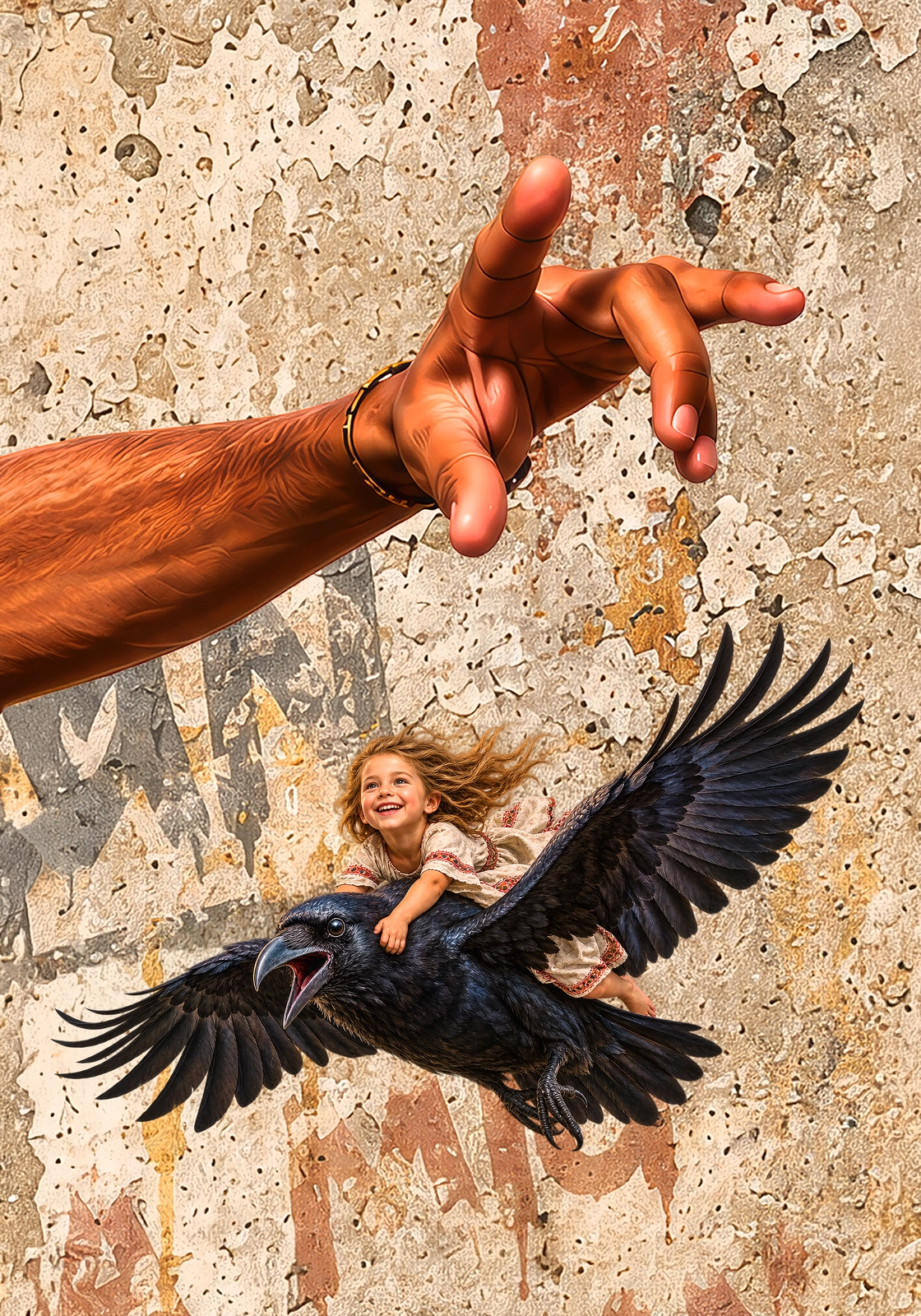
But the story does not remain confined to memory. In the grown woman’s recurring dream, something reality might never allow happens: the crow survives. It grows enormous, returns to the girl, and carries her across Sweden on its back as a gigantic hand tries to seize them. Is the hand death, fate, reality, or the well-meaning adult world that wants to bring the child back down to earth and teach her to accept the inevitable?
Once, the girl carried the crow.
In the dream, their roles are reversed.
Now it is the crow that carries her – and teaches her to fly.
“The Crow That Taught Me to Fly
I bore thee once when broken was thy wing,
When death lay dark beneath each feathered breath;
A child, I knew no wisdom age could bring,
I only knew I would not yield to death.
I ran as though my feet could conquer fate,
As though my arms might hold thy life in place;
I did not know the road might be too late,
Nor why the dying world should ask for grace.
The years went by. The child became the old,
And men made metaphors of bird and flight;
They dressed my crow in dreams of red and gold,
And made its wounded wing their failing light.
Yet still, at night, I hear thee call my name,
No dying creature trembling in my hand,
But vast and black, with eyes like living flame,
Thy wings spread wide above my sleeping land.
Then I am young. I climb upon thy back,
And Sweden opens far beneath our flight;
The lakes are glass, the forests blue and black,
The northern mountains burn with morning light.
But through the clouds a giant hand appears,
Its fingers reaching silently for thee.
Is it the fate that gathers up our years?
Is it the truth that says we are not free?
Is it death, returning for its due,
Or merely reason calling us below?
I do not know. I only cling to you,
And feel your mighty wings refuse to slow.
For once I carried thee when thou couldst not fly,
And would not leave thee wounded on the ground.
Now thou dost bear me underneath the sky,
Where neither death nor destiny is found.
And if that hand should follow evermore,
Let still thy wings beat fiercely through the air.
For hope is not the certainty we soar—
It is the choice to fly while fear is there.
So carry me where childhood does not end,
Where wounded things may rise instead of die.
I saved thee once, my dark and feathered friend.
And now, my crow, thou teachest me to fly.”
Malmö, October 2026
PROLOGUE – The Crow That Refuses to Die
A little girl sits on the back of an enormous black crow, laughing. Her hair streams in the wind as the bird carries her through the air on powerful wings. It is a strange image, almost as if it had been taken from Selma Lagerlöf’s The Wonderful Adventures of Nils Holgersson. But there is no Akka from Kebnekaise, no tame goose named Mårten, and no flock of wild geese. Only a girl and a crow remain, and by all rights, the bird should be dead.
Above them stretches an enormous hand, its fingers spread wide in an attempt to seize the two fugitives. We never learn whose hand it is. Perhaps it is fate, seeking to restore the order the crow has disrupted by surviving, or perhaps death itself, refusing to accept that its intended victim has escaped. Or is it reality, the inexorable reason of the adult world, trying to capture childhood dreams and force them back to earth?
The image contains a contradiction that only becomes comprehensible when we understand its origins. Once, this same girl ran through a forest, carrying a wounded crow in her arms, desperately trying to reach a veterinarian before it was too late. Her father, the artist Oscar Cleve, captured the incident in a drawing that, many years later, inspired Mikael Wiehe to write one of his most beloved songs. In Wiehe’s interpretation, the dying crow also became a metaphor for faltering political hope, for the wounded dreams of socialism, and for a generation beginning to doubt whether the world could ever be truly changed.
But in this picture, something has happened that neither the artist nor the musician could have foreseen. The crow has survived, and the little girl who once tried to save its life has been rescued. Many years later, when she has become a grown woman, the bird returns in her dreams, carrying her on dizzying flights across Sweden. The enormous hand pursues them, but never quite manages to catch them.
That is why the girl is laughing. Not because she has defeated death or overcome reality, but because, for a brief moment, she has escaped both. She has discovered that hope can endure even when all reason argues against it, and that someone who once saved another life may, in turn, be saved herself.
The picture is therefore more than an illustration of a recurring dream. It is also the continuation of a story that began with a child’s despair, became an artist’s drawing, and later a musician’s reckoning with his own lost illusions.
Now it is the girl’s turn to tell the story, and she has grown into an older woman.
Many years have passed since that day, yet sometimes I need only hear the opening notes of Mikael Wiehe’s “The Girl and the Crow” to feel that little bird’s body against my chest once more. Memory is a curious thing. I may have forgotten people whose company I enjoyed for years, faces that were once familiar parts of my everyday life, but I have never forgotten that crow. Nor have I forgotten the despair that seized me when I realised it was dying and that I might be the only person left who could still do anything to help it.
I was only a child and knew almost nothing about death. I knew that people and animals could die, and that once they were dead, they could not be brought back to life. But I had not yet learned the adult world’s peculiar ability to accept the inevitable. To me, death was still something to protest against, something one might perhaps outrun if only one ran fast enough.
That was why I ran. I wanted the bird to survive.
That Day in the Forest
I no longer remember every detail surrounding my discovery of the crow. Memory has changed over the years, and sometimes I wonder whether I remember the event itself or only my father’s drawing and Wiehe’s song. But I remember the feeling as I lifted the bird from the ground and realised it was still alive.
It was larger than I had imagined. As a child, I had watched crows from a distance, hopping about in fields or perched high in trees, cawing at the world with an assurance that could almost be mistaken for insolence. Up close, this one was different. It was no longer that noisy, rather disagreeable bird that adults sometimes chased away. It was a living creature in pain, unable to understand why it could no longer fly.
I held it carefully against me, trying not to touch its injured wing. I remember how frightened I was of hurting it further, even as I knew I had to hold it firmly enough not to drop it. It moved faintly in my arms, and I thought I could feel its heart beating beneath the feathers.
I had heard that a veterinarian could help sick animals, and to my childish mind the solution seemed simple. If only I could get there, everything would be all right. The veterinarian would know what to do, perhaps bandage the wing or give the bird some medicine, and then it would recover.
But the distance was considerable, at least for a child carrying an injured crow. I ran as fast as I could, stumbling over roots and stones as I tried to protect the bird from the jolts. Sometimes I scarcely dared look down, fearing what I might find. I wanted to feel that it was still moving, that there was still warmth beneath its feathers.
Strangely enough, I don’t remember feeling any anger towards whoever shot it. That came later. At the time, there was no room for anything but the fear of arriving too late. Only much later did I begin to wonder what makes a person shoot a bird that has done them no harm, and why certain animals are regarded as so insignificant that their suffering scarcely counts.
Had it been a swan, an eagle, or some other magnificent bird, perhaps more people would have reacted. But it was only a crow, one of those grey-and-black birds that rarely evoke anything beautiful in the human imagination.
To me, however, it was the most important creature in the world for those minutes. I had lifted it from the ground and, without fully understanding what I was doing, had assumed a responsibility I could no longer set aside.
My Father’s Drawing
Many years later, when I looked at my father’s drawing, I discovered something I had never considered as a child. He had not merely drawn a girl running with an injured bird. He captured a moment when two entirely different understandings of the world confronted one another.
I saw the crow as a life that had to be saved. He also saw the strange, perhaps tragic, contradiction between my conviction and the limitations imposed by reality. I do not believe he was making fun of me, although his drawing had something of the laconic humour that often characterised his work. He naturally recognised the almost absurd nature of my undertaking, but he also recognised its seriousness.
That was precisely what moved me so deeply when, as an adult, I returned to the picture. My father had not portrayed me as some little heroine who would triumphantly save an animal. He let me remain a child who ran because she had not yet learned to give up.
The drawing was titled Little Girl Hurries to the veterinarian with a Wounded Crow. Something almost comical about its matter-of-fact wording, as though it were a newspaper caption describing an everyday occurrence. Yet behind those words lies a despair no newspaper headline could ever capture.
Over the years, I have also come to understand what it means to be portrayed in that moment. In reality, time moved on. I grew older, left childhood behind, and experienced everything that comes with adult life. But the girl in the drawing was never allowed to grow older. She kept running with the same despair, the same laboured breathing, and the same unreasonable hope that she might still save the bird.
In a sense, my father had taken a moment from my life and made it independent of me. The picture no longer belonged solely to my childhood. It had become something others could recognise themselves in, something they could interpret and perhaps even use to understand their own lives.
I could not yet imagine how far that transformation would go.
When Mikael Wiehe took over the story
Many years later, I learned that Mikael Wiehe had seen my father’s drawing and, so moved, had written a song. When I first heard The Girl and the Crow, it was a strange experience, almost as if someone else were telling a story I had lived through myself, though I no longer had exclusive rights to it.
It was still I who was running, still the same injured bird, and still the same desperate attempt to arrive in time. Yet something fundamental had changed.
My father had captured movement in a picture. He gave it progression, rhythm, and voice. In the music, I could almost feel one footstep after another, my breathing growing heavier, and the distance to the vet growing as my strength diminished. It was as though he had heard something in the drawing that even my father had not been able to express through his lines.
Above all, however, he had understood something about my despair for which I had never found the words.
When I ran with the crow, I knew it might die. I was not so young as to believe every injured animal could be saved. But I refused to let that knowledge dictate what I should do. As long as there remained even the smallest possibility that the bird was still alive, there was a reason to continue.
Wiehe seized on this contradiction. He recognised that hope is not always grounded in the conviction that something will succeed. Sometimes, on the contrary, hope is strongest when we begin to suspect that everything is already lost, because then it is no longer a question of probabilities but of what we ourselves are prepared to abandon.
That interpretation moved me deeply, but it also surprised me. To me, the event had always been about a crow. To Wiehe, it concerned something much greater. As I gradually came to understand his political background, I realised why this particular little bird had acquired such significance for him.
The Crow and the lost dreams
When The Girl and the Crow appeared on the album “Kråksånger” (Crow Songs) in 1981, the Swedish left and the progressive music movement were in transition. The faith in the future that had characterised much of the 1960s and 1970s had begun to weaken. The society that so many had imagined would emerge through solidarity, equality, and collective struggle no longer seemed as certain to become reality.
I have tried to understand what this meant to someone like Wiehe, who had spent so many years singing about the possibility of changing the world. Hoola Bandoola Band was more than a musical phenomenon; it was part of a political culture in which songs could unite people around shared convictions. A powerful belief held that history had a direction and, despite setbacks, pointed towards a more just society.
But what happens when such a conviction begins to weaken?
Looking back, it is easy to describe the decline of the progressive movement as the result of shifting political circumstances, but I believe it also reflected a deeper disappointment. Many people had not merely fought for political reforms; they had invested their lives, friendships, and personal identities in the vision of a different future. When that dream began to lose its power, it was not merely a political theory being questioned. It was part of the people themselves.
Moreover, the socialist movement had its own contradictions to confront. The equality intended to liberate people could sometimes become an expectation of conformity. Collective solidarity could conflict with individual freedom, and political conviction could harden into an orthodoxy that treated dissenting opinions as betrayal. What began as a dream of emancipation risked losing some of its human warmth when ideology became more important than the people it was meant to serve.
I do not know to what extent Wiehe himself considered these contradictions when he wrote the song. But I can understand how the wounded crow became an image of his faltering hope. It was not dead, but it could no longer fly. It still held the possibility of another life, yet someone had injured it so severely that its future had become uncertain.
And there I was, running with it clutched in my arms.
When I think about it today, something both beautiful and sorrowful emerges: my childhood despair could become an image of an entire generation’s political disillusionment. At the same time, I have occasionally resisted that interpretation. I was not trying to save socialism. I was trying to save a crow.
That distinction matters.
The Individual and the Great Ideas
The older I have become, the more I have reflected on the relationship between immediate human compassion and the great political ideas that purport to explain the world.
As a child, I needed no ideology to recognise that the crow was suffering. I did not need to consider its place in nature, its usefulness to society, or its symbolic significance. It was injured and needed help, and that was enough for me.
Perhaps that is precisely why I believe Wiehe’s song still holds such power. It does not begin with a political programme but with a human act that is comprehensible regardless of one’s opinions. Only afterwards does that act acquire its wider significance.
But there is also a danger here. When people are reduced to symbols, their actual experiences risk being lost behind the ideas they are expected to represent. Someone who sees the crow as an image of socialism may forget that it is, in fact, an animal in pain. Someone who sees me as a symbol of political idealism may forget that I was a frightened child trying to do something good.
I believe Wiehe understood this better than many of those who later analysed his song. He did not let the political interpretation replace the human story, but allowed the two to coexist. That is why the song can still move people with no connection to the Swedish progressive movement who may not even know the political circumstances in which it was written.
There is also something liberating about his choice of a crow. Had it been a white dove, the symbolism would have been almost predetermined. The dove would have suggested peace, reconciliation, and human goodness. The crow, by contrast, is a more troublesome creature. It is noisy, grey-and-black, and not particularly popular, yet it is also intelligent, resilient, and integral to nature.
Perhaps that was precisely what made it such a useful metaphor. What deserves saving need not be beautiful, admired, or even particularly easy to love.
When a Dove joined the Crow
A few years later, the wounded bird returned in Wiehe’s world, this time in another form. In Som en duva (Like a Dove), which appeared on the album he recorded with Björn Afzelius in 1986, we encounter a bird marked by violence and persecution, seeking refuge with a human being.
When I later saw the two birds together in an Arcimboldo-inspired portrait of Wiehe, I began to reflect on how remarkably close these two stories are.
My crow was a creature I was trying to save. The dove came to the human being of its own accord and needed to be welcomed. In both cases, the fundamental question was the same: what do we do when something vulnerable and wounded is placed in our hands?
But the dove also carried another story. The song concerned Latin American political refugees who had come to Sweden after being forced to leave their homelands. The wounded bird thus became an image of people who had lost their security and their homes, and sometimes even those closest to them, yet still carried the hope that life might begin again.
I like to think of these two birds as relatives, even though their stories differ. The crow perhaps represents the hope that is dying within us, while the dove represents the hope we can offer another person by opening our hands.
And somewhere between them stands Mikael Wiehe with his guitar, still preoccupied with the same question that once made him pause before my father’s drawing.
What is hope really worth if it exists only as long as we are certain of success?
The Crow That Taught Me to Fly
A dream has accompanied me throughout most of my adult life. It does not come every night. Sometimes several years pass between its appearances, but when it returns, it is so vivid that I wake feeling as if I have truly been somewhere else. I can feel the wind in my hair, remember the landscape beneath me, and almost hear the tremendous beating of the wings of the bird I once believed I would lose forever.
In the dream, the crow survives.
I never quite know how it happened. Perhaps I reached the vet in time that day, perhaps he managed to save the injured wing, or perhaps the dream has decided that death shall not have the final word. Such things require no explanation in dreams. What is strange is that I am never surprised when the crow returns. I recognise it immediately, though it has grown so enormous that I can easily sit on its back.
It usually comes to me early in the morning, when the world is still suspended between night and day. I hear a caw outside the window, and when I draw back the curtain, there it sits on the windowsill or on a nearby branch. It watches me with its wise, dark eyes, tilts its head to one side, and seems to wonder why I am taking so long.
Only when I open the window do I realise I have once again become the little girl from my father’s drawing. My hands are small, my hair falls over my shoulders, and I am wearing the same dress as on the day I ran through the forest. But now I am not afraid, at least not at first. The crow lowers one wing so I can climb onto its back, and when I carefully grasp its feathers, I feel a warmth that reminds me of how cold it once was in my arms.
Then we take flight.
The first time it happened, I thought we would fall, but the crow rose with such effortless assurance that my fear soon gave way to an almost overwhelming joy. The houses shrank beneath us, roads became narrow ribbons winding through the countryside, and people shrank to specks. I had never understood how beautiful the world could be from above, and I laughed so loudly that the crow turned its head and cawed at me, almost as though it were laughing in return.
I have often thought of Selma Lagerlöf’s “Nils Holgersson” when trying to describe the dream to myself. Like him, I can travel across Sweden on the back of a bird, and like him, I discover a country that is both familiar and strange. But while Nils’s journey was an educational expedition through Sweden’s landscapes, mine has become a flight through memories, hopes, and things I came to understand only much later in life.
We fly over the yellow rapeseed fields of Skåne, where farms lie scattered like little islands in a sea of green and gold. We pass Malmö, and I see the enormous cranes of the Kockums shipyard, the factories, and the long streets where people hurry to work. Sometimes I hear music rising from the city, and as we draw closer, I think I can make out a guitar and a voice I recognise. Then I think of Mikael Wiehe and wonder whether, somewhere down there, he is still singing about the little girl who tried to save a crow.
We continue northwards over the forests and lakes of Småland, across the gleaming waters of Lake Vättern and the great plains where roads and railways cut through the landscape. Farther away lie the old industrial communities of Bergslagen and the red cottages of Dalarna. Sometimes the crow carries me so high that I can watch cloud shadows travel across entire landscapes. When we finally reach Norrland, the forests spread out beneath us like an endless dark-green blanket, crossed by rivers glittering in the sunlight.
But we see more than landscapes. The crow seems determined to show me the people living below, and sometimes it flies so low that I can make out their faces. I see children playing outside schools, older people sitting alone at their windows, and workers leaving factories where the machinery has fallen silent. I see people demonstrating for a better future, and others turning their backs on them. I begin to understand that the country, which appears so peaceful from above, contains both great hopes and profound disappointments.
Then I notice the hand for the first time.
It suddenly appears from one side, enormous and strangely alien against the open sky. It resembles a human hand, yet it is so large that its fingers seem capable of enclosing both the crow and me. It reaches towards us with a slow, almost certain movement, as though it already knows we must sooner or later fall into its grasp.
The crow swerves sharply, and the hand closes on empty air. I cling to the feathers as we plunge through the clouds. When we find air beneath our wings again, I see that the hand is still pursuing us.
The strange thing is that it never looks entirely threatening. It is not clenched into a fist and carries no weapon. Its fingers are outstretched, almost as though they wish to caress us or gently lift us down from the sky. Yet I feel paralysed whenever it approaches, because somehow I know that our journey will be over if it catches us.
Sometimes I believe the hand belongs to death. That would perhaps be the simplest explanation, since death once tried to take the crow from me. In the dream, the bird escapes, and the hand returns to restore the order we disturbed by taking flight.
At other times, I imagine it belongs to fate, that mysterious power people so readily appeal to when they can no longer explain why something has happened. If fate had already decided that the crow must die, perhaps it is not so surprising that it now tries to capture us when we defy its decree.
But over the years, I have begun to suspect that the hand represents something even closer to us, perhaps for that very reason something more frightening.
It might be reality itself.
The reality that tells us birds with shattered wings do not suddenly grow large enough to carry little girls across Sweden. The reality that reminds us that childhood is over, that people grow old, and that the dreams we once regarded as self-evident do not always come true. The reality that eventually demands that we stop flying and return to the ground, where everything has its appointed weight and where not even the strongest will can overturn the laws of nature.
Some nights, the hand almost catches us. I feel its fingertips brush my dress, and then the crow surges forward with such force that its whole body trembles. We fly between mountain peaks, across dark lakes, and through narrow valleys the hand cannot follow. Sometimes we hide among the clouds, and when we emerge on the other side, the sun has begun to rise over a landscape I have never seen.
In these moments, I feel the greatest gratitude towards the crow. It no longer flies merely for its own sake but for mine as well, and I realise our roles have been reversed. Once, I carried it through the forest and tried to save its life. Now it carries me through the sky and tries to save something within me that I might otherwise have lost.
I have sometimes wondered whether the hand might also represent the political reality Mikael Wiehe sought to understand when he wrote his song. Perhaps it is the same force that slowly seized the dreams of the 1970s and dragged them back into a world where economic interests, power structures, and human weakness proved far harder to change than anyone had imagined.
From our position high above Sweden, I watch the red banners fade, the protest marches thin, and people who once marched together begin to walk in different directions. Some have abandoned their ideals, others have adapted them to a changing society, while still others continue to hold fast to the conviction that the world can be different.
But I also see that it is not merely their opponents who threaten the old dreams. Sometimes those dreams have become so rigidly bound to particular visions of a just society that they have almost forgotten the people who were meant to live within it. The dream of equality has, in some places, become a pursuit of uniformity, and the solidarity meant to give people greater freedom has sometimes been used to demand submission to the collective.
Perhaps that is why the hand never has a face. It is not a particular political movement, a specific social class, or any identifiable enemy. Rather, it represents all the forces that seek to persuade human beings to accept that the world must remain exactly as it is.
Yet the crow continues to fly.
And there is something wonderfully liberating about the fact that this very bird, once wounded and helpless in my arms, has now become stronger than anything that tries to keep us on the ground. It is no longer the awkward, grey-and-black creature that people could dismiss with a shrug. It is an enormous bird with gleaming plumage and wings that seem capable of carrying us as far as we wish.
Sometimes we fly all the way to the mountains of Lapland, where snow still lies on the summits even when summer has arrived in the valleys. Up there, the air grows thinner, and the sky becomes so intensely blue that merely looking at it makes me almost dizzy. The crow slows and lets itself be carried on the rising currents of air, and for a few wonderful minutes there is neither hand nor fear nor anything else to disturb our flight.
That is when I usually ask why it keeps coming back to me.
Naturally, it does not answer in words. It merely turns its head and regards me with its dark eye, and sometimes I think I detect something resembling a smile in its open beak. But I believe I understand the answer all the same.
It returns because I once refused to give it up.
And perhaps that is also why it never allows the hand to capture us. It knows what it means to lie helpless on the ground. At the same time, life slowly slips away, and it knows there are moments when the only hope of rescue lies in someone else’s refusal to accept what seems inevitable.
Towards the end of the dream, we always set out southwards again. I recognise the landscapes beneath us and realise that our flight is drawing to a close. The hand appears one final time, larger than ever, and this time it does not come from behind but comes straight towards us. Its fingers open like an enormous gate, and for a moment I am convinced that we cannot possibly escape.
But the crow does not hesitate. Gathering its last reserves of strength, it spreads its wings and flies directly towards the gap between two fingers. I close my eyes and cling so tightly that my hands ache, then feel us pass through the narrow gap and emerge once more into the open air.
When I dare to open my eyes, the hand has vanished.
We fly a little longer, but now the landscape beneath us is familiar. The crow slowly descends towards the ground, and I see the forest where everything once began. The trees are still there, the path winds between them, and somewhere farther away lies the road to the vet. When we land, I carefully climb down from its back and stroke its great black feathers.
I want to ask it to stay, but I know it cannot. It must continue its journey, and I must return to my own life. Before taking flight, however, it bends its head towards me, and for a moment our eyes meet, just as they did on that day so many years ago.
Then I awaken.
It always takes a little while before I realise where I am. I am lying in my own bed, once again a grown woman, and outside the window I hear the familiar sounds of a world where crows do not carry human beings on their backs. Yet the sensation of flight lingers, and sometimes I almost feel a black feather between my fingers.
I have never managed to decide what the hand truly represents. Perhaps it is death, perhaps fate, or perhaps the reality that eventually catches up with us all. Yet another possibility has increasingly occupied my thoughts over the years.
What if the hand is not trying to harm us?
What if it belongs to someone who wants to protect us from the dangers of flying, someone who wishes to bring us back to the safety of the ground and to persuade us that it is better to accept the world’s limitations than to keep challenging them? In that case, the hand becomes almost more frightening, because it represents not evil but the well-intentioned wisdom that so often persuades people to abandon their dreams.
Perhaps it is the grown woman’s own hand, trying to seize the little girl she once was.
And perhaps that is why I never want the crow to allow itself to be caught.
I know now that human beings cannot fly on the backs of birds and that no dream can undo what has already happened. But I also know that life would become unbearably impoverished if we allowed ourselves to hope only for things that seemed possible from the outset.
When I think of Mikael Wiehe’s song, I realise that my recurring dream may not be about escaping reality at all. Rather, it is about refusing to let reality set the limits of what is still worth longing for.
And sometimes, when I sit by my window and watch a crow take flight from a rooftop, I cannot help but smile at the thought that perhaps it is coming to fetch me again.
Deep within me, the little girl who ran through the forest with a wounded bird in her arms still lives.
The only difference is that she now knows what it feels like to fly.
EPILOGUE – What Remained
I have sometimes wondered what the little girl in the drawing would think if she could learn everything that happened afterwards. She would probably be astonished that so many people had taken an interest in her running, that art historians and music writers had discussed her significance, and that a song about her despair had come to be associated with the crisis of socialism and with an entire generation’s lost faith in the future.
Perhaps she would also grow a little impatient. After all, she had no time to stop and listen to such arguments. She had an injured bird in her arms, and somewhere ahead, a veterinarian might be able to help.
But I am no longer that girl. I have lived long enough to understand that the world is more complicated than I believed on that day, and that good intentions do not always lead to good outcomes. I have seen people struggle for convictions that later proved mistaken, and others abandon their ideals because they could no longer bear the disappointment. I have also learned that anyone who wishes to change the world must be prepared to question their own beliefs, even when it hurts.
That does not mean I regret running.
On the contrary, over the years I have become increasingly convinced that something essential lay precisely there, in my childhood inability to accept another creature’s suffering. I did not know whether I could save the crow, but I knew I could not leave it behind. It was no great philosophical insight, nor was it a political statement. It was simply the instinctive feeling that a life slipping away also concerns the person who happens to witness it.
My father captured that feeling. Mikael Wiehe turned it into a song and found in it an image of his own faltering hope. Since then, others have heard the song and recognised their own losses, their own failures, and their own attempts to hold on to something that may already have been lost.
It is strange to think that all of this began with a little girl and a wounded crow.
Sometimes, when I hear the song, I close my eyes and try to remember what it was really like. Once again, I feel the weight of the bird in my arms, the growing exhaustion, and the fear of arriving too late. But I also remember how natural it felt to keep running, even though I had no idea how the story would end.
And perhaps this is precisely what I would like to say to Mikael Wiehe, after all these years.
You were welcome to borrow my crow for your political dreams. You were welcome to let it carry the sorrow of a movement that had begun to lose faith in itself and of a society that had not become what people had hoped it would be. I now understand why you did so, and I am grateful that you saw something in my father’s drawing that made my little despair comprehensible to so many others.
But I hope you also understood that I was never running for any ideology. I was running because I held a dying animal in my arms and could not bear to abandon it.
And if today, with all my adult experience and everything I have learned about how seldom life fulfils our hopes, I were once again standing in the forest with that same wounded crow before me, I truly believe I would do exactly what I did then.
I would lift it, hold it gently to my chest, and begin to run.
Not because I knew it would survive, but because I still couldn’t bring myself to leave it.
Perhaps that is precisely why Mikael Wiehe’s song has never left me.
Jörgen Thornberg
The Crow That Taught Me to Fly - ENGLISH VERSION, 2026
Digital
50 x 70 cm
2 900 kr
The Crow That Taught Me to Fly - Kråkan som lärde mig flyga
Svensk text i slutet
INTRODUCTION – The Crow That Taught Me to Fly
It begins with something very simple: a child finds a wounded crow and tries to save it. She picks up the bird, holds it close to her body, and runs towards the vet, convinced there is still time. To her, there is no symbolism, no politics and no larger story: only a dying animal and a child who refuses to accept that nothing can be done.
But the moment endures. The girl’s father captures her desperate dash in a drawing, and many years later the image takes on new life when Mikael Wiehe sees it and writes ”The Girl and the Crow”. There, the story shifts. The wounded bird becomes not only a crow but also an image of wounded hope, of the Swedish progressive movement’s faltering faith in the future, and of a socialism whose dream of equality and solidarity is beginning to confront its own contradictions.
Yet the real girl remains behind all these interpretations. She grows up and eventually grows old, and can look back on what happened with an experience she lacked when she ran through the forest. She can understand the artist’s gaze and Wiehe’s political metaphor, but she can also challenge them. To her, the crow was never primarily a symbol. It was warm against her body, in pain, dying – and she wanted to save it.
In ”The Crow That Taught Me to Fly”, she is therefore able to reclaim the story for herself. She remembers the child she once was, her father’s picture, and, many years later, the strange experience of hearing something that had happened to her transformed into one of Mikael Wiehe’s best-known songs. She also looks back at the political world that turned the crow into a metaphor and asks what happens when great ideas become so vast that the human being – or the small, wounded creature – risks disappearing behind them.
But the story does not remain confined to memory. In the grown woman’s recurring dream, something reality might never allow happens: the crow survives. It grows enormous, returns to the girl, and carries her across Sweden on its back as a gigantic hand tries to seize them. Is the hand death, fate, reality, or the well-meaning adult world that wants to bring the child back down to earth and teach her to accept the inevitable?
Once, the girl carried the crow.
In the dream, their roles are reversed.
Now it is the crow that carries her – and teaches her to fly.
“The Crow That Taught Me to Fly
I bore thee once when broken was thy wing,
When death lay dark beneath each feathered breath;
A child, I knew no wisdom age could bring,
I only knew I would not yield to death.
I ran as though my feet could conquer fate,
As though my arms might hold thy life in place;
I did not know the road might be too late,
Nor why the dying world should ask for grace.
The years went by. The child became the old,
And men made metaphors of bird and flight;
They dressed my crow in dreams of red and gold,
And made its wounded wing their failing light.
Yet still, at night, I hear thee call my name,
No dying creature trembling in my hand,
But vast and black, with eyes like living flame,
Thy wings spread wide above my sleeping land.
Then I am young. I climb upon thy back,
And Sweden opens far beneath our flight;
The lakes are glass, the forests blue and black,
The northern mountains burn with morning light.
But through the clouds a giant hand appears,
Its fingers reaching silently for thee.
Is it the fate that gathers up our years?
Is it the truth that says we are not free?
Is it death, returning for its due,
Or merely reason calling us below?
I do not know. I only cling to you,
And feel your mighty wings refuse to slow.
For once I carried thee when thou couldst not fly,
And would not leave thee wounded on the ground.
Now thou dost bear me underneath the sky,
Where neither death nor destiny is found.
And if that hand should follow evermore,
Let still thy wings beat fiercely through the air.
For hope is not the certainty we soar—
It is the choice to fly while fear is there.
So carry me where childhood does not end,
Where wounded things may rise instead of die.
I saved thee once, my dark and feathered friend.
And now, my crow, thou teachest me to fly.”
Malmö, October 2026
PROLOGUE – The Crow That Refuses to Die
A little girl sits on the back of an enormous black crow, laughing. Her hair streams in the wind as the bird carries her through the air on powerful wings. It is a strange image, almost as if it had been taken from Selma Lagerlöf’s The Wonderful Adventures of Nils Holgersson. But there is no Akka from Kebnekaise, no tame goose named Mårten, and no flock of wild geese. Only a girl and a crow remain, and by all rights, the bird should be dead.
Above them stretches an enormous hand, its fingers spread wide in an attempt to seize the two fugitives. We never learn whose hand it is. Perhaps it is fate, seeking to restore the order the crow has disrupted by surviving, or perhaps death itself, refusing to accept that its intended victim has escaped. Or is it reality, the inexorable reason of the adult world, trying to capture childhood dreams and force them back to earth?
The image contains a contradiction that only becomes comprehensible when we understand its origins. Once, this same girl ran through a forest, carrying a wounded crow in her arms, desperately trying to reach a veterinarian before it was too late. Her father, the artist Oscar Cleve, captured the incident in a drawing that, many years later, inspired Mikael Wiehe to write one of his most beloved songs. In Wiehe’s interpretation, the dying crow also became a metaphor for faltering political hope, for the wounded dreams of socialism, and for a generation beginning to doubt whether the world could ever be truly changed.
But in this picture, something has happened that neither the artist nor the musician could have foreseen. The crow has survived, and the little girl who once tried to save its life has been rescued. Many years later, when she has become a grown woman, the bird returns in her dreams, carrying her on dizzying flights across Sweden. The enormous hand pursues them, but never quite manages to catch them.
That is why the girl is laughing. Not because she has defeated death or overcome reality, but because, for a brief moment, she has escaped both. She has discovered that hope can endure even when all reason argues against it, and that someone who once saved another life may, in turn, be saved herself.
The picture is therefore more than an illustration of a recurring dream. It is also the continuation of a story that began with a child’s despair, became an artist’s drawing, and later a musician’s reckoning with his own lost illusions.
Now it is the girl’s turn to tell the story, and she has grown into an older woman.
Many years have passed since that day, yet sometimes I need only hear the opening notes of Mikael Wiehe’s “The Girl and the Crow” to feel that little bird’s body against my chest once more. Memory is a curious thing. I may have forgotten people whose company I enjoyed for years, faces that were once familiar parts of my everyday life, but I have never forgotten that crow. Nor have I forgotten the despair that seized me when I realised it was dying and that I might be the only person left who could still do anything to help it.
I was only a child and knew almost nothing about death. I knew that people and animals could die, and that once they were dead, they could not be brought back to life. But I had not yet learned the adult world’s peculiar ability to accept the inevitable. To me, death was still something to protest against, something one might perhaps outrun if only one ran fast enough.
That was why I ran. I wanted the bird to survive.
That Day in the Forest
I no longer remember every detail surrounding my discovery of the crow. Memory has changed over the years, and sometimes I wonder whether I remember the event itself or only my father’s drawing and Wiehe’s song. But I remember the feeling as I lifted the bird from the ground and realised it was still alive.
It was larger than I had imagined. As a child, I had watched crows from a distance, hopping about in fields or perched high in trees, cawing at the world with an assurance that could almost be mistaken for insolence. Up close, this one was different. It was no longer that noisy, rather disagreeable bird that adults sometimes chased away. It was a living creature in pain, unable to understand why it could no longer fly.
I held it carefully against me, trying not to touch its injured wing. I remember how frightened I was of hurting it further, even as I knew I had to hold it firmly enough not to drop it. It moved faintly in my arms, and I thought I could feel its heart beating beneath the feathers.
I had heard that a veterinarian could help sick animals, and to my childish mind the solution seemed simple. If only I could get there, everything would be all right. The veterinarian would know what to do, perhaps bandage the wing or give the bird some medicine, and then it would recover.
But the distance was considerable, at least for a child carrying an injured crow. I ran as fast as I could, stumbling over roots and stones as I tried to protect the bird from the jolts. Sometimes I scarcely dared look down, fearing what I might find. I wanted to feel that it was still moving, that there was still warmth beneath its feathers.
Strangely enough, I don’t remember feeling any anger towards whoever shot it. That came later. At the time, there was no room for anything but the fear of arriving too late. Only much later did I begin to wonder what makes a person shoot a bird that has done them no harm, and why certain animals are regarded as so insignificant that their suffering scarcely counts.
Had it been a swan, an eagle, or some other magnificent bird, perhaps more people would have reacted. But it was only a crow, one of those grey-and-black birds that rarely evoke anything beautiful in the human imagination.
To me, however, it was the most important creature in the world for those minutes. I had lifted it from the ground and, without fully understanding what I was doing, had assumed a responsibility I could no longer set aside.
My Father’s Drawing
Many years later, when I looked at my father’s drawing, I discovered something I had never considered as a child. He had not merely drawn a girl running with an injured bird. He captured a moment when two entirely different understandings of the world confronted one another.
I saw the crow as a life that had to be saved. He also saw the strange, perhaps tragic, contradiction between my conviction and the limitations imposed by reality. I do not believe he was making fun of me, although his drawing had something of the laconic humour that often characterised his work. He naturally recognised the almost absurd nature of my undertaking, but he also recognised its seriousness.
That was precisely what moved me so deeply when, as an adult, I returned to the picture. My father had not portrayed me as some little heroine who would triumphantly save an animal. He let me remain a child who ran because she had not yet learned to give up.
The drawing was titled Little Girl Hurries to the veterinarian with a Wounded Crow. Something almost comical about its matter-of-fact wording, as though it were a newspaper caption describing an everyday occurrence. Yet behind those words lies a despair no newspaper headline could ever capture.
Over the years, I have also come to understand what it means to be portrayed in that moment. In reality, time moved on. I grew older, left childhood behind, and experienced everything that comes with adult life. But the girl in the drawing was never allowed to grow older. She kept running with the same despair, the same laboured breathing, and the same unreasonable hope that she might still save the bird.
In a sense, my father had taken a moment from my life and made it independent of me. The picture no longer belonged solely to my childhood. It had become something others could recognise themselves in, something they could interpret and perhaps even use to understand their own lives.
I could not yet imagine how far that transformation would go.
When Mikael Wiehe took over the story
Many years later, I learned that Mikael Wiehe had seen my father’s drawing and, so moved, had written a song. When I first heard The Girl and the Crow, it was a strange experience, almost as if someone else were telling a story I had lived through myself, though I no longer had exclusive rights to it.
It was still I who was running, still the same injured bird, and still the same desperate attempt to arrive in time. Yet something fundamental had changed.
My father had captured movement in a picture. He gave it progression, rhythm, and voice. In the music, I could almost feel one footstep after another, my breathing growing heavier, and the distance to the vet growing as my strength diminished. It was as though he had heard something in the drawing that even my father had not been able to express through his lines.
Above all, however, he had understood something about my despair for which I had never found the words.
When I ran with the crow, I knew it might die. I was not so young as to believe every injured animal could be saved. But I refused to let that knowledge dictate what I should do. As long as there remained even the smallest possibility that the bird was still alive, there was a reason to continue.
Wiehe seized on this contradiction. He recognised that hope is not always grounded in the conviction that something will succeed. Sometimes, on the contrary, hope is strongest when we begin to suspect that everything is already lost, because then it is no longer a question of probabilities but of what we ourselves are prepared to abandon.
That interpretation moved me deeply, but it also surprised me. To me, the event had always been about a crow. To Wiehe, it concerned something much greater. As I gradually came to understand his political background, I realised why this particular little bird had acquired such significance for him.
The Crow and the lost dreams
When The Girl and the Crow appeared on the album “Kråksånger” (Crow Songs) in 1981, the Swedish left and the progressive music movement were in transition. The faith in the future that had characterised much of the 1960s and 1970s had begun to weaken. The society that so many had imagined would emerge through solidarity, equality, and collective struggle no longer seemed as certain to become reality.
I have tried to understand what this meant to someone like Wiehe, who had spent so many years singing about the possibility of changing the world. Hoola Bandoola Band was more than a musical phenomenon; it was part of a political culture in which songs could unite people around shared convictions. A powerful belief held that history had a direction and, despite setbacks, pointed towards a more just society.
But what happens when such a conviction begins to weaken?
Looking back, it is easy to describe the decline of the progressive movement as the result of shifting political circumstances, but I believe it also reflected a deeper disappointment. Many people had not merely fought for political reforms; they had invested their lives, friendships, and personal identities in the vision of a different future. When that dream began to lose its power, it was not merely a political theory being questioned. It was part of the people themselves.
Moreover, the socialist movement had its own contradictions to confront. The equality intended to liberate people could sometimes become an expectation of conformity. Collective solidarity could conflict with individual freedom, and political conviction could harden into an orthodoxy that treated dissenting opinions as betrayal. What began as a dream of emancipation risked losing some of its human warmth when ideology became more important than the people it was meant to serve.
I do not know to what extent Wiehe himself considered these contradictions when he wrote the song. But I can understand how the wounded crow became an image of his faltering hope. It was not dead, but it could no longer fly. It still held the possibility of another life, yet someone had injured it so severely that its future had become uncertain.
And there I was, running with it clutched in my arms.
When I think about it today, something both beautiful and sorrowful emerges: my childhood despair could become an image of an entire generation’s political disillusionment. At the same time, I have occasionally resisted that interpretation. I was not trying to save socialism. I was trying to save a crow.
That distinction matters.
The Individual and the Great Ideas
The older I have become, the more I have reflected on the relationship between immediate human compassion and the great political ideas that purport to explain the world.
As a child, I needed no ideology to recognise that the crow was suffering. I did not need to consider its place in nature, its usefulness to society, or its symbolic significance. It was injured and needed help, and that was enough for me.
Perhaps that is precisely why I believe Wiehe’s song still holds such power. It does not begin with a political programme but with a human act that is comprehensible regardless of one’s opinions. Only afterwards does that act acquire its wider significance.
But there is also a danger here. When people are reduced to symbols, their actual experiences risk being lost behind the ideas they are expected to represent. Someone who sees the crow as an image of socialism may forget that it is, in fact, an animal in pain. Someone who sees me as a symbol of political idealism may forget that I was a frightened child trying to do something good.
I believe Wiehe understood this better than many of those who later analysed his song. He did not let the political interpretation replace the human story, but allowed the two to coexist. That is why the song can still move people with no connection to the Swedish progressive movement who may not even know the political circumstances in which it was written.
There is also something liberating about his choice of a crow. Had it been a white dove, the symbolism would have been almost predetermined. The dove would have suggested peace, reconciliation, and human goodness. The crow, by contrast, is a more troublesome creature. It is noisy, grey-and-black, and not particularly popular, yet it is also intelligent, resilient, and integral to nature.
Perhaps that was precisely what made it such a useful metaphor. What deserves saving need not be beautiful, admired, or even particularly easy to love.
When a Dove joined the Crow
A few years later, the wounded bird returned in Wiehe’s world, this time in another form. In Som en duva (Like a Dove), which appeared on the album he recorded with Björn Afzelius in 1986, we encounter a bird marked by violence and persecution, seeking refuge with a human being.
When I later saw the two birds together in an Arcimboldo-inspired portrait of Wiehe, I began to reflect on how remarkably close these two stories are.
My crow was a creature I was trying to save. The dove came to the human being of its own accord and needed to be welcomed. In both cases, the fundamental question was the same: what do we do when something vulnerable and wounded is placed in our hands?
But the dove also carried another story. The song concerned Latin American political refugees who had come to Sweden after being forced to leave their homelands. The wounded bird thus became an image of people who had lost their security and their homes, and sometimes even those closest to them, yet still carried the hope that life might begin again.
I like to think of these two birds as relatives, even though their stories differ. The crow perhaps represents the hope that is dying within us, while the dove represents the hope we can offer another person by opening our hands.
And somewhere between them stands Mikael Wiehe with his guitar, still preoccupied with the same question that once made him pause before my father’s drawing.
What is hope really worth if it exists only as long as we are certain of success?
The Crow That Taught Me to Fly
A dream has accompanied me throughout most of my adult life. It does not come every night. Sometimes several years pass between its appearances, but when it returns, it is so vivid that I wake feeling as if I have truly been somewhere else. I can feel the wind in my hair, remember the landscape beneath me, and almost hear the tremendous beating of the wings of the bird I once believed I would lose forever.
In the dream, the crow survives.
I never quite know how it happened. Perhaps I reached the vet in time that day, perhaps he managed to save the injured wing, or perhaps the dream has decided that death shall not have the final word. Such things require no explanation in dreams. What is strange is that I am never surprised when the crow returns. I recognise it immediately, though it has grown so enormous that I can easily sit on its back.
It usually comes to me early in the morning, when the world is still suspended between night and day. I hear a caw outside the window, and when I draw back the curtain, there it sits on the windowsill or on a nearby branch. It watches me with its wise, dark eyes, tilts its head to one side, and seems to wonder why I am taking so long.
Only when I open the window do I realise I have once again become the little girl from my father’s drawing. My hands are small, my hair falls over my shoulders, and I am wearing the same dress as on the day I ran through the forest. But now I am not afraid, at least not at first. The crow lowers one wing so I can climb onto its back, and when I carefully grasp its feathers, I feel a warmth that reminds me of how cold it once was in my arms.
Then we take flight.
The first time it happened, I thought we would fall, but the crow rose with such effortless assurance that my fear soon gave way to an almost overwhelming joy. The houses shrank beneath us, roads became narrow ribbons winding through the countryside, and people shrank to specks. I had never understood how beautiful the world could be from above, and I laughed so loudly that the crow turned its head and cawed at me, almost as though it were laughing in return.
I have often thought of Selma Lagerlöf’s “Nils Holgersson” when trying to describe the dream to myself. Like him, I can travel across Sweden on the back of a bird, and like him, I discover a country that is both familiar and strange. But while Nils’s journey was an educational expedition through Sweden’s landscapes, mine has become a flight through memories, hopes, and things I came to understand only much later in life.
We fly over the yellow rapeseed fields of Skåne, where farms lie scattered like little islands in a sea of green and gold. We pass Malmö, and I see the enormous cranes of the Kockums shipyard, the factories, and the long streets where people hurry to work. Sometimes I hear music rising from the city, and as we draw closer, I think I can make out a guitar and a voice I recognise. Then I think of Mikael Wiehe and wonder whether, somewhere down there, he is still singing about the little girl who tried to save a crow.
We continue northwards over the forests and lakes of Småland, across the gleaming waters of Lake Vättern and the great plains where roads and railways cut through the landscape. Farther away lie the old industrial communities of Bergslagen and the red cottages of Dalarna. Sometimes the crow carries me so high that I can watch cloud shadows travel across entire landscapes. When we finally reach Norrland, the forests spread out beneath us like an endless dark-green blanket, crossed by rivers glittering in the sunlight.
But we see more than landscapes. The crow seems determined to show me the people living below, and sometimes it flies so low that I can make out their faces. I see children playing outside schools, older people sitting alone at their windows, and workers leaving factories where the machinery has fallen silent. I see people demonstrating for a better future, and others turning their backs on them. I begin to understand that the country, which appears so peaceful from above, contains both great hopes and profound disappointments.
Then I notice the hand for the first time.
It suddenly appears from one side, enormous and strangely alien against the open sky. It resembles a human hand, yet it is so large that its fingers seem capable of enclosing both the crow and me. It reaches towards us with a slow, almost certain movement, as though it already knows we must sooner or later fall into its grasp.
The crow swerves sharply, and the hand closes on empty air. I cling to the feathers as we plunge through the clouds. When we find air beneath our wings again, I see that the hand is still pursuing us.
The strange thing is that it never looks entirely threatening. It is not clenched into a fist and carries no weapon. Its fingers are outstretched, almost as though they wish to caress us or gently lift us down from the sky. Yet I feel paralysed whenever it approaches, because somehow I know that our journey will be over if it catches us.
Sometimes I believe the hand belongs to death. That would perhaps be the simplest explanation, since death once tried to take the crow from me. In the dream, the bird escapes, and the hand returns to restore the order we disturbed by taking flight.
At other times, I imagine it belongs to fate, that mysterious power people so readily appeal to when they can no longer explain why something has happened. If fate had already decided that the crow must die, perhaps it is not so surprising that it now tries to capture us when we defy its decree.
But over the years, I have begun to suspect that the hand represents something even closer to us, perhaps for that very reason something more frightening.
It might be reality itself.
The reality that tells us birds with shattered wings do not suddenly grow large enough to carry little girls across Sweden. The reality that reminds us that childhood is over, that people grow old, and that the dreams we once regarded as self-evident do not always come true. The reality that eventually demands that we stop flying and return to the ground, where everything has its appointed weight and where not even the strongest will can overturn the laws of nature.
Some nights, the hand almost catches us. I feel its fingertips brush my dress, and then the crow surges forward with such force that its whole body trembles. We fly between mountain peaks, across dark lakes, and through narrow valleys the hand cannot follow. Sometimes we hide among the clouds, and when we emerge on the other side, the sun has begun to rise over a landscape I have never seen.
In these moments, I feel the greatest gratitude towards the crow. It no longer flies merely for its own sake but for mine as well, and I realise our roles have been reversed. Once, I carried it through the forest and tried to save its life. Now it carries me through the sky and tries to save something within me that I might otherwise have lost.
I have sometimes wondered whether the hand might also represent the political reality Mikael Wiehe sought to understand when he wrote his song. Perhaps it is the same force that slowly seized the dreams of the 1970s and dragged them back into a world where economic interests, power structures, and human weakness proved far harder to change than anyone had imagined.
From our position high above Sweden, I watch the red banners fade, the protest marches thin, and people who once marched together begin to walk in different directions. Some have abandoned their ideals, others have adapted them to a changing society, while still others continue to hold fast to the conviction that the world can be different.
But I also see that it is not merely their opponents who threaten the old dreams. Sometimes those dreams have become so rigidly bound to particular visions of a just society that they have almost forgotten the people who were meant to live within it. The dream of equality has, in some places, become a pursuit of uniformity, and the solidarity meant to give people greater freedom has sometimes been used to demand submission to the collective.
Perhaps that is why the hand never has a face. It is not a particular political movement, a specific social class, or any identifiable enemy. Rather, it represents all the forces that seek to persuade human beings to accept that the world must remain exactly as it is.
Yet the crow continues to fly.
And there is something wonderfully liberating about the fact that this very bird, once wounded and helpless in my arms, has now become stronger than anything that tries to keep us on the ground. It is no longer the awkward, grey-and-black creature that people could dismiss with a shrug. It is an enormous bird with gleaming plumage and wings that seem capable of carrying us as far as we wish.
Sometimes we fly all the way to the mountains of Lapland, where snow still lies on the summits even when summer has arrived in the valleys. Up there, the air grows thinner, and the sky becomes so intensely blue that merely looking at it makes me almost dizzy. The crow slows and lets itself be carried on the rising currents of air, and for a few wonderful minutes there is neither hand nor fear nor anything else to disturb our flight.
That is when I usually ask why it keeps coming back to me.
Naturally, it does not answer in words. It merely turns its head and regards me with its dark eye, and sometimes I think I detect something resembling a smile in its open beak. But I believe I understand the answer all the same.
It returns because I once refused to give it up.
And perhaps that is also why it never allows the hand to capture us. It knows what it means to lie helpless on the ground. At the same time, life slowly slips away, and it knows there are moments when the only hope of rescue lies in someone else’s refusal to accept what seems inevitable.
Towards the end of the dream, we always set out southwards again. I recognise the landscapes beneath us and realise that our flight is drawing to a close. The hand appears one final time, larger than ever, and this time it does not come from behind but comes straight towards us. Its fingers open like an enormous gate, and for a moment I am convinced that we cannot possibly escape.
But the crow does not hesitate. Gathering its last reserves of strength, it spreads its wings and flies directly towards the gap between two fingers. I close my eyes and cling so tightly that my hands ache, then feel us pass through the narrow gap and emerge once more into the open air.
When I dare to open my eyes, the hand has vanished.
We fly a little longer, but now the landscape beneath us is familiar. The crow slowly descends towards the ground, and I see the forest where everything once began. The trees are still there, the path winds between them, and somewhere farther away lies the road to the vet. When we land, I carefully climb down from its back and stroke its great black feathers.
I want to ask it to stay, but I know it cannot. It must continue its journey, and I must return to my own life. Before taking flight, however, it bends its head towards me, and for a moment our eyes meet, just as they did on that day so many years ago.
Then I awaken.
It always takes a little while before I realise where I am. I am lying in my own bed, once again a grown woman, and outside the window I hear the familiar sounds of a world where crows do not carry human beings on their backs. Yet the sensation of flight lingers, and sometimes I almost feel a black feather between my fingers.
I have never managed to decide what the hand truly represents. Perhaps it is death, perhaps fate, or perhaps the reality that eventually catches up with us all. Yet another possibility has increasingly occupied my thoughts over the years.
What if the hand is not trying to harm us?
What if it belongs to someone who wants to protect us from the dangers of flying, someone who wishes to bring us back to the safety of the ground and to persuade us that it is better to accept the world’s limitations than to keep challenging them? In that case, the hand becomes almost more frightening, because it represents not evil but the well-intentioned wisdom that so often persuades people to abandon their dreams.
Perhaps it is the grown woman’s own hand, trying to seize the little girl she once was.
And perhaps that is why I never want the crow to allow itself to be caught.
I know now that human beings cannot fly on the backs of birds and that no dream can undo what has already happened. But I also know that life would become unbearably impoverished if we allowed ourselves to hope only for things that seemed possible from the outset.
When I think of Mikael Wiehe’s song, I realise that my recurring dream may not be about escaping reality at all. Rather, it is about refusing to let reality set the limits of what is still worth longing for.
And sometimes, when I sit by my window and watch a crow take flight from a rooftop, I cannot help but smile at the thought that perhaps it is coming to fetch me again.
Deep within me, the little girl who ran through the forest with a wounded bird in her arms still lives.
The only difference is that she now knows what it feels like to fly.
EPILOGUE – What Remained
I have sometimes wondered what the little girl in the drawing would think if she could learn everything that happened afterwards. She would probably be astonished that so many people had taken an interest in her running, that art historians and music writers had discussed her significance, and that a song about her despair had come to be associated with the crisis of socialism and with an entire generation’s lost faith in the future.
Perhaps she would also grow a little impatient. After all, she had no time to stop and listen to such arguments. She had an injured bird in her arms, and somewhere ahead, a veterinarian might be able to help.
But I am no longer that girl. I have lived long enough to understand that the world is more complicated than I believed on that day, and that good intentions do not always lead to good outcomes. I have seen people struggle for convictions that later proved mistaken, and others abandon their ideals because they could no longer bear the disappointment. I have also learned that anyone who wishes to change the world must be prepared to question their own beliefs, even when it hurts.
That does not mean I regret running.
On the contrary, over the years I have become increasingly convinced that something essential lay precisely there, in my childhood inability to accept another creature’s suffering. I did not know whether I could save the crow, but I knew I could not leave it behind. It was no great philosophical insight, nor was it a political statement. It was simply the instinctive feeling that a life slipping away also concerns the person who happens to witness it.
My father captured that feeling. Mikael Wiehe turned it into a song and found in it an image of his own faltering hope. Since then, others have heard the song and recognised their own losses, their own failures, and their own attempts to hold on to something that may already have been lost.
It is strange to think that all of this began with a little girl and a wounded crow.
Sometimes, when I hear the song, I close my eyes and try to remember what it was really like. Once again, I feel the weight of the bird in my arms, the growing exhaustion, and the fear of arriving too late. But I also remember how natural it felt to keep running, even though I had no idea how the story would end.
And perhaps this is precisely what I would like to say to Mikael Wiehe, after all these years.
You were welcome to borrow my crow for your political dreams. You were welcome to let it carry the sorrow of a movement that had begun to lose faith in itself and of a society that had not become what people had hoped it would be. I now understand why you did so, and I am grateful that you saw something in my father’s drawing that made my little despair comprehensible to so many others.
But I hope you also understood that I was never running for any ideology. I was running because I held a dying animal in my arms and could not bear to abandon it.
And if today, with all my adult experience and everything I have learned about how seldom life fulfils our hopes, I were once again standing in the forest with that same wounded crow before me, I truly believe I would do exactly what I did then.
I would lift it, hold it gently to my chest, and begin to run.
Not because I knew it would survive, but because I still couldn’t bring myself to leave it.
Perhaps that is precisely why Mikael Wiehe’s song has never left me.
2 900 kr

Jörgen Thornberg
Malmö
Lite om bilder och mig. Translation in English at the end.
Jag är en nyfiken person som ser allt i bilder, även det jag fäster i ord, gärna tillsammans för bakom alla mina bilder finns en berättelse. Till vissa bilder hör en kortare eller längre novell som följer med bilden.
Bilder berättar historier. Jag omges av naturlig skönhet, intressanta människor och historia var jag än går. Jag använder min kamera för att dokumentera världen och blanda det jag ser med vad jag känner för att fånga den dolda magin.
Mina bilder berättar mina historier. Genom mina bilder, tryck och berättelser. Jag bjuder in dig att ta del av dessa berättelser, in i ditt liv och hem och dela min mycket personliga syn på vår värld. Mer än vad ögat ser. Jag tänker i bilder, drömmer och skriver och pratar om dem; följaktligen måste jag också skapa bilder. De blir vad jag ser, inte nödvändigtvis begränsade till verkligheten. Det finns en bild runt varje hörn. Jag hoppas att du kommer att se vad jag såg och gilla det.
Jag är också en skrivande person och till många bilder hör en kortare eller längre essay. Den följer med tavlan, tryckt på fint papper och med en personlig hälsning från mig.
Flertalet bilder startar sin resa i min kamera. Enkelt förklarat beskriver jag bilden jag ser i mitt inre, upplevd eller fantiserad. Bilden uppstår inom mig redan innan jag fått okularet till ögat. På bråkdelen av ett ögonblick ser jag vad jag vill ha och vad som kan göras med bilden. Här skall jag stoppa in en giraff, stålmannen, Titanic eller vad det är min fantasi finner ut. Ännu märkligare är att jag kommer ihåg minnesbilden långt efteråt när det blir tid att skapa verket. Om jag lyckas eller inte, är upp till betraktaren, oftast präglat av en stråk av svart humor – meningen är att man skall bli underhållen. Mina bilder blir ofta en snackis där de hänger.
Jag föredrar bilder som förmedlar ett budskap i flera lager. Vid första anblicken fylld av feel-good, en vacker utsikt, fint väder, solen skiner, blommor på ängen eller vattnet som ligger förrädiskt spegelblankt. I en sådan bild kan jag gömma min egentliga berättelse, mitt förakt för förtryckare och våldsverkare, rasister och fördomsfulla människor - ett gärna återkommande motiv mer eller mindre dolt i det vackra motivet. Jag försöker förena dem i ett gemensamt narrativ.
Bild och formgivning har löpt som en röd tråd genom livet. Fotokonst känns som en värdig final som jag gärna delar med mig.
Min genre är vid som framgår av mina bilder, temat en blandning av pop- och gatukonst i kollage som kan bestå av hundratals lager. Vissa bilder kan ta veckor, andra någon dag innan det är dags att överlämna resultatet till printverkstaden. Fine Art Prints är digitala fotocollage. I dessa kollage sker rivandet, klippandet, pusslandet, målandet, ritandet och sprayningen digitalt. Det jag monterar in kan vara hundratals år gamla bilder som jag omsorgsfullt frilägger så att de ser ut att vara en del av tavlan men också bilder skapade av mig själv efter min egen fantasi. Därefter besöks printstudion och för vissa bilder numrera en limiterad upplaga (oftast 7 exemplar) och signera för hand. Vissa bilder kan köpas i olika format. Det är bara att fråga efter vilka. Gillar man en bild som är 70x100 men inte har plats på väggen, går den kanske att få i 50x70 cm istället. Frågan är fri.
Metoden Giclée eller Fine Art Print som det också kallas är det moderna sättet för framställning av grafisk konst. Villkoret för denna typ av utskrifter är att en högkvalitativ storformatskrivare används med åldersbeständigt färgpigment och konstnärspapper eller i förekommande fall på duk. Pappret som används möter de krav på livslängd som ställs av museer och gallerier. Normalt säljer jag mina bilder oinramade så att den nya ägaren själv kan bestämma hur de skall se ut, med eller utan passepartout färg på ram, med eller utan glas etc..
Under många år ställde jag bara ut på nätet, i valda grupper och på min egen Facebooksida - https://www.facebook.com/jorgen.thornberg.9
Jag finns också på en egen hemsida som tyvärr inte alltid är uppdaterad – https://www.jth.life/ Där kan du också läsa en del av de berättelser som följer med bilden.
UTSTÄLLNINGAR
Luftkastellet, oktober 2022
Konst i Lund, november 2022
Luftkastellet, mars 2023
Engleson Galleri Caroli, april 2023
Hydra, Greece June 2023
Engleson Galleri Caroli, oktober 2023
Toppen, Höllviken december 2023
Luftkastellet, mars 2024
Torups Galleri, mars 2024
Venice, May 2024
Luftkastellet, oktober 2024
Konst i Advent, December 2024
Galleri Engleson, Caroli December 2024
Jäger & Jansson Galleri, april 2025
A bit about pictures and me.
I'm a curious person who sees everything in pictures, even what I express in words, often combining them, for behind all my pictures lies a story. These narratives, some as short as a single image and others as long as a novel, are the heart and soul of my work.
Pictures tell stories. Wherever I go, I'm surrounded by natural beauty, exciting people, and history. I use my camera to document the world and blend what I see with what I feel to capture the hidden magic.
My images tell my stories. Through my pictures, prints, and narratives, I invite you to partake in these stories in your life and home and share my deeply personal perspective of our world. More than meets the eye. I think in pictures, dream, write, and talk about them; consequently, I must create images too. They become what I see, not necessarily confined to reality. There's a picture around every corner. I hope you'll see what I saw and enjoy it.
I'm also a writer, and many images come with a shorter or longer essay. It accompanies the painting, printed on fine paper with my personal greeting.
Many pictures start their journey on my camera. Simply put, I describe the image I see in my mind, experienced or imagined. The image arises within me even before I bring the eyepiece to my eye. In a fraction of a moment, I see what I want and what can be done with the picture. Here, I'll insert a giraffe, Superman, the Titanic, or whatever my imagination conjures up. Even stranger is that I remember the mental image long after it's time to create the work. Whether I succeed is up to the observer, often imbued with a streak of black humour – the aim is to entertain. My pictures usually become a talking point wherever they hang.
I prefer pictures that convey a message in multiple layers. At first glance, they're filled with feel-good vibes, a beautiful view, lovely weather, the sun shining, flowers in the meadow, or the water lying deceptively calm. But beneath this surface beauty, I often conceal a deeper story, a narrative that challenges societal norms or explores the human condition. I invite you to delve into these hidden narratives and discover the layers of meaning within my work.
Picture and design have been a thread running through my life. Photographic art feels like a fitting finale, and I'm happy to share it.
My genre is varied, as seen in my pictures; the theme is a blend of pop and street art in collages that can consist of hundreds of layers. Some images can take weeks, others just a day before it's time to hand over the result to the print workshop. Fine Art Prints are digital photo collages. In these collages, tearing, cutting, puzzling, painting, drawing, and spraying happen digitally. What I insert can be images hundreds of years old that I carefully extract so they appear to be part of the painting, but also images created by myself, now also generated from my imagination. Next, visit the print studio and, for certain images, number a limited edition (usually 7 copies) and sign them by hand. Some images may be available in other formats. Just ask which ones. If you like an image that's 70x100 but doesn't have space on the wall, you might be able to get it in 50x70 cm instead. The question is open.
The Giclée method, or Fine Art Print as it's also called, is the modern way of producing graphic art. This method ensures the highest quality and longevity of the artwork, using a high-quality large-format printer with archival pigment inks and artist paper or, in some cases, canvas. The paper used meets the longevity requirements set by museums and galleries. I sell my pictures unframed, allowing the new owner to personalise their artwork, confident in the lasting value and quality of the piece.
For many years, I only exhibited online, in selected groups, and on my Facebook page - https://www.facebook.com/jorgen.thornberg.9. I also have my website, which unfortunately is not constantly updated - https://www.jth.life/. You can also read some of the stories accompanying the pictures there.
EXHIBITIONS
Luftkastellet, October 2022
Art in Lund, November 2022
Luftkastellet, March 2023
Engleson Gallery Caroli, April 2023
Hydra, Greece June 2023
Engleson Gallery Caroli, October 2023
Toppen, Höllviken December 2023
Luftkastellet, March 2024
Torup Gallery, March 2024
Venice, May 2024
UTSTÄLLNINGAR
Luftkastellet, oktober 2022
Konst i Lund, november 2022
Luftkastellet, mars 2023
Engleson Galleri Caroli, april 2023
Hydra, Greece June 2023
Engleson Galleri Caroli, oktober 2023
Toppen, Höllviken december 2023
Luftkastellet, mars 2024
Torups Galleri, mars 2024
Venice, May 2024
Luftkastellet, October 2024
Konst i Advent, December 2024
Galleri Engleson, Caroli December 2024
Jäger & Jansson Galleri, April 2025
Utbildning
Autodidakt
Medlem i konstnärsförening
Öppna Sinnen
Med i konstrunda
Konstrundan i Skåne
Utställningar
Luftkastellet, October 2022
Art in Lund, November 2022
Luftkastellet, March 2023
Engleson Gallery Caroli, April 2023
Hydra, Greece June 2023
Engleson Gallery Caroli, October 2023
Toppen, Höllviken December 2023
Luftkastellet, March 2024
Torup Gallery, March 2024
Venice, May 2024