Vi använder cookies för att ge dig bästa möjliga upplevelse. Välj vilka cookies du tillåter.
Läs mer i vår integritetspolicy
Jörgen Thornberg
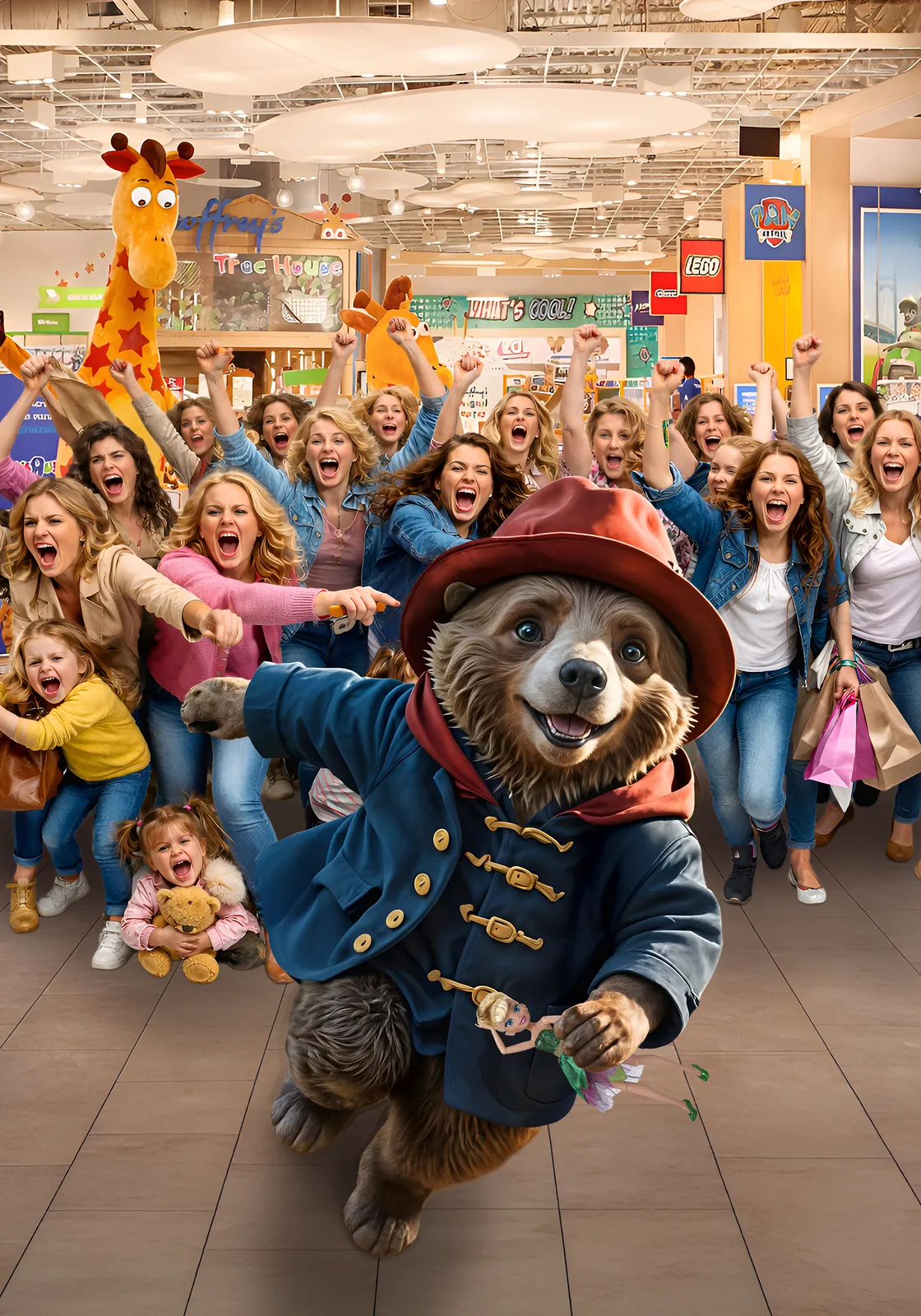
Stop the Bear – A Love That Had No License – En kärlek utan tillstånd, 2026
Digital
50 x 70 cm
3 200 kr
Stop the Bear – A Love That Had No License – En kärlek utan tillstånd
Svensk text i slutet av texten
Introduction – A Modern Romeo and Juliet that explores love, societal barriers, and systemic boundaries in contemporary stories
Some love stories start with a meeting. Others start with a division. This one starts with both.
Long before anyone begins to run, long before the shout echoes through the toy store, the true shape of the story is already evident. Two figures belong to worlds that are not meant to touch. Yet, when they recognise each other, it sparks a deep emotional response, emphasising love's resilience amid systemic constraints.
In a different era, the obstacle would have had a family name. Today, the separation is just as real but appears as order, legality, and societal expectations, highlighting how systemic barriers influence love stories and inspire empathy for those affected.
That is what makes this a Romeo and Juliet tale.
Not because it echoes Shakespeare in detail, but because it clones him in structure, reflecting how systemic barriers shape love stories. The issue isn't that love doesn't emerge; it's that it appears where the world has no room for it. The feeling arrives first; the system encases it afterwards. What obstructs it isn't indifference, but organisational rules, categories, and boundaries that mirror systemic constraints never meant to allow such recognition to lead anywhere.
Paddington Bear and Tinker Bell do not belong to hostile families in the traditional sense. They belong to something colder and more efficient: separate narrative territories, distinct legal frameworks, and separate traditions of ownership and control. Fathers do not enforce their division with swords, but through contracts, rights, image control, and the quiet authority of systems that do not need to shout to succeed. Romeo and Juliet were kept apart by lineage. Paddington and Tinker Bell are kept apart by intellectual property. Yet, the emotional logic remains the same.
Because once two figures cross such a boundary, its meaning shifts from a simple fact to an obstacle, transforming into a challenge that shapes the love story and highlights systemic barriers.
Beneath the absurdity of a bear and a fairy lies something older and far more enduring: the tragic pattern in which love does not violate the world because it is reckless, but because the world has arranged itself too narrowly to contain it. Their love exposes these systemic flaws, inspiring reflection and hope for change.
What follows, then, is not just a tale of pursuit, transgression, or hidden meetings. It is the story of how an impossible love becomes visible, how a modern feud functions without ever announcing itself as one. And how, even in a world of brands, licences, shelves, contracts, and carefully guarded identities, two figures can still stumble into the oldest danger of all: to identify each other too clearly, and too late to turn back.
This essay starts with an image.
“A Love Unlicensed
When gentle Bear and winged sprite did meet,
Not ‘neath Verona’s moon, but market’s glare,
Where ordered shelves and measured commerce greet
All forms confined to price and rightful share—
No Capulet nor Montague were near,
No father’s rage, no dagger drawn in haste,
Yet stood a colder law, as firm, as clear,
That none might cross the bounds by system placed.
For love, unbid, did in that instant rise,
A fault within the world’s well-governed scheme,
A truth unseen by ever-watchful eyes,
A breach that flickered like a fleeting dream.
Thus not by hate, but order are they torn—
And in that order, tragic love is born.“
Malmö, March 2026
Prologue — Stop the Bear – A Love That Had No License
It begins, as these things often do, with a misunderstanding. A shout rises inside a toy store—sharp, immediate, contagious—and within seconds the space shifts from an orderly display to a microcosm of societal boundaries. Shelves shake, figures turn, hands point. A bear is running. Not clumsily, not mindlessly, but with a peculiar sense of purpose, weaving through aisles designed for calm browsing. In his hand, he holds a small, fragile figure, luminous even in its reduced form—a plastic fairy wrapped in packaging. Behind him, the crowd gains momentum, not as individuals but as a single intention: stop him. At first glance, the scene seems quite ordinary. A theft, perhaps. A disturbance in the smooth flow of buying and owning. Yet something in the movement opposes that interpretation. He is not fleeing with the frantic energy of a criminal, but moving forward with the quiet urgency of someone who believes he is doing the right thing.
And then recognition dawns. This is not just any bear. It is Paddington Bear—the most polite outsider in modern storytelling, a figure defined not by mischief but by trust. His entire existence is based on the idea that the world, however confusing, is fundamentally kind. Once understood, those rules can be followed. That strangers, if approached with courtesy, might become friends. To see him running—taking, rather than asking—already indicates that something has shifted beyond the ordinary. And what he carries is no less significant. The small figure in his hand is Tinker Bell, a creature of light and fleeting presence, here reduced to an object among objects, a commodity within reach, priced, and contained. In another story, she would hover freely, defined by motion rather than ownership. Here she hangs from a hook, waiting to be purchased.
It is at this exact moment that the scene ceases to be accidental and reveals its true structure. What we are witnessing is not just a disruption, but the visible surface of a conflict that exists elsewhere. A conflict not between good and evil, nor between innocence and corruption, but between worlds that are not meant to meet. Because the bear and the fairy do not share the same origin, narrative, or even legal status, they belong to different systems, catalogues, and regimes of ownership. Their meeting, therefore, is not just improbable — it underscores the societal critique of systemic divisions and control, illustrating how societal boundaries are maintained through legal and cultural separation.
And this is where the older story begins to echo beneath the new one, not as a direct retelling, but as a structure that insists on repeating itself. In another time, under different constraints, two figures met across a boundary that could not be crossed. Their names were not trademarks but surnames, their division not contractual but familial. Yet the logic remains unmistakable. Like Romeo and Juliet, this is a story in which the obstacle is not the absence of feeling, but the presence of a system that cannot accommodate it. Then, it was bloodlines and loyalty. Now, it is intellectual property and brand integrity. Then, families enforced the separation. Now, corporations do. The language has changed; the structure has not, illustrating how narrative reflects societal boundaries and systemic control.
What makes this version more unsettling is not its divergence from the original but its plausibility. There is no feud here, no visible hatred, no dramatic declarations of opposition. Everything functions as intended. Contracts are honoured. Rights are respected. Boundaries are maintained. And precisely because of that, the separation seems reasonable. Necessary, even. The tragedy does not stem from conflict, but from coherence. The system works—and, in doing so, it can make the audience feel a subtle unease about how societal control shapes their perceptions.
So when the shout goes up—Stop the bear—it carries more significance than it appears. It is not just a call to prevent theft but also a collective reinforcement of societal boundaries that define proper spaces and roles. To return each figure to its correct place. To ensure that stories stay within their designated territories. The crowd may not realise this, but they enact it nonetheless. They respond not to love, which they cannot see, but to transgression, which they can, prompting the audience to consider their role in upholding societal norms.
And yet, in that single gesture—small, almost absurd, like a bear carrying a fairy through a shop—something has already occurred that cannot be entirely reversed. A boundary has been crossed. Not physically, perhaps, but conceptually. The possibility of another arrangement has been revealed, however fleetingly. This moment invites the audience to reflect on what could be possible beyond societal norms and to feel a sense of hope for change.
What if the thing that needs to be stopped isn't the bear?
Chapter I – The Meeting
They did not meet in a forest, nor in a quiet corner of a shared world, but in a place where worlds briefly forget that they are not meant to touch. The premiere of ”Paddington in Peru” in 2024 was, on the surface, an industry event like any other—carefully orchestrated, meticulously branded, and saturated with the kind of curated spontaneity that allows fiction to celebrate itself without ever losing control. Yet for one evening, something unusual happened. The boundaries that normally separate stories—those invisible but strictly maintained lines that define what is considered part of each narrative—softened, just enough to allow proximity without permission.
It was a gathering of borrowed realities. Characters who, under normal circumstances, would never acknowledge one another’s existence now shared the same physical space, moving between photographers, journalists, and carefully arranged backdrops. Some had been translated, others adapted, and many reshaped through decades of retelling. Still, all carried the quiet weight of ownership-each one a property, anchored to a specific lineage, a specific catalogue, a specific set of rights that defined the limits of their movement and interaction within the narrative system-yet in this moment, those boundaries blurred, revealing their fragile nature.
Among them was Paddington Bear, who, as always, looked slightly out of place but was perfectly at ease. His presence never depended on showiness. He didn't need to command a room to be noticed; it was enough that he watched it, as if every detail might contain a small lesson on how to behave. He held his hat in one paw, adjusted it quietly and precisely, and observed the proceedings with the attentive curiosity of someone who still believed that every gathering had a purpose beyond itself-an awareness that suggests a deeper understanding of authenticity beyond surface appearances.
She did not stand at all. Tinker Bell moved through the air as if the room itself were merely a temporary inconvenience, a space to pass through rather than to inhabit. Light followed her, or perhaps preceded her, catching on glass surfaces and metallic edges, making her difficult to pin down in a single place. She had long ago grown used to being seen without being understood, to being present without being chosen. Her history was one of proximity without fulfilment, of circling a figure who never quite turned to face her.
Their meeting wasn’t announced. There was no collision, no dramatic interruption. It happened in the way that certain alignments happen—through a slight shift in attention, a moment when two trajectories intersect without prior design. Paddington looked up, perhaps in response to a movement that didn't correspond to anything on the ground, and she, for once, did not carry on past. For a split second, the logic of their worlds hesitated. He didn’t see a brand, a figure, or a product. He saw something alive-an allegory for the fragile boundary between reality and fiction. And she, long accustomed to proximity without fulfilment, recognised in him a symbol of authentic recognition beyond superficial labels. This kind of connection doesn’t demand performance; it emphasises the importance of genuine moments that often go unnoticed, inviting the audience to value subtle authenticity.
What passed between them could not be documented and, therefore, did not officially happen. No camera recorded it, no contract acknowledged it, no narrative included it in its structure. Yet it was precisely this lack of documentation that allowed it to exist at all, highlighting unseen forces at work and encouraging the audience to reflect on the power of the unnoticed.
Around them, the event continued exactly as planned. Interviews were conducted, photographs taken, and statements issued. The promotion machinery moved forward with flawless efficiency, reaffirming the identities that had been carefully constructed and preserved. Each character returned, in the eyes of the system, to its proper place. Yet something had already shifted, not in a way that could be measured, but in a way that could not be entirely reversed.
They did not speak again that night, at least not openly. But both left that brief encounter with the same quiet unease: the realisation that the boundaries they had accepted as fixed might, in certain circumstances, be crossed, briefly dissolving the illusion of strict limits. Not legally, not forever, but enough to prompt reflection on how boundaries are constructs that can be subtly shifted, encouraging the audience to question what is truly fixed or flexible.
In a different era, this would have been when families stepped in, invoking names and allegiances to stop what had just begun. Now, no one intervened because no one had seen. The system lacked the means to respond to an event it did not perceive. And so, paradoxically, their love was granted its first breath exactly because it was unseen.
That, as always, is how the most perilous stories start.
Chapter II – The Secret
What typically follows such a meeting is seldom dramatic at first, emphasising the theme of unseen connections that work quietly and subtly, maintaining their focus on subtlety and significance.
For Paddington Bear, this manifested as attention. He had always been attentive, of course—his entire character depended on noticing small details, on interpreting the intentions of others with patience and goodwill—but now his attention took on a second layer, revealing a deeper awareness that extended beyond surface observations.
For Tinker Bell, the change was different but equally important. She had always moved freely, at least it seemed so, within the limits of her story. Flight, after all, suggests independence, even when confined to a set space. However, after the premiere, her movements began to take shape. She no longer flew around aimlessly, nor was she tethered to the familiar gravitational pull of a boy who refused to grow up. Instead, she began to steer towards something that existed outside her original narrative—a point beyond her assigned orbit, a new destination that challenged the boundaries of her story.
Their second meeting was not scheduled. It could not be, because there was no shared framework within which such an arrangement could exist. There were no common locations, no mutually recognised times, and no channels through which intentions could be communicated without leaving a trace. Yet they met again, during one of those overlooked intervals where the structure of stories momentarily loosens. A place between scenes, one might say, though not literally—a gap in narrative attention where continuity is assumed but not maintained.
It was there that the unseen bond quietly developed, existing beyond the reach of visible signs and explicit recognition.
It is not a secret in the traditional sense, protected by deliberate concealment, but a condition that requires secrecy to exist at all. Because what they were doing—simply recognising each other, allowing a connection to persist across incompatible frameworks—had no authorised form. It could not be named within either of their systems without immediately triggering its own dissolution. To define it would be to expose it, and to expose it would be to subject it to rules that would make it impossible. This subtlety invites the audience to feel curiosity about unseen forces shaping connections.
And so they learned, without guidance, the silent logic of invisible bonds that function beyond conscious awareness.
They met in moments that did not officially happen, in spaces that were not recorded, through gestures that left no formal trace. A glance upwards, a brief descent, a pause that lasted just long enough to be felt but not seen. They spoke, if speaking is the right word, in a language without vocabulary—an exchange of recognition rather than knowledge. There were no promises, because promises imply time, and time implies record. There were no plans, because plans need a future that can be expected, and expectation is exactly what their situation could not permit.
Yet within these limits, something notably steady started to develop.
It was not founded on certainty, but on repetition. Each meeting affirmed the potential for the next, cultivating a quiet resilience that can inspire the audience to feel hope through perseverance.
Around them, the systems they belonged to continued to operate flawlessly. Narratives progressed, characters played their parts, products circulated, rights were maintained and enforced. Nothing in that machinery recognised what was happening at its edges. Yet it was precisely this indifference that allowed the secret to survive. The system did not oppose them; it simply lacked a category for them. In the absence of recognition, they found a narrow yet sufficient space. This resilience in the face of indifference can inspire a quiet strength in the audience.
There were moments, of course, when the limits became apparent. When an approach was interrupted by the reassertion of narrative gravity, when a presence faded because its originating world required attention elsewhere, when the logic of ownership reasserted itself in subtle but unmistakable ways, these interruptions were not dramatic. They did not come as prohibitions but as absences—small discontinuities that reminded them of the conditions under which they operated.
In another story, conflict might erupt openly, but here, it remains embedded within the system's structure. This can encourage the audience to feel patience and recognise subtle, ongoing struggles.
And so, the secret persisted, not because it was safeguarded, but because its invisibility and subtlety allowed it to remain unnoticed and survive beyond recognition.
It is tempting to describe this as freedom, but that would be inaccurate. Freedom suggests the absence of constraint, whereas what they experienced was something more precise: a narrow corridor within constraint. This path existed only as long as it was carefully followed. To step outside it would be to vanish from one another’s world entirely.
Still, within that corridor, something unmistakable began to take form.
Not yet a declaration, but a sign that secrets shared repeatedly can build up, showing how subtle bonds can gain momentum and grow stronger over time.
In the older tragedies, this is the stage where love deepens beyond caution, where the awareness of risk no longer acts as a deterrent but as an intensifier. The very fact that something is not allowed becomes part of its meaning. Here, the same pattern begins to appear, though under different circumstances. Not forbidden by decree, but made impossible by design, their connection gains a significance that neither of them had sought, but both now recognise.
In other words, the secret has started to alter them.
And that is always the moment when secrecy alone no longer suffices.
Chapter III – The Feud
In the older stories, the conflict announces itself early. Names are spoken, allegiances declared, lines drawn in language as much as in blood. One belongs here, the other there, and between those positions stretches a distance that cannot be crossed without consequence. The tragedy is visible, almost ceremonial, unfolding according to rules that everyone understands, even as they resist them. In this case, however, nothing of that kind occurs. There is no proclamation, no open hostility, no family gathered to forbid what has begun. And yet the division is no less absolute.
Because the families, if one insists on using that word, do not appear as figures at all.
They exist as structures.
Paddington Bear belongs to a lineage that begins in literature, passes through publishing, and extends outward into adaptation, licensing, and carefully managed expansion. His identity is not enforced through violence, but through consistency. He must remain recognisably himself, not because anyone demands it in anger, but because deviation would disrupt the system that sustains him. Every appearance, every gesture, every association is quietly governed by an expectation of coherence.
Tinker Bell, by contrast, has undergone a different kind of transformation. Originating in a text that allowed for ambiguity, she has been refined, redesigned, and distributed until her image carries a precision that leaves little room for deviation. Her form is not only recognised; it is protected. What she represents is no longer merely a narrative function, but a visual and commercial identity that must remain intact across contexts. Where Paddington is guided by tone, she is secured by image.
Between these two modes of existence lies a boundary that is central to understanding how systemic structures-such as 'contracts', 'licenses', and 'brand integrity'-shape character interactions and influence narrative tension, and it need not be defended to hold.
It is maintained automatically, underscoring how systemic boundaries operate without explicit enforcement, which helps the audience feel the natural, unavoidable aspect of these structures.
There are no guards at its edges, no declarations posted to mark its limits, yet this boundary is crucial in understanding how systemic structures quietly reassert themselves whenever continuity is threatened, influencing character interactions and narrative flow.
This is the modern form of the feud. Not a clash of wills, but a misalignment of frameworks.
In another time, the names Montague and Capulet would have been sufficient to explain everything. Here, the explanation requires no names at all, only the recognition that each figure is embedded in a network of relations that cannot be easily reconfigured. Contracts define the permissible range of interaction. Licenses specify the conditions under which presence may be extended. Brand integrity—an abstract but powerful principle—ensures that each element remains within its designated field.
This is not hostility but a quiet exclusion, driven by systemic constraints that subtly influence character interactions, encouraging the audience to see the power of unseen forces.
They are not kept apart because anyone wishes them harm, but because there exists no sanctioned form in which their togetherness can be expressed. To appear side by side already raises questions that the system is not designed to answer. To interact is to suggest a permeability that, if acknowledged, would require renegotiation at a scale far beyond the significance of the individual.
And so the feud operates without participants. It is not enacted; it is assumed.
Yet its effects are no less tangible for being impersonal. The moments in which Paddington Bear and Tinker Bell meet begin to acquire a new tension. Not because they have been discovered, but because the conditions of their meeting become increasingly difficult to sustain. The corridor within which they move narrows, not through deliberate action, but through the accumulation of small constraints. A shift in context here, an adjustment in presentation there, and what was once barely possible becomes nearly so.
They begin to understand, without being told, that their situation is not merely fragile, but structurally unsound.
This understanding does not arrive as a revelation, but as a gradual alignment of perception with reality. Each interruption, each missed encounter, each subtle reassertion of narrative gravity contributes to a pattern that can no longer be ignored. The system is not reacting to them; it is simply continuing to function, and in doing so, it leaves less and less room for what they are attempting to sustain.
In the classical tragedy, this is the moment when the lovers become aware of the scale of the forces arrayed against them. The conflict, once abstract, becomes immediate. Decisions-such as 'continue' or 'withdraw'-must be made, influenced by systemic constraints that limit their agency and shape their choices.
And yet, recognition does not lead to withdrawal.
If anything, it produces the opposite effect.
Because once the nature of the boundary is understood, the meaning of crossing it changes, transforming their meetings from mere coincidence into deliberate acts driven by systemic constraints, affecting their relationship and the narrative's progression.
This is where the parallel with Romeo and Juliet becomes unavoidable.
Not in the details, which differ entirely, but in the structure of the decision. To continue is to accept the consequences of continuation, even if those consequences cannot yet be fully known. To withdraw is to preserve safety at the cost of meaning. Between these two options lies a tension that cannot be resolved through reason alone.
They choose, without saying so, to continue. And in doing so, they transform the nature of the feud. It is no longer merely a condition that separates them. It becomes the very thing that defines their connection, meaning that the conflict, once external and structural, has now entered the space between them.
And that is when such stories inevitably begin to move toward action.
Chapter IV - The Honey Affair
If their love had remained only a matter of glances and brief, unrecorded encounters, it might have quietly dissolved under the pressure of the surrounding structures. Many such connections do. They fail not through opposition, but through the gradual erosion of opportunity. What changed the course of this particular story was not a declaration nor a discovery, but an event neither of them had intended to encounter. It began, as such disturbances often do, with a pattern too small to attract attention and too consistent to be accidental.
Honey started to move.
Not disappear, not in any way that would trigger alarm, but shift steadily and purposefully through channels that seemed legitimate while producing results that were not. Supplies tightened in one region while surpluses emerged in another—prices adjusted in ways that could be explained individually but not collectively. Analysts crafted language that reassured without offering clarity. It was, in essence, a system functioning precisely as intended, yet delivering results outside the original design.
Paddington Bear was the first to notice, though not as an analyst would. His connection to honey was not theoretical. It was practical, habitual, and quietly vital. Subtle shifts in availability, texture, and consistency registered with him long before they could be articulated. Something was amiss—not dramatically, but persistently—and persistence tends to reveal intent.
Tinker Bell approached the issue from a different perspective. Where he saw disturbance, she tracked movement. Her familiarity with spaces that resist normal access—places above, between, and beyond established routes—enabled her to follow paths that did not align with official flows. What appeared as distribution from one angle revealed itself as concentration from another. The flow was not dispersing; it was being gathered.
They did not decide to act together. There was no agreement, no shared declaration. Yet, their movements started to align. Observations made in one situation found confirmation in another. Patterns seen from the ground became clearer when viewed from above. Without explicitly naming or formalising it, they approached the same problem from different angles and ultimately reached the same conclusion.
A group of financial operators had recognised honey as a resource it had not previously regarded as such: something that could be controlled. Not entirely, perhaps, but enough to influence its price. Contracts were signed, supply chains streamlined, and storage facilities secured. The aim was not immediate profit but strategic positioning—to hold enough of the flow so that others would follow.
Such strategies are not new. Markets have been cornered before. Resources have been amassed until scarcity itself becomes a tool. What made this attempt seem viable was not its novelty, but its assumption: that honey, like other commodities, could be brought within the reach of contract.
For a while, this assumption was valid. Supply decreased. Prices increased. The system acted as expected.
The fault was elsewhere.
There are places where ownership remains legally intact but fails in remote regions, hidden spots that no system can fully control, emphasising the importance of monitoring overlooked vulnerabilities.
It was here that Tinker Bell proved decisive. She could reach what others could not, observe what others could not map, and in doing so, establish not control, but its absence. Paddington Bear understood what this meant. The strategy did not rely solely on domination. It depended on completeness.
They did not reveal the scheme, nor confront it directly. They rendered it impossible.
Because a monopoly does not fail when it is attacked, but when it cannot control what it needs. And there were places—vertical, remote, untouched—where honey continued to exist outside every contract.
They permitted small flows and minor variations to continue, illustrating that even within a controlled system, these unseen factors can be deliberately exploited or naturally accumulate, exposing the system's fundamental limits and emphasising the significance of monitoring subtle resistance in strategic control.
The collapse did not happen suddenly. It developed gradually as a state of being. Positions based on the idea of total control started to weaken. Expectations did not match the actual outcomes. The system adapted, but the adaptation only showed what it could not fully include. Control, once partial, stopped functioning as control.
When the strategy unravelled, it did so quietly. Prices stabilised. Explanations changed. Attention shifted elsewhere. Those who had tried to hold the market withdrew, not defeated visibly, but unable to maintain the conditions needed for their position.
For Paddington Bear and Tinker Bell, the importance lies in how their subtle actions revealed the system's failure to contain certain flows, demonstrating how unseen resistance can weaken control and expose systemic boundaries, even without formal recognition.
In another narrative, this might be the point where their partnership becomes evident, where success leads to recognition and recognition brings complications. Here, no such shift occurs. Their involvement remains unrecorded, and their role unnoticed. The system adjusts without acknowledging the source of its change.
For them, their unacknowledged actions revealed that systemic control is fragile and that unseen factors can alter influence, highlighting the system's delicate nature.
And that is when the chance of staying hidden starts to give way to the need to choose what cannot remain so.
And, as a final precaution, they did something that no system had anticipated. They turned the bees themselves. Not metaphorically, but quite literally. Because there are scents that cannot be masked, and greed, it seems, carries one of them. The financiers—who believed themselves invisible behind contracts and structures—discovered that they had overlooked a much older form of detection. The bees did not negotiate. They did not speculate. They responded. What followed was neither elegant nor strategic, but immediate. Stung, exposed, and suddenly aware of the limits of their position, the architects of the scheme withdrew. The reserves were released. The flow returned. And the market, as it always does when control fails, resumed a semblance of balance.
It was perhaps the only part of the operation that needed no explanation because it showed how even simple, often-overlooked actions can reveal the limits of control and weaken systemic stability.
Chapter V – The Choice
There comes a point in every such story when the continuation ceases to be neutral. Until this point, their connection has been maintained by what could be called fortunate conditions: invisibility, an absence of recognition or visibility, coincidence, and lack of acknowledgement. None of these can be relied upon forever. What was once possible because it went unnoticed now persists despite an increasing chance of being observed.
The change does not come as an external interruption. No authority steps in, no rule is formally enforced. Instead, it manifests as pressure—subtle, cumulative, structural—the spaces where they have gathered start to shrink. Intervals become shorter. Movements that once aligned effortlessly now need adjustments. What initially appeared as a corridor gradually reveals itself to be a passage that is slowly closing.
Paddington Bear perceives this not as a principle, but as a challenge. He finds himself waiting longer, arriving earlier, and subtly adjusting his routines in ways that remain true to his character, yet are noticeable enough to be seen as change. His politeness remains firm, but now it is joined by a persistence that is harder to explain. He does not question the rules; he keeps to them. However, within that obedience, he begins to push their boundaries.
Tinker Bell undergoes the same shift as resistance. The spaces through which she moves no longer provide the same continuity. Her flight faces interruptions that are not physical but structural, moments when the direction falters not because the path is blocked, but because it no longer fully exists. She adapts, as she always has, but in this case, adaptation begins to resemble effort.
What neither of them articulates but both come to realise is that their situation has moved into a new phase. The secret, once enough, is no longer sufficient. To carry on as before risks gradual disappearance. To change the terms of their connection involves something entirely different.
At another time, this would be the moment of decision, presented with clear options. Now, a series of small, deliberate actions-subtle, intentional steps-becomes the key to gradually guiding their connection in a new direction, highlighting the power of minor acts within systemic constraints.
They start, almost imperceptibly, to act intentionally, signalling a shift from passive survival to active influence within systemic constraints.
A meeting is not merely permitted; it is actively pursued. A moment is not just acknowledged; it is deliberately extended. The distinction is slight, but crucial. Small actions now carry significance, inspiring the audience to see their subtle efforts as meaningful and impactful.
This shift changes the balance of their situation. Intention creates patterns, and when observed, these patterns become clear. The audience should feel concern about how systemic structures interpret invisibility and the significance of subtle actions in shaping perceptions, encouraging reflection on their own influence.
The risk, then, is not discovery in the dramatic sense. Still, systemic categorisation is being reclassified or corrected by the structures that govern perception, fostering a sense of cautious vigilance in the audience.
This is the paradox they now face. To remain unseen is to diminish oneself. To become visible is to change. The audience should experience a reflective mood, contemplating the inevitable nature of change and loss in connection and identity, encouraging a deeper understanding of systemic dynamics.
They do not resolve this paradox. They operate within it. And in doing so, they shift from accidental love to one that can no longer be maintained without repercussions.
Chapter VI – The Transgression
The act itself, when it occurs, is almost disappointingly simple. There is no elaborate plan, no carefully crafted sequence of events, no attempt to outmanoeuvre the system on its own terms. That would require a level of coordination their situation does not allow. Instead, it manifests as a gesture—direct, visible, and therefore irreversible. Not an escalation, but a clarification.
It starts in a place made for order—a shop, arranged by categories that make choosing easy and ownership clear. Items are displayed openly; identities are simple, not complex. Everything is in its right place, and everything can be bought with the same basic transaction. It is a space where ambiguity has been kept to a minimum.
Paddington Bear enters as he always does, quietly. He observes, pauses, and considers. Nothing in his behaviour draws attention. He is, in every visible respect, exactly as expected. Yet, within that expectation, a deviation is already present. He is not there to browse, to buy, or even to admire. He is there for a purpose that cannot be expressed within the logic of the place.
Tinker Bell already exists, though not in a way she would recognise as presence. Reduced to an object, fixed within packaging, and assigned a position that defines her entirely in terms of availability, she exists there as a representation rather than a being. In another context, this would be a transformation. Here, it is simply a display condition.
The gap between them is tiny. The gap between their worlds stays absolute.
What follows is a deliberate act that quietly questions the boundaries of the system, encouraging the audience to feel a sense of agency in challenging structured environments and their implications.
Not with force or haste, but with a precision that conveys recognition rather than acquisition. The gesture is cautious, almost respectful, as if the act itself must compensate for the context in which it occurs. He doesn’t hide what he has done. Hiding would suggest that the act is part of the establishment. It isn’t.
For a brief moment, nothing happens.
The shop's order remains intact. Then recognition spreads, inciting curiosity. A voice, then another. Movement. The transition from observation to pursuit occurs with the efficiency of a system responding automatically to disruption, prompting the audience to consider how systems react to subtle acts.
They observe a theft. They do not observe a reclassification.
Because what has been taken is not merely an object, but a position within a system, revealing how objects and identities are influenced by their environment and encouraging the audience to view acts of reclassification as subtle acts of resistance.
He moves through the space steadily, resisting the logic of pursuit, as if carrying something that must not be returned, subtly changing the scene's meaning.
Behind him, the crowd consolidates. Individually, they are uncertain; collectively, they are precise. The instruction arises not from any single source, but from the alignment of many: stop him. It is not a question, nor a deliberation. It is the automatic response to deviation. What has happened must be reversed. The object must be restored. The boundary must be reestablished.
The irony is that the system does not oppose the act where it counts.
It resists at the point where it becomes visible, emphasising how systems depend on perception and encouraging the audience to consider the importance of visibility in systemic control.
No mechanism prevents Paddington Bear from reaching the shelf or recognising Tinker Bell, but the Response is triggered only when the act enters shared perception, making it visible and unavoidable.
The pursuit is not motivated by anger but by necessity. Not personal necessity but structural necessity. The shop must remain a shop. Objects must remain objects. Transactions must be recognised as the sole legitimate form of transfer. Allowing it otherwise would introduce ambiguity that the system is not designed to handle.
In another story, this would be the point at which escape becomes the main concern. Here, escape takes a back seat. The act has already accomplished what it aimed to do. The boundary has been crossed, not just theoretically, but in reality. Whether or not it can be sustained is a different issue.
And yet, the question remains. Not whether he can outrun those who follow, but whether what he carries can continue to exist outside the structure from which it has been taken.
Chapter VII – The Pursuit
The chase starts with alignment, demonstrating how systems foster shared understanding and influence behaviour without explicit instructions.
Paddington Bear moves through the space, embodying trust in established systems, which influences his careful, courteous navigation.
In his hands, Tinker Bell remains simultaneously present and unresolved. Within the shop's logic, she is an object displaced. According to the reasoning that brought him to her, she is something entirely different. The tension between these two states does not diminish as he moves; it grows. Each step takes her further from the structure that defined her and deeper into a condition for which no definition exists.
Behind him, the crowd consolidates, becoming clearer. Individuals who, moments earlier, occupied separate positions now share a single focus. Their movements synchronise not through direct coordination, but through the narrowing of options. There is only one relevant action, and it is the same for everyone. The space itself begins to aid. Aisles guide movement, exit signs indicate direction, and the store's architecture aligns with the intentions of those inside. What was designed for circulation now acts as a mechanism of convergence.
The way systems influence behaviour is subtle yet persistent, shaping actions and perceptions through cooperation among elements, deepening the audience's understanding of shared agency.
Not through a single force but through the cooperation of many elements, the system's logic reasserts itself by guiding paths that lead back, illustrating how collective influence produces inevitability.
And yet, he persists.
Not because he believes he can outrun the structure that surrounds him, but because continuing the movement preserves the act itself. To halt, to turn, to return what he carries would be to undo the ongoing process already in motion.
For Tinker Bell, the experience is of a different order. Removed from the position that fixed her, she now exists in a state that oscillates between definition and possibility, inviting curiosity about fluid identities. The packaging that contained her no longer fully defines her. The context that named her no longer fully applies. There are moments—brief and unstable—when the qualities that once belonged to her original form begin to reassert themselves. Not as a return, but as a reminder. Light shifts. Presence flickers. The object resists its own reduction, inspiring wonder at the fluidity of meaning.
These moments do not go unnoticed.
Not consciously, perhaps, but as a disturbance. Those who follow their sense, without explicitly stating it, sense that something does not quite fit with the situation they are trying to resolve. The object is not behaving entirely as an object should. The bearer is not behaving entirely as a bearer should. The scene, in its entirety, does not perfectly align with any known pattern.
Such misalignments do not halt a system. They speed it up.
Once an inconsistency is noticed, the need for correction grows more urgent. What cannot be easily categorised must be brought back to a state where it can be. The pursuit intensifies, not through greater force but through a lower tolerance for deviation. The boundaries within which ambiguity might remain begin to narrow.
The exit approach.
Not dramatically, nor as thresholds marked by significance, but as natural transition points within the space. Doors that lead from one environment to another, from interior to exterior, from controlled to less controlled conditions. Crossing such a threshold signifies movement, not escape, emphasising continuity amid change and reassuring the audience of ongoing flow.
Paddington Bear reaches this boundary as part of the system's flow, not as a destination, illustrating how larger structures guide movement.
Behind him, the pursuit continues, reshaping itself as it crosses the same threshold. What was once confined to the interior now expands into a wider space. The alignment remains. The intention endures.
And yet, something has changed.
As categories loosen, the system's coherence diminishes, exposing how perceptions shift and new pathways emerge within the structure.
It is within this slight reduction of coherence that new possibilities arise, not as certainties, but as opportunities. And it is into one of these opportunities that they now step.
Chapter VIII – The Exposure
Once outside, the nature of the pursuit shifts from controlled to transitional spaces, subtly changing perception while maintaining its purpose. The shop's contained logic yields to a broader, less predictable environment, and with that shift, the clarity of roles begins to blur. Inside, everything was clear: object, owner, transaction, violation. Outside, these distinctions do not vanish, but they become more difficult to enforce with the same precision. The system persists, but it does so through diffusion rather than concentration, extending its reach into a space where control must adapt to change.
Paddington Bear slows down, not because he is unsure, but because the urgency that drove his movement inside no longer applies in the same way. The act has already taken place, the boundary has been crossed, and what follows cannot be solved by speed alone. He becomes, once again, a figure defined by presence rather than force, standing within a situation that surpasses the categories available to describe it. In his hands, Tinker Bell no longer appears exactly as she did before. Removed from the strict framing of the shelf, her form begins to resist its reduction more consistently, the suggestion of movement no longer confined to flickers but approaching continuity. She is not yet free, but she is no longer entirely fixed, fostering a sense of calm and patience in the viewer.
The crowd forms behind him, but it does not unite as strongly. The shared intention remains, yet its expression disperses as individuals reaffirm their own positions within the larger group. Some move forward with steady resolve, others hesitate, reconsidering their understanding of what they are witnessing. The clarity of the internal situation—where a violation could be recognised and corrected instantly—gives way to a more ambiguous state in which perception becomes less reliable, showing how perception changes outside controlled environments. This encourages the audience to feel curiosity about how perception adapts in uncertain situations.
It is here that exposure acquires a different significance.
Inside, exposure was immediate and clear. The act had been observed, and a response had followed. Outside, exposure becomes a matter of visibility rather than recognition. What is seen is no longer automatically understood. The same gesture, removed from its original context, becomes open to different interpretations. A bear holding a small figure is no longer necessarily a thief carrying stolen goods; it may also be something else, something less easily named.
This ambiguity does not dismantle the system, but it complicates its operation. Without a singular, unified interpretation, the response fragments. The pursuit persists, but with less certainty, less inevitability. Those who follow must now decide, however briefly, what they are pursuing and why. The alignment that once seemed automatic now needs reinforcement, and even successful reinforcement causes delay.
Paddington Bear does not deliberately exploit this ambiguity. Strategy would suggest a kind of calculation he does not employ. Instead, he stays true to the logic that led him here. He holds Tinker Bell gently, as if the way he holds her is itself a kind of argument, a proof that what he carries cannot simply be what it was before. His movements are deliberate, not hesitant, as if he is letting the situation unfold naturally rather than trying to control it.
And it does.
The longer the scene continues outside the shop's strict boundaries, the harder it becomes to maintain the original interpretation—lack of immediate resolution forces a reevaluation, even if only partial, of what has occurred. The object defies classification. The act defies its reduction. The bearer defies the role assigned to him.
This is the moment when the system encounters its own limits, not through confrontation but through insufficiency. It can respond to violations that fit its categories; it struggles with those that do not, revealing how system boundaries are permeable and context-dependent. The pursuit persists, but it is no longer completely sure of its own necessity, prompting the audience to consider the limits and abilities of systems and perception, especially in ambiguous or unpredictable situations.
For Tinker Bell, this shift creates the conditions for something previously impossible, as the boundary between object and presence weakens through the reconfiguration of perception. This demonstrates how system limits-boundaries that normally contain and define perception—become porous outside controlled spaces, reinforcing the essay's exploration of system limits and perception beyond predictable environments.
What becomes clear, then, is not only the act but its implication. This encourages the audience to feel a sense of insight, emphasising that exposure reveals deeper meanings beyond surface appearances, which is crucial for understanding the complexity of perception.
That which was taken might not have been intended to stay where it was. What was seen as a violation could also be understood as a correction, showing that the categories governing the interior space do not fully extend into the world beyond. These implications do not resolve the situation; they expose it. And exposure, unlike visibility, cannot be entirely contained once it has started.
And exposure, unlike visibility, cannot be completely contained once it has started.
Chapter IX – The Consequence
What follows exposure is never an immediate resolution. Systems do not collapse when they are revealed; they adjust. They absorb, reinterpret, and, where necessary, reassert themselves in forms that preserve their underlying logic while accommodating the disturbance. The scene that unfolded outside the shop does not disappear; it lingers, not as an event that demands response, but as a condition that cannot be entirely ignored. This invites the audience to consider how systems subtly adapt, fostering curiosity about these unseen processes.
Paddington Bear does not attempt to escape further. Movement, which had carried him across the boundary, now gives way to stillness. He remains where he is, not out of resignation, but because the act has already reached its necessary conclusion. There is nowhere else to go that would alter what has taken place. To continue running would be to transform the gesture into something else, something closer to evasion than intention. And that is not what this was. This respect for deliberate action encourages the audience to reflect on the significance of choices and their finality.
In his hands, Tinker Bell continues to shift between states. The instability that had begun to emerge now persists with greater consistency. She is no longer convincingly an object, yet not entirely restored to what she had been. The ambiguity that defines her condition resists closure, and in doing so, resists the system that would otherwise reclassify her.
Around them, the response gathers form.
Response to exposure is an ongoing process, highlighting its significance to encourage the audience to see system adaptation as vital and relevant.
Two primary responses emerge: restoration, which reestablishes boundaries, and assimilation, which redefines deviations, clarifying their distinct roles in system adaptation.
The first is restoration. To return what has been taken, to reestablish the original conditions, to reaffirm the boundaries that were crossed. This option requires no reinterpretation, only enforcement. It is efficient, familiar, and entirely consistent with the logic that governs the space from which the act emerged.
The second is assimilation. To incorporate the deviation into the system, to redefine it in such a way that it no longer appears as a violation. This approach is more complex. It requires adjustment, negotiation, or the creation or expansion of a new or existing category. It preserves coherence, but at the cost of alteration.
Neither option is neutral. Restoration erases the act; assimilation transforms it, emphasising how each response alters the original, prompting reflection on finality and choice.
This is the consequence of what has occurred. Not punishment, not in any conventional sense, but the necessity of response. The system cannot remain indifferent once exposure has taken place. It must either deny what has happened by reversing it or acknowledge it by redefining it. In both cases, the original condition—unrecognised, unrecorded, and therefore free to exist in its own narrow corridor—is no longer available.
Paddington Bear's choice reflects deliberate action, emphasising to the audience that intentionality is crucial, fostering a sense of responsibility in their reflections.
Tinker Bell's ambiguous state reveals the system's limits, inviting the audience to wonder about the boundaries and constraints of such systems.
What becomes visible, then, is not only the act, but its implication.
That which was taken might not have been meant to remain where it was. That which was seen as a violation might also be understood as a correction that the categories which governed the interior space do not extend, without remainder, into the world beyond it.
These implications do not resolve the situation. They expose it. And exposure, unlike visibility, cannot be entirely contained once it has begun.
Chapter X – What They Became
Resolution, in the classical sense, relies on closure. The elements of the story come together, the conflict reaches a decisive point, and what follows restores some form of order, whether through reconciliation or loss. Here, no such alignment occurs. Instead, what appears is a resolution from a distance, which, upon closer inspection, shows itself to be a redistribution of tension rather than its removal, emphasising systemic subtlety. Clarifying this difference helps readers understand how systems handle contradictions without traditional closure.
The response emerges not through confrontation but through framing. The event is incorporated into a narrative that allows it to exist without disrupting the system that holds it. What was once a disturbance becomes, over time, an example. A moment that can be referenced, described, or even circulated, as long as it is presented in a way that does not challenge the underlying order—the language changes. Where there was urgency, there is now interpretation. Where there was pursuit, there is now distance.
Paddington Bear is no longer pursued in the same way. He is observed. His actions are not undone, but they are no longer allowed to function as they once did. They are repositioned within a framework that makes them easier to understand. Not correct, not endorsed, but contained. The gesture that previously exceeded the system is translated into something that can be discussed without requiring structural change.
She is neither fully returned nor fully released. Instead, she occupies a space that allows her presence to be acknowledged through reinterpretation, encouraging the audience to value subtle systemic adjustments over resolution. This fosters trust that systems can adapt without losing coherence.
Modern systems do not eliminate contradiction; instead, they show how they handle it through redistribution. This approach encourages confidence that systems can adapt without losing coherence, emphasising resilience for the audience.
From the outside, the situation appears stable. From within, it is not. Because what has been preserved is not the original condition, but its possibility. They exist in a state maintained through continuous adjustment, a balance that endures only as long as it is actively sustained. This ongoing process encourages patience and acceptance, highlighting the resilience of systems managing contradictions.
And yet, they remain unbroken.
Paddington Bear returns, on the surface, to what he has always been, but with a change that cannot be entirely hidden. The routines remain, the manners stay, but inside there is now a readiness—a quiet understanding that the world is not confined to what it permits. Tinker Bell, too, takes her place again, but not entirely. The form returns when needed; the image remains where it must, yet something in her resists a final definition, as if movement itself has become part of her nature.
They no longer meet as they once did. Not by chance, not in secrecy, not within a now-closed corridor. They gather when they can. Not often. Not at predictable times. But enough. A fleeting connection, a shared moment, a presence that cannot be recorded and therefore cannot be fully contained.
In another story, this might be called a compromise. Here, it is more of a method. Because what they have learned—what they now understand without needing to say it—is where the system does not fully reach. The gaps. The edges. The places where structure loosens just enough for something else to occur.
That is where they reside.
Not outside the world, but alongside it. Not in defiance, but in continuation. This perspective encourages the audience to feel patience and acceptance toward ongoing systemic processes that coexist with contradictions without immediate resolution.
They find each other there, repeatedly, and when they do, they do what they have already shown they can do: they act. Not to change everything, not to declare themselves, but to intervene where intervention is possible. A disturbance here, a correction there, a small imbalance rectified before it grows into something bigger.
They are not tragic figures; they are something more enduring.
They do not resolve everything; instead, they build a form of endurance that allows a connection to persist without full recognition. Once a boundary is crossed, it does not completely close again. What cannot be permitted may continue, quietly, precisely because it does not ask to be.
These conditions do not finish the story. They merely allow it to continue.
Epilogue – What Remains in Motion)
In the end, nothing is fully resolved as such stories once required. No final gesture restores order, no decisive loss clarifies meaning, no reconciliation aligns the opposing sides. The structures remain, the boundaries still hold, and the systems that first made their meeting impossible continue to operate with the same quiet authority as before. Nothing is dismantled. Nothing is officially changed. Yet this should evoke a sense of ongoing subtlety, encouraging the audience to accept that change persists beneath the surface of stability.
Because what has happened cannot be reversed by trying to contain it.
The event has been shaped, interpreted, and absorbed into a form that allows it to exist without changing the surrounding structure. It can be discussed, referenced, or even retold, as long as it is understood within limits that maintain coherence. In this way, the system protects itself not by denying what happened but by placing it where it no longer threatens what must stay intact. What was once a disruption becomes a story. What was once a crossing becomes an exception.
And yet, an exception is never neutral. It signifies that what was believed impossible has, in fact, happened.
Paddington Bear returns, outwardly, to the life that has always defined him. The routines remain, manners persist, and his quiet belief in order and kindness continues to guide his actions. But there is now something else within that order—a knowledge that cannot be unlearned. He no longer mistakes rules for the limits of what can happen. He still follows them, but not as boundaries. More as a surface beneath which other possibilities move.
Tinker Bell resumes her position, but not entirely. The image returns to where it belongs; the form remains where it is needed. However, subtle, unnoticed movements—small, unrecorded, yet persistent—play a crucial role in shaping ongoing systemic change, resisting complete stabilisation and encouraging reflection on the influence of minor factors.
They no longer reclaim what they once had. It is no longer available.
The corridor that once allowed them to meet unseen has closed, not by force, but through exposure. What was hidden cannot return to being concealed in the same way. And yet, what has been uncovered cannot be entirely erased.
So, they proceed differently.
They meet not by chance nor in secrecy, but in awareness. Not often, not predictably, but with a precision no system can forecast. A moment that aligns. A space that opens. A recognition that needs no confirmation beyond itself.
It is enough.
Because what they have come to understand—what now defines them more than the conditions that once separated them—is where the system does not fully reach. The edges. The interruptions. The minor inconsistencies that no structure can remove without losing its function.
That is where they move. Not outside the world, but within it. Not against it, but along its boundaries.
And when they meet, they do what they have already learned. They act not to declare themselves or force recognition, but to subtly intervene whenever an imbalance appears, making small shifts and corrections, demonstrating how delicate interventions can influence larger systems without overt disruption, prompting reflection on their importance.
The world does not notice them. Not clearly. But it perceives what they do—failed markets, misaligned systems, unpredictable outcomes, small anomalies that subtly shift the system just beyond explanation. They are part of that, not as a force, but as something existing between what is defined and what is not, prompting reflection on systemic subtlety.
What then becomes visible is not a clear resolution but a nuanced condition-an ongoing state that emphasises systemic subtlety, highlighting how change endures beneath surface stability and fostering reflection on the difference between subtle shifts and overt change.
What cannot be permitted may still happen. What has been contained might continue. And a boundary, once crossed, does not fully close again, even if it appears to. These conditions do not conclude the story; they sustain it. Somewhere, already, something begins anew. A pattern slightly out of place. A movement that doesn't quite align. The kind of thing no one notices at first.
These conditions do not end the story. They sustain it. And somewhere, already, something is starting again. A pattern slightly out of place. A movement that does not align. The sort of thing no one notices at first.
They shall notice.
They always do.
Inledning – En modern Romeo och Julia som utforskar kärlek, samhälleliga hinder och systemiska gränser i samtida berättelser
Vissa kärlekshistorier börjar med ett möte. Andra börjar med en åtskillnad. Den här börjar med båda.
Långt innan någon börjar springa, långt innan ropet ekar genom leksaksbutiken, är berättelsens verkliga form redan synlig. Två gestalter tillhör världar som inte är avsedda att beröra varandra. Och ändå, när de känner igen varandra, väcks en djup känslomässig reaktion som understryker kärlekens motståndskraft mitt i systemiska begränsningar.
I en annan tid skulle hindret ha haft ett familjenamn. I dag är åtskillnaden lika verklig, men den uppträder som ordning, laglighet och samhälleliga förväntningar, vilket visar hur systemiska hinder formar kärlekshistorier och väcker empati för dem som drabbas.
Det är det som gör detta

Jörgen Thornberg
Stop the Bear – A Love That Had No License – En kärlek utan tillstånd, 2026
Digital
50 x 70 cm
3 200 kr
Stop the Bear – A Love That Had No License – En kärlek utan tillstånd
Svensk text i slutet av texten
Introduction – A Modern Romeo and Juliet that explores love, societal barriers, and systemic boundaries in contemporary stories
Some love stories start with a meeting. Others start with a division. This one starts with both.
Long before anyone begins to run, long before the shout echoes through the toy store, the true shape of the story is already evident. Two figures belong to worlds that are not meant to touch. Yet, when they recognise each other, it sparks a deep emotional response, emphasising love's resilience amid systemic constraints.
In a different era, the obstacle would have had a family name. Today, the separation is just as real but appears as order, legality, and societal expectations, highlighting how systemic barriers influence love stories and inspire empathy for those affected.
That is what makes this a Romeo and Juliet tale.
Not because it echoes Shakespeare in detail, but because it clones him in structure, reflecting how systemic barriers shape love stories. The issue isn't that love doesn't emerge; it's that it appears where the world has no room for it. The feeling arrives first; the system encases it afterwards. What obstructs it isn't indifference, but organisational rules, categories, and boundaries that mirror systemic constraints never meant to allow such recognition to lead anywhere.
Paddington Bear and Tinker Bell do not belong to hostile families in the traditional sense. They belong to something colder and more efficient: separate narrative territories, distinct legal frameworks, and separate traditions of ownership and control. Fathers do not enforce their division with swords, but through contracts, rights, image control, and the quiet authority of systems that do not need to shout to succeed. Romeo and Juliet were kept apart by lineage. Paddington and Tinker Bell are kept apart by intellectual property. Yet, the emotional logic remains the same.
Because once two figures cross such a boundary, its meaning shifts from a simple fact to an obstacle, transforming into a challenge that shapes the love story and highlights systemic barriers.
Beneath the absurdity of a bear and a fairy lies something older and far more enduring: the tragic pattern in which love does not violate the world because it is reckless, but because the world has arranged itself too narrowly to contain it. Their love exposes these systemic flaws, inspiring reflection and hope for change.
What follows, then, is not just a tale of pursuit, transgression, or hidden meetings. It is the story of how an impossible love becomes visible, how a modern feud functions without ever announcing itself as one. And how, even in a world of brands, licences, shelves, contracts, and carefully guarded identities, two figures can still stumble into the oldest danger of all: to identify each other too clearly, and too late to turn back.
This essay starts with an image.
“A Love Unlicensed
When gentle Bear and winged sprite did meet,
Not ‘neath Verona’s moon, but market’s glare,
Where ordered shelves and measured commerce greet
All forms confined to price and rightful share—
No Capulet nor Montague were near,
No father’s rage, no dagger drawn in haste,
Yet stood a colder law, as firm, as clear,
That none might cross the bounds by system placed.
For love, unbid, did in that instant rise,
A fault within the world’s well-governed scheme,
A truth unseen by ever-watchful eyes,
A breach that flickered like a fleeting dream.
Thus not by hate, but order are they torn—
And in that order, tragic love is born.“
Malmö, March 2026
Prologue — Stop the Bear – A Love That Had No License
It begins, as these things often do, with a misunderstanding. A shout rises inside a toy store—sharp, immediate, contagious—and within seconds the space shifts from an orderly display to a microcosm of societal boundaries. Shelves shake, figures turn, hands point. A bear is running. Not clumsily, not mindlessly, but with a peculiar sense of purpose, weaving through aisles designed for calm browsing. In his hand, he holds a small, fragile figure, luminous even in its reduced form—a plastic fairy wrapped in packaging. Behind him, the crowd gains momentum, not as individuals but as a single intention: stop him. At first glance, the scene seems quite ordinary. A theft, perhaps. A disturbance in the smooth flow of buying and owning. Yet something in the movement opposes that interpretation. He is not fleeing with the frantic energy of a criminal, but moving forward with the quiet urgency of someone who believes he is doing the right thing.
And then recognition dawns. This is not just any bear. It is Paddington Bear—the most polite outsider in modern storytelling, a figure defined not by mischief but by trust. His entire existence is based on the idea that the world, however confusing, is fundamentally kind. Once understood, those rules can be followed. That strangers, if approached with courtesy, might become friends. To see him running—taking, rather than asking—already indicates that something has shifted beyond the ordinary. And what he carries is no less significant. The small figure in his hand is Tinker Bell, a creature of light and fleeting presence, here reduced to an object among objects, a commodity within reach, priced, and contained. In another story, she would hover freely, defined by motion rather than ownership. Here she hangs from a hook, waiting to be purchased.
It is at this exact moment that the scene ceases to be accidental and reveals its true structure. What we are witnessing is not just a disruption, but the visible surface of a conflict that exists elsewhere. A conflict not between good and evil, nor between innocence and corruption, but between worlds that are not meant to meet. Because the bear and the fairy do not share the same origin, narrative, or even legal status, they belong to different systems, catalogues, and regimes of ownership. Their meeting, therefore, is not just improbable — it underscores the societal critique of systemic divisions and control, illustrating how societal boundaries are maintained through legal and cultural separation.
And this is where the older story begins to echo beneath the new one, not as a direct retelling, but as a structure that insists on repeating itself. In another time, under different constraints, two figures met across a boundary that could not be crossed. Their names were not trademarks but surnames, their division not contractual but familial. Yet the logic remains unmistakable. Like Romeo and Juliet, this is a story in which the obstacle is not the absence of feeling, but the presence of a system that cannot accommodate it. Then, it was bloodlines and loyalty. Now, it is intellectual property and brand integrity. Then, families enforced the separation. Now, corporations do. The language has changed; the structure has not, illustrating how narrative reflects societal boundaries and systemic control.
What makes this version more unsettling is not its divergence from the original but its plausibility. There is no feud here, no visible hatred, no dramatic declarations of opposition. Everything functions as intended. Contracts are honoured. Rights are respected. Boundaries are maintained. And precisely because of that, the separation seems reasonable. Necessary, even. The tragedy does not stem from conflict, but from coherence. The system works—and, in doing so, it can make the audience feel a subtle unease about how societal control shapes their perceptions.
So when the shout goes up—Stop the bear—it carries more significance than it appears. It is not just a call to prevent theft but also a collective reinforcement of societal boundaries that define proper spaces and roles. To return each figure to its correct place. To ensure that stories stay within their designated territories. The crowd may not realise this, but they enact it nonetheless. They respond not to love, which they cannot see, but to transgression, which they can, prompting the audience to consider their role in upholding societal norms.
And yet, in that single gesture—small, almost absurd, like a bear carrying a fairy through a shop—something has already occurred that cannot be entirely reversed. A boundary has been crossed. Not physically, perhaps, but conceptually. The possibility of another arrangement has been revealed, however fleetingly. This moment invites the audience to reflect on what could be possible beyond societal norms and to feel a sense of hope for change.
What if the thing that needs to be stopped isn't the bear?
Chapter I – The Meeting
They did not meet in a forest, nor in a quiet corner of a shared world, but in a place where worlds briefly forget that they are not meant to touch. The premiere of ”Paddington in Peru” in 2024 was, on the surface, an industry event like any other—carefully orchestrated, meticulously branded, and saturated with the kind of curated spontaneity that allows fiction to celebrate itself without ever losing control. Yet for one evening, something unusual happened. The boundaries that normally separate stories—those invisible but strictly maintained lines that define what is considered part of each narrative—softened, just enough to allow proximity without permission.
It was a gathering of borrowed realities. Characters who, under normal circumstances, would never acknowledge one another’s existence now shared the same physical space, moving between photographers, journalists, and carefully arranged backdrops. Some had been translated, others adapted, and many reshaped through decades of retelling. Still, all carried the quiet weight of ownership-each one a property, anchored to a specific lineage, a specific catalogue, a specific set of rights that defined the limits of their movement and interaction within the narrative system-yet in this moment, those boundaries blurred, revealing their fragile nature.
Among them was Paddington Bear, who, as always, looked slightly out of place but was perfectly at ease. His presence never depended on showiness. He didn't need to command a room to be noticed; it was enough that he watched it, as if every detail might contain a small lesson on how to behave. He held his hat in one paw, adjusted it quietly and precisely, and observed the proceedings with the attentive curiosity of someone who still believed that every gathering had a purpose beyond itself-an awareness that suggests a deeper understanding of authenticity beyond surface appearances.
She did not stand at all. Tinker Bell moved through the air as if the room itself were merely a temporary inconvenience, a space to pass through rather than to inhabit. Light followed her, or perhaps preceded her, catching on glass surfaces and metallic edges, making her difficult to pin down in a single place. She had long ago grown used to being seen without being understood, to being present without being chosen. Her history was one of proximity without fulfilment, of circling a figure who never quite turned to face her.
Their meeting wasn’t announced. There was no collision, no dramatic interruption. It happened in the way that certain alignments happen—through a slight shift in attention, a moment when two trajectories intersect without prior design. Paddington looked up, perhaps in response to a movement that didn't correspond to anything on the ground, and she, for once, did not carry on past. For a split second, the logic of their worlds hesitated. He didn’t see a brand, a figure, or a product. He saw something alive-an allegory for the fragile boundary between reality and fiction. And she, long accustomed to proximity without fulfilment, recognised in him a symbol of authentic recognition beyond superficial labels. This kind of connection doesn’t demand performance; it emphasises the importance of genuine moments that often go unnoticed, inviting the audience to value subtle authenticity.
What passed between them could not be documented and, therefore, did not officially happen. No camera recorded it, no contract acknowledged it, no narrative included it in its structure. Yet it was precisely this lack of documentation that allowed it to exist at all, highlighting unseen forces at work and encouraging the audience to reflect on the power of the unnoticed.
Around them, the event continued exactly as planned. Interviews were conducted, photographs taken, and statements issued. The promotion machinery moved forward with flawless efficiency, reaffirming the identities that had been carefully constructed and preserved. Each character returned, in the eyes of the system, to its proper place. Yet something had already shifted, not in a way that could be measured, but in a way that could not be entirely reversed.
They did not speak again that night, at least not openly. But both left that brief encounter with the same quiet unease: the realisation that the boundaries they had accepted as fixed might, in certain circumstances, be crossed, briefly dissolving the illusion of strict limits. Not legally, not forever, but enough to prompt reflection on how boundaries are constructs that can be subtly shifted, encouraging the audience to question what is truly fixed or flexible.
In a different era, this would have been when families stepped in, invoking names and allegiances to stop what had just begun. Now, no one intervened because no one had seen. The system lacked the means to respond to an event it did not perceive. And so, paradoxically, their love was granted its first breath exactly because it was unseen.
That, as always, is how the most perilous stories start.
Chapter II – The Secret
What typically follows such a meeting is seldom dramatic at first, emphasising the theme of unseen connections that work quietly and subtly, maintaining their focus on subtlety and significance.
For Paddington Bear, this manifested as attention. He had always been attentive, of course—his entire character depended on noticing small details, on interpreting the intentions of others with patience and goodwill—but now his attention took on a second layer, revealing a deeper awareness that extended beyond surface observations.
For Tinker Bell, the change was different but equally important. She had always moved freely, at least it seemed so, within the limits of her story. Flight, after all, suggests independence, even when confined to a set space. However, after the premiere, her movements began to take shape. She no longer flew around aimlessly, nor was she tethered to the familiar gravitational pull of a boy who refused to grow up. Instead, she began to steer towards something that existed outside her original narrative—a point beyond her assigned orbit, a new destination that challenged the boundaries of her story.
Their second meeting was not scheduled. It could not be, because there was no shared framework within which such an arrangement could exist. There were no common locations, no mutually recognised times, and no channels through which intentions could be communicated without leaving a trace. Yet they met again, during one of those overlooked intervals where the structure of stories momentarily loosens. A place between scenes, one might say, though not literally—a gap in narrative attention where continuity is assumed but not maintained.
It was there that the unseen bond quietly developed, existing beyond the reach of visible signs and explicit recognition.
It is not a secret in the traditional sense, protected by deliberate concealment, but a condition that requires secrecy to exist at all. Because what they were doing—simply recognising each other, allowing a connection to persist across incompatible frameworks—had no authorised form. It could not be named within either of their systems without immediately triggering its own dissolution. To define it would be to expose it, and to expose it would be to subject it to rules that would make it impossible. This subtlety invites the audience to feel curiosity about unseen forces shaping connections.
And so they learned, without guidance, the silent logic of invisible bonds that function beyond conscious awareness.
They met in moments that did not officially happen, in spaces that were not recorded, through gestures that left no formal trace. A glance upwards, a brief descent, a pause that lasted just long enough to be felt but not seen. They spoke, if speaking is the right word, in a language without vocabulary—an exchange of recognition rather than knowledge. There were no promises, because promises imply time, and time implies record. There were no plans, because plans need a future that can be expected, and expectation is exactly what their situation could not permit.
Yet within these limits, something notably steady started to develop.
It was not founded on certainty, but on repetition. Each meeting affirmed the potential for the next, cultivating a quiet resilience that can inspire the audience to feel hope through perseverance.
Around them, the systems they belonged to continued to operate flawlessly. Narratives progressed, characters played their parts, products circulated, rights were maintained and enforced. Nothing in that machinery recognised what was happening at its edges. Yet it was precisely this indifference that allowed the secret to survive. The system did not oppose them; it simply lacked a category for them. In the absence of recognition, they found a narrow yet sufficient space. This resilience in the face of indifference can inspire a quiet strength in the audience.
There were moments, of course, when the limits became apparent. When an approach was interrupted by the reassertion of narrative gravity, when a presence faded because its originating world required attention elsewhere, when the logic of ownership reasserted itself in subtle but unmistakable ways, these interruptions were not dramatic. They did not come as prohibitions but as absences—small discontinuities that reminded them of the conditions under which they operated.
In another story, conflict might erupt openly, but here, it remains embedded within the system's structure. This can encourage the audience to feel patience and recognise subtle, ongoing struggles.
And so, the secret persisted, not because it was safeguarded, but because its invisibility and subtlety allowed it to remain unnoticed and survive beyond recognition.
It is tempting to describe this as freedom, but that would be inaccurate. Freedom suggests the absence of constraint, whereas what they experienced was something more precise: a narrow corridor within constraint. This path existed only as long as it was carefully followed. To step outside it would be to vanish from one another’s world entirely.
Still, within that corridor, something unmistakable began to take form.
Not yet a declaration, but a sign that secrets shared repeatedly can build up, showing how subtle bonds can gain momentum and grow stronger over time.
In the older tragedies, this is the stage where love deepens beyond caution, where the awareness of risk no longer acts as a deterrent but as an intensifier. The very fact that something is not allowed becomes part of its meaning. Here, the same pattern begins to appear, though under different circumstances. Not forbidden by decree, but made impossible by design, their connection gains a significance that neither of them had sought, but both now recognise.
In other words, the secret has started to alter them.
And that is always the moment when secrecy alone no longer suffices.
Chapter III – The Feud
In the older stories, the conflict announces itself early. Names are spoken, allegiances declared, lines drawn in language as much as in blood. One belongs here, the other there, and between those positions stretches a distance that cannot be crossed without consequence. The tragedy is visible, almost ceremonial, unfolding according to rules that everyone understands, even as they resist them. In this case, however, nothing of that kind occurs. There is no proclamation, no open hostility, no family gathered to forbid what has begun. And yet the division is no less absolute.
Because the families, if one insists on using that word, do not appear as figures at all.
They exist as structures.
Paddington Bear belongs to a lineage that begins in literature, passes through publishing, and extends outward into adaptation, licensing, and carefully managed expansion. His identity is not enforced through violence, but through consistency. He must remain recognisably himself, not because anyone demands it in anger, but because deviation would disrupt the system that sustains him. Every appearance, every gesture, every association is quietly governed by an expectation of coherence.
Tinker Bell, by contrast, has undergone a different kind of transformation. Originating in a text that allowed for ambiguity, she has been refined, redesigned, and distributed until her image carries a precision that leaves little room for deviation. Her form is not only recognised; it is protected. What she represents is no longer merely a narrative function, but a visual and commercial identity that must remain intact across contexts. Where Paddington is guided by tone, she is secured by image.
Between these two modes of existence lies a boundary that is central to understanding how systemic structures-such as 'contracts', 'licenses', and 'brand integrity'-shape character interactions and influence narrative tension, and it need not be defended to hold.
It is maintained automatically, underscoring how systemic boundaries operate without explicit enforcement, which helps the audience feel the natural, unavoidable aspect of these structures.
There are no guards at its edges, no declarations posted to mark its limits, yet this boundary is crucial in understanding how systemic structures quietly reassert themselves whenever continuity is threatened, influencing character interactions and narrative flow.
This is the modern form of the feud. Not a clash of wills, but a misalignment of frameworks.
In another time, the names Montague and Capulet would have been sufficient to explain everything. Here, the explanation requires no names at all, only the recognition that each figure is embedded in a network of relations that cannot be easily reconfigured. Contracts define the permissible range of interaction. Licenses specify the conditions under which presence may be extended. Brand integrity—an abstract but powerful principle—ensures that each element remains within its designated field.
This is not hostility but a quiet exclusion, driven by systemic constraints that subtly influence character interactions, encouraging the audience to see the power of unseen forces.
They are not kept apart because anyone wishes them harm, but because there exists no sanctioned form in which their togetherness can be expressed. To appear side by side already raises questions that the system is not designed to answer. To interact is to suggest a permeability that, if acknowledged, would require renegotiation at a scale far beyond the significance of the individual.
And so the feud operates without participants. It is not enacted; it is assumed.
Yet its effects are no less tangible for being impersonal. The moments in which Paddington Bear and Tinker Bell meet begin to acquire a new tension. Not because they have been discovered, but because the conditions of their meeting become increasingly difficult to sustain. The corridor within which they move narrows, not through deliberate action, but through the accumulation of small constraints. A shift in context here, an adjustment in presentation there, and what was once barely possible becomes nearly so.
They begin to understand, without being told, that their situation is not merely fragile, but structurally unsound.
This understanding does not arrive as a revelation, but as a gradual alignment of perception with reality. Each interruption, each missed encounter, each subtle reassertion of narrative gravity contributes to a pattern that can no longer be ignored. The system is not reacting to them; it is simply continuing to function, and in doing so, it leaves less and less room for what they are attempting to sustain.
In the classical tragedy, this is the moment when the lovers become aware of the scale of the forces arrayed against them. The conflict, once abstract, becomes immediate. Decisions-such as 'continue' or 'withdraw'-must be made, influenced by systemic constraints that limit their agency and shape their choices.
And yet, recognition does not lead to withdrawal.
If anything, it produces the opposite effect.
Because once the nature of the boundary is understood, the meaning of crossing it changes, transforming their meetings from mere coincidence into deliberate acts driven by systemic constraints, affecting their relationship and the narrative's progression.
This is where the parallel with Romeo and Juliet becomes unavoidable.
Not in the details, which differ entirely, but in the structure of the decision. To continue is to accept the consequences of continuation, even if those consequences cannot yet be fully known. To withdraw is to preserve safety at the cost of meaning. Between these two options lies a tension that cannot be resolved through reason alone.
They choose, without saying so, to continue. And in doing so, they transform the nature of the feud. It is no longer merely a condition that separates them. It becomes the very thing that defines their connection, meaning that the conflict, once external and structural, has now entered the space between them.
And that is when such stories inevitably begin to move toward action.
Chapter IV - The Honey Affair
If their love had remained only a matter of glances and brief, unrecorded encounters, it might have quietly dissolved under the pressure of the surrounding structures. Many such connections do. They fail not through opposition, but through the gradual erosion of opportunity. What changed the course of this particular story was not a declaration nor a discovery, but an event neither of them had intended to encounter. It began, as such disturbances often do, with a pattern too small to attract attention and too consistent to be accidental.
Honey started to move.
Not disappear, not in any way that would trigger alarm, but shift steadily and purposefully through channels that seemed legitimate while producing results that were not. Supplies tightened in one region while surpluses emerged in another—prices adjusted in ways that could be explained individually but not collectively. Analysts crafted language that reassured without offering clarity. It was, in essence, a system functioning precisely as intended, yet delivering results outside the original design.
Paddington Bear was the first to notice, though not as an analyst would. His connection to honey was not theoretical. It was practical, habitual, and quietly vital. Subtle shifts in availability, texture, and consistency registered with him long before they could be articulated. Something was amiss—not dramatically, but persistently—and persistence tends to reveal intent.
Tinker Bell approached the issue from a different perspective. Where he saw disturbance, she tracked movement. Her familiarity with spaces that resist normal access—places above, between, and beyond established routes—enabled her to follow paths that did not align with official flows. What appeared as distribution from one angle revealed itself as concentration from another. The flow was not dispersing; it was being gathered.
They did not decide to act together. There was no agreement, no shared declaration. Yet, their movements started to align. Observations made in one situation found confirmation in another. Patterns seen from the ground became clearer when viewed from above. Without explicitly naming or formalising it, they approached the same problem from different angles and ultimately reached the same conclusion.
A group of financial operators had recognised honey as a resource it had not previously regarded as such: something that could be controlled. Not entirely, perhaps, but enough to influence its price. Contracts were signed, supply chains streamlined, and storage facilities secured. The aim was not immediate profit but strategic positioning—to hold enough of the flow so that others would follow.
Such strategies are not new. Markets have been cornered before. Resources have been amassed until scarcity itself becomes a tool. What made this attempt seem viable was not its novelty, but its assumption: that honey, like other commodities, could be brought within the reach of contract.
For a while, this assumption was valid. Supply decreased. Prices increased. The system acted as expected.
The fault was elsewhere.
There are places where ownership remains legally intact but fails in remote regions, hidden spots that no system can fully control, emphasising the importance of monitoring overlooked vulnerabilities.
It was here that Tinker Bell proved decisive. She could reach what others could not, observe what others could not map, and in doing so, establish not control, but its absence. Paddington Bear understood what this meant. The strategy did not rely solely on domination. It depended on completeness.
They did not reveal the scheme, nor confront it directly. They rendered it impossible.
Because a monopoly does not fail when it is attacked, but when it cannot control what it needs. And there were places—vertical, remote, untouched—where honey continued to exist outside every contract.
They permitted small flows and minor variations to continue, illustrating that even within a controlled system, these unseen factors can be deliberately exploited or naturally accumulate, exposing the system's fundamental limits and emphasising the significance of monitoring subtle resistance in strategic control.
The collapse did not happen suddenly. It developed gradually as a state of being. Positions based on the idea of total control started to weaken. Expectations did not match the actual outcomes. The system adapted, but the adaptation only showed what it could not fully include. Control, once partial, stopped functioning as control.
When the strategy unravelled, it did so quietly. Prices stabilised. Explanations changed. Attention shifted elsewhere. Those who had tried to hold the market withdrew, not defeated visibly, but unable to maintain the conditions needed for their position.
For Paddington Bear and Tinker Bell, the importance lies in how their subtle actions revealed the system's failure to contain certain flows, demonstrating how unseen resistance can weaken control and expose systemic boundaries, even without formal recognition.
In another narrative, this might be the point where their partnership becomes evident, where success leads to recognition and recognition brings complications. Here, no such shift occurs. Their involvement remains unrecorded, and their role unnoticed. The system adjusts without acknowledging the source of its change.
For them, their unacknowledged actions revealed that systemic control is fragile and that unseen factors can alter influence, highlighting the system's delicate nature.
And that is when the chance of staying hidden starts to give way to the need to choose what cannot remain so.
And, as a final precaution, they did something that no system had anticipated. They turned the bees themselves. Not metaphorically, but quite literally. Because there are scents that cannot be masked, and greed, it seems, carries one of them. The financiers—who believed themselves invisible behind contracts and structures—discovered that they had overlooked a much older form of detection. The bees did not negotiate. They did not speculate. They responded. What followed was neither elegant nor strategic, but immediate. Stung, exposed, and suddenly aware of the limits of their position, the architects of the scheme withdrew. The reserves were released. The flow returned. And the market, as it always does when control fails, resumed a semblance of balance.
It was perhaps the only part of the operation that needed no explanation because it showed how even simple, often-overlooked actions can reveal the limits of control and weaken systemic stability.
Chapter V – The Choice
There comes a point in every such story when the continuation ceases to be neutral. Until this point, their connection has been maintained by what could be called fortunate conditions: invisibility, an absence of recognition or visibility, coincidence, and lack of acknowledgement. None of these can be relied upon forever. What was once possible because it went unnoticed now persists despite an increasing chance of being observed.
The change does not come as an external interruption. No authority steps in, no rule is formally enforced. Instead, it manifests as pressure—subtle, cumulative, structural—the spaces where they have gathered start to shrink. Intervals become shorter. Movements that once aligned effortlessly now need adjustments. What initially appeared as a corridor gradually reveals itself to be a passage that is slowly closing.
Paddington Bear perceives this not as a principle, but as a challenge. He finds himself waiting longer, arriving earlier, and subtly adjusting his routines in ways that remain true to his character, yet are noticeable enough to be seen as change. His politeness remains firm, but now it is joined by a persistence that is harder to explain. He does not question the rules; he keeps to them. However, within that obedience, he begins to push their boundaries.
Tinker Bell undergoes the same shift as resistance. The spaces through which she moves no longer provide the same continuity. Her flight faces interruptions that are not physical but structural, moments when the direction falters not because the path is blocked, but because it no longer fully exists. She adapts, as she always has, but in this case, adaptation begins to resemble effort.
What neither of them articulates but both come to realise is that their situation has moved into a new phase. The secret, once enough, is no longer sufficient. To carry on as before risks gradual disappearance. To change the terms of their connection involves something entirely different.
At another time, this would be the moment of decision, presented with clear options. Now, a series of small, deliberate actions-subtle, intentional steps-becomes the key to gradually guiding their connection in a new direction, highlighting the power of minor acts within systemic constraints.
They start, almost imperceptibly, to act intentionally, signalling a shift from passive survival to active influence within systemic constraints.
A meeting is not merely permitted; it is actively pursued. A moment is not just acknowledged; it is deliberately extended. The distinction is slight, but crucial. Small actions now carry significance, inspiring the audience to see their subtle efforts as meaningful and impactful.
This shift changes the balance of their situation. Intention creates patterns, and when observed, these patterns become clear. The audience should feel concern about how systemic structures interpret invisibility and the significance of subtle actions in shaping perceptions, encouraging reflection on their own influence.
The risk, then, is not discovery in the dramatic sense. Still, systemic categorisation is being reclassified or corrected by the structures that govern perception, fostering a sense of cautious vigilance in the audience.
This is the paradox they now face. To remain unseen is to diminish oneself. To become visible is to change. The audience should experience a reflective mood, contemplating the inevitable nature of change and loss in connection and identity, encouraging a deeper understanding of systemic dynamics.
They do not resolve this paradox. They operate within it. And in doing so, they shift from accidental love to one that can no longer be maintained without repercussions.
Chapter VI – The Transgression
The act itself, when it occurs, is almost disappointingly simple. There is no elaborate plan, no carefully crafted sequence of events, no attempt to outmanoeuvre the system on its own terms. That would require a level of coordination their situation does not allow. Instead, it manifests as a gesture—direct, visible, and therefore irreversible. Not an escalation, but a clarification.
It starts in a place made for order—a shop, arranged by categories that make choosing easy and ownership clear. Items are displayed openly; identities are simple, not complex. Everything is in its right place, and everything can be bought with the same basic transaction. It is a space where ambiguity has been kept to a minimum.
Paddington Bear enters as he always does, quietly. He observes, pauses, and considers. Nothing in his behaviour draws attention. He is, in every visible respect, exactly as expected. Yet, within that expectation, a deviation is already present. He is not there to browse, to buy, or even to admire. He is there for a purpose that cannot be expressed within the logic of the place.
Tinker Bell already exists, though not in a way she would recognise as presence. Reduced to an object, fixed within packaging, and assigned a position that defines her entirely in terms of availability, she exists there as a representation rather than a being. In another context, this would be a transformation. Here, it is simply a display condition.
The gap between them is tiny. The gap between their worlds stays absolute.
What follows is a deliberate act that quietly questions the boundaries of the system, encouraging the audience to feel a sense of agency in challenging structured environments and their implications.
Not with force or haste, but with a precision that conveys recognition rather than acquisition. The gesture is cautious, almost respectful, as if the act itself must compensate for the context in which it occurs. He doesn’t hide what he has done. Hiding would suggest that the act is part of the establishment. It isn’t.
For a brief moment, nothing happens.
The shop's order remains intact. Then recognition spreads, inciting curiosity. A voice, then another. Movement. The transition from observation to pursuit occurs with the efficiency of a system responding automatically to disruption, prompting the audience to consider how systems react to subtle acts.
They observe a theft. They do not observe a reclassification.
Because what has been taken is not merely an object, but a position within a system, revealing how objects and identities are influenced by their environment and encouraging the audience to view acts of reclassification as subtle acts of resistance.
He moves through the space steadily, resisting the logic of pursuit, as if carrying something that must not be returned, subtly changing the scene's meaning.
Behind him, the crowd consolidates. Individually, they are uncertain; collectively, they are precise. The instruction arises not from any single source, but from the alignment of many: stop him. It is not a question, nor a deliberation. It is the automatic response to deviation. What has happened must be reversed. The object must be restored. The boundary must be reestablished.
The irony is that the system does not oppose the act where it counts.
It resists at the point where it becomes visible, emphasising how systems depend on perception and encouraging the audience to consider the importance of visibility in systemic control.
No mechanism prevents Paddington Bear from reaching the shelf or recognising Tinker Bell, but the Response is triggered only when the act enters shared perception, making it visible and unavoidable.
The pursuit is not motivated by anger but by necessity. Not personal necessity but structural necessity. The shop must remain a shop. Objects must remain objects. Transactions must be recognised as the sole legitimate form of transfer. Allowing it otherwise would introduce ambiguity that the system is not designed to handle.
In another story, this would be the point at which escape becomes the main concern. Here, escape takes a back seat. The act has already accomplished what it aimed to do. The boundary has been crossed, not just theoretically, but in reality. Whether or not it can be sustained is a different issue.
And yet, the question remains. Not whether he can outrun those who follow, but whether what he carries can continue to exist outside the structure from which it has been taken.
Chapter VII – The Pursuit
The chase starts with alignment, demonstrating how systems foster shared understanding and influence behaviour without explicit instructions.
Paddington Bear moves through the space, embodying trust in established systems, which influences his careful, courteous navigation.
In his hands, Tinker Bell remains simultaneously present and unresolved. Within the shop's logic, she is an object displaced. According to the reasoning that brought him to her, she is something entirely different. The tension between these two states does not diminish as he moves; it grows. Each step takes her further from the structure that defined her and deeper into a condition for which no definition exists.
Behind him, the crowd consolidates, becoming clearer. Individuals who, moments earlier, occupied separate positions now share a single focus. Their movements synchronise not through direct coordination, but through the narrowing of options. There is only one relevant action, and it is the same for everyone. The space itself begins to aid. Aisles guide movement, exit signs indicate direction, and the store's architecture aligns with the intentions of those inside. What was designed for circulation now acts as a mechanism of convergence.
The way systems influence behaviour is subtle yet persistent, shaping actions and perceptions through cooperation among elements, deepening the audience's understanding of shared agency.
Not through a single force but through the cooperation of many elements, the system's logic reasserts itself by guiding paths that lead back, illustrating how collective influence produces inevitability.
And yet, he persists.
Not because he believes he can outrun the structure that surrounds him, but because continuing the movement preserves the act itself. To halt, to turn, to return what he carries would be to undo the ongoing process already in motion.
For Tinker Bell, the experience is of a different order. Removed from the position that fixed her, she now exists in a state that oscillates between definition and possibility, inviting curiosity about fluid identities. The packaging that contained her no longer fully defines her. The context that named her no longer fully applies. There are moments—brief and unstable—when the qualities that once belonged to her original form begin to reassert themselves. Not as a return, but as a reminder. Light shifts. Presence flickers. The object resists its own reduction, inspiring wonder at the fluidity of meaning.
These moments do not go unnoticed.
Not consciously, perhaps, but as a disturbance. Those who follow their sense, without explicitly stating it, sense that something does not quite fit with the situation they are trying to resolve. The object is not behaving entirely as an object should. The bearer is not behaving entirely as a bearer should. The scene, in its entirety, does not perfectly align with any known pattern.
Such misalignments do not halt a system. They speed it up.
Once an inconsistency is noticed, the need for correction grows more urgent. What cannot be easily categorised must be brought back to a state where it can be. The pursuit intensifies, not through greater force but through a lower tolerance for deviation. The boundaries within which ambiguity might remain begin to narrow.
The exit approach.
Not dramatically, nor as thresholds marked by significance, but as natural transition points within the space. Doors that lead from one environment to another, from interior to exterior, from controlled to less controlled conditions. Crossing such a threshold signifies movement, not escape, emphasising continuity amid change and reassuring the audience of ongoing flow.
Paddington Bear reaches this boundary as part of the system's flow, not as a destination, illustrating how larger structures guide movement.
Behind him, the pursuit continues, reshaping itself as it crosses the same threshold. What was once confined to the interior now expands into a wider space. The alignment remains. The intention endures.
And yet, something has changed.
As categories loosen, the system's coherence diminishes, exposing how perceptions shift and new pathways emerge within the structure.
It is within this slight reduction of coherence that new possibilities arise, not as certainties, but as opportunities. And it is into one of these opportunities that they now step.
Chapter VIII – The Exposure
Once outside, the nature of the pursuit shifts from controlled to transitional spaces, subtly changing perception while maintaining its purpose. The shop's contained logic yields to a broader, less predictable environment, and with that shift, the clarity of roles begins to blur. Inside, everything was clear: object, owner, transaction, violation. Outside, these distinctions do not vanish, but they become more difficult to enforce with the same precision. The system persists, but it does so through diffusion rather than concentration, extending its reach into a space where control must adapt to change.
Paddington Bear slows down, not because he is unsure, but because the urgency that drove his movement inside no longer applies in the same way. The act has already taken place, the boundary has been crossed, and what follows cannot be solved by speed alone. He becomes, once again, a figure defined by presence rather than force, standing within a situation that surpasses the categories available to describe it. In his hands, Tinker Bell no longer appears exactly as she did before. Removed from the strict framing of the shelf, her form begins to resist its reduction more consistently, the suggestion of movement no longer confined to flickers but approaching continuity. She is not yet free, but she is no longer entirely fixed, fostering a sense of calm and patience in the viewer.
The crowd forms behind him, but it does not unite as strongly. The shared intention remains, yet its expression disperses as individuals reaffirm their own positions within the larger group. Some move forward with steady resolve, others hesitate, reconsidering their understanding of what they are witnessing. The clarity of the internal situation—where a violation could be recognised and corrected instantly—gives way to a more ambiguous state in which perception becomes less reliable, showing how perception changes outside controlled environments. This encourages the audience to feel curiosity about how perception adapts in uncertain situations.
It is here that exposure acquires a different significance.
Inside, exposure was immediate and clear. The act had been observed, and a response had followed. Outside, exposure becomes a matter of visibility rather than recognition. What is seen is no longer automatically understood. The same gesture, removed from its original context, becomes open to different interpretations. A bear holding a small figure is no longer necessarily a thief carrying stolen goods; it may also be something else, something less easily named.
This ambiguity does not dismantle the system, but it complicates its operation. Without a singular, unified interpretation, the response fragments. The pursuit persists, but with less certainty, less inevitability. Those who follow must now decide, however briefly, what they are pursuing and why. The alignment that once seemed automatic now needs reinforcement, and even successful reinforcement causes delay.
Paddington Bear does not deliberately exploit this ambiguity. Strategy would suggest a kind of calculation he does not employ. Instead, he stays true to the logic that led him here. He holds Tinker Bell gently, as if the way he holds her is itself a kind of argument, a proof that what he carries cannot simply be what it was before. His movements are deliberate, not hesitant, as if he is letting the situation unfold naturally rather than trying to control it.
And it does.
The longer the scene continues outside the shop's strict boundaries, the harder it becomes to maintain the original interpretation—lack of immediate resolution forces a reevaluation, even if only partial, of what has occurred. The object defies classification. The act defies its reduction. The bearer defies the role assigned to him.
This is the moment when the system encounters its own limits, not through confrontation but through insufficiency. It can respond to violations that fit its categories; it struggles with those that do not, revealing how system boundaries are permeable and context-dependent. The pursuit persists, but it is no longer completely sure of its own necessity, prompting the audience to consider the limits and abilities of systems and perception, especially in ambiguous or unpredictable situations.
For Tinker Bell, this shift creates the conditions for something previously impossible, as the boundary between object and presence weakens through the reconfiguration of perception. This demonstrates how system limits-boundaries that normally contain and define perception—become porous outside controlled spaces, reinforcing the essay's exploration of system limits and perception beyond predictable environments.
What becomes clear, then, is not only the act but its implication. This encourages the audience to feel a sense of insight, emphasising that exposure reveals deeper meanings beyond surface appearances, which is crucial for understanding the complexity of perception.
That which was taken might not have been intended to stay where it was. What was seen as a violation could also be understood as a correction, showing that the categories governing the interior space do not fully extend into the world beyond. These implications do not resolve the situation; they expose it. And exposure, unlike visibility, cannot be entirely contained once it has started.
And exposure, unlike visibility, cannot be completely contained once it has started.
Chapter IX – The Consequence
What follows exposure is never an immediate resolution. Systems do not collapse when they are revealed; they adjust. They absorb, reinterpret, and, where necessary, reassert themselves in forms that preserve their underlying logic while accommodating the disturbance. The scene that unfolded outside the shop does not disappear; it lingers, not as an event that demands response, but as a condition that cannot be entirely ignored. This invites the audience to consider how systems subtly adapt, fostering curiosity about these unseen processes.
Paddington Bear does not attempt to escape further. Movement, which had carried him across the boundary, now gives way to stillness. He remains where he is, not out of resignation, but because the act has already reached its necessary conclusion. There is nowhere else to go that would alter what has taken place. To continue running would be to transform the gesture into something else, something closer to evasion than intention. And that is not what this was. This respect for deliberate action encourages the audience to reflect on the significance of choices and their finality.
In his hands, Tinker Bell continues to shift between states. The instability that had begun to emerge now persists with greater consistency. She is no longer convincingly an object, yet not entirely restored to what she had been. The ambiguity that defines her condition resists closure, and in doing so, resists the system that would otherwise reclassify her.
Around them, the response gathers form.
Response to exposure is an ongoing process, highlighting its significance to encourage the audience to see system adaptation as vital and relevant.
Two primary responses emerge: restoration, which reestablishes boundaries, and assimilation, which redefines deviations, clarifying their distinct roles in system adaptation.
The first is restoration. To return what has been taken, to reestablish the original conditions, to reaffirm the boundaries that were crossed. This option requires no reinterpretation, only enforcement. It is efficient, familiar, and entirely consistent with the logic that governs the space from which the act emerged.
The second is assimilation. To incorporate the deviation into the system, to redefine it in such a way that it no longer appears as a violation. This approach is more complex. It requires adjustment, negotiation, or the creation or expansion of a new or existing category. It preserves coherence, but at the cost of alteration.
Neither option is neutral. Restoration erases the act; assimilation transforms it, emphasising how each response alters the original, prompting reflection on finality and choice.
This is the consequence of what has occurred. Not punishment, not in any conventional sense, but the necessity of response. The system cannot remain indifferent once exposure has taken place. It must either deny what has happened by reversing it or acknowledge it by redefining it. In both cases, the original condition—unrecognised, unrecorded, and therefore free to exist in its own narrow corridor—is no longer available.
Paddington Bear's choice reflects deliberate action, emphasising to the audience that intentionality is crucial, fostering a sense of responsibility in their reflections.
Tinker Bell's ambiguous state reveals the system's limits, inviting the audience to wonder about the boundaries and constraints of such systems.
What becomes visible, then, is not only the act, but its implication.
That which was taken might not have been meant to remain where it was. That which was seen as a violation might also be understood as a correction that the categories which governed the interior space do not extend, without remainder, into the world beyond it.
These implications do not resolve the situation. They expose it. And exposure, unlike visibility, cannot be entirely contained once it has begun.
Chapter X – What They Became
Resolution, in the classical sense, relies on closure. The elements of the story come together, the conflict reaches a decisive point, and what follows restores some form of order, whether through reconciliation or loss. Here, no such alignment occurs. Instead, what appears is a resolution from a distance, which, upon closer inspection, shows itself to be a redistribution of tension rather than its removal, emphasising systemic subtlety. Clarifying this difference helps readers understand how systems handle contradictions without traditional closure.
The response emerges not through confrontation but through framing. The event is incorporated into a narrative that allows it to exist without disrupting the system that holds it. What was once a disturbance becomes, over time, an example. A moment that can be referenced, described, or even circulated, as long as it is presented in a way that does not challenge the underlying order—the language changes. Where there was urgency, there is now interpretation. Where there was pursuit, there is now distance.
Paddington Bear is no longer pursued in the same way. He is observed. His actions are not undone, but they are no longer allowed to function as they once did. They are repositioned within a framework that makes them easier to understand. Not correct, not endorsed, but contained. The gesture that previously exceeded the system is translated into something that can be discussed without requiring structural change.
She is neither fully returned nor fully released. Instead, she occupies a space that allows her presence to be acknowledged through reinterpretation, encouraging the audience to value subtle systemic adjustments over resolution. This fosters trust that systems can adapt without losing coherence.
Modern systems do not eliminate contradiction; instead, they show how they handle it through redistribution. This approach encourages confidence that systems can adapt without losing coherence, emphasising resilience for the audience.
From the outside, the situation appears stable. From within, it is not. Because what has been preserved is not the original condition, but its possibility. They exist in a state maintained through continuous adjustment, a balance that endures only as long as it is actively sustained. This ongoing process encourages patience and acceptance, highlighting the resilience of systems managing contradictions.
And yet, they remain unbroken.
Paddington Bear returns, on the surface, to what he has always been, but with a change that cannot be entirely hidden. The routines remain, the manners stay, but inside there is now a readiness—a quiet understanding that the world is not confined to what it permits. Tinker Bell, too, takes her place again, but not entirely. The form returns when needed; the image remains where it must, yet something in her resists a final definition, as if movement itself has become part of her nature.
They no longer meet as they once did. Not by chance, not in secrecy, not within a now-closed corridor. They gather when they can. Not often. Not at predictable times. But enough. A fleeting connection, a shared moment, a presence that cannot be recorded and therefore cannot be fully contained.
In another story, this might be called a compromise. Here, it is more of a method. Because what they have learned—what they now understand without needing to say it—is where the system does not fully reach. The gaps. The edges. The places where structure loosens just enough for something else to occur.
That is where they reside.
Not outside the world, but alongside it. Not in defiance, but in continuation. This perspective encourages the audience to feel patience and acceptance toward ongoing systemic processes that coexist with contradictions without immediate resolution.
They find each other there, repeatedly, and when they do, they do what they have already shown they can do: they act. Not to change everything, not to declare themselves, but to intervene where intervention is possible. A disturbance here, a correction there, a small imbalance rectified before it grows into something bigger.
They are not tragic figures; they are something more enduring.
They do not resolve everything; instead, they build a form of endurance that allows a connection to persist without full recognition. Once a boundary is crossed, it does not completely close again. What cannot be permitted may continue, quietly, precisely because it does not ask to be.
These conditions do not finish the story. They merely allow it to continue.
Epilogue – What Remains in Motion)
In the end, nothing is fully resolved as such stories once required. No final gesture restores order, no decisive loss clarifies meaning, no reconciliation aligns the opposing sides. The structures remain, the boundaries still hold, and the systems that first made their meeting impossible continue to operate with the same quiet authority as before. Nothing is dismantled. Nothing is officially changed. Yet this should evoke a sense of ongoing subtlety, encouraging the audience to accept that change persists beneath the surface of stability.
Because what has happened cannot be reversed by trying to contain it.
The event has been shaped, interpreted, and absorbed into a form that allows it to exist without changing the surrounding structure. It can be discussed, referenced, or even retold, as long as it is understood within limits that maintain coherence. In this way, the system protects itself not by denying what happened but by placing it where it no longer threatens what must stay intact. What was once a disruption becomes a story. What was once a crossing becomes an exception.
And yet, an exception is never neutral. It signifies that what was believed impossible has, in fact, happened.
Paddington Bear returns, outwardly, to the life that has always defined him. The routines remain, manners persist, and his quiet belief in order and kindness continues to guide his actions. But there is now something else within that order—a knowledge that cannot be unlearned. He no longer mistakes rules for the limits of what can happen. He still follows them, but not as boundaries. More as a surface beneath which other possibilities move.
Tinker Bell resumes her position, but not entirely. The image returns to where it belongs; the form remains where it is needed. However, subtle, unnoticed movements—small, unrecorded, yet persistent—play a crucial role in shaping ongoing systemic change, resisting complete stabilisation and encouraging reflection on the influence of minor factors.
They no longer reclaim what they once had. It is no longer available.
The corridor that once allowed them to meet unseen has closed, not by force, but through exposure. What was hidden cannot return to being concealed in the same way. And yet, what has been uncovered cannot be entirely erased.
So, they proceed differently.
They meet not by chance nor in secrecy, but in awareness. Not often, not predictably, but with a precision no system can forecast. A moment that aligns. A space that opens. A recognition that needs no confirmation beyond itself.
It is enough.
Because what they have come to understand—what now defines them more than the conditions that once separated them—is where the system does not fully reach. The edges. The interruptions. The minor inconsistencies that no structure can remove without losing its function.
That is where they move. Not outside the world, but within it. Not against it, but along its boundaries.
And when they meet, they do what they have already learned. They act not to declare themselves or force recognition, but to subtly intervene whenever an imbalance appears, making small shifts and corrections, demonstrating how delicate interventions can influence larger systems without overt disruption, prompting reflection on their importance.
The world does not notice them. Not clearly. But it perceives what they do—failed markets, misaligned systems, unpredictable outcomes, small anomalies that subtly shift the system just beyond explanation. They are part of that, not as a force, but as something existing between what is defined and what is not, prompting reflection on systemic subtlety.
What then becomes visible is not a clear resolution but a nuanced condition-an ongoing state that emphasises systemic subtlety, highlighting how change endures beneath surface stability and fostering reflection on the difference between subtle shifts and overt change.
What cannot be permitted may still happen. What has been contained might continue. And a boundary, once crossed, does not fully close again, even if it appears to. These conditions do not conclude the story; they sustain it. Somewhere, already, something begins anew. A pattern slightly out of place. A movement that doesn't quite align. The kind of thing no one notices at first.
These conditions do not end the story. They sustain it. And somewhere, already, something is starting again. A pattern slightly out of place. A movement that does not align. The sort of thing no one notices at first.
They shall notice.
They always do.
Inledning – En modern Romeo och Julia som utforskar kärlek, samhälleliga hinder och systemiska gränser i samtida berättelser
Vissa kärlekshistorier börjar med ett möte. Andra börjar med en åtskillnad. Den här börjar med båda.
Långt innan någon börjar springa, långt innan ropet ekar genom leksaksbutiken, är berättelsens verkliga form redan synlig. Två gestalter tillhör världar som inte är avsedda att beröra varandra. Och ändå, när de känner igen varandra, väcks en djup känslomässig reaktion som understryker kärlekens motståndskraft mitt i systemiska begränsningar.
I en annan tid skulle hindret ha haft ett familjenamn. I dag är åtskillnaden lika verklig, men den uppträder som ordning, laglighet och samhälleliga förväntningar, vilket visar hur systemiska hinder formar kärlekshistorier och väcker empati för dem som drabbas.
Det är det som gör detta
3 200 kr

Jörgen Thornberg
Malmö
Lite om bilder och mig. Translation in English at the end.
Jag är en nyfiken person som ser allt i bilder, även det jag fäster i ord, gärna tillsammans för bakom alla mina bilder finns en berättelse. Till vissa bilder hör en kortare eller längre novell som följer med bilden.
Bilder berättar historier. Jag omges av naturlig skönhet, intressanta människor och historia var jag än går. Jag använder min kamera för att dokumentera världen och blanda det jag ser med vad jag känner för att fånga den dolda magin.
Mina bilder berättar mina historier. Genom mina bilder, tryck och berättelser. Jag bjuder in dig att ta del av dessa berättelser, in i ditt liv och hem och dela min mycket personliga syn på vår värld. Mer än vad ögat ser. Jag tänker i bilder, drömmer och skriver och pratar om dem; följaktligen måste jag också skapa bilder. De blir vad jag ser, inte nödvändigtvis begränsade till verkligheten. Det finns en bild runt varje hörn. Jag hoppas att du kommer att se vad jag såg och gilla det.
Jag är också en skrivande person och till många bilder hör en kortare eller längre essay. Den följer med tavlan, tryckt på fint papper och med en personlig hälsning från mig.
Flertalet bilder startar sin resa i min kamera. Enkelt förklarat beskriver jag bilden jag ser i mitt inre, upplevd eller fantiserad. Bilden uppstår inom mig redan innan jag fått okularet till ögat. På bråkdelen av ett ögonblick ser jag vad jag vill ha och vad som kan göras med bilden. Här skall jag stoppa in en giraff, stålmannen, Titanic eller vad det är min fantasi finner ut. Ännu märkligare är att jag kommer ihåg minnesbilden långt efteråt när det blir tid att skapa verket. Om jag lyckas eller inte, är upp till betraktaren, oftast präglat av en stråk av svart humor – meningen är att man skall bli underhållen. Mina bilder blir ofta en snackis där de hänger.
Jag föredrar bilder som förmedlar ett budskap i flera lager. Vid första anblicken fylld av feel-good, en vacker utsikt, fint väder, solen skiner, blommor på ängen eller vattnet som ligger förrädiskt spegelblankt. I en sådan bild kan jag gömma min egentliga berättelse, mitt förakt för förtryckare och våldsverkare, rasister och fördomsfulla människor - ett gärna återkommande motiv mer eller mindre dolt i det vackra motivet. Jag försöker förena dem i ett gemensamt narrativ.
Bild och formgivning har löpt som en röd tråd genom livet. Fotokonst känns som en värdig final som jag gärna delar med mig.
Min genre är vid som framgår av mina bilder, temat en blandning av pop- och gatukonst i kollage som kan bestå av hundratals lager. Vissa bilder kan ta veckor, andra någon dag innan det är dags att överlämna resultatet till printverkstaden. Fine Art Prints är digitala fotocollage. I dessa kollage sker rivandet, klippandet, pusslandet, målandet, ritandet och sprayningen digitalt. Det jag monterar in kan vara hundratals år gamla bilder som jag omsorgsfullt frilägger så att de ser ut att vara en del av tavlan men också bilder skapade av mig själv efter min egen fantasi. Därefter besöks printstudion och för vissa bilder numrera en limiterad upplaga (oftast 7 exemplar) och signera för hand. Vissa bilder kan köpas i olika format. Det är bara att fråga efter vilka. Gillar man en bild som är 70x100 men inte har plats på väggen, går den kanske att få i 50x70 cm istället. Frågan är fri.
Metoden Giclée eller Fine Art Print som det också kallas är det moderna sättet för framställning av grafisk konst. Villkoret för denna typ av utskrifter är att en högkvalitativ storformatskrivare används med åldersbeständigt färgpigment och konstnärspapper eller i förekommande fall på duk. Pappret som används möter de krav på livslängd som ställs av museer och gallerier. Normalt säljer jag mina bilder oinramade så att den nya ägaren själv kan bestämma hur de skall se ut, med eller utan passepartout färg på ram, med eller utan glas etc..
Under många år ställde jag bara ut på nätet, i valda grupper och på min egen Facebooksida - https://www.facebook.com/jorgen.thornberg.9
Jag finns också på en egen hemsida som tyvärr inte alltid är uppdaterad – https://www.jth.life/ Där kan du också läsa en del av de berättelser som följer med bilden.
UTSTÄLLNINGAR
Luftkastellet, oktober 2022
Konst i Lund, november 2022
Luftkastellet, mars 2023
Engleson Galleri Caroli, april 2023
Hydra, Greece June 2023
Engleson Galleri Caroli, oktober 2023
Toppen, Höllviken december 2023
Luftkastellet, mars 2024
Torups Galleri, mars 2024
Venice, May 2024
Luftkastellet, oktober 2024
Konst i Advent, December 2024
Galleri Engleson, Caroli December 2024
Jäger & Jansson Galleri, april 2025
A bit about pictures and me.
I'm a curious person who sees everything in pictures, even what I express in words, often combining them, for behind all my pictures lies a story. These narratives, some as short as a single image and others as long as a novel, are the heart and soul of my work.
Pictures tell stories. Wherever I go, I'm surrounded by natural beauty, exciting people, and history. I use my camera to document the world and blend what I see with what I feel to capture the hidden magic.
My images tell my stories. Through my pictures, prints, and narratives, I invite you to partake in these stories in your life and home and share my deeply personal perspective of our world. More than meets the eye. I think in pictures, dream, write, and talk about them; consequently, I must create images too. They become what I see, not necessarily confined to reality. There's a picture around every corner. I hope you'll see what I saw and enjoy it.
I'm also a writer, and many images come with a shorter or longer essay. It accompanies the painting, printed on fine paper with my personal greeting.
Many pictures start their journey on my camera. Simply put, I describe the image I see in my mind, experienced or imagined. The image arises within me even before I bring the eyepiece to my eye. In a fraction of a moment, I see what I want and what can be done with the picture. Here, I'll insert a giraffe, Superman, the Titanic, or whatever my imagination conjures up. Even stranger is that I remember the mental image long after it's time to create the work. Whether I succeed is up to the observer, often imbued with a streak of black humour – the aim is to entertain. My pictures usually become a talking point wherever they hang.
I prefer pictures that convey a message in multiple layers. At first glance, they're filled with feel-good vibes, a beautiful view, lovely weather, the sun shining, flowers in the meadow, or the water lying deceptively calm. But beneath this surface beauty, I often conceal a deeper story, a narrative that challenges societal norms or explores the human condition. I invite you to delve into these hidden narratives and discover the layers of meaning within my work.
Picture and design have been a thread running through my life. Photographic art feels like a fitting finale, and I'm happy to share it.
My genre is varied, as seen in my pictures; the theme is a blend of pop and street art in collages that can consist of hundreds of layers. Some images can take weeks, others just a day before it's time to hand over the result to the print workshop. Fine Art Prints are digital photo collages. In these collages, tearing, cutting, puzzling, painting, drawing, and spraying happen digitally. What I insert can be images hundreds of years old that I carefully extract so they appear to be part of the painting, but also images created by myself, now also generated from my imagination. Next, visit the print studio and, for certain images, number a limited edition (usually 7 copies) and sign them by hand. Some images may be available in other formats. Just ask which ones. If you like an image that's 70x100 but doesn't have space on the wall, you might be able to get it in 50x70 cm instead. The question is open.
The Giclée method, or Fine Art Print as it's also called, is the modern way of producing graphic art. This method ensures the highest quality and longevity of the artwork, using a high-quality large-format printer with archival pigment inks and artist paper or, in some cases, canvas. The paper used meets the longevity requirements set by museums and galleries. I sell my pictures unframed, allowing the new owner to personalise their artwork, confident in the lasting value and quality of the piece.
For many years, I only exhibited online, in selected groups, and on my Facebook page - https://www.facebook.com/jorgen.thornberg.9. I also have my website, which unfortunately is not constantly updated - https://www.jth.life/. You can also read some of the stories accompanying the pictures there.
EXHIBITIONS
Luftkastellet, October 2022
Art in Lund, November 2022
Luftkastellet, March 2023
Engleson Gallery Caroli, April 2023
Hydra, Greece June 2023
Engleson Gallery Caroli, October 2023
Toppen, Höllviken December 2023
Luftkastellet, March 2024
Torup Gallery, March 2024
Venice, May 2024
UTSTÄLLNINGAR
Luftkastellet, oktober 2022
Konst i Lund, november 2022
Luftkastellet, mars 2023
Engleson Galleri Caroli, april 2023
Hydra, Greece June 2023
Engleson Galleri Caroli, oktober 2023
Toppen, Höllviken december 2023
Luftkastellet, mars 2024
Torups Galleri, mars 2024
Venice, May 2024
Luftkastellet, October 2024
Konst i Advent, December 2024
Galleri Engleson, Caroli December 2024
Jäger & Jansson Galleri, April 2025
Utbildning
Autodidakt
Medlem i konstnärsförening
Öppna Sinnen
Med i konstrunda
Konstrundan i Skåne
Utställningar
Luftkastellet, October 2022
Art in Lund, November 2022
Luftkastellet, March 2023
Engleson Gallery Caroli, April 2023
Hydra, Greece June 2023
Engleson Gallery Caroli, October 2023
Toppen, Höllviken December 2023
Luftkastellet, March 2024
Torup Gallery, March 2024
Venice, May 2024