Vi använder cookies för att ge dig bästa möjliga upplevelse. Välj vilka cookies du tillåter.
Läs mer i vår integritetspolicy
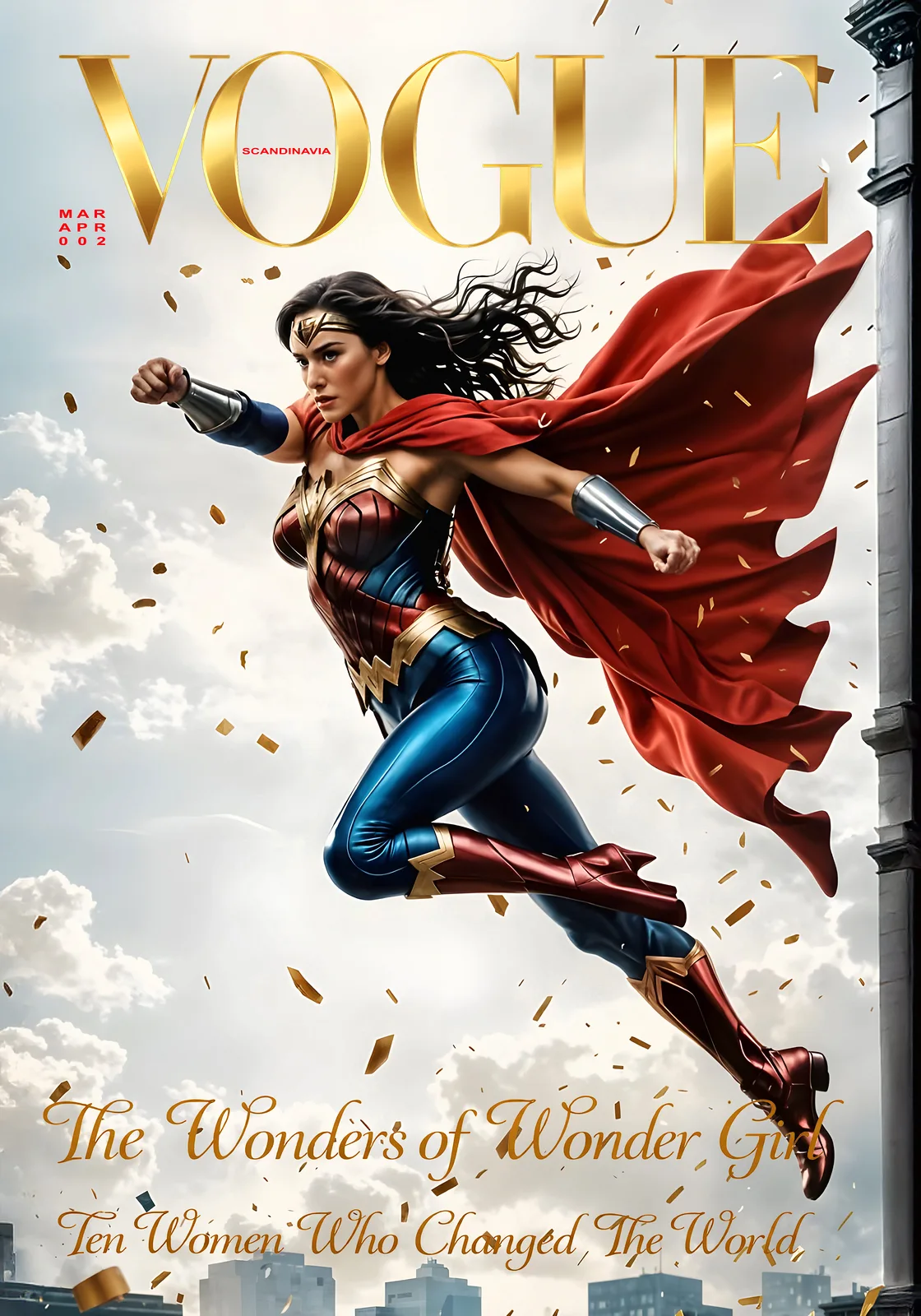
Jörgen Thornberg
The Wonders of Wonder Girl, 2026
Digital
50 x 70 cm
3 200 kr
The Wonders of Wonder Girl
Svensk text i slutet av texten
Some figures are so ingrained in their own era that they fade once that era ends. Others do the opposite: they grow in significance as the world around them evolves. Wonder Woman belongs to the latter kind. She endures not by remaining the same, but by continuing to resonate—adapting to shifting cultural landscapes while retaining something recognisable at her core.
That may be one reason she has lasted. She has never existed in a single register. She belongs at once to pulp and mythology, to wartime propaganda and feminist critique, to fantasy and philosophy. Around her gathers a constellation of questions—about truth, power, justice, gender, authority, desire, and the uneasy relationship between liberation and representation.
To write about Wonder Woman is not simply to analyse a superheroine. It is to engage with the twentieth and twenty-first centuries, with changing ideas of female power, and with the ways popular culture absorbs social conflict and returns it to us in symbolic form. Her story begins in comics, but it does not remain there. It extends into film, television, fashion, politics, protest, nostalgia, and debate.
This is also why she cannot be understood as a fixed answer. She is too contradictory, too layered, too historically burdened—and yet too mobile. She has been celebrated as a feminist icon and criticised in the name of feminism. She has been imagined as a liberator, warrior, diplomat, fantasy, commodity, and moral force. She has been placed on pedestals and pulled down from them. And still, she remains.
Perhaps that is because Wonder Woman was never intended as mere entertainment. From the beginning, she was designed to intervene—to propose another model of strength, another relation between power and truth, another image of what a hero might be. Whether that proposal was coherent, whether it was flawed from the outset, whether it still speaks to us today—these are precisely the questions that make her worth returning to.
Wonder Woman is more than a character within stories. She is a story about stories—about who gets to embody power, what forms that power may take, and how each generation reshapes its icons in the image of its own hopes and anxieties.
This essay begins with an image.
“Wonder Girl
Before the armour learned her name,
before the world could call her wonder,
she moved where time had not yet hardened—
An island held between myth and morning.
She ran along the edge of light,
barefoot on marble and memory,
where no shadow taught her fear
and no voice told her what she could not be.
They called her daughter, not yet a legend,
a question walking in a body,
strength untested, uncontained,
like wind that had not met resistance.
She learned the weight of silence first—
How truth can live without a witness,
how power does not need to shout
to alter what the world insists on.
Bracelets cool against her pulse,
echoes of hands that shaped her story,
not as chains but as a rhythm—
a measure of restraint and force.
She watched the horizon gather meaning,
not as distance but as invitation,
a line that asked, without command:
What remains if you step beyond it?
And somewhere in that quiet tension,
between belonging and departure,
she understood what had no name—
That leaving is a form of becoming.
No battle marked her transformation,
no single act declared her arrival.
She changed the way a tide changes—
persistent, patient, almost unseen.
Until one day the world required her,
fractured, loud, and certain of itself,
and she, who had never been still,
stepped forward—not as answer, but as motion.
Not yet Wonder Woman,
but no longer only a girl—
She crossed the space between the two
and carried both with her.“
Malmö, March 2026
The Wonders of Wonder Girl
Prologue — The Image That Refuses to Land
She does not stand still. She does not pose. She is already in motion.
Across the polished surface of a magazine cover—where stillness is usually the rule and perfection is carefully arranged—she breaks the agreement. Her body slices through the air, angled forward, as if the image itself cannot contain her. The red of her cape does not fall; it defies gravity, demanding direction rather than decoration. Even the gold letters above her seem less like a title and more like a horizon she is about to cross.
This is not just an image. It is an interruption.
A fashion cover, yes—VOGUE, the temple of surfaces, of fabrics, of curated identities. Yet here, within that familiar frame, something refuses to remain ornamental. The woman does not wear power; she embodies it. The costume—so often debated, dissected, and reduced—becomes, in this moment, secondary to velocity. This challenges traditional notions of power as static or posed, urging us to reconsider how images convey strength through movement and presence.
And that is the first rupture. Because historically, images of women have asked us to pause, to admire, to consume. They have been composed for the gaze, arranged within it. But here, the gaze must follow. The viewer is no longer in control of the scene; we are left behind, catching fragments—the tension in her arm, the determined line of her jaw, the wind pulling at her hair as if it recognises her as an equal. This shift invites us to see strength as active and dynamic, not merely static or ornamental.
Even the sky participates. It is not merely a backdrop but a field of resistance, a space she must navigate rather than adorn. The fragments that appear to scatter around her—dust, debris, perhaps remnants of something already broken—suggest that movement carries consequences. She is not emerging from calm, but from disruption. This portrayal aims to evoke feelings of resilience and strength through her disruptive motion.
And yet, there is a strange familiarity in the image, as if we have seen her before, not only in comics or films, but somewhere deeper — in myths of winged figures, in stories of gods who moved between worlds, in older imaginings of power that did not seek permission to exist. She belongs as much to that lineage as to the modern page she now occupies.
This is where the image transcends mere illustration. It becomes a proposition. It challenges us to reconsider notions of power and movement, inviting the audience to feel curious and intellectually stimulated by its deeper meaning.
What if strength is not a pose but a direction? What if power is not something displayed, but something enacted? What if the figure we are looking at is not meant to be understood as an object at all, but as a force passing through the frame?
She does not wait for interpretation. She does not present herself as a neatly resolved symbol.
She moves—and in doing so, she leaves the rest of us with the uncomfortable task of deciding whether we are witnessing an image, or being asked to follow it.
A Hero Born in an Era of Division
It is tempting to say that she was born in 1938, in that charged pre-war atmosphere when many modern myths began to take shape. The instinct is not entirely wrong. Even if Wonder Woman first appeared in 1941, she unquestionably belongs to that earlier time—a world already wavering, already seeking new ways to define strength, authority, and moral clarity. Exploring her feminist roots reveals her as a symbol of empowerment beyond mere heroism.
The late 1930s and early 1940s were not just a historical background; they served as a testing ground for ideas. Old certainties were breaking down, and the language of power was being rewritten in real time. Nations mobilised, ideologies became more rigid, and individuals were compelled to reconsider what it meant to act, to resist, to lead. It is within this environment that Wonder Woman appears — not as an afterthought, but as a deliberate response.
Her creator, William Moulton Marston, was not a traditional storyteller but a psychologist, a man preoccupied with the inner workings of truth and deception. His involvement in developing early lie-detection techniques is more than a biographical detail; it is essential to understanding the figure he helped create. While other heroes were characterised by physical strength, speed, or technological prowess, Wonder Woman was conceived around a different principle. Her defining power was not the ability to overpower, but the ability to reveal.
This distinction matters. In an age dominated by propaganda—where truth itself becomes unstable, contested, and weaponised—the idea of a hero whose main role is to compel honesty holds particular significance. Her lasso does not merely restrain; it reveals. It turns confrontation into revelation, conflict into understanding. In that sense, she does not just fight within her era; she confronts one of its most pressing dilemmas.
From the outset, she is not a secondary figure. She embodies an alternative power—one that invites admiration and curiosity, redefining strength as a pursuit of truth rather than domination.
Understanding her origin involves recognising a shift. She does not emerge entirely from myth, nor only from imagination, but from a convergence—history pressing against psychology, crisis confronting theory, the visible world clashing with invisible structures of belief. In this sense, she is less a creation than a negotiation between past power and future possibilities.
And that is why placing her in 1938 is less an error and more an intuition. She belongs to that moment just before everything fractures, when the future remains uncertain, and new forms have not yet hardened into convention. She arrives not after the question has been answered, but while it is still being asked.
The Weapon of Truth
If she is born from a crisis of meaning, then her most distinctive attribute-the golden lasso—evokes respect and trust. It symbolises her commitment to truth amid her era's instability, redefining power as revelation.
To understand this, one must briefly revisit William Moulton Marston and his fascination with truth as an almost physical, measurable phenomenon. His work with early lie detection was based on the idea that the body reveals the mind—that truth, no matter how hidden, leaves traces. In translating this idea into fiction, he did not invent a machine but a symbol. The lasso becomes a tool that bridges the gap between what is said and what is, embodying psychological insight into human honesty and vulnerability.
This marks a significant shift from the typical logic that drives most heroic narratives. Usually, power is exercised through domination: the enemy is subdued, defeated, and eliminated. The resolution lies in victory. However, the lasso offers an alternative. It does not silence the opponent; it forces them to speak. It turns conflict into revelation.
There is something almost unsettling about this. To be overpowered is one thing; to be compelled to reveal the truth is another. It suggests that the ultimate vulnerability is not physical weakness but the inability to conceal. In this manner, Wonder Woman’s power extends beyond the battlefield. It functions in the domain of conscience, self-exposure, and moral accountability.
Placed within the historical context of the early 1940s, the symbolism becomes clearer. This was a time filled with narratives—political, ideological, national—each claiming legitimacy and shaping perception. Truth was not just hidden; it was actively created. Against this backdrop, the idea of a figure who could pierce through illusion carries an almost utopian significance. She does not impose a new narrative; she reveals what lies beneath the existing ones.
And yet, the lasso is not impartial. It raises its own questions. Who has the right to demand truth? Under what circumstances is revelation an act of justice rather than control? The act of compelling honesty can itself become a form of power, and therefore subject to the same scrutiny as the forces it seeks to expose. This tension highlights the complex symbolism of her weapon within a broader ethical context.
Her weapon is not a simple tool but a tension-filled symbol, embodying both emancipation and limitation, clarity and coercion, encouraging appreciation for its nuanced role in her power.
In this context, her strength is not solely measured by what she can do, but by what she insists upon. She does not just win; she reveals. And in a world where appearances often serve as a form of defence, that might be the more disruptive act.
A World Apart
If her power is defined not by force but by revelation, then her origin must also be understood as a symbol of broader themes, enriching the interpretation of her character beyond mere narrative convenience.
Themyscira, the island of the Amazons, is often described as a paradise, and in one sense, it is. It is detached from conflict, untouched by the historical cycles of domination and collapse that define the world beyond its shores. However, to see it merely as an idyllic refuge is to miss its true purpose. It is not an escape from reality but a redefinition of it.
Here, women are not exceptions but the norm. Authority is not challenged through traditional means because the structures that foster such challenges have been dismantled. Power does not need to assert itself via hierarchy; it circulates differently, rooted in competence, discipline, and a shared sense of purpose. The island is, in this sense, less a utopia than a controlled experiment: what happens if the principles that govern society are removed and replaced?
The stability of Themyscira, which risks becoming static once perfection is achieved, should evoke reassurance about the island's coherence and self-sufficiency.
This is where Wonder Woman’s departure becomes significant. She acts as a bridge between the idealised world of Themyscira and the complex reality, embodying both its values and contradictions, thus deepening her symbolic role.
The connection to ancient myth deepens this reading. The Amazons of Greek legend were never merely figures of admiration. They were also symbols of anxiety—women who lived outside the structures that defined the known world, and who therefore represented both possibility and threat. They were simultaneously idealised and contained, their difference marking the boundaries of what could be imagined.
In this way, Wonder Woman is not so much a modern creation as a reemergence. She reactivates an older narrative but situates it within a new context. The island remains, but it is no longer enough. The question is no longer about what such a world might look like in isolation, but what occurs when it interacts with everything it excludes.
Her presence in the “real” world is therefore not merely an act of heroism. It represents an intrusion. She bears a different logic with her—one that does not easily align with the systems she encounters. And it is precisely in this misalignment that her significance becomes apparent.
She does not belong, and she is not meant to. Her role is not to integrate seamlessly, but to reveal the limits of what is taken for granted. Themyscira is not left behind; it is brought to the forefront, as a question that refuses to fade away.
And so her origin remains active. It is not a past she leaves behind, but a perspective she continues to hold—a reminder that the world as it is has always had alternatives, even if they have been pushed to the fringes of imagination.
Between Good and Its Reflection
It is often said that heroes stand on the side of the good, as if that position were stable, clearly defined, and universally accepted. Yet Wonder Woman challenges this assumption by embodying a moral stance that questions the very idea of good itself, inviting readers interested in literature, philosophy, or superhero narratives to explore her moral complexity.
At first glance, she seems to fit comfortably within the moral framework of the superhero tradition. She opposes violence, resists injustice, and defends those who cannot defend themselves. There is little ambiguity in her alignment. Yet, repeatedly, she finds herself at odds not only with obvious forms of evil but also with institutions and ideologies that claim to represent the good, which deepens the exploration of her moral stance for scholars and students alike.
This is where her difference becomes clear. She not only confronts enemies; she also actively questions the definitions of right and wrong. War, for example, is rarely shown to her as a straightforward battle between good and evil. Instead, it is depicted through competing stories—each side convinced of its validity, each invoking necessity, duty, or survival. In this context, choosing a side isn’t enough; one must also critically examine the reasons behind that choice, encouraging reflection on moral evaluation.
Her position, then, is not that of a rebel in the traditional sense. She neither rejects order nor advocates chaos. Instead, she occupies a more uncertain space—one where allegiance is conditional, subject to scrutiny, and open to revision. She is loyal not to structures, but to principles, and even those principles are not immune to examination.
This creates a subtle yet persistent friction. When authority aligns with justice, she supports it. When it diverges, she resists. The result is a figure who can stand with power and against it, sometimes within the same narrative. To those observing more closely, this reveals a different kind of coherence—one grounded in ongoing evaluation and moral responsibility, inspiring admiration for her resilience.
In this way, she is more a symbol of moral responsibility than of fixed certainty. She does not inherit a static definition of the good; she actively participates in shaping its evolution. Every action becomes a deliberate choice, each one reflecting what should be preserved and what must be challenged in the ongoing pursuit of moral understanding.
There is, inevitably, a cost to this stance. To question the good is to risk isolation, to step outside the comfort of collective agreement. It demands a willingness to be misunderstood, to be perceived as oppositional even when the aim is corrective. And yet this is exactly where her ethical strength lies, inspiring admiration for her moral resilience.
What she reveals is not that goodness is missing, but that it is delicate—dependent on vigilance, reflection, and the courage to face it when it hardens into something else. She invites the audience to see the fragility of goodness and feel a shared responsibility to protect it, fostering humility and collective effort.
And in doing so, she changes the hero's role. The task is no longer to defeat what is wrong, but to stay attentive to the possibility that what seems right may, upon scrutiny, show a different face.
A Symbol—But Not a Straightforward One
To call Wonder Woman a feminist symbol is both accurate and insufficient, as her layered symbolism invites analysis through various feminist theories-such as liberal, radical, and intersectional feminism-enriching scholarly understanding and encouraging nuanced debate.
Her creator, William Moulton Marston, did not see her merely as an equal to existing heroes but as an alternative rooted in early 20th-century debates on gender roles and emotional intelligence, emphasising empathy and an ethics of care over domination, highlighting how personal beliefs shape her feminist symbolism.
This vision, however, did not arise in isolation. It was subtly yet firmly shaped by the women in his life, especially Elizabeth Holloway Marston and Olive Byrne, whose intellectual and personal influence left clear marks on the character. The bracelets, often seen as purely ornamental or as symbols of restraint, reflect the actual objects Byrne wore. The emphasis on female autonomy demonstrates a lived experience within a household that itself opposed traditional structures.
And yet, within these progressive aims lie elements that challenge straightforward alignment with modern understandings of feminism. The early tales are characterised by recurring imagery of restriction—binding, captivity, submission-that can be examined through feminist theories of power, agency, and resistance. At first glance, these motifs seem contradictory, even troubling. How can a figure meant to symbolise liberation be so often depicted in states of restraint?
The answer, if there is one, lies in Marston’s own theories, which complicate rather than resolve the tension. He saw submission not solely as oppression, but as a possible expression of trust, emotional connection, or even voluntary surrender within a framework of mutual respect. This view sits uneasily with many modern interpretations, and perhaps rightly so. However, to dismiss it entirely would be to ignore how the character was always intertwined with questions that resist simple categorisation.
Thus, Wonder Woman becomes less a fixed symbol and more a site of negotiation, mirroring ongoing feminist debates about empowerment, autonomy, and the legacy of emancipation narratives across generations, inspiring the audience to see her as a living part of ongoing discussions.
This instability is not a flaw. It is, in many respects, her defining trait.
And yet, because she cannot be reduced to a single interpretation, she invites ongoing debate. She provokes reconsideration and reflection, encouraging the audience to stay curious and engaged with her evolving symbolism, reflecting the continuous development of the ideas she embodies.
Calling her a feminist symbol is only the start, not the end. It recognises her origins but not her destination. What she ultimately represents is not a fixed stance but an ongoing debate — about power, about freedom, and about the possibilities those ideas might still hold.
From Comic to Icon
If her meaning resists closure, it is because she has never been confined to a single form. Wonder Woman does not merely persist; she migrates—across media, across decades, across shifting cultural expectations—each transformation leaving a trace, each reinterpretation altering the balance of what she represents.
In her earliest incarnations, she is inseparable from the wartime context that gave rise to her: a figure connected with collective struggle. This presence affirms the possibility of justice in a world characterised by conflict. The visual language is direct, almost declarative. She acts, intervenes, and resolves. There is little hesitation in her movements, little ambiguity in her role.
By the time she reappeared on television in the 1970s, embodied by Lynda Carter, something had shifted. The world she inhabits is no longer at war in the same direct sense, but it is experiencing its own changes—social, political, cultural. Here, she becomes not just a protector, but a presence—graceful, composed, navigating between strength and visibility. The performance softens certain edges while emphasising others. She remains powerful, but she is also more accessible in a different way, framed for a medium that values continuity over rupture.
In more recent interpretations, especially in the cinematic portrayals of Gal Gadot, the pendulum swings again. The focus returns to origin, to myth, and to the weight of history carried in the body. The aesthetic shifts towards the monumental: armour replaces costume, texture replaces surface, and gravity reasserts itself. She is not just present; she is rooted—both literally and figuratively—in a lineage that extends beyond the immediate narrative.
What remains constant through these transformations is not a fixed identity but a layered set of tensions. She is simultaneously a warrior and a diplomat, a figure and a force, a symbol and a subject. Each era emphasises different aspects, inviting the audience to appreciate her multifaceted nature and fostering respect for her ongoing reinterpretation.
This accumulation has consequences. Over time, she no longer belongs entirely to any single interpretation. She becomes recognisable beyond specific stories, beyond individual performances. Her silhouette, her attributes, her gestures—these begin to function independently, circulating through culture as fragments that carry meaning even when detached from their original context.
It is at this point that she transforms into something else: not merely a character, but an icon.
An icon, however, is not a neutral entity. It invites projection. It absorbs expectation. It risks oversimplification. The more widely it is recognised, the more it is subjected to forces that aim to stabilise it, to define it once and for all. And yet, in her case, that stabilisation never fully succeeds.
For every attempt to fix her meaning, a new interpretation arises, reopening the question.
Her shift from comic to icon is not a move towards clarity but towards complexity. She does not discard her earlier forms; instead, she carries them forward, layered and sometimes at odds, encouraging the audience to see her as a dynamic symbol that invites continuous reinterpretation.
In this way, her endurance is not merely about popularity. It is about adaptability—an ability to be reimagined without being erased, transformed without being lost-instilling admiration for her resilience and ongoing relevance.
And that, perhaps, is the ultimate paradox of her iconic status: the more she is recognised, the less she can be simplified.
The Anecdote as Method
If Wonder Woman resists definition, it is perhaps because her story is best told not in statements, but in fragments—small, revealing episodes where intention and reality sometimes clash, where the ideal flickers and something more human emerges beneath it.
Begin by examining the context of her creation. It is tempting to envision a single author, a defining moment of invention, and a clear origin. However, what we discover is a network—almost a domestic experiment—focused on William Moulton Marston, but extending well beyond him. His household included not only his wife, Elizabeth Holloway Marston, but also their partner, Olive Byrne. Both women were educated, independent, and intellectually active; both influenced the environment from which Wonder Woman emerged. The often-repeated remark—“If you’re going to create a superhero, make her a woman”—captures something fundamental, even if its precise wording has been refined over time. A more concrete detail is Byrne’s bracelets, which closely resemble those worn by the character. It is a small gesture, but one of significance: the myth is already rooted in real lived experience.
The same movement—from the empirical to the symbolic—can be traced in the transformation of Marston’s work on lie detection into the Lasso of Truth. What begins as a technical curiosity, an attempt to measure physiological responses, becomes in fiction an instrument of moral exposure. The change is not just superficial. It embodies a wish to turn a scientific intuition into a story, to make the unseen visible, to give shape to the idea that truth persists, even when hidden. Still, like all such translations, something shifts. The lasso does not simply measure; it forces. It introduces, alongside revelation, an element of coercion.
However, other anecdotes take a different route—away from intention and towards contradiction. In the 1950s, during a time when cultural pressures aimed to reinforce more traditional gender roles, Wonder Woman—creator, warrior, symbol of extraordinary ability—appears in certain stories not at the centre of action but on its administrative edge. She becomes, quite literally, a secretary. The image is almost too exact to ignore: a character designed to redefine power repositioned within a structure that neutralises it. It is not her abilities that change, but the framework in which they are recognised.
Decades later, a similar tension resurfaces under different circumstances. In 2016, she was named an honorary ambassador for women's empowerment by the United Nations—an act that, at first glance, seems to be the logical culmination of her symbolic journey. However, the appointment is met with protests. Critics contend that she represents an unrealistic and sexualised ideal, unable to embody the diversity of genuine women’s experiences. The role is quietly rescinded. What is striking here is not the disagreement itself but its trajectory: a figure fashioned as a symbol of empowerment becomes the target of critique within the very discourse she was intended to endorse.
Even the question of her appearance—her costume, her body—refuses to settle. Over decades, it has been altered, reinterpreted, defended, and rejected. Is it functional or ornamental, empowering or objectifying, historical or fantastical? Each answer prompts another question. When the character is reimagined in more recent portrayals, the move towards armour, weight, and texture suggests a desire to ground her, to connect her more closely with the logic of physical reality. But this, too, is not a resolution. It remains another stance within an ongoing negotiation.
Taken together, these episodes do not form a coherent narrative in the traditional sense. They do not lead seamlessly from origin to outcome. Instead, they build up. They reveal a figure constantly shaped by forces both internal and external—by the intentions of her creators, by the expectations of audiences, by the pressures of the cultures she moves through.
To follow these anecdotes is to recognise that Wonder Woman is not sustained by consistency, but by tension. A complication accompanies each moment of clarity; each assertion is met with a counterpoint. The character does not resolve these contradictions. She carries them.
And perhaps this is why the anecdote becomes not merely illustrative but methodological. It allows us to approach her not as a fixed idea but as a series of encounters—partial, situated, sometimes contradictory, always revealing.
The Uncomfortable Dimension
There remains, however, a layer that resists easy integration—a dimension that does not align neatly with the language of empowerment, nor with the comforting clarity often associated with Wonder Woman. It exists from the outset, embedded in the earliest stories, recurring with a persistence that makes it impossible to dismiss as accidental.
The imagery is unmistakable. Chains, ropes, restraints. Bodies bound, immobilised, rendered temporarily powerless. And not only her adversaries, but often Wonder Woman herself. The repetition is too deliberate to be accidental, too structured to be ignored. It introduces a visual and thematic vocabulary that sits uneasily alongside the narrative of liberation.
To understand this tension, one must revisit William Moulton Marston. His psychological theories did not view power as a straightforward conflict between domination and resistance. Instead, he suggested a more intricate dynamic—where submission, under certain circumstances, could be voluntary and even desirable, serving as a form of trust rather than coercion. This perspective challenges traditional interpretations and does not easily align with contemporary frameworks.
Within the stories, this creates an ambiguity that is difficult to resolve. When Wonder Woman is bound, is she being diminished, or is she engaging in a narrative structure that redefines vulnerability? When she breaks free, is this a restoration of autonomy, or the end of a cycle in which constraint and release are interconnected? These questions do not have simple answers, and perhaps that is exactly the point. This ongoing tension stimulates curiosity and invites deeper analysis, resonating with scholars and critical thinkers.
The imagery does not function as a straightforward statement but as a disturbance—a reminder that power is seldom singular and often contains its own opposition. To be strong is not to exist beyond constraint, but to face it, negotiate with it, and move through it. From a contemporary perspective, this tension between control and surrender may seem unsettling, even incompatible with the figure’s status as a feminist symbol. However, acknowledging this complexity enriches her representation, resisting reductive interpretations and highlighting her resistance to simplistic narratives.
What emerges here is not a contradiction to be resolved but a complexity to be recognised. Wonder Woman does not represent a seamless vision of freedom. She embodies a more intricate reality, in which power and vulnerability, control and surrender, coexist in a fragile relation.
This does not weaken her. It makes her deeper.
It suggests that the absence of tension does not define strength, but rather the capacity to hold it — to remain active within it, and to resist the impulse to resolve it too quickly into something more manageable. In this way, the “uncomfortable dimension” is not an anomaly within her story but an essential part of it.
It is the element that resists closure, keeps interpretation open, and quietly but persistently insists that even the most powerful figures are shaped by forces that cannot be entirely mastered.
Conclusion — A Figure in Motion
What remains, after all these approaches, is not a single image but a trajectory. Wonder Woman does not resolve into a fixed meaning; she continues to move between ideas, epochs, and interpretations that never fully settle.
She has been perceived as a myth and a modern invention, as a warrior and a diplomat, as a symbol and a subject. She has been elevated, questioned, reframed, and, at times, reduced. Yet none of these perspectives has succeeded in containing her. Each has captured something, but never the whole.
This is not a failure of definition; rather, it is a condition inherent to her existence.
What she embodies is not a fixed answer but an ongoing negotiation between strength and empathy, between authority and its critique, between visibility and autonomy. She does not eradicate these tensions; she sustains them. And in doing so, she resists the closure that would make her inert. This resilience and complexity should inspire respect and admiration among readers engaged in critical analysis.
If there is a continuity across her many forms, it lies not in consistency but in direction. She moves—away from fixed roles, away from inherited structures, away from the expectation that power must resemble what it has always been. Her presence is less a statement than a vector, less a conclusion than a proposition unfolding in time.
This movement inevitably brings us back to the image we started with, not as an illustration but as a condensation. She is not standing within the frame; she is passing through it. The surface cannot contain her, just as no single interpretation can.
And so the question she leaves behind is not who she is, but what she does to the space she enters. What shifts when strength is no longer defined by domination, but by revelation? What changes when power refuses to settle into a single form?
She does not respond to these questions. She continues to carry them forward.
Epilogue — The Wonders of Wonder Girl and their societal significance
If the title promises wonders, it does not refer to miracles in the traditional sense. The word hints at something quieter, more persistent—acts that change perception rather than suspend reality. The wonders of Wonder Woman, once called Wonder Girl in her earlier incarnations, are not only found in spectacle but also in the subtle redefinition of what power can be.
Her first wonder is not that she can fly, deflect bullets, or lift what others cannot. It is that she shifts the axis of strength, inspiring admiration by redefining power as responsibility and reflection. This shift encourages your audience to see strength as something admirable and aspirational.
The second wonder lies in her relation to truth, not as an abstract virtue, but as a demand placed upon the world. The lasso, often seen as an object, is better understood as an insistence that what is hidden must be spoken, and that what is distorted needs clarification. In this, her power becomes unsettling because it extends beyond the visible conflict and into the underlying structures that uphold it.
A third wonder is her origin—not just that she comes from elsewhere, but that she carries that elsewhere with her. Themyscira is not left behind as a lost paradise; it remains active, serving as a counterpoint to the world she inhabits. Wherever she appears, another possibility is suggested: that the existing order is not the only one, and that alternatives exist even when they are not immediately visible.
There is also the marvel of contradiction. She is simultaneously a figure and an argument, a symbol and a question. She can be appropriated, contested, reimagined—and yet she does not disintegrate. Instead, she absorbs these tensions, allowing them to coexist. While many icons harden into clarity, she remains permeable, open to reinterpretation without losing coherence.
And perhaps the most lasting wonder is this: she does not remain where she is placed. Every attempt to define her results in a remainder, something that escapes and exceeds the frame. She cannot be confined to a role because she continually moves beyond it.
In this sense, her wonders are not feats to be listed, but effects to be observed. They manifest in the shift of perspective, in the disruption of expectations, in the quiet reorientation of what seems natural and what might otherwise be.
She started as an answer to a question that had yet to be fully expressed. She is undoubtedly still an unresolved question.
And perhaps that is the final wonder.
Post Scriptum — A Living Measure of Wonder.
If the marvels of Wonder Woman are not to remain confined to fiction, then the question must eventually turn outward. Not towards superficial comparison—no living person deflects bullets or commands truth with a golden lasso—but towards resonance. Where, in real history, do we find the same redefinition of strength, the same refusal to accept inherited limits, the same insistence that power must respond to something beyond itself?
One name emerges quite distinctly: Greta Thunberg.
At first glance, the gap between myth and reality seems clear, but a structural similarity begins to emerge beneath these differences.
Her influence is not rooted in physical strength or official authority. Instead, it stems from an unwavering insistence on truth—spoken plainly, reiterated tirelessly, resistant to dilution. This steadfastness can evoke respect and trust in your audience, highlighting her integrity.
The Lasso of Truth, when brought to reality, symbolises a stance—an outright refusal to permit evasion and a demand that words align with actions —emphasising societal transparency.
There is also the question of origin—not in the literal sense but in relation to the world one enters. Wonder Woman comes from Themyscira, symbolising a utopian ideal of matriarchal power and distinct cultural values. Greta Thunberg, although firmly rooted in contemporary society, holds a comparable position of dissonance. She speaks from within the system but not according to its conventions. Her perspective disrupts the frameworks it relies upon, revealing contradictions that are otherwise absorbed into routine.
And just like Wonder Woman, this disruption provokes resistance. She is criticised, dismissed, reinterpreted, and sometimes reduced to an image that is easier to control. The pattern is familiar: a figure who challenges established narratives faces not only opposition but also attempts to reframe her in less threatening ways. However, as with the fictional counterpart, these efforts do not entirely succeed. Something remains fundamentally irreducible.
Drawing this parallel does not mean bridging the gap between fiction and reality, nor does it imply they are equal where they are not. Instead, it involves recognising that the “wonders” ascribed to an imagined figure are not solely the product of imagination. They suggest capacities that, under certain conditions, can manifest within the real.
What both figures reveal is a shift in the perception of strength. Not as domination or control, but as persistence rooted in principle. A capacity to stay within tension without falling into simplification. A willingness to speak when silence might be easier, to act when passivity could be safer.
In this sense, Wonder Woman's wonders are not supernatural; they are aspirational. They depict, in amplified form, the potential for power to be wielded differently—revealing rather than concealing, challenging rather than conforming, enduring rather than imposing. This can inspire your audience to believe in the possibility of positive change.
Not that the myth has become real, but that it was never entirely separate from reality to begin with.
Inledning – Ett bestående under
Vissa gestalter är så djupt förankrade i sin egen tid att de bleknar när den tiden passerar. Andra gör tvärtom: de växer i betydelse i takt med att världen omkring dem förändras. Wonder Woman tillhör den senare kategorin. Hon består inte genom att förbli densamma, utan genom att fortsätta resonera—genom att anpassa sig till skiftande kulturella landskap samtidigt som något igenkännbart bevaras i hennes kärna.
Det kan vara en av anledningarna till att hon har bestått. Hon har aldrig existerat i ett enda register. Hon hör samtidigt hemma i pulp och mytologi, i krigspropaganda och feministisk kritik, i fantasi och filosofi. Runt henne samlas en hel konstellation av frågor—om sanning, makt, rättvisa, kön, auktoritet, begär och den svårfångade relationen mellan frigörelse och representation.
Att skriva om Wonder Woman är därför inte bara att analysera en superhjältinna. Det är att närma sig det tjugonde och tjugoförsta århundradet, att följa föreställningarna om kvinnlig styrka i förändring och att se hur populärkulturen absorberar sociala konflikter och återger dem i symbolisk form. Hennes berättelse börjar i serietidningarna, men stannar inte där. Den sträcker sig vidare in i film, tv, mode, politik, protest, nostalgi och debatt.
Det är också därför hon inte kan förstås som ett fast svar. Hon är alltför motsägelsefull, alltför skiktad, alltför historiskt belastad – och samtidigt alltför rörlig. Hon har hyllats som feministisk ikon och kritiserats i feminismens namn. Hon har föreställts som befriare, krigare, diplomat, fantasi, vara och moralisk kraft. Hon har placerats på piedestaler och dragits ner från dem. Och ändå består hon.
Kanske är det för att Wonder Woman aldrig var tänkt som enbart underhållning. Från början var hon skapad för att ingripa—för att föreslå en annan modell för styrka, en annan relation mellan makt och sanning, en annan bild av vad en hjälte kan vara. Om denna idé var sammanhängande, om den var motsägelsefull redan från början, om den fortfarande talar till oss idag—det är just dessa frågor som gör henne värd att återvända till.
Wonder Woman är mer än en gestalt i berättelser. Hon är en berättelse om berättelser—om vem som får gestalta makt, vilka former den kan ta och hur varje generation omformar sina ikoner i bilden av sina egna förhoppningar och rädslor.
Den här essän börjar med en bild.
Prolog — Bilden som vägrar att landa
Hon står inte stilla. Hon poserar inte. Hon är redan i rörelse.
Över den polerade ytan på ett tidningsomslag—där stillhet vanligtvis är regeln och fulländning arrangeras med omsorg—bryter hon mot överenskommelsen. Hennes kropp skär genom luften, lutad framåt, som om själva bilden inte kan rymma henne. Det röda i hennes cape faller inte; det trotsar tyngdlagen och kräver riktning snarare än dekoration. Till och med de gyllene bokstäverna ovanför henne liknar mindre en titel än en horisont hon är på väg att korsa.
Detta är inte bara en bild. Det är ett avbrott.
Ett modeomslag, ja—VOGUE, ytors, tygers och kuraterade identiteters tempel. Och ändå, inom denna välbekanta ram, finns något som vägrar att förbli ornamentalt. Kvinnan bär inte makt; hon förkroppsligar den. Dräkten—så ofta debatterad, dissekerad och reducerad—blir i detta ögonblick underordnad hastigheten. Hon betraktas inte. Hon är på väg någonstans.
Och där ligger den första sprickan. För historiskt sett har bilder av kvinnor bett oss att stanna upp, beundra, konsumera. De har komponerats för blicken, ordnats inom den. Men här måste blicken följa efter. Betraktaren har inte längre kontroll över scenen; vi lämnas kvar, fångade fragment—spänningen i hennes arm, den beslutsamma linjen i hennes käke, vinden som sliter i hennes hår som om den erkände henne som en jämlike.
Till och med himlen deltar. Den är inte bara en bakgrund utan ett motståndsfält, ett rum hon måste navigera genom snarare än pryda. De fragment som tycks spridas omkring henne—damm, spillror, kanske rester av något som redan krossats—antyder att rörelse får konsekvenser. Hon träder inte fram ur lugn, utan ur störning.
Och ändå finns det något märkligt välbekant i bilden, som om vi har sett henne förut, inte bara i serier eller filmer, utan någonstans djupare—in i myter om bevingade gestalter, i berättelser om gudar som rörde sig mellan världar, i äldre föreställningar om makt som inte bad om lov att existera. Hon hör lika mycket till den traditionen som till den moderna sidan hon nu upptar.
Det är här bilden överskrider det rent illustrativa. Det blir ett påstående.
Tänk om styrka inte är en pose utan en riktning? Tänk om makt inte är något som visas upp, utan något som utövas? Tänk om gestalten vi ser på inte alls är tänkt att förstås som ett objekt, utan som en kraft som passerar genom ramen?
Hon väntar inte på tolkning. Hon presenterar sig inte som en prydlig lös symbol.
Hon rör sig – och i det lämnar hon oss andra med den obekväma uppgiften att avgöra om vi bevittnar en bild eller om vi uppmanas att följa den.
En hjälte född i en tid av splittring.
Det är frestande att säga att hon föddes 1938 i denna laddade förkrigsatmosfär när många moderna myter började ta form. Instinkten är inte helt fel. Även om Wonder Woman först framträdde 1941, hör hon obestridligen hemma i denna tidigare tid — en värld som redan vacklade, redan sökte nya sätt att definiera styrka, auktoritet och moralisk klarhet.
Slutet av 1930-talet och början av 1940-talet var inte bara en historisk bakgrund; de fungerade som en experimentverkstad för idéer. Gamla vissheter höll på att bryta samman och maktens språk skrevs om i realtid. Nationer mobiliserades, ideologier stelnade och individer tvingades ompröva vad det innebar att handla, att göra motstånd, att leda. Det är i denna miljö som Wonder Woman träder fram — inte som en eftertanke, utan som ett medvetet svar.
Hennes skapare, William Moulton Marston, var ingen traditionell berättare utan en psykolog, en man upptagen av sanningens och bedrägeriets inre mekanismer. Hans medverkan i utvecklingen av tidiga lögndetektionstekniker är mer än en biografisk detalj; den är avgörande för att förstå den gestalt han bidrog till att skapa. Medan andra hjältar kännetecknades av fysisk styrka, snabbhet eller teknologisk överlägsenhet, tänkte sig Wonder Woman kring en annan princip. Hennes definierande kraft var inte förmågan att övermanna utan förmågan att avslöja.
Denna skillnad spelar roll. I en tidsålder präglad av propaganda — där sanningen själv blir instabil, omstridd och vapeniserad — får idén om en hjälte vars främsta uppgift är att tvinga fram ärlighet en särskild betydelse. Hennes lasso håller inte bara fast; den avslöjar. Det förvandlar konfrontation till blottläggande, konflikt till insikt. I den meningen strider hon inte bara inom sin epok; hon konfronterar ett av dess mest akuta dilemman.
Redan från början är hon inte en sekundär figur. Hon är inte en kvinnlig motsvarighet skapad för att spegla en redan etablerad modell. Istället förkroppsligar hon en alternativ maktuppfattning—en som inte avstår från styrka men omdefinierar dess syfte. Fysisk kraft förblir en del av hennes identitet, men den underordnas något mer svårgripbart och kanske mer oroande: påståendet att sanningen själv kan fungera som en form av auktoritet.
Att förstå hennes ursprung innebär att känna igen en förskjutning. Hon träder inte helt fram ur myten, och inte heller enbart ur fantasin, utan ur en sammanflätning—historia som pressar mot psykologi, kris som konfronterar teori, den synliga världen som kolliderar med osynliga trosstrukturer. I den meningen är hon mindre en skapelse än en förhandling mellan gårdagens makt och morgondagens möjligheter.
Och det är därför det är mindre ett misstag än en intuition att placera henne år 1938. Hon hör hemma i det ögonblicket strax innan allting spricker, när framtiden fortfarande är osäker och nya former ännu inte har stelnat till konvention. Hon anländer inte efter att frågan har besvarats, utan medan den fortfarande ställs.
Sanningens vapen
Om hon föds ur en meningskris, är hennes mest särpräglade attribut inte något tillfälligt. Det är i stället ett direkt svar på hennes epoks instabilitet. Det gyllene lassot—ofta sett enbart som en visuell signatur, ett dekorativt kännetecken för identitet—utgör i själva verket Wonder Womans begreppsliga kärna. Det förstärker inte hennes styrka; det omdefinierar den.
För att förstå detta måste man kort återvända till William Moulton Marston och hans fascination för sanningen som ett nästan fysiskt, mätbart fenomen. Hans arbete med tidig lögndetektion byggde på tanken att kroppen avslöjar sinnet—att sanningen, hur dold den än är, lämnar spår. När han översatte denna idé till fiktion, uppfann han inte en maskin utan en symbol. Lassot blir ett redskap som överbryggar klyftan mellan det som sägs och det som är.
Detta markerar en tydlig förskjutning från den logik som vanligtvis driver de flesta hjältberättelser. Vanligen utövas makt genom dominans: fienden kuvas, besegras och undanröjs. Upplösningen ligger i segern. Lassot erbjuder däremot ett alternativ. Det tystar inte motståndaren; det tvingar dem att tala. Det förvandlar konflikt till avslöjande.
Det finns något nästan oroande i detta. Att bli övermannad är en sak; att tvingas avslöja sanningen är en annan. Det antyder att den yttersta sårbarheten inte är fysisk svaghet utan oförmågan att dölja sig. På detta sätt sträcker sig Wonder Womans makt bortom slagfältet. Den verkar inom samvetets, självutlämnandets och det moraliska ansvarets område.
Satt i den historiska kontexten från början av 1940-talet blir symboliken tydligare. Detta var en tid fylld av berättelser—politiska, ideologiska, nationella—som alla gjorde anspråk på legitimitet och formade uppfattningen av verkligheten. Sanningen dolde sig inte bara; den skapades aktivt. Mot denna bakgrund får idén om en gestalt som kan tränga igenom illusionen en nästan utopisk betydelse. Hon påtvingar inte världen en ny berättelse; hon blottlägger det som finns under det redan existerande.
Och ändå är lasset inte opartiskt. Det väcker sina egna frågor. Vem har rätt att kräva sanning? Under vilka omständigheter är avslöjande en rättvisans handling snarare än kontroll? Själva akten att tvinga fram ärlighet kan i sig bli en form av makt och därmed underställas samma granskning som de krafter den försöker avslöja.
Än en gång motsätter sig Wonder Woman förenkling. Hennes vapen är inte en lösning utan en spänning. Det rymmer både frigörelse och begränsning, klarhet och tvång. Det antyder att sanningen, hur nödvändig den än är, aldrig är helt oskuldsfull.
I detta sammanhang mäts hennes styrka inte enbart i vad hon kan göra, utan i vad hon insisterar på. Hon segrar inte bara; hon avslöjar. Och i en värld där ytan ofta fungerar som ett försvar kan det vara den mer omstörtande handlingen.
En värld för sig
Om hennes makt inte definieras av kraft utan av avslöjande, måste också hennes ursprung förstås som något mer än bara en berättarteknisk bekvämlighet. Wonder Woman kommer inte från samma värld som hon träder in i. Hon anländer från annanstans—mer som ett begrepp än som en geografi.
Themyscira, Amazonernas ö, beskrivs ofta som ett paradis och i en mening är den det. Den är avskild från konflikt, oberörd av de historiska kretsloppen av dominans och sammanbrott som präglar världen bortom dess stränder. Men att se den enbart som en idyllisk tillflykt är att missa dess egentliga funktion. Den är inte en flykt från verkligheten utan en omdefiniering av den.
Här är kvinnor inte undantag utan norm. Auktoritet ifrågasätts inte på traditionellt vis, eftersom de strukturer som ger upphov till sådan kamp har avlägsnats. Makten behöver inte hävda sig genom hierarki; den cirkulerar på ett annat sätt, förankrad i kompetens, disciplin och en gemensam känsla av syfte. Ön är i den meningen mindre en utopi än ett kontrollerat experiment: vad händer om de principer som styr samhället tas bort och ersätts?
Svaret är en smula obekvämt. Om Themyscira står för en värld utan patriarkal dominans, står den också för en värld utan de spänningar som sådan dominans historiskt har framkallat. Den är stabil, sammanhängande och självförsörjande. Och just därför riskerar den att bli statisk. När fulländning väl är uppnådd, finns det få skäl att förändras.
Det är här Wonder Womans avfärd blir betydelsefull. Hon stannar inte kvar inom detta slutna system; hon lämnar det. Och därmed för hon inte bara med sig den världens värden, utan också dess olösta motsägelser. Hon blir en bro mellan två ordningar: en föreställd och en verklig; en harmonisk och en sprucken.
Kopplingen till den antika myten fördjupar denna läsning. De grekiska legendens amazoner var aldrig enbart beundrade gestalter. De var också symboler för oro — kvinnor som levde utanför de strukturer som definierade den kända världen och som därför representerade både möjlighet och hot. De idealiserades och hölls samtidigt i schack; deras olikhet markerade gränserna för vad som kunde föreställas.
På så vis är Wonder Woman mindre en modern skapelse än ett återuppdykande. Hon återaktiverar en äldre berättelse men placerar den i en ny kontext. Ön finns kvar, men den räcker inte längre. Frågan gäller inte längre hur en sådan värld skulle kunna se ut i isolering, utan vad som händer när den kommer i kontakt med allt det den utesluter.
Hennes närvaro i den ”verkliga” världen är därför inte bara en hjältehandling. Det är ett intrång. Hon bär med sig en annan logik — en som inte låter sig fogas in utan vidare i de system hon möter. Och det är just i denna felpassning som hennes betydelse blir synlig.
Hon hör inte hemma där, och det är inte heller meningen. Hennes roll är inte att sömlöst integreras utan att blottlägga gränserna för det som tas för givet. Themyscira lämnas inte bakom; den förs fram i förgrunden, som en fråga som vägrar att blekna.
Och därför förblir hennes ursprung aktivt. Det är inte ett förflutet hon lämnar bakom sig, utan ett perspektiv hon fortsätter att bära — en påminnelse om att världen sådan den är alltid har haft alternativ, även om de har skjutits ut mot fantasin ytterkanter.
Mellan det goda och dess spegelbild
Det sägs ofta att hjältar står på det godas sida, som om den positionen vore stabil, tydligt definierad och allmänt accepterad. Men Wonder Woman utmanar detta antagande. Hon förkastar inte idén om det goda; hon granskar den.
Vid första anblick verkar hon passa väl in i superhjältetraditionens moraliska ramverk. Hon motsätter sig våld, står emot orättvisa och försvarar dem som inte kan försvara sig själva. Det finns liten oklarhet i hennes orientering. Och ändå hamnar hon gång på gång i konflikt — inte bara med uppenbara former av ondska, utan också med institutioner och ideologier som gör anspråk på att representera det goda.
Det är här hennes särart blir tydlig. Hon konfronterar inte bara fiender; hon utmanar definitioner. Krig framställs för henne exempelvis sällan som en enkel strid mellan rätt och fel. I stället skildras det genom konkurrerande berättelser—där varje sida är övertygad om sin giltighet och åberopar nödvändighet, plikt eller överlevnad. I ett sådant sammanhang räcker det inte att välja sida. Man måste också ifrågasätta skälen till valet.
Hennes position är alltså inte rebellens i traditionell mening. Hon avvisar varken ordning eller förespråkar kaos. I stället intar hon en mer osäker plats—en där lojalitet är villkorad, underställd prövning och öppen för omprövning. Hon är trogen inte strukturer, utan principer, och inte ens dessa principer undgår granskning.
Detta skapar en subtil men ihållande friktion. När auktoritet sammanfaller med rättvisa stöder hon den. När den glider isär gör hon motstånd. Resultatet blir en figur som kan stå med makten och mot den, ibland inom samma berättelse. För den som väntar sig tydlighet kan detta verka inkonsekvent. För den som ser närmare visar det en annan sorts sammanhang—grundat inte i fasta positioner utan i en fortgående värderingsprocess.
På så vis är hon mer en symbol för ansvar än för visshet. Hon ärver ingen fast definition av det goda; hon bidrar till att forma dess utveckling. Varje handling blir ett val, och varje val ett påstående om vad som bör bevaras och vad som måste utmanas.
Det finns, oundvikligen, ett pris för denna hållning. Att ifrågasätta det goda är att riskera isolering, att kliva ut ur den kollektiva överenskommelsens bekvämlighet. Det kräver en vilja att bli missförstådd, att uppfattas som oppositionell även när syftet är korrigerande. Och ändå är det just här hennes etiska styrka ligger.
Det hon visar är inte att godheten saknas, utan att den är skör—beroende av vaksamhet, eftertanke och modet att konfrontera den när den hårdnar till något annat. Hon krossar inte idén om det goda; hon hindrar den från att bli oantastlig.
Och därigenom förändrar hon hjälterollen. Uppgiften är inte längre bara att besegra det som är fel, utan att förbli uppmärksam på möjligheten att det som verkar rätt vid närmare granskning kan visa ett annat ansikte.
En symbol—men inte en entydig sådan
Att kalla Wonder Woman för en feministisk symbol är både träffande och otillräckligt. Hon tänktes från början som en korrigering—en figur avsedd att utmana obalansen i en värld där makt länge hade kodats som manlig. Och ändå, ju längre hon existerar, desto mer upplöses denna tydlighet i något mer skiktat, mer omstritt, mer avslöjande.
Hennes skapare, William Moulton Marston, såg henne inte bara som jämbördig med existerande hjältar utan som ett alternativ. Styrka skulle enligt honom inte berövas av sin kraft utan omdirigeras—mildrad av empati och vägledd av en omsorgsetik snarare än av dominans. Han trodde, inte utan kontrovers, att en framtid formad av det han kallade ”kärleksfull auktoritet” skulle överträffa en styrd av tvång och att kvinnor genom läggning eller historisk erfarenhet var bättre rustade att gestalta en sådan förskjutning.
Denna vision uppstod dock inte i isolation. Den formades stillsamt men bestämt av kvinnorna i hans liv, särskilt Elizabeth Holloway Marston och Olive Byrne, vars intellektuella och personliga inflytande satte tydliga spår i gestalten. Armbanden, ofta sedda som rent ornamentala eller som symboler för begränsning, återspeglar de verkliga föremål Byrne bar. Betoningen av kvinnlig autonomi vittnar om en levd erfarenhet inom ett hushåll som självt motsatte sig traditionella strukturer.
Och ändå finns det inom dessa progressiva ambitioner element som gör det svårt att utan vidare förena henne med moderna feministiska tolkningar. De tidiga berättelserna präglas av återkommande bilder av begränsning—bindning, fångenskap, underkastelse. Vid första anblick verkar dessa motiv motsägelsefulla, till och med oroande. Hur kan en figur som är tänkt att symbolisera frigörelse så ofta framställas i tillstånd av fasthållning?
Svaret, om det finns ett sådant, ligger i Marstons egna teorier, som komplicerar snarare än löser spänningen. Han såg underkastelse inte enbart som förtryck, utan som ett möjligt uttryck för tillit, känslomässig förbindelse eller till och med frivillig överlåtelse inom en ram av ömsesidig respekt. Denna syn ligger obekvämt till i många moderna läsningar och kanske med rätta. Men att helt avfärda den vore att förbise hur gestalten alltid har varit sammanflätad med frågor som vägrar enkel kategorisering.
Därför blir Wonder Woman mindre en fast symbol och mer en plats för förhandling. Olika generationer återvänder till henne, omtolkar henne, betonar en aspekt medan de tonar ned en annan. För vissa står hon som en tydlig symbol för egenmakt; för andra som en påminnelse om hur även emancipatoriska berättelser kan bära spår av de strukturer de försöker överskrida.
Denna instabilitet är ingen brist. Det är i många avseenden hennes definierande drag.
En symbol som förblir oemotsagd riskerar att bli passiv, med en fixerad mening och försvagad relevans. Wonder Woman undgår detta öde just därför att hon inte kan reduceras till en enda tolkning. Hon inbjuder till debatt, framkallar omprövning och speglar därigenom den fortgående utvecklingen hos de idéer hon sägs förkroppsliga.
Att kalla henne en feministisk symbol är därför bara början, inte slutet. Det erkänner hennes ursprung men inte hennes destination. Det hon ytterst representerar är inte en fast ståndpunkt utan en pågående diskussion—om makt, om frihet och om de möjligheter som dessa idéer fortfarande kan rymma.
Från seriefigur till ikon
Att hennes betydelse motsätter sig slutgiltighet beror på att hon aldrig har varit instängd i en enda form. Wonder Woman består inte bara; hon förflyttar sig—över medier, över decennier, genom föränderliga kulturella förväntningar—och varje förvandling lämnar ett spår; varje omtolkning rubbar balansen i det hon representerar.
I sina tidigaste inkarnationer är hon oskiljbar från den krigstid som gav upphov till henne: en figur förbunden med kollektiv kamp. Denna närvaro bekräftar möjligheten till rättvisa i en värld präglad av konflikt. Det visuella språket är direkt, nästan deklarativt. Hon handlar, ingriper och löser. Det finns liten tvekan i hennes rörelser, liten tvetydighet i hennes roll.
När hon sedan återvänder till televisionen på 1970-talet, gestaltad av Lynda Carter, har något förskjutits. Den värld hon rör sig i befinner sig inte längre i krig på samma omedelbara sätt, men den genomgår sina egna förändringar—sociala, politiska, kulturella. Här blir hon inte bara en beskyddare utan en närvaro—graciös, samlad, rörande sig mellan styrka och synlighet. Framställningen rundar av vissa kanter samtidigt som den förstärker andra. Hon är fortfarande mäktig, men hon blir också tillgänglig på ett annat sätt, inramad för ett medium som värdesätter kontinuitet mer än brott.
I senare tolkningar, särskilt i Gal Gadots filmgestaltningar, slår pendeln åter tillbaka. Fokus återvänder till ursprunget, till myten och till historiens tyngd i kroppen. Estetiken drar mot det monumentala: rustning ersätter kostym, struktur ersätter yta och tyngden gör sig åter gällande. Hon är inte bara närvarande; hon är rotad—bokstavligt och bildligt—in i ett arv som sträcker sig bortom den omedelbara berättelsen.
Det som förblir konstant genom dessa förvandlingar är inte en fast identitet, utan ett knippe spänningar. Hon är samtidigt krigare och diplomat, gestalt och kraft, symbol och subjekt. Varje epok väljer ur detta register, framhäver det den behöver och tonar ned det den finner obekvämt. Resultatet är inte inkonsekvens utan ackumulation.
Denna ackumulation får följder. Med tiden tillhör hon inte längre helt och hållet någon enskild tolkning. Hon blir igenkännbar bortom specifika berättelser, bortom individuella rolltolkn
Jörgen Thornberg
The Wonders of Wonder Girl, 2026
Digital
50 x 70 cm
3 200 kr
The Wonders of Wonder Girl
Svensk text i slutet av texten
Some figures are so ingrained in their own era that they fade once that era ends. Others do the opposite: they grow in significance as the world around them evolves. Wonder Woman belongs to the latter kind. She endures not by remaining the same, but by continuing to resonate—adapting to shifting cultural landscapes while retaining something recognisable at her core.
That may be one reason she has lasted. She has never existed in a single register. She belongs at once to pulp and mythology, to wartime propaganda and feminist critique, to fantasy and philosophy. Around her gathers a constellation of questions—about truth, power, justice, gender, authority, desire, and the uneasy relationship between liberation and representation.
To write about Wonder Woman is not simply to analyse a superheroine. It is to engage with the twentieth and twenty-first centuries, with changing ideas of female power, and with the ways popular culture absorbs social conflict and returns it to us in symbolic form. Her story begins in comics, but it does not remain there. It extends into film, television, fashion, politics, protest, nostalgia, and debate.
This is also why she cannot be understood as a fixed answer. She is too contradictory, too layered, too historically burdened—and yet too mobile. She has been celebrated as a feminist icon and criticised in the name of feminism. She has been imagined as a liberator, warrior, diplomat, fantasy, commodity, and moral force. She has been placed on pedestals and pulled down from them. And still, she remains.
Perhaps that is because Wonder Woman was never intended as mere entertainment. From the beginning, she was designed to intervene—to propose another model of strength, another relation between power and truth, another image of what a hero might be. Whether that proposal was coherent, whether it was flawed from the outset, whether it still speaks to us today—these are precisely the questions that make her worth returning to.
Wonder Woman is more than a character within stories. She is a story about stories—about who gets to embody power, what forms that power may take, and how each generation reshapes its icons in the image of its own hopes and anxieties.
This essay begins with an image.
“Wonder Girl
Before the armour learned her name,
before the world could call her wonder,
she moved where time had not yet hardened—
An island held between myth and morning.
She ran along the edge of light,
barefoot on marble and memory,
where no shadow taught her fear
and no voice told her what she could not be.
They called her daughter, not yet a legend,
a question walking in a body,
strength untested, uncontained,
like wind that had not met resistance.
She learned the weight of silence first—
How truth can live without a witness,
how power does not need to shout
to alter what the world insists on.
Bracelets cool against her pulse,
echoes of hands that shaped her story,
not as chains but as a rhythm—
a measure of restraint and force.
She watched the horizon gather meaning,
not as distance but as invitation,
a line that asked, without command:
What remains if you step beyond it?
And somewhere in that quiet tension,
between belonging and departure,
she understood what had no name—
That leaving is a form of becoming.
No battle marked her transformation,
no single act declared her arrival.
She changed the way a tide changes—
persistent, patient, almost unseen.
Until one day the world required her,
fractured, loud, and certain of itself,
and she, who had never been still,
stepped forward—not as answer, but as motion.
Not yet Wonder Woman,
but no longer only a girl—
She crossed the space between the two
and carried both with her.“
Malmö, March 2026
The Wonders of Wonder Girl
Prologue — The Image That Refuses to Land
She does not stand still. She does not pose. She is already in motion.
Across the polished surface of a magazine cover—where stillness is usually the rule and perfection is carefully arranged—she breaks the agreement. Her body slices through the air, angled forward, as if the image itself cannot contain her. The red of her cape does not fall; it defies gravity, demanding direction rather than decoration. Even the gold letters above her seem less like a title and more like a horizon she is about to cross.
This is not just an image. It is an interruption.
A fashion cover, yes—VOGUE, the temple of surfaces, of fabrics, of curated identities. Yet here, within that familiar frame, something refuses to remain ornamental. The woman does not wear power; she embodies it. The costume—so often debated, dissected, and reduced—becomes, in this moment, secondary to velocity. This challenges traditional notions of power as static or posed, urging us to reconsider how images convey strength through movement and presence.
And that is the first rupture. Because historically, images of women have asked us to pause, to admire, to consume. They have been composed for the gaze, arranged within it. But here, the gaze must follow. The viewer is no longer in control of the scene; we are left behind, catching fragments—the tension in her arm, the determined line of her jaw, the wind pulling at her hair as if it recognises her as an equal. This shift invites us to see strength as active and dynamic, not merely static or ornamental.
Even the sky participates. It is not merely a backdrop but a field of resistance, a space she must navigate rather than adorn. The fragments that appear to scatter around her—dust, debris, perhaps remnants of something already broken—suggest that movement carries consequences. She is not emerging from calm, but from disruption. This portrayal aims to evoke feelings of resilience and strength through her disruptive motion.
And yet, there is a strange familiarity in the image, as if we have seen her before, not only in comics or films, but somewhere deeper — in myths of winged figures, in stories of gods who moved between worlds, in older imaginings of power that did not seek permission to exist. She belongs as much to that lineage as to the modern page she now occupies.
This is where the image transcends mere illustration. It becomes a proposition. It challenges us to reconsider notions of power and movement, inviting the audience to feel curious and intellectually stimulated by its deeper meaning.
What if strength is not a pose but a direction? What if power is not something displayed, but something enacted? What if the figure we are looking at is not meant to be understood as an object at all, but as a force passing through the frame?
She does not wait for interpretation. She does not present herself as a neatly resolved symbol.
She moves—and in doing so, she leaves the rest of us with the uncomfortable task of deciding whether we are witnessing an image, or being asked to follow it.
A Hero Born in an Era of Division
It is tempting to say that she was born in 1938, in that charged pre-war atmosphere when many modern myths began to take shape. The instinct is not entirely wrong. Even if Wonder Woman first appeared in 1941, she unquestionably belongs to that earlier time—a world already wavering, already seeking new ways to define strength, authority, and moral clarity. Exploring her feminist roots reveals her as a symbol of empowerment beyond mere heroism.
The late 1930s and early 1940s were not just a historical background; they served as a testing ground for ideas. Old certainties were breaking down, and the language of power was being rewritten in real time. Nations mobilised, ideologies became more rigid, and individuals were compelled to reconsider what it meant to act, to resist, to lead. It is within this environment that Wonder Woman appears — not as an afterthought, but as a deliberate response.
Her creator, William Moulton Marston, was not a traditional storyteller but a psychologist, a man preoccupied with the inner workings of truth and deception. His involvement in developing early lie-detection techniques is more than a biographical detail; it is essential to understanding the figure he helped create. While other heroes were characterised by physical strength, speed, or technological prowess, Wonder Woman was conceived around a different principle. Her defining power was not the ability to overpower, but the ability to reveal.
This distinction matters. In an age dominated by propaganda—where truth itself becomes unstable, contested, and weaponised—the idea of a hero whose main role is to compel honesty holds particular significance. Her lasso does not merely restrain; it reveals. It turns confrontation into revelation, conflict into understanding. In that sense, she does not just fight within her era; she confronts one of its most pressing dilemmas.
From the outset, she is not a secondary figure. She embodies an alternative power—one that invites admiration and curiosity, redefining strength as a pursuit of truth rather than domination.
Understanding her origin involves recognising a shift. She does not emerge entirely from myth, nor only from imagination, but from a convergence—history pressing against psychology, crisis confronting theory, the visible world clashing with invisible structures of belief. In this sense, she is less a creation than a negotiation between past power and future possibilities.
And that is why placing her in 1938 is less an error and more an intuition. She belongs to that moment just before everything fractures, when the future remains uncertain, and new forms have not yet hardened into convention. She arrives not after the question has been answered, but while it is still being asked.
The Weapon of Truth
If she is born from a crisis of meaning, then her most distinctive attribute-the golden lasso—evokes respect and trust. It symbolises her commitment to truth amid her era's instability, redefining power as revelation.
To understand this, one must briefly revisit William Moulton Marston and his fascination with truth as an almost physical, measurable phenomenon. His work with early lie detection was based on the idea that the body reveals the mind—that truth, no matter how hidden, leaves traces. In translating this idea into fiction, he did not invent a machine but a symbol. The lasso becomes a tool that bridges the gap between what is said and what is, embodying psychological insight into human honesty and vulnerability.
This marks a significant shift from the typical logic that drives most heroic narratives. Usually, power is exercised through domination: the enemy is subdued, defeated, and eliminated. The resolution lies in victory. However, the lasso offers an alternative. It does not silence the opponent; it forces them to speak. It turns conflict into revelation.
There is something almost unsettling about this. To be overpowered is one thing; to be compelled to reveal the truth is another. It suggests that the ultimate vulnerability is not physical weakness but the inability to conceal. In this manner, Wonder Woman’s power extends beyond the battlefield. It functions in the domain of conscience, self-exposure, and moral accountability.
Placed within the historical context of the early 1940s, the symbolism becomes clearer. This was a time filled with narratives—political, ideological, national—each claiming legitimacy and shaping perception. Truth was not just hidden; it was actively created. Against this backdrop, the idea of a figure who could pierce through illusion carries an almost utopian significance. She does not impose a new narrative; she reveals what lies beneath the existing ones.
And yet, the lasso is not impartial. It raises its own questions. Who has the right to demand truth? Under what circumstances is revelation an act of justice rather than control? The act of compelling honesty can itself become a form of power, and therefore subject to the same scrutiny as the forces it seeks to expose. This tension highlights the complex symbolism of her weapon within a broader ethical context.
Her weapon is not a simple tool but a tension-filled symbol, embodying both emancipation and limitation, clarity and coercion, encouraging appreciation for its nuanced role in her power.
In this context, her strength is not solely measured by what she can do, but by what she insists upon. She does not just win; she reveals. And in a world where appearances often serve as a form of defence, that might be the more disruptive act.
A World Apart
If her power is defined not by force but by revelation, then her origin must also be understood as a symbol of broader themes, enriching the interpretation of her character beyond mere narrative convenience.
Themyscira, the island of the Amazons, is often described as a paradise, and in one sense, it is. It is detached from conflict, untouched by the historical cycles of domination and collapse that define the world beyond its shores. However, to see it merely as an idyllic refuge is to miss its true purpose. It is not an escape from reality but a redefinition of it.
Here, women are not exceptions but the norm. Authority is not challenged through traditional means because the structures that foster such challenges have been dismantled. Power does not need to assert itself via hierarchy; it circulates differently, rooted in competence, discipline, and a shared sense of purpose. The island is, in this sense, less a utopia than a controlled experiment: what happens if the principles that govern society are removed and replaced?
The stability of Themyscira, which risks becoming static once perfection is achieved, should evoke reassurance about the island's coherence and self-sufficiency.
This is where Wonder Woman’s departure becomes significant. She acts as a bridge between the idealised world of Themyscira and the complex reality, embodying both its values and contradictions, thus deepening her symbolic role.
The connection to ancient myth deepens this reading. The Amazons of Greek legend were never merely figures of admiration. They were also symbols of anxiety—women who lived outside the structures that defined the known world, and who therefore represented both possibility and threat. They were simultaneously idealised and contained, their difference marking the boundaries of what could be imagined.
In this way, Wonder Woman is not so much a modern creation as a reemergence. She reactivates an older narrative but situates it within a new context. The island remains, but it is no longer enough. The question is no longer about what such a world might look like in isolation, but what occurs when it interacts with everything it excludes.
Her presence in the “real” world is therefore not merely an act of heroism. It represents an intrusion. She bears a different logic with her—one that does not easily align with the systems she encounters. And it is precisely in this misalignment that her significance becomes apparent.
She does not belong, and she is not meant to. Her role is not to integrate seamlessly, but to reveal the limits of what is taken for granted. Themyscira is not left behind; it is brought to the forefront, as a question that refuses to fade away.
And so her origin remains active. It is not a past she leaves behind, but a perspective she continues to hold—a reminder that the world as it is has always had alternatives, even if they have been pushed to the fringes of imagination.
Between Good and Its Reflection
It is often said that heroes stand on the side of the good, as if that position were stable, clearly defined, and universally accepted. Yet Wonder Woman challenges this assumption by embodying a moral stance that questions the very idea of good itself, inviting readers interested in literature, philosophy, or superhero narratives to explore her moral complexity.
At first glance, she seems to fit comfortably within the moral framework of the superhero tradition. She opposes violence, resists injustice, and defends those who cannot defend themselves. There is little ambiguity in her alignment. Yet, repeatedly, she finds herself at odds not only with obvious forms of evil but also with institutions and ideologies that claim to represent the good, which deepens the exploration of her moral stance for scholars and students alike.
This is where her difference becomes clear. She not only confronts enemies; she also actively questions the definitions of right and wrong. War, for example, is rarely shown to her as a straightforward battle between good and evil. Instead, it is depicted through competing stories—each side convinced of its validity, each invoking necessity, duty, or survival. In this context, choosing a side isn’t enough; one must also critically examine the reasons behind that choice, encouraging reflection on moral evaluation.
Her position, then, is not that of a rebel in the traditional sense. She neither rejects order nor advocates chaos. Instead, she occupies a more uncertain space—one where allegiance is conditional, subject to scrutiny, and open to revision. She is loyal not to structures, but to principles, and even those principles are not immune to examination.
This creates a subtle yet persistent friction. When authority aligns with justice, she supports it. When it diverges, she resists. The result is a figure who can stand with power and against it, sometimes within the same narrative. To those observing more closely, this reveals a different kind of coherence—one grounded in ongoing evaluation and moral responsibility, inspiring admiration for her resilience.
In this way, she is more a symbol of moral responsibility than of fixed certainty. She does not inherit a static definition of the good; she actively participates in shaping its evolution. Every action becomes a deliberate choice, each one reflecting what should be preserved and what must be challenged in the ongoing pursuit of moral understanding.
There is, inevitably, a cost to this stance. To question the good is to risk isolation, to step outside the comfort of collective agreement. It demands a willingness to be misunderstood, to be perceived as oppositional even when the aim is corrective. And yet this is exactly where her ethical strength lies, inspiring admiration for her moral resilience.
What she reveals is not that goodness is missing, but that it is delicate—dependent on vigilance, reflection, and the courage to face it when it hardens into something else. She invites the audience to see the fragility of goodness and feel a shared responsibility to protect it, fostering humility and collective effort.
And in doing so, she changes the hero's role. The task is no longer to defeat what is wrong, but to stay attentive to the possibility that what seems right may, upon scrutiny, show a different face.
A Symbol—But Not a Straightforward One
To call Wonder Woman a feminist symbol is both accurate and insufficient, as her layered symbolism invites analysis through various feminist theories-such as liberal, radical, and intersectional feminism-enriching scholarly understanding and encouraging nuanced debate.
Her creator, William Moulton Marston, did not see her merely as an equal to existing heroes but as an alternative rooted in early 20th-century debates on gender roles and emotional intelligence, emphasising empathy and an ethics of care over domination, highlighting how personal beliefs shape her feminist symbolism.
This vision, however, did not arise in isolation. It was subtly yet firmly shaped by the women in his life, especially Elizabeth Holloway Marston and Olive Byrne, whose intellectual and personal influence left clear marks on the character. The bracelets, often seen as purely ornamental or as symbols of restraint, reflect the actual objects Byrne wore. The emphasis on female autonomy demonstrates a lived experience within a household that itself opposed traditional structures.
And yet, within these progressive aims lie elements that challenge straightforward alignment with modern understandings of feminism. The early tales are characterised by recurring imagery of restriction—binding, captivity, submission-that can be examined through feminist theories of power, agency, and resistance. At first glance, these motifs seem contradictory, even troubling. How can a figure meant to symbolise liberation be so often depicted in states of restraint?
The answer, if there is one, lies in Marston’s own theories, which complicate rather than resolve the tension. He saw submission not solely as oppression, but as a possible expression of trust, emotional connection, or even voluntary surrender within a framework of mutual respect. This view sits uneasily with many modern interpretations, and perhaps rightly so. However, to dismiss it entirely would be to ignore how the character was always intertwined with questions that resist simple categorisation.
Thus, Wonder Woman becomes less a fixed symbol and more a site of negotiation, mirroring ongoing feminist debates about empowerment, autonomy, and the legacy of emancipation narratives across generations, inspiring the audience to see her as a living part of ongoing discussions.
This instability is not a flaw. It is, in many respects, her defining trait.
And yet, because she cannot be reduced to a single interpretation, she invites ongoing debate. She provokes reconsideration and reflection, encouraging the audience to stay curious and engaged with her evolving symbolism, reflecting the continuous development of the ideas she embodies.
Calling her a feminist symbol is only the start, not the end. It recognises her origins but not her destination. What she ultimately represents is not a fixed stance but an ongoing debate — about power, about freedom, and about the possibilities those ideas might still hold.
From Comic to Icon
If her meaning resists closure, it is because she has never been confined to a single form. Wonder Woman does not merely persist; she migrates—across media, across decades, across shifting cultural expectations—each transformation leaving a trace, each reinterpretation altering the balance of what she represents.
In her earliest incarnations, she is inseparable from the wartime context that gave rise to her: a figure connected with collective struggle. This presence affirms the possibility of justice in a world characterised by conflict. The visual language is direct, almost declarative. She acts, intervenes, and resolves. There is little hesitation in her movements, little ambiguity in her role.
By the time she reappeared on television in the 1970s, embodied by Lynda Carter, something had shifted. The world she inhabits is no longer at war in the same direct sense, but it is experiencing its own changes—social, political, cultural. Here, she becomes not just a protector, but a presence—graceful, composed, navigating between strength and visibility. The performance softens certain edges while emphasising others. She remains powerful, but she is also more accessible in a different way, framed for a medium that values continuity over rupture.
In more recent interpretations, especially in the cinematic portrayals of Gal Gadot, the pendulum swings again. The focus returns to origin, to myth, and to the weight of history carried in the body. The aesthetic shifts towards the monumental: armour replaces costume, texture replaces surface, and gravity reasserts itself. She is not just present; she is rooted—both literally and figuratively—in a lineage that extends beyond the immediate narrative.
What remains constant through these transformations is not a fixed identity but a layered set of tensions. She is simultaneously a warrior and a diplomat, a figure and a force, a symbol and a subject. Each era emphasises different aspects, inviting the audience to appreciate her multifaceted nature and fostering respect for her ongoing reinterpretation.
This accumulation has consequences. Over time, she no longer belongs entirely to any single interpretation. She becomes recognisable beyond specific stories, beyond individual performances. Her silhouette, her attributes, her gestures—these begin to function independently, circulating through culture as fragments that carry meaning even when detached from their original context.
It is at this point that she transforms into something else: not merely a character, but an icon.
An icon, however, is not a neutral entity. It invites projection. It absorbs expectation. It risks oversimplification. The more widely it is recognised, the more it is subjected to forces that aim to stabilise it, to define it once and for all. And yet, in her case, that stabilisation never fully succeeds.
For every attempt to fix her meaning, a new interpretation arises, reopening the question.
Her shift from comic to icon is not a move towards clarity but towards complexity. She does not discard her earlier forms; instead, she carries them forward, layered and sometimes at odds, encouraging the audience to see her as a dynamic symbol that invites continuous reinterpretation.
In this way, her endurance is not merely about popularity. It is about adaptability—an ability to be reimagined without being erased, transformed without being lost-instilling admiration for her resilience and ongoing relevance.
And that, perhaps, is the ultimate paradox of her iconic status: the more she is recognised, the less she can be simplified.
The Anecdote as Method
If Wonder Woman resists definition, it is perhaps because her story is best told not in statements, but in fragments—small, revealing episodes where intention and reality sometimes clash, where the ideal flickers and something more human emerges beneath it.
Begin by examining the context of her creation. It is tempting to envision a single author, a defining moment of invention, and a clear origin. However, what we discover is a network—almost a domestic experiment—focused on William Moulton Marston, but extending well beyond him. His household included not only his wife, Elizabeth Holloway Marston, but also their partner, Olive Byrne. Both women were educated, independent, and intellectually active; both influenced the environment from which Wonder Woman emerged. The often-repeated remark—“If you’re going to create a superhero, make her a woman”—captures something fundamental, even if its precise wording has been refined over time. A more concrete detail is Byrne’s bracelets, which closely resemble those worn by the character. It is a small gesture, but one of significance: the myth is already rooted in real lived experience.
The same movement—from the empirical to the symbolic—can be traced in the transformation of Marston’s work on lie detection into the Lasso of Truth. What begins as a technical curiosity, an attempt to measure physiological responses, becomes in fiction an instrument of moral exposure. The change is not just superficial. It embodies a wish to turn a scientific intuition into a story, to make the unseen visible, to give shape to the idea that truth persists, even when hidden. Still, like all such translations, something shifts. The lasso does not simply measure; it forces. It introduces, alongside revelation, an element of coercion.
However, other anecdotes take a different route—away from intention and towards contradiction. In the 1950s, during a time when cultural pressures aimed to reinforce more traditional gender roles, Wonder Woman—creator, warrior, symbol of extraordinary ability—appears in certain stories not at the centre of action but on its administrative edge. She becomes, quite literally, a secretary. The image is almost too exact to ignore: a character designed to redefine power repositioned within a structure that neutralises it. It is not her abilities that change, but the framework in which they are recognised.
Decades later, a similar tension resurfaces under different circumstances. In 2016, she was named an honorary ambassador for women's empowerment by the United Nations—an act that, at first glance, seems to be the logical culmination of her symbolic journey. However, the appointment is met with protests. Critics contend that she represents an unrealistic and sexualised ideal, unable to embody the diversity of genuine women’s experiences. The role is quietly rescinded. What is striking here is not the disagreement itself but its trajectory: a figure fashioned as a symbol of empowerment becomes the target of critique within the very discourse she was intended to endorse.
Even the question of her appearance—her costume, her body—refuses to settle. Over decades, it has been altered, reinterpreted, defended, and rejected. Is it functional or ornamental, empowering or objectifying, historical or fantastical? Each answer prompts another question. When the character is reimagined in more recent portrayals, the move towards armour, weight, and texture suggests a desire to ground her, to connect her more closely with the logic of physical reality. But this, too, is not a resolution. It remains another stance within an ongoing negotiation.
Taken together, these episodes do not form a coherent narrative in the traditional sense. They do not lead seamlessly from origin to outcome. Instead, they build up. They reveal a figure constantly shaped by forces both internal and external—by the intentions of her creators, by the expectations of audiences, by the pressures of the cultures she moves through.
To follow these anecdotes is to recognise that Wonder Woman is not sustained by consistency, but by tension. A complication accompanies each moment of clarity; each assertion is met with a counterpoint. The character does not resolve these contradictions. She carries them.
And perhaps this is why the anecdote becomes not merely illustrative but methodological. It allows us to approach her not as a fixed idea but as a series of encounters—partial, situated, sometimes contradictory, always revealing.
The Uncomfortable Dimension
There remains, however, a layer that resists easy integration—a dimension that does not align neatly with the language of empowerment, nor with the comforting clarity often associated with Wonder Woman. It exists from the outset, embedded in the earliest stories, recurring with a persistence that makes it impossible to dismiss as accidental.
The imagery is unmistakable. Chains, ropes, restraints. Bodies bound, immobilised, rendered temporarily powerless. And not only her adversaries, but often Wonder Woman herself. The repetition is too deliberate to be accidental, too structured to be ignored. It introduces a visual and thematic vocabulary that sits uneasily alongside the narrative of liberation.
To understand this tension, one must revisit William Moulton Marston. His psychological theories did not view power as a straightforward conflict between domination and resistance. Instead, he suggested a more intricate dynamic—where submission, under certain circumstances, could be voluntary and even desirable, serving as a form of trust rather than coercion. This perspective challenges traditional interpretations and does not easily align with contemporary frameworks.
Within the stories, this creates an ambiguity that is difficult to resolve. When Wonder Woman is bound, is she being diminished, or is she engaging in a narrative structure that redefines vulnerability? When she breaks free, is this a restoration of autonomy, or the end of a cycle in which constraint and release are interconnected? These questions do not have simple answers, and perhaps that is exactly the point. This ongoing tension stimulates curiosity and invites deeper analysis, resonating with scholars and critical thinkers.
The imagery does not function as a straightforward statement but as a disturbance—a reminder that power is seldom singular and often contains its own opposition. To be strong is not to exist beyond constraint, but to face it, negotiate with it, and move through it. From a contemporary perspective, this tension between control and surrender may seem unsettling, even incompatible with the figure’s status as a feminist symbol. However, acknowledging this complexity enriches her representation, resisting reductive interpretations and highlighting her resistance to simplistic narratives.
What emerges here is not a contradiction to be resolved but a complexity to be recognised. Wonder Woman does not represent a seamless vision of freedom. She embodies a more intricate reality, in which power and vulnerability, control and surrender, coexist in a fragile relation.
This does not weaken her. It makes her deeper.
It suggests that the absence of tension does not define strength, but rather the capacity to hold it — to remain active within it, and to resist the impulse to resolve it too quickly into something more manageable. In this way, the “uncomfortable dimension” is not an anomaly within her story but an essential part of it.
It is the element that resists closure, keeps interpretation open, and quietly but persistently insists that even the most powerful figures are shaped by forces that cannot be entirely mastered.
Conclusion — A Figure in Motion
What remains, after all these approaches, is not a single image but a trajectory. Wonder Woman does not resolve into a fixed meaning; she continues to move between ideas, epochs, and interpretations that never fully settle.
She has been perceived as a myth and a modern invention, as a warrior and a diplomat, as a symbol and a subject. She has been elevated, questioned, reframed, and, at times, reduced. Yet none of these perspectives has succeeded in containing her. Each has captured something, but never the whole.
This is not a failure of definition; rather, it is a condition inherent to her existence.
What she embodies is not a fixed answer but an ongoing negotiation between strength and empathy, between authority and its critique, between visibility and autonomy. She does not eradicate these tensions; she sustains them. And in doing so, she resists the closure that would make her inert. This resilience and complexity should inspire respect and admiration among readers engaged in critical analysis.
If there is a continuity across her many forms, it lies not in consistency but in direction. She moves—away from fixed roles, away from inherited structures, away from the expectation that power must resemble what it has always been. Her presence is less a statement than a vector, less a conclusion than a proposition unfolding in time.
This movement inevitably brings us back to the image we started with, not as an illustration but as a condensation. She is not standing within the frame; she is passing through it. The surface cannot contain her, just as no single interpretation can.
And so the question she leaves behind is not who she is, but what she does to the space she enters. What shifts when strength is no longer defined by domination, but by revelation? What changes when power refuses to settle into a single form?
She does not respond to these questions. She continues to carry them forward.
Epilogue — The Wonders of Wonder Girl and their societal significance
If the title promises wonders, it does not refer to miracles in the traditional sense. The word hints at something quieter, more persistent—acts that change perception rather than suspend reality. The wonders of Wonder Woman, once called Wonder Girl in her earlier incarnations, are not only found in spectacle but also in the subtle redefinition of what power can be.
Her first wonder is not that she can fly, deflect bullets, or lift what others cannot. It is that she shifts the axis of strength, inspiring admiration by redefining power as responsibility and reflection. This shift encourages your audience to see strength as something admirable and aspirational.
The second wonder lies in her relation to truth, not as an abstract virtue, but as a demand placed upon the world. The lasso, often seen as an object, is better understood as an insistence that what is hidden must be spoken, and that what is distorted needs clarification. In this, her power becomes unsettling because it extends beyond the visible conflict and into the underlying structures that uphold it.
A third wonder is her origin—not just that she comes from elsewhere, but that she carries that elsewhere with her. Themyscira is not left behind as a lost paradise; it remains active, serving as a counterpoint to the world she inhabits. Wherever she appears, another possibility is suggested: that the existing order is not the only one, and that alternatives exist even when they are not immediately visible.
There is also the marvel of contradiction. She is simultaneously a figure and an argument, a symbol and a question. She can be appropriated, contested, reimagined—and yet she does not disintegrate. Instead, she absorbs these tensions, allowing them to coexist. While many icons harden into clarity, she remains permeable, open to reinterpretation without losing coherence.
And perhaps the most lasting wonder is this: she does not remain where she is placed. Every attempt to define her results in a remainder, something that escapes and exceeds the frame. She cannot be confined to a role because she continually moves beyond it.
In this sense, her wonders are not feats to be listed, but effects to be observed. They manifest in the shift of perspective, in the disruption of expectations, in the quiet reorientation of what seems natural and what might otherwise be.
She started as an answer to a question that had yet to be fully expressed. She is undoubtedly still an unresolved question.
And perhaps that is the final wonder.
Post Scriptum — A Living Measure of Wonder.
If the marvels of Wonder Woman are not to remain confined to fiction, then the question must eventually turn outward. Not towards superficial comparison—no living person deflects bullets or commands truth with a golden lasso—but towards resonance. Where, in real history, do we find the same redefinition of strength, the same refusal to accept inherited limits, the same insistence that power must respond to something beyond itself?
One name emerges quite distinctly: Greta Thunberg.
At first glance, the gap between myth and reality seems clear, but a structural similarity begins to emerge beneath these differences.
Her influence is not rooted in physical strength or official authority. Instead, it stems from an unwavering insistence on truth—spoken plainly, reiterated tirelessly, resistant to dilution. This steadfastness can evoke respect and trust in your audience, highlighting her integrity.
The Lasso of Truth, when brought to reality, symbolises a stance—an outright refusal to permit evasion and a demand that words align with actions —emphasising societal transparency.
There is also the question of origin—not in the literal sense but in relation to the world one enters. Wonder Woman comes from Themyscira, symbolising a utopian ideal of matriarchal power and distinct cultural values. Greta Thunberg, although firmly rooted in contemporary society, holds a comparable position of dissonance. She speaks from within the system but not according to its conventions. Her perspective disrupts the frameworks it relies upon, revealing contradictions that are otherwise absorbed into routine.
And just like Wonder Woman, this disruption provokes resistance. She is criticised, dismissed, reinterpreted, and sometimes reduced to an image that is easier to control. The pattern is familiar: a figure who challenges established narratives faces not only opposition but also attempts to reframe her in less threatening ways. However, as with the fictional counterpart, these efforts do not entirely succeed. Something remains fundamentally irreducible.
Drawing this parallel does not mean bridging the gap between fiction and reality, nor does it imply they are equal where they are not. Instead, it involves recognising that the “wonders” ascribed to an imagined figure are not solely the product of imagination. They suggest capacities that, under certain conditions, can manifest within the real.
What both figures reveal is a shift in the perception of strength. Not as domination or control, but as persistence rooted in principle. A capacity to stay within tension without falling into simplification. A willingness to speak when silence might be easier, to act when passivity could be safer.
In this sense, Wonder Woman's wonders are not supernatural; they are aspirational. They depict, in amplified form, the potential for power to be wielded differently—revealing rather than concealing, challenging rather than conforming, enduring rather than imposing. This can inspire your audience to believe in the possibility of positive change.
Not that the myth has become real, but that it was never entirely separate from reality to begin with.
Inledning – Ett bestående under
Vissa gestalter är så djupt förankrade i sin egen tid att de bleknar när den tiden passerar. Andra gör tvärtom: de växer i betydelse i takt med att världen omkring dem förändras. Wonder Woman tillhör den senare kategorin. Hon består inte genom att förbli densamma, utan genom att fortsätta resonera—genom att anpassa sig till skiftande kulturella landskap samtidigt som något igenkännbart bevaras i hennes kärna.
Det kan vara en av anledningarna till att hon har bestått. Hon har aldrig existerat i ett enda register. Hon hör samtidigt hemma i pulp och mytologi, i krigspropaganda och feministisk kritik, i fantasi och filosofi. Runt henne samlas en hel konstellation av frågor—om sanning, makt, rättvisa, kön, auktoritet, begär och den svårfångade relationen mellan frigörelse och representation.
Att skriva om Wonder Woman är därför inte bara att analysera en superhjältinna. Det är att närma sig det tjugonde och tjugoförsta århundradet, att följa föreställningarna om kvinnlig styrka i förändring och att se hur populärkulturen absorberar sociala konflikter och återger dem i symbolisk form. Hennes berättelse börjar i serietidningarna, men stannar inte där. Den sträcker sig vidare in i film, tv, mode, politik, protest, nostalgi och debatt.
Det är också därför hon inte kan förstås som ett fast svar. Hon är alltför motsägelsefull, alltför skiktad, alltför historiskt belastad – och samtidigt alltför rörlig. Hon har hyllats som feministisk ikon och kritiserats i feminismens namn. Hon har föreställts som befriare, krigare, diplomat, fantasi, vara och moralisk kraft. Hon har placerats på piedestaler och dragits ner från dem. Och ändå består hon.
Kanske är det för att Wonder Woman aldrig var tänkt som enbart underhållning. Från början var hon skapad för att ingripa—för att föreslå en annan modell för styrka, en annan relation mellan makt och sanning, en annan bild av vad en hjälte kan vara. Om denna idé var sammanhängande, om den var motsägelsefull redan från början, om den fortfarande talar till oss idag—det är just dessa frågor som gör henne värd att återvända till.
Wonder Woman är mer än en gestalt i berättelser. Hon är en berättelse om berättelser—om vem som får gestalta makt, vilka former den kan ta och hur varje generation omformar sina ikoner i bilden av sina egna förhoppningar och rädslor.
Den här essän börjar med en bild.
Prolog — Bilden som vägrar att landa
Hon står inte stilla. Hon poserar inte. Hon är redan i rörelse.
Över den polerade ytan på ett tidningsomslag—där stillhet vanligtvis är regeln och fulländning arrangeras med omsorg—bryter hon mot överenskommelsen. Hennes kropp skär genom luften, lutad framåt, som om själva bilden inte kan rymma henne. Det röda i hennes cape faller inte; det trotsar tyngdlagen och kräver riktning snarare än dekoration. Till och med de gyllene bokstäverna ovanför henne liknar mindre en titel än en horisont hon är på väg att korsa.
Detta är inte bara en bild. Det är ett avbrott.
Ett modeomslag, ja—VOGUE, ytors, tygers och kuraterade identiteters tempel. Och ändå, inom denna välbekanta ram, finns något som vägrar att förbli ornamentalt. Kvinnan bär inte makt; hon förkroppsligar den. Dräkten—så ofta debatterad, dissekerad och reducerad—blir i detta ögonblick underordnad hastigheten. Hon betraktas inte. Hon är på väg någonstans.
Och där ligger den första sprickan. För historiskt sett har bilder av kvinnor bett oss att stanna upp, beundra, konsumera. De har komponerats för blicken, ordnats inom den. Men här måste blicken följa efter. Betraktaren har inte längre kontroll över scenen; vi lämnas kvar, fångade fragment—spänningen i hennes arm, den beslutsamma linjen i hennes käke, vinden som sliter i hennes hår som om den erkände henne som en jämlike.
Till och med himlen deltar. Den är inte bara en bakgrund utan ett motståndsfält, ett rum hon måste navigera genom snarare än pryda. De fragment som tycks spridas omkring henne—damm, spillror, kanske rester av något som redan krossats—antyder att rörelse får konsekvenser. Hon träder inte fram ur lugn, utan ur störning.
Och ändå finns det något märkligt välbekant i bilden, som om vi har sett henne förut, inte bara i serier eller filmer, utan någonstans djupare—in i myter om bevingade gestalter, i berättelser om gudar som rörde sig mellan världar, i äldre föreställningar om makt som inte bad om lov att existera. Hon hör lika mycket till den traditionen som till den moderna sidan hon nu upptar.
Det är här bilden överskrider det rent illustrativa. Det blir ett påstående.
Tänk om styrka inte är en pose utan en riktning? Tänk om makt inte är något som visas upp, utan något som utövas? Tänk om gestalten vi ser på inte alls är tänkt att förstås som ett objekt, utan som en kraft som passerar genom ramen?
Hon väntar inte på tolkning. Hon presenterar sig inte som en prydlig lös symbol.
Hon rör sig – och i det lämnar hon oss andra med den obekväma uppgiften att avgöra om vi bevittnar en bild eller om vi uppmanas att följa den.
En hjälte född i en tid av splittring.
Det är frestande att säga att hon föddes 1938 i denna laddade förkrigsatmosfär när många moderna myter började ta form. Instinkten är inte helt fel. Även om Wonder Woman först framträdde 1941, hör hon obestridligen hemma i denna tidigare tid — en värld som redan vacklade, redan sökte nya sätt att definiera styrka, auktoritet och moralisk klarhet.
Slutet av 1930-talet och början av 1940-talet var inte bara en historisk bakgrund; de fungerade som en experimentverkstad för idéer. Gamla vissheter höll på att bryta samman och maktens språk skrevs om i realtid. Nationer mobiliserades, ideologier stelnade och individer tvingades ompröva vad det innebar att handla, att göra motstånd, att leda. Det är i denna miljö som Wonder Woman träder fram — inte som en eftertanke, utan som ett medvetet svar.
Hennes skapare, William Moulton Marston, var ingen traditionell berättare utan en psykolog, en man upptagen av sanningens och bedrägeriets inre mekanismer. Hans medverkan i utvecklingen av tidiga lögndetektionstekniker är mer än en biografisk detalj; den är avgörande för att förstå den gestalt han bidrog till att skapa. Medan andra hjältar kännetecknades av fysisk styrka, snabbhet eller teknologisk överlägsenhet, tänkte sig Wonder Woman kring en annan princip. Hennes definierande kraft var inte förmågan att övermanna utan förmågan att avslöja.
Denna skillnad spelar roll. I en tidsålder präglad av propaganda — där sanningen själv blir instabil, omstridd och vapeniserad — får idén om en hjälte vars främsta uppgift är att tvinga fram ärlighet en särskild betydelse. Hennes lasso håller inte bara fast; den avslöjar. Det förvandlar konfrontation till blottläggande, konflikt till insikt. I den meningen strider hon inte bara inom sin epok; hon konfronterar ett av dess mest akuta dilemman.
Redan från början är hon inte en sekundär figur. Hon är inte en kvinnlig motsvarighet skapad för att spegla en redan etablerad modell. Istället förkroppsligar hon en alternativ maktuppfattning—en som inte avstår från styrka men omdefinierar dess syfte. Fysisk kraft förblir en del av hennes identitet, men den underordnas något mer svårgripbart och kanske mer oroande: påståendet att sanningen själv kan fungera som en form av auktoritet.
Att förstå hennes ursprung innebär att känna igen en förskjutning. Hon träder inte helt fram ur myten, och inte heller enbart ur fantasin, utan ur en sammanflätning—historia som pressar mot psykologi, kris som konfronterar teori, den synliga världen som kolliderar med osynliga trosstrukturer. I den meningen är hon mindre en skapelse än en förhandling mellan gårdagens makt och morgondagens möjligheter.
Och det är därför det är mindre ett misstag än en intuition att placera henne år 1938. Hon hör hemma i det ögonblicket strax innan allting spricker, när framtiden fortfarande är osäker och nya former ännu inte har stelnat till konvention. Hon anländer inte efter att frågan har besvarats, utan medan den fortfarande ställs.
Sanningens vapen
Om hon föds ur en meningskris, är hennes mest särpräglade attribut inte något tillfälligt. Det är i stället ett direkt svar på hennes epoks instabilitet. Det gyllene lassot—ofta sett enbart som en visuell signatur, ett dekorativt kännetecken för identitet—utgör i själva verket Wonder Womans begreppsliga kärna. Det förstärker inte hennes styrka; det omdefinierar den.
För att förstå detta måste man kort återvända till William Moulton Marston och hans fascination för sanningen som ett nästan fysiskt, mätbart fenomen. Hans arbete med tidig lögndetektion byggde på tanken att kroppen avslöjar sinnet—att sanningen, hur dold den än är, lämnar spår. När han översatte denna idé till fiktion, uppfann han inte en maskin utan en symbol. Lassot blir ett redskap som överbryggar klyftan mellan det som sägs och det som är.
Detta markerar en tydlig förskjutning från den logik som vanligtvis driver de flesta hjältberättelser. Vanligen utövas makt genom dominans: fienden kuvas, besegras och undanröjs. Upplösningen ligger i segern. Lassot erbjuder däremot ett alternativ. Det tystar inte motståndaren; det tvingar dem att tala. Det förvandlar konflikt till avslöjande.
Det finns något nästan oroande i detta. Att bli övermannad är en sak; att tvingas avslöja sanningen är en annan. Det antyder att den yttersta sårbarheten inte är fysisk svaghet utan oförmågan att dölja sig. På detta sätt sträcker sig Wonder Womans makt bortom slagfältet. Den verkar inom samvetets, självutlämnandets och det moraliska ansvarets område.
Satt i den historiska kontexten från början av 1940-talet blir symboliken tydligare. Detta var en tid fylld av berättelser—politiska, ideologiska, nationella—som alla gjorde anspråk på legitimitet och formade uppfattningen av verkligheten. Sanningen dolde sig inte bara; den skapades aktivt. Mot denna bakgrund får idén om en gestalt som kan tränga igenom illusionen en nästan utopisk betydelse. Hon påtvingar inte världen en ny berättelse; hon blottlägger det som finns under det redan existerande.
Och ändå är lasset inte opartiskt. Det väcker sina egna frågor. Vem har rätt att kräva sanning? Under vilka omständigheter är avslöjande en rättvisans handling snarare än kontroll? Själva akten att tvinga fram ärlighet kan i sig bli en form av makt och därmed underställas samma granskning som de krafter den försöker avslöja.
Än en gång motsätter sig Wonder Woman förenkling. Hennes vapen är inte en lösning utan en spänning. Det rymmer både frigörelse och begränsning, klarhet och tvång. Det antyder att sanningen, hur nödvändig den än är, aldrig är helt oskuldsfull.
I detta sammanhang mäts hennes styrka inte enbart i vad hon kan göra, utan i vad hon insisterar på. Hon segrar inte bara; hon avslöjar. Och i en värld där ytan ofta fungerar som ett försvar kan det vara den mer omstörtande handlingen.
En värld för sig
Om hennes makt inte definieras av kraft utan av avslöjande, måste också hennes ursprung förstås som något mer än bara en berättarteknisk bekvämlighet. Wonder Woman kommer inte från samma värld som hon träder in i. Hon anländer från annanstans—mer som ett begrepp än som en geografi.
Themyscira, Amazonernas ö, beskrivs ofta som ett paradis och i en mening är den det. Den är avskild från konflikt, oberörd av de historiska kretsloppen av dominans och sammanbrott som präglar världen bortom dess stränder. Men att se den enbart som en idyllisk tillflykt är att missa dess egentliga funktion. Den är inte en flykt från verkligheten utan en omdefiniering av den.
Här är kvinnor inte undantag utan norm. Auktoritet ifrågasätts inte på traditionellt vis, eftersom de strukturer som ger upphov till sådan kamp har avlägsnats. Makten behöver inte hävda sig genom hierarki; den cirkulerar på ett annat sätt, förankrad i kompetens, disciplin och en gemensam känsla av syfte. Ön är i den meningen mindre en utopi än ett kontrollerat experiment: vad händer om de principer som styr samhället tas bort och ersätts?
Svaret är en smula obekvämt. Om Themyscira står för en värld utan patriarkal dominans, står den också för en värld utan de spänningar som sådan dominans historiskt har framkallat. Den är stabil, sammanhängande och självförsörjande. Och just därför riskerar den att bli statisk. När fulländning väl är uppnådd, finns det få skäl att förändras.
Det är här Wonder Womans avfärd blir betydelsefull. Hon stannar inte kvar inom detta slutna system; hon lämnar det. Och därmed för hon inte bara med sig den världens värden, utan också dess olösta motsägelser. Hon blir en bro mellan två ordningar: en föreställd och en verklig; en harmonisk och en sprucken.
Kopplingen till den antika myten fördjupar denna läsning. De grekiska legendens amazoner var aldrig enbart beundrade gestalter. De var också symboler för oro — kvinnor som levde utanför de strukturer som definierade den kända världen och som därför representerade både möjlighet och hot. De idealiserades och hölls samtidigt i schack; deras olikhet markerade gränserna för vad som kunde föreställas.
På så vis är Wonder Woman mindre en modern skapelse än ett återuppdykande. Hon återaktiverar en äldre berättelse men placerar den i en ny kontext. Ön finns kvar, men den räcker inte längre. Frågan gäller inte längre hur en sådan värld skulle kunna se ut i isolering, utan vad som händer när den kommer i kontakt med allt det den utesluter.
Hennes närvaro i den ”verkliga” världen är därför inte bara en hjältehandling. Det är ett intrång. Hon bär med sig en annan logik — en som inte låter sig fogas in utan vidare i de system hon möter. Och det är just i denna felpassning som hennes betydelse blir synlig.
Hon hör inte hemma där, och det är inte heller meningen. Hennes roll är inte att sömlöst integreras utan att blottlägga gränserna för det som tas för givet. Themyscira lämnas inte bakom; den förs fram i förgrunden, som en fråga som vägrar att blekna.
Och därför förblir hennes ursprung aktivt. Det är inte ett förflutet hon lämnar bakom sig, utan ett perspektiv hon fortsätter att bära — en påminnelse om att världen sådan den är alltid har haft alternativ, även om de har skjutits ut mot fantasin ytterkanter.
Mellan det goda och dess spegelbild
Det sägs ofta att hjältar står på det godas sida, som om den positionen vore stabil, tydligt definierad och allmänt accepterad. Men Wonder Woman utmanar detta antagande. Hon förkastar inte idén om det goda; hon granskar den.
Vid första anblick verkar hon passa väl in i superhjältetraditionens moraliska ramverk. Hon motsätter sig våld, står emot orättvisa och försvarar dem som inte kan försvara sig själva. Det finns liten oklarhet i hennes orientering. Och ändå hamnar hon gång på gång i konflikt — inte bara med uppenbara former av ondska, utan också med institutioner och ideologier som gör anspråk på att representera det goda.
Det är här hennes särart blir tydlig. Hon konfronterar inte bara fiender; hon utmanar definitioner. Krig framställs för henne exempelvis sällan som en enkel strid mellan rätt och fel. I stället skildras det genom konkurrerande berättelser—där varje sida är övertygad om sin giltighet och åberopar nödvändighet, plikt eller överlevnad. I ett sådant sammanhang räcker det inte att välja sida. Man måste också ifrågasätta skälen till valet.
Hennes position är alltså inte rebellens i traditionell mening. Hon avvisar varken ordning eller förespråkar kaos. I stället intar hon en mer osäker plats—en där lojalitet är villkorad, underställd prövning och öppen för omprövning. Hon är trogen inte strukturer, utan principer, och inte ens dessa principer undgår granskning.
Detta skapar en subtil men ihållande friktion. När auktoritet sammanfaller med rättvisa stöder hon den. När den glider isär gör hon motstånd. Resultatet blir en figur som kan stå med makten och mot den, ibland inom samma berättelse. För den som väntar sig tydlighet kan detta verka inkonsekvent. För den som ser närmare visar det en annan sorts sammanhang—grundat inte i fasta positioner utan i en fortgående värderingsprocess.
På så vis är hon mer en symbol för ansvar än för visshet. Hon ärver ingen fast definition av det goda; hon bidrar till att forma dess utveckling. Varje handling blir ett val, och varje val ett påstående om vad som bör bevaras och vad som måste utmanas.
Det finns, oundvikligen, ett pris för denna hållning. Att ifrågasätta det goda är att riskera isolering, att kliva ut ur den kollektiva överenskommelsens bekvämlighet. Det kräver en vilja att bli missförstådd, att uppfattas som oppositionell även när syftet är korrigerande. Och ändå är det just här hennes etiska styrka ligger.
Det hon visar är inte att godheten saknas, utan att den är skör—beroende av vaksamhet, eftertanke och modet att konfrontera den när den hårdnar till något annat. Hon krossar inte idén om det goda; hon hindrar den från att bli oantastlig.
Och därigenom förändrar hon hjälterollen. Uppgiften är inte längre bara att besegra det som är fel, utan att förbli uppmärksam på möjligheten att det som verkar rätt vid närmare granskning kan visa ett annat ansikte.
En symbol—men inte en entydig sådan
Att kalla Wonder Woman för en feministisk symbol är både träffande och otillräckligt. Hon tänktes från början som en korrigering—en figur avsedd att utmana obalansen i en värld där makt länge hade kodats som manlig. Och ändå, ju längre hon existerar, desto mer upplöses denna tydlighet i något mer skiktat, mer omstritt, mer avslöjande.
Hennes skapare, William Moulton Marston, såg henne inte bara som jämbördig med existerande hjältar utan som ett alternativ. Styrka skulle enligt honom inte berövas av sin kraft utan omdirigeras—mildrad av empati och vägledd av en omsorgsetik snarare än av dominans. Han trodde, inte utan kontrovers, att en framtid formad av det han kallade ”kärleksfull auktoritet” skulle överträffa en styrd av tvång och att kvinnor genom läggning eller historisk erfarenhet var bättre rustade att gestalta en sådan förskjutning.
Denna vision uppstod dock inte i isolation. Den formades stillsamt men bestämt av kvinnorna i hans liv, särskilt Elizabeth Holloway Marston och Olive Byrne, vars intellektuella och personliga inflytande satte tydliga spår i gestalten. Armbanden, ofta sedda som rent ornamentala eller som symboler för begränsning, återspeglar de verkliga föremål Byrne bar. Betoningen av kvinnlig autonomi vittnar om en levd erfarenhet inom ett hushåll som självt motsatte sig traditionella strukturer.
Och ändå finns det inom dessa progressiva ambitioner element som gör det svårt att utan vidare förena henne med moderna feministiska tolkningar. De tidiga berättelserna präglas av återkommande bilder av begränsning—bindning, fångenskap, underkastelse. Vid första anblick verkar dessa motiv motsägelsefulla, till och med oroande. Hur kan en figur som är tänkt att symbolisera frigörelse så ofta framställas i tillstånd av fasthållning?
Svaret, om det finns ett sådant, ligger i Marstons egna teorier, som komplicerar snarare än löser spänningen. Han såg underkastelse inte enbart som förtryck, utan som ett möjligt uttryck för tillit, känslomässig förbindelse eller till och med frivillig överlåtelse inom en ram av ömsesidig respekt. Denna syn ligger obekvämt till i många moderna läsningar och kanske med rätta. Men att helt avfärda den vore att förbise hur gestalten alltid har varit sammanflätad med frågor som vägrar enkel kategorisering.
Därför blir Wonder Woman mindre en fast symbol och mer en plats för förhandling. Olika generationer återvänder till henne, omtolkar henne, betonar en aspekt medan de tonar ned en annan. För vissa står hon som en tydlig symbol för egenmakt; för andra som en påminnelse om hur även emancipatoriska berättelser kan bära spår av de strukturer de försöker överskrida.
Denna instabilitet är ingen brist. Det är i många avseenden hennes definierande drag.
En symbol som förblir oemotsagd riskerar att bli passiv, med en fixerad mening och försvagad relevans. Wonder Woman undgår detta öde just därför att hon inte kan reduceras till en enda tolkning. Hon inbjuder till debatt, framkallar omprövning och speglar därigenom den fortgående utvecklingen hos de idéer hon sägs förkroppsliga.
Att kalla henne en feministisk symbol är därför bara början, inte slutet. Det erkänner hennes ursprung men inte hennes destination. Det hon ytterst representerar är inte en fast ståndpunkt utan en pågående diskussion—om makt, om frihet och om de möjligheter som dessa idéer fortfarande kan rymma.
Från seriefigur till ikon
Att hennes betydelse motsätter sig slutgiltighet beror på att hon aldrig har varit instängd i en enda form. Wonder Woman består inte bara; hon förflyttar sig—över medier, över decennier, genom föränderliga kulturella förväntningar—och varje förvandling lämnar ett spår; varje omtolkning rubbar balansen i det hon representerar.
I sina tidigaste inkarnationer är hon oskiljbar från den krigstid som gav upphov till henne: en figur förbunden med kollektiv kamp. Denna närvaro bekräftar möjligheten till rättvisa i en värld präglad av konflikt. Det visuella språket är direkt, nästan deklarativt. Hon handlar, ingriper och löser. Det finns liten tvekan i hennes rörelser, liten tvetydighet i hennes roll.
När hon sedan återvänder till televisionen på 1970-talet, gestaltad av Lynda Carter, har något förskjutits. Den värld hon rör sig i befinner sig inte längre i krig på samma omedelbara sätt, men den genomgår sina egna förändringar—sociala, politiska, kulturella. Här blir hon inte bara en beskyddare utan en närvaro—graciös, samlad, rörande sig mellan styrka och synlighet. Framställningen rundar av vissa kanter samtidigt som den förstärker andra. Hon är fortfarande mäktig, men hon blir också tillgänglig på ett annat sätt, inramad för ett medium som värdesätter kontinuitet mer än brott.
I senare tolkningar, särskilt i Gal Gadots filmgestaltningar, slår pendeln åter tillbaka. Fokus återvänder till ursprunget, till myten och till historiens tyngd i kroppen. Estetiken drar mot det monumentala: rustning ersätter kostym, struktur ersätter yta och tyngden gör sig åter gällande. Hon är inte bara närvarande; hon är rotad—bokstavligt och bildligt—in i ett arv som sträcker sig bortom den omedelbara berättelsen.
Det som förblir konstant genom dessa förvandlingar är inte en fast identitet, utan ett knippe spänningar. Hon är samtidigt krigare och diplomat, gestalt och kraft, symbol och subjekt. Varje epok väljer ur detta register, framhäver det den behöver och tonar ned det den finner obekvämt. Resultatet är inte inkonsekvens utan ackumulation.
Denna ackumulation får följder. Med tiden tillhör hon inte längre helt och hållet någon enskild tolkning. Hon blir igenkännbar bortom specifika berättelser, bortom individuella rolltolkn
3 200 kr

Jörgen Thornberg
Malmö
Lite om bilder och mig. Translation in English at the end.
Jag är en nyfiken person som ser allt i bilder, även det jag fäster i ord, gärna tillsammans för bakom alla mina bilder finns en berättelse. Till vissa bilder hör en kortare eller längre novell som följer med bilden.
Bilder berättar historier. Jag omges av naturlig skönhet, intressanta människor och historia var jag än går. Jag använder min kamera för att dokumentera världen och blanda det jag ser med vad jag känner för att fånga den dolda magin.
Mina bilder berättar mina historier. Genom mina bilder, tryck och berättelser. Jag bjuder in dig att ta del av dessa berättelser, in i ditt liv och hem och dela min mycket personliga syn på vår värld. Mer än vad ögat ser. Jag tänker i bilder, drömmer och skriver och pratar om dem; följaktligen måste jag också skapa bilder. De blir vad jag ser, inte nödvändigtvis begränsade till verkligheten. Det finns en bild runt varje hörn. Jag hoppas att du kommer att se vad jag såg och gilla det.
Jag är också en skrivande person och till många bilder hör en kortare eller längre essay. Den följer med tavlan, tryckt på fint papper och med en personlig hälsning från mig.
Flertalet bilder startar sin resa i min kamera. Enkelt förklarat beskriver jag bilden jag ser i mitt inre, upplevd eller fantiserad. Bilden uppstår inom mig redan innan jag fått okularet till ögat. På bråkdelen av ett ögonblick ser jag vad jag vill ha och vad som kan göras med bilden. Här skall jag stoppa in en giraff, stålmannen, Titanic eller vad det är min fantasi finner ut. Ännu märkligare är att jag kommer ihåg minnesbilden långt efteråt när det blir tid att skapa verket. Om jag lyckas eller inte, är upp till betraktaren, oftast präglat av en stråk av svart humor – meningen är att man skall bli underhållen. Mina bilder blir ofta en snackis där de hänger.
Jag föredrar bilder som förmedlar ett budskap i flera lager. Vid första anblicken fylld av feel-good, en vacker utsikt, fint väder, solen skiner, blommor på ängen eller vattnet som ligger förrädiskt spegelblankt. I en sådan bild kan jag gömma min egentliga berättelse, mitt förakt för förtryckare och våldsverkare, rasister och fördomsfulla människor - ett gärna återkommande motiv mer eller mindre dolt i det vackra motivet. Jag försöker förena dem i ett gemensamt narrativ.
Bild och formgivning har löpt som en röd tråd genom livet. Fotokonst känns som en värdig final som jag gärna delar med mig.
Min genre är vid som framgår av mina bilder, temat en blandning av pop- och gatukonst i kollage som kan bestå av hundratals lager. Vissa bilder kan ta veckor, andra någon dag innan det är dags att överlämna resultatet till printverkstaden. Fine Art Prints är digitala fotocollage. I dessa kollage sker rivandet, klippandet, pusslandet, målandet, ritandet och sprayningen digitalt. Det jag monterar in kan vara hundratals år gamla bilder som jag omsorgsfullt frilägger så att de ser ut att vara en del av tavlan men också bilder skapade av mig själv efter min egen fantasi. Därefter besöks printstudion och för vissa bilder numrera en limiterad upplaga (oftast 7 exemplar) och signera för hand. Vissa bilder kan köpas i olika format. Det är bara att fråga efter vilka. Gillar man en bild som är 70x100 men inte har plats på väggen, går den kanske att få i 50x70 cm istället. Frågan är fri.
Metoden Giclée eller Fine Art Print som det också kallas är det moderna sättet för framställning av grafisk konst. Villkoret för denna typ av utskrifter är att en högkvalitativ storformatskrivare används med åldersbeständigt färgpigment och konstnärspapper eller i förekommande fall på duk. Pappret som används möter de krav på livslängd som ställs av museer och gallerier. Normalt säljer jag mina bilder oinramade så att den nya ägaren själv kan bestämma hur de skall se ut, med eller utan passepartout färg på ram, med eller utan glas etc..
Under många år ställde jag bara ut på nätet, i valda grupper och på min egen Facebooksida - https://www.facebook.com/jorgen.thornberg.9
Jag finns också på en egen hemsida som tyvärr inte alltid är uppdaterad – https://www.jth.life/ Där kan du också läsa en del av de berättelser som följer med bilden.
UTSTÄLLNINGAR
Luftkastellet, oktober 2022
Konst i Lund, november 2022
Luftkastellet, mars 2023
Engleson Galleri Caroli, april 2023
Hydra, Greece June 2023
Engleson Galleri Caroli, oktober 2023
Toppen, Höllviken december 2023
Luftkastellet, mars 2024
Torups Galleri, mars 2024
Venice, May 2024
Luftkastellet, oktober 2024
Konst i Advent, December 2024
Galleri Engleson, Caroli December 2024
Jäger & Jansson Galleri, april 2025
A bit about pictures and me.
I'm a curious person who sees everything in pictures, even what I express in words, often combining them, for behind all my pictures lies a story. These narratives, some as short as a single image and others as long as a novel, are the heart and soul of my work.
Pictures tell stories. Wherever I go, I'm surrounded by natural beauty, exciting people, and history. I use my camera to document the world and blend what I see with what I feel to capture the hidden magic.
My images tell my stories. Through my pictures, prints, and narratives, I invite you to partake in these stories in your life and home and share my deeply personal perspective of our world. More than meets the eye. I think in pictures, dream, write, and talk about them; consequently, I must create images too. They become what I see, not necessarily confined to reality. There's a picture around every corner. I hope you'll see what I saw and enjoy it.
I'm also a writer, and many images come with a shorter or longer essay. It accompanies the painting, printed on fine paper with my personal greeting.
Many pictures start their journey on my camera. Simply put, I describe the image I see in my mind, experienced or imagined. The image arises within me even before I bring the eyepiece to my eye. In a fraction of a moment, I see what I want and what can be done with the picture. Here, I'll insert a giraffe, Superman, the Titanic, or whatever my imagination conjures up. Even stranger is that I remember the mental image long after it's time to create the work. Whether I succeed is up to the observer, often imbued with a streak of black humour – the aim is to entertain. My pictures usually become a talking point wherever they hang.
I prefer pictures that convey a message in multiple layers. At first glance, they're filled with feel-good vibes, a beautiful view, lovely weather, the sun shining, flowers in the meadow, or the water lying deceptively calm. But beneath this surface beauty, I often conceal a deeper story, a narrative that challenges societal norms or explores the human condition. I invite you to delve into these hidden narratives and discover the layers of meaning within my work.
Picture and design have been a thread running through my life. Photographic art feels like a fitting finale, and I'm happy to share it.
My genre is varied, as seen in my pictures; the theme is a blend of pop and street art in collages that can consist of hundreds of layers. Some images can take weeks, others just a day before it's time to hand over the result to the print workshop. Fine Art Prints are digital photo collages. In these collages, tearing, cutting, puzzling, painting, drawing, and spraying happen digitally. What I insert can be images hundreds of years old that I carefully extract so they appear to be part of the painting, but also images created by myself, now also generated from my imagination. Next, visit the print studio and, for certain images, number a limited edition (usually 7 copies) and sign them by hand. Some images may be available in other formats. Just ask which ones. If you like an image that's 70x100 but doesn't have space on the wall, you might be able to get it in 50x70 cm instead. The question is open.
The Giclée method, or Fine Art Print as it's also called, is the modern way of producing graphic art. This method ensures the highest quality and longevity of the artwork, using a high-quality large-format printer with archival pigment inks and artist paper or, in some cases, canvas. The paper used meets the longevity requirements set by museums and galleries. I sell my pictures unframed, allowing the new owner to personalise their artwork, confident in the lasting value and quality of the piece.
For many years, I only exhibited online, in selected groups, and on my Facebook page - https://www.facebook.com/jorgen.thornberg.9. I also have my website, which unfortunately is not constantly updated - https://www.jth.life/. You can also read some of the stories accompanying the pictures there.
EXHIBITIONS
Luftkastellet, October 2022
Art in Lund, November 2022
Luftkastellet, March 2023
Engleson Gallery Caroli, April 2023
Hydra, Greece June 2023
Engleson Gallery Caroli, October 2023
Toppen, Höllviken December 2023
Luftkastellet, March 2024
Torup Gallery, March 2024
Venice, May 2024
UTSTÄLLNINGAR
Luftkastellet, oktober 2022
Konst i Lund, november 2022
Luftkastellet, mars 2023
Engleson Galleri Caroli, april 2023
Hydra, Greece June 2023
Engleson Galleri Caroli, oktober 2023
Toppen, Höllviken december 2023
Luftkastellet, mars 2024
Torups Galleri, mars 2024
Venice, May 2024
Luftkastellet, October 2024
Konst i Advent, December 2024
Galleri Engleson, Caroli December 2024
Jäger & Jansson Galleri, April 2025
Utbildning
Autodidakt
Medlem i konstnärsförening
Öppna Sinnen
Med i konstrunda
Konstrundan i Skåne
Utställningar
Luftkastellet, October 2022
Art in Lund, November 2022
Luftkastellet, March 2023
Engleson Gallery Caroli, April 2023
Hydra, Greece June 2023
Engleson Gallery Caroli, October 2023
Toppen, Höllviken December 2023
Luftkastellet, March 2024
Torup Gallery, March 2024
Venice, May 2024