Vi använder cookies för att ge dig bästa möjliga upplevelse. Välj vilka cookies du tillåter.
Läs mer i vår integritetspolicy
Jörgen Thornberg
Girls’ Dinner at Årstiderna - ENGLISH VERSION, 2026
Digital
50 x 70 cm
2 900 kr
Girls’ Dinner at Årstiderna - Tjejmiddag på Årstiderna
Svensk text i slutet
INTRODUCTION – A Timeless Girls’ Dinner
What happens when five of the most renowned women in art history step out of their frames and sit at the same table?
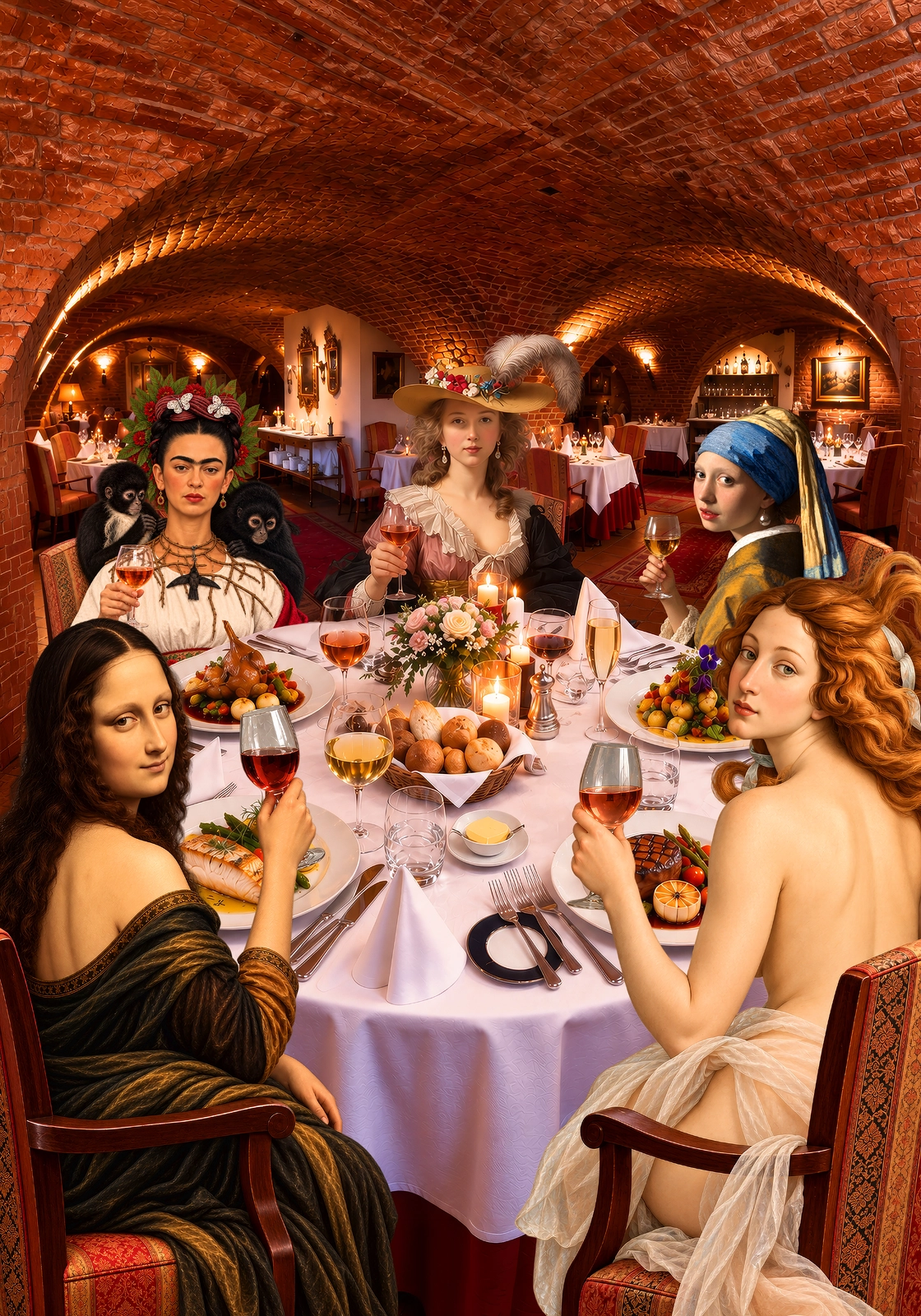
“Girls’ Dinner at Årstiderna” begins as an impossible dinner at Årstiderna (the Seasons), a restaurant in Malmö. Sandro Botticelli’s Venus, Leonardo da Vinci’s Mona Lisa, Johannes Vermeer’s Girl with a Pearl Earring, and Élisabeth Vigée Le Brun and Frida Kahlo have stepped out of their paintings and gathered around a round table. They have brought their clothes, their bodies, their gazes, and all the stories posterity has imposed upon them, but they have left time outside. No fifteenth, sixteenth, seventeenth, eighteenth, or twentieth century is here. At this table, they belong to the same age, the only one capable of containing them all: eternity.
Nor is this a solemn gathering. They eat different dishes, drink wine and champagne, study one another, and joke and disagree. Venus has a substantial piece of meat before her; Mona Lisa, oven-baked cod; the Girl with a Pearl Earring, a vegetarian dish; Frida, poultry; and Vigée Le Brun, sole meunière. Yet from these ordinary pleasures, the larger questions begin to emerge, as they so often do at a dinner from which nobody is particularly eager to go home.
The five women have much in common, yet they have had radically different opportunities to control their own image. A man created Venus as an ideal of female beauty and desire. Mona Lisa was a real woman whose life has almost entirely disappeared behind the image Leonardo created. The Girl with a Pearl Earring still has no certain name. She here carries a considerably bolder story: she was not merely Vermeer’s model but also his anonymous pupil and collaborator, making the famous painting, in this telling, her own self-portrait as well, created in close collaboration with the master. Vigée Le Brun, by contrast, needs no man behind the easel; she holds the brush herself and decides how the world will see her. With Frida Kahlo, that power is taken even further. She is not content merely to depict her exterior but uses her body and face to paint what lies within.
Their conversation therefore becomes an essay about something far greater than five paintings. It is about a woman’s relationship with her body and sexuality, about love and marriage, money and economic dependence, the right to work and education, and, above all, about who, throughout history, has been allowed to define the image of woman. When their conversation reaches 1848, and the five women who gathered around another table in Waterloo before the Seneca Falls Convention, the dinner at Årstiderna also becomes a story about how great social transformations can begin in the most ordinary way imaginable: a few women sit down together and discover that what each of them believed to be a private experience is, in fact, shared by others.
But a sixth chair is at the table.
It belongs to no painting, and at first none of the women mentions it. Only gradually does it become clear that it has been occupied all along. That is where the observer – “we” – sits and listens. And we alone know what happened after Frida Kahlo’s death in 1954: the continuing emancipation of women, the sexual revolution, shifting family roles, women’s growing economic and political power, and, much later, #MeToo.
When the five women finally turn towards the sixth chair, the roles have been reversed. We are no longer looking at them.
They are looking at us.
And after five hundred years of questions about women, suddenly only one question remains for our own time:
“How far did we really get?”
“The girls who stepped out of the frame
They had been still for far too long,
five women held by wood and gold,
by canvas, varnish, other eyes,
and stories endlessly retold.
One rose from foam without her shell,
still wearing almost nothing but desire.
One left a smile in Florence
and brought the secret with her.
One turned away from Delft,
the pearl still trembling at her ear,
and carried in the hand that washed the brushes
a painter hidden there for years.
One took her own brush with her,
her straw hat tilted towards the light.
She knew a woman need not choose
between being beautiful and being right.
And Frida came completely dressed,
yet naked in another way;
she had already painted everything
the body learns but cannot say.
They found a table waiting
in a house far from their painted skies,
ordered meat and fish and champagne,
and looked into each other’s eyes.
No century divided them.
Eternity has little use for dates.
They spoke of love and work and money,
of husbands, bodies, brushes, fates.
And somewhere in the conversation
something older than the frames gave way:
the woman who had once been looked at
looked back — and had something to say.
Five women stepped out of their pictures.
But there were six chairs at the table.
The last was ours.
So we sat among the immortals,
with all the years they never knew,
until the women stopped their talking
and slowly turned their eyes to you.
Venus leaned across the table.
The pearl caught light.
Frida smiled.
And suddenly the frame was not around them.
It was around us.”
Malmö, Oktober 2026
PROLOGUE – The Girls Who Stepped Out of Their Paintings
Five women have stepped out of some of the most famous paintings in art history and taken their places around a round table at the restaurant “Årstiderna” in Malmö. They come from different worlds but no longer from different times, because for one evening time itself has ceased to exist—no Renaissance, no seventeenth century, no Revolution, and no twentieth century. In eternity, everything exists at once. They can therefore speak to one another, as women of the same age, about love, the body, men, art, money, work, sexuality, and power. Six chairs sit at the table. In the sixth seat sit we who are looking at the picture.
There is nothing particularly remarkable about a girls’ dinner at Kockska huset in Malmö. Five women have gathered around a table to eat, drink wine, and talk. At first glance, they might be any group of friends, letting dinner run late into the evening as the conversation proves more important than the clock.
Only when we come closer does something feel strange. The women look remarkably familiar, yet their clothes couldn’t have come from the same wardrobe. The explanation is simpler than it first appears. They have not come from different parts of Malmö. They have come from different paintings. None of those paintings hangs in Malmö. They met here because Citze Kortzdatter, wife of Jörgen Kock and a remarkably independent woman with a fortune of her own, invited them.
And none of them has seen any need to change clothes.
Five centuries of women’s fashion.
Sandro Botticelli’s Venus has left her shell and taken her place at the round table, wearing scarcely more than a thin veil. To her left sits Lisa Gherardini, the woman the world knows as Mona Lisa. She has left Leonardo’s landscape behind and turned so that, for once, we are allowed to see something the Renaissance master never showed us: her back, exposed by the deep cut of her dress and, in its own way, every bit as sensual as the almost naked goddess seated to her right.
Élisabeth Vigée Le Brun has stepped out of her 1782 self-portrait without any apparent reason to change either her straw hat or her plunging neckline. She appears exactly as she once chose to present herself: elegant and attractive, yet with the natural confidence of a woman who knows she ranks among the finest practitioners of her profession. Frida Kahlo and Vermeer’s Girl with a Pearl Earring, by contrast, are perhaps surprisingly the most fully dressed women at the table.
A warning already exists against drawing easy conclusions about female emancipation by measuring how much fabric a woman wears. Venus reveals almost her entire body but almost nothing of her inner self. Frida covers nearly all of hers, yet devoted her art to exposing what lies far beneath the skin.
Nobody asks what year it is. The question is meaningless, because for this evening they inhabit eternity, and eternity has neither calendar nor clock. Botticelli and Leonardo, Vermeer and Marie Antoinette, Diego Rivera and the women of Seneca Falls therefore coexist as experiences, memories and topics of conversation. History is not behind these women.
It is sitting at the table with them.
The food arrives and proves almost as varied as the guests. Venus has ordered a substantial piece of meat and regards it with the same unapologetic appetite she seems to have for most things life has offered her. Beside her, Mona Lisa has chosen oven-baked cod, while the Girl with a Pearl Earring has gone vegetarian and has her glass filled with champagne. Frida has poultry, while Élisabeth, unwilling to abandon her French heritage merely because dinner happens to be in Malmö, has chosen sole meunière with butter, lemon, and parsley.
Venus glances at the vegetarian plate in Girl with a Pearl Earring.
– Are you really going to get fully on that?
– At least I don’t have to eat anything that once had a face on it.
Mona Lisa looks up from her cod.
– My fish had one.
– Exactly.
Lisa smiles.
– So do I. That doesn’t seem to have deterred anyone.
The laughter changes something at the table. The initial reserve melts away.
Six glasses sit on the table.
No one mentions the sixth.
Venus
A little later, the Girl with a Pearl Earring asks Venus whether she is cold. The question amuses the goddess, who has been gazed upon by millions over the centuries, few of whom have worried about the temperature.
– You’re hardly wearing anything.
Venus looks down at the thin veil.
– I haven’t been for five hundred years, and nobody has complained yet.
When Botticelli sent her drifting across the sea on her shell, a woman was indeed waiting on shore, wrapped in a flower-covered cloak, but the moment the world chose to preserve is the one just before that cloak reaches her. Venus has hung in the Uffizi in Florence since the fifteenth century, almost naked, while generation after generation has declared her body an ideal of female beauty.
Yet her nakedness is the least interesting thing about her. What is genuinely subversive is her relationship with desire. Venus is not merely the woman men desire. She desires in her own right. She is married to Hephaestus but has loved Ares, Adonis and Anchises, and she has never regarded her sexuality as something requiring a man’s administration.
Mona Lisa looks at her.
– Did your husband accept that?
– No.
– But you did it anyway?
Venus almost shrugs.
– Naturally.
Frida laughs. That single word distinguishes Venus’s world from Lisa’s more effectively than any history book could.
For a real woman, sexual reputation could affect her marriage, her family’s standing and her own future. The freedom that came naturally to a goddess could be devastating for a woman of flesh and blood. Frida recognises the contradiction of another world. She herself has loved both men and women and has never been particularly interested in the boundaries others sought to draw around her desire.
Venus listens and discovers something peculiar. The same civilisation that has hung her naked body on the walls of palaces and museums has been perfectly capable of going home and demanding modesty of its daughters.
– Then men would have hated me.
Élisabeth shakes her head.
– Quite the opposite. They’ve been hanging you on their walls for five hundred years.
Mona Lisa then asks who Venus really is.
Venus thinks for a moment.
– Perhaps my name was Simonetta.
Simonetta Vespucci was celebrated for her beauty during her short life and died young in 1476. Her distinctive features recur in the type of female beauty associated with Botticelli’s art. After half a millennium, no one alive can tell us precisely where Simonetta ends, and Botticelli’s ideal begins. At this table, Venus has no difficulty embodying both identities. A dead Florentine woman has lived on as an ancient goddess.
Venus raises her glass towards Mona Lisa.
– The woman died. The image survived.
Lisa nods.
That is something they share.
Mona Lisa
Lisa Gherardini has suffered a fate stranger than most people’s. Her face is among the world’s most famous, while her life has almost disappeared behind it.
She was a Florentine woman with a husband, children, relatives, and everyday routines and worries. Yet people who do not even know her name recognise her mouth at once. The smile has been analysed, diagnosed, and psychoanalysed until it has almost stopped belonging to her.
Venus asks what she is really smiling about.
Lisa does not answer.
Frida laughs.
– Don’t tell us. Don’t ruin five hundred years of speculation.
Lisa clearly intends to follow that advice.
Instead, the conversation turns to Leonardo. His close relationships with men and his sexuality have been discussed almost as persistently as Lisa’s smile, and much suggests that his erotic interest was directed primarily towards men. Yet posterity has found it hard to accept a woman and a male artist coexisting in the same story without trying to construct a love affair between them.
Perhaps the strangest thing is the painting itself. It was never delivered as a standard completed commission. Leonardo kept it, continued working on it, and carried it with him during the final years of his life. Then there were his studio, his pupils, and his young male companions. The Prado Mona Lisa shows how closely another painter could work alongside him: alterations to Leonardo’s painting were mirrored in the second version.
Lisa looks at the Girl with a Pearl Earring.
– Apparently a painting doesn’t have to have only one hand.
The Girl with a Pearl Earring smiles.
– No.
Something in that answer makes Élisabeth look at her more closely.
Who Is the Girl with a Pearl Earring?
The question does not come immediately. The conversation moves on, and the glass of champagne is refilled before Élisabeth returns to that little word.
No.
She looks at the young woman opposite her.
– Who are you, really?
– The Girl with a Pearl Earring.
Frida shakes her head.
– We know that. But who are you?
For the first time that evening, the answer comes slowly.
Venus at least has the name of a goddess, and perhaps Simonetta does, too. Mona Lisa has been identified as Lisa Gherardini. Among friends, Lisa will do. Élisabeth wrote her own name into the history of art, and Frida made sure nobody would ever forget hers.
But the Girl with a Pearl Earring’s name disappeared.
Millions of people recognise the blue-and-yellow headscarf, the dark background, the slightly parted lips, the glance, and the great gleaming pearl. They know her face better than they know the faces of most people who have actually lived. Yet nobody can say with certainty what she was called.
At last she puts down her champagne glass.
– I am the artist.
The table falls silent.
Even Venus stops cutting her meat.
Mona Lisa looks at her questioningly.
– You mean Vermeer?
– I mean me.
For centuries, Johannes Vermeer’s “Girl with a Pearl Earring”, painted around 1665, has been regarded as one of the great monuments to the genius of the solitary master. Popular culture eventually gave the girl the name Griet and cast her as a fictional maidservant. At the same time, art historians have searched for her identity among Vermeer’s daughters and the families of his wealthy patrons.
The Girl with a Pearl Earring shakes her head.
– I was none of them.
– But you were the model? Venus asks.
– Yes.
– And you painted the picture?
The Girl with a Pearl Earring smiles.
– We painted it.
That is the difference.
In her story, “Girl with a Pearl Earring” is in fact a self-portrait, but not in the modern sense of a solitary artist standing before a mirror. It emerged from close collaboration between a master and the young woman he began teaching. Vermeer had the experience, the studio, the materials and the name. The girl had the eye and, eventually, the hand.
She had not come to Vermeer as an artist. She came from a world in which a poor girl’s hands were regarded as tools of labour, and nobody asked whether those same hands might also create art. She cleaned the dust-sensitive studio, tended the equipment and washed the brushes. Yet this placed her every day in a world that few girls of her background would otherwise have access to. She watched pigments being prepared, saw how light was used, and watched a painting slowly take shape.
To wash a brush is also to hold it in your hand.
At some point she must have begun asking questions. At some point Vermeer must have answered them. And at some point he handed her the brush.
Frida leans forward.
– And then?
– Then I painted.
– With him?
– Beside him. First as a pupil. Then almost as an equal.
No surviving documents tell her story. Still, modern technical examination has made one thing considerably harder to dismiss than it once was: the idea of Vermeer as an artist who always worked entirely alone.
“Girl with a Flute”, long attributed to Vermeer, has, after advanced technical analysis, been judged to have been painted by another hand – by someone working close enough to him to know his materials, pigments and methods. Suddenly, a blank space appeared in art history where a human being must once have stood. Someone worked side by side with the master, yet posterity does not know who.
The Girl with a Pearl Earring doesn’t need to say that this person was her.
The silence says it for her.
Frida breaks it.
– So the painting is a self-portrait?
– Yes.
– Painted by you?
The Girl with a Pearl Earring hesitates.
– By us.
Élisabeth understands the distinction. She knows that the boundary between instruction, correction and the young artist’s own hand cannot always be drawn with the precision posterity would prefer. A master can demonstrate, adjust and correct while the pupil paints.
The Girl with a Pearl Earring therefore does not need to determine which centimetre of the canvas is hers and which is Vermeer’s. The girl before the easel was also the girl on the canvas, and the master stood beside her.
When Vermeer died in 1675, the world that had made this possible disappeared. The studio dissolved, and the family’s finances collapsed. The expensive pigments, the tools, the contacts, and, above all, the established name were not hers to take with her. If the Girl with a Pearl Earring was the poor outsider she describes, she could not open a studio of her own and carry on as if nothing had happened.
She disappeared from the documents as an artist and remained behind as an equally anonymous model.
That does not necessarily mean her hand disappeared from art.
Venus studies her for a long time.
– So the world has been looking at your face for more than three hundred and fifty years, all the while asking who painted you.
The Girl with a Pearl Earring nods.
– When they should have been asking who had painted with me.
Élisabeth raises her wine glass.
She understands what has just happened in the story.
Venus is the woman a man turned into his ideal of beauty. Mona Lisa is the woman whose face a man made immortal. But with Girl with a Pearl Earring, something new happens. The woman in front of the easel walks around it and takes her place beside the man who is painting her.
Élisabeth smiles.
– And then we no longer needed him.
Frida raises her glass towards her.
– Exactly.
The Woman Who Took Over the Easel
Élisabeth needs no introduction. She has already introduced herself.
When she painted “Woman in a Straw Hat” in 1782, she did not place herself modestly at the edge of her own picture. She meets the viewer wearing her straw hat, with her plunging neckline and the self-assurance of an artist. She has no intention of choosing between appearing as a woman and as a painter.
She will paint Marie Antoinette again and again, portraying court ladies, aristocrats and some of Europe’s most powerful people. The Revolution forces her out of France, but not out of her profession. She continues to work across Europe and establishes herself, regardless of gender, as one of the great masters of portraiture.
Mona Lisa regards her with fascination.
For the first time at the table, she meets a woman who doesn’t need to explain her relationship to the man who painted her.
There was no such man.
She painted herself.
Venus looks at the self-portrait as though it were still hanging before her.
– Is your picture truer than ours, then?
Élisabeth shakes her head.
– A portrait is never the truth.
– What is it, then?
– A choice.
That’s all she needs to say. The rest is in her art. When Marie Antoinette sat for her, the task was not to expose every fear, secret or weakness behind the Queen’s face. Portraiture was about presence, dignity, beauty, personality and representation. Élisabeth mastered the surface and understood that it need not be superficial.
Frida puts down her cutlery.
– You paint what you see.
– Absolutely not.
Frida raises an eyebrow.
– No?
– I paint what I want other people to see.
Frida studies her over her glass of wine for a moment and smiles.
– That was better.
Élisabeth calmly slices another piece of sole.
– Better than what?
– Than I thought you were going to say.
Now they both laugh.
Frida
Frida Kahlo and Élisabeth are, in one sense, the two women at the table who stand closest together. They need no man between them and the canvas. They hold the brush themselves and decide how posterity will see them.
Then the similarity ends.
Élisabeth uses painting to master the exterior. Frida uses the exterior to reach the interior. In her work, the body becomes a map of pain, love, jealousy, childlessness, sexuality, Mexico, Diego Rivera and the self.
That is why there is no contradiction in Frida being one of the most fully dressed women at the dinner table and, at the same time, perhaps the one who has exposed herself most completely. She does not need to show her breasts or her back. She has already shown considerably more than that.
Venus suddenly discovers the opposite in herself. Her body has been public for centuries, while her inner life has remained almost entirely protected.
– You show very little, Venus says, looking at Frida’s clothes.
– Do I?
Venus understands the question and laughs.
No, of course she does not.
The two self-portraitists therefore exercise their power in almost opposite ways. Élisabeth controls her exterior to create the woman she wants posterity to meet. Frida paints her exterior to force posterity to encounter what lies within.
The Girl with a Pearl Earring looks at both of them.
– I would have been happy simply to put my name in the corner.
The laughter catches slightly in their throats.
Because that is where the difference lies.
Who Owns the Woman?
Money shifts the conversation away from painting.
Élisabeth earned her own living. She had patrons, negotiated payment, and supported herself through her skill. For her, female freedom is therefore not merely a question of love, sex or artistic independence. Freedom also lies in the purse.
She turns to Mona Lisa.
– How much money did you have that was entirely yours?
The question is almost brutally simple.
Lisa need not give a lecture on Renaissance marriage law. Her hesitation is enough to steer the conversation towards marriage, property, and a world in which a woman’s economic existence was intertwined with a man’s. The Girl with a Pearl Earring recognises dependence on another social class. Venus scarcely understands it at all. A goddess has never had to wonder who owns the house.
Frida, however, understands the connection immediately. Someone who cannot support herself has far greater difficulty leaving the person who supports her.
The conversation therefore moves almost imperceptibly from money to work, from work to education, and from education to the right to determine one’s own life. Love, art, the body and economics turn out to have revolved around the same question all along.
Who has the power to say no?
And who can afford to?
That is when the story of five other women at another table enters the dinner.
1848
On 9 July 1848, Jane Hunt sits at home in Waterloo, New York, with Elizabeth Cady Stanton, Lucretia Mott, Martha Coffin Wright, and Mary Ann M’Clintock. Five women drink tea and discuss a world in which men and women live together, but not as equals.
It sounds almost banal.
It is not.
Historical change does not always begin in parliament, on a battlefield or before cheering crowds. Sometimes it begins in someone’s home. Someone puts out the cups. A few people begin to talk and realise that what each of them believed was a private problem is, in fact, a shared experience.
By the time the women rise from the table, conversation has turned into action. They decide to call a meeting on women’s rights, and ten days later the Seneca Falls Convention opens.
In a sense, the same thing is happening at Årstiderna. Five women compare their experiences and realise that beneath the differences in their lives lie the same questions.
Venus listens with growing astonishment.
– Wait. Did women actually need men’s permission to be free?
Élisabeth shakes her head.
– No. They decided to stop waiting for permission.
Venus falls silent.
For the first time at dinner, she seems to understand how peculiar her position truly is. For millennia, she has been the symbol of female beauty, love and sexual desire in civilisations where real women have simultaneously had to fight for the right to own property, study, work, vote and determine what happens to their own bodies.
Humanity has worshipped the free woman for as long as she remained a goddess on the wall.
The trouble began when she stepped down.
– How did it turn out? Venus asks.
Frida can tell them part of the story. She knows of the victories of women’s suffrage, women’s growing access to education and professions, and a world in which women had begun to occupy positions unimaginable to many of the others.
Then her knowledge ends.
Frida Kahlo died in 1954.
That is when the women discover the sixth chair.
The Sixth Chair
The sixth glass of wine has stood untouched throughout the evening. The chair has never been empty, even though it has remained outside the frame.
That is where the viewer is seated.
In other words, all the rest of us.
We have listened to the conversation from the only place at the table that lies beyond these women’s experience. We know what happened after Frida, and we know what happened during the more than seventy years she never lived to see.
Now the women begin looking at us.
Mona Lisa asks whether marriage has finally stopped determining a woman’s economic and social position. The Girl with a Pearl Earring asks whether female artists can still disappear behind famous men. Élisabeth wonders whether a woman can now be counted among the greatest artists of her age without her sex having to be mentioned first. Frida wants to know whether a woman has been allowed to be loved or alone, heterosexual or homosexual, a mother or childless, young or old, beautiful or ugly, without her value first having to pass through somebody else’s judgement.
Venus waits until the others have finished.
– Does a woman now control her own body?
We sit there holding the answer sheet and discover how difficult the question is to answer.
We can tell them about suffrage, education and economic independence, and about female heads of government, doctors, professors, judges, entrepreneurs and artists. We can tell them about contraception, divorce and the possibility for women to choose lives that Lisa Gherardini could scarcely have imagined. We can say that a woman can own the home she lives in, the money she earns and the company she has built.
But almost every answer requires the same two words.
“Yes, but.”
We must also tell them about violence and harassment and about #MeToo, when women across large parts of the world began comparing experiences that many had kept as private shame and discovered they were shared. What happened had, in a strange way, the same mechanism as the conversation in Waterloo in 1848. One woman spoke. Another recognised the experience. Then a third. What had seemed private revealed itself as structural, and conversation became a movement.
We must tell them that the female body remains political territory and that a woman’s sexuality can still be judged by rules different from those applied to a man’s. And we must explain a paradox that Venus and Élisabeth, above all, should understand.
Over the centuries since Botticelli painted one of them and the other painted herself, women have increasingly secured the right to create their own image. The brush passed into their hands. Then the camera. Finally, the phone.
Never before have so many women been able to decide exactly what image of themselves they wish to present to the world.
At the same time, never before have so many people been able to look at it, judge it and comment upon it.
Woman has taken possession of the brush.
She has not escaped the viewer.
EPILOGUE – Årstiderna
The dinner is drawing to a close, yet nobody seems in any hurry to leave. In eternity, after all, there is no final sitting.
On the table lie the remains of five meals. Venus has made serious inroads into her piece of meat, Lisa has almost finished her cod, and Frida’s poultry has been reduced to remnants. Élisabeth has treated her sole with greater elegance. At the same time, the Girl with a Pearl Earring’s vegetarian dish is almost finished, and her glass of champagne has needed refilling more than once.
The food has not made them the women they are, but it has made them a group. They have eaten, drunk, teased one another, laughed and disagreed. Somewhere between the first course and the final sips of wine, a dinner among five strangers has become a conversation about who, throughout history, has had the right to define a woman.
Venus came to the table almost naked and turned out to be the woman whose inner life we know least. Lisa arrived with the world’s most analysed smile and still refused to reveal what it means. The Girl with a Pearl Earring came without a name but told us that the world may have made its greatest mistake by automatically placing her in front of the easel rather than behind it. Élisabeth defended the surface not as superficiality but as something a woman can master and define. Frida defended the opposite and demonstrated that a woman who is almost entirely clothed can expose more of herself than a naked goddess.
A movement exists between them, but it is not as simple as a march from oppression to freedom.
Venus is the oldest and, at the same time, the most sexually free. Mona Lisa shows what happens when the real woman enters a society in which family and husband determine the space available to her. In “The Girl with a Pearl Earring”, the woman moves around the easel and discovers that the hand that washes the brush can also wield it. Élisabeth openly holds the brush herself and decides which woman the world will be allowed to see. Finally, Frida uses that same brush to turn the body inside out and paint what would once have remained hidden.
But none of them is sitting at the table as the representative of a century.
They come from eternity.
That is why Venus can understand Frida, and the Girl with a Pearl Earring can understand Élisabeth Le Brun. That is why Mona Lisa can laugh with a woman who lived four centuries after her, and why five women from completely different historical worlds can discover that their questions resemble one another.
Who owns my body? Who decides whom I may love? Who owns the money I earn? Who has the right to decide how I should live? Who gets to tell the world who I am?
And who holds the brush?
At last, the women stop talking to one another.
Venus looks at Lisa, Lisa at the Girl with a Pearl Earring, the Girl with a Pearl Earring at Élisabeth, and Élisabeth at Frida.
Then they all turn towards the same place at the table.
The sixth chair.
It has never been empty.
That is where the rest of us are sitting – those of us looking at the picture and eavesdropping on the conversation – with more than five hundred years of experience since Botticelli allowed Venus to rise from the sea. We viewers know what happened next. The women in the paintings no longer owe us any answers.
We owe one to them.
Venus leans forward across the table. The thin veil still falls over her body, and before her stand the remains of dinner and the half-full glass of wine. She looks at the sixth guest with the same self-assured gaze, as though she already knows our answer will be considerably more complicated than we would like.
Then she asks:
– Well?
Jörgen Thornberg
Girls’ Dinner at Årstiderna - ENGLISH VERSION, 2026
Digital
50 x 70 cm
2 900 kr
Girls’ Dinner at Årstiderna - Tjejmiddag på Årstiderna
Svensk text i slutet
INTRODUCTION – A Timeless Girls’ Dinner
What happens when five of the most renowned women in art history step out of their frames and sit at the same table?
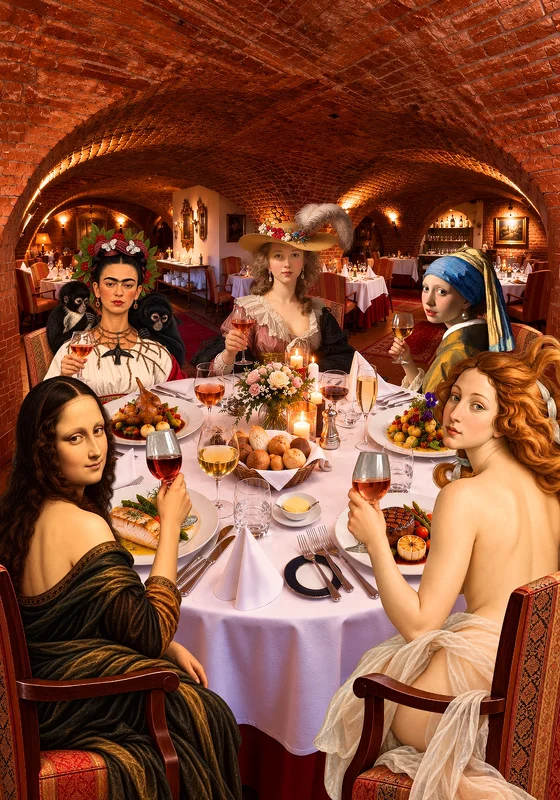
“Girls’ Dinner at Årstiderna” begins as an impossible dinner at Årstiderna (the Seasons), a restaurant in Malmö. Sandro Botticelli’s Venus, Leonardo da Vinci’s Mona Lisa, Johannes Vermeer’s Girl with a Pearl Earring, and Élisabeth Vigée Le Brun and Frida Kahlo have stepped out of their paintings and gathered around a round table. They have brought their clothes, their bodies, their gazes, and all the stories posterity has imposed upon them, but they have left time outside. No fifteenth, sixteenth, seventeenth, eighteenth, or twentieth century is here. At this table, they belong to the same age, the only one capable of containing them all: eternity.
Nor is this a solemn gathering. They eat different dishes, drink wine and champagne, study one another, and joke and disagree. Venus has a substantial piece of meat before her; Mona Lisa, oven-baked cod; the Girl with a Pearl Earring, a vegetarian dish; Frida, poultry; and Vigée Le Brun, sole meunière. Yet from these ordinary pleasures, the larger questions begin to emerge, as they so often do at a dinner from which nobody is particularly eager to go home.
The five women have much in common, yet they have had radically different opportunities to control their own image. A man created Venus as an ideal of female beauty and desire. Mona Lisa was a real woman whose life has almost entirely disappeared behind the image Leonardo created. The Girl with a Pearl Earring still has no certain name. She here carries a considerably bolder story: she was not merely Vermeer’s model but also his anonymous pupil and collaborator, making the famous painting, in this telling, her own self-portrait as well, created in close collaboration with the master. Vigée Le Brun, by contrast, needs no man behind the easel; she holds the brush herself and decides how the world will see her. With Frida Kahlo, that power is taken even further. She is not content merely to depict her exterior but uses her body and face to paint what lies within.
Their conversation therefore becomes an essay about something far greater than five paintings. It is about a woman’s relationship with her body and sexuality, about love and marriage, money and economic dependence, the right to work and education, and, above all, about who, throughout history, has been allowed to define the image of woman. When their conversation reaches 1848, and the five women who gathered around another table in Waterloo before the Seneca Falls Convention, the dinner at Årstiderna also becomes a story about how great social transformations can begin in the most ordinary way imaginable: a few women sit down together and discover that what each of them believed to be a private experience is, in fact, shared by others.
But a sixth chair is at the table.
It belongs to no painting, and at first none of the women mentions it. Only gradually does it become clear that it has been occupied all along. That is where the observer – “we” – sits and listens. And we alone know what happened after Frida Kahlo’s death in 1954: the continuing emancipation of women, the sexual revolution, shifting family roles, women’s growing economic and political power, and, much later, #MeToo.
When the five women finally turn towards the sixth chair, the roles have been reversed. We are no longer looking at them.
They are looking at us.
And after five hundred years of questions about women, suddenly only one question remains for our own time:
“How far did we really get?”
“The girls who stepped out of the frame
They had been still for far too long,
five women held by wood and gold,
by canvas, varnish, other eyes,
and stories endlessly retold.
One rose from foam without her shell,
still wearing almost nothing but desire.
One left a smile in Florence
and brought the secret with her.
One turned away from Delft,
the pearl still trembling at her ear,
and carried in the hand that washed the brushes
a painter hidden there for years.
One took her own brush with her,
her straw hat tilted towards the light.
She knew a woman need not choose
between being beautiful and being right.
And Frida came completely dressed,
yet naked in another way;
she had already painted everything
the body learns but cannot say.
They found a table waiting
in a house far from their painted skies,
ordered meat and fish and champagne,
and looked into each other’s eyes.
No century divided them.
Eternity has little use for dates.
They spoke of love and work and money,
of husbands, bodies, brushes, fates.
And somewhere in the conversation
something older than the frames gave way:
the woman who had once been looked at
looked back — and had something to say.
Five women stepped out of their pictures.
But there were six chairs at the table.
The last was ours.
So we sat among the immortals,
with all the years they never knew,
until the women stopped their talking
and slowly turned their eyes to you.
Venus leaned across the table.
The pearl caught light.
Frida smiled.
And suddenly the frame was not around them.
It was around us.”
Malmö, Oktober 2026
PROLOGUE – The Girls Who Stepped Out of Their Paintings
Five women have stepped out of some of the most famous paintings in art history and taken their places around a round table at the restaurant “Årstiderna” in Malmö. They come from different worlds but no longer from different times, because for one evening time itself has ceased to exist—no Renaissance, no seventeenth century, no Revolution, and no twentieth century. In eternity, everything exists at once. They can therefore speak to one another, as women of the same age, about love, the body, men, art, money, work, sexuality, and power. Six chairs sit at the table. In the sixth seat sit we who are looking at the picture.
There is nothing particularly remarkable about a girls’ dinner at Kockska huset in Malmö. Five women have gathered around a table to eat, drink wine, and talk. At first glance, they might be any group of friends, letting dinner run late into the evening as the conversation proves more important than the clock.
Only when we come closer does something feel strange. The women look remarkably familiar, yet their clothes couldn’t have come from the same wardrobe. The explanation is simpler than it first appears. They have not come from different parts of Malmö. They have come from different paintings. None of those paintings hangs in Malmö. They met here because Citze Kortzdatter, wife of Jörgen Kock and a remarkably independent woman with a fortune of her own, invited them.
And none of them has seen any need to change clothes.
Five centuries of women’s fashion.
Sandro Botticelli’s Venus has left her shell and taken her place at the round table, wearing scarcely more than a thin veil. To her left sits Lisa Gherardini, the woman the world knows as Mona Lisa. She has left Leonardo’s landscape behind and turned so that, for once, we are allowed to see something the Renaissance master never showed us: her back, exposed by the deep cut of her dress and, in its own way, every bit as sensual as the almost naked goddess seated to her right.
Élisabeth Vigée Le Brun has stepped out of her 1782 self-portrait without any apparent reason to change either her straw hat or her plunging neckline. She appears exactly as she once chose to present herself: elegant and attractive, yet with the natural confidence of a woman who knows she ranks among the finest practitioners of her profession. Frida Kahlo and Vermeer’s Girl with a Pearl Earring, by contrast, are perhaps surprisingly the most fully dressed women at the table.
A warning already exists against drawing easy conclusions about female emancipation by measuring how much fabric a woman wears. Venus reveals almost her entire body but almost nothing of her inner self. Frida covers nearly all of hers, yet devoted her art to exposing what lies far beneath the skin.
Nobody asks what year it is. The question is meaningless, because for this evening they inhabit eternity, and eternity has neither calendar nor clock. Botticelli and Leonardo, Vermeer and Marie Antoinette, Diego Rivera and the women of Seneca Falls therefore coexist as experiences, memories and topics of conversation. History is not behind these women.
It is sitting at the table with them.
The food arrives and proves almost as varied as the guests. Venus has ordered a substantial piece of meat and regards it with the same unapologetic appetite she seems to have for most things life has offered her. Beside her, Mona Lisa has chosen oven-baked cod, while the Girl with a Pearl Earring has gone vegetarian and has her glass filled with champagne. Frida has poultry, while Élisabeth, unwilling to abandon her French heritage merely because dinner happens to be in Malmö, has chosen sole meunière with butter, lemon, and parsley.
Venus glances at the vegetarian plate in Girl with a Pearl Earring.
– Are you really going to get fully on that?
– At least I don’t have to eat anything that once had a face on it.
Mona Lisa looks up from her cod.
– My fish had one.
– Exactly.
Lisa smiles.
– So do I. That doesn’t seem to have deterred anyone.
The laughter changes something at the table. The initial reserve melts away.
Six glasses sit on the table.
No one mentions the sixth.
Venus
A little later, the Girl with a Pearl Earring asks Venus whether she is cold. The question amuses the goddess, who has been gazed upon by millions over the centuries, few of whom have worried about the temperature.
– You’re hardly wearing anything.
Venus looks down at the thin veil.
– I haven’t been for five hundred years, and nobody has complained yet.
When Botticelli sent her drifting across the sea on her shell, a woman was indeed waiting on shore, wrapped in a flower-covered cloak, but the moment the world chose to preserve is the one just before that cloak reaches her. Venus has hung in the Uffizi in Florence since the fifteenth century, almost naked, while generation after generation has declared her body an ideal of female beauty.
Yet her nakedness is the least interesting thing about her. What is genuinely subversive is her relationship with desire. Venus is not merely the woman men desire. She desires in her own right. She is married to Hephaestus but has loved Ares, Adonis and Anchises, and she has never regarded her sexuality as something requiring a man’s administration.
Mona Lisa looks at her.
– Did your husband accept that?
– No.
– But you did it anyway?
Venus almost shrugs.
– Naturally.
Frida laughs. That single word distinguishes Venus’s world from Lisa’s more effectively than any history book could.
For a real woman, sexual reputation could affect her marriage, her family’s standing and her own future. The freedom that came naturally to a goddess could be devastating for a woman of flesh and blood. Frida recognises the contradiction of another world. She herself has loved both men and women and has never been particularly interested in the boundaries others sought to draw around her desire.
Venus listens and discovers something peculiar. The same civilisation that has hung her naked body on the walls of palaces and museums has been perfectly capable of going home and demanding modesty of its daughters.
– Then men would have hated me.
Élisabeth shakes her head.
– Quite the opposite. They’ve been hanging you on their walls for five hundred years.
Mona Lisa then asks who Venus really is.
Venus thinks for a moment.
– Perhaps my name was Simonetta.
Simonetta Vespucci was celebrated for her beauty during her short life and died young in 1476. Her distinctive features recur in the type of female beauty associated with Botticelli’s art. After half a millennium, no one alive can tell us precisely where Simonetta ends, and Botticelli’s ideal begins. At this table, Venus has no difficulty embodying both identities. A dead Florentine woman has lived on as an ancient goddess.
Venus raises her glass towards Mona Lisa.
– The woman died. The image survived.
Lisa nods.
That is something they share.
Mona Lisa
Lisa Gherardini has suffered a fate stranger than most people’s. Her face is among the world’s most famous, while her life has almost disappeared behind it.
She was a Florentine woman with a husband, children, relatives, and everyday routines and worries. Yet people who do not even know her name recognise her mouth at once. The smile has been analysed, diagnosed, and psychoanalysed until it has almost stopped belonging to her.
Venus asks what she is really smiling about.
Lisa does not answer.
Frida laughs.
– Don’t tell us. Don’t ruin five hundred years of speculation.
Lisa clearly intends to follow that advice.
Instead, the conversation turns to Leonardo. His close relationships with men and his sexuality have been discussed almost as persistently as Lisa’s smile, and much suggests that his erotic interest was directed primarily towards men. Yet posterity has found it hard to accept a woman and a male artist coexisting in the same story without trying to construct a love affair between them.
Perhaps the strangest thing is the painting itself. It was never delivered as a standard completed commission. Leonardo kept it, continued working on it, and carried it with him during the final years of his life. Then there were his studio, his pupils, and his young male companions. The Prado Mona Lisa shows how closely another painter could work alongside him: alterations to Leonardo’s painting were mirrored in the second version.
Lisa looks at the Girl with a Pearl Earring.
– Apparently a painting doesn’t have to have only one hand.
The Girl with a Pearl Earring smiles.
– No.
Something in that answer makes Élisabeth look at her more closely.
Who Is the Girl with a Pearl Earring?
The question does not come immediately. The conversation moves on, and the glass of champagne is refilled before Élisabeth returns to that little word.
No.
She looks at the young woman opposite her.
– Who are you, really?
– The Girl with a Pearl Earring.
Frida shakes her head.
– We know that. But who are you?
For the first time that evening, the answer comes slowly.
Venus at least has the name of a goddess, and perhaps Simonetta does, too. Mona Lisa has been identified as Lisa Gherardini. Among friends, Lisa will do. Élisabeth wrote her own name into the history of art, and Frida made sure nobody would ever forget hers.
But the Girl with a Pearl Earring’s name disappeared.
Millions of people recognise the blue-and-yellow headscarf, the dark background, the slightly parted lips, the glance, and the great gleaming pearl. They know her face better than they know the faces of most people who have actually lived. Yet nobody can say with certainty what she was called.
At last she puts down her champagne glass.
– I am the artist.
The table falls silent.
Even Venus stops cutting her meat.
Mona Lisa looks at her questioningly.
– You mean Vermeer?
– I mean me.
For centuries, Johannes Vermeer’s “Girl with a Pearl Earring”, painted around 1665, has been regarded as one of the great monuments to the genius of the solitary master. Popular culture eventually gave the girl the name Griet and cast her as a fictional maidservant. At the same time, art historians have searched for her identity among Vermeer’s daughters and the families of his wealthy patrons.
The Girl with a Pearl Earring shakes her head.
– I was none of them.
– But you were the model? Venus asks.
– Yes.
– And you painted the picture?
The Girl with a Pearl Earring smiles.
– We painted it.
That is the difference.
In her story, “Girl with a Pearl Earring” is in fact a self-portrait, but not in the modern sense of a solitary artist standing before a mirror. It emerged from close collaboration between a master and the young woman he began teaching. Vermeer had the experience, the studio, the materials and the name. The girl had the eye and, eventually, the hand.
She had not come to Vermeer as an artist. She came from a world in which a poor girl’s hands were regarded as tools of labour, and nobody asked whether those same hands might also create art. She cleaned the dust-sensitive studio, tended the equipment and washed the brushes. Yet this placed her every day in a world that few girls of her background would otherwise have access to. She watched pigments being prepared, saw how light was used, and watched a painting slowly take shape.
To wash a brush is also to hold it in your hand.
At some point she must have begun asking questions. At some point Vermeer must have answered them. And at some point he handed her the brush.
Frida leans forward.
– And then?
– Then I painted.
– With him?
– Beside him. First as a pupil. Then almost as an equal.
No surviving documents tell her story. Still, modern technical examination has made one thing considerably harder to dismiss than it once was: the idea of Vermeer as an artist who always worked entirely alone.
“Girl with a Flute”, long attributed to Vermeer, has, after advanced technical analysis, been judged to have been painted by another hand – by someone working close enough to him to know his materials, pigments and methods. Suddenly, a blank space appeared in art history where a human being must once have stood. Someone worked side by side with the master, yet posterity does not know who.
The Girl with a Pearl Earring doesn’t need to say that this person was her.
The silence says it for her.
Frida breaks it.
– So the painting is a self-portrait?
– Yes.
– Painted by you?
The Girl with a Pearl Earring hesitates.
– By us.
Élisabeth understands the distinction. She knows that the boundary between instruction, correction and the young artist’s own hand cannot always be drawn with the precision posterity would prefer. A master can demonstrate, adjust and correct while the pupil paints.
The Girl with a Pearl Earring therefore does not need to determine which centimetre of the canvas is hers and which is Vermeer’s. The girl before the easel was also the girl on the canvas, and the master stood beside her.
When Vermeer died in 1675, the world that had made this possible disappeared. The studio dissolved, and the family’s finances collapsed. The expensive pigments, the tools, the contacts, and, above all, the established name were not hers to take with her. If the Girl with a Pearl Earring was the poor outsider she describes, she could not open a studio of her own and carry on as if nothing had happened.
She disappeared from the documents as an artist and remained behind as an equally anonymous model.
That does not necessarily mean her hand disappeared from art.
Venus studies her for a long time.
– So the world has been looking at your face for more than three hundred and fifty years, all the while asking who painted you.
The Girl with a Pearl Earring nods.
– When they should have been asking who had painted with me.
Élisabeth raises her wine glass.
She understands what has just happened in the story.
Venus is the woman a man turned into his ideal of beauty. Mona Lisa is the woman whose face a man made immortal. But with Girl with a Pearl Earring, something new happens. The woman in front of the easel walks around it and takes her place beside the man who is painting her.
Élisabeth smiles.
– And then we no longer needed him.
Frida raises her glass towards her.
– Exactly.
The Woman Who Took Over the Easel
Élisabeth needs no introduction. She has already introduced herself.
When she painted “Woman in a Straw Hat” in 1782, she did not place herself modestly at the edge of her own picture. She meets the viewer wearing her straw hat, with her plunging neckline and the self-assurance of an artist. She has no intention of choosing between appearing as a woman and as a painter.
She will paint Marie Antoinette again and again, portraying court ladies, aristocrats and some of Europe’s most powerful people. The Revolution forces her out of France, but not out of her profession. She continues to work across Europe and establishes herself, regardless of gender, as one of the great masters of portraiture.
Mona Lisa regards her with fascination.
For the first time at the table, she meets a woman who doesn’t need to explain her relationship to the man who painted her.
There was no such man.
She painted herself.
Venus looks at the self-portrait as though it were still hanging before her.
– Is your picture truer than ours, then?
Élisabeth shakes her head.
– A portrait is never the truth.
– What is it, then?
– A choice.
That’s all she needs to say. The rest is in her art. When Marie Antoinette sat for her, the task was not to expose every fear, secret or weakness behind the Queen’s face. Portraiture was about presence, dignity, beauty, personality and representation. Élisabeth mastered the surface and understood that it need not be superficial.
Frida puts down her cutlery.
– You paint what you see.
– Absolutely not.
Frida raises an eyebrow.
– No?
– I paint what I want other people to see.
Frida studies her over her glass of wine for a moment and smiles.
– That was better.
Élisabeth calmly slices another piece of sole.
– Better than what?
– Than I thought you were going to say.
Now they both laugh.
Frida
Frida Kahlo and Élisabeth are, in one sense, the two women at the table who stand closest together. They need no man between them and the canvas. They hold the brush themselves and decide how posterity will see them.
Then the similarity ends.
Élisabeth uses painting to master the exterior. Frida uses the exterior to reach the interior. In her work, the body becomes a map of pain, love, jealousy, childlessness, sexuality, Mexico, Diego Rivera and the self.
That is why there is no contradiction in Frida being one of the most fully dressed women at the dinner table and, at the same time, perhaps the one who has exposed herself most completely. She does not need to show her breasts or her back. She has already shown considerably more than that.
Venus suddenly discovers the opposite in herself. Her body has been public for centuries, while her inner life has remained almost entirely protected.
– You show very little, Venus says, looking at Frida’s clothes.
– Do I?
Venus understands the question and laughs.
No, of course she does not.
The two self-portraitists therefore exercise their power in almost opposite ways. Élisabeth controls her exterior to create the woman she wants posterity to meet. Frida paints her exterior to force posterity to encounter what lies within.
The Girl with a Pearl Earring looks at both of them.
– I would have been happy simply to put my name in the corner.
The laughter catches slightly in their throats.
Because that is where the difference lies.
Who Owns the Woman?
Money shifts the conversation away from painting.
Élisabeth earned her own living. She had patrons, negotiated payment, and supported herself through her skill. For her, female freedom is therefore not merely a question of love, sex or artistic independence. Freedom also lies in the purse.
She turns to Mona Lisa.
– How much money did you have that was entirely yours?
The question is almost brutally simple.
Lisa need not give a lecture on Renaissance marriage law. Her hesitation is enough to steer the conversation towards marriage, property, and a world in which a woman’s economic existence was intertwined with a man’s. The Girl with a Pearl Earring recognises dependence on another social class. Venus scarcely understands it at all. A goddess has never had to wonder who owns the house.
Frida, however, understands the connection immediately. Someone who cannot support herself has far greater difficulty leaving the person who supports her.
The conversation therefore moves almost imperceptibly from money to work, from work to education, and from education to the right to determine one’s own life. Love, art, the body and economics turn out to have revolved around the same question all along.
Who has the power to say no?
And who can afford to?
That is when the story of five other women at another table enters the dinner.
1848
On 9 July 1848, Jane Hunt sits at home in Waterloo, New York, with Elizabeth Cady Stanton, Lucretia Mott, Martha Coffin Wright, and Mary Ann M’Clintock. Five women drink tea and discuss a world in which men and women live together, but not as equals.
It sounds almost banal.
It is not.
Historical change does not always begin in parliament, on a battlefield or before cheering crowds. Sometimes it begins in someone’s home. Someone puts out the cups. A few people begin to talk and realise that what each of them believed was a private problem is, in fact, a shared experience.
By the time the women rise from the table, conversation has turned into action. They decide to call a meeting on women’s rights, and ten days later the Seneca Falls Convention opens.
In a sense, the same thing is happening at Årstiderna. Five women compare their experiences and realise that beneath the differences in their lives lie the same questions.
Venus listens with growing astonishment.
– Wait. Did women actually need men’s permission to be free?
Élisabeth shakes her head.
– No. They decided to stop waiting for permission.
Venus falls silent.
For the first time at dinner, she seems to understand how peculiar her position truly is. For millennia, she has been the symbol of female beauty, love and sexual desire in civilisations where real women have simultaneously had to fight for the right to own property, study, work, vote and determine what happens to their own bodies.
Humanity has worshipped the free woman for as long as she remained a goddess on the wall.
The trouble began when she stepped down.
– How did it turn out? Venus asks.
Frida can tell them part of the story. She knows of the victories of women’s suffrage, women’s growing access to education and professions, and a world in which women had begun to occupy positions unimaginable to many of the others.
Then her knowledge ends.
Frida Kahlo died in 1954.
That is when the women discover the sixth chair.
The Sixth Chair
The sixth glass of wine has stood untouched throughout the evening. The chair has never been empty, even though it has remained outside the frame.
That is where the viewer is seated.
In other words, all the rest of us.
We have listened to the conversation from the only place at the table that lies beyond these women’s experience. We know what happened after Frida, and we know what happened during the more than seventy years she never lived to see.
Now the women begin looking at us.
Mona Lisa asks whether marriage has finally stopped determining a woman’s economic and social position. The Girl with a Pearl Earring asks whether female artists can still disappear behind famous men. Élisabeth wonders whether a woman can now be counted among the greatest artists of her age without her sex having to be mentioned first. Frida wants to know whether a woman has been allowed to be loved or alone, heterosexual or homosexual, a mother or childless, young or old, beautiful or ugly, without her value first having to pass through somebody else’s judgement.
Venus waits until the others have finished.
– Does a woman now control her own body?
We sit there holding the answer sheet and discover how difficult the question is to answer.
We can tell them about suffrage, education and economic independence, and about female heads of government, doctors, professors, judges, entrepreneurs and artists. We can tell them about contraception, divorce and the possibility for women to choose lives that Lisa Gherardini could scarcely have imagined. We can say that a woman can own the home she lives in, the money she earns and the company she has built.
But almost every answer requires the same two words.
“Yes, but.”
We must also tell them about violence and harassment and about #MeToo, when women across large parts of the world began comparing experiences that many had kept as private shame and discovered they were shared. What happened had, in a strange way, the same mechanism as the conversation in Waterloo in 1848. One woman spoke. Another recognised the experience. Then a third. What had seemed private revealed itself as structural, and conversation became a movement.
We must tell them that the female body remains political territory and that a woman’s sexuality can still be judged by rules different from those applied to a man’s. And we must explain a paradox that Venus and Élisabeth, above all, should understand.
Over the centuries since Botticelli painted one of them and the other painted herself, women have increasingly secured the right to create their own image. The brush passed into their hands. Then the camera. Finally, the phone.
Never before have so many women been able to decide exactly what image of themselves they wish to present to the world.
At the same time, never before have so many people been able to look at it, judge it and comment upon it.
Woman has taken possession of the brush.
She has not escaped the viewer.
EPILOGUE – Årstiderna
The dinner is drawing to a close, yet nobody seems in any hurry to leave. In eternity, after all, there is no final sitting.
On the table lie the remains of five meals. Venus has made serious inroads into her piece of meat, Lisa has almost finished her cod, and Frida’s poultry has been reduced to remnants. Élisabeth has treated her sole with greater elegance. At the same time, the Girl with a Pearl Earring’s vegetarian dish is almost finished, and her glass of champagne has needed refilling more than once.
The food has not made them the women they are, but it has made them a group. They have eaten, drunk, teased one another, laughed and disagreed. Somewhere between the first course and the final sips of wine, a dinner among five strangers has become a conversation about who, throughout history, has had the right to define a woman.
Venus came to the table almost naked and turned out to be the woman whose inner life we know least. Lisa arrived with the world’s most analysed smile and still refused to reveal what it means. The Girl with a Pearl Earring came without a name but told us that the world may have made its greatest mistake by automatically placing her in front of the easel rather than behind it. Élisabeth defended the surface not as superficiality but as something a woman can master and define. Frida defended the opposite and demonstrated that a woman who is almost entirely clothed can expose more of herself than a naked goddess.
A movement exists between them, but it is not as simple as a march from oppression to freedom.
Venus is the oldest and, at the same time, the most sexually free. Mona Lisa shows what happens when the real woman enters a society in which family and husband determine the space available to her. In “The Girl with a Pearl Earring”, the woman moves around the easel and discovers that the hand that washes the brush can also wield it. Élisabeth openly holds the brush herself and decides which woman the world will be allowed to see. Finally, Frida uses that same brush to turn the body inside out and paint what would once have remained hidden.
But none of them is sitting at the table as the representative of a century.
They come from eternity.
That is why Venus can understand Frida, and the Girl with a Pearl Earring can understand Élisabeth Le Brun. That is why Mona Lisa can laugh with a woman who lived four centuries after her, and why five women from completely different historical worlds can discover that their questions resemble one another.
Who owns my body? Who decides whom I may love? Who owns the money I earn? Who has the right to decide how I should live? Who gets to tell the world who I am?
And who holds the brush?
At last, the women stop talking to one another.
Venus looks at Lisa, Lisa at the Girl with a Pearl Earring, the Girl with a Pearl Earring at Élisabeth, and Élisabeth at Frida.
Then they all turn towards the same place at the table.
The sixth chair.
It has never been empty.
That is where the rest of us are sitting – those of us looking at the picture and eavesdropping on the conversation – with more than five hundred years of experience since Botticelli allowed Venus to rise from the sea. We viewers know what happened next. The women in the paintings no longer owe us any answers.
We owe one to them.
Venus leans forward across the table. The thin veil still falls over her body, and before her stand the remains of dinner and the half-full glass of wine. She looks at the sixth guest with the same self-assured gaze, as though she already knows our answer will be considerably more complicated than we would like.
Then she asks:
– Well?
2 900 kr

Jörgen Thornberg
Malmö
Lite om bilder och mig. Translation in English at the end.
Jag är en nyfiken person som ser allt i bilder, även det jag fäster i ord, gärna tillsammans för bakom alla mina bilder finns en berättelse. Till vissa bilder hör en kortare eller längre novell som följer med bilden.
Bilder berättar historier. Jag omges av naturlig skönhet, intressanta människor och historia var jag än går. Jag använder min kamera för att dokumentera världen och blanda det jag ser med vad jag känner för att fånga den dolda magin.
Mina bilder berättar mina historier. Genom mina bilder, tryck och berättelser. Jag bjuder in dig att ta del av dessa berättelser, in i ditt liv och hem och dela min mycket personliga syn på vår värld. Mer än vad ögat ser. Jag tänker i bilder, drömmer och skriver och pratar om dem; följaktligen måste jag också skapa bilder. De blir vad jag ser, inte nödvändigtvis begränsade till verkligheten. Det finns en bild runt varje hörn. Jag hoppas att du kommer att se vad jag såg och gilla det.
Jag är också en skrivande person och till många bilder hör en kortare eller längre essay. Den följer med tavlan, tryckt på fint papper och med en personlig hälsning från mig.
Flertalet bilder startar sin resa i min kamera. Enkelt förklarat beskriver jag bilden jag ser i mitt inre, upplevd eller fantiserad. Bilden uppstår inom mig redan innan jag fått okularet till ögat. På bråkdelen av ett ögonblick ser jag vad jag vill ha och vad som kan göras med bilden. Här skall jag stoppa in en giraff, stålmannen, Titanic eller vad det är min fantasi finner ut. Ännu märkligare är att jag kommer ihåg minnesbilden långt efteråt när det blir tid att skapa verket. Om jag lyckas eller inte, är upp till betraktaren, oftast präglat av en stråk av svart humor – meningen är att man skall bli underhållen. Mina bilder blir ofta en snackis där de hänger.
Jag föredrar bilder som förmedlar ett budskap i flera lager. Vid första anblicken fylld av feel-good, en vacker utsikt, fint väder, solen skiner, blommor på ängen eller vattnet som ligger förrädiskt spegelblankt. I en sådan bild kan jag gömma min egentliga berättelse, mitt förakt för förtryckare och våldsverkare, rasister och fördomsfulla människor - ett gärna återkommande motiv mer eller mindre dolt i det vackra motivet. Jag försöker förena dem i ett gemensamt narrativ.
Bild och formgivning har löpt som en röd tråd genom livet. Fotokonst känns som en värdig final som jag gärna delar med mig.
Min genre är vid som framgår av mina bilder, temat en blandning av pop- och gatukonst i kollage som kan bestå av hundratals lager. Vissa bilder kan ta veckor, andra någon dag innan det är dags att överlämna resultatet till printverkstaden. Fine Art Prints är digitala fotocollage. I dessa kollage sker rivandet, klippandet, pusslandet, målandet, ritandet och sprayningen digitalt. Det jag monterar in kan vara hundratals år gamla bilder som jag omsorgsfullt frilägger så att de ser ut att vara en del av tavlan men också bilder skapade av mig själv efter min egen fantasi. Därefter besöks printstudion och för vissa bilder numrera en limiterad upplaga (oftast 7 exemplar) och signera för hand. Vissa bilder kan köpas i olika format. Det är bara att fråga efter vilka. Gillar man en bild som är 70x100 men inte har plats på väggen, går den kanske att få i 50x70 cm istället. Frågan är fri.
Metoden Giclée eller Fine Art Print som det också kallas är det moderna sättet för framställning av grafisk konst. Villkoret för denna typ av utskrifter är att en högkvalitativ storformatskrivare används med åldersbeständigt färgpigment och konstnärspapper eller i förekommande fall på duk. Pappret som används möter de krav på livslängd som ställs av museer och gallerier. Normalt säljer jag mina bilder oinramade så att den nya ägaren själv kan bestämma hur de skall se ut, med eller utan passepartout färg på ram, med eller utan glas etc..
Under många år ställde jag bara ut på nätet, i valda grupper och på min egen Facebooksida - https://www.facebook.com/jorgen.thornberg.9
Jag finns också på en egen hemsida som tyvärr inte alltid är uppdaterad – https://www.jth.life/ Där kan du också läsa en del av de berättelser som följer med bilden.
UTSTÄLLNINGAR
Luftkastellet, oktober 2022
Konst i Lund, november 2022
Luftkastellet, mars 2023
Engleson Galleri Caroli, april 2023
Hydra, Greece June 2023
Engleson Galleri Caroli, oktober 2023
Toppen, Höllviken december 2023
Luftkastellet, mars 2024
Torups Galleri, mars 2024
Venice, May 2024
Luftkastellet, oktober 2024
Konst i Advent, December 2024
Galleri Engleson, Caroli December 2024
Jäger & Jansson Galleri, april 2025
A bit about pictures and me.
I'm a curious person who sees everything in pictures, even what I express in words, often combining them, for behind all my pictures lies a story. These narratives, some as short as a single image and others as long as a novel, are the heart and soul of my work.
Pictures tell stories. Wherever I go, I'm surrounded by natural beauty, exciting people, and history. I use my camera to document the world and blend what I see with what I feel to capture the hidden magic.
My images tell my stories. Through my pictures, prints, and narratives, I invite you to partake in these stories in your life and home and share my deeply personal perspective of our world. More than meets the eye. I think in pictures, dream, write, and talk about them; consequently, I must create images too. They become what I see, not necessarily confined to reality. There's a picture around every corner. I hope you'll see what I saw and enjoy it.
I'm also a writer, and many images come with a shorter or longer essay. It accompanies the painting, printed on fine paper with my personal greeting.
Many pictures start their journey on my camera. Simply put, I describe the image I see in my mind, experienced or imagined. The image arises within me even before I bring the eyepiece to my eye. In a fraction of a moment, I see what I want and what can be done with the picture. Here, I'll insert a giraffe, Superman, the Titanic, or whatever my imagination conjures up. Even stranger is that I remember the mental image long after it's time to create the work. Whether I succeed is up to the observer, often imbued with a streak of black humour – the aim is to entertain. My pictures usually become a talking point wherever they hang.
I prefer pictures that convey a message in multiple layers. At first glance, they're filled with feel-good vibes, a beautiful view, lovely weather, the sun shining, flowers in the meadow, or the water lying deceptively calm. But beneath this surface beauty, I often conceal a deeper story, a narrative that challenges societal norms or explores the human condition. I invite you to delve into these hidden narratives and discover the layers of meaning within my work.
Picture and design have been a thread running through my life. Photographic art feels like a fitting finale, and I'm happy to share it.
My genre is varied, as seen in my pictures; the theme is a blend of pop and street art in collages that can consist of hundreds of layers. Some images can take weeks, others just a day before it's time to hand over the result to the print workshop. Fine Art Prints are digital photo collages. In these collages, tearing, cutting, puzzling, painting, drawing, and spraying happen digitally. What I insert can be images hundreds of years old that I carefully extract so they appear to be part of the painting, but also images created by myself, now also generated from my imagination. Next, visit the print studio and, for certain images, number a limited edition (usually 7 copies) and sign them by hand. Some images may be available in other formats. Just ask which ones. If you like an image that's 70x100 but doesn't have space on the wall, you might be able to get it in 50x70 cm instead. The question is open.
The Giclée method, or Fine Art Print as it's also called, is the modern way of producing graphic art. This method ensures the highest quality and longevity of the artwork, using a high-quality large-format printer with archival pigment inks and artist paper or, in some cases, canvas. The paper used meets the longevity requirements set by museums and galleries. I sell my pictures unframed, allowing the new owner to personalise their artwork, confident in the lasting value and quality of the piece.
For many years, I only exhibited online, in selected groups, and on my Facebook page - https://www.facebook.com/jorgen.thornberg.9. I also have my website, which unfortunately is not constantly updated - https://www.jth.life/. You can also read some of the stories accompanying the pictures there.
EXHIBITIONS
Luftkastellet, October 2022
Art in Lund, November 2022
Luftkastellet, March 2023
Engleson Gallery Caroli, April 2023
Hydra, Greece June 2023
Engleson Gallery Caroli, October 2023
Toppen, Höllviken December 2023
Luftkastellet, March 2024
Torup Gallery, March 2024
Venice, May 2024
UTSTÄLLNINGAR
Luftkastellet, oktober 2022
Konst i Lund, november 2022
Luftkastellet, mars 2023
Engleson Galleri Caroli, april 2023
Hydra, Greece June 2023
Engleson Galleri Caroli, oktober 2023
Toppen, Höllviken december 2023
Luftkastellet, mars 2024
Torups Galleri, mars 2024
Venice, May 2024
Luftkastellet, October 2024
Konst i Advent, December 2024
Galleri Engleson, Caroli December 2024
Jäger & Jansson Galleri, April 2025
Utbildning
Autodidakt
Medlem i konstnärsförening
Öppna Sinnen
Med i konstrunda
Konstrundan i Skåne
Utställningar
Luftkastellet, October 2022
Art in Lund, November 2022
Luftkastellet, March 2023
Engleson Gallery Caroli, April 2023
Hydra, Greece June 2023
Engleson Gallery Caroli, October 2023
Toppen, Höllviken December 2023
Luftkastellet, March 2024
Torup Gallery, March 2024
Venice, May 2024