Vi använder cookies för att ge dig bästa möjliga upplevelse. Välj vilka cookies du tillåter.
Läs mer i vår integritetspolicy
Jörgen Thornberg
Samlom Samlom Salabamlom!, 2026
Digital
50 x 70 cm
2 900 kr
Arcimboldo - Samlom Samlom Salabamlom!
Svensk text i slutet
Introduction – Samlom Samlom Salabamlom!
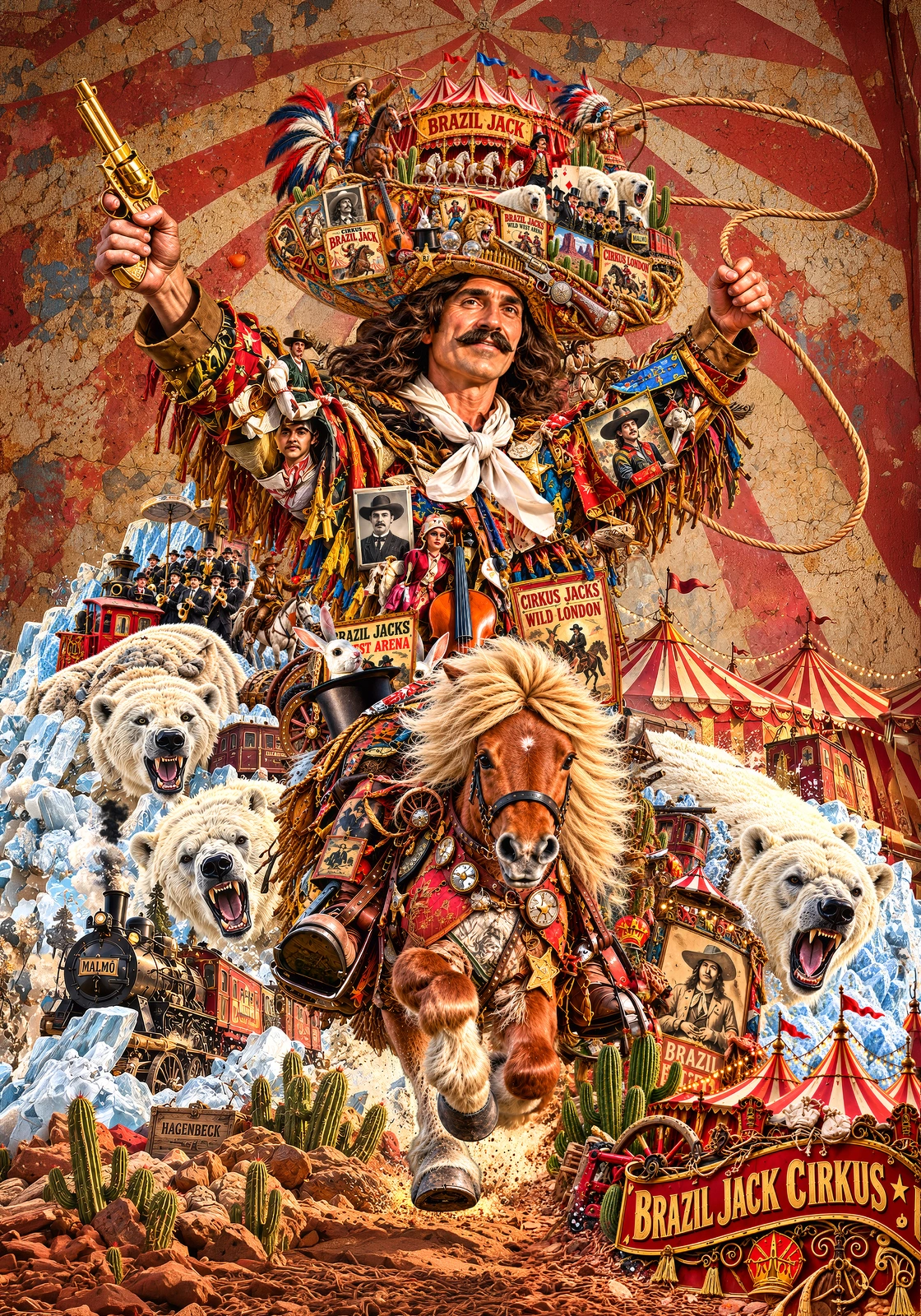
What happens when Giuseppe Arcimboldo’s way of painting a human being is no longer based on fruit, flowers, books or fish, but on an entire life? When the face and body are instead constructed from the places, people, animals, objects and stories that together shaped a person?
In this series, Arcimboldo returns to our time and encounters people who lived long after him. He does not paint them as they looked, nor as a traditional portrait painter would. Instead, he seeks to capture who they were by letting their lives become the image's material. A face may emerge from buildings and photographs, a body from memories and decisive events. At the same time, tiny details far out at the edges of the picture may carry stories that only become visible when we stop and look more closely.
This time he encounters Brazil Jack, or Carl Max Alexander Rhodin, as he was actually called, the man who turned his own life into a performance. It is difficult to imagine anyone better suited to Arcimboldo’s method, for around Brazil Jack crowd the violin and the revolver, the lasso and the circus tent, horses and lions, the railway and the Wild West, Theodore Roosevelt and Malmö – and, of course, the almost unbelievable story of some forty polar bears.
The result is therefore less a portrait in the conventional sense than a pictorial biography, in which the boundary between documented history, circus legend and the family’s own stories can sometimes be as difficult to distinguish as the boundary between Carl Rhodin and the character he created for himself. For somewhere beneath the cowboy hat, behind the magnificent moustache and amid all this teeming spectacle, there is still the man who managed to perform perhaps the greatest act in his own lifetime – transforming himself into Brazil Jack.
“Samlom Samlom Salabamlom!
He came with a fiddle, a lasso, a gun,
and somehow decided that one life was none.
So Carl became Jack with a flourish and crack,
and Sweden discovered there was no turning back.
He borrowed the West, gave the prairie a tent,
made cowboys from Swedes and called it an event.
With horses and lions, with posters and brass,
he knew that a crowd must be stopped as they pass.
Then Teddy came travelling by railway one day,
and Jack saw a chance far too splendid to waste.
“Don’t you remember me, Teddy, old friend?”
A friendship invented from beginning to end.
The cameras went flashing, the brass band played on,
and before anyone questioned it, Roosevelt was gone.
But newspapers carried what Jack understood:
a story need not be likely —
it only needs to be good.
Then somebody whispered, “A bear would be grand.”
Jack thought for a moment and raised his hand.
“One polar bear? Two? Why think quite so small?
If there’s a good price on them —
I’ll purchase them all!”
So bears came to Malmö, and lions did too,
while trains hauled a circus that constantly grew.
There were wagons and horses and canvas and light,
a whole moving city disappearing each night.
The years rolled away, and the old cowboy died,
but the name on the circus remained there outside.
For Carl was mortal, as all men must be,
but Brazil Jack had found immortality.
And somewhere beneath that impossible hat,
among lions and posters and this thing and that,
Arcimboldo still paints while the circus drums roll:
Samlom Samlom Salabamlom!
For some men have a story.
Brazil Jack became the whole show.”
Malmö, September 2026
Samlom Samlom Salabamlom! – An Essay on Brazil Jack – the Man Who Turned His Own Life into a Circus
PROLOGUE – Arcimboldo Goes to the Circus
Giuseppe Arcimboldo had painted emperors from fruit, lawyers from books, seasons from flowers, and people from the things that revealed who they really were. When, several centuries after his death, he returned to Earth and heard about a Swedish circus director named Brazil Jack, the task should therefore have been simple.
It was not.
The problem was not that he had too few things to paint him, but that he had far too many. Arcimboldo began with a cowboy hat, which immediately filled with circus tents, horses, revolvers, lassos, playing cards, and posters. He tried to paint the hair, but from the curls emerged Native Americans, cowboys, and an orchestra playing “Stars and Stripes Forever”. He began on the body and soon found himself struggling for space among violins, conjuring apparatus, railway carriages, lions, rabbits, circus wagons, and an entire horde of polar bears.
In the end, he abandoned the attempt to separate the man from his story, for it could not be done.
Brazil Jack had done with his life exactly what Arcimboldo did with his portraits: constructed a human being from hundreds of seemingly incompatible parts and somehow made them coalesce into a single person.
And somewhere in the midst of it all, his old magic formula could still be heard: Samlom, Samlom, Salabamlom! – roughly equivalent to “Abracadabra!” or “Hocus-pocus!”
The Man Who Was Born Behind the Curtain
His real name was Carl Max Alexander Rhodin, and he was born on 28 September 1871 in Bergen. His birth in Norway was almost an accident, as his family was on tour. His father was the illusionist Max Alexander, while his mother, Theresa Margarethe Welcher, performed as a sand artist under the stage name Theresa Rombello. In other words, the show preceded the child. Brazil Jack was not born into an ordinary home and later drawn towards the circus; the circus had been there from the beginning.
He received a musical education, learned to play the violin, and soon discovered that it could provide him with a living. As a young man, he made his way to Sweden, playing in courtyards and alleys. The story tells how he began cautiously in Arlöv and Lomma before finally daring to try Malmö.
That is hard to imagine when you know what came later. The man who would eventually halt an international celebrity train and turn a railway platform into a stage had once been reluctant even to play his violin in Malmö.
Yet perhaps the secret of Brazil Jack is already here: he learned that an audience does not simply appear. You have to make it stop and watch.
One Man Was Not Enough
Carl Rhodin seems to have grasped remarkably early what the modern entertainment industry would later take for granted: a name can become a product, and a person can create their own brand.
Being Carl Rhodin was therefore not enough.
He could be a violinist and a troubadour. Under the name Roodini – also rendered as Carlo Roodini – he appeared in Italian costume. He performed shadow plays and magic tricks, sang, wrote, acted in short sketches, and exhibited curiosities. His skills included shadow play, conjuring, trick shooting, curiosities, and, of course, the circus.
He also appears in the world surrounding Madigan’s circus and later with a Romani company under the name “Zigenarprinsen” – “the Gypsy Prince”, in the terminology of the period – before the Italian troubadour and, finally, the cowboy took possession of the story.
He was not merely changing acts; he was moving from one imagined world to another. Sometime towards the end of the 1890s, he discovered the world that would eventually swallow all the others: the Wild West.
When Carl Rhodin Became Brazil Jack
Europe had already fallen in love with Buffalo Bill’s Wild West. William F. Cody had understood how the history and mythology of the American West could be transformed into a travelling mass spectacle, in which horses, gunfire, Native Americans, cowboys and heroism could all be loaded onto railway carriages and sold from town to town.
Rhodin saw the possibilities.
In the autumn of 1898, he began performing as the cowboy artist Brazil Jack. In January the following year, he appeared at Stora Teatern in Norrköping, leading a “Mexican Cowboy Company” that demonstrated trick shooting, lasso throwing and archery. By the spring of 1899, the company had become Cirkus Brazil Jack.
The name was inspired.
It sounded foreign, dangerous and exotic, yet remained simple enough for a child to remember. Buffalo Bill and Texas Jack were obvious models, and the family story about his mother’s Brazilian origins also contributed to the mythology surrounding the name.
Carl Rhodin had thereby performed his greatest magic trick: he had made Carl Rhodin disappear, and in his place stood Brazil Jack.
Sweden Gets Its Own Wild West
Brazil Jack looked like a man who had already stepped out of his own circus poster. His long hair, enormous moustache, hat and theatrical clothes gave him a silhouette that was enough in itself.
What remained was to provide the action: stagecoach robberies, gunfire, horses, lassos, knives, archery, cowboys and Native Americans. Brazil Jack naturally placed himself at the centre of the drama and, just as naturally, emerged on the right side of it when the smoke finally cleared. At the same time, the very same man could play the violin, perform magic tricks, create shadow pictures and sing comic songs.
It was hardly realism, but it suited his purposes better than realism. It was circus.
That is why, in the painting, the revolver rests in one hand and the lasso in the other, with the magnificently moustached man between them. His hat has grown into an entire universe of tents, horses, posters, lions and people. This is not a chronological biography but something closer to the inside of Brazil Jack’s mind, where everything happens at once.
The Man Who Could Stop Roosevelt
Perhaps the most perfect Brazil Jack story of all took place in Katrineholm in May 1910. Theodore Roosevelt, the former President of the United States, was travelling through Europe and passed through Sweden. Brazil Jack immediately recognised what most people would have regarded as an insurmountable obstacle: Roosevelt did not know him.
To Brazil Jack, this was merely a detail.
When Roosevelt arrived in Katrineholm, an orchestra, circus performers, and a carefully staged Wild West spectacle greeted him. According to ”Svenskt biografiskt lexikon”, Brazil Jack welcomed him with a full orchestra and performers dressed as Native Americans and cowboys, and reminded the former president of their previous encounters.
Those encounters had not occurred.
Family legend adds even more to the scene. In that version, Brazil Jack rides forward and calls out:
“Teddy! Don’t you remember me from the prairies?”
Roosevelt plays along, the press takes their photographs, and within minutes Brazil Jack has transformed a meeting between two strangers into a news story. What exact words were spoken is ultimately less important than the fact that the publicity stunt took place.
Brazil Jack had understood the logic of the media long before anyone coined the term “media logic”. What mattered less was what happened than creating something people would want to talk about.
A Circus Empire on Wheels
Beneath the antics lay a serious entrepreneur. New ventures followed Cirkus Brazil Jack. In 1906, Brazil Jack’s Wild West Arena toured Sweden, and the following year he took over Cirkus London, which toured Sweden, Denmark and Norway until 1914. In 1915, the name Cirkus Brazil Jack returned, but the First World War subsequently hit the circus business hard, and in 1916 Rhodin was forced to hand over its management.
Behind the romance lay an enormous logistical operation. A circus was a town that had to be constantly dismantled, moved and rebuilt. People, animals, tents, props, musical instruments, kitchens, sleeping quarters and ticket offices all had to move on to the next destination. Later family accounts state that, at its largest, the operation required no fewer than 42 railway carriages.
That is why the railway has such a natural place in the portrait, not merely because Roosevelt arrived by train. The circus’s true magic wand was not the revolver but the timetable.
The Lions
Brazil Jack rarely seems to have regarded moderation as a particularly useful criterion. When an animal act was intended to be spectacular, international performers were brought in, including the animal trainer Alfred Schneider and his renowned lion act.
Here, however, we also enter a part of circus history that our own age views through very different eyes. For much of the twentieth century, animals were central to the traditional circus, and exotic species served as living evidence that the circus could bring a strange and dangerous world directly to the local tent site.
What was once advertised as a sensation and an adventure now raises questions about animal welfare and humanity’s right to use wild animals for entertainment. The historical perspective has shifted, and Brazil Jack’s own circus dynasty would eventually change with it.
The Train from Germany
One of the darker, more dramatic scenes in the picture belongs to the next generation.
During the closing stages of the Second World War, animals and performers from the German Hagenbeck circus world came to Trolle Rhodin’s circus in Sweden. By then, Brazil Jack’s son Trolle had taken over the major animal-circus operation, while his father could still contribute his name, experience, and phenomenal ability to attract attention. The zoological animal circus was transferred to Trolle, with Brazil Jack subsequently serving as press and publicity manager, an important distinction, as family history can easily be traced backwards until the father becomes the central character even in his son’s achievements.
He was not. Yet without Brazil Jack, there would hardly have been a Rhodin circus empire for Trolle to inherit and develop.
That is why the train also belongs in the portrait: it links the man to the dynasty.
And Then There Were the Polar Bears
Then comes the story that is almost too good to be true – but considerably more than merely almost.
According to Rhodin family tradition, the ageing Brazil Jack decided that his son’s animal circus needed polar bears. A few might, of course, have been impressive, but somewhere between the idea and the delivery, something happened that seems to have happened rather frequently whenever Brazil Jack became involved.
The question of scale disappeared.
According to the family story, he was offered a favourable price if he bought the entire available group. What did he do? Brazil Jack bought the lot.
The result was around forty polar bears; the material used for this essay states that at one point the group may have numbered as many as 48.
That is why they charge through the lower part of the painting. They are not merely animals but Brazil Jack’s personality expressed in zoological form. An ordinary person might ask, “Do we really need a polar bear?” Brazil Jack asks, “How much for all of them?”
Only afterwards do the more prosaic questions arise: cages, water, ice, and the enormous quantities of food required to keep an entire polar bear population alive.
If the story has grown somewhat in the family’s oral tradition over the years, that hardly diminishes its appeal. We should distinguish family tradition from episodes that are as securely documented as the Roosevelt stunt. Yet it is difficult to imagine 48 polar bears simply materialising from nowhere and then vanishing without leaving a considerable mark on family memory.
By then, Brazil Jack had achieved something granted to very few people: he had become the sort of person about whom Brazil Jack stories could be told.
The Man Behind the Poster
It would be easy to reduce all this to nothing more than a collection of amusing eccentricities: the cowboy, the former president, the polar bears, the revolvers, the lasso and the magnificent moustache.
But then we would lose sight of the man.
Brazil Jack lived a long life marked by financial successes and failures, major changes in his family life, collapsed businesses, and repeated attempts to start again. The First World War shattered a flourishing circus enterprise. He eventually left his first family, formed a new one in Sweden, continued working on a smaller scale, and lived to see the next generation take over what he himself had created.
Nor was he simply a cowboy. The violinist remained, as did the magician and the storyteller, while the publicity man never disappeared. Perhaps that is why he survived so many of his own enterprises. Circus tents could be blown down, economies could collapse, and company names could change, but Brazil Jack could always be rebuilt.
“Himma i Malmö” – At Home in Malmö
Eventually the story moved south.
Brazil Jack developed strong ties to Malmö and to the family’s winter quarters there. He also died in Malmö on 7 November 1952, aged 81.
That is why, in the portrait, a locomotive bearing the name MALMÖ on its front pushes through the ice and circus chaos. It is more than a geographical marker; wartime winters really were bitterly cold, and the ice stretched all the way towards Copenhagen. The polar bears could have walked across it, scaring the living daylights out of the Danes.
Malmö was the final station.
The man, born while his parents were on tour in Bergen and who had spent an entire lifetime refusing to stand still, finally came to rest in Malmö.
However, the name did not stop there.
After Brazil Jack
His son, Trolle Rhodin, developed the circus world his father had created and eventually became an artistic director at Ringling Bros. and Barnum & Bailey in the United States. In 1982, the next generation of the family revived Cirkus Brazil Jack.
Then came perhaps the greatest transformation of all. In 2018, Cirkus Brazil Jack decided to abandon animal acts and become a completely animal-free circus.
The lions, horses and polar bears were gone. Still, the people remained, along with the acrobatics, clowns, music, lights, the tent and the fundamental idea that had already existed in the young man with the violin: to create, for a few hours, a world that does not exist outside the canvas walls.
EPILOGUE – The Man Beneath the Hat
When Arcimboldo finally sets down his brush, there is hardly any room left on the canvas.
There are the revolver and the lasso, the violin and the magic tricks, the horses and the lions, Cirkus London and Wild West Arena, Roosevelt and the railway, Hagenbeck, Malmö and the improbable polar bears: posters, playing cards, circus wagons, and the great red-and-yellow tent.
Yet somewhere deep within this overloaded portrait, a face still emerges, and that is where Brazil Jack becomes truly interesting.
Beneath all the exaggeration lay a remarkably modern insight: a human being can be both a person and a story. Carl Rhodin created Brazil Jack, but over time it became impossible to tell where one ended and the other began. He no longer merely performed in the show; his own life had become the show.
That is why Arcimboldo’s method suits him better than any conventional portrait ever could. A photograph can show the long moustache, and a painting can show the cowboy hat. Still, to portray Brazil Jack, one must also find room for the violin, the train, the revolver, the circus tent, Roosevelt, the lions, the horses, Malmö and some forty polar bears.
And when all of that is finally in place, only one thing remains: to let the man raise his hat, lift his arm, and call out across the circus ring one more time:
“Samlom! Samlom! Salabamlom!”
Introduktion - Samlom Samlom Salabamlom!
Vad händer när Giuseppe Arcimboldos sätt att måla en människa inte längre utgår från frukter, blommor, böcker eller fiskar, utan från ett helt liv? När ansiktet och kroppen i stället byggs av de platser, människor, djur, föremål och historier som tillsammans har skapat en person?
I den här serien får Arcimboldo återvända till vår tid och möta människor som levt långt efter honom. Han målar dem inte som de såg ut i verkligheten och inte heller som ett traditionellt porträtt skulle ha gjort. I stället försöker han fånga vilka de var genom att låta deras liv bli själva materialet i bilden. Ett ansikte kan växa fram ur byggnader och fotografier, en kropp ur minnen och avgörande händelser, medan små detaljer långt ute i bildens kanter kan bära på berättelser som först blir synliga när man stannar upp och tittar närmare.
Den här gången möter han Brazil Jack, eller som han egentligen hette, Carl Max Alexander Rhodin, mannen som gjorde sitt eget liv till en föreställning. Det är svårt att tänka sig någon som bättre passar Arcimboldos metod, för kring Brazil Jack trängs fiolen och revolvern, lassot och cirkustältet, hästarna och lejonen, järnvägen och Vilda västern, Theodore Roosevelt och Malmö – och, naturligtvis, den närmast osannolika historien om ett fyrtiotal isbjörnar.
Resultatet blir därför mindre ett porträtt i vanlig mening än en bildbiografi, där gränsen mellan dokumenterad historia, cirkusmyt och familjens egna berättelser ibland är lika svår att urskilja som gränsen mellan Carl Rhodin och den gestalt han skapade åt sig själv. För någonstans under cowboyhatten, bakom den väldiga mustaschen och mitt i allt detta myller, finns fortfarande mannen som lyckades med sitt kanske största nummer redan under sin livstid – att förvandla sig själv till Brazil Jack.
Samlom Samlom Salabamlom! - En essä om Brazil Jack – mannen som gjorde sitt eget liv till cirkus
PROLOG – Arcimboldo går på cirkus
Giuseppe Arcimboldo hade målat kejsare av frukter, jurister av böcker, årstider av blommor och människor av de ting som avslöjade vilka de egentligen var. När han, flera hundra år efter sin död, återvände till jorden och fick höra talas om en svensk cirkusdirektör vid namn Brazil Jack, borde uppgiften därför ha varit enkel.
Det var den inte.
Problemet var inte att det saknades saker att måla honom med. Problemet var att det fanns alldeles för många.
Arcimboldo började med en cowboyhatt. Genast fylldes den av cirkustält, hästar, revolvrar, lasson, spelkort och affischer. Han försökte måla håret, men ur lockarna kom indianer, cowboys och en orkester som spelade ”Stars and Stripes Forever”. Han började på kroppen och fick snart trängas med fioler, trolleriapparater, järnvägsvagnar, lejon, kaniner, cirkusvagnar och en hel hord isbjörnar.
Till sist gav han upp försöket att skilja mannen från hans historia. Det gick inte.
Brazil Jack hade gjort samma sak med sitt liv som Arcimboldo gjorde med sina porträtt: byggt en människa av hundratals till synes oförenliga delar och fått dem att tillsammans föreställa en enda person.
Och någonstans mitt i alltihop hördes hans gamla trollformel: Samlom Samlom Salabamlom! Ungefär ”Simsalabim” eller ”Hokus Pokus Filiokus”.
Mannen som föddes bakom ridån
Han hette egentligen Carl Max Alexander Rhodin och föddes den 28 september 1871 i Bergen. Att han föddes i Norge var närmast en tillfällighet. Familjen befann sig på turné. Fadern var illusionisten Max Alexander och modern var Theresa Margarethe Welcher, som uppträdde som sandmålare under artistnamnet Theresa Rombello. Showen föregick alltså barnet. Brazil Jack föddes inte in i ett vanligt hem och sökte sig senare till cirkusen; cirkusen fanns där från början.
Han fick musikalisk utbildning, lärde sig spela fiol och upptäckte snart att det gick att försörja sig på den. Som ung drog han till Sverige och spelade på gårdar och i gränder. I materialet berättas hur han började försiktigt i Arlöv och Lomma innan han vågade sig på Malmö.
Det är nästan svårt att föreställa sig när man känner till fortsättningen. Mannen som senare kunde stoppa ett internationellt celebritetståg och förvandla en järnvägsperrong till en föreställning vågade från början inte spela fiol i Malmö.
Men redan här finns kanske hemligheten bakom hela Brazil Jack. Han lärde sig att en publik inte kommer av sig själv. Man måste få den att stanna.
En man räckte inte
Carl Rhodin tycks tidigt ha förstått något som vår tids underhållningsindustri senare skulle göra till en självklarhet: att ett namn kan vara en produkt och att en människa kan skapa sitt eget varumärke.
Därför nöjde han sig inte med att vara Carl Rhodin.
Han kunde vara violinist och trubadur. Under namnet Roodini – även återgivet som Carlo Roodini – framträdde han i italiensk dräkt. Han gjorde skuggspel, trollade, sjöng, skrev, spelade små scener och visade upp kuriositeter. Nationalencyklopedin räknar just skuggspel, trolleri, konstskytte, kuriositeter och cirkus till sina specialiteter.
I ditt material dyker han dessutom upp i Madigans cirkusmiljö och senare tillsammans med ett romskt sällskap under namnet ”Zigenarprinsen”, innan den italienske trubaduren och slutligen cowboyen tar över berättelsen.
Han bytte inte bara nummer. Han bytte värld.
Och någon gång i slutet av 1890-talet fann han den värld som skulle sluka alla de andra.
Vilda västern.
När Carl Rhodin blev Brazil Jack
Europa hade redan förälskat sig i Buffalo Bills Wild West. William F. Cody hade förstått hur man kunde förvandla den amerikanska västerns historia och mytologi till ett kringresande masspektakel. Hästar, skottlossning, indianer, cowboys och hjältemod kunde packas på järnvägsvagnar och säljas stad efter stad.
Rhodin såg möjligheten.
Hösten 1898 började han framträda som cowboyartisten Brazil Jack. I januari följande år stod han på Stora Teatern i Norrköping i spetsen för ett ”Mexikanskt Cowboy-sällskap” och demonstrerade prickskytte, lassokastning och bågskytte. Våren 1899 blev sällskapet Cirkus Brazil Jack.
Namnet var genialt.
Det lät utländskt, farligt och exotiskt samtidigt som det var så enkelt att ett barn kunde komma ihåg det. Förebilderna Buffalo Bill och Texas Jack låg nära till hands; även familjens berättelse om moderns brasilianska ursprung bidrog till Brazil-mytologin.
Carl Rhodin hade därmed utfört sitt största trolleritrick. Han hade trollat bort Carl Rhodin. Kvar stod Brazil Jack.
Sverige får en egen Vilda västern
Brazil Jack såg ut som en människa som redan hade klivit ut ur sin egen affisch. Det långa håret, den enorma mustaschen, hatten och de teatrala kläderna gjorde att silhuetten räckte.
Sedan behövdes handling.
Diligensöverfall. Skottlossningar. Hästar. Lasson. Knivar. Bågskytte. Cowboys och indianer. Brazil Jack placerade sig naturligtvis själv mitt i dramat och kom, lika naturligt, ut på rätt sida när röken hade skingrats. Samtidigt kunde samma man spela fiol, trolla, göra skuggbilder och sjunga kupletter.
Det var knappast realism. Det var bättre än realism. Det var cirkus.
I bilden sitter därför revolvern i ena handen och lassot i den andra. Mellan dem finns mannen med den väldiga mustaschen. Hatten har vuxit till ett helt universum av tält, hästar, affischer, lejon och människor. Det är ingen kronologisk biografi. Det är Brazil Jacks hjärna.
Allting pågår samtidigt.
Mannen som kunde stoppa Roosevelt
Den kanske mest fulländade Brazil Jack-historien utspelade sig i Katrineholm i maj 1910. Theodore Roosevelt, USA:s tidigare president, befann sig på en resa i Europa och passerade Sverige. Brazil Jack insåg vad de flesta människor skulle ha betraktat som ett oöverstigligt problem: att Roosevelt inte kände honom.
För Brazil Jack var detta snarare en detalj.
När Roosevelt kom till Katrineholm möttes han av en orkester, cirkusfolk och ett arrangerat Vilda västern-spektakel. ”Svenskt biografiskt lexikon” beskriver hur Brazil Jack uppvaktade honom med full orkester och artister utklädda till indianer och cowboys och dessutom påminde presidenten om deras tidigare sammanträffanden.
Dessa sammanträffanden var uppdiktade. Familjehistorien har gjort scenen ännu bättre. Där rider Brazil Jack fram och ropar:
”Teddy! Don’t you remember me from the prairies?”
Roosevelt spelar med, pressen fotograferar och Brazil Jack har på bara några minuter förvandlat ett möte mellan två främlingar till en nyhet. Det avgörande är egentligen inte vilka repliker som återgavs exakt. Det historiskt intressanta är att själva PR-kuppen verkligen ägde rum.
Brazil Jack hade förstått medielogiken långt innan någon använde ordet medielogik. Det spelade mindre roll vad som hade hänt. Det viktiga var att skapa något som människor ville berätta om.
Ett cirkusimperium på hjul
Bakom upptågen fanns samtidigt en seriös företagare. Cirkus Brazil Jack följdes av nya konstellationer. År 1906 turnerade Brazil Jacks Wild West Arena genom Sverige och året därpå tog han över Cirkus London, som kom att turnera i Sverige, Danmark och Norge fram till 1914. År 1915 återkom namnet Cirkus Brazil Jack. Första världskriget slog därefter hårt mot cirkusbranschen, och 1916 tvingades Rhodin lämna över ledningen.
Bakom romantiken fanns en enorm logistik. Cirkusen var en stad som ständigt måste rivas, flyttas och byggas upp igen. Människor, djur, tält, rekvisita, instrument, kök, sovplatser och biljettkassor skulle vidare till nästa ort. I familjens senare berättelser framgår det att verksamheten, när den var som störst, krävde 42 järnvägsvagnar.
Det är därför järnvägen har en självklar plats i porträttet. Inte bara för att Roosevelt kom med tåget
Cirkusens verkliga trollstav var inte revolvern. Det var tidtabellen.
Lejonen
Brazil Jack tyckte sällan att lagom var en användbar måttenhet. När ett djurnummer skulle vara spektakulärt engagerades internationella artister. I materialet finns bland annat rovdjursdressören Alfred Schneider och hans stora lejonnummer.
Och här börjar också den del av cirkushistorien som vår tid ser med andra ögon. Djur var under större delen av 1900-talet centrala för den klassiska cirkusens föreställningsvärld. Exotiska arter fungerade som levande bevis på att cirkusen kunde föra en främmande och farlig värld ända fram till hemortens tältplats.
Det som då marknadsfördes som sensation och äventyr väcker i dag frågor om djurhållning och människans rätt att använda vilda djur för underhållning.
Historien har ändrat perspektiv. Och Brazil Jacks egen cirkusdynasti skulle långt senare göra detsamma.
Tåget från Tyskland
En av bildens mörkare och mer dramatiska scener tillhör egentligen nästa generation.
Under andra världskrigets slutskede kom djur och artister från den tyska Hagenbeck-miljön till Trolle Rhodins cirkus i Sverige. Brazil Jacks son Trolle hade vid denna tid tagit över den stora djurcirkusverksamheten, medan fadern fortfarande kunde bidra med sitt namn, sin erfarenhet och sin fenomenala förmåga att skapa uppmärksamhet. Svenskt biografiskt lexikon bekräftar att den zoologiska rovdjurscirkusen överfördes till Trolle och att Brazil Jack därefter fungerade som press- och reklamchef. Det är viktigt eftersom historien lätt växer bakåt och gör fadern till huvudperson även i sonens bedrifter.
Han var inte det. Men utan Brazil Jack hade det knappast funnits något Rhodinskt cirkusimperium för Trolle att föra vidare.
Därför finns också tåget i porträttet: som en länk mellan mannen och dynastin.
Och så var det isbjörnarna
Sedan kommer historien som nästan är för bra för att vara sann. Men bra mycket mer än nästan.
Den äldre Brazil Jack fick enligt den Rhodinska familjetraditionen idén att sonens djurcirkus behövde isbjörnar. Några stycken kan förstås vara effektfulla. Men någonstans mellan idé och leverans inträffade det som ofta tycks ha hänt när Brazil Jack var inblandad.
Skalan försvann.I familjeberättelsen erbjöds han ett fördelaktigt pris om han köpte hela flocken. Vad gjorde han då? Brazil Jack köpte rubbet.
Resultatet blev ett fyrtiotal isbjörnar; i ditt material anges att flocken som mest ska ha bestått av 48.
Det är därför de rusar genom målningens nedre del. De är inte bara djur. De är Brazil Jacks personlighet i zoologisk form.
En normal människa frågar: ”Behöver vi verkligen en isbjörn?”
Brazil Jack frågar: ”Vad kostar alla?”
Och först därefter uppstår de mer prosaiska frågorna om burar, vatten, is och de enorma mängder mat som krävs för att hålla en hel isbjörnsflock vid liv.
Om historien genom åren har blivit något större i familjens muntliga tradition gör det nästan ingenting. Man bör bara vara tydlig med att detaljerna är en familjetradition snarare än lika säkert dokumenterade som exempelvis Roosevelt-kuppen. Men det är svårt att tänka sig att 48 isbjörnar dyker upp ur intet för att sedan gå upp i rök.
Brazil Jack hade vid det laget lyckats med något få människor lyckas med. Han hade blivit en person som det var möjligt att berätta Brazil Jack-historier om.
Mannen bakom affischen
Det är lätt att låta allt detta bli en samling lustigheter: cowboyen, expresidenten, isbjörnarna, revolvrarna, lassot och den yviga mustaschen.
Men då missar man mannen.
Brazil Jack levde ett långt liv präglat av ekonomiska framgångar och misslyckanden, stora familjeförändringar, nedlagda företag och ständiga försök att börja om. Första världskriget slog sönder en blomstrande cirkusverksamhet. Han lämnade så småningom sin första familj och bildade en ny i Sverige. Han turnerade mindre, arbetade vidare och såg nästa generation ta över det han själv hade grundat.
Han var dessutom mer än en cowboy. Violinisten fanns kvar. Trollkarlen fanns kvar. Berättaren fanns kvar. Reklammannen fanns definitivt kvar.
Kanske var det därför han överlevde så många av sina egna företag. Cirkustältet kunde blåsa sönder. Ekonomier kunde kollapsa. Namn på företag kunde bytas.
Men Brazil Jack gick alltid att sätta upp igen.
”Himma i Malmö”
Till slut fördes historien söderut.
Brazil Jack kom att få en stark anknytning till Malmö och familjens vinterkvarter. Det var också i Malmö som han dog den 7 november 1952, 81 år gammal.
I porträttet kommer därför ett lok med MALMÖ på fronten genom isen och cirkuskaoset. Det är inte bara en geografisk markering; krigsvintrarna var verkligen hårda, och isen låg hela vägen till Köpenhamn. Isbjörnarna kunde traskat över isen och skrämt cettet ur danskarna.
Malmö var slutstationen.
Mannen som föddes under föräldrarnas turné i Bergen och sedan ägnade ett helt liv åt att aldrig stå stilla hamnade till slut i Malmö.
Men namnet stannade inte där.
Efter Brazil Jack
Sonen Trolle Rhodin utvecklade den cirkusvärld som fadern hade skapat och blev så småningom artistchef för Ringling Bros. and Barnum & Bailey i USA. År 1982 återuppstod Cirkus Brazil Jack under nästa generation i familjen.
Och så inträffade den kanske största förändringen av alla. År 2018 beslutade Cirkus Brazil Jack att lämna djurnumren och bli en djurfri cirkus.
Lejonen försvann. Hästarna försvann.Isbjörnarna hade sedan länge försvunnit.
Kvar blev människorna, akrobatiken, clownerna, musiken, ljuset, tältet och den grundläggande idén som redan fanns hos mannen med fiolen – att i några timmar skapa en värld som inte existerar utanför tältduken.
EPILOG – Mannen under hatten
När Arcimboldo till sist lägger ifrån sig penseln finns det nästan ingen plats kvar på duken.
Där finns revolvern och lasson. Fiolen och trollkonsterna. Hästarna och lejonen. Cirkus London och Wild West Arena. Roosevelt och järnvägen. Hagenbeck, Malmö och de osannolika isbjörnarna. Där finns affischerna, spelkorten, cirkusvagnarna och det stora rödgula tältet.
Men längst inne i detta överlastade porträtt finns fortfarande ett ansikte. Det är där Brazil Jack blir riktigt intressant.
Bakom alla överdrifter fanns en ovanligt modern insikt: människan kan vara både person och berättelse. Carl Rhodin skapade Brazil Jack, men med tiden blev det omöjligt att avgöra var den ena slutade och den andra började. Han uppträdde inte längre bara i föreställningen. Hans eget liv hade blivit föreställningen.
Därför passar Arcimboldos metod honom bättre än vad ett vanligt porträtt någonsin skulle kunna göra. Ett fotografi kan visa den långa mustaschen. En målning kan visa cowboyhatten.
Men för att avbilda Brazil Jack måste man också få plats med fiolen, tåget, revolvern, cirkustältet, Roosevelt, lejonen, hästarna, Malmö och ett fyrtiotal isbjörnar.
Och när allt detta äntligen är på plats återstår egentligen bara en sak. Att låta mannen lyfta hatten, höja armen och ännu en gång ropa över manegen:
“Samlom! Samlom! Salabamlom!”
Jörgen Thornberg
Samlom Samlom Salabamlom!, 2026
Digital
50 x 70 cm
2 900 kr
Arcimboldo - Samlom Samlom Salabamlom!
Svensk text i slutet
Introduction – Samlom Samlom Salabamlom!
What happens when Giuseppe Arcimboldo’s way of painting a human being is no longer based on fruit, flowers, books or fish, but on an entire life? When the face and body are instead constructed from the places, people, animals, objects and stories that together shaped a person?
In this series, Arcimboldo returns to our time and encounters people who lived long after him. He does not paint them as they looked, nor as a traditional portrait painter would. Instead, he seeks to capture who they were by letting their lives become the image's material. A face may emerge from buildings and photographs, a body from memories and decisive events. At the same time, tiny details far out at the edges of the picture may carry stories that only become visible when we stop and look more closely.
This time he encounters Brazil Jack, or Carl Max Alexander Rhodin, as he was actually called, the man who turned his own life into a performance. It is difficult to imagine anyone better suited to Arcimboldo’s method, for around Brazil Jack crowd the violin and the revolver, the lasso and the circus tent, horses and lions, the railway and the Wild West, Theodore Roosevelt and Malmö – and, of course, the almost unbelievable story of some forty polar bears.
The result is therefore less a portrait in the conventional sense than a pictorial biography, in which the boundary between documented history, circus legend and the family’s own stories can sometimes be as difficult to distinguish as the boundary between Carl Rhodin and the character he created for himself. For somewhere beneath the cowboy hat, behind the magnificent moustache and amid all this teeming spectacle, there is still the man who managed to perform perhaps the greatest act in his own lifetime – transforming himself into Brazil Jack.
“Samlom Samlom Salabamlom!
He came with a fiddle, a lasso, a gun,
and somehow decided that one life was none.
So Carl became Jack with a flourish and crack,
and Sweden discovered there was no turning back.
He borrowed the West, gave the prairie a tent,
made cowboys from Swedes and called it an event.
With horses and lions, with posters and brass,
he knew that a crowd must be stopped as they pass.
Then Teddy came travelling by railway one day,
and Jack saw a chance far too splendid to waste.
“Don’t you remember me, Teddy, old friend?”
A friendship invented from beginning to end.
The cameras went flashing, the brass band played on,
and before anyone questioned it, Roosevelt was gone.
But newspapers carried what Jack understood:
a story need not be likely —
it only needs to be good.
Then somebody whispered, “A bear would be grand.”
Jack thought for a moment and raised his hand.
“One polar bear? Two? Why think quite so small?
If there’s a good price on them —
I’ll purchase them all!”
So bears came to Malmö, and lions did too,
while trains hauled a circus that constantly grew.
There were wagons and horses and canvas and light,
a whole moving city disappearing each night.
The years rolled away, and the old cowboy died,
but the name on the circus remained there outside.
For Carl was mortal, as all men must be,
but Brazil Jack had found immortality.
And somewhere beneath that impossible hat,
among lions and posters and this thing and that,
Arcimboldo still paints while the circus drums roll:
Samlom Samlom Salabamlom!
For some men have a story.
Brazil Jack became the whole show.”
Malmö, September 2026
Samlom Samlom Salabamlom! – An Essay on Brazil Jack – the Man Who Turned His Own Life into a Circus
PROLOGUE – Arcimboldo Goes to the Circus
Giuseppe Arcimboldo had painted emperors from fruit, lawyers from books, seasons from flowers, and people from the things that revealed who they really were. When, several centuries after his death, he returned to Earth and heard about a Swedish circus director named Brazil Jack, the task should therefore have been simple.
It was not.
The problem was not that he had too few things to paint him, but that he had far too many. Arcimboldo began with a cowboy hat, which immediately filled with circus tents, horses, revolvers, lassos, playing cards, and posters. He tried to paint the hair, but from the curls emerged Native Americans, cowboys, and an orchestra playing “Stars and Stripes Forever”. He began on the body and soon found himself struggling for space among violins, conjuring apparatus, railway carriages, lions, rabbits, circus wagons, and an entire horde of polar bears.
In the end, he abandoned the attempt to separate the man from his story, for it could not be done.
Brazil Jack had done with his life exactly what Arcimboldo did with his portraits: constructed a human being from hundreds of seemingly incompatible parts and somehow made them coalesce into a single person.
And somewhere in the midst of it all, his old magic formula could still be heard: Samlom, Samlom, Salabamlom! – roughly equivalent to “Abracadabra!” or “Hocus-pocus!”
The Man Who Was Born Behind the Curtain
His real name was Carl Max Alexander Rhodin, and he was born on 28 September 1871 in Bergen. His birth in Norway was almost an accident, as his family was on tour. His father was the illusionist Max Alexander, while his mother, Theresa Margarethe Welcher, performed as a sand artist under the stage name Theresa Rombello. In other words, the show preceded the child. Brazil Jack was not born into an ordinary home and later drawn towards the circus; the circus had been there from the beginning.
He received a musical education, learned to play the violin, and soon discovered that it could provide him with a living. As a young man, he made his way to Sweden, playing in courtyards and alleys. The story tells how he began cautiously in Arlöv and Lomma before finally daring to try Malmö.
That is hard to imagine when you know what came later. The man who would eventually halt an international celebrity train and turn a railway platform into a stage had once been reluctant even to play his violin in Malmö.
Yet perhaps the secret of Brazil Jack is already here: he learned that an audience does not simply appear. You have to make it stop and watch.
One Man Was Not Enough
Carl Rhodin seems to have grasped remarkably early what the modern entertainment industry would later take for granted: a name can become a product, and a person can create their own brand.
Being Carl Rhodin was therefore not enough.
He could be a violinist and a troubadour. Under the name Roodini – also rendered as Carlo Roodini – he appeared in Italian costume. He performed shadow plays and magic tricks, sang, wrote, acted in short sketches, and exhibited curiosities. His skills included shadow play, conjuring, trick shooting, curiosities, and, of course, the circus.
He also appears in the world surrounding Madigan’s circus and later with a Romani company under the name “Zigenarprinsen” – “the Gypsy Prince”, in the terminology of the period – before the Italian troubadour and, finally, the cowboy took possession of the story.
He was not merely changing acts; he was moving from one imagined world to another. Sometime towards the end of the 1890s, he discovered the world that would eventually swallow all the others: the Wild West.
When Carl Rhodin Became Brazil Jack
Europe had already fallen in love with Buffalo Bill’s Wild West. William F. Cody had understood how the history and mythology of the American West could be transformed into a travelling mass spectacle, in which horses, gunfire, Native Americans, cowboys and heroism could all be loaded onto railway carriages and sold from town to town.
Rhodin saw the possibilities.
In the autumn of 1898, he began performing as the cowboy artist Brazil Jack. In January the following year, he appeared at Stora Teatern in Norrköping, leading a “Mexican Cowboy Company” that demonstrated trick shooting, lasso throwing and archery. By the spring of 1899, the company had become Cirkus Brazil Jack.
The name was inspired.
It sounded foreign, dangerous and exotic, yet remained simple enough for a child to remember. Buffalo Bill and Texas Jack were obvious models, and the family story about his mother’s Brazilian origins also contributed to the mythology surrounding the name.
Carl Rhodin had thereby performed his greatest magic trick: he had made Carl Rhodin disappear, and in his place stood Brazil Jack.
Sweden Gets Its Own Wild West
Brazil Jack looked like a man who had already stepped out of his own circus poster. His long hair, enormous moustache, hat and theatrical clothes gave him a silhouette that was enough in itself.
What remained was to provide the action: stagecoach robberies, gunfire, horses, lassos, knives, archery, cowboys and Native Americans. Brazil Jack naturally placed himself at the centre of the drama and, just as naturally, emerged on the right side of it when the smoke finally cleared. At the same time, the very same man could play the violin, perform magic tricks, create shadow pictures and sing comic songs.
It was hardly realism, but it suited his purposes better than realism. It was circus.
That is why, in the painting, the revolver rests in one hand and the lasso in the other, with the magnificently moustached man between them. His hat has grown into an entire universe of tents, horses, posters, lions and people. This is not a chronological biography but something closer to the inside of Brazil Jack’s mind, where everything happens at once.
The Man Who Could Stop Roosevelt
Perhaps the most perfect Brazil Jack story of all took place in Katrineholm in May 1910. Theodore Roosevelt, the former President of the United States, was travelling through Europe and passed through Sweden. Brazil Jack immediately recognised what most people would have regarded as an insurmountable obstacle: Roosevelt did not know him.
To Brazil Jack, this was merely a detail.
When Roosevelt arrived in Katrineholm, an orchestra, circus performers, and a carefully staged Wild West spectacle greeted him. According to ”Svenskt biografiskt lexikon”, Brazil Jack welcomed him with a full orchestra and performers dressed as Native Americans and cowboys, and reminded the former president of their previous encounters.
Those encounters had not occurred.
Family legend adds even more to the scene. In that version, Brazil Jack rides forward and calls out:
“Teddy! Don’t you remember me from the prairies?”
Roosevelt plays along, the press takes their photographs, and within minutes Brazil Jack has transformed a meeting between two strangers into a news story. What exact words were spoken is ultimately less important than the fact that the publicity stunt took place.
Brazil Jack had understood the logic of the media long before anyone coined the term “media logic”. What mattered less was what happened than creating something people would want to talk about.
A Circus Empire on Wheels
Beneath the antics lay a serious entrepreneur. New ventures followed Cirkus Brazil Jack. In 1906, Brazil Jack’s Wild West Arena toured Sweden, and the following year he took over Cirkus London, which toured Sweden, Denmark and Norway until 1914. In 1915, the name Cirkus Brazil Jack returned, but the First World War subsequently hit the circus business hard, and in 1916 Rhodin was forced to hand over its management.
Behind the romance lay an enormous logistical operation. A circus was a town that had to be constantly dismantled, moved and rebuilt. People, animals, tents, props, musical instruments, kitchens, sleeping quarters and ticket offices all had to move on to the next destination. Later family accounts state that, at its largest, the operation required no fewer than 42 railway carriages.
That is why the railway has such a natural place in the portrait, not merely because Roosevelt arrived by train. The circus’s true magic wand was not the revolver but the timetable.
The Lions
Brazil Jack rarely seems to have regarded moderation as a particularly useful criterion. When an animal act was intended to be spectacular, international performers were brought in, including the animal trainer Alfred Schneider and his renowned lion act.
Here, however, we also enter a part of circus history that our own age views through very different eyes. For much of the twentieth century, animals were central to the traditional circus, and exotic species served as living evidence that the circus could bring a strange and dangerous world directly to the local tent site.
What was once advertised as a sensation and an adventure now raises questions about animal welfare and humanity’s right to use wild animals for entertainment. The historical perspective has shifted, and Brazil Jack’s own circus dynasty would eventually change with it.
The Train from Germany
One of the darker, more dramatic scenes in the picture belongs to the next generation.
During the closing stages of the Second World War, animals and performers from the German Hagenbeck circus world came to Trolle Rhodin’s circus in Sweden. By then, Brazil Jack’s son Trolle had taken over the major animal-circus operation, while his father could still contribute his name, experience, and phenomenal ability to attract attention. The zoological animal circus was transferred to Trolle, with Brazil Jack subsequently serving as press and publicity manager, an important distinction, as family history can easily be traced backwards until the father becomes the central character even in his son’s achievements.
He was not. Yet without Brazil Jack, there would hardly have been a Rhodin circus empire for Trolle to inherit and develop.
That is why the train also belongs in the portrait: it links the man to the dynasty.
And Then There Were the Polar Bears
Then comes the story that is almost too good to be true – but considerably more than merely almost.
According to Rhodin family tradition, the ageing Brazil Jack decided that his son’s animal circus needed polar bears. A few might, of course, have been impressive, but somewhere between the idea and the delivery, something happened that seems to have happened rather frequently whenever Brazil Jack became involved.
The question of scale disappeared.
According to the family story, he was offered a favourable price if he bought the entire available group. What did he do? Brazil Jack bought the lot.
The result was around forty polar bears; the material used for this essay states that at one point the group may have numbered as many as 48.
That is why they charge through the lower part of the painting. They are not merely animals but Brazil Jack’s personality expressed in zoological form. An ordinary person might ask, “Do we really need a polar bear?” Brazil Jack asks, “How much for all of them?”
Only afterwards do the more prosaic questions arise: cages, water, ice, and the enormous quantities of food required to keep an entire polar bear population alive.
If the story has grown somewhat in the family’s oral tradition over the years, that hardly diminishes its appeal. We should distinguish family tradition from episodes that are as securely documented as the Roosevelt stunt. Yet it is difficult to imagine 48 polar bears simply materialising from nowhere and then vanishing without leaving a considerable mark on family memory.
By then, Brazil Jack had achieved something granted to very few people: he had become the sort of person about whom Brazil Jack stories could be told.
The Man Behind the Poster
It would be easy to reduce all this to nothing more than a collection of amusing eccentricities: the cowboy, the former president, the polar bears, the revolvers, the lasso and the magnificent moustache.
But then we would lose sight of the man.
Brazil Jack lived a long life marked by financial successes and failures, major changes in his family life, collapsed businesses, and repeated attempts to start again. The First World War shattered a flourishing circus enterprise. He eventually left his first family, formed a new one in Sweden, continued working on a smaller scale, and lived to see the next generation take over what he himself had created.
Nor was he simply a cowboy. The violinist remained, as did the magician and the storyteller, while the publicity man never disappeared. Perhaps that is why he survived so many of his own enterprises. Circus tents could be blown down, economies could collapse, and company names could change, but Brazil Jack could always be rebuilt.
“Himma i Malmö” – At Home in Malmö
Eventually the story moved south.
Brazil Jack developed strong ties to Malmö and to the family’s winter quarters there. He also died in Malmö on 7 November 1952, aged 81.
That is why, in the portrait, a locomotive bearing the name MALMÖ on its front pushes through the ice and circus chaos. It is more than a geographical marker; wartime winters really were bitterly cold, and the ice stretched all the way towards Copenhagen. The polar bears could have walked across it, scaring the living daylights out of the Danes.
Malmö was the final station.
The man, born while his parents were on tour in Bergen and who had spent an entire lifetime refusing to stand still, finally came to rest in Malmö.
However, the name did not stop there.
After Brazil Jack
His son, Trolle Rhodin, developed the circus world his father had created and eventually became an artistic director at Ringling Bros. and Barnum & Bailey in the United States. In 1982, the next generation of the family revived Cirkus Brazil Jack.
Then came perhaps the greatest transformation of all. In 2018, Cirkus Brazil Jack decided to abandon animal acts and become a completely animal-free circus.
The lions, horses and polar bears were gone. Still, the people remained, along with the acrobatics, clowns, music, lights, the tent and the fundamental idea that had already existed in the young man with the violin: to create, for a few hours, a world that does not exist outside the canvas walls.
EPILOGUE – The Man Beneath the Hat
When Arcimboldo finally sets down his brush, there is hardly any room left on the canvas.
There are the revolver and the lasso, the violin and the magic tricks, the horses and the lions, Cirkus London and Wild West Arena, Roosevelt and the railway, Hagenbeck, Malmö and the improbable polar bears: posters, playing cards, circus wagons, and the great red-and-yellow tent.
Yet somewhere deep within this overloaded portrait, a face still emerges, and that is where Brazil Jack becomes truly interesting.
Beneath all the exaggeration lay a remarkably modern insight: a human being can be both a person and a story. Carl Rhodin created Brazil Jack, but over time it became impossible to tell where one ended and the other began. He no longer merely performed in the show; his own life had become the show.
That is why Arcimboldo’s method suits him better than any conventional portrait ever could. A photograph can show the long moustache, and a painting can show the cowboy hat. Still, to portray Brazil Jack, one must also find room for the violin, the train, the revolver, the circus tent, Roosevelt, the lions, the horses, Malmö and some forty polar bears.
And when all of that is finally in place, only one thing remains: to let the man raise his hat, lift his arm, and call out across the circus ring one more time:
“Samlom! Samlom! Salabamlom!”
Introduktion - Samlom Samlom Salabamlom!
Vad händer när Giuseppe Arcimboldos sätt att måla en människa inte längre utgår från frukter, blommor, böcker eller fiskar, utan från ett helt liv? När ansiktet och kroppen i stället byggs av de platser, människor, djur, föremål och historier som tillsammans har skapat en person?
I den här serien får Arcimboldo återvända till vår tid och möta människor som levt långt efter honom. Han målar dem inte som de såg ut i verkligheten och inte heller som ett traditionellt porträtt skulle ha gjort. I stället försöker han fånga vilka de var genom att låta deras liv bli själva materialet i bilden. Ett ansikte kan växa fram ur byggnader och fotografier, en kropp ur minnen och avgörande händelser, medan små detaljer långt ute i bildens kanter kan bära på berättelser som först blir synliga när man stannar upp och tittar närmare.
Den här gången möter han Brazil Jack, eller som han egentligen hette, Carl Max Alexander Rhodin, mannen som gjorde sitt eget liv till en föreställning. Det är svårt att tänka sig någon som bättre passar Arcimboldos metod, för kring Brazil Jack trängs fiolen och revolvern, lassot och cirkustältet, hästarna och lejonen, järnvägen och Vilda västern, Theodore Roosevelt och Malmö – och, naturligtvis, den närmast osannolika historien om ett fyrtiotal isbjörnar.
Resultatet blir därför mindre ett porträtt i vanlig mening än en bildbiografi, där gränsen mellan dokumenterad historia, cirkusmyt och familjens egna berättelser ibland är lika svår att urskilja som gränsen mellan Carl Rhodin och den gestalt han skapade åt sig själv. För någonstans under cowboyhatten, bakom den väldiga mustaschen och mitt i allt detta myller, finns fortfarande mannen som lyckades med sitt kanske största nummer redan under sin livstid – att förvandla sig själv till Brazil Jack.
Samlom Samlom Salabamlom! - En essä om Brazil Jack – mannen som gjorde sitt eget liv till cirkus
PROLOG – Arcimboldo går på cirkus
Giuseppe Arcimboldo hade målat kejsare av frukter, jurister av böcker, årstider av blommor och människor av de ting som avslöjade vilka de egentligen var. När han, flera hundra år efter sin död, återvände till jorden och fick höra talas om en svensk cirkusdirektör vid namn Brazil Jack, borde uppgiften därför ha varit enkel.
Det var den inte.
Problemet var inte att det saknades saker att måla honom med. Problemet var att det fanns alldeles för många.
Arcimboldo började med en cowboyhatt. Genast fylldes den av cirkustält, hästar, revolvrar, lasson, spelkort och affischer. Han försökte måla håret, men ur lockarna kom indianer, cowboys och en orkester som spelade ”Stars and Stripes Forever”. Han började på kroppen och fick snart trängas med fioler, trolleriapparater, järnvägsvagnar, lejon, kaniner, cirkusvagnar och en hel hord isbjörnar.
Till sist gav han upp försöket att skilja mannen från hans historia. Det gick inte.
Brazil Jack hade gjort samma sak med sitt liv som Arcimboldo gjorde med sina porträtt: byggt en människa av hundratals till synes oförenliga delar och fått dem att tillsammans föreställa en enda person.
Och någonstans mitt i alltihop hördes hans gamla trollformel: Samlom Samlom Salabamlom! Ungefär ”Simsalabim” eller ”Hokus Pokus Filiokus”.
Mannen som föddes bakom ridån
Han hette egentligen Carl Max Alexander Rhodin och föddes den 28 september 1871 i Bergen. Att han föddes i Norge var närmast en tillfällighet. Familjen befann sig på turné. Fadern var illusionisten Max Alexander och modern var Theresa Margarethe Welcher, som uppträdde som sandmålare under artistnamnet Theresa Rombello. Showen föregick alltså barnet. Brazil Jack föddes inte in i ett vanligt hem och sökte sig senare till cirkusen; cirkusen fanns där från början.
Han fick musikalisk utbildning, lärde sig spela fiol och upptäckte snart att det gick att försörja sig på den. Som ung drog han till Sverige och spelade på gårdar och i gränder. I materialet berättas hur han började försiktigt i Arlöv och Lomma innan han vågade sig på Malmö.
Det är nästan svårt att föreställa sig när man känner till fortsättningen. Mannen som senare kunde stoppa ett internationellt celebritetståg och förvandla en järnvägsperrong till en föreställning vågade från början inte spela fiol i Malmö.
Men redan här finns kanske hemligheten bakom hela Brazil Jack. Han lärde sig att en publik inte kommer av sig själv. Man måste få den att stanna.
En man räckte inte
Carl Rhodin tycks tidigt ha förstått något som vår tids underhållningsindustri senare skulle göra till en självklarhet: att ett namn kan vara en produkt och att en människa kan skapa sitt eget varumärke.
Därför nöjde han sig inte med att vara Carl Rhodin.
Han kunde vara violinist och trubadur. Under namnet Roodini – även återgivet som Carlo Roodini – framträdde han i italiensk dräkt. Han gjorde skuggspel, trollade, sjöng, skrev, spelade små scener och visade upp kuriositeter. Nationalencyklopedin räknar just skuggspel, trolleri, konstskytte, kuriositeter och cirkus till sina specialiteter.
I ditt material dyker han dessutom upp i Madigans cirkusmiljö och senare tillsammans med ett romskt sällskap under namnet ”Zigenarprinsen”, innan den italienske trubaduren och slutligen cowboyen tar över berättelsen.
Han bytte inte bara nummer. Han bytte värld.
Och någon gång i slutet av 1890-talet fann han den värld som skulle sluka alla de andra.
Vilda västern.
När Carl Rhodin blev Brazil Jack
Europa hade redan förälskat sig i Buffalo Bills Wild West. William F. Cody hade förstått hur man kunde förvandla den amerikanska västerns historia och mytologi till ett kringresande masspektakel. Hästar, skottlossning, indianer, cowboys och hjältemod kunde packas på järnvägsvagnar och säljas stad efter stad.
Rhodin såg möjligheten.
Hösten 1898 började han framträda som cowboyartisten Brazil Jack. I januari följande år stod han på Stora Teatern i Norrköping i spetsen för ett ”Mexikanskt Cowboy-sällskap” och demonstrerade prickskytte, lassokastning och bågskytte. Våren 1899 blev sällskapet Cirkus Brazil Jack.
Namnet var genialt.
Det lät utländskt, farligt och exotiskt samtidigt som det var så enkelt att ett barn kunde komma ihåg det. Förebilderna Buffalo Bill och Texas Jack låg nära till hands; även familjens berättelse om moderns brasilianska ursprung bidrog till Brazil-mytologin.
Carl Rhodin hade därmed utfört sitt största trolleritrick. Han hade trollat bort Carl Rhodin. Kvar stod Brazil Jack.
Sverige får en egen Vilda västern
Brazil Jack såg ut som en människa som redan hade klivit ut ur sin egen affisch. Det långa håret, den enorma mustaschen, hatten och de teatrala kläderna gjorde att silhuetten räckte.
Sedan behövdes handling.
Diligensöverfall. Skottlossningar. Hästar. Lasson. Knivar. Bågskytte. Cowboys och indianer. Brazil Jack placerade sig naturligtvis själv mitt i dramat och kom, lika naturligt, ut på rätt sida när röken hade skingrats. Samtidigt kunde samma man spela fiol, trolla, göra skuggbilder och sjunga kupletter.
Det var knappast realism. Det var bättre än realism. Det var cirkus.
I bilden sitter därför revolvern i ena handen och lassot i den andra. Mellan dem finns mannen med den väldiga mustaschen. Hatten har vuxit till ett helt universum av tält, hästar, affischer, lejon och människor. Det är ingen kronologisk biografi. Det är Brazil Jacks hjärna.
Allting pågår samtidigt.
Mannen som kunde stoppa Roosevelt
Den kanske mest fulländade Brazil Jack-historien utspelade sig i Katrineholm i maj 1910. Theodore Roosevelt, USA:s tidigare president, befann sig på en resa i Europa och passerade Sverige. Brazil Jack insåg vad de flesta människor skulle ha betraktat som ett oöverstigligt problem: att Roosevelt inte kände honom.
För Brazil Jack var detta snarare en detalj.
När Roosevelt kom till Katrineholm möttes han av en orkester, cirkusfolk och ett arrangerat Vilda västern-spektakel. ”Svenskt biografiskt lexikon” beskriver hur Brazil Jack uppvaktade honom med full orkester och artister utklädda till indianer och cowboys och dessutom påminde presidenten om deras tidigare sammanträffanden.
Dessa sammanträffanden var uppdiktade. Familjehistorien har gjort scenen ännu bättre. Där rider Brazil Jack fram och ropar:
”Teddy! Don’t you remember me from the prairies?”
Roosevelt spelar med, pressen fotograferar och Brazil Jack har på bara några minuter förvandlat ett möte mellan två främlingar till en nyhet. Det avgörande är egentligen inte vilka repliker som återgavs exakt. Det historiskt intressanta är att själva PR-kuppen verkligen ägde rum.
Brazil Jack hade förstått medielogiken långt innan någon använde ordet medielogik. Det spelade mindre roll vad som hade hänt. Det viktiga var att skapa något som människor ville berätta om.
Ett cirkusimperium på hjul
Bakom upptågen fanns samtidigt en seriös företagare. Cirkus Brazil Jack följdes av nya konstellationer. År 1906 turnerade Brazil Jacks Wild West Arena genom Sverige och året därpå tog han över Cirkus London, som kom att turnera i Sverige, Danmark och Norge fram till 1914. År 1915 återkom namnet Cirkus Brazil Jack. Första världskriget slog därefter hårt mot cirkusbranschen, och 1916 tvingades Rhodin lämna över ledningen.
Bakom romantiken fanns en enorm logistik. Cirkusen var en stad som ständigt måste rivas, flyttas och byggas upp igen. Människor, djur, tält, rekvisita, instrument, kök, sovplatser och biljettkassor skulle vidare till nästa ort. I familjens senare berättelser framgår det att verksamheten, när den var som störst, krävde 42 järnvägsvagnar.
Det är därför järnvägen har en självklar plats i porträttet. Inte bara för att Roosevelt kom med tåget
Cirkusens verkliga trollstav var inte revolvern. Det var tidtabellen.
Lejonen
Brazil Jack tyckte sällan att lagom var en användbar måttenhet. När ett djurnummer skulle vara spektakulärt engagerades internationella artister. I materialet finns bland annat rovdjursdressören Alfred Schneider och hans stora lejonnummer.
Och här börjar också den del av cirkushistorien som vår tid ser med andra ögon. Djur var under större delen av 1900-talet centrala för den klassiska cirkusens föreställningsvärld. Exotiska arter fungerade som levande bevis på att cirkusen kunde föra en främmande och farlig värld ända fram till hemortens tältplats.
Det som då marknadsfördes som sensation och äventyr väcker i dag frågor om djurhållning och människans rätt att använda vilda djur för underhållning.
Historien har ändrat perspektiv. Och Brazil Jacks egen cirkusdynasti skulle långt senare göra detsamma.
Tåget från Tyskland
En av bildens mörkare och mer dramatiska scener tillhör egentligen nästa generation.
Under andra världskrigets slutskede kom djur och artister från den tyska Hagenbeck-miljön till Trolle Rhodins cirkus i Sverige. Brazil Jacks son Trolle hade vid denna tid tagit över den stora djurcirkusverksamheten, medan fadern fortfarande kunde bidra med sitt namn, sin erfarenhet och sin fenomenala förmåga att skapa uppmärksamhet. Svenskt biografiskt lexikon bekräftar att den zoologiska rovdjurscirkusen överfördes till Trolle och att Brazil Jack därefter fungerade som press- och reklamchef. Det är viktigt eftersom historien lätt växer bakåt och gör fadern till huvudperson även i sonens bedrifter.
Han var inte det. Men utan Brazil Jack hade det knappast funnits något Rhodinskt cirkusimperium för Trolle att föra vidare.
Därför finns också tåget i porträttet: som en länk mellan mannen och dynastin.
Och så var det isbjörnarna
Sedan kommer historien som nästan är för bra för att vara sann. Men bra mycket mer än nästan.
Den äldre Brazil Jack fick enligt den Rhodinska familjetraditionen idén att sonens djurcirkus behövde isbjörnar. Några stycken kan förstås vara effektfulla. Men någonstans mellan idé och leverans inträffade det som ofta tycks ha hänt när Brazil Jack var inblandad.
Skalan försvann.I familjeberättelsen erbjöds han ett fördelaktigt pris om han köpte hela flocken. Vad gjorde han då? Brazil Jack köpte rubbet.
Resultatet blev ett fyrtiotal isbjörnar; i ditt material anges att flocken som mest ska ha bestått av 48.
Det är därför de rusar genom målningens nedre del. De är inte bara djur. De är Brazil Jacks personlighet i zoologisk form.
En normal människa frågar: ”Behöver vi verkligen en isbjörn?”
Brazil Jack frågar: ”Vad kostar alla?”
Och först därefter uppstår de mer prosaiska frågorna om burar, vatten, is och de enorma mängder mat som krävs för att hålla en hel isbjörnsflock vid liv.
Om historien genom åren har blivit något större i familjens muntliga tradition gör det nästan ingenting. Man bör bara vara tydlig med att detaljerna är en familjetradition snarare än lika säkert dokumenterade som exempelvis Roosevelt-kuppen. Men det är svårt att tänka sig att 48 isbjörnar dyker upp ur intet för att sedan gå upp i rök.
Brazil Jack hade vid det laget lyckats med något få människor lyckas med. Han hade blivit en person som det var möjligt att berätta Brazil Jack-historier om.
Mannen bakom affischen
Det är lätt att låta allt detta bli en samling lustigheter: cowboyen, expresidenten, isbjörnarna, revolvrarna, lassot och den yviga mustaschen.
Men då missar man mannen.
Brazil Jack levde ett långt liv präglat av ekonomiska framgångar och misslyckanden, stora familjeförändringar, nedlagda företag och ständiga försök att börja om. Första världskriget slog sönder en blomstrande cirkusverksamhet. Han lämnade så småningom sin första familj och bildade en ny i Sverige. Han turnerade mindre, arbetade vidare och såg nästa generation ta över det han själv hade grundat.
Han var dessutom mer än en cowboy. Violinisten fanns kvar. Trollkarlen fanns kvar. Berättaren fanns kvar. Reklammannen fanns definitivt kvar.
Kanske var det därför han överlevde så många av sina egna företag. Cirkustältet kunde blåsa sönder. Ekonomier kunde kollapsa. Namn på företag kunde bytas.
Men Brazil Jack gick alltid att sätta upp igen.
”Himma i Malmö”
Till slut fördes historien söderut.
Brazil Jack kom att få en stark anknytning till Malmö och familjens vinterkvarter. Det var också i Malmö som han dog den 7 november 1952, 81 år gammal.
I porträttet kommer därför ett lok med MALMÖ på fronten genom isen och cirkuskaoset. Det är inte bara en geografisk markering; krigsvintrarna var verkligen hårda, och isen låg hela vägen till Köpenhamn. Isbjörnarna kunde traskat över isen och skrämt cettet ur danskarna.
Malmö var slutstationen.
Mannen som föddes under föräldrarnas turné i Bergen och sedan ägnade ett helt liv åt att aldrig stå stilla hamnade till slut i Malmö.
Men namnet stannade inte där.
Efter Brazil Jack
Sonen Trolle Rhodin utvecklade den cirkusvärld som fadern hade skapat och blev så småningom artistchef för Ringling Bros. and Barnum & Bailey i USA. År 1982 återuppstod Cirkus Brazil Jack under nästa generation i familjen.
Och så inträffade den kanske största förändringen av alla. År 2018 beslutade Cirkus Brazil Jack att lämna djurnumren och bli en djurfri cirkus.
Lejonen försvann. Hästarna försvann.Isbjörnarna hade sedan länge försvunnit.
Kvar blev människorna, akrobatiken, clownerna, musiken, ljuset, tältet och den grundläggande idén som redan fanns hos mannen med fiolen – att i några timmar skapa en värld som inte existerar utanför tältduken.
EPILOG – Mannen under hatten
När Arcimboldo till sist lägger ifrån sig penseln finns det nästan ingen plats kvar på duken.
Där finns revolvern och lasson. Fiolen och trollkonsterna. Hästarna och lejonen. Cirkus London och Wild West Arena. Roosevelt och järnvägen. Hagenbeck, Malmö och de osannolika isbjörnarna. Där finns affischerna, spelkorten, cirkusvagnarna och det stora rödgula tältet.
Men längst inne i detta överlastade porträtt finns fortfarande ett ansikte. Det är där Brazil Jack blir riktigt intressant.
Bakom alla överdrifter fanns en ovanligt modern insikt: människan kan vara både person och berättelse. Carl Rhodin skapade Brazil Jack, men med tiden blev det omöjligt att avgöra var den ena slutade och den andra började. Han uppträdde inte längre bara i föreställningen. Hans eget liv hade blivit föreställningen.
Därför passar Arcimboldos metod honom bättre än vad ett vanligt porträtt någonsin skulle kunna göra. Ett fotografi kan visa den långa mustaschen. En målning kan visa cowboyhatten.
Men för att avbilda Brazil Jack måste man också få plats med fiolen, tåget, revolvern, cirkustältet, Roosevelt, lejonen, hästarna, Malmö och ett fyrtiotal isbjörnar.
Och när allt detta äntligen är på plats återstår egentligen bara en sak. Att låta mannen lyfta hatten, höja armen och ännu en gång ropa över manegen:
“Samlom! Samlom! Salabamlom!”
2 900 kr

Jörgen Thornberg
Malmö
Lite om bilder och mig. Translation in English at the end.
Jag är en nyfiken person som ser allt i bilder, även det jag fäster i ord, gärna tillsammans för bakom alla mina bilder finns en berättelse. Till vissa bilder hör en kortare eller längre novell som följer med bilden.
Bilder berättar historier. Jag omges av naturlig skönhet, intressanta människor och historia var jag än går. Jag använder min kamera för att dokumentera världen och blanda det jag ser med vad jag känner för att fånga den dolda magin.
Mina bilder berättar mina historier. Genom mina bilder, tryck och berättelser. Jag bjuder in dig att ta del av dessa berättelser, in i ditt liv och hem och dela min mycket personliga syn på vår värld. Mer än vad ögat ser. Jag tänker i bilder, drömmer och skriver och pratar om dem; följaktligen måste jag också skapa bilder. De blir vad jag ser, inte nödvändigtvis begränsade till verkligheten. Det finns en bild runt varje hörn. Jag hoppas att du kommer att se vad jag såg och gilla det.
Jag är också en skrivande person och till många bilder hör en kortare eller längre essay. Den följer med tavlan, tryckt på fint papper och med en personlig hälsning från mig.
Flertalet bilder startar sin resa i min kamera. Enkelt förklarat beskriver jag bilden jag ser i mitt inre, upplevd eller fantiserad. Bilden uppstår inom mig redan innan jag fått okularet till ögat. På bråkdelen av ett ögonblick ser jag vad jag vill ha och vad som kan göras med bilden. Här skall jag stoppa in en giraff, stålmannen, Titanic eller vad det är min fantasi finner ut. Ännu märkligare är att jag kommer ihåg minnesbilden långt efteråt när det blir tid att skapa verket. Om jag lyckas eller inte, är upp till betraktaren, oftast präglat av en stråk av svart humor – meningen är att man skall bli underhållen. Mina bilder blir ofta en snackis där de hänger.
Jag föredrar bilder som förmedlar ett budskap i flera lager. Vid första anblicken fylld av feel-good, en vacker utsikt, fint väder, solen skiner, blommor på ängen eller vattnet som ligger förrädiskt spegelblankt. I en sådan bild kan jag gömma min egentliga berättelse, mitt förakt för förtryckare och våldsverkare, rasister och fördomsfulla människor - ett gärna återkommande motiv mer eller mindre dolt i det vackra motivet. Jag försöker förena dem i ett gemensamt narrativ.
Bild och formgivning har löpt som en röd tråd genom livet. Fotokonst känns som en värdig final som jag gärna delar med mig.
Min genre är vid som framgår av mina bilder, temat en blandning av pop- och gatukonst i kollage som kan bestå av hundratals lager. Vissa bilder kan ta veckor, andra någon dag innan det är dags att överlämna resultatet till printverkstaden. Fine Art Prints är digitala fotocollage. I dessa kollage sker rivandet, klippandet, pusslandet, målandet, ritandet och sprayningen digitalt. Det jag monterar in kan vara hundratals år gamla bilder som jag omsorgsfullt frilägger så att de ser ut att vara en del av tavlan men också bilder skapade av mig själv efter min egen fantasi. Därefter besöks printstudion och för vissa bilder numrera en limiterad upplaga (oftast 7 exemplar) och signera för hand. Vissa bilder kan köpas i olika format. Det är bara att fråga efter vilka. Gillar man en bild som är 70x100 men inte har plats på väggen, går den kanske att få i 50x70 cm istället. Frågan är fri.
Metoden Giclée eller Fine Art Print som det också kallas är det moderna sättet för framställning av grafisk konst. Villkoret för denna typ av utskrifter är att en högkvalitativ storformatskrivare används med åldersbeständigt färgpigment och konstnärspapper eller i förekommande fall på duk. Pappret som används möter de krav på livslängd som ställs av museer och gallerier. Normalt säljer jag mina bilder oinramade så att den nya ägaren själv kan bestämma hur de skall se ut, med eller utan passepartout färg på ram, med eller utan glas etc..
Under många år ställde jag bara ut på nätet, i valda grupper och på min egen Facebooksida - https://www.facebook.com/jorgen.thornberg.9
Jag finns också på en egen hemsida som tyvärr inte alltid är uppdaterad – https://www.jth.life/ Där kan du också läsa en del av de berättelser som följer med bilden.
UTSTÄLLNINGAR
Luftkastellet, oktober 2022
Konst i Lund, november 2022
Luftkastellet, mars 2023
Engleson Galleri Caroli, april 2023
Hydra, Greece June 2023
Engleson Galleri Caroli, oktober 2023
Toppen, Höllviken december 2023
Luftkastellet, mars 2024
Torups Galleri, mars 2024
Venice, May 2024
Luftkastellet, oktober 2024
Konst i Advent, December 2024
Galleri Engleson, Caroli December 2024
Jäger & Jansson Galleri, april 2025
A bit about pictures and me.
I'm a curious person who sees everything in pictures, even what I express in words, often combining them, for behind all my pictures lies a story. These narratives, some as short as a single image and others as long as a novel, are the heart and soul of my work.
Pictures tell stories. Wherever I go, I'm surrounded by natural beauty, exciting people, and history. I use my camera to document the world and blend what I see with what I feel to capture the hidden magic.
My images tell my stories. Through my pictures, prints, and narratives, I invite you to partake in these stories in your life and home and share my deeply personal perspective of our world. More than meets the eye. I think in pictures, dream, write, and talk about them; consequently, I must create images too. They become what I see, not necessarily confined to reality. There's a picture around every corner. I hope you'll see what I saw and enjoy it.
I'm also a writer, and many images come with a shorter or longer essay. It accompanies the painting, printed on fine paper with my personal greeting.
Many pictures start their journey on my camera. Simply put, I describe the image I see in my mind, experienced or imagined. The image arises within me even before I bring the eyepiece to my eye. In a fraction of a moment, I see what I want and what can be done with the picture. Here, I'll insert a giraffe, Superman, the Titanic, or whatever my imagination conjures up. Even stranger is that I remember the mental image long after it's time to create the work. Whether I succeed is up to the observer, often imbued with a streak of black humour – the aim is to entertain. My pictures usually become a talking point wherever they hang.
I prefer pictures that convey a message in multiple layers. At first glance, they're filled with feel-good vibes, a beautiful view, lovely weather, the sun shining, flowers in the meadow, or the water lying deceptively calm. But beneath this surface beauty, I often conceal a deeper story, a narrative that challenges societal norms or explores the human condition. I invite you to delve into these hidden narratives and discover the layers of meaning within my work.
Picture and design have been a thread running through my life. Photographic art feels like a fitting finale, and I'm happy to share it.
My genre is varied, as seen in my pictures; the theme is a blend of pop and street art in collages that can consist of hundreds of layers. Some images can take weeks, others just a day before it's time to hand over the result to the print workshop. Fine Art Prints are digital photo collages. In these collages, tearing, cutting, puzzling, painting, drawing, and spraying happen digitally. What I insert can be images hundreds of years old that I carefully extract so they appear to be part of the painting, but also images created by myself, now also generated from my imagination. Next, visit the print studio and, for certain images, number a limited edition (usually 7 copies) and sign them by hand. Some images may be available in other formats. Just ask which ones. If you like an image that's 70x100 but doesn't have space on the wall, you might be able to get it in 50x70 cm instead. The question is open.
The Giclée method, or Fine Art Print as it's also called, is the modern way of producing graphic art. This method ensures the highest quality and longevity of the artwork, using a high-quality large-format printer with archival pigment inks and artist paper or, in some cases, canvas. The paper used meets the longevity requirements set by museums and galleries. I sell my pictures unframed, allowing the new owner to personalise their artwork, confident in the lasting value and quality of the piece.
For many years, I only exhibited online, in selected groups, and on my Facebook page - https://www.facebook.com/jorgen.thornberg.9. I also have my website, which unfortunately is not constantly updated - https://www.jth.life/. You can also read some of the stories accompanying the pictures there.
EXHIBITIONS
Luftkastellet, October 2022
Art in Lund, November 2022
Luftkastellet, March 2023
Engleson Gallery Caroli, April 2023
Hydra, Greece June 2023
Engleson Gallery Caroli, October 2023
Toppen, Höllviken December 2023
Luftkastellet, March 2024
Torup Gallery, March 2024
Venice, May 2024
UTSTÄLLNINGAR
Luftkastellet, oktober 2022
Konst i Lund, november 2022
Luftkastellet, mars 2023
Engleson Galleri Caroli, april 2023
Hydra, Greece June 2023
Engleson Galleri Caroli, oktober 2023
Toppen, Höllviken december 2023
Luftkastellet, mars 2024
Torups Galleri, mars 2024
Venice, May 2024
Luftkastellet, October 2024
Konst i Advent, December 2024
Galleri Engleson, Caroli December 2024
Jäger & Jansson Galleri, April 2025
Utbildning
Autodidakt
Medlem i konstnärsförening
Öppna Sinnen
Med i konstrunda
Konstrundan i Skåne
Utställningar
Luftkastellet, October 2022
Art in Lund, November 2022
Luftkastellet, March 2023
Engleson Gallery Caroli, April 2023
Hydra, Greece June 2023
Engleson Gallery Caroli, October 2023
Toppen, Höllviken December 2023
Luftkastellet, March 2024
Torup Gallery, March 2024
Venice, May 2024