Vi använder cookies för att ge dig bästa möjliga upplevelse. Välj vilka cookies du tillåter.
Läs mer i vår integritetspolicy
Jörgen Thornberg
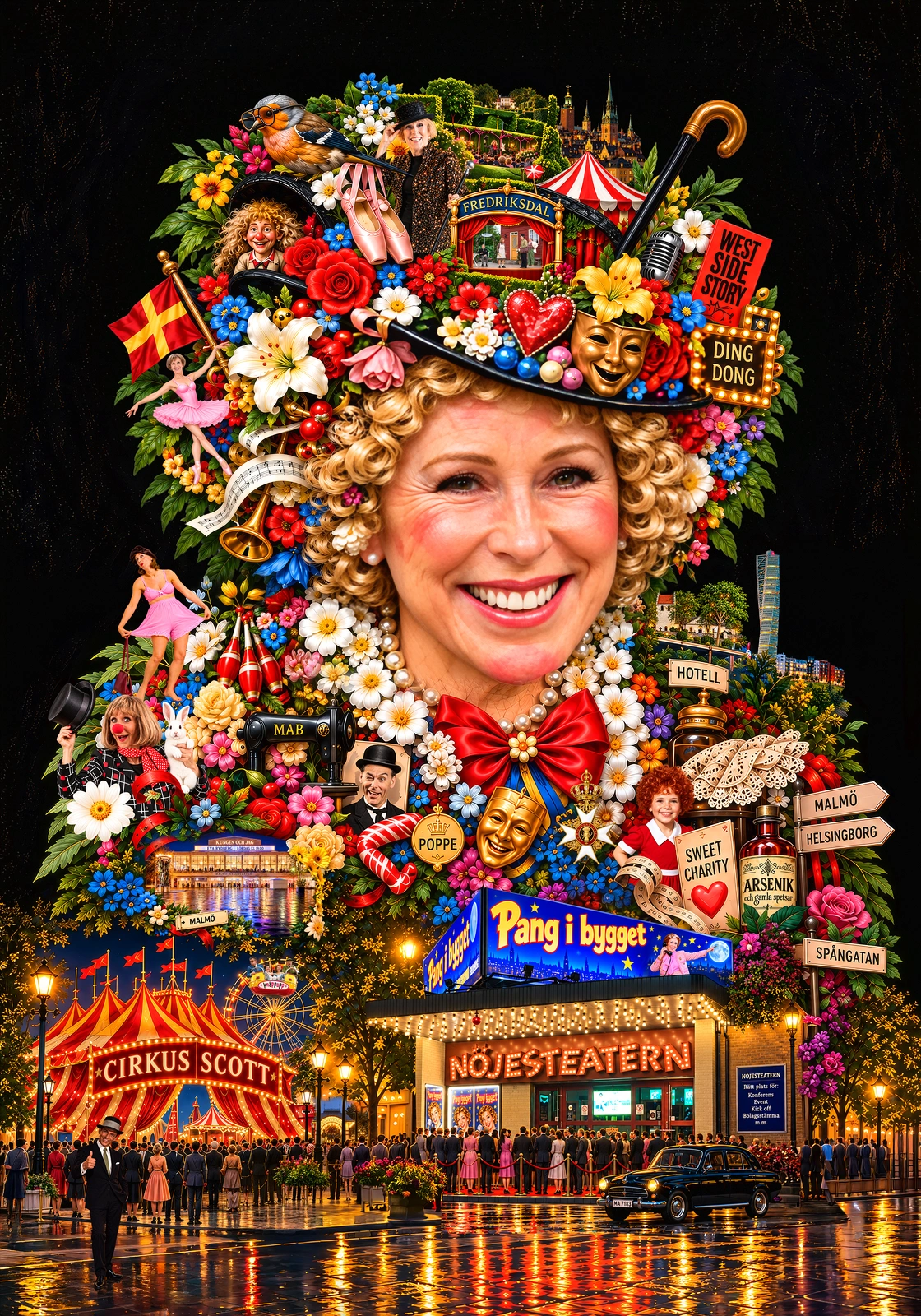
Arcimboldo - Nothing but Ding Dong! - Rena rama ding dong, 2026
Digital
50 x 70 cm
2 900 kr
Arcimboldo - Nothing but Ding Dong! - Rena rama ding dong
Svensk Text i slutet
INTRODUCTION – An Entire Life in a Single Picture
Some people are easy to portray, while others seem to burst out of the frame the moment you try.
Eva Rydberg belongs to the latter category.
For more than half a century, she has moved through Swedish entertainment history as an actress, comedian, dancer, clown, revue artist, director, and theatre manager. She has performed in the circus ring and on some of Sweden’s most beloved summer stages, appeared in farces and musicals, worn elegant costumes and deliberately made a fool of herself, danced ballet and other styles, and turned her own body into a comic instrument with a precision few possess.
How would Giuseppe Arcimboldo have depicted such a person?
Probably not by leaving things out.
When the Renaissance painter constructed his strange portraits from flowers, fruit, books, fish and other objects, every detail became part of the person he portrayed. Four centuries later, Eva Rydberg’s life offers an almost overwhelming abundance of such material. Nöjesteatern, Fredriksdalsteatern and Cirkus Scott can coexist with ballet shoes, handbags, characters, costumes and memories from a life on stage, where the boundary between the solemn and the utterly absurd has never mattered much.
The result, therefore, is neither an ordinary portrait nor quite a biography.
It attempts to take apart one of Sweden’s great entertainment personalities into her constituent parts and, according to Arcimboldo’s old principle, put her back together again.
When we look more closely at the picture, it becomes clear that almost nothing is accidental.
“The lady who fell upwards
She learned to dance on pointed toes,
with perfect arms and perfect pose,
then looked at all that grace and thought:
There must be something this has taught.
So Eva stumbled, Eva spun,
and made disaster look like fun.
She tripped with such exquisite skill
you knew she'd practised every spill.
She met a clown and stole his nose,
borrowed Chaplin's hat and pose,
found a chaffinch, half as blind,
and somehow left good sense behind.
She danced through farce, through song and show,
through Fredriksdal and falling snow;
and when a handbag joined the dance,
she gave the thing a leading chance.
Sinatra turned up. Why? Who knows?
In Eva's world that's how it goes.
Annie appeared. A circus too.
And arsenic joined the theatre crew.
Arcimboldo scratched his head:
"Paint this woman?" Then he said,
"Flowers, theatres, hats and shoes—
with this much Eva, how can I lose?"
So pile the roses to the sky,
let circus gondolas drift by,
bring ballet shoes and clownish art—
but leave some room around her heart.
For every pratfall, every grin,
had years of discipline within.
The greatest joke, when all is done?
She made hard work look bloody fun.
And when at last the lights burn low,
and everybody has to go,
one final rule remains quite clear:
If Eva falls — the floor should fear.”
Malmö, September 2026
PROLOGUE – Before the Curtain Rises
There is a moment in the theatre when nothing has happened.
The curtain is closed, the stage lies hidden, and the auditorium has settled into that particular darkness that lingers for only a few seconds before a performance begins. And yet everything is already there. The laughter that has not yet been heard, the line that has not yet been spoken, the step that has not yet been taken, and the applause still held in the audience’s hands.
At that moment, I imagine Giuseppe Arcimboldo visiting Sweden, more than four hundred years after his own time, standing before a blank canvas, tasked with portraying Eva Rydberg.
He would soon discover the problem.
How do you paint someone who, throughout her professional life, seems to have refused to remain within the confines of a single profession? An ordinary portrait might capture the face, the hair and the familiar smile, but it would leave almost everything else outside the frame. The clown, the dancer, the actress, the comedian, the director and the woman of the theatre would disappear. The circus ring, the revue stage, Fredriksdalsteatern and Nöjesteatern would have no room. Nor would all the characters to whom she has lent her body, her voice and her comic timing.
For Arcimboldo, the solution was obvious. He did not paint Eva Rydberg surrounded by her life.
He built her out of it.
The curtain rises.
Eva Rydberg – A Life on Stage in a Hat
Giuseppe Arcimboldo had created emperors from fruit, lawyers from books, and faces from fish, flowers and vegetables. Four centuries later, he faces a problem of an entirely different kind. Before him stands a woman whose life already seems arranged in his own way. Here are flowers and birds, hats and walking sticks, ballet shoes and clown noses, circus tents and theatre auditoriums, Stockholm and Malmö, Fredriksdal and Nöjesteatern, Nils Poppe and Frank Sinatra. Even a bottle of arsenic has found its way into the story.
The difficulty, therefore, is not finding anything to paint.
The difficulty lies in finding room for everything.
In the midst of this abundance sits Eva Rydberg, smiling. And that is where we must begin, because if we move too close to the picture too soon, we risk losing her in the details. From a distance, she remains the instantly recognisable entertainer, with her broad smile and the almost infectious sense that something is about to happen. But as we move closer, the portrait begins to dissolve. The hat becomes a stage. The flowers become memories. People emerge among the petals. A circus tent rises. A theatre sign lights up. A chaffinch sits where a chaffinch could scarcely be expected to sit, and suddenly we realise that Arcimboldo has not merely painted Eva Rydberg.
He has tried to paint a picture of her life.
It begins in Malmö.
Eva was born in 1943, grew up on Spångatan, and began dancing at an early age. Her mother, Hertha, took on extra work, including cleaning stairwells, to pay for her dance lessons. Eva performed in children’s theatre at Folkets Park before joining the ballet at Malmö City Theatre. Ballet master Carl Gustaf Kruuse saw in Eva a future prima ballerina.
That is why the ballet remains in the portrait. The pink ballet shoes are not decorative accessories that Arcimboldo happened to find attractive among the flowers. They represent the first Eva – the girl who might have seriously chosen classical dance. Malmö City Theatre reappears farther down in the picture, with “The King and I” on the sign, reminding us of this early world of ballet, discipline, and the stage.
But beside the ballet, there is something considerably less glamorous: MAB.
Her father had imagined a more secure future for his daughter. She could have become a seamstress and, before the stage took over her life, actually worked at the MAB clothing factory. That is why the sewing machine has found its place among roses, lilies, and theatrical memories. It does not represent the career Eva Rydberg had, but the one she might have had.
It is a small machine for an alternative life.
She chose the stage.
At sixteen, she found work as a dancer with “Knäppupp” and moved to Stockholm. In the picture, therefore, Stockholm rises behind the circus world, with rooftops and church spires rather than an anonymous international metropolis. Knäppupp has been given one of the portrait’s more playful positions: a gondola that appears to have broken free from its Ferris wheel and is drifting through entertainment history.
It is utterly absurd.
This means it fits perfectly.
From here, the world opens up. The dancer becomes a musical performer. ”West Side Story” has its sign, recalling Anybody, the role that marked Eva’s breakthrough, which she first played in Denmark and later at Oscarsteatern in Stockholm. ”Sweet Charity” is represented by its heart – Charity Hope Valentine, one of her great musical roles.
Yet something else soon takes over.
The circus.
Cirkus Scott glows at the bottom of the picture as though the entire tent were about to explode with light bulbs. This is no peripheral episode. Eva Rydberg worked as a clown at Cirkus Schumann in Copenhagen, among others, as well as at Cirkus Benneweis and Cirkus Scott. That is why the clown is everywhere, though not always visible. The red nose, the top hat, the rabbit, the juggling clubs and the physical comedy all belong to the same artistic language.
And perhaps this is where we begin to understand why the ballet shoes have to be so close to the clown's nose.
Eva Rydberg’s comedy is not based solely on lines. Her body language has been singled out as one of her foremost artistic characteristics. The ballet girl, then, never disappeared. She merely changed stages. The trained body that might have been used to create beauty through perfectly controlled movement was instead put to use in the considerably more difficult art of falling, walking, dancing and standing wrongly – exactly right.
Charlie Chaplin appears somewhere around here.
The bowler hat and cane are obvious attributes, since Eva competed in Melodifestivalen in 1977 with ”Charlie Chaplin”, written by Tomas Ledin. But Chaplin belongs more deeply to the picture than that. In him, too, dancer and clown met. The precise body was used to create the illusion of complete catastrophe.
Among the flowers there is also a considerably smaller performer.
Knut the Chaffinch.
The short-sighted chaffinch is one of Eva Rydberg’s best-known characters, and Arcimboldo has naturally recognised the opportunity: a bird wearing spectacles is almost ridiculously well suited to his pictorial world. At first, it may appear simply another bird among the plants, until we notice the spectacles and realise that it, too, carries a story.
Elsewhere, we catch glimpses of the fairy-tale world of “Trolltider”. In Gloria and the other television roles, woodland, vegetation, and fantastical details merge with Arcimboldo’s own world of nature. It is difficult to imagine a more comfortable meeting between a Renaissance painter and Swedish television.
Then comes Nils Poppe.
He is small compared with Eva, but enormous in the story.
In 1993, they appeared together in “Bröderna Östermans huskors”. When Poppe retired, he recommended Eva Rydberg as his successor, and from 1994 until 2023 she led Fredriksdalsteatern. Poppe, therefore, is not merely another celebrity. He represents the passing of the baton.
A Swedish theatrical tradition is passed from one comedian to another.
Behind him, Fredriksdal emerges from the greenery. The hedges, the open-air theatre, the audience and the manor house form almost a little world of their own, high in the hat. Here, it is no longer about the young performer seeking roles. Instead, we meet the theatre manager, the established star and the person who now carries the tradition forward herself.
And around Fredriksdal, farce begins to spread.
A bottle bears the utterly improbable yet entirely correct words “Arsenik och gamla spetsar” – “Arsenic and Old Lace”. There is the hotel world of “Fawlty Towers”, in which Eva played Sybil, and the great Nöjesteatern sign at the bottom makes the performance seem almost to continue out of the portrait and into the real city.
Little red-haired Annie is there as well. She is not Eva as a child, but a reference to the musical "Annie”, in which Eva plays Miss Hannigan. It is typical of the entire picture: one person can be represented by another, a production by a bottle, and several decades of work by a single object.
And then, suddenly, Frank Sinatra stands in the middle of it all.
It sounds almost like a tall tale, but in 1990 Eva Rydberg warmed up the audience for Sinatra at Globen. He liked that very much. So he, too, has earned a place in her universe, complete with the hat, the suit and the characteristic gesture. In an ordinary portrait, Sinatra would have been a disruptive foreign element.
With Arcimboldo, he becomes another petal.
Everywhere, there are also signs of the public recognition her work has received. The Guldmasken theatre award naturally belongs in such a picture, but there is also the considerably more solemn insignia of an order. In 2024, Eva Rydberg was appointed Commander of the Royal Order of Vasa. Her other honours include the Karamelodikt Scholarship, the Poppe Prize, the Piraten Prize, the Helsingborg Medal, the City of Malmö Cultural Prize and Region Skåne’s Cultural Prize.
It would have been easy to let the medals dominate. Arcimboldo does the opposite, allowing them almost to disappear among the flowers.
The awards are not the person. They are small, glittering receipts for the work that the rest of the picture tells us about.
Geography does the same. Malmö and Helsingborg are marked out. Spångatan is there. Turning Torso rises above Malmö. Fredriksdal belongs to Helsingborg. The Scanian flag unfurls among the flowers. The picture moves between the two cities that, in different ways, have framed her life: Malmö, where the story began, and Helsingborg, where Fredriksdal became so closely associated with her name.
But at the bottom, something important happens. There, the symbols almost stop being symbols.
Nöjesteatern stands with its lights blazing. Cirkus Scott glows beside it. People wait outside. The street is wet, and the lights are reflected in the asphalt. The entire fantastical construction above – the flowers, the bird, the masks, the medals, the ballet shoes, the performers, the circus and all the roles – suddenly finds solid ground beneath it.
This was work.
Night after night, an audience had to arrive. The curtain had to rise. The lines had to land. The body had to work. The timing could not fail. And however effortless everything looked from the auditorium, someone had rehearsed until the difficult looked easy.
Perhaps this is where Arcimboldo finally lays down his brush.
He began with the idea of painting a comedian and discovered he was painting a professional. He began collecting amusing attributes and found discipline. He starts with the clown's nose and ends with the ballet girl from Malmö.
Then he steps back and views his work from a distance.
Now Sinatra disappears. Poppe becomes a mere small dark figure. Annie dissolves into the colours. The sewing machine, the arsenic bottle, the cane, the masks, the circus tent and the Knäppupp gondola sink back into the flowers. Stockholm and Malmö become a few towers on the horizon. Fredriksdal’s hedges become green shapes. For a moment, all these people, places and objects cease to be themselves.
Eva Rydberg remains.
And she smiles.
It is a fitting conclusion to the portrait of a person who has devoted most of her life to getting others to do the same.
EPILOGUE – When the Curtain Has Fallen
In the end, the curtain falls.
It does so after every performance, no matter how successful. The audience rises, the applause slowly fades, the rows of seats empty, and what only moments ago was a living world of lines, music, laughter and movement once again becomes a stage with scenery, spotlights and dust.
But not everything disappears with the applause.
Perhaps this is what Arcimboldo understood when he looked at his finished portrait of Eva Rydberg. He had tried to paint a person but discovered that, at the same time, he had painted a piece of Swedish entertainment history. Every object, every stage, every role and every small absurdity in the picture told of something that had once happened before an audience and had therefore also remained with others.
A long life on stage cannot be measured solely by premieres, performances and years in the theatre. It must also be measured in laughter. In people who went home from the theatre a little happier than when they arrived. In lines that lived on long after a production had closed, and in characters that audiences can still picture the moment someone merely mentions their names.
That is why the portrait can never be truly finished.
When Arcimboldo puts down his brush, there remains something that cannot be painted: the movement, the timing, the voice, and that fraction of a second between the set-up and the laugh, when a great comedian knows exactly how long an audience must be made to wait.
The auditorium is empty now. The curtain has fallen. But somewhere, laughter can still be heard.
INTRODUKTION – Ett helt liv i en enda bild
Det finns människor som är lätta att porträttera och så finns det människor som tycks spränga ramen så snart man försöker.
Eva Rydberg tillhör de senare.
Under mer än ett halvt sekel har hon rört sig genom svensk underhållningshistoria som skådespelare, komiker, dansare, clown, revyartist, regissör och teaterledare. Hon har stått i cirkusmanegen och på några av landets mest älskade sommarscener, spelat fars och musikal, burit eleganta kostymer och gjort sig medvetet löjlig, dansat balett och knasdans och förvandlat sin egen kropp till ett komiskt instrument med en precision som få behärskar.
Hur skulle Giuseppe Arcimboldo ha porträtterat en sådan människa?
Förmodligen inte genom att försöka välja bort.
När renässansmålaren målade sina märkliga porträtt av blommor, frukter, böcker, fiskar och andra föremål blev varje detalj en del av den människa han avbildade. Fyra sekler senare erbjuder Eva Rydbergs liv nästan ett överflöd av sådant material. Nöjesteatern, Fredriksdalsteatern och Cirkus Scott kan samsas med balettskor, handväskor, rollfigurer, kostymer och minnen från ett scenliv där gränsen mellan det högtidliga och det fullständigt befängda aldrig har varit särskilt intressant.
Resultatet blir därför varken ett vanligt porträtt eller knappast en vanlig biografi.
Det blir ett försök att plocka isär en av Sveriges stora nöjesprofiler i hennes beståndsdelar och sedan, enligt Arcimboldos gamla princip, sätta ihop henne igen.
Och när man börjar titta närmare på bilden visar det sig att det nästan inte finns något där av en slump.
PROLOG – Innan ridån går upp
Det finns ett ögonblick på teatern då ännu ingenting har hänt.
Ridån är stängd, scenen ligger dold och salongen har sjunkit ned i det där särskilda mörker som bara finns några sekunder innan en föreställning börjar. Ändå är allt redan där. Skrattet som ännu inte har hörts, repliken som ännu inte har sagts, steget som ännu inte har tagits och applåden som fortfarande ligger gömd i publikens händer.
Det är i det ögonblicket jag försöker föreställa mig Giuseppe Arcimboldo på besök i Sverige, mer än fyra hundra år efter sin egen tid, stående framför en tom duk med uppdraget att porträttera Eva Rydberg.
Han skulle snart upptäcka problemet.
Hur målar man en människa som under hela sitt yrkesliv tycks ha vägrat att hålla sig inom ramen för ett enda yrke? Ett vanligt porträtt skulle kunna fånga ansiktet, håret och det välbekanta leendet, men det skulle lämna nästan allt annat utanför. Clownen, dansaren, skådespelaren, komikern, regissören och teatermänniskan skulle försvinna. Cirkusmanegen, revyscenen, Fredriksdalsteatern och Nöjesteatern skulle inte få plats. Inte heller alla de gestalter hon har lånat sin kropp, sin röst och sin komiska timing åt.
För Arcimboldo var lösningen självklar. Han målade inte Eva Rydberg omgiven av sitt liv. Han byggde henne av det.
Ridån går upp.
Eva Rydberg – ett scenliv i en hatt
Giuseppe Arcimboldo hade skapat kejsare av frukt, jurister av böcker och ansikten av fiskar, blommor och grönsaker. Fyra århundraden senare ställs han inför ett problem av ett helt annat slag. Framför honom finns en kvinna vars liv redan tycks ha arrangerats enligt hans egen metod. Här finns blommor och fåglar, hattar och käppar, balettskor och clownnäsor, cirkustält och teatersalonger, Stockholm och Malmö, Fredriksdal och Nöjesteatern, Nils Poppe och Frank Sinatra. Till och med en flaska arsenik har lyckats ta sig in i historien.
Det svåra är därför inte att hitta något att måla.
Det svåra är att få plats med allt.
Mitt i detta överflöd sitter Eva Rydberg och ler. Det är också där man måste börja, för om man går för nära bilden för tidigt riskerar man att förlora henne bland alla detaljer. På avstånd är hon fortfarande den omedelbart igenkännbara nöjesartisten, med det stora leendet och den nästan smittande känslan av att någonting alldeles strax kommer att hända. Men när man går närmare börjar porträttet lösas upp. Hatten blir en scen. Blommorna blir minnen. Mellan kronbladen dyker människor upp. Ett cirkustält reser sig. En teaterskylt tänds. En bofink sitter där den knappt borde kunna sitta, och plötsligt inser man att Arcimboldo inte bara har målat Eva Rydberg.
Han har försökt måla hennes liv. Det börjar i Malmö.
Eva föddes 1943, växte upp på Spångatan och började dansa tidigt. Modern Hertha arbetade extra, bland annat med trappstädning, för att kunna betala danslektionerna, och Eva spelade barnteater i Folkets Park innan hon kom till baletten vid Malmö stadsteater. Balettmästaren Carl Gustaf Kruuse såg en framtida prima ballerina i Eva.
Därför finns baletten kvar i porträttet. De rosa ballerinaskorna är inte dekorativa accessoarer som Arcimboldo råkat tycka passade bland blommorna. De representerar den första Eva – flickan som på allvar kunde ha valt klassisk dans. Malmö stadsteater återkommer längre ned i bilden, med ”Kungen och jag” på skylten, som en påminnelse om denna tidiga värld av balett, disciplin och scen.
Men bredvid baletten finns något betydligt mindre glamoröst: MAB.
Fadern hade tänkt sig en tryggare framtid för dottern. Hon kunde bli sömmerska, och innan scenlivet tog över arbetade hon faktiskt på klädfabriken MAB. Därför har symaskinen fått sin plats bland rosor, liljor och teaterminnen. Den representerar inte den karriär Eva Rydberg fick, utan den hon hade kunnat få. Det är en liten maskin för ett alternativt liv.
Hon valde scenen.
Som sextonåring fick hon arbete som dansare i Knäppupp och flyttade till Stockholm. I bilden har Stockholm därför fått växa upp bakom cirkusvärlden, med hustak och kyrktorn snarare än en anonym internationell storstad. Och Knäppupp har fått en av porträttets mer lekfulla platser: en gondol som tycks ha slitit sig loss från sitt pariserhjul och svävar fritt genom nöjeshistorien.
Det är fullständigt orimligt. Alltså passar det utmärkt.
Härifrån öppnar sig världen. Dansaren blir musikalartist. ”West Side Story” får sin skylt och påminner om Anybody, rollen som blev ett stort genombrott och som Eva spelade först i Danmark och sedan på Oscarsteatern i Stockholm. ”Sweet Charity” finns där genom sitt hjärta – Charity Hope Valentine, en av hennes stora musikalroller.
Ändå är det något annat som snart tar över.
Cirkusen.
Cirkus Scott lyser längst ned i bilden som om hela tältet vore på väg att explodera av glödlampor. Det är inte en perifer episod. Eva Rydberg arbetade som clown bland annat på Cirkus Schumann i Köpenhamn, Cirkus Benneweis och Cirkus Scott. Därför finns clownen överallt utan att alltid synas. Den röda näsan, cylinderhatten, kaninen, jongleringskäglorna och den kroppsliga komiken hör samman med samma artistiska språk.
Och kanske är det här man börjar förstå varför balettskorna måste finnas så nära clownnäsan.
Eva Rydbergs komik bygger inte bara på repliker. Hennes kroppsspråk har lyfts fram som ett av hennes främsta artistiska kännetecken. Balettflickan försvann alltså aldrig. Hon bytte bara scen. Den tränade kroppen som kunde ha använts för att skapa skönhet genom perfekt kontrollerade rörelser kom i stället att användas för den betydligt svårare konsten att falla fel, gå fel, dansa fel och stå fel – exakt rätt.
Där någonstans dyker Charlie Chaplin upp.
Plommonstopet och käppen är självklara attribut, eftersom Eva 1977 tävlade i Melodifestivalen med ”Charlie Chaplin”, skriven av Tomas Ledin. Men Chaplin passar djupare in i bilden än så. Också hos honom möttes dansaren och clownen. Den precisa kroppen användes för att skapa illusionen av en fullständig katastrof.
Bland blommorna finns också en betydligt mindre artist.
Bofinken Knut.
Den närsynta bofinken hör till Eva Rydbergs mest kända figurer, och Arcimboldo har naturligtvis förstått möjligheten: en fågel med glasögon är nästan löjligt väl lämpad för hans bildvärld. Den kan först uppfattas som ännu en fågel bland växterna tills man ser glasögonen och förstår att även den bär på en historia.
På andra håll skymtar sagovärlden från ”Trolltider”. Gloria och de andra TV-rollerna gör att skog, växtlighet och fantastiska detaljer kan smälta samman med Arcimboldos egen naturvärld. Det är svårt att tänka sig ett bekvämare möte mellan en renässansmålare och svensk television.
Sedan kommer Nils Poppe.
Han är liten i förhållande till Eva men stor i berättelsen.
År 1993 spelade de tillsammans i ”Bröderna Östermans huskors”. När Poppe drog sig tillbaka rekommenderade han Eva Rydberg som sin efterträdare, och från 1994 till 2023 ledde hon Fredriksdalsteatern. Därför är Poppe inte infogad som en kändis bland andra. Han representerar en stafettväxling.
En svensk scenisk tradition går från en komiker till en annan.
Bakom honom växer Fredriksdal fram ur grönskan. Häckarna, friluftsteatern, publiken och herrgården bildar nästan en egen liten värld högt uppe i hatten. Där finns något som inte längre handlar om den unga artisten som söker roller. Här möter vi i stället teaterledaren, den etablerade stjärnan och den som själv bär vidare en tradition.
Och runt omkring Fredriksdal börjar farsen bre ut sig.
En flaska bär den fullständigt osannolika men alldeles korrekta texten ”ARSENIK och gamla spetsar”. Där finns hotellvärlden från ”Pang i bygget”, där Eva spelade Sybil, och Nöjesteaterns stora skylt längst ned gör att föreställningen nästan tycks fortsätta ut ur porträttet och in i den verkliga staden.
Den rödhåriga lilla Annie står också där. Hon är inte Eva som barn, utan en hänvisning till ”Annie”, där Eva spelar Miss Hannigan. Det är typiskt för hela bilden: en människa kan representeras av en annan människa, en föreställning av en flaska och flera decennier av arbete i ett enda föremål.
Och så står plötsligt Frank Sinatra mitt i alltihop.
Det låter nästan som en skröna, men 1990 värmde Eva Rydberg upp publiken inför Sinatra i Globen. Därför får han också plats i hennes universum, med hatten, kostymen och den karakteristiska gesten. I ett vanligt porträtt hade Sinatra varit ett störande främmande element. Hos Arcimboldo blir han ytterligare ett kronblad.
Överallt finns dessutom tecken på den offentliga uppskattning som arbetet har mött. Guldmasken hör naturligt hemma i en teaterbild, men där finns också det betydligt högtidligare ordenstecknet. Eva Rydberg utnämndes 2024 till kommendör av Kungliga Vasaorden. Till hennes övriga utmärkelser hör bland annat Karamelodiktstipendiet, Poppepriset, Piratenpriset, Helsingborgsmedaljen, Malmö stads kulturpris och Region Skånes kulturpris.
Det hade varit lätt att låta medaljerna dominera. Arcimboldo gör tvärtom. Han låter dem nästan försvinna bland blommorna.
För utmärkelserna är inte människan. De är små glänsande kvitton på det arbete som resten av bilden berättar om.
Geografin gör samma sak. Malmö och Helsingborg pekas ut. Spångatan finns där. Turning Torso reser sig över Malmö. Fredriksdal hör till Helsingborg. Den skånska flaggan vecklar ut sig bland blommorna. Bilden rör sig mellan de två städer som på olika sätt kommit att rama in hennes liv: Malmö, där historien började, och Helsingborg, där Fredriksdal blev så starkt förknippat med hennes namn.
Men längst ned händer någonting viktigt.
Där upphör symbolerna nästan att vara symboler.
Nöjesteatern står där med lamporna tända. Cirkus Scott glöder bredvid. Folk väntar utanför. Gatan är våt och ljusen speglas i asfalten. Hela den fantastiska konstruktionen ovanför – blommorna, fågeln, maskerna, medaljerna, balettskorna, artisterna, cirkusen och alla rollerna – får plötsligt mark under fötterna.
Detta var ett arbete.
Kväll efter kväll skulle en publik komma. Ridån skulle gå upp. Repliker skulle sitta. Kroppen skulle fungera. Tajmingen fick inte svika. Och oavsett hur lätt allt såg ut från salongen skulle någon dessförinnan ha repeterat tills det svåra såg enkelt ut.
Det är kanske där Arcimboldo till sist lägger ifrån sig penseln.
Han började med föreställningen att han skulle måla en komiker och upptäckte att han målade en yrkesperson. Han började samla på sig lustiga attribut och fann disciplin. Han började med clownnäsan och hamnade hos balettflickan från Malmö.
Sedan betraktar han sitt verk på avstånd.
Nu försvinner Sinatra. Poppe blir bara en liten mörk figur. Annie löses upp i färgerna. Symaskinen, arsenikflaskan, käppen, maskerna, cirkustältet och Knäppuppgondolen sjunker tillbaka in bland blommorna. Stockholm och Malmö blir några torn i horisonten. Fredriksdals häckar blir gröna former. Alla dessa människor, platser och föremål upphör för ett ögonblick att vara sig själva.
Kvar finns Eva Rydberg.
Och hon ler.
Det är ett passande slut på porträttet av en människa som har ägnat större delen av sitt liv åt att få andra att göra detsamma.
EPILOG – När ridån har gått ned
Till slut går ridån ned.
Det gör den efter varje föreställning, oavsett hur stor succén har varit. Publiken reser sig, applåderna tunnas långsamt ut, stolsraderna töms och det som alldeles nyss var en levande värld av repliker, musik, skratt och rörelse blir åter en scen med kulisser, strålkastare och damm.
Men allt försvinner inte med applåderna.
Det är kanske detta Arcimboldo förstod när han betraktade sitt färdiga porträtt av Eva Rydberg. Han hade försökt måla en människa men upptäckt att han samtidigt hade målat en bit av svensk nöjeshistoria. Varje föremål, varje scen, varje roll och varje liten absurditet i bilden berättade om något som en gång hade hänt inför en publik och som därför också hade blivit kvar hos andra människor.
Ett långt liv på scenen kan nämligen inte räknas enbart i premiärer, föreställningar och spelår. Det måste också räknas in i skrattet. I människor som gått hem från teatern lite gladare än när de kom. I repliker som levt vidare långt efter att föreställningen lagts ned och i rollfigurer som publiken fortfarande kan se framför sig när någon bara nämner deras namn.
Därför kan porträttet heller aldrig bli riktigt färdigt.
När Arcimboldo lägger ifrån sig penseln finns det fortfarande något som inte låter sig målas: rörelsen, tajmingen, rösten och den där bråkdelen av en sekund mellan upptakten och skrattet, där en stor komiker vet exakt hur länge publiken måste få vänta.
Salongen är tom nu. Ridån har gått ned. Men någonstans hörs fortfarande skrattet.
Jörgen Thornberg
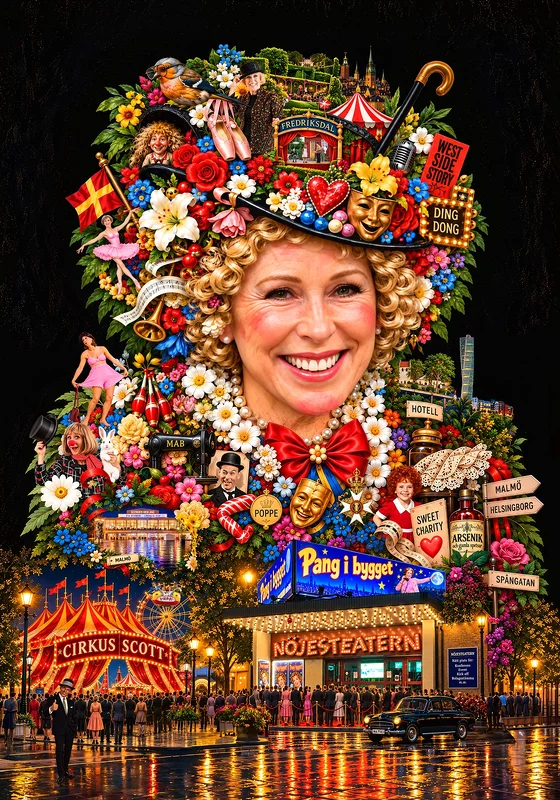
Arcimboldo - Nothing but Ding Dong! - Rena rama ding dong, 2026
Digital
50 x 70 cm
2 900 kr
Arcimboldo - Nothing but Ding Dong! - Rena rama ding dong
Svensk Text i slutet
INTRODUCTION – An Entire Life in a Single Picture
Some people are easy to portray, while others seem to burst out of the frame the moment you try.
Eva Rydberg belongs to the latter category.
For more than half a century, she has moved through Swedish entertainment history as an actress, comedian, dancer, clown, revue artist, director, and theatre manager. She has performed in the circus ring and on some of Sweden’s most beloved summer stages, appeared in farces and musicals, worn elegant costumes and deliberately made a fool of herself, danced ballet and other styles, and turned her own body into a comic instrument with a precision few possess.
How would Giuseppe Arcimboldo have depicted such a person?
Probably not by leaving things out.
When the Renaissance painter constructed his strange portraits from flowers, fruit, books, fish and other objects, every detail became part of the person he portrayed. Four centuries later, Eva Rydberg’s life offers an almost overwhelming abundance of such material. Nöjesteatern, Fredriksdalsteatern and Cirkus Scott can coexist with ballet shoes, handbags, characters, costumes and memories from a life on stage, where the boundary between the solemn and the utterly absurd has never mattered much.
The result, therefore, is neither an ordinary portrait nor quite a biography.
It attempts to take apart one of Sweden’s great entertainment personalities into her constituent parts and, according to Arcimboldo’s old principle, put her back together again.
When we look more closely at the picture, it becomes clear that almost nothing is accidental.
“The lady who fell upwards
She learned to dance on pointed toes,
with perfect arms and perfect pose,
then looked at all that grace and thought:
There must be something this has taught.
So Eva stumbled, Eva spun,
and made disaster look like fun.
She tripped with such exquisite skill
you knew she'd practised every spill.
She met a clown and stole his nose,
borrowed Chaplin's hat and pose,
found a chaffinch, half as blind,
and somehow left good sense behind.
She danced through farce, through song and show,
through Fredriksdal and falling snow;
and when a handbag joined the dance,
she gave the thing a leading chance.
Sinatra turned up. Why? Who knows?
In Eva's world that's how it goes.
Annie appeared. A circus too.
And arsenic joined the theatre crew.
Arcimboldo scratched his head:
"Paint this woman?" Then he said,
"Flowers, theatres, hats and shoes—
with this much Eva, how can I lose?"
So pile the roses to the sky,
let circus gondolas drift by,
bring ballet shoes and clownish art—
but leave some room around her heart.
For every pratfall, every grin,
had years of discipline within.
The greatest joke, when all is done?
She made hard work look bloody fun.
And when at last the lights burn low,
and everybody has to go,
one final rule remains quite clear:
If Eva falls — the floor should fear.”
Malmö, September 2026
PROLOGUE – Before the Curtain Rises
There is a moment in the theatre when nothing has happened.
The curtain is closed, the stage lies hidden, and the auditorium has settled into that particular darkness that lingers for only a few seconds before a performance begins. And yet everything is already there. The laughter that has not yet been heard, the line that has not yet been spoken, the step that has not yet been taken, and the applause still held in the audience’s hands.
At that moment, I imagine Giuseppe Arcimboldo visiting Sweden, more than four hundred years after his own time, standing before a blank canvas, tasked with portraying Eva Rydberg.
He would soon discover the problem.
How do you paint someone who, throughout her professional life, seems to have refused to remain within the confines of a single profession? An ordinary portrait might capture the face, the hair and the familiar smile, but it would leave almost everything else outside the frame. The clown, the dancer, the actress, the comedian, the director and the woman of the theatre would disappear. The circus ring, the revue stage, Fredriksdalsteatern and Nöjesteatern would have no room. Nor would all the characters to whom she has lent her body, her voice and her comic timing.
For Arcimboldo, the solution was obvious. He did not paint Eva Rydberg surrounded by her life.
He built her out of it.
The curtain rises.
Eva Rydberg – A Life on Stage in a Hat
Giuseppe Arcimboldo had created emperors from fruit, lawyers from books, and faces from fish, flowers and vegetables. Four centuries later, he faces a problem of an entirely different kind. Before him stands a woman whose life already seems arranged in his own way. Here are flowers and birds, hats and walking sticks, ballet shoes and clown noses, circus tents and theatre auditoriums, Stockholm and Malmö, Fredriksdal and Nöjesteatern, Nils Poppe and Frank Sinatra. Even a bottle of arsenic has found its way into the story.
The difficulty, therefore, is not finding anything to paint.
The difficulty lies in finding room for everything.
In the midst of this abundance sits Eva Rydberg, smiling. And that is where we must begin, because if we move too close to the picture too soon, we risk losing her in the details. From a distance, she remains the instantly recognisable entertainer, with her broad smile and the almost infectious sense that something is about to happen. But as we move closer, the portrait begins to dissolve. The hat becomes a stage. The flowers become memories. People emerge among the petals. A circus tent rises. A theatre sign lights up. A chaffinch sits where a chaffinch could scarcely be expected to sit, and suddenly we realise that Arcimboldo has not merely painted Eva Rydberg.
He has tried to paint a picture of her life.
It begins in Malmö.
Eva was born in 1943, grew up on Spångatan, and began dancing at an early age. Her mother, Hertha, took on extra work, including cleaning stairwells, to pay for her dance lessons. Eva performed in children’s theatre at Folkets Park before joining the ballet at Malmö City Theatre. Ballet master Carl Gustaf Kruuse saw in Eva a future prima ballerina.
That is why the ballet remains in the portrait. The pink ballet shoes are not decorative accessories that Arcimboldo happened to find attractive among the flowers. They represent the first Eva – the girl who might have seriously chosen classical dance. Malmö City Theatre reappears farther down in the picture, with “The King and I” on the sign, reminding us of this early world of ballet, discipline, and the stage.
But beside the ballet, there is something considerably less glamorous: MAB.
Her father had imagined a more secure future for his daughter. She could have become a seamstress and, before the stage took over her life, actually worked at the MAB clothing factory. That is why the sewing machine has found its place among roses, lilies, and theatrical memories. It does not represent the career Eva Rydberg had, but the one she might have had.
It is a small machine for an alternative life.
She chose the stage.
At sixteen, she found work as a dancer with “Knäppupp” and moved to Stockholm. In the picture, therefore, Stockholm rises behind the circus world, with rooftops and church spires rather than an anonymous international metropolis. Knäppupp has been given one of the portrait’s more playful positions: a gondola that appears to have broken free from its Ferris wheel and is drifting through entertainment history.
It is utterly absurd.
This means it fits perfectly.
From here, the world opens up. The dancer becomes a musical performer. ”West Side Story” has its sign, recalling Anybody, the role that marked Eva’s breakthrough, which she first played in Denmark and later at Oscarsteatern in Stockholm. ”Sweet Charity” is represented by its heart – Charity Hope Valentine, one of her great musical roles.
Yet something else soon takes over.
The circus.
Cirkus Scott glows at the bottom of the picture as though the entire tent were about to explode with light bulbs. This is no peripheral episode. Eva Rydberg worked as a clown at Cirkus Schumann in Copenhagen, among others, as well as at Cirkus Benneweis and Cirkus Scott. That is why the clown is everywhere, though not always visible. The red nose, the top hat, the rabbit, the juggling clubs and the physical comedy all belong to the same artistic language.
And perhaps this is where we begin to understand why the ballet shoes have to be so close to the clown's nose.
Eva Rydberg’s comedy is not based solely on lines. Her body language has been singled out as one of her foremost artistic characteristics. The ballet girl, then, never disappeared. She merely changed stages. The trained body that might have been used to create beauty through perfectly controlled movement was instead put to use in the considerably more difficult art of falling, walking, dancing and standing wrongly – exactly right.
Charlie Chaplin appears somewhere around here.
The bowler hat and cane are obvious attributes, since Eva competed in Melodifestivalen in 1977 with ”Charlie Chaplin”, written by Tomas Ledin. But Chaplin belongs more deeply to the picture than that. In him, too, dancer and clown met. The precise body was used to create the illusion of complete catastrophe.
Among the flowers there is also a considerably smaller performer.
Knut the Chaffinch.
The short-sighted chaffinch is one of Eva Rydberg’s best-known characters, and Arcimboldo has naturally recognised the opportunity: a bird wearing spectacles is almost ridiculously well suited to his pictorial world. At first, it may appear simply another bird among the plants, until we notice the spectacles and realise that it, too, carries a story.
Elsewhere, we catch glimpses of the fairy-tale world of “Trolltider”. In Gloria and the other television roles, woodland, vegetation, and fantastical details merge with Arcimboldo’s own world of nature. It is difficult to imagine a more comfortable meeting between a Renaissance painter and Swedish television.
Then comes Nils Poppe.
He is small compared with Eva, but enormous in the story.
In 1993, they appeared together in “Bröderna Östermans huskors”. When Poppe retired, he recommended Eva Rydberg as his successor, and from 1994 until 2023 she led Fredriksdalsteatern. Poppe, therefore, is not merely another celebrity. He represents the passing of the baton.
A Swedish theatrical tradition is passed from one comedian to another.
Behind him, Fredriksdal emerges from the greenery. The hedges, the open-air theatre, the audience and the manor house form almost a little world of their own, high in the hat. Here, it is no longer about the young performer seeking roles. Instead, we meet the theatre manager, the established star and the person who now carries the tradition forward herself.
And around Fredriksdal, farce begins to spread.
A bottle bears the utterly improbable yet entirely correct words “Arsenik och gamla spetsar” – “Arsenic and Old Lace”. There is the hotel world of “Fawlty Towers”, in which Eva played Sybil, and the great Nöjesteatern sign at the bottom makes the performance seem almost to continue out of the portrait and into the real city.
Little red-haired Annie is there as well. She is not Eva as a child, but a reference to the musical "Annie”, in which Eva plays Miss Hannigan. It is typical of the entire picture: one person can be represented by another, a production by a bottle, and several decades of work by a single object.
And then, suddenly, Frank Sinatra stands in the middle of it all.
It sounds almost like a tall tale, but in 1990 Eva Rydberg warmed up the audience for Sinatra at Globen. He liked that very much. So he, too, has earned a place in her universe, complete with the hat, the suit and the characteristic gesture. In an ordinary portrait, Sinatra would have been a disruptive foreign element.
With Arcimboldo, he becomes another petal.
Everywhere, there are also signs of the public recognition her work has received. The Guldmasken theatre award naturally belongs in such a picture, but there is also the considerably more solemn insignia of an order. In 2024, Eva Rydberg was appointed Commander of the Royal Order of Vasa. Her other honours include the Karamelodikt Scholarship, the Poppe Prize, the Piraten Prize, the Helsingborg Medal, the City of Malmö Cultural Prize and Region Skåne’s Cultural Prize.
It would have been easy to let the medals dominate. Arcimboldo does the opposite, allowing them almost to disappear among the flowers.
The awards are not the person. They are small, glittering receipts for the work that the rest of the picture tells us about.
Geography does the same. Malmö and Helsingborg are marked out. Spångatan is there. Turning Torso rises above Malmö. Fredriksdal belongs to Helsingborg. The Scanian flag unfurls among the flowers. The picture moves between the two cities that, in different ways, have framed her life: Malmö, where the story began, and Helsingborg, where Fredriksdal became so closely associated with her name.
But at the bottom, something important happens. There, the symbols almost stop being symbols.
Nöjesteatern stands with its lights blazing. Cirkus Scott glows beside it. People wait outside. The street is wet, and the lights are reflected in the asphalt. The entire fantastical construction above – the flowers, the bird, the masks, the medals, the ballet shoes, the performers, the circus and all the roles – suddenly finds solid ground beneath it.
This was work.
Night after night, an audience had to arrive. The curtain had to rise. The lines had to land. The body had to work. The timing could not fail. And however effortless everything looked from the auditorium, someone had rehearsed until the difficult looked easy.
Perhaps this is where Arcimboldo finally lays down his brush.
He began with the idea of painting a comedian and discovered he was painting a professional. He began collecting amusing attributes and found discipline. He starts with the clown's nose and ends with the ballet girl from Malmö.
Then he steps back and views his work from a distance.
Now Sinatra disappears. Poppe becomes a mere small dark figure. Annie dissolves into the colours. The sewing machine, the arsenic bottle, the cane, the masks, the circus tent and the Knäppupp gondola sink back into the flowers. Stockholm and Malmö become a few towers on the horizon. Fredriksdal’s hedges become green shapes. For a moment, all these people, places and objects cease to be themselves.
Eva Rydberg remains.
And she smiles.
It is a fitting conclusion to the portrait of a person who has devoted most of her life to getting others to do the same.
EPILOGUE – When the Curtain Has Fallen
In the end, the curtain falls.
It does so after every performance, no matter how successful. The audience rises, the applause slowly fades, the rows of seats empty, and what only moments ago was a living world of lines, music, laughter and movement once again becomes a stage with scenery, spotlights and dust.
But not everything disappears with the applause.
Perhaps this is what Arcimboldo understood when he looked at his finished portrait of Eva Rydberg. He had tried to paint a person but discovered that, at the same time, he had painted a piece of Swedish entertainment history. Every object, every stage, every role and every small absurdity in the picture told of something that had once happened before an audience and had therefore also remained with others.
A long life on stage cannot be measured solely by premieres, performances and years in the theatre. It must also be measured in laughter. In people who went home from the theatre a little happier than when they arrived. In lines that lived on long after a production had closed, and in characters that audiences can still picture the moment someone merely mentions their names.
That is why the portrait can never be truly finished.
When Arcimboldo puts down his brush, there remains something that cannot be painted: the movement, the timing, the voice, and that fraction of a second between the set-up and the laugh, when a great comedian knows exactly how long an audience must be made to wait.
The auditorium is empty now. The curtain has fallen. But somewhere, laughter can still be heard.
INTRODUKTION – Ett helt liv i en enda bild
Det finns människor som är lätta att porträttera och så finns det människor som tycks spränga ramen så snart man försöker.
Eva Rydberg tillhör de senare.
Under mer än ett halvt sekel har hon rört sig genom svensk underhållningshistoria som skådespelare, komiker, dansare, clown, revyartist, regissör och teaterledare. Hon har stått i cirkusmanegen och på några av landets mest älskade sommarscener, spelat fars och musikal, burit eleganta kostymer och gjort sig medvetet löjlig, dansat balett och knasdans och förvandlat sin egen kropp till ett komiskt instrument med en precision som få behärskar.
Hur skulle Giuseppe Arcimboldo ha porträtterat en sådan människa?
Förmodligen inte genom att försöka välja bort.
När renässansmålaren målade sina märkliga porträtt av blommor, frukter, böcker, fiskar och andra föremål blev varje detalj en del av den människa han avbildade. Fyra sekler senare erbjuder Eva Rydbergs liv nästan ett överflöd av sådant material. Nöjesteatern, Fredriksdalsteatern och Cirkus Scott kan samsas med balettskor, handväskor, rollfigurer, kostymer och minnen från ett scenliv där gränsen mellan det högtidliga och det fullständigt befängda aldrig har varit särskilt intressant.
Resultatet blir därför varken ett vanligt porträtt eller knappast en vanlig biografi.
Det blir ett försök att plocka isär en av Sveriges stora nöjesprofiler i hennes beståndsdelar och sedan, enligt Arcimboldos gamla princip, sätta ihop henne igen.
Och när man börjar titta närmare på bilden visar det sig att det nästan inte finns något där av en slump.
PROLOG – Innan ridån går upp
Det finns ett ögonblick på teatern då ännu ingenting har hänt.
Ridån är stängd, scenen ligger dold och salongen har sjunkit ned i det där särskilda mörker som bara finns några sekunder innan en föreställning börjar. Ändå är allt redan där. Skrattet som ännu inte har hörts, repliken som ännu inte har sagts, steget som ännu inte har tagits och applåden som fortfarande ligger gömd i publikens händer.
Det är i det ögonblicket jag försöker föreställa mig Giuseppe Arcimboldo på besök i Sverige, mer än fyra hundra år efter sin egen tid, stående framför en tom duk med uppdraget att porträttera Eva Rydberg.
Han skulle snart upptäcka problemet.
Hur målar man en människa som under hela sitt yrkesliv tycks ha vägrat att hålla sig inom ramen för ett enda yrke? Ett vanligt porträtt skulle kunna fånga ansiktet, håret och det välbekanta leendet, men det skulle lämna nästan allt annat utanför. Clownen, dansaren, skådespelaren, komikern, regissören och teatermänniskan skulle försvinna. Cirkusmanegen, revyscenen, Fredriksdalsteatern och Nöjesteatern skulle inte få plats. Inte heller alla de gestalter hon har lånat sin kropp, sin röst och sin komiska timing åt.
För Arcimboldo var lösningen självklar. Han målade inte Eva Rydberg omgiven av sitt liv. Han byggde henne av det.
Ridån går upp.
Eva Rydberg – ett scenliv i en hatt
Giuseppe Arcimboldo hade skapat kejsare av frukt, jurister av böcker och ansikten av fiskar, blommor och grönsaker. Fyra århundraden senare ställs han inför ett problem av ett helt annat slag. Framför honom finns en kvinna vars liv redan tycks ha arrangerats enligt hans egen metod. Här finns blommor och fåglar, hattar och käppar, balettskor och clownnäsor, cirkustält och teatersalonger, Stockholm och Malmö, Fredriksdal och Nöjesteatern, Nils Poppe och Frank Sinatra. Till och med en flaska arsenik har lyckats ta sig in i historien.
Det svåra är därför inte att hitta något att måla.
Det svåra är att få plats med allt.
Mitt i detta överflöd sitter Eva Rydberg och ler. Det är också där man måste börja, för om man går för nära bilden för tidigt riskerar man att förlora henne bland alla detaljer. På avstånd är hon fortfarande den omedelbart igenkännbara nöjesartisten, med det stora leendet och den nästan smittande känslan av att någonting alldeles strax kommer att hända. Men när man går närmare börjar porträttet lösas upp. Hatten blir en scen. Blommorna blir minnen. Mellan kronbladen dyker människor upp. Ett cirkustält reser sig. En teaterskylt tänds. En bofink sitter där den knappt borde kunna sitta, och plötsligt inser man att Arcimboldo inte bara har målat Eva Rydberg.
Han har försökt måla hennes liv. Det börjar i Malmö.
Eva föddes 1943, växte upp på Spångatan och började dansa tidigt. Modern Hertha arbetade extra, bland annat med trappstädning, för att kunna betala danslektionerna, och Eva spelade barnteater i Folkets Park innan hon kom till baletten vid Malmö stadsteater. Balettmästaren Carl Gustaf Kruuse såg en framtida prima ballerina i Eva.
Därför finns baletten kvar i porträttet. De rosa ballerinaskorna är inte dekorativa accessoarer som Arcimboldo råkat tycka passade bland blommorna. De representerar den första Eva – flickan som på allvar kunde ha valt klassisk dans. Malmö stadsteater återkommer längre ned i bilden, med ”Kungen och jag” på skylten, som en påminnelse om denna tidiga värld av balett, disciplin och scen.
Men bredvid baletten finns något betydligt mindre glamoröst: MAB.
Fadern hade tänkt sig en tryggare framtid för dottern. Hon kunde bli sömmerska, och innan scenlivet tog över arbetade hon faktiskt på klädfabriken MAB. Därför har symaskinen fått sin plats bland rosor, liljor och teaterminnen. Den representerar inte den karriär Eva Rydberg fick, utan den hon hade kunnat få. Det är en liten maskin för ett alternativt liv.
Hon valde scenen.
Som sextonåring fick hon arbete som dansare i Knäppupp och flyttade till Stockholm. I bilden har Stockholm därför fått växa upp bakom cirkusvärlden, med hustak och kyrktorn snarare än en anonym internationell storstad. Och Knäppupp har fått en av porträttets mer lekfulla platser: en gondol som tycks ha slitit sig loss från sitt pariserhjul och svävar fritt genom nöjeshistorien.
Det är fullständigt orimligt. Alltså passar det utmärkt.
Härifrån öppnar sig världen. Dansaren blir musikalartist. ”West Side Story” får sin skylt och påminner om Anybody, rollen som blev ett stort genombrott och som Eva spelade först i Danmark och sedan på Oscarsteatern i Stockholm. ”Sweet Charity” finns där genom sitt hjärta – Charity Hope Valentine, en av hennes stora musikalroller.
Ändå är det något annat som snart tar över.
Cirkusen.
Cirkus Scott lyser längst ned i bilden som om hela tältet vore på väg att explodera av glödlampor. Det är inte en perifer episod. Eva Rydberg arbetade som clown bland annat på Cirkus Schumann i Köpenhamn, Cirkus Benneweis och Cirkus Scott. Därför finns clownen överallt utan att alltid synas. Den röda näsan, cylinderhatten, kaninen, jongleringskäglorna och den kroppsliga komiken hör samman med samma artistiska språk.
Och kanske är det här man börjar förstå varför balettskorna måste finnas så nära clownnäsan.
Eva Rydbergs komik bygger inte bara på repliker. Hennes kroppsspråk har lyfts fram som ett av hennes främsta artistiska kännetecken. Balettflickan försvann alltså aldrig. Hon bytte bara scen. Den tränade kroppen som kunde ha använts för att skapa skönhet genom perfekt kontrollerade rörelser kom i stället att användas för den betydligt svårare konsten att falla fel, gå fel, dansa fel och stå fel – exakt rätt.
Där någonstans dyker Charlie Chaplin upp.
Plommonstopet och käppen är självklara attribut, eftersom Eva 1977 tävlade i Melodifestivalen med ”Charlie Chaplin”, skriven av Tomas Ledin. Men Chaplin passar djupare in i bilden än så. Också hos honom möttes dansaren och clownen. Den precisa kroppen användes för att skapa illusionen av en fullständig katastrof.
Bland blommorna finns också en betydligt mindre artist.
Bofinken Knut.
Den närsynta bofinken hör till Eva Rydbergs mest kända figurer, och Arcimboldo har naturligtvis förstått möjligheten: en fågel med glasögon är nästan löjligt väl lämpad för hans bildvärld. Den kan först uppfattas som ännu en fågel bland växterna tills man ser glasögonen och förstår att även den bär på en historia.
På andra håll skymtar sagovärlden från ”Trolltider”. Gloria och de andra TV-rollerna gör att skog, växtlighet och fantastiska detaljer kan smälta samman med Arcimboldos egen naturvärld. Det är svårt att tänka sig ett bekvämare möte mellan en renässansmålare och svensk television.
Sedan kommer Nils Poppe.
Han är liten i förhållande till Eva men stor i berättelsen.
År 1993 spelade de tillsammans i ”Bröderna Östermans huskors”. När Poppe drog sig tillbaka rekommenderade han Eva Rydberg som sin efterträdare, och från 1994 till 2023 ledde hon Fredriksdalsteatern. Därför är Poppe inte infogad som en kändis bland andra. Han representerar en stafettväxling.
En svensk scenisk tradition går från en komiker till en annan.
Bakom honom växer Fredriksdal fram ur grönskan. Häckarna, friluftsteatern, publiken och herrgården bildar nästan en egen liten värld högt uppe i hatten. Där finns något som inte längre handlar om den unga artisten som söker roller. Här möter vi i stället teaterledaren, den etablerade stjärnan och den som själv bär vidare en tradition.
Och runt omkring Fredriksdal börjar farsen bre ut sig.
En flaska bär den fullständigt osannolika men alldeles korrekta texten ”ARSENIK och gamla spetsar”. Där finns hotellvärlden från ”Pang i bygget”, där Eva spelade Sybil, och Nöjesteaterns stora skylt längst ned gör att föreställningen nästan tycks fortsätta ut ur porträttet och in i den verkliga staden.
Den rödhåriga lilla Annie står också där. Hon är inte Eva som barn, utan en hänvisning till ”Annie”, där Eva spelar Miss Hannigan. Det är typiskt för hela bilden: en människa kan representeras av en annan människa, en föreställning av en flaska och flera decennier av arbete i ett enda föremål.
Och så står plötsligt Frank Sinatra mitt i alltihop.
Det låter nästan som en skröna, men 1990 värmde Eva Rydberg upp publiken inför Sinatra i Globen. Därför får han också plats i hennes universum, med hatten, kostymen och den karakteristiska gesten. I ett vanligt porträtt hade Sinatra varit ett störande främmande element. Hos Arcimboldo blir han ytterligare ett kronblad.
Överallt finns dessutom tecken på den offentliga uppskattning som arbetet har mött. Guldmasken hör naturligt hemma i en teaterbild, men där finns också det betydligt högtidligare ordenstecknet. Eva Rydberg utnämndes 2024 till kommendör av Kungliga Vasaorden. Till hennes övriga utmärkelser hör bland annat Karamelodiktstipendiet, Poppepriset, Piratenpriset, Helsingborgsmedaljen, Malmö stads kulturpris och Region Skånes kulturpris.
Det hade varit lätt att låta medaljerna dominera. Arcimboldo gör tvärtom. Han låter dem nästan försvinna bland blommorna.
För utmärkelserna är inte människan. De är små glänsande kvitton på det arbete som resten av bilden berättar om.
Geografin gör samma sak. Malmö och Helsingborg pekas ut. Spångatan finns där. Turning Torso reser sig över Malmö. Fredriksdal hör till Helsingborg. Den skånska flaggan vecklar ut sig bland blommorna. Bilden rör sig mellan de två städer som på olika sätt kommit att rama in hennes liv: Malmö, där historien började, och Helsingborg, där Fredriksdal blev så starkt förknippat med hennes namn.
Men längst ned händer någonting viktigt.
Där upphör symbolerna nästan att vara symboler.
Nöjesteatern står där med lamporna tända. Cirkus Scott glöder bredvid. Folk väntar utanför. Gatan är våt och ljusen speglas i asfalten. Hela den fantastiska konstruktionen ovanför – blommorna, fågeln, maskerna, medaljerna, balettskorna, artisterna, cirkusen och alla rollerna – får plötsligt mark under fötterna.
Detta var ett arbete.
Kväll efter kväll skulle en publik komma. Ridån skulle gå upp. Repliker skulle sitta. Kroppen skulle fungera. Tajmingen fick inte svika. Och oavsett hur lätt allt såg ut från salongen skulle någon dessförinnan ha repeterat tills det svåra såg enkelt ut.
Det är kanske där Arcimboldo till sist lägger ifrån sig penseln.
Han började med föreställningen att han skulle måla en komiker och upptäckte att han målade en yrkesperson. Han började samla på sig lustiga attribut och fann disciplin. Han började med clownnäsan och hamnade hos balettflickan från Malmö.
Sedan betraktar han sitt verk på avstånd.
Nu försvinner Sinatra. Poppe blir bara en liten mörk figur. Annie löses upp i färgerna. Symaskinen, arsenikflaskan, käppen, maskerna, cirkustältet och Knäppuppgondolen sjunker tillbaka in bland blommorna. Stockholm och Malmö blir några torn i horisonten. Fredriksdals häckar blir gröna former. Alla dessa människor, platser och föremål upphör för ett ögonblick att vara sig själva.
Kvar finns Eva Rydberg.
Och hon ler.
Det är ett passande slut på porträttet av en människa som har ägnat större delen av sitt liv åt att få andra att göra detsamma.
EPILOG – När ridån har gått ned
Till slut går ridån ned.
Det gör den efter varje föreställning, oavsett hur stor succén har varit. Publiken reser sig, applåderna tunnas långsamt ut, stolsraderna töms och det som alldeles nyss var en levande värld av repliker, musik, skratt och rörelse blir åter en scen med kulisser, strålkastare och damm.
Men allt försvinner inte med applåderna.
Det är kanske detta Arcimboldo förstod när han betraktade sitt färdiga porträtt av Eva Rydberg. Han hade försökt måla en människa men upptäckt att han samtidigt hade målat en bit av svensk nöjeshistoria. Varje föremål, varje scen, varje roll och varje liten absurditet i bilden berättade om något som en gång hade hänt inför en publik och som därför också hade blivit kvar hos andra människor.
Ett långt liv på scenen kan nämligen inte räknas enbart i premiärer, föreställningar och spelår. Det måste också räknas in i skrattet. I människor som gått hem från teatern lite gladare än när de kom. I repliker som levt vidare långt efter att föreställningen lagts ned och i rollfigurer som publiken fortfarande kan se framför sig när någon bara nämner deras namn.
Därför kan porträttet heller aldrig bli riktigt färdigt.
När Arcimboldo lägger ifrån sig penseln finns det fortfarande något som inte låter sig målas: rörelsen, tajmingen, rösten och den där bråkdelen av en sekund mellan upptakten och skrattet, där en stor komiker vet exakt hur länge publiken måste få vänta.
Salongen är tom nu. Ridån har gått ned. Men någonstans hörs fortfarande skrattet.
2 900 kr

Jörgen Thornberg
Malmö
Lite om bilder och mig. Translation in English at the end.
Jag är en nyfiken person som ser allt i bilder, även det jag fäster i ord, gärna tillsammans för bakom alla mina bilder finns en berättelse. Till vissa bilder hör en kortare eller längre novell som följer med bilden.
Bilder berättar historier. Jag omges av naturlig skönhet, intressanta människor och historia var jag än går. Jag använder min kamera för att dokumentera världen och blanda det jag ser med vad jag känner för att fånga den dolda magin.
Mina bilder berättar mina historier. Genom mina bilder, tryck och berättelser. Jag bjuder in dig att ta del av dessa berättelser, in i ditt liv och hem och dela min mycket personliga syn på vår värld. Mer än vad ögat ser. Jag tänker i bilder, drömmer och skriver och pratar om dem; följaktligen måste jag också skapa bilder. De blir vad jag ser, inte nödvändigtvis begränsade till verkligheten. Det finns en bild runt varje hörn. Jag hoppas att du kommer att se vad jag såg och gilla det.
Jag är också en skrivande person och till många bilder hör en kortare eller längre essay. Den följer med tavlan, tryckt på fint papper och med en personlig hälsning från mig.
Flertalet bilder startar sin resa i min kamera. Enkelt förklarat beskriver jag bilden jag ser i mitt inre, upplevd eller fantiserad. Bilden uppstår inom mig redan innan jag fått okularet till ögat. På bråkdelen av ett ögonblick ser jag vad jag vill ha och vad som kan göras med bilden. Här skall jag stoppa in en giraff, stålmannen, Titanic eller vad det är min fantasi finner ut. Ännu märkligare är att jag kommer ihåg minnesbilden långt efteråt när det blir tid att skapa verket. Om jag lyckas eller inte, är upp till betraktaren, oftast präglat av en stråk av svart humor – meningen är att man skall bli underhållen. Mina bilder blir ofta en snackis där de hänger.
Jag föredrar bilder som förmedlar ett budskap i flera lager. Vid första anblicken fylld av feel-good, en vacker utsikt, fint väder, solen skiner, blommor på ängen eller vattnet som ligger förrädiskt spegelblankt. I en sådan bild kan jag gömma min egentliga berättelse, mitt förakt för förtryckare och våldsverkare, rasister och fördomsfulla människor - ett gärna återkommande motiv mer eller mindre dolt i det vackra motivet. Jag försöker förena dem i ett gemensamt narrativ.
Bild och formgivning har löpt som en röd tråd genom livet. Fotokonst känns som en värdig final som jag gärna delar med mig.
Min genre är vid som framgår av mina bilder, temat en blandning av pop- och gatukonst i kollage som kan bestå av hundratals lager. Vissa bilder kan ta veckor, andra någon dag innan det är dags att överlämna resultatet till printverkstaden. Fine Art Prints är digitala fotocollage. I dessa kollage sker rivandet, klippandet, pusslandet, målandet, ritandet och sprayningen digitalt. Det jag monterar in kan vara hundratals år gamla bilder som jag omsorgsfullt frilägger så att de ser ut att vara en del av tavlan men också bilder skapade av mig själv efter min egen fantasi. Därefter besöks printstudion och för vissa bilder numrera en limiterad upplaga (oftast 7 exemplar) och signera för hand. Vissa bilder kan köpas i olika format. Det är bara att fråga efter vilka. Gillar man en bild som är 70x100 men inte har plats på väggen, går den kanske att få i 50x70 cm istället. Frågan är fri.
Metoden Giclée eller Fine Art Print som det också kallas är det moderna sättet för framställning av grafisk konst. Villkoret för denna typ av utskrifter är att en högkvalitativ storformatskrivare används med åldersbeständigt färgpigment och konstnärspapper eller i förekommande fall på duk. Pappret som används möter de krav på livslängd som ställs av museer och gallerier. Normalt säljer jag mina bilder oinramade så att den nya ägaren själv kan bestämma hur de skall se ut, med eller utan passepartout färg på ram, med eller utan glas etc..
Under många år ställde jag bara ut på nätet, i valda grupper och på min egen Facebooksida - https://www.facebook.com/jorgen.thornberg.9
Jag finns också på en egen hemsida som tyvärr inte alltid är uppdaterad – https://www.jth.life/ Där kan du också läsa en del av de berättelser som följer med bilden.
UTSTÄLLNINGAR
Luftkastellet, oktober 2022
Konst i Lund, november 2022
Luftkastellet, mars 2023
Engleson Galleri Caroli, april 2023
Hydra, Greece June 2023
Engleson Galleri Caroli, oktober 2023
Toppen, Höllviken december 2023
Luftkastellet, mars 2024
Torups Galleri, mars 2024
Venice, May 2024
Luftkastellet, oktober 2024
Konst i Advent, December 2024
Galleri Engleson, Caroli December 2024
Jäger & Jansson Galleri, april 2025
A bit about pictures and me.
I'm a curious person who sees everything in pictures, even what I express in words, often combining them, for behind all my pictures lies a story. These narratives, some as short as a single image and others as long as a novel, are the heart and soul of my work.
Pictures tell stories. Wherever I go, I'm surrounded by natural beauty, exciting people, and history. I use my camera to document the world and blend what I see with what I feel to capture the hidden magic.
My images tell my stories. Through my pictures, prints, and narratives, I invite you to partake in these stories in your life and home and share my deeply personal perspective of our world. More than meets the eye. I think in pictures, dream, write, and talk about them; consequently, I must create images too. They become what I see, not necessarily confined to reality. There's a picture around every corner. I hope you'll see what I saw and enjoy it.
I'm also a writer, and many images come with a shorter or longer essay. It accompanies the painting, printed on fine paper with my personal greeting.
Many pictures start their journey on my camera. Simply put, I describe the image I see in my mind, experienced or imagined. The image arises within me even before I bring the eyepiece to my eye. In a fraction of a moment, I see what I want and what can be done with the picture. Here, I'll insert a giraffe, Superman, the Titanic, or whatever my imagination conjures up. Even stranger is that I remember the mental image long after it's time to create the work. Whether I succeed is up to the observer, often imbued with a streak of black humour – the aim is to entertain. My pictures usually become a talking point wherever they hang.
I prefer pictures that convey a message in multiple layers. At first glance, they're filled with feel-good vibes, a beautiful view, lovely weather, the sun shining, flowers in the meadow, or the water lying deceptively calm. But beneath this surface beauty, I often conceal a deeper story, a narrative that challenges societal norms or explores the human condition. I invite you to delve into these hidden narratives and discover the layers of meaning within my work.
Picture and design have been a thread running through my life. Photographic art feels like a fitting finale, and I'm happy to share it.
My genre is varied, as seen in my pictures; the theme is a blend of pop and street art in collages that can consist of hundreds of layers. Some images can take weeks, others just a day before it's time to hand over the result to the print workshop. Fine Art Prints are digital photo collages. In these collages, tearing, cutting, puzzling, painting, drawing, and spraying happen digitally. What I insert can be images hundreds of years old that I carefully extract so they appear to be part of the painting, but also images created by myself, now also generated from my imagination. Next, visit the print studio and, for certain images, number a limited edition (usually 7 copies) and sign them by hand. Some images may be available in other formats. Just ask which ones. If you like an image that's 70x100 but doesn't have space on the wall, you might be able to get it in 50x70 cm instead. The question is open.
The Giclée method, or Fine Art Print as it's also called, is the modern way of producing graphic art. This method ensures the highest quality and longevity of the artwork, using a high-quality large-format printer with archival pigment inks and artist paper or, in some cases, canvas. The paper used meets the longevity requirements set by museums and galleries. I sell my pictures unframed, allowing the new owner to personalise their artwork, confident in the lasting value and quality of the piece.
For many years, I only exhibited online, in selected groups, and on my Facebook page - https://www.facebook.com/jorgen.thornberg.9. I also have my website, which unfortunately is not constantly updated - https://www.jth.life/. You can also read some of the stories accompanying the pictures there.
EXHIBITIONS
Luftkastellet, October 2022
Art in Lund, November 2022
Luftkastellet, March 2023
Engleson Gallery Caroli, April 2023
Hydra, Greece June 2023
Engleson Gallery Caroli, October 2023
Toppen, Höllviken December 2023
Luftkastellet, March 2024
Torup Gallery, March 2024
Venice, May 2024
UTSTÄLLNINGAR
Luftkastellet, oktober 2022
Konst i Lund, november 2022
Luftkastellet, mars 2023
Engleson Galleri Caroli, april 2023
Hydra, Greece June 2023
Engleson Galleri Caroli, oktober 2023
Toppen, Höllviken december 2023
Luftkastellet, mars 2024
Torups Galleri, mars 2024
Venice, May 2024
Luftkastellet, October 2024
Konst i Advent, December 2024
Galleri Engleson, Caroli December 2024
Jäger & Jansson Galleri, April 2025
Utbildning
Autodidakt
Medlem i konstnärsförening
Öppna Sinnen
Med i konstrunda
Konstrundan i Skåne
Utställningar
Luftkastellet, October 2022
Art in Lund, November 2022
Luftkastellet, March 2023
Engleson Gallery Caroli, April 2023
Hydra, Greece June 2023
Engleson Gallery Caroli, October 2023
Toppen, Höllviken December 2023
Luftkastellet, March 2024
Torup Gallery, March 2024
Venice, May 2024