Vi använder cookies för att ge dig bästa möjliga upplevelse. Välj vilka cookies du tillåter.
Läs mer i vår integritetspolicy
Jörgen Thornberg
The Black Hole Inn - ENGLISH VERSION, 2026
Digital
50 x 70 cm
3 200 kr
The Black Hole Inn - ENGLISH VERSION
INTRODUCTION
Smuggling is one of those activities that history has had an unusually difficult time categorising. In the authorities' records, we encounter criminals, tricksters, and confiscated goods. In the stories of coastal communities, we meet the same people, described as enterprising fishermen, skippers, and merchants, who merely had the bad habit of treating the customs border as a suggestion rather than an obstacle.
In Scania, this attitude has ancient roots. The Öresund was never merely a border between two realms. It was a trade route where the same commodity could be cheap on one shore and expensive on the other so that a few nautical miles could turn an ordinary cargo into a fortune. As long as kings and governments tried to control what people could buy, how much it would cost, and from whom it would come, others were ready to arrange matters more smoothly.
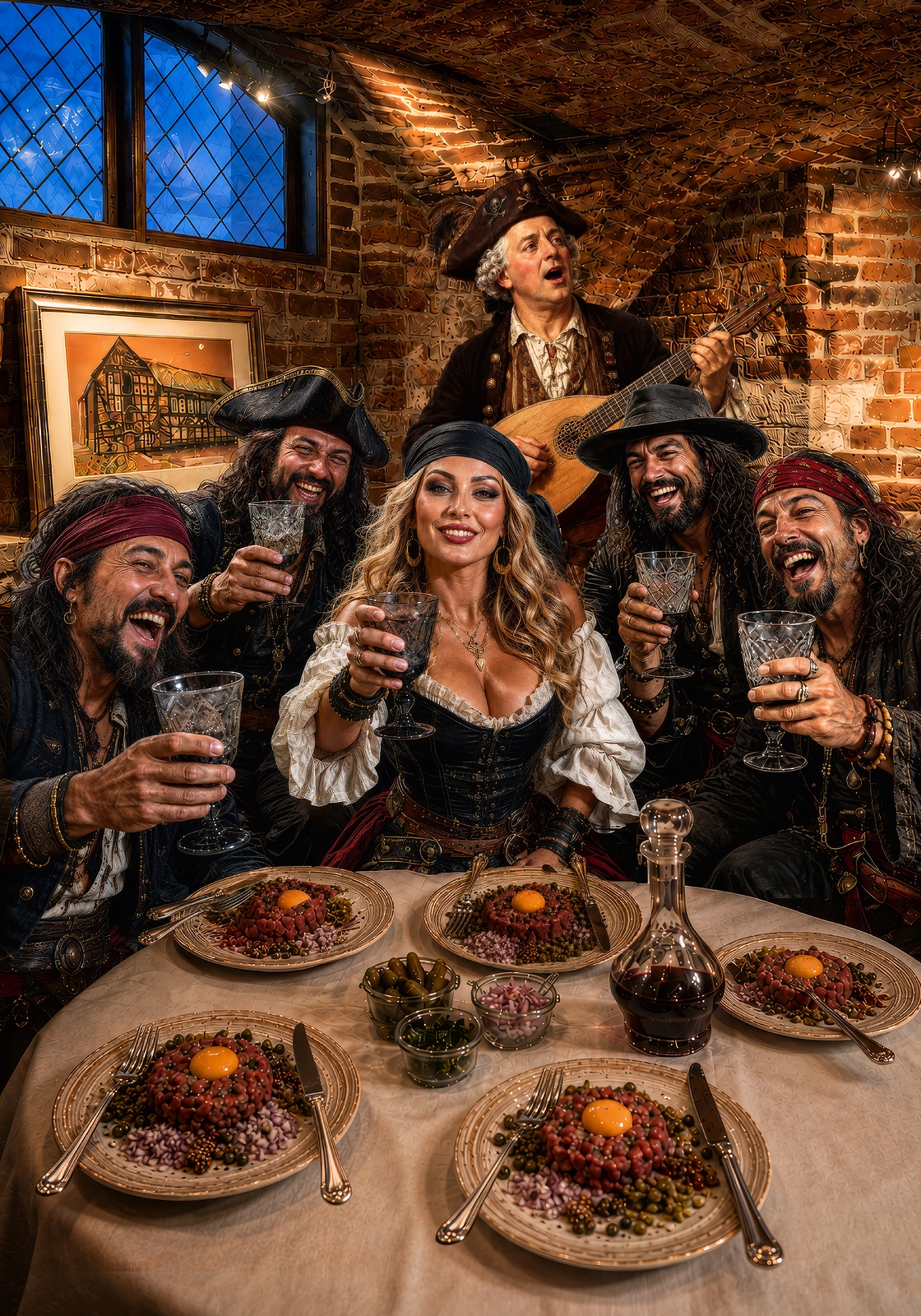
In this story, we find ourselves right in the middle of that world. The year is 1871, and the location is the Svarta Hålet, the Black Hole Inn on Norra Vallgatan in Malmö, an establishment whose name hardly needs further explanation. There, KLUHS the Committee for the Rehabilitation of Smuggling and Historical Truth has gathered around the venues legendary steak tartare and a French claret. The company consists of people from different centuries, which, in eternity, is not regarded as a major practical problem.
Anita Ekberg has, as usual, found herself right in the thick of it. At the table, she hears how a future priest abandoned theology for a far more lucrative profession, how customs officers were fooled, and how French cognac and champagne slipped across the Öresund without raising the authorities suspicions. At the neighbouring table sits a long-deceased poet from Lund, doing his best to prove that smuggling is far from the only way to live off other peoples money. It will be an evening of tricksters, customs snoopers, fraudsters, the police mayor, drunken brawls, and time-travellers and of Johan Anders Wadman, Gothenburgs Bellman, as a musical guide.
A few hundred years here or there do not really matter. Nor does a thousand. Not as long as you are having a good time.
When I Drink
When two old men over a gold tube bicker,
Or squabble about a piece of land,
Limping toward glory's temple quicker,
Or clashing over empty words at hand;
Hey, then I drink and smile with glee:
You stubborn old goats! Good for you, see.
When two old aunts over coffee cups sitting
Are both near vomiting their spite,
Finding faults in soul and body, splitting,
Gossiping of things with no truth in sight;
Hey! Then I drink and smile so free:
You angry old hags! Shame on you, see!
When two men, who walk the same career path,
Lie with sweet faces to one another,
To deceive by habit and draw their wrath
Upon the tricked friend, if they can bother;
Hey! Then I drink and look to see,
If the devil won't take you eventually.
When two neighbour wives with each other bicker
About sitting upfront at lavish feasts,
Can barely eat because they bore and flicker,
Envious of each other's dresses like beasts;
Hey! Then I drink and pray to be:
May God protect me from your company!
When a youth his girls affection wishes to win,
Thinks a single room feels like a castle grand;
When his girl, as soon as her wifedom begins,
Believes that true joy has found its land;
Hey! Then I drink and offer to thee,
Sometimes a good piece of advice from me.
When I see a lively crowd of children playing,
Completely carefree and wild and dazed,
Defying all rules, threats, and dangers staying,
For a little midnight theft adventure raised;
Hey! Then I drink and pray to see:
May heaven protect your company!
When I sit by the bowl filled up to the brim
In a crowd of old, good friends of mine,
Cheering and toasting the first toast with vim,
Emptying the glass, feeling happiness divine;
Hey! Then I drink and look to see,
Merry brothers wanting more, like me.
Alas! But if I sit by the empty bowl
In a crowd of old, good friends of mine,
Stammering sluggish and slow at the final toll,
Yawning widely at the morning's sign;
Oh! Then I drink and look to see,
Still after a little more for me.
Ugh! But if I lie on the steep brink
Of the black, cold, and deep grave,
Restless in bed, from the foul smell I shrink,
Sniffing the medicine that they gave.
Fie! Then I drink, but look to see,
Surely no more after that for me.
Johan Anders Wadman
Malmö, August 1800
PROLOGUE New Winds Over Scania
When late summer 1790 swept over Scania, the winds brought a long-awaited but hard-won peace. In August, Gustav IIIs war with Russia finally ended with the Peace of Värälä. After years of hardship on distant battlefields and at sea, Scanian soldiers and boatswains turned homeward. What should have been a time of joy, however, became a new tragedy. The returning regiments carried hidden enemies; Russian captivity had broken their bodies, and during the long marches, typhus and dysentery spread. Instead of peace, the warriors brought contagion, and mortality skyrocketed in the Scanian parishes. At the same time, nature showed its most fickle face. The summer brought extreme weather contrasts that plagued an agricultural sector already brought to its knees after several years of crop failure. The soil was depleted, the air heavy with fever, and the future uncertain.
Out of the crisis, a new order emerged, and as 1791 began, the Scanian landscape began to change. The economy slowly stabilised, but the fruits of this recovery did not reach the poor. It was the Scanian nobility and the large estates that expanded their power. They carried out the most radical land reform in Swedens history, and Scania was the province where it was implemented first and most ruthlessly. Villages were shattered, and farmers were forced to tear down their houses and rebuild them elsewhere.
With an iron fist, the nobility began to streamline agriculture, and the Scanian manor landscape was filled with a new rationality. For the ordinary farmers, this meant an even harsher existence. They were forced into heavy corvée labour on the estates lands to feed the masters ambitions. Beneath the surface of the Scanian fields, social unrest smouldered. It was a silent but dangerous anger, subtly fueled by whispers and news filtering in from revolutionary France. The contrast became absolute: while the noble estates flourished, discontent brewed among the men and women whose sweat built the wealth.
With the peace, another kind of activity came to life along the Scanian shores. The Öresund had been transformed into a vast smuggling hub. On the Danish side, Elsinore served as a vast legal warehouse for goods that in Sweden were subject to sky-high customs duties or outright monopolies. Gustav III had wanted to protect Swedish industry, but instead the tax-free, illegal alternatives became a gold mine. The scent of roasted coffee, exotic tea, pipe tobacco, and French wines drifted through the summer nights, along with the rustle of exclusive silk and printed cotton. In 1790, when the crowns gaze and resources were still fixed on the final stages of the war, the Scanian coast was left largely unguarded. This gave the smuggling rings free rein to build efficient, invisible networks.
This illegal trade, however, was no shady business hidden in shame it was an integral part of Scanian society. For the coasts fishermen, farmers, and boatswains, nightly trips across the Sound were a widely accepted and welcome sideline to supplement their income. No one regarded it as a moral crime. Rather, the opposite; even the nobility on the Scanian estates gratefully accepted smuggled luxury goods to keep their elegant salons alive. The flawed customs system did little to stop the flow. The customs officials were underpaid, lacked fast boats, and, more often than not, chose to look the other way in exchange for a well-filled purse or a barrel of good wine. As the year drew towards 1792, Scania overflowed with smuggled goods, completely beyond the states control, in a golden age that would soon test the patience of the new regency government.
The Black Hole Inn
At the beginning of the golden age of trickery, the smugglers association KLUHS sought to celebrate with an anniversary meeting. In October 1871, smugglers from different eras met at the Black Hole Inn. The inn was strategically located near the customs gate towards the sea in the Svalperup quarter, between Norra Vallgatan and Adelgatan. It bordered Hamngatan to the west and Kansligatan to the east.
Norra Vallgatan ran just inside the northern defensive ramparts, and between Strandporten and Bastion Wennersborg lay the Black Hole, where drinking had been going on since the late 1600s. The official name was Gästgivaregården (The Guest House), but it was known to everyone as the Black Hole.
We move back to a cheerful evening when the Time-traveller Anita Ekberg and her smuggler friends from KLUHS the Committee for the Rehabilitation of Smuggling and Historical Truth have secured the best corner table in the front row, with everything happening at the tavern laid out before them. They are eating the venues legendary steak tartare and drinking a Bordeaux, French claret, as it was written on the wine list. It had been an eventful week, full of escapades. Anita, who, by the whims of eternity, had slipped into this remarkable company, continued to learn about an activity she had never encountered during her time on Earth whether on the silver screen or in private. Her smuggled extra bottle of whisky, hidden among her underwear in her luggage, did not count, but it still counted as a merit in this company.
To Anitas left sat Anderz Rijs, a time-traveller born in the 1830s. She had enticed him into telling the story of how he decided to become a smuggler. Anderz proved to be a good storyteller.
When I was younger, I was set on following in my fathers footsteps and becoming a priest. Who knows, maybe that would have been for the best. I envisioned myself as a parish priest in a small town, walking among the cottages in a black cassock, smoking my pipe in peace all day. Sometimes I even imagined I would end up as a bishop in Lund.
The plan was to study like crazy but I grew tired of it quickly and didnt give a damn about the whole thing. A sea captain moved into the neighbouring house. His name was Edvard, and he had a fantastic sailing sloop that he invited me aboard. He had some short freight runs between the coastal towns in the Öresund Malmö, Landskrona, Elsinore, and Copenhagen and I was allowed to come along. It was June, and the weather was fantastic. According to Edvard, there was too little wind, but no one ruled the weather. I felt right at home on the open blue sea. That summer I lived life, free as a bird and happy.
But winter was rotten. Then I sat locked in the cold halls of the Latin School, freezing, with my nose buried in books until my face turned purple. In those days, they plagued us with Latin day in and day out. As if that wasnt enough, I was scolded every day by a private tutor who was just as lazy as I was. But the piece of garbage wanted to show his power. I bit the bullet, because I was going to be a priest, after all. But I remember the next spring, when the term was nearly over. I was dead tired of school. The teachers half-slept through the lessons, and I sighed with relief when it was over. Cicero, Ovid, and all the other old authors, along with Latin grammar, ended up on the top shelf in a hell of a hurry.
My skipper neighbour was just about to sail for Lisbon.
If you want to work on a boat over the summer, come along, but you have to get ready right away! he said.
He was a man of his word. I ran away, shed a tear, blew my nose, and went aboard. The wind was fair, and the water foamed around the bow in the summer sun as we left the East Quay. I said goodbye to my old homeland.
We didnt make it beyond the North Sea before the skies darkened and we were caught in a brutal storm. I became acutely seasick. I vomited and prayed to God, begging to be set ashore. He heard my prayer, and they put me ashore outside Smögen.
So it was God, this mythological figure who, on Earth, is behind everything, both evil and good, who sent you back to theology? Anita wondered.
At least thats what I believed back then. If he had existed, he would soon have had cause to regret it.
That made her laugh, but before she could ask any further, the food arrived. The Black Holes legendary steak tartare was placed before them, generously portioned and served in the manner that had made the inn famous, crowned with an egg yolk. Along with it, they and the others had ordered a French claret, a red Bordeaux recommended by the innkeeper.
I had had more than enough of sea life for the moment. Instead, I took the stagecoach back to Malmö, and after the summer I went to the university in Lund to study to become a priest. It was Latin, of course, but also Hebrew and Greek exegesis, church history, dogmatics and systematic theology, moral theology, and practical theology. It ended with me soaking up crazy amounts of punch at the student parties the glasses were absolutely enormous, and I was dead drunk every other night.
Anita cut a piece of the steak tartare.
So it was the punch that saved you from the priesthood?
Not just that. It made me receptive to new ideas. Then I met Palle. In the summer of 1871, I changed my mind again. Theological studies are all well and good, but when you have spent evening after evening emptying enormous punch glasses, those dusty books on exegesis and dogmatics start to feel pretty meaningless. I realised rather quickly that I would rather drink punch than preach against it. Your horizons also broaden when you meet young men from different backgrounds and with different dreams, and, above all, when the stories become more and more exciting after the second or third glass.
Palle, one of my drinking brothers, came from Råå. He had grown up with the Sound right outside his door and talked about trickery much as others talked about fishing or farming. Palles uncle was named Pål Raus, but he was never called anything other than The King of Råå (Rååkungen). He was a professional smuggler, or a trickster, as its called in Råå. Officially, he was a fisherman, but that wasnt what he lived on. It wasnt the fish that paid for my friends studies in Lund.
Together with others, the King of Råå ran a joint smuggling operation. They rowed or sailed to Denmark in large, fast double-ended boats (snipor) carrying ten, twelve, or sixteen men, and returned with aquavit, tobacco, fabric, and other goods that were cheaper on the Danish side or cost too much after the Swedish customs had taken their share.
The aquavit was the big business. A sizeable boat could return with forty anchors of spirits more than one and a half thousand litres on a single journey. The cargo had to be brought ashore unseen by the customs officers, hidden, and then transported by horse and carriage to those already waiting for it. It wasnt a matter of a few scattered bottles under a coat, but a well-organised trade involving boat crews, financiers, receivers, and buyers.
Back home in Råå, it wasnt called criminality, of course. There, it was a way of making a living. The state was mostly seen as a troublesome middleman who wanted to make it difficult for people to buy what they intended to buy anyway.
It wasnt risk-free, naturally. The customs officers had their own boats and were armed, and when they spotted a boat, it was a matter of knowing how to row. The previous summer, a sixteen-man boat had been chased outside Rydebäck. The customs officers fired, and a bullet hit the helmsman. Such incidents were not told to discourage anyone. On the contrary, the stories grew better with each retelling, and recruitment in smuggling circles was strong.
Anita had swallowed a piece of steak tartare and chopped onion.
And that made you want to start?
Anderz shrugged his shoulders.
I was nineteen, Anita.
It was hard to argue against that sort of youthful idiocy, so she contented herself with shaking her head and refilling her glass.
The more Palle told me, the less appealing the idea of spending my life in a parsonage became. Here were men who could read the wind and the current, who knew where the customs yacht lay and which shores you dared approach on a dark night. There was money to be made, excitement to be had, and above all, a world where no one asked what you had received in exegesis.
When the term ended, I did not follow the others home to study for the next exam. I took the stagecoach north to Palle and Råå. The priests hat would remain a dream. The sea called again, but this time not to haul legal cargo for Captain Edvard. I had realised where the real money lay in smuggling.
I associated not only with the sons of smugglers but also with a few from the upper class. Those contacts from student life proved to be worth their weight in gold. One of them was a rich mans son from Malmö who had made contact with a German wholesaler who could source French cognac, champagne, and luxury tobacco for Malmös finer salons.
My wealthy companion was willing to provide the capital, and with him as financier, I bought a worn but fast-sailing boat. We agreed to split the profit equally after expenses were deducted. His surname could not be associated with smuggling, so the practical side had to be handled by a priests son.
Now it was just a matter of outsmarting Malmös customs officers, and my first coup required both cunning and cold-blooded resolve.
The cognac and champagne had never cleared Copenhagens customs. Our Danish partners had brought the cargo directly to Saltholm, where it awaited us: thirty twelve-box cases of Hennessy Very Superior Old Pale and an equal number of Veuve Clicquot. The price was free on Saltholm. How the German and his Danish contacts got the goods there was their concern. From the moment the crates lay hidden on the island, they were ours and so was the risk.
Saltholm is almost completely flat. Its highest point is Harehøj, three metres above sea level. In the north-western part of the island, there are a couple of smaller farms. The island has almost no trees and consists of a single large meadow that floods during storms. Therefore, it has been used as grazing land since time immemorial.
Above all, the water around the island is extremely shallow. The seabed lies for the most part less than two metres below the water's surface, and it was precisely that which made the place so useful for us. The larger customs boats had to stay where there was enough water under the keel. Our shallow-draft boat could get much closer to land.
On the south-western side, there was a small bay containing a tiny island also called Saltholm. The inlet was difficult to spot unless you knew where to look. Our Danish partners had buried the crates there. Everything was still there when we arrived. Sixty crates.
Anita raised her eyebrows.
Sixty crates on the first attempt?
It is just as forbidden to smuggle sixty as it is to smuggle six.
She couldnt argue with that, even if she suspected the customs officers might have noticed a certain difference in degree.
Thirty with Hennessy and thirty with Veuve Clicquot. Three hundred and sixty bottles of each kind, a total of seven hundred and twenty bottles of French luxury, were not recorded in either the Danish or the Swedish customs papers.
We worked quickly, stowing the crates as low and evenly as possible in the boat. When the last one was aboard, we had about a ton of precious cargo. Fortunately, the usual westerly wind was blowing, so we didnt have to row all the way back. Good, because now we had cargo on board that I preferred not to risk on any unnecessary adventures. The sails filled, and Saltholm slowly disappeared behind us.
Getting across the Sound, however, was only half the coup. Now we had to enter Malmö harbour.
A new outer breakwater had replaced the outermost eastern pier, and work was in full swing to construct the upcoming Ångbåtsbron (Steamboat Bridge). We naturally did not want to go to that part of the port. It was far too close to the customs watch office, where the customs snoopers hung about.
To the west, it was far more interesting. The city had already established its dry dock there in 1857, and the year before our coup, in 1870, Frans Henrik Kockum had taken it over and begun building up his shipyard. Kockums was expanding just when we needed a dark place to unload. There were depots, coal, coke, building materials, and debris, and the entire area was still changing.
It was a pitch-black, somewhat misty night when we approached the quay by the coal depot, which Kockums had just expanded. This was the perfect spot: filthy, dark, and devoid of people. Nearby stood the old fourteen-metre-high wooden lighthouse from 1822, shining over the harbour inlet.
I had found out exactly how the customs officials worked. They werent stupid, but they were lazy and loved their fixed routines. That was really all I needed to know. If you know where a person usually is at a given time, you need to give them a good enough reason to be elsewhere.
I had paid a young harbour boy to light a false signal lantern over by Nyhamn, and at the same time made sure to start a massive drunken brawl at one of the shady taverns near the port.
Sure enough, when the customs officers heard the screams and saw the light, they headed that way. You never knew. Perhaps it was smuggled goods being fought over. In any case, the innkeeper usually offered something nice to calm the authorities down once order was restored.
Meanwhile, we glided like ghosts towards the dark quay.
My heart pounded so hard against my chest that I was convinced it could be heard all the way to the town hall. I had heard Palle and the King of Råå tell stories about this sort of thing and thought they sounded fantastically exciting. They still did, but in a significantly less pleasant way when it was I myself who risked being caught.
With trembling yet swift hands, we began to pass the crates ashore. One. Two. Three. Yo-heave-ho. Only after the tenth did my hands stop shaking.
We hid the crates among coal slag, a worthless by-product that lay in ever-growing heaps. There they could rest in peace until they were collected in smaller batches and driven onward to waiting buyersno one needed to peddle smuggled cognac like a hawker. The business was essentially finalised before the goods even reached Saltholm.
Anderz paused briefly and turned his attention to the steak tartare, which had almost been forgotten as he told the story of the unloading. Anita refilled his glass.
So you were terrified?
Completely.
It doesnt sound that way when you tell it.
That is one of the advantages of telling things long afterwards, when you know it went well.
No bottle was sold individually. Anyone who wanted to serve Hennessy or Veuve Clicquot in Malmös finer salons had to buy a full twelve-bottle case. The cognac cost fifty riksdaler per case and the champagne eighty-five riksdalernothing for poor folk. The customers paid without haggling.
When the last crate had been removed, and all expenses accounted for, the deal yielded 1,400 riksdaler in pure profit. My companion and I had agreed to split it equally, so my share was seven hundred riksdaler.
Anita put down her knife.
Seven hundred?
My half.
Then I understand why nothing ever came of you as a bishop.
Anderz laughed and raised his glass.
I did too. It was more money than I had ever held in my hand. That was surely true for most Swedes. It was what a skilled craftsman needed to earn in over a year.
I hadnt invested any capital. My contribution had been the boat, the planning, the labour, and, above all, the risk of ending up in prison and having my life ruined. My partner got his money back, plus seven hundred riksdaler for his trouble. We were both very pleased.
Above all, I had learned something the King of Råå and his men already knew. It wasnt the alcohol you made money on. It was the customs tariff.
The greater the difference between what a commodity cost on one side of a border and what someone was prepared to pay on the other, the better the business was. What was inside the crates was almost irrelevant.
The coup was a complete success. That night, I earned more money than I had ever imagined in such a short time. It was then I realised I had found my true calling. I wasnt going to be a bishop. I was going to be a smuggler.
The cognac and champagne were just the beginning. In the years that followed, I managed to transport most of the goods that, for some reason, governments deemed people shouldnt be allowed to buy without first paying for the privilege. It became tobacco, fabric, spirits, and other goods, with a few crates worth more than an entire boatload of regular aquavit. I learned fairly quickly not to fall in love with any particular commodity. A true trickster doesnt smuggle cognac or tobacco. He smuggles price differences.
What was profitable one year could be uninteresting the next. Customs tariffs changed, taxes were adjusted, and peoples tastes shifted. You had to change with them.
I also grew better at the work itself. In the beginning, I stood at the helm myself and felt how deep it was with the oar. I helped carry the crates, hid the cargo, and lay sleepless when one of our boats was late. After a few years, I had men who did it for me. It is much like any other business enterprise. If you are still the one carrying the crates after twenty years, you havent been particularly successful.
The single boat became multiple boats, the boats became contacts, and the contacts formed a network stretching from Malmö and Copenhagen to Hamburg and further south. I had people who could buy, transport, hide, and sell. In the end, most of them didnt even need to know each other. It was safest that way.
Part of what we did was entirely legal. It was practical to be both merchants and smugglers. A man who never imports anything legally arouses suspicion when twenty crates suddenly appear in his warehouse. A man who receives hundreds of crates a year can easily misplace a few.
Over the years, I therefore became a rather respectable gentleman. I married, had a family, made money, and acquired businesses that could withstand the light of day. I bought a house at the right address in Malmö and became a burgher. I paid tax on the things the authorities knew about and could politely tip my hat to the same customs officials who spent their working days trying to find the rest.
Anita had made good progress with the steak tartare, while Anderz had transformed himself from a smuggler on a boat into an established merchant.
So, in the end, you became honest?
Respectable, Anderz corrected. Its not quite the same.
That distinction was appreciated around the table. It worked out very well.
Times changed too. The King of Råås large sixteen-man boats belonged to a bygone world. The railways expanded, steam replaced sail, harbours grew, and the flow of goods increased. For a smuggler, that wasnt necessarily a problem. On the contrary, the more goods that were transported legally, the easier it became to hide the illegal ones among them.
By the turn of the century, I rarely needed to go anywhere near a boat. I arranged the goods, the money, the transport, the receiver, and the buyer. Above all, I knew whom to trust. That is the most important knowledge a smuggler can possess. Customs officers can be fooled. Storms can sometimes be weathered. A bad partner can ruin everything.
When I passed sixty, I had intended to start taking it easy. I had money, younger men handled the practical side, and I rarely needed to get any closer to a customs officer than to greet him in the street. I thought I had done my part.
Then came 1914. Suddenly, the governments of Europe began, on a grand scale, what they had previously done more cautiously. They decided which goods were allowed to cross the border, which were not, and where they could be sent if they were not allowed to cross. Ships were stopped, cargoes inspected, export bans introduced, and things that could be bought openly one week became, the next week, difficult or impossible to obtain.
Gradually, it grew worse. The war dragged on, the blockades tightened, and scarcity deepened.
People did not stop wanting things just because governments decided they shouldnt have them. They still wanted coffee. They wanted tobacco, spirits, food, soap, and everything else that had become hard to get. At the same time, on the other side of the border, people were prepared to pay fantastic prices for things that could still be bought in Sweden.
It was the same old story as on Saltholm in 1871. There was a commodity on one side and a buyer on the other. And in between, there was a border.
I was a bit over sixty and had spent almost my entire adult life dealing with precisely the problems that Europes governments had managed to create on a scale I had never previously dreamed of. I no longer needed to learn which bays were shallow or where the customs officers lay in wait. I had a network, capital, vessels, merchants, and younger men who gladly took the risks I had taken forty years earlier.
Anita leaned back. The steak tartare was finished, and in the claret bottle, only a dreg remained.
And then you felt content.
Yes.
Rich?
Tolerably.
Respectable?
Very.
And yet you threw yourself into it all again?
Anderz looked almost surprised by the question.
Anita, it would have been downright impolite to say no. After a lifetime in the business, perhaps I should have been the wise old man who declined. I wasnt. I postponed retirement.
Anderz fell silent as things began to happen nearby.
The Bastion of Inebriation
It was a Friday evening, and at the Black Hole, the mood was high, the tone raw, and there was not a sober soul in sight. At the adjacent table sat the troubadour Johan Anders Wadman, surrounded by cronies from the Wadman Society Bacchus Guild (Wadmansällskapet Bacchi Gille), which he had founded. The priests son, Wadman, studied in Lund and was known for his songs and, to say the least, his raw, honest, and humorous attitude towards alcohol and social life.
After many glasses of aquavit and foaming beer mugs, a wild quarrel erupted between two of the guests over a woman and a fake die. Glasses shattered, chairs flew through the air, and the whole thing quickly escalated into a full-blown, bloody tavern brawl, with Wadman standing on a table, cheering them on, waving a curled wig he had ripped off one of the brawlers.
Now things are really moving. Anders laughed and nodded towards the next table.
What no one in the tavern knew was that the legendary police mayor Georg Reinhold Dahlström who loved adventure, theatre, and moving incognito among the citys citizens had learned that some interesting individuals were at this questionable establishment. Dahlström had disguised himself in a simple, dark burghers cloak, pulled a slouch hat down over his face, and slipped in through the taverns back door with his faithful assistant, Peter Söder, to catch people in the act of sin.
Just as Dahlström stepped into the smoky room, a large farmhand smashed an empty beer stein over a customs officials head, and the entire tavern erupted into chaos. Dahlström, backed against the wall and shocked, tried to avoid being hit by flying steins. In the midst of the mess, he caught sight of Wadman, who, in his drunkenness, had fallen off the table and was trying to hide under a bench with a half-empty bottle in hand.
Dahlström stepped forward, pulled up his slouch hat so his face was exposed to the light of the tallow candles, looked sternly down at the troubadour, and exclaimed in a slightly affected bureaucratic voice:
Well, look here! Is this how a Lund student spends his nights? In the middle of a godless gutter brawl, among rabble and drunkards! What has my sir to say in his defence before the citys police mayor?
The tavern fell quiet for a moment as some of the guests recognised the masked man. But Wadman, drunk and with his clothes stained by alcohol and floor dust, crawled out from under the bench, stood unsteadily, and brushed off his knees. He looked Dahlström straight in the eye, bowed so deeply and theatrically that his nose almost touched the dirty floorboards, and replied lightning-fast:
Highly Esteemed Sir and honoured Mr Police Mayor! I beg You not to misunderstand my presence here. I am truly not involved in any brawl. I was sent here by Our Lord himself to serve as Your Esteemed Sirs personal mirror!
Dahlström furrowed his brow, half amused, half irritated by the troubadours audacity, and asked:
A mirror? In what way could this misery reflect me?
Wadman gestured with his arms towards the ruined tavern furniture, the bleeding guests, and the general anarchy, and said:
Why, my Highly Honoured Sir! When I see how these wretches fight, vomit, and destroy one another, I realise, in my deeply moved heart, exactly how much Malmö needs a strong, enlightened, and absolute official to keep order among the fools. I sit here in the dirt solely so that my love for Your office may grow with every shattered glass!
Dahlström stiffened, but his deeply rooted vanity and love of a good performance quickly took the upper hand. He burst into a loud, affected laugh, patted Wadman on the shoulder, and said to the assistant Söder:
Listen to that rascal! He can turn the worst drunken brawl into a tribute in an instant. Let us leave this den before the city guard arrives, and ensure a clean shirt is sent to Wadman tomorrow.
Dahlström pulled his hat down again and disappeared into the Malmö night, while Wadman sat back at the table, ordered another mug of beer to be put on the police mayors tab, and kept the party going. That was how he ended up at our table, despite his lack of insight into trickery. Actually, it was his songs that found their way to our hearts. For that rascal could certainly sing. Above all, he was a rogue and a bohemian, famous for getting out of the most precarious situations often of a pecuniary nature, for lack of money.
What the smuggler and I have in common is living off other peoples surplus and a need for validation, Anderz laughed. Furthermore, the police mayor himself is a scoundrel, fully in the same class as Wadman, though of a different and more unpleasant kind. Dahlström is a power player who knows exactly how to bend the rules for his own gain, which makes him more than willing to be charmed by a rascal who speaks his own language. It was clear that Anderz was not impressed.
Wadman picked up his lute, which he had standing against the wall. He stood between our tables, struck a few chords, took a mouthful of beer, and cleared his throat.
I shall beg to sing a few lines of a song I composed recently. It concerns a nightly drinking bout at the Town Cellar (Stadskällaren) in Lund, where Father Jeppa is seized with melancholy and Mamsell Elna thunders on the floor. I have called it When a Drunkard Pleases You, but you may call it whatever you wish. Thus Wadman sang in a clear voice, accompanied by the lute and a foot stomping the rhythm.
Dear brothers, empty the mug now!
The sun sinks, the night dawns.
Hear how the wind shakes the house,
away then the glow of friendship flies.
Father Jeppa grasps the tankard,
the foam runs down his beard.
The whole gang now in high spirits,
staggers against the tavern wall.
Look, Elna, fine in her jacket,
waves her red handkerchief.
Agilely she waves her veil,
amid hunger, distress, and death.
Abandon ship! cries Jeppa,
Pour the aquavit that is best!
Let us drop sin money,
listen to the taverns drunkest guest.
The drunkard rolls across the street,
the Scanian plain lies silent.
Jeppa swears an oath against Satan:
Never have I kissed virtue!
Play on your old lute,
let us weep and laugh merrily.
Before the watchman asks us to stop,
in the dark Malmö night.
End of the tankard. Empty is the bottle.
Jeppa falls asleep at his table.
Man becomes ashes later,
hides in Scanias soil.
But our Elna, she conquers
joy with one final dance.
Until the morning star burns,
and gives the day all its glory.
The song he sang was borrowed notes, for the melody was Bellmans Fjäriln vingad syns på Haga, one of the few melodies that his Stockholm colleague had composed himself. The entire tavern was filled with applause and cheers, for a good musician was always appreciated. People put coins into a copper mug he set down on the tables.
While Wadman went further into the cellar and sang, Anderz spoke about this original from Karlskrona.
Supper in Sorrow and Joy
The priests son is constantly broke and almost as often intoxicated, Anderz laughed. The stories about him are amusing, and a good number of them are presumably true. Like the one about how he fleeced an innkeeper in Lund. I actually heard that one from a cold-cook (kallkokerska) who worked at the tavern when the whole thing happened.
Anita was all ears, thinking of her first husband, a good-for-nothing. He was more often drunk than sober and lived off her money.
Wadman and his faithful drinking companion Spareman had sat for a whole evening at the Town Cellar in Lund. He sits there! Anderz nodded discreetly towards a reasonably haggard figure at the neighbouring table. The Lund tavern was known as the absolute hub of the citys finer social life; an exclusive oasis where the universitys haughty professors, noble students, and visiting bishops gathered to add a golden lining to existence. It was here, under the heavy ceiling beams, that academic successes and doctoral defence dinners were celebrated with dishes inspired directly by French cuisine.
The two friends had apparently spared no expense, ordering the very best and most expensive items the house had to offer. The feast had begun grandly with an appetiser of tender stuffed pheasant, quickly followed by the main event: a masterfully roasted and larded venison, served with gleaming pan juices and elegant accompaniments. To wash down these manor delicacies, nothing less than the cellars most exclusive bottles was required. First, they poured a couple of elegant, expensive wines from the Rhine, followed by a heavier, nobler Bordeaux that made the palate sing. It almost makes one hungry. Anderz picked up a few crumbs of steak tartare left on his plate and popped them into his mouth before continuing.
When the dishes were carried out, Wadman insisted that such a beginning demanded sweetness. In rolled a French glacé flambéed at the table, flanked by copious amounts of hot, golden-yellow French punch, steaming with arrack and sugar. As the crowning glory, coffee and cognac were, of course, required. At the time, coffee beans were strictly state-controlled luxury items, subject to prohibitions and tariffs. But the Town Cellar belonged to the finer establishments that either bought exorbitant licences or smuggled the coveted beans in at night to offer their guests the dark drink, served with glittering sugar hacked directly from an imported sugar loaf.
I hear it was a real party, and I sense trouble, Anita laughed.
When the hour grew late enough, the tallow candles burned down to stumps, and the innkeeper personally stepped up to their table with a bill that, to say the least, was hefty. The cold, pale afterthought struck. The two friends realised, after looking at each other, that neither of them had a penny in their pockets. Or perhaps they had known it from the start.
Without blinking and without the waiting innkeeper noticing the slightest shift in their expressions, they exchanged a swift, lightning-fast glance. They didnt need to say a word; they knew each others dramatic streak and acting talents inside out after countless nights in the gutter and on the academic stages.
Spareman stood up with a theatrical jolt. He was deathly pale, his eyes wide, and slammed his fist so hard on the table that the empty Bordeaux bottles and the fine coffee cups rattled. He cried out in a trembling, deeply tearful voice that cut through the smoky cellar hall:
No! What are you saying? It is not true! It simply cannot be true! The great, noble man... dead! Anderz raised his voice for dramatic effect. Wadman, who understood his cue to the second, immediately buried his face in his hands. He began to sob loudly and with exaggerated drama, wailing in feigned pain, wringing his hands in despair, and throwing himself headlong across the table, right down among coffee spills and sugar crumbs, in what appeared to be a bottomless, utterly hysterical grief. All the remaining guests stared intently at the unfolding drama, of course.
The innkeeper, startled by the sudden outburst, hurried, trembling, to the table. In the late 1700s, political news was dynamite. Was another revolution on the way, or a sudden death in the royal court or the government in Stockholm that could alter the entire countrys future? And affect his business.
Good sirs, for Gods sake! the innkeeper whispered, terrified, glancing nervously around the premises. What misfortune has happened? Who has died? Is it His Majesty the King? Ever since Gustav IIIs palace coup in 1789, the country had hummed with rumours of assassination plots.
Spareman clutched his heart, gasped for air, stared at the innkeeper with an utterly blank, glassy stare, and sobbed out:
Alas, misery it is even worse than that! It is my dearly beloved, venerable father who has passed away at this very moment! My good friend did not want to tell me until now. Dear creator, what shall I do? Spareman wailed.
The innkeeper let out a deep, shuddering sigh, heartily relieved that neither a new coup d'état nor a royal assassination had struck the country. At the same time, he was filled with deep compassion for the young students sudden, brutal grief over his beloved father. He patted Spareman fatherly on the shoulder, lowered his voice, and said with great dignity:
Dear sir, do not despair in this dark hour. In such a moment of unbearable grief, you should not have to think about such worldly and banal matters as a tavern bill. Let it be, gentlemen. The house treats you tonight. Go home in peace to your chambers and mourn your father.
Wadman and Spareman thanked him humbly, their throats thick with sobs and tears gleaming in the corners of their eyes. They picked up their hats, bowed politely, and hurried out of the subdued Town Cellar with heavy, mourning steps. But they had barely closed the heavy oak door behind them and stepped out onto Lunds dark, desolate, cobblestone-paved streets before the act was over. They straightened their backs, looked at each other, and burst into an echoing roar of laughter that bounced between the university buildings.
Sparemans father was not dead at all he was alive and well and a wealthy and respected man back home in Kristianstad. The poor innkeeper in Lund never saw a cent of his money for the lavish pheasant and the delicious venison. The story of how the two brilliant jokers managed to weep themselves free from the enormous bill has become a classic in Scanias student circles.
Anita laughed until she choked. The likes of such audacity could only be mustered by my first husband, as when Tony surprised me with a necklace he had bought on credit in my name.
Tell me so I can rest my voice, Anderz said.
Do you know what that wretched person did? Tony came home one day with glittering eyes and gave me a love present. The box came from a well-known jeweller in Rome and contained a fantastic, exclusive necklace. I love jewellery, so of course I was happy. Tony posed as the great romantic gentleman who wanted to spoil his beautiful wife. I was, of course, glad and moved. I had to pause, because even in eternity the memory pained.
But the happiness did not last long. On his desk, I came across a bill from the jeweller, addressed to me, not to Tony. That scoundrel had marched into the luxury jeweller, picked out the most expensive piece he could find, and bought it on credit in my name. He expected me to pay for my own surprise, while he took all the credit!
I became so furious that smoke practically came out of me. Do you think I paid? Never in my life! I drove straight to the jeweller, slammed the necklace on the counter, and said it as it was: My husband bought this in my name without my permission. You have to take it back and cancel the invoice immediately! The jeweller looked terrified and did exactly as I said. Tony was left standing there with the shame, a quality he unfortunately lacked. I thought I had married a man, but it turned out I had married a baby! An unusually deceitful one at that. Enough about a misery that occurred 60 years ago. Do you have more stories about that Wadman that can cheer things up?
Absolutely, Anderz said after commiserating with me about my fate.
A Tailors Move
Wadman owed his tailor in Lund a large sum of riksdaler for several elegant coats and embroidered vests he had had made to keep up appearances at the universitys more formal gatherings. The tailor, an angry, stubborn, and bitter craftsman, had grown tired of the young poets promises, lyrically delivered excuses, and beautiful words. Now he openly threatened to send the city guard to arrest Wadman and throw him into the debtors prison to rot among the citys lowest criminals.
Wadman, who was penniless, realised he had to do something drastic to save his skin. He gathered a crew of his most faithful and thirsty tavern companions, with his loyal drinking companion Spareman at the head.
When the tailor, in a fit of rage, marched up the street towards the house where Wadmans student room was, to demand his money, Wadman was forewarned. A rare, sombre sight met the tailor. A black-clad funeral procession walked slowly across the cobblestones. At the front of the procession, a simple wooden coffin was carried, draped in a dark cloth and decorated with flowers swiped from one of the citys flowerbeds. Behind the coffin, Wadmans student friends walked with bowed heads. They held wax candles in their hands and, with tearful, cracked voices, sang what sounded like a funeral hymn. In reality, it was one of Wadmans drinking songs sung slowly backwards. To think that rhymes on toast (skål) and bowl (bål) can sound so sacred.
The tailor stopped, removed his hat in reverence for the deceaseds final journey, squinted at the retinue, recognised several of the known bohemians, and took a quick step towards Spareman, who walked directly behind the coffin.
But, dear sir, who is it that has so tragically passed away? the tailor asked innocently.
Spareman wiped away a feigned tear with a dirty handkerchief, looked at the tailor with an utterly blank, devastated gaze, and sobbed loudly:
Alas, woe and horror it is our dearly beloved brother Wadman! The great poet has stopped breathing. The galloping consumption has taken his life. We are now carrying him in sorrow and affliction to his final resting place in the cemetery.
The tailor turned completely pale. His first thought was one of shock and distress, but his second was economic. The tailor realised that his hard-earned money for fabric and thread was lost forever. In frustration, the tailor lost his composure, stood in the way of the procession, slammed his fist on the coffin, and exclaimed bitterly:
Dead?! Well, damn it all! My greatest claim is dead! That wretch cheated me out of every penny before he dropped into the grave!
At the very moment the tailors fist thundered against the wood, the coffin lid flew open with a loud bang. From the coffin rose Johan Anders Wadman, alive and well, pale with powder and dramatically clad in a white, fluttering sheet. He widened his eyes, looked the frozen tailor straight in the eye, pointed at him with a trembling, accusing finger, and shouted in a thundering, ghostly, theatrical voice:
Yes! And I certainly dont intend to pay you in the next world either! Carry on, brothers!
The tailor was so terrified at seeing the dead genius awaken and speak to him from the bottom of the coffin that he dropped his hat, turned on his heel, and, in panic, ran as fast as his legs could carry him out of the city.
Wadman lay back down comfortably in the coffin again, the wooden lid closing with a dull thud, and the procession continued at a slow pace through Lund but the sorrowful hymn-singing was replaced in an instant by the student societys drinking songs, which quickly steered their course straight to the Town Cellar to celebrate a written-off debt.
How did it turn out for the poor tailor? Anita asked when she had finished laughing. Typical of women: first they laugh at the misery, only to immediately wonder about the consequences.
He moved straight to Landskrona, Anderz replied dryly.
Johan Anders Wadman could be heard singing from the far end of the Black Holes cellar.
When I sit by the bowl, filled to the brim,
In a crowd of old, good friends of mine,
Cheering and toasting the first toast with vim,
Emptying the glass, feeling happiness divine;
Hey! Then I drink and look to see,
Merry brothers wanting more, like me.
PS.
Malmö was indeed governed by a magistrate, with different mayoral offices existing side by side. During the late 1700s, there were, among others, the regular mayor and the police mayor.
During the 1790s, the colourful Georg Reinhold Dahlström served as the police mayor of Malmö. He was a controversial, hardline figure, often accused of arbitrary use of power and political scheming, yet he ruled the citys law enforcement with an iron fist.
As the person responsible for the citys order, espionage, and security the police side he had a direct official interest in what moved beneath the surface. During the 1790s, Malmö boiled with French revolutionary ideas, artisanal discontent, and an exploding smuggling market. That Dahlström himself would put on a simple burghers cloak to listen to drunken talk and expose corrupt customs officers or revolutionary conspirators in the taverns along Norra Vallgatan is historically entirely plausible. Acquiring leverage over his citizens was among his absolute specialities.
Johan Anders Wadman (17771837) left behind the image of the great bohemian a Swedish poet who, with his sharp intellect and tragicomic destiny, came to be known as Gothenburgs Bellman. His path began with a stormy, dissolute student era at Lund University around the turn of the 1800s. This period laid the foundations for his deep education but also for the economic lightheartedness that followed him throughout his life. In the Lund student quarters and at taverns in Lund and Malmö, the image emerged of a man who prioritised the company of happy friends and cultural freedom over material security.
Through campaigns in Europe, Wadman secured his place in Swedish anecdotal lore with his legendary, laconic report, Utsupet (Drank it all). Still, it was in Gothenburg that his artistic legacy was cemented. For two decades, he supported himself through short-term commissions, tribute poems, and biting satire, while serving as the natural centre of the citys fraternal societies and tavern life. His unique ability to move between the raw, burlesque shouting of the tavern and the poignant, mournful lyricism of nature as in his most beloved song, Min lilla vrå bland bergen demonstrated a poetic breadth that few of his contemporaries could match.
When Wadman closed his eyes in a wretched apartment on Kvarnberget in 1837, he left behind a literary heritage so outspoken and challenging that posterity initially censored it. His legacy is the story of a brilliant scoundrel whose poetry lived on the absolute border between brilliance and misery. Today he is honoured not only by his statue in Gothenburgs Vasapark, but also as a symbol of a bygone eras Scanian and West Swedish social life a poet who preferred to live in poverty in the moment rather than in wealth through unmade songs.
Just in case it has not already become clear, Wadman was long dead by the time this story took place. He travelled from his star to visit Malmö and the Black Hole as a Time-traveller in 1871. It was a welcome return visit, just over a decade before the old guest house was bought up and incorporated into Hotell Horn, the predecessor to the Savoy. As usual when Time-travellers from different eras meet, time on Earth, as well as in eternity, flows together but who cares, as long as you are having a good time? A few hundred years here or there do not matter. Nor do a few thousand, for that matter.
When you, like Anita, left Earth in 2015 and returned to the 1800s, you had to tag along. Earlier in this trip, she had sat with some Malmö ladies in the residences salon in 1791 and drunk forbidden coffee when a couple of coffee spies rushed in. This time, it was Anita, with a modern womans instinct, who solved the problem.
Jörgen Thornberg
The Black Hole Inn - ENGLISH VERSION, 2026
Digital
50 x 70 cm
3 200 kr
The Black Hole Inn - ENGLISH VERSION
INTRODUCTION
Smuggling is one of those activities that history has had an unusually difficult time categorising. In the authorities' records, we encounter criminals, tricksters, and confiscated goods. In the stories of coastal communities, we meet the same people, described as enterprising fishermen, skippers, and merchants, who merely had the bad habit of treating the customs border as a suggestion rather than an obstacle.
In Scania, this attitude has ancient roots. The Öresund was never merely a border between two realms. It was a trade route where the same commodity could be cheap on one shore and expensive on the other so that a few nautical miles could turn an ordinary cargo into a fortune. As long as kings and governments tried to control what people could buy, how much it would cost, and from whom it would come, others were ready to arrange matters more smoothly.
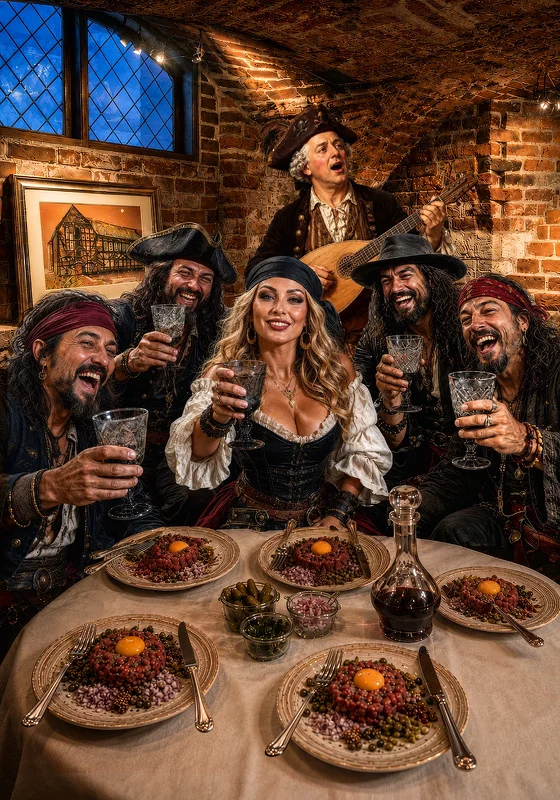
In this story, we find ourselves right in the middle of that world. The year is 1871, and the location is the Svarta Hålet, the Black Hole Inn on Norra Vallgatan in Malmö, an establishment whose name hardly needs further explanation. There, KLUHS the Committee for the Rehabilitation of Smuggling and Historical Truth has gathered around the venues legendary steak tartare and a French claret. The company consists of people from different centuries, which, in eternity, is not regarded as a major practical problem.
Anita Ekberg has, as usual, found herself right in the thick of it. At the table, she hears how a future priest abandoned theology for a far more lucrative profession, how customs officers were fooled, and how French cognac and champagne slipped across the Öresund without raising the authorities suspicions. At the neighbouring table sits a long-deceased poet from Lund, doing his best to prove that smuggling is far from the only way to live off other peoples money. It will be an evening of tricksters, customs snoopers, fraudsters, the police mayor, drunken brawls, and time-travellers and of Johan Anders Wadman, Gothenburgs Bellman, as a musical guide.
A few hundred years here or there do not really matter. Nor does a thousand. Not as long as you are having a good time.
When I Drink
When two old men over a gold tube bicker,
Or squabble about a piece of land,
Limping toward glory's temple quicker,
Or clashing over empty words at hand;
Hey, then I drink and smile with glee:
You stubborn old goats! Good for you, see.
When two old aunts over coffee cups sitting
Are both near vomiting their spite,
Finding faults in soul and body, splitting,
Gossiping of things with no truth in sight;
Hey! Then I drink and smile so free:
You angry old hags! Shame on you, see!
When two men, who walk the same career path,
Lie with sweet faces to one another,
To deceive by habit and draw their wrath
Upon the tricked friend, if they can bother;
Hey! Then I drink and look to see,
If the devil won't take you eventually.
When two neighbour wives with each other bicker
About sitting upfront at lavish feasts,
Can barely eat because they bore and flicker,
Envious of each other's dresses like beasts;
Hey! Then I drink and pray to be:
May God protect me from your company!
When a youth his girls affection wishes to win,
Thinks a single room feels like a castle grand;
When his girl, as soon as her wifedom begins,
Believes that true joy has found its land;
Hey! Then I drink and offer to thee,
Sometimes a good piece of advice from me.
When I see a lively crowd of children playing,
Completely carefree and wild and dazed,
Defying all rules, threats, and dangers staying,
For a little midnight theft adventure raised;
Hey! Then I drink and pray to see:
May heaven protect your company!
When I sit by the bowl filled up to the brim
In a crowd of old, good friends of mine,
Cheering and toasting the first toast with vim,
Emptying the glass, feeling happiness divine;
Hey! Then I drink and look to see,
Merry brothers wanting more, like me.
Alas! But if I sit by the empty bowl
In a crowd of old, good friends of mine,
Stammering sluggish and slow at the final toll,
Yawning widely at the morning's sign;
Oh! Then I drink and look to see,
Still after a little more for me.
Ugh! But if I lie on the steep brink
Of the black, cold, and deep grave,
Restless in bed, from the foul smell I shrink,
Sniffing the medicine that they gave.
Fie! Then I drink, but look to see,
Surely no more after that for me.
Johan Anders Wadman
Malmö, August 1800
PROLOGUE New Winds Over Scania
When late summer 1790 swept over Scania, the winds brought a long-awaited but hard-won peace. In August, Gustav IIIs war with Russia finally ended with the Peace of Värälä. After years of hardship on distant battlefields and at sea, Scanian soldiers and boatswains turned homeward. What should have been a time of joy, however, became a new tragedy. The returning regiments carried hidden enemies; Russian captivity had broken their bodies, and during the long marches, typhus and dysentery spread. Instead of peace, the warriors brought contagion, and mortality skyrocketed in the Scanian parishes. At the same time, nature showed its most fickle face. The summer brought extreme weather contrasts that plagued an agricultural sector already brought to its knees after several years of crop failure. The soil was depleted, the air heavy with fever, and the future uncertain.
Out of the crisis, a new order emerged, and as 1791 began, the Scanian landscape began to change. The economy slowly stabilised, but the fruits of this recovery did not reach the poor. It was the Scanian nobility and the large estates that expanded their power. They carried out the most radical land reform in Swedens history, and Scania was the province where it was implemented first and most ruthlessly. Villages were shattered, and farmers were forced to tear down their houses and rebuild them elsewhere.
With an iron fist, the nobility began to streamline agriculture, and the Scanian manor landscape was filled with a new rationality. For the ordinary farmers, this meant an even harsher existence. They were forced into heavy corvée labour on the estates lands to feed the masters ambitions. Beneath the surface of the Scanian fields, social unrest smouldered. It was a silent but dangerous anger, subtly fueled by whispers and news filtering in from revolutionary France. The contrast became absolute: while the noble estates flourished, discontent brewed among the men and women whose sweat built the wealth.
With the peace, another kind of activity came to life along the Scanian shores. The Öresund had been transformed into a vast smuggling hub. On the Danish side, Elsinore served as a vast legal warehouse for goods that in Sweden were subject to sky-high customs duties or outright monopolies. Gustav III had wanted to protect Swedish industry, but instead the tax-free, illegal alternatives became a gold mine. The scent of roasted coffee, exotic tea, pipe tobacco, and French wines drifted through the summer nights, along with the rustle of exclusive silk and printed cotton. In 1790, when the crowns gaze and resources were still fixed on the final stages of the war, the Scanian coast was left largely unguarded. This gave the smuggling rings free rein to build efficient, invisible networks.
This illegal trade, however, was no shady business hidden in shame it was an integral part of Scanian society. For the coasts fishermen, farmers, and boatswains, nightly trips across the Sound were a widely accepted and welcome sideline to supplement their income. No one regarded it as a moral crime. Rather, the opposite; even the nobility on the Scanian estates gratefully accepted smuggled luxury goods to keep their elegant salons alive. The flawed customs system did little to stop the flow. The customs officials were underpaid, lacked fast boats, and, more often than not, chose to look the other way in exchange for a well-filled purse or a barrel of good wine. As the year drew towards 1792, Scania overflowed with smuggled goods, completely beyond the states control, in a golden age that would soon test the patience of the new regency government.
The Black Hole Inn
At the beginning of the golden age of trickery, the smugglers association KLUHS sought to celebrate with an anniversary meeting. In October 1871, smugglers from different eras met at the Black Hole Inn. The inn was strategically located near the customs gate towards the sea in the Svalperup quarter, between Norra Vallgatan and Adelgatan. It bordered Hamngatan to the west and Kansligatan to the east.
Norra Vallgatan ran just inside the northern defensive ramparts, and between Strandporten and Bastion Wennersborg lay the Black Hole, where drinking had been going on since the late 1600s. The official name was Gästgivaregården (The Guest House), but it was known to everyone as the Black Hole.
We move back to a cheerful evening when the Time-traveller Anita Ekberg and her smuggler friends from KLUHS the Committee for the Rehabilitation of Smuggling and Historical Truth have secured the best corner table in the front row, with everything happening at the tavern laid out before them. They are eating the venues legendary steak tartare and drinking a Bordeaux, French claret, as it was written on the wine list. It had been an eventful week, full of escapades. Anita, who, by the whims of eternity, had slipped into this remarkable company, continued to learn about an activity she had never encountered during her time on Earth whether on the silver screen or in private. Her smuggled extra bottle of whisky, hidden among her underwear in her luggage, did not count, but it still counted as a merit in this company.
To Anitas left sat Anderz Rijs, a time-traveller born in the 1830s. She had enticed him into telling the story of how he decided to become a smuggler. Anderz proved to be a good storyteller.
When I was younger, I was set on following in my fathers footsteps and becoming a priest. Who knows, maybe that would have been for the best. I envisioned myself as a parish priest in a small town, walking among the cottages in a black cassock, smoking my pipe in peace all day. Sometimes I even imagined I would end up as a bishop in Lund.
The plan was to study like crazy but I grew tired of it quickly and didnt give a damn about the whole thing. A sea captain moved into the neighbouring house. His name was Edvard, and he had a fantastic sailing sloop that he invited me aboard. He had some short freight runs between the coastal towns in the Öresund Malmö, Landskrona, Elsinore, and Copenhagen and I was allowed to come along. It was June, and the weather was fantastic. According to Edvard, there was too little wind, but no one ruled the weather. I felt right at home on the open blue sea. That summer I lived life, free as a bird and happy.
But winter was rotten. Then I sat locked in the cold halls of the Latin School, freezing, with my nose buried in books until my face turned purple. In those days, they plagued us with Latin day in and day out. As if that wasnt enough, I was scolded every day by a private tutor who was just as lazy as I was. But the piece of garbage wanted to show his power. I bit the bullet, because I was going to be a priest, after all. But I remember the next spring, when the term was nearly over. I was dead tired of school. The teachers half-slept through the lessons, and I sighed with relief when it was over. Cicero, Ovid, and all the other old authors, along with Latin grammar, ended up on the top shelf in a hell of a hurry.
My skipper neighbour was just about to sail for Lisbon.
If you want to work on a boat over the summer, come along, but you have to get ready right away! he said.
He was a man of his word. I ran away, shed a tear, blew my nose, and went aboard. The wind was fair, and the water foamed around the bow in the summer sun as we left the East Quay. I said goodbye to my old homeland.
We didnt make it beyond the North Sea before the skies darkened and we were caught in a brutal storm. I became acutely seasick. I vomited and prayed to God, begging to be set ashore. He heard my prayer, and they put me ashore outside Smögen.
So it was God, this mythological figure who, on Earth, is behind everything, both evil and good, who sent you back to theology? Anita wondered.
At least thats what I believed back then. If he had existed, he would soon have had cause to regret it.
That made her laugh, but before she could ask any further, the food arrived. The Black Holes legendary steak tartare was placed before them, generously portioned and served in the manner that had made the inn famous, crowned with an egg yolk. Along with it, they and the others had ordered a French claret, a red Bordeaux recommended by the innkeeper.
I had had more than enough of sea life for the moment. Instead, I took the stagecoach back to Malmö, and after the summer I went to the university in Lund to study to become a priest. It was Latin, of course, but also Hebrew and Greek exegesis, church history, dogmatics and systematic theology, moral theology, and practical theology. It ended with me soaking up crazy amounts of punch at the student parties the glasses were absolutely enormous, and I was dead drunk every other night.
Anita cut a piece of the steak tartare.
So it was the punch that saved you from the priesthood?
Not just that. It made me receptive to new ideas. Then I met Palle. In the summer of 1871, I changed my mind again. Theological studies are all well and good, but when you have spent evening after evening emptying enormous punch glasses, those dusty books on exegesis and dogmatics start to feel pretty meaningless. I realised rather quickly that I would rather drink punch than preach against it. Your horizons also broaden when you meet young men from different backgrounds and with different dreams, and, above all, when the stories become more and more exciting after the second or third glass.
Palle, one of my drinking brothers, came from Råå. He had grown up with the Sound right outside his door and talked about trickery much as others talked about fishing or farming. Palles uncle was named Pål Raus, but he was never called anything other than The King of Råå (Rååkungen). He was a professional smuggler, or a trickster, as its called in Råå. Officially, he was a fisherman, but that wasnt what he lived on. It wasnt the fish that paid for my friends studies in Lund.
Together with others, the King of Råå ran a joint smuggling operation. They rowed or sailed to Denmark in large, fast double-ended boats (snipor) carrying ten, twelve, or sixteen men, and returned with aquavit, tobacco, fabric, and other goods that were cheaper on the Danish side or cost too much after the Swedish customs had taken their share.
The aquavit was the big business. A sizeable boat could return with forty anchors of spirits more than one and a half thousand litres on a single journey. The cargo had to be brought ashore unseen by the customs officers, hidden, and then transported by horse and carriage to those already waiting for it. It wasnt a matter of a few scattered bottles under a coat, but a well-organised trade involving boat crews, financiers, receivers, and buyers.
Back home in Råå, it wasnt called criminality, of course. There, it was a way of making a living. The state was mostly seen as a troublesome middleman who wanted to make it difficult for people to buy what they intended to buy anyway.
It wasnt risk-free, naturally. The customs officers had their own boats and were armed, and when they spotted a boat, it was a matter of knowing how to row. The previous summer, a sixteen-man boat had been chased outside Rydebäck. The customs officers fired, and a bullet hit the helmsman. Such incidents were not told to discourage anyone. On the contrary, the stories grew better with each retelling, and recruitment in smuggling circles was strong.
Anita had swallowed a piece of steak tartare and chopped onion.
And that made you want to start?
Anderz shrugged his shoulders.
I was nineteen, Anita.
It was hard to argue against that sort of youthful idiocy, so she contented herself with shaking her head and refilling her glass.
The more Palle told me, the less appealing the idea of spending my life in a parsonage became. Here were men who could read the wind and the current, who knew where the customs yacht lay and which shores you dared approach on a dark night. There was money to be made, excitement to be had, and above all, a world where no one asked what you had received in exegesis.
When the term ended, I did not follow the others home to study for the next exam. I took the stagecoach north to Palle and Råå. The priests hat would remain a dream. The sea called again, but this time not to haul legal cargo for Captain Edvard. I had realised where the real money lay in smuggling.
I associated not only with the sons of smugglers but also with a few from the upper class. Those contacts from student life proved to be worth their weight in gold. One of them was a rich mans son from Malmö who had made contact with a German wholesaler who could source French cognac, champagne, and luxury tobacco for Malmös finer salons.
My wealthy companion was willing to provide the capital, and with him as financier, I bought a worn but fast-sailing boat. We agreed to split the profit equally after expenses were deducted. His surname could not be associated with smuggling, so the practical side had to be handled by a priests son.
Now it was just a matter of outsmarting Malmös customs officers, and my first coup required both cunning and cold-blooded resolve.
The cognac and champagne had never cleared Copenhagens customs. Our Danish partners had brought the cargo directly to Saltholm, where it awaited us: thirty twelve-box cases of Hennessy Very Superior Old Pale and an equal number of Veuve Clicquot. The price was free on Saltholm. How the German and his Danish contacts got the goods there was their concern. From the moment the crates lay hidden on the island, they were ours and so was the risk.
Saltholm is almost completely flat. Its highest point is Harehøj, three metres above sea level. In the north-western part of the island, there are a couple of smaller farms. The island has almost no trees and consists of a single large meadow that floods during storms. Therefore, it has been used as grazing land since time immemorial.
Above all, the water around the island is extremely shallow. The seabed lies for the most part less than two metres below the water's surface, and it was precisely that which made the place so useful for us. The larger customs boats had to stay where there was enough water under the keel. Our shallow-draft boat could get much closer to land.
On the south-western side, there was a small bay containing a tiny island also called Saltholm. The inlet was difficult to spot unless you knew where to look. Our Danish partners had buried the crates there. Everything was still there when we arrived. Sixty crates.
Anita raised her eyebrows.
Sixty crates on the first attempt?
It is just as forbidden to smuggle sixty as it is to smuggle six.
She couldnt argue with that, even if she suspected the customs officers might have noticed a certain difference in degree.
Thirty with Hennessy and thirty with Veuve Clicquot. Three hundred and sixty bottles of each kind, a total of seven hundred and twenty bottles of French luxury, were not recorded in either the Danish or the Swedish customs papers.
We worked quickly, stowing the crates as low and evenly as possible in the boat. When the last one was aboard, we had about a ton of precious cargo. Fortunately, the usual westerly wind was blowing, so we didnt have to row all the way back. Good, because now we had cargo on board that I preferred not to risk on any unnecessary adventures. The sails filled, and Saltholm slowly disappeared behind us.
Getting across the Sound, however, was only half the coup. Now we had to enter Malmö harbour.
A new outer breakwater had replaced the outermost eastern pier, and work was in full swing to construct the upcoming Ångbåtsbron (Steamboat Bridge). We naturally did not want to go to that part of the port. It was far too close to the customs watch office, where the customs snoopers hung about.
To the west, it was far more interesting. The city had already established its dry dock there in 1857, and the year before our coup, in 1870, Frans Henrik Kockum had taken it over and begun building up his shipyard. Kockums was expanding just when we needed a dark place to unload. There were depots, coal, coke, building materials, and debris, and the entire area was still changing.
It was a pitch-black, somewhat misty night when we approached the quay by the coal depot, which Kockums had just expanded. This was the perfect spot: filthy, dark, and devoid of people. Nearby stood the old fourteen-metre-high wooden lighthouse from 1822, shining over the harbour inlet.
I had found out exactly how the customs officials worked. They werent stupid, but they were lazy and loved their fixed routines. That was really all I needed to know. If you know where a person usually is at a given time, you need to give them a good enough reason to be elsewhere.
I had paid a young harbour boy to light a false signal lantern over by Nyhamn, and at the same time made sure to start a massive drunken brawl at one of the shady taverns near the port.
Sure enough, when the customs officers heard the screams and saw the light, they headed that way. You never knew. Perhaps it was smuggled goods being fought over. In any case, the innkeeper usually offered something nice to calm the authorities down once order was restored.
Meanwhile, we glided like ghosts towards the dark quay.
My heart pounded so hard against my chest that I was convinced it could be heard all the way to the town hall. I had heard Palle and the King of Råå tell stories about this sort of thing and thought they sounded fantastically exciting. They still did, but in a significantly less pleasant way when it was I myself who risked being caught.
With trembling yet swift hands, we began to pass the crates ashore. One. Two. Three. Yo-heave-ho. Only after the tenth did my hands stop shaking.
We hid the crates among coal slag, a worthless by-product that lay in ever-growing heaps. There they could rest in peace until they were collected in smaller batches and driven onward to waiting buyersno one needed to peddle smuggled cognac like a hawker. The business was essentially finalised before the goods even reached Saltholm.
Anderz paused briefly and turned his attention to the steak tartare, which had almost been forgotten as he told the story of the unloading. Anita refilled his glass.
So you were terrified?
Completely.
It doesnt sound that way when you tell it.
That is one of the advantages of telling things long afterwards, when you know it went well.
No bottle was sold individually. Anyone who wanted to serve Hennessy or Veuve Clicquot in Malmös finer salons had to buy a full twelve-bottle case. The cognac cost fifty riksdaler per case and the champagne eighty-five riksdalernothing for poor folk. The customers paid without haggling.
When the last crate had been removed, and all expenses accounted for, the deal yielded 1,400 riksdaler in pure profit. My companion and I had agreed to split it equally, so my share was seven hundred riksdaler.
Anita put down her knife.
Seven hundred?
My half.
Then I understand why nothing ever came of you as a bishop.
Anderz laughed and raised his glass.
I did too. It was more money than I had ever held in my hand. That was surely true for most Swedes. It was what a skilled craftsman needed to earn in over a year.
I hadnt invested any capital. My contribution had been the boat, the planning, the labour, and, above all, the risk of ending up in prison and having my life ruined. My partner got his money back, plus seven hundred riksdaler for his trouble. We were both very pleased.
Above all, I had learned something the King of Råå and his men already knew. It wasnt the alcohol you made money on. It was the customs tariff.
The greater the difference between what a commodity cost on one side of a border and what someone was prepared to pay on the other, the better the business was. What was inside the crates was almost irrelevant.
The coup was a complete success. That night, I earned more money than I had ever imagined in such a short time. It was then I realised I had found my true calling. I wasnt going to be a bishop. I was going to be a smuggler.
The cognac and champagne were just the beginning. In the years that followed, I managed to transport most of the goods that, for some reason, governments deemed people shouldnt be allowed to buy without first paying for the privilege. It became tobacco, fabric, spirits, and other goods, with a few crates worth more than an entire boatload of regular aquavit. I learned fairly quickly not to fall in love with any particular commodity. A true trickster doesnt smuggle cognac or tobacco. He smuggles price differences.
What was profitable one year could be uninteresting the next. Customs tariffs changed, taxes were adjusted, and peoples tastes shifted. You had to change with them.
I also grew better at the work itself. In the beginning, I stood at the helm myself and felt how deep it was with the oar. I helped carry the crates, hid the cargo, and lay sleepless when one of our boats was late. After a few years, I had men who did it for me. It is much like any other business enterprise. If you are still the one carrying the crates after twenty years, you havent been particularly successful.
The single boat became multiple boats, the boats became contacts, and the contacts formed a network stretching from Malmö and Copenhagen to Hamburg and further south. I had people who could buy, transport, hide, and sell. In the end, most of them didnt even need to know each other. It was safest that way.
Part of what we did was entirely legal. It was practical to be both merchants and smugglers. A man who never imports anything legally arouses suspicion when twenty crates suddenly appear in his warehouse. A man who receives hundreds of crates a year can easily misplace a few.
Over the years, I therefore became a rather respectable gentleman. I married, had a family, made money, and acquired businesses that could withstand the light of day. I bought a house at the right address in Malmö and became a burgher. I paid tax on the things the authorities knew about and could politely tip my hat to the same customs officials who spent their working days trying to find the rest.
Anita had made good progress with the steak tartare, while Anderz had transformed himself from a smuggler on a boat into an established merchant.
So, in the end, you became honest?
Respectable, Anderz corrected. Its not quite the same.
That distinction was appreciated around the table. It worked out very well.
Times changed too. The King of Råås large sixteen-man boats belonged to a bygone world. The railways expanded, steam replaced sail, harbours grew, and the flow of goods increased. For a smuggler, that wasnt necessarily a problem. On the contrary, the more goods that were transported legally, the easier it became to hide the illegal ones among them.
By the turn of the century, I rarely needed to go anywhere near a boat. I arranged the goods, the money, the transport, the receiver, and the buyer. Above all, I knew whom to trust. That is the most important knowledge a smuggler can possess. Customs officers can be fooled. Storms can sometimes be weathered. A bad partner can ruin everything.
When I passed sixty, I had intended to start taking it easy. I had money, younger men handled the practical side, and I rarely needed to get any closer to a customs officer than to greet him in the street. I thought I had done my part.
Then came 1914. Suddenly, the governments of Europe began, on a grand scale, what they had previously done more cautiously. They decided which goods were allowed to cross the border, which were not, and where they could be sent if they were not allowed to cross. Ships were stopped, cargoes inspected, export bans introduced, and things that could be bought openly one week became, the next week, difficult or impossible to obtain.
Gradually, it grew worse. The war dragged on, the blockades tightened, and scarcity deepened.
People did not stop wanting things just because governments decided they shouldnt have them. They still wanted coffee. They wanted tobacco, spirits, food, soap, and everything else that had become hard to get. At the same time, on the other side of the border, people were prepared to pay fantastic prices for things that could still be bought in Sweden.
It was the same old story as on Saltholm in 1871. There was a commodity on one side and a buyer on the other. And in between, there was a border.
I was a bit over sixty and had spent almost my entire adult life dealing with precisely the problems that Europes governments had managed to create on a scale I had never previously dreamed of. I no longer needed to learn which bays were shallow or where the customs officers lay in wait. I had a network, capital, vessels, merchants, and younger men who gladly took the risks I had taken forty years earlier.
Anita leaned back. The steak tartare was finished, and in the claret bottle, only a dreg remained.
And then you felt content.
Yes.
Rich?
Tolerably.
Respectable?
Very.
And yet you threw yourself into it all again?
Anderz looked almost surprised by the question.
Anita, it would have been downright impolite to say no. After a lifetime in the business, perhaps I should have been the wise old man who declined. I wasnt. I postponed retirement.
Anderz fell silent as things began to happen nearby.
The Bastion of Inebriation
It was a Friday evening, and at the Black Hole, the mood was high, the tone raw, and there was not a sober soul in sight. At the adjacent table sat the troubadour Johan Anders Wadman, surrounded by cronies from the Wadman Society Bacchus Guild (Wadmansällskapet Bacchi Gille), which he had founded. The priests son, Wadman, studied in Lund and was known for his songs and, to say the least, his raw, honest, and humorous attitude towards alcohol and social life.
After many glasses of aquavit and foaming beer mugs, a wild quarrel erupted between two of the guests over a woman and a fake die. Glasses shattered, chairs flew through the air, and the whole thing quickly escalated into a full-blown, bloody tavern brawl, with Wadman standing on a table, cheering them on, waving a curled wig he had ripped off one of the brawlers.
Now things are really moving. Anders laughed and nodded towards the next table.
What no one in the tavern knew was that the legendary police mayor Georg Reinhold Dahlström who loved adventure, theatre, and moving incognito among the citys citizens had learned that some interesting individuals were at this questionable establishment. Dahlström had disguised himself in a simple, dark burghers cloak, pulled a slouch hat down over his face, and slipped in through the taverns back door with his faithful assistant, Peter Söder, to catch people in the act of sin.
Just as Dahlström stepped into the smoky room, a large farmhand smashed an empty beer stein over a customs officials head, and the entire tavern erupted into chaos. Dahlström, backed against the wall and shocked, tried to avoid being hit by flying steins. In the midst of the mess, he caught sight of Wadman, who, in his drunkenness, had fallen off the table and was trying to hide under a bench with a half-empty bottle in hand.
Dahlström stepped forward, pulled up his slouch hat so his face was exposed to the light of the tallow candles, looked sternly down at the troubadour, and exclaimed in a slightly affected bureaucratic voice:
Well, look here! Is this how a Lund student spends his nights? In the middle of a godless gutter brawl, among rabble and drunkards! What has my sir to say in his defence before the citys police mayor?
The tavern fell quiet for a moment as some of the guests recognised the masked man. But Wadman, drunk and with his clothes stained by alcohol and floor dust, crawled out from under the bench, stood unsteadily, and brushed off his knees. He looked Dahlström straight in the eye, bowed so deeply and theatrically that his nose almost touched the dirty floorboards, and replied lightning-fast:
Highly Esteemed Sir and honoured Mr Police Mayor! I beg You not to misunderstand my presence here. I am truly not involved in any brawl. I was sent here by Our Lord himself to serve as Your Esteemed Sirs personal mirror!
Dahlström furrowed his brow, half amused, half irritated by the troubadours audacity, and asked:
A mirror? In what way could this misery reflect me?
Wadman gestured with his arms towards the ruined tavern furniture, the bleeding guests, and the general anarchy, and said:
Why, my Highly Honoured Sir! When I see how these wretches fight, vomit, and destroy one another, I realise, in my deeply moved heart, exactly how much Malmö needs a strong, enlightened, and absolute official to keep order among the fools. I sit here in the dirt solely so that my love for Your office may grow with every shattered glass!
Dahlström stiffened, but his deeply rooted vanity and love of a good performance quickly took the upper hand. He burst into a loud, affected laugh, patted Wadman on the shoulder, and said to the assistant Söder:
Listen to that rascal! He can turn the worst drunken brawl into a tribute in an instant. Let us leave this den before the city guard arrives, and ensure a clean shirt is sent to Wadman tomorrow.
Dahlström pulled his hat down again and disappeared into the Malmö night, while Wadman sat back at the table, ordered another mug of beer to be put on the police mayors tab, and kept the party going. That was how he ended up at our table, despite his lack of insight into trickery. Actually, it was his songs that found their way to our hearts. For that rascal could certainly sing. Above all, he was a rogue and a bohemian, famous for getting out of the most precarious situations often of a pecuniary nature, for lack of money.
What the smuggler and I have in common is living off other peoples surplus and a need for validation, Anderz laughed. Furthermore, the police mayor himself is a scoundrel, fully in the same class as Wadman, though of a different and more unpleasant kind. Dahlström is a power player who knows exactly how to bend the rules for his own gain, which makes him more than willing to be charmed by a rascal who speaks his own language. It was clear that Anderz was not impressed.
Wadman picked up his lute, which he had standing against the wall. He stood between our tables, struck a few chords, took a mouthful of beer, and cleared his throat.
I shall beg to sing a few lines of a song I composed recently. It concerns a nightly drinking bout at the Town Cellar (Stadskällaren) in Lund, where Father Jeppa is seized with melancholy and Mamsell Elna thunders on the floor. I have called it When a Drunkard Pleases You, but you may call it whatever you wish. Thus Wadman sang in a clear voice, accompanied by the lute and a foot stomping the rhythm.
Dear brothers, empty the mug now!
The sun sinks, the night dawns.
Hear how the wind shakes the house,
away then the glow of friendship flies.
Father Jeppa grasps the tankard,
the foam runs down his beard.
The whole gang now in high spirits,
staggers against the tavern wall.
Look, Elna, fine in her jacket,
waves her red handkerchief.
Agilely she waves her veil,
amid hunger, distress, and death.
Abandon ship! cries Jeppa,
Pour the aquavit that is best!
Let us drop sin money,
listen to the taverns drunkest guest.
The drunkard rolls across the street,
the Scanian plain lies silent.
Jeppa swears an oath against Satan:
Never have I kissed virtue!
Play on your old lute,
let us weep and laugh merrily.
Before the watchman asks us to stop,
in the dark Malmö night.
End of the tankard. Empty is the bottle.
Jeppa falls asleep at his table.
Man becomes ashes later,
hides in Scanias soil.
But our Elna, she conquers
joy with one final dance.
Until the morning star burns,
and gives the day all its glory.
The song he sang was borrowed notes, for the melody was Bellmans Fjäriln vingad syns på Haga, one of the few melodies that his Stockholm colleague had composed himself. The entire tavern was filled with applause and cheers, for a good musician was always appreciated. People put coins into a copper mug he set down on the tables.
While Wadman went further into the cellar and sang, Anderz spoke about this original from Karlskrona.
Supper in Sorrow and Joy
The priests son is constantly broke and almost as often intoxicated, Anderz laughed. The stories about him are amusing, and a good number of them are presumably true. Like the one about how he fleeced an innkeeper in Lund. I actually heard that one from a cold-cook (kallkokerska) who worked at the tavern when the whole thing happened.
Anita was all ears, thinking of her first husband, a good-for-nothing. He was more often drunk than sober and lived off her money.
Wadman and his faithful drinking companion Spareman had sat for a whole evening at the Town Cellar in Lund. He sits there! Anderz nodded discreetly towards a reasonably haggard figure at the neighbouring table. The Lund tavern was known as the absolute hub of the citys finer social life; an exclusive oasis where the universitys haughty professors, noble students, and visiting bishops gathered to add a golden lining to existence. It was here, under the heavy ceiling beams, that academic successes and doctoral defence dinners were celebrated with dishes inspired directly by French cuisine.
The two friends had apparently spared no expense, ordering the very best and most expensive items the house had to offer. The feast had begun grandly with an appetiser of tender stuffed pheasant, quickly followed by the main event: a masterfully roasted and larded venison, served with gleaming pan juices and elegant accompaniments. To wash down these manor delicacies, nothing less than the cellars most exclusive bottles was required. First, they poured a couple of elegant, expensive wines from the Rhine, followed by a heavier, nobler Bordeaux that made the palate sing. It almost makes one hungry. Anderz picked up a few crumbs of steak tartare left on his plate and popped them into his mouth before continuing.
When the dishes were carried out, Wadman insisted that such a beginning demanded sweetness. In rolled a French glacé flambéed at the table, flanked by copious amounts of hot, golden-yellow French punch, steaming with arrack and sugar. As the crowning glory, coffee and cognac were, of course, required. At the time, coffee beans were strictly state-controlled luxury items, subject to prohibitions and tariffs. But the Town Cellar belonged to the finer establishments that either bought exorbitant licences or smuggled the coveted beans in at night to offer their guests the dark drink, served with glittering sugar hacked directly from an imported sugar loaf.
I hear it was a real party, and I sense trouble, Anita laughed.
When the hour grew late enough, the tallow candles burned down to stumps, and the innkeeper personally stepped up to their table with a bill that, to say the least, was hefty. The cold, pale afterthought struck. The two friends realised, after looking at each other, that neither of them had a penny in their pockets. Or perhaps they had known it from the start.
Without blinking and without the waiting innkeeper noticing the slightest shift in their expressions, they exchanged a swift, lightning-fast glance. They didnt need to say a word; they knew each others dramatic streak and acting talents inside out after countless nights in the gutter and on the academic stages.
Spareman stood up with a theatrical jolt. He was deathly pale, his eyes wide, and slammed his fist so hard on the table that the empty Bordeaux bottles and the fine coffee cups rattled. He cried out in a trembling, deeply tearful voice that cut through the smoky cellar hall:
No! What are you saying? It is not true! It simply cannot be true! The great, noble man... dead! Anderz raised his voice for dramatic effect. Wadman, who understood his cue to the second, immediately buried his face in his hands. He began to sob loudly and with exaggerated drama, wailing in feigned pain, wringing his hands in despair, and throwing himself headlong across the table, right down among coffee spills and sugar crumbs, in what appeared to be a bottomless, utterly hysterical grief. All the remaining guests stared intently at the unfolding drama, of course.
The innkeeper, startled by the sudden outburst, hurried, trembling, to the table. In the late 1700s, political news was dynamite. Was another revolution on the way, or a sudden death in the royal court or the government in Stockholm that could alter the entire countrys future? And affect his business.
Good sirs, for Gods sake! the innkeeper whispered, terrified, glancing nervously around the premises. What misfortune has happened? Who has died? Is it His Majesty the King? Ever since Gustav IIIs palace coup in 1789, the country had hummed with rumours of assassination plots.
Spareman clutched his heart, gasped for air, stared at the innkeeper with an utterly blank, glassy stare, and sobbed out:
Alas, misery it is even worse than that! It is my dearly beloved, venerable father who has passed away at this very moment! My good friend did not want to tell me until now. Dear creator, what shall I do? Spareman wailed.
The innkeeper let out a deep, shuddering sigh, heartily relieved that neither a new coup d'état nor a royal assassination had struck the country. At the same time, he was filled with deep compassion for the young students sudden, brutal grief over his beloved father. He patted Spareman fatherly on the shoulder, lowered his voice, and said with great dignity:
Dear sir, do not despair in this dark hour. In such a moment of unbearable grief, you should not have to think about such worldly and banal matters as a tavern bill. Let it be, gentlemen. The house treats you tonight. Go home in peace to your chambers and mourn your father.
Wadman and Spareman thanked him humbly, their throats thick with sobs and tears gleaming in the corners of their eyes. They picked up their hats, bowed politely, and hurried out of the subdued Town Cellar with heavy, mourning steps. But they had barely closed the heavy oak door behind them and stepped out onto Lunds dark, desolate, cobblestone-paved streets before the act was over. They straightened their backs, looked at each other, and burst into an echoing roar of laughter that bounced between the university buildings.
Sparemans father was not dead at all he was alive and well and a wealthy and respected man back home in Kristianstad. The poor innkeeper in Lund never saw a cent of his money for the lavish pheasant and the delicious venison. The story of how the two brilliant jokers managed to weep themselves free from the enormous bill has become a classic in Scanias student circles.
Anita laughed until she choked. The likes of such audacity could only be mustered by my first husband, as when Tony surprised me with a necklace he had bought on credit in my name.
Tell me so I can rest my voice, Anderz said.
Do you know what that wretched person did? Tony came home one day with glittering eyes and gave me a love present. The box came from a well-known jeweller in Rome and contained a fantastic, exclusive necklace. I love jewellery, so of course I was happy. Tony posed as the great romantic gentleman who wanted to spoil his beautiful wife. I was, of course, glad and moved. I had to pause, because even in eternity the memory pained.
But the happiness did not last long. On his desk, I came across a bill from the jeweller, addressed to me, not to Tony. That scoundrel had marched into the luxury jeweller, picked out the most expensive piece he could find, and bought it on credit in my name. He expected me to pay for my own surprise, while he took all the credit!
I became so furious that smoke practically came out of me. Do you think I paid? Never in my life! I drove straight to the jeweller, slammed the necklace on the counter, and said it as it was: My husband bought this in my name without my permission. You have to take it back and cancel the invoice immediately! The jeweller looked terrified and did exactly as I said. Tony was left standing there with the shame, a quality he unfortunately lacked. I thought I had married a man, but it turned out I had married a baby! An unusually deceitful one at that. Enough about a misery that occurred 60 years ago. Do you have more stories about that Wadman that can cheer things up?
Absolutely, Anderz said after commiserating with me about my fate.
A Tailors Move
Wadman owed his tailor in Lund a large sum of riksdaler for several elegant coats and embroidered vests he had had made to keep up appearances at the universitys more formal gatherings. The tailor, an angry, stubborn, and bitter craftsman, had grown tired of the young poets promises, lyrically delivered excuses, and beautiful words. Now he openly threatened to send the city guard to arrest Wadman and throw him into the debtors prison to rot among the citys lowest criminals.
Wadman, who was penniless, realised he had to do something drastic to save his skin. He gathered a crew of his most faithful and thirsty tavern companions, with his loyal drinking companion Spareman at the head.
When the tailor, in a fit of rage, marched up the street towards the house where Wadmans student room was, to demand his money, Wadman was forewarned. A rare, sombre sight met the tailor. A black-clad funeral procession walked slowly across the cobblestones. At the front of the procession, a simple wooden coffin was carried, draped in a dark cloth and decorated with flowers swiped from one of the citys flowerbeds. Behind the coffin, Wadmans student friends walked with bowed heads. They held wax candles in their hands and, with tearful, cracked voices, sang what sounded like a funeral hymn. In reality, it was one of Wadmans drinking songs sung slowly backwards. To think that rhymes on toast (skål) and bowl (bål) can sound so sacred.
The tailor stopped, removed his hat in reverence for the deceaseds final journey, squinted at the retinue, recognised several of the known bohemians, and took a quick step towards Spareman, who walked directly behind the coffin.
But, dear sir, who is it that has so tragically passed away? the tailor asked innocently.
Spareman wiped away a feigned tear with a dirty handkerchief, looked at the tailor with an utterly blank, devastated gaze, and sobbed loudly:
Alas, woe and horror it is our dearly beloved brother Wadman! The great poet has stopped breathing. The galloping consumption has taken his life. We are now carrying him in sorrow and affliction to his final resting place in the cemetery.
The tailor turned completely pale. His first thought was one of shock and distress, but his second was economic. The tailor realised that his hard-earned money for fabric and thread was lost forever. In frustration, the tailor lost his composure, stood in the way of the procession, slammed his fist on the coffin, and exclaimed bitterly:
Dead?! Well, damn it all! My greatest claim is dead! That wretch cheated me out of every penny before he dropped into the grave!
At the very moment the tailors fist thundered against the wood, the coffin lid flew open with a loud bang. From the coffin rose Johan Anders Wadman, alive and well, pale with powder and dramatically clad in a white, fluttering sheet. He widened his eyes, looked the frozen tailor straight in the eye, pointed at him with a trembling, accusing finger, and shouted in a thundering, ghostly, theatrical voice:
Yes! And I certainly dont intend to pay you in the next world either! Carry on, brothers!
The tailor was so terrified at seeing the dead genius awaken and speak to him from the bottom of the coffin that he dropped his hat, turned on his heel, and, in panic, ran as fast as his legs could carry him out of the city.
Wadman lay back down comfortably in the coffin again, the wooden lid closing with a dull thud, and the procession continued at a slow pace through Lund but the sorrowful hymn-singing was replaced in an instant by the student societys drinking songs, which quickly steered their course straight to the Town Cellar to celebrate a written-off debt.
How did it turn out for the poor tailor? Anita asked when she had finished laughing. Typical of women: first they laugh at the misery, only to immediately wonder about the consequences.
He moved straight to Landskrona, Anderz replied dryly.
Johan Anders Wadman could be heard singing from the far end of the Black Holes cellar.
When I sit by the bowl, filled to the brim,
In a crowd of old, good friends of mine,
Cheering and toasting the first toast with vim,
Emptying the glass, feeling happiness divine;
Hey! Then I drink and look to see,
Merry brothers wanting more, like me.
PS.
Malmö was indeed governed by a magistrate, with different mayoral offices existing side by side. During the late 1700s, there were, among others, the regular mayor and the police mayor.
During the 1790s, the colourful Georg Reinhold Dahlström served as the police mayor of Malmö. He was a controversial, hardline figure, often accused of arbitrary use of power and political scheming, yet he ruled the citys law enforcement with an iron fist.
As the person responsible for the citys order, espionage, and security the police side he had a direct official interest in what moved beneath the surface. During the 1790s, Malmö boiled with French revolutionary ideas, artisanal discontent, and an exploding smuggling market. That Dahlström himself would put on a simple burghers cloak to listen to drunken talk and expose corrupt customs officers or revolutionary conspirators in the taverns along Norra Vallgatan is historically entirely plausible. Acquiring leverage over his citizens was among his absolute specialities.
Johan Anders Wadman (17771837) left behind the image of the great bohemian a Swedish poet who, with his sharp intellect and tragicomic destiny, came to be known as Gothenburgs Bellman. His path began with a stormy, dissolute student era at Lund University around the turn of the 1800s. This period laid the foundations for his deep education but also for the economic lightheartedness that followed him throughout his life. In the Lund student quarters and at taverns in Lund and Malmö, the image emerged of a man who prioritised the company of happy friends and cultural freedom over material security.
Through campaigns in Europe, Wadman secured his place in Swedish anecdotal lore with his legendary, laconic report, Utsupet (Drank it all). Still, it was in Gothenburg that his artistic legacy was cemented. For two decades, he supported himself through short-term commissions, tribute poems, and biting satire, while serving as the natural centre of the citys fraternal societies and tavern life. His unique ability to move between the raw, burlesque shouting of the tavern and the poignant, mournful lyricism of nature as in his most beloved song, Min lilla vrå bland bergen demonstrated a poetic breadth that few of his contemporaries could match.
When Wadman closed his eyes in a wretched apartment on Kvarnberget in 1837, he left behind a literary heritage so outspoken and challenging that posterity initially censored it. His legacy is the story of a brilliant scoundrel whose poetry lived on the absolute border between brilliance and misery. Today he is honoured not only by his statue in Gothenburgs Vasapark, but also as a symbol of a bygone eras Scanian and West Swedish social life a poet who preferred to live in poverty in the moment rather than in wealth through unmade songs.
Just in case it has not already become clear, Wadman was long dead by the time this story took place. He travelled from his star to visit Malmö and the Black Hole as a Time-traveller in 1871. It was a welcome return visit, just over a decade before the old guest house was bought up and incorporated into Hotell Horn, the predecessor to the Savoy. As usual when Time-travellers from different eras meet, time on Earth, as well as in eternity, flows together but who cares, as long as you are having a good time? A few hundred years here or there do not matter. Nor do a few thousand, for that matter.
When you, like Anita, left Earth in 2015 and returned to the 1800s, you had to tag along. Earlier in this trip, she had sat with some Malmö ladies in the residences salon in 1791 and drunk forbidden coffee when a couple of coffee spies rushed in. This time, it was Anita, with a modern womans instinct, who solved the problem.
3 200 kr

Jörgen Thornberg
Malmö
Lite om bilder och mig. Translation in English at the end.
Jag är en nyfiken person som ser allt i bilder, även det jag fäster i ord, gärna tillsammans för bakom alla mina bilder finns en berättelse. Till vissa bilder hör en kortare eller längre novell som följer med bilden.
Bilder berättar historier. Jag omges av naturlig skönhet, intressanta människor och historia var jag än går. Jag använder min kamera för att dokumentera världen och blanda det jag ser med vad jag känner för att fånga den dolda magin.
Mina bilder berättar mina historier. Genom mina bilder, tryck och berättelser. Jag bjuder in dig att ta del av dessa berättelser, in i ditt liv och hem och dela min mycket personliga syn på vår värld. Mer än vad ögat ser. Jag tänker i bilder, drömmer och skriver och pratar om dem; följaktligen måste jag också skapa bilder. De blir vad jag ser, inte nödvändigtvis begränsade till verkligheten. Det finns en bild runt varje hörn. Jag hoppas att du kommer att se vad jag såg och gilla det.
Jag är också en skrivande person och till många bilder hör en kortare eller längre essay. Den följer med tavlan, tryckt på fint papper och med en personlig hälsning från mig.
Flertalet bilder startar sin resa i min kamera. Enkelt förklarat beskriver jag bilden jag ser i mitt inre, upplevd eller fantiserad. Bilden uppstår inom mig redan innan jag fått okularet till ögat. På bråkdelen av ett ögonblick ser jag vad jag vill ha och vad som kan göras med bilden. Här skall jag stoppa in en giraff, stålmannen, Titanic eller vad det är min fantasi finner ut. Ännu märkligare är att jag kommer ihåg minnesbilden långt efteråt när det blir tid att skapa verket. Om jag lyckas eller inte, är upp till betraktaren, oftast präglat av en stråk av svart humor – meningen är att man skall bli underhållen. Mina bilder blir ofta en snackis där de hänger.
Jag föredrar bilder som förmedlar ett budskap i flera lager. Vid första anblicken fylld av feel-good, en vacker utsikt, fint väder, solen skiner, blommor på ängen eller vattnet som ligger förrädiskt spegelblankt. I en sådan bild kan jag gömma min egentliga berättelse, mitt förakt för förtryckare och våldsverkare, rasister och fördomsfulla människor - ett gärna återkommande motiv mer eller mindre dolt i det vackra motivet. Jag försöker förena dem i ett gemensamt narrativ.
Bild och formgivning har löpt som en röd tråd genom livet. Fotokonst känns som en värdig final som jag gärna delar med mig.
Min genre är vid som framgår av mina bilder, temat en blandning av pop- och gatukonst i kollage som kan bestå av hundratals lager. Vissa bilder kan ta veckor, andra någon dag innan det är dags att överlämna resultatet till printverkstaden. Fine Art Prints är digitala fotocollage. I dessa kollage sker rivandet, klippandet, pusslandet, målandet, ritandet och sprayningen digitalt. Det jag monterar in kan vara hundratals år gamla bilder som jag omsorgsfullt frilägger så att de ser ut att vara en del av tavlan men också bilder skapade av mig själv efter min egen fantasi. Därefter besöks printstudion och för vissa bilder numrera en limiterad upplaga (oftast 7 exemplar) och signera för hand. Vissa bilder kan köpas i olika format. Det är bara att fråga efter vilka. Gillar man en bild som är 70x100 men inte har plats på väggen, går den kanske att få i 50x70 cm istället. Frågan är fri.
Metoden Giclée eller Fine Art Print som det också kallas är det moderna sättet för framställning av grafisk konst. Villkoret för denna typ av utskrifter är att en högkvalitativ storformatskrivare används med åldersbeständigt färgpigment och konstnärspapper eller i förekommande fall på duk. Pappret som används möter de krav på livslängd som ställs av museer och gallerier. Normalt säljer jag mina bilder oinramade så att den nya ägaren själv kan bestämma hur de skall se ut, med eller utan passepartout färg på ram, med eller utan glas etc..
Under många år ställde jag bara ut på nätet, i valda grupper och på min egen Facebooksida - https://www.facebook.com/jorgen.thornberg.9
Jag finns också på en egen hemsida som tyvärr inte alltid är uppdaterad – https://www.jth.life/ Där kan du också läsa en del av de berättelser som följer med bilden.
UTSTÄLLNINGAR
Luftkastellet, oktober 2022
Konst i Lund, november 2022
Luftkastellet, mars 2023
Engleson Galleri Caroli, april 2023
Hydra, Greece June 2023
Engleson Galleri Caroli, oktober 2023
Toppen, Höllviken december 2023
Luftkastellet, mars 2024
Torups Galleri, mars 2024
Venice, May 2024
Luftkastellet, oktober 2024
Konst i Advent, December 2024
Galleri Engleson, Caroli December 2024
Jäger & Jansson Galleri, april 2025
A bit about pictures and me.
I'm a curious person who sees everything in pictures, even what I express in words, often combining them, for behind all my pictures lies a story. These narratives, some as short as a single image and others as long as a novel, are the heart and soul of my work.
Pictures tell stories. Wherever I go, I'm surrounded by natural beauty, exciting people, and history. I use my camera to document the world and blend what I see with what I feel to capture the hidden magic.
My images tell my stories. Through my pictures, prints, and narratives, I invite you to partake in these stories in your life and home and share my deeply personal perspective of our world. More than meets the eye. I think in pictures, dream, write, and talk about them; consequently, I must create images too. They become what I see, not necessarily confined to reality. There's a picture around every corner. I hope you'll see what I saw and enjoy it.
I'm also a writer, and many images come with a shorter or longer essay. It accompanies the painting, printed on fine paper with my personal greeting.
Many pictures start their journey on my camera. Simply put, I describe the image I see in my mind, experienced or imagined. The image arises within me even before I bring the eyepiece to my eye. In a fraction of a moment, I see what I want and what can be done with the picture. Here, I'll insert a giraffe, Superman, the Titanic, or whatever my imagination conjures up. Even stranger is that I remember the mental image long after it's time to create the work. Whether I succeed is up to the observer, often imbued with a streak of black humour – the aim is to entertain. My pictures usually become a talking point wherever they hang.
I prefer pictures that convey a message in multiple layers. At first glance, they're filled with feel-good vibes, a beautiful view, lovely weather, the sun shining, flowers in the meadow, or the water lying deceptively calm. But beneath this surface beauty, I often conceal a deeper story, a narrative that challenges societal norms or explores the human condition. I invite you to delve into these hidden narratives and discover the layers of meaning within my work.
Picture and design have been a thread running through my life. Photographic art feels like a fitting finale, and I'm happy to share it.
My genre is varied, as seen in my pictures; the theme is a blend of pop and street art in collages that can consist of hundreds of layers. Some images can take weeks, others just a day before it's time to hand over the result to the print workshop. Fine Art Prints are digital photo collages. In these collages, tearing, cutting, puzzling, painting, drawing, and spraying happen digitally. What I insert can be images hundreds of years old that I carefully extract so they appear to be part of the painting, but also images created by myself, now also generated from my imagination. Next, visit the print studio and, for certain images, number a limited edition (usually 7 copies) and sign them by hand. Some images may be available in other formats. Just ask which ones. If you like an image that's 70x100 but doesn't have space on the wall, you might be able to get it in 50x70 cm instead. The question is open.
The Giclée method, or Fine Art Print as it's also called, is the modern way of producing graphic art. This method ensures the highest quality and longevity of the artwork, using a high-quality large-format printer with archival pigment inks and artist paper or, in some cases, canvas. The paper used meets the longevity requirements set by museums and galleries. I sell my pictures unframed, allowing the new owner to personalise their artwork, confident in the lasting value and quality of the piece.
For many years, I only exhibited online, in selected groups, and on my Facebook page - https://www.facebook.com/jorgen.thornberg.9. I also have my website, which unfortunately is not constantly updated - https://www.jth.life/. You can also read some of the stories accompanying the pictures there.
EXHIBITIONS
Luftkastellet, October 2022
Art in Lund, November 2022
Luftkastellet, March 2023
Engleson Gallery Caroli, April 2023
Hydra, Greece June 2023
Engleson Gallery Caroli, October 2023
Toppen, Höllviken December 2023
Luftkastellet, March 2024
Torup Gallery, March 2024
Venice, May 2024
UTSTÄLLNINGAR
Luftkastellet, oktober 2022
Konst i Lund, november 2022
Luftkastellet, mars 2023
Engleson Galleri Caroli, april 2023
Hydra, Greece June 2023
Engleson Galleri Caroli, oktober 2023
Toppen, Höllviken december 2023
Luftkastellet, mars 2024
Torups Galleri, mars 2024
Venice, May 2024
Luftkastellet, October 2024
Konst i Advent, December 2024
Galleri Engleson, Caroli December 2024
Jäger & Jansson Galleri, April 2025
Utbildning
Autodidakt
Medlem i konstnärsförening
Öppna Sinnen
Med i konstrunda
Konstrundan i Skåne
Utställningar
Luftkastellet, October 2022
Art in Lund, November 2022
Luftkastellet, March 2023
Engleson Gallery Caroli, April 2023
Hydra, Greece June 2023
Engleson Gallery Caroli, October 2023
Toppen, Höllviken December 2023
Luftkastellet, March 2024
Torup Gallery, March 2024
Venice, May 2024