Vi använder cookies för att ge dig bästa möjliga upplevelse. Välj vilka cookies du tillåter.
Läs mer i vår integritetspolicy
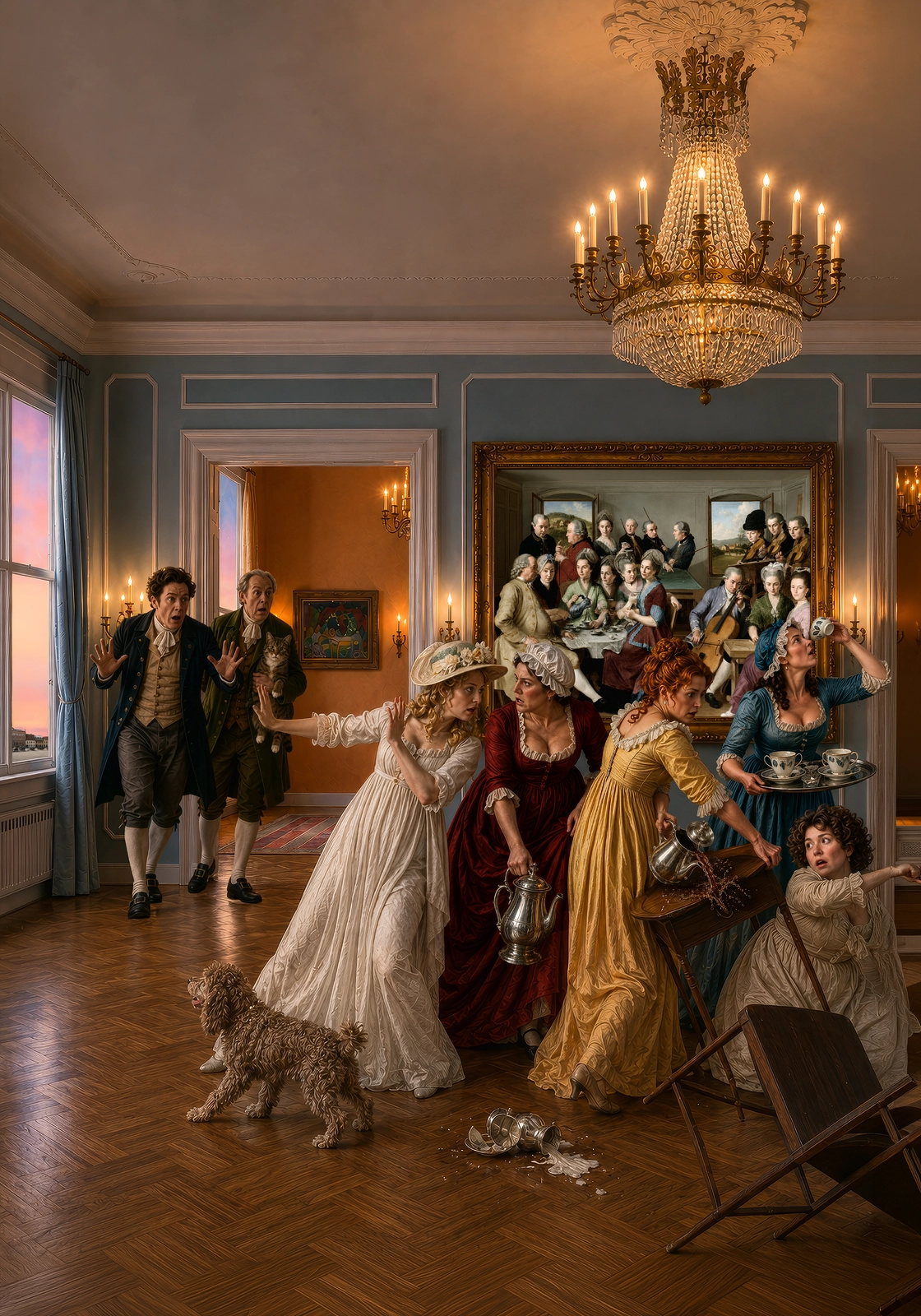
Jörgen Thornberg
Coffee Raid at the Governors - English version, 2026
Digital
50 x 70 cm
3 200 kr
Coffee Raid at the Governors
INTRODUCTION
What do you do when the state bans something that almost everyone has already decided they cannot live without?
You hide the coffee pot.
During the 18th century, coffee evolved from an exotic luxury into an integral part of everyday Swedish life. It was drunk in coffee houses and bourgeois homes, by the gentry and servants alike, at breakfast, after dinner, and whenever good friends gathered around a table. The authorities, on the other hand, did not see merely a dark and fragrant beverage. They saw money leaving the country, extravagance and luxury, and a populace stubbornly refusing to understand what was best for the nation.
The result was taxes, customs duties, and ultimately a total prohibition. Coffee pots were hidden, grinders fell silent at the sound of a knock at the door, and what was served in the next room after dinner might, just to be safe, be called "water." Everyone, of course, knew what it really was.
But in the autumn of 1795, a new problem arose. Although the ban applied to the entire realm, respect for it was not evenly distributed. The young king drank coffee, the court drank coffee, and the Dowager Queen had hardly concealed her opinion on the matter. Just a few months earlier, the king's own coffee kitchen had travelled through Skåne with four horses, and coffee was drunk openly at the great field camp.
Therefore, a certain amount of judgement was required of anyone tasked with uncovering illegal coffee drinking. Above all, one needed to understand which doors not to open.
Two police officers in Malmö failed to understand that.
They sneaked into the Governors residence.
In Praise of the Coffee Pot
Our little town, in days gone by,
Was peaceful, virtuous and still;
The monarchs laws none dared defy,
Our fathers customs were our will.
With faithful friends we drank our brew,
And found it kept us hale and whole;
For every coffee-lover knew
It warmed alike the flesh and soul.
When morning sunlight through the pane
Upon the table cast its ray,
The coffee pot stood there again,
And none begrudged his cup that day.
The burgher drank from finest China,
The poor man from his earthen clay;
But coffees drops, so brown and finer,
Made high and low as one that day.
But ah! what grief, what pallid faces,
When coffees prohibition came!
When spies, dispatched from higher places,
Crept round the houses in its name.
They searched each corner, every room,
And sniffed wherever beans might hide;
They listened for the grinders vroom,
And wondered what was brewed inside.
Now in the cupboard hides the pot,
The grinder silent under key;
At every knock they fear they're caught:
Hide all the cups! Who can it be?
But coffee's fragrance won't obey,
Through every crack it slips outside;
No watchful nose can keep away
Turn from the law, and drink with pride.
So round the house the bailiff creeps,
And peers through window, door and gate;
The scent of coffee through town sweeps,
Yet cup nor pot awaits his fate.
Before the law can make its raid,
The pot is cold, the table bare;
The coffee may be banned by trade
But ban our thirst? They wouldn't dare!
So drink, Your Grace, when doors are tight,
And let the brown ambrosia flow;
What friends enjoy by candlelight
No royal ban need ever know.
And should some spying servant swear
He scents our coffee through the night,
Say: Chimney smoke has filled the air!
Then, just in case, put out the light.
To Her Grace, the Lady Governor of Malmö
Attributed to Johan Elers, Autumn 1794
Malmö, August 2026
The Coffee Hour at the Residence
It was a late afternoon in October 1795. A pink twilight lay over the Main Square (Stortorget), making Malmö look warmer and friendlier than the season allowed. The last daylight filtered through the tall windows of the residence, blending with the light from the candles in the crystal chandelier and the sconces.
I grew up in Malmö but have never been invited to the residence, certainly not in 1795. Yet the feeling of having ended up in a foreign world was less pronounced than I had thought. After more than fifty years in Rome, I had grown accustomed to the fact that time and buildings do not necessarily keep pace. In the Eternal City, a clothing shop could become a bank, the bank a restaurant, and the restaurant a hotel, all behind a facade that looked roughly the same as it had when one's great-great-grandmother lived. Generations of people lived and died, but the houses remained. Rome taught me that the past did not always lie behind you. Sometimes you just needed to open the right door.
The residence gave me a similar feeling. Some of the furniture might be replaced over the next two hundred years, but the proportions of the rooms, the tall windows, and the long row of drawing-rooms forced new generations to adapt to them rather than the other way round.
The most eye-catching feature in the salon was the large painting on the wall. A Dutch family sat together, making music, playing cards, and drinking coffee, which suited the day extraordinarily well. It was difficult to imagine a more appropriate painting in a Swedish room where the very same beverage was temporarily forbidden.
We were five women around the real coffee table: our hostess, Maria Juliana von Rosen; Anna Catharina Suell; Gunilla Kockum; Anna Catharina de la Rose; and me. The four Malmö women had known each other for a long time and hardly needed an introduction. Malmö was no larger than a place where families like Suell, Kockum, and de la Rose constantly crossed each other's paths through kinship, business, and social life.
It was me they were curious about. I came from Rome, which, in its own way, was true, give or take a couple of hundred years. At least, that was the version I used. I told them that my father had been a Swedish diplomat, that I had grown up abroad, and that I was now visiting Sweden. The closer to the truth one stayed, the less one had to remember, and Rome, in my case, was no lie. I had lived there for more than fifty years and could answer almost any question about the city. That these fifty years lay in the future was a detail that did not need to burden the conversation. It also applied to the fact that I lived on a star, Alpha Centauri, and left Earth in 2015. A dizzying time travel that is possible for us in eternity. Telling such things only creates misunderstandings.
The coffee was served by a mademoiselle who knew her business. When La Haijs coffee house closed in 1790, some of the staff were hired at the residencetwo mademoiselles and a maid. They knew how the beans should be roasted, ground, and prepared, and, at least as importantly, how the coffee should be served. Such knowledge was not discarded simply because the government had deemed the result illegal.
The coffee was dark, strong, and excellent. I had drunk significantly worse on Via Veneto. On a small platter lay small, crisp almond biscuits, baked in the residences kitchen from a recipe one of the mademoiselles had brought with her from La Haij. They were moderately sweet and paired well with the strong coffee. Gunilla took one, broke it in two, and dipped it quickly into her cup. Anna Catharina Suell pointed out that she had thereby ruined both the coffee and the biscuit, which Gunilla firmly denied. I tried it myself later and concluded that Gunilla was right.
Maria Juliana noticed that I was observing the painting.
"You are looking at our Dutchmen."
"I am trying to determine whether they are aware of Swedish law."
Gunilla followed my gaze and smiled.
"They are Dutch. They do not need to worry about Swedish regulations."
"Fortunate people."
"Besides, they are dead," said Anna Catharina de la Rose.
"That usually helps too."
She laughed, and I had already begun to like her.
The conversation had begun with Maria Julianas little daughter, Hedvig, who had been born in the summer. Somewhere further into the apartment, the child could be heard very briefly, but the mother did not need to rise. Hedvig had both a wet nurse and a nursery maid, and the babys older siblings had their own caretakers. However, the childs distant cry was enough to steer the conversation towards children, and from there it was not a long step to illnesses. Anna Catharina Suell spoke of a relative who had recently been gravely ill with flux fever. Within a few minutes, Spanish fly, compresses, and strengthening drops had all been recommended.
I stayed out of the discussion. My experiences with 18th-century medicine had taught me that it could sometimes be easier to survive the illness than the treatment.
Gunilla seemed to notice my hesitation.
"You do not look convinced, Mamsell Ekberg. Do they cure flux fever differently in Rome?"
"In many ways, I should think. Personally, I have great respect for physicians who know when to do nothing."
"That sounds unusual," said Maria Juliana.
"And ought to make the doctors visit cheaper," added Anna Catharina de la Rose.
From there, the conversation drifted to Italy. They wanted to know what Rome actually looked like, whether St. Peters Basilica was truly as overwhelming as travellers claimed, and whether Italians were quite as loud as Swedes imagined. These were questions I could answer without any hesitation. I told them about the alleys, the palaces, and the squares, and about the peculiarity of being able to step into a house that was already old when Gustav Vasa was born to buy a pair of gloves.
"But does anything change?" Gunilla asked.
"Everything changes. Only the houses do not. The shops come and go, people move in and die, the signs are replaced, and someone repaints a door. Then you look up and find the house still standing, not caring in the slightest."
"That sounds like a city with good self-confidence," said Maria Juliana.
It was not a bad description of Rome.
She asked how I had actually come into contact with Swedes there, and the story then became somewhat more complicated. I told them that I had met Gustav III during his Italian journey, when he called himself the Count of Haga. I said that his alias could not fool many who met him; he was altogether too much of a king to pass as an ordinary human being.
"That sounds like Gustav," Maria Juliana said with a smile. "Who was with him?"
I mentioned Armfelt first and realised it was not a successful choice. The conversation stalled, as conversations do when someone mentions a person about whom everyone has an opinion but no one quite knows how freely one may speak. I therefore moved on.
"Sergel I knew best."
"Johan Tobias Sergel?" Gunilla asked.
"Yes."
"You say it as if he were a cousin from Lund."
"No. He draws better."
It amused them, but Gunilla wanted to know what he was really like. I paused before answering. Sergel had a gaze that sometimes made me feel he had already sketched you before he even picked up his drawing tool. He did not just see the nose, the chin, or how the hair was arranged, but something behind it all.
"He saw people," I said. "Not just what they wanted to show."
"Surely everyone does that," said Gunilla.
"No. Most people see what people want them to see. Sergel saw the rest too."
Anna Catharina de la Rose tilted her head slightly.
"That sounds like a dangerous quality in a man."
"Particularly in one who can draw," said Fru Suell.
I could agree with that. Gunilla naturally asked whether he had drawn me. I answered somewhat evasively. There were things from our journeys through time that one did not need to account for, even at a very pleasant coffee table.
While we spoke, the coffee had cooled, but none of us needed to point it out. One of the mademoiselles entered with a fresh pot, lifted the old one away, and replenished our cups with hot coffee without interrupting the conversation. At the same time, she replaced the nearly empty biscuit platter with a fresh one. It was clear this had once been her profession. She did not ask if anything was needed, but saw it herself and was gone again before we had managed to pay her any greater attention.
Gustav III soon returned to the conversation. I told them he had urged me to come to Sweden and that I had genuinely intended to do so, but the journey had never come to pass.
"Why not?" Maria Juliana asked.
"I delayed too long. I thought I had plenty of time."
No one said anything for a few moments. The king had been dead for three years, and certain things did not need to be explained. Or ought not to be.
Then Fersen came up.
"Axel von Fersen?" Gunilla asked.
"Yes."
"What was he like?"
I looked at her.
"You do not ask about his political views."
Anna Catharina de la Rose was the first to laugh, and then the others followed. I discovered once again that time travel had its limitations. The houses changed, the clothes changed, the laws changed, and sometimes entire countries changed. Yet certain conversations between women seemed to survive the centuries without major adjustment.
Fersen brought us back to France and to Marie Antoinette. To me, she was a historical figure, but to the women around the table, she was a queen who had died just two years earlier. They had followed the events as they unfolded, read the newspapers, and heard stories travelling from Paris via Hamburg and Copenhagen to Malmö. Anna Catharina de la Rose opined that Copenhagen improved every story before it was sent across the Sound.
"That applies not only to stories," said Gunilla. "It applies to dresses as well."
Anna Catharina Suell sighed.
"There they are."
"What?"
"The dresses. I wondered how long we would be able to talk about the French Revolution before we arrived at the dresses."
It made us laugh. Maria Juliana took one of the almond biscuits. While Gunilla recounted what else she had heard from Copenhagen, the mademoiselle appeared again and filled Anna Catharina de la Roses cup with hot coffee. She kept speaking without even noticing. The service operated with the sort of discretion that made one almost forget, after a while, that someone was managing it; the coffee was hot, and the biscuit platter, remarkably enough, was never truly empty.
France did not quite let go of the conversation. Marie Antoinettes death led back to Gustav III, and from there to the way Sweden had changed over the three years that followed. Reuterholm hardly needed an introduction to anyone at the table. Nor did the caution that spread as people began to weigh their words, causing the newspapers to weigh theirs even more carefully.
Thomas Thorild came up, and Gunilla had difficulty reconciling herself to the idea that a human being could be exiled for putting his thoughts into print.
"Four years," she said. "For words."
"It depends, perhaps, on which words," said Maria Juliana.
"No. It depends on who decides which words are dangerous."
Maria Juliana looked at her over her coffee cup.
"I would say that a bit lower if I were you."
"I am sitting at the residence."
"Exactly for that reason."
There was no quarrel about the matter. They knew each other too well, and perhaps they were all too accustomed to the new caution. Anna Catharina Suell said that nowadays she thought twice before saying what she believed, especially when she did not know who was listening. It was enough for someone to misunderstand a sentence and repeat it to someone else.
"Then the second person repeats it to a third," said Fru de la Rose. "When it comes back, you have said something significantly more interesting than you could ever have invented yourself."
It was when they began to discuss how one could express oneself without saying too much that the name Anna Maria Lenngren emerged. Here, I soon discovered that Gunilla and, in particular, Anna Catharina Suell had a significantly better grasp of Swedish literature than I did.
"There you have at least someone who knows how to say something without giving the censor anything to grab onto," said Gunilla. "She needs only a few lines, and when one has read them, someone has been completely stripped bare, with even his name not appearing in the paper."
"Or hers," said Anna Catharina Suell.
Gunilla understood at once what she meant.
"You are thinking of 'Thé-Conseilen' (The Tea Council)."
"Among other things, it is easy to make fun of women who speak of neighbours, clothes, marriage, and servants when one has first ensured that they are not permitted to occupy themselves with much else."
"But that is the point."
"Are you sure about that?"
Gunilla was. Anna Catharina was not, and I sat between them, realising I had read far too little of Lenngren to be able to help either of them.
"I prefer Bellman," I said.
Now everyone turned toward me.
"Bellman?" said Gunilla. "Ahead of Fru Lenngren?"
She took a sip of coffee before continuing, as if Bellman required something to fortify him before he could be treated fairly.
"He devotes a significant portion of his poetry to taverns, drunkards, and Ulla Winblad."
"He writes about people."
"And the women?"
"Also people."
Gunilla smiled.
"Ulla Winblad, above all."
"That hardly makes him unique among men."
Anna Catharina de la Rose had hitherto contented herself with listening, but now she set down her cup.
"Continue. This is becoming significantly more interesting than Thorild."
I tried to explain what I meant. Bellman had naturally written about schnapps, sex, taverns, and people who did not always behave particularly well, but he had also done something else. He observed people most of the bourgeoisie would hardly have noticed and gave them names, faces, and lives. They were allowed to be ridiculous and tragic, intoxicated and ill, lecherous and tender, and sometimes remarkably beautiful or ugly.
"But it is still Bellman looking at the women," objected Gunilla. "They are seldom permitted to look back."
She had a point.
"I agree with that."
"Then we are approaching Lenngren."
"Not too quickly."
Maria Juliana laughed.
"You stubbornly defend him even though you have never met him."
That was a difficult phrasing, as I had done exactly that. Bellman had never been my strongest suit at school. I mostly remembered Fredman, Ulla Winblad, and many songs that the teachers felt we ought to appreciate. I did not. It became easier much later, when I met him in eternity and discovered that the man behind the legacy was both sharper, funnier, and significantly more complicated than the figure he had become on Earth. Naturally, I could not say that.
"Sergel," I said. "He told me a great deal about Bellman in Rome."
That was at least true.
"Then Sergel may have been biased," said Gunilla.
"It is possible. So am I."
Furthermore, I knew how legacies were created. Bellman had become the man who drank, sang, and chased women. To posterity, I had become the busty blonde who bathed in the Trevi Fountain. Neither image was entirely untrue. That was precisely what made them so effective. The problem was everything that had been clipped away.
Bellman had died in February of that same year, which meant he was still spoken of as a human being rather than as a monument. Maria Juliana thought it remarkable how quickly the Gustavian world seemed to have vanished along with the king and his old circle. At the same time, Anna Catharina Suell pointed out that Bellmans songs hardly seemed to have disappeared. They were still sung.
"They will likely be for a long time," I said.
"There you are, firm again, Mamsell Ekberg," said Anna Catharina de la Rose.
I was beginning to realise that I ought to be more careful about the future. Gunilla, however, had not given up on her candidate.
"Bellman can have the people," she said. "I shall keep Lenngren. She sees something else."
"What?"
"What we do to one another. The titles, the birth, the vanity, and all these rules about who is permitted to be what."
Anna Catharina Suell nodded but returned to the women in "Thé-Conseilen." If they occupied themselves with gossip and pettiness, it might also be because society had made their world small.
"Then perhaps that is exactly what Lenngren shows," Gunilla said.
"Or she is laughing at them."
"It can be both."
It was only during the discussion that I began to take a serious interest in her candidate. I had known very little about Fru Lenngren when I sat down at the table, but the more they told me, the more I found myself agreeing with her, at least on much of what she seemed to want. I had never felt any great need to read my way to the opinion that women were just as capable of thinking as men.
Anna Catharina de la Rose had listened to both sides and seemed at last to tire of the contest.
"I do not understand why you must choose. Bellman writes about people who drink too much, and Fru Lenngren about people who talk too much. Both seem to have had plenty of material."
Maria Juliana laughed.
"Fru Lenngren could certainly write a new 'Thé-Conseil' about us."
Anna Catharina Suell raised her coffee cup.
"Then she will have to change the title. We are not drinking tea."
It was an innocent joke, but in a country where the contents of our cups were forbidden, it had a much sharper edge than it first appeared to have.
From there, Mary Wollstonecraft entered the conversation. She was no distant philosopher to the women. She was a highly contemporary Englishwoman who had just that year travelled through Scandinavia and had attracted attention for both her ideas and her way of life. Gunilla had heard of her views on womens education and could not understand why they should be considered particularly revolutionary.
"If a girl has just as good a head as her brother, why should he be allowed to learn things she is not?"
"Because the brother shall one day rule over her," said Anna Catharina de la Rose.
Gunilla looked at her, surprised.
"Do you truly mean that?"
"Naturally not. I am trying to understand how those who have arranged the matter have thought about it."
"That presupposes they have thought," said Anna Catharina Suell.
Maria Juliana tried to hide a smile behind her coffee cup. Gunilla did not give in. She spoke of unmarried women who were under guardians and married women whose husbands represented them legally. In contrast, the very same women could be responsible for households, servants, and significant sums of money.
"And if the woman becomes a widow, she suddenly has to manage everything herself. How does that work? On Monday she cannot dispose of her own money; on Tuesday her husband dies; and on Wednesday she has apparently regained her wits."
"That is perhaps one of the privileges of widowhood," said Anna Catharina de la Rose. She took the last almond biscuit from the platter, noticed Gunilla watching, and broke it in half. "One need not be a widow to decide over a biscuit."
Gunilla accepted her half.
"Not yet."
Just then, one of the mademoiselles returned with the hot coffee pot and began to fill the cups. Maria Juliana noticed the empty platter and asked her to bring more biscuits next time. The mademoiselle curtsied, and a few minutes later a full platter stood there again, unnoticed.
They laughed at the biscuits, but Gunilla did so only briefly before returning to the matter.
"I do not think it is particularly funny."
"Nor do I," said Anna Catharina. "But after thirty-two years of marriage, I have learned that some things are easier to endure if one is at least allowed to laugh at them."
Anna Catharina Suell pointed out that the men must, in fact, know very well what women were capable of. Otherwise, they would hardly hand over so much of the households practical economy to their wives.
"When the husband is travelling, the wife is expected to be able to resolve everything that arises," she said. "But when he returns home, she needs his approval again."
"The men have the law on their side," said Maria Juliana, who had long listened more than she had spoken. "But we often have reality in our hands."
It fell quiet for a moment. Not because anyone disagreed, but because she had articulated something everyone recognised.
Gunilla turned to me.
"How is it in Rome, Mamsell Ekberg?"
That question was more dangerous than she suspected.
"Not as different as you might hope."
"And do you believe it will always be so?"
"No."
The answer came altogether too quickly. Four women looked at me.
"That sounded very firm," said Maria Juliana.
I looked out the window towards the deepening pink evening sky and took refuge in Rome.
"I have lived a long time in a city where almost nothing seems to change, yet everything does. Emperors, popes, princes, and legislation come and go. The houses remain. It teaches one to be careful with the word 'always'."
"But do you believe women will one day rule themselves?" Gunilla asked.
"Yes."
"Like men?"
"Yes."
"When?"
There lay the limit.
"Not soon enough."
Anna Catharina de la Rose observed me for a moment over the rim of her cup.
"You are a remarkable woman, Mamsell Ekberg."
It had been said before.
"My friends say the same."
As so often happens when a conversation becomes a bit too serious, the women themselves found a way out. It went via Copenhagen and ended with dresses. Gunilla had seen the new fashion there, with lighter fabrics and a silhouette that was beginning to move away from the old wide skirts and tightly fitted bodices. Anna Catharina Suell was sceptical and thought some of the new garments looked as if the dressmaker had run out of fabric, while Gunilla predicted that the others would, within a few years, dress the same way and then deny that they had ever protested.
"Not I," said Fru Suell.
"Women always say that about the next fashion trend."
"If some of those thin dresses become the next fashion, women will freeze to death before they have time to get used to them."
Maria Juliana thought that at least lighter clothing had the advantage that a woman could walk through a door without first having to calculate its width. At the same time, Anna Catharina de la Rose opined that one should not laugh too much at womens fashion, as long as men could still appear in public wearing some of the wigs she had seen.
No one could object to that. From the dresses, they moved on to fabrics, and when French silk was mentioned, something suddenly fell into place for me. I looked at Anna Catharina de la Rose.
"Excuse me. Is your husbands name Nils, by any chance?"
She looked at me.
"Yes."
"Nils de la Rose?"
"I have only one."
"Then I have heard of him."
It had become noticeably more interesting at the table.
"In Rome?" asked Anna Catharina Suell.
"No. Here in Malmö."
Fru de la Rose slowly set down her cup.
"I see."
"It concerned silk."
She closed her eyes for a moment.
"That cursed dress."
I could not help but laugh.
"Then you know the story?"
"Everyone in Malmö knows the story. Catharina Falkman wore the dress once to the Knuts-ball, and since then my husband has spent twenty-six years without knowing where the fabric came from."
"Thirty-six cubits (alnar) of French silk," I said.
Now she opened her eyes fully.
"You know the story better than you ought to."
"I have good sources."
"So did the customs," said Anna Catharina Suell. "It did not help them."
"No," said Fru de la Rose. "Nils still has not the slightest inkling of where the silk came from."
"And you believe him?"
She looked at me as if I had asked an unusually stupid question.
"I have been married to him since 1763."
That was answer enough. There sat, then, the wife of the very same Nils de la Rose, who twenty-six years earlier had had significantly closer contact with Catharina Falkmans forbidden French silk than any customs official had managed to prove. The dress had long since become old-fashioned, and the old import bans had come and gone, but the story evidently still lived on in the family.
While we were still laughing, one of the mademoiselles from La Haijs old coffee house returned with yet another pot. She lifted the old one, now nearly empty, and filled our cups with fresh, hot coffee. She did not need to ask who wanted more; she saw which cups needed filling. She also brought another platter of small almond biscuits, prompting Anna Catharina Suell to wonder whether the intention was to fatten them up before the authorities could punish them. The mademoiselle smiled, curtsied, and disappeared as discreetly as she had come.
The scent of freshly brewed coffee drifted once more through the salon. Anna Catharina de la Rose took her cup.
"Now we speak no more of silk."
"Naturally not."
"Coffee is a much more pleasant topic of conversation."
"And less dangerous?"
She looked at me over the rim of her cup.
"I did not say that."
Outside, the pink sky over the Main Square had deepened and begun to turn violet. The last daylight was fading, while the flames of the chandelier and the sconces were reflected ever more clearly in the tall window panes. On the wall behind us, the Dutch family continued their coffee party with the detachment only people in a painting can exhibit. We kept them company.
After everything we had just said about Thorild and censorship, about Lenngrens way of circumventing it, about laws that determined what people were permitted to say and what women were permitted to do, and about how reality, despite everything, had a capacity to find paths around regulations, perhaps one of us ought to have seen the irony in five women sitting in the Governors residence, drinking forbidden coffee from porcelain cups beneath a painting of people doing precisely the same thing.
We did not.
Therefore, we did not react when we heard a door open somewhere in the gable rooms behind us. The mademoiselles had been going back and forth all afternoon with coffee, biscuits, and porcelain, and in a residence there were always servants in motion. The conversation continued for a few moments more before the sound from the distant room changed. Heavy, resolute footsteps were heard, and I saw that both our hostess and her friends reacted strongly.
"But cross in all my time! Heaven and earth, what is it I behold? Officers!" exclaimed our hostess von Rosen in a shrill voice, and she rose ramrod straight.
"Coffee spies!" hissed de la Rose, looking terrified. "What will my husband say?"
"And my children," sobbed Fru Kockum.
The two officers had barely crossed the threshold into the large salon when I rose and issued a harsh command:
"Stop right there!"
I had seen that sort of entrance before. Not coffee spies, of course, but photographers who rushed across pavements or through hotel lobbies, firmly convinced that a camera gave them the right to force their way forward in any manner whatsoever. During my years in Rome, I had numerous opportunities to confront such men.
I walked straight towards the officers with firm steps. The first had advanced no more than a few paces into the room before I stood in front of him. He tried to continue, but I placed my hand against his chest and pushed him roughly back.
"What business have you here?"
The officer stopped mid-stride and gaped like a goldfish. He had forced his way in with the obvious authority of a senior officer and expected the women before him to become frightened, confused, and quickly submissive. Instead, there stood a tall blonde woman, taller than he, treating him like a rascal.
Behind me, there was a crash. Someone had knocked into the table as she rose. A coffee cup fell to the parquet floor and shattered into several pieces, the cream jug toppled, and a chair scraped across the floor. I did not turn around. It was unnecessary. I heard the rustle of skirts and quick footsteps behind me and understood that the others had grasped exactly what needed to be done.
However, none of the men had grasped anything.
"Move," said the officer, my hand against his chest.
"No."
He stared at me.
"We come by royal command," said the second officer. He tried to sound authoritative, but failed.
"Then you can begin by behaving yourselves." I fixed my gaze on the foremost officer and kept my hand firmly on his chest.
"I..." More than that, it did not come to anything. With a cracking voice, he failed to regain the initiative. Being addressed in that manner by a woman had surely never happened to him before.
Behind my back, a remarkably efficient diversionary manoeuvre was underway. I heard porcelain being moved, but I still didn't turn around. One of the women must have had far better presence of mind than I did, for she even managed to pick up the cream jug and the largest shards from the shipwrecked coffee cup.
Then it grew quiet. The officers stood as if glued to the parquet. Their initial astonishment had begun to subside, and the foremost tried to look authoritative again.
I glanced over my shoulder.
The large salon was empty. The table too. Five women had been sitting there only moments ago. Now I stood alone, and there was not a trace of the coffee.
The officers looked around, bewildered.
"We have a royal decree and are dispatched to stop coffee offenders."
"Does my lord see any coffee?"
He looked toward the empty table.
"No, but it smells!"
"Does it? Then you must sniff elsewhere, for there is no coffee here."
"No, so it appears, but just now there was. And there were five women in the room."
"Indeed. What does that prove? As far as I know, no regulations prevent respectable women from meeting."
"No, but..."
"No buts. Do you have any paper showing that you have the right to force your way into other people's homes?"
He did. The officer straightened. At last, we had entered an area where he felt more secure. He slid his hand inside his coat, produced a folded paper, and carefully unfolded it. There was both a seal and a signature, and the officer held it out with the expression people have when they are convinced that a document has settled a discussion.
I read it, then looked at him.
"I see."
The officer tried to look important. I let my gaze flick from the document to him and back again, giving him roughly the same look I used to reserve for persistent photographers who, after three nos, still believed the fourth attempt would succeed. Then I opened my fabric bag.
"Then perhaps you should see mine."
I hauled out a parchment folded four times. It was significantly larger than his paper, and when I unfolded it, the royal seal was visible at the bottom. I held it in front of him.
ROYAL MAJESTY'S OPEN LETTER AND RECOMMENDATION
We GUSTAF, by the Grace of God, King of Sweden, the Goths, and the Vends, etc. etc. etc. Heir to Norway, Duke of Schleswig-Holstein, Stormarn, and Ditmarsken, Count of Oldenburg and Delmenhorst, etc. etc. Make known: That as We have ever fixed Our special favor and gracious benevolence upon loyalty, diligence, and virtuous qualities; so have We, after mature consideration and of Our free will, found it good hereby to appoint, ordain, and in view of Our high affairs elevate the Virtuous Mamsell Anita Ekbergus as Our eternally personal Envoy and Gracious Representative.
We therefore command and bid, as well as Kindly and Graciously request All and Everyone, to whom this Our Open Letter and Recommendation may be presented, of whatever Estate, Dignity, or Office they may be, not only to render compliance to this Our Royal ordinance, but likewise to assist the aforementioned Mamsell Anita Ekbergus with all the honor, free passage, and assistance which justly belongs to and may be required for Our personal Envoy. It behoves everyone to obey.
In further testimony whereof, We have signed this with Our Own Hand and caused Our Royal Secret Seal to be affixed below.
Given at Our Royal Castle in Stockholm, the 27th of August in the Year after Christs Birth One Thousand Seven Hundred and Eighty-Nine.
GUSTAF
Ad mandatum Sacræ Regiæ Majestatis:
Elis Schröderheim
The officer read, and the goldfish regained its grip on his face. I saw exactly when he reached the name. He read it again, looked at the seal, then at the large royal signature. The colour drained from his face.
I did not need to say anything. I let him stand there with his coffee decree in hand, comparing it with a personal open letter from Gustav III. Finally, I looked at him over the edge of the parchment.
"Well?"
That sufficed. The man bowed so deeply that his forehead nearly touched the parquet floor.
"Mamsell..." His voice was a whisper.
I raised my eyebrows.
"Was there anything else?"
"No, mamsell." He bowed again.
The officer made a hasty gesture to his colleague. The latter needed no further explanation. He too had seen the name and the seal. Both began to back away. They bowed again, took a few more steps backwards through the large opening, and disappeared into the small gable salon. From there, the retreat continued down the same spiral staircase they had used to climb up.
I stayed standing until they had gone. Only then did I fold the parchment.
Gustav had been dead for three years, yet his name remained sacred to many in Malmö and Skåne. Several of his reforms had benefited southern Sweden, and the coffee spy who had just tried to force his way past me was hardly the sort of man who would risk his position by questioning a document bearing Gustav III's own signature, royal seal, and the countersignature of Elis Schröderheim.
The strangest thing was that the document had begun as a joke. I had received it from Gustav in Rome the other yearor nearly two hundred years later, depending on which direction one counted. We had met when he and some of his old travelling companions had made one of their return visits to the city, and Gustav had amused himself with the idea of appointing me his eternally personal Envoy and Gracious Representative. Schröderheim had played along and countersigned the letter to complete the joke. None of us, of course, had counted on my having any practical use for ita curiosity.
I slipped the parchment back into the fabric bag. Five women had been talking and drinking coffee. When the coffee spies came in, they saw five women. Once they understood what had happened, they saw only one.
And no coffee.
One by one, the others returned. Now we were five again, and I ordered the coffee forward once more. Freshly brewed.
It took no more than a few minutes for the pot to stand on the table, the cups to be filled again, and everything to look almost as it had before the interruption. The only visible reminder of the drama was a porcelain shard on the parquet.
"I do not understand how you got them out so quickly," said Gunilla, who had been peering. "The first one looked as if he wanted to sink through the floor. To think he was afraid of a woman."
"He was," I said. "Though not for physical reasons."
"What then?"
I took my cup.
"When he introduced himself as Truls Trulsson, I took a gamble."
"A what?"
"I took a chance." It was apparently an expression that required translation in 1795. "I said I knew who his great-great-grandfather was."
Maria Juliana looked amused.
"Did you know?"
"Not when I said it," I lied.
"Said what?"
"His name was Truls Trulsson. I figured that if ever there were a family where one could guess that the great-great-grandfather was also named Truls."
Anna Catharina Suell began laughing.
"And that sufficed?" Anna Catharina asked incredulously.
"Wait. I said that his great-great-grandfather had lived at the end of the last century and had been caught smuggling a large quantity of tobacco. Then I looked him in the eye and said: 'If that comes out, Trulsson, your days as a spy are numbered'."
"But you did not know that either," Gunilla said.
"No."
"And if his great-great-grandfather had never smuggled tobacco?"
"Then I would have had to invent something different."
Maria Juliana laughed so hard that she had to set her cup down.
"But he believed you?"
"Believe me? He turned completely white. That was when I realised I had hit the mark."
"How could you know the rest?" asked Gunilla. "About the tobacco and the fact that his ancestor had actually been caught?"
I took one of the almond biscuits and dipped it into the coffee, which prompted Anna Catharina Suell to give me the same disapproving look she had given Gunilla.
"That is a story I shall have to tell on another occasion. It comes from the same source that told me about Leonard de la Rose."
It grew quiet at the table. I looked at Anna Catharina de la Rose. She said nothing. She did not need to. Anna Catharina had heard the story of how her husbands ancestor, Leonard de la Rose, had come to grief in the very same customs, and she therefore knew better than the others that my remarkable knowledge of old smugglers was not fabricated.
Gunilla looked from her to me.
"I am beginning to suspect that there is much you do not tell us, Mamsell Ekberg."
"There certainly is."
"And do you intend to tell it?"
"Not today." I lifted the coffee cup. It was hot again. "Today, I think we can content ourselves with noting that Truls Trulsson's great-great-grandfather smuggled tobacco; that his great-great-grandson's career as a coffee spy was saved by his leaving the residence in time; and that Gustav III still commands respect in old Skåne."
Anna Catharina Suell looked at the pot.
"And the coffee?"
I took a sip.
"The coffee survived too."
On the wall, the Dutch family continued their coffee party as if nothing had happened. We joined them.
Epilogue
The aftermath was that the two coffee spiespolice officers, the official designationwere relocated to guard the marshiest part of Lake Östra Ringsjön and keep the gulls there in "the nurture and admonition of the Lord," as stated in the job description.
It was hardly a major legal scandal. The regency government had admittedly banned coffee, but the court seems to have taken the ban with considerable composure. The young king drank coffee, the court drank coffee, and the Dowager Queen had more or less openly declared that she intended to continue drinking hers. When the court travelled through Skåne that same year, the king's coffee kitchen followed, requiring four horses, and at the great field camp, coffee was drunk openly in tents and canteens.
And so it was done in some quarters, even in bourgeois homes. After dinner, the guests might be invited into an adjoining room to drink "water." Everyone present naturally knew what was meant. It was a remarkably dark, warm, and fragrant water, served from a chased-silver coffee pot and preferably drunk from a coffee cup with double ears or from the saucer, since the coffee was served piping hot. As long as everyone agreed it was water, there was no great reason to ruin a pleasant evening by claiming otherwise.
Nor are Malmö's ruling gentlemen said to have died of thirst. According to history, something officially called "vann" (water) or "Aqua Nera" was served at the magistrates meetings at the Town Hall and drunk in an adjoining room. Whether that story is true, I do not know, but given what was going on in the rest of the country, it would hardly surprise me.
Against that background, it was perhaps not so remarkable that Governor von Rosen and his guests did not regard a cup of coffee at the Residence as a crime that should shake the realm.
PS.
The coffee had travelled a long way before it reached Swedish cups. By the middle of the 16th century, it had reached Constantinople, and from there the beverage spread across Europe over the following century, not least through Venetian merchants.
Coffee arrived in earnest in Sweden only at the beginning of the 18th century, and the path here was unusual, to say the least. After the defeat at Poltava in 1709, Karl XII fled with many Swedes to the Ottoman Empire and eventually settled in Bender. There, the Swedes became acquainted with a beverage the Turks had long drunk but which, back home in Sweden, was still virtually exotic: coffee.
When the king returned north after his years in Turkey, the habit followed him. In 1715, Turks also came to Sweden in the king's retinue, and they naturally did not leave their coffee behind.
In that way, the Swedes came to know a beverage they would soon become so fond of that neither taxes, royal ordinances, seizures, fines, nor repeated total bans could make them stop drinking coffee. That can be called a successful import.
Early coffee houses served as open social clubs. There, not only was coffee drunk, but politics were discussed, news exchanged, and billiards, chess, and backgammon were played.
Coffee was, of course, nothing new in the 18th century. By the previous century, specific coffee houses had already appeared in Europe's major citiesLondon, Paris, Vienna, Berlin, Leipzig, and Hamburgand Sweden followed suit. By 1728, there were already some fifteen coffee houses in Stockholm.
But one should not think of them as today's cafés, where one sits down with a cup and a pastry. The coffee houses were rather open social clubs. There, the gentlemen drank coffee, read, exchanged news, discussed politics, were intrigued, and played billiards, backgammon, or chess. Already in 1708, the authorities complained about all these idlers and unemployed wanderers who frequented taverns and coffee houses. It sounds almost as if the coffee itself was the least of the problems.
Naturally, the state could not allow people to sit and enjoy themselves without regulation. Throughout the 18th century, coffee houses were therefore subject to royal ordinances. Anyone running a coffee house in a larger city could be required to pay a tax of between 150 and 300 daler in silver coin per year. Furthermore, coffee could only be boiled and sold within the coffee houses. It had to be consumed there and could neither be carried out nor fetched from there.
Anyone defying the regulation risked a fine of 100 daler in silver and was furthermore deprived of both vessels and cups. Not even the opening hours could the coffee house owner determine himself. Between August 1st and May 1st, taverns, cellars, and coffee houses had to close at 9 p.m. During the summer, they were permitted to stay open until ten. Violating the rules cost ten daler in silver, and the state had devised a particularly effective system: half of the fines went to the parish poor and the other half to the one who had informed on the sinner.
On Sundays and holidays, billiards and other table games were also forbidden in cellars and coffee houses. To ensure no one could claim ignorance, the royal regulations were to be posted on the walls of inns, coffee houses, cellars, taverns, and guesthouses throughout the country.
All this helped little. The Swedes had discovered coffee and evidently had no intention of surrendering it. Finally, the Collegium Medicum, the highest medical authority of the time, also began to worry. In 1746, it proclaimed the increasing excess and abuse of coffee. The following year, the state attempted to curb consumption with a special coffee tax. How much one paid depended on who one was; the fee ranged from 2 to 12 riksdaler in silver a year, depending on social class.
Nor did that work. In 1756, the parliament therefore resorted to the simplest measure: it banned coffee entirely. The remarkable thing is that the ban was not just about coffee. The estate of the peasantry pushed it through as a form of political revenge, since the peasants had been denied the free distillation of schnapps they had previously enjoyed. If the peasants were not to be allowed to distil their schnapps, the gentry could well do without their coffee.
It went roughly as could be expected. For ten years, coffee continued to enter Sweden by all kinds of stealthy routes. When the great sumptuary ordinance was enacted in 1766, the ban was renewed and explicitly covered both the importation and the use of coffee. But coffee continued to defy the borders. The smugglers did what smugglers have always done when the state bans something people nonetheless want to buy: they ensured it was delivered.
At last, the authorities gave up. In 1769, coffee was permitted again, but only at a high tariff. The matter was not settled. A new coffee ban was introduced in 1794 and repealed in 1796, when Gustav IV Adolf assumed power. They tried again in 17991802 and yet again in 18171822. Sweden thus devoted a surprisingly large part of a century to deciding whether people should be allowed to drink coffee.
The most amusing thing, perhaps, is that medical science was not even in agreement with the state about how dangerous this beverage was. Carl von Linné (Linnaeus) wrote an entire essay on coffee in an almanack in 1747at that time one of the most widely circulated writings among ordinary people after the Bible and the hymnal. And Linné was hardly an enemy of coffee. On the contrary, he enumerated no fewer than eight occasions when a cup could do a person good.
According to him, coffee was excellent for anyone who had felt ill after drinking strong beverages the day before. It helped anyone who had become heavy and drowsy after a substantial dinner, and the well-living person who ate well but worked too little. The coffee made her cheerful and could wake a sleepy brain.
He also recommended it for migraines, intestinal worms, certain female complaints, and obesity. In the case of the stomach pain called cardialgiaor, as Linné expressed it, the Dalecarlians Bälua couple of cups of coffee without sugar, quickly gulped down, could serve as a remarkably effective remedy.
It is a rather wonderful contradiction. At the same time that the country's most famous naturalist was telling Swedes about the medical benefits of coffee, the authorities, led by the Collegium Medicum, were warning of the dangers of coffee abuse and urging people to cut down.
Actually, it was not very much about health.
The real worry was money.
Coffee was an imported luxury item and had to be paid for in foreign currency or in gold. In the economic thinking of that time, this was a problem. The state wanted to prevent Swedish money from leaving the country and therefore sought to limit or halt imports. When it turned out that the Swedes continued to drink coffee and smugglers continued to bring it in, the solution was the old familiar one: the state permitted the import again and collected customs duties on it. And that was, of course, significantly wiser. If people by all means intended to drink coffee, the state could at least make money from it.
Though it would take some time before all Swedish governments understood the matter, coffee would be banned again, smuggled again, and seized again. And when the police eventually began knocking on doors to look for coffee pots, grinders, and freshly roasted beans, an ordinary cup of coffee had become something far more exciting than a warm beverage.
It had become contraband.
The Coffee in Malmö
Coffee houses and taverns were, at times, an important part of social life for Malmö's citizens during the 18th century. But Malmö was still a small town, and unlike Stockholm, its coffee houses had difficulty surviving for any length of time.
In January 1787, however, a new entrepreneur appeared. The music director, Henric La Haij, had moved to Malmö from Gothenburg, where he had previously run a coffee house with billiards. He now approached the magistrate and requested permission to keep a Coffee House, Billiards, and Inn for Travellers.
La Haij had clearly done some market research. In his application, he noted that there was currently no coffee house in Malmö and therefore hoped that such an establishment would be both more in demand and more profitable here. The town elders had no objection, and the magistrate gave him permission to open a coffee house and an inn for the convenience of travellers.
La Haij seems to have been keen to maintain good relations with the town's ruling gentlemen. A couple of months later, he sent the magistrate an elegantly phrased humble thanksgiving for the permit. He wrote that he ought naturally to have conveyed his thanks in person, but he was still a stranger to the town and spoke Swedish so poorly that he preferred to do so in writing.
Then he concluded with something that sounded almost like the 18th-century equivalent of a personal invitation to an opening. He would regard it as further proof of the magistrate's goodwill if he were to see the highly noble gentlemen in my Lodgings or the Billiards at some time. It was at least difficult to accuse him of poor customer care.
The following year, we find La Haij in the census register. He lived in the property at the corner of Västergatan and Mäster Johansgatan and ran his coffee house there. The business was not insignificant. To assist him, the music director had two mademoiselles, two maids, and a stableman. There, Malmö's citizens could drink coffee, play billiards, meet acquaintances, and discuss the day's events, while travellers could obtain both food and lodging.
But even La Haij failed to keep the coffee house open long. That was a recurring problem in Malmö during the 18th century. The town's coffee houses usually lasted only a few years before disappearing again. Malmö was still a peripheral Swedish small town and lacked Stockholm's population base. In Stockholm, the coffee houses could flourish as meeting places for people with both money and time to devote to coffee, games, news, and political discussions. In Malmö, that customer base seemed too small, even though there was nothing wrong with the thirst for coffee. Probably it was as simple as Malmö residents having other things to do than sit idle at a coffee house, such as earning money. Coffee was expensive, even when brewed at home.
By around 1790, La Haijs time as a coffee house host had also ended. After La Haij stopped serving coffee and music in 1790, there was no longer any coffee house in Malmö. The town's population did not, of course, stop drinking coffee for that reasonquite the contrary. As in the capital, coffee was drunk like never before, to Gustav III's vexation. The king was deeply suspicious of the beverage and convinced that it could hardly be wholesome.
La Haij's two mademoiselles and one of the maids instead found employment at the Residence, where they ensured the Governor and his guests were entertained as the demands of the time required. It would prove an excellent arrangementat least until the day coffee was banned again.
During this period, the king also staged his famous investigation into the health risks of coffee. More about that later.
Coffee was still permitted, even though its import was subject to high tariffs. The state wanted to limit the introduction of foreign luxury goods while at the same time earning income from coffee, which the Swedes obviously did not intend to stop drinking.
Gustav III was assassinated in 1792.
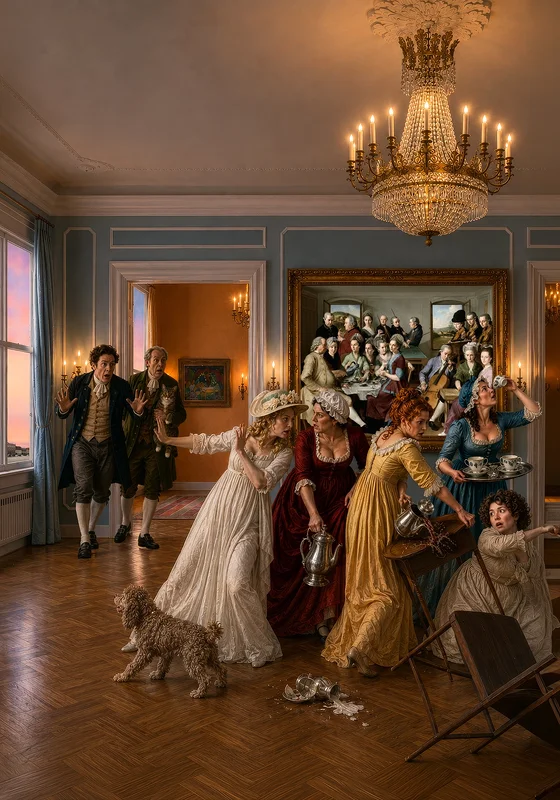
Jörgen Thornberg
Coffee Raid at the Governors - English version, 2026
Digital
50 x 70 cm
3 200 kr
Coffee Raid at the Governors
INTRODUCTION
What do you do when the state bans something that almost everyone has already decided they cannot live without?
You hide the coffee pot.
During the 18th century, coffee evolved from an exotic luxury into an integral part of everyday Swedish life. It was drunk in coffee houses and bourgeois homes, by the gentry and servants alike, at breakfast, after dinner, and whenever good friends gathered around a table. The authorities, on the other hand, did not see merely a dark and fragrant beverage. They saw money leaving the country, extravagance and luxury, and a populace stubbornly refusing to understand what was best for the nation.
The result was taxes, customs duties, and ultimately a total prohibition. Coffee pots were hidden, grinders fell silent at the sound of a knock at the door, and what was served in the next room after dinner might, just to be safe, be called "water." Everyone, of course, knew what it really was.
But in the autumn of 1795, a new problem arose. Although the ban applied to the entire realm, respect for it was not evenly distributed. The young king drank coffee, the court drank coffee, and the Dowager Queen had hardly concealed her opinion on the matter. Just a few months earlier, the king's own coffee kitchen had travelled through Skåne with four horses, and coffee was drunk openly at the great field camp.
Therefore, a certain amount of judgement was required of anyone tasked with uncovering illegal coffee drinking. Above all, one needed to understand which doors not to open.
Two police officers in Malmö failed to understand that.
They sneaked into the Governors residence.
In Praise of the Coffee Pot
Our little town, in days gone by,
Was peaceful, virtuous and still;
The monarchs laws none dared defy,
Our fathers customs were our will.
With faithful friends we drank our brew,
And found it kept us hale and whole;
For every coffee-lover knew
It warmed alike the flesh and soul.
When morning sunlight through the pane
Upon the table cast its ray,
The coffee pot stood there again,
And none begrudged his cup that day.
The burgher drank from finest China,
The poor man from his earthen clay;
But coffees drops, so brown and finer,
Made high and low as one that day.
But ah! what grief, what pallid faces,
When coffees prohibition came!
When spies, dispatched from higher places,
Crept round the houses in its name.
They searched each corner, every room,
And sniffed wherever beans might hide;
They listened for the grinders vroom,
And wondered what was brewed inside.
Now in the cupboard hides the pot,
The grinder silent under key;
At every knock they fear they're caught:
Hide all the cups! Who can it be?
But coffee's fragrance won't obey,
Through every crack it slips outside;
No watchful nose can keep away
Turn from the law, and drink with pride.
So round the house the bailiff creeps,
And peers through window, door and gate;
The scent of coffee through town sweeps,
Yet cup nor pot awaits his fate.
Before the law can make its raid,
The pot is cold, the table bare;
The coffee may be banned by trade
But ban our thirst? They wouldn't dare!
So drink, Your Grace, when doors are tight,
And let the brown ambrosia flow;
What friends enjoy by candlelight
No royal ban need ever know.
And should some spying servant swear
He scents our coffee through the night,
Say: Chimney smoke has filled the air!
Then, just in case, put out the light.
To Her Grace, the Lady Governor of Malmö
Attributed to Johan Elers, Autumn 1794
Malmö, August 2026
The Coffee Hour at the Residence
It was a late afternoon in October 1795. A pink twilight lay over the Main Square (Stortorget), making Malmö look warmer and friendlier than the season allowed. The last daylight filtered through the tall windows of the residence, blending with the light from the candles in the crystal chandelier and the sconces.
I grew up in Malmö but have never been invited to the residence, certainly not in 1795. Yet the feeling of having ended up in a foreign world was less pronounced than I had thought. After more than fifty years in Rome, I had grown accustomed to the fact that time and buildings do not necessarily keep pace. In the Eternal City, a clothing shop could become a bank, the bank a restaurant, and the restaurant a hotel, all behind a facade that looked roughly the same as it had when one's great-great-grandmother lived. Generations of people lived and died, but the houses remained. Rome taught me that the past did not always lie behind you. Sometimes you just needed to open the right door.
The residence gave me a similar feeling. Some of the furniture might be replaced over the next two hundred years, but the proportions of the rooms, the tall windows, and the long row of drawing-rooms forced new generations to adapt to them rather than the other way round.
The most eye-catching feature in the salon was the large painting on the wall. A Dutch family sat together, making music, playing cards, and drinking coffee, which suited the day extraordinarily well. It was difficult to imagine a more appropriate painting in a Swedish room where the very same beverage was temporarily forbidden.
We were five women around the real coffee table: our hostess, Maria Juliana von Rosen; Anna Catharina Suell; Gunilla Kockum; Anna Catharina de la Rose; and me. The four Malmö women had known each other for a long time and hardly needed an introduction. Malmö was no larger than a place where families like Suell, Kockum, and de la Rose constantly crossed each other's paths through kinship, business, and social life.
It was me they were curious about. I came from Rome, which, in its own way, was true, give or take a couple of hundred years. At least, that was the version I used. I told them that my father had been a Swedish diplomat, that I had grown up abroad, and that I was now visiting Sweden. The closer to the truth one stayed, the less one had to remember, and Rome, in my case, was no lie. I had lived there for more than fifty years and could answer almost any question about the city. That these fifty years lay in the future was a detail that did not need to burden the conversation. It also applied to the fact that I lived on a star, Alpha Centauri, and left Earth in 2015. A dizzying time travel that is possible for us in eternity. Telling such things only creates misunderstandings.
The coffee was served by a mademoiselle who knew her business. When La Haijs coffee house closed in 1790, some of the staff were hired at the residencetwo mademoiselles and a maid. They knew how the beans should be roasted, ground, and prepared, and, at least as importantly, how the coffee should be served. Such knowledge was not discarded simply because the government had deemed the result illegal.
The coffee was dark, strong, and excellent. I had drunk significantly worse on Via Veneto. On a small platter lay small, crisp almond biscuits, baked in the residences kitchen from a recipe one of the mademoiselles had brought with her from La Haij. They were moderately sweet and paired well with the strong coffee. Gunilla took one, broke it in two, and dipped it quickly into her cup. Anna Catharina Suell pointed out that she had thereby ruined both the coffee and the biscuit, which Gunilla firmly denied. I tried it myself later and concluded that Gunilla was right.
Maria Juliana noticed that I was observing the painting.
"You are looking at our Dutchmen."
"I am trying to determine whether they are aware of Swedish law."
Gunilla followed my gaze and smiled.
"They are Dutch. They do not need to worry about Swedish regulations."
"Fortunate people."
"Besides, they are dead," said Anna Catharina de la Rose.
"That usually helps too."
She laughed, and I had already begun to like her.
The conversation had begun with Maria Julianas little daughter, Hedvig, who had been born in the summer. Somewhere further into the apartment, the child could be heard very briefly, but the mother did not need to rise. Hedvig had both a wet nurse and a nursery maid, and the babys older siblings had their own caretakers. However, the childs distant cry was enough to steer the conversation towards children, and from there it was not a long step to illnesses. Anna Catharina Suell spoke of a relative who had recently been gravely ill with flux fever. Within a few minutes, Spanish fly, compresses, and strengthening drops had all been recommended.
I stayed out of the discussion. My experiences with 18th-century medicine had taught me that it could sometimes be easier to survive the illness than the treatment.
Gunilla seemed to notice my hesitation.
"You do not look convinced, Mamsell Ekberg. Do they cure flux fever differently in Rome?"
"In many ways, I should think. Personally, I have great respect for physicians who know when to do nothing."
"That sounds unusual," said Maria Juliana.
"And ought to make the doctors visit cheaper," added Anna Catharina de la Rose.
From there, the conversation drifted to Italy. They wanted to know what Rome actually looked like, whether St. Peters Basilica was truly as overwhelming as travellers claimed, and whether Italians were quite as loud as Swedes imagined. These were questions I could answer without any hesitation. I told them about the alleys, the palaces, and the squares, and about the peculiarity of being able to step into a house that was already old when Gustav Vasa was born to buy a pair of gloves.
"But does anything change?" Gunilla asked.
"Everything changes. Only the houses do not. The shops come and go, people move in and die, the signs are replaced, and someone repaints a door. Then you look up and find the house still standing, not caring in the slightest."
"That sounds like a city with good self-confidence," said Maria Juliana.
It was not a bad description of Rome.
She asked how I had actually come into contact with Swedes there, and the story then became somewhat more complicated. I told them that I had met Gustav III during his Italian journey, when he called himself the Count of Haga. I said that his alias could not fool many who met him; he was altogether too much of a king to pass as an ordinary human being.
"That sounds like Gustav," Maria Juliana said with a smile. "Who was with him?"
I mentioned Armfelt first and realised it was not a successful choice. The conversation stalled, as conversations do when someone mentions a person about whom everyone has an opinion but no one quite knows how freely one may speak. I therefore moved on.
"Sergel I knew best."
"Johan Tobias Sergel?" Gunilla asked.
"Yes."
"You say it as if he were a cousin from Lund."
"No. He draws better."
It amused them, but Gunilla wanted to know what he was really like. I paused before answering. Sergel had a gaze that sometimes made me feel he had already sketched you before he even picked up his drawing tool. He did not just see the nose, the chin, or how the hair was arranged, but something behind it all.
"He saw people," I said. "Not just what they wanted to show."
"Surely everyone does that," said Gunilla.
"No. Most people see what people want them to see. Sergel saw the rest too."
Anna Catharina de la Rose tilted her head slightly.
"That sounds like a dangerous quality in a man."
"Particularly in one who can draw," said Fru Suell.
I could agree with that. Gunilla naturally asked whether he had drawn me. I answered somewhat evasively. There were things from our journeys through time that one did not need to account for, even at a very pleasant coffee table.
While we spoke, the coffee had cooled, but none of us needed to point it out. One of the mademoiselles entered with a fresh pot, lifted the old one away, and replenished our cups with hot coffee without interrupting the conversation. At the same time, she replaced the nearly empty biscuit platter with a fresh one. It was clear this had once been her profession. She did not ask if anything was needed, but saw it herself and was gone again before we had managed to pay her any greater attention.
Gustav III soon returned to the conversation. I told them he had urged me to come to Sweden and that I had genuinely intended to do so, but the journey had never come to pass.
"Why not?" Maria Juliana asked.
"I delayed too long. I thought I had plenty of time."
No one said anything for a few moments. The king had been dead for three years, and certain things did not need to be explained. Or ought not to be.
Then Fersen came up.
"Axel von Fersen?" Gunilla asked.
"Yes."
"What was he like?"
I looked at her.
"You do not ask about his political views."
Anna Catharina de la Rose was the first to laugh, and then the others followed. I discovered once again that time travel had its limitations. The houses changed, the clothes changed, the laws changed, and sometimes entire countries changed. Yet certain conversations between women seemed to survive the centuries without major adjustment.
Fersen brought us back to France and to Marie Antoinette. To me, she was a historical figure, but to the women around the table, she was a queen who had died just two years earlier. They had followed the events as they unfolded, read the newspapers, and heard stories travelling from Paris via Hamburg and Copenhagen to Malmö. Anna Catharina de la Rose opined that Copenhagen improved every story before it was sent across the Sound.
"That applies not only to stories," said Gunilla. "It applies to dresses as well."
Anna Catharina Suell sighed.
"There they are."
"What?"
"The dresses. I wondered how long we would be able to talk about the French Revolution before we arrived at the dresses."
It made us laugh. Maria Juliana took one of the almond biscuits. While Gunilla recounted what else she had heard from Copenhagen, the mademoiselle appeared again and filled Anna Catharina de la Roses cup with hot coffee. She kept speaking without even noticing. The service operated with the sort of discretion that made one almost forget, after a while, that someone was managing it; the coffee was hot, and the biscuit platter, remarkably enough, was never truly empty.
France did not quite let go of the conversation. Marie Antoinettes death led back to Gustav III, and from there to the way Sweden had changed over the three years that followed. Reuterholm hardly needed an introduction to anyone at the table. Nor did the caution that spread as people began to weigh their words, causing the newspapers to weigh theirs even more carefully.
Thomas Thorild came up, and Gunilla had difficulty reconciling herself to the idea that a human being could be exiled for putting his thoughts into print.
"Four years," she said. "For words."
"It depends, perhaps, on which words," said Maria Juliana.
"No. It depends on who decides which words are dangerous."
Maria Juliana looked at her over her coffee cup.
"I would say that a bit lower if I were you."
"I am sitting at the residence."
"Exactly for that reason."
There was no quarrel about the matter. They knew each other too well, and perhaps they were all too accustomed to the new caution. Anna Catharina Suell said that nowadays she thought twice before saying what she believed, especially when she did not know who was listening. It was enough for someone to misunderstand a sentence and repeat it to someone else.
"Then the second person repeats it to a third," said Fru de la Rose. "When it comes back, you have said something significantly more interesting than you could ever have invented yourself."
It was when they began to discuss how one could express oneself without saying too much that the name Anna Maria Lenngren emerged. Here, I soon discovered that Gunilla and, in particular, Anna Catharina Suell had a significantly better grasp of Swedish literature than I did.
"There you have at least someone who knows how to say something without giving the censor anything to grab onto," said Gunilla. "She needs only a few lines, and when one has read them, someone has been completely stripped bare, with even his name not appearing in the paper."
"Or hers," said Anna Catharina Suell.
Gunilla understood at once what she meant.
"You are thinking of 'Thé-Conseilen' (The Tea Council)."
"Among other things, it is easy to make fun of women who speak of neighbours, clothes, marriage, and servants when one has first ensured that they are not permitted to occupy themselves with much else."
"But that is the point."
"Are you sure about that?"
Gunilla was. Anna Catharina was not, and I sat between them, realising I had read far too little of Lenngren to be able to help either of them.
"I prefer Bellman," I said.
Now everyone turned toward me.
"Bellman?" said Gunilla. "Ahead of Fru Lenngren?"
She took a sip of coffee before continuing, as if Bellman required something to fortify him before he could be treated fairly.
"He devotes a significant portion of his poetry to taverns, drunkards, and Ulla Winblad."
"He writes about people."
"And the women?"
"Also people."
Gunilla smiled.
"Ulla Winblad, above all."
"That hardly makes him unique among men."
Anna Catharina de la Rose had hitherto contented herself with listening, but now she set down her cup.
"Continue. This is becoming significantly more interesting than Thorild."
I tried to explain what I meant. Bellman had naturally written about schnapps, sex, taverns, and people who did not always behave particularly well, but he had also done something else. He observed people most of the bourgeoisie would hardly have noticed and gave them names, faces, and lives. They were allowed to be ridiculous and tragic, intoxicated and ill, lecherous and tender, and sometimes remarkably beautiful or ugly.
"But it is still Bellman looking at the women," objected Gunilla. "They are seldom permitted to look back."
She had a point.
"I agree with that."
"Then we are approaching Lenngren."
"Not too quickly."
Maria Juliana laughed.
"You stubbornly defend him even though you have never met him."
That was a difficult phrasing, as I had done exactly that. Bellman had never been my strongest suit at school. I mostly remembered Fredman, Ulla Winblad, and many songs that the teachers felt we ought to appreciate. I did not. It became easier much later, when I met him in eternity and discovered that the man behind the legacy was both sharper, funnier, and significantly more complicated than the figure he had become on Earth. Naturally, I could not say that.
"Sergel," I said. "He told me a great deal about Bellman in Rome."
That was at least true.
"Then Sergel may have been biased," said Gunilla.
"It is possible. So am I."
Furthermore, I knew how legacies were created. Bellman had become the man who drank, sang, and chased women. To posterity, I had become the busty blonde who bathed in the Trevi Fountain. Neither image was entirely untrue. That was precisely what made them so effective. The problem was everything that had been clipped away.
Bellman had died in February of that same year, which meant he was still spoken of as a human being rather than as a monument. Maria Juliana thought it remarkable how quickly the Gustavian world seemed to have vanished along with the king and his old circle. At the same time, Anna Catharina Suell pointed out that Bellmans songs hardly seemed to have disappeared. They were still sung.
"They will likely be for a long time," I said.
"There you are, firm again, Mamsell Ekberg," said Anna Catharina de la Rose.
I was beginning to realise that I ought to be more careful about the future. Gunilla, however, had not given up on her candidate.
"Bellman can have the people," she said. "I shall keep Lenngren. She sees something else."
"What?"
"What we do to one another. The titles, the birth, the vanity, and all these rules about who is permitted to be what."
Anna Catharina Suell nodded but returned to the women in "Thé-Conseilen." If they occupied themselves with gossip and pettiness, it might also be because society had made their world small.
"Then perhaps that is exactly what Lenngren shows," Gunilla said.
"Or she is laughing at them."
"It can be both."
It was only during the discussion that I began to take a serious interest in her candidate. I had known very little about Fru Lenngren when I sat down at the table, but the more they told me, the more I found myself agreeing with her, at least on much of what she seemed to want. I had never felt any great need to read my way to the opinion that women were just as capable of thinking as men.
Anna Catharina de la Rose had listened to both sides and seemed at last to tire of the contest.
"I do not understand why you must choose. Bellman writes about people who drink too much, and Fru Lenngren about people who talk too much. Both seem to have had plenty of material."
Maria Juliana laughed.
"Fru Lenngren could certainly write a new 'Thé-Conseil' about us."
Anna Catharina Suell raised her coffee cup.
"Then she will have to change the title. We are not drinking tea."
It was an innocent joke, but in a country where the contents of our cups were forbidden, it had a much sharper edge than it first appeared to have.
From there, Mary Wollstonecraft entered the conversation. She was no distant philosopher to the women. She was a highly contemporary Englishwoman who had just that year travelled through Scandinavia and had attracted attention for both her ideas and her way of life. Gunilla had heard of her views on womens education and could not understand why they should be considered particularly revolutionary.
"If a girl has just as good a head as her brother, why should he be allowed to learn things she is not?"
"Because the brother shall one day rule over her," said Anna Catharina de la Rose.
Gunilla looked at her, surprised.
"Do you truly mean that?"
"Naturally not. I am trying to understand how those who have arranged the matter have thought about it."
"That presupposes they have thought," said Anna Catharina Suell.
Maria Juliana tried to hide a smile behind her coffee cup. Gunilla did not give in. She spoke of unmarried women who were under guardians and married women whose husbands represented them legally. In contrast, the very same women could be responsible for households, servants, and significant sums of money.
"And if the woman becomes a widow, she suddenly has to manage everything herself. How does that work? On Monday she cannot dispose of her own money; on Tuesday her husband dies; and on Wednesday she has apparently regained her wits."
"That is perhaps one of the privileges of widowhood," said Anna Catharina de la Rose. She took the last almond biscuit from the platter, noticed Gunilla watching, and broke it in half. "One need not be a widow to decide over a biscuit."
Gunilla accepted her half.
"Not yet."
Just then, one of the mademoiselles returned with the hot coffee pot and began to fill the cups. Maria Juliana noticed the empty platter and asked her to bring more biscuits next time. The mademoiselle curtsied, and a few minutes later a full platter stood there again, unnoticed.
They laughed at the biscuits, but Gunilla did so only briefly before returning to the matter.
"I do not think it is particularly funny."
"Nor do I," said Anna Catharina. "But after thirty-two years of marriage, I have learned that some things are easier to endure if one is at least allowed to laugh at them."
Anna Catharina Suell pointed out that the men must, in fact, know very well what women were capable of. Otherwise, they would hardly hand over so much of the households practical economy to their wives.
"When the husband is travelling, the wife is expected to be able to resolve everything that arises," she said. "But when he returns home, she needs his approval again."
"The men have the law on their side," said Maria Juliana, who had long listened more than she had spoken. "But we often have reality in our hands."
It fell quiet for a moment. Not because anyone disagreed, but because she had articulated something everyone recognised.
Gunilla turned to me.
"How is it in Rome, Mamsell Ekberg?"
That question was more dangerous than she suspected.
"Not as different as you might hope."
"And do you believe it will always be so?"
"No."
The answer came altogether too quickly. Four women looked at me.
"That sounded very firm," said Maria Juliana.
I looked out the window towards the deepening pink evening sky and took refuge in Rome.
"I have lived a long time in a city where almost nothing seems to change, yet everything does. Emperors, popes, princes, and legislation come and go. The houses remain. It teaches one to be careful with the word 'always'."
"But do you believe women will one day rule themselves?" Gunilla asked.
"Yes."
"Like men?"
"Yes."
"When?"
There lay the limit.
"Not soon enough."
Anna Catharina de la Rose observed me for a moment over the rim of her cup.
"You are a remarkable woman, Mamsell Ekberg."
It had been said before.
"My friends say the same."
As so often happens when a conversation becomes a bit too serious, the women themselves found a way out. It went via Copenhagen and ended with dresses. Gunilla had seen the new fashion there, with lighter fabrics and a silhouette that was beginning to move away from the old wide skirts and tightly fitted bodices. Anna Catharina Suell was sceptical and thought some of the new garments looked as if the dressmaker had run out of fabric, while Gunilla predicted that the others would, within a few years, dress the same way and then deny that they had ever protested.
"Not I," said Fru Suell.
"Women always say that about the next fashion trend."
"If some of those thin dresses become the next fashion, women will freeze to death before they have time to get used to them."
Maria Juliana thought that at least lighter clothing had the advantage that a woman could walk through a door without first having to calculate its width. At the same time, Anna Catharina de la Rose opined that one should not laugh too much at womens fashion, as long as men could still appear in public wearing some of the wigs she had seen.
No one could object to that. From the dresses, they moved on to fabrics, and when French silk was mentioned, something suddenly fell into place for me. I looked at Anna Catharina de la Rose.
"Excuse me. Is your husbands name Nils, by any chance?"
She looked at me.
"Yes."
"Nils de la Rose?"
"I have only one."
"Then I have heard of him."
It had become noticeably more interesting at the table.
"In Rome?" asked Anna Catharina Suell.
"No. Here in Malmö."
Fru de la Rose slowly set down her cup.
"I see."
"It concerned silk."
She closed her eyes for a moment.
"That cursed dress."
I could not help but laugh.
"Then you know the story?"
"Everyone in Malmö knows the story. Catharina Falkman wore the dress once to the Knuts-ball, and since then my husband has spent twenty-six years without knowing where the fabric came from."
"Thirty-six cubits (alnar) of French silk," I said.
Now she opened her eyes fully.
"You know the story better than you ought to."
"I have good sources."
"So did the customs," said Anna Catharina Suell. "It did not help them."
"No," said Fru de la Rose. "Nils still has not the slightest inkling of where the silk came from."
"And you believe him?"
She looked at me as if I had asked an unusually stupid question.
"I have been married to him since 1763."
That was answer enough. There sat, then, the wife of the very same Nils de la Rose, who twenty-six years earlier had had significantly closer contact with Catharina Falkmans forbidden French silk than any customs official had managed to prove. The dress had long since become old-fashioned, and the old import bans had come and gone, but the story evidently still lived on in the family.
While we were still laughing, one of the mademoiselles from La Haijs old coffee house returned with yet another pot. She lifted the old one, now nearly empty, and filled our cups with fresh, hot coffee. She did not need to ask who wanted more; she saw which cups needed filling. She also brought another platter of small almond biscuits, prompting Anna Catharina Suell to wonder whether the intention was to fatten them up before the authorities could punish them. The mademoiselle smiled, curtsied, and disappeared as discreetly as she had come.
The scent of freshly brewed coffee drifted once more through the salon. Anna Catharina de la Rose took her cup.
"Now we speak no more of silk."
"Naturally not."
"Coffee is a much more pleasant topic of conversation."
"And less dangerous?"
She looked at me over the rim of her cup.
"I did not say that."
Outside, the pink sky over the Main Square had deepened and begun to turn violet. The last daylight was fading, while the flames of the chandelier and the sconces were reflected ever more clearly in the tall window panes. On the wall behind us, the Dutch family continued their coffee party with the detachment only people in a painting can exhibit. We kept them company.
After everything we had just said about Thorild and censorship, about Lenngrens way of circumventing it, about laws that determined what people were permitted to say and what women were permitted to do, and about how reality, despite everything, had a capacity to find paths around regulations, perhaps one of us ought to have seen the irony in five women sitting in the Governors residence, drinking forbidden coffee from porcelain cups beneath a painting of people doing precisely the same thing.
We did not.
Therefore, we did not react when we heard a door open somewhere in the gable rooms behind us. The mademoiselles had been going back and forth all afternoon with coffee, biscuits, and porcelain, and in a residence there were always servants in motion. The conversation continued for a few moments more before the sound from the distant room changed. Heavy, resolute footsteps were heard, and I saw that both our hostess and her friends reacted strongly.
"But cross in all my time! Heaven and earth, what is it I behold? Officers!" exclaimed our hostess von Rosen in a shrill voice, and she rose ramrod straight.
"Coffee spies!" hissed de la Rose, looking terrified. "What will my husband say?"
"And my children," sobbed Fru Kockum.
The two officers had barely crossed the threshold into the large salon when I rose and issued a harsh command:
"Stop right there!"
I had seen that sort of entrance before. Not coffee spies, of course, but photographers who rushed across pavements or through hotel lobbies, firmly convinced that a camera gave them the right to force their way forward in any manner whatsoever. During my years in Rome, I had numerous opportunities to confront such men.
I walked straight towards the officers with firm steps. The first had advanced no more than a few paces into the room before I stood in front of him. He tried to continue, but I placed my hand against his chest and pushed him roughly back.
"What business have you here?"
The officer stopped mid-stride and gaped like a goldfish. He had forced his way in with the obvious authority of a senior officer and expected the women before him to become frightened, confused, and quickly submissive. Instead, there stood a tall blonde woman, taller than he, treating him like a rascal.
Behind me, there was a crash. Someone had knocked into the table as she rose. A coffee cup fell to the parquet floor and shattered into several pieces, the cream jug toppled, and a chair scraped across the floor. I did not turn around. It was unnecessary. I heard the rustle of skirts and quick footsteps behind me and understood that the others had grasped exactly what needed to be done.
However, none of the men had grasped anything.
"Move," said the officer, my hand against his chest.
"No."
He stared at me.
"We come by royal command," said the second officer. He tried to sound authoritative, but failed.
"Then you can begin by behaving yourselves." I fixed my gaze on the foremost officer and kept my hand firmly on his chest.
"I..." More than that, it did not come to anything. With a cracking voice, he failed to regain the initiative. Being addressed in that manner by a woman had surely never happened to him before.
Behind my back, a remarkably efficient diversionary manoeuvre was underway. I heard porcelain being moved, but I still didn't turn around. One of the women must have had far better presence of mind than I did, for she even managed to pick up the cream jug and the largest shards from the shipwrecked coffee cup.
Then it grew quiet. The officers stood as if glued to the parquet. Their initial astonishment had begun to subside, and the foremost tried to look authoritative again.
I glanced over my shoulder.
The large salon was empty. The table too. Five women had been sitting there only moments ago. Now I stood alone, and there was not a trace of the coffee.
The officers looked around, bewildered.
"We have a royal decree and are dispatched to stop coffee offenders."
"Does my lord see any coffee?"
He looked toward the empty table.
"No, but it smells!"
"Does it? Then you must sniff elsewhere, for there is no coffee here."
"No, so it appears, but just now there was. And there were five women in the room."
"Indeed. What does that prove? As far as I know, no regulations prevent respectable women from meeting."
"No, but..."
"No buts. Do you have any paper showing that you have the right to force your way into other people's homes?"
He did. The officer straightened. At last, we had entered an area where he felt more secure. He slid his hand inside his coat, produced a folded paper, and carefully unfolded it. There was both a seal and a signature, and the officer held it out with the expression people have when they are convinced that a document has settled a discussion.
I read it, then looked at him.
"I see."
The officer tried to look important. I let my gaze flick from the document to him and back again, giving him roughly the same look I used to reserve for persistent photographers who, after three nos, still believed the fourth attempt would succeed. Then I opened my fabric bag.
"Then perhaps you should see mine."
I hauled out a parchment folded four times. It was significantly larger than his paper, and when I unfolded it, the royal seal was visible at the bottom. I held it in front of him.
ROYAL MAJESTY'S OPEN LETTER AND RECOMMENDATION
We GUSTAF, by the Grace of God, King of Sweden, the Goths, and the Vends, etc. etc. etc. Heir to Norway, Duke of Schleswig-Holstein, Stormarn, and Ditmarsken, Count of Oldenburg and Delmenhorst, etc. etc. Make known: That as We have ever fixed Our special favor and gracious benevolence upon loyalty, diligence, and virtuous qualities; so have We, after mature consideration and of Our free will, found it good hereby to appoint, ordain, and in view of Our high affairs elevate the Virtuous Mamsell Anita Ekbergus as Our eternally personal Envoy and Gracious Representative.
We therefore command and bid, as well as Kindly and Graciously request All and Everyone, to whom this Our Open Letter and Recommendation may be presented, of whatever Estate, Dignity, or Office they may be, not only to render compliance to this Our Royal ordinance, but likewise to assist the aforementioned Mamsell Anita Ekbergus with all the honor, free passage, and assistance which justly belongs to and may be required for Our personal Envoy. It behoves everyone to obey.
In further testimony whereof, We have signed this with Our Own Hand and caused Our Royal Secret Seal to be affixed below.
Given at Our Royal Castle in Stockholm, the 27th of August in the Year after Christs Birth One Thousand Seven Hundred and Eighty-Nine.
GUSTAF
Ad mandatum Sacræ Regiæ Majestatis:
Elis Schröderheim
The officer read, and the goldfish regained its grip on his face. I saw exactly when he reached the name. He read it again, looked at the seal, then at the large royal signature. The colour drained from his face.
I did not need to say anything. I let him stand there with his coffee decree in hand, comparing it with a personal open letter from Gustav III. Finally, I looked at him over the edge of the parchment.
"Well?"
That sufficed. The man bowed so deeply that his forehead nearly touched the parquet floor.
"Mamsell..." His voice was a whisper.
I raised my eyebrows.
"Was there anything else?"
"No, mamsell." He bowed again.
The officer made a hasty gesture to his colleague. The latter needed no further explanation. He too had seen the name and the seal. Both began to back away. They bowed again, took a few more steps backwards through the large opening, and disappeared into the small gable salon. From there, the retreat continued down the same spiral staircase they had used to climb up.
I stayed standing until they had gone. Only then did I fold the parchment.
Gustav had been dead for three years, yet his name remained sacred to many in Malmö and Skåne. Several of his reforms had benefited southern Sweden, and the coffee spy who had just tried to force his way past me was hardly the sort of man who would risk his position by questioning a document bearing Gustav III's own signature, royal seal, and the countersignature of Elis Schröderheim.
The strangest thing was that the document had begun as a joke. I had received it from Gustav in Rome the other yearor nearly two hundred years later, depending on which direction one counted. We had met when he and some of his old travelling companions had made one of their return visits to the city, and Gustav had amused himself with the idea of appointing me his eternally personal Envoy and Gracious Representative. Schröderheim had played along and countersigned the letter to complete the joke. None of us, of course, had counted on my having any practical use for ita curiosity.
I slipped the parchment back into the fabric bag. Five women had been talking and drinking coffee. When the coffee spies came in, they saw five women. Once they understood what had happened, they saw only one.
And no coffee.
One by one, the others returned. Now we were five again, and I ordered the coffee forward once more. Freshly brewed.
It took no more than a few minutes for the pot to stand on the table, the cups to be filled again, and everything to look almost as it had before the interruption. The only visible reminder of the drama was a porcelain shard on the parquet.
"I do not understand how you got them out so quickly," said Gunilla, who had been peering. "The first one looked as if he wanted to sink through the floor. To think he was afraid of a woman."
"He was," I said. "Though not for physical reasons."
"What then?"
I took my cup.
"When he introduced himself as Truls Trulsson, I took a gamble."
"A what?"
"I took a chance." It was apparently an expression that required translation in 1795. "I said I knew who his great-great-grandfather was."
Maria Juliana looked amused.
"Did you know?"
"Not when I said it," I lied.
"Said what?"
"His name was Truls Trulsson. I figured that if ever there were a family where one could guess that the great-great-grandfather was also named Truls."
Anna Catharina Suell began laughing.
"And that sufficed?" Anna Catharina asked incredulously.
"Wait. I said that his great-great-grandfather had lived at the end of the last century and had been caught smuggling a large quantity of tobacco. Then I looked him in the eye and said: 'If that comes out, Trulsson, your days as a spy are numbered'."
"But you did not know that either," Gunilla said.
"No."
"And if his great-great-grandfather had never smuggled tobacco?"
"Then I would have had to invent something different."
Maria Juliana laughed so hard that she had to set her cup down.
"But he believed you?"
"Believe me? He turned completely white. That was when I realised I had hit the mark."
"How could you know the rest?" asked Gunilla. "About the tobacco and the fact that his ancestor had actually been caught?"
I took one of the almond biscuits and dipped it into the coffee, which prompted Anna Catharina Suell to give me the same disapproving look she had given Gunilla.
"That is a story I shall have to tell on another occasion. It comes from the same source that told me about Leonard de la Rose."
It grew quiet at the table. I looked at Anna Catharina de la Rose. She said nothing. She did not need to. Anna Catharina had heard the story of how her husbands ancestor, Leonard de la Rose, had come to grief in the very same customs, and she therefore knew better than the others that my remarkable knowledge of old smugglers was not fabricated.
Gunilla looked from her to me.
"I am beginning to suspect that there is much you do not tell us, Mamsell Ekberg."
"There certainly is."
"And do you intend to tell it?"
"Not today." I lifted the coffee cup. It was hot again. "Today, I think we can content ourselves with noting that Truls Trulsson's great-great-grandfather smuggled tobacco; that his great-great-grandson's career as a coffee spy was saved by his leaving the residence in time; and that Gustav III still commands respect in old Skåne."
Anna Catharina Suell looked at the pot.
"And the coffee?"
I took a sip.
"The coffee survived too."
On the wall, the Dutch family continued their coffee party as if nothing had happened. We joined them.
Epilogue
The aftermath was that the two coffee spiespolice officers, the official designationwere relocated to guard the marshiest part of Lake Östra Ringsjön and keep the gulls there in "the nurture and admonition of the Lord," as stated in the job description.
It was hardly a major legal scandal. The regency government had admittedly banned coffee, but the court seems to have taken the ban with considerable composure. The young king drank coffee, the court drank coffee, and the Dowager Queen had more or less openly declared that she intended to continue drinking hers. When the court travelled through Skåne that same year, the king's coffee kitchen followed, requiring four horses, and at the great field camp, coffee was drunk openly in tents and canteens.
And so it was done in some quarters, even in bourgeois homes. After dinner, the guests might be invited into an adjoining room to drink "water." Everyone present naturally knew what was meant. It was a remarkably dark, warm, and fragrant water, served from a chased-silver coffee pot and preferably drunk from a coffee cup with double ears or from the saucer, since the coffee was served piping hot. As long as everyone agreed it was water, there was no great reason to ruin a pleasant evening by claiming otherwise.
Nor are Malmö's ruling gentlemen said to have died of thirst. According to history, something officially called "vann" (water) or "Aqua Nera" was served at the magistrates meetings at the Town Hall and drunk in an adjoining room. Whether that story is true, I do not know, but given what was going on in the rest of the country, it would hardly surprise me.
Against that background, it was perhaps not so remarkable that Governor von Rosen and his guests did not regard a cup of coffee at the Residence as a crime that should shake the realm.
PS.
The coffee had travelled a long way before it reached Swedish cups. By the middle of the 16th century, it had reached Constantinople, and from there the beverage spread across Europe over the following century, not least through Venetian merchants.
Coffee arrived in earnest in Sweden only at the beginning of the 18th century, and the path here was unusual, to say the least. After the defeat at Poltava in 1709, Karl XII fled with many Swedes to the Ottoman Empire and eventually settled in Bender. There, the Swedes became acquainted with a beverage the Turks had long drunk but which, back home in Sweden, was still virtually exotic: coffee.
When the king returned north after his years in Turkey, the habit followed him. In 1715, Turks also came to Sweden in the king's retinue, and they naturally did not leave their coffee behind.
In that way, the Swedes came to know a beverage they would soon become so fond of that neither taxes, royal ordinances, seizures, fines, nor repeated total bans could make them stop drinking coffee. That can be called a successful import.
Early coffee houses served as open social clubs. There, not only was coffee drunk, but politics were discussed, news exchanged, and billiards, chess, and backgammon were played.
Coffee was, of course, nothing new in the 18th century. By the previous century, specific coffee houses had already appeared in Europe's major citiesLondon, Paris, Vienna, Berlin, Leipzig, and Hamburgand Sweden followed suit. By 1728, there were already some fifteen coffee houses in Stockholm.
But one should not think of them as today's cafés, where one sits down with a cup and a pastry. The coffee houses were rather open social clubs. There, the gentlemen drank coffee, read, exchanged news, discussed politics, were intrigued, and played billiards, backgammon, or chess. Already in 1708, the authorities complained about all these idlers and unemployed wanderers who frequented taverns and coffee houses. It sounds almost as if the coffee itself was the least of the problems.
Naturally, the state could not allow people to sit and enjoy themselves without regulation. Throughout the 18th century, coffee houses were therefore subject to royal ordinances. Anyone running a coffee house in a larger city could be required to pay a tax of between 150 and 300 daler in silver coin per year. Furthermore, coffee could only be boiled and sold within the coffee houses. It had to be consumed there and could neither be carried out nor fetched from there.
Anyone defying the regulation risked a fine of 100 daler in silver and was furthermore deprived of both vessels and cups. Not even the opening hours could the coffee house owner determine himself. Between August 1st and May 1st, taverns, cellars, and coffee houses had to close at 9 p.m. During the summer, they were permitted to stay open until ten. Violating the rules cost ten daler in silver, and the state had devised a particularly effective system: half of the fines went to the parish poor and the other half to the one who had informed on the sinner.
On Sundays and holidays, billiards and other table games were also forbidden in cellars and coffee houses. To ensure no one could claim ignorance, the royal regulations were to be posted on the walls of inns, coffee houses, cellars, taverns, and guesthouses throughout the country.
All this helped little. The Swedes had discovered coffee and evidently had no intention of surrendering it. Finally, the Collegium Medicum, the highest medical authority of the time, also began to worry. In 1746, it proclaimed the increasing excess and abuse of coffee. The following year, the state attempted to curb consumption with a special coffee tax. How much one paid depended on who one was; the fee ranged from 2 to 12 riksdaler in silver a year, depending on social class.
Nor did that work. In 1756, the parliament therefore resorted to the simplest measure: it banned coffee entirely. The remarkable thing is that the ban was not just about coffee. The estate of the peasantry pushed it through as a form of political revenge, since the peasants had been denied the free distillation of schnapps they had previously enjoyed. If the peasants were not to be allowed to distil their schnapps, the gentry could well do without their coffee.
It went roughly as could be expected. For ten years, coffee continued to enter Sweden by all kinds of stealthy routes. When the great sumptuary ordinance was enacted in 1766, the ban was renewed and explicitly covered both the importation and the use of coffee. But coffee continued to defy the borders. The smugglers did what smugglers have always done when the state bans something people nonetheless want to buy: they ensured it was delivered.
At last, the authorities gave up. In 1769, coffee was permitted again, but only at a high tariff. The matter was not settled. A new coffee ban was introduced in 1794 and repealed in 1796, when Gustav IV Adolf assumed power. They tried again in 17991802 and yet again in 18171822. Sweden thus devoted a surprisingly large part of a century to deciding whether people should be allowed to drink coffee.
The most amusing thing, perhaps, is that medical science was not even in agreement with the state about how dangerous this beverage was. Carl von Linné (Linnaeus) wrote an entire essay on coffee in an almanack in 1747at that time one of the most widely circulated writings among ordinary people after the Bible and the hymnal. And Linné was hardly an enemy of coffee. On the contrary, he enumerated no fewer than eight occasions when a cup could do a person good.
According to him, coffee was excellent for anyone who had felt ill after drinking strong beverages the day before. It helped anyone who had become heavy and drowsy after a substantial dinner, and the well-living person who ate well but worked too little. The coffee made her cheerful and could wake a sleepy brain.
He also recommended it for migraines, intestinal worms, certain female complaints, and obesity. In the case of the stomach pain called cardialgiaor, as Linné expressed it, the Dalecarlians Bälua couple of cups of coffee without sugar, quickly gulped down, could serve as a remarkably effective remedy.
It is a rather wonderful contradiction. At the same time that the country's most famous naturalist was telling Swedes about the medical benefits of coffee, the authorities, led by the Collegium Medicum, were warning of the dangers of coffee abuse and urging people to cut down.
Actually, it was not very much about health.
The real worry was money.
Coffee was an imported luxury item and had to be paid for in foreign currency or in gold. In the economic thinking of that time, this was a problem. The state wanted to prevent Swedish money from leaving the country and therefore sought to limit or halt imports. When it turned out that the Swedes continued to drink coffee and smugglers continued to bring it in, the solution was the old familiar one: the state permitted the import again and collected customs duties on it. And that was, of course, significantly wiser. If people by all means intended to drink coffee, the state could at least make money from it.
Though it would take some time before all Swedish governments understood the matter, coffee would be banned again, smuggled again, and seized again. And when the police eventually began knocking on doors to look for coffee pots, grinders, and freshly roasted beans, an ordinary cup of coffee had become something far more exciting than a warm beverage.
It had become contraband.
The Coffee in Malmö
Coffee houses and taverns were, at times, an important part of social life for Malmö's citizens during the 18th century. But Malmö was still a small town, and unlike Stockholm, its coffee houses had difficulty surviving for any length of time.
In January 1787, however, a new entrepreneur appeared. The music director, Henric La Haij, had moved to Malmö from Gothenburg, where he had previously run a coffee house with billiards. He now approached the magistrate and requested permission to keep a Coffee House, Billiards, and Inn for Travellers.
La Haij had clearly done some market research. In his application, he noted that there was currently no coffee house in Malmö and therefore hoped that such an establishment would be both more in demand and more profitable here. The town elders had no objection, and the magistrate gave him permission to open a coffee house and an inn for the convenience of travellers.
La Haij seems to have been keen to maintain good relations with the town's ruling gentlemen. A couple of months later, he sent the magistrate an elegantly phrased humble thanksgiving for the permit. He wrote that he ought naturally to have conveyed his thanks in person, but he was still a stranger to the town and spoke Swedish so poorly that he preferred to do so in writing.
Then he concluded with something that sounded almost like the 18th-century equivalent of a personal invitation to an opening. He would regard it as further proof of the magistrate's goodwill if he were to see the highly noble gentlemen in my Lodgings or the Billiards at some time. It was at least difficult to accuse him of poor customer care.
The following year, we find La Haij in the census register. He lived in the property at the corner of Västergatan and Mäster Johansgatan and ran his coffee house there. The business was not insignificant. To assist him, the music director had two mademoiselles, two maids, and a stableman. There, Malmö's citizens could drink coffee, play billiards, meet acquaintances, and discuss the day's events, while travellers could obtain both food and lodging.
But even La Haij failed to keep the coffee house open long. That was a recurring problem in Malmö during the 18th century. The town's coffee houses usually lasted only a few years before disappearing again. Malmö was still a peripheral Swedish small town and lacked Stockholm's population base. In Stockholm, the coffee houses could flourish as meeting places for people with both money and time to devote to coffee, games, news, and political discussions. In Malmö, that customer base seemed too small, even though there was nothing wrong with the thirst for coffee. Probably it was as simple as Malmö residents having other things to do than sit idle at a coffee house, such as earning money. Coffee was expensive, even when brewed at home.
By around 1790, La Haijs time as a coffee house host had also ended. After La Haij stopped serving coffee and music in 1790, there was no longer any coffee house in Malmö. The town's population did not, of course, stop drinking coffee for that reasonquite the contrary. As in the capital, coffee was drunk like never before, to Gustav III's vexation. The king was deeply suspicious of the beverage and convinced that it could hardly be wholesome.
La Haij's two mademoiselles and one of the maids instead found employment at the Residence, where they ensured the Governor and his guests were entertained as the demands of the time required. It would prove an excellent arrangementat least until the day coffee was banned again.
During this period, the king also staged his famous investigation into the health risks of coffee. More about that later.
Coffee was still permitted, even though its import was subject to high tariffs. The state wanted to limit the introduction of foreign luxury goods while at the same time earning income from coffee, which the Swedes obviously did not intend to stop drinking.
Gustav III was assassinated in 1792.
3 200 kr

Jörgen Thornberg
Malmö
Lite om bilder och mig. Translation in English at the end.
Jag är en nyfiken person som ser allt i bilder, även det jag fäster i ord, gärna tillsammans för bakom alla mina bilder finns en berättelse. Till vissa bilder hör en kortare eller längre novell som följer med bilden.
Bilder berättar historier. Jag omges av naturlig skönhet, intressanta människor och historia var jag än går. Jag använder min kamera för att dokumentera världen och blanda det jag ser med vad jag känner för att fånga den dolda magin.
Mina bilder berättar mina historier. Genom mina bilder, tryck och berättelser. Jag bjuder in dig att ta del av dessa berättelser, in i ditt liv och hem och dela min mycket personliga syn på vår värld. Mer än vad ögat ser. Jag tänker i bilder, drömmer och skriver och pratar om dem; följaktligen måste jag också skapa bilder. De blir vad jag ser, inte nödvändigtvis begränsade till verkligheten. Det finns en bild runt varje hörn. Jag hoppas att du kommer att se vad jag såg och gilla det.
Jag är också en skrivande person och till många bilder hör en kortare eller längre essay. Den följer med tavlan, tryckt på fint papper och med en personlig hälsning från mig.
Flertalet bilder startar sin resa i min kamera. Enkelt förklarat beskriver jag bilden jag ser i mitt inre, upplevd eller fantiserad. Bilden uppstår inom mig redan innan jag fått okularet till ögat. På bråkdelen av ett ögonblick ser jag vad jag vill ha och vad som kan göras med bilden. Här skall jag stoppa in en giraff, stålmannen, Titanic eller vad det är min fantasi finner ut. Ännu märkligare är att jag kommer ihåg minnesbilden långt efteråt när det blir tid att skapa verket. Om jag lyckas eller inte, är upp till betraktaren, oftast präglat av en stråk av svart humor – meningen är att man skall bli underhållen. Mina bilder blir ofta en snackis där de hänger.
Jag föredrar bilder som förmedlar ett budskap i flera lager. Vid första anblicken fylld av feel-good, en vacker utsikt, fint väder, solen skiner, blommor på ängen eller vattnet som ligger förrädiskt spegelblankt. I en sådan bild kan jag gömma min egentliga berättelse, mitt förakt för förtryckare och våldsverkare, rasister och fördomsfulla människor - ett gärna återkommande motiv mer eller mindre dolt i det vackra motivet. Jag försöker förena dem i ett gemensamt narrativ.
Bild och formgivning har löpt som en röd tråd genom livet. Fotokonst känns som en värdig final som jag gärna delar med mig.
Min genre är vid som framgår av mina bilder, temat en blandning av pop- och gatukonst i kollage som kan bestå av hundratals lager. Vissa bilder kan ta veckor, andra någon dag innan det är dags att överlämna resultatet till printverkstaden. Fine Art Prints är digitala fotocollage. I dessa kollage sker rivandet, klippandet, pusslandet, målandet, ritandet och sprayningen digitalt. Det jag monterar in kan vara hundratals år gamla bilder som jag omsorgsfullt frilägger så att de ser ut att vara en del av tavlan men också bilder skapade av mig själv efter min egen fantasi. Därefter besöks printstudion och för vissa bilder numrera en limiterad upplaga (oftast 7 exemplar) och signera för hand. Vissa bilder kan köpas i olika format. Det är bara att fråga efter vilka. Gillar man en bild som är 70x100 men inte har plats på väggen, går den kanske att få i 50x70 cm istället. Frågan är fri.
Metoden Giclée eller Fine Art Print som det också kallas är det moderna sättet för framställning av grafisk konst. Villkoret för denna typ av utskrifter är att en högkvalitativ storformatskrivare används med åldersbeständigt färgpigment och konstnärspapper eller i förekommande fall på duk. Pappret som används möter de krav på livslängd som ställs av museer och gallerier. Normalt säljer jag mina bilder oinramade så att den nya ägaren själv kan bestämma hur de skall se ut, med eller utan passepartout färg på ram, med eller utan glas etc..
Under många år ställde jag bara ut på nätet, i valda grupper och på min egen Facebooksida - https://www.facebook.com/jorgen.thornberg.9
Jag finns också på en egen hemsida som tyvärr inte alltid är uppdaterad – https://www.jth.life/ Där kan du också läsa en del av de berättelser som följer med bilden.
UTSTÄLLNINGAR
Luftkastellet, oktober 2022
Konst i Lund, november 2022
Luftkastellet, mars 2023
Engleson Galleri Caroli, april 2023
Hydra, Greece June 2023
Engleson Galleri Caroli, oktober 2023
Toppen, Höllviken december 2023
Luftkastellet, mars 2024
Torups Galleri, mars 2024
Venice, May 2024
Luftkastellet, oktober 2024
Konst i Advent, December 2024
Galleri Engleson, Caroli December 2024
Jäger & Jansson Galleri, april 2025
A bit about pictures and me.
I'm a curious person who sees everything in pictures, even what I express in words, often combining them, for behind all my pictures lies a story. These narratives, some as short as a single image and others as long as a novel, are the heart and soul of my work.
Pictures tell stories. Wherever I go, I'm surrounded by natural beauty, exciting people, and history. I use my camera to document the world and blend what I see with what I feel to capture the hidden magic.
My images tell my stories. Through my pictures, prints, and narratives, I invite you to partake in these stories in your life and home and share my deeply personal perspective of our world. More than meets the eye. I think in pictures, dream, write, and talk about them; consequently, I must create images too. They become what I see, not necessarily confined to reality. There's a picture around every corner. I hope you'll see what I saw and enjoy it.
I'm also a writer, and many images come with a shorter or longer essay. It accompanies the painting, printed on fine paper with my personal greeting.
Many pictures start their journey on my camera. Simply put, I describe the image I see in my mind, experienced or imagined. The image arises within me even before I bring the eyepiece to my eye. In a fraction of a moment, I see what I want and what can be done with the picture. Here, I'll insert a giraffe, Superman, the Titanic, or whatever my imagination conjures up. Even stranger is that I remember the mental image long after it's time to create the work. Whether I succeed is up to the observer, often imbued with a streak of black humour – the aim is to entertain. My pictures usually become a talking point wherever they hang.
I prefer pictures that convey a message in multiple layers. At first glance, they're filled with feel-good vibes, a beautiful view, lovely weather, the sun shining, flowers in the meadow, or the water lying deceptively calm. But beneath this surface beauty, I often conceal a deeper story, a narrative that challenges societal norms or explores the human condition. I invite you to delve into these hidden narratives and discover the layers of meaning within my work.
Picture and design have been a thread running through my life. Photographic art feels like a fitting finale, and I'm happy to share it.
My genre is varied, as seen in my pictures; the theme is a blend of pop and street art in collages that can consist of hundreds of layers. Some images can take weeks, others just a day before it's time to hand over the result to the print workshop. Fine Art Prints are digital photo collages. In these collages, tearing, cutting, puzzling, painting, drawing, and spraying happen digitally. What I insert can be images hundreds of years old that I carefully extract so they appear to be part of the painting, but also images created by myself, now also generated from my imagination. Next, visit the print studio and, for certain images, number a limited edition (usually 7 copies) and sign them by hand. Some images may be available in other formats. Just ask which ones. If you like an image that's 70x100 but doesn't have space on the wall, you might be able to get it in 50x70 cm instead. The question is open.
The Giclée method, or Fine Art Print as it's also called, is the modern way of producing graphic art. This method ensures the highest quality and longevity of the artwork, using a high-quality large-format printer with archival pigment inks and artist paper or, in some cases, canvas. The paper used meets the longevity requirements set by museums and galleries. I sell my pictures unframed, allowing the new owner to personalise their artwork, confident in the lasting value and quality of the piece.
For many years, I only exhibited online, in selected groups, and on my Facebook page - https://www.facebook.com/jorgen.thornberg.9. I also have my website, which unfortunately is not constantly updated - https://www.jth.life/. You can also read some of the stories accompanying the pictures there.
EXHIBITIONS
Luftkastellet, October 2022
Art in Lund, November 2022
Luftkastellet, March 2023
Engleson Gallery Caroli, April 2023
Hydra, Greece June 2023
Engleson Gallery Caroli, October 2023
Toppen, Höllviken December 2023
Luftkastellet, March 2024
Torup Gallery, March 2024
Venice, May 2024
UTSTÄLLNINGAR
Luftkastellet, oktober 2022
Konst i Lund, november 2022
Luftkastellet, mars 2023
Engleson Galleri Caroli, april 2023
Hydra, Greece June 2023
Engleson Galleri Caroli, oktober 2023
Toppen, Höllviken december 2023
Luftkastellet, mars 2024
Torups Galleri, mars 2024
Venice, May 2024
Luftkastellet, October 2024
Konst i Advent, December 2024
Galleri Engleson, Caroli December 2024
Jäger & Jansson Galleri, April 2025
Utbildning
Autodidakt
Medlem i konstnärsförening
Öppna Sinnen
Med i konstrunda
Konstrundan i Skåne
Utställningar
Luftkastellet, October 2022
Art in Lund, November 2022
Luftkastellet, March 2023
Engleson Gallery Caroli, April 2023
Hydra, Greece June 2023
Engleson Gallery Caroli, October 2023
Toppen, Höllviken December 2023
Luftkastellet, March 2024
Torup Gallery, March 2024
Venice, May 2024