Vi använder cookies för att ge dig bästa möjliga upplevelse. Välj vilka cookies du tillåter.
Läs mer i vår integritetspolicy
Jörgen Thornberg
The Smugglers Realm - English version, 2026
Digital
50 x 70 cm
3 200 kr
The Smugglers Realm - Smugglarnas rike
Svensk text på slutet
INTRODUCTION Nothing to declare
Smuggling is one of the few businesses in which the losers have almost always written history. Those who managed to pass the customs barrier and sail across the sound, or to come home with their cargo unseen, had little reason to explain how it had happened. Those who failed, on the other hand, ended up in the customs records, before the court, and eventually in the archives.
In Malmö, the conditions for this trade have been unusually favourable. On the other side of the Öresund lay Denmark, and from there the rest of Europe. At the same time, Swedish customs, import bans, and luxury regulations over the centuries determined what the people of Malmö could buy, how much it would cost, and sometimes even what they were allowed to wear. This created a market for those with a somewhat more flexible view of the meaning of borders.
At Södertull, people tried to hide tobacco in carriage cushions, bribe guards, and drive past with goods that should never have been on the wagon. Others were more sophisticated. A truly skilled swindler needed neither to flee customs nor to throw the cargo overboard. Above all, he needed patience, good contacts, and the ability to understand what the customs officer was looking forand then hide the goods somewhere no one had any reason to look.
This is therefore the story of both those who were caught and those who, by their own account, were far too clever to be caught. About customs officers and merchants, unstamped tobacco and forbidden silk, bribes, strange explanations before the court, and an old Baroque painting that may have been far more valuable on the back than on the front.
Amid all this is KLUHS, the Committee for the Rehabilitation of Swindling and Historical Truth (Kommittén för Lurendrejeriets Upprättelse och Historiska Sanning), whose members naturally claim that history has misunderstood them. Smugglers usually doespecially those who never got caught.
The ugly men saving the dance.
They hang in rows, those ugly men,
In wigs gone wild and faces stern,
With eyes that seem to judge again
Each pleasure they were never meant to earn.
Their names are brass on blackened frames,
Their virtues mostly made of air,
Yet from their scowls and powdered claims
Comes silk enough for one to wear.
For on this night of masks and light,
When candle-glow begins to fail,
It is their gold, from trading by night,
That keeps the music from going stale.
They smuggled tea and silks and dreams
Across the waves the law forbade.
They bribed, they bargained, they evaded schemes
So others might be finely arrayed.
So let them glower from oil and gloom
The dancers spin, the glasses ring.
Without their sins, this hall were doom;
With theirs, the night is fit for a king.
Raise not your eyes too high in shame
At portraits grimly hanging there
For every ugly face and name
Has helped to keep the dance in air.
Malmö, August 2026
The Smugglers Realm and the Eternal Temptation of Borders
Throughout history, Malmö has been shaped by its proximity to Denmark and the continent. This position has shaped the citys architecture, trade, and population, and has also made the border and customs a part of everyday life. Where the state saw goods to be taxed and a border to be guarded, many Malmö residents saw the opportunity to buy, sell, and bring in what was cheaper or easier to obtain on the other side of the Öresund. Smuggling therefore cut across social classes and was not always viewed with the same moral condemnation as other violations of the law. When what was carried across the sound was tobacco, fabric, grain, coffee, or other highly sought-after goods, the customs offence could appear to many as significantly less serious than it was to the state.
Before the Treaty of Roskilde in 1658, the Öresund had been a Danish inland sea where Scanians and Danes traded and moved within the same kingdom. When Scania became Swedish, the conditions changed fundamentally. Swedish economic policy was characterised by mercantilism and the belief that the nations wealth depended, among other things, on keeping as little gold and silver as possible out of the country. Customs duties and prohibitions therefore restricted the import of foreign consumer goods, while domestic production was to be protected and encouraged. For Malmö, which now lay at the kingdoms new border with Denmark, this meant that an old trade connection across the Öresund also became subject to customs.
The Guardians of the Customs Gates and the Swindlers of the Night
The Swedish customs system had been organised long before the conquest of Scania. The Lilla tullen (The Small Customs) was introduced as early as 1622 as a fee on all edible, wearable, and consumable goods brought from the countryside into the cities markets. In 1636, the customs service received a firmer central organisation. When Malmö became Swedish, the city was incorporated into a new system. As a staple town, Malmö was allowed to receive foreign shipping, whose cargoes were to be cleared under the Stora sjötullen (The Great Sea Customs), while goods brought into the city by land passed through the Lilla tullen. Around Malmö, there were customs fences and gates, including the Eastern and Southern customs and Strandporten by the sea. The exact locations of the customs houses changed over time, but the task remained the same: people, wagons, sacks, and baskets were to be checked and the fees paid.
What we call smuggling today was described by other terms at the time. Lurendrejeri (swindling/contraband trade) referred to illegal importation and trade, while tullförsnillning (customs embezzlement) could denote attempts to evade customs and other fees. The surviving excise court records from the Malmö City Archives, unfortunately, cover only a limited period between 1691 and 1708, which is too short to draw reliable conclusions about long-term statistical changes, but all the better for those who want to get close to the people. For the last decade of the 17th century, 42 cases are preserved. About half concerned house searches within the city for, among other things, illegal malt or illicit bread sales, while the other half concerned attempts to bring goods past the citys customs without paying what the crown demanded.
Slaps, Tobacco Rolls, and Angry Widows
The cases that came before the excise court show that the battle between customs officials and Malmö residents could take forms that hardly need any retrospective dramatisation. One summer day in 1694, the merchant Jöran Holst drove his wagon past the southern customs house. Before customs clerk Christian Stares servant, Jöns Svensson, could arrive to inspect the load, Holst took out four öre silver coins and held them out towards the guard soldier at the barrier. The plan was for the soldier to give Svensson a few proper slaps in the face so that the customs attendant would back off and the wagon could continue. The soldier, however, would not be bought; the slaps never happened, and when the wagon was examined, two unstamped blue pieces of cloth were found. Before the excise court, Holst claimed he had been so drunk that he remembered nothing of the incident. He was personally acquitted, but the fabrics were confiscated.
In the autumn of 1695, another case arose at Södertull. Customs inspector Jonas Eriksson, temporarily borrowed from the Eastern customs, grew suspicious of the burger Truls Trulsson and had his wagon examined. There, eight and a half kilograms of unstamped tobacco were found, distributed across ten rolls and six so-called bricks, hidden among the legal goods. Trulsson was fined 30 silver öre for the tobacco and 40 silver daler for violating the stamping regulations. On the same day, the well-known merchant Leonard de la Rose appeared before the court. His servant had transported wigs from Helsingborg through the Eastern customs, but he was also carrying 15 rolls of tobacco, which de la Rose claimed he had mistakenly forgotten to declare. The protests did not help; he was not allowed to clear himself by oath and had to forfeit the tobacco and pay a fine.
The customs battles did not stop at the city gates. The customs right to search houses, the so-called hemgången (home entry), brought the authorities directly into Malmö residents' homes and created recurring conflicts. Customs visitor Olof Jacobsson at Södertull, for example, ended up in a fierce feud with Mrs Anna, the widow of the prominent merchant Mårten Nehrmann. Jacobsson had followed a wagon driven by a farmers wife from Klörup all the way to the widows estate and demanded to inspect the loft for illicit grain. Mrs Anna fixed her eyes on him, ordered him to pack his bags and leave, and explained to the neighbours that the customs official was insolent and dead drunk. Jacobsson was admittedly known for his fondness for strong drinks, but on this particular occasion witnesses could testify that he was sober. Up in the loft, sure enough, one extra barrel of grain was found. The grain was confiscated, and the widow was fined three daler. At the same time, the court contented itself with a warning for her treatment of the customs official, explaining that she as a woman did not know His Royal Majestys regulations on how house searches were conducted.
In December of the same year, customs clerk Petter Appelberg at Söderport customs received an anonymous tip about a major tobacco-smuggling operation just east of Malmö. Together with inspector Jonas Eriksson, he rode out in the dark to the farmer Jöns Eriksson at Spillepengen. The customs men did not wait to be let in but broke in. During the house search, they found nine rolls and eleven bricks of unstamped tobacco hidden in a cupboard and behind a stove. The packaging bore initials that pointed to the merchant Ernst Hindrich Stern. The trial became protracted; servants, wagon men, and farmers blamed each other, yet all recounted that the goods had been fetched from an unknown boat down by the shore. Stern initially claimed that, as a foreigner, he understood neither Swedish nor the countrys customs regulations, and refused to speak. He claimed to have ordered only legal haberdashery and requested to swear himself free. When the court finally gave him that opportunity, he was so relieved that the courts chairman Josua Fistulator had to reprimand him and point out that the matter was nothing to joke about. Stern swore the oath and was acquitted, while the actual owner of the tobacco remained unknown.
Not everyone could blame drunkenness or a lack of language skills. In the summer of 1696, the Schleswig-Holstein skipper Hans Augustin arrived in Malmö with iron and boards from Norrköping. He could produce a Stora sjötullpass (Great Sea Customs Pass) showing that the fee had already been paid at the port of departure, but the goods still had to be declared at the Lilla tullen at Strandporten to obtain a land customs pass. Augustin and the merchant Hans Tijl claimed that the customs officer in Norrköping had said the sea customs pass was sufficient, but the excise court did not accept this explanation. Augustin was sentenced to 100 silver daler, and Tijl to the same amount for his involvement. By comparison, a customs clerk at the time had a fixed annual salary of 96 daler.
In the autumn of the same year, customs inspector Olof Jacobsson stopped a young boy at the southern customs hut. The boy carried a seemingly innocent carriage cushion, but inside were ten rolls of tobacco. It turned out he was running errands for the merchant David Nehrman, who pulled customs clerk Olof Palm aside and offered him a carolin (coin) to let the boy pass. Palm refused. Nehrman realised the matter was difficult to explain, declined to take an oath, and had the tobacco confiscated and was fined.
Those Who Never Got Caught
All these people have left traces behind them for one simple reason: a customs officer discovered what they were doing. Successful smuggling is significantly harder to write about in history. It yielded no seizure, no investigation, and no judgment. Once the wagon had passed the customs barrier, there was rarely any reason for the authorities to record its contents.
This was precisely what KLUHS emphasised when the Committee sought to explain why its most prominent members were, strangely enough, often absent from the customs archives. One of them was Jacob Fredrik Kolman, a burgher and merchant in 18th-century Malmö, an art dealer when it suited him, and, by his own account, a far more skilled swindler than the unfortunate colleagues whose convictions had immortalised them.
The day after the gathering by the fire, Anita and some of KLUHSs more enterprising members still had not had enough of the customs. On the contrary, the nights discussions about customs officers, swindlers, and the centuries-long tug-of-war between those who guarded the border and those who tried to cross it had awakened a rather childish desire to test whether todays customs officers were just as easy to tease as yesterdays. The alcohol in the lunch basket had been legally purchased from Systembolaget, but the banknotes used for the purchase were counterfeit. Counterfeiting Swedish banknotes could not be regarded as a customs offence, but it was important to their self-respect.
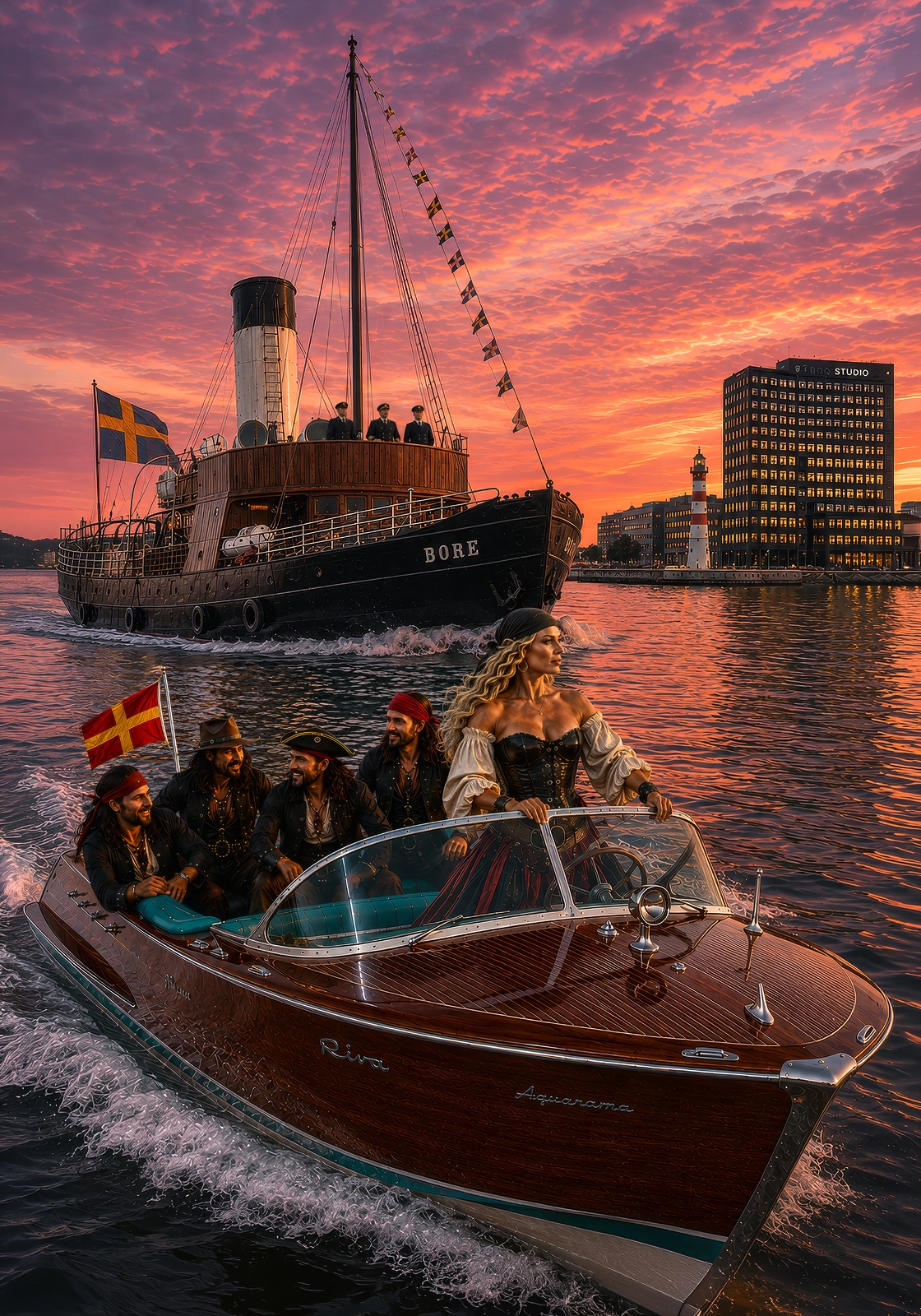
Anita, through an acquaintance, had borrowed a Riva boat docked at Dockan and squeezed the whole gang of smugglers into the aft sofa. As they left the harbour, it was already clear the excursion would hardly be limited to the planned lunch at sea. By Malmös inner lighthouse stood a few customs officers, and Anita, who after the previous evening had customs on the brain, naturally could not help but tease them. She zipped past them once, made a wide turn, and came back, repeating the manoeuvre a couple more times, the last with a skid stop so close that no one on the lighthouse could reasonably fail to perceive it as a personal greeting. They at least got wet.
The customs officers did nothing at first, but down in the harbour lay the old icebreaker Bore, built at Kockums in the late 1900s. By pure coincidence, her crew was building up steam pressure for the annual trial run. Someone among the customs officers realised the opportunity. When Bore steamed out of the harbour shortly thereafter with a few extra passengers on board, there was hardly any doubt about which little mahogany boat had attracted their interest.
Some of the men on the Riva immediately began discussing how fast she could go and whether they could outrun the old icebreaker, but Anita had a much simpler solution. She let Bore follow, held back long enough for the customs officers to become thoroughly interested, then calmly steered into water so shallow that the icebreaker, with its deeper draft, could not follow. There, she cut the engines, let the Riva glide to a stop, and dropped the lunch anchor.
If the customs officers had expected a dramatic chase, they were disappointed. The lunch basket was unpacked, the food was laid out, and the bottles were opened while Bore remained farther out on the road, close enough for the customs officers to see what was happening.
At first, the situation was very entertaining. They ate, drank, and toasted towards Bore, where the customs officers stubbornly remained, obviously waiting for the Riva to leave the shallow water sooner or later. After a while, however, the mutual siege began to lose some of its novelty. When Anita looked again towards the icebreaker and noted that the customs snoops apparently intended to wait them out, Jacob Fredrik Kolmans voice was heard.
Then they still havent understood anything.
Kolman was one of KLUHSs heavier members and belonged to the exclusive category of swindlers the Committee valued above all others: the successful ones who never got caught. Anita knew enough about him to realise the comment did not apply only to Bore.
What is it they havent understood? Anita asked.
Kolman took considerable time before answering, since a man who had built a large part of his legacy on patience could hardly be expected to rush into such an explanation.
That the one in a hurry always has a disadvantage.
Anita refilled her glass, studying him.
That comes from a man who was never caught.
Convicted, Kolman corrected her. I was never convicted. Its not quite the same thing.
With that, she had set him off.
They tried once. They were even entirely convinced they had me, and I readily admit that if I had been a customs officer, I would probably have believed the same.
It had been a few years before the affair that would later make Kolman one of the more respected members of KLUHS, at least in his own view of the matter. On that occasion, the customs had entered the case with great self-confidence. Certain goods he had brought into Malmö did not quite correspond to what was written in the documents; excises had, according to the authority, been withheld, and the discrepancies were far too advantageous for Kolman to be explained by chance.
What had happened? Anita asked.
A mix-up.
Naturally.
I appreciate you not anticipating the courts work. One load had been confused with another; a customs note could apparently be read in two ways, and two witnesses who had at first been very sure of their case remembered things differently when asked about the details. Such things happen.
Especially to you?
Kolman ignored the question and continued to explain that the decisive factor had not been the mix-up itself, but what happened afterwards. He was acquitted, which put the customs authority in an awkward position, since it had gone hard against an established Malmö burgher, taken the matter to court, and then failed to prove the alleged crime. No explicit order was needed from above, but the message was clear enough: next time they went after Jacob Fredrik Kolman, they had better be sure of their case. Without evidence that held up, they had to leave him in peace.
Most swindlers would have regarded it as a free pass, Kolman said. That was why most swindlers were sooner or later caught. I regarded it as an indication of where the boundary lay, and once you know where a boundary is, there is no reason to stretch it.
He had thus not begun to avoid the customs but continued to behave exactly as before. Kolman was a burgher and merchant who conducted fully legitimate trade between Malmö, Copenhagen, Hamburg, and the Netherlands, and had every reason in the world to pass through customs stations with goods, papers, and wagons. Among the things he traded in was art, above all paintings that he bought on the continent and sold on to people with better finances than judgmenta customer category which, according to Kolman, had always been the safest foundation of the art trade.
It was during a trip to Antwerp that Kolman got the idea. At an art dealers, several old paintings stood, none of which anyone seemed to want. Rococo had made its entry; tastes had changed, and dark Baroque portraits from the previous century had become difficult to sell, especially when the artist was unknown and the subject completely unfamiliar. Portraits of beautiful women could still sell reasonably well, but the market for dead men in dark coats and massive wigs was almost non-existent. Kolman had walked along the row, lifted down one of the portraits, and turned it around, whereupon the dealer wondered what he was doing, since he had long been trying to sell the front and the strange Swede suddenly showed greater interest in the back.
I asked what he wanted for the painting. He quoted a price, and I asked what he wanted for the three worst ones.
Why three? Anita asked.
Because he had four bad ones, and I didnt want to make him suspicious.
For the first time, Kolman smiled. What he had discovered was nothing remarkable, he continued, but on the contrary, so obvious that the art dealer hadnt seen it. An old painting had something very difficult to produce artificially but almost free to buy if the painting was sufficiently terrible: a completely authentic, old back. The canvas had darkened and stained over the decades, the wood had aged, the nails had rusted, and the dirt had become part of the object.
It is possible to forge a painting, Kolman said. It is far more difficult to forge a hundred years of dirt.
He therefore began experimenting with two worthless old paintings that could be combined into a single one without anything visible needing to be fake. From the front, you saw an authentic Baroque portrait of an unknown man. Behind the painted canvas, a thin package of folded silk fabric could be placed, along with a protective linen cloth, and at the very back sat the canvas from the second painting, turned so that the uninteresting man stared inward, while its old, dirty back faced outward. The stretcher frame lay recessed within the heavier outer frame, and if everything was done properly, the construction didnt need to become so much thicker that anyone would noticea couple of millimetres at most.
So it was a false bottom, said one of the other smugglers.
Kolman shook his head.
No. That is what you dont understand. Customs officers look for false bottoms. I had a painting that was actually two paintings, though only one was visible on the front.
He let them ponder for a moment before continuing.
And a little silk fabric hidden in between.
Around the same time, Kolman had begun doing business with the dyer Nils de la Rose in Malmö, a wealthy man with a large estate at Lilla Torg and the professional knowledge of fabrics, colours, and imported dyes that made him better suited than Kolman to judge what a piece of silk was actually worth. He also had the right customerspeople who had enough money to keep wanting what the state had decided they shouldnt buy.
Kolman appreciated him for another reason as well. Nils was the grandson of Leonard de la Rose, whose servant in 1695 had passed the Eastern customs with a dozen wigs and fifteen rolls of tobacco, which Leonard later claimed he had mistakenly forgotten to declare.
A good family, Kolman notedold traditions.
Despite the import bans of the late 1760s, demand for foreign silk remained high, and when Nils received an order for first-class large-patterned silk fabric, Kolman already had transport in place. The order was for about thirty-six cubits (alnar), just over twenty-one metres, of a very fine silk, only about fifty-five centimetres wide but enough for an exclusive dress according to prevailing fashion. On the illegal market, the price was 1,800 daler copper coins, or 50 daler per cubit.
It was a small fortune. A craft journeyman would need to work between six and twelve years to earn enough for such a dressthe woman who would wear it at the Knutsbalen ball paid without blinking. Entering the dance in forbidden French silk obviously had a price. A staggering price. In todays money, you could buy a decent car for that amount. Now, it didnt hurt anyone poor. The merchant Henric Falkman was rich as a troll and married to Catharina Weijer, who would wear the dress. Perhaps she herself paid for it. Catharina was the widow of the tobacco manufacturer Nicolaes Suell. Falkman took over both the widow and the business when Suell died.
The fabric was folded into a thin, flat package, placed behind the unknown man from Antwerp, and covered with a cheap linen cloth before the other old painted canvas was mounted face-down behind him. When the work was finished, Kolman could examine the painting from both sides without finding anything that shouldnt be there. The front was old because it was, and the back looked just as old for the same reason.
Then Kolman took it to Malmö. This time he travelled with his smuggled goods, as he had another painting with him. It was destined for Stockholm and Lotta Sparre, Mistress of the Robes to Crown Princess Sofia Magdalena. The future queen had already bought a painting from Kolman and was the one who had recommended that her lady-in-waiting do the same.
The weather had been wretched, and what awaited would be a winter people would talk about for a long time. The rain and autumn cold had made the roads miserable, and the wind from the Sound blew straight through marrow and bone. Despite the weather, the customs men at the city gate had spent the day engaged in one of the activities that the prohibitory legislation of the time had made them particularly skilled at. They sniffed.
Coffee was one of the most sought-after smuggled goods, but it had the unfortunate quality of having a distinctive smell, which made the nose the customs foremost weapon. The guards could go from sack to sack and chest to chest in search of the distinctive aroma that revealed the cargo long before they managed to identify the source.
I had no coffee, Kolman said. That is a good rule when customs officers are looking for it.
They recognised him at once. That didnt mean he escaped inspection, but rather that they examined his baggage with extra thoroughness, which Kolman had counted on. He stood calmly by while they worked, answered when asked, and waited until someone finally noticed the paintings. The unknown men were regarded with curiosity. Kolman had chosen both with care; their faces were unremarkable, the artist unknown, and the dark Baroque painting so hopelessly old-fashioned that no reasonable person could suspect it of being the baggages most valuable item.
Then the customs officer turned them over. Kolman still remembered the momentnot because he had been afraid, he assured, but because it was always interesting to see a person standing with their hands around something they were looking for, unaware that they had already found it. The customs officer looked at the old canvas on the back, let his hand follow the frame, and examined the edges, but everything he saw was authentic. To reach the silk, he would have had to dismantle the painting, and to do that he needed more than a mere suspicion that Jacob Fredrik Kolman might be a swindler. After the failed trial, both Kolman and the customs officials knew what was required before the authority destroyed or seized his property again.
The customs officer returned the paintings.
Are you related? he asked.
Not at all. Does it look like it?
I was just wondering.
Finished? Kolman asked.
Finished.
Excellent. Thanks for a good job.
Someone on the Riva began to laugh.
Did you really say that?
No, said Kolman. But I should have. The customs officer had, after all, done his job within the framework of the law.
Kolmans assistant, who met him with a horse and wagon, loaded the goods and then drove the short distance to Kolmans house on Per Wejersgatan.
The day after, I delivered the painting to Nils de la Rose at Lilla Torg. Behind closed doors, I loosened the rear canvas, and the thirty-six cubits of French silk unfurled. Nils needed no lecture on what he had before him; he was the citys foremost dyer and could feel the quality between his fingers, examine the weave, and see how the dye lay in the fabric. Kolman had delivered exactly what had been ordered.
From there, the silk went to a skilled seamstress, who undertook the work for proper payment but set a condition that Nils at first thought was rather cheeky. All remnants were to belong to her. Every little piece, every usable strip, and all the waste that arose when the narrow panels were cut and pattern-matched were to be hers. Nils naturally protested, since the seamstress, just as well as he, knew that even small pieces of genuine French silk could be converted into good money when no legal trade could offer them.
She got the waste, Kolman said. Nils complained about it for years, which I regarded as proof that the seamstress had made a good deal.
The dress was fully fitted and ready just in time for the Knutsbalen ball in January, the highlight of the years festive calendar. There, Catharina showed off the result to the citys well-to-do women and could enter the dance in her new French silk dress without anyone being able to prove where the fabric came from. When another lady, just as admiring as she was envious, asked if the dress was new, Catharina had been sensible enough not to complicate matters. Oh no, the old rag had been in the family for years and had just been altered.
She was better at it than many smugglers I knew, Kolman said. She explained nothing that no one had asked about. The woman who asked surely suspected, but there was no need to be overly explicit. Women have their codes. A wise woman doesnt ask whether the other has bought her fabric illegally, but whether the other happens to know someone who can get hold of silk. As you ask the question, so you get the answer.
The deal was so successful that several others followed suit, but Malmö had its limitations. It was a small town, and even Kolman realised that it would sooner or later attract attention if he continued to bring in an endless stream of unknown Baroque gentlemen from the Netherlands. There were even those who hung up the work and claimed that the portrait was of a prominent ancestor.
Stockholm, on the other hand, was a different story and, according to Kolman, had an almost insatiable appetite for bad Baroque portraits. The truly good paintings he bought on his travels he naturally sold as art, but the worst ones were usually more profitable. Some carried silk; others had to serve as cover for other small and precious goods that the state preferred not to see brought into the country, while the paintings travelled openly. Over time, it didnt even seem strange that Jacob Fredrik Kolman had old Dutch portraits in his shipments.
One such product was tea, which was not forbidden in Sweden but was burdened with prohibitively high import duties in England. If you filled the space in between with Hyson, the most exclusive green tea, you made a handsome profit. It was drunk by royalty and aristocrats, and, because of the enormous price difference from ordinary tea, Hyson was a prime target for luxury smuggling. The Swedish customs officers could sniff all they wanted, because tea wasnt on their list.
If you believe Kolman himself, he became a major player in the re-export of Chinese tea smuggled to Britain. Hundreds of ugly portraits still hang on English estates, with fictitious names on small brass plaques on the frames. Talk about a pedigree. No wonder Kolman eventually moved to the country and bought his own small estate. There, he could hang the remaining portraits and ensure his own lineage stretched back a couple of hundred years.
His clientele eventually extended to other parts of the court, and several of his paintings were sold to members of the royal family, including the queen.
Anita raised her eyebrows.
So you smuggled silk for the royal family?
Kolman looked genuinely offended.
I sold paintings to the royal family. At least try to keep my business branches separate.
No one on board seemed convinced, but Kolman continued with the dignity he felt the matter deserved. What might have been found between two painted canvases during an earlier part of the transport had nothing to do with the later art sale, and KLUHS, he pointed out, had always been very careful about legal certainty.
It had even happened that a customer really liked one of the old Baroque old-timers and wanted to buy that specific painting. Then an inconvenience arose that Kolman had never counted on. He had stood at the art dealers in Antwerp and picked out the ugliest portraits, but the silk first had to be removed, the painting restored, and the old man thereafter sold as art.
It was a waste, Kolman said.
Of the silk?
Of excellent packaging.
By then, the lunch on the Riva had been going on for a long time. The food was basically gone. Someone had pulled out a thermos of coffee spiked with brandy, which became the famous Scanian kaffekask. A drink smugglers invented when the precious coffee needed to be diluted to last longer.
Bore remained out in deeper water with a stubbornness that Kolman seemed to appreciate more than Anita did. She occasionally shot an irritated look towards the icebreaker.
His own business had gradually become routine, Kolman continued, but that had never made him bolder. On the contrary, he said, this was the difference between the smugglers who could continue and those who became entries in the customs records and ended up in the slammer. If something felt wrong, he waited; if he got a tip that customs had received orders for tightened controls, he took the next boat; and if a transport could not be carried out without him having to stretch the boundary he had once learned to know, he didnt carry it out at all.
Many make the same mistake when they tell stories about swindling, he said, looking at the others. They think the most skilled smuggler is the one who dares the most. He isnt. It is the one who knows when not to dare at all.
Kolman had never tried to run from a customs officer, never needed to throw any cargo overboard, and, above all, never regarded a customs officers suspicion as a problem. A customs officer was welcome to believe that Jacob Fredrik Kolman smuggled, and could, for that matter, be fully convinced of it, since suspicion in itself didnt cost Kolman a dime.
The dangerous thing is evidence. One should watch out for it.
Kolman fell silent, took his glass, and looked out over the water. On the roads, only the faint vibration of the engines from Bore, the wind, and the regular lapping against the Rivas hull remained. Anita followed his gaze towards the icebreaker, which, after all this waiting, still lay in the same place.
How many times did you do it? she asked.
Do what?
The silk in the paintings.
Kolman thought for a while.
I dont remember.
How many times did the customs find it?
Now he didnt need to think.
Never.
Almost simultaneously, the sound from Bore changed. Darker smoke rose from the funnel; the water began to swirl around the stern, and the old icebreaker veered slowly. The customs officers had finally had enough of waiting for people who obviously intended to continue their lunch until it turned into dinner, and Bore set a course back towards Malmö.
Anita said nothing but began, together with the others, to clear away glasses, plates, and the remnants of lunch. When everything was back in the basket, they pulled up the anchor, and only when Bore had disappeared into the harbour did she start the engines.
Kolman sat back and followed the icebreaker with his gaze until there was no longer any doubt about its direction.
You see, he said to Anita. Two hundred years later, they still havent learned.
What?
He pulled up his coat collar against the wind and settled himself for the journey back.
Its not about being cleverer than customs. Its about having greater patience.
But how did it go at the Knutsbalen ball, by the way? Anita asked. After all that trouble with the silk, one wants to know whether the dress was a success.
It was. The St. Knuts Guilds great solemn assembly and Knutsbalen ball were held, as tradition dictated, in January, around St. Knuts Day on the 13th. In 1768, there was unusually much to talk about in Malmö. Carl Fredrik Widegren had taken office as the citys new mayor, and it had been just over a year since the luxury regulation of 1766 had made it difficult to dress as elegantly as the citys wealthier burghers and their wives felt their position required. At least if you, as women often do, want something new to wear.
Prohibitions, however, rarely stopped a Malmö resident with money, good contacts, and customs officers who could be reasoned with. At the town hall, the St. Knuts Guild spared nothing. The tables groaned under poultry and game, cured ham and saddle of venison, marinated salmon and poached pike, oysters that had arrived in barrels, and sweets stacked into small monuments to the hosts wealth. There were marzipan, almonds, and candied fruits, and with all this, sweet Spanish and Portuguese wines, French red wine, and German beer were drunk from pewter mugs and, among those who really wanted to show what they could afford, from imported crystal glasses. If the luxury regulation had been intended to teach people restraint, the Knutsbalen ball was hardly the place to study its effects.
When dinner was over, the tables were cleared away, the musicians from the garrison tuned their violins and wind instruments, and the hall was made ready for dancing. First came the minuet, a slow, solemn showcase in which one couple at a time stepped forward while the rest of the company looked on. The hierarchy was as self-evident as the dance steps; the foremost began, the others waited their turn, and everyone knew very well who was looking at whom.
Last out were Catharina and her dance partner, the new mayor. In the light of the thousand wax candles, she stepped onto the floor in the thirty-six cubits of French silk that Nils had managed to smuggle past both import bans and customs officers. The fabric rustled around her as she curtsied, trailed across the floor as she turned, and gleamed with every movement. No other woman in the Knutssalen hall had anything that even resembled this: the very latest large-patterned silk from China.
The 1,800 daler copper coins she had paid for the silk were a fortune, but she got value for every single daler. The gentlemen looked; the ladies looked even more closely; and around the walls, whispers began to spread. Where had the fabric come from? Who had got hold of it? And how in the Lords name had it come into Malmö?
And what did she say? Anita asked.
That the fabric had, of course, been in the family chest since long before the prohibition.
Anita laughed.
Naturally.
After the minuet, the musicians struck up a country dance (kontradans). Now several couples could dance simultaneously in long rows and formations. The tempo rose, partners were switched, and it became much easier to flirt and gossip. By the end of the evening, at least half a dozen different explanations for the French dress had spread through the hall, and by the following morning half of Malmö knew who had worn it.
Where the silk had really come from, on the other hand, no one knew. Catharina had received a couple of questions about whether she knew where one could obtain fine silk. She had replied that she would do her best to find out.
That his wife had a fine dress was good for business, and for Henric Falkman the coming spring proved his best. He himself explained the phenomenon with a single word: silk power (sidenkraft)or, as he also put it, that the right wife was worth her weight in gold.
EPILOGUE The Border Moves
Kolmans world was one where the border was easy to understand. It had a customs gate, a barrier, and a customs officer. If you managed to carry your goods past all three, you had generally also succeeded in your swindle. But borders have the peculiar trait of rarely disappearing just because the barrier is removed. They move.
When the customs gates around Malmö eventually disappeared, surveillance shifted towards the coast and the Öresund. As trade became freer, some of the old smuggled goods disappeared, but new ones took their place. Wars, rationing, taxes, and prohibitions repeatedly redrew the map of what was profitable to carry across the sound and what the state felt it needed to prevent.
Not even European integration put an end to that story. The Öresund Bridge and the EUs internal market made the old border between Malmö and Copenhagen almost invisible for legal trade, but customs did not disappear for all that. It took on other tasks, other goods to look for, and other places to look for them.
All these changes, KLUHS has been able to reconcile itself with. The Committee has, after all, never held particularly high opinions of customs duties, import bans, or the states right to determine what a person may put in their coffee cup or sew their dress from. But swindling, too, has a boundary, and it goes to that which not only defies laws, customs, and regulations but also destroys people.
Therefore, there are no drug barons among KLUHSs members, nor are there any of their henchmen. They will never be admitted. The Committee for the Rehabilitation of Swindling and Historical Truth dedicates itself to smugglers who provided humanity with what it has taken pleasure in or used, or at least asked to buy. Silk, coffee, tea, and a bottle of brandy can be discussed. Narcotics that feed organised crime and human misery cannot.
That is perhaps the strangest thing about borders. Sometimes they consist of a wall, sometimes of a customs barrier, and sometimes you barely notice you are crossing them. KLUHS has its own. And it does not intend to move it.
Jörgen Thornberg
The Smugglers Realm - English version, 2026
Digital
50 x 70 cm
3 200 kr
The Smugglers Realm - Smugglarnas rike
Svensk text på slutet
INTRODUCTION Nothing to declare
Smuggling is one of the few businesses in which the losers have almost always written history. Those who managed to pass the customs barrier and sail across the sound, or to come home with their cargo unseen, had little reason to explain how it had happened. Those who failed, on the other hand, ended up in the customs records, before the court, and eventually in the archives.
In Malmö, the conditions for this trade have been unusually favourable. On the other side of the Öresund lay Denmark, and from there the rest of Europe. At the same time, Swedish customs, import bans, and luxury regulations over the centuries determined what the people of Malmö could buy, how much it would cost, and sometimes even what they were allowed to wear. This created a market for those with a somewhat more flexible view of the meaning of borders.
At Södertull, people tried to hide tobacco in carriage cushions, bribe guards, and drive past with goods that should never have been on the wagon. Others were more sophisticated. A truly skilled swindler needed neither to flee customs nor to throw the cargo overboard. Above all, he needed patience, good contacts, and the ability to understand what the customs officer was looking forand then hide the goods somewhere no one had any reason to look.
This is therefore the story of both those who were caught and those who, by their own account, were far too clever to be caught. About customs officers and merchants, unstamped tobacco and forbidden silk, bribes, strange explanations before the court, and an old Baroque painting that may have been far more valuable on the back than on the front.
Amid all this is KLUHS, the Committee for the Rehabilitation of Swindling and Historical Truth (Kommittén för Lurendrejeriets Upprättelse och Historiska Sanning), whose members naturally claim that history has misunderstood them. Smugglers usually doespecially those who never got caught.
The ugly men saving the dance.
They hang in rows, those ugly men,
In wigs gone wild and faces stern,
With eyes that seem to judge again
Each pleasure they were never meant to earn.
Their names are brass on blackened frames,
Their virtues mostly made of air,
Yet from their scowls and powdered claims
Comes silk enough for one to wear.
For on this night of masks and light,
When candle-glow begins to fail,
It is their gold, from trading by night,
That keeps the music from going stale.
They smuggled tea and silks and dreams
Across the waves the law forbade.
They bribed, they bargained, they evaded schemes
So others might be finely arrayed.
So let them glower from oil and gloom
The dancers spin, the glasses ring.
Without their sins, this hall were doom;
With theirs, the night is fit for a king.
Raise not your eyes too high in shame
At portraits grimly hanging there
For every ugly face and name
Has helped to keep the dance in air.
Malmö, August 2026
The Smugglers Realm and the Eternal Temptation of Borders
Throughout history, Malmö has been shaped by its proximity to Denmark and the continent. This position has shaped the citys architecture, trade, and population, and has also made the border and customs a part of everyday life. Where the state saw goods to be taxed and a border to be guarded, many Malmö residents saw the opportunity to buy, sell, and bring in what was cheaper or easier to obtain on the other side of the Öresund. Smuggling therefore cut across social classes and was not always viewed with the same moral condemnation as other violations of the law. When what was carried across the sound was tobacco, fabric, grain, coffee, or other highly sought-after goods, the customs offence could appear to many as significantly less serious than it was to the state.
Before the Treaty of Roskilde in 1658, the Öresund had been a Danish inland sea where Scanians and Danes traded and moved within the same kingdom. When Scania became Swedish, the conditions changed fundamentally. Swedish economic policy was characterised by mercantilism and the belief that the nations wealth depended, among other things, on keeping as little gold and silver as possible out of the country. Customs duties and prohibitions therefore restricted the import of foreign consumer goods, while domestic production was to be protected and encouraged. For Malmö, which now lay at the kingdoms new border with Denmark, this meant that an old trade connection across the Öresund also became subject to customs.
The Guardians of the Customs Gates and the Swindlers of the Night
The Swedish customs system had been organised long before the conquest of Scania. The Lilla tullen (The Small Customs) was introduced as early as 1622 as a fee on all edible, wearable, and consumable goods brought from the countryside into the cities markets. In 1636, the customs service received a firmer central organisation. When Malmö became Swedish, the city was incorporated into a new system. As a staple town, Malmö was allowed to receive foreign shipping, whose cargoes were to be cleared under the Stora sjötullen (The Great Sea Customs), while goods brought into the city by land passed through the Lilla tullen. Around Malmö, there were customs fences and gates, including the Eastern and Southern customs and Strandporten by the sea. The exact locations of the customs houses changed over time, but the task remained the same: people, wagons, sacks, and baskets were to be checked and the fees paid.
What we call smuggling today was described by other terms at the time. Lurendrejeri (swindling/contraband trade) referred to illegal importation and trade, while tullförsnillning (customs embezzlement) could denote attempts to evade customs and other fees. The surviving excise court records from the Malmö City Archives, unfortunately, cover only a limited period between 1691 and 1708, which is too short to draw reliable conclusions about long-term statistical changes, but all the better for those who want to get close to the people. For the last decade of the 17th century, 42 cases are preserved. About half concerned house searches within the city for, among other things, illegal malt or illicit bread sales, while the other half concerned attempts to bring goods past the citys customs without paying what the crown demanded.
Slaps, Tobacco Rolls, and Angry Widows
The cases that came before the excise court show that the battle between customs officials and Malmö residents could take forms that hardly need any retrospective dramatisation. One summer day in 1694, the merchant Jöran Holst drove his wagon past the southern customs house. Before customs clerk Christian Stares servant, Jöns Svensson, could arrive to inspect the load, Holst took out four öre silver coins and held them out towards the guard soldier at the barrier. The plan was for the soldier to give Svensson a few proper slaps in the face so that the customs attendant would back off and the wagon could continue. The soldier, however, would not be bought; the slaps never happened, and when the wagon was examined, two unstamped blue pieces of cloth were found. Before the excise court, Holst claimed he had been so drunk that he remembered nothing of the incident. He was personally acquitted, but the fabrics were confiscated.
In the autumn of 1695, another case arose at Södertull. Customs inspector Jonas Eriksson, temporarily borrowed from the Eastern customs, grew suspicious of the burger Truls Trulsson and had his wagon examined. There, eight and a half kilograms of unstamped tobacco were found, distributed across ten rolls and six so-called bricks, hidden among the legal goods. Trulsson was fined 30 silver öre for the tobacco and 40 silver daler for violating the stamping regulations. On the same day, the well-known merchant Leonard de la Rose appeared before the court. His servant had transported wigs from Helsingborg through the Eastern customs, but he was also carrying 15 rolls of tobacco, which de la Rose claimed he had mistakenly forgotten to declare. The protests did not help; he was not allowed to clear himself by oath and had to forfeit the tobacco and pay a fine.
The customs battles did not stop at the city gates. The customs right to search houses, the so-called hemgången (home entry), brought the authorities directly into Malmö residents' homes and created recurring conflicts. Customs visitor Olof Jacobsson at Södertull, for example, ended up in a fierce feud with Mrs Anna, the widow of the prominent merchant Mårten Nehrmann. Jacobsson had followed a wagon driven by a farmers wife from Klörup all the way to the widows estate and demanded to inspect the loft for illicit grain. Mrs Anna fixed her eyes on him, ordered him to pack his bags and leave, and explained to the neighbours that the customs official was insolent and dead drunk. Jacobsson was admittedly known for his fondness for strong drinks, but on this particular occasion witnesses could testify that he was sober. Up in the loft, sure enough, one extra barrel of grain was found. The grain was confiscated, and the widow was fined three daler. At the same time, the court contented itself with a warning for her treatment of the customs official, explaining that she as a woman did not know His Royal Majestys regulations on how house searches were conducted.
In December of the same year, customs clerk Petter Appelberg at Söderport customs received an anonymous tip about a major tobacco-smuggling operation just east of Malmö. Together with inspector Jonas Eriksson, he rode out in the dark to the farmer Jöns Eriksson at Spillepengen. The customs men did not wait to be let in but broke in. During the house search, they found nine rolls and eleven bricks of unstamped tobacco hidden in a cupboard and behind a stove. The packaging bore initials that pointed to the merchant Ernst Hindrich Stern. The trial became protracted; servants, wagon men, and farmers blamed each other, yet all recounted that the goods had been fetched from an unknown boat down by the shore. Stern initially claimed that, as a foreigner, he understood neither Swedish nor the countrys customs regulations, and refused to speak. He claimed to have ordered only legal haberdashery and requested to swear himself free. When the court finally gave him that opportunity, he was so relieved that the courts chairman Josua Fistulator had to reprimand him and point out that the matter was nothing to joke about. Stern swore the oath and was acquitted, while the actual owner of the tobacco remained unknown.
Not everyone could blame drunkenness or a lack of language skills. In the summer of 1696, the Schleswig-Holstein skipper Hans Augustin arrived in Malmö with iron and boards from Norrköping. He could produce a Stora sjötullpass (Great Sea Customs Pass) showing that the fee had already been paid at the port of departure, but the goods still had to be declared at the Lilla tullen at Strandporten to obtain a land customs pass. Augustin and the merchant Hans Tijl claimed that the customs officer in Norrköping had said the sea customs pass was sufficient, but the excise court did not accept this explanation. Augustin was sentenced to 100 silver daler, and Tijl to the same amount for his involvement. By comparison, a customs clerk at the time had a fixed annual salary of 96 daler.
In the autumn of the same year, customs inspector Olof Jacobsson stopped a young boy at the southern customs hut. The boy carried a seemingly innocent carriage cushion, but inside were ten rolls of tobacco. It turned out he was running errands for the merchant David Nehrman, who pulled customs clerk Olof Palm aside and offered him a carolin (coin) to let the boy pass. Palm refused. Nehrman realised the matter was difficult to explain, declined to take an oath, and had the tobacco confiscated and was fined.
Those Who Never Got Caught
All these people have left traces behind them for one simple reason: a customs officer discovered what they were doing. Successful smuggling is significantly harder to write about in history. It yielded no seizure, no investigation, and no judgment. Once the wagon had passed the customs barrier, there was rarely any reason for the authorities to record its contents.
This was precisely what KLUHS emphasised when the Committee sought to explain why its most prominent members were, strangely enough, often absent from the customs archives. One of them was Jacob Fredrik Kolman, a burgher and merchant in 18th-century Malmö, an art dealer when it suited him, and, by his own account, a far more skilled swindler than the unfortunate colleagues whose convictions had immortalised them.
The day after the gathering by the fire, Anita and some of KLUHSs more enterprising members still had not had enough of the customs. On the contrary, the nights discussions about customs officers, swindlers, and the centuries-long tug-of-war between those who guarded the border and those who tried to cross it had awakened a rather childish desire to test whether todays customs officers were just as easy to tease as yesterdays. The alcohol in the lunch basket had been legally purchased from Systembolaget, but the banknotes used for the purchase were counterfeit. Counterfeiting Swedish banknotes could not be regarded as a customs offence, but it was important to their self-respect.
Anita, through an acquaintance, had borrowed a Riva boat docked at Dockan and squeezed the whole gang of smugglers into the aft sofa. As they left the harbour, it was already clear the excursion would hardly be limited to the planned lunch at sea. By Malmös inner lighthouse stood a few customs officers, and Anita, who after the previous evening had customs on the brain, naturally could not help but tease them. She zipped past them once, made a wide turn, and came back, repeating the manoeuvre a couple more times, the last with a skid stop so close that no one on the lighthouse could reasonably fail to perceive it as a personal greeting. They at least got wet.
The customs officers did nothing at first, but down in the harbour lay the old icebreaker Bore, built at Kockums in the late 1900s. By pure coincidence, her crew was building up steam pressure for the annual trial run. Someone among the customs officers realised the opportunity. When Bore steamed out of the harbour shortly thereafter with a few extra passengers on board, there was hardly any doubt about which little mahogany boat had attracted their interest.
Some of the men on the Riva immediately began discussing how fast she could go and whether they could outrun the old icebreaker, but Anita had a much simpler solution. She let Bore follow, held back long enough for the customs officers to become thoroughly interested, then calmly steered into water so shallow that the icebreaker, with its deeper draft, could not follow. There, she cut the engines, let the Riva glide to a stop, and dropped the lunch anchor.
If the customs officers had expected a dramatic chase, they were disappointed. The lunch basket was unpacked, the food was laid out, and the bottles were opened while Bore remained farther out on the road, close enough for the customs officers to see what was happening.
At first, the situation was very entertaining. They ate, drank, and toasted towards Bore, where the customs officers stubbornly remained, obviously waiting for the Riva to leave the shallow water sooner or later. After a while, however, the mutual siege began to lose some of its novelty. When Anita looked again towards the icebreaker and noted that the customs snoops apparently intended to wait them out, Jacob Fredrik Kolmans voice was heard.
Then they still havent understood anything.
Kolman was one of KLUHSs heavier members and belonged to the exclusive category of swindlers the Committee valued above all others: the successful ones who never got caught. Anita knew enough about him to realise the comment did not apply only to Bore.
What is it they havent understood? Anita asked.
Kolman took considerable time before answering, since a man who had built a large part of his legacy on patience could hardly be expected to rush into such an explanation.
That the one in a hurry always has a disadvantage.
Anita refilled her glass, studying him.
That comes from a man who was never caught.
Convicted, Kolman corrected her. I was never convicted. Its not quite the same thing.
With that, she had set him off.
They tried once. They were even entirely convinced they had me, and I readily admit that if I had been a customs officer, I would probably have believed the same.
It had been a few years before the affair that would later make Kolman one of the more respected members of KLUHS, at least in his own view of the matter. On that occasion, the customs had entered the case with great self-confidence. Certain goods he had brought into Malmö did not quite correspond to what was written in the documents; excises had, according to the authority, been withheld, and the discrepancies were far too advantageous for Kolman to be explained by chance.
What had happened? Anita asked.
A mix-up.
Naturally.
I appreciate you not anticipating the courts work. One load had been confused with another; a customs note could apparently be read in two ways, and two witnesses who had at first been very sure of their case remembered things differently when asked about the details. Such things happen.
Especially to you?
Kolman ignored the question and continued to explain that the decisive factor had not been the mix-up itself, but what happened afterwards. He was acquitted, which put the customs authority in an awkward position, since it had gone hard against an established Malmö burgher, taken the matter to court, and then failed to prove the alleged crime. No explicit order was needed from above, but the message was clear enough: next time they went after Jacob Fredrik Kolman, they had better be sure of their case. Without evidence that held up, they had to leave him in peace.
Most swindlers would have regarded it as a free pass, Kolman said. That was why most swindlers were sooner or later caught. I regarded it as an indication of where the boundary lay, and once you know where a boundary is, there is no reason to stretch it.
He had thus not begun to avoid the customs but continued to behave exactly as before. Kolman was a burgher and merchant who conducted fully legitimate trade between Malmö, Copenhagen, Hamburg, and the Netherlands, and had every reason in the world to pass through customs stations with goods, papers, and wagons. Among the things he traded in was art, above all paintings that he bought on the continent and sold on to people with better finances than judgmenta customer category which, according to Kolman, had always been the safest foundation of the art trade.
It was during a trip to Antwerp that Kolman got the idea. At an art dealers, several old paintings stood, none of which anyone seemed to want. Rococo had made its entry; tastes had changed, and dark Baroque portraits from the previous century had become difficult to sell, especially when the artist was unknown and the subject completely unfamiliar. Portraits of beautiful women could still sell reasonably well, but the market for dead men in dark coats and massive wigs was almost non-existent. Kolman had walked along the row, lifted down one of the portraits, and turned it around, whereupon the dealer wondered what he was doing, since he had long been trying to sell the front and the strange Swede suddenly showed greater interest in the back.
I asked what he wanted for the painting. He quoted a price, and I asked what he wanted for the three worst ones.
Why three? Anita asked.
Because he had four bad ones, and I didnt want to make him suspicious.
For the first time, Kolman smiled. What he had discovered was nothing remarkable, he continued, but on the contrary, so obvious that the art dealer hadnt seen it. An old painting had something very difficult to produce artificially but almost free to buy if the painting was sufficiently terrible: a completely authentic, old back. The canvas had darkened and stained over the decades, the wood had aged, the nails had rusted, and the dirt had become part of the object.
It is possible to forge a painting, Kolman said. It is far more difficult to forge a hundred years of dirt.
He therefore began experimenting with two worthless old paintings that could be combined into a single one without anything visible needing to be fake. From the front, you saw an authentic Baroque portrait of an unknown man. Behind the painted canvas, a thin package of folded silk fabric could be placed, along with a protective linen cloth, and at the very back sat the canvas from the second painting, turned so that the uninteresting man stared inward, while its old, dirty back faced outward. The stretcher frame lay recessed within the heavier outer frame, and if everything was done properly, the construction didnt need to become so much thicker that anyone would noticea couple of millimetres at most.
So it was a false bottom, said one of the other smugglers.
Kolman shook his head.
No. That is what you dont understand. Customs officers look for false bottoms. I had a painting that was actually two paintings, though only one was visible on the front.
He let them ponder for a moment before continuing.
And a little silk fabric hidden in between.
Around the same time, Kolman had begun doing business with the dyer Nils de la Rose in Malmö, a wealthy man with a large estate at Lilla Torg and the professional knowledge of fabrics, colours, and imported dyes that made him better suited than Kolman to judge what a piece of silk was actually worth. He also had the right customerspeople who had enough money to keep wanting what the state had decided they shouldnt buy.
Kolman appreciated him for another reason as well. Nils was the grandson of Leonard de la Rose, whose servant in 1695 had passed the Eastern customs with a dozen wigs and fifteen rolls of tobacco, which Leonard later claimed he had mistakenly forgotten to declare.
A good family, Kolman notedold traditions.
Despite the import bans of the late 1760s, demand for foreign silk remained high, and when Nils received an order for first-class large-patterned silk fabric, Kolman already had transport in place. The order was for about thirty-six cubits (alnar), just over twenty-one metres, of a very fine silk, only about fifty-five centimetres wide but enough for an exclusive dress according to prevailing fashion. On the illegal market, the price was 1,800 daler copper coins, or 50 daler per cubit.
It was a small fortune. A craft journeyman would need to work between six and twelve years to earn enough for such a dressthe woman who would wear it at the Knutsbalen ball paid without blinking. Entering the dance in forbidden French silk obviously had a price. A staggering price. In todays money, you could buy a decent car for that amount. Now, it didnt hurt anyone poor. The merchant Henric Falkman was rich as a troll and married to Catharina Weijer, who would wear the dress. Perhaps she herself paid for it. Catharina was the widow of the tobacco manufacturer Nicolaes Suell. Falkman took over both the widow and the business when Suell died.
The fabric was folded into a thin, flat package, placed behind the unknown man from Antwerp, and covered with a cheap linen cloth before the other old painted canvas was mounted face-down behind him. When the work was finished, Kolman could examine the painting from both sides without finding anything that shouldnt be there. The front was old because it was, and the back looked just as old for the same reason.
Then Kolman took it to Malmö. This time he travelled with his smuggled goods, as he had another painting with him. It was destined for Stockholm and Lotta Sparre, Mistress of the Robes to Crown Princess Sofia Magdalena. The future queen had already bought a painting from Kolman and was the one who had recommended that her lady-in-waiting do the same.
The weather had been wretched, and what awaited would be a winter people would talk about for a long time. The rain and autumn cold had made the roads miserable, and the wind from the Sound blew straight through marrow and bone. Despite the weather, the customs men at the city gate had spent the day engaged in one of the activities that the prohibitory legislation of the time had made them particularly skilled at. They sniffed.
Coffee was one of the most sought-after smuggled goods, but it had the unfortunate quality of having a distinctive smell, which made the nose the customs foremost weapon. The guards could go from sack to sack and chest to chest in search of the distinctive aroma that revealed the cargo long before they managed to identify the source.
I had no coffee, Kolman said. That is a good rule when customs officers are looking for it.
They recognised him at once. That didnt mean he escaped inspection, but rather that they examined his baggage with extra thoroughness, which Kolman had counted on. He stood calmly by while they worked, answered when asked, and waited until someone finally noticed the paintings. The unknown men were regarded with curiosity. Kolman had chosen both with care; their faces were unremarkable, the artist unknown, and the dark Baroque painting so hopelessly old-fashioned that no reasonable person could suspect it of being the baggages most valuable item.
Then the customs officer turned them over. Kolman still remembered the momentnot because he had been afraid, he assured, but because it was always interesting to see a person standing with their hands around something they were looking for, unaware that they had already found it. The customs officer looked at the old canvas on the back, let his hand follow the frame, and examined the edges, but everything he saw was authentic. To reach the silk, he would have had to dismantle the painting, and to do that he needed more than a mere suspicion that Jacob Fredrik Kolman might be a swindler. After the failed trial, both Kolman and the customs officials knew what was required before the authority destroyed or seized his property again.
The customs officer returned the paintings.
Are you related? he asked.
Not at all. Does it look like it?
I was just wondering.
Finished? Kolman asked.
Finished.
Excellent. Thanks for a good job.
Someone on the Riva began to laugh.
Did you really say that?
No, said Kolman. But I should have. The customs officer had, after all, done his job within the framework of the law.
Kolmans assistant, who met him with a horse and wagon, loaded the goods and then drove the short distance to Kolmans house on Per Wejersgatan.
The day after, I delivered the painting to Nils de la Rose at Lilla Torg. Behind closed doors, I loosened the rear canvas, and the thirty-six cubits of French silk unfurled. Nils needed no lecture on what he had before him; he was the citys foremost dyer and could feel the quality between his fingers, examine the weave, and see how the dye lay in the fabric. Kolman had delivered exactly what had been ordered.
From there, the silk went to a skilled seamstress, who undertook the work for proper payment but set a condition that Nils at first thought was rather cheeky. All remnants were to belong to her. Every little piece, every usable strip, and all the waste that arose when the narrow panels were cut and pattern-matched were to be hers. Nils naturally protested, since the seamstress, just as well as he, knew that even small pieces of genuine French silk could be converted into good money when no legal trade could offer them.
She got the waste, Kolman said. Nils complained about it for years, which I regarded as proof that the seamstress had made a good deal.
The dress was fully fitted and ready just in time for the Knutsbalen ball in January, the highlight of the years festive calendar. There, Catharina showed off the result to the citys well-to-do women and could enter the dance in her new French silk dress without anyone being able to prove where the fabric came from. When another lady, just as admiring as she was envious, asked if the dress was new, Catharina had been sensible enough not to complicate matters. Oh no, the old rag had been in the family for years and had just been altered.
She was better at it than many smugglers I knew, Kolman said. She explained nothing that no one had asked about. The woman who asked surely suspected, but there was no need to be overly explicit. Women have their codes. A wise woman doesnt ask whether the other has bought her fabric illegally, but whether the other happens to know someone who can get hold of silk. As you ask the question, so you get the answer.
The deal was so successful that several others followed suit, but Malmö had its limitations. It was a small town, and even Kolman realised that it would sooner or later attract attention if he continued to bring in an endless stream of unknown Baroque gentlemen from the Netherlands. There were even those who hung up the work and claimed that the portrait was of a prominent ancestor.
Stockholm, on the other hand, was a different story and, according to Kolman, had an almost insatiable appetite for bad Baroque portraits. The truly good paintings he bought on his travels he naturally sold as art, but the worst ones were usually more profitable. Some carried silk; others had to serve as cover for other small and precious goods that the state preferred not to see brought into the country, while the paintings travelled openly. Over time, it didnt even seem strange that Jacob Fredrik Kolman had old Dutch portraits in his shipments.
One such product was tea, which was not forbidden in Sweden but was burdened with prohibitively high import duties in England. If you filled the space in between with Hyson, the most exclusive green tea, you made a handsome profit. It was drunk by royalty and aristocrats, and, because of the enormous price difference from ordinary tea, Hyson was a prime target for luxury smuggling. The Swedish customs officers could sniff all they wanted, because tea wasnt on their list.
If you believe Kolman himself, he became a major player in the re-export of Chinese tea smuggled to Britain. Hundreds of ugly portraits still hang on English estates, with fictitious names on small brass plaques on the frames. Talk about a pedigree. No wonder Kolman eventually moved to the country and bought his own small estate. There, he could hang the remaining portraits and ensure his own lineage stretched back a couple of hundred years.
His clientele eventually extended to other parts of the court, and several of his paintings were sold to members of the royal family, including the queen.
Anita raised her eyebrows.
So you smuggled silk for the royal family?
Kolman looked genuinely offended.
I sold paintings to the royal family. At least try to keep my business branches separate.
No one on board seemed convinced, but Kolman continued with the dignity he felt the matter deserved. What might have been found between two painted canvases during an earlier part of the transport had nothing to do with the later art sale, and KLUHS, he pointed out, had always been very careful about legal certainty.
It had even happened that a customer really liked one of the old Baroque old-timers and wanted to buy that specific painting. Then an inconvenience arose that Kolman had never counted on. He had stood at the art dealers in Antwerp and picked out the ugliest portraits, but the silk first had to be removed, the painting restored, and the old man thereafter sold as art.
It was a waste, Kolman said.
Of the silk?
Of excellent packaging.
By then, the lunch on the Riva had been going on for a long time. The food was basically gone. Someone had pulled out a thermos of coffee spiked with brandy, which became the famous Scanian kaffekask. A drink smugglers invented when the precious coffee needed to be diluted to last longer.
Bore remained out in deeper water with a stubbornness that Kolman seemed to appreciate more than Anita did. She occasionally shot an irritated look towards the icebreaker.
His own business had gradually become routine, Kolman continued, but that had never made him bolder. On the contrary, he said, this was the difference between the smugglers who could continue and those who became entries in the customs records and ended up in the slammer. If something felt wrong, he waited; if he got a tip that customs had received orders for tightened controls, he took the next boat; and if a transport could not be carried out without him having to stretch the boundary he had once learned to know, he didnt carry it out at all.
Many make the same mistake when they tell stories about swindling, he said, looking at the others. They think the most skilled smuggler is the one who dares the most. He isnt. It is the one who knows when not to dare at all.
Kolman had never tried to run from a customs officer, never needed to throw any cargo overboard, and, above all, never regarded a customs officers suspicion as a problem. A customs officer was welcome to believe that Jacob Fredrik Kolman smuggled, and could, for that matter, be fully convinced of it, since suspicion in itself didnt cost Kolman a dime.
The dangerous thing is evidence. One should watch out for it.
Kolman fell silent, took his glass, and looked out over the water. On the roads, only the faint vibration of the engines from Bore, the wind, and the regular lapping against the Rivas hull remained. Anita followed his gaze towards the icebreaker, which, after all this waiting, still lay in the same place.
How many times did you do it? she asked.
Do what?
The silk in the paintings.
Kolman thought for a while.
I dont remember.
How many times did the customs find it?
Now he didnt need to think.
Never.
Almost simultaneously, the sound from Bore changed. Darker smoke rose from the funnel; the water began to swirl around the stern, and the old icebreaker veered slowly. The customs officers had finally had enough of waiting for people who obviously intended to continue their lunch until it turned into dinner, and Bore set a course back towards Malmö.
Anita said nothing but began, together with the others, to clear away glasses, plates, and the remnants of lunch. When everything was back in the basket, they pulled up the anchor, and only when Bore had disappeared into the harbour did she start the engines.
Kolman sat back and followed the icebreaker with his gaze until there was no longer any doubt about its direction.
You see, he said to Anita. Two hundred years later, they still havent learned.
What?
He pulled up his coat collar against the wind and settled himself for the journey back.
Its not about being cleverer than customs. Its about having greater patience.
But how did it go at the Knutsbalen ball, by the way? Anita asked. After all that trouble with the silk, one wants to know whether the dress was a success.
It was. The St. Knuts Guilds great solemn assembly and Knutsbalen ball were held, as tradition dictated, in January, around St. Knuts Day on the 13th. In 1768, there was unusually much to talk about in Malmö. Carl Fredrik Widegren had taken office as the citys new mayor, and it had been just over a year since the luxury regulation of 1766 had made it difficult to dress as elegantly as the citys wealthier burghers and their wives felt their position required. At least if you, as women often do, want something new to wear.
Prohibitions, however, rarely stopped a Malmö resident with money, good contacts, and customs officers who could be reasoned with. At the town hall, the St. Knuts Guild spared nothing. The tables groaned under poultry and game, cured ham and saddle of venison, marinated salmon and poached pike, oysters that had arrived in barrels, and sweets stacked into small monuments to the hosts wealth. There were marzipan, almonds, and candied fruits, and with all this, sweet Spanish and Portuguese wines, French red wine, and German beer were drunk from pewter mugs and, among those who really wanted to show what they could afford, from imported crystal glasses. If the luxury regulation had been intended to teach people restraint, the Knutsbalen ball was hardly the place to study its effects.
When dinner was over, the tables were cleared away, the musicians from the garrison tuned their violins and wind instruments, and the hall was made ready for dancing. First came the minuet, a slow, solemn showcase in which one couple at a time stepped forward while the rest of the company looked on. The hierarchy was as self-evident as the dance steps; the foremost began, the others waited their turn, and everyone knew very well who was looking at whom.
Last out were Catharina and her dance partner, the new mayor. In the light of the thousand wax candles, she stepped onto the floor in the thirty-six cubits of French silk that Nils had managed to smuggle past both import bans and customs officers. The fabric rustled around her as she curtsied, trailed across the floor as she turned, and gleamed with every movement. No other woman in the Knutssalen hall had anything that even resembled this: the very latest large-patterned silk from China.
The 1,800 daler copper coins she had paid for the silk were a fortune, but she got value for every single daler. The gentlemen looked; the ladies looked even more closely; and around the walls, whispers began to spread. Where had the fabric come from? Who had got hold of it? And how in the Lords name had it come into Malmö?
And what did she say? Anita asked.
That the fabric had, of course, been in the family chest since long before the prohibition.
Anita laughed.
Naturally.
After the minuet, the musicians struck up a country dance (kontradans). Now several couples could dance simultaneously in long rows and formations. The tempo rose, partners were switched, and it became much easier to flirt and gossip. By the end of the evening, at least half a dozen different explanations for the French dress had spread through the hall, and by the following morning half of Malmö knew who had worn it.
Where the silk had really come from, on the other hand, no one knew. Catharina had received a couple of questions about whether she knew where one could obtain fine silk. She had replied that she would do her best to find out.
That his wife had a fine dress was good for business, and for Henric Falkman the coming spring proved his best. He himself explained the phenomenon with a single word: silk power (sidenkraft)or, as he also put it, that the right wife was worth her weight in gold.
EPILOGUE The Border Moves
Kolmans world was one where the border was easy to understand. It had a customs gate, a barrier, and a customs officer. If you managed to carry your goods past all three, you had generally also succeeded in your swindle. But borders have the peculiar trait of rarely disappearing just because the barrier is removed. They move.
When the customs gates around Malmö eventually disappeared, surveillance shifted towards the coast and the Öresund. As trade became freer, some of the old smuggled goods disappeared, but new ones took their place. Wars, rationing, taxes, and prohibitions repeatedly redrew the map of what was profitable to carry across the sound and what the state felt it needed to prevent.
Not even European integration put an end to that story. The Öresund Bridge and the EUs internal market made the old border between Malmö and Copenhagen almost invisible for legal trade, but customs did not disappear for all that. It took on other tasks, other goods to look for, and other places to look for them.
All these changes, KLUHS has been able to reconcile itself with. The Committee has, after all, never held particularly high opinions of customs duties, import bans, or the states right to determine what a person may put in their coffee cup or sew their dress from. But swindling, too, has a boundary, and it goes to that which not only defies laws, customs, and regulations but also destroys people.
Therefore, there are no drug barons among KLUHSs members, nor are there any of their henchmen. They will never be admitted. The Committee for the Rehabilitation of Swindling and Historical Truth dedicates itself to smugglers who provided humanity with what it has taken pleasure in or used, or at least asked to buy. Silk, coffee, tea, and a bottle of brandy can be discussed. Narcotics that feed organised crime and human misery cannot.
That is perhaps the strangest thing about borders. Sometimes they consist of a wall, sometimes of a customs barrier, and sometimes you barely notice you are crossing them. KLUHS has its own. And it does not intend to move it.
3 200 kr

Jörgen Thornberg
Malmö
Lite om bilder och mig. Translation in English at the end.
Jag är en nyfiken person som ser allt i bilder, även det jag fäster i ord, gärna tillsammans för bakom alla mina bilder finns en berättelse. Till vissa bilder hör en kortare eller längre novell som följer med bilden.
Bilder berättar historier. Jag omges av naturlig skönhet, intressanta människor och historia var jag än går. Jag använder min kamera för att dokumentera världen och blanda det jag ser med vad jag känner för att fånga den dolda magin.
Mina bilder berättar mina historier. Genom mina bilder, tryck och berättelser. Jag bjuder in dig att ta del av dessa berättelser, in i ditt liv och hem och dela min mycket personliga syn på vår värld. Mer än vad ögat ser. Jag tänker i bilder, drömmer och skriver och pratar om dem; följaktligen måste jag också skapa bilder. De blir vad jag ser, inte nödvändigtvis begränsade till verkligheten. Det finns en bild runt varje hörn. Jag hoppas att du kommer att se vad jag såg och gilla det.
Jag är också en skrivande person och till många bilder hör en kortare eller längre essay. Den följer med tavlan, tryckt på fint papper och med en personlig hälsning från mig.
Flertalet bilder startar sin resa i min kamera. Enkelt förklarat beskriver jag bilden jag ser i mitt inre, upplevd eller fantiserad. Bilden uppstår inom mig redan innan jag fått okularet till ögat. På bråkdelen av ett ögonblick ser jag vad jag vill ha och vad som kan göras med bilden. Här skall jag stoppa in en giraff, stålmannen, Titanic eller vad det är min fantasi finner ut. Ännu märkligare är att jag kommer ihåg minnesbilden långt efteråt när det blir tid att skapa verket. Om jag lyckas eller inte, är upp till betraktaren, oftast präglat av en stråk av svart humor – meningen är att man skall bli underhållen. Mina bilder blir ofta en snackis där de hänger.
Jag föredrar bilder som förmedlar ett budskap i flera lager. Vid första anblicken fylld av feel-good, en vacker utsikt, fint väder, solen skiner, blommor på ängen eller vattnet som ligger förrädiskt spegelblankt. I en sådan bild kan jag gömma min egentliga berättelse, mitt förakt för förtryckare och våldsverkare, rasister och fördomsfulla människor - ett gärna återkommande motiv mer eller mindre dolt i det vackra motivet. Jag försöker förena dem i ett gemensamt narrativ.
Bild och formgivning har löpt som en röd tråd genom livet. Fotokonst känns som en värdig final som jag gärna delar med mig.
Min genre är vid som framgår av mina bilder, temat en blandning av pop- och gatukonst i kollage som kan bestå av hundratals lager. Vissa bilder kan ta veckor, andra någon dag innan det är dags att överlämna resultatet till printverkstaden. Fine Art Prints är digitala fotocollage. I dessa kollage sker rivandet, klippandet, pusslandet, målandet, ritandet och sprayningen digitalt. Det jag monterar in kan vara hundratals år gamla bilder som jag omsorgsfullt frilägger så att de ser ut att vara en del av tavlan men också bilder skapade av mig själv efter min egen fantasi. Därefter besöks printstudion och för vissa bilder numrera en limiterad upplaga (oftast 7 exemplar) och signera för hand. Vissa bilder kan köpas i olika format. Det är bara att fråga efter vilka. Gillar man en bild som är 70x100 men inte har plats på väggen, går den kanske att få i 50x70 cm istället. Frågan är fri.
Metoden Giclée eller Fine Art Print som det också kallas är det moderna sättet för framställning av grafisk konst. Villkoret för denna typ av utskrifter är att en högkvalitativ storformatskrivare används med åldersbeständigt färgpigment och konstnärspapper eller i förekommande fall på duk. Pappret som används möter de krav på livslängd som ställs av museer och gallerier. Normalt säljer jag mina bilder oinramade så att den nya ägaren själv kan bestämma hur de skall se ut, med eller utan passepartout färg på ram, med eller utan glas etc..
Under många år ställde jag bara ut på nätet, i valda grupper och på min egen Facebooksida - https://www.facebook.com/jorgen.thornberg.9
Jag finns också på en egen hemsida som tyvärr inte alltid är uppdaterad – https://www.jth.life/ Där kan du också läsa en del av de berättelser som följer med bilden.
UTSTÄLLNINGAR
Luftkastellet, oktober 2022
Konst i Lund, november 2022
Luftkastellet, mars 2023
Engleson Galleri Caroli, april 2023
Hydra, Greece June 2023
Engleson Galleri Caroli, oktober 2023
Toppen, Höllviken december 2023
Luftkastellet, mars 2024
Torups Galleri, mars 2024
Venice, May 2024
Luftkastellet, oktober 2024
Konst i Advent, December 2024
Galleri Engleson, Caroli December 2024
Jäger & Jansson Galleri, april 2025
A bit about pictures and me.
I'm a curious person who sees everything in pictures, even what I express in words, often combining them, for behind all my pictures lies a story. These narratives, some as short as a single image and others as long as a novel, are the heart and soul of my work.
Pictures tell stories. Wherever I go, I'm surrounded by natural beauty, exciting people, and history. I use my camera to document the world and blend what I see with what I feel to capture the hidden magic.
My images tell my stories. Through my pictures, prints, and narratives, I invite you to partake in these stories in your life and home and share my deeply personal perspective of our world. More than meets the eye. I think in pictures, dream, write, and talk about them; consequently, I must create images too. They become what I see, not necessarily confined to reality. There's a picture around every corner. I hope you'll see what I saw and enjoy it.
I'm also a writer, and many images come with a shorter or longer essay. It accompanies the painting, printed on fine paper with my personal greeting.
Many pictures start their journey on my camera. Simply put, I describe the image I see in my mind, experienced or imagined. The image arises within me even before I bring the eyepiece to my eye. In a fraction of a moment, I see what I want and what can be done with the picture. Here, I'll insert a giraffe, Superman, the Titanic, or whatever my imagination conjures up. Even stranger is that I remember the mental image long after it's time to create the work. Whether I succeed is up to the observer, often imbued with a streak of black humour – the aim is to entertain. My pictures usually become a talking point wherever they hang.
I prefer pictures that convey a message in multiple layers. At first glance, they're filled with feel-good vibes, a beautiful view, lovely weather, the sun shining, flowers in the meadow, or the water lying deceptively calm. But beneath this surface beauty, I often conceal a deeper story, a narrative that challenges societal norms or explores the human condition. I invite you to delve into these hidden narratives and discover the layers of meaning within my work.
Picture and design have been a thread running through my life. Photographic art feels like a fitting finale, and I'm happy to share it.
My genre is varied, as seen in my pictures; the theme is a blend of pop and street art in collages that can consist of hundreds of layers. Some images can take weeks, others just a day before it's time to hand over the result to the print workshop. Fine Art Prints are digital photo collages. In these collages, tearing, cutting, puzzling, painting, drawing, and spraying happen digitally. What I insert can be images hundreds of years old that I carefully extract so they appear to be part of the painting, but also images created by myself, now also generated from my imagination. Next, visit the print studio and, for certain images, number a limited edition (usually 7 copies) and sign them by hand. Some images may be available in other formats. Just ask which ones. If you like an image that's 70x100 but doesn't have space on the wall, you might be able to get it in 50x70 cm instead. The question is open.
The Giclée method, or Fine Art Print as it's also called, is the modern way of producing graphic art. This method ensures the highest quality and longevity of the artwork, using a high-quality large-format printer with archival pigment inks and artist paper or, in some cases, canvas. The paper used meets the longevity requirements set by museums and galleries. I sell my pictures unframed, allowing the new owner to personalise their artwork, confident in the lasting value and quality of the piece.
For many years, I only exhibited online, in selected groups, and on my Facebook page - https://www.facebook.com/jorgen.thornberg.9. I also have my website, which unfortunately is not constantly updated - https://www.jth.life/. You can also read some of the stories accompanying the pictures there.
EXHIBITIONS
Luftkastellet, October 2022
Art in Lund, November 2022
Luftkastellet, March 2023
Engleson Gallery Caroli, April 2023
Hydra, Greece June 2023
Engleson Gallery Caroli, October 2023
Toppen, Höllviken December 2023
Luftkastellet, March 2024
Torup Gallery, March 2024
Venice, May 2024
UTSTÄLLNINGAR
Luftkastellet, oktober 2022
Konst i Lund, november 2022
Luftkastellet, mars 2023
Engleson Galleri Caroli, april 2023
Hydra, Greece June 2023
Engleson Galleri Caroli, oktober 2023
Toppen, Höllviken december 2023
Luftkastellet, mars 2024
Torups Galleri, mars 2024
Venice, May 2024
Luftkastellet, October 2024
Konst i Advent, December 2024
Galleri Engleson, Caroli December 2024
Jäger & Jansson Galleri, April 2025
Utbildning
Autodidakt
Medlem i konstnärsförening
Öppna Sinnen
Med i konstrunda
Konstrundan i Skåne
Utställningar
Luftkastellet, October 2022
Art in Lund, November 2022
Luftkastellet, March 2023
Engleson Gallery Caroli, April 2023
Hydra, Greece June 2023
Engleson Gallery Caroli, October 2023
Toppen, Höllviken December 2023
Luftkastellet, March 2024
Torup Gallery, March 2024
Venice, May 2024