Vi använder cookies för att ge dig bästa möjliga upplevelse. Välj vilka cookies du tillåter.
Läs mer i vår integritetspolicy
Jörgen Thornberg
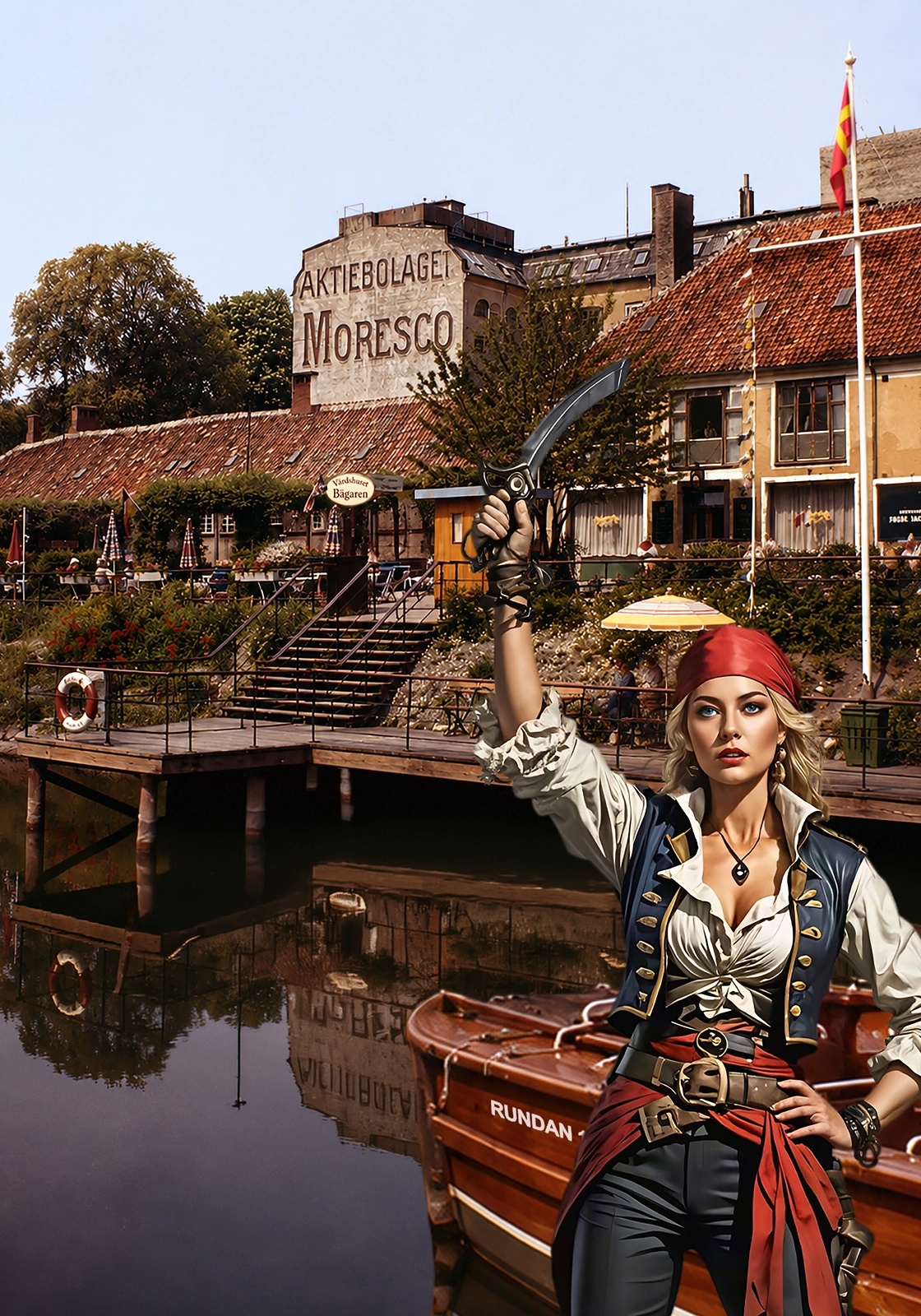
Anita and the Sea Devil - English Version, 2026
Digital
50 x 70 cm
3 200 kr
Anita and the Sea Devil Anita och havets demon
Svensk text på slutet
INTRODUCTION
There are people whose lives, in retrospect, seem so improbable that one suspects that someone has embellished the story along the way. Felix von Luckner was such a person. He ran away from home as a thirteen-year-old, went to sea under a false name, survived when he was washed overboard, worked as a boxer, wrestler, circus artist and magician, was an officer in the Imperial German Navy and during the First World War commanded the Seeadler, a sailing ship that hunted enemy merchant vessels with a mixture of cunning, theater and old-fashioned pirate romance. He captured ships, took hundreds of prisoners and treated them to champagne, shipwrecked on a coral island in the Pacific Ocean, set off in an open lifeboat, was captured, escaped from captivity and subsequently became so popular in the USA that the former enemy was named an honorary citizen. Then he married a girl from Malmö and lived for many years in the citys largest private residence, a palace with the Öresund as its nearest neighbour.
It was how the Demon of the Sea eventually ended up at Ribersborg, where the world-famous privateer captain was transformed into one of the citys most colourful profiles, known for his parties, his magic tricks, his enormous raw strength and his strange habit of tearing phone books apart and bending coins with his fingers. In the spring of 1952, Felix and Ingeborg von Luckner invited a young Malmö girl who had begun to attract the worlds attention. Her name was Anita Ekberg.
More than half a century later, Anita herself gets to tell the story of the man she met, of the boy who chose the sea over the cavalry, of the Seeadler and the Emperors pirates, of the escape across the Pacific Ocean, the fame in America, the confrontation with Nazism, life in Malmö and the riddle that finally brings the story back to what every real pirate story must containa treasure.
For Felix von Luckner was not just a man who could navigate across the worlds oceans. He was also a man who knew exactly where he was, how to find his way back, and how to leave something behind for anyone who one day succeeded in following the course.
The Sea Devils Ballad
He ran from home when thirteen years
And chose the rolling sea,
Where canvas cracked above his head
And every wind blew free.
No fathers plans, no cavalry
Could make the young man stay;
He took another name instead
And sailed his life away.
He learned to fight, he learned to steer,
To read the stars at night,
To trust the compass and the wind,
And sometimes trust his might.
From circus ring to distant shore,
From sailors bunk to fame,
The oceans taught him all he knew
Before the Great War came.
Then "Seeadler" spread her mighty wings
And slipped beyond the line,
A merchant ship to British eyes,
A raider by design.
Her hidden guns lay out of sight,
Her papers told a lie,
While Luckner raised his glass and smiled
As warships passed him by.
He fought a pirates gentleman war,
With cunning for his blade;
He burned false fires upon his deck
And watched the trap hed laid.
The merchant captains struck their flags,
Their crews came safe aboard,
And champagne flowed where other men
Might rather draw the sword.
Fourteen ships beneath his spell
Were captured on the sea,
Yet prisoners dined beside their guards
And wandered almost free.
For Luckner warred with ships and flags,
Not men who sailed below,
And mercy was the strangest flag
His "Seeadler" could show.
But every captain meets a storm
No cunning can command;
The reef took "Seeadler" from the sea
And cast her on the sand.
So Luckner chose an open boat,
Five sailors and the stars,
And crossed the empty tropic blue
Beyond all charts and bars.
They caught him once, he slipped away,
They caught the man once more;
For prison walls were never built
To keep him long ashore.
And when at last the war was done
The enemy became
The cheering crowd that filled the halls
And shouted Luckners name.
Then darker flags rose over home,
And Luckner would not bow;
The man who fooled the British fleet
Defied a Führer now.
When Halle waited for the bombs
And death stood at the gate,
He crossed the lines and faced the guns
And changed a citys fate.
At last he crossed the Öresund
To Malmö and his bride,
Where Fridhemsborg looked toward the sea
And Ingeborg stood beside.
There wine was poured and tales were told,
And guests would laugh to see
Him tear the books and bend the coins
That stronger men left be.
And once a girl from Malmö came,
Young Anita, tall and fair;
The old magician raised his hands
And drew her from thin air.
He could not know what seas of fame
That girl would travel through,
Nor could she know the pirates tale
Still held one secret too.
For every pirate needs their gold,
A map, a mark, a key,
A secret buried out of sight
Beyond the watching sea.
Most buccaneers drank fortunes dry
Before their final breath,
But navigators mark their course
And leave a trail past death.
So fill the glass and raise it high
To captains bold and free,
To canvas filled by western winds
And moonlight on the sea.
For ships may sink and men may die,
Yet legends leave a chart
And Luckner hid his greatest prize
Where maps and memories part.
Malmö, August 2026
Prologue
Anita Ekberg never played a pirate role during her long career. But it was extremely close that she wrote herself into film history in a completely different but at least as iconic way. She was, namely, the producers first choice as the co-star with James Bond in the very first film, Dr No.
The role of Honey Ryder ultimately went to Ursula Andress a then completely unknown Swiss woman. The character was not fully defined from the beginning. The only thing that was clear in the early manuscript drafts was that this woman belonged to the evil side.
When she, in the now-legendary scene, emerges from the turquoise water, one does not at first know who she is or where she comes from. Is she a shipwrecked pirate from a bygone era, or a windsurfer who has become completely lost at sea? The mystery surrounding her origin remains dense.
Anita Ekberg, during her years in the spotlight, managed to play some truly unpleasant women, but none of them made piracy their profession. Yet these xxx were at least as manipulative, ruthless and dangerous as the worst of the seas buccaneers. Anitas characters moved in the shadows, were driven by hidden motives and often left traces of destruction behind them traits that would have made them perfect captains on any pirate ship during the golden age of privateers. But that was on the silver screen. In reality, it was a completely different type of buccaneer who left behind the most difficult riddle in Swedish history. A man who, unlike the movie villains, was a gentleman and mastered the noble art of navigation to perfection.
Perhaps it is precisely there, in the borderland between the seas secrets, shipwrecks and unsolved riddles, that the most valuable treasures hide
The man who conjured Anita out of a hat
I met Alex von Luckner once, in the spring of 1952, when I was still so young that almost everything that would later become my life lay ahead of me. I had become Miss Sweden; pictures of me had already appeared in Life Magazine, and suddenly people I had never met before began to wonder who that tall girl from Malmö was. Felix and his wife, Ingeborg von Luckner, were among them. He had appeared on the front page of Life for his escapades at sea during WWI. What had I done to end up there? Alex wanted to hear it from my own mouth, so I was invited to one of their parties.
If you imagine that I arrived through the front door, left my coat with a servant, and was then politely introduced to the hosts, you do not know Felix von Luckner, because he had been a sailor, a war hero, a prisoner, a fugitive, a circus performer, a magician, and one of the great international adventurers of his time. Such a man naturally did not let a future movie star make an entrance in the usual way; instead, he conjured me out of a giant hat in front of the guests.
Fortunately, I did not have any rabbit ears, even though they would certainly have suited his performance, and I remember the party as both fun and remarkable. Numerous people from Malmös high society now had the chance to meet someone they suspected would carry the citys name far beyond Swedens borders. It sounds a bit presumptuous, of course, when I say it myself, but I can say it now that we know the outcome, because Malmö has not produced very many people who have become world-famous. Jörgen Kock had, in the 1500s, been a man with connections far beyond the city walls, but since then, such connections had been quite sparse among Malmö residents who put the city on the world map.
The funny thing is that both Jörgen Kock and von Luckner were originally German and came from fine families. At the same time, I, who would soon leave Malmö for America, was a simple working-class girl from Östra Fäladsgatan in Kirseberg.
When I first met Felix, he was over seventy and, at least in a twenty-year-old girls eyes, an older man. He was almost exactly fifty years older than I, but as soon as he began telling his stories, the years disappeared. The salon could have been a ships deck; we, Felixs guests, were his privateer crew, the Öresund lay outside the corner of their giant villa Fridhemsborg, the Atlantic Ocean stretched beyond, and the man with the pipe in front of me was once again the young naval officer who had been chased across the worlds oceans. Only later did I understand how improbable his life had been.
The boy who chose the sea
He had many names, but I had a trick to remember them: FNAG - Felix Nikolaus Alexander Georg Graf von Luckner, born in 1881 into an aristocratic German military family, where the future already seemed mapped out. His father had decided that the son should follow the family tradition and become a cavalry officer. Still, Felix had a troublesome trait that could be both a curse and a blessing: he refused to let others decide what his life should look like. We found we had much in common. He detested school, as did I; sitting still and being obedient suited us equally poorly. When he was thirteen, he did something that says quite a lot about the person he would become. He ran away from home.
I cannot help comparing myself. I did not run away, but I made myself independent as soon as I could. When I was thirteen, I still lived at home on Östra Fäladsgatan with my parents and five older brothers. At the same time, Felix packed a small valise, set off for Bremerhaven, and assumed the fictitious name Phylax Lüdecke so the police would not identify him and send him home.
There, the thirteen-year-old Counts son managed to secure a place as an unpaid cabin boy on the Russian full-rigged ship Niobe, and at the same moment his protected aristocratic childhood came to an end.
Life on board was harsh and brutal, and out on the sea, no one cared who his father was or what name the family bore. In a storm in the Atlantic, he was washed overboard and could have died before his life had even begun, but another sailor managed to grab hold of him and pull him back on board. Most thirteen-year-olds would probably have regarded this as an excellent argument for returning home and never setting foot on a vessel again. Still, Felix seems rather to have seen it as confirmation that he had found the right path.
Over the following years, he travelled around the world and supported himself with whatever he could find. He worked as a circus artist, a professional boxer and wrestler, a lighthouse keepers assistant, and a kangaroo hunter in Australia. He learned to do magic, which is why I got to make an entrance from a giant hat in Malmö. When he returned home to Germany and the family, he had become something entirely different from the cavalry officer his father had intended for him. He had become a sailor and, above all, had learned to manage on his own.
A pirate in the Emperors service
In 1912, von Luckner was called up to the Imperial German Navy, and when the First World War broke out, he found himself in a war in which ironclads, submarines, and industrial mass killing were replacing the world of old sailing ships. He took part in other events, including the Battle of Jutland in 1916, but it was not there that he became the legend he would be remembered for.
That same year, he was given command of a ship that actually belonged to an earlier era, the three-masted full-rigged ship Seeadler, equipped with an auxiliary engine and hidden cannons. The vessel was camouflaged as a peaceful Norwegian merchant ship to break the British blockade and subsequently attack Allied merchant shipping. It was, in other words, an old-fashioned privateer war in the middle of a modern world war. For a man like Felix von Luckner, the assignment was perfect.
Seeadler was transformed into a Norwegian cargo ship Irma. Felix faked false papers; the logbooks were treated with saltwater to look used; the ship and its crew were sprayed with stinking whale oil; and one of the sailors had to dress up as the captains wife to make the performance complete. When British officers boarded them on Christmas Day, they were thus met by a Norwegian-speaking captain who offered brandy, a sick wife who lay inside the cabin groaning, and such a stench that they did not want to stay onboard a minute longer than necessary.
The bluff succeeded. The British approved the papers, wished the Norwegian sailing ship a good voyage, and left it, unaware of the hidden German cannons. That summarises von Luckners approach to waging war well. He preferred theatre, cunning and a good performance over a bloodbath.
The Emperors pirates
Once Seeadler had made its way into the Atlantic, the hunt for Allied merchant ships began, and during the subsequent raid, von Luckner captured or sank fourteen ships. The strangest thing, however, was not how many he managed to catch but how he did it, since he repeatedly tried to trick his opponents rather than blasting them to the bottom with the crew on board.
When Seeadler encountered the large British steamer Horngarth, the problem was that a sailing ship could not catch up with a faster steamer. Felix therefore set fire to tar and chemicals on deck, and thick smoke billowed, giving the impression that his ship was ablaze. The British did exactly what decent sailors were expected to do when they saw a ship in distress, and changed course to come to the rescue. Once they had come close enough, the emergency quickly vanished. The hidden cannons were revealed, the German war flag was hoisted, and the commander of the Horngarth discovered that the rescue operation had in fact been a trap. Faced with the uncovered cannons, he surrendered without a fight.
Such actions made Felix famous as the gentleman pirate, but it was his treatment of the prisoners that set him apart. When he sank a ship, he first ensured that the crew was transferred to the Seeadler, where they were not locked up in a musty cargo hold but were allowed to move about fairly freely, eat proper food and even drink champagne together with their enemies. He organised something that closely resembled a French-British-German club on board, which sounded more like a holiday cruise than the First World War.
Felix himself said he waged war against ships and flags, not against the people who happened to be on board. During the entire raid, only one person lost their life, and it was an accident.
Eventually, the Seeadler had taken on so many prisoners that the situation became difficult. Felix then captured the French ship Cambronne, transferred 300 prisoners, and let them sail on towards Rio de Janeiro. Some of the French sailors protested, preferring to remain on the Seeadler, where they had been spoiled with French champagne stolen from a ship on its way to Rio. Even Russian caviar was part of the prisoners diet, a luxury they shared with the crew. It must be a record, even for a pirate, that prisoners do not want to be liberated.
When the sea won
People von Luckner could trick, but the sea was harder to outsmart. After many months at sea, the Seeadler needed maintenance. In the summer of 1917, he anchored off the isolated coral atoll Maupihaa in the Society Islands. On August 2, a giant wave threw the ship onto the coral reef, destroying it. The privateer captain suddenly found himself on a deserted island in the middle of the Pacific Ocean, together with about sixty Germans and forty-six prisoners of war. Everyone had survived, and they managed to salvage food, weapons, and equipment from the wreck and to build a small provisional community with tents, a kitchen, and a radio station. Still, Felix understood that the island could not sustain them indefinitely.
He then chose a solution that any sensible person would have been unlikely to recommend. One of Seeadlers open lifeboats, barely six metres long, was equipped with sails and weapons and renamed Kronprinzessin Cecilie. Felix then selected five men and set out across the Pacific Ocean with the intention of finding a ship, capturing it, and returning to fetch the others.
I have spent a lot of time at sea, owned a couple of fast Riva boats, driven at high speeds up the Tiber River, and made long sailing trips on Gianni Agnellis large sailboat, all far more comfortable than a six-metre-long lifeboat. I can assure you that I would not have voluntarily joined Felix and his men on a voyage of hundreds of nautical miles across the Pacific Ocean, through tropical storms and under a blazing sun, with limited supplies and only rainwater to drink.
Finally, they reached Wakaya in Fiji. There, Felix tried to play the role of a stranded Norwegian sailor, but the performance was less convincing than on the Seeadler. The local population grew suspicious of these fit Norwegians and alerted the authorities. A local police inspector arrived in a small steamer and claimed that he had a heavily armed warship waiting around the point. He did not.
But Felix believed him and surrendered, unwilling to risk human lives in a meaningless battle. There is a certain poetic justice in this: the man who had fooled the British Navy with a fake captains wife and captured the Horngarth with an artificial fire was himself defeated by a policeman with a vivid imagination.
The prisoner who escaped
Von Luckner was sent to New Zealand and placed in a prisoner-of-war camp on the island of Motuihe, where his adventures should reasonably have paused, at least until the war was over. But prison life suited him just as poorly as school had when he was a boy. Soon, he managed to charm the guards and was granted permission to stage theatre performances, which allowed him and his men to secretly prepare an escape.
They manufactured fake uniforms, maps, and navigation equipment. Late at night on St. Lucias Day, December 13, 1917, they cut the islands telephone lines, stole the camp commandants motorboat Pearl, and disappeared into the darkness. Thereafter, they captured the New Zealand wooden schooner Moa, after which Felix resumed command as privateer captain and hoisted a self-made German war flag.
The newly won freedom proved short-lived when the New Zealand auxiliary warship Iris caught up with them near the Kermadec Islands. Since the Moa could not fight, Felix had to capitulate for the second time. After that, the authorities ensured he was guarded more closely for the rest of the war. It was not until 1919 that he could return to Germany as a man whose adventures had already made him an international legend.
The enemy whom the Americans loved
Von Luckners fame did not fade when the war ended; on the contrary, it grew as he began writing books and touring as a lecturer. During the 1920s and 1930s, he became particularly popular in the USA, which was remarkable, given that just a few years earlier he had been an officer in the German Navy and an enemy of the Americans.
In 1926, he embarked on a goodwill tour to help reconcile Germany with its former adversaries. The Americans fell head over heels for the Count, captivated by his stories of the gentlemanly war, his humour and charm, and, not least, his enormous physical strength, which he demonstrated by tearing phone books apart with his bare hands. He did not tackle small rural directories. He tore both Manhattans and Hamburgs thick directories in half. This strange speciality became, over time, almost as famous as his sailor stories. Henry Ford was so impressed by him that he gifted him a car; San Francisco gave him the keys to the city and named him an honorary citizen, and similar honours followed elsewhere. The then American President, Calvin Coolidge, expressed a desire to meet the famous German Count. The German Foreign Ministry said no, as it wanted to avoid his visit taking on an overly political character.
A few years earlier, Felix had been the Americans enemy; now he was treated as a hero. No one could then have suspected that the friendship with the Americans, long afterwards, would prove more significant than all the military medals he was honoured with during his American tour.
The Malmö girl Ingeborg
Malmö had already entered his life in 1924, when Felix married Ingeborg Engeström, daughter of the wealthy Malmö consul, Max Engeström. The wedding took place at Hotel Kramer by Stortorget. It became such a public event as arises when an international celebrity suddenly becomes part of a city that world celebrities had not yet spoiled.
The residents of Malmö gathered around the hotel to catch a glimpse of the Demon of the Sea and his Swedish bride, and the banquet was as grand as one could expect. Food and champagne were served, while Felix did what he did best when he had an audience: performed magic, bent coins, told stories and demonstrated his strength.
The marriage to Ingeborg would endure through all the strange turns. She followed him on his travels and stood by his side through political conflicts, threats of war, and periods of surveillance, while her hometown, Malmö, became their fixed point. When I met them in the spring of 1952, I met not only a German naval hero and his Swedish wife, but also a couple who had become part of Malmö, albeit an unusual one.
The man who refused to let himself be used
When the Nazis took power in Germany in 1933, they naturally recognised the value of Felix von Luckner. He was internationally famous and immensely popular in the USA, and would have been a perfect advertising billboard for the new Germany. The problem was that Felix did not want to play the role they had planned for him. Hitler demanded that Felix renounce his American honorary citizenship and sever his ties with the Freemasons, but Felix refused. The consequences were severe: his bank accounts were frozen, his books were banned, his opportunities to appear publicly were restricted, and he periodically lived under intense surveillance.
From these years also comes the story of Rose Janson, a Jewish woman in Halle who was threatened by the Gestapo and at risk of deportation. According to her later account, Felix helped her by forging documents that enabled her to leave Germany and reach the USA. After the war, she wrote a letter stating that he had saved her life. The story fits with a trait of his that recurs time and again: Felix found it hard to stand aside when power was used against defenceless people.
In 1945, this same trait would lead him into perhaps the most dangerous adventure since the Seeadler.
The man who saved the city of Halle
In April 1945, Germany was collapsing, and American troops had surrounded Halle, where the local Nazi leadership, despite the catastrophic situation, intended to defend the city to the last drop of blood. The Americans threatened a devastating attack if the city did not surrender, putting thousands of civilians at risk of dying in a war that was already lost.
Felix was by then over sixty years old, and apparently no one had managed to persuade him that a man of his age should sit at home and wait for the end of the war. Together with a local officer, he made his way through the battle lines to negotiate with the Americans, using there his most powerful weapon: his own name and reputation.
The Americans knew very well who he was. The German privateer captain from the First World War had been a beloved lecturer in their country during the interwar period. When he referred to his honorary citizenship in San Francisco, he therefore spoke not like just any German negotiator, but like an old acquaintance.
Moreover, the story goes that he is said to have demonstrated his contempt for the regime by tearing a copy of Hitlers Mein Kampf apart. That detail may have grown over the years, as so much else surrounding von Luckner has, but no one who had seen him tear phone books apart would have regarded the feat as physically impossible. Directories are one thing, but the paper in fiction books and political manifestos is usually of a different, more compact quality than the razor-thin, easily torn newsprint used in telephone directories which makes a bound book like Mein Kampf significantly harder to tear apart with bare hands. But 800 pages of political nonsense he managed without problems.
The negotiations succeeded; the threatened attack on Halle was called off, and the city was spared the destruction that would otherwise have befallen it. The Nazis immediately sentenced von Luckner to death in his absence, not so much for having disavowed the commandant and prevented him from sacrificing innocent German lives as for having desecrated the Nazis bible, the Führers Mein Kampf. It was, naturally, high treason, and the punishment could be no less than death. Felix managed to remain hidden during the chaotic weeks leading up to the regime's collapse.
After these dramatic events, he moved to his wifes hometown, Malmö, to spend the rest of his life in peace. After two world wars, Nazism, and everything that had happened in Germany, Felix was rather fed up with his old homeland.
Fridhemsborg
After the war, Felix and Ingeborg settled in Malmö at their famous home, Fridhemsborg, the Engeström patrician villa on Fridhemsvägen near Ribersborg. Calling it a villa is misleading, since the house, built in 1916 by Ingeborgs parents, Max and Margarete Engeström, covered around 1,200 square metres and originally had some forty rooms. It was Malmös largest private residence, even larger than the one at Stortorget.
It was a private palace, set within a large, park-like garden of tall trees and huge rhododendron bushes, with Öresund in the background as a reminder of the world Felix came from. Indoors, there were trophies, gifts, and exotic objects from a life of travel. The palace became a gathering place for Malmös high society, international guests, diplomats, and others who wanted to meet the living legend. I thus became one of them.
It was said that Fridhemsborg was seldom particularly quiet when Felix had guests, and I can very well imagine that. The champagne flowed, the food was plentiful, and the host had no intention of leaving the entertainment to anyone else; instead, he performed magic, told his best pirate stories, tore phone books apart, and bent silver coins with his fingers.
One of these stories is worth retelling. As a teenager, Felix had made his way to Australia under a false name. As a penniless runaway, he scraped by on temporary odd jobs. For a time, he secured a job as an assistant lighthouse keeper at the isolated Cape Leeuwin lighthouse in south-western Australia. The job was not a good fit it meant loneliness and strict routines except for its proximity to the sea; nothing else suited him. But there were extenuating circumstances. The lighthouse keeper had a beautiful daughter. Felix, a charmer with a well-oiled tongue, spent more time courting the daughter than polishing the lighthouse lenses and keeping the kerosene lamps burning. The daughter was on board with it. The whole thing came to an abrupt and drastic end one night when the lighthouse keeper caught them red-handed. Felix was literally thrown out of the lighthouse in the middle of a raging storm and had to flee head over heels along the rocky shores.
After this romantic adventure, he was forced to seek work as a kangaroo hunter and professional wrestler at a travelling circus to survive. He had actually trained in wrestling while hunting kangaroos. Kangaroos were known for their lethal kicks. To wrestle down such an animal demanded a man, and Felix was such a man. At the circus, he challenged anyone to step into the ring and fight him. It went excellently.
Should any challenger gain the upper hand, Felix would use a trick he had learned from his close contact with kangaroos. Like humans, kangaroos are ticklish, and if you press your knuckles in a certain way under the armpits, the other person bursts into paroxysms of laughter and lets go. It was, by the way, at that circus that Felix learned to tear phone books apartboth Sydneys and Melbournes directories were, in that respect, a good international standard.
To help him at Fridhemsborg, Felix had his loyal German servant and chauffeur, Georg Langer, who became a well-known figure on Malmös streets. When Felix was not holding court at home, he liked to travel around Scania in his custom-built Tempo Matador, an early motorhome.
Langer was not only a car driver in the spirit of racing driver Stirling Moss but also a skilled mechanic. Instead of the modest Austin engine, he crammed in a significantly more powerful Porsche four-cylinder engine with 75 horsepower. That, along with a favourable gear ratio, gave the bus the extra power needed to win all spontaneous races that arose when the traffic lights turned green.
Nor did the parties always stay within bounds, as the Count gladly extended them into the park at full blast. In the open air, Felix performed magic for the neighbourhood children or pulled out coins for those standing outside, staring in through the gates.
The man who had once been pursued across the worlds oceans by British and New Zealand forces had, in his later years, become something of a circus director at Ribersborg.
The phone book and the Malmö police
Felixs raw strength was no stage illusion. At Malmös restaurants, he could ask the head waiter to fetch the thickest telephone directory available and then tear it in half before astonished dinner guests. Another of his favourite acts was to bend or fold a silver coin with his fingers and then leave it as a tip, which was surely a memorable moment for the waiter, even if the coin was unusable afterwards.
Naturally, there is also a story about Felix and the Malmö police, and it would almost have been stranger if it had not existed. He and Langer were driving on Regementsgatan in the Tempo bus when a young policeman stopped them, possibly near Fridhem. They had been going noticeably fast. Even though they did not have radar in those days, it was clear that the vehicle had travelled at more than 100 kilometres per hour. In the early 50s, that was a respectable speed even on a highway, but in a city it was sheer madness.
When the police officer asked him to show identification, Felix did not pull out his driving licence but a phone book, which he tore in half in front of the officer. Then he pulled out a coin, bent it between his fingers and said: Here is my identification, young man. Do you need to see my passport too?
The story ended with the young policeman losing interest in his fine book, saluting, and letting the duo drive on in their strange bus. Whether it really happened exactly as described, I cannot vouch for, but it is an excellent von Luckner story. Sometimes a good tall tale tells more about a persons personality than an entire archive of official documents. No one would tell it about a dull bank director, but when it comes to Felix, one is inclined to believe it before the end is heard.
The old pirate in Malmö
Fridhemsborg did not remain Felix and Ingeborgs home for the rest of their lives. After Ingeborgs mother died in 1950, the familys circumstances changed, and in 1955 the large property was sold to shipowner Einar Hansen. However, Felix did not leave Malmö. Although he thereafter commuted between Malmö and Hamburg, he remained a colourful figure in the city right up until his death.
It is perhaps that part of his story that fascinates me most, because world fame otherwise easily becomes something abstract and distant. Felix had sailed across the worlds oceans, been the First World Wars most famous privateer captain, become a prisoner of war and escaped, been hailed as a celebrity in America, defied the Nazis and helped to save an entire German city, but after that, one could meet him on a street in Malmö with his pipe in his mouth and yet another incredible story ready for anyone who had time to listen.
That was the man I met in the spring of 1952, when I could not yet know how remarkable my life would become. Hollywood, Rome, Fellini, the bow-and-arrow hunt for photographers, the speedboat ride up the Tiber, the scandals and the movies lay ahead of me, and perhaps Felix recognised in me the same restlessness he knew in himself. He had lived long enough to know that a persons life can change direction in just a few minutes. For him, it had happened when a thirteen-year-old boy stepped on board the Niobe. For me, it happened when I entered a beauty pageant.
Neither of us would ever return to the world we had left behind.
The final journey
Felix von Luckner died in Malmö on April 13, 1966, at the age of 84. The news spread far beyond Sweden because the Demon of the Sea and the Emperors pirate were still remembered across large parts of the world. His body was taken to Hamburg, where the funeral was held with great solemnity, attended by representatives from official Malmö and from the circles that had come to know him during his Swedish years.
It was as if the circle had closed. When he married Ingeborg at Kramer in 1924, the residents of Malmö filled Stortorget to see him. Forty-two years later, people gathered once again around Felix von Luckner, this time to say goodbye. Felixs final journey took him to Hamburg, where he was buried at Ohlsdorfer Friedhof. Ingeborg returned to Malmö and lived for a few more years.
The loyal Georg Langer stayed with her, helping with everyday life while also guarding Felixs memories. When Ingeborg died in January 1973, she was taken to Hamburg and buried beside her husband. After all the travels across land and oceans, all the wars, escapes and adventures, their shared journey ended side by side.
What was left
Felix von Luckner never completely disappeared from Malmö. The Maritime Society in Malmö manages a fund bearing his name, with the yield used to fund prizes and scholarships for promising students at the Maritime Academy in Kalmar. I think this is unusually fitting, given how his own life began.
The thirteen-year-old boy who ran away from home and went to sea as an unpaid cabin boy eventually worked his way up to become a sea captain, a Count, a war hero, an international celebrity, and an honorary citizen of American cities. Through the fund, his name still helps young people who want to learn what he himself once had to learn the hard way: to navigate, to guide a vessel across the sea, and, above all, to find the way home again. There, the story could have ended if it hadnt begun in a completely different place. We began with pirates. But there are no real pirates without a treasure.
The pirates treasure
There are no real pirates without treasure, and that applies to von Luckner as well. The difference is that almost none of the classic pirate treasures have ever been found. Presumably, that is due to something far simpler than all the stories about secret maps, black crosses and chests buried under palm trees. Most pirates likely partied away their treasures on rum, women, clothes and weapons, and enjoyed a few days or weeks of the good life before heading back out to sea. For someone who knew the next cannonball could put an end to everything, there was hardly any incentive to plan for long-term retirement savings.
Felix von Luckner was, however, no ordinary pirate and, above all, a navigator. He had spent his life knowing where he was and how to find his way back, had guided the Seeadler through the British blockade, and had navigated a small open lifeboat for hundreds of nautical miles across the Pacific Ocean. If such a man decided to hide something, he could choose a location that very few others could reach.
And another story begins, one that is not about captured merchant ships, false Norwegian captains, champagne for prisoners of war, or phone books torn right in half at Malmös restaurants, but about Alex von Luckners testament. And about the treasure he left behind.
Alex von Luckners testament
The legendary sea captain and Count Felix Alex von Luckner took many secrets to the grave when he died in Malmö in 1966. But the best-kept secret of them all concerned neither naval battles nor escape plans. It concerned an inheritance from his last great voyage around the world a treasure that today lies hidden somewhere in Scania, protected by an intricate three-step encryption.
The Australian gift
It all began in May 1938. Von Luckner arrived in Australia aboard his yacht, Seeteufel, and was received as a celebrated hero by the local elite. During a visit to the famous inland mining areas, he was presented with an extremely rare gift. At the same excavation, two unique, completely uncut black opals were discovered.
The stones were twins, but von Luckners specimen was an absolute giant roughly 40 carats larger than its sister stone. At the time, no one understood the raw stones true potential, as they mostly looked like dark, rough lumps. Only much later, when the smaller sister stone was finally cut and proved to be a fantastic, perfect opal, did von Luckner realise what an uncut treasure he was sitting on.
When the Count later had a master cutter process his own giant stone in secret, its full splendour was revealed. The opal was flawless. It displayed an absolutely faultless play of colour, with exactly as many colours and deep red fire as an ultimate gemstone should have. It is worth an enormous fortune, surely double the value of the sibling stone, today perhaps more than 2 million US dollars.
The treasure is hidden in Scania.
When von Luckner settled in Scania in his final years, he realised that such a gemstone did no good lying in a safe. Furthermore, he did not need the money, and the couple had no children. He decided to hide the stone. Inspired by historical book cyphers and secret societies, he created a testament divided into sections. Whoever cracks the codes gets the stone.
The construction is based on the requirement that one must piece together three hidden clues to locate the stone.
The location Bird, fish, or in-between
The first section of the testament establishes the treasures overall position in the terrain. The code reveals that the opal is neither buried in the earth (in-between), submerged in the depths of the Öresund (fish), nor located in the air among the birds. It is the first spatial clue, narrowing the search to Scanian soil, a cave, or a bank safety deposit box. It could also be located among the fish, if not literally, then in water. Scanias towers, masts, or known bird nesting sites can also hide the opal.
The content (The hidden nature)
The second section confirms what one is actually looking for. Here we learn that the treasure is not gold or secret documents, but the unique giant black opal from Australia. This part describes the stones exact characteristics and enormous value, so that the fortune hunter knows what kind of hidden masterpiece awaits. As for the nature of the treasure, the cyphers solution referred to a Wikipedia article about the sibling stone, and other details were also contained in the cypher.
The riddle (The final piece of the puzzle)
Here the open tracks end. It is simply a matter of solving the unsolved rebus an encrypted number-and-symbol code left by von Luckner. Without the correct code key, it is impossible to pinpoint the exact niche, cavity, or beam where the opal rests.
When von Luckner created this, there were no GPS satellites. Still, the Count was a divinely gifted navigator and could pinpoint a position to within a centimetre using just four coordinates. What land surveyors achieved in the 1960s, von Luckner achieved just as well, on land, at sea and in the air. If there are only four fixed positions that nature cannot destroy within the foreseeable future, someone will sooner or later find the opal.
There are thus one or more who have solved the first two riddles and who naturally do not think I should pass their secret along not even about what kind of treasure we are talking about. For anyone who wants to read up on how the method works, it echoes the history of the most famous book cypher: the Beale cyphers. The information is in the same place as The Aurora Australis.
The story of Alex von Luckners testament lives on, but the final rebus remains to be cracked by whoever has the patience and the sharpness of mind to outsmart the Sea Devil.
If I had to live my life on earth again, I would probably become a privateer too. Better to hunt than to be hunted, Anita finished, thinking of all the worlds photographers.
Jörgen Thornberg
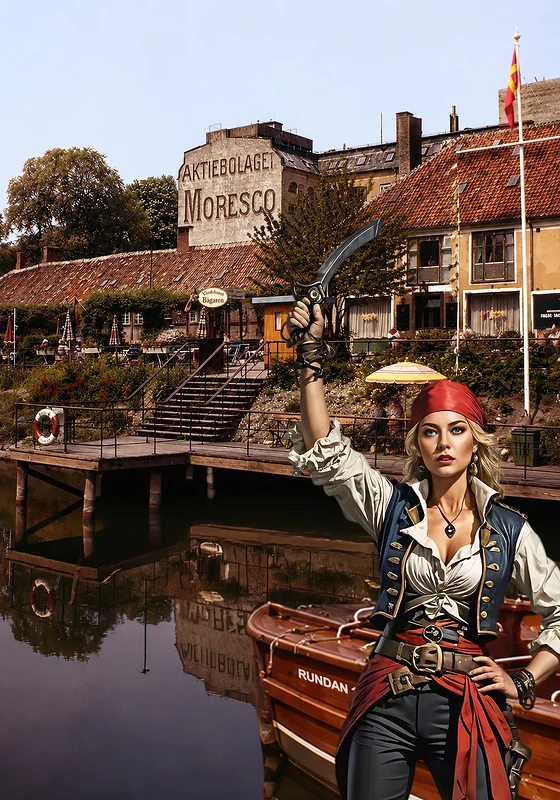
Anita and the Sea Devil - English Version, 2026
Digital
50 x 70 cm
3 200 kr
Anita and the Sea Devil Anita och havets demon
Svensk text på slutet
INTRODUCTION
There are people whose lives, in retrospect, seem so improbable that one suspects that someone has embellished the story along the way. Felix von Luckner was such a person. He ran away from home as a thirteen-year-old, went to sea under a false name, survived when he was washed overboard, worked as a boxer, wrestler, circus artist and magician, was an officer in the Imperial German Navy and during the First World War commanded the Seeadler, a sailing ship that hunted enemy merchant vessels with a mixture of cunning, theater and old-fashioned pirate romance. He captured ships, took hundreds of prisoners and treated them to champagne, shipwrecked on a coral island in the Pacific Ocean, set off in an open lifeboat, was captured, escaped from captivity and subsequently became so popular in the USA that the former enemy was named an honorary citizen. Then he married a girl from Malmö and lived for many years in the citys largest private residence, a palace with the Öresund as its nearest neighbour.
It was how the Demon of the Sea eventually ended up at Ribersborg, where the world-famous privateer captain was transformed into one of the citys most colourful profiles, known for his parties, his magic tricks, his enormous raw strength and his strange habit of tearing phone books apart and bending coins with his fingers. In the spring of 1952, Felix and Ingeborg von Luckner invited a young Malmö girl who had begun to attract the worlds attention. Her name was Anita Ekberg.
More than half a century later, Anita herself gets to tell the story of the man she met, of the boy who chose the sea over the cavalry, of the Seeadler and the Emperors pirates, of the escape across the Pacific Ocean, the fame in America, the confrontation with Nazism, life in Malmö and the riddle that finally brings the story back to what every real pirate story must containa treasure.
For Felix von Luckner was not just a man who could navigate across the worlds oceans. He was also a man who knew exactly where he was, how to find his way back, and how to leave something behind for anyone who one day succeeded in following the course.
The Sea Devils Ballad
He ran from home when thirteen years
And chose the rolling sea,
Where canvas cracked above his head
And every wind blew free.
No fathers plans, no cavalry
Could make the young man stay;
He took another name instead
And sailed his life away.
He learned to fight, he learned to steer,
To read the stars at night,
To trust the compass and the wind,
And sometimes trust his might.
From circus ring to distant shore,
From sailors bunk to fame,
The oceans taught him all he knew
Before the Great War came.
Then "Seeadler" spread her mighty wings
And slipped beyond the line,
A merchant ship to British eyes,
A raider by design.
Her hidden guns lay out of sight,
Her papers told a lie,
While Luckner raised his glass and smiled
As warships passed him by.
He fought a pirates gentleman war,
With cunning for his blade;
He burned false fires upon his deck
And watched the trap hed laid.
The merchant captains struck their flags,
Their crews came safe aboard,
And champagne flowed where other men
Might rather draw the sword.
Fourteen ships beneath his spell
Were captured on the sea,
Yet prisoners dined beside their guards
And wandered almost free.
For Luckner warred with ships and flags,
Not men who sailed below,
And mercy was the strangest flag
His "Seeadler" could show.
But every captain meets a storm
No cunning can command;
The reef took "Seeadler" from the sea
And cast her on the sand.
So Luckner chose an open boat,
Five sailors and the stars,
And crossed the empty tropic blue
Beyond all charts and bars.
They caught him once, he slipped away,
They caught the man once more;
For prison walls were never built
To keep him long ashore.
And when at last the war was done
The enemy became
The cheering crowd that filled the halls
And shouted Luckners name.
Then darker flags rose over home,
And Luckner would not bow;
The man who fooled the British fleet
Defied a Führer now.
When Halle waited for the bombs
And death stood at the gate,
He crossed the lines and faced the guns
And changed a citys fate.
At last he crossed the Öresund
To Malmö and his bride,
Where Fridhemsborg looked toward the sea
And Ingeborg stood beside.
There wine was poured and tales were told,
And guests would laugh to see
Him tear the books and bend the coins
That stronger men left be.
And once a girl from Malmö came,
Young Anita, tall and fair;
The old magician raised his hands
And drew her from thin air.
He could not know what seas of fame
That girl would travel through,
Nor could she know the pirates tale
Still held one secret too.
For every pirate needs their gold,
A map, a mark, a key,
A secret buried out of sight
Beyond the watching sea.
Most buccaneers drank fortunes dry
Before their final breath,
But navigators mark their course
And leave a trail past death.
So fill the glass and raise it high
To captains bold and free,
To canvas filled by western winds
And moonlight on the sea.
For ships may sink and men may die,
Yet legends leave a chart
And Luckner hid his greatest prize
Where maps and memories part.
Malmö, August 2026
Prologue
Anita Ekberg never played a pirate role during her long career. But it was extremely close that she wrote herself into film history in a completely different but at least as iconic way. She was, namely, the producers first choice as the co-star with James Bond in the very first film, Dr No.
The role of Honey Ryder ultimately went to Ursula Andress a then completely unknown Swiss woman. The character was not fully defined from the beginning. The only thing that was clear in the early manuscript drafts was that this woman belonged to the evil side.
When she, in the now-legendary scene, emerges from the turquoise water, one does not at first know who she is or where she comes from. Is she a shipwrecked pirate from a bygone era, or a windsurfer who has become completely lost at sea? The mystery surrounding her origin remains dense.
Anita Ekberg, during her years in the spotlight, managed to play some truly unpleasant women, but none of them made piracy their profession. Yet these xxx were at least as manipulative, ruthless and dangerous as the worst of the seas buccaneers. Anitas characters moved in the shadows, were driven by hidden motives and often left traces of destruction behind them traits that would have made them perfect captains on any pirate ship during the golden age of privateers. But that was on the silver screen. In reality, it was a completely different type of buccaneer who left behind the most difficult riddle in Swedish history. A man who, unlike the movie villains, was a gentleman and mastered the noble art of navigation to perfection.
Perhaps it is precisely there, in the borderland between the seas secrets, shipwrecks and unsolved riddles, that the most valuable treasures hide
The man who conjured Anita out of a hat
I met Alex von Luckner once, in the spring of 1952, when I was still so young that almost everything that would later become my life lay ahead of me. I had become Miss Sweden; pictures of me had already appeared in Life Magazine, and suddenly people I had never met before began to wonder who that tall girl from Malmö was. Felix and his wife, Ingeborg von Luckner, were among them. He had appeared on the front page of Life for his escapades at sea during WWI. What had I done to end up there? Alex wanted to hear it from my own mouth, so I was invited to one of their parties.
If you imagine that I arrived through the front door, left my coat with a servant, and was then politely introduced to the hosts, you do not know Felix von Luckner, because he had been a sailor, a war hero, a prisoner, a fugitive, a circus performer, a magician, and one of the great international adventurers of his time. Such a man naturally did not let a future movie star make an entrance in the usual way; instead, he conjured me out of a giant hat in front of the guests.
Fortunately, I did not have any rabbit ears, even though they would certainly have suited his performance, and I remember the party as both fun and remarkable. Numerous people from Malmös high society now had the chance to meet someone they suspected would carry the citys name far beyond Swedens borders. It sounds a bit presumptuous, of course, when I say it myself, but I can say it now that we know the outcome, because Malmö has not produced very many people who have become world-famous. Jörgen Kock had, in the 1500s, been a man with connections far beyond the city walls, but since then, such connections had been quite sparse among Malmö residents who put the city on the world map.
The funny thing is that both Jörgen Kock and von Luckner were originally German and came from fine families. At the same time, I, who would soon leave Malmö for America, was a simple working-class girl from Östra Fäladsgatan in Kirseberg.
When I first met Felix, he was over seventy and, at least in a twenty-year-old girls eyes, an older man. He was almost exactly fifty years older than I, but as soon as he began telling his stories, the years disappeared. The salon could have been a ships deck; we, Felixs guests, were his privateer crew, the Öresund lay outside the corner of their giant villa Fridhemsborg, the Atlantic Ocean stretched beyond, and the man with the pipe in front of me was once again the young naval officer who had been chased across the worlds oceans. Only later did I understand how improbable his life had been.
The boy who chose the sea
He had many names, but I had a trick to remember them: FNAG - Felix Nikolaus Alexander Georg Graf von Luckner, born in 1881 into an aristocratic German military family, where the future already seemed mapped out. His father had decided that the son should follow the family tradition and become a cavalry officer. Still, Felix had a troublesome trait that could be both a curse and a blessing: he refused to let others decide what his life should look like. We found we had much in common. He detested school, as did I; sitting still and being obedient suited us equally poorly. When he was thirteen, he did something that says quite a lot about the person he would become. He ran away from home.
I cannot help comparing myself. I did not run away, but I made myself independent as soon as I could. When I was thirteen, I still lived at home on Östra Fäladsgatan with my parents and five older brothers. At the same time, Felix packed a small valise, set off for Bremerhaven, and assumed the fictitious name Phylax Lüdecke so the police would not identify him and send him home.
There, the thirteen-year-old Counts son managed to secure a place as an unpaid cabin boy on the Russian full-rigged ship Niobe, and at the same moment his protected aristocratic childhood came to an end.
Life on board was harsh and brutal, and out on the sea, no one cared who his father was or what name the family bore. In a storm in the Atlantic, he was washed overboard and could have died before his life had even begun, but another sailor managed to grab hold of him and pull him back on board. Most thirteen-year-olds would probably have regarded this as an excellent argument for returning home and never setting foot on a vessel again. Still, Felix seems rather to have seen it as confirmation that he had found the right path.
Over the following years, he travelled around the world and supported himself with whatever he could find. He worked as a circus artist, a professional boxer and wrestler, a lighthouse keepers assistant, and a kangaroo hunter in Australia. He learned to do magic, which is why I got to make an entrance from a giant hat in Malmö. When he returned home to Germany and the family, he had become something entirely different from the cavalry officer his father had intended for him. He had become a sailor and, above all, had learned to manage on his own.
A pirate in the Emperors service
In 1912, von Luckner was called up to the Imperial German Navy, and when the First World War broke out, he found himself in a war in which ironclads, submarines, and industrial mass killing were replacing the world of old sailing ships. He took part in other events, including the Battle of Jutland in 1916, but it was not there that he became the legend he would be remembered for.
That same year, he was given command of a ship that actually belonged to an earlier era, the three-masted full-rigged ship Seeadler, equipped with an auxiliary engine and hidden cannons. The vessel was camouflaged as a peaceful Norwegian merchant ship to break the British blockade and subsequently attack Allied merchant shipping. It was, in other words, an old-fashioned privateer war in the middle of a modern world war. For a man like Felix von Luckner, the assignment was perfect.
Seeadler was transformed into a Norwegian cargo ship Irma. Felix faked false papers; the logbooks were treated with saltwater to look used; the ship and its crew were sprayed with stinking whale oil; and one of the sailors had to dress up as the captains wife to make the performance complete. When British officers boarded them on Christmas Day, they were thus met by a Norwegian-speaking captain who offered brandy, a sick wife who lay inside the cabin groaning, and such a stench that they did not want to stay onboard a minute longer than necessary.
The bluff succeeded. The British approved the papers, wished the Norwegian sailing ship a good voyage, and left it, unaware of the hidden German cannons. That summarises von Luckners approach to waging war well. He preferred theatre, cunning and a good performance over a bloodbath.
The Emperors pirates
Once Seeadler had made its way into the Atlantic, the hunt for Allied merchant ships began, and during the subsequent raid, von Luckner captured or sank fourteen ships. The strangest thing, however, was not how many he managed to catch but how he did it, since he repeatedly tried to trick his opponents rather than blasting them to the bottom with the crew on board.
When Seeadler encountered the large British steamer Horngarth, the problem was that a sailing ship could not catch up with a faster steamer. Felix therefore set fire to tar and chemicals on deck, and thick smoke billowed, giving the impression that his ship was ablaze. The British did exactly what decent sailors were expected to do when they saw a ship in distress, and changed course to come to the rescue. Once they had come close enough, the emergency quickly vanished. The hidden cannons were revealed, the German war flag was hoisted, and the commander of the Horngarth discovered that the rescue operation had in fact been a trap. Faced with the uncovered cannons, he surrendered without a fight.
Such actions made Felix famous as the gentleman pirate, but it was his treatment of the prisoners that set him apart. When he sank a ship, he first ensured that the crew was transferred to the Seeadler, where they were not locked up in a musty cargo hold but were allowed to move about fairly freely, eat proper food and even drink champagne together with their enemies. He organised something that closely resembled a French-British-German club on board, which sounded more like a holiday cruise than the First World War.
Felix himself said he waged war against ships and flags, not against the people who happened to be on board. During the entire raid, only one person lost their life, and it was an accident.
Eventually, the Seeadler had taken on so many prisoners that the situation became difficult. Felix then captured the French ship Cambronne, transferred 300 prisoners, and let them sail on towards Rio de Janeiro. Some of the French sailors protested, preferring to remain on the Seeadler, where they had been spoiled with French champagne stolen from a ship on its way to Rio. Even Russian caviar was part of the prisoners diet, a luxury they shared with the crew. It must be a record, even for a pirate, that prisoners do not want to be liberated.
When the sea won
People von Luckner could trick, but the sea was harder to outsmart. After many months at sea, the Seeadler needed maintenance. In the summer of 1917, he anchored off the isolated coral atoll Maupihaa in the Society Islands. On August 2, a giant wave threw the ship onto the coral reef, destroying it. The privateer captain suddenly found himself on a deserted island in the middle of the Pacific Ocean, together with about sixty Germans and forty-six prisoners of war. Everyone had survived, and they managed to salvage food, weapons, and equipment from the wreck and to build a small provisional community with tents, a kitchen, and a radio station. Still, Felix understood that the island could not sustain them indefinitely.
He then chose a solution that any sensible person would have been unlikely to recommend. One of Seeadlers open lifeboats, barely six metres long, was equipped with sails and weapons and renamed Kronprinzessin Cecilie. Felix then selected five men and set out across the Pacific Ocean with the intention of finding a ship, capturing it, and returning to fetch the others.
I have spent a lot of time at sea, owned a couple of fast Riva boats, driven at high speeds up the Tiber River, and made long sailing trips on Gianni Agnellis large sailboat, all far more comfortable than a six-metre-long lifeboat. I can assure you that I would not have voluntarily joined Felix and his men on a voyage of hundreds of nautical miles across the Pacific Ocean, through tropical storms and under a blazing sun, with limited supplies and only rainwater to drink.
Finally, they reached Wakaya in Fiji. There, Felix tried to play the role of a stranded Norwegian sailor, but the performance was less convincing than on the Seeadler. The local population grew suspicious of these fit Norwegians and alerted the authorities. A local police inspector arrived in a small steamer and claimed that he had a heavily armed warship waiting around the point. He did not.
But Felix believed him and surrendered, unwilling to risk human lives in a meaningless battle. There is a certain poetic justice in this: the man who had fooled the British Navy with a fake captains wife and captured the Horngarth with an artificial fire was himself defeated by a policeman with a vivid imagination.
The prisoner who escaped
Von Luckner was sent to New Zealand and placed in a prisoner-of-war camp on the island of Motuihe, where his adventures should reasonably have paused, at least until the war was over. But prison life suited him just as poorly as school had when he was a boy. Soon, he managed to charm the guards and was granted permission to stage theatre performances, which allowed him and his men to secretly prepare an escape.
They manufactured fake uniforms, maps, and navigation equipment. Late at night on St. Lucias Day, December 13, 1917, they cut the islands telephone lines, stole the camp commandants motorboat Pearl, and disappeared into the darkness. Thereafter, they captured the New Zealand wooden schooner Moa, after which Felix resumed command as privateer captain and hoisted a self-made German war flag.
The newly won freedom proved short-lived when the New Zealand auxiliary warship Iris caught up with them near the Kermadec Islands. Since the Moa could not fight, Felix had to capitulate for the second time. After that, the authorities ensured he was guarded more closely for the rest of the war. It was not until 1919 that he could return to Germany as a man whose adventures had already made him an international legend.
The enemy whom the Americans loved
Von Luckners fame did not fade when the war ended; on the contrary, it grew as he began writing books and touring as a lecturer. During the 1920s and 1930s, he became particularly popular in the USA, which was remarkable, given that just a few years earlier he had been an officer in the German Navy and an enemy of the Americans.
In 1926, he embarked on a goodwill tour to help reconcile Germany with its former adversaries. The Americans fell head over heels for the Count, captivated by his stories of the gentlemanly war, his humour and charm, and, not least, his enormous physical strength, which he demonstrated by tearing phone books apart with his bare hands. He did not tackle small rural directories. He tore both Manhattans and Hamburgs thick directories in half. This strange speciality became, over time, almost as famous as his sailor stories. Henry Ford was so impressed by him that he gifted him a car; San Francisco gave him the keys to the city and named him an honorary citizen, and similar honours followed elsewhere. The then American President, Calvin Coolidge, expressed a desire to meet the famous German Count. The German Foreign Ministry said no, as it wanted to avoid his visit taking on an overly political character.
A few years earlier, Felix had been the Americans enemy; now he was treated as a hero. No one could then have suspected that the friendship with the Americans, long afterwards, would prove more significant than all the military medals he was honoured with during his American tour.
The Malmö girl Ingeborg
Malmö had already entered his life in 1924, when Felix married Ingeborg Engeström, daughter of the wealthy Malmö consul, Max Engeström. The wedding took place at Hotel Kramer by Stortorget. It became such a public event as arises when an international celebrity suddenly becomes part of a city that world celebrities had not yet spoiled.
The residents of Malmö gathered around the hotel to catch a glimpse of the Demon of the Sea and his Swedish bride, and the banquet was as grand as one could expect. Food and champagne were served, while Felix did what he did best when he had an audience: performed magic, bent coins, told stories and demonstrated his strength.
The marriage to Ingeborg would endure through all the strange turns. She followed him on his travels and stood by his side through political conflicts, threats of war, and periods of surveillance, while her hometown, Malmö, became their fixed point. When I met them in the spring of 1952, I met not only a German naval hero and his Swedish wife, but also a couple who had become part of Malmö, albeit an unusual one.
The man who refused to let himself be used
When the Nazis took power in Germany in 1933, they naturally recognised the value of Felix von Luckner. He was internationally famous and immensely popular in the USA, and would have been a perfect advertising billboard for the new Germany. The problem was that Felix did not want to play the role they had planned for him. Hitler demanded that Felix renounce his American honorary citizenship and sever his ties with the Freemasons, but Felix refused. The consequences were severe: his bank accounts were frozen, his books were banned, his opportunities to appear publicly were restricted, and he periodically lived under intense surveillance.
From these years also comes the story of Rose Janson, a Jewish woman in Halle who was threatened by the Gestapo and at risk of deportation. According to her later account, Felix helped her by forging documents that enabled her to leave Germany and reach the USA. After the war, she wrote a letter stating that he had saved her life. The story fits with a trait of his that recurs time and again: Felix found it hard to stand aside when power was used against defenceless people.
In 1945, this same trait would lead him into perhaps the most dangerous adventure since the Seeadler.
The man who saved the city of Halle
In April 1945, Germany was collapsing, and American troops had surrounded Halle, where the local Nazi leadership, despite the catastrophic situation, intended to defend the city to the last drop of blood. The Americans threatened a devastating attack if the city did not surrender, putting thousands of civilians at risk of dying in a war that was already lost.
Felix was by then over sixty years old, and apparently no one had managed to persuade him that a man of his age should sit at home and wait for the end of the war. Together with a local officer, he made his way through the battle lines to negotiate with the Americans, using there his most powerful weapon: his own name and reputation.
The Americans knew very well who he was. The German privateer captain from the First World War had been a beloved lecturer in their country during the interwar period. When he referred to his honorary citizenship in San Francisco, he therefore spoke not like just any German negotiator, but like an old acquaintance.
Moreover, the story goes that he is said to have demonstrated his contempt for the regime by tearing a copy of Hitlers Mein Kampf apart. That detail may have grown over the years, as so much else surrounding von Luckner has, but no one who had seen him tear phone books apart would have regarded the feat as physically impossible. Directories are one thing, but the paper in fiction books and political manifestos is usually of a different, more compact quality than the razor-thin, easily torn newsprint used in telephone directories which makes a bound book like Mein Kampf significantly harder to tear apart with bare hands. But 800 pages of political nonsense he managed without problems.
The negotiations succeeded; the threatened attack on Halle was called off, and the city was spared the destruction that would otherwise have befallen it. The Nazis immediately sentenced von Luckner to death in his absence, not so much for having disavowed the commandant and prevented him from sacrificing innocent German lives as for having desecrated the Nazis bible, the Führers Mein Kampf. It was, naturally, high treason, and the punishment could be no less than death. Felix managed to remain hidden during the chaotic weeks leading up to the regime's collapse.
After these dramatic events, he moved to his wifes hometown, Malmö, to spend the rest of his life in peace. After two world wars, Nazism, and everything that had happened in Germany, Felix was rather fed up with his old homeland.
Fridhemsborg
After the war, Felix and Ingeborg settled in Malmö at their famous home, Fridhemsborg, the Engeström patrician villa on Fridhemsvägen near Ribersborg. Calling it a villa is misleading, since the house, built in 1916 by Ingeborgs parents, Max and Margarete Engeström, covered around 1,200 square metres and originally had some forty rooms. It was Malmös largest private residence, even larger than the one at Stortorget.
It was a private palace, set within a large, park-like garden of tall trees and huge rhododendron bushes, with Öresund in the background as a reminder of the world Felix came from. Indoors, there were trophies, gifts, and exotic objects from a life of travel. The palace became a gathering place for Malmös high society, international guests, diplomats, and others who wanted to meet the living legend. I thus became one of them.
It was said that Fridhemsborg was seldom particularly quiet when Felix had guests, and I can very well imagine that. The champagne flowed, the food was plentiful, and the host had no intention of leaving the entertainment to anyone else; instead, he performed magic, told his best pirate stories, tore phone books apart, and bent silver coins with his fingers.
One of these stories is worth retelling. As a teenager, Felix had made his way to Australia under a false name. As a penniless runaway, he scraped by on temporary odd jobs. For a time, he secured a job as an assistant lighthouse keeper at the isolated Cape Leeuwin lighthouse in south-western Australia. The job was not a good fit it meant loneliness and strict routines except for its proximity to the sea; nothing else suited him. But there were extenuating circumstances. The lighthouse keeper had a beautiful daughter. Felix, a charmer with a well-oiled tongue, spent more time courting the daughter than polishing the lighthouse lenses and keeping the kerosene lamps burning. The daughter was on board with it. The whole thing came to an abrupt and drastic end one night when the lighthouse keeper caught them red-handed. Felix was literally thrown out of the lighthouse in the middle of a raging storm and had to flee head over heels along the rocky shores.
After this romantic adventure, he was forced to seek work as a kangaroo hunter and professional wrestler at a travelling circus to survive. He had actually trained in wrestling while hunting kangaroos. Kangaroos were known for their lethal kicks. To wrestle down such an animal demanded a man, and Felix was such a man. At the circus, he challenged anyone to step into the ring and fight him. It went excellently.
Should any challenger gain the upper hand, Felix would use a trick he had learned from his close contact with kangaroos. Like humans, kangaroos are ticklish, and if you press your knuckles in a certain way under the armpits, the other person bursts into paroxysms of laughter and lets go. It was, by the way, at that circus that Felix learned to tear phone books apartboth Sydneys and Melbournes directories were, in that respect, a good international standard.
To help him at Fridhemsborg, Felix had his loyal German servant and chauffeur, Georg Langer, who became a well-known figure on Malmös streets. When Felix was not holding court at home, he liked to travel around Scania in his custom-built Tempo Matador, an early motorhome.
Langer was not only a car driver in the spirit of racing driver Stirling Moss but also a skilled mechanic. Instead of the modest Austin engine, he crammed in a significantly more powerful Porsche four-cylinder engine with 75 horsepower. That, along with a favourable gear ratio, gave the bus the extra power needed to win all spontaneous races that arose when the traffic lights turned green.
Nor did the parties always stay within bounds, as the Count gladly extended them into the park at full blast. In the open air, Felix performed magic for the neighbourhood children or pulled out coins for those standing outside, staring in through the gates.
The man who had once been pursued across the worlds oceans by British and New Zealand forces had, in his later years, become something of a circus director at Ribersborg.
The phone book and the Malmö police
Felixs raw strength was no stage illusion. At Malmös restaurants, he could ask the head waiter to fetch the thickest telephone directory available and then tear it in half before astonished dinner guests. Another of his favourite acts was to bend or fold a silver coin with his fingers and then leave it as a tip, which was surely a memorable moment for the waiter, even if the coin was unusable afterwards.
Naturally, there is also a story about Felix and the Malmö police, and it would almost have been stranger if it had not existed. He and Langer were driving on Regementsgatan in the Tempo bus when a young policeman stopped them, possibly near Fridhem. They had been going noticeably fast. Even though they did not have radar in those days, it was clear that the vehicle had travelled at more than 100 kilometres per hour. In the early 50s, that was a respectable speed even on a highway, but in a city it was sheer madness.
When the police officer asked him to show identification, Felix did not pull out his driving licence but a phone book, which he tore in half in front of the officer. Then he pulled out a coin, bent it between his fingers and said: Here is my identification, young man. Do you need to see my passport too?
The story ended with the young policeman losing interest in his fine book, saluting, and letting the duo drive on in their strange bus. Whether it really happened exactly as described, I cannot vouch for, but it is an excellent von Luckner story. Sometimes a good tall tale tells more about a persons personality than an entire archive of official documents. No one would tell it about a dull bank director, but when it comes to Felix, one is inclined to believe it before the end is heard.
The old pirate in Malmö
Fridhemsborg did not remain Felix and Ingeborgs home for the rest of their lives. After Ingeborgs mother died in 1950, the familys circumstances changed, and in 1955 the large property was sold to shipowner Einar Hansen. However, Felix did not leave Malmö. Although he thereafter commuted between Malmö and Hamburg, he remained a colourful figure in the city right up until his death.
It is perhaps that part of his story that fascinates me most, because world fame otherwise easily becomes something abstract and distant. Felix had sailed across the worlds oceans, been the First World Wars most famous privateer captain, become a prisoner of war and escaped, been hailed as a celebrity in America, defied the Nazis and helped to save an entire German city, but after that, one could meet him on a street in Malmö with his pipe in his mouth and yet another incredible story ready for anyone who had time to listen.
That was the man I met in the spring of 1952, when I could not yet know how remarkable my life would become. Hollywood, Rome, Fellini, the bow-and-arrow hunt for photographers, the speedboat ride up the Tiber, the scandals and the movies lay ahead of me, and perhaps Felix recognised in me the same restlessness he knew in himself. He had lived long enough to know that a persons life can change direction in just a few minutes. For him, it had happened when a thirteen-year-old boy stepped on board the Niobe. For me, it happened when I entered a beauty pageant.
Neither of us would ever return to the world we had left behind.
The final journey
Felix von Luckner died in Malmö on April 13, 1966, at the age of 84. The news spread far beyond Sweden because the Demon of the Sea and the Emperors pirate were still remembered across large parts of the world. His body was taken to Hamburg, where the funeral was held with great solemnity, attended by representatives from official Malmö and from the circles that had come to know him during his Swedish years.
It was as if the circle had closed. When he married Ingeborg at Kramer in 1924, the residents of Malmö filled Stortorget to see him. Forty-two years later, people gathered once again around Felix von Luckner, this time to say goodbye. Felixs final journey took him to Hamburg, where he was buried at Ohlsdorfer Friedhof. Ingeborg returned to Malmö and lived for a few more years.
The loyal Georg Langer stayed with her, helping with everyday life while also guarding Felixs memories. When Ingeborg died in January 1973, she was taken to Hamburg and buried beside her husband. After all the travels across land and oceans, all the wars, escapes and adventures, their shared journey ended side by side.
What was left
Felix von Luckner never completely disappeared from Malmö. The Maritime Society in Malmö manages a fund bearing his name, with the yield used to fund prizes and scholarships for promising students at the Maritime Academy in Kalmar. I think this is unusually fitting, given how his own life began.
The thirteen-year-old boy who ran away from home and went to sea as an unpaid cabin boy eventually worked his way up to become a sea captain, a Count, a war hero, an international celebrity, and an honorary citizen of American cities. Through the fund, his name still helps young people who want to learn what he himself once had to learn the hard way: to navigate, to guide a vessel across the sea, and, above all, to find the way home again. There, the story could have ended if it hadnt begun in a completely different place. We began with pirates. But there are no real pirates without a treasure.
The pirates treasure
There are no real pirates without treasure, and that applies to von Luckner as well. The difference is that almost none of the classic pirate treasures have ever been found. Presumably, that is due to something far simpler than all the stories about secret maps, black crosses and chests buried under palm trees. Most pirates likely partied away their treasures on rum, women, clothes and weapons, and enjoyed a few days or weeks of the good life before heading back out to sea. For someone who knew the next cannonball could put an end to everything, there was hardly any incentive to plan for long-term retirement savings.
Felix von Luckner was, however, no ordinary pirate and, above all, a navigator. He had spent his life knowing where he was and how to find his way back, had guided the Seeadler through the British blockade, and had navigated a small open lifeboat for hundreds of nautical miles across the Pacific Ocean. If such a man decided to hide something, he could choose a location that very few others could reach.
And another story begins, one that is not about captured merchant ships, false Norwegian captains, champagne for prisoners of war, or phone books torn right in half at Malmös restaurants, but about Alex von Luckners testament. And about the treasure he left behind.
Alex von Luckners testament
The legendary sea captain and Count Felix Alex von Luckner took many secrets to the grave when he died in Malmö in 1966. But the best-kept secret of them all concerned neither naval battles nor escape plans. It concerned an inheritance from his last great voyage around the world a treasure that today lies hidden somewhere in Scania, protected by an intricate three-step encryption.
The Australian gift
It all began in May 1938. Von Luckner arrived in Australia aboard his yacht, Seeteufel, and was received as a celebrated hero by the local elite. During a visit to the famous inland mining areas, he was presented with an extremely rare gift. At the same excavation, two unique, completely uncut black opals were discovered.
The stones were twins, but von Luckners specimen was an absolute giant roughly 40 carats larger than its sister stone. At the time, no one understood the raw stones true potential, as they mostly looked like dark, rough lumps. Only much later, when the smaller sister stone was finally cut and proved to be a fantastic, perfect opal, did von Luckner realise what an uncut treasure he was sitting on.
When the Count later had a master cutter process his own giant stone in secret, its full splendour was revealed. The opal was flawless. It displayed an absolutely faultless play of colour, with exactly as many colours and deep red fire as an ultimate gemstone should have. It is worth an enormous fortune, surely double the value of the sibling stone, today perhaps more than 2 million US dollars.
The treasure is hidden in Scania.
When von Luckner settled in Scania in his final years, he realised that such a gemstone did no good lying in a safe. Furthermore, he did not need the money, and the couple had no children. He decided to hide the stone. Inspired by historical book cyphers and secret societies, he created a testament divided into sections. Whoever cracks the codes gets the stone.
The construction is based on the requirement that one must piece together three hidden clues to locate the stone.
The location Bird, fish, or in-between
The first section of the testament establishes the treasures overall position in the terrain. The code reveals that the opal is neither buried in the earth (in-between), submerged in the depths of the Öresund (fish), nor located in the air among the birds. It is the first spatial clue, narrowing the search to Scanian soil, a cave, or a bank safety deposit box. It could also be located among the fish, if not literally, then in water. Scanias towers, masts, or known bird nesting sites can also hide the opal.
The content (The hidden nature)
The second section confirms what one is actually looking for. Here we learn that the treasure is not gold or secret documents, but the unique giant black opal from Australia. This part describes the stones exact characteristics and enormous value, so that the fortune hunter knows what kind of hidden masterpiece awaits. As for the nature of the treasure, the cyphers solution referred to a Wikipedia article about the sibling stone, and other details were also contained in the cypher.
The riddle (The final piece of the puzzle)
Here the open tracks end. It is simply a matter of solving the unsolved rebus an encrypted number-and-symbol code left by von Luckner. Without the correct code key, it is impossible to pinpoint the exact niche, cavity, or beam where the opal rests.
When von Luckner created this, there were no GPS satellites. Still, the Count was a divinely gifted navigator and could pinpoint a position to within a centimetre using just four coordinates. What land surveyors achieved in the 1960s, von Luckner achieved just as well, on land, at sea and in the air. If there are only four fixed positions that nature cannot destroy within the foreseeable future, someone will sooner or later find the opal.
There are thus one or more who have solved the first two riddles and who naturally do not think I should pass their secret along not even about what kind of treasure we are talking about. For anyone who wants to read up on how the method works, it echoes the history of the most famous book cypher: the Beale cyphers. The information is in the same place as The Aurora Australis.
The story of Alex von Luckners testament lives on, but the final rebus remains to be cracked by whoever has the patience and the sharpness of mind to outsmart the Sea Devil.
If I had to live my life on earth again, I would probably become a privateer too. Better to hunt than to be hunted, Anita finished, thinking of all the worlds photographers.
3 200 kr

Jörgen Thornberg
Malmö
Lite om bilder och mig. Translation in English at the end.
Jag är en nyfiken person som ser allt i bilder, även det jag fäster i ord, gärna tillsammans för bakom alla mina bilder finns en berättelse. Till vissa bilder hör en kortare eller längre novell som följer med bilden.
Bilder berättar historier. Jag omges av naturlig skönhet, intressanta människor och historia var jag än går. Jag använder min kamera för att dokumentera världen och blanda det jag ser med vad jag känner för att fånga den dolda magin.
Mina bilder berättar mina historier. Genom mina bilder, tryck och berättelser. Jag bjuder in dig att ta del av dessa berättelser, in i ditt liv och hem och dela min mycket personliga syn på vår värld. Mer än vad ögat ser. Jag tänker i bilder, drömmer och skriver och pratar om dem; följaktligen måste jag också skapa bilder. De blir vad jag ser, inte nödvändigtvis begränsade till verkligheten. Det finns en bild runt varje hörn. Jag hoppas att du kommer att se vad jag såg och gilla det.
Jag är också en skrivande person och till många bilder hör en kortare eller längre essay. Den följer med tavlan, tryckt på fint papper och med en personlig hälsning från mig.
Flertalet bilder startar sin resa i min kamera. Enkelt förklarat beskriver jag bilden jag ser i mitt inre, upplevd eller fantiserad. Bilden uppstår inom mig redan innan jag fått okularet till ögat. På bråkdelen av ett ögonblick ser jag vad jag vill ha och vad som kan göras med bilden. Här skall jag stoppa in en giraff, stålmannen, Titanic eller vad det är min fantasi finner ut. Ännu märkligare är att jag kommer ihåg minnesbilden långt efteråt när det blir tid att skapa verket. Om jag lyckas eller inte, är upp till betraktaren, oftast präglat av en stråk av svart humor – meningen är att man skall bli underhållen. Mina bilder blir ofta en snackis där de hänger.
Jag föredrar bilder som förmedlar ett budskap i flera lager. Vid första anblicken fylld av feel-good, en vacker utsikt, fint väder, solen skiner, blommor på ängen eller vattnet som ligger förrädiskt spegelblankt. I en sådan bild kan jag gömma min egentliga berättelse, mitt förakt för förtryckare och våldsverkare, rasister och fördomsfulla människor - ett gärna återkommande motiv mer eller mindre dolt i det vackra motivet. Jag försöker förena dem i ett gemensamt narrativ.
Bild och formgivning har löpt som en röd tråd genom livet. Fotokonst känns som en värdig final som jag gärna delar med mig.
Min genre är vid som framgår av mina bilder, temat en blandning av pop- och gatukonst i kollage som kan bestå av hundratals lager. Vissa bilder kan ta veckor, andra någon dag innan det är dags att överlämna resultatet till printverkstaden. Fine Art Prints är digitala fotocollage. I dessa kollage sker rivandet, klippandet, pusslandet, målandet, ritandet och sprayningen digitalt. Det jag monterar in kan vara hundratals år gamla bilder som jag omsorgsfullt frilägger så att de ser ut att vara en del av tavlan men också bilder skapade av mig själv efter min egen fantasi. Därefter besöks printstudion och för vissa bilder numrera en limiterad upplaga (oftast 7 exemplar) och signera för hand. Vissa bilder kan köpas i olika format. Det är bara att fråga efter vilka. Gillar man en bild som är 70x100 men inte har plats på väggen, går den kanske att få i 50x70 cm istället. Frågan är fri.
Metoden Giclée eller Fine Art Print som det också kallas är det moderna sättet för framställning av grafisk konst. Villkoret för denna typ av utskrifter är att en högkvalitativ storformatskrivare används med åldersbeständigt färgpigment och konstnärspapper eller i förekommande fall på duk. Pappret som används möter de krav på livslängd som ställs av museer och gallerier. Normalt säljer jag mina bilder oinramade så att den nya ägaren själv kan bestämma hur de skall se ut, med eller utan passepartout färg på ram, med eller utan glas etc..
Under många år ställde jag bara ut på nätet, i valda grupper och på min egen Facebooksida - https://www.facebook.com/jorgen.thornberg.9
Jag finns också på en egen hemsida som tyvärr inte alltid är uppdaterad – https://www.jth.life/ Där kan du också läsa en del av de berättelser som följer med bilden.
UTSTÄLLNINGAR
Luftkastellet, oktober 2022
Konst i Lund, november 2022
Luftkastellet, mars 2023
Engleson Galleri Caroli, april 2023
Hydra, Greece June 2023
Engleson Galleri Caroli, oktober 2023
Toppen, Höllviken december 2023
Luftkastellet, mars 2024
Torups Galleri, mars 2024
Venice, May 2024
Luftkastellet, oktober 2024
Konst i Advent, December 2024
Galleri Engleson, Caroli December 2024
Jäger & Jansson Galleri, april 2025
A bit about pictures and me.
I'm a curious person who sees everything in pictures, even what I express in words, often combining them, for behind all my pictures lies a story. These narratives, some as short as a single image and others as long as a novel, are the heart and soul of my work.
Pictures tell stories. Wherever I go, I'm surrounded by natural beauty, exciting people, and history. I use my camera to document the world and blend what I see with what I feel to capture the hidden magic.
My images tell my stories. Through my pictures, prints, and narratives, I invite you to partake in these stories in your life and home and share my deeply personal perspective of our world. More than meets the eye. I think in pictures, dream, write, and talk about them; consequently, I must create images too. They become what I see, not necessarily confined to reality. There's a picture around every corner. I hope you'll see what I saw and enjoy it.
I'm also a writer, and many images come with a shorter or longer essay. It accompanies the painting, printed on fine paper with my personal greeting.
Many pictures start their journey on my camera. Simply put, I describe the image I see in my mind, experienced or imagined. The image arises within me even before I bring the eyepiece to my eye. In a fraction of a moment, I see what I want and what can be done with the picture. Here, I'll insert a giraffe, Superman, the Titanic, or whatever my imagination conjures up. Even stranger is that I remember the mental image long after it's time to create the work. Whether I succeed is up to the observer, often imbued with a streak of black humour – the aim is to entertain. My pictures usually become a talking point wherever they hang.
I prefer pictures that convey a message in multiple layers. At first glance, they're filled with feel-good vibes, a beautiful view, lovely weather, the sun shining, flowers in the meadow, or the water lying deceptively calm. But beneath this surface beauty, I often conceal a deeper story, a narrative that challenges societal norms or explores the human condition. I invite you to delve into these hidden narratives and discover the layers of meaning within my work.
Picture and design have been a thread running through my life. Photographic art feels like a fitting finale, and I'm happy to share it.
My genre is varied, as seen in my pictures; the theme is a blend of pop and street art in collages that can consist of hundreds of layers. Some images can take weeks, others just a day before it's time to hand over the result to the print workshop. Fine Art Prints are digital photo collages. In these collages, tearing, cutting, puzzling, painting, drawing, and spraying happen digitally. What I insert can be images hundreds of years old that I carefully extract so they appear to be part of the painting, but also images created by myself, now also generated from my imagination. Next, visit the print studio and, for certain images, number a limited edition (usually 7 copies) and sign them by hand. Some images may be available in other formats. Just ask which ones. If you like an image that's 70x100 but doesn't have space on the wall, you might be able to get it in 50x70 cm instead. The question is open.
The Giclée method, or Fine Art Print as it's also called, is the modern way of producing graphic art. This method ensures the highest quality and longevity of the artwork, using a high-quality large-format printer with archival pigment inks and artist paper or, in some cases, canvas. The paper used meets the longevity requirements set by museums and galleries. I sell my pictures unframed, allowing the new owner to personalise their artwork, confident in the lasting value and quality of the piece.
For many years, I only exhibited online, in selected groups, and on my Facebook page - https://www.facebook.com/jorgen.thornberg.9. I also have my website, which unfortunately is not constantly updated - https://www.jth.life/. You can also read some of the stories accompanying the pictures there.
EXHIBITIONS
Luftkastellet, October 2022
Art in Lund, November 2022
Luftkastellet, March 2023
Engleson Gallery Caroli, April 2023
Hydra, Greece June 2023
Engleson Gallery Caroli, October 2023
Toppen, Höllviken December 2023
Luftkastellet, March 2024
Torup Gallery, March 2024
Venice, May 2024
UTSTÄLLNINGAR
Luftkastellet, oktober 2022
Konst i Lund, november 2022
Luftkastellet, mars 2023
Engleson Galleri Caroli, april 2023
Hydra, Greece June 2023
Engleson Galleri Caroli, oktober 2023
Toppen, Höllviken december 2023
Luftkastellet, mars 2024
Torups Galleri, mars 2024
Venice, May 2024
Luftkastellet, October 2024
Konst i Advent, December 2024
Galleri Engleson, Caroli December 2024
Jäger & Jansson Galleri, April 2025
Utbildning
Autodidakt
Medlem i konstnärsförening
Öppna Sinnen
Med i konstrunda
Konstrundan i Skåne
Utställningar
Luftkastellet, October 2022
Art in Lund, November 2022
Luftkastellet, March 2023
Engleson Gallery Caroli, April 2023
Hydra, Greece June 2023
Engleson Gallery Caroli, October 2023
Toppen, Höllviken December 2023
Luftkastellet, March 2024
Torup Gallery, March 2024
Venice, May 2024