Vi använder cookies för att ge dig bästa möjliga upplevelse. Välj vilka cookies du tillåter.
Läs mer i vår integritetspolicy
Jörgen Thornberg
The Little Diva - Den lilla divan, 2026
Digital
50 x 70 cm
3 200 kr
The Little Diva - Den lilla divan
Svensk text på slutet
Introduction
What would you do if you were offered an opportunity no human being had ever been given before? Not to become immortal or to travel back in time and change history, but something far stranger: to return to the world you once left behind and see it through entirely new eyes.
For Anita Ekberg, the answer was unexpected. She did not dream of reliving the film premieres in Rome, the applause in Hollywood, or the glamorous years when the whole world spoke of the blonde goddess of La Dolce Vita. She wanted to walk through Malmö and Lund one more timebut this time at a height of just twenty-nine centimetres, as the world's one and only Barbie doll modelled on Anita Ekberg.
What first appears to be a playful fantasy soon reveals itself to be something quite different. The story moves between haute couture and miniature craftsmanship, from Anonymouse's tiny mouse shops to Ruth Handler's creation of the Barbie doll. Beneath the surface, however, it explores far greater questions: identity, memory, perspective, and humanity's eternal curiosity about what awaits us in the life beyond.
This is therefore not merely the story of how a doll came into being. It is also an essay on how the very same world is transformed when viewed from a different heightand why it sometimes takes an impossible picture to help us discover what has been before our eyes all along.
"The Impossible Picture
There hangs a picture, strange to see,
Of things that never ought to be.
A lady dressed in scarlet bright
Stands smiling in the evening light.
A tiny record shop stands near,
Too small for any soul to hear.
Its little door, its painted wall,
Were never meant for her at all.
"Perspective!" some will quickly cry.
"A trick to fool the eager eye.
Perhaps Photoshop played its part,
Or someone with a clever art."
Perhaps they're right. Yet who can say
That every dream must fade away?
That every road once left behind
Can never greet the heart and mind?
She asked no throne of gold above,
No crowds, no fame, no roaring love.
She wished to walk one final mile
Through streets that made her life worthwhile.
Not tall this time, but small instead,
With tiny footsteps softly led;
Just twenty-nine centimetres high,
To see the world with altered eye.
The stones became like mountains grand,
Each kerb a cliff, each step a strand.
The city she had always known
Had somehow into wonder grown.
So if one quiet autumn night
You glimpse a lady dressed in light,
In scarlet silk and measured grace,
Then do not quicken up your pace.
For some return when dreams insist,
Like morning wrapped in silver mist.
Not all that seems impossible
Is false because it's wonderful.
And if that picture remains,
Defying logic's careful chains,
Perhaps its purpose was, from start,
To make one question in the heart.
For every world, however wide,
Looks different from the other side.
And every truth we've held so long
May wear a costume wrong.
Malmö, July 2026
Prologue The Impossible Picture
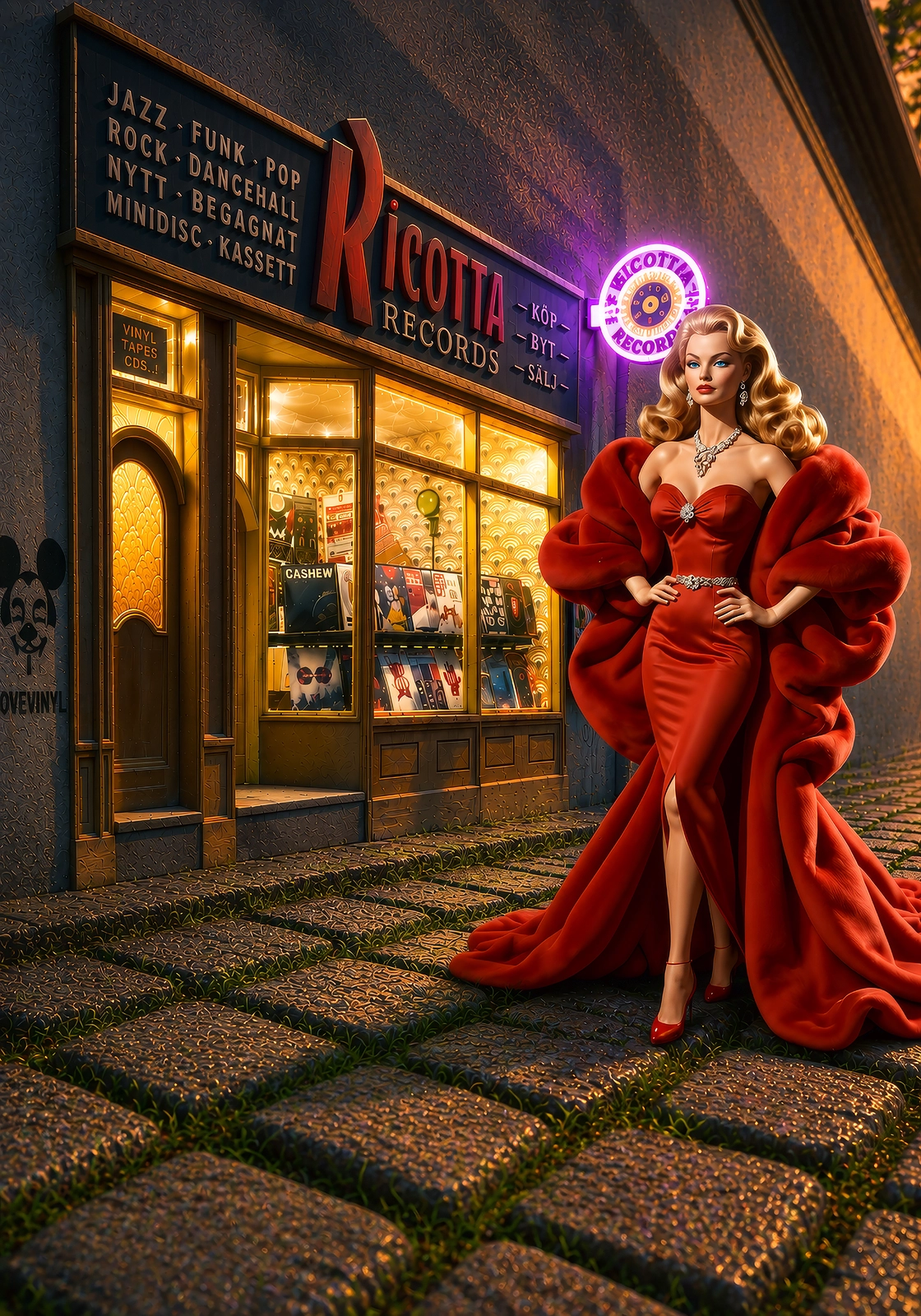
The picture that opens this essay depicts something impossible. An elegant woman in brilliant scarlet haute couture stands outside a tiny record shop on Nygatan in Lund. At first glance, everything appears perfectly ordinary, but a closer look soon reveals that the proportions are all wrong. The woman is far too large for the shopfront. If she tried to step through the doorway, she would have to bend down considerablyand even then it would be in vain. The building is not a real building at all, but one of the miniature installations created by the artist duo Anonymouse, built for mice and extending only a few centimetres behind the façade. The record shop is therefore an illusion, designed to spark the imagination of passers-by rather than to be used.
The remarkable thing, however, is not the façade but the woman. She is Anita Ekbergor rather, an Anita who has chosen to return to Earth in the form of a Barbie doll. Why would one of the world's most celebrated film stars do such a thing? The answer is as simple as it is unexpected. For many years, Anita cherished a dream she never had the chance to fulfil during her earthly life. She wanted to return to Malmö and see her old hometown from a frog's-eye viewnot figuratively, but literally.
In Swedish, we speak of a grodperspektiva frog's-eye viewwhile English uses the expression worm's-eye viewtwo different creatures, but the same idea: observing the world from the level of the cobblestones. After a lifetime spent before cameras, seeing the world from the height of her high heels, Anita longed to experience the same city from the lowest possible vantage point. For a brief moment, she even considered returning as a frog. For a time traveller, that is entirely possible. She soon realised it was not a particularly wise idea. A frog might easily be run over by the first cyclist who came along, while a worm would scarcely survive the first early-rising blackbird. Although a time traveller cannot die a second time, the form one chooses can still prove short-lived and impractical. A Barbie doll therefore turned out to be a far better alternative. It was small enough to give her the longed-for frog's-eye view, yet human enough to allow her to stroll quietly through the city's streets without having to hop or wriggle her way along.
That was also why her encounter with Anonymouse became so fascinating. For a moment, Anita believed she had finally discovered a world built almost to the same scale as the doll herself. But appearances were deceptive. She was still just a little too large. Had she attempted to enter the record shop, she would have had to duck considerably, and once inside, there would have been nothing at all. The buildings were merely façades with almost no depth, designed to deceive the eye and set the imagination in motion, not to provide homes for anyonenot even mice. Yet she remained standing before the little record shop for a long time. It was not the façade itself that fascinated her but the perspective. For the first time, she was seeing the world from exactly the height she had always dreamed of.
The idea had already taken shape on her star, Centaurus. If Anita was going to experience the world as a Barbie doll, she ought to do it properly. The problem was that no such doll had ever existed. Over the decades, Mattel had produced hundreds of Barbie dolls portraying real women, but never Anita Ekberg. That was partly due to commercial and legal considerations, but also to Anita herself. She knew her own worth and, throughout her life, had been careful not to let others commercialise her image. If her old dream were ever to come true, the world's firstand onlyBarbie doll portraying Anita Ekberg would first have to be created.
That story begins with Ruth Handler, another Time-traveller and the woman behind Barbie.
When the story has been told, however, one question remainsone far greater than Barbie dolls, haute couture, and miniature shoes. How can Anita possibly be walking through the streets of Malmö and Lund so many years after her death? The answer is not nearly as simple as one might imagine, and it first requires understanding how Time-travellers actually work. But before we get there, another story must be told.
There is a curious paradox that makes these return visits possible. The closer someone was to a time traveller in life, the more difficult it becomes for that person to recognise her when she returns. A passer-by may well pause, thinking the woman in the street looks remarkably like Anita Ekberg. A lover of classic cinema might even smile at the resemblance. But someone who truly knew Anita will rarely reach the same conclusion. The thought is dismissed before it has even fully formed. Anita Ekberg is dead. Therefore, the woman standing before them cannot possibly be Anita. It is no supernatural force that protects Time-travellers. It is simply human logic. The better we know someone, the harder it is for us to accept the impossible.
And it is precisely that paradox that makes this story understandable.
Now it only remains to explain how the world's only Barbie doll portraying Anita Ekberg came into being. That story begins with Ruth Handler. There, among pattern paper, silk, dressmaker's pins, and a sewing machine scarcely larger than a matchbox, the first stage of the journey begins. Only then will it be time to return to the larger question of what truly happens when a human being diesand whether death is always the final destination, or whether some people are occasionally granted the chance to return for a brief visit and see the world once morethis time from an entirely different perspective.
The Little Diva
The little diva who perhaps never was a diva at all. Some people become prisoners of their own legends, and Anita Ekberg was undoubtedly one of them. Ask almost anyone about her, and the word diva soon appears. For many, it has become almost a surname. There she stands in our collective memory: the blonde goddess of La Dolce Vita, the woman wading through the Trevi Fountain while the world's photographers crowded along the edge and the press continued to build the image of a temperamental, demanding, and impossible star. Yet one cannot help wondering whether that image tells us more about Anita than about our own longing for myths.
The meaning of the word diva has also changed over time. It derives from Italian and means "the divine one." It was used to describe the greatest stars of the opera stagewomen whose voices and stage presence seemed to transcend the merely human. Only much later did the word acquire the meaning most often associated with it today: someone who makes unreasonable demands, constantly seeks attention, and expects special treatment. That later meaning has been so persistently attached to Anita Ekberg that many have accepted it as unquestionable truth.
The problem is that reality does not always align with the legend. People who worked with Anita often described someone very different from the woman portrayed in newspaper headlines. She could certainly be strong-willed and never hesitated to speak up when she believed she had been treated unfairly, but that is entirely different from being a diva. She also lived in a film industry where women were expected to be accommodating, smile graciously, and, above all, show gratitude. Anita did not always do so. She had integrity, defended her boundaries, and refused to assume that others had the right to decide for her. For a woman working in the film industry of the 1950s and 1960s, such behaviour could be more than enough to earn the label difficult.
At the same time, her appearance almost invited mythmaking. Federico Fellini described Anita as a force of nature, a creature as improbable as a giraffe or a baobab tree. He was not referring to her personality but to her presence. Anita did not need to do anything. She did not need to overact, raise her voice, or dominate a room. She took possession of the room simply by being there. When someone possesses that kind of presence, the world soon begins to fill in the rest of the story for itself, and perhaps that is where the diva myth is born.
A firm opinion gradually becomes a temper tantrum. A closed door turns into a dramatic gesture. A woman demanding the same respect as her male colleagues is suddenly labelled difficult. History is full of such examples, and Anita Ekberg became one of them. True, she occasionally chose to play along with the role once journalists had already decided who she was, but behind the headlines lies a far warmer person. Friends spoke of her generosity, her sense of humour, and her ability to laugh at herself and at her own reputation. Those are hardly the qualities most people associate with a diva.
The title The Little Diva contains an unexpected truth. Not because Anita was ever smallon the contrary, she was one of the greatest international film stars Sweden has ever producedbut because the title plays with the image the world created of her. Besides, at 174 centimetres in her stocking feet, she stood well above average height.
What happens when the great diva suddenly shrinks to just thirty centimetres tall and begins wandering through the city in the middle of the night? What happens when she stops in front of a tiny record shop built for mice and discovers that greatness is not measured by height, fame, or newspaper headlines?
Perhaps the answer is that Anita Ekberg never needed to be a diva at all. Her presence was enough. Everything else was created by cameras, journalists, and our own fascination with people who seem larger than life. When the great diva becomes the little diva, the contrast is not merely humorous. It also reminds us that behind every myth there is a human beingand that this person is sometimes far less dramatic, yet infinitely more interesting, than the figure history has chosen to remember.
But where does the Barbie doll outside the newly opened miniature record shop created by Anonymouse on Nygatan in Lund fit into all this? In the shop window, among other things, is the latest record by the mouse singer Veronica Formaggio, titled Cat, Oh Well. A fair question, though in truth the connection is no more profound than the happy coincidence of a frog's-eye view.
The doll wandering among Anonymouse's miniature buildings in Malmö and Lund is unique in every possible way. She really is a Barbie doll, but she is the only one in existence. The toy giant Mattel has never mass-produced a doll in the likeness of Anita Ekberg. That is partly due to complicated licensing issues and unfortunate cultural timing, but above all to Anita herself. She knew her own worth and usually declined whenever companies wanted to commercialise her appearance.
Although she was one of the greatest global style icons of the 1950s and 1960s, her public persona conflicted with Mattel's business strategy at the time. When Barbie was launched in 1959 as an innocent fashion doll for young girls, Anita reached the peak of her career the following year with Federico Fellini's La Dolce Vita. Her iconic bath in the Trevi Fountain cast her as a sensual vamp, considered far too mature and provocative for the toy market. By the time Mattel began targeting adult collectors through series such as the Barbie Tribute Collection, which celebrated Anita's contemporariesincluding Marilyn Monroe in her famous flying white dress, Grace Kelly in her elegant Hitchcock style, Elizabeth Taylor as Cleopatra, and Audrey Hepburn in her black Givenchy dressEkberg's commercial impact in the United States had already faded.
In fact, no named Swedish woman has ever been honoured with an official, mass-produced Barbie doll in her likeness. Mattel has generally prioritised personalities with American or worldwide recognition, such as Frida Kahlo or the British 1960s fashion model Twiggy, who in 1967 became the first living celebrity to be immortalised as a Barbie doll. The closest Sweden has come is the collector's doll Swedish Barbie, released in 1999, which was not based on any historical woman but instead a generic Barbie dressed in a traditional Swedish Midsummer folk costume.
Even today's Swedish world stars, such as Olympic swimmer Sarah Sjöström and pop star Zara Larsson, remain notably absent from Barbie's catalogue. There have been unique exceptions, such as MTV presenter Kajsa Mellgren, who received a single custom-made Barbie in her likeness during a promotional campaign in the mid-1990s. Still, on toy store shelves, they have remained conspicuously absent.
A Great Diva in a Small Package
Apart from the perspective she had gained during her childhood, growing up in a working-class family in Malmö, Anita knew surprisingly little about life at ground level.
From her years as a film starand later from the vantage point of her own starAnita had experienced life almost entirely from a von oben perspective. To understand what life looked like down below, she had to rely on imagination. She wanted to see the world from what Swedes call a frog's-eye view", or rather, from the level of a doll.
Jumping around Malmö as a frogor wriggling through the streets as a worm, to borrow the English expression worm's-eye viewwould almost certainly prove fatal. Even though a Time-traveller cannot die a second time, the frog or worm whose form one assumes can still be crushed underfoot.
Much safer, she concluded, was to stroll through the city as a Barbie dollat least at night, when little girls were asleep. From just thirty centimetres above the ground, the world suddenly looked entirely different. Houses seemed taller, cobblestones became cliffs, and kerbstones turned into mountains. Marcel Proust once wrote that the real voyage of discovery consists not in seeking new landscapes, but in seeing with new eyes.
Anita had also realised that crawling on all fours through Malmö in the middle of the night would have attracted considerably more attention. A supposedly intoxicated blonde woman would hardly have been left alone. The first opportunist would almost certainly have sensed possibilitiesor so Anita believed, a view undoubtedly shared by many men and with good reason. A solitary Barbie doll, on the other hand, was unlikely to inspire the same fantasies in lonely men. So, a Barbie doll it would be.
The only question was: where could she find one that looked like her?
Never underestimate eternity. Among all the dollmakers who had ever lived on Earth was the poor carpenter Geppetto, who carved the mischievous wooden puppet Pinocchio from a block of timber. Eternity was also home to Ruth Handler, the creator of Barbie, who had invented the doll to give little girls an adult woman they could imagine becoming. Anita paid a visit to the doll icon on her star, Barbie, to ask whether she might create an Anita doll.
"My philosophy behind Barbie was always to let a little girl become whatever she wanted through her doll," Ruth said. "So, of course, I can create a great diva in a small package."
The doll itself was not what Ruth needed to make, since Anita could embody a living one herself. Time-travellers are not limited to choosing the age at which they appear; they may also choose their size and form. In fact, Anita could just as easily have appeared as a frog or a wormbut after some thought, those possibilities had already been dismissed.
"As you know," Ruth continued, "the problemif you can call it oneis that whenever we Time-travellers take a form, we do so without clothes. And I suspect a naked Anita doll would attract rather more attention than either of us intends."
Ruth burst out laughing. Her Barbie dolls had caused controversy from the very beginning, particularly among conservative circlesincluding certain religious groupsbecause they had unmistakably adult female bodies with clearly defined breasts.
"As I once said in an interview," Anita replied, grinning. Men are all the same. I promise you, they'd stare at me even if I weren't wearing a single thread.
When they had both finished laughing, they stepped into Ruth's vast sewing studio beneath the endless roof of the universe. During her visits to Earth, she had collected everything she needed to make dolls.
"We're going to create a miniature Hollywood gown," Ruth said, unfolding a fashion sketch from the early 1960s. "Brilliant scarletand tailored so perfectly it fits like a second skin."
"It looks magnificent," Anita said, studying the drawing.
"But we begin underneath," Ruth smiled. "With most dolls, I first make custom underwear and foundation garments. To recreate the dramatic hourglass silhouette of the 1950sthink Marilyn Monroe or Elizabeth TaylorI use miniature corsets, layers of tulle petticoats, and occasionally a little strategic padding. But with you, I don't have to worry about any of that. Everything is already exactly where it belongs."
Anita laughed.
"And you won't need to sew any knickers either. I never wore them on Earth, and I haven't changed that habit in the eternity."
Ruth laughed along.
"That saves me a few stitches. But now comes the truly difficult part. Sewing haute couture for a doll that's only twenty-nine centimetres tall is considerably harder than sewing for a full-sized woman. Fabrics that drape beautifully on an adult body often become thick and clumsy in miniature."
"So how do you solve that?"
Ruth let a length of deep crimson satin slip from her fingers.
"Everything has to be reduced without the eye ever noticing. The fabric must retain the same sheen, drape, and elegance as the original. Lace, embroidery, and seams all have to be scaled down proportionally. Otherwise, the dress looks like a doll's clothes rather than couture."
She smiled.
"But that's the easy part. Now comes the craftsmanship."
Carefully, Ruth draped the fabric over a dress form she had taken from a cupboard.
"I hope you don't mind my using this mannequin," she said. "I originally had it made for a Sophia Loren doll. She was the only woman of your generation who could rival youboth in height and bust measurements."
"Well now," Anita replied dryly.
"Sophia gave Hollywood the same headaches you did. She often acted opposite leading men who were much shorter than audiences realised, and the studios had to build platforms and wooden boxes to even out the height difference. In high heels and with her towering hairstyle, she easily stood over one hundred and eighty centimetres tall."
"I had the same problem," Anita said. "We were almost the same height. When I appeared opposite Frank Sinatra in 4 for Texas, he wore hidden lifts in his cowboy boots, while I was instructed to lean against furniture or sit down whenever possible."
"But you spent time together in private, didn't you?"
"Oh yesbut then it wasn't a problem. In bed, height isn't really an issue. At least not when we're talking about the distance above the ground."
They both burst into laughter.
"I completely agree," Ruth said, trying to sound as worldly as Anita.
"Fellini did exactly the opposite," Anita continued. "He never tried to hide my height. He gave me even higher heels, filmed me from below, and made me look like a giant goddess. That's when he began calling me Anitona'Big Anita.'"
"I rather suspect," Ruth smiled, "that he wasn't referring only to your height."
A Great Diva in a Small Package
Apart from the perspective she had gained during her childhood, growing up in a working-class family in Malmö, Anita knew surprisingly little about how life was actually lived.
From her years as a film starand later from the vantage point of her own starAnita had experienced the world almost entirely from a von oben perspective. To understand what life looked like down below, she had to rely on imagination. She wanted to see life from what Swedes call a frog's-eye view or rather, from the level of a doll.
Jumping around Malmö as a frogor wriggling through the streets as a worm, to borrow the English expression worm's-eye viewwould almost certainly prove fatal. Even though a time traveller cannot die a second time, the frog or worm whose form one assumes can still be crushed underfoot.
Much safer, she concluded, was to stroll through the city as a Barbie dollat least at night, when little girls were asleep. At thirty centimetres above the ground, the world suddenly looks completely different. Houses grow taller, cobblestones become cliffs, and kerbs become mountains. Marcel Proust wrote that the real voyage of discovery consists not in seeking new landscapes but in seeing with new eyes.
Anita had also realised that crawling around on all fours through Malmö in the middle of the night would attract rather more attention. A supposedly intoxicated blonde woman would hardly be left alone. The first opportunist would almost certainly sense an opportunityor so Anita believed, a view undoubtedly shared by many women, and with good reason. A solitary Barbie doll, on the other hand, was unlikely to spark the same fantasies in lonely men. So a Barbie doll it would be. The only question was where she could find one that looked like herself.
Never underestimate eternity. Among all the dollmakers who had ever lived on Earth was the poor carpenter Geppetto, who carved the mischievous wooden puppet Pinocchio from a block of timber. Eternity was also home to Ruth Handler, the creator of Barbie, who invented the doll to give little girls an adult woman to imagine becoming. Anita visited the doll icon on her star, Barbie, to ask whether she could create an Anita doll.
"My philosophy behind Barbie was to let every little girl become whatever she wanted to be through her doll, so, of course, I could create a great diva in a small package," said Ruth.
The doll itself was not what Ruth needed to make, since Anita could embody a living one herself. Time-travellers are not limited to choosing the age at which they appear; they may also choose their size and form. In fact, Anita could have appeared as easily as a frog or a wormbut after some thought, those possibilities had already been dismissed.
"As you know, the problemif indeed it is oneis that whenever we Time-travellers assume a form, we do so without clothing. And a naked Anita doll would almost certainly attract far more attention."
Ruth laughed heartily. Her Barbie dolls had caused controversy from the very beginning, particularly within conservative circlesincluding certain religious groupsbecause they had unmistakably adult female bodies with clearly defined breasts.
"As I once said in an interview, 'Men are all the same. I promise you, they'd stare at me even if I weren't wearing a single thread,'" Anita replied.
When they had both finished laughing, they entered Ruth's large sewing room beneath the endless roof of the universe. During her visits to Earth, Ruth had gathered everything she could possibly need to make dolls.
"We're going to create a miniature Hollywood gown," said Ruth, unfolding a fashion sketch from the early 1960s. "Brilliant scarletand tailored so perfectly it fits like a second skin."
"It looks magnificent," Anita said, studying the drawing.
"But we begin underneath," Ruth smiled. "With most dolls, I first make custom underwear and foundation garments. To recreate the dramatic hourglass silhouette of the 1950slike Marilyn Monroe's or Elizabeth Taylor'sI use miniature corsets, layers of tulle petticoats, and occasionally a little strategic padding. But with you, I don't have to worry about any of that. Everything is already exactly where it belongs."
Anita laughed.
"And you won't need to sew any knickers. I never wore them on Earth, and I haven't changed that habit in an eternity."
Ruth laughed along.
"That saves us a few stitches. But now comes the truly difficult part. Sewing haute couture for a doll just twenty-nine centimetres tall is considerably harder than sewing for a full-sized woman. Fabrics that drape beautifully on an adult body often look thick and clumsy in miniature."
"How do you solve that?"
Ruth let a length of deep crimson satin slip through her fingers.
"First, everything must be reduced without the eye noticing. The fabric must retain the same sheen, drape, and elegance as the original. Lace, embroidery, and seams must all be scaled down proportionally. Otherwise, the gown looks like a doll's dress rather than couture."
She smiled.
"But theory is the easy part. Now the craftsmanship begins."
Ruth gently draped the fabric over the dress form she had taken from a cupboard.
"I hope you don't mind my using this mannequin," said Ruth. "I once had it made for a Sophia Loren doll. She was the only woman of your generation who could rival youboth in height and bust measurements."
"Well now," Anita replied dryly.
"Sophia gave Hollywood the same headaches you did. She often acted opposite leading men who were much shorter than audiences realised, and the studios had to build platforms and wooden boxes to even out the height difference. In high heels, with her towering hairstyle, she stood over one hundred and eighty centimetres tall."
"I had the same problem," Anita said. "We were almost the same height. When I appeared opposite Frank Sinatra in 4 for Texas, he wore hidden lifts in his cowboy boots, while I was instructed to lean against furniture or sit down whenever possible."
"But didn't you spend time together in private?"
"Oh yesbut then it wasn't a problem. In bed, height isn't really an issue. At least not when we're talking about the distance above the ground."
They both burst into laughter.
"I quite agree," Ruth said, trying to sound as worldly as Anita.
"Fellini did exactly the opposite," Anita continued. "He never tried to hide my height. He gave me even higher heels, filmed me from below, and made me look like a giant goddess. That's when he started calling me AnitonaBig Anita."
"I rather suspect," Ruth smiled, "that he wasn't referring only to your height."
"But Frank used to stand on tiptoe whenever we kissed. That was rather sweet."
"Now, back to work! Do you see how the satin falls?" Ruth gently gathered the fabric, making the dress form seem to sway at the hips. "That's exactly the illusion I want to create. The gown must move as though it were made for a full-sized womannot for a doll."
"At Hollywood's acting school, I was taught to walk so that, from behind, it looked as though two boys were fighting inside a sack," Anita said, giving her hips an exaggerated sway.
Ruth laughed.
"Exactly! Now you understand why I want the fabric to move in the same way."
Anita smiled and gave another playful wiggle.
"First, I'll take your measurements," Ruth said, producing a tape measure barely wider than a strip of cotton ribbon. "Not because you'll ever change, but because at this scale, half a millimetre makes all the difference."
She measured Anita's bust, waist, hips, back, shoulders, and leg length, carefully noting the measurements on a pattern sheet before beginning to draw.
"I never cut directly into the real fabric. First, I make a trial pattern. Then I pin the pieces together and try them on the mannequin. After that, I unpick the seams, adjust the pattern, and try it on again. Sometimes I have to repeat the process four or five times before the proportions feel exactly right."
"I thought you glued everything together," Anita teased.
Ruth looked almost offended.
"Glue? Never in my life. Haute couture is sewneven at doll size."
She pointed towards a sewing machine no larger than a matchbox.
"That one was specially built for miniature sewing. The needle is finer than a human hair, and the stitches are so tiny they're almost invisible. I sew everything else by hand, using tweezers and a magnifying glass."
She carefully stitched together the first sections.
"Only after every seam has been sewn do I press them, fit the dress again, and correct the slightest wrinkle. Haute couture isn't really about fabric. It's about fit."
Only then did Ruth allow a length of deep crimson satin to glide through her fingers.
"Now the real work begins. The actual gown."
She draped the fabric over the mannequin, secured it with tiny dressmaker's pins, and marked it with tailor's chalk finer than a paper clip's tip.
"Again?" Anita asked.
"Yes. Haute couture is all about fitting, pinning, and starting over. It is never about sewing quickly."
Ruth carefully cut the first pieces, pinned them together, and then gently slipped the gown back over the mannequin.
"Stand perfectly still."
She walked slowly around the figure, narrowed her eyes, tugged lightly at the fabric at the hips, and shifted a couple of pins.
"No... the waist has to be raised by half a millimetre, and the neckline should be just a touch lower."
She removed the dress again, unpicked a few seams, repinned everything, and Anita's doll tried it on once more.
Anita smiled.
"You never seem satisfied."
"That's why it's called haute couture. You fit, adjust, and remove pins until the fabric drapes naturally. Only then does the sewing machine do its work."
Ruth sat down at the tiny sewing machine, its needle scarcely larger than the head of a pin. It purred almost silently as the final seams were stitched with impossibly small stitches.
Then Ruth dressed Anita's little stand-in once more.
She examined the doll from every angle, gently straightened the hem, smoothed a slight crease at the back, and nodded in satisfaction.
"Almost finished."
She reached for a miniature steam iron, scarcely larger than a sugar cube, and pressed each seam in turn until the satin fell softly and naturally.
"But what about the zipper?" Anita asked, wondering how she would ever get into such a close-fitting creation when the time came.
Ruth shook her head.
"A real zip would look like a barn door on a doll. Instead, I've sewn in microscopic magnets into the back seam. They automatically find each other and keep the gown perfectly in place. You can take it on and off as many times as you like without it ever losing its shape."
Anita ran a finger gently down the back.
"I can't see a thing."
"Exactly. In haute couture, the finest craftsmanship is the part nobody ever notices."
Together, they carefully slipped the gown onto the doll for the final time.
Ruth stepped back, smiled in satisfaction, and said:
"Now it fits exactly as I imagined. Like a second skin."
"It certainly does."
"And over the gown comes the stolethe red faux fur that matches your dress and your shoes," Ruth said. "That, too, requires a special material. Real fur would be far too coarse at this scale, so I make faux fur from ultra-fine synthetic fibres. The fibres are anchored to a thin backing fabric, then trimmed, brushed, steamed, and shaped until they have the same soft volume and movement as genuine fur."
She paused beside a machine as a length of scarlet fabric slowly disappeared beneath a forest of tiny needles.
"That machine makes faux fur," Ruth explained. "Thousands of synthetic fibres are punched into the fabric and bonded on the reverse side. Afterwards, they're trimmed, brushed, steamed, and dyed until they resemble mink, fox, or chinchillaor, in your case, a mink that has somehow become redder than the reddest fox."
Anita ran her hand over the soft surface.
"Remarkable. It feels completely real."
Ruth smiled.
"That's the whole point. The finest faux fur should fool the eyebut never harm a single animal."
She draped the stole over the doll's bare shoulders and stepped back.
"Now, Mini-Anita is beginning to look like a Hollywood star."
"It looks more like haute couture than doll's clothes," Anita said admiringly.
Ruth smiled.
"That's exactly the idea. No one should think, 'What a lovely doll's dress.' They should think, 'What a magnificent gown,' and only afterwards realise that the woman wearing it is just twenty-nine centimetres tall."
Ruth opened a cabinet in which hundreds of tiny shoe boxes stood neatly arranged.
"Now it's time for the shoes."
She took down a box labelled Slingbacks Hollywood 1961 and lifted out a pair of miniature, brilliant scarlet high heels.
Anita laughed.
"They're smaller than half a fingernail. How on earth do you know they'll fit?"
"Naturally, I fit them to the originalor rather, to her stand-in. That's why I have dress forms. This one has your exact measurements, down to a tenth of a millimetre. But feet can vary slightly, even among women of the same height."
She carefully slipped the shoe onto the mannequin's foot.
"No shoemaker has ever laid a hand on these. They're moulded from a solid-coloured composite material. It's lightweight, durable, and slightly elastic, so there are no seams that can split and no paint to wear away."
Ruth picked up a tiny hairdryer and aimed it at the shoe.
"When I warm the material, it softens and can stretch by up to two sizes. If I put it in the freezer, it shrinks by roughly one size. That allows me to fine-tune the fit without having to mould a completely new pair every time."
She allowed the shoe to cool before putting it back on the mannequin.
"Perfect. Once you've shrunk to Barbie size, they'll fit as if they were made for you."
Anita smiled.
"I only hope I'll fit them just as perfectlyfrom the inside!" she laughed.
"Now comes the really difficult part," Ruth continued. "Jewellery at this scale is a challenge, no matter how small a jeweller's hands are."
She opened a little box filled with glittering stones.
"I hope you're not planning to be stingy," Anita said with a grin.
"Not a chance."
Ruth lifted out a dazzling diamond necklace, matching earrings, a brooch for the plunging neckline, and an elegant belt set with sparkling stones.
"I replace the original gems with tiny space crystals. Then I glue them into place, one by one, by hand."
Anita looked genuinely impressed.
"You seem to have an entire jewellery workshop."
"Semi-finished pieces," Ruth laughed. "Enough to assemble a complete jewellery box whenever I need one."
She placed the jewellery on the doll, stepped back, sprinkled a final scattering of stardust over the Anita-doll, and smiled in satisfaction.
"There. Now the work is complete."
Ruth carefully placed the remaining jewels back into their jewellery case.
"Yes," Anita said softly. "You've done extraordinary work."
"Thank you, darling. But remember one thing. Once you've assumed your doll's size, you can't use hairspray the way you used to with a hairstyle that's only two or three per cent of its normal size."
"With Barbie dolls, I usually set the hairstyle with doll styling gel. To keep period hairstylessuch as the Hollywood waves of the 1950s or the heavily teased updos of the 1960sfrom being ruined during transport, the dolls' hair is sprayed with a strong setting spray that permanently holds every strand exactly where it belongs."
"I prefer my hair curly," Anita replied, "with long curls and as little hairspray as possible."
"You'll have to experiment," Ruth said, holding up a tiny spray bottle barely four centimetres high.
"A Dior sample bottle," she smiled, slipping it into an equally miniature handbag from the same fashion house.
"Red leather, naturally."
Then she looked at Anita with a knowing smile.
"And remember one thing. Doll hair is far finer than human hair. A single drop of ordinary hairspray would make your hairstyle as stiff as a crash helmet."
Becoming Twenty-Nine Centimetres Tall
A frog's-eye view is a curious expression when it could just as easily be called a doll's-eye viewseeing reality through the eyes of a doll. That was precisely what Anita had chosen to do. It is one of the privileges of a time traveller to assume whatever form seems most appropriate. When a person dies, the bodywith all its aches and infirmitiesis left behind on Earth, while the soul journeys to an unoccupied star somewhere in the universe. The image of what that person looked like during life remains preserved within the soul and can be embodied again at any time. That such things also happen on Earth has long been known, although often misunderstood. It is not divine beings who incarnate, but any soul with a longing to revisit the world it once left behind.
So, when Anita appears in Malmö, it is perfectly natural, even though it is supernatural. She can embody herself at any age she chooses. For herand for most other Time-travellersthat means the age they believe they were at their very best: somewhere between thirty-five and fifty, still youthful yet with a touch of maturity.
The word incarnation comes from Latin and literally means to take on fleshto appear in bodily form. It is an expression that feels warmer and more human, describing a tangible act rather than a theological concept.
While Christianity regards the Incarnation as a unique historical eventGod becoming man once in the person of JesusBuddhism views the assumption of new forms as an endless process shared by all living beings. Buddhists prefer to call it rebirth. That comes closer to the condition of eternity, yet it is still not quite correct.
When time-travellers revisit Earth, they do so without drama, and it has nothing to do with rebirth. Their visit is temporary. It is much like a tourist travelling to another country. One is merely a visitor and never truly becomes part of the place one is visiting.
As long as Anita lived on Earth, she rarely gave much thought to life after death. She was far too busy living to devote much attention to metaphysics. In that respect, she was probably like most people. When she regained consciousness in eternity, she was considerably less surprised than Giovanni Montinithe future Pope Paul VIwho had been one of the fiercest critics of La Dolce Vita. For him, eternity must have looked very different from everything he had preached throughout his life: full of stars, yet empty of gods. Heaven and Hell had both been left behind on Earth, just as Anita had left them behind, for those two extremes are precisely what characterise earthly existence. During her lifetime, Anita had experienced both heaven and hell as life carried her to extraordinary heights and painful depths. They are states of experience rather than physical places and have nothing whatsoever to do with divine judgement. There is no Last Day. That is true for humanity regardless of culture or religion. Few people can objectively be said to live permanently in paradise, while many endure a kind of hell throughout their entire lives.
There is no divine selection, no Day of Judgement, no Ragnarök, no Apocalypse, no end of time, no Final Judgement, and no god directing events. There is only the brutality of chance. No living creature asks to be born, and whether we enter the world rich or poor, healthy or sick, depends solely on circumstances over which none of us has any control.
Buddhism, which has no gods, comes closer than any other religion to this metaphysical understanding. The Buddha was a human being, neither a god nor the son of one. He attained enlightenment through his own efforts and serves on Earth as a guide and teacher for others. The Buddha is not a saviour. He cannot forgive sins or rescue anyone. Every human being must walk the path towards enlightenment alone.
In simple terms, enlightenment consists of three things: awakening from the illusion of a permanent self and recognising that everything is interconnected; extinguishing the three fires of craving, anger, and ignorance that give rise to human suffering; and ultimately attaining nirvanaan eternal state of unshakable peace and compassion beyond time and space, where the cycle of rebirth finally comes to an end.
One might call it living well and doing good. Yet the idea of treating others as you yourself wish to be treated has little to do with religion. It is, in essence, enlightened self-preservation. This principle of balance is woven into every form of lifeanimals, plants, and human beings alike. Without one another, life itself ceases to exist. Parasites eventually find themselves alone, and when that happens, everything dies.
For the overwhelming majority of living things, the system works as long as balance is maintained. Unfortunately, such balance exists only when viewed from a great distance. From Anita's star, Centaurus, the Earth appears as a tiny blue dot, seemingly unchanged from one day to the next. Yet appearances deceive. Beneath that peaceful blue surface lie billions of individual imbalances. Balance is, in reality, an illusionthe sum of countless balances and imbalances. As long as that overall condition remains unchanged, the Earth continues to shine blue, unlike its neighbouring planet Mars, which today glows with an inhospitable red.
That offers little comfort to those whose lives on Earth are filled with misery, nor was it something Anita spent much time considering during the happiest years of her own life. Only after arriving in eternity did she begin to wonder how humanity had created so many extraordinary religions. From the simple gods of the Stone Agethe rock that caused someone to stumble or the sun that gave light and warmthto cultures with a separate deity for every force of nature, and finally to the all-knowing God of the Abrahamic faiths, humanity has always invented divine beings to explain what it could not understand.
Epilogue The Final Picture
When the story ends, only the picture remains. It shows an elegant woman in brilliant scarlet haute couture, standing outside a tiny record shop on Nygatan in Lund. At first glance, everything seems perfectly ordinary, but after a few seconds the eye begins to protest. The proportions are wrong. The woman is far too large for the façade. Or perhaps the shop is far too small. The viewer instinctively searches for a reasonable explanation. Perhaps it is a photomontage. Perhaps it is Photoshop. Perhaps it is an artistic statementor a clever trick of perspective. Or perhaps all of them at once.
Anyone familiar with Anonymouse's miniature installations soon realises that the shop was built for mice. Anyone who also recognises Anita Ekberg may think the woman bears an astonishing resemblance to her. Yet almost no one arrives at the conclusion on which this entire story restsand that is hardly surprising. Human beings are trained to seek the most probable explanation, not the most improbable one.
That is precisely why no one needs to be convinced. Stories of this kind cannot be proved or disproved. They work in much the same way as all good literature. They open a door to a possibility that may not existbut can never be completely ruled out.
If, one late evening, you should happen to stroll through the streets of Malmö or Lund and glimpse a doll-like woman in brilliant scarlet haute couture disappearing around a street corner, there is no need to hurry after her. She has already experienced the one thing she longed for throughout her life: to see her old hometown from a frog's-eye view. Perhaps she pauses for a moment beside a cobblestone, a doorstep, or a tiny record shop built for mice, smiling at how different the world looks when one is only twenty-nine centimetres tall.
Then she quietly continues her walk, as unnoticed as when she first arrived. Not because she is invisible, but because we human beings find it so difficult to believe in the impossible.
And perhaps that is why the impossible picture lingers in the memory. Not because it depicts something that truly happened, but because it reminds us that the world can sometimes feel richer if, for just a brief moment, we dare to look at it from an entirely different perspective.
Introduktion
Vad skulle du göra om du fick en möjlighet som ingen människa tidigare har fått? Inte att bli odödlig eller resa tillbaka i tiden för att förändra historien, utan något betydligt märkligare: att återvända till den värld du en gång lämnade och få se den med helt nya ögon.
För Anita Ekberg var svaret oväntat. Hon drömde inte om att återuppleva filmpremiärerna i Rom, applåderna i Hollywood eller de glamorösa åren då hela världen talade om den blonda gudinnan i La Dolce Vita. Hon ville promenera genom Malmö och Lund en gång till, men denna gång på tjugonio centimeters höjd. Som världens enda Barbiedocka som föreställer Anita Ekberg.
Det som först verkar vara en lekfull fantasi visar sig snart vara något helt annat. Berättelsen rör sig mellan haute couture och miniatyrhantverk, mellan Anonymouse små musbutiker och Ruth Handlers skapelse Barbiedockan. Men under ytan handlar den om betydligt större frågor: identitet, minnen, perspektiv och människans eviga nyfikenhet på vad som väntar i livet efter detta.
Det är därför inte bara berättelsen om hur en docka blir till. Det är också en essä om hur samma värld förändras totalt när den betraktas från en annan höjd och om varför det ibland krävs en omöjlig bild för att få oss att upptäcka det som hela tiden har funnits framför våra ögon.
Prolog Den omöjliga bilden
Bilden som inleder den här essän föreställer egentligen något omöjligt. En elegant kvinna i knallröd haute couture står utanför en liten skivbutik på Nygatan i Lund. Vid första anblicken ser allt ganska normalt ut, men tittar man närmare upptäcker man snart att proportionerna inte stämmer. Kvinnan är alldeles för stor för butikens fasad. Skulle hon försöka gå in genom dörren, fick hon böja sig kraftigt och det hade ändå varit förgäves. Huset är nämligen inget riktigt hus utan en av konstnärsduon Anonymouse små installationer, byggda för möss och med ett djup som bara sträcker sig några få centimeter bakom fasaden. Skivbutiken är alltså en illusion, skapad för att väcka fantasin hos förbipasserande snarare än att användas.
Det märkliga är emellertid inte fasaden utan kvinnan. Det är Anita Ekberg eller rättare sagt en Anita som har valt att återvända till jorden i en Barbiedockas storlek. Varför skulle en av världens mest omskrivna filmstjärnor göra något sådant? Svaret är lika enkelt som oväntat. Anita bar under lång tid på en dröm som hon aldrig fick möjlighet att förverkliga under sitt jordeliv. Hon ville återvända till Malmö och se sin gamla hemstad ur grodperspektiv. Inte bildligt, utan bokstavligt.
På svenska talar vi om grodperspektiv, medan engelsmännen använder uttrycket worm's-eye view, maskens perspektiv. Två olika djur men samma tanke: att iaktta världen från gatstenens nivå. Efter ett helt liv framför kameror och med världen sedd från sina höga klackar längtade Anita efter att uppleva samma stad från den lägsta tänkbara utsiktspunkt. Hon funderade faktiskt en stund på att återvända som en groda. För en tidsresenär är det fullt möjligt. Hon insåg att det inte var någon särskilt lyckad idé. Grodan riskerade att bli överkörd av första bästa cyklist och masken skulle knappast överleva den första morgonpigga koltrasten. Även om en tidsresenär inte kan dö en andra gång, kan den gestalt man valt bli både kortlivad och opraktisk. En Barbiedocka visade sig därför vara ett betydligt bättre alternativ. Den var tillräckligt liten för att ge henne det efterlängtade grodperspektivet och samtidigt tillräckligt mänsklig för att försiktigt promenera genom stadens gator utan att behöva hoppa eller ringla sig fram.
Det var också därför mötet med Anonymouse blev så fascinerande. För ett ögonblick trodde Anita att hon äntligen funnit en värld byggd i nästan samma skala som dockans. Men skenet bedrog. Hon var fortfarande en aning för stor. Ville hon gå in genom dörren till skivbutiken skulle hon behöva ducka rejält, och väl inne fanns egentligen ingenting. Husen var bara fasader med ett obetydligt djup, skapade för att lura ögat och sätta fantasin i rörelse, inte för att någon skulle kunna bo där. Inte ens möss. Ändå blev hon stående länge framför den lilla skivbutiken. Det var inte fasaden i sig som fascinerade henne utan perspektivet. För första gången såg hon världen från just den höjd hon alltid hade drömt om.
Redan på sin stjärna Kentauren föddes tanken. Om Anita skulle uppleva världen som en Barbiedocka borde hon naturligtvis göra det ordentligt. Problemet var bara att någon sådan docka aldrig hade funnits. Mattel hade genom årtionden tillverkat hundratals Barbiedockor föreställande verkliga kvinnor, men aldrig Anita Ekberg. Det berodde på kommersiella och juridiska frågor, men också på Anita själv. Hon visste sitt värde och hade under hela sitt liv varit försiktig med att låta andra kommersialisera sin person. För att hennes gamla dröm skulle kunna förverkligas måste därför världens första och enda Barbiedocka som föreställer Anita Ekberg först skapas.
Historien börjar hos Ruth Handler, en annan tidsresenär och kvinnan bakom Barbiedockan.
När berättelsen är färdig återstår emellertid en fråga som är betydligt större än både Barbiedockor, haute couture och miniatyrskor. Hur kan Anita över huvud taget promenera omkring på Malmös och Lunds gator många år efter sin död? Svaret är inte så enkelt som man kanske tror och det kräver först en förståelse av hur tidsresenärer fungerar. Men innan vi kommer dit finns det en historia som måste berättas.
Det finns en egendomlig paradox som gör dessa återbesök möjliga. Ju närmare någon på jorden stod en tidsresenär under livet, desto svårare har just den personen att känna igen henne när hon återvänder. En förbipasserande kan mycket väl stanna upp och tänka att kvinnan på gatan är otroligt lik Anita Ekberg. En filmälskare kanske till och med ler åt likheten. Men den som verkligen kände Anita kommer nästan aldrig fram till samma slutsats. Tanken avvisas redan innan den hunnit formas. Anita Ekberg är död. Alltså kan kvinnan framför en omöjligt vara Anita. Det är ingen övernaturlig kraft som skyddar tidsresenärerna. Det är människans egen logik. Ju bättre vi känner någon, desto svårare är det för oss att acceptera det omöjliga.
Och just den paradoxen gör den här berättelsen förståelig.
Nu återstår att berätta hur världens enda Barbiedocka föreställande Anita Ekberg kom till. Historien börjar hos Ruth Handler. Där, bland mönsterpapper, siden, knappnålar och en symaskin inte mycket större än en tändsticksask, tar den första etappen sin början. Först därefter är det dags att återvända till den större frågan om vad som egentligen händer när en människa dör och om döden verkligen alltid är slutpunkten, eller om vissa människor ibland får möjlighet att återvända en kort stund för att se världen en gång till denna gång ur ett helt nytt perspektiv.s
The Little Diva - Den lilla divan
Den lilla divan som kanske aldrig var någon diva. Det finns människor som blir fångar i sina egna legender, och Anita Ekberg var utan tvekan en av dem. Fråga vem som helst om henne och ordet diva dyker snart upp. För många har det blivit nästan ett efternamn. Där står hon i det kollektiva minnet: den blonda gudinnan från La Dolce Vita, kvinnan som vadade genom Fontana di Trevi medan världens fotografer trängdes på kanten och pressen byggde vidare på bilden av den temperamentsfulla, krävande och omöjliga stjärnan. Men frågan är om den bilden egentligen säger mer om Anita än om vår egen längtan efter myter.
Begreppet diva har dessutom förändrats genom tiderna. Ursprungligen kommer ordet från italienskan och betyder helt enkelt "den gudomliga". Det användes om operascenens största stjärnor, kvinnor vars röster och sceniska närvaro tycktes överskrida det mänskliga. Först långt senare började ordet få den innebörd vi oftast förknippar med det i dag en person som ställer orimliga krav, kräver ständig uppmärksamhet och förväntar sig särbehandling. Den betydelsen har i efterhand klistrats fast på Anita Ekberg så envist att många har tagit den som en obestridlig sanning.
Problemet är bara att verkligheten inte alltid stämmer överens med legenden. Människor som faktiskt arbetade tillsammans med Anita beskrev ofta en helt annan person än den som tidningsrubrikerna målade upp. Hon kunde vara envis och tvekade inte att säga ifrån när hon ansåg sig orättvist behandlad, men det är något helt annat än att vara en diva. Hon levde dessutom i en filmvärld där kvinnor förväntades vara tillmötesgående, le vänligt och framför allt visa tacksamhet. Anita gjorde inte alltid det. Hon hade integritet, hon försvarade sina egna gränser och hon accepterade inte självklart att andra skulle bestämma över henne. För en kvinna i filmindustrin på 1950- och 60-talen kunde ett sådant beteende räcka långt för att få etiketten "svår".
Samtidigt var hennes yttre nästan en inbjudan till mytbildning. Federico Fellini beskrev henne som en naturkraft, en varelse som framstod lika osannolik som en giraff eller ett baobabträd. Han syftade inte på hennes personlighet utan på hennes närvaro. Anita behövde egentligen inte göra någonting. Hon behövde inte spela över, höja rösten eller dominera ett rum. Hon tog över det bara genom att finnas där. När en människa har en sådan utstrålning börjar omvärlden snart fylla i resten av historien på egen hand, och det är kanske där divamyten föds.
En bestämd åsikt blir med tiden ett raseriutbrott. En stängd dörr blir ett utspel. En kvinna som kräver samma respekt som hennes manliga kollegor beskrivs plötsligt som besvärlig. Historien är full av sådana exempel och Anita Ekberg blev ett av dem. Visst kunde hon ibland spela med i rollen när journalisterna redan hade bestämt sig för vem hon var, men bakom rubrikerna framträder en betydligt varmare människa. Vänner berättade om hennes generositet, humor och förmåga att skratta åt både sig själv och sitt eget rykte. Det är knappast de egenskaper man i första hand förknippar med en diva.
Titeln Den lilla divan rymmer en oväntad sanning. Inte därför att Anita någonsin var liten tvärtom var hon en av de största internationella filmstjärnorna Sverige någonsin har haft utan därför att titeln leker med den bild världen skapade av henne. Dessutom var hon klart över medellängden med sina 174 centimeter i strumplästen.
Vad händer om den stora divan plötsligt bara är trettio centimeter hög och börjar vandra genom staden mitt i natten? Vad händer om hon stannar framför en liten skivbutik byggd för möss och upptäcker att storhet inte mäts i längd, berömmelse eller rubriker?
Kanske blir svaret att Anita Ekberg aldrig behövde vara någon diva över huvud taget. Hennes närvaro räckte. Resten skapades av kamerorna, journalisterna och vår egen fascination för människor som verkar större än livet självt. När den stora divan blir den lilla divan, blir kontrasten därför inte bara humoristisk. Den blir också en påminnelse om att det ofta finns en människa bakom myten och att den människan ibland är betydligt mindre dramatisk men långt mer intressant än den figur som historien har valt att minnas.
Men var kommer Barbiedockan utanför miniatyrmakarna Anonymouse nyöppnade skivaffär på Nygatan i Lund in? I skyltfönstret visas bland annat mussångerskan Veronica Formaggios senaste platta Katten också. Bra fråga, men egentligen utan något annat samband än grodperspektivets slump.
Nu är det dock på det viset att dockan som promenerar omkring bland Anonymouse-husen i Malmö och Lund är unik på alla sätt. Hon är faktiskt en Barbiedocka, men det är den enda som finns. Leksaksjätten Mattel har nämligen aldrig massproducerat en docka av Anita Ekberg. Det beror dels på komplicerade rättighetsfrågor och bristande kulturell timing, men främst på henne själv. Anita visste sitt värde och tackade oftast nej när företag ville kommersialisera hennes utseende.
Trots att hon var en av 1950- och 60-talets absolut största globala stilikoner, krockade hennes offentliga persona med Mattels dåvarande affärsstrategi. När Barbie lanserades 1959 som en oskyldig modedocka för unga flickor, nådde Anita sin karriärtopp med Federico Fellinis Det ljuva livet året efter. Hennes ikoniska bad i Trevifontänen gav henne en sensuell vamp-stämpel som ansågs alltför vuxenorienterad och syndig för leksaksvärlden. När Mattel långt senare började rikta sig till vuxna samlare genom serier som Barbie Tribute Collection och hyllade Anitas samtida kollegor som Marilyn Monroe i sin flygande vita klänning, Grace Kelly i sin eleganta Hitchcock-stil, Elizabeth Taylor som Cleopatra och Audrey Hepburn i en svart Givenchy-klänning hade Ekbergs kommersiella genomslag i USA minskat.
Faktum är att ingen namngiven svensk kvinna någonsin har fått en officiell, massproducerad Barbiedocka i sin egen avbild. Mattel har prioriterat personer med amerikansk eller global genomslagskraft, som Frida Kahlo eller den brittiska 60-talsmodellen Twiggy, som 1967 blev den allra första levande kändisen att förevigas som Barbie. Det närmaste Sverige har kommit är samlardockan Swedish Barbie från 1999, som i stället för en specifik historisk pionjär var en generisk docka klädd i en traditionell midsommarfolkdräkt.
Nutidens svenska världsstjärnor, som simmaren Sara Sjöström eller popstjärnan Zara Larsson, lyser fortfarande med sin frånvaro som dockor. Det har funnits unika undantag, som när MTV-profilen Kajsa Mellgren i mitten av 90-talet fick en specialtillverkad version av sig själv i ett enda exemplar under en marknadsföringskampanj, men på leksakshyllorna har det förblivit tomt.
En stor diva i liten förpackning
Bortsett från barndomens perspektiv, uppvuxen i en arbetarfamilj i Malmö, saknade Anita kunskap om mycket i verkligheten.
Från livet som filmstjärna, liksom utsikten från sin stjärna, hade Anita egentligen bara ett von-oben-perspektiv. Hur livet tedde sig där nere fick hon ta fantasin till hjälp för att förstå. Hon ville alltså se livet ur ett grodperspektiv, som man uttrycker det på svenska. Eller snarare på en docknivå.
Men att hoppa omkring i Malmö som en groda, eller ringla som en mask om man använder engelskans metafor worm's-eye view vore säkert fatalt. Även om en tidsresenär inte kan dö en andra gång, kan grodan eller masken man gestaltar trampas sönder.
Säkrare är det att promenera omkring som en Barbiedocka, åtminstone på natten när små flickor sover. Trettio centimeter över marken ser världen plötsligt annorlunda ut. Husen växer, gatstenarna blir till klippor och trottoarkanterna till berg. Marcel Proust menade att den verkliga upptäcktsresan inte består i att söka nya landskap utan i att se med nya ögon.
Anita hade kommit fram till att det att krypa omkring på alla fyra mitt i natten skulle ha väckt mer uppståndelse. En förmodat berusad blondin skulle inte lämnas i fred. Första bästa karl skulle ana möjligheter, enligt Anitas och många kvinnors uppfattning. En säkert välgrundad uppfattning. En ensam docka skulle inte väcka samma våta drömmar hos kåta karlar. Så det fick bli en Barbiedocka. Men varifrån kunde hon få tag på en sådan som var en miniatyr av sig själv?
Underskatta inte evigheten. Bland alla dockmakare som har levt på jorden genom tiderna fanns inte bara den fattige snickaren Geppetto som ur ett stycke trä täljde den vanartige trädockan Pinocchio. I evigheten fanns också Ruth Handler, som skapade Barbiedockan för att ge små flickor en vuxen kvinnlig förebild att fantisera om. Anita besökte dockikonen på sin stjärna Barbie för att fråga om hon kunde göra en Anita-docka.
Min filosofi om Barbie var att låta den lilla flickan, genom dockan, bli vad hon ville vara, så det är klart att jag kan skapa en stor diva i liten förpackning, sa Ruth. Nu var det inte dockan i sig hon skulle göra, eftersom Anita själv kunde gestalta en levande sådan. Tidsresenärer är inte begränsade till vilken ålder de vill uppträda som, utan kan också välja storlek och form. Faktum är att Anita kunde uppträda som både en groda och en mask, men det var ju inte aktuellt efter närmare eftertanke.
Som du vet är problemet, om det nu är ett sådant, att när vi tidsresenärer gestaltar någon gör vi det utan kläder, och en naken Anita-docka skulle garanterat väcka större uppmärksamhet. Ruth skrattade hjärtligt. Hennes Barbiedockor hade redan från början väckt anstöt hos många konservativa kretsar däribland vissa religiösa grupper eftersom dockorna hade en vuxen kvinnokropp med tydligt markerade bröst.
Som jag sagt nån gång under en intervju: "Karlar är sig lika. Jag lovar, de skulle glo på mig även om jag inte hade en tråd på kroppen", sa Anita. Efter att de hade skrattat färdigt gick de in i Ruths stora syrum med universum som enda tak. Där hade Ruth under sina besök på jorden samlat ihop allt som behövdes för att göra dockor.
Vi ska skapa en Hollywood-klänning i miniatyr, sa Ruth och vecklade ut en skiss från tidigt 1960-tal. Knallröd och så välsydd att den sitter som en andra hud.
Den ser fantastisk ut, sa Anita och studerade teckningen.
Men vi börjar underifrån, log Ruth. På de flesta dockor syr jag först skräddarsydda underkläder och stommar. För att återskapa 1950-talets extrema timglasfigur som hos Marilyn Monroe eller Elizabeth Taylor använder jag miniatyrkorsetter, tyllunderkjolar och ibland lite strategisk stoppning. Men när det gäller dig behöver jag inte tänka på sånt. Allt sitter redan där det ska.
Anita skrattade.
Och några trosor behöver du inte sy. Jag bar inga
Jörgen Thornberg
The Little Diva - Den lilla divan, 2026
Digital
50 x 70 cm
3 200 kr
The Little Diva - Den lilla divan
Svensk text på slutet
Introduction
What would you do if you were offered an opportunity no human being had ever been given before? Not to become immortal or to travel back in time and change history, but something far stranger: to return to the world you once left behind and see it through entirely new eyes.
For Anita Ekberg, the answer was unexpected. She did not dream of reliving the film premieres in Rome, the applause in Hollywood, or the glamorous years when the whole world spoke of the blonde goddess of La Dolce Vita. She wanted to walk through Malmö and Lund one more timebut this time at a height of just twenty-nine centimetres, as the world's one and only Barbie doll modelled on Anita Ekberg.
What first appears to be a playful fantasy soon reveals itself to be something quite different. The story moves between haute couture and miniature craftsmanship, from Anonymouse's tiny mouse shops to Ruth Handler's creation of the Barbie doll. Beneath the surface, however, it explores far greater questions: identity, memory, perspective, and humanity's eternal curiosity about what awaits us in the life beyond.
This is therefore not merely the story of how a doll came into being. It is also an essay on how the very same world is transformed when viewed from a different heightand why it sometimes takes an impossible picture to help us discover what has been before our eyes all along.
"The Impossible Picture
There hangs a picture, strange to see,
Of things that never ought to be.
A lady dressed in scarlet bright
Stands smiling in the evening light.
A tiny record shop stands near,
Too small for any soul to hear.
Its little door, its painted wall,
Were never meant for her at all.
"Perspective!" some will quickly cry.
"A trick to fool the eager eye.
Perhaps Photoshop played its part,
Or someone with a clever art."
Perhaps they're right. Yet who can say
That every dream must fade away?
That every road once left behind
Can never greet the heart and mind?
She asked no throne of gold above,
No crowds, no fame, no roaring love.
She wished to walk one final mile
Through streets that made her life worthwhile.
Not tall this time, but small instead,
With tiny footsteps softly led;
Just twenty-nine centimetres high,
To see the world with altered eye.
The stones became like mountains grand,
Each kerb a cliff, each step a strand.
The city she had always known
Had somehow into wonder grown.
So if one quiet autumn night
You glimpse a lady dressed in light,
In scarlet silk and measured grace,
Then do not quicken up your pace.
For some return when dreams insist,
Like morning wrapped in silver mist.
Not all that seems impossible
Is false because it's wonderful.
And if that picture remains,
Defying logic's careful chains,
Perhaps its purpose was, from start,
To make one question in the heart.
For every world, however wide,
Looks different from the other side.
And every truth we've held so long
May wear a costume wrong.
Malmö, July 2026
Prologue The Impossible Picture
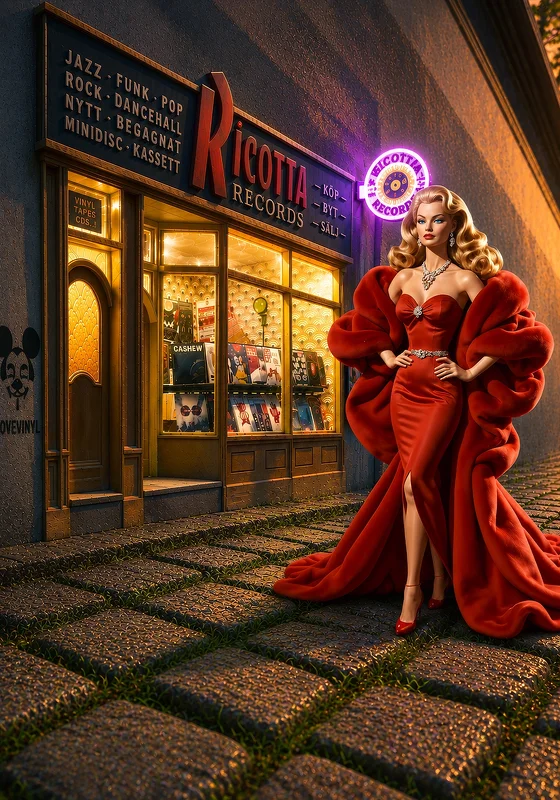
The picture that opens this essay depicts something impossible. An elegant woman in brilliant scarlet haute couture stands outside a tiny record shop on Nygatan in Lund. At first glance, everything appears perfectly ordinary, but a closer look soon reveals that the proportions are all wrong. The woman is far too large for the shopfront. If she tried to step through the doorway, she would have to bend down considerablyand even then it would be in vain. The building is not a real building at all, but one of the miniature installations created by the artist duo Anonymouse, built for mice and extending only a few centimetres behind the façade. The record shop is therefore an illusion, designed to spark the imagination of passers-by rather than to be used.
The remarkable thing, however, is not the façade but the woman. She is Anita Ekbergor rather, an Anita who has chosen to return to Earth in the form of a Barbie doll. Why would one of the world's most celebrated film stars do such a thing? The answer is as simple as it is unexpected. For many years, Anita cherished a dream she never had the chance to fulfil during her earthly life. She wanted to return to Malmö and see her old hometown from a frog's-eye viewnot figuratively, but literally.
In Swedish, we speak of a grodperspektiva frog's-eye viewwhile English uses the expression worm's-eye viewtwo different creatures, but the same idea: observing the world from the level of the cobblestones. After a lifetime spent before cameras, seeing the world from the height of her high heels, Anita longed to experience the same city from the lowest possible vantage point. For a brief moment, she even considered returning as a frog. For a time traveller, that is entirely possible. She soon realised it was not a particularly wise idea. A frog might easily be run over by the first cyclist who came along, while a worm would scarcely survive the first early-rising blackbird. Although a time traveller cannot die a second time, the form one chooses can still prove short-lived and impractical. A Barbie doll therefore turned out to be a far better alternative. It was small enough to give her the longed-for frog's-eye view, yet human enough to allow her to stroll quietly through the city's streets without having to hop or wriggle her way along.
That was also why her encounter with Anonymouse became so fascinating. For a moment, Anita believed she had finally discovered a world built almost to the same scale as the doll herself. But appearances were deceptive. She was still just a little too large. Had she attempted to enter the record shop, she would have had to duck considerably, and once inside, there would have been nothing at all. The buildings were merely façades with almost no depth, designed to deceive the eye and set the imagination in motion, not to provide homes for anyonenot even mice. Yet she remained standing before the little record shop for a long time. It was not the façade itself that fascinated her but the perspective. For the first time, she was seeing the world from exactly the height she had always dreamed of.
The idea had already taken shape on her star, Centaurus. If Anita was going to experience the world as a Barbie doll, she ought to do it properly. The problem was that no such doll had ever existed. Over the decades, Mattel had produced hundreds of Barbie dolls portraying real women, but never Anita Ekberg. That was partly due to commercial and legal considerations, but also to Anita herself. She knew her own worth and, throughout her life, had been careful not to let others commercialise her image. If her old dream were ever to come true, the world's firstand onlyBarbie doll portraying Anita Ekberg would first have to be created.
That story begins with Ruth Handler, another Time-traveller and the woman behind Barbie.
When the story has been told, however, one question remainsone far greater than Barbie dolls, haute couture, and miniature shoes. How can Anita possibly be walking through the streets of Malmö and Lund so many years after her death? The answer is not nearly as simple as one might imagine, and it first requires understanding how Time-travellers actually work. But before we get there, another story must be told.
There is a curious paradox that makes these return visits possible. The closer someone was to a time traveller in life, the more difficult it becomes for that person to recognise her when she returns. A passer-by may well pause, thinking the woman in the street looks remarkably like Anita Ekberg. A lover of classic cinema might even smile at the resemblance. But someone who truly knew Anita will rarely reach the same conclusion. The thought is dismissed before it has even fully formed. Anita Ekberg is dead. Therefore, the woman standing before them cannot possibly be Anita. It is no supernatural force that protects Time-travellers. It is simply human logic. The better we know someone, the harder it is for us to accept the impossible.
And it is precisely that paradox that makes this story understandable.
Now it only remains to explain how the world's only Barbie doll portraying Anita Ekberg came into being. That story begins with Ruth Handler. There, among pattern paper, silk, dressmaker's pins, and a sewing machine scarcely larger than a matchbox, the first stage of the journey begins. Only then will it be time to return to the larger question of what truly happens when a human being diesand whether death is always the final destination, or whether some people are occasionally granted the chance to return for a brief visit and see the world once morethis time from an entirely different perspective.
The Little Diva
The little diva who perhaps never was a diva at all. Some people become prisoners of their own legends, and Anita Ekberg was undoubtedly one of them. Ask almost anyone about her, and the word diva soon appears. For many, it has become almost a surname. There she stands in our collective memory: the blonde goddess of La Dolce Vita, the woman wading through the Trevi Fountain while the world's photographers crowded along the edge and the press continued to build the image of a temperamental, demanding, and impossible star. Yet one cannot help wondering whether that image tells us more about Anita than about our own longing for myths.
The meaning of the word diva has also changed over time. It derives from Italian and means "the divine one." It was used to describe the greatest stars of the opera stagewomen whose voices and stage presence seemed to transcend the merely human. Only much later did the word acquire the meaning most often associated with it today: someone who makes unreasonable demands, constantly seeks attention, and expects special treatment. That later meaning has been so persistently attached to Anita Ekberg that many have accepted it as unquestionable truth.
The problem is that reality does not always align with the legend. People who worked with Anita often described someone very different from the woman portrayed in newspaper headlines. She could certainly be strong-willed and never hesitated to speak up when she believed she had been treated unfairly, but that is entirely different from being a diva. She also lived in a film industry where women were expected to be accommodating, smile graciously, and, above all, show gratitude. Anita did not always do so. She had integrity, defended her boundaries, and refused to assume that others had the right to decide for her. For a woman working in the film industry of the 1950s and 1960s, such behaviour could be more than enough to earn the label difficult.
At the same time, her appearance almost invited mythmaking. Federico Fellini described Anita as a force of nature, a creature as improbable as a giraffe or a baobab tree. He was not referring to her personality but to her presence. Anita did not need to do anything. She did not need to overact, raise her voice, or dominate a room. She took possession of the room simply by being there. When someone possesses that kind of presence, the world soon begins to fill in the rest of the story for itself, and perhaps that is where the diva myth is born.
A firm opinion gradually becomes a temper tantrum. A closed door turns into a dramatic gesture. A woman demanding the same respect as her male colleagues is suddenly labelled difficult. History is full of such examples, and Anita Ekberg became one of them. True, she occasionally chose to play along with the role once journalists had already decided who she was, but behind the headlines lies a far warmer person. Friends spoke of her generosity, her sense of humour, and her ability to laugh at herself and at her own reputation. Those are hardly the qualities most people associate with a diva.
The title The Little Diva contains an unexpected truth. Not because Anita was ever smallon the contrary, she was one of the greatest international film stars Sweden has ever producedbut because the title plays with the image the world created of her. Besides, at 174 centimetres in her stocking feet, she stood well above average height.
What happens when the great diva suddenly shrinks to just thirty centimetres tall and begins wandering through the city in the middle of the night? What happens when she stops in front of a tiny record shop built for mice and discovers that greatness is not measured by height, fame, or newspaper headlines?
Perhaps the answer is that Anita Ekberg never needed to be a diva at all. Her presence was enough. Everything else was created by cameras, journalists, and our own fascination with people who seem larger than life. When the great diva becomes the little diva, the contrast is not merely humorous. It also reminds us that behind every myth there is a human beingand that this person is sometimes far less dramatic, yet infinitely more interesting, than the figure history has chosen to remember.
But where does the Barbie doll outside the newly opened miniature record shop created by Anonymouse on Nygatan in Lund fit into all this? In the shop window, among other things, is the latest record by the mouse singer Veronica Formaggio, titled Cat, Oh Well. A fair question, though in truth the connection is no more profound than the happy coincidence of a frog's-eye view.
The doll wandering among Anonymouse's miniature buildings in Malmö and Lund is unique in every possible way. She really is a Barbie doll, but she is the only one in existence. The toy giant Mattel has never mass-produced a doll in the likeness of Anita Ekberg. That is partly due to complicated licensing issues and unfortunate cultural timing, but above all to Anita herself. She knew her own worth and usually declined whenever companies wanted to commercialise her appearance.
Although she was one of the greatest global style icons of the 1950s and 1960s, her public persona conflicted with Mattel's business strategy at the time. When Barbie was launched in 1959 as an innocent fashion doll for young girls, Anita reached the peak of her career the following year with Federico Fellini's La Dolce Vita. Her iconic bath in the Trevi Fountain cast her as a sensual vamp, considered far too mature and provocative for the toy market. By the time Mattel began targeting adult collectors through series such as the Barbie Tribute Collection, which celebrated Anita's contemporariesincluding Marilyn Monroe in her famous flying white dress, Grace Kelly in her elegant Hitchcock style, Elizabeth Taylor as Cleopatra, and Audrey Hepburn in her black Givenchy dressEkberg's commercial impact in the United States had already faded.
In fact, no named Swedish woman has ever been honoured with an official, mass-produced Barbie doll in her likeness. Mattel has generally prioritised personalities with American or worldwide recognition, such as Frida Kahlo or the British 1960s fashion model Twiggy, who in 1967 became the first living celebrity to be immortalised as a Barbie doll. The closest Sweden has come is the collector's doll Swedish Barbie, released in 1999, which was not based on any historical woman but instead a generic Barbie dressed in a traditional Swedish Midsummer folk costume.
Even today's Swedish world stars, such as Olympic swimmer Sarah Sjöström and pop star Zara Larsson, remain notably absent from Barbie's catalogue. There have been unique exceptions, such as MTV presenter Kajsa Mellgren, who received a single custom-made Barbie in her likeness during a promotional campaign in the mid-1990s. Still, on toy store shelves, they have remained conspicuously absent.
A Great Diva in a Small Package
Apart from the perspective she had gained during her childhood, growing up in a working-class family in Malmö, Anita knew surprisingly little about life at ground level.
From her years as a film starand later from the vantage point of her own starAnita had experienced life almost entirely from a von oben perspective. To understand what life looked like down below, she had to rely on imagination. She wanted to see the world from what Swedes call a frog's-eye view", or rather, from the level of a doll.
Jumping around Malmö as a frogor wriggling through the streets as a worm, to borrow the English expression worm's-eye viewwould almost certainly prove fatal. Even though a Time-traveller cannot die a second time, the frog or worm whose form one assumes can still be crushed underfoot.
Much safer, she concluded, was to stroll through the city as a Barbie dollat least at night, when little girls were asleep. From just thirty centimetres above the ground, the world suddenly looked entirely different. Houses seemed taller, cobblestones became cliffs, and kerbstones turned into mountains. Marcel Proust once wrote that the real voyage of discovery consists not in seeking new landscapes, but in seeing with new eyes.
Anita had also realised that crawling on all fours through Malmö in the middle of the night would have attracted considerably more attention. A supposedly intoxicated blonde woman would hardly have been left alone. The first opportunist would almost certainly have sensed possibilitiesor so Anita believed, a view undoubtedly shared by many men and with good reason. A solitary Barbie doll, on the other hand, was unlikely to inspire the same fantasies in lonely men. So, a Barbie doll it would be.
The only question was: where could she find one that looked like her?
Never underestimate eternity. Among all the dollmakers who had ever lived on Earth was the poor carpenter Geppetto, who carved the mischievous wooden puppet Pinocchio from a block of timber. Eternity was also home to Ruth Handler, the creator of Barbie, who had invented the doll to give little girls an adult woman they could imagine becoming. Anita paid a visit to the doll icon on her star, Barbie, to ask whether she might create an Anita doll.
"My philosophy behind Barbie was always to let a little girl become whatever she wanted through her doll," Ruth said. "So, of course, I can create a great diva in a small package."
The doll itself was not what Ruth needed to make, since Anita could embody a living one herself. Time-travellers are not limited to choosing the age at which they appear; they may also choose their size and form. In fact, Anita could just as easily have appeared as a frog or a wormbut after some thought, those possibilities had already been dismissed.
"As you know," Ruth continued, "the problemif you can call it oneis that whenever we Time-travellers take a form, we do so without clothes. And I suspect a naked Anita doll would attract rather more attention than either of us intends."
Ruth burst out laughing. Her Barbie dolls had caused controversy from the very beginning, particularly among conservative circlesincluding certain religious groupsbecause they had unmistakably adult female bodies with clearly defined breasts.
"As I once said in an interview," Anita replied, grinning. Men are all the same. I promise you, they'd stare at me even if I weren't wearing a single thread.
When they had both finished laughing, they stepped into Ruth's vast sewing studio beneath the endless roof of the universe. During her visits to Earth, she had collected everything she needed to make dolls.
"We're going to create a miniature Hollywood gown," Ruth said, unfolding a fashion sketch from the early 1960s. "Brilliant scarletand tailored so perfectly it fits like a second skin."
"It looks magnificent," Anita said, studying the drawing.
"But we begin underneath," Ruth smiled. "With most dolls, I first make custom underwear and foundation garments. To recreate the dramatic hourglass silhouette of the 1950sthink Marilyn Monroe or Elizabeth TaylorI use miniature corsets, layers of tulle petticoats, and occasionally a little strategic padding. But with you, I don't have to worry about any of that. Everything is already exactly where it belongs."
Anita laughed.
"And you won't need to sew any knickers either. I never wore them on Earth, and I haven't changed that habit in the eternity."
Ruth laughed along.
"That saves me a few stitches. But now comes the truly difficult part. Sewing haute couture for a doll that's only twenty-nine centimetres tall is considerably harder than sewing for a full-sized woman. Fabrics that drape beautifully on an adult body often become thick and clumsy in miniature."
"So how do you solve that?"
Ruth let a length of deep crimson satin slip from her fingers.
"Everything has to be reduced without the eye ever noticing. The fabric must retain the same sheen, drape, and elegance as the original. Lace, embroidery, and seams all have to be scaled down proportionally. Otherwise, the dress looks like a doll's clothes rather than couture."
She smiled.
"But that's the easy part. Now comes the craftsmanship."
Carefully, Ruth draped the fabric over a dress form she had taken from a cupboard.
"I hope you don't mind my using this mannequin," she said. "I originally had it made for a Sophia Loren doll. She was the only woman of your generation who could rival youboth in height and bust measurements."
"Well now," Anita replied dryly.
"Sophia gave Hollywood the same headaches you did. She often acted opposite leading men who were much shorter than audiences realised, and the studios had to build platforms and wooden boxes to even out the height difference. In high heels and with her towering hairstyle, she easily stood over one hundred and eighty centimetres tall."
"I had the same problem," Anita said. "We were almost the same height. When I appeared opposite Frank Sinatra in 4 for Texas, he wore hidden lifts in his cowboy boots, while I was instructed to lean against furniture or sit down whenever possible."
"But you spent time together in private, didn't you?"
"Oh yesbut then it wasn't a problem. In bed, height isn't really an issue. At least not when we're talking about the distance above the ground."
They both burst into laughter.
"I completely agree," Ruth said, trying to sound as worldly as Anita.
"Fellini did exactly the opposite," Anita continued. "He never tried to hide my height. He gave me even higher heels, filmed me from below, and made me look like a giant goddess. That's when he began calling me Anitona'Big Anita.'"
"I rather suspect," Ruth smiled, "that he wasn't referring only to your height."
A Great Diva in a Small Package
Apart from the perspective she had gained during her childhood, growing up in a working-class family in Malmö, Anita knew surprisingly little about how life was actually lived.
From her years as a film starand later from the vantage point of her own starAnita had experienced the world almost entirely from a von oben perspective. To understand what life looked like down below, she had to rely on imagination. She wanted to see life from what Swedes call a frog's-eye view or rather, from the level of a doll.
Jumping around Malmö as a frogor wriggling through the streets as a worm, to borrow the English expression worm's-eye viewwould almost certainly prove fatal. Even though a time traveller cannot die a second time, the frog or worm whose form one assumes can still be crushed underfoot.
Much safer, she concluded, was to stroll through the city as a Barbie dollat least at night, when little girls were asleep. At thirty centimetres above the ground, the world suddenly looks completely different. Houses grow taller, cobblestones become cliffs, and kerbs become mountains. Marcel Proust wrote that the real voyage of discovery consists not in seeking new landscapes but in seeing with new eyes.
Anita had also realised that crawling around on all fours through Malmö in the middle of the night would attract rather more attention. A supposedly intoxicated blonde woman would hardly be left alone. The first opportunist would almost certainly sense an opportunityor so Anita believed, a view undoubtedly shared by many women, and with good reason. A solitary Barbie doll, on the other hand, was unlikely to spark the same fantasies in lonely men. So a Barbie doll it would be. The only question was where she could find one that looked like herself.
Never underestimate eternity. Among all the dollmakers who had ever lived on Earth was the poor carpenter Geppetto, who carved the mischievous wooden puppet Pinocchio from a block of timber. Eternity was also home to Ruth Handler, the creator of Barbie, who invented the doll to give little girls an adult woman to imagine becoming. Anita visited the doll icon on her star, Barbie, to ask whether she could create an Anita doll.
"My philosophy behind Barbie was to let every little girl become whatever she wanted to be through her doll, so, of course, I could create a great diva in a small package," said Ruth.
The doll itself was not what Ruth needed to make, since Anita could embody a living one herself. Time-travellers are not limited to choosing the age at which they appear; they may also choose their size and form. In fact, Anita could have appeared as easily as a frog or a wormbut after some thought, those possibilities had already been dismissed.
"As you know, the problemif indeed it is oneis that whenever we Time-travellers assume a form, we do so without clothing. And a naked Anita doll would almost certainly attract far more attention."
Ruth laughed heartily. Her Barbie dolls had caused controversy from the very beginning, particularly within conservative circlesincluding certain religious groupsbecause they had unmistakably adult female bodies with clearly defined breasts.
"As I once said in an interview, 'Men are all the same. I promise you, they'd stare at me even if I weren't wearing a single thread,'" Anita replied.
When they had both finished laughing, they entered Ruth's large sewing room beneath the endless roof of the universe. During her visits to Earth, Ruth had gathered everything she could possibly need to make dolls.
"We're going to create a miniature Hollywood gown," said Ruth, unfolding a fashion sketch from the early 1960s. "Brilliant scarletand tailored so perfectly it fits like a second skin."
"It looks magnificent," Anita said, studying the drawing.
"But we begin underneath," Ruth smiled. "With most dolls, I first make custom underwear and foundation garments. To recreate the dramatic hourglass silhouette of the 1950slike Marilyn Monroe's or Elizabeth Taylor'sI use miniature corsets, layers of tulle petticoats, and occasionally a little strategic padding. But with you, I don't have to worry about any of that. Everything is already exactly where it belongs."
Anita laughed.
"And you won't need to sew any knickers. I never wore them on Earth, and I haven't changed that habit in an eternity."
Ruth laughed along.
"That saves us a few stitches. But now comes the truly difficult part. Sewing haute couture for a doll just twenty-nine centimetres tall is considerably harder than sewing for a full-sized woman. Fabrics that drape beautifully on an adult body often look thick and clumsy in miniature."
"How do you solve that?"
Ruth let a length of deep crimson satin slip through her fingers.
"First, everything must be reduced without the eye noticing. The fabric must retain the same sheen, drape, and elegance as the original. Lace, embroidery, and seams must all be scaled down proportionally. Otherwise, the gown looks like a doll's dress rather than couture."
She smiled.
"But theory is the easy part. Now the craftsmanship begins."
Ruth gently draped the fabric over the dress form she had taken from a cupboard.
"I hope you don't mind my using this mannequin," said Ruth. "I once had it made for a Sophia Loren doll. She was the only woman of your generation who could rival youboth in height and bust measurements."
"Well now," Anita replied dryly.
"Sophia gave Hollywood the same headaches you did. She often acted opposite leading men who were much shorter than audiences realised, and the studios had to build platforms and wooden boxes to even out the height difference. In high heels, with her towering hairstyle, she stood over one hundred and eighty centimetres tall."
"I had the same problem," Anita said. "We were almost the same height. When I appeared opposite Frank Sinatra in 4 for Texas, he wore hidden lifts in his cowboy boots, while I was instructed to lean against furniture or sit down whenever possible."
"But didn't you spend time together in private?"
"Oh yesbut then it wasn't a problem. In bed, height isn't really an issue. At least not when we're talking about the distance above the ground."
They both burst into laughter.
"I quite agree," Ruth said, trying to sound as worldly as Anita.
"Fellini did exactly the opposite," Anita continued. "He never tried to hide my height. He gave me even higher heels, filmed me from below, and made me look like a giant goddess. That's when he started calling me AnitonaBig Anita."
"I rather suspect," Ruth smiled, "that he wasn't referring only to your height."
"But Frank used to stand on tiptoe whenever we kissed. That was rather sweet."
"Now, back to work! Do you see how the satin falls?" Ruth gently gathered the fabric, making the dress form seem to sway at the hips. "That's exactly the illusion I want to create. The gown must move as though it were made for a full-sized womannot for a doll."
"At Hollywood's acting school, I was taught to walk so that, from behind, it looked as though two boys were fighting inside a sack," Anita said, giving her hips an exaggerated sway.
Ruth laughed.
"Exactly! Now you understand why I want the fabric to move in the same way."
Anita smiled and gave another playful wiggle.
"First, I'll take your measurements," Ruth said, producing a tape measure barely wider than a strip of cotton ribbon. "Not because you'll ever change, but because at this scale, half a millimetre makes all the difference."
She measured Anita's bust, waist, hips, back, shoulders, and leg length, carefully noting the measurements on a pattern sheet before beginning to draw.
"I never cut directly into the real fabric. First, I make a trial pattern. Then I pin the pieces together and try them on the mannequin. After that, I unpick the seams, adjust the pattern, and try it on again. Sometimes I have to repeat the process four or five times before the proportions feel exactly right."
"I thought you glued everything together," Anita teased.
Ruth looked almost offended.
"Glue? Never in my life. Haute couture is sewneven at doll size."
She pointed towards a sewing machine no larger than a matchbox.
"That one was specially built for miniature sewing. The needle is finer than a human hair, and the stitches are so tiny they're almost invisible. I sew everything else by hand, using tweezers and a magnifying glass."
She carefully stitched together the first sections.
"Only after every seam has been sewn do I press them, fit the dress again, and correct the slightest wrinkle. Haute couture isn't really about fabric. It's about fit."
Only then did Ruth allow a length of deep crimson satin to glide through her fingers.
"Now the real work begins. The actual gown."
She draped the fabric over the mannequin, secured it with tiny dressmaker's pins, and marked it with tailor's chalk finer than a paper clip's tip.
"Again?" Anita asked.
"Yes. Haute couture is all about fitting, pinning, and starting over. It is never about sewing quickly."
Ruth carefully cut the first pieces, pinned them together, and then gently slipped the gown back over the mannequin.
"Stand perfectly still."
She walked slowly around the figure, narrowed her eyes, tugged lightly at the fabric at the hips, and shifted a couple of pins.
"No... the waist has to be raised by half a millimetre, and the neckline should be just a touch lower."
She removed the dress again, unpicked a few seams, repinned everything, and Anita's doll tried it on once more.
Anita smiled.
"You never seem satisfied."
"That's why it's called haute couture. You fit, adjust, and remove pins until the fabric drapes naturally. Only then does the sewing machine do its work."
Ruth sat down at the tiny sewing machine, its needle scarcely larger than the head of a pin. It purred almost silently as the final seams were stitched with impossibly small stitches.
Then Ruth dressed Anita's little stand-in once more.
She examined the doll from every angle, gently straightened the hem, smoothed a slight crease at the back, and nodded in satisfaction.
"Almost finished."
She reached for a miniature steam iron, scarcely larger than a sugar cube, and pressed each seam in turn until the satin fell softly and naturally.
"But what about the zipper?" Anita asked, wondering how she would ever get into such a close-fitting creation when the time came.
Ruth shook her head.
"A real zip would look like a barn door on a doll. Instead, I've sewn in microscopic magnets into the back seam. They automatically find each other and keep the gown perfectly in place. You can take it on and off as many times as you like without it ever losing its shape."
Anita ran a finger gently down the back.
"I can't see a thing."
"Exactly. In haute couture, the finest craftsmanship is the part nobody ever notices."
Together, they carefully slipped the gown onto the doll for the final time.
Ruth stepped back, smiled in satisfaction, and said:
"Now it fits exactly as I imagined. Like a second skin."
"It certainly does."
"And over the gown comes the stolethe red faux fur that matches your dress and your shoes," Ruth said. "That, too, requires a special material. Real fur would be far too coarse at this scale, so I make faux fur from ultra-fine synthetic fibres. The fibres are anchored to a thin backing fabric, then trimmed, brushed, steamed, and shaped until they have the same soft volume and movement as genuine fur."
She paused beside a machine as a length of scarlet fabric slowly disappeared beneath a forest of tiny needles.
"That machine makes faux fur," Ruth explained. "Thousands of synthetic fibres are punched into the fabric and bonded on the reverse side. Afterwards, they're trimmed, brushed, steamed, and dyed until they resemble mink, fox, or chinchillaor, in your case, a mink that has somehow become redder than the reddest fox."
Anita ran her hand over the soft surface.
"Remarkable. It feels completely real."
Ruth smiled.
"That's the whole point. The finest faux fur should fool the eyebut never harm a single animal."
She draped the stole over the doll's bare shoulders and stepped back.
"Now, Mini-Anita is beginning to look like a Hollywood star."
"It looks more like haute couture than doll's clothes," Anita said admiringly.
Ruth smiled.
"That's exactly the idea. No one should think, 'What a lovely doll's dress.' They should think, 'What a magnificent gown,' and only afterwards realise that the woman wearing it is just twenty-nine centimetres tall."
Ruth opened a cabinet in which hundreds of tiny shoe boxes stood neatly arranged.
"Now it's time for the shoes."
She took down a box labelled Slingbacks Hollywood 1961 and lifted out a pair of miniature, brilliant scarlet high heels.
Anita laughed.
"They're smaller than half a fingernail. How on earth do you know they'll fit?"
"Naturally, I fit them to the originalor rather, to her stand-in. That's why I have dress forms. This one has your exact measurements, down to a tenth of a millimetre. But feet can vary slightly, even among women of the same height."
She carefully slipped the shoe onto the mannequin's foot.
"No shoemaker has ever laid a hand on these. They're moulded from a solid-coloured composite material. It's lightweight, durable, and slightly elastic, so there are no seams that can split and no paint to wear away."
Ruth picked up a tiny hairdryer and aimed it at the shoe.
"When I warm the material, it softens and can stretch by up to two sizes. If I put it in the freezer, it shrinks by roughly one size. That allows me to fine-tune the fit without having to mould a completely new pair every time."
She allowed the shoe to cool before putting it back on the mannequin.
"Perfect. Once you've shrunk to Barbie size, they'll fit as if they were made for you."
Anita smiled.
"I only hope I'll fit them just as perfectlyfrom the inside!" she laughed.
"Now comes the really difficult part," Ruth continued. "Jewellery at this scale is a challenge, no matter how small a jeweller's hands are."
She opened a little box filled with glittering stones.
"I hope you're not planning to be stingy," Anita said with a grin.
"Not a chance."
Ruth lifted out a dazzling diamond necklace, matching earrings, a brooch for the plunging neckline, and an elegant belt set with sparkling stones.
"I replace the original gems with tiny space crystals. Then I glue them into place, one by one, by hand."
Anita looked genuinely impressed.
"You seem to have an entire jewellery workshop."
"Semi-finished pieces," Ruth laughed. "Enough to assemble a complete jewellery box whenever I need one."
She placed the jewellery on the doll, stepped back, sprinkled a final scattering of stardust over the Anita-doll, and smiled in satisfaction.
"There. Now the work is complete."
Ruth carefully placed the remaining jewels back into their jewellery case.
"Yes," Anita said softly. "You've done extraordinary work."
"Thank you, darling. But remember one thing. Once you've assumed your doll's size, you can't use hairspray the way you used to with a hairstyle that's only two or three per cent of its normal size."
"With Barbie dolls, I usually set the hairstyle with doll styling gel. To keep period hairstylessuch as the Hollywood waves of the 1950s or the heavily teased updos of the 1960sfrom being ruined during transport, the dolls' hair is sprayed with a strong setting spray that permanently holds every strand exactly where it belongs."
"I prefer my hair curly," Anita replied, "with long curls and as little hairspray as possible."
"You'll have to experiment," Ruth said, holding up a tiny spray bottle barely four centimetres high.
"A Dior sample bottle," she smiled, slipping it into an equally miniature handbag from the same fashion house.
"Red leather, naturally."
Then she looked at Anita with a knowing smile.
"And remember one thing. Doll hair is far finer than human hair. A single drop of ordinary hairspray would make your hairstyle as stiff as a crash helmet."
Becoming Twenty-Nine Centimetres Tall
A frog's-eye view is a curious expression when it could just as easily be called a doll's-eye viewseeing reality through the eyes of a doll. That was precisely what Anita had chosen to do. It is one of the privileges of a time traveller to assume whatever form seems most appropriate. When a person dies, the bodywith all its aches and infirmitiesis left behind on Earth, while the soul journeys to an unoccupied star somewhere in the universe. The image of what that person looked like during life remains preserved within the soul and can be embodied again at any time. That such things also happen on Earth has long been known, although often misunderstood. It is not divine beings who incarnate, but any soul with a longing to revisit the world it once left behind.
So, when Anita appears in Malmö, it is perfectly natural, even though it is supernatural. She can embody herself at any age she chooses. For herand for most other Time-travellersthat means the age they believe they were at their very best: somewhere between thirty-five and fifty, still youthful yet with a touch of maturity.
The word incarnation comes from Latin and literally means to take on fleshto appear in bodily form. It is an expression that feels warmer and more human, describing a tangible act rather than a theological concept.
While Christianity regards the Incarnation as a unique historical eventGod becoming man once in the person of JesusBuddhism views the assumption of new forms as an endless process shared by all living beings. Buddhists prefer to call it rebirth. That comes closer to the condition of eternity, yet it is still not quite correct.
When time-travellers revisit Earth, they do so without drama, and it has nothing to do with rebirth. Their visit is temporary. It is much like a tourist travelling to another country. One is merely a visitor and never truly becomes part of the place one is visiting.
As long as Anita lived on Earth, she rarely gave much thought to life after death. She was far too busy living to devote much attention to metaphysics. In that respect, she was probably like most people. When she regained consciousness in eternity, she was considerably less surprised than Giovanni Montinithe future Pope Paul VIwho had been one of the fiercest critics of La Dolce Vita. For him, eternity must have looked very different from everything he had preached throughout his life: full of stars, yet empty of gods. Heaven and Hell had both been left behind on Earth, just as Anita had left them behind, for those two extremes are precisely what characterise earthly existence. During her lifetime, Anita had experienced both heaven and hell as life carried her to extraordinary heights and painful depths. They are states of experience rather than physical places and have nothing whatsoever to do with divine judgement. There is no Last Day. That is true for humanity regardless of culture or religion. Few people can objectively be said to live permanently in paradise, while many endure a kind of hell throughout their entire lives.
There is no divine selection, no Day of Judgement, no Ragnarök, no Apocalypse, no end of time, no Final Judgement, and no god directing events. There is only the brutality of chance. No living creature asks to be born, and whether we enter the world rich or poor, healthy or sick, depends solely on circumstances over which none of us has any control.
Buddhism, which has no gods, comes closer than any other religion to this metaphysical understanding. The Buddha was a human being, neither a god nor the son of one. He attained enlightenment through his own efforts and serves on Earth as a guide and teacher for others. The Buddha is not a saviour. He cannot forgive sins or rescue anyone. Every human being must walk the path towards enlightenment alone.
In simple terms, enlightenment consists of three things: awakening from the illusion of a permanent self and recognising that everything is interconnected; extinguishing the three fires of craving, anger, and ignorance that give rise to human suffering; and ultimately attaining nirvanaan eternal state of unshakable peace and compassion beyond time and space, where the cycle of rebirth finally comes to an end.
One might call it living well and doing good. Yet the idea of treating others as you yourself wish to be treated has little to do with religion. It is, in essence, enlightened self-preservation. This principle of balance is woven into every form of lifeanimals, plants, and human beings alike. Without one another, life itself ceases to exist. Parasites eventually find themselves alone, and when that happens, everything dies.
For the overwhelming majority of living things, the system works as long as balance is maintained. Unfortunately, such balance exists only when viewed from a great distance. From Anita's star, Centaurus, the Earth appears as a tiny blue dot, seemingly unchanged from one day to the next. Yet appearances deceive. Beneath that peaceful blue surface lie billions of individual imbalances. Balance is, in reality, an illusionthe sum of countless balances and imbalances. As long as that overall condition remains unchanged, the Earth continues to shine blue, unlike its neighbouring planet Mars, which today glows with an inhospitable red.
That offers little comfort to those whose lives on Earth are filled with misery, nor was it something Anita spent much time considering during the happiest years of her own life. Only after arriving in eternity did she begin to wonder how humanity had created so many extraordinary religions. From the simple gods of the Stone Agethe rock that caused someone to stumble or the sun that gave light and warmthto cultures with a separate deity for every force of nature, and finally to the all-knowing God of the Abrahamic faiths, humanity has always invented divine beings to explain what it could not understand.
Epilogue The Final Picture
When the story ends, only the picture remains. It shows an elegant woman in brilliant scarlet haute couture, standing outside a tiny record shop on Nygatan in Lund. At first glance, everything seems perfectly ordinary, but after a few seconds the eye begins to protest. The proportions are wrong. The woman is far too large for the façade. Or perhaps the shop is far too small. The viewer instinctively searches for a reasonable explanation. Perhaps it is a photomontage. Perhaps it is Photoshop. Perhaps it is an artistic statementor a clever trick of perspective. Or perhaps all of them at once.
Anyone familiar with Anonymouse's miniature installations soon realises that the shop was built for mice. Anyone who also recognises Anita Ekberg may think the woman bears an astonishing resemblance to her. Yet almost no one arrives at the conclusion on which this entire story restsand that is hardly surprising. Human beings are trained to seek the most probable explanation, not the most improbable one.
That is precisely why no one needs to be convinced. Stories of this kind cannot be proved or disproved. They work in much the same way as all good literature. They open a door to a possibility that may not existbut can never be completely ruled out.
If, one late evening, you should happen to stroll through the streets of Malmö or Lund and glimpse a doll-like woman in brilliant scarlet haute couture disappearing around a street corner, there is no need to hurry after her. She has already experienced the one thing she longed for throughout her life: to see her old hometown from a frog's-eye view. Perhaps she pauses for a moment beside a cobblestone, a doorstep, or a tiny record shop built for mice, smiling at how different the world looks when one is only twenty-nine centimetres tall.
Then she quietly continues her walk, as unnoticed as when she first arrived. Not because she is invisible, but because we human beings find it so difficult to believe in the impossible.
And perhaps that is why the impossible picture lingers in the memory. Not because it depicts something that truly happened, but because it reminds us that the world can sometimes feel richer if, for just a brief moment, we dare to look at it from an entirely different perspective.
Introduktion
Vad skulle du göra om du fick en möjlighet som ingen människa tidigare har fått? Inte att bli odödlig eller resa tillbaka i tiden för att förändra historien, utan något betydligt märkligare: att återvända till den värld du en gång lämnade och få se den med helt nya ögon.
För Anita Ekberg var svaret oväntat. Hon drömde inte om att återuppleva filmpremiärerna i Rom, applåderna i Hollywood eller de glamorösa åren då hela världen talade om den blonda gudinnan i La Dolce Vita. Hon ville promenera genom Malmö och Lund en gång till, men denna gång på tjugonio centimeters höjd. Som världens enda Barbiedocka som föreställer Anita Ekberg.
Det som först verkar vara en lekfull fantasi visar sig snart vara något helt annat. Berättelsen rör sig mellan haute couture och miniatyrhantverk, mellan Anonymouse små musbutiker och Ruth Handlers skapelse Barbiedockan. Men under ytan handlar den om betydligt större frågor: identitet, minnen, perspektiv och människans eviga nyfikenhet på vad som väntar i livet efter detta.
Det är därför inte bara berättelsen om hur en docka blir till. Det är också en essä om hur samma värld förändras totalt när den betraktas från en annan höjd och om varför det ibland krävs en omöjlig bild för att få oss att upptäcka det som hela tiden har funnits framför våra ögon.
Prolog Den omöjliga bilden
Bilden som inleder den här essän föreställer egentligen något omöjligt. En elegant kvinna i knallröd haute couture står utanför en liten skivbutik på Nygatan i Lund. Vid första anblicken ser allt ganska normalt ut, men tittar man närmare upptäcker man snart att proportionerna inte stämmer. Kvinnan är alldeles för stor för butikens fasad. Skulle hon försöka gå in genom dörren, fick hon böja sig kraftigt och det hade ändå varit förgäves. Huset är nämligen inget riktigt hus utan en av konstnärsduon Anonymouse små installationer, byggda för möss och med ett djup som bara sträcker sig några få centimeter bakom fasaden. Skivbutiken är alltså en illusion, skapad för att väcka fantasin hos förbipasserande snarare än att användas.
Det märkliga är emellertid inte fasaden utan kvinnan. Det är Anita Ekberg eller rättare sagt en Anita som har valt att återvända till jorden i en Barbiedockas storlek. Varför skulle en av världens mest omskrivna filmstjärnor göra något sådant? Svaret är lika enkelt som oväntat. Anita bar under lång tid på en dröm som hon aldrig fick möjlighet att förverkliga under sitt jordeliv. Hon ville återvända till Malmö och se sin gamla hemstad ur grodperspektiv. Inte bildligt, utan bokstavligt.
På svenska talar vi om grodperspektiv, medan engelsmännen använder uttrycket worm's-eye view, maskens perspektiv. Två olika djur men samma tanke: att iaktta världen från gatstenens nivå. Efter ett helt liv framför kameror och med världen sedd från sina höga klackar längtade Anita efter att uppleva samma stad från den lägsta tänkbara utsiktspunkt. Hon funderade faktiskt en stund på att återvända som en groda. För en tidsresenär är det fullt möjligt. Hon insåg att det inte var någon särskilt lyckad idé. Grodan riskerade att bli överkörd av första bästa cyklist och masken skulle knappast överleva den första morgonpigga koltrasten. Även om en tidsresenär inte kan dö en andra gång, kan den gestalt man valt bli både kortlivad och opraktisk. En Barbiedocka visade sig därför vara ett betydligt bättre alternativ. Den var tillräckligt liten för att ge henne det efterlängtade grodperspektivet och samtidigt tillräckligt mänsklig för att försiktigt promenera genom stadens gator utan att behöva hoppa eller ringla sig fram.
Det var också därför mötet med Anonymouse blev så fascinerande. För ett ögonblick trodde Anita att hon äntligen funnit en värld byggd i nästan samma skala som dockans. Men skenet bedrog. Hon var fortfarande en aning för stor. Ville hon gå in genom dörren till skivbutiken skulle hon behöva ducka rejält, och väl inne fanns egentligen ingenting. Husen var bara fasader med ett obetydligt djup, skapade för att lura ögat och sätta fantasin i rörelse, inte för att någon skulle kunna bo där. Inte ens möss. Ändå blev hon stående länge framför den lilla skivbutiken. Det var inte fasaden i sig som fascinerade henne utan perspektivet. För första gången såg hon världen från just den höjd hon alltid hade drömt om.
Redan på sin stjärna Kentauren föddes tanken. Om Anita skulle uppleva världen som en Barbiedocka borde hon naturligtvis göra det ordentligt. Problemet var bara att någon sådan docka aldrig hade funnits. Mattel hade genom årtionden tillverkat hundratals Barbiedockor föreställande verkliga kvinnor, men aldrig Anita Ekberg. Det berodde på kommersiella och juridiska frågor, men också på Anita själv. Hon visste sitt värde och hade under hela sitt liv varit försiktig med att låta andra kommersialisera sin person. För att hennes gamla dröm skulle kunna förverkligas måste därför världens första och enda Barbiedocka som föreställer Anita Ekberg först skapas.
Historien börjar hos Ruth Handler, en annan tidsresenär och kvinnan bakom Barbiedockan.
När berättelsen är färdig återstår emellertid en fråga som är betydligt större än både Barbiedockor, haute couture och miniatyrskor. Hur kan Anita över huvud taget promenera omkring på Malmös och Lunds gator många år efter sin död? Svaret är inte så enkelt som man kanske tror och det kräver först en förståelse av hur tidsresenärer fungerar. Men innan vi kommer dit finns det en historia som måste berättas.
Det finns en egendomlig paradox som gör dessa återbesök möjliga. Ju närmare någon på jorden stod en tidsresenär under livet, desto svårare har just den personen att känna igen henne när hon återvänder. En förbipasserande kan mycket väl stanna upp och tänka att kvinnan på gatan är otroligt lik Anita Ekberg. En filmälskare kanske till och med ler åt likheten. Men den som verkligen kände Anita kommer nästan aldrig fram till samma slutsats. Tanken avvisas redan innan den hunnit formas. Anita Ekberg är död. Alltså kan kvinnan framför en omöjligt vara Anita. Det är ingen övernaturlig kraft som skyddar tidsresenärerna. Det är människans egen logik. Ju bättre vi känner någon, desto svårare är det för oss att acceptera det omöjliga.
Och just den paradoxen gör den här berättelsen förståelig.
Nu återstår att berätta hur världens enda Barbiedocka föreställande Anita Ekberg kom till. Historien börjar hos Ruth Handler. Där, bland mönsterpapper, siden, knappnålar och en symaskin inte mycket större än en tändsticksask, tar den första etappen sin början. Först därefter är det dags att återvända till den större frågan om vad som egentligen händer när en människa dör och om döden verkligen alltid är slutpunkten, eller om vissa människor ibland får möjlighet att återvända en kort stund för att se världen en gång till denna gång ur ett helt nytt perspektiv.s
The Little Diva - Den lilla divan
Den lilla divan som kanske aldrig var någon diva. Det finns människor som blir fångar i sina egna legender, och Anita Ekberg var utan tvekan en av dem. Fråga vem som helst om henne och ordet diva dyker snart upp. För många har det blivit nästan ett efternamn. Där står hon i det kollektiva minnet: den blonda gudinnan från La Dolce Vita, kvinnan som vadade genom Fontana di Trevi medan världens fotografer trängdes på kanten och pressen byggde vidare på bilden av den temperamentsfulla, krävande och omöjliga stjärnan. Men frågan är om den bilden egentligen säger mer om Anita än om vår egen längtan efter myter.
Begreppet diva har dessutom förändrats genom tiderna. Ursprungligen kommer ordet från italienskan och betyder helt enkelt "den gudomliga". Det användes om operascenens största stjärnor, kvinnor vars röster och sceniska närvaro tycktes överskrida det mänskliga. Först långt senare började ordet få den innebörd vi oftast förknippar med det i dag en person som ställer orimliga krav, kräver ständig uppmärksamhet och förväntar sig särbehandling. Den betydelsen har i efterhand klistrats fast på Anita Ekberg så envist att många har tagit den som en obestridlig sanning.
Problemet är bara att verkligheten inte alltid stämmer överens med legenden. Människor som faktiskt arbetade tillsammans med Anita beskrev ofta en helt annan person än den som tidningsrubrikerna målade upp. Hon kunde vara envis och tvekade inte att säga ifrån när hon ansåg sig orättvist behandlad, men det är något helt annat än att vara en diva. Hon levde dessutom i en filmvärld där kvinnor förväntades vara tillmötesgående, le vänligt och framför allt visa tacksamhet. Anita gjorde inte alltid det. Hon hade integritet, hon försvarade sina egna gränser och hon accepterade inte självklart att andra skulle bestämma över henne. För en kvinna i filmindustrin på 1950- och 60-talen kunde ett sådant beteende räcka långt för att få etiketten "svår".
Samtidigt var hennes yttre nästan en inbjudan till mytbildning. Federico Fellini beskrev henne som en naturkraft, en varelse som framstod lika osannolik som en giraff eller ett baobabträd. Han syftade inte på hennes personlighet utan på hennes närvaro. Anita behövde egentligen inte göra någonting. Hon behövde inte spela över, höja rösten eller dominera ett rum. Hon tog över det bara genom att finnas där. När en människa har en sådan utstrålning börjar omvärlden snart fylla i resten av historien på egen hand, och det är kanske där divamyten föds.
En bestämd åsikt blir med tiden ett raseriutbrott. En stängd dörr blir ett utspel. En kvinna som kräver samma respekt som hennes manliga kollegor beskrivs plötsligt som besvärlig. Historien är full av sådana exempel och Anita Ekberg blev ett av dem. Visst kunde hon ibland spela med i rollen när journalisterna redan hade bestämt sig för vem hon var, men bakom rubrikerna framträder en betydligt varmare människa. Vänner berättade om hennes generositet, humor och förmåga att skratta åt både sig själv och sitt eget rykte. Det är knappast de egenskaper man i första hand förknippar med en diva.
Titeln Den lilla divan rymmer en oväntad sanning. Inte därför att Anita någonsin var liten tvärtom var hon en av de största internationella filmstjärnorna Sverige någonsin har haft utan därför att titeln leker med den bild världen skapade av henne. Dessutom var hon klart över medellängden med sina 174 centimeter i strumplästen.
Vad händer om den stora divan plötsligt bara är trettio centimeter hög och börjar vandra genom staden mitt i natten? Vad händer om hon stannar framför en liten skivbutik byggd för möss och upptäcker att storhet inte mäts i längd, berömmelse eller rubriker?
Kanske blir svaret att Anita Ekberg aldrig behövde vara någon diva över huvud taget. Hennes närvaro räckte. Resten skapades av kamerorna, journalisterna och vår egen fascination för människor som verkar större än livet självt. När den stora divan blir den lilla divan, blir kontrasten därför inte bara humoristisk. Den blir också en påminnelse om att det ofta finns en människa bakom myten och att den människan ibland är betydligt mindre dramatisk men långt mer intressant än den figur som historien har valt att minnas.
Men var kommer Barbiedockan utanför miniatyrmakarna Anonymouse nyöppnade skivaffär på Nygatan i Lund in? I skyltfönstret visas bland annat mussångerskan Veronica Formaggios senaste platta Katten också. Bra fråga, men egentligen utan något annat samband än grodperspektivets slump.
Nu är det dock på det viset att dockan som promenerar omkring bland Anonymouse-husen i Malmö och Lund är unik på alla sätt. Hon är faktiskt en Barbiedocka, men det är den enda som finns. Leksaksjätten Mattel har nämligen aldrig massproducerat en docka av Anita Ekberg. Det beror dels på komplicerade rättighetsfrågor och bristande kulturell timing, men främst på henne själv. Anita visste sitt värde och tackade oftast nej när företag ville kommersialisera hennes utseende.
Trots att hon var en av 1950- och 60-talets absolut största globala stilikoner, krockade hennes offentliga persona med Mattels dåvarande affärsstrategi. När Barbie lanserades 1959 som en oskyldig modedocka för unga flickor, nådde Anita sin karriärtopp med Federico Fellinis Det ljuva livet året efter. Hennes ikoniska bad i Trevifontänen gav henne en sensuell vamp-stämpel som ansågs alltför vuxenorienterad och syndig för leksaksvärlden. När Mattel långt senare började rikta sig till vuxna samlare genom serier som Barbie Tribute Collection och hyllade Anitas samtida kollegor som Marilyn Monroe i sin flygande vita klänning, Grace Kelly i sin eleganta Hitchcock-stil, Elizabeth Taylor som Cleopatra och Audrey Hepburn i en svart Givenchy-klänning hade Ekbergs kommersiella genomslag i USA minskat.
Faktum är att ingen namngiven svensk kvinna någonsin har fått en officiell, massproducerad Barbiedocka i sin egen avbild. Mattel har prioriterat personer med amerikansk eller global genomslagskraft, som Frida Kahlo eller den brittiska 60-talsmodellen Twiggy, som 1967 blev den allra första levande kändisen att förevigas som Barbie. Det närmaste Sverige har kommit är samlardockan Swedish Barbie från 1999, som i stället för en specifik historisk pionjär var en generisk docka klädd i en traditionell midsommarfolkdräkt.
Nutidens svenska världsstjärnor, som simmaren Sara Sjöström eller popstjärnan Zara Larsson, lyser fortfarande med sin frånvaro som dockor. Det har funnits unika undantag, som när MTV-profilen Kajsa Mellgren i mitten av 90-talet fick en specialtillverkad version av sig själv i ett enda exemplar under en marknadsföringskampanj, men på leksakshyllorna har det förblivit tomt.
En stor diva i liten förpackning
Bortsett från barndomens perspektiv, uppvuxen i en arbetarfamilj i Malmö, saknade Anita kunskap om mycket i verkligheten.
Från livet som filmstjärna, liksom utsikten från sin stjärna, hade Anita egentligen bara ett von-oben-perspektiv. Hur livet tedde sig där nere fick hon ta fantasin till hjälp för att förstå. Hon ville alltså se livet ur ett grodperspektiv, som man uttrycker det på svenska. Eller snarare på en docknivå.
Men att hoppa omkring i Malmö som en groda, eller ringla som en mask om man använder engelskans metafor worm's-eye view vore säkert fatalt. Även om en tidsresenär inte kan dö en andra gång, kan grodan eller masken man gestaltar trampas sönder.
Säkrare är det att promenera omkring som en Barbiedocka, åtminstone på natten när små flickor sover. Trettio centimeter över marken ser världen plötsligt annorlunda ut. Husen växer, gatstenarna blir till klippor och trottoarkanterna till berg. Marcel Proust menade att den verkliga upptäcktsresan inte består i att söka nya landskap utan i att se med nya ögon.
Anita hade kommit fram till att det att krypa omkring på alla fyra mitt i natten skulle ha väckt mer uppståndelse. En förmodat berusad blondin skulle inte lämnas i fred. Första bästa karl skulle ana möjligheter, enligt Anitas och många kvinnors uppfattning. En säkert välgrundad uppfattning. En ensam docka skulle inte väcka samma våta drömmar hos kåta karlar. Så det fick bli en Barbiedocka. Men varifrån kunde hon få tag på en sådan som var en miniatyr av sig själv?
Underskatta inte evigheten. Bland alla dockmakare som har levt på jorden genom tiderna fanns inte bara den fattige snickaren Geppetto som ur ett stycke trä täljde den vanartige trädockan Pinocchio. I evigheten fanns också Ruth Handler, som skapade Barbiedockan för att ge små flickor en vuxen kvinnlig förebild att fantisera om. Anita besökte dockikonen på sin stjärna Barbie för att fråga om hon kunde göra en Anita-docka.
Min filosofi om Barbie var att låta den lilla flickan, genom dockan, bli vad hon ville vara, så det är klart att jag kan skapa en stor diva i liten förpackning, sa Ruth. Nu var det inte dockan i sig hon skulle göra, eftersom Anita själv kunde gestalta en levande sådan. Tidsresenärer är inte begränsade till vilken ålder de vill uppträda som, utan kan också välja storlek och form. Faktum är att Anita kunde uppträda som både en groda och en mask, men det var ju inte aktuellt efter närmare eftertanke.
Som du vet är problemet, om det nu är ett sådant, att när vi tidsresenärer gestaltar någon gör vi det utan kläder, och en naken Anita-docka skulle garanterat väcka större uppmärksamhet. Ruth skrattade hjärtligt. Hennes Barbiedockor hade redan från början väckt anstöt hos många konservativa kretsar däribland vissa religiösa grupper eftersom dockorna hade en vuxen kvinnokropp med tydligt markerade bröst.
Som jag sagt nån gång under en intervju: "Karlar är sig lika. Jag lovar, de skulle glo på mig även om jag inte hade en tråd på kroppen", sa Anita. Efter att de hade skrattat färdigt gick de in i Ruths stora syrum med universum som enda tak. Där hade Ruth under sina besök på jorden samlat ihop allt som behövdes för att göra dockor.
Vi ska skapa en Hollywood-klänning i miniatyr, sa Ruth och vecklade ut en skiss från tidigt 1960-tal. Knallröd och så välsydd att den sitter som en andra hud.
Den ser fantastisk ut, sa Anita och studerade teckningen.
Men vi börjar underifrån, log Ruth. På de flesta dockor syr jag först skräddarsydda underkläder och stommar. För att återskapa 1950-talets extrema timglasfigur som hos Marilyn Monroe eller Elizabeth Taylor använder jag miniatyrkorsetter, tyllunderkjolar och ibland lite strategisk stoppning. Men när det gäller dig behöver jag inte tänka på sånt. Allt sitter redan där det ska.
Anita skrattade.
Och några trosor behöver du inte sy. Jag bar inga
3 200 kr

Jörgen Thornberg
Malmö
Lite om bilder och mig. Translation in English at the end.
Jag är en nyfiken person som ser allt i bilder, även det jag fäster i ord, gärna tillsammans för bakom alla mina bilder finns en berättelse. Till vissa bilder hör en kortare eller längre novell som följer med bilden.
Bilder berättar historier. Jag omges av naturlig skönhet, intressanta människor och historia var jag än går. Jag använder min kamera för att dokumentera världen och blanda det jag ser med vad jag känner för att fånga den dolda magin.
Mina bilder berättar mina historier. Genom mina bilder, tryck och berättelser. Jag bjuder in dig att ta del av dessa berättelser, in i ditt liv och hem och dela min mycket personliga syn på vår värld. Mer än vad ögat ser. Jag tänker i bilder, drömmer och skriver och pratar om dem; följaktligen måste jag också skapa bilder. De blir vad jag ser, inte nödvändigtvis begränsade till verkligheten. Det finns en bild runt varje hörn. Jag hoppas att du kommer att se vad jag såg och gilla det.
Jag är också en skrivande person och till många bilder hör en kortare eller längre essay. Den följer med tavlan, tryckt på fint papper och med en personlig hälsning från mig.
Flertalet bilder startar sin resa i min kamera. Enkelt förklarat beskriver jag bilden jag ser i mitt inre, upplevd eller fantiserad. Bilden uppstår inom mig redan innan jag fått okularet till ögat. På bråkdelen av ett ögonblick ser jag vad jag vill ha och vad som kan göras med bilden. Här skall jag stoppa in en giraff, stålmannen, Titanic eller vad det är min fantasi finner ut. Ännu märkligare är att jag kommer ihåg minnesbilden långt efteråt när det blir tid att skapa verket. Om jag lyckas eller inte, är upp till betraktaren, oftast präglat av en stråk av svart humor – meningen är att man skall bli underhållen. Mina bilder blir ofta en snackis där de hänger.
Jag föredrar bilder som förmedlar ett budskap i flera lager. Vid första anblicken fylld av feel-good, en vacker utsikt, fint väder, solen skiner, blommor på ängen eller vattnet som ligger förrädiskt spegelblankt. I en sådan bild kan jag gömma min egentliga berättelse, mitt förakt för förtryckare och våldsverkare, rasister och fördomsfulla människor - ett gärna återkommande motiv mer eller mindre dolt i det vackra motivet. Jag försöker förena dem i ett gemensamt narrativ.
Bild och formgivning har löpt som en röd tråd genom livet. Fotokonst känns som en värdig final som jag gärna delar med mig.
Min genre är vid som framgår av mina bilder, temat en blandning av pop- och gatukonst i kollage som kan bestå av hundratals lager. Vissa bilder kan ta veckor, andra någon dag innan det är dags att överlämna resultatet till printverkstaden. Fine Art Prints är digitala fotocollage. I dessa kollage sker rivandet, klippandet, pusslandet, målandet, ritandet och sprayningen digitalt. Det jag monterar in kan vara hundratals år gamla bilder som jag omsorgsfullt frilägger så att de ser ut att vara en del av tavlan men också bilder skapade av mig själv efter min egen fantasi. Därefter besöks printstudion och för vissa bilder numrera en limiterad upplaga (oftast 7 exemplar) och signera för hand. Vissa bilder kan köpas i olika format. Det är bara att fråga efter vilka. Gillar man en bild som är 70x100 men inte har plats på väggen, går den kanske att få i 50x70 cm istället. Frågan är fri.
Metoden Giclée eller Fine Art Print som det också kallas är det moderna sättet för framställning av grafisk konst. Villkoret för denna typ av utskrifter är att en högkvalitativ storformatskrivare används med åldersbeständigt färgpigment och konstnärspapper eller i förekommande fall på duk. Pappret som används möter de krav på livslängd som ställs av museer och gallerier. Normalt säljer jag mina bilder oinramade så att den nya ägaren själv kan bestämma hur de skall se ut, med eller utan passepartout färg på ram, med eller utan glas etc..
Under många år ställde jag bara ut på nätet, i valda grupper och på min egen Facebooksida - https://www.facebook.com/jorgen.thornberg.9
Jag finns också på en egen hemsida som tyvärr inte alltid är uppdaterad – https://www.jth.life/ Där kan du också läsa en del av de berättelser som följer med bilden.
UTSTÄLLNINGAR
Luftkastellet, oktober 2022
Konst i Lund, november 2022
Luftkastellet, mars 2023
Engleson Galleri Caroli, april 2023
Hydra, Greece June 2023
Engleson Galleri Caroli, oktober 2023
Toppen, Höllviken december 2023
Luftkastellet, mars 2024
Torups Galleri, mars 2024
Venice, May 2024
Luftkastellet, oktober 2024
Konst i Advent, December 2024
Galleri Engleson, Caroli December 2024
Jäger & Jansson Galleri, april 2025
A bit about pictures and me.
I'm a curious person who sees everything in pictures, even what I express in words, often combining them, for behind all my pictures lies a story. These narratives, some as short as a single image and others as long as a novel, are the heart and soul of my work.
Pictures tell stories. Wherever I go, I'm surrounded by natural beauty, exciting people, and history. I use my camera to document the world and blend what I see with what I feel to capture the hidden magic.
My images tell my stories. Through my pictures, prints, and narratives, I invite you to partake in these stories in your life and home and share my deeply personal perspective of our world. More than meets the eye. I think in pictures, dream, write, and talk about them; consequently, I must create images too. They become what I see, not necessarily confined to reality. There's a picture around every corner. I hope you'll see what I saw and enjoy it.
I'm also a writer, and many images come with a shorter or longer essay. It accompanies the painting, printed on fine paper with my personal greeting.
Many pictures start their journey on my camera. Simply put, I describe the image I see in my mind, experienced or imagined. The image arises within me even before I bring the eyepiece to my eye. In a fraction of a moment, I see what I want and what can be done with the picture. Here, I'll insert a giraffe, Superman, the Titanic, or whatever my imagination conjures up. Even stranger is that I remember the mental image long after it's time to create the work. Whether I succeed is up to the observer, often imbued with a streak of black humour – the aim is to entertain. My pictures usually become a talking point wherever they hang.
I prefer pictures that convey a message in multiple layers. At first glance, they're filled with feel-good vibes, a beautiful view, lovely weather, the sun shining, flowers in the meadow, or the water lying deceptively calm. But beneath this surface beauty, I often conceal a deeper story, a narrative that challenges societal norms or explores the human condition. I invite you to delve into these hidden narratives and discover the layers of meaning within my work.
Picture and design have been a thread running through my life. Photographic art feels like a fitting finale, and I'm happy to share it.
My genre is varied, as seen in my pictures; the theme is a blend of pop and street art in collages that can consist of hundreds of layers. Some images can take weeks, others just a day before it's time to hand over the result to the print workshop. Fine Art Prints are digital photo collages. In these collages, tearing, cutting, puzzling, painting, drawing, and spraying happen digitally. What I insert can be images hundreds of years old that I carefully extract so they appear to be part of the painting, but also images created by myself, now also generated from my imagination. Next, visit the print studio and, for certain images, number a limited edition (usually 7 copies) and sign them by hand. Some images may be available in other formats. Just ask which ones. If you like an image that's 70x100 but doesn't have space on the wall, you might be able to get it in 50x70 cm instead. The question is open.
The Giclée method, or Fine Art Print as it's also called, is the modern way of producing graphic art. This method ensures the highest quality and longevity of the artwork, using a high-quality large-format printer with archival pigment inks and artist paper or, in some cases, canvas. The paper used meets the longevity requirements set by museums and galleries. I sell my pictures unframed, allowing the new owner to personalise their artwork, confident in the lasting value and quality of the piece.
For many years, I only exhibited online, in selected groups, and on my Facebook page - https://www.facebook.com/jorgen.thornberg.9. I also have my website, which unfortunately is not constantly updated - https://www.jth.life/. You can also read some of the stories accompanying the pictures there.
EXHIBITIONS
Luftkastellet, October 2022
Art in Lund, November 2022
Luftkastellet, March 2023
Engleson Gallery Caroli, April 2023
Hydra, Greece June 2023
Engleson Gallery Caroli, October 2023
Toppen, Höllviken December 2023
Luftkastellet, March 2024
Torup Gallery, March 2024
Venice, May 2024
UTSTÄLLNINGAR
Luftkastellet, oktober 2022
Konst i Lund, november 2022
Luftkastellet, mars 2023
Engleson Galleri Caroli, april 2023
Hydra, Greece June 2023
Engleson Galleri Caroli, oktober 2023
Toppen, Höllviken december 2023
Luftkastellet, mars 2024
Torups Galleri, mars 2024
Venice, May 2024
Luftkastellet, October 2024
Konst i Advent, December 2024
Galleri Engleson, Caroli December 2024
Jäger & Jansson Galleri, April 2025
Utbildning
Autodidakt
Medlem i konstnärsförening
Öppna Sinnen
Med i konstrunda
Konstrundan i Skåne
Utställningar
Luftkastellet, October 2022
Art in Lund, November 2022
Luftkastellet, March 2023
Engleson Gallery Caroli, April 2023
Hydra, Greece June 2023
Engleson Gallery Caroli, October 2023
Toppen, Höllviken December 2023
Luftkastellet, March 2024
Torup Gallery, March 2024
Venice, May 2024