Vi använder cookies för att ge dig bästa möjliga upplevelse. Välj vilka cookies du tillåter.
Läs mer i vår integritetspolicy
Jörgen Thornberg
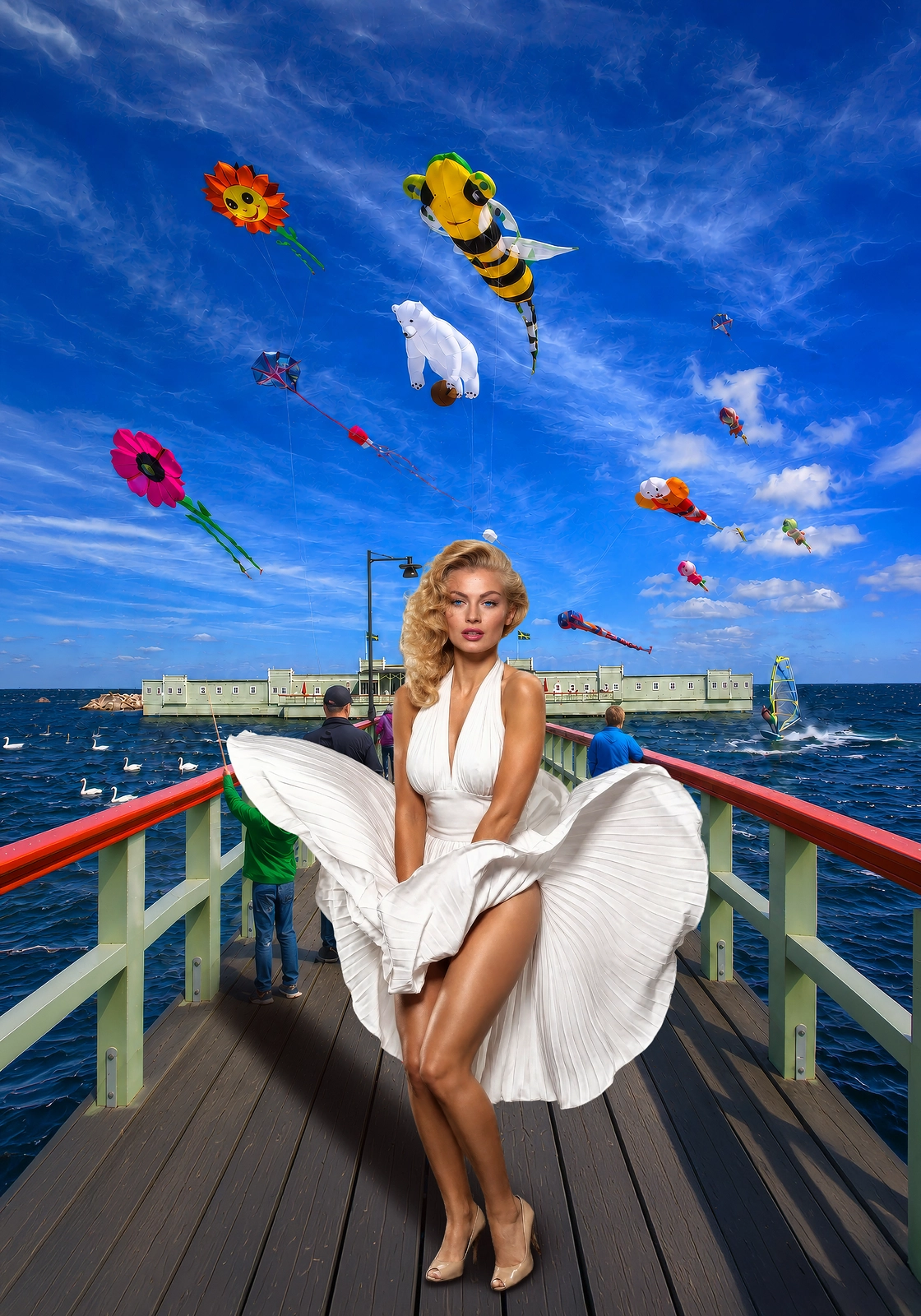
Queen of the Winds - Vindarnas drottning, 2026
Digital
50 x 70 cm
3 200 kr
Queen of the Winds - Vindarnas drottning
Svensk text på slutet
Introduction
What, really, is a kite?
For most people, the answer seems obvious. A few light wooden sticks, a piece of brightly coloured fabric, a length of string, and a steady breeze. A simple toy that sends children laughing across a sandy beach or a grassy field, their eyes fixed on something soaring high above.
But a kite can be so much more.
It can be the memory of a father teaching his daughter to dream bigger and higher than she ever imagined possible. It can be a story of love, patience, and the joy of creation. It can also become a symbol of everything we struggle to hold on toeven though life, sooner or later, asks us to let go.
In Queen of the Winds, Anita Ekberg takes us on a journey that begins with a stubborn tiger kite built in a kitchen in Malmö and ends among the world's great kite festivals, the battlefields of ancient China, scientific discoveries, and the dream factories of Hollywood. With her unique blend of warmth, humour, and reflection, she weaves together deeply personal memories and a fascinating cultural history spanning more than two thousand years.
This is a story about kites.
But even more than that, it is a story about being humanabout our irresistible longing to rise above the earth, the courage to trust the wind as it carries us, and the wisdom to recognise that everything we love must one day be set free.
So take a firm hold of the string. The wind has already begun to blow.
"The Queen of the Winds
I built a kite with childish hands,
while Father's dreams became its frame.
My colours gave the tiger life;
his careful craft gave it a name.
My mother smiled from flour and thread,
her quiet love our constant sky.
She watched two dreamers build with hope,
and never asked the wind just why.
We tied our wishes to a string,
with every knot a silent prayer;
that life would lift us from the earth,
yet leave our hearts forever there.
The tiger climbed through autumn light,
until the clouds became its sea.
Then came the snapone single breath
and it was finally flying free.
I cried because I'd lost my kite.
My father smiled: "You've lost no part.
The things we truly build with love
can never leave the human heart."
The years have taught me what he knew:
No hand can hold what time sets free.
We love, we build, we let things go
and that is how they're meant to be.
So if one day your own string breaks,
don't chase the sky in fear or pain.
The wind remembers every dream,
and love will always fly again.
Malmö, July 2026
Kites I Had to Let Go
Not long ago, I met my father, Gustav, at the star where he and Mother now live. We always have so much to talk about. Mother was there too, of course. My parents have always loved each other. Just as they did on Earth, they still cannot keep their hands off one another. I don't remember why, but all of a sudden I found myself thinking about the day he and I flew a kite together in Beijers Park.
"Dad," I asked, "do you remember when we built the kite? It is one of my dearest memories. That kite taught me so much. I think I was twelve, and I had been pestering you for ages to build a kite with me. Nothing extraordinary. Just an ordinary little diamond-shaped kite, about half my height, with a long tail. The kind I had seen other girls flying."
My pestering awakened something in youmemories of your childhood, when you had been a master kite flyer, the Red Baron's successor, a fearless dreamer. Or rather, it was the engineer in you that came to life. I could see it in your eyes.
"In Sweden, it's mostly children who fly kites, but far from here, in countries like India, both children and adults compete at kite-flying," you said absent-mindedly, and I could tell you were thinking of a very different kind of kite. We hadn't reached India in school yet, and I imagined the children there were yellow-skinned with slanting eyes.
"Have you been there?" I asked in amazement, because Father had never told me that.
"No, my little girl, it's way too far from Malmö. I read about it in Mum's Allers Family Journal." You disappeared for a moment and came back with the magazine. Sure enough, there was a feature on India, and one of the photographs showed a kite festival with the sky filled with kites. Not many of them looked like the kite I had imagined. And the children were neither yellow nor slant-eyed.
When your creative spirit and your engineer's soul joined forces, I could forget all about my little, simple kite. Such a thing was no longer on the map. At least not on your map.
This was no longer just a kite. This was "a project" that required preparation, careful planning, and, above all, a blueprint. I sighed as you brought out graph paper, a couple of index cards, a ruler, a pencil, and an eraser.
"Oh no... not graph paper!" I groaned. Then you began to sketch. At the same time, I was glad you took mea girlso seriously. When it came to technology and things like that, it was mostly my brothers who counted, while I was expected to stay with Mother, bake buns and sew clothes.
Dad, you never did anything haphazardly. Never. First came a plan, then methodical work, and whenever possible, everything had to be written down on index cardsor, better still, drawn and engineered! Dreams had to be put on paper.
I stood beside you, watching as you sketched something that bore no resemblance to the kite in my imagination. It looked like an elongated box, almost as tall as I was, open in the middle, with twelve-inch-wide fabric panels at the top and bottom. In Father's engineering world, there was no room for a floppy tail. Certainly not! Not when you could "build the stability into the structure," as you put it whenever I questioned your ideas. That was why you also drew a pair of triangular wings on the sides.
There has always been a creative rebel inside you, dear Dad. It came to life whenever there were kites.
I still remember the expression on your face as you drew. You had disappeared into an enchanted world of flight, wonder and imagination. A world where anything was possible, where form followed function, and where the sky was the literal limit. When you finished, you looked up with a triumphant smile.
"This is a box kite. A modified one. You saw one like it in Allers."
As a daughterwhen you can no longer keep up, and the picture in your mind has fallen apartthe best thing you can do is sit quietly, listen, watch, and trust your old man. And index cards really are wonderful. Indispensable. They work just as well for jotting down lines for a film as for making shopping lists. Sometimes I mixed the two and found myself saying, "Buy two pounds of carrots," right in the middle of a film scene. My goodness, how the director laughed. So did the entire film crew.
Although I was only twelve, I knew this was not a project that would be finished in an hour. Not a chance. Dad never accepted shortcuts or sloppy workmanship. Together, we went to the hardware store and bought sturdy wooden dowels, wood glue, small tacks, and sailmaker's twine, then began to build. You quietly helped yourself to a piece of heavy yellow fabric from Mother's box of leftover cloth. She pretended to be annoyed when she discovered that one of her fabric scraps had suddenly grown wings, but I caught the smile at the corner of her mouth. Mother knew that once you had an idea, there was no stopping you. She baked cinnamon buns for us while we worked, and from time to time she poked her head through the doorway to see how far her two engineers had come. Then she smiled and returned to her baking and her sewing machine.
You measured and sawed while I managed to get glue everywhere. Slowly but surely, the kite began to take shapeor rather, the box, since that was what it looked like. We stretched the fabric as tightly as we could over the frame, glued it in place, and fastened it with small tacks. Then you sprayed it with water.
"So, the fabric will shrink and become perfectly taut once it dries," you explained, noticing the puzzled look on my face.
You were truly a wise man. You taught me how important it is to be patient, to work carefully, to do my very best, and to take pride in what I create. That lesson has helped me throughout my career.
At last, you allowed me to unleash my imagination. With two paintbrushes and black-and-white paint, I brought the yellow box to life. It became a tiger, its great mouth wide open at the front, lined with rows of sharp white teeth. I glued on a strip of red fabric, which became the perfect tongue. I was almost frightened by my own creation. The tiger looked wonderfully fierce.
We put a great deal of ourselves into that striped tiger kite. I gave it the tiger. You gave it the engineering. The unspoken bond between a father and his daughter was woven into its very fabric. My longing to be close to you, my eagerness to make you proud, my wish to earn your praise and your blessingwe carefully wove all of it into that kite.
For your part, you built your own dreams and hopes for my futureyour wish that together we would rise and soar high above the ground. As children, we do not think in such philosophical terms; our horizons are much shorter. Yet all the expectations and longing between a father and his daughter were there, even if they were rarely spoken aloud. You were a traditional family man who, at first, opposed my dreams of becoming a model and an actress. You would have preferred a more conventional life for your daughter than the uncertain world of show business. But at that moment I wasn't thinking about any of that. I was wondering whether the tiger would actually flyeven though all those hopes, and so much more, had already been built into that kite.
As cold as the winter had been, the summer that year was just as hot. For weeks there was hardly a breath of wind, and the only thing to do in Beijers Park was splash around in the paddling pool. All we could do was wait and hope that late summer would bring better kite-flying weather. At the beginning of August, the weather finally changed. High pressure gave way to low pressure. After a rainstorm had passed eastward, a gap opened in the cloudsbut the wind remained.
Three weeks later, we stood at the highest point in Beijers Park, only a block from our house. I remember thinking it would be a miracle if the kite even left the ground. But it didand magnificently. Every one of your calculations had been right, Dad. Right down to the last detail. We had named her Ruth after an aunt who was rather like a tiger herself. Quite fierce, in fact. She never married and had no children of her own to put her in her place.
Together we launched the tiger in all her glory. A brisk autumn wind caught her, and I could feel how powerfully Ruth pulled on the line as she climbed towards the sky. Our tailless beauty flew magnificently. The string slipped through my hands as Ruth climbed higher and higher, growing smaller yet somehow even more beautiful with every yard she rose towards the scattered clouds. Whenever the line gave a sudden tug, I felt as though I might be lifted off the ground, and you stretched out your arms, ready to catch me if I started flying away.
And then, suddenly...
Snap!!!!
The line broke, and like a writhing snake, it fluttered to the ground.
This couldn't be happening! We had made drawings and filled in index cards. We had built stability into the structure, and I had painted a tiger on it.
And yet...
There was Ruth, soaring free of her string, carried towards the skyor at least towards Denmark.
Despite all your wisdom and meticulous work, unexpected things still happen. Fate has a place in life that no blueprint or index card can ever control.
I was beside myself with despair and wanted to run after the kite as it drifted towards the horizon.
"Say goodbye to your kite, Anita," you said with a smile. In your eyes, we had already succeededwhat mattered most.
I have thought many times about Ruth the tiger and about everything that kite came to symbolise: dreams, plans, hope, fear, joy, and a father's loveeven as, in that very moment, she drifted into the distance.
Just as my twelve-year-old self had once been forced to say farewell to that kite, twenty-six years later I had to say goodbye to its master builderyou, Dad. Of course, I had no way of knowing we would meet again.
That time, too, there was no possibility of running after what I had lost. The time had come to let go, just as it had with Mother only a few months earlier. You were ready to leave this world and rise towards the heavens to follow your beloved Alva.
That day comes for all of us when we can no longer choose but to let go. Whether it happens as we hoped or in a way we could never have imagined, everything will one day pass away. In time, life's victories and defeats, its joys and disappointments, all begin to fade. Even the carefully glued joints and the fragile fabric of our lives will eventually come apart.
The most important thing was never that we built the kite, not even that it flew, nor that it finally broke free. The most important thing was that we built it together. It is the simple act of sharing our love with another human being that truly matters.
I love you, Dad.
And Mum.
Chapter 1 A Festival at the Seaside Bathhouse
When I think of Dad and Ruth the tiger, I understand why kites touch me so deeply. Perhaps that is why I have come to the Ribersborg Seaside Bathhouse and its kite festival, letting my eyes follow hundreds of kites as they climb into the sky.
There are days when nature itself seems determined to stage a festival, and this is one of them. The Öresund is anything but calm today. It has a life of its own. A fresh south-westerly wind sweeps unhindered across the sea, raising whitecaps and filling the air with the scent of salt water and seaweed. Farther out, the swans ride the rolling swells with the effortless dignity only they seem to possess, while windsurfers seize every gust and race across the water so swiftly that, at times, they appear to be flying above the surface.
I am standing at the very end of the long pier leading to Ribersborg Seaside Bathhouse, watching people of every age make their way here. It is remarkable how completely the wind can transform a landscape. On a calm summer's day, people stroll along the beach, dip their feet in the water and look for shade. But when the wind blows like this, the sky becomes the main attraction. Children run, laughing, with their kites; teenagers struggle to master their lightning-fast stunt kites; and older enthusiasts stand with their eyes fixed on the clouds and their hands firmly gripping the lines, as though they were playing an invisible instrument whose melody is written by the wind itself.
I had chosen to wear a white summer dressa decision that seemed perfectly sensible when I left home, but one the wind quickly began to question. Now and then, it fills my skirt like the sail of a yacht, lifting it considerably higher than good manners would recommend. I have to hold it down with both hands, and I cannot help smiling. Suddenly my thoughts turn to Marilyn Monroe and that unforgettable scene from The Seven Year Itch filmed in 1954, when a blast of air from the New York subway rushed through a street grating on Lexington Avenue, lifting her white dress and creating one of the most iconic images in cinema history. Marilyn had the subway to help her. I have to make do with the Öresund, although I suspect the wind out here is every bit as powerfuland considerably fresher.
I have stood before cameras in Hollywood and Rome, walked the red carpets in Cannes, and spent most of my adult life in the Italian sun. Yet there is something about the wind back home in Malmö that nothing else has ever replaced. It feels exactly as it did when I was a little girl, running along Ribban. The wind does not care who you have become or how many films you have made. It simply recognises an old friend.
As I lean against the railing and watch the hundreds of colourful kites dancing above the Seaside Bathhouse, I am struck by how extraordinary we human beings are. Throughout history, we have been fascinated by the sky. We have envied the birds, built balloons, gliders and aeroplanes, yet long before any of those became reality, we had already discovered a way to send our dreams among the clouds. They rose not by means of engines or wings, but by something as invisible as the wind itself. As I watch the delight shining on the children's faces, it is hard to imagine that these colourful kites were not created for joy. Their story does not begin on a sandy beach or beside a seaside bathhouse, but on an ancient battlefield in China.
A large, brilliantly coloured kite climbs steadily higher until it almost disappears into the blue summer sky. Yet it will never rise beyond the length of its string. On the pier below, a fourteen-year-old boy holds it firmly in his hands.
It is rather remarkable, when you think about it. A few bamboo sticks, a piece of fabric, a length of string and a steady breezethat is all it takes to make people of every age stand with their faces turned to the sky, smiling like children.
But it was not always so. The kite's history did not begin with play. It began with war.
Chapter 2 When Humanity Tamed the Wind
I do not think the fourteen-year-old boy standing a few yards behind me has the faintest idea that he is holding a piece of world history at the end of his string. To him, it is simply a kitea few bamboo sticks, a piece of brightly coloured fabric, and a line connecting him to something floating high above the blue sky. If the wind over the Öresund were to die suddenly, the kite would fall to the ground within seconds. But as long as the sea breeze keeps blowing, it lives a life of its own among the clouds.
And so it has been for more than two thousand years.
Long before humankind learned to harness steam, electricity or the internal combustion engine, we learned to harness the wind. The first kites were born in China several centuries before the birth of Christ, where skilled artisans discovered that bamboo could be bent into light yet remarkably strong frames and that silk was thin enough to catch the wind without being weighed down. The result was something the world had never seen beforea creation capable of leaving the earth and rising into the sky on nothing more than the invisible power of the air.
But the first Chinese kites were nothing like the simple diamond-shaped kites we picture today. They were flying works of art. Artisans gave free rein to their imaginations, creating figures drawn from nature and mythology. Many took the form of the Chinese dragon of good fortunea long, winding creature with horns, whiskers and shimmering scales, its body undulating through the air for dozens of metres as though truly alive. Others were shaped like snakes, tigers, leopards, dogs, eagles, cranes, swallows, fish, butterflies, grasshoppers, deer or antelopes. There were also kites depicting phoenixes and other mythical creatures that had never existed anywhere except in the human imagination.
The colours were as important as the shapes. Fiery red symbolised happiness and success, gold represented imperial power and wealth, green stood for life and vitality, while blue reflected the heavens and the water. Many kites were painted with enormous staring eyes, flaming tongues and glittering scales, as people believed they could drive away evil spirits and attract good fortune.
I can only imagine what a sight it must have been as a dragon twenty metres long, its scales glistening in the sunlight and its body winding gracefully through the air, slowly climbed towards the heavens. Humanity has always dreamed of flying, but the first to succeed were neither wooden birds nor machines of metal. They were bent bamboo rods, silk, and a human being who had discovered how the wind itself behaved.
No one can now say exactly where history ends, and legend begins. Still, these stories reveal how early humanity began dreaming not only of sending a kite into the sky but also of following it there.
More than two thousand years would pass before the Wright brothers realised that dream.
I was born almost thirty years after the Wright brothers' first flight. When, as a young girl in Malmö, I saw an aeroplane pass overhead, people still stopped in the street and looked up at the sky. A few years later, I found myself aboard an aircraft bound for America. I did not speak a word of English, but I knew my life was about to change. Today, flying between continents seems almost routine, yet I sometimes reflect that the entire journey began with humanity's ancient longing to defy gravity. From a Chinese kite made of bamboo and silk to a passenger aircraft crossing the Atlantic, one unbroken thread of curiosity, determination and dreams runs.
I watch another kite drifting above Ribersborg. It makes a gentle turn in the wind, almost as if it has chosen its own course. To the child holding the string, it is simply a game. To me, it is a reminder of humanity's first success in outwitting gravity.
But the invention would soon serve a very different purpose.
Chapter 3 Soldiers of the Sky
It did not take long for Chinese generals to recognise the possibilities offered by this remarkable invention. An army that could see farther than its enemy already possessed an advantage before the first sword had even been drawn.
Kites soon took on an increasing number of military duties. They carried signal flags visible from great distances, helped commanders determine the wind direction before launching fire arrows, and conveyed messages between troops separated by mountains, rivers or enemy lines. In an age without binoculars, radios or aircraft, the wind became an unexpected ally.
One of the most famous stories concerns the Chinese general Han Xin. According to ancient chronicles, during a siege he flew a kite over the enemy's city wall to measure the exact distance to the fortress. By calculating the length of the string, his engineers could determine where to begin digging a tunnel that would emerge inside the walls. Whether the story is entirely true, no one can say. Yet it reveals that the kite was used as a practical surveying instrument rather than merely as a pair of eyes in the sky.
There are even stranger accounts. Several Chinese chronicles describe enormous kites built to lift a human into the air. Because every pound mattered, tradition holds that small, lightweight people were often chosen. In some stories, they were willing scouts; in others, they were condemned prisoners or criminals forced aloft to report what they could see beyond the enemy's wallsor simply to test whether the construction would hold. No historian today can determine how much of these stories is literal truth and how much has grown into legend. Still, they appear in several independent Chinese sources and reveal how boldly people were already experimenting with the idea of letting humans follow their kites into the sky.
I cannot help wondering what such a sight must have been like. Long before balloons and flying machines existed, perhaps a solitary human being floated high above a battlefield, carried only by bamboo, silk and a strong wind.
It can hardly have been an easy experience.
Yet this was only the beginning. Kites could also be used to inspire fear. Small bamboo flutes and whistles were attached to their frames, and when the wind caught them, they produced a strange, mournful sound that drifted through the night. To soldiers who had no idea what hovered above them, it must have seemed as though spirits or gods were gliding across the battlefield.
I have appeared in films where war formed the backdrop to the story. During the filming of War and Peace, I found myself surrounded by hundreds of extras, soldiers, horses and officers, all recreated on a scale so magnificent it almost took my breath away. On the cinema screen, battles often appear grand and glorious. The uniforms are immaculate, the banners wave proudly, and the music leaves audiences spellbound. But real wars have rarely been glorious. More often, they have been about gaining the smallest possible advantageseeing a little farther than your opponent or making him just a little more afraid. Reading about Chinese kites, I realise they, too, became weapons. The very same wind that today makes children laugh once made soldiers tremble.
As I watch the children at Ribersborg running across the beach with their kites, laughing with delight, it seems almost unreal that this same invention was once used in such a way. Perhaps that is precisely why its history fascinates me. The wind is the same as it was two thousand years ago. Bamboo and silk obey the same laws of nature today as they did then. The only thing that has truly changed is the purpose to which human beings have put them.
Chapter 4 From War to Knowledge
I have often thought that humanity's greatest inventions almost always arise in the wrong place.
Strangely enough, war has given birth to countless ideas that later benefited all humanity. The kite is one of the oldest examples. What was once designed to give an army the upper hand gradually found a far more peaceful purposethe pursuit of knowledge.
Once Chinese artisans had learned to harness the wind, people soon began experimenting. How high could a kite fly? How did the wind change at different altitudes? How did mountains, valleys and the sea affect it? The more they flew their kites, the more they learned about the invisible force that carried them.
This knowledge travelled west along the Silk Road. Merchants, sailors and travellers carried far more than silk, spices and porcelain between continents. They also carried ideas. In time, kites appeared in India, Persia and throughout the Arab world, and much later in Europe, where they first inspired wonder and curiosity before becoming part of humankind's growing body of knowledge.
I like that thought. An invention born in one corner of the world could travel thousands of miles without the help of engines, railways or aeroplanes. All it took was for someone to see it, become curious, and decide to build one of their own.
Several centuries later, scientists began using kites in ways the ancient Chinese generals could never have imagined. Instruments were sent aloft to measure temperature, air pressure and wind conditions. The kite became a flying laboratory, helping humanity understand, step by step, the atmosphere above our heads.
Then came Benjamin Franklin.
In 1752, according to the famous story, he flew a kite into a thunderstorm with a metal key attached to the string. The experiment demonstrated the link between lightning and electricity and became one of the most celebrated in the history of science. I must confess that I would never have been braveor perhaps foolishenough to stand outside in a thunderstorm, holding a kite string. Sometimes the line between genius and madness is surprisingly hard to recognise.
During my years at Cinecittà and in Hollywood, I often realised how deeply filmmaking depends on scientific advances. Cameras became lighter, lenses sharper, colour film richer, and lighting techniques ever more sophisticated. Audiences saw only the finished illusion projected onto the silver screen, but behind every scene lay decadessometimes centuriesof human curiosity and ingenuity. Benjamin Franklin's kite and a motion-picture camera may seem to have little in common at first glance. Yet both are products of the same human impulse: the desire to ask questions, to explore the unknown, and to understand the world a little better than we did the day before.
As I stand here on the pier, watching the kites dance above the Öresund, it strikes me that they are still doing exactly what they have always done. They help us understand the wind. The only difference is that we no longer need to conquer the world or to prove scientific theories.
It is enough to look up.
Chapter 5 Where the Sky Becomes a Celebration
It is remarkable how far an invention can travel beyond its creators wildest dreams. The first kites were born in China, but they did not remain there. Carried by merchants, sailors and travellers, they followed the Silk Roads westward and gradually spread across much of the world. Everywhere they went, they took on new shapes, colours and meanings, yet they never lost their greatest giftthe ability to make people stop, look up and marvel at the sky.
Nowhere was this more evident than in Asia.
In China, kite flying evolved into a genuine folk art, with every kite becoming a small masterpiece. In Japan, enormous kites required dozens of people to lift them from the ground, and in several cities, competitions are still held to determine who can create the largest and most spectacular design. It is about far more than craftsmanship. It is about pride, tradition and community.
Farther west, in India and Pakistan, kite flying became something approaching a national sport. People do not simply compete to see whose kite flies highestthey compete against one another. The strings are coated with a thin layer of glue mixed with crushed glass, making them razor-sharp. The aim is to cut an opponent's line. The moment a kite breaks free and drifts with the wind, cheers erupt, and children race through the narrow streets, hoping to catch it before it reaches the ground. During the great kite festivals, thousands upon thousands of kites fill the sky at once, and people say the sun itself almost disappears behind the sea of colour.
I must confess I prefer the more peaceful version. I have never felt much need to defeat anyone. It is quite enough to watch a kite climb into the sky and know the wind will do the rest.
I have often thought it rather curious that kites have rarely been allowed to play the leading role in films. Umbrellas, on the other hand, seem to appear everywhere. Peter Pan sails through the air beneath his umbrella. Mary Poppins floats over the rooftops of London with hers. In *The Umbrellas of Cherbourg*, the umbrella becomes almost a character in its own right. Yet kites, which for more than two thousand years have inspired people to lift their eyes towards the heavens, are still waiting for their great motion picture. I used to joke about this with Federico Fellini. I told him we ought to film it at my home in Genzano, with the garden, the olive trees and the Mediterranean as our backdrop. He would smile that wonderfully boyish smile of his and immediately begin imagining hundreds of kites filling the sky in every conceivable colour and shape. Sadly, he left us before the film could ever become a reality. Perhaps it does not matter. The world moves on, but someone still needs to make a film about kites. Standing here on the pier, watching a kite catch the wind, I cannot help but feel that Fellini's camera is still rolling somewhere up there among the clouds.
I have been fortunate enough to travel more than most people. Films took me to places the young girl from Malmö had never even dreamed of. I have met people who spoke different languages, practised different religions and lived by entirely different traditions. Yet everywhere I found the same curiosity and delight in life's small moments. A colourful kite riding the wind needs no interpreter. It brings smiles to faces, whether it is flying above a beach in Sweden, a rice field in China or a rooftop in Lahore.
Perhaps that is also why kites have survived for more than two thousand years. They require no electricity, fuel or complex technology. Only a little imagination, a few lightweight materials and a wind willing to cooperate. Nature takes care of everything else.
As I stand here on the pier at Ribersborg, I realise that we are not so different from the people on the other side of the world. The children running across the grass here in Malmö laugh in the same way as children in Lahore, Tokyo or Beijing. They speak different languages and live in different cultures, yet when a kite catches a strong gust of wind and begins to soar, their faces light up in the same way.
Few inventions have managed to unite people for so long. Perhaps that is why the kite has never gone out of fashion. It belongs to no nation or religion. It requires no common language. All it asks is for the wind to blow.
I also find myself thinking about Gianni Agnelli. Beneath the polished industrialist, there was always a boy who never quite stopped playing. One summer's day on the Mediterranean, we launched two kites from the stern deck as the yacht cut through the deep blue water between Capri and Ischia. The wind was so steady that the kites danced far behind us, high above the white wake, as if trying to catch the horizon. We stood there, smiling at each other. For a brief moment, it no longer mattered who owned the yacht or what lives we led on shore. We were simply two human beings letting the wind do what it does best.
And perhaps that is precisely why I love kites so much. They make us look up from the ground and remind us that, despite all its borders, the world is sometimes far smaller than we imagine.
Chapter 6 The Wind Never Changes
The remarkable thing is that the world has changed almost beyond recognition since the first Chinese artisans bent their bamboo rods. Empires have risen and fallen. Religions have emerged. Continents have been discovered. The steam engine, the motor car, the aeroplane, radio, television, the computer and the mobile phone have followed in rapid succession.
But the wind remains the same.
It blows across Ribersborg with precisely the same invisible force that once swept across the rice fields of China, the mountains of Japan and the plains of India. It cares nothing for dates, borders or languages. It simply does what it has always doneblows across the earth, waiting for someone willing to catch it.
Perhaps that is why the kite continues to fascinate us. It is one of the very few inventions that has never really needed improvement. The materials have become lighter, the strings stronger and the colours brighter, yet the idea itself remains the same as it was two thousand years ago: a light frame, a piece of fabric and the wind.
Nothing more is required.
I watch the boy on the beach give the string a gentle tug. The kite responds at once, climbing a few more metres before settling effortlessly into the air. No engine startsno propeller spinsonly an almost invisible conversation between a human and the wind.
Perhaps that is precisely why kite flying feels so deeply calming. You cannot force the wind to obey. You have to work with it. Pull too hard, and the kite loses altitude. Let out too much line, and you lose control. Everything depends on balance, patience and instinct.
I believe we human beings could learn a great deal from kites. It took me many years to realise this. When I was young, I tried to control everything myself. I wanted to decide my own future, my career and my life. Sometimes things turned out exactly as I had hoped; sometimes they turned out entirely differently. The older I grew, the more I realised that life is very much like a kite. Of course, you must hold on to the string, but you can never tell the wind where to blow. It goes where it chooses, and those who learn to work with it often travel farther than those who stubbornly try to conquer it.
Life rarely improves by fighting every gust of wind. Sometimes it is enough to adjust the angle slightly, let out a few more yards of string, and allow the forces of nature to do the rest.
I lean against the railing and watch yet another colourful kite slowly disappear into the sky above the Öresund. For a moment, it almost seems to belong up there.
And perhaps it does.
Kites have never truly belonged to the earth. They have always belonged somewhere between humankind and the sky.
Chapter 7 The Invisible Thread
I am still standing on the pier. The sun has sunk lower towards the horizon, and the wind has softened since earlier in the day, but it has not died away. I can still hear the familiar rustling as the breeze fills the kites sails, and I watch a handful of brightly coloured creations drifting slowly above the Öresund, almost as though they were sailing on an invisible sea suspended above our heads.
The children are beginning to leave the beach. Some carefully wind up their strings and carry their kites under their arms, while others stubbornly wait for one last gust before it is time to go home. I recognise that determination. Once you have felt something fly, you always long to feel it just one more time.
"I understand them."
There is something extraordinary about a kite. You never truly own it. You merely borrow the wind for a little while. As long as the wind is willing to cooperate, the kite dances high above you, but the very moment the air grows still, it obediently returns to earth. Perhaps that is precisely why kites have never ceased to fascinate us. They remind us that we cannot master naturewe can only learn to work with it.
I think of the young boy who stood behind me when all of this began. To him, it was probably nothing more than a happy summer's day at Ribersborg. In a few years, he may well have forgotten what his kite looked like or how high it flew. Still, I hope he remembers that first magical moment when the string suddenly tightened in his hand. He realised that something high above was responding to every small movement he made.
Human beings have carried that feeling within them for more than two thousand years. It links the child in today's Malmö with the Chinese artisans who first bent their bamboo rods, the soldiers who used kites to measure distances and send signals, the scientists who employed them to uncover nature's secrets, and countless people who, through the centuries, have stood still and watched a colourful creation rise towards the heavens.
It is a truly extraordinary thought. Over the course of history, we have invented the steam engine, the motor car, the aeroplane, the rocket and the spacecraft. We have learned to travel faster than sound and have sent human beings to the Moon. Yet there remains something profoundly satisfying about watching a piece of fabric, a few bamboo sticks and a slender string rise into the sky on nothing more than the power of the wind.
Perhaps that is because the kite has never really been about technology. It has always been about humanity. About curiosity, imagination, and that indomitable longing to lift our eyes and discover what lies beyond the next cloud.
As I watch it floating above me, I find myself thinking that perhaps my own life has not been so very different. I began as an ordinary girl from Östra Fäladsgatan, with a head full of dreams, and somehow found myself in places I could never have imagined. Hollywood, Rome and people from every corner of the world became part of my life, yet the invisible thread always led me back here. Perhaps we all carry such a thread throughout our lives. We may fly farther than we ever believed possible, but somewhere there is always the hand that first let out that very first length of string.
I lean against the railing and watch the last kite still floating above the Öresund. At this distance, it is no longer possible to tell whether it is shaped like a bird, a dragon or some other mythical creature. It has become nothing more than a small dark silhouette against the bright summer sky, almost like a greeting from everyone who, through the ages, has held a string in their hand and let the wind do the rest.
And perhaps that is precisely why kites never grow old.
They remind us that humanity's greatest dreams often begin with something simplean idea, a little imagination, and the courage to let go, without ever losing sight of the invisible thread that allows us to guide the kite from the earth below.
Epilogue When the Wind Carries On
The beach is almost empty now. The voices have faded into the distance. Families have packed away their picnic baskets, children carry their kites under their arms, and the last footsteps fade along the promenade. Only the sea remains.
The evening breeze still drifts across the Öresund. It is gentler now than an hour ago, yet it carries the same quiet certainty it has always held. It will continue to blow long after I am gone, just as it did long before I was born.
I watch the last kite descend. The child holding the string winds it slowly back onto the spool until the colourful sail rests once again in waiting hands. It is such an ordinary little moment that most people hardly notice it. Yet perhaps it is the most beautiful moment of all. Every flight must eventually come to an endnot because the kite has failed, but because it has already fulfilled its purpose.
Standing here, I find myself thinking once more of Dad, of the tiger kite named Rut, of the broken string, and of the lesson I was far too young to understand when he smiled and told me to let it go.
I understand it now.
Life has never been about holding on forever. It has always been about knowing when to hold the line firmly, when to let it run freely, and when to trust the wind enough to let go of what we love.
The invisible thread has never belonged only to a kite. It runs through every human life. It binds children to their parents, teachers to their pupils, friends to one another, and one generation to the next. We spend years believing we are steering our own course, only to discover that countless unseen hands have guided us long before we ever held the string. One day we become those hands.
Perhaps the greatest gift we can leave behind is not fame or monuments, but the courage to inspire another person to look up, to dream a little higher, and to believe that invisible forces can sometimes carry us farther than strength alone ever could.
One day, another child will stand on this very pier at Ribersborg. Perhaps there will be another kite festival. Perhaps it will simply be an ordinary afternoon with a little more wind than usual. That child will never know my name, just as I never knew the names of the Chinese artisans who first bent bamboo into the shape of a dream more than two thousand years ago. Yet we shall still be connected by the same wind, the same sky, and the same invisible thread.
The wind has never belonged to any of us. We have only been fortunate enough to borrow it for a short time.
Vindarnas drottning
Introduktion
Vad är egentligen en drake?
För de flesta är svaret självklart. Några lätta trästavar, ett stycke färgglatt tyg, en lina och en lagom stark vind. En leksak som får barn att springa skrattande över en sandstrand eller gräsäng, medan blicken följer något som svävar högt ovanför.
Men en drake kan vara mycket mer än så.
Den kan vara ett minne av en far som lär sin dotter att drömma större och högre än hon själv hade vågat. Den kan vara en berättelse om kärlek, tålamod och skaparglädje. Den kan också vara en symbol för allt det vi människor försöker hålla fast vid samtidigt som livet, förr eller senare, tvingar oss att släppa taget.
I Vindarnas drottning tar Anita Ekberg med oss på en resa som börjar med en egensinnig tigerdrake byggd i ett kök i Malmö och slutar bland världens drakfestivaler, kinesiska slagfält, vetenskapliga upptäckter och Hollywoods drömfabriker. Med sin egen blandning av värme, humor och eftertanke väver hon samman personliga minnen med en fascinerande kulturhistoria som sträcker sig över mer än två tusen år.
Det här är en berättelse om drakar.
Men ännu mer är det en bok om människan om vår okuvliga längtan att lyfta från marken, om modet att följa vinden när den bär och om visheten att förstå att allt vi älskar en dag måste släppas fritt.
Så ta ett stadigt grepp om linan, för vinden har redan börjat blåsa.
Vindarnas drottning
För att fånga vinden gjorde vi en drake
Jag med ett barns händer.
Pappa byggde dess kropp.
Jag gav den tigerns ansikte,
Han gav den vingar.
Mamma log bland mjöl, deg och tyg.
Hon såg på sina två ingenjörer
Och lät oss hållas.
Hon visste att vissa drömmar
Måste få byggas färdigt.
Vi knöt våra förhoppningar till en tunn lina.
Knuten bar på en tyst önskan.
Att livet skulle lyfta oss högt,
Men aldrig föra oss bort från varandra.
Sedan steg tigern mot himlen.
Den blev mindre och mindre,
Vackrare för varje meter,
Tills ett enda ögonblick
Förändrade allt och linan brast.
Jag grät för att jag hade förlorat min drake.
"Du har inte förlorat den", sa han och log.
"Det vi bygger med kärlek
Kan aldrig gå förlorat."
Först, långt senare,
Förstod jag vad han menade.
Ingen kan hålla fast vid livet.
Vi bygger.
Vi älskar.
Men förr eller senare
Måste vi släppa taget.
Så om också din lina en dag brister,
Jaga inte det som vinden för bort.
Lyft i stället blicken.
För vinden glömmer aldrig våra drömmar,
Och kärleken hittar alltid tillbaka.
Malmö, Juli 2026
Drakar jag måst släppa
Jag träffade pappa Gustav på hans och mammas stjärna för ett tag sedan. Vi har alltid mycket att prata om. Mamma var naturligtvis med. Mina föräldrar har alltid älskat varandra. Precis som på jorden kan de aldrig hålla händerna från varandra. Jag minns inte varför, men plötsligt kom jag att tänka på när han och jag flög med drake i Beijers park.
"Pappa", frågade jag, "kommer du ihåg när vi byggde draken? Det är ett av mina allra käraste minnen. Den där draken lärde mig så mycket. Jag tror att jag var tolv år gammal och hade tjatat på dig länge om att vi skulle bygga en drake. Inget märkvärdigt. En sådan där vanlig liten och enkel diamantformad drake, hög som halva mig, med en lång svans. En sådan som jag hade sett andra flickor ha.
Mitt tjat väckte något inom dig, minnen från när du själv var barn, en drakflygningens mästare, den röde baronens efterföljare, en djärv drömmare. Eller snarare var det ingenjören i dig som vaknade till liv. Jag såg det i ögonen.
I Sverige är det mest barn som flyger drakar, men långt härifrån, i länder som Indien, tävlar både barn och vuxna i drakflygning, berättade du förstrött, och jag såg att du tänkte på en annan drake. Vi hade inte hunnit till Indien i skolan ännu, men jag trodde att barnen där var gula och hade sneda ögon.
Har du varit där? frågade jag förundrat, för det hade pappa aldrig berättat.
Nej, lilla vän, det ligger alldeles för långt bort från Malmö. Jag har läst det i mors Allers Familj-journal. Du försvann en stund och kom tillbaka med tidningen. Mycket riktigt fanns det ett reportage om Indien och en av bilderna visade en drakfestival med himlen full av drakar. Det var inte många som såg ut som draken jag hade i huvudet. Och barnen var varken gula eller hade sneda ögon.
När din skaparlust och ingenjörssjäl slog sig samman, kunde jag glömma allt vad drake heter som var litet och enkelt. En sådan fanns inte på kartan! Din karta.
Det här var inte längre bara en drake. Det här var "ett projekt" som krävde förberedelser, noggrann planering och framför allt en ritning. Jag suckade när du plockade fram ett rutpapper, ett par registerkort, en linjal, en blyertspenna och ett suddgummi. Sedan började du skissa.
"Åh nej inte rutpapper!" sa jag. Men samtidigt var jag lycklig över att du tog mig, en flicka, på så stort allvar. När det gällde teknik och sånt var det mest mina bröder som gällde, och jag fick hålla mig med mamma, baka bullar och sy kläder.
Pappa, du gjorde aldrig någonsin något på måfå. Nej. Först en plan, sedan metodiskt arbete och, när det var möjligt, skulle allt skrivas ner på registerkort eller ännu hellre ritas upp och konstrueras! Drömmar måste fästas på papper.
Jag stod bredvid och tittade när du skissade på något som inte påminde det minsta om en drake, en sådan som jag hade i huvudet. Det såg ut som en utdragen kub, nästan lika lång som jag, öppen i mitten, med 30 centimeter breda tygband upptill och nertill. I pappas ingenjörsvärld fanns det ingen plats för en ranglig svans. Nej då! Inte när man kunde "bygga in stabiliteten i konstruktionen", som du uttryckte det när jag hade synpunkter. Därför ritade du också dit ett par triangelformade vingar på sidorna.
Det har alltid funnits en kreativ rebell i dig, kära pappa. Den vaknade till liv när det handlade om drakar.
Jag minns uttrycket i ditt ansikte, pappa, när du ritade. Du hade försvunnit in i en förtrollad värld av flykt, förundran och fantasi. En värld där allt var möjligt, där formen följde funktionen och där himlen bokstavligen var gränsen. När du var klar, tittade du upp med en triumferande blick.
"Det här är en låddrake. En modifierad låddrake. Du såg sådana på bilden i Allers."
Som dotter när man inte riktigt hänger med och bilden inom mig har krackelerat är det bäst att bara sitta still, lyssna, titta och lita på den gamle. Och registerkort är faktiskt jättebra. Oumbärliga. De fungerar lika bra för att rita ner repliker till en film man ska göra som för att skriva att-göra-listor. Ibland kunde det bli på samma kort, och jag sa köpa ett kilo morötter mitt i en filmdialog. Gud, vad regissören skrattade. Och hela filmteamet.
Fast jag var bara tolv år, förstod jag att det här inte var ett projekt som skulle bli klart på en timme. Inte en chans. Pappa, du accepterade aldrig halvdana lösningar eller slarv. Vi gick tillsammans till järnaffären och köpte rejäla trästavar, trälim, nubb och segelgarn och började bygga. Ett kraftigt gult tyg snodde du ur mammas låda med restbitar. Hon låtsades bli förargad när hon upptäckte att en av hennes tygbitar hade fått vingar, men jag såg leendet i hennes mungipa. Mamma visste att när du fick en idé gick det inte att stoppa dig. Hon bakade bullar åt oss medan vi byggde, och då och då stack hon in huvudet genom dörren för att se hur långt hennes två ingenjörer hade kommit. Sedan log hon bara och gick tillbaka till bullbaket och symaskinen.
Du mätte och sågade; själv fick jag lim överallt. Sakta men säkert tog draken form. Eller lådan, för det var en sådan som den såg ut. Vi spände tyget över stommen så hårt vi kunde, limmade och spikade fast det med nubb. Sedan sprayade du det med vatten. För att tyget ska krympa och bli perfekt spänt när det torkat, förklarade du när jag såg frågande ut.
Du var verkligen klok. Jag lärde mig mycket om hur viktigt det är att ha tålamod, vara noggrann, alltid göra sitt allra bästa och vara stolt över sitt arbete. Den lärdomen har hjälpt mig mycket i min karriär.
Du lät mig till sist släppa loss min egen fantasi. Med två rundpenslar och svart och vit färg gav jag den gula lådan liv. Den blev en tiger med en öppen mun längst fram med rader av vita tänder. En röd tygbit limmade jag dit som blev en perfekt tunga. Jag blev nästan rädd för min egen bild. Så rasande hade tigern blivit.
Vi byggde in mycket av oss själva i den tigerrandiga draken. Jag stod för tigern. Du stod för konstruktionen. Den ordlösa spänningen mellan en far och hans dotter satt i tyget. Min längtan efter att få vara nära dig, min iver att göra dig glad och min önskan att få ditt beröm och din välsignelse. Allt detta byggde vi omsorgsfullt in i draken.
För din del byggde du in dina egna drömmar och förhoppningar om att det skulle gå bra för mig i livet din önskan om att vi tillsammans skulle lyfta och sväva högt. Som barn tänker man inte så filosofiskt och perspektiven är kortare. Men det fanns inbyggda alla förväntningar och längtan som finns mellan en far och en dotter, även om det sällan sades högt. Du var en traditionell familjefar som till en början motsatte dig mina drömmar om att bli modell och skådespelerska. Du såg hellre en mer konventionell livsväg för din dotter än den osäkra nöjesbranschen. Men just i den stunden funderade jag inte på vare sig det ena eller det andra utan mest på om tigern skulle kunna flyga även om allt detta och mycket mer fanns inbyggt i den där draken.
Lika kall som vintern varit, lika het var sommaren det här året. Det var vindstilla i flera veckor, och det enda man kunde göra i Beijers park var att bada i plaskdammen. Det var bara att vänta och se om sensommaren skulle bjuda på bättre drakväder. I början av augusti slog vädret om och högtrycket ersattes av lågtryck. Efter att ett regnväder passerat vidare österut öppnade sig ett hål i molntäcket, men vinden fortsatte.
Tre veckor senare stod vi högst uppe i Beijers park, bara ett kvarter från vårt hus. Jag tänkte att det nästan vore ett under om den ens kom upp i luften. Men den kunde flyga, och det med besked. Alla dina kalkyler stämde, pappa. Till punkt och pricka. Vi hade döpt henne till Rut efter en moster som var som en tiger. Ganska ilsken, faktiskt. Hon var ogift och hade inga egna barn som uppfostrade henne.
Vi skickade upp tigern i all sin prakt. En frisk höstvind tog tag i tigern, och jag kände hur hårt Rut drog i linan medan hon steg mot himlen. Vår svanslösa skönhet flög magnifikt. Linan gled genom mina händer medan Rut steg allt högre, blev mindre men samtidigt ännu vackrare för varje meter hon steg mot de enstaka molnen. När det ryckte i linan kändes det faktiskt som om jag skulle lyfta från marken, och du sträckte ut händerna för att ta tag i mig om jag skulle flyga iväg.
Och så plötsligt...
Smack!!!!
Linan brast, och likt en fladdrande orm föll den mot marken.
Det här kunde inte hända! Vi hade gjort ritningar och fyllt i registerkort. Vi hade byggt in stabilitet i konstruktionen och jag målade dit en tiger.
Och ändå...
Där svävade Rut, befriad från sin lina, på väg mot himlen i alla fall mot Danmark.
Trots all din klokhet och ditt minutiösa arbete händer det ändå oväntade saker. Ödet har en plats i livet som inga ritningar eller registerkort kan kontrollera.
Jag var utom mig av förtvivlan och ville genast springa efter draken som var på väg att försvinna bortom horisonten.
"Säg adjö till din drake, Anita", sa du och log för enligt dig hade vi ändå lyckats, vilket är det viktigaste.
Jag har tänkt många gånger på tigern Rut och på allt som draken symboliserade. Drömmarna, planerna, hoppet, rädslan, glädjen och en pappas kärlek fast den just i den stunden svävade bort i fjärran.
Precis som mitt tolvåriga jag en gång tvingades säga farväl till draken, var jag tjugosex år senare tvungen att ta farväl av dess byggmästare dig, pappa. Jag kunde ju inte veta att vi skulle ses igen.
Även den gången fanns det ingen möjlighet att springa efter. Tiden hade kommit att släppa taget. Precis som med mamma, bara några månader tidigare. Du var redo att lämna den här världen och själv stiga mot himlen för att följa efter din älskade mamma Alva.
Den dagen kommer för oss alla, då vi inte längre har något val utan måste släppa taget. Oavsett om det sker så som vi hoppats eller på ett sätt vi aldrig kunnat förutse, kommer allt en dag att försvinna. Med tiden bleknar livets segrar och nederlag, glädjeämnen och besvikelser. Alla de noggrant limmade fogarna och det sköra tyget i våra liv löses så småningom upp.
Det viktigaste var inte att vi byggde draken. Inte ens att den flög. Inte heller att den slet sig fri. Det viktigaste var att vi gjorde det tillsammans. Det är själva handlingen att dela sin kärlek med någon annan som betyder något.
Jag älskar dig, pappa. Och mamma!
Kapitel 1 Folkfest vid Kallbadhuset
När jag tänker på pappa och tigern Rut förstår jag varför drakar berör mig så djupt. Kanske är det därför jag tagit mig till Ribersborgs kallbadhus och drakfestivalen och låter blicken följa hundratals drakar mot himlen.
Det finns dagar då naturen verkar ha bestämt sig för att ordna en egen festival, och den här dagen är en av dem. Öresund ligger inte alls lugnt och stilla utan lever sitt eget liv. Den friska sydvästvinden sveper obehindrat in över havet, lyfter vita gäss på vågkammarna och fyller luften med doften av saltvatten och tång. Längre ut rider svanarna de höga dyningarna med en självklar värdighet som bara svanar tycks behärska, medan vindsurfarna tar vara på varje vindby och skjuter fram över vattnet i en fart som ibland får dem att se ut att sväva ovanför havsytan.
Jag står längst ute på bryggan som leder fram till Ribersborgs kallbadhus och ser hur människor i alla åldrar har sökt sig hit. Det är egentligen märkligt hur vinden kan förändra ett landskap. En stilla sommardag promenerar man längs stranden, doppar fötterna i vattnet och söker skugga. Men när det blåser så här blir himlen själva huvudattraktionen. Barn springer skrattande med sina drakar, ungdomar försöker bemästra sina snabba stuntdrakar och äldre entusiaster står med blicken riktad mot molnen och händerna stadigt kring linorna, som om de spelade på ett osynligt instrument där vinden bestämmer melodin.
Själv hade jag valt en vit sommarklänning, ett beslut som kändes alldeles utmärkt när jag lämnade hemmet men som vinden snart började ifrågasätta. Med jämna mellanrum fyller den kjolen som ett segel och lyfter den högre än etiketten rekommenderar. Jag får hålla ett stadigt grepp om tyget och kan inte låta bli att dra på munnen. Plötsligt går tankarna till Marilyn Monroe och den där klassiska filmscenen från The Seven Year Itch, inspelad 1954, där en uppåtstigande tunnelbanevind under ett gatugaller på Lexington Avenue i New York lyfte hennes vita klänning och skapade en av filmhistoriens mest berömda bilder. Marilyn hade tunnelbanan till hjälp. Jag får nöja mig med Öresund, men jag misstänker att vinden här ute är minst lika kraftfull och betydligt friskare.
Jag har stått framför kameror i Hollywood och Rom, promenerat på röda mattor i Cannes och tillbringat större delen av mitt vuxna liv under Italiens sol. Ändå finns det något med vinden hemma i Malmö som ingen annan plats har kunnat ersätta. Den känns precis som när jag var flicka och sprang längs Ribban. Vinden bryr sig inte om vem man har blivit eller hur många filmer man har gjort. Den känner bara igen en gammal vän.
När jag lutar mig mot räcket och låter blicken följa de hundratals färggranna drakar som dansar över kallbadhuset, slås jag av hur märklig människan egentligen är. Vi har i alla tider fascinerats av himlen. Vi har betraktat fåglarna med avund, byggt ballonger, segelflygplan och flygmaskiner, men långt innan något av detta blev verklighet hade vi redan hittat ett sätt att skicka våra drömmar upp bland molnen. De svävade inte med hjälp av motorer eller vingar, utan med hjälp av något så osynligt som vinden. När jag ser barnens ansikten lysa av förtjusning är det svårt att föreställa sig att dessa färgglada drakar en gång i tiden inte alls var skapade för glädje. Deras historia börjar nämligen inte på en sandstrand eller vid ett kallbadhus, utan på ett slagfält i det gamla Kina.
En stor färgglad drake stiger sakta allt högre tills den nästan försvinner mot den blå sommarhimlen. Men högre än linan tillåter kommer den aldrig. Där nere på bryggan håller en fjortonårig pojke den stadigt i handen.
Det är märkligt egentligen. Några bambupinnar, lite tyg, en lina och en lagom stark vind mer behövs inte för att människor i alla åldrar ska stå med ansiktet vänt mot himlen och le som barn.
Men så har det faktiskt inte alltid varit, för drakarnas historia började inte med lek. Allt började med krig.
Kapitel 2 När människan tämjde vinden
Jag tror inte att den fjortonårige pojken som står några meter bakom mig har den blekaste aning om att han har ett stycke världshistoria i änden på sin lina. För honom är det bara en drake några bambupinnar, ett stycke färgglatt tyg och en lina som förbinder honom med något som svävar högt där uppe mot den blå himlen. Om vinden plötsligt mojnade skulle draken falla till marken på några sekunder, men så länge Öresund fortsätter att blåsa lever den sitt eget liv bland molnen.
Så har det varit i mer än två tusen år.
Långt innan människan lärde sig tämja ångan, elektriciteten eller bensinmotorn lärde hon sig att tämja vinden. De första drakarna föddes i Kina, flera hundra år före Kristi födelse, där skickliga hantverkare upptäckte att bambu kunde böjas till lätta men starka ramar och att siden var tillräckligt tunt för att fånga vinden utan att tyngas ned. Resultatet blev något som ingen tidigare hade sett ett föremål som kunde lämna marken och stiga mot himlen enbart med hjälp av luftens osynliga krafter.
Men de första kinesiska drakarna var inte alls de enkla rombformade drakar som vi oftast tänker på i dag. De var flygande konstverk. Hantverkarna lät fantasin flöda och skapade gestalter hämtade ur både naturen och mytologin. Många föreställde sig den kinesiska lyckodraken en lång, slingrande varelse med horn, morrhår och glittrande fjäll, vars kropp kunde bölja genom luften i tiotals meter som om den verkligen levde. Andra formades som ormar, tigrar, leoparder, hundar, örnar, tranor, svalor, fiskar, fjärilar, gräshoppor, hjortar eller antiloper. Det fanns också drakar som avbildade fenixfåglar och andra fantasivarelser som aldrig existerat annat än i människans föreställningsvärld.
Färgerna var lika betydelsefulla som formerna. Eldrött symboliserade lycka och framgång, guld kejsarmakt och rikedom, grönt stod för liv och växtkraft och blått för himmel och vatten. Många drakar målades med stora, stirrande ögon, flammande tungor och glänsande fjäll, eftersom man trodde att de kunde skrämma bort onda andar och samtidigt locka till sig lyckan.
Jag kan bara föreställa mig vilken syn det måste ha varit när en tjugo meter lång drake med glittrande fjäll och en slingrande kropp långsamt reste sig mot himlen. Vi människor har alltid drömt om att flyga, men de första som verkligen lyckades var inte fåglar av trä eller maskiner av metall. Det var några böjda bambustavar, siden och en människa som hade förstått hur vinden tänkte.
Ingen kan längre avgöra exakt var gränsen går mellan historia och legend, men berättelserna visar hur tidigt människan började drömma om att inte bara skicka upp en drake mot himlen, utan också att själv följa med.
Den drömmen skulle det dröja mer än två tusen år innan bröderna Wright lyckades förverkliga.
Jag föddes nästan trettio år efter bröderna Wrights första flygning. När jag som ung flicka i Malmö såg ett flygplan passera över staden var det fortfarande något som fick människor att stanna upp och titta upp mot himlen. Några år senare satt jag själv ombord på ett flygplan på väg mot Amerika. Jag kunde inte ett ord engelska, men jag visste att mitt liv höll på att förändras. I dag känns det nästan självklart att flyga mellan världsdelar, men ibland tänker jag på att hela den resan i grunden började med människans uråldriga längtan att trotsa tyngdlagen. Från en kinesisk drake av bambu och siden till ett passagerarflygplan över Atlanten går det en rak linje av nyfikenhet, envishet och drömmar.
Jag följer ännu en drake över Ribersborg. Den gör en mjuk sväng i vinden, nästan som om den själv hade bestämt vart den vill flyga. För barnet som håller linan är det bara en lek. För mig är den en påminnelse om den första gången människan lyckades överlista tyngdlagen.
Men uppfinningen skulle snart få ett helt annat användningsområde.
Kapitel 3 Himlens soldater
Det dröjde inte länge innan de kinesiska fältherrarna insåg vilka möjligheter den nya uppfinningen gav dem. En armé som kunde se längre än fienden hade ett övertag redan innan det första svärdshugget utdelades.
Drakarna började därför få allt fler militära uppgifter. De kunde bära signalflaggor som syntes på stora avstånd, hjälpa befälhavare att avgöra vindriktningen innan eldpilar avfyrades och användas för att sända meddelanden mellan trupper som skilts åt av berg, floder eller fiendens linjer. I en tid då det saknades kikare, radio och flygplan blev vinden en oväntad bundsförvant.
En av de mest omtalade berättelserna handlar om den kinesiske fältherren Han Xin. Under en belägring lät han, enligt de gamla krönikorna, flyga en drake över fiendens stadsmur för att
Jörgen Thornberg
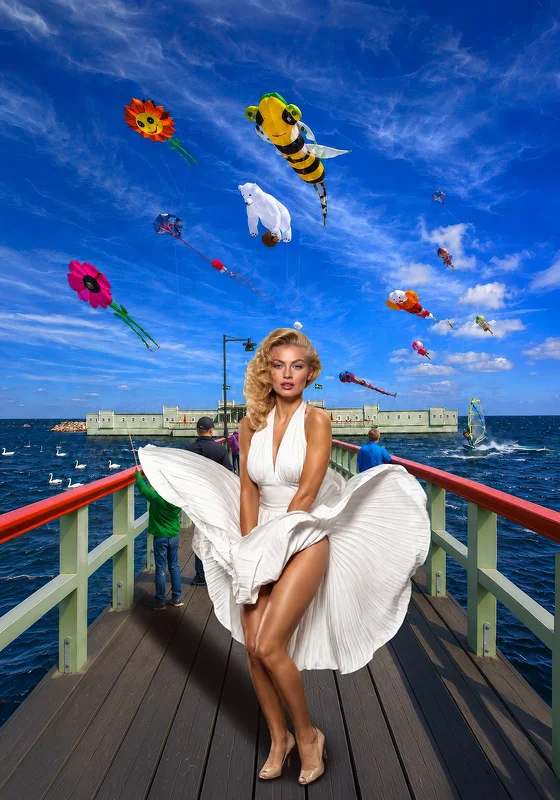
Queen of the Winds - Vindarnas drottning, 2026
Digital
50 x 70 cm
3 200 kr
Queen of the Winds - Vindarnas drottning
Svensk text på slutet
Introduction
What, really, is a kite?
For most people, the answer seems obvious. A few light wooden sticks, a piece of brightly coloured fabric, a length of string, and a steady breeze. A simple toy that sends children laughing across a sandy beach or a grassy field, their eyes fixed on something soaring high above.
But a kite can be so much more.
It can be the memory of a father teaching his daughter to dream bigger and higher than she ever imagined possible. It can be a story of love, patience, and the joy of creation. It can also become a symbol of everything we struggle to hold on toeven though life, sooner or later, asks us to let go.
In Queen of the Winds, Anita Ekberg takes us on a journey that begins with a stubborn tiger kite built in a kitchen in Malmö and ends among the world's great kite festivals, the battlefields of ancient China, scientific discoveries, and the dream factories of Hollywood. With her unique blend of warmth, humour, and reflection, she weaves together deeply personal memories and a fascinating cultural history spanning more than two thousand years.
This is a story about kites.
But even more than that, it is a story about being humanabout our irresistible longing to rise above the earth, the courage to trust the wind as it carries us, and the wisdom to recognise that everything we love must one day be set free.
So take a firm hold of the string. The wind has already begun to blow.
"The Queen of the Winds
I built a kite with childish hands,
while Father's dreams became its frame.
My colours gave the tiger life;
his careful craft gave it a name.
My mother smiled from flour and thread,
her quiet love our constant sky.
She watched two dreamers build with hope,
and never asked the wind just why.
We tied our wishes to a string,
with every knot a silent prayer;
that life would lift us from the earth,
yet leave our hearts forever there.
The tiger climbed through autumn light,
until the clouds became its sea.
Then came the snapone single breath
and it was finally flying free.
I cried because I'd lost my kite.
My father smiled: "You've lost no part.
The things we truly build with love
can never leave the human heart."
The years have taught me what he knew:
No hand can hold what time sets free.
We love, we build, we let things go
and that is how they're meant to be.
So if one day your own string breaks,
don't chase the sky in fear or pain.
The wind remembers every dream,
and love will always fly again.
Malmö, July 2026
Kites I Had to Let Go
Not long ago, I met my father, Gustav, at the star where he and Mother now live. We always have so much to talk about. Mother was there too, of course. My parents have always loved each other. Just as they did on Earth, they still cannot keep their hands off one another. I don't remember why, but all of a sudden I found myself thinking about the day he and I flew a kite together in Beijers Park.
"Dad," I asked, "do you remember when we built the kite? It is one of my dearest memories. That kite taught me so much. I think I was twelve, and I had been pestering you for ages to build a kite with me. Nothing extraordinary. Just an ordinary little diamond-shaped kite, about half my height, with a long tail. The kind I had seen other girls flying."
My pestering awakened something in youmemories of your childhood, when you had been a master kite flyer, the Red Baron's successor, a fearless dreamer. Or rather, it was the engineer in you that came to life. I could see it in your eyes.
"In Sweden, it's mostly children who fly kites, but far from here, in countries like India, both children and adults compete at kite-flying," you said absent-mindedly, and I could tell you were thinking of a very different kind of kite. We hadn't reached India in school yet, and I imagined the children there were yellow-skinned with slanting eyes.
"Have you been there?" I asked in amazement, because Father had never told me that.
"No, my little girl, it's way too far from Malmö. I read about it in Mum's Allers Family Journal." You disappeared for a moment and came back with the magazine. Sure enough, there was a feature on India, and one of the photographs showed a kite festival with the sky filled with kites. Not many of them looked like the kite I had imagined. And the children were neither yellow nor slant-eyed.
When your creative spirit and your engineer's soul joined forces, I could forget all about my little, simple kite. Such a thing was no longer on the map. At least not on your map.
This was no longer just a kite. This was "a project" that required preparation, careful planning, and, above all, a blueprint. I sighed as you brought out graph paper, a couple of index cards, a ruler, a pencil, and an eraser.
"Oh no... not graph paper!" I groaned. Then you began to sketch. At the same time, I was glad you took mea girlso seriously. When it came to technology and things like that, it was mostly my brothers who counted, while I was expected to stay with Mother, bake buns and sew clothes.
Dad, you never did anything haphazardly. Never. First came a plan, then methodical work, and whenever possible, everything had to be written down on index cardsor, better still, drawn and engineered! Dreams had to be put on paper.
I stood beside you, watching as you sketched something that bore no resemblance to the kite in my imagination. It looked like an elongated box, almost as tall as I was, open in the middle, with twelve-inch-wide fabric panels at the top and bottom. In Father's engineering world, there was no room for a floppy tail. Certainly not! Not when you could "build the stability into the structure," as you put it whenever I questioned your ideas. That was why you also drew a pair of triangular wings on the sides.
There has always been a creative rebel inside you, dear Dad. It came to life whenever there were kites.
I still remember the expression on your face as you drew. You had disappeared into an enchanted world of flight, wonder and imagination. A world where anything was possible, where form followed function, and where the sky was the literal limit. When you finished, you looked up with a triumphant smile.
"This is a box kite. A modified one. You saw one like it in Allers."
As a daughterwhen you can no longer keep up, and the picture in your mind has fallen apartthe best thing you can do is sit quietly, listen, watch, and trust your old man. And index cards really are wonderful. Indispensable. They work just as well for jotting down lines for a film as for making shopping lists. Sometimes I mixed the two and found myself saying, "Buy two pounds of carrots," right in the middle of a film scene. My goodness, how the director laughed. So did the entire film crew.
Although I was only twelve, I knew this was not a project that would be finished in an hour. Not a chance. Dad never accepted shortcuts or sloppy workmanship. Together, we went to the hardware store and bought sturdy wooden dowels, wood glue, small tacks, and sailmaker's twine, then began to build. You quietly helped yourself to a piece of heavy yellow fabric from Mother's box of leftover cloth. She pretended to be annoyed when she discovered that one of her fabric scraps had suddenly grown wings, but I caught the smile at the corner of her mouth. Mother knew that once you had an idea, there was no stopping you. She baked cinnamon buns for us while we worked, and from time to time she poked her head through the doorway to see how far her two engineers had come. Then she smiled and returned to her baking and her sewing machine.
You measured and sawed while I managed to get glue everywhere. Slowly but surely, the kite began to take shapeor rather, the box, since that was what it looked like. We stretched the fabric as tightly as we could over the frame, glued it in place, and fastened it with small tacks. Then you sprayed it with water.
"So, the fabric will shrink and become perfectly taut once it dries," you explained, noticing the puzzled look on my face.
You were truly a wise man. You taught me how important it is to be patient, to work carefully, to do my very best, and to take pride in what I create. That lesson has helped me throughout my career.
At last, you allowed me to unleash my imagination. With two paintbrushes and black-and-white paint, I brought the yellow box to life. It became a tiger, its great mouth wide open at the front, lined with rows of sharp white teeth. I glued on a strip of red fabric, which became the perfect tongue. I was almost frightened by my own creation. The tiger looked wonderfully fierce.
We put a great deal of ourselves into that striped tiger kite. I gave it the tiger. You gave it the engineering. The unspoken bond between a father and his daughter was woven into its very fabric. My longing to be close to you, my eagerness to make you proud, my wish to earn your praise and your blessingwe carefully wove all of it into that kite.
For your part, you built your own dreams and hopes for my futureyour wish that together we would rise and soar high above the ground. As children, we do not think in such philosophical terms; our horizons are much shorter. Yet all the expectations and longing between a father and his daughter were there, even if they were rarely spoken aloud. You were a traditional family man who, at first, opposed my dreams of becoming a model and an actress. You would have preferred a more conventional life for your daughter than the uncertain world of show business. But at that moment I wasn't thinking about any of that. I was wondering whether the tiger would actually flyeven though all those hopes, and so much more, had already been built into that kite.
As cold as the winter had been, the summer that year was just as hot. For weeks there was hardly a breath of wind, and the only thing to do in Beijers Park was splash around in the paddling pool. All we could do was wait and hope that late summer would bring better kite-flying weather. At the beginning of August, the weather finally changed. High pressure gave way to low pressure. After a rainstorm had passed eastward, a gap opened in the cloudsbut the wind remained.
Three weeks later, we stood at the highest point in Beijers Park, only a block from our house. I remember thinking it would be a miracle if the kite even left the ground. But it didand magnificently. Every one of your calculations had been right, Dad. Right down to the last detail. We had named her Ruth after an aunt who was rather like a tiger herself. Quite fierce, in fact. She never married and had no children of her own to put her in her place.
Together we launched the tiger in all her glory. A brisk autumn wind caught her, and I could feel how powerfully Ruth pulled on the line as she climbed towards the sky. Our tailless beauty flew magnificently. The string slipped through my hands as Ruth climbed higher and higher, growing smaller yet somehow even more beautiful with every yard she rose towards the scattered clouds. Whenever the line gave a sudden tug, I felt as though I might be lifted off the ground, and you stretched out your arms, ready to catch me if I started flying away.
And then, suddenly...
Snap!!!!
The line broke, and like a writhing snake, it fluttered to the ground.
This couldn't be happening! We had made drawings and filled in index cards. We had built stability into the structure, and I had painted a tiger on it.
And yet...
There was Ruth, soaring free of her string, carried towards the skyor at least towards Denmark.
Despite all your wisdom and meticulous work, unexpected things still happen. Fate has a place in life that no blueprint or index card can ever control.
I was beside myself with despair and wanted to run after the kite as it drifted towards the horizon.
"Say goodbye to your kite, Anita," you said with a smile. In your eyes, we had already succeededwhat mattered most.
I have thought many times about Ruth the tiger and about everything that kite came to symbolise: dreams, plans, hope, fear, joy, and a father's loveeven as, in that very moment, she drifted into the distance.
Just as my twelve-year-old self had once been forced to say farewell to that kite, twenty-six years later I had to say goodbye to its master builderyou, Dad. Of course, I had no way of knowing we would meet again.
That time, too, there was no possibility of running after what I had lost. The time had come to let go, just as it had with Mother only a few months earlier. You were ready to leave this world and rise towards the heavens to follow your beloved Alva.
That day comes for all of us when we can no longer choose but to let go. Whether it happens as we hoped or in a way we could never have imagined, everything will one day pass away. In time, life's victories and defeats, its joys and disappointments, all begin to fade. Even the carefully glued joints and the fragile fabric of our lives will eventually come apart.
The most important thing was never that we built the kite, not even that it flew, nor that it finally broke free. The most important thing was that we built it together. It is the simple act of sharing our love with another human being that truly matters.
I love you, Dad.
And Mum.
Chapter 1 A Festival at the Seaside Bathhouse
When I think of Dad and Ruth the tiger, I understand why kites touch me so deeply. Perhaps that is why I have come to the Ribersborg Seaside Bathhouse and its kite festival, letting my eyes follow hundreds of kites as they climb into the sky.
There are days when nature itself seems determined to stage a festival, and this is one of them. The Öresund is anything but calm today. It has a life of its own. A fresh south-westerly wind sweeps unhindered across the sea, raising whitecaps and filling the air with the scent of salt water and seaweed. Farther out, the swans ride the rolling swells with the effortless dignity only they seem to possess, while windsurfers seize every gust and race across the water so swiftly that, at times, they appear to be flying above the surface.
I am standing at the very end of the long pier leading to Ribersborg Seaside Bathhouse, watching people of every age make their way here. It is remarkable how completely the wind can transform a landscape. On a calm summer's day, people stroll along the beach, dip their feet in the water and look for shade. But when the wind blows like this, the sky becomes the main attraction. Children run, laughing, with their kites; teenagers struggle to master their lightning-fast stunt kites; and older enthusiasts stand with their eyes fixed on the clouds and their hands firmly gripping the lines, as though they were playing an invisible instrument whose melody is written by the wind itself.
I had chosen to wear a white summer dressa decision that seemed perfectly sensible when I left home, but one the wind quickly began to question. Now and then, it fills my skirt like the sail of a yacht, lifting it considerably higher than good manners would recommend. I have to hold it down with both hands, and I cannot help smiling. Suddenly my thoughts turn to Marilyn Monroe and that unforgettable scene from The Seven Year Itch filmed in 1954, when a blast of air from the New York subway rushed through a street grating on Lexington Avenue, lifting her white dress and creating one of the most iconic images in cinema history. Marilyn had the subway to help her. I have to make do with the Öresund, although I suspect the wind out here is every bit as powerfuland considerably fresher.
I have stood before cameras in Hollywood and Rome, walked the red carpets in Cannes, and spent most of my adult life in the Italian sun. Yet there is something about the wind back home in Malmö that nothing else has ever replaced. It feels exactly as it did when I was a little girl, running along Ribban. The wind does not care who you have become or how many films you have made. It simply recognises an old friend.
As I lean against the railing and watch the hundreds of colourful kites dancing above the Seaside Bathhouse, I am struck by how extraordinary we human beings are. Throughout history, we have been fascinated by the sky. We have envied the birds, built balloons, gliders and aeroplanes, yet long before any of those became reality, we had already discovered a way to send our dreams among the clouds. They rose not by means of engines or wings, but by something as invisible as the wind itself. As I watch the delight shining on the children's faces, it is hard to imagine that these colourful kites were not created for joy. Their story does not begin on a sandy beach or beside a seaside bathhouse, but on an ancient battlefield in China.
A large, brilliantly coloured kite climbs steadily higher until it almost disappears into the blue summer sky. Yet it will never rise beyond the length of its string. On the pier below, a fourteen-year-old boy holds it firmly in his hands.
It is rather remarkable, when you think about it. A few bamboo sticks, a piece of fabric, a length of string and a steady breezethat is all it takes to make people of every age stand with their faces turned to the sky, smiling like children.
But it was not always so. The kite's history did not begin with play. It began with war.
Chapter 2 When Humanity Tamed the Wind
I do not think the fourteen-year-old boy standing a few yards behind me has the faintest idea that he is holding a piece of world history at the end of his string. To him, it is simply a kitea few bamboo sticks, a piece of brightly coloured fabric, and a line connecting him to something floating high above the blue sky. If the wind over the Öresund were to die suddenly, the kite would fall to the ground within seconds. But as long as the sea breeze keeps blowing, it lives a life of its own among the clouds.
And so it has been for more than two thousand years.
Long before humankind learned to harness steam, electricity or the internal combustion engine, we learned to harness the wind. The first kites were born in China several centuries before the birth of Christ, where skilled artisans discovered that bamboo could be bent into light yet remarkably strong frames and that silk was thin enough to catch the wind without being weighed down. The result was something the world had never seen beforea creation capable of leaving the earth and rising into the sky on nothing more than the invisible power of the air.
But the first Chinese kites were nothing like the simple diamond-shaped kites we picture today. They were flying works of art. Artisans gave free rein to their imaginations, creating figures drawn from nature and mythology. Many took the form of the Chinese dragon of good fortunea long, winding creature with horns, whiskers and shimmering scales, its body undulating through the air for dozens of metres as though truly alive. Others were shaped like snakes, tigers, leopards, dogs, eagles, cranes, swallows, fish, butterflies, grasshoppers, deer or antelopes. There were also kites depicting phoenixes and other mythical creatures that had never existed anywhere except in the human imagination.
The colours were as important as the shapes. Fiery red symbolised happiness and success, gold represented imperial power and wealth, green stood for life and vitality, while blue reflected the heavens and the water. Many kites were painted with enormous staring eyes, flaming tongues and glittering scales, as people believed they could drive away evil spirits and attract good fortune.
I can only imagine what a sight it must have been as a dragon twenty metres long, its scales glistening in the sunlight and its body winding gracefully through the air, slowly climbed towards the heavens. Humanity has always dreamed of flying, but the first to succeed were neither wooden birds nor machines of metal. They were bent bamboo rods, silk, and a human being who had discovered how the wind itself behaved.
No one can now say exactly where history ends, and legend begins. Still, these stories reveal how early humanity began dreaming not only of sending a kite into the sky but also of following it there.
More than two thousand years would pass before the Wright brothers realised that dream.
I was born almost thirty years after the Wright brothers' first flight. When, as a young girl in Malmö, I saw an aeroplane pass overhead, people still stopped in the street and looked up at the sky. A few years later, I found myself aboard an aircraft bound for America. I did not speak a word of English, but I knew my life was about to change. Today, flying between continents seems almost routine, yet I sometimes reflect that the entire journey began with humanity's ancient longing to defy gravity. From a Chinese kite made of bamboo and silk to a passenger aircraft crossing the Atlantic, one unbroken thread of curiosity, determination and dreams runs.
I watch another kite drifting above Ribersborg. It makes a gentle turn in the wind, almost as if it has chosen its own course. To the child holding the string, it is simply a game. To me, it is a reminder of humanity's first success in outwitting gravity.
But the invention would soon serve a very different purpose.
Chapter 3 Soldiers of the Sky
It did not take long for Chinese generals to recognise the possibilities offered by this remarkable invention. An army that could see farther than its enemy already possessed an advantage before the first sword had even been drawn.
Kites soon took on an increasing number of military duties. They carried signal flags visible from great distances, helped commanders determine the wind direction before launching fire arrows, and conveyed messages between troops separated by mountains, rivers or enemy lines. In an age without binoculars, radios or aircraft, the wind became an unexpected ally.
One of the most famous stories concerns the Chinese general Han Xin. According to ancient chronicles, during a siege he flew a kite over the enemy's city wall to measure the exact distance to the fortress. By calculating the length of the string, his engineers could determine where to begin digging a tunnel that would emerge inside the walls. Whether the story is entirely true, no one can say. Yet it reveals that the kite was used as a practical surveying instrument rather than merely as a pair of eyes in the sky.
There are even stranger accounts. Several Chinese chronicles describe enormous kites built to lift a human into the air. Because every pound mattered, tradition holds that small, lightweight people were often chosen. In some stories, they were willing scouts; in others, they were condemned prisoners or criminals forced aloft to report what they could see beyond the enemy's wallsor simply to test whether the construction would hold. No historian today can determine how much of these stories is literal truth and how much has grown into legend. Still, they appear in several independent Chinese sources and reveal how boldly people were already experimenting with the idea of letting humans follow their kites into the sky.
I cannot help wondering what such a sight must have been like. Long before balloons and flying machines existed, perhaps a solitary human being floated high above a battlefield, carried only by bamboo, silk and a strong wind.
It can hardly have been an easy experience.
Yet this was only the beginning. Kites could also be used to inspire fear. Small bamboo flutes and whistles were attached to their frames, and when the wind caught them, they produced a strange, mournful sound that drifted through the night. To soldiers who had no idea what hovered above them, it must have seemed as though spirits or gods were gliding across the battlefield.
I have appeared in films where war formed the backdrop to the story. During the filming of War and Peace, I found myself surrounded by hundreds of extras, soldiers, horses and officers, all recreated on a scale so magnificent it almost took my breath away. On the cinema screen, battles often appear grand and glorious. The uniforms are immaculate, the banners wave proudly, and the music leaves audiences spellbound. But real wars have rarely been glorious. More often, they have been about gaining the smallest possible advantageseeing a little farther than your opponent or making him just a little more afraid. Reading about Chinese kites, I realise they, too, became weapons. The very same wind that today makes children laugh once made soldiers tremble.
As I watch the children at Ribersborg running across the beach with their kites, laughing with delight, it seems almost unreal that this same invention was once used in such a way. Perhaps that is precisely why its history fascinates me. The wind is the same as it was two thousand years ago. Bamboo and silk obey the same laws of nature today as they did then. The only thing that has truly changed is the purpose to which human beings have put them.
Chapter 4 From War to Knowledge
I have often thought that humanity's greatest inventions almost always arise in the wrong place.
Strangely enough, war has given birth to countless ideas that later benefited all humanity. The kite is one of the oldest examples. What was once designed to give an army the upper hand gradually found a far more peaceful purposethe pursuit of knowledge.
Once Chinese artisans had learned to harness the wind, people soon began experimenting. How high could a kite fly? How did the wind change at different altitudes? How did mountains, valleys and the sea affect it? The more they flew their kites, the more they learned about the invisible force that carried them.
This knowledge travelled west along the Silk Road. Merchants, sailors and travellers carried far more than silk, spices and porcelain between continents. They also carried ideas. In time, kites appeared in India, Persia and throughout the Arab world, and much later in Europe, where they first inspired wonder and curiosity before becoming part of humankind's growing body of knowledge.
I like that thought. An invention born in one corner of the world could travel thousands of miles without the help of engines, railways or aeroplanes. All it took was for someone to see it, become curious, and decide to build one of their own.
Several centuries later, scientists began using kites in ways the ancient Chinese generals could never have imagined. Instruments were sent aloft to measure temperature, air pressure and wind conditions. The kite became a flying laboratory, helping humanity understand, step by step, the atmosphere above our heads.
Then came Benjamin Franklin.
In 1752, according to the famous story, he flew a kite into a thunderstorm with a metal key attached to the string. The experiment demonstrated the link between lightning and electricity and became one of the most celebrated in the history of science. I must confess that I would never have been braveor perhaps foolishenough to stand outside in a thunderstorm, holding a kite string. Sometimes the line between genius and madness is surprisingly hard to recognise.
During my years at Cinecittà and in Hollywood, I often realised how deeply filmmaking depends on scientific advances. Cameras became lighter, lenses sharper, colour film richer, and lighting techniques ever more sophisticated. Audiences saw only the finished illusion projected onto the silver screen, but behind every scene lay decadessometimes centuriesof human curiosity and ingenuity. Benjamin Franklin's kite and a motion-picture camera may seem to have little in common at first glance. Yet both are products of the same human impulse: the desire to ask questions, to explore the unknown, and to understand the world a little better than we did the day before.
As I stand here on the pier, watching the kites dance above the Öresund, it strikes me that they are still doing exactly what they have always done. They help us understand the wind. The only difference is that we no longer need to conquer the world or to prove scientific theories.
It is enough to look up.
Chapter 5 Where the Sky Becomes a Celebration
It is remarkable how far an invention can travel beyond its creators wildest dreams. The first kites were born in China, but they did not remain there. Carried by merchants, sailors and travellers, they followed the Silk Roads westward and gradually spread across much of the world. Everywhere they went, they took on new shapes, colours and meanings, yet they never lost their greatest giftthe ability to make people stop, look up and marvel at the sky.
Nowhere was this more evident than in Asia.
In China, kite flying evolved into a genuine folk art, with every kite becoming a small masterpiece. In Japan, enormous kites required dozens of people to lift them from the ground, and in several cities, competitions are still held to determine who can create the largest and most spectacular design. It is about far more than craftsmanship. It is about pride, tradition and community.
Farther west, in India and Pakistan, kite flying became something approaching a national sport. People do not simply compete to see whose kite flies highestthey compete against one another. The strings are coated with a thin layer of glue mixed with crushed glass, making them razor-sharp. The aim is to cut an opponent's line. The moment a kite breaks free and drifts with the wind, cheers erupt, and children race through the narrow streets, hoping to catch it before it reaches the ground. During the great kite festivals, thousands upon thousands of kites fill the sky at once, and people say the sun itself almost disappears behind the sea of colour.
I must confess I prefer the more peaceful version. I have never felt much need to defeat anyone. It is quite enough to watch a kite climb into the sky and know the wind will do the rest.
I have often thought it rather curious that kites have rarely been allowed to play the leading role in films. Umbrellas, on the other hand, seem to appear everywhere. Peter Pan sails through the air beneath his umbrella. Mary Poppins floats over the rooftops of London with hers. In *The Umbrellas of Cherbourg*, the umbrella becomes almost a character in its own right. Yet kites, which for more than two thousand years have inspired people to lift their eyes towards the heavens, are still waiting for their great motion picture. I used to joke about this with Federico Fellini. I told him we ought to film it at my home in Genzano, with the garden, the olive trees and the Mediterranean as our backdrop. He would smile that wonderfully boyish smile of his and immediately begin imagining hundreds of kites filling the sky in every conceivable colour and shape. Sadly, he left us before the film could ever become a reality. Perhaps it does not matter. The world moves on, but someone still needs to make a film about kites. Standing here on the pier, watching a kite catch the wind, I cannot help but feel that Fellini's camera is still rolling somewhere up there among the clouds.
I have been fortunate enough to travel more than most people. Films took me to places the young girl from Malmö had never even dreamed of. I have met people who spoke different languages, practised different religions and lived by entirely different traditions. Yet everywhere I found the same curiosity and delight in life's small moments. A colourful kite riding the wind needs no interpreter. It brings smiles to faces, whether it is flying above a beach in Sweden, a rice field in China or a rooftop in Lahore.
Perhaps that is also why kites have survived for more than two thousand years. They require no electricity, fuel or complex technology. Only a little imagination, a few lightweight materials and a wind willing to cooperate. Nature takes care of everything else.
As I stand here on the pier at Ribersborg, I realise that we are not so different from the people on the other side of the world. The children running across the grass here in Malmö laugh in the same way as children in Lahore, Tokyo or Beijing. They speak different languages and live in different cultures, yet when a kite catches a strong gust of wind and begins to soar, their faces light up in the same way.
Few inventions have managed to unite people for so long. Perhaps that is why the kite has never gone out of fashion. It belongs to no nation or religion. It requires no common language. All it asks is for the wind to blow.
I also find myself thinking about Gianni Agnelli. Beneath the polished industrialist, there was always a boy who never quite stopped playing. One summer's day on the Mediterranean, we launched two kites from the stern deck as the yacht cut through the deep blue water between Capri and Ischia. The wind was so steady that the kites danced far behind us, high above the white wake, as if trying to catch the horizon. We stood there, smiling at each other. For a brief moment, it no longer mattered who owned the yacht or what lives we led on shore. We were simply two human beings letting the wind do what it does best.
And perhaps that is precisely why I love kites so much. They make us look up from the ground and remind us that, despite all its borders, the world is sometimes far smaller than we imagine.
Chapter 6 The Wind Never Changes
The remarkable thing is that the world has changed almost beyond recognition since the first Chinese artisans bent their bamboo rods. Empires have risen and fallen. Religions have emerged. Continents have been discovered. The steam engine, the motor car, the aeroplane, radio, television, the computer and the mobile phone have followed in rapid succession.
But the wind remains the same.
It blows across Ribersborg with precisely the same invisible force that once swept across the rice fields of China, the mountains of Japan and the plains of India. It cares nothing for dates, borders or languages. It simply does what it has always doneblows across the earth, waiting for someone willing to catch it.
Perhaps that is why the kite continues to fascinate us. It is one of the very few inventions that has never really needed improvement. The materials have become lighter, the strings stronger and the colours brighter, yet the idea itself remains the same as it was two thousand years ago: a light frame, a piece of fabric and the wind.
Nothing more is required.
I watch the boy on the beach give the string a gentle tug. The kite responds at once, climbing a few more metres before settling effortlessly into the air. No engine startsno propeller spinsonly an almost invisible conversation between a human and the wind.
Perhaps that is precisely why kite flying feels so deeply calming. You cannot force the wind to obey. You have to work with it. Pull too hard, and the kite loses altitude. Let out too much line, and you lose control. Everything depends on balance, patience and instinct.
I believe we human beings could learn a great deal from kites. It took me many years to realise this. When I was young, I tried to control everything myself. I wanted to decide my own future, my career and my life. Sometimes things turned out exactly as I had hoped; sometimes they turned out entirely differently. The older I grew, the more I realised that life is very much like a kite. Of course, you must hold on to the string, but you can never tell the wind where to blow. It goes where it chooses, and those who learn to work with it often travel farther than those who stubbornly try to conquer it.
Life rarely improves by fighting every gust of wind. Sometimes it is enough to adjust the angle slightly, let out a few more yards of string, and allow the forces of nature to do the rest.
I lean against the railing and watch yet another colourful kite slowly disappear into the sky above the Öresund. For a moment, it almost seems to belong up there.
And perhaps it does.
Kites have never truly belonged to the earth. They have always belonged somewhere between humankind and the sky.
Chapter 7 The Invisible Thread
I am still standing on the pier. The sun has sunk lower towards the horizon, and the wind has softened since earlier in the day, but it has not died away. I can still hear the familiar rustling as the breeze fills the kites sails, and I watch a handful of brightly coloured creations drifting slowly above the Öresund, almost as though they were sailing on an invisible sea suspended above our heads.
The children are beginning to leave the beach. Some carefully wind up their strings and carry their kites under their arms, while others stubbornly wait for one last gust before it is time to go home. I recognise that determination. Once you have felt something fly, you always long to feel it just one more time.
"I understand them."
There is something extraordinary about a kite. You never truly own it. You merely borrow the wind for a little while. As long as the wind is willing to cooperate, the kite dances high above you, but the very moment the air grows still, it obediently returns to earth. Perhaps that is precisely why kites have never ceased to fascinate us. They remind us that we cannot master naturewe can only learn to work with it.
I think of the young boy who stood behind me when all of this began. To him, it was probably nothing more than a happy summer's day at Ribersborg. In a few years, he may well have forgotten what his kite looked like or how high it flew. Still, I hope he remembers that first magical moment when the string suddenly tightened in his hand. He realised that something high above was responding to every small movement he made.
Human beings have carried that feeling within them for more than two thousand years. It links the child in today's Malmö with the Chinese artisans who first bent their bamboo rods, the soldiers who used kites to measure distances and send signals, the scientists who employed them to uncover nature's secrets, and countless people who, through the centuries, have stood still and watched a colourful creation rise towards the heavens.
It is a truly extraordinary thought. Over the course of history, we have invented the steam engine, the motor car, the aeroplane, the rocket and the spacecraft. We have learned to travel faster than sound and have sent human beings to the Moon. Yet there remains something profoundly satisfying about watching a piece of fabric, a few bamboo sticks and a slender string rise into the sky on nothing more than the power of the wind.
Perhaps that is because the kite has never really been about technology. It has always been about humanity. About curiosity, imagination, and that indomitable longing to lift our eyes and discover what lies beyond the next cloud.
As I watch it floating above me, I find myself thinking that perhaps my own life has not been so very different. I began as an ordinary girl from Östra Fäladsgatan, with a head full of dreams, and somehow found myself in places I could never have imagined. Hollywood, Rome and people from every corner of the world became part of my life, yet the invisible thread always led me back here. Perhaps we all carry such a thread throughout our lives. We may fly farther than we ever believed possible, but somewhere there is always the hand that first let out that very first length of string.
I lean against the railing and watch the last kite still floating above the Öresund. At this distance, it is no longer possible to tell whether it is shaped like a bird, a dragon or some other mythical creature. It has become nothing more than a small dark silhouette against the bright summer sky, almost like a greeting from everyone who, through the ages, has held a string in their hand and let the wind do the rest.
And perhaps that is precisely why kites never grow old.
They remind us that humanity's greatest dreams often begin with something simplean idea, a little imagination, and the courage to let go, without ever losing sight of the invisible thread that allows us to guide the kite from the earth below.
Epilogue When the Wind Carries On
The beach is almost empty now. The voices have faded into the distance. Families have packed away their picnic baskets, children carry their kites under their arms, and the last footsteps fade along the promenade. Only the sea remains.
The evening breeze still drifts across the Öresund. It is gentler now than an hour ago, yet it carries the same quiet certainty it has always held. It will continue to blow long after I am gone, just as it did long before I was born.
I watch the last kite descend. The child holding the string winds it slowly back onto the spool until the colourful sail rests once again in waiting hands. It is such an ordinary little moment that most people hardly notice it. Yet perhaps it is the most beautiful moment of all. Every flight must eventually come to an endnot because the kite has failed, but because it has already fulfilled its purpose.
Standing here, I find myself thinking once more of Dad, of the tiger kite named Rut, of the broken string, and of the lesson I was far too young to understand when he smiled and told me to let it go.
I understand it now.
Life has never been about holding on forever. It has always been about knowing when to hold the line firmly, when to let it run freely, and when to trust the wind enough to let go of what we love.
The invisible thread has never belonged only to a kite. It runs through every human life. It binds children to their parents, teachers to their pupils, friends to one another, and one generation to the next. We spend years believing we are steering our own course, only to discover that countless unseen hands have guided us long before we ever held the string. One day we become those hands.
Perhaps the greatest gift we can leave behind is not fame or monuments, but the courage to inspire another person to look up, to dream a little higher, and to believe that invisible forces can sometimes carry us farther than strength alone ever could.
One day, another child will stand on this very pier at Ribersborg. Perhaps there will be another kite festival. Perhaps it will simply be an ordinary afternoon with a little more wind than usual. That child will never know my name, just as I never knew the names of the Chinese artisans who first bent bamboo into the shape of a dream more than two thousand years ago. Yet we shall still be connected by the same wind, the same sky, and the same invisible thread.
The wind has never belonged to any of us. We have only been fortunate enough to borrow it for a short time.
Vindarnas drottning
Introduktion
Vad är egentligen en drake?
För de flesta är svaret självklart. Några lätta trästavar, ett stycke färgglatt tyg, en lina och en lagom stark vind. En leksak som får barn att springa skrattande över en sandstrand eller gräsäng, medan blicken följer något som svävar högt ovanför.
Men en drake kan vara mycket mer än så.
Den kan vara ett minne av en far som lär sin dotter att drömma större och högre än hon själv hade vågat. Den kan vara en berättelse om kärlek, tålamod och skaparglädje. Den kan också vara en symbol för allt det vi människor försöker hålla fast vid samtidigt som livet, förr eller senare, tvingar oss att släppa taget.
I Vindarnas drottning tar Anita Ekberg med oss på en resa som börjar med en egensinnig tigerdrake byggd i ett kök i Malmö och slutar bland världens drakfestivaler, kinesiska slagfält, vetenskapliga upptäckter och Hollywoods drömfabriker. Med sin egen blandning av värme, humor och eftertanke väver hon samman personliga minnen med en fascinerande kulturhistoria som sträcker sig över mer än två tusen år.
Det här är en berättelse om drakar.
Men ännu mer är det en bok om människan om vår okuvliga längtan att lyfta från marken, om modet att följa vinden när den bär och om visheten att förstå att allt vi älskar en dag måste släppas fritt.
Så ta ett stadigt grepp om linan, för vinden har redan börjat blåsa.
Vindarnas drottning
För att fånga vinden gjorde vi en drake
Jag med ett barns händer.
Pappa byggde dess kropp.
Jag gav den tigerns ansikte,
Han gav den vingar.
Mamma log bland mjöl, deg och tyg.
Hon såg på sina två ingenjörer
Och lät oss hållas.
Hon visste att vissa drömmar
Måste få byggas färdigt.
Vi knöt våra förhoppningar till en tunn lina.
Knuten bar på en tyst önskan.
Att livet skulle lyfta oss högt,
Men aldrig föra oss bort från varandra.
Sedan steg tigern mot himlen.
Den blev mindre och mindre,
Vackrare för varje meter,
Tills ett enda ögonblick
Förändrade allt och linan brast.
Jag grät för att jag hade förlorat min drake.
"Du har inte förlorat den", sa han och log.
"Det vi bygger med kärlek
Kan aldrig gå förlorat."
Först, långt senare,
Förstod jag vad han menade.
Ingen kan hålla fast vid livet.
Vi bygger.
Vi älskar.
Men förr eller senare
Måste vi släppa taget.
Så om också din lina en dag brister,
Jaga inte det som vinden för bort.
Lyft i stället blicken.
För vinden glömmer aldrig våra drömmar,
Och kärleken hittar alltid tillbaka.
Malmö, Juli 2026
Drakar jag måst släppa
Jag träffade pappa Gustav på hans och mammas stjärna för ett tag sedan. Vi har alltid mycket att prata om. Mamma var naturligtvis med. Mina föräldrar har alltid älskat varandra. Precis som på jorden kan de aldrig hålla händerna från varandra. Jag minns inte varför, men plötsligt kom jag att tänka på när han och jag flög med drake i Beijers park.
"Pappa", frågade jag, "kommer du ihåg när vi byggde draken? Det är ett av mina allra käraste minnen. Den där draken lärde mig så mycket. Jag tror att jag var tolv år gammal och hade tjatat på dig länge om att vi skulle bygga en drake. Inget märkvärdigt. En sådan där vanlig liten och enkel diamantformad drake, hög som halva mig, med en lång svans. En sådan som jag hade sett andra flickor ha.
Mitt tjat väckte något inom dig, minnen från när du själv var barn, en drakflygningens mästare, den röde baronens efterföljare, en djärv drömmare. Eller snarare var det ingenjören i dig som vaknade till liv. Jag såg det i ögonen.
I Sverige är det mest barn som flyger drakar, men långt härifrån, i länder som Indien, tävlar både barn och vuxna i drakflygning, berättade du förstrött, och jag såg att du tänkte på en annan drake. Vi hade inte hunnit till Indien i skolan ännu, men jag trodde att barnen där var gula och hade sneda ögon.
Har du varit där? frågade jag förundrat, för det hade pappa aldrig berättat.
Nej, lilla vän, det ligger alldeles för långt bort från Malmö. Jag har läst det i mors Allers Familj-journal. Du försvann en stund och kom tillbaka med tidningen. Mycket riktigt fanns det ett reportage om Indien och en av bilderna visade en drakfestival med himlen full av drakar. Det var inte många som såg ut som draken jag hade i huvudet. Och barnen var varken gula eller hade sneda ögon.
När din skaparlust och ingenjörssjäl slog sig samman, kunde jag glömma allt vad drake heter som var litet och enkelt. En sådan fanns inte på kartan! Din karta.
Det här var inte längre bara en drake. Det här var "ett projekt" som krävde förberedelser, noggrann planering och framför allt en ritning. Jag suckade när du plockade fram ett rutpapper, ett par registerkort, en linjal, en blyertspenna och ett suddgummi. Sedan började du skissa.
"Åh nej inte rutpapper!" sa jag. Men samtidigt var jag lycklig över att du tog mig, en flicka, på så stort allvar. När det gällde teknik och sånt var det mest mina bröder som gällde, och jag fick hålla mig med mamma, baka bullar och sy kläder.
Pappa, du gjorde aldrig någonsin något på måfå. Nej. Först en plan, sedan metodiskt arbete och, när det var möjligt, skulle allt skrivas ner på registerkort eller ännu hellre ritas upp och konstrueras! Drömmar måste fästas på papper.
Jag stod bredvid och tittade när du skissade på något som inte påminde det minsta om en drake, en sådan som jag hade i huvudet. Det såg ut som en utdragen kub, nästan lika lång som jag, öppen i mitten, med 30 centimeter breda tygband upptill och nertill. I pappas ingenjörsvärld fanns det ingen plats för en ranglig svans. Nej då! Inte när man kunde "bygga in stabiliteten i konstruktionen", som du uttryckte det när jag hade synpunkter. Därför ritade du också dit ett par triangelformade vingar på sidorna.
Det har alltid funnits en kreativ rebell i dig, kära pappa. Den vaknade till liv när det handlade om drakar.
Jag minns uttrycket i ditt ansikte, pappa, när du ritade. Du hade försvunnit in i en förtrollad värld av flykt, förundran och fantasi. En värld där allt var möjligt, där formen följde funktionen och där himlen bokstavligen var gränsen. När du var klar, tittade du upp med en triumferande blick.
"Det här är en låddrake. En modifierad låddrake. Du såg sådana på bilden i Allers."
Som dotter när man inte riktigt hänger med och bilden inom mig har krackelerat är det bäst att bara sitta still, lyssna, titta och lita på den gamle. Och registerkort är faktiskt jättebra. Oumbärliga. De fungerar lika bra för att rita ner repliker till en film man ska göra som för att skriva att-göra-listor. Ibland kunde det bli på samma kort, och jag sa köpa ett kilo morötter mitt i en filmdialog. Gud, vad regissören skrattade. Och hela filmteamet.
Fast jag var bara tolv år, förstod jag att det här inte var ett projekt som skulle bli klart på en timme. Inte en chans. Pappa, du accepterade aldrig halvdana lösningar eller slarv. Vi gick tillsammans till järnaffären och köpte rejäla trästavar, trälim, nubb och segelgarn och började bygga. Ett kraftigt gult tyg snodde du ur mammas låda med restbitar. Hon låtsades bli förargad när hon upptäckte att en av hennes tygbitar hade fått vingar, men jag såg leendet i hennes mungipa. Mamma visste att när du fick en idé gick det inte att stoppa dig. Hon bakade bullar åt oss medan vi byggde, och då och då stack hon in huvudet genom dörren för att se hur långt hennes två ingenjörer hade kommit. Sedan log hon bara och gick tillbaka till bullbaket och symaskinen.
Du mätte och sågade; själv fick jag lim överallt. Sakta men säkert tog draken form. Eller lådan, för det var en sådan som den såg ut. Vi spände tyget över stommen så hårt vi kunde, limmade och spikade fast det med nubb. Sedan sprayade du det med vatten. För att tyget ska krympa och bli perfekt spänt när det torkat, förklarade du när jag såg frågande ut.
Du var verkligen klok. Jag lärde mig mycket om hur viktigt det är att ha tålamod, vara noggrann, alltid göra sitt allra bästa och vara stolt över sitt arbete. Den lärdomen har hjälpt mig mycket i min karriär.
Du lät mig till sist släppa loss min egen fantasi. Med två rundpenslar och svart och vit färg gav jag den gula lådan liv. Den blev en tiger med en öppen mun längst fram med rader av vita tänder. En röd tygbit limmade jag dit som blev en perfekt tunga. Jag blev nästan rädd för min egen bild. Så rasande hade tigern blivit.
Vi byggde in mycket av oss själva i den tigerrandiga draken. Jag stod för tigern. Du stod för konstruktionen. Den ordlösa spänningen mellan en far och hans dotter satt i tyget. Min längtan efter att få vara nära dig, min iver att göra dig glad och min önskan att få ditt beröm och din välsignelse. Allt detta byggde vi omsorgsfullt in i draken.
För din del byggde du in dina egna drömmar och förhoppningar om att det skulle gå bra för mig i livet din önskan om att vi tillsammans skulle lyfta och sväva högt. Som barn tänker man inte så filosofiskt och perspektiven är kortare. Men det fanns inbyggda alla förväntningar och längtan som finns mellan en far och en dotter, även om det sällan sades högt. Du var en traditionell familjefar som till en början motsatte dig mina drömmar om att bli modell och skådespelerska. Du såg hellre en mer konventionell livsväg för din dotter än den osäkra nöjesbranschen. Men just i den stunden funderade jag inte på vare sig det ena eller det andra utan mest på om tigern skulle kunna flyga även om allt detta och mycket mer fanns inbyggt i den där draken.
Lika kall som vintern varit, lika het var sommaren det här året. Det var vindstilla i flera veckor, och det enda man kunde göra i Beijers park var att bada i plaskdammen. Det var bara att vänta och se om sensommaren skulle bjuda på bättre drakväder. I början av augusti slog vädret om och högtrycket ersattes av lågtryck. Efter att ett regnväder passerat vidare österut öppnade sig ett hål i molntäcket, men vinden fortsatte.
Tre veckor senare stod vi högst uppe i Beijers park, bara ett kvarter från vårt hus. Jag tänkte att det nästan vore ett under om den ens kom upp i luften. Men den kunde flyga, och det med besked. Alla dina kalkyler stämde, pappa. Till punkt och pricka. Vi hade döpt henne till Rut efter en moster som var som en tiger. Ganska ilsken, faktiskt. Hon var ogift och hade inga egna barn som uppfostrade henne.
Vi skickade upp tigern i all sin prakt. En frisk höstvind tog tag i tigern, och jag kände hur hårt Rut drog i linan medan hon steg mot himlen. Vår svanslösa skönhet flög magnifikt. Linan gled genom mina händer medan Rut steg allt högre, blev mindre men samtidigt ännu vackrare för varje meter hon steg mot de enstaka molnen. När det ryckte i linan kändes det faktiskt som om jag skulle lyfta från marken, och du sträckte ut händerna för att ta tag i mig om jag skulle flyga iväg.
Och så plötsligt...
Smack!!!!
Linan brast, och likt en fladdrande orm föll den mot marken.
Det här kunde inte hända! Vi hade gjort ritningar och fyllt i registerkort. Vi hade byggt in stabilitet i konstruktionen och jag målade dit en tiger.
Och ändå...
Där svävade Rut, befriad från sin lina, på väg mot himlen i alla fall mot Danmark.
Trots all din klokhet och ditt minutiösa arbete händer det ändå oväntade saker. Ödet har en plats i livet som inga ritningar eller registerkort kan kontrollera.
Jag var utom mig av förtvivlan och ville genast springa efter draken som var på väg att försvinna bortom horisonten.
"Säg adjö till din drake, Anita", sa du och log för enligt dig hade vi ändå lyckats, vilket är det viktigaste.
Jag har tänkt många gånger på tigern Rut och på allt som draken symboliserade. Drömmarna, planerna, hoppet, rädslan, glädjen och en pappas kärlek fast den just i den stunden svävade bort i fjärran.
Precis som mitt tolvåriga jag en gång tvingades säga farväl till draken, var jag tjugosex år senare tvungen att ta farväl av dess byggmästare dig, pappa. Jag kunde ju inte veta att vi skulle ses igen.
Även den gången fanns det ingen möjlighet att springa efter. Tiden hade kommit att släppa taget. Precis som med mamma, bara några månader tidigare. Du var redo att lämna den här världen och själv stiga mot himlen för att följa efter din älskade mamma Alva.
Den dagen kommer för oss alla, då vi inte längre har något val utan måste släppa taget. Oavsett om det sker så som vi hoppats eller på ett sätt vi aldrig kunnat förutse, kommer allt en dag att försvinna. Med tiden bleknar livets segrar och nederlag, glädjeämnen och besvikelser. Alla de noggrant limmade fogarna och det sköra tyget i våra liv löses så småningom upp.
Det viktigaste var inte att vi byggde draken. Inte ens att den flög. Inte heller att den slet sig fri. Det viktigaste var att vi gjorde det tillsammans. Det är själva handlingen att dela sin kärlek med någon annan som betyder något.
Jag älskar dig, pappa. Och mamma!
Kapitel 1 Folkfest vid Kallbadhuset
När jag tänker på pappa och tigern Rut förstår jag varför drakar berör mig så djupt. Kanske är det därför jag tagit mig till Ribersborgs kallbadhus och drakfestivalen och låter blicken följa hundratals drakar mot himlen.
Det finns dagar då naturen verkar ha bestämt sig för att ordna en egen festival, och den här dagen är en av dem. Öresund ligger inte alls lugnt och stilla utan lever sitt eget liv. Den friska sydvästvinden sveper obehindrat in över havet, lyfter vita gäss på vågkammarna och fyller luften med doften av saltvatten och tång. Längre ut rider svanarna de höga dyningarna med en självklar värdighet som bara svanar tycks behärska, medan vindsurfarna tar vara på varje vindby och skjuter fram över vattnet i en fart som ibland får dem att se ut att sväva ovanför havsytan.
Jag står längst ute på bryggan som leder fram till Ribersborgs kallbadhus och ser hur människor i alla åldrar har sökt sig hit. Det är egentligen märkligt hur vinden kan förändra ett landskap. En stilla sommardag promenerar man längs stranden, doppar fötterna i vattnet och söker skugga. Men när det blåser så här blir himlen själva huvudattraktionen. Barn springer skrattande med sina drakar, ungdomar försöker bemästra sina snabba stuntdrakar och äldre entusiaster står med blicken riktad mot molnen och händerna stadigt kring linorna, som om de spelade på ett osynligt instrument där vinden bestämmer melodin.
Själv hade jag valt en vit sommarklänning, ett beslut som kändes alldeles utmärkt när jag lämnade hemmet men som vinden snart började ifrågasätta. Med jämna mellanrum fyller den kjolen som ett segel och lyfter den högre än etiketten rekommenderar. Jag får hålla ett stadigt grepp om tyget och kan inte låta bli att dra på munnen. Plötsligt går tankarna till Marilyn Monroe och den där klassiska filmscenen från The Seven Year Itch, inspelad 1954, där en uppåtstigande tunnelbanevind under ett gatugaller på Lexington Avenue i New York lyfte hennes vita klänning och skapade en av filmhistoriens mest berömda bilder. Marilyn hade tunnelbanan till hjälp. Jag får nöja mig med Öresund, men jag misstänker att vinden här ute är minst lika kraftfull och betydligt friskare.
Jag har stått framför kameror i Hollywood och Rom, promenerat på röda mattor i Cannes och tillbringat större delen av mitt vuxna liv under Italiens sol. Ändå finns det något med vinden hemma i Malmö som ingen annan plats har kunnat ersätta. Den känns precis som när jag var flicka och sprang längs Ribban. Vinden bryr sig inte om vem man har blivit eller hur många filmer man har gjort. Den känner bara igen en gammal vän.
När jag lutar mig mot räcket och låter blicken följa de hundratals färggranna drakar som dansar över kallbadhuset, slås jag av hur märklig människan egentligen är. Vi har i alla tider fascinerats av himlen. Vi har betraktat fåglarna med avund, byggt ballonger, segelflygplan och flygmaskiner, men långt innan något av detta blev verklighet hade vi redan hittat ett sätt att skicka våra drömmar upp bland molnen. De svävade inte med hjälp av motorer eller vingar, utan med hjälp av något så osynligt som vinden. När jag ser barnens ansikten lysa av förtjusning är det svårt att föreställa sig att dessa färgglada drakar en gång i tiden inte alls var skapade för glädje. Deras historia börjar nämligen inte på en sandstrand eller vid ett kallbadhus, utan på ett slagfält i det gamla Kina.
En stor färgglad drake stiger sakta allt högre tills den nästan försvinner mot den blå sommarhimlen. Men högre än linan tillåter kommer den aldrig. Där nere på bryggan håller en fjortonårig pojke den stadigt i handen.
Det är märkligt egentligen. Några bambupinnar, lite tyg, en lina och en lagom stark vind mer behövs inte för att människor i alla åldrar ska stå med ansiktet vänt mot himlen och le som barn.
Men så har det faktiskt inte alltid varit, för drakarnas historia började inte med lek. Allt började med krig.
Kapitel 2 När människan tämjde vinden
Jag tror inte att den fjortonårige pojken som står några meter bakom mig har den blekaste aning om att han har ett stycke världshistoria i änden på sin lina. För honom är det bara en drake några bambupinnar, ett stycke färgglatt tyg och en lina som förbinder honom med något som svävar högt där uppe mot den blå himlen. Om vinden plötsligt mojnade skulle draken falla till marken på några sekunder, men så länge Öresund fortsätter att blåsa lever den sitt eget liv bland molnen.
Så har det varit i mer än två tusen år.
Långt innan människan lärde sig tämja ångan, elektriciteten eller bensinmotorn lärde hon sig att tämja vinden. De första drakarna föddes i Kina, flera hundra år före Kristi födelse, där skickliga hantverkare upptäckte att bambu kunde böjas till lätta men starka ramar och att siden var tillräckligt tunt för att fånga vinden utan att tyngas ned. Resultatet blev något som ingen tidigare hade sett ett föremål som kunde lämna marken och stiga mot himlen enbart med hjälp av luftens osynliga krafter.
Men de första kinesiska drakarna var inte alls de enkla rombformade drakar som vi oftast tänker på i dag. De var flygande konstverk. Hantverkarna lät fantasin flöda och skapade gestalter hämtade ur både naturen och mytologin. Många föreställde sig den kinesiska lyckodraken en lång, slingrande varelse med horn, morrhår och glittrande fjäll, vars kropp kunde bölja genom luften i tiotals meter som om den verkligen levde. Andra formades som ormar, tigrar, leoparder, hundar, örnar, tranor, svalor, fiskar, fjärilar, gräshoppor, hjortar eller antiloper. Det fanns också drakar som avbildade fenixfåglar och andra fantasivarelser som aldrig existerat annat än i människans föreställningsvärld.
Färgerna var lika betydelsefulla som formerna. Eldrött symboliserade lycka och framgång, guld kejsarmakt och rikedom, grönt stod för liv och växtkraft och blått för himmel och vatten. Många drakar målades med stora, stirrande ögon, flammande tungor och glänsande fjäll, eftersom man trodde att de kunde skrämma bort onda andar och samtidigt locka till sig lyckan.
Jag kan bara föreställa mig vilken syn det måste ha varit när en tjugo meter lång drake med glittrande fjäll och en slingrande kropp långsamt reste sig mot himlen. Vi människor har alltid drömt om att flyga, men de första som verkligen lyckades var inte fåglar av trä eller maskiner av metall. Det var några böjda bambustavar, siden och en människa som hade förstått hur vinden tänkte.
Ingen kan längre avgöra exakt var gränsen går mellan historia och legend, men berättelserna visar hur tidigt människan började drömma om att inte bara skicka upp en drake mot himlen, utan också att själv följa med.
Den drömmen skulle det dröja mer än två tusen år innan bröderna Wright lyckades förverkliga.
Jag föddes nästan trettio år efter bröderna Wrights första flygning. När jag som ung flicka i Malmö såg ett flygplan passera över staden var det fortfarande något som fick människor att stanna upp och titta upp mot himlen. Några år senare satt jag själv ombord på ett flygplan på väg mot Amerika. Jag kunde inte ett ord engelska, men jag visste att mitt liv höll på att förändras. I dag känns det nästan självklart att flyga mellan världsdelar, men ibland tänker jag på att hela den resan i grunden började med människans uråldriga längtan att trotsa tyngdlagen. Från en kinesisk drake av bambu och siden till ett passagerarflygplan över Atlanten går det en rak linje av nyfikenhet, envishet och drömmar.
Jag följer ännu en drake över Ribersborg. Den gör en mjuk sväng i vinden, nästan som om den själv hade bestämt vart den vill flyga. För barnet som håller linan är det bara en lek. För mig är den en påminnelse om den första gången människan lyckades överlista tyngdlagen.
Men uppfinningen skulle snart få ett helt annat användningsområde.
Kapitel 3 Himlens soldater
Det dröjde inte länge innan de kinesiska fältherrarna insåg vilka möjligheter den nya uppfinningen gav dem. En armé som kunde se längre än fienden hade ett övertag redan innan det första svärdshugget utdelades.
Drakarna började därför få allt fler militära uppgifter. De kunde bära signalflaggor som syntes på stora avstånd, hjälpa befälhavare att avgöra vindriktningen innan eldpilar avfyrades och användas för att sända meddelanden mellan trupper som skilts åt av berg, floder eller fiendens linjer. I en tid då det saknades kikare, radio och flygplan blev vinden en oväntad bundsförvant.
En av de mest omtalade berättelserna handlar om den kinesiske fältherren Han Xin. Under en belägring lät han, enligt de gamla krönikorna, flyga en drake över fiendens stadsmur för att
3 200 kr

Jörgen Thornberg
Malmö
Lite om bilder och mig. Translation in English at the end.
Jag är en nyfiken person som ser allt i bilder, även det jag fäster i ord, gärna tillsammans för bakom alla mina bilder finns en berättelse. Till vissa bilder hör en kortare eller längre novell som följer med bilden.
Bilder berättar historier. Jag omges av naturlig skönhet, intressanta människor och historia var jag än går. Jag använder min kamera för att dokumentera världen och blanda det jag ser med vad jag känner för att fånga den dolda magin.
Mina bilder berättar mina historier. Genom mina bilder, tryck och berättelser. Jag bjuder in dig att ta del av dessa berättelser, in i ditt liv och hem och dela min mycket personliga syn på vår värld. Mer än vad ögat ser. Jag tänker i bilder, drömmer och skriver och pratar om dem; följaktligen måste jag också skapa bilder. De blir vad jag ser, inte nödvändigtvis begränsade till verkligheten. Det finns en bild runt varje hörn. Jag hoppas att du kommer att se vad jag såg och gilla det.
Jag är också en skrivande person och till många bilder hör en kortare eller längre essay. Den följer med tavlan, tryckt på fint papper och med en personlig hälsning från mig.
Flertalet bilder startar sin resa i min kamera. Enkelt förklarat beskriver jag bilden jag ser i mitt inre, upplevd eller fantiserad. Bilden uppstår inom mig redan innan jag fått okularet till ögat. På bråkdelen av ett ögonblick ser jag vad jag vill ha och vad som kan göras med bilden. Här skall jag stoppa in en giraff, stålmannen, Titanic eller vad det är min fantasi finner ut. Ännu märkligare är att jag kommer ihåg minnesbilden långt efteråt när det blir tid att skapa verket. Om jag lyckas eller inte, är upp till betraktaren, oftast präglat av en stråk av svart humor – meningen är att man skall bli underhållen. Mina bilder blir ofta en snackis där de hänger.
Jag föredrar bilder som förmedlar ett budskap i flera lager. Vid första anblicken fylld av feel-good, en vacker utsikt, fint väder, solen skiner, blommor på ängen eller vattnet som ligger förrädiskt spegelblankt. I en sådan bild kan jag gömma min egentliga berättelse, mitt förakt för förtryckare och våldsverkare, rasister och fördomsfulla människor - ett gärna återkommande motiv mer eller mindre dolt i det vackra motivet. Jag försöker förena dem i ett gemensamt narrativ.
Bild och formgivning har löpt som en röd tråd genom livet. Fotokonst känns som en värdig final som jag gärna delar med mig.
Min genre är vid som framgår av mina bilder, temat en blandning av pop- och gatukonst i kollage som kan bestå av hundratals lager. Vissa bilder kan ta veckor, andra någon dag innan det är dags att överlämna resultatet till printverkstaden. Fine Art Prints är digitala fotocollage. I dessa kollage sker rivandet, klippandet, pusslandet, målandet, ritandet och sprayningen digitalt. Det jag monterar in kan vara hundratals år gamla bilder som jag omsorgsfullt frilägger så att de ser ut att vara en del av tavlan men också bilder skapade av mig själv efter min egen fantasi. Därefter besöks printstudion och för vissa bilder numrera en limiterad upplaga (oftast 7 exemplar) och signera för hand. Vissa bilder kan köpas i olika format. Det är bara att fråga efter vilka. Gillar man en bild som är 70x100 men inte har plats på väggen, går den kanske att få i 50x70 cm istället. Frågan är fri.
Metoden Giclée eller Fine Art Print som det också kallas är det moderna sättet för framställning av grafisk konst. Villkoret för denna typ av utskrifter är att en högkvalitativ storformatskrivare används med åldersbeständigt färgpigment och konstnärspapper eller i förekommande fall på duk. Pappret som används möter de krav på livslängd som ställs av museer och gallerier. Normalt säljer jag mina bilder oinramade så att den nya ägaren själv kan bestämma hur de skall se ut, med eller utan passepartout färg på ram, med eller utan glas etc..
Under många år ställde jag bara ut på nätet, i valda grupper och på min egen Facebooksida - https://www.facebook.com/jorgen.thornberg.9
Jag finns också på en egen hemsida som tyvärr inte alltid är uppdaterad – https://www.jth.life/ Där kan du också läsa en del av de berättelser som följer med bilden.
UTSTÄLLNINGAR
Luftkastellet, oktober 2022
Konst i Lund, november 2022
Luftkastellet, mars 2023
Engleson Galleri Caroli, april 2023
Hydra, Greece June 2023
Engleson Galleri Caroli, oktober 2023
Toppen, Höllviken december 2023
Luftkastellet, mars 2024
Torups Galleri, mars 2024
Venice, May 2024
Luftkastellet, oktober 2024
Konst i Advent, December 2024
Galleri Engleson, Caroli December 2024
Jäger & Jansson Galleri, april 2025
A bit about pictures and me.
I'm a curious person who sees everything in pictures, even what I express in words, often combining them, for behind all my pictures lies a story. These narratives, some as short as a single image and others as long as a novel, are the heart and soul of my work.
Pictures tell stories. Wherever I go, I'm surrounded by natural beauty, exciting people, and history. I use my camera to document the world and blend what I see with what I feel to capture the hidden magic.
My images tell my stories. Through my pictures, prints, and narratives, I invite you to partake in these stories in your life and home and share my deeply personal perspective of our world. More than meets the eye. I think in pictures, dream, write, and talk about them; consequently, I must create images too. They become what I see, not necessarily confined to reality. There's a picture around every corner. I hope you'll see what I saw and enjoy it.
I'm also a writer, and many images come with a shorter or longer essay. It accompanies the painting, printed on fine paper with my personal greeting.
Many pictures start their journey on my camera. Simply put, I describe the image I see in my mind, experienced or imagined. The image arises within me even before I bring the eyepiece to my eye. In a fraction of a moment, I see what I want and what can be done with the picture. Here, I'll insert a giraffe, Superman, the Titanic, or whatever my imagination conjures up. Even stranger is that I remember the mental image long after it's time to create the work. Whether I succeed is up to the observer, often imbued with a streak of black humour – the aim is to entertain. My pictures usually become a talking point wherever they hang.
I prefer pictures that convey a message in multiple layers. At first glance, they're filled with feel-good vibes, a beautiful view, lovely weather, the sun shining, flowers in the meadow, or the water lying deceptively calm. But beneath this surface beauty, I often conceal a deeper story, a narrative that challenges societal norms or explores the human condition. I invite you to delve into these hidden narratives and discover the layers of meaning within my work.
Picture and design have been a thread running through my life. Photographic art feels like a fitting finale, and I'm happy to share it.
My genre is varied, as seen in my pictures; the theme is a blend of pop and street art in collages that can consist of hundreds of layers. Some images can take weeks, others just a day before it's time to hand over the result to the print workshop. Fine Art Prints are digital photo collages. In these collages, tearing, cutting, puzzling, painting, drawing, and spraying happen digitally. What I insert can be images hundreds of years old that I carefully extract so they appear to be part of the painting, but also images created by myself, now also generated from my imagination. Next, visit the print studio and, for certain images, number a limited edition (usually 7 copies) and sign them by hand. Some images may be available in other formats. Just ask which ones. If you like an image that's 70x100 but doesn't have space on the wall, you might be able to get it in 50x70 cm instead. The question is open.
The Giclée method, or Fine Art Print as it's also called, is the modern way of producing graphic art. This method ensures the highest quality and longevity of the artwork, using a high-quality large-format printer with archival pigment inks and artist paper or, in some cases, canvas. The paper used meets the longevity requirements set by museums and galleries. I sell my pictures unframed, allowing the new owner to personalise their artwork, confident in the lasting value and quality of the piece.
For many years, I only exhibited online, in selected groups, and on my Facebook page - https://www.facebook.com/jorgen.thornberg.9. I also have my website, which unfortunately is not constantly updated - https://www.jth.life/. You can also read some of the stories accompanying the pictures there.
EXHIBITIONS
Luftkastellet, October 2022
Art in Lund, November 2022
Luftkastellet, March 2023
Engleson Gallery Caroli, April 2023
Hydra, Greece June 2023
Engleson Gallery Caroli, October 2023
Toppen, Höllviken December 2023
Luftkastellet, March 2024
Torup Gallery, March 2024
Venice, May 2024
UTSTÄLLNINGAR
Luftkastellet, oktober 2022
Konst i Lund, november 2022
Luftkastellet, mars 2023
Engleson Galleri Caroli, april 2023
Hydra, Greece June 2023
Engleson Galleri Caroli, oktober 2023
Toppen, Höllviken december 2023
Luftkastellet, mars 2024
Torups Galleri, mars 2024
Venice, May 2024
Luftkastellet, October 2024
Konst i Advent, December 2024
Galleri Engleson, Caroli December 2024
Jäger & Jansson Galleri, April 2025
Utbildning
Autodidakt
Medlem i konstnärsförening
Öppna Sinnen
Med i konstrunda
Konstrundan i Skåne
Utställningar
Luftkastellet, October 2022
Art in Lund, November 2022
Luftkastellet, March 2023
Engleson Gallery Caroli, April 2023
Hydra, Greece June 2023
Engleson Gallery Caroli, October 2023
Toppen, Höllviken December 2023
Luftkastellet, March 2024
Torup Gallery, March 2024
Venice, May 2024