Vi använder cookies för att ge dig bästa möjliga upplevelse. Välj vilka cookies du tillåter.
Läs mer i vår integritetspolicy
Jörgen Thornberg
The Lost Train - Det förlorade tåget, 2026
Digital
50 x 70 cm
3 200 kr
The Lost Train - Det förlorade tåget
Svensk text på slutet
To deepen your understanding of these themes, explore my reflections on traditions and societal critique through this link, which complements the essay's exploration of pink skies.
https://www.konst.se/jorgen-thornberg
Introduction
It is often said that the victors write history, but in the long shadows of the post-war years, that is seldom true. The real history is written instead by those who lie best and by the few who can afford oblivion. When the guns fell silent in 1945, a new invisible war emerged across the European continent. It was fought not in muddy trenches but in discreet bank vaults in Zurich, in austere law offices in London, and in the dim back rooms off Baker Streeta war over documents, identities, and fabricated fortunes.
At the heart of this shadow play lie three seemingly irreconcilable destinies, three pieces of a puzzle fate forced together.
First comes the illusion. The story of a young man of Polish descent who found life as a student at Cambridge far too agreeable to leave behind. Under the name Jan Henryk Wlewski, posing as a Russian prince with forged Imperial crowns and ecclesiastical Latin, he charmed British high society until a single seal was dashed against the floor. It was a deadly game of status and love, fuelled by a burning hatred for a rival in Hollywood. Yet the false prince would soon discover that swindlers were playing in a league far more dangerous than his own.
Then came the silence of the Scanian plain. On a sweltering July morning in 1950, an entire special train, laden with secrets, disappeared without a trace in broad daylight between Tygelsjö and Hököpinge. An engine driver lay beside the railway embankment, his neck broken. It was a mystery so monstrous that it baffled the criminal investigators of Malmö for six long years.
And finally, there is the architect behind it all. Christian de Vigny. A man born perhaps once in a million, a master of the Jackal's craft, hired by the enigmatic Consortium Group A to erase every trace of a past that was never meant to see the light of day. A man who carried out the perfect revenge, only to discover he had been deceived.
This is the story of how these threads become entwined, and a chronicle of human vanity, political cynicism, and a lost train. When the doors of a forgotten boiler house at a sugar refinery in rural Scania are finally opened in November 1956, the truth is revealed about a world in which everythingeven justice itselfproves, in the end, to be for sale.
Welcome to the shadows.
Anita's Book
When the Scanian summer sun blazed at its fiercest and the heat settled heavily over the city of stone, thousands of Malmö residents packed their wicker baskets in search of relief along the coast. On days like these, the city seemed gripped by a collective fever. Most headed for Ribersborg, Malmö's own Riviera, simply because it was the closest. Yet it was also the most crowded, and its beach stretched gently into the sea. Far more tempting was Falsterbo Strandbad, even though it lay an hour away by train. The railway between Malmö and Falsterbo, inaugurated in 1904, had, over the decades, evolved from an exclusive route serving the fashionable guests of the luxurious Falsterbohus Hotel into a popular institution: the legendary bathing trains. On fine summer Sundays, these enormous, overcrowded trains were hauled by double steam locomotives, powerful enough to pull the immense weight of the holiday crowds.
In June, Anita had won the Miss Malmö title, and on 24 August she swept aside every other contestant to become Miss Sweden in Stockholm. Now she was back home in Malmö for a few days to pack her belongings and collect her passport before leaving for America the following Saturday. The weather was magnificent, and Anita decided to make one last quick trip to the beach at Falsterbo. She deliberately avoided Ribersborg, where the risk of being recognised was greatest.
Although she was not yet the international film star the world would come to know through the famous fountain scene in Rome, the blonde nineteen-year-old Anita Ekberg already drew attention wherever she went. She had wisely chosen to begin her journey at Malmö West Station, where the bathing train stood empty and ready to depart. There she could board at leisure and secure one of the coveted seats on the varnished wooden benches before the crowds poured in.
Before boarding, Anita stopped at the Pressbyrån kiosk inside the station. Her eyes settled on a newly published book with a steam locomotive on its cover. It was not the locomotive that caught her interest, but the title: The Lost Train. Her English vocabulary was still extremely limited, and she thought a book in English about a railway journey might prove useful. The organisers of the beauty pageant had urged her to learn the language before travelling to America.
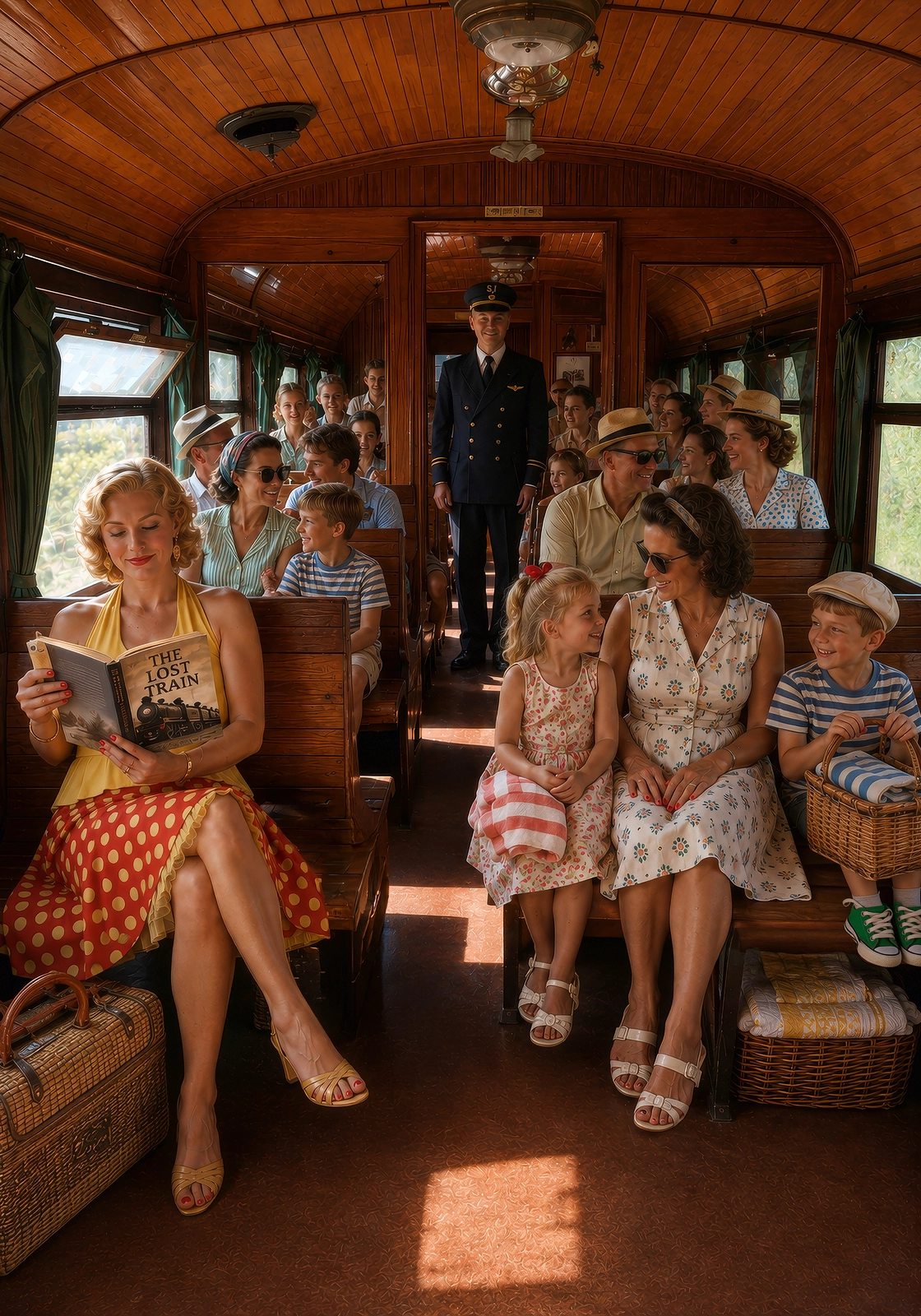
In the photograph, we see Anita seated in the third-class compartment beneath its gracefully vaulted ceiling, surrounded by chatting families, straw hats, and passengers dressed for a summer's day. As a cooling breeze drifted through the open windows and the scent of coal smoke mingled with the warm sunshine, she opened the first page. Lowering her eyes, Anita began to painstakingly sound out the unfamiliar words, unaware that the book she had bought for a few kronor told the story of a train very much like the one she was travelling onexcept that in the novel it was destined to vanish into thin air in broad daylight between Tygelsjö and Hököpinge, the very places she was passing at that moment.
PROLOGUE The Bridge Evening
It did not really begin with a train at all, but with a warm July evening a few days earlier, in the home of Station Master Alfred Arfwidson, the yellow railway residence beside Malmö Södervärn Station.
The windows stood half open towards the garden. The lilacs had long since finished blooming, yet the scent of freshly cut grass and the faint whiff of coal smoke drifting from the railway yard still found their way through the open windows.
The coffee cups had been cleared from the dining table, and in their place stood four heavy-bottomed tumblers beside a pack of cards on the green baize card table. Alfred carefully poured a measure of Swedish cognac into each glass, then topped them up with ice-cold Vichy water from a green glass siphon bottle. As he pressed the chrome-plated lever, the familiar hiss of the carbon dioxide cartridge filled the room.
"Now we can begin," he said, satisfied.
Opposite him sat Police Superintendent Erik Collin.
"You're mixing them more weakly every year, Alfred."
"Nonsense. You're simply getting older."
The others laughed.
That exchange needed no explanation. It had been repeated for years.
The bridge evenings rotated from one household to another. Dinner was always served first. Afterwards, the coffee cups were cleared away, and the cards brought out. The gentlemen poured themselves a light drink, while their wives joined them at the table. Four players. Two partnerships. The same rules. The same good-natured arguments over bidding and contracts. The same promise every week that someone else would host the following Thursday.
"Two hearts," said Alfred.
Collin barely looked up.
"Overbid."
"Just wait."
"I am waiting."
No one at the table took their eyes off their cards.
Alfred Arfwidson played bridge in much the same way he ran the railway. He seized the initiative, counted quickly, and trusted that sooner or later his opponents would make a mistake. Alfred never needed to pause to work out how many minutes it took to travel between Vintrie and Västra Klagstorp. The timetable was etched into his very bones.
Collin played differently.
He remembered every card that had been played. He noticed who had hesitated for the briefest fraction of a second before bidding, and he remembered the bidding from the opening trick to the very last hand.
The very same qualities made him an exceptionally capable police superintendent.
When the final hand had been played, Alfred rose and walked to the window. Below the house lay the narrow street that separated the railway residence from the station grounds. Beyond it stood a simple iron fence, partly concealed by a dense lilac hedge. Behind the hedge lay a strip of grass and gravel before the first railway tracks began. In the evening sunlight, a solitary shunting locomotive rolled slowly past. When it had disappeared, silence settled over the station once more.
"There are still some of us who have to work," said Collin, joining Alfred at the open window. A cool evening breeze drifted into the room.
"You know, Erik," Alfred said without turning, "after thirty years on the railway, people still think trains run themselves."
Collin smiled.
"And don't they?"
Alfred laughed.
"Not an inch. Every engine driver, every signal, every set of points, and every timetable must work perfectly. Otherwise, the whole railway comes to a standstill."
"Or disappears altogether," Collin replied dryly.
All four of them laughed.
Then Alfred filled their glasses one last time.
None of them had the faintest idea that, before the week was over, the very man who had just declared that no train ever ran itself would pick up the telephone and call his bridge partner with the words no railwayman ever wishes to utter.
"Erik..."
"I think we've lost a train."
PART I THE TRAIN THAT VANISHED
Chapter 1 The Telephone Call
From the service notes of Police Cadet Joakim Tallström.
"When I was assigned to Police Superintendent Erik Collin as a police cadet in the summer of 1950, I believed police work consisted mainly of thefts, drunken brawls, fraud cases, and the occasional wanted swindler. I had then served for barely a year and had written more reports than I could count, yet I had never encountered a single case that had not, sooner or later, found a perfectly reasonable explanation."
That was about to change.
The morning of 18 July began like any other summer morning. The sun had already warmed the city streets when the telephone rang in the superintendent's office. I was sitting outside, typing up the transcript of an interview, while the clatter of typewriters echoed through the corridors.
The conversation was brief.
When Superintendent Collin replaced the receiver, he remained seated, motionless, for several seconds. During the time I had worked under him, I had learned that his silence meant far more than other men's raised voices. He never jumped to conclusions and rarely raised his voice. He thought first, then spoke.
At last, he rose, put on his jacket, and asked me to accompany him. We were heading for Malmö Södervärn Station. Only after we had reached the courtyard below did he tell me what the telephone call was about.
The caller was Station Master Alfred Arfwidson, an old friend of the superintendent. They had played bridge together for many years, and Collin knew Arfwidson was not a man easily rattled. It was precisely for that reason that the call had troubled him.
Arfwidson had not shouted, nor had he claimed that an accident had occurred. He had said:
"Erik... I think we've lost a train."
Even when Collin repeated the words, I could not quite grasp their meaning. Trains did not disappear. They could be delayed, halted somewhere along the line, or derail, but they did not simply disappear. The entire railway system depended on order, timetables, and meticulous control. Every station manager knew where every train wasor at the very least, where it had last been reported.
That was precisely why Arfwidson's words sounded so implausible.
The journey to Malmö Södervärn took only a few minutes. During the drive, Superintendent Collin said almost nothing. He sat in silence behind the wheel while I tried to imagine what might have happeneda misunderstanding, I thought, or an error in the reporting. Perhaps a train had been left standing on a branch line without anyone notifying the proper authorities. I could think of no other explanation.
As we turned into the forecourt outside the station building, I immediately sensed something was amiss.
The station itself looked exactly as it always had. Travellers crossed the platform, carrying their suitcases, a cyclist rode past along the street, and somewhere farther away a steam locomotive let out a short whistle. Yet the station staff were not behaving as they normally did. Small groups had gathered outside the station office, and their conversations fell silent the moment they caught sight of the superintendent.
Alfred Arfwidson stood among them. He stepped forward, shook hands with Collin, and nodded to me courteously.
"You must be Tallström."
I introduced myself, and he returned my handshake with a brief smile that never quite reached his eyes.
Only then did I realise how deeply troubled he was.
Alfred Arfwidson had lived his entire adult life by the railway clock. He knew how many minutes it took to travel between Vintrie and Västra Klagstorp as instinctively as most people knew their own date of birth. The timetable was part of him, and he often said there were no secrets on a railway. Everything could be traced, everything could be checked, and every train left a trail behind it.
That morning, he looked as though someone had just proved him wrong.
"Come into the office," he said quietly.
He waited until the door had closed behind us before he continued.
"I'm going to show you something that shouldn't be possible."
Chapter 2 Malmö Södervärn
When I think back to that July morning, many years later, it is not the extraordinary telephone call that I remember first, but the deceptive sense that everything was perfectly normal. Malmö Södervärn was going about its everyday business, and nothing suggested that an event without precedent was unfolding before our very eyes.
A few years earlier, when the Swedish State Railways had taken over the operations of the old private railway companies, the station had become an integral part of the SJ organisation. From here, trains departed for Trelleborg, Skanör, and Falsterbo, and during the summer months passenger traffic was heavier than at any other time of year. Holidaymakers carrying towels, picnic baskets, and parasols filled the platforms from early morning. Children ran impatiently between the adults, and the conductors often had to help passengers find the correct carriage before the departure whistle sounded. Everything followed a familiar pattern, repeated day after day and year after year with such precision that even the slightest deviation immediately attracted attention.
That morning, however, Södervärn looked nothing like the picture Collin had painted during the drive. There were certainly crowds heading for the peninsula to spend the day at the beach. The station was bustling with life, children playing with beach balls while mothers tried to stop them from rolling onto the tracks. Even inside the station building, everything appeared perfectly normal on the surface. The young women at the two ticket windows worked at their usual pace while travellers queued patiently in front of them. In the railway yard came the familiar sounds of shunting, escaping steam, and the ring of metal on metal. It was only when Superintendent Collin and I stepped into the waiting hall that we realised something was wrong. As several members of the station staff turned towards the superintendent, I understood from their expressions that the anxiety lay not in the operation of the railway, but in the people themselves.
"They know something is wrong," Collin said quietly as we crossed the platform. "But they don't yet know what it is."
It was an observation typical of him. While I saw a railway station, Collin saw the people who worked there. In the months that followed, I would learn that he almost always began an investigation in exactly that way. Evidence could disappear, objects could be concealed, and documents could be destroyed, but people's behaviour often revealed far more than they realised.
Station Master Alfred Arfwidson met us outside the station office. He had changed into a fresh uniform jacket since telephoning the superintendent, but his face still bore unmistakable signs of a troubled morning. Collin had told me he was an exceptionally experienced railwayman, but only later did I realise how completely he lived for the railway. The timetables were not merely stored in his memory; they had become part of how he thought. He knew when every train was due to leave the station, when it ought to pass the next stop, and exactly how long a crossing on the single-track line should normally take. To him, the railway was not a collection of locomotives and carriages, but a single, interconnected system in which every movement had its appointed place.
His eyes betrayed a man who had always believed the world operated according to fixed rules. He no longer seemed to believe that.
He led the way upstairs to his office.
Once inside, Arfwidson spread various documents across his desk and allowed Superintendent Collin to examine them at his own pace. There were the timetable, the station log, the reports on the morning's traffic, the station master's operational notes, and the ticket office journal. None of the documents contained anything remarkable. On the contrary, they showed that the previous evening's and the morning's traffic had followed the timetable exactly, and that the station's routines had functioned precisely as they were supposed to. Everything appeared as normal as a well-run operation ought to be.
"It all seems to be in order," Collin said after reviewing the documents.
"That is precisely the problem," Arfwidson replied as Collin looked at him questioningly. "Whenever a train is delayed, there is always an explanation. If a locomotive develops a mechanical fault, it becomes apparent immediately. If a signal fails, the telephones ring before the train has even left the station limits. But this time there is no explanation at all. Every document says that everything has gone exactly as it should, yet one train is missing."
Superintendent Collin did not reply immediately. He let his eyes travel slowly across the documents once more before closing the station log and resting his hand on it.
"Lets start from the beginning," he said calmly. "I don't want to hear any theories. I want to know exactly what each person saw."
Chapter 3 Old Notes
Now, twenty years later, as I sit with my old service notes spread out before me, I am struck by how little I actually experienced during the first few days of the investigation. I had been a police cadet for less than a year, and it was not my task to conduct interviews. I listened, took notes, fetched documents, typed up reports, and tried to keep track of names, times, and places. It was Superintendent Erik Collin who asked the questions. I sat beside him, learning my profession.
During the first few days, almost all the interviews were held at Malmö Södervärn Station. Station Master Alfred Arfwidson generously made his office available to the police, and one by one locomotive drivers, conductors, clerks, track inspectors, signallers, and other railway employees passed through the room. Some were formally questioned. Others told us what they knew over a cup of coffee while I wrote as quickly as my pen would allow.
Superintendent Collin had a remarkable way of questioning people. He rarely interrupted. He let them finish what they had to say, even when they wandered into matters that seemed to be of no importance whatsoever. It was only much later that I came to understand that it was often precisely those small details that determined which statements could be trusted. Whenever several people, independently of one another, described the same event in almost the same way, he would lean back, fill his pipe, and say:
"Then I think we have a fairly accurate picture of what actually happened."
What follows, therefore, is based not on the testimony of a single witness but on a large number of consistent accounts, compared with the railway's own records, witness statements, official reports, and my own notes and observations from the investigation. As I read them again now, twenty years later, it is as though the door to Alfred Arfwidson's office opens once more and that extraordinary July morning of 1950 begins to take shape again.
But the morning had begun the previous evening.
Chapter 4 The Last Passenger
On Saturday, 15 July 1950, a gentleman who introduced himself as Señor Hermann Rauff requested an interview with Alfred Arfwidson, the Station Master at Malmö Södervärn. That Arfwidson happened to be at the station that late Saturday evening was no coincidence but a necessity. The following morning marked the start of the annual industrial holiday, when large parts of Sweden shut down for two summer weeks. Even so, the trains still had to run, and the station master himself had to remain on duty so that as many members of his staff as possible could enjoy their well-earned holiday. Two weeks of statutory leave were all that most people received, and every single day was precious.
Rauff was a slender, middle-aged man with short dark hair and black-rimmed spectacles. He was accompanied by a companion, a man of imposing physique whose deferential manner and constant attentiveness clearly suggested a subordinate position. This companionor bodyguard, as he might equally well have beenwhose name was never discovered, was certainly no European. Judging by his dark complexion, he most likely came from South America. He carried a black leather document case in his left hand. Arfwidson's sharp-eyed clerk noticed that the case was fastened to the man's wrist by a short chain. At the time, no one paid much attention to this unusual arrangement, but the events that followed would later lend the observation a certain significance. Military officers and diplomats were occasionally seen carrying confidential documents in that manner.
Señor Rauff was shown upstairs to Alfred Arfwidson's office, while his companion remained outside. The matter was dealt with quickly and efficiently.
Earlier that morning, Rauff had arrived in Gothenburg aboard a ship from South America. The vessel had been delayed by a full day, but after a sea voyage lasting more than a month, such a delay was hardly remarkable. From there, he had boarded the first available southbound train, an ordinary passenger service calling at every station along the west coast. It was not until a quarter past eight that evening that he finally arrived at Malmö Central Station.
Technically, he still had time to cover the little more than a kilometre to Malmö West Station and to continue by the evening train to Trelleborg. Had he done so, he would have arrived shortly after half past ten. However, the night ferry to Sassnitz had sailed half an hour earlier. Since the industrial holiday had just begun, every hotel in Trelleborg was fully booked. The only remaining option was therefore to spend the night in Malmö and continue his journey the following morning.
That soon proved to be a poor solution.
The first train on Sunday departed from Malmö West at 8.03 a.m. and arrived in Trelleborg at 9.00. The morning ferry to Sassnitz, however, sailed at 8.15. The railway and ferry timetables were separated by more than an hour.
It was when Rauff's associate discovered this unfortunate fact that the idea of a special train was conceived. Señor Rauff himself had been travelling south by rail, completely unaware of the problem. Only upon arriving in Malmö was he informed of it, together with a suggested solution.
There was no margin for delay. The circumstances were of the utmost importance, requiring Señor Rauff to be in Berlin no later than Monday morning.
He had no wish to haggle over a few Swedish kronor either way. Instead, he proposed hiring a special train, complete with the necessary staff, in return for a generous payment. Earlier that day, his associate had already investigated how railway traffic between Malmö and Trelleborg was organised. They knew that an ordinary train usually consisted of two to four passenger coaches, and that an early Sunday morning departure would be scarcely full.
Rauff therefore based his calculations on a complete four-coach train, offering a total of 128 seats, 24 of which were first-class.
"A fully occupied train would, if my calculations are correct, earn the Swedish State Railways 301 kronor and 60 öre in each direction, since the train must, of course, return," Señor Rauff said in German, as the interpreter translated. "I therefore offer 2,000 kronor as full compensation. This sum includes reasonable remuneration for the staff required to work so early on a Sunday morning, locomotive and carriage charges, the engine driver, fireman, conductor, station staff, signaller, water replenishment, and all other expenses."
The interpreter read the offer aloud from a document prepared in advance by Rauff's associates.
"In addition," Señor Rauff added, "a further four hundred kronor to be distributed in whatever manner the railway administration deems appropriate."
Even the interpreter looked surprised.
Through their inquiries, Rauff's associates had learned that the Swedish State Railways occasionally chartered special trains for school outings, associations, and company anniversaries. A modest special train, consisting of a steam locomotive and two passenger coaches, normally cost between 300 and 600 kronor for a short journey. Rauff was offering almost four times that amount and therefore assumed that his proposal would encounter no resistance.
"Would the gentleman require an invoice?" Arfwidson asked.
"I shall pay in cash if that causes no inconvenience."
He said it as though a sum equal to several months' wages for an industrial worker were little more than pocket money.
"I am sure that will pose no difficulty. I merely need, as a matter of form, to consult my colleague at the State Railways."
Despite the late hour, Alfred Arfwidson telephoned Bror Elwing, the Traffic Manager for the Third District of the Swedish State Railways. The conversation lasted only a few minutes before the matter was settled. An offer of that magnitude was hard to refuse.
"Naturally, we can arrange it," Arfwidson said, replacing the receiver.
He cleared his throat softly and adjusted his uniform jacket. It was the first time he had sold an entire special train to a single passenger, and he seemed slightly uncertain about the correct procedure.
However, in the end, he scarcely needed to say another word.
At that very moment, Señor Rauff took a wallet from the inside pocket of his jacket, counted out twenty-two greenish-blue one-hundred-kronor banknotes bearing the portrait of King Gustaf V, and calmly laid them on the desk. The exchange of American dollars for Swedish currency had, like everything else, been arranged in advance by his associate.
Arfwidson quickly gathered the banknotes.
"In that case, you and your party are welcome at Malmö West Station tomorrow morning. Departure will be at exactly seven o'clock. The fireman will begin work several hours earlier to build up steam pressure. Before then, the stations must exchange telegrams, the points must be set, and the level crossing gates lowered in good time. When you arrive, the train will be ready."
Chapter 5 A Coincidence
After leaving the Station Master's office, Señor Rauff returned to his companion, and both men appeared eager to leave as quickly as possible. Having paid the agreed amount, they asked to inspect the railway carriage, but at such a late hour that proved impossible. They had to be content with accepting it unseen.
Meanwhile, a remarkable coincidence had occurred in the very office Señor Rauff had just left.
A request for a special train was by no means unusual in a major commercial centre, but for two such requests to be made on the very same evening was exceedingly rare. As it happened, Alfred Arfwidson had scarcely shown the first traveller out when a second gentleman entered with a similar request.
He introduced himself as Mr Horace Moore, a courteous man with a distinctly military bearing. He explained that his German wife had suddenly fallen gravely ill, and that it was therefore of the utmost importance that he lose no time before setting out on his journey. His anxiety and genuine distress made a deep impression, and Alfred Arfwidson did everything within his power to assist him.
A second special train, however, was entirely out of the question. The regular local services would already be affected by the first chartered train, and no additional train set could be made available. Only one alternative therefore remained. If Señor Rauff were willing, Mr Moore could share the expense and travel in the second vacant first-class compartment of the already chartered train.
There seemed to be no reasonable objection to such an arrangement, but when Bror Elwing presented the proposal, Señor Rauff rejected it outright.
"The train is mine," he said curtly, insisting on the exclusive right to its use.
No amount of persuasion could alter his decision, so the proposal had to be abandoned. Mr Horace Moore left the station in considerable distress after being informed that his only remaining option was to take the ordinary passenger train departing from Malmö at six o'clock the following morning.
Chapter 6 The Vanished Train
At exactly 6.55 a.m., according to the station clock, the special train carrying the slender Señor Rauff and his gigantic companion steamed out of Malmö Station. At that hour, the line was clear, and there should have been no need to stop before reaching Vellinge.
The trains departing from Malmö Södervärn on the VellingeSkanörFalsterbo Railway ran over another company's tracks as far as that station, which the special train should have reached shortly before half past seven. When the clock reached a quarter past seven, a telegram from Vellinge therefore caused surprise and consternation among the railway officials in Malmö. It reported that the special train had not yet arrived.
An immediate inquiry was sent to Södervärn, located roughly one-third of the way between Malmö and Vellinge. The reply arrived almost at once:
"To Johan Bland, Traffic Coordinator, Malmö West. The special train passed here at 7.01 a.m., exactly on time. Södervärn."
This telegram was received at 7.02 a.m.
At 7.25 a.m., the next telegram arrived, this time from Hököpinge:
"No sign of the special train referred to in your message."
Ten minutes later, another telegram arrived, this time from Vellinge:
"There has probably been a misunderstanding about the scheduled operation of the special train. The regular passenger train from Södervärn to Trelleborg has just arrived, but I have seen no special train. Kindly advise by telegram. Vellinge."
The matter was now assuming a most perplexing character, although in one respect the last telegram brought some relief. If the special train had derailed somewhere along the line, it seemed scarcely possible that the ordinary passenger train could have passed the scene without discovering the accident.
But if not, what explanation remained?
Could the special train, for some reason, have been diverted onto a siding to allow the slower passenger train to pass? If the locomotive required a minor repair, such a measure was not entirely inconceivable.
Telegrams were therefore sent to every station between Södervärn and Vellinge. At the same time, Station Master Alfred Arfwidson and Traffic Manager Bror Elwing waited with mounting tension beside the telegraph, awaiting replies that would reveal the train's whereabouts.
The replies came back in the same order as the stations lay along the line.
"The special train passed here at 7.04 a.m. Kulladal."
"The special train passed here at 7.11 a.m. Vintrie."
"The special train passed here at 7.16 a.m. Västra Klagstorp."
"The special train passed here at 7.19 a.m. Tygelsjö."
"No special train has passed here. Hököpinge."
"No special train has passed here. Vellinge."
The two men stared at one another.
"This is unique in my thirty years' service," said Alfred Arfwidson.
"Entirely without precedent," replied Bror Elwing. "The special train has disappeared somewhere between Tygelsjö and Hököpinge."
"And yet, unless my memory fails me, there isn't a single siding along that stretch. It must have derailed."
"There is the branch line to the sugar refinery," Elwing replied. "We shall have to make sure that no points were left in the wrong position."
"And the branch line to Klagshamn at Tygelsjö. Check that too," Arfwidson ordered.
Time passed.
The regular morning train to Falsterbo had departed at 7.35 a.m., with strict instructions to keep a careful lookout along the line. After Vellinge, it branched south towards Skanör and Falsterbo.
The station telegraphist continually handed over the telegrams that routinely accompanied the train's progress. The reports were unequivocal. Every set of points was correctly aligned. There was no damage to the rails. No locomotive or carriage had left the track.
"How could the Falsterbo train have travelled over the same stretch without discovering anything?" Bror Elwing asked irritably. "If the Traffic Manager already knows about this, the news has probably reached the Director General in Stockholm by now."
Arfwidson felt the ground sway under him.
"There is no other possibility. The train must have derailed. Perhaps one of the track inspectors has seen something that could shed light on the matter. We shall telegraph Vellinge for further information and instruct Tygelsjö to examine the foot line all the way to Hököpinge."
The reply from Vellinge arrived only a few minutes later.
"No further news on the missing special train. The engine driver and conductor of the Falsterbo train are certain that no accident has occurred between Tygelsjö and Hököpinge. The line is clear, and nothing unusual has been observed. Station Master, Vellinge."
"That driver and that conductor will have to go," Alfred Arfwidson said coldly. "A derailment has occurred, and they failed to notice it. I cannot understand how a locomotive could leave the rails without obstructing traffic, but it must have happened. Before long, we shall receive a telegram from Tygelsjö or Hököpinge informing us that the locomotive and coaches have been found beside the embankment."
But that prediction did not come true.
Half an hour later, another telegram arrived from the Station Inspector at Tygelsjö.
"There is no trace of the missing special train. It is certain that it passed here but did not arrive at Hököpinge. We uncoupled a locomotive from a goods train, and I have personally travelled the entire section. The line is clear, and no sign of any accident has been found."
Alfred Arfwidson ran his hands despairingly through his hair.
"This is sheer madness, Bror! A train cannot vanish into thin air in Sweden in broad daylight! The whole affair is absurd. A locomotive, a tender, two coaches, an engine driver, a fireman, and a conductorfive peopledisappear along a perfectly straight railway line. If we have nothing tangible within the next hour, I'll fetch Superintendent Collin and go down there myself."
Chapter 7 The Dead Engine Driver
At last, something tangible happened. A new telegram arrived from Hököpinge.
"Regret to report that the body of John Eriksson, the special train's driver, has just been found among thickets of lupins and Japanese knotweed approximately two kilometres before Hököpinge Station. He appears to have fallen from the locomotive, been hurled down the railway embankment, and rolled into the bushes. Injuries to the head and neck appear to have caused death. The ground has been thoroughly searched. No trace of the missing train has been found."
The international situation dominated the summer of 1950. The Korean War, which broke out on 25 June, fuelled widespread anxiety that the world once again stood on the brink of a major conflict. At the same time, the stream of refugees into West Berlin swelled with each passing week as thousands of East Germans fled the Soviet occupation zone before the border could be sealed.
As a result, the newspapers devoted most of their columns to international affairs, and the extraordinary disappearance of the special train received far less attention than it otherwise would have. The incident itself seemed so improbable that several editorial offices initially assumed it was an elaborate practical joke. Only when the medical examiner's report confirmed that the engine driver had indeed been killed did it become clear that this was a tragedy rather than a carefully contrived hoax.
The post-mortem examination, however, provided no answers. John Eriksson's injuries were entirely consistent with a fall from a moving locomotive. Yet they revealed nothing about the fate of the locomotive itself, the tender, the mail coach, or the passenger carriage. The fact that the engine driver had cirrhosis of the liver could scarcely explain why an entire train had disappeared.
That same evening, Alfred Arfwidson travelled to Tygelsjö with Superintendent Collin. They spent the rest of the evening and the whole of the following day examining the railway line, but their efforts yielded no positive results. Not only was there no trace of the missing train, but none of the theories that had initially seemed plausible could any longer be sustained.
In his official report, which now lies before me as I write these lines, Superintendent Collin summarised the situation as follows:
"Along the railway line between Tygelsjö and Hököpinge, there are several small industrial facilities and farms. Several of them either have or once had branch lines connected to the main line. Most are narrow-gauge industrial tracks intended for hand-powered trolleys and can be dismissed immediately. Only two establishments have standard-gauge connections with points leading onto the main line, namely the Klagshamn Fish Processing Plant and the Hököpinge Sugar Factory."
The sugar factory branch line is only about two kilometres long and terminates at the sugar beet storage area. The entire site has been searched without success. Furthermore, an internal siding within the factory grounds is blocked by seven wagons loaded with limestone for the factory's lime kilns. No railway movement could have passed that point.
The Klagshamn branch has likewise been thoroughly examined. Several fishermen were present in the harbour on the morning of 16 July and unanimously stated that no train arrived on that route. The line has been searched both on foot and by inspection trolley, without any trace being found.
It should also be noted that the junction to Klagshamn lies before the point at which engine driver John Eriksson was found. The special train had therefore already passed that set of points when Eriksson fell from the locomotive. Whatever happened thereafter cannot therefore have been connected with the Klagshamn branch.
As for the engine driver, John Eriksson, his injuries provide no clue. A man falling from a locomotive travelling at speed inevitably sustains severe injuries. We can merely establish that he died after falling from his engine. Why he fell, and what subsequently became of the locomotive, are questions which I do not consider myself able to answer.
The report concluded with Superintendent Collin rejecting the newspaper's allegations of negligence or incompetence by the railway staff. On the contrary, every conceivable explanation had been examined and rejected. Only one fact remained.
A special train had left Malmö and passed through Tygelsjö. Shortly afterwards, on a perfectly straight stretch of railway across the plains of Scania, it had vanished without leaving the slightest trace.
Chapter 8 The Tips Pour In
A month passed, during which both the police and the Swedish State Railways continued their investigations without the slightest success. Every conceivable explanation had been examined. The railway embankment had been searched on foot, by inspection trolley, and by locomotive. Every branch line had been examined yard by yard. Engine drivers, track inspectors, station hands, and farmers had been questioned repeatedly.
In the hope of obtaining public assistance, a reward of one thousand kronor was offereda considerable sum at the time. At the same time, amnesty was promised to anyone who voluntarily came forward, should a crime, against all expectations, be found to lie behind the disappearance.
No one claimed the amnesty.
However, the tips began pouring in.
The reward proved to stimulate the imagination far more than the truth. Every morning, new letters awaited the police on their desks, and almost every hour, some eccentric telephoned with yet another piece of information about the train's whereabouts. Some informants seemed genuinely eager to help; others had already begun spending the thousand kronor in their minds.
The most common theory was that a local landowner had hidden the locomotive on his own property. A surprising number of people seemed convinced that a steam locomotive, with its tender and two passenger coaches, could be concealed without much difficulty behind a lilac hedge or inside a barn.
Another recurring explanation was that a scrap-metal dealer was responsible for the disappearance. Scrap merchants seemed to be an unusually persecuted profession that summer. More than a dozen dealers were specifically accused of dismantling an entire locomotive and two railway coaches under cover of darkness to profit from the scrap's value; how this could have been accomplished without a single neighbour hearing even a single hammer blow or seeing the faintest wisp of smoke troubled no one.
Not even religion was left out of the matter.
A lengthy letter from a deeply religious resident of Malmö claimed that God had finally grown weary of the Swedish State Railways continually coating Möllevången Church with soot. The church had been consecrated the previous year as the parish church of the newly established Möllevången Parish. It stood so close to Södervärn Station that its red-brick walls had already turned grey-black from the smoke of the steam locomotives.
The punishment, therefore, had been as just as it was unexpected.
According to the letter writer, the Archangel Gabriel had been sent down to remove the entire train as a divine rebuke.
The letter concluded with an earnest appeal to the Swedish State Railways to switch immediately to electric traction.
A retired schoolmaster from Ystad held a different view. He maintained that the entire affair must be explained by magnetic earth currents and enclosed several hand-drawn maps of Scania showing lines of force intersecting precisely between Tygelsjö and Hököpinge.
A dowser from Småland arrived in person in Malmö, carrying two freshly cut hazel rods. Before an audience of curious spectators, he walked slowly along the railway embankment, the twigs trembling in his hands.
"The iron is somewhere around here," he assured them.
After several hours of searching, he had found nothing more than a few old railway spikes and a rusty bicycle handlebar. He calmly explained that someone must have disturbed the earth's natural radiation.
Nor did the spiritualists intend to remain idle.
A medium from Limhamn offered to hold a séance to contact the deceased engine driver, John Eriksson. If only the police could provide a darkened room and a round table, the dead man himself would surely reveal where the train had gone.
The offer was politely declined.
An inventor from Lund wrote to say that he had designed an electromagnetic locomotive detector that, in return for reasonable reimbursement of his material costs, could locate large iron objects at a distance of several kilometres. He enclosed a drawing that looked little more than a crystal radio receiver fitted with two umbrella handles.
The police thanked him, too, for his interest.
Day after day, the public opened their newspapers, convinced that the grotesque mystery would finally be solved. Yet week after week passed, and the answer remained as elusive as ever.
In broad daylight, on a Sunday morning in July, in the most densely populated part of Scania, a train and its passengers had vanished as completely as though the magician Hector El Neco himself had been standing by the railway embankment.
In one of his most celebrated stage acts, he made his wife, Ebba, vanish before the very eyes of his audience.
Two entirely unrelated individuals reported to the police that El Neco was responsible for making the train disappear.
The first argued that if a magician could make a human being vanish, making a train disappear would hardly pose any greater difficulty. The second maintained that this was precisely why the police ought to arrest him immediately, before he managed to make even more trains disappear.
The police did neither.
However, the imaginative explanations did not stop with magicians, dowsers, and archangels.
Among the many theories published in the newspapers were also a few that at least attempted to give the appearance of logical reasoning. They therefore attracted considerably more attention than the purely fantastical rumours.
The most widely discussed appeared in the newspaper Sydsvenskan and was signed by a well-known amateur analyst, a gentleman who, over the years, had made something of a name for himself by solving all manner of mysteries from the safety of the grandstand. His argument was at once logical and pseudoscientific. A brief extract will suffice.
"It is a fundamental principle of practical reasoning that, once the impossible has been eliminated, whatever remains, however improbable, must contain the truth."
It is certain that the train departed from Tygelsjö. It is equally certain that it never reached Hököpinge. It is therefore highly improbable, though not impossible, that it took either of the two available branch lines. A train cannot run where there are no rails. Consequently, only Klagshamn and the Hököpinge Sugar Factory remain.
So far, most readers were able to follow his reasoning.
Then imagination took over.
"Could there perhaps be a secret society of sugar-beet growersa Scanian mafiacapable of making both trains and passengers disappear? It is improbable, but not impossible. I readily admit I can propose no better explanation. The railway authorities should therefore direct their full attention to these two branch lines. A thorough inspection of Scania's pawnshops might also bring certain revealing facts to light," the analyst continued.
Precisely what, in that case, was supposed to have been pawned was never made clear.
Nevertheless, one reporter contacted several pawnshops in Malmö and Lund to investigate the matter. They explained that over the years they had accepted a wide range of items, from wedding rings and violins to bicycles, sewing machines, and occasionally even motor cars, as security for loans.
However, a steam locomotive had never been among them.
As so often happens when a mystery remains unsolved, less savoury rumours also began to circulate. Some sought to associate the pawnshops with alleged Jewish interests. The police found no reason to take such allegations seriously. They were based on old antisemitic myths and had no foundation whatsoever, either in the investigation or in the commercial life of Scania.
The letter, nevertheless, attracted considerable attention.
Just as quickly, it provoked a furious reaction among those who believed that its author had subjected the sugar-beet farmers of Scania to an outrageous slander.
The reply came almost immediately.
A letter published in the newspaper Arbetet suggested that the special train was, in fact, lying at the bottom of the Gessie Brook, which runs parallel to the railway for a short stretch between Hököpinge and Gessie.
The suggestion was initially dismissed with a smile.
In places, the brook was so shallow that a boy could wade across it without wetting his knees. The idea that it might conceal a steam locomotive with its tender and two passenger coaches seemed, to put it mildly, rather unlikely.
However, the letter writer refused to give up. He pointed out that heavy rain had fallen in the days following the disappearance.
"If the locomotive was already lying in the brook," he wrote, "the floodwaters could very well have carried it through Foteviken Bay and out into the Øresund."
The theory was never officially commented on.
Another correspondent chose instead to focus on the passengers' luggage.
Perhaps, he suggested, someone had been transporting an entirely new explosive, vastly more powerful than anything previously known. The explosion might have pulverised the locomotive, the coaches, and the passengers into fine dust, yet, for some mysterious reason, left the rails entirely undamaged. It was a theory so imaginative that it resembled little more than a farce at the Hippodrome Theatre.
By then, even the most seasoned crime reporters had begun shaking their heads.
The investigation had reached a point where each new theory seemed even less plausible than the one before it.
The police had no clues, the railway had no explanation, and the newspapers were running out of new ideas.
It was then, just as both the authorities and the general public had almost accepted that the mystery might never be solved, that something completely unexpected occurred.
"A letter means so much."
Such was the familiar advertising slogan of the Royal Swedish Post Office. It was intended to encourage Swedes to write more letters, send more postcards, and, on occasion, post a parcel of woollen socks to their grandchildren.
But sometimes a single letter could mean far more.
The letter now on its way to Malmö did not bear Swedish stamps.
It came from England.
Before its contents became known, the entire investigation would take a direction no one could have imagined.
Chapter 9 The Letter from England
On 18 August, a little more than a month after the inexplicable disappearance of the special train, something happened that, for the first time, moved the investigation forward. It was not another telephone call from some well-meaning Scanian claiming to have seen a steam locomotive behind his neighbour's barn, nor yet another letter to the editor accusing the Devil, the Archangel Gabriel, or a sugar-beet mafia of responsibility. This time the clue arrived in a far more modest form.
It came with the morning post.
Among the day's ordinary correspondence lay a thick, cream-coloured envelope bearing several British postage stamps depicting King George VI. It was addressed to the Criminal Investigation Department in Malmö. It had been sent by a firm of solicitors in Lincoln's Inn Fields, London, one of England's oldest and most distinguished legal districts. The sender alone made the envelope stand out from the usual letters from insurance companies, railway administrations, and curious members of the public.
Superintendent Collin carefully opened the envelope with his paper knife.
The letter had been typed in impeccable business English and contained not the slightest trace of sensationalism or exaggeration. It was precisely for that reason that it caught his attention.
To the Criminal Investigation Department, Malmö.
Through the British press, we have become acquainted with the reports published about the Swedish train that disappeared under remarkable circumstances between Malmö and Trelleborg.
We would particularly draw your attention to one of the passengers, who, according to newspaper reports, travelled under the name Señor Rauff.
We have reason to suspect that this gentleman has not given his real name.
If that should prove to be the case, he may be identical with an individual whose activities have for some considerable time been the subject of our attention.
Should you require any further information, we shall be pleased to be at your disposal.
Yours faithfully,
John Broadstone
Mather & Broadstone
Solicitors
London
Collin read the letter once.
Then a second time.
Finally, a third.
During the preceding weeks, he had grown accustomed to receiving letters from people convinced they had solved the mystery. Almost all of them were based on assumptions, dreams, or pure imagination. This letter differed from the rest in one decisive respect.
Its sender claimed to know something for sure.
He was a partner at a respected English firm of solicitors.
Superintendent Collin and I, his assistant, arrived for our daily visit, and Collin handed the letter to Arfwidson.
After Arfwidson had finished reading it, he remained silent for a long time.
"What do you think?" Arfwidson asked at last.
"I don't think anything yet," Collin replied thoughtfully. "But for the first time since the train disappeared, someone is not trying to tell us where the train is. Instead, he is drawing our attention to who one of the passengers really was."
It was an observation that would prove far more significant than it first appeared.
Until then, the entire investigation had centred on the train itself. People had searched for missing rails, branch lines, abandoned gravel pits, hidden railway yards, and sunken locomotives. They had been looking for a missing train. No one had really been looking for Señor Rauff, the man who had been so determined to charter the train that he had willingly paid a fantastic sum for it.
"We start again," Collin said in a quiet voice.
"From the beginning?"
"From the beginning."
"With the train?"
Collin slowly shook his head.
"No. With the man."
Passports and visas would be examined once again. The records at the Hotel Savoy from the single night Señor Rauff and his presumed bodyguard had spent in Sweden would be reviewed. Everything would have to be reviewed from the beginning. Witnesses would be questioned again. Everyone who might know anythingincluding banks, travel agencies, the Consulate of Ecuador, and the Johnson Line shipping companywould be contacted. If the English were right, the entire investigation might rest on a false name.
And if the name was false, the man might also be entirely different from the wealthy South American he claimed to be.
None of us realised at the time that this letter would become the first genuine clue in an investigation that would soon extend far beyond Swedens borders. The British solicitor, Broadstone, had apparently been studying the exploits of this Wlewski ever since his spectacular wedding swindle collapsed in London the previous summer, in 1949.
I was the youngest member of that highly experienced group of detectives, and therefore I usually kept my thoughts to myself. Even so, I could not help wondering how a man's identity could help us find a train that seemed to have vanished into thin air. Whether Rauff's real name was Andersson, Svensson, or Karlsson surely could not alter the fact that a locomotive, two passenger coaches, and several people had disappeared without a trace.
At that time, flying saucers were the latest fashion. The newspapers were filled with extraordinary sightings, and almost every week someone claimed to have seen a mysterious object in the sky or to have heard of green little men abducting people. I found myself waiting for someone to suggest that a flying saucer had swallowed the State Railways' special train. Absurd though such a theory would have been, at least it would have addressed the disappearance of a train.
No, I kept my thoughts to myself.
My older colleagues talked instead about identities, passports, and hotel registers. I found it hard to understand how a new name attached to one of the passengers could cause a train to roll out of nowhere.
I was soon to discover just how profoundly mistaken I had been, but neither a flying saucer nor any little green men would carry the investigation forward.
PART II THE TRAIN THAT VANISHED
Chapter 10 The Road to Cambridge
According to John Broadstone, the British solicitor, the mysterious man who featured in the story of the steam train that had vanished into thin air might well be a swindler with whom his firm had previously crossed paths. The correspondence that followed revealed an extraordinary story which, in truth, had nothing whatsoever to do with railways. The solicitor nevertheless believed that Señor Rauff, who appeared in the newspaper reports about the missing train, displayed the same modus operandi as a certain Prince Theodore who had victimised one of their clients.
Broadstone was kind enoughnaturally under the strictest confidentialityto send a copy of his memorandum about an unusually ingenious rogue who had insinuated himself into the British establishment. It made astonishing reading, almost on a par with the disappearance of a train.
"The alleged prince is of Polish noble descent and is in fact named Jan Henryk Wlewski," the memorandum began, to the considerable amusement of Detective Assistant Tallström and Superintendent Collin alike. In its own way, it resembled the true story of Lasse-Maja, the Swedish thief who disguised himself as a woman and whose exploits charmed even the King of Sweden. This time, however, it concerned an English confidence trickster who might conceivably be connected to our missing train.
The surname Wlewski emerged in the eighteenth century, when one of his ancestors officially converted from Judaism to Christianity. It was a proud, newly created noble name that secretly alluded to the Jewish lion, yet was deliberately Polonised to secure the familys admission to the ranks of the Polish nobility. Their forebears had been noted patriots and ran into serious difficulties when the Russian Empire crushed the Polish Commonwealth towards the end of the eighteenth century, partitioned the country, and reduced what remained to a tightly controlled Russian province. Forced to flee for their lives, they followed the same route as so many other Polish noble families of the period, eventually finding refuge in France. Once members of the highest aristocracy, the family gradually lost both influence and fortune. Rather than entering the elegant salons of Paris, they settled on a modest vineyard in the French countryside.
The family's glorious history, however, never faded, even though the Polish language disappeared after a few generations. Wlewski was a proud aristocrat, consumed by a longing for restoration, yet he saw little future in an estate that barely generated enough income to keep the buildings habitable. The German occupation during the war only worsened the situation for Poles living in exile. Although the family had outwardly lived as French Catholics for generations, one quiet tradition remained: the first-born daughter was always christened Rebecca, a deeply Jewish name. During the war years, that beautiful name suddenly became a potentially fatal clue. The fear that the Germans might begin examining the old parish registers and discover the eighteenth-century conversion eventually made the situation intolerable. Rebelliousness seemed almost hereditary, for Wlewski's father had joined the French Resistance at an early stage.
As a precaution against every eventuality, his father sent his daughter, Rebecca, across the English Channel to the supposed safety of England, accompanied by her elder brother, Jan, as both escort and protector. Their paths soon diverged when Rebecca was sent on to relatives in America. Their father had little confidence that Britain would be able to resist the German war machine any more successfully than France had. Jan proved more optimistic and quickly established himself. During this British exile, he realised that his Polish initialsJ.H.W.offered the perfect opportunity to invent the identity of Dr John H. Wlewski, a respectable façade he would later employ as a stepping stone to the role of Prince Theodore.
His years at Cambridge sowed the first seeds of Jan's great deception. Mixing with Britain's upper classes left him wanting more, and already in his first year he began carefully refining his new identity. Gradually, the Russian Prince Theodore took shape, while his circle of acquaintances steadily expanded. Wlewski changed his field of study to The History of Political Thought and spent long hours in the university libraries. By the time he graduated, shortly after the end of the war, with the prestigious Bachelor of Arts degree awarded under Cambridge's traditional Historical Tripos, he had become not only an authority on Russian history but also a master of the customs and manners of Britain's ruling classes. In addition to his melodious French, Wlewski now spoke flawless English, coloured by a faint, indefinable Continental accent that only enhanced his exotic and tragic charm in the eyes of the British aristocracy.
Wlewski felt no urgency to leave the university. He had fallen in love with the carefree life of student life and chose to remain in Cambridge for several years as what the British themselves called a perpetual student. It was during those leisurely yet remarkably productive extra years that the Russian Prince Theodore was perfected.
The Royal Game in the Shadows of Mayfair: The Challenge to the Romanovs
During the late 1940s, the world was changing at a feverish pace. While Europe was licking its wounds after a devastating world war and the Iron Curtain descended across the continent, a very different, far quieter war was being fought in high society. It was an age of faded splendour, when noble titleswhether genuine or fabricatedand desperate aristocrats had become valuable currency. At the centre of this curious drama stood two of the most gifted impostors of the post-war era, operating on opposite sides of the Atlantic.
In the United States, the Lithuanian-born confidence trickster Harry Gerguson had taken Hollywood by storm under the name "Prince Michael Romanoff". By claiming to be a nephew of Tsar Nicholas II, the last Emperor of Russia, he charmed film stars and millionaires alike, eventually laying the foundations for his legendary luxury restaurant, Romanoff's, in Beverly Hills. On the opposite side of the Atlantic, however, in a London still marked by rationing, fog and rigid class barriers, there suddenly appeared a far more sophisticated challenger: Dr John H. Wlewski. He did not borrow the Romanov name. Wlewski was far cleverer than that. Instead, he plunged directly into the darkest and most legitimate roots of Russian history.
Wlewski called himself Theodore II, Prince of the Rurik Dynasty, and was formally introduced to Britain's gentlemen's clubs as His Imperial Highness Prince Theodore of Russia. Wlewski's deception was a masterpiece of historical precision. While the American "Michael Romanoff" offered glamour, cocktails and imperial Russian kitsch, Wlewski presented Tsarist heir Prince Theodore, a man whose lineage was as tragic as it was intellectual and deeply compelling. Theodore's invented family history was as ingenious as it was difficult to disprove. Wlewski claimed that Prince Theodore was the secretly surviving direct descendant of Tsar Feodor I and his wife, Tsarina Irina Godunova.
According to Theodore's eloquent accounts, delivered in impeccable aristocratic Oxford English in the clubs of Mayfair and the suites of The Savoy, Tsarina Irina had indeed given birth to a son in 1596. Yet danger lurked within the imperial court. The Tsarina's own brother, the power-hungry Boris Godunov, already exercised de facto authority and harboured ambitions to seize the throne. To save the newborn heir from Godunov's assassins, the infant Prince Theodore was secretly spirited away by loyal supporters of the House of Rurik. An official miscarriage was announced at court, while the child was hidden in a monastery. He was immediately smuggled across the frontier into the sovereign Polish-Lithuanian Commonwealth, a vast European power beyond the reach of Boris Godunov's spies. In his cradle, beside the infant, lay, in effect, a life insurance policy for his new homeland: a parchment certifying his identity, signed by his mother and eleven loyal supporters.
In 1598, the ailing Tsar Feodor died. Boris Godunov seized the throne, and the bloody period known as the Time of Troubles began. The rightful prince had alread
Jörgen Thornberg
The Lost Train - Det förlorade tåget, 2026
Digital
50 x 70 cm
3 200 kr
The Lost Train - Det förlorade tåget
Svensk text på slutet
To deepen your understanding of these themes, explore my reflections on traditions and societal critique through this link, which complements the essay's exploration of pink skies.
https://www.konst.se/jorgen-thornberg
Introduction
It is often said that the victors write history, but in the long shadows of the post-war years, that is seldom true. The real history is written instead by those who lie best and by the few who can afford oblivion. When the guns fell silent in 1945, a new invisible war emerged across the European continent. It was fought not in muddy trenches but in discreet bank vaults in Zurich, in austere law offices in London, and in the dim back rooms off Baker Streeta war over documents, identities, and fabricated fortunes.
At the heart of this shadow play lie three seemingly irreconcilable destinies, three pieces of a puzzle fate forced together.
First comes the illusion. The story of a young man of Polish descent who found life as a student at Cambridge far too agreeable to leave behind. Under the name Jan Henryk Wlewski, posing as a Russian prince with forged Imperial crowns and ecclesiastical Latin, he charmed British high society until a single seal was dashed against the floor. It was a deadly game of status and love, fuelled by a burning hatred for a rival in Hollywood. Yet the false prince would soon discover that swindlers were playing in a league far more dangerous than his own.
Then came the silence of the Scanian plain. On a sweltering July morning in 1950, an entire special train, laden with secrets, disappeared without a trace in broad daylight between Tygelsjö and Hököpinge. An engine driver lay beside the railway embankment, his neck broken. It was a mystery so monstrous that it baffled the criminal investigators of Malmö for six long years.
And finally, there is the architect behind it all. Christian de Vigny. A man born perhaps once in a million, a master of the Jackal's craft, hired by the enigmatic Consortium Group A to erase every trace of a past that was never meant to see the light of day. A man who carried out the perfect revenge, only to discover he had been deceived.
This is the story of how these threads become entwined, and a chronicle of human vanity, political cynicism, and a lost train. When the doors of a forgotten boiler house at a sugar refinery in rural Scania are finally opened in November 1956, the truth is revealed about a world in which everythingeven justice itselfproves, in the end, to be for sale.
Welcome to the shadows.
Anita's Book
When the Scanian summer sun blazed at its fiercest and the heat settled heavily over the city of stone, thousands of Malmö residents packed their wicker baskets in search of relief along the coast. On days like these, the city seemed gripped by a collective fever. Most headed for Ribersborg, Malmö's own Riviera, simply because it was the closest. Yet it was also the most crowded, and its beach stretched gently into the sea. Far more tempting was Falsterbo Strandbad, even though it lay an hour away by train. The railway between Malmö and Falsterbo, inaugurated in 1904, had, over the decades, evolved from an exclusive route serving the fashionable guests of the luxurious Falsterbohus Hotel into a popular institution: the legendary bathing trains. On fine summer Sundays, these enormous, overcrowded trains were hauled by double steam locomotives, powerful enough to pull the immense weight of the holiday crowds.
In June, Anita had won the Miss Malmö title, and on 24 August she swept aside every other contestant to become Miss Sweden in Stockholm. Now she was back home in Malmö for a few days to pack her belongings and collect her passport before leaving for America the following Saturday. The weather was magnificent, and Anita decided to make one last quick trip to the beach at Falsterbo. She deliberately avoided Ribersborg, where the risk of being recognised was greatest.
Although she was not yet the international film star the world would come to know through the famous fountain scene in Rome, the blonde nineteen-year-old Anita Ekberg already drew attention wherever she went. She had wisely chosen to begin her journey at Malmö West Station, where the bathing train stood empty and ready to depart. There she could board at leisure and secure one of the coveted seats on the varnished wooden benches before the crowds poured in.
Before boarding, Anita stopped at the Pressbyrån kiosk inside the station. Her eyes settled on a newly published book with a steam locomotive on its cover. It was not the locomotive that caught her interest, but the title: The Lost Train. Her English vocabulary was still extremely limited, and she thought a book in English about a railway journey might prove useful. The organisers of the beauty pageant had urged her to learn the language before travelling to America.
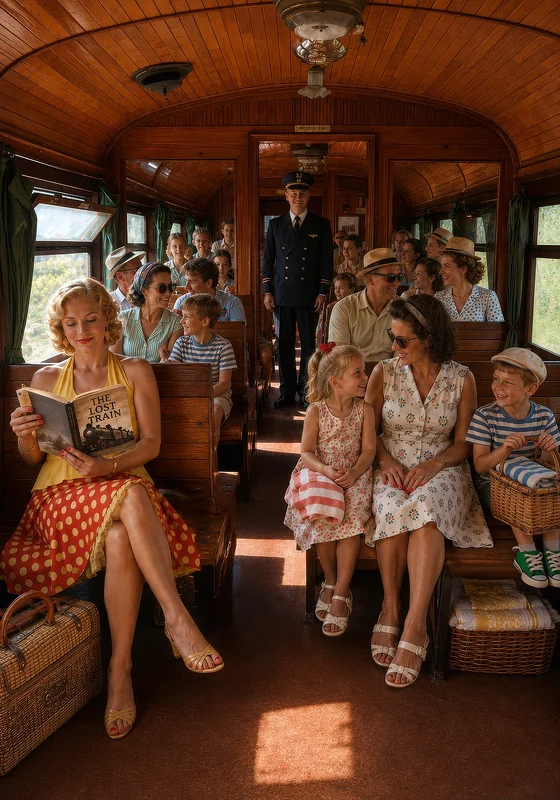
In the photograph, we see Anita seated in the third-class compartment beneath its gracefully vaulted ceiling, surrounded by chatting families, straw hats, and passengers dressed for a summer's day. As a cooling breeze drifted through the open windows and the scent of coal smoke mingled with the warm sunshine, she opened the first page. Lowering her eyes, Anita began to painstakingly sound out the unfamiliar words, unaware that the book she had bought for a few kronor told the story of a train very much like the one she was travelling onexcept that in the novel it was destined to vanish into thin air in broad daylight between Tygelsjö and Hököpinge, the very places she was passing at that moment.
PROLOGUE The Bridge Evening
It did not really begin with a train at all, but with a warm July evening a few days earlier, in the home of Station Master Alfred Arfwidson, the yellow railway residence beside Malmö Södervärn Station.
The windows stood half open towards the garden. The lilacs had long since finished blooming, yet the scent of freshly cut grass and the faint whiff of coal smoke drifting from the railway yard still found their way through the open windows.
The coffee cups had been cleared from the dining table, and in their place stood four heavy-bottomed tumblers beside a pack of cards on the green baize card table. Alfred carefully poured a measure of Swedish cognac into each glass, then topped them up with ice-cold Vichy water from a green glass siphon bottle. As he pressed the chrome-plated lever, the familiar hiss of the carbon dioxide cartridge filled the room.
"Now we can begin," he said, satisfied.
Opposite him sat Police Superintendent Erik Collin.
"You're mixing them more weakly every year, Alfred."
"Nonsense. You're simply getting older."
The others laughed.
That exchange needed no explanation. It had been repeated for years.
The bridge evenings rotated from one household to another. Dinner was always served first. Afterwards, the coffee cups were cleared away, and the cards brought out. The gentlemen poured themselves a light drink, while their wives joined them at the table. Four players. Two partnerships. The same rules. The same good-natured arguments over bidding and contracts. The same promise every week that someone else would host the following Thursday.
"Two hearts," said Alfred.
Collin barely looked up.
"Overbid."
"Just wait."
"I am waiting."
No one at the table took their eyes off their cards.
Alfred Arfwidson played bridge in much the same way he ran the railway. He seized the initiative, counted quickly, and trusted that sooner or later his opponents would make a mistake. Alfred never needed to pause to work out how many minutes it took to travel between Vintrie and Västra Klagstorp. The timetable was etched into his very bones.
Collin played differently.
He remembered every card that had been played. He noticed who had hesitated for the briefest fraction of a second before bidding, and he remembered the bidding from the opening trick to the very last hand.
The very same qualities made him an exceptionally capable police superintendent.
When the final hand had been played, Alfred rose and walked to the window. Below the house lay the narrow street that separated the railway residence from the station grounds. Beyond it stood a simple iron fence, partly concealed by a dense lilac hedge. Behind the hedge lay a strip of grass and gravel before the first railway tracks began. In the evening sunlight, a solitary shunting locomotive rolled slowly past. When it had disappeared, silence settled over the station once more.
"There are still some of us who have to work," said Collin, joining Alfred at the open window. A cool evening breeze drifted into the room.
"You know, Erik," Alfred said without turning, "after thirty years on the railway, people still think trains run themselves."
Collin smiled.
"And don't they?"
Alfred laughed.
"Not an inch. Every engine driver, every signal, every set of points, and every timetable must work perfectly. Otherwise, the whole railway comes to a standstill."
"Or disappears altogether," Collin replied dryly.
All four of them laughed.
Then Alfred filled their glasses one last time.
None of them had the faintest idea that, before the week was over, the very man who had just declared that no train ever ran itself would pick up the telephone and call his bridge partner with the words no railwayman ever wishes to utter.
"Erik..."
"I think we've lost a train."
PART I THE TRAIN THAT VANISHED
Chapter 1 The Telephone Call
From the service notes of Police Cadet Joakim Tallström.
"When I was assigned to Police Superintendent Erik Collin as a police cadet in the summer of 1950, I believed police work consisted mainly of thefts, drunken brawls, fraud cases, and the occasional wanted swindler. I had then served for barely a year and had written more reports than I could count, yet I had never encountered a single case that had not, sooner or later, found a perfectly reasonable explanation."
That was about to change.
The morning of 18 July began like any other summer morning. The sun had already warmed the city streets when the telephone rang in the superintendent's office. I was sitting outside, typing up the transcript of an interview, while the clatter of typewriters echoed through the corridors.
The conversation was brief.
When Superintendent Collin replaced the receiver, he remained seated, motionless, for several seconds. During the time I had worked under him, I had learned that his silence meant far more than other men's raised voices. He never jumped to conclusions and rarely raised his voice. He thought first, then spoke.
At last, he rose, put on his jacket, and asked me to accompany him. We were heading for Malmö Södervärn Station. Only after we had reached the courtyard below did he tell me what the telephone call was about.
The caller was Station Master Alfred Arfwidson, an old friend of the superintendent. They had played bridge together for many years, and Collin knew Arfwidson was not a man easily rattled. It was precisely for that reason that the call had troubled him.
Arfwidson had not shouted, nor had he claimed that an accident had occurred. He had said:
"Erik... I think we've lost a train."
Even when Collin repeated the words, I could not quite grasp their meaning. Trains did not disappear. They could be delayed, halted somewhere along the line, or derail, but they did not simply disappear. The entire railway system depended on order, timetables, and meticulous control. Every station manager knew where every train wasor at the very least, where it had last been reported.
That was precisely why Arfwidson's words sounded so implausible.
The journey to Malmö Södervärn took only a few minutes. During the drive, Superintendent Collin said almost nothing. He sat in silence behind the wheel while I tried to imagine what might have happeneda misunderstanding, I thought, or an error in the reporting. Perhaps a train had been left standing on a branch line without anyone notifying the proper authorities. I could think of no other explanation.
As we turned into the forecourt outside the station building, I immediately sensed something was amiss.
The station itself looked exactly as it always had. Travellers crossed the platform, carrying their suitcases, a cyclist rode past along the street, and somewhere farther away a steam locomotive let out a short whistle. Yet the station staff were not behaving as they normally did. Small groups had gathered outside the station office, and their conversations fell silent the moment they caught sight of the superintendent.
Alfred Arfwidson stood among them. He stepped forward, shook hands with Collin, and nodded to me courteously.
"You must be Tallström."
I introduced myself, and he returned my handshake with a brief smile that never quite reached his eyes.
Only then did I realise how deeply troubled he was.
Alfred Arfwidson had lived his entire adult life by the railway clock. He knew how many minutes it took to travel between Vintrie and Västra Klagstorp as instinctively as most people knew their own date of birth. The timetable was part of him, and he often said there were no secrets on a railway. Everything could be traced, everything could be checked, and every train left a trail behind it.
That morning, he looked as though someone had just proved him wrong.
"Come into the office," he said quietly.
He waited until the door had closed behind us before he continued.
"I'm going to show you something that shouldn't be possible."
Chapter 2 Malmö Södervärn
When I think back to that July morning, many years later, it is not the extraordinary telephone call that I remember first, but the deceptive sense that everything was perfectly normal. Malmö Södervärn was going about its everyday business, and nothing suggested that an event without precedent was unfolding before our very eyes.
A few years earlier, when the Swedish State Railways had taken over the operations of the old private railway companies, the station had become an integral part of the SJ organisation. From here, trains departed for Trelleborg, Skanör, and Falsterbo, and during the summer months passenger traffic was heavier than at any other time of year. Holidaymakers carrying towels, picnic baskets, and parasols filled the platforms from early morning. Children ran impatiently between the adults, and the conductors often had to help passengers find the correct carriage before the departure whistle sounded. Everything followed a familiar pattern, repeated day after day and year after year with such precision that even the slightest deviation immediately attracted attention.
That morning, however, Södervärn looked nothing like the picture Collin had painted during the drive. There were certainly crowds heading for the peninsula to spend the day at the beach. The station was bustling with life, children playing with beach balls while mothers tried to stop them from rolling onto the tracks. Even inside the station building, everything appeared perfectly normal on the surface. The young women at the two ticket windows worked at their usual pace while travellers queued patiently in front of them. In the railway yard came the familiar sounds of shunting, escaping steam, and the ring of metal on metal. It was only when Superintendent Collin and I stepped into the waiting hall that we realised something was wrong. As several members of the station staff turned towards the superintendent, I understood from their expressions that the anxiety lay not in the operation of the railway, but in the people themselves.
"They know something is wrong," Collin said quietly as we crossed the platform. "But they don't yet know what it is."
It was an observation typical of him. While I saw a railway station, Collin saw the people who worked there. In the months that followed, I would learn that he almost always began an investigation in exactly that way. Evidence could disappear, objects could be concealed, and documents could be destroyed, but people's behaviour often revealed far more than they realised.
Station Master Alfred Arfwidson met us outside the station office. He had changed into a fresh uniform jacket since telephoning the superintendent, but his face still bore unmistakable signs of a troubled morning. Collin had told me he was an exceptionally experienced railwayman, but only later did I realise how completely he lived for the railway. The timetables were not merely stored in his memory; they had become part of how he thought. He knew when every train was due to leave the station, when it ought to pass the next stop, and exactly how long a crossing on the single-track line should normally take. To him, the railway was not a collection of locomotives and carriages, but a single, interconnected system in which every movement had its appointed place.
His eyes betrayed a man who had always believed the world operated according to fixed rules. He no longer seemed to believe that.
He led the way upstairs to his office.
Once inside, Arfwidson spread various documents across his desk and allowed Superintendent Collin to examine them at his own pace. There were the timetable, the station log, the reports on the morning's traffic, the station master's operational notes, and the ticket office journal. None of the documents contained anything remarkable. On the contrary, they showed that the previous evening's and the morning's traffic had followed the timetable exactly, and that the station's routines had functioned precisely as they were supposed to. Everything appeared as normal as a well-run operation ought to be.
"It all seems to be in order," Collin said after reviewing the documents.
"That is precisely the problem," Arfwidson replied as Collin looked at him questioningly. "Whenever a train is delayed, there is always an explanation. If a locomotive develops a mechanical fault, it becomes apparent immediately. If a signal fails, the telephones ring before the train has even left the station limits. But this time there is no explanation at all. Every document says that everything has gone exactly as it should, yet one train is missing."
Superintendent Collin did not reply immediately. He let his eyes travel slowly across the documents once more before closing the station log and resting his hand on it.
"Lets start from the beginning," he said calmly. "I don't want to hear any theories. I want to know exactly what each person saw."
Chapter 3 Old Notes
Now, twenty years later, as I sit with my old service notes spread out before me, I am struck by how little I actually experienced during the first few days of the investigation. I had been a police cadet for less than a year, and it was not my task to conduct interviews. I listened, took notes, fetched documents, typed up reports, and tried to keep track of names, times, and places. It was Superintendent Erik Collin who asked the questions. I sat beside him, learning my profession.
During the first few days, almost all the interviews were held at Malmö Södervärn Station. Station Master Alfred Arfwidson generously made his office available to the police, and one by one locomotive drivers, conductors, clerks, track inspectors, signallers, and other railway employees passed through the room. Some were formally questioned. Others told us what they knew over a cup of coffee while I wrote as quickly as my pen would allow.
Superintendent Collin had a remarkable way of questioning people. He rarely interrupted. He let them finish what they had to say, even when they wandered into matters that seemed to be of no importance whatsoever. It was only much later that I came to understand that it was often precisely those small details that determined which statements could be trusted. Whenever several people, independently of one another, described the same event in almost the same way, he would lean back, fill his pipe, and say:
"Then I think we have a fairly accurate picture of what actually happened."
What follows, therefore, is based not on the testimony of a single witness but on a large number of consistent accounts, compared with the railway's own records, witness statements, official reports, and my own notes and observations from the investigation. As I read them again now, twenty years later, it is as though the door to Alfred Arfwidson's office opens once more and that extraordinary July morning of 1950 begins to take shape again.
But the morning had begun the previous evening.
Chapter 4 The Last Passenger
On Saturday, 15 July 1950, a gentleman who introduced himself as Señor Hermann Rauff requested an interview with Alfred Arfwidson, the Station Master at Malmö Södervärn. That Arfwidson happened to be at the station that late Saturday evening was no coincidence but a necessity. The following morning marked the start of the annual industrial holiday, when large parts of Sweden shut down for two summer weeks. Even so, the trains still had to run, and the station master himself had to remain on duty so that as many members of his staff as possible could enjoy their well-earned holiday. Two weeks of statutory leave were all that most people received, and every single day was precious.
Rauff was a slender, middle-aged man with short dark hair and black-rimmed spectacles. He was accompanied by a companion, a man of imposing physique whose deferential manner and constant attentiveness clearly suggested a subordinate position. This companionor bodyguard, as he might equally well have beenwhose name was never discovered, was certainly no European. Judging by his dark complexion, he most likely came from South America. He carried a black leather document case in his left hand. Arfwidson's sharp-eyed clerk noticed that the case was fastened to the man's wrist by a short chain. At the time, no one paid much attention to this unusual arrangement, but the events that followed would later lend the observation a certain significance. Military officers and diplomats were occasionally seen carrying confidential documents in that manner.
Señor Rauff was shown upstairs to Alfred Arfwidson's office, while his companion remained outside. The matter was dealt with quickly and efficiently.
Earlier that morning, Rauff had arrived in Gothenburg aboard a ship from South America. The vessel had been delayed by a full day, but after a sea voyage lasting more than a month, such a delay was hardly remarkable. From there, he had boarded the first available southbound train, an ordinary passenger service calling at every station along the west coast. It was not until a quarter past eight that evening that he finally arrived at Malmö Central Station.
Technically, he still had time to cover the little more than a kilometre to Malmö West Station and to continue by the evening train to Trelleborg. Had he done so, he would have arrived shortly after half past ten. However, the night ferry to Sassnitz had sailed half an hour earlier. Since the industrial holiday had just begun, every hotel in Trelleborg was fully booked. The only remaining option was therefore to spend the night in Malmö and continue his journey the following morning.
That soon proved to be a poor solution.
The first train on Sunday departed from Malmö West at 8.03 a.m. and arrived in Trelleborg at 9.00. The morning ferry to Sassnitz, however, sailed at 8.15. The railway and ferry timetables were separated by more than an hour.
It was when Rauff's associate discovered this unfortunate fact that the idea of a special train was conceived. Señor Rauff himself had been travelling south by rail, completely unaware of the problem. Only upon arriving in Malmö was he informed of it, together with a suggested solution.
There was no margin for delay. The circumstances were of the utmost importance, requiring Señor Rauff to be in Berlin no later than Monday morning.
He had no wish to haggle over a few Swedish kronor either way. Instead, he proposed hiring a special train, complete with the necessary staff, in return for a generous payment. Earlier that day, his associate had already investigated how railway traffic between Malmö and Trelleborg was organised. They knew that an ordinary train usually consisted of two to four passenger coaches, and that an early Sunday morning departure would be scarcely full.
Rauff therefore based his calculations on a complete four-coach train, offering a total of 128 seats, 24 of which were first-class.
"A fully occupied train would, if my calculations are correct, earn the Swedish State Railways 301 kronor and 60 öre in each direction, since the train must, of course, return," Señor Rauff said in German, as the interpreter translated. "I therefore offer 2,000 kronor as full compensation. This sum includes reasonable remuneration for the staff required to work so early on a Sunday morning, locomotive and carriage charges, the engine driver, fireman, conductor, station staff, signaller, water replenishment, and all other expenses."
The interpreter read the offer aloud from a document prepared in advance by Rauff's associates.
"In addition," Señor Rauff added, "a further four hundred kronor to be distributed in whatever manner the railway administration deems appropriate."
Even the interpreter looked surprised.
Through their inquiries, Rauff's associates had learned that the Swedish State Railways occasionally chartered special trains for school outings, associations, and company anniversaries. A modest special train, consisting of a steam locomotive and two passenger coaches, normally cost between 300 and 600 kronor for a short journey. Rauff was offering almost four times that amount and therefore assumed that his proposal would encounter no resistance.
"Would the gentleman require an invoice?" Arfwidson asked.
"I shall pay in cash if that causes no inconvenience."
He said it as though a sum equal to several months' wages for an industrial worker were little more than pocket money.
"I am sure that will pose no difficulty. I merely need, as a matter of form, to consult my colleague at the State Railways."
Despite the late hour, Alfred Arfwidson telephoned Bror Elwing, the Traffic Manager for the Third District of the Swedish State Railways. The conversation lasted only a few minutes before the matter was settled. An offer of that magnitude was hard to refuse.
"Naturally, we can arrange it," Arfwidson said, replacing the receiver.
He cleared his throat softly and adjusted his uniform jacket. It was the first time he had sold an entire special train to a single passenger, and he seemed slightly uncertain about the correct procedure.
However, in the end, he scarcely needed to say another word.
At that very moment, Señor Rauff took a wallet from the inside pocket of his jacket, counted out twenty-two greenish-blue one-hundred-kronor banknotes bearing the portrait of King Gustaf V, and calmly laid them on the desk. The exchange of American dollars for Swedish currency had, like everything else, been arranged in advance by his associate.
Arfwidson quickly gathered the banknotes.
"In that case, you and your party are welcome at Malmö West Station tomorrow morning. Departure will be at exactly seven o'clock. The fireman will begin work several hours earlier to build up steam pressure. Before then, the stations must exchange telegrams, the points must be set, and the level crossing gates lowered in good time. When you arrive, the train will be ready."
Chapter 5 A Coincidence
After leaving the Station Master's office, Señor Rauff returned to his companion, and both men appeared eager to leave as quickly as possible. Having paid the agreed amount, they asked to inspect the railway carriage, but at such a late hour that proved impossible. They had to be content with accepting it unseen.
Meanwhile, a remarkable coincidence had occurred in the very office Señor Rauff had just left.
A request for a special train was by no means unusual in a major commercial centre, but for two such requests to be made on the very same evening was exceedingly rare. As it happened, Alfred Arfwidson had scarcely shown the first traveller out when a second gentleman entered with a similar request.
He introduced himself as Mr Horace Moore, a courteous man with a distinctly military bearing. He explained that his German wife had suddenly fallen gravely ill, and that it was therefore of the utmost importance that he lose no time before setting out on his journey. His anxiety and genuine distress made a deep impression, and Alfred Arfwidson did everything within his power to assist him.
A second special train, however, was entirely out of the question. The regular local services would already be affected by the first chartered train, and no additional train set could be made available. Only one alternative therefore remained. If Señor Rauff were willing, Mr Moore could share the expense and travel in the second vacant first-class compartment of the already chartered train.
There seemed to be no reasonable objection to such an arrangement, but when Bror Elwing presented the proposal, Señor Rauff rejected it outright.
"The train is mine," he said curtly, insisting on the exclusive right to its use.
No amount of persuasion could alter his decision, so the proposal had to be abandoned. Mr Horace Moore left the station in considerable distress after being informed that his only remaining option was to take the ordinary passenger train departing from Malmö at six o'clock the following morning.
Chapter 6 The Vanished Train
At exactly 6.55 a.m., according to the station clock, the special train carrying the slender Señor Rauff and his gigantic companion steamed out of Malmö Station. At that hour, the line was clear, and there should have been no need to stop before reaching Vellinge.
The trains departing from Malmö Södervärn on the VellingeSkanörFalsterbo Railway ran over another company's tracks as far as that station, which the special train should have reached shortly before half past seven. When the clock reached a quarter past seven, a telegram from Vellinge therefore caused surprise and consternation among the railway officials in Malmö. It reported that the special train had not yet arrived.
An immediate inquiry was sent to Södervärn, located roughly one-third of the way between Malmö and Vellinge. The reply arrived almost at once:
"To Johan Bland, Traffic Coordinator, Malmö West. The special train passed here at 7.01 a.m., exactly on time. Södervärn."
This telegram was received at 7.02 a.m.
At 7.25 a.m., the next telegram arrived, this time from Hököpinge:
"No sign of the special train referred to in your message."
Ten minutes later, another telegram arrived, this time from Vellinge:
"There has probably been a misunderstanding about the scheduled operation of the special train. The regular passenger train from Södervärn to Trelleborg has just arrived, but I have seen no special train. Kindly advise by telegram. Vellinge."
The matter was now assuming a most perplexing character, although in one respect the last telegram brought some relief. If the special train had derailed somewhere along the line, it seemed scarcely possible that the ordinary passenger train could have passed the scene without discovering the accident.
But if not, what explanation remained?
Could the special train, for some reason, have been diverted onto a siding to allow the slower passenger train to pass? If the locomotive required a minor repair, such a measure was not entirely inconceivable.
Telegrams were therefore sent to every station between Södervärn and Vellinge. At the same time, Station Master Alfred Arfwidson and Traffic Manager Bror Elwing waited with mounting tension beside the telegraph, awaiting replies that would reveal the train's whereabouts.
The replies came back in the same order as the stations lay along the line.
"The special train passed here at 7.04 a.m. Kulladal."
"The special train passed here at 7.11 a.m. Vintrie."
"The special train passed here at 7.16 a.m. Västra Klagstorp."
"The special train passed here at 7.19 a.m. Tygelsjö."
"No special train has passed here. Hököpinge."
"No special train has passed here. Vellinge."
The two men stared at one another.
"This is unique in my thirty years' service," said Alfred Arfwidson.
"Entirely without precedent," replied Bror Elwing. "The special train has disappeared somewhere between Tygelsjö and Hököpinge."
"And yet, unless my memory fails me, there isn't a single siding along that stretch. It must have derailed."
"There is the branch line to the sugar refinery," Elwing replied. "We shall have to make sure that no points were left in the wrong position."
"And the branch line to Klagshamn at Tygelsjö. Check that too," Arfwidson ordered.
Time passed.
The regular morning train to Falsterbo had departed at 7.35 a.m., with strict instructions to keep a careful lookout along the line. After Vellinge, it branched south towards Skanör and Falsterbo.
The station telegraphist continually handed over the telegrams that routinely accompanied the train's progress. The reports were unequivocal. Every set of points was correctly aligned. There was no damage to the rails. No locomotive or carriage had left the track.
"How could the Falsterbo train have travelled over the same stretch without discovering anything?" Bror Elwing asked irritably. "If the Traffic Manager already knows about this, the news has probably reached the Director General in Stockholm by now."
Arfwidson felt the ground sway under him.
"There is no other possibility. The train must have derailed. Perhaps one of the track inspectors has seen something that could shed light on the matter. We shall telegraph Vellinge for further information and instruct Tygelsjö to examine the foot line all the way to Hököpinge."
The reply from Vellinge arrived only a few minutes later.
"No further news on the missing special train. The engine driver and conductor of the Falsterbo train are certain that no accident has occurred between Tygelsjö and Hököpinge. The line is clear, and nothing unusual has been observed. Station Master, Vellinge."
"That driver and that conductor will have to go," Alfred Arfwidson said coldly. "A derailment has occurred, and they failed to notice it. I cannot understand how a locomotive could leave the rails without obstructing traffic, but it must have happened. Before long, we shall receive a telegram from Tygelsjö or Hököpinge informing us that the locomotive and coaches have been found beside the embankment."
But that prediction did not come true.
Half an hour later, another telegram arrived from the Station Inspector at Tygelsjö.
"There is no trace of the missing special train. It is certain that it passed here but did not arrive at Hököpinge. We uncoupled a locomotive from a goods train, and I have personally travelled the entire section. The line is clear, and no sign of any accident has been found."
Alfred Arfwidson ran his hands despairingly through his hair.
"This is sheer madness, Bror! A train cannot vanish into thin air in Sweden in broad daylight! The whole affair is absurd. A locomotive, a tender, two coaches, an engine driver, a fireman, and a conductorfive peopledisappear along a perfectly straight railway line. If we have nothing tangible within the next hour, I'll fetch Superintendent Collin and go down there myself."
Chapter 7 The Dead Engine Driver
At last, something tangible happened. A new telegram arrived from Hököpinge.
"Regret to report that the body of John Eriksson, the special train's driver, has just been found among thickets of lupins and Japanese knotweed approximately two kilometres before Hököpinge Station. He appears to have fallen from the locomotive, been hurled down the railway embankment, and rolled into the bushes. Injuries to the head and neck appear to have caused death. The ground has been thoroughly searched. No trace of the missing train has been found."
The international situation dominated the summer of 1950. The Korean War, which broke out on 25 June, fuelled widespread anxiety that the world once again stood on the brink of a major conflict. At the same time, the stream of refugees into West Berlin swelled with each passing week as thousands of East Germans fled the Soviet occupation zone before the border could be sealed.
As a result, the newspapers devoted most of their columns to international affairs, and the extraordinary disappearance of the special train received far less attention than it otherwise would have. The incident itself seemed so improbable that several editorial offices initially assumed it was an elaborate practical joke. Only when the medical examiner's report confirmed that the engine driver had indeed been killed did it become clear that this was a tragedy rather than a carefully contrived hoax.
The post-mortem examination, however, provided no answers. John Eriksson's injuries were entirely consistent with a fall from a moving locomotive. Yet they revealed nothing about the fate of the locomotive itself, the tender, the mail coach, or the passenger carriage. The fact that the engine driver had cirrhosis of the liver could scarcely explain why an entire train had disappeared.
That same evening, Alfred Arfwidson travelled to Tygelsjö with Superintendent Collin. They spent the rest of the evening and the whole of the following day examining the railway line, but their efforts yielded no positive results. Not only was there no trace of the missing train, but none of the theories that had initially seemed plausible could any longer be sustained.
In his official report, which now lies before me as I write these lines, Superintendent Collin summarised the situation as follows:
"Along the railway line between Tygelsjö and Hököpinge, there are several small industrial facilities and farms. Several of them either have or once had branch lines connected to the main line. Most are narrow-gauge industrial tracks intended for hand-powered trolleys and can be dismissed immediately. Only two establishments have standard-gauge connections with points leading onto the main line, namely the Klagshamn Fish Processing Plant and the Hököpinge Sugar Factory."
The sugar factory branch line is only about two kilometres long and terminates at the sugar beet storage area. The entire site has been searched without success. Furthermore, an internal siding within the factory grounds is blocked by seven wagons loaded with limestone for the factory's lime kilns. No railway movement could have passed that point.
The Klagshamn branch has likewise been thoroughly examined. Several fishermen were present in the harbour on the morning of 16 July and unanimously stated that no train arrived on that route. The line has been searched both on foot and by inspection trolley, without any trace being found.
It should also be noted that the junction to Klagshamn lies before the point at which engine driver John Eriksson was found. The special train had therefore already passed that set of points when Eriksson fell from the locomotive. Whatever happened thereafter cannot therefore have been connected with the Klagshamn branch.
As for the engine driver, John Eriksson, his injuries provide no clue. A man falling from a locomotive travelling at speed inevitably sustains severe injuries. We can merely establish that he died after falling from his engine. Why he fell, and what subsequently became of the locomotive, are questions which I do not consider myself able to answer.
The report concluded with Superintendent Collin rejecting the newspaper's allegations of negligence or incompetence by the railway staff. On the contrary, every conceivable explanation had been examined and rejected. Only one fact remained.
A special train had left Malmö and passed through Tygelsjö. Shortly afterwards, on a perfectly straight stretch of railway across the plains of Scania, it had vanished without leaving the slightest trace.
Chapter 8 The Tips Pour In
A month passed, during which both the police and the Swedish State Railways continued their investigations without the slightest success. Every conceivable explanation had been examined. The railway embankment had been searched on foot, by inspection trolley, and by locomotive. Every branch line had been examined yard by yard. Engine drivers, track inspectors, station hands, and farmers had been questioned repeatedly.
In the hope of obtaining public assistance, a reward of one thousand kronor was offereda considerable sum at the time. At the same time, amnesty was promised to anyone who voluntarily came forward, should a crime, against all expectations, be found to lie behind the disappearance.
No one claimed the amnesty.
However, the tips began pouring in.
The reward proved to stimulate the imagination far more than the truth. Every morning, new letters awaited the police on their desks, and almost every hour, some eccentric telephoned with yet another piece of information about the train's whereabouts. Some informants seemed genuinely eager to help; others had already begun spending the thousand kronor in their minds.
The most common theory was that a local landowner had hidden the locomotive on his own property. A surprising number of people seemed convinced that a steam locomotive, with its tender and two passenger coaches, could be concealed without much difficulty behind a lilac hedge or inside a barn.
Another recurring explanation was that a scrap-metal dealer was responsible for the disappearance. Scrap merchants seemed to be an unusually persecuted profession that summer. More than a dozen dealers were specifically accused of dismantling an entire locomotive and two railway coaches under cover of darkness to profit from the scrap's value; how this could have been accomplished without a single neighbour hearing even a single hammer blow or seeing the faintest wisp of smoke troubled no one.
Not even religion was left out of the matter.
A lengthy letter from a deeply religious resident of Malmö claimed that God had finally grown weary of the Swedish State Railways continually coating Möllevången Church with soot. The church had been consecrated the previous year as the parish church of the newly established Möllevången Parish. It stood so close to Södervärn Station that its red-brick walls had already turned grey-black from the smoke of the steam locomotives.
The punishment, therefore, had been as just as it was unexpected.
According to the letter writer, the Archangel Gabriel had been sent down to remove the entire train as a divine rebuke.
The letter concluded with an earnest appeal to the Swedish State Railways to switch immediately to electric traction.
A retired schoolmaster from Ystad held a different view. He maintained that the entire affair must be explained by magnetic earth currents and enclosed several hand-drawn maps of Scania showing lines of force intersecting precisely between Tygelsjö and Hököpinge.
A dowser from Småland arrived in person in Malmö, carrying two freshly cut hazel rods. Before an audience of curious spectators, he walked slowly along the railway embankment, the twigs trembling in his hands.
"The iron is somewhere around here," he assured them.
After several hours of searching, he had found nothing more than a few old railway spikes and a rusty bicycle handlebar. He calmly explained that someone must have disturbed the earth's natural radiation.
Nor did the spiritualists intend to remain idle.
A medium from Limhamn offered to hold a séance to contact the deceased engine driver, John Eriksson. If only the police could provide a darkened room and a round table, the dead man himself would surely reveal where the train had gone.
The offer was politely declined.
An inventor from Lund wrote to say that he had designed an electromagnetic locomotive detector that, in return for reasonable reimbursement of his material costs, could locate large iron objects at a distance of several kilometres. He enclosed a drawing that looked little more than a crystal radio receiver fitted with two umbrella handles.
The police thanked him, too, for his interest.
Day after day, the public opened their newspapers, convinced that the grotesque mystery would finally be solved. Yet week after week passed, and the answer remained as elusive as ever.
In broad daylight, on a Sunday morning in July, in the most densely populated part of Scania, a train and its passengers had vanished as completely as though the magician Hector El Neco himself had been standing by the railway embankment.
In one of his most celebrated stage acts, he made his wife, Ebba, vanish before the very eyes of his audience.
Two entirely unrelated individuals reported to the police that El Neco was responsible for making the train disappear.
The first argued that if a magician could make a human being vanish, making a train disappear would hardly pose any greater difficulty. The second maintained that this was precisely why the police ought to arrest him immediately, before he managed to make even more trains disappear.
The police did neither.
However, the imaginative explanations did not stop with magicians, dowsers, and archangels.
Among the many theories published in the newspapers were also a few that at least attempted to give the appearance of logical reasoning. They therefore attracted considerably more attention than the purely fantastical rumours.
The most widely discussed appeared in the newspaper Sydsvenskan and was signed by a well-known amateur analyst, a gentleman who, over the years, had made something of a name for himself by solving all manner of mysteries from the safety of the grandstand. His argument was at once logical and pseudoscientific. A brief extract will suffice.
"It is a fundamental principle of practical reasoning that, once the impossible has been eliminated, whatever remains, however improbable, must contain the truth."
It is certain that the train departed from Tygelsjö. It is equally certain that it never reached Hököpinge. It is therefore highly improbable, though not impossible, that it took either of the two available branch lines. A train cannot run where there are no rails. Consequently, only Klagshamn and the Hököpinge Sugar Factory remain.
So far, most readers were able to follow his reasoning.
Then imagination took over.
"Could there perhaps be a secret society of sugar-beet growersa Scanian mafiacapable of making both trains and passengers disappear? It is improbable, but not impossible. I readily admit I can propose no better explanation. The railway authorities should therefore direct their full attention to these two branch lines. A thorough inspection of Scania's pawnshops might also bring certain revealing facts to light," the analyst continued.
Precisely what, in that case, was supposed to have been pawned was never made clear.
Nevertheless, one reporter contacted several pawnshops in Malmö and Lund to investigate the matter. They explained that over the years they had accepted a wide range of items, from wedding rings and violins to bicycles, sewing machines, and occasionally even motor cars, as security for loans.
However, a steam locomotive had never been among them.
As so often happens when a mystery remains unsolved, less savoury rumours also began to circulate. Some sought to associate the pawnshops with alleged Jewish interests. The police found no reason to take such allegations seriously. They were based on old antisemitic myths and had no foundation whatsoever, either in the investigation or in the commercial life of Scania.
The letter, nevertheless, attracted considerable attention.
Just as quickly, it provoked a furious reaction among those who believed that its author had subjected the sugar-beet farmers of Scania to an outrageous slander.
The reply came almost immediately.
A letter published in the newspaper Arbetet suggested that the special train was, in fact, lying at the bottom of the Gessie Brook, which runs parallel to the railway for a short stretch between Hököpinge and Gessie.
The suggestion was initially dismissed with a smile.
In places, the brook was so shallow that a boy could wade across it without wetting his knees. The idea that it might conceal a steam locomotive with its tender and two passenger coaches seemed, to put it mildly, rather unlikely.
However, the letter writer refused to give up. He pointed out that heavy rain had fallen in the days following the disappearance.
"If the locomotive was already lying in the brook," he wrote, "the floodwaters could very well have carried it through Foteviken Bay and out into the Øresund."
The theory was never officially commented on.
Another correspondent chose instead to focus on the passengers' luggage.
Perhaps, he suggested, someone had been transporting an entirely new explosive, vastly more powerful than anything previously known. The explosion might have pulverised the locomotive, the coaches, and the passengers into fine dust, yet, for some mysterious reason, left the rails entirely undamaged. It was a theory so imaginative that it resembled little more than a farce at the Hippodrome Theatre.
By then, even the most seasoned crime reporters had begun shaking their heads.
The investigation had reached a point where each new theory seemed even less plausible than the one before it.
The police had no clues, the railway had no explanation, and the newspapers were running out of new ideas.
It was then, just as both the authorities and the general public had almost accepted that the mystery might never be solved, that something completely unexpected occurred.
"A letter means so much."
Such was the familiar advertising slogan of the Royal Swedish Post Office. It was intended to encourage Swedes to write more letters, send more postcards, and, on occasion, post a parcel of woollen socks to their grandchildren.
But sometimes a single letter could mean far more.
The letter now on its way to Malmö did not bear Swedish stamps.
It came from England.
Before its contents became known, the entire investigation would take a direction no one could have imagined.
Chapter 9 The Letter from England
On 18 August, a little more than a month after the inexplicable disappearance of the special train, something happened that, for the first time, moved the investigation forward. It was not another telephone call from some well-meaning Scanian claiming to have seen a steam locomotive behind his neighbour's barn, nor yet another letter to the editor accusing the Devil, the Archangel Gabriel, or a sugar-beet mafia of responsibility. This time the clue arrived in a far more modest form.
It came with the morning post.
Among the day's ordinary correspondence lay a thick, cream-coloured envelope bearing several British postage stamps depicting King George VI. It was addressed to the Criminal Investigation Department in Malmö. It had been sent by a firm of solicitors in Lincoln's Inn Fields, London, one of England's oldest and most distinguished legal districts. The sender alone made the envelope stand out from the usual letters from insurance companies, railway administrations, and curious members of the public.
Superintendent Collin carefully opened the envelope with his paper knife.
The letter had been typed in impeccable business English and contained not the slightest trace of sensationalism or exaggeration. It was precisely for that reason that it caught his attention.
To the Criminal Investigation Department, Malmö.
Through the British press, we have become acquainted with the reports published about the Swedish train that disappeared under remarkable circumstances between Malmö and Trelleborg.
We would particularly draw your attention to one of the passengers, who, according to newspaper reports, travelled under the name Señor Rauff.
We have reason to suspect that this gentleman has not given his real name.
If that should prove to be the case, he may be identical with an individual whose activities have for some considerable time been the subject of our attention.
Should you require any further information, we shall be pleased to be at your disposal.
Yours faithfully,
John Broadstone
Mather & Broadstone
Solicitors
London
Collin read the letter once.
Then a second time.
Finally, a third.
During the preceding weeks, he had grown accustomed to receiving letters from people convinced they had solved the mystery. Almost all of them were based on assumptions, dreams, or pure imagination. This letter differed from the rest in one decisive respect.
Its sender claimed to know something for sure.
He was a partner at a respected English firm of solicitors.
Superintendent Collin and I, his assistant, arrived for our daily visit, and Collin handed the letter to Arfwidson.
After Arfwidson had finished reading it, he remained silent for a long time.
"What do you think?" Arfwidson asked at last.
"I don't think anything yet," Collin replied thoughtfully. "But for the first time since the train disappeared, someone is not trying to tell us where the train is. Instead, he is drawing our attention to who one of the passengers really was."
It was an observation that would prove far more significant than it first appeared.
Until then, the entire investigation had centred on the train itself. People had searched for missing rails, branch lines, abandoned gravel pits, hidden railway yards, and sunken locomotives. They had been looking for a missing train. No one had really been looking for Señor Rauff, the man who had been so determined to charter the train that he had willingly paid a fantastic sum for it.
"We start again," Collin said in a quiet voice.
"From the beginning?"
"From the beginning."
"With the train?"
Collin slowly shook his head.
"No. With the man."
Passports and visas would be examined once again. The records at the Hotel Savoy from the single night Señor Rauff and his presumed bodyguard had spent in Sweden would be reviewed. Everything would have to be reviewed from the beginning. Witnesses would be questioned again. Everyone who might know anythingincluding banks, travel agencies, the Consulate of Ecuador, and the Johnson Line shipping companywould be contacted. If the English were right, the entire investigation might rest on a false name.
And if the name was false, the man might also be entirely different from the wealthy South American he claimed to be.
None of us realised at the time that this letter would become the first genuine clue in an investigation that would soon extend far beyond Swedens borders. The British solicitor, Broadstone, had apparently been studying the exploits of this Wlewski ever since his spectacular wedding swindle collapsed in London the previous summer, in 1949.
I was the youngest member of that highly experienced group of detectives, and therefore I usually kept my thoughts to myself. Even so, I could not help wondering how a man's identity could help us find a train that seemed to have vanished into thin air. Whether Rauff's real name was Andersson, Svensson, or Karlsson surely could not alter the fact that a locomotive, two passenger coaches, and several people had disappeared without a trace.
At that time, flying saucers were the latest fashion. The newspapers were filled with extraordinary sightings, and almost every week someone claimed to have seen a mysterious object in the sky or to have heard of green little men abducting people. I found myself waiting for someone to suggest that a flying saucer had swallowed the State Railways' special train. Absurd though such a theory would have been, at least it would have addressed the disappearance of a train.
No, I kept my thoughts to myself.
My older colleagues talked instead about identities, passports, and hotel registers. I found it hard to understand how a new name attached to one of the passengers could cause a train to roll out of nowhere.
I was soon to discover just how profoundly mistaken I had been, but neither a flying saucer nor any little green men would carry the investigation forward.
PART II THE TRAIN THAT VANISHED
Chapter 10 The Road to Cambridge
According to John Broadstone, the British solicitor, the mysterious man who featured in the story of the steam train that had vanished into thin air might well be a swindler with whom his firm had previously crossed paths. The correspondence that followed revealed an extraordinary story which, in truth, had nothing whatsoever to do with railways. The solicitor nevertheless believed that Señor Rauff, who appeared in the newspaper reports about the missing train, displayed the same modus operandi as a certain Prince Theodore who had victimised one of their clients.
Broadstone was kind enoughnaturally under the strictest confidentialityto send a copy of his memorandum about an unusually ingenious rogue who had insinuated himself into the British establishment. It made astonishing reading, almost on a par with the disappearance of a train.
"The alleged prince is of Polish noble descent and is in fact named Jan Henryk Wlewski," the memorandum began, to the considerable amusement of Detective Assistant Tallström and Superintendent Collin alike. In its own way, it resembled the true story of Lasse-Maja, the Swedish thief who disguised himself as a woman and whose exploits charmed even the King of Sweden. This time, however, it concerned an English confidence trickster who might conceivably be connected to our missing train.
The surname Wlewski emerged in the eighteenth century, when one of his ancestors officially converted from Judaism to Christianity. It was a proud, newly created noble name that secretly alluded to the Jewish lion, yet was deliberately Polonised to secure the familys admission to the ranks of the Polish nobility. Their forebears had been noted patriots and ran into serious difficulties when the Russian Empire crushed the Polish Commonwealth towards the end of the eighteenth century, partitioned the country, and reduced what remained to a tightly controlled Russian province. Forced to flee for their lives, they followed the same route as so many other Polish noble families of the period, eventually finding refuge in France. Once members of the highest aristocracy, the family gradually lost both influence and fortune. Rather than entering the elegant salons of Paris, they settled on a modest vineyard in the French countryside.
The family's glorious history, however, never faded, even though the Polish language disappeared after a few generations. Wlewski was a proud aristocrat, consumed by a longing for restoration, yet he saw little future in an estate that barely generated enough income to keep the buildings habitable. The German occupation during the war only worsened the situation for Poles living in exile. Although the family had outwardly lived as French Catholics for generations, one quiet tradition remained: the first-born daughter was always christened Rebecca, a deeply Jewish name. During the war years, that beautiful name suddenly became a potentially fatal clue. The fear that the Germans might begin examining the old parish registers and discover the eighteenth-century conversion eventually made the situation intolerable. Rebelliousness seemed almost hereditary, for Wlewski's father had joined the French Resistance at an early stage.
As a precaution against every eventuality, his father sent his daughter, Rebecca, across the English Channel to the supposed safety of England, accompanied by her elder brother, Jan, as both escort and protector. Their paths soon diverged when Rebecca was sent on to relatives in America. Their father had little confidence that Britain would be able to resist the German war machine any more successfully than France had. Jan proved more optimistic and quickly established himself. During this British exile, he realised that his Polish initialsJ.H.W.offered the perfect opportunity to invent the identity of Dr John H. Wlewski, a respectable façade he would later employ as a stepping stone to the role of Prince Theodore.
His years at Cambridge sowed the first seeds of Jan's great deception. Mixing with Britain's upper classes left him wanting more, and already in his first year he began carefully refining his new identity. Gradually, the Russian Prince Theodore took shape, while his circle of acquaintances steadily expanded. Wlewski changed his field of study to The History of Political Thought and spent long hours in the university libraries. By the time he graduated, shortly after the end of the war, with the prestigious Bachelor of Arts degree awarded under Cambridge's traditional Historical Tripos, he had become not only an authority on Russian history but also a master of the customs and manners of Britain's ruling classes. In addition to his melodious French, Wlewski now spoke flawless English, coloured by a faint, indefinable Continental accent that only enhanced his exotic and tragic charm in the eyes of the British aristocracy.
Wlewski felt no urgency to leave the university. He had fallen in love with the carefree life of student life and chose to remain in Cambridge for several years as what the British themselves called a perpetual student. It was during those leisurely yet remarkably productive extra years that the Russian Prince Theodore was perfected.
The Royal Game in the Shadows of Mayfair: The Challenge to the Romanovs
During the late 1940s, the world was changing at a feverish pace. While Europe was licking its wounds after a devastating world war and the Iron Curtain descended across the continent, a very different, far quieter war was being fought in high society. It was an age of faded splendour, when noble titleswhether genuine or fabricatedand desperate aristocrats had become valuable currency. At the centre of this curious drama stood two of the most gifted impostors of the post-war era, operating on opposite sides of the Atlantic.
In the United States, the Lithuanian-born confidence trickster Harry Gerguson had taken Hollywood by storm under the name "Prince Michael Romanoff". By claiming to be a nephew of Tsar Nicholas II, the last Emperor of Russia, he charmed film stars and millionaires alike, eventually laying the foundations for his legendary luxury restaurant, Romanoff's, in Beverly Hills. On the opposite side of the Atlantic, however, in a London still marked by rationing, fog and rigid class barriers, there suddenly appeared a far more sophisticated challenger: Dr John H. Wlewski. He did not borrow the Romanov name. Wlewski was far cleverer than that. Instead, he plunged directly into the darkest and most legitimate roots of Russian history.
Wlewski called himself Theodore II, Prince of the Rurik Dynasty, and was formally introduced to Britain's gentlemen's clubs as His Imperial Highness Prince Theodore of Russia. Wlewski's deception was a masterpiece of historical precision. While the American "Michael Romanoff" offered glamour, cocktails and imperial Russian kitsch, Wlewski presented Tsarist heir Prince Theodore, a man whose lineage was as tragic as it was intellectual and deeply compelling. Theodore's invented family history was as ingenious as it was difficult to disprove. Wlewski claimed that Prince Theodore was the secretly surviving direct descendant of Tsar Feodor I and his wife, Tsarina Irina Godunova.
According to Theodore's eloquent accounts, delivered in impeccable aristocratic Oxford English in the clubs of Mayfair and the suites of The Savoy, Tsarina Irina had indeed given birth to a son in 1596. Yet danger lurked within the imperial court. The Tsarina's own brother, the power-hungry Boris Godunov, already exercised de facto authority and harboured ambitions to seize the throne. To save the newborn heir from Godunov's assassins, the infant Prince Theodore was secretly spirited away by loyal supporters of the House of Rurik. An official miscarriage was announced at court, while the child was hidden in a monastery. He was immediately smuggled across the frontier into the sovereign Polish-Lithuanian Commonwealth, a vast European power beyond the reach of Boris Godunov's spies. In his cradle, beside the infant, lay, in effect, a life insurance policy for his new homeland: a parchment certifying his identity, signed by his mother and eleven loyal supporters.
In 1598, the ailing Tsar Feodor died. Boris Godunov seized the throne, and the bloody period known as the Time of Troubles began. The rightful prince had alread
3 200 kr

Jörgen Thornberg
Malmö
Lite om bilder och mig. Translation in English at the end.
Jag är en nyfiken person som ser allt i bilder, även det jag fäster i ord, gärna tillsammans för bakom alla mina bilder finns en berättelse. Till vissa bilder hör en kortare eller längre novell som följer med bilden.
Bilder berättar historier. Jag omges av naturlig skönhet, intressanta människor och historia var jag än går. Jag använder min kamera för att dokumentera världen och blanda det jag ser med vad jag känner för att fånga den dolda magin.
Mina bilder berättar mina historier. Genom mina bilder, tryck och berättelser. Jag bjuder in dig att ta del av dessa berättelser, in i ditt liv och hem och dela min mycket personliga syn på vår värld. Mer än vad ögat ser. Jag tänker i bilder, drömmer och skriver och pratar om dem; följaktligen måste jag också skapa bilder. De blir vad jag ser, inte nödvändigtvis begränsade till verkligheten. Det finns en bild runt varje hörn. Jag hoppas att du kommer att se vad jag såg och gilla det.
Jag är också en skrivande person och till många bilder hör en kortare eller längre essay. Den följer med tavlan, tryckt på fint papper och med en personlig hälsning från mig.
Flertalet bilder startar sin resa i min kamera. Enkelt förklarat beskriver jag bilden jag ser i mitt inre, upplevd eller fantiserad. Bilden uppstår inom mig redan innan jag fått okularet till ögat. På bråkdelen av ett ögonblick ser jag vad jag vill ha och vad som kan göras med bilden. Här skall jag stoppa in en giraff, stålmannen, Titanic eller vad det är min fantasi finner ut. Ännu märkligare är att jag kommer ihåg minnesbilden långt efteråt när det blir tid att skapa verket. Om jag lyckas eller inte, är upp till betraktaren, oftast präglat av en stråk av svart humor – meningen är att man skall bli underhållen. Mina bilder blir ofta en snackis där de hänger.
Jag föredrar bilder som förmedlar ett budskap i flera lager. Vid första anblicken fylld av feel-good, en vacker utsikt, fint väder, solen skiner, blommor på ängen eller vattnet som ligger förrädiskt spegelblankt. I en sådan bild kan jag gömma min egentliga berättelse, mitt förakt för förtryckare och våldsverkare, rasister och fördomsfulla människor - ett gärna återkommande motiv mer eller mindre dolt i det vackra motivet. Jag försöker förena dem i ett gemensamt narrativ.
Bild och formgivning har löpt som en röd tråd genom livet. Fotokonst känns som en värdig final som jag gärna delar med mig.
Min genre är vid som framgår av mina bilder, temat en blandning av pop- och gatukonst i kollage som kan bestå av hundratals lager. Vissa bilder kan ta veckor, andra någon dag innan det är dags att överlämna resultatet till printverkstaden. Fine Art Prints är digitala fotocollage. I dessa kollage sker rivandet, klippandet, pusslandet, målandet, ritandet och sprayningen digitalt. Det jag monterar in kan vara hundratals år gamla bilder som jag omsorgsfullt frilägger så att de ser ut att vara en del av tavlan men också bilder skapade av mig själv efter min egen fantasi. Därefter besöks printstudion och för vissa bilder numrera en limiterad upplaga (oftast 7 exemplar) och signera för hand. Vissa bilder kan köpas i olika format. Det är bara att fråga efter vilka. Gillar man en bild som är 70x100 men inte har plats på väggen, går den kanske att få i 50x70 cm istället. Frågan är fri.
Metoden Giclée eller Fine Art Print som det också kallas är det moderna sättet för framställning av grafisk konst. Villkoret för denna typ av utskrifter är att en högkvalitativ storformatskrivare används med åldersbeständigt färgpigment och konstnärspapper eller i förekommande fall på duk. Pappret som används möter de krav på livslängd som ställs av museer och gallerier. Normalt säljer jag mina bilder oinramade så att den nya ägaren själv kan bestämma hur de skall se ut, med eller utan passepartout färg på ram, med eller utan glas etc..
Under många år ställde jag bara ut på nätet, i valda grupper och på min egen Facebooksida - https://www.facebook.com/jorgen.thornberg.9
Jag finns också på en egen hemsida som tyvärr inte alltid är uppdaterad – https://www.jth.life/ Där kan du också läsa en del av de berättelser som följer med bilden.
UTSTÄLLNINGAR
Luftkastellet, oktober 2022
Konst i Lund, november 2022
Luftkastellet, mars 2023
Engleson Galleri Caroli, april 2023
Hydra, Greece June 2023
Engleson Galleri Caroli, oktober 2023
Toppen, Höllviken december 2023
Luftkastellet, mars 2024
Torups Galleri, mars 2024
Venice, May 2024
Luftkastellet, oktober 2024
Konst i Advent, December 2024
Galleri Engleson, Caroli December 2024
Jäger & Jansson Galleri, april 2025
A bit about pictures and me.
I'm a curious person who sees everything in pictures, even what I express in words, often combining them, for behind all my pictures lies a story. These narratives, some as short as a single image and others as long as a novel, are the heart and soul of my work.
Pictures tell stories. Wherever I go, I'm surrounded by natural beauty, exciting people, and history. I use my camera to document the world and blend what I see with what I feel to capture the hidden magic.
My images tell my stories. Through my pictures, prints, and narratives, I invite you to partake in these stories in your life and home and share my deeply personal perspective of our world. More than meets the eye. I think in pictures, dream, write, and talk about them; consequently, I must create images too. They become what I see, not necessarily confined to reality. There's a picture around every corner. I hope you'll see what I saw and enjoy it.
I'm also a writer, and many images come with a shorter or longer essay. It accompanies the painting, printed on fine paper with my personal greeting.
Many pictures start their journey on my camera. Simply put, I describe the image I see in my mind, experienced or imagined. The image arises within me even before I bring the eyepiece to my eye. In a fraction of a moment, I see what I want and what can be done with the picture. Here, I'll insert a giraffe, Superman, the Titanic, or whatever my imagination conjures up. Even stranger is that I remember the mental image long after it's time to create the work. Whether I succeed is up to the observer, often imbued with a streak of black humour – the aim is to entertain. My pictures usually become a talking point wherever they hang.
I prefer pictures that convey a message in multiple layers. At first glance, they're filled with feel-good vibes, a beautiful view, lovely weather, the sun shining, flowers in the meadow, or the water lying deceptively calm. But beneath this surface beauty, I often conceal a deeper story, a narrative that challenges societal norms or explores the human condition. I invite you to delve into these hidden narratives and discover the layers of meaning within my work.
Picture and design have been a thread running through my life. Photographic art feels like a fitting finale, and I'm happy to share it.
My genre is varied, as seen in my pictures; the theme is a blend of pop and street art in collages that can consist of hundreds of layers. Some images can take weeks, others just a day before it's time to hand over the result to the print workshop. Fine Art Prints are digital photo collages. In these collages, tearing, cutting, puzzling, painting, drawing, and spraying happen digitally. What I insert can be images hundreds of years old that I carefully extract so they appear to be part of the painting, but also images created by myself, now also generated from my imagination. Next, visit the print studio and, for certain images, number a limited edition (usually 7 copies) and sign them by hand. Some images may be available in other formats. Just ask which ones. If you like an image that's 70x100 but doesn't have space on the wall, you might be able to get it in 50x70 cm instead. The question is open.
The Giclée method, or Fine Art Print as it's also called, is the modern way of producing graphic art. This method ensures the highest quality and longevity of the artwork, using a high-quality large-format printer with archival pigment inks and artist paper or, in some cases, canvas. The paper used meets the longevity requirements set by museums and galleries. I sell my pictures unframed, allowing the new owner to personalise their artwork, confident in the lasting value and quality of the piece.
For many years, I only exhibited online, in selected groups, and on my Facebook page - https://www.facebook.com/jorgen.thornberg.9. I also have my website, which unfortunately is not constantly updated - https://www.jth.life/. You can also read some of the stories accompanying the pictures there.
EXHIBITIONS
Luftkastellet, October 2022
Art in Lund, November 2022
Luftkastellet, March 2023
Engleson Gallery Caroli, April 2023
Hydra, Greece June 2023
Engleson Gallery Caroli, October 2023
Toppen, Höllviken December 2023
Luftkastellet, March 2024
Torup Gallery, March 2024
Venice, May 2024
UTSTÄLLNINGAR
Luftkastellet, oktober 2022
Konst i Lund, november 2022
Luftkastellet, mars 2023
Engleson Galleri Caroli, april 2023
Hydra, Greece June 2023
Engleson Galleri Caroli, oktober 2023
Toppen, Höllviken december 2023
Luftkastellet, mars 2024
Torups Galleri, mars 2024
Venice, May 2024
Luftkastellet, October 2024
Konst i Advent, December 2024
Galleri Engleson, Caroli December 2024
Jäger & Jansson Galleri, April 2025
Utbildning
Autodidakt
Medlem i konstnärsförening
Öppna Sinnen
Med i konstrunda
Konstrundan i Skåne
Utställningar
Luftkastellet, October 2022
Art in Lund, November 2022
Luftkastellet, March 2023
Engleson Gallery Caroli, April 2023
Hydra, Greece June 2023
Engleson Gallery Caroli, October 2023
Toppen, Höllviken December 2023
Luftkastellet, March 2024
Torup Gallery, March 2024
Venice, May 2024