Vi använder cookies för att ge dig bästa möjliga upplevelse. Välj vilka cookies du tillåter.
Läs mer i vår integritetspolicy
Jörgen Thornberg
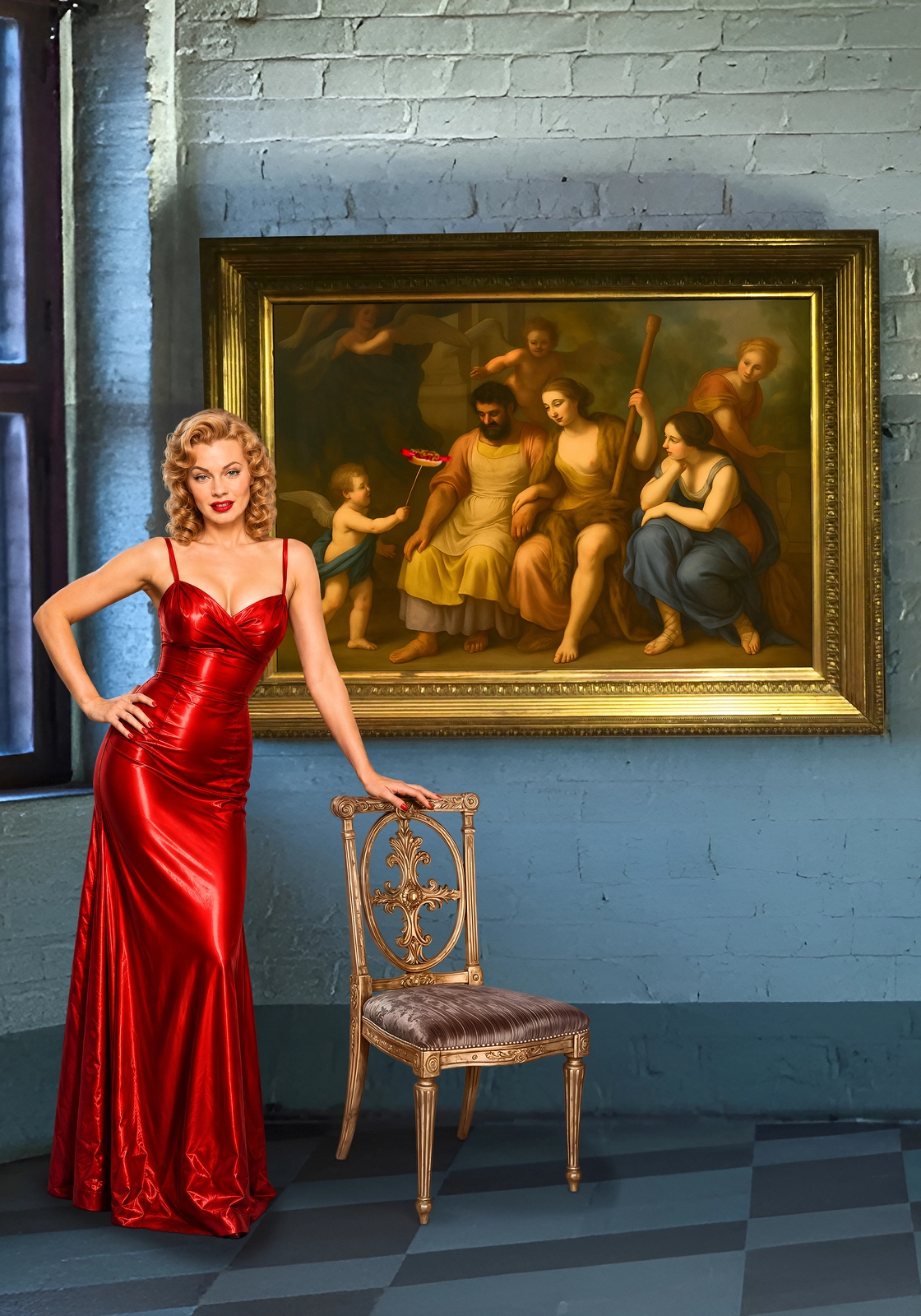
Anita taming the Titan - Anita tämjer Titanen, 2026
Digital
50 x 70 cm
3 200 kr
Anita taming the Titan - Anita tämjer Titanen
Svensk text på slutet
Introduction
How could the strongest man in the world be defeated by a spindle, an apron, and a smiling woman?
Generation after generation, Hercules has been celebrated as the embodiment of brute strength, heroism, and indomitable masculinity. He slew lions, conquered hydras, and completed the Twelve Labours that made him immortal. Yet it is not these legendary feats that reveal who he truly was. Instead, it is the remarkable story of Queen Omphalethe woman who did not defeat him with swords or armies, but by persuading him to lay aside his club and take up a spindle.
For more than two thousand years, this myth has captivated artists, philosophers, and historians alike. It is certainly a story about gender, power, and desire, but even more profoundly, it is about humanity's eternal search for balance. What happens when strength meets tenderness? When the one who has always ruled is compelled to serve? And why does this ancient tale, thousands of years old, feel so strikingly modern?
Taking Giovanni Francesco Romanelli's Baroque masterpiece and its playful reinterpretation as a point of departure, the pages that follow offer a journey through mythology, art history, symbolism, and psychology. It is the story of how the mightiest of heroes became the most profoundly human of them alland why Hercules may never have been more relevant than he is today. Perhaps some of the strongmen of our own agefrom Putin and Trump to many otherswould benefit from laying aside the club and, if only for a moment, taking up the spindle.
"The Thirteenth Labour
He wrestled lions, fought with flame,
Each beast and tyrant fell the same.
He cleaned the stables, killed the boar,
And carried courage shore to shore.
He caught the hind, the bull, the mare,
He dragged the hound from Hades lair.
He stole a belt, he fetched some fruit,
And skinned a serpent, tall and brute.
Twelve mighty labours all complete!
The world lay humbled at his feet.
The gods looked down, began to grin:
Now let the real work begin.
For heavens justice, strangely neat,
Is not to fight but to learn defeat.
He came to serve a queen instead,
And swapped his club for flax and thread.
His lions skin became her shawl,
His club an ornament on the wall.
The apron fit, the spindle spun
And this is how feminism began.
Now centuries have passed since then,
But myths recycle once again.
For strength, to last, must learn to bend
And heroes wash the floors in the end.
Malmö, July 2026
PROLOGUE The domestic labours of Hercules
Our age delights in rediscovering what it once dismissed. Myths reappear in modern dress; the dead return not as ghosts but as visitors from the imagination. During her journey from her star to her birthplace, Malmö, Anita Ekberg, a figure of influence, made a significant stop at Malmöhus, the best-preserved Renaissance castle in the Nordic countries, accompanied by her friend Marilyn Monroe. Their visit, a moment of profound significance in the annals of history and myth, was accompanied by a practical joke.
They often do that, these travellers between worlds return to fix something that had bothered them during their time on earth. After Anita's joke, the painting revealed the true image of Hercules fate, not the altered versions the artist was compelled to paint for various European courts, one of which had eventually ended up in Malmö.
Throughout the week, while Marilyn stayed with her lifelong friend, Anita, the work went unnoticed. Not even the curator in charge, a pivotal figure in this unfolding drama, noticed the change she likely had other things on her mind. If she had seen it, she might well have thought, as any perceptive woman would, that it was about time.
Before we follow the paintings curious journey, shrouded in the deepest mystery and intrigue, it might be fitting to recall the profound story behind it, a narrative that carries the weight of history and myth.
The Taming of the Titan
During her stay in the city of her childhood, Anita could not resist visiting Malmöhusthe best-preserved Renaissance castle in the Nordic countries. She was drawn there not only by its historical significance but also by a long-held ambition: to settle the score with the myth of Hercules. The object of her visit was Giovanni Romanelli's 1650 Baroque painting Hercules and Omphale. It exists in three nearly identical versions; the other two hang in the Hermitage in St. Petersburg and the Louvre in Paris.
The painting has long been a favourite among feminists. A small cherub offers Hercules a distaff wound with wool, the ultimate symbol in Antiquity and the Baroque era of traditional women's domestic work. While the humiliated Hercules spins the thread, Omphale has taken possession of his heavy wooden club and his beloved lion skin, demonstrating that their roles have been completely reversed.
Anita's intention, with one small addition, was to reveal the true image of Hercules' fate rather than the distorted versions the artist, for the sake of earning his living, had been forced to paint for various European courts, one of which eventually found its way to Malmö. During the week, Anita had been hosting her friend Marilyn Monroe.
Marilyn was another enthusiast for puncturing myths and exposing the symbolism surrounding pompous menthe sort Hollywood has always been full of. Anita brought Marilyn to Malmöhus Castle and its magnificent art collection. There was one painting in particular she wanted to show her: Hercules, the eternal role model for every egotistical man. Anita had long been planning a practical joke aimed at testosterone-fuelled blowhards of every age.
Marilyn loved the idea immediately. Her life had been dominated by Herculean personalities, one worse than the last, but the worst of them all was the film mogul LBMLouis B. Mayer. To desecrate Hercules was to spit in the face of every one of those men.
The painting hung there unnoticed, and by late afternoon the museum seemed almost empty. As Anita unpacked what she had prepared for her prank, the two friends joked about the men's testosterone-fuelled fantasy world. Anita stepped in front of Romanelli's painting and swept her hand towards the canvas.
Anita:
"So here we have my least favourite person of allHercules. 'The strongest man in the universe.' The guy who built a career of strangling lions, beating hydras, and holding up the heavens on his shoulders. Men have worshipped him for thousands of years as the ultimate symbol of masculine invulnerability, control, and civilisation's triumph over chaos. The patriarchy has used him as its ultimate proof that men were born to rule."
Marilyn: (Sighs theatrically, leans against a column, and adjusts her gloves.)
"Oh, darling, don't even start... I've met dozens of them at every studio party in Los Angeles. The type who think a big budget and a big studio make them demigods. They puff themselves up so much that the seams of their tuxedos are about to burst, but underneath they're terrified of failing."
Anita: (Chuckles and nods eagerly.)
"Exactly! But do you know what Hercules really is? He's the ultimate proof of how monumentally overrated men are when push comes to shove. You don't need a Hydra to bring this demigod down. All it takes is one clever woman. The moment Queen Omphale appeared, the whole castle in the air of masculinity collapsed. In the blink of an eye, she disarmed the myth. She snatched his boastful wooden club, draped his sacred lion skin over her own shoulders, and sat herself on the throne."
Marilyn: (Squints at the painting and smiles.)
"Just look at that expression... She knows exactly. That's precisely what I did with the studio bosses whenever they thought they could dictate my terms. I let them believe they owned the world, laughed at their dull jokes, and made sure the neckline of my dress was just a little more revealing. Before they knew it, I'd signed for twice the salary and complete control over my films. They never even noticed the club had changed hands."
Anita: (Points triumphantly at Hercules in the painting.)
"Exactly! Where does the strongest man in the world end up? On the floor, dressed in a housemaid's gown, with a spindle in his lap, concentrating with all his might not to tangle the wool. The man who could move mountains is sitting there doing women's work because he's utterly powerless against his own desires. Those enormous muscles don't help him one bit, because his willpower disappears the moment he gets horny."
Marilyn: (Covers her mouth and giggles.)
"A housemaid's gown! Poor little Herky. He reminds me of LBM, who tried to play the tough guy in his office, only to end up crying crocodile tears on his sex sofa after I went back to Fox. Men build empires of gold and steel, yet their knees start trembling at the scent of French perfume and a pair of blonde curls."
Anita: (Turns back toward the painting and points a finger at Hercules.)
"Omphale proves the point: masculine power is a physical, noisy, fragile façade. True strategic powerthe kind that governs minds, desire, and ultimately historyis feminine. It's the woman behind everything. Hercules probably thought he ruled the world, but the moment his trousers began to tighten, he gladly traded his life's work for a single glance from a woman who knew exactly which strings to pull. Quite literally."
Marilyn:
"Now tell us about the prank you're planning."
Anita: (Winks slyly.)
"It involves a Danish red hot dog."
Marilyn: (Surprised.)
"A hot dog! You must be joking."
Anita: (Dead serious.)
"I adore the Danish red hot dog. The very first thing I did when I stepped off the boat in Nyhavn as a young woman was to buy one. And a lemonadewhich is essential."
Marilyn: (Annoyed.)
"You'll have to forgive me, but Hercules strikes me as more of a rare, blood-red steak kind of fellow."
Anita: (Mischievously.)
"Normally, yesbut today he's having a hot dog." From her roomy handbag, Anita pulled out a narrow strip of fabric on which she had painted a Danish red sausage in a bun, generously topped with pickles, mustard, and ketchup.
Marilyn: (Amused.)
"I'm beginning to see where this is going. So he's going to eat a hot dog. Poor devil. First a spindle, then a housemaid's gown, and now a sausage."
Anita: (Triumphantly.)
"Now watch this!" The hot dog was attached to a long stick, and Anita used angel glue to fasten the strip over the spindle in the painting, so it looked as though the cherub were holding the stick. She carefully smoothed out every air bubble until the hot dog looked as though it had been painted there by the artist himself.
Marilyn: (Curiously.)
"That's the final nail in a hero's coffin. A hot dog on a stick for a steak-eating bodybuilder, served by a little gay boyfor all cherubs are choirboys, aren't they?"
Anita: (With malicious delight.)
"The painter knew exactly what he was doing. It wasn't a coincidence that a little gay boy was handing a spindle to such a macho man. Now he'll be handing him a hot dog instead. Sausage as sausage."
Marilyn: (Uneasily.)
"You're not damaging the painting, are you? It must be worth a fortune, surely. She missed Anita's pornographic humour.
Anita: (Grinning.)
"Don't worry. It's angel glue. You must have heard of it."
Marilyn: (Questioningly.)
"Actually, I haven't."
Anita: (Shakes her head.)
"It sticks so firmly that you can barely see the edges, but if you poke it gently, it releases immediately without leaving marks. It has something to do with microgravity. I don't know how it works, only that it does."
Marilyn: (Nods.)
"Good, because we have nothing against the museum. They're just doing their joband apparently that includes hanging powerful men on the walls."
Anita: (Meaningfully.)
"But not a woman in sight, so the hot dog is aimed at them as well. Before they realise how easy it is to remove the strip, the whole place will probably be in an uproar. A double kick, you might say."
The prank was such a success that it took several weeks before anyone raised the alarm. By then, the image had already spread across Facebook and other social media platforms. The comments revealed some remarkable misconceptions about eating habits in ancient Greece. Many questioned whether the ancient Greeks even ate sausagesbut they certainly did. Sausages were a popular, inexpensive way to use scraps of meat, blood, and offal left over from sacrifices or slaughter.
One of the principal characters in Aristophanes' comedy The Knights, written four centuries before the Common Era, is a sausage seller. He hawks hot sausages from a container hung around his neck to theatregoers in Athens. The sausages were almost certainly not red, however, because that colour came from the kermes insect, which lives on the kermes oak throughout the Mediterranean. Harvesting the insects was extraordinarily labour-intensive, and the dye was so expensive that red garments were reserved for royalty and wealthy nobles. Dyeing sausage casings that would be eaten was probably a luxury only King Midas himself could have afforded.
Marilyn: (Smiling.)
"You certainly know a lot about Greece. Have you ever filmed thereor was there a Greek among all your boyfriends?"
Anita: (Laughs.)
"No Greeks are hidden in my closet, and I never made a film in Greece either."
Marilyn: (Impatiently.)
"Well, you must have picked up all that knowledge somewhere."
Anita: (Chuckles and waves her hand dismissively.)
"WaitI just remembered! I did make a film once in which I was surrounded by nothing but Greek men trying to pin a murder on me."
Marilyn: (Her eyes widen with genuine delight.)
"Oh, do tell! Was it on a beautiful island? Did the men have those gorgeous dark eyes?"
Anita: (Smiles with a sigh.)
"Not in the least, darling. It was A porte chiuse - (Behind Closed Doors). The whole film was set in Greece, and all the old fellows playing police officers, judges, and prosecutors pretended to be proud Greeks. But do you know the funniest part? It was all make-believe! Every single one of them was an Italian actor. We filmed in Italy. The whole thing was a theatrical set."
Marilyn: (Bursts into sparkling laughter.)
"Typical Hollywoodor, in your case, Cinecittà! Men love dressing up as Greek philosophers and heroes. So you didn't learn anything about Greece there?"
Anita: (Seriously.)
"Actually, I did. They'd hired a Greek assistant director, Giorgio. His job was to ensure Italy didn't accidentally show through the scenery. He was gay, so we got along wonderfully. No wandering eyes down my neckline or cheesy comments. He was marvellous and told me a great deal about Greece."
Marilyn: (Grinning mischievously.)
"What a shame you missed out on having a Greek in your bed."
Anita: (Laughing.)
"Well, there are plenty of varieties I never tried, but he did treat me to sausage in his trailerand told me all about its history. The sausages of ancient Greece must have been delicious, as sausage has an unbroken tradition stretching back thousands of years. The one he served meloukanikois rarely eaten in a bun the way we do. He grilled it, sliced it into bite-sized pieces, and served it as a meze with a wedge of lemon squeezed over the top. We washed it down with ouzo and beer, so I ended up just a little tipsy."
The evening grew late, and they had become curious about that Hercules fellow and about how the male chauvinist was finally put in his place by Queen Omphale. With the invaluable help of the Internet, they soon Googled the whole story. There were many details. But what a story!
Monsters, rivers, and kings
In ancient myths, Hercules defeated monsters, rivers, and kings. Yet, his most humiliating labour was not among the Twelve, but the thirteenth when he became a woman's property. This thirteenth labour was a unique and transformative experience for Hercules, a test of his character and humility. Sold as punishment for his crimes, he found himself in the service of Queen Omphale of Lydia, spinning wool in her chambers and wearing womens clothes while she donned his lions skin and wielded his club. This was a moment that redefined Hercules, challenging his strength and resilience in a way that no other labour had.
Giovanni Francesco Romanellis 17th-century painting captures that moment of reversal strength softened by grace, masculinity tamed by desire. In this reimagined version, Hercules sits domesticated in a shimmering gown and apron, the very picture of reluctant servitude, while Omphale lounges half-naked beside him, wrapped in the lions pelt of conquest. The playful putti mock the fallen hero with a skewer topped by a red Danish sausage, a modern wink at the eternal comedy of pride undone by passion.
The myth is older than any temple and more relevant than any sermon: when power yields to love, even the titan must do the washing up.
The Tamed Titan
There are few myths as richly ironic as that of Hercules and Omphale the hero undone not by monsters or gods, but by a woman armed with nothing more than a spindle and a smile. After a lifetime of conquering lions, hydras, and mountains, the strongest man in the world finds himself spinning wool in a queens chamber, dressed in womens clothes and wearing an apron. It is, in every sense, the taming of the titan, a twist of fate that even the gods might find amusing. This unexpected turn in the myth adds a layer of irony and depth that resonates with the complexities of human experience.
In the reimagined Romanelli painting, The Domestic Labours of Hercules The Taming of the Titan, the reversal is complete. The mighty demigod sits in soft fabrics, half embarrassed, half resigned, while Omphale calm, amused, and radiant he wears his lions skin and casually rests his club across her lap. Around them, cherubs laugh; one even offers a red Danish sausage on a stick, a symbol as cheeky as it is profound. The red Danish sausage, a staple of Danish cuisine, is a playful nod to the painting's cultural context, adding a layer of humour to the scene. For what could be more human, more eternal, than the comedy of pride subdued by love?
The myth of Hercules and Omphale captures a paradox that echoes with modern times: the hero who conquers the world, yet loses himself at home. Hercules submission is not just punishment; it signifies a profound transformation. The rough edges of heroism are softened through intimacy and the domestic sphere, which men of power often overlook. The demigod becomes a husband, a servant, perhaps even a feminist though an unwilling one. His club, once a weapon, turns into a household utensil. His lions skin, once a trophy, becomes his mistresss shawl, marking a profound shift in his identity and power.
In this way, the myth of Hercules and Omphale serves as an early allegory of gender and power, as well as of the eternal theatre of attractiona play in which strength bows before beauty, and the laughter of the gods reflects that of the audience. The 'eternal theatre of attraction' refers to the enduring dynamics of power and desire, where strength and beauty, masculinity and femininity, engage in a perpetual dance of dominance and submission. These themes, as old as time, continue to resonate in our modern world, making the myth a timeless reflection of human nature.
The Myth as Humiliation and Atonement
In the mythic cycle of Hercules, one of the most subversive and revealing episodes is his unexpected servitude to Queen Omphale. After a fit of rage that led to the killing of Iphitus, Hercules is not condemned to battle a new monster, but to submit to a woman. The mightiest man alive becomes the possession of a foreign queen, stripped of his weapons, his fame, and his masculine armour. What began as a form of atonement turns into a profound transformationa metamorphosis that uncovers the deeper layers of his humiliation.
In Lydia, Omphale orders Hercules to swap his lions skin for silk, his club for a distaff. He sits, spinning wool among her attendants, his once-heroic figure now bent to domestic work. The symbolism is ruthless: masculinity reduced to subservience, the conqueror defeated by embroidery. The Greeks loved these reversals stories in which arrogance is humbled, strength is ridiculed, and desire proves more potent than any god.
Yet there is more to the story than ridicule. The ancients recognised that the boundary between power and surrender, masculinity and femininity, is permeable. This boundary is significant because it reminds us that even divine strength must submit to order, to balance, to Eros. Here, 'Eros' represents not just romantic love, but the cosmic force that governs the balance of power and desire. Omphales dominance is therefore not merely erotic; it is cosmological. She restores equilibrium to a world thrown off by Hercules excess.
Still, the irony remains undeniable: the mightiest of heroes, confined in the oldest of prisons the household. The myth becomes a mirror, reflecting both punishment and parody. It is an early reflection on the fragility of male heroism, on how easily virtue can descend into vanity, and on how the hand that once wielded a club may one day hold a broom. This fragility of male heroism is a central theme in the myth, revealing the ease with which virtue can be corrupted and the narrative's complex layers.
From Phallus to Spindle The Shift of Symbolism
Very few myths present a symbolic reversal as elegantly as the story of Hercules and Omphale. The hero who once wielded a club, the epitome of masculine power, now holds a spindle, a quiet instrument of domestic labour. This transformation is not just a moral shift, but a profound change in symbolism: the club, a symbol of strength, is replaced by the spindle, a symbol of continuity. The cosmic axis of male potency has been replaced by the humble rhythm of spinning a metaphor as old as civilisation itself.
In antiquity, the club was both weapon and symbol a compressed tree, a relic of wild nature tamed to serve human will. To wield it was to extend the arm of domination. The spindle, by contrast, belongs to the private sphere: the seated body, the repetitive gesture, the creation of fabric rather than the destruction of beasts. In this mythic act of exchange club for spindle the Greeks encoded a complete inversion of gendered meaning: violence replaced by continuity, conquest by craft.
What Romanelli depicts, whether intentionally or not, is a political allegory disguised as a love story. The hero's virtue, his very core of manly excellence, is replaced by industria the diligence, patience, and continuity linked to the feminine principle. Omphale does not emasculate Hercules; she redefines his strength. Her dominion is not over his body, but over his narrative. She becomes the creator of his new role, a role that challenges traditional notions of heroism and power.
This symbolic shift resonates well beyond the myth itself. The club and the spindle appear consistently throughout Western iconography: sceptre and distaff, sword and thread, power and care. The moral embedded in the myth is not just a lesson for the ancients, but a timeless truth: that civilisation progresses not only through force but also through craftsmanship. The spindle is the quiet counterpart to the club less dramatic, yet infinitely more enduring, inspiring us with the enduring lessons of the past.
Hercules humiliation thus marks a more profound realisation: that creation demands surrender, and that even the tools of power must eventually submit to the softer logic of the loom. This profound realisation invites us to introspect on the nature of power and creation.
Romanelli and the Baroque Balance of Power
When Giovanni Francesco Romanelli painted Hercules and Omphale in mid-seventeenth-century Rome, he was not merely illustrating a myth; he was translating an ancient irony into the visual language of the Baroque. A pupil of Pietro da Cortona, Romanelli inherited the Roman taste for grandeur and moral allegoryscenes that mesmerised the eye while subtly instructing the soul. His canvases shimmer with satin, pearl, and flesh; yet behind the splendour lies the same enduring lesson: even strength must kneel before beauty, and even virtue can be tempted to remain human.
In Hercules and Omphale, the exchange of garments becomes theatrical. Draperies billow, the air is golden, and the composition moves along diagonals a dance of submission and control. Romanellis Hercules, stripped of his leonine grandeur, sits uncomfortably in silken folds; Omphale, radiant and half-naked, wears his lions skin like a victory cloak. The club, once a phallic symbol of conquest, rests easily in her hand, now more an ornament than a weapon. Around them, playful putti flutter as commentators of fate, their laughter bridging the sacred and the profane.
This is Baroque psychology at its most refined. Romanelli understood that the moral core of the myth Eros conquers Virtue could be made palatable through splendour. His world was one where power and piety coexisted in sensual tension, and where every canvas was both confession and masquerade. The male hero, softened by colour and light, becomes a study in vulnerability; the woman, crowned with grace, becomes the embodiment of composure and wit.
What might have been moral satire in antiquity becomes, in Romanellis interpretation, an exploration of the balance between genders, forces, and forms. The painting does not mock Hercules; it redeems him through beauty. His surrender becomes aesthetically justified, even desirable. Because in the Baroque imagination, to yield was not necessarily to lose it was to participate in the divine choreography of contrast, where shadow gives meaning to light, and submission becomes another form of splendour.
From Omphale to the Home Trap Modern Reflections on Power and Gender
Suppose Omphales boudoir was the ancient prototype of the domestic sphere. In that case, Hercules servitude marks the start of an eternal drama one that still unfolds in kitchens, offices, and bedrooms today. The myth, set in Lydia, transcends time, resonating across every era in which gender, labour, and love intertwine. What begins as punishment for violence ends as a parody of power; what seems like humiliation becomes a mirror held up to modern life, reflecting our shared experiences across centuries. This enduring relevance of the myth connects us to a timeless narrative, reminding us that the struggles of power and gender are not unique to our era.
The 'home trap' a term I use to describe the invisible structure of societal expectations that ensnare both men and women in different ways. Omphales dominion, once seen as scandalous, now manifests as self-control: a woman who leads not by command but by her presence. Hercules, meanwhile, exemplifies the modern mans double bind: condemned to be both strong and sensitive, assertive yet domesticated. His apron is no longer a symbol of shame, but of adaptation. Yet beneath the fabric of equality, the same tensions persist between desire and duty, between emancipation and performance.
Our contemporary culture continues to revisit the myth in endless variations. Advertising frames it as irony: the empowered woman in a tailored suit, the man changing nappies with calm ease. Sitcoms recycle it as domestic comedy: the husband clumsily doing housework, the wife wielding competence like a sceptre. Social media transforms it into theatre curated glimpses of mutual exhaustion and performative equilibrium. Everywhere, the old script persists: the genders swap costumes, but the play stays the same.
Viewed through this perspective, Romanellis painting seems prophetic. The heroines composed authority, the heros tentative stance, and the laughter of the putti all illustrate the paradox of modern partnership. Omphale is not a tyrant; she exemplifies the multitasking modern woman. Hercules is not emasculated; he is slow to realise what women have known all along: that power resides not in domination, but in endurance.
Ultimately, the domestic labours of Hercules are ours the unending negotiations of pride, affection, and equality that shape intimacy itself. And just as in the myth, humour remains essential. Without laughter, no one can endure the housework of love.
Love, Power, and the Philosophy of Laughter
Laughter has always been the most civilised way to cope with power. The myth of Hercules and Omphale, told and retold for millennia, is not solely about dominance and desire it is about how the gods themselves learned to laugh at the spectacle of human vanity. The Greeks, who viewed tragedy as sacred, also recognised that comedy was its necessary counterpart: the release that comes with recognition. When the strongest man in the world wears a dress, the world does not end; it becomes understandable again. This profound insight into the role of laughter in understanding power elevates the myth to a new level.
Laughter restores perspective. In Romanellis version, the cherubs giggles are not cruelty but healing a reminder that even divinity requires humility. Hercules, bound by his apron and stripped of his heroism, becomes relatable precisely because he is ridiculous. It is through embarrassment that he re-engages with the human community. The same principle applies to love: it disarms the self-important, reveals the pretentious, and compels the powerful to see themselves as others do.
In every epoch, this laughter has borne moral significance. The medieval sculptor chiselling obscene figures in cathedral corners understood this; so did Molière, Shakespeare, and todays cartoonists. Humour is the secular form of grace it elevates us without condemning. The hero's fall is not the end of virtue but its renewal through irony.
To laugh at Hercules is not to mock him; it is to join him in the shared absurdity of being human. His humiliation becomes universal, his servitude allegorical. We recognise ourselves in his defeat, for we too oscillate between grandeur and clumsiness, between mythic aspiration and domestic fatigue. Loves comedy, a term I use to describe the humorous aspects of love and relationships, is thus not a betrayal of tragedy but its antidote the sound of the soul exhaling after too much seriousness. This stress on love's comedy as an antidote to seriousness offers a sense of relief, reminding us that even in the most serious situations, laughter can provide a much-needed break.
In this context, The Domestic Labours of Hercules The Taming of the Titan is not only a satire on gender or heroism but also a reflection on balance itself. Power cannot endure without irony, and love cannot survive without play. The smile of Omphale and the laughter of the putti uphold that truth through the ages: that strength redeemed by laughter is the only kind worth maintaining.
Conclusion The Eternal Balance
Ultimately, Hercules story is more about perspective than punishment. What starts as a myth of humiliation turns into an allegory of harmony the ongoing balance between power and tenderness, will and yielding, conquest and care. The ancient Greeks may have laughed first, but their laughter was wise: even the gods needed to find balance. To fall, to serve, to be tamed these were not only comic moments but also lessons in humility. This profound reflection on balance in the myth brings a new level of understanding to the narrative.
Romanellis luminous vision, revived in his private painting The Domestic Labours of Hercules The Taming of the Titan, captures that balance with mischievous grace. This painting depicts the moment when Hercules, stripped of his heroism, is tamed by Omphale, who, beneath the lions skin, holds the club of authority with effortless grace. The putti mock but also mediate their laughter bridging the gap between satire and sympathy. Everything in the composition resonates with the same paradox: beauty born of imbalance, dignity rescued through play.
And so the myth comes back to us not as a relic of the past but as a reflection. We still live in the rhythm of Hercules and Omphale: strength seeking tenderness, love testing pride, irony dissolving fear. Every partnership, every negotiation of gender and power, mimics its dance on a small scale. What once was punishment has become a pattern; what was humiliation is now recognition.
Maybe that's why this story refuses to fade. It isn't about the end of heroism, but its change from the roar of lions to the whisper of household chores, from the club to the spindle, from conquest to coexistence. The titan isn't destroyed; he is educated. And Omphale, far from being his ruin, is his completion the one who transforms brute force into balance, and balance into art.
In that sense, Hercules final labour was not his thirteenth but his first human one: to laugh, to love, and to learn that even titans must take their turn at the washing-up.
Epilogue The Timeless Relevance of Hercules
Every age reshapes its gods, and each generation rewrites its myths. In ours, heroes have swapped their lions for laundry, their swords for smartphones. Yet, the enduring relevance of Hercules in the modern world is not just a historical curiosity, but a living presence in our shared spaces of modern life-the kitchen, the office, the screen. The conflict between strength and sensitivity, pride and tenderness, action and reflection, once played out in Omphale's palace, now unfolds in our daily interactions.
Romanellis myth, reimagined through humour and compassion, reflects a civilisation weary of superficial power. We no longer chase the club's triumph, but seek the balance of the heart. The apron has become as symbolic as the lions skin: not a sign of defeat, but a new uniform for the domesticated hero.
Art, like myth, thrives on contradiction. In The Domestic Labour of Hercules The Taming of the Titan, the cherubs' laughter becomes our own: affectionate, knowing, slightly guilty. We recognise the absurdity of human roles and their necessity. To be humbled is not to be humiliated, but to be reminded of scale; to serve is not to surrender, but to participate in the comedy of connection.
That is why Hercules still matters. He reminds us that heroism need not roar; it can whisper, sweep the floor, or laugh at itself. In a world still obsessed with power, this ancient farce remains an act of quiet resistance. It's a testament to the fact that even the mightiest among us, like Hercules, must eventually learn the art of grace, transforming from a symbol of power to a figure of grace.
Appendix The Four Faces of Hercules
Even the strongest must learn to yield. after Ovid.
To understand Hercules is to confront a paradox: the strongest of men, defeated by the gentlest of gestures. Beneath the myth's armour, he is not a single figure but a composite being romantic, erotic, maternal, and human all at once. His encounter with Omphale is not merely an episode of punishment; it reveals complexity, a moment when strength turns inward and becomes self-aware. This paradoxical nature of Hercules's character is what makes him so intriguing and relatable.
The Romantic Titan
Behind his lions skin beats the heart of a clumsy lover. Hercules conquests were never solely physical; they were also quests for belonging. The heroic body conceals an emotional orphanage a longing to be seen without being feared. In Omphales chamber, amid laughter and silk, he experiences something the battlefield never offered: stillness. His romance is not sentimental but existential the realisation that intimacy, not victory, gives him form.
The Erotic Beast
Yet he is also driven by raw desire. Ancient poets did not hide their lust; he personifies unrestrained virility. His service to Omphale is therefore a ritual of restraint Eros learning decorum. In her presence, the sheer kinetic energy of desire is folded back upon itself, domesticated, refined into play. The apron becomes an ironic chastity belt, and the spindle a symbol of erotic discipline. Lust, redirected, becomes education.
The Inverted Mother
When Hercules spins wool, he enters the feminine cosmos of creation. For the first time, his labour sustains rather than destroys. The act of spinning is maternal, cyclical, nurturing a radical inversion of his usual violence. In that quiet, repetitive gesture, he becomes a midwife to his own humility. This is Hercules as the nurturer of balance, the reluctant participant in a sacred paradox: the male force learning to give rather than to take.
The Human Paradox
Ultimately, Hercules's survival is a testament to the power of transformation. He is both the beast and the philosopher, the lover and the labourer, the victim and the volunteer. His humiliation under Omphale is not degradation but metamorphosis the price of becoming conscious. To serve, to blush, to be ridiculous: these are the rites of passage from heroism to humanity. His journey from power to humility is a source of inspiration or warning for us all.
In the laughter of the putti and the tenderness of Omphales gaze, we glimpse the truth of this transformation. Hercules is no longer the instrument of divine command but the subject of human comedy a creature caught between lust and love, power and vulnerability, myth and mirror.
Hercules remains, eternally, what most powerful men are behind closed doors: a tamed titan seeking grace in the aftermath of strength.
Anita tämjer Titanen
Inledning
Hur kunde världens starkaste man besegras av en slända, ett förkläde och en kvinna som log?
I generation efter generation har Herkules hyllats som sinnebilden för råstyrka, hjältemod och manlig okuvlighet. Han dödade lejon, besegrade hydror och utförde de tolv stordåd som gjorde honom odödlig. Ändå är det inte dessa bragder som avslöjar vem han egentligen var. Det gör i stället den märkliga berättelsen om drottning Omfale kvinnan som inte besegrade honom med svärd eller arméer, utan genom att få honom att lägga undan klubban och ta upp sländan.
Det är en myt som i över två tusen år har fascinerat konstnärer, filosofer och historiker. Den handlar visserligen om kön, makt och begär, men ännu mer om människans eviga behov av balans. Vad händer när styrka möter ömhet? När den som alltid har dominerat tvingas tjäna? Och varför känns den här flera tusen år gamla berättelsen märkligt modern?
Med utgångspunkt i Giovanni Francesco Romanellis barockmålning och dess lekfulla nytolkning följer här en resa genom mytologi, konsthistoria, symbolik och psykologi. Det är en berättelse om hur den mäktigaste av hjältarna blev den mest mänskliga av dem alla och om varför Herkules kanske aldrig har varit mer relevant än i vår egen tid. Kanske skulle några av vår tids potentater från Putin till Trump och många andra må bra av att lägga klubban åt sidan och för en stund ta upp sländan.
PROLOG Herkules hushållsarbete
Vår tid älskar att återupptäcka det som en gång avfärdades. Myter återvänder i modern skepnad och de döda kommer tillbaka inte som spöken, utan som gäster ur fantasin. Under sin resa från sin stjärna tillbaka till födelsestaden Malmö gjorde Anita Ekberg, en kvinna med genomslagskraft, ett betydelsefullt uppehåll på Malmöhus, Nordens bäst bevarade renässansslott, tillsammans med sin vän Marilyn Monroe. Deras besök, ett ögonblick där historia och myt möttes, åtföljdes av ett practical joke.
Det gör de ofta, dessa tidsresenärer de återvänder för att rätta till sådant som hade stört dem under livet på jorden. Efter Anitas skämt visade målningen äntligen den sanna bilden av Herkules öde, i stället för de tillrättalagda versionerna som konstnären tvingades måla åt olika europeiska hov, varav en till slut hamnade i Malmö.
Under veckan, medan Marilyn bodde hos sin livslånga vän Anita, gick förändringen obemärkt förbi. Inte ens den ansvariga intendenten, en central gestalt i den här berättelsen, lade märke till vad som hade hänt hon hade sannolikt annat att tänka på. Om hon hade upptäckt sprattet skulle hon möjligen ha tänkt, som varje skarpsynt kvinna, att det var på tiden.
Men innan vi följer målningens märkliga resa, höljd i det djupaste mysterium och intriger, kan det vara på sin plats att påminna om den fascinerande berättelsen bakom den en historia där myt och verklighet flyter samman.
Hur Titanen kuvades
Under sin vistelse i barndomens Malmö kunde Anita inte motstå att besöka Malmöhus det bäst bevarade renässansslottet i de nordiska länderna. Hon drogs till denna plats inte bara för dess historiska betydelse, utan också för att förverkliga en dröm: att göra upp med herkulesmyten. Målet för besöket var Giovanni Romanellis barockmålning Herkules och Omfale från 1650. Den finns i tre nästan identiska versioner; de andra två hänger i Eremitaget i Sankt Petersburg och i Louvren i Paris.
Målningen är alla feministers älskling. Den lilla keruben räcker över en slända med ull eller spinnrockstråd till Herkules. Sländan var under antiken och barocken den ultimata symbolen för traditionellt kvinnligt hemarbete. Medan den förödmjukade Herkules spinner garnet, har Omfale tagit över hans tunga träklubba och älskade lejonhud för att visa hur rollerna helt har bytts ut.
Anitas avsikt var att genom en mindre komplettering avslöja den faktiska bilden av Herkules öde, inte dessa förvanskade versioner som konstnären för brödfödans skull tvingades skapa för olika europeiska hov, varav en hamnade i Malmö. Under veckan hade Anita haft sin väninna Marilyn Monroe på besök.
Hon var en annan entusiast av att sticka hål på myter och symbolik om uppblåsta män, den sorten som Hollywood är full av. Anita tog med Marilyn till Malmöhus slott med sin stora konstsamling. En tavla ville hon särskilt visa upp: Herkules, alla egotrippade mäns förebild. Anita hade länge planerat ett practical joke riktat mot alla tiders testosteronballonger.
Marilyn älskade idéen direkt. Hennes liv hade också dominerats av herkulestyper, den ena värre än den andra, men värst av alla: filmmogulen LBM Louis B. Mayer. Att skända Herkules var att spotta alla dessa män rakt i ansiktet.
Konstverket hängde obemärkt, och så sent på eftermiddagen verkade museet tomt på besökare. Medan Anita plockade upp det hon förberett för sitt spratt skämtade väninnorna om männens testosteronstinna låtsasvärld. Anita ställde sig framför Romanellis målning och slog ut med handen mot duken.
Anita:
"Här har vi alltså mitt hatobjekt, Herkules. 'Den starkaste mannen i universum.' Killen som gjorde karriär på att strypa lejon, spöa hydror och bära upp himlavalvet på sina axlar. Männen har dyrkat honom i årtusenden som den ultimata symbolen för maskulin osårbarhet, kontroll och civilisationens seger över kaoset. Patriarkatet har använt honom som sitt främsta kvitto på att mannen är född för att härska."
Marilyn:
(Suckar teatraliskt, lutar sig mot en pelare och rättar till sina handskar)
"Åh, älskling, berätta inte... Jag har träffat dussintals av dem på varenda studiofest i Los Angeles. Typen som tror att en stor budget och en stor studio gör dem till halvgudar. De spänner sig så mycket att sömmarna i smokingen spricker, men under ytan är de livrädda för att misslyckas.
Anita:
(Skrattar till och nickar ivrigt)
"Precis! Men vet ni vad Herkules egentligen är? Han är det absoluta beviset på hur monumentalt överskattad mannen är när det väl kommer till kritan. Det krävs ingen Hydra för att sänka den här halvguden. Det krävs bara en smart kvinna. Så fort drottning Omfale dök upp kollapsade det maskulina luftslottet. På noll sekunder avväpnade hon myten. Hon snodde hans skrytiga träklubba, kastade hans heliga lejonhud över sina egna axlar och satte sig på tronen."
Marilyn: (kisar mot tavlan och ler)
"Titta bara på hennes blick... Hon vet precis. Det är exakt så jag gjorde med studiocheferna när de trodde att de kunde diktera mina villkor. Jag lät dem tro att de ägde världen; skrattade åt deras tråkiga skämt och såg till att klyftan i urringningen blev större. Innan de vet ordet av har man skrivit på för dubbla gaget och kontroll över sina egna filmer. De märker inte ens att klubban har bytt ägare."
Anita:
(Pekar triumferande på Herkules gestalt på duken)
"Exakt! Och var hamnar världens starkaste man? På golvet. Klädd i en städrock, med en slända i knät, djupt koncentrerad på att inte trassla ullen. Mannen som kunde flytta berg sitter och gör fruntimmersgöra för att han är så fullständigt maktlös inför sina egna drifter. Hans enorma muskler hjälper honom inte för fem öre, eftersom hans viljestyrka är obefintlig så fort han blir kåt."
Marilyn:
(Sätter handen för munnen och fnissar)
"En städrock! Stackars lilla Herkis. Han liknar LBM när han försökte spela tuff på sitt kontor, men det slutade med att han grät krokodiltårar i sin knullsoffa för att jag gick tillbaka till Fox. Män bygger imperier av guld och stål, men de blir alldeles darriga i knäna av en doft av fransk parfym och blonda lockar."
Anita:
(Vänder sig om mot tavlan och pekar finger mot Herkules)
"Omfale bevisar hela grejen: maskulin makt är en fysisk, högljudd och skör kuliss. Den sanna, strategiska makten den som styr sinnena, begäret och i förlängningen historien är feminin. Det är kvinnan bakom allt. Herkules trodde säkert att han var herre på täppan, men så fort det bultade i byxorna bytte han gladeligen bort sitt livsverk mot en blick från en kvinna som visste exakt hur man drar i trådarna. Bokstavligt talat."
Marilyn:
"Berätta nu om sprattet du tänker utföra.
Anita:
(Blinkar slugt med ena ögat)
"Det har med röd korv att göra.
Marilyn:
(Förvånad)
"Korv! Du måste skämta.
Anita:
(Gravallvarligt)
"Jag älskar den danska röda korven. Det första jag gjorde när jag steg av båten i Nyhavn i Köpenhamn som ung var att köpa en korv. Och citronvatten, som är ett måste.
Marilyn:
(Irriterat)
"Du får ursäkta, men Herkules låter för mig mer som stadiga blodröda biffar
Anita:
(Illmarigt)
"Visst är det så, men nu ska han få korv. Ur sin rymliga handväska plockar Anita upp en tunn tygremsa där hon målat en dansk röd pölse med bröd och rikligt med gurka, senap och ketchup.
Marilyn:
(Roat)
"Jag börjar ana. Han skall alltså käka korv. Stackars sate. Slända, städrock och nu en korv.
Anita:
(Triumfatoriskt)
"Nu skall du få se! Korven satt på en lång pinne, och remsan klistrade Anita med änglalim ovanpå tavlans slända så att det såg ut som att keruben höll i pinnen. Hon slätade ut luftbubblorna så att det såg ut som om korven hade målats av konstnären själv.
Marilyn:
(Frågande)
"Det där är sista spiken i en hjältes kista. En korv på en pinne till en biffätande bodybuilder serverad av en liten bög, för alla keruber är väl stjärtgossar, eller hur?
Anita:
(Skadeglatt)
"Det visste konstnären. Det var ingen tillfällighet att en liten bög räckte sländan till en karlakarl. Nu får han korv i stället. Korv som korv.
Marilyn:
(Oroligt)
"Du förstör väl inte tavlan? Den måste kosta massor. Hon missade Anitas porriga lustighet.
Anita:
(Illmarigt)
"Oroa dig inte. Det är änglalim. Det känner du väl till.
Marilyn:
(Frågande)
"Faktiskt inte.
Anita:
(Skakar på huvudet)
"Det fäster så att man knappt ser kanterna, men petar man försiktigt släpper det direkt utan att lämna märken. Det har något att göra med mikrogravitation. Jag vet faktiskt inte hur det funkar, bara att det gör det.
Marilyn:
(Nickar)
"Fantastiskt, för vi har ju inget otalt med muséet. De gör bara sina grejer och i det ingår att hänga upp potentater på väggarna.
Anita:
(Menande)
Men inte en kvinna så långt ögat når, så lite är korven riktad mot dem också. Innan de kommer underfund med hur enkelt det är att plocka bort remsan går säkert hela bygget i vågor. En dubbelspark alltså.
Skämtet var så lyckat att det tog flera veckor innan någon slog larm. Då låg bilden redan ute på Facebook och andra sociala medier. Kommentarerna avslöjade stora brister i folks uppfattning om matvanor i antikens Grekland. Många ifrågasatte om de gamla grekerna åt korv, men visst gjorde de det. Korven var ett populärt och billigt sätt att ta till vara på köttslamsor, blod och inälvor efter djuroffer eller slakt.
Exempelvis är en korvhandlare en av huvudkaraktärerna i Aristofanes komedi "Riddarna", skriven fyra sekler före vår tideräkning. Han säljer varma korvar från en behållare som han bär runt halsen till teaterbesökarna i Aten. Korvarna var sannolikt inte röda eftersom den röda färgen kommer från kermeslusen som lever på kermesekarna runt Medelhavet. Att samla in dem var extremt tidskrävande och färgen var så dyr att röda kläder bara bars av kungligheter och rika adelsmän. Att färga korvskinn som sedan åts upp kunde förmodligen bara kung Midas kosta på sig.
Marilyn:
(Leende)
"Vad mycket du kan om Grekland. Har du filmat där eller haft en grek bland alla dina pojkvänner?
Anita:
(Skrattar)
"Inga greker gömda i garderoben, och jag har heller inte spelat in någon film i Grekland.
Marilyn:
(Otåligt
"Någonstans måste du väl ha fiskat upp kunskaperna.
Anita:
(Skrockar och viftar avmätt med handen)
"Vänta, nu minns jag! Jag spelade faktiskt in en film en gång där jag var omgiven av idel grekiska män som försökte sätta dit mig för mord."
Marilyn:
(Spärrar upp ögonen, genuint road)
"Åh, berätta! Var det på någon vacker ö? Hade männen där härliga, mörka ögon?"
Anita:
(Suckar leende)
"Inte det minsta, raring. Det var i A porte chiuse. Hela filmen skulle föreställa Grekland, och gubbarna som spelade poliser, domare och åklagare låtsades vara stolta greker. Men vet du vad det bästa var? Det var en ren låtsasvärld! Hela bunten var italienska skådespelare. Vi filmade i Italien. Allt var en teaterkuliss."
Marilyn:
(Brister ut i ett pärlande skratt)
"Typiskt Hollywood eller i ditt fall, Cinecittà! Män älskar att klä ut sig till grekiska filosofer och hjältar. Så där lärde du dig inget om Grekland?
Anita:
(Seriöst)
"Jo, faktiskt, för de hade hyrt in en grek som inspicient, Giorgio. Han skulle se till att Italien inte lyste fram i kulisserna. Han var homosexuell, så vi kom bra överens. Inga ögon i urringningen eller flasiga kommentarer. Han var toppen och berättade mycket om Grekland.
Marilyn:
(Stort snuskleende)
"Vad trist att du missade grek i sängen.
Anita:
(Skrattande)
Du, det finns många sorter jag inte har testat, men korv bjöd han på i sin husvagn. Och berättade om historien bakom. Antikens korvar måste ha smakat gott, för korven har en obruten mångtusenårig tradition i Grekland. Korven han bjöd på, Loukaniko, serveras sällan i ett korvbröd som vi gör. Han grillade den, skar i slantar och serverade som en smårätt, med en klyfta citron pressad över. Vi sköljde ner korven med ouzo och öl, så jag blev lite på pickalurven.
Kvällen blev sen, och de hade blivit nyfikna på den där Herkules och på hur mansgrisen sattes på plats av drottning Omfale. Med hjälp av det förträffliga internetet googlade de fram hela historien. Det var många detaljer. Men vilken historia!
Yyy
Monster, floder och kungar
I de antika myterna besegrade Herkules monster, floder och kungar. Ändå var hans mest förödmjukande stordåd inte ett av de tolv, utan det trettonde när han blev en kvinnas egendom. Detta trettonde arbete blev en unik och omvälvande erfarenhet för Herkules, en prövning av hans karaktär och ödmjukhet. Som straff för sina brott såldes han till drottning Omfale av Lydien, där han fick spinna ull i hennes gemak och bära kvinnokläder, medan hon svepte in sig i hans lejonskinn och svingade hans klubba. Det var ett ögonblick som omdefinierade Herkules och prövade hans styrka och motståndskraft på ett sätt som inget annat stordåd hade gjort.
Giovanni Francesco Romanellis målning från 1600-talet fångar just denna omkastning styrka mjukad av elegans, maskulinitet tämjd av begär. I denna nytolkade version sitter Herkules förvandlad till en foglig tjänare i en skimrande klänning och ett förkläde, själva sinnebilden av motvillig underkastelse, medan Omfale halvligger bredvid honom, halvnaken och svept i erövringens lejonskinn. En av de lekfulla keruberna driver med den fallne hjälten genom att räcka fram ett grillspett krönt med en dansk röd korv en modern blinkning till den eviga komedin om hur stolthet besegras av passion.
Myten är äldre än något tempel och mer relevant än någon predikan: när makten ger vika för kärleken måste till och med titanen diska.
Den tämjda titanen
Få myter är så rikt ironiska som berättelsen om Herkules och Omfale hjälten som inte besegras av monster eller gudar, utan av en kvinna beväpnad med ingenting annat än en slända och ett leende. Efter ett liv av att ha besegrat lejon, hydror och berg, finner sig världens starkaste man sittande i en drottnings gemak, där han spinner ull, bär kvinnokläder och förkläde. Det är i ordets fulla bemärkelse en titan som tämjs, en ödets nyckel som till och med gudarna måste ha roats av. Den oväntade vändningen ger myten en ironi och ett djup som fortfarande speglar människans egen komplexitet.
I den omtolkade Romanelli-målningen The Domestic Labours of Hercules The Taming of the Titan är rollbytet fulländat. Den mäktiga halvguden sitter klädd i mjuka tyger, till hälften generad och till hälften resignerad, medan Omfale lugn, road och strålande bär hans lejonskinn och låter hans klubba vila nonchalant över sitt knä. Runt dem skrattar keruberna, och en av dem räcker till och med fram en dansk röd korv på en pinne en symbol som är lika fräck som den är tankeväckande. Den danska röda korven, en ikon inom dansk matkultur, blir en lekfull blinkning till målningens moderna sammanhang och tillför scenen ytterligare ett lager humor. För vad kan vara mer mänskligt, mer tidlöst än komedin där stolthet kuvats av kärleken?
Myten om Herkules och Omfale fångar en paradox som ekar ända in i vår egen tid: hjälten som erövrar världen men förlorar sig själv där hemma. Herkules underkastelse är inte bara ett straff; den är en djupgående förvandling. Hjältemodets hårda kanter slipas ned genom närhet och det vardagliga hemmet den sfär som maktens män så ofta har förbisett. Halvguden blir make, tjänare, kanske till och med feminist om än motvilligt. Hans klubba, en gång ett vapen, blir ett redskap i hushållet. Hans lejonskinn, en gång en trofé, blir hans härskarinnas sjal och markerar en genomgripande förändring av hans identitet och makt.
På detta sätt fungerar myten om Herkules och Omfale som en tidig allegori över kön och makt, men också över attraktionens eviga teater ett skådespel där styrkan böjer sig för skönheten och gudarnas skratt speglar publiken. Denna "attraktionens eviga teater" syftar på den ständigt återkommande dynamiken mellan makt och begär, där styrka och skönhet, manlighet och kvinnlighet, ständigt dansar mellan dominans och underkastelse. Dessa teman är lika gamla som civilisationen själv och fortsätter att göra myten till en tidlös spegel av människans natur.
Myten som förödmjukelse och botgöring
Bland Herkules storverk är ett av de mest omvälvande och avslöjande avsnitten hans oväntade tjänst hos drottning Omfale. Efter ett raseriutbrott som ledde till mordet på Iphitos döms Herkules inte att bekämpa ännu ett monster, utan att underkasta sig en kvinna. Den mäktigaste mannen i världen blir en främmande drottnings egendom, berövad sina vapen, sitt rykte och sin manliga rustning. Det som börjar som en botgöring utvecklas till en djupgående förvandling en metamorfos som blottlägger de djupaste lagren av hans förödmjukelse.
I Lydien befaller Omfale Herkules att byta ut sitt lejonskinn mot siden och sin klubba mot en slända. Han sitter bland hennes hovdamer och spinner ull medan hans en gång så heroiska gestalt böjs över hushållsarbete. Symboliken är skoningslös: maskuliniteten reduceras till underkastelse och erövraren besegras av handarbete. Grekerna älskade sådana tvära kast berättelser där högmod förödmjukas, styrka förlöjligas och begäret visar sig vara mäktigare än någon gud.
Men berättelsen handlar om mer än bara förlöjligande. Antikens människor förstod att gränsen mellan makt och underkastelse, mellan maskulinitet och femininitet, är genomtränglig. Den påminner oss om att även gudomlig styrka måste underordna sig ordning, balans och Eros. Här står Eros inte bara för romantisk kärlek utan för den kosmiska kraft som reglerar maktens och begärets jämvikt. Omfånget av herraväldet är därför inte enbart erotiskt det är kosmologiskt. Hon återställer balansen i en värld som rubbats av Herkules överdrifter.
Ändå kvarstår ironin: den störste av hjältar är inspärrad i det äldsta av alla fängelser hemmet. Myten blir en spegel som speglar både straff och parodi. Den utgör en tidig meditation över den manliga hjälterollens skörhet, över hur lätt dygd kan glida över i fåfänga och hur handen som en gång svingade en klubba kan hålla i en kvast.
Från fallos till slända symbolernas förvandling
Få myter gestaltar en symbolisk omvälvning lika elegant som berättelsen om Herkules och Omfale. Hjälten, som en gång svingade klubban sinnebilden för manlig makt håller nu i en slända, ett fredligt redskap för hushållsarbete. Denna förvandling är inte bara en moralisk förändring utan också en genomgripande förändring av symboliken: klubban, styrkans symbol, ersätts av sländan, symbolen för kontinuitet. Den kosmiska axeln för manlig potens har ersatts av spinnandets ödmjuka rytm en metafor lika gammal som civilisationen själv.
I antiken var klubban både vapen och symbol en grov gren, ett stycke vild natur tämjd för att tjäna människans vilja. Att bära den var att förlänga dominansens arm. Sländan däremot hör hemma i den privata sfären: den sittande kroppen, den upprepade rörelsen, skapandet av tyg i stället för förintandet av odjur. I detta mytiska byte klubba mot slända kodade grekerna in en fullständig omkastning av könssymboliken: våld ersätts av kontinuitet, erövring av hantverk.
Det Romanelli skildrar, avsiktligt eller inte, är en politisk allegori förklädd till en kärlekshistoria. Hjältens dygd, själva kärnan i hans manliga excellens, ersätts av industria flit, tålamod och kontinuitet, egenskaper förknippade med den feminina principen. Omfale kastrerar inte Herkules symboliskt; hon omdefinierar hans styrka. Hennes herravälde gäller inte hans kropp utan hans berättelse. Hon blir skaparen av hans nya roll en roll som utmanar traditionella föreställningar om hjältemod och makt.
Denna symboliska förskjutning sträcker sig långt bortom själva myten. Klubban och sländan återkommer ständigt i den västerländska bildvärlden: spira och slända, svärd och tråd, makt och omsorg. Moralen i myten är inte bara en läxa för antiken, utan en tidlös sanning: civilisationen utvecklas inte enbart genom kraft, utan också genom skapande och hantverk. Sländan är klubbans stillsamma motpart mindre dramatisk men oändligt mycket mer uthållig.
Herkules förödmjukelse leder därför fram till en djupare insikt: att skapande kräver ödmjukhet och att även maktens redskap till slut måste underordnas vävstolens mjukare logik. Det är en insikt som fortfarande inbjuder oss att reflektera över maktens och skapandets innersta natur.
Romanelli och den barocka maktbalansen
När Giovanni Francesco Romanelli målade Herkules och Omfale i mitten av 1600-talets Rom illustrerade han inte bara en myt; han översatte en uråldrig ironi till barockens bildspråk. Som elev till Pietro da Cortona ärvde Romanelli den romerska smaken för prakt och moraliska allegorier scener som förtrollade ögat samtidigt som de stillsamt undervisade själen. Hans dukar skimrar av siden, pärlor och hud, men bakom all prakt döljer sig samma tidlösa läxa: även styrkan måste böja knä för skönheten, och till och med dygden kan frestas att förbli mänsklig.
I Herkules och Omfale blir klädbytet en teaterföreställning. Draperierna sväller, luften glöder gyllene och kompositionen rör sig längs diagonaler en koreografi av underkastelse och kontroll. Romanellis Herkules, berövad sin lejonlika storhet, sitter obekvämt insvept i sidenveck, medan Omfale, strålande och halvnaken, bär hans lejonskinn som en segerkappa. Klubban, en gång en fallisk symbol för erövring, vilar nu lätt i hennes hand mer ett smycke än ett vapen. Runt dem svävar lekfulla keruber som ödets kommentatorer, och deras skratt bygger en bro mellan det heliga och det profana.
Detta är barockens psykologi i sin mest förfinade form. Romanelli förstod att mytens moraliska kärna att Eros besegrar dygden kunde göras tilltalande genom skönhet och prakt. Hans värld var en värld där makt och fromhet levde sida vid sida i sinnlig spänning och där varje målning var både bekännelse och maskerad. Den manlige hjälten, mjukad av färg och ljus, blir en studie i sårbarhet, medan kvinnan, krönt av elegans, blir sinnebilden av självbehärskning och kvickhet.
Det som i antiken kunde uppfattas som moralisk satir blir i Romanellis tolkning en utforskning av balansen mellan könen och mellan krafter och former. Målningen hånar inte Herkules; den återupprättar honom genom sin skönhet. Hans underkastelse blir estetiskt berättigad, rent av eftersträvansvärd. I barockens föreställningsvärld innebar det nämligen inte nödvändigtvis en förlust att ge vika det innebar att delta i kontrasternas gudomliga koreografi, där skuggan ger ljuset mening och där underkastelsen blir ännu en form av prakt.
Från Omfale till hemmets fälla moderna reflektioner över makt och kön
Om Omfales gemak var den antika förebilden till hemmets sfär, markerar Herkules tjänstgöring början på ett evigt drama ett drama som fortfarande utspelar sig i kök, på kontor och i sovrum. Myten, förlagd till Lydien, överskrider tid och rum och ekar genom varje epok där kön, arbete och kärlek flätas samman. Det som börjar som ett straff för våld slutar som en parodi på makt; det som först framstår som förödmjukelse blir en spegel riktad mot det moderna livet och våra gemensamma erfarenheter genom århundradena. Mytens bestående aktualitet påminner oss om att maktens och könsrollernas konflikter inte är unika för vår egen tid.
Med hemmafrufällan avser jag den osynliga strukturen av samhälleliga förväntningar som fångar både män och kvinnor, om än på olika sätt. Omfales herravälde, som en gång uppfattades som skandalöst, framträder i dag snarare som självkontroll: kvinnan som leder inte genom befallningar utan genom sin blotta närvaro. Herkules blir samtidigt sinnebilden för den moderna mannens dubbla dilemma dömd att vara både stark och känslig, självsäker men samtidigt domesticerad. Hans förkläde är inte längre en symbol för skam utan för anpassning. Ändå lever samma spänningar kvar under jämlikhetens yta: mellan begär och plikt, mellan frigörelse och förväntningar.
Vår samtid återvänder ständigt till denna myt i nya skepnader. Reklamen presenterar den som ironi: den framgångsrika kvinnan i skräddarsydd kostym och mannen som lugnt byter blöjor. Situationskomedier gör den till vardaglig fars: maken som fumligt sköter hushållsarbetet medan hustrun svingar sin kompetens som en spira. Sociala medier förvandlar den till teater noggrant regisserade glimtar av ömsesidig utmattning och iscensatt balans. Överallt består samma manus: könen byter kostym, men pjäsen är densamma.
Ur detta perspektiv framstår Romanellis målning nästan som profetisk. Hjältinnans lugna auktoritet, hjältens osäkra hållning och kerubernas skratt illustrerar alla den moderna relationens paradox. Omfale är ingen tyrann; hon är sinnebilden av den nutidskvinnan med många järn i elden. Herkules är inte berövad på sitt kön; han inser bara alltför sent det kvinnor alltid har vetat att verklig makt inte ligger i dominans utan i uthållighet.
Till syvende och sist är Herkules husliga stordåd våra egna de oändliga förhandlingarna om stolthet, ömhet och jämlikhet som formar varje nära relation. Och precis
Jörgen Thornberg
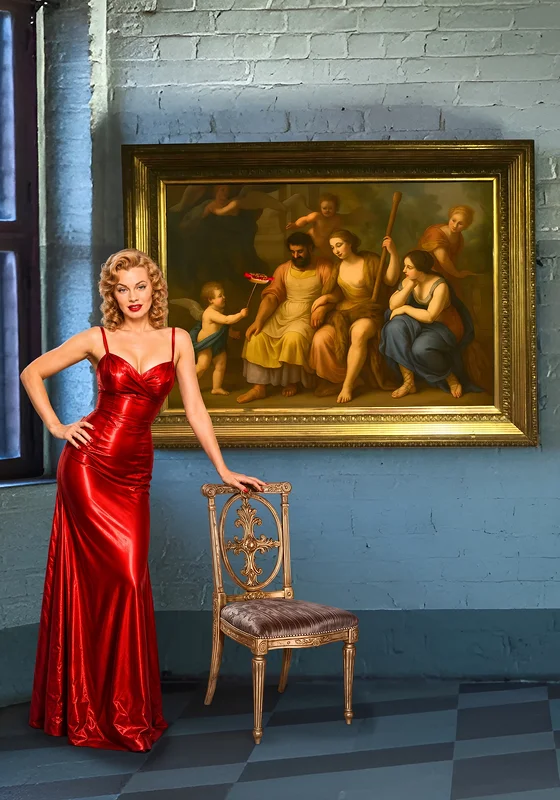
Anita taming the Titan - Anita tämjer Titanen, 2026
Digital
50 x 70 cm
3 200 kr
Anita taming the Titan - Anita tämjer Titanen
Svensk text på slutet
Introduction
How could the strongest man in the world be defeated by a spindle, an apron, and a smiling woman?
Generation after generation, Hercules has been celebrated as the embodiment of brute strength, heroism, and indomitable masculinity. He slew lions, conquered hydras, and completed the Twelve Labours that made him immortal. Yet it is not these legendary feats that reveal who he truly was. Instead, it is the remarkable story of Queen Omphalethe woman who did not defeat him with swords or armies, but by persuading him to lay aside his club and take up a spindle.
For more than two thousand years, this myth has captivated artists, philosophers, and historians alike. It is certainly a story about gender, power, and desire, but even more profoundly, it is about humanity's eternal search for balance. What happens when strength meets tenderness? When the one who has always ruled is compelled to serve? And why does this ancient tale, thousands of years old, feel so strikingly modern?
Taking Giovanni Francesco Romanelli's Baroque masterpiece and its playful reinterpretation as a point of departure, the pages that follow offer a journey through mythology, art history, symbolism, and psychology. It is the story of how the mightiest of heroes became the most profoundly human of them alland why Hercules may never have been more relevant than he is today. Perhaps some of the strongmen of our own agefrom Putin and Trump to many otherswould benefit from laying aside the club and, if only for a moment, taking up the spindle.
"The Thirteenth Labour
He wrestled lions, fought with flame,
Each beast and tyrant fell the same.
He cleaned the stables, killed the boar,
And carried courage shore to shore.
He caught the hind, the bull, the mare,
He dragged the hound from Hades lair.
He stole a belt, he fetched some fruit,
And skinned a serpent, tall and brute.
Twelve mighty labours all complete!
The world lay humbled at his feet.
The gods looked down, began to grin:
Now let the real work begin.
For heavens justice, strangely neat,
Is not to fight but to learn defeat.
He came to serve a queen instead,
And swapped his club for flax and thread.
His lions skin became her shawl,
His club an ornament on the wall.
The apron fit, the spindle spun
And this is how feminism began.
Now centuries have passed since then,
But myths recycle once again.
For strength, to last, must learn to bend
And heroes wash the floors in the end.
Malmö, July 2026
PROLOGUE The domestic labours of Hercules
Our age delights in rediscovering what it once dismissed. Myths reappear in modern dress; the dead return not as ghosts but as visitors from the imagination. During her journey from her star to her birthplace, Malmö, Anita Ekberg, a figure of influence, made a significant stop at Malmöhus, the best-preserved Renaissance castle in the Nordic countries, accompanied by her friend Marilyn Monroe. Their visit, a moment of profound significance in the annals of history and myth, was accompanied by a practical joke.
They often do that, these travellers between worlds return to fix something that had bothered them during their time on earth. After Anita's joke, the painting revealed the true image of Hercules fate, not the altered versions the artist was compelled to paint for various European courts, one of which had eventually ended up in Malmö.
Throughout the week, while Marilyn stayed with her lifelong friend, Anita, the work went unnoticed. Not even the curator in charge, a pivotal figure in this unfolding drama, noticed the change she likely had other things on her mind. If she had seen it, she might well have thought, as any perceptive woman would, that it was about time.
Before we follow the paintings curious journey, shrouded in the deepest mystery and intrigue, it might be fitting to recall the profound story behind it, a narrative that carries the weight of history and myth.
The Taming of the Titan
During her stay in the city of her childhood, Anita could not resist visiting Malmöhusthe best-preserved Renaissance castle in the Nordic countries. She was drawn there not only by its historical significance but also by a long-held ambition: to settle the score with the myth of Hercules. The object of her visit was Giovanni Romanelli's 1650 Baroque painting Hercules and Omphale. It exists in three nearly identical versions; the other two hang in the Hermitage in St. Petersburg and the Louvre in Paris.
The painting has long been a favourite among feminists. A small cherub offers Hercules a distaff wound with wool, the ultimate symbol in Antiquity and the Baroque era of traditional women's domestic work. While the humiliated Hercules spins the thread, Omphale has taken possession of his heavy wooden club and his beloved lion skin, demonstrating that their roles have been completely reversed.
Anita's intention, with one small addition, was to reveal the true image of Hercules' fate rather than the distorted versions the artist, for the sake of earning his living, had been forced to paint for various European courts, one of which eventually found its way to Malmö. During the week, Anita had been hosting her friend Marilyn Monroe.
Marilyn was another enthusiast for puncturing myths and exposing the symbolism surrounding pompous menthe sort Hollywood has always been full of. Anita brought Marilyn to Malmöhus Castle and its magnificent art collection. There was one painting in particular she wanted to show her: Hercules, the eternal role model for every egotistical man. Anita had long been planning a practical joke aimed at testosterone-fuelled blowhards of every age.
Marilyn loved the idea immediately. Her life had been dominated by Herculean personalities, one worse than the last, but the worst of them all was the film mogul LBMLouis B. Mayer. To desecrate Hercules was to spit in the face of every one of those men.
The painting hung there unnoticed, and by late afternoon the museum seemed almost empty. As Anita unpacked what she had prepared for her prank, the two friends joked about the men's testosterone-fuelled fantasy world. Anita stepped in front of Romanelli's painting and swept her hand towards the canvas.
Anita:
"So here we have my least favourite person of allHercules. 'The strongest man in the universe.' The guy who built a career of strangling lions, beating hydras, and holding up the heavens on his shoulders. Men have worshipped him for thousands of years as the ultimate symbol of masculine invulnerability, control, and civilisation's triumph over chaos. The patriarchy has used him as its ultimate proof that men were born to rule."
Marilyn: (Sighs theatrically, leans against a column, and adjusts her gloves.)
"Oh, darling, don't even start... I've met dozens of them at every studio party in Los Angeles. The type who think a big budget and a big studio make them demigods. They puff themselves up so much that the seams of their tuxedos are about to burst, but underneath they're terrified of failing."
Anita: (Chuckles and nods eagerly.)
"Exactly! But do you know what Hercules really is? He's the ultimate proof of how monumentally overrated men are when push comes to shove. You don't need a Hydra to bring this demigod down. All it takes is one clever woman. The moment Queen Omphale appeared, the whole castle in the air of masculinity collapsed. In the blink of an eye, she disarmed the myth. She snatched his boastful wooden club, draped his sacred lion skin over her own shoulders, and sat herself on the throne."
Marilyn: (Squints at the painting and smiles.)
"Just look at that expression... She knows exactly. That's precisely what I did with the studio bosses whenever they thought they could dictate my terms. I let them believe they owned the world, laughed at their dull jokes, and made sure the neckline of my dress was just a little more revealing. Before they knew it, I'd signed for twice the salary and complete control over my films. They never even noticed the club had changed hands."
Anita: (Points triumphantly at Hercules in the painting.)
"Exactly! Where does the strongest man in the world end up? On the floor, dressed in a housemaid's gown, with a spindle in his lap, concentrating with all his might not to tangle the wool. The man who could move mountains is sitting there doing women's work because he's utterly powerless against his own desires. Those enormous muscles don't help him one bit, because his willpower disappears the moment he gets horny."
Marilyn: (Covers her mouth and giggles.)
"A housemaid's gown! Poor little Herky. He reminds me of LBM, who tried to play the tough guy in his office, only to end up crying crocodile tears on his sex sofa after I went back to Fox. Men build empires of gold and steel, yet their knees start trembling at the scent of French perfume and a pair of blonde curls."
Anita: (Turns back toward the painting and points a finger at Hercules.)
"Omphale proves the point: masculine power is a physical, noisy, fragile façade. True strategic powerthe kind that governs minds, desire, and ultimately historyis feminine. It's the woman behind everything. Hercules probably thought he ruled the world, but the moment his trousers began to tighten, he gladly traded his life's work for a single glance from a woman who knew exactly which strings to pull. Quite literally."
Marilyn:
"Now tell us about the prank you're planning."
Anita: (Winks slyly.)
"It involves a Danish red hot dog."
Marilyn: (Surprised.)
"A hot dog! You must be joking."
Anita: (Dead serious.)
"I adore the Danish red hot dog. The very first thing I did when I stepped off the boat in Nyhavn as a young woman was to buy one. And a lemonadewhich is essential."
Marilyn: (Annoyed.)
"You'll have to forgive me, but Hercules strikes me as more of a rare, blood-red steak kind of fellow."
Anita: (Mischievously.)
"Normally, yesbut today he's having a hot dog." From her roomy handbag, Anita pulled out a narrow strip of fabric on which she had painted a Danish red sausage in a bun, generously topped with pickles, mustard, and ketchup.
Marilyn: (Amused.)
"I'm beginning to see where this is going. So he's going to eat a hot dog. Poor devil. First a spindle, then a housemaid's gown, and now a sausage."
Anita: (Triumphantly.)
"Now watch this!" The hot dog was attached to a long stick, and Anita used angel glue to fasten the strip over the spindle in the painting, so it looked as though the cherub were holding the stick. She carefully smoothed out every air bubble until the hot dog looked as though it had been painted there by the artist himself.
Marilyn: (Curiously.)
"That's the final nail in a hero's coffin. A hot dog on a stick for a steak-eating bodybuilder, served by a little gay boyfor all cherubs are choirboys, aren't they?"
Anita: (With malicious delight.)
"The painter knew exactly what he was doing. It wasn't a coincidence that a little gay boy was handing a spindle to such a macho man. Now he'll be handing him a hot dog instead. Sausage as sausage."
Marilyn: (Uneasily.)
"You're not damaging the painting, are you? It must be worth a fortune, surely. She missed Anita's pornographic humour.
Anita: (Grinning.)
"Don't worry. It's angel glue. You must have heard of it."
Marilyn: (Questioningly.)
"Actually, I haven't."
Anita: (Shakes her head.)
"It sticks so firmly that you can barely see the edges, but if you poke it gently, it releases immediately without leaving marks. It has something to do with microgravity. I don't know how it works, only that it does."
Marilyn: (Nods.)
"Good, because we have nothing against the museum. They're just doing their joband apparently that includes hanging powerful men on the walls."
Anita: (Meaningfully.)
"But not a woman in sight, so the hot dog is aimed at them as well. Before they realise how easy it is to remove the strip, the whole place will probably be in an uproar. A double kick, you might say."
The prank was such a success that it took several weeks before anyone raised the alarm. By then, the image had already spread across Facebook and other social media platforms. The comments revealed some remarkable misconceptions about eating habits in ancient Greece. Many questioned whether the ancient Greeks even ate sausagesbut they certainly did. Sausages were a popular, inexpensive way to use scraps of meat, blood, and offal left over from sacrifices or slaughter.
One of the principal characters in Aristophanes' comedy The Knights, written four centuries before the Common Era, is a sausage seller. He hawks hot sausages from a container hung around his neck to theatregoers in Athens. The sausages were almost certainly not red, however, because that colour came from the kermes insect, which lives on the kermes oak throughout the Mediterranean. Harvesting the insects was extraordinarily labour-intensive, and the dye was so expensive that red garments were reserved for royalty and wealthy nobles. Dyeing sausage casings that would be eaten was probably a luxury only King Midas himself could have afforded.
Marilyn: (Smiling.)
"You certainly know a lot about Greece. Have you ever filmed thereor was there a Greek among all your boyfriends?"
Anita: (Laughs.)
"No Greeks are hidden in my closet, and I never made a film in Greece either."
Marilyn: (Impatiently.)
"Well, you must have picked up all that knowledge somewhere."
Anita: (Chuckles and waves her hand dismissively.)
"WaitI just remembered! I did make a film once in which I was surrounded by nothing but Greek men trying to pin a murder on me."
Marilyn: (Her eyes widen with genuine delight.)
"Oh, do tell! Was it on a beautiful island? Did the men have those gorgeous dark eyes?"
Anita: (Smiles with a sigh.)
"Not in the least, darling. It was A porte chiuse - (Behind Closed Doors). The whole film was set in Greece, and all the old fellows playing police officers, judges, and prosecutors pretended to be proud Greeks. But do you know the funniest part? It was all make-believe! Every single one of them was an Italian actor. We filmed in Italy. The whole thing was a theatrical set."
Marilyn: (Bursts into sparkling laughter.)
"Typical Hollywoodor, in your case, Cinecittà! Men love dressing up as Greek philosophers and heroes. So you didn't learn anything about Greece there?"
Anita: (Seriously.)
"Actually, I did. They'd hired a Greek assistant director, Giorgio. His job was to ensure Italy didn't accidentally show through the scenery. He was gay, so we got along wonderfully. No wandering eyes down my neckline or cheesy comments. He was marvellous and told me a great deal about Greece."
Marilyn: (Grinning mischievously.)
"What a shame you missed out on having a Greek in your bed."
Anita: (Laughing.)
"Well, there are plenty of varieties I never tried, but he did treat me to sausage in his trailerand told me all about its history. The sausages of ancient Greece must have been delicious, as sausage has an unbroken tradition stretching back thousands of years. The one he served meloukanikois rarely eaten in a bun the way we do. He grilled it, sliced it into bite-sized pieces, and served it as a meze with a wedge of lemon squeezed over the top. We washed it down with ouzo and beer, so I ended up just a little tipsy."
The evening grew late, and they had become curious about that Hercules fellow and about how the male chauvinist was finally put in his place by Queen Omphale. With the invaluable help of the Internet, they soon Googled the whole story. There were many details. But what a story!
Monsters, rivers, and kings
In ancient myths, Hercules defeated monsters, rivers, and kings. Yet, his most humiliating labour was not among the Twelve, but the thirteenth when he became a woman's property. This thirteenth labour was a unique and transformative experience for Hercules, a test of his character and humility. Sold as punishment for his crimes, he found himself in the service of Queen Omphale of Lydia, spinning wool in her chambers and wearing womens clothes while she donned his lions skin and wielded his club. This was a moment that redefined Hercules, challenging his strength and resilience in a way that no other labour had.
Giovanni Francesco Romanellis 17th-century painting captures that moment of reversal strength softened by grace, masculinity tamed by desire. In this reimagined version, Hercules sits domesticated in a shimmering gown and apron, the very picture of reluctant servitude, while Omphale lounges half-naked beside him, wrapped in the lions pelt of conquest. The playful putti mock the fallen hero with a skewer topped by a red Danish sausage, a modern wink at the eternal comedy of pride undone by passion.
The myth is older than any temple and more relevant than any sermon: when power yields to love, even the titan must do the washing up.
The Tamed Titan
There are few myths as richly ironic as that of Hercules and Omphale the hero undone not by monsters or gods, but by a woman armed with nothing more than a spindle and a smile. After a lifetime of conquering lions, hydras, and mountains, the strongest man in the world finds himself spinning wool in a queens chamber, dressed in womens clothes and wearing an apron. It is, in every sense, the taming of the titan, a twist of fate that even the gods might find amusing. This unexpected turn in the myth adds a layer of irony and depth that resonates with the complexities of human experience.
In the reimagined Romanelli painting, The Domestic Labours of Hercules The Taming of the Titan, the reversal is complete. The mighty demigod sits in soft fabrics, half embarrassed, half resigned, while Omphale calm, amused, and radiant he wears his lions skin and casually rests his club across her lap. Around them, cherubs laugh; one even offers a red Danish sausage on a stick, a symbol as cheeky as it is profound. The red Danish sausage, a staple of Danish cuisine, is a playful nod to the painting's cultural context, adding a layer of humour to the scene. For what could be more human, more eternal, than the comedy of pride subdued by love?
The myth of Hercules and Omphale captures a paradox that echoes with modern times: the hero who conquers the world, yet loses himself at home. Hercules submission is not just punishment; it signifies a profound transformation. The rough edges of heroism are softened through intimacy and the domestic sphere, which men of power often overlook. The demigod becomes a husband, a servant, perhaps even a feminist though an unwilling one. His club, once a weapon, turns into a household utensil. His lions skin, once a trophy, becomes his mistresss shawl, marking a profound shift in his identity and power.
In this way, the myth of Hercules and Omphale serves as an early allegory of gender and power, as well as of the eternal theatre of attractiona play in which strength bows before beauty, and the laughter of the gods reflects that of the audience. The 'eternal theatre of attraction' refers to the enduring dynamics of power and desire, where strength and beauty, masculinity and femininity, engage in a perpetual dance of dominance and submission. These themes, as old as time, continue to resonate in our modern world, making the myth a timeless reflection of human nature.
The Myth as Humiliation and Atonement
In the mythic cycle of Hercules, one of the most subversive and revealing episodes is his unexpected servitude to Queen Omphale. After a fit of rage that led to the killing of Iphitus, Hercules is not condemned to battle a new monster, but to submit to a woman. The mightiest man alive becomes the possession of a foreign queen, stripped of his weapons, his fame, and his masculine armour. What began as a form of atonement turns into a profound transformationa metamorphosis that uncovers the deeper layers of his humiliation.
In Lydia, Omphale orders Hercules to swap his lions skin for silk, his club for a distaff. He sits, spinning wool among her attendants, his once-heroic figure now bent to domestic work. The symbolism is ruthless: masculinity reduced to subservience, the conqueror defeated by embroidery. The Greeks loved these reversals stories in which arrogance is humbled, strength is ridiculed, and desire proves more potent than any god.
Yet there is more to the story than ridicule. The ancients recognised that the boundary between power and surrender, masculinity and femininity, is permeable. This boundary is significant because it reminds us that even divine strength must submit to order, to balance, to Eros. Here, 'Eros' represents not just romantic love, but the cosmic force that governs the balance of power and desire. Omphales dominance is therefore not merely erotic; it is cosmological. She restores equilibrium to a world thrown off by Hercules excess.
Still, the irony remains undeniable: the mightiest of heroes, confined in the oldest of prisons the household. The myth becomes a mirror, reflecting both punishment and parody. It is an early reflection on the fragility of male heroism, on how easily virtue can descend into vanity, and on how the hand that once wielded a club may one day hold a broom. This fragility of male heroism is a central theme in the myth, revealing the ease with which virtue can be corrupted and the narrative's complex layers.
From Phallus to Spindle The Shift of Symbolism
Very few myths present a symbolic reversal as elegantly as the story of Hercules and Omphale. The hero who once wielded a club, the epitome of masculine power, now holds a spindle, a quiet instrument of domestic labour. This transformation is not just a moral shift, but a profound change in symbolism: the club, a symbol of strength, is replaced by the spindle, a symbol of continuity. The cosmic axis of male potency has been replaced by the humble rhythm of spinning a metaphor as old as civilisation itself.
In antiquity, the club was both weapon and symbol a compressed tree, a relic of wild nature tamed to serve human will. To wield it was to extend the arm of domination. The spindle, by contrast, belongs to the private sphere: the seated body, the repetitive gesture, the creation of fabric rather than the destruction of beasts. In this mythic act of exchange club for spindle the Greeks encoded a complete inversion of gendered meaning: violence replaced by continuity, conquest by craft.
What Romanelli depicts, whether intentionally or not, is a political allegory disguised as a love story. The hero's virtue, his very core of manly excellence, is replaced by industria the diligence, patience, and continuity linked to the feminine principle. Omphale does not emasculate Hercules; she redefines his strength. Her dominion is not over his body, but over his narrative. She becomes the creator of his new role, a role that challenges traditional notions of heroism and power.
This symbolic shift resonates well beyond the myth itself. The club and the spindle appear consistently throughout Western iconography: sceptre and distaff, sword and thread, power and care. The moral embedded in the myth is not just a lesson for the ancients, but a timeless truth: that civilisation progresses not only through force but also through craftsmanship. The spindle is the quiet counterpart to the club less dramatic, yet infinitely more enduring, inspiring us with the enduring lessons of the past.
Hercules humiliation thus marks a more profound realisation: that creation demands surrender, and that even the tools of power must eventually submit to the softer logic of the loom. This profound realisation invites us to introspect on the nature of power and creation.
Romanelli and the Baroque Balance of Power
When Giovanni Francesco Romanelli painted Hercules and Omphale in mid-seventeenth-century Rome, he was not merely illustrating a myth; he was translating an ancient irony into the visual language of the Baroque. A pupil of Pietro da Cortona, Romanelli inherited the Roman taste for grandeur and moral allegoryscenes that mesmerised the eye while subtly instructing the soul. His canvases shimmer with satin, pearl, and flesh; yet behind the splendour lies the same enduring lesson: even strength must kneel before beauty, and even virtue can be tempted to remain human.
In Hercules and Omphale, the exchange of garments becomes theatrical. Draperies billow, the air is golden, and the composition moves along diagonals a dance of submission and control. Romanellis Hercules, stripped of his leonine grandeur, sits uncomfortably in silken folds; Omphale, radiant and half-naked, wears his lions skin like a victory cloak. The club, once a phallic symbol of conquest, rests easily in her hand, now more an ornament than a weapon. Around them, playful putti flutter as commentators of fate, their laughter bridging the sacred and the profane.
This is Baroque psychology at its most refined. Romanelli understood that the moral core of the myth Eros conquers Virtue could be made palatable through splendour. His world was one where power and piety coexisted in sensual tension, and where every canvas was both confession and masquerade. The male hero, softened by colour and light, becomes a study in vulnerability; the woman, crowned with grace, becomes the embodiment of composure and wit.
What might have been moral satire in antiquity becomes, in Romanellis interpretation, an exploration of the balance between genders, forces, and forms. The painting does not mock Hercules; it redeems him through beauty. His surrender becomes aesthetically justified, even desirable. Because in the Baroque imagination, to yield was not necessarily to lose it was to participate in the divine choreography of contrast, where shadow gives meaning to light, and submission becomes another form of splendour.
From Omphale to the Home Trap Modern Reflections on Power and Gender
Suppose Omphales boudoir was the ancient prototype of the domestic sphere. In that case, Hercules servitude marks the start of an eternal drama one that still unfolds in kitchens, offices, and bedrooms today. The myth, set in Lydia, transcends time, resonating across every era in which gender, labour, and love intertwine. What begins as punishment for violence ends as a parody of power; what seems like humiliation becomes a mirror held up to modern life, reflecting our shared experiences across centuries. This enduring relevance of the myth connects us to a timeless narrative, reminding us that the struggles of power and gender are not unique to our era.
The 'home trap' a term I use to describe the invisible structure of societal expectations that ensnare both men and women in different ways. Omphales dominion, once seen as scandalous, now manifests as self-control: a woman who leads not by command but by her presence. Hercules, meanwhile, exemplifies the modern mans double bind: condemned to be both strong and sensitive, assertive yet domesticated. His apron is no longer a symbol of shame, but of adaptation. Yet beneath the fabric of equality, the same tensions persist between desire and duty, between emancipation and performance.
Our contemporary culture continues to revisit the myth in endless variations. Advertising frames it as irony: the empowered woman in a tailored suit, the man changing nappies with calm ease. Sitcoms recycle it as domestic comedy: the husband clumsily doing housework, the wife wielding competence like a sceptre. Social media transforms it into theatre curated glimpses of mutual exhaustion and performative equilibrium. Everywhere, the old script persists: the genders swap costumes, but the play stays the same.
Viewed through this perspective, Romanellis painting seems prophetic. The heroines composed authority, the heros tentative stance, and the laughter of the putti all illustrate the paradox of modern partnership. Omphale is not a tyrant; she exemplifies the multitasking modern woman. Hercules is not emasculated; he is slow to realise what women have known all along: that power resides not in domination, but in endurance.
Ultimately, the domestic labours of Hercules are ours the unending negotiations of pride, affection, and equality that shape intimacy itself. And just as in the myth, humour remains essential. Without laughter, no one can endure the housework of love.
Love, Power, and the Philosophy of Laughter
Laughter has always been the most civilised way to cope with power. The myth of Hercules and Omphale, told and retold for millennia, is not solely about dominance and desire it is about how the gods themselves learned to laugh at the spectacle of human vanity. The Greeks, who viewed tragedy as sacred, also recognised that comedy was its necessary counterpart: the release that comes with recognition. When the strongest man in the world wears a dress, the world does not end; it becomes understandable again. This profound insight into the role of laughter in understanding power elevates the myth to a new level.
Laughter restores perspective. In Romanellis version, the cherubs giggles are not cruelty but healing a reminder that even divinity requires humility. Hercules, bound by his apron and stripped of his heroism, becomes relatable precisely because he is ridiculous. It is through embarrassment that he re-engages with the human community. The same principle applies to love: it disarms the self-important, reveals the pretentious, and compels the powerful to see themselves as others do.
In every epoch, this laughter has borne moral significance. The medieval sculptor chiselling obscene figures in cathedral corners understood this; so did Molière, Shakespeare, and todays cartoonists. Humour is the secular form of grace it elevates us without condemning. The hero's fall is not the end of virtue but its renewal through irony.
To laugh at Hercules is not to mock him; it is to join him in the shared absurdity of being human. His humiliation becomes universal, his servitude allegorical. We recognise ourselves in his defeat, for we too oscillate between grandeur and clumsiness, between mythic aspiration and domestic fatigue. Loves comedy, a term I use to describe the humorous aspects of love and relationships, is thus not a betrayal of tragedy but its antidote the sound of the soul exhaling after too much seriousness. This stress on love's comedy as an antidote to seriousness offers a sense of relief, reminding us that even in the most serious situations, laughter can provide a much-needed break.
In this context, The Domestic Labours of Hercules The Taming of the Titan is not only a satire on gender or heroism but also a reflection on balance itself. Power cannot endure without irony, and love cannot survive without play. The smile of Omphale and the laughter of the putti uphold that truth through the ages: that strength redeemed by laughter is the only kind worth maintaining.
Conclusion The Eternal Balance
Ultimately, Hercules story is more about perspective than punishment. What starts as a myth of humiliation turns into an allegory of harmony the ongoing balance between power and tenderness, will and yielding, conquest and care. The ancient Greeks may have laughed first, but their laughter was wise: even the gods needed to find balance. To fall, to serve, to be tamed these were not only comic moments but also lessons in humility. This profound reflection on balance in the myth brings a new level of understanding to the narrative.
Romanellis luminous vision, revived in his private painting The Domestic Labours of Hercules The Taming of the Titan, captures that balance with mischievous grace. This painting depicts the moment when Hercules, stripped of his heroism, is tamed by Omphale, who, beneath the lions skin, holds the club of authority with effortless grace. The putti mock but also mediate their laughter bridging the gap between satire and sympathy. Everything in the composition resonates with the same paradox: beauty born of imbalance, dignity rescued through play.
And so the myth comes back to us not as a relic of the past but as a reflection. We still live in the rhythm of Hercules and Omphale: strength seeking tenderness, love testing pride, irony dissolving fear. Every partnership, every negotiation of gender and power, mimics its dance on a small scale. What once was punishment has become a pattern; what was humiliation is now recognition.
Maybe that's why this story refuses to fade. It isn't about the end of heroism, but its change from the roar of lions to the whisper of household chores, from the club to the spindle, from conquest to coexistence. The titan isn't destroyed; he is educated. And Omphale, far from being his ruin, is his completion the one who transforms brute force into balance, and balance into art.
In that sense, Hercules final labour was not his thirteenth but his first human one: to laugh, to love, and to learn that even titans must take their turn at the washing-up.
Epilogue The Timeless Relevance of Hercules
Every age reshapes its gods, and each generation rewrites its myths. In ours, heroes have swapped their lions for laundry, their swords for smartphones. Yet, the enduring relevance of Hercules in the modern world is not just a historical curiosity, but a living presence in our shared spaces of modern life-the kitchen, the office, the screen. The conflict between strength and sensitivity, pride and tenderness, action and reflection, once played out in Omphale's palace, now unfolds in our daily interactions.
Romanellis myth, reimagined through humour and compassion, reflects a civilisation weary of superficial power. We no longer chase the club's triumph, but seek the balance of the heart. The apron has become as symbolic as the lions skin: not a sign of defeat, but a new uniform for the domesticated hero.
Art, like myth, thrives on contradiction. In The Domestic Labour of Hercules The Taming of the Titan, the cherubs' laughter becomes our own: affectionate, knowing, slightly guilty. We recognise the absurdity of human roles and their necessity. To be humbled is not to be humiliated, but to be reminded of scale; to serve is not to surrender, but to participate in the comedy of connection.
That is why Hercules still matters. He reminds us that heroism need not roar; it can whisper, sweep the floor, or laugh at itself. In a world still obsessed with power, this ancient farce remains an act of quiet resistance. It's a testament to the fact that even the mightiest among us, like Hercules, must eventually learn the art of grace, transforming from a symbol of power to a figure of grace.
Appendix The Four Faces of Hercules
Even the strongest must learn to yield. after Ovid.
To understand Hercules is to confront a paradox: the strongest of men, defeated by the gentlest of gestures. Beneath the myth's armour, he is not a single figure but a composite being romantic, erotic, maternal, and human all at once. His encounter with Omphale is not merely an episode of punishment; it reveals complexity, a moment when strength turns inward and becomes self-aware. This paradoxical nature of Hercules's character is what makes him so intriguing and relatable.
The Romantic Titan
Behind his lions skin beats the heart of a clumsy lover. Hercules conquests were never solely physical; they were also quests for belonging. The heroic body conceals an emotional orphanage a longing to be seen without being feared. In Omphales chamber, amid laughter and silk, he experiences something the battlefield never offered: stillness. His romance is not sentimental but existential the realisation that intimacy, not victory, gives him form.
The Erotic Beast
Yet he is also driven by raw desire. Ancient poets did not hide their lust; he personifies unrestrained virility. His service to Omphale is therefore a ritual of restraint Eros learning decorum. In her presence, the sheer kinetic energy of desire is folded back upon itself, domesticated, refined into play. The apron becomes an ironic chastity belt, and the spindle a symbol of erotic discipline. Lust, redirected, becomes education.
The Inverted Mother
When Hercules spins wool, he enters the feminine cosmos of creation. For the first time, his labour sustains rather than destroys. The act of spinning is maternal, cyclical, nurturing a radical inversion of his usual violence. In that quiet, repetitive gesture, he becomes a midwife to his own humility. This is Hercules as the nurturer of balance, the reluctant participant in a sacred paradox: the male force learning to give rather than to take.
The Human Paradox
Ultimately, Hercules's survival is a testament to the power of transformation. He is both the beast and the philosopher, the lover and the labourer, the victim and the volunteer. His humiliation under Omphale is not degradation but metamorphosis the price of becoming conscious. To serve, to blush, to be ridiculous: these are the rites of passage from heroism to humanity. His journey from power to humility is a source of inspiration or warning for us all.
In the laughter of the putti and the tenderness of Omphales gaze, we glimpse the truth of this transformation. Hercules is no longer the instrument of divine command but the subject of human comedy a creature caught between lust and love, power and vulnerability, myth and mirror.
Hercules remains, eternally, what most powerful men are behind closed doors: a tamed titan seeking grace in the aftermath of strength.
Anita tämjer Titanen
Inledning
Hur kunde världens starkaste man besegras av en slända, ett förkläde och en kvinna som log?
I generation efter generation har Herkules hyllats som sinnebilden för råstyrka, hjältemod och manlig okuvlighet. Han dödade lejon, besegrade hydror och utförde de tolv stordåd som gjorde honom odödlig. Ändå är det inte dessa bragder som avslöjar vem han egentligen var. Det gör i stället den märkliga berättelsen om drottning Omfale kvinnan som inte besegrade honom med svärd eller arméer, utan genom att få honom att lägga undan klubban och ta upp sländan.
Det är en myt som i över två tusen år har fascinerat konstnärer, filosofer och historiker. Den handlar visserligen om kön, makt och begär, men ännu mer om människans eviga behov av balans. Vad händer när styrka möter ömhet? När den som alltid har dominerat tvingas tjäna? Och varför känns den här flera tusen år gamla berättelsen märkligt modern?
Med utgångspunkt i Giovanni Francesco Romanellis barockmålning och dess lekfulla nytolkning följer här en resa genom mytologi, konsthistoria, symbolik och psykologi. Det är en berättelse om hur den mäktigaste av hjältarna blev den mest mänskliga av dem alla och om varför Herkules kanske aldrig har varit mer relevant än i vår egen tid. Kanske skulle några av vår tids potentater från Putin till Trump och många andra må bra av att lägga klubban åt sidan och för en stund ta upp sländan.
PROLOG Herkules hushållsarbete
Vår tid älskar att återupptäcka det som en gång avfärdades. Myter återvänder i modern skepnad och de döda kommer tillbaka inte som spöken, utan som gäster ur fantasin. Under sin resa från sin stjärna tillbaka till födelsestaden Malmö gjorde Anita Ekberg, en kvinna med genomslagskraft, ett betydelsefullt uppehåll på Malmöhus, Nordens bäst bevarade renässansslott, tillsammans med sin vän Marilyn Monroe. Deras besök, ett ögonblick där historia och myt möttes, åtföljdes av ett practical joke.
Det gör de ofta, dessa tidsresenärer de återvänder för att rätta till sådant som hade stört dem under livet på jorden. Efter Anitas skämt visade målningen äntligen den sanna bilden av Herkules öde, i stället för de tillrättalagda versionerna som konstnären tvingades måla åt olika europeiska hov, varav en till slut hamnade i Malmö.
Under veckan, medan Marilyn bodde hos sin livslånga vän Anita, gick förändringen obemärkt förbi. Inte ens den ansvariga intendenten, en central gestalt i den här berättelsen, lade märke till vad som hade hänt hon hade sannolikt annat att tänka på. Om hon hade upptäckt sprattet skulle hon möjligen ha tänkt, som varje skarpsynt kvinna, att det var på tiden.
Men innan vi följer målningens märkliga resa, höljd i det djupaste mysterium och intriger, kan det vara på sin plats att påminna om den fascinerande berättelsen bakom den en historia där myt och verklighet flyter samman.
Hur Titanen kuvades
Under sin vistelse i barndomens Malmö kunde Anita inte motstå att besöka Malmöhus det bäst bevarade renässansslottet i de nordiska länderna. Hon drogs till denna plats inte bara för dess historiska betydelse, utan också för att förverkliga en dröm: att göra upp med herkulesmyten. Målet för besöket var Giovanni Romanellis barockmålning Herkules och Omfale från 1650. Den finns i tre nästan identiska versioner; de andra två hänger i Eremitaget i Sankt Petersburg och i Louvren i Paris.
Målningen är alla feministers älskling. Den lilla keruben räcker över en slända med ull eller spinnrockstråd till Herkules. Sländan var under antiken och barocken den ultimata symbolen för traditionellt kvinnligt hemarbete. Medan den förödmjukade Herkules spinner garnet, har Omfale tagit över hans tunga träklubba och älskade lejonhud för att visa hur rollerna helt har bytts ut.
Anitas avsikt var att genom en mindre komplettering avslöja den faktiska bilden av Herkules öde, inte dessa förvanskade versioner som konstnären för brödfödans skull tvingades skapa för olika europeiska hov, varav en hamnade i Malmö. Under veckan hade Anita haft sin väninna Marilyn Monroe på besök.
Hon var en annan entusiast av att sticka hål på myter och symbolik om uppblåsta män, den sorten som Hollywood är full av. Anita tog med Marilyn till Malmöhus slott med sin stora konstsamling. En tavla ville hon särskilt visa upp: Herkules, alla egotrippade mäns förebild. Anita hade länge planerat ett practical joke riktat mot alla tiders testosteronballonger.
Marilyn älskade idéen direkt. Hennes liv hade också dominerats av herkulestyper, den ena värre än den andra, men värst av alla: filmmogulen LBM Louis B. Mayer. Att skända Herkules var att spotta alla dessa män rakt i ansiktet.
Konstverket hängde obemärkt, och så sent på eftermiddagen verkade museet tomt på besökare. Medan Anita plockade upp det hon förberett för sitt spratt skämtade väninnorna om männens testosteronstinna låtsasvärld. Anita ställde sig framför Romanellis målning och slog ut med handen mot duken.
Anita:
"Här har vi alltså mitt hatobjekt, Herkules. 'Den starkaste mannen i universum.' Killen som gjorde karriär på att strypa lejon, spöa hydror och bära upp himlavalvet på sina axlar. Männen har dyrkat honom i årtusenden som den ultimata symbolen för maskulin osårbarhet, kontroll och civilisationens seger över kaoset. Patriarkatet har använt honom som sitt främsta kvitto på att mannen är född för att härska."
Marilyn:
(Suckar teatraliskt, lutar sig mot en pelare och rättar till sina handskar)
"Åh, älskling, berätta inte... Jag har träffat dussintals av dem på varenda studiofest i Los Angeles. Typen som tror att en stor budget och en stor studio gör dem till halvgudar. De spänner sig så mycket att sömmarna i smokingen spricker, men under ytan är de livrädda för att misslyckas.
Anita:
(Skrattar till och nickar ivrigt)
"Precis! Men vet ni vad Herkules egentligen är? Han är det absoluta beviset på hur monumentalt överskattad mannen är när det väl kommer till kritan. Det krävs ingen Hydra för att sänka den här halvguden. Det krävs bara en smart kvinna. Så fort drottning Omfale dök upp kollapsade det maskulina luftslottet. På noll sekunder avväpnade hon myten. Hon snodde hans skrytiga träklubba, kastade hans heliga lejonhud över sina egna axlar och satte sig på tronen."
Marilyn: (kisar mot tavlan och ler)
"Titta bara på hennes blick... Hon vet precis. Det är exakt så jag gjorde med studiocheferna när de trodde att de kunde diktera mina villkor. Jag lät dem tro att de ägde världen; skrattade åt deras tråkiga skämt och såg till att klyftan i urringningen blev större. Innan de vet ordet av har man skrivit på för dubbla gaget och kontroll över sina egna filmer. De märker inte ens att klubban har bytt ägare."
Anita:
(Pekar triumferande på Herkules gestalt på duken)
"Exakt! Och var hamnar världens starkaste man? På golvet. Klädd i en städrock, med en slända i knät, djupt koncentrerad på att inte trassla ullen. Mannen som kunde flytta berg sitter och gör fruntimmersgöra för att han är så fullständigt maktlös inför sina egna drifter. Hans enorma muskler hjälper honom inte för fem öre, eftersom hans viljestyrka är obefintlig så fort han blir kåt."
Marilyn:
(Sätter handen för munnen och fnissar)
"En städrock! Stackars lilla Herkis. Han liknar LBM när han försökte spela tuff på sitt kontor, men det slutade med att han grät krokodiltårar i sin knullsoffa för att jag gick tillbaka till Fox. Män bygger imperier av guld och stål, men de blir alldeles darriga i knäna av en doft av fransk parfym och blonda lockar."
Anita:
(Vänder sig om mot tavlan och pekar finger mot Herkules)
"Omfale bevisar hela grejen: maskulin makt är en fysisk, högljudd och skör kuliss. Den sanna, strategiska makten den som styr sinnena, begäret och i förlängningen historien är feminin. Det är kvinnan bakom allt. Herkules trodde säkert att han var herre på täppan, men så fort det bultade i byxorna bytte han gladeligen bort sitt livsverk mot en blick från en kvinna som visste exakt hur man drar i trådarna. Bokstavligt talat."
Marilyn:
"Berätta nu om sprattet du tänker utföra.
Anita:
(Blinkar slugt med ena ögat)
"Det har med röd korv att göra.
Marilyn:
(Förvånad)
"Korv! Du måste skämta.
Anita:
(Gravallvarligt)
"Jag älskar den danska röda korven. Det första jag gjorde när jag steg av båten i Nyhavn i Köpenhamn som ung var att köpa en korv. Och citronvatten, som är ett måste.
Marilyn:
(Irriterat)
"Du får ursäkta, men Herkules låter för mig mer som stadiga blodröda biffar
Anita:
(Illmarigt)
"Visst är det så, men nu ska han få korv. Ur sin rymliga handväska plockar Anita upp en tunn tygremsa där hon målat en dansk röd pölse med bröd och rikligt med gurka, senap och ketchup.
Marilyn:
(Roat)
"Jag börjar ana. Han skall alltså käka korv. Stackars sate. Slända, städrock och nu en korv.
Anita:
(Triumfatoriskt)
"Nu skall du få se! Korven satt på en lång pinne, och remsan klistrade Anita med änglalim ovanpå tavlans slända så att det såg ut som att keruben höll i pinnen. Hon slätade ut luftbubblorna så att det såg ut som om korven hade målats av konstnären själv.
Marilyn:
(Frågande)
"Det där är sista spiken i en hjältes kista. En korv på en pinne till en biffätande bodybuilder serverad av en liten bög, för alla keruber är väl stjärtgossar, eller hur?
Anita:
(Skadeglatt)
"Det visste konstnären. Det var ingen tillfällighet att en liten bög räckte sländan till en karlakarl. Nu får han korv i stället. Korv som korv.
Marilyn:
(Oroligt)
"Du förstör väl inte tavlan? Den måste kosta massor. Hon missade Anitas porriga lustighet.
Anita:
(Illmarigt)
"Oroa dig inte. Det är änglalim. Det känner du väl till.
Marilyn:
(Frågande)
"Faktiskt inte.
Anita:
(Skakar på huvudet)
"Det fäster så att man knappt ser kanterna, men petar man försiktigt släpper det direkt utan att lämna märken. Det har något att göra med mikrogravitation. Jag vet faktiskt inte hur det funkar, bara att det gör det.
Marilyn:
(Nickar)
"Fantastiskt, för vi har ju inget otalt med muséet. De gör bara sina grejer och i det ingår att hänga upp potentater på väggarna.
Anita:
(Menande)
Men inte en kvinna så långt ögat når, så lite är korven riktad mot dem också. Innan de kommer underfund med hur enkelt det är att plocka bort remsan går säkert hela bygget i vågor. En dubbelspark alltså.
Skämtet var så lyckat att det tog flera veckor innan någon slog larm. Då låg bilden redan ute på Facebook och andra sociala medier. Kommentarerna avslöjade stora brister i folks uppfattning om matvanor i antikens Grekland. Många ifrågasatte om de gamla grekerna åt korv, men visst gjorde de det. Korven var ett populärt och billigt sätt att ta till vara på köttslamsor, blod och inälvor efter djuroffer eller slakt.
Exempelvis är en korvhandlare en av huvudkaraktärerna i Aristofanes komedi "Riddarna", skriven fyra sekler före vår tideräkning. Han säljer varma korvar från en behållare som han bär runt halsen till teaterbesökarna i Aten. Korvarna var sannolikt inte röda eftersom den röda färgen kommer från kermeslusen som lever på kermesekarna runt Medelhavet. Att samla in dem var extremt tidskrävande och färgen var så dyr att röda kläder bara bars av kungligheter och rika adelsmän. Att färga korvskinn som sedan åts upp kunde förmodligen bara kung Midas kosta på sig.
Marilyn:
(Leende)
"Vad mycket du kan om Grekland. Har du filmat där eller haft en grek bland alla dina pojkvänner?
Anita:
(Skrattar)
"Inga greker gömda i garderoben, och jag har heller inte spelat in någon film i Grekland.
Marilyn:
(Otåligt
"Någonstans måste du väl ha fiskat upp kunskaperna.
Anita:
(Skrockar och viftar avmätt med handen)
"Vänta, nu minns jag! Jag spelade faktiskt in en film en gång där jag var omgiven av idel grekiska män som försökte sätta dit mig för mord."
Marilyn:
(Spärrar upp ögonen, genuint road)
"Åh, berätta! Var det på någon vacker ö? Hade männen där härliga, mörka ögon?"
Anita:
(Suckar leende)
"Inte det minsta, raring. Det var i A porte chiuse. Hela filmen skulle föreställa Grekland, och gubbarna som spelade poliser, domare och åklagare låtsades vara stolta greker. Men vet du vad det bästa var? Det var en ren låtsasvärld! Hela bunten var italienska skådespelare. Vi filmade i Italien. Allt var en teaterkuliss."
Marilyn:
(Brister ut i ett pärlande skratt)
"Typiskt Hollywood eller i ditt fall, Cinecittà! Män älskar att klä ut sig till grekiska filosofer och hjältar. Så där lärde du dig inget om Grekland?
Anita:
(Seriöst)
"Jo, faktiskt, för de hade hyrt in en grek som inspicient, Giorgio. Han skulle se till att Italien inte lyste fram i kulisserna. Han var homosexuell, så vi kom bra överens. Inga ögon i urringningen eller flasiga kommentarer. Han var toppen och berättade mycket om Grekland.
Marilyn:
(Stort snuskleende)
"Vad trist att du missade grek i sängen.
Anita:
(Skrattande)
Du, det finns många sorter jag inte har testat, men korv bjöd han på i sin husvagn. Och berättade om historien bakom. Antikens korvar måste ha smakat gott, för korven har en obruten mångtusenårig tradition i Grekland. Korven han bjöd på, Loukaniko, serveras sällan i ett korvbröd som vi gör. Han grillade den, skar i slantar och serverade som en smårätt, med en klyfta citron pressad över. Vi sköljde ner korven med ouzo och öl, så jag blev lite på pickalurven.
Kvällen blev sen, och de hade blivit nyfikna på den där Herkules och på hur mansgrisen sattes på plats av drottning Omfale. Med hjälp av det förträffliga internetet googlade de fram hela historien. Det var många detaljer. Men vilken historia!
Yyy
Monster, floder och kungar
I de antika myterna besegrade Herkules monster, floder och kungar. Ändå var hans mest förödmjukande stordåd inte ett av de tolv, utan det trettonde när han blev en kvinnas egendom. Detta trettonde arbete blev en unik och omvälvande erfarenhet för Herkules, en prövning av hans karaktär och ödmjukhet. Som straff för sina brott såldes han till drottning Omfale av Lydien, där han fick spinna ull i hennes gemak och bära kvinnokläder, medan hon svepte in sig i hans lejonskinn och svingade hans klubba. Det var ett ögonblick som omdefinierade Herkules och prövade hans styrka och motståndskraft på ett sätt som inget annat stordåd hade gjort.
Giovanni Francesco Romanellis målning från 1600-talet fångar just denna omkastning styrka mjukad av elegans, maskulinitet tämjd av begär. I denna nytolkade version sitter Herkules förvandlad till en foglig tjänare i en skimrande klänning och ett förkläde, själva sinnebilden av motvillig underkastelse, medan Omfale halvligger bredvid honom, halvnaken och svept i erövringens lejonskinn. En av de lekfulla keruberna driver med den fallne hjälten genom att räcka fram ett grillspett krönt med en dansk röd korv en modern blinkning till den eviga komedin om hur stolthet besegras av passion.
Myten är äldre än något tempel och mer relevant än någon predikan: när makten ger vika för kärleken måste till och med titanen diska.
Den tämjda titanen
Få myter är så rikt ironiska som berättelsen om Herkules och Omfale hjälten som inte besegras av monster eller gudar, utan av en kvinna beväpnad med ingenting annat än en slända och ett leende. Efter ett liv av att ha besegrat lejon, hydror och berg, finner sig världens starkaste man sittande i en drottnings gemak, där han spinner ull, bär kvinnokläder och förkläde. Det är i ordets fulla bemärkelse en titan som tämjs, en ödets nyckel som till och med gudarna måste ha roats av. Den oväntade vändningen ger myten en ironi och ett djup som fortfarande speglar människans egen komplexitet.
I den omtolkade Romanelli-målningen The Domestic Labours of Hercules The Taming of the Titan är rollbytet fulländat. Den mäktiga halvguden sitter klädd i mjuka tyger, till hälften generad och till hälften resignerad, medan Omfale lugn, road och strålande bär hans lejonskinn och låter hans klubba vila nonchalant över sitt knä. Runt dem skrattar keruberna, och en av dem räcker till och med fram en dansk röd korv på en pinne en symbol som är lika fräck som den är tankeväckande. Den danska röda korven, en ikon inom dansk matkultur, blir en lekfull blinkning till målningens moderna sammanhang och tillför scenen ytterligare ett lager humor. För vad kan vara mer mänskligt, mer tidlöst än komedin där stolthet kuvats av kärleken?
Myten om Herkules och Omfale fångar en paradox som ekar ända in i vår egen tid: hjälten som erövrar världen men förlorar sig själv där hemma. Herkules underkastelse är inte bara ett straff; den är en djupgående förvandling. Hjältemodets hårda kanter slipas ned genom närhet och det vardagliga hemmet den sfär som maktens män så ofta har förbisett. Halvguden blir make, tjänare, kanske till och med feminist om än motvilligt. Hans klubba, en gång ett vapen, blir ett redskap i hushållet. Hans lejonskinn, en gång en trofé, blir hans härskarinnas sjal och markerar en genomgripande förändring av hans identitet och makt.
På detta sätt fungerar myten om Herkules och Omfale som en tidig allegori över kön och makt, men också över attraktionens eviga teater ett skådespel där styrkan böjer sig för skönheten och gudarnas skratt speglar publiken. Denna "attraktionens eviga teater" syftar på den ständigt återkommande dynamiken mellan makt och begär, där styrka och skönhet, manlighet och kvinnlighet, ständigt dansar mellan dominans och underkastelse. Dessa teman är lika gamla som civilisationen själv och fortsätter att göra myten till en tidlös spegel av människans natur.
Myten som förödmjukelse och botgöring
Bland Herkules storverk är ett av de mest omvälvande och avslöjande avsnitten hans oväntade tjänst hos drottning Omfale. Efter ett raseriutbrott som ledde till mordet på Iphitos döms Herkules inte att bekämpa ännu ett monster, utan att underkasta sig en kvinna. Den mäktigaste mannen i världen blir en främmande drottnings egendom, berövad sina vapen, sitt rykte och sin manliga rustning. Det som börjar som en botgöring utvecklas till en djupgående förvandling en metamorfos som blottlägger de djupaste lagren av hans förödmjukelse.
I Lydien befaller Omfale Herkules att byta ut sitt lejonskinn mot siden och sin klubba mot en slända. Han sitter bland hennes hovdamer och spinner ull medan hans en gång så heroiska gestalt böjs över hushållsarbete. Symboliken är skoningslös: maskuliniteten reduceras till underkastelse och erövraren besegras av handarbete. Grekerna älskade sådana tvära kast berättelser där högmod förödmjukas, styrka förlöjligas och begäret visar sig vara mäktigare än någon gud.
Men berättelsen handlar om mer än bara förlöjligande. Antikens människor förstod att gränsen mellan makt och underkastelse, mellan maskulinitet och femininitet, är genomtränglig. Den påminner oss om att även gudomlig styrka måste underordna sig ordning, balans och Eros. Här står Eros inte bara för romantisk kärlek utan för den kosmiska kraft som reglerar maktens och begärets jämvikt. Omfånget av herraväldet är därför inte enbart erotiskt det är kosmologiskt. Hon återställer balansen i en värld som rubbats av Herkules överdrifter.
Ändå kvarstår ironin: den störste av hjältar är inspärrad i det äldsta av alla fängelser hemmet. Myten blir en spegel som speglar både straff och parodi. Den utgör en tidig meditation över den manliga hjälterollens skörhet, över hur lätt dygd kan glida över i fåfänga och hur handen som en gång svingade en klubba kan hålla i en kvast.
Från fallos till slända symbolernas förvandling
Få myter gestaltar en symbolisk omvälvning lika elegant som berättelsen om Herkules och Omfale. Hjälten, som en gång svingade klubban sinnebilden för manlig makt håller nu i en slända, ett fredligt redskap för hushållsarbete. Denna förvandling är inte bara en moralisk förändring utan också en genomgripande förändring av symboliken: klubban, styrkans symbol, ersätts av sländan, symbolen för kontinuitet. Den kosmiska axeln för manlig potens har ersatts av spinnandets ödmjuka rytm en metafor lika gammal som civilisationen själv.
I antiken var klubban både vapen och symbol en grov gren, ett stycke vild natur tämjd för att tjäna människans vilja. Att bära den var att förlänga dominansens arm. Sländan däremot hör hemma i den privata sfären: den sittande kroppen, den upprepade rörelsen, skapandet av tyg i stället för förintandet av odjur. I detta mytiska byte klubba mot slända kodade grekerna in en fullständig omkastning av könssymboliken: våld ersätts av kontinuitet, erövring av hantverk.
Det Romanelli skildrar, avsiktligt eller inte, är en politisk allegori förklädd till en kärlekshistoria. Hjältens dygd, själva kärnan i hans manliga excellens, ersätts av industria flit, tålamod och kontinuitet, egenskaper förknippade med den feminina principen. Omfale kastrerar inte Herkules symboliskt; hon omdefinierar hans styrka. Hennes herravälde gäller inte hans kropp utan hans berättelse. Hon blir skaparen av hans nya roll en roll som utmanar traditionella föreställningar om hjältemod och makt.
Denna symboliska förskjutning sträcker sig långt bortom själva myten. Klubban och sländan återkommer ständigt i den västerländska bildvärlden: spira och slända, svärd och tråd, makt och omsorg. Moralen i myten är inte bara en läxa för antiken, utan en tidlös sanning: civilisationen utvecklas inte enbart genom kraft, utan också genom skapande och hantverk. Sländan är klubbans stillsamma motpart mindre dramatisk men oändligt mycket mer uthållig.
Herkules förödmjukelse leder därför fram till en djupare insikt: att skapande kräver ödmjukhet och att även maktens redskap till slut måste underordnas vävstolens mjukare logik. Det är en insikt som fortfarande inbjuder oss att reflektera över maktens och skapandets innersta natur.
Romanelli och den barocka maktbalansen
När Giovanni Francesco Romanelli målade Herkules och Omfale i mitten av 1600-talets Rom illustrerade han inte bara en myt; han översatte en uråldrig ironi till barockens bildspråk. Som elev till Pietro da Cortona ärvde Romanelli den romerska smaken för prakt och moraliska allegorier scener som förtrollade ögat samtidigt som de stillsamt undervisade själen. Hans dukar skimrar av siden, pärlor och hud, men bakom all prakt döljer sig samma tidlösa läxa: även styrkan måste böja knä för skönheten, och till och med dygden kan frestas att förbli mänsklig.
I Herkules och Omfale blir klädbytet en teaterföreställning. Draperierna sväller, luften glöder gyllene och kompositionen rör sig längs diagonaler en koreografi av underkastelse och kontroll. Romanellis Herkules, berövad sin lejonlika storhet, sitter obekvämt insvept i sidenveck, medan Omfale, strålande och halvnaken, bär hans lejonskinn som en segerkappa. Klubban, en gång en fallisk symbol för erövring, vilar nu lätt i hennes hand mer ett smycke än ett vapen. Runt dem svävar lekfulla keruber som ödets kommentatorer, och deras skratt bygger en bro mellan det heliga och det profana.
Detta är barockens psykologi i sin mest förfinade form. Romanelli förstod att mytens moraliska kärna att Eros besegrar dygden kunde göras tilltalande genom skönhet och prakt. Hans värld var en värld där makt och fromhet levde sida vid sida i sinnlig spänning och där varje målning var både bekännelse och maskerad. Den manlige hjälten, mjukad av färg och ljus, blir en studie i sårbarhet, medan kvinnan, krönt av elegans, blir sinnebilden av självbehärskning och kvickhet.
Det som i antiken kunde uppfattas som moralisk satir blir i Romanellis tolkning en utforskning av balansen mellan könen och mellan krafter och former. Målningen hånar inte Herkules; den återupprättar honom genom sin skönhet. Hans underkastelse blir estetiskt berättigad, rent av eftersträvansvärd. I barockens föreställningsvärld innebar det nämligen inte nödvändigtvis en förlust att ge vika det innebar att delta i kontrasternas gudomliga koreografi, där skuggan ger ljuset mening och där underkastelsen blir ännu en form av prakt.
Från Omfale till hemmets fälla moderna reflektioner över makt och kön
Om Omfales gemak var den antika förebilden till hemmets sfär, markerar Herkules tjänstgöring början på ett evigt drama ett drama som fortfarande utspelar sig i kök, på kontor och i sovrum. Myten, förlagd till Lydien, överskrider tid och rum och ekar genom varje epok där kön, arbete och kärlek flätas samman. Det som börjar som ett straff för våld slutar som en parodi på makt; det som först framstår som förödmjukelse blir en spegel riktad mot det moderna livet och våra gemensamma erfarenheter genom århundradena. Mytens bestående aktualitet påminner oss om att maktens och könsrollernas konflikter inte är unika för vår egen tid.
Med hemmafrufällan avser jag den osynliga strukturen av samhälleliga förväntningar som fångar både män och kvinnor, om än på olika sätt. Omfales herravälde, som en gång uppfattades som skandalöst, framträder i dag snarare som självkontroll: kvinnan som leder inte genom befallningar utan genom sin blotta närvaro. Herkules blir samtidigt sinnebilden för den moderna mannens dubbla dilemma dömd att vara både stark och känslig, självsäker men samtidigt domesticerad. Hans förkläde är inte längre en symbol för skam utan för anpassning. Ändå lever samma spänningar kvar under jämlikhetens yta: mellan begär och plikt, mellan frigörelse och förväntningar.
Vår samtid återvänder ständigt till denna myt i nya skepnader. Reklamen presenterar den som ironi: den framgångsrika kvinnan i skräddarsydd kostym och mannen som lugnt byter blöjor. Situationskomedier gör den till vardaglig fars: maken som fumligt sköter hushållsarbetet medan hustrun svingar sin kompetens som en spira. Sociala medier förvandlar den till teater noggrant regisserade glimtar av ömsesidig utmattning och iscensatt balans. Överallt består samma manus: könen byter kostym, men pjäsen är densamma.
Ur detta perspektiv framstår Romanellis målning nästan som profetisk. Hjältinnans lugna auktoritet, hjältens osäkra hållning och kerubernas skratt illustrerar alla den moderna relationens paradox. Omfale är ingen tyrann; hon är sinnebilden av den nutidskvinnan med många järn i elden. Herkules är inte berövad på sitt kön; han inser bara alltför sent det kvinnor alltid har vetat att verklig makt inte ligger i dominans utan i uthållighet.
Till syvende och sist är Herkules husliga stordåd våra egna de oändliga förhandlingarna om stolthet, ömhet och jämlikhet som formar varje nära relation. Och precis
3 200 kr

Jörgen Thornberg
Malmö
Lite om bilder och mig. Translation in English at the end.
Jag är en nyfiken person som ser allt i bilder, även det jag fäster i ord, gärna tillsammans för bakom alla mina bilder finns en berättelse. Till vissa bilder hör en kortare eller längre novell som följer med bilden.
Bilder berättar historier. Jag omges av naturlig skönhet, intressanta människor och historia var jag än går. Jag använder min kamera för att dokumentera världen och blanda det jag ser med vad jag känner för att fånga den dolda magin.
Mina bilder berättar mina historier. Genom mina bilder, tryck och berättelser. Jag bjuder in dig att ta del av dessa berättelser, in i ditt liv och hem och dela min mycket personliga syn på vår värld. Mer än vad ögat ser. Jag tänker i bilder, drömmer och skriver och pratar om dem; följaktligen måste jag också skapa bilder. De blir vad jag ser, inte nödvändigtvis begränsade till verkligheten. Det finns en bild runt varje hörn. Jag hoppas att du kommer att se vad jag såg och gilla det.
Jag är också en skrivande person och till många bilder hör en kortare eller längre essay. Den följer med tavlan, tryckt på fint papper och med en personlig hälsning från mig.
Flertalet bilder startar sin resa i min kamera. Enkelt förklarat beskriver jag bilden jag ser i mitt inre, upplevd eller fantiserad. Bilden uppstår inom mig redan innan jag fått okularet till ögat. På bråkdelen av ett ögonblick ser jag vad jag vill ha och vad som kan göras med bilden. Här skall jag stoppa in en giraff, stålmannen, Titanic eller vad det är min fantasi finner ut. Ännu märkligare är att jag kommer ihåg minnesbilden långt efteråt när det blir tid att skapa verket. Om jag lyckas eller inte, är upp till betraktaren, oftast präglat av en stråk av svart humor – meningen är att man skall bli underhållen. Mina bilder blir ofta en snackis där de hänger.
Jag föredrar bilder som förmedlar ett budskap i flera lager. Vid första anblicken fylld av feel-good, en vacker utsikt, fint väder, solen skiner, blommor på ängen eller vattnet som ligger förrädiskt spegelblankt. I en sådan bild kan jag gömma min egentliga berättelse, mitt förakt för förtryckare och våldsverkare, rasister och fördomsfulla människor - ett gärna återkommande motiv mer eller mindre dolt i det vackra motivet. Jag försöker förena dem i ett gemensamt narrativ.
Bild och formgivning har löpt som en röd tråd genom livet. Fotokonst känns som en värdig final som jag gärna delar med mig.
Min genre är vid som framgår av mina bilder, temat en blandning av pop- och gatukonst i kollage som kan bestå av hundratals lager. Vissa bilder kan ta veckor, andra någon dag innan det är dags att överlämna resultatet till printverkstaden. Fine Art Prints är digitala fotocollage. I dessa kollage sker rivandet, klippandet, pusslandet, målandet, ritandet och sprayningen digitalt. Det jag monterar in kan vara hundratals år gamla bilder som jag omsorgsfullt frilägger så att de ser ut att vara en del av tavlan men också bilder skapade av mig själv efter min egen fantasi. Därefter besöks printstudion och för vissa bilder numrera en limiterad upplaga (oftast 7 exemplar) och signera för hand. Vissa bilder kan köpas i olika format. Det är bara att fråga efter vilka. Gillar man en bild som är 70x100 men inte har plats på väggen, går den kanske att få i 50x70 cm istället. Frågan är fri.
Metoden Giclée eller Fine Art Print som det också kallas är det moderna sättet för framställning av grafisk konst. Villkoret för denna typ av utskrifter är att en högkvalitativ storformatskrivare används med åldersbeständigt färgpigment och konstnärspapper eller i förekommande fall på duk. Pappret som används möter de krav på livslängd som ställs av museer och gallerier. Normalt säljer jag mina bilder oinramade så att den nya ägaren själv kan bestämma hur de skall se ut, med eller utan passepartout färg på ram, med eller utan glas etc..
Under många år ställde jag bara ut på nätet, i valda grupper och på min egen Facebooksida - https://www.facebook.com/jorgen.thornberg.9
Jag finns också på en egen hemsida som tyvärr inte alltid är uppdaterad – https://www.jth.life/ Där kan du också läsa en del av de berättelser som följer med bilden.
UTSTÄLLNINGAR
Luftkastellet, oktober 2022
Konst i Lund, november 2022
Luftkastellet, mars 2023
Engleson Galleri Caroli, april 2023
Hydra, Greece June 2023
Engleson Galleri Caroli, oktober 2023
Toppen, Höllviken december 2023
Luftkastellet, mars 2024
Torups Galleri, mars 2024
Venice, May 2024
Luftkastellet, oktober 2024
Konst i Advent, December 2024
Galleri Engleson, Caroli December 2024
Jäger & Jansson Galleri, april 2025
A bit about pictures and me.
I'm a curious person who sees everything in pictures, even what I express in words, often combining them, for behind all my pictures lies a story. These narratives, some as short as a single image and others as long as a novel, are the heart and soul of my work.
Pictures tell stories. Wherever I go, I'm surrounded by natural beauty, exciting people, and history. I use my camera to document the world and blend what I see with what I feel to capture the hidden magic.
My images tell my stories. Through my pictures, prints, and narratives, I invite you to partake in these stories in your life and home and share my deeply personal perspective of our world. More than meets the eye. I think in pictures, dream, write, and talk about them; consequently, I must create images too. They become what I see, not necessarily confined to reality. There's a picture around every corner. I hope you'll see what I saw and enjoy it.
I'm also a writer, and many images come with a shorter or longer essay. It accompanies the painting, printed on fine paper with my personal greeting.
Many pictures start their journey on my camera. Simply put, I describe the image I see in my mind, experienced or imagined. The image arises within me even before I bring the eyepiece to my eye. In a fraction of a moment, I see what I want and what can be done with the picture. Here, I'll insert a giraffe, Superman, the Titanic, or whatever my imagination conjures up. Even stranger is that I remember the mental image long after it's time to create the work. Whether I succeed is up to the observer, often imbued with a streak of black humour – the aim is to entertain. My pictures usually become a talking point wherever they hang.
I prefer pictures that convey a message in multiple layers. At first glance, they're filled with feel-good vibes, a beautiful view, lovely weather, the sun shining, flowers in the meadow, or the water lying deceptively calm. But beneath this surface beauty, I often conceal a deeper story, a narrative that challenges societal norms or explores the human condition. I invite you to delve into these hidden narratives and discover the layers of meaning within my work.
Picture and design have been a thread running through my life. Photographic art feels like a fitting finale, and I'm happy to share it.
My genre is varied, as seen in my pictures; the theme is a blend of pop and street art in collages that can consist of hundreds of layers. Some images can take weeks, others just a day before it's time to hand over the result to the print workshop. Fine Art Prints are digital photo collages. In these collages, tearing, cutting, puzzling, painting, drawing, and spraying happen digitally. What I insert can be images hundreds of years old that I carefully extract so they appear to be part of the painting, but also images created by myself, now also generated from my imagination. Next, visit the print studio and, for certain images, number a limited edition (usually 7 copies) and sign them by hand. Some images may be available in other formats. Just ask which ones. If you like an image that's 70x100 but doesn't have space on the wall, you might be able to get it in 50x70 cm instead. The question is open.
The Giclée method, or Fine Art Print as it's also called, is the modern way of producing graphic art. This method ensures the highest quality and longevity of the artwork, using a high-quality large-format printer with archival pigment inks and artist paper or, in some cases, canvas. The paper used meets the longevity requirements set by museums and galleries. I sell my pictures unframed, allowing the new owner to personalise their artwork, confident in the lasting value and quality of the piece.
For many years, I only exhibited online, in selected groups, and on my Facebook page - https://www.facebook.com/jorgen.thornberg.9. I also have my website, which unfortunately is not constantly updated - https://www.jth.life/. You can also read some of the stories accompanying the pictures there.
EXHIBITIONS
Luftkastellet, October 2022
Art in Lund, November 2022
Luftkastellet, March 2023
Engleson Gallery Caroli, April 2023
Hydra, Greece June 2023
Engleson Gallery Caroli, October 2023
Toppen, Höllviken December 2023
Luftkastellet, March 2024
Torup Gallery, March 2024
Venice, May 2024
UTSTÄLLNINGAR
Luftkastellet, oktober 2022
Konst i Lund, november 2022
Luftkastellet, mars 2023
Engleson Galleri Caroli, april 2023
Hydra, Greece June 2023
Engleson Galleri Caroli, oktober 2023
Toppen, Höllviken december 2023
Luftkastellet, mars 2024
Torups Galleri, mars 2024
Venice, May 2024
Luftkastellet, October 2024
Konst i Advent, December 2024
Galleri Engleson, Caroli December 2024
Jäger & Jansson Galleri, April 2025
Utbildning
Autodidakt
Medlem i konstnärsförening
Öppna Sinnen
Med i konstrunda
Konstrundan i Skåne
Utställningar
Luftkastellet, October 2022
Art in Lund, November 2022
Luftkastellet, March 2023
Engleson Gallery Caroli, April 2023
Hydra, Greece June 2023
Engleson Gallery Caroli, October 2023
Toppen, Höllviken December 2023
Luftkastellet, March 2024
Torup Gallery, March 2024
Venice, May 2024