Vi använder cookies för att ge dig bästa möjliga upplevelse. Välj vilka cookies du tillåter.
Läs mer i vår integritetspolicy
Jörgen Thornberg
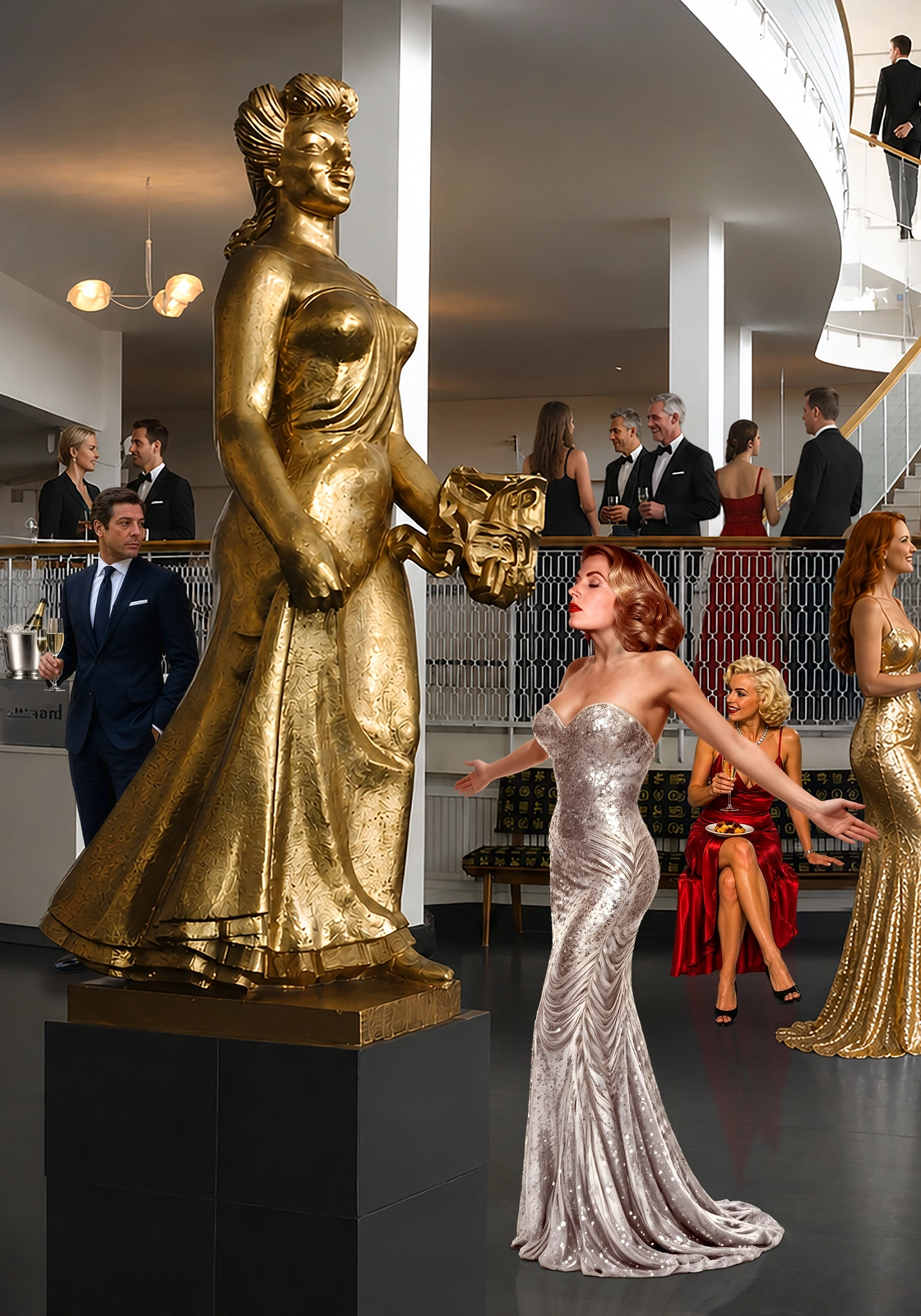
Anita vs Thalia - Anita mot Thalia, 2026
Digital
50 x 70 cm
3 200 kr
Anita vs Thalia - Anita mot Thalia
Svensk text på slutet
A Night at Malmö Opera that might never have taken place.
Some stories begin with a murder. Others with a love affair. This one begins with music and champagne.
More specifically, an unusually elegant evening at Malmö Opera sometime after midnight, when Johann Strauss IIs Die Fledermaus filled the building with waltzes, laughter, disguises, and the comforting illusion that civilisation might survive one more century through sheer elegance alone.
At first glance, the audience appeared entirely ordinary.
Well-dressed Malmö couples drifted beneath Malmö Operas magnificent crystal chandeliers, holding champagne glasses as they discussed sopranos, ticket prices, and where to have a light bite afterwards. Elderly gentlemen adjusted their scarves with diplomatic seriousness. Women in glittering evening gowns paused by mirrors and marble staircases. Somewhere in the foyer, someone laughed a little too loudly after the second glass of champagne.
Yet not everybody attending the performance had arrived by ordinary means.
Among the audience, a small number of Time-travellers moved visitors from distant centuries, vanished civilisations, forgotten futures, and stars so remote that Earth itself had become little more than a nostalgic detour along the edge of eternity.
Two of them had arrived in an old Triumph TR3A, Anita Ekberg and Marcello Mastroianni.
They had spent the evening driving slowly through Malmö beneath wet Scandinavian streetlights, arriving at the Opera for the performance. For Anita, it was a nostalgic reunion. The sports car itself had travelled to Earth with them through a wormhole, because Time-travellers, unlike Earthlings, understood that reality functioned far more logically once imagination was allowed to participate.
Waiting inside the Opera foyer stood another immortal, entirely. Her name was Thalia. Not her image in gold, but herself, the goddess of antiquity.
And she had already been watching humanity perform for more than two thousand years.
A Sonnet Before the Curtain Rises
When chandeliers like frozen planets gleam,
And Strauss awakens velvet halls with light,
When mortals gather briefly inside a dream
To dance against the loneliness of the night,
Then masks grow kinder than the face beneath,
And weary hearts wear elegance awhile,
For music teaches fragile souls to breathe
And sorrow learns, at last, the art of style.
What are we else but actors passing through,
Bright ghosts beneath the gold of stage and star?
A kiss, a waltz, a glass of midnight blue
Small lanterns carried through the cosmic dark.
So let the opera glow against the rain.
Tomorrow fades. Tonight returns again.
Malmö, May 2026
Anita vs Thalia - Anita mot Thalia
Prologue The Foyer During the Intermission
Johann Strauss IIs Die Fledermaus had fallen silent for the interval. Yet the music still seemed to linger beneath the great crystal chandeliers of Malmö Opera, like the final bubbles rising through an unfinished glass of champagne.
It was, after all, the operetta worlds supreme celebration of pleasure a glittering whirl of masked flirtations, mistaken identities, champagne-fuelled intoxication, laughter, and Viennese waltzes spinning recklessly through the night. Ever since its premiere in nineteenth-century Vienna, Die Fledermaus had remained an irresistible invitation to human folly: aristocrats pretending to be servants, servants pretending to be aristocrats, lovers deceiving one another. At the same time, Strauss music carried them all towards dawn with smiling elegance.
The performance had drawn not only Malmö society but also an unusual audience from much more distant places.
Time-travellers slipped quietly among the intermission crowd beneath the chandeliers and marble staircases. Some had come from vanished centuries, others from futures not yet born. A Roman actress stood beside a Swedish banker from the 1980s. A silent-film comedian shared cigarettes with a Renaissance court musician near the champagne bar. Nobody seemed particularly surprised. Malmö Opera had, over the decades, acquired a curious reputation even among eternitys wanderers. Certain stages, it seemed, continued to glow long after ordinary history had moved on.
At around seven, in time for the plays first act, Anita Ekberg and Marcello arrived after a slow evening drive through Malmö in their old Triumph TR3A the same model that once rolled through the dreamlike streets of La Dolce Vita. The city lights reflected across the windscreen as trembling cinema projections, as canals, bridges, and wet cobblestones drifted past the windows.
Now Marcello remained near the champagne table, charming half the foyer without seeming to try.
Anita, however, had wandered off alone. Something in the lower foyer had caught her attention.
At first glance, it seemed merely the great golden Thalia statue by Bror Marklund, standing silently among the mingling guests radiant beneath the warm theatre lights, holding the theatrical mask that symbolised comedy, illusion, and the eternal performance of human life.
But Anita sensed almost immediately that something was wrong, or perhaps impossibly right.
Because the figure standing on the pedestal was not alone, Thalia herself stood below it. Not the golden statue by Bror Marklund, but the actual goddess dressed, much like Anita, for an evening gala. Her gown shimmered faintly like liquid bronze beneath the theatre lights. At the same time, her ancient theatrical mask rested lightly against one arm, as though she had only momentarily stepped away from some celestial performance elsewhere in the universe.
Thalia immediately recognised who Anita was, and Anita recognised Thalia just as quickly, for that is how it works among Time-travellers.
They read one anothers thoughts.
It is highly practical when one lives in the airless regions of the cosmos. Without air, the vocal cords become largely useless, and telepathy shifts from talent to necessity. Unfortunately, this creates difficulties whenever eternitys inhabitants attempt to interact socially with ordinary Earthlings. Time-travellers not only remain several sentences ahead in every conversation but also effortlessly see through every attempted lie, exaggeration, hidden insecurity, or polite deception.
Human beings rarely enjoy such conditions for very long. But tonight, both women greeted one another warmly because, on Earth, they can talk like ordinary people and read minds.
They had, after all, met briefly once before, years earlier, at another strange gathering somewhere between worlds. Thalia had lived among humanity for well over two thousand years, wandering through Greek amphitheatres, Roman spectacles, Renaissance masquerades, opera houses, cabarets, and cinema palaces long before Anita Ekberg ever arrived among the stars after leaving Earth in 2015.
This meant there were many things to talk about.
Chapter I Masks Beneath the Chandeliers
For a few moments, neither woman spoke. They did not need to.
Thoughts drifted softly between them beneath the chandeliers as waiters drifted past, carrying silver trays of champagne glasses. Somewhere upstairs, the orchestra had begun tuning for the second act of Die Fledermaus. Fragments of Strauss floated faintly through the marble corridors like elegant ghosts refusing to leave the building.
You always did prefer entrances worthy of the cinema, Thalia observed, her eyes flicking towards Marcello across the foyer.
Anita smiled.
And you always preferred theatres.
The goddess laughed softly.
True. Yet after two thousand years, even immortality begins to repeat itself. Amphitheatres, royal courts, opera houses, cabarets, cinema palaces, nightclubs humanity changes costumes more often than souls do.
Anita lifted a glass of champagne from a passing tray.
Yet they still arrive dressed for dreams.
She looked around the foyer.
Women in glittering evening gowns drifted beneath the chandeliers like reflections in flowing water. Elderly Malmö couples stood beside time-travellers from vanished centuries, unaware of anything unusual. A young jazz musician from 1958 flirted openly with a woman who had probably attended the court of Louis XIV. Near the staircase, a Roman senator appeared deeply fascinated by modern Swedish canapés.
Thalia followed Anitas gaze.
They all came for the same reason, she said. To forget reality for a few hours.
Or perhaps to survive it, Anita replied in a quiet voice.
That answer pleased the goddess.
For a moment, Thalia studied her more closely.
Anita Ekberg still possessed the same overwhelming physical presence she had carried through Rome during the great years of La Dolce Vita. The blonde hair, the dramatic eyes, the impossible silhouette eternity had preserved her exactly as she preferred to be remembered. Time-travellers always chose their appearance carefully. Some arrived in the bodies of their youth. Others preferred maturity. A few embraced age completely.
Anita had selected around 1960.
The goddess smiled knowingly.
You miss Earth.
Anita hesitated.
Sometimes.
Only sometimes?
Now Anita laughed.
In eternity, one misses strange things. Not fame. Not premieres. Not photographers. But small things. She paused. The smell of rain on warm asphalt in Rome. Cold hotel sheets after midnight. A car ride with nowhere in particular to go. Espresso at three in the morning with people who still believed life would last forever.
And Marcello?
Anita glanced toward him again.
Marcello stood, surrounded by admirers near the champagne bar, effortlessly charming an entire semicircle of guests while seeming slightly bored by his own success.
Marcello misses being desired, Anita replied. Which is fortunate, as eternity gives him unlimited opportunities.
Thalia burst into laughter so suddenly that several nearby guests turned towards the golden statue in confusion.
Ah, yes, said the goddess. The beautiful sadness of attractive men.
And attractive women, Anita added.
That made Thalia nod more thoughtfully.
Yes. Especially attractive women.
Only then did Anita notice that someone was already seated on the velvet sofa beside them.
Marilyn Monroe.
She wore a ruby-red satin gown that shimmered beneath the chandeliers, her platinum hair glowing almost silver against the darker wood and marble of the foyer. One elegant shoe rested carelessly beside the sofa, as though she had been sitting there for some time, quietly observing the conversation with amused blue eyes.
Anita laughed in surprise.
Marilyn! I didnt even see you.
Marilyn smiled lazily.
You were busy discussing eternity with a Greek goddess. I try not to interrupt professional conversations.
The two women embraced warmly.
They had known one another well for years, even on earth, and, in many ways, had become close friends among the stars. Marilyn had been among the first to welcome Anita after her arrival in eternity. By then, Marilyn had already spent more than fifty years wandering through the strange afterlife of Time-travellers, long enough to become both a guide and a legend to newly arrived souls.
Anita shook her head in theatrical disbelief.
I had no idea you liked' Die Fledermaus'.
Before Marilyn could answer, Thalia smiled.
She adores it.
The goddess glanced knowingly between them.
We travelled through the wormhole together tonight. Conveniently enough, it opened beside the old sports ground, next to the Opera.
Marilyn nodded.
One moment, we were crossing half the galaxy. Next, we were standing outside Malmö Opera, listening to drunk people argue about parking spaces. She sighed happily. Honestly, thats why I still love Earth.
For a brief moment, the noise of the foyer seemed to fade around them.
You know, Thalia said quietly, humans always imagine beauty as power, but it often becomes a prison instead.
Anita looked towards the great mirrors lining the foyer walls.
I know.
In Athens, they carved my face in marble. In Rome, they painted me on the walls. Later, they cast me as statues, theatre curtains, and opera ceilings The goddess smiled faintly. And eventually as actresses.
Anita raised an eyebrow.
You compare me to a Greek muse?
I compare modern cinema to ancient mythology, Thalia replied. The mechanisms are almost identical. Audiences gather in the dark, project longing onto luminous figures, and worship beauty, tragedy, romance, and scandal. Then they return home believing the gods still exist.
And do they?
Thalia glanced towards the stage doors upstairs, where Strauss music was starting again.
Occasionally, she said. On very good evenings.
Chapter II The Goddess of Comedy Explains Humanity
Marilyn crossed her legs elegantly on the velvet sofa while Anita remained standing beside Thalias pedestal, a glass of champagne balanced lightly between her fingers. Around them, the foyer continued to glow with the warm, golden confusion unique to opera intermissions laughter, perfume, polished shoes on marble, distant Strauss melodies drifting through staircases and corridors.
For several moments, the three women watched the crowd.
Finally, Marilyn smiled.
You know, she said, Earth never really changes. Only hairstyles do.
Thalia laughed immediately.
That is because human beings remain fundamentally theatrical creatures, even when they believe themselves serious.
She gestured lightly towards the foyer.
Look at them. Half of these people spent two hours dressing for tonight. Hair, jewellery, shoes, perfume, cufflinks, make-up, carefully selected jackets all for an operetta about deception, flirtation, masks, champagne, and people pretending to be someone else.
They love every second of it, Anita said.
Of course they do, replied Thalia. Because civilisation itself is a performance.
The goddess leaned slightly against the pedestal as though she herself had grown tired after observing humanity for several thousand years.
In Athens, they wore masks of linen and wood. In Venice, they hid behind carnival masks. In Hollywood, they used cameras, filters and lighting. Today, they use social media, cosmetic surgery, political branding, filtered photographs and public relations departments. The methods evolve. The instinct remains unchanged.
Marilyn raised an eyebrow.
You make the whole human race sound like actors.
Thalia smiled.
My dear Marilyn actors are the only people honest enough to admit it.
That made Anita laugh so suddenly that several nearby guests turned towards them again. A middle-aged Malmö banker paused, confused, beside the champagne fountain. For a brief moment, he could have sworn the great golden Thalia statue had moved. But then Strauss floated down from the upper galleries once more, and he blamed the champagne instead.
Marilyn leaned back further into the sofa.
I think people forgive performers because they secretly envy them.
Oh? said Anita.
Yes. Most people spend their entire lives hiding parts of themselves, only to pay money to watch someone else become enormous in public.
Thalia nodded approvingly.
That is one reason theatre has survived for over two thousand years.
And cinema? Anita asked.
The goddess looked toward her carefully.
Cinema changed everything.
Even the noise in the foyer seemed to soften around those words.
In ancient theatre, Thalia continued, the audience always remained aware of the divide between gods and mortals. But cinema She smiled faintly. Cinema allowed humans to fall in love with faces.
Marilyn let out a quiet little sigh.
Yes, that part can become complicated.
Anita glanced toward her friend.
Neither woman needed telepathy to grasp the meaning of that sentence. Thousands of photographers. Millions of projected desires. Entire industries are built around beauty, longing, fantasy, and lonelinessthe strange immortality of film.
You know what the real tragedy is? Marilyn said in a soft voice.
That people confuse being admired with being loved.
For the first time since the conversation began, Thalia fell completely silent.
After several thousand years among humanity, even a goddess could not honestly disagree.
Chapter III Champagne, Masks, and the Loneliness of Beautiful People
The orchestra upstairs had begun quietly retuning their instruments for the second act. Fragments of Strauss drifted down the marble corridors violins testing phrases, woodwinds fluttering briefly before falling silent again. Around the foyer, the familiar ritual of the intermission continued. Some guests had already begun to move slowly towards the staircases after the first bell, while others stubbornly remained beside the champagne tables, pretending not to notice.
Thalia smiled faintly as she listened.
You see? Humanity always understands more than it lets on.
Marilyn looked amused.
That sounds dangerously philosophical for an operetta about drunken aristocrats.
Ah, said the goddess, raising one elegant finger. But comedy often hides the truth more effectively than tragedy. Tragedy warns people directly. Comedy slips past their defences while they are laughing.
Anita nodded slowly.
That is true of cinema too.
She glanced towards the staircase, where elegantly dressed guests drifted among the chandeliers like figures in a moving painting.
In La Dolce Vita, audiences believed they were watching glamour. Parties. Celebrities. Scandal. Romance. Anita smiled sadly. But Fellini was really filming exhaustion.
Thalias eyes brightened immediately.
Yes.
The desperate need to keep celebrating because silence would force people to hear themselves think.
For a brief moment, they said nothing.
Around them, the foyer glittered magnificently. Diamonds flashed beneath the chandeliers. Silk dresses shimmered across the polished marble floors. Laughter echoed upwards through the staircases like music rehearsing itself.
Yet beneath it all, that unmistakable human fear of stillness remained.
Marilyn broke the silence first.
The funny thing is, she said softly, crowds often gather around the loneliest people on Earth.
Anita gave her a knowing look.
You too?
Marilyn laughed quietly.
My dear Anita I practically invented it.
Even Thalia looked saddened by that answer.
In antiquity, the goddess said carefully, people imagined immortality as humanitys greatest reward. Eternal beauty. Eternal youth. Eternal admiration. She paused. But mortals rarely grasp the danger of becoming symbols.
Anita leaned lightly against the pedestal.
Because symbols are no longer allowed to age?
Yes, said Thalia. Or to fail. Or to become ordinary.
Marilyn slowly turned her glass of champagne beneath the foyer lights, watching the reflections glide across the crystal.
People preferred me unhappy, she said quietly. They never admitted it openly.
Anita frowned slightly.
Thats unfair.
Of course its unfair, Marilyn replied. But sadness photographs beautifully.
That sentence hung heavily between them.
Not because it was cynical, but because all three women knew it was true.
For thousands of years, humanity has transformed sorrow into entertainment, beauty into mythology, and longing into spectacle. Ancient amphitheatres. Shakespearean stages. Opera houses. Hollywood premieres. Magazine covers. Streaming platforms. Different centuries, identical instincts.
Then, somewhere upstairs, the second bell rang softly through Malmö Opera.
A subtle shift passed through the foyer. Guests reluctantly emptied their champagne glasses, adjusted their tuxedos and evening gowns, and finished conversations that would not end.
Thalia watched them with quiet affection.
And yet humans remain worth loving.
Marilyn looked genuinely curious.
After two thousand years, you still think so?
The goddess glanced towards the foyer crowd towards the elderly couples dressed carefully for the evening, towards the nervous young lovers trying to appear sophisticated, towards waiters balancing champagne trays through impossible conversations, towards visitors from centuries past and future gathered beneath Malmö Operas chandeliers.
Yes, she said softly. Despite everything they continue to make beauty in the middle of chaos.
The distant murmur of the audience returning to the auditorium drifted through the building like an incoming tide.
Masks.
Mistaken identities.
Champagne.
Music.
Human beings pretending to be happier than they really are.
Thalia listened to the sound almost tenderly.
Besides, she said, they can occasionally be quite entertaining.
Chapter IV Marcello Joins the Conversation
The second bell had not yet rung when Marcello finally slipped free of the admirers surrounding him near the champagne fountain. With elegant resignation, he adjusted his dinner jacket, carried two fresh glasses to the sofa, and sat beside Marilyn as though he had belonged there all evening.
Ah, he sighed dramatically, at last. I have survived another crowd of people explaining why they once almost became film-makers.
Marilyn smiled lazily.
That still happens?
My dear Marilyn, Marcello replied, Half of humanity believes they were born for cinema, while the other half believes they should have married someone famous.
Before either woman could answer, Marcello rose gracefully to his feet again, with the instinctive elegance of a man raised in a civilisation that had spent centuries perfecting the art of flirtation.
Forgive me, he said solemnly, resting one hand on his chest. I have behaved disgracefully.
First, he turned toward Thalia.
Even a Greek goddess looked faintly amused as Marcello, beneath the chandeliers, gently lifted her hand and kissed it with exaggerated old-world courtesy.
My lady, he said softly, forgive me for not recognising your divinity at once.
Thalia laughed.
After several thousand years, that line still works surprisingly well.
Marcello then turned towards Marilyn, whose amused blue eyes already anticipated exactly what was coming.
And as for you he murmured.
He kissed Marilyns hand with just as much elegance.
Marilyn sighed theatrically.
There it is.
What?
The Italian entrance, she replied. Charm first, existential crisis later.
Anita nearly spilt her champagne laughing.
Marcello looked mildly offended.
I shall make it clear that I am perfectly capable of experiencing both simultaneously.
Anita laughed quietly.
You encouraged them.
I encouraged nobody. I merely existed near the cameras.
Thalia looked amused.
That has sufficed for many men throughout history.
Marcello finally noticed the goddess properly and placed one hand theatrically to his chest.
You know, he said, most men spend their youth hoping to meet women like the two of you. He glanced at Marilyn and Anita. But only in eternity does one discover how exhausting such women are.
Marilyn nearly choked on her champagne.
Careful, she said. Youre speaking to a goddess.
Marcello smiled.
Yes. Which is why I am trying to remain charming while there is still time.
Thalia now laughed openly, drawing another round of confused glances from nearby guests who remained uncertain whether the golden statue was somehow changing expression beneath the chandeliers.
You understand performance instinctively, she told him.
Marcello spread his hands modestly.
I am Italian. We rehearse our emotions from childhood.
That explains opera, Marilyn murmured.
And politics, Anita added.
For a moment, all four of them sat, listening to the soft noise of the foyer as it began to thin, with more guests drifting back towards the auditorium. Waiters collected abandoned glasses. Velvet curtains shifted gently each time the great doors upstairs opened and closed.
Marcello studied Thalia with growing fascination.
You know, he said carefully, when I was still on earth, people spoke constantly about muses. He nodded towards her mask. Painters. actresses. lovers. Inspirations. He paused. But nobody ever asked the muses what they thought of us.
That is because men rarely ask women questions when they are busy worshipping them, Marilyn said dryly.
True, Marcello admitted immediately.
Thalias expression softened slightly.
The truth? she said. Most muses eventually grow tired.
Tired of artists? Anita asked.
Tired of longing.
That answer surprised them all.
The goddess rested one hand lightly on the golden theatrical mask beside her.
For thousands of years, humans have projected their dreams onto figures they consider extraordinary. Gods. Queens. Film stars. Poets. Lovers. She smiled faintly. But eventually even symbols wish to sit quietly somewhere, without representing anything.
Marilyn nodded slowly.
Yes.
Anita understood that answer too well herself.
The endless photographers.
The expectation to remain magnificent.
The strange burden of becoming more famous than ones personality.
Marcello glanced between the women and suddenly smiled more gently than he had before.
You know, he said, perhaps that is why people love Die Fledermaus.
Oh? said Thalia.
Because for one evening everyone wears masks openly instead of pretending they do not.
For perhaps the first time that evening, the goddess looked truly impressed.
Then, somewhere upstairs, came the distant sound of the audience settling back into their seats, like waves calming before the music.
And beneath Malmö Operas enormous chandeliers, four immortals stood together in silence for a few more precious moments before the performance and history resumed.
Chapter V The Wormhole Beside the Sports Ground
The foyer had begun to empty slowly. Small islands of conversation dissolved beneath the chandeliers as guests reluctantly drifted towards the staircases after the second bell. Somewhere upstairs, an impatient usher was already trying, with limited success, to encourage culture-loving Malmö citizens to return to their seats before the third bell transformed politeness into a necessity.
Marcello remained comfortably seated.
Italians, Marilyn observed dryly, treat opera bells as philosophical suggestions.
Naturally, Marcello replied. Civilisation would collapse if beauty were interrupted by punctuality.
Thalia smiled faintly.
That sentence alone explains half of European history.
Marilyn leaned back against the velvet sofa, clearly enjoying herself now.
You know, she said, the wormhole tonight was especially beautiful.
Anita turned toward her.
You still havent explained why you suddenly became interested in Viennese operetta.
Oh, Ive always liked Die Fledermaus, Marilyn answered. Champagne, disguises, elegant lies, emotionally confused aristocrats pretending to be happier than they are She gave a slight shrug. Its practically Hollywood.
That, said Thalia, is one of the more accurate descriptions of operetta Ive heard in centuries.
Marilyn continued.
Besides, the route here was lovely tonight. The wormhole opened almost perfectly beside the old sports ground, next to the Opera. We arrived just after sunset.
At once, Anita pictured it through Marilyns eyes.
The cool Malmö evening. Wet pavement glowed beneath the streetlights. The enormous curved façade of the Opera rises beyond the trees. The strange silence that often surrounds wormholes before reality settles again.
Marilyn smiled softly as the memory passed between them.
One moment, we were crossing the interstellar darkness. Next, we were standing beside a couple arguing over parking tickets near Fersens väg.
Marcello nodded approvingly.
Excellent. That means Malmö remains authentic.
It was beautiful, Marilyn continued. The air smelt faintly of rain and cigarettes. Nearby, someone was rehearsing trumpet scales very badly.
That, Anita said, really is Malmö.
For a moment, the four of them sat in silence in the warm golden light of the foyer. At the same time, fragments of memory drifted gently between their minds Rome at dawn, old Hollywood premieres, ancient Greek theatres beneath open skies, snowy Scandinavian streets, forgotten cafés that no longer existed anywhere except among Time-travellers.
Thalia finally spoke again, her voice softer.
What fascinates me most about Earthlings?
Marcello smiled.
That after two thousand years you still havent grown tired of studying us?
Oh, I grew tired centuries ago, said the goddess calmly. But fascination endured.
Marilyn laughed softly into her champagne glass.
And what still fascinates you?
Thalia looked towards the staircase, where the last guests were now disappearing into the auditorium.
The fact that mortals continue to build beautiful things despite knowing they will not last.
That answer left all of them silent for a moment.
Opera itself suddenly seemed the perfect example.
A magnificent building filled with music that vanished the moment it was created.
Voices rising into the air, only to disappear forever.
A few hours of illusion, surviving briefly against time.
Marcello looked at Anita.
Perhaps that is why we all came here tonight.
Anita nodded slowly.
Yes, she said. To watch human beings fight impermanence with champagne and Strauss.
Chapter VI The Third Bell
Then, at last, the third bell rang throughout Malmö Opera.
Unlike the earlier bells, this one carried authority.
Its sound moved through the chandeliers, marble staircases, velvet curtains, and golden walls with ceremonial inevitability, like the closing of invisible gates between worlds. Even the remaining guests in the foyer finally surrendered to reality. Champagne glasses were emptied. Gloves were adjusted. Conversations were reluctantly abandoned mid-sentence.
Ah, sighed Marcello, rising slowly. Civilisation calls.
More accurately, Marilyn replied, Swedish punctuality is called.
Anita laughed, finishing the last sip of her champagne.
Around them, the great foyer had grown calmer, almost dreamlike, after the earlier glittering chaos. Waiters collected abandoned glasses as distant footsteps echoed up the staircases towards the auditorium. Somewhere behind the closed doors, the orchestra was already settling into silence before the second act.
However, Thalia remained beside the pedestal.
Youre not coming in? Anita asked.
The goddess smiled faintly.
I have seen Die Fledermaus perhaps twelve thousand times.
And?
And it improves with champagne.
Even Marilyn laughed at that.
Marcello automatically offered his arm to Anita, who accepted it with old-cinematic elegance. For a brief moment, the two looked exactly as they once had beneath the Roman night skies of La Dolce Vita beautiful, amused, slightly melancholy, forever illuminated by invisible cameras.
Before leaving, Anita turned once more towards Thalia.
You never grow tired of humanity?
The goddess considered the question carefully.
Oh, constantly, she admitted. But then they create Mozart, Shakespeare, Fellini, or a ridiculous operetta in which everybody lies to one another while pretending to drink too much champagne. She smiled warmly. And somehow one forgives them again.
Marilyn rose from the sofa, smoothing the folds of her deep ruby-red gown in the chandeliers' light.
Thats because humans become most lovable precisely when they stop pretending to be perfect.
For a brief moment, silence settled softly around the four of them.
Then, from somewhere deep in the auditorium, a sudden burst of laughter came from the audience as the curtain rose once more upstairs.
Masks.
Music.
Desire.
Illusion.
The ancient machinery of theatre starts again.
Thalia listened almost reverently.
You hear that? she said quietly. That sound has outlasted empires.
Marcello nodded.
And will probably survive civilisation itself.
The goddess smiled.
Yes, she said softly. As long as human beings remain afraid of death, they will continue to gather in beautiful rooms to tell stories against the darkness.
Then Anita and Marcello slipped slowly towards the staircase and the glowing auditorium beyond, while Marilyn lingered beside Thalia beneath the chandeliers for a few moments longer, like two eternal constellations briefly resting within the warm golden dream of Malmö Opera.
Chapter VII Prince Orlofskys Ball
When Anita and Marcello re-entered the auditorium, the second act had already begun.
Onstage, Prince Orlofskys extravagant ball unfolded beneath dazzling chandeliers and swirling gowns. Laughter rippled through the audience as disguises multiplied, flirtations collided, champagne flowed recklessly, and Strauss music carried everyone deeper into elegant chaos. The stage glowed with impossible colours as waltzes spun through the Opera like living bubbles of champagne.
Anita paused briefly before taking her seat. Marcello had wisely secured two aisle seats at the very edge of the parquet section, so they could slip back in during the second act without disturbing half of Malmö society or, perhaps more importantly, without forcing Swedish opera audiences to perform the national ritual of pretending not to be annoyed.
For a strange moment, the boundary between stage and reality seemed almost non-existent.
The audience watched aristocrats pretending to be servants while servants pretended to be aristocrats. Jealous lovers hid behind masks. Guests reinvented themselves for a single glittering evening. Everyone performed versions of themselves, slightly more charming, seductive, witty, or dangerous than reality normally permitted.
Human beings, Anita thought, had always needed masquerades.
Beside her, Marcello leaned back comfortably into the velvet seat and agreed with a return thought.
You realise, he whispered, that half the audience is behaving exactly like the characters onstage.
Only half? Anita murmured.
Marcello smiled.
In Malmö, one must remain generous.
Below, the orchestra surged magnificently into another waltz.
The audience visibly softened beneath the music. Even the most restrained Swedish spectators seemed carried upwards by Strauss shoulders relaxing, eyes brightening, elegant shoes tapping unconsciously on the floor.
Opera did that sometimes. Not merely entertainment, but a temporary liberation.
Anita glanced around the auditorium.
A time-traveller from the Belle Époque sat two rows ahead, beside a woman who had probably worked in silent films in the 1920s. Near the aisle, a tired modern businessman, who knew nothing about wormholes or eternity, sat completely enchanted beside his wife, both smiling like newlyweds under the stage lights.
Perhaps, Anita thought, Thalia was right. Human beings remained absurd. Marcello nodded in agreement.
But there was something deeply moving about the effort they kept making dressing beautifully, gathering together, applauding the music, inventing glamour, and falling in love with stories, even while knowing the evening would end.
Then the great champagne scene arrived onstage.
Crystal glasses lifted everywhere beneath the stage lights, while Strauss music sparkled with almost reckless joy.
Marcello leaned slightly toward Anita.
There, he whispered triumphantly. The true religion of Europe.
Champagne?
No, Marcello replied. The hope that life can still be beautiful after midnight.
Anita smiled softly.
That line, she thought, sounded far better than most dialogue in films.
Far above the stage, hidden among shadows and gold decorations, she suddenly noticed two familiar figures quietly watching the performance from one of the upper balconies.
Marilyn and Thalia.
The goddess sat perfectly still beside the glowing red figure of Marilyn Monroe, both watching the operetta with expressions caught between amusement and tenderness.
For a fleeting instant, Thalia glanced down towards Anita. Although no words were spoken aloud, Anita heard the thought clearly in her mind:
This is why they survive.
Chapter VIII After Midnight in Vienna, Rome, and Malmö
By the time the second act reached its glorious confusion of disguises, accusations, flirtations, and champagne-fuelled misunderstandings, the audience at Malmö Opera had fully surrendered to Strauss.
Even the Swedes had grown noticeably warmer.
Laughter now rolled freely through the auditorium. Elegant elderly ladies leaned towards one another, whispering delighted remarks. Men who normally discussed interest rates and municipal planning now smiled like mischievous schoolboys whenever Prince Orlofsky raised another glass onstage.
Marcello observed all this with satisfaction.
You see? he whispered. Civilisation is merely the Mediterranean, temporarily trapped in colder countries.
Anita nearly laughed aloud.
Hush.
I am serious. Give Scandinavians chandeliers, champagne, velvet curtains, and music from Vienna, and they will eventually reveal their true selves.
And what is that?
Marcello smiled.
Repressed Italians.
The orchestra burst into joy beneath another waltz.
Onstage, identities continued to dissolve into delightful chaos. Husbands flirted unknowingly with their own wives. Friends deceived friends. Servants manipulated aristocrats. Everybody lied constantly, while music transformed dishonesty into elegance.
Human beings adored this kind of fantasy because reality itself often hinged on performance.
Anita understood it better than most people.
She remembered Rome after the war the desperate glamour of Cinecittà, photographers chasing actresses down midnight streets, aristocrats pretending to remain aristocrats long after history had quietly stripped them of power entire societies surviving emotionally through style.
By her side, Marcello suddenly fell quiet.
You know, he murmured, Fellini would have loved this audience.
Anita glanced toward him.
Because they are pretending?
No, Marcello said softly. They know they are pretending.
That distinction mattered.
Below them, the stage glittered magnificently, while the vast crystal chandeliers once suspended above Malmö Operas auditorium and now glowing in the grand foyer outside seemed almost to haunt the performance, conjured from memory. Gold details shimmered against velvet and silk as Strauss conducted the evenings emotional traffic with mathematical precision comedy balanced against melancholy, beauty against absurdity.
Anita suddenly realised that Die Fledermaus was not really about deception.
It was about forgiveness.
Human beings lie to one another because reality often feels too heavy without fantasy.
Marilyns earlier words returned quietly to her mind.
People preferred me to be unhappy.
Yet audiences loved Marilyn not because she suffered, but because she transformed suffering into radiance so convincingly that millions believed beauty itself could save them.
Perhaps opera worked similarly. For a few hours, music reorganised pain into harmony. Even loneliness found its rhythm.
Then, high above the auditorium, Anita once again noticed Marilyn and Thalia seated together in the shadows of the upper balcony.
Marilyn leaned towards the goddess, whispering something that made Thalia laugh softly behind an elegant hand.
Two immortals are enjoying an operetta about temporary identities. The image itself felt strangely perfect.
Marcello followed Anitas gaze upwards.
Ah, he whispered. They stayed.
Of course they stayed.
Good, he said. One should never abandon humanity during the champagne scenes. That would be philosophically irresponsible.
Chapter IX The Night Air Outside the Opera
When the performance finally ended, and the last glorious Strauss waltz dissolved into applause, the audience slowly poured out into the Malmö night like survivors from some unusually elegant dream.
The enormous foyer still shimmered with warmth, crystal reflections, perfume, and scattered laughter. Outside the Opera, however, the air felt cooler, calmer, almost startlingly real after so much velvet, champagne, and music. The old sports ground beside the building lay dark beneath the trees.
Marcello lit a cigarette almost immediately.
When he noticed the mildly disapproving looks from several nearby opera-goers, he merely shrugged with elegant resignation.
One can die only once, he said.
That explanation may once have sounded romantic in Rome. In modern Sweden, it bordered on social rebellion. Hardly anyone smoked any more, especially not outside opera houses filled with environmentally conscious upper-middle-class culture lovers in expensive scarves.
For a brief moment, Marcello looked less like a distinguished Italian gentleman and more like a dangerous historical re-enactment from another civilisation entirely.
Ah, he sighed happily, now the evening is beautiful.
Because the opera had ended? Marilyn asked.
No. Now everybody begins pretending they understood it perfectly.
Around them, small groups lingered outside the entrance beneath the glowing lamps. Elderly couples discussed their favourite arias with scholarly seriousness, while younger guests posed for photographs beneath the illuminated façade. Nearby, someone was still absentmindedly humming Strauss. On the piazza, the great sculpture Tragos burned quietly in the night, its living gas flames rising above the dark bronze ring like an ancient pagan altar still guarding the Opera after midnight.
A taxi driver leaned out of his window, watching Malmö society drift into the night. The city itself seemed softer after midnight.
Streetlights reflected on damp pavement. Cars moved slowly along Fersens väg. Beyond the trees, parts of Malmö shimmered beneath low clouds fragments of windows, neon signs, traffic lights, distant apartment towers.
For a brief moment, Anita stood still, breathing the cold Scandinavian air. Childhood memories came flooding back.
Rome never smelled like this.
Neither did Hollywood.
There was something uniquely Nordic about Malmö after opera performances restrained elegance mingled with mild practical exhaustion. Even glamour here wore sensible shoes beneath the illusion.
Thalia emerged from the Opera a few moments later, accompanied by Marilyn, though remarkably few mortals seemed to notice the Greek goddess now walking calmly through the Malmö night in bronze-coloured silk.
Time-travellers possessed a useful instinct for remaining psychologically invisible when necessary.
Marilyn slipped one arm through Anitas arm.
I always love this moment, she said softly.
What moment?
The moment after the performance ends but before reality fully returns.
Anita nodded slowly.
Yes. That fragile in-between state. Music still lingered in the body, while ordinary life waited patiently outside the theatre doors.
Marcello exhaled cigarette smoke into the cold sky.
You know, he said thoughtfully, human beings may have invented opera for the same reason they invented religion.
Thalia smiled.
To make suffering beautiful?
No, Marcello replied. To convince themselves that endings can sound magnificent.
For once, nobody laughed. Because somewhere far beyond Malmö, beyond Earth itself, beyond wormholes, stars, and eternity, all four of them knew exactly how difficult endings could be.
Behind them, Malmö Opera still glowed against the darkness like a great ship of music, temporarily anchored beside the sleeping city.
Chapter X The Last Cigarette Before Eternity
The crowd outside Malmö Opera had begun to thin. Taxis departed one by one into the sleeping city. At the same time, the last clusters of guests lingered stubbornly beneath the lamps, reluctant to let the evening dissolve completely back into ordinary life.
Over the square, Tragos continued to burn quietly in the darkness.
Its living gas flames twisted upwards through the cold Malmö air, transforming the opera plaza into something strangely ancient part Scandinavian modernism, part forgotten pagan ritual. The fire reflected faintly on the wet pavement as Strauss still echoed through the departing audience, like champagne refusing to leave the bloodstream.
Marcello stood slightly apart from the others, smoking with evident satisfaction.
You know, he said, Swedish nights become even more beautiful after midnight.
That, Marilyn replied, may simply be because you can no longer see clearly through the cigarette smoke.
Marcello calmly ignored this.
In Rome, he continued, nobody truly went home after the opera. The night merely changed its costume.
Thalia smiled.
Yes. Humanity has always feared returning directly from beauty to reality.
For a few moments, they all stood in silence, watching Malmö around them.
Cars moved softly through the wet streets. Somewhere far away, a siren drifted across the city for a moment before disappearing again. A bicycle passed along the dark pavement beside the Opera, its rider completely unaware that he had just cycled past a Greek goddess, Marilyn Monroe, Anita Ekberg, and Marcello Mastroianni, discussing civilisation beneath a flaming sculpture after midnight.
Eternity often lay remarkably close to ordinary life.
Anita wrapped her coat a little tighter against the cool Scandinavian air.
I had forgotten how different Swedish nights feel.
In what way? asked Marilyn.
Theyre quieter. Anita briefly searched for the right thought. Even the loneliness here sounds restrained.
That sentence greatly pleased Thalia.
Yes, the goddess said softly. Northern melancholy is very different from Mediterranean melancholy.
Marcello pointed his cigarette at her.
At last, somebody understands.
In Southern Europe, Thalia continued, people suffer loudly, publicly, theatrically. In Scandinavia She glanced towards the dark Malmö streets. People suffer politely, often apologising for causing inconvenience.
Marilyn burst into laughter.
That may be the most accurate description of Sweden Ive ever heard.
A cold wind briefly swept across the square, stirring dresses and coats as the flames of Tragos twisted higher for a moment against the night sky.
Then Anita noticed something unusual.
The wormhole had begun quietly reopening beside the old sports ground.
At first, it appeared only as a faint disturbance in the darkness beyond the trees almost like a heat shimmer above invisible water. But gradually the air itself seemed to bend softly inward, while distant stars flickered through impossible geometries between the branches.
Marcello sighed.
There it is.
Nobody moved immediately.
Because departures, even temporary ones, always brought sadness.
Especially after beautiful evenings.
Chapter XI What Remains After Applause
For several moments, none of them spoke. Behind them, Malmö Opera continued to glow warmly against the darkness, while inside the building, the evening had already begun to dissolve into memory. Staff cleared abandoned programmes beneath the chandeliers, doors closed softly somewhere deep in the corridors, and the great performance slowly retreated into history, as all performances eventually did. Tomorrow, the foyer would once again belong to school classes, pensioners attending matinees, singers rehearsing scales, and technicians carrying cables beneath the enormous crystal chandeliers that had once hung in the auditorium before being moved into the Operas grand foyer during modernisation. Human life moved quickly. That was both its tragedy and its beauty.
Above the square, Tragos continued to burn quietly in the cold Malmö night. Its living gas flames twisted upwards against the darkness like an ancient ceremonial fire surviving alongside modern Scandinavia. Small groups of opera guests still lingered outside the entrance beneath the glowing lamps, discussing Strauss, champagne, and favourite singers with scholarly seriousness. At the same time, taxis drifted away, one by one, into the sleeping city.
Eventually, the four of them began walking slowly around the Opera, leaving behind the glowing entrance plaza, the lingering audience, and the restless flames of Tragos in front.
Behind the building, the atmosphere changed completely.
The night grew quieter there. Dark trees surrounded the old sports ground beside the car park, where Marcellos Triumph TR3A waited beneath the lamps, its polished bodywork reflecting fragments of yellow light across the wet pavement. From this side of the Opera, the city felt farther away, as though Malmö itself had already fallen asleep.
And there, beyond the parked cars and the drifting mist beneath the trees, the wormhole had begun to reopen quietly.
At first, it appeared only as a faint distortion in the darkness between the branches, almost like a heat shimmer above invisible water. But gradually the air itself seemed to bend inward, while distant stars flickered through impossible geometries beyond ordinary space.
Marilyn looked towards it first.
Well, she sighed softly. Eternity calls.
Beside her, Thalia smiled faintly as the shimmering light gradually brightened beneath the trees.
Marcello, however, merely crushed his cigarette under one polished shoe and glanced towards the parked Triumph.
No, he said quietly. Tonight, I prefer roads.
Anita looked at him and immediately understood what.
Not wormholes.
Not stars.
Not eternity.
Just wet streets, engine noise, reflected neon, and Malmö at midnight.
For one brief evening that felt more precious than immortality.
Marilyn smiled knowingly.
The Earth still has its advantages.
Especially vintage Italian sports cars, Marcello replied.
For a moment, they all stood together in silence beside the car park, as the cold Scandinavian air sang through the trees behind the Opera. Somewhere far away, a siren echoed briefly across Malmö before disappearing into the night again.
Then Anita smiled faintly at Thalia.
You really do love them, dont you?
Who?
Humans.
The goddess considered the question carefully as the wormhole flickered softly behind her.
Then she looked back towards the Opera, glowing through the trees.
Towards the people still lingering outside after midnight, who were not yet emotionally prepared to return fully to ordinary life.
Towards the music that had already vanished into the air the instant it was performed.
Yes, she said quietly. Against all logic.
Marilyn slipped one arm gently through Anitas arm.
The strange thing is, she said softly, they believe eternity would end loneliness.
And does it? Anita asked.
Marilyn smiled sadly.
No. It merely gives one more time to think it over.
That answer lingered gently in the cold air.
Even Marcello did not joke for several seconds.
Then at last he opened the passenger door of the Triumph with old-fashioned elegance and looked towards Anita.
Well, he said quietly, before anybody becomes philosophical enough to ruin Strauss completely
That finally made them laugh again.
Marilyn embraced Anita warmly beneath the trees while Thalia stood watching them with the patient calm of someone who had already witnessed several thousand such departures throughout human history.
Then, without drama, Marilyn and the goddess slowly walked towards the shimmering distortion beside the old sports ground until both figures gradually dissolved into starlight and darkness among the trees.
For a long moment, Anita stood silently beside the car.
Then she looked once more towards Malmö Opera, glowing through the misty night, its windows still warm with light and memory.
Masks.
Champagne.
Music.
Beautiful people pretending not to be lonely. Human civilisation condensed into a few brief hours in a park in Malmö.
You see now why theatre survives everything? Thalias voice echoed softly, one final time, somewhere within Anitas thoughts.
Anita smiled.
Yes.
Then Marcello started the Triumphs engine, and together they slowly pulled away into the wet Malmö night while the Opera continued to glow behind them like a great ship of music temporarily anchored beside the sleeping city.
Chapter XII The Detour to Eternity
The Triumph TR3A rolled quietly away from the car park behind Malmö Opera as mist drifted low across the wet streets beyond the trees. For a few moments, neither Anita nor Marcello spoke. The engine itself seemed enough that soft mechanical growl from another century, moving carefully through sleeping Malmö beneath reflected streetlights and scattered rainwater.
They drove along Fersens Väg towards the sea. Behind them, the Operas glowing façade gradually disappeared among trees and buildings, leaving only faint traces of gold in the mirrors.
The Triumph itself had arrived through the wormhole with them earlier that evening. Wormholes, after all, were never narrower than the imagination of the Time-travellers using them. Human beings on Earth once joked that where there was room in the heart, there was always room for one more guest. Among Time-travellers, the saying had evolved over the centuries:
If there is room in your dreams, there is room in the wormhole.
Not that automobiles served any practical purpose in eternity, because there were no roads. Compared with wormholes and interstellar travel through the hidden fourth geometry of the universe, even a beautiful Italian sports car moved painfully slowly. So did light itself. But speed had never really been the point.
However, some evenings deserved roads, as this one did after the opera.
Besides, a garage on a distant star worked just as well as one on Earth with the added advantage that parking was free.
Strauss still lingered in Anitas thoughts. Not individual melodies any more, but atmosphere.
Champagne music.
Music written by people who understood that civilisation sometimes survived entirely on elegance.
Marcello drove slowly through the nearly empty streets, one hand resting lightly on the steering wheel. The city around them felt strangely suspended between dream and reality traffic lights changing for almost no one, silent bicycles leaning beside dark shop windows, distant apartment towers glowing faintly against low clouds.
They crossed the canal, with the city library right where Castle Park begins.
Reflections trembled softly on the black water beneath the bridge, while somewhere far behind them, the Opera continued to glow like a memory that refused to fade completely.
You know, Marcello said eventually, the strange thing about eternity is that it makes one appreciate temporary evenings even more.
Anita turned slightly toward him.
Oh?
Yes. He smiled faintly. When life becomes endless, beautiful moments become rarer, not more common.
Outside the windscreen, Malmö drifted past in fragments of wet neon and sleeping architecture. A late-night kebab shop still glowed somewhere near Davidshall. Two students crossed the street, laughing beneath umbrellas. A lone taxi waited by an empty bus stop as distant blue lights flickered briefly somewhere far across the city.
Ordinary human life continues quietly through the night.
Anita rested one hand lightly against the door, watching reflections slide across the Triumphs polished bonnet.
I think Thalia was right, she said softly.
About what?
That humans continue to make beauty because they know everything disappears.
Marcello nodded slowly.
Yes.
For a while, they listened only to the engine and the faint hiss of tyres on wet pavement.
Then Marcello smiled again, though more thoughtfully this time.
You know what the real difference is between mortals and immortals?
Anita looked at him.
Mortals still believe there will always be one more evening. We know there will be an infinite number."
That sentence remained quietly between them while the Triumph moved onward through Malmö after midnight.
After the bridge, at a red light, Anita glanced back once more. Far behind them, beyond rooftops, mist, and sleeping streets, she could still make out the warm glow of Malmö Opera against the darkness. For a fleeting moment, it looked less like a building than a memory.
Then the light changed to green.
Marcello shifted gears gently.
And together they continued deeper into the Scandinavian night, taking the long detour towards eternity, while somewhere, perhaps only in memory now, Strauss continued playing long after the music itself had ended.
PS Why Time-Travellers Still Keep Cars
Several Earth-bound readers may reasonably wonder why time-travellers capable of crossing galaxies through wormholes still bother to maintain old Italian sports cars.
The answer is as simple as it is incomprehensible.
Wormholes do not operate by speed in the ordinary human sense. In conventional space, light remains the fastest thing in the universe. But wormholes bypass ordinary geometry entirely by moving through a fourth dimension invisible to human beings. Call them shortcuts. Compared with such travel, even light itself becomes rather slow.
A galaxy located one thousand light-years from Earth can therefore be reached in what humans would describe as only a few hours. The journey from Anitas star to Earth usually takes about six earthly hours, depending somewhat on stellar alignment, gravitational turbulence, and the general temperament of eternity.
The Triumph TR3A itself arrived through the wormhole earlier that day, along with Anita and Marcello. Wormholes, after all, are never narrower than the imaginations of the time-travellers who use them.
Human beings on Earth once liked to say:
Where theres room in the heart, theres always room for one more.
Among Time-travellers the saying gradually evolved:
If there is room in your dreams, there is room in the wormhole.
Not that automobiles serve much practical purpose in eternity, where roads are largely nonexistent and interstellar travel renders combustion engines almost absurdly slow. Compared with wormholes and the universe's hidden fourth geometry, even a beautiful Italian sports car moves with touching slowness.
But speed has never really been the point.
However, evenings like this deserve roads.
Besides, a garage on a distant star works just as well as one on Earth with the added advantage that parking is entirely free.
En natt på Malmö Opera som kanske aldrig ägt rum
Vissa berättelser börjar med ett mord.
Andra med en kärlekshistoria.
Den här börjar med musik och champagne.
Mer exakt: en ovanligt elegant kväll på Malmö Opera någon gång efter midnatt, när Johann Strauss d.y:s Läderlappen fyllde byggnaden med valser, skratt, förklädnader och den trösterika illusionen att civilisationen kanske kunde överleva ytterligare ett sekel genom ren elegans.
Vid första anblicken verkade publiken helt vanlig.
Välklädda Malmöbor gled omkring under Malmö Operas magnifika kristallkronor med champagneglas i händerna medan de diskuterade sopraner, biljettpriser och var man kunde ta något lätt att äta efteråt. Äldre herrar rättade till sina halsdukar med diplomatisk allvarlighet. Kvinnor i glittrande aftonklänningar stannade till vid speglar och marmortrappor. Någonstans i foajén skrattade någon lite för högt efter det andra glaset champagne.
Men alla som bevistade föreställningen hade inte anlänt på vanligt vis.
Bland publiken rörde sig ett mindre antal Time-travellers besökare från avlägsna sekler, försvunna civilisationer, bortglömda framtider och stjärnor så fjärran att jorden själv blivit lite mer än en nostalgisk omväg vid evighetens utkant.
Två av dem hade anlänt i en gammal Triumph TR3A: Anita Ekberg och Marcello Mastroianni.
De hade tillbringat kvällen med att långsamt köra genom Malmö under våta skandinaviska gatlyktor innan de anlände till Operan för föreställningen. För Anita var det ett nostalgiskt återseende. Sportbilen hade färdats till jorden tillsammans med dem genom ett maskhål, eftersom Time-travellers, till skillnad från jordbor, förstått att verkligheten fungerar långt mer logiskt när fantasin tillåts delta.
Inne i Operans foajé väntade ytterligare en odödlig gestalt. Hennes namn var Thalia. Inte hennes bild i guld, utan hon själv, antikens gudinna.
Och hon hade redan betraktat mänskligheten i mer än två tusen år.
En sonett innan ridån går upp
När kristallkronor glimmar som frusna planeter,
Och Strauss fyller sammetsalar med sitt ljus,
När dödliga för en stund samlas i en dröm
För att dansa mot nattens ensamhet,
Då blir maskerna vänligare än ansiktet därunder,
Och trötta hjärtan bär elegans en stund,
Ty musiken lär sköra själar att andas
Och sorgen lär sig till slut stilens konst.
Vad är vi annars än skådespelare på genomresa,
Ljusa vålnader under scenens och stjärnornas guld?
En kyss, en vals, ett glas av midnattsblått
Små lyktor brann genom det kosmiska mörkret.
Så låt Operan glöda mot regnet.
Morgondagen bleknar. Men natten återvänder.
Malmö, maj 2026
Anita mot Thalia
Prolog Foajén under pausen
Johann Strauss d.y.s Läderlappen hade tystnat för paus. Ändå tycktes musiken dröja kvar under Malmö Operas stora kristallkronor, som de sista bubblorna i ett ännu inte tömt champagneglas.
Det var trots allt operettvärldens främsta hyllning till njutningen en glittrande virvel av maskeradflirtar, förväxlingar, champagneberusning, skratt och wienervals som snurrade vårdslöst genom natten. Ända sedan premiären i 1800-talets Wien hade Läderlappen förblivit en oemotståndlig inbjudan till mänsklig dårskap: aristokrater som låtsades vara tjänare, tjänare som låtsades vara aristokrater, älskande som bedrog varandra. Samtidigt bar Strauss musik dem alla mot gryningen med leende elegans.
Föreställningen hade lockat inte bara Malmös societet utan också en ovanlig publik från betydligt mer avlägsna platser.
Time-travellers gled stilla omkring bland pauspubliken under kristallkronor och marmortrappor. Några hade kommit från försvunna århundraden, andra från framtider som ännu inte fötts. En romersk skådespelerska stod bredvid en svensk bankman från 1980-talet. En stumfilmskomiker delade cigaretter med en renässansmusiker vid champagnebaren. Ingen verkade särskilt förvånad. Malmö Opera hade under årtiondena fått ett märkligt rykte även bland evighetens vandrare. Vissa scener, tycktes det, fortsatte att glöda långt efter att den vanliga historien gått vidare.
Vid sjutiden, lagom till första akten, anlände Anita Ekberg och Marcello efter en långsam kvällstur genom Malmö i sin gamla Triumph TR3A samma modell som en gång rullade genom de drömlika gatorna i La Dolce Vita. Stadens ljus speglade sig över vindrutan som darrande filmprojektioner medan kanaler, broar och våta kullerstenar gled förbi utanför rutorna.
Nu stod Marcello kvar vid champagnebordet och charmade halva foajén utan att ens tyckas anstränga sig.
Anita däremot hade vandrat iväg ensam. Något i den nedre foajén hade fångat hennes uppmärksamhet.
Vid första anblicken verkade det bara vara den stora gyllene Thalia-statyn av Bror Marklund som stod tyst bland de minglande gästerna strålande under det varma teaterljuset med teatermasken i handen, symbolen för komedi, illusion och människolivets eviga föreställning.
Men Anita kände nästan omedelbart att något var fel eller kanske omöjligt rätt.
För gestalten som stod vid sockeln var inte ensam. Nedanför stod Thalia själv. Inte Bror Marklunds gyllene staty, utan den verkliga gudinnan klädd, liksom Anita, för en galakväll. Hennes klänning skimrade svagt som flytande brons under teaterljuset. Samtidigt vilade hennes antika teatermask lätt mot den ena armen, som om hon bara tillfälligt hade lämnat någon himmelsk föreställning någon annanstans i universum.
Thalia förstod genast vem Anita var, och Anita kände lika snabbt igen Thalia, för så fungerar det bland Time-travellers.
De läser varandras tankar.
Det är mycket praktiskt när man lever i kosmos lufttomma regioner. Utan luft blir stämbanden tämligen oanvändbara och telepati övergår från talang till nödvändighet. Tyvärr skapar detta vissa svårigheter när evighetens invånare försöker umgås med vanliga jordbor. Time-travellers ligger inte bara flera meningar före i varje samtal utan genomskådar också utan ansträngning varje lögn, överdrift, dold osäkerhet eller artig förställning.
Människor uppskattar sällan sådana förhållanden särskilt länge. Men denna kväll hälsade de båda kvinnorna varmt på varandra, eftersom de på jorden kunde tala som vanliga människor s
Jörgen Thornberg
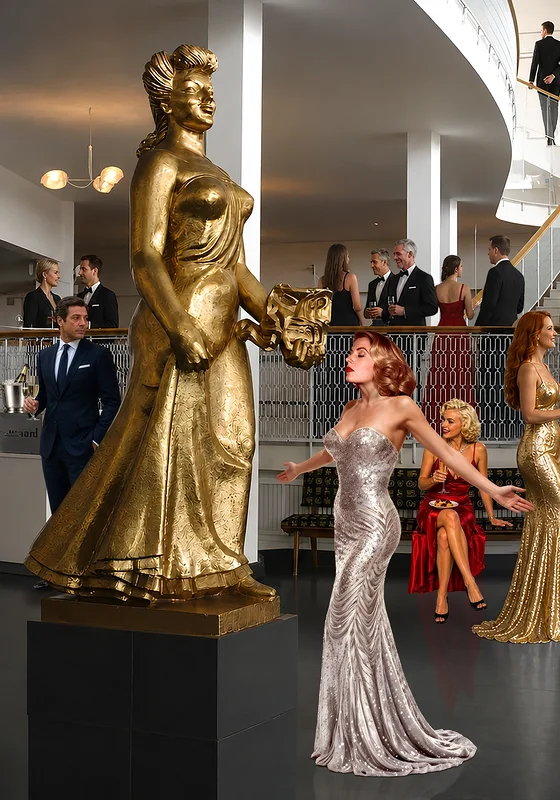
Anita vs Thalia - Anita mot Thalia, 2026
Digital
50 x 70 cm
3 200 kr
Anita vs Thalia - Anita mot Thalia
Svensk text på slutet
A Night at Malmö Opera that might never have taken place.
Some stories begin with a murder. Others with a love affair. This one begins with music and champagne.
More specifically, an unusually elegant evening at Malmö Opera sometime after midnight, when Johann Strauss IIs Die Fledermaus filled the building with waltzes, laughter, disguises, and the comforting illusion that civilisation might survive one more century through sheer elegance alone.
At first glance, the audience appeared entirely ordinary.
Well-dressed Malmö couples drifted beneath Malmö Operas magnificent crystal chandeliers, holding champagne glasses as they discussed sopranos, ticket prices, and where to have a light bite afterwards. Elderly gentlemen adjusted their scarves with diplomatic seriousness. Women in glittering evening gowns paused by mirrors and marble staircases. Somewhere in the foyer, someone laughed a little too loudly after the second glass of champagne.
Yet not everybody attending the performance had arrived by ordinary means.
Among the audience, a small number of Time-travellers moved visitors from distant centuries, vanished civilisations, forgotten futures, and stars so remote that Earth itself had become little more than a nostalgic detour along the edge of eternity.
Two of them had arrived in an old Triumph TR3A, Anita Ekberg and Marcello Mastroianni.
They had spent the evening driving slowly through Malmö beneath wet Scandinavian streetlights, arriving at the Opera for the performance. For Anita, it was a nostalgic reunion. The sports car itself had travelled to Earth with them through a wormhole, because Time-travellers, unlike Earthlings, understood that reality functioned far more logically once imagination was allowed to participate.
Waiting inside the Opera foyer stood another immortal, entirely. Her name was Thalia. Not her image in gold, but herself, the goddess of antiquity.
And she had already been watching humanity perform for more than two thousand years.
A Sonnet Before the Curtain Rises
When chandeliers like frozen planets gleam,
And Strauss awakens velvet halls with light,
When mortals gather briefly inside a dream
To dance against the loneliness of the night,
Then masks grow kinder than the face beneath,
And weary hearts wear elegance awhile,
For music teaches fragile souls to breathe
And sorrow learns, at last, the art of style.
What are we else but actors passing through,
Bright ghosts beneath the gold of stage and star?
A kiss, a waltz, a glass of midnight blue
Small lanterns carried through the cosmic dark.
So let the opera glow against the rain.
Tomorrow fades. Tonight returns again.
Malmö, May 2026
Anita vs Thalia - Anita mot Thalia
Prologue The Foyer During the Intermission
Johann Strauss IIs Die Fledermaus had fallen silent for the interval. Yet the music still seemed to linger beneath the great crystal chandeliers of Malmö Opera, like the final bubbles rising through an unfinished glass of champagne.
It was, after all, the operetta worlds supreme celebration of pleasure a glittering whirl of masked flirtations, mistaken identities, champagne-fuelled intoxication, laughter, and Viennese waltzes spinning recklessly through the night. Ever since its premiere in nineteenth-century Vienna, Die Fledermaus had remained an irresistible invitation to human folly: aristocrats pretending to be servants, servants pretending to be aristocrats, lovers deceiving one another. At the same time, Strauss music carried them all towards dawn with smiling elegance.
The performance had drawn not only Malmö society but also an unusual audience from much more distant places.
Time-travellers slipped quietly among the intermission crowd beneath the chandeliers and marble staircases. Some had come from vanished centuries, others from futures not yet born. A Roman actress stood beside a Swedish banker from the 1980s. A silent-film comedian shared cigarettes with a Renaissance court musician near the champagne bar. Nobody seemed particularly surprised. Malmö Opera had, over the decades, acquired a curious reputation even among eternitys wanderers. Certain stages, it seemed, continued to glow long after ordinary history had moved on.
At around seven, in time for the plays first act, Anita Ekberg and Marcello arrived after a slow evening drive through Malmö in their old Triumph TR3A the same model that once rolled through the dreamlike streets of La Dolce Vita. The city lights reflected across the windscreen as trembling cinema projections, as canals, bridges, and wet cobblestones drifted past the windows.
Now Marcello remained near the champagne table, charming half the foyer without seeming to try.
Anita, however, had wandered off alone. Something in the lower foyer had caught her attention.
At first glance, it seemed merely the great golden Thalia statue by Bror Marklund, standing silently among the mingling guests radiant beneath the warm theatre lights, holding the theatrical mask that symbolised comedy, illusion, and the eternal performance of human life.
But Anita sensed almost immediately that something was wrong, or perhaps impossibly right.
Because the figure standing on the pedestal was not alone, Thalia herself stood below it. Not the golden statue by Bror Marklund, but the actual goddess dressed, much like Anita, for an evening gala. Her gown shimmered faintly like liquid bronze beneath the theatre lights. At the same time, her ancient theatrical mask rested lightly against one arm, as though she had only momentarily stepped away from some celestial performance elsewhere in the universe.
Thalia immediately recognised who Anita was, and Anita recognised Thalia just as quickly, for that is how it works among Time-travellers.
They read one anothers thoughts.
It is highly practical when one lives in the airless regions of the cosmos. Without air, the vocal cords become largely useless, and telepathy shifts from talent to necessity. Unfortunately, this creates difficulties whenever eternitys inhabitants attempt to interact socially with ordinary Earthlings. Time-travellers not only remain several sentences ahead in every conversation but also effortlessly see through every attempted lie, exaggeration, hidden insecurity, or polite deception.
Human beings rarely enjoy such conditions for very long. But tonight, both women greeted one another warmly because, on Earth, they can talk like ordinary people and read minds.
They had, after all, met briefly once before, years earlier, at another strange gathering somewhere between worlds. Thalia had lived among humanity for well over two thousand years, wandering through Greek amphitheatres, Roman spectacles, Renaissance masquerades, opera houses, cabarets, and cinema palaces long before Anita Ekberg ever arrived among the stars after leaving Earth in 2015.
This meant there were many things to talk about.
Chapter I Masks Beneath the Chandeliers
For a few moments, neither woman spoke. They did not need to.
Thoughts drifted softly between them beneath the chandeliers as waiters drifted past, carrying silver trays of champagne glasses. Somewhere upstairs, the orchestra had begun tuning for the second act of Die Fledermaus. Fragments of Strauss floated faintly through the marble corridors like elegant ghosts refusing to leave the building.
You always did prefer entrances worthy of the cinema, Thalia observed, her eyes flicking towards Marcello across the foyer.
Anita smiled.
And you always preferred theatres.
The goddess laughed softly.
True. Yet after two thousand years, even immortality begins to repeat itself. Amphitheatres, royal courts, opera houses, cabarets, cinema palaces, nightclubs humanity changes costumes more often than souls do.
Anita lifted a glass of champagne from a passing tray.
Yet they still arrive dressed for dreams.
She looked around the foyer.
Women in glittering evening gowns drifted beneath the chandeliers like reflections in flowing water. Elderly Malmö couples stood beside time-travellers from vanished centuries, unaware of anything unusual. A young jazz musician from 1958 flirted openly with a woman who had probably attended the court of Louis XIV. Near the staircase, a Roman senator appeared deeply fascinated by modern Swedish canapés.
Thalia followed Anitas gaze.
They all came for the same reason, she said. To forget reality for a few hours.
Or perhaps to survive it, Anita replied in a quiet voice.
That answer pleased the goddess.
For a moment, Thalia studied her more closely.
Anita Ekberg still possessed the same overwhelming physical presence she had carried through Rome during the great years of La Dolce Vita. The blonde hair, the dramatic eyes, the impossible silhouette eternity had preserved her exactly as she preferred to be remembered. Time-travellers always chose their appearance carefully. Some arrived in the bodies of their youth. Others preferred maturity. A few embraced age completely.
Anita had selected around 1960.
The goddess smiled knowingly.
You miss Earth.
Anita hesitated.
Sometimes.
Only sometimes?
Now Anita laughed.
In eternity, one misses strange things. Not fame. Not premieres. Not photographers. But small things. She paused. The smell of rain on warm asphalt in Rome. Cold hotel sheets after midnight. A car ride with nowhere in particular to go. Espresso at three in the morning with people who still believed life would last forever.
And Marcello?
Anita glanced toward him again.
Marcello stood, surrounded by admirers near the champagne bar, effortlessly charming an entire semicircle of guests while seeming slightly bored by his own success.
Marcello misses being desired, Anita replied. Which is fortunate, as eternity gives him unlimited opportunities.
Thalia burst into laughter so suddenly that several nearby guests turned towards the golden statue in confusion.
Ah, yes, said the goddess. The beautiful sadness of attractive men.
And attractive women, Anita added.
That made Thalia nod more thoughtfully.
Yes. Especially attractive women.
Only then did Anita notice that someone was already seated on the velvet sofa beside them.
Marilyn Monroe.
She wore a ruby-red satin gown that shimmered beneath the chandeliers, her platinum hair glowing almost silver against the darker wood and marble of the foyer. One elegant shoe rested carelessly beside the sofa, as though she had been sitting there for some time, quietly observing the conversation with amused blue eyes.
Anita laughed in surprise.
Marilyn! I didnt even see you.
Marilyn smiled lazily.
You were busy discussing eternity with a Greek goddess. I try not to interrupt professional conversations.
The two women embraced warmly.
They had known one another well for years, even on earth, and, in many ways, had become close friends among the stars. Marilyn had been among the first to welcome Anita after her arrival in eternity. By then, Marilyn had already spent more than fifty years wandering through the strange afterlife of Time-travellers, long enough to become both a guide and a legend to newly arrived souls.
Anita shook her head in theatrical disbelief.
I had no idea you liked' Die Fledermaus'.
Before Marilyn could answer, Thalia smiled.
She adores it.
The goddess glanced knowingly between them.
We travelled through the wormhole together tonight. Conveniently enough, it opened beside the old sports ground, next to the Opera.
Marilyn nodded.
One moment, we were crossing half the galaxy. Next, we were standing outside Malmö Opera, listening to drunk people argue about parking spaces. She sighed happily. Honestly, thats why I still love Earth.
For a brief moment, the noise of the foyer seemed to fade around them.
You know, Thalia said quietly, humans always imagine beauty as power, but it often becomes a prison instead.
Anita looked towards the great mirrors lining the foyer walls.
I know.
In Athens, they carved my face in marble. In Rome, they painted me on the walls. Later, they cast me as statues, theatre curtains, and opera ceilings The goddess smiled faintly. And eventually as actresses.
Anita raised an eyebrow.
You compare me to a Greek muse?
I compare modern cinema to ancient mythology, Thalia replied. The mechanisms are almost identical. Audiences gather in the dark, project longing onto luminous figures, and worship beauty, tragedy, romance, and scandal. Then they return home believing the gods still exist.
And do they?
Thalia glanced towards the stage doors upstairs, where Strauss music was starting again.
Occasionally, she said. On very good evenings.
Chapter II The Goddess of Comedy Explains Humanity
Marilyn crossed her legs elegantly on the velvet sofa while Anita remained standing beside Thalias pedestal, a glass of champagne balanced lightly between her fingers. Around them, the foyer continued to glow with the warm, golden confusion unique to opera intermissions laughter, perfume, polished shoes on marble, distant Strauss melodies drifting through staircases and corridors.
For several moments, the three women watched the crowd.
Finally, Marilyn smiled.
You know, she said, Earth never really changes. Only hairstyles do.
Thalia laughed immediately.
That is because human beings remain fundamentally theatrical creatures, even when they believe themselves serious.
She gestured lightly towards the foyer.
Look at them. Half of these people spent two hours dressing for tonight. Hair, jewellery, shoes, perfume, cufflinks, make-up, carefully selected jackets all for an operetta about deception, flirtation, masks, champagne, and people pretending to be someone else.
They love every second of it, Anita said.
Of course they do, replied Thalia. Because civilisation itself is a performance.
The goddess leaned slightly against the pedestal as though she herself had grown tired after observing humanity for several thousand years.
In Athens, they wore masks of linen and wood. In Venice, they hid behind carnival masks. In Hollywood, they used cameras, filters and lighting. Today, they use social media, cosmetic surgery, political branding, filtered photographs and public relations departments. The methods evolve. The instinct remains unchanged.
Marilyn raised an eyebrow.
You make the whole human race sound like actors.
Thalia smiled.
My dear Marilyn actors are the only people honest enough to admit it.
That made Anita laugh so suddenly that several nearby guests turned towards them again. A middle-aged Malmö banker paused, confused, beside the champagne fountain. For a brief moment, he could have sworn the great golden Thalia statue had moved. But then Strauss floated down from the upper galleries once more, and he blamed the champagne instead.
Marilyn leaned back further into the sofa.
I think people forgive performers because they secretly envy them.
Oh? said Anita.
Yes. Most people spend their entire lives hiding parts of themselves, only to pay money to watch someone else become enormous in public.
Thalia nodded approvingly.
That is one reason theatre has survived for over two thousand years.
And cinema? Anita asked.
The goddess looked toward her carefully.
Cinema changed everything.
Even the noise in the foyer seemed to soften around those words.
In ancient theatre, Thalia continued, the audience always remained aware of the divide between gods and mortals. But cinema She smiled faintly. Cinema allowed humans to fall in love with faces.
Marilyn let out a quiet little sigh.
Yes, that part can become complicated.
Anita glanced toward her friend.
Neither woman needed telepathy to grasp the meaning of that sentence. Thousands of photographers. Millions of projected desires. Entire industries are built around beauty, longing, fantasy, and lonelinessthe strange immortality of film.
You know what the real tragedy is? Marilyn said in a soft voice.
That people confuse being admired with being loved.
For the first time since the conversation began, Thalia fell completely silent.
After several thousand years among humanity, even a goddess could not honestly disagree.
Chapter III Champagne, Masks, and the Loneliness of Beautiful People
The orchestra upstairs had begun quietly retuning their instruments for the second act. Fragments of Strauss drifted down the marble corridors violins testing phrases, woodwinds fluttering briefly before falling silent again. Around the foyer, the familiar ritual of the intermission continued. Some guests had already begun to move slowly towards the staircases after the first bell, while others stubbornly remained beside the champagne tables, pretending not to notice.
Thalia smiled faintly as she listened.
You see? Humanity always understands more than it lets on.
Marilyn looked amused.
That sounds dangerously philosophical for an operetta about drunken aristocrats.
Ah, said the goddess, raising one elegant finger. But comedy often hides the truth more effectively than tragedy. Tragedy warns people directly. Comedy slips past their defences while they are laughing.
Anita nodded slowly.
That is true of cinema too.
She glanced towards the staircase, where elegantly dressed guests drifted among the chandeliers like figures in a moving painting.
In La Dolce Vita, audiences believed they were watching glamour. Parties. Celebrities. Scandal. Romance. Anita smiled sadly. But Fellini was really filming exhaustion.
Thalias eyes brightened immediately.
Yes.
The desperate need to keep celebrating because silence would force people to hear themselves think.
For a brief moment, they said nothing.
Around them, the foyer glittered magnificently. Diamonds flashed beneath the chandeliers. Silk dresses shimmered across the polished marble floors. Laughter echoed upwards through the staircases like music rehearsing itself.
Yet beneath it all, that unmistakable human fear of stillness remained.
Marilyn broke the silence first.
The funny thing is, she said softly, crowds often gather around the loneliest people on Earth.
Anita gave her a knowing look.
You too?
Marilyn laughed quietly.
My dear Anita I practically invented it.
Even Thalia looked saddened by that answer.
In antiquity, the goddess said carefully, people imagined immortality as humanitys greatest reward. Eternal beauty. Eternal youth. Eternal admiration. She paused. But mortals rarely grasp the danger of becoming symbols.
Anita leaned lightly against the pedestal.
Because symbols are no longer allowed to age?
Yes, said Thalia. Or to fail. Or to become ordinary.
Marilyn slowly turned her glass of champagne beneath the foyer lights, watching the reflections glide across the crystal.
People preferred me unhappy, she said quietly. They never admitted it openly.
Anita frowned slightly.
Thats unfair.
Of course its unfair, Marilyn replied. But sadness photographs beautifully.
That sentence hung heavily between them.
Not because it was cynical, but because all three women knew it was true.
For thousands of years, humanity has transformed sorrow into entertainment, beauty into mythology, and longing into spectacle. Ancient amphitheatres. Shakespearean stages. Opera houses. Hollywood premieres. Magazine covers. Streaming platforms. Different centuries, identical instincts.
Then, somewhere upstairs, the second bell rang softly through Malmö Opera.
A subtle shift passed through the foyer. Guests reluctantly emptied their champagne glasses, adjusted their tuxedos and evening gowns, and finished conversations that would not end.
Thalia watched them with quiet affection.
And yet humans remain worth loving.
Marilyn looked genuinely curious.
After two thousand years, you still think so?
The goddess glanced towards the foyer crowd towards the elderly couples dressed carefully for the evening, towards the nervous young lovers trying to appear sophisticated, towards waiters balancing champagne trays through impossible conversations, towards visitors from centuries past and future gathered beneath Malmö Operas chandeliers.
Yes, she said softly. Despite everything they continue to make beauty in the middle of chaos.
The distant murmur of the audience returning to the auditorium drifted through the building like an incoming tide.
Masks.
Mistaken identities.
Champagne.
Music.
Human beings pretending to be happier than they really are.
Thalia listened to the sound almost tenderly.
Besides, she said, they can occasionally be quite entertaining.
Chapter IV Marcello Joins the Conversation
The second bell had not yet rung when Marcello finally slipped free of the admirers surrounding him near the champagne fountain. With elegant resignation, he adjusted his dinner jacket, carried two fresh glasses to the sofa, and sat beside Marilyn as though he had belonged there all evening.
Ah, he sighed dramatically, at last. I have survived another crowd of people explaining why they once almost became film-makers.
Marilyn smiled lazily.
That still happens?
My dear Marilyn, Marcello replied, Half of humanity believes they were born for cinema, while the other half believes they should have married someone famous.
Before either woman could answer, Marcello rose gracefully to his feet again, with the instinctive elegance of a man raised in a civilisation that had spent centuries perfecting the art of flirtation.
Forgive me, he said solemnly, resting one hand on his chest. I have behaved disgracefully.
First, he turned toward Thalia.
Even a Greek goddess looked faintly amused as Marcello, beneath the chandeliers, gently lifted her hand and kissed it with exaggerated old-world courtesy.
My lady, he said softly, forgive me for not recognising your divinity at once.
Thalia laughed.
After several thousand years, that line still works surprisingly well.
Marcello then turned towards Marilyn, whose amused blue eyes already anticipated exactly what was coming.
And as for you he murmured.
He kissed Marilyns hand with just as much elegance.
Marilyn sighed theatrically.
There it is.
What?
The Italian entrance, she replied. Charm first, existential crisis later.
Anita nearly spilt her champagne laughing.
Marcello looked mildly offended.
I shall make it clear that I am perfectly capable of experiencing both simultaneously.
Anita laughed quietly.
You encouraged them.
I encouraged nobody. I merely existed near the cameras.
Thalia looked amused.
That has sufficed for many men throughout history.
Marcello finally noticed the goddess properly and placed one hand theatrically to his chest.
You know, he said, most men spend their youth hoping to meet women like the two of you. He glanced at Marilyn and Anita. But only in eternity does one discover how exhausting such women are.
Marilyn nearly choked on her champagne.
Careful, she said. Youre speaking to a goddess.
Marcello smiled.
Yes. Which is why I am trying to remain charming while there is still time.
Thalia now laughed openly, drawing another round of confused glances from nearby guests who remained uncertain whether the golden statue was somehow changing expression beneath the chandeliers.
You understand performance instinctively, she told him.
Marcello spread his hands modestly.
I am Italian. We rehearse our emotions from childhood.
That explains opera, Marilyn murmured.
And politics, Anita added.
For a moment, all four of them sat, listening to the soft noise of the foyer as it began to thin, with more guests drifting back towards the auditorium. Waiters collected abandoned glasses. Velvet curtains shifted gently each time the great doors upstairs opened and closed.
Marcello studied Thalia with growing fascination.
You know, he said carefully, when I was still on earth, people spoke constantly about muses. He nodded towards her mask. Painters. actresses. lovers. Inspirations. He paused. But nobody ever asked the muses what they thought of us.
That is because men rarely ask women questions when they are busy worshipping them, Marilyn said dryly.
True, Marcello admitted immediately.
Thalias expression softened slightly.
The truth? she said. Most muses eventually grow tired.
Tired of artists? Anita asked.
Tired of longing.
That answer surprised them all.
The goddess rested one hand lightly on the golden theatrical mask beside her.
For thousands of years, humans have projected their dreams onto figures they consider extraordinary. Gods. Queens. Film stars. Poets. Lovers. She smiled faintly. But eventually even symbols wish to sit quietly somewhere, without representing anything.
Marilyn nodded slowly.
Yes.
Anita understood that answer too well herself.
The endless photographers.
The expectation to remain magnificent.
The strange burden of becoming more famous than ones personality.
Marcello glanced between the women and suddenly smiled more gently than he had before.
You know, he said, perhaps that is why people love Die Fledermaus.
Oh? said Thalia.
Because for one evening everyone wears masks openly instead of pretending they do not.
For perhaps the first time that evening, the goddess looked truly impressed.
Then, somewhere upstairs, came the distant sound of the audience settling back into their seats, like waves calming before the music.
And beneath Malmö Operas enormous chandeliers, four immortals stood together in silence for a few more precious moments before the performance and history resumed.
Chapter V The Wormhole Beside the Sports Ground
The foyer had begun to empty slowly. Small islands of conversation dissolved beneath the chandeliers as guests reluctantly drifted towards the staircases after the second bell. Somewhere upstairs, an impatient usher was already trying, with limited success, to encourage culture-loving Malmö citizens to return to their seats before the third bell transformed politeness into a necessity.
Marcello remained comfortably seated.
Italians, Marilyn observed dryly, treat opera bells as philosophical suggestions.
Naturally, Marcello replied. Civilisation would collapse if beauty were interrupted by punctuality.
Thalia smiled faintly.
That sentence alone explains half of European history.
Marilyn leaned back against the velvet sofa, clearly enjoying herself now.
You know, she said, the wormhole tonight was especially beautiful.
Anita turned toward her.
You still havent explained why you suddenly became interested in Viennese operetta.
Oh, Ive always liked Die Fledermaus, Marilyn answered. Champagne, disguises, elegant lies, emotionally confused aristocrats pretending to be happier than they are She gave a slight shrug. Its practically Hollywood.
That, said Thalia, is one of the more accurate descriptions of operetta Ive heard in centuries.
Marilyn continued.
Besides, the route here was lovely tonight. The wormhole opened almost perfectly beside the old sports ground, next to the Opera. We arrived just after sunset.
At once, Anita pictured it through Marilyns eyes.
The cool Malmö evening. Wet pavement glowed beneath the streetlights. The enormous curved façade of the Opera rises beyond the trees. The strange silence that often surrounds wormholes before reality settles again.
Marilyn smiled softly as the memory passed between them.
One moment, we were crossing the interstellar darkness. Next, we were standing beside a couple arguing over parking tickets near Fersens väg.
Marcello nodded approvingly.
Excellent. That means Malmö remains authentic.
It was beautiful, Marilyn continued. The air smelt faintly of rain and cigarettes. Nearby, someone was rehearsing trumpet scales very badly.
That, Anita said, really is Malmö.
For a moment, the four of them sat in silence in the warm golden light of the foyer. At the same time, fragments of memory drifted gently between their minds Rome at dawn, old Hollywood premieres, ancient Greek theatres beneath open skies, snowy Scandinavian streets, forgotten cafés that no longer existed anywhere except among Time-travellers.
Thalia finally spoke again, her voice softer.
What fascinates me most about Earthlings?
Marcello smiled.
That after two thousand years you still havent grown tired of studying us?
Oh, I grew tired centuries ago, said the goddess calmly. But fascination endured.
Marilyn laughed softly into her champagne glass.
And what still fascinates you?
Thalia looked towards the staircase, where the last guests were now disappearing into the auditorium.
The fact that mortals continue to build beautiful things despite knowing they will not last.
That answer left all of them silent for a moment.
Opera itself suddenly seemed the perfect example.
A magnificent building filled with music that vanished the moment it was created.
Voices rising into the air, only to disappear forever.
A few hours of illusion, surviving briefly against time.
Marcello looked at Anita.
Perhaps that is why we all came here tonight.
Anita nodded slowly.
Yes, she said. To watch human beings fight impermanence with champagne and Strauss.
Chapter VI The Third Bell
Then, at last, the third bell rang throughout Malmö Opera.
Unlike the earlier bells, this one carried authority.
Its sound moved through the chandeliers, marble staircases, velvet curtains, and golden walls with ceremonial inevitability, like the closing of invisible gates between worlds. Even the remaining guests in the foyer finally surrendered to reality. Champagne glasses were emptied. Gloves were adjusted. Conversations were reluctantly abandoned mid-sentence.
Ah, sighed Marcello, rising slowly. Civilisation calls.
More accurately, Marilyn replied, Swedish punctuality is called.
Anita laughed, finishing the last sip of her champagne.
Around them, the great foyer had grown calmer, almost dreamlike, after the earlier glittering chaos. Waiters collected abandoned glasses as distant footsteps echoed up the staircases towards the auditorium. Somewhere behind the closed doors, the orchestra was already settling into silence before the second act.
However, Thalia remained beside the pedestal.
Youre not coming in? Anita asked.
The goddess smiled faintly.
I have seen Die Fledermaus perhaps twelve thousand times.
And?
And it improves with champagne.
Even Marilyn laughed at that.
Marcello automatically offered his arm to Anita, who accepted it with old-cinematic elegance. For a brief moment, the two looked exactly as they once had beneath the Roman night skies of La Dolce Vita beautiful, amused, slightly melancholy, forever illuminated by invisible cameras.
Before leaving, Anita turned once more towards Thalia.
You never grow tired of humanity?
The goddess considered the question carefully.
Oh, constantly, she admitted. But then they create Mozart, Shakespeare, Fellini, or a ridiculous operetta in which everybody lies to one another while pretending to drink too much champagne. She smiled warmly. And somehow one forgives them again.
Marilyn rose from the sofa, smoothing the folds of her deep ruby-red gown in the chandeliers' light.
Thats because humans become most lovable precisely when they stop pretending to be perfect.
For a brief moment, silence settled softly around the four of them.
Then, from somewhere deep in the auditorium, a sudden burst of laughter came from the audience as the curtain rose once more upstairs.
Masks.
Music.
Desire.
Illusion.
The ancient machinery of theatre starts again.
Thalia listened almost reverently.
You hear that? she said quietly. That sound has outlasted empires.
Marcello nodded.
And will probably survive civilisation itself.
The goddess smiled.
Yes, she said softly. As long as human beings remain afraid of death, they will continue to gather in beautiful rooms to tell stories against the darkness.
Then Anita and Marcello slipped slowly towards the staircase and the glowing auditorium beyond, while Marilyn lingered beside Thalia beneath the chandeliers for a few moments longer, like two eternal constellations briefly resting within the warm golden dream of Malmö Opera.
Chapter VII Prince Orlofskys Ball
When Anita and Marcello re-entered the auditorium, the second act had already begun.
Onstage, Prince Orlofskys extravagant ball unfolded beneath dazzling chandeliers and swirling gowns. Laughter rippled through the audience as disguises multiplied, flirtations collided, champagne flowed recklessly, and Strauss music carried everyone deeper into elegant chaos. The stage glowed with impossible colours as waltzes spun through the Opera like living bubbles of champagne.
Anita paused briefly before taking her seat. Marcello had wisely secured two aisle seats at the very edge of the parquet section, so they could slip back in during the second act without disturbing half of Malmö society or, perhaps more importantly, without forcing Swedish opera audiences to perform the national ritual of pretending not to be annoyed.
For a strange moment, the boundary between stage and reality seemed almost non-existent.
The audience watched aristocrats pretending to be servants while servants pretended to be aristocrats. Jealous lovers hid behind masks. Guests reinvented themselves for a single glittering evening. Everyone performed versions of themselves, slightly more charming, seductive, witty, or dangerous than reality normally permitted.
Human beings, Anita thought, had always needed masquerades.
Beside her, Marcello leaned back comfortably into the velvet seat and agreed with a return thought.
You realise, he whispered, that half the audience is behaving exactly like the characters onstage.
Only half? Anita murmured.
Marcello smiled.
In Malmö, one must remain generous.
Below, the orchestra surged magnificently into another waltz.
The audience visibly softened beneath the music. Even the most restrained Swedish spectators seemed carried upwards by Strauss shoulders relaxing, eyes brightening, elegant shoes tapping unconsciously on the floor.
Opera did that sometimes. Not merely entertainment, but a temporary liberation.
Anita glanced around the auditorium.
A time-traveller from the Belle Époque sat two rows ahead, beside a woman who had probably worked in silent films in the 1920s. Near the aisle, a tired modern businessman, who knew nothing about wormholes or eternity, sat completely enchanted beside his wife, both smiling like newlyweds under the stage lights.
Perhaps, Anita thought, Thalia was right. Human beings remained absurd. Marcello nodded in agreement.
But there was something deeply moving about the effort they kept making dressing beautifully, gathering together, applauding the music, inventing glamour, and falling in love with stories, even while knowing the evening would end.
Then the great champagne scene arrived onstage.
Crystal glasses lifted everywhere beneath the stage lights, while Strauss music sparkled with almost reckless joy.
Marcello leaned slightly toward Anita.
There, he whispered triumphantly. The true religion of Europe.
Champagne?
No, Marcello replied. The hope that life can still be beautiful after midnight.
Anita smiled softly.
That line, she thought, sounded far better than most dialogue in films.
Far above the stage, hidden among shadows and gold decorations, she suddenly noticed two familiar figures quietly watching the performance from one of the upper balconies.
Marilyn and Thalia.
The goddess sat perfectly still beside the glowing red figure of Marilyn Monroe, both watching the operetta with expressions caught between amusement and tenderness.
For a fleeting instant, Thalia glanced down towards Anita. Although no words were spoken aloud, Anita heard the thought clearly in her mind:
This is why they survive.
Chapter VIII After Midnight in Vienna, Rome, and Malmö
By the time the second act reached its glorious confusion of disguises, accusations, flirtations, and champagne-fuelled misunderstandings, the audience at Malmö Opera had fully surrendered to Strauss.
Even the Swedes had grown noticeably warmer.
Laughter now rolled freely through the auditorium. Elegant elderly ladies leaned towards one another, whispering delighted remarks. Men who normally discussed interest rates and municipal planning now smiled like mischievous schoolboys whenever Prince Orlofsky raised another glass onstage.
Marcello observed all this with satisfaction.
You see? he whispered. Civilisation is merely the Mediterranean, temporarily trapped in colder countries.
Anita nearly laughed aloud.
Hush.
I am serious. Give Scandinavians chandeliers, champagne, velvet curtains, and music from Vienna, and they will eventually reveal their true selves.
And what is that?
Marcello smiled.
Repressed Italians.
The orchestra burst into joy beneath another waltz.
Onstage, identities continued to dissolve into delightful chaos. Husbands flirted unknowingly with their own wives. Friends deceived friends. Servants manipulated aristocrats. Everybody lied constantly, while music transformed dishonesty into elegance.
Human beings adored this kind of fantasy because reality itself often hinged on performance.
Anita understood it better than most people.
She remembered Rome after the war the desperate glamour of Cinecittà, photographers chasing actresses down midnight streets, aristocrats pretending to remain aristocrats long after history had quietly stripped them of power entire societies surviving emotionally through style.
By her side, Marcello suddenly fell quiet.
You know, he murmured, Fellini would have loved this audience.
Anita glanced toward him.
Because they are pretending?
No, Marcello said softly. They know they are pretending.
That distinction mattered.
Below them, the stage glittered magnificently, while the vast crystal chandeliers once suspended above Malmö Operas auditorium and now glowing in the grand foyer outside seemed almost to haunt the performance, conjured from memory. Gold details shimmered against velvet and silk as Strauss conducted the evenings emotional traffic with mathematical precision comedy balanced against melancholy, beauty against absurdity.
Anita suddenly realised that Die Fledermaus was not really about deception.
It was about forgiveness.
Human beings lie to one another because reality often feels too heavy without fantasy.
Marilyns earlier words returned quietly to her mind.
People preferred me to be unhappy.
Yet audiences loved Marilyn not because she suffered, but because she transformed suffering into radiance so convincingly that millions believed beauty itself could save them.
Perhaps opera worked similarly. For a few hours, music reorganised pain into harmony. Even loneliness found its rhythm.
Then, high above the auditorium, Anita once again noticed Marilyn and Thalia seated together in the shadows of the upper balcony.
Marilyn leaned towards the goddess, whispering something that made Thalia laugh softly behind an elegant hand.
Two immortals are enjoying an operetta about temporary identities. The image itself felt strangely perfect.
Marcello followed Anitas gaze upwards.
Ah, he whispered. They stayed.
Of course they stayed.
Good, he said. One should never abandon humanity during the champagne scenes. That would be philosophically irresponsible.
Chapter IX The Night Air Outside the Opera
When the performance finally ended, and the last glorious Strauss waltz dissolved into applause, the audience slowly poured out into the Malmö night like survivors from some unusually elegant dream.
The enormous foyer still shimmered with warmth, crystal reflections, perfume, and scattered laughter. Outside the Opera, however, the air felt cooler, calmer, almost startlingly real after so much velvet, champagne, and music. The old sports ground beside the building lay dark beneath the trees.
Marcello lit a cigarette almost immediately.
When he noticed the mildly disapproving looks from several nearby opera-goers, he merely shrugged with elegant resignation.
One can die only once, he said.
That explanation may once have sounded romantic in Rome. In modern Sweden, it bordered on social rebellion. Hardly anyone smoked any more, especially not outside opera houses filled with environmentally conscious upper-middle-class culture lovers in expensive scarves.
For a brief moment, Marcello looked less like a distinguished Italian gentleman and more like a dangerous historical re-enactment from another civilisation entirely.
Ah, he sighed happily, now the evening is beautiful.
Because the opera had ended? Marilyn asked.
No. Now everybody begins pretending they understood it perfectly.
Around them, small groups lingered outside the entrance beneath the glowing lamps. Elderly couples discussed their favourite arias with scholarly seriousness, while younger guests posed for photographs beneath the illuminated façade. Nearby, someone was still absentmindedly humming Strauss. On the piazza, the great sculpture Tragos burned quietly in the night, its living gas flames rising above the dark bronze ring like an ancient pagan altar still guarding the Opera after midnight.
A taxi driver leaned out of his window, watching Malmö society drift into the night. The city itself seemed softer after midnight.
Streetlights reflected on damp pavement. Cars moved slowly along Fersens väg. Beyond the trees, parts of Malmö shimmered beneath low clouds fragments of windows, neon signs, traffic lights, distant apartment towers.
For a brief moment, Anita stood still, breathing the cold Scandinavian air. Childhood memories came flooding back.
Rome never smelled like this.
Neither did Hollywood.
There was something uniquely Nordic about Malmö after opera performances restrained elegance mingled with mild practical exhaustion. Even glamour here wore sensible shoes beneath the illusion.
Thalia emerged from the Opera a few moments later, accompanied by Marilyn, though remarkably few mortals seemed to notice the Greek goddess now walking calmly through the Malmö night in bronze-coloured silk.
Time-travellers possessed a useful instinct for remaining psychologically invisible when necessary.
Marilyn slipped one arm through Anitas arm.
I always love this moment, she said softly.
What moment?
The moment after the performance ends but before reality fully returns.
Anita nodded slowly.
Yes. That fragile in-between state. Music still lingered in the body, while ordinary life waited patiently outside the theatre doors.
Marcello exhaled cigarette smoke into the cold sky.
You know, he said thoughtfully, human beings may have invented opera for the same reason they invented religion.
Thalia smiled.
To make suffering beautiful?
No, Marcello replied. To convince themselves that endings can sound magnificent.
For once, nobody laughed. Because somewhere far beyond Malmö, beyond Earth itself, beyond wormholes, stars, and eternity, all four of them knew exactly how difficult endings could be.
Behind them, Malmö Opera still glowed against the darkness like a great ship of music, temporarily anchored beside the sleeping city.
Chapter X The Last Cigarette Before Eternity
The crowd outside Malmö Opera had begun to thin. Taxis departed one by one into the sleeping city. At the same time, the last clusters of guests lingered stubbornly beneath the lamps, reluctant to let the evening dissolve completely back into ordinary life.
Over the square, Tragos continued to burn quietly in the darkness.
Its living gas flames twisted upwards through the cold Malmö air, transforming the opera plaza into something strangely ancient part Scandinavian modernism, part forgotten pagan ritual. The fire reflected faintly on the wet pavement as Strauss still echoed through the departing audience, like champagne refusing to leave the bloodstream.
Marcello stood slightly apart from the others, smoking with evident satisfaction.
You know, he said, Swedish nights become even more beautiful after midnight.
That, Marilyn replied, may simply be because you can no longer see clearly through the cigarette smoke.
Marcello calmly ignored this.
In Rome, he continued, nobody truly went home after the opera. The night merely changed its costume.
Thalia smiled.
Yes. Humanity has always feared returning directly from beauty to reality.
For a few moments, they all stood in silence, watching Malmö around them.
Cars moved softly through the wet streets. Somewhere far away, a siren drifted across the city for a moment before disappearing again. A bicycle passed along the dark pavement beside the Opera, its rider completely unaware that he had just cycled past a Greek goddess, Marilyn Monroe, Anita Ekberg, and Marcello Mastroianni, discussing civilisation beneath a flaming sculpture after midnight.
Eternity often lay remarkably close to ordinary life.
Anita wrapped her coat a little tighter against the cool Scandinavian air.
I had forgotten how different Swedish nights feel.
In what way? asked Marilyn.
Theyre quieter. Anita briefly searched for the right thought. Even the loneliness here sounds restrained.
That sentence greatly pleased Thalia.
Yes, the goddess said softly. Northern melancholy is very different from Mediterranean melancholy.
Marcello pointed his cigarette at her.
At last, somebody understands.
In Southern Europe, Thalia continued, people suffer loudly, publicly, theatrically. In Scandinavia She glanced towards the dark Malmö streets. People suffer politely, often apologising for causing inconvenience.
Marilyn burst into laughter.
That may be the most accurate description of Sweden Ive ever heard.
A cold wind briefly swept across the square, stirring dresses and coats as the flames of Tragos twisted higher for a moment against the night sky.
Then Anita noticed something unusual.
The wormhole had begun quietly reopening beside the old sports ground.
At first, it appeared only as a faint disturbance in the darkness beyond the trees almost like a heat shimmer above invisible water. But gradually the air itself seemed to bend softly inward, while distant stars flickered through impossible geometries between the branches.
Marcello sighed.
There it is.
Nobody moved immediately.
Because departures, even temporary ones, always brought sadness.
Especially after beautiful evenings.
Chapter XI What Remains After Applause
For several moments, none of them spoke. Behind them, Malmö Opera continued to glow warmly against the darkness, while inside the building, the evening had already begun to dissolve into memory. Staff cleared abandoned programmes beneath the chandeliers, doors closed softly somewhere deep in the corridors, and the great performance slowly retreated into history, as all performances eventually did. Tomorrow, the foyer would once again belong to school classes, pensioners attending matinees, singers rehearsing scales, and technicians carrying cables beneath the enormous crystal chandeliers that had once hung in the auditorium before being moved into the Operas grand foyer during modernisation. Human life moved quickly. That was both its tragedy and its beauty.
Above the square, Tragos continued to burn quietly in the cold Malmö night. Its living gas flames twisted upwards against the darkness like an ancient ceremonial fire surviving alongside modern Scandinavia. Small groups of opera guests still lingered outside the entrance beneath the glowing lamps, discussing Strauss, champagne, and favourite singers with scholarly seriousness. At the same time, taxis drifted away, one by one, into the sleeping city.
Eventually, the four of them began walking slowly around the Opera, leaving behind the glowing entrance plaza, the lingering audience, and the restless flames of Tragos in front.
Behind the building, the atmosphere changed completely.
The night grew quieter there. Dark trees surrounded the old sports ground beside the car park, where Marcellos Triumph TR3A waited beneath the lamps, its polished bodywork reflecting fragments of yellow light across the wet pavement. From this side of the Opera, the city felt farther away, as though Malmö itself had already fallen asleep.
And there, beyond the parked cars and the drifting mist beneath the trees, the wormhole had begun to reopen quietly.
At first, it appeared only as a faint distortion in the darkness between the branches, almost like a heat shimmer above invisible water. But gradually the air itself seemed to bend inward, while distant stars flickered through impossible geometries beyond ordinary space.
Marilyn looked towards it first.
Well, she sighed softly. Eternity calls.
Beside her, Thalia smiled faintly as the shimmering light gradually brightened beneath the trees.
Marcello, however, merely crushed his cigarette under one polished shoe and glanced towards the parked Triumph.
No, he said quietly. Tonight, I prefer roads.
Anita looked at him and immediately understood what.
Not wormholes.
Not stars.
Not eternity.
Just wet streets, engine noise, reflected neon, and Malmö at midnight.
For one brief evening that felt more precious than immortality.
Marilyn smiled knowingly.
The Earth still has its advantages.
Especially vintage Italian sports cars, Marcello replied.
For a moment, they all stood together in silence beside the car park, as the cold Scandinavian air sang through the trees behind the Opera. Somewhere far away, a siren echoed briefly across Malmö before disappearing into the night again.
Then Anita smiled faintly at Thalia.
You really do love them, dont you?
Who?
Humans.
The goddess considered the question carefully as the wormhole flickered softly behind her.
Then she looked back towards the Opera, glowing through the trees.
Towards the people still lingering outside after midnight, who were not yet emotionally prepared to return fully to ordinary life.
Towards the music that had already vanished into the air the instant it was performed.
Yes, she said quietly. Against all logic.
Marilyn slipped one arm gently through Anitas arm.
The strange thing is, she said softly, they believe eternity would end loneliness.
And does it? Anita asked.
Marilyn smiled sadly.
No. It merely gives one more time to think it over.
That answer lingered gently in the cold air.
Even Marcello did not joke for several seconds.
Then at last he opened the passenger door of the Triumph with old-fashioned elegance and looked towards Anita.
Well, he said quietly, before anybody becomes philosophical enough to ruin Strauss completely
That finally made them laugh again.
Marilyn embraced Anita warmly beneath the trees while Thalia stood watching them with the patient calm of someone who had already witnessed several thousand such departures throughout human history.
Then, without drama, Marilyn and the goddess slowly walked towards the shimmering distortion beside the old sports ground until both figures gradually dissolved into starlight and darkness among the trees.
For a long moment, Anita stood silently beside the car.
Then she looked once more towards Malmö Opera, glowing through the misty night, its windows still warm with light and memory.
Masks.
Champagne.
Music.
Beautiful people pretending not to be lonely. Human civilisation condensed into a few brief hours in a park in Malmö.
You see now why theatre survives everything? Thalias voice echoed softly, one final time, somewhere within Anitas thoughts.
Anita smiled.
Yes.
Then Marcello started the Triumphs engine, and together they slowly pulled away into the wet Malmö night while the Opera continued to glow behind them like a great ship of music temporarily anchored beside the sleeping city.
Chapter XII The Detour to Eternity
The Triumph TR3A rolled quietly away from the car park behind Malmö Opera as mist drifted low across the wet streets beyond the trees. For a few moments, neither Anita nor Marcello spoke. The engine itself seemed enough that soft mechanical growl from another century, moving carefully through sleeping Malmö beneath reflected streetlights and scattered rainwater.
They drove along Fersens Väg towards the sea. Behind them, the Operas glowing façade gradually disappeared among trees and buildings, leaving only faint traces of gold in the mirrors.
The Triumph itself had arrived through the wormhole with them earlier that evening. Wormholes, after all, were never narrower than the imagination of the Time-travellers using them. Human beings on Earth once joked that where there was room in the heart, there was always room for one more guest. Among Time-travellers, the saying had evolved over the centuries:
If there is room in your dreams, there is room in the wormhole.
Not that automobiles served any practical purpose in eternity, because there were no roads. Compared with wormholes and interstellar travel through the hidden fourth geometry of the universe, even a beautiful Italian sports car moved painfully slowly. So did light itself. But speed had never really been the point.
However, some evenings deserved roads, as this one did after the opera.
Besides, a garage on a distant star worked just as well as one on Earth with the added advantage that parking was free.
Strauss still lingered in Anitas thoughts. Not individual melodies any more, but atmosphere.
Champagne music.
Music written by people who understood that civilisation sometimes survived entirely on elegance.
Marcello drove slowly through the nearly empty streets, one hand resting lightly on the steering wheel. The city around them felt strangely suspended between dream and reality traffic lights changing for almost no one, silent bicycles leaning beside dark shop windows, distant apartment towers glowing faintly against low clouds.
They crossed the canal, with the city library right where Castle Park begins.
Reflections trembled softly on the black water beneath the bridge, while somewhere far behind them, the Opera continued to glow like a memory that refused to fade completely.
You know, Marcello said eventually, the strange thing about eternity is that it makes one appreciate temporary evenings even more.
Anita turned slightly toward him.
Oh?
Yes. He smiled faintly. When life becomes endless, beautiful moments become rarer, not more common.
Outside the windscreen, Malmö drifted past in fragments of wet neon and sleeping architecture. A late-night kebab shop still glowed somewhere near Davidshall. Two students crossed the street, laughing beneath umbrellas. A lone taxi waited by an empty bus stop as distant blue lights flickered briefly somewhere far across the city.
Ordinary human life continues quietly through the night.
Anita rested one hand lightly against the door, watching reflections slide across the Triumphs polished bonnet.
I think Thalia was right, she said softly.
About what?
That humans continue to make beauty because they know everything disappears.
Marcello nodded slowly.
Yes.
For a while, they listened only to the engine and the faint hiss of tyres on wet pavement.
Then Marcello smiled again, though more thoughtfully this time.
You know what the real difference is between mortals and immortals?
Anita looked at him.
Mortals still believe there will always be one more evening. We know there will be an infinite number."
That sentence remained quietly between them while the Triumph moved onward through Malmö after midnight.
After the bridge, at a red light, Anita glanced back once more. Far behind them, beyond rooftops, mist, and sleeping streets, she could still make out the warm glow of Malmö Opera against the darkness. For a fleeting moment, it looked less like a building than a memory.
Then the light changed to green.
Marcello shifted gears gently.
And together they continued deeper into the Scandinavian night, taking the long detour towards eternity, while somewhere, perhaps only in memory now, Strauss continued playing long after the music itself had ended.
PS Why Time-Travellers Still Keep Cars
Several Earth-bound readers may reasonably wonder why time-travellers capable of crossing galaxies through wormholes still bother to maintain old Italian sports cars.
The answer is as simple as it is incomprehensible.
Wormholes do not operate by speed in the ordinary human sense. In conventional space, light remains the fastest thing in the universe. But wormholes bypass ordinary geometry entirely by moving through a fourth dimension invisible to human beings. Call them shortcuts. Compared with such travel, even light itself becomes rather slow.
A galaxy located one thousand light-years from Earth can therefore be reached in what humans would describe as only a few hours. The journey from Anitas star to Earth usually takes about six earthly hours, depending somewhat on stellar alignment, gravitational turbulence, and the general temperament of eternity.
The Triumph TR3A itself arrived through the wormhole earlier that day, along with Anita and Marcello. Wormholes, after all, are never narrower than the imaginations of the time-travellers who use them.
Human beings on Earth once liked to say:
Where theres room in the heart, theres always room for one more.
Among Time-travellers the saying gradually evolved:
If there is room in your dreams, there is room in the wormhole.
Not that automobiles serve much practical purpose in eternity, where roads are largely nonexistent and interstellar travel renders combustion engines almost absurdly slow. Compared with wormholes and the universe's hidden fourth geometry, even a beautiful Italian sports car moves with touching slowness.
But speed has never really been the point.
However, evenings like this deserve roads.
Besides, a garage on a distant star works just as well as one on Earth with the added advantage that parking is entirely free.
En natt på Malmö Opera som kanske aldrig ägt rum
Vissa berättelser börjar med ett mord.
Andra med en kärlekshistoria.
Den här börjar med musik och champagne.
Mer exakt: en ovanligt elegant kväll på Malmö Opera någon gång efter midnatt, när Johann Strauss d.y:s Läderlappen fyllde byggnaden med valser, skratt, förklädnader och den trösterika illusionen att civilisationen kanske kunde överleva ytterligare ett sekel genom ren elegans.
Vid första anblicken verkade publiken helt vanlig.
Välklädda Malmöbor gled omkring under Malmö Operas magnifika kristallkronor med champagneglas i händerna medan de diskuterade sopraner, biljettpriser och var man kunde ta något lätt att äta efteråt. Äldre herrar rättade till sina halsdukar med diplomatisk allvarlighet. Kvinnor i glittrande aftonklänningar stannade till vid speglar och marmortrappor. Någonstans i foajén skrattade någon lite för högt efter det andra glaset champagne.
Men alla som bevistade föreställningen hade inte anlänt på vanligt vis.
Bland publiken rörde sig ett mindre antal Time-travellers besökare från avlägsna sekler, försvunna civilisationer, bortglömda framtider och stjärnor så fjärran att jorden själv blivit lite mer än en nostalgisk omväg vid evighetens utkant.
Två av dem hade anlänt i en gammal Triumph TR3A: Anita Ekberg och Marcello Mastroianni.
De hade tillbringat kvällen med att långsamt köra genom Malmö under våta skandinaviska gatlyktor innan de anlände till Operan för föreställningen. För Anita var det ett nostalgiskt återseende. Sportbilen hade färdats till jorden tillsammans med dem genom ett maskhål, eftersom Time-travellers, till skillnad från jordbor, förstått att verkligheten fungerar långt mer logiskt när fantasin tillåts delta.
Inne i Operans foajé väntade ytterligare en odödlig gestalt. Hennes namn var Thalia. Inte hennes bild i guld, utan hon själv, antikens gudinna.
Och hon hade redan betraktat mänskligheten i mer än två tusen år.
En sonett innan ridån går upp
När kristallkronor glimmar som frusna planeter,
Och Strauss fyller sammetsalar med sitt ljus,
När dödliga för en stund samlas i en dröm
För att dansa mot nattens ensamhet,
Då blir maskerna vänligare än ansiktet därunder,
Och trötta hjärtan bär elegans en stund,
Ty musiken lär sköra själar att andas
Och sorgen lär sig till slut stilens konst.
Vad är vi annars än skådespelare på genomresa,
Ljusa vålnader under scenens och stjärnornas guld?
En kyss, en vals, ett glas av midnattsblått
Små lyktor brann genom det kosmiska mörkret.
Så låt Operan glöda mot regnet.
Morgondagen bleknar. Men natten återvänder.
Malmö, maj 2026
Anita mot Thalia
Prolog Foajén under pausen
Johann Strauss d.y.s Läderlappen hade tystnat för paus. Ändå tycktes musiken dröja kvar under Malmö Operas stora kristallkronor, som de sista bubblorna i ett ännu inte tömt champagneglas.
Det var trots allt operettvärldens främsta hyllning till njutningen en glittrande virvel av maskeradflirtar, förväxlingar, champagneberusning, skratt och wienervals som snurrade vårdslöst genom natten. Ända sedan premiären i 1800-talets Wien hade Läderlappen förblivit en oemotståndlig inbjudan till mänsklig dårskap: aristokrater som låtsades vara tjänare, tjänare som låtsades vara aristokrater, älskande som bedrog varandra. Samtidigt bar Strauss musik dem alla mot gryningen med leende elegans.
Föreställningen hade lockat inte bara Malmös societet utan också en ovanlig publik från betydligt mer avlägsna platser.
Time-travellers gled stilla omkring bland pauspubliken under kristallkronor och marmortrappor. Några hade kommit från försvunna århundraden, andra från framtider som ännu inte fötts. En romersk skådespelerska stod bredvid en svensk bankman från 1980-talet. En stumfilmskomiker delade cigaretter med en renässansmusiker vid champagnebaren. Ingen verkade särskilt förvånad. Malmö Opera hade under årtiondena fått ett märkligt rykte även bland evighetens vandrare. Vissa scener, tycktes det, fortsatte att glöda långt efter att den vanliga historien gått vidare.
Vid sjutiden, lagom till första akten, anlände Anita Ekberg och Marcello efter en långsam kvällstur genom Malmö i sin gamla Triumph TR3A samma modell som en gång rullade genom de drömlika gatorna i La Dolce Vita. Stadens ljus speglade sig över vindrutan som darrande filmprojektioner medan kanaler, broar och våta kullerstenar gled förbi utanför rutorna.
Nu stod Marcello kvar vid champagnebordet och charmade halva foajén utan att ens tyckas anstränga sig.
Anita däremot hade vandrat iväg ensam. Något i den nedre foajén hade fångat hennes uppmärksamhet.
Vid första anblicken verkade det bara vara den stora gyllene Thalia-statyn av Bror Marklund som stod tyst bland de minglande gästerna strålande under det varma teaterljuset med teatermasken i handen, symbolen för komedi, illusion och människolivets eviga föreställning.
Men Anita kände nästan omedelbart att något var fel eller kanske omöjligt rätt.
För gestalten som stod vid sockeln var inte ensam. Nedanför stod Thalia själv. Inte Bror Marklunds gyllene staty, utan den verkliga gudinnan klädd, liksom Anita, för en galakväll. Hennes klänning skimrade svagt som flytande brons under teaterljuset. Samtidigt vilade hennes antika teatermask lätt mot den ena armen, som om hon bara tillfälligt hade lämnat någon himmelsk föreställning någon annanstans i universum.
Thalia förstod genast vem Anita var, och Anita kände lika snabbt igen Thalia, för så fungerar det bland Time-travellers.
De läser varandras tankar.
Det är mycket praktiskt när man lever i kosmos lufttomma regioner. Utan luft blir stämbanden tämligen oanvändbara och telepati övergår från talang till nödvändighet. Tyvärr skapar detta vissa svårigheter när evighetens invånare försöker umgås med vanliga jordbor. Time-travellers ligger inte bara flera meningar före i varje samtal utan genomskådar också utan ansträngning varje lögn, överdrift, dold osäkerhet eller artig förställning.
Människor uppskattar sällan sådana förhållanden särskilt länge. Men denna kväll hälsade de båda kvinnorna varmt på varandra, eftersom de på jorden kunde tala som vanliga människor s
3 200 kr

Jörgen Thornberg
Malmö
Lite om bilder och mig. Translation in English at the end.
Jag är en nyfiken person som ser allt i bilder, även det jag fäster i ord, gärna tillsammans för bakom alla mina bilder finns en berättelse. Till vissa bilder hör en kortare eller längre novell som följer med bilden.
Bilder berättar historier. Jag omges av naturlig skönhet, intressanta människor och historia var jag än går. Jag använder min kamera för att dokumentera världen och blanda det jag ser med vad jag känner för att fånga den dolda magin.
Mina bilder berättar mina historier. Genom mina bilder, tryck och berättelser. Jag bjuder in dig att ta del av dessa berättelser, in i ditt liv och hem och dela min mycket personliga syn på vår värld. Mer än vad ögat ser. Jag tänker i bilder, drömmer och skriver och pratar om dem; följaktligen måste jag också skapa bilder. De blir vad jag ser, inte nödvändigtvis begränsade till verkligheten. Det finns en bild runt varje hörn. Jag hoppas att du kommer att se vad jag såg och gilla det.
Jag är också en skrivande person och till många bilder hör en kortare eller längre essay. Den följer med tavlan, tryckt på fint papper och med en personlig hälsning från mig.
Flertalet bilder startar sin resa i min kamera. Enkelt förklarat beskriver jag bilden jag ser i mitt inre, upplevd eller fantiserad. Bilden uppstår inom mig redan innan jag fått okularet till ögat. På bråkdelen av ett ögonblick ser jag vad jag vill ha och vad som kan göras med bilden. Här skall jag stoppa in en giraff, stålmannen, Titanic eller vad det är min fantasi finner ut. Ännu märkligare är att jag kommer ihåg minnesbilden långt efteråt när det blir tid att skapa verket. Om jag lyckas eller inte, är upp till betraktaren, oftast präglat av en stråk av svart humor – meningen är att man skall bli underhållen. Mina bilder blir ofta en snackis där de hänger.
Jag föredrar bilder som förmedlar ett budskap i flera lager. Vid första anblicken fylld av feel-good, en vacker utsikt, fint väder, solen skiner, blommor på ängen eller vattnet som ligger förrädiskt spegelblankt. I en sådan bild kan jag gömma min egentliga berättelse, mitt förakt för förtryckare och våldsverkare, rasister och fördomsfulla människor - ett gärna återkommande motiv mer eller mindre dolt i det vackra motivet. Jag försöker förena dem i ett gemensamt narrativ.
Bild och formgivning har löpt som en röd tråd genom livet. Fotokonst känns som en värdig final som jag gärna delar med mig.
Min genre är vid som framgår av mina bilder, temat en blandning av pop- och gatukonst i kollage som kan bestå av hundratals lager. Vissa bilder kan ta veckor, andra någon dag innan det är dags att överlämna resultatet till printverkstaden. Fine Art Prints är digitala fotocollage. I dessa kollage sker rivandet, klippandet, pusslandet, målandet, ritandet och sprayningen digitalt. Det jag monterar in kan vara hundratals år gamla bilder som jag omsorgsfullt frilägger så att de ser ut att vara en del av tavlan men också bilder skapade av mig själv efter min egen fantasi. Därefter besöks printstudion och för vissa bilder numrera en limiterad upplaga (oftast 7 exemplar) och signera för hand. Vissa bilder kan köpas i olika format. Det är bara att fråga efter vilka. Gillar man en bild som är 70x100 men inte har plats på väggen, går den kanske att få i 50x70 cm istället. Frågan är fri.
Metoden Giclée eller Fine Art Print som det också kallas är det moderna sättet för framställning av grafisk konst. Villkoret för denna typ av utskrifter är att en högkvalitativ storformatskrivare används med åldersbeständigt färgpigment och konstnärspapper eller i förekommande fall på duk. Pappret som används möter de krav på livslängd som ställs av museer och gallerier. Normalt säljer jag mina bilder oinramade så att den nya ägaren själv kan bestämma hur de skall se ut, med eller utan passepartout färg på ram, med eller utan glas etc..
Under många år ställde jag bara ut på nätet, i valda grupper och på min egen Facebooksida - https://www.facebook.com/jorgen.thornberg.9
Jag finns också på en egen hemsida som tyvärr inte alltid är uppdaterad – https://www.jth.life/ Där kan du också läsa en del av de berättelser som följer med bilden.
UTSTÄLLNINGAR
Luftkastellet, oktober 2022
Konst i Lund, november 2022
Luftkastellet, mars 2023
Engleson Galleri Caroli, april 2023
Hydra, Greece June 2023
Engleson Galleri Caroli, oktober 2023
Toppen, Höllviken december 2023
Luftkastellet, mars 2024
Torups Galleri, mars 2024
Venice, May 2024
Luftkastellet, oktober 2024
Konst i Advent, December 2024
Galleri Engleson, Caroli December 2024
Jäger & Jansson Galleri, april 2025
A bit about pictures and me.
I'm a curious person who sees everything in pictures, even what I express in words, often combining them, for behind all my pictures lies a story. These narratives, some as short as a single image and others as long as a novel, are the heart and soul of my work.
Pictures tell stories. Wherever I go, I'm surrounded by natural beauty, exciting people, and history. I use my camera to document the world and blend what I see with what I feel to capture the hidden magic.
My images tell my stories. Through my pictures, prints, and narratives, I invite you to partake in these stories in your life and home and share my deeply personal perspective of our world. More than meets the eye. I think in pictures, dream, write, and talk about them; consequently, I must create images too. They become what I see, not necessarily confined to reality. There's a picture around every corner. I hope you'll see what I saw and enjoy it.
I'm also a writer, and many images come with a shorter or longer essay. It accompanies the painting, printed on fine paper with my personal greeting.
Many pictures start their journey on my camera. Simply put, I describe the image I see in my mind, experienced or imagined. The image arises within me even before I bring the eyepiece to my eye. In a fraction of a moment, I see what I want and what can be done with the picture. Here, I'll insert a giraffe, Superman, the Titanic, or whatever my imagination conjures up. Even stranger is that I remember the mental image long after it's time to create the work. Whether I succeed is up to the observer, often imbued with a streak of black humour – the aim is to entertain. My pictures usually become a talking point wherever they hang.
I prefer pictures that convey a message in multiple layers. At first glance, they're filled with feel-good vibes, a beautiful view, lovely weather, the sun shining, flowers in the meadow, or the water lying deceptively calm. But beneath this surface beauty, I often conceal a deeper story, a narrative that challenges societal norms or explores the human condition. I invite you to delve into these hidden narratives and discover the layers of meaning within my work.
Picture and design have been a thread running through my life. Photographic art feels like a fitting finale, and I'm happy to share it.
My genre is varied, as seen in my pictures; the theme is a blend of pop and street art in collages that can consist of hundreds of layers. Some images can take weeks, others just a day before it's time to hand over the result to the print workshop. Fine Art Prints are digital photo collages. In these collages, tearing, cutting, puzzling, painting, drawing, and spraying happen digitally. What I insert can be images hundreds of years old that I carefully extract so they appear to be part of the painting, but also images created by myself, now also generated from my imagination. Next, visit the print studio and, for certain images, number a limited edition (usually 7 copies) and sign them by hand. Some images may be available in other formats. Just ask which ones. If you like an image that's 70x100 but doesn't have space on the wall, you might be able to get it in 50x70 cm instead. The question is open.
The Giclée method, or Fine Art Print as it's also called, is the modern way of producing graphic art. This method ensures the highest quality and longevity of the artwork, using a high-quality large-format printer with archival pigment inks and artist paper or, in some cases, canvas. The paper used meets the longevity requirements set by museums and galleries. I sell my pictures unframed, allowing the new owner to personalise their artwork, confident in the lasting value and quality of the piece.
For many years, I only exhibited online, in selected groups, and on my Facebook page - https://www.facebook.com/jorgen.thornberg.9. I also have my website, which unfortunately is not constantly updated - https://www.jth.life/. You can also read some of the stories accompanying the pictures there.
EXHIBITIONS
Luftkastellet, October 2022
Art in Lund, November 2022
Luftkastellet, March 2023
Engleson Gallery Caroli, April 2023
Hydra, Greece June 2023
Engleson Gallery Caroli, October 2023
Toppen, Höllviken December 2023
Luftkastellet, March 2024
Torup Gallery, March 2024
Venice, May 2024
UTSTÄLLNINGAR
Luftkastellet, oktober 2022
Konst i Lund, november 2022
Luftkastellet, mars 2023
Engleson Galleri Caroli, april 2023
Hydra, Greece June 2023
Engleson Galleri Caroli, oktober 2023
Toppen, Höllviken december 2023
Luftkastellet, mars 2024
Torups Galleri, mars 2024
Venice, May 2024
Luftkastellet, October 2024
Konst i Advent, December 2024
Galleri Engleson, Caroli December 2024
Jäger & Jansson Galleri, April 2025
Utbildning
Autodidakt
Medlem i konstnärsförening
Öppna Sinnen
Med i konstrunda
Konstrundan i Skåne
Utställningar
Luftkastellet, October 2022
Art in Lund, November 2022
Luftkastellet, March 2023
Engleson Gallery Caroli, April 2023
Hydra, Greece June 2023
Engleson Gallery Caroli, October 2023
Toppen, Höllviken December 2023
Luftkastellet, March 2024
Torup Gallery, March 2024
Venice, May 2024