Vi använder cookies för att ge dig bästa möjliga upplevelse. Välj vilka cookies du tillåter.
Läs mer i vår integritetspolicy
Jörgen Thornberg
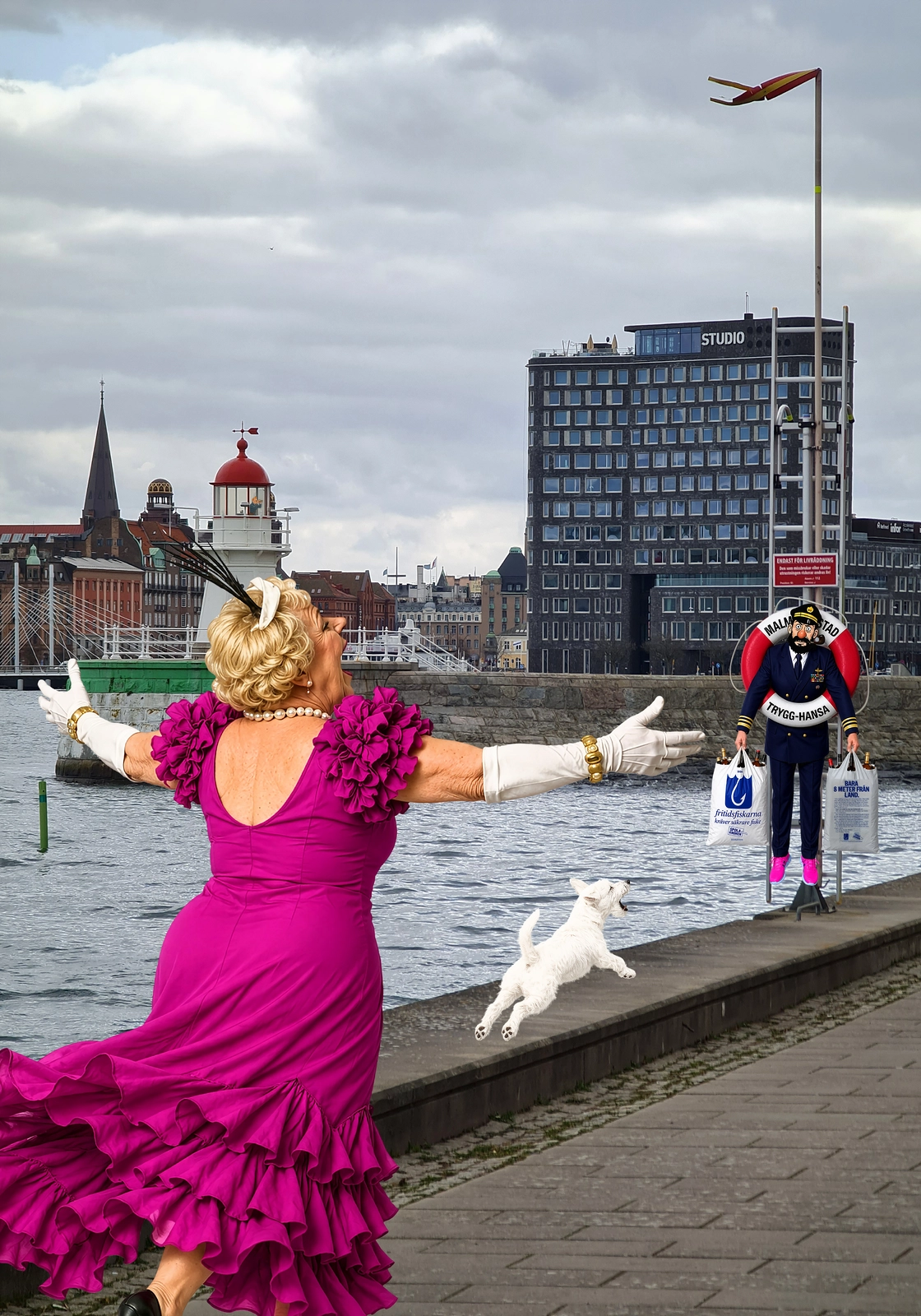
Haddock hanging around in the Harbour Haddock hänger i hamnen., 2026
Digital
50 x 70 cm
3 200 kr
Haddock hanging around in the Harbour Haddock hänger i hamnen.
Svensk text på slutet
It begins with an image. - The Captain in the Life Buoy
There are many types of alcoholics.
Some destroy themselves quietly in small apartments, with hidden beer cans behind winter boots and trembling hands clutching supermarket lager at eight in the morning. Others attempt to recover drowned whisky from Malmö harbour after becoming trapped inside municipal safety equipment, while an opera singer negotiates with firefighters.
This is the story of both.
Late one rainy evening in Malmö, Captain Archibald Haddock sailor, adventurer, volcanic expert in profanity, and perhaps the most gloriously dysfunctional alcoholic in European comic history reaches what may be the lowest point of his remarkable career. Suspended helplessly above the harbour in a life buoy marked MALMÖ STAD, clutching shopping bags full of whisky like rescued children from a sinking ship, the captain finds himself confronted not by pirates, gangsters, or revolutionaries but by something far more dangerous.
Recognition.
The man who recognises him is Torsten the Thirst, a former Swedish alcoholic with hidden beer cans, panic attacks, failed jobs, and enough experience of self-destruction to recognise another drowning man at once. What follows is neither quite an intervention nor quite a confession, and certainly not therapy in any conventional sense.
Instead, it becomes a strange comic duel fought over coffee cups and cream pastries in a Malmö harbour café long after midnight.
Bottle versus can. Adventure versus ordinary life. Loch Lomond versus Stella Artois. Moon rockets versus IKEA furniture.
Yet beneath the absurdity, both men slowly discover the same mechanism hiding underneath every excuse, every lie, every final drink, and every impossible promise to stop tomorrow.
Meanwhile, Bianca Castafiore watches with unexpected wisdom; Snowy sleeps beneath the table like an exhausted veteran of too many rescue missions; and somewhere beneath the black harbour water, the captains beloved whisky bottles rest in silence among seaweed and rusted bicycles.
A ridiculous comedy. A surprisingly serious conversation.
And perhaps, beneath all the shouting, explosions, hangovers, and maritime profanity, a small story about how human beings sometimes begin to save themselves not dramatically, but one exhausted step at a time.
The Ballad of Captain Haddock and Torsten the Thirst
There once was a captain in Malmö town
Who drank every whisky, both amber and brown,
Till he hung from a life buoy one terrible night
Still guarding his bottles with all of his might.
Bombs and barnacles! Haddock roared high,
As long as I breathe, not a drop shall run dry!
While gulls circled round him in cold harbour air
And cyclists stopped openly, perfectly fair.
Then Castafiore arrived in bright pink,
The sort of grand woman who sings before thinking.
She seized both the shopping bags out of his hand
And launched them like torpedoes straight out from the land.
They vanished below with a sorrowful splash,
Like Scottish sea captains, all drowning in cash.
Haddock collapsed with a howl full of grief:
My brave liquid children! My Highland relief!
He prepared for a dive like a doomed old sea cod
When out of the darkness came Torsten from God.
Or perhaps from rehab. Its hard to be sure.
Both often wear jackets, exhausted and poor.
Torsten the Thirst, once a king among drunks,
With hidden beer cans stuffed in cupboards and trunks,
Said calmly: Dear captain, I know this disease.
You dont need more whisky. You desperately need keys.
Keys? cried the captain. You terrible fool!
What helps any sailor is alcohol fuel!
But Torsten just sighed with the weariness born
From too many mornings ashamed and forlorn.
So they sat in a café till long after two
With cream cakes and coffee and existential rue,
Comparing old shipwrecks, both comic and grim:
One lost himself loudly. One quietly dim.
One hid beer in drawers near IKEA lamps glow,
One smuggled a Loch Lomond aboard rockets to go
Straight upward to moonlight while gravity failed
Yet both woke each morning exhausted and pale.
For alcohol rarely arrives with a roar.
It enters through tiny cracks under the door.
One excuse. One bottle. One comforting lie.
One promise to stop sometime later. Not tonight.
And Snowy slept softly beneath Castafiores chair,
Too tired to rescue humankind anymore.
Hed once tasted whisky himself by mistake
And decided at once that sobrietys best for a dogs sake.
At last, Haddock stood by the dark harbour side.
The bottles still waited below in the tide.
He stared at the water. The water stared back.
A long, silent duel beside Malmös black dock.
Then Torsten spoke softly: The thirst never ends.
You only decide whether thirst is your friend.
The captain said nothing. He just turned away
From the bottles below in the cold Baltic grey.
No choir sang triumph. No miracle came.
No angel descended to cure him by name.
Just one tired old sailor, still wounded and flawed,
Taking one step away from the harbour toward God.
Malmö, May 2026
Text till - Haddock hanging around in the Harbour Haddock hänger i hamnen.
Prologue - The Captain Hanging in the Harbour
The problem with Captain Haddock was not that he drank. Sailors drank. Detectives drank. Opera singers certainly drank, though they insisted on calling it a restorative. Even professors occasionally disappeared behind a bottle of brandy after midnight. The world itself floated half-pickled through history.
No, the real problem with Captain Haddock was that alcohol and catastrophe seemed to be magnetically attracted to one another.
If there existed, somewhere in the universe, a safe chair, Haddock would fall off it, drunk. If there existed a locked cabinet of whisky, Haddock would somehow awaken inside it. If there existed a calm harbour with absolutely no danger whatsoever, Haddock would eventually be discovered suspended above the water in a municipal life buoy, screaming nautical obscenities at a swan.
That was precisely what happened in Malmö.
The morning had begun innocently enough with a small medicinal tasting near the harbour district, around Dockplatsen. By late afternoon, the tasting had expanded into what Haddock insisted on calling an important comparative investigation into Scottish naval traditions. By evening, he had purchased six bottles of whisky, three unknown bottles from a sailor in Copenhagen, and something green that may once have been used to clean engine parts aboard a Finnish ferry.
Somewhere between the third harbour pub and a patriotic argument over whether herrings could technically be considered seafood artillery, the captain disappeared.
Two hours later, he was found hanging helplessly from a life buoy mounted on a pole beside the quay.
Nobody ever fully understood how he had managed to do it.
The life buoy itself belonged to the municipality of Malmö and bore the words MALMÖ STAD in faded black lettering. Haddock, meanwhile, hung trapped beneath it like an unusually aggressive chandelier. One arm had somehow slipped through the ring. His coat was twisted behind his back. One shoe was missing. His magnificent beard pointed towards the heavens like a storm-damaged lighthouse broom.
Most remarkably, he had not dropped his shopping bags. The captain clung to them with desperate, paternal devotion. Inside the bags were his beloved bottles. His children. His crew. His liquid navy.
DONT TOUCH THEM! Haddock roared at the horrified pedestrians. These brave little bottles have weathered worse storms than you miserable landlubbers!
Above him, the Malmö sky darkened theatrically. Wind whipped across the harbour. Snowy, Tintins white terrier, barked hysterically at the dangling captain, as if trying to alert NATO.
And then, like an operatic missile in shocking-pink silk, Bianca Castafiore arrived.
My poor captain! she cried, spreading her arms towards heaven. What tragedy has befallen you?
TRAGEDY?! thundered Haddock. Madam, I am dangling from public safety equipment like a salted codfish! I call it a disaster!
Castafiore gasped. The little dog barked more loudly. A cyclist crashed into a bollard. And from people fishing along the quay, the unmistakable sound of mobile phones being raised to record the spectacle forever.
Captain Haddock closed his eyes.
For the first time in many years, he suspected he might finally have reached the bottom.
Chapter One - The Baptism of the Bottles
It took three firefighters, one harbour maintenance worker, and an elderly Danish tourist with sailing experience to lower Captain Haddock from the life buoy without damaging the captain, his bottles, or municipal property.
The operation itself resembled the dismantling of an intoxicated piano.
Careful with the left arm! cried a firefighter.
Careful with the whisky! roared Haddock.
Careful with my nerves! shrieked Castafiore.
The little white terrier contributed by biting everyone equally.
At last, the captain alighted on the pavement with the wobbling dignity of a fallen monarch. His coat hung open. One suspender had snapped. His beard looked electrically charged. Yet throughout the entire rescue operation, he had never once loosened his grip on the shopping bags.
Not even when upside down. Especially not then.
The firefighters, concluding that this was not technically their strangest evening in Malmö, departed quickly before paperwork was involved.
Haddock attempted to stand upright, failed magnificently, saluted the nearby lighthouse, then nearly pitched headfirst into the harbour again.
Captain! cried Castafiore. You are in no condition to continue drinking!
Madam, said Haddock with grave dignity, history itself has been fuelled by alcohol. Entire civilisations were built on fermented liquids!
Yes, said Castafiore. Most of them collapsed.
Haddock blinked at her suspiciously. The opera singer seized the moment.
My dear captain, she said sweetly, extending both gloved hands towards the shopping bags, permit me to carry these heavy burdens for you.
No.
But captain
NO!
Only for a moment
Woman, I would sooner surrender my trousers to pirates!
The statement would have carried greater authority had one trouser leg not already been dangling halfway down his calf.
Passers-by slowed openly now. Malmö had entered that magical Scandinavian hour when respectable citizens pretended not to stare while staring intently.
A teenager began filming, and Haddock noticed instantly.
YOU PUT DOWN THAT INFERNAL MACHINE! he bellowed. I am not public entertainment, you digital barnacle!
The teenager continued filming.
Castafiore sighed theatrically towards heaven, then moved with astonishing speed. Before Haddock understood what was happening, she had snatched both shopping bags from his hands.
For a frozen second, the entire harbour fell silent.
Even Snowy stopped barking.
Haddock stared at the empty air where his bottles had stood.
My my little fellows
Castafiore marched toward the quay.
Madam Haddock whispered weakly.
She turned.
No! thundered the captain, suddenly struck by terrible clarity. Dont you dare!
Bianca Castafiore drew herself up like an empress about to declare war.
Then, with one magnificent operatic flourish, she hurled both shopping bags into the harbour.
SPLOOSH!
Several gulls fled.
A cyclist swore loudly in Danish.
Far below, the black water swallowed six bottles of whisky, three mysterious Copenhagen spirits, and the unidentified green industrial liquid forever.
Haddock made a sound no human had previously made outside experimental theatre or beyond the River Hades. He staggered to the edge of the quay and fell to his knees.
My brave little bottles he whispered hoarsely. Lost at sea
Then he began to cry.
Not politely.
Not silently.
He wept with the full emotional force of a shipwrecked admiral as his fleet sank beneath the Atlantic.
They can still be saved! Haddock suddenly shouted, scrambling to his feet. Whisky can survive saltwater! We merely dilute it temporarily!
He kicked off his last shoe and prepared to dive.
That was the exact moment when another voice entered the scene.
Mate, said a calm man behind him, if you jump into Malmö harbour tonight for whisky, I promise you the whisky wont be your biggest problem.
Haddock turned.
Standing beneath the streetlamp was a broad-shouldered man in his fifties, carrying a supermarket bag, wearing a worn brown jacket, and wearing the tired expression of someone who had once lost a long war with himself.
Names Torsten, the man said. Though back in the day, they used to call me Torsten the Thirst, in Swedish Torsten med Törsten.
Chapter Two - Torsten the Thirst
Captain Haddock looked the newcomer up and down suspiciously. Under normal circumstances, he distrusted sober people in principle. They tended to ask difficult questions and to remember the answers.
At the moment, however, circumstances were far from normal. Behind him, somewhere beneath the black harbour water, floated enough whisky to tranquillise a medium-sized cavalry regiment.
You know nothing of suffering! Haddock thundered. Down there lie innocent victims of an operatic crime!
Torsten glanced toward the harbour.
Mostly I see liquor.
LIQUOR?! Haddock exploded. Sir, among those bottles was a twelve-year-old Highland single malt with notes of smoke, oak, and divine revelation!
Mm, said Torsten calmly. And in about ten minutes, itll also have notes of dead herring.
Castafiore covered her mouth to suppress a laugh. Haddock stared at her in betrayal. The white terrier barked triumphantly towards the water as if personally responsible for the rescue of civilisation.
Torsten stepped closer. Unlike most people confronting Haddock, he showed no fear at all. Not of the beard, the temper, the volume, or the vocabulary. That immediately unsettled the captain.
Youre drunk enough to dive into a freezing harbour after bottles, Torsten said quietly. Ive been there myself.
Haddock folded his arms stubbornly.
I am not an alcoholic, sir. I am a sailor.
Those categories overlap more than youd think.
I merely appreciate whisky.
Right. And I used to appreciate lager for twelve hours a day.
Something in the mans voice made Haddock hesitate. There was no accusation in it. No moral superiority. Just exhausted recognition.
The harbour wind swept between them. Far away, church bells rang over Malmö.
Come on, Torsten said at last. Theres a café still open near Dockplatsen. Coffee. Sugar. Something with cream. Your liver looks like its waving a white flag.
My liver has served bravely under impossible conditions.
Im sure it has.
I refuse to abandon my bottles!
Theyll still be down there tomorrow.
Haddock looked towards the water again. This was evidently true, which annoyed him greatly.
Castafiore suddenly slipped her arm through his.
For once, she said gently, listen to someone else.
The captain opened his mouth to protest, then stopped. Something terrible had happened. He was exhausted.
Not ordinary tiredness. Not the fatigue after storms, adventures, or fistfights with international criminals. This was deeper. Ancient. Like an old boiler finally cracking under years of pressure.
The rage seeped out of him.
Very well, Haddock muttered darkly. But I warn you both coffee is no substitute for whisky.
It depends on how close you are to dying, said Torsten.
The strange procession moved through the Malmö evening: Bianca Castafiore in brilliant pink silk, Captain Haddock stumbling beside her in one shoe, the little white terrier leaping around their legs like an overexcited exorcist, and Torsten the Thirst walking calmly ahead, the patience of a man who had once escorted far worse creatures home from bars.
The café overlooked the dark harbour basin. Warm yellow light spilt across the pavement. Inside, students sat with laptops, alongside two exhausted nurses and a couple silently sharing carrot cake, the gravity of a peace treaty.
The moment Haddock entered, the conversation stopped. People instantly sensed that something extraordinary had arrived. Haddock removed his cap with wounded dignity.
Good evening, he announced. I require your strongest coffee and your least judgmental pastry, Torsten ordered for everyone before the captain could begin negotiations over rum.
Five minutes later, Haddock sat slumped before an enormous latte topped with foam and a cream-filled pastry roughly the size of Belgium. He eyed them both suspiciously.
This, he said carefully, appears to be breakfast for an emotionally distressed rhinoceros.
It helps, Torsten replied.
Haddock took one bite. Then another. Then three more in quick succession. The effect was almost miraculous. Some colour returned to his face. His hands steadied slightly. The terrible trembling behind his eyes eased.
Castafiore watched in silence. For once, she did not sing. Torsten stirred his coffee slowly.
So, he said at last, how long have you been drinking like this?
Haddock snorted.
My dear fellow, sailors have drunk alcohol since the beginning of civilisation.
That wasnt what I asked.
The captain looked down at the table.
Outside the harbour, the water moved softly in the darkness. Inside the café, the espresso machine hissed like distant steam engines.
And for the first time in many years, Captain Haddock did not immediately know what lie to tell.
Chapter Three - The Man Who Drank Through a Burglary
Haddock remained silent for so long that even the café staff began glancing nervously towards the table. Silence did not suit him. The captain normally inhabited quietness, the way artillery occupied landscapes.
At last, he cleared his throat.
There may, he said cautiously, have been certain incidents.
Torsten nodded.
There always are.
I once accidentally fired a revolver in my own sitting room.
Mm.
During an expedition in the Sahara, I mistook a snowstorm for a marching band.
Classic.
I also drank whisky aboard a moon rocket.
Torsten looked up.
An actual moon rocket?
Yes.
And people survived this?
Barely.
Torsten took a long sip of coffee.
Fair enough, he admitted. You may have had a more eventful alcoholism than mine.
That, said Haddock proudly, is because I am a man of the sea.
Aye, Torsten replied. But the hangovers are identical on land.
The captain frowned thoughtfully at this. He disliked wisdom when it arrived in the guise of common sense.
Torsten leaned back in his chair.
My big moment wasnt in the desert or on the moon, he said. It happened in a two-room flat with IKEA lamps and a television licence we could barely afford to pay for.
Haddock already looked disappointed.
No pirates?
No pirates.
Smugglers?
Only the Swedish alcohol monopoly.
Hm.
Torsten smiled faintly.
Britt and I had been drinking since lunchtime. Nothing dramatic. Just beer, wine, whisky, more beer, then a mysterious bottle somebody brought over that tasted like melted Christmas decorations.
That sounds medically irresponsible, muttered Haddock.
We were sitting in the living room, watching a crime documentary. Ironically.
Castafiore listened with sudden fascination. The little white terrier had fallen asleep beneath the table, like a tiny, exhausted cloud.
All the windows were open because of the heat, Torsten continued. At some point, we switched from wine to lager, thinking beer might sober us up.
A catastrophic tactical error, Haddock said gravely.
Exactly. Around midnight, Britt said she was tired, so I went to the bedroom to fetch blankets.
He paused.
Everything was gone.
Haddock blinked.
Gone?
Laptop. Watch. Camera. Drawers emptied. Someone had been inside the flat while we sat ten feet away, drinking ourselves unconscious.
Haddock looked impressed.
Thunderingly efficient criminals.
Oh, they werent finished.
Torsten rubbed his forehead slowly, still half-embarrassed by the memory even after all these years.
Britt suddenly says, Torsten wheres my underwear?
Castafiore nearly choked on her coffee.
The thieves had taken that as well?
Red lace bra. Matching undies. Completely disappeared.
But surely, Haddock protested, your companion was wearing them, too?
That, said Torsten darkly, was exactly the problem.
The captain stared. Then, despite himself, he began to laugh. Not polite laughter. Not dignified laughter. Great, explosive cannon-fire bursts that shook the cups on the table.
HA! HA! HA! BILLIONS OF BARNACLES! Robbed so thoroughly that they stole clothes still under negotiation with reality!
Even Castafiore surrendered, bursting into helpless laughter. The sleeping Snowy awoke in alarm and barked furiously at the pastry counter.
Torsten smiled.
It was funny later, not then.
No, Haddock admitted, wiping away tears from his eyes. No, probably not.
The strange part, Torsten continued quietly, was that I felt relieved when the police arrived.
Relieved?
I had an excuse to drink more.
The laughter faded instantly.
Outside the harbour, the lights trembled on the black water. Somewhere, a bicycle bell rang in the night.
Torsten looked down into his coffee.
Thats when I began to understand how sick I really was. Wed just been robbed blind, and all I could think was: excellent, now nobody can complain if I get drunk again.
Haddock said nothing.
For the first time that evening, he completely understood another human being.
Chapter Four - Canhattan
For a while, the four of them sat quietly in the warm café by the Dockan harbour, Kockums' old dry dock, now a marina. Outside, Malmö moved through the damp Scandinavian night with sleepy dignity: taxis gliding past, bicycles whispering over wet pavements, distant gulls screaming like unpaid opera critics.
Captain Haddock stared into his empty latte cup as though hoping whisky might still materialise at the bottom by divine intervention.
So, he muttered at last. What happened after the burglary?
Torsten gave a tired, little shrug.
We drank.
Ah, said Haddock softly. Naturally.
That was the terrible part. We shouldve been terrified, angry, and calling insurance companies. Instead, we opened another bottle and sat there discussing whether the thieves had shown unusually refined taste in womens underwear.
Castafiore laughed again, despite herself.
Britt was furious, Torsten continued. Not mainly because wed been robbed, but because she realised two burglars had apparently seen more of her that evening than she was comfortable with.
A horrifying breach of maritime privacy, Haddock agreed solemnly.
The next morning was worse. Sunlight everywhere. Empty bottles scattered across the floor. My head felt as if it were filled with wet cement. And then came the awful realisation that normal people would probably have noticed strangers emptying an apartment while sitting five metres away, watching television.
Haddock slowly nodded.
Yes, he said quietly. Alcohol turns catastrophes into background decoration.
Torsten looked at him carefully.
You really do know.
My dear man, Haddock sighed, I once became so drunk aboard a cargo vessel that I accused my own reflection of espionage.
That bad?
I attempted to arrest a mirror.
Torsten burst out laughing.
And Tintin?
Oh, he had become accustomed to these little episodes. The boy possesses the patience of a saint working in a lunatic asylum.
Castafiore stirred her coffee delicately.
And the captain also snores like heavy artillery after drinking whisky.
Madam!
It is true.
It is slander!
You once snored so loudly at Marlinspike Hall that the chandeliers vibrated.
Old houses naturally echo!
Torsten smiled into his cup. The atmosphere had softened. Not exactly cheerful, but warmer. Like survivors comparing storms after the ship had already sunk.
So when did you realise it had become serious? Haddock asked.
Torsten leaned back slowly.
The cans.
The cans?
I started hiding them. Everywhere. Behind books. Under the sofa. Inside drawers. I had a filing cabinet beside my desk at home. If I left the bottom drawer just ajar, I could slide a can inside and shut it quickly with my foot if Britt came into the room.
Haddock looked genuinely impressed.
A sophisticated system.
A pathetic system.
Hm. Both, perhaps.
I became obsessed with appearing normal. Thats the strange thing about alcoholism. The worse it gets, the more energy you spend pretending that everythings fine.
The captain looked down at the table again.
Torsten continued quietly.
Every morning, there were mountains of empty cans. Britt started calling our living room Canhattan.
Even Haddock winced.
Yes, Torsten said. Exactly that expression.
The captain rubbed his beard thoughtfully.
In my experience, he said slowly, there comes a moment when a man begins negotiating with bottles as if they were diplomats.
Torsten looked up immediately.
Oh, absolutely.
You promise them things.
Yes.
You hide them.
Yes.
You become furious when others interfere.
Yes.
You insist that you remain completely in command.
Torsten smiled sadly.
Usually, while visibly falling apart.
The captain sighed deeply.
My dear fellow, at one point, I transported whisky aboard a moon rocket.
Torsten shook his head in admiration.
You really did speedrun alcoholism.
Haddock ignored this.
The point is, he continued, even then I still considered myself merely a man who enjoyed drinking.
Torsten nodded slowly.
That word, he said quietly. Alcoholic. It took me years before I could say it out loud.
The café had grown quieter around them. One of the nurses had gone home. Rain now tapped gently against the windows. Even Castafiore seemed subdued.
Torsten folded his hands.
The frightening thing wasnt the drinking itself, he said. It was how small my world became. Eventually, everything revolved around access to alcohol. Time. Excuses. Shops were open. Other people were leaving the apartment so I could drink properly.
Haddock looked towards the rain-darkened harbour outside.
Far below, somewhere beneath the black water, his bottles still lay silent among seaweed and bicycle parts.
For the first time that evening, he no longer seemed concerned about rescuing them.
Chapter Five - The Moon Rocket and the Morning Beer
The rain thickened outside. Malmö harbour dissolved into blurred reflections and trembling yellow lights. Inside the café, the espresso machine sighed occasionally, like an old locomotive trying to survive another winter.
Captain Haddock had now consumed two pastries, one latte, half of Castafiores mineral water, and without permission most of the small bowl of wrapped chocolate squares by the till.
Colour had returned to his face. Unfortunately, so had philosophy.
You know what the real problem is? Haddock suddenly declared, pointing with a half-eaten pastry. People always imagine alcoholism as something theatrical.
Torsten smiled faintly.
Well, in your case
Yes, yes, granted, there have been incidents involving camels, submarines, avalanches, and once an exploding shark harpoon. But most of it is repetitive. That is the horror.
Torsten nodded immediately.
Exactly.
The same bottle. The same excuses. The same promises.
The same hangover.
The same declaration that this, Haddock said grandly, shall be the final drink before moderate, civilised behaviour resumes!
And then, Torsten added, you buy more beer at eleven in the morning because the first six didnt calm your nerves.
Haddock looked at him sharply.
You drank in the mornings?
Oh yes.
How early?
Torsten gave a small, embarrassed shrug.
Depends on how frightened I was that day.
The captain slowly lowered the pastry.
For the first time all evening, he seemed less amused.
I once opened a bottle at six-thirty in the morning aboard a freighter near Casablanca, Haddock admitted quietly. Told myself it was medicinal because the sea looked aggressive.
Torsten laughed softly.
The sea always looks menacing.
Exactly! That is what makes it such an excellent excuse.
Castafiore shook her head in disbelief.
You men, she sighed. You talk about self-destruction the way wine experts talk about grapes.
My dear madam, Haddock replied solemnly, alcoholics are simply optimists with very poor navigation skills.
Torsten nearly spat out coffee, laughing.
Snowy barked again, offended by the noise.
For a moment, the conversation drifted into an absurd competition.
Torsten described trying to hide beer cans in winter boots so that Britt would not hear them clink in the recycling bag.
Haddock countered with the story of smuggling whisky aboard the moon rocket, concealed within technical equipment.
Torsten described panic-buying lager three minutes before closing time and running through Malmö like a hunted criminal.
Haddock described waking in the Sahara beside an empty bottle, accusing a cactus of mutiny.
Torsten described pretending to take long, healthy evening walks while secretly drinking behind a car park near Möllevången.
Haddock described accidentally setting fire to part of a lifeboat after mistaking whisky for lamp fuel.
By then, even the café staff had stopped pretending not to listen.
What amazes me, Torsten said eventually, is how intelligent alcoholics can be about idiotic things.
Correct!
We become strategists and logistics experts.
Masters of supply chains!
Human calculators of liquor shop opening hours.
Architects of deception!
Meanwhile, Torsten sighed, basic adult life completely collapses.
Haddock fell silent at that.
Rain now slid slowly down the windows. Outside, bicycles glistened beneath the street lamps. Somewhere far across the harbour, a foghorn moaned softly through the night.
The captain stared into the darkness.
You know, he said at last, people think Tintin rescued me from criminals, deserts, and pirates.
Torsten waited quietly.
But the truth is, Haddock continued, the boy spent most of his time rescuing me from myself.
No one laughed this time.
Even Castafiore looked down at her untouched coffee.
He never judged me, Haddock muttered. That almost made it worse.
Torsten nodded slowly.
Britt was the same.
The captain rubbed his tired eyes.
And still, he said bitterly, every morning begins with the same thought.
What thought?
Haddock looked at him.
How quickly can I reasonably start drinking today without alarming civilisation?
Chapter Six - AAA
The waitress approached the table carefully, carrying fresh coffee, as one might approach a gathering of emotionally volatile diplomats.
No more pastries for the captain, Castafiore said firmly.
This is tyranny, Haddock muttered.
You already ate something with enough cream to lubricate farm machinery.
It was medicinal.
Everything is medicinal to you.
The waitress quickly retreated before international relations deteriorated further.
Outside, rain hammered the harbour windows. The black water beyond the quay looked cold enough to erase memories.
Torsten sat in silence for a moment before speaking again.
You know what finally frightened me? he asked.
Haddock snorted.
Liver failure?
No.
Divorce?
Close.
Death?
Torsten shook his head slowly.
It was how normal everything became.
The captain looked at him carefully.
I could wake up shaking, Torsten continued, drink two beers before breakfast, hide cans around the apartment, lie to Britt all day, and still somehow think: yes, this seems perfectly manageable.
Haddock nodded grimly.
Yes. The terrifying elasticity of human standards.
Exactly.
Torsten leaned back.
One day, I realised I had started planning life entirely around alcohol. Not enjoying alcohol. Organising existence around access to it.
The captain looked uncomfortable now.
I knew which Systembolaget stayed open the latest. Which kiosks sold weak beer after midnight? Which bars poured the most? Which colleagues could smell whisky? Which ones drank enough not to notice.
A professional specialisation, Haddock muttered.
A disease, Torsten corrected gently.
Silence settled over the table again.
At last, Haddock cleared his throat.
And this AAA organisation cured you?
Torsten laughed quietly.
No. Thats the first thing they tell you. Nobody cures you.
Encouraging.
They just teach you how not to drown.
Haddock stared suspiciously into his coffee, as though it might contain hidden morality.
What happens there exactly? he asked. In these meetings.
Well, said Torsten, mostly people talk.
About alcohol?
About lying.
Hm.
About shame.
Hm.
About waking up and promising themselves not to drink.
Hm.
Then drinking anyway.
The captains expression shifted slightly.
Torsten continued.
You sit in a circle with people whove done absurd things. Judges. Nurses. Teachers. Mechanics. Old sailors. Young students. Mothers. Men who hid vodka in flowerpots. Women who drank mouthwash at airports.
Good Lord.
One bloke accidentally attended his own intervention because he thought it was a birthday party.
Even Haddock looked impressed.
And everyone tells the truth? he asked quietly.
For once.
The rain softened outside.
The café had nearly emptied. Chairs stood upside down on tables. Somewhere in the kitchen, a glass clinked softly.
Haddock rubbed his beard.
And what exactly would I say at such a meeting?
Torsten smiled faintly.
Probably: Hello, my name is Captain Haddock, and I once tried to retrieve whisky from Malmö harbour after becoming trapped in public safety equipment.
Castafiore burst out laughing again.
Even Haddock reluctantly smiled.
That, he admitted, does sound rather bad when summarised professionally.
Torsten nodded.
Thats part of the trick. Alcoholics survive by editing. AAA removes the editing.
The captain stared again towards the harbour windows.
Far below, hidden beneath black water and drifting rain, his drowned bottles remained unseen.
You know what finally convinced me? Torsten asked in a quiet voice.
What?
Britt.
Haddock looked back at him.
She stopped yelling, Torsten said. That was worse. Much worse.
The captain said nothing.
She looked tired. Not angry. Not dramatic. Just tired. As if carrying furniture alone up endless stairs.
Torsten folded his hands slowly.
She told me we could get married and that I could go into rehab or she was leaving.
And you chose rehab.
I chose not dying first.
Haddock exhaled slowly through his nostrils.
Outside the harbour, the foghorn sounded again, low and mournful over the rain.
Then, very quietly, the captain asked:
And if a man perhaps hypothetically still enjoys whisky immensely?
Chapter Seven - The Last Honest Lie
Torsten smiled wearily into his coffee.
Oh, I still enjoy alcohol immensely, he said. Thats the problem.
Haddock blinked.
You do?
Of course. If alcohol had tasted like radiator fluid from the start, there wouldnt be many alcoholics.
That, said Haddock gravely, is one of the wisest things ever said in a café.
Torsten shrugged.
The trick isnt learning to hate booze. Its accepting that booze hates you back.
The captain fell silent again.
Rainwater slid slowly down the harbour windows behind him, like melting shadows. Somewhere outside, a drunken student sang ABBA with tragic confidence.
Castafiore looked thoughtfully between the two men.
You know, she said carefully, for years I believed the captain merely enjoyed exaggerating.
Madam, Haddock protested weakly. I am a man of passion.
You are a man who once tried to open a bottle of whisky with a revolver.
It was an emergency.
You were in your own kitchen.
The cork had become mutinous.
Torsten laughed into his cup.
And another time, Castafiore continued mercilessly, the captain insisted that the grandfather clock at Marlinspike Hall was insulting him personally.
It ticked provocatively!
Then you challenged it to a duel.
Haddock lowered his eyes.
In retrospect, he muttered, that may have been chemically ambitious.
Torsten wiped away tears of laughter from his eyes.
Oh God, he said. You really are the deluxe edition of alcoholism.
The captain looked oddly proud of this for half a second before remembering the context.
Yes, he sighed. Well.
For a while, nobody spoke.
Snowy had fallen asleep again beneath Castafiores chair. Curled into a small white spiral of exhausted fur, he twitched now and then in his sleep, paws trembling faintly as though still chasing criminals through old nightmares.
For once, there was peace.
No gunfire.
No kidnappers.
No collapsing temples.
No South American revolutionaries.
No Rastapopoulous.
No suspicious cargo ships.
And above all: no Captain Haddock dangling upside down from public harbour equipment, screaming at the seabirds.
When his master was not nearby, Snowy could finally relax properly. Readers of their adventures rarely appreciated the burden the small terrier carried. Officially, Tintin solved mysteries. Unofficially, Snowy spent half his life preventing a complete catastrophe.
Again and again, he had rescued his master and the captain from gangsters, deserts, snowstorms, caves, spies, quicksand, explosions, and moustachioed international lunatics. He had found hidden clues, uncovered traps, bitten armed criminals at strategic moments, and, on several occasions, displayed considerably more common sense than the entire human cast combined.
Particularly the captain.
Especially after whisky.
Snowy had long ago learned to recognise the warning signs. The louder Haddock became about naval traditions or the dignity of sailors, the more likely it was that furniture, diplomacy, or even gravity itself would soon suffer serious consequences.
The little terrier let out a tiny, sleepy sigh beneath the chair.
No, he was no longer involved in the captains relationship with alcohol. Not after the terrible incident during the affair in The Crab with the Golden Claws.
Even now, years later, the memory still haunted him.
At the time, he had only been curious. A small taste from a forgotten glass. Just a few experimental licks with the tongue. The captain had made it look enjoyable enough.
The result was horrifying.
The room had begun to spin. His paws no longer obeyed him. Reality itself had become suspiciously unstable. Snowy distinctly remembered trying to bark at two duplicate Tintins at once while the floor tilted sideways beneath him like the deck of a sinking ship.
Never again!
The experience had left deep psychological scars on the little dog.
Unlike humans, Snowy possessed the wisdom to learn immediately from catastrophic mistakes.
He had watched what whisky did to Captain Haddock: the shouting, the staggering, the emotional speeches to inanimate objects, the morning-after misery, and the endless promises that this shall absolutely be the final bottle before discipline resumes.
It was no life for a dog.
A small dog, Snowy understood, could become an alcoholic alarmingly fast. One careless habit, one nightly saucer of whisky for the nerves, and suddenly he too might end up barking philosophical insults at harbour machinery while sleeping in flowerpots.
No, thank you.
Besides, somebody in the expedition had to remain functional.
Snowy opened one eye briefly and looked towards the table where Haddock and Torsten still sat, speaking softly over their coffee cups like two retired generals discussing an old, lost war.
The terrier studied the captain carefully for a moment.
Then, with the profound exhaustion of a creature who had spent years protecting fools from themselves, Snowy closed his eyes again and fell asleep once more beneath Castafiores chair. At the same time, the rain whispered against the windows of Malmö harbour.
The waitress discreetly wiped nearby tables, pretending not to eavesdrop on what was clearly the greatest conversation she would ever overhear during a Thursday evening shift in Malmö.
At last, Torsten leaned forward.
You know what finally broke me? he asked in a quiet voice.
Haddock looked up.
It wasnt losing jobs. It wasnt panic attacks. It wasnt even the burglary.
What was it then?
Torsten stared out at the rain-darkened window.
One morning, I woke up before Britt. I went into the kitchen, shaking so badly I could barely open a can. And while I stood there drinking warm lager at seven-thirty in the morning, I suddenly realised something.
What?
If this continued, there would eventually be nothing left of me except maintenance.
The captain frowned.
Maintenance?
Just enough drinking to stave off fear. Just enough functioning to buy more alcohol. Nothing else. No joy. No future. No self-respect. Just chemical maintenance.
The words settled heavily over the table.
Haddock slowly removed his cap.
For the first time all evening, he looked old.
Not comic-old. Not theatrical-old. Just tired, in the way certain sailors, soldiers, and widowers sometimes look when nobody is watching.
I used to think adventures protected me, he admitted quietly. Storms. Treasure hunts. Rockets. Explosions. One always imagines disaster must arrive dramatically.
Torsten nodded.
But alcoholism, Haddock continued bitterly, mostly arrives on Tuesday morning.
Nobody laughed.
Outside, the rain finally eased over the harbour.
The captain rubbed his hands slowly together.
You know what frightens me most? he asked.
What?
I cannot honestly remember whether I drink because adventures ruined my nerves He paused. Or whether I sought adventures because they excused my drinking.
Torsten looked at him for a long moment.
Then he smiled sadly.
AAAs full of people asking the same question.
Haddock stared down at the empty coffee cup in front of him.
And what answer do they find?
Torsten rose slowly, put on his old brown jacket, and looked out over the black harbour water, where the drowned whisky bottles still lay unseen beneath the surface.
Usually, he said quietly, they discover it no longer matters.
Chapter Eight - Cans Against Bottles
The café had grown quieter around them. Rain whispered against the harbour windows while the last customers drifted out into the Malmö night one by one. Somewhere behind the counter, a dishwasher hummed with the tired resignation of a machine that had seen too much humanity.
Captain Haddock leaned back heavily in his chair, folding his arms.
So, he muttered, you hid cans. I hid bottles. Civilisation collapses through different architecture.
Torsten smiled faintly.
Yes. You built cathedrals. I built recycling stations.
Haddock pointed solemnly at him.
My dear fellow, never underestimate the emotional engineering that goes into a properly hidden whisky bottle.
Oh, I know, Torsten replied. I once hid a large item in an old vacuum-cleaner box because Britt had started checking the cupboards.
A clever manoeuvre.
A desperate manoeuvre.
Those are often identical.
Torsten laughed softly.
At my worst, I planned entire days around alcohol logistics. Which shop opened earliest? Which kiosk sold beer after closing? Which route home avoided neighbours likely to start a conversation?
Haddock nodded immediately.
Yes! One begins to think like a military strategist trapped inside an idiot.
Exactly.
And every obstacle becomes intolerable. Closed shops. Family visits. Unexpected responsibilities. Conversations that require sobriety.
Torsten pointed toward him.
That one.
What?
Conversations requiring sobriety. Thats alcoholism in a sentence.
The captain sighed deeply.
My dear man, during one expedition, I smuggled Loch Lomond aboard a moon rocket, disguised as scientific equipment.
Torsten stared.
You really keep escalating every anecdote beyond reason.
The point, Haddock continued, wounded dignity in his voice, is that I considered this entirely rational at the time.
Of course you did.
The thought of spending several days in space without whisky struck me as medically irresponsible.
Torsten shook his head slowly.
At least your alcoholism had style. Mine mostly meant panic-buying Stella Artois while pretending I needed milk.
Never trust a man buying milk at eleven-thirty at night, Haddock agreed.
Exactly.
The captain rubbed his beard thoughtfully.
And these panic attacks?
Torsten looked down at his coffee.
They began quietly. Pub conversations suddenly became difficult. Too many people. Too much noise. Id sit there, smiling, while my heart hammered like someone trying to escape through my ribs.
Haddocks expression shifted slightly.
Yes, he said carefully. I know that sensation.
I started leaving parties early, not because I wanted less alcohol, but because I wanted to drink alone.
The captain slowly nodded.
That, he admitted, is a very dark milestone.
You stop drinking socially and start drinking professionally.
Beautifully put, Haddock muttered sadly.
Torsten smiled without humour.
At one point, I could no longer relax unless I knew alcohol was nearby. Even unopened cans soothed me. Just seeing them in the fridge helped.
Like lifeboats.
Yes. Exactly like lifeboats.
For a moment, neither man spoke.
Rain drifted across the harbour windows in silver streaks. Somewhere outside, a siren echoed faintly through Malmö.
Then Haddock cleared his throat.
I once tried to hide whisky from Tintin inside a globe.
Torsten blinked.
A globe?
A decorative globe in the library at Marlinspike Hall.
What happened?
The boy spun Europe too aggressively, and Scotland leaked.
Torsten burst out laughing helplessly.
And after that, Haddock continued bitterly, he began examining geographical objects.
Yes, Torsten sighed. Loved ones become detectives.
Infuriatingly observant people.
They start listening for recycling bags.
They smell your breath.
They count the cans.
They notice the lies.
The captain looked down at the table again.
And still, he muttered, one continues.
Torsten nodded quietly.
Yes. Because the frightening thing is this: eventually the lies stop feeling dishonest.
Haddock looked up sharply.
That, he said after a long pause, may be the worst thing anyone has said tonight.
Chapter Nine - Captain, You Sing False When You Drink.
The rain had almost stopped. Beyond the harbour windows, Malmö shimmered softly beneath street lamps and reflected neon, the wet pavements glowing like dark amber.
Inside the café, the atmosphere had shifted. The comedy still lingered around the table the drowned whisky bottles, the life buoy, the hidden cans, the exploding moon rocket but something heavier now sat quietly beneath it all.
Captain Haddock stared into the remains of his coffee.
Torsten watched him carefully.
Neither man seemed particularly interested in pretending anymore.
At last, Haddock exhaled deeply.
You know what the truly humiliating part is? he muttered.
The life buoy?
No. Although that was unquestionably a tactical low point.
The harbour rescue operation?
No.
The fact that you nearly dived into industrial Scandinavian seawater for whisky?
Haddock rubbed his eyes tiredly.
The humiliating part, he said quietly, is that I still wanted to.
Nobody answered immediately.
The sentence hung above the table, heavier than all the jokes.
Torsten nodded once.
Yes, he said softly. Thats the real thing.
The captain looked out towards the harbour again.
I knew it was absurd. I knew the bottles were probably shattered. I knew I could barely stand upright. He paused, bitter. And still, part of me thought: perhaps this could still be salvaged.
Torsten smiled sadly.
Alcoholics are great believers in the impossible recovery missions.
Haddock gave a hollow laugh.
My entire life has been impossible recovery missions.
Yes, Torsten replied gently. But most of those involved treasure maps. This one involved drowning whisky.
Silence settled again.
Then, unexpectedly, Bianca Castafiore spoke.
Very quietly.
Captain, she said, you sing falsely when you drink.
Haddock froze.
Torsten blinked.
Even Snowy looked up briefly from beneath the chair.
The captain turned slowly toward her.
What?
Castafiore did not smile now. For once, there was no theatricality in her voice. No performance. No opera diva. Just simple honesty.
You sing falsely, she repeated softly. Not loudly. Most people would not hear it, but I hear it immediately.
Haddock stared at her as if she had struck him.
That is absurd, he muttered weakly. Whisky improves the emotional colour of the voice.
No, she said gently. It blurs it. Your timing shifts. Your breathing grows heavy. You force notes rather than reaching them.
The captains face slowly collapsed into genuine horror.
Torsten wisely remained silent.
Haddock could survive storms, explosions, desert warfare, gangsters, submarines, humiliation, bankruptcy, and even hanging from public harbour equipment like drunken fishing bait.
But this was different.
This was professional shame.
My dear Bianca he whispered. Surely not always?
She hesitated.
Usually after the third glass.
The captain closed his eyes.
Somewhere outside, a gull screamed over the harbour like a soul ripped from existence.
Sweet suffering barnacles, Haddock muttered faintly.
Castafiore leaned closer.
You are a brave man, Captain, but bravery and self-destruction are not the same thing.
Torsten slowly looked down into his cup of coffee.
Because the absurd conversation in the Malmö café suddenly no longer sounded absurd at all.
Chapter Ten - The Turning Point
Nobody spoke for a long time after Castafiores sentence.
Outside, the harbour glistened beneath the fading rain. The storm had moved east across the dark Baltic, leaving Malmö washed clean and strangely fragile under the night sky.
Captain Haddock sat motionless.
One hand still rested around the empty coffee cup as if it contained instructions for survival.
At last, Torsten leaned back slowly and exhaled.
That was roughly when Britt broke too, he said quietly.
Haddock looked up.
She stopped arguing?
Torsten nodded.
No more shouting. No more crying. No more checking recycling bags or sniffing beer cans like a customs officer. He smiled faintly. Honestly, I almost missed the fighting.
What happened instead?
She became calm.
The captain frowned immediately.
That sounds dangerous.
It was terrifying.
Torsten stared out into the harbour darkness.
One evening she sat down beside me in the kitchen while I was pretending not to drink from a coffee mug full of lager. He paused. And she said: Torsten, I cant spend the rest of my life watching you slowly disappear.
The captain lowered his eyes.
Torsten continued quietly.
She said we could still save things. We could marry. I could get help. Rehab. Meetings. Sobriety. He gave a tired smile. Or she would leave.
And?
And suddenly I realised something horrible.
Haddock looked at him carefully.
I wasnt frightened of losing alcohol.
The café was now completely silent, except for the soft hum of distant refrigeration behind the counter.
I was frightened because part of me genuinely preferred alcohol to life.
The words landed heavily between them.
Haddock looked away first.
Far below the harbour surface, invisible in the darkness, rested the drowned bottles that had nearly sent him diving into black water like a desperate treasure hunter.
Torsten spoke softly now.
Thats the moment, I think. Not when you drink too much. Not when you embarrass yourself. Not even when you destroy things. He paused. The real moment comes when you realise you are beginning to love the thing destroying you more than the people trying to save you.
Haddocks jaw tightened.
Nonsense, he muttered weakly.
Torsten did not argue.
That was the worst part.
No sermon.
No morality.
No accusations.
Just recognition.
The captain suddenly stood up and began pacing beside the windows.
My dear fellow, he barked, you speak as though a man cannot enjoy whisky without surrendering his immortal soul!
Of course he can.
Exactly!
But you nearly jumped into Malmö harbour after six drowned bottles.
That was a question of principle!
No, Torsten replied quietly. It wasnt.
Haddock stopped walking.
Outside, the dark water moved gently against the quay.
The captain understood now why Torsten disturbed him so deeply.
Tintin usually rescued him physically: from deserts, gangsters, shipwrecks, and avalanches.
But Torsten had done something far more dangerous.
He had recognised him.
Not Captain Haddock the adventurer.
Not the comic drunk shouting at thunderstorms.
Not the fearless sailor.
Just another alcoholic bargaining with himself beside the ruins of another evening.
The captain stared silently out toward the harbour.
Then, very softly, almost to himself, he said:
The truly awful thing is I still want those bottles.
Chapter Eleven - The Bottles Remain
Nobody answered immediately.
Torsten nodded once, slowly, as if the sentence confirmed something he had known all along.
Yes, he said quietly. Of course you do.
Captain Haddock stood by the rain-speckled harbour windows, both hands buried deep in his coat pockets. Beyond the glass, the black water moved softly beneath the lamps along the quay.
Somewhere down there rested the bottles.
His beautiful drowned fleet.
Loch Lomond among seaweed and rusty bicycles.
The thought remained unbearably painful.
Castafiore rose carefully from her chair and walked towards him. For once, she made no theatrical entrance, no sweeping gestures, no declarations to heaven.
She merely stood beside him.
Snowy stretched sleepily beneath the table, and she followed after her with the tired dignity of a veteran soldier reluctantly returning to duty.
Torsten remained seated.
When I entered rehab, he said quietly, I thought the whole point was to learn not to want alcohol any more.
Haddock kept staring towards the harbour.
But that isnt really the first step.
No? the captain muttered.
The first step is to understand that wanting it isnt the same as obeying it.
The harbour lights trembled faintly across the wet glass.
Haddock said nothing.
Torsten smiled sadly.
I spent years thinking every craving was an order.
Slowly, almost unwillingly, the captain nodded.
Yes, he admitted. That sounds unpleasantly familiar.
For another minute, they stood there, listening to the distant drip of rainwater from the quay into the harbour below.
Then Haddock cleared his throat, awkwardly.
Hypothetically speaking, he muttered, does saltwater ruin whisky completely?
Torsten looked up at him.
Not more than whisky ruins people.
The captain winced as if physically struck.
That, he muttered darkly, was an extremely unfair sentence.
It was also true.
Hm.
Outside, the harbour lay in silence, waiting.
The captain looked towards the quay entrance, leading back to the water. For one dangerous second, Torsten thought he might actually run for it one final drunken rescue mission into the Baltic night.
But instead, Haddock merely sighed.
The terrible, exhausted sigh of a man who has suddenly realised that the real battle is not against bottles, oceans, opera singers, or even himself when drunk.
It is against the voice that whispers forever:
just one more.
Castafiore gently took his arm.
This time, he did not protest.
Snowy barked once at the harbour, perhaps in farewell to the drowned whisky below.
Haddock glanced once more towards the black water.
Farewell, my little sailors, he muttered.
Then the captain turned away from the harbour.
For the first time that evening, he did not look back.
Epilogue - The Captain No Longer Hanging
At nearly midnight, they finally left the café.
The rain had stopped completely. Malmö harbour shimmered beneath the wet streetlights in silver and black, the air cool and salty after the storm. Somewhere far away, music drifted faintly from an apartment balcony. A tram bell echoed through the sleeping city.
The strange little procession moved slowly along the quay: Bianca Castafiore in pink silk beneath the harbour lamps, Snowy trotting ahead with renewed professional seriousness, Torsten the Thirst in his old brown jacket, his calmness tired, and between them Captain Haddock, walking more carefully now, as though uncertain whether the ground beneath him could still be trusted.
Nobody spoke much.
Some conversations continue long after words end.
They finally passed the lifebuoy.
The great municipal instrument of humiliation still hung there on its pole beside the quay, innocent and circular beneath the streetlamp. The faded black letters MALMÖ STAD glistened softly in the damp night.
Haddock stopped.
For a terrible moment, Torsten thought the captain might salute it.
Instead, Haddock narrowed his eyes in suspicion.
You, he muttered darkly, are an enemy of maritime dignity.
Snowy barked once in agreement. Castafiore smiled quietly.
The captain stared down at the black harbour water. Somewhere beneath the surface, his bottles still lay in silence among seaweed, rusted bicycles, shopping trolleys, and whatever else Scandinavian harbours collected from human foolishness.
For years, Haddock had imagined alcoholism in dramatic terms storms, shipwrecks, explosions, heroic disasters worthy of sea legends.
But now, standing beside a wet life buoy in Malmö after midnight, with coffee still lingering in his bloodstream, he understood something profoundly disappointing.
Most destruction did not arrive heroically.
It arrived gradually.
One excuse. One hidden bottle. One ridiculous lie. One more drink.
Eventually, a man found himself hanging helplessly above harbour water while an opera singer negotiated with firefighters.
The captain sighed deeply.
My dear fellow, he muttered to Torsten. This evening has been profoundly educational and deeply insulting.
That usually means it was important.
Hm.
For a moment, they stood together in silence, listening to the water tapping softly against the quay.
Then Haddock did something extraordinary.
He adjusted his coat, straightened his beard with wounded dignity, and deliberately turned his back on the harbour.
On the bottles.
On the water.
On the possibility of jumping after them.
It was not a triumph. Not redemption. Not even sobriety. Just a tiny movement in another direction.
But sometimes, Torsten knew, that was how survival began.
Snowy trotted ahead into the Malmö night. Castafiore followed the captain, unusually silent for once. Torsten lingered a moment longer by the harbour rail before finally smiling to himself and walking after them beneath the wet Scandinavian streetlights.
Behind them, the life buoy hung quietly above the dark water.
Empty now.
P.S. Captain Haddock
Captain Haddock full name Archibald Haddock is one of the central characters in The Adventures of Tintin, created by the Belgian cartoonist Hergé. He first appeared in 1941 in The Crab with the Golden Claws. He quickly evolved from a secondary comic figure into what many readers consider the emotional heart of the entire series.
Key Facts
Full name: Archibald Haddock
Occupation: Sailor. Adventurer. Angry old man. Alcoholic.
First appearance: The Crab with the Golden Claws
Residence: Marlinspike Hall
Later title: Country gentleman and master of the estate
Creator: Hergé
Haddock was introduced as a broken, whisky-soaked sea captain, manipulated by smugglers and barely able to control either his ship or himself. Without Tintin, he would probably have disappeared into alcohol entirely after his first appearance.
Instead, he became unforgettable.
Explosive, impulsive, emotional, theatrical, and often catastrophically clumsy, Haddock nevertheless possesses enormous courage, loyalty, and humanity. His love of whisky particularly the legendary Loch Lomond brand became a recurring motif in the series, serving as comic relief and as a surprisingly dark portrait of dependency.
After recovering his ancestral estate in Red Rackham's Treasure, Haddock becomes Tintins permanent companion, sharing in treasure hunts, revolutions, sea voyages, desert disasters, and eventually even space travel. In Tintin in Tibet, he reveals some of his deepest humanity through unwavering loyalty and compassion. In Explorers on the Moon and Destination Moon, he also becomes one of literatures earliest intoxicated astronauts.
Captain Haddock is equally famous for his volcanic insults and his impossible vocabulary:
Billions of blistering blue barnacles!
Troglodyte!
Iconoclast!
Swaggering jellyfish!
Visigoths!
Bashi-bazouks!
Entire dictionaries and tribute books have been devoted to the extraordinary linguistic creativity of his outbursts.
Yet what truly made Haddock immortal may not have been his temper, his beard, or even his whisky.
It is his weakness.
Tintin is the hero readers admire. Haddock is the person they recognise.
He is frightened, vain, impulsive, sentimental, ridiculous, brave, self-destructive, generous, lonely, and painfully real. A man capable of surviving pirates, revolutions, deserts, shipwrecks, moon rockets, and opera singers yet still vulnerable to a single bottle of whisky.
And perhaps that is why Captain Haddock continues to feel so alive long after most fictional adventurers have faded into history.
Det börjar med en bild.
Det börjar med en bild.
Kaptenen i livbojen
Det finns många sorters alkoholister.
Vissa förstör sig själva tyst i små lägenheter, med gömda ölburkar bakom vinterstövlar och darrande händer kring folköl från snabbköpet klockan åtta på morgonen. Andra försöker bärga drunknad whisky ur Malmö hamn efter att ha fastnat i kommunal säkerhetsutrustning medan en operasångerska förhandlar med brandmän.
Det här är berättelsen om båda.
En sen regnig kväll i Malmö når kapten Archibald Haddock sjöman, äventyrare, vulkanisk expert på svordomar och kanske den mest storslaget dysfunktionella alkoholisten i europeisk seriehistoria vad som möjligen är den absoluta bottenpunkten i hans remarkabla karriär. Hjälplöst hängande ovanför hamnbassängen i en livboj märkt MALMÖ STAD, klamrande sig fast vid systemkassar fyllda med whisky som vore de räddade barn från ett sjunkande fartyg, ställs kaptenen inte inför pirater, gangstrar eller revolutionärer utan inför något långt farligare.
Igenkänning.
Mannen som känner igen honom är Torsten med törsten, en före detta svensk alkoholist med gömda ölburkar, panikattacker, havererade jobb och tillräcklig erfarenhet av självförstörelse för att omedelbart känna igen en annan drunknande människa. Det som följer är varken riktigt ett ingripande eller riktigt en bekännelse och definitivt inte terapi i någon traditionell mening.
I stället utvecklas det till en märklig komisk duell över kaffekoppar och gräddbakelser på ett kafé i Malmö hamn långt efter midnatt.
Flaska mot burk. Äventyr mot vardagsliv. Loch Lomond mot Stella Artois. Månraketer mot IKEA-möbler.
Men under det absurda börjar båda männen långsamt upptäcka samma mekanism som gömmer sig bakom varje ursäkt, varje lögn, varje sista glas och varje omöjligt löfte om att sluta i morgon.
Samtidigt betraktar Bianca Castafiore allt med oväntad klokskap, Milou sover under bordet som en utmattad veteran från alltför många räddningsuppdrag, och någonstans nere i det svarta hamnvattnet ligger kaptenens älskade whiskyflaskor tysta bland tång och rostiga cyklar.
En löjlig komedi. Ett oväntat allvarligt samtal.
Och kanske, under allt skrikande, alla explosioner, bakfyllor och marina kraftuttryck, också en liten berättelse om hur människor ibland börjar rädda sig själva inte dramatiskt, utan ett utmattat steg i taget.
Balladen om kapten Haddock och Torsten med törsten
Det fanns en kapten i Malmö stad
Som drack varje whisky, både ljus och glad,
Tills han en kväll i hamnen satt fast
I en livboj h
Jörgen Thornberg
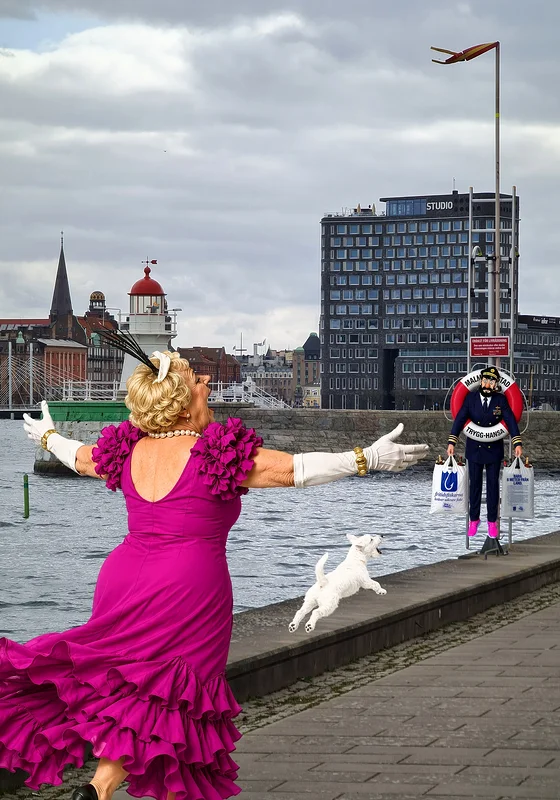
Haddock hanging around in the Harbour Haddock hänger i hamnen., 2026
Digital
50 x 70 cm
3 200 kr
Haddock hanging around in the Harbour Haddock hänger i hamnen.
Svensk text på slutet
It begins with an image. - The Captain in the Life Buoy
There are many types of alcoholics.
Some destroy themselves quietly in small apartments, with hidden beer cans behind winter boots and trembling hands clutching supermarket lager at eight in the morning. Others attempt to recover drowned whisky from Malmö harbour after becoming trapped inside municipal safety equipment, while an opera singer negotiates with firefighters.
This is the story of both.
Late one rainy evening in Malmö, Captain Archibald Haddock sailor, adventurer, volcanic expert in profanity, and perhaps the most gloriously dysfunctional alcoholic in European comic history reaches what may be the lowest point of his remarkable career. Suspended helplessly above the harbour in a life buoy marked MALMÖ STAD, clutching shopping bags full of whisky like rescued children from a sinking ship, the captain finds himself confronted not by pirates, gangsters, or revolutionaries but by something far more dangerous.
Recognition.
The man who recognises him is Torsten the Thirst, a former Swedish alcoholic with hidden beer cans, panic attacks, failed jobs, and enough experience of self-destruction to recognise another drowning man at once. What follows is neither quite an intervention nor quite a confession, and certainly not therapy in any conventional sense.
Instead, it becomes a strange comic duel fought over coffee cups and cream pastries in a Malmö harbour café long after midnight.
Bottle versus can. Adventure versus ordinary life. Loch Lomond versus Stella Artois. Moon rockets versus IKEA furniture.
Yet beneath the absurdity, both men slowly discover the same mechanism hiding underneath every excuse, every lie, every final drink, and every impossible promise to stop tomorrow.
Meanwhile, Bianca Castafiore watches with unexpected wisdom; Snowy sleeps beneath the table like an exhausted veteran of too many rescue missions; and somewhere beneath the black harbour water, the captains beloved whisky bottles rest in silence among seaweed and rusted bicycles.
A ridiculous comedy. A surprisingly serious conversation.
And perhaps, beneath all the shouting, explosions, hangovers, and maritime profanity, a small story about how human beings sometimes begin to save themselves not dramatically, but one exhausted step at a time.
The Ballad of Captain Haddock and Torsten the Thirst
There once was a captain in Malmö town
Who drank every whisky, both amber and brown,
Till he hung from a life buoy one terrible night
Still guarding his bottles with all of his might.
Bombs and barnacles! Haddock roared high,
As long as I breathe, not a drop shall run dry!
While gulls circled round him in cold harbour air
And cyclists stopped openly, perfectly fair.
Then Castafiore arrived in bright pink,
The sort of grand woman who sings before thinking.
She seized both the shopping bags out of his hand
And launched them like torpedoes straight out from the land.
They vanished below with a sorrowful splash,
Like Scottish sea captains, all drowning in cash.
Haddock collapsed with a howl full of grief:
My brave liquid children! My Highland relief!
He prepared for a dive like a doomed old sea cod
When out of the darkness came Torsten from God.
Or perhaps from rehab. Its hard to be sure.
Both often wear jackets, exhausted and poor.
Torsten the Thirst, once a king among drunks,
With hidden beer cans stuffed in cupboards and trunks,
Said calmly: Dear captain, I know this disease.
You dont need more whisky. You desperately need keys.
Keys? cried the captain. You terrible fool!
What helps any sailor is alcohol fuel!
But Torsten just sighed with the weariness born
From too many mornings ashamed and forlorn.
So they sat in a café till long after two
With cream cakes and coffee and existential rue,
Comparing old shipwrecks, both comic and grim:
One lost himself loudly. One quietly dim.
One hid beer in drawers near IKEA lamps glow,
One smuggled a Loch Lomond aboard rockets to go
Straight upward to moonlight while gravity failed
Yet both woke each morning exhausted and pale.
For alcohol rarely arrives with a roar.
It enters through tiny cracks under the door.
One excuse. One bottle. One comforting lie.
One promise to stop sometime later. Not tonight.
And Snowy slept softly beneath Castafiores chair,
Too tired to rescue humankind anymore.
Hed once tasted whisky himself by mistake
And decided at once that sobrietys best for a dogs sake.
At last, Haddock stood by the dark harbour side.
The bottles still waited below in the tide.
He stared at the water. The water stared back.
A long, silent duel beside Malmös black dock.
Then Torsten spoke softly: The thirst never ends.
You only decide whether thirst is your friend.
The captain said nothing. He just turned away
From the bottles below in the cold Baltic grey.
No choir sang triumph. No miracle came.
No angel descended to cure him by name.
Just one tired old sailor, still wounded and flawed,
Taking one step away from the harbour toward God.
Malmö, May 2026
Text till - Haddock hanging around in the Harbour Haddock hänger i hamnen.
Prologue - The Captain Hanging in the Harbour
The problem with Captain Haddock was not that he drank. Sailors drank. Detectives drank. Opera singers certainly drank, though they insisted on calling it a restorative. Even professors occasionally disappeared behind a bottle of brandy after midnight. The world itself floated half-pickled through history.
No, the real problem with Captain Haddock was that alcohol and catastrophe seemed to be magnetically attracted to one another.
If there existed, somewhere in the universe, a safe chair, Haddock would fall off it, drunk. If there existed a locked cabinet of whisky, Haddock would somehow awaken inside it. If there existed a calm harbour with absolutely no danger whatsoever, Haddock would eventually be discovered suspended above the water in a municipal life buoy, screaming nautical obscenities at a swan.
That was precisely what happened in Malmö.
The morning had begun innocently enough with a small medicinal tasting near the harbour district, around Dockplatsen. By late afternoon, the tasting had expanded into what Haddock insisted on calling an important comparative investigation into Scottish naval traditions. By evening, he had purchased six bottles of whisky, three unknown bottles from a sailor in Copenhagen, and something green that may once have been used to clean engine parts aboard a Finnish ferry.
Somewhere between the third harbour pub and a patriotic argument over whether herrings could technically be considered seafood artillery, the captain disappeared.
Two hours later, he was found hanging helplessly from a life buoy mounted on a pole beside the quay.
Nobody ever fully understood how he had managed to do it.
The life buoy itself belonged to the municipality of Malmö and bore the words MALMÖ STAD in faded black lettering. Haddock, meanwhile, hung trapped beneath it like an unusually aggressive chandelier. One arm had somehow slipped through the ring. His coat was twisted behind his back. One shoe was missing. His magnificent beard pointed towards the heavens like a storm-damaged lighthouse broom.
Most remarkably, he had not dropped his shopping bags. The captain clung to them with desperate, paternal devotion. Inside the bags were his beloved bottles. His children. His crew. His liquid navy.
DONT TOUCH THEM! Haddock roared at the horrified pedestrians. These brave little bottles have weathered worse storms than you miserable landlubbers!
Above him, the Malmö sky darkened theatrically. Wind whipped across the harbour. Snowy, Tintins white terrier, barked hysterically at the dangling captain, as if trying to alert NATO.
And then, like an operatic missile in shocking-pink silk, Bianca Castafiore arrived.
My poor captain! she cried, spreading her arms towards heaven. What tragedy has befallen you?
TRAGEDY?! thundered Haddock. Madam, I am dangling from public safety equipment like a salted codfish! I call it a disaster!
Castafiore gasped. The little dog barked more loudly. A cyclist crashed into a bollard. And from people fishing along the quay, the unmistakable sound of mobile phones being raised to record the spectacle forever.
Captain Haddock closed his eyes.
For the first time in many years, he suspected he might finally have reached the bottom.
Chapter One - The Baptism of the Bottles
It took three firefighters, one harbour maintenance worker, and an elderly Danish tourist with sailing experience to lower Captain Haddock from the life buoy without damaging the captain, his bottles, or municipal property.
The operation itself resembled the dismantling of an intoxicated piano.
Careful with the left arm! cried a firefighter.
Careful with the whisky! roared Haddock.
Careful with my nerves! shrieked Castafiore.
The little white terrier contributed by biting everyone equally.
At last, the captain alighted on the pavement with the wobbling dignity of a fallen monarch. His coat hung open. One suspender had snapped. His beard looked electrically charged. Yet throughout the entire rescue operation, he had never once loosened his grip on the shopping bags.
Not even when upside down. Especially not then.
The firefighters, concluding that this was not technically their strangest evening in Malmö, departed quickly before paperwork was involved.
Haddock attempted to stand upright, failed magnificently, saluted the nearby lighthouse, then nearly pitched headfirst into the harbour again.
Captain! cried Castafiore. You are in no condition to continue drinking!
Madam, said Haddock with grave dignity, history itself has been fuelled by alcohol. Entire civilisations were built on fermented liquids!
Yes, said Castafiore. Most of them collapsed.
Haddock blinked at her suspiciously. The opera singer seized the moment.
My dear captain, she said sweetly, extending both gloved hands towards the shopping bags, permit me to carry these heavy burdens for you.
No.
But captain
NO!
Only for a moment
Woman, I would sooner surrender my trousers to pirates!
The statement would have carried greater authority had one trouser leg not already been dangling halfway down his calf.
Passers-by slowed openly now. Malmö had entered that magical Scandinavian hour when respectable citizens pretended not to stare while staring intently.
A teenager began filming, and Haddock noticed instantly.
YOU PUT DOWN THAT INFERNAL MACHINE! he bellowed. I am not public entertainment, you digital barnacle!
The teenager continued filming.
Castafiore sighed theatrically towards heaven, then moved with astonishing speed. Before Haddock understood what was happening, she had snatched both shopping bags from his hands.
For a frozen second, the entire harbour fell silent.
Even Snowy stopped barking.
Haddock stared at the empty air where his bottles had stood.
My my little fellows
Castafiore marched toward the quay.
Madam Haddock whispered weakly.
She turned.
No! thundered the captain, suddenly struck by terrible clarity. Dont you dare!
Bianca Castafiore drew herself up like an empress about to declare war.
Then, with one magnificent operatic flourish, she hurled both shopping bags into the harbour.
SPLOOSH!
Several gulls fled.
A cyclist swore loudly in Danish.
Far below, the black water swallowed six bottles of whisky, three mysterious Copenhagen spirits, and the unidentified green industrial liquid forever.
Haddock made a sound no human had previously made outside experimental theatre or beyond the River Hades. He staggered to the edge of the quay and fell to his knees.
My brave little bottles he whispered hoarsely. Lost at sea
Then he began to cry.
Not politely.
Not silently.
He wept with the full emotional force of a shipwrecked admiral as his fleet sank beneath the Atlantic.
They can still be saved! Haddock suddenly shouted, scrambling to his feet. Whisky can survive saltwater! We merely dilute it temporarily!
He kicked off his last shoe and prepared to dive.
That was the exact moment when another voice entered the scene.
Mate, said a calm man behind him, if you jump into Malmö harbour tonight for whisky, I promise you the whisky wont be your biggest problem.
Haddock turned.
Standing beneath the streetlamp was a broad-shouldered man in his fifties, carrying a supermarket bag, wearing a worn brown jacket, and wearing the tired expression of someone who had once lost a long war with himself.
Names Torsten, the man said. Though back in the day, they used to call me Torsten the Thirst, in Swedish Torsten med Törsten.
Chapter Two - Torsten the Thirst
Captain Haddock looked the newcomer up and down suspiciously. Under normal circumstances, he distrusted sober people in principle. They tended to ask difficult questions and to remember the answers.
At the moment, however, circumstances were far from normal. Behind him, somewhere beneath the black harbour water, floated enough whisky to tranquillise a medium-sized cavalry regiment.
You know nothing of suffering! Haddock thundered. Down there lie innocent victims of an operatic crime!
Torsten glanced toward the harbour.
Mostly I see liquor.
LIQUOR?! Haddock exploded. Sir, among those bottles was a twelve-year-old Highland single malt with notes of smoke, oak, and divine revelation!
Mm, said Torsten calmly. And in about ten minutes, itll also have notes of dead herring.
Castafiore covered her mouth to suppress a laugh. Haddock stared at her in betrayal. The white terrier barked triumphantly towards the water as if personally responsible for the rescue of civilisation.
Torsten stepped closer. Unlike most people confronting Haddock, he showed no fear at all. Not of the beard, the temper, the volume, or the vocabulary. That immediately unsettled the captain.
Youre drunk enough to dive into a freezing harbour after bottles, Torsten said quietly. Ive been there myself.
Haddock folded his arms stubbornly.
I am not an alcoholic, sir. I am a sailor.
Those categories overlap more than youd think.
I merely appreciate whisky.
Right. And I used to appreciate lager for twelve hours a day.
Something in the mans voice made Haddock hesitate. There was no accusation in it. No moral superiority. Just exhausted recognition.
The harbour wind swept between them. Far away, church bells rang over Malmö.
Come on, Torsten said at last. Theres a café still open near Dockplatsen. Coffee. Sugar. Something with cream. Your liver looks like its waving a white flag.
My liver has served bravely under impossible conditions.
Im sure it has.
I refuse to abandon my bottles!
Theyll still be down there tomorrow.
Haddock looked towards the water again. This was evidently true, which annoyed him greatly.
Castafiore suddenly slipped her arm through his.
For once, she said gently, listen to someone else.
The captain opened his mouth to protest, then stopped. Something terrible had happened. He was exhausted.
Not ordinary tiredness. Not the fatigue after storms, adventures, or fistfights with international criminals. This was deeper. Ancient. Like an old boiler finally cracking under years of pressure.
The rage seeped out of him.
Very well, Haddock muttered darkly. But I warn you both coffee is no substitute for whisky.
It depends on how close you are to dying, said Torsten.
The strange procession moved through the Malmö evening: Bianca Castafiore in brilliant pink silk, Captain Haddock stumbling beside her in one shoe, the little white terrier leaping around their legs like an overexcited exorcist, and Torsten the Thirst walking calmly ahead, the patience of a man who had once escorted far worse creatures home from bars.
The café overlooked the dark harbour basin. Warm yellow light spilt across the pavement. Inside, students sat with laptops, alongside two exhausted nurses and a couple silently sharing carrot cake, the gravity of a peace treaty.
The moment Haddock entered, the conversation stopped. People instantly sensed that something extraordinary had arrived. Haddock removed his cap with wounded dignity.
Good evening, he announced. I require your strongest coffee and your least judgmental pastry, Torsten ordered for everyone before the captain could begin negotiations over rum.
Five minutes later, Haddock sat slumped before an enormous latte topped with foam and a cream-filled pastry roughly the size of Belgium. He eyed them both suspiciously.
This, he said carefully, appears to be breakfast for an emotionally distressed rhinoceros.
It helps, Torsten replied.
Haddock took one bite. Then another. Then three more in quick succession. The effect was almost miraculous. Some colour returned to his face. His hands steadied slightly. The terrible trembling behind his eyes eased.
Castafiore watched in silence. For once, she did not sing. Torsten stirred his coffee slowly.
So, he said at last, how long have you been drinking like this?
Haddock snorted.
My dear fellow, sailors have drunk alcohol since the beginning of civilisation.
That wasnt what I asked.
The captain looked down at the table.
Outside the harbour, the water moved softly in the darkness. Inside the café, the espresso machine hissed like distant steam engines.
And for the first time in many years, Captain Haddock did not immediately know what lie to tell.
Chapter Three - The Man Who Drank Through a Burglary
Haddock remained silent for so long that even the café staff began glancing nervously towards the table. Silence did not suit him. The captain normally inhabited quietness, the way artillery occupied landscapes.
At last, he cleared his throat.
There may, he said cautiously, have been certain incidents.
Torsten nodded.
There always are.
I once accidentally fired a revolver in my own sitting room.
Mm.
During an expedition in the Sahara, I mistook a snowstorm for a marching band.
Classic.
I also drank whisky aboard a moon rocket.
Torsten looked up.
An actual moon rocket?
Yes.
And people survived this?
Barely.
Torsten took a long sip of coffee.
Fair enough, he admitted. You may have had a more eventful alcoholism than mine.
That, said Haddock proudly, is because I am a man of the sea.
Aye, Torsten replied. But the hangovers are identical on land.
The captain frowned thoughtfully at this. He disliked wisdom when it arrived in the guise of common sense.
Torsten leaned back in his chair.
My big moment wasnt in the desert or on the moon, he said. It happened in a two-room flat with IKEA lamps and a television licence we could barely afford to pay for.
Haddock already looked disappointed.
No pirates?
No pirates.
Smugglers?
Only the Swedish alcohol monopoly.
Hm.
Torsten smiled faintly.
Britt and I had been drinking since lunchtime. Nothing dramatic. Just beer, wine, whisky, more beer, then a mysterious bottle somebody brought over that tasted like melted Christmas decorations.
That sounds medically irresponsible, muttered Haddock.
We were sitting in the living room, watching a crime documentary. Ironically.
Castafiore listened with sudden fascination. The little white terrier had fallen asleep beneath the table, like a tiny, exhausted cloud.
All the windows were open because of the heat, Torsten continued. At some point, we switched from wine to lager, thinking beer might sober us up.
A catastrophic tactical error, Haddock said gravely.
Exactly. Around midnight, Britt said she was tired, so I went to the bedroom to fetch blankets.
He paused.
Everything was gone.
Haddock blinked.
Gone?
Laptop. Watch. Camera. Drawers emptied. Someone had been inside the flat while we sat ten feet away, drinking ourselves unconscious.
Haddock looked impressed.
Thunderingly efficient criminals.
Oh, they werent finished.
Torsten rubbed his forehead slowly, still half-embarrassed by the memory even after all these years.
Britt suddenly says, Torsten wheres my underwear?
Castafiore nearly choked on her coffee.
The thieves had taken that as well?
Red lace bra. Matching undies. Completely disappeared.
But surely, Haddock protested, your companion was wearing them, too?
That, said Torsten darkly, was exactly the problem.
The captain stared. Then, despite himself, he began to laugh. Not polite laughter. Not dignified laughter. Great, explosive cannon-fire bursts that shook the cups on the table.
HA! HA! HA! BILLIONS OF BARNACLES! Robbed so thoroughly that they stole clothes still under negotiation with reality!
Even Castafiore surrendered, bursting into helpless laughter. The sleeping Snowy awoke in alarm and barked furiously at the pastry counter.
Torsten smiled.
It was funny later, not then.
No, Haddock admitted, wiping away tears from his eyes. No, probably not.
The strange part, Torsten continued quietly, was that I felt relieved when the police arrived.
Relieved?
I had an excuse to drink more.
The laughter faded instantly.
Outside the harbour, the lights trembled on the black water. Somewhere, a bicycle bell rang in the night.
Torsten looked down into his coffee.
Thats when I began to understand how sick I really was. Wed just been robbed blind, and all I could think was: excellent, now nobody can complain if I get drunk again.
Haddock said nothing.
For the first time that evening, he completely understood another human being.
Chapter Four - Canhattan
For a while, the four of them sat quietly in the warm café by the Dockan harbour, Kockums' old dry dock, now a marina. Outside, Malmö moved through the damp Scandinavian night with sleepy dignity: taxis gliding past, bicycles whispering over wet pavements, distant gulls screaming like unpaid opera critics.
Captain Haddock stared into his empty latte cup as though hoping whisky might still materialise at the bottom by divine intervention.
So, he muttered at last. What happened after the burglary?
Torsten gave a tired, little shrug.
We drank.
Ah, said Haddock softly. Naturally.
That was the terrible part. We shouldve been terrified, angry, and calling insurance companies. Instead, we opened another bottle and sat there discussing whether the thieves had shown unusually refined taste in womens underwear.
Castafiore laughed again, despite herself.
Britt was furious, Torsten continued. Not mainly because wed been robbed, but because she realised two burglars had apparently seen more of her that evening than she was comfortable with.
A horrifying breach of maritime privacy, Haddock agreed solemnly.
The next morning was worse. Sunlight everywhere. Empty bottles scattered across the floor. My head felt as if it were filled with wet cement. And then came the awful realisation that normal people would probably have noticed strangers emptying an apartment while sitting five metres away, watching television.
Haddock slowly nodded.
Yes, he said quietly. Alcohol turns catastrophes into background decoration.
Torsten looked at him carefully.
You really do know.
My dear man, Haddock sighed, I once became so drunk aboard a cargo vessel that I accused my own reflection of espionage.
That bad?
I attempted to arrest a mirror.
Torsten burst out laughing.
And Tintin?
Oh, he had become accustomed to these little episodes. The boy possesses the patience of a saint working in a lunatic asylum.
Castafiore stirred her coffee delicately.
And the captain also snores like heavy artillery after drinking whisky.
Madam!
It is true.
It is slander!
You once snored so loudly at Marlinspike Hall that the chandeliers vibrated.
Old houses naturally echo!
Torsten smiled into his cup. The atmosphere had softened. Not exactly cheerful, but warmer. Like survivors comparing storms after the ship had already sunk.
So when did you realise it had become serious? Haddock asked.
Torsten leaned back slowly.
The cans.
The cans?
I started hiding them. Everywhere. Behind books. Under the sofa. Inside drawers. I had a filing cabinet beside my desk at home. If I left the bottom drawer just ajar, I could slide a can inside and shut it quickly with my foot if Britt came into the room.
Haddock looked genuinely impressed.
A sophisticated system.
A pathetic system.
Hm. Both, perhaps.
I became obsessed with appearing normal. Thats the strange thing about alcoholism. The worse it gets, the more energy you spend pretending that everythings fine.
The captain looked down at the table again.
Torsten continued quietly.
Every morning, there were mountains of empty cans. Britt started calling our living room Canhattan.
Even Haddock winced.
Yes, Torsten said. Exactly that expression.
The captain rubbed his beard thoughtfully.
In my experience, he said slowly, there comes a moment when a man begins negotiating with bottles as if they were diplomats.
Torsten looked up immediately.
Oh, absolutely.
You promise them things.
Yes.
You hide them.
Yes.
You become furious when others interfere.
Yes.
You insist that you remain completely in command.
Torsten smiled sadly.
Usually, while visibly falling apart.
The captain sighed deeply.
My dear fellow, at one point, I transported whisky aboard a moon rocket.
Torsten shook his head in admiration.
You really did speedrun alcoholism.
Haddock ignored this.
The point is, he continued, even then I still considered myself merely a man who enjoyed drinking.
Torsten nodded slowly.
That word, he said quietly. Alcoholic. It took me years before I could say it out loud.
The café had grown quieter around them. One of the nurses had gone home. Rain now tapped gently against the windows. Even Castafiore seemed subdued.
Torsten folded his hands.
The frightening thing wasnt the drinking itself, he said. It was how small my world became. Eventually, everything revolved around access to alcohol. Time. Excuses. Shops were open. Other people were leaving the apartment so I could drink properly.
Haddock looked towards the rain-darkened harbour outside.
Far below, somewhere beneath the black water, his bottles still lay silent among seaweed and bicycle parts.
For the first time that evening, he no longer seemed concerned about rescuing them.
Chapter Five - The Moon Rocket and the Morning Beer
The rain thickened outside. Malmö harbour dissolved into blurred reflections and trembling yellow lights. Inside the café, the espresso machine sighed occasionally, like an old locomotive trying to survive another winter.
Captain Haddock had now consumed two pastries, one latte, half of Castafiores mineral water, and without permission most of the small bowl of wrapped chocolate squares by the till.
Colour had returned to his face. Unfortunately, so had philosophy.
You know what the real problem is? Haddock suddenly declared, pointing with a half-eaten pastry. People always imagine alcoholism as something theatrical.
Torsten smiled faintly.
Well, in your case
Yes, yes, granted, there have been incidents involving camels, submarines, avalanches, and once an exploding shark harpoon. But most of it is repetitive. That is the horror.
Torsten nodded immediately.
Exactly.
The same bottle. The same excuses. The same promises.
The same hangover.
The same declaration that this, Haddock said grandly, shall be the final drink before moderate, civilised behaviour resumes!
And then, Torsten added, you buy more beer at eleven in the morning because the first six didnt calm your nerves.
Haddock looked at him sharply.
You drank in the mornings?
Oh yes.
How early?
Torsten gave a small, embarrassed shrug.
Depends on how frightened I was that day.
The captain slowly lowered the pastry.
For the first time all evening, he seemed less amused.
I once opened a bottle at six-thirty in the morning aboard a freighter near Casablanca, Haddock admitted quietly. Told myself it was medicinal because the sea looked aggressive.
Torsten laughed softly.
The sea always looks menacing.
Exactly! That is what makes it such an excellent excuse.
Castafiore shook her head in disbelief.
You men, she sighed. You talk about self-destruction the way wine experts talk about grapes.
My dear madam, Haddock replied solemnly, alcoholics are simply optimists with very poor navigation skills.
Torsten nearly spat out coffee, laughing.
Snowy barked again, offended by the noise.
For a moment, the conversation drifted into an absurd competition.
Torsten described trying to hide beer cans in winter boots so that Britt would not hear them clink in the recycling bag.
Haddock countered with the story of smuggling whisky aboard the moon rocket, concealed within technical equipment.
Torsten described panic-buying lager three minutes before closing time and running through Malmö like a hunted criminal.
Haddock described waking in the Sahara beside an empty bottle, accusing a cactus of mutiny.
Torsten described pretending to take long, healthy evening walks while secretly drinking behind a car park near Möllevången.
Haddock described accidentally setting fire to part of a lifeboat after mistaking whisky for lamp fuel.
By then, even the café staff had stopped pretending not to listen.
What amazes me, Torsten said eventually, is how intelligent alcoholics can be about idiotic things.
Correct!
We become strategists and logistics experts.
Masters of supply chains!
Human calculators of liquor shop opening hours.
Architects of deception!
Meanwhile, Torsten sighed, basic adult life completely collapses.
Haddock fell silent at that.
Rain now slid slowly down the windows. Outside, bicycles glistened beneath the street lamps. Somewhere far across the harbour, a foghorn moaned softly through the night.
The captain stared into the darkness.
You know, he said at last, people think Tintin rescued me from criminals, deserts, and pirates.
Torsten waited quietly.
But the truth is, Haddock continued, the boy spent most of his time rescuing me from myself.
No one laughed this time.
Even Castafiore looked down at her untouched coffee.
He never judged me, Haddock muttered. That almost made it worse.
Torsten nodded slowly.
Britt was the same.
The captain rubbed his tired eyes.
And still, he said bitterly, every morning begins with the same thought.
What thought?
Haddock looked at him.
How quickly can I reasonably start drinking today without alarming civilisation?
Chapter Six - AAA
The waitress approached the table carefully, carrying fresh coffee, as one might approach a gathering of emotionally volatile diplomats.
No more pastries for the captain, Castafiore said firmly.
This is tyranny, Haddock muttered.
You already ate something with enough cream to lubricate farm machinery.
It was medicinal.
Everything is medicinal to you.
The waitress quickly retreated before international relations deteriorated further.
Outside, rain hammered the harbour windows. The black water beyond the quay looked cold enough to erase memories.
Torsten sat in silence for a moment before speaking again.
You know what finally frightened me? he asked.
Haddock snorted.
Liver failure?
No.
Divorce?
Close.
Death?
Torsten shook his head slowly.
It was how normal everything became.
The captain looked at him carefully.
I could wake up shaking, Torsten continued, drink two beers before breakfast, hide cans around the apartment, lie to Britt all day, and still somehow think: yes, this seems perfectly manageable.
Haddock nodded grimly.
Yes. The terrifying elasticity of human standards.
Exactly.
Torsten leaned back.
One day, I realised I had started planning life entirely around alcohol. Not enjoying alcohol. Organising existence around access to it.
The captain looked uncomfortable now.
I knew which Systembolaget stayed open the latest. Which kiosks sold weak beer after midnight? Which bars poured the most? Which colleagues could smell whisky? Which ones drank enough not to notice.
A professional specialisation, Haddock muttered.
A disease, Torsten corrected gently.
Silence settled over the table again.
At last, Haddock cleared his throat.
And this AAA organisation cured you?
Torsten laughed quietly.
No. Thats the first thing they tell you. Nobody cures you.
Encouraging.
They just teach you how not to drown.
Haddock stared suspiciously into his coffee, as though it might contain hidden morality.
What happens there exactly? he asked. In these meetings.
Well, said Torsten, mostly people talk.
About alcohol?
About lying.
Hm.
About shame.
Hm.
About waking up and promising themselves not to drink.
Hm.
Then drinking anyway.
The captains expression shifted slightly.
Torsten continued.
You sit in a circle with people whove done absurd things. Judges. Nurses. Teachers. Mechanics. Old sailors. Young students. Mothers. Men who hid vodka in flowerpots. Women who drank mouthwash at airports.
Good Lord.
One bloke accidentally attended his own intervention because he thought it was a birthday party.
Even Haddock looked impressed.
And everyone tells the truth? he asked quietly.
For once.
The rain softened outside.
The café had nearly emptied. Chairs stood upside down on tables. Somewhere in the kitchen, a glass clinked softly.
Haddock rubbed his beard.
And what exactly would I say at such a meeting?
Torsten smiled faintly.
Probably: Hello, my name is Captain Haddock, and I once tried to retrieve whisky from Malmö harbour after becoming trapped in public safety equipment.
Castafiore burst out laughing again.
Even Haddock reluctantly smiled.
That, he admitted, does sound rather bad when summarised professionally.
Torsten nodded.
Thats part of the trick. Alcoholics survive by editing. AAA removes the editing.
The captain stared again towards the harbour windows.
Far below, hidden beneath black water and drifting rain, his drowned bottles remained unseen.
You know what finally convinced me? Torsten asked in a quiet voice.
What?
Britt.
Haddock looked back at him.
She stopped yelling, Torsten said. That was worse. Much worse.
The captain said nothing.
She looked tired. Not angry. Not dramatic. Just tired. As if carrying furniture alone up endless stairs.
Torsten folded his hands slowly.
She told me we could get married and that I could go into rehab or she was leaving.
And you chose rehab.
I chose not dying first.
Haddock exhaled slowly through his nostrils.
Outside the harbour, the foghorn sounded again, low and mournful over the rain.
Then, very quietly, the captain asked:
And if a man perhaps hypothetically still enjoys whisky immensely?
Chapter Seven - The Last Honest Lie
Torsten smiled wearily into his coffee.
Oh, I still enjoy alcohol immensely, he said. Thats the problem.
Haddock blinked.
You do?
Of course. If alcohol had tasted like radiator fluid from the start, there wouldnt be many alcoholics.
That, said Haddock gravely, is one of the wisest things ever said in a café.
Torsten shrugged.
The trick isnt learning to hate booze. Its accepting that booze hates you back.
The captain fell silent again.
Rainwater slid slowly down the harbour windows behind him, like melting shadows. Somewhere outside, a drunken student sang ABBA with tragic confidence.
Castafiore looked thoughtfully between the two men.
You know, she said carefully, for years I believed the captain merely enjoyed exaggerating.
Madam, Haddock protested weakly. I am a man of passion.
You are a man who once tried to open a bottle of whisky with a revolver.
It was an emergency.
You were in your own kitchen.
The cork had become mutinous.
Torsten laughed into his cup.
And another time, Castafiore continued mercilessly, the captain insisted that the grandfather clock at Marlinspike Hall was insulting him personally.
It ticked provocatively!
Then you challenged it to a duel.
Haddock lowered his eyes.
In retrospect, he muttered, that may have been chemically ambitious.
Torsten wiped away tears of laughter from his eyes.
Oh God, he said. You really are the deluxe edition of alcoholism.
The captain looked oddly proud of this for half a second before remembering the context.
Yes, he sighed. Well.
For a while, nobody spoke.
Snowy had fallen asleep again beneath Castafiores chair. Curled into a small white spiral of exhausted fur, he twitched now and then in his sleep, paws trembling faintly as though still chasing criminals through old nightmares.
For once, there was peace.
No gunfire.
No kidnappers.
No collapsing temples.
No South American revolutionaries.
No Rastapopoulous.
No suspicious cargo ships.
And above all: no Captain Haddock dangling upside down from public harbour equipment, screaming at the seabirds.
When his master was not nearby, Snowy could finally relax properly. Readers of their adventures rarely appreciated the burden the small terrier carried. Officially, Tintin solved mysteries. Unofficially, Snowy spent half his life preventing a complete catastrophe.
Again and again, he had rescued his master and the captain from gangsters, deserts, snowstorms, caves, spies, quicksand, explosions, and moustachioed international lunatics. He had found hidden clues, uncovered traps, bitten armed criminals at strategic moments, and, on several occasions, displayed considerably more common sense than the entire human cast combined.
Particularly the captain.
Especially after whisky.
Snowy had long ago learned to recognise the warning signs. The louder Haddock became about naval traditions or the dignity of sailors, the more likely it was that furniture, diplomacy, or even gravity itself would soon suffer serious consequences.
The little terrier let out a tiny, sleepy sigh beneath the chair.
No, he was no longer involved in the captains relationship with alcohol. Not after the terrible incident during the affair in The Crab with the Golden Claws.
Even now, years later, the memory still haunted him.
At the time, he had only been curious. A small taste from a forgotten glass. Just a few experimental licks with the tongue. The captain had made it look enjoyable enough.
The result was horrifying.
The room had begun to spin. His paws no longer obeyed him. Reality itself had become suspiciously unstable. Snowy distinctly remembered trying to bark at two duplicate Tintins at once while the floor tilted sideways beneath him like the deck of a sinking ship.
Never again!
The experience had left deep psychological scars on the little dog.
Unlike humans, Snowy possessed the wisdom to learn immediately from catastrophic mistakes.
He had watched what whisky did to Captain Haddock: the shouting, the staggering, the emotional speeches to inanimate objects, the morning-after misery, and the endless promises that this shall absolutely be the final bottle before discipline resumes.
It was no life for a dog.
A small dog, Snowy understood, could become an alcoholic alarmingly fast. One careless habit, one nightly saucer of whisky for the nerves, and suddenly he too might end up barking philosophical insults at harbour machinery while sleeping in flowerpots.
No, thank you.
Besides, somebody in the expedition had to remain functional.
Snowy opened one eye briefly and looked towards the table where Haddock and Torsten still sat, speaking softly over their coffee cups like two retired generals discussing an old, lost war.
The terrier studied the captain carefully for a moment.
Then, with the profound exhaustion of a creature who had spent years protecting fools from themselves, Snowy closed his eyes again and fell asleep once more beneath Castafiores chair. At the same time, the rain whispered against the windows of Malmö harbour.
The waitress discreetly wiped nearby tables, pretending not to eavesdrop on what was clearly the greatest conversation she would ever overhear during a Thursday evening shift in Malmö.
At last, Torsten leaned forward.
You know what finally broke me? he asked in a quiet voice.
Haddock looked up.
It wasnt losing jobs. It wasnt panic attacks. It wasnt even the burglary.
What was it then?
Torsten stared out at the rain-darkened window.
One morning, I woke up before Britt. I went into the kitchen, shaking so badly I could barely open a can. And while I stood there drinking warm lager at seven-thirty in the morning, I suddenly realised something.
What?
If this continued, there would eventually be nothing left of me except maintenance.
The captain frowned.
Maintenance?
Just enough drinking to stave off fear. Just enough functioning to buy more alcohol. Nothing else. No joy. No future. No self-respect. Just chemical maintenance.
The words settled heavily over the table.
Haddock slowly removed his cap.
For the first time all evening, he looked old.
Not comic-old. Not theatrical-old. Just tired, in the way certain sailors, soldiers, and widowers sometimes look when nobody is watching.
I used to think adventures protected me, he admitted quietly. Storms. Treasure hunts. Rockets. Explosions. One always imagines disaster must arrive dramatically.
Torsten nodded.
But alcoholism, Haddock continued bitterly, mostly arrives on Tuesday morning.
Nobody laughed.
Outside, the rain finally eased over the harbour.
The captain rubbed his hands slowly together.
You know what frightens me most? he asked.
What?
I cannot honestly remember whether I drink because adventures ruined my nerves He paused. Or whether I sought adventures because they excused my drinking.
Torsten looked at him for a long moment.
Then he smiled sadly.
AAAs full of people asking the same question.
Haddock stared down at the empty coffee cup in front of him.
And what answer do they find?
Torsten rose slowly, put on his old brown jacket, and looked out over the black harbour water, where the drowned whisky bottles still lay unseen beneath the surface.
Usually, he said quietly, they discover it no longer matters.
Chapter Eight - Cans Against Bottles
The café had grown quieter around them. Rain whispered against the harbour windows while the last customers drifted out into the Malmö night one by one. Somewhere behind the counter, a dishwasher hummed with the tired resignation of a machine that had seen too much humanity.
Captain Haddock leaned back heavily in his chair, folding his arms.
So, he muttered, you hid cans. I hid bottles. Civilisation collapses through different architecture.
Torsten smiled faintly.
Yes. You built cathedrals. I built recycling stations.
Haddock pointed solemnly at him.
My dear fellow, never underestimate the emotional engineering that goes into a properly hidden whisky bottle.
Oh, I know, Torsten replied. I once hid a large item in an old vacuum-cleaner box because Britt had started checking the cupboards.
A clever manoeuvre.
A desperate manoeuvre.
Those are often identical.
Torsten laughed softly.
At my worst, I planned entire days around alcohol logistics. Which shop opened earliest? Which kiosk sold beer after closing? Which route home avoided neighbours likely to start a conversation?
Haddock nodded immediately.
Yes! One begins to think like a military strategist trapped inside an idiot.
Exactly.
And every obstacle becomes intolerable. Closed shops. Family visits. Unexpected responsibilities. Conversations that require sobriety.
Torsten pointed toward him.
That one.
What?
Conversations requiring sobriety. Thats alcoholism in a sentence.
The captain sighed deeply.
My dear man, during one expedition, I smuggled Loch Lomond aboard a moon rocket, disguised as scientific equipment.
Torsten stared.
You really keep escalating every anecdote beyond reason.
The point, Haddock continued, wounded dignity in his voice, is that I considered this entirely rational at the time.
Of course you did.
The thought of spending several days in space without whisky struck me as medically irresponsible.
Torsten shook his head slowly.
At least your alcoholism had style. Mine mostly meant panic-buying Stella Artois while pretending I needed milk.
Never trust a man buying milk at eleven-thirty at night, Haddock agreed.
Exactly.
The captain rubbed his beard thoughtfully.
And these panic attacks?
Torsten looked down at his coffee.
They began quietly. Pub conversations suddenly became difficult. Too many people. Too much noise. Id sit there, smiling, while my heart hammered like someone trying to escape through my ribs.
Haddocks expression shifted slightly.
Yes, he said carefully. I know that sensation.
I started leaving parties early, not because I wanted less alcohol, but because I wanted to drink alone.
The captain slowly nodded.
That, he admitted, is a very dark milestone.
You stop drinking socially and start drinking professionally.
Beautifully put, Haddock muttered sadly.
Torsten smiled without humour.
At one point, I could no longer relax unless I knew alcohol was nearby. Even unopened cans soothed me. Just seeing them in the fridge helped.
Like lifeboats.
Yes. Exactly like lifeboats.
For a moment, neither man spoke.
Rain drifted across the harbour windows in silver streaks. Somewhere outside, a siren echoed faintly through Malmö.
Then Haddock cleared his throat.
I once tried to hide whisky from Tintin inside a globe.
Torsten blinked.
A globe?
A decorative globe in the library at Marlinspike Hall.
What happened?
The boy spun Europe too aggressively, and Scotland leaked.
Torsten burst out laughing helplessly.
And after that, Haddock continued bitterly, he began examining geographical objects.
Yes, Torsten sighed. Loved ones become detectives.
Infuriatingly observant people.
They start listening for recycling bags.
They smell your breath.
They count the cans.
They notice the lies.
The captain looked down at the table again.
And still, he muttered, one continues.
Torsten nodded quietly.
Yes. Because the frightening thing is this: eventually the lies stop feeling dishonest.
Haddock looked up sharply.
That, he said after a long pause, may be the worst thing anyone has said tonight.
Chapter Nine - Captain, You Sing False When You Drink.
The rain had almost stopped. Beyond the harbour windows, Malmö shimmered softly beneath street lamps and reflected neon, the wet pavements glowing like dark amber.
Inside the café, the atmosphere had shifted. The comedy still lingered around the table the drowned whisky bottles, the life buoy, the hidden cans, the exploding moon rocket but something heavier now sat quietly beneath it all.
Captain Haddock stared into the remains of his coffee.
Torsten watched him carefully.
Neither man seemed particularly interested in pretending anymore.
At last, Haddock exhaled deeply.
You know what the truly humiliating part is? he muttered.
The life buoy?
No. Although that was unquestionably a tactical low point.
The harbour rescue operation?
No.
The fact that you nearly dived into industrial Scandinavian seawater for whisky?
Haddock rubbed his eyes tiredly.
The humiliating part, he said quietly, is that I still wanted to.
Nobody answered immediately.
The sentence hung above the table, heavier than all the jokes.
Torsten nodded once.
Yes, he said softly. Thats the real thing.
The captain looked out towards the harbour again.
I knew it was absurd. I knew the bottles were probably shattered. I knew I could barely stand upright. He paused, bitter. And still, part of me thought: perhaps this could still be salvaged.
Torsten smiled sadly.
Alcoholics are great believers in the impossible recovery missions.
Haddock gave a hollow laugh.
My entire life has been impossible recovery missions.
Yes, Torsten replied gently. But most of those involved treasure maps. This one involved drowning whisky.
Silence settled again.
Then, unexpectedly, Bianca Castafiore spoke.
Very quietly.
Captain, she said, you sing falsely when you drink.
Haddock froze.
Torsten blinked.
Even Snowy looked up briefly from beneath the chair.
The captain turned slowly toward her.
What?
Castafiore did not smile now. For once, there was no theatricality in her voice. No performance. No opera diva. Just simple honesty.
You sing falsely, she repeated softly. Not loudly. Most people would not hear it, but I hear it immediately.
Haddock stared at her as if she had struck him.
That is absurd, he muttered weakly. Whisky improves the emotional colour of the voice.
No, she said gently. It blurs it. Your timing shifts. Your breathing grows heavy. You force notes rather than reaching them.
The captains face slowly collapsed into genuine horror.
Torsten wisely remained silent.
Haddock could survive storms, explosions, desert warfare, gangsters, submarines, humiliation, bankruptcy, and even hanging from public harbour equipment like drunken fishing bait.
But this was different.
This was professional shame.
My dear Bianca he whispered. Surely not always?
She hesitated.
Usually after the third glass.
The captain closed his eyes.
Somewhere outside, a gull screamed over the harbour like a soul ripped from existence.
Sweet suffering barnacles, Haddock muttered faintly.
Castafiore leaned closer.
You are a brave man, Captain, but bravery and self-destruction are not the same thing.
Torsten slowly looked down into his cup of coffee.
Because the absurd conversation in the Malmö café suddenly no longer sounded absurd at all.
Chapter Ten - The Turning Point
Nobody spoke for a long time after Castafiores sentence.
Outside, the harbour glistened beneath the fading rain. The storm had moved east across the dark Baltic, leaving Malmö washed clean and strangely fragile under the night sky.
Captain Haddock sat motionless.
One hand still rested around the empty coffee cup as if it contained instructions for survival.
At last, Torsten leaned back slowly and exhaled.
That was roughly when Britt broke too, he said quietly.
Haddock looked up.
She stopped arguing?
Torsten nodded.
No more shouting. No more crying. No more checking recycling bags or sniffing beer cans like a customs officer. He smiled faintly. Honestly, I almost missed the fighting.
What happened instead?
She became calm.
The captain frowned immediately.
That sounds dangerous.
It was terrifying.
Torsten stared out into the harbour darkness.
One evening she sat down beside me in the kitchen while I was pretending not to drink from a coffee mug full of lager. He paused. And she said: Torsten, I cant spend the rest of my life watching you slowly disappear.
The captain lowered his eyes.
Torsten continued quietly.
She said we could still save things. We could marry. I could get help. Rehab. Meetings. Sobriety. He gave a tired smile. Or she would leave.
And?
And suddenly I realised something horrible.
Haddock looked at him carefully.
I wasnt frightened of losing alcohol.
The café was now completely silent, except for the soft hum of distant refrigeration behind the counter.
I was frightened because part of me genuinely preferred alcohol to life.
The words landed heavily between them.
Haddock looked away first.
Far below the harbour surface, invisible in the darkness, rested the drowned bottles that had nearly sent him diving into black water like a desperate treasure hunter.
Torsten spoke softly now.
Thats the moment, I think. Not when you drink too much. Not when you embarrass yourself. Not even when you destroy things. He paused. The real moment comes when you realise you are beginning to love the thing destroying you more than the people trying to save you.
Haddocks jaw tightened.
Nonsense, he muttered weakly.
Torsten did not argue.
That was the worst part.
No sermon.
No morality.
No accusations.
Just recognition.
The captain suddenly stood up and began pacing beside the windows.
My dear fellow, he barked, you speak as though a man cannot enjoy whisky without surrendering his immortal soul!
Of course he can.
Exactly!
But you nearly jumped into Malmö harbour after six drowned bottles.
That was a question of principle!
No, Torsten replied quietly. It wasnt.
Haddock stopped walking.
Outside, the dark water moved gently against the quay.
The captain understood now why Torsten disturbed him so deeply.
Tintin usually rescued him physically: from deserts, gangsters, shipwrecks, and avalanches.
But Torsten had done something far more dangerous.
He had recognised him.
Not Captain Haddock the adventurer.
Not the comic drunk shouting at thunderstorms.
Not the fearless sailor.
Just another alcoholic bargaining with himself beside the ruins of another evening.
The captain stared silently out toward the harbour.
Then, very softly, almost to himself, he said:
The truly awful thing is I still want those bottles.
Chapter Eleven - The Bottles Remain
Nobody answered immediately.
Torsten nodded once, slowly, as if the sentence confirmed something he had known all along.
Yes, he said quietly. Of course you do.
Captain Haddock stood by the rain-speckled harbour windows, both hands buried deep in his coat pockets. Beyond the glass, the black water moved softly beneath the lamps along the quay.
Somewhere down there rested the bottles.
His beautiful drowned fleet.
Loch Lomond among seaweed and rusty bicycles.
The thought remained unbearably painful.
Castafiore rose carefully from her chair and walked towards him. For once, she made no theatrical entrance, no sweeping gestures, no declarations to heaven.
She merely stood beside him.
Snowy stretched sleepily beneath the table, and she followed after her with the tired dignity of a veteran soldier reluctantly returning to duty.
Torsten remained seated.
When I entered rehab, he said quietly, I thought the whole point was to learn not to want alcohol any more.
Haddock kept staring towards the harbour.
But that isnt really the first step.
No? the captain muttered.
The first step is to understand that wanting it isnt the same as obeying it.
The harbour lights trembled faintly across the wet glass.
Haddock said nothing.
Torsten smiled sadly.
I spent years thinking every craving was an order.
Slowly, almost unwillingly, the captain nodded.
Yes, he admitted. That sounds unpleasantly familiar.
For another minute, they stood there, listening to the distant drip of rainwater from the quay into the harbour below.
Then Haddock cleared his throat, awkwardly.
Hypothetically speaking, he muttered, does saltwater ruin whisky completely?
Torsten looked up at him.
Not more than whisky ruins people.
The captain winced as if physically struck.
That, he muttered darkly, was an extremely unfair sentence.
It was also true.
Hm.
Outside, the harbour lay in silence, waiting.
The captain looked towards the quay entrance, leading back to the water. For one dangerous second, Torsten thought he might actually run for it one final drunken rescue mission into the Baltic night.
But instead, Haddock merely sighed.
The terrible, exhausted sigh of a man who has suddenly realised that the real battle is not against bottles, oceans, opera singers, or even himself when drunk.
It is against the voice that whispers forever:
just one more.
Castafiore gently took his arm.
This time, he did not protest.
Snowy barked once at the harbour, perhaps in farewell to the drowned whisky below.
Haddock glanced once more towards the black water.
Farewell, my little sailors, he muttered.
Then the captain turned away from the harbour.
For the first time that evening, he did not look back.
Epilogue - The Captain No Longer Hanging
At nearly midnight, they finally left the café.
The rain had stopped completely. Malmö harbour shimmered beneath the wet streetlights in silver and black, the air cool and salty after the storm. Somewhere far away, music drifted faintly from an apartment balcony. A tram bell echoed through the sleeping city.
The strange little procession moved slowly along the quay: Bianca Castafiore in pink silk beneath the harbour lamps, Snowy trotting ahead with renewed professional seriousness, Torsten the Thirst in his old brown jacket, his calmness tired, and between them Captain Haddock, walking more carefully now, as though uncertain whether the ground beneath him could still be trusted.
Nobody spoke much.
Some conversations continue long after words end.
They finally passed the lifebuoy.
The great municipal instrument of humiliation still hung there on its pole beside the quay, innocent and circular beneath the streetlamp. The faded black letters MALMÖ STAD glistened softly in the damp night.
Haddock stopped.
For a terrible moment, Torsten thought the captain might salute it.
Instead, Haddock narrowed his eyes in suspicion.
You, he muttered darkly, are an enemy of maritime dignity.
Snowy barked once in agreement. Castafiore smiled quietly.
The captain stared down at the black harbour water. Somewhere beneath the surface, his bottles still lay in silence among seaweed, rusted bicycles, shopping trolleys, and whatever else Scandinavian harbours collected from human foolishness.
For years, Haddock had imagined alcoholism in dramatic terms storms, shipwrecks, explosions, heroic disasters worthy of sea legends.
But now, standing beside a wet life buoy in Malmö after midnight, with coffee still lingering in his bloodstream, he understood something profoundly disappointing.
Most destruction did not arrive heroically.
It arrived gradually.
One excuse. One hidden bottle. One ridiculous lie. One more drink.
Eventually, a man found himself hanging helplessly above harbour water while an opera singer negotiated with firefighters.
The captain sighed deeply.
My dear fellow, he muttered to Torsten. This evening has been profoundly educational and deeply insulting.
That usually means it was important.
Hm.
For a moment, they stood together in silence, listening to the water tapping softly against the quay.
Then Haddock did something extraordinary.
He adjusted his coat, straightened his beard with wounded dignity, and deliberately turned his back on the harbour.
On the bottles.
On the water.
On the possibility of jumping after them.
It was not a triumph. Not redemption. Not even sobriety. Just a tiny movement in another direction.
But sometimes, Torsten knew, that was how survival began.
Snowy trotted ahead into the Malmö night. Castafiore followed the captain, unusually silent for once. Torsten lingered a moment longer by the harbour rail before finally smiling to himself and walking after them beneath the wet Scandinavian streetlights.
Behind them, the life buoy hung quietly above the dark water.
Empty now.
P.S. Captain Haddock
Captain Haddock full name Archibald Haddock is one of the central characters in The Adventures of Tintin, created by the Belgian cartoonist Hergé. He first appeared in 1941 in The Crab with the Golden Claws. He quickly evolved from a secondary comic figure into what many readers consider the emotional heart of the entire series.
Key Facts
Full name: Archibald Haddock
Occupation: Sailor. Adventurer. Angry old man. Alcoholic.
First appearance: The Crab with the Golden Claws
Residence: Marlinspike Hall
Later title: Country gentleman and master of the estate
Creator: Hergé
Haddock was introduced as a broken, whisky-soaked sea captain, manipulated by smugglers and barely able to control either his ship or himself. Without Tintin, he would probably have disappeared into alcohol entirely after his first appearance.
Instead, he became unforgettable.
Explosive, impulsive, emotional, theatrical, and often catastrophically clumsy, Haddock nevertheless possesses enormous courage, loyalty, and humanity. His love of whisky particularly the legendary Loch Lomond brand became a recurring motif in the series, serving as comic relief and as a surprisingly dark portrait of dependency.
After recovering his ancestral estate in Red Rackham's Treasure, Haddock becomes Tintins permanent companion, sharing in treasure hunts, revolutions, sea voyages, desert disasters, and eventually even space travel. In Tintin in Tibet, he reveals some of his deepest humanity through unwavering loyalty and compassion. In Explorers on the Moon and Destination Moon, he also becomes one of literatures earliest intoxicated astronauts.
Captain Haddock is equally famous for his volcanic insults and his impossible vocabulary:
Billions of blistering blue barnacles!
Troglodyte!
Iconoclast!
Swaggering jellyfish!
Visigoths!
Bashi-bazouks!
Entire dictionaries and tribute books have been devoted to the extraordinary linguistic creativity of his outbursts.
Yet what truly made Haddock immortal may not have been his temper, his beard, or even his whisky.
It is his weakness.
Tintin is the hero readers admire. Haddock is the person they recognise.
He is frightened, vain, impulsive, sentimental, ridiculous, brave, self-destructive, generous, lonely, and painfully real. A man capable of surviving pirates, revolutions, deserts, shipwrecks, moon rockets, and opera singers yet still vulnerable to a single bottle of whisky.
And perhaps that is why Captain Haddock continues to feel so alive long after most fictional adventurers have faded into history.
Det börjar med en bild.
Det börjar med en bild.
Kaptenen i livbojen
Det finns många sorters alkoholister.
Vissa förstör sig själva tyst i små lägenheter, med gömda ölburkar bakom vinterstövlar och darrande händer kring folköl från snabbköpet klockan åtta på morgonen. Andra försöker bärga drunknad whisky ur Malmö hamn efter att ha fastnat i kommunal säkerhetsutrustning medan en operasångerska förhandlar med brandmän.
Det här är berättelsen om båda.
En sen regnig kväll i Malmö når kapten Archibald Haddock sjöman, äventyrare, vulkanisk expert på svordomar och kanske den mest storslaget dysfunktionella alkoholisten i europeisk seriehistoria vad som möjligen är den absoluta bottenpunkten i hans remarkabla karriär. Hjälplöst hängande ovanför hamnbassängen i en livboj märkt MALMÖ STAD, klamrande sig fast vid systemkassar fyllda med whisky som vore de räddade barn från ett sjunkande fartyg, ställs kaptenen inte inför pirater, gangstrar eller revolutionärer utan inför något långt farligare.
Igenkänning.
Mannen som känner igen honom är Torsten med törsten, en före detta svensk alkoholist med gömda ölburkar, panikattacker, havererade jobb och tillräcklig erfarenhet av självförstörelse för att omedelbart känna igen en annan drunknande människa. Det som följer är varken riktigt ett ingripande eller riktigt en bekännelse och definitivt inte terapi i någon traditionell mening.
I stället utvecklas det till en märklig komisk duell över kaffekoppar och gräddbakelser på ett kafé i Malmö hamn långt efter midnatt.
Flaska mot burk. Äventyr mot vardagsliv. Loch Lomond mot Stella Artois. Månraketer mot IKEA-möbler.
Men under det absurda börjar båda männen långsamt upptäcka samma mekanism som gömmer sig bakom varje ursäkt, varje lögn, varje sista glas och varje omöjligt löfte om att sluta i morgon.
Samtidigt betraktar Bianca Castafiore allt med oväntad klokskap, Milou sover under bordet som en utmattad veteran från alltför många räddningsuppdrag, och någonstans nere i det svarta hamnvattnet ligger kaptenens älskade whiskyflaskor tysta bland tång och rostiga cyklar.
En löjlig komedi. Ett oväntat allvarligt samtal.
Och kanske, under allt skrikande, alla explosioner, bakfyllor och marina kraftuttryck, också en liten berättelse om hur människor ibland börjar rädda sig själva inte dramatiskt, utan ett utmattat steg i taget.
Balladen om kapten Haddock och Torsten med törsten
Det fanns en kapten i Malmö stad
Som drack varje whisky, både ljus och glad,
Tills han en kväll i hamnen satt fast
I en livboj h
3 200 kr

Jörgen Thornberg
Malmö
Lite om bilder och mig. Translation in English at the end.
Jag är en nyfiken person som ser allt i bilder, även det jag fäster i ord, gärna tillsammans för bakom alla mina bilder finns en berättelse. Till vissa bilder hör en kortare eller längre novell som följer med bilden.
Bilder berättar historier. Jag omges av naturlig skönhet, intressanta människor och historia var jag än går. Jag använder min kamera för att dokumentera världen och blanda det jag ser med vad jag känner för att fånga den dolda magin.
Mina bilder berättar mina historier. Genom mina bilder, tryck och berättelser. Jag bjuder in dig att ta del av dessa berättelser, in i ditt liv och hem och dela min mycket personliga syn på vår värld. Mer än vad ögat ser. Jag tänker i bilder, drömmer och skriver och pratar om dem; följaktligen måste jag också skapa bilder. De blir vad jag ser, inte nödvändigtvis begränsade till verkligheten. Det finns en bild runt varje hörn. Jag hoppas att du kommer att se vad jag såg och gilla det.
Jag är också en skrivande person och till många bilder hör en kortare eller längre essay. Den följer med tavlan, tryckt på fint papper och med en personlig hälsning från mig.
Flertalet bilder startar sin resa i min kamera. Enkelt förklarat beskriver jag bilden jag ser i mitt inre, upplevd eller fantiserad. Bilden uppstår inom mig redan innan jag fått okularet till ögat. På bråkdelen av ett ögonblick ser jag vad jag vill ha och vad som kan göras med bilden. Här skall jag stoppa in en giraff, stålmannen, Titanic eller vad det är min fantasi finner ut. Ännu märkligare är att jag kommer ihåg minnesbilden långt efteråt när det blir tid att skapa verket. Om jag lyckas eller inte, är upp till betraktaren, oftast präglat av en stråk av svart humor – meningen är att man skall bli underhållen. Mina bilder blir ofta en snackis där de hänger.
Jag föredrar bilder som förmedlar ett budskap i flera lager. Vid första anblicken fylld av feel-good, en vacker utsikt, fint väder, solen skiner, blommor på ängen eller vattnet som ligger förrädiskt spegelblankt. I en sådan bild kan jag gömma min egentliga berättelse, mitt förakt för förtryckare och våldsverkare, rasister och fördomsfulla människor - ett gärna återkommande motiv mer eller mindre dolt i det vackra motivet. Jag försöker förena dem i ett gemensamt narrativ.
Bild och formgivning har löpt som en röd tråd genom livet. Fotokonst känns som en värdig final som jag gärna delar med mig.
Min genre är vid som framgår av mina bilder, temat en blandning av pop- och gatukonst i kollage som kan bestå av hundratals lager. Vissa bilder kan ta veckor, andra någon dag innan det är dags att överlämna resultatet till printverkstaden. Fine Art Prints är digitala fotocollage. I dessa kollage sker rivandet, klippandet, pusslandet, målandet, ritandet och sprayningen digitalt. Det jag monterar in kan vara hundratals år gamla bilder som jag omsorgsfullt frilägger så att de ser ut att vara en del av tavlan men också bilder skapade av mig själv efter min egen fantasi. Därefter besöks printstudion och för vissa bilder numrera en limiterad upplaga (oftast 7 exemplar) och signera för hand. Vissa bilder kan köpas i olika format. Det är bara att fråga efter vilka. Gillar man en bild som är 70x100 men inte har plats på väggen, går den kanske att få i 50x70 cm istället. Frågan är fri.
Metoden Giclée eller Fine Art Print som det också kallas är det moderna sättet för framställning av grafisk konst. Villkoret för denna typ av utskrifter är att en högkvalitativ storformatskrivare används med åldersbeständigt färgpigment och konstnärspapper eller i förekommande fall på duk. Pappret som används möter de krav på livslängd som ställs av museer och gallerier. Normalt säljer jag mina bilder oinramade så att den nya ägaren själv kan bestämma hur de skall se ut, med eller utan passepartout färg på ram, med eller utan glas etc..
Under många år ställde jag bara ut på nätet, i valda grupper och på min egen Facebooksida - https://www.facebook.com/jorgen.thornberg.9
Jag finns också på en egen hemsida som tyvärr inte alltid är uppdaterad – https://www.jth.life/ Där kan du också läsa en del av de berättelser som följer med bilden.
UTSTÄLLNINGAR
Luftkastellet, oktober 2022
Konst i Lund, november 2022
Luftkastellet, mars 2023
Engleson Galleri Caroli, april 2023
Hydra, Greece June 2023
Engleson Galleri Caroli, oktober 2023
Toppen, Höllviken december 2023
Luftkastellet, mars 2024
Torups Galleri, mars 2024
Venice, May 2024
Luftkastellet, oktober 2024
Konst i Advent, December 2024
Galleri Engleson, Caroli December 2024
Jäger & Jansson Galleri, april 2025
A bit about pictures and me.
I'm a curious person who sees everything in pictures, even what I express in words, often combining them, for behind all my pictures lies a story. These narratives, some as short as a single image and others as long as a novel, are the heart and soul of my work.
Pictures tell stories. Wherever I go, I'm surrounded by natural beauty, exciting people, and history. I use my camera to document the world and blend what I see with what I feel to capture the hidden magic.
My images tell my stories. Through my pictures, prints, and narratives, I invite you to partake in these stories in your life and home and share my deeply personal perspective of our world. More than meets the eye. I think in pictures, dream, write, and talk about them; consequently, I must create images too. They become what I see, not necessarily confined to reality. There's a picture around every corner. I hope you'll see what I saw and enjoy it.
I'm also a writer, and many images come with a shorter or longer essay. It accompanies the painting, printed on fine paper with my personal greeting.
Many pictures start their journey on my camera. Simply put, I describe the image I see in my mind, experienced or imagined. The image arises within me even before I bring the eyepiece to my eye. In a fraction of a moment, I see what I want and what can be done with the picture. Here, I'll insert a giraffe, Superman, the Titanic, or whatever my imagination conjures up. Even stranger is that I remember the mental image long after it's time to create the work. Whether I succeed is up to the observer, often imbued with a streak of black humour – the aim is to entertain. My pictures usually become a talking point wherever they hang.
I prefer pictures that convey a message in multiple layers. At first glance, they're filled with feel-good vibes, a beautiful view, lovely weather, the sun shining, flowers in the meadow, or the water lying deceptively calm. But beneath this surface beauty, I often conceal a deeper story, a narrative that challenges societal norms or explores the human condition. I invite you to delve into these hidden narratives and discover the layers of meaning within my work.
Picture and design have been a thread running through my life. Photographic art feels like a fitting finale, and I'm happy to share it.
My genre is varied, as seen in my pictures; the theme is a blend of pop and street art in collages that can consist of hundreds of layers. Some images can take weeks, others just a day before it's time to hand over the result to the print workshop. Fine Art Prints are digital photo collages. In these collages, tearing, cutting, puzzling, painting, drawing, and spraying happen digitally. What I insert can be images hundreds of years old that I carefully extract so they appear to be part of the painting, but also images created by myself, now also generated from my imagination. Next, visit the print studio and, for certain images, number a limited edition (usually 7 copies) and sign them by hand. Some images may be available in other formats. Just ask which ones. If you like an image that's 70x100 but doesn't have space on the wall, you might be able to get it in 50x70 cm instead. The question is open.
The Giclée method, or Fine Art Print as it's also called, is the modern way of producing graphic art. This method ensures the highest quality and longevity of the artwork, using a high-quality large-format printer with archival pigment inks and artist paper or, in some cases, canvas. The paper used meets the longevity requirements set by museums and galleries. I sell my pictures unframed, allowing the new owner to personalise their artwork, confident in the lasting value and quality of the piece.
For many years, I only exhibited online, in selected groups, and on my Facebook page - https://www.facebook.com/jorgen.thornberg.9. I also have my website, which unfortunately is not constantly updated - https://www.jth.life/. You can also read some of the stories accompanying the pictures there.
EXHIBITIONS
Luftkastellet, October 2022
Art in Lund, November 2022
Luftkastellet, March 2023
Engleson Gallery Caroli, April 2023
Hydra, Greece June 2023
Engleson Gallery Caroli, October 2023
Toppen, Höllviken December 2023
Luftkastellet, March 2024
Torup Gallery, March 2024
Venice, May 2024
UTSTÄLLNINGAR
Luftkastellet, oktober 2022
Konst i Lund, november 2022
Luftkastellet, mars 2023
Engleson Galleri Caroli, april 2023
Hydra, Greece June 2023
Engleson Galleri Caroli, oktober 2023
Toppen, Höllviken december 2023
Luftkastellet, mars 2024
Torups Galleri, mars 2024
Venice, May 2024
Luftkastellet, October 2024
Konst i Advent, December 2024
Galleri Engleson, Caroli December 2024
Jäger & Jansson Galleri, April 2025
Utbildning
Autodidakt
Medlem i konstnärsförening
Öppna Sinnen
Med i konstrunda
Konstrundan i Skåne
Utställningar
Luftkastellet, October 2022
Art in Lund, November 2022
Luftkastellet, March 2023
Engleson Gallery Caroli, April 2023
Hydra, Greece June 2023
Engleson Gallery Caroli, October 2023
Toppen, Höllviken December 2023
Luftkastellet, March 2024
Torup Gallery, March 2024
Venice, May 2024