Vi använder cookies för att ge dig bästa möjliga upplevelse. Välj vilka cookies du tillåter.
Läs mer i vår integritetspolicy
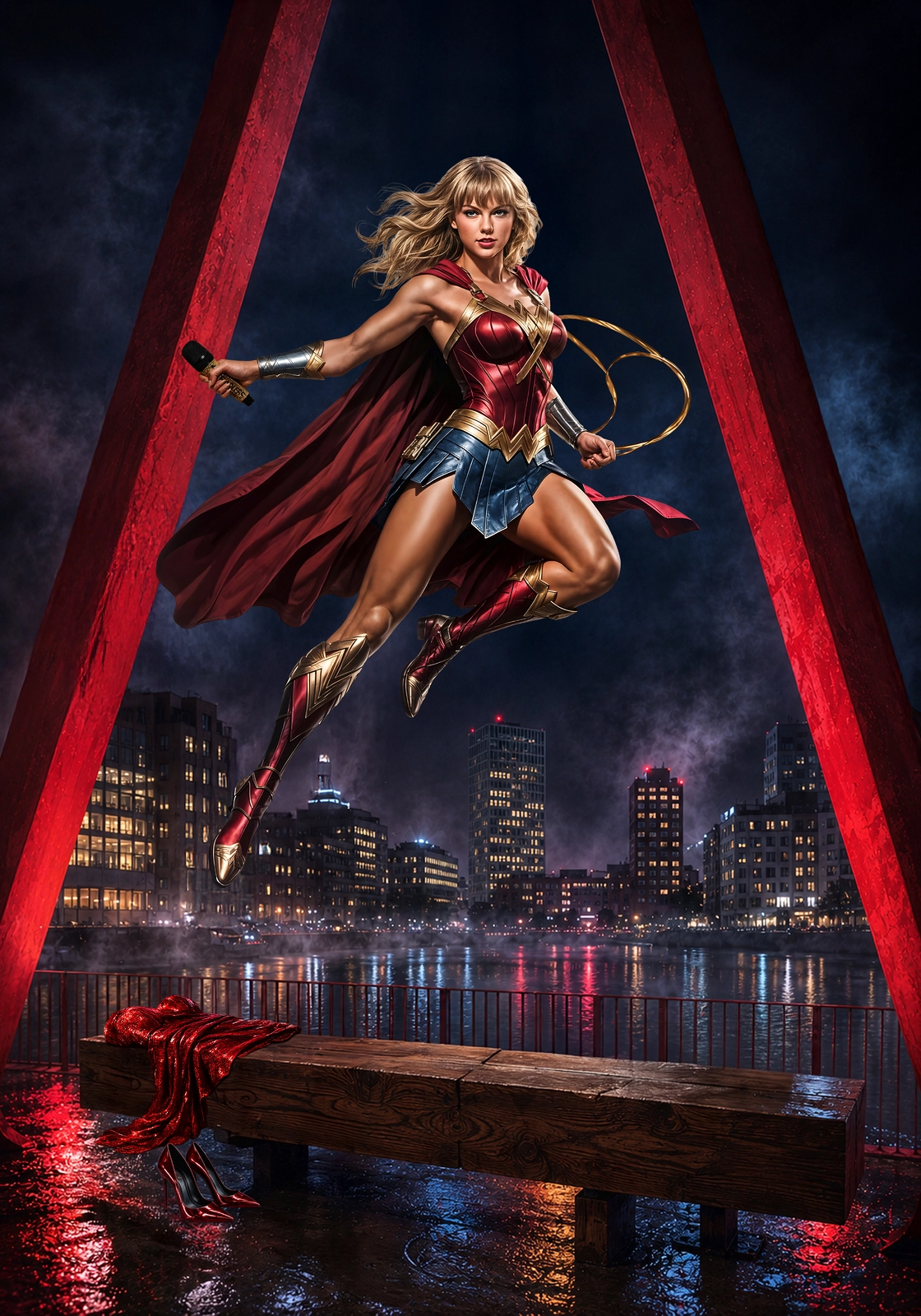
Jörgen Thornberg
The Modern Wonder Woman Taylor Swift and the Art of Reinvention, 2026
Digital
50 x 70 cm
3 200 kr
The Modern Wonder Woman Taylor Swift and the Art of Reinvention
Svensk text på slutet
It begins with an image.
A woman hovering above Malmö Harbour like a modern Wonder Woman, as the waters of Västra Hamnen reflect the city's lights. Below her, on Beijer Bridge, a red cape lay across a solitary wooden bench, and beneath it stood a pair of high heels. Behind her, Turning Torso rose from the mist like a futuristic tower from a Nordic fairy tale. And somewhere between stage lights, pop music, superhero mythology, and the digital age, a question emerged that proved far larger than Taylor Swift alone.
What is a modern icon, really?
Is she merely an artist? A corporation? An emotional phenomenon? A story written collectively by millions of people? Or have the superstars of our era, in fact, inherited the place once held by gods, heroes, and mythological figures in the human imagination?
This essay is therefore not only about Taylor Swift. It is about transformation. About stage performance as a modern ritual. About how identities are built, dismantled, and reborn in real time before a global audience. About why people still need heroes even in the age of algorithms and livestreams.
And perhaps it is also about Malmö, Swedens third city, internationally, a small city.
A city that has rebuilt its identity through reinvention. Old shipyard cranes transformed into glass towers. Water, neon lights, and Nordic nights where reality and performance sometimes merge, until the boundary between human and myth almost disappears.
Because somewhere behind the stage curtains, another costume is always waiting.
Another era.
Another transformation.
The Woman Above the Water
Above the harbour, cold and wide,
Where Nordic winds and neon collide,
A woman rose through rain and flame
While thousands cried her hidden name.
Below her on the crimson bridge
A red cape stirred beside the ridge
Of darkened water, steel, and glass
Where ships and old worlds used to pass.
Her high heels waited silently there,
Like relics from another prayer,
As Turning Torso pierced the night
A silver spear of northern light.
Was she a singer? Was she myth?
A dream the modern age walks with?
A warrior wrapped in sequined fire,
Built equally from pain and desire?
For every era leaves its skin
And something new steps out within.
The girl next door becomes the queen,
Then disappears behind the screen.
The crowds lift phones like candle flames,
Creating gods from borrowed names,
While algorithms learn by heart
The architecture of her art.
And somewhere backstage, out of sight,
Beyond the thunder and the light,
Another costume softly waits
Behind the darkened loading gates.
Another version. Another face.
Another entrance into grace.
For modern heroes cannot stay
They rise, transform, and drift away.
Yet still above Malmö at dawn,
When all the final songs are gone,
The harbour whispers through the rain:
She may return this way again.
Is she a saint or a superhero?
A northern star in stadium glow?
A goddess forged in screens and sound,
Or just the girl next door, spellbound?
Is she armour? Is she grace?
A thousand versions of one face?
A myth the modern world designed
To carry longing through the mind?
And who is Taylor Swift, in truth,
Still hovering above the bridge roof?
A woman, a symbol, a dream, or a light
Reflected on the harbour at night?
Perhaps no single answer stays.
She shifts like water, smoke, and haze.
Yet somewhere over Malmös tide
She still hangs glowing in the sky.
Malmö, May 2026
Taylor Swift and the Art of Reinvention
Prologue The Woman Above the Water
At first, she appears only as a reflection a streak of red trembling across the dark waters of Malmö Harbour as neon dissolves in the rain and the glass towers of Västra Hamnen vanish into Nordic mist. Somewhere behind the illuminated apartment windows, ordinary life continues: people scrolling on phones, cleaning restaurant floors, arguing softly in kitchens washed blue by television light. But down by the water, another kind of electricity has gathered. The stage lights awaken first. Then the smoke. Then the roar. And suddenly she is there.
Not walking onto the stage like an ordinary performer, but descending into the night as though she had stepped out of a modern mythology assembled from stadium speakers, heartbreak anthems, sequins, algorithms, and ancient heroic archetypes. A woman suspended between pop culture and legend, between mechanical precision and emotional vulnerability.
Taylor Swift no longer resembles a traditional celebrity. She has evolved into something far stranger: a shape-shifting cultural phenomenon whose transformations are followed with the same fascination earlier civilisations reserved for queens, goddesses, or warrior saints. She hovers above the harbour like a contemporary Wonder Woman not because she wields weapons or possesses supernatural strength, but because she has mastered reinvention itself.
Every movement is rehearsed. Every spotlight is calculated. Entire emotional landscapes are mapped in advance with astonishing precision. A modern Taylor Swift concert operates with the complexity of a military operation, disguised as a dream. Beneath the glitter and choreography lies an almost frightening level of control: synchronised lighting systems, costume logistics, camera timing, emotional pacing, crowd psychology, emergency alternatives, backup plans for rain, vocal strain, broken heels, delayed cues, and audiences overwhelmed by emotion. Nothing is accidental. And yet the audience experiences the evening as intimate. That is the magic trick.
A glance at a crying fan suddenly feels personal in an arena of 70,000 people. An improvised acoustic song can spread across the internet within seconds and become part of collective memory before the encore ends. She understands something crucial about modern audiences: they no longer worship perfection alone. They worship the illusion of access to the human being hidden somewhere within the machinery.
Perhaps that is why she changes constantly. One era dies so another may emerge. Backstage, beneath cold white work lights and the quiet voices of stage crews in headsets, another costume is already waiting. Another incarnation hangs silently beside sequined armour, glittering boots, handwritten lyrics, half-empty water bottles, and backup microphones wrapped in black tape. The woman flying above Malmö tonight is already becoming someone else.
Below her, on a rain-darkened wooden bench on the glowing red Beijer Bridge, a discarded red cape lies folded like the skin of a former life. Nearby, a pair of abandoned high heels reflects the crimson glow from the steel structures overhead. They look less like forgotten objects than like evidence of transformation as though an ordinary woman had sat there only moments ago, before stepping into another identity entirely.
The city watches the sky, while somewhere in the darkness behind the stage curtains, the next version of Taylor Swift is already waiting to be born.
I. The Architecture of Perfection
Long before the audience enters the stadium, the concert already exists as a machine. Not merely a musical performance, but an enormous architectural structure built from timing, emotion, choreography, electricity, narrative, and control. Every modern Taylor Swift show resembles a temporary city assembled for a single purpose: to create the illusion of spontaneity through meticulous preparation.
Thousands of people help build that illusion. Lighting designers calculate emotional temperatures through colour palettes. Sound engineers shape the acoustics so that even spectators at the very top of the arena hear whispered confessions as if they were private conversations. Camera operators rehearse their movements with balletic precision. Dancers memorise the exact distances between moving stage platforms. Technicians monitor hydraulic lifts, pyrotechnics, wireless frequencies, costume repairs, backup instruments, emergency exits, weather forecasts, and security flows with the same concentration as air-traffic controllers.
Meanwhile, somewhere in the middle of this gigantic organism, stands the woman around whom everything revolves.
Taylor Swift herself often appears remarkably calm amid the machinery. That calm is deceptive. What the audience experiences as effortless charisma is, in fact, the result of obsessive discipline. Transitions between songs may last only seconds, yet those moments are the product of months of rehearsal. A costume must detach perfectly. A microphone must already be in the correct hand. A camera must capture the exact expression at the exact lyric. A staircase hidden in darkness must be climbed without hesitation while thousands of screaming fans shake the stadium floor beneath her heels.
Nothing can collapse. Yet the audience must never see the labour.
That is one of the oldest laws of stage illusion. Great spectacle conceals its construction. The magician never reveals the trapdoor. The ballerina must appear weightless despite years of pain. The superhero lands gracefully, with wires remaining invisible.
Taylor Swift understands this instinctively. Her concerts are not chaotic eruptions of celebrity ego. They are carefully choreographed emotional journeys, with each era of her career treated almost as a separate kingdom, each with its own visual language, costumes, emotional climate, typography, symbolism, and mythology. One moment, the stage becomes a glittering teenage fairy tale of pastel romance and diary confessions. Minutes later, it transforms into a dark industrial battlefield of revenge narratives, serpentine imagery, and towering shadows. Then, suddenly, everything softens into candlelight, folk poetry, autumn forests, cardigan nostalgia, and intimate storytelling.
She does not merely sing songs. She builds worlds.
The remarkable thing is that modern audiences have become sophisticated enough to recognise the machinery while still surrendering to it emotionally. Everyone understands that the show is planned down to the microscopic detail. Social media has exposed too much for innocence to survive intact. Fans analyse setlists statistically. Camera angles are dissected online within minutes. Costume changes become forensic studies. Entire communities track recurring gestures, hidden references, numerical patterns, lyrical callbacks, and symbolic clues, much as medieval scholars interpreted sacred manuscripts.
And the illusion still works.
Perhaps people no longer seek authenticity in the traditional sense. They seek dedication. Effort. Obsession. Mastery.
In earlier centuries, cathedrals demonstrated the power of religion through architecture. Today, stadium concerts serve a strangely similar function for popular culture. Massive crowds gather beneath lights powerful enough to resemble artificial suns, while giant screens magnify the face of a single woman into something almost mythological. Songs become communal rituals, and private heartbreak becomes a collective ceremony.
Seen from above, the entire event resembles less a concert than a carefully orchestrated act of modern mythmaking. And somewhere backstage, beneath white work lights, another version of Taylor Swift is already waiting on a rack. Another skin. Another era. Another transformation is preparing to step into the light the moment the current illusion ends.
II. The Illusion of Spontaneity
The strange paradox of a Taylor Swift concert is that something so meticulously controlled can still feel spontaneous. Modern audiences understand perfectly well that enormous stadium productions are planned with military precision. Yet they continue to search for moments that appear unscripted tiny cracks in the machinery where something human suddenly emerges.
Taylor Swift has become highly skilled at creating those moments.
A pause before a chorus lasts slightly longer than expected. A smile breaks through the carefully maintained stage composure as the crowd's reaction grows louder than anticipated. A forgotten lyric becomes a joke rather than a disaster. An acoustic song appears unexpectedly because fans have spent weeks pleading for it online. A speech changes tone depending on the emotional atmosphere in the arena that night.
These details matter because contemporary audiences no longer gauge authenticity as earlier generations did. In the age of social media, almost everyone recognises that public identity is partly constructed. The illusion of total sincerity is impossible to sustain. What people seek instead is controlled vulnerability the sense that, beneath the elaborate production, a living person remains, capable of reacting emotionally in real time.
Taylor Swift understands this instinctively. She rarely allows chaos to take over completely, but she leaves enough open space for unpredictability to breathe. That balance is difficult to strike. Too much perfection becomes cold. Too much improvisation risks destroying the spectacles structure. The modern superstar must therefore perform a strange balancing act between machine and human.
Perhaps this explains why audiences become so emotionally attached to minor deviations from the expected script. A slight shift in gaze towards the crowd can spark thousands of online discussions within minutes. A surprise song becomes historic because it exists only for one particular audience on one particular evening. Fans speak about these moments almost as earlier generations described religious visions or legendary football matches: You had to be there.
The internet intensifies this phenomenon. Every concert now exists simultaneously in physical space and in a digital afterlife. Before the encore has even ended, fragments of the performance are already circulating globally via TikTok clips, livestreams, reaction videos, screenshots, memes, and fan analyses. A spontaneous remark made in Stockholm may become a source of comfort for someone sitting alone in Seoul or Buenos Aires an hour later.
In this environment, improvisation itself becomes part of the architecture.
Even accidents can be transformed into a narrative. A broken piano, a rainstorm, a technical malfunction, an emotional reaction all can be woven into the mythology if handled well. Older generations of performers often feared visible imperfection because it threatened the illusion of greatness. Modern audiences, however, often interpret imperfection as proof of humanity. The flaw becomes evidence that the person behind the icon still exists.
Yet none of this is entirely accidental either.
That is the deeper irony. The illusion of spontaneity is itself partially rehearsed. The modern superstar must prepare for unpredictability. Entire production teams develop contingency plans to maintain emotional flexibility. There are backup routes through the machinery, alternative transitions, emergency camera patterns, spare costumes, and acoustic arrangements, all ready to appear at a moments notice. Even freedom has infrastructure behind it.
Taylor Swift, therefore, occupies a curious position in contemporary culture. She appears both untouchably controlled and emotionally accessible. She is simultaneously a global corporation, a storyteller, a confessional songwriter, a strategist, a fantasy figure, and a strangely familiar companion to millions of listeners who have never met her.
Like a modern Wonder Woman, she moves effortlessly between identities. One moment, she towers over the audience like an impossible myth, illuminated by stadium lights powerful enough to resemble artificial suns. Next, she sits alone with a guitar, speaking softly about heartbreak as though the entire arena were a private room.
The audience understands that both versions are performances. Yet they believe in both.
Perhaps that is the true magic of contemporary fame: not convincing people that the illusion is real, but making them willingly choose to enter it together.
III. Shedding Skins
One reason Taylor Swift continues to dominate popular culture is that she understands something many artists fear: survival requires transformation. Staying static is dangerous. Repeating the same identity for too long eventually turns even the most successful performer into a museum piece admired perhaps, but no longer culturally alive.
Taylor Swift refuses to become static.
Instead, she sheds identities like a serpent sheds its skin. Entire aesthetic worlds are abandoned, reinvented, mocked, resurrected, or deliberately destroyed. The wide-eyed country teenager with curls and cowboy boots evolves into the fairytale heroine, writing diary confessions beneath glittering stage lights. Later, a sharper, more calculating figure emerges, surrounded by media scandals, public feuds, and serpentine symbolism. Then, suddenly, the spectacle collapses inward into muted cardigans, candlelight, autumn forests, and introspective folk storytelling. Each transformation feels dramatic at the time, yet afterwards it seems almost inevitable, as though every previous version already contained the seeds of the next.
What makes these transitions remarkable is that they rarely erase the past. Older identities survive like ghosts beneath newer ones. Fans continue to carry emotional relationships not merely to the current Taylor Swift, but to the different eras through which they once lived. One audience member remembers the teenage country ballads as the soundtrack to first love. Another associates the darker revenge narratives with heartbreak and reinvention after divorce. Someone else discovers her through the quieter, indie-inspired albums and experiences her primarily as a reflective songwriter rather than a pop phenomenon.
In this sense, Taylor Swift has become less of a fixed celebrity and more of an evolving emotional archive.
Modern fandom encourages this fragmentation of identity. Social media enables audiences to catalogue and preserve every hairstyle, interview, outfit, lyric variation, and symbolic clue with obsessive precision. Entire online communities function almost as historians, documenting the rise and fall of artistic civilisations. Fans speak not only about albums but about eras, as though discussing dynasties or mythological ages.
The word itself is revealing.
An era suggests something more than entertainment. It implies architecture, atmosphere, emotional climate, and even morality. Each Taylor Swift era arrives with its own colours, typography, costumes, gestures, stage design, visual mythology, and emotional vocabulary. She does not merely release music; she constructs temporary realities into which millions willingly step.
This constant metamorphosis places her within a long historical tradition of performers who regarded identity as a theatrical construction. David Bowie repeatedly transformed himself until the boundary between performer and invented character almost disappeared. Madonna rebuilt her image so often that reinvention itself became her central artistic language. Earlier still, actors and opera divas regarded costume, gesture, and illusion as forms of power capable of reshaping the public imagination.
Yet Taylor Swift differs from many predecessors because her transformations unfold in the brutal transparency of the digital age. Nothing disappears any more. Every previous version remains permanently searchable online, preserved in photographs, interviews, fan archives, reaction videos, memes, and endless commentary. Reinvention, therefore, becomes more complicated. The artist cannot simply abandon an old identity because the internet refuses to forget.
Instead, Taylor Swift incorporates memory into the performance.
Old selves are revisited, reinterpreted, and reclaimed. Songs are rerecorded. Earlier aesthetics return, wearing slightly altered faces. Nostalgia becomes both a commercial strategy and an emotional archaeology. The audience is encouraged not merely to consume transformation but to participate in it collectively.
Perhaps that is why the superhero comparison feels increasingly apt. Traditional superheroes rarely possess a single identity. Beneath the costume lies another self; beneath that self lies yet another layer. Wonder Woman herself moves between the roles of mythological warrior, diplomat, outsider, feminist symbol, and ordinary woman navigating the modern world. The costume is never merely decorative. It represents transformation, ritual, and psychological power.
Taylor Swifts backstage wardrobe works in much the same way.
Somewhere behind the stage curtains, beneath white industrial lights and the low murmur of production crews, another costume already hangs in silent readiness. Sequins wait beside black fabric. Boots wait beside acoustic guitars. One identity is preparing to disappear as another is preparing to emerge. The audience may believe they are witnessing a definitive version of Taylor Swift, but the machinery behind the spectacle already knows otherwise.
There is always another skin waiting in the wings.
IV. The Modern Superhero
The modern world no longer creates heroes as earlier civilisations once did. We no longer gather around campfires to hear epics of Achilles or Hercules. We no longer carve saints into cathedral walls or paint victorious monarchs riding across battlefields in divine sunlight. Instead, we project our longings onto celebrities, athletes, fictional superheroes, and cultural figures who can withstand the endless pressure of visibility.
In that sense, Taylor Swift belongs to a distinctly modern mythology.
Not because she possesses supernatural powers in any literal sense, but because she embodies qualities that contemporary society increasingly associates with heroism: endurance, reinvention, emotional resilience, narrative control, and the ability to survive public scrutiny without disappearing beneath it. The modern superhero no longer needs to rescue trains from collapsing bridges. She must instead navigate a world of surveillance, algorithms, global attention, media cycles, emotional projection, and permanent exposure.
Taylor Swift performs this balancing act with remarkable precision.
Like Wonder Woman, she exists simultaneously as a symbol and as an individual. Millions see fragments of themselves reflected in her various incarnations: the underestimated girl, the ambitious outsider, the romantic idealist, the betrayed woman, the calculating strategist, the isolated artist, the survivor rebuilding herself after humiliation. Her power lies partly in her ability to move between these identities without fully abandoning any of them.
This creates a strange paradox of intimacy. Fans feel they know her personally, despite interacting mostly with carefully constructed representations. Songs become emotional mirrors into which listeners pour their own memories and heartbreak. Entire relationships are formed not with the actual human being, but with the meanings people attach to her evolving mythology.
Older forms of celebrity often relied on distance. Classical Hollywood movie stars were elevated above ordinary life through glamour and inaccessibility. Today, the relationship works differently. Modern audiences demand emotional transparency while simultaneously contributing to the impossible pressures that make genuine transparency dangerous. The contemporary superstar must therefore master selective vulnerability revealing enough humanity to remain relatable while safeguarding enough privacy to survive psychologically.
Taylor Swift understands this instinct almost strategically. She reveals emotions, narratives, symbols, fragments, clues, confessions, and carefully chosen vulnerabilities, but rarely offers complete access. The audience experiences a sense of intimacy while the machinery of celebrity continues to operate behind controlled boundaries.
That balance resembles superhero mythology more than traditional fame does.
Superheroes are defined not merely by strength but by duality. Clark Kent and Superman. Diana Prince and Wonder Woman. Bruce Wayne and Batman. Public identity and hidden self coexist, each impossible without the other. The costume becomes both disguise and revelation.
Taylor Swifts eras function similarly. Each one amplifies certain aspects of personality while concealing others. A glittering pop persona may mask exhaustion. A revenge narrative may conceal vulnerability. A quiet acoustic era may still operate within a billion-dollar commercial structure. None of these versions is entirely false, yet none is fully complete either.
Modern fandom actively sustains this mythology. Audiences no longer consume stories passively. They investigate, decode, and expand them collaboratively online. Hidden references become treasure hunts. Lyrics are analysed like sacred texts. Fans search for continuity across songs, performances, outfits, interviews, and visual symbolism with almost theological intensity.
In earlier centuries, mythology evolved slowly through oral storytelling. Today, myth evolves at digital speed.
A stadium concert, therefore, becomes more than entertainment. It becomes a ritual space. Tens of thousands gather beneath artificial constellations of stage lighting as giant screens magnify a single figure to near-divine scale. Collective singing replaces hymns. Friendship bracelets become ceremonial tokens exchanged between strangers. Emotional catharsis unfolds publicly, with crowds filming the experience to preserve it forever.
The atmosphere resembles religion, theatre, and mass psychology simultaneously.
At the centre stands a woman who has learned to transform herself repeatedly without breaking the illusion of continuity. That may be her greatest superpower of all. Not perfection. Not fame. Not beauty. But controlled metamorphosis under relentless observation.
The audience watches her soar above the harbour lights like a modern Wonder Woman, suspended between mythology and machinery. Yet somewhere backstage, beneath white industrial lamps and beside racks of glittering costumes, another transformation is already waiting in silence because the modern superhero can never remain motionless for long.
V. The Machinery Behind the Myth
Every mythology hides a machinery behind it.
Ancient temples required armies of builders, priests, engineers, servants, accountants, and labourers, whose names history rarely preserved. The shining façade visible to the public concealed an enormous, invisible infrastructure working constantly behind the scenes. Modern celebrity functions much the same way. The myth of effortless perfection survives only because countless people devote themselves to maintaining it.
Taylor Swifts world operates on a scale that increasingly resembles a multinational enterprise rather than traditional entertainment. Entire touring cities move across continents, carrying stages, lighting towers, costumes, instruments, generators, cameras, catering systems, security structures, communication networks, and technical crews large enough to populate small villages. Trucks travel through the night while aircraft leap between countries, carrying fragments of the illusion from one temporary kingdom to another.
The audience sees glamour. Backstage, however, glamour dissolves into logistics.
Schedules taped to walls. Headsets crackling with instructions. Emergency sewing repairs minutes before stage entrances. Makeup lights glowing at strange hours after midnight. Vocal warm-ups were performed despite exhaustion. Dancers stretched bruised muscles beneath industrial fluorescent lamps. Technicians climbed steel structures while rain lashed the stadium roof. Someone checked batteries. Someone replaced a damaged cable. Someone recalculated timing after a delayed cue threatened to disrupt an entire chain of transitions lasting only seconds.
Inside this machinery stands the performer herself, trapped in a paradox familiar to many modern icons: the more visible she becomes, the more tightly controlled her existence must be.
Fame at this level no longer resembles ordinary public recognition. It becomes environmental. Surveillance is constant. Cameras wait outside restaurants, airports, hotels, rehearsals, family gatherings, beaches, and funerals. Entire industries profit from monitoring emotional fluctuations, friendships, romances, conflicts, facial expressions, clothing choices, body language, and private movement patterns. Social media further intensifies the pressure by creating the expectation of permanent accessibility. Silence itself is interpreted as communication.
Under such conditions, identity risks becoming performance twenty-four hours a day.
Perhaps this explains why Taylor Swifts transformations feel so deliberate. Reinvention becomes not merely an artistic expression but a survival strategy. The old skin must be shed before it hardens into a prison. One public narrative must die so another can emerge before audiences, journalists, and algorithms fully consume the previous version.
Yet constant transformation carries its own dangers.
At what point does adaptation begin to erode the person beneath the performance? How many identities can someone inhabit before the boundary between authentic feeling and strategic storytelling becomes impossible to discern? Modern celebrity culture rarely allows stillness. Remaining visible requires continuous production: new songs, new imagery, new narratives, new reactions, new emotional revelations. The machine must keep feeding itself because attention is now the most unstable currency.
This pressure lends an almost tragic dimension beneath the spectacle.
The audience sees the flying figure above the harbour lights radiant, powerful, untouchable while beneath the illusion lies a human being operating within schedules so demanding that ordinary concepts of privacy, rest, and emotional recovery begin to blur. Even vulnerability may become part of the performance cycle. Heartbreak becomes an album. An album becomes a tour. The tour becomes mythology. The mythology generates expectations for the next transformation.
The machinery never fully stops.
And yet perhaps that endless movement is precisely what fascinates modern audiences so deeply. Taylor Swift appears both empowered by the system and imprisoned within it. She controls the spectacle with astonishing intelligence while remaining dependent on the same machinery that magnifies her to mythological scale.
That contradiction makes her feel surprisingly contemporary.
Older generations imagined superheroes as beings standing outside ordinary society, gifted with powers beyond human limits. Modern culture creates different kinds of heroes: individuals capable of enduring extreme exposure in public without psychological disintegration. Their battles are fought not only against enemies but also against exhaustion, fragmentation, repetition, surveillance, and the relentless demand to remain emotionally available to millions of strangers.
Somewhere backstage, beneath white work lights and the low metallic hum of equipment cases being wheeled across concrete floors, another costume already waits in silence. Another era. Another emotional architecture is preparing to rise. The audience may believe the transformation on stage is complete, but the machinery behind the myth already knows the truth.
The next reinvention has begun long before the current one concludes.
VI. The Audience as Co-Creator
One of the most remarkable aspects of modern celebrity culture is that audiences are no longer passive spectators. Earlier generations consumed music, films, and performances from a distance. The relationship moved largely in one direction: from artist to public. Today, the boundary has become porous. Fans actively participate in constructing the performer's mythology.
Taylor Swift recognised this transformation earlier than many of her contemporaries.
Her career evolved alongside the rise of social media, livestream culture, fan communities, reaction videos, and digital intimacy. She belongs to the first generation of global superstars shaped not only by traditional media industries but also by the constant online interaction between artists and audiences. In that environment, fandom ceases to be mere admiration and becomes collaborative storytelling.
The audience no longer listens to Taylor Swift. It interprets her work.
Lyrics are dissected line by line, like literary texts. Hidden references become treasure hunts. Colours, numbers, costumes, gestures, emojis, interview fragments, stage visuals, and social media captions are analysed with almost scholarly obsession. Entire online communities act as collective detective agencies, searching for symbolic continuity across eras and performances.
This process turns spectators into participants.
The modern Taylor Swift phenomenon, therefore, resembles something larger than ordinary pop stardom. It operates almost like an evolving fictional universe, with millions contributing emotional interpretations, theories, memories, and personal experiences. Fans connect songs to their own divorces, friendships, betrayals, anxieties, recoveries, and hopes. The performer provides the framework, but the audience fills it with private meaning.
Perhaps this explains the extraordinary emotional atmosphere at her concerts.
People do not enter the stadium merely to hear songs. They arrive carrying fragments of their own lives, attached to specific lyrics and eras. One fan associates a particular album with adolescence. Another survived heartbreak by repeatedly listening to a particular song at night through headphones. Someone else remembers a first kiss, a hospital room, a lost friendship, a lonely train journey, a wedding, a funeral, or an escape from depression, all set to the soundtrack of her music.
When tens of thousands gather, those private memories merge into something collective.
The friendship bracelets exchanged between strangers at concerts illustrate this beautifully. On the surface, they appear playful and harmless colourful handmade objects inspired in part by lyrics and internet culture. Yet symbolically, they function almost as ritual offerings or ceremonial tokens. Strangers approach each other, carrying coded messages, exchanging fragments of identity through beads, colours, inside jokes, and references only understandable within the shared mythology of the fandom.
In another era, religious pilgrims carried medallions or saints relics. Today, audiences exchange bracelets bearing song lyrics beneath giant LED constellations.
The comparison may sound exaggerated, but modern mass culture increasingly occupies emotional spaces once filled by religion, folklore, and communal ritual. Stadium concerts offer collective catharsis in societies where many traditional forms of belonging have weakened. For a few hours, strangers sing in unison beneath artificial stars as giant screens magnify emotions to mythic scale. The experience becomes both personal and communal.
Taylor Swift herself appears keenly aware of this dynamic. She often structures performances to reward emotional participation rather than passive observation. Surprise songs foster intimacy. Hidden references encourage long-term engagement. Recurring visual motifs make fans feel included in an ongoing narrative larger than any individual concert.
The audience, therefore, becomes part of the machinery.
Without the fandoms interpretive energy, many of the transformations would lose their power. An era exists not only because the artist declares it, but because millions collectively agree to inhabit it. Fans archive it, discuss it, parody it, defend it, romanticise it, and preserve it emotionally long after the official tour ends.
This creates an unusual relationship between control and surrender. Taylor Swift carefully shapes the mythology surrounding her, yet the audience simultaneously reshapes it through endless collective interpretation. The result resembles a constantly evolving collaboration between the performer and the mass imagination.
From afar, the scene by the Malmö waterfront begins to resemble something almost surreal. A flying, modern Wonder Woman suspended above water and steel. Thousands of illuminated phones raised like digital candles. Crowds singing lyrics back towards the stage as though participating in a shared ritual older than popular music itself.
And somewhere behind the curtains, beneath cold white work lights and beside another waiting costume, the next transformation is already preparing itself knowing that once it steps into the light, millions of people will immediately begin helping to write its meaning.
VII. Malmö, Water, and Neon Reflections
Perhaps this story could not unfold anywhere but in a place like Västra Hamnen in my Malmö. With emphasis on my.
The district itself is built on transformation. Once the territory of the Kockums shipyard a landscape of steel, welding sparks, cranes, oil, and industrial labour it has gradually reinvented itself as something almost futuristic. Glass towers rise where ships were once assembled. Cyclists glide past modern architecture on ground shaped by generations of dockworkers. The old industrial harbour has become a landscape of reflections: water, steel, neon, and carefully curated Scandinavian modernity.
That makes it an unusually fitting stage for a figure such as Taylor Swift.
She, too, exists in perpetual reinvention.
The connection between artist and environment becomes strangely symbolic. Just as the harbour shed its old identity without entirely erasing its past, Taylor Swift continually rebuilds herself, with traces of earlier eras still visible beneath the surface. Reinvention does not destroy memory. It layers new meaning on older foundations.
At night, the district takes on an almost cinematic atmosphere. Rainwater reflects the aircraft's red warning lights at Turning Torso. Wind sweeps across the Öresund, carrying salt, fog, distant traffic noise, and the metallic echo of modern urban life. The enormous bridge towards Copenhagen glows faintly in the distance, like part of some futuristic dreamscape suspended between Scandinavia and the continent.
In such surroundings, the image of a modern Wonder Woman no longer seems absurd.
She appears less like a comic-book superhero than like a new kind of mythological figure born of the twenty-first century: part pop icon, part digital construct, part emotional confessor, part corporate empire, part fantasy projection. Her stage costume gleams against the Nordic darkness like armour redesigned for the age of livestreams and algorithms.
Below her, Malmö continues with its ordinary life.
A late green bus glides silently along wet streets. Someone walks home after a night shift. Teenagers sit by the waterfront, sharing cigarettes and music through phone speakers. Restaurant workers drag chairs inside as the rain grows heavier. Somewhere in an apartment, a child falls asleep wearing headphones after replaying concert videos that are already spreading across social media.
Meanwhile, the giant spectacle above the harbour becomes a memory almost immediately.
That is another defining feature of contemporary culture: experiences become archives the instant they occur. Before the final applause has faded, fragments of the evening already circulate online as digital relics slowed-down videos, emotional reactions, screenshots, fan edits, grainy livestreams, and photographs taken from impossible angles beneath flashing lights. The concert exists simultaneously as lived reality and as instantly preserved mythology.
Perhaps this explains why the imagery surrounding modern stardom often feels dreamlike. The boundary between reality and performance grows increasingly unstable. Taylor Swift standing above Malmö Harbour becomes, at once, a real performer, a symbolic projection, a social media phenomenon, and a personal emotional experience, each spectator interpreting it differently.
To one person, she embodies ambition.
To another survival.
For someone else, heartbreak transformed into strength.
And to millions, she represents movement itself the capacity to keep changing without disappearing.
The old harbour understands that instinct. Cities survive through reinvention, as artists do. Cranes vanish. Towers rise. Factories become apartments. Industrial silence gives way to nightlife and digital spectacle. Yet traces of older worlds remain hidden beneath the polished surfaces.
Somewhere behind the stage curtains, another costume waits beneath white industrial lights. Another era is already preparing itself in the quiet darkness while the current one still glows above the water. And out across the harbour, where red reflections tremble in the rain beside the silent outline of Turning Torso, the flying figure hovers momentarily between mythology and modernity before beginning to transform once more.
Epilogue The Next Transformation
Eventually, the lights go out.
The stadium empties slowly at first, then all at once. Tens of thousands of people drift back into ordinary life, carrying fragments of the evening like glowing embers: half-recorded videos, hoarse voices, wet jackets that smell faintly of rain and smoke machines, and friendship bracelets clattering softly against wrists on the walk home through Malmös midnight streets.
The illusion dissolves surprisingly fast.
Stage workers already move through the darkness, dismantling the dream piece by piece. Towers of light are lowered towards the ground. Cables disappear into black containers. Giant screens fade into lifeless rectangles of metal and glass. Somewhere backstage, makeup is being removed under harsh mirrors as exhausted dancers sit in silence, scrolling on their phones after the adrenaline crash. The machinery that only hours earlier resembled mythology gradually reverts to ordinary industrial labour.
And yet something lingers.
Perhaps because modern spectacles are designed not merely to be experienced but to endure in memory and repetition before dawn arrives, the concert already exists online in thousands of altered forms: slowed-down emotional clips, blurry photographs, fan edits glowing with artificial nostalgia, reaction videos, analyses, rankings, screenshots, theories, and fragments of songs escaping through headphones on night buses crossing the city.
The performance continues long after the stage has disappeared.
That may be the defining characteristic of twenty-first-century mythology. Earlier civilisations built monuments from marble and stone. Modern culture constructs them from circulation, memory, digital archives, and emotional attachment. The myth survives because millions continue to carry pieces of it within themselves.
Taylor Swift understands this better than almost anyone else.
She knows the concert does not truly end when the audience leaves the arena. It continues in bedrooms, on social media feeds, on lonely train rides, in headphones after heartbreak, in late-night conversations between friends, in children rehearsing songs before mirrors, and in adults reconnecting with younger versions of themselves through melodies tied to forgotten years of their lives.
The modern Wonder Woman, therefore, possesses a different kind of superpower. She does not stop bullets or lift collapsing buildings. She manipulates emotional memory on a planetary scale. She transforms private feelings into collective mythology while allowing millions to believe the songs belong uniquely to them.
That balance is extremely difficult to maintain.
Perhaps that is why she keeps changing. Remaining motionless would break the spell. The mythology survives only through movement constant renewal, reinvention, disappearance, and return. Like the harbour outside Malmö, she exists in a permanent state of transition between what once was and what comes next.
Down by the water, the rain has finally stopped. Red reflections from distant warning lights shimmer beside the dark silhouette of Turning Torso. The wooden bench still stands empty in the harbour wind. Across it lies the abandoned red cape, damp with mist and sea air, while the nearby high heels gleam faintly beneath the city lights like artefacts from a vanished performance.
But backstage, another costume is already waiting.
Another era.
Another skin.
Another version of Taylor Swift is preparing in silence beneath white work lights, waiting for the moment when the darkness opens once again, and the modern Wonder Woman rises above the water.
PS. Wonder Woman and Taylor Swift
Wonder Woman was created in 1941 as an ideal rather than merely a superhero. An Amazon princess, warrior, diplomat, and founding member of the Justice League, she embodied an unusual blend of strength and compassion. Unlike many earlier comic-book heroes whose power rested primarily on violence or vengeance, Wonder Woman represented something more complex: the belief that courage and empathy could coexist. She fought wars while dreaming of peace. She carried weapons yet spoke constantly about truth, justice, and reconciliation. In many ways, she was designed as a modern myth about female power existing outside traditional limitations. She is a feminist superhero.
But mythology rarely remains pure for long.
Over the decades, Wonder Woman has appeared in countless reinterpretations shaped by shifting generations, political moods, commercial pressures, and cultural anxieties. At times, she has been portrayed almost as a utopian feminist symbol. In other eras, she has become darker, more militarised, more emotionally conflicted, even morally ambiguous. Like many long-running mythological figures, she has gradually absorbed contradictions from the societies rewriting her.
That instability is perhaps precisely what links her to Taylor Swift.
Neither of them endures through permanence. Both evolve continuously through reinterpretation. Both exist simultaneously as individuals and as projections onto which millions project conflicting expectations. One audience wants vulnerability. Another wants invincibility. One sees compassion. Another sees calculated ambition. Some view Taylor Swift as empowering, generous, and emotionally intelligent; others see strategic manipulation, commercial control, or carefully orchestrated mythology. Wonder Woman has undergone the same process for generations. Heroine to some. Propaganda figures to otherswarrior, diplomat, celebrity, feminist icon, corporate productsometimes all at once.
Perhaps that is the unavoidable fate of modern icons. The larger they become, the more contradictory meanings they absorb.
Are Wonder Woman and Taylor Swift twins, sisters, or merely cousins?
Probably not twins. Wonder Woman belongs to the realm of mythological archetypes larger, older, almost symbolic by design. Taylor Swift remains unmistakably human despite the machinery surrounding her. She bleeds publicly through her songs in ways superheroes rarely can. Taylor Swift is, in many ways, the girl next door, something Wonder Woman is far from.
But sisters? Perhaps emotionally.
Both are women whose power rests partly on performance and partly on public belief. Both move between armour and vulnerability. Both are expected to remain graceful under impossible scrutiny. Both inspire devotion while provoking suspicion. And both understand that modern femininity often demands contradictory qualities at once: strength without coldness, ambition without arrogance, beauty without vanity, vulnerability without weakness.
Maybe 'cousins' is the most accurate answer.
Wonder Woman hails from the older mythology of comic books and heroic fantasy. Taylor Swift emerges from the newer mythology of stadium culture, digital identity, and emotional storytelling. Yet they clearly belong to the same enormous family tree of female icons onto whom society projects fantasies of power, transformation, morality, and reinvention.
One holds a golden lasso.
The other holds a microphone.
But both stand beneath blinding lights while the world watches, judges, admires, doubts, and still believes anyway.
PS 2
And finally, one small detail remains strangely unresolved in this entire story.
Despite her extensive global tours and her almost cinematic connection to modern waterfront cities, Taylor Swift has still never performed a concert in Malmö. For many in southern Sweden, this feels surreal. Malmö is often described as Swedens musical capital a city shaped by concerts, clubs, festivals, immigrant cultures, underground scenes, opera, pop history, punk movements, and generations of musicians travelling between Copenhagen and the rest of Scandinavia. Music drifts naturally through the city, like the sea wind through the harbour.
Perhaps geography has played its part as well. Copenhagen, only a short distance away across the Öresund, has long served as the larger international magnet for large-scale arena productions. Global tours often stop there instead, leaving Malmö watching from across the water as stadium lights flicker faintly on the horizon.
Yet the feeling persists that her arrival is only delayed, not impossible.
Maybe the timing has not been right yet.
The planned 2029 inauguration of Malmös new super stadium could change that entirely. A city built on reinvention, opening a new monumental arena by the harbour, would provide an almost suspiciously perfect backdrop for an artist whose entire mythology revolves around transformation, spectacle, and emotional architecture. One can already imagine the headlines, the reflections on the water, and the crowds moving through the Nordic summer night beneath illuminated towers and giant screens.
Perhaps that will finally be the moment when the modern Wonder Woman descends over Malmö for real, rather than merely hovering above it in imagination.
And if that night eventually arrives, another costume will already be waiting in the wings.
Det börjar med en bild.
En kvinna svävande över Malmö hamn som en modern Wonder Woman medan Västra hamnens vatten speglade stadens ljus. Nedanför henne på Beijers bro låg en röd cape på en ensam träbänk och inunder stod ett par högklackade skor. Bakom henne reste sig Turning Torso ur dimman som ett futuristiskt torn ur en nordisk saga. Och någonstans mellan scenljus, popmusik, superhjältemytologi och digital samtid uppstod en fråga som visade sig vara långt större än bara Taylor Swift.
Vad är egentligen en modern ikon?
Är hon bara en artist? Ett företag? Ett emotionellt fenomen? En berättelse som miljontals människor skriver tillsammans? Eller har vår tids superstjärnor i själva verket tagit över den plats som gudar, hjältar och mytologiska gestalter en gång hade i människors fantasi?
Denna essä handlar därför inte bara om Taylor Swift. Den handlar om transformation. Om scenkonst som modern ritual. Om hur identiteter byggs, rivs och återuppstår i realtid inför en global publik. Om varför människor fortfarande behöver hjältar även i algoritmernas och livestreamarnas tidsålder.
Och kanske handlar den också om Malmö, Sveriges tredje stad, internationellt en småstad.
Om en stad som själv byggt sin identitet på återuppfinnelse. Om gamla varvskranar som blivit glastorn. Om vatten, neonljus och nordiska nätter där verklighet och iscensättning ibland flyter samman tills gränsen mellan människa och myt nästan försvinner.
För någonstans bakom scenridåerna väntar alltid nästa kostym.
Nästa era.
Nästa förvandling.
Prolog Kvinnan ovanför vattnet
Till en början syns hon bara som en spegling ett rött stråk som darrar över Malmö hamns mörka vatten medan neonljusen löses upp i regnet och glasfasaderna i Västra Hamnen försvinner in i nordisk dimma. Någonstans bakom de upplysta lägenhetsfönstren fortsätter vardagen: människor som scrollar på sina telefoner, städar restauranggolv eller smågrälar i kök färgade blå av tv-skärmar. Men nere vid vattnet har en annan sorts elektricitet samlats. Först vaknar strålkastarna. Sedan röken. Sedan vrålet. Och plötsligt är hon där.
Inte gående upp på scenen som en vanlig artist, utan nedstigande som om hon är sprungen ur en modern mytologi sammansatt av arenahögtalare, hjärtesorgshymner, paljetter, algoritmer och uråldriga hjältearketyper. En kvinna svävande mellan populärkultur och legend, mellan mekanisk precision och emotionell sårbarhet.
Taylor Swift liknar inte längre en traditionell kändis. Hon har utvecklats till något betydligt märkligare: ett skepnadsskiftande kulturfenomen vars förvandlingar följs med samma fascination som tidigare civilisationer reserverade för drottningar, gudinnor och krigarhelgon. Hon svävar ovanför hamnen som en modern Wonder Woman inte därför att hon bär vapen eller besitter övernaturlig styrka, utan därför att hon behärskar själva konsten att återuppfinna sig själv.
Varje rörelse är repeterad. Varje strålkastarvinkel är beräknad. Hela känslolandskapet är kartlagt i förväg med precision. En modern Taylor Swift-konsert fungerar med samma komplexitet som en militär operation, förklädd till en dröm. Under glittret och koreografin döljer sig ett nästan överväldigande kontrollsystem: synkroniserade ljusriggar, kostymbyten, kameratiming, emotionell rytm, publikpsykologi, reservplaner för regn, röstproblem, brutna klackar, försenade signaler och publikmassor överväldigade av känslor. Ingenting är slumpmässigt. Och ändå upplever publiken kvällen som intim. Det är själva trollerinumret.
En blick mot ett gråtande fan känns plötsligt personlig i en arena med sjuttiotusen människor. En improviserad akustisk låt kan spridas över internet på några sekunder och bli en del av det kollektiva minnet innan extranumret ens har hunnit ta slut. Hon förstår något avgörande om moderna publikmassor: de dyrkar inte längre bara perfektion. De dyrkar illusionen av tillgång till människan som gömmer sig någonstans inne i maskineriet.
Kanske är det därför hon ständigt förändras. En era måste dö för att en annan ska kunna födas. Backstage, under kalla, vita arbetslampor och bland lågmälda röster från scentekniker med headset, väntar redan nästa kostym. En ny inkarnation hänger tyst bredvid paljettglittrande rustningar, glittrande stövlar, handskrivna texter, halvtomma vattenflaskor och reservmikrofoner lindade i svart tejp. Kvinnan som flyger över Malmö i kväll håller redan på att bli någon annan.
Nedanför henne, på en regnmörk träbänk ute på den glödande röda Beijers bro, ligger en övergiven röd cape hopvikt som huden från ett tidigare liv. Intill står ett par övergivna högklackade skor som speglar det röda ljuset från stålkonstruktionerna ovanför. De ser mindre ut som bortglömda föremål än som bevis på en förvandling som om en helt vanlig kvinna satt där bara några ögonblick tidigare innan hon steg in i en helt annan identitet.
Staden betraktar himlen medan någonstans bakom scenridåernas mörker väntar nästa version av Taylor Swift redan på att födas.
I. Perfektionens arkitektur
Långt innan publiken går in på stadion existerar konserten redan som en maskin. Inte bara som en musikalisk föreställning utan som en enorm arkitektonisk konstruktion byggd av timing, känslor, koreografi, elektricitet, berättande och kontroll. Varje modern Taylor Swift-show liknar en tillfällig stad skapad för ett enda syfte: att framkalla illusionen av spontanitet genom minutiösa förberedelser.
Tusentals människor hjälper till att bygga den illusionen. Ljusdesigners beräknar emotionella temperaturer genom färgskalor. Ljudtekniker formar akustiken så att även publiken längst upp i arenan hör viskande bekännelser som om de vore privata samtal. Kameraoperatörer repeterar sina rörelser med balettlik precision. Dansare memorerar exakta avstånd mellan rörliga scenplattformar. Tekniker övervakar hydrauliska lyft, pyroteknik, trådlösa frekvenser, kostymreparationer, reservinstrument, nödutgångar, väderprognoser och säkerhetsflöden med samma koncentration som flygledare.
Och någonstans mitt i denna gigantiska organism står kvinnan kring vilken allting kretsar.
Taylor Swift själv framstår ofta som märkligt lugn. Det lugnet är bedrägligt. Det publiken upplever som effortless-karisma är i själva verket resultatet av besatt disciplin. Övergångar mellan låtar kan vara några få sekunder långa, men bakom dem ligger månader av repetitioner. En kostym måste sitta perfekt. En mikrofon måste redan ligga i rätt hand. En kamera måste fånga exakt rätt ansiktsuttryck vid exakt rätt textrad. En trappa dold i mörker måste bestigas utan minsta tvekan, medan tusentals skrikande fans får stadiongolvet att vibrera under hennes klackar.
Ingenting får falla samman. Och ändå får publiken aldrig se arbetet bakom.
Det är en av scenkonstens äldsta lagar. Stora illusioner döljer alltid sin konstruktion. Trollkarlen avslöjar aldrig falluckan. Ballerinan måste se viktlös ut trots år av smärta. Superhjälten landar graciöst medan vajrarna förblir osynliga.
Taylor Swift förstår detta instinktivt. Hennes konserter är inte kaotiska explosioner av kändisego. De är noggrant koreograferade känsloresor där varje era i hennes karriär behandlas nästan som ett eget kungarike med sitt eget visuella språk, sina egna kostymer, sitt eget känsloklimat, sin egen typografi, symbolik och mytologi. Ena stunden förvandlas scenen till en glittrande tonårssaga fylld av pastellromantik och dagboksbekännelser. Minuten senare blir den ett mörkt industriellt slagfält av hämndfantasier, ormsymbolik och väldiga skuggor. Och plötsligt mjuknar allt till stearinljus, folkpoesi, höstskogar, cardigan-nostalgi och intimt berättande.
Hon framför inte bara låtar. Hon bygger världar.
Det märkliga är att den moderna publiken har blivit tillräckligt sofistikerad för att känna igen maskineriet och ändå känslomässigt ge sig hän åt det. Alla förstår att showen är planerad in i mikroskopiska detaljer. Sociala medier har avslöjat för mycket för att oskulden helt ska kunna överleva. Fans analyserar setlists statistiskt. Kameravinklar analyseras online inom minuter. Kostymbyten blir närmast kriminaltekniska studier. Hela nätgemenskaper följer återkommande gester, dolda referenser, siffermönster, textrader och symboliska ledtrådar på samma sätt som medeltida lärda tolkade heliga manuskript.
Och ändå fungerar illusionen fortfarande.
Kanske därför att människor inte längre söker autenticitet i den gamla meningen. De söker hängivenhet, ansträngning, besatthet och mästerskap.
Under tidigare århundraden demonstrerade katedraler religionens makt genom arkitektur. I dag fyller stadionkonserter en märkligt liknande funktion för populärkulturen. Enorma folkmassor samlas under lampor starka nog att likna artificiella solar, medan gigantiska bildskärmar förstorar en enda kvinnas ansikte till något nästan mytologiskt. Sånger blir kollektiva ritualer och privat hjärtesorg förvandlas till offentlig ceremoni.
Sedd ovanifrån liknar hela evenemanget mindre en konsert än en noggrant orkestrerad akt av modern mytbildning. Och någonstans backstage, under vita arbetslampor, väntar redan ännu en version av Taylor Swift på en galge. Ett nytt skinn. En ny era. En ny förvandling som förbereder sig för att träda fram i ljuset i samma ögonblick som den nuvarande illusionen tar slut.
II. Illusionen av spontanitet
Den märkliga paradoxen med en Taylor Swift-konsert är att något så minutiöst kontrollerat ändå kan kännas spontant. Moderna publikmassor förstår mycket väl att enorma stadionproduktioner planeras med militär precision. Ändå fortsätter människor att leta efter ögonblick som verkar oskrivna små sprickor i maskineriet där något mänskligt plötsligt träder fram.
Taylor Swift har blivit en mästare på att skapa just sådana ögonblick.
En paus före refrängen varar lite längre än väntat. Ett leende bryter igenom den noggrant upprätthållna scenmasken när publikens jubel växer starkare än beräknat. En glömd textrad blir ett skämt i stället för en katastrof. En akustisk låt dyker oväntat upp eftersom fans i veckor har bett om den online. Ett tal förändrar tonen beroende på den emotionella stämningen i arenan just den kvällen.
De där detaljerna betyder mycket eftersom dagens publik inte längre mäter äkthet på samma sätt som tidigare generationer gjorde. I sociala mediers tidsålder förstår nästan alla att offentliga identiteter delvis är konstruerade. Illusionen om total uppriktighet går inte längre att upprätthålla. Det människor söker i stället är kontrollerad sårbarhet känslan av att det fortfarande finns en levande människa bakom den gigantiska produktionen, någon som faktiskt kan reagera känslomässigt i realtid.
Taylor Swift förstår detta. Hon låter sällan kaoset ta över helt, men hon lämnar tillräckligt mycket utrymme för att oförutsägbarheten ska kunna andas. Balansen är svår att uppnå. För mycket perfektion blir kallt. För mycket improvisation riskerar att rasera hela spektaklets struktur. Den moderna superstjärnan måste därför utföra en märklig balansakt mellan maskin och människa.
Kanske är det därför publiken blir så känslomässigt fäst vid små avvikelser från det förväntade manuset. En liten förändring i en blick mot publiken kan skapa tusentals diskussioner online inom några minuter. En överraskningslåt blir historisk därför att den bara existerar för en enda publik under en enda kväll. Fans talar om dessa ögonblick nästan på samma sätt som tidigare generationer beskrev religiösa visioner eller legendariska fotbollsmatcher: Man var tvungen att vara där.
Internet förstärker detta fenomen ytterligare. Varje konsert existerar numera samtidigt i fysisk verklighet och i ett digitalt efterliv. Innan extranumret ens hunnit avslutas sprids fragment av föreställningen globalt genom TikTok-klipp, livestreams, reaktionsvideor, skärmdumpar, memes och fananalyser. En spontan kommentar i Stockholm kan bli emotionell tröst för någon som sitter ensam i Seoul eller Buenos Aires en timme senare.
I denna miljö blir själva improvisationen en del av arkitekturen.
Till och med olyckor kan förvandlas till berättelser. Ett trasigt piano, ett skyfall, tekniska problem eller en emotionell reaktion kan vävas in i mytologin om de hanteras rätt. Äldre generationers artister fruktade ofta synliga misstag eftersom de hotade illusionen av storhet. Dagens publik tolkar däremot ofta brister som bevis på mänsklighet. Felet blir ett tecken på att personen bakom ikonen fortfarande existerar.
Och ändå är inte heller detta helt slumpmässigt.
Där ligger den djupaste ironin. Illusionen av spontanitet är i sig delvis repeterad. Den moderna superstjärnan måste förbereda sig för oförutsägbarhet. Hela produktionsteamet utvecklar reservplaner för emotionell flexibilitet. Det finns alternativa vägar genom maskineriet, nödlösningar för övergångar, reservkameramönster, extrakostymer och akustiska arrangemang redo att plockas fram med ett ögonblicks varsel. Till och med friheten har en infrastruktur bakom sig.
Taylor Swift intar därför en märklig position i den samtida kulturen. Hon framstår samtidigt som oantastligt kontrollerad och emotionellt tillgänglig. Hon är på en gång global koncern, berättare, bekännelsepoet, strateg, fantasigestalt och en märkligt familjär följeslagare för miljontals människor som aldrig träffat henne.
Som en modern Wonder Woman rör hon sig obehindrat mellan identiteter. Ena stunden tornar hon upp sig över publiken som en omöjlig myt, belyst av strålkastare starka nog att likna artificiella solar. I nästa sitter hon ensam med en gitarr och talar lågmält om hjärtesorg, som om hela arenan vore ett privat rum.
Publiken förstår att båda versionerna är iscensättningar och ändå tror man på dem båda.
Kanske är det den moderna berömmelsens verkliga magi: inte att övertyga människor om att illusionen är verklig, utan att få dem att frivilligt välja att stiga in i den tillsammans.
III. Att ömsa skinn
En av anledningarna till att Taylor Swift fortsätter dominera populärkulturen är att hon har förstått något många artister fruktar: överlevnad kräver förvandling. Att förbli statisk är farligt. Den som upprepar samma identitet för länge riskerar till slut att förvandlas till ett museumföremål beundrat kanske, men inte längre kul
Jörgen Thornberg
The Modern Wonder Woman Taylor Swift and the Art of Reinvention, 2026
Digital
50 x 70 cm
3 200 kr
The Modern Wonder Woman Taylor Swift and the Art of Reinvention
Svensk text på slutet
It begins with an image.
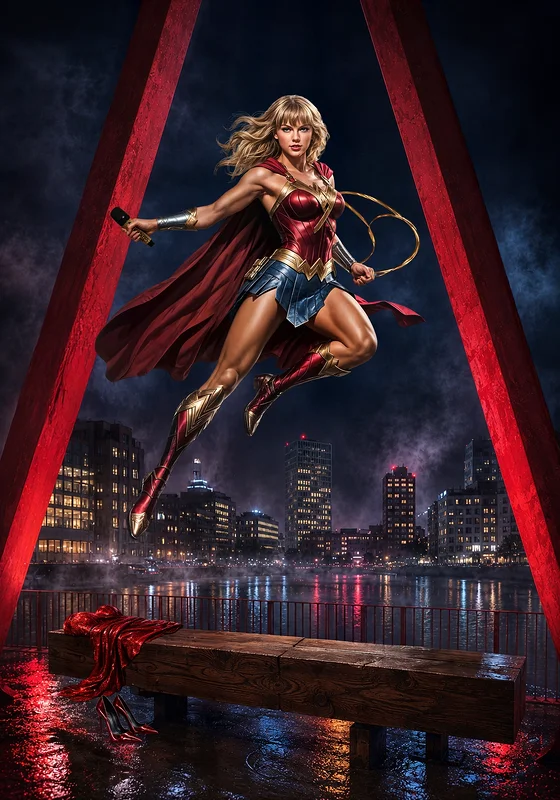
A woman hovering above Malmö Harbour like a modern Wonder Woman, as the waters of Västra Hamnen reflect the city's lights. Below her, on Beijer Bridge, a red cape lay across a solitary wooden bench, and beneath it stood a pair of high heels. Behind her, Turning Torso rose from the mist like a futuristic tower from a Nordic fairy tale. And somewhere between stage lights, pop music, superhero mythology, and the digital age, a question emerged that proved far larger than Taylor Swift alone.
What is a modern icon, really?
Is she merely an artist? A corporation? An emotional phenomenon? A story written collectively by millions of people? Or have the superstars of our era, in fact, inherited the place once held by gods, heroes, and mythological figures in the human imagination?
This essay is therefore not only about Taylor Swift. It is about transformation. About stage performance as a modern ritual. About how identities are built, dismantled, and reborn in real time before a global audience. About why people still need heroes even in the age of algorithms and livestreams.
And perhaps it is also about Malmö, Swedens third city, internationally, a small city.
A city that has rebuilt its identity through reinvention. Old shipyard cranes transformed into glass towers. Water, neon lights, and Nordic nights where reality and performance sometimes merge, until the boundary between human and myth almost disappears.
Because somewhere behind the stage curtains, another costume is always waiting.
Another era.
Another transformation.
The Woman Above the Water
Above the harbour, cold and wide,
Where Nordic winds and neon collide,
A woman rose through rain and flame
While thousands cried her hidden name.
Below her on the crimson bridge
A red cape stirred beside the ridge
Of darkened water, steel, and glass
Where ships and old worlds used to pass.
Her high heels waited silently there,
Like relics from another prayer,
As Turning Torso pierced the night
A silver spear of northern light.
Was she a singer? Was she myth?
A dream the modern age walks with?
A warrior wrapped in sequined fire,
Built equally from pain and desire?
For every era leaves its skin
And something new steps out within.
The girl next door becomes the queen,
Then disappears behind the screen.
The crowds lift phones like candle flames,
Creating gods from borrowed names,
While algorithms learn by heart
The architecture of her art.
And somewhere backstage, out of sight,
Beyond the thunder and the light,
Another costume softly waits
Behind the darkened loading gates.
Another version. Another face.
Another entrance into grace.
For modern heroes cannot stay
They rise, transform, and drift away.
Yet still above Malmö at dawn,
When all the final songs are gone,
The harbour whispers through the rain:
She may return this way again.
Is she a saint or a superhero?
A northern star in stadium glow?
A goddess forged in screens and sound,
Or just the girl next door, spellbound?
Is she armour? Is she grace?
A thousand versions of one face?
A myth the modern world designed
To carry longing through the mind?
And who is Taylor Swift, in truth,
Still hovering above the bridge roof?
A woman, a symbol, a dream, or a light
Reflected on the harbour at night?
Perhaps no single answer stays.
She shifts like water, smoke, and haze.
Yet somewhere over Malmös tide
She still hangs glowing in the sky.
Malmö, May 2026
Taylor Swift and the Art of Reinvention
Prologue The Woman Above the Water
At first, she appears only as a reflection a streak of red trembling across the dark waters of Malmö Harbour as neon dissolves in the rain and the glass towers of Västra Hamnen vanish into Nordic mist. Somewhere behind the illuminated apartment windows, ordinary life continues: people scrolling on phones, cleaning restaurant floors, arguing softly in kitchens washed blue by television light. But down by the water, another kind of electricity has gathered. The stage lights awaken first. Then the smoke. Then the roar. And suddenly she is there.
Not walking onto the stage like an ordinary performer, but descending into the night as though she had stepped out of a modern mythology assembled from stadium speakers, heartbreak anthems, sequins, algorithms, and ancient heroic archetypes. A woman suspended between pop culture and legend, between mechanical precision and emotional vulnerability.
Taylor Swift no longer resembles a traditional celebrity. She has evolved into something far stranger: a shape-shifting cultural phenomenon whose transformations are followed with the same fascination earlier civilisations reserved for queens, goddesses, or warrior saints. She hovers above the harbour like a contemporary Wonder Woman not because she wields weapons or possesses supernatural strength, but because she has mastered reinvention itself.
Every movement is rehearsed. Every spotlight is calculated. Entire emotional landscapes are mapped in advance with astonishing precision. A modern Taylor Swift concert operates with the complexity of a military operation, disguised as a dream. Beneath the glitter and choreography lies an almost frightening level of control: synchronised lighting systems, costume logistics, camera timing, emotional pacing, crowd psychology, emergency alternatives, backup plans for rain, vocal strain, broken heels, delayed cues, and audiences overwhelmed by emotion. Nothing is accidental. And yet the audience experiences the evening as intimate. That is the magic trick.
A glance at a crying fan suddenly feels personal in an arena of 70,000 people. An improvised acoustic song can spread across the internet within seconds and become part of collective memory before the encore ends. She understands something crucial about modern audiences: they no longer worship perfection alone. They worship the illusion of access to the human being hidden somewhere within the machinery.
Perhaps that is why she changes constantly. One era dies so another may emerge. Backstage, beneath cold white work lights and the quiet voices of stage crews in headsets, another costume is already waiting. Another incarnation hangs silently beside sequined armour, glittering boots, handwritten lyrics, half-empty water bottles, and backup microphones wrapped in black tape. The woman flying above Malmö tonight is already becoming someone else.
Below her, on a rain-darkened wooden bench on the glowing red Beijer Bridge, a discarded red cape lies folded like the skin of a former life. Nearby, a pair of abandoned high heels reflects the crimson glow from the steel structures overhead. They look less like forgotten objects than like evidence of transformation as though an ordinary woman had sat there only moments ago, before stepping into another identity entirely.
The city watches the sky, while somewhere in the darkness behind the stage curtains, the next version of Taylor Swift is already waiting to be born.
I. The Architecture of Perfection
Long before the audience enters the stadium, the concert already exists as a machine. Not merely a musical performance, but an enormous architectural structure built from timing, emotion, choreography, electricity, narrative, and control. Every modern Taylor Swift show resembles a temporary city assembled for a single purpose: to create the illusion of spontaneity through meticulous preparation.
Thousands of people help build that illusion. Lighting designers calculate emotional temperatures through colour palettes. Sound engineers shape the acoustics so that even spectators at the very top of the arena hear whispered confessions as if they were private conversations. Camera operators rehearse their movements with balletic precision. Dancers memorise the exact distances between moving stage platforms. Technicians monitor hydraulic lifts, pyrotechnics, wireless frequencies, costume repairs, backup instruments, emergency exits, weather forecasts, and security flows with the same concentration as air-traffic controllers.
Meanwhile, somewhere in the middle of this gigantic organism, stands the woman around whom everything revolves.
Taylor Swift herself often appears remarkably calm amid the machinery. That calm is deceptive. What the audience experiences as effortless charisma is, in fact, the result of obsessive discipline. Transitions between songs may last only seconds, yet those moments are the product of months of rehearsal. A costume must detach perfectly. A microphone must already be in the correct hand. A camera must capture the exact expression at the exact lyric. A staircase hidden in darkness must be climbed without hesitation while thousands of screaming fans shake the stadium floor beneath her heels.
Nothing can collapse. Yet the audience must never see the labour.
That is one of the oldest laws of stage illusion. Great spectacle conceals its construction. The magician never reveals the trapdoor. The ballerina must appear weightless despite years of pain. The superhero lands gracefully, with wires remaining invisible.
Taylor Swift understands this instinctively. Her concerts are not chaotic eruptions of celebrity ego. They are carefully choreographed emotional journeys, with each era of her career treated almost as a separate kingdom, each with its own visual language, costumes, emotional climate, typography, symbolism, and mythology. One moment, the stage becomes a glittering teenage fairy tale of pastel romance and diary confessions. Minutes later, it transforms into a dark industrial battlefield of revenge narratives, serpentine imagery, and towering shadows. Then, suddenly, everything softens into candlelight, folk poetry, autumn forests, cardigan nostalgia, and intimate storytelling.
She does not merely sing songs. She builds worlds.
The remarkable thing is that modern audiences have become sophisticated enough to recognise the machinery while still surrendering to it emotionally. Everyone understands that the show is planned down to the microscopic detail. Social media has exposed too much for innocence to survive intact. Fans analyse setlists statistically. Camera angles are dissected online within minutes. Costume changes become forensic studies. Entire communities track recurring gestures, hidden references, numerical patterns, lyrical callbacks, and symbolic clues, much as medieval scholars interpreted sacred manuscripts.
And the illusion still works.
Perhaps people no longer seek authenticity in the traditional sense. They seek dedication. Effort. Obsession. Mastery.
In earlier centuries, cathedrals demonstrated the power of religion through architecture. Today, stadium concerts serve a strangely similar function for popular culture. Massive crowds gather beneath lights powerful enough to resemble artificial suns, while giant screens magnify the face of a single woman into something almost mythological. Songs become communal rituals, and private heartbreak becomes a collective ceremony.
Seen from above, the entire event resembles less a concert than a carefully orchestrated act of modern mythmaking. And somewhere backstage, beneath white work lights, another version of Taylor Swift is already waiting on a rack. Another skin. Another era. Another transformation is preparing to step into the light the moment the current illusion ends.
II. The Illusion of Spontaneity
The strange paradox of a Taylor Swift concert is that something so meticulously controlled can still feel spontaneous. Modern audiences understand perfectly well that enormous stadium productions are planned with military precision. Yet they continue to search for moments that appear unscripted tiny cracks in the machinery where something human suddenly emerges.
Taylor Swift has become highly skilled at creating those moments.
A pause before a chorus lasts slightly longer than expected. A smile breaks through the carefully maintained stage composure as the crowd's reaction grows louder than anticipated. A forgotten lyric becomes a joke rather than a disaster. An acoustic song appears unexpectedly because fans have spent weeks pleading for it online. A speech changes tone depending on the emotional atmosphere in the arena that night.
These details matter because contemporary audiences no longer gauge authenticity as earlier generations did. In the age of social media, almost everyone recognises that public identity is partly constructed. The illusion of total sincerity is impossible to sustain. What people seek instead is controlled vulnerability the sense that, beneath the elaborate production, a living person remains, capable of reacting emotionally in real time.
Taylor Swift understands this instinctively. She rarely allows chaos to take over completely, but she leaves enough open space for unpredictability to breathe. That balance is difficult to strike. Too much perfection becomes cold. Too much improvisation risks destroying the spectacles structure. The modern superstar must therefore perform a strange balancing act between machine and human.
Perhaps this explains why audiences become so emotionally attached to minor deviations from the expected script. A slight shift in gaze towards the crowd can spark thousands of online discussions within minutes. A surprise song becomes historic because it exists only for one particular audience on one particular evening. Fans speak about these moments almost as earlier generations described religious visions or legendary football matches: You had to be there.
The internet intensifies this phenomenon. Every concert now exists simultaneously in physical space and in a digital afterlife. Before the encore has even ended, fragments of the performance are already circulating globally via TikTok clips, livestreams, reaction videos, screenshots, memes, and fan analyses. A spontaneous remark made in Stockholm may become a source of comfort for someone sitting alone in Seoul or Buenos Aires an hour later.
In this environment, improvisation itself becomes part of the architecture.
Even accidents can be transformed into a narrative. A broken piano, a rainstorm, a technical malfunction, an emotional reaction all can be woven into the mythology if handled well. Older generations of performers often feared visible imperfection because it threatened the illusion of greatness. Modern audiences, however, often interpret imperfection as proof of humanity. The flaw becomes evidence that the person behind the icon still exists.
Yet none of this is entirely accidental either.
That is the deeper irony. The illusion of spontaneity is itself partially rehearsed. The modern superstar must prepare for unpredictability. Entire production teams develop contingency plans to maintain emotional flexibility. There are backup routes through the machinery, alternative transitions, emergency camera patterns, spare costumes, and acoustic arrangements, all ready to appear at a moments notice. Even freedom has infrastructure behind it.
Taylor Swift, therefore, occupies a curious position in contemporary culture. She appears both untouchably controlled and emotionally accessible. She is simultaneously a global corporation, a storyteller, a confessional songwriter, a strategist, a fantasy figure, and a strangely familiar companion to millions of listeners who have never met her.
Like a modern Wonder Woman, she moves effortlessly between identities. One moment, she towers over the audience like an impossible myth, illuminated by stadium lights powerful enough to resemble artificial suns. Next, she sits alone with a guitar, speaking softly about heartbreak as though the entire arena were a private room.
The audience understands that both versions are performances. Yet they believe in both.
Perhaps that is the true magic of contemporary fame: not convincing people that the illusion is real, but making them willingly choose to enter it together.
III. Shedding Skins
One reason Taylor Swift continues to dominate popular culture is that she understands something many artists fear: survival requires transformation. Staying static is dangerous. Repeating the same identity for too long eventually turns even the most successful performer into a museum piece admired perhaps, but no longer culturally alive.
Taylor Swift refuses to become static.
Instead, she sheds identities like a serpent sheds its skin. Entire aesthetic worlds are abandoned, reinvented, mocked, resurrected, or deliberately destroyed. The wide-eyed country teenager with curls and cowboy boots evolves into the fairytale heroine, writing diary confessions beneath glittering stage lights. Later, a sharper, more calculating figure emerges, surrounded by media scandals, public feuds, and serpentine symbolism. Then, suddenly, the spectacle collapses inward into muted cardigans, candlelight, autumn forests, and introspective folk storytelling. Each transformation feels dramatic at the time, yet afterwards it seems almost inevitable, as though every previous version already contained the seeds of the next.
What makes these transitions remarkable is that they rarely erase the past. Older identities survive like ghosts beneath newer ones. Fans continue to carry emotional relationships not merely to the current Taylor Swift, but to the different eras through which they once lived. One audience member remembers the teenage country ballads as the soundtrack to first love. Another associates the darker revenge narratives with heartbreak and reinvention after divorce. Someone else discovers her through the quieter, indie-inspired albums and experiences her primarily as a reflective songwriter rather than a pop phenomenon.
In this sense, Taylor Swift has become less of a fixed celebrity and more of an evolving emotional archive.
Modern fandom encourages this fragmentation of identity. Social media enables audiences to catalogue and preserve every hairstyle, interview, outfit, lyric variation, and symbolic clue with obsessive precision. Entire online communities function almost as historians, documenting the rise and fall of artistic civilisations. Fans speak not only about albums but about eras, as though discussing dynasties or mythological ages.
The word itself is revealing.
An era suggests something more than entertainment. It implies architecture, atmosphere, emotional climate, and even morality. Each Taylor Swift era arrives with its own colours, typography, costumes, gestures, stage design, visual mythology, and emotional vocabulary. She does not merely release music; she constructs temporary realities into which millions willingly step.
This constant metamorphosis places her within a long historical tradition of performers who regarded identity as a theatrical construction. David Bowie repeatedly transformed himself until the boundary between performer and invented character almost disappeared. Madonna rebuilt her image so often that reinvention itself became her central artistic language. Earlier still, actors and opera divas regarded costume, gesture, and illusion as forms of power capable of reshaping the public imagination.
Yet Taylor Swift differs from many predecessors because her transformations unfold in the brutal transparency of the digital age. Nothing disappears any more. Every previous version remains permanently searchable online, preserved in photographs, interviews, fan archives, reaction videos, memes, and endless commentary. Reinvention, therefore, becomes more complicated. The artist cannot simply abandon an old identity because the internet refuses to forget.
Instead, Taylor Swift incorporates memory into the performance.
Old selves are revisited, reinterpreted, and reclaimed. Songs are rerecorded. Earlier aesthetics return, wearing slightly altered faces. Nostalgia becomes both a commercial strategy and an emotional archaeology. The audience is encouraged not merely to consume transformation but to participate in it collectively.
Perhaps that is why the superhero comparison feels increasingly apt. Traditional superheroes rarely possess a single identity. Beneath the costume lies another self; beneath that self lies yet another layer. Wonder Woman herself moves between the roles of mythological warrior, diplomat, outsider, feminist symbol, and ordinary woman navigating the modern world. The costume is never merely decorative. It represents transformation, ritual, and psychological power.
Taylor Swifts backstage wardrobe works in much the same way.
Somewhere behind the stage curtains, beneath white industrial lights and the low murmur of production crews, another costume already hangs in silent readiness. Sequins wait beside black fabric. Boots wait beside acoustic guitars. One identity is preparing to disappear as another is preparing to emerge. The audience may believe they are witnessing a definitive version of Taylor Swift, but the machinery behind the spectacle already knows otherwise.
There is always another skin waiting in the wings.
IV. The Modern Superhero
The modern world no longer creates heroes as earlier civilisations once did. We no longer gather around campfires to hear epics of Achilles or Hercules. We no longer carve saints into cathedral walls or paint victorious monarchs riding across battlefields in divine sunlight. Instead, we project our longings onto celebrities, athletes, fictional superheroes, and cultural figures who can withstand the endless pressure of visibility.
In that sense, Taylor Swift belongs to a distinctly modern mythology.
Not because she possesses supernatural powers in any literal sense, but because she embodies qualities that contemporary society increasingly associates with heroism: endurance, reinvention, emotional resilience, narrative control, and the ability to survive public scrutiny without disappearing beneath it. The modern superhero no longer needs to rescue trains from collapsing bridges. She must instead navigate a world of surveillance, algorithms, global attention, media cycles, emotional projection, and permanent exposure.
Taylor Swift performs this balancing act with remarkable precision.
Like Wonder Woman, she exists simultaneously as a symbol and as an individual. Millions see fragments of themselves reflected in her various incarnations: the underestimated girl, the ambitious outsider, the romantic idealist, the betrayed woman, the calculating strategist, the isolated artist, the survivor rebuilding herself after humiliation. Her power lies partly in her ability to move between these identities without fully abandoning any of them.
This creates a strange paradox of intimacy. Fans feel they know her personally, despite interacting mostly with carefully constructed representations. Songs become emotional mirrors into which listeners pour their own memories and heartbreak. Entire relationships are formed not with the actual human being, but with the meanings people attach to her evolving mythology.
Older forms of celebrity often relied on distance. Classical Hollywood movie stars were elevated above ordinary life through glamour and inaccessibility. Today, the relationship works differently. Modern audiences demand emotional transparency while simultaneously contributing to the impossible pressures that make genuine transparency dangerous. The contemporary superstar must therefore master selective vulnerability revealing enough humanity to remain relatable while safeguarding enough privacy to survive psychologically.
Taylor Swift understands this instinct almost strategically. She reveals emotions, narratives, symbols, fragments, clues, confessions, and carefully chosen vulnerabilities, but rarely offers complete access. The audience experiences a sense of intimacy while the machinery of celebrity continues to operate behind controlled boundaries.
That balance resembles superhero mythology more than traditional fame does.
Superheroes are defined not merely by strength but by duality. Clark Kent and Superman. Diana Prince and Wonder Woman. Bruce Wayne and Batman. Public identity and hidden self coexist, each impossible without the other. The costume becomes both disguise and revelation.
Taylor Swifts eras function similarly. Each one amplifies certain aspects of personality while concealing others. A glittering pop persona may mask exhaustion. A revenge narrative may conceal vulnerability. A quiet acoustic era may still operate within a billion-dollar commercial structure. None of these versions is entirely false, yet none is fully complete either.
Modern fandom actively sustains this mythology. Audiences no longer consume stories passively. They investigate, decode, and expand them collaboratively online. Hidden references become treasure hunts. Lyrics are analysed like sacred texts. Fans search for continuity across songs, performances, outfits, interviews, and visual symbolism with almost theological intensity.
In earlier centuries, mythology evolved slowly through oral storytelling. Today, myth evolves at digital speed.
A stadium concert, therefore, becomes more than entertainment. It becomes a ritual space. Tens of thousands gather beneath artificial constellations of stage lighting as giant screens magnify a single figure to near-divine scale. Collective singing replaces hymns. Friendship bracelets become ceremonial tokens exchanged between strangers. Emotional catharsis unfolds publicly, with crowds filming the experience to preserve it forever.
The atmosphere resembles religion, theatre, and mass psychology simultaneously.
At the centre stands a woman who has learned to transform herself repeatedly without breaking the illusion of continuity. That may be her greatest superpower of all. Not perfection. Not fame. Not beauty. But controlled metamorphosis under relentless observation.
The audience watches her soar above the harbour lights like a modern Wonder Woman, suspended between mythology and machinery. Yet somewhere backstage, beneath white industrial lamps and beside racks of glittering costumes, another transformation is already waiting in silence because the modern superhero can never remain motionless for long.
V. The Machinery Behind the Myth
Every mythology hides a machinery behind it.
Ancient temples required armies of builders, priests, engineers, servants, accountants, and labourers, whose names history rarely preserved. The shining façade visible to the public concealed an enormous, invisible infrastructure working constantly behind the scenes. Modern celebrity functions much the same way. The myth of effortless perfection survives only because countless people devote themselves to maintaining it.
Taylor Swifts world operates on a scale that increasingly resembles a multinational enterprise rather than traditional entertainment. Entire touring cities move across continents, carrying stages, lighting towers, costumes, instruments, generators, cameras, catering systems, security structures, communication networks, and technical crews large enough to populate small villages. Trucks travel through the night while aircraft leap between countries, carrying fragments of the illusion from one temporary kingdom to another.
The audience sees glamour. Backstage, however, glamour dissolves into logistics.
Schedules taped to walls. Headsets crackling with instructions. Emergency sewing repairs minutes before stage entrances. Makeup lights glowing at strange hours after midnight. Vocal warm-ups were performed despite exhaustion. Dancers stretched bruised muscles beneath industrial fluorescent lamps. Technicians climbed steel structures while rain lashed the stadium roof. Someone checked batteries. Someone replaced a damaged cable. Someone recalculated timing after a delayed cue threatened to disrupt an entire chain of transitions lasting only seconds.
Inside this machinery stands the performer herself, trapped in a paradox familiar to many modern icons: the more visible she becomes, the more tightly controlled her existence must be.
Fame at this level no longer resembles ordinary public recognition. It becomes environmental. Surveillance is constant. Cameras wait outside restaurants, airports, hotels, rehearsals, family gatherings, beaches, and funerals. Entire industries profit from monitoring emotional fluctuations, friendships, romances, conflicts, facial expressions, clothing choices, body language, and private movement patterns. Social media further intensifies the pressure by creating the expectation of permanent accessibility. Silence itself is interpreted as communication.
Under such conditions, identity risks becoming performance twenty-four hours a day.
Perhaps this explains why Taylor Swifts transformations feel so deliberate. Reinvention becomes not merely an artistic expression but a survival strategy. The old skin must be shed before it hardens into a prison. One public narrative must die so another can emerge before audiences, journalists, and algorithms fully consume the previous version.
Yet constant transformation carries its own dangers.
At what point does adaptation begin to erode the person beneath the performance? How many identities can someone inhabit before the boundary between authentic feeling and strategic storytelling becomes impossible to discern? Modern celebrity culture rarely allows stillness. Remaining visible requires continuous production: new songs, new imagery, new narratives, new reactions, new emotional revelations. The machine must keep feeding itself because attention is now the most unstable currency.
This pressure lends an almost tragic dimension beneath the spectacle.
The audience sees the flying figure above the harbour lights radiant, powerful, untouchable while beneath the illusion lies a human being operating within schedules so demanding that ordinary concepts of privacy, rest, and emotional recovery begin to blur. Even vulnerability may become part of the performance cycle. Heartbreak becomes an album. An album becomes a tour. The tour becomes mythology. The mythology generates expectations for the next transformation.
The machinery never fully stops.
And yet perhaps that endless movement is precisely what fascinates modern audiences so deeply. Taylor Swift appears both empowered by the system and imprisoned within it. She controls the spectacle with astonishing intelligence while remaining dependent on the same machinery that magnifies her to mythological scale.
That contradiction makes her feel surprisingly contemporary.
Older generations imagined superheroes as beings standing outside ordinary society, gifted with powers beyond human limits. Modern culture creates different kinds of heroes: individuals capable of enduring extreme exposure in public without psychological disintegration. Their battles are fought not only against enemies but also against exhaustion, fragmentation, repetition, surveillance, and the relentless demand to remain emotionally available to millions of strangers.
Somewhere backstage, beneath white work lights and the low metallic hum of equipment cases being wheeled across concrete floors, another costume already waits in silence. Another era. Another emotional architecture is preparing to rise. The audience may believe the transformation on stage is complete, but the machinery behind the myth already knows the truth.
The next reinvention has begun long before the current one concludes.
VI. The Audience as Co-Creator
One of the most remarkable aspects of modern celebrity culture is that audiences are no longer passive spectators. Earlier generations consumed music, films, and performances from a distance. The relationship moved largely in one direction: from artist to public. Today, the boundary has become porous. Fans actively participate in constructing the performer's mythology.
Taylor Swift recognised this transformation earlier than many of her contemporaries.
Her career evolved alongside the rise of social media, livestream culture, fan communities, reaction videos, and digital intimacy. She belongs to the first generation of global superstars shaped not only by traditional media industries but also by the constant online interaction between artists and audiences. In that environment, fandom ceases to be mere admiration and becomes collaborative storytelling.
The audience no longer listens to Taylor Swift. It interprets her work.
Lyrics are dissected line by line, like literary texts. Hidden references become treasure hunts. Colours, numbers, costumes, gestures, emojis, interview fragments, stage visuals, and social media captions are analysed with almost scholarly obsession. Entire online communities act as collective detective agencies, searching for symbolic continuity across eras and performances.
This process turns spectators into participants.
The modern Taylor Swift phenomenon, therefore, resembles something larger than ordinary pop stardom. It operates almost like an evolving fictional universe, with millions contributing emotional interpretations, theories, memories, and personal experiences. Fans connect songs to their own divorces, friendships, betrayals, anxieties, recoveries, and hopes. The performer provides the framework, but the audience fills it with private meaning.
Perhaps this explains the extraordinary emotional atmosphere at her concerts.
People do not enter the stadium merely to hear songs. They arrive carrying fragments of their own lives, attached to specific lyrics and eras. One fan associates a particular album with adolescence. Another survived heartbreak by repeatedly listening to a particular song at night through headphones. Someone else remembers a first kiss, a hospital room, a lost friendship, a lonely train journey, a wedding, a funeral, or an escape from depression, all set to the soundtrack of her music.
When tens of thousands gather, those private memories merge into something collective.
The friendship bracelets exchanged between strangers at concerts illustrate this beautifully. On the surface, they appear playful and harmless colourful handmade objects inspired in part by lyrics and internet culture. Yet symbolically, they function almost as ritual offerings or ceremonial tokens. Strangers approach each other, carrying coded messages, exchanging fragments of identity through beads, colours, inside jokes, and references only understandable within the shared mythology of the fandom.
In another era, religious pilgrims carried medallions or saints relics. Today, audiences exchange bracelets bearing song lyrics beneath giant LED constellations.
The comparison may sound exaggerated, but modern mass culture increasingly occupies emotional spaces once filled by religion, folklore, and communal ritual. Stadium concerts offer collective catharsis in societies where many traditional forms of belonging have weakened. For a few hours, strangers sing in unison beneath artificial stars as giant screens magnify emotions to mythic scale. The experience becomes both personal and communal.
Taylor Swift herself appears keenly aware of this dynamic. She often structures performances to reward emotional participation rather than passive observation. Surprise songs foster intimacy. Hidden references encourage long-term engagement. Recurring visual motifs make fans feel included in an ongoing narrative larger than any individual concert.
The audience, therefore, becomes part of the machinery.
Without the fandoms interpretive energy, many of the transformations would lose their power. An era exists not only because the artist declares it, but because millions collectively agree to inhabit it. Fans archive it, discuss it, parody it, defend it, romanticise it, and preserve it emotionally long after the official tour ends.
This creates an unusual relationship between control and surrender. Taylor Swift carefully shapes the mythology surrounding her, yet the audience simultaneously reshapes it through endless collective interpretation. The result resembles a constantly evolving collaboration between the performer and the mass imagination.
From afar, the scene by the Malmö waterfront begins to resemble something almost surreal. A flying, modern Wonder Woman suspended above water and steel. Thousands of illuminated phones raised like digital candles. Crowds singing lyrics back towards the stage as though participating in a shared ritual older than popular music itself.
And somewhere behind the curtains, beneath cold white work lights and beside another waiting costume, the next transformation is already preparing itself knowing that once it steps into the light, millions of people will immediately begin helping to write its meaning.
VII. Malmö, Water, and Neon Reflections
Perhaps this story could not unfold anywhere but in a place like Västra Hamnen in my Malmö. With emphasis on my.
The district itself is built on transformation. Once the territory of the Kockums shipyard a landscape of steel, welding sparks, cranes, oil, and industrial labour it has gradually reinvented itself as something almost futuristic. Glass towers rise where ships were once assembled. Cyclists glide past modern architecture on ground shaped by generations of dockworkers. The old industrial harbour has become a landscape of reflections: water, steel, neon, and carefully curated Scandinavian modernity.
That makes it an unusually fitting stage for a figure such as Taylor Swift.
She, too, exists in perpetual reinvention.
The connection between artist and environment becomes strangely symbolic. Just as the harbour shed its old identity without entirely erasing its past, Taylor Swift continually rebuilds herself, with traces of earlier eras still visible beneath the surface. Reinvention does not destroy memory. It layers new meaning on older foundations.
At night, the district takes on an almost cinematic atmosphere. Rainwater reflects the aircraft's red warning lights at Turning Torso. Wind sweeps across the Öresund, carrying salt, fog, distant traffic noise, and the metallic echo of modern urban life. The enormous bridge towards Copenhagen glows faintly in the distance, like part of some futuristic dreamscape suspended between Scandinavia and the continent.
In such surroundings, the image of a modern Wonder Woman no longer seems absurd.
She appears less like a comic-book superhero than like a new kind of mythological figure born of the twenty-first century: part pop icon, part digital construct, part emotional confessor, part corporate empire, part fantasy projection. Her stage costume gleams against the Nordic darkness like armour redesigned for the age of livestreams and algorithms.
Below her, Malmö continues with its ordinary life.
A late green bus glides silently along wet streets. Someone walks home after a night shift. Teenagers sit by the waterfront, sharing cigarettes and music through phone speakers. Restaurant workers drag chairs inside as the rain grows heavier. Somewhere in an apartment, a child falls asleep wearing headphones after replaying concert videos that are already spreading across social media.
Meanwhile, the giant spectacle above the harbour becomes a memory almost immediately.
That is another defining feature of contemporary culture: experiences become archives the instant they occur. Before the final applause has faded, fragments of the evening already circulate online as digital relics slowed-down videos, emotional reactions, screenshots, fan edits, grainy livestreams, and photographs taken from impossible angles beneath flashing lights. The concert exists simultaneously as lived reality and as instantly preserved mythology.
Perhaps this explains why the imagery surrounding modern stardom often feels dreamlike. The boundary between reality and performance grows increasingly unstable. Taylor Swift standing above Malmö Harbour becomes, at once, a real performer, a symbolic projection, a social media phenomenon, and a personal emotional experience, each spectator interpreting it differently.
To one person, she embodies ambition.
To another survival.
For someone else, heartbreak transformed into strength.
And to millions, she represents movement itself the capacity to keep changing without disappearing.
The old harbour understands that instinct. Cities survive through reinvention, as artists do. Cranes vanish. Towers rise. Factories become apartments. Industrial silence gives way to nightlife and digital spectacle. Yet traces of older worlds remain hidden beneath the polished surfaces.
Somewhere behind the stage curtains, another costume waits beneath white industrial lights. Another era is already preparing itself in the quiet darkness while the current one still glows above the water. And out across the harbour, where red reflections tremble in the rain beside the silent outline of Turning Torso, the flying figure hovers momentarily between mythology and modernity before beginning to transform once more.
Epilogue The Next Transformation
Eventually, the lights go out.
The stadium empties slowly at first, then all at once. Tens of thousands of people drift back into ordinary life, carrying fragments of the evening like glowing embers: half-recorded videos, hoarse voices, wet jackets that smell faintly of rain and smoke machines, and friendship bracelets clattering softly against wrists on the walk home through Malmös midnight streets.
The illusion dissolves surprisingly fast.
Stage workers already move through the darkness, dismantling the dream piece by piece. Towers of light are lowered towards the ground. Cables disappear into black containers. Giant screens fade into lifeless rectangles of metal and glass. Somewhere backstage, makeup is being removed under harsh mirrors as exhausted dancers sit in silence, scrolling on their phones after the adrenaline crash. The machinery that only hours earlier resembled mythology gradually reverts to ordinary industrial labour.
And yet something lingers.
Perhaps because modern spectacles are designed not merely to be experienced but to endure in memory and repetition before dawn arrives, the concert already exists online in thousands of altered forms: slowed-down emotional clips, blurry photographs, fan edits glowing with artificial nostalgia, reaction videos, analyses, rankings, screenshots, theories, and fragments of songs escaping through headphones on night buses crossing the city.
The performance continues long after the stage has disappeared.
That may be the defining characteristic of twenty-first-century mythology. Earlier civilisations built monuments from marble and stone. Modern culture constructs them from circulation, memory, digital archives, and emotional attachment. The myth survives because millions continue to carry pieces of it within themselves.
Taylor Swift understands this better than almost anyone else.
She knows the concert does not truly end when the audience leaves the arena. It continues in bedrooms, on social media feeds, on lonely train rides, in headphones after heartbreak, in late-night conversations between friends, in children rehearsing songs before mirrors, and in adults reconnecting with younger versions of themselves through melodies tied to forgotten years of their lives.
The modern Wonder Woman, therefore, possesses a different kind of superpower. She does not stop bullets or lift collapsing buildings. She manipulates emotional memory on a planetary scale. She transforms private feelings into collective mythology while allowing millions to believe the songs belong uniquely to them.
That balance is extremely difficult to maintain.
Perhaps that is why she keeps changing. Remaining motionless would break the spell. The mythology survives only through movement constant renewal, reinvention, disappearance, and return. Like the harbour outside Malmö, she exists in a permanent state of transition between what once was and what comes next.
Down by the water, the rain has finally stopped. Red reflections from distant warning lights shimmer beside the dark silhouette of Turning Torso. The wooden bench still stands empty in the harbour wind. Across it lies the abandoned red cape, damp with mist and sea air, while the nearby high heels gleam faintly beneath the city lights like artefacts from a vanished performance.
But backstage, another costume is already waiting.
Another era.
Another skin.
Another version of Taylor Swift is preparing in silence beneath white work lights, waiting for the moment when the darkness opens once again, and the modern Wonder Woman rises above the water.
PS. Wonder Woman and Taylor Swift
Wonder Woman was created in 1941 as an ideal rather than merely a superhero. An Amazon princess, warrior, diplomat, and founding member of the Justice League, she embodied an unusual blend of strength and compassion. Unlike many earlier comic-book heroes whose power rested primarily on violence or vengeance, Wonder Woman represented something more complex: the belief that courage and empathy could coexist. She fought wars while dreaming of peace. She carried weapons yet spoke constantly about truth, justice, and reconciliation. In many ways, she was designed as a modern myth about female power existing outside traditional limitations. She is a feminist superhero.
But mythology rarely remains pure for long.
Over the decades, Wonder Woman has appeared in countless reinterpretations shaped by shifting generations, political moods, commercial pressures, and cultural anxieties. At times, she has been portrayed almost as a utopian feminist symbol. In other eras, she has become darker, more militarised, more emotionally conflicted, even morally ambiguous. Like many long-running mythological figures, she has gradually absorbed contradictions from the societies rewriting her.
That instability is perhaps precisely what links her to Taylor Swift.
Neither of them endures through permanence. Both evolve continuously through reinterpretation. Both exist simultaneously as individuals and as projections onto which millions project conflicting expectations. One audience wants vulnerability. Another wants invincibility. One sees compassion. Another sees calculated ambition. Some view Taylor Swift as empowering, generous, and emotionally intelligent; others see strategic manipulation, commercial control, or carefully orchestrated mythology. Wonder Woman has undergone the same process for generations. Heroine to some. Propaganda figures to otherswarrior, diplomat, celebrity, feminist icon, corporate productsometimes all at once.
Perhaps that is the unavoidable fate of modern icons. The larger they become, the more contradictory meanings they absorb.
Are Wonder Woman and Taylor Swift twins, sisters, or merely cousins?
Probably not twins. Wonder Woman belongs to the realm of mythological archetypes larger, older, almost symbolic by design. Taylor Swift remains unmistakably human despite the machinery surrounding her. She bleeds publicly through her songs in ways superheroes rarely can. Taylor Swift is, in many ways, the girl next door, something Wonder Woman is far from.
But sisters? Perhaps emotionally.
Both are women whose power rests partly on performance and partly on public belief. Both move between armour and vulnerability. Both are expected to remain graceful under impossible scrutiny. Both inspire devotion while provoking suspicion. And both understand that modern femininity often demands contradictory qualities at once: strength without coldness, ambition without arrogance, beauty without vanity, vulnerability without weakness.
Maybe 'cousins' is the most accurate answer.
Wonder Woman hails from the older mythology of comic books and heroic fantasy. Taylor Swift emerges from the newer mythology of stadium culture, digital identity, and emotional storytelling. Yet they clearly belong to the same enormous family tree of female icons onto whom society projects fantasies of power, transformation, morality, and reinvention.
One holds a golden lasso.
The other holds a microphone.
But both stand beneath blinding lights while the world watches, judges, admires, doubts, and still believes anyway.
PS 2
And finally, one small detail remains strangely unresolved in this entire story.
Despite her extensive global tours and her almost cinematic connection to modern waterfront cities, Taylor Swift has still never performed a concert in Malmö. For many in southern Sweden, this feels surreal. Malmö is often described as Swedens musical capital a city shaped by concerts, clubs, festivals, immigrant cultures, underground scenes, opera, pop history, punk movements, and generations of musicians travelling between Copenhagen and the rest of Scandinavia. Music drifts naturally through the city, like the sea wind through the harbour.
Perhaps geography has played its part as well. Copenhagen, only a short distance away across the Öresund, has long served as the larger international magnet for large-scale arena productions. Global tours often stop there instead, leaving Malmö watching from across the water as stadium lights flicker faintly on the horizon.
Yet the feeling persists that her arrival is only delayed, not impossible.
Maybe the timing has not been right yet.
The planned 2029 inauguration of Malmös new super stadium could change that entirely. A city built on reinvention, opening a new monumental arena by the harbour, would provide an almost suspiciously perfect backdrop for an artist whose entire mythology revolves around transformation, spectacle, and emotional architecture. One can already imagine the headlines, the reflections on the water, and the crowds moving through the Nordic summer night beneath illuminated towers and giant screens.
Perhaps that will finally be the moment when the modern Wonder Woman descends over Malmö for real, rather than merely hovering above it in imagination.
And if that night eventually arrives, another costume will already be waiting in the wings.
Det börjar med en bild.
En kvinna svävande över Malmö hamn som en modern Wonder Woman medan Västra hamnens vatten speglade stadens ljus. Nedanför henne på Beijers bro låg en röd cape på en ensam träbänk och inunder stod ett par högklackade skor. Bakom henne reste sig Turning Torso ur dimman som ett futuristiskt torn ur en nordisk saga. Och någonstans mellan scenljus, popmusik, superhjältemytologi och digital samtid uppstod en fråga som visade sig vara långt större än bara Taylor Swift.
Vad är egentligen en modern ikon?
Är hon bara en artist? Ett företag? Ett emotionellt fenomen? En berättelse som miljontals människor skriver tillsammans? Eller har vår tids superstjärnor i själva verket tagit över den plats som gudar, hjältar och mytologiska gestalter en gång hade i människors fantasi?
Denna essä handlar därför inte bara om Taylor Swift. Den handlar om transformation. Om scenkonst som modern ritual. Om hur identiteter byggs, rivs och återuppstår i realtid inför en global publik. Om varför människor fortfarande behöver hjältar även i algoritmernas och livestreamarnas tidsålder.
Och kanske handlar den också om Malmö, Sveriges tredje stad, internationellt en småstad.
Om en stad som själv byggt sin identitet på återuppfinnelse. Om gamla varvskranar som blivit glastorn. Om vatten, neonljus och nordiska nätter där verklighet och iscensättning ibland flyter samman tills gränsen mellan människa och myt nästan försvinner.
För någonstans bakom scenridåerna väntar alltid nästa kostym.
Nästa era.
Nästa förvandling.
Prolog Kvinnan ovanför vattnet
Till en början syns hon bara som en spegling ett rött stråk som darrar över Malmö hamns mörka vatten medan neonljusen löses upp i regnet och glasfasaderna i Västra Hamnen försvinner in i nordisk dimma. Någonstans bakom de upplysta lägenhetsfönstren fortsätter vardagen: människor som scrollar på sina telefoner, städar restauranggolv eller smågrälar i kök färgade blå av tv-skärmar. Men nere vid vattnet har en annan sorts elektricitet samlats. Först vaknar strålkastarna. Sedan röken. Sedan vrålet. Och plötsligt är hon där.
Inte gående upp på scenen som en vanlig artist, utan nedstigande som om hon är sprungen ur en modern mytologi sammansatt av arenahögtalare, hjärtesorgshymner, paljetter, algoritmer och uråldriga hjältearketyper. En kvinna svävande mellan populärkultur och legend, mellan mekanisk precision och emotionell sårbarhet.
Taylor Swift liknar inte längre en traditionell kändis. Hon har utvecklats till något betydligt märkligare: ett skepnadsskiftande kulturfenomen vars förvandlingar följs med samma fascination som tidigare civilisationer reserverade för drottningar, gudinnor och krigarhelgon. Hon svävar ovanför hamnen som en modern Wonder Woman inte därför att hon bär vapen eller besitter övernaturlig styrka, utan därför att hon behärskar själva konsten att återuppfinna sig själv.
Varje rörelse är repeterad. Varje strålkastarvinkel är beräknad. Hela känslolandskapet är kartlagt i förväg med precision. En modern Taylor Swift-konsert fungerar med samma komplexitet som en militär operation, förklädd till en dröm. Under glittret och koreografin döljer sig ett nästan överväldigande kontrollsystem: synkroniserade ljusriggar, kostymbyten, kameratiming, emotionell rytm, publikpsykologi, reservplaner för regn, röstproblem, brutna klackar, försenade signaler och publikmassor överväldigade av känslor. Ingenting är slumpmässigt. Och ändå upplever publiken kvällen som intim. Det är själva trollerinumret.
En blick mot ett gråtande fan känns plötsligt personlig i en arena med sjuttiotusen människor. En improviserad akustisk låt kan spridas över internet på några sekunder och bli en del av det kollektiva minnet innan extranumret ens har hunnit ta slut. Hon förstår något avgörande om moderna publikmassor: de dyrkar inte längre bara perfektion. De dyrkar illusionen av tillgång till människan som gömmer sig någonstans inne i maskineriet.
Kanske är det därför hon ständigt förändras. En era måste dö för att en annan ska kunna födas. Backstage, under kalla, vita arbetslampor och bland lågmälda röster från scentekniker med headset, väntar redan nästa kostym. En ny inkarnation hänger tyst bredvid paljettglittrande rustningar, glittrande stövlar, handskrivna texter, halvtomma vattenflaskor och reservmikrofoner lindade i svart tejp. Kvinnan som flyger över Malmö i kväll håller redan på att bli någon annan.
Nedanför henne, på en regnmörk träbänk ute på den glödande röda Beijers bro, ligger en övergiven röd cape hopvikt som huden från ett tidigare liv. Intill står ett par övergivna högklackade skor som speglar det röda ljuset från stålkonstruktionerna ovanför. De ser mindre ut som bortglömda föremål än som bevis på en förvandling som om en helt vanlig kvinna satt där bara några ögonblick tidigare innan hon steg in i en helt annan identitet.
Staden betraktar himlen medan någonstans bakom scenridåernas mörker väntar nästa version av Taylor Swift redan på att födas.
I. Perfektionens arkitektur
Långt innan publiken går in på stadion existerar konserten redan som en maskin. Inte bara som en musikalisk föreställning utan som en enorm arkitektonisk konstruktion byggd av timing, känslor, koreografi, elektricitet, berättande och kontroll. Varje modern Taylor Swift-show liknar en tillfällig stad skapad för ett enda syfte: att framkalla illusionen av spontanitet genom minutiösa förberedelser.
Tusentals människor hjälper till att bygga den illusionen. Ljusdesigners beräknar emotionella temperaturer genom färgskalor. Ljudtekniker formar akustiken så att även publiken längst upp i arenan hör viskande bekännelser som om de vore privata samtal. Kameraoperatörer repeterar sina rörelser med balettlik precision. Dansare memorerar exakta avstånd mellan rörliga scenplattformar. Tekniker övervakar hydrauliska lyft, pyroteknik, trådlösa frekvenser, kostymreparationer, reservinstrument, nödutgångar, väderprognoser och säkerhetsflöden med samma koncentration som flygledare.
Och någonstans mitt i denna gigantiska organism står kvinnan kring vilken allting kretsar.
Taylor Swift själv framstår ofta som märkligt lugn. Det lugnet är bedrägligt. Det publiken upplever som effortless-karisma är i själva verket resultatet av besatt disciplin. Övergångar mellan låtar kan vara några få sekunder långa, men bakom dem ligger månader av repetitioner. En kostym måste sitta perfekt. En mikrofon måste redan ligga i rätt hand. En kamera måste fånga exakt rätt ansiktsuttryck vid exakt rätt textrad. En trappa dold i mörker måste bestigas utan minsta tvekan, medan tusentals skrikande fans får stadiongolvet att vibrera under hennes klackar.
Ingenting får falla samman. Och ändå får publiken aldrig se arbetet bakom.
Det är en av scenkonstens äldsta lagar. Stora illusioner döljer alltid sin konstruktion. Trollkarlen avslöjar aldrig falluckan. Ballerinan måste se viktlös ut trots år av smärta. Superhjälten landar graciöst medan vajrarna förblir osynliga.
Taylor Swift förstår detta instinktivt. Hennes konserter är inte kaotiska explosioner av kändisego. De är noggrant koreograferade känsloresor där varje era i hennes karriär behandlas nästan som ett eget kungarike med sitt eget visuella språk, sina egna kostymer, sitt eget känsloklimat, sin egen typografi, symbolik och mytologi. Ena stunden förvandlas scenen till en glittrande tonårssaga fylld av pastellromantik och dagboksbekännelser. Minuten senare blir den ett mörkt industriellt slagfält av hämndfantasier, ormsymbolik och väldiga skuggor. Och plötsligt mjuknar allt till stearinljus, folkpoesi, höstskogar, cardigan-nostalgi och intimt berättande.
Hon framför inte bara låtar. Hon bygger världar.
Det märkliga är att den moderna publiken har blivit tillräckligt sofistikerad för att känna igen maskineriet och ändå känslomässigt ge sig hän åt det. Alla förstår att showen är planerad in i mikroskopiska detaljer. Sociala medier har avslöjat för mycket för att oskulden helt ska kunna överleva. Fans analyserar setlists statistiskt. Kameravinklar analyseras online inom minuter. Kostymbyten blir närmast kriminaltekniska studier. Hela nätgemenskaper följer återkommande gester, dolda referenser, siffermönster, textrader och symboliska ledtrådar på samma sätt som medeltida lärda tolkade heliga manuskript.
Och ändå fungerar illusionen fortfarande.
Kanske därför att människor inte längre söker autenticitet i den gamla meningen. De söker hängivenhet, ansträngning, besatthet och mästerskap.
Under tidigare århundraden demonstrerade katedraler religionens makt genom arkitektur. I dag fyller stadionkonserter en märkligt liknande funktion för populärkulturen. Enorma folkmassor samlas under lampor starka nog att likna artificiella solar, medan gigantiska bildskärmar förstorar en enda kvinnas ansikte till något nästan mytologiskt. Sånger blir kollektiva ritualer och privat hjärtesorg förvandlas till offentlig ceremoni.
Sedd ovanifrån liknar hela evenemanget mindre en konsert än en noggrant orkestrerad akt av modern mytbildning. Och någonstans backstage, under vita arbetslampor, väntar redan ännu en version av Taylor Swift på en galge. Ett nytt skinn. En ny era. En ny förvandling som förbereder sig för att träda fram i ljuset i samma ögonblick som den nuvarande illusionen tar slut.
II. Illusionen av spontanitet
Den märkliga paradoxen med en Taylor Swift-konsert är att något så minutiöst kontrollerat ändå kan kännas spontant. Moderna publikmassor förstår mycket väl att enorma stadionproduktioner planeras med militär precision. Ändå fortsätter människor att leta efter ögonblick som verkar oskrivna små sprickor i maskineriet där något mänskligt plötsligt träder fram.
Taylor Swift har blivit en mästare på att skapa just sådana ögonblick.
En paus före refrängen varar lite längre än väntat. Ett leende bryter igenom den noggrant upprätthållna scenmasken när publikens jubel växer starkare än beräknat. En glömd textrad blir ett skämt i stället för en katastrof. En akustisk låt dyker oväntat upp eftersom fans i veckor har bett om den online. Ett tal förändrar tonen beroende på den emotionella stämningen i arenan just den kvällen.
De där detaljerna betyder mycket eftersom dagens publik inte längre mäter äkthet på samma sätt som tidigare generationer gjorde. I sociala mediers tidsålder förstår nästan alla att offentliga identiteter delvis är konstruerade. Illusionen om total uppriktighet går inte längre att upprätthålla. Det människor söker i stället är kontrollerad sårbarhet känslan av att det fortfarande finns en levande människa bakom den gigantiska produktionen, någon som faktiskt kan reagera känslomässigt i realtid.
Taylor Swift förstår detta. Hon låter sällan kaoset ta över helt, men hon lämnar tillräckligt mycket utrymme för att oförutsägbarheten ska kunna andas. Balansen är svår att uppnå. För mycket perfektion blir kallt. För mycket improvisation riskerar att rasera hela spektaklets struktur. Den moderna superstjärnan måste därför utföra en märklig balansakt mellan maskin och människa.
Kanske är det därför publiken blir så känslomässigt fäst vid små avvikelser från det förväntade manuset. En liten förändring i en blick mot publiken kan skapa tusentals diskussioner online inom några minuter. En överraskningslåt blir historisk därför att den bara existerar för en enda publik under en enda kväll. Fans talar om dessa ögonblick nästan på samma sätt som tidigare generationer beskrev religiösa visioner eller legendariska fotbollsmatcher: Man var tvungen att vara där.
Internet förstärker detta fenomen ytterligare. Varje konsert existerar numera samtidigt i fysisk verklighet och i ett digitalt efterliv. Innan extranumret ens hunnit avslutas sprids fragment av föreställningen globalt genom TikTok-klipp, livestreams, reaktionsvideor, skärmdumpar, memes och fananalyser. En spontan kommentar i Stockholm kan bli emotionell tröst för någon som sitter ensam i Seoul eller Buenos Aires en timme senare.
I denna miljö blir själva improvisationen en del av arkitekturen.
Till och med olyckor kan förvandlas till berättelser. Ett trasigt piano, ett skyfall, tekniska problem eller en emotionell reaktion kan vävas in i mytologin om de hanteras rätt. Äldre generationers artister fruktade ofta synliga misstag eftersom de hotade illusionen av storhet. Dagens publik tolkar däremot ofta brister som bevis på mänsklighet. Felet blir ett tecken på att personen bakom ikonen fortfarande existerar.
Och ändå är inte heller detta helt slumpmässigt.
Där ligger den djupaste ironin. Illusionen av spontanitet är i sig delvis repeterad. Den moderna superstjärnan måste förbereda sig för oförutsägbarhet. Hela produktionsteamet utvecklar reservplaner för emotionell flexibilitet. Det finns alternativa vägar genom maskineriet, nödlösningar för övergångar, reservkameramönster, extrakostymer och akustiska arrangemang redo att plockas fram med ett ögonblicks varsel. Till och med friheten har en infrastruktur bakom sig.
Taylor Swift intar därför en märklig position i den samtida kulturen. Hon framstår samtidigt som oantastligt kontrollerad och emotionellt tillgänglig. Hon är på en gång global koncern, berättare, bekännelsepoet, strateg, fantasigestalt och en märkligt familjär följeslagare för miljontals människor som aldrig träffat henne.
Som en modern Wonder Woman rör hon sig obehindrat mellan identiteter. Ena stunden tornar hon upp sig över publiken som en omöjlig myt, belyst av strålkastare starka nog att likna artificiella solar. I nästa sitter hon ensam med en gitarr och talar lågmält om hjärtesorg, som om hela arenan vore ett privat rum.
Publiken förstår att båda versionerna är iscensättningar och ändå tror man på dem båda.
Kanske är det den moderna berömmelsens verkliga magi: inte att övertyga människor om att illusionen är verklig, utan att få dem att frivilligt välja att stiga in i den tillsammans.
III. Att ömsa skinn
En av anledningarna till att Taylor Swift fortsätter dominera populärkulturen är att hon har förstått något många artister fruktar: överlevnad kräver förvandling. Att förbli statisk är farligt. Den som upprepar samma identitet för länge riskerar till slut att förvandlas till ett museumföremål beundrat kanske, men inte längre kul
3 200 kr

Jörgen Thornberg
Malmö
Lite om bilder och mig. Translation in English at the end.
Jag är en nyfiken person som ser allt i bilder, även det jag fäster i ord, gärna tillsammans för bakom alla mina bilder finns en berättelse. Till vissa bilder hör en kortare eller längre novell som följer med bilden.
Bilder berättar historier. Jag omges av naturlig skönhet, intressanta människor och historia var jag än går. Jag använder min kamera för att dokumentera världen och blanda det jag ser med vad jag känner för att fånga den dolda magin.
Mina bilder berättar mina historier. Genom mina bilder, tryck och berättelser. Jag bjuder in dig att ta del av dessa berättelser, in i ditt liv och hem och dela min mycket personliga syn på vår värld. Mer än vad ögat ser. Jag tänker i bilder, drömmer och skriver och pratar om dem; följaktligen måste jag också skapa bilder. De blir vad jag ser, inte nödvändigtvis begränsade till verkligheten. Det finns en bild runt varje hörn. Jag hoppas att du kommer att se vad jag såg och gilla det.
Jag är också en skrivande person och till många bilder hör en kortare eller längre essay. Den följer med tavlan, tryckt på fint papper och med en personlig hälsning från mig.
Flertalet bilder startar sin resa i min kamera. Enkelt förklarat beskriver jag bilden jag ser i mitt inre, upplevd eller fantiserad. Bilden uppstår inom mig redan innan jag fått okularet till ögat. På bråkdelen av ett ögonblick ser jag vad jag vill ha och vad som kan göras med bilden. Här skall jag stoppa in en giraff, stålmannen, Titanic eller vad det är min fantasi finner ut. Ännu märkligare är att jag kommer ihåg minnesbilden långt efteråt när det blir tid att skapa verket. Om jag lyckas eller inte, är upp till betraktaren, oftast präglat av en stråk av svart humor – meningen är att man skall bli underhållen. Mina bilder blir ofta en snackis där de hänger.
Jag föredrar bilder som förmedlar ett budskap i flera lager. Vid första anblicken fylld av feel-good, en vacker utsikt, fint väder, solen skiner, blommor på ängen eller vattnet som ligger förrädiskt spegelblankt. I en sådan bild kan jag gömma min egentliga berättelse, mitt förakt för förtryckare och våldsverkare, rasister och fördomsfulla människor - ett gärna återkommande motiv mer eller mindre dolt i det vackra motivet. Jag försöker förena dem i ett gemensamt narrativ.
Bild och formgivning har löpt som en röd tråd genom livet. Fotokonst känns som en värdig final som jag gärna delar med mig.
Min genre är vid som framgår av mina bilder, temat en blandning av pop- och gatukonst i kollage som kan bestå av hundratals lager. Vissa bilder kan ta veckor, andra någon dag innan det är dags att överlämna resultatet till printverkstaden. Fine Art Prints är digitala fotocollage. I dessa kollage sker rivandet, klippandet, pusslandet, målandet, ritandet och sprayningen digitalt. Det jag monterar in kan vara hundratals år gamla bilder som jag omsorgsfullt frilägger så att de ser ut att vara en del av tavlan men också bilder skapade av mig själv efter min egen fantasi. Därefter besöks printstudion och för vissa bilder numrera en limiterad upplaga (oftast 7 exemplar) och signera för hand. Vissa bilder kan köpas i olika format. Det är bara att fråga efter vilka. Gillar man en bild som är 70x100 men inte har plats på väggen, går den kanske att få i 50x70 cm istället. Frågan är fri.
Metoden Giclée eller Fine Art Print som det också kallas är det moderna sättet för framställning av grafisk konst. Villkoret för denna typ av utskrifter är att en högkvalitativ storformatskrivare används med åldersbeständigt färgpigment och konstnärspapper eller i förekommande fall på duk. Pappret som används möter de krav på livslängd som ställs av museer och gallerier. Normalt säljer jag mina bilder oinramade så att den nya ägaren själv kan bestämma hur de skall se ut, med eller utan passepartout färg på ram, med eller utan glas etc..
Under många år ställde jag bara ut på nätet, i valda grupper och på min egen Facebooksida - https://www.facebook.com/jorgen.thornberg.9
Jag finns också på en egen hemsida som tyvärr inte alltid är uppdaterad – https://www.jth.life/ Där kan du också läsa en del av de berättelser som följer med bilden.
UTSTÄLLNINGAR
Luftkastellet, oktober 2022
Konst i Lund, november 2022
Luftkastellet, mars 2023
Engleson Galleri Caroli, april 2023
Hydra, Greece June 2023
Engleson Galleri Caroli, oktober 2023
Toppen, Höllviken december 2023
Luftkastellet, mars 2024
Torups Galleri, mars 2024
Venice, May 2024
Luftkastellet, oktober 2024
Konst i Advent, December 2024
Galleri Engleson, Caroli December 2024
Jäger & Jansson Galleri, april 2025
A bit about pictures and me.
I'm a curious person who sees everything in pictures, even what I express in words, often combining them, for behind all my pictures lies a story. These narratives, some as short as a single image and others as long as a novel, are the heart and soul of my work.
Pictures tell stories. Wherever I go, I'm surrounded by natural beauty, exciting people, and history. I use my camera to document the world and blend what I see with what I feel to capture the hidden magic.
My images tell my stories. Through my pictures, prints, and narratives, I invite you to partake in these stories in your life and home and share my deeply personal perspective of our world. More than meets the eye. I think in pictures, dream, write, and talk about them; consequently, I must create images too. They become what I see, not necessarily confined to reality. There's a picture around every corner. I hope you'll see what I saw and enjoy it.
I'm also a writer, and many images come with a shorter or longer essay. It accompanies the painting, printed on fine paper with my personal greeting.
Many pictures start their journey on my camera. Simply put, I describe the image I see in my mind, experienced or imagined. The image arises within me even before I bring the eyepiece to my eye. In a fraction of a moment, I see what I want and what can be done with the picture. Here, I'll insert a giraffe, Superman, the Titanic, or whatever my imagination conjures up. Even stranger is that I remember the mental image long after it's time to create the work. Whether I succeed is up to the observer, often imbued with a streak of black humour – the aim is to entertain. My pictures usually become a talking point wherever they hang.
I prefer pictures that convey a message in multiple layers. At first glance, they're filled with feel-good vibes, a beautiful view, lovely weather, the sun shining, flowers in the meadow, or the water lying deceptively calm. But beneath this surface beauty, I often conceal a deeper story, a narrative that challenges societal norms or explores the human condition. I invite you to delve into these hidden narratives and discover the layers of meaning within my work.
Picture and design have been a thread running through my life. Photographic art feels like a fitting finale, and I'm happy to share it.
My genre is varied, as seen in my pictures; the theme is a blend of pop and street art in collages that can consist of hundreds of layers. Some images can take weeks, others just a day before it's time to hand over the result to the print workshop. Fine Art Prints are digital photo collages. In these collages, tearing, cutting, puzzling, painting, drawing, and spraying happen digitally. What I insert can be images hundreds of years old that I carefully extract so they appear to be part of the painting, but also images created by myself, now also generated from my imagination. Next, visit the print studio and, for certain images, number a limited edition (usually 7 copies) and sign them by hand. Some images may be available in other formats. Just ask which ones. If you like an image that's 70x100 but doesn't have space on the wall, you might be able to get it in 50x70 cm instead. The question is open.
The Giclée method, or Fine Art Print as it's also called, is the modern way of producing graphic art. This method ensures the highest quality and longevity of the artwork, using a high-quality large-format printer with archival pigment inks and artist paper or, in some cases, canvas. The paper used meets the longevity requirements set by museums and galleries. I sell my pictures unframed, allowing the new owner to personalise their artwork, confident in the lasting value and quality of the piece.
For many years, I only exhibited online, in selected groups, and on my Facebook page - https://www.facebook.com/jorgen.thornberg.9. I also have my website, which unfortunately is not constantly updated - https://www.jth.life/. You can also read some of the stories accompanying the pictures there.
EXHIBITIONS
Luftkastellet, October 2022
Art in Lund, November 2022
Luftkastellet, March 2023
Engleson Gallery Caroli, April 2023
Hydra, Greece June 2023
Engleson Gallery Caroli, October 2023
Toppen, Höllviken December 2023
Luftkastellet, March 2024
Torup Gallery, March 2024
Venice, May 2024
UTSTÄLLNINGAR
Luftkastellet, oktober 2022
Konst i Lund, november 2022
Luftkastellet, mars 2023
Engleson Galleri Caroli, april 2023
Hydra, Greece June 2023
Engleson Galleri Caroli, oktober 2023
Toppen, Höllviken december 2023
Luftkastellet, mars 2024
Torups Galleri, mars 2024
Venice, May 2024
Luftkastellet, October 2024
Konst i Advent, December 2024
Galleri Engleson, Caroli December 2024
Jäger & Jansson Galleri, April 2025
Utbildning
Autodidakt
Medlem i konstnärsförening
Öppna Sinnen
Med i konstrunda
Konstrundan i Skåne
Utställningar
Luftkastellet, October 2022
Art in Lund, November 2022
Luftkastellet, March 2023
Engleson Gallery Caroli, April 2023
Hydra, Greece June 2023
Engleson Gallery Caroli, October 2023
Toppen, Höllviken December 2023
Luftkastellet, March 2024
Torup Gallery, March 2024
Venice, May 2024