Vi använder cookies för att ge dig bästa möjliga upplevelse. Välj vilka cookies du tillåter.
Läs mer i vår integritetspolicy
Jörgen Thornberg
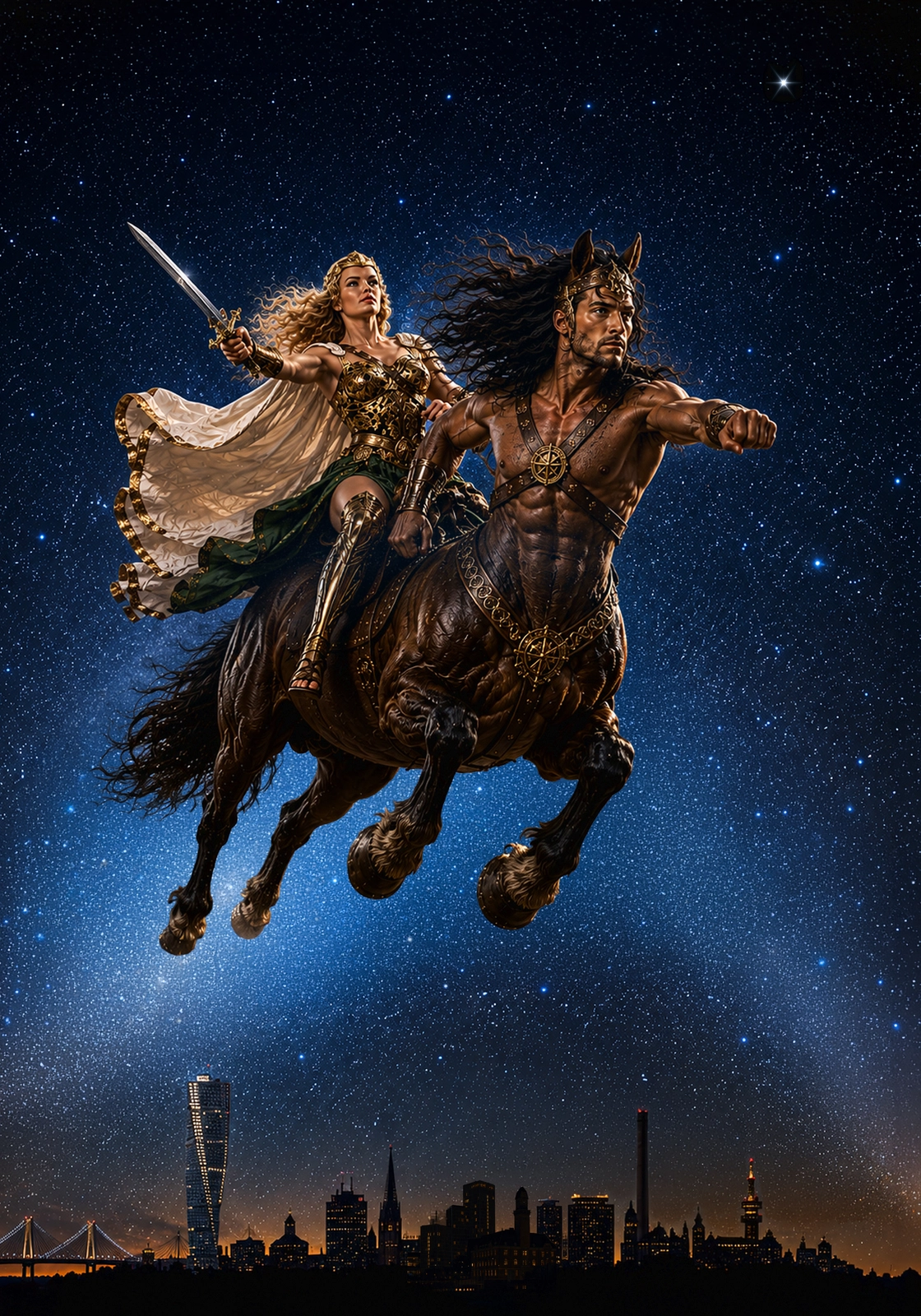
Rider of the Milky Way - Vintergatans ryttare, 2026
Digital
50 x 70 cm
3 200 kr
Rider of the Milky Way - Vintergatans ryttare
Svensk text på slutet
When the truth becomes too improbable
What happens when two people who have already left Earth decide to return? Not to save the world. Not to change history. Not even to right old wrongs.
Instead, they arrive as time-travellers to amuse themselves.
On the star Alpha Centauri, more than four light-years from Earth, Anita Ekberg and Gianni Agnelli live a life in which time and space have long since lost their grip. Yet some things endure even into eternity: a love of a good story, a delight in teasing authority, and the pleasure of a well-planned practical joke.
They therefore set out for Scania through a wormhole that opens behind Malmö Opera. During their journey across the universe, stories are told of cosmic horse-traders, stolen racehorses, Federico Fellinis most outrageous film productions, and a glass that seemed to contain milk but concealed something entirely different.
At the same time, a plan begins to take shape.
A plan that will transform a quiet summer afternoon outside Malmö Opera into something no one present will ever be able to explain, and which the journalists, exactly as Anita had anticipated, will swallow hook, line, and sinker.
"Through the Wormhole
Upon the back of Karystos she rode,
Fair Anita, crowned with deathless light,
Whilst through the hidden road of stars they strode,
Beyond the reach of common day and night.
No earthly ship their wondrous passage bore,
No sail of fire, no engine forged by men;
They passed instead through Time's forbidden door
And crossed the dark between the stars again.
Around them wheeled the galaxies untold,
Like scattered jewels cast upon the sea;
The heavens bent, the laws of space grew old,
And distance yielded to eternity.
The constellations blurred like painted dreams,
The Milky Way became a silver thread;
A thousand suns dissolved in flowing streams,
As past and future mingled overhead.
Yet neither fear nor doubt disturbed their flight,
For love had travelled farther still than they;
She laughed, and all the tunnel filled with light,
Whilst worlds and ages drifted far away.
Then suddenly the cosmic shadows broke.
Green fields appeared beneath a summer sky.
The sleeping land of Scania awoke,
And Malmö's towers rose before their eye.
The wormhole closed behind them without sound.
The stars withdrew beyond the veil of blue.
And there upon familiar earthly ground,
Their newest tale prepared itself anew.
For though they came from realms beyond all ken,
Where Time itself no longer keeps its throne,
They journeyed not to save the world of men
But merely to amuse themselves alone.
"
Malmö, June 2026
PROLOGUE
Far from Earth's noise, on Alpha Centauri A the fourth-brightest star in the night sky, deep within the constellation Centaurus Gianni Agnelli and Anita Ekberg have built their shared home. On this glowing celestial body, they live beyond the laws of time. Gianni often assumes his most magnificent form as the centaur Karystos, while Anita shines with an eternal, divine radiance.
Yet Earth and Sweden are calling to them on this June evening in 2026. To cross the immense cosmic gulf of more than four light-years, they do not use spacecraft but ride straight through a wormhole. This cosmic window has its unique earthly opening in the very heart of Malmö in the green corridor, the "mallean," stretching between Malmö Opera and the sports grounds just behind it. Although wormholes twist and wind through the universe, they are in fact the straightest route between two destinations. One travels through the fourth dimension, which is invisible from Earth. Seen from Earth, Alpha Centauri lies 4.37 light-years away. For an earthly space probe, the journey would take tens of thousands of years, but through the wormhole behind Malmö Opera, Gianni and Anita arrive after only a few earthly minutes.
Incomprehensible? Absolutely! It is equally incomprehensible to someone who leaves Earth and wakes up a few minutes later on a distant star. One gets used to it quickly. It is no more difficult than the first time people boarded an aeroplane and discovered that a journey which had taken a month in the eighteenth century could suddenly be completed in an hour. Let us listen to Gianni Agnelli recount his travels with his eternal love, Anita Ekberg.
Chapter 1: Through the Fourth Dimension
I was galloping at full speed through the wormhole in my guise as the centaur Karystos, with Anita sitting firmly upon my back. I love transforming myself into a centaur, and Anita loves riding on my back. Besides, travelling from our star is an hour faster that way than simply sitting on a folding chair. This time, however, it was not about saving time, since in eternity time is relative anyway.
We were on a special mission, bound for Malmö, to settle a few old scores. Her hometown had not exactly stood by her during her years abroad. The Law of Jante had dominated the scene, and journalists in particular had tormented her from a distance. It was that latter group she wanted to tease: to give them something to write about that was a lie and a damned fabrication from beginning to end, yet which they would swallow hook, line and sinker.
To make the journey pass more quickly, I told her the story of how I acquired my star and of the horse dealer's cosmic swindles. She had probably heard the tale before, but a good tall story always deserves to be told again.
Chapter 2: The Horse Trader's Cosmic Frauds
"The shady horse trader from the fourteenth century," I began, "had realised that the sharp, revealing light of Alpha Centauri made it impossible to hide defects in his merchandise. He sold horses to gullible time travellers, but beneath the brilliant glow of the twin stars, every concealed flaw became painfully obvious. That was why he was more than willing to trade his bright giant star for my tiny red one."
When I left Earth for eternity in 2003, I first ended up on Wolf 359a red dwarf star in the constellation Leo and one of the Sun's nearest neighbours in the galaxy. It is famous for its extreme faintness and minimal mass, which suited a soul as large as mine rather poorly. The star has a surface temperature of around 2,800°C, is only about 16 per cent of the Sun's diameter, and has less than 1 per cent of the Sun's luminosity. In other words, it is a celestial body best suited to light-shy souls. Absolutely perfect for a horse trader and his desert of horses.
As a newcomer, I quickly discovered that the cosmos functions very much like the Italy I had just left behind: everything is for sale at the right price, and the same rule applies as in real estate on Earthlocation, location, location. Superficially, Wolf 359 was hardly an attractive bargaining chip, but many, for various reasons, could not tolerate too much light, unlike that horse trader.
The old rascal cheated by 'upgrading' his defective horses. As on Earth, he relied on time-tested swindler's tricks, but he adapted them skilfully to the cosmos.
Bloated stomachs had worked for thousands of years. He made thin, worn-out horses swallow cosmic dust or fed them half-fermented Pegasus grass half a day before a sale. This filled out their sunken withers, instantly making them appear well-fed and powerful.
Sometimes, thousand-year-old animals found themselves caught in the rogue's lasso. To conceal their advanced age, he used soot from extinguished comets to carefully dye the grey hairs around their heads and muzzles.
Cracked and damaged hooves were filled with black star pitcha form of space tarand polished until they gleamed as if the horse had just come from the finest farrier in the galaxy.
If a horse limped, he would press a small, sharp flint stone into the hoof of the healthy leg. The pain made the horse limp equally on both sides, making it appear merely impatient and eager to trot.
The powerful light of Alpha Centauri exposed such frauds immediately; the dye ran off during solar storms, and the starlight shone straight through the artificially inflated skin. On shadowy Wolf 359, however, such deceptions posed no problem.
But on the perpetually green planets of Pegasusthat enormous constellation so easily recognised by its great square of four bright starsthe environment was perfectly suited to his purposes.
Since reproduction does not exist in the cosmos, the Milky Way's horse population increased only at the rate at which horses died and left Earth. It was a completely closed cycle. Furthermore, the horses living on the planets of the Pegasus constellation refused to leave their heavenly realm of endless grassy plains and beautiful lakes. The horse trader therefore had no choice but to kidnap them directly from their herds.
Hunting wild horses across those vast plains was nearly impossible for a medieval man. The horse trader therefore recruited the finest riders the universe had ever seen: Sioux horse riders from the Piedmont region of Virginia. These riders descended from the ancient Sioux confederations, such as the Monacan and Manahoac peoples, who once ruled Virginia's wooded hills and broad valleys. With their legendary ability to understand animals and to ride bareback as if they were one with the horse, they were the only beings in the cosmos capable of sneaking up on the Pegasus herds, casting their space lassos, and galloping away with the rarest treasures.
Chapter 3: Gianni's Locked-Room Mystery
"That was when I staged my own locked-room mystery," I continued, feeling Anita grip a little tighter as our speed increased. "After all, I wanted to acquire the horse swindler's Alpha Centauri, so I calculated the weak point of that seven-hundred-year-old rogue. The old man always wanted the very bestand the very best was still to be found on Earth. I knew exactly where."
One night, what horse enthusiasts still describe as a genuine locked-room mystery worthy of Agatha Christie herself occurred. In my old, heavily guarded estate in Italy, the finest thoroughbred on the stud farm stood. The stable was locked from the inside with heavy iron bars and titanium padlocks forged to withstand extreme violence. The property was surrounded by high walls and patrolled day and night by armed guards and half-starved attack dogs.
Yet the stall was empty the next morning.
The marks in the straw showed that the horse had stood peacefully there until midnight. No locks had been broken, no windows shattered, and neither the guards nor their dogs had heard a sound. Not even the horse had protested being taken away in the middle of the night.
What no mortal could know was that I had exploited Alpha Centauri's position in the galaxy. By synchronising the gravitational pull of the Centaur constellation with a specific coordinate on Earth, I opened a temporary wormhole right in the middle of the locked stall. The horse had taken a single step forward, been sucked into the wormhole, and travelled through time and space to arrive directly on the terrace of my plasma villa on Wolf 359.
A thoroughbred stallion in the prime of life, smuggled from Earth through a wormhole, was a galactic rarity that left the horse swindler utterly speechless. Naturally, if they knew about it, Earthlings would have protested and spoken of unprecedented cruelty to animals, asking how a horse could possibly survive such a journey.
It cannot, of course. It dies within fractions of a second due to an acceleration of several thousand g. The process is therefore entirely painless, and it is immediately resurrected upon arrival.
The soul, that is.
The horse's remains are eaten. Horse meat is a highly sought-after delicacy, even among the stars. Since nobody who has moved into eternity can diethey have already done thatit is not difficult to understand why horse meat is so expensive in the afterlife. The former thoroughbred ended up in my vast freezer room, an absolute necessity on a star unless one prefers super-dried meat.
When the horse swindler stepped into my plasma villa and saw the resurrected thoroughbred standing on the terrace, he completely lost his composure. His medieval mind, which for centuries had believed it held a monopoly on cosmic trickery, could not comprehend what he saw.
The animal's soul stood there in absolute perfection. The withers were naturally high, the eyes sparkled without deceit, and the hooves gleamed with an earthly sheen, untouched by a single drop of space tar. Ruthlessly revealed in the muted glow of Wolf 359, the stallion was the most beautiful and flawless creature the old man had ever seen.
Seven hundred years of greed shone in his eyes as he realised this was a commodity no time traveller in the universe could resist, not even in the brightest starlight.
I read the horse trader like an open book and did not keep him in suspense for long. I offered a straight exchange: the resurrected luxury thoroughbred and Wolf 359 for his Alpha Centauri.
For the horse swindler, the choice was simple. On the gloomy, shadowy dwarf star Wolf 359, he could continue concealing his cosmic frauds for all eternity, and with Earth's finest thoroughbred soul in his stable, his fortune was made.
The contract was signed on the spot, and the exchange proved perfectly even. The horse trader received his light-shy refuge amid space soot and carbon dust. At the same time, my magnificent soul finally moved to the radiant brilliance of Alpha Centauria destination entirely worthy of a true Italian aristocrat.
Chapter 4: The Solution to a White Dilemma
Anita had just enough time to tell the story behind a film Gianni had never had the chance to see on Earthand what was actually inside the famous glass during filming.
"You know, Gianni, Fellini's second film with me is one of the films I often wish you had seen while we were still down on Earth."
Anita smiled and leaned forward on the centaur's back as starlight shimmered beyond the wormhole's transparent walls.
"Now you've seen the film, but I don't think I've ever told you the background."
Gianni shook his head, sending his mane swirling.
"Federico Fellini's" Le tentazioni del dottor Antonio"The Temptations of Doctor Antoniowas one of four episodes in the Italian anthology film Boccaccio '70 made in 1962. In Sweden, it was released under the title "Det ljuva lättsinnet."
Doctor Antonio was portrayed by the famous Italian comedian Peppino De Filippo. By contrast, I, as the gigantic woman, essentially played myself, dressed in a generously low-cut silver lamé gown that was hardly designed to calm nervous moralists.
"And those were precisely the sort of moralists Federico intended to target."
The story unfolded in Rome's EUR district, an area renowned for its austere, modernist and almost ghostly architecture. Federico loved contrasts. The cold, geometric buildings stood as monuments to order, discipline and control. Right in the middle of all that, he placed my curves, my laughter, my hair and my body. The contrast between hard concrete and living flesh was entirely deliberate.
Doctor Antonio Mazzuolo was an extremely prudish, self-appointed guardian of morality. He had made it his life's mission to cleanse Rome of sin. He chased young lovers from parks, scolded women for low necklines, and tore apart men's magazines at newspaper kiosks. He even gave lectures to frightened Boy Scouts, attempting to explain that his obsession with morality stemmed from a childhood memory of accidentally seeing his aunt undressed.
"Federico could be merciless when he was satirising."
One day, workers suddenly erected a giant neon-lit billboard directly opposite Doctor Antonio's apartment window. The poster showed me reclining on a chaise longue, with a deeply revealing neckline and a large glass of milk in my hand.
And as if that were not enough, a commercial jingle began blaring endlessly from the loudspeakers.
Bevete più latte, bevete più latte! Il latte fa bene, il latte nutre... Anita sang.
" Drink more milk, drink more milk! Milk is good for you. It provides nourishment."
Cheerful schoolchildren performed the song, which quickly became a nationwide annoyance. For Antonio, it was pure torture. The irony was that milk traditionally symbolised innocence, motherhood and health. Yet in his imagination it became something entirely erotic.
"That was where Federico twisted the knife."
Antonio waged a one-person war against the billboard. He called politicians, teachers and church officials. He demanded that the advertisement be banned. But nobody could help him because the message merely encouraged people to drink a healthy beverage.
Eventually, he climbed up and threw ink and paint over the poster.
The authorities temporarily covered it with a large canvas, giving Antonio a brief sense of victory. But that was only the beginning. One night, a storm swept across Rome, and the wind tore away the covering.
That was when Antonio's feverish delirium peaked.
He walked out into the empty city at night to confront his enemy. Suddenly, the billboard began to move. I blinked. I smiled. I changed my expression.
And then I stepped out of the frame and onto the street.
"That was one of Federico's most imaginative sequences."
The giant Anita from the billboard was as large as a small skyscraper. I laughed at the little doctor, picked him up in my hand, and carried him through the streets of Rome. The entire cat-and-mouse sequence was created using miniatures and practical effects shot directly in camera. It was long before computers and AI took over such work.
Antonio was now completely overwhelmed by terror and by the sexual desire he himself diagnosed as the Devil's temptation. In a final, desperate attempt to defend himself, he tore a spear from a statue and hurled it at me.
When morning arrived, he was found unconscious, high atop the billboard's steel framework. He had suffered a complete mental breakdown.
As the ambulance carried him away, the children's choir could still be heard:
Bevete più latte, bevete più latte...
Anita sang the teasing melody once more.
"Federico had humour, Gianni. Sometimes as black as the night itself, but always precise."
She gazed out towards the stars and spotted the tiny blue speck that was Earth. They would soon arrive.
"Many people thought the film was about me, but it was really about Antonio. About people so frightened of their own feelings that they begin waging war against them in the outside world. Federico used the episode to satirise the hypocrisy of the Catholic Church and the Italian bourgeois attitude to sexuality."
She slowly shook her head.
"The message was quite simple. Doctor Antonio's extreme moralism and misogyny were not signs of strength. They were projections of his deeply repressed desires. The harder he tried to suppress them, the larger they grew."
Anita smiled.
"That is why Federico made me grow to the size of a skyscraper, not because I was dangerous, but because Antonio's own imagination made me that large."
Gianni continued trotting along the winding path of the wormhole through the cosmos. At last, he smiled crookedly.
"Anita, there is one thing I do not understand."
"Oh?"
"How did you manage an entire film shoot while holding a huge glass of milk? The very thought makes me feel ill."
Anita burst out laughing.
Piña Colada.
"What?"
"Piña Colada," Anita replied briefly as Gianni continued trotting through the wormhole.
She looked at his puzzled expression with satisfaction.
"One part light Bacardi rum, one part pineapple juice, one part sweetened coconut cream, and lots of ice."
"You are joking."
"Not at all. It looks exactly like milk if you skip the garnish. No pineapple slice. No cocktail cherry. Just a large glass full of an innocent-looking, thick, white liquid."
Gianni laughed.
"Did Federico know?"
"Federico knew most things. He was a director, not an idiot."
She shrugged.
"It is admittedly a great sacrifice to be forced to drink a Piña Colada without a garnish, but what wouldn't I do for the sake of cinema?"
Gianni shook his head.
"I have always said you took your work very seriously."
"Of course. I was a professional."
"And the milk?"
"I only had milk in cappuccino and for cooking."
I began humming:
Bevete più latte, bevete più latte...
"Good Lord," said Gianni. "Not that song again."
"Federico must take responsibility for that," Anita replied, watching the city of Malmö begin to emerge at the far end of the wormhole.
Chapter 5: Now the Reporters Shall Get What They Deserve
Both Gianni and Anita loved practical jokes, and their years on Earth had been filled with them.
What could they possibly inflict upon Malmö?
Given Gianni Agnelli's legendary elegance and Anita Ekberg's exuberant cinematic charisma, their cosmic practical joke in Malmö in 2026 would be anything but crude. It would blend Italian luxury, Scanian local patriotism and pure mythic magic.
One idea was to improve Malmö's most famous landmark, which Anita felt looked far too stiff. According to her, Turning Torso ought to be fitted with a gigantic blue plastic wing nut, complete with a red knob that immediately evokes an old-fashioned wind-up toy. Two strategically placed black dots as eyes and a stylised red mouth, Anita insisted, would make the building resemble an enormous doll, merely waiting to be wound up and stroll away through Västra Hamnen.
For a Time-traveller, that sort of prank presents no difficulty. All it takes is a shopping list of the necessary materials and gadgets. As I have explained before, Time-travellers print their own money. Not even an electron microscope can detect the forgery, and the serial numbers are taken directly from the Riksbank. Any discrepancy that arises is recorded in the accounts as destroyed currency. The system has functioned ever since coins were first introduced in Lydia some 2,700 years ago. The invention of banknotes in the late seventeenth century simplified matters considerably, since one no longer had to carry silver and gold pilfered from the king's treasury. An even greater revolution came with the introduction of plastic cards in the 1950s.
The estimated global loss in the card payment system is roughly 0.0050 per cent of total transaction volume. This means that for every hundred kronor spent by card, just over three öre disappearsome to earthly fraudsters, but more than half to enthusiastic Time-travellers on nostalgic visits. The Nilson Report estimates the loss at approximately $33.4 billion, although that figure excludes cards linked to accounts with unlimited credit. Now and then, the debt is written off when someone discovers that the account holder does not actually exist.
Hiring people in Malmö to pull off a practical joke is difficult because Swedish companies fear the authorities. Naturally, there are undeclared workers with more flexible consciences, but that is unnecessary for this kind of undertaking. The only tools Anita and Gianni require are their own imagination, since imagination both moves objects and reshapes them according to one's wishes. People often wonder how optical illusions occur and how things vanish into thin air. Here is the explanation, and why this type of practical joke leaves no trace behind.
The plan to wind up Turning Torso was postponed, however, when it turned out that no eight-metre plastic wing nuts could be obtained in Sweden at such short notice. Even though time and distance meant little to Time-travellers, Gianni found it rather troublesome to travel all the way to India, where he had located a factory with exactly such items in stock. Admittedly, they were red, but Anita refused to accept that compromise.
Instead, they decided to stage it near the mouth of the wormhole.
As a playful nod to Anita's famous scene in "La Dolce Vita", they would transform the fountain outside Malmö Opera into a cosmic paradise of bubbles. The perfect moment would be during the intermission of a Saturday matinee, when crowds would be present. Broad daylight would do full justice to the bubbles. The June Saturday they selected proved ideal for mischief. The sun shone from a cloudless blue sky, and heat records were being broken across Europe.
The Tragos Fountain, also known as "The Birth of Tragedy", is the official sculpture in front of Malmö Opera. It is one of Malmö's cultural landmarks, and Anita and Gianni intended to make it famous throughout the entire Milky Way. The name derives from the Greek word "tragos," meaning "goat," and is linked to the origin of the word "tragedy" in ancient Greek theatre.
The fountain depicts a spiral populated by a colourful array of figures symbolising the birth of theatrical art, with its characteristic flowing water that Anita and Gianni intended to enhanceconsiderably. The higher the figures climb, the lighter and more uplifted they become. At the bottom, they are heavy and earthbound, while at the summit they support a great bronze ring from which water cascades.
On the dramatic side of the sculpture, the spiral begins with figures depicting ecstatic rituals and goat songs dedicated to Dionysus, the ancient god of wine.
The tragic Greek hero Orestes embodies the earliest roots of theatre and the weight of classical drama.
Higher up stands Hamlet, the iconic figure of modern drama, in his most familiar pose, contemplating Yorick's skull.
Nearby appears the Captain from Strindberg's "The Father", symbolising psychological realism and the modern, bitter family drama.
The comedy side celebrates laughter, satire, farce and entertainment. It begins with figures inspired by Aristophanes's play The Birds, in which the characters attempt to build a city in the sky.
Further up, the forms evolve into the stylised archetypes of sixteenth-century Italian Commedia dell'arte, such as Harlequin and Columbine.
At the very top floats Charlie Chaplin. The silent-film icon symbolises modern cinema, physical comedy and the vulnerability of the little man through his portrayal of the Tramp.
Several figures wear, hold or interact with theatrical masks, illustrating the shifting boundary between actor and role. Others are intertwined like acrobats in physically demanding poses, symbolising the collective teamwork required to create theatre.
Deep within the spiral, water surged from the sculpture's base. Fifteen minutes before the interval, Gianni had secretly placed a nozzle made of polyvinyl alcohol, a synthetic plastic that dissolves on contact with water. His calculations proved correct. Visitors carrying glasses and plates drifted from the foyer onto the piazza and into the afternoon sunshine. The fountain naturally became a gathering place, its cooling spray offering relief from the summer heat.
Then, amid the crowd's cheerful chatter, the fountain suddenly transformed into a prosecco fireworks display.
Instead of water, millions of weightless, floating bubbles, tasting of Italian prosecco, burst into the air. Amid the bubbles, Anita's unmistakable laughter echoed across the piazza.
Within seconds, every face turned towards Tragos.
The faint pink prosecco emerged from a chemical reaction between water and the genuine articlea condensed form of prosecco. How else, after all, could we transport millions of tonnes of sparkling beverages to our stars in eternity if drinks could not be compressed? On Earth, every drunkard dreams of carrying a small sachet of extract in a pocket and simply adding water to produce a fine whisky. Smoky or not, single malt or blendedit hardly matters. But this occasion concerned a Prosecco of the highest quality: a Gemin from Cartizze, normally costing 700 kronor per bottle at Systembolaget.
As the nozzle dissolved, a mixture of potassium permanganate and hydrogen peroxide set the prosecco in motion. When the powder met the peroxide, oxygen was released at extraordinary speed, and like a geyser, the fountain blasted bubbles high above the piazza.
All one had to do was stick out one's tongue to taste.
Some people immediately began drinking straight from the fountain. Perhaps curiosity drove them, or perhaps a floating bubble burst on their lips, awakening a desire for more. Those without glasses cupped their hands and took generous mouthfulsone, two, perhaps three, or even more. After all, the entertainment was free.
People became intoxicated. Some became very intoxicated. It is not every day that one is offered unlimited free sparkling wine.
Some swore that several of the figures began to speak.
Which was entirely correct. Anita and Gianni had transformed into pigeons, perched amid the splashing water.
Afterwards, the whole affair was dismissed as a drunken fantasy by those who had drunk too much prosecco.
The truth, however, was that Anita and Gianni had fallen victim to the curse of the modern age: mobile phones. In countless selfies uploaded to YouTube, the bubbling fountain was clearly visible. What proved harder to make out was Dionysus and Hamlet arguing over whether wine was a blessing or a curse, while the poet declaimed that the time was out of joint.
Several times, Anita, speaking as Dionysus, boomed:
"To drink, or not to drinkthat is the question! Wine is the fire of life, you pale prince! Without the juice of the grape, man is but an empty barrel!"
Gianni answered in Hamlet's dark voice:
"No, Dionysus. To drink is to forget, and to forget is to flee. Wine is a poison that conceals the truth. A false comfort in a rotten world!"
Then Anita switched to her deepest contralto and voiced the poet:
"Stop quarrelling over your goblets! Can you not see? The time is out of joint! Alas, that I was born to set it right! The world is burning, and you bicker over weak wine. Give me a proper glass of sparkling bubbles instead!"
Finally, Dionysus settled the dispute:
"Silence, verse-maker! If time is out of joint, it merely needs to drink more to limp back into step again!"
On the opposite side of the spiral, the rooster-headed figure crowed indecencies at Columbine:
"I have found the cure for your melancholy! It is long, hard, and beating inside my trousers!"
Harlequin immediately leapt to her defence.
"Stop yapping like a lovesick mongrel! Columbine does not even look your way, even if your comb were covered in diamonds!"
The tragic hero Orestes delivered the final line as the powder ran out:
From Aristophanes'" The Frogs" of 405 BC, he quoted:
"O Lord! It is over! The god has struck! ... Let us piss upon the threshold..."
Shortly afterwards the police arrived with sirens wailing.
A teetotaller in the audience had called the emergency services to report that someone was distributing illegal spirits outside the Opera House. Since the matter did not involve an ordinary robbery or anyone spray-painting obscenities across the Opera's marble façade, the police arrived relatively quickly.
The word "spirits" holds a peculiar power in Sweden.
By then, everything appeared perfectly normal. The fountain burbled peacefully, and the water in the basin looked and tasted exactly like water.
The intoxicated people babbling about talking statues and pink bubbles above the piazza were duly noted in the police notebooks. Over-refreshed individuals often see and hear strange things, and since the Opera had a licence to serve alcohol, the officers eventually departed.
Not a single journalist missed the story.
One reporter had even been present and insisted that his account was the only truth. Independent newspapersthat is, those that had not been theredid not believe a word of it. "Svenska Dagbladet", unlike much of the Swedish media, was not part of the Bonnier sphere, and consulted experts about what sounded suspiciously like one of those old tales claiming that a black-and-white television could become colour simply by stretching a nylon stocking across the screen.
Although the original television segment had been broadcast in black and white on April Fool's Day, newspapers across the country reported the story as a sensation, and some journalists even suggested they had personally tested the method.
The experts dismissed the entire bubbling affair as improbable and blamed it on mass hysteria combined with alcohol consumption.
The Director of Malmö Opera understood the Finnish saying that dog dirt smells worse the more one stirs it. Consequently, he refrained from fighting back and allowed the media storm to subside naturally.
This was especially true since every performance sold out six months in advance. Everyone suddenly wanted to visit Malmö Opera.
The municipality threatened to revoke the Opera's alcohol licence. However, it quickly calmed down when the restaurant manager produced clear records showing that fewer than half as many alcoholic drinks had been sold during that Saturday matinee as on a normal occasion.
No wonder. The audience had been served free of charge on the piazza.
Epilogue
With a silent roar, Karystos bursts through the bushes around Malmö's old sports ground. His hooves scarcely touch the Scanian Earth before the centaur Gianni launches himself in a mighty leap towards the stratosphere.
Above Malmö's rooftops, with the Opera House's characteristic functionalist lines and the sports ground's floodlights far below, they rise towards the cosmos. Anita raises her sword in a triumphant gesture, ready to guide their return to the Centaurus star system, while the people of Malmö below are dazzled by what they believe to be a meteor crossing the clear night sky of 2026.
That the meteor laughed could indeed be heard. Still, people assumed the sound came from cheerful Malmö residents aboard an excursion boat emptying a bottle of champagne somewhere in the city's canals.
Anita wanted to see "Skåne from Above," as her favourite singer, Edvard Persson, once sang.
The lyrics might have been written that very day, though they date from 1939. Then, as now, the world was troubled. Back then, it was Hitler and Stalin. Today, it is Putin and Trump.
"Now all the walls of Earth begin to shake,
A gathering of fools has set our world aflame.
What our fathers built collapses into ruin,
Old bonds of friendship tear apart.
Dear people fighting down on Earth,
Come up and take a look with me.
I am quite certain
You would feel ashamed
If you saw our old Earth from up here above."
Lasse Dahlquist, 1939
Vintergatans ryttare
När sanningen blir för osannolik
Vad händer när två människor som redan har lämnat jorden bestämmer sig för att återvända? Inte för att rädda världen. Inte för att förändra historien. Inte ens för att ställa gamla oförrätter till rätta.
Utan som tidsresenärer kommer de för att roa sig.
På stjärnan Alpha Centauri , mer än fyra ljusår från jorden, lever Anita Ekberg och Gianni Agnelli ett liv där tid och rum har förlorat sitt grepp. Men vissa saker följer med även in i evigheten: kärleken till en god historia, lusten att driva med auktoriteter och glädjen i ett riktigt välplanerat practical joke.
De ger sig därför av mot Skåne genom ett maskhål som slutar bakom Malmö Opera. Under färden genom universum berättas historier om kosmiska hästhandlare, stulna kapplöpningshästar, Federico Fellinis galnaste filminspelningar och ett glas som såg ut att innehålla mjölk men som dolde något helt annat.
Samtidigt växer en plan fram.
En plan som förvandlar en stillsam sommareftermiddag utanför Malmö Opera till något som ingen närvarande någonsin kommer att kunna förklara. Och som journalisterna, precis som Anita räknat med, sväljer med hull och hår.
Långt borta från jordens larm, på Alpha Centauri A den fjärde ljusstarkaste stjärnan på natthimlen, djupt inne i stjärnbilden Centaurus har Gianni Agnelli och Anita Ekberg skapat sitt gemensamma hem. På denna glödande himlakropp lever de bortom tidens lagar. Gianni antar ofta sin mest magnifika skepnad som kentauren Karystos och Anita strålar med en evig, gudomlig glans.
Men jorden och Sverige drar i dem den här junikvällen år 2026. För att korsa det enorma kosmiska djupet på drygt fyra ljusår använder de inte rymdskepp, utan rider raka vägen genom ett maskhål. Detta kosmiska fönster har sin unika jordiska mynning precis i hjärtat av Malmö i den gröna korridoren, "mallean", som sträcker sig mellan Malmö Opera och idrottsplatsen strax bakom. Trots att maskhålen ringlar sig genom universum är det faktiskt den rakaste vägen mellan två mål. Man färdas genom den fjärde dimensionen som inte är synlig från jorden. Från jorden betraktat ligger Alfa Centauri 4,37 ljusår bort. För en jordisk rymdsond skulle sträckan ta tiotusentals år, men genom maskhålet bakom Malmö Opera landar Gianni och Anita efter några jordiska minuter. Obegripligt? Absolut! Det är det också för en som precis lämnar jorden och några minuter senare vaknar upp på en stjärna långt bort. Man vänjer sig snabbt. Det är inte svårare än när man första gången tog flyget, och en månads resa på 1700-talet klarades av på en timme. Låt oss lyssna på Gianni Agnelli berätta om hans och hans eviga kärlek, Anita Ekbergs, resor.
Kapitel 1: Genom den fjärde dimensionen
Jag travade i full galopp genom maskhålet i min skepnad som kentauren Karystos, med Anita stadigt på min rygg. Jag älskar att förvandla mig till en kentaur och Anita älskar att rida på min rygg. Att rida från vår stjärna går dessutom en timme snabbare än att bara sitta på en fällbar stol. Nu handlade det inte om tiden eftersom den ändå i evigheten är relativ. Vi var på specialuppdrag den här gången, till Malmö, för att ge igen för gamla oförrätter. Hennes hemstad hade inte precis ställt upp för henne under åren utomlands. Jantelagen hade dominerat, och inte minst journalisterna hade plågat henne på avstånd. Det var den senare gruppen hon ville skoja med: ge dem något att skriva om som var lögn och förbannad dikt från början till slut, men som de skulle svälja med hull och hår.
För att tiden skulle gå snabbare berättade jag under färden om hur jag fick min stjärna och om hästhandlarens kosmiska bedrägerier. Hon hade säkert hört historien förut, men en bra skröna förtjänar alltid att återberättas.
Kapitel 2: Hästhandlarens kosmiska bedrägerier
Den ljusskygga hästhandlaren från 1300-talet, började jag, hade insett att det skarpa, avslöjande ljuset från Alfa Centauri gjorde det omöjligt att dölja skavankerna på hans handelsvaror. Han krängde hästar till lättlurade tidresenärer, men i tvillingstjärnornas klara sken syntes varje dolt fel alldeles för tydligt. Det var därför han mer än gärna bytte bort sin ljusstarka jättestjärna mot min pyttelilla röda.
När jag år 2003 lämnade jorden för evigheten hamnade jag ju först på Wolf 359 en röd dvärgstjärna i stjärnbilden Lejonet och en av vår sols närmaste grannar i galaxen. Den är känd för sin extrema ljussvaghet och minimala massa, vilket passade ganska dåligt för en så stor själ som min. Stjärnan har en yttemperatur på runt 2 800 °C, är bara cirka 16 procent av solens diameter och har mindre än 1 procent av solens ljusstyrka. Med andra ord är det en himlakropp som lämpar sig bäst för ljusskygga själar. Helt perfekt för en hästhandlare och hans öken av hästar.
Som nyankommen förstod jag snart att kosmos fungerar precis som det Italien jag nyss hade lämnat: allt är till salu till rätt pris, och samma premisser gäller som för fastigheter på jorden läge, läge, läge. Ytligt sett var Wolf 359 inget vidare bytesobjekt, men det fanns många som av olika anledningar inte tålde alltför mycket ljus. Som den där hästhandlaren.
Gubben fuskade och 'uppgraderade' sina defekta hästar. Liksom på jorden använde han gamla beprövade tjuvknep, men han anpassade dem skickligt för kosmos.
Att jäsa upp magen på djuren hade fungerat i tusentals år. Han lät magra, utslitna hästar svälja kosmiskt damm eller mata dem med halvjäst Pegasus-gräs en halv dag före försäljning. Detta fyllde ut deras insjunkna mankar så att de genast såg välnärda och kraftfulla ut.
Ibland fastnade tusenåriga djur i skojarens lasso. För att dölja deras höga ålder använde han sot från slocknade kometer för att omsorgsfullt färga över de gråa håren runt hästarnas huvuden och mulearna.
Spruckna och trasiga hovar fylldes i med svart stjärnpitch en sorts rymdtjära och polerades tills de glänste som om hästen precis hade kommit från galaxens bästa hovslagare.
Om en häst haltade, tryckte han in en liten vass rymdsten i hoven på det friska benet. Smärtan gjorde att hästen haltade lika mycket på båda benen, vilket fick den att framstå som en otålig, frustrerad travare.
Alfa Centauris starka ljus avslöjade sådant fusk direkt; färgen rann av i solstormarna och stjärnljuset lyste rakt igenom den uppblåsta huden. På skuggiga Wolf 359 var däremot sådant fusk inget problem.
Men på de ständigt gröna planeterna i Pegasus den där enorma stjärnbilden som är så lätt att känna igen på sin stora kvadrat med fyra ljusa stjärnor var miljön helt perfekt för hans syften.
Eftersom det inte existerar någon reproduktion i kosmos ökade Vintergatans hästpopulation endast i samma takt som hästar dog och lämnade jorden. Det var ett helt stängt kretslopp. Hästarna på planeterna i konstellationen Pegasus vägrade dessutom frivilligt att lämna sitt himmelrike av enorma, gräsbevuxna slätter och ljuvliga sjöar. Hästhandlaren var därför tvungen att helt enkelt röva bort dem ur flockarna.
Att jaga vildhästar på de jättelika slätterna var nästintill omöjligt för en medeltida man. Hästhandlaren hade därför rekryterat de absolut bästa ryttarna universum skådat: siouxindianer från Piedmont-regionen i Virginia. Dessa ryttare härstammade från de gamla Sioux-konfederationerna, såsom Monacan och Manahoac, som en gång i tiden behärskade Virginias skogsklädda kullar och vidsträckta dalgångar. Med sin legendariska förmåga att läsa av djurens natur och rida barbacka som om de vore ett med hästen, var de de enda i kosmos som kunde smyga sig på Pegasus-flockarna, kasta sina rymdlasstron och galoppera iväg med de mest sällsynta rariteterna.
Kapitel 3: Giannis slutna-rum-mysterium
Det var då jag iscensatte mitt eget slutna-rum-mysterium, fortsatte jag och kände hur Anita höll i sig lite hårdare när farten ökade. Jag ville ju byta till mig hästskojarens Alfa Centauri, så jag räknade ut den där sjuhundraåringens svaga punkt. Gubben ville alltid ha det absolut bästa och det bästa fanns fortfarande kvar på jorden, och jag visste exakt var.
En natt inträffade det som i hästkretsar än i dag beskrivs som ett äkta slutet-rum-mysterium värdigt Agatha Christie. I min gamla, hårt bevakade herrgård i Italien stod stuteriets främsta fullblodshäst. Stallet var låst inifrån med tunga järnbommar och titanhänglås, smidda för att motstå extremt våld. Gården var omgärdad av höga murar och patrullerades dygnet runt av beväpnade vakter och halvsvultna kamphundar.
Ändå var boxen helt tom nästa morgon. Spåren i halmen visade att hästen hade stått där fridfullt fram till midnatt. Inga lås var uppbrutna, inga fönster var krossade och varken vakterna eller deras hundar hade hört ett knyst. Inte ens hästen hade protesterat mot att bli bortförd mitt i natten.
Vad ingen dödlig kunde veta var att jag hade utnyttjat Alfa Centauris position i galaxen. Genom att synkronisera stjärnbilden Kentaurens gravitationella dragkraft med en specifik koordinat på jorden öppnade jag ett tillfälligt maskhål mitt i den stängda stallboxen. Hästen hade helt enkelt tagit ett enda steg framåt, sugits in i maskhålet och färdats genom tid och rum för att hamna direkt på terrassen till min plasmavilla på Wolf 359.
En fullblodshingst i sina bästa år, smugglad från jorden genom ett maskhål, var en galaktisk raritet som gjorde hästskojaren helt mållös. Naturligtvis, om de visste om det, skulle vissa jordbor ha protesterat och talat om en aldrig tidigare skådad grymhet mot djur och frågat hur en häst kunde överleva en sådan resa.
Det kan den naturligtvis inte. Den avlider på några bråkdelar av en sekund på grund av en acceleration på åtskilliga tusen g. Processen är alltså helt smärtfri och vid ankomsten återuppstår den direkt. Själen, vill säga. Resterna av hästen äter man upp. Hästkött är en eftertraktad delikatess även bland stjärnorna, och eftersom ingen som flyttat till evigheten kan dö det har man ju redan gjort är det inte svårt att räkna ut varför hästkött är så dyrt i efterlivet. Det före detta fullblodet hamnade i mitt gigantiska frysrum; en absolut nödvändighet på en stjärna, om man inte föredrar supertorkat kött.
När hästskojaren klev in i min plasmavilla och fick se det återuppståndna fullblodet stå på terrassen, tappade han helt fattningen. Hans medeltida hjärna, som i århundraden trott sig ha monopol på kosmiska tjuvknep, kunde inte begripa vad han såg. Djurets själ stod där i absolut perfektion: manken var naturligt hög, ögonen gnistrade utan fusk och hovarna bar jordisk glans utan en enda droppe rymdtjära. Skoningslöst blottad i Wolf 359:s dämpade sken var hingsten det vackraste, mest felfria väsen gubben någonsin hade skådat. Sju hundra år av girighet lyste i hans ögon när han insåg att detta var en handelsvara som ingen tidsresenär i världen skulle kunna motstå, inte ens i det skarpaste stjärnljuset.
Jag läste hästhandlaren som en öppen bok och lät honom inte hållas i ovisshet länge. Jag erbjöd ett byte rakt av: det återuppståndna lyxfullblodet och Wolf 359 mot hans Alfa Centauri. För hästskojaren var valet enkelt; på den skuggiga och murriga dvärgstjärnan Wolf 359 kunde han fortsätta dölja sina kosmiska bedrägerier i all evighet, och med jordens främsta fullblodssjäl i sitt stall var hans lycka gjord. Kontraktet signerades på stående fot och bytet gick jämnt ut. Hästmannen fick sin ljusskygga fristad bland rymdsot och kolsyredamm, medan min storslagna själ äntligen fick flytta till det strålande, klara ljuset på Alfa Centauri ett läge helt i klass med en sann italiensk aristokrat.
Kapitel 4: Lösningen på ett vitt dilemma
Anita hann berätta om bakgrunden till en film som Gianni aldrig hade tillfälle att se på jorden och vad som fanns i glaset under inspelningen.
Vet du, Gianni, Fellinis andra film med mig är en av de filmer jag ofta önskar att du hade hunnit se medan vi fortfarande var kvar på jorden.
Anita log och lutade sig framåt på kentaurens rygg medan stjärnljuset glittrade på andra sidan maskhålets transparenta väggar.
Nu har du sett filmen, men jag tror inte att jag har berättat bakgrunden.
Gianni ruskade på huvudet så att manen virvlade.
Federico Fellinis "Le tentazioni del dottor Antonio" "Doktor Antonios frestelser" var en av fyra delar i den italienska antologifilmen "Boccaccio '70" från 1962. På svenska kallades filmen "Det ljuva lättsinnet".
Doktor Antonio spelades av den berömde italienske komikern Peppino De Filippo, medan jag, som den gigantiska kvinnan, spelade mig själv iklädd en frikostigt urringad silverlaméklänning som knappast var skapad för att lugna nervösa moralister.
Och det var just sådana moralister Federico ville åt.
Berättelsen utspelade sig i stadsdelen EUR i Rom, ett område känt för sin strama, modernistiska och nästan spöklika arkitektur. Federico älskade kontraster. De kalla geometriska byggnaderna stod som monument över ordning, disciplin och kontroll. Mitt i allt detta placerade han mina böljande former, mitt skratt, mitt hår och min kropp. Kontrasten mellan den hårda betongen och det levande köttet var helt medveten.
Doktor Antonio Mazzuolo var en extremt pryd och självutnämnd moralväktare. Han hade gjort det till sitt livsmål att rensa Rom från synd. Han kastade ut unga älskande ur parkerna, skällde ut kvinnor med djupa urringningar och rev sönder herrtidningar hos tidningshandlarna. Han höll till och med föredrag för skrämda scoutpojkar där han försökte förklara att hans besatthet av moral hade sitt ursprung i ett barndomsminne då han råkat se sin moster klä av sig.
Federico kunde vara grym när han gjorde satir.
En dag byggde arbetare plötsligt upp en gigantisk neonlyst reklamtavla mitt emot doktor Antonios lägenhetsfönster. Affischen föreställde mig med djup urringning liggande på en schäslong med ett stort glas mjölk i handen. Och som om det inte var tillräckligt började en reklamslinga dåna ur högtalare:
"Bevete più latte, bevete più latte! Il latte fa bene, il latte nutre...", sjöng Anita.
Drick mer mjölk, drick mer mjölk! Mjölk gör gott. Mjölk ger näring.
Sången sjöngs av glada skolbarn och blev snabbt en landsomfattande plåga. För Antonio blev det ren tortyr. Det komiska var att mjölken egentligen symboliserade allt det oskyldiga, moderliga och hälsosamma. Men i hans fantasi förvandlades den till något fullständigt erotiskt.
Det var där Federico satte in kniven.
Antonio startade sitt enmanskrig mot affischen. Han ringde politiker, lärare och kyrkans företrädare. Han krävde att reklamen skulle förbjudas. Men ingen kunde hjälpa honom, eftersom budskapet bara uppmanade människor att dricka en nyttig dryck.
Till slut klättrade han upp och kastade bläck och målarfärg på affischen.
Myndigheterna täckte då tillfälligt över den med ett stort skynke, vilket gav honom en kortvarig känsla av seger. Men det var bara början, för en natt drog en storm in över Rom. Skynket slets loss av vinden.
Det var då Antonios febriga delirium nådde sin kulmen. Han gick ut i den tomma nattliga staden för att konfrontera sin fiende. Plötsligt började affischen röra sig. Jag blinkade. Jag log. Jag ändrade ansiktsuttryck. Och sedan klev jag ut ur ramen och ner på gatan.
Det var en av Federicos mest fantasifulla sekvenser.
Affischens jätte-Anita var stor som en mindre skyskrapa. Jag skrattade åt den lille doktorn, plockade upp honom i min hand och bar runt honom genom Roms gator. Hela katt-och-råtta-leken skapades med miniatyrer och specialeffekter direkt i kameran. Det var långt innan datorer och AI tog över sådant arbete.
Antonio var nu fullständigt förvirrad av skräck och av den sexuella lust som han själv diagnostiserade som djävulens frestelse. I ett sista desperat försök att försvara sig ryckte han loss ett spjut från en staty på gatan och kastade det mot mig.
När morgonen grydde hittades han medvetslös högt uppe på reklamskyltens ställning. Han hade drabbats av ett psykiskt sammanbrott.
Medan ambulansen förde bort honom hördes barnkören:
"Bevete più latte, bevete più latte..."
Anita sjöng den retfulla melodin igen.
Federico hade humour, Gianni. Ibland svart som natten, men alltid träffsäker.
Hon såg ut över stjärnorna och upptäckte den lilla blå pricken som var jorden. De skulle snart vara framme.
Många trodde att filmen handlade om mig. Men egentligen handlade den om Antonio. Om människor som är så rädda för sina egna känslor att de börjar kriga mot dem i omvärlden. Federico använde novellfilmen för att göra satir av den katolska kyrkans och det italienska borgerliga samhällets hyckleri kring sexualitet.
Hon skakade långsamt på huvudet.
Budskapet var ganska enkelt. Doktor Antonios extrema moralism och hans kvinnohat var inte tecken på styrka. Det var en projektion av hans egna djupt undertryckta begär. Ju mer han försökte bekämpa dem, desto större blev de.
Anita log.
Därför fick Federico mig att växa till storleken på ett höghus. Inte för att jag var farlig, utan för att Antonios egen fantasi gjorde mig så stor.
Gianni travade vidare längs maskhålets slingrande väg genom kosmos. Till sist log han snett.
Anita, det är en sak jag inte förstår.
Jaså?
Hur kunde du klara en hel inspelning med ett stort glas mjölk i handen? Bara tanken gör mig illamående.
Anita brast ut i skratt.
Piña Colada.
Va?
Piña Colada, svarade Anita kort medan Gianni travade vidare genom maskhålet.
Hon såg nöjt på hans förbryllade min.
En del ljus Bacardi-rom, en del ananasjuice och en del sötad kokosgrädde. Och massor av is.
Du skojar.
Inte alls. Det ser precis ut som mjölk om man skippar garneringen. Ingen ananasskiva. Inget cocktailkörsbär. Bara ett stort glas fullt av en oskyldig, vit, tjockflytande vätska.
Gianni skrattade.
Federico visste om det?
Federico visste det mesta. Han var regissör, inte idiot.
Hon ryckte på axlarna.
Det är förvisso en stor uppoffring att tvingas dricka en Piña colada utan garnering, men vad gjorde jag inte för filmkonsten?
Gianni skakade på huvudet.
Jag har alltid sagt att du tog ditt arbete på största allvar.
Naturligtvis. Jag var professionell.
Och mjölken?
Jag hade bara mjölk i cappuccino och till matlagning.
Jag började nynna:
"Bevete più latte, bevete più latte..."
Herregud, sa Gianni. Inte den sången igen.
Federico får ta ansvar för det, svarade Anita och kunde se hur staden Malmö växte fram i änden av maskhålet.
Kapitel 5: Nu skall murvlarna få vad de förtjänar
Både Gianni och Anita älskar practical jokes och tiden på jorden hade varit full av sådana.
Vad skulle de kunna utsätta Malmö för?
Med tanke på Gianni Agnellis legendariska elegans och Anita Ekbergs sprudlande, filmiska karisma, skulle deras kosmiska practical joke i Malmö år 2026 vara långt ifrån plumpt. De skulle blanda italiensk lyx, skånsk lokalpatriotism och ren mytologisk magi.
En idé var att förbättra Malmös mest kända landmärke som såg alltför stelt ut.
Anita ansåg att Turning Torso borde få ett gigantiskt, vingmutterliknande blått plastvred med en röd knopp som omedelbart för tankarna till en gammaldags uppvridbar leksak. Två strategiskt placerade svarta prickar som ögon och en stilistisk röd mun skulle, enligt Anita, få byggnaden att se ut som en jättedocka som bara väntar på att väckas till liv och promenera iväg genom Västra hamnen.
För en Time-traveller är den sortens hyss inget problem. En lista över nödvändiga material och attiraljer för att ge sig ut på en shoppingrunda i Malmö. Som jag berättat tidigare trycker Time-travellers sina egna pengar. Inte ens ett elektronmikroskop kan avslöja falskmynteriet och sedlarnas nummerserier hämtas direkt från Riksbanken. Den diskrepans som uppstår bokförs som makulatur. Systemet har fungerat sedan man började använda mynt i Lydien för 2700 år sedan. Tryckandet av sedlar i slutet av 1600-talet underlättade, eftersom man då slapp släpa omkring med silver och guld som nallats ur kungens skattkammare. En ännu större revolution innebar introduktionen av plastkort på 50-talet.
Det beräknade globala svinnet i betalkortssystemet ligger på cirka 0,0050 % av den totala transaktionsvolymen.Det innebär att för varje 100-lapp som handlas med kort försvinner drygt 3 öre en del till jordbundna bedragare, men mer än hälften till köpsugna Time-travellers på återbesök. The Nilson Report slår fast att svinnet landar på cirka 33,4 miljarder dollar, men räknar då inte in kort kopplade till konton med obegränsad kredit. Med jämna mellanrum skrivs skulden helt enkelt av eftersom det upptäcks att kontoinnehavaren är obefintlig.
Att hyra in folk för ett practical joke är svårt eftersom svenska företag är rädda för myndigheterna. Det finns naturligtvis svartarbetande typer som har rymligare samveten. Det är onödigt för den här typen av arbete. Det enda verktyg Anita och Gianni behöver är fantasin, eftersom den både förflyttar saker och formar dem efter önskemål. Människor undrar ibland hur synvillor uppstår och hur saker kan försvinna i det tomma intet. Här är förklaringen och också varför den här sortens practical joke inte lämnar några spår efter sig.
Den uppskruvade Turning Torso sköts emellertid på framtiden eftersom det visade sig att två åttameters plastvingmuttrar inte gick att uppbringa i Sverige på så kort varsel. Även om tid och avstånd inte är några problem för Time-travellers tyckte Gianni att det var bökigt att behöva bege sig till Indien, där han hade hittat en fabrik med sådana i lager, visserligen röda, men det kunde Anita inte acceptera.
Istället bestämde de sig för att ställa till med en scen nära maskhålets mynning.
Som en blinkning till Anitas filmscen i La Dolce Vita skulle de förvandla fontänen utanför Malmö Opera till ett kosmiskt bubbelparadis. Det bästa tillfället var under pausen på en lördagsmatiné med massor av folk. Fullt dagsljus skulle göra alla bubblor full rättvisa. Lördagen i juni de valt var perfekt för deras bus. Solen lyste från en klarblå himmel och det slogs värmerekord över hela Europa.
Fontänen Tragos, även kallad "Tragedins födelse", är den officiella skulpturen framför Malmö Opera. Det är ett av Malmös kända kulturella landmärken som de tänkte göra känt över hela Vintergatan. Namnet kommer från det grekiska ordet Tragos som betyder bock och är kopplat till ordet tragedi i den antika grekiska teatern
Fontänen föreställer en spiral med en brokig samling figurer som symboliserar teaterkonstens födelse och har ett karaktäristiskt porlande vatten som Anita och Gianni tänkte förstärka minst sagt. Ju högre upp de kommer, desto mer upplyfta och viktlösa blir figurerna. Längst ner är de tunga och nära jorden, men i toppen håller de, med sina huvuden uppe, den tunga bronsringen varifrån vatten rinner ner.
Längst ner på den dramatiska sidan börjar spiralen med figurer som skildrar de antika grekiska källorna till teatern de extatiska riter och bocksånger som hedrade vinguden Dionysos.
Den antika grekiska tragiska hjälten Orestes representerar teaterkonstens allra tidigaste rötter och det tunga dramat
Högre upp i spiralen står det moderna dramats portalfigur, Hamlet, i sin mest klassiska pose begrundande en dödskalle i sin hand, teaterscenen i Shakespeares verk med gycklaren Yoricks skalle.
Strax intill gestaltar en av figurerna, Ryttmästaren från Strindbergs drama Fadren, vilket symboliserar den psykologiska realismen och det moderna, bittra familjedramat.
Spiralens komedisida hyllar skrattet, hånet, det farsartade och den lätta underhållningen. Lustspelet startar med figurer inspirerade av den antika grekiska komediförfattaren Aristofanes och hans pjäs Fåglarna, där karaktärerna försöker bygga en stad i luften.
Högre upp skiftar figurerna form till det italienska 1500-talets Commedia dell'arte med stiliseringar av klassiska arketyper som Harlekin och Colombine.
Allra högst upp svävar Charlie Chaplin. Stumfilmsikonen symboliserar den moderna filmkonsten, den stumma karaktärskomiken och den lilla människans utsatthet i gestaltningen av en luffare.
Flera av figurerna bär, håller i eller interagerar med klassiska teatermasker för att visa skiftet mellan skådespelarens sanna jag och rollfiguren på scen. Några bronsgestalter är likt akrobater sammanflätade i fysiskt krävande positioner, vilket symboliserar det kollektiva lagarbete och det "bärande" samarbete som krävs för att skapa scenkonst.
Mitt inne i spiralen sprutar vatten från statyns fundament. Där hade Gianni en kvart före pausen placerat en dysa tillverkad av polyvinylalkohol, en syntetisk plast som löses upp vid kontakt med vatten. Hans beräkning stämde. Med sina glas och fat hann folk ta sig från foajén ut på piazzan och eftermiddagssolen. En naturlig plats är fontänen där det sprutande vattnet skänkte svalka i sommarhettan.
Mitt i sorlet av hundratals operabesökare förvandlades fontänen plötsligt till ett Prosecco-fyrverkeri. Istället för vatten sprutade fontänen miljontals tyngdlösa, svävande bubblor som smakade italiensk prosecco. Mitt i bubblorna hördes Anitas karakteristiska skratt och ekade över piazzan. Det tog inte många sekunder innan allas ansikten var vända mot Tragos.
Den svagt rosafärgade Prosecco:n uppstod genom en kemisk reaktion mellan vatten och den äkta varan, en kondenserad Prosecco hur tror ni annars att vi i evigheten kan transportera upp miljontals ton mousserande drycker till våra stjärnor om dryckerna inte går att komprimera? På jorden är det varje fyllerists dröm att kunna ha en liten påse med extrakt i fickan och bara tillsätta vatten, och vips har man en välsmakande whisky. Rökig eller inte rökig, single malt, spelar ingen roll. Men nu gällde det en Prosecco av ädlaste sort, en Gemin från Cartizze, normalt 700 kronor per flaska på Systembolaget.
När dysan började lösas upp satte en blandning av kaliumpermanganat och väteperoxid fart på Proseccon. När pulvret mötte väteperoxiden bröts det ner till syrgas i en extrem fart, och likt en gejser sprutade fontänen bubblor av Prosecco högt över piazzan. Det var bara att sträcka ut tungan för att smaka.
Det fanns de som började smaka direkt ur fontänen. Kanske var de nyfikna eller så hade en av de svävande bubblorna poppat på deras läppar och de fått begär efter mer.
De som inte haft glas med sig inifrån kupade handen och tog sig en rejäl slurk, kanske två eller varför inte tre eller fler. Nöjet kostade ju inget. Folk blev berusade, en del rejält, eftersom det inte är var dag man bjuds på gratis bubbel.
Det fanns de som kunde svära på att flera av figurerna pratade, vilket var helt korrekt eftersom Anita och Gianni hade förvandlat sig till duvor som satt mitt i plasket.
Efteråt avfärdades det som fyllesnack av folk som menade att det berodde på att en del hade fått i sig för mycket Prosecco.
Men faktum är att Anita och Gianni hade fastnat i moderna tiders gissel, mobiltelefonen. På flera selfies som lagts upp på YouTube kunde man se bubbelkaskaderna. Däremot var det svårt att urskilja hur Dionysos och Hamlet grälade om vinets vara eller icke vara, och poeten deklamerade att tiden var ur led.
Ett par gånger deklamerade Anita som Dionysos: "Att dricka, eller inte dricka det är frågan! Vinet är livets eld, din bleka prins! Utan druvans saft är människan bara en tom tunna!"
Gianni sa emot med Hamlets mörka röst: "Nej, Dionysos. Att dricka är att glömma och att glömma är att fly. Vinet är ett gift som döljer sanningen. Det är en falsk tröst i en rutten värld!"
Anita tar i med sin djupaste alt och låter poetfiguren deklamera: "Sluta tvista om era bägare! ¿Ser ni inte? Tiden är ur led! Ack, ve, att jag föddes för att hela den! Världen brinner och ni bråkar om svagt vin. Tacka vet jag ett rejält glas med bubbel!"
Sedan låter hon Dionysos avsluta grälet: Tyst med dig, versmakare! Om tiden är ur led behöver den bara dricka mer för att halta i takt igen! På andra sidan spiralen hördes figuren med tupphuvudet gala snuskigheter till Colombine: "Jag har funnit botemedlet mot din melankoli! Det är långt, hårt och bankar i mina byxor!"
Harlekin käftar tillbaka till hennes försvar. "Sluta gläfsa som en lysten byracka! Colombina tittar inte ens åt ditt håll, om din tuppkam så vore täckt av diamanter!"
Den tragiska hjälten Orestes fick sista ordet innan pulvret tog slut. "Låt oss kissa på tröskeln" ur Aristofanes verk Grodorna från 405 f.Kr. "O Herre! Det är över! Guden har slagit till! Låt oss kissa på tröskeln"
När polisen strax efteråt dök upp med ljutande siren var det hela över. En nykterist bland publiken hade ringt 112 och anmält att någon sålde olaglig sprit utanför Operan. Eftersom det inte gällde ett vanligt rån eller att någon var i full fart med att spraya Operans marmorfasad med könsord, anlände polisen förhållandevis snabbt. Ordet sprit har en förunderlig klang i Sverige.-
Då såg allt ut som vanligt; fontänen porlade och vattnet i bassängen både såg ut som och smakade som vatten. Att det fanns berusade människor som babblade om talande statyer och rosa bubblor över pizzan noterade poliserna i sina anteckningsböcker. Det är inte ovanligt att överförfriskade människor ser och hör konstiga saker, och eftersom Operan har utskänkningstillstånd kunde polisen ge sig av.
Det fanns ingen journalist som missade den här historien, och en fanns dessutom på plats och gjorde gällande att hans artikel var den enda sanningen. Oberoende tidningar, det vill säga sådana som inte funnits på plats, trodde in
Jörgen Thornberg
Rider of the Milky Way - Vintergatans ryttare, 2026
Digital
50 x 70 cm
3 200 kr
Rider of the Milky Way - Vintergatans ryttare
Svensk text på slutet
When the truth becomes too improbable
What happens when two people who have already left Earth decide to return? Not to save the world. Not to change history. Not even to right old wrongs.
Instead, they arrive as time-travellers to amuse themselves.
On the star Alpha Centauri, more than four light-years from Earth, Anita Ekberg and Gianni Agnelli live a life in which time and space have long since lost their grip. Yet some things endure even into eternity: a love of a good story, a delight in teasing authority, and the pleasure of a well-planned practical joke.
They therefore set out for Scania through a wormhole that opens behind Malmö Opera. During their journey across the universe, stories are told of cosmic horse-traders, stolen racehorses, Federico Fellinis most outrageous film productions, and a glass that seemed to contain milk but concealed something entirely different.
At the same time, a plan begins to take shape.
A plan that will transform a quiet summer afternoon outside Malmö Opera into something no one present will ever be able to explain, and which the journalists, exactly as Anita had anticipated, will swallow hook, line, and sinker.
"Through the Wormhole
Upon the back of Karystos she rode,
Fair Anita, crowned with deathless light,
Whilst through the hidden road of stars they strode,
Beyond the reach of common day and night.
No earthly ship their wondrous passage bore,
No sail of fire, no engine forged by men;
They passed instead through Time's forbidden door
And crossed the dark between the stars again.
Around them wheeled the galaxies untold,
Like scattered jewels cast upon the sea;
The heavens bent, the laws of space grew old,
And distance yielded to eternity.
The constellations blurred like painted dreams,
The Milky Way became a silver thread;
A thousand suns dissolved in flowing streams,
As past and future mingled overhead.
Yet neither fear nor doubt disturbed their flight,
For love had travelled farther still than they;
She laughed, and all the tunnel filled with light,
Whilst worlds and ages drifted far away.
Then suddenly the cosmic shadows broke.
Green fields appeared beneath a summer sky.
The sleeping land of Scania awoke,
And Malmö's towers rose before their eye.
The wormhole closed behind them without sound.
The stars withdrew beyond the veil of blue.
And there upon familiar earthly ground,
Their newest tale prepared itself anew.
For though they came from realms beyond all ken,
Where Time itself no longer keeps its throne,
They journeyed not to save the world of men
But merely to amuse themselves alone.
"
Malmö, June 2026
PROLOGUE
Far from Earth's noise, on Alpha Centauri A the fourth-brightest star in the night sky, deep within the constellation Centaurus Gianni Agnelli and Anita Ekberg have built their shared home. On this glowing celestial body, they live beyond the laws of time. Gianni often assumes his most magnificent form as the centaur Karystos, while Anita shines with an eternal, divine radiance.
Yet Earth and Sweden are calling to them on this June evening in 2026. To cross the immense cosmic gulf of more than four light-years, they do not use spacecraft but ride straight through a wormhole. This cosmic window has its unique earthly opening in the very heart of Malmö in the green corridor, the "mallean," stretching between Malmö Opera and the sports grounds just behind it. Although wormholes twist and wind through the universe, they are in fact the straightest route between two destinations. One travels through the fourth dimension, which is invisible from Earth. Seen from Earth, Alpha Centauri lies 4.37 light-years away. For an earthly space probe, the journey would take tens of thousands of years, but through the wormhole behind Malmö Opera, Gianni and Anita arrive after only a few earthly minutes.
Incomprehensible? Absolutely! It is equally incomprehensible to someone who leaves Earth and wakes up a few minutes later on a distant star. One gets used to it quickly. It is no more difficult than the first time people boarded an aeroplane and discovered that a journey which had taken a month in the eighteenth century could suddenly be completed in an hour. Let us listen to Gianni Agnelli recount his travels with his eternal love, Anita Ekberg.
Chapter 1: Through the Fourth Dimension
I was galloping at full speed through the wormhole in my guise as the centaur Karystos, with Anita sitting firmly upon my back. I love transforming myself into a centaur, and Anita loves riding on my back. Besides, travelling from our star is an hour faster that way than simply sitting on a folding chair. This time, however, it was not about saving time, since in eternity time is relative anyway.
We were on a special mission, bound for Malmö, to settle a few old scores. Her hometown had not exactly stood by her during her years abroad. The Law of Jante had dominated the scene, and journalists in particular had tormented her from a distance. It was that latter group she wanted to tease: to give them something to write about that was a lie and a damned fabrication from beginning to end, yet which they would swallow hook, line and sinker.
To make the journey pass more quickly, I told her the story of how I acquired my star and of the horse dealer's cosmic swindles. She had probably heard the tale before, but a good tall story always deserves to be told again.
Chapter 2: The Horse Trader's Cosmic Frauds
"The shady horse trader from the fourteenth century," I began, "had realised that the sharp, revealing light of Alpha Centauri made it impossible to hide defects in his merchandise. He sold horses to gullible time travellers, but beneath the brilliant glow of the twin stars, every concealed flaw became painfully obvious. That was why he was more than willing to trade his bright giant star for my tiny red one."
When I left Earth for eternity in 2003, I first ended up on Wolf 359a red dwarf star in the constellation Leo and one of the Sun's nearest neighbours in the galaxy. It is famous for its extreme faintness and minimal mass, which suited a soul as large as mine rather poorly. The star has a surface temperature of around 2,800°C, is only about 16 per cent of the Sun's diameter, and has less than 1 per cent of the Sun's luminosity. In other words, it is a celestial body best suited to light-shy souls. Absolutely perfect for a horse trader and his desert of horses.
As a newcomer, I quickly discovered that the cosmos functions very much like the Italy I had just left behind: everything is for sale at the right price, and the same rule applies as in real estate on Earthlocation, location, location. Superficially, Wolf 359 was hardly an attractive bargaining chip, but many, for various reasons, could not tolerate too much light, unlike that horse trader.
The old rascal cheated by 'upgrading' his defective horses. As on Earth, he relied on time-tested swindler's tricks, but he adapted them skilfully to the cosmos.
Bloated stomachs had worked for thousands of years. He made thin, worn-out horses swallow cosmic dust or fed them half-fermented Pegasus grass half a day before a sale. This filled out their sunken withers, instantly making them appear well-fed and powerful.
Sometimes, thousand-year-old animals found themselves caught in the rogue's lasso. To conceal their advanced age, he used soot from extinguished comets to carefully dye the grey hairs around their heads and muzzles.
Cracked and damaged hooves were filled with black star pitcha form of space tarand polished until they gleamed as if the horse had just come from the finest farrier in the galaxy.
If a horse limped, he would press a small, sharp flint stone into the hoof of the healthy leg. The pain made the horse limp equally on both sides, making it appear merely impatient and eager to trot.
The powerful light of Alpha Centauri exposed such frauds immediately; the dye ran off during solar storms, and the starlight shone straight through the artificially inflated skin. On shadowy Wolf 359, however, such deceptions posed no problem.
But on the perpetually green planets of Pegasusthat enormous constellation so easily recognised by its great square of four bright starsthe environment was perfectly suited to his purposes.
Since reproduction does not exist in the cosmos, the Milky Way's horse population increased only at the rate at which horses died and left Earth. It was a completely closed cycle. Furthermore, the horses living on the planets of the Pegasus constellation refused to leave their heavenly realm of endless grassy plains and beautiful lakes. The horse trader therefore had no choice but to kidnap them directly from their herds.
Hunting wild horses across those vast plains was nearly impossible for a medieval man. The horse trader therefore recruited the finest riders the universe had ever seen: Sioux horse riders from the Piedmont region of Virginia. These riders descended from the ancient Sioux confederations, such as the Monacan and Manahoac peoples, who once ruled Virginia's wooded hills and broad valleys. With their legendary ability to understand animals and to ride bareback as if they were one with the horse, they were the only beings in the cosmos capable of sneaking up on the Pegasus herds, casting their space lassos, and galloping away with the rarest treasures.
Chapter 3: Gianni's Locked-Room Mystery
"That was when I staged my own locked-room mystery," I continued, feeling Anita grip a little tighter as our speed increased. "After all, I wanted to acquire the horse swindler's Alpha Centauri, so I calculated the weak point of that seven-hundred-year-old rogue. The old man always wanted the very bestand the very best was still to be found on Earth. I knew exactly where."
One night, what horse enthusiasts still describe as a genuine locked-room mystery worthy of Agatha Christie herself occurred. In my old, heavily guarded estate in Italy, the finest thoroughbred on the stud farm stood. The stable was locked from the inside with heavy iron bars and titanium padlocks forged to withstand extreme violence. The property was surrounded by high walls and patrolled day and night by armed guards and half-starved attack dogs.
Yet the stall was empty the next morning.
The marks in the straw showed that the horse had stood peacefully there until midnight. No locks had been broken, no windows shattered, and neither the guards nor their dogs had heard a sound. Not even the horse had protested being taken away in the middle of the night.
What no mortal could know was that I had exploited Alpha Centauri's position in the galaxy. By synchronising the gravitational pull of the Centaur constellation with a specific coordinate on Earth, I opened a temporary wormhole right in the middle of the locked stall. The horse had taken a single step forward, been sucked into the wormhole, and travelled through time and space to arrive directly on the terrace of my plasma villa on Wolf 359.
A thoroughbred stallion in the prime of life, smuggled from Earth through a wormhole, was a galactic rarity that left the horse swindler utterly speechless. Naturally, if they knew about it, Earthlings would have protested and spoken of unprecedented cruelty to animals, asking how a horse could possibly survive such a journey.
It cannot, of course. It dies within fractions of a second due to an acceleration of several thousand g. The process is therefore entirely painless, and it is immediately resurrected upon arrival.
The soul, that is.
The horse's remains are eaten. Horse meat is a highly sought-after delicacy, even among the stars. Since nobody who has moved into eternity can diethey have already done thatit is not difficult to understand why horse meat is so expensive in the afterlife. The former thoroughbred ended up in my vast freezer room, an absolute necessity on a star unless one prefers super-dried meat.
When the horse swindler stepped into my plasma villa and saw the resurrected thoroughbred standing on the terrace, he completely lost his composure. His medieval mind, which for centuries had believed it held a monopoly on cosmic trickery, could not comprehend what he saw.
The animal's soul stood there in absolute perfection. The withers were naturally high, the eyes sparkled without deceit, and the hooves gleamed with an earthly sheen, untouched by a single drop of space tar. Ruthlessly revealed in the muted glow of Wolf 359, the stallion was the most beautiful and flawless creature the old man had ever seen.
Seven hundred years of greed shone in his eyes as he realised this was a commodity no time traveller in the universe could resist, not even in the brightest starlight.
I read the horse trader like an open book and did not keep him in suspense for long. I offered a straight exchange: the resurrected luxury thoroughbred and Wolf 359 for his Alpha Centauri.
For the horse swindler, the choice was simple. On the gloomy, shadowy dwarf star Wolf 359, he could continue concealing his cosmic frauds for all eternity, and with Earth's finest thoroughbred soul in his stable, his fortune was made.
The contract was signed on the spot, and the exchange proved perfectly even. The horse trader received his light-shy refuge amid space soot and carbon dust. At the same time, my magnificent soul finally moved to the radiant brilliance of Alpha Centauria destination entirely worthy of a true Italian aristocrat.
Chapter 4: The Solution to a White Dilemma
Anita had just enough time to tell the story behind a film Gianni had never had the chance to see on Earthand what was actually inside the famous glass during filming.
"You know, Gianni, Fellini's second film with me is one of the films I often wish you had seen while we were still down on Earth."
Anita smiled and leaned forward on the centaur's back as starlight shimmered beyond the wormhole's transparent walls.
"Now you've seen the film, but I don't think I've ever told you the background."
Gianni shook his head, sending his mane swirling.
"Federico Fellini's" Le tentazioni del dottor Antonio"The Temptations of Doctor Antoniowas one of four episodes in the Italian anthology film Boccaccio '70 made in 1962. In Sweden, it was released under the title "Det ljuva lättsinnet."
Doctor Antonio was portrayed by the famous Italian comedian Peppino De Filippo. By contrast, I, as the gigantic woman, essentially played myself, dressed in a generously low-cut silver lamé gown that was hardly designed to calm nervous moralists.
"And those were precisely the sort of moralists Federico intended to target."
The story unfolded in Rome's EUR district, an area renowned for its austere, modernist and almost ghostly architecture. Federico loved contrasts. The cold, geometric buildings stood as monuments to order, discipline and control. Right in the middle of all that, he placed my curves, my laughter, my hair and my body. The contrast between hard concrete and living flesh was entirely deliberate.
Doctor Antonio Mazzuolo was an extremely prudish, self-appointed guardian of morality. He had made it his life's mission to cleanse Rome of sin. He chased young lovers from parks, scolded women for low necklines, and tore apart men's magazines at newspaper kiosks. He even gave lectures to frightened Boy Scouts, attempting to explain that his obsession with morality stemmed from a childhood memory of accidentally seeing his aunt undressed.
"Federico could be merciless when he was satirising."
One day, workers suddenly erected a giant neon-lit billboard directly opposite Doctor Antonio's apartment window. The poster showed me reclining on a chaise longue, with a deeply revealing neckline and a large glass of milk in my hand.
And as if that were not enough, a commercial jingle began blaring endlessly from the loudspeakers.
Bevete più latte, bevete più latte! Il latte fa bene, il latte nutre... Anita sang.
" Drink more milk, drink more milk! Milk is good for you. It provides nourishment."
Cheerful schoolchildren performed the song, which quickly became a nationwide annoyance. For Antonio, it was pure torture. The irony was that milk traditionally symbolised innocence, motherhood and health. Yet in his imagination it became something entirely erotic.
"That was where Federico twisted the knife."
Antonio waged a one-person war against the billboard. He called politicians, teachers and church officials. He demanded that the advertisement be banned. But nobody could help him because the message merely encouraged people to drink a healthy beverage.
Eventually, he climbed up and threw ink and paint over the poster.
The authorities temporarily covered it with a large canvas, giving Antonio a brief sense of victory. But that was only the beginning. One night, a storm swept across Rome, and the wind tore away the covering.
That was when Antonio's feverish delirium peaked.
He walked out into the empty city at night to confront his enemy. Suddenly, the billboard began to move. I blinked. I smiled. I changed my expression.
And then I stepped out of the frame and onto the street.
"That was one of Federico's most imaginative sequences."
The giant Anita from the billboard was as large as a small skyscraper. I laughed at the little doctor, picked him up in my hand, and carried him through the streets of Rome. The entire cat-and-mouse sequence was created using miniatures and practical effects shot directly in camera. It was long before computers and AI took over such work.
Antonio was now completely overwhelmed by terror and by the sexual desire he himself diagnosed as the Devil's temptation. In a final, desperate attempt to defend himself, he tore a spear from a statue and hurled it at me.
When morning arrived, he was found unconscious, high atop the billboard's steel framework. He had suffered a complete mental breakdown.
As the ambulance carried him away, the children's choir could still be heard:
Bevete più latte, bevete più latte...
Anita sang the teasing melody once more.
"Federico had humour, Gianni. Sometimes as black as the night itself, but always precise."
She gazed out towards the stars and spotted the tiny blue speck that was Earth. They would soon arrive.
"Many people thought the film was about me, but it was really about Antonio. About people so frightened of their own feelings that they begin waging war against them in the outside world. Federico used the episode to satirise the hypocrisy of the Catholic Church and the Italian bourgeois attitude to sexuality."
She slowly shook her head.
"The message was quite simple. Doctor Antonio's extreme moralism and misogyny were not signs of strength. They were projections of his deeply repressed desires. The harder he tried to suppress them, the larger they grew."
Anita smiled.
"That is why Federico made me grow to the size of a skyscraper, not because I was dangerous, but because Antonio's own imagination made me that large."
Gianni continued trotting along the winding path of the wormhole through the cosmos. At last, he smiled crookedly.
"Anita, there is one thing I do not understand."
"Oh?"
"How did you manage an entire film shoot while holding a huge glass of milk? The very thought makes me feel ill."
Anita burst out laughing.
Piña Colada.
"What?"
"Piña Colada," Anita replied briefly as Gianni continued trotting through the wormhole.
She looked at his puzzled expression with satisfaction.
"One part light Bacardi rum, one part pineapple juice, one part sweetened coconut cream, and lots of ice."
"You are joking."
"Not at all. It looks exactly like milk if you skip the garnish. No pineapple slice. No cocktail cherry. Just a large glass full of an innocent-looking, thick, white liquid."
Gianni laughed.
"Did Federico know?"
"Federico knew most things. He was a director, not an idiot."
She shrugged.
"It is admittedly a great sacrifice to be forced to drink a Piña Colada without a garnish, but what wouldn't I do for the sake of cinema?"
Gianni shook his head.
"I have always said you took your work very seriously."
"Of course. I was a professional."
"And the milk?"
"I only had milk in cappuccino and for cooking."
I began humming:
Bevete più latte, bevete più latte...
"Good Lord," said Gianni. "Not that song again."
"Federico must take responsibility for that," Anita replied, watching the city of Malmö begin to emerge at the far end of the wormhole.
Chapter 5: Now the Reporters Shall Get What They Deserve
Both Gianni and Anita loved practical jokes, and their years on Earth had been filled with them.
What could they possibly inflict upon Malmö?
Given Gianni Agnelli's legendary elegance and Anita Ekberg's exuberant cinematic charisma, their cosmic practical joke in Malmö in 2026 would be anything but crude. It would blend Italian luxury, Scanian local patriotism and pure mythic magic.
One idea was to improve Malmö's most famous landmark, which Anita felt looked far too stiff. According to her, Turning Torso ought to be fitted with a gigantic blue plastic wing nut, complete with a red knob that immediately evokes an old-fashioned wind-up toy. Two strategically placed black dots as eyes and a stylised red mouth, Anita insisted, would make the building resemble an enormous doll, merely waiting to be wound up and stroll away through Västra Hamnen.
For a Time-traveller, that sort of prank presents no difficulty. All it takes is a shopping list of the necessary materials and gadgets. As I have explained before, Time-travellers print their own money. Not even an electron microscope can detect the forgery, and the serial numbers are taken directly from the Riksbank. Any discrepancy that arises is recorded in the accounts as destroyed currency. The system has functioned ever since coins were first introduced in Lydia some 2,700 years ago. The invention of banknotes in the late seventeenth century simplified matters considerably, since one no longer had to carry silver and gold pilfered from the king's treasury. An even greater revolution came with the introduction of plastic cards in the 1950s.
The estimated global loss in the card payment system is roughly 0.0050 per cent of total transaction volume. This means that for every hundred kronor spent by card, just over three öre disappearsome to earthly fraudsters, but more than half to enthusiastic Time-travellers on nostalgic visits. The Nilson Report estimates the loss at approximately $33.4 billion, although that figure excludes cards linked to accounts with unlimited credit. Now and then, the debt is written off when someone discovers that the account holder does not actually exist.
Hiring people in Malmö to pull off a practical joke is difficult because Swedish companies fear the authorities. Naturally, there are undeclared workers with more flexible consciences, but that is unnecessary for this kind of undertaking. The only tools Anita and Gianni require are their own imagination, since imagination both moves objects and reshapes them according to one's wishes. People often wonder how optical illusions occur and how things vanish into thin air. Here is the explanation, and why this type of practical joke leaves no trace behind.
The plan to wind up Turning Torso was postponed, however, when it turned out that no eight-metre plastic wing nuts could be obtained in Sweden at such short notice. Even though time and distance meant little to Time-travellers, Gianni found it rather troublesome to travel all the way to India, where he had located a factory with exactly such items in stock. Admittedly, they were red, but Anita refused to accept that compromise.
Instead, they decided to stage it near the mouth of the wormhole.
As a playful nod to Anita's famous scene in "La Dolce Vita", they would transform the fountain outside Malmö Opera into a cosmic paradise of bubbles. The perfect moment would be during the intermission of a Saturday matinee, when crowds would be present. Broad daylight would do full justice to the bubbles. The June Saturday they selected proved ideal for mischief. The sun shone from a cloudless blue sky, and heat records were being broken across Europe.
The Tragos Fountain, also known as "The Birth of Tragedy", is the official sculpture in front of Malmö Opera. It is one of Malmö's cultural landmarks, and Anita and Gianni intended to make it famous throughout the entire Milky Way. The name derives from the Greek word "tragos," meaning "goat," and is linked to the origin of the word "tragedy" in ancient Greek theatre.
The fountain depicts a spiral populated by a colourful array of figures symbolising the birth of theatrical art, with its characteristic flowing water that Anita and Gianni intended to enhanceconsiderably. The higher the figures climb, the lighter and more uplifted they become. At the bottom, they are heavy and earthbound, while at the summit they support a great bronze ring from which water cascades.
On the dramatic side of the sculpture, the spiral begins with figures depicting ecstatic rituals and goat songs dedicated to Dionysus, the ancient god of wine.
The tragic Greek hero Orestes embodies the earliest roots of theatre and the weight of classical drama.
Higher up stands Hamlet, the iconic figure of modern drama, in his most familiar pose, contemplating Yorick's skull.
Nearby appears the Captain from Strindberg's "The Father", symbolising psychological realism and the modern, bitter family drama.
The comedy side celebrates laughter, satire, farce and entertainment. It begins with figures inspired by Aristophanes's play The Birds, in which the characters attempt to build a city in the sky.
Further up, the forms evolve into the stylised archetypes of sixteenth-century Italian Commedia dell'arte, such as Harlequin and Columbine.
At the very top floats Charlie Chaplin. The silent-film icon symbolises modern cinema, physical comedy and the vulnerability of the little man through his portrayal of the Tramp.
Several figures wear, hold or interact with theatrical masks, illustrating the shifting boundary between actor and role. Others are intertwined like acrobats in physically demanding poses, symbolising the collective teamwork required to create theatre.
Deep within the spiral, water surged from the sculpture's base. Fifteen minutes before the interval, Gianni had secretly placed a nozzle made of polyvinyl alcohol, a synthetic plastic that dissolves on contact with water. His calculations proved correct. Visitors carrying glasses and plates drifted from the foyer onto the piazza and into the afternoon sunshine. The fountain naturally became a gathering place, its cooling spray offering relief from the summer heat.
Then, amid the crowd's cheerful chatter, the fountain suddenly transformed into a prosecco fireworks display.
Instead of water, millions of weightless, floating bubbles, tasting of Italian prosecco, burst into the air. Amid the bubbles, Anita's unmistakable laughter echoed across the piazza.
Within seconds, every face turned towards Tragos.
The faint pink prosecco emerged from a chemical reaction between water and the genuine articlea condensed form of prosecco. How else, after all, could we transport millions of tonnes of sparkling beverages to our stars in eternity if drinks could not be compressed? On Earth, every drunkard dreams of carrying a small sachet of extract in a pocket and simply adding water to produce a fine whisky. Smoky or not, single malt or blendedit hardly matters. But this occasion concerned a Prosecco of the highest quality: a Gemin from Cartizze, normally costing 700 kronor per bottle at Systembolaget.
As the nozzle dissolved, a mixture of potassium permanganate and hydrogen peroxide set the prosecco in motion. When the powder met the peroxide, oxygen was released at extraordinary speed, and like a geyser, the fountain blasted bubbles high above the piazza.
All one had to do was stick out one's tongue to taste.
Some people immediately began drinking straight from the fountain. Perhaps curiosity drove them, or perhaps a floating bubble burst on their lips, awakening a desire for more. Those without glasses cupped their hands and took generous mouthfulsone, two, perhaps three, or even more. After all, the entertainment was free.
People became intoxicated. Some became very intoxicated. It is not every day that one is offered unlimited free sparkling wine.
Some swore that several of the figures began to speak.
Which was entirely correct. Anita and Gianni had transformed into pigeons, perched amid the splashing water.
Afterwards, the whole affair was dismissed as a drunken fantasy by those who had drunk too much prosecco.
The truth, however, was that Anita and Gianni had fallen victim to the curse of the modern age: mobile phones. In countless selfies uploaded to YouTube, the bubbling fountain was clearly visible. What proved harder to make out was Dionysus and Hamlet arguing over whether wine was a blessing or a curse, while the poet declaimed that the time was out of joint.
Several times, Anita, speaking as Dionysus, boomed:
"To drink, or not to drinkthat is the question! Wine is the fire of life, you pale prince! Without the juice of the grape, man is but an empty barrel!"
Gianni answered in Hamlet's dark voice:
"No, Dionysus. To drink is to forget, and to forget is to flee. Wine is a poison that conceals the truth. A false comfort in a rotten world!"
Then Anita switched to her deepest contralto and voiced the poet:
"Stop quarrelling over your goblets! Can you not see? The time is out of joint! Alas, that I was born to set it right! The world is burning, and you bicker over weak wine. Give me a proper glass of sparkling bubbles instead!"
Finally, Dionysus settled the dispute:
"Silence, verse-maker! If time is out of joint, it merely needs to drink more to limp back into step again!"
On the opposite side of the spiral, the rooster-headed figure crowed indecencies at Columbine:
"I have found the cure for your melancholy! It is long, hard, and beating inside my trousers!"
Harlequin immediately leapt to her defence.
"Stop yapping like a lovesick mongrel! Columbine does not even look your way, even if your comb were covered in diamonds!"
The tragic hero Orestes delivered the final line as the powder ran out:
From Aristophanes'" The Frogs" of 405 BC, he quoted:
"O Lord! It is over! The god has struck! ... Let us piss upon the threshold..."
Shortly afterwards the police arrived with sirens wailing.
A teetotaller in the audience had called the emergency services to report that someone was distributing illegal spirits outside the Opera House. Since the matter did not involve an ordinary robbery or anyone spray-painting obscenities across the Opera's marble façade, the police arrived relatively quickly.
The word "spirits" holds a peculiar power in Sweden.
By then, everything appeared perfectly normal. The fountain burbled peacefully, and the water in the basin looked and tasted exactly like water.
The intoxicated people babbling about talking statues and pink bubbles above the piazza were duly noted in the police notebooks. Over-refreshed individuals often see and hear strange things, and since the Opera had a licence to serve alcohol, the officers eventually departed.
Not a single journalist missed the story.
One reporter had even been present and insisted that his account was the only truth. Independent newspapersthat is, those that had not been theredid not believe a word of it. "Svenska Dagbladet", unlike much of the Swedish media, was not part of the Bonnier sphere, and consulted experts about what sounded suspiciously like one of those old tales claiming that a black-and-white television could become colour simply by stretching a nylon stocking across the screen.
Although the original television segment had been broadcast in black and white on April Fool's Day, newspapers across the country reported the story as a sensation, and some journalists even suggested they had personally tested the method.
The experts dismissed the entire bubbling affair as improbable and blamed it on mass hysteria combined with alcohol consumption.
The Director of Malmö Opera understood the Finnish saying that dog dirt smells worse the more one stirs it. Consequently, he refrained from fighting back and allowed the media storm to subside naturally.
This was especially true since every performance sold out six months in advance. Everyone suddenly wanted to visit Malmö Opera.
The municipality threatened to revoke the Opera's alcohol licence. However, it quickly calmed down when the restaurant manager produced clear records showing that fewer than half as many alcoholic drinks had been sold during that Saturday matinee as on a normal occasion.
No wonder. The audience had been served free of charge on the piazza.
Epilogue
With a silent roar, Karystos bursts through the bushes around Malmö's old sports ground. His hooves scarcely touch the Scanian Earth before the centaur Gianni launches himself in a mighty leap towards the stratosphere.
Above Malmö's rooftops, with the Opera House's characteristic functionalist lines and the sports ground's floodlights far below, they rise towards the cosmos. Anita raises her sword in a triumphant gesture, ready to guide their return to the Centaurus star system, while the people of Malmö below are dazzled by what they believe to be a meteor crossing the clear night sky of 2026.
That the meteor laughed could indeed be heard. Still, people assumed the sound came from cheerful Malmö residents aboard an excursion boat emptying a bottle of champagne somewhere in the city's canals.
Anita wanted to see "Skåne from Above," as her favourite singer, Edvard Persson, once sang.
The lyrics might have been written that very day, though they date from 1939. Then, as now, the world was troubled. Back then, it was Hitler and Stalin. Today, it is Putin and Trump.
"Now all the walls of Earth begin to shake,
A gathering of fools has set our world aflame.
What our fathers built collapses into ruin,
Old bonds of friendship tear apart.
Dear people fighting down on Earth,
Come up and take a look with me.
I am quite certain
You would feel ashamed
If you saw our old Earth from up here above."
Lasse Dahlquist, 1939
Vintergatans ryttare
När sanningen blir för osannolik
Vad händer när två människor som redan har lämnat jorden bestämmer sig för att återvända? Inte för att rädda världen. Inte för att förändra historien. Inte ens för att ställa gamla oförrätter till rätta.
Utan som tidsresenärer kommer de för att roa sig.
På stjärnan Alpha Centauri , mer än fyra ljusår från jorden, lever Anita Ekberg och Gianni Agnelli ett liv där tid och rum har förlorat sitt grepp. Men vissa saker följer med även in i evigheten: kärleken till en god historia, lusten att driva med auktoriteter och glädjen i ett riktigt välplanerat practical joke.
De ger sig därför av mot Skåne genom ett maskhål som slutar bakom Malmö Opera. Under färden genom universum berättas historier om kosmiska hästhandlare, stulna kapplöpningshästar, Federico Fellinis galnaste filminspelningar och ett glas som såg ut att innehålla mjölk men som dolde något helt annat.
Samtidigt växer en plan fram.
En plan som förvandlar en stillsam sommareftermiddag utanför Malmö Opera till något som ingen närvarande någonsin kommer att kunna förklara. Och som journalisterna, precis som Anita räknat med, sväljer med hull och hår.
Långt borta från jordens larm, på Alpha Centauri A den fjärde ljusstarkaste stjärnan på natthimlen, djupt inne i stjärnbilden Centaurus har Gianni Agnelli och Anita Ekberg skapat sitt gemensamma hem. På denna glödande himlakropp lever de bortom tidens lagar. Gianni antar ofta sin mest magnifika skepnad som kentauren Karystos och Anita strålar med en evig, gudomlig glans.
Men jorden och Sverige drar i dem den här junikvällen år 2026. För att korsa det enorma kosmiska djupet på drygt fyra ljusår använder de inte rymdskepp, utan rider raka vägen genom ett maskhål. Detta kosmiska fönster har sin unika jordiska mynning precis i hjärtat av Malmö i den gröna korridoren, "mallean", som sträcker sig mellan Malmö Opera och idrottsplatsen strax bakom. Trots att maskhålen ringlar sig genom universum är det faktiskt den rakaste vägen mellan två mål. Man färdas genom den fjärde dimensionen som inte är synlig från jorden. Från jorden betraktat ligger Alfa Centauri 4,37 ljusår bort. För en jordisk rymdsond skulle sträckan ta tiotusentals år, men genom maskhålet bakom Malmö Opera landar Gianni och Anita efter några jordiska minuter. Obegripligt? Absolut! Det är det också för en som precis lämnar jorden och några minuter senare vaknar upp på en stjärna långt bort. Man vänjer sig snabbt. Det är inte svårare än när man första gången tog flyget, och en månads resa på 1700-talet klarades av på en timme. Låt oss lyssna på Gianni Agnelli berätta om hans och hans eviga kärlek, Anita Ekbergs, resor.
Kapitel 1: Genom den fjärde dimensionen
Jag travade i full galopp genom maskhålet i min skepnad som kentauren Karystos, med Anita stadigt på min rygg. Jag älskar att förvandla mig till en kentaur och Anita älskar att rida på min rygg. Att rida från vår stjärna går dessutom en timme snabbare än att bara sitta på en fällbar stol. Nu handlade det inte om tiden eftersom den ändå i evigheten är relativ. Vi var på specialuppdrag den här gången, till Malmö, för att ge igen för gamla oförrätter. Hennes hemstad hade inte precis ställt upp för henne under åren utomlands. Jantelagen hade dominerat, och inte minst journalisterna hade plågat henne på avstånd. Det var den senare gruppen hon ville skoja med: ge dem något att skriva om som var lögn och förbannad dikt från början till slut, men som de skulle svälja med hull och hår.
För att tiden skulle gå snabbare berättade jag under färden om hur jag fick min stjärna och om hästhandlarens kosmiska bedrägerier. Hon hade säkert hört historien förut, men en bra skröna förtjänar alltid att återberättas.
Kapitel 2: Hästhandlarens kosmiska bedrägerier
Den ljusskygga hästhandlaren från 1300-talet, började jag, hade insett att det skarpa, avslöjande ljuset från Alfa Centauri gjorde det omöjligt att dölja skavankerna på hans handelsvaror. Han krängde hästar till lättlurade tidresenärer, men i tvillingstjärnornas klara sken syntes varje dolt fel alldeles för tydligt. Det var därför han mer än gärna bytte bort sin ljusstarka jättestjärna mot min pyttelilla röda.
När jag år 2003 lämnade jorden för evigheten hamnade jag ju först på Wolf 359 en röd dvärgstjärna i stjärnbilden Lejonet och en av vår sols närmaste grannar i galaxen. Den är känd för sin extrema ljussvaghet och minimala massa, vilket passade ganska dåligt för en så stor själ som min. Stjärnan har en yttemperatur på runt 2 800 °C, är bara cirka 16 procent av solens diameter och har mindre än 1 procent av solens ljusstyrka. Med andra ord är det en himlakropp som lämpar sig bäst för ljusskygga själar. Helt perfekt för en hästhandlare och hans öken av hästar.
Som nyankommen förstod jag snart att kosmos fungerar precis som det Italien jag nyss hade lämnat: allt är till salu till rätt pris, och samma premisser gäller som för fastigheter på jorden läge, läge, läge. Ytligt sett var Wolf 359 inget vidare bytesobjekt, men det fanns många som av olika anledningar inte tålde alltför mycket ljus. Som den där hästhandlaren.
Gubben fuskade och 'uppgraderade' sina defekta hästar. Liksom på jorden använde han gamla beprövade tjuvknep, men han anpassade dem skickligt för kosmos.
Att jäsa upp magen på djuren hade fungerat i tusentals år. Han lät magra, utslitna hästar svälja kosmiskt damm eller mata dem med halvjäst Pegasus-gräs en halv dag före försäljning. Detta fyllde ut deras insjunkna mankar så att de genast såg välnärda och kraftfulla ut.
Ibland fastnade tusenåriga djur i skojarens lasso. För att dölja deras höga ålder använde han sot från slocknade kometer för att omsorgsfullt färga över de gråa håren runt hästarnas huvuden och mulearna.
Spruckna och trasiga hovar fylldes i med svart stjärnpitch en sorts rymdtjära och polerades tills de glänste som om hästen precis hade kommit från galaxens bästa hovslagare.
Om en häst haltade, tryckte han in en liten vass rymdsten i hoven på det friska benet. Smärtan gjorde att hästen haltade lika mycket på båda benen, vilket fick den att framstå som en otålig, frustrerad travare.
Alfa Centauris starka ljus avslöjade sådant fusk direkt; färgen rann av i solstormarna och stjärnljuset lyste rakt igenom den uppblåsta huden. På skuggiga Wolf 359 var däremot sådant fusk inget problem.
Men på de ständigt gröna planeterna i Pegasus den där enorma stjärnbilden som är så lätt att känna igen på sin stora kvadrat med fyra ljusa stjärnor var miljön helt perfekt för hans syften.
Eftersom det inte existerar någon reproduktion i kosmos ökade Vintergatans hästpopulation endast i samma takt som hästar dog och lämnade jorden. Det var ett helt stängt kretslopp. Hästarna på planeterna i konstellationen Pegasus vägrade dessutom frivilligt att lämna sitt himmelrike av enorma, gräsbevuxna slätter och ljuvliga sjöar. Hästhandlaren var därför tvungen att helt enkelt röva bort dem ur flockarna.
Att jaga vildhästar på de jättelika slätterna var nästintill omöjligt för en medeltida man. Hästhandlaren hade därför rekryterat de absolut bästa ryttarna universum skådat: siouxindianer från Piedmont-regionen i Virginia. Dessa ryttare härstammade från de gamla Sioux-konfederationerna, såsom Monacan och Manahoac, som en gång i tiden behärskade Virginias skogsklädda kullar och vidsträckta dalgångar. Med sin legendariska förmåga att läsa av djurens natur och rida barbacka som om de vore ett med hästen, var de de enda i kosmos som kunde smyga sig på Pegasus-flockarna, kasta sina rymdlasstron och galoppera iväg med de mest sällsynta rariteterna.
Kapitel 3: Giannis slutna-rum-mysterium
Det var då jag iscensatte mitt eget slutna-rum-mysterium, fortsatte jag och kände hur Anita höll i sig lite hårdare när farten ökade. Jag ville ju byta till mig hästskojarens Alfa Centauri, så jag räknade ut den där sjuhundraåringens svaga punkt. Gubben ville alltid ha det absolut bästa och det bästa fanns fortfarande kvar på jorden, och jag visste exakt var.
En natt inträffade det som i hästkretsar än i dag beskrivs som ett äkta slutet-rum-mysterium värdigt Agatha Christie. I min gamla, hårt bevakade herrgård i Italien stod stuteriets främsta fullblodshäst. Stallet var låst inifrån med tunga järnbommar och titanhänglås, smidda för att motstå extremt våld. Gården var omgärdad av höga murar och patrullerades dygnet runt av beväpnade vakter och halvsvultna kamphundar.
Ändå var boxen helt tom nästa morgon. Spåren i halmen visade att hästen hade stått där fridfullt fram till midnatt. Inga lås var uppbrutna, inga fönster var krossade och varken vakterna eller deras hundar hade hört ett knyst. Inte ens hästen hade protesterat mot att bli bortförd mitt i natten.
Vad ingen dödlig kunde veta var att jag hade utnyttjat Alfa Centauris position i galaxen. Genom att synkronisera stjärnbilden Kentaurens gravitationella dragkraft med en specifik koordinat på jorden öppnade jag ett tillfälligt maskhål mitt i den stängda stallboxen. Hästen hade helt enkelt tagit ett enda steg framåt, sugits in i maskhålet och färdats genom tid och rum för att hamna direkt på terrassen till min plasmavilla på Wolf 359.
En fullblodshingst i sina bästa år, smugglad från jorden genom ett maskhål, var en galaktisk raritet som gjorde hästskojaren helt mållös. Naturligtvis, om de visste om det, skulle vissa jordbor ha protesterat och talat om en aldrig tidigare skådad grymhet mot djur och frågat hur en häst kunde överleva en sådan resa.
Det kan den naturligtvis inte. Den avlider på några bråkdelar av en sekund på grund av en acceleration på åtskilliga tusen g. Processen är alltså helt smärtfri och vid ankomsten återuppstår den direkt. Själen, vill säga. Resterna av hästen äter man upp. Hästkött är en eftertraktad delikatess även bland stjärnorna, och eftersom ingen som flyttat till evigheten kan dö det har man ju redan gjort är det inte svårt att räkna ut varför hästkött är så dyrt i efterlivet. Det före detta fullblodet hamnade i mitt gigantiska frysrum; en absolut nödvändighet på en stjärna, om man inte föredrar supertorkat kött.
När hästskojaren klev in i min plasmavilla och fick se det återuppståndna fullblodet stå på terrassen, tappade han helt fattningen. Hans medeltida hjärna, som i århundraden trott sig ha monopol på kosmiska tjuvknep, kunde inte begripa vad han såg. Djurets själ stod där i absolut perfektion: manken var naturligt hög, ögonen gnistrade utan fusk och hovarna bar jordisk glans utan en enda droppe rymdtjära. Skoningslöst blottad i Wolf 359:s dämpade sken var hingsten det vackraste, mest felfria väsen gubben någonsin hade skådat. Sju hundra år av girighet lyste i hans ögon när han insåg att detta var en handelsvara som ingen tidsresenär i världen skulle kunna motstå, inte ens i det skarpaste stjärnljuset.
Jag läste hästhandlaren som en öppen bok och lät honom inte hållas i ovisshet länge. Jag erbjöd ett byte rakt av: det återuppståndna lyxfullblodet och Wolf 359 mot hans Alfa Centauri. För hästskojaren var valet enkelt; på den skuggiga och murriga dvärgstjärnan Wolf 359 kunde han fortsätta dölja sina kosmiska bedrägerier i all evighet, och med jordens främsta fullblodssjäl i sitt stall var hans lycka gjord. Kontraktet signerades på stående fot och bytet gick jämnt ut. Hästmannen fick sin ljusskygga fristad bland rymdsot och kolsyredamm, medan min storslagna själ äntligen fick flytta till det strålande, klara ljuset på Alfa Centauri ett läge helt i klass med en sann italiensk aristokrat.
Kapitel 4: Lösningen på ett vitt dilemma
Anita hann berätta om bakgrunden till en film som Gianni aldrig hade tillfälle att se på jorden och vad som fanns i glaset under inspelningen.
Vet du, Gianni, Fellinis andra film med mig är en av de filmer jag ofta önskar att du hade hunnit se medan vi fortfarande var kvar på jorden.
Anita log och lutade sig framåt på kentaurens rygg medan stjärnljuset glittrade på andra sidan maskhålets transparenta väggar.
Nu har du sett filmen, men jag tror inte att jag har berättat bakgrunden.
Gianni ruskade på huvudet så att manen virvlade.
Federico Fellinis "Le tentazioni del dottor Antonio" "Doktor Antonios frestelser" var en av fyra delar i den italienska antologifilmen "Boccaccio '70" från 1962. På svenska kallades filmen "Det ljuva lättsinnet".
Doktor Antonio spelades av den berömde italienske komikern Peppino De Filippo, medan jag, som den gigantiska kvinnan, spelade mig själv iklädd en frikostigt urringad silverlaméklänning som knappast var skapad för att lugna nervösa moralister.
Och det var just sådana moralister Federico ville åt.
Berättelsen utspelade sig i stadsdelen EUR i Rom, ett område känt för sin strama, modernistiska och nästan spöklika arkitektur. Federico älskade kontraster. De kalla geometriska byggnaderna stod som monument över ordning, disciplin och kontroll. Mitt i allt detta placerade han mina böljande former, mitt skratt, mitt hår och min kropp. Kontrasten mellan den hårda betongen och det levande köttet var helt medveten.
Doktor Antonio Mazzuolo var en extremt pryd och självutnämnd moralväktare. Han hade gjort det till sitt livsmål att rensa Rom från synd. Han kastade ut unga älskande ur parkerna, skällde ut kvinnor med djupa urringningar och rev sönder herrtidningar hos tidningshandlarna. Han höll till och med föredrag för skrämda scoutpojkar där han försökte förklara att hans besatthet av moral hade sitt ursprung i ett barndomsminne då han råkat se sin moster klä av sig.
Federico kunde vara grym när han gjorde satir.
En dag byggde arbetare plötsligt upp en gigantisk neonlyst reklamtavla mitt emot doktor Antonios lägenhetsfönster. Affischen föreställde mig med djup urringning liggande på en schäslong med ett stort glas mjölk i handen. Och som om det inte var tillräckligt började en reklamslinga dåna ur högtalare:
"Bevete più latte, bevete più latte! Il latte fa bene, il latte nutre...", sjöng Anita.
Drick mer mjölk, drick mer mjölk! Mjölk gör gott. Mjölk ger näring.
Sången sjöngs av glada skolbarn och blev snabbt en landsomfattande plåga. För Antonio blev det ren tortyr. Det komiska var att mjölken egentligen symboliserade allt det oskyldiga, moderliga och hälsosamma. Men i hans fantasi förvandlades den till något fullständigt erotiskt.
Det var där Federico satte in kniven.
Antonio startade sitt enmanskrig mot affischen. Han ringde politiker, lärare och kyrkans företrädare. Han krävde att reklamen skulle förbjudas. Men ingen kunde hjälpa honom, eftersom budskapet bara uppmanade människor att dricka en nyttig dryck.
Till slut klättrade han upp och kastade bläck och målarfärg på affischen.
Myndigheterna täckte då tillfälligt över den med ett stort skynke, vilket gav honom en kortvarig känsla av seger. Men det var bara början, för en natt drog en storm in över Rom. Skynket slets loss av vinden.
Det var då Antonios febriga delirium nådde sin kulmen. Han gick ut i den tomma nattliga staden för att konfrontera sin fiende. Plötsligt började affischen röra sig. Jag blinkade. Jag log. Jag ändrade ansiktsuttryck. Och sedan klev jag ut ur ramen och ner på gatan.
Det var en av Federicos mest fantasifulla sekvenser.
Affischens jätte-Anita var stor som en mindre skyskrapa. Jag skrattade åt den lille doktorn, plockade upp honom i min hand och bar runt honom genom Roms gator. Hela katt-och-råtta-leken skapades med miniatyrer och specialeffekter direkt i kameran. Det var långt innan datorer och AI tog över sådant arbete.
Antonio var nu fullständigt förvirrad av skräck och av den sexuella lust som han själv diagnostiserade som djävulens frestelse. I ett sista desperat försök att försvara sig ryckte han loss ett spjut från en staty på gatan och kastade det mot mig.
När morgonen grydde hittades han medvetslös högt uppe på reklamskyltens ställning. Han hade drabbats av ett psykiskt sammanbrott.
Medan ambulansen förde bort honom hördes barnkören:
"Bevete più latte, bevete più latte..."
Anita sjöng den retfulla melodin igen.
Federico hade humour, Gianni. Ibland svart som natten, men alltid träffsäker.
Hon såg ut över stjärnorna och upptäckte den lilla blå pricken som var jorden. De skulle snart vara framme.
Många trodde att filmen handlade om mig. Men egentligen handlade den om Antonio. Om människor som är så rädda för sina egna känslor att de börjar kriga mot dem i omvärlden. Federico använde novellfilmen för att göra satir av den katolska kyrkans och det italienska borgerliga samhällets hyckleri kring sexualitet.
Hon skakade långsamt på huvudet.
Budskapet var ganska enkelt. Doktor Antonios extrema moralism och hans kvinnohat var inte tecken på styrka. Det var en projektion av hans egna djupt undertryckta begär. Ju mer han försökte bekämpa dem, desto större blev de.
Anita log.
Därför fick Federico mig att växa till storleken på ett höghus. Inte för att jag var farlig, utan för att Antonios egen fantasi gjorde mig så stor.
Gianni travade vidare längs maskhålets slingrande väg genom kosmos. Till sist log han snett.
Anita, det är en sak jag inte förstår.
Jaså?
Hur kunde du klara en hel inspelning med ett stort glas mjölk i handen? Bara tanken gör mig illamående.
Anita brast ut i skratt.
Piña Colada.
Va?
Piña Colada, svarade Anita kort medan Gianni travade vidare genom maskhålet.
Hon såg nöjt på hans förbryllade min.
En del ljus Bacardi-rom, en del ananasjuice och en del sötad kokosgrädde. Och massor av is.
Du skojar.
Inte alls. Det ser precis ut som mjölk om man skippar garneringen. Ingen ananasskiva. Inget cocktailkörsbär. Bara ett stort glas fullt av en oskyldig, vit, tjockflytande vätska.
Gianni skrattade.
Federico visste om det?
Federico visste det mesta. Han var regissör, inte idiot.
Hon ryckte på axlarna.
Det är förvisso en stor uppoffring att tvingas dricka en Piña colada utan garnering, men vad gjorde jag inte för filmkonsten?
Gianni skakade på huvudet.
Jag har alltid sagt att du tog ditt arbete på största allvar.
Naturligtvis. Jag var professionell.
Och mjölken?
Jag hade bara mjölk i cappuccino och till matlagning.
Jag började nynna:
"Bevete più latte, bevete più latte..."
Herregud, sa Gianni. Inte den sången igen.
Federico får ta ansvar för det, svarade Anita och kunde se hur staden Malmö växte fram i änden av maskhålet.
Kapitel 5: Nu skall murvlarna få vad de förtjänar
Både Gianni och Anita älskar practical jokes och tiden på jorden hade varit full av sådana.
Vad skulle de kunna utsätta Malmö för?
Med tanke på Gianni Agnellis legendariska elegans och Anita Ekbergs sprudlande, filmiska karisma, skulle deras kosmiska practical joke i Malmö år 2026 vara långt ifrån plumpt. De skulle blanda italiensk lyx, skånsk lokalpatriotism och ren mytologisk magi.
En idé var att förbättra Malmös mest kända landmärke som såg alltför stelt ut.
Anita ansåg att Turning Torso borde få ett gigantiskt, vingmutterliknande blått plastvred med en röd knopp som omedelbart för tankarna till en gammaldags uppvridbar leksak. Två strategiskt placerade svarta prickar som ögon och en stilistisk röd mun skulle, enligt Anita, få byggnaden att se ut som en jättedocka som bara väntar på att väckas till liv och promenera iväg genom Västra hamnen.
För en Time-traveller är den sortens hyss inget problem. En lista över nödvändiga material och attiraljer för att ge sig ut på en shoppingrunda i Malmö. Som jag berättat tidigare trycker Time-travellers sina egna pengar. Inte ens ett elektronmikroskop kan avslöja falskmynteriet och sedlarnas nummerserier hämtas direkt från Riksbanken. Den diskrepans som uppstår bokförs som makulatur. Systemet har fungerat sedan man började använda mynt i Lydien för 2700 år sedan. Tryckandet av sedlar i slutet av 1600-talet underlättade, eftersom man då slapp släpa omkring med silver och guld som nallats ur kungens skattkammare. En ännu större revolution innebar introduktionen av plastkort på 50-talet.
Det beräknade globala svinnet i betalkortssystemet ligger på cirka 0,0050 % av den totala transaktionsvolymen.Det innebär att för varje 100-lapp som handlas med kort försvinner drygt 3 öre en del till jordbundna bedragare, men mer än hälften till köpsugna Time-travellers på återbesök. The Nilson Report slår fast att svinnet landar på cirka 33,4 miljarder dollar, men räknar då inte in kort kopplade till konton med obegränsad kredit. Med jämna mellanrum skrivs skulden helt enkelt av eftersom det upptäcks att kontoinnehavaren är obefintlig.
Att hyra in folk för ett practical joke är svårt eftersom svenska företag är rädda för myndigheterna. Det finns naturligtvis svartarbetande typer som har rymligare samveten. Det är onödigt för den här typen av arbete. Det enda verktyg Anita och Gianni behöver är fantasin, eftersom den både förflyttar saker och formar dem efter önskemål. Människor undrar ibland hur synvillor uppstår och hur saker kan försvinna i det tomma intet. Här är förklaringen och också varför den här sortens practical joke inte lämnar några spår efter sig.
Den uppskruvade Turning Torso sköts emellertid på framtiden eftersom det visade sig att två åttameters plastvingmuttrar inte gick att uppbringa i Sverige på så kort varsel. Även om tid och avstånd inte är några problem för Time-travellers tyckte Gianni att det var bökigt att behöva bege sig till Indien, där han hade hittat en fabrik med sådana i lager, visserligen röda, men det kunde Anita inte acceptera.
Istället bestämde de sig för att ställa till med en scen nära maskhålets mynning.
Som en blinkning till Anitas filmscen i La Dolce Vita skulle de förvandla fontänen utanför Malmö Opera till ett kosmiskt bubbelparadis. Det bästa tillfället var under pausen på en lördagsmatiné med massor av folk. Fullt dagsljus skulle göra alla bubblor full rättvisa. Lördagen i juni de valt var perfekt för deras bus. Solen lyste från en klarblå himmel och det slogs värmerekord över hela Europa.
Fontänen Tragos, även kallad "Tragedins födelse", är den officiella skulpturen framför Malmö Opera. Det är ett av Malmös kända kulturella landmärken som de tänkte göra känt över hela Vintergatan. Namnet kommer från det grekiska ordet Tragos som betyder bock och är kopplat till ordet tragedi i den antika grekiska teatern
Fontänen föreställer en spiral med en brokig samling figurer som symboliserar teaterkonstens födelse och har ett karaktäristiskt porlande vatten som Anita och Gianni tänkte förstärka minst sagt. Ju högre upp de kommer, desto mer upplyfta och viktlösa blir figurerna. Längst ner är de tunga och nära jorden, men i toppen håller de, med sina huvuden uppe, den tunga bronsringen varifrån vatten rinner ner.
Längst ner på den dramatiska sidan börjar spiralen med figurer som skildrar de antika grekiska källorna till teatern de extatiska riter och bocksånger som hedrade vinguden Dionysos.
Den antika grekiska tragiska hjälten Orestes representerar teaterkonstens allra tidigaste rötter och det tunga dramat
Högre upp i spiralen står det moderna dramats portalfigur, Hamlet, i sin mest klassiska pose begrundande en dödskalle i sin hand, teaterscenen i Shakespeares verk med gycklaren Yoricks skalle.
Strax intill gestaltar en av figurerna, Ryttmästaren från Strindbergs drama Fadren, vilket symboliserar den psykologiska realismen och det moderna, bittra familjedramat.
Spiralens komedisida hyllar skrattet, hånet, det farsartade och den lätta underhållningen. Lustspelet startar med figurer inspirerade av den antika grekiska komediförfattaren Aristofanes och hans pjäs Fåglarna, där karaktärerna försöker bygga en stad i luften.
Högre upp skiftar figurerna form till det italienska 1500-talets Commedia dell'arte med stiliseringar av klassiska arketyper som Harlekin och Colombine.
Allra högst upp svävar Charlie Chaplin. Stumfilmsikonen symboliserar den moderna filmkonsten, den stumma karaktärskomiken och den lilla människans utsatthet i gestaltningen av en luffare.
Flera av figurerna bär, håller i eller interagerar med klassiska teatermasker för att visa skiftet mellan skådespelarens sanna jag och rollfiguren på scen. Några bronsgestalter är likt akrobater sammanflätade i fysiskt krävande positioner, vilket symboliserar det kollektiva lagarbete och det "bärande" samarbete som krävs för att skapa scenkonst.
Mitt inne i spiralen sprutar vatten från statyns fundament. Där hade Gianni en kvart före pausen placerat en dysa tillverkad av polyvinylalkohol, en syntetisk plast som löses upp vid kontakt med vatten. Hans beräkning stämde. Med sina glas och fat hann folk ta sig från foajén ut på piazzan och eftermiddagssolen. En naturlig plats är fontänen där det sprutande vattnet skänkte svalka i sommarhettan.
Mitt i sorlet av hundratals operabesökare förvandlades fontänen plötsligt till ett Prosecco-fyrverkeri. Istället för vatten sprutade fontänen miljontals tyngdlösa, svävande bubblor som smakade italiensk prosecco. Mitt i bubblorna hördes Anitas karakteristiska skratt och ekade över piazzan. Det tog inte många sekunder innan allas ansikten var vända mot Tragos.
Den svagt rosafärgade Prosecco:n uppstod genom en kemisk reaktion mellan vatten och den äkta varan, en kondenserad Prosecco hur tror ni annars att vi i evigheten kan transportera upp miljontals ton mousserande drycker till våra stjärnor om dryckerna inte går att komprimera? På jorden är det varje fyllerists dröm att kunna ha en liten påse med extrakt i fickan och bara tillsätta vatten, och vips har man en välsmakande whisky. Rökig eller inte rökig, single malt, spelar ingen roll. Men nu gällde det en Prosecco av ädlaste sort, en Gemin från Cartizze, normalt 700 kronor per flaska på Systembolaget.
När dysan började lösas upp satte en blandning av kaliumpermanganat och väteperoxid fart på Proseccon. När pulvret mötte väteperoxiden bröts det ner till syrgas i en extrem fart, och likt en gejser sprutade fontänen bubblor av Prosecco högt över piazzan. Det var bara att sträcka ut tungan för att smaka.
Det fanns de som började smaka direkt ur fontänen. Kanske var de nyfikna eller så hade en av de svävande bubblorna poppat på deras läppar och de fått begär efter mer.
De som inte haft glas med sig inifrån kupade handen och tog sig en rejäl slurk, kanske två eller varför inte tre eller fler. Nöjet kostade ju inget. Folk blev berusade, en del rejält, eftersom det inte är var dag man bjuds på gratis bubbel.
Det fanns de som kunde svära på att flera av figurerna pratade, vilket var helt korrekt eftersom Anita och Gianni hade förvandlat sig till duvor som satt mitt i plasket.
Efteråt avfärdades det som fyllesnack av folk som menade att det berodde på att en del hade fått i sig för mycket Prosecco.
Men faktum är att Anita och Gianni hade fastnat i moderna tiders gissel, mobiltelefonen. På flera selfies som lagts upp på YouTube kunde man se bubbelkaskaderna. Däremot var det svårt att urskilja hur Dionysos och Hamlet grälade om vinets vara eller icke vara, och poeten deklamerade att tiden var ur led.
Ett par gånger deklamerade Anita som Dionysos: "Att dricka, eller inte dricka det är frågan! Vinet är livets eld, din bleka prins! Utan druvans saft är människan bara en tom tunna!"
Gianni sa emot med Hamlets mörka röst: "Nej, Dionysos. Att dricka är att glömma och att glömma är att fly. Vinet är ett gift som döljer sanningen. Det är en falsk tröst i en rutten värld!"
Anita tar i med sin djupaste alt och låter poetfiguren deklamera: "Sluta tvista om era bägare! ¿Ser ni inte? Tiden är ur led! Ack, ve, att jag föddes för att hela den! Världen brinner och ni bråkar om svagt vin. Tacka vet jag ett rejält glas med bubbel!"
Sedan låter hon Dionysos avsluta grälet: Tyst med dig, versmakare! Om tiden är ur led behöver den bara dricka mer för att halta i takt igen! På andra sidan spiralen hördes figuren med tupphuvudet gala snuskigheter till Colombine: "Jag har funnit botemedlet mot din melankoli! Det är långt, hårt och bankar i mina byxor!"
Harlekin käftar tillbaka till hennes försvar. "Sluta gläfsa som en lysten byracka! Colombina tittar inte ens åt ditt håll, om din tuppkam så vore täckt av diamanter!"
Den tragiska hjälten Orestes fick sista ordet innan pulvret tog slut. "Låt oss kissa på tröskeln" ur Aristofanes verk Grodorna från 405 f.Kr. "O Herre! Det är över! Guden har slagit till! Låt oss kissa på tröskeln"
När polisen strax efteråt dök upp med ljutande siren var det hela över. En nykterist bland publiken hade ringt 112 och anmält att någon sålde olaglig sprit utanför Operan. Eftersom det inte gällde ett vanligt rån eller att någon var i full fart med att spraya Operans marmorfasad med könsord, anlände polisen förhållandevis snabbt. Ordet sprit har en förunderlig klang i Sverige.-
Då såg allt ut som vanligt; fontänen porlade och vattnet i bassängen både såg ut som och smakade som vatten. Att det fanns berusade människor som babblade om talande statyer och rosa bubblor över pizzan noterade poliserna i sina anteckningsböcker. Det är inte ovanligt att överförfriskade människor ser och hör konstiga saker, och eftersom Operan har utskänkningstillstånd kunde polisen ge sig av.
Det fanns ingen journalist som missade den här historien, och en fanns dessutom på plats och gjorde gällande att hans artikel var den enda sanningen. Oberoende tidningar, det vill säga sådana som inte funnits på plats, trodde in
3 200 kr

Jörgen Thornberg
Malmö
Lite om bilder och mig. Translation in English at the end.
Jag är en nyfiken person som ser allt i bilder, även det jag fäster i ord, gärna tillsammans för bakom alla mina bilder finns en berättelse. Till vissa bilder hör en kortare eller längre novell som följer med bilden.
Bilder berättar historier. Jag omges av naturlig skönhet, intressanta människor och historia var jag än går. Jag använder min kamera för att dokumentera världen och blanda det jag ser med vad jag känner för att fånga den dolda magin.
Mina bilder berättar mina historier. Genom mina bilder, tryck och berättelser. Jag bjuder in dig att ta del av dessa berättelser, in i ditt liv och hem och dela min mycket personliga syn på vår värld. Mer än vad ögat ser. Jag tänker i bilder, drömmer och skriver och pratar om dem; följaktligen måste jag också skapa bilder. De blir vad jag ser, inte nödvändigtvis begränsade till verkligheten. Det finns en bild runt varje hörn. Jag hoppas att du kommer att se vad jag såg och gilla det.
Jag är också en skrivande person och till många bilder hör en kortare eller längre essay. Den följer med tavlan, tryckt på fint papper och med en personlig hälsning från mig.
Flertalet bilder startar sin resa i min kamera. Enkelt förklarat beskriver jag bilden jag ser i mitt inre, upplevd eller fantiserad. Bilden uppstår inom mig redan innan jag fått okularet till ögat. På bråkdelen av ett ögonblick ser jag vad jag vill ha och vad som kan göras med bilden. Här skall jag stoppa in en giraff, stålmannen, Titanic eller vad det är min fantasi finner ut. Ännu märkligare är att jag kommer ihåg minnesbilden långt efteråt när det blir tid att skapa verket. Om jag lyckas eller inte, är upp till betraktaren, oftast präglat av en stråk av svart humor – meningen är att man skall bli underhållen. Mina bilder blir ofta en snackis där de hänger.
Jag föredrar bilder som förmedlar ett budskap i flera lager. Vid första anblicken fylld av feel-good, en vacker utsikt, fint väder, solen skiner, blommor på ängen eller vattnet som ligger förrädiskt spegelblankt. I en sådan bild kan jag gömma min egentliga berättelse, mitt förakt för förtryckare och våldsverkare, rasister och fördomsfulla människor - ett gärna återkommande motiv mer eller mindre dolt i det vackra motivet. Jag försöker förena dem i ett gemensamt narrativ.
Bild och formgivning har löpt som en röd tråd genom livet. Fotokonst känns som en värdig final som jag gärna delar med mig.
Min genre är vid som framgår av mina bilder, temat en blandning av pop- och gatukonst i kollage som kan bestå av hundratals lager. Vissa bilder kan ta veckor, andra någon dag innan det är dags att överlämna resultatet till printverkstaden. Fine Art Prints är digitala fotocollage. I dessa kollage sker rivandet, klippandet, pusslandet, målandet, ritandet och sprayningen digitalt. Det jag monterar in kan vara hundratals år gamla bilder som jag omsorgsfullt frilägger så att de ser ut att vara en del av tavlan men också bilder skapade av mig själv efter min egen fantasi. Därefter besöks printstudion och för vissa bilder numrera en limiterad upplaga (oftast 7 exemplar) och signera för hand. Vissa bilder kan köpas i olika format. Det är bara att fråga efter vilka. Gillar man en bild som är 70x100 men inte har plats på väggen, går den kanske att få i 50x70 cm istället. Frågan är fri.
Metoden Giclée eller Fine Art Print som det också kallas är det moderna sättet för framställning av grafisk konst. Villkoret för denna typ av utskrifter är att en högkvalitativ storformatskrivare används med åldersbeständigt färgpigment och konstnärspapper eller i förekommande fall på duk. Pappret som används möter de krav på livslängd som ställs av museer och gallerier. Normalt säljer jag mina bilder oinramade så att den nya ägaren själv kan bestämma hur de skall se ut, med eller utan passepartout färg på ram, med eller utan glas etc..
Under många år ställde jag bara ut på nätet, i valda grupper och på min egen Facebooksida - https://www.facebook.com/jorgen.thornberg.9
Jag finns också på en egen hemsida som tyvärr inte alltid är uppdaterad – https://www.jth.life/ Där kan du också läsa en del av de berättelser som följer med bilden.
UTSTÄLLNINGAR
Luftkastellet, oktober 2022
Konst i Lund, november 2022
Luftkastellet, mars 2023
Engleson Galleri Caroli, april 2023
Hydra, Greece June 2023
Engleson Galleri Caroli, oktober 2023
Toppen, Höllviken december 2023
Luftkastellet, mars 2024
Torups Galleri, mars 2024
Venice, May 2024
Luftkastellet, oktober 2024
Konst i Advent, December 2024
Galleri Engleson, Caroli December 2024
Jäger & Jansson Galleri, april 2025
A bit about pictures and me.
I'm a curious person who sees everything in pictures, even what I express in words, often combining them, for behind all my pictures lies a story. These narratives, some as short as a single image and others as long as a novel, are the heart and soul of my work.
Pictures tell stories. Wherever I go, I'm surrounded by natural beauty, exciting people, and history. I use my camera to document the world and blend what I see with what I feel to capture the hidden magic.
My images tell my stories. Through my pictures, prints, and narratives, I invite you to partake in these stories in your life and home and share my deeply personal perspective of our world. More than meets the eye. I think in pictures, dream, write, and talk about them; consequently, I must create images too. They become what I see, not necessarily confined to reality. There's a picture around every corner. I hope you'll see what I saw and enjoy it.
I'm also a writer, and many images come with a shorter or longer essay. It accompanies the painting, printed on fine paper with my personal greeting.
Many pictures start their journey on my camera. Simply put, I describe the image I see in my mind, experienced or imagined. The image arises within me even before I bring the eyepiece to my eye. In a fraction of a moment, I see what I want and what can be done with the picture. Here, I'll insert a giraffe, Superman, the Titanic, or whatever my imagination conjures up. Even stranger is that I remember the mental image long after it's time to create the work. Whether I succeed is up to the observer, often imbued with a streak of black humour – the aim is to entertain. My pictures usually become a talking point wherever they hang.
I prefer pictures that convey a message in multiple layers. At first glance, they're filled with feel-good vibes, a beautiful view, lovely weather, the sun shining, flowers in the meadow, or the water lying deceptively calm. But beneath this surface beauty, I often conceal a deeper story, a narrative that challenges societal norms or explores the human condition. I invite you to delve into these hidden narratives and discover the layers of meaning within my work.
Picture and design have been a thread running through my life. Photographic art feels like a fitting finale, and I'm happy to share it.
My genre is varied, as seen in my pictures; the theme is a blend of pop and street art in collages that can consist of hundreds of layers. Some images can take weeks, others just a day before it's time to hand over the result to the print workshop. Fine Art Prints are digital photo collages. In these collages, tearing, cutting, puzzling, painting, drawing, and spraying happen digitally. What I insert can be images hundreds of years old that I carefully extract so they appear to be part of the painting, but also images created by myself, now also generated from my imagination. Next, visit the print studio and, for certain images, number a limited edition (usually 7 copies) and sign them by hand. Some images may be available in other formats. Just ask which ones. If you like an image that's 70x100 but doesn't have space on the wall, you might be able to get it in 50x70 cm instead. The question is open.
The Giclée method, or Fine Art Print as it's also called, is the modern way of producing graphic art. This method ensures the highest quality and longevity of the artwork, using a high-quality large-format printer with archival pigment inks and artist paper or, in some cases, canvas. The paper used meets the longevity requirements set by museums and galleries. I sell my pictures unframed, allowing the new owner to personalise their artwork, confident in the lasting value and quality of the piece.
For many years, I only exhibited online, in selected groups, and on my Facebook page - https://www.facebook.com/jorgen.thornberg.9. I also have my website, which unfortunately is not constantly updated - https://www.jth.life/. You can also read some of the stories accompanying the pictures there.
EXHIBITIONS
Luftkastellet, October 2022
Art in Lund, November 2022
Luftkastellet, March 2023
Engleson Gallery Caroli, April 2023
Hydra, Greece June 2023
Engleson Gallery Caroli, October 2023
Toppen, Höllviken December 2023
Luftkastellet, March 2024
Torup Gallery, March 2024
Venice, May 2024
UTSTÄLLNINGAR
Luftkastellet, oktober 2022
Konst i Lund, november 2022
Luftkastellet, mars 2023
Engleson Galleri Caroli, april 2023
Hydra, Greece June 2023
Engleson Galleri Caroli, oktober 2023
Toppen, Höllviken december 2023
Luftkastellet, mars 2024
Torups Galleri, mars 2024
Venice, May 2024
Luftkastellet, October 2024
Konst i Advent, December 2024
Galleri Engleson, Caroli December 2024
Jäger & Jansson Galleri, April 2025
Utbildning
Autodidakt
Medlem i konstnärsförening
Öppna Sinnen
Med i konstrunda
Konstrundan i Skåne
Utställningar
Luftkastellet, October 2022
Art in Lund, November 2022
Luftkastellet, March 2023
Engleson Gallery Caroli, April 2023
Hydra, Greece June 2023
Engleson Gallery Caroli, October 2023
Toppen, Höllviken December 2023
Luftkastellet, March 2024
Torup Gallery, March 2024
Venice, May 2024