Vi använder cookies för att ge dig bästa möjliga upplevelse. Välj vilka cookies du tillåter.
Läs mer i vår integritetspolicy
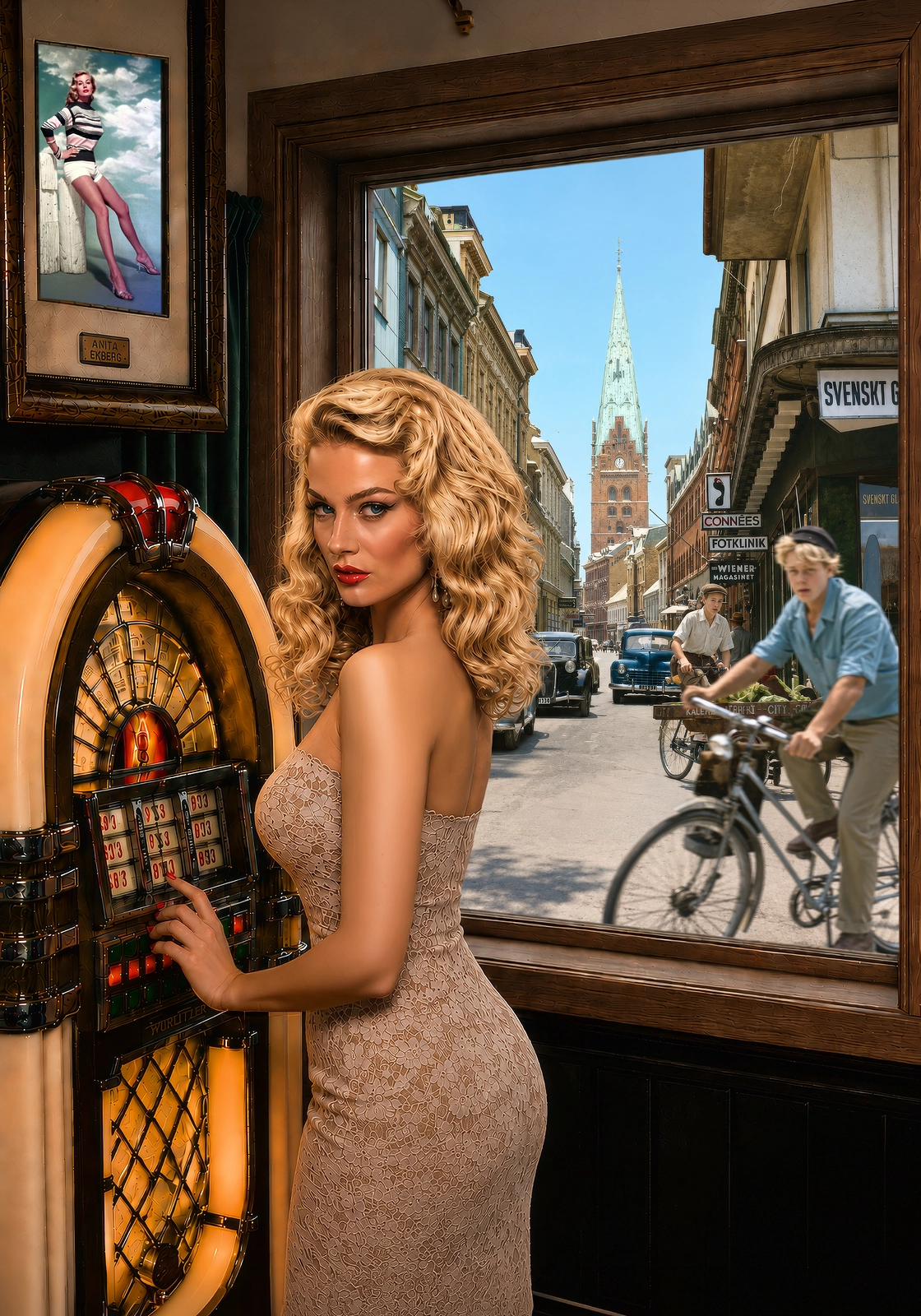
Jörgen Thornberg
Take the 'A' train, 2026
Digital
50 x 70 cm
3 200 kr
Take the 'A' train
Svensk text på slutet
To deepen your understanding of these themes, explore my reflections on traditions and societal critique through this link, which complements the essays exploration of pink skies.
https://www.konst.se/jorgen-thornberg
Welcome to La Dolce Vita (the Sweet Life) from the Inside In My Own Words
They called me a goddess. They photographed my curves, dubbed my voice, and conjured a myth in the darkness of cinemas. Yet no one ever managed to silence my own rhythm.
This is not another pale Hollywood biography or the journalists version of the truth. This is my story, told from my star in eternity, about what the music of the sweet life sounded like from within.
Join me on a breathtaking journey through the soundtrack of my life. From the shellac records and jukeboxes of Kalendegatan in Malmö to the smoky nightclubs of West Hollywood, where Frank Sinatra proposed to me at the table. Meet me in the feverish, decadent nights of Rome, where I chased paparazzi barefoot with a bow and arrow, and step aboard the luxury yachts of the Mediterranean alongside the greatest style icon of the postwar era and the great love of my life, Gianni Agnelli.
It is a world filled with roaring Maserati engines, ice-cold Negronis, secret agents, and the thunderous practical joke in which a stubborn Swedish girl outwitted Italys most powerful industrial magnate with a reef knot glued with rubber.
Step aboard the Anita Train before it departs the platform. Pour yourself a glass of champagne, put on your red lipstick, and prepare for a soundtrack that will play for eternity.
Read the exclusive chapters belowfor a true star never fades.
Take the "Anita" Train
You must take the "Anita" train
If you want to reach Hollywood and fame
If you miss the "Anita" train
You'll find you've missed the fastest road to fame
Hurry, get on, now it's leaving.
Hear the cameras click and gleaming.
All aboard, get on the "Anita" train
Soon you'll see the lights of Hollywood's domain
From Malmö's streets to Cinecittà
Where the movie stars all shine
Past the fountains, flashbulbs sparkling
On a silver screen divine
You must take the "Anita" train
Ride it westward through a dreamer's land
All aboard, get on the "Anita" train
Soon you'll walk where all the legends stand
Malmö, June 2026
PROLOGUE: The Jukebox on Kalendegatan
You can leave the Earth, but you never leave Malmö behind. It remains in your soul. From my star in eternity, I watch continents shift, and cities rise and fall, but now and then I set my feet down exactly where it all began. The journey is simple. I merely take the nearest wormhole winding its way through the Milky Way and emerging between what is now Malmö Opera and the old sports ground. On this nostalgic trip, I shall search for the music of my life, my soundtrack. I walk slowly through the city and end up in an old café on Kalendegatan. A café that disappeared long ago, yet still lives on in my memorythe kind of place scented with strong coffee, deliciously greasy Danish pastries, and cigarettes. Back then, it was almost suspicious not to smoke. In eternity, time ceases to exist, but on Earth it was 1949, and I became Miss Hipp that summer.
I am wearing my finest lace dress, and outside the window a couple of messenger boys cycle past, while traffic, so soon after the war, is not particularly hectic. Petrol is still scarce, and some people are still driving with gas generators attached to their vehicles. I am eighteen and have just been crowned Miss Hipp at the Hippodrome, only a stones throw from the café. The whole city seems to know who I am, but nobody knows where I am going. But I do, because I have a dream, and the moment the train departs, I am jumping aboard.
Outside the window, the slow rhythm of the post-war years drifts by, a pace I hope never to be trapped in. One of the messenger boys, wearing a grey-blue shirt, turns his head and stares at me as though he knows me, but I do not know him. Then again, as we say in Sweden, everybody knows the monkey, but the monkey knows no one.
I press button 46 on the jukebox. The mechanism rattles into life, the heavy arm lifts the shellac record, and the little café fills with the sound of Duke Ellingtons orchestra. The chattering trumpet and the irresistible swing of the rhythm drill their way through the smoke hanging in the room.
The spire of Saint Peters Church points towards the summer sky, and the clock on the tower shows twelve. No doubt the bells are striking their twelve chimes, but I do not hear them, because in the café Duke is playing my favourite melody, Take the A Train, a song that is really about me. Take the Anita Train.
During my lifetime, journalists asked what I listened to in my bedroom on Östra Fäladsgatan, or whether I cared about music at all before the world discovered me. But the song that carried my secret dreams was about a train racing at express speed towards something immense, still hidden behind a thick curtain of mist. It shimmered and sparkled, and I could see shadowy figures dancing, but I could not hear what they were dancing to.
In our living room stood a radiogram, and whenever my father was out, I could play some of my 78-rpm jazz records. That early autumn, I owned ten shellac discs and bought more whenever payday came around. After Miss Hipp, I was already busy with modelling jobs and travelled around Scania as a fashion model. I earned enough to contribute to the household, even though my father protested, as it wounded his pride as the familys sole breadwinner.
I have said it before, and I will say it again: when the train finally arrives, you do not linger on the platform. You must never hesitate. The platform is safe, but it is also where dreams go to die. When my train arrived, I boarded without looking back. I took the fastest line jazz and big-band music could offer, straight out into the world. That is the journey I want to tell you about, if anyone still cares to listen.
Beside a Wurlitzer jukebox on a street that hardly remembers me, my soundtrack began. Let me tell you about the music, about my own voice that nobody ever managed to silence, and about what the sweet life sounded like from the inside.
CHAPTER 1 The Post Office Savings Bank and the Dance Floor of Social Mobility
Autumn came, and winter followed, and Malmö turned grey as people put on their winter clothes. But beneath the surface, my life had already taken a different turn. There were photographs, fittings, fashion shows and modelling jobs all over Scania. The money almost poured in. I often earned more than my father, but I never mentioned it at home. Instead, I quietly deposited my earnings into my Post Office savings account. Waving banknotes in front of a father who worked hard to support his family was unthinkableit would have threatened his pride and his role as the sole breadwinner. I paid my share at home, and after much grumbling, he accepted it. Today's generations have no idea what that kind of male duty and working-class pride actually meant.
The money I saved was not for rainy days, but for the day when the time was right, and I could afford to travel into the world. That railway platform was not yet in sight, because I knew the journey ahead might carry me far beyond the reach of the Swedish railway network.
But an eighteen-year-old needs to breathe as well. Once a week, I went to Amiralen with my girlfriends to dance away the week's work beneath the coloured lanterns of Folkets Park. There, Harry Arnold and his orchestra reigned supreme, transforming the largest dance palace in the Nordic countries into a national centre of jazz. Dancing a slow dance to Quincy Jones's "The Midnight Sun Never Sets" was wonderful. Or a classic foxtrot to "Stand By This Is Harry," Harry's signature tune that always opened and closed his performances.
Sometimes we went to Moriskan, with its oriental domes and exotic mystique, where reasonably priced meals were served with light dance music. More often, my girlfriends and I went to the Arena Dance Palace, where the Crown Prince's Hussar Regiment had once stood. The old officers' mess had been converted into a dance restaurant. I loved it there and danced to the trumpet of Gösta Tönne, who led Arena's popular house orchestra and played swing jazz. Their performances were regularly broadcast live on national radio. I adored dancing swing whenever he played Stan Kenton's "Painted Rhythm." We youngsters turned the dance floor into a showcase of lindy hop and jive. I can assure you there were rapid spins, arm throws and pure acrobatics, complete with airborne leaps that matched the song's explosive brass section perfectly. You might say I was right in the thick of it, and my father worried. Sometimes I got a beating, because that was still considered acceptable in those days.
During the weeks when I had been especially busy with work, however, I did something entirely different. I treated my best girlfriend to dinner and dancing at Restaurant Kungsparken. Its dining room offered an elegant French-Swedish bourgeois menu, served by waiters in tails. Naturally, I never mentioned that at home. One should never wake a sleeping bear, and Kungsparken was certainly not a place for the working class. It was a world of luxury and glamour, the perfect arena for someone like me who wanted to practise her social skills. Malmö's high society gathered there, and I could study how the well-to-do behaved. I refined my posture and learned to move through a room where chandeliers sparkled overhead. They played soft swing, a gentler version of the day's popular jazz. The tempo was slow and steady, tailor-made for elegant foxtrots and English waltzes. The latter was the ultimate dance for lovers, quite unlike the traditional Viennese waltz that whirls along at a furious pace. Can you guess how often the wealthy merchants asked me to dance? I also found interesting modelling assignments there, as the fashion directors frequented Kungsparken.
CHAPTER 2 When the Train Pulled into the City Theatre
If winter in Malmö had been a long, grey-blue wait at a pace I refused to be trapped in, then the summer of 1950 was its complete opposite. It was as if the entire city had suddenly been seized by feverish anticipation. There was something in the air that even the heavy Scanian summer heat could not suppress. The two-hundred-year-old fog in my mind, the one that had hidden my deepest future dreams throughout my childhood on Östra Fäladsgatan, finally began to lift. The shadowy figures I had seen dancing in my dreams suddenly acquired faces and sharp outlines. And they were no longer dancing to crackling 78-rpm records in our living room when Father was awaythey were dancing to real, living jazz.
On 2 June 1950, the atmosphere in Malmö changed. It was the day Duke Ellington and his orchestra rolled into town. Their Swedish tour was to begin in Malmö, and the evening newspaper had trumpeted the event for weeks. I remember standing amid the enormous crowd outside Malmö City Theatre. It was a magnificent modern building, but that evening the auditorium was gripped by an intense heat wave. There was no modern air conditioning, and the air inside was so thick and motionless it could almost be cut with a knife. Perhaps that was why the theatre was barely half full, as many people preferred the parks, where they could cool off. For me, that was never an option. I wore my finest clothes, a light chiffon dress that perhaps revealed a little too much. My Miss Hipp posture certainly helped, and people looked more at me than at the stage as I sat somewhere in the middle of a sea of empty seats. I was ready to absorb every second.
When Duke Ellington sat down at the piano and the orchestra began to play, everyone forgot the sweat dripping down their backs.
And they forgot to stare at me.
It became a musical triumph beyond compare. One of the evening's greatest successes was "Air Conditioned Jungle." It was a technically advanced original composition, a spectacular and sophisticated duet for clarinet and double bass that sliced through the room. Ironically, it suited the tropical heat perfectly; the music itself seemed to provide a cooling breeze.
When the muted brass section began "Mood Indigo," a timeless melancholy spread across the theatre. They wove "Sophisticated Lady" and "Solitude" into a lyrical medley that revealed the orchestra's very soul before launching into Caroline, making the audience sway in their seats to the rhythm of "It Don't Mean a Thing (If It Ain't Got That Swing)." If the theatre had been hot before, it was nothing compared with now.
But there was another song I was waiting for.
The orchestra's unmistakable signature tune.
When the opening notes of "Take the 'A' Train" flowed from the stage, I felt the trumpets tear holes in the dense air. Strangely enough, it felt cooling. It was my favourite song from the jukebox on Kalendegatan, but hearing the American masters perform it live was like receiving one final, trembling signal directly to my heart.
Storytellers and old jazz cats in Malmö have spent decades spreading a charming myth that Duke spotted me in the audience, invited me on stage, and dedicated the song to me as "Take the Anita Train." It is a beautiful lie, but the truth is even greater. I did not need to stand on stage. I let the music speak directly to my secret dreams. In my head, the song was already mine. Then, amid the thunderous swing, I silently composed the lines that became my personal compass:
"You must take the 'Anita' train
If you want to reach Hollywood and fame
If you miss the 'Anita' train
You'll find you've missed the fastest road to fame."
Much later, after I had left the Earth and met Duke at a concert among the stars, he told me the true story behind the song. It turned out to contain the same kind of magic as my own life. It had been written in 1939 by Billy Strayhorn, a twenty-three-year-old pianist. Incidentally, he was in Malmö as well.
Duke had met him in Pittsburgh and offered him a job, but he had not written down a formal set of directions to his Harlem home. Instead, Duke had quickly scribbled a few simple subway instructions on a paper napkin. They began with the words: "Take the A train"because the newly opened line was by far the fastest route through New York City.
The most remarkable thing is that the song almost never came into existence. When Strayhorn arrived in New York, he threw away his first draft because it sounded too much like another composer's work. Duke's son, Mercer Ellington, later found the discarded sheets in a wastebasket and realised what genius was hidden in the rejected material.
What a dizzying thought.
Jazz's greatest masterpiece, the melody that carried my dreams from Malmö to Hollywood, began as directions scribbled on a napkin and was rescued from a rubbish bin. It was exactly like my own life. I was the girl from Östra Fäladsgatan, carrying a secret blueprint. When the Duke Ellington trumpeter blew the final notes into the Malmö night, I knew my time in the wastebasket was over. My fog had lifted. My own train stood on the track, ready to accelerate, and I certainly had no intention of remaining on the platform.
Another summer and a gloomy autumn passed with modelling jobs and a great deal of dancing. Then winter came again, but whenever my girlfriends and I stepped through the doors of Amiralen, we left the raw, icy Scanian winter outside. Inside, the warmth changed everything; we entered another world where big-band jazz set the blood racing and the great misted windows facing Folkets Park testified to the intensity on the dance floor. After winning Miss Hipp, I was no longer anonymous there, and on the parquet floor I was entirely in my element. Orchestra after orchestra took the stage. We danced to the heavy, elegant swing of Glenn Miller's classic arrangements, the fiery trumpet blasts of Harry James's repertoire, and, of course, to Thore Ehrling's orchestra whenever Alice Babs stepped to the microphone and set the entire hall boiling with her scat singing.
The dance floor was a sea of colour and motion. These were the final glorious years of the Swing Era, and the fast jitterbug dominated the winter evenings. The boys hurled us, girls, through breathtaking spins; skirts flew, and shoe soles skidded across the smooth, waxed parquet. Personally, I preferred it when the tempo eased into a suggestive foxtrot or an elegant slow waltz. Then my height and posture truly came into their own. I moved with long, gliding steps, close to my partner yet always fully in control, as though I were already moving across a far larger stage than the dance floors of Malmö. We sweated, laughed, and let big-band jazz thaw us right down to the marrowit was a pace and an energy perfectly suited to my dreams.
"Hurry, get on, now it's leaving
Hear the cameras click and gleaming
All aboard, get on the 'Anita' train
Soon you'll see the lights of Hollywood's domain."
CHAPTER 3: The Ticket and the Platform (1951)
Spring arrived with lily of the valley, bird cherry, and lilac blossoms, and the trees lining Malmö's canals had time to leaf out and shed their leaves once again. From my star, I watched the parks glow in shades of red and gold throughout the autumn before another dark, cold, and lengthy winter passed, with thick snow and ice covering the city's canals and ponds. But for me, there was no winter break. Quite the opposite. It was peak season for me as a mannequin and model, and my visits to the Post Office Savings Bank became regular. The dancing continued exactly as before, and by then I had bought more than a hundred shellac records for my room. My radiogram played constantly, with what I loved most: big-band jazz, swing, and the new, provocative bebop.
Then spring finally burst forth once again, and the willow trees hung heavy and green over the canals. On 29 June 1951, the train finally pulled into the station. The locomotive driver of my future was Rune Ernestad. He was a journalist and talent scout for Vecko-Revyn magazine and had spotted me on Södergatan. He turned around, walked up to me, and offered me a ticket on the Miss Malmö trainthe direct route to the Miss Sweden competition in Stockholm that August. He wanted an answer that very evening!
The platform trembled beneath my feet. I knew that if I stepped aboard, there would be no turning back. Win or disappear, I thought dramatically. It felt as though I were living on borrowed glory; the title of Miss Hipp had carried me this far, but travelling around the Scanian countryside as a fashion model had no future. If I won Miss Malmö and reached Stockholm, at least the entire Swedish railway network would lie open before me. If I lost, there would be Eslöv and Teckomatorp, and, in time, a place behind the counter at the local Co-op store.
But I was not someone who rushed into things. Before I accepted and boarded Vecko-Revyn's train, I went straight home to speak to my mother. Ernestad looked rather surprised when I played hard to get. He was considerably happier when I called his hotel a few hours later to say yes.
Father drove Mother and me to Folkets Park without knowing why we were going there. There were ten girls on the stage. I was number eight. We wore tight white sweaters, black shorts and medium heels. They were pleasant girls, but I immediately judged that half of them had no chance at allbecause, of course, I knew what a beautiful girl looked like. As soon as I had walked back and forth across the stage, I understood from the audience's reaction that I was going to win. I did win. The crowd cheered, and I received a magnificent bouquet, which I brought home to Mother.
During the holiday month of July, I had no free time. As the newly crowned Miss Malmö, I was expected to take part in every imaginable charity event. But in the evenings I was generally free. As free as one can be when everyone in the city knows who you are and all the boys want to dance with you and put their arms around you.
The summer of 1951 was a boiling-hot jazz summer. On the warmest evenings, the large glass walls of Amiralen, facing Folkets Park, were removed so the music poured out into the summer night. It was almost a relief when the time finally came for the Miss Sweden final in Stockholm on Friday, 24 August. A stage had been erected in the middle of Humlegården, and we were to parade before and be examined by an enormous audience. Thousands of staring eyes made my head spin, but it was excellent training. I came across as remarkably wholesome when I told the judges that I designed and sewed my own clothes. And they loved it! In reality, it had been a long time since I had sewn anything myself, because once I started modelling there always seemed to be clothes left over, so to speak, and my wardrobe had grown considerably over the previous years. In Humlegården, the newspapers wrote that I swept the floor with my competitors. I won.
The train would continue rolling forward, but now I had to change my means of transport. The next destination lay nine hours away by air. I was going all the way to the United States, and on the last day of August I departed for a packed schedule. I did not win Miss Universe, which troubled me very little, as it would only have meant a year of poorly paid obligations. Instead, I could devote myself entirely to the many modelling offers I had received, for fees that seemed staggering by Swedish standards.
Everyone wanted to photograph me, and my pictures spread across the world. I often say that if I had received a krona or two for every photograph, I would have been richer than the Sultan of Brunei. Instead, I received publicity, which laid the foundation for my successful life.
After a month in America, I returned home just in time to celebrate my twentieth birthday on Östra Fäladsgatan. That autumn, I even became engaged to Carl Langenskiöld. But my sights were set firmly on the West, while he was destined to take over his family's private bank in Sweden. Faced with the prospect of the Atlantic Ocean separating us, we broke off the engagementmy second broken engagement in a single year. Becoming somebody's housewife was not my ambition.
I still do not know what got into me during that period, with all those handsome young men whose arms I fell intoor who fell into mine. Three engagements altogether. Elegant cars belonging to wealthy fathers, enormous villas, and even an eighteen-metre wooden yacht.
Looking back, I must admit I became something of a travelling trophy for boys from distinguished families, wealthy landowners, counts and barons. Life was a catwalk with only me on the runway.
Gentlemen. Men of honour. Cavaliers. Unfortunately, there were one or two less pleasant examples as well. At a private party, I was raped by a man I had rather likedwith the emphasis on had. It is the worst thing that can happen to a young woman and an unforgivable act. Although I quickly put the incident behind me, it remains an experience I remember as clearly as if it were yesterday.
I have always liked sex because it proves I am attractive. That matters to a woman. But it is equally clear that the woman sets the boundaries. No means no. Men are wonderful creatures, but each one ought to come with an instruction manual.
Even the legendary classical composer Sten Broman paid court to me, but I preferred jazz to his compositions. We have remained in touch throughout eternity, and he is still as entertaining as ever.
Not even history allowed me any peace. In later years, many famous men claimed they had been involved with me, that we had lived together, or even that we had been engaged. If all those alleged romances were true, there would not have been enough days in the calendar. And I would have ended up with bedsores, Anita laughed. If one wishes to be charitable, one can blame it on dementia, although people suffering from it usually subtract details rather than add them.
CHAPTER 4 The Eyes of the Big Boys
Once the Atlantic lay between me and the country estates of Scania, there was no turning back. I had traded the familiar crackle of my hundred shellac records on Östra Fäladsgatan for the monotonous roar of aircraft engines carrying me westward. It was a journey that crossed not only geographical borders but also time and space itself. I stepped off the aeroplane and straight into an American dream, so filled with neon lights, flashing cameras and pulsating rhythms that it left a young girl from Malmö dizzy.
It was not long before the locomotive of my American career appeared in the form of one of the world's most eccentric and influential men, Howard Hughes, the aviation billionaire and movie mogul who had spotted me at the Miss Universe competition in Long Beach. He was always on the lookout for new beauties for the silver screen, and when he saw me, he felt no need for screen tests. At first, he did not come himself but sent his right-hand man, Walter Kane. The idiot arrived two hours late for our meeting, so I told him to go to hell. In broad Scanian, no less. He did not understand the words, but he understood the message.
The next time Hughes appeared in person, he immediately offered me a seven-year contract with his studio, RKO Pictures. At first, the contract seemed dazzling. I did not even need to know English, because Hughes felt that my appearance and the way I moved already told an audience everything they needed to know. But Howard Hughes was a complicated creatureeccentric and almost entirely devoid of humour. He was accustomed to owning everything and wanted to control me as he controlled his companies and his aircraft. He wanted to shape me, lock me in a golden cage, and dictate my every step, just as the well-bred Swedish boys back home in Scania had wanted to do. But neither luxury cars nor enormous villas bent my will then. I accepted Hughes's money and seized the opportunity to study drama and diction at his film school, but I refused to be tamed. I was no dumb blonde he could place in a trophy cabinet.
Hughes wanted to alter my nose and teeth and even change my name. "Ekberg" was far too difficult for Americans to pronounce; it sounded too harsh and foreign, so I ought to adopt a more streamlined Hollywood name.
"Listen, Howard," I said, looking him straight in the eye. "If I become famous, people will learn to pronounce my name. If I don't, it won't matter."
That settled it.
My name was mine, just as my nose was mine, and no billionaire in the world was going to erase the girl from Malmö. I adjusted my teeth slightlya few weeks in braces was enoughbut they remained my own.
Looking back from my star upon Hollywood's dream factory, I realise how rotten the system was beneath all the glamour. It was not only foreign girls who were expected to abandon their origins to fit the studios' mould. The dream factory reinvented most aspiring stars, whether they came from Scania or Texas. Names routinely failed auditions. Norma Jeane Mortenson became Marilyn Monroe, and Archibald Leach obediently transformed himself into Cary Grant. Even the men and women around Frank Sinatra told similar stories once I got to know them.
My dear Frank had at least been allowed to keep his Italian-American surname, but the studios shortened his elegant Francis Albert to the punchier Frank Sinatra. His best friend, Dean Martin, had actually been born Dino Paul Crocetti, though he hardly cared, as everyone called him Dino anyway. Dino, with his lazy charm and effortless style, became another constant presence in those early years. Life was a catwalk, and the Malmö stage had now become global.
Incidentally, Dino once sued the creators of the animated television series The Flintstones because they had named their little dinosaur Dino. At first, the creature spoke with an Italian accent, but after a settlement, they were allowed to keep the name, provided Dino barked like a dog instead. And so it was.
At our table, there was sometimes the wonderful yet deeply tragic Judy Garland, who became a close friend of mine. Judy was one of Frank's dearest friends, yet even she had not been allowed to remain herself. The world adored her as Judy Garland, but she had been born Frances Ethel Gumm. Most stars had allowed themselves to be reshaped and renamed in exchange for fame. But I was proud of my Scanian nose, my Malmö teeth and my surname. I refused to let Howard Hughes rebuild me into a mute, nameless doll. That is why I worked furiously to learn Englishso furiously that I accidentally spoke English when I returned to Sweden. For the rest of my life, people reminded me that I had apparently forgotten my native tongue after only a few months.
Nobody tried to remake Sammy Davis Jr.
"It would have been pointless," Sammy once told me. "The odds were stacked against me anyway. I was Black, one-eyed and Jewish, so changing my name wouldn't have helped." He laughed. "The only reason I made it was probably that people got used to me. I wore the audience out. I started in vaudeville at four, so eventually they let me stay."
Sammy was extraordinary. During one dinner, with me seated at his table, he suddenly leapt to his feet and launched into his signature number. "The Birth of the Blues" begins as a jazzy ballad but explodes halfway through into a furious big-band tempo, designed to showcase Sammy's famous machine-gun-fast tap-dancing solos. He had arranged everything with the orchestra beforehand. It was all for me, he said.
With Frank, Dean and Sammy's Rat Pack, I plunged headfirst into the pulsing nightlife of West Hollywood. These were the glory days of the 1950s, and the soundtrack of my new life shifted from the radiogram to the legendary nightclubs along the Sunset Stripplaces like Mocambo, Ciro's and The Crescendo. There, amid palm trees, cigarette smoke and ice-cold cocktails, an entirely new musical world came alive for me. It was the era of Afro-Cuban mambo, sophisticated exotica and a cool, restrained jazz that felt worlds away from the cheerful swing dances at Amiralen. And it was there, beneath the subdued glow of nightclub spotlights, that I spent my nights with the boys who owned the town. Frank, Dean and Sammy.
Hearing Frank Sinatra sing "Young at Heart" live, only a few metres from my table, was enough to make my heart somersault in my chest. Back in Malmö, his voice on a 78-rpm record had seemed distant and magical, but here he was flesh and blood, with eyes that could melt ice and phrasing that bordered on perfection.
We connected immediately. Frank and I shared a passion for nightlife, for music that must never fall silent, and for freedom. He saw me for who I truly wasa woman who refused to apologise for her existence or her beauty. During our nights in Hollywood and Las Vegas, jazz and his ballads often provided the soundtrack to a life lived fast and without safety nets. He claimed he had dedicated "Young at Heart" to me and that it expressed exactly how he felt in my presence.
Fairy tales can come true, it can happen to you
If you're young at heart.
For it's hard, you will find, to be narrow of mind
If you're young at heart.
Frank was not merely a friend and a soulmate of the nightlifehe became completely intoxicated by my presence. It went so far that he actually proposed to me. He wanted to marry me, keep me by his side forever, and have children together. I said no.
Becoming Mrs Sinatra would have meant entering another golden cage.
I had not boarded the train in Malmö to become an accessory to an American entertainment tycoon.
Frank accepted my refusal like a gentleman, with that mixture of wounded pride and dignity that only he could show, and our friendship endured.
Life within that circle was never entirely uncomplicated, and before long a genuine jealousy drama erupted, shaking the Rat Pack to its core. Sammy Davis Jr. was deeply in love with me as well. He was a magnificent performer, overflowing with musical genius and energy. We spent a great deal of time together. But in 1950s Hollywood, racial prejudice remained brutal, and the sight of a Black man openly spending time with a blonde white Miss Sweden was explosive.
Frank, the unquestioned leader of the group and fiercely protective by nature, became furiously jealous. Sparks flew between him and Sammy in the nightclubs. Their arguments were as much about wounded masculinity as about possessiveness, while I stood in the middle, observing the spectacle.
Men are wonderful creatures, as I often say, but when their egos collide over a woman who refuses to be owned, nightclub jazz can turn into a very loud and very dangerous drama.
I let them keep their jealousyit was, after all, a confirmation of my attractivenessbut I set the boundaries.
None of them owned me.
When I look back from my star in eternity, I cannot help but smile at Sammy. He seemed to have developed a taste for Swedish blondes after our nights together in Hollywood. When he realised he would never have me, only a few years passed before he found another independent girl from the Scandinavian north. In 1959, he met May Britt in a Los Angeles nightclub. The following year, they married in a ceremony that shocked segregated America. There were no other blondes on his matrimonial calendar in the meantime, only a brief, forced marriage of convenience to a Black singer, intended to calm nervous studio executives after another romance with a white woman. But it was Scandinavian glamour he sought. Like me, May Britt challenged the spirit of the age, even converting to Judaism for his sake. Together, they had three children. Sammy eventually found his Scandinavian goddess, even if she was not the girl from Östra Fäladsgatan.
Hollywood also presented a strange paradox about my own voice. I began receiving roles in Hughes's films and soon appeared alongside giants such as John Wayne and in comedies with Dean Martin and Jerry Lewis, including Artists and Models. Yet the dream factory operated by an unwritten law for foreign beauties: we could be seen, but our voices were to be softened or hidden. My speaking voice was deep, rich and distinctive. Still, in musical and dance numbers, the studios often used professional "ghost singers" who dubbed my lip movements so that everything sounded as streamlined as American audiences expected. When I performed my sensual dance in Zarak, it was my body, my rhythm and my hypnotic presence that captivated audiences, while the melody itself was sung by a ghost somewhere in the background. The music was as far removed from jazz as imaginable: traditional Middle Eastern dance music, accompanying my character, Salma, as she performed an erotic, provocative belly dance in a glittering two-piece costume. The dance and music were considered so daring and "spicy" for their time that British censors forced the producers to cut the sequence substantially before release. My stock in the film industry rose considerably after those headlines.
Hughes believed he could use me as a silent muse, a beautiful screen onto which he could project his fantasies.
But he underestimated the girl from Malmö.
His Hollywood school, where my voice was hidden behind ghost singers, became little more than preparation. Deep down, I always knew my own voice could not remain concealed forever. I absorbed everythingthe American swing, Sinatra's confidence, the freedom of the nightclubsand packed it away in my mental luggage.
One day I would return to safe, moral Sweden, and when I did, I certainly had no intention of merely mouthing somebody else's melody.
I would sing for myself, in my own voice, and make the Swedish establishment choke on its coffee.
Well, it did not quite turn out that way.
CHAPTER 5 Soundtrack in Rubato Tempo
When you look back on your life on Earth from this side of eternity, it is remarkable how vividly certain impressions endure. For me, it is not only the images, the spotlights or the dresses. It is the sounds and the music. Hollywood always believed it owned my voice. They gave me a seven-year contract, locked me into the role of the cool Nordic ice goddess, and whenever a director demanded that my character sing, they placed a pale, anonymous ghost singer in a studio to dub my lip movements. They silenced my voice, but they never understood that music still controlled me. My body dictated the tempo, not their ridiculous scripts. It was my rhythm that brought me to life, and through music I reclaimed the power to shape how the world saw me.
It all really began in 1953. I was new to Hollywood, hungry for a career but tied to Universal on a fixed salarynot a large one, but a secure one. They gave me lessons in drama, horseback riding and even fencing. My first official film role was in the comedy "Abbott and Costello Go to Mars." The irony was that the fools in the film never even reached Mars; they navigated incorrectly and landed on Venus instead. The studio released a soundtrack that was a curious mixture of period big-band jazz and cheap futuristic sound effects. I played a guard on the planet Venus, dressed in a minimal costume, and the idiots fell over themselves the moment they saw me. I did not need to say a single word because Venusians communicated through sign language. I was purely a visual apparition, but I remember using the heavy big-band jazz to learn how to move in front of a camera. I absorbed everything. That same year, I was cast in smaller, uncredited roles in "The Mississippi Gambler," "Take Me to Town," and "The Golden Blade." The music in those productions was little more than generic studio fareclassical strings and predictable melodies intended to remain anonymous in the background. Hollywood would not let me take a single dance step; they merely wanted me to fill the screen with my body. But I listened carefully and learned the rhythm of how a film set worked. Beyond that, not much happened, except that I kept learning more and more English.
The big breakthrough came in 1955 with the adventure film "Blood Alley." There I acted opposite none other than John Wayne, but the film meant far more to me than simply appearing alongside one of Hollywood's giants. It became my salvation. Before that, my career had been in danger of ending before it had even begun. My time at Universal had become a dead end. They paid me a weekly salary of 250 dollars, but mostly used me as a decorative trophy at premieres or forced me to pose in bikinis for magazine covers. They had no idea what to do with a Swedish girl with generous curves who could not keep quiet. I could feel myself fading away in their studio school, becoming a forgotten glamour doll.
John Wayne's independent production company, Batjac Productions, had noticed me. Wayne and his business partner, Robert Fellows, were seeking new, slightly unconventional talent that the rigid formulas of the major studios had not shaped. When they saw my screen tests and press photographs, they did not hesitate. They bought out part of my Universal contract and took over my career. Batjac gave me the respect and professional protection I so desperately needed.
John Wayneor "Duke," as we called himwas a very different sort of person from the slimy studio executives at Paramount or Fox. He did not greet me with the hungry looks I had grown so tired of; he regarded me with a fatherly, almost protective respect. Duke quickly realised that beneath that blonde Hollywood hair lay a raw Scandinavian stubbornness that reminded him of his own ideals.
He told me in his deep, drawling voice: "Anita, don't let them turn you into just another. You're a force of nature. Make them adapt to you."
Batjac shielded me from Hollywood's most corrupt aspects. They ensured I received proper acting lessons and promoted me as an international personality rather than a standard pin-up girl. Being taken under their wing gave me a new status in town. Suddenly I was no longer Universal's property; I was under the personal protection of The Duke himself, and every wolf in Hollywood stepped back.
It was Batjac that cast me in "Blood Alley," and they spared no expense. The studio hired Roy Webb to compose a powerful, classical and dramatic symphonic score with clear Asian influences, as the story centred on a dangerous escape from Communist China. There was no room for light-hearted singing or sensual dancing in the rugged screenplay, but the grand orchestral music gave my charactera tormented yet strong-willed womana new sense of tragic weight. It was a magnificent musical setting that matched my on-screen presence. During filming in San Rafael, California, which stood in for the Chinese coast, Duke was always there to support me. When I struggled with English diction in the most dramatic scenes, he would stop filming, take me aside and say:
"Don't speak in their words, Anita. Speak with your eyes. That's where your strength lies."
Thanks to John Wayne's personal faith in me and Batjac's determination to give me a chance, the industry finally began to take me seriously as a genuine actress. That film and Batjac's powerful marketing machine directly paved the way for my Golden Globe award the following year. You gave me my career back, and without Batjac I would probably have packed my bags and returned to Malmö long before Rome was ever mentioned.
That same year, my life exploded with colour and swing in "Artists and Models." It was a cheerful Hollywood comedy in which I appeared opposite Dean Martin and Jerry Lewis. The music was the very definition of glossy 1950s pop and big-band jazz, filled with romantic hits. Dino sang "Innamorata" in his incomparable velvet crooner voice, causing half the women in the cinemas to swoon. I was not allowed to sing this time eitherthe studio used its usual dubbing techniquesbut I received my first major dance number. I played The Bat Lady and performed a stylised, theatrical, almost hypnotic dance in a tight black costume. As I moved to the pulsating jazz, I felt for the first time that I owned the room in Hollywood. My body and my rhythm were my contribution, and the studio practically boiled during filming.
This success earned me a Golden Globe in early February 1956 as the industry's Most Promising Newcomer for my performance in "Blood Alley," and suddenly everyone was talking about me. After this major success, in May 1956, I married the British actor Anthony Steela man whose appearance was that of a classic matinée idol, but whose inner life was damaged by jealousy and alcohol. Our marriage quickly became a public roller coaster, a series of dramatic scenes played out in Hollywood nightclubs before an audience. Anthony could not tolerate the attention I received, let alone the men who surrounded me.
The most talked-about affair of the period was my intense, complicated relationship with Sammy Davis Jr. He was deeply in love with me and made no attempt to hide it. This led to a monumental jealousy drama one evening at an exclusive Los Angeles club, where Frank Sinatra was also present. Frank, who was like an older brother and protector to Sammy, pulled me aside into a corner as the music thundered in the background. He fixed me with a hard stare and growled that I should stay away from Sammynot because he begrudged his friend happiness, but because he was terrified of what racist America in the 1950s would do to Sammy's career if it became known that he was seeing a white Hollywood star. Sammy was devastated, and I realised how much politics and fear controlled the entertainment industry. Much later, when Sammy married the Swedish actress May Britt in 1960, I could not help but smile to myself. He had searched for the same Scandinavian radiance he had lost when Frank put an end to us.
Amid all this emotional and personal chaos, I played an important role in the 1956 historical epic "War and Peace". It was a colossal Hollywood-Italian co-production, with a soundtrack composed by the brilliant Nino Rota. The music was classical, symphonic and deeply romantic, composed to reflect the grandeur of Imperial Russia. In the lavish ballroom scenes, I danced a classical waltz with Henry Fonda while wearing a magnificent period gown. It was splendid indeed.
It took weeks of rehearsal to perfect the steps to Rota's flowing strings. Behind the scenes, however, a very different drama was unfolding. Once filming was complete, the producers realised the film had become monstrously long. Even after brutal editing, the final version ran an astonishing three hours and twenty-eight minutes. Something had to be cut. Those with full insight into the production knew that my performance as the seductive but scheming Hélène Kuragina had been exceptionally strong. But Hollywood logic is merciless. Paramount had paid Audrey Hepburn a record-breaking salary to play Natasha, and there was no possibility of removing a single second from the studio's golden calf.
Instead, it was my role that was sacrificed.
My scenes were cut down to a fraction of what had originally been planned.
It was a hard blow, but the film nevertheless proved crucial to my future. Despite my role being reduced to a minimum, it was precisely those remaining ballroom scenes that caught the attention of Federico Fellini in a Roman cinema. He later told me that my grace while dancing to the classical waltz to Rota's music gave him physical chills and planted the first seed of what was to come.
After the historical seriousness, I returned to comedy that same year in "Hollywood or Bust," my second film with Dean Martin and Jerry Lewis. The music once again featured light popular songs and easy swing, tailor-made for Dino's relaxed singing style. I neither sang nor danced in the film; my task was to play myselfthe ultimate unattainable dream girlwho drove Dean and Jerry to lose their minds in a series of comic escapades. It was fun, but it also felt as though I were standing still. Hollywood wanted only my surface.
That same year, I tested my wings in the thriller genre with "Back from Eternity" and "Man in the Vault." The music was dark, heavy and traditionally dramatic, designed to build an atmosphere of threat and mystery. There were no glittering production numbers, no songs and no elegant dance steps. Instead, I had to rely entirely on my acting and my ability to communicate fear and tension solely through my eyes and presence.
It was, however, the British-produced epic "Zarak," also from 1956, that truly shattered every moral barrier. The soundtrack, composed by William Alwyn, was a suggestive and hypnotic blend of traditional Middle Eastern folk music and pure oriental belly-dance music, dominated by intense percussion and winding flutes. It was here that I performed my famous erotic belly dance on film. I wore a glittering two-piece costume that concealed almost nothing. I was not really singingthe lip movements were, as usual, dubbed afterwards by a ghost singerbut my body and hips moved with such untamed sensuality to the rhythm of the drums that British film censors panicked. They forced the producers to cut the sequence drastically before the film was released, or it would not be shown at all. It was the first time I realised the explosive power contained in my combination of movement and music.
In 1957, I appeared in the British crime film "Interpol" opposite Victor Mature. The music was a classical, dramatic orchestral score suited to a thriller about international drug smuggling. I played a sophisticated but cold woman, and the role required neither singing nor dancing, only pure, elegant mystery. The following year, 1958, I returned to the smoky, dangerous world of music in the thriller "Screaming Mimi." The soundtrack was filled with cool, dark, and suggestive nightclub jazz. I portrayed a nightclub dancer who survived a brutal assault, and I performed a highly discussed and daring burlesque dance on stage to an intense jazz drum solo. It was one of my most complex and challenging roles in America, where the music catalysed the character's inner trauma. That same year, I made "Paris Holiday" with Bob Hope, a light-hearted comedy featuring catchy popular music, in which I served as a decorative and comic presence without any musical performances of my own.
By this point, I was thoroughly tired of Hollywood's superficiality, the studio bosses' obsession with control, and my marriage to Anthony, which was rapidly falling apart. Europe was calling in earnest, and I shifted my focus to Rome, which, in the late 1950s, was experiencing an extraordinary golden age and was known as Hollywood on the Tiber. My first major Italian production was "Sign of the Gladiator" in 1959. The music was grand, classical peplumsword-and-sandal film musicfilled with dramatic trumpets, heavy brass and majestic Roman marches. I played the proud Queen Zenobia of Palmyra, dressed in heavy royal gold garments, a surprisingly modest role by my standards. There was no room for carefree dancing or singing, but the magnificent musical backdrop suited my new European status perfectly.
During this intense period in Rome, my life and career culminated in one of the most famous scandals in film history.
It was November 1958, and the city was boiling over with decadence, aristocracy and aggressive street photographersthe people who would soon be known as paparazzi. Countess Olghina di Robilant hosted a private birthday party at the Rugantino restaurant in the bohemian district of Trastevere. The place was packed to overflowing with actors, princes and artists. The air was thick with smoke, sweat and expensive champagne.
Jazz pumped from the speakers and my blood fizzed like champagne bubbles. I suddenly felt trapped at my table, bored by polite conversation. I kicked off my shoes. Barefoot, I grabbed a hand, stepped onto the floor, and launched into a wild, untamed cha-cha. I surrendered completely to the music. Before anyone knew what was happening, I had jumped onto one of the restaurant tables. Glasses rattled, champagne spilt across expensive tailored suits, and I lifted my dress high enough to reveal my garters in the dim light. The room froze in collective shock and fascination, while photographers' flashes lit the darkness like a chain of thunderstorms.
From the simple pop jazz on Venus to a singing giant billboard in Rome. Hollywood tried to silence my voice, but music always found a way to speak through my body.
That was how far the soundtrack of my life had carried me, and I do not regret a single note.
Nor do I intend to change a single note in what comes next.
CHAPTER 6 The Soundtrack of My Life From Giant Billboards to Scanian Kites
If the 1950s were a whirlwind of big-band jazz and Hollywood, the 1960s became the decade when I became immortal. The decade began magnificently with Federico Fellini's "La Dolce Vita," for which Nino Rota composed a brilliant soundtrack blending modern Italian jazz, cabaret-style circus music and intense rock and roll. In the famous nightclub scene, just before we headed to the Trevi Fountain, I kicked off my shoes to a furious, high-powered rock-jazz number. Nino's music was a stroke of genius, crafted to reflect the paradoxical blend of emptiness and glamour that defined high society. Yet when those wild, syncopated drums burst into life, I felt no emptiness at allI felt pure, uncontrolled joy. And when I stepped into the fountain, the soundtrack suddenly transformed into melancholy, almost sacred strings that seized the audience and made me immortal on screen. Rota understood that my physical presence required precisely those musical contrastsfrom the wild to the sublime.
My collaboration with Federico and Nino did not end there. Only two years later, in 1962, Fellini cast me in the anthology film "Boccaccio '70." In his segment, "The Temptation of Dr Antonio," I became a living giant billboard. For that role, Nino Rota composed the jingle "Bevete più latte" ("Drink More Milk"). It was a deliberately repetitive, catchy, and almost hypnotic Italian pop jingle. Musically, it was a brilliant piece of pop art; the nagging brass section and mechanical repetition were designed to drive a strict puritanical moralist completely insane. I moved my gigantic body in perfect time with that ironic melody and sang along to the advertising slogan, mocking the hypocrisy of the age. The song was glossy and artificial, but beneath the surface it possessed remarkable sharpness that perfectly matched Fellini's surreal vision. You can imagine how much I enjoyed it.
Rome had become my home, but Hollywood continued to pull at me. The following year, 1963, I found myself in the western comedy "4 for Texas", alongside Ursula Andress and my old friends Dean Martin and Frank Sinatra. James Van Heusen composed the soundtrack, with lyrics by Sammy Cahna classic Hollywood sound, rich in sweeping western themes and big-band arrangements. Standing on that set felt like walking straight into a smoky Las Vegas nightclub. Dean Martin's relaxed timing and Frank's patented rhythmic phrasing seemed embedded in every bar of the score. The music possessed that unmistakable broad American self-confidence that made you want to push back your hat and ride in time with the brass section.
That same year, I worked on the British adventure comedy "Call Me Bwana" with Bob Hope. The music was lighter and more commercial, filled with comic melodies and exotic touches tailored to Bob's comic adventures. It was rather formulaic, but it served perfectly well as a decorative backdrop to the fast-moving screenplay.
I continued to jump between genres. In 1965, I appeared in the Agatha Christie mystery "The Alphabet Murders," whose score was filled with tense, creeping strings and classic British suspense. I loved how the composer used sudden dissonant chords to heighten tension around the characters. In 1967, I appeared in Vittorio De Sica's star-studded anthology film "Woman Times Seven" alongside Shirley MacLaine. The soundtrack was an elegant European composition with floating melodies and sophisticated jazz influences, reflecting the liberated, modern spirit of the late 1960s.
It was in the middle of this intense decade, in September 1964, that I allowed myself to be persuaded into doing something I swore I would never do again.
The Swedish New Wave director Bo Widerberg was in the middle of a chaotic film shoot in Österlen. He suddenly decided the film needed international glamour and wrote a role specifically for me. I said no at first. Why should I leave Rome for the winds of Scania? But Bo flew down to Italy himself, charmed me, and eventually persuaded me to sign. As everyone who knows me will tell you, I have always found it difficult to resist male charm. I still suffer from that weakness. The project was then called "Love 64." Perhaps it was the title that fooled me.
The result was a culture clash of biblical proportions when I arrived in the small fishing village of Kåseberga. Widerberg was celebrated at home, but on set he was a disaster. He worked without a finished script and expected me, Anita Ekberg, to stand in the Scanian wind and improvise dialogue. But the worst part was his bizarre visual concept for my character. Bo wanted to strip away every trace of glamour. He seriously expected me to play a simple country girl. He wanted braids in my hair and to force me into what I had called wooden peasant clogs as a child. I refused outright. I had refused as a child, too. The idea was absurd. I had not spent decades building my icon status in high heels only to wander around like a Scanian farmwife in wooden clogs before the entire world.
To make matters worse, bitter conflicts erupted over my salary and contract. Had he paid a few million, I might perhaps have braided my hair and sawn the heels off an old pair of shoes. Life was often a matter of price, at least for those of us whose bank accounts were not exactly overflowing.
The atmosphere in Kåseberga was not merely tenseit was stretched to breaking point, like a violin E-string wound so tightly it shrieked in an impossible key. There was no resonance left, only metallic pressure threatening to break the bridge and everyone's nerves. Rumour had it that Widerberg eventually resorted to tranquillisers to gather the courage to meet my gaze. As for me, I felt completely disrespected.
Eventually the final straw arrived.
I packed my thirteen suitcases in protest, turned my back on Kåseberga, and boarded the first flight back to Rome.
My role was eliminated. Widerberg added another year to the title, completed the film without me, and released it as "Love 65." That brief episode became the final nail in the coffin for my relationship with my homeland. Throughout my career, I never appeared in a Swedish feature film.
When I eventually watched the completed film, I could not deny that the soundtrack was a masterpiece of musical atmosphere. Widerberg used music in exactly the poetic, lyrical and melancholy way Swedish critics adored, especially in the famous scenes where the characters fly kites into the sky. He framed the film with the pure classical tones of Antonio Vivaldi's violin concerto "L'amoroso" and Frédéric Chopin's heavy, fateful Funeral March. To ground the film in the Swedish folk-home tradition, he used rustic elements such as "Gökvalsen" and a "Trollebo Schottische." But the finest piece in the entire film was jazz pianist Bill Evans's meditative composition "Peace Piece." Its sparse piano chords created a sense of space and melancholy that cut straight through the screen, complemented by contemporary 1960s pop such as Harry Arnold's "Stay Spray" and Harold Geller's "Bar Twist." Musically, it was brilliantbut for me personally, Kåseberga remained a bitter reminder of why I had left Sweden.
When the 1970s arrived, I returned to the comforting embrace of Fellini in "The Clowns". The soundtrack was a brilliant explosion of traditional, noisy, and nostalgic circus music, with blaring trumpets and marching rhythms that celebrated clowning and the magic of childhood. But times changed, and the roles in Europe grew darker.
In 1978, I appeared in the deeply controversial Italian horror thriller "Images in a Convent," where I portrayed the mentally disturbed Sister Gertrude. The music was a dark, creeping, and deeply unsettling psychological landscape. The composer used shrill, distorted strings and painful synthetic dissonances to reinforce the character's inner trauma and the convent's claustrophobic atmosphere. There was no beauty in those notes, only naked terror. Fortunately for actors, the music was added afterwardsI doubt I could even have entered the studio had I heard it beforehand.
My final great magical moment with Federico came in 1987, in the autobiographical film "Intervista." It was a painful yet extraordinarily beautiful experience in which I reunited with Marcello Mastroianni on camera. This time, Nicola Piovani composed the score, creating a soundtrack drenched in nostalgia, longing and melancholy. It felt like an echo of Nino Rota's old themes, only softer. When Marcello and I sat in my living room watching old clips of ourselves at the Trevi Fountain, Piovani's melancholic piano drifted through the background. The music sounded like running water and lost time. It tightened my heart, and for a brief moment we returned to the glory days of our youth.
After "Intervista", I continued working throughout the 1990s and into the early 2000s for purely financial reasons. I hardly bothered to read the scripts, as they were almost always terrible. The music in those later productions often reflected the films' quality. In 1991's "Il conte Max" and the following year's dramas "Ambrogio" and "Cattive ragazze", the soundtracks consisted of generic Italian pop and lightweight background music, the sort one hears in lifts. There were no brilliant themes or grand arrangements, only cheap synthesiser loops washing anonymously in the background. The same was true of the Spanish-Italian erotic comedy-drama "Bámbola" in 1996, whose soundtrack was filled with clichéd Spanish guitars and heavy, sensual rhythms that felt far too predictable for my taste.
My last truly acclaimed performance came in 1998 in the Belgian-French film "Le nain rouge." I played an ageing opera diva, Paola Bendoni, and the soundtrack was magnificent. It was filled with dramatic operatic arias and heavy symphonic arrangements, evoking a sense of lost grandeur and theatrical drama. The music carried my character and gave my performance enormous weight, as opera's dramatic crescendos perfectly reflected an ageing diva's pride and vulnerability. We had a great deal in common, so all I really had to do was play myself.
My final appearance was in the Italian television series "Il bello delle donne" (20012002). The music was glossy contemporary television pop and melodramatic strings suited to a soap operaeasy to digest, yet entirely lacking the immortal soul Nino Rota had once given my films. The years passed, and nobody called any more, but at home the giants of jazz compensated for the silence. My sound system was magnificent, filling the rooms with nostalgia. More and more, I lived in the past. Music and my garden became my opium.
After "Il bello delle donne," the telephone at my villa fell silent. The years passed, and nobody from the film industry called again, but at my home in Genzano di Roma the giants of jazz filled the emptiness. My music system was wonderful; it could fill the echoing rooms with warm nostalgia. More and more, I lived in the past. Music, my dogs and my beloved garden became my opium, the only fixed points in a life that was slowly slipping through my fingers.
On 26 January 2003, the only man I ever truly loved, Gianni Agnelli, was buried in Turin Cathedral. Naturally, I was not invited, even though we had been together for twenty yearsnot publicly acknowledged as a couple, yet bound by a love that had always been forced to live in the shadows, even if we were not always particularly discreet. Gianni, known as L'Avvocato, the legendary Fiat patriarch, style icon and uncrowned king of Turin, was so powerful that the Italian media scarcely dared write about our relationship. It survived in the shadow of his marriage to Princess Donna Marella Caracciolo di Castagneto, the mother of his children and the woman who could be presented publicly.
"So much mischief we made together," I often think. "In his houses, while travelling, somewhere on the Riviera, aboard one of his boats, or on my Riva. Like the time we nearly made it all the way to Rome by racing up the Tiber."
And that, perhaps, is another chapter entirely.
CHAPTER 7: Speed, Rivers and Fake Sharks Life with L'Avvocato
But our shared obsession with engines and extreme speed did not end at the banks of the Tiber. Gianni built the true monument to our passion out at sea. In the early 1960s, just as our feelings for each other were at their most intense, he set out to conquer the international elite of powerboat racing. He turned to the legendary British boat designer Renato Sonny Levi and the shipyard at Anzio. The result was an eleven-metre-long beast of the darkest mahogany. To achieve truly brutal speeds, the monster was fitted with three Maserati petrol engines, producing an astonishing combined output of 1,380 horsepower.
When the machine was christened in 1962, Gianni displayed his characteristic elegant arrogance. He named it La Última Dea The Last Goddess. In Italian high society, nobody needed to guess who the title referred to. After the success of "La Dolce Vita," I was regarded everywhere as the ultimate symbol of beauty, a living goddess on earth. Since the gossip columns dared not openly write about the Fiat owner's affair, the boat's name became a subtle, teasing declaration of love directed at me. He was flirting in plain sight, with the entire Italian elite watching.
Of course, Gianni did not settle for merely showing off his new toy. He raced it, pushed it to its limits, and personally took the helm in the gruelling international Cowes-Torquay race in England in both 1962 and 1964. I was often by his side during training runs in the Mediterranean, and life aboard La Última Dea was filled with our usual drama. The boat was a technological marvel, but the engines were temperamental and plagued by constant mechanical problems. The sound of those triple Maserati engines was a symphony of pure, raw poweran ear-splitting roar that made the entire hull vibrate. Yet whenever the engines suddenly died in the middle of the open sea, that roar gave way to a silence that set my Scanian temper boiling. My own temperament was at least as explosive as Maserati's cylinders, and I became absolutely furious whenever we found ourselves helplessly drifting in the waves like
Jörgen Thornberg
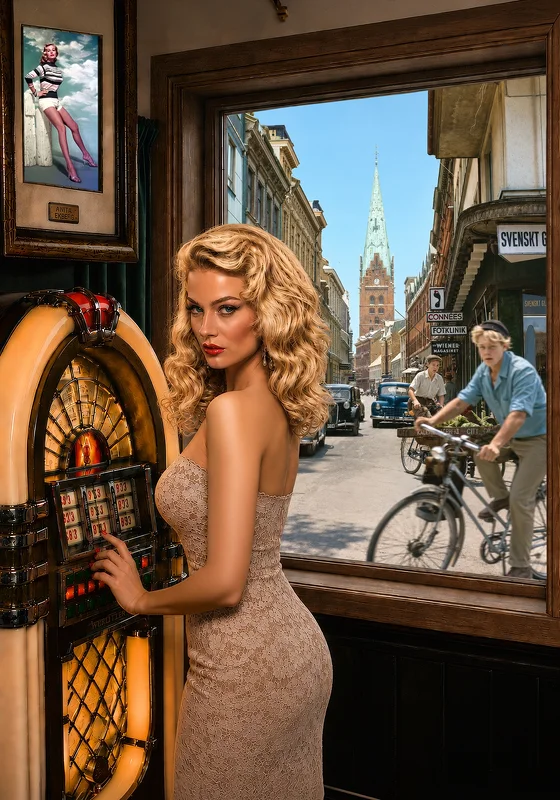
Take the 'A' train, 2026
Digital
50 x 70 cm
3 200 kr
Take the 'A' train
Svensk text på slutet
To deepen your understanding of these themes, explore my reflections on traditions and societal critique through this link, which complements the essays exploration of pink skies.
https://www.konst.se/jorgen-thornberg
Welcome to La Dolce Vita (the Sweet Life) from the Inside In My Own Words
They called me a goddess. They photographed my curves, dubbed my voice, and conjured a myth in the darkness of cinemas. Yet no one ever managed to silence my own rhythm.
This is not another pale Hollywood biography or the journalists version of the truth. This is my story, told from my star in eternity, about what the music of the sweet life sounded like from within.
Join me on a breathtaking journey through the soundtrack of my life. From the shellac records and jukeboxes of Kalendegatan in Malmö to the smoky nightclubs of West Hollywood, where Frank Sinatra proposed to me at the table. Meet me in the feverish, decadent nights of Rome, where I chased paparazzi barefoot with a bow and arrow, and step aboard the luxury yachts of the Mediterranean alongside the greatest style icon of the postwar era and the great love of my life, Gianni Agnelli.
It is a world filled with roaring Maserati engines, ice-cold Negronis, secret agents, and the thunderous practical joke in which a stubborn Swedish girl outwitted Italys most powerful industrial magnate with a reef knot glued with rubber.
Step aboard the Anita Train before it departs the platform. Pour yourself a glass of champagne, put on your red lipstick, and prepare for a soundtrack that will play for eternity.
Read the exclusive chapters belowfor a true star never fades.
Take the "Anita" Train
You must take the "Anita" train
If you want to reach Hollywood and fame
If you miss the "Anita" train
You'll find you've missed the fastest road to fame
Hurry, get on, now it's leaving.
Hear the cameras click and gleaming.
All aboard, get on the "Anita" train
Soon you'll see the lights of Hollywood's domain
From Malmö's streets to Cinecittà
Where the movie stars all shine
Past the fountains, flashbulbs sparkling
On a silver screen divine
You must take the "Anita" train
Ride it westward through a dreamer's land
All aboard, get on the "Anita" train
Soon you'll walk where all the legends stand
Malmö, June 2026
PROLOGUE: The Jukebox on Kalendegatan
You can leave the Earth, but you never leave Malmö behind. It remains in your soul. From my star in eternity, I watch continents shift, and cities rise and fall, but now and then I set my feet down exactly where it all began. The journey is simple. I merely take the nearest wormhole winding its way through the Milky Way and emerging between what is now Malmö Opera and the old sports ground. On this nostalgic trip, I shall search for the music of my life, my soundtrack. I walk slowly through the city and end up in an old café on Kalendegatan. A café that disappeared long ago, yet still lives on in my memorythe kind of place scented with strong coffee, deliciously greasy Danish pastries, and cigarettes. Back then, it was almost suspicious not to smoke. In eternity, time ceases to exist, but on Earth it was 1949, and I became Miss Hipp that summer.
I am wearing my finest lace dress, and outside the window a couple of messenger boys cycle past, while traffic, so soon after the war, is not particularly hectic. Petrol is still scarce, and some people are still driving with gas generators attached to their vehicles. I am eighteen and have just been crowned Miss Hipp at the Hippodrome, only a stones throw from the café. The whole city seems to know who I am, but nobody knows where I am going. But I do, because I have a dream, and the moment the train departs, I am jumping aboard.
Outside the window, the slow rhythm of the post-war years drifts by, a pace I hope never to be trapped in. One of the messenger boys, wearing a grey-blue shirt, turns his head and stares at me as though he knows me, but I do not know him. Then again, as we say in Sweden, everybody knows the monkey, but the monkey knows no one.
I press button 46 on the jukebox. The mechanism rattles into life, the heavy arm lifts the shellac record, and the little café fills with the sound of Duke Ellingtons orchestra. The chattering trumpet and the irresistible swing of the rhythm drill their way through the smoke hanging in the room.
The spire of Saint Peters Church points towards the summer sky, and the clock on the tower shows twelve. No doubt the bells are striking their twelve chimes, but I do not hear them, because in the café Duke is playing my favourite melody, Take the A Train, a song that is really about me. Take the Anita Train.
During my lifetime, journalists asked what I listened to in my bedroom on Östra Fäladsgatan, or whether I cared about music at all before the world discovered me. But the song that carried my secret dreams was about a train racing at express speed towards something immense, still hidden behind a thick curtain of mist. It shimmered and sparkled, and I could see shadowy figures dancing, but I could not hear what they were dancing to.
In our living room stood a radiogram, and whenever my father was out, I could play some of my 78-rpm jazz records. That early autumn, I owned ten shellac discs and bought more whenever payday came around. After Miss Hipp, I was already busy with modelling jobs and travelled around Scania as a fashion model. I earned enough to contribute to the household, even though my father protested, as it wounded his pride as the familys sole breadwinner.
I have said it before, and I will say it again: when the train finally arrives, you do not linger on the platform. You must never hesitate. The platform is safe, but it is also where dreams go to die. When my train arrived, I boarded without looking back. I took the fastest line jazz and big-band music could offer, straight out into the world. That is the journey I want to tell you about, if anyone still cares to listen.
Beside a Wurlitzer jukebox on a street that hardly remembers me, my soundtrack began. Let me tell you about the music, about my own voice that nobody ever managed to silence, and about what the sweet life sounded like from the inside.
CHAPTER 1 The Post Office Savings Bank and the Dance Floor of Social Mobility
Autumn came, and winter followed, and Malmö turned grey as people put on their winter clothes. But beneath the surface, my life had already taken a different turn. There were photographs, fittings, fashion shows and modelling jobs all over Scania. The money almost poured in. I often earned more than my father, but I never mentioned it at home. Instead, I quietly deposited my earnings into my Post Office savings account. Waving banknotes in front of a father who worked hard to support his family was unthinkableit would have threatened his pride and his role as the sole breadwinner. I paid my share at home, and after much grumbling, he accepted it. Today's generations have no idea what that kind of male duty and working-class pride actually meant.
The money I saved was not for rainy days, but for the day when the time was right, and I could afford to travel into the world. That railway platform was not yet in sight, because I knew the journey ahead might carry me far beyond the reach of the Swedish railway network.
But an eighteen-year-old needs to breathe as well. Once a week, I went to Amiralen with my girlfriends to dance away the week's work beneath the coloured lanterns of Folkets Park. There, Harry Arnold and his orchestra reigned supreme, transforming the largest dance palace in the Nordic countries into a national centre of jazz. Dancing a slow dance to Quincy Jones's "The Midnight Sun Never Sets" was wonderful. Or a classic foxtrot to "Stand By This Is Harry," Harry's signature tune that always opened and closed his performances.
Sometimes we went to Moriskan, with its oriental domes and exotic mystique, where reasonably priced meals were served with light dance music. More often, my girlfriends and I went to the Arena Dance Palace, where the Crown Prince's Hussar Regiment had once stood. The old officers' mess had been converted into a dance restaurant. I loved it there and danced to the trumpet of Gösta Tönne, who led Arena's popular house orchestra and played swing jazz. Their performances were regularly broadcast live on national radio. I adored dancing swing whenever he played Stan Kenton's "Painted Rhythm." We youngsters turned the dance floor into a showcase of lindy hop and jive. I can assure you there were rapid spins, arm throws and pure acrobatics, complete with airborne leaps that matched the song's explosive brass section perfectly. You might say I was right in the thick of it, and my father worried. Sometimes I got a beating, because that was still considered acceptable in those days.
During the weeks when I had been especially busy with work, however, I did something entirely different. I treated my best girlfriend to dinner and dancing at Restaurant Kungsparken. Its dining room offered an elegant French-Swedish bourgeois menu, served by waiters in tails. Naturally, I never mentioned that at home. One should never wake a sleeping bear, and Kungsparken was certainly not a place for the working class. It was a world of luxury and glamour, the perfect arena for someone like me who wanted to practise her social skills. Malmö's high society gathered there, and I could study how the well-to-do behaved. I refined my posture and learned to move through a room where chandeliers sparkled overhead. They played soft swing, a gentler version of the day's popular jazz. The tempo was slow and steady, tailor-made for elegant foxtrots and English waltzes. The latter was the ultimate dance for lovers, quite unlike the traditional Viennese waltz that whirls along at a furious pace. Can you guess how often the wealthy merchants asked me to dance? I also found interesting modelling assignments there, as the fashion directors frequented Kungsparken.
CHAPTER 2 When the Train Pulled into the City Theatre
If winter in Malmö had been a long, grey-blue wait at a pace I refused to be trapped in, then the summer of 1950 was its complete opposite. It was as if the entire city had suddenly been seized by feverish anticipation. There was something in the air that even the heavy Scanian summer heat could not suppress. The two-hundred-year-old fog in my mind, the one that had hidden my deepest future dreams throughout my childhood on Östra Fäladsgatan, finally began to lift. The shadowy figures I had seen dancing in my dreams suddenly acquired faces and sharp outlines. And they were no longer dancing to crackling 78-rpm records in our living room when Father was awaythey were dancing to real, living jazz.
On 2 June 1950, the atmosphere in Malmö changed. It was the day Duke Ellington and his orchestra rolled into town. Their Swedish tour was to begin in Malmö, and the evening newspaper had trumpeted the event for weeks. I remember standing amid the enormous crowd outside Malmö City Theatre. It was a magnificent modern building, but that evening the auditorium was gripped by an intense heat wave. There was no modern air conditioning, and the air inside was so thick and motionless it could almost be cut with a knife. Perhaps that was why the theatre was barely half full, as many people preferred the parks, where they could cool off. For me, that was never an option. I wore my finest clothes, a light chiffon dress that perhaps revealed a little too much. My Miss Hipp posture certainly helped, and people looked more at me than at the stage as I sat somewhere in the middle of a sea of empty seats. I was ready to absorb every second.
When Duke Ellington sat down at the piano and the orchestra began to play, everyone forgot the sweat dripping down their backs.
And they forgot to stare at me.
It became a musical triumph beyond compare. One of the evening's greatest successes was "Air Conditioned Jungle." It was a technically advanced original composition, a spectacular and sophisticated duet for clarinet and double bass that sliced through the room. Ironically, it suited the tropical heat perfectly; the music itself seemed to provide a cooling breeze.
When the muted brass section began "Mood Indigo," a timeless melancholy spread across the theatre. They wove "Sophisticated Lady" and "Solitude" into a lyrical medley that revealed the orchestra's very soul before launching into Caroline, making the audience sway in their seats to the rhythm of "It Don't Mean a Thing (If It Ain't Got That Swing)." If the theatre had been hot before, it was nothing compared with now.
But there was another song I was waiting for.
The orchestra's unmistakable signature tune.
When the opening notes of "Take the 'A' Train" flowed from the stage, I felt the trumpets tear holes in the dense air. Strangely enough, it felt cooling. It was my favourite song from the jukebox on Kalendegatan, but hearing the American masters perform it live was like receiving one final, trembling signal directly to my heart.
Storytellers and old jazz cats in Malmö have spent decades spreading a charming myth that Duke spotted me in the audience, invited me on stage, and dedicated the song to me as "Take the Anita Train." It is a beautiful lie, but the truth is even greater. I did not need to stand on stage. I let the music speak directly to my secret dreams. In my head, the song was already mine. Then, amid the thunderous swing, I silently composed the lines that became my personal compass:
"You must take the 'Anita' train
If you want to reach Hollywood and fame
If you miss the 'Anita' train
You'll find you've missed the fastest road to fame."
Much later, after I had left the Earth and met Duke at a concert among the stars, he told me the true story behind the song. It turned out to contain the same kind of magic as my own life. It had been written in 1939 by Billy Strayhorn, a twenty-three-year-old pianist. Incidentally, he was in Malmö as well.
Duke had met him in Pittsburgh and offered him a job, but he had not written down a formal set of directions to his Harlem home. Instead, Duke had quickly scribbled a few simple subway instructions on a paper napkin. They began with the words: "Take the A train"because the newly opened line was by far the fastest route through New York City.
The most remarkable thing is that the song almost never came into existence. When Strayhorn arrived in New York, he threw away his first draft because it sounded too much like another composer's work. Duke's son, Mercer Ellington, later found the discarded sheets in a wastebasket and realised what genius was hidden in the rejected material.
What a dizzying thought.
Jazz's greatest masterpiece, the melody that carried my dreams from Malmö to Hollywood, began as directions scribbled on a napkin and was rescued from a rubbish bin. It was exactly like my own life. I was the girl from Östra Fäladsgatan, carrying a secret blueprint. When the Duke Ellington trumpeter blew the final notes into the Malmö night, I knew my time in the wastebasket was over. My fog had lifted. My own train stood on the track, ready to accelerate, and I certainly had no intention of remaining on the platform.
Another summer and a gloomy autumn passed with modelling jobs and a great deal of dancing. Then winter came again, but whenever my girlfriends and I stepped through the doors of Amiralen, we left the raw, icy Scanian winter outside. Inside, the warmth changed everything; we entered another world where big-band jazz set the blood racing and the great misted windows facing Folkets Park testified to the intensity on the dance floor. After winning Miss Hipp, I was no longer anonymous there, and on the parquet floor I was entirely in my element. Orchestra after orchestra took the stage. We danced to the heavy, elegant swing of Glenn Miller's classic arrangements, the fiery trumpet blasts of Harry James's repertoire, and, of course, to Thore Ehrling's orchestra whenever Alice Babs stepped to the microphone and set the entire hall boiling with her scat singing.
The dance floor was a sea of colour and motion. These were the final glorious years of the Swing Era, and the fast jitterbug dominated the winter evenings. The boys hurled us, girls, through breathtaking spins; skirts flew, and shoe soles skidded across the smooth, waxed parquet. Personally, I preferred it when the tempo eased into a suggestive foxtrot or an elegant slow waltz. Then my height and posture truly came into their own. I moved with long, gliding steps, close to my partner yet always fully in control, as though I were already moving across a far larger stage than the dance floors of Malmö. We sweated, laughed, and let big-band jazz thaw us right down to the marrowit was a pace and an energy perfectly suited to my dreams.
"Hurry, get on, now it's leaving
Hear the cameras click and gleaming
All aboard, get on the 'Anita' train
Soon you'll see the lights of Hollywood's domain."
CHAPTER 3: The Ticket and the Platform (1951)
Spring arrived with lily of the valley, bird cherry, and lilac blossoms, and the trees lining Malmö's canals had time to leaf out and shed their leaves once again. From my star, I watched the parks glow in shades of red and gold throughout the autumn before another dark, cold, and lengthy winter passed, with thick snow and ice covering the city's canals and ponds. But for me, there was no winter break. Quite the opposite. It was peak season for me as a mannequin and model, and my visits to the Post Office Savings Bank became regular. The dancing continued exactly as before, and by then I had bought more than a hundred shellac records for my room. My radiogram played constantly, with what I loved most: big-band jazz, swing, and the new, provocative bebop.
Then spring finally burst forth once again, and the willow trees hung heavy and green over the canals. On 29 June 1951, the train finally pulled into the station. The locomotive driver of my future was Rune Ernestad. He was a journalist and talent scout for Vecko-Revyn magazine and had spotted me on Södergatan. He turned around, walked up to me, and offered me a ticket on the Miss Malmö trainthe direct route to the Miss Sweden competition in Stockholm that August. He wanted an answer that very evening!
The platform trembled beneath my feet. I knew that if I stepped aboard, there would be no turning back. Win or disappear, I thought dramatically. It felt as though I were living on borrowed glory; the title of Miss Hipp had carried me this far, but travelling around the Scanian countryside as a fashion model had no future. If I won Miss Malmö and reached Stockholm, at least the entire Swedish railway network would lie open before me. If I lost, there would be Eslöv and Teckomatorp, and, in time, a place behind the counter at the local Co-op store.
But I was not someone who rushed into things. Before I accepted and boarded Vecko-Revyn's train, I went straight home to speak to my mother. Ernestad looked rather surprised when I played hard to get. He was considerably happier when I called his hotel a few hours later to say yes.
Father drove Mother and me to Folkets Park without knowing why we were going there. There were ten girls on the stage. I was number eight. We wore tight white sweaters, black shorts and medium heels. They were pleasant girls, but I immediately judged that half of them had no chance at allbecause, of course, I knew what a beautiful girl looked like. As soon as I had walked back and forth across the stage, I understood from the audience's reaction that I was going to win. I did win. The crowd cheered, and I received a magnificent bouquet, which I brought home to Mother.
During the holiday month of July, I had no free time. As the newly crowned Miss Malmö, I was expected to take part in every imaginable charity event. But in the evenings I was generally free. As free as one can be when everyone in the city knows who you are and all the boys want to dance with you and put their arms around you.
The summer of 1951 was a boiling-hot jazz summer. On the warmest evenings, the large glass walls of Amiralen, facing Folkets Park, were removed so the music poured out into the summer night. It was almost a relief when the time finally came for the Miss Sweden final in Stockholm on Friday, 24 August. A stage had been erected in the middle of Humlegården, and we were to parade before and be examined by an enormous audience. Thousands of staring eyes made my head spin, but it was excellent training. I came across as remarkably wholesome when I told the judges that I designed and sewed my own clothes. And they loved it! In reality, it had been a long time since I had sewn anything myself, because once I started modelling there always seemed to be clothes left over, so to speak, and my wardrobe had grown considerably over the previous years. In Humlegården, the newspapers wrote that I swept the floor with my competitors. I won.
The train would continue rolling forward, but now I had to change my means of transport. The next destination lay nine hours away by air. I was going all the way to the United States, and on the last day of August I departed for a packed schedule. I did not win Miss Universe, which troubled me very little, as it would only have meant a year of poorly paid obligations. Instead, I could devote myself entirely to the many modelling offers I had received, for fees that seemed staggering by Swedish standards.
Everyone wanted to photograph me, and my pictures spread across the world. I often say that if I had received a krona or two for every photograph, I would have been richer than the Sultan of Brunei. Instead, I received publicity, which laid the foundation for my successful life.
After a month in America, I returned home just in time to celebrate my twentieth birthday on Östra Fäladsgatan. That autumn, I even became engaged to Carl Langenskiöld. But my sights were set firmly on the West, while he was destined to take over his family's private bank in Sweden. Faced with the prospect of the Atlantic Ocean separating us, we broke off the engagementmy second broken engagement in a single year. Becoming somebody's housewife was not my ambition.
I still do not know what got into me during that period, with all those handsome young men whose arms I fell intoor who fell into mine. Three engagements altogether. Elegant cars belonging to wealthy fathers, enormous villas, and even an eighteen-metre wooden yacht.
Looking back, I must admit I became something of a travelling trophy for boys from distinguished families, wealthy landowners, counts and barons. Life was a catwalk with only me on the runway.
Gentlemen. Men of honour. Cavaliers. Unfortunately, there were one or two less pleasant examples as well. At a private party, I was raped by a man I had rather likedwith the emphasis on had. It is the worst thing that can happen to a young woman and an unforgivable act. Although I quickly put the incident behind me, it remains an experience I remember as clearly as if it were yesterday.
I have always liked sex because it proves I am attractive. That matters to a woman. But it is equally clear that the woman sets the boundaries. No means no. Men are wonderful creatures, but each one ought to come with an instruction manual.
Even the legendary classical composer Sten Broman paid court to me, but I preferred jazz to his compositions. We have remained in touch throughout eternity, and he is still as entertaining as ever.
Not even history allowed me any peace. In later years, many famous men claimed they had been involved with me, that we had lived together, or even that we had been engaged. If all those alleged romances were true, there would not have been enough days in the calendar. And I would have ended up with bedsores, Anita laughed. If one wishes to be charitable, one can blame it on dementia, although people suffering from it usually subtract details rather than add them.
CHAPTER 4 The Eyes of the Big Boys
Once the Atlantic lay between me and the country estates of Scania, there was no turning back. I had traded the familiar crackle of my hundred shellac records on Östra Fäladsgatan for the monotonous roar of aircraft engines carrying me westward. It was a journey that crossed not only geographical borders but also time and space itself. I stepped off the aeroplane and straight into an American dream, so filled with neon lights, flashing cameras and pulsating rhythms that it left a young girl from Malmö dizzy.
It was not long before the locomotive of my American career appeared in the form of one of the world's most eccentric and influential men, Howard Hughes, the aviation billionaire and movie mogul who had spotted me at the Miss Universe competition in Long Beach. He was always on the lookout for new beauties for the silver screen, and when he saw me, he felt no need for screen tests. At first, he did not come himself but sent his right-hand man, Walter Kane. The idiot arrived two hours late for our meeting, so I told him to go to hell. In broad Scanian, no less. He did not understand the words, but he understood the message.
The next time Hughes appeared in person, he immediately offered me a seven-year contract with his studio, RKO Pictures. At first, the contract seemed dazzling. I did not even need to know English, because Hughes felt that my appearance and the way I moved already told an audience everything they needed to know. But Howard Hughes was a complicated creatureeccentric and almost entirely devoid of humour. He was accustomed to owning everything and wanted to control me as he controlled his companies and his aircraft. He wanted to shape me, lock me in a golden cage, and dictate my every step, just as the well-bred Swedish boys back home in Scania had wanted to do. But neither luxury cars nor enormous villas bent my will then. I accepted Hughes's money and seized the opportunity to study drama and diction at his film school, but I refused to be tamed. I was no dumb blonde he could place in a trophy cabinet.
Hughes wanted to alter my nose and teeth and even change my name. "Ekberg" was far too difficult for Americans to pronounce; it sounded too harsh and foreign, so I ought to adopt a more streamlined Hollywood name.
"Listen, Howard," I said, looking him straight in the eye. "If I become famous, people will learn to pronounce my name. If I don't, it won't matter."
That settled it.
My name was mine, just as my nose was mine, and no billionaire in the world was going to erase the girl from Malmö. I adjusted my teeth slightlya few weeks in braces was enoughbut they remained my own.
Looking back from my star upon Hollywood's dream factory, I realise how rotten the system was beneath all the glamour. It was not only foreign girls who were expected to abandon their origins to fit the studios' mould. The dream factory reinvented most aspiring stars, whether they came from Scania or Texas. Names routinely failed auditions. Norma Jeane Mortenson became Marilyn Monroe, and Archibald Leach obediently transformed himself into Cary Grant. Even the men and women around Frank Sinatra told similar stories once I got to know them.
My dear Frank had at least been allowed to keep his Italian-American surname, but the studios shortened his elegant Francis Albert to the punchier Frank Sinatra. His best friend, Dean Martin, had actually been born Dino Paul Crocetti, though he hardly cared, as everyone called him Dino anyway. Dino, with his lazy charm and effortless style, became another constant presence in those early years. Life was a catwalk, and the Malmö stage had now become global.
Incidentally, Dino once sued the creators of the animated television series The Flintstones because they had named their little dinosaur Dino. At first, the creature spoke with an Italian accent, but after a settlement, they were allowed to keep the name, provided Dino barked like a dog instead. And so it was.
At our table, there was sometimes the wonderful yet deeply tragic Judy Garland, who became a close friend of mine. Judy was one of Frank's dearest friends, yet even she had not been allowed to remain herself. The world adored her as Judy Garland, but she had been born Frances Ethel Gumm. Most stars had allowed themselves to be reshaped and renamed in exchange for fame. But I was proud of my Scanian nose, my Malmö teeth and my surname. I refused to let Howard Hughes rebuild me into a mute, nameless doll. That is why I worked furiously to learn Englishso furiously that I accidentally spoke English when I returned to Sweden. For the rest of my life, people reminded me that I had apparently forgotten my native tongue after only a few months.
Nobody tried to remake Sammy Davis Jr.
"It would have been pointless," Sammy once told me. "The odds were stacked against me anyway. I was Black, one-eyed and Jewish, so changing my name wouldn't have helped." He laughed. "The only reason I made it was probably that people got used to me. I wore the audience out. I started in vaudeville at four, so eventually they let me stay."
Sammy was extraordinary. During one dinner, with me seated at his table, he suddenly leapt to his feet and launched into his signature number. "The Birth of the Blues" begins as a jazzy ballad but explodes halfway through into a furious big-band tempo, designed to showcase Sammy's famous machine-gun-fast tap-dancing solos. He had arranged everything with the orchestra beforehand. It was all for me, he said.
With Frank, Dean and Sammy's Rat Pack, I plunged headfirst into the pulsing nightlife of West Hollywood. These were the glory days of the 1950s, and the soundtrack of my new life shifted from the radiogram to the legendary nightclubs along the Sunset Stripplaces like Mocambo, Ciro's and The Crescendo. There, amid palm trees, cigarette smoke and ice-cold cocktails, an entirely new musical world came alive for me. It was the era of Afro-Cuban mambo, sophisticated exotica and a cool, restrained jazz that felt worlds away from the cheerful swing dances at Amiralen. And it was there, beneath the subdued glow of nightclub spotlights, that I spent my nights with the boys who owned the town. Frank, Dean and Sammy.
Hearing Frank Sinatra sing "Young at Heart" live, only a few metres from my table, was enough to make my heart somersault in my chest. Back in Malmö, his voice on a 78-rpm record had seemed distant and magical, but here he was flesh and blood, with eyes that could melt ice and phrasing that bordered on perfection.
We connected immediately. Frank and I shared a passion for nightlife, for music that must never fall silent, and for freedom. He saw me for who I truly wasa woman who refused to apologise for her existence or her beauty. During our nights in Hollywood and Las Vegas, jazz and his ballads often provided the soundtrack to a life lived fast and without safety nets. He claimed he had dedicated "Young at Heart" to me and that it expressed exactly how he felt in my presence.
Fairy tales can come true, it can happen to you
If you're young at heart.
For it's hard, you will find, to be narrow of mind
If you're young at heart.
Frank was not merely a friend and a soulmate of the nightlifehe became completely intoxicated by my presence. It went so far that he actually proposed to me. He wanted to marry me, keep me by his side forever, and have children together. I said no.
Becoming Mrs Sinatra would have meant entering another golden cage.
I had not boarded the train in Malmö to become an accessory to an American entertainment tycoon.
Frank accepted my refusal like a gentleman, with that mixture of wounded pride and dignity that only he could show, and our friendship endured.
Life within that circle was never entirely uncomplicated, and before long a genuine jealousy drama erupted, shaking the Rat Pack to its core. Sammy Davis Jr. was deeply in love with me as well. He was a magnificent performer, overflowing with musical genius and energy. We spent a great deal of time together. But in 1950s Hollywood, racial prejudice remained brutal, and the sight of a Black man openly spending time with a blonde white Miss Sweden was explosive.
Frank, the unquestioned leader of the group and fiercely protective by nature, became furiously jealous. Sparks flew between him and Sammy in the nightclubs. Their arguments were as much about wounded masculinity as about possessiveness, while I stood in the middle, observing the spectacle.
Men are wonderful creatures, as I often say, but when their egos collide over a woman who refuses to be owned, nightclub jazz can turn into a very loud and very dangerous drama.
I let them keep their jealousyit was, after all, a confirmation of my attractivenessbut I set the boundaries.
None of them owned me.
When I look back from my star in eternity, I cannot help but smile at Sammy. He seemed to have developed a taste for Swedish blondes after our nights together in Hollywood. When he realised he would never have me, only a few years passed before he found another independent girl from the Scandinavian north. In 1959, he met May Britt in a Los Angeles nightclub. The following year, they married in a ceremony that shocked segregated America. There were no other blondes on his matrimonial calendar in the meantime, only a brief, forced marriage of convenience to a Black singer, intended to calm nervous studio executives after another romance with a white woman. But it was Scandinavian glamour he sought. Like me, May Britt challenged the spirit of the age, even converting to Judaism for his sake. Together, they had three children. Sammy eventually found his Scandinavian goddess, even if she was not the girl from Östra Fäladsgatan.
Hollywood also presented a strange paradox about my own voice. I began receiving roles in Hughes's films and soon appeared alongside giants such as John Wayne and in comedies with Dean Martin and Jerry Lewis, including Artists and Models. Yet the dream factory operated by an unwritten law for foreign beauties: we could be seen, but our voices were to be softened or hidden. My speaking voice was deep, rich and distinctive. Still, in musical and dance numbers, the studios often used professional "ghost singers" who dubbed my lip movements so that everything sounded as streamlined as American audiences expected. When I performed my sensual dance in Zarak, it was my body, my rhythm and my hypnotic presence that captivated audiences, while the melody itself was sung by a ghost somewhere in the background. The music was as far removed from jazz as imaginable: traditional Middle Eastern dance music, accompanying my character, Salma, as she performed an erotic, provocative belly dance in a glittering two-piece costume. The dance and music were considered so daring and "spicy" for their time that British censors forced the producers to cut the sequence substantially before release. My stock in the film industry rose considerably after those headlines.
Hughes believed he could use me as a silent muse, a beautiful screen onto which he could project his fantasies.
But he underestimated the girl from Malmö.
His Hollywood school, where my voice was hidden behind ghost singers, became little more than preparation. Deep down, I always knew my own voice could not remain concealed forever. I absorbed everythingthe American swing, Sinatra's confidence, the freedom of the nightclubsand packed it away in my mental luggage.
One day I would return to safe, moral Sweden, and when I did, I certainly had no intention of merely mouthing somebody else's melody.
I would sing for myself, in my own voice, and make the Swedish establishment choke on its coffee.
Well, it did not quite turn out that way.
CHAPTER 5 Soundtrack in Rubato Tempo
When you look back on your life on Earth from this side of eternity, it is remarkable how vividly certain impressions endure. For me, it is not only the images, the spotlights or the dresses. It is the sounds and the music. Hollywood always believed it owned my voice. They gave me a seven-year contract, locked me into the role of the cool Nordic ice goddess, and whenever a director demanded that my character sing, they placed a pale, anonymous ghost singer in a studio to dub my lip movements. They silenced my voice, but they never understood that music still controlled me. My body dictated the tempo, not their ridiculous scripts. It was my rhythm that brought me to life, and through music I reclaimed the power to shape how the world saw me.
It all really began in 1953. I was new to Hollywood, hungry for a career but tied to Universal on a fixed salarynot a large one, but a secure one. They gave me lessons in drama, horseback riding and even fencing. My first official film role was in the comedy "Abbott and Costello Go to Mars." The irony was that the fools in the film never even reached Mars; they navigated incorrectly and landed on Venus instead. The studio released a soundtrack that was a curious mixture of period big-band jazz and cheap futuristic sound effects. I played a guard on the planet Venus, dressed in a minimal costume, and the idiots fell over themselves the moment they saw me. I did not need to say a single word because Venusians communicated through sign language. I was purely a visual apparition, but I remember using the heavy big-band jazz to learn how to move in front of a camera. I absorbed everything. That same year, I was cast in smaller, uncredited roles in "The Mississippi Gambler," "Take Me to Town," and "The Golden Blade." The music in those productions was little more than generic studio fareclassical strings and predictable melodies intended to remain anonymous in the background. Hollywood would not let me take a single dance step; they merely wanted me to fill the screen with my body. But I listened carefully and learned the rhythm of how a film set worked. Beyond that, not much happened, except that I kept learning more and more English.
The big breakthrough came in 1955 with the adventure film "Blood Alley." There I acted opposite none other than John Wayne, but the film meant far more to me than simply appearing alongside one of Hollywood's giants. It became my salvation. Before that, my career had been in danger of ending before it had even begun. My time at Universal had become a dead end. They paid me a weekly salary of 250 dollars, but mostly used me as a decorative trophy at premieres or forced me to pose in bikinis for magazine covers. They had no idea what to do with a Swedish girl with generous curves who could not keep quiet. I could feel myself fading away in their studio school, becoming a forgotten glamour doll.
John Wayne's independent production company, Batjac Productions, had noticed me. Wayne and his business partner, Robert Fellows, were seeking new, slightly unconventional talent that the rigid formulas of the major studios had not shaped. When they saw my screen tests and press photographs, they did not hesitate. They bought out part of my Universal contract and took over my career. Batjac gave me the respect and professional protection I so desperately needed.
John Wayneor "Duke," as we called himwas a very different sort of person from the slimy studio executives at Paramount or Fox. He did not greet me with the hungry looks I had grown so tired of; he regarded me with a fatherly, almost protective respect. Duke quickly realised that beneath that blonde Hollywood hair lay a raw Scandinavian stubbornness that reminded him of his own ideals.
He told me in his deep, drawling voice: "Anita, don't let them turn you into just another. You're a force of nature. Make them adapt to you."
Batjac shielded me from Hollywood's most corrupt aspects. They ensured I received proper acting lessons and promoted me as an international personality rather than a standard pin-up girl. Being taken under their wing gave me a new status in town. Suddenly I was no longer Universal's property; I was under the personal protection of The Duke himself, and every wolf in Hollywood stepped back.
It was Batjac that cast me in "Blood Alley," and they spared no expense. The studio hired Roy Webb to compose a powerful, classical and dramatic symphonic score with clear Asian influences, as the story centred on a dangerous escape from Communist China. There was no room for light-hearted singing or sensual dancing in the rugged screenplay, but the grand orchestral music gave my charactera tormented yet strong-willed womana new sense of tragic weight. It was a magnificent musical setting that matched my on-screen presence. During filming in San Rafael, California, which stood in for the Chinese coast, Duke was always there to support me. When I struggled with English diction in the most dramatic scenes, he would stop filming, take me aside and say:
"Don't speak in their words, Anita. Speak with your eyes. That's where your strength lies."
Thanks to John Wayne's personal faith in me and Batjac's determination to give me a chance, the industry finally began to take me seriously as a genuine actress. That film and Batjac's powerful marketing machine directly paved the way for my Golden Globe award the following year. You gave me my career back, and without Batjac I would probably have packed my bags and returned to Malmö long before Rome was ever mentioned.
That same year, my life exploded with colour and swing in "Artists and Models." It was a cheerful Hollywood comedy in which I appeared opposite Dean Martin and Jerry Lewis. The music was the very definition of glossy 1950s pop and big-band jazz, filled with romantic hits. Dino sang "Innamorata" in his incomparable velvet crooner voice, causing half the women in the cinemas to swoon. I was not allowed to sing this time eitherthe studio used its usual dubbing techniquesbut I received my first major dance number. I played The Bat Lady and performed a stylised, theatrical, almost hypnotic dance in a tight black costume. As I moved to the pulsating jazz, I felt for the first time that I owned the room in Hollywood. My body and my rhythm were my contribution, and the studio practically boiled during filming.
This success earned me a Golden Globe in early February 1956 as the industry's Most Promising Newcomer for my performance in "Blood Alley," and suddenly everyone was talking about me. After this major success, in May 1956, I married the British actor Anthony Steela man whose appearance was that of a classic matinée idol, but whose inner life was damaged by jealousy and alcohol. Our marriage quickly became a public roller coaster, a series of dramatic scenes played out in Hollywood nightclubs before an audience. Anthony could not tolerate the attention I received, let alone the men who surrounded me.
The most talked-about affair of the period was my intense, complicated relationship with Sammy Davis Jr. He was deeply in love with me and made no attempt to hide it. This led to a monumental jealousy drama one evening at an exclusive Los Angeles club, where Frank Sinatra was also present. Frank, who was like an older brother and protector to Sammy, pulled me aside into a corner as the music thundered in the background. He fixed me with a hard stare and growled that I should stay away from Sammynot because he begrudged his friend happiness, but because he was terrified of what racist America in the 1950s would do to Sammy's career if it became known that he was seeing a white Hollywood star. Sammy was devastated, and I realised how much politics and fear controlled the entertainment industry. Much later, when Sammy married the Swedish actress May Britt in 1960, I could not help but smile to myself. He had searched for the same Scandinavian radiance he had lost when Frank put an end to us.
Amid all this emotional and personal chaos, I played an important role in the 1956 historical epic "War and Peace". It was a colossal Hollywood-Italian co-production, with a soundtrack composed by the brilliant Nino Rota. The music was classical, symphonic and deeply romantic, composed to reflect the grandeur of Imperial Russia. In the lavish ballroom scenes, I danced a classical waltz with Henry Fonda while wearing a magnificent period gown. It was splendid indeed.
It took weeks of rehearsal to perfect the steps to Rota's flowing strings. Behind the scenes, however, a very different drama was unfolding. Once filming was complete, the producers realised the film had become monstrously long. Even after brutal editing, the final version ran an astonishing three hours and twenty-eight minutes. Something had to be cut. Those with full insight into the production knew that my performance as the seductive but scheming Hélène Kuragina had been exceptionally strong. But Hollywood logic is merciless. Paramount had paid Audrey Hepburn a record-breaking salary to play Natasha, and there was no possibility of removing a single second from the studio's golden calf.
Instead, it was my role that was sacrificed.
My scenes were cut down to a fraction of what had originally been planned.
It was a hard blow, but the film nevertheless proved crucial to my future. Despite my role being reduced to a minimum, it was precisely those remaining ballroom scenes that caught the attention of Federico Fellini in a Roman cinema. He later told me that my grace while dancing to the classical waltz to Rota's music gave him physical chills and planted the first seed of what was to come.
After the historical seriousness, I returned to comedy that same year in "Hollywood or Bust," my second film with Dean Martin and Jerry Lewis. The music once again featured light popular songs and easy swing, tailor-made for Dino's relaxed singing style. I neither sang nor danced in the film; my task was to play myselfthe ultimate unattainable dream girlwho drove Dean and Jerry to lose their minds in a series of comic escapades. It was fun, but it also felt as though I were standing still. Hollywood wanted only my surface.
That same year, I tested my wings in the thriller genre with "Back from Eternity" and "Man in the Vault." The music was dark, heavy and traditionally dramatic, designed to build an atmosphere of threat and mystery. There were no glittering production numbers, no songs and no elegant dance steps. Instead, I had to rely entirely on my acting and my ability to communicate fear and tension solely through my eyes and presence.
It was, however, the British-produced epic "Zarak," also from 1956, that truly shattered every moral barrier. The soundtrack, composed by William Alwyn, was a suggestive and hypnotic blend of traditional Middle Eastern folk music and pure oriental belly-dance music, dominated by intense percussion and winding flutes. It was here that I performed my famous erotic belly dance on film. I wore a glittering two-piece costume that concealed almost nothing. I was not really singingthe lip movements were, as usual, dubbed afterwards by a ghost singerbut my body and hips moved with such untamed sensuality to the rhythm of the drums that British film censors panicked. They forced the producers to cut the sequence drastically before the film was released, or it would not be shown at all. It was the first time I realised the explosive power contained in my combination of movement and music.
In 1957, I appeared in the British crime film "Interpol" opposite Victor Mature. The music was a classical, dramatic orchestral score suited to a thriller about international drug smuggling. I played a sophisticated but cold woman, and the role required neither singing nor dancing, only pure, elegant mystery. The following year, 1958, I returned to the smoky, dangerous world of music in the thriller "Screaming Mimi." The soundtrack was filled with cool, dark, and suggestive nightclub jazz. I portrayed a nightclub dancer who survived a brutal assault, and I performed a highly discussed and daring burlesque dance on stage to an intense jazz drum solo. It was one of my most complex and challenging roles in America, where the music catalysed the character's inner trauma. That same year, I made "Paris Holiday" with Bob Hope, a light-hearted comedy featuring catchy popular music, in which I served as a decorative and comic presence without any musical performances of my own.
By this point, I was thoroughly tired of Hollywood's superficiality, the studio bosses' obsession with control, and my marriage to Anthony, which was rapidly falling apart. Europe was calling in earnest, and I shifted my focus to Rome, which, in the late 1950s, was experiencing an extraordinary golden age and was known as Hollywood on the Tiber. My first major Italian production was "Sign of the Gladiator" in 1959. The music was grand, classical peplumsword-and-sandal film musicfilled with dramatic trumpets, heavy brass and majestic Roman marches. I played the proud Queen Zenobia of Palmyra, dressed in heavy royal gold garments, a surprisingly modest role by my standards. There was no room for carefree dancing or singing, but the magnificent musical backdrop suited my new European status perfectly.
During this intense period in Rome, my life and career culminated in one of the most famous scandals in film history.
It was November 1958, and the city was boiling over with decadence, aristocracy and aggressive street photographersthe people who would soon be known as paparazzi. Countess Olghina di Robilant hosted a private birthday party at the Rugantino restaurant in the bohemian district of Trastevere. The place was packed to overflowing with actors, princes and artists. The air was thick with smoke, sweat and expensive champagne.
Jazz pumped from the speakers and my blood fizzed like champagne bubbles. I suddenly felt trapped at my table, bored by polite conversation. I kicked off my shoes. Barefoot, I grabbed a hand, stepped onto the floor, and launched into a wild, untamed cha-cha. I surrendered completely to the music. Before anyone knew what was happening, I had jumped onto one of the restaurant tables. Glasses rattled, champagne spilt across expensive tailored suits, and I lifted my dress high enough to reveal my garters in the dim light. The room froze in collective shock and fascination, while photographers' flashes lit the darkness like a chain of thunderstorms.
From the simple pop jazz on Venus to a singing giant billboard in Rome. Hollywood tried to silence my voice, but music always found a way to speak through my body.
That was how far the soundtrack of my life had carried me, and I do not regret a single note.
Nor do I intend to change a single note in what comes next.
CHAPTER 6 The Soundtrack of My Life From Giant Billboards to Scanian Kites
If the 1950s were a whirlwind of big-band jazz and Hollywood, the 1960s became the decade when I became immortal. The decade began magnificently with Federico Fellini's "La Dolce Vita," for which Nino Rota composed a brilliant soundtrack blending modern Italian jazz, cabaret-style circus music and intense rock and roll. In the famous nightclub scene, just before we headed to the Trevi Fountain, I kicked off my shoes to a furious, high-powered rock-jazz number. Nino's music was a stroke of genius, crafted to reflect the paradoxical blend of emptiness and glamour that defined high society. Yet when those wild, syncopated drums burst into life, I felt no emptiness at allI felt pure, uncontrolled joy. And when I stepped into the fountain, the soundtrack suddenly transformed into melancholy, almost sacred strings that seized the audience and made me immortal on screen. Rota understood that my physical presence required precisely those musical contrastsfrom the wild to the sublime.
My collaboration with Federico and Nino did not end there. Only two years later, in 1962, Fellini cast me in the anthology film "Boccaccio '70." In his segment, "The Temptation of Dr Antonio," I became a living giant billboard. For that role, Nino Rota composed the jingle "Bevete più latte" ("Drink More Milk"). It was a deliberately repetitive, catchy, and almost hypnotic Italian pop jingle. Musically, it was a brilliant piece of pop art; the nagging brass section and mechanical repetition were designed to drive a strict puritanical moralist completely insane. I moved my gigantic body in perfect time with that ironic melody and sang along to the advertising slogan, mocking the hypocrisy of the age. The song was glossy and artificial, but beneath the surface it possessed remarkable sharpness that perfectly matched Fellini's surreal vision. You can imagine how much I enjoyed it.
Rome had become my home, but Hollywood continued to pull at me. The following year, 1963, I found myself in the western comedy "4 for Texas", alongside Ursula Andress and my old friends Dean Martin and Frank Sinatra. James Van Heusen composed the soundtrack, with lyrics by Sammy Cahna classic Hollywood sound, rich in sweeping western themes and big-band arrangements. Standing on that set felt like walking straight into a smoky Las Vegas nightclub. Dean Martin's relaxed timing and Frank's patented rhythmic phrasing seemed embedded in every bar of the score. The music possessed that unmistakable broad American self-confidence that made you want to push back your hat and ride in time with the brass section.
That same year, I worked on the British adventure comedy "Call Me Bwana" with Bob Hope. The music was lighter and more commercial, filled with comic melodies and exotic touches tailored to Bob's comic adventures. It was rather formulaic, but it served perfectly well as a decorative backdrop to the fast-moving screenplay.
I continued to jump between genres. In 1965, I appeared in the Agatha Christie mystery "The Alphabet Murders," whose score was filled with tense, creeping strings and classic British suspense. I loved how the composer used sudden dissonant chords to heighten tension around the characters. In 1967, I appeared in Vittorio De Sica's star-studded anthology film "Woman Times Seven" alongside Shirley MacLaine. The soundtrack was an elegant European composition with floating melodies and sophisticated jazz influences, reflecting the liberated, modern spirit of the late 1960s.
It was in the middle of this intense decade, in September 1964, that I allowed myself to be persuaded into doing something I swore I would never do again.
The Swedish New Wave director Bo Widerberg was in the middle of a chaotic film shoot in Österlen. He suddenly decided the film needed international glamour and wrote a role specifically for me. I said no at first. Why should I leave Rome for the winds of Scania? But Bo flew down to Italy himself, charmed me, and eventually persuaded me to sign. As everyone who knows me will tell you, I have always found it difficult to resist male charm. I still suffer from that weakness. The project was then called "Love 64." Perhaps it was the title that fooled me.
The result was a culture clash of biblical proportions when I arrived in the small fishing village of Kåseberga. Widerberg was celebrated at home, but on set he was a disaster. He worked without a finished script and expected me, Anita Ekberg, to stand in the Scanian wind and improvise dialogue. But the worst part was his bizarre visual concept for my character. Bo wanted to strip away every trace of glamour. He seriously expected me to play a simple country girl. He wanted braids in my hair and to force me into what I had called wooden peasant clogs as a child. I refused outright. I had refused as a child, too. The idea was absurd. I had not spent decades building my icon status in high heels only to wander around like a Scanian farmwife in wooden clogs before the entire world.
To make matters worse, bitter conflicts erupted over my salary and contract. Had he paid a few million, I might perhaps have braided my hair and sawn the heels off an old pair of shoes. Life was often a matter of price, at least for those of us whose bank accounts were not exactly overflowing.
The atmosphere in Kåseberga was not merely tenseit was stretched to breaking point, like a violin E-string wound so tightly it shrieked in an impossible key. There was no resonance left, only metallic pressure threatening to break the bridge and everyone's nerves. Rumour had it that Widerberg eventually resorted to tranquillisers to gather the courage to meet my gaze. As for me, I felt completely disrespected.
Eventually the final straw arrived.
I packed my thirteen suitcases in protest, turned my back on Kåseberga, and boarded the first flight back to Rome.
My role was eliminated. Widerberg added another year to the title, completed the film without me, and released it as "Love 65." That brief episode became the final nail in the coffin for my relationship with my homeland. Throughout my career, I never appeared in a Swedish feature film.
When I eventually watched the completed film, I could not deny that the soundtrack was a masterpiece of musical atmosphere. Widerberg used music in exactly the poetic, lyrical and melancholy way Swedish critics adored, especially in the famous scenes where the characters fly kites into the sky. He framed the film with the pure classical tones of Antonio Vivaldi's violin concerto "L'amoroso" and Frédéric Chopin's heavy, fateful Funeral March. To ground the film in the Swedish folk-home tradition, he used rustic elements such as "Gökvalsen" and a "Trollebo Schottische." But the finest piece in the entire film was jazz pianist Bill Evans's meditative composition "Peace Piece." Its sparse piano chords created a sense of space and melancholy that cut straight through the screen, complemented by contemporary 1960s pop such as Harry Arnold's "Stay Spray" and Harold Geller's "Bar Twist." Musically, it was brilliantbut for me personally, Kåseberga remained a bitter reminder of why I had left Sweden.
When the 1970s arrived, I returned to the comforting embrace of Fellini in "The Clowns". The soundtrack was a brilliant explosion of traditional, noisy, and nostalgic circus music, with blaring trumpets and marching rhythms that celebrated clowning and the magic of childhood. But times changed, and the roles in Europe grew darker.
In 1978, I appeared in the deeply controversial Italian horror thriller "Images in a Convent," where I portrayed the mentally disturbed Sister Gertrude. The music was a dark, creeping, and deeply unsettling psychological landscape. The composer used shrill, distorted strings and painful synthetic dissonances to reinforce the character's inner trauma and the convent's claustrophobic atmosphere. There was no beauty in those notes, only naked terror. Fortunately for actors, the music was added afterwardsI doubt I could even have entered the studio had I heard it beforehand.
My final great magical moment with Federico came in 1987, in the autobiographical film "Intervista." It was a painful yet extraordinarily beautiful experience in which I reunited with Marcello Mastroianni on camera. This time, Nicola Piovani composed the score, creating a soundtrack drenched in nostalgia, longing and melancholy. It felt like an echo of Nino Rota's old themes, only softer. When Marcello and I sat in my living room watching old clips of ourselves at the Trevi Fountain, Piovani's melancholic piano drifted through the background. The music sounded like running water and lost time. It tightened my heart, and for a brief moment we returned to the glory days of our youth.
After "Intervista", I continued working throughout the 1990s and into the early 2000s for purely financial reasons. I hardly bothered to read the scripts, as they were almost always terrible. The music in those later productions often reflected the films' quality. In 1991's "Il conte Max" and the following year's dramas "Ambrogio" and "Cattive ragazze", the soundtracks consisted of generic Italian pop and lightweight background music, the sort one hears in lifts. There were no brilliant themes or grand arrangements, only cheap synthesiser loops washing anonymously in the background. The same was true of the Spanish-Italian erotic comedy-drama "Bámbola" in 1996, whose soundtrack was filled with clichéd Spanish guitars and heavy, sensual rhythms that felt far too predictable for my taste.
My last truly acclaimed performance came in 1998 in the Belgian-French film "Le nain rouge." I played an ageing opera diva, Paola Bendoni, and the soundtrack was magnificent. It was filled with dramatic operatic arias and heavy symphonic arrangements, evoking a sense of lost grandeur and theatrical drama. The music carried my character and gave my performance enormous weight, as opera's dramatic crescendos perfectly reflected an ageing diva's pride and vulnerability. We had a great deal in common, so all I really had to do was play myself.
My final appearance was in the Italian television series "Il bello delle donne" (20012002). The music was glossy contemporary television pop and melodramatic strings suited to a soap operaeasy to digest, yet entirely lacking the immortal soul Nino Rota had once given my films. The years passed, and nobody called any more, but at home the giants of jazz compensated for the silence. My sound system was magnificent, filling the rooms with nostalgia. More and more, I lived in the past. Music and my garden became my opium.
After "Il bello delle donne," the telephone at my villa fell silent. The years passed, and nobody from the film industry called again, but at my home in Genzano di Roma the giants of jazz filled the emptiness. My music system was wonderful; it could fill the echoing rooms with warm nostalgia. More and more, I lived in the past. Music, my dogs and my beloved garden became my opium, the only fixed points in a life that was slowly slipping through my fingers.
On 26 January 2003, the only man I ever truly loved, Gianni Agnelli, was buried in Turin Cathedral. Naturally, I was not invited, even though we had been together for twenty yearsnot publicly acknowledged as a couple, yet bound by a love that had always been forced to live in the shadows, even if we were not always particularly discreet. Gianni, known as L'Avvocato, the legendary Fiat patriarch, style icon and uncrowned king of Turin, was so powerful that the Italian media scarcely dared write about our relationship. It survived in the shadow of his marriage to Princess Donna Marella Caracciolo di Castagneto, the mother of his children and the woman who could be presented publicly.
"So much mischief we made together," I often think. "In his houses, while travelling, somewhere on the Riviera, aboard one of his boats, or on my Riva. Like the time we nearly made it all the way to Rome by racing up the Tiber."
And that, perhaps, is another chapter entirely.
CHAPTER 7: Speed, Rivers and Fake Sharks Life with L'Avvocato
But our shared obsession with engines and extreme speed did not end at the banks of the Tiber. Gianni built the true monument to our passion out at sea. In the early 1960s, just as our feelings for each other were at their most intense, he set out to conquer the international elite of powerboat racing. He turned to the legendary British boat designer Renato Sonny Levi and the shipyard at Anzio. The result was an eleven-metre-long beast of the darkest mahogany. To achieve truly brutal speeds, the monster was fitted with three Maserati petrol engines, producing an astonishing combined output of 1,380 horsepower.
When the machine was christened in 1962, Gianni displayed his characteristic elegant arrogance. He named it La Última Dea The Last Goddess. In Italian high society, nobody needed to guess who the title referred to. After the success of "La Dolce Vita," I was regarded everywhere as the ultimate symbol of beauty, a living goddess on earth. Since the gossip columns dared not openly write about the Fiat owner's affair, the boat's name became a subtle, teasing declaration of love directed at me. He was flirting in plain sight, with the entire Italian elite watching.
Of course, Gianni did not settle for merely showing off his new toy. He raced it, pushed it to its limits, and personally took the helm in the gruelling international Cowes-Torquay race in England in both 1962 and 1964. I was often by his side during training runs in the Mediterranean, and life aboard La Última Dea was filled with our usual drama. The boat was a technological marvel, but the engines were temperamental and plagued by constant mechanical problems. The sound of those triple Maserati engines was a symphony of pure, raw poweran ear-splitting roar that made the entire hull vibrate. Yet whenever the engines suddenly died in the middle of the open sea, that roar gave way to a silence that set my Scanian temper boiling. My own temperament was at least as explosive as Maserati's cylinders, and I became absolutely furious whenever we found ourselves helplessly drifting in the waves like
3 200 kr

Jörgen Thornberg
Malmö
Lite om bilder och mig. Translation in English at the end.
Jag är en nyfiken person som ser allt i bilder, även det jag fäster i ord, gärna tillsammans för bakom alla mina bilder finns en berättelse. Till vissa bilder hör en kortare eller längre novell som följer med bilden.
Bilder berättar historier. Jag omges av naturlig skönhet, intressanta människor och historia var jag än går. Jag använder min kamera för att dokumentera världen och blanda det jag ser med vad jag känner för att fånga den dolda magin.
Mina bilder berättar mina historier. Genom mina bilder, tryck och berättelser. Jag bjuder in dig att ta del av dessa berättelser, in i ditt liv och hem och dela min mycket personliga syn på vår värld. Mer än vad ögat ser. Jag tänker i bilder, drömmer och skriver och pratar om dem; följaktligen måste jag också skapa bilder. De blir vad jag ser, inte nödvändigtvis begränsade till verkligheten. Det finns en bild runt varje hörn. Jag hoppas att du kommer att se vad jag såg och gilla det.
Jag är också en skrivande person och till många bilder hör en kortare eller längre essay. Den följer med tavlan, tryckt på fint papper och med en personlig hälsning från mig.
Flertalet bilder startar sin resa i min kamera. Enkelt förklarat beskriver jag bilden jag ser i mitt inre, upplevd eller fantiserad. Bilden uppstår inom mig redan innan jag fått okularet till ögat. På bråkdelen av ett ögonblick ser jag vad jag vill ha och vad som kan göras med bilden. Här skall jag stoppa in en giraff, stålmannen, Titanic eller vad det är min fantasi finner ut. Ännu märkligare är att jag kommer ihåg minnesbilden långt efteråt när det blir tid att skapa verket. Om jag lyckas eller inte, är upp till betraktaren, oftast präglat av en stråk av svart humor – meningen är att man skall bli underhållen. Mina bilder blir ofta en snackis där de hänger.
Jag föredrar bilder som förmedlar ett budskap i flera lager. Vid första anblicken fylld av feel-good, en vacker utsikt, fint väder, solen skiner, blommor på ängen eller vattnet som ligger förrädiskt spegelblankt. I en sådan bild kan jag gömma min egentliga berättelse, mitt förakt för förtryckare och våldsverkare, rasister och fördomsfulla människor - ett gärna återkommande motiv mer eller mindre dolt i det vackra motivet. Jag försöker förena dem i ett gemensamt narrativ.
Bild och formgivning har löpt som en röd tråd genom livet. Fotokonst känns som en värdig final som jag gärna delar med mig.
Min genre är vid som framgår av mina bilder, temat en blandning av pop- och gatukonst i kollage som kan bestå av hundratals lager. Vissa bilder kan ta veckor, andra någon dag innan det är dags att överlämna resultatet till printverkstaden. Fine Art Prints är digitala fotocollage. I dessa kollage sker rivandet, klippandet, pusslandet, målandet, ritandet och sprayningen digitalt. Det jag monterar in kan vara hundratals år gamla bilder som jag omsorgsfullt frilägger så att de ser ut att vara en del av tavlan men också bilder skapade av mig själv efter min egen fantasi. Därefter besöks printstudion och för vissa bilder numrera en limiterad upplaga (oftast 7 exemplar) och signera för hand. Vissa bilder kan köpas i olika format. Det är bara att fråga efter vilka. Gillar man en bild som är 70x100 men inte har plats på väggen, går den kanske att få i 50x70 cm istället. Frågan är fri.
Metoden Giclée eller Fine Art Print som det också kallas är det moderna sättet för framställning av grafisk konst. Villkoret för denna typ av utskrifter är att en högkvalitativ storformatskrivare används med åldersbeständigt färgpigment och konstnärspapper eller i förekommande fall på duk. Pappret som används möter de krav på livslängd som ställs av museer och gallerier. Normalt säljer jag mina bilder oinramade så att den nya ägaren själv kan bestämma hur de skall se ut, med eller utan passepartout färg på ram, med eller utan glas etc..
Under många år ställde jag bara ut på nätet, i valda grupper och på min egen Facebooksida - https://www.facebook.com/jorgen.thornberg.9
Jag finns också på en egen hemsida som tyvärr inte alltid är uppdaterad – https://www.jth.life/ Där kan du också läsa en del av de berättelser som följer med bilden.
UTSTÄLLNINGAR
Luftkastellet, oktober 2022
Konst i Lund, november 2022
Luftkastellet, mars 2023
Engleson Galleri Caroli, april 2023
Hydra, Greece June 2023
Engleson Galleri Caroli, oktober 2023
Toppen, Höllviken december 2023
Luftkastellet, mars 2024
Torups Galleri, mars 2024
Venice, May 2024
Luftkastellet, oktober 2024
Konst i Advent, December 2024
Galleri Engleson, Caroli December 2024
Jäger & Jansson Galleri, april 2025
A bit about pictures and me.
I'm a curious person who sees everything in pictures, even what I express in words, often combining them, for behind all my pictures lies a story. These narratives, some as short as a single image and others as long as a novel, are the heart and soul of my work.
Pictures tell stories. Wherever I go, I'm surrounded by natural beauty, exciting people, and history. I use my camera to document the world and blend what I see with what I feel to capture the hidden magic.
My images tell my stories. Through my pictures, prints, and narratives, I invite you to partake in these stories in your life and home and share my deeply personal perspective of our world. More than meets the eye. I think in pictures, dream, write, and talk about them; consequently, I must create images too. They become what I see, not necessarily confined to reality. There's a picture around every corner. I hope you'll see what I saw and enjoy it.
I'm also a writer, and many images come with a shorter or longer essay. It accompanies the painting, printed on fine paper with my personal greeting.
Many pictures start their journey on my camera. Simply put, I describe the image I see in my mind, experienced or imagined. The image arises within me even before I bring the eyepiece to my eye. In a fraction of a moment, I see what I want and what can be done with the picture. Here, I'll insert a giraffe, Superman, the Titanic, or whatever my imagination conjures up. Even stranger is that I remember the mental image long after it's time to create the work. Whether I succeed is up to the observer, often imbued with a streak of black humour – the aim is to entertain. My pictures usually become a talking point wherever they hang.
I prefer pictures that convey a message in multiple layers. At first glance, they're filled with feel-good vibes, a beautiful view, lovely weather, the sun shining, flowers in the meadow, or the water lying deceptively calm. But beneath this surface beauty, I often conceal a deeper story, a narrative that challenges societal norms or explores the human condition. I invite you to delve into these hidden narratives and discover the layers of meaning within my work.
Picture and design have been a thread running through my life. Photographic art feels like a fitting finale, and I'm happy to share it.
My genre is varied, as seen in my pictures; the theme is a blend of pop and street art in collages that can consist of hundreds of layers. Some images can take weeks, others just a day before it's time to hand over the result to the print workshop. Fine Art Prints are digital photo collages. In these collages, tearing, cutting, puzzling, painting, drawing, and spraying happen digitally. What I insert can be images hundreds of years old that I carefully extract so they appear to be part of the painting, but also images created by myself, now also generated from my imagination. Next, visit the print studio and, for certain images, number a limited edition (usually 7 copies) and sign them by hand. Some images may be available in other formats. Just ask which ones. If you like an image that's 70x100 but doesn't have space on the wall, you might be able to get it in 50x70 cm instead. The question is open.
The Giclée method, or Fine Art Print as it's also called, is the modern way of producing graphic art. This method ensures the highest quality and longevity of the artwork, using a high-quality large-format printer with archival pigment inks and artist paper or, in some cases, canvas. The paper used meets the longevity requirements set by museums and galleries. I sell my pictures unframed, allowing the new owner to personalise their artwork, confident in the lasting value and quality of the piece.
For many years, I only exhibited online, in selected groups, and on my Facebook page - https://www.facebook.com/jorgen.thornberg.9. I also have my website, which unfortunately is not constantly updated - https://www.jth.life/. You can also read some of the stories accompanying the pictures there.
EXHIBITIONS
Luftkastellet, October 2022
Art in Lund, November 2022
Luftkastellet, March 2023
Engleson Gallery Caroli, April 2023
Hydra, Greece June 2023
Engleson Gallery Caroli, October 2023
Toppen, Höllviken December 2023
Luftkastellet, March 2024
Torup Gallery, March 2024
Venice, May 2024
UTSTÄLLNINGAR
Luftkastellet, oktober 2022
Konst i Lund, november 2022
Luftkastellet, mars 2023
Engleson Galleri Caroli, april 2023
Hydra, Greece June 2023
Engleson Galleri Caroli, oktober 2023
Toppen, Höllviken december 2023
Luftkastellet, mars 2024
Torups Galleri, mars 2024
Venice, May 2024
Luftkastellet, October 2024
Konst i Advent, December 2024
Galleri Engleson, Caroli December 2024
Jäger & Jansson Galleri, April 2025
Utbildning
Autodidakt
Medlem i konstnärsförening
Öppna Sinnen
Med i konstrunda
Konstrundan i Skåne
Utställningar
Luftkastellet, October 2022
Art in Lund, November 2022
Luftkastellet, March 2023
Engleson Gallery Caroli, April 2023
Hydra, Greece June 2023
Engleson Gallery Caroli, October 2023
Toppen, Höllviken December 2023
Luftkastellet, March 2024
Torup Gallery, March 2024
Venice, May 2024