Vi använder cookies för att ge dig bästa möjliga upplevelse. Välj vilka cookies du tillåter.
Läs mer i vår integritetspolicy
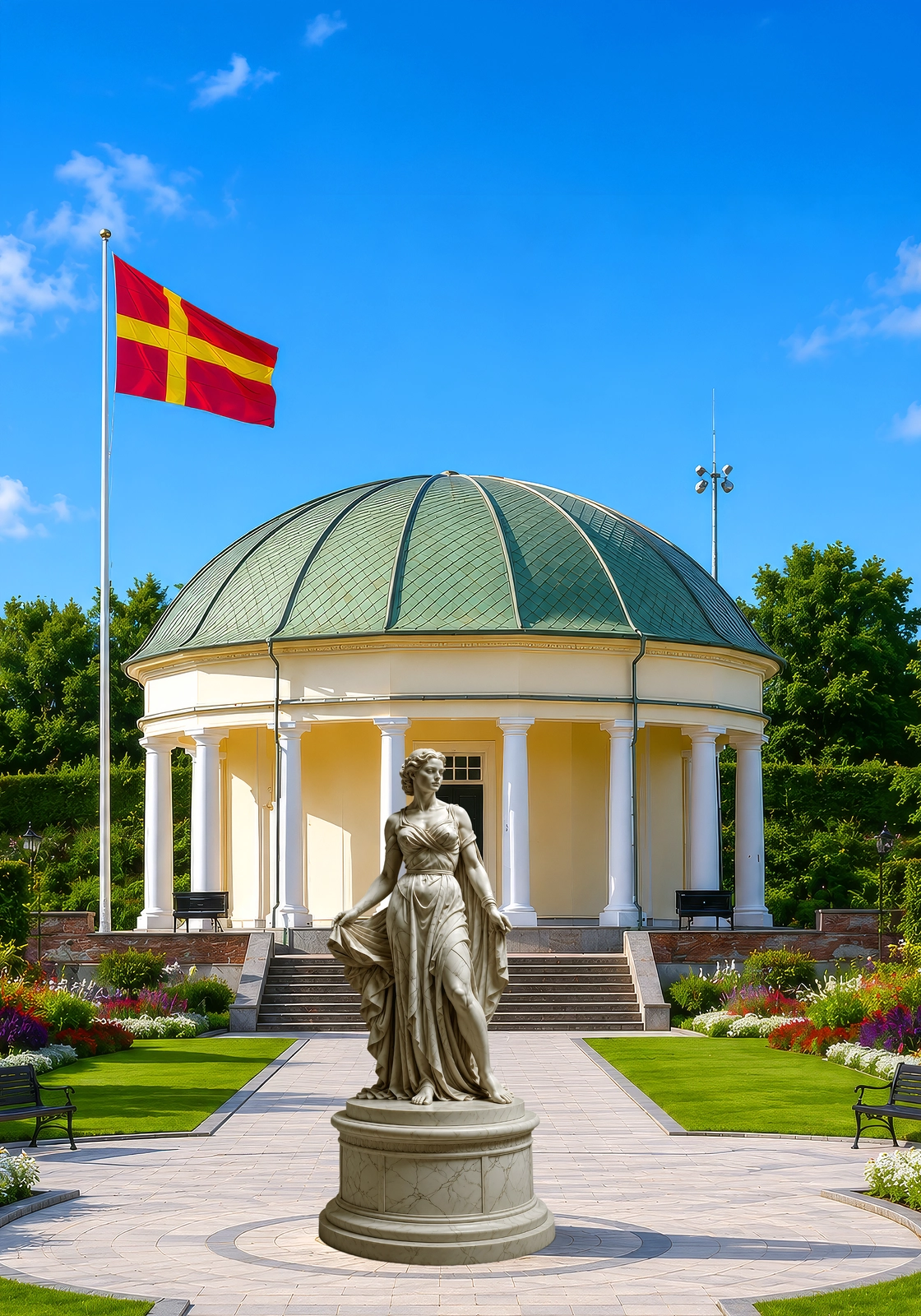
Jörgen Thornberg
The Anita Pavilion - Anitapaviljongen, 2026
Digital
50 x 70 cm
3 200 kr
The Anita Pavilion - Anitapaviljongen
Svensk text på slutet
INTRODUCTION
A forgotten tin box in a bank vault. A parchment that no one has read for five hundred years. A stubborn historian from Lund who asks the wrong question and, by doing so, finds the right answer.
What begins as a genealogists search for an almost-invisible woman in Malmö's history gradually leads to one of Europe's most remarkable discoveries. Hidden behind a series of ancient folds lies not only a fortune on the scale of the Nobel Foundation, but also a vision formulated by Jörgen Kock and his wife, Citze Kortsdatter, in the sixteenth centurya vision of women's education, independence, and future opportunities.
From that discovery grows something no one could have foreseen: the Anita Prize, the world's largest international award for women.
As Malmö prepares for the first award ceremony at the Anita Pavilion, people gather from every corner of the world. Yet among the guests are other visitors as well. Time-travellers long since departed from earthly life: Jörgen and Citze Kock, Frans Suell, Anna Cronholm and her father Bernhard, and Anita Ekberg herself.
This is the story of how a document from 1535 changed the future. A story of historys strange detours. Of money, ideals, determination, and chance. And of how a small tin box finally opened the door to something no one had dared to dream of.
This is her story. Or rather, the story behind it.
The Anita Pavilion
A dusty box, forgotten by the years,
Lay silent in a vault beneath the town.
Its secrets slept through centuries of fears,
While kings and empires rose and tumbled down.
A scholar sought a woman lost from sight,
A shadow standing just beyond the frame.
She followed traces through the fading light,
And found a spark that burst into a flame.
Old parchment spoke of dreams that would not die,
Of women lifting others toward the sun.
A promise sealed beneath a northern sky,
Awaiting those who dared complete whats begun.
Thus from the past a living future grew,
And Anitas star now shines for all to view.
Malmö, June 2026
The Anita Pavilion Anitapaviljongen
PROLOGUE The Ones Who Returned
Over the centuries, Malmö had welcomed kings, emperors, revolutionaries, industrial magnates, artists, prophets, swindlers, and footballers. The city had been besieged, burned, torn down, and rebuilt. But never before had it hosted a gathering like this.
If the living had known who was wandering through the parks, sitting at the outdoor cafés, and discreetly observing the preparations for the evenings ceremony on this late-summer day, they would probably have lost both their power of speech and their composure.
Many of the guests were Time-travellers who had not lived on Earth for a very long time; the two most important had not done so since the middle of the sixteenth century.
Some were well-known but not recognised.
Jörgen Kock walked slowly along Flower Street, which led up to the pavilion, with the same curious gaze that had once inspired him to build trading houses, ships, and fortunes. At his side walked his wife, Citze, whose name history books had rarely devoted many lines to, yet whose patience, money, and practical wisdom had rescued more than one of her husbands daring projects.
The couple passed Anna Elisabeth Cronholm, who was watching the crowd gather in front of Anitas statue. Her husband, Ernst Flensburg, looked just as astonished as he had the first time he was appointed mayor. Both found it hard to understand how a dusty old tin box and its contents could have changed the world and multicultural Malmö.
A short distance away sat Anita Ekberg, as beautiful as ever in her glory days in Rome. If anyone in the audience had recognised her, the evening would probably have descended into complete chaos. It was Anita who had given the pavilion and the statuette to be presented at the evenings ceremony their new names.
She was sitting with Bernhard Cronholm, who, during his life on Earth, had avoided publicity so consistently that no one today even knew what he looked like. No photographs existed, and no paintings had survived. Only a small sketch-like profile, which greets the reader on the front page of Sydsvenskan, the newspaper he founded in 1848, every day.
He had been a publisher, public debater, and conservative opinion-maker at a time when such men rarely doubted their convictions. In eternity, he had been reunited with his wife and his eldest daughter, Anna Elisabeth two women who had patiently continued the discussions life had interrupted. As a result, Bernhard gradually evolved from a conservative publisher into something considerably harder to place within a political category. He used to joke that it was impossible to win an argument against two intelligent women when one had all eternity at ones disposal. That was why he was immeasurably proud on this day.
Now all three of them were back in Malmö, and they were far from alone.
Besides all the earthlings from near and far, the evenings award ceremony had attracted an audience that considered itself to have an obvious place in the front row. Some women had fought for education, suffrage, science, art, and human rights. Some men had used their position to open doors rather than close them. There were people whose names were known throughout the world, and others who had almost fallen into oblivion, even though their efforts had changed history.
All of them had, in one way or another, contributed to what was about to happen. This evening, the first Anita Statuette would be awarded, the womens equivalent of the male Oscars, but not to reward film stars and directors; rather, to honour those who had done something significant for the women of the world.
And none of them could quite understand how a forgotten tin box, a document several hundred years old, and a stubborn female historian from Lund had managed to achieve what generations of politicians, bankers, and philanthropists had never even attempted.
To understand that, one must begin much earlier. Not with the prize. Not with the pavilion. Not even with Anita Ekberg. But with an agreement between two spouses who refused to die.
CHAPTER 1 An Unexpected View
The sun stood high above Malmö on this August afternoon in 2028. The air shimmered gently over the paving stones in front of the Anita Pavilion, and the red-and-yellow Scanian flag drifted in the faint breeze. The sky was almost unrealistically blue, as if one of the city's old advertising painters had been commissioned to create the perfect summer day and had then refused to leave anything to chance.
A few hours remained before the evening's grand ceremony would begin.
Technicians were running the final cables between the pavilion and the stage area. Camera platforms were already in place. Journalists from several continents wandered back and forth with microphones, cameras, and notebooks filled with notes. In the distance, fragments of conversations in Swedish, English, German, French, and Spanish drifted.
Malmö had become the centre of the world's attention. Not because of a state visit or a sporting event. Not even because of a Nobel Prize, which had now acquired a worthy rival. And this, even though the prize had not yet been awarded once, for tonight was its premiere.
At a café table a few metres from the pavilion, Anita Ekberg sat, watching it all with an expression that shifted between curiosity, astonishment, and mild disbelief.
At last she shook her head.
I must admit that I still don't quite understand it.
The man sitting opposite her smiled.
Which part?
She made a sweeping gesture that took in the pavilion, the statue, the park, and the people.
The whole package.
Bernhard Cronholm followed her gaze.
It is quite a large package.
Bernhard, when I left Earth, I thought my legacy would consist of a few films, a couple of hundred startling photographs, and perhaps the occasional nostalgic documentary on Italian television.
You underestimate the Italians.
I underestimate no one. I know Italians.
Bernhard laughed.
Go on.
Now I'm sitting here, watching people fly in from five continents to see a prize awarded in my name. I see journalists discussing the new major international award. I see diplomats, researchers, and billionaires running around like headless chickens. And in the middle of it all stands a statue of me, in front of a pavilion once built for a Crown Princess but now named after me. A bit much, perhaps, Anita.
She leaned back.
If someone had told me this when I was cycling around Möllevångstorget as a teenager, I would have recommended professional help.
Most people probably would have.
Anita let her gaze drift towards her own statue.
It stood directly in front of the pavilion in the afternoon sunlight. Visitors paused to photograph it before heading towards the entrance.
I'll never get used to that.
To what?
Standing over there and sitting here at the same time.
It becomes easier with time. Besides, you once said in an interview that you wouldn't mind a statue being erected in your honour.
Bernhard, that was just something that slipped out.
Well, you've never been particularly modest.
Anita laughed with delight.
Then she fell silent.
People moved slowly through the area. A group of Swiss guests passed by. Representatives of the City of Malmö stood with the organisers near the entrance. On stage, a sound technician was testing the microphones.
Do you know what puzzles me most?
I suspect you're going to tell me anyway.
Anita pointed towards the pavilion, where guests, journalists, and staff moved to and fro like parts of a well-oiled machine.
Nobody seems to be quarrelling. Not about the prize, not about the money, not about the fact that half the world's press is here. People usually go completely mad when large fortunes are involved.
Bernhard nodded slowly.
That struck me as well. But quite soon, most people realised the document was about something larger than money alone. Besides, many realised it wasn't particularly wise to stand in the way. When women's organisations from all over the world began to get involved, it became clear that opposition would carry a high political price. No municipal politician wanted to be seen as the person who stopped the world's largest women's prize, any more than the supposed heirs or other special interests did. It was over, quite simply. For once.
That sounds suspiciously idealistic.
I know. And yet it's true.
What about Basel? Anita asked. I've met bankers. They don't usually hand over money voluntarily.
They didn't.
Aha!
They got to keep it.
Now it's beginning to sound more realistic.
Bernhard smiled.
The capital remains where it has been for generations. That was one of the settlements key conditions. The fortune is still managed in Switzerland. Only the returns are distributed. Everyone benefited. Basel maintains the capital and ensures it grows. Malmö received the prize. The foundation receives its income. The world gained something new. And the biggest winners are the women of the Earth.
That sounds almost annoyingly sensible.
Yes, it ruined many people's plans for a proper quarrel.
Anita studied him for a few seconds.
You know exactly how it all happened, don't you?
I've had plenty of time to do my homework.
And you're planning to make me drag the story out of you, piece by piece.
It's an old occupational hazard.
Historian?
Newspaperman.
The same disease with different symptoms.
Bernhard laughed.
At that moment, a woman emerged from the pavilion, carrying a folder under her arm. She paused to speak with several journalists, then continued towards the stage area.
Bernhard nodded in her direction.
Do you see that woman over there?
The historian?
Anna Maria Flensburg.
The name sounded familiar.
The one who found the bank vault?
Yes, but what she really found was something much larger than that.
So Anna Maria found the trail left by Anna Cronholm, which led to the vault. The vault contained the document, which led to Jörgen Kock.
In broad terms, yes.
Anita followed the woman with her eyes.
I like her already.
Why?
Because she seems to be the only person in history who found a fortune and immediately began thinking about how to get rid of it.
That was roughly the journalists' reaction as well.
She could have become rich.
Very rich.
But she didn't.
No.
That requires an unusual kind of person.
Or an unusual family history.
For a while they sat in silence.
In front of them, the first guests for the evening's ceremony began to arrive. Limousines pulled in. Photographers prepared. Somewhere farther away, an orchestra could be heard rehearsing.
Anita took a sip of coffee.
Then I think you should tell me everything from the beginning, because you have obviously read more than the rest of humanity has.
From Jörgen Kock?
No.
She smiled.
From that damned tin box that no sensible person should have kept for generations.
Bernhard laughed.
That is actually an excellent place to begin.
As the afternoon sun slowly descended over Pildammsparken and the eyes of the world gradually turned towards the Anita Pavilion, Bernhard Cronholm began to tell the story of the little box no one had dared to throw away, of the woman who asked the wrong question and therefore found the right answer, and of how an almost forgotten document would eventually change the world.
The story began, as so many great stories do, with something that at first seemed completely insignificant.
CHAPTER 2 THE WOMAN WHO ASKED THE WRONG QUESTION
If the story begins with a tin box, said Anita, why does everyone keep talking about a historian?
Bernhard followed with his eyes a group of journalists who had just passed the pavilion before replying.
Because the box did not find itself. Anna Maria Flensburg did.
He pointed towards the entrance, where the female historian had just disappeared into the building.
She was not really looking for money, documents, or family secrets. She was researching women in Malmös history, particularly those who had ended up in their husbands shadows.
Sooner or later, you end up with Anna Cronholm.
Exactly. Anna Maria began with the same question that so many historians ask: who was the woman behind the famous man? In this case, Mayor Ernst Flensburg. The more she dug, the stranger it became. Anna Cronholm appeared everywhere in charitable projects, associations, family correspondence, and social networks. She seemed to have exerted far greater influence than the historical record suggested.
In other words, a classic example of womens historical invisibility.
Exactly.
Bernhard took a sip of coffee before continuing.
What made the research personal was that Anna Maria discovered, fairly early on, that she was related to the people she was studying. Anna Elisabeth Amalia Cronholm had married Ernst Flensburg, and Ernst turned out to be Anna Marias great-great-great-grandfather.
Then suddenly, it was no longer just history.
No. From that moment on, it was no longer simply about an interesting woman from Malmös past. It was also about her own family. Every letter, every note, and every document took on a different weight once she realised that the people she was researching were, in fact, her own ancestors.
I can imagine that changed the perspective.
Completely.
Bernhard took another sip of coffee.
That was when Anna Maria began to go through the family archives more systematically. She followed every trail she could find. Letters. Wills. Estates. Newspaper articles. Old family notes. But the more she found, the clearer it became that something was missing. Certain references seemed to point to a story that had never been fully told.
A void?
Exactly. As if someone had deliberately left clues but never the explanation itself.
In front of the pavilion, several tourists paused to photograph the statue. On the other side of the walkway, a television crew was testing the sound for the evenings broadcast.
And then came the letter.
Yes. A registered letter that changed everything.
From the bank?
From the bank. At first, Anna Maria assumed it was some administrative formality. Perhaps an old estate or a registration error. But when she began looking into the matter, she discovered something that no one in the family seemed to know much about any more.
The safe-deposit box.
Yes. The family was still listed as the holder of a very old safe-deposit box. A so-called gold box that had once been assigned to Anna Cronholm because her father was a major shareholder in Malmö Savings Bank. When Anna Maria started digging into the banks history, the picture became increasingly strange. The box had followed the family through generations. When the Savings Bank left its premises on Adelgatan, the box had been transferred to the headquarters of the merged Sparbanken Bikupan on Östergatan. Ten years later, it was moved again to the new bank building at Gustav Adolfs Square. Each time, the contents had followed, under the banks supervision.
But no one had opened it?
Not for a very long time. Generation after generation had inherited the responsibility. New keys had been issued, new papers signed. The fee had already been paid in advance. But no one seemed to know why anymore.
Anita raised an eyebrow.
That would have made me curious.
And somewhere around that point, the project changed. It was no longer just about Anna Cronholm. It was now about understanding why the family had continued for more than a century to preserve something that almost no one seemed to know about.
Bernhard paused briefly.
It is a miracle the safe-deposit box survived everything. Two world wars. Depressions. Emigration. Estates. Branches of the family that moved to Stockholm, London, and the United States. People came and went, but the arrangement endured. The bank moved. The box moved with it. The same tradition. The same responsibility.
As if some invisible hand kept guiding the whole thing.
Something like that.
Anita smiled.
Do you know what sets Anna Maria apart from most treasure hunters?
No.
She never went looking for a treasure.
Bernhard nodded.
That is actually the heart of the entire story. Had she been searching for money, she would probably have missed everything. She was searching for a human being, for a woman whom history had almost forgotten.
She was looking for a person and found a story.
Exactly.
More guests were arriving around the pavilion. Officials checked lists. Photographers took up positions for the evening. Malmö was preparing for one of the strangest ceremonies the city had ever organised.
So what did she do next?
What a historian always does when confronted with a mystery. She followed the next clue.
The safe-deposit box.
Yes. For Anna Maria, it was the culmination of several years work. She had no idea what awaited her inside. She only knew she stood before something no one else in the family had seriously investigated.
Anita looked towards the pavilion, where the historian had once again appeared alongside television crews.
So there she stands now. The woman who opened the door. First to Anna Cronholm, then to the safe-deposit box, and finally to the tin box.
A rather impressive achievement for someone who simply wanted to write history.
Anita took a sip of coffee.
Then I think we should go to the bank.
Bernhard smiled.
That is exactly what Anna Maria did.
CHAPTER 3 The Safe-Deposit Box at the Square
I think we should go to the bank.
Bernhard smiled.
That is exactly what Anna Maria did.
He leaned back in his chair and let his gaze wander across the area in front of the Anita Pavilion. More guests had begun to arrive. A television crew from Japan was setting up its equipment beside the Anita statue, while a German production company was discussing camera angles with several stressed organisers. Somewhere behind the pavilion, the sound of an orchestra rehearsing the evenings musical programme drifted in.
Anita followed his gaze.
Do you know what I like about this story?
That its about you?
Naturally. But it is also about people who happen to stumble upon something they were not looking for.
Bernhard laughed.
Then you will appreciate what comes next.
He took a sip of coffee before continuing.
When Anna Maria left Lund that morning, she still believed she might find dusty family papers, old photographs, perhaps even a forgotten document that could shed new light on Anna Cronholm. She had no idea she was on her way to something that would eventually change both her own life and an important part of Malmös future.
That is almost always the way.
Yes. History rarely issues invitations in advance.
Anna Maria had walked from the station through central Malmö. The August sun shone warmly over the city. People hurried between offices, cafés, and shops, paying her no particular attention. For them, it was an entirely ordinary working day. For her, the day began to feel less ordinary the closer she came to Gustav Adolfs Square.
The registered letter from the bank lay in her bag. She had read it several times without gaining any clarity. The wording was polite but unusually firm. The bank requested contact regarding an old safe-deposit box for which, according to their records, she was the responsible representative.
I would have become suspicious at once, said Anita.
So did she.
One rarely receives letters from banks that lead to anything enjoyable.
That depends on how one defines enjoyment.
When banks wrote to me in the old days, it usually meant they wanted to raise the interest rate on my loans, or to collect interest I could not afford to pay.
Bernhard smiled.
That was definitely not what they wanted this time.
The two of them sat in silence for a moment as several photographers passed by their table. A young reporter glanced at Anita without the slightest idea who she really was. Anita looked amused.
If only he knew.
Then he would probably be fired for missing the interview of the century.
True.
Bernhard continued.
The bank building at Gustav Adolfs Square did not look particularly remarkable. It was modern and efficient, and considerably less romantic than the old savings-bank palaces that had once dominated the city centre. Yet beneath its discreet surface, there were still remnants of another age.
Such as safe-deposit boxes.
Such as safe-deposit boxes deep within a gigantic vault.
When Anna Maria reported to the reception desk, she noticed almost immediately that the staff were just as curious as she was, not because they knew what the box contained, but because the documentation surrounding it was unusual.
The bank had changed its name several times over the years. The venerable Malmö Savings Bank of 1824 had become simply Sparbanken. Sparbanken had then become Sparbanken Bikupan. After that, further mergers, reorganisations, and name changes followed until the operation eventually became part of the Swedbank group. During the same period, almost all traditional safe-deposit boxes had disappeared. Now all safe-deposit boxes in Sweden were to be discontinued because they were considered unprofitable. Yet this box remained.
It is starting to sound like an old curse, said Anita.
Or a very stubborn family.
Sometimes that is the same thing.
Bernhard nodded.
The strange thing was that the fee had once been paid in such a way that no later generation had to make any decision about it. The responsible individuals had died. Heirs had taken over. New documents had been signed over the years. Yet the arrangement itself had continued automatically.
Like a relay baton that no one dared throw away.
Exactly.
In front of them, the first limousines pulled in. Several guests stepped out and were greeted by organisers, who guided them towards the pavilion, where drinks would be served. Anita watched the spectacle unfold.
Go on.
I am beginning to feel like Scheherazade.
The difference is that I do not intend to execute you if the story grows boring.
Which is reassuring.
They smiled at one another.
After the usual formalities, Anna Maria was escorted down to the vault. It was not nearly as dramatic as she had imagined. A lift took them deep underground and straight into a vast vaultno mountains of gold, no secret tunnels. Just a security door, several corridors, and rows of numbered boxes. But the farther down she went, the stronger the sense grew that time worked differently there.
He paused briefly.
You know how certain churches feel older than the very stones they are built from?
Absolutely.
That was what it felt like, as if generations of people had left their secrets there and then disappeared.
I like that.
So did Anna Maria.
The bank official produced his key. Anna Maria had found a key among the papers in the family archive. It had a paper clip attached, and fastened to the clip was a small note: Savings Bank. Not which savings bank, but she knew that now.
It is the first time in a long while, said the bank employee, looking through a small ledger he had brought with him. The last time this box was opened was in 1973, the year this branch was inaugurated. Before that, nobody had wanted to see the contents since the gold box was installed in 1880.
He showed Anna Maria the entry. The faded ink made it clear that a very long time had passed.
1880!
Something clicked in Anna Marias mind. 1880 was the year Anna Cronholm married into the Flensburg family. That could hardly be a coincidence.
They inserted their respective keys and turned them. Two locks had to be opened at the same time. There was a metallic click, the door opened, and the drawer slid partway out.
Anita leaned forward as though she herself were about to pull out the drawer.
And then?
The bank employee lifted out the drawer, placed it on a table, and stepped back a couple of paces. Apparently, banks nowadays are supposed to monitor whether people are hiding bundles of banknotes in their safe-deposit boxes. They are required to look for signs of money laundering. Then something happened that left both Anna Maria and the employee slightly confused.
Now it is becoming interesting.
The contents looked nothing like what one would expect to find in a safe-deposit box that had been passed down through generations.
No uncut diamonds or gold bars?
No.
No share certificates or thick bundles of banknotes?
No.
No jewels?
Not a single one.
Anita laughed.
The bank employee must have been disappointed.
A little.
Instead, there was only a tin box darkened by age, and beside it a dirty envelope containing something thick. It looked completely ordinary, like something one might find in an attic or at the back of a drawer.
The famous box.
Yes, although Anna Maria did not yet know that.
I must admit I already like it.
You are not alone.
Bernhard glanced towards Anitas statue, where people were pausing to take selfies. No one noticed that the statue resembled the woman sitting a short distance away, because marble is marble and a face is a face, even when it belongs to a guest from the stars.
Anna Maria immediately realised that the box must be important. No one places an old box inside a safe-deposit box and preserves it without reason. As she saw it, it had probably been lying there since the 1930s. Families do not preserve meaningless objects generation after generation.
Unless they contain a story.
Exactly.
Bernhard smiled.
And that was precisely what Anna Maria began to suspect in the vault beneath Gustav Adolfs Square. She had not yet opened the box. She did not yet know what the documents contained. She had no idea that the name Jörgen Kock would soon appear before her.
But for the first time, she began to understand that perhaps she had not merely discovered a forgotten family archive.
Perhaps she had discovered the beginning of a story passed down through the centuries.
While people high above her head continued their ordinary lives, unaware of what was taking place fifteen metres below ground, Anna Maria carefully picked up the small tin box. She weighed it in her hand and shook it gently, but nothing rattled like gemstones or nuggets of gold. It was far too light. Slightly disappointed, she placed it in her bag and left the bank.
And then? Anita asked.
Bernhard smiled slowly.
Then she went home to open it.
At last.
Yes. That was when the real story began.
CHAPTER 4 The Tin Box
At last.
Yes. That was when the real story began.
Bernhard leaned back and looked out over the area in front of the Anita Pavilion. The sun was sinking lower behind the treetops, and the number of guests was increasing by the minute. On the lawns, groups of journalists from different countries were trying to secure their final interviews before the evening's ceremony. A few metres away, two technicians were engaged in an intense discussion in front of a monitor. At the same time, a woman from the organising staff hurried past, wearing a headset and carrying a bundle of papers.
Anita followed the movement with her gaze.
Do you know what is strangest?
That you still manage to attract everyone's attention without anyone understanding who you are?
That too. But I was thinking about Anna Maria. She is standing among all these people and looks completely ordinary.
Historians usually do.
Yes, but sometimes the most dangerous people hide behind the most innocent facades.
Dangerous?
To old secrets.
Bernhard smiled.
There is something in that.
He took a sip of his now lukewarm coffee, then continued.
When Anna Maria returned home to Lund that evening, she was rather tired. She had spent most of the day dealing with archives, conversations, bank staff, and speculation. But as every researcher knows, there are moments when curiosity is stronger than fatigue.
I would have opened the box on the train.
I am quite sure you would have.
Without the slightest hesitation.
Anna Maria was somewhat more methodical.
In other words, more boring.
Considerably.
Anita laughed.
Bernhard continued.
First, she went through the envelope. It turned out to contain several older notes, many of them from the late nineteenth century. None of it seemed immediately sensational, but several names recurred again and again: Cronholm, Flensburg, and Malmö Savings Bank. There were also references to a document that none of the notes described in any detail. But there was one more object inside the envelope. When Anna Maria carefully emptied the contents onto the table, something heavy and metallic rolled out. At first she thought it was a fitting, but within a few seconds she realised what she had before her. It was a seal stamp.
She picked it up and examined it carefully under her desk lamp. As a historian, she did not need long to recognise what sort of object it was, though she had no idea who had once owned it. The coat of arms or symbol itself was not immediately easy to identify, but the discovery still made her pause. Seal stamps belonged to the category of objects historians rarely had the opportunity to study. When a person of importance died, families often destroyed both seal stamps and signet rings because they knew how easily they could be misused. With the correct seal, false documents could be created and old agreements forged. For that reason, it was generally considered safest to let them accompany their owner to the grave or to smash them. The fact that an original stamp had survived through generations was therefore an unusual discovery in itself.
Anna Maria weighed it in her hand. The metal felt heavy despite its modest size, and someone had clearly considered it worth preserving alongside the documents and the tin box. She carefully set it aside. For the moment, she did not know that the small seal stamp would one day help confirm the authenticity of a document that much of the academic world would initially find hard to believe.
Which naturally made her even more curious.
Naturally.
Outside along Baltiska Vägen, black limousines were beginning to roll slowly towards the entrance. Some of the arriving guests were obviously attracting the journalists' attention, and cameras suddenly began flashing in long bursts.
Anita glanced in that direction.
Who is that?
Bernhard squinted.
I think it is last year's Peace Prize recipient.
Then she will have to get used to cameras.
You did.
I had no choice.
Bernhard smiled and returned to the story.
At last, only the tin box remained. It stood alone on the table in front of Anna Maria, looking entirely unremarkable, darkened by centuries and nowhere near as dramatic as one might expect of something stored in a bank vault. After years of research, she may have expected something more spectacular than a small tin box. At the same time, there was something peculiar about its modest appearance. Objects that survive generation after generation usually do so for a reason, and the longer she looked at it, the more convinced she became that the real treasure probably did not lie in the boxs value but in its history.
That is where she was wrong.
Very wrong.
She picked up the box and examined it carefully. It was older than she had first believed. Not nineteenth-century, but older. The pewter had darkened, yet it was still surprisingly well preserved. She could see that a skilled artisan had once crafted it. On the inside of the lid were traces of what might have been initials, but they were unreadable.
Did she have any idea what was waiting for her?
Not the slightest.
Good.
I suspected you would appreciate that.
Bernhard noticed that some of the evening's honoured guests were gathering inside the pavilion. The murmur of voices grew louder by the minute, even though an hour remained before the ceremony began.
When Anna Maria opened the lid, she expected to find jewellery wrapped in linen. Instead, she found a folded parchment.
Only one?
Only one.
Then she must have been disappointed.
Quite the opposite.
At first glance, she could see that the parchment was oldnot old in the sense people mean when they talk about their grandparents' papers, but genuinely old. The yellowed surface of the parchment and its uneven edges testified to centuries of careful handling. When she cautiously unfolded the document, she saw three seals still attached to their parchment tags. They were darkened and worn, yet remarkably well preserved, and the sight of them immediately made her sit up straighter.
That was when she realised it was not an ordinary family document. Three seals suggested an official instrument.
Yes, I would have thought so too, said Anita. The more stamps or revenue stamps there are, the more important the paper must be. That was how it worked in Italy. The state sold stamps that had to be affixed to official documents. Those fees were a useful source of revenue whenever people were unwilling to pay taxes in other ways.
Anna Maria had worked with old documents long enough to understand what she was looking at. People did not affix multiple seals to ordinary documents. Such formalities were reserved for agreements deemed important.
She leaned closer to the document and began reading the first lines. First slowly, then again, and finally a third time to make certain she had not misunderstood.
And?
Bernhard smiled.
Then she saw the name.
Which name?
Jörgen Kock.
Anita put down her coffee cup.
There he is.
There he is.
Suddenly, everything changed. Jörgen Kock was not just any name in Malmö's history. He was the man who, during a decisive period, had been the city's wealthiest merchant, mayor, master of the mint, and one of the most influential figures in all of Scandinavia.
Not bad for a man who has been dead for nearly five hundred years.
No.
And now he is sitting in the park, waiting for tonight's ceremony.
Bernhard nodded towards the man.
It is not every day that one sees a five-hundred-year-old man in modern clothes, he said.
History has a peculiar sense of humour, Anita said.
The evening light was deepening into shades of pink, and the lights inside the pavilion were coming on. But at her desk in Lund, Anna Maria saw none of this. She saw only the parchment before her, bearing the signatures of Jörgen Kock and his wife, Citze Kortsdatter, signatures she had encountered in an entirely different context. The three seals and the first indications of an agreement had waited almost five hundred years to be read again.
Now it is becoming truly exciting, said Anita.
Bernhard smiled.
Yes.
What did the document say?
That, Anita, is the next chapter.
I certainly hope so.
CHAPTER 5 The Vision
The evening light was now settling over Pildammsparken. The lights around the Anita Pavilion were on, and more and more guests were gathering at the entrance. Several journalists were making their final test broadcasts, while the organisers discreetly tried to maintain order among diplomats, researchers, award recipients, and curious spectators. From the terrace came the murmur of conversations in several languages.
Anita looked out over the swelling crowd.
So Anna Maria was sitting at home in Lund with a sixteenth-century document in front of her, Jörgen Kocks name on the parchment, and three seals that had survived five hundred years. I assume she did not sleep much that night.
No more than any other historian who suspects reality is beginning to outstrip imagination.
Bernhard smiled.
But the remarkable thing is that she still did not understand what she had found.
She didnt?
No. It is easy for us to say that with hindsight. This was something she had never encountered before.
He leaned back.
The parchment was not merely folded to make it easier to store. The folding itself was part of the concealment. People in the sixteenth century had no envelopes, no safes, and no passwords. They used the paper or parchment itself as protection. Folds, seals, and strips served as their equivalent of security devices.
So the document had several layers?
In the way it was folded, yes, but in reality it was only a front and a back. You could compare it to Japanese origami, equally sophisticated yet without any decorative purpose.
Anna Maria studied the parchment for a long time before doing anything. She then took out the seal stamp that had been lying in the envelope and compared it with the first seal. The pattern matched. Not perfectly, since both the wax and the metal had been worn down by the passing centuries, but well enough for her to feel confident.
The first seal belonged to Jörgen Kock.
The second she identified was Citze's, after several more hours of work.
The third remained a mystery.
She photographed it from different angles, digitally enhanced the images, and tried to compare it with various coats of arms, but reached no definite conclusion. Two strange animals appeared on either side of a shield, and in the centre rose a curved staff or crozier. The symbolism was clearly important but still difficult to interpret.
Historians love mysteries until they encounter a real one.
There is something to that.
Bernhard smiled.
But the interesting thing was that Anna Maria did not yet care much about the third seal. Her attention was instead focused on the text.
She carefully unfolded the document as far as its construction allowed. It soon became clear that the parchment contained nothing she had expected. There were no figures, no accounting records, no information about money, and no instructions for merchants or bankers.
Instead, she found something entirely different.
A vision.
...for the benefit and assistance of honourable women who diligently labour for the good of other women... that through learning and proper conduct they may raise one another up, so that they and their households may earn an honest livelihood and escape poverty...
The text was written in the language and style of the sixteenth century, yet its meaning was surprisingly clear. The document described how certain unspecified assets were to be used to support women who worked for the benefit of other women. It spoke of women improving other women's circumstances by providing educational opportunities, enhancing their professional skills, and giving them and their families the means to support themselves. The wording was concise but unusually concrete for its time. Above all, it was far ahead of its time.
In the sixteenth century, donations almost always concerned the purchase of masses for souls or the construction of monastery chapels. But this was entirely different. It was an investment in the futurean eternal fund for female independence.
Anna Maria read slowly. Then she read everything again, and then a third time. The more she read, the stranger the feeling grew.
What did she think? asked Anita.
That she might have found a foundation charter.
As early as 1535?
Yes.
Bernhard nodded.
Not in the modern sense, of course, but the idea was the same. A couple had set aside assets for a specific purpose that would endure after their deaths. And that purpose concerned women.
Anita was silent for a moment.
That does not sound very sixteenth-century.
No. That was exactly what made the document so unusual. Anna Maria understood it immediately.
Anna Maria was beginning to understand why generation after generation had preserved the parchment. She was not sitting with yet another family letter or another legal document from Malmös history. She was sitting with a visionan idea formulated by two people almost five hundred years earlier, which still felt alive.
What fascinated her most was that the text mentioned no specific sum. No amount was stated. No accounting. No figures at all.
The purpose was crystal clear, but the means were unspecified.
That was rather strange, wasnt it?
Yes. Anna Maria probably assumed the rest of the records had been lost. She believed she had the whole story in front of her.
But she didnt.
Not even close.
Bernhard looked towards the pavilion, where guests stood with glasses.
What made the document so ingenious was that the Kocks had placed the most important elements first: the vision, the purpose, the dream, and what the money was to be used for. Only much later would someone realise that the document also contained the answer to the question that all foundations must eventually ask.
Where the money came from.
Exactly.
Five years earlier, Anna Maria had sat for a long time, bent over the parchment. Before her, she saw two people from sixteenth-century Malmö who, in their ageing language, had articulated something the world was still grappling with half a millennium later: how capable and enterprising women could help other women gain greater opportunities than they themselves had enjoyed.
Anna Maria believed she had reached the end of the document.
In reality, she was still standing only on the threshold.
I dont like that smile, said Anita suspiciously.
What smile?
The one you get when you know something I dont.
Bernhard laughed.
Then you are going to like it even less in the next chapter.
He nodded towards the open-air theatre, where the audience was now filling the rows of benches beneath the warm August evening sky. The spotlights had been switched on, and technicians on stage were making the final preparations for the ceremony. Guests drifted slowly from the pavilion towards their seats, while the murmur of voices rose like a distant sea.
It is strange, he continued. All of this began with a single parchment and a few lines of text that most people would have overlooked without a second thought.
Anita followed his gaze.
Farther away, Anna Maria Flensburg could be seen surrounded by organisers, journalists, and representatives of the foundation. For the occasion, she had been given the honour of opening the ceremony, but at that moment she looked mostly like someone trying to make a hundred practical details work at the same time.
She looks stressed.
She is.
Does she know it?
Probably not.
Bernhard smiled.
But five years earlier, it would have been difficult to convince Anna Maria, hunched over the parchment, that one day she would stand among the hosts of all this.
From the theatre came the sound of the orchestra playing the first overture of the evenings musical programme.
And yet it is not the most important discovery she has made, said Anita.
No.
Not even close.
Bernhard rose slowly from his chair.
Anna Maria still believed she had understood the document when she read the section about the foundation and its purpose. She still did not know that the real secret remained hidden behind the final fold.
Which means that you intend to torture me for another chapter.
Without the slightest twinge of conscience.
And while the applause from the open-air theatre began to roll through the warm evening air and the first guests took their seats for the presentation of the very first Anita Prize, Anita waited to hear the parchments final secret.
CHAPTER 6 The Final Fold
From the open-air theatre came the sound of the orchestra tuning its instruments as guests slowly filled the rows of seats in front of the stage. The lights around the Anita Pavilion cast a warm glow across Flower Street, and in the twilight, diplomats, researchers, journalists, and prize recipients moved among the trees. Everything was moving towards a climax, although most people still had no idea how extraordinary the past that had brought them there was.
Anita followed the crowd with her eyes, then turned to Bernhard.
You are not getting away with it this time.
Getting away with what?
The final fold.
Bernhard laughed softly.
I should have realised you were not going to let it go.
Not when you have devoted an entire chapter to suggesting it changed everything.
Then I suppose we must return to Lund.
He glanced towards the theatre, where the front rows were now almost full.
Five years ago, at roughly this time, Anna Maria sat alone at her desk with the parchment spread before her. She had already spent the afternoon and evening studying it, comparing seals, photographing details, and trying to understand what the Kocks had intended to say. She had read the text so many times that the phrases had begun to take on a life of their own in her head. Anna Maria was convinced she had essentially understood its significance.
On the table lay what she believed to be an unusually early foundation charter, a vision of how women would help other women achieve education, independence, and financial security. In itself, it was the sort of discovery most historians would have been more than satisfied with.
But the longer she stared at the parchment, the more one detail disturbed her. The parchment would not quite lie flat. Parchment can warp because it is a living material, but this one bulged oddly.
It was not much. After almost five hundred years, it was perfectly natural for an old parchment to retain traces of its original folds. Yet something did not seem right. A slight ridge ran along the lower section of the document, and the more Anna Maria studied it, the stronger the conviction grew that this was not an ordinary fold but something deliberately constructed.
Historians eventually develop a special sensitivity to such things. They spend their lives dealing with people who, for understandable reasons, can no longer answer questions. As a result, they learn to notice small irregularities that others might dismiss as insignificant. Anna Maria took out her magnifying glass again and began methodically examining the edge of the fold. After a while, she thought she could make out a narrow strip of parchment that had almost completely fused with the main sheet. It had probably been sealed with wax. For the first time, she realised the document might not have been fully examined.
It was a thought that left her both excited and nervous.
Anna Maria stood up, went into the kitchen, made more coffee, and then returned to her desk with the kind of concentration that comes when a researcher senses a discovery may be near. Over the following hours, she studied the construction from every conceivable angle. Slowly, she became convinced that the Kocks had not merely written a document but had constructed it as a safe made of parchment.
Every fold seemed to serve a purpose and to have been placed deliberately. The entire parchment resembled not so much an ordinary legal document as an intricate puzzle of the kind created in an age before people had safes, bank vaults, or modern archivesorigami with serious intent. Today, origami is used in modern science and space research to fold solar panels on satellites so they can fit inside rockets.
You have to admit that Jörgen Kock was ahead of his time, said Bernhard.
Folding things cleverly sounds more like Citzes creation, Anita said dryly.
Bernhard ignored the sarcasm and continued.
Eventually, Anna Maria could wait no longer and abandoned a little of her caution.
She carefully traced the hidden strip with her fingers. Parchment from the sixteenth century is surprisingly durable, yet a single careless movement can still destroy something that has survived for centuries. She therefore worked slowly, almost reverently, as though she were holding a living piece of history in her hands.
That was when she noticed the old wax seal beginning to give way.
Not suddenly or dramatically, but slowly and almost reluctantly, as though the document, after centuries of silence, had finally decided to reveal what had been hidden deepest within. When the final fold unfolded, a line of text appeared that no one had been able to read since someone had glued the fold together in the sixteenth century: Ratsurkunde.
Anna felt excitement rising within her.
Council Charter.
But which council?
She carefully unfolded the document. Layer after layer unfolded before her until the parchment was almost twice its original size. It was then that she realised the foundation charter on the outside was only one part of the document, the part intended to be seen, protecting the other part. Whatever that might be. It looked like an official instrument.
This text had an entirely different character. No longer was it about visions, purposes, and support for enterprising women. Instead, it dealt with deposits, administration, obligations, and repayment. The language was legal and formal. The further Anna Maria read, the clearer it became that she had reached the heart of the parchment.
The text was written in early sixteenth-century German and was difficult to interpret because of its archaic script. Time and again, Anna Maria had to look up words, compare letter forms, and check her interpretations against other contemporary documents she could find online. Several times, she thought she had misread something and began again. Yet every new examination led to the same conclusion.
The document had been issued in Basel in July 1535 and signed by two parties, whose elaborate signatures appeared at the bottom.
It was then that the third seal finally received its explanation. When Anna Maria returned to her photographs, she noticed details she had previously overlooked. The strange animals flanking the coat of arms were basilisks, and the curved staff at the centre was a bishops crozier. After further research online, the matter became clear. The seal belonged not to a private individual but to the city-state of Basel.
With that, the entire structure of the document fell into place. The three seals did not represent two contracting parties and a witness, as one might easily assume at first glance, but three full parties: Jörgen Kock, Citze van Nuland, and the city of Basel. Citze in relation to the donation section, and Jörgen Kock and the city of Basel in relation to the deposit agreement.
When Anna Maria finally deciphered the central section of the text, she sat motionless for a long time. There, the Council of Basel acknowledged that Jörgen Kock of Ellenbogen had deposited one hundred Rhenish guilders, a sum equivalent to forty-three Cologne markswhich, in modern terms, amounts to approximately ten kilograms of pure silverinto the citys administration, together with an annual interest payment of one pound and one gold coin per thousand guilders. The capital was to be managed alongside the citys other assets and repaid upon presentation of the original instrument.
Bernhard paused theatrically, looking at Anita over the rim of his glass.
That final clause was simply how they expressed it in those days, he added with a quiet laugh. Anna Maria quickly converted it on her mobile phone. It equated to an annual interest rate of exactly 2.1 per cent. That may not sound like very much.
Ellenbogen? That sounds German.
That was Malmös name in the sixteenth century, after the shape of the bay. The Elbow.
Aha. I somehow missed that in school. But I was thinking about the interest that has been running all this time.
Anita drew in her breath as the realisation struck home.
But with compound interest... over five hundred years, that becomes an enormous sum of money.
Exactly, Bernhard continued.
The remarkable thing was not the amount but the conditions. The document contained no time limit, no final expiration date, and no provision stating that the claim would lapse after a certain number of years. Repayment was to be made on demand, with compound interest.
Anna Maria read the passage over and over before she dared trust her own interpretation. If she had understood the text correctly, it meant that no one had ever terminated the agreement. For almost five hundred years, no one had made a claim on the deposit, and for almost five hundred years Basel had been able to use the capital as part of its own administration. She was not an economist, but as a historian she constantly compared the past and the present, not least because ordinary people needed such comparisons to understand. Present-value calculations were therefore not unfamiliar territory to Anna Maria.
With interest, Basels debt must have grown to an unimaginably large sum.
Now the original instrument lay before her on the desk. Formally, she held the right to the claim. Anna Maria had both the document and Jörgen Kocks seal in her possession. She did not need to be a lawyer to realise that the case appeared watertight so far. At the same time, she was not naïve enough to believe that the issue would not engage lawyers, economists, historians, and politicians throughout Europe.
If the debt still existed, how much was it?
Using an online specialist programme available to her, Anna Maria calculated that ten kilograms of silver, managed with an average real return of approximately 2.1 per cent per year for nearly five hundred years, would have produced a final value of roughly six to seven billion Swedish kronor in todays money at the time of the agreement.
Anna Maria read the figures once. She read them again.
After that, she rose from her chair and began pacing back and forth across the room, trying to make sense of what she had just read.
For the first time, the element missing from the first part of the document was present.
The money.
What a coincidence that the sum fell within the same range as the Nobel Foundations assets. Jörgen Kocks deposit was therefore no longer a historical curiosity but a capital fund capable, in practice, of financing an international prize on the scale of the Nobel Prize.
A womens prize, thought Anna Maria. It was entirely consistent with the stipulation, namely the couples shared wish as expressed in the earlier document.
CHAPTER 7 Basel on the Map
If I remember the storys structure correctly, Bernhard mused aloud.
Basel had never needed to keep the money in a separate chest. Over the centuries, the capital could have formed part of the city's ordinary administration, as banks and foundations do. But at the same time, Basel carried a corresponding liability. If the document's wording about eternal time and repayment upon demand was still legally valid, the city suddenly faced a claim whose present value amounted to approximately six or seven billion kronorroughly the same as the total assets of the Nobel Foundation.
Not exactly chicken feed, said Anita.
No, one cannot call it that. During the hours Anna Maria had spent studying the parchment, she had marvelled at how clearly the purpose was described, while the financing remained invisible. Now the explanation appeared. The Kocks had deliberately hidden that information behind the final fold. There it became clear that certain assets had been placed in the custody of the authorities in Basel and that the administration was to continue for all eternity. The capital itself was not to be distributed, consumed, or dissolved. Only the return could be used, and it was to be used for the purpose previously described in the document.
When Anna Maria read the wording for the third or fourth time, a new thought slowly began to take shape. If the text spoke the truth, this was not a completed historical project. It was something that, in principle, remained in force. A dizzying idea gradually emerged.
At that point, her racing imagination came to a halt, and reason intervened.
Anna Maria reacted as a historian rather than as an economist. Why Basel? Why not Malmö, Copenhagen, or Lübeck? What connections had Jörgen Kock maintained there? How could such a deposit have arisen amid the turbulent years of the Count's Feud? Jörgen Kock must have visited Basel in person. The questions arrived faster than the answers, and, fascinated by the historical context, she almost overlooked the most astonishing consequence of all.
She still had no idea that a few lines on an old parchment would soon prompt lawyers, economists, bank directors, historians, and politicians to scrutinise the same document with an intensity no one had devoted to it for five hundred years.
For Anna Maria, it was still research, and she set aside every thought of money.
She imagined an article, perhaps a book, or possibly an unusually interesting research project. She still did not realise that she was holding the key to one of Europe's most extraordinary financial stories.
Several more weeks would pass before the idea, germinating somewhere in the back of her mind, matured.
And it would require contact with Basel. But Anna Maria was neither an economist nor a lawyer. Just a curious historian with ambitions. All right, she knew she was no fool, but this was too big to handle alone.
Then she will have to get help, Anita said impatiently, as if Anna Maria needed to hear it. After all, she had reached the finish line, and the evidence surrounded them at the Anita Pavilion.
Bernhard laughed.
Just as Anna Maria does, I find myself asking why Basel?
Anita looked down into her glass and slowly rotated her foot.
Do you remember that I told you how Jörgen Kock and his wife, Citze, were forced to flee for their lives during the war in the sixteenth century? Jörgen emptied his mint in Malmö. He packed chests with silver and gold, took Citze with him, and fled headlong first to Copenhagen and later into Germany. An enormous fortune was hidden in foreign trading houses across Europe as a form of life insurance. Money that Malmö and the Danish king never got their hands on.
The mint master's escape capital... Did they take it abroad? Anita's eyes widened.
When Kock was pardoned and regained his position under the new Danish king, he never brought all of it home. Jörgen Kock could never be certain that he would not fall from favour again. Therefore, part of it was placed in various ways on the Continent, where it continued to earn returns beyond the king's control. Those claims were collected after Jörgen Kock's death and became part of the Kocks' and his wife's fund for the poor of Malmö.
Aha, but the money in Basel was not included.
No. It escaped everyone's attention for almost six centuries. That was probably never the intention, but when Citze left this world unexpectedly, before Kock, the money was forgotten.
So much money! What did those ten kilograms of silver actually represent in 1535? Anita asked, fascinated. What could Jörgen Kock really buy for that sum in his own day?
Bernhard smiled and rotated his glass as if weighing history in his hand.
That is precisely what makes it so interesting, he replied. Ten kilograms of pure silveror one hundred Rhenish guilderswas a fortune for an ordinary person in 1535. To understand its value, one has to look at the cost of living at the time.
Bernhard paused briefly and did some mental calculation.
In the 1530s, a skilled carpenter or craftsman earned roughly ten to twelve guilders a year. Those hundred guilders therefore represented almost ten years wages for an adult tradesman. If you wanted to buy a substantial stone house in central Malmö or Copenhagen at that time, one hundred guilders would have been more than sufficient. You could buy thirty dairy cows or thousands of litres of quality wine from the Rhineland.
That would have been quite a drinking spree.
Anita smiled.
It was certainly not pocket money he was carrying. Bernhard nodded. For an ordinary burgher, it was an unattainable lifetime fortune. But for Jörgen Kock, who controlled Denmark's royal mint and conducted large-scale international trade through the Hanseatic League, it was little more than a trifle. The genius lay not in the amount he deposited, but in allowing Central Europe's safest bankers to manage ituntouched for five hundred years. It was a financial time bomb that Anna Maria had now set off.
The wonderful thing is that Citze's and Jörgen's old escape money is now funding a feminist foundation. Entirely legally and beyond the reach of all greedy men.
Anita broke into a dazzling Hollywood smile and clapped her hands with delight.
Isn't it magnificent, Bernhard?
Old Kock's flight silver financing a women's celebration at the Pildamms five hundred years later! It is not merely poetryit is the finest damned coup in Malmö's history!
But how did he even get down there? she asked, looking at Bernhard. Travelling from Malmö to Basel in the sixteenth century... that must have been a lifetime undertaking.
It was, Bernhard nodded, leaning back. But Jörgen Kock was no ordinary man. He was Denmark's royal mint master and Malmö's mayor. When he travelled, he did so in style, with money and a heavily armed escort. The roads were dreadful, rife with highwaymen, and the journey took weeks. There were essentially two routes he could take, depending on whether he departed from Malmö or Copenhagen.
Did he ride or travel in a carriage?
He rode without a doubt, Bernhard answered firmly, taking a sip from his glass. Not that anyone knows whether Kock rode or crawled; that information has not survived. My answer rests on simple logic and basic historical knowledge.
Anita raised her eyebrows in surprise.
Really? Not even in a comfortable carriage, given how rich he was?
No. In the sixteenth century, virtually everyone who could afford a horse rode. The first covered court carriages and coaches were beginning to appear then, but they were heavy, cumbersome, and lacked suspension. The roads through the German forests were essentially widened riding tracks, filled with deep mud holes, roots, and fallen rocks. Sitting in a carriage over such terrain was torture for the back, and the vehicles were constantly stuck or overturned.
Bernhard leaned forward, placing his hands on the table.
A man like Jörgen Kocka man of action and a former soldierpreferred the saddle. On horseback, he was mobile, fast, and ready if they encountered bandits. Donkeys probably followed, carrying supplies. Kock himself would have travelled at a gallop and a trot on sturdy German riding horses, changing to fresh animals at stations along the route.
Anita smiled and gazed out across the terrace, as though she could see the Scanian magnate thundering across Central Europe.
One certainly did not travel by train in those days.
It was clear that Anita was reflecting on her own intense travels in her golden years and on how her career might have looked in the sixteenth century. Beautiful women, after al
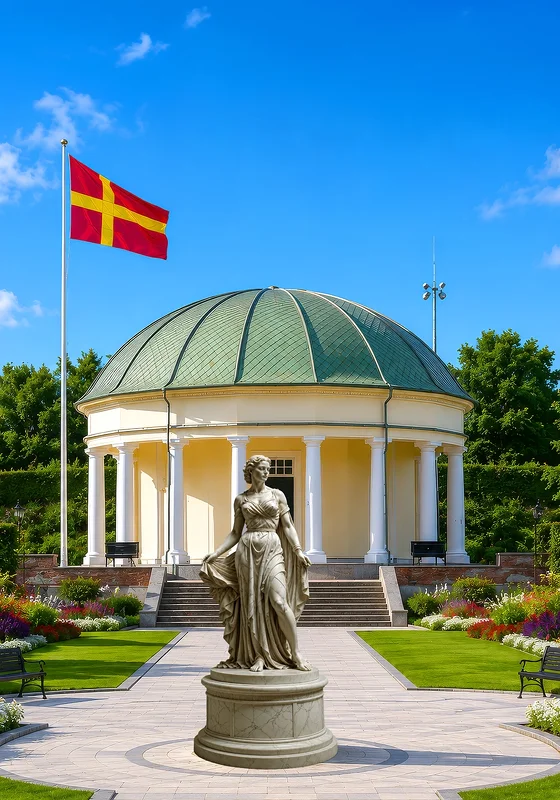
Jörgen Thornberg
The Anita Pavilion - Anitapaviljongen, 2026
Digital
50 x 70 cm
3 200 kr
The Anita Pavilion - Anitapaviljongen
Svensk text på slutet
INTRODUCTION
A forgotten tin box in a bank vault. A parchment that no one has read for five hundred years. A stubborn historian from Lund who asks the wrong question and, by doing so, finds the right answer.
What begins as a genealogists search for an almost-invisible woman in Malmö's history gradually leads to one of Europe's most remarkable discoveries. Hidden behind a series of ancient folds lies not only a fortune on the scale of the Nobel Foundation, but also a vision formulated by Jörgen Kock and his wife, Citze Kortsdatter, in the sixteenth centurya vision of women's education, independence, and future opportunities.
From that discovery grows something no one could have foreseen: the Anita Prize, the world's largest international award for women.
As Malmö prepares for the first award ceremony at the Anita Pavilion, people gather from every corner of the world. Yet among the guests are other visitors as well. Time-travellers long since departed from earthly life: Jörgen and Citze Kock, Frans Suell, Anna Cronholm and her father Bernhard, and Anita Ekberg herself.
This is the story of how a document from 1535 changed the future. A story of historys strange detours. Of money, ideals, determination, and chance. And of how a small tin box finally opened the door to something no one had dared to dream of.
This is her story. Or rather, the story behind it.
The Anita Pavilion
A dusty box, forgotten by the years,
Lay silent in a vault beneath the town.
Its secrets slept through centuries of fears,
While kings and empires rose and tumbled down.
A scholar sought a woman lost from sight,
A shadow standing just beyond the frame.
She followed traces through the fading light,
And found a spark that burst into a flame.
Old parchment spoke of dreams that would not die,
Of women lifting others toward the sun.
A promise sealed beneath a northern sky,
Awaiting those who dared complete whats begun.
Thus from the past a living future grew,
And Anitas star now shines for all to view.
Malmö, June 2026
The Anita Pavilion Anitapaviljongen
PROLOGUE The Ones Who Returned
Over the centuries, Malmö had welcomed kings, emperors, revolutionaries, industrial magnates, artists, prophets, swindlers, and footballers. The city had been besieged, burned, torn down, and rebuilt. But never before had it hosted a gathering like this.
If the living had known who was wandering through the parks, sitting at the outdoor cafés, and discreetly observing the preparations for the evenings ceremony on this late-summer day, they would probably have lost both their power of speech and their composure.
Many of the guests were Time-travellers who had not lived on Earth for a very long time; the two most important had not done so since the middle of the sixteenth century.
Some were well-known but not recognised.
Jörgen Kock walked slowly along Flower Street, which led up to the pavilion, with the same curious gaze that had once inspired him to build trading houses, ships, and fortunes. At his side walked his wife, Citze, whose name history books had rarely devoted many lines to, yet whose patience, money, and practical wisdom had rescued more than one of her husbands daring projects.
The couple passed Anna Elisabeth Cronholm, who was watching the crowd gather in front of Anitas statue. Her husband, Ernst Flensburg, looked just as astonished as he had the first time he was appointed mayor. Both found it hard to understand how a dusty old tin box and its contents could have changed the world and multicultural Malmö.
A short distance away sat Anita Ekberg, as beautiful as ever in her glory days in Rome. If anyone in the audience had recognised her, the evening would probably have descended into complete chaos. It was Anita who had given the pavilion and the statuette to be presented at the evenings ceremony their new names.
She was sitting with Bernhard Cronholm, who, during his life on Earth, had avoided publicity so consistently that no one today even knew what he looked like. No photographs existed, and no paintings had survived. Only a small sketch-like profile, which greets the reader on the front page of Sydsvenskan, the newspaper he founded in 1848, every day.
He had been a publisher, public debater, and conservative opinion-maker at a time when such men rarely doubted their convictions. In eternity, he had been reunited with his wife and his eldest daughter, Anna Elisabeth two women who had patiently continued the discussions life had interrupted. As a result, Bernhard gradually evolved from a conservative publisher into something considerably harder to place within a political category. He used to joke that it was impossible to win an argument against two intelligent women when one had all eternity at ones disposal. That was why he was immeasurably proud on this day.
Now all three of them were back in Malmö, and they were far from alone.
Besides all the earthlings from near and far, the evenings award ceremony had attracted an audience that considered itself to have an obvious place in the front row. Some women had fought for education, suffrage, science, art, and human rights. Some men had used their position to open doors rather than close them. There were people whose names were known throughout the world, and others who had almost fallen into oblivion, even though their efforts had changed history.
All of them had, in one way or another, contributed to what was about to happen. This evening, the first Anita Statuette would be awarded, the womens equivalent of the male Oscars, but not to reward film stars and directors; rather, to honour those who had done something significant for the women of the world.
And none of them could quite understand how a forgotten tin box, a document several hundred years old, and a stubborn female historian from Lund had managed to achieve what generations of politicians, bankers, and philanthropists had never even attempted.
To understand that, one must begin much earlier. Not with the prize. Not with the pavilion. Not even with Anita Ekberg. But with an agreement between two spouses who refused to die.
CHAPTER 1 An Unexpected View
The sun stood high above Malmö on this August afternoon in 2028. The air shimmered gently over the paving stones in front of the Anita Pavilion, and the red-and-yellow Scanian flag drifted in the faint breeze. The sky was almost unrealistically blue, as if one of the city's old advertising painters had been commissioned to create the perfect summer day and had then refused to leave anything to chance.
A few hours remained before the evening's grand ceremony would begin.
Technicians were running the final cables between the pavilion and the stage area. Camera platforms were already in place. Journalists from several continents wandered back and forth with microphones, cameras, and notebooks filled with notes. In the distance, fragments of conversations in Swedish, English, German, French, and Spanish drifted.
Malmö had become the centre of the world's attention. Not because of a state visit or a sporting event. Not even because of a Nobel Prize, which had now acquired a worthy rival. And this, even though the prize had not yet been awarded once, for tonight was its premiere.
At a café table a few metres from the pavilion, Anita Ekberg sat, watching it all with an expression that shifted between curiosity, astonishment, and mild disbelief.
At last she shook her head.
I must admit that I still don't quite understand it.
The man sitting opposite her smiled.
Which part?
She made a sweeping gesture that took in the pavilion, the statue, the park, and the people.
The whole package.
Bernhard Cronholm followed her gaze.
It is quite a large package.
Bernhard, when I left Earth, I thought my legacy would consist of a few films, a couple of hundred startling photographs, and perhaps the occasional nostalgic documentary on Italian television.
You underestimate the Italians.
I underestimate no one. I know Italians.
Bernhard laughed.
Go on.
Now I'm sitting here, watching people fly in from five continents to see a prize awarded in my name. I see journalists discussing the new major international award. I see diplomats, researchers, and billionaires running around like headless chickens. And in the middle of it all stands a statue of me, in front of a pavilion once built for a Crown Princess but now named after me. A bit much, perhaps, Anita.
She leaned back.
If someone had told me this when I was cycling around Möllevångstorget as a teenager, I would have recommended professional help.
Most people probably would have.
Anita let her gaze drift towards her own statue.
It stood directly in front of the pavilion in the afternoon sunlight. Visitors paused to photograph it before heading towards the entrance.
I'll never get used to that.
To what?
Standing over there and sitting here at the same time.
It becomes easier with time. Besides, you once said in an interview that you wouldn't mind a statue being erected in your honour.
Bernhard, that was just something that slipped out.
Well, you've never been particularly modest.
Anita laughed with delight.
Then she fell silent.
People moved slowly through the area. A group of Swiss guests passed by. Representatives of the City of Malmö stood with the organisers near the entrance. On stage, a sound technician was testing the microphones.
Do you know what puzzles me most?
I suspect you're going to tell me anyway.
Anita pointed towards the pavilion, where guests, journalists, and staff moved to and fro like parts of a well-oiled machine.
Nobody seems to be quarrelling. Not about the prize, not about the money, not about the fact that half the world's press is here. People usually go completely mad when large fortunes are involved.
Bernhard nodded slowly.
That struck me as well. But quite soon, most people realised the document was about something larger than money alone. Besides, many realised it wasn't particularly wise to stand in the way. When women's organisations from all over the world began to get involved, it became clear that opposition would carry a high political price. No municipal politician wanted to be seen as the person who stopped the world's largest women's prize, any more than the supposed heirs or other special interests did. It was over, quite simply. For once.
That sounds suspiciously idealistic.
I know. And yet it's true.
What about Basel? Anita asked. I've met bankers. They don't usually hand over money voluntarily.
They didn't.
Aha!
They got to keep it.
Now it's beginning to sound more realistic.
Bernhard smiled.
The capital remains where it has been for generations. That was one of the settlements key conditions. The fortune is still managed in Switzerland. Only the returns are distributed. Everyone benefited. Basel maintains the capital and ensures it grows. Malmö received the prize. The foundation receives its income. The world gained something new. And the biggest winners are the women of the Earth.
That sounds almost annoyingly sensible.
Yes, it ruined many people's plans for a proper quarrel.
Anita studied him for a few seconds.
You know exactly how it all happened, don't you?
I've had plenty of time to do my homework.
And you're planning to make me drag the story out of you, piece by piece.
It's an old occupational hazard.
Historian?
Newspaperman.
The same disease with different symptoms.
Bernhard laughed.
At that moment, a woman emerged from the pavilion, carrying a folder under her arm. She paused to speak with several journalists, then continued towards the stage area.
Bernhard nodded in her direction.
Do you see that woman over there?
The historian?
Anna Maria Flensburg.
The name sounded familiar.
The one who found the bank vault?
Yes, but what she really found was something much larger than that.
So Anna Maria found the trail left by Anna Cronholm, which led to the vault. The vault contained the document, which led to Jörgen Kock.
In broad terms, yes.
Anita followed the woman with her eyes.
I like her already.
Why?
Because she seems to be the only person in history who found a fortune and immediately began thinking about how to get rid of it.
That was roughly the journalists' reaction as well.
She could have become rich.
Very rich.
But she didn't.
No.
That requires an unusual kind of person.
Or an unusual family history.
For a while they sat in silence.
In front of them, the first guests for the evening's ceremony began to arrive. Limousines pulled in. Photographers prepared. Somewhere farther away, an orchestra could be heard rehearsing.
Anita took a sip of coffee.
Then I think you should tell me everything from the beginning, because you have obviously read more than the rest of humanity has.
From Jörgen Kock?
No.
She smiled.
From that damned tin box that no sensible person should have kept for generations.
Bernhard laughed.
That is actually an excellent place to begin.
As the afternoon sun slowly descended over Pildammsparken and the eyes of the world gradually turned towards the Anita Pavilion, Bernhard Cronholm began to tell the story of the little box no one had dared to throw away, of the woman who asked the wrong question and therefore found the right answer, and of how an almost forgotten document would eventually change the world.
The story began, as so many great stories do, with something that at first seemed completely insignificant.
CHAPTER 2 THE WOMAN WHO ASKED THE WRONG QUESTION
If the story begins with a tin box, said Anita, why does everyone keep talking about a historian?
Bernhard followed with his eyes a group of journalists who had just passed the pavilion before replying.
Because the box did not find itself. Anna Maria Flensburg did.
He pointed towards the entrance, where the female historian had just disappeared into the building.
She was not really looking for money, documents, or family secrets. She was researching women in Malmös history, particularly those who had ended up in their husbands shadows.
Sooner or later, you end up with Anna Cronholm.
Exactly. Anna Maria began with the same question that so many historians ask: who was the woman behind the famous man? In this case, Mayor Ernst Flensburg. The more she dug, the stranger it became. Anna Cronholm appeared everywhere in charitable projects, associations, family correspondence, and social networks. She seemed to have exerted far greater influence than the historical record suggested.
In other words, a classic example of womens historical invisibility.
Exactly.
Bernhard took a sip of coffee before continuing.
What made the research personal was that Anna Maria discovered, fairly early on, that she was related to the people she was studying. Anna Elisabeth Amalia Cronholm had married Ernst Flensburg, and Ernst turned out to be Anna Marias great-great-great-grandfather.
Then suddenly, it was no longer just history.
No. From that moment on, it was no longer simply about an interesting woman from Malmös past. It was also about her own family. Every letter, every note, and every document took on a different weight once she realised that the people she was researching were, in fact, her own ancestors.
I can imagine that changed the perspective.
Completely.
Bernhard took another sip of coffee.
That was when Anna Maria began to go through the family archives more systematically. She followed every trail she could find. Letters. Wills. Estates. Newspaper articles. Old family notes. But the more she found, the clearer it became that something was missing. Certain references seemed to point to a story that had never been fully told.
A void?
Exactly. As if someone had deliberately left clues but never the explanation itself.
In front of the pavilion, several tourists paused to photograph the statue. On the other side of the walkway, a television crew was testing the sound for the evenings broadcast.
And then came the letter.
Yes. A registered letter that changed everything.
From the bank?
From the bank. At first, Anna Maria assumed it was some administrative formality. Perhaps an old estate or a registration error. But when she began looking into the matter, she discovered something that no one in the family seemed to know much about any more.
The safe-deposit box.
Yes. The family was still listed as the holder of a very old safe-deposit box. A so-called gold box that had once been assigned to Anna Cronholm because her father was a major shareholder in Malmö Savings Bank. When Anna Maria started digging into the banks history, the picture became increasingly strange. The box had followed the family through generations. When the Savings Bank left its premises on Adelgatan, the box had been transferred to the headquarters of the merged Sparbanken Bikupan on Östergatan. Ten years later, it was moved again to the new bank building at Gustav Adolfs Square. Each time, the contents had followed, under the banks supervision.
But no one had opened it?
Not for a very long time. Generation after generation had inherited the responsibility. New keys had been issued, new papers signed. The fee had already been paid in advance. But no one seemed to know why anymore.
Anita raised an eyebrow.
That would have made me curious.
And somewhere around that point, the project changed. It was no longer just about Anna Cronholm. It was now about understanding why the family had continued for more than a century to preserve something that almost no one seemed to know about.
Bernhard paused briefly.
It is a miracle the safe-deposit box survived everything. Two world wars. Depressions. Emigration. Estates. Branches of the family that moved to Stockholm, London, and the United States. People came and went, but the arrangement endured. The bank moved. The box moved with it. The same tradition. The same responsibility.
As if some invisible hand kept guiding the whole thing.
Something like that.
Anita smiled.
Do you know what sets Anna Maria apart from most treasure hunters?
No.
She never went looking for a treasure.
Bernhard nodded.
That is actually the heart of the entire story. Had she been searching for money, she would probably have missed everything. She was searching for a human being, for a woman whom history had almost forgotten.
She was looking for a person and found a story.
Exactly.
More guests were arriving around the pavilion. Officials checked lists. Photographers took up positions for the evening. Malmö was preparing for one of the strangest ceremonies the city had ever organised.
So what did she do next?
What a historian always does when confronted with a mystery. She followed the next clue.
The safe-deposit box.
Yes. For Anna Maria, it was the culmination of several years work. She had no idea what awaited her inside. She only knew she stood before something no one else in the family had seriously investigated.
Anita looked towards the pavilion, where the historian had once again appeared alongside television crews.
So there she stands now. The woman who opened the door. First to Anna Cronholm, then to the safe-deposit box, and finally to the tin box.
A rather impressive achievement for someone who simply wanted to write history.
Anita took a sip of coffee.
Then I think we should go to the bank.
Bernhard smiled.
That is exactly what Anna Maria did.
CHAPTER 3 The Safe-Deposit Box at the Square
I think we should go to the bank.
Bernhard smiled.
That is exactly what Anna Maria did.
He leaned back in his chair and let his gaze wander across the area in front of the Anita Pavilion. More guests had begun to arrive. A television crew from Japan was setting up its equipment beside the Anita statue, while a German production company was discussing camera angles with several stressed organisers. Somewhere behind the pavilion, the sound of an orchestra rehearsing the evenings musical programme drifted in.
Anita followed his gaze.
Do you know what I like about this story?
That its about you?
Naturally. But it is also about people who happen to stumble upon something they were not looking for.
Bernhard laughed.
Then you will appreciate what comes next.
He took a sip of coffee before continuing.
When Anna Maria left Lund that morning, she still believed she might find dusty family papers, old photographs, perhaps even a forgotten document that could shed new light on Anna Cronholm. She had no idea she was on her way to something that would eventually change both her own life and an important part of Malmös future.
That is almost always the way.
Yes. History rarely issues invitations in advance.
Anna Maria had walked from the station through central Malmö. The August sun shone warmly over the city. People hurried between offices, cafés, and shops, paying her no particular attention. For them, it was an entirely ordinary working day. For her, the day began to feel less ordinary the closer she came to Gustav Adolfs Square.
The registered letter from the bank lay in her bag. She had read it several times without gaining any clarity. The wording was polite but unusually firm. The bank requested contact regarding an old safe-deposit box for which, according to their records, she was the responsible representative.
I would have become suspicious at once, said Anita.
So did she.
One rarely receives letters from banks that lead to anything enjoyable.
That depends on how one defines enjoyment.
When banks wrote to me in the old days, it usually meant they wanted to raise the interest rate on my loans, or to collect interest I could not afford to pay.
Bernhard smiled.
That was definitely not what they wanted this time.
The two of them sat in silence for a moment as several photographers passed by their table. A young reporter glanced at Anita without the slightest idea who she really was. Anita looked amused.
If only he knew.
Then he would probably be fired for missing the interview of the century.
True.
Bernhard continued.
The bank building at Gustav Adolfs Square did not look particularly remarkable. It was modern and efficient, and considerably less romantic than the old savings-bank palaces that had once dominated the city centre. Yet beneath its discreet surface, there were still remnants of another age.
Such as safe-deposit boxes.
Such as safe-deposit boxes deep within a gigantic vault.
When Anna Maria reported to the reception desk, she noticed almost immediately that the staff were just as curious as she was, not because they knew what the box contained, but because the documentation surrounding it was unusual.
The bank had changed its name several times over the years. The venerable Malmö Savings Bank of 1824 had become simply Sparbanken. Sparbanken had then become Sparbanken Bikupan. After that, further mergers, reorganisations, and name changes followed until the operation eventually became part of the Swedbank group. During the same period, almost all traditional safe-deposit boxes had disappeared. Now all safe-deposit boxes in Sweden were to be discontinued because they were considered unprofitable. Yet this box remained.
It is starting to sound like an old curse, said Anita.
Or a very stubborn family.
Sometimes that is the same thing.
Bernhard nodded.
The strange thing was that the fee had once been paid in such a way that no later generation had to make any decision about it. The responsible individuals had died. Heirs had taken over. New documents had been signed over the years. Yet the arrangement itself had continued automatically.
Like a relay baton that no one dared throw away.
Exactly.
In front of them, the first limousines pulled in. Several guests stepped out and were greeted by organisers, who guided them towards the pavilion, where drinks would be served. Anita watched the spectacle unfold.
Go on.
I am beginning to feel like Scheherazade.
The difference is that I do not intend to execute you if the story grows boring.
Which is reassuring.
They smiled at one another.
After the usual formalities, Anna Maria was escorted down to the vault. It was not nearly as dramatic as she had imagined. A lift took them deep underground and straight into a vast vaultno mountains of gold, no secret tunnels. Just a security door, several corridors, and rows of numbered boxes. But the farther down she went, the stronger the sense grew that time worked differently there.
He paused briefly.
You know how certain churches feel older than the very stones they are built from?
Absolutely.
That was what it felt like, as if generations of people had left their secrets there and then disappeared.
I like that.
So did Anna Maria.
The bank official produced his key. Anna Maria had found a key among the papers in the family archive. It had a paper clip attached, and fastened to the clip was a small note: Savings Bank. Not which savings bank, but she knew that now.
It is the first time in a long while, said the bank employee, looking through a small ledger he had brought with him. The last time this box was opened was in 1973, the year this branch was inaugurated. Before that, nobody had wanted to see the contents since the gold box was installed in 1880.
He showed Anna Maria the entry. The faded ink made it clear that a very long time had passed.
1880!
Something clicked in Anna Marias mind. 1880 was the year Anna Cronholm married into the Flensburg family. That could hardly be a coincidence.
They inserted their respective keys and turned them. Two locks had to be opened at the same time. There was a metallic click, the door opened, and the drawer slid partway out.
Anita leaned forward as though she herself were about to pull out the drawer.
And then?
The bank employee lifted out the drawer, placed it on a table, and stepped back a couple of paces. Apparently, banks nowadays are supposed to monitor whether people are hiding bundles of banknotes in their safe-deposit boxes. They are required to look for signs of money laundering. Then something happened that left both Anna Maria and the employee slightly confused.
Now it is becoming interesting.
The contents looked nothing like what one would expect to find in a safe-deposit box that had been passed down through generations.
No uncut diamonds or gold bars?
No.
No share certificates or thick bundles of banknotes?
No.
No jewels?
Not a single one.
Anita laughed.
The bank employee must have been disappointed.
A little.
Instead, there was only a tin box darkened by age, and beside it a dirty envelope containing something thick. It looked completely ordinary, like something one might find in an attic or at the back of a drawer.
The famous box.
Yes, although Anna Maria did not yet know that.
I must admit I already like it.
You are not alone.
Bernhard glanced towards Anitas statue, where people were pausing to take selfies. No one noticed that the statue resembled the woman sitting a short distance away, because marble is marble and a face is a face, even when it belongs to a guest from the stars.
Anna Maria immediately realised that the box must be important. No one places an old box inside a safe-deposit box and preserves it without reason. As she saw it, it had probably been lying there since the 1930s. Families do not preserve meaningless objects generation after generation.
Unless they contain a story.
Exactly.
Bernhard smiled.
And that was precisely what Anna Maria began to suspect in the vault beneath Gustav Adolfs Square. She had not yet opened the box. She did not yet know what the documents contained. She had no idea that the name Jörgen Kock would soon appear before her.
But for the first time, she began to understand that perhaps she had not merely discovered a forgotten family archive.
Perhaps she had discovered the beginning of a story passed down through the centuries.
While people high above her head continued their ordinary lives, unaware of what was taking place fifteen metres below ground, Anna Maria carefully picked up the small tin box. She weighed it in her hand and shook it gently, but nothing rattled like gemstones or nuggets of gold. It was far too light. Slightly disappointed, she placed it in her bag and left the bank.
And then? Anita asked.
Bernhard smiled slowly.
Then she went home to open it.
At last.
Yes. That was when the real story began.
CHAPTER 4 The Tin Box
At last.
Yes. That was when the real story began.
Bernhard leaned back and looked out over the area in front of the Anita Pavilion. The sun was sinking lower behind the treetops, and the number of guests was increasing by the minute. On the lawns, groups of journalists from different countries were trying to secure their final interviews before the evening's ceremony. A few metres away, two technicians were engaged in an intense discussion in front of a monitor. At the same time, a woman from the organising staff hurried past, wearing a headset and carrying a bundle of papers.
Anita followed the movement with her gaze.
Do you know what is strangest?
That you still manage to attract everyone's attention without anyone understanding who you are?
That too. But I was thinking about Anna Maria. She is standing among all these people and looks completely ordinary.
Historians usually do.
Yes, but sometimes the most dangerous people hide behind the most innocent facades.
Dangerous?
To old secrets.
Bernhard smiled.
There is something in that.
He took a sip of his now lukewarm coffee, then continued.
When Anna Maria returned home to Lund that evening, she was rather tired. She had spent most of the day dealing with archives, conversations, bank staff, and speculation. But as every researcher knows, there are moments when curiosity is stronger than fatigue.
I would have opened the box on the train.
I am quite sure you would have.
Without the slightest hesitation.
Anna Maria was somewhat more methodical.
In other words, more boring.
Considerably.
Anita laughed.
Bernhard continued.
First, she went through the envelope. It turned out to contain several older notes, many of them from the late nineteenth century. None of it seemed immediately sensational, but several names recurred again and again: Cronholm, Flensburg, and Malmö Savings Bank. There were also references to a document that none of the notes described in any detail. But there was one more object inside the envelope. When Anna Maria carefully emptied the contents onto the table, something heavy and metallic rolled out. At first she thought it was a fitting, but within a few seconds she realised what she had before her. It was a seal stamp.
She picked it up and examined it carefully under her desk lamp. As a historian, she did not need long to recognise what sort of object it was, though she had no idea who had once owned it. The coat of arms or symbol itself was not immediately easy to identify, but the discovery still made her pause. Seal stamps belonged to the category of objects historians rarely had the opportunity to study. When a person of importance died, families often destroyed both seal stamps and signet rings because they knew how easily they could be misused. With the correct seal, false documents could be created and old agreements forged. For that reason, it was generally considered safest to let them accompany their owner to the grave or to smash them. The fact that an original stamp had survived through generations was therefore an unusual discovery in itself.
Anna Maria weighed it in her hand. The metal felt heavy despite its modest size, and someone had clearly considered it worth preserving alongside the documents and the tin box. She carefully set it aside. For the moment, she did not know that the small seal stamp would one day help confirm the authenticity of a document that much of the academic world would initially find hard to believe.
Which naturally made her even more curious.
Naturally.
Outside along Baltiska Vägen, black limousines were beginning to roll slowly towards the entrance. Some of the arriving guests were obviously attracting the journalists' attention, and cameras suddenly began flashing in long bursts.
Anita glanced in that direction.
Who is that?
Bernhard squinted.
I think it is last year's Peace Prize recipient.
Then she will have to get used to cameras.
You did.
I had no choice.
Bernhard smiled and returned to the story.
At last, only the tin box remained. It stood alone on the table in front of Anna Maria, looking entirely unremarkable, darkened by centuries and nowhere near as dramatic as one might expect of something stored in a bank vault. After years of research, she may have expected something more spectacular than a small tin box. At the same time, there was something peculiar about its modest appearance. Objects that survive generation after generation usually do so for a reason, and the longer she looked at it, the more convinced she became that the real treasure probably did not lie in the boxs value but in its history.
That is where she was wrong.
Very wrong.
She picked up the box and examined it carefully. It was older than she had first believed. Not nineteenth-century, but older. The pewter had darkened, yet it was still surprisingly well preserved. She could see that a skilled artisan had once crafted it. On the inside of the lid were traces of what might have been initials, but they were unreadable.
Did she have any idea what was waiting for her?
Not the slightest.
Good.
I suspected you would appreciate that.
Bernhard noticed that some of the evening's honoured guests were gathering inside the pavilion. The murmur of voices grew louder by the minute, even though an hour remained before the ceremony began.
When Anna Maria opened the lid, she expected to find jewellery wrapped in linen. Instead, she found a folded parchment.
Only one?
Only one.
Then she must have been disappointed.
Quite the opposite.
At first glance, she could see that the parchment was oldnot old in the sense people mean when they talk about their grandparents' papers, but genuinely old. The yellowed surface of the parchment and its uneven edges testified to centuries of careful handling. When she cautiously unfolded the document, she saw three seals still attached to their parchment tags. They were darkened and worn, yet remarkably well preserved, and the sight of them immediately made her sit up straighter.
That was when she realised it was not an ordinary family document. Three seals suggested an official instrument.
Yes, I would have thought so too, said Anita. The more stamps or revenue stamps there are, the more important the paper must be. That was how it worked in Italy. The state sold stamps that had to be affixed to official documents. Those fees were a useful source of revenue whenever people were unwilling to pay taxes in other ways.
Anna Maria had worked with old documents long enough to understand what she was looking at. People did not affix multiple seals to ordinary documents. Such formalities were reserved for agreements deemed important.
She leaned closer to the document and began reading the first lines. First slowly, then again, and finally a third time to make certain she had not misunderstood.
And?
Bernhard smiled.
Then she saw the name.
Which name?
Jörgen Kock.
Anita put down her coffee cup.
There he is.
There he is.
Suddenly, everything changed. Jörgen Kock was not just any name in Malmö's history. He was the man who, during a decisive period, had been the city's wealthiest merchant, mayor, master of the mint, and one of the most influential figures in all of Scandinavia.
Not bad for a man who has been dead for nearly five hundred years.
No.
And now he is sitting in the park, waiting for tonight's ceremony.
Bernhard nodded towards the man.
It is not every day that one sees a five-hundred-year-old man in modern clothes, he said.
History has a peculiar sense of humour, Anita said.
The evening light was deepening into shades of pink, and the lights inside the pavilion were coming on. But at her desk in Lund, Anna Maria saw none of this. She saw only the parchment before her, bearing the signatures of Jörgen Kock and his wife, Citze Kortsdatter, signatures she had encountered in an entirely different context. The three seals and the first indications of an agreement had waited almost five hundred years to be read again.
Now it is becoming truly exciting, said Anita.
Bernhard smiled.
Yes.
What did the document say?
That, Anita, is the next chapter.
I certainly hope so.
CHAPTER 5 The Vision
The evening light was now settling over Pildammsparken. The lights around the Anita Pavilion were on, and more and more guests were gathering at the entrance. Several journalists were making their final test broadcasts, while the organisers discreetly tried to maintain order among diplomats, researchers, award recipients, and curious spectators. From the terrace came the murmur of conversations in several languages.
Anita looked out over the swelling crowd.
So Anna Maria was sitting at home in Lund with a sixteenth-century document in front of her, Jörgen Kocks name on the parchment, and three seals that had survived five hundred years. I assume she did not sleep much that night.
No more than any other historian who suspects reality is beginning to outstrip imagination.
Bernhard smiled.
But the remarkable thing is that she still did not understand what she had found.
She didnt?
No. It is easy for us to say that with hindsight. This was something she had never encountered before.
He leaned back.
The parchment was not merely folded to make it easier to store. The folding itself was part of the concealment. People in the sixteenth century had no envelopes, no safes, and no passwords. They used the paper or parchment itself as protection. Folds, seals, and strips served as their equivalent of security devices.
So the document had several layers?
In the way it was folded, yes, but in reality it was only a front and a back. You could compare it to Japanese origami, equally sophisticated yet without any decorative purpose.
Anna Maria studied the parchment for a long time before doing anything. She then took out the seal stamp that had been lying in the envelope and compared it with the first seal. The pattern matched. Not perfectly, since both the wax and the metal had been worn down by the passing centuries, but well enough for her to feel confident.
The first seal belonged to Jörgen Kock.
The second she identified was Citze's, after several more hours of work.
The third remained a mystery.
She photographed it from different angles, digitally enhanced the images, and tried to compare it with various coats of arms, but reached no definite conclusion. Two strange animals appeared on either side of a shield, and in the centre rose a curved staff or crozier. The symbolism was clearly important but still difficult to interpret.
Historians love mysteries until they encounter a real one.
There is something to that.
Bernhard smiled.
But the interesting thing was that Anna Maria did not yet care much about the third seal. Her attention was instead focused on the text.
She carefully unfolded the document as far as its construction allowed. It soon became clear that the parchment contained nothing she had expected. There were no figures, no accounting records, no information about money, and no instructions for merchants or bankers.
Instead, she found something entirely different.
A vision.
...for the benefit and assistance of honourable women who diligently labour for the good of other women... that through learning and proper conduct they may raise one another up, so that they and their households may earn an honest livelihood and escape poverty...
The text was written in the language and style of the sixteenth century, yet its meaning was surprisingly clear. The document described how certain unspecified assets were to be used to support women who worked for the benefit of other women. It spoke of women improving other women's circumstances by providing educational opportunities, enhancing their professional skills, and giving them and their families the means to support themselves. The wording was concise but unusually concrete for its time. Above all, it was far ahead of its time.
In the sixteenth century, donations almost always concerned the purchase of masses for souls or the construction of monastery chapels. But this was entirely different. It was an investment in the futurean eternal fund for female independence.
Anna Maria read slowly. Then she read everything again, and then a third time. The more she read, the stranger the feeling grew.
What did she think? asked Anita.
That she might have found a foundation charter.
As early as 1535?
Yes.
Bernhard nodded.
Not in the modern sense, of course, but the idea was the same. A couple had set aside assets for a specific purpose that would endure after their deaths. And that purpose concerned women.
Anita was silent for a moment.
That does not sound very sixteenth-century.
No. That was exactly what made the document so unusual. Anna Maria understood it immediately.
Anna Maria was beginning to understand why generation after generation had preserved the parchment. She was not sitting with yet another family letter or another legal document from Malmös history. She was sitting with a visionan idea formulated by two people almost five hundred years earlier, which still felt alive.
What fascinated her most was that the text mentioned no specific sum. No amount was stated. No accounting. No figures at all.
The purpose was crystal clear, but the means were unspecified.
That was rather strange, wasnt it?
Yes. Anna Maria probably assumed the rest of the records had been lost. She believed she had the whole story in front of her.
But she didnt.
Not even close.
Bernhard looked towards the pavilion, where guests stood with glasses.
What made the document so ingenious was that the Kocks had placed the most important elements first: the vision, the purpose, the dream, and what the money was to be used for. Only much later would someone realise that the document also contained the answer to the question that all foundations must eventually ask.
Where the money came from.
Exactly.
Five years earlier, Anna Maria had sat for a long time, bent over the parchment. Before her, she saw two people from sixteenth-century Malmö who, in their ageing language, had articulated something the world was still grappling with half a millennium later: how capable and enterprising women could help other women gain greater opportunities than they themselves had enjoyed.
Anna Maria believed she had reached the end of the document.
In reality, she was still standing only on the threshold.
I dont like that smile, said Anita suspiciously.
What smile?
The one you get when you know something I dont.
Bernhard laughed.
Then you are going to like it even less in the next chapter.
He nodded towards the open-air theatre, where the audience was now filling the rows of benches beneath the warm August evening sky. The spotlights had been switched on, and technicians on stage were making the final preparations for the ceremony. Guests drifted slowly from the pavilion towards their seats, while the murmur of voices rose like a distant sea.
It is strange, he continued. All of this began with a single parchment and a few lines of text that most people would have overlooked without a second thought.
Anita followed his gaze.
Farther away, Anna Maria Flensburg could be seen surrounded by organisers, journalists, and representatives of the foundation. For the occasion, she had been given the honour of opening the ceremony, but at that moment she looked mostly like someone trying to make a hundred practical details work at the same time.
She looks stressed.
She is.
Does she know it?
Probably not.
Bernhard smiled.
But five years earlier, it would have been difficult to convince Anna Maria, hunched over the parchment, that one day she would stand among the hosts of all this.
From the theatre came the sound of the orchestra playing the first overture of the evenings musical programme.
And yet it is not the most important discovery she has made, said Anita.
No.
Not even close.
Bernhard rose slowly from his chair.
Anna Maria still believed she had understood the document when she read the section about the foundation and its purpose. She still did not know that the real secret remained hidden behind the final fold.
Which means that you intend to torture me for another chapter.
Without the slightest twinge of conscience.
And while the applause from the open-air theatre began to roll through the warm evening air and the first guests took their seats for the presentation of the very first Anita Prize, Anita waited to hear the parchments final secret.
CHAPTER 6 The Final Fold
From the open-air theatre came the sound of the orchestra tuning its instruments as guests slowly filled the rows of seats in front of the stage. The lights around the Anita Pavilion cast a warm glow across Flower Street, and in the twilight, diplomats, researchers, journalists, and prize recipients moved among the trees. Everything was moving towards a climax, although most people still had no idea how extraordinary the past that had brought them there was.
Anita followed the crowd with her eyes, then turned to Bernhard.
You are not getting away with it this time.
Getting away with what?
The final fold.
Bernhard laughed softly.
I should have realised you were not going to let it go.
Not when you have devoted an entire chapter to suggesting it changed everything.
Then I suppose we must return to Lund.
He glanced towards the theatre, where the front rows were now almost full.
Five years ago, at roughly this time, Anna Maria sat alone at her desk with the parchment spread before her. She had already spent the afternoon and evening studying it, comparing seals, photographing details, and trying to understand what the Kocks had intended to say. She had read the text so many times that the phrases had begun to take on a life of their own in her head. Anna Maria was convinced she had essentially understood its significance.
On the table lay what she believed to be an unusually early foundation charter, a vision of how women would help other women achieve education, independence, and financial security. In itself, it was the sort of discovery most historians would have been more than satisfied with.
But the longer she stared at the parchment, the more one detail disturbed her. The parchment would not quite lie flat. Parchment can warp because it is a living material, but this one bulged oddly.
It was not much. After almost five hundred years, it was perfectly natural for an old parchment to retain traces of its original folds. Yet something did not seem right. A slight ridge ran along the lower section of the document, and the more Anna Maria studied it, the stronger the conviction grew that this was not an ordinary fold but something deliberately constructed.
Historians eventually develop a special sensitivity to such things. They spend their lives dealing with people who, for understandable reasons, can no longer answer questions. As a result, they learn to notice small irregularities that others might dismiss as insignificant. Anna Maria took out her magnifying glass again and began methodically examining the edge of the fold. After a while, she thought she could make out a narrow strip of parchment that had almost completely fused with the main sheet. It had probably been sealed with wax. For the first time, she realised the document might not have been fully examined.
It was a thought that left her both excited and nervous.
Anna Maria stood up, went into the kitchen, made more coffee, and then returned to her desk with the kind of concentration that comes when a researcher senses a discovery may be near. Over the following hours, she studied the construction from every conceivable angle. Slowly, she became convinced that the Kocks had not merely written a document but had constructed it as a safe made of parchment.
Every fold seemed to serve a purpose and to have been placed deliberately. The entire parchment resembled not so much an ordinary legal document as an intricate puzzle of the kind created in an age before people had safes, bank vaults, or modern archivesorigami with serious intent. Today, origami is used in modern science and space research to fold solar panels on satellites so they can fit inside rockets.
You have to admit that Jörgen Kock was ahead of his time, said Bernhard.
Folding things cleverly sounds more like Citzes creation, Anita said dryly.
Bernhard ignored the sarcasm and continued.
Eventually, Anna Maria could wait no longer and abandoned a little of her caution.
She carefully traced the hidden strip with her fingers. Parchment from the sixteenth century is surprisingly durable, yet a single careless movement can still destroy something that has survived for centuries. She therefore worked slowly, almost reverently, as though she were holding a living piece of history in her hands.
That was when she noticed the old wax seal beginning to give way.
Not suddenly or dramatically, but slowly and almost reluctantly, as though the document, after centuries of silence, had finally decided to reveal what had been hidden deepest within. When the final fold unfolded, a line of text appeared that no one had been able to read since someone had glued the fold together in the sixteenth century: Ratsurkunde.
Anna felt excitement rising within her.
Council Charter.
But which council?
She carefully unfolded the document. Layer after layer unfolded before her until the parchment was almost twice its original size. It was then that she realised the foundation charter on the outside was only one part of the document, the part intended to be seen, protecting the other part. Whatever that might be. It looked like an official instrument.
This text had an entirely different character. No longer was it about visions, purposes, and support for enterprising women. Instead, it dealt with deposits, administration, obligations, and repayment. The language was legal and formal. The further Anna Maria read, the clearer it became that she had reached the heart of the parchment.
The text was written in early sixteenth-century German and was difficult to interpret because of its archaic script. Time and again, Anna Maria had to look up words, compare letter forms, and check her interpretations against other contemporary documents she could find online. Several times, she thought she had misread something and began again. Yet every new examination led to the same conclusion.
The document had been issued in Basel in July 1535 and signed by two parties, whose elaborate signatures appeared at the bottom.
It was then that the third seal finally received its explanation. When Anna Maria returned to her photographs, she noticed details she had previously overlooked. The strange animals flanking the coat of arms were basilisks, and the curved staff at the centre was a bishops crozier. After further research online, the matter became clear. The seal belonged not to a private individual but to the city-state of Basel.
With that, the entire structure of the document fell into place. The three seals did not represent two contracting parties and a witness, as one might easily assume at first glance, but three full parties: Jörgen Kock, Citze van Nuland, and the city of Basel. Citze in relation to the donation section, and Jörgen Kock and the city of Basel in relation to the deposit agreement.
When Anna Maria finally deciphered the central section of the text, she sat motionless for a long time. There, the Council of Basel acknowledged that Jörgen Kock of Ellenbogen had deposited one hundred Rhenish guilders, a sum equivalent to forty-three Cologne markswhich, in modern terms, amounts to approximately ten kilograms of pure silverinto the citys administration, together with an annual interest payment of one pound and one gold coin per thousand guilders. The capital was to be managed alongside the citys other assets and repaid upon presentation of the original instrument.
Bernhard paused theatrically, looking at Anita over the rim of his glass.
That final clause was simply how they expressed it in those days, he added with a quiet laugh. Anna Maria quickly converted it on her mobile phone. It equated to an annual interest rate of exactly 2.1 per cent. That may not sound like very much.
Ellenbogen? That sounds German.
That was Malmös name in the sixteenth century, after the shape of the bay. The Elbow.
Aha. I somehow missed that in school. But I was thinking about the interest that has been running all this time.
Anita drew in her breath as the realisation struck home.
But with compound interest... over five hundred years, that becomes an enormous sum of money.
Exactly, Bernhard continued.
The remarkable thing was not the amount but the conditions. The document contained no time limit, no final expiration date, and no provision stating that the claim would lapse after a certain number of years. Repayment was to be made on demand, with compound interest.
Anna Maria read the passage over and over before she dared trust her own interpretation. If she had understood the text correctly, it meant that no one had ever terminated the agreement. For almost five hundred years, no one had made a claim on the deposit, and for almost five hundred years Basel had been able to use the capital as part of its own administration. She was not an economist, but as a historian she constantly compared the past and the present, not least because ordinary people needed such comparisons to understand. Present-value calculations were therefore not unfamiliar territory to Anna Maria.
With interest, Basels debt must have grown to an unimaginably large sum.
Now the original instrument lay before her on the desk. Formally, she held the right to the claim. Anna Maria had both the document and Jörgen Kocks seal in her possession. She did not need to be a lawyer to realise that the case appeared watertight so far. At the same time, she was not naïve enough to believe that the issue would not engage lawyers, economists, historians, and politicians throughout Europe.
If the debt still existed, how much was it?
Using an online specialist programme available to her, Anna Maria calculated that ten kilograms of silver, managed with an average real return of approximately 2.1 per cent per year for nearly five hundred years, would have produced a final value of roughly six to seven billion Swedish kronor in todays money at the time of the agreement.
Anna Maria read the figures once. She read them again.
After that, she rose from her chair and began pacing back and forth across the room, trying to make sense of what she had just read.
For the first time, the element missing from the first part of the document was present.
The money.
What a coincidence that the sum fell within the same range as the Nobel Foundations assets. Jörgen Kocks deposit was therefore no longer a historical curiosity but a capital fund capable, in practice, of financing an international prize on the scale of the Nobel Prize.
A womens prize, thought Anna Maria. It was entirely consistent with the stipulation, namely the couples shared wish as expressed in the earlier document.
CHAPTER 7 Basel on the Map
If I remember the storys structure correctly, Bernhard mused aloud.
Basel had never needed to keep the money in a separate chest. Over the centuries, the capital could have formed part of the city's ordinary administration, as banks and foundations do. But at the same time, Basel carried a corresponding liability. If the document's wording about eternal time and repayment upon demand was still legally valid, the city suddenly faced a claim whose present value amounted to approximately six or seven billion kronorroughly the same as the total assets of the Nobel Foundation.
Not exactly chicken feed, said Anita.
No, one cannot call it that. During the hours Anna Maria had spent studying the parchment, she had marvelled at how clearly the purpose was described, while the financing remained invisible. Now the explanation appeared. The Kocks had deliberately hidden that information behind the final fold. There it became clear that certain assets had been placed in the custody of the authorities in Basel and that the administration was to continue for all eternity. The capital itself was not to be distributed, consumed, or dissolved. Only the return could be used, and it was to be used for the purpose previously described in the document.
When Anna Maria read the wording for the third or fourth time, a new thought slowly began to take shape. If the text spoke the truth, this was not a completed historical project. It was something that, in principle, remained in force. A dizzying idea gradually emerged.
At that point, her racing imagination came to a halt, and reason intervened.
Anna Maria reacted as a historian rather than as an economist. Why Basel? Why not Malmö, Copenhagen, or Lübeck? What connections had Jörgen Kock maintained there? How could such a deposit have arisen amid the turbulent years of the Count's Feud? Jörgen Kock must have visited Basel in person. The questions arrived faster than the answers, and, fascinated by the historical context, she almost overlooked the most astonishing consequence of all.
She still had no idea that a few lines on an old parchment would soon prompt lawyers, economists, bank directors, historians, and politicians to scrutinise the same document with an intensity no one had devoted to it for five hundred years.
For Anna Maria, it was still research, and she set aside every thought of money.
She imagined an article, perhaps a book, or possibly an unusually interesting research project. She still did not realise that she was holding the key to one of Europe's most extraordinary financial stories.
Several more weeks would pass before the idea, germinating somewhere in the back of her mind, matured.
And it would require contact with Basel. But Anna Maria was neither an economist nor a lawyer. Just a curious historian with ambitions. All right, she knew she was no fool, but this was too big to handle alone.
Then she will have to get help, Anita said impatiently, as if Anna Maria needed to hear it. After all, she had reached the finish line, and the evidence surrounded them at the Anita Pavilion.
Bernhard laughed.
Just as Anna Maria does, I find myself asking why Basel?
Anita looked down into her glass and slowly rotated her foot.
Do you remember that I told you how Jörgen Kock and his wife, Citze, were forced to flee for their lives during the war in the sixteenth century? Jörgen emptied his mint in Malmö. He packed chests with silver and gold, took Citze with him, and fled headlong first to Copenhagen and later into Germany. An enormous fortune was hidden in foreign trading houses across Europe as a form of life insurance. Money that Malmö and the Danish king never got their hands on.
The mint master's escape capital... Did they take it abroad? Anita's eyes widened.
When Kock was pardoned and regained his position under the new Danish king, he never brought all of it home. Jörgen Kock could never be certain that he would not fall from favour again. Therefore, part of it was placed in various ways on the Continent, where it continued to earn returns beyond the king's control. Those claims were collected after Jörgen Kock's death and became part of the Kocks' and his wife's fund for the poor of Malmö.
Aha, but the money in Basel was not included.
No. It escaped everyone's attention for almost six centuries. That was probably never the intention, but when Citze left this world unexpectedly, before Kock, the money was forgotten.
So much money! What did those ten kilograms of silver actually represent in 1535? Anita asked, fascinated. What could Jörgen Kock really buy for that sum in his own day?
Bernhard smiled and rotated his glass as if weighing history in his hand.
That is precisely what makes it so interesting, he replied. Ten kilograms of pure silveror one hundred Rhenish guilderswas a fortune for an ordinary person in 1535. To understand its value, one has to look at the cost of living at the time.
Bernhard paused briefly and did some mental calculation.
In the 1530s, a skilled carpenter or craftsman earned roughly ten to twelve guilders a year. Those hundred guilders therefore represented almost ten years wages for an adult tradesman. If you wanted to buy a substantial stone house in central Malmö or Copenhagen at that time, one hundred guilders would have been more than sufficient. You could buy thirty dairy cows or thousands of litres of quality wine from the Rhineland.
That would have been quite a drinking spree.
Anita smiled.
It was certainly not pocket money he was carrying. Bernhard nodded. For an ordinary burgher, it was an unattainable lifetime fortune. But for Jörgen Kock, who controlled Denmark's royal mint and conducted large-scale international trade through the Hanseatic League, it was little more than a trifle. The genius lay not in the amount he deposited, but in allowing Central Europe's safest bankers to manage ituntouched for five hundred years. It was a financial time bomb that Anna Maria had now set off.
The wonderful thing is that Citze's and Jörgen's old escape money is now funding a feminist foundation. Entirely legally and beyond the reach of all greedy men.
Anita broke into a dazzling Hollywood smile and clapped her hands with delight.
Isn't it magnificent, Bernhard?
Old Kock's flight silver financing a women's celebration at the Pildamms five hundred years later! It is not merely poetryit is the finest damned coup in Malmö's history!
But how did he even get down there? she asked, looking at Bernhard. Travelling from Malmö to Basel in the sixteenth century... that must have been a lifetime undertaking.
It was, Bernhard nodded, leaning back. But Jörgen Kock was no ordinary man. He was Denmark's royal mint master and Malmö's mayor. When he travelled, he did so in style, with money and a heavily armed escort. The roads were dreadful, rife with highwaymen, and the journey took weeks. There were essentially two routes he could take, depending on whether he departed from Malmö or Copenhagen.
Did he ride or travel in a carriage?
He rode without a doubt, Bernhard answered firmly, taking a sip from his glass. Not that anyone knows whether Kock rode or crawled; that information has not survived. My answer rests on simple logic and basic historical knowledge.
Anita raised her eyebrows in surprise.
Really? Not even in a comfortable carriage, given how rich he was?
No. In the sixteenth century, virtually everyone who could afford a horse rode. The first covered court carriages and coaches were beginning to appear then, but they were heavy, cumbersome, and lacked suspension. The roads through the German forests were essentially widened riding tracks, filled with deep mud holes, roots, and fallen rocks. Sitting in a carriage over such terrain was torture for the back, and the vehicles were constantly stuck or overturned.
Bernhard leaned forward, placing his hands on the table.
A man like Jörgen Kocka man of action and a former soldierpreferred the saddle. On horseback, he was mobile, fast, and ready if they encountered bandits. Donkeys probably followed, carrying supplies. Kock himself would have travelled at a gallop and a trot on sturdy German riding horses, changing to fresh animals at stations along the route.
Anita smiled and gazed out across the terrace, as though she could see the Scanian magnate thundering across Central Europe.
One certainly did not travel by train in those days.
It was clear that Anita was reflecting on her own intense travels in her golden years and on how her career might have looked in the sixteenth century. Beautiful women, after al
3 200 kr

Jörgen Thornberg
Malmö
Lite om bilder och mig. Translation in English at the end.
Jag är en nyfiken person som ser allt i bilder, även det jag fäster i ord, gärna tillsammans för bakom alla mina bilder finns en berättelse. Till vissa bilder hör en kortare eller längre novell som följer med bilden.
Bilder berättar historier. Jag omges av naturlig skönhet, intressanta människor och historia var jag än går. Jag använder min kamera för att dokumentera världen och blanda det jag ser med vad jag känner för att fånga den dolda magin.
Mina bilder berättar mina historier. Genom mina bilder, tryck och berättelser. Jag bjuder in dig att ta del av dessa berättelser, in i ditt liv och hem och dela min mycket personliga syn på vår värld. Mer än vad ögat ser. Jag tänker i bilder, drömmer och skriver och pratar om dem; följaktligen måste jag också skapa bilder. De blir vad jag ser, inte nödvändigtvis begränsade till verkligheten. Det finns en bild runt varje hörn. Jag hoppas att du kommer att se vad jag såg och gilla det.
Jag är också en skrivande person och till många bilder hör en kortare eller längre essay. Den följer med tavlan, tryckt på fint papper och med en personlig hälsning från mig.
Flertalet bilder startar sin resa i min kamera. Enkelt förklarat beskriver jag bilden jag ser i mitt inre, upplevd eller fantiserad. Bilden uppstår inom mig redan innan jag fått okularet till ögat. På bråkdelen av ett ögonblick ser jag vad jag vill ha och vad som kan göras med bilden. Här skall jag stoppa in en giraff, stålmannen, Titanic eller vad det är min fantasi finner ut. Ännu märkligare är att jag kommer ihåg minnesbilden långt efteråt när det blir tid att skapa verket. Om jag lyckas eller inte, är upp till betraktaren, oftast präglat av en stråk av svart humor – meningen är att man skall bli underhållen. Mina bilder blir ofta en snackis där de hänger.
Jag föredrar bilder som förmedlar ett budskap i flera lager. Vid första anblicken fylld av feel-good, en vacker utsikt, fint väder, solen skiner, blommor på ängen eller vattnet som ligger förrädiskt spegelblankt. I en sådan bild kan jag gömma min egentliga berättelse, mitt förakt för förtryckare och våldsverkare, rasister och fördomsfulla människor - ett gärna återkommande motiv mer eller mindre dolt i det vackra motivet. Jag försöker förena dem i ett gemensamt narrativ.
Bild och formgivning har löpt som en röd tråd genom livet. Fotokonst känns som en värdig final som jag gärna delar med mig.
Min genre är vid som framgår av mina bilder, temat en blandning av pop- och gatukonst i kollage som kan bestå av hundratals lager. Vissa bilder kan ta veckor, andra någon dag innan det är dags att överlämna resultatet till printverkstaden. Fine Art Prints är digitala fotocollage. I dessa kollage sker rivandet, klippandet, pusslandet, målandet, ritandet och sprayningen digitalt. Det jag monterar in kan vara hundratals år gamla bilder som jag omsorgsfullt frilägger så att de ser ut att vara en del av tavlan men också bilder skapade av mig själv efter min egen fantasi. Därefter besöks printstudion och för vissa bilder numrera en limiterad upplaga (oftast 7 exemplar) och signera för hand. Vissa bilder kan köpas i olika format. Det är bara att fråga efter vilka. Gillar man en bild som är 70x100 men inte har plats på väggen, går den kanske att få i 50x70 cm istället. Frågan är fri.
Metoden Giclée eller Fine Art Print som det också kallas är det moderna sättet för framställning av grafisk konst. Villkoret för denna typ av utskrifter är att en högkvalitativ storformatskrivare används med åldersbeständigt färgpigment och konstnärspapper eller i förekommande fall på duk. Pappret som används möter de krav på livslängd som ställs av museer och gallerier. Normalt säljer jag mina bilder oinramade så att den nya ägaren själv kan bestämma hur de skall se ut, med eller utan passepartout färg på ram, med eller utan glas etc..
Under många år ställde jag bara ut på nätet, i valda grupper och på min egen Facebooksida - https://www.facebook.com/jorgen.thornberg.9
Jag finns också på en egen hemsida som tyvärr inte alltid är uppdaterad – https://www.jth.life/ Där kan du också läsa en del av de berättelser som följer med bilden.
UTSTÄLLNINGAR
Luftkastellet, oktober 2022
Konst i Lund, november 2022
Luftkastellet, mars 2023
Engleson Galleri Caroli, april 2023
Hydra, Greece June 2023
Engleson Galleri Caroli, oktober 2023
Toppen, Höllviken december 2023
Luftkastellet, mars 2024
Torups Galleri, mars 2024
Venice, May 2024
Luftkastellet, oktober 2024
Konst i Advent, December 2024
Galleri Engleson, Caroli December 2024
Jäger & Jansson Galleri, april 2025
A bit about pictures and me.
I'm a curious person who sees everything in pictures, even what I express in words, often combining them, for behind all my pictures lies a story. These narratives, some as short as a single image and others as long as a novel, are the heart and soul of my work.
Pictures tell stories. Wherever I go, I'm surrounded by natural beauty, exciting people, and history. I use my camera to document the world and blend what I see with what I feel to capture the hidden magic.
My images tell my stories. Through my pictures, prints, and narratives, I invite you to partake in these stories in your life and home and share my deeply personal perspective of our world. More than meets the eye. I think in pictures, dream, write, and talk about them; consequently, I must create images too. They become what I see, not necessarily confined to reality. There's a picture around every corner. I hope you'll see what I saw and enjoy it.
I'm also a writer, and many images come with a shorter or longer essay. It accompanies the painting, printed on fine paper with my personal greeting.
Many pictures start their journey on my camera. Simply put, I describe the image I see in my mind, experienced or imagined. The image arises within me even before I bring the eyepiece to my eye. In a fraction of a moment, I see what I want and what can be done with the picture. Here, I'll insert a giraffe, Superman, the Titanic, or whatever my imagination conjures up. Even stranger is that I remember the mental image long after it's time to create the work. Whether I succeed is up to the observer, often imbued with a streak of black humour – the aim is to entertain. My pictures usually become a talking point wherever they hang.
I prefer pictures that convey a message in multiple layers. At first glance, they're filled with feel-good vibes, a beautiful view, lovely weather, the sun shining, flowers in the meadow, or the water lying deceptively calm. But beneath this surface beauty, I often conceal a deeper story, a narrative that challenges societal norms or explores the human condition. I invite you to delve into these hidden narratives and discover the layers of meaning within my work.
Picture and design have been a thread running through my life. Photographic art feels like a fitting finale, and I'm happy to share it.
My genre is varied, as seen in my pictures; the theme is a blend of pop and street art in collages that can consist of hundreds of layers. Some images can take weeks, others just a day before it's time to hand over the result to the print workshop. Fine Art Prints are digital photo collages. In these collages, tearing, cutting, puzzling, painting, drawing, and spraying happen digitally. What I insert can be images hundreds of years old that I carefully extract so they appear to be part of the painting, but also images created by myself, now also generated from my imagination. Next, visit the print studio and, for certain images, number a limited edition (usually 7 copies) and sign them by hand. Some images may be available in other formats. Just ask which ones. If you like an image that's 70x100 but doesn't have space on the wall, you might be able to get it in 50x70 cm instead. The question is open.
The Giclée method, or Fine Art Print as it's also called, is the modern way of producing graphic art. This method ensures the highest quality and longevity of the artwork, using a high-quality large-format printer with archival pigment inks and artist paper or, in some cases, canvas. The paper used meets the longevity requirements set by museums and galleries. I sell my pictures unframed, allowing the new owner to personalise their artwork, confident in the lasting value and quality of the piece.
For many years, I only exhibited online, in selected groups, and on my Facebook page - https://www.facebook.com/jorgen.thornberg.9. I also have my website, which unfortunately is not constantly updated - https://www.jth.life/. You can also read some of the stories accompanying the pictures there.
EXHIBITIONS
Luftkastellet, October 2022
Art in Lund, November 2022
Luftkastellet, March 2023
Engleson Gallery Caroli, April 2023
Hydra, Greece June 2023
Engleson Gallery Caroli, October 2023
Toppen, Höllviken December 2023
Luftkastellet, March 2024
Torup Gallery, March 2024
Venice, May 2024
UTSTÄLLNINGAR
Luftkastellet, oktober 2022
Konst i Lund, november 2022
Luftkastellet, mars 2023
Engleson Galleri Caroli, april 2023
Hydra, Greece June 2023
Engleson Galleri Caroli, oktober 2023
Toppen, Höllviken december 2023
Luftkastellet, mars 2024
Torups Galleri, mars 2024
Venice, May 2024
Luftkastellet, October 2024
Konst i Advent, December 2024
Galleri Engleson, Caroli December 2024
Jäger & Jansson Galleri, April 2025
Utbildning
Autodidakt
Medlem i konstnärsförening
Öppna Sinnen
Med i konstrunda
Konstrundan i Skåne
Utställningar
Luftkastellet, October 2022
Art in Lund, November 2022
Luftkastellet, March 2023
Engleson Gallery Caroli, April 2023
Hydra, Greece June 2023
Engleson Gallery Caroli, October 2023
Toppen, Höllviken December 2023
Luftkastellet, March 2024
Torup Gallery, March 2024
Venice, May 2024