Vi använder cookies för att ge dig bästa möjliga upplevelse. Välj vilka cookies du tillåter.
Läs mer i vår integritetspolicy
Jörgen Thornberg
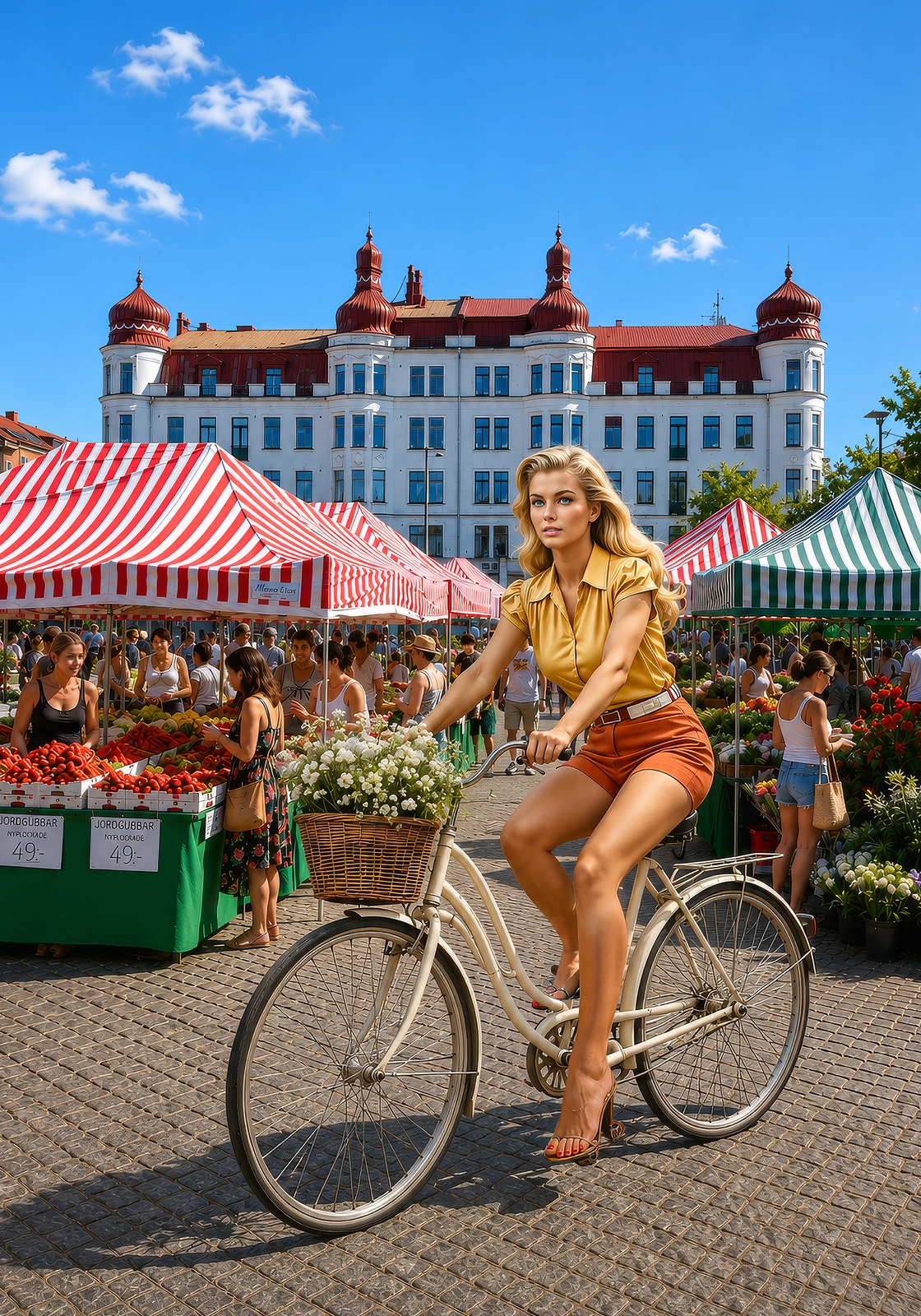
Not as sweet as she looks Skenet bedrar, 2026
Digital
50 x 70 cm
3 200 kr
Not as sweet as she looks Skenet bedrar
Svensk text på slutet
Introduction
Some people become famous because they are talented. Others because they are beautiful. A very small number become famous because they seem larger than life.
Anita Ekberg became all three.
For more than half a century, the world believed it knew who she was. Millions saw the woman in the Trevi Fountain. Millions saw the photographs, magazine covers, Hollywood premieres and headlines. They saw the blonde bombshell. The goddess. The sex symbol. The woman who seemed to have conquered the world simply by walking into a room.
But appearances have a habit of deceiving.
Behind the photographs stood a stubborn girl from Malmö who rarely did what others expected. A young woman who argued with authority, challenged powerful men, refused to change her name for Hollywood and never learned to make herself smaller to make others comfortable. The smile was real. The beauty was real. But so were the sharp tongue, the fierce independence and the refusal to be owned by anyone.
In 1982, the legendary Swedish TV personality Hagge Geigert met Anita Ekberg and uncovered something many journalists had missed. Behind the myth lay a far more interesting person than the headlines suggested.
Now, in the summer of 2026, Hagge finally gets the chance to continue that conversation and travels from his distant star to Malmö for an afternoon interview. Admittedly, there is one small complication. Both interviewer and interviewee have long since left the world of the living.
Having settled on their respective stars somewhere in the Milky Way and returned to Malmö as time-travellers, they meet once again on Möllevångstorget. Around them, the market stalls bustle with life, bicycles roll across the square, and ordinary people go about their daily business. Yet beneath the summer sky, an extraordinary conversation unfolds.
Together, they revisit a life that carried Anita from the working-class streets of Malmö to Hollywood, Rome and even immortality. They speak about beauty, ambition, freedom, love, loneliness, fame and the price of becoming a symbol. They discuss the men who tried to possess her, the directors who understood her and the countless people who thought they knew her after seeing a photograph.
Most of all, they explore a question that followed Anita throughout her life. Who was the woman behind the legend?
The answer, as Hagge gradually discovers, is both simpler and far more complex than the world ever imagined.
Because Anita Ekberg was many things.
A film star.
A rebel.
A dream.
A survivor.
And perhaps above all, a Malmö girl who never stopped being herself.
This is her story. Or rather, the story behind it.
The Anita
From Malmös market square and cobblestone lane,
to Rome, where fountains immortalised her name.
A girl on a bicycle, flowers in hand,
who dreamed of a world far beyond her homeland.
She won her first crowns and wore them with grace,
yet never allowed them to keep her in place.
For the train of adventure stood waiting nearby,
and Anita stepped aboard without asking why.
She landed at last in the land of the dream,
with English still awkward and far from supreme.
Hollywood stared as she stepped from the plane,
a Nordic amazement they could not explain.
Producers and princes lined up in her wake,
while tycoons imagined her freedom could break.
But Anita just smiled at their power and fame,
and stubbornly held to her own family name.
Howard Hughes offered fortunes beyond any measure,
yet she would not trade her identity for treasure.
If they want me famous, she said with delight,
they can learn how to say Ekberg right.
Anthony loved her, and Sinatra too,
while countless admirers appeared in her view.
Yet none ever purchased the soul she concealed;
some treasures are never intended to yield.
Then Fellini arrived with a visionary eye,
and saw something deeper than glamour could buy.
He captured her longing, her pride and her fire,
the strength and the loneliness hidden beneath desire.
When Sylvia stepped into Trevi that night,
the world stood enchanted before the strange sight.
They saw only beauty, the curves and the grace,
but missed the real woman behind the face.
The photographers chased her wherever she went,
their cameras clicking with tireless intent.
Yet Anita walked onward, unbowed by the game,
refusing to live by the headlines of fame.
The years rolled away like the tide from the shore,
and youth could not linger forevermore.
But the girl from Malmö remained all the while,
behind every legend, photograph and smile.
Now high on her star in the heavens above,
she looks back on triumph and heartbreak and love.
And Hagge discovers, through laughter and tears,
the truth hidden quietly beneath all the years.
So raise now a glass to the girl who once came
from working-class streets to international fame.
For Anita was never the myth people saw
she was the storm itself, and the world stood in awe.
Malmö, June 2026
Beauty on Two Wheels
In June 2026, Hagge Geigert finally got his wish. Admittedly, it required both he and his interview subject to have left earthly life behind, settled on their respective stars somewhere in the Milky Way, and now to have returned to Malmö as time-travellers. Some dreams take longer to fulfil than others. The people who would have the opportunity to read the interview were several billion time-travellers scattered throughout the universe.
Despite the existence of hundreds of thousands of television channels and networks throughout eternity, many still preferred to leaf through an old-fashioned newspaper even if it was now digital. There was still something special about turning pages, a sensation humanity had enjoyed for thousands of years. The Egyptians had already been turning or unrolling the papyrus scrolls they read from, while the Sumerians and Babylonians turned their clay tablets inscribed with cuneiform to continue reading. Nothing new under the sun until digital technology arrived in the twenty-first century. On Earth, that is. Among the stars, it had existed much longer.
When Hagge stepped out of the wormhole, which discreetly ended behind Malmö Opera among some trees, he looked remarkably unchanged. Just as well prepared, just as polite, just as knowledgeable, and, above all, just as curious. During his years on Earth, he had interviewed royalty, prime ministers, actors and international entertainers. Yet few encounters stayed with him more warmly than his conversation with Anita Ekberg in 1982. She later said she appreciated his way of working. He asked direct questions without being intrusive, listened to the answers, and sought to understand the person behind the headlines. It was a rare quality in a profession where many journalists seemed more interested in themselves than in the people they interviewed.
That was why he now stood, waiting, in Möllevångstorget.
The market was in full swing. Strawberries lay stacked in red pyramids on the stalls, though there was a shortage of berries that year. The flower stands glowed in every colour of the rainbow, their summer blossoms bright. Above the square stretched a clear blue Scanian sky, dotted with a few small clouds. The old buildings surrounding the square stood where they always had, their window-eyes observing the crowds with the same calm patience they had shown for generations.
Then Hagge spotted her.
She was cycling among the stalls on an old-fashioned ladies' bicycle, a basket full of white flowers. For a brief moment, the scene could have been lifted from a tourist brochure or a romantic postcard from the past. A blonde woman on a bicycle on market day in Malmö.
But only for a moment.
The girl on the bicycle wore red shorts that revealed legs still capable of making an Italian paparazzo drop his camera. Her golden-yellow blouse caught the sunlight, and her blonde hair fell over her shoulders just as it had in the old days. Her red-painted toenails were clearly visible in heeled sandals that no sensible person would choose for a bicycle ride across the cobblestones of Möllevångstorget. But in that respect, Anita was not sensible. She was simply Anita.
In short, Anita Ekberg looked exactly like Anita Ekberg.
She braked in front of Hagge, set one foot on the paving stones, and smiled her familiar smile.
Tell me, Hagge, do I look like a pensioner?
Hagge laughed.
No, Anita. But you do not look like the innocent girl people think they see in old photographs.
Anita leaned lightly against the handlebars, glancing at the basket of flowers.
There you have the entire problem of my life in one sentence.
How do you mean?
People saw the flowers.
And missed the thorns?
Exactly.
She laughed.
For almost a hundred years, people have allowed themselves to be fooled by my appearance. They saw the blonde girl on her bicycle and assumed she was sweet, gentle and obedient. But I was never particularly obedient.
Hagge took out his notebook.
Then perhaps it is time to correct that misunderstanding.
Anita nodded.
I think so. If there is one thing I have learned in my life, it is that appearances are deceptive. They were deceptive when I was a tall teenage girl here in Malmö, and they are deceptive still.
She gazed across the square as though she could see both the people around her and her own memories from nearly eighty years earlier.
So let us begin at the beginning, Hagge. Let us talk about who I actually was, not who people thought I was.
CHAPTER 1 Appearances Are Deceptive
They left the murmur of the marketplace behind them, waited for the traffic light to turn green, and crossed Bergsgatan. Anita pedalled her bicycle carefully through the crowd heading towards the market. She attracted glances from people who thought she resembled someone. And indeed she resembled herself though as she had looked seventy years earlier. The summer sun shone brightly over Möllevången, but on the other side of the street they found shade beneath an old tree. There stood a bench with an unobstructed view of the square.
In the centre of the square stood the monumental sculpture group The Glory of Labour. The powerful figures, carrying a stone block on their shoulders, gazed over the market with their bronze eyes, as they had for almost a century. Around the statue, Malmö residents of every age moved. Some hurried to their errands. Others lingered by the fruit and vegetable stalls. Children chased pigeons while cyclists threaded their way through the crowds.
Hagge Geigert sat down on the bench after Anita had settled herself.
It feels strange to sit here with you, Anita. If someone had told the people of Malmö in 1948 that the girl cycling across this square would become one of the worlds most famous women, the figures on that statue would probably have laughed.
Anita smiled.
They would probably have laughed at you as well. A young journalist from the paper Bohusläningen who became Hagge to the entire Swedish nation and went on to host his own television programme Guest of Hagge.
Were they wrong?
Hagge did not comment on his own brief biography, as this interview was supposed to be about Anita.
Of course they were wrong.
Hagge laughed.
There you are. That sounds like the Anita I remember.
Anita opened her handbag, which she had put on the bench beside her. She took out a packet of cigarettes, tapped one out and placed it between her lips. Then she fished out an old chrome Ronson lighter, held it for a moment as if she had found an old friend, and let the lid snap open with a familiar click.
She lit the cigarette with just the right amount of nonchalance, inhaled the smoke, and slowly blew it out into the evening air over Möllevången.
Only then did Hagge react.
"But wait a minute. Didn't you quit smoking in the late nineties, cold turkey, as the Americans say?"
Anita smiled behind her cigarette.
"Yes, I did. And I've never started again."
"Then I miss something.
"You do.
She held up the cigarette between two fingers.
"On Earth, they now have something called a vape. Electronic smoke in hundreds of flavours for people who want to smoke without actually doing so."
"I've heard about it, but it is claimed to be just as dangerous."
"This is more or less the same thing. But for people in eternity, for us Time-travellers.
Hagge raised an eyebrow.
"How could I have missed that?"
"Because the smoke is not visible in space. The universe contains no oxygen, Hagge. This makes smoking a rather pointless occupation. You can't light a real cigarette up there."
"Reasonable.
"That's why, in the 1920s, some enterprising soul invented the imaginary cigarette."
"The imaginary cigarette?"
"Of course. It tastes nothing. It smells of nothing. It contains nothing. Actually, it hardly even exists. But when you smoke it, it feels real."
"But you still smoke it?"
"Of course, but only when I'm on earth. In eternity, it feels pretty pointless. Actually, only inveterate smokers take the habit with them into eternity. It is available both as a pipe and as a cigar. And like marijuana, so that old hippies can smoke it."
"Why do you smoke now?"
Anita took another slow puff.
"Because it works just like a real cigarette in every way that matters. You hold it between your fingers. You can tap the ash. You can take a puff when you need to think."
She blew out a thin loop of completely unreal smoke.
"Above all, it calms the nerves."
"And you need to calm your nerves?"
"Of course, I'm going to be interviewed."
"After a lifetime in Hollywood?
"That's exactly why."
She smiled crookedly.
"You never really get used to journalists," Anita said.
She leaned back against the backrest and looked at the square. She demonstratively blew out some smoke rings that rose like the Olympic rings against the blue sky. She had practised that. It showed. A group of young people cycled past and gave the smoke rings a thumbs-up. She gave them a timeless smile and continued.
You know what is amusing? People have often imagined that I was a very shy girl when I was young.
Yes, the photographs give that impression.
That is the strange thing. All my life, people have looked at photographs of me and believed they understood who I was after five seconds.
And did they?
Almost never.
So appearances were deceptive?
Often. People saw the blonde girl and wrote the rest of the story themselves. They assumed I must have been cautious, obedient, and waiting for someone else to explain how the world worked.
But that was not the case?
Not even remotely.
Photographs sometimes lie.
So you were no little dove?
She laughed.
No, Hagge. I was no little dove.
A faint breeze rustled the leaves above them.
I was tall even then, taller than many boys my age. That alone made me stand out. People noticed me before I had even opened my mouth.
And when you opened your mouth?
Then they noticed me even more.
Hagge burst out laughing.
That answer I believe.
I had opinions. I knew what I thought. And if someone tried telling me what I ought to do, I became suspicious not to say rebellious.
Defiant?
Independent.
That is often the same thing when you are seventeen.
Perhaps.
You know what I think?
No.
I think people often expect a beautiful young woman to be compliant.
And I was not?
I was polite when people deserved it. That is not the same thing.
She let her gaze wander across the square again.
But I also had something else.
What was that?
Curiosity.
About the world?
About everything.
CHAPTER 2 The Girl Who Spoke Her Mind
Life continued on the far side of Bergsgatan. A vendor was stacking melons into a neat pyramid that looked as if it might collapse at the slightest nudge. A small boy was trying unsuccessfully to catch a pigeon that always managed to stay just out of reach. A group of teenagers on bicycles swept past the statue, laughing at something only they understood.
Hagge watched them for a moment.
You have said several times that you were no little dove. When did you first realise it yourself?
Anita thought for a moment.
I do not know if I realised it myself. I think other people noticed it first.
How?
By becoming annoyed with me.
Hagge laughed.
That sounds promising.
I had an unfortunate habit of asking questions.
Journalists usually appreciate that.
Parents do not always.
And teachers not always either, I suspect.
Especially not teachers.
She smiled at the memory.
There were people who believed that young girls should listen more than they spoke.
And you disagreed?
If I had agreed, we would not be sitting here today.
The breeze carried the aroma of coffee from a nearby café. They could always stop for a fika later, tempting though it was.
You grew up in a large family, Hagge continued.
Yes. You learn quickly how to make your voice heard if you do not want to be run over. I was number six among the children and the first girl in the family. Having five older brothers was an early introduction to life's tougher lessons. As a small child, however, I was the blonde-haired favourite, fussed over and fiercely protected by those five older brothers. Two more siblings were born after me. My absolute favourite was my third-oldest brother, Jan-Åke. We remained very close throughout our lives.
Were you the one who made the most noise?
No, but I never gave up easily.
I can imagine that.
My father was a good man. He worked hard and wanted what was best for his children. But sometimes we disagreed about what my life should look like.
He probably did not exactly picture Hollywood.
I do not think he even pictured Copenhagen.
Hagge burst out laughing.
That is a little cruel.
But not entirely wrong.
Anita looked across the square, where people were squeezing fruit and vegetables to test their freshness.
You see, Hagge, it was never about opposing people for its own sake. I wanted to decide for myself.
There is a difference.
A rather large one.
But many people confuse the two.
All the time.
An older woman paused at a flower stall. Anita watched her.
I think many young women in those days lived under far more rules than boys did.
In what way?
You were expected to be moderate. Moderately loud. Moderately visible. Moderately ambitious.
That word again.
Yes. That word has haunted Sweden longer than many kings have.
Hagge laughed.
And you had difficulties with moderation?
I had difficulties with other people deciding what moderation meant. That word carried enormous weight in Sweden at the time. If I had been forced to be moderate, I would probably have ended up behind the counter at the local grocery store.
They fell silent for a moment.
A bicycle wound its way through the crowds in the square before them.
If you met the seventeen-year-old Anita today, what would you think? Hagge asked.
Anita watched the cyclist disappear into the crowd.
That her parents had quite a task ahead of them.
Quite a task?
Possibly a very large task.
They both laughed.
But I also had energy, she continued. I wanted to do things. Discover things. Learn things.
Restless?
Curious.
You prefer that word?
Absolutely.
What were you most curious about?
People.
Not film stars?
They are people too.
That answer sounds suspiciously diplomatic.
Then you do not know me very well.
Hagge shook his head.
That is true. You have never been particularly diplomatic.
Thank you.
That was not intended as a compliment.
Then I shall take it as one anyway.
The sun had shifted slightly across the square. The shade from the tree stretched farther across the ground than when they had first sat down.
You know what is amusing? Anita said.
No.
People often talk about self-confidence as though it is something you are born with.
And it is not?
Not always. Sometimes it is simply a matter of taking one more step even when you are uncertain.
Did you do that?
Many times.
Even though people thought you never doubted yourself?
There you are. Appearances were deceptive again.
Hagge nodded.
So that tall Malmö girl cycling through the city was braver than she appeared?
Perhaps.
And more stubborn?
Definitely.
And more independent?
Without question.
Hagge smiled.
That sounds like a rather good combination.
Sometimes.
Sometimes?
Sometimes it makes life considerably more complicated.
But also more interesting?
Anita looked out across Möllevångstorget.
Much more interesting.
For a while they sat in silence. Then Hagge leaned back. It was a technique he had learned during his years in television, and it usually meant that a difficult question was coming next.
So the seventeen-year-old Anita had already decided to live her own life.
Yes.
Even if the world had other plans?
Especially then.
And the next step?
Anita smiled.
The next step happened to be only a few blocks from here.
The old Hippodrome?
The old Hippodrome.
That was where the train really began to move?
That was where people first began to suspect that the tall girl from Malmö might not be content to remain standing on the platform, waving as the train pulled away.
CHAPTER 3 The Road to the Old Hippodrome
The old Hip, Hagge repeated. I have noticed that the name still makes older Malmö residents straighten their backs with pride.
And rightly so, Anita replied. For younger people, it is simply the city theatre, assuming they go to the theatre at all. Otherwise, it is just a building standing where it has always stood, in the Lion Passage between Kalendegatan and Djäknegatan.
For Time-travellers who have not yet visited Malmö, perhaps we should explain what it is. They have eternity ahead of them, after all, so sooner or later they may get around to it.
That might be a good idea. Otherwise, they will think we are talking about a hip joint.
Hagge laughed.
That would be an unusual place to win a beauty contest.
Malmö has done many things over the years, but I think that is where the line is drawn.
They both laughed.
Anita looked up at the statue before continuing.
The Hippodrome was already an institution in Malmö back then, hosting theatre, revues, variety shows, music and entertainment. Generations of Malmö residents had passed through its auditorium long before I ever set foot inside.
And when did you?
The summer of 1948.
You were seventeen.
Exactly. I got a job with the Hippodrome Revue as a number girl.
A number girl sounds as if it belongs to another world.
It probably did. My job was to walk across the stage between the acts and show the audience a sign with the number of the next sketch, song, comedian or performer.
That sounds simple.
It was. But sometimes simple jobs are more dangerous than complicated ones.
How so?
People had time to look at me.
Hagge laughed.
And that turned out to be a career move.
Apparently.
She smiled.
I walked across the stage in elegant clothes, held up the sign and disappeared again. Yet for some reason the audience started paying attention to me.
For some reason?
Hagge, I am trying to be modest.
It suits you almost as well as a Miss Hipp crown.
Almost.
A gentle breeze stirred the leaves above them.
During the revue there was a local beauty contest held at the theatre, Anita continued. I entered and was chosen as Miss Hipp.
That was where it began?
Yes. That was really the starting signal. The title echoed through Malmö in a way I had never expected.
What happened next?
Suddenly opportunities began appearing. Modelling jobs. Photo shoots. People who wanted me to wear clothes, display clothes or stand in front of a camera.
Not bad for a girl whose job was simply to carry a sign.
No, it turned out to be a remarkably good return on that sign.
Hagge laughed.
And you had no plans of becoming a beauty queen?
Not really.
That is what all future beauty queens say.
Then perhaps I am an exception.
Hagge smiled.
But somebody must have encouraged you.
I am sure they did. What I mostly remember is that people began talking about the contests as if the outcome had already been decided.
And what did you think about that?
That they were probably crazy.
A woman pushing a pram passed in front of the bench. A small child waved at them. Anita waved back.
It is easy to forget how young I was, she continued. When people look at the photographs later, they see a finished Anita Ekberg, but that person did not yet exist.
Who existed then?
A fairly ordinary girl from Malmö.
Who happened to be unusually tall.
And unusually stubborn.
And unusually beautiful.
Anita shrugged.
I will leave that last judgment to the jury.
The jury seemed remarkably united.
So it did.
Hagge laughed.
You are still bad at accepting compliments.
No. I am simply good at surviving them.
The square was filling with new people as lunchtime approached.
How did your family react? Hagge asked.
With varying degrees of enthusiasm.
That sounds diplomatic.
Then I am expressing myself unusually cautiously.
Your father was sceptical?
Very.
Because it involved beauty contests?
Partly. But also because he sensed what might follow afterwards.
Which perhaps he was right about.
As a matter of fact, he was.
Anita smiled thoughtfully.
Parents have that irritating habit of sometimes being right for entirely the wrong reasons.
That sentence ought to be embroidered onto a cushion.
Feel free.
Hagge laughed so loudly that a few passers-by turned around.
But you entered anyway.
Of course.
Why?
Because opportunities do not come with guarantees.
And if you say no?
Then you never find out what might have happened.
She looked across the square where a group of teenagers were parking their bicycles.
Do you know what I think?
No.
I think many people spend their entire lives waiting until they feel completely certain before they dare do anything.
And then?
Then they often miss the train.
Hagge nodded.
You seem to have had a special relationship with trains.
I had a special relationship with platforms.
How do you mean?
You either step aboard the train, or you remain standing where you are.
And you did not remain standing.
Not for very long.
For a while they sat in silence.
Behind them came the sounds of the city. In front of them, The Glory of Labour stood as immovable as ever.
So there you were, said Hagge. A teenage girl from Malmö on her way to a beauty contest at the old Hippodrome.
Yes.
Did you realise your life was about to change?
Not at all.
Not in the slightest?
Of course I hoped things would go well. But nobody can see the future.
Probably just as well.
Absolutely. If someone had told me what lay ahead, I would probably have thought they had gone completely mad.
Hollywood?
Mad.
Fellini?
Mad. Besides, I did not even know who he was.
Rome?
Mad.
The Trevi Fountain?
Completely mad. The fountain in Gustav Adolfs Square was quite large enough for me.
They both laughed.
Then Anita became more serious.
But do you know what was not mad?
No.
Having the courage to try.
Hagge nodded.
And you did.
Yes.
Even though you had no idea where the road would lead.
That is usually when the most interesting journeys begin.
He followed her gaze across the square.
So what happened when you arrived at the Hippodrome?
Anita smiled.
That was when the real circus began.
CHAPTER 4 Miss Malmö
The pram had disappeared down the street. Anita watched it for a moment before turning back to Hagge. The thought of having a child of her own still lingered, even though in eternity no one could have children, no matter who shared their bed. Sex still existed, but without consequences.
You know what surprised me most?
That you won?
No.
No?
That so many other people seemed less surprised than I was.
Hagge laughed.
You mean after Miss Hipp?
Yes. Suddenly people began behaving as though they had known it all along.
That is an old human disease.
Which one?
Always having predicted whatever has already happened.
Anita laughed.
Then Malmö must have suffered badly from it.
The marketplace continued humming around them.
After Miss Hipp, things began to happen rather quickly, she continued. Newspapers wrote about me. Photographers wanted photographs. I received more modelling assignments.
And then came Miss Malmö.
Yes.
Was that a big deal?
In Malmö, it was a very big deal.
Bigger than today's readers might realise?
Much bigger. There was no internet, no social media and no twenty-four-hour television. But rumours do not require technology. If a girl from Malmö became Miss Malmö, the entire city soon knew about it.
And you won.
Yes, I did.
How did it feel?
Anita paused.
A little unreal.
You do not sound convinced.
That is because I still did not see myself as others saw me.
How did you see yourself?
As Anita.
Just Anita?
Just Anita.
Hagge smiled.
That is becoming a recurring theme.
It is a good theme.
A group of teenagers stopped at a fruit stall. Someone dropped an orange, which rolled across the paving stones.
You see, Hagge, Anita continued, when people told the story later, it sometimes sounded as if everything had been inevitable. As if someone had pointed at me when I was seventeen and said, There goes the future film star.
And that was not the case?
Of course not.
What was it, then?
A series of coincidences and a certain amount of work.
And quite a lot of beauty.
That probably helped.
Probably?
All right then. It helped a lot.
They both laughed.
But beauty only takes you so far if you do not show up on time, work hard and take advantage of the opportunities that arise.
That almost sounds un-Swedish.
I have lived abroad for too long.
There we have it.
Anita smiled.
I think many people underestimate how much work goes into that kind of success. They see the crown, but not everything that happened before it was placed on someone's head.
Or after.
Especially after.
Hagge nodded.
Because Miss Malmö led somewhere else.
Yes.
To Miss Sweden.
Exactly.
And that was when Malmö began to feel too small.
Anita looked out across the square, where people still moved between the stalls.
Malmö never became too small in my heart.
But the world grew larger.
Much larger.
And the next stop on the journey?
Anita smiled.
Miss Sweden.
That was when the rest of the country began to discover Anita Ekberg?
Yes.
And still had no idea what was coming.
Only that the winner would receive a ticket to America and the Miss Universe competition. Naturally, that thought was dizzying.
Hagge nodded slowly as he watched people passing by.
CHAPTER 5 The Girl Who Couldn't Speak English
It would have been dizzying for most nineteen-year-olds, Hagge said.
Anita smiled.
Especially for a girl from Malmö who had never travelled farther from home than to Copenhagen on the other side of the Sound. On the other hand, I had been there so often that I almost felt half Danish.
And suddenly you were heading across the Atlantic.
Yes. And there was an awful lot of water underneath.
Hagge laughed.
Were you afraid the plane would fall out of the sky?
No. But the thought crossed my mind.
It must have seemed very far away.
Anita looked out across the square, where a few cyclists crossed the cobblestones.
It would be difficult to explain to younger people today. Now you can fly around the world in a matter of hours and call home from the other side of the globe. Back then, America felt almost like another planet.
Hagge raised an eyebrow.
You could barely speak English.
Still couldn't. I had learned a few words while filling in my visa application. Travelling to America in 1951 involved a tremendous amount of bureaucracy. Along with the Miss Sweden organisers, I had to visit the American embassy, attend interviews, present my new passport, provide medical certificates, and obtain a visa stamp. It felt as though the only thing they did not ask for was my shoe size.
That must have been difficult.
It was.
But not difficult enough to stop you.
No.
A group of cyclists swept past. One of them stared at Anita for so long that he nearly rode into a parked car.
Hagge smiled.
How did you do in the competition?
I did not win.
I seem to remember that. Was it a disappointment?
Anita considered the question.
Not a very big one.
I do not believe that.
She laughed.
All right then. A little.
Thank you.
But only for a few days.
Why so short?
Because I quickly realised that the competition was not the most important thing.
What was?
America.
Not the crown?
Anita snorted.
It was a tiara. Tin and cut glass. It was not even heavy enough to use as a paperweight.
Hagge burst out laughing.
Not your placing?
No. A competition only has one first place.
So what remained?
America.
She looked up into the branches above them.
I had grown up in post-war Sweden. Suddenly I found myself in a country where everything seemed larger than life. The cars, the hotels, the advertisements, the films, the dreams.
Hollywood.
Above all, Hollywood.
The dream factory.
Yes. And it did not take long for the dream factory to notice a tall Swedish blonde.
Hagge laughed.
And that is where the fairy tale begins.
Or the circus.
Either way.
A bit of both.
She smiled at the memory.
The strange thing was that I did not feel like a film star at all.
How did you feel?
Like a Swedish girl trying to understand what people were saying.
That sounds less glamorous.
Considerably less glamorous.
While journalists were writing about the new Swedish beauty, were you studying English vocabulary?
More or less.
That is not quite the same picture.
No. But it is the truer one.
A light breeze rustled the leaves overhead.
Hagge glanced down at his notes.
How did you get your first contract?
Universal saw something they liked.
You mean your acting talent?
Anita gave him a sceptical look.
I suspect they noticed something else first.
I cannot imagine what.
Neither can I.
They both laughed.
But Universal offered me a contract. Suddenly I found myself inside the very world I had only seen on cinema screens back in Malmö.
How did it work?
Like a factory.
A factory?
Hollywood was a factory. They took young people, polished their personalities and taught them how to speak, walk, smile, dress and behave. Then they hoped the audience would buy the result.
Hagge nodded thoughtfully.
And you allowed yourself to be shaped?
To a certain extent.
But not completely.
Not nearly as much as they would have liked.
There is the Anita from Möllevången again.
Anita smiled.
She came with me to America.
Hagge leaned back on the bench, shuffled his papers and looked up with a warm but mischievous smile.
When one looks back on the 1950s, one remembers Hollywood full of sweet, delicate little girls. Then you stepped off the planea statuesque platinum-blonde Amazon from Östra Fäladsgatan in Malmö. You swept everything aside. How on earth did you conquer the world so quickly?
Cigarette smoke drifted slowly towards the branches above.
Anita leaned back and smiled confidently.
You know, Hagge? The world was probably unbearably dull before I arrived. Those Hollywood producers had never seen a real woman. They were used to little dolls who did exactly as they were told. I arrived and took up space. I never apologised for existing, and I certainly had no intention of apologising for how I looked.
Hagge chuckled.
No, you never did. But it must have required more than curves. You were a genius at publicity before the word had even become fashionable in Sweden. That famous incident in London, for example, when your dress accidentally split open in front of a crowd of photographers. Was that a Scanian accident or pure strategy?
Anita gave him an amused, sharp glance.
Hagge, you old fox, you are far too well informed. Let us call it... helping fate along a little. If you want the men in newspaper offices to write about you, you have to give them something to look at. But do not forget that I could also work. I worked like a beast. It was not all publicity and glamour.
The smile slowly faded from Hagge's face. He set down his papers and leaned forward.
I am sure of that. But there was another side to your independence. Howard Hughes, the powerful billionaire who owned the studio, wanted to buy you. He offered you everything, but demanded that you change your surname to something Americans could pronounce. You said no. Why?
Anita straightened her back.
Because I am Anita Ekberg!
Her voice had suddenly hardened.
I am nobody's possession. He thought he could buy a girl from Malmö simply because his pockets were full of dollars. I told him, If I become famous, they can bloody well learn to pronounce Ekberg. My name is the only thing that is completely mine. I am not selling it to anyone, not even to a man who owns half of Hollywood.
Hagge nodded with admiration.
And history proved you right. They learned the name.
Yes. They certainly did.
He sat silently for a few moments before continuing.
But the decisive step towards immortality did not happen in America. It happened in Rome, through Federico Fellini and that deeply symbolic bath in the Trevi Fountain in La Dolce Vita. Why do you think that scene struck the world like lightning?
Anita's gaze grew almost dreamy. She took a slow drag on her cigarette before answering.
Fellini understood who I was. He did not merely see a blonde woman; he saw a force of nature. The world was changing after the war. People were tired of the old and the rigid. When I stepped into that freezing water, barefoot in my black dress, it was not acting. It became a symbol of absolute freedom. It was sinful, beautiful and alive. The world longed for the sweet life, Hagge. And I gave it to them.
For several seconds Hagge looked at her before bowing his head slightly.
Yes... you certainly did, Anita. And the world has never forgotten it.
Anita shrugged.
What difference does it make today, sitting on my star? New talents arrive all the time. That is probably for the best.
For a brief moment, they sat in silence. Across the square came the sound of a delivery truck stocking supplies for the next market day.
Eventually, Hagge smiled again.
And then Howard Hughes appeared.
Anita laughed loudly.
Sooner or later, Howard Hughes always appears whenever beautiful girls are involved.
It seems that way.
He was a strange man.
That is a cautious description.
Then I am being unusually diplomatic.
Did you know who he was?
Other people told me. One of the richest men in the world. Aviation pioneer. Film producer. Eccentric. Especially that last part.
And a notorious womaniser.
They told me that too.
He pursued you.
Yes.
Intensely.
Very intensely.
How intensely?
Anita laughed.
Let us just say that when Howard Hughes decided he wanted to meet a woman, he did not allow minor obstacles to stand in his way.
Such as the woman's own schedule?
Something like that.
They both laughed.
The newspapers must have loved the story, Hagge continued.
Naturally.
The young Swedish beauty and the eccentric billionaire.
It sounded better in headlines than it did in reality.
Did it?
Often.
Anita looked out across the square as the evening light softened.
You know what struck me during those years?
No.
How many people were famous, rich and successful, yet did not seem particularly happy.
Hollywood's great secret?
Perhaps.
And there you were, nineteen or twenty, in the middle of it all.
Yes.
Did you miss Malmö?
Sometimes.
What did you miss most?
That people said what they meant.
Hagge smiled.
They did not do that in Hollywood?
Not always.
Well then.
In Hollywood, a no could mean maybe, a maybe could be read as yes, and a yes often meant someone was still thinking it over or waiting for a better offer. Time itself could become a mystery. There was a lot of sand in Hollywood, and not all of it was on the beaches.
Hagge laughed.
That sounds confusing.
It was.
They sat quietly for a while, looking across the square.
But you stayed.
Yes.
Despite the language.
Yes.
Despite the loneliness and despite being on the other side of the world.
Yes.
Why?
Anita thought for a few moments.
Because I knew the opportunity would not come twice.
And because you were no little dove?
She smiled.
That too.
When did you begin to realise that you might actually become a film star?
Anita leaned back against the bench.
When other people began treating me as if I already was one.
And were they right?
She smiled again.
People sometimes underestimate me. But on that occasion it turned out that they may have seen something I had not yet discovered myself.
Hagge nodded slowly.
And then?
Anita took a deep breath.
Then the real roller coaster began.
Anthony Steel?
Among other things.
Hollywood?
Still Hollywood.
Love?
Love too.
And the headlines?
Anita laughed.
Above all, the headlines.
CHAPTER 6 Love, Careers and Headlines
An elderly gentleman stopped a short distance away and stared as though he had seen a ghost in broad daylight. Anita smiled at him. The man looked even more confused, then continued on his way.
Hagge smiled.
You know what surprised me most about fame?
Anita raised an eyebrow.
That people started recognising you?
No.
That journalists never stopped asking questions?
Not that either.
Then I give up.
How quickly people became interested in my private life.
Hagge laughed.
You mean they were not content to know which films you had made?
If only it had been that simple.
What did they want to know?
Anita rolled her eyes.
Who was I having dinner with? Who was I dancing with? Who was I travelling with? Who was I smiling at? Who was I not smiling at? And, more or less disguised, who was I sleeping with?
Hagge chuckled.
Surely they did not ask quite that directly?
No, but they could ask whether anyone had complimented the décor of my bedroom, or whether a certain gentleman had expressed an opinion about my choice of bedspread. Sometimes there was almost a punch-up in the air, but most of the time I answered with something equally ridiculous.
And if you happened to smile at the wrong person, it became a headline.
Exactly.
A bus rumbled past on Bergsgatan.
During those years I learned very quickly that Hollywood does not merely sell films.
What else does it sell?
Dreams.
And scandals?
Especially scandals.
Hagge nodded.
For a young woman who also happened to be tall, blonde and photogenic, it must have been even worse.
Considerably worse.
You became a story as much as a person.
Yes.
Hagge glanced down at his notes.
And then came Anthony Steel.
A faint smile crossed Anita's face.
Then came Anthony.
One of Britain's biggest film stars.
He was.
And far more established than you.
Yes. When we met, he was the famous one, and I was the promising newcomer.
Later the roles would reverse.
They would.
A seagull circled above the square before disappearing towards Folkets Park.
What attracted you to him? Hagge asked.
Anita considered the question.
He was charming.
That is usually a good start.
And intelligent.
Even better.
He also understood the film world in a way I was still trying to learn.
So you fell in love?
Yes.
Truly?
Truly.
Hagge smiled.
That sounds dangerous.
Love usually is.
There speaks experience.
Several times over.
For a while they sat in silence, looking out across the square.
When you married, it looked like a fairy tale, Hagge continued.
Many fairy tales look wonderful in photographs.
But?
Photographs often have a rather untidy reverse side.
There we are again.
Appearances are deceptive.
Exactly.
Anita watched a group of children run across the square.
People often look at old photographs and assume they are seeing happiness simply because the pictures have turned yellow with age. But a camera captures only a fraction of reality. Things were not necessarily better in the old days.
And reality?
Reality is always more complicated.
Even for film stars?
Especially for film stars.
Was it difficult to combine love and a career?
Often.
Because you both worked in the same profession?
Partly.
And partly because your own career was rising very quickly?
Yes.
Hagge nodded slowly.
That is not always easy for people.
No.
Not even for film stars.
Perhaps least of all for film stars.
Anita fell silent for a moment before continuing.
When people later wrote about our marriage, they often did so as though they were searching for a villain and a victim.
Hagge leaned back on the bench.
And did they find one?
Anita slowly shook her head.
Not as far as I could see.
What did they find instead?
Two people.
That sounds less dramatic.
But considerably more truthful.
A light evening breeze crossed the square, sending a few forgotten scraps of paper skittering across the paving stones.
You have never really liked simple explanations, said Hagge.
Because life rarely offers any.
But meanwhile your fame kept growing.
Yes.
The films became more numerous.
Yes.
The headlines multiplied.
Considerably.
And the photographers?
Anita laughed.
They reproduced like rabbits.
Hagge burst out laughing.
That ought to be engraved on a plaque somewhere in Hollywood.
I think many people would recognise the truth of it.
Was that when you first began to understand what fame actually costs?
The smile slowly faded from her face.
Yes.
And what did it cost?
Anita thought for a long moment before answering.
Privacy.
That simple?
That simple.
And that difficult.
Exactly.
They sat quietly for a while.
The market was almost finished. A few vendors were folding up their stalls as the evening light settled over Möllevångstorget.
If you could give one piece of advice to the young Anita who had just arrived in America, said Hagge, what would it be?
Anita smiled immediately.
Buy shares in a successful company.
Hagge laughed loudly.
Apart from that.
That fame is a very strange animal.
In what way?
Everybody thinks they want it until they get it.
And then?
Then they discover that it likes to follow them home.
Even when it was not invited?
Especially then.
Hagge nodded thoughtfully.
But in the middle of all that, there were also people who mattered more than the headlines.
Yes.
Some of them became friends.
A few.
And some became something more?
Anita smiled faintly.
A few became something more.
Hagge glanced through his notes before looking up again.
If we are talking about the sweet life... there were men in your life who held a prominent place in the world as well. Frank Sinatra, for example.
An almost secretive smile tugged at Anita's lips.
Frank...
There it is, that smile.
Frank had that effect on many people.
He was not exactly unknown.
One could say that.
But Hollywood rumours claim that when The Voice met The Iceberg, it was Frank who had to adjust.
Anita laughed.
That sounds like something a journalist invented. A proper newspaper duck.
Is it true?
Partly.
What was Frank really like?
She thought for a few seconds.
Frank was a charmer. The gods know that. And he was accustomed to women fainting the moment he opened his mouth.
But not you?
I never fainted for anyone, Hagge. Not even Frank Sinatra.
That must have been a new experience for him.
I think it was.
So what happened?
He was used to being in charge, but I think he found it refreshing to meet a girl from Malmö who answered back.
Hagge smiled.
It is said that he proposed to you.
Anita laughed.
Yes.
Once?
More than once.
So you could have become Mrs Sinatra.
Apparently.
And yet you said no.
The smile remained, but her voice grew more serious.
Do you know why?
No.
Because I quickly realised that if I had married Frank, I would have become Mrs Sinatra and another trophy in his collection.
And you did not want that.
Never.
Not even for Frank Sinatra?
Not even for Frank Sinatra.
So you turned down one of the most sought-after men in the world.
I turned down being somebody else's accessory.
That sounds more like Anita from Malmö than like Hollywood.
That is because it is the same person.
Hagge nodded slowly.
But you remained friends.
Yes.
Even after rejecting him.
Yes.
That is rather unusual.
Frank was more complicated than people think.
How?
Anita's expression softened.
Frank recognised a genuine person when he saw one. We both came from modest backgrounds. He came from Hoboken, New Jersey, and I came from Malmö. We both knew what it felt like to fight for a place in the world.
So he respected you?
Yes.
And you respected him?
Absolutely.
Even though you turned him down?
Perhaps I turned him down.
They sat in silence for a moment.
Then Hagge smiled.
A girl from Malmö and a boy from New Jersey. It is not the most obvious love story.
Anita shrugged.
My entire life has been full of unlikely stories.
And yet you said no.
Yes.
Do you regret it?
She answered without hesitation.
Not for a second.
But it was a pity, surely?
One might think so, provided such a marriage could have existed on equal terms. Enough about that.
Hagge noticed that her tone had suddenly grown much sharper.
There is the Anita I remember.
I certainly hope so.
You still do not enjoy being placed on a pedestal?
No.
Even though half the world has been trying to do exactly that since the 1950s?
Anita snorted.
Especially because of that.
Why?
People who place you on a pedestal often do so to avoid seeing you as the human being you actually are. Hero worship.
Hagge nodded slowly.
There is something in that.
If you are a goddess, nobody has to care whether you get cold, tired, heartbroken, or disagree with them.
And if you are Anita from Malmö?
Then you can become troublesome.
You have managed that a few times.
More than a few.
They both laughed.
By now, evening had begun to settle over the square. The last vendors were packing away their goods. Nearby, a metal shutter rattled down.
Hagge looked through his notes again.
You know what is strange?
No.
That people still talk about the men around Anita Ekberg almost as often as they talk about her.
That probably says more about them than about me.
I think it does.
Anthony Steel. Frank Sinatra. Howard Hughes.
And a few others.
A few others.
Anita smiled slightly.
But when all is said and done, I was still the one answering the questions.
You still are.
Yes.
And yet you are still sitting here.
What choice do I have? You keep following me, even onto my star.
Hagge laughed loudly.
There is some truth in that.
Anita looked out over the square one final time.
But do you know what is strangest of all?
No.
That all these people, all these headlines and all these stories were merely the overture.
The overture to what?
Now she smiled in a way that made Hagge immediately put down his papers.
Italy.
Rome?
Rome.
And a certain director named Federico Fellini?
For the first time in a long while, Anita did not laugh.
She smiled.
Now we are finally approaching the story that everybody thinks they know.
But perhaps they do not know it at all?
Exactly.
CHAPTER 7 Rome Calls
For a while, they sat in silence. The market was beginning to thin out. A few vendors were packing up their stalls as the afternoon sun settled over Möllevången.
Hagge broke the silence.
Most people think Anita Ekberg's story begins in Rome.
Yes.
In the fountain, with you in a black dress that revealed rather a great deal, Anita.
Anita laughed.
But that is not true.
Not even slightly.
Hagge smiled.
By then you had already lived several lives.
Sometimes it feels that way.
The remarkable thing is that you had actually succeeded in Hollywood.
Yes.
You had contracts.
Yes.
Films.
Yes.
Fame.
To some extent.
So why Italy?
Anita looked across the square.
Because Italy was more fun.
That is the entire explanation?
No.
A pity. It would have been a very brief interview.
She laughed.
Hollywood was wonderful in many ways, but there was also something soulless and mechanical about the whole enterprise.
The dream factory.
Exactly.
And Italy?
It felt more alive.
Hagge nodded slowly, still fascinated by the woman who had voluntarily left the world's most powerful film industry behind.
It is a fascinating choice, Anita. You left glittering Hollywood, the undisputed entertainment capital of the world, where you had million-dollar contracts, and chose to settle in Rome instead. What made Rome completely outshine Hollywood in your eyes?
A faint trace of disdain crossed Anita's face.
Hollywood was mechanical, Haggea cold, soulless factory. Over there, I was just another product moving along an assembly line. Studio executives sat with their rulers, calculating exactly how much screen time I should receive, how I should speak, and whom I should be seen with. They loved what they saw on the cinema screen, but they became far less enthusiastic when I started having opinions of my own.
Hagge tilted his head.
And Italy was different?
Anita's eyes flashed.
Italy felt alive. It was like night and day. When I arrived in Rome, I encountered people who breathed passion, art and emotion. Italians have never been afraid of what is grand or dramatic. In Hollywood, I constantly felt I was expected to hold myself back, as if I were somehow too much for them. But the Italians had no desire to make me smaller than I was.
Hagge remained silent for a few moments, letting the words sink in.
They had no desire to make you smaller. That is a powerful statement. Do you mean you no longer had to apologise for simply existing?
Anita lightly tapped the armrest of the bench.
Exactly. In Italy, I never had to apologise for taking up space. If I laughed loudly, scolded a photographer, or stepped into a fountain in the middle of the night, they applauded. They loved that I was a force of nature. Americans wanted to tame me and turn me into a well-behaved little housewife on screen, but in Rome I was allowed to be Anita Ekberg. That turned out to be enough.
Hagge laughed.
There is the Anita I remember.
Anita smiled.
Italians understood that a large woman requires a large space. Hollywood gave me money, Hagge, but Rome gave me the right to be fully myself.
A cyclist passed slowly in front of them, staring intently at Hagge.
You see, Hagge? In Hollywood, everything was planned. In Italy, people were sometimes not even sure whether anything had actually started.
That sounds chaotic.
It was.
And you enjoyed it?
Immensely.
They both laughed.
Rome in the 1950s was truly extraordinary.
How so?
It felt as if the whole world had gathered there.
Film stars.
Yes.
Directors.
Yes.
Aristocrats.
Yes.
Journalists.
Unfortunately.
Hagge laughed.
So you found a home?
In a way, I think I did.
Despite being Swedish.
Perhaps because I was Swedish.
How do you mean?
Italians never felt the need to make me smaller than I was.
That sounds suspiciously like a criticism of the Jante Law.
If the shoe fits, people are welcome to wear it.
A seagull landed on the very top of the *Glory of Labour* monument.
When did you first meet Fellini?
Not when people think I did.
Oh?
Many imagine that he suddenly spotted me and exclaimed, There she is!
Did he not?
No.
What did he do instead?
He observed.
Like a detective?
Like an artist.
Hagge nodded.
That is an important distinction.
Federico collected people. Faces. Voices. Gestures. He saw the world differently from almost everyone else.
And what did he see when he looked at Anita Ekberg?
Anita smiled to herself.
I do not think Federico discovered me in the way people imagine it.
How so?
People think he saw a photograph, slapped his forehead, and shouted, There she is!
And he did not?
No. It was far messier than that.
Hagge leaned forward.
Now it is becoming interesting.
Then came that notorious eveningthe fifth of November, 1958. Countess Olghina di Robilant celebrated her birthday at the Rugantino restaurant in Trastevere. The entire Roman social world seemed to be in attendance, and the atmosphere was like a pressure cooker filled with liquor, cigarette smoke and jazz.
That already sounds like a Fellini film.
Just wait. I did not care that counts and barons were sitting at the tables. I kicked off my shoes and started dancing the cha-cha directly on top of them.
Hagge burst out laughing.
That is exactly what I mean by Malmö temperament.
I had never understood why distinguished people should be allowed more fun than anyone else. But my little improvisation set off a chain reaction. A Lebanese belly dancer named Aiché Nana decided to outdo everyone and launched into an impromptu striptease right in the middle of the restaurant.
And there went the calm.
Completely. Photographers gathered outside the windows like vultures. The police stormed the restaurant. The next day, all of Italy erupted in a moral panic.
The infamous Rugantino scandal.
Exactly.
Anita smiled at the memory.
Among those looking at the photographs the following day was Federico Fellini.
So that was when he saw you?
That was when he saw far more than me. He saw an entire Rome in the process of change. He saw people living as though tomorrow did not exist. He saw chaos, scandal, dreams and longing. And somewhere in the middle of all that, I happened to be dancing on a table.
That sounds like the beginning of a film.
It was.
And then he called?
Not long afterwards, he said he wanted to meet me.
Because you were beautiful?
Anita shook her head.
No. He had seen thousands of beautiful women. Federico was looking for people who were alive. I think that was what he saw.
But you sensed something was happening?
Yes.
How?
Because Federico never asked the questions others asked.
What did he ask about?
Almost everything except what journalists wanted to talk about.
Not beauty?
No.
Not glamour?
No.
Not scandals?
No.
What then?
People.
That sounds as if he was trying to understand you.
He was.
And did he succeed?
Anita smiled.
Better than most.
For a while they sat in silence.
The square was bathed in evening light.
Did you know the film would change your life?
No.
Not even a little?
Hagge, if someone had told me that a scene lasting only a few minutes would make me famous worldwide, I would have laughed.
You probably did anyway.
Most likely.
So when did you realise that *La Dolce Vita* was more than just another film?
Anita looked up at the sky.
Only when Federico started explaining what the film was really about.
And what was it about?
Not glamour.
No?
No.
Not luxury?
No.
Not celebrities?
Not only.
Many people have misunderstood it.
Very many.
So what was it about?
Anita smiled.
That, Hagge, is a story that deserves its own chapter.
CHAPTER 8 The Woman in the Fountain
Möllevångstorget was almost empty now. The last market vendors were packing away their goods as the evening light laid a soft shimmer across the paving stones. A few young people cut across the square on their way towards Folkets Park. Somewhere far away in memory, a tram bell could be heard, even though Malmö no longer had any trams.
Hagge leaned back on the bench.
All right, Anita. You cannot slip away any longer.
Oh?
Now I want to hear about the fountain.
Anita laughed.
I suspected that question would arrive sooner or later.
It only took seven chapters.
You show admirable self-control.
Thank you. I have practised.
They smiled at one another.
The strange thing is that people think everything began there, Anita continued. As though I had suddenly materialised in the Trevi Fountain one night and then disappeared again.
That is more or less how the story is usually told.
Yes, but when I stepped into that fountain, I had already been working for several years. I had crossed the Atlantic, struggled with English, survived Hollywood, been shouted at by producers, and been chased by photographers.
And danced on tables in Rome.
That too.
Hagge laughed.
That is a detail that history books sometimes forget.
History books are often far duller than reality.
A brief silence followed.
What was that night really like?
Anita leaned back.
Cold.
Not very poetic.
But its true. People watch the film and imagine a warm Roman summer night. In fact, we were freezing like dogs. It was March.
And yet you look completely unbothered.
That is called acting, Hagge.
I am beginning to understand why you were paid.
At last.
They both laughed.
Federico was running around like a conductor in front of a very strange orchestra. Cameras, technicians, extras, photographers and actors. Everyone was waiting for him to say what would happen next.
Did he know himself?
Not always.
That sounds risky.
That was why it became good.
Hagge nodded slowly.
He trusted intuition more than rules.
Exactly.
And Marcello?
Marcello Mastroianni was far more warmly dressed than I was.
That sounds unfair.
It was.
You stood in ice-cold water while he stood there wrapped up like a winter tourist.
More or less.
That must have felt unfair.
I consoled myself with the thought that the audience would later look at me far more than at him.
Hagge laughed loudly.
There is the Anita Ekberg I remember.
I should hope so.
A faint breeze crossed the square.
But the strange thing is that when the film was released, people began discussing the scene as though it were only about beauty.
Was it not?
Anita shook her head.
Not for Federico.
What was it about, then?
Longing. Dreams. People searching for something they cannot quite articulate.
That sounds considerably more complicated than most reviews suggest.
Federico was almost always more complicated than the reviews told.
Hagge fell silent for a few seconds, then leaned forward.
Anita... when one sees you in that fountain, or on all those thousands of magazine covers around the world, one eventually has to ask a question.
What question?
What were people really looking at? Was it the soul or the body they saw?
Anita did not answer at once. She looked across the square, then slowly turned her gaze back to Hagge.
They saw what they wanted to see. And in those days, most men wanted to see one thing. They saw the curves, the blonde hair and the large breasts. They saw a fantasy figure. An object. Many believed that simply because a woman was beautiful, there could be nothing behind her forehead.
But you played along with the game.
Of course I did.
Why?
Because I was not stupid.
Hagge raised his eyebrows.
Please elaborate.
I realised fairly early that my body was my ticket out of Östra Fäladsgatan. It took me to Hollywood, gave me money and freedom. But while people believed they possessed me with their gaze, in reality I was the one controlling them.
And the soul?
Anita smiled crookedly.
That they sure as hell were not allowed to buy.
Hagge sat in silence for a few seconds and then leafed through his notes.
That reminds me of something you once said. A journalist asked about your clothes and about all the men who stared at you. Apparently, you replied that they would stare even if
Jörgen Thornberg
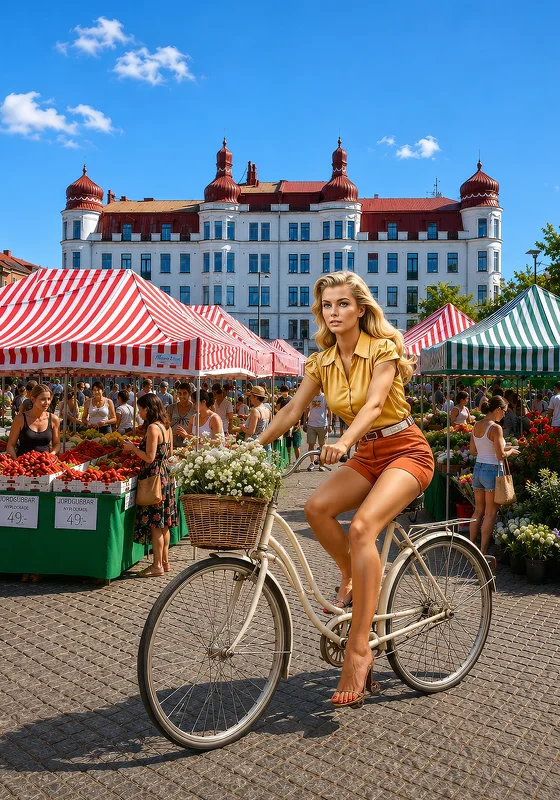
Not as sweet as she looks Skenet bedrar, 2026
Digital
50 x 70 cm
3 200 kr
Not as sweet as she looks Skenet bedrar
Svensk text på slutet
Introduction
Some people become famous because they are talented. Others because they are beautiful. A very small number become famous because they seem larger than life.
Anita Ekberg became all three.
For more than half a century, the world believed it knew who she was. Millions saw the woman in the Trevi Fountain. Millions saw the photographs, magazine covers, Hollywood premieres and headlines. They saw the blonde bombshell. The goddess. The sex symbol. The woman who seemed to have conquered the world simply by walking into a room.
But appearances have a habit of deceiving.
Behind the photographs stood a stubborn girl from Malmö who rarely did what others expected. A young woman who argued with authority, challenged powerful men, refused to change her name for Hollywood and never learned to make herself smaller to make others comfortable. The smile was real. The beauty was real. But so were the sharp tongue, the fierce independence and the refusal to be owned by anyone.
In 1982, the legendary Swedish TV personality Hagge Geigert met Anita Ekberg and uncovered something many journalists had missed. Behind the myth lay a far more interesting person than the headlines suggested.
Now, in the summer of 2026, Hagge finally gets the chance to continue that conversation and travels from his distant star to Malmö for an afternoon interview. Admittedly, there is one small complication. Both interviewer and interviewee have long since left the world of the living.
Having settled on their respective stars somewhere in the Milky Way and returned to Malmö as time-travellers, they meet once again on Möllevångstorget. Around them, the market stalls bustle with life, bicycles roll across the square, and ordinary people go about their daily business. Yet beneath the summer sky, an extraordinary conversation unfolds.
Together, they revisit a life that carried Anita from the working-class streets of Malmö to Hollywood, Rome and even immortality. They speak about beauty, ambition, freedom, love, loneliness, fame and the price of becoming a symbol. They discuss the men who tried to possess her, the directors who understood her and the countless people who thought they knew her after seeing a photograph.
Most of all, they explore a question that followed Anita throughout her life. Who was the woman behind the legend?
The answer, as Hagge gradually discovers, is both simpler and far more complex than the world ever imagined.
Because Anita Ekberg was many things.
A film star.
A rebel.
A dream.
A survivor.
And perhaps above all, a Malmö girl who never stopped being herself.
This is her story. Or rather, the story behind it.
The Anita
From Malmös market square and cobblestone lane,
to Rome, where fountains immortalised her name.
A girl on a bicycle, flowers in hand,
who dreamed of a world far beyond her homeland.
She won her first crowns and wore them with grace,
yet never allowed them to keep her in place.
For the train of adventure stood waiting nearby,
and Anita stepped aboard without asking why.
She landed at last in the land of the dream,
with English still awkward and far from supreme.
Hollywood stared as she stepped from the plane,
a Nordic amazement they could not explain.
Producers and princes lined up in her wake,
while tycoons imagined her freedom could break.
But Anita just smiled at their power and fame,
and stubbornly held to her own family name.
Howard Hughes offered fortunes beyond any measure,
yet she would not trade her identity for treasure.
If they want me famous, she said with delight,
they can learn how to say Ekberg right.
Anthony loved her, and Sinatra too,
while countless admirers appeared in her view.
Yet none ever purchased the soul she concealed;
some treasures are never intended to yield.
Then Fellini arrived with a visionary eye,
and saw something deeper than glamour could buy.
He captured her longing, her pride and her fire,
the strength and the loneliness hidden beneath desire.
When Sylvia stepped into Trevi that night,
the world stood enchanted before the strange sight.
They saw only beauty, the curves and the grace,
but missed the real woman behind the face.
The photographers chased her wherever she went,
their cameras clicking with tireless intent.
Yet Anita walked onward, unbowed by the game,
refusing to live by the headlines of fame.
The years rolled away like the tide from the shore,
and youth could not linger forevermore.
But the girl from Malmö remained all the while,
behind every legend, photograph and smile.
Now high on her star in the heavens above,
she looks back on triumph and heartbreak and love.
And Hagge discovers, through laughter and tears,
the truth hidden quietly beneath all the years.
So raise now a glass to the girl who once came
from working-class streets to international fame.
For Anita was never the myth people saw
she was the storm itself, and the world stood in awe.
Malmö, June 2026
Beauty on Two Wheels
In June 2026, Hagge Geigert finally got his wish. Admittedly, it required both he and his interview subject to have left earthly life behind, settled on their respective stars somewhere in the Milky Way, and now to have returned to Malmö as time-travellers. Some dreams take longer to fulfil than others. The people who would have the opportunity to read the interview were several billion time-travellers scattered throughout the universe.
Despite the existence of hundreds of thousands of television channels and networks throughout eternity, many still preferred to leaf through an old-fashioned newspaper even if it was now digital. There was still something special about turning pages, a sensation humanity had enjoyed for thousands of years. The Egyptians had already been turning or unrolling the papyrus scrolls they read from, while the Sumerians and Babylonians turned their clay tablets inscribed with cuneiform to continue reading. Nothing new under the sun until digital technology arrived in the twenty-first century. On Earth, that is. Among the stars, it had existed much longer.
When Hagge stepped out of the wormhole, which discreetly ended behind Malmö Opera among some trees, he looked remarkably unchanged. Just as well prepared, just as polite, just as knowledgeable, and, above all, just as curious. During his years on Earth, he had interviewed royalty, prime ministers, actors and international entertainers. Yet few encounters stayed with him more warmly than his conversation with Anita Ekberg in 1982. She later said she appreciated his way of working. He asked direct questions without being intrusive, listened to the answers, and sought to understand the person behind the headlines. It was a rare quality in a profession where many journalists seemed more interested in themselves than in the people they interviewed.
That was why he now stood, waiting, in Möllevångstorget.
The market was in full swing. Strawberries lay stacked in red pyramids on the stalls, though there was a shortage of berries that year. The flower stands glowed in every colour of the rainbow, their summer blossoms bright. Above the square stretched a clear blue Scanian sky, dotted with a few small clouds. The old buildings surrounding the square stood where they always had, their window-eyes observing the crowds with the same calm patience they had shown for generations.
Then Hagge spotted her.
She was cycling among the stalls on an old-fashioned ladies' bicycle, a basket full of white flowers. For a brief moment, the scene could have been lifted from a tourist brochure or a romantic postcard from the past. A blonde woman on a bicycle on market day in Malmö.
But only for a moment.
The girl on the bicycle wore red shorts that revealed legs still capable of making an Italian paparazzo drop his camera. Her golden-yellow blouse caught the sunlight, and her blonde hair fell over her shoulders just as it had in the old days. Her red-painted toenails were clearly visible in heeled sandals that no sensible person would choose for a bicycle ride across the cobblestones of Möllevångstorget. But in that respect, Anita was not sensible. She was simply Anita.
In short, Anita Ekberg looked exactly like Anita Ekberg.
She braked in front of Hagge, set one foot on the paving stones, and smiled her familiar smile.
Tell me, Hagge, do I look like a pensioner?
Hagge laughed.
No, Anita. But you do not look like the innocent girl people think they see in old photographs.
Anita leaned lightly against the handlebars, glancing at the basket of flowers.
There you have the entire problem of my life in one sentence.
How do you mean?
People saw the flowers.
And missed the thorns?
Exactly.
She laughed.
For almost a hundred years, people have allowed themselves to be fooled by my appearance. They saw the blonde girl on her bicycle and assumed she was sweet, gentle and obedient. But I was never particularly obedient.
Hagge took out his notebook.
Then perhaps it is time to correct that misunderstanding.
Anita nodded.
I think so. If there is one thing I have learned in my life, it is that appearances are deceptive. They were deceptive when I was a tall teenage girl here in Malmö, and they are deceptive still.
She gazed across the square as though she could see both the people around her and her own memories from nearly eighty years earlier.
So let us begin at the beginning, Hagge. Let us talk about who I actually was, not who people thought I was.
CHAPTER 1 Appearances Are Deceptive
They left the murmur of the marketplace behind them, waited for the traffic light to turn green, and crossed Bergsgatan. Anita pedalled her bicycle carefully through the crowd heading towards the market. She attracted glances from people who thought she resembled someone. And indeed she resembled herself though as she had looked seventy years earlier. The summer sun shone brightly over Möllevången, but on the other side of the street they found shade beneath an old tree. There stood a bench with an unobstructed view of the square.
In the centre of the square stood the monumental sculpture group The Glory of Labour. The powerful figures, carrying a stone block on their shoulders, gazed over the market with their bronze eyes, as they had for almost a century. Around the statue, Malmö residents of every age moved. Some hurried to their errands. Others lingered by the fruit and vegetable stalls. Children chased pigeons while cyclists threaded their way through the crowds.
Hagge Geigert sat down on the bench after Anita had settled herself.
It feels strange to sit here with you, Anita. If someone had told the people of Malmö in 1948 that the girl cycling across this square would become one of the worlds most famous women, the figures on that statue would probably have laughed.
Anita smiled.
They would probably have laughed at you as well. A young journalist from the paper Bohusläningen who became Hagge to the entire Swedish nation and went on to host his own television programme Guest of Hagge.
Were they wrong?
Hagge did not comment on his own brief biography, as this interview was supposed to be about Anita.
Of course they were wrong.
Hagge laughed.
There you are. That sounds like the Anita I remember.
Anita opened her handbag, which she had put on the bench beside her. She took out a packet of cigarettes, tapped one out and placed it between her lips. Then she fished out an old chrome Ronson lighter, held it for a moment as if she had found an old friend, and let the lid snap open with a familiar click.
She lit the cigarette with just the right amount of nonchalance, inhaled the smoke, and slowly blew it out into the evening air over Möllevången.
Only then did Hagge react.
"But wait a minute. Didn't you quit smoking in the late nineties, cold turkey, as the Americans say?"
Anita smiled behind her cigarette.
"Yes, I did. And I've never started again."
"Then I miss something.
"You do.
She held up the cigarette between two fingers.
"On Earth, they now have something called a vape. Electronic smoke in hundreds of flavours for people who want to smoke without actually doing so."
"I've heard about it, but it is claimed to be just as dangerous."
"This is more or less the same thing. But for people in eternity, for us Time-travellers.
Hagge raised an eyebrow.
"How could I have missed that?"
"Because the smoke is not visible in space. The universe contains no oxygen, Hagge. This makes smoking a rather pointless occupation. You can't light a real cigarette up there."
"Reasonable.
"That's why, in the 1920s, some enterprising soul invented the imaginary cigarette."
"The imaginary cigarette?"
"Of course. It tastes nothing. It smells of nothing. It contains nothing. Actually, it hardly even exists. But when you smoke it, it feels real."
"But you still smoke it?"
"Of course, but only when I'm on earth. In eternity, it feels pretty pointless. Actually, only inveterate smokers take the habit with them into eternity. It is available both as a pipe and as a cigar. And like marijuana, so that old hippies can smoke it."
"Why do you smoke now?"
Anita took another slow puff.
"Because it works just like a real cigarette in every way that matters. You hold it between your fingers. You can tap the ash. You can take a puff when you need to think."
She blew out a thin loop of completely unreal smoke.
"Above all, it calms the nerves."
"And you need to calm your nerves?"
"Of course, I'm going to be interviewed."
"After a lifetime in Hollywood?
"That's exactly why."
She smiled crookedly.
"You never really get used to journalists," Anita said.
She leaned back against the backrest and looked at the square. She demonstratively blew out some smoke rings that rose like the Olympic rings against the blue sky. She had practised that. It showed. A group of young people cycled past and gave the smoke rings a thumbs-up. She gave them a timeless smile and continued.
You know what is amusing? People have often imagined that I was a very shy girl when I was young.
Yes, the photographs give that impression.
That is the strange thing. All my life, people have looked at photographs of me and believed they understood who I was after five seconds.
And did they?
Almost never.
So appearances were deceptive?
Often. People saw the blonde girl and wrote the rest of the story themselves. They assumed I must have been cautious, obedient, and waiting for someone else to explain how the world worked.
But that was not the case?
Not even remotely.
Photographs sometimes lie.
So you were no little dove?
She laughed.
No, Hagge. I was no little dove.
A faint breeze rustled the leaves above them.
I was tall even then, taller than many boys my age. That alone made me stand out. People noticed me before I had even opened my mouth.
And when you opened your mouth?
Then they noticed me even more.
Hagge burst out laughing.
That answer I believe.
I had opinions. I knew what I thought. And if someone tried telling me what I ought to do, I became suspicious not to say rebellious.
Defiant?
Independent.
That is often the same thing when you are seventeen.
Perhaps.
You know what I think?
No.
I think people often expect a beautiful young woman to be compliant.
And I was not?
I was polite when people deserved it. That is not the same thing.
She let her gaze wander across the square again.
But I also had something else.
What was that?
Curiosity.
About the world?
About everything.
CHAPTER 2 The Girl Who Spoke Her Mind
Life continued on the far side of Bergsgatan. A vendor was stacking melons into a neat pyramid that looked as if it might collapse at the slightest nudge. A small boy was trying unsuccessfully to catch a pigeon that always managed to stay just out of reach. A group of teenagers on bicycles swept past the statue, laughing at something only they understood.
Hagge watched them for a moment.
You have said several times that you were no little dove. When did you first realise it yourself?
Anita thought for a moment.
I do not know if I realised it myself. I think other people noticed it first.
How?
By becoming annoyed with me.
Hagge laughed.
That sounds promising.
I had an unfortunate habit of asking questions.
Journalists usually appreciate that.
Parents do not always.
And teachers not always either, I suspect.
Especially not teachers.
She smiled at the memory.
There were people who believed that young girls should listen more than they spoke.
And you disagreed?
If I had agreed, we would not be sitting here today.
The breeze carried the aroma of coffee from a nearby café. They could always stop for a fika later, tempting though it was.
You grew up in a large family, Hagge continued.
Yes. You learn quickly how to make your voice heard if you do not want to be run over. I was number six among the children and the first girl in the family. Having five older brothers was an early introduction to life's tougher lessons. As a small child, however, I was the blonde-haired favourite, fussed over and fiercely protected by those five older brothers. Two more siblings were born after me. My absolute favourite was my third-oldest brother, Jan-Åke. We remained very close throughout our lives.
Were you the one who made the most noise?
No, but I never gave up easily.
I can imagine that.
My father was a good man. He worked hard and wanted what was best for his children. But sometimes we disagreed about what my life should look like.
He probably did not exactly picture Hollywood.
I do not think he even pictured Copenhagen.
Hagge burst out laughing.
That is a little cruel.
But not entirely wrong.
Anita looked across the square, where people were squeezing fruit and vegetables to test their freshness.
You see, Hagge, it was never about opposing people for its own sake. I wanted to decide for myself.
There is a difference.
A rather large one.
But many people confuse the two.
All the time.
An older woman paused at a flower stall. Anita watched her.
I think many young women in those days lived under far more rules than boys did.
In what way?
You were expected to be moderate. Moderately loud. Moderately visible. Moderately ambitious.
That word again.
Yes. That word has haunted Sweden longer than many kings have.
Hagge laughed.
And you had difficulties with moderation?
I had difficulties with other people deciding what moderation meant. That word carried enormous weight in Sweden at the time. If I had been forced to be moderate, I would probably have ended up behind the counter at the local grocery store.
They fell silent for a moment.
A bicycle wound its way through the crowds in the square before them.
If you met the seventeen-year-old Anita today, what would you think? Hagge asked.
Anita watched the cyclist disappear into the crowd.
That her parents had quite a task ahead of them.
Quite a task?
Possibly a very large task.
They both laughed.
But I also had energy, she continued. I wanted to do things. Discover things. Learn things.
Restless?
Curious.
You prefer that word?
Absolutely.
What were you most curious about?
People.
Not film stars?
They are people too.
That answer sounds suspiciously diplomatic.
Then you do not know me very well.
Hagge shook his head.
That is true. You have never been particularly diplomatic.
Thank you.
That was not intended as a compliment.
Then I shall take it as one anyway.
The sun had shifted slightly across the square. The shade from the tree stretched farther across the ground than when they had first sat down.
You know what is amusing? Anita said.
No.
People often talk about self-confidence as though it is something you are born with.
And it is not?
Not always. Sometimes it is simply a matter of taking one more step even when you are uncertain.
Did you do that?
Many times.
Even though people thought you never doubted yourself?
There you are. Appearances were deceptive again.
Hagge nodded.
So that tall Malmö girl cycling through the city was braver than she appeared?
Perhaps.
And more stubborn?
Definitely.
And more independent?
Without question.
Hagge smiled.
That sounds like a rather good combination.
Sometimes.
Sometimes?
Sometimes it makes life considerably more complicated.
But also more interesting?
Anita looked out across Möllevångstorget.
Much more interesting.
For a while they sat in silence. Then Hagge leaned back. It was a technique he had learned during his years in television, and it usually meant that a difficult question was coming next.
So the seventeen-year-old Anita had already decided to live her own life.
Yes.
Even if the world had other plans?
Especially then.
And the next step?
Anita smiled.
The next step happened to be only a few blocks from here.
The old Hippodrome?
The old Hippodrome.
That was where the train really began to move?
That was where people first began to suspect that the tall girl from Malmö might not be content to remain standing on the platform, waving as the train pulled away.
CHAPTER 3 The Road to the Old Hippodrome
The old Hip, Hagge repeated. I have noticed that the name still makes older Malmö residents straighten their backs with pride.
And rightly so, Anita replied. For younger people, it is simply the city theatre, assuming they go to the theatre at all. Otherwise, it is just a building standing where it has always stood, in the Lion Passage between Kalendegatan and Djäknegatan.
For Time-travellers who have not yet visited Malmö, perhaps we should explain what it is. They have eternity ahead of them, after all, so sooner or later they may get around to it.
That might be a good idea. Otherwise, they will think we are talking about a hip joint.
Hagge laughed.
That would be an unusual place to win a beauty contest.
Malmö has done many things over the years, but I think that is where the line is drawn.
They both laughed.
Anita looked up at the statue before continuing.
The Hippodrome was already an institution in Malmö back then, hosting theatre, revues, variety shows, music and entertainment. Generations of Malmö residents had passed through its auditorium long before I ever set foot inside.
And when did you?
The summer of 1948.
You were seventeen.
Exactly. I got a job with the Hippodrome Revue as a number girl.
A number girl sounds as if it belongs to another world.
It probably did. My job was to walk across the stage between the acts and show the audience a sign with the number of the next sketch, song, comedian or performer.
That sounds simple.
It was. But sometimes simple jobs are more dangerous than complicated ones.
How so?
People had time to look at me.
Hagge laughed.
And that turned out to be a career move.
Apparently.
She smiled.
I walked across the stage in elegant clothes, held up the sign and disappeared again. Yet for some reason the audience started paying attention to me.
For some reason?
Hagge, I am trying to be modest.
It suits you almost as well as a Miss Hipp crown.
Almost.
A gentle breeze stirred the leaves above them.
During the revue there was a local beauty contest held at the theatre, Anita continued. I entered and was chosen as Miss Hipp.
That was where it began?
Yes. That was really the starting signal. The title echoed through Malmö in a way I had never expected.
What happened next?
Suddenly opportunities began appearing. Modelling jobs. Photo shoots. People who wanted me to wear clothes, display clothes or stand in front of a camera.
Not bad for a girl whose job was simply to carry a sign.
No, it turned out to be a remarkably good return on that sign.
Hagge laughed.
And you had no plans of becoming a beauty queen?
Not really.
That is what all future beauty queens say.
Then perhaps I am an exception.
Hagge smiled.
But somebody must have encouraged you.
I am sure they did. What I mostly remember is that people began talking about the contests as if the outcome had already been decided.
And what did you think about that?
That they were probably crazy.
A woman pushing a pram passed in front of the bench. A small child waved at them. Anita waved back.
It is easy to forget how young I was, she continued. When people look at the photographs later, they see a finished Anita Ekberg, but that person did not yet exist.
Who existed then?
A fairly ordinary girl from Malmö.
Who happened to be unusually tall.
And unusually stubborn.
And unusually beautiful.
Anita shrugged.
I will leave that last judgment to the jury.
The jury seemed remarkably united.
So it did.
Hagge laughed.
You are still bad at accepting compliments.
No. I am simply good at surviving them.
The square was filling with new people as lunchtime approached.
How did your family react? Hagge asked.
With varying degrees of enthusiasm.
That sounds diplomatic.
Then I am expressing myself unusually cautiously.
Your father was sceptical?
Very.
Because it involved beauty contests?
Partly. But also because he sensed what might follow afterwards.
Which perhaps he was right about.
As a matter of fact, he was.
Anita smiled thoughtfully.
Parents have that irritating habit of sometimes being right for entirely the wrong reasons.
That sentence ought to be embroidered onto a cushion.
Feel free.
Hagge laughed so loudly that a few passers-by turned around.
But you entered anyway.
Of course.
Why?
Because opportunities do not come with guarantees.
And if you say no?
Then you never find out what might have happened.
She looked across the square where a group of teenagers were parking their bicycles.
Do you know what I think?
No.
I think many people spend their entire lives waiting until they feel completely certain before they dare do anything.
And then?
Then they often miss the train.
Hagge nodded.
You seem to have had a special relationship with trains.
I had a special relationship with platforms.
How do you mean?
You either step aboard the train, or you remain standing where you are.
And you did not remain standing.
Not for very long.
For a while they sat in silence.
Behind them came the sounds of the city. In front of them, The Glory of Labour stood as immovable as ever.
So there you were, said Hagge. A teenage girl from Malmö on her way to a beauty contest at the old Hippodrome.
Yes.
Did you realise your life was about to change?
Not at all.
Not in the slightest?
Of course I hoped things would go well. But nobody can see the future.
Probably just as well.
Absolutely. If someone had told me what lay ahead, I would probably have thought they had gone completely mad.
Hollywood?
Mad.
Fellini?
Mad. Besides, I did not even know who he was.
Rome?
Mad.
The Trevi Fountain?
Completely mad. The fountain in Gustav Adolfs Square was quite large enough for me.
They both laughed.
Then Anita became more serious.
But do you know what was not mad?
No.
Having the courage to try.
Hagge nodded.
And you did.
Yes.
Even though you had no idea where the road would lead.
That is usually when the most interesting journeys begin.
He followed her gaze across the square.
So what happened when you arrived at the Hippodrome?
Anita smiled.
That was when the real circus began.
CHAPTER 4 Miss Malmö
The pram had disappeared down the street. Anita watched it for a moment before turning back to Hagge. The thought of having a child of her own still lingered, even though in eternity no one could have children, no matter who shared their bed. Sex still existed, but without consequences.
You know what surprised me most?
That you won?
No.
No?
That so many other people seemed less surprised than I was.
Hagge laughed.
You mean after Miss Hipp?
Yes. Suddenly people began behaving as though they had known it all along.
That is an old human disease.
Which one?
Always having predicted whatever has already happened.
Anita laughed.
Then Malmö must have suffered badly from it.
The marketplace continued humming around them.
After Miss Hipp, things began to happen rather quickly, she continued. Newspapers wrote about me. Photographers wanted photographs. I received more modelling assignments.
And then came Miss Malmö.
Yes.
Was that a big deal?
In Malmö, it was a very big deal.
Bigger than today's readers might realise?
Much bigger. There was no internet, no social media and no twenty-four-hour television. But rumours do not require technology. If a girl from Malmö became Miss Malmö, the entire city soon knew about it.
And you won.
Yes, I did.
How did it feel?
Anita paused.
A little unreal.
You do not sound convinced.
That is because I still did not see myself as others saw me.
How did you see yourself?
As Anita.
Just Anita?
Just Anita.
Hagge smiled.
That is becoming a recurring theme.
It is a good theme.
A group of teenagers stopped at a fruit stall. Someone dropped an orange, which rolled across the paving stones.
You see, Hagge, Anita continued, when people told the story later, it sometimes sounded as if everything had been inevitable. As if someone had pointed at me when I was seventeen and said, There goes the future film star.
And that was not the case?
Of course not.
What was it, then?
A series of coincidences and a certain amount of work.
And quite a lot of beauty.
That probably helped.
Probably?
All right then. It helped a lot.
They both laughed.
But beauty only takes you so far if you do not show up on time, work hard and take advantage of the opportunities that arise.
That almost sounds un-Swedish.
I have lived abroad for too long.
There we have it.
Anita smiled.
I think many people underestimate how much work goes into that kind of success. They see the crown, but not everything that happened before it was placed on someone's head.
Or after.
Especially after.
Hagge nodded.
Because Miss Malmö led somewhere else.
Yes.
To Miss Sweden.
Exactly.
And that was when Malmö began to feel too small.
Anita looked out across the square, where people still moved between the stalls.
Malmö never became too small in my heart.
But the world grew larger.
Much larger.
And the next stop on the journey?
Anita smiled.
Miss Sweden.
That was when the rest of the country began to discover Anita Ekberg?
Yes.
And still had no idea what was coming.
Only that the winner would receive a ticket to America and the Miss Universe competition. Naturally, that thought was dizzying.
Hagge nodded slowly as he watched people passing by.
CHAPTER 5 The Girl Who Couldn't Speak English
It would have been dizzying for most nineteen-year-olds, Hagge said.
Anita smiled.
Especially for a girl from Malmö who had never travelled farther from home than to Copenhagen on the other side of the Sound. On the other hand, I had been there so often that I almost felt half Danish.
And suddenly you were heading across the Atlantic.
Yes. And there was an awful lot of water underneath.
Hagge laughed.
Were you afraid the plane would fall out of the sky?
No. But the thought crossed my mind.
It must have seemed very far away.
Anita looked out across the square, where a few cyclists crossed the cobblestones.
It would be difficult to explain to younger people today. Now you can fly around the world in a matter of hours and call home from the other side of the globe. Back then, America felt almost like another planet.
Hagge raised an eyebrow.
You could barely speak English.
Still couldn't. I had learned a few words while filling in my visa application. Travelling to America in 1951 involved a tremendous amount of bureaucracy. Along with the Miss Sweden organisers, I had to visit the American embassy, attend interviews, present my new passport, provide medical certificates, and obtain a visa stamp. It felt as though the only thing they did not ask for was my shoe size.
That must have been difficult.
It was.
But not difficult enough to stop you.
No.
A group of cyclists swept past. One of them stared at Anita for so long that he nearly rode into a parked car.
Hagge smiled.
How did you do in the competition?
I did not win.
I seem to remember that. Was it a disappointment?
Anita considered the question.
Not a very big one.
I do not believe that.
She laughed.
All right then. A little.
Thank you.
But only for a few days.
Why so short?
Because I quickly realised that the competition was not the most important thing.
What was?
America.
Not the crown?
Anita snorted.
It was a tiara. Tin and cut glass. It was not even heavy enough to use as a paperweight.
Hagge burst out laughing.
Not your placing?
No. A competition only has one first place.
So what remained?
America.
She looked up into the branches above them.
I had grown up in post-war Sweden. Suddenly I found myself in a country where everything seemed larger than life. The cars, the hotels, the advertisements, the films, the dreams.
Hollywood.
Above all, Hollywood.
The dream factory.
Yes. And it did not take long for the dream factory to notice a tall Swedish blonde.
Hagge laughed.
And that is where the fairy tale begins.
Or the circus.
Either way.
A bit of both.
She smiled at the memory.
The strange thing was that I did not feel like a film star at all.
How did you feel?
Like a Swedish girl trying to understand what people were saying.
That sounds less glamorous.
Considerably less glamorous.
While journalists were writing about the new Swedish beauty, were you studying English vocabulary?
More or less.
That is not quite the same picture.
No. But it is the truer one.
A light breeze rustled the leaves overhead.
Hagge glanced down at his notes.
How did you get your first contract?
Universal saw something they liked.
You mean your acting talent?
Anita gave him a sceptical look.
I suspect they noticed something else first.
I cannot imagine what.
Neither can I.
They both laughed.
But Universal offered me a contract. Suddenly I found myself inside the very world I had only seen on cinema screens back in Malmö.
How did it work?
Like a factory.
A factory?
Hollywood was a factory. They took young people, polished their personalities and taught them how to speak, walk, smile, dress and behave. Then they hoped the audience would buy the result.
Hagge nodded thoughtfully.
And you allowed yourself to be shaped?
To a certain extent.
But not completely.
Not nearly as much as they would have liked.
There is the Anita from Möllevången again.
Anita smiled.
She came with me to America.
Hagge leaned back on the bench, shuffled his papers and looked up with a warm but mischievous smile.
When one looks back on the 1950s, one remembers Hollywood full of sweet, delicate little girls. Then you stepped off the planea statuesque platinum-blonde Amazon from Östra Fäladsgatan in Malmö. You swept everything aside. How on earth did you conquer the world so quickly?
Cigarette smoke drifted slowly towards the branches above.
Anita leaned back and smiled confidently.
You know, Hagge? The world was probably unbearably dull before I arrived. Those Hollywood producers had never seen a real woman. They were used to little dolls who did exactly as they were told. I arrived and took up space. I never apologised for existing, and I certainly had no intention of apologising for how I looked.
Hagge chuckled.
No, you never did. But it must have required more than curves. You were a genius at publicity before the word had even become fashionable in Sweden. That famous incident in London, for example, when your dress accidentally split open in front of a crowd of photographers. Was that a Scanian accident or pure strategy?
Anita gave him an amused, sharp glance.
Hagge, you old fox, you are far too well informed. Let us call it... helping fate along a little. If you want the men in newspaper offices to write about you, you have to give them something to look at. But do not forget that I could also work. I worked like a beast. It was not all publicity and glamour.
The smile slowly faded from Hagge's face. He set down his papers and leaned forward.
I am sure of that. But there was another side to your independence. Howard Hughes, the powerful billionaire who owned the studio, wanted to buy you. He offered you everything, but demanded that you change your surname to something Americans could pronounce. You said no. Why?
Anita straightened her back.
Because I am Anita Ekberg!
Her voice had suddenly hardened.
I am nobody's possession. He thought he could buy a girl from Malmö simply because his pockets were full of dollars. I told him, If I become famous, they can bloody well learn to pronounce Ekberg. My name is the only thing that is completely mine. I am not selling it to anyone, not even to a man who owns half of Hollywood.
Hagge nodded with admiration.
And history proved you right. They learned the name.
Yes. They certainly did.
He sat silently for a few moments before continuing.
But the decisive step towards immortality did not happen in America. It happened in Rome, through Federico Fellini and that deeply symbolic bath in the Trevi Fountain in La Dolce Vita. Why do you think that scene struck the world like lightning?
Anita's gaze grew almost dreamy. She took a slow drag on her cigarette before answering.
Fellini understood who I was. He did not merely see a blonde woman; he saw a force of nature. The world was changing after the war. People were tired of the old and the rigid. When I stepped into that freezing water, barefoot in my black dress, it was not acting. It became a symbol of absolute freedom. It was sinful, beautiful and alive. The world longed for the sweet life, Hagge. And I gave it to them.
For several seconds Hagge looked at her before bowing his head slightly.
Yes... you certainly did, Anita. And the world has never forgotten it.
Anita shrugged.
What difference does it make today, sitting on my star? New talents arrive all the time. That is probably for the best.
For a brief moment, they sat in silence. Across the square came the sound of a delivery truck stocking supplies for the next market day.
Eventually, Hagge smiled again.
And then Howard Hughes appeared.
Anita laughed loudly.
Sooner or later, Howard Hughes always appears whenever beautiful girls are involved.
It seems that way.
He was a strange man.
That is a cautious description.
Then I am being unusually diplomatic.
Did you know who he was?
Other people told me. One of the richest men in the world. Aviation pioneer. Film producer. Eccentric. Especially that last part.
And a notorious womaniser.
They told me that too.
He pursued you.
Yes.
Intensely.
Very intensely.
How intensely?
Anita laughed.
Let us just say that when Howard Hughes decided he wanted to meet a woman, he did not allow minor obstacles to stand in his way.
Such as the woman's own schedule?
Something like that.
They both laughed.
The newspapers must have loved the story, Hagge continued.
Naturally.
The young Swedish beauty and the eccentric billionaire.
It sounded better in headlines than it did in reality.
Did it?
Often.
Anita looked out across the square as the evening light softened.
You know what struck me during those years?
No.
How many people were famous, rich and successful, yet did not seem particularly happy.
Hollywood's great secret?
Perhaps.
And there you were, nineteen or twenty, in the middle of it all.
Yes.
Did you miss Malmö?
Sometimes.
What did you miss most?
That people said what they meant.
Hagge smiled.
They did not do that in Hollywood?
Not always.
Well then.
In Hollywood, a no could mean maybe, a maybe could be read as yes, and a yes often meant someone was still thinking it over or waiting for a better offer. Time itself could become a mystery. There was a lot of sand in Hollywood, and not all of it was on the beaches.
Hagge laughed.
That sounds confusing.
It was.
They sat quietly for a while, looking across the square.
But you stayed.
Yes.
Despite the language.
Yes.
Despite the loneliness and despite being on the other side of the world.
Yes.
Why?
Anita thought for a few moments.
Because I knew the opportunity would not come twice.
And because you were no little dove?
She smiled.
That too.
When did you begin to realise that you might actually become a film star?
Anita leaned back against the bench.
When other people began treating me as if I already was one.
And were they right?
She smiled again.
People sometimes underestimate me. But on that occasion it turned out that they may have seen something I had not yet discovered myself.
Hagge nodded slowly.
And then?
Anita took a deep breath.
Then the real roller coaster began.
Anthony Steel?
Among other things.
Hollywood?
Still Hollywood.
Love?
Love too.
And the headlines?
Anita laughed.
Above all, the headlines.
CHAPTER 6 Love, Careers and Headlines
An elderly gentleman stopped a short distance away and stared as though he had seen a ghost in broad daylight. Anita smiled at him. The man looked even more confused, then continued on his way.
Hagge smiled.
You know what surprised me most about fame?
Anita raised an eyebrow.
That people started recognising you?
No.
That journalists never stopped asking questions?
Not that either.
Then I give up.
How quickly people became interested in my private life.
Hagge laughed.
You mean they were not content to know which films you had made?
If only it had been that simple.
What did they want to know?
Anita rolled her eyes.
Who was I having dinner with? Who was I dancing with? Who was I travelling with? Who was I smiling at? Who was I not smiling at? And, more or less disguised, who was I sleeping with?
Hagge chuckled.
Surely they did not ask quite that directly?
No, but they could ask whether anyone had complimented the décor of my bedroom, or whether a certain gentleman had expressed an opinion about my choice of bedspread. Sometimes there was almost a punch-up in the air, but most of the time I answered with something equally ridiculous.
And if you happened to smile at the wrong person, it became a headline.
Exactly.
A bus rumbled past on Bergsgatan.
During those years I learned very quickly that Hollywood does not merely sell films.
What else does it sell?
Dreams.
And scandals?
Especially scandals.
Hagge nodded.
For a young woman who also happened to be tall, blonde and photogenic, it must have been even worse.
Considerably worse.
You became a story as much as a person.
Yes.
Hagge glanced down at his notes.
And then came Anthony Steel.
A faint smile crossed Anita's face.
Then came Anthony.
One of Britain's biggest film stars.
He was.
And far more established than you.
Yes. When we met, he was the famous one, and I was the promising newcomer.
Later the roles would reverse.
They would.
A seagull circled above the square before disappearing towards Folkets Park.
What attracted you to him? Hagge asked.
Anita considered the question.
He was charming.
That is usually a good start.
And intelligent.
Even better.
He also understood the film world in a way I was still trying to learn.
So you fell in love?
Yes.
Truly?
Truly.
Hagge smiled.
That sounds dangerous.
Love usually is.
There speaks experience.
Several times over.
For a while they sat in silence, looking out across the square.
When you married, it looked like a fairy tale, Hagge continued.
Many fairy tales look wonderful in photographs.
But?
Photographs often have a rather untidy reverse side.
There we are again.
Appearances are deceptive.
Exactly.
Anita watched a group of children run across the square.
People often look at old photographs and assume they are seeing happiness simply because the pictures have turned yellow with age. But a camera captures only a fraction of reality. Things were not necessarily better in the old days.
And reality?
Reality is always more complicated.
Even for film stars?
Especially for film stars.
Was it difficult to combine love and a career?
Often.
Because you both worked in the same profession?
Partly.
And partly because your own career was rising very quickly?
Yes.
Hagge nodded slowly.
That is not always easy for people.
No.
Not even for film stars.
Perhaps least of all for film stars.
Anita fell silent for a moment before continuing.
When people later wrote about our marriage, they often did so as though they were searching for a villain and a victim.
Hagge leaned back on the bench.
And did they find one?
Anita slowly shook her head.
Not as far as I could see.
What did they find instead?
Two people.
That sounds less dramatic.
But considerably more truthful.
A light evening breeze crossed the square, sending a few forgotten scraps of paper skittering across the paving stones.
You have never really liked simple explanations, said Hagge.
Because life rarely offers any.
But meanwhile your fame kept growing.
Yes.
The films became more numerous.
Yes.
The headlines multiplied.
Considerably.
And the photographers?
Anita laughed.
They reproduced like rabbits.
Hagge burst out laughing.
That ought to be engraved on a plaque somewhere in Hollywood.
I think many people would recognise the truth of it.
Was that when you first began to understand what fame actually costs?
The smile slowly faded from her face.
Yes.
And what did it cost?
Anita thought for a long moment before answering.
Privacy.
That simple?
That simple.
And that difficult.
Exactly.
They sat quietly for a while.
The market was almost finished. A few vendors were folding up their stalls as the evening light settled over Möllevångstorget.
If you could give one piece of advice to the young Anita who had just arrived in America, said Hagge, what would it be?
Anita smiled immediately.
Buy shares in a successful company.
Hagge laughed loudly.
Apart from that.
That fame is a very strange animal.
In what way?
Everybody thinks they want it until they get it.
And then?
Then they discover that it likes to follow them home.
Even when it was not invited?
Especially then.
Hagge nodded thoughtfully.
But in the middle of all that, there were also people who mattered more than the headlines.
Yes.
Some of them became friends.
A few.
And some became something more?
Anita smiled faintly.
A few became something more.
Hagge glanced through his notes before looking up again.
If we are talking about the sweet life... there were men in your life who held a prominent place in the world as well. Frank Sinatra, for example.
An almost secretive smile tugged at Anita's lips.
Frank...
There it is, that smile.
Frank had that effect on many people.
He was not exactly unknown.
One could say that.
But Hollywood rumours claim that when The Voice met The Iceberg, it was Frank who had to adjust.
Anita laughed.
That sounds like something a journalist invented. A proper newspaper duck.
Is it true?
Partly.
What was Frank really like?
She thought for a few seconds.
Frank was a charmer. The gods know that. And he was accustomed to women fainting the moment he opened his mouth.
But not you?
I never fainted for anyone, Hagge. Not even Frank Sinatra.
That must have been a new experience for him.
I think it was.
So what happened?
He was used to being in charge, but I think he found it refreshing to meet a girl from Malmö who answered back.
Hagge smiled.
It is said that he proposed to you.
Anita laughed.
Yes.
Once?
More than once.
So you could have become Mrs Sinatra.
Apparently.
And yet you said no.
The smile remained, but her voice grew more serious.
Do you know why?
No.
Because I quickly realised that if I had married Frank, I would have become Mrs Sinatra and another trophy in his collection.
And you did not want that.
Never.
Not even for Frank Sinatra?
Not even for Frank Sinatra.
So you turned down one of the most sought-after men in the world.
I turned down being somebody else's accessory.
That sounds more like Anita from Malmö than like Hollywood.
That is because it is the same person.
Hagge nodded slowly.
But you remained friends.
Yes.
Even after rejecting him.
Yes.
That is rather unusual.
Frank was more complicated than people think.
How?
Anita's expression softened.
Frank recognised a genuine person when he saw one. We both came from modest backgrounds. He came from Hoboken, New Jersey, and I came from Malmö. We both knew what it felt like to fight for a place in the world.
So he respected you?
Yes.
And you respected him?
Absolutely.
Even though you turned him down?
Perhaps I turned him down.
They sat in silence for a moment.
Then Hagge smiled.
A girl from Malmö and a boy from New Jersey. It is not the most obvious love story.
Anita shrugged.
My entire life has been full of unlikely stories.
And yet you said no.
Yes.
Do you regret it?
She answered without hesitation.
Not for a second.
But it was a pity, surely?
One might think so, provided such a marriage could have existed on equal terms. Enough about that.
Hagge noticed that her tone had suddenly grown much sharper.
There is the Anita I remember.
I certainly hope so.
You still do not enjoy being placed on a pedestal?
No.
Even though half the world has been trying to do exactly that since the 1950s?
Anita snorted.
Especially because of that.
Why?
People who place you on a pedestal often do so to avoid seeing you as the human being you actually are. Hero worship.
Hagge nodded slowly.
There is something in that.
If you are a goddess, nobody has to care whether you get cold, tired, heartbroken, or disagree with them.
And if you are Anita from Malmö?
Then you can become troublesome.
You have managed that a few times.
More than a few.
They both laughed.
By now, evening had begun to settle over the square. The last vendors were packing away their goods. Nearby, a metal shutter rattled down.
Hagge looked through his notes again.
You know what is strange?
No.
That people still talk about the men around Anita Ekberg almost as often as they talk about her.
That probably says more about them than about me.
I think it does.
Anthony Steel. Frank Sinatra. Howard Hughes.
And a few others.
A few others.
Anita smiled slightly.
But when all is said and done, I was still the one answering the questions.
You still are.
Yes.
And yet you are still sitting here.
What choice do I have? You keep following me, even onto my star.
Hagge laughed loudly.
There is some truth in that.
Anita looked out over the square one final time.
But do you know what is strangest of all?
No.
That all these people, all these headlines and all these stories were merely the overture.
The overture to what?
Now she smiled in a way that made Hagge immediately put down his papers.
Italy.
Rome?
Rome.
And a certain director named Federico Fellini?
For the first time in a long while, Anita did not laugh.
She smiled.
Now we are finally approaching the story that everybody thinks they know.
But perhaps they do not know it at all?
Exactly.
CHAPTER 7 Rome Calls
For a while, they sat in silence. The market was beginning to thin out. A few vendors were packing up their stalls as the afternoon sun settled over Möllevången.
Hagge broke the silence.
Most people think Anita Ekberg's story begins in Rome.
Yes.
In the fountain, with you in a black dress that revealed rather a great deal, Anita.
Anita laughed.
But that is not true.
Not even slightly.
Hagge smiled.
By then you had already lived several lives.
Sometimes it feels that way.
The remarkable thing is that you had actually succeeded in Hollywood.
Yes.
You had contracts.
Yes.
Films.
Yes.
Fame.
To some extent.
So why Italy?
Anita looked across the square.
Because Italy was more fun.
That is the entire explanation?
No.
A pity. It would have been a very brief interview.
She laughed.
Hollywood was wonderful in many ways, but there was also something soulless and mechanical about the whole enterprise.
The dream factory.
Exactly.
And Italy?
It felt more alive.
Hagge nodded slowly, still fascinated by the woman who had voluntarily left the world's most powerful film industry behind.
It is a fascinating choice, Anita. You left glittering Hollywood, the undisputed entertainment capital of the world, where you had million-dollar contracts, and chose to settle in Rome instead. What made Rome completely outshine Hollywood in your eyes?
A faint trace of disdain crossed Anita's face.
Hollywood was mechanical, Haggea cold, soulless factory. Over there, I was just another product moving along an assembly line. Studio executives sat with their rulers, calculating exactly how much screen time I should receive, how I should speak, and whom I should be seen with. They loved what they saw on the cinema screen, but they became far less enthusiastic when I started having opinions of my own.
Hagge tilted his head.
And Italy was different?
Anita's eyes flashed.
Italy felt alive. It was like night and day. When I arrived in Rome, I encountered people who breathed passion, art and emotion. Italians have never been afraid of what is grand or dramatic. In Hollywood, I constantly felt I was expected to hold myself back, as if I were somehow too much for them. But the Italians had no desire to make me smaller than I was.
Hagge remained silent for a few moments, letting the words sink in.
They had no desire to make you smaller. That is a powerful statement. Do you mean you no longer had to apologise for simply existing?
Anita lightly tapped the armrest of the bench.
Exactly. In Italy, I never had to apologise for taking up space. If I laughed loudly, scolded a photographer, or stepped into a fountain in the middle of the night, they applauded. They loved that I was a force of nature. Americans wanted to tame me and turn me into a well-behaved little housewife on screen, but in Rome I was allowed to be Anita Ekberg. That turned out to be enough.
Hagge laughed.
There is the Anita I remember.
Anita smiled.
Italians understood that a large woman requires a large space. Hollywood gave me money, Hagge, but Rome gave me the right to be fully myself.
A cyclist passed slowly in front of them, staring intently at Hagge.
You see, Hagge? In Hollywood, everything was planned. In Italy, people were sometimes not even sure whether anything had actually started.
That sounds chaotic.
It was.
And you enjoyed it?
Immensely.
They both laughed.
Rome in the 1950s was truly extraordinary.
How so?
It felt as if the whole world had gathered there.
Film stars.
Yes.
Directors.
Yes.
Aristocrats.
Yes.
Journalists.
Unfortunately.
Hagge laughed.
So you found a home?
In a way, I think I did.
Despite being Swedish.
Perhaps because I was Swedish.
How do you mean?
Italians never felt the need to make me smaller than I was.
That sounds suspiciously like a criticism of the Jante Law.
If the shoe fits, people are welcome to wear it.
A seagull landed on the very top of the *Glory of Labour* monument.
When did you first meet Fellini?
Not when people think I did.
Oh?
Many imagine that he suddenly spotted me and exclaimed, There she is!
Did he not?
No.
What did he do instead?
He observed.
Like a detective?
Like an artist.
Hagge nodded.
That is an important distinction.
Federico collected people. Faces. Voices. Gestures. He saw the world differently from almost everyone else.
And what did he see when he looked at Anita Ekberg?
Anita smiled to herself.
I do not think Federico discovered me in the way people imagine it.
How so?
People think he saw a photograph, slapped his forehead, and shouted, There she is!
And he did not?
No. It was far messier than that.
Hagge leaned forward.
Now it is becoming interesting.
Then came that notorious eveningthe fifth of November, 1958. Countess Olghina di Robilant celebrated her birthday at the Rugantino restaurant in Trastevere. The entire Roman social world seemed to be in attendance, and the atmosphere was like a pressure cooker filled with liquor, cigarette smoke and jazz.
That already sounds like a Fellini film.
Just wait. I did not care that counts and barons were sitting at the tables. I kicked off my shoes and started dancing the cha-cha directly on top of them.
Hagge burst out laughing.
That is exactly what I mean by Malmö temperament.
I had never understood why distinguished people should be allowed more fun than anyone else. But my little improvisation set off a chain reaction. A Lebanese belly dancer named Aiché Nana decided to outdo everyone and launched into an impromptu striptease right in the middle of the restaurant.
And there went the calm.
Completely. Photographers gathered outside the windows like vultures. The police stormed the restaurant. The next day, all of Italy erupted in a moral panic.
The infamous Rugantino scandal.
Exactly.
Anita smiled at the memory.
Among those looking at the photographs the following day was Federico Fellini.
So that was when he saw you?
That was when he saw far more than me. He saw an entire Rome in the process of change. He saw people living as though tomorrow did not exist. He saw chaos, scandal, dreams and longing. And somewhere in the middle of all that, I happened to be dancing on a table.
That sounds like the beginning of a film.
It was.
And then he called?
Not long afterwards, he said he wanted to meet me.
Because you were beautiful?
Anita shook her head.
No. He had seen thousands of beautiful women. Federico was looking for people who were alive. I think that was what he saw.
But you sensed something was happening?
Yes.
How?
Because Federico never asked the questions others asked.
What did he ask about?
Almost everything except what journalists wanted to talk about.
Not beauty?
No.
Not glamour?
No.
Not scandals?
No.
What then?
People.
That sounds as if he was trying to understand you.
He was.
And did he succeed?
Anita smiled.
Better than most.
For a while they sat in silence.
The square was bathed in evening light.
Did you know the film would change your life?
No.
Not even a little?
Hagge, if someone had told me that a scene lasting only a few minutes would make me famous worldwide, I would have laughed.
You probably did anyway.
Most likely.
So when did you realise that *La Dolce Vita* was more than just another film?
Anita looked up at the sky.
Only when Federico started explaining what the film was really about.
And what was it about?
Not glamour.
No?
No.
Not luxury?
No.
Not celebrities?
Not only.
Many people have misunderstood it.
Very many.
So what was it about?
Anita smiled.
That, Hagge, is a story that deserves its own chapter.
CHAPTER 8 The Woman in the Fountain
Möllevångstorget was almost empty now. The last market vendors were packing away their goods as the evening light laid a soft shimmer across the paving stones. A few young people cut across the square on their way towards Folkets Park. Somewhere far away in memory, a tram bell could be heard, even though Malmö no longer had any trams.
Hagge leaned back on the bench.
All right, Anita. You cannot slip away any longer.
Oh?
Now I want to hear about the fountain.
Anita laughed.
I suspected that question would arrive sooner or later.
It only took seven chapters.
You show admirable self-control.
Thank you. I have practised.
They smiled at one another.
The strange thing is that people think everything began there, Anita continued. As though I had suddenly materialised in the Trevi Fountain one night and then disappeared again.
That is more or less how the story is usually told.
Yes, but when I stepped into that fountain, I had already been working for several years. I had crossed the Atlantic, struggled with English, survived Hollywood, been shouted at by producers, and been chased by photographers.
And danced on tables in Rome.
That too.
Hagge laughed.
That is a detail that history books sometimes forget.
History books are often far duller than reality.
A brief silence followed.
What was that night really like?
Anita leaned back.
Cold.
Not very poetic.
But its true. People watch the film and imagine a warm Roman summer night. In fact, we were freezing like dogs. It was March.
And yet you look completely unbothered.
That is called acting, Hagge.
I am beginning to understand why you were paid.
At last.
They both laughed.
Federico was running around like a conductor in front of a very strange orchestra. Cameras, technicians, extras, photographers and actors. Everyone was waiting for him to say what would happen next.
Did he know himself?
Not always.
That sounds risky.
That was why it became good.
Hagge nodded slowly.
He trusted intuition more than rules.
Exactly.
And Marcello?
Marcello Mastroianni was far more warmly dressed than I was.
That sounds unfair.
It was.
You stood in ice-cold water while he stood there wrapped up like a winter tourist.
More or less.
That must have felt unfair.
I consoled myself with the thought that the audience would later look at me far more than at him.
Hagge laughed loudly.
There is the Anita Ekberg I remember.
I should hope so.
A faint breeze crossed the square.
But the strange thing is that when the film was released, people began discussing the scene as though it were only about beauty.
Was it not?
Anita shook her head.
Not for Federico.
What was it about, then?
Longing. Dreams. People searching for something they cannot quite articulate.
That sounds considerably more complicated than most reviews suggest.
Federico was almost always more complicated than the reviews told.
Hagge fell silent for a few seconds, then leaned forward.
Anita... when one sees you in that fountain, or on all those thousands of magazine covers around the world, one eventually has to ask a question.
What question?
What were people really looking at? Was it the soul or the body they saw?
Anita did not answer at once. She looked across the square, then slowly turned her gaze back to Hagge.
They saw what they wanted to see. And in those days, most men wanted to see one thing. They saw the curves, the blonde hair and the large breasts. They saw a fantasy figure. An object. Many believed that simply because a woman was beautiful, there could be nothing behind her forehead.
But you played along with the game.
Of course I did.
Why?
Because I was not stupid.
Hagge raised his eyebrows.
Please elaborate.
I realised fairly early that my body was my ticket out of Östra Fäladsgatan. It took me to Hollywood, gave me money and freedom. But while people believed they possessed me with their gaze, in reality I was the one controlling them.
And the soul?
Anita smiled crookedly.
That they sure as hell were not allowed to buy.
Hagge sat in silence for a few seconds and then leafed through his notes.
That reminds me of something you once said. A journalist asked about your clothes and about all the men who stared at you. Apparently, you replied that they would stare even if
3 200 kr

Jörgen Thornberg
Malmö
Lite om bilder och mig. Translation in English at the end.
Jag är en nyfiken person som ser allt i bilder, även det jag fäster i ord, gärna tillsammans för bakom alla mina bilder finns en berättelse. Till vissa bilder hör en kortare eller längre novell som följer med bilden.
Bilder berättar historier. Jag omges av naturlig skönhet, intressanta människor och historia var jag än går. Jag använder min kamera för att dokumentera världen och blanda det jag ser med vad jag känner för att fånga den dolda magin.
Mina bilder berättar mina historier. Genom mina bilder, tryck och berättelser. Jag bjuder in dig att ta del av dessa berättelser, in i ditt liv och hem och dela min mycket personliga syn på vår värld. Mer än vad ögat ser. Jag tänker i bilder, drömmer och skriver och pratar om dem; följaktligen måste jag också skapa bilder. De blir vad jag ser, inte nödvändigtvis begränsade till verkligheten. Det finns en bild runt varje hörn. Jag hoppas att du kommer att se vad jag såg och gilla det.
Jag är också en skrivande person och till många bilder hör en kortare eller längre essay. Den följer med tavlan, tryckt på fint papper och med en personlig hälsning från mig.
Flertalet bilder startar sin resa i min kamera. Enkelt förklarat beskriver jag bilden jag ser i mitt inre, upplevd eller fantiserad. Bilden uppstår inom mig redan innan jag fått okularet till ögat. På bråkdelen av ett ögonblick ser jag vad jag vill ha och vad som kan göras med bilden. Här skall jag stoppa in en giraff, stålmannen, Titanic eller vad det är min fantasi finner ut. Ännu märkligare är att jag kommer ihåg minnesbilden långt efteråt när det blir tid att skapa verket. Om jag lyckas eller inte, är upp till betraktaren, oftast präglat av en stråk av svart humor – meningen är att man skall bli underhållen. Mina bilder blir ofta en snackis där de hänger.
Jag föredrar bilder som förmedlar ett budskap i flera lager. Vid första anblicken fylld av feel-good, en vacker utsikt, fint väder, solen skiner, blommor på ängen eller vattnet som ligger förrädiskt spegelblankt. I en sådan bild kan jag gömma min egentliga berättelse, mitt förakt för förtryckare och våldsverkare, rasister och fördomsfulla människor - ett gärna återkommande motiv mer eller mindre dolt i det vackra motivet. Jag försöker förena dem i ett gemensamt narrativ.
Bild och formgivning har löpt som en röd tråd genom livet. Fotokonst känns som en värdig final som jag gärna delar med mig.
Min genre är vid som framgår av mina bilder, temat en blandning av pop- och gatukonst i kollage som kan bestå av hundratals lager. Vissa bilder kan ta veckor, andra någon dag innan det är dags att överlämna resultatet till printverkstaden. Fine Art Prints är digitala fotocollage. I dessa kollage sker rivandet, klippandet, pusslandet, målandet, ritandet och sprayningen digitalt. Det jag monterar in kan vara hundratals år gamla bilder som jag omsorgsfullt frilägger så att de ser ut att vara en del av tavlan men också bilder skapade av mig själv efter min egen fantasi. Därefter besöks printstudion och för vissa bilder numrera en limiterad upplaga (oftast 7 exemplar) och signera för hand. Vissa bilder kan köpas i olika format. Det är bara att fråga efter vilka. Gillar man en bild som är 70x100 men inte har plats på väggen, går den kanske att få i 50x70 cm istället. Frågan är fri.
Metoden Giclée eller Fine Art Print som det också kallas är det moderna sättet för framställning av grafisk konst. Villkoret för denna typ av utskrifter är att en högkvalitativ storformatskrivare används med åldersbeständigt färgpigment och konstnärspapper eller i förekommande fall på duk. Pappret som används möter de krav på livslängd som ställs av museer och gallerier. Normalt säljer jag mina bilder oinramade så att den nya ägaren själv kan bestämma hur de skall se ut, med eller utan passepartout färg på ram, med eller utan glas etc..
Under många år ställde jag bara ut på nätet, i valda grupper och på min egen Facebooksida - https://www.facebook.com/jorgen.thornberg.9
Jag finns också på en egen hemsida som tyvärr inte alltid är uppdaterad – https://www.jth.life/ Där kan du också läsa en del av de berättelser som följer med bilden.
UTSTÄLLNINGAR
Luftkastellet, oktober 2022
Konst i Lund, november 2022
Luftkastellet, mars 2023
Engleson Galleri Caroli, april 2023
Hydra, Greece June 2023
Engleson Galleri Caroli, oktober 2023
Toppen, Höllviken december 2023
Luftkastellet, mars 2024
Torups Galleri, mars 2024
Venice, May 2024
Luftkastellet, oktober 2024
Konst i Advent, December 2024
Galleri Engleson, Caroli December 2024
Jäger & Jansson Galleri, april 2025
A bit about pictures and me.
I'm a curious person who sees everything in pictures, even what I express in words, often combining them, for behind all my pictures lies a story. These narratives, some as short as a single image and others as long as a novel, are the heart and soul of my work.
Pictures tell stories. Wherever I go, I'm surrounded by natural beauty, exciting people, and history. I use my camera to document the world and blend what I see with what I feel to capture the hidden magic.
My images tell my stories. Through my pictures, prints, and narratives, I invite you to partake in these stories in your life and home and share my deeply personal perspective of our world. More than meets the eye. I think in pictures, dream, write, and talk about them; consequently, I must create images too. They become what I see, not necessarily confined to reality. There's a picture around every corner. I hope you'll see what I saw and enjoy it.
I'm also a writer, and many images come with a shorter or longer essay. It accompanies the painting, printed on fine paper with my personal greeting.
Many pictures start their journey on my camera. Simply put, I describe the image I see in my mind, experienced or imagined. The image arises within me even before I bring the eyepiece to my eye. In a fraction of a moment, I see what I want and what can be done with the picture. Here, I'll insert a giraffe, Superman, the Titanic, or whatever my imagination conjures up. Even stranger is that I remember the mental image long after it's time to create the work. Whether I succeed is up to the observer, often imbued with a streak of black humour – the aim is to entertain. My pictures usually become a talking point wherever they hang.
I prefer pictures that convey a message in multiple layers. At first glance, they're filled with feel-good vibes, a beautiful view, lovely weather, the sun shining, flowers in the meadow, or the water lying deceptively calm. But beneath this surface beauty, I often conceal a deeper story, a narrative that challenges societal norms or explores the human condition. I invite you to delve into these hidden narratives and discover the layers of meaning within my work.
Picture and design have been a thread running through my life. Photographic art feels like a fitting finale, and I'm happy to share it.
My genre is varied, as seen in my pictures; the theme is a blend of pop and street art in collages that can consist of hundreds of layers. Some images can take weeks, others just a day before it's time to hand over the result to the print workshop. Fine Art Prints are digital photo collages. In these collages, tearing, cutting, puzzling, painting, drawing, and spraying happen digitally. What I insert can be images hundreds of years old that I carefully extract so they appear to be part of the painting, but also images created by myself, now also generated from my imagination. Next, visit the print studio and, for certain images, number a limited edition (usually 7 copies) and sign them by hand. Some images may be available in other formats. Just ask which ones. If you like an image that's 70x100 but doesn't have space on the wall, you might be able to get it in 50x70 cm instead. The question is open.
The Giclée method, or Fine Art Print as it's also called, is the modern way of producing graphic art. This method ensures the highest quality and longevity of the artwork, using a high-quality large-format printer with archival pigment inks and artist paper or, in some cases, canvas. The paper used meets the longevity requirements set by museums and galleries. I sell my pictures unframed, allowing the new owner to personalise their artwork, confident in the lasting value and quality of the piece.
For many years, I only exhibited online, in selected groups, and on my Facebook page - https://www.facebook.com/jorgen.thornberg.9. I also have my website, which unfortunately is not constantly updated - https://www.jth.life/. You can also read some of the stories accompanying the pictures there.
EXHIBITIONS
Luftkastellet, October 2022
Art in Lund, November 2022
Luftkastellet, March 2023
Engleson Gallery Caroli, April 2023
Hydra, Greece June 2023
Engleson Gallery Caroli, October 2023
Toppen, Höllviken December 2023
Luftkastellet, March 2024
Torup Gallery, March 2024
Venice, May 2024
UTSTÄLLNINGAR
Luftkastellet, oktober 2022
Konst i Lund, november 2022
Luftkastellet, mars 2023
Engleson Galleri Caroli, april 2023
Hydra, Greece June 2023
Engleson Galleri Caroli, oktober 2023
Toppen, Höllviken december 2023
Luftkastellet, mars 2024
Torups Galleri, mars 2024
Venice, May 2024
Luftkastellet, October 2024
Konst i Advent, December 2024
Galleri Engleson, Caroli December 2024
Jäger & Jansson Galleri, April 2025
Utbildning
Autodidakt
Medlem i konstnärsförening
Öppna Sinnen
Med i konstrunda
Konstrundan i Skåne
Utställningar
Luftkastellet, October 2022
Art in Lund, November 2022
Luftkastellet, March 2023
Engleson Gallery Caroli, April 2023
Hydra, Greece June 2023
Engleson Gallery Caroli, October 2023
Toppen, Höllviken December 2023
Luftkastellet, March 2024
Torup Gallery, March 2024
Venice, May 2024