Vi använder cookies för att ge dig bästa möjliga upplevelse. Välj vilka cookies du tillåter.
Läs mer i vår integritetspolicy
Jörgen Thornberg
Cold Turkey - Kall Kalkon, 2026
Digital
50 x 70 cm
3 200 kr
Cold Turkey
Svensk text på slutet
Introduction
Some people leave monuments. Others leave books, films or works of art. Most leave memories that slowly fade as the years pass.
Anita Ekberg left behind thousands of photographs.
In many of those photographs, she is smiling. In others, she is laughing, arguing, posing, driving, dancing, filming, or simply walking through a world that seems fascinated by her. Sometimes she stands beneath the spotlights of Hollywood. Sometimes she strolls through the streets of Rome. Sometimes she sits on a rooftop overlooking the Italian countryside. And very often, a cigarette appears somewhere in the picture.
At first glance, this might seem to be an essay on smoking.
It is not. The cigarette is merely a thread running through a much larger narrative.
It is the story of a girl from Malmö who became one of the world's most recognisable women. A woman who conquered Hollywood, was immortalised in Federico Fellinis La Dolce Vita, feuded with the paparazzi, argued with film stars, drove fast cars, loved fiercely, lived recklessly at times, and refused to let others decide who she should be.
It is also the story of an era.
A time when cigarettes were everywhere. They stood on restaurant tables, filled aircraft cabins, drifted through film studios, and accompanied late-night conversations that seemed as if they might never end. A time when smoking was associated with glamour, sophistication and adulthood, long before it became linked to warning labels and public health campaigns.
Through Anitas memories, we step into a vanished world.
We encounter Fellinis Rome, Sophia Loren, Gina Lollobrigida and the paparazzi. We climb onto the rooftop in Genzano. We sit behind the wheel of a silver Mercedes-Benz 300 SL Roadster. We witness quarrels, adventures, scandals and moments of unexpected solitude. We meet the young woman who learned to smoke, the international star who never stopped attracting attention, and the older woman who one day surprised even herself by quitting.
Yet beneath all the glamour lies something universal.
This is a story about freedom.
The freedom to choose one's own path.
The freedom to ignore expectations.
The freedom to make mistakes.
And, eventually, the freedom to change.
The photographs show the smoke.
These pages reveal the woman behind it.
The Song of Gilgamesh
**The Smoker's Lament**
A smoker sat proudly outside a café one day,
Puffing and blowing the morning away.
He twirled his moustache and adjusted his hat,
Certain the world was impressed by all that.
My cigarettes help me think, he declared with a grin.
They sharpen my wit and the thoughts deep within.
His neighbour looked up from a newspaper spread:
Strange then that most of your thoughts seem long dead.
The smoker ignored him and struck a grand pose,
Sending smoke rings aloft through the air from his nose.
A pigeon flew through one and looked quite perplexed,
As if wondering what sort of cloud might come next.
A doctor walked by and said, Friend, take great care.
Those little white sticks aren't improving the air.
The smoker replied, I've been hearing that song
For forty years running, and I'm still going strong!
At that very moment he started to cough,
A wheeze and a rattle that simply wouldn't stop.
The pigeon returned and looked down from above.
Perhaps, it cooed softly, it's time for self-love.
The smoker considered this avian advice,
Though taking advice never happened twice.
He lit one more cigarette, just out of spite,
Then accidentally set fire to his tie.
The waiter arrived with a bucket of foam,
The pigeon departed and hurried back home.
The doctor just smiled and remarked with delight,
Well, that is one way to extinguish a light.
The smoker stood dripping and smelling quite odd,
Like a chimney abandoned by reason and God.
At last he admitted, with admirable candour,
That habit perhaps has become rather grander
Than any sensible fellow should ever allow.
Maybe I'll stop... though I'm not certain how.
The doctor replied, Just quit, if you dare.
The smoker said, Fine! and tossed one in the air.
Years later they met by the very same square.
The smoker looked healthier, breathing fresh air.
No cigarettes now? asked the doctor with pride.
No, smiled the smoker. They smoked me, so I stepped aside.
Malmö, June 2026
Cold Turkey
What does Anita Ekberg have to do with cold turkey?
Not much, as far as I know.
"Cold turkey" is an English idiom, about as puzzling as the expression "it is raining cats and dogs". As far as I understand, English is the only language on Earth that uses "cold turkey" to describe the abrupt end of something, such as a bad habit. Readers who are curious about the origins of the phrase can turn to the postscript after Anita has finished telling the story of her smoking years and how she eventually brought her long-standing addiction to an end. But for now, I shall let Anita speak for herself.
PROLOGUE A Puff of Smoke from Another Time
Before I begin, I must tell you something.
Many of you reading this have never smoked a cigarette. Others gave it up long ago. Some of you may dislike the smell of tobacco smoke and find it hard to understand why anyone would voluntarily put a cigarette in their mouth. I understand that. The world has changed.
When I was growing up, cigarettes were everywhere. They were in cafés, restaurants, theatres, airports, hotels and film studios. They appeared in films, advertisements and weekly magazines. Politicians, movie stars, factory workers and housewives smoked. Hardly anyone raised an eyebrow. For my generation, cigarettes were as natural as a cup of coffee. People smoked like chimneys.
That does not mean things were better back then. It simply means they were different.
When people look at old photographs of me today, they often think of the dresses, the films or the Trevi Fountain. But if you look carefully, there is usually a cigarette somewhere in the picture as well. In my hand, in an ashtray, resting on a table, or between my fingers while I am talking to someone. For many years, it was just as much a part of my public image as the high heels or the blonde curls.
The truth is that cigarettes meant different things at different times in my life. Sometimes they were an expression of freedom. Sometimes they were a shield against journalists and photographers. Sometimes they were simply a habit. And sometimes they were a way to find a few moments of peace in a world where people were constantly wanting something from me.
I began smoking as a young, rebellious girl from Malmö. Even then, I had a knack for doing what other people thought I ought to avoid. Later, I smoked in Hollywood, in Rome, on film sets, at parties, on terraces overlooking the Italian countryside, and in places where respectable ladies, according to the rules of the time, absolutely were not supposed to sit and smoke. If someone told me it was inappropriate, it often increased my desire to do it.
Over the years, I was photographed thousands of times with a cigarette in my hand. Some of those photographs became famous. In some, I look glamorous, with a cigarette perched at the end of a long holder. In others, I look tired. Looking at them today, I realise that the cigarette often revealed more about my mood than my smile ever did.
But this is not really a story about tobacco. It is my account of a vanished age, of a generation that lived differently from today's, and of a woman who spent most of her life doing exactly as she pleased. It just so happened that cigarettes accompanied me throughout almost the entire journey, from my youth in Malmö to the great film studios, the Roman nights, and the many strange situations life had in store for me.
Perhaps strangest of all is that this story is also about how it all ended, not with grand ceremonies, solemn New Year's resolutions, or long discussions with doctors. After decades of smoking, a day came when I stubbed out a cigarette and never lit another. For those who knew me well, that may not have been especially surprising. Once I had made up my mind about something, there was usually very little room for negotiation.
But before we get there, we must travel back to Malmö, not to the movie star Anita Ekberg, not to the woman who would one day be photographed by the world's most famous photographers and see her name glow on cinema marquees, but to a rather tall, stubborn and occasionally troublesome girl who had no idea what the future held for her.
That is where everything began. Long before Hollywood, Rome, Fellini, the paparazzi and all the stories people still tell about me. Back then, life was about family, school, friends and that restless feeling that the world had to be bigger than what could be seen from one's own neighbourhood.
I was not a model student. My grades were nothing remarkable, and I sometimes struggled to understand why certain rules had to be followed simply because they were rules. If someone told me something was forbidden, I became curious. If someone said a young girl should not do a particular thing, I often wondered whether that was precisely the thing I ought to try.
That was more or less how cigarettes entered my life.
And like so many things that begin out of simple curiosity, they would remain with me far longer than was good for me.
CHAPTER 1 The Girl from Malmö Who Smoked in Secret
If you are expecting a dramatic story about my first cigarette, you will be disappointed. It was not a life-changing moment when the heavens opened, and I suddenly understood the meaning of existence. I probably coughed, thought it tasted strange, and tried to look far more sophisticated than I really was.
That is often the case with a first cigarette.
The curious thing is that almost nobody starts smoking because cigarettes taste good. People begin for entirely different reasons. They want to feel grown up, to be brave, to fit in, or to stand out. Sometimes they want to do exactly what someone has told them not to do.
In my case, it was probably mostly curiosity.
Malmö, of course, was not Hollywood. It was not Rome either. But for a teenage girl in the 1940s, even Malmö could feel both large and small at once. Large because the city buzzed with people, ships and shipyards, factories, shops and stories from every corner of the world. Small because everyone seemed to know how a young girl ought to behave.
I had already realised at an early age that I was not particularly interested in living up to other people's expectations.
I have occasionally read descriptions of myself as a teenager that make me sound like a wild rebel who constantly caused chaos wherever she went. That was not really the case. But I was stubborn. And I had the unfortunate habit of asking questions when other people seemed perfectly satisfied with the answers they had been given.
Why were boys permitted to do certain things while girls were not?
Why were some ambitions considered reasonable for men but not for women?
And why did adults become so upset about things that many of them had done themselves, such as smoking?
Looking back, I realise that for many women of my generation, the cigarette became a symbol of something larger than tobacco itself. When men smoked, nobody thought much of it. When women did the same, it suddenly became a question of morality, respectability and character. That alone was enough to make many of us even more interested.
I do not think I analysed it so consciously when I was young, but the feeling was there. The sense that certain rules seemed to apply more to girls than to boys.
When I later began working as a model, I quickly discovered that the world was full of contradictions. Men could admire a beautiful woman, photograph her from every angle, and profit from her appearance. Yet those same people could become upset if she took the liberty of living exactly as she pleasedusually in much the same way they themselves did.
I would encounter that contradiction many times later in life.
But even as a teenager, I sensed a certain freedom in not always doing what was expected of me. Not because I wanted to provoke people, but because I wanted to be myself.
People have sometimes asked whether I regret starting to smoke.
It is a difficult question. If I say no, people assume I am defending smoking. If I say yes, it sounds as if I am trying to rewrite my own life after the event. The truth is that life does not work that way.
Had I been young today, I might never have started. I grew up in a different era, with different role models and different knowledge. None of us sat in school studying photographs of diseased lungs. There were no warning labels on cigarette packets. Cigarette advertising was everywhere, often featuring a movie star holding a cigarette. Nobody talked about passive smoking. Nobody could imagine a day when cigarettes would be banned from restaurants, aeroplanes and almost every public place.
We lived in the world around us, not in the one that was yet to come.
When I look back on that young girl from Malmö, I feel neither pride nor shame about her first cigarettes. I recognise her. She was curious, stubborn, and convinced that life was waiting beyond the horizon. She had no idea that horizon would eventually lead her to America, to Italy, and to a fame that sometimes felt more like a storm than a reward.
But she had already begun to develop a trait that would follow her throughout her life.
Whenever anyone tried to tell Anita Ekberg what she absolutely had to do, my first instinct was usually to wonder whether there might be a very good reason to do exactly the opposite.
CHAPTER 2 Hollywood Taught Me How to Smoke Beautifully
When I left Malmö and eventually found myself in America, I discovered that the world was far larger than I had imagined. I also found that cigarettes were even more common than they had been back home in Sweden. The selection was enormous. There seemed to be a brand for every occasion, every social class and almost every profession.
One Swedish brand, Commerce, advertised itself with the slogan "Good Afterwards." Paired with photographs of young couples, the message carried unmistakable sexual undertonesthe idea of smoking a cigarette after making love. People talked about those advertisements endlessly. I remember smoking a cigarette after my first sexual encounter, but mine was a Bill, the favourite cigarette of the Swedish working class. It was cheap, ordinary, and entirely without glamour, which suited the occasion perfectly, as the experience itself was not particularly memorable.
Today it is difficult to explain to younger people how completely normalised smoking was in the 1950s. If you watch old films from the period, you could easily believe that nobody could hold a conversation without a cigarette. Politicians smoked during meetings. Journalists smoked in newsrooms. Doctors smoked in hospitals. Actors smoked between takes. Flight attendants handed out cigarettes on some flights, and restaurants kept ashtrays on tables as naturally as salt and pepper shakers.
Hollywood was no exception.
If anything, it was worse.
An entire industry existed that not only accepted smoking but also actively encouraged it. Tobacco companies sponsored television programmes, bought newspaper advertisements, and paid enormous sums to have their brands seen in the hands of famous people. Movie stars were used to sell cigarettes, and cigarettes were used to sell movie stars.
It sounds cynical today, but at the time it was simply part of normal life.
I quickly learned that a cigarette could serve a public role. It could make a woman appear confident, mysterious, sophisticated or independent. When a photographer asked a model to hold a cigarette, it was rarely about tobacco. It was about creating an atmosphere.
A photograph was meant to tell a story. That story could be true or completely invented.
Sometimes I laughed at the whole thing. The same people who could be scandalised by a low neckline or a skirt deemed too short had no objection to a young woman smoking in front of a camera. Morality was strangely selective.
During those years, I also began to understand how strongly people reacted to symbols. A cigarette was never merely a cigarette. To some, it represented glamour. To others, sin. To still others, independence or sexual liberation. I rarely thought about it that deeply myself. I was busy living my life while others tried to interpret it.
It was also during this period that advertisers realised my appearance could be used to sell almost anything. Yet I never actually appeared in cigarette advertising, whether on giant billboards, in magazine campaigns or in cinema commercials, despite smoking like a chimney and being photographed constantly with a cigarette in my hand.
When Winston launched its enormous billboard campaign across America with the slogan "It's what's up front that counts," it took only a few days before comedians, talk-show hosts and ordinary people began joking that the slogan ought to appear directly beneath a photograph of Anita Ekberg. Officially, the phrase referred to the cigarette's filter. Unofficially, very few people missed the joke. Depending on how mischievous one happened to be, it could also be interpreted as referring to certain male attributes. In any case, it was about as subtle as an elephant standing in the middle of a living room.
But that was the era.
Today, such a campaign would probably provoke outrage from several directions at once. Back then, it was generally regarded as cheeky, clever and amusing.
I never minded making fun of my own image. If people were going to think about my curves anyway, they might as well laugh at them. Humour is often a better defence than indignation.
At the same time, there was something peculiar about living in a society that warned young women not to become too independent while happily using their photographs to sell products. I was far from the only woman to notice that contradiction.
Hollywood was full of women expected to be both strong and weak. Glamorous, but not too confident. Independent, but not too independent. Visible, but not too free. Everything, ultimately, on men's terms.
I was never particularly adept at that balancing act.
Whenever someone tried to put me in a box, I usually stepped right back out of it. Perhaps that is why I felt so comfortable in front of a camera and sometimes so uncomfortable when I was away from it.
Behind all the photographs, advertising campaigns, and magazine covers, the same girl from Malmö remained, who could never quite understand why other people believed they had the right to decide how she should live. The difference was that the world had grown much larger and far more people had begun to interfere.
It would become even worse when I arrived in Italy. There I would encounter not only film cameras but also producers and journalists and what later became known as La Dolce Vita. If Hollywood smoked heavily, it was nothing compared with Rome in those years, when the nights seemed endless and the ashtrays filled up several times before the sun finally rose again.
CHAPTER 3 Smoke as Armour
When people look at old photographs from the height of my career, they often think they are seeing a woman overflowing with confidence. It is easy to understand why. In those pictures, I stand straight-backed, look directly into the camera, and appear as though I own the world. Sometimes I am wearing evening gowns that cost more than an ordinary person's annual salary. Sometimes I am stepping out of a sports car. Sometimes I am surrounded by producers, princes, journalists, or movie stars. Very often I hold a cigarette in my hand.
But photographs do not always tell the whole story.
A camera captures a moment. It does not show what happened five minutes earlier or five minutes later. It does not show the exhaustion after a long day on set. It does not convey the loneliness of a hotel room after the applause has faded. It does not reveal the insecurity that sometimes hides behind a smile that looks so confident in a photograph.
I think many people imagine that movie stars wake up every morning, completely convinced of their own greatness. If that were true, the world would be full of unbearable people. Most of us are far more complicated than that.
We shared the same fears as everyone else. The only difference was that our fears were often photographed.
That was where the cigarette sometimes entered the picture. Not as a pleasure. Not even as a habit. But as a kind of armour.
When a journalist asked a foolish question, I could take a puff instead of answering on the spot. When a photographer wanted twenty more pictures, I could buy myself a few moments of breathing space by lighting a cigarette. When I felt irritated, tired or uncomfortable, a cigarette gave me something to do with my hands while I decided what I really wanted to say.
I was far from the only one to use that trick.
Throughout the 1950s and 1960s, countless actors used cigarettes in much the same way. Humphrey Bogart did. Marlene Dietrich did. Many others did too. Cigarettes functioned almost as a social tool. They created pauses in conversation. They gave people an excuse to stay a little longer or a reason to leave. They could signal interest, irritation, impatience or indifference without a single word.
In my case, a cigarette sometimes served as a way of keeping the world at a comfortable distance.
Fame means people are constantly trying to get close to you. Journalists want interviews. Photographers want pictures. Admirers want autographs. Strangers want to tell you their life stories. Producers want meetings. Agents want decisions.
Eventually, you long for a few moments of peace.
A cigarette could create that pause. People saw the smoke, waited a few seconds, and let you finish your thoughts.
That was also why I sometimes used it as an answer to questions I had no wish to answer.
Journalists love clear statements. They want headlines and a quotation that can be printed in large type the following morning. I was not always in the mood to help them.
On more than one occasion, I took a long drag, exhaled the smoke, and let silence do the work for me.
Silence can be a remarkably effective response.
I particularly remember how journalists always wanted to know everything about my love affairs. Who was I seeing? Whom had I left? Who had left me? Whom was I planning to marry next? It was as though my private life belonged to the public and existed solely for their entertainment.
Once, I was asked whether I was afraid of being hurt when relationships ended.
I took a puff, looked at the reporter, and replied that feelings could vanish as quickly as smoke and that words were cheap.
It was a typical Anita-style answer.
Partly true. Partly untrue. And considerably more complicated than it sounded.
Because the truth, of course, is that movie stars get hurt too. We cry. We doubt ourselves. We make mistakes. We miss the people who have left us. The difference is that we usually try to do so behind closed doors, while the rest of the world imagines we live in a state of permanent glamour.
Perhaps that is why I felt so comfortable smoking cigarettes during those years.
The smoke did not hide anything, but it created an illusion of control. It gave me a few seconds to gather my thoughts before the world demanded another answer, another smile, or another photograph.
It served as armour, nothing more, nothing less. But like all armour, it can become so comfortable that you eventually forget why you put it on.
In Rome, it would soon become something more than that. There, it was no longer just about interviews, photographers and film studios. The cigarette became part of the nightlife itself, part of the cafés, the endless parties and the world that Federico Fellini would later christen La Dolce Vita. Smoke drifted through the salons as naturally as champagne, and sometimes it was hard to tell which came first in making people lose their judgement.
CHAPTER 4 La Dolce Vita Smelled of Cigarette Smoke
When people today hear the phrase La Dolce Vita, they often think of glamour, fountains, beautiful dresses and Italian sports cars. They think of the photograph of me in the Trevi Fountain, of Marcello Mastroianni and of Federico Fellini's film. But for those of us who actually lived in that world, La Dolce Vita smelled above all of cigarette smoke, perfume, espresso and Roman nights that seemed to stretch long after the sun ought to have risen.
Rome in the late 1950s was a peculiar place. The war was still fresh in people's memories, yet the future suddenly looked bright. The economy was growing, the film industry was flourishing, and people wanted to live. After years of hardship, there was an almost tangible hunger for pleasure, beauty and freedom. The cafés were full. The restaurants were full. The parties seemed never to end.
And smoke was everywhere.
Today, many of the establishments where we spent our evenings would probably have been shut down by health authorities within hours. Back then, the blue-grey haze beneath the ceiling lamps was regarded as part of the atmosphere. Waiters balanced trays of drinks between the tables; the music played; people laughed, flirted, and argued; and above it all, a cloud of cigarette smoke made the light appear softer than it really was.
It was also during those years that paparazzi photographers became part of everyday life. The word scarcely existed before Fellini's film, but the people already did. They waited outside restaurants, hotels and nightclubs. They appeared when you least expected them and often arrived before you even knew where the evening was headed. Many of the most famous photographs from that era look spontaneous, but the truth is that we often lived as though we were constantly on stage.
In such a world, cigarettes almost became part of the costume. Not because anyone ordered us to smoke, but because they were already everywhere around us. There was an ashtray on every table. Someone offered a packet. Someone else lit a cigarette of their own. The conversation continued. Nobody thought much about it.
I think it is difficult for younger people to understand how attitudes to smoking have changed. Today, cigarettes are primarily associated with illness and addiction. Back then, they were often associated with adulthood, elegance, independence and success. That did not mean that everyone smoked, but it did mean that almost nobody reacted when someone did.
In my own life, those years coincided with a period when everything seemed to be moving faster than I could fully grasp. Films were being made. Journalists were calling. New people appeared every week. Old ones disappeared just as quickly. One evening I might be sitting in a restaurant with producers, actors and aristocrats; the next with artists, writers and people who had nothing in common except that they wanted to be wherever things were happeningand that they all smoked.
The most famous example of that world would, of course, be the notorious party at Rugantino in Trastevere. The story has been told so often that it has become a legend, yet reality was almost as improbable as the myth. Film stars, socialites, journalists, eccentrics and adventurers mingled in a whirlwind of music, laughter, champagne and sheer foolishness. People danced on tables, performances were improvised in quick succession, and the boundary between party and theatre disappeared completelyphysically as well, since the cigarette smoke hung thicker than the worst London smog.
Federico Fellini was there. Several of the people who would later inspire his filmand minewere there. And in the middle of it all, people were naturally sitting and smoking as though the world's supply of tobacco would never run out.
Looking back, many people have described La Dolce Vita as a golden age. There were certainly moments when it felt that way. But behind the glitter, there was something else as well. Many of us were constantly racing towards the next party, the next premiere, or the next success, without ever really stopping to ask ourselves why. Sometimes I think cigarettes fitted so perfectly into that world because they mirrored the lives we were living. They burned intensely, shone brightly for a moment, and then turned to ashes.
It was an age of abundance, but also of restlessness. Although I had no intention of quitting smoking at the time, I occasionally began to suspect that the world around me could not continue forever. No party lasts forever, no matter how loud the music may be, and when dawn finally arrived, the ashtrays often looked considerably sadder than the people who had filled them only a few hours earlier.
Yet it was hard to think about tomorrow while the night was still unfolding. Rome had a way of making people live entirely in the present, and I was far from immune to its charm. That was also why I so often found myself in situations others called scandals, while I mostly regarded them as just another evening in an unusual life. In many of those scandals there was a cigarette present.
CHAPTER 5 The Bow, the Paparazzo and the Cigarette
If there is one photograph that summarises my relationship with the paparazzi better than any other, it is probably the picture of me standing in the middle of the night, with a cigarette in one hand and a bow and arrow in the other.
It sounds like a scene from a Fellini film, but it actually happened.
To understand the incident, one must remember how life had changed after La Dolce Vita. Fame had always carried a price, of course, but during those years the price began to rise much faster than many of us had anticipated. The paparazzi became more numerous, bolder and more aggressive. They were no longer satisfied with photographing famous people at premieres or press conferences. They wanted to follow us home, document our private lives, and capture moments never intended for public consumption.
At first, one tried to laugh it off, then to ignore it, and eventually grew tired of it.
That was roughly where I found myself one autumn night in 1960. The volcano within me was building towards an eruption.
I had returned home after a long evening in Rome when I found photographers waiting outside the house. They had followed me through the city and showed no sign of leaving. For them, it was just another shift at work, but for me it was my home, my fortress.
There comes a point when even the most patient person has had enough.
I had recently finished filming The Mongols and had learned to handle a bow. I no longer remember exactly how the chain of thought unfolded. Still, somewhere between irritation, lack of sleep and my natural stubbornness, I concluded that if the photographers intended to behave like attacking horsemen, I might as well meet them with suitable equipment.
So I went outside, barefoot, with a cigarette in one hand and a bow in the other.
If anyone had proposed the scene as a film script, the producer would probably have dismissed it as far too implausible. The photographers, however, seemed to understand exactly what was happening.
What followed has been told in countless versions over the years. Some stories have grown larger with each retelling, which often happens when journalists get hold of good material. But the basic truth is simple enough. I really did shoot arrows at the photographers, and one of them struck Felice Quinto in the hand.
Naturally, there were headlines and a scandal unlike any other. There were discussions about temperament, self-control and proper behaviour.
Personally, I mostly found it strange that so many people seemed surprised that someone who was constantly being hunted eventually reacted.
I do not recommend the method, but I still understand the sentiment.
When I look at the photographs from that night today, it is not the bow that first catches my eye. It is the cigarette. There I am, in the middle of a minor war with the world's photographers, still calmly holding my cigarette as though it were my shield.
In a way, it was.
During those years, cigarettes followed us everywhere. They were in the restaurants, the dressing rooms, the film sets, the cars, and on the terraces at home. They were as commonplace as handbags or sunglasses. Nobody thought much of it. At least I did not.
Only in retrospect do I realise how many of the era's most famous photographs feature cigarettes. They appear in the hands of actors, writers, politicians and musicians as though they were extensions of the body. Even at the Oscars, there was a lot of smoking. During Hollywood's so-called golden era and the first decades of the gala, smoking was a completely natural part of the event. Both the awardees and the winners stood on stage with a cigarette in their hands. In the classic era of Hollywood, smoking was strongly linked to glamour, and it was not considered strange to take a cigarette up to the podium.
When the avid smoker Humphrey Bogart accepted his Oscar for The African Queen (1952), he held a glowing cigarette between his fingers in one hand and the statuette in the other. Since I missed out on an Oscar, I didn't face that situation. But in 1956, when I, as one of the very few Swedish actresses, won a Golden Globe, I had the good taste not to smoke on stage.
To those who grew up several decades later, it looks exotic; to some, it is downright horrifying. To us, it was everyday life. Nowadays, smoking is banned almost everywhere, and smokers are often viewed with disapproval.
What was not part of everyday life, however, was living under constant surveillance, which intensified with each passing year. I had entered the world of cinema because I loved films. I had never dreamed I would spend half my life trying to escape photographers in the streets of Rome.
Sometimes I managed to laugh about it. Sometimes I became irritated. And sometimes, as on that particular night, irritation proved stronger than my patience.
Strangely enough, the bow-and-arrow episode made me even more famous. The photographs travelled around the world and fitted perfectly with the image of Anita Ekberg that was already taking shape: the woman who did as she pleased, said exactly what she thought, and rarely backed down from a confrontation. Quite a few people probably felt the photographers got what they deserved.
There was some truth to that image.
But only some.
Behind the headlines, there was still the same person who occasionally longed for something as simple as being able to go home without being photographed along the way.
When that proved impossible, one sometimes had to improvise.
And if the improvisation happened to involve a bow, a cigarette and a few very nervous photographers, it became yet another story for the newspapers to cover. Curiously, the guardians of propriety were often more upset that I was walking around with a cigarette in my hand. The etiquette of that era dictated that respectable young women should sit while smoking, whereas today's etiquette dictates that they should not smoke at all.
CHAPTER 6 On the Roof in Genzano
Many of the best-known stories about my life involve premieres, scandals, love affairs, or photographers chasing me through the streets of Rome. That is perhaps not surprising. Drama has always sold better than tranquillity. But if I am allowed to choose the memories I most enjoy revisiting, it is often the quiet moments that come back first.
One such place was my house in Genzano di Roma, especially the roof.
The house stood high above the countryside south of Rome, where the hills roll gently towards the sea and the evening light paints the horizon in gold and copper. When work, telephones, journalists and everyone else's expectations became too much, I could climb onto the roof and, for a little while, pretend that the world beyond it did not exist.
It was, of course, an illusion. Once one becomes famous, the world tends to follow along, even when one tries to hide. Yet Genzano came closer to peace than any other place in my life.
It was there that the famous photographs from the summer of 1962 were taken. The pictures show me sitting on the rooftop, a packet of cigarettes within reach, gazing out over the countryside and the distant sea. When people look at photographs of Villa Anita today, they often think of glamour or eccentricity. Some perhaps see a film star trying to provoke the world once again. But they have not seen my place on the roof. When one has three storeys with four bedrooms, five bathrooms and an enormous living room, surrounded by seven thousand square metres of garden and several ancient olive trees, what exactly is one doing up there?
The truth is simple. I liked the view. Sometimes the most complicated explanation is the least accurate.
When I climbed onto the roof, I did not do it for the photographers or to create headlines. I did it because from there one could see far beyond the garden, beyond the roads and beyond the people who constantly wanted something from me. Up there were the sky, the wind and the silence, and after enough years in public life, one learns to appreciate them.
There was also something liberating about sitting there alone. For most of my adult life, people have had opinions on how I should dress, what I should say, whom I should love and how I should behave. The more famous I became, the more experts suddenly appeared to tell me how Anita Ekberg ought to live her life.
Curiously enough, I was rarely consulted.
On the roof, all those voices disappeared for a while. There were no journalists seeking quotes, no producers wanting to discuss contracts, and no photographers trying to capture the next sensational picture. If anyone happened to be offended by a woman straddling her own rooftop ridge while smoking a cigarette, that was their problem.
It is easy to forget how different the atmosphere was back then. In the early 1960s, many people still believed that women ought to be elegant, discreet and, above all, predictable. I had never been particularly successful at any of those things. Elegance I could occasionally manage, but discretion and predictability proved considerably more difficult.
I think that was why some people found me so irritating. Not because I did anything particularly scandalous, but because I seemed to do it without explaining afterwards.
The photographs from Genzano capture something of that feeling. When I look at them today, I do not see a sex symbol or a film star. I see a woman who, for a little while, was allowed to be alone with her thoughts. The cigarette is there, as it was in so many other parts of my life, but it is almost incidental. What mattered was the view, the light and that rare sense of freedom.
Freedom is a word people use far too casually. For some, it means money. For others, fame. For still others, power. I have often thought that freedom is something much simpler. Freedom is occasionally being left alone with one's own thoughts, without anyone demanding an explanation.
The roof in Genzano provided exactly that.
I sometimes sat there for hours as the sun moved across the sky and shadows slowly shifted across the hills below. I thought about people I missed, people I loved, people I was perfectly happy never to see again, and all the strange detours that had carried a girl from Malmö to a rooftop outside Rome.
When I look back on those moments, I do not remember many cigarettes. I remember the wind. I remember the scent of summer warmth it carried. I remember the view towards the horizon and the feeling that the world had, at least for a little while, stopped pulling at me from every direction.
That may be why I enjoyed it so much up there.
Not because it brought me closer to heaven, but because it carried me a little farther from everything else.
CHAPTER 7 Gina, the Aeroplane and the Smell of Hell
If the paparazzi were one group of people who tended to irritate me, film stars were the other. Not all of them, of course. I had many friends in the film world and several colleagues whom I liked very much. But the film industry is a peculiar environment where large egos are often forced to share the same space, and situations arise that no screenwriter would have dared invent.
One of the most famous occurred on an aeroplane.
The story has been told so often that it has almost become a legend, yet at its core it is true. I was sitting in first class on a flight to Latin America. As was so often the case in those days, people smoked on board. There were ashtrays built into the armrests, and nobody thought it unusual for a passenger to light a cigarette during the journey.
Before doing so, I asked the people sitting nearest to me whether they minded. They kindly replied that they had no objection. The matter therefore seemed settled. If one wished to avoid smokers, one sat in the non-smoking section. I did not. It was as simple as that in those days.
But not always.
Several rows away sat Gina Lollobrigida.
For many years, Gina and I were portrayed by the press as rivals. Sometimes there was a grain of truth in the rumours. More often, however, they were pure fantasy. She tended to see me as a competitor more than I saw her. Journalists love conflict, and they love it even more when they can place two women at the centre of the story. If two male actors competed for the same role, it was called professional rivalry. If two female stars did the same, it was often presented as a catfight.
It became tiresome after a while.
In truth, I was never part of the central conflict. The deep, bitter and long-running feudthe one over power, prestige and the soul of Italian cinemawas between Gina and Sophia Loren. The press dubbed it La guerra delle curve, the War of the Curves. It was a rivalry with enormous consequences for the Italian film industry over several decades, in which I was, at best, a provocative supporting character.
On this particular day, however, Gina seemed genuinely annoyed. I had taken only a few puffs before her voice rang through the cabin.
Anita! Put out that cigarette! It smells like hell in here!
Naturally, the passengers around us became immediately interested. There is something about a loud quarrel between film stars that makes people forget newspapers, books and even airline safety instructions.
At first I was surprised, then amused. How could the old she-devil know what hell smelt like? Perhaps she had been there. But I did not say so.
Not because I enjoyed irritating Gina, but because the situation was so absurd. I had asked the people beside me, and they had said yes. No one near me seemed bothered. Yet one of Europe's most famous actresses was sitting several rows away, declaring that the cabin smelt like the underworld.
I turned around, looked at her, and replied in Italian so nothing would be lost in translation.
Oh, Gina, why don't you stop being such a pain. I am sitting in the smoking section, and beside me are gentlemen who do not mind in the slightest, so mind your own business.
Then I calmly continued smoking while the gentlemen next to me nodded sympathetically and kept smoking as well.
The argument on the aeroplane was merely one in a long series of public clashes between us. It began at a party where Gina pointedly ignored me. I later took my revenge by referring to her in several interviews as an overdecorated Christmas tree and by publicly mocking both her wardrobe and some of her film roles. We were both Italian-based sex symbols and did not coexist particularly well in the same backyard.
The smoking dispute began in the VIP lounge before departure and continued aboard the aircraft. I had bought a stack of brand-new magazines, still wrapped in plasticVogue among them. Gina walked over to where I was sitting, grabbed a handful, tore off the wrappers, and began reading my magazines without even asking permission. Naturally, I became irritated and asked whether things were going so badly for her that she had to steal other people's magazines. She threw them onto the floor and did not even apologise.
Today, when smoking is banned on aircraft all over the world, the episode feels almost archaeological. Younger people find it hard to imagine that hundreds of passengers once sat sealed inside a metal tube ten thousand metres above the earth as cigarette smoke slowly filled the cabin. Yet that was reality for many years.
At the same time, the quarrel was never really about cigarettes. It was about temperament. Both Gina and I had strong personalities. Neither of us was inclined to retreat when we were convinced we were right. When two such people collide, the result is rarely quiet.
When I look back on the incident today, I mostly laugh, not at Gina or at myself, but at the entire situation. There sat two grown women who had worked with some of Europe's greatest directors, travelled around the world and built international careers, yet somehow found themselves in an argument that resembled two schoolgirls quarrelling on a tram.
Fame does not make people wiser. It merely makes them more visible.
If the episode says anything about me, perhaps it is that I have never been particularly good at taking orders. When someone tried to tell me what to do, my first instinct was usually to ask why. If the answer failed to convince me, there was a distinct risk I would do precisely the opposite.
That trait has caused several problems over the years, but it has also produced some rather entertaining stories.
The quarrel with Gina on the aeroplane unquestionably belongs in the latter category. Yet although I can still smile at the memory, one thing strikes me when I think back on it. At the time, I defended my right to smoke with the same stubborn determination I applied to everything else in life. I had not yet begun to wonder whether a day might come when cigarettes would no longer have a place in my everyday life.
That thought still lay far off.
Back then, I lived in a world where ashtrays stood on restaurant tables, cigarettes accompanied people on flights, and I could not imagine an evening without the small ritual that began with a match or a lighter. Wherever one went, a haze lingered beneath the ceilings.
But the world was already beginning to change, even if we had not yet paid much attention to it. More people than Gina felt uncomfortable in public spaces. Cigar smokers and gentlemen in tweed coats puffing on pipes were often the first to draw complaints. Some pipe tobaccos produced aromas that enthusiasts considered delightful but which could fill an entire restaurant. One blend, called Clan, could make a perfectly good entrecôte taste like horse manure. Fortunately, pipe smokers were often a gentlemanly breed who avoided provoking other guests. There were pipe tobaccos that smelled a little stronger than cigarettesthose poisonous little sticks that, curiously enough, were accepted by most peopleexcept by Gina.
Anyone who happened to light a Simon Arzt cigarette, however, risked serious trouble. This Egyptian brand had an almost perfumed aroma. When the Oriental tobacco burned, it released a distinctive aromasweet, smoky and almost incense-like. The smoker risked social lynching, which is why very few people dared smoke them indoors, except in Egypt, of course.
When I was filming the adventure mystery The Glass Sphinx (La sfinge d'oro) in Cairo in 1966, members of the local crew smoked that brand. We were in the middle of the desert, and one advantage of the smoke was that the dreaded and highly venomous desert horned viper slithered away as quickly as possible.
The poor dromedaries seemed more accustomed to it, naturallyexcept for the one I happened to be riding, which snorted like a broken steam locomotive. A photograph of me and the dromedary, distributed worldwide by United Press, became quite famous and carried the humorous caption Beauty and the Beast. The reporter joked that the proud dromedary appeared deeply offended at having one of Hollywood's most celebrated stars perched on its back.
CHAPTER 8 The Mercedes, the Cigarette Holder and the Woman Behind the Wheel
If there were two things capable of making Italian men lose their concentration in the early 1960s, they were fast sports cars and beautiful women with generous curves. If both were combined, the effect could sometimes be almost comical.
I had always liked cars. Perhaps it was because they represented the same thing as so many other things that attracted mefreedom. A car meant you could choose your own direction. You could leave a party whenever you wished, drive wherever you pleased, and avoid waiting for someone else to make decisions for you. Today that sounds perfectly ordinary, but at the time many people still believed that a woman ought to sit elegantly in the passenger seat while a man held the steering wheel. I never quite understood why someone else should be allowed to have more fun than I did.
One should also remember that drinking and driving had not yet become the major public issue it would later be. If one had attended a party and could still find one's car afterwards, people generally assumed one was capable of driving it. On the other hand, if one caused an accident while carrying too much alcohol in one's bloodstream, the consequences were serious. If someone died and you were found responsible, it was often regarded as morally comparable to murder. Naturally, people tried to be careful.
That was one reason I enjoyed being behind the wheel. For many years, I drove a silver Mercedes-Benz 300 SL Roadster, one of the most desirable cars a person could own at the time. It was fast, elegant and sufficiently expensive to make both neighbours and journalists raise their eyebrows. When the engine came to life, it sounded almost like a promise that the day might take any direction.
Rome was an ideal city for such excursions. Not because the traffic was particularly well organisedit most certainly was notbut because the city lived in a way that turned every drive into a minor adventure. One could set out intending to buy a newspaper and find oneself several hours later, having lunch far from where the day had begun. Romans possessed an almost innate ability to adapt plans as they progressed.
The photographers, naturally, had no difficulty adapting to that lifestyle. They travelled by car or on Vespas, enabling them to appear almost anywhere. Paparazzi turned up everywhereoutside hotels, restaurants, film studios and nightclubs, and even beside one's car. Sometimes I wondered whether they slept less than we actors did.
One of the most widely circulated photographs from that period shows me about to step into my Mercedes outside a hotel in Rome. I am wearing an elegant dress, appear to be heading somewhere important, and am holding a long cigarette holder. Over the years, people have tried to analyse the image as though it were a work of art filled with hidden symbolism.
I was taking a puff.
The truth is much simpler.
I liked cigarette holders because I found them elegant.
Yet the symbolism was there nonetheless. At the time, a long cigarette holder carried aristocratic associations. It recalled an older world in which women could be both sophisticated and dangerous. When one looks at old photographs of Marlene Dietrich, Greta Garbo or other stars from the golden age of cinema, cigarette holders often appear as extensions of their personalities. For me, it had less to do with aristocracy and more to do with theatre. Life in Rome already contained enough drama to resemble a film at times, and a cigarette holder was merely another prop in the performance.
The curious thing is that people often saw the car, the cigarette and the woman, yet somehow missed the most important thing: the woman herself.
Most people saw glamour.
I saw something far more important: independence.
It was still unusual for a woman to drive alone in one of Europe's fastest sports cars. Some men found it provocative, while others, like Gianni Agnelli, considered it fascinating. For me, it was mainly practical. I had never had much patience for people who wanted to tell me what women should or should not do. If I wanted to drive, I did so without asking anyone's permission. If I wanted to smoke a cigarette, I smoked oneor two, or perhaps three, or even an entire pack if the mood struck me. And if someone disliked it, that was more their problem than mine.
Looking back, I realise that much of what seemed rebellious was actually quite simple. I wanted to live my life without constantly asking permission. That does not sound especially revolutionary today, but in the 1950s and 1960s it was still unusual enough to attract attention. Many people saw only the result, not the reason behind it. They saw the headlines, the photographs and the large cars, but they did not see the stubborn girl from Malmö who remained behind it all.
At the same time, something was slowly beginning to change in the background.
At first, it was hardly noticed.
An article here. A doctor there. A sensitive nose trapped in the wrong room. A newspaper reporting new research from the United States. An acquaintance mentioning that physicians had begun discussing links between smoking and various diseases. Most of us shrugged. Film stars smoked, politicians smoked, journalists smoked, and doctors still smoked in their own waiting rooms. It was difficult to take the warnings entirely seriously when those delivering them often held cigarettes.
In the media, opposing camps began hammering their arguments into one another's heads. According to one side, people lived longer, happier and more successful lives if they smoked. The other side presented statistics on mass mortality among smokers.
Besides, cigarettes remained a perfectly ordinary part of everyday life. Ashtrays stood ready on restaurant tables. At parties, cigarette packets circulated the table as naturally as bottles of wine. On film sets, people lit cigarettes between takes without a second thought. Passive smoking had not yet emerged as a major public concern; the debate centred mainly on the tobacco industry, which some critics were already portraying as a threat to humanity itself. Society was saturated with a habit that few people seriously questioned, almost as though it had always existed and always would.
Yet when I look back on those years today, I can see that the world which seemed so permanent had already begun to change.
We did not notice it yet.
We still sat behind the wheel, lit our cigarettes, and continued down the road as though it stretched endlessly ahead. But somewhere farther on, beyond the horizon, a bend was waitingone most of us could not yet see.
CHAPTER 10 Cold Turkey
If my husband Rik had told me that one day I would quit smoking abruptly, without gradually cutting down, without nicotine patches or anything else, and without ever taking up smoking again, I would probably have laughed at him. We were married for twelve years, so he ought to have known me better. Had he also claimed that it would not happen after a dramatic visit to the doctor or a frightening health report, but because of irritation, I would have laughed even harder. Yet history would prove that he was right and I was wrong. It just took more than twenty years.
Life has a curious sense of humour.
For most of my adult life, cigarette smoke had followed me like a shadow. It had drifted through Hollywood, Rome, film sets, airports, restaurants and countless hotel rooms. It had survived love affairs, marriages, divorces, scandals, successes and disasters. If someone had asked me which habit seemed most enduring in my life, cigarettes would have ranked very highly on the list.
Yet it ended in seconds.
By then, several of my friends had already quit smoking. That was naturally good for them, and I was genuinely pleased they had succeeded. The problem was that some of them never seemed to stop talking about it. Every lunch, every dinner and every telephone conversation could sooner or later turn into a discussion about how difficult it was not to smoke.
They missed cigarettes. They dreamed of cigarettes. They thought of cigarettes. They told everyone else they were thinking of cigarettes.
One particularly close friend eventually drove me completely mad.
She had succeeded in quitting, which should have been the end of the story. Instead, it became the beginning of a new one. Weeks passed, then months, yet the subject remained the same. How difficult it was. How much she missed cigarettes. How strong the temptation still was. How much she suffered, and how sorry everyone ought to feel for her.
Eventually, I had had enough.
I no longer remember the exact words, but I remember the feeling. It was that familiar irritation that, over the years, had prompted me to defy journalists, photographers, producers, rivals, and many others who had tried to tell me how I ought to live.
I thought something along the lines of "Is it really that difficult?"
Then I decided to find out.
There was no grand plan. No solemn ceremony. No dramatic farewell scene in which I stared into the sunset as a packet of cigarettes slowly slipped from my hand. I smoked my last cigarette, stubbed it out, and decided not to light another.
That was all.
In English, the phenomenon is called cold turkey. In Swedish, we usually speak of quitting abruptly without mentioning any bumpy-feathered poultry. I have never been particularly fond of half-measures. Once a decision has been made, I do not see much point in negotiating with myself.
The first few days were not magical. I had smoked for most of my adult life, and my body noticed the change. But the remarkable thing was that I never began to see myself as a former smoker struggling against temptation. I saw myself as a person who did not smoke.
The difference may seem insignificant, but for me it was decisive.
I had made up my mind. That settled it.
A few years later, I was asked in an interview whether I missed cigarettes. My answer seemed to surprise the interviewer. Perhaps he expected a long story about withdrawal and struggle.
He received a much briefer answer.
I am strong and determined. I do not miss them at all.
That was true then and is true now.
Do not misunderstand me. I miss the people, the places, and the moments associated with cigarettes. I miss the evenings in Rome, the view from the rooftop in Genzano, the conversations that went on until the restaurant staff wanted to go home, or the world that existed before mobile phones and social media made everything faster.
But it is not the cigarettes I miss. It is the time I miss.
When people talk about quitting smoking, they often describe it as a battle against nicotine. For me, it became a meeting with myself instead. I realised cigarettes had far less power over me than I had believed the people around me had. Once I had made my decision, they were gone.
So simple, yet so difficult.
When I look back on all those years, I do not primarily see cigarettes. In my mind, I see a long procession of people, places and events: the girl from Malmö who smoked in secret because she was curious; the young woman in Hollywood who learned that cigarettes could be part of an image; the Roman nights and the paparazzi I chased with a burning cigarette and a bow; old She-Devil Gina on the aeroplane; my beloved Mercedes; the cigarette holder; and, not least, the magical view from the rooftop in Genzano.
All of that remains in my memory. However, the smoke disappeared.
That is, after all, its nature. One sees it clearly for a while. Then it curls upwards towards the sky, dissolves, and leaves only a memory behind.
And perhaps that is precisely how a long life should be viewed, not through the ashes that remain.
But through the people, laughter, love, mistakes and adventures that existed while the cigarette was still burning.
EPILOGUE The Smoke and the Woman Behind It
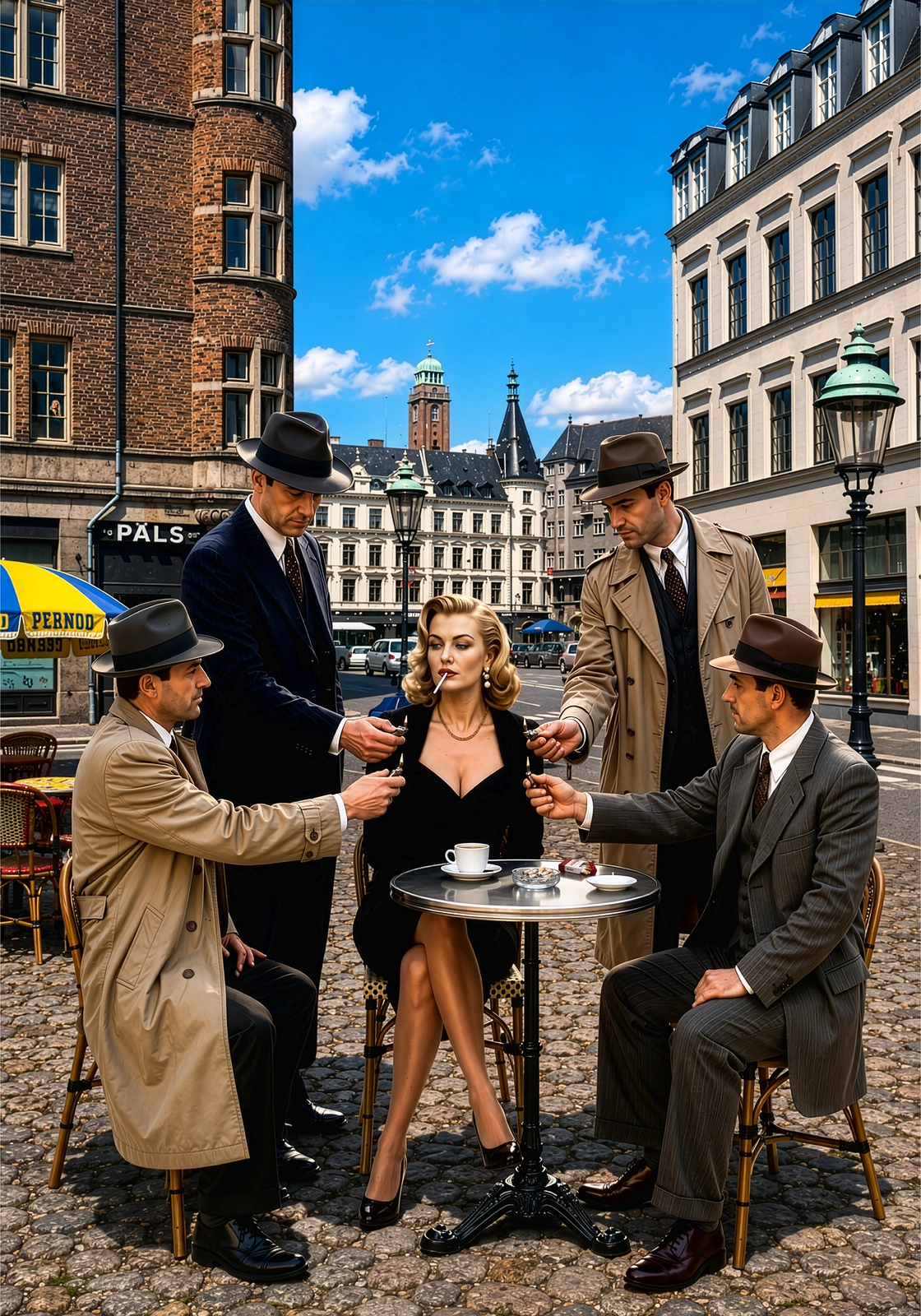
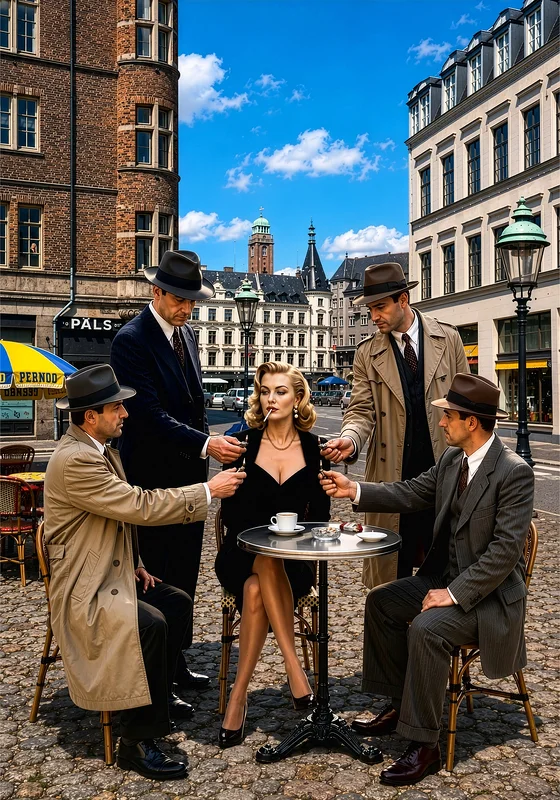
When I look at the photograph of Lilla Torg in Malmö, I see something that makes me smile.
Four eager gentlemen are simultaneously extending their lighters, as if it were a matter of national importance to light Anita Ekbergs cigarette. Meanwhile, I remain calmly seated in the midst of the commotion while the men compete over a task I could easily have performed myself.
The picture is amusing.
But it also says something about how people have often perceived me.
Over the years, many photographers have captured me with a cigarette in my hand. Sometimes it was on a film set, sometimes in a restaurant, sometimes at a party, and sometimes in a situation that became a story in its own right. If someone flips through the photographs from my life, it can almost seem as though a permanent cloud of smoke drifts through the entire narrative.
But the smoke is not the point.
It simply happens to be visible in the photographs.
When people talk about Anita Ekberg, they often mention the Trevi Fountain, Fellini, Hollywood, the love affairs, the scandals, the glamorous gowns, and sometimes cigarettes. That is understandable. All of those things were part of my life, but they were never what defined me.
The cigarettes were a habit.
Sometimes a pleasure.
Sometimes a prop.
Sometimes a bad habit.
In the end, it became a habit I got rid of.
The woman behind the cigarette was considerably more complicated than that.
She was a girl from Malmö who dreamed of the world. She was an actress, a daughter, a friend, a lover, and occasionally a troublemaker. She could be stubborn, impatient, generous, impulsive, and far too proud for her own good. She made mistakes, learned from some of them, and repeated others several times before she finally knew better.
If there is one thing I hope the reader takes away from my words, it is not the story of my smoking, but the story of how I lived.
And perhaps also how a person can end a habit that has followed her for most of her life. Not through grand speeches or dramatic promises, but simply by deciding one day.
I did what the English call cold turkey.
I stubbed out my final cigarette.
Then I moved on.
The smoke persisted in the photographs.
But the smoker did not.
PS What on Earth Do Turkeys Have to Do with It?
Before we part company, I feel obliged to clear up one matter. I have described several times how I quit smoking cold turkey, an expression that English-speaking people use without blinking, but which to a Swede sounds about as logical as saying it is raining cats and dogs.
What exactly does 'cold turkey' have to do with quitting smoking?
The answer is that nobody seems to know for sure.
Several theories exist. The most imaginative claims that withdrawal symptoms in people who suddenly stop using nicotine or drugs can produce pale, bumpy skin resembling that of a cold, uncooked turkey. It is a theory that is often repeated, but linguists do not seem particularly convinced by it.
Another explanation is more linguistic and therefore probably more accurate. As early as the nineteenth century, Americans used the expression talk turkey, which roughly meant speaking plainly or getting straight to the point. Over time, the phrase talk cold turkey emerged, meaning to tell the truth without embellishment, excuses, or diplomatic detours. From there, the meaning evolved to denote doing something directly, without intermediate steps.
When the expression began to be used about addicts and smokers in the 1920s, it acquired the meaning we know today: to stop immediately, without tapering off, without aids and without negotiation.
There is also a theory that the expression refers to cold turkey as a meal. A cold turkey left over from yesterdays dinner requires no further preparation. One takes it out and eats it. In the same way, one abandons a habit abruptly, without fuss. It is a charming theory, but most linguists appear to favour the language-based explanation.
Whatever the truth about the turkeys may be, one thing is certain. The expression has nothing to do with birds and everything to do with determination. English happens to be a language that loves peculiar idioms. In English, it rains cats and dogs; people buy a pig in a poke; hit the nail on the head; let the cat out of the bag; and throw in the towel when they give up.
Personally, I prefer the Swedish expression for abruptly quitting.
It sounds less like a dinner menu and more like what actually happened.
I stubbed out my last cigarette. Then I never
Jörgen Thornberg
Cold Turkey - Kall Kalkon, 2026
Digital
50 x 70 cm
3 200 kr
Cold Turkey
Svensk text på slutet
Introduction
Some people leave monuments. Others leave books, films or works of art. Most leave memories that slowly fade as the years pass.
Anita Ekberg left behind thousands of photographs.
In many of those photographs, she is smiling. In others, she is laughing, arguing, posing, driving, dancing, filming, or simply walking through a world that seems fascinated by her. Sometimes she stands beneath the spotlights of Hollywood. Sometimes she strolls through the streets of Rome. Sometimes she sits on a rooftop overlooking the Italian countryside. And very often, a cigarette appears somewhere in the picture.
At first glance, this might seem to be an essay on smoking.
It is not. The cigarette is merely a thread running through a much larger narrative.
It is the story of a girl from Malmö who became one of the world's most recognisable women. A woman who conquered Hollywood, was immortalised in Federico Fellinis La Dolce Vita, feuded with the paparazzi, argued with film stars, drove fast cars, loved fiercely, lived recklessly at times, and refused to let others decide who she should be.
It is also the story of an era.
A time when cigarettes were everywhere. They stood on restaurant tables, filled aircraft cabins, drifted through film studios, and accompanied late-night conversations that seemed as if they might never end. A time when smoking was associated with glamour, sophistication and adulthood, long before it became linked to warning labels and public health campaigns.
Through Anitas memories, we step into a vanished world.
We encounter Fellinis Rome, Sophia Loren, Gina Lollobrigida and the paparazzi. We climb onto the rooftop in Genzano. We sit behind the wheel of a silver Mercedes-Benz 300 SL Roadster. We witness quarrels, adventures, scandals and moments of unexpected solitude. We meet the young woman who learned to smoke, the international star who never stopped attracting attention, and the older woman who one day surprised even herself by quitting.
Yet beneath all the glamour lies something universal.
This is a story about freedom.
The freedom to choose one's own path.
The freedom to ignore expectations.
The freedom to make mistakes.
And, eventually, the freedom to change.
The photographs show the smoke.
These pages reveal the woman behind it.
The Song of Gilgamesh
**The Smoker's Lament**
A smoker sat proudly outside a café one day,
Puffing and blowing the morning away.
He twirled his moustache and adjusted his hat,
Certain the world was impressed by all that.
My cigarettes help me think, he declared with a grin.
They sharpen my wit and the thoughts deep within.
His neighbour looked up from a newspaper spread:
Strange then that most of your thoughts seem long dead.
The smoker ignored him and struck a grand pose,
Sending smoke rings aloft through the air from his nose.
A pigeon flew through one and looked quite perplexed,
As if wondering what sort of cloud might come next.
A doctor walked by and said, Friend, take great care.
Those little white sticks aren't improving the air.
The smoker replied, I've been hearing that song
For forty years running, and I'm still going strong!
At that very moment he started to cough,
A wheeze and a rattle that simply wouldn't stop.
The pigeon returned and looked down from above.
Perhaps, it cooed softly, it's time for self-love.
The smoker considered this avian advice,
Though taking advice never happened twice.
He lit one more cigarette, just out of spite,
Then accidentally set fire to his tie.
The waiter arrived with a bucket of foam,
The pigeon departed and hurried back home.
The doctor just smiled and remarked with delight,
Well, that is one way to extinguish a light.
The smoker stood dripping and smelling quite odd,
Like a chimney abandoned by reason and God.
At last he admitted, with admirable candour,
That habit perhaps has become rather grander
Than any sensible fellow should ever allow.
Maybe I'll stop... though I'm not certain how.
The doctor replied, Just quit, if you dare.
The smoker said, Fine! and tossed one in the air.
Years later they met by the very same square.
The smoker looked healthier, breathing fresh air.
No cigarettes now? asked the doctor with pride.
No, smiled the smoker. They smoked me, so I stepped aside.
Malmö, June 2026
Cold Turkey
What does Anita Ekberg have to do with cold turkey?
Not much, as far as I know.
"Cold turkey" is an English idiom, about as puzzling as the expression "it is raining cats and dogs". As far as I understand, English is the only language on Earth that uses "cold turkey" to describe the abrupt end of something, such as a bad habit. Readers who are curious about the origins of the phrase can turn to the postscript after Anita has finished telling the story of her smoking years and how she eventually brought her long-standing addiction to an end. But for now, I shall let Anita speak for herself.
PROLOGUE A Puff of Smoke from Another Time
Before I begin, I must tell you something.
Many of you reading this have never smoked a cigarette. Others gave it up long ago. Some of you may dislike the smell of tobacco smoke and find it hard to understand why anyone would voluntarily put a cigarette in their mouth. I understand that. The world has changed.
When I was growing up, cigarettes were everywhere. They were in cafés, restaurants, theatres, airports, hotels and film studios. They appeared in films, advertisements and weekly magazines. Politicians, movie stars, factory workers and housewives smoked. Hardly anyone raised an eyebrow. For my generation, cigarettes were as natural as a cup of coffee. People smoked like chimneys.
That does not mean things were better back then. It simply means they were different.
When people look at old photographs of me today, they often think of the dresses, the films or the Trevi Fountain. But if you look carefully, there is usually a cigarette somewhere in the picture as well. In my hand, in an ashtray, resting on a table, or between my fingers while I am talking to someone. For many years, it was just as much a part of my public image as the high heels or the blonde curls.
The truth is that cigarettes meant different things at different times in my life. Sometimes they were an expression of freedom. Sometimes they were a shield against journalists and photographers. Sometimes they were simply a habit. And sometimes they were a way to find a few moments of peace in a world where people were constantly wanting something from me.
I began smoking as a young, rebellious girl from Malmö. Even then, I had a knack for doing what other people thought I ought to avoid. Later, I smoked in Hollywood, in Rome, on film sets, at parties, on terraces overlooking the Italian countryside, and in places where respectable ladies, according to the rules of the time, absolutely were not supposed to sit and smoke. If someone told me it was inappropriate, it often increased my desire to do it.
Over the years, I was photographed thousands of times with a cigarette in my hand. Some of those photographs became famous. In some, I look glamorous, with a cigarette perched at the end of a long holder. In others, I look tired. Looking at them today, I realise that the cigarette often revealed more about my mood than my smile ever did.
But this is not really a story about tobacco. It is my account of a vanished age, of a generation that lived differently from today's, and of a woman who spent most of her life doing exactly as she pleased. It just so happened that cigarettes accompanied me throughout almost the entire journey, from my youth in Malmö to the great film studios, the Roman nights, and the many strange situations life had in store for me.
Perhaps strangest of all is that this story is also about how it all ended, not with grand ceremonies, solemn New Year's resolutions, or long discussions with doctors. After decades of smoking, a day came when I stubbed out a cigarette and never lit another. For those who knew me well, that may not have been especially surprising. Once I had made up my mind about something, there was usually very little room for negotiation.
But before we get there, we must travel back to Malmö, not to the movie star Anita Ekberg, not to the woman who would one day be photographed by the world's most famous photographers and see her name glow on cinema marquees, but to a rather tall, stubborn and occasionally troublesome girl who had no idea what the future held for her.
That is where everything began. Long before Hollywood, Rome, Fellini, the paparazzi and all the stories people still tell about me. Back then, life was about family, school, friends and that restless feeling that the world had to be bigger than what could be seen from one's own neighbourhood.
I was not a model student. My grades were nothing remarkable, and I sometimes struggled to understand why certain rules had to be followed simply because they were rules. If someone told me something was forbidden, I became curious. If someone said a young girl should not do a particular thing, I often wondered whether that was precisely the thing I ought to try.
That was more or less how cigarettes entered my life.
And like so many things that begin out of simple curiosity, they would remain with me far longer than was good for me.
CHAPTER 1 The Girl from Malmö Who Smoked in Secret
If you are expecting a dramatic story about my first cigarette, you will be disappointed. It was not a life-changing moment when the heavens opened, and I suddenly understood the meaning of existence. I probably coughed, thought it tasted strange, and tried to look far more sophisticated than I really was.
That is often the case with a first cigarette.
The curious thing is that almost nobody starts smoking because cigarettes taste good. People begin for entirely different reasons. They want to feel grown up, to be brave, to fit in, or to stand out. Sometimes they want to do exactly what someone has told them not to do.
In my case, it was probably mostly curiosity.
Malmö, of course, was not Hollywood. It was not Rome either. But for a teenage girl in the 1940s, even Malmö could feel both large and small at once. Large because the city buzzed with people, ships and shipyards, factories, shops and stories from every corner of the world. Small because everyone seemed to know how a young girl ought to behave.
I had already realised at an early age that I was not particularly interested in living up to other people's expectations.
I have occasionally read descriptions of myself as a teenager that make me sound like a wild rebel who constantly caused chaos wherever she went. That was not really the case. But I was stubborn. And I had the unfortunate habit of asking questions when other people seemed perfectly satisfied with the answers they had been given.
Why were boys permitted to do certain things while girls were not?
Why were some ambitions considered reasonable for men but not for women?
And why did adults become so upset about things that many of them had done themselves, such as smoking?
Looking back, I realise that for many women of my generation, the cigarette became a symbol of something larger than tobacco itself. When men smoked, nobody thought much of it. When women did the same, it suddenly became a question of morality, respectability and character. That alone was enough to make many of us even more interested.
I do not think I analysed it so consciously when I was young, but the feeling was there. The sense that certain rules seemed to apply more to girls than to boys.
When I later began working as a model, I quickly discovered that the world was full of contradictions. Men could admire a beautiful woman, photograph her from every angle, and profit from her appearance. Yet those same people could become upset if she took the liberty of living exactly as she pleasedusually in much the same way they themselves did.
I would encounter that contradiction many times later in life.
But even as a teenager, I sensed a certain freedom in not always doing what was expected of me. Not because I wanted to provoke people, but because I wanted to be myself.
People have sometimes asked whether I regret starting to smoke.
It is a difficult question. If I say no, people assume I am defending smoking. If I say yes, it sounds as if I am trying to rewrite my own life after the event. The truth is that life does not work that way.
Had I been young today, I might never have started. I grew up in a different era, with different role models and different knowledge. None of us sat in school studying photographs of diseased lungs. There were no warning labels on cigarette packets. Cigarette advertising was everywhere, often featuring a movie star holding a cigarette. Nobody talked about passive smoking. Nobody could imagine a day when cigarettes would be banned from restaurants, aeroplanes and almost every public place.
We lived in the world around us, not in the one that was yet to come.
When I look back on that young girl from Malmö, I feel neither pride nor shame about her first cigarettes. I recognise her. She was curious, stubborn, and convinced that life was waiting beyond the horizon. She had no idea that horizon would eventually lead her to America, to Italy, and to a fame that sometimes felt more like a storm than a reward.
But she had already begun to develop a trait that would follow her throughout her life.
Whenever anyone tried to tell Anita Ekberg what she absolutely had to do, my first instinct was usually to wonder whether there might be a very good reason to do exactly the opposite.
CHAPTER 2 Hollywood Taught Me How to Smoke Beautifully
When I left Malmö and eventually found myself in America, I discovered that the world was far larger than I had imagined. I also found that cigarettes were even more common than they had been back home in Sweden. The selection was enormous. There seemed to be a brand for every occasion, every social class and almost every profession.
One Swedish brand, Commerce, advertised itself with the slogan "Good Afterwards." Paired with photographs of young couples, the message carried unmistakable sexual undertonesthe idea of smoking a cigarette after making love. People talked about those advertisements endlessly. I remember smoking a cigarette after my first sexual encounter, but mine was a Bill, the favourite cigarette of the Swedish working class. It was cheap, ordinary, and entirely without glamour, which suited the occasion perfectly, as the experience itself was not particularly memorable.
Today it is difficult to explain to younger people how completely normalised smoking was in the 1950s. If you watch old films from the period, you could easily believe that nobody could hold a conversation without a cigarette. Politicians smoked during meetings. Journalists smoked in newsrooms. Doctors smoked in hospitals. Actors smoked between takes. Flight attendants handed out cigarettes on some flights, and restaurants kept ashtrays on tables as naturally as salt and pepper shakers.
Hollywood was no exception.
If anything, it was worse.
An entire industry existed that not only accepted smoking but also actively encouraged it. Tobacco companies sponsored television programmes, bought newspaper advertisements, and paid enormous sums to have their brands seen in the hands of famous people. Movie stars were used to sell cigarettes, and cigarettes were used to sell movie stars.
It sounds cynical today, but at the time it was simply part of normal life.
I quickly learned that a cigarette could serve a public role. It could make a woman appear confident, mysterious, sophisticated or independent. When a photographer asked a model to hold a cigarette, it was rarely about tobacco. It was about creating an atmosphere.
A photograph was meant to tell a story. That story could be true or completely invented.
Sometimes I laughed at the whole thing. The same people who could be scandalised by a low neckline or a skirt deemed too short had no objection to a young woman smoking in front of a camera. Morality was strangely selective.
During those years, I also began to understand how strongly people reacted to symbols. A cigarette was never merely a cigarette. To some, it represented glamour. To others, sin. To still others, independence or sexual liberation. I rarely thought about it that deeply myself. I was busy living my life while others tried to interpret it.
It was also during this period that advertisers realised my appearance could be used to sell almost anything. Yet I never actually appeared in cigarette advertising, whether on giant billboards, in magazine campaigns or in cinema commercials, despite smoking like a chimney and being photographed constantly with a cigarette in my hand.
When Winston launched its enormous billboard campaign across America with the slogan "It's what's up front that counts," it took only a few days before comedians, talk-show hosts and ordinary people began joking that the slogan ought to appear directly beneath a photograph of Anita Ekberg. Officially, the phrase referred to the cigarette's filter. Unofficially, very few people missed the joke. Depending on how mischievous one happened to be, it could also be interpreted as referring to certain male attributes. In any case, it was about as subtle as an elephant standing in the middle of a living room.
But that was the era.
Today, such a campaign would probably provoke outrage from several directions at once. Back then, it was generally regarded as cheeky, clever and amusing.
I never minded making fun of my own image. If people were going to think about my curves anyway, they might as well laugh at them. Humour is often a better defence than indignation.
At the same time, there was something peculiar about living in a society that warned young women not to become too independent while happily using their photographs to sell products. I was far from the only woman to notice that contradiction.
Hollywood was full of women expected to be both strong and weak. Glamorous, but not too confident. Independent, but not too independent. Visible, but not too free. Everything, ultimately, on men's terms.
I was never particularly adept at that balancing act.
Whenever someone tried to put me in a box, I usually stepped right back out of it. Perhaps that is why I felt so comfortable in front of a camera and sometimes so uncomfortable when I was away from it.
Behind all the photographs, advertising campaigns, and magazine covers, the same girl from Malmö remained, who could never quite understand why other people believed they had the right to decide how she should live. The difference was that the world had grown much larger and far more people had begun to interfere.
It would become even worse when I arrived in Italy. There I would encounter not only film cameras but also producers and journalists and what later became known as La Dolce Vita. If Hollywood smoked heavily, it was nothing compared with Rome in those years, when the nights seemed endless and the ashtrays filled up several times before the sun finally rose again.
CHAPTER 3 Smoke as Armour
When people look at old photographs from the height of my career, they often think they are seeing a woman overflowing with confidence. It is easy to understand why. In those pictures, I stand straight-backed, look directly into the camera, and appear as though I own the world. Sometimes I am wearing evening gowns that cost more than an ordinary person's annual salary. Sometimes I am stepping out of a sports car. Sometimes I am surrounded by producers, princes, journalists, or movie stars. Very often I hold a cigarette in my hand.
But photographs do not always tell the whole story.
A camera captures a moment. It does not show what happened five minutes earlier or five minutes later. It does not show the exhaustion after a long day on set. It does not convey the loneliness of a hotel room after the applause has faded. It does not reveal the insecurity that sometimes hides behind a smile that looks so confident in a photograph.
I think many people imagine that movie stars wake up every morning, completely convinced of their own greatness. If that were true, the world would be full of unbearable people. Most of us are far more complicated than that.
We shared the same fears as everyone else. The only difference was that our fears were often photographed.
That was where the cigarette sometimes entered the picture. Not as a pleasure. Not even as a habit. But as a kind of armour.
When a journalist asked a foolish question, I could take a puff instead of answering on the spot. When a photographer wanted twenty more pictures, I could buy myself a few moments of breathing space by lighting a cigarette. When I felt irritated, tired or uncomfortable, a cigarette gave me something to do with my hands while I decided what I really wanted to say.
I was far from the only one to use that trick.
Throughout the 1950s and 1960s, countless actors used cigarettes in much the same way. Humphrey Bogart did. Marlene Dietrich did. Many others did too. Cigarettes functioned almost as a social tool. They created pauses in conversation. They gave people an excuse to stay a little longer or a reason to leave. They could signal interest, irritation, impatience or indifference without a single word.
In my case, a cigarette sometimes served as a way of keeping the world at a comfortable distance.
Fame means people are constantly trying to get close to you. Journalists want interviews. Photographers want pictures. Admirers want autographs. Strangers want to tell you their life stories. Producers want meetings. Agents want decisions.
Eventually, you long for a few moments of peace.
A cigarette could create that pause. People saw the smoke, waited a few seconds, and let you finish your thoughts.
That was also why I sometimes used it as an answer to questions I had no wish to answer.
Journalists love clear statements. They want headlines and a quotation that can be printed in large type the following morning. I was not always in the mood to help them.
On more than one occasion, I took a long drag, exhaled the smoke, and let silence do the work for me.
Silence can be a remarkably effective response.
I particularly remember how journalists always wanted to know everything about my love affairs. Who was I seeing? Whom had I left? Who had left me? Whom was I planning to marry next? It was as though my private life belonged to the public and existed solely for their entertainment.
Once, I was asked whether I was afraid of being hurt when relationships ended.
I took a puff, looked at the reporter, and replied that feelings could vanish as quickly as smoke and that words were cheap.
It was a typical Anita-style answer.
Partly true. Partly untrue. And considerably more complicated than it sounded.
Because the truth, of course, is that movie stars get hurt too. We cry. We doubt ourselves. We make mistakes. We miss the people who have left us. The difference is that we usually try to do so behind closed doors, while the rest of the world imagines we live in a state of permanent glamour.
Perhaps that is why I felt so comfortable smoking cigarettes during those years.
The smoke did not hide anything, but it created an illusion of control. It gave me a few seconds to gather my thoughts before the world demanded another answer, another smile, or another photograph.
It served as armour, nothing more, nothing less. But like all armour, it can become so comfortable that you eventually forget why you put it on.
In Rome, it would soon become something more than that. There, it was no longer just about interviews, photographers and film studios. The cigarette became part of the nightlife itself, part of the cafés, the endless parties and the world that Federico Fellini would later christen La Dolce Vita. Smoke drifted through the salons as naturally as champagne, and sometimes it was hard to tell which came first in making people lose their judgement.
CHAPTER 4 La Dolce Vita Smelled of Cigarette Smoke
When people today hear the phrase La Dolce Vita, they often think of glamour, fountains, beautiful dresses and Italian sports cars. They think of the photograph of me in the Trevi Fountain, of Marcello Mastroianni and of Federico Fellini's film. But for those of us who actually lived in that world, La Dolce Vita smelled above all of cigarette smoke, perfume, espresso and Roman nights that seemed to stretch long after the sun ought to have risen.
Rome in the late 1950s was a peculiar place. The war was still fresh in people's memories, yet the future suddenly looked bright. The economy was growing, the film industry was flourishing, and people wanted to live. After years of hardship, there was an almost tangible hunger for pleasure, beauty and freedom. The cafés were full. The restaurants were full. The parties seemed never to end.
And smoke was everywhere.
Today, many of the establishments where we spent our evenings would probably have been shut down by health authorities within hours. Back then, the blue-grey haze beneath the ceiling lamps was regarded as part of the atmosphere. Waiters balanced trays of drinks between the tables; the music played; people laughed, flirted, and argued; and above it all, a cloud of cigarette smoke made the light appear softer than it really was.
It was also during those years that paparazzi photographers became part of everyday life. The word scarcely existed before Fellini's film, but the people already did. They waited outside restaurants, hotels and nightclubs. They appeared when you least expected them and often arrived before you even knew where the evening was headed. Many of the most famous photographs from that era look spontaneous, but the truth is that we often lived as though we were constantly on stage.
In such a world, cigarettes almost became part of the costume. Not because anyone ordered us to smoke, but because they were already everywhere around us. There was an ashtray on every table. Someone offered a packet. Someone else lit a cigarette of their own. The conversation continued. Nobody thought much about it.
I think it is difficult for younger people to understand how attitudes to smoking have changed. Today, cigarettes are primarily associated with illness and addiction. Back then, they were often associated with adulthood, elegance, independence and success. That did not mean that everyone smoked, but it did mean that almost nobody reacted when someone did.
In my own life, those years coincided with a period when everything seemed to be moving faster than I could fully grasp. Films were being made. Journalists were calling. New people appeared every week. Old ones disappeared just as quickly. One evening I might be sitting in a restaurant with producers, actors and aristocrats; the next with artists, writers and people who had nothing in common except that they wanted to be wherever things were happeningand that they all smoked.
The most famous example of that world would, of course, be the notorious party at Rugantino in Trastevere. The story has been told so often that it has become a legend, yet reality was almost as improbable as the myth. Film stars, socialites, journalists, eccentrics and adventurers mingled in a whirlwind of music, laughter, champagne and sheer foolishness. People danced on tables, performances were improvised in quick succession, and the boundary between party and theatre disappeared completelyphysically as well, since the cigarette smoke hung thicker than the worst London smog.
Federico Fellini was there. Several of the people who would later inspire his filmand minewere there. And in the middle of it all, people were naturally sitting and smoking as though the world's supply of tobacco would never run out.
Looking back, many people have described La Dolce Vita as a golden age. There were certainly moments when it felt that way. But behind the glitter, there was something else as well. Many of us were constantly racing towards the next party, the next premiere, or the next success, without ever really stopping to ask ourselves why. Sometimes I think cigarettes fitted so perfectly into that world because they mirrored the lives we were living. They burned intensely, shone brightly for a moment, and then turned to ashes.
It was an age of abundance, but also of restlessness. Although I had no intention of quitting smoking at the time, I occasionally began to suspect that the world around me could not continue forever. No party lasts forever, no matter how loud the music may be, and when dawn finally arrived, the ashtrays often looked considerably sadder than the people who had filled them only a few hours earlier.
Yet it was hard to think about tomorrow while the night was still unfolding. Rome had a way of making people live entirely in the present, and I was far from immune to its charm. That was also why I so often found myself in situations others called scandals, while I mostly regarded them as just another evening in an unusual life. In many of those scandals there was a cigarette present.
CHAPTER 5 The Bow, the Paparazzo and the Cigarette
If there is one photograph that summarises my relationship with the paparazzi better than any other, it is probably the picture of me standing in the middle of the night, with a cigarette in one hand and a bow and arrow in the other.
It sounds like a scene from a Fellini film, but it actually happened.
To understand the incident, one must remember how life had changed after La Dolce Vita. Fame had always carried a price, of course, but during those years the price began to rise much faster than many of us had anticipated. The paparazzi became more numerous, bolder and more aggressive. They were no longer satisfied with photographing famous people at premieres or press conferences. They wanted to follow us home, document our private lives, and capture moments never intended for public consumption.
At first, one tried to laugh it off, then to ignore it, and eventually grew tired of it.
That was roughly where I found myself one autumn night in 1960. The volcano within me was building towards an eruption.
I had returned home after a long evening in Rome when I found photographers waiting outside the house. They had followed me through the city and showed no sign of leaving. For them, it was just another shift at work, but for me it was my home, my fortress.
There comes a point when even the most patient person has had enough.
I had recently finished filming The Mongols and had learned to handle a bow. I no longer remember exactly how the chain of thought unfolded. Still, somewhere between irritation, lack of sleep and my natural stubbornness, I concluded that if the photographers intended to behave like attacking horsemen, I might as well meet them with suitable equipment.
So I went outside, barefoot, with a cigarette in one hand and a bow in the other.
If anyone had proposed the scene as a film script, the producer would probably have dismissed it as far too implausible. The photographers, however, seemed to understand exactly what was happening.
What followed has been told in countless versions over the years. Some stories have grown larger with each retelling, which often happens when journalists get hold of good material. But the basic truth is simple enough. I really did shoot arrows at the photographers, and one of them struck Felice Quinto in the hand.
Naturally, there were headlines and a scandal unlike any other. There were discussions about temperament, self-control and proper behaviour.
Personally, I mostly found it strange that so many people seemed surprised that someone who was constantly being hunted eventually reacted.
I do not recommend the method, but I still understand the sentiment.
When I look at the photographs from that night today, it is not the bow that first catches my eye. It is the cigarette. There I am, in the middle of a minor war with the world's photographers, still calmly holding my cigarette as though it were my shield.
In a way, it was.
During those years, cigarettes followed us everywhere. They were in the restaurants, the dressing rooms, the film sets, the cars, and on the terraces at home. They were as commonplace as handbags or sunglasses. Nobody thought much of it. At least I did not.
Only in retrospect do I realise how many of the era's most famous photographs feature cigarettes. They appear in the hands of actors, writers, politicians and musicians as though they were extensions of the body. Even at the Oscars, there was a lot of smoking. During Hollywood's so-called golden era and the first decades of the gala, smoking was a completely natural part of the event. Both the awardees and the winners stood on stage with a cigarette in their hands. In the classic era of Hollywood, smoking was strongly linked to glamour, and it was not considered strange to take a cigarette up to the podium.
When the avid smoker Humphrey Bogart accepted his Oscar for The African Queen (1952), he held a glowing cigarette between his fingers in one hand and the statuette in the other. Since I missed out on an Oscar, I didn't face that situation. But in 1956, when I, as one of the very few Swedish actresses, won a Golden Globe, I had the good taste not to smoke on stage.
To those who grew up several decades later, it looks exotic; to some, it is downright horrifying. To us, it was everyday life. Nowadays, smoking is banned almost everywhere, and smokers are often viewed with disapproval.
What was not part of everyday life, however, was living under constant surveillance, which intensified with each passing year. I had entered the world of cinema because I loved films. I had never dreamed I would spend half my life trying to escape photographers in the streets of Rome.
Sometimes I managed to laugh about it. Sometimes I became irritated. And sometimes, as on that particular night, irritation proved stronger than my patience.
Strangely enough, the bow-and-arrow episode made me even more famous. The photographs travelled around the world and fitted perfectly with the image of Anita Ekberg that was already taking shape: the woman who did as she pleased, said exactly what she thought, and rarely backed down from a confrontation. Quite a few people probably felt the photographers got what they deserved.
There was some truth to that image.
But only some.
Behind the headlines, there was still the same person who occasionally longed for something as simple as being able to go home without being photographed along the way.
When that proved impossible, one sometimes had to improvise.
And if the improvisation happened to involve a bow, a cigarette and a few very nervous photographers, it became yet another story for the newspapers to cover. Curiously, the guardians of propriety were often more upset that I was walking around with a cigarette in my hand. The etiquette of that era dictated that respectable young women should sit while smoking, whereas today's etiquette dictates that they should not smoke at all.
CHAPTER 6 On the Roof in Genzano
Many of the best-known stories about my life involve premieres, scandals, love affairs, or photographers chasing me through the streets of Rome. That is perhaps not surprising. Drama has always sold better than tranquillity. But if I am allowed to choose the memories I most enjoy revisiting, it is often the quiet moments that come back first.
One such place was my house in Genzano di Roma, especially the roof.
The house stood high above the countryside south of Rome, where the hills roll gently towards the sea and the evening light paints the horizon in gold and copper. When work, telephones, journalists and everyone else's expectations became too much, I could climb onto the roof and, for a little while, pretend that the world beyond it did not exist.
It was, of course, an illusion. Once one becomes famous, the world tends to follow along, even when one tries to hide. Yet Genzano came closer to peace than any other place in my life.
It was there that the famous photographs from the summer of 1962 were taken. The pictures show me sitting on the rooftop, a packet of cigarettes within reach, gazing out over the countryside and the distant sea. When people look at photographs of Villa Anita today, they often think of glamour or eccentricity. Some perhaps see a film star trying to provoke the world once again. But they have not seen my place on the roof. When one has three storeys with four bedrooms, five bathrooms and an enormous living room, surrounded by seven thousand square metres of garden and several ancient olive trees, what exactly is one doing up there?
The truth is simple. I liked the view. Sometimes the most complicated explanation is the least accurate.
When I climbed onto the roof, I did not do it for the photographers or to create headlines. I did it because from there one could see far beyond the garden, beyond the roads and beyond the people who constantly wanted something from me. Up there were the sky, the wind and the silence, and after enough years in public life, one learns to appreciate them.
There was also something liberating about sitting there alone. For most of my adult life, people have had opinions on how I should dress, what I should say, whom I should love and how I should behave. The more famous I became, the more experts suddenly appeared to tell me how Anita Ekberg ought to live her life.
Curiously enough, I was rarely consulted.
On the roof, all those voices disappeared for a while. There were no journalists seeking quotes, no producers wanting to discuss contracts, and no photographers trying to capture the next sensational picture. If anyone happened to be offended by a woman straddling her own rooftop ridge while smoking a cigarette, that was their problem.
It is easy to forget how different the atmosphere was back then. In the early 1960s, many people still believed that women ought to be elegant, discreet and, above all, predictable. I had never been particularly successful at any of those things. Elegance I could occasionally manage, but discretion and predictability proved considerably more difficult.
I think that was why some people found me so irritating. Not because I did anything particularly scandalous, but because I seemed to do it without explaining afterwards.
The photographs from Genzano capture something of that feeling. When I look at them today, I do not see a sex symbol or a film star. I see a woman who, for a little while, was allowed to be alone with her thoughts. The cigarette is there, as it was in so many other parts of my life, but it is almost incidental. What mattered was the view, the light and that rare sense of freedom.
Freedom is a word people use far too casually. For some, it means money. For others, fame. For still others, power. I have often thought that freedom is something much simpler. Freedom is occasionally being left alone with one's own thoughts, without anyone demanding an explanation.
The roof in Genzano provided exactly that.
I sometimes sat there for hours as the sun moved across the sky and shadows slowly shifted across the hills below. I thought about people I missed, people I loved, people I was perfectly happy never to see again, and all the strange detours that had carried a girl from Malmö to a rooftop outside Rome.
When I look back on those moments, I do not remember many cigarettes. I remember the wind. I remember the scent of summer warmth it carried. I remember the view towards the horizon and the feeling that the world had, at least for a little while, stopped pulling at me from every direction.
That may be why I enjoyed it so much up there.
Not because it brought me closer to heaven, but because it carried me a little farther from everything else.
CHAPTER 7 Gina, the Aeroplane and the Smell of Hell
If the paparazzi were one group of people who tended to irritate me, film stars were the other. Not all of them, of course. I had many friends in the film world and several colleagues whom I liked very much. But the film industry is a peculiar environment where large egos are often forced to share the same space, and situations arise that no screenwriter would have dared invent.
One of the most famous occurred on an aeroplane.
The story has been told so often that it has almost become a legend, yet at its core it is true. I was sitting in first class on a flight to Latin America. As was so often the case in those days, people smoked on board. There were ashtrays built into the armrests, and nobody thought it unusual for a passenger to light a cigarette during the journey.
Before doing so, I asked the people sitting nearest to me whether they minded. They kindly replied that they had no objection. The matter therefore seemed settled. If one wished to avoid smokers, one sat in the non-smoking section. I did not. It was as simple as that in those days.
But not always.
Several rows away sat Gina Lollobrigida.
For many years, Gina and I were portrayed by the press as rivals. Sometimes there was a grain of truth in the rumours. More often, however, they were pure fantasy. She tended to see me as a competitor more than I saw her. Journalists love conflict, and they love it even more when they can place two women at the centre of the story. If two male actors competed for the same role, it was called professional rivalry. If two female stars did the same, it was often presented as a catfight.
It became tiresome after a while.
In truth, I was never part of the central conflict. The deep, bitter and long-running feudthe one over power, prestige and the soul of Italian cinemawas between Gina and Sophia Loren. The press dubbed it La guerra delle curve, the War of the Curves. It was a rivalry with enormous consequences for the Italian film industry over several decades, in which I was, at best, a provocative supporting character.
On this particular day, however, Gina seemed genuinely annoyed. I had taken only a few puffs before her voice rang through the cabin.
Anita! Put out that cigarette! It smells like hell in here!
Naturally, the passengers around us became immediately interested. There is something about a loud quarrel between film stars that makes people forget newspapers, books and even airline safety instructions.
At first I was surprised, then amused. How could the old she-devil know what hell smelt like? Perhaps she had been there. But I did not say so.
Not because I enjoyed irritating Gina, but because the situation was so absurd. I had asked the people beside me, and they had said yes. No one near me seemed bothered. Yet one of Europe's most famous actresses was sitting several rows away, declaring that the cabin smelt like the underworld.
I turned around, looked at her, and replied in Italian so nothing would be lost in translation.
Oh, Gina, why don't you stop being such a pain. I am sitting in the smoking section, and beside me are gentlemen who do not mind in the slightest, so mind your own business.
Then I calmly continued smoking while the gentlemen next to me nodded sympathetically and kept smoking as well.
The argument on the aeroplane was merely one in a long series of public clashes between us. It began at a party where Gina pointedly ignored me. I later took my revenge by referring to her in several interviews as an overdecorated Christmas tree and by publicly mocking both her wardrobe and some of her film roles. We were both Italian-based sex symbols and did not coexist particularly well in the same backyard.
The smoking dispute began in the VIP lounge before departure and continued aboard the aircraft. I had bought a stack of brand-new magazines, still wrapped in plasticVogue among them. Gina walked over to where I was sitting, grabbed a handful, tore off the wrappers, and began reading my magazines without even asking permission. Naturally, I became irritated and asked whether things were going so badly for her that she had to steal other people's magazines. She threw them onto the floor and did not even apologise.
Today, when smoking is banned on aircraft all over the world, the episode feels almost archaeological. Younger people find it hard to imagine that hundreds of passengers once sat sealed inside a metal tube ten thousand metres above the earth as cigarette smoke slowly filled the cabin. Yet that was reality for many years.
At the same time, the quarrel was never really about cigarettes. It was about temperament. Both Gina and I had strong personalities. Neither of us was inclined to retreat when we were convinced we were right. When two such people collide, the result is rarely quiet.
When I look back on the incident today, I mostly laugh, not at Gina or at myself, but at the entire situation. There sat two grown women who had worked with some of Europe's greatest directors, travelled around the world and built international careers, yet somehow found themselves in an argument that resembled two schoolgirls quarrelling on a tram.
Fame does not make people wiser. It merely makes them more visible.
If the episode says anything about me, perhaps it is that I have never been particularly good at taking orders. When someone tried to tell me what to do, my first instinct was usually to ask why. If the answer failed to convince me, there was a distinct risk I would do precisely the opposite.
That trait has caused several problems over the years, but it has also produced some rather entertaining stories.
The quarrel with Gina on the aeroplane unquestionably belongs in the latter category. Yet although I can still smile at the memory, one thing strikes me when I think back on it. At the time, I defended my right to smoke with the same stubborn determination I applied to everything else in life. I had not yet begun to wonder whether a day might come when cigarettes would no longer have a place in my everyday life.
That thought still lay far off.
Back then, I lived in a world where ashtrays stood on restaurant tables, cigarettes accompanied people on flights, and I could not imagine an evening without the small ritual that began with a match or a lighter. Wherever one went, a haze lingered beneath the ceilings.
But the world was already beginning to change, even if we had not yet paid much attention to it. More people than Gina felt uncomfortable in public spaces. Cigar smokers and gentlemen in tweed coats puffing on pipes were often the first to draw complaints. Some pipe tobaccos produced aromas that enthusiasts considered delightful but which could fill an entire restaurant. One blend, called Clan, could make a perfectly good entrecôte taste like horse manure. Fortunately, pipe smokers were often a gentlemanly breed who avoided provoking other guests. There were pipe tobaccos that smelled a little stronger than cigarettesthose poisonous little sticks that, curiously enough, were accepted by most peopleexcept by Gina.
Anyone who happened to light a Simon Arzt cigarette, however, risked serious trouble. This Egyptian brand had an almost perfumed aroma. When the Oriental tobacco burned, it released a distinctive aromasweet, smoky and almost incense-like. The smoker risked social lynching, which is why very few people dared smoke them indoors, except in Egypt, of course.
When I was filming the adventure mystery The Glass Sphinx (La sfinge d'oro) in Cairo in 1966, members of the local crew smoked that brand. We were in the middle of the desert, and one advantage of the smoke was that the dreaded and highly venomous desert horned viper slithered away as quickly as possible.
The poor dromedaries seemed more accustomed to it, naturallyexcept for the one I happened to be riding, which snorted like a broken steam locomotive. A photograph of me and the dromedary, distributed worldwide by United Press, became quite famous and carried the humorous caption Beauty and the Beast. The reporter joked that the proud dromedary appeared deeply offended at having one of Hollywood's most celebrated stars perched on its back.
CHAPTER 8 The Mercedes, the Cigarette Holder and the Woman Behind the Wheel
If there were two things capable of making Italian men lose their concentration in the early 1960s, they were fast sports cars and beautiful women with generous curves. If both were combined, the effect could sometimes be almost comical.
I had always liked cars. Perhaps it was because they represented the same thing as so many other things that attracted mefreedom. A car meant you could choose your own direction. You could leave a party whenever you wished, drive wherever you pleased, and avoid waiting for someone else to make decisions for you. Today that sounds perfectly ordinary, but at the time many people still believed that a woman ought to sit elegantly in the passenger seat while a man held the steering wheel. I never quite understood why someone else should be allowed to have more fun than I did.
One should also remember that drinking and driving had not yet become the major public issue it would later be. If one had attended a party and could still find one's car afterwards, people generally assumed one was capable of driving it. On the other hand, if one caused an accident while carrying too much alcohol in one's bloodstream, the consequences were serious. If someone died and you were found responsible, it was often regarded as morally comparable to murder. Naturally, people tried to be careful.
That was one reason I enjoyed being behind the wheel. For many years, I drove a silver Mercedes-Benz 300 SL Roadster, one of the most desirable cars a person could own at the time. It was fast, elegant and sufficiently expensive to make both neighbours and journalists raise their eyebrows. When the engine came to life, it sounded almost like a promise that the day might take any direction.
Rome was an ideal city for such excursions. Not because the traffic was particularly well organisedit most certainly was notbut because the city lived in a way that turned every drive into a minor adventure. One could set out intending to buy a newspaper and find oneself several hours later, having lunch far from where the day had begun. Romans possessed an almost innate ability to adapt plans as they progressed.
The photographers, naturally, had no difficulty adapting to that lifestyle. They travelled by car or on Vespas, enabling them to appear almost anywhere. Paparazzi turned up everywhereoutside hotels, restaurants, film studios and nightclubs, and even beside one's car. Sometimes I wondered whether they slept less than we actors did.
One of the most widely circulated photographs from that period shows me about to step into my Mercedes outside a hotel in Rome. I am wearing an elegant dress, appear to be heading somewhere important, and am holding a long cigarette holder. Over the years, people have tried to analyse the image as though it were a work of art filled with hidden symbolism.
I was taking a puff.
The truth is much simpler.
I liked cigarette holders because I found them elegant.
Yet the symbolism was there nonetheless. At the time, a long cigarette holder carried aristocratic associations. It recalled an older world in which women could be both sophisticated and dangerous. When one looks at old photographs of Marlene Dietrich, Greta Garbo or other stars from the golden age of cinema, cigarette holders often appear as extensions of their personalities. For me, it had less to do with aristocracy and more to do with theatre. Life in Rome already contained enough drama to resemble a film at times, and a cigarette holder was merely another prop in the performance.
The curious thing is that people often saw the car, the cigarette and the woman, yet somehow missed the most important thing: the woman herself.
Most people saw glamour.
I saw something far more important: independence.
It was still unusual for a woman to drive alone in one of Europe's fastest sports cars. Some men found it provocative, while others, like Gianni Agnelli, considered it fascinating. For me, it was mainly practical. I had never had much patience for people who wanted to tell me what women should or should not do. If I wanted to drive, I did so without asking anyone's permission. If I wanted to smoke a cigarette, I smoked oneor two, or perhaps three, or even an entire pack if the mood struck me. And if someone disliked it, that was more their problem than mine.
Looking back, I realise that much of what seemed rebellious was actually quite simple. I wanted to live my life without constantly asking permission. That does not sound especially revolutionary today, but in the 1950s and 1960s it was still unusual enough to attract attention. Many people saw only the result, not the reason behind it. They saw the headlines, the photographs and the large cars, but they did not see the stubborn girl from Malmö who remained behind it all.
At the same time, something was slowly beginning to change in the background.
At first, it was hardly noticed.
An article here. A doctor there. A sensitive nose trapped in the wrong room. A newspaper reporting new research from the United States. An acquaintance mentioning that physicians had begun discussing links between smoking and various diseases. Most of us shrugged. Film stars smoked, politicians smoked, journalists smoked, and doctors still smoked in their own waiting rooms. It was difficult to take the warnings entirely seriously when those delivering them often held cigarettes.
In the media, opposing camps began hammering their arguments into one another's heads. According to one side, people lived longer, happier and more successful lives if they smoked. The other side presented statistics on mass mortality among smokers.
Besides, cigarettes remained a perfectly ordinary part of everyday life. Ashtrays stood ready on restaurant tables. At parties, cigarette packets circulated the table as naturally as bottles of wine. On film sets, people lit cigarettes between takes without a second thought. Passive smoking had not yet emerged as a major public concern; the debate centred mainly on the tobacco industry, which some critics were already portraying as a threat to humanity itself. Society was saturated with a habit that few people seriously questioned, almost as though it had always existed and always would.
Yet when I look back on those years today, I can see that the world which seemed so permanent had already begun to change.
We did not notice it yet.
We still sat behind the wheel, lit our cigarettes, and continued down the road as though it stretched endlessly ahead. But somewhere farther on, beyond the horizon, a bend was waitingone most of us could not yet see.
CHAPTER 10 Cold Turkey
If my husband Rik had told me that one day I would quit smoking abruptly, without gradually cutting down, without nicotine patches or anything else, and without ever taking up smoking again, I would probably have laughed at him. We were married for twelve years, so he ought to have known me better. Had he also claimed that it would not happen after a dramatic visit to the doctor or a frightening health report, but because of irritation, I would have laughed even harder. Yet history would prove that he was right and I was wrong. It just took more than twenty years.
Life has a curious sense of humour.
For most of my adult life, cigarette smoke had followed me like a shadow. It had drifted through Hollywood, Rome, film sets, airports, restaurants and countless hotel rooms. It had survived love affairs, marriages, divorces, scandals, successes and disasters. If someone had asked me which habit seemed most enduring in my life, cigarettes would have ranked very highly on the list.
Yet it ended in seconds.
By then, several of my friends had already quit smoking. That was naturally good for them, and I was genuinely pleased they had succeeded. The problem was that some of them never seemed to stop talking about it. Every lunch, every dinner and every telephone conversation could sooner or later turn into a discussion about how difficult it was not to smoke.
They missed cigarettes. They dreamed of cigarettes. They thought of cigarettes. They told everyone else they were thinking of cigarettes.
One particularly close friend eventually drove me completely mad.
She had succeeded in quitting, which should have been the end of the story. Instead, it became the beginning of a new one. Weeks passed, then months, yet the subject remained the same. How difficult it was. How much she missed cigarettes. How strong the temptation still was. How much she suffered, and how sorry everyone ought to feel for her.
Eventually, I had had enough.
I no longer remember the exact words, but I remember the feeling. It was that familiar irritation that, over the years, had prompted me to defy journalists, photographers, producers, rivals, and many others who had tried to tell me how I ought to live.
I thought something along the lines of "Is it really that difficult?"
Then I decided to find out.
There was no grand plan. No solemn ceremony. No dramatic farewell scene in which I stared into the sunset as a packet of cigarettes slowly slipped from my hand. I smoked my last cigarette, stubbed it out, and decided not to light another.
That was all.
In English, the phenomenon is called cold turkey. In Swedish, we usually speak of quitting abruptly without mentioning any bumpy-feathered poultry. I have never been particularly fond of half-measures. Once a decision has been made, I do not see much point in negotiating with myself.
The first few days were not magical. I had smoked for most of my adult life, and my body noticed the change. But the remarkable thing was that I never began to see myself as a former smoker struggling against temptation. I saw myself as a person who did not smoke.
The difference may seem insignificant, but for me it was decisive.
I had made up my mind. That settled it.
A few years later, I was asked in an interview whether I missed cigarettes. My answer seemed to surprise the interviewer. Perhaps he expected a long story about withdrawal and struggle.
He received a much briefer answer.
I am strong and determined. I do not miss them at all.
That was true then and is true now.
Do not misunderstand me. I miss the people, the places, and the moments associated with cigarettes. I miss the evenings in Rome, the view from the rooftop in Genzano, the conversations that went on until the restaurant staff wanted to go home, or the world that existed before mobile phones and social media made everything faster.
But it is not the cigarettes I miss. It is the time I miss.
When people talk about quitting smoking, they often describe it as a battle against nicotine. For me, it became a meeting with myself instead. I realised cigarettes had far less power over me than I had believed the people around me had. Once I had made my decision, they were gone.
So simple, yet so difficult.
When I look back on all those years, I do not primarily see cigarettes. In my mind, I see a long procession of people, places and events: the girl from Malmö who smoked in secret because she was curious; the young woman in Hollywood who learned that cigarettes could be part of an image; the Roman nights and the paparazzi I chased with a burning cigarette and a bow; old She-Devil Gina on the aeroplane; my beloved Mercedes; the cigarette holder; and, not least, the magical view from the rooftop in Genzano.
All of that remains in my memory. However, the smoke disappeared.
That is, after all, its nature. One sees it clearly for a while. Then it curls upwards towards the sky, dissolves, and leaves only a memory behind.
And perhaps that is precisely how a long life should be viewed, not through the ashes that remain.
But through the people, laughter, love, mistakes and adventures that existed while the cigarette was still burning.
EPILOGUE The Smoke and the Woman Behind It
When I look at the photograph of Lilla Torg in Malmö, I see something that makes me smile.
Four eager gentlemen are simultaneously extending their lighters, as if it were a matter of national importance to light Anita Ekbergs cigarette. Meanwhile, I remain calmly seated in the midst of the commotion while the men compete over a task I could easily have performed myself.
The picture is amusing.
But it also says something about how people have often perceived me.
Over the years, many photographers have captured me with a cigarette in my hand. Sometimes it was on a film set, sometimes in a restaurant, sometimes at a party, and sometimes in a situation that became a story in its own right. If someone flips through the photographs from my life, it can almost seem as though a permanent cloud of smoke drifts through the entire narrative.
But the smoke is not the point.
It simply happens to be visible in the photographs.
When people talk about Anita Ekberg, they often mention the Trevi Fountain, Fellini, Hollywood, the love affairs, the scandals, the glamorous gowns, and sometimes cigarettes. That is understandable. All of those things were part of my life, but they were never what defined me.
The cigarettes were a habit.
Sometimes a pleasure.
Sometimes a prop.
Sometimes a bad habit.
In the end, it became a habit I got rid of.
The woman behind the cigarette was considerably more complicated than that.
She was a girl from Malmö who dreamed of the world. She was an actress, a daughter, a friend, a lover, and occasionally a troublemaker. She could be stubborn, impatient, generous, impulsive, and far too proud for her own good. She made mistakes, learned from some of them, and repeated others several times before she finally knew better.
If there is one thing I hope the reader takes away from my words, it is not the story of my smoking, but the story of how I lived.
And perhaps also how a person can end a habit that has followed her for most of her life. Not through grand speeches or dramatic promises, but simply by deciding one day.
I did what the English call cold turkey.
I stubbed out my final cigarette.
Then I moved on.
The smoke persisted in the photographs.
But the smoker did not.
PS What on Earth Do Turkeys Have to Do with It?
Before we part company, I feel obliged to clear up one matter. I have described several times how I quit smoking cold turkey, an expression that English-speaking people use without blinking, but which to a Swede sounds about as logical as saying it is raining cats and dogs.
What exactly does 'cold turkey' have to do with quitting smoking?
The answer is that nobody seems to know for sure.
Several theories exist. The most imaginative claims that withdrawal symptoms in people who suddenly stop using nicotine or drugs can produce pale, bumpy skin resembling that of a cold, uncooked turkey. It is a theory that is often repeated, but linguists do not seem particularly convinced by it.
Another explanation is more linguistic and therefore probably more accurate. As early as the nineteenth century, Americans used the expression talk turkey, which roughly meant speaking plainly or getting straight to the point. Over time, the phrase talk cold turkey emerged, meaning to tell the truth without embellishment, excuses, or diplomatic detours. From there, the meaning evolved to denote doing something directly, without intermediate steps.
When the expression began to be used about addicts and smokers in the 1920s, it acquired the meaning we know today: to stop immediately, without tapering off, without aids and without negotiation.
There is also a theory that the expression refers to cold turkey as a meal. A cold turkey left over from yesterdays dinner requires no further preparation. One takes it out and eats it. In the same way, one abandons a habit abruptly, without fuss. It is a charming theory, but most linguists appear to favour the language-based explanation.
Whatever the truth about the turkeys may be, one thing is certain. The expression has nothing to do with birds and everything to do with determination. English happens to be a language that loves peculiar idioms. In English, it rains cats and dogs; people buy a pig in a poke; hit the nail on the head; let the cat out of the bag; and throw in the towel when they give up.
Personally, I prefer the Swedish expression for abruptly quitting.
It sounds less like a dinner menu and more like what actually happened.
I stubbed out my last cigarette. Then I never
3 200 kr

Jörgen Thornberg
Malmö
Lite om bilder och mig. Translation in English at the end.
Jag är en nyfiken person som ser allt i bilder, även det jag fäster i ord, gärna tillsammans för bakom alla mina bilder finns en berättelse. Till vissa bilder hör en kortare eller längre novell som följer med bilden.
Bilder berättar historier. Jag omges av naturlig skönhet, intressanta människor och historia var jag än går. Jag använder min kamera för att dokumentera världen och blanda det jag ser med vad jag känner för att fånga den dolda magin.
Mina bilder berättar mina historier. Genom mina bilder, tryck och berättelser. Jag bjuder in dig att ta del av dessa berättelser, in i ditt liv och hem och dela min mycket personliga syn på vår värld. Mer än vad ögat ser. Jag tänker i bilder, drömmer och skriver och pratar om dem; följaktligen måste jag också skapa bilder. De blir vad jag ser, inte nödvändigtvis begränsade till verkligheten. Det finns en bild runt varje hörn. Jag hoppas att du kommer att se vad jag såg och gilla det.
Jag är också en skrivande person och till många bilder hör en kortare eller längre essay. Den följer med tavlan, tryckt på fint papper och med en personlig hälsning från mig.
Flertalet bilder startar sin resa i min kamera. Enkelt förklarat beskriver jag bilden jag ser i mitt inre, upplevd eller fantiserad. Bilden uppstår inom mig redan innan jag fått okularet till ögat. På bråkdelen av ett ögonblick ser jag vad jag vill ha och vad som kan göras med bilden. Här skall jag stoppa in en giraff, stålmannen, Titanic eller vad det är min fantasi finner ut. Ännu märkligare är att jag kommer ihåg minnesbilden långt efteråt när det blir tid att skapa verket. Om jag lyckas eller inte, är upp till betraktaren, oftast präglat av en stråk av svart humor – meningen är att man skall bli underhållen. Mina bilder blir ofta en snackis där de hänger.
Jag föredrar bilder som förmedlar ett budskap i flera lager. Vid första anblicken fylld av feel-good, en vacker utsikt, fint väder, solen skiner, blommor på ängen eller vattnet som ligger förrädiskt spegelblankt. I en sådan bild kan jag gömma min egentliga berättelse, mitt förakt för förtryckare och våldsverkare, rasister och fördomsfulla människor - ett gärna återkommande motiv mer eller mindre dolt i det vackra motivet. Jag försöker förena dem i ett gemensamt narrativ.
Bild och formgivning har löpt som en röd tråd genom livet. Fotokonst känns som en värdig final som jag gärna delar med mig.
Min genre är vid som framgår av mina bilder, temat en blandning av pop- och gatukonst i kollage som kan bestå av hundratals lager. Vissa bilder kan ta veckor, andra någon dag innan det är dags att överlämna resultatet till printverkstaden. Fine Art Prints är digitala fotocollage. I dessa kollage sker rivandet, klippandet, pusslandet, målandet, ritandet och sprayningen digitalt. Det jag monterar in kan vara hundratals år gamla bilder som jag omsorgsfullt frilägger så att de ser ut att vara en del av tavlan men också bilder skapade av mig själv efter min egen fantasi. Därefter besöks printstudion och för vissa bilder numrera en limiterad upplaga (oftast 7 exemplar) och signera för hand. Vissa bilder kan köpas i olika format. Det är bara att fråga efter vilka. Gillar man en bild som är 70x100 men inte har plats på väggen, går den kanske att få i 50x70 cm istället. Frågan är fri.
Metoden Giclée eller Fine Art Print som det också kallas är det moderna sättet för framställning av grafisk konst. Villkoret för denna typ av utskrifter är att en högkvalitativ storformatskrivare används med åldersbeständigt färgpigment och konstnärspapper eller i förekommande fall på duk. Pappret som används möter de krav på livslängd som ställs av museer och gallerier. Normalt säljer jag mina bilder oinramade så att den nya ägaren själv kan bestämma hur de skall se ut, med eller utan passepartout färg på ram, med eller utan glas etc..
Under många år ställde jag bara ut på nätet, i valda grupper och på min egen Facebooksida - https://www.facebook.com/jorgen.thornberg.9
Jag finns också på en egen hemsida som tyvärr inte alltid är uppdaterad – https://www.jth.life/ Där kan du också läsa en del av de berättelser som följer med bilden.
UTSTÄLLNINGAR
Luftkastellet, oktober 2022
Konst i Lund, november 2022
Luftkastellet, mars 2023
Engleson Galleri Caroli, april 2023
Hydra, Greece June 2023
Engleson Galleri Caroli, oktober 2023
Toppen, Höllviken december 2023
Luftkastellet, mars 2024
Torups Galleri, mars 2024
Venice, May 2024
Luftkastellet, oktober 2024
Konst i Advent, December 2024
Galleri Engleson, Caroli December 2024
Jäger & Jansson Galleri, april 2025
A bit about pictures and me.
I'm a curious person who sees everything in pictures, even what I express in words, often combining them, for behind all my pictures lies a story. These narratives, some as short as a single image and others as long as a novel, are the heart and soul of my work.
Pictures tell stories. Wherever I go, I'm surrounded by natural beauty, exciting people, and history. I use my camera to document the world and blend what I see with what I feel to capture the hidden magic.
My images tell my stories. Through my pictures, prints, and narratives, I invite you to partake in these stories in your life and home and share my deeply personal perspective of our world. More than meets the eye. I think in pictures, dream, write, and talk about them; consequently, I must create images too. They become what I see, not necessarily confined to reality. There's a picture around every corner. I hope you'll see what I saw and enjoy it.
I'm also a writer, and many images come with a shorter or longer essay. It accompanies the painting, printed on fine paper with my personal greeting.
Many pictures start their journey on my camera. Simply put, I describe the image I see in my mind, experienced or imagined. The image arises within me even before I bring the eyepiece to my eye. In a fraction of a moment, I see what I want and what can be done with the picture. Here, I'll insert a giraffe, Superman, the Titanic, or whatever my imagination conjures up. Even stranger is that I remember the mental image long after it's time to create the work. Whether I succeed is up to the observer, often imbued with a streak of black humour – the aim is to entertain. My pictures usually become a talking point wherever they hang.
I prefer pictures that convey a message in multiple layers. At first glance, they're filled with feel-good vibes, a beautiful view, lovely weather, the sun shining, flowers in the meadow, or the water lying deceptively calm. But beneath this surface beauty, I often conceal a deeper story, a narrative that challenges societal norms or explores the human condition. I invite you to delve into these hidden narratives and discover the layers of meaning within my work.
Picture and design have been a thread running through my life. Photographic art feels like a fitting finale, and I'm happy to share it.
My genre is varied, as seen in my pictures; the theme is a blend of pop and street art in collages that can consist of hundreds of layers. Some images can take weeks, others just a day before it's time to hand over the result to the print workshop. Fine Art Prints are digital photo collages. In these collages, tearing, cutting, puzzling, painting, drawing, and spraying happen digitally. What I insert can be images hundreds of years old that I carefully extract so they appear to be part of the painting, but also images created by myself, now also generated from my imagination. Next, visit the print studio and, for certain images, number a limited edition (usually 7 copies) and sign them by hand. Some images may be available in other formats. Just ask which ones. If you like an image that's 70x100 but doesn't have space on the wall, you might be able to get it in 50x70 cm instead. The question is open.
The Giclée method, or Fine Art Print as it's also called, is the modern way of producing graphic art. This method ensures the highest quality and longevity of the artwork, using a high-quality large-format printer with archival pigment inks and artist paper or, in some cases, canvas. The paper used meets the longevity requirements set by museums and galleries. I sell my pictures unframed, allowing the new owner to personalise their artwork, confident in the lasting value and quality of the piece.
For many years, I only exhibited online, in selected groups, and on my Facebook page - https://www.facebook.com/jorgen.thornberg.9. I also have my website, which unfortunately is not constantly updated - https://www.jth.life/. You can also read some of the stories accompanying the pictures there.
EXHIBITIONS
Luftkastellet, October 2022
Art in Lund, November 2022
Luftkastellet, March 2023
Engleson Gallery Caroli, April 2023
Hydra, Greece June 2023
Engleson Gallery Caroli, October 2023
Toppen, Höllviken December 2023
Luftkastellet, March 2024
Torup Gallery, March 2024
Venice, May 2024
UTSTÄLLNINGAR
Luftkastellet, oktober 2022
Konst i Lund, november 2022
Luftkastellet, mars 2023
Engleson Galleri Caroli, april 2023
Hydra, Greece June 2023
Engleson Galleri Caroli, oktober 2023
Toppen, Höllviken december 2023
Luftkastellet, mars 2024
Torups Galleri, mars 2024
Venice, May 2024
Luftkastellet, October 2024
Konst i Advent, December 2024
Galleri Engleson, Caroli December 2024
Jäger & Jansson Galleri, April 2025
Utbildning
Autodidakt
Medlem i konstnärsförening
Öppna Sinnen
Med i konstrunda
Konstrundan i Skåne
Utställningar
Luftkastellet, October 2022
Art in Lund, November 2022
Luftkastellet, March 2023
Engleson Gallery Caroli, April 2023
Hydra, Greece June 2023
Engleson Gallery Caroli, October 2023
Toppen, Höllviken December 2023
Luftkastellet, March 2024
Torup Gallery, March 2024
Venice, May 2024