Vi använder cookies för att ge dig bästa möjliga upplevelse. Välj vilka cookies du tillåter.
Läs mer i vår integritetspolicy
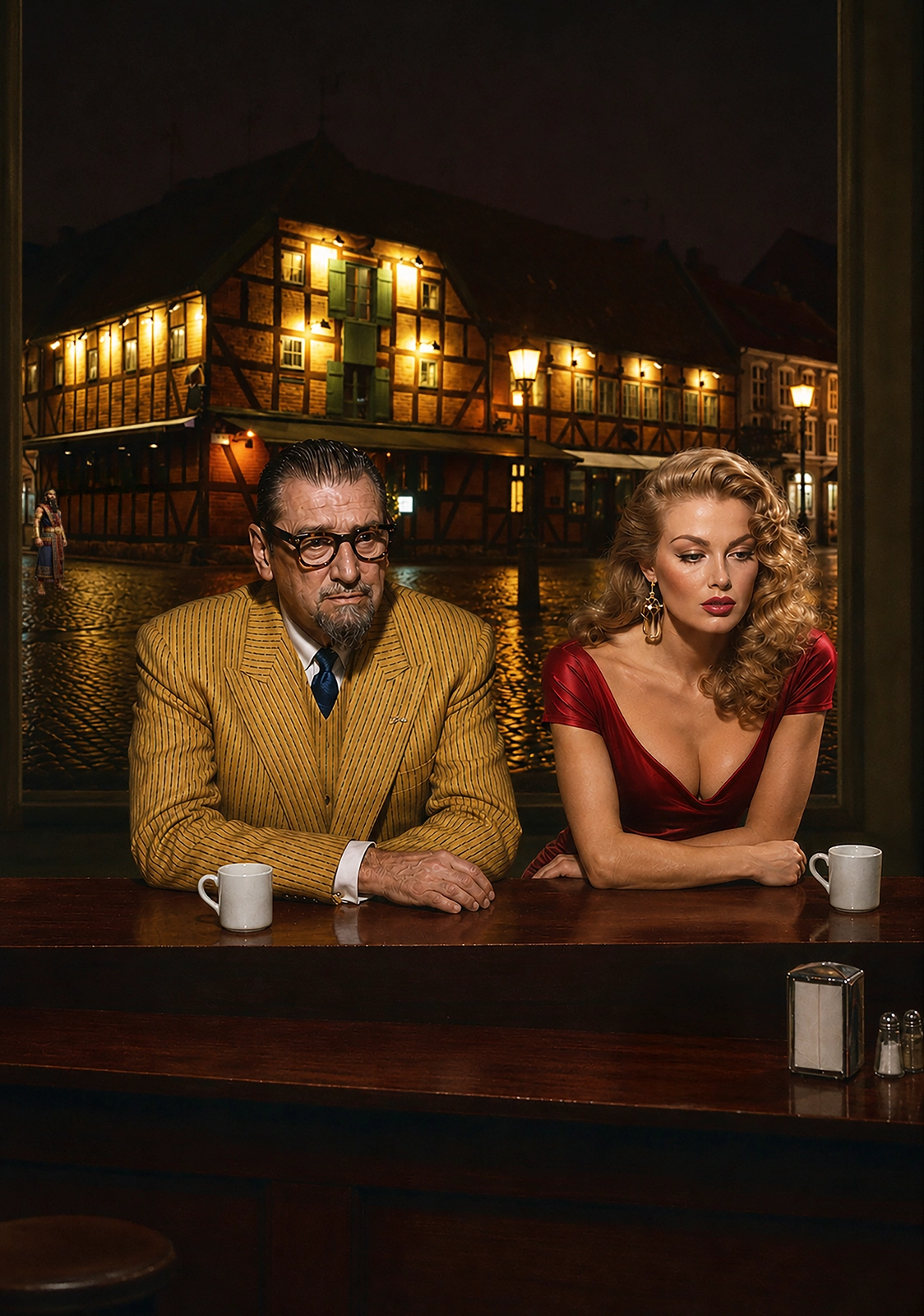
Jörgen Thornberg
Alone Together - Ensam Tillsammans, 2026
Digital
50 x 70 cm
3 200 kr
Alone Together - Ensam Tillsammans
Svensk text på slutet
Introduction
Some stories belong to a particular country. Others belong to a particular age. And some stories seem to belong to humanity itself.
More than four thousand years ago, somewhere between the rivers Tigris and Euphrates, an unknown poet began telling the story of a king who had everything a human being could desirepower, wealth, fame and gloryyet remained profoundly dissatisfied. When his closest friend died, he was forced to confront the one enemy no king, warrior, or conqueror could ever defeat: mortality itself.
At first glance, the ancient world of Gilgamesh seems far removed from a late-night café in modern Malmö. Yet the distance is not as great as it seems. During a long night at Lilla Torg, two unlikely companionsSten Broman and Anita Ekbergfind themselves reflecting on many of the same questions that once haunted the king of Uruk. Around them, the city sleeps. Beyond the windows, ordinary people come and go. Inside, memories, history, fame, friendship and loneliness quietly share the same table.
Their conversation is also haunted by another observer of the human condition: Edward Hopper. In his famous painting Nighthawks, a handful of anonymous people sit together under artificial light as darkness gathers outside. They appear alone, yet they have all chosen the same place. Hopper's nocturnal café becomes a bridge between ancient Uruk, twentieth-century Europe and the modern world.
Beneath the stories of kings, film stars, professors and artists lies the same enduring question. What does it mean to be human when time keeps moving forward? Why do friendship, love and companionship matter so much when everything else eventually passes away? And how should we live when we know that neither fame, success, power nor knowledge can stop the passage of time?
The Epic of Gilgamesh remains one of the oldest surviving literary works, yet it is also one of the most modern. Beneath its tales of gods, monsters, distant journeys and ancient cities lies a deeply human story of friendship, grief, loneliness, hope and the search for meaning in a world where nothing lasts forever.
The pages that follow offer a brief introduction to this remarkable work and to the civilisation that produced it. They also explain why a story written thousands of years before the birth of Greece, Rome and Christianity can still illuminate the lives of people sitting beneath a café lamp long after midnight.
Some books endure because they are old. The Epic of Gilgamesh endures because every generation eventually discovers that it is, in some measure, a story about themselves.
The Song of Gilgamesh
In ancient Uruk's sunlit walls of stone,
There ruled a king who thought himself alone.
With power, wealth and glory at command,
He sought to leave his mark upon the land.
Yet all his strength could never calm his mind,
For restless hearts seek more than they can find.
Then Enkidu appeared from dust and wild,
And fate transformed the tyrant to a child.
They fought as brothers, wandered far and wide,
Through cedar forests where the monsters hide.
They challenged gods, they conquered fear and fame,
And history remembered Gilgamesh's name.
But sorrow waits where every friendship grows,
And death arrives for all, as no one knows.
When Enkidu was taken by the night,
The world grew cold and lost its former light.
Then Gilgamesh set out across the earth,
To find the secret of immortal worth.
Through deserts burning underneath the sky,
He searched for ways that mortal men might fly.
He crossed dark seas, and mountains crowned with snow,
To learn the things no living man should know.
He met the flood survivor, old and wise,
Who watched the centuries with patient eyes.
But all the roads and all the oceans crossed,
Could not restore the friend that he had lost.
The gods had kept their oldest law intact:
That death remains humanity's true fact.
At last he turned once more toward home and day,
No longer seeking some impossible way.
For wisdom waited where his journey led:
Among the living, not among the dead.
And so the ancient story still remains,
Across the deserts, cities, seas and plains.
For every age discovers, in its turn,
The same deep truth for which we all still yearn:
No wall endures forever in the sun,
No race against the passing years is won.
Yet friendship, love and kindness leave their trace,
And give brief mortal lives enduring grace.
So when the stars above grow cold and dim,
The world still hears the song of Gilgamesh's hymn.
Not of a king who conquered death at last,
But one who learned to cherish life while it still passed.
Malmö, June 2026
Alone Together - Ensam Tillsammans
Prologue Alone together
The rain had stopped, but the cobblestones of Lilla Torg still glistened in the glow of street lamps and shop windows. The old half-timbered buildings stood as stage sets from another age, while the modern city slowly withdrew into the stillness of the night. A few late patrons hurried across the square from nearby restaurants. Somewhere in the distance, a glass clinked. Then only silence remained.
Behind the window of a late-night café sat two people who, in their lifetimes, had been among Swedens most recognisable faces. Anita Ekberg and Sten Broman had both lived lives larger than most. He had filled concert halls, newspaper columns, radio broadcasts and television screens with music, learning, eccentricity and flamboyant costumes. She had left her childhood home and stepped onto the silver screen, becoming one of the most celebrated film stars of the post-war era. For decades they had moved through public life as though it were their natural element.
Now they sat here, silent and reflective, two Time-travellers who, after long detours, had somehow found themselves at the same table.
The scene recalled the American artist Edward Hoppers Nighthawks. When Hopper painted it in 1942, the world was in the midst of the Second World War. Europe was burning, millions were living under occupation or fleeing for their lives, and no one knew how or when the catastrophe would end. Yet Hopper chose not to paint soldiers, tanks or battlefields. He painted a handful of people sitting awake late at night while history unfolded outside the window. Perhaps he sensed that this is how most people experience great events. Not from the centres of power, but from a kitchen table, a café or a living room, with a cup of coffee in front of them and the news somewhere in the background.
When the painting was created, Sten Broman was forty. He had already lived through the First World War as a boy, the Russian Revolution, the political turbulence of the interwar years, the Great Depression and the rise of Nazism. He had grown up in a home where his father admired Germany, while he himself rejected the ideas that had helped push Europe into the abyss. Anita Ekberg was only eleven. For her, the war was not a political event but a physical presence. Occupied Denmark lay only a few miles away across the Øresund. At night she could hear the distant rumble of bombs falling over Copenhagen. Once a month, the air-raid siren known as Hesa Fredrik wailed from the rooftops, a brutal reminder that the flames might one day spread to Malmö as well. Behind the blackout curtains in her bed, the same question gnawed at her night after night: When will they come here? When will it be our turn to burn?
Since then, the world has continued its restless journey through history. The Cold War followed the atomic bombings of Japan. The Berlin Wall rose and fell. Humanity landed on the Moon. Empires dissolved, and new superpowers emerged. Television transformed everyday life, followed by the computer and the internet. One war succeeded another. Ideologies were born, flourished and collapsed. Generation after generation grew up convinced that its own age was unique, only to discover that humanity's fears, dreams and conflicts kept returning in new disguises.
In the early decades of the twenty-first century, Sten and Anita found themselves looking out on yet another world shaped by uncertainty. War had returned to Europe and the Middle East. Great powers threatened one another. Democracies were shaken by distrust and polarisation. People had access to more information than ever before, yet seemed increasingly unable to understand one another. Despite its technological achievements, humanity had never truly left its old conflicts behind. History did not repeat itself exactly, but it continued to move in familiar circles.
Perhaps that was why, on this particular night, Stens thoughts drifted towards a story far older than Hopper, Malmö, or the modern world itself. More than four thousand years ago, another man had asked the same questions, and his thoughts had been preserved on clay tablets in cuneiform script. Gilgamesh, King of Uruk, had built walls, defeated enemies, and sought a name that would endure forever. Yet when his friend Enkidu died, he discovered that neither power, fame, nor achievement could protect him from the same fate that awaits all human beings. His long journey through darkness and wilderness ended with the insight that every generation must rediscover for itself: death cannot be defeated.
As Sten looked at his reflection in the glass, he sensed the parallel. He and Anita had also spent their lives searching for something that would outlast them. He through music, knowledge and culture. She through beauty, cinema and the modern myth the world called celebrity. They had succeeded better than most. Their names were still known long after they had left the earth. Their images and accomplishments endured. Yet, viewed from the vast perspective of time, even their achievements seemed temporary.
In the late-night café, two time-travellers sat at a table. Two people who, for most of their lives, had been surrounded by others, yet, like the figures in Hoppers painting and like Gilgamesh at the end of his journey, found themselves alone before the same mystery that has accompanied humanity since the dawn of civilisation.
Alone together.
CHAPTER 2 The Shadow of Gilgamesh
Long before the first half-timbered houses were built in Malmö, long before Rome became an empire, and long before anything called Sweden existed, a king wandered through the darkness.
His name was Gilgamesh.
He ruled over Uruk, one of the world's earliest cities. According to the story, he was stronger, richer, and more powerful than any other man. He built walls meant to defy time and performed deeds no one else dared attempt. If any human being should have been satisfied with life, it was he.
Yet it was not enough.
Behind all the power and all the success lay the same anxiety that human beings still carry within them. What happens when life comes to an end? What remains when strength fades? What do glory, wealth and fame mean if death is waiting at the end of the road?
The question became real when his friend Enkidu died.
Suddenly, Gilgamesh saw his own future. For the first time, he understood that even a king was mortal. That was when the long journey began. He left his kingdom and set out to find the secret of eternal life. He crossed mountains and deserts, wandered through darkness, and sought out the few people said to know the gods' secrets.
He found wisdom, stories and consolation.
But he never found immortality.
When his journey ended, he returned to Uruk empty-handed.
Or almost empty-handed.
What at first appeared to be a failure revealed itself to be the true heart of the story. Gilgamesh had not defeated death. Instead, he had come to understand that death had never been the enemy. It was the fear of death that had driven him across the world.
No human being can escape destiny.
But every human being can choose how to live before destiny catches up.
Perhaps that was why Sten Broman could not let go of the image of the ancient Sumerian king. The longer he stared at his reflection in the window before him, the clearer the resemblance grew.
Gilgamesh had built walls, and he himself had surrounded his life with public visibility, endless activity and celebration.
Gilgamesh had sought immortality through great deeds.
Sten had sought it through music, culture and knowledge.
For most of his life, he had filled the world around him with sound. Compositions, lectures, newspaper articles, radio broadcasts and television appearances had become his own walls against oblivion. He had turned himself into an institution, a character, a name instantly recognised.
Yet behind all this, the same human being remained, once a boy in Lund reading about the wars tearing Europe apart.
Anita had made a similar journey, though on a very different road.
Gilgamesh built walls of stone.
Sten built walls of culture.
Anita built walls of light.
She had left Malmö behind and become one of the most photographed women in the world. Her image had been projected onto cinema screens across continents. Millions of people recognised her figure at the Trevi Fountain without ever having met her.
That too was an attempt to defeat time.
Not with swords or city walls, but with images, beauty and famewith the dream of being remembered.
Now the two of them sat behind the same pane of glass on Lilla Torg. Close to one another, yet it might as well have been light-years between them, for the landscape before them was solitude.
Beyond Lilla Torg, the world continued its eternal movement. Wars began and ended. Governments rose and fell. New generations were born. History kept writing its chapters without asking anyone's permission.
Inside the warm glow of the café sat two people who, over the course of their lives, had achieved more fame than most human beings ever dream of, yet had finally arrived at the same place as Gilgamesh.
Not at the destination.
But at the realisation that humanity's greatest struggle has never been about conquering the world.
It has been about making peace with the fact that the world will endure long after we ourselves are gone.
PART 3 Sten's Journey
Sten Broman let his gaze follow the gleaming cobblestones outside. The night held a peculiar stillness that settles when most people have gone home and the city, for a brief moment, seems to belong to itself. It was then the memories came crowding in.
When Gilgamesh saw his friend Enkidu die, he suddenly realised that he too was mortal. For Sten, the realisation had come more slowly. Perhaps it had begun in childhood.
Sten was born in 1902, and when the First World War broke out he was twelve. Sweden remained outside the war, but Europe did not. The newspapers were filled with reports from the fronts. Maps were redrawn. Empires fell. Adults who had recently spoken confidently about the progress of civilisation suddenly began talking about mobilisations, blockades and collapse. He was still a boy, but old enough to understand that the world was not entirely stable.
The twenties arrived like a great laugh after a funeral. People wanted to dance, celebrate and forget. At the same time, anxiety grew beneath the surface. Revolutions shook Europe. Communism frightened some people; fascism attracted others. In Germany, bundles of banknotes became worthless paper as people queued to buy bread before prices rose again.
His father looked with admiration towards the old cultural nation of Germany.
Sten saw something else. He saw how education could be transformed into dogma and wielded as a weapon against others, how nationalism could clothe itself in the language of culture. He saw how intelligent people could convince themselves of almost anything, provided they wanted to badly enough.
As the thirties arrived, the shadows lengthened. Nazism spread. Democracies wavered. Europe once again marched towards catastrophe. Many chose to look away. Others hoped the storm would pass.
Sten did not. Instead, he committed himself to his side, not because he believed he could change the world alone, but because there are moments when silence becomes a statement in itself. His membership of the Tuesday Club was an expression of this. If democracy is threatened, someone must be prepared to defend it.
The war ended, but history continued. The Cold War followed almost immediately. Berlin was divided, and nuclear powers stared at one another across the Iron Curtain. Hungary, Suez, Cuba, Vietnam and countless other conflicts followed the Korean War. For decades, the world lived with the knowledge that everything could cease to exist in a matter of minutes.
Yet everyday life continued.
People went to work, children were born, concerts were held, and restaurants set their tables. Love stories began and ended. Life stubbornly carried on amid the uncertainty. It struck him that Hopper had understood this better than most historians. The great events take place in the history books, but life is lived at kitchen tables, in cafés and in late-night restaurants.
Sten himself chose to meet the world on his own terms. He filled it with music, laughter, colourful suits, witty remarks and culture. He became a public figure long before the concept of celebrity acquired its modern meaning. People recognised him in the street. They knew how he spoke, how he laughed and how he looked.
It was easy to believe that such a person could never be lonely.
But perhaps the opposite was the case.
The more people knew Sten Broman, the fewer truly knew the human being behind the figure. The applause ended. The dinners ended. The parties ended. Even the longest nights ended. In the end, only silence remained.
It was there that the resemblance to Gilgamesh became most evident.
The Sumerian king had built stone walls. Sten built his through culture, knowledge and public presence. For most of his life, he had believed that neither words nor memories could confer permanence.
From his position in eternity, he knew better. It was not the walls that mattered, but the people one met within them.
He let his gaze drift to Anita. They had lived different lives and travelled different paths through the same century, yet they had both arrived at the same place. Like Gilgamesh at the end of his journey, Sten was beginning to sense that the greatest wisdom did not lie in overcoming death.
It lay in understanding life while one still had it.
PART 4 Anita's Escape
Anita silently studied her reflection in the windowpane, with an almost deserted Lilla Torg outside. A few solitary figures crossed the wet cobblestones before disappearing into the night. At the same time, the old half-timbered houses stood motionless, as they had for generation after generation, while people had come and gone along the pavement beside them.
The strange thing was that she first saw her reflection as the superficial image of Anita Ekberg, the film star. For most of her life, the world had made the same mistake: people who had never even met her knew exactly what she looked like, recognised the face, the hair, the figure, and the voice, and carried vivid memories of photographs, films, and headlines. But how many of them had actually known the human being behind that powerful image? While King Gilgamesh in ancient times had built stone walls to protect his legacy, she had built hers from dazzling light.
When Anita was growing up in Malmö, she could never have imagined how far those walls of light would one day extend. Back then, in childhood, life was about entirely different, far more down-to-earth things about a large family, about sharing limited space with her many siblings, and about trying to find a place of her own, a safe place in the world. But then the war came and changed everything.
For Sten, with his historical perspective, it may have seemed just another chapter in Europe's long and violent history of conflict. Still, for Anita, it was something far more concrete and tangible. Denmark lay only a few miles away across the Øresund, and at night she could sometimes hear the distant, muffled rumble of bombs falling over occupied Copenhagen. The war therefore became not a matter of maps or generals' strategies, but a frightening sound that relentlessly cut through the darkness and settled like a heavy blanket over the entire city.
No one knew what would happen next, whether the Germans would remain where they were or whether Sweden too would be occupied. Whether she might wake one night to the sound of the city's own air-raid sirens. Anita was only a young girl, but old enough to understand that familiar security could vanish in an instant. Perhaps it was in that creeping fear that everything truly began. It was not a sudden longing for fame or a specific dream of America, but rather a deep, instinctive desire to get away away from fear, away from the limitations of Scania, and towards a larger, freer world.
When peace finally arrived, the world opened before her like a wide-open door. For most people, the post-war years meant hard work, reconstruction and a determined effort to return to normality, but for Anita, the new era represented, above all, opportunity. She soon discovered that people stopped and fell silent whenever she entered a room, and that her appearance had a rare power that opened doors that had been closed to a working-class girl from Malmö.
One step quickly led to the next in a dizzying chain of success. From the local beauty pageant Miss Malmö to Stockholm, onward to Miss World, all the way to Hollywood and finally to Rome. Yet every time she reached the goal she had been dreaming of, she found another horizon, even farther away. She continued moving forward as though the final answer were waiting for her somewhere out there in the unknown.
For a time, this restless strategy seemed to work remarkably well. The entire world learned to pronounce her name, her photographs spread across every continent, journalists filled columns with stories about her love affairs, film producers saw an inexhaustible gold mine, and cinema audiences saw an unattainable goddess.
When she stepped into the cool waters of the Trevi Fountain, she became more than a living human being; she was transformed into an eternal symbol. But symbols are strange and dangerous creatures, for the larger and more radiant they become, the less room they leave for the real person behind them. Anita became one of the most photographed women in the world, and millions recognised every feature of her face. Yet she sometimes felt that the girl from Malmö was becoming increasingly difficult to discern beneath the massive façade the outside world had so greedily created.
Perhaps that was precisely why the ancient Gilgamesh felt so strangely close here in the café. He had sought absolute immortality, while she had pursued the ever-receding horizon. Yet both had made the same mistake, believing the true answer lay farther away beyond the next long journey, beyond the next great success, or beyond the next invisible boundary. But the horizon always moved one step farther away, and time continued its relentless march.
Now she sat by a window overlooking Lilla Torg, a simple cup of coffee before her, and looked back on a life most people could only dream of. She did not regret the journey, not a single day of it, but she was finally beginning to understand that it was not the gala premieres, the photo shoots or the screaming headlines that stayed longest in her memory. What truly mattered in the end were the people, the family, the friends, the laughter and those deep conversations that continued long past midnight all those priceless moments that never appeared on film posters. She shifted her gaze to Sten's reflection beside her; they had travelled along entirely different roads through the same dramatic century, he protecting himself behind walls of culture and she behind walls of light, yet they had both arrived at the same destination. And just like Gilgamesh at the edge of the world, they were both beginning to sense that the greatest wisdom did not lie in trying to overcome death at all, but in truly understanding and living life before the final darkness fell.
PART 5 The World Beyond the Window
For a while they sat in silence as the coffee in their cups slowly cooled, and the waiter had long since stopped asking whether they wanted a refill. Outside, the old half-timbered houses stood as motionless as ever, untouched by the countless people who had passed through the centuries. Kings had been born and died, fought bloody wars, erected statues of themselves and built magnificent palaces. The houses remained, watching humanity's restless pursuit of eternity.
It was in this profound silence that Sten found himself thinking about Edward Hopper and his masterpiece. Most people who looked at Nighthawks always spoke of the palpable loneliness, but the older he grew, the less certain he became that this was truly the painting's central theme. The loneliness was there, of course, as a natural premise, with people sitting close together without ever meeting one another's eyes. Still, there was something else in that scene that touched him on an even deeper level a quiet anticipation and a creeping sense that something enormous was unfolding just beyond the narrow frame of the picture.
When Hopper painted the work, the Second World War was raging at its fiercest, and somewhere far beyond the brightly lit restaurant, tanks were crossing entire continents, cities were being reduced to ashes by bombs, and families were being torn apart forever. Millions lost their lives, yet in America, beneath the artificial light, a few anonymous people continued to live their ordinary lives; they drank their coffee, sat on their stools, and did what a human being can do when the surrounding world becomes too vast and frightening to comprehend they carried on. Sten wondered whether this had not always been the true human condition throughout history. The Sumerian king Gilgamesh had been unable to halt the relentless passage of time; Anita had failed to outrun it despite her journeys across the world's oceans; and he himself had never understood it. Yet all of them had been forced to keep moving forward, one step at a time.
Beyond the window lay a world entirely different from the one Hopper had once depicted, yet it sometimes seemed remarkably familiar. Humanity had indeed built advanced computers capable of speech, sent scientific probes to distant planets Hopper could scarcely have imagined, and created digital communication networks that connected the entire globe in an instant. Despite all these technological triumphs, the ancient existential questions of fear, longing, power, love and death refused to disappear and had, in fact, merely changed their clothes to suit a new age.
Anita followed a solitary night-wanderer with her eyes as he silently crossed the wet square and finally disappeared behind a dark street corner. For a brief moment, she realised how dizzyingly small every individual human being truly was within the vast machinery of existence. There walked yet another solitary creature, carrying his dreams, his hidden anxieties, his fading memories and his deepest secrets. In a hundred years, absolutely no one would know that he had passed this very night, just as no one today remembers the people who once walked through ancient Uruk, glittering Rome or medieval Malmö. They are all gone, leaving the earth with their loneliness.
And yet it was precisely those solitary lives that constituted the true story of humanity not the story of kings, generals or exalted film stars, but of people sitting at simple kitchen tables, in late-night cafés and behind softly lit windows in the darkness.
Perhaps that was why Hopper's paintings still felt so strikingly modern; he had not portrayed the great historical events, but ordinary people trying to live their lives while history thundered on in the background. Sten looked at his own reflection beside Anita's in the glass and saw two figures who had together experienced almost the entire dramatic twentieth century and had now also travelled well into the twenty-first.
They had seen grand ideologies born in glory only to die in the gutter; they had seen technology transform human existence faster than any previous generation could have imagined; and they had watched people celebrate the future in one moment, only to fear it with all their hearts the next. Yet beyond the cold pane of glass, the night remained night, and humanity remained humanity. Perhaps that was why the two of them had ultimately ended up here at this bar not to understand the great world finally, but at last to understand their own small place within it.
PART 6 The History That Refused to End
For a while, they stared out across the square without a word. The night had grown darker and emptier. The few people who had been moving across the square only moments earlier had vanished. What remained were the wet cobblestones, the old buildings, and their own reflections in the window.
For most of his life, Sten had believed that history moved forward. Not without setbacks. Not without catastrophes. But forward. After all, that had been the great narrative of the twentieth century: two world wars had torn Europe apart. Nazism had been defeated, colonial empires had fallen, and democracies had emerged. Science had achieved wonders that earlier generations could only have dreamed of. Humanity had left its own planet, set foot on the Moon, and begun to turn its gaze towards Mars.
Certainly, the world had been far from perfect, but had it learned anything?
Putin. Trump. Gaza. Ukraine. Iran. Sudan. The South China Sea and hundreds of other bloody conflicts. Faltering democracies and new strongmen.
The twenty-first century puzzled him. Not because wars still existed. Wars had always existed. Not because people still sought power. They had always done so as well. What truly troubled him was how frighteningly quickly the old ideas could return, dressed in new clothes.
During his youth, he had witnessed firsthand how people fell in love with strong leaders. He had seen nations begin to speak of historical injustices, of lost national greatness, and of the need to reclaim what was said to have been taken away. He had seen how propaganda could persuade ordinary people to doubt their own eyes in the face of obvious injustices. All of this he had optimistically believed belonged to a finished chapter in the history books. Now he was no longer so certain.
Anita viewed these developments from an entirely different perspective. She had spent most of her adult life crossing geographical and cultural borders, and her entire life had been built on encounters between people from different countries, languages and cultures. A working-class girl from Malmö had become a film star in both Italy and America. Her friends, lovers, colleagues and rivals had come from every corner of the world.
For Anita, the world had always been growing larger. Now many seemed determined to shrink it again.
That troubled Anita more than she cared to admit. Not because she longed for the past, but because she knew what could happen when people first began to see one another as strangers rather than fellow human beings. History had taught her that lesson. And suddenly history seemed eager to teach a new generation all over again.
Sten turned his thoughts back to Gilgamesh. During his long journey, the ancient king had believed his quest was for immortality. Only at the end of the road did he realise it had really been about knowledge. Not knowledge of the world, but knowledge of humanity.
Perhaps that was why the story had endured for more than four thousand years.
Human beings changed their tools and clothing, their cities and machines, but rarely their dreams and fears. They retained, almost cherished, their weaknesses.
Outside, there lay a Malmö that would have been impossible to imagine when Hopper painted his masterpiece in 1942. The cold glow of mobile phones shimmered in people's hands. Satellites orbited invisibly high above their heads. Information travelled across the earth faster than the light from the square's old neon signs.
Yet people still lie awake at night, worrying.
About war.
About the future.
About their children.
About tomorrow.
In that respect, they were not so different from the people of Uruk, or from those in Hopper's all-night diner, or from the two time travellers drinking a late cup of coffee at Lilla Torg.
History had changed almost everything in humanity's outer world, but almost nothing in its inner world. That was perhaps the most troubling realisation of all.
But also the most comforting.
If human beings still carried the same fears as their ancient ancestors, they also still carried the same capacity to hope, to love and to begin again. Perhaps that was why the world continued turning day after day despite everything. Not because of kings. Not because of generals. Not because of ideologies.
But because of all the ordinary people who rose every morning, drank their coffee, and kept moving forward, even though the future always remained uncertain.
Just as they always had.
And just as they always would.
PART 7 Siduri's Advice
The night outside had reached that strange, fleeting hour when the world seemed to hold its breath. Not the slightest breeze stirred between the half-timbered houses, and all that remained in the emptiness was the warm light from the café, a few street lamps, the deserted cobblestones, and their own pale reflections in the cold windowpane. Near the kitchen entrance, the café owner moved like a timeless ghost.
It was in this absolute stillness that Sten once again found himself thinking about Siduri, the Sumerian tavern-keeper at the edge of the world. Most people remembered Gilgamesh for his heroic struggle against mortality, the terrifying monsters he defeated, and the mighty walls he built around his city of Uruk. Yet as Sten grew older, he had begun to suspect that the most important person in the entire story might not have been the great hero himself at all, but rather the unassuming woman who kept the tavern by the sea.
After wandering through burning deserts, crossing unexplored mountain ranges, and losing almost everything he had ever loved on earth, Gilgamesh finally reached her door. Exhausted, deeply grief-stricken, and consumed by his feverish desire to conquer death, he wanted to move on at once, continue his search, and discover the cosmic secret the gods so jealously concealed from humanity. But Siduri offered him neither a magical elixir nor grand mystical answers; instead, she offered him something far simpler, yet in practice infinitely more difficult for a king to accept. She tried to make him understand that he was searching for meaning in the wrong place and that life's true value did not lie in an unattainable eternal existence on earth.
For most of his earthly life, Sten had been forced to realise that he had made the same mistake. He had searched for permanence in music, in culture, in intellectual knowledge, and in the spotlight of public life not because he naively believed himself to be physically immortal, but because every creative person carries, somewhere deep within, a quiet desire to leave an indelible mark, so that they will not vanish entirely into oblivion when the final curtain finally falls.
Anita had made precisely the same existential journey in her own glamorous way; she had constantly searched farther away, higher up and farther ahead in life, from her childhood in Malmö to post-war Rome, and onward from Rome to Hollywood's dream factory, where she had moved from one shimmering horizon to the next, persistently feeling that the true answer might be waiting just beyond the next bend in the glittering road.
And yet here they sat now at a bar on Lilla Torg, stripped of their former roles. Gilgamesh had desperately sought immortality, Sten had sought cultural permanence, and Anita had pursued the ever-receding horizon, while the world beyond kept spinning onward without ever once asking any of them for permission. Perhaps this was the simple truth Siduri had understood: that history would never be fully completed and that destructive wars would never entirely cease. Human beings would stubbornly continue to love, hate, hope, build, destroy and begin again. Each new generation, in its pride, would believe its own problems and fears were unique, only to discover in the end that the same questions had already been asked and answered by people who had lived thousands of years before them.
Yet there was something strangely comforting in this seemingly bleak thought, for if the world would never become finished or perfect, neither did the individual human being need to force themselves to do so. Anita let her gaze drift across the empty square, where night would eventually give way to morning; nearby, a baker was already preparing the first loaves of the new day, a weary taxi driver was struggling against sleep behind the wheel, and a nurse was finishing a long and demanding night shift.
Real life, therefore, continued quietly while Anita and Sten reflected on the great currents of history. Suddenly, the monumental existential questions seemed far less important not unimportant, but somehow less dominant. After all, it was not kings who kept the world alive, nor generals, nor billionaires, nor even celebrated film stars or colourful professors. Instead, the world was carried each day on the broad shoulders of ordinary people who dutifully rose from their beds, went to their invisible jobs, cared for their children, helped their fellow human beings, and kept moving forward even though the future always remained profoundly uncertain.
Perhaps this was exactly what Siduri had so desperately tried to tell Gilgamesh at the edge of the world, and perhaps it was the same thing Edward Hopper tried to show in his nocturnal paintings. Most people will never become physically immortal; most will never taste world fame; and their anonymous names will never be carved into the history books. Yet it is their everyday lives that truly constitute history.
Sten once again studied his own reflection beside Anita's in the dark windowpane, and for the very first time that evening he felt no sorrow or bitterness at all about the great world continuing to exist without him. On the contrary, there was something almost indescribably beautiful in the thought that people a hundred, a thousand, or even four thousand years from now would still sit awake behind similar illuminated windows in the night, drinking their coffee and finding comfort in pondering the same questions he had just been contemplating. King Gilgamesh had finally abandoned his search and returned home to Uruk, and perhaps it was not because his cosmic journey had failed, but because at the end of the road he had finally understood where on earth he truly belonged.
PART 8 Alone Together
Anita let her gaze rest on the empty chair a few yards away. It stood on its pedestal, bolted to the floor, waiting for its next guest, as anonymous as thousands of other chairs in cafés, restaurants and taverns around the world. Yet she found that such chairs told us more about humanity than many history books. Human beings do not build houses merely to protect themselves from rain and cold. They build meeting places. They build rooms where they can sit close to other people, even when they have very little to sayplaces where they can be alone together.
Perhaps this was exactly what Hopper had painted.
Most people who looked at Nighthawks immediately saw loneliness, just as Anita herself had. But as the evening drifted into night, she began to suspect the painting was really about something else. The four people in Hopper's diner certainly appear lonely; they scarcely meet one another's eyes and seem to share no great confidences. Yet they have all chosen the same place. They could have stayed at home behind their own doors, but something had drawn them out into the night and into the illuminated room.
Sten thought that perhaps the same applied to almost everything human beings created together. Music was naturally about notes and harmonies, but also about people gathering to listen. Theatre was about stories, but also about strangers sharing the same dream for a few hours. Even books worked in this way. A person could sit alone in an armchair with a book in hand and still have a silent conversation with someone who had lived hundreds, or even thousands, of years earlier.
No human being truly wants to be alone. They do not want to be alone with their loneliness.
Anita smiled faintly at the thought. For most of her life, she had been surrounded by people. Cameras had followed her, journalists had asked questions, and admirers had called out her name. Yet some of her loneliest moments had occurred in the middle of the largest crowds. It had taken her many years to understand why. People saw Anita Ekberg, but they rarely saw Anita. They saw their own dreams, fantasies and expectations. The image sometimes became so powerful that it almost concealed the person behind it.
Sten recognised the mechanism. He, too, had spent decades playing the role of Sten Broman, the colourful scholar, musician, provocateur and entertainer. The role was not false; it simply was not the whole truth. Behind the public figure was the same human being who had once been a boy in Lund, trying to understand a world that always seemed to be changing.
Perhaps that was why genuine friendship was so rare and precious, as if one were identical twins.
Gilgamesh had been a king long before he met Enkidu. He possessed power, wealth and fame. Yet only through friendship did he become whole. When Enkidu died, Gilgamesh lost more than a companion; he lost the person who had seen him as he truly was.
Once again, Sten saw his reflection beside Anita's in the windowpane.
They had lived different lives. They had travelled along different roads through the same century. Neither could fully understand the other's experiences. Anita had never been Sten. Sten had never been Anita, just as no human being can ever fully step into another person's consciousness.
Yet they were sitting here.
Perhaps that was enough.
Maybe it was even the closest humanity would ever come to an answer to loneliness. Not to be fully understood, not to achieve perfect communion, but to have someone else choose to sit at the same table and stay for a while.
Beyond the glass, night still lay over Lilla Torg. But beyond the rooftops to the east, the darkness was slowly beginning to yield. It was not yet morning. Only the promise of morning.
And perhaps the thought of the light to come is enough to ease loneliness.
After many solitary hours, the night was almost over, and dawn was taking its place. They remained at the same table beneath the artificial light, but something in the rooms atmosphere had changed irrevocably. Perhaps it was the light from outside slowly filtering in, or the late hours that had ticked away like an old wall clock. Perhaps it was merely that strange, almost sacred feeling that arrives just before dawn that fleeting moment when the whole world seems to rest between two breaths.
Outside, the darkness had finally begun to give way to morning, and their reflections in the glass were fading. At first, the change was almost imperceptible, as though the rising sun were gently erasing the shadows, but it became more noticeable with every passing minute. The old, beautiful half-timbered houses of Lilla Torg slowly emerged from the night's darkness, and the wet cobblestones dried beneath the awakening morning light.
In the distance came the muted sound of a truck engine starting. Somewhere, a door opened with a faint creak as someone began a new working day. The great world continued onward, just as it always had. Meridian by meridian, it would awaken all the lonely people.
King Gilgamesh had believed that his cosmic journey was solely about finding a way to conquer death. Only at the end of his long wanderings did he understand the deeper truth; life had never been about triumphing over time, but about daring to live fully while time remained.
Perhaps Sten and Anita had reached the same realisation here at the bar. During their earthly lives, they had sought very different things: Sten had sought existential meaning through academic knowledge, culture, and musical scores, while Anita had sought the same meaning in the spotlight, in physical beauty, and in the pulsating world beyond Scania's borders. Neither of them had found a final or universal answer to life's riddle, but perhaps they had found something far better instead a deep and quiet reconciliation with their own destinies.
History would continue to roll relentlessly onward. New generations would be born into the world, destructive wars would flare up, and solemn statesmen would sign new peace treaties. New Hitlers, Stalins, Putins and Trumps would come to power, and new people would fall hopelessly in love, have their hearts brutally broken, build magnificent dreams and bury their dead in sorrow.
Human beings would continue to ask the same existential questions they had always asked. Why am I here, and can I stop time and remain? Perhaps that was why the story of Gilgamesh still survived and remained so moving after more than four thousand years. It was not because the king miraculously found the immortality he sought, but because he ultimately failed in his quest. His cosmic defeat proved to be humanity's most universal shared experience. No one ever reaches the actual end of the world, no one finds the one final answer, and no one succeeds in defeating the passage of time and yet we all continue our solitary journey.
Sten turned his gaze towards the dawn outside the window, and Anita silently followed it. Beyond the glass, Malmö was slowly waking; ordinary people who had probably never even heard of the Epic of Gilgamesh hurried towards their jobs. Someone unlocked the door to a small shop, others switched on the morning coffee in their kitchens, and somewhere else a person sat alone at a table, reflecting on the fate of their life, while two friends in another corner were already laughing loudly together in their solitude.
Real life was unfolding all around them, just as it always had and would continue to do. Anita smiled a faint, reconciled smile, and Sten smiled warmly in return.
They rose from the bar, left the empty coffee cups behind, and stepped out into the clear, fresh morning light to remain alone together.
P.S.
The Epic of Gilgamesh
The Epic of Gilgamesh is one of the oldest surviving works of literature, preserved in cuneiform on twelve clay tablets from ancient Sumer (present-day southern Iraq), dating from approximately 21001200 BC. The work recounts the story of King Gilgamesh of Uruk, his friendship with the wild man Enkidu, and their quest for immortality. The epic is a cornerstone of world literature and offers unique insights into the Mesopotamian worldview.
The epic developed from earlier Sumerian stories about Gilgamesh, a historical ruler of Uruk around 2700 BC. The most famous version, the so-called Standard Babylonian text, was compiled by the scribe Sin-leqi-unninni around 1200 BC. Fragments of the text were recovered, among other places, from Ashurbanipals library in Nineveh.
Plot and Themes
The story follows Gilgamesh and Enkidu as they face monsters and gods, explore their friendship, and depict Enkidu's death, which drives Gilgamesh to seek the secret of life. During his journey, he meets Utnapishtim, the survivor of a great flood, revealing parallels with later biblical traditions. Through the realisation that immortality is reserved for the gods, Gilgamesh finds meaning in human legacy and the enduring nature of the city.
Cultural and Historical Significance
The epic illuminates early civilisation and ancient views of the gods, power and mortality. It influenced later works across the Middle East and in Western literature, including the biblical flood narrative. Modern translations have made the text accessible to contemporary readers, and it continues to inspire humanistic and literary scholarship. It is available to read online.
xxx
Introduktion
Vissa berättelser tillhör ett särskilt land. Andra tillhör en särskild tidsålder. Och vissa berättelser tycks tillhöra mänskligheten själv.
För mer än fyra tusen år sedan, någonstans mellan floderna Eufrat och Tigris, började en okänd poet berätta historien om en kung som hade allt en människa kunde önska sig makt, rikedom, berömmelse och ära men som ändå förblev djupt otillfredsställd. När hans närmaste vän dog tvingades han konfrontera den enda fienden som ingen kung, krigare eller erövrare någonsin kan besegra: dödligheten själv.
Vid första anblicken kan Gilgameshs forntida värld verka mycket avlägsen från ett nattöppet café i dagens Malmö. Ändå är avståndet inte så stort som det först verkar. Under en lång natt på Lilla Torg finner sig två osannolika följeslagare Sten Broman och Anita Ekberg att fundera över många av samma frågor som en gång plågade kungen av Uruk. Runt omkring dem sover staden. Utanför fönstren kommer och går vanliga människor. Därinne delar minnen, historia, berömmelse, vänskap och ensamhet stilla samma bord.
Deras samtal hemsöks också av en annan skildrare av människans villkor: Edward Hopper. I hans berömda målning Nighthawks sitter en handfull anonyma människor tillsammans under artificiellt ljus medan mörkret samlas utanför. De ser ensamma ut, men de har alla valt samma plats. Hoppers nattliga café blir en bro mellan det forntida Uruk, nittonhundratalets Europa och den moderna världen.
Under berättelserna om kungar, filmstjärnor, professorer och konstnärer döljer sig samma tidlösa fråga. Vad innebär det att vara människa när tiden ständigt rör sig framåt? Varför betyder vänskap, kärlek och gemenskap så mycket när allt annat förr eller senare försvinner? Och hur bör vi leva när vi vet att varken berömmelse, framgång, makt eller kunskap kan stoppa tidens gång?
Gilgamesheposet är fortfarande ett av världens äldsta bevarade litterära verk, men samtidigt också ett av de mest moderna. Under dess berättelser om gudar, monster, avlägsna resor och uråldriga städer finns en djupt mänsklig skildring av vänskap, sorg, ensamhet, hopp och sökandet efter mening i en värld där ingenting varar för evigt.
Min text ger en kort introduktion till detta märkliga verk och till den civilisation som skapade det. De förklarar också varför en berättelse som skrevs tusentals år före Greklands, Roms och kristendomens framväxt fortfarande kan kasta ljus över människor som sitter under en cafélampa långt efter midnatt.
Vissa böcker överlever därför att de är gamla. Gilgamesheposet överlever därför att varje generation förr eller senare upptäcker att det, åtminstone till en del, är en berättelse om dem själva.
Prolog Ensam tillsammans
Regnet hade upphört, men kullerstenarna på Lilla Torg glänste fortfarande i skenet från gatlyktor och skyltfönster. De gamla korsvirkeshusen stod som kulisser från en annan tid, medan den moderna staden långsamt drog sig tillbaka i nattens stillhet. Några sena gäster skyndade över torget från krogarna intill. Ett glas klirrade i fjärran. Sedan återstod bara tystnaden.
Bakom glasrutan i ett nattöppet café satt två människor som under sina liv varit bland Sveriges mest igenkända ansikten. Sten Broman och Anita Ekberg hade båda levt större liv än de flesta. Han hade fyllt konsertsalar, tidningsspalter och tv-rutor med musik, lärdom, excentricitet och färgstarka kostymer. Hon hade flyttat från sitt barndomshem till världens biodukar och blivit en av efterkrigstidens mest berömda filmstjärnor. Under årtionden hade de rört sig genom offentligheten som om den vore deras naturliga element.
Nu satt de här, tysta och eftertänksamma, två tidsresenärer som efter långa omvägar hade hamnat vid samma bord.
Scenen påminde om Edward Hoppers målning Nighthawks. När Hopper målade tavlan 1942 befann sig världen mitt i verkligheten av andra världskriget. Europa stod i brand, miljoner människor levde under ockupation eller på flykt, och ingen visste hur eller när katastrofen skulle ta slut. Ändå valde Hopper att inte måla soldater, stridsvagnar eller slagfält. Han målade några människor som satt vakna sent på natten medan historien fortsatte utanför fönstret. Kanske anade han att de flesta människor upplever de stora händelserna just så. Inte från maktens centrum utan från ett köksbord, ett kafé eller ett vardagsrum. Med en kopp kaffe framför sig och nyheterna någonstans i bakgrunden.
När tavlan målades var Sten Broman 40 år gammal. Han hade redan upplevt första världskriget som pojke, den ryska revolutionen, mellankrigstidens politiska dramatik, den stora depressionen och nazismens framväxt. Han hade vuxit upp i ett hem där fadern såg på Tyskland med beundran, samtidigt som han själv tog avstånd från de idéer som hade kastat Europa i avgrunden. Anita Ekberg var då bara elva år. För henne var kriget inget politiskt skeende utan en fysisk närvaro. Det ockuperade Danmark låg bara några mil bort på andra sidan Öresund. Om nätterna kunde hon höra det avlägsna mullret från bomber över Köpenhamn. En gång i månaden väste flyglarmet Hesa Fredrik från hustaken och påminde brutalt om att elden en dag också kunde sprida sig till Malmö. Bakom mörkläggningsgardinen i sin säng gnagde varje natt samma fråga: När kommer de hit? När är det vår tur att brinna?
Sedan dess har världen fortsatt sin rastlösa färd genom historien. Atombomberna över Japan följdes av det kalla kriget. Berlinmuren restes och föll. Människan landade på månen. Imperier upplöstes och nya stormakter växte fram. Televisionen förändrade vardagen, därefter datorn och internet. Krig avlöste krig. Ideologier föddes, blomstrade och kollapsade. Generation efter generation växte upp i tron att just deras tid var unik, bara för att upptäcka att rädslorna, drömmarna och konflikterna ofta återkom i nya skepnader.
I den här stunden satt Sten och Anita i början av det tjugoförsta århundradet och såg ännu en värld präglad av osäkerhet. Krig rasade åter i Europa och Mellanöstern. Stormakter hotade varandra. Demokratier skakades av misstro och polarisering. Människor hade större tillgång till information än någonsin, samtidigt som det blev svårare att förstå varandra. Trots alla tekniska framsteg hade mänskligheten inte lyckats lämna sina gamla konflikter bakom sig. Historien upprepade sig inte exakt, men den fortsatte att röra sig i välbekanta cirklar.
Det var kanske därför Stens tankar denna natt drogs till en berättelse som var långt äldre än både Hopper, Malmö och den moderna världen. För mer än fyra tusen år sedan hade en annan människa ställt samma frågor och fått dem nedtecknade på lertavlor med kilskrift. Gilgamesh, kungen av Uruk, hade byggt murar, besegrat fiender och sökt ett namn som skulle leva för evigt. Men när hans vän Enkidu dog, upptäckte han att ingen makt, ingen berömmelse och ingen prestation kunde skydda honom från samma öde som väntade alla människor. Hans långa vandring genom mörker och ödemarker slutade med en insikt som varje generation tvingas återupptäcka: döden kan inte besegras.
När Sten såg sin egen spegelbild i glasrutan anade han parallellen. Han och Anita hade också tillbringat sina liv med att söka något som skulle överleva dem själva. Han genom musiken, kunskapen och kulturen. Hon genom skönheten, filmen och den moderna myten som världen kallade kändisskap. De hade lyckats bättre än de flesta. Deras namn var fortfarande känt långt efter att de lämnat jorden. Deras bilder och verk levde kvar. Men i ett långt tidsperspektiv framstod även deras framgångar som tillfälliga.
På det nattöppna fiket satt två tidresenärer vid ett bord. Två människor som under större delen av sina liv varit omgivna av andra människor var ändå, likt figurerna i Hoppers tavla och på samma sätt som Gilgamesh vid slutet av sin resa, ensamma inför samma gåta som följt mänskligheten sedan civilisationens gryning.
Att vara ensamma tillsammans.
DEL 2 Gilgameshs skugga
Långt innan de första korsvirkeshusen restes i Malmö, långt innan Rom blev ett imperium och långt innan det fanns något som kallades Sverige, vandrade en kung genom mörkret.
Hans namn var Gilgamesh.
Han härskade över Uruk, en av världens första stora städer. Enligt berättelsen var han starkare än alla andra män, rikare än alla andra män och mäktigare än alla andra män. Han byggde murar som skulle trotsa tiden och utförde stordåd som ingen annan vågade sig på. Om någon människa borde ha varit nöjd med sitt liv var det han.
Ändå var det inte nog.
Bakom all makt och all framgång dolde sig samma oro som människor fortfarande bär på. Vad händer när livet tar slut? Vad återstår när styrkan försvinner? Vad betyder ära, rikedom och berömmelse om döden ändå väntar vid vägens slut?
Frågan blev verklig när hans vän Enkidu dog.
Plötsligt såg Gilgamesh sin egen framtid. För första gången förstod han att även en kung är dödlig. Det var då den långa resan började. Han lämnade sitt rike och gav sig ut för att finna hemligheten bakom ett evigt liv. Han korsade berg och öknar, vandrade genom mörker och sökte upp de få människor som sades känna till gudarnas hemligheter.
Han fann visdom, berättelser och tröst. Men han fann aldrig odödlighet.
När hans resa var över återvände han tomhänt till Uruk. Eller nästan tomhänt. Det som först såg ut som ett misslyckande visade sig vara berättelsens verkliga kärna. Gilgamesh hade inte besegrat döden. Han hade i stället förstått att döden aldrig hade varit fienden. Det var rädslan för döden som hade drivit honom genom världen.
Ingen människa kan undkomma sitt öde. Men varje människa kan välja hur hon lever innan ödet hinner ikapp henne.
Kanske var det därför Sten Broman inte kunde släppa tanken på den gamle sumeriske kungen. Ju längre han betraktade sin spegelbild i den glasruta framför sig, desto tydligare blev likheten.
Sten hade byggt osynliga murar mot livets gåta med ett livligt festande och ett omfattande offentligt liv. Gilgamesh hade sökt odödlighet genom sina stordåd. Sten hade sökt den genom musik, kultur och kunskap.
Under större delen av sitt liv hade Sten fyllt världen omkring sig med ljud. Kompositioner, föreläsningar, tidningsartiklar, radioinslag och tv-program hade blivit hans egna murar mot glömskan. Han hade gjort sig till en institution, en karaktär, ett namn som människor omedelbart kände igen.
Men bakom allt detta fanns samma människa som en gång, på åskådarplats, upplevt två krig som slet sönder Europa.
Anita hade gjort en liknande resa men längs en helt annan väg.
Gilgamesh byggde murar av sten. Sten byggde murar av kultur. Anita byggde murar av ljus.
Hon hade lämnat Malmö bakom sig och blivit en av världens mest fotograferade kvinnor. Hennes ansikte hade projicerats på biodukar över hela världen. Miljontals människor kände igen hennes gestalt i Trevifontänen utan att någonsin ha träffat henne.
Även det var ett försök att besegra tiden. Inte med svärd eller stadsmurar, utan med bilder, skönhet och berömmelse, med drömmen om att bli ihågkommen.
Nu satt de båda bakom samma glasruta på Lilla Torg. Nära varandra, men det kunde lika gärna ha varit flera ljusårs avstånd, för deras utsikt var ensamheten.
Bortom Lilla Torg fortsatte världen sin eviga rörelse. Krig började och slutade. Regeringar föll. Nya generationer föddes. Historien fortsatte att skriva sina kapitel utan att fråga någon om lov.
Inne i caféets varma ljus satt två människor som under sina liv hade uppnått mer berömmelse än de flesta någonsin drömmer om, ändå hade de till slut hamnat på samma plats som Gilgamesh.
Inte vid målet. Utan vid insikten att människans största kamp aldrig har handlat om att besegra världen. Den har handlat om att försonas med att världen kommer att fortsätta även när vi själva är borta.
DEL 3 Stens vandring
Sten Broman lät blicken följa de blanka kullerstenarna utanför. Natten hade den där märkliga stillheten som infinner sig när de flesta människor har gått hem och staden för ett ögonblick verkar tillhöra sig själv. Det var då minnena trängde sig på.
När Gilgamesh såg sin vän Enkidu dö förstod han plötsligt att även han själv var dödlig. För Sten hade insikten kommit långsammare. Kanske började den redan i barndomen.
Sten föddes 1902 och när första världskriget bröt ut var han 12 år gammal. Sverige stod utanför kriget, men Europa gjorde det inte. Tidningarna var fulla av rapporter från fronterna. Kartor ritades om. Imperier föll. Vuxna människor som nyligen hade talat självsäkert om civilisationens framsteg började plötsligt tala om mobiliseringar, blockader och sammanbrott. Han var fortfarande en pojke, men tillräckligt gammal för att förstå att världen inte var helt stabil.
Tjugotalet kom som ett stort skratt efter en begravning. Människor ville dansa, festa och glömma. Samtidigt växte oron under ytan. Revolutioner skakade Europa. Kommunismen skrämde vissa människor; fascismen lockade andra. I Tyskland förvandlades sedelbuntar till värdelöst papper medan människor stod i kö för att köpa bröd innan priserna steg igen.
Hans far såg mot det gamla kulturlandet Tyskland med beundran.
Sten såg någonting annat. Han såg hur bildning kunde förvandlas till dogm och bli ett vapen riktat mot andra. Hur nationalism kunde klä sig i kulturens språk. Hur intelligenta människor kunde övertyga sig själva om nästan vad som helst, om de bara ville tillräckligt mycket.
När trettiotalet kom blev skuggorna längre. Nazismen växte. Demokratier vacklade. Europa började åter marschera mot katastrofen. Många valde att titta bort. Andra hoppades att stormen skulle blåsa över.
Sten gjorde det inte, utan engagerade sig på sin sida. Inte därför att han trodde sig kunna förändra världen ensam, utan därför att det finns ögonblick då tystnad blir ett ställningstagande i sig. Medlemskapet i Tisdagsklubben var ett uttryck för detta. Om demokratin hotas måste någon vara beredd att försvara den.
Kriget tog slut, men historien fortsatte. Det kalla kriget följde nästan omedelbart. Berlin delades. Kärnvapenmakter stirrade på varandra över järnridån. Koreakriget avlöstes av Ungern, Suez, Kuba, Vietnam och otaliga andra konflikter. Under decennier levde världen med tanken att allt skulle kunna upphöra på bara några minuter.
Och ändå fortsatte vardagen.
Människor gick till arbetet, barn föddes, konserter spelades och restauranger dukade sina bord. Kärlekshistorier började och slutade. Livet fortsatte envist mitt i all osäkerhet. Det slog honom att Hopper hade förstått detta bättre än de flesta historiker. De stora händelserna äger rum i böckerna, men livet levs vid köksbordet, på caféer och i nattöppna restauranger.
Själv valde Sten att möta världen på sitt eget sätt. Han fyllde den med musik, skratt, färgstarka kostymer, kvickheter och kultur. Han blev en offentlig person långt innan begreppet kändis fick sin moderna betydelse. Människor kände igen honom på gatan. De visste hur han talade, hur han skrattade och hur han såg ut.
Det var lätt att tro att en sådan människa aldrig kunde vara ensam.
Men kanske var det tvärtom.
Ju fler människor som kände till Sten Broman, desto färre kände egentligen människan bakom figuren. Applåderna tog slut. Middagarna tog slut. Festerna tog slut. Till och med de längsta nätterna tog slut. Kvar fanns till sist bara tystnaden.
Det var där likheten med Gilgamesh blev som tydligast.
Den sumeriske kungen hade byggt murar av sten. Sten byggde sina med hjälp av kultur, kunskap och offentlig närvaro. Under större delen av sitt liv hade han trott att varken orden eller minnena kunde skapa någon form av beständighet.
Från sin position i evigheten visste han bättre. Det var inte murarna som var viktiga, utan människorna man mötte innanför dem.
Han lät blicken glida över till Anita. De hade levt olika liv och färdats längs olika vägar genom samma årh
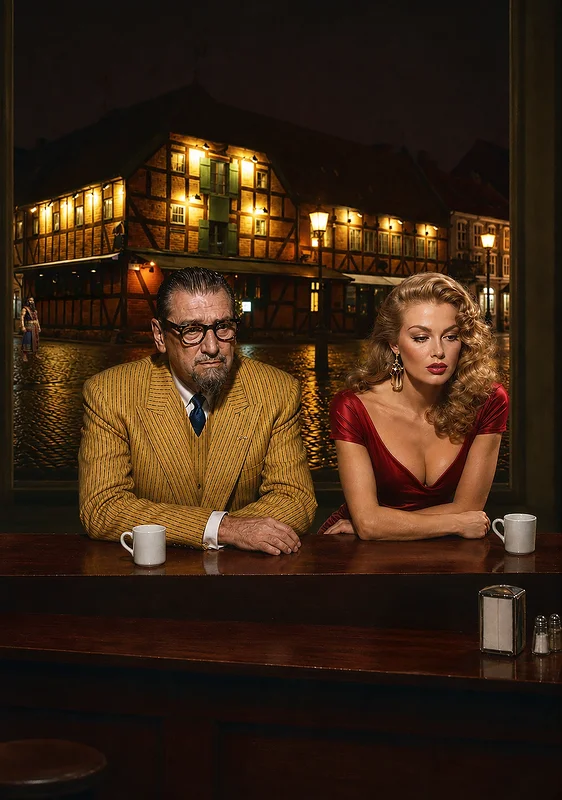
Jörgen Thornberg
Alone Together - Ensam Tillsammans, 2026
Digital
50 x 70 cm
3 200 kr
Alone Together - Ensam Tillsammans
Svensk text på slutet
Introduction
Some stories belong to a particular country. Others belong to a particular age. And some stories seem to belong to humanity itself.
More than four thousand years ago, somewhere between the rivers Tigris and Euphrates, an unknown poet began telling the story of a king who had everything a human being could desirepower, wealth, fame and gloryyet remained profoundly dissatisfied. When his closest friend died, he was forced to confront the one enemy no king, warrior, or conqueror could ever defeat: mortality itself.
At first glance, the ancient world of Gilgamesh seems far removed from a late-night café in modern Malmö. Yet the distance is not as great as it seems. During a long night at Lilla Torg, two unlikely companionsSten Broman and Anita Ekbergfind themselves reflecting on many of the same questions that once haunted the king of Uruk. Around them, the city sleeps. Beyond the windows, ordinary people come and go. Inside, memories, history, fame, friendship and loneliness quietly share the same table.
Their conversation is also haunted by another observer of the human condition: Edward Hopper. In his famous painting Nighthawks, a handful of anonymous people sit together under artificial light as darkness gathers outside. They appear alone, yet they have all chosen the same place. Hopper's nocturnal café becomes a bridge between ancient Uruk, twentieth-century Europe and the modern world.
Beneath the stories of kings, film stars, professors and artists lies the same enduring question. What does it mean to be human when time keeps moving forward? Why do friendship, love and companionship matter so much when everything else eventually passes away? And how should we live when we know that neither fame, success, power nor knowledge can stop the passage of time?
The Epic of Gilgamesh remains one of the oldest surviving literary works, yet it is also one of the most modern. Beneath its tales of gods, monsters, distant journeys and ancient cities lies a deeply human story of friendship, grief, loneliness, hope and the search for meaning in a world where nothing lasts forever.
The pages that follow offer a brief introduction to this remarkable work and to the civilisation that produced it. They also explain why a story written thousands of years before the birth of Greece, Rome and Christianity can still illuminate the lives of people sitting beneath a café lamp long after midnight.
Some books endure because they are old. The Epic of Gilgamesh endures because every generation eventually discovers that it is, in some measure, a story about themselves.
The Song of Gilgamesh
In ancient Uruk's sunlit walls of stone,
There ruled a king who thought himself alone.
With power, wealth and glory at command,
He sought to leave his mark upon the land.
Yet all his strength could never calm his mind,
For restless hearts seek more than they can find.
Then Enkidu appeared from dust and wild,
And fate transformed the tyrant to a child.
They fought as brothers, wandered far and wide,
Through cedar forests where the monsters hide.
They challenged gods, they conquered fear and fame,
And history remembered Gilgamesh's name.
But sorrow waits where every friendship grows,
And death arrives for all, as no one knows.
When Enkidu was taken by the night,
The world grew cold and lost its former light.
Then Gilgamesh set out across the earth,
To find the secret of immortal worth.
Through deserts burning underneath the sky,
He searched for ways that mortal men might fly.
He crossed dark seas, and mountains crowned with snow,
To learn the things no living man should know.
He met the flood survivor, old and wise,
Who watched the centuries with patient eyes.
But all the roads and all the oceans crossed,
Could not restore the friend that he had lost.
The gods had kept their oldest law intact:
That death remains humanity's true fact.
At last he turned once more toward home and day,
No longer seeking some impossible way.
For wisdom waited where his journey led:
Among the living, not among the dead.
And so the ancient story still remains,
Across the deserts, cities, seas and plains.
For every age discovers, in its turn,
The same deep truth for which we all still yearn:
No wall endures forever in the sun,
No race against the passing years is won.
Yet friendship, love and kindness leave their trace,
And give brief mortal lives enduring grace.
So when the stars above grow cold and dim,
The world still hears the song of Gilgamesh's hymn.
Not of a king who conquered death at last,
But one who learned to cherish life while it still passed.
Malmö, June 2026
Alone Together - Ensam Tillsammans
Prologue Alone together
The rain had stopped, but the cobblestones of Lilla Torg still glistened in the glow of street lamps and shop windows. The old half-timbered buildings stood as stage sets from another age, while the modern city slowly withdrew into the stillness of the night. A few late patrons hurried across the square from nearby restaurants. Somewhere in the distance, a glass clinked. Then only silence remained.
Behind the window of a late-night café sat two people who, in their lifetimes, had been among Swedens most recognisable faces. Anita Ekberg and Sten Broman had both lived lives larger than most. He had filled concert halls, newspaper columns, radio broadcasts and television screens with music, learning, eccentricity and flamboyant costumes. She had left her childhood home and stepped onto the silver screen, becoming one of the most celebrated film stars of the post-war era. For decades they had moved through public life as though it were their natural element.
Now they sat here, silent and reflective, two Time-travellers who, after long detours, had somehow found themselves at the same table.
The scene recalled the American artist Edward Hoppers Nighthawks. When Hopper painted it in 1942, the world was in the midst of the Second World War. Europe was burning, millions were living under occupation or fleeing for their lives, and no one knew how or when the catastrophe would end. Yet Hopper chose not to paint soldiers, tanks or battlefields. He painted a handful of people sitting awake late at night while history unfolded outside the window. Perhaps he sensed that this is how most people experience great events. Not from the centres of power, but from a kitchen table, a café or a living room, with a cup of coffee in front of them and the news somewhere in the background.
When the painting was created, Sten Broman was forty. He had already lived through the First World War as a boy, the Russian Revolution, the political turbulence of the interwar years, the Great Depression and the rise of Nazism. He had grown up in a home where his father admired Germany, while he himself rejected the ideas that had helped push Europe into the abyss. Anita Ekberg was only eleven. For her, the war was not a political event but a physical presence. Occupied Denmark lay only a few miles away across the Øresund. At night she could hear the distant rumble of bombs falling over Copenhagen. Once a month, the air-raid siren known as Hesa Fredrik wailed from the rooftops, a brutal reminder that the flames might one day spread to Malmö as well. Behind the blackout curtains in her bed, the same question gnawed at her night after night: When will they come here? When will it be our turn to burn?
Since then, the world has continued its restless journey through history. The Cold War followed the atomic bombings of Japan. The Berlin Wall rose and fell. Humanity landed on the Moon. Empires dissolved, and new superpowers emerged. Television transformed everyday life, followed by the computer and the internet. One war succeeded another. Ideologies were born, flourished and collapsed. Generation after generation grew up convinced that its own age was unique, only to discover that humanity's fears, dreams and conflicts kept returning in new disguises.
In the early decades of the twenty-first century, Sten and Anita found themselves looking out on yet another world shaped by uncertainty. War had returned to Europe and the Middle East. Great powers threatened one another. Democracies were shaken by distrust and polarisation. People had access to more information than ever before, yet seemed increasingly unable to understand one another. Despite its technological achievements, humanity had never truly left its old conflicts behind. History did not repeat itself exactly, but it continued to move in familiar circles.
Perhaps that was why, on this particular night, Stens thoughts drifted towards a story far older than Hopper, Malmö, or the modern world itself. More than four thousand years ago, another man had asked the same questions, and his thoughts had been preserved on clay tablets in cuneiform script. Gilgamesh, King of Uruk, had built walls, defeated enemies, and sought a name that would endure forever. Yet when his friend Enkidu died, he discovered that neither power, fame, nor achievement could protect him from the same fate that awaits all human beings. His long journey through darkness and wilderness ended with the insight that every generation must rediscover for itself: death cannot be defeated.
As Sten looked at his reflection in the glass, he sensed the parallel. He and Anita had also spent their lives searching for something that would outlast them. He through music, knowledge and culture. She through beauty, cinema and the modern myth the world called celebrity. They had succeeded better than most. Their names were still known long after they had left the earth. Their images and accomplishments endured. Yet, viewed from the vast perspective of time, even their achievements seemed temporary.
In the late-night café, two time-travellers sat at a table. Two people who, for most of their lives, had been surrounded by others, yet, like the figures in Hoppers painting and like Gilgamesh at the end of his journey, found themselves alone before the same mystery that has accompanied humanity since the dawn of civilisation.
Alone together.
CHAPTER 2 The Shadow of Gilgamesh
Long before the first half-timbered houses were built in Malmö, long before Rome became an empire, and long before anything called Sweden existed, a king wandered through the darkness.
His name was Gilgamesh.
He ruled over Uruk, one of the world's earliest cities. According to the story, he was stronger, richer, and more powerful than any other man. He built walls meant to defy time and performed deeds no one else dared attempt. If any human being should have been satisfied with life, it was he.
Yet it was not enough.
Behind all the power and all the success lay the same anxiety that human beings still carry within them. What happens when life comes to an end? What remains when strength fades? What do glory, wealth and fame mean if death is waiting at the end of the road?
The question became real when his friend Enkidu died.
Suddenly, Gilgamesh saw his own future. For the first time, he understood that even a king was mortal. That was when the long journey began. He left his kingdom and set out to find the secret of eternal life. He crossed mountains and deserts, wandered through darkness, and sought out the few people said to know the gods' secrets.
He found wisdom, stories and consolation.
But he never found immortality.
When his journey ended, he returned to Uruk empty-handed.
Or almost empty-handed.
What at first appeared to be a failure revealed itself to be the true heart of the story. Gilgamesh had not defeated death. Instead, he had come to understand that death had never been the enemy. It was the fear of death that had driven him across the world.
No human being can escape destiny.
But every human being can choose how to live before destiny catches up.
Perhaps that was why Sten Broman could not let go of the image of the ancient Sumerian king. The longer he stared at his reflection in the window before him, the clearer the resemblance grew.
Gilgamesh had built walls, and he himself had surrounded his life with public visibility, endless activity and celebration.
Gilgamesh had sought immortality through great deeds.
Sten had sought it through music, culture and knowledge.
For most of his life, he had filled the world around him with sound. Compositions, lectures, newspaper articles, radio broadcasts and television appearances had become his own walls against oblivion. He had turned himself into an institution, a character, a name instantly recognised.
Yet behind all this, the same human being remained, once a boy in Lund reading about the wars tearing Europe apart.
Anita had made a similar journey, though on a very different road.
Gilgamesh built walls of stone.
Sten built walls of culture.
Anita built walls of light.
She had left Malmö behind and become one of the most photographed women in the world. Her image had been projected onto cinema screens across continents. Millions of people recognised her figure at the Trevi Fountain without ever having met her.
That too was an attempt to defeat time.
Not with swords or city walls, but with images, beauty and famewith the dream of being remembered.
Now the two of them sat behind the same pane of glass on Lilla Torg. Close to one another, yet it might as well have been light-years between them, for the landscape before them was solitude.
Beyond Lilla Torg, the world continued its eternal movement. Wars began and ended. Governments rose and fell. New generations were born. History kept writing its chapters without asking anyone's permission.
Inside the warm glow of the café sat two people who, over the course of their lives, had achieved more fame than most human beings ever dream of, yet had finally arrived at the same place as Gilgamesh.
Not at the destination.
But at the realisation that humanity's greatest struggle has never been about conquering the world.
It has been about making peace with the fact that the world will endure long after we ourselves are gone.
PART 3 Sten's Journey
Sten Broman let his gaze follow the gleaming cobblestones outside. The night held a peculiar stillness that settles when most people have gone home and the city, for a brief moment, seems to belong to itself. It was then the memories came crowding in.
When Gilgamesh saw his friend Enkidu die, he suddenly realised that he too was mortal. For Sten, the realisation had come more slowly. Perhaps it had begun in childhood.
Sten was born in 1902, and when the First World War broke out he was twelve. Sweden remained outside the war, but Europe did not. The newspapers were filled with reports from the fronts. Maps were redrawn. Empires fell. Adults who had recently spoken confidently about the progress of civilisation suddenly began talking about mobilisations, blockades and collapse. He was still a boy, but old enough to understand that the world was not entirely stable.
The twenties arrived like a great laugh after a funeral. People wanted to dance, celebrate and forget. At the same time, anxiety grew beneath the surface. Revolutions shook Europe. Communism frightened some people; fascism attracted others. In Germany, bundles of banknotes became worthless paper as people queued to buy bread before prices rose again.
His father looked with admiration towards the old cultural nation of Germany.
Sten saw something else. He saw how education could be transformed into dogma and wielded as a weapon against others, how nationalism could clothe itself in the language of culture. He saw how intelligent people could convince themselves of almost anything, provided they wanted to badly enough.
As the thirties arrived, the shadows lengthened. Nazism spread. Democracies wavered. Europe once again marched towards catastrophe. Many chose to look away. Others hoped the storm would pass.
Sten did not. Instead, he committed himself to his side, not because he believed he could change the world alone, but because there are moments when silence becomes a statement in itself. His membership of the Tuesday Club was an expression of this. If democracy is threatened, someone must be prepared to defend it.
The war ended, but history continued. The Cold War followed almost immediately. Berlin was divided, and nuclear powers stared at one another across the Iron Curtain. Hungary, Suez, Cuba, Vietnam and countless other conflicts followed the Korean War. For decades, the world lived with the knowledge that everything could cease to exist in a matter of minutes.
Yet everyday life continued.
People went to work, children were born, concerts were held, and restaurants set their tables. Love stories began and ended. Life stubbornly carried on amid the uncertainty. It struck him that Hopper had understood this better than most historians. The great events take place in the history books, but life is lived at kitchen tables, in cafés and in late-night restaurants.
Sten himself chose to meet the world on his own terms. He filled it with music, laughter, colourful suits, witty remarks and culture. He became a public figure long before the concept of celebrity acquired its modern meaning. People recognised him in the street. They knew how he spoke, how he laughed and how he looked.
It was easy to believe that such a person could never be lonely.
But perhaps the opposite was the case.
The more people knew Sten Broman, the fewer truly knew the human being behind the figure. The applause ended. The dinners ended. The parties ended. Even the longest nights ended. In the end, only silence remained.
It was there that the resemblance to Gilgamesh became most evident.
The Sumerian king had built stone walls. Sten built his through culture, knowledge and public presence. For most of his life, he had believed that neither words nor memories could confer permanence.
From his position in eternity, he knew better. It was not the walls that mattered, but the people one met within them.
He let his gaze drift to Anita. They had lived different lives and travelled different paths through the same century, yet they had both arrived at the same place. Like Gilgamesh at the end of his journey, Sten was beginning to sense that the greatest wisdom did not lie in overcoming death.
It lay in understanding life while one still had it.
PART 4 Anita's Escape
Anita silently studied her reflection in the windowpane, with an almost deserted Lilla Torg outside. A few solitary figures crossed the wet cobblestones before disappearing into the night. At the same time, the old half-timbered houses stood motionless, as they had for generation after generation, while people had come and gone along the pavement beside them.
The strange thing was that she first saw her reflection as the superficial image of Anita Ekberg, the film star. For most of her life, the world had made the same mistake: people who had never even met her knew exactly what she looked like, recognised the face, the hair, the figure, and the voice, and carried vivid memories of photographs, films, and headlines. But how many of them had actually known the human being behind that powerful image? While King Gilgamesh in ancient times had built stone walls to protect his legacy, she had built hers from dazzling light.
When Anita was growing up in Malmö, she could never have imagined how far those walls of light would one day extend. Back then, in childhood, life was about entirely different, far more down-to-earth things about a large family, about sharing limited space with her many siblings, and about trying to find a place of her own, a safe place in the world. But then the war came and changed everything.
For Sten, with his historical perspective, it may have seemed just another chapter in Europe's long and violent history of conflict. Still, for Anita, it was something far more concrete and tangible. Denmark lay only a few miles away across the Øresund, and at night she could sometimes hear the distant, muffled rumble of bombs falling over occupied Copenhagen. The war therefore became not a matter of maps or generals' strategies, but a frightening sound that relentlessly cut through the darkness and settled like a heavy blanket over the entire city.
No one knew what would happen next, whether the Germans would remain where they were or whether Sweden too would be occupied. Whether she might wake one night to the sound of the city's own air-raid sirens. Anita was only a young girl, but old enough to understand that familiar security could vanish in an instant. Perhaps it was in that creeping fear that everything truly began. It was not a sudden longing for fame or a specific dream of America, but rather a deep, instinctive desire to get away away from fear, away from the limitations of Scania, and towards a larger, freer world.
When peace finally arrived, the world opened before her like a wide-open door. For most people, the post-war years meant hard work, reconstruction and a determined effort to return to normality, but for Anita, the new era represented, above all, opportunity. She soon discovered that people stopped and fell silent whenever she entered a room, and that her appearance had a rare power that opened doors that had been closed to a working-class girl from Malmö.
One step quickly led to the next in a dizzying chain of success. From the local beauty pageant Miss Malmö to Stockholm, onward to Miss World, all the way to Hollywood and finally to Rome. Yet every time she reached the goal she had been dreaming of, she found another horizon, even farther away. She continued moving forward as though the final answer were waiting for her somewhere out there in the unknown.
For a time, this restless strategy seemed to work remarkably well. The entire world learned to pronounce her name, her photographs spread across every continent, journalists filled columns with stories about her love affairs, film producers saw an inexhaustible gold mine, and cinema audiences saw an unattainable goddess.
When she stepped into the cool waters of the Trevi Fountain, she became more than a living human being; she was transformed into an eternal symbol. But symbols are strange and dangerous creatures, for the larger and more radiant they become, the less room they leave for the real person behind them. Anita became one of the most photographed women in the world, and millions recognised every feature of her face. Yet she sometimes felt that the girl from Malmö was becoming increasingly difficult to discern beneath the massive façade the outside world had so greedily created.
Perhaps that was precisely why the ancient Gilgamesh felt so strangely close here in the café. He had sought absolute immortality, while she had pursued the ever-receding horizon. Yet both had made the same mistake, believing the true answer lay farther away beyond the next long journey, beyond the next great success, or beyond the next invisible boundary. But the horizon always moved one step farther away, and time continued its relentless march.
Now she sat by a window overlooking Lilla Torg, a simple cup of coffee before her, and looked back on a life most people could only dream of. She did not regret the journey, not a single day of it, but she was finally beginning to understand that it was not the gala premieres, the photo shoots or the screaming headlines that stayed longest in her memory. What truly mattered in the end were the people, the family, the friends, the laughter and those deep conversations that continued long past midnight all those priceless moments that never appeared on film posters. She shifted her gaze to Sten's reflection beside her; they had travelled along entirely different roads through the same dramatic century, he protecting himself behind walls of culture and she behind walls of light, yet they had both arrived at the same destination. And just like Gilgamesh at the edge of the world, they were both beginning to sense that the greatest wisdom did not lie in trying to overcome death at all, but in truly understanding and living life before the final darkness fell.
PART 5 The World Beyond the Window
For a while they sat in silence as the coffee in their cups slowly cooled, and the waiter had long since stopped asking whether they wanted a refill. Outside, the old half-timbered houses stood as motionless as ever, untouched by the countless people who had passed through the centuries. Kings had been born and died, fought bloody wars, erected statues of themselves and built magnificent palaces. The houses remained, watching humanity's restless pursuit of eternity.
It was in this profound silence that Sten found himself thinking about Edward Hopper and his masterpiece. Most people who looked at Nighthawks always spoke of the palpable loneliness, but the older he grew, the less certain he became that this was truly the painting's central theme. The loneliness was there, of course, as a natural premise, with people sitting close together without ever meeting one another's eyes. Still, there was something else in that scene that touched him on an even deeper level a quiet anticipation and a creeping sense that something enormous was unfolding just beyond the narrow frame of the picture.
When Hopper painted the work, the Second World War was raging at its fiercest, and somewhere far beyond the brightly lit restaurant, tanks were crossing entire continents, cities were being reduced to ashes by bombs, and families were being torn apart forever. Millions lost their lives, yet in America, beneath the artificial light, a few anonymous people continued to live their ordinary lives; they drank their coffee, sat on their stools, and did what a human being can do when the surrounding world becomes too vast and frightening to comprehend they carried on. Sten wondered whether this had not always been the true human condition throughout history. The Sumerian king Gilgamesh had been unable to halt the relentless passage of time; Anita had failed to outrun it despite her journeys across the world's oceans; and he himself had never understood it. Yet all of them had been forced to keep moving forward, one step at a time.
Beyond the window lay a world entirely different from the one Hopper had once depicted, yet it sometimes seemed remarkably familiar. Humanity had indeed built advanced computers capable of speech, sent scientific probes to distant planets Hopper could scarcely have imagined, and created digital communication networks that connected the entire globe in an instant. Despite all these technological triumphs, the ancient existential questions of fear, longing, power, love and death refused to disappear and had, in fact, merely changed their clothes to suit a new age.
Anita followed a solitary night-wanderer with her eyes as he silently crossed the wet square and finally disappeared behind a dark street corner. For a brief moment, she realised how dizzyingly small every individual human being truly was within the vast machinery of existence. There walked yet another solitary creature, carrying his dreams, his hidden anxieties, his fading memories and his deepest secrets. In a hundred years, absolutely no one would know that he had passed this very night, just as no one today remembers the people who once walked through ancient Uruk, glittering Rome or medieval Malmö. They are all gone, leaving the earth with their loneliness.
And yet it was precisely those solitary lives that constituted the true story of humanity not the story of kings, generals or exalted film stars, but of people sitting at simple kitchen tables, in late-night cafés and behind softly lit windows in the darkness.
Perhaps that was why Hopper's paintings still felt so strikingly modern; he had not portrayed the great historical events, but ordinary people trying to live their lives while history thundered on in the background. Sten looked at his own reflection beside Anita's in the glass and saw two figures who had together experienced almost the entire dramatic twentieth century and had now also travelled well into the twenty-first.
They had seen grand ideologies born in glory only to die in the gutter; they had seen technology transform human existence faster than any previous generation could have imagined; and they had watched people celebrate the future in one moment, only to fear it with all their hearts the next. Yet beyond the cold pane of glass, the night remained night, and humanity remained humanity. Perhaps that was why the two of them had ultimately ended up here at this bar not to understand the great world finally, but at last to understand their own small place within it.
PART 6 The History That Refused to End
For a while, they stared out across the square without a word. The night had grown darker and emptier. The few people who had been moving across the square only moments earlier had vanished. What remained were the wet cobblestones, the old buildings, and their own reflections in the window.
For most of his life, Sten had believed that history moved forward. Not without setbacks. Not without catastrophes. But forward. After all, that had been the great narrative of the twentieth century: two world wars had torn Europe apart. Nazism had been defeated, colonial empires had fallen, and democracies had emerged. Science had achieved wonders that earlier generations could only have dreamed of. Humanity had left its own planet, set foot on the Moon, and begun to turn its gaze towards Mars.
Certainly, the world had been far from perfect, but had it learned anything?
Putin. Trump. Gaza. Ukraine. Iran. Sudan. The South China Sea and hundreds of other bloody conflicts. Faltering democracies and new strongmen.
The twenty-first century puzzled him. Not because wars still existed. Wars had always existed. Not because people still sought power. They had always done so as well. What truly troubled him was how frighteningly quickly the old ideas could return, dressed in new clothes.
During his youth, he had witnessed firsthand how people fell in love with strong leaders. He had seen nations begin to speak of historical injustices, of lost national greatness, and of the need to reclaim what was said to have been taken away. He had seen how propaganda could persuade ordinary people to doubt their own eyes in the face of obvious injustices. All of this he had optimistically believed belonged to a finished chapter in the history books. Now he was no longer so certain.
Anita viewed these developments from an entirely different perspective. She had spent most of her adult life crossing geographical and cultural borders, and her entire life had been built on encounters between people from different countries, languages and cultures. A working-class girl from Malmö had become a film star in both Italy and America. Her friends, lovers, colleagues and rivals had come from every corner of the world.
For Anita, the world had always been growing larger. Now many seemed determined to shrink it again.
That troubled Anita more than she cared to admit. Not because she longed for the past, but because she knew what could happen when people first began to see one another as strangers rather than fellow human beings. History had taught her that lesson. And suddenly history seemed eager to teach a new generation all over again.
Sten turned his thoughts back to Gilgamesh. During his long journey, the ancient king had believed his quest was for immortality. Only at the end of the road did he realise it had really been about knowledge. Not knowledge of the world, but knowledge of humanity.
Perhaps that was why the story had endured for more than four thousand years.
Human beings changed their tools and clothing, their cities and machines, but rarely their dreams and fears. They retained, almost cherished, their weaknesses.
Outside, there lay a Malmö that would have been impossible to imagine when Hopper painted his masterpiece in 1942. The cold glow of mobile phones shimmered in people's hands. Satellites orbited invisibly high above their heads. Information travelled across the earth faster than the light from the square's old neon signs.
Yet people still lie awake at night, worrying.
About war.
About the future.
About their children.
About tomorrow.
In that respect, they were not so different from the people of Uruk, or from those in Hopper's all-night diner, or from the two time travellers drinking a late cup of coffee at Lilla Torg.
History had changed almost everything in humanity's outer world, but almost nothing in its inner world. That was perhaps the most troubling realisation of all.
But also the most comforting.
If human beings still carried the same fears as their ancient ancestors, they also still carried the same capacity to hope, to love and to begin again. Perhaps that was why the world continued turning day after day despite everything. Not because of kings. Not because of generals. Not because of ideologies.
But because of all the ordinary people who rose every morning, drank their coffee, and kept moving forward, even though the future always remained uncertain.
Just as they always had.
And just as they always would.
PART 7 Siduri's Advice
The night outside had reached that strange, fleeting hour when the world seemed to hold its breath. Not the slightest breeze stirred between the half-timbered houses, and all that remained in the emptiness was the warm light from the café, a few street lamps, the deserted cobblestones, and their own pale reflections in the cold windowpane. Near the kitchen entrance, the café owner moved like a timeless ghost.
It was in this absolute stillness that Sten once again found himself thinking about Siduri, the Sumerian tavern-keeper at the edge of the world. Most people remembered Gilgamesh for his heroic struggle against mortality, the terrifying monsters he defeated, and the mighty walls he built around his city of Uruk. Yet as Sten grew older, he had begun to suspect that the most important person in the entire story might not have been the great hero himself at all, but rather the unassuming woman who kept the tavern by the sea.
After wandering through burning deserts, crossing unexplored mountain ranges, and losing almost everything he had ever loved on earth, Gilgamesh finally reached her door. Exhausted, deeply grief-stricken, and consumed by his feverish desire to conquer death, he wanted to move on at once, continue his search, and discover the cosmic secret the gods so jealously concealed from humanity. But Siduri offered him neither a magical elixir nor grand mystical answers; instead, she offered him something far simpler, yet in practice infinitely more difficult for a king to accept. She tried to make him understand that he was searching for meaning in the wrong place and that life's true value did not lie in an unattainable eternal existence on earth.
For most of his earthly life, Sten had been forced to realise that he had made the same mistake. He had searched for permanence in music, in culture, in intellectual knowledge, and in the spotlight of public life not because he naively believed himself to be physically immortal, but because every creative person carries, somewhere deep within, a quiet desire to leave an indelible mark, so that they will not vanish entirely into oblivion when the final curtain finally falls.
Anita had made precisely the same existential journey in her own glamorous way; she had constantly searched farther away, higher up and farther ahead in life, from her childhood in Malmö to post-war Rome, and onward from Rome to Hollywood's dream factory, where she had moved from one shimmering horizon to the next, persistently feeling that the true answer might be waiting just beyond the next bend in the glittering road.
And yet here they sat now at a bar on Lilla Torg, stripped of their former roles. Gilgamesh had desperately sought immortality, Sten had sought cultural permanence, and Anita had pursued the ever-receding horizon, while the world beyond kept spinning onward without ever once asking any of them for permission. Perhaps this was the simple truth Siduri had understood: that history would never be fully completed and that destructive wars would never entirely cease. Human beings would stubbornly continue to love, hate, hope, build, destroy and begin again. Each new generation, in its pride, would believe its own problems and fears were unique, only to discover in the end that the same questions had already been asked and answered by people who had lived thousands of years before them.
Yet there was something strangely comforting in this seemingly bleak thought, for if the world would never become finished or perfect, neither did the individual human being need to force themselves to do so. Anita let her gaze drift across the empty square, where night would eventually give way to morning; nearby, a baker was already preparing the first loaves of the new day, a weary taxi driver was struggling against sleep behind the wheel, and a nurse was finishing a long and demanding night shift.
Real life, therefore, continued quietly while Anita and Sten reflected on the great currents of history. Suddenly, the monumental existential questions seemed far less important not unimportant, but somehow less dominant. After all, it was not kings who kept the world alive, nor generals, nor billionaires, nor even celebrated film stars or colourful professors. Instead, the world was carried each day on the broad shoulders of ordinary people who dutifully rose from their beds, went to their invisible jobs, cared for their children, helped their fellow human beings, and kept moving forward even though the future always remained profoundly uncertain.
Perhaps this was exactly what Siduri had so desperately tried to tell Gilgamesh at the edge of the world, and perhaps it was the same thing Edward Hopper tried to show in his nocturnal paintings. Most people will never become physically immortal; most will never taste world fame; and their anonymous names will never be carved into the history books. Yet it is their everyday lives that truly constitute history.
Sten once again studied his own reflection beside Anita's in the dark windowpane, and for the very first time that evening he felt no sorrow or bitterness at all about the great world continuing to exist without him. On the contrary, there was something almost indescribably beautiful in the thought that people a hundred, a thousand, or even four thousand years from now would still sit awake behind similar illuminated windows in the night, drinking their coffee and finding comfort in pondering the same questions he had just been contemplating. King Gilgamesh had finally abandoned his search and returned home to Uruk, and perhaps it was not because his cosmic journey had failed, but because at the end of the road he had finally understood where on earth he truly belonged.
PART 8 Alone Together
Anita let her gaze rest on the empty chair a few yards away. It stood on its pedestal, bolted to the floor, waiting for its next guest, as anonymous as thousands of other chairs in cafés, restaurants and taverns around the world. Yet she found that such chairs told us more about humanity than many history books. Human beings do not build houses merely to protect themselves from rain and cold. They build meeting places. They build rooms where they can sit close to other people, even when they have very little to sayplaces where they can be alone together.
Perhaps this was exactly what Hopper had painted.
Most people who looked at Nighthawks immediately saw loneliness, just as Anita herself had. But as the evening drifted into night, she began to suspect the painting was really about something else. The four people in Hopper's diner certainly appear lonely; they scarcely meet one another's eyes and seem to share no great confidences. Yet they have all chosen the same place. They could have stayed at home behind their own doors, but something had drawn them out into the night and into the illuminated room.
Sten thought that perhaps the same applied to almost everything human beings created together. Music was naturally about notes and harmonies, but also about people gathering to listen. Theatre was about stories, but also about strangers sharing the same dream for a few hours. Even books worked in this way. A person could sit alone in an armchair with a book in hand and still have a silent conversation with someone who had lived hundreds, or even thousands, of years earlier.
No human being truly wants to be alone. They do not want to be alone with their loneliness.
Anita smiled faintly at the thought. For most of her life, she had been surrounded by people. Cameras had followed her, journalists had asked questions, and admirers had called out her name. Yet some of her loneliest moments had occurred in the middle of the largest crowds. It had taken her many years to understand why. People saw Anita Ekberg, but they rarely saw Anita. They saw their own dreams, fantasies and expectations. The image sometimes became so powerful that it almost concealed the person behind it.
Sten recognised the mechanism. He, too, had spent decades playing the role of Sten Broman, the colourful scholar, musician, provocateur and entertainer. The role was not false; it simply was not the whole truth. Behind the public figure was the same human being who had once been a boy in Lund, trying to understand a world that always seemed to be changing.
Perhaps that was why genuine friendship was so rare and precious, as if one were identical twins.
Gilgamesh had been a king long before he met Enkidu. He possessed power, wealth and fame. Yet only through friendship did he become whole. When Enkidu died, Gilgamesh lost more than a companion; he lost the person who had seen him as he truly was.
Once again, Sten saw his reflection beside Anita's in the windowpane.
They had lived different lives. They had travelled along different roads through the same century. Neither could fully understand the other's experiences. Anita had never been Sten. Sten had never been Anita, just as no human being can ever fully step into another person's consciousness.
Yet they were sitting here.
Perhaps that was enough.
Maybe it was even the closest humanity would ever come to an answer to loneliness. Not to be fully understood, not to achieve perfect communion, but to have someone else choose to sit at the same table and stay for a while.
Beyond the glass, night still lay over Lilla Torg. But beyond the rooftops to the east, the darkness was slowly beginning to yield. It was not yet morning. Only the promise of morning.
And perhaps the thought of the light to come is enough to ease loneliness.
After many solitary hours, the night was almost over, and dawn was taking its place. They remained at the same table beneath the artificial light, but something in the rooms atmosphere had changed irrevocably. Perhaps it was the light from outside slowly filtering in, or the late hours that had ticked away like an old wall clock. Perhaps it was merely that strange, almost sacred feeling that arrives just before dawn that fleeting moment when the whole world seems to rest between two breaths.
Outside, the darkness had finally begun to give way to morning, and their reflections in the glass were fading. At first, the change was almost imperceptible, as though the rising sun were gently erasing the shadows, but it became more noticeable with every passing minute. The old, beautiful half-timbered houses of Lilla Torg slowly emerged from the night's darkness, and the wet cobblestones dried beneath the awakening morning light.
In the distance came the muted sound of a truck engine starting. Somewhere, a door opened with a faint creak as someone began a new working day. The great world continued onward, just as it always had. Meridian by meridian, it would awaken all the lonely people.
King Gilgamesh had believed that his cosmic journey was solely about finding a way to conquer death. Only at the end of his long wanderings did he understand the deeper truth; life had never been about triumphing over time, but about daring to live fully while time remained.
Perhaps Sten and Anita had reached the same realisation here at the bar. During their earthly lives, they had sought very different things: Sten had sought existential meaning through academic knowledge, culture, and musical scores, while Anita had sought the same meaning in the spotlight, in physical beauty, and in the pulsating world beyond Scania's borders. Neither of them had found a final or universal answer to life's riddle, but perhaps they had found something far better instead a deep and quiet reconciliation with their own destinies.
History would continue to roll relentlessly onward. New generations would be born into the world, destructive wars would flare up, and solemn statesmen would sign new peace treaties. New Hitlers, Stalins, Putins and Trumps would come to power, and new people would fall hopelessly in love, have their hearts brutally broken, build magnificent dreams and bury their dead in sorrow.
Human beings would continue to ask the same existential questions they had always asked. Why am I here, and can I stop time and remain? Perhaps that was why the story of Gilgamesh still survived and remained so moving after more than four thousand years. It was not because the king miraculously found the immortality he sought, but because he ultimately failed in his quest. His cosmic defeat proved to be humanity's most universal shared experience. No one ever reaches the actual end of the world, no one finds the one final answer, and no one succeeds in defeating the passage of time and yet we all continue our solitary journey.
Sten turned his gaze towards the dawn outside the window, and Anita silently followed it. Beyond the glass, Malmö was slowly waking; ordinary people who had probably never even heard of the Epic of Gilgamesh hurried towards their jobs. Someone unlocked the door to a small shop, others switched on the morning coffee in their kitchens, and somewhere else a person sat alone at a table, reflecting on the fate of their life, while two friends in another corner were already laughing loudly together in their solitude.
Real life was unfolding all around them, just as it always had and would continue to do. Anita smiled a faint, reconciled smile, and Sten smiled warmly in return.
They rose from the bar, left the empty coffee cups behind, and stepped out into the clear, fresh morning light to remain alone together.
P.S.
The Epic of Gilgamesh
The Epic of Gilgamesh is one of the oldest surviving works of literature, preserved in cuneiform on twelve clay tablets from ancient Sumer (present-day southern Iraq), dating from approximately 21001200 BC. The work recounts the story of King Gilgamesh of Uruk, his friendship with the wild man Enkidu, and their quest for immortality. The epic is a cornerstone of world literature and offers unique insights into the Mesopotamian worldview.
The epic developed from earlier Sumerian stories about Gilgamesh, a historical ruler of Uruk around 2700 BC. The most famous version, the so-called Standard Babylonian text, was compiled by the scribe Sin-leqi-unninni around 1200 BC. Fragments of the text were recovered, among other places, from Ashurbanipals library in Nineveh.
Plot and Themes
The story follows Gilgamesh and Enkidu as they face monsters and gods, explore their friendship, and depict Enkidu's death, which drives Gilgamesh to seek the secret of life. During his journey, he meets Utnapishtim, the survivor of a great flood, revealing parallels with later biblical traditions. Through the realisation that immortality is reserved for the gods, Gilgamesh finds meaning in human legacy and the enduring nature of the city.
Cultural and Historical Significance
The epic illuminates early civilisation and ancient views of the gods, power and mortality. It influenced later works across the Middle East and in Western literature, including the biblical flood narrative. Modern translations have made the text accessible to contemporary readers, and it continues to inspire humanistic and literary scholarship. It is available to read online.
xxx
Introduktion
Vissa berättelser tillhör ett särskilt land. Andra tillhör en särskild tidsålder. Och vissa berättelser tycks tillhöra mänskligheten själv.
För mer än fyra tusen år sedan, någonstans mellan floderna Eufrat och Tigris, började en okänd poet berätta historien om en kung som hade allt en människa kunde önska sig makt, rikedom, berömmelse och ära men som ändå förblev djupt otillfredsställd. När hans närmaste vän dog tvingades han konfrontera den enda fienden som ingen kung, krigare eller erövrare någonsin kan besegra: dödligheten själv.
Vid första anblicken kan Gilgameshs forntida värld verka mycket avlägsen från ett nattöppet café i dagens Malmö. Ändå är avståndet inte så stort som det först verkar. Under en lång natt på Lilla Torg finner sig två osannolika följeslagare Sten Broman och Anita Ekberg att fundera över många av samma frågor som en gång plågade kungen av Uruk. Runt omkring dem sover staden. Utanför fönstren kommer och går vanliga människor. Därinne delar minnen, historia, berömmelse, vänskap och ensamhet stilla samma bord.
Deras samtal hemsöks också av en annan skildrare av människans villkor: Edward Hopper. I hans berömda målning Nighthawks sitter en handfull anonyma människor tillsammans under artificiellt ljus medan mörkret samlas utanför. De ser ensamma ut, men de har alla valt samma plats. Hoppers nattliga café blir en bro mellan det forntida Uruk, nittonhundratalets Europa och den moderna världen.
Under berättelserna om kungar, filmstjärnor, professorer och konstnärer döljer sig samma tidlösa fråga. Vad innebär det att vara människa när tiden ständigt rör sig framåt? Varför betyder vänskap, kärlek och gemenskap så mycket när allt annat förr eller senare försvinner? Och hur bör vi leva när vi vet att varken berömmelse, framgång, makt eller kunskap kan stoppa tidens gång?
Gilgamesheposet är fortfarande ett av världens äldsta bevarade litterära verk, men samtidigt också ett av de mest moderna. Under dess berättelser om gudar, monster, avlägsna resor och uråldriga städer finns en djupt mänsklig skildring av vänskap, sorg, ensamhet, hopp och sökandet efter mening i en värld där ingenting varar för evigt.
Min text ger en kort introduktion till detta märkliga verk och till den civilisation som skapade det. De förklarar också varför en berättelse som skrevs tusentals år före Greklands, Roms och kristendomens framväxt fortfarande kan kasta ljus över människor som sitter under en cafélampa långt efter midnatt.
Vissa böcker överlever därför att de är gamla. Gilgamesheposet överlever därför att varje generation förr eller senare upptäcker att det, åtminstone till en del, är en berättelse om dem själva.
Prolog Ensam tillsammans
Regnet hade upphört, men kullerstenarna på Lilla Torg glänste fortfarande i skenet från gatlyktor och skyltfönster. De gamla korsvirkeshusen stod som kulisser från en annan tid, medan den moderna staden långsamt drog sig tillbaka i nattens stillhet. Några sena gäster skyndade över torget från krogarna intill. Ett glas klirrade i fjärran. Sedan återstod bara tystnaden.
Bakom glasrutan i ett nattöppet café satt två människor som under sina liv varit bland Sveriges mest igenkända ansikten. Sten Broman och Anita Ekberg hade båda levt större liv än de flesta. Han hade fyllt konsertsalar, tidningsspalter och tv-rutor med musik, lärdom, excentricitet och färgstarka kostymer. Hon hade flyttat från sitt barndomshem till världens biodukar och blivit en av efterkrigstidens mest berömda filmstjärnor. Under årtionden hade de rört sig genom offentligheten som om den vore deras naturliga element.
Nu satt de här, tysta och eftertänksamma, två tidsresenärer som efter långa omvägar hade hamnat vid samma bord.
Scenen påminde om Edward Hoppers målning Nighthawks. När Hopper målade tavlan 1942 befann sig världen mitt i verkligheten av andra världskriget. Europa stod i brand, miljoner människor levde under ockupation eller på flykt, och ingen visste hur eller när katastrofen skulle ta slut. Ändå valde Hopper att inte måla soldater, stridsvagnar eller slagfält. Han målade några människor som satt vakna sent på natten medan historien fortsatte utanför fönstret. Kanske anade han att de flesta människor upplever de stora händelserna just så. Inte från maktens centrum utan från ett köksbord, ett kafé eller ett vardagsrum. Med en kopp kaffe framför sig och nyheterna någonstans i bakgrunden.
När tavlan målades var Sten Broman 40 år gammal. Han hade redan upplevt första världskriget som pojke, den ryska revolutionen, mellankrigstidens politiska dramatik, den stora depressionen och nazismens framväxt. Han hade vuxit upp i ett hem där fadern såg på Tyskland med beundran, samtidigt som han själv tog avstånd från de idéer som hade kastat Europa i avgrunden. Anita Ekberg var då bara elva år. För henne var kriget inget politiskt skeende utan en fysisk närvaro. Det ockuperade Danmark låg bara några mil bort på andra sidan Öresund. Om nätterna kunde hon höra det avlägsna mullret från bomber över Köpenhamn. En gång i månaden väste flyglarmet Hesa Fredrik från hustaken och påminde brutalt om att elden en dag också kunde sprida sig till Malmö. Bakom mörkläggningsgardinen i sin säng gnagde varje natt samma fråga: När kommer de hit? När är det vår tur att brinna?
Sedan dess har världen fortsatt sin rastlösa färd genom historien. Atombomberna över Japan följdes av det kalla kriget. Berlinmuren restes och föll. Människan landade på månen. Imperier upplöstes och nya stormakter växte fram. Televisionen förändrade vardagen, därefter datorn och internet. Krig avlöste krig. Ideologier föddes, blomstrade och kollapsade. Generation efter generation växte upp i tron att just deras tid var unik, bara för att upptäcka att rädslorna, drömmarna och konflikterna ofta återkom i nya skepnader.
I den här stunden satt Sten och Anita i början av det tjugoförsta århundradet och såg ännu en värld präglad av osäkerhet. Krig rasade åter i Europa och Mellanöstern. Stormakter hotade varandra. Demokratier skakades av misstro och polarisering. Människor hade större tillgång till information än någonsin, samtidigt som det blev svårare att förstå varandra. Trots alla tekniska framsteg hade mänskligheten inte lyckats lämna sina gamla konflikter bakom sig. Historien upprepade sig inte exakt, men den fortsatte att röra sig i välbekanta cirklar.
Det var kanske därför Stens tankar denna natt drogs till en berättelse som var långt äldre än både Hopper, Malmö och den moderna världen. För mer än fyra tusen år sedan hade en annan människa ställt samma frågor och fått dem nedtecknade på lertavlor med kilskrift. Gilgamesh, kungen av Uruk, hade byggt murar, besegrat fiender och sökt ett namn som skulle leva för evigt. Men när hans vän Enkidu dog, upptäckte han att ingen makt, ingen berömmelse och ingen prestation kunde skydda honom från samma öde som väntade alla människor. Hans långa vandring genom mörker och ödemarker slutade med en insikt som varje generation tvingas återupptäcka: döden kan inte besegras.
När Sten såg sin egen spegelbild i glasrutan anade han parallellen. Han och Anita hade också tillbringat sina liv med att söka något som skulle överleva dem själva. Han genom musiken, kunskapen och kulturen. Hon genom skönheten, filmen och den moderna myten som världen kallade kändisskap. De hade lyckats bättre än de flesta. Deras namn var fortfarande känt långt efter att de lämnat jorden. Deras bilder och verk levde kvar. Men i ett långt tidsperspektiv framstod även deras framgångar som tillfälliga.
På det nattöppna fiket satt två tidresenärer vid ett bord. Två människor som under större delen av sina liv varit omgivna av andra människor var ändå, likt figurerna i Hoppers tavla och på samma sätt som Gilgamesh vid slutet av sin resa, ensamma inför samma gåta som följt mänskligheten sedan civilisationens gryning.
Att vara ensamma tillsammans.
DEL 2 Gilgameshs skugga
Långt innan de första korsvirkeshusen restes i Malmö, långt innan Rom blev ett imperium och långt innan det fanns något som kallades Sverige, vandrade en kung genom mörkret.
Hans namn var Gilgamesh.
Han härskade över Uruk, en av världens första stora städer. Enligt berättelsen var han starkare än alla andra män, rikare än alla andra män och mäktigare än alla andra män. Han byggde murar som skulle trotsa tiden och utförde stordåd som ingen annan vågade sig på. Om någon människa borde ha varit nöjd med sitt liv var det han.
Ändå var det inte nog.
Bakom all makt och all framgång dolde sig samma oro som människor fortfarande bär på. Vad händer när livet tar slut? Vad återstår när styrkan försvinner? Vad betyder ära, rikedom och berömmelse om döden ändå väntar vid vägens slut?
Frågan blev verklig när hans vän Enkidu dog.
Plötsligt såg Gilgamesh sin egen framtid. För första gången förstod han att även en kung är dödlig. Det var då den långa resan började. Han lämnade sitt rike och gav sig ut för att finna hemligheten bakom ett evigt liv. Han korsade berg och öknar, vandrade genom mörker och sökte upp de få människor som sades känna till gudarnas hemligheter.
Han fann visdom, berättelser och tröst. Men han fann aldrig odödlighet.
När hans resa var över återvände han tomhänt till Uruk. Eller nästan tomhänt. Det som först såg ut som ett misslyckande visade sig vara berättelsens verkliga kärna. Gilgamesh hade inte besegrat döden. Han hade i stället förstått att döden aldrig hade varit fienden. Det var rädslan för döden som hade drivit honom genom världen.
Ingen människa kan undkomma sitt öde. Men varje människa kan välja hur hon lever innan ödet hinner ikapp henne.
Kanske var det därför Sten Broman inte kunde släppa tanken på den gamle sumeriske kungen. Ju längre han betraktade sin spegelbild i den glasruta framför sig, desto tydligare blev likheten.
Sten hade byggt osynliga murar mot livets gåta med ett livligt festande och ett omfattande offentligt liv. Gilgamesh hade sökt odödlighet genom sina stordåd. Sten hade sökt den genom musik, kultur och kunskap.
Under större delen av sitt liv hade Sten fyllt världen omkring sig med ljud. Kompositioner, föreläsningar, tidningsartiklar, radioinslag och tv-program hade blivit hans egna murar mot glömskan. Han hade gjort sig till en institution, en karaktär, ett namn som människor omedelbart kände igen.
Men bakom allt detta fanns samma människa som en gång, på åskådarplats, upplevt två krig som slet sönder Europa.
Anita hade gjort en liknande resa men längs en helt annan väg.
Gilgamesh byggde murar av sten. Sten byggde murar av kultur. Anita byggde murar av ljus.
Hon hade lämnat Malmö bakom sig och blivit en av världens mest fotograferade kvinnor. Hennes ansikte hade projicerats på biodukar över hela världen. Miljontals människor kände igen hennes gestalt i Trevifontänen utan att någonsin ha träffat henne.
Även det var ett försök att besegra tiden. Inte med svärd eller stadsmurar, utan med bilder, skönhet och berömmelse, med drömmen om att bli ihågkommen.
Nu satt de båda bakom samma glasruta på Lilla Torg. Nära varandra, men det kunde lika gärna ha varit flera ljusårs avstånd, för deras utsikt var ensamheten.
Bortom Lilla Torg fortsatte världen sin eviga rörelse. Krig började och slutade. Regeringar föll. Nya generationer föddes. Historien fortsatte att skriva sina kapitel utan att fråga någon om lov.
Inne i caféets varma ljus satt två människor som under sina liv hade uppnått mer berömmelse än de flesta någonsin drömmer om, ändå hade de till slut hamnat på samma plats som Gilgamesh.
Inte vid målet. Utan vid insikten att människans största kamp aldrig har handlat om att besegra världen. Den har handlat om att försonas med att världen kommer att fortsätta även när vi själva är borta.
DEL 3 Stens vandring
Sten Broman lät blicken följa de blanka kullerstenarna utanför. Natten hade den där märkliga stillheten som infinner sig när de flesta människor har gått hem och staden för ett ögonblick verkar tillhöra sig själv. Det var då minnena trängde sig på.
När Gilgamesh såg sin vän Enkidu dö förstod han plötsligt att även han själv var dödlig. För Sten hade insikten kommit långsammare. Kanske började den redan i barndomen.
Sten föddes 1902 och när första världskriget bröt ut var han 12 år gammal. Sverige stod utanför kriget, men Europa gjorde det inte. Tidningarna var fulla av rapporter från fronterna. Kartor ritades om. Imperier föll. Vuxna människor som nyligen hade talat självsäkert om civilisationens framsteg började plötsligt tala om mobiliseringar, blockader och sammanbrott. Han var fortfarande en pojke, men tillräckligt gammal för att förstå att världen inte var helt stabil.
Tjugotalet kom som ett stort skratt efter en begravning. Människor ville dansa, festa och glömma. Samtidigt växte oron under ytan. Revolutioner skakade Europa. Kommunismen skrämde vissa människor; fascismen lockade andra. I Tyskland förvandlades sedelbuntar till värdelöst papper medan människor stod i kö för att köpa bröd innan priserna steg igen.
Hans far såg mot det gamla kulturlandet Tyskland med beundran.
Sten såg någonting annat. Han såg hur bildning kunde förvandlas till dogm och bli ett vapen riktat mot andra. Hur nationalism kunde klä sig i kulturens språk. Hur intelligenta människor kunde övertyga sig själva om nästan vad som helst, om de bara ville tillräckligt mycket.
När trettiotalet kom blev skuggorna längre. Nazismen växte. Demokratier vacklade. Europa började åter marschera mot katastrofen. Många valde att titta bort. Andra hoppades att stormen skulle blåsa över.
Sten gjorde det inte, utan engagerade sig på sin sida. Inte därför att han trodde sig kunna förändra världen ensam, utan därför att det finns ögonblick då tystnad blir ett ställningstagande i sig. Medlemskapet i Tisdagsklubben var ett uttryck för detta. Om demokratin hotas måste någon vara beredd att försvara den.
Kriget tog slut, men historien fortsatte. Det kalla kriget följde nästan omedelbart. Berlin delades. Kärnvapenmakter stirrade på varandra över järnridån. Koreakriget avlöstes av Ungern, Suez, Kuba, Vietnam och otaliga andra konflikter. Under decennier levde världen med tanken att allt skulle kunna upphöra på bara några minuter.
Och ändå fortsatte vardagen.
Människor gick till arbetet, barn föddes, konserter spelades och restauranger dukade sina bord. Kärlekshistorier började och slutade. Livet fortsatte envist mitt i all osäkerhet. Det slog honom att Hopper hade förstått detta bättre än de flesta historiker. De stora händelserna äger rum i böckerna, men livet levs vid köksbordet, på caféer och i nattöppna restauranger.
Själv valde Sten att möta världen på sitt eget sätt. Han fyllde den med musik, skratt, färgstarka kostymer, kvickheter och kultur. Han blev en offentlig person långt innan begreppet kändis fick sin moderna betydelse. Människor kände igen honom på gatan. De visste hur han talade, hur han skrattade och hur han såg ut.
Det var lätt att tro att en sådan människa aldrig kunde vara ensam.
Men kanske var det tvärtom.
Ju fler människor som kände till Sten Broman, desto färre kände egentligen människan bakom figuren. Applåderna tog slut. Middagarna tog slut. Festerna tog slut. Till och med de längsta nätterna tog slut. Kvar fanns till sist bara tystnaden.
Det var där likheten med Gilgamesh blev som tydligast.
Den sumeriske kungen hade byggt murar av sten. Sten byggde sina med hjälp av kultur, kunskap och offentlig närvaro. Under större delen av sitt liv hade han trott att varken orden eller minnena kunde skapa någon form av beständighet.
Från sin position i evigheten visste han bättre. Det var inte murarna som var viktiga, utan människorna man mötte innanför dem.
Han lät blicken glida över till Anita. De hade levt olika liv och färdats längs olika vägar genom samma årh
3 200 kr

Jörgen Thornberg
Malmö
Lite om bilder och mig. Translation in English at the end.
Jag är en nyfiken person som ser allt i bilder, även det jag fäster i ord, gärna tillsammans för bakom alla mina bilder finns en berättelse. Till vissa bilder hör en kortare eller längre novell som följer med bilden.
Bilder berättar historier. Jag omges av naturlig skönhet, intressanta människor och historia var jag än går. Jag använder min kamera för att dokumentera världen och blanda det jag ser med vad jag känner för att fånga den dolda magin.
Mina bilder berättar mina historier. Genom mina bilder, tryck och berättelser. Jag bjuder in dig att ta del av dessa berättelser, in i ditt liv och hem och dela min mycket personliga syn på vår värld. Mer än vad ögat ser. Jag tänker i bilder, drömmer och skriver och pratar om dem; följaktligen måste jag också skapa bilder. De blir vad jag ser, inte nödvändigtvis begränsade till verkligheten. Det finns en bild runt varje hörn. Jag hoppas att du kommer att se vad jag såg och gilla det.
Jag är också en skrivande person och till många bilder hör en kortare eller längre essay. Den följer med tavlan, tryckt på fint papper och med en personlig hälsning från mig.
Flertalet bilder startar sin resa i min kamera. Enkelt förklarat beskriver jag bilden jag ser i mitt inre, upplevd eller fantiserad. Bilden uppstår inom mig redan innan jag fått okularet till ögat. På bråkdelen av ett ögonblick ser jag vad jag vill ha och vad som kan göras med bilden. Här skall jag stoppa in en giraff, stålmannen, Titanic eller vad det är min fantasi finner ut. Ännu märkligare är att jag kommer ihåg minnesbilden långt efteråt när det blir tid att skapa verket. Om jag lyckas eller inte, är upp till betraktaren, oftast präglat av en stråk av svart humor – meningen är att man skall bli underhållen. Mina bilder blir ofta en snackis där de hänger.
Jag föredrar bilder som förmedlar ett budskap i flera lager. Vid första anblicken fylld av feel-good, en vacker utsikt, fint väder, solen skiner, blommor på ängen eller vattnet som ligger förrädiskt spegelblankt. I en sådan bild kan jag gömma min egentliga berättelse, mitt förakt för förtryckare och våldsverkare, rasister och fördomsfulla människor - ett gärna återkommande motiv mer eller mindre dolt i det vackra motivet. Jag försöker förena dem i ett gemensamt narrativ.
Bild och formgivning har löpt som en röd tråd genom livet. Fotokonst känns som en värdig final som jag gärna delar med mig.
Min genre är vid som framgår av mina bilder, temat en blandning av pop- och gatukonst i kollage som kan bestå av hundratals lager. Vissa bilder kan ta veckor, andra någon dag innan det är dags att överlämna resultatet till printverkstaden. Fine Art Prints är digitala fotocollage. I dessa kollage sker rivandet, klippandet, pusslandet, målandet, ritandet och sprayningen digitalt. Det jag monterar in kan vara hundratals år gamla bilder som jag omsorgsfullt frilägger så att de ser ut att vara en del av tavlan men också bilder skapade av mig själv efter min egen fantasi. Därefter besöks printstudion och för vissa bilder numrera en limiterad upplaga (oftast 7 exemplar) och signera för hand. Vissa bilder kan köpas i olika format. Det är bara att fråga efter vilka. Gillar man en bild som är 70x100 men inte har plats på väggen, går den kanske att få i 50x70 cm istället. Frågan är fri.
Metoden Giclée eller Fine Art Print som det också kallas är det moderna sättet för framställning av grafisk konst. Villkoret för denna typ av utskrifter är att en högkvalitativ storformatskrivare används med åldersbeständigt färgpigment och konstnärspapper eller i förekommande fall på duk. Pappret som används möter de krav på livslängd som ställs av museer och gallerier. Normalt säljer jag mina bilder oinramade så att den nya ägaren själv kan bestämma hur de skall se ut, med eller utan passepartout färg på ram, med eller utan glas etc..
Under många år ställde jag bara ut på nätet, i valda grupper och på min egen Facebooksida - https://www.facebook.com/jorgen.thornberg.9
Jag finns också på en egen hemsida som tyvärr inte alltid är uppdaterad – https://www.jth.life/ Där kan du också läsa en del av de berättelser som följer med bilden.
UTSTÄLLNINGAR
Luftkastellet, oktober 2022
Konst i Lund, november 2022
Luftkastellet, mars 2023
Engleson Galleri Caroli, april 2023
Hydra, Greece June 2023
Engleson Galleri Caroli, oktober 2023
Toppen, Höllviken december 2023
Luftkastellet, mars 2024
Torups Galleri, mars 2024
Venice, May 2024
Luftkastellet, oktober 2024
Konst i Advent, December 2024
Galleri Engleson, Caroli December 2024
Jäger & Jansson Galleri, april 2025
A bit about pictures and me.
I'm a curious person who sees everything in pictures, even what I express in words, often combining them, for behind all my pictures lies a story. These narratives, some as short as a single image and others as long as a novel, are the heart and soul of my work.
Pictures tell stories. Wherever I go, I'm surrounded by natural beauty, exciting people, and history. I use my camera to document the world and blend what I see with what I feel to capture the hidden magic.
My images tell my stories. Through my pictures, prints, and narratives, I invite you to partake in these stories in your life and home and share my deeply personal perspective of our world. More than meets the eye. I think in pictures, dream, write, and talk about them; consequently, I must create images too. They become what I see, not necessarily confined to reality. There's a picture around every corner. I hope you'll see what I saw and enjoy it.
I'm also a writer, and many images come with a shorter or longer essay. It accompanies the painting, printed on fine paper with my personal greeting.
Many pictures start their journey on my camera. Simply put, I describe the image I see in my mind, experienced or imagined. The image arises within me even before I bring the eyepiece to my eye. In a fraction of a moment, I see what I want and what can be done with the picture. Here, I'll insert a giraffe, Superman, the Titanic, or whatever my imagination conjures up. Even stranger is that I remember the mental image long after it's time to create the work. Whether I succeed is up to the observer, often imbued with a streak of black humour – the aim is to entertain. My pictures usually become a talking point wherever they hang.
I prefer pictures that convey a message in multiple layers. At first glance, they're filled with feel-good vibes, a beautiful view, lovely weather, the sun shining, flowers in the meadow, or the water lying deceptively calm. But beneath this surface beauty, I often conceal a deeper story, a narrative that challenges societal norms or explores the human condition. I invite you to delve into these hidden narratives and discover the layers of meaning within my work.
Picture and design have been a thread running through my life. Photographic art feels like a fitting finale, and I'm happy to share it.
My genre is varied, as seen in my pictures; the theme is a blend of pop and street art in collages that can consist of hundreds of layers. Some images can take weeks, others just a day before it's time to hand over the result to the print workshop. Fine Art Prints are digital photo collages. In these collages, tearing, cutting, puzzling, painting, drawing, and spraying happen digitally. What I insert can be images hundreds of years old that I carefully extract so they appear to be part of the painting, but also images created by myself, now also generated from my imagination. Next, visit the print studio and, for certain images, number a limited edition (usually 7 copies) and sign them by hand. Some images may be available in other formats. Just ask which ones. If you like an image that's 70x100 but doesn't have space on the wall, you might be able to get it in 50x70 cm instead. The question is open.
The Giclée method, or Fine Art Print as it's also called, is the modern way of producing graphic art. This method ensures the highest quality and longevity of the artwork, using a high-quality large-format printer with archival pigment inks and artist paper or, in some cases, canvas. The paper used meets the longevity requirements set by museums and galleries. I sell my pictures unframed, allowing the new owner to personalise their artwork, confident in the lasting value and quality of the piece.
For many years, I only exhibited online, in selected groups, and on my Facebook page - https://www.facebook.com/jorgen.thornberg.9. I also have my website, which unfortunately is not constantly updated - https://www.jth.life/. You can also read some of the stories accompanying the pictures there.
EXHIBITIONS
Luftkastellet, October 2022
Art in Lund, November 2022
Luftkastellet, March 2023
Engleson Gallery Caroli, April 2023
Hydra, Greece June 2023
Engleson Gallery Caroli, October 2023
Toppen, Höllviken December 2023
Luftkastellet, March 2024
Torup Gallery, March 2024
Venice, May 2024
UTSTÄLLNINGAR
Luftkastellet, oktober 2022
Konst i Lund, november 2022
Luftkastellet, mars 2023
Engleson Galleri Caroli, april 2023
Hydra, Greece June 2023
Engleson Galleri Caroli, oktober 2023
Toppen, Höllviken december 2023
Luftkastellet, mars 2024
Torups Galleri, mars 2024
Venice, May 2024
Luftkastellet, October 2024
Konst i Advent, December 2024
Galleri Engleson, Caroli December 2024
Jäger & Jansson Galleri, April 2025
Utbildning
Autodidakt
Medlem i konstnärsförening
Öppna Sinnen
Med i konstrunda
Konstrundan i Skåne
Utställningar
Luftkastellet, October 2022
Art in Lund, November 2022
Luftkastellet, March 2023
Engleson Gallery Caroli, April 2023
Hydra, Greece June 2023
Engleson Gallery Caroli, October 2023
Toppen, Höllviken December 2023
Luftkastellet, March 2024
Torup Gallery, March 2024
Venice, May 2024