Vi använder cookies för att ge dig bästa möjliga upplevelse. Välj vilka cookies du tillåter.
Läs mer i vår integritetspolicy
Jörgen Thornberg
La Dolce Vita - Det ljuva Livet, 2026
Digital
50 x 70 cm
3 200 kr
La Dolce Vita - Det ljuva Livet
Svensk text på slutet
INTRODUCTION
Some people never truly leave the city where their story began.
They may travel across oceans, settle in other countries, become famous, rich, or widely talked about, but somewhere, some of them continue to wander along the same streets they once left behind.
That was the case for Anita Ekberg and Sten Broman.
At first glance, they don't have much in common. She became an international film star, her face known far beyond Sweden's borders. He became one of the country's most talked-about cultural figures, as admired as he was feared for his sharp tongue and unwillingness to adapt. Their lives took them in different directions and through completely different worlds. Still, there is something strangely familiar about them when you look back.
Both carried Malmö with them, not as a place on the map but as a temperament. The same mix of self-assurance and self-irony. The same reluctance to bow to authority. The same ability to end up in the middle of the action without being entirely comfortable there. They met for the first time in 1949; she was seventeen, and he was forty-eight.
Throughout their lives, they met royalty, movie stars, professors, billionaires, politicians, journalists, artists and all sorts of originals. They experienced successes most people only dream of and setbacks few outsiders imagined. They were often described as larger than life. But behind the headlines, the photographs and the public roles, two people were really wrestling with the same issues as everyone else.
How much of a person belongs to him, and how much to the outside world?
What is success worth if it costs one's freedom?
Where is the line between enjoying life and self-deception?
Why is it so difficult to understand other people before it is too late?
This is the story of a conversation that never happened but perhaps should have.
Two Scanians meet on a late summer evening in Malmö. They have already lived their lives, survived their disasters, and collected more stories than most people have time to hear in a lifetime. Neither has anything to prove any more. Neither needs to win any arguments.
Still, they will try.
And perhaps that's why their conversation is worth listening to.
The Ballad of Anita and Sten
Now Anita loved water,
She splashed in every fountain.
If there wasn't one nearby,
She'd happily climb a mountain
To find a lake, a river,
A swimming pool or sea.
"If there's water anywhere,
It's probably calling me."
But Sten despised the liquid stuff
With all his heart and soul.
He trusted wine and whisky,
Yet doubted HO.
"Water is quite dangerous,"
He'd solemnly explain.
"Jesus saw the risk at once
And changed it into wine."
Anita laughed and waded on,
Her sandals in her hand.
While Sten remained a safe three yards
Away on solid land.
She crossed the Trevi Fountain,
He crossed the street instead.
She cooled her feet in summer heat,
He cooled his drink, he said.
She loved boats upon the sea,
The spray, the waves, the foam.
He loved boats as floating bars
With comfortable room.
"If heaven has a fountain,"
Said Anita with delight,
"I'll spend eternity in it
From morning until night."
"If heaven has a fountain,"
Said Sten, "then let me state:
I hope they also have a bar
A prudent distance away."
And so, they stood in Malmö,
One splashing, one bone dry,
Arguing about water
Beneath a summer sky.
Neither changed the other's mind,
Not once, not even then.
Anita stayed in fountains,
And Sten stayed being Sten.
Malmö, June 2026
La Dolce Vita - Det ljuva Livet
PROLOGUE
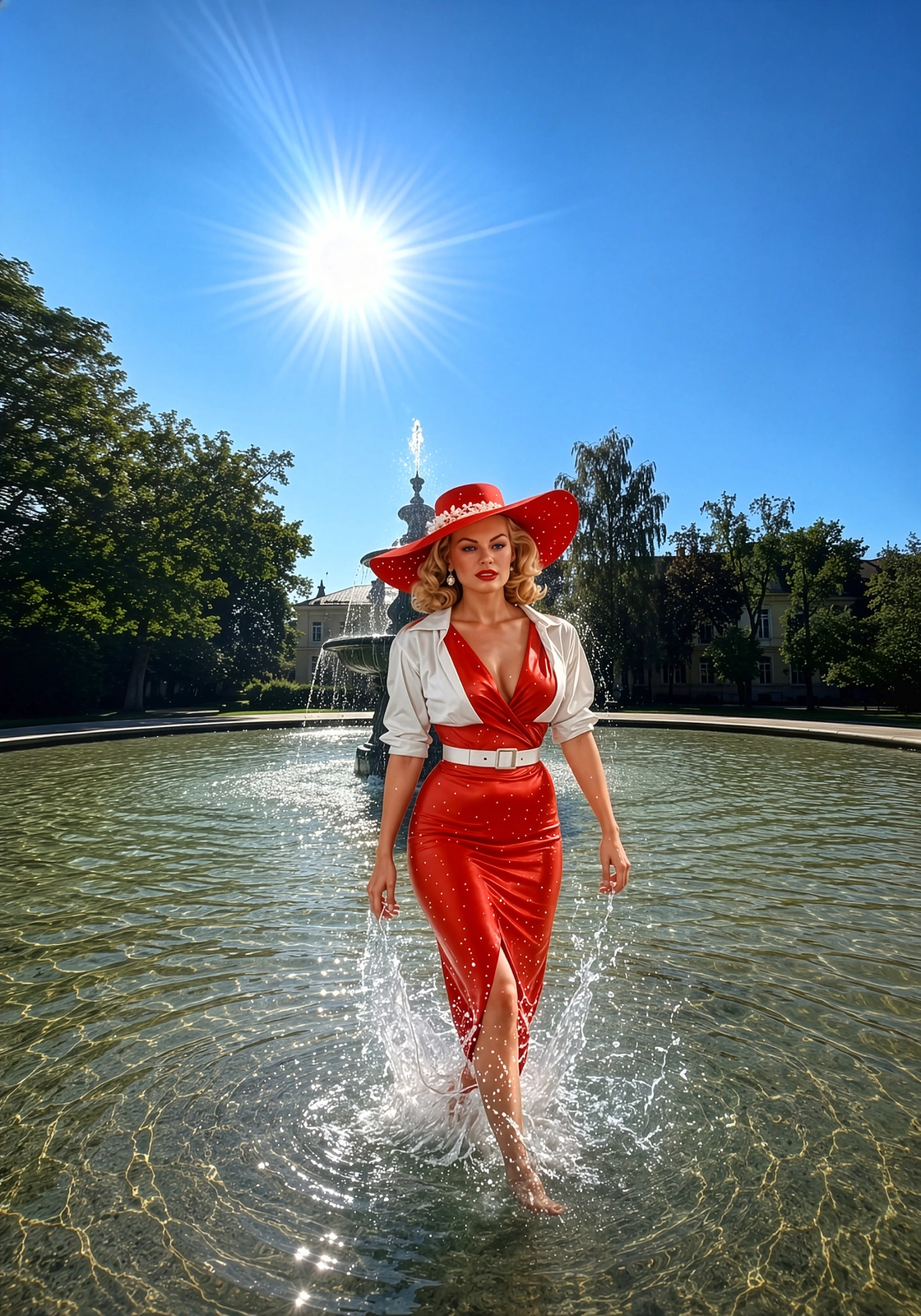
The sight of Anita Ekberg wading through the fountain beneath the old restaurant in Kungsparken would hardly surprise anyone.
She had experience.
By then, she had already made the most famous walk through a fountain in history. Millions of people still remember the night she stepped into the Trevi Fountain and transformed a few minutes of cinema into eternity. Water had accompanied her throughout much of her life. Sometimes it was the blue horizon of the Mediterranean beyond the bow of a Riva. Sometimes it was the rain falling over Rome. Sometimes it was the quiet evenings in the garden at Genzano, where the olive trees whispered as the lights of the city shimmered far away.
For that reason, seeing Anita standing in water feels almost natural. Her companion, however, is rather more surprising.
Standing at the edge of the basin is Sten Broman: bon vivant and man-about-town, composer, violinist, music critic, television legend, and one of the most colourful personalities ever produced by Scania. He loved the sea, spent countless summers at Falsterbohus, and owned several boats during his life. Yet he regarded water itself with a suspicion that bordered on the philosophical.
His most famous theory about water was that it is poisonous and that Jesus had already understood this, since He immediately turned it into wine whenever He encountered it. The argument was, of course, absurd, but such details rarely troubled Sten Broman once he had found a formulation that amused him.
That is why the scene outside the restaurant in Kungsparken is so peculiar. Anita Ekberg stands in the middle of the fountain, water swirling around her legs as though it were the most natural place in the world, while Sten Broman keeps a safe distance from any risk of getting wet.
Had anyone suggested that these two people had much in common, both would probably have protested loudly. At first glance, they seem to come from entirely different worlds. Anita became the international film star who conquered Hollywood, Rome and the world's press. In contrast, Sten became the musician, professor and television personality who conquered Swedish living rooms, concert halls and universities. She moved among film stars, producers, aristocrats and Italian billionaires. He felt most at home among composers, professors, cultural figures and the colourful characters who gathered around his dinner table at the Savoy.
Yet the differences are not as great as they first appear.
Both loved people, stories and good dinners. Both flourished in company where conversation continued long after midnight. Both moved through worlds where pleasure, glamour and alcohol were constant companions. And both spent their lives watching the people around them destroy themselves because they could no longer distinguish between enjoying life and destroying it.
Anita had lived close to men who drank away both their judgement and their opportunities. During his many years in cultural life, Sten had seen the same thing happen to gifted people who once seemed to have their entire futures ahead of them. Neither of them had any desire to become a teetotaller. They appreciated the good things in life far too much for that. Yet neither had much patience with people who let last night's festivities govern the following day.
When Federico Fellini called that the camera was ready, it made no difference what had happened the night before. The scene had to be played. Likewise, the review, the score or the television recording would be waiting for Sten the following morning, no matter how enjoyable the evening at the Savoy had been.
And now, many years later, they stand here beside the same fountain. Two Scanians who have experienced far more than most people dare dream of, and who remain as inclined to argue in Eternity as they were when they first met.
When one thinks about it, it is perhaps not surprising that their conversation this evening will revolve around fleeting things. Not merely water and alcohol, but all those things that flow constantly through human lives, never allowing themselves to be held. Love affairs, money, fame, memories and time itself possess a remarkable ability to slip through people's fingers, no matter how tightly they try to hold on.
And that is where our story begins.
ACT 1 The Fountain in Kungsparken
Kungsparken, a few days after the lively smorgasbord at Rådhuskällaren. A bright late-summer afternoon that exists only in memory and imagination. The Kungsparken Restaurant above reflects in the basin as the fountain murmurs. Anita Ekberg stands barefoot in the cool water beneath the fountain. Sten Broman stands at the basins edge in a dazzling white suit with a high-waisted vest, a colourful tie, and his characteristic posture. He regards the water with the same suspicion he might show at an accordion recital.
Sten:
Do you realise this is entirely unnecessary?
Anita:
What?
Sten:
Standing in a fountain.
Anita:
People said the same thing in Rome.
Sten:
And yet you did it.
Anita:
Yet people are still talking about it.
Sten:
A regrettable development.
Anita:
You're just jealous because no one remembers you in swimming trunks.
Sten:
Miss Ekberg, a gentleman does not appear wearing swimming trunks.
Anita:
No, that's right. You appear in the curtains.
Sten looks down at his suit.
Sten:
This suit is a work of art. I designed it myself. It is the result of many years spent studying humanity's sartorial failures.
Anita:
It looks like something that escaped from a furniture shop.
Sten:
And you still look like the catastrophe that struck the world's male population.
Anita:
Thank you.
Sten:
That was not a compliment.
Anita:
Of course it was.
She laughs and lets her hand glide through the water.
Anita:
Do you remember the first time we met?
Sten:
Naturally.
Anita:
Don't lie.
Sten:
I remember everything.
Anita:
Then let's hear it.
Sten:
Jägersro Racecourse. Opening luncheon. Spring of 1949.
Anita:
And?
Sten:
The sun was shining. The menu was rather ordinary, yet people still spoke of it as though Escoffier himself had created it. The wine was acceptable, but no more. Two horses were badly ridden, a gentleman from Malmö managed to lose a small fortune before coffee was served, and a trumpeter played half a tone flat during the opening ceremony. The latter, incidentally, was the only thing that genuinely upset me.
Anita:
That isn't usually what people notice when they meet me.
Sten:
I have never been a people person.
Anita:
No, nobody could accuse you of that.
Sten:
Besides, I remember there was a tall blonde girl who seemed to attract everyone's attention. She wasn't actually the guest of honour, yet somehow she managed to become the centre of attention.
Anita:
There you are.
Sten:
What I remember most is that the gentlemen lost all concentration. Some sat with binoculars pointed in the wrong direction, and several missed the start of the next race.
Anita:
And the ladies?
Sten:
They lost patience. Some looked as though they wanted to strangle their husbands with the tablecloths.
Anita bursts out laughing.
Anita:
That sounds considerably more truthful.
Sten:
You were seventeen. I remember that peculiar blend of uncertainty and absolute self-confidence that only certain young people possess. You seemed unsure what would happen next, yet at the same time you were completely convinced that the world would somehow arrange itself to your plans.
Anita:
And you were forty-two, already convinced that the world ought to arrange itself according to your ideas.
Sten:
I was in my prime.
Anita:
Already then?
Sten:
Especially then.
Anita:
I was working at the Hippodrome.
Sten:
Miss Hipp.
Anita:
It was bigger than you might imagine. In those days, the Hippodrome was almost a world of its own. I ran between rehearsals, among chorus girls, variety acts, and the constant stream of people coming and going. To me, it was every bit as exciting as Hollywood later became for others.
Sten:
It was smaller than you think.
Anita:
You sound exactly like all the older gentlemen did back then.
Sten:
And you sound exactly like all the young women who have already realised they are going to conquer the world.
She pauses for a moment.
Anita:
Do you know what I remember?
Sten:
This will undoubtedly be entirely irrelevant.
Anita:
I remember the looks. Not just the men's, as you're probably imagining. Everyone looked. Women too. When you're seventeen, you don't quite understand what's happening. You notice people looking a little longer than usual. Someone whispers to a friend. Someone else turns for a second glance. I remember it sometimes embarrassed me and often amused me. Looking back, I think the story of Anita Ekberg began long before Hollywood. It probably began right there, at Jägersro, Folkets Park and the Hippodrome.
Sten:
The story of Anita Ekberg began long before Hollywood.
Anita:
Yes.
Sten:
That was already obvious then.
Anita:
I didn't know what was going to happen.
Sten:
I don't believe that.
Anita:
Don't you?
Sten:
No.
Anita:
Why?
Sten:
Some people enter a room as though they are apologising for being there; others enter as though they own the place. You belonged to the latter category. I remember watching you move through the crowd as though you were already accustomed to being looked at. Not arrogantly. Not even consciously. But with a natural assurance that is far rarer than beauty. There is plenty of beauty in the world. Assurance is much scarcer.
Anita smiles.
Anita:
And you?
Sten:
I already owned the world.
Anita:
In Lund, perhaps.
Sten:
Lund goes a long way.
Anita:
Not as far as Rome.
Sten:
No, but as far as Copenhagen. And sometimes that's almost the same thing.
Anita:
Now you're wrong.
Sten:
That happens exceedingly rarely.
The fountain murmurs between them.
Anita:
Do you know what I think?
Sten:
No, but I dread finding out.
Anita:
I think you already liked me back then. Not in the way journalists later made careers out of fantasising about. But you liked me. I saw the way you watched people. You studied human beings the way others study musical scores. Every time someone said something foolish, you looked as though you had just discovered a new disease.
Sten:
Nonsense.
Anita:
You liked beautiful women.
Sten:
I still do.
Anita:
And young women.
Sten:
For scientific purposes.
Anita:
Ha!
Sten:
Besides, you were unusually quick-witted.
Anita:
That's the first genuinely nice thing you've said.
Sten:
Don't misunderstand me. I said unusually.
Anita:
And I think you already knew I was going to become somebody.
Sten:
Yes.
Anita looks almost surprised.
Anita:
That was quick.
Sten:
You were impossible to miss. I didn't know you would become a world star. I doubt even you knew that. But I understood that you would never become one of those people who disappear into the crowd. You recognise such people immediately.
Anita:
Thank you.
Sten:
But I never imagined you would become quite that famous.
Anita:
What did you imagine?
Sten:
That you would cause considerably less damage.
Anita:
To humanity?
Sten:
To men.
Anita laughs so loudly that a pair of pigeons take flight from the edge of the fountain.
Anita:
Do you know something, Sten?
Sten:
No.
Anita:
That may be the nicest thing anyone has ever said to me: that I was meant to save men.
Sten tries to look stern but fails.
Sten:
Then you had very peculiar acquaintances even back then.
The fountain continues to murmur as the two Scanians regard one another with the same blend of rivalry, curiosity and mutual respect that began at Jägersro in the summer of 1949.
ACT 2 Two Kinds of Fame
Sten had seated himself on the edge of the fountain, his hat and cane beside him. An elderly couple walked past. The woman cast a glance at Anita.
Woman:
Doesn't she look like someone?
Man:
These days I think everyone does.
They continued.
Anita:
You see? It happens all the time.
Sten:
What does?
Anita:
People think I look like somebody.
Sten:
You do look like somebody.
Anita:
And you look like a teacher who terrifies his pupils. Like Caligula in the film Torment.
Sten:
That's because I was one of the people who terrified pupils.
Anita:
You would never have survived Hollywood.
Sten:
On the contrary, Hollywood would never have survived me.
Anita:
I don't believe that.
Sten:
Yes, because I would have told the producers exactly what I thought of them.
Anita:
They would have thrown you out before the starter.
Sten:
People in Lund occasionally did the same.
Anita:
The difference is that Hollywood would have filmed it.
The fountain splashes. Sten discreetly moves one shoe a few centimetres away from the water. He leans back theatrically against the stone edge, removes his glasses, polishes them slowly, and gazes across the water as though he were suddenly very far from Kungsparken.
Sten:
When I arrived in Prague as a young violinist, I believed, as every young musician does, that the world was waiting for talent. That the person who played best, composed best, or worked hardest would eventually prevail.
He puts his glasses back on and raises a finger.
Sten:
It took only a few months before I realised how naïve that idea was.
Every conservatory is full of geniuses. Every orchestra contains people who play so beautifully that it makes you unhappy not to be able to reach the same level yourself. I met violinists who could have played me off the stage without even coming close to short of breath, and composers who made me feel like a schoolboy. At first, I thought the great names of the future surrounded me. I imagined these people would conquer the world and leave me behind.
He shrugs lightly.
Anita:
Did they?
Sten:
No. I was mistaken. A few years later, most of them were gone. One married and found other things to think about. Another took a safe post as a teacher. Some gave up and ended up behind office desks. One became bitter because the world failed to recognise his greatness immediately and hanged himself in an attic. It is not uncommon for unsuccessful geniuses to end that way.
A crooked smile appears.
Sten:
I had one unusual advantage.
Anita:
What was it?
Sten straightens his tie with great dignity.
Sten:
I was far too stubborn to give up and far too proud to admit defeat.
Anita:
In what way?
Sten:
I was arrogant enough to refuse surrender.
Anita:
That sounds familiar.
Sten:
Does it?
Anita:
People have always wanted to simplify things. They say I became a film star because I had long legs and a cascade of blonde hair. That's rather like saying you became a professor simply because you wore glasses and a tie.
Sten:
I never became a professor, despite my elegant glasses and a tie that sat beneath my chin like a trumpet.
There was a hint of bitterness in his voice.
Anita:
When I arrived in Rome, the city was full of beautiful women. Cinecittà was overflowing with them. They came from France, Italy, Germany, Sweden and America. Some were more beautiful than I was; others were better actresses; and many had richer husbands, more powerful producers, or better agents behind them. Or influential lovers with poor judgement.
But sooner or later the day comes when someone says no. For many, it comes at the very first screen test. Others survive ten rejections. Then they go home, cry on their mother's shoulder, and begin another life.
I don't know if I was braver than the others, but I was certainly more stubborn. Every time someone closed a door, I assumed there had to be another entrance, perhaps a back door. While others gave up, I kept knocking. Eventually, someone opened.
Sten:
And that is why you are still standing here.
Anita:
Exactly.
Sten:
Although admittedly in a fountain.
Anita:
Where else would I stand?
For a moment they fall silent.
Sten:
Do you know what fascinates me?
Anita:
No.
Sten:
That people still speak about fame as though it were a reward.
Anita:
It isn't.
Sten:
No.
Anita:
It's work.
Sten:
A very peculiar kind of work.
Anita:
When I was young, I thought fame meant freedom.
Sten:
And?
Anita:
It meant almost the opposite. I believed that if I became successful enough, I would finally be able to live my own life. Instead, the opposite happened. The more famous I became, the more people thought they knew who Anita Ekberg really was.
Sten:
The world was full of experts, know-it-alls and mind-readers. How offensive it was to read in newspapers what one supposedly thought.
Anita:
Exactly! Journalists wrote about me as if they had lived in the same apartment. Producers told me what kind of woman I ought to be. Moralists told me what kind of woman I was. The public decided I was a sex symbol, and after that it scarcely mattered what I did. If I said something intelligent, people were surprised. If I made a mistake, it became a headline. After a few years, I discovered there were thousands of people with strong opinions about Anita Ekberg, but very few who actually knew me.
Sten:
I know that feeling. The only difference was that nobody ever called me a sex symbol, which I still regard as one of the media's greater failures. But the mechanism was identical. People saw the suits, heard the voice, and concluded they knew everything about me. Some thought I was arrogant. Others thought I was playing a role. The truth was considerably worse. I was exactly the person I wanted to be.
Anita:
Neither of us lived in celibacy, yet according to the newspapers, I spent my entire life lying on my back.
Sten:
Or on top. Ha, ha.
Anita:
People interpreted me through their own distorted fantasies. You know exactly what I mean.
Sten:
Absolutely. When the music quiz show Kontrapunkt was at its peak, people thought they knew me. They had seen me on television and therefore assumed we were acquaintances. Some approached me in restaurants and spoke to me as if we had grown up together, as if we were friends.
Anita:
What did you do?
Sten:
I corrected their pronunciation. It is horrifying to hear how some people abuse their native languageour beautiful Swedish tongue.
Anita:
Naturally.
Sten:
What did you do?
Anita:
I smiled.
Sten:
That was wiser.
Anita:
No. Merely more profitable.
A group of young women pass by. One glances at Anita.
Young Woman:
She looks like someone from an old film.
Friend:
Yes. Or a queen.
They walk on.
Anita:
A queen.
That's a new one.
Sten:
You ought to be pleased.
Anita:
I prefer empress.
Sten:
I'm sure you do.
Anita:
Do you know what irritated me most?
Sten:
Fellini.
Anita:
How did you know that?
Sten:
Because you always return to Fellini.
Anita:
The whole world wanted to believe he had created me. As though I hadn't existed before La Dolce Vita. As though I weren't Anita from Malmö. As though I hadn't travelled, struggled, failed, and worked long before that fountain in Rome. Besides, I created Fellini. Without me, his fame would have remained in Italy. After our film, he belonged to the world.
Sten:
That is the cost of becoming a symbol.
Anita:
I never wanted to become a symbol.
Sten:
Nobody does. I wanted to be a musician, but became the man with the suits. Though admittedly a symbol of exceptional knowledge and impeccable taste.
Anita:
I wanted to be an actress, but I became a tousled blonde.
Sten:
I dreamed of entering history through my music, of surpassing Franz Berwald and taking my place in the pantheon alongside Bach and Beethoven, my greatest heroes.
Anita:
I wanted to be remembered for my roles.
Sten:
Instead, I became the tie.
Anita:
And I became one with the fountain.
They look at each other. There is no irony in their eyes nowonly recognition.
Sten:
Do you know what we truly share in common?
Anita:
That we're both from Scania?
Sten:
Worse than that.
Anita:
Oh?
Sten:
We both became famous for the wrong reasons.
Anita thinks for a few moments, then slowly nods.
Anita:
Yes, that's probably true.
Sten:
It's almost always true of people who become truly famous.
The fountain continues to murmur as the afternoon sun caresses the water. For the first time since their reunion, it feels as though they are no longer competing to see who has lived the stranger life.
They are beginning to realise that the answer is probably both.
A dead heat.
ACT 3 The Skylark and the Blackbird
The fountain murmurs softly, and suddenly a bird begins to sing somewhere among the trees in Kungsparken. Its notes drift clear and bright through the warm afternoon air.
Sten immediately raises his head.
Sten:
Blackbird.
Anita:
Skylark.
Sten:
Blackbird.
Anita:
Skylark.
Sten:
I grew up in a family where people collected birds with the same enthusiasm others devote to postage stamps. My brother Tore could identify a bird before it knew what kind of bird it was. That is a blackbird.
Anita:
I lived in a garden in Italy with eighty ancient olive trees and thousands of birds. That is a skylark.
Sten:
Skylarks do not sit in trees.
Anita:
Now you're ruining everything.
Sten:
Truth tends to have that effect.
Anita:
No. That is exactly what's typical of you. You hear a bird and immediately start thinking about classifying it.
Sten:
Naturally. What do you think about?
Anita:
That it's singing.
Sten looks at her for a few seconds.
Sten:
Yes. Perhaps that is the difference between us.
Anita:
Oh?
Sten:
I want to know why it's singing.
Anita:
And I'm simply glad it does.
Sten:
Typical.
Anita:
You hear the analysis.
Sten:
And you hear the feeling.
Anita:
That's why you became a lecturer.
Sten:
And you became a film star.
Anita laughs.
Anita:
There it is.
Sten:
What?
Anita:
The insult disguised as a compliment.
Sten:
On the contrary, I mean it.
He leans forward slightly.
Sten:
You know, Anita, all my life I've listened to people speak about intelligence as though it were a minor detail. Something dry. Something dusty. Yet all civilisation begins with knowledge. Every symphony. Every bridge. Every library. Every scientific discovery. Everything rests on someone being curious enough to understand the world.
Anita:
Yet that isn't why people get up in the morning.
Sten:
No?
Anita:
No.
She lets her hand glide across the water.
Anita:
People get up for love. For their children. For their dreams. Because someone is waiting for them. Because the sun is shining. Because somebody kissed them the night before. No one has ever become happy because of a footnote.
Sten:
That is an absurd statement.
Anita:
Have you ever been happy because of a footnote?
Sten:
Many times. My life has been full of footnotes.
Anita:
Which is why you're Sten Broman.
Sten:
And that is why you're Anita Ekbergthe film star without footnotes.
The last remark carries a faintly acidic undertone.
A brief silence follows.
The bird continues to sing.
After a pause that feels almost eternal, Sten speaks.
Sten:
Knowledge is power.
Anita:
Beauty is power.
Sten:
Knowledge lasts longer.
Anita:
Beauty opens more doors.
Sten:
To the wrong rooms.
Anita:
Not always.
Sten:
I entertained twelve million people with Bach, Beethoven and Brahms.
Anita:
I made half the world dream of Rome.
Sten:
I spread knowledge.
Anita:
I spread longing.
Sten:
Intelligence was my greatest asset.
Anita:
Vitality was mine.
Sten looks at her, and Anita looks back.
For the first time, neither of them seems willing to yield. And for the first time, neither seems entirely certain that the other is wrong. After a moment of contemplation, accompanied by the sound of the fountain, Sten stirs again.
Sten:
Do you know what is strange?
Anita:
That you were wrong about the bird?
Sten:
That still hasn't happened.
Anita:
Go on.
Sten:
When people describe you, they would probably call you a skylark.
Anita:
Because I'm blonde? And they're brown.
She said sarcastically.
Sten:
Because you're visible. Because you fly high. Because the whole world has noticed you.
Anita:
And what would they call you?
Sten:
A blackbird, I supposesomeone who sits in a tree and reflects on existence.
Anita:
But that's not true at all.
Sten:
No?
Anita:
You loved being on stage. You loved television. You loved people watching you.
Sten:
I did.
Anita:
You're the skylark.
Sten:
Am I?
Anita:
Absolutely. You rose above everyone else and sang until all of Sweden could hear you.
Sten laughs.
Sten:
And what about you?
Anita looks toward the trees.
Anita:
I think I'm the blackbird.
Sten:
You? Of all people?
Anita:
Yes.
She falls silent for a moment.
Anita:
People remember the Trevi Fountain. They remember the photographs. They remember the headlines. But they don't remember the evenings in the garden at Genzano. The olive trees. The birds. The silence after the guests have gone home.
Sten:
No.
Anita:
That is where the blackbird sings.
Sten:
And where Anita Ekberg disappears?
Anita:
No.
She smiles.
Anita:
That is where she remains. The soul resides on a star, yet memory has taken root in the olive trees of Genzano.
Sten:
Do you know what irritates me?
Anita:
That I might be the blackbird?
Sten:
No.
Anita:
Then what?
Sten:
You are probably right.
ACT 4 Experts on Love
The bird eventually fell silent. Perhaps it had grown tired of being analysed by an academic and of being romanticised by a film star. But from larks and blackbirds, their thoughts soon drifted to the far stranger birds that had passed through their own liveslovers, spouses, fiancées, admirers, and heartbreakers. If birdsong followed certain rules, love seemed to obey none at all. Out in nature, birds followed the laws of the seasons. Human beings rarely did. And so, from singing birds, their thoughts quite naturally turned to those who, sooner or later, had flown away.
Sten:
Do you know what fascinates me?
Anita:
That you still believe you understand women?
Sten:
On the contrary, I've always understood that I don't. That's why I survived.
Anita:
That was unusually wise.
Sten:
Thank you. I'll try not to repeat it.
Anita:
Too late. I'm going to quote you.
Sten:
Then I'll deny everything.
Anita laughs.
Anita:
Still, you had remarkable luck with women.
Sten:
Luck?
Anita:
Yes. They seem to have liked you even afterwards.
Sten:
That is a greatly underrated quality.
Anita:
Very much so.
Sten:
I've always believed that a failed relationship does not necessarily have to be followed by a failed war.
Anita:
That sounds suspiciously rehearsed.
Sten:
Possibly.
He straightens his tie.
Sten:
Besides, I have always preferred women over men.
Anita:
So have I.
Sten:
There you are. At last, something we agree on.
Anita:
The difference is that I had considerably worse taste.
Sten:
Nonsense.
Anita:
Anthony Steel.
Sten:
Yes.
Anita:
Agnelli.
Sten:
Yes.
Anita:
And then a few others.
Sten:
You may have a point. Anthony Steel, then. What actually happened?
Anita:
The usual.
Sten:
Which is?
Anita:
Two people meet. They fall in love. They get married. They imagine the future will be much like the present. Then they discover the future has other plans.
Sten:
That was unusually poetic.
Anita:
I spent far too much time among Italians.
Sten:
Anthony was English, wasn't he?
Anita:
Yes, but the problems were international.
Sten laughs.
Anita:
When we met, he was the star. I was the young, beautiful girl on her way up. A few years later, the roles had reversed. Not everyone handles that change well. Sometimes I've thought I married the wrong man and loved the right one.
Sten:
Anthony Steel?
Anita:
Anthony was handsome and charming, and could be wonderfully pleasant when he wanted to be. But after some time, I began to realise that I had actually married a whisky bottle.
Sten:
Empty or full?
Anita:
That varied.
Sten:
Sounds expensive.
Anita:
It was.
She laughs, but then grows more serious.
Anita:
The sad thing is that he was fundamentally a decent man. But while my career was rising, his was beginning to sink. I think that hurt him, perhaps more than I understood at the time. It's easy to be generous when you're standing in the spotlight yourself. Much harder when the light moves to someone else.
Sten:
It's difficult for people to watch someone else receive the life they believed would be theirs.
Anita:
Yes.
A brief silence follows.
Sten:
And Agnelli?
Anita smiles in an entirely different way.
Sten notices immediately.
Sten:
Aha.
Anita:
What do you mean, aha?
Sten:
Your voice changed.
Anita:
Imagination.
Sten:
No.
Anita:
Yes.
Sten:
No.
Anita:
You sound like a schoolboy.
Sten:
And you sound like a woman who's just been caught.
Anita laughs.
Anita:
You should have become a policeman.
Sten:
I would have arrested half of Europe.
Anita:
That wouldn't have been enough.
Sten:
No, perhaps not.
He leans back.
Sten:
Well?
Anita:
Well what?
Sten:
Was he the great love?
Anita looks toward the western horizon.
Anita:
I don't know whether people have only one great love. That sounds like something invented by poets and florists.
Sten:
Given that you're avoiding the question, I shall continue to interpret your silence as a yes.
Anita:
You're insufferable.
Sten:
I know.
Anita:
Maybe.
Sten:
There. The truth emerges.
Anita:
Maybe.
She smiles.
Anita:
But Gianni was impossible from the start. Not as a man. As a project.
Sten:
Explain.
Anita:
You're a Scanian. You think that if two people love each other, the rest will sort itself out.
Sten:
Isn't that reasonable?
Anita:
Not in that world.
She lets her hand glide through the water.
Anita:
He wasn't just a man. He was an institution. A surname. An empire. A legacy. All of Italy had an opinion on whom Gianni Agnelli ought to marry. He could love Anita Ekberg. Marrying Anita Ekberg was an entirely different matter.
Sten:
And yet you stayed.
Anita:
Yes.
Sten:
Why?
Anita:
Because love rarely heeds reason. If it did, humanity would be much happier.
Sten:
And Agnelli?
Anita:
Agnelli never had to compete with me. He knew who he was, which is why I liked him.
Sten:
But he belonged to another world.
Anita:
Exactly. Yet I was the woman he wanted. But princesses and conventions stood in our way. Our love story slowly dried up, like this basin would without fresh water.
Sten:
Do you know what strikes me?
Anita:
No.
Sten:
You always seem to have fallen in love with storms.
Anita:
And you?
Sten:
I preferred better weather forecasts.
Anita:
Ha!
Sten:
It's true.
For the first time in a long while, he smiles without irony.
Sten:
Gunilla was forty-three years younger than I. Everyone thought it was a joke, a scandal, or a whim. Perhaps I thought so myself in the first few weeks.
Anita:
But?
Sten:
Then months passed. Then years. People talked about the age difference. I talked to Gunilla. It turned out to be considerably more pleasant.
Anita:
It usually is.
Sten:
She was intelligent and funny, and she had far more patience than I deserved. We travelled and ate together, argued occasionally, and laughed a lot. People saw a professor and a striptease dancer and assumed they already knew the whole story. We were having far more fun than that.
Anita:
You sound almost in love.
Sten:
Almost?
Anita:
All right then. Very much in love.
Sten:
It happens.
Anita:
Didn't she eventually meet a man her own age?
Sten:
That's correct.
His voice is expressionless.
Anita:
What did you do then?
Sten:
I bought her wedding dress.
Anita stares at him.
Anita:
That is either very beautiful or completely insane.
Sten:
The two are not mutually exclusive.
Anita:
No, I suppose they aren't.
Sten:
Besides, I was genuinely happy for her. Love is not a bird you can cage. If you try, it usually flies away at the first opportunity. She was still there until the day I left the earth, and I was there for her.
Anita:
That sounded almost romantic.
Sten:
Don't tell anyone.
Anita:
Too late.
Sten:
Blast.
It would be difficult to imagine a more beautiful soundtrack than the murmur of the fountain.
Anita:
Do you know what's unfair?
Sten:
No.
Anita:
You got a happy ending to that story.
Sten:
Perhaps.
Anita:
My best love stories always seem to be missing the final chapter.
Sten looks at her for a moment.
Sten:
Yes.
For once, he does not try to joke his way out of it.
Somewhere far away, a bird can be heard again. But from larks and blackbirds, their thoughts have now flown much fartherto people who arrived like storms, stayed like guests, and vanished like legends.
ACT 5 THE PRESS
A few young people cross the bridge in Kungsparken. None of them recognises the two Time-travellers by the fountain, but one of the girls gives Anita a second glance.
"She looks like someone."
"Yeah," her friend replies. "Like someone out of an old film."
Then they disappear.
Sten:
Do you know what strikes me?
Anita:
That they didn't recognise us?
Sten:
That they thought they did anyway.
Anita:
That's how fame works.
Sten:
Yes. Like an echo. People remember something without quite knowing what they remember.
Anita:
Or whom.
Sten:
Or whom.
He looks toward the trees.
Sten:
I've always had a good relationship with the press.
Anita slowly looks up.
Anita:
That's because they weren't hiding in the bushes outside your bedroom window.
Sten laughs at first, but his laughter fades when he realises she means it.
Anita:
I mean that literally. People sometimes think actors exaggerate these things, but they actually did. They hid behind walls, rented hotel rooms opposite my windows, bribed porters and waiters, and paid people for information that was none of their business. When *La Dolce Vita* came out, everything changed. I didn't just become famous. I became public property.
Sten:
Public property. That's a dreadful expression, but I understand what you mean. Or rather, I'm beginning to. I always thought of the press as a kind of marketplace where one offers a remark and receives attention in return. In my case, it was almost a parlour game. They wanted Sten Broman, and I delivered Sten Broman, preferably in stronger colours than before. But what you're describing is something else. That's not publicity. That's a hunt.
Anita:
Exactly. I was interviewed. I was hunted. I was prey.
She leans against the edge of the fountain.
Anita:
If I had dinner with a man, it made the headlines. If I had dinner alone, it made the headlines. If I smiled, I was in love. If I looked tired, I was miserable. If I travelled somewhere, someone followed me. If I stayed home, people wanted to know why. Eventually, I could wake up in the morning and read about my own life in the papers, things I had never heard of myself.
Sten:
And then you got angry.
Anita:
Angry? I was furious.
She laughs softly.
Anita:
Do you know what's strange? Most people think the defining moment of my life was walking into the Trevi Fountain. I remember just as clearly all the times I ran away from it, from photographers, from reporters, from people who wanted one more picture, one more quote, one more scandal.
Sten:
You even chased them back at times.
Anita:
Yes.
Sten:
With bow and arrow.
Anita:
The bow and arrow event.
Sten starts laughing.
Anita:
You don't have to look so pleased.
Sten:
Forgive me, but it's a wonderful image. The entire world press is chasing Anita Ekberg, and suddenly she turns around like a Nordic Artemis and starts chasing them.
Anita:
It didn't work particularly well.
Sten:
No?
Anita:
No, they just got better photographs.
Even Sten laughs at that.
Sten:
That, in fact, is the press's greatest talent, turning resistance into material.
Anita:
Exactly.
For a moment they fall silent.
Sten:
That's where our experiences differ rather dramatically.
Anita:
Yes.
Sten:
Journalists came to me because I gave them what they wanteda quote, an opinion, or a provocation. I shall admit that I occasionally helped them along. If a journalist called to ask for a comment on the state of Swedish music, I rarely settled for a balanced, polite response. That produced no headlines. I discovered quite early that the press worked rather like an old accordion. If you pressed the right places, exactly the notes you wanted came out.
Anita:
It's almost infuriating to hear that. Not because you were wrong, perhaps, but because you had a choice. You could open the door when the press knocked and close it when you'd had enough. You could even choose which version of Sten Broman they would get. I often had to fight just to close the door. That's probably why we speak so differently about the same thing. For you, the press was a tool. For me, it sometimes became a cage.
Sten:
There's probably something in that.
Anita:
Something?
Sten:
Quite a lot.
He glances toward the restaurant.
Sten:
But I will admit one thing.
Anita:
Now I'm nervous.
Sten:
Many people believed Sten Broman was simply eccentric by nature.
Anita:
And?
Sten:
It was hard work.
Anita:
Ha!
Sten:
I mean it. People think public figures simply appear. But most of us build our character ourselves. The suits. The ties. The quotations. The gestures. I created Sten Broman much as a director creates a role.
Anita:
The difference was that you got to write your own script.
Sten:
Yes.
Anita:
There's the difference again.
Sten:
What do you mean?
Anita:
I was often forced to read scripts written for me by other people.
Sten falls silent.
For the first time in a long while, he cannot think of a quick retort.
Anita:
The producers wrote one script. The journalists wrote another. The public wrote a third. Everyone had opinions about who Anita Ekberg was. The dumb blonde. The vamp. The sex symbol. Fellini's creation. I spent half my life trying to explain that I was human, not a poster.
Sten:
And did they listen?
Anita:
Sometimes.
She smiles faintly.
Anita:
Usually not.
Sten:
That reminds me of something.
Anita:
What?
Sten:
When Kontrapunkt was at its height, people believed they knew me. They saw a man in colourful suits, speaking rapidly and holding opinions on everything under the sun. Many concluded they knew exactly who I was.
Anita:
But?
Sten:
But they only knew the character, not the person.
Anita:
The difference is that you created the character.
Sten:
Yes.
Anita:
And I became trapped inside mine.
Sten slowly nods, and this time he doesn't argue.
Sten:
Do you know what fascinates me?
Anita:
What now?
Sten:
Despite everything, you never stopped playing the game.
Anita:
No.
Sten:
Why not, if I may ask?
Anita looks up at the sky.
Anita:
Because I loved the audience.
The answer comes without hesitation.
Anita:
Don't misunderstand me. I hated the lies. I hated the intrusions. I hated people who made a living inventing stories about others. But the audience was something else. When people came up to me to say that a film had made them happy, made them dream, or helped them through a difficult time, the anger would fade for a while.
Sten nods.
Sten:
That's where we're alike.
Anita:
Yes.
Sten:
I loved the audience too. Not the press. Not the headlines. The audience.
Anita:
Though in your own way.
Sten:
And you in yours.
Anita:
You gave people Bach.
Sten:
And Beethoven.
Anita:
And Brahms.
Sten:
Sometimes to their despair.
Anita:
The audience's or the composers'?
Sten chooses not to answer. Anita continues.
Anita:
I gave them Rome.
Sten:
To their longing.
They laugh, but then Anita grows serious again.
Anita:
Do you know what still makes me angry?
Sten:
No.
Anita:
People often remember photographs better than words.
Sten doesn't answer immediately.
He looks out across the basin.
Sten:
Yes.
This time, no joke follows.
Sten is beginning to understand that while he built his public persona stone by stone, Anita spent much of her life trying to escape from her own.
ACT 6 SCANIA AND THE WORLD
The afternoon is beginning to soften. The shadows beneath the trees in Kungsparken lengthen, and the fountain seems quieter than before.
For a while, neither of them says anything.
Then Sten looks out over the water.
Sten:
I've always found it amusing that people speak of travelling as if it automatically makes a person wiser.
Anita:
Doesn't it?
Sten:
Not necessarily.
Anita:
You've travelled quite a lot yourself.
Sten:
Enough to discover that human stupidity exists in several languages.
Anita laughs.
Anita:
That sounds like something you've spent years researching.
Sten:
I have.
Anita:
What did your research conclude?
Sten:
That every nation believes it possesses a monopoly on civilisation.
Anita:
And every nation is wrong.
Sten:
Exactly.
He adjusts his glasses.
Sten:
When I was young, I thought the continent held all the answers. Prague. Leipzig. Vienna. The great musical capitals. To understand music, one had to leave Sweden. That much was true.
Anita:
Did you find what you were looking for?
Sten:
Sometimes.
Anita:
That's not a very enthusiastic answer.
Sten:
Because life rarely delivers what one was looking for. It delivers something else.
Anita:
That sounds surprisingly philosophical.
Sten:
Age has ruined me.
Anita:
You were philosophical at twenty.
Sten:
That's true.
He smiles.
Sten:
I arrived abroad believing I would discover music. Instead, I discovered people.
Anita:
What a disappointment.
Sten:
A profound one.
Anita:
Yet you spent the rest of your life collecting them.
Sten:
Yes.
He pauses.
Sten:
Do you know what struck me most?
Anita:
No.
Sten:
How similar people were. The languages changed. The architecture changed. The menus improved considerably. But people remained people. They fell in love with the wrong person. They worried about money. They boasted when they ought to have listened. They lied to themselves. In short, they behaved exactly as Scandinavians do.
Anita:
That must have been reassuring.
Sten:
It was disappointing.
Anita laughs.
Anita:
I had almost the opposite experience.
Sten:
How so?
Anita:
When I first left Sweden, I thought I understood the world because I knew Malmö.
Sten:
A common mistake.
Anita:
A very common mistake.
She leans back against the edge of the fountain.
Anita:
Then suddenly I found myself in places where everything seemed larger. Larger cities. Larger fortunes. Larger scandals. Larger dreams. Hollywood wasn't merely another city. It was a machine for manufacturing fantasies. Rome wasn't merely Rome. It was history, theatre and chaos, all at once.
Sten:
And did you feel at home?
Anita thinks for a moment.
Anita:
Sometimes.
Sten:
Only sometimes?
Anita:
The strange thing is that I often felt most foreign when people thought I belonged there.
Sten:
I know exactly what you mean.
Anita:
Do you?
Sten:
Certainly.
He looks towards the old restaurant building.
Sten:
People assumed I belonged in university halls because I was an academic. Others assumed I belonged in concert halls because I was a musician. Some thought I belonged in television studios because they had seen me there.
Anita:
And where did you belong?
Sten:
Usually at dinner.
Anita bursts out laughing.
Sten:
I'm serious.
Anita:
I know you are.
Sten:
A dinner table is a far more civilised institution than either academia or television is.
Anita:
You've probably offended both professions.
Sten:
Good.
The fountain splashes softly between them.
Anita:
Do you ever wonder what would have happened if you'd left Sweden for good?
Sten:
Never.
Anita:
Never?
Sten:
Not for a second.
Anita:
Why not?
Sten:
Because I realised quite early that I was fundamentally provincial.
Anita:
You?
Sten:
Absolutely.
Anita:
That's absurd.
Sten:
Not at all.
He points vaguely southward.
Sten:
Everything I loved was herethe language, the humour, the food, the arguments, the landscapes. Even the people who irritated me were my people.
Anita:
That's actually rather beautiful.
Sten:
Don't spread that rumour.
Anita:
Too late.
Sten:
Blast.
Anita smiles.
Anita:
I used to think I had escaped Malmö.
Sten:
And?
Anita:
Then I discovered that Malmö had travelled with me.
Sten:
Exactly.
Anita:
It happened everywhere. In Rome. In Paris. In Hollywood. Sooner or later, someone would ask where I was from. And every time I answered, I became the girl from Malmö again.
Sten:
Not the film star?
Anita:
No.
Sten:
Not the international celebrity?
Anita:
No.
Sten:
Not Fellini's Sylvia?
Anita:
No.
She smiles.
Anita:
Just Anita from Malmö.
For a while they sit quietly.
The city moves around them. Cyclists pass by. Voices drift through the park. Somewhere, a church bell sounds the hour.
Sten:
Do you know what I think?
Anita:
This should be interesting.
Sten:
Home isn't really a place.
Anita:
No?
Sten:
It's the place where people get your jokes.
Anita laughs so hard that the water ripples around her legs.
Anita:
That may be the most accurate thing you've said all day.
Sten:
Thank you.
Anita:
And rather fitting.
Sten:
Why?
Anita:
Because after all these years, I still understand yours.
Sten looks at her for a moment.
Sten:
Yes.
Anita:
And you understand mine.
Sten:
Most of them.
Anita:
Good enough.
The fountain continues to murmur.
Some people leave home and never return. Others return every day without ever leaving.
Neither Anita Ekberg nor Sten Broman truly belonged to the places that made them famous. They belonged to the place they carried within them. And that place still answered to the name Malmö.
ACT 7 Idiots, Fools and Other Natural Phenomena
Evening has begun to settle over Kungsparken. The murmur of the fountain sounds calmer now. Some of the park benches are filled with people enjoying the mild evening air. Anita is still standing in the shallow water, while Sten leans against the edge of the basin.
Sten:
Over the course of a long life, one meets thousands of people. Most are forgotten. A few are remembered with affection. And then there is a small group that questions Darwin's theories.
Anita:
Hollywood was full of them.
Sten:
Universities too.
Anita:
Well, there you are. Apparently we worked in the same industry.
Sten laughs.
Sten:
When I was younger, I believed that education automatically made people wiser. That was one of the first illusions I lost. I've met professors who could read six languages but couldn't understand a simple human situation. At the same time, I've met fishermen, taxi drivers and waitresses with enough good judgement to supply an entire faculty council.
Anita:
I recognise that.
Sten:
Do you?
Anita:
Absolutely. People think the film world is all glamour. But after a few years, you realise it functions very much like the rest of the world. There are intelligent people, foolish people, and people who somehow manage to be both at once.
Sten:
That last group is especially interesting.
Anita:
And especially dangerous.
She leans against the edge of the fountain.
Anita:
Do you know what struck me the first time I arrived in Hollywood? The number of people who held strong opinions about women they had never met. Producers could spend hours discussing what audiences wanted. Men who had never been to Sweden explained to me how Swedish women thought. Other men who had never stood in front of a camera explained how a film star ought to behave.
Sten:
I suspect you didn't always heed their advice.
Anita:
I listened politely.
Sten:
And then?
Anita:
Then I did exactly as I pleased.
Sten:
A sound principle.
Anita:
Not always. But often.
The fountain throws another arc of water into the air, breaking the evening glow into a rainbow.
Sten:
The strange thing is that ignorance has never troubled me most. Ignorant people can learn. There is hope for them. What depresses me is people who are proud of knowing nothing, who refuse to take anything in. Quite often, they justify this by saying that if they cannot personally influence something, they have no interest in it. Nazism grew in the soil of ignorance, just as the fool who occupies the White House in America today. Every totalitarian state begins with one idiot and is soon joined by others.
Anita:
Yes, unfortunately that's true.
Sten:
People who regard ignorance as a virtue and believe reflection is a weakness and doubt a sign of poor character.
Anita:
They existed in Hollywood too.
Sten:
They exist everywhere.
Anita:
The strange thing is that they always seem so certain of themselves.
Sten nods.
Sten:
Because doubt requires intelligence.
Anita smiles.
Anita:
I'm stealing that one.
Sten:
Be my guest.
Anita:
It's true. The wisest people I ever met were always asking questions. The stupidest already had all the answers and therefore saw no need to ask any questions.
Sten:
Exactly.
He falls silent for a moment.
Sten:
Kontrapunkt taught me something peculiar about people. When the cameras started rolling, some contestants grew nervous and suddenly doubted everything they knew. Others became as self-assured as Napoleon on his way to Moscow. More often than not, it was the first group who actually knew what they were talking about.
Anita:
The same applies to the film world.
Sten:
Does it?
Anita:
The most talented actors I worked with were almost always insecure, not about their craft but about themselves. They kept wondering whether they could improve and whether everyone else had already seen through them.
Sten:
And the others?
Anita:
They were geniuses from day one.
Sten:
How fortunate for them.
Anita:
Indeed, it saved them the trouble of making an effort.
Both laugh.
Then Anita becomes more serious.
Anita:
Do you know what made me angriest?
Sten:
No.
Anita:
The way people so often assumed that a beautiful woman must be stupid.
Sten nods immediately.
Anita:
It didn't matter what one had read, what one had experienced, or how hard one had worked. For some people, a single photograph was enough to make them believe they knew everything.
Sten:
That isn't stupidity.
Anita:
Isn't it?
Sten:
No. It's laziness. Intellectual laziness. People love simple explanations. They see a beautiful woman and assume beauty explains everything. They meet an academic and assume intelligence comes automatically with the title. Reality is almost always more complicated.
Anita:
And considerably more interesting.
Sten:
Which is precisely why so many people avoid it.
A group of young people passes through the park in the distance. Laughter drifts between the trees.
Anita:
Do you think people have become wiser?
Sten considers the question.
For a long time.
Sten:
No.
Anita:
No?
Sten:
But they've acquired better technology.
Anita:
That was unusually pessimistic.
Sten:
On the contrary, humanity has survived its idiots for several thousand years. There is no reason to believe it will stop now.
Anita laughs.
Anita:
That's almost optimistic.
Sten:
I am full of optimism. I merely express it more harshly.
Anita:
I've noticed.
Sten:
Thank you.
Anita:
That was actually a compliment this time.
Sten looks almost touched.
Sten:
Then we must mark the date in the calendar.
The glow around them deepens. For once, they are not on opposite sides of an argument. They have met different people, travelled through different worlds, and lived entirely different lives, yet they have arrived at much the same conclusion.
That humanity is sometimes completely incomprehensible.
And still worth loving.
ACT 8 The Body
Dusk has draped its blue-grey-pink veil over Kungsparken. The illuminated fountain casts soft reflections on the water. Somewhere in the distance, music drifts from an outdoor café. Not particularly good music, judging by the expression on Sten's face.
Anita watches him for a moment.
Anita:
You always dress as if the body were a shop window display.
Sten:
Naturally.
Anita:
Naturally?
Sten:
If one is going to walk around in it, one might as well decorate it.
He straightens his tie.
Sten:
Besides, I have always felt that the world suffers from a lack of colour.
Anita:
That may be true.
Sten:
It is a fact.
Anita:
Sometimes you looked as though a paint shop had exploded.
Sten:
And yet people remember me.
Anita:
They do.
Sten:
There you are.
Anita laughs.
Anita:
The strange thing is that people think I spent all day thinking about my appearance.
Sten:
Didn't you?
Anita:
No.
Sten:
Not even a little?
Anita:
Less than people imagine.
She leans against the edge of the fountain.
Anita:
I mostly thought about work. About the next day's filming. About contracts. About the dogs back home in Genzano. About my family. About bills. And about why men possessed an almost supernatural ability to complicate life. I usually thought about my appearance only when I stood in front of a mirror. Quite practical, really, because then I could correct whatever I didn't like.
Sten:
Why fools insist on tangling up reality remains a phenomenon that science still lacks an explanation for.
Anita:
I suspected as much.
For a moment they fall silent.
Anita:
It's actually rather amusing.
Sten:
What?
Anita:
That my entire career was built on people watching me.
Sten:
That's not so strange.
Anita:
Yes, it is.
Sten:
Why?
Anita:
Because I hardly ever thought about it.
She gazes out across the basin.
Anita:
When you're young, you think your body will always stay the same. You don't really reflect on it. You live. Then suddenly people start talking about your age. At first, they do it carefully. Then less and less so.
Sten:
Men hear such things too.
Anita:
Yes, but not quite in the same way.
Sten:
No.
Anita:
A man can grow older and still be considered interesting. A woman is often compared with her younger self.
Sten nods slowly.
Sten:
That is true.
Anita:
And rather unfair.
Sten:
Most people are rather unfair.
Anita:
Yes.
She smiles.
Anita:
Though we already knew that.
Sten:
Do you know what surprised me?
Anita:
No.
Sten:
When I was young, I believed the body existed mainly to carry the head.
Anita laughs.
Sten:
I am perfectly serious.
Anita:
I know.
Sten:
I believed the brain was the important part and that the rest mostly functioned as a stand.
Anita:
And then?
Sten:
Then I realised that the head belongs to the body.
Anita:
That is usually how it works.
Sten:
Highly irritating.
He looks down at his hands.
Sten:
Suddenly, one becomes more tired. Joints begin to protest. The memory still works, but not always on command. The body starts behaving in ways it never did when one was thirty.
Anita:
I know exactly what you mean.
Sten:
I suspected you might.
Anita:
People think the worst thing about getting older is wrinkles.
Sten:
Isn't it?
Anita:
No.
She thinks for a moment.
Anita:
The hardest thing is realising that the world still sees the person you once were, even though you yourself have become someone else.
Sten falls silent.
Anita:
People spoke about me as if I were still the girl in the Trevi Fountain. But I had lived an entire life since then. I had loved, travelled, been disappointed, laughed, cried, worked and grown wiser. Yet many people only wanted to see that young woman standing in the fountain.
Sten:
I recognise that more than you might think.
Anita:
Do you?
Sten:
When people thought of me, they often saw the man from Kontrapunktthe one in colourful suits, with quick replies. But I had lived an entire life beyond television. The concerts. The journeys. The friends. The love affairs. All the dinners.
Anita:
The dinners seem to have been particularly important.
Sten:
Extremely important.
Anita:
I understand.
They both laugh.
Then Anita becomes serious again.
Anita:
There is a particular kind of loneliness in being remembered forever by people as you were at twenty-five.
Sten nods.
Sten:
And there is a particular kind of irritation in having people remember how clever you were at forty.
Anita:
Ha!
Sten:
I am serious.
Anita:
I know.
Sten:
People have the curious idea that the best years are always behind us, as though life were a long downhill slope.
Anita:
Isn't it?
Sten:
No.
Anita:
No?
Sten:
No. It's simply a different road.
Anita studies him.
Anita:
That was unusually beautiful.
Sten:
Don't write it down.
Anita:
Too late.
For a while, only the sound of the water remains.
Anita:
Do you know what surprises me?
Sten:
What?
Anita:
When people talk about my beauty, they almost always remember my face.
Sten:
And what do you remember?
Anita smiles.
Anita:
The laughter.
Sten watches her. Then he nods.
Sten:
When people speak about me, they remember my quotations.
Anita:
And what do you remember?
Sten:
The dinners.
Anita:
Naturally.
Sten:
The best conversations almost always took place around the dinner table.
Anita:
Or afterwards.
Sten:
Yes.
Or afterwards.
Two people who once became famous for their most obvious assetsher beauty and his intellectdiscover that what they remember most clearly is something entirely different.
Not faces.
Not quotations.
But the laughter.
ACT 9 The People of Malmö They Met
Anita:
You must know countless interesting people in Malmö who have spent their entire lives here. When I came back in 1962, I hardly knew anyone after a decade abroad. Everyone knew me, of courseeverybody knows the monkey, but the monkey knows nobody.
Sten:
Far too many. But one stands out above all others: Piraten, who taught me something the university never managed to teach.
Anita:
You mean Fritiof Nilsson Piraten, the man who wrote Bombi Bitt?
Sten:
The very same.
Anita:
What could he possibly teach someone who already knew everything?
Sten:
People almost always reveal themselves when they talk about others.
Anita:
Tell me.
Sten:
One evening, Piraten was sitting at Savoy, listening to a few gentlemen gossip about a mutual acquaintance. Afterwards, he remarked that he had learned absolutely nothing about the person they had been slandering, but quite a lot about the men doing the talking. None of it was flattering.
I've thought about that many times since.
Anita:
That was wise.
Sten:
Annoyingly wise.
Anita:
Why was Piraten called the Pirate? Pirates are ruthless creatures who plunder and murder. Surely the writer wasn't anything like that?
Sten:
At heart, Piraten was a thoroughly good-natured man. The only thing he ever plundered was a smörgåsbord. According to Piraten's own tall tales, he conquered an island single-handedly while serving as a naval conscript and earned the nickname as a result.
Anita:
That certainly sounds like a tall tale.
Sten:
Most likely. A more credible tradition holds that he was given the name by a former classmate in the spring of 1913. He had spent a short time at sea and returned to the schoolyard in Ystad wearing an enormous hat and a broad-striped jacket.
Anita:
That sounds more like the way you dress. Now tell me about another interesting Scanian.
Sten:
Interesting is perhaps the wrong word, but there is one I've thought about many times. In the late fifties, Savoy had a young waiter who certainly never forgot me.
Anita:
This sounds promising.
Sten:
The restaurateur Lars Lendrop had just hired him. It must have been 1931. The boy was polite and ambitious, yet terrified of making mistakes, which naturally led him to make them.
Anita:
That's usually how it works. Imagine thatit was the same year I was born, little me.
What she was really thinking about was how much older Sten was and how he could already be out drinking while she was still lying in a pram. In Eternity, age no longer mattered, but still.
Sten:
One evening, he served a schnapps meant to accomp
Jörgen Thornberg
La Dolce Vita - Det ljuva Livet, 2026
Digital
50 x 70 cm
3 200 kr
La Dolce Vita - Det ljuva Livet
Svensk text på slutet
INTRODUCTION
Some people never truly leave the city where their story began.
They may travel across oceans, settle in other countries, become famous, rich, or widely talked about, but somewhere, some of them continue to wander along the same streets they once left behind.
That was the case for Anita Ekberg and Sten Broman.
At first glance, they don't have much in common. She became an international film star, her face known far beyond Sweden's borders. He became one of the country's most talked-about cultural figures, as admired as he was feared for his sharp tongue and unwillingness to adapt. Their lives took them in different directions and through completely different worlds. Still, there is something strangely familiar about them when you look back.
Both carried Malmö with them, not as a place on the map but as a temperament. The same mix of self-assurance and self-irony. The same reluctance to bow to authority. The same ability to end up in the middle of the action without being entirely comfortable there. They met for the first time in 1949; she was seventeen, and he was forty-eight.
Throughout their lives, they met royalty, movie stars, professors, billionaires, politicians, journalists, artists and all sorts of originals. They experienced successes most people only dream of and setbacks few outsiders imagined. They were often described as larger than life. But behind the headlines, the photographs and the public roles, two people were really wrestling with the same issues as everyone else.
How much of a person belongs to him, and how much to the outside world?
What is success worth if it costs one's freedom?
Where is the line between enjoying life and self-deception?
Why is it so difficult to understand other people before it is too late?
This is the story of a conversation that never happened but perhaps should have.
Two Scanians meet on a late summer evening in Malmö. They have already lived their lives, survived their disasters, and collected more stories than most people have time to hear in a lifetime. Neither has anything to prove any more. Neither needs to win any arguments.
Still, they will try.
And perhaps that's why their conversation is worth listening to.
The Ballad of Anita and Sten
Now Anita loved water,
She splashed in every fountain.
If there wasn't one nearby,
She'd happily climb a mountain
To find a lake, a river,
A swimming pool or sea.
"If there's water anywhere,
It's probably calling me."
But Sten despised the liquid stuff
With all his heart and soul.
He trusted wine and whisky,
Yet doubted HO.
"Water is quite dangerous,"
He'd solemnly explain.
"Jesus saw the risk at once
And changed it into wine."
Anita laughed and waded on,
Her sandals in her hand.
While Sten remained a safe three yards
Away on solid land.
She crossed the Trevi Fountain,
He crossed the street instead.
She cooled her feet in summer heat,
He cooled his drink, he said.
She loved boats upon the sea,
The spray, the waves, the foam.
He loved boats as floating bars
With comfortable room.
"If heaven has a fountain,"
Said Anita with delight,
"I'll spend eternity in it
From morning until night."
"If heaven has a fountain,"
Said Sten, "then let me state:
I hope they also have a bar
A prudent distance away."
And so, they stood in Malmö,
One splashing, one bone dry,
Arguing about water
Beneath a summer sky.
Neither changed the other's mind,
Not once, not even then.
Anita stayed in fountains,
And Sten stayed being Sten.
Malmö, June 2026
La Dolce Vita - Det ljuva Livet
PROLOGUE
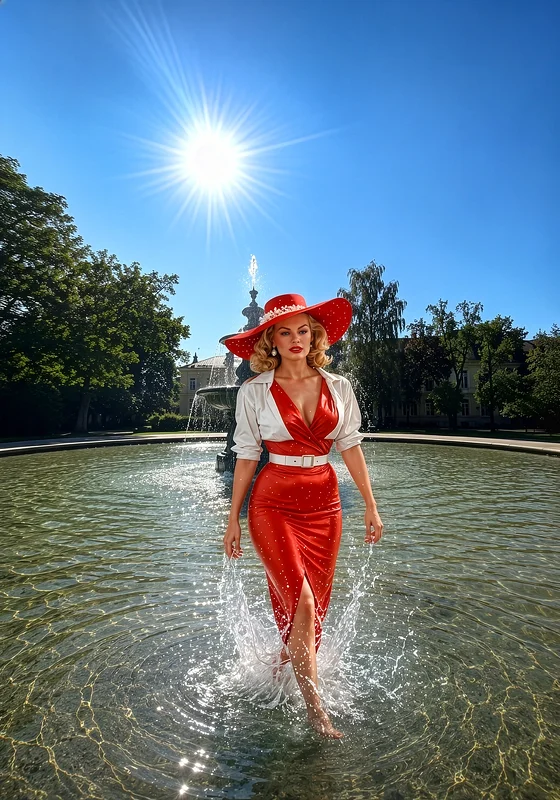
The sight of Anita Ekberg wading through the fountain beneath the old restaurant in Kungsparken would hardly surprise anyone.
She had experience.
By then, she had already made the most famous walk through a fountain in history. Millions of people still remember the night she stepped into the Trevi Fountain and transformed a few minutes of cinema into eternity. Water had accompanied her throughout much of her life. Sometimes it was the blue horizon of the Mediterranean beyond the bow of a Riva. Sometimes it was the rain falling over Rome. Sometimes it was the quiet evenings in the garden at Genzano, where the olive trees whispered as the lights of the city shimmered far away.
For that reason, seeing Anita standing in water feels almost natural. Her companion, however, is rather more surprising.
Standing at the edge of the basin is Sten Broman: bon vivant and man-about-town, composer, violinist, music critic, television legend, and one of the most colourful personalities ever produced by Scania. He loved the sea, spent countless summers at Falsterbohus, and owned several boats during his life. Yet he regarded water itself with a suspicion that bordered on the philosophical.
His most famous theory about water was that it is poisonous and that Jesus had already understood this, since He immediately turned it into wine whenever He encountered it. The argument was, of course, absurd, but such details rarely troubled Sten Broman once he had found a formulation that amused him.
That is why the scene outside the restaurant in Kungsparken is so peculiar. Anita Ekberg stands in the middle of the fountain, water swirling around her legs as though it were the most natural place in the world, while Sten Broman keeps a safe distance from any risk of getting wet.
Had anyone suggested that these two people had much in common, both would probably have protested loudly. At first glance, they seem to come from entirely different worlds. Anita became the international film star who conquered Hollywood, Rome and the world's press. In contrast, Sten became the musician, professor and television personality who conquered Swedish living rooms, concert halls and universities. She moved among film stars, producers, aristocrats and Italian billionaires. He felt most at home among composers, professors, cultural figures and the colourful characters who gathered around his dinner table at the Savoy.
Yet the differences are not as great as they first appear.
Both loved people, stories and good dinners. Both flourished in company where conversation continued long after midnight. Both moved through worlds where pleasure, glamour and alcohol were constant companions. And both spent their lives watching the people around them destroy themselves because they could no longer distinguish between enjoying life and destroying it.
Anita had lived close to men who drank away both their judgement and their opportunities. During his many years in cultural life, Sten had seen the same thing happen to gifted people who once seemed to have their entire futures ahead of them. Neither of them had any desire to become a teetotaller. They appreciated the good things in life far too much for that. Yet neither had much patience with people who let last night's festivities govern the following day.
When Federico Fellini called that the camera was ready, it made no difference what had happened the night before. The scene had to be played. Likewise, the review, the score or the television recording would be waiting for Sten the following morning, no matter how enjoyable the evening at the Savoy had been.
And now, many years later, they stand here beside the same fountain. Two Scanians who have experienced far more than most people dare dream of, and who remain as inclined to argue in Eternity as they were when they first met.
When one thinks about it, it is perhaps not surprising that their conversation this evening will revolve around fleeting things. Not merely water and alcohol, but all those things that flow constantly through human lives, never allowing themselves to be held. Love affairs, money, fame, memories and time itself possess a remarkable ability to slip through people's fingers, no matter how tightly they try to hold on.
And that is where our story begins.
ACT 1 The Fountain in Kungsparken
Kungsparken, a few days after the lively smorgasbord at Rådhuskällaren. A bright late-summer afternoon that exists only in memory and imagination. The Kungsparken Restaurant above reflects in the basin as the fountain murmurs. Anita Ekberg stands barefoot in the cool water beneath the fountain. Sten Broman stands at the basins edge in a dazzling white suit with a high-waisted vest, a colourful tie, and his characteristic posture. He regards the water with the same suspicion he might show at an accordion recital.
Sten:
Do you realise this is entirely unnecessary?
Anita:
What?
Sten:
Standing in a fountain.
Anita:
People said the same thing in Rome.
Sten:
And yet you did it.
Anita:
Yet people are still talking about it.
Sten:
A regrettable development.
Anita:
You're just jealous because no one remembers you in swimming trunks.
Sten:
Miss Ekberg, a gentleman does not appear wearing swimming trunks.
Anita:
No, that's right. You appear in the curtains.
Sten looks down at his suit.
Sten:
This suit is a work of art. I designed it myself. It is the result of many years spent studying humanity's sartorial failures.
Anita:
It looks like something that escaped from a furniture shop.
Sten:
And you still look like the catastrophe that struck the world's male population.
Anita:
Thank you.
Sten:
That was not a compliment.
Anita:
Of course it was.
She laughs and lets her hand glide through the water.
Anita:
Do you remember the first time we met?
Sten:
Naturally.
Anita:
Don't lie.
Sten:
I remember everything.
Anita:
Then let's hear it.
Sten:
Jägersro Racecourse. Opening luncheon. Spring of 1949.
Anita:
And?
Sten:
The sun was shining. The menu was rather ordinary, yet people still spoke of it as though Escoffier himself had created it. The wine was acceptable, but no more. Two horses were badly ridden, a gentleman from Malmö managed to lose a small fortune before coffee was served, and a trumpeter played half a tone flat during the opening ceremony. The latter, incidentally, was the only thing that genuinely upset me.
Anita:
That isn't usually what people notice when they meet me.
Sten:
I have never been a people person.
Anita:
No, nobody could accuse you of that.
Sten:
Besides, I remember there was a tall blonde girl who seemed to attract everyone's attention. She wasn't actually the guest of honour, yet somehow she managed to become the centre of attention.
Anita:
There you are.
Sten:
What I remember most is that the gentlemen lost all concentration. Some sat with binoculars pointed in the wrong direction, and several missed the start of the next race.
Anita:
And the ladies?
Sten:
They lost patience. Some looked as though they wanted to strangle their husbands with the tablecloths.
Anita bursts out laughing.
Anita:
That sounds considerably more truthful.
Sten:
You were seventeen. I remember that peculiar blend of uncertainty and absolute self-confidence that only certain young people possess. You seemed unsure what would happen next, yet at the same time you were completely convinced that the world would somehow arrange itself to your plans.
Anita:
And you were forty-two, already convinced that the world ought to arrange itself according to your ideas.
Sten:
I was in my prime.
Anita:
Already then?
Sten:
Especially then.
Anita:
I was working at the Hippodrome.
Sten:
Miss Hipp.
Anita:
It was bigger than you might imagine. In those days, the Hippodrome was almost a world of its own. I ran between rehearsals, among chorus girls, variety acts, and the constant stream of people coming and going. To me, it was every bit as exciting as Hollywood later became for others.
Sten:
It was smaller than you think.
Anita:
You sound exactly like all the older gentlemen did back then.
Sten:
And you sound exactly like all the young women who have already realised they are going to conquer the world.
She pauses for a moment.
Anita:
Do you know what I remember?
Sten:
This will undoubtedly be entirely irrelevant.
Anita:
I remember the looks. Not just the men's, as you're probably imagining. Everyone looked. Women too. When you're seventeen, you don't quite understand what's happening. You notice people looking a little longer than usual. Someone whispers to a friend. Someone else turns for a second glance. I remember it sometimes embarrassed me and often amused me. Looking back, I think the story of Anita Ekberg began long before Hollywood. It probably began right there, at Jägersro, Folkets Park and the Hippodrome.
Sten:
The story of Anita Ekberg began long before Hollywood.
Anita:
Yes.
Sten:
That was already obvious then.
Anita:
I didn't know what was going to happen.
Sten:
I don't believe that.
Anita:
Don't you?
Sten:
No.
Anita:
Why?
Sten:
Some people enter a room as though they are apologising for being there; others enter as though they own the place. You belonged to the latter category. I remember watching you move through the crowd as though you were already accustomed to being looked at. Not arrogantly. Not even consciously. But with a natural assurance that is far rarer than beauty. There is plenty of beauty in the world. Assurance is much scarcer.
Anita smiles.
Anita:
And you?
Sten:
I already owned the world.
Anita:
In Lund, perhaps.
Sten:
Lund goes a long way.
Anita:
Not as far as Rome.
Sten:
No, but as far as Copenhagen. And sometimes that's almost the same thing.
Anita:
Now you're wrong.
Sten:
That happens exceedingly rarely.
The fountain murmurs between them.
Anita:
Do you know what I think?
Sten:
No, but I dread finding out.
Anita:
I think you already liked me back then. Not in the way journalists later made careers out of fantasising about. But you liked me. I saw the way you watched people. You studied human beings the way others study musical scores. Every time someone said something foolish, you looked as though you had just discovered a new disease.
Sten:
Nonsense.
Anita:
You liked beautiful women.
Sten:
I still do.
Anita:
And young women.
Sten:
For scientific purposes.
Anita:
Ha!
Sten:
Besides, you were unusually quick-witted.
Anita:
That's the first genuinely nice thing you've said.
Sten:
Don't misunderstand me. I said unusually.
Anita:
And I think you already knew I was going to become somebody.
Sten:
Yes.
Anita looks almost surprised.
Anita:
That was quick.
Sten:
You were impossible to miss. I didn't know you would become a world star. I doubt even you knew that. But I understood that you would never become one of those people who disappear into the crowd. You recognise such people immediately.
Anita:
Thank you.
Sten:
But I never imagined you would become quite that famous.
Anita:
What did you imagine?
Sten:
That you would cause considerably less damage.
Anita:
To humanity?
Sten:
To men.
Anita laughs so loudly that a pair of pigeons take flight from the edge of the fountain.
Anita:
Do you know something, Sten?
Sten:
No.
Anita:
That may be the nicest thing anyone has ever said to me: that I was meant to save men.
Sten tries to look stern but fails.
Sten:
Then you had very peculiar acquaintances even back then.
The fountain continues to murmur as the two Scanians regard one another with the same blend of rivalry, curiosity and mutual respect that began at Jägersro in the summer of 1949.
ACT 2 Two Kinds of Fame
Sten had seated himself on the edge of the fountain, his hat and cane beside him. An elderly couple walked past. The woman cast a glance at Anita.
Woman:
Doesn't she look like someone?
Man:
These days I think everyone does.
They continued.
Anita:
You see? It happens all the time.
Sten:
What does?
Anita:
People think I look like somebody.
Sten:
You do look like somebody.
Anita:
And you look like a teacher who terrifies his pupils. Like Caligula in the film Torment.
Sten:
That's because I was one of the people who terrified pupils.
Anita:
You would never have survived Hollywood.
Sten:
On the contrary, Hollywood would never have survived me.
Anita:
I don't believe that.
Sten:
Yes, because I would have told the producers exactly what I thought of them.
Anita:
They would have thrown you out before the starter.
Sten:
People in Lund occasionally did the same.
Anita:
The difference is that Hollywood would have filmed it.
The fountain splashes. Sten discreetly moves one shoe a few centimetres away from the water. He leans back theatrically against the stone edge, removes his glasses, polishes them slowly, and gazes across the water as though he were suddenly very far from Kungsparken.
Sten:
When I arrived in Prague as a young violinist, I believed, as every young musician does, that the world was waiting for talent. That the person who played best, composed best, or worked hardest would eventually prevail.
He puts his glasses back on and raises a finger.
Sten:
It took only a few months before I realised how naïve that idea was.
Every conservatory is full of geniuses. Every orchestra contains people who play so beautifully that it makes you unhappy not to be able to reach the same level yourself. I met violinists who could have played me off the stage without even coming close to short of breath, and composers who made me feel like a schoolboy. At first, I thought the great names of the future surrounded me. I imagined these people would conquer the world and leave me behind.
He shrugs lightly.
Anita:
Did they?
Sten:
No. I was mistaken. A few years later, most of them were gone. One married and found other things to think about. Another took a safe post as a teacher. Some gave up and ended up behind office desks. One became bitter because the world failed to recognise his greatness immediately and hanged himself in an attic. It is not uncommon for unsuccessful geniuses to end that way.
A crooked smile appears.
Sten:
I had one unusual advantage.
Anita:
What was it?
Sten straightens his tie with great dignity.
Sten:
I was far too stubborn to give up and far too proud to admit defeat.
Anita:
In what way?
Sten:
I was arrogant enough to refuse surrender.
Anita:
That sounds familiar.
Sten:
Does it?
Anita:
People have always wanted to simplify things. They say I became a film star because I had long legs and a cascade of blonde hair. That's rather like saying you became a professor simply because you wore glasses and a tie.
Sten:
I never became a professor, despite my elegant glasses and a tie that sat beneath my chin like a trumpet.
There was a hint of bitterness in his voice.
Anita:
When I arrived in Rome, the city was full of beautiful women. Cinecittà was overflowing with them. They came from France, Italy, Germany, Sweden and America. Some were more beautiful than I was; others were better actresses; and many had richer husbands, more powerful producers, or better agents behind them. Or influential lovers with poor judgement.
But sooner or later the day comes when someone says no. For many, it comes at the very first screen test. Others survive ten rejections. Then they go home, cry on their mother's shoulder, and begin another life.
I don't know if I was braver than the others, but I was certainly more stubborn. Every time someone closed a door, I assumed there had to be another entrance, perhaps a back door. While others gave up, I kept knocking. Eventually, someone opened.
Sten:
And that is why you are still standing here.
Anita:
Exactly.
Sten:
Although admittedly in a fountain.
Anita:
Where else would I stand?
For a moment they fall silent.
Sten:
Do you know what fascinates me?
Anita:
No.
Sten:
That people still speak about fame as though it were a reward.
Anita:
It isn't.
Sten:
No.
Anita:
It's work.
Sten:
A very peculiar kind of work.
Anita:
When I was young, I thought fame meant freedom.
Sten:
And?
Anita:
It meant almost the opposite. I believed that if I became successful enough, I would finally be able to live my own life. Instead, the opposite happened. The more famous I became, the more people thought they knew who Anita Ekberg really was.
Sten:
The world was full of experts, know-it-alls and mind-readers. How offensive it was to read in newspapers what one supposedly thought.
Anita:
Exactly! Journalists wrote about me as if they had lived in the same apartment. Producers told me what kind of woman I ought to be. Moralists told me what kind of woman I was. The public decided I was a sex symbol, and after that it scarcely mattered what I did. If I said something intelligent, people were surprised. If I made a mistake, it became a headline. After a few years, I discovered there were thousands of people with strong opinions about Anita Ekberg, but very few who actually knew me.
Sten:
I know that feeling. The only difference was that nobody ever called me a sex symbol, which I still regard as one of the media's greater failures. But the mechanism was identical. People saw the suits, heard the voice, and concluded they knew everything about me. Some thought I was arrogant. Others thought I was playing a role. The truth was considerably worse. I was exactly the person I wanted to be.
Anita:
Neither of us lived in celibacy, yet according to the newspapers, I spent my entire life lying on my back.
Sten:
Or on top. Ha, ha.
Anita:
People interpreted me through their own distorted fantasies. You know exactly what I mean.
Sten:
Absolutely. When the music quiz show Kontrapunkt was at its peak, people thought they knew me. They had seen me on television and therefore assumed we were acquaintances. Some approached me in restaurants and spoke to me as if we had grown up together, as if we were friends.
Anita:
What did you do?
Sten:
I corrected their pronunciation. It is horrifying to hear how some people abuse their native languageour beautiful Swedish tongue.
Anita:
Naturally.
Sten:
What did you do?
Anita:
I smiled.
Sten:
That was wiser.
Anita:
No. Merely more profitable.
A group of young women pass by. One glances at Anita.
Young Woman:
She looks like someone from an old film.
Friend:
Yes. Or a queen.
They walk on.
Anita:
A queen.
That's a new one.
Sten:
You ought to be pleased.
Anita:
I prefer empress.
Sten:
I'm sure you do.
Anita:
Do you know what irritated me most?
Sten:
Fellini.
Anita:
How did you know that?
Sten:
Because you always return to Fellini.
Anita:
The whole world wanted to believe he had created me. As though I hadn't existed before La Dolce Vita. As though I weren't Anita from Malmö. As though I hadn't travelled, struggled, failed, and worked long before that fountain in Rome. Besides, I created Fellini. Without me, his fame would have remained in Italy. After our film, he belonged to the world.
Sten:
That is the cost of becoming a symbol.
Anita:
I never wanted to become a symbol.
Sten:
Nobody does. I wanted to be a musician, but became the man with the suits. Though admittedly a symbol of exceptional knowledge and impeccable taste.
Anita:
I wanted to be an actress, but I became a tousled blonde.
Sten:
I dreamed of entering history through my music, of surpassing Franz Berwald and taking my place in the pantheon alongside Bach and Beethoven, my greatest heroes.
Anita:
I wanted to be remembered for my roles.
Sten:
Instead, I became the tie.
Anita:
And I became one with the fountain.
They look at each other. There is no irony in their eyes nowonly recognition.
Sten:
Do you know what we truly share in common?
Anita:
That we're both from Scania?
Sten:
Worse than that.
Anita:
Oh?
Sten:
We both became famous for the wrong reasons.
Anita thinks for a few moments, then slowly nods.
Anita:
Yes, that's probably true.
Sten:
It's almost always true of people who become truly famous.
The fountain continues to murmur as the afternoon sun caresses the water. For the first time since their reunion, it feels as though they are no longer competing to see who has lived the stranger life.
They are beginning to realise that the answer is probably both.
A dead heat.
ACT 3 The Skylark and the Blackbird
The fountain murmurs softly, and suddenly a bird begins to sing somewhere among the trees in Kungsparken. Its notes drift clear and bright through the warm afternoon air.
Sten immediately raises his head.
Sten:
Blackbird.
Anita:
Skylark.
Sten:
Blackbird.
Anita:
Skylark.
Sten:
I grew up in a family where people collected birds with the same enthusiasm others devote to postage stamps. My brother Tore could identify a bird before it knew what kind of bird it was. That is a blackbird.
Anita:
I lived in a garden in Italy with eighty ancient olive trees and thousands of birds. That is a skylark.
Sten:
Skylarks do not sit in trees.
Anita:
Now you're ruining everything.
Sten:
Truth tends to have that effect.
Anita:
No. That is exactly what's typical of you. You hear a bird and immediately start thinking about classifying it.
Sten:
Naturally. What do you think about?
Anita:
That it's singing.
Sten looks at her for a few seconds.
Sten:
Yes. Perhaps that is the difference between us.
Anita:
Oh?
Sten:
I want to know why it's singing.
Anita:
And I'm simply glad it does.
Sten:
Typical.
Anita:
You hear the analysis.
Sten:
And you hear the feeling.
Anita:
That's why you became a lecturer.
Sten:
And you became a film star.
Anita laughs.
Anita:
There it is.
Sten:
What?
Anita:
The insult disguised as a compliment.
Sten:
On the contrary, I mean it.
He leans forward slightly.
Sten:
You know, Anita, all my life I've listened to people speak about intelligence as though it were a minor detail. Something dry. Something dusty. Yet all civilisation begins with knowledge. Every symphony. Every bridge. Every library. Every scientific discovery. Everything rests on someone being curious enough to understand the world.
Anita:
Yet that isn't why people get up in the morning.
Sten:
No?
Anita:
No.
She lets her hand glide across the water.
Anita:
People get up for love. For their children. For their dreams. Because someone is waiting for them. Because the sun is shining. Because somebody kissed them the night before. No one has ever become happy because of a footnote.
Sten:
That is an absurd statement.
Anita:
Have you ever been happy because of a footnote?
Sten:
Many times. My life has been full of footnotes.
Anita:
Which is why you're Sten Broman.
Sten:
And that is why you're Anita Ekbergthe film star without footnotes.
The last remark carries a faintly acidic undertone.
A brief silence follows.
The bird continues to sing.
After a pause that feels almost eternal, Sten speaks.
Sten:
Knowledge is power.
Anita:
Beauty is power.
Sten:
Knowledge lasts longer.
Anita:
Beauty opens more doors.
Sten:
To the wrong rooms.
Anita:
Not always.
Sten:
I entertained twelve million people with Bach, Beethoven and Brahms.
Anita:
I made half the world dream of Rome.
Sten:
I spread knowledge.
Anita:
I spread longing.
Sten:
Intelligence was my greatest asset.
Anita:
Vitality was mine.
Sten looks at her, and Anita looks back.
For the first time, neither of them seems willing to yield. And for the first time, neither seems entirely certain that the other is wrong. After a moment of contemplation, accompanied by the sound of the fountain, Sten stirs again.
Sten:
Do you know what is strange?
Anita:
That you were wrong about the bird?
Sten:
That still hasn't happened.
Anita:
Go on.
Sten:
When people describe you, they would probably call you a skylark.
Anita:
Because I'm blonde? And they're brown.
She said sarcastically.
Sten:
Because you're visible. Because you fly high. Because the whole world has noticed you.
Anita:
And what would they call you?
Sten:
A blackbird, I supposesomeone who sits in a tree and reflects on existence.
Anita:
But that's not true at all.
Sten:
No?
Anita:
You loved being on stage. You loved television. You loved people watching you.
Sten:
I did.
Anita:
You're the skylark.
Sten:
Am I?
Anita:
Absolutely. You rose above everyone else and sang until all of Sweden could hear you.
Sten laughs.
Sten:
And what about you?
Anita looks toward the trees.
Anita:
I think I'm the blackbird.
Sten:
You? Of all people?
Anita:
Yes.
She falls silent for a moment.
Anita:
People remember the Trevi Fountain. They remember the photographs. They remember the headlines. But they don't remember the evenings in the garden at Genzano. The olive trees. The birds. The silence after the guests have gone home.
Sten:
No.
Anita:
That is where the blackbird sings.
Sten:
And where Anita Ekberg disappears?
Anita:
No.
She smiles.
Anita:
That is where she remains. The soul resides on a star, yet memory has taken root in the olive trees of Genzano.
Sten:
Do you know what irritates me?
Anita:
That I might be the blackbird?
Sten:
No.
Anita:
Then what?
Sten:
You are probably right.
ACT 4 Experts on Love
The bird eventually fell silent. Perhaps it had grown tired of being analysed by an academic and of being romanticised by a film star. But from larks and blackbirds, their thoughts soon drifted to the far stranger birds that had passed through their own liveslovers, spouses, fiancées, admirers, and heartbreakers. If birdsong followed certain rules, love seemed to obey none at all. Out in nature, birds followed the laws of the seasons. Human beings rarely did. And so, from singing birds, their thoughts quite naturally turned to those who, sooner or later, had flown away.
Sten:
Do you know what fascinates me?
Anita:
That you still believe you understand women?
Sten:
On the contrary, I've always understood that I don't. That's why I survived.
Anita:
That was unusually wise.
Sten:
Thank you. I'll try not to repeat it.
Anita:
Too late. I'm going to quote you.
Sten:
Then I'll deny everything.
Anita laughs.
Anita:
Still, you had remarkable luck with women.
Sten:
Luck?
Anita:
Yes. They seem to have liked you even afterwards.
Sten:
That is a greatly underrated quality.
Anita:
Very much so.
Sten:
I've always believed that a failed relationship does not necessarily have to be followed by a failed war.
Anita:
That sounds suspiciously rehearsed.
Sten:
Possibly.
He straightens his tie.
Sten:
Besides, I have always preferred women over men.
Anita:
So have I.
Sten:
There you are. At last, something we agree on.
Anita:
The difference is that I had considerably worse taste.
Sten:
Nonsense.
Anita:
Anthony Steel.
Sten:
Yes.
Anita:
Agnelli.
Sten:
Yes.
Anita:
And then a few others.
Sten:
You may have a point. Anthony Steel, then. What actually happened?
Anita:
The usual.
Sten:
Which is?
Anita:
Two people meet. They fall in love. They get married. They imagine the future will be much like the present. Then they discover the future has other plans.
Sten:
That was unusually poetic.
Anita:
I spent far too much time among Italians.
Sten:
Anthony was English, wasn't he?
Anita:
Yes, but the problems were international.
Sten laughs.
Anita:
When we met, he was the star. I was the young, beautiful girl on her way up. A few years later, the roles had reversed. Not everyone handles that change well. Sometimes I've thought I married the wrong man and loved the right one.
Sten:
Anthony Steel?
Anita:
Anthony was handsome and charming, and could be wonderfully pleasant when he wanted to be. But after some time, I began to realise that I had actually married a whisky bottle.
Sten:
Empty or full?
Anita:
That varied.
Sten:
Sounds expensive.
Anita:
It was.
She laughs, but then grows more serious.
Anita:
The sad thing is that he was fundamentally a decent man. But while my career was rising, his was beginning to sink. I think that hurt him, perhaps more than I understood at the time. It's easy to be generous when you're standing in the spotlight yourself. Much harder when the light moves to someone else.
Sten:
It's difficult for people to watch someone else receive the life they believed would be theirs.
Anita:
Yes.
A brief silence follows.
Sten:
And Agnelli?
Anita smiles in an entirely different way.
Sten notices immediately.
Sten:
Aha.
Anita:
What do you mean, aha?
Sten:
Your voice changed.
Anita:
Imagination.
Sten:
No.
Anita:
Yes.
Sten:
No.
Anita:
You sound like a schoolboy.
Sten:
And you sound like a woman who's just been caught.
Anita laughs.
Anita:
You should have become a policeman.
Sten:
I would have arrested half of Europe.
Anita:
That wouldn't have been enough.
Sten:
No, perhaps not.
He leans back.
Sten:
Well?
Anita:
Well what?
Sten:
Was he the great love?
Anita looks toward the western horizon.
Anita:
I don't know whether people have only one great love. That sounds like something invented by poets and florists.
Sten:
Given that you're avoiding the question, I shall continue to interpret your silence as a yes.
Anita:
You're insufferable.
Sten:
I know.
Anita:
Maybe.
Sten:
There. The truth emerges.
Anita:
Maybe.
She smiles.
Anita:
But Gianni was impossible from the start. Not as a man. As a project.
Sten:
Explain.
Anita:
You're a Scanian. You think that if two people love each other, the rest will sort itself out.
Sten:
Isn't that reasonable?
Anita:
Not in that world.
She lets her hand glide through the water.
Anita:
He wasn't just a man. He was an institution. A surname. An empire. A legacy. All of Italy had an opinion on whom Gianni Agnelli ought to marry. He could love Anita Ekberg. Marrying Anita Ekberg was an entirely different matter.
Sten:
And yet you stayed.
Anita:
Yes.
Sten:
Why?
Anita:
Because love rarely heeds reason. If it did, humanity would be much happier.
Sten:
And Agnelli?
Anita:
Agnelli never had to compete with me. He knew who he was, which is why I liked him.
Sten:
But he belonged to another world.
Anita:
Exactly. Yet I was the woman he wanted. But princesses and conventions stood in our way. Our love story slowly dried up, like this basin would without fresh water.
Sten:
Do you know what strikes me?
Anita:
No.
Sten:
You always seem to have fallen in love with storms.
Anita:
And you?
Sten:
I preferred better weather forecasts.
Anita:
Ha!
Sten:
It's true.
For the first time in a long while, he smiles without irony.
Sten:
Gunilla was forty-three years younger than I. Everyone thought it was a joke, a scandal, or a whim. Perhaps I thought so myself in the first few weeks.
Anita:
But?
Sten:
Then months passed. Then years. People talked about the age difference. I talked to Gunilla. It turned out to be considerably more pleasant.
Anita:
It usually is.
Sten:
She was intelligent and funny, and she had far more patience than I deserved. We travelled and ate together, argued occasionally, and laughed a lot. People saw a professor and a striptease dancer and assumed they already knew the whole story. We were having far more fun than that.
Anita:
You sound almost in love.
Sten:
Almost?
Anita:
All right then. Very much in love.
Sten:
It happens.
Anita:
Didn't she eventually meet a man her own age?
Sten:
That's correct.
His voice is expressionless.
Anita:
What did you do then?
Sten:
I bought her wedding dress.
Anita stares at him.
Anita:
That is either very beautiful or completely insane.
Sten:
The two are not mutually exclusive.
Anita:
No, I suppose they aren't.
Sten:
Besides, I was genuinely happy for her. Love is not a bird you can cage. If you try, it usually flies away at the first opportunity. She was still there until the day I left the earth, and I was there for her.
Anita:
That sounded almost romantic.
Sten:
Don't tell anyone.
Anita:
Too late.
Sten:
Blast.
It would be difficult to imagine a more beautiful soundtrack than the murmur of the fountain.
Anita:
Do you know what's unfair?
Sten:
No.
Anita:
You got a happy ending to that story.
Sten:
Perhaps.
Anita:
My best love stories always seem to be missing the final chapter.
Sten looks at her for a moment.
Sten:
Yes.
For once, he does not try to joke his way out of it.
Somewhere far away, a bird can be heard again. But from larks and blackbirds, their thoughts have now flown much fartherto people who arrived like storms, stayed like guests, and vanished like legends.
ACT 5 THE PRESS
A few young people cross the bridge in Kungsparken. None of them recognises the two Time-travellers by the fountain, but one of the girls gives Anita a second glance.
"She looks like someone."
"Yeah," her friend replies. "Like someone out of an old film."
Then they disappear.
Sten:
Do you know what strikes me?
Anita:
That they didn't recognise us?
Sten:
That they thought they did anyway.
Anita:
That's how fame works.
Sten:
Yes. Like an echo. People remember something without quite knowing what they remember.
Anita:
Or whom.
Sten:
Or whom.
He looks toward the trees.
Sten:
I've always had a good relationship with the press.
Anita slowly looks up.
Anita:
That's because they weren't hiding in the bushes outside your bedroom window.
Sten laughs at first, but his laughter fades when he realises she means it.
Anita:
I mean that literally. People sometimes think actors exaggerate these things, but they actually did. They hid behind walls, rented hotel rooms opposite my windows, bribed porters and waiters, and paid people for information that was none of their business. When *La Dolce Vita* came out, everything changed. I didn't just become famous. I became public property.
Sten:
Public property. That's a dreadful expression, but I understand what you mean. Or rather, I'm beginning to. I always thought of the press as a kind of marketplace where one offers a remark and receives attention in return. In my case, it was almost a parlour game. They wanted Sten Broman, and I delivered Sten Broman, preferably in stronger colours than before. But what you're describing is something else. That's not publicity. That's a hunt.
Anita:
Exactly. I was interviewed. I was hunted. I was prey.
She leans against the edge of the fountain.
Anita:
If I had dinner with a man, it made the headlines. If I had dinner alone, it made the headlines. If I smiled, I was in love. If I looked tired, I was miserable. If I travelled somewhere, someone followed me. If I stayed home, people wanted to know why. Eventually, I could wake up in the morning and read about my own life in the papers, things I had never heard of myself.
Sten:
And then you got angry.
Anita:
Angry? I was furious.
She laughs softly.
Anita:
Do you know what's strange? Most people think the defining moment of my life was walking into the Trevi Fountain. I remember just as clearly all the times I ran away from it, from photographers, from reporters, from people who wanted one more picture, one more quote, one more scandal.
Sten:
You even chased them back at times.
Anita:
Yes.
Sten:
With bow and arrow.
Anita:
The bow and arrow event.
Sten starts laughing.
Anita:
You don't have to look so pleased.
Sten:
Forgive me, but it's a wonderful image. The entire world press is chasing Anita Ekberg, and suddenly she turns around like a Nordic Artemis and starts chasing them.
Anita:
It didn't work particularly well.
Sten:
No?
Anita:
No, they just got better photographs.
Even Sten laughs at that.
Sten:
That, in fact, is the press's greatest talent, turning resistance into material.
Anita:
Exactly.
For a moment they fall silent.
Sten:
That's where our experiences differ rather dramatically.
Anita:
Yes.
Sten:
Journalists came to me because I gave them what they wanteda quote, an opinion, or a provocation. I shall admit that I occasionally helped them along. If a journalist called to ask for a comment on the state of Swedish music, I rarely settled for a balanced, polite response. That produced no headlines. I discovered quite early that the press worked rather like an old accordion. If you pressed the right places, exactly the notes you wanted came out.
Anita:
It's almost infuriating to hear that. Not because you were wrong, perhaps, but because you had a choice. You could open the door when the press knocked and close it when you'd had enough. You could even choose which version of Sten Broman they would get. I often had to fight just to close the door. That's probably why we speak so differently about the same thing. For you, the press was a tool. For me, it sometimes became a cage.
Sten:
There's probably something in that.
Anita:
Something?
Sten:
Quite a lot.
He glances toward the restaurant.
Sten:
But I will admit one thing.
Anita:
Now I'm nervous.
Sten:
Many people believed Sten Broman was simply eccentric by nature.
Anita:
And?
Sten:
It was hard work.
Anita:
Ha!
Sten:
I mean it. People think public figures simply appear. But most of us build our character ourselves. The suits. The ties. The quotations. The gestures. I created Sten Broman much as a director creates a role.
Anita:
The difference was that you got to write your own script.
Sten:
Yes.
Anita:
There's the difference again.
Sten:
What do you mean?
Anita:
I was often forced to read scripts written for me by other people.
Sten falls silent.
For the first time in a long while, he cannot think of a quick retort.
Anita:
The producers wrote one script. The journalists wrote another. The public wrote a third. Everyone had opinions about who Anita Ekberg was. The dumb blonde. The vamp. The sex symbol. Fellini's creation. I spent half my life trying to explain that I was human, not a poster.
Sten:
And did they listen?
Anita:
Sometimes.
She smiles faintly.
Anita:
Usually not.
Sten:
That reminds me of something.
Anita:
What?
Sten:
When Kontrapunkt was at its height, people believed they knew me. They saw a man in colourful suits, speaking rapidly and holding opinions on everything under the sun. Many concluded they knew exactly who I was.
Anita:
But?
Sten:
But they only knew the character, not the person.
Anita:
The difference is that you created the character.
Sten:
Yes.
Anita:
And I became trapped inside mine.
Sten slowly nods, and this time he doesn't argue.
Sten:
Do you know what fascinates me?
Anita:
What now?
Sten:
Despite everything, you never stopped playing the game.
Anita:
No.
Sten:
Why not, if I may ask?
Anita looks up at the sky.
Anita:
Because I loved the audience.
The answer comes without hesitation.
Anita:
Don't misunderstand me. I hated the lies. I hated the intrusions. I hated people who made a living inventing stories about others. But the audience was something else. When people came up to me to say that a film had made them happy, made them dream, or helped them through a difficult time, the anger would fade for a while.
Sten nods.
Sten:
That's where we're alike.
Anita:
Yes.
Sten:
I loved the audience too. Not the press. Not the headlines. The audience.
Anita:
Though in your own way.
Sten:
And you in yours.
Anita:
You gave people Bach.
Sten:
And Beethoven.
Anita:
And Brahms.
Sten:
Sometimes to their despair.
Anita:
The audience's or the composers'?
Sten chooses not to answer. Anita continues.
Anita:
I gave them Rome.
Sten:
To their longing.
They laugh, but then Anita grows serious again.
Anita:
Do you know what still makes me angry?
Sten:
No.
Anita:
People often remember photographs better than words.
Sten doesn't answer immediately.
He looks out across the basin.
Sten:
Yes.
This time, no joke follows.
Sten is beginning to understand that while he built his public persona stone by stone, Anita spent much of her life trying to escape from her own.
ACT 6 SCANIA AND THE WORLD
The afternoon is beginning to soften. The shadows beneath the trees in Kungsparken lengthen, and the fountain seems quieter than before.
For a while, neither of them says anything.
Then Sten looks out over the water.
Sten:
I've always found it amusing that people speak of travelling as if it automatically makes a person wiser.
Anita:
Doesn't it?
Sten:
Not necessarily.
Anita:
You've travelled quite a lot yourself.
Sten:
Enough to discover that human stupidity exists in several languages.
Anita laughs.
Anita:
That sounds like something you've spent years researching.
Sten:
I have.
Anita:
What did your research conclude?
Sten:
That every nation believes it possesses a monopoly on civilisation.
Anita:
And every nation is wrong.
Sten:
Exactly.
He adjusts his glasses.
Sten:
When I was young, I thought the continent held all the answers. Prague. Leipzig. Vienna. The great musical capitals. To understand music, one had to leave Sweden. That much was true.
Anita:
Did you find what you were looking for?
Sten:
Sometimes.
Anita:
That's not a very enthusiastic answer.
Sten:
Because life rarely delivers what one was looking for. It delivers something else.
Anita:
That sounds surprisingly philosophical.
Sten:
Age has ruined me.
Anita:
You were philosophical at twenty.
Sten:
That's true.
He smiles.
Sten:
I arrived abroad believing I would discover music. Instead, I discovered people.
Anita:
What a disappointment.
Sten:
A profound one.
Anita:
Yet you spent the rest of your life collecting them.
Sten:
Yes.
He pauses.
Sten:
Do you know what struck me most?
Anita:
No.
Sten:
How similar people were. The languages changed. The architecture changed. The menus improved considerably. But people remained people. They fell in love with the wrong person. They worried about money. They boasted when they ought to have listened. They lied to themselves. In short, they behaved exactly as Scandinavians do.
Anita:
That must have been reassuring.
Sten:
It was disappointing.
Anita laughs.
Anita:
I had almost the opposite experience.
Sten:
How so?
Anita:
When I first left Sweden, I thought I understood the world because I knew Malmö.
Sten:
A common mistake.
Anita:
A very common mistake.
She leans back against the edge of the fountain.
Anita:
Then suddenly I found myself in places where everything seemed larger. Larger cities. Larger fortunes. Larger scandals. Larger dreams. Hollywood wasn't merely another city. It was a machine for manufacturing fantasies. Rome wasn't merely Rome. It was history, theatre and chaos, all at once.
Sten:
And did you feel at home?
Anita thinks for a moment.
Anita:
Sometimes.
Sten:
Only sometimes?
Anita:
The strange thing is that I often felt most foreign when people thought I belonged there.
Sten:
I know exactly what you mean.
Anita:
Do you?
Sten:
Certainly.
He looks towards the old restaurant building.
Sten:
People assumed I belonged in university halls because I was an academic. Others assumed I belonged in concert halls because I was a musician. Some thought I belonged in television studios because they had seen me there.
Anita:
And where did you belong?
Sten:
Usually at dinner.
Anita bursts out laughing.
Sten:
I'm serious.
Anita:
I know you are.
Sten:
A dinner table is a far more civilised institution than either academia or television is.
Anita:
You've probably offended both professions.
Sten:
Good.
The fountain splashes softly between them.
Anita:
Do you ever wonder what would have happened if you'd left Sweden for good?
Sten:
Never.
Anita:
Never?
Sten:
Not for a second.
Anita:
Why not?
Sten:
Because I realised quite early that I was fundamentally provincial.
Anita:
You?
Sten:
Absolutely.
Anita:
That's absurd.
Sten:
Not at all.
He points vaguely southward.
Sten:
Everything I loved was herethe language, the humour, the food, the arguments, the landscapes. Even the people who irritated me were my people.
Anita:
That's actually rather beautiful.
Sten:
Don't spread that rumour.
Anita:
Too late.
Sten:
Blast.
Anita smiles.
Anita:
I used to think I had escaped Malmö.
Sten:
And?
Anita:
Then I discovered that Malmö had travelled with me.
Sten:
Exactly.
Anita:
It happened everywhere. In Rome. In Paris. In Hollywood. Sooner or later, someone would ask where I was from. And every time I answered, I became the girl from Malmö again.
Sten:
Not the film star?
Anita:
No.
Sten:
Not the international celebrity?
Anita:
No.
Sten:
Not Fellini's Sylvia?
Anita:
No.
She smiles.
Anita:
Just Anita from Malmö.
For a while they sit quietly.
The city moves around them. Cyclists pass by. Voices drift through the park. Somewhere, a church bell sounds the hour.
Sten:
Do you know what I think?
Anita:
This should be interesting.
Sten:
Home isn't really a place.
Anita:
No?
Sten:
It's the place where people get your jokes.
Anita laughs so hard that the water ripples around her legs.
Anita:
That may be the most accurate thing you've said all day.
Sten:
Thank you.
Anita:
And rather fitting.
Sten:
Why?
Anita:
Because after all these years, I still understand yours.
Sten looks at her for a moment.
Sten:
Yes.
Anita:
And you understand mine.
Sten:
Most of them.
Anita:
Good enough.
The fountain continues to murmur.
Some people leave home and never return. Others return every day without ever leaving.
Neither Anita Ekberg nor Sten Broman truly belonged to the places that made them famous. They belonged to the place they carried within them. And that place still answered to the name Malmö.
ACT 7 Idiots, Fools and Other Natural Phenomena
Evening has begun to settle over Kungsparken. The murmur of the fountain sounds calmer now. Some of the park benches are filled with people enjoying the mild evening air. Anita is still standing in the shallow water, while Sten leans against the edge of the basin.
Sten:
Over the course of a long life, one meets thousands of people. Most are forgotten. A few are remembered with affection. And then there is a small group that questions Darwin's theories.
Anita:
Hollywood was full of them.
Sten:
Universities too.
Anita:
Well, there you are. Apparently we worked in the same industry.
Sten laughs.
Sten:
When I was younger, I believed that education automatically made people wiser. That was one of the first illusions I lost. I've met professors who could read six languages but couldn't understand a simple human situation. At the same time, I've met fishermen, taxi drivers and waitresses with enough good judgement to supply an entire faculty council.
Anita:
I recognise that.
Sten:
Do you?
Anita:
Absolutely. People think the film world is all glamour. But after a few years, you realise it functions very much like the rest of the world. There are intelligent people, foolish people, and people who somehow manage to be both at once.
Sten:
That last group is especially interesting.
Anita:
And especially dangerous.
She leans against the edge of the fountain.
Anita:
Do you know what struck me the first time I arrived in Hollywood? The number of people who held strong opinions about women they had never met. Producers could spend hours discussing what audiences wanted. Men who had never been to Sweden explained to me how Swedish women thought. Other men who had never stood in front of a camera explained how a film star ought to behave.
Sten:
I suspect you didn't always heed their advice.
Anita:
I listened politely.
Sten:
And then?
Anita:
Then I did exactly as I pleased.
Sten:
A sound principle.
Anita:
Not always. But often.
The fountain throws another arc of water into the air, breaking the evening glow into a rainbow.
Sten:
The strange thing is that ignorance has never troubled me most. Ignorant people can learn. There is hope for them. What depresses me is people who are proud of knowing nothing, who refuse to take anything in. Quite often, they justify this by saying that if they cannot personally influence something, they have no interest in it. Nazism grew in the soil of ignorance, just as the fool who occupies the White House in America today. Every totalitarian state begins with one idiot and is soon joined by others.
Anita:
Yes, unfortunately that's true.
Sten:
People who regard ignorance as a virtue and believe reflection is a weakness and doubt a sign of poor character.
Anita:
They existed in Hollywood too.
Sten:
They exist everywhere.
Anita:
The strange thing is that they always seem so certain of themselves.
Sten nods.
Sten:
Because doubt requires intelligence.
Anita smiles.
Anita:
I'm stealing that one.
Sten:
Be my guest.
Anita:
It's true. The wisest people I ever met were always asking questions. The stupidest already had all the answers and therefore saw no need to ask any questions.
Sten:
Exactly.
He falls silent for a moment.
Sten:
Kontrapunkt taught me something peculiar about people. When the cameras started rolling, some contestants grew nervous and suddenly doubted everything they knew. Others became as self-assured as Napoleon on his way to Moscow. More often than not, it was the first group who actually knew what they were talking about.
Anita:
The same applies to the film world.
Sten:
Does it?
Anita:
The most talented actors I worked with were almost always insecure, not about their craft but about themselves. They kept wondering whether they could improve and whether everyone else had already seen through them.
Sten:
And the others?
Anita:
They were geniuses from day one.
Sten:
How fortunate for them.
Anita:
Indeed, it saved them the trouble of making an effort.
Both laugh.
Then Anita becomes more serious.
Anita:
Do you know what made me angriest?
Sten:
No.
Anita:
The way people so often assumed that a beautiful woman must be stupid.
Sten nods immediately.
Anita:
It didn't matter what one had read, what one had experienced, or how hard one had worked. For some people, a single photograph was enough to make them believe they knew everything.
Sten:
That isn't stupidity.
Anita:
Isn't it?
Sten:
No. It's laziness. Intellectual laziness. People love simple explanations. They see a beautiful woman and assume beauty explains everything. They meet an academic and assume intelligence comes automatically with the title. Reality is almost always more complicated.
Anita:
And considerably more interesting.
Sten:
Which is precisely why so many people avoid it.
A group of young people passes through the park in the distance. Laughter drifts between the trees.
Anita:
Do you think people have become wiser?
Sten considers the question.
For a long time.
Sten:
No.
Anita:
No?
Sten:
But they've acquired better technology.
Anita:
That was unusually pessimistic.
Sten:
On the contrary, humanity has survived its idiots for several thousand years. There is no reason to believe it will stop now.
Anita laughs.
Anita:
That's almost optimistic.
Sten:
I am full of optimism. I merely express it more harshly.
Anita:
I've noticed.
Sten:
Thank you.
Anita:
That was actually a compliment this time.
Sten looks almost touched.
Sten:
Then we must mark the date in the calendar.
The glow around them deepens. For once, they are not on opposite sides of an argument. They have met different people, travelled through different worlds, and lived entirely different lives, yet they have arrived at much the same conclusion.
That humanity is sometimes completely incomprehensible.
And still worth loving.
ACT 8 The Body
Dusk has draped its blue-grey-pink veil over Kungsparken. The illuminated fountain casts soft reflections on the water. Somewhere in the distance, music drifts from an outdoor café. Not particularly good music, judging by the expression on Sten's face.
Anita watches him for a moment.
Anita:
You always dress as if the body were a shop window display.
Sten:
Naturally.
Anita:
Naturally?
Sten:
If one is going to walk around in it, one might as well decorate it.
He straightens his tie.
Sten:
Besides, I have always felt that the world suffers from a lack of colour.
Anita:
That may be true.
Sten:
It is a fact.
Anita:
Sometimes you looked as though a paint shop had exploded.
Sten:
And yet people remember me.
Anita:
They do.
Sten:
There you are.
Anita laughs.
Anita:
The strange thing is that people think I spent all day thinking about my appearance.
Sten:
Didn't you?
Anita:
No.
Sten:
Not even a little?
Anita:
Less than people imagine.
She leans against the edge of the fountain.
Anita:
I mostly thought about work. About the next day's filming. About contracts. About the dogs back home in Genzano. About my family. About bills. And about why men possessed an almost supernatural ability to complicate life. I usually thought about my appearance only when I stood in front of a mirror. Quite practical, really, because then I could correct whatever I didn't like.
Sten:
Why fools insist on tangling up reality remains a phenomenon that science still lacks an explanation for.
Anita:
I suspected as much.
For a moment they fall silent.
Anita:
It's actually rather amusing.
Sten:
What?
Anita:
That my entire career was built on people watching me.
Sten:
That's not so strange.
Anita:
Yes, it is.
Sten:
Why?
Anita:
Because I hardly ever thought about it.
She gazes out across the basin.
Anita:
When you're young, you think your body will always stay the same. You don't really reflect on it. You live. Then suddenly people start talking about your age. At first, they do it carefully. Then less and less so.
Sten:
Men hear such things too.
Anita:
Yes, but not quite in the same way.
Sten:
No.
Anita:
A man can grow older and still be considered interesting. A woman is often compared with her younger self.
Sten nods slowly.
Sten:
That is true.
Anita:
And rather unfair.
Sten:
Most people are rather unfair.
Anita:
Yes.
She smiles.
Anita:
Though we already knew that.
Sten:
Do you know what surprised me?
Anita:
No.
Sten:
When I was young, I believed the body existed mainly to carry the head.
Anita laughs.
Sten:
I am perfectly serious.
Anita:
I know.
Sten:
I believed the brain was the important part and that the rest mostly functioned as a stand.
Anita:
And then?
Sten:
Then I realised that the head belongs to the body.
Anita:
That is usually how it works.
Sten:
Highly irritating.
He looks down at his hands.
Sten:
Suddenly, one becomes more tired. Joints begin to protest. The memory still works, but not always on command. The body starts behaving in ways it never did when one was thirty.
Anita:
I know exactly what you mean.
Sten:
I suspected you might.
Anita:
People think the worst thing about getting older is wrinkles.
Sten:
Isn't it?
Anita:
No.
She thinks for a moment.
Anita:
The hardest thing is realising that the world still sees the person you once were, even though you yourself have become someone else.
Sten falls silent.
Anita:
People spoke about me as if I were still the girl in the Trevi Fountain. But I had lived an entire life since then. I had loved, travelled, been disappointed, laughed, cried, worked and grown wiser. Yet many people only wanted to see that young woman standing in the fountain.
Sten:
I recognise that more than you might think.
Anita:
Do you?
Sten:
When people thought of me, they often saw the man from Kontrapunktthe one in colourful suits, with quick replies. But I had lived an entire life beyond television. The concerts. The journeys. The friends. The love affairs. All the dinners.
Anita:
The dinners seem to have been particularly important.
Sten:
Extremely important.
Anita:
I understand.
They both laugh.
Then Anita becomes serious again.
Anita:
There is a particular kind of loneliness in being remembered forever by people as you were at twenty-five.
Sten nods.
Sten:
And there is a particular kind of irritation in having people remember how clever you were at forty.
Anita:
Ha!
Sten:
I am serious.
Anita:
I know.
Sten:
People have the curious idea that the best years are always behind us, as though life were a long downhill slope.
Anita:
Isn't it?
Sten:
No.
Anita:
No?
Sten:
No. It's simply a different road.
Anita studies him.
Anita:
That was unusually beautiful.
Sten:
Don't write it down.
Anita:
Too late.
For a while, only the sound of the water remains.
Anita:
Do you know what surprises me?
Sten:
What?
Anita:
When people talk about my beauty, they almost always remember my face.
Sten:
And what do you remember?
Anita smiles.
Anita:
The laughter.
Sten watches her. Then he nods.
Sten:
When people speak about me, they remember my quotations.
Anita:
And what do you remember?
Sten:
The dinners.
Anita:
Naturally.
Sten:
The best conversations almost always took place around the dinner table.
Anita:
Or afterwards.
Sten:
Yes.
Or afterwards.
Two people who once became famous for their most obvious assetsher beauty and his intellectdiscover that what they remember most clearly is something entirely different.
Not faces.
Not quotations.
But the laughter.
ACT 9 The People of Malmö They Met
Anita:
You must know countless interesting people in Malmö who have spent their entire lives here. When I came back in 1962, I hardly knew anyone after a decade abroad. Everyone knew me, of courseeverybody knows the monkey, but the monkey knows nobody.
Sten:
Far too many. But one stands out above all others: Piraten, who taught me something the university never managed to teach.
Anita:
You mean Fritiof Nilsson Piraten, the man who wrote Bombi Bitt?
Sten:
The very same.
Anita:
What could he possibly teach someone who already knew everything?
Sten:
People almost always reveal themselves when they talk about others.
Anita:
Tell me.
Sten:
One evening, Piraten was sitting at Savoy, listening to a few gentlemen gossip about a mutual acquaintance. Afterwards, he remarked that he had learned absolutely nothing about the person they had been slandering, but quite a lot about the men doing the talking. None of it was flattering.
I've thought about that many times since.
Anita:
That was wise.
Sten:
Annoyingly wise.
Anita:
Why was Piraten called the Pirate? Pirates are ruthless creatures who plunder and murder. Surely the writer wasn't anything like that?
Sten:
At heart, Piraten was a thoroughly good-natured man. The only thing he ever plundered was a smörgåsbord. According to Piraten's own tall tales, he conquered an island single-handedly while serving as a naval conscript and earned the nickname as a result.
Anita:
That certainly sounds like a tall tale.
Sten:
Most likely. A more credible tradition holds that he was given the name by a former classmate in the spring of 1913. He had spent a short time at sea and returned to the schoolyard in Ystad wearing an enormous hat and a broad-striped jacket.
Anita:
That sounds more like the way you dress. Now tell me about another interesting Scanian.
Sten:
Interesting is perhaps the wrong word, but there is one I've thought about many times. In the late fifties, Savoy had a young waiter who certainly never forgot me.
Anita:
This sounds promising.
Sten:
The restaurateur Lars Lendrop had just hired him. It must have been 1931. The boy was polite and ambitious, yet terrified of making mistakes, which naturally led him to make them.
Anita:
That's usually how it works. Imagine thatit was the same year I was born, little me.
What she was really thinking about was how much older Sten was and how he could already be out drinking while she was still lying in a pram. In Eternity, age no longer mattered, but still.
Sten:
One evening, he served a schnapps meant to accomp
3 200 kr

Jörgen Thornberg
Malmö
Lite om bilder och mig. Translation in English at the end.
Jag är en nyfiken person som ser allt i bilder, även det jag fäster i ord, gärna tillsammans för bakom alla mina bilder finns en berättelse. Till vissa bilder hör en kortare eller längre novell som följer med bilden.
Bilder berättar historier. Jag omges av naturlig skönhet, intressanta människor och historia var jag än går. Jag använder min kamera för att dokumentera världen och blanda det jag ser med vad jag känner för att fånga den dolda magin.
Mina bilder berättar mina historier. Genom mina bilder, tryck och berättelser. Jag bjuder in dig att ta del av dessa berättelser, in i ditt liv och hem och dela min mycket personliga syn på vår värld. Mer än vad ögat ser. Jag tänker i bilder, drömmer och skriver och pratar om dem; följaktligen måste jag också skapa bilder. De blir vad jag ser, inte nödvändigtvis begränsade till verkligheten. Det finns en bild runt varje hörn. Jag hoppas att du kommer att se vad jag såg och gilla det.
Jag är också en skrivande person och till många bilder hör en kortare eller längre essay. Den följer med tavlan, tryckt på fint papper och med en personlig hälsning från mig.
Flertalet bilder startar sin resa i min kamera. Enkelt förklarat beskriver jag bilden jag ser i mitt inre, upplevd eller fantiserad. Bilden uppstår inom mig redan innan jag fått okularet till ögat. På bråkdelen av ett ögonblick ser jag vad jag vill ha och vad som kan göras med bilden. Här skall jag stoppa in en giraff, stålmannen, Titanic eller vad det är min fantasi finner ut. Ännu märkligare är att jag kommer ihåg minnesbilden långt efteråt när det blir tid att skapa verket. Om jag lyckas eller inte, är upp till betraktaren, oftast präglat av en stråk av svart humor – meningen är att man skall bli underhållen. Mina bilder blir ofta en snackis där de hänger.
Jag föredrar bilder som förmedlar ett budskap i flera lager. Vid första anblicken fylld av feel-good, en vacker utsikt, fint väder, solen skiner, blommor på ängen eller vattnet som ligger förrädiskt spegelblankt. I en sådan bild kan jag gömma min egentliga berättelse, mitt förakt för förtryckare och våldsverkare, rasister och fördomsfulla människor - ett gärna återkommande motiv mer eller mindre dolt i det vackra motivet. Jag försöker förena dem i ett gemensamt narrativ.
Bild och formgivning har löpt som en röd tråd genom livet. Fotokonst känns som en värdig final som jag gärna delar med mig.
Min genre är vid som framgår av mina bilder, temat en blandning av pop- och gatukonst i kollage som kan bestå av hundratals lager. Vissa bilder kan ta veckor, andra någon dag innan det är dags att överlämna resultatet till printverkstaden. Fine Art Prints är digitala fotocollage. I dessa kollage sker rivandet, klippandet, pusslandet, målandet, ritandet och sprayningen digitalt. Det jag monterar in kan vara hundratals år gamla bilder som jag omsorgsfullt frilägger så att de ser ut att vara en del av tavlan men också bilder skapade av mig själv efter min egen fantasi. Därefter besöks printstudion och för vissa bilder numrera en limiterad upplaga (oftast 7 exemplar) och signera för hand. Vissa bilder kan köpas i olika format. Det är bara att fråga efter vilka. Gillar man en bild som är 70x100 men inte har plats på väggen, går den kanske att få i 50x70 cm istället. Frågan är fri.
Metoden Giclée eller Fine Art Print som det också kallas är det moderna sättet för framställning av grafisk konst. Villkoret för denna typ av utskrifter är att en högkvalitativ storformatskrivare används med åldersbeständigt färgpigment och konstnärspapper eller i förekommande fall på duk. Pappret som används möter de krav på livslängd som ställs av museer och gallerier. Normalt säljer jag mina bilder oinramade så att den nya ägaren själv kan bestämma hur de skall se ut, med eller utan passepartout färg på ram, med eller utan glas etc..
Under många år ställde jag bara ut på nätet, i valda grupper och på min egen Facebooksida - https://www.facebook.com/jorgen.thornberg.9
Jag finns också på en egen hemsida som tyvärr inte alltid är uppdaterad – https://www.jth.life/ Där kan du också läsa en del av de berättelser som följer med bilden.
UTSTÄLLNINGAR
Luftkastellet, oktober 2022
Konst i Lund, november 2022
Luftkastellet, mars 2023
Engleson Galleri Caroli, april 2023
Hydra, Greece June 2023
Engleson Galleri Caroli, oktober 2023
Toppen, Höllviken december 2023
Luftkastellet, mars 2024
Torups Galleri, mars 2024
Venice, May 2024
Luftkastellet, oktober 2024
Konst i Advent, December 2024
Galleri Engleson, Caroli December 2024
Jäger & Jansson Galleri, april 2025
A bit about pictures and me.
I'm a curious person who sees everything in pictures, even what I express in words, often combining them, for behind all my pictures lies a story. These narratives, some as short as a single image and others as long as a novel, are the heart and soul of my work.
Pictures tell stories. Wherever I go, I'm surrounded by natural beauty, exciting people, and history. I use my camera to document the world and blend what I see with what I feel to capture the hidden magic.
My images tell my stories. Through my pictures, prints, and narratives, I invite you to partake in these stories in your life and home and share my deeply personal perspective of our world. More than meets the eye. I think in pictures, dream, write, and talk about them; consequently, I must create images too. They become what I see, not necessarily confined to reality. There's a picture around every corner. I hope you'll see what I saw and enjoy it.
I'm also a writer, and many images come with a shorter or longer essay. It accompanies the painting, printed on fine paper with my personal greeting.
Many pictures start their journey on my camera. Simply put, I describe the image I see in my mind, experienced or imagined. The image arises within me even before I bring the eyepiece to my eye. In a fraction of a moment, I see what I want and what can be done with the picture. Here, I'll insert a giraffe, Superman, the Titanic, or whatever my imagination conjures up. Even stranger is that I remember the mental image long after it's time to create the work. Whether I succeed is up to the observer, often imbued with a streak of black humour – the aim is to entertain. My pictures usually become a talking point wherever they hang.
I prefer pictures that convey a message in multiple layers. At first glance, they're filled with feel-good vibes, a beautiful view, lovely weather, the sun shining, flowers in the meadow, or the water lying deceptively calm. But beneath this surface beauty, I often conceal a deeper story, a narrative that challenges societal norms or explores the human condition. I invite you to delve into these hidden narratives and discover the layers of meaning within my work.
Picture and design have been a thread running through my life. Photographic art feels like a fitting finale, and I'm happy to share it.
My genre is varied, as seen in my pictures; the theme is a blend of pop and street art in collages that can consist of hundreds of layers. Some images can take weeks, others just a day before it's time to hand over the result to the print workshop. Fine Art Prints are digital photo collages. In these collages, tearing, cutting, puzzling, painting, drawing, and spraying happen digitally. What I insert can be images hundreds of years old that I carefully extract so they appear to be part of the painting, but also images created by myself, now also generated from my imagination. Next, visit the print studio and, for certain images, number a limited edition (usually 7 copies) and sign them by hand. Some images may be available in other formats. Just ask which ones. If you like an image that's 70x100 but doesn't have space on the wall, you might be able to get it in 50x70 cm instead. The question is open.
The Giclée method, or Fine Art Print as it's also called, is the modern way of producing graphic art. This method ensures the highest quality and longevity of the artwork, using a high-quality large-format printer with archival pigment inks and artist paper or, in some cases, canvas. The paper used meets the longevity requirements set by museums and galleries. I sell my pictures unframed, allowing the new owner to personalise their artwork, confident in the lasting value and quality of the piece.
For many years, I only exhibited online, in selected groups, and on my Facebook page - https://www.facebook.com/jorgen.thornberg.9. I also have my website, which unfortunately is not constantly updated - https://www.jth.life/. You can also read some of the stories accompanying the pictures there.
EXHIBITIONS
Luftkastellet, October 2022
Art in Lund, November 2022
Luftkastellet, March 2023
Engleson Gallery Caroli, April 2023
Hydra, Greece June 2023
Engleson Gallery Caroli, October 2023
Toppen, Höllviken December 2023
Luftkastellet, March 2024
Torup Gallery, March 2024
Venice, May 2024
UTSTÄLLNINGAR
Luftkastellet, oktober 2022
Konst i Lund, november 2022
Luftkastellet, mars 2023
Engleson Galleri Caroli, april 2023
Hydra, Greece June 2023
Engleson Galleri Caroli, oktober 2023
Toppen, Höllviken december 2023
Luftkastellet, mars 2024
Torups Galleri, mars 2024
Venice, May 2024
Luftkastellet, October 2024
Konst i Advent, December 2024
Galleri Engleson, Caroli December 2024
Jäger & Jansson Galleri, April 2025
Utbildning
Autodidakt
Medlem i konstnärsförening
Öppna Sinnen
Med i konstrunda
Konstrundan i Skåne
Utställningar
Luftkastellet, October 2022
Art in Lund, November 2022
Luftkastellet, March 2023
Engleson Gallery Caroli, April 2023
Hydra, Greece June 2023
Engleson Gallery Caroli, October 2023
Toppen, Höllviken December 2023
Luftkastellet, March 2024
Torup Gallery, March 2024
Venice, May 2024