Vi använder cookies för att ge dig bästa möjliga upplevelse. Välj vilka cookies du tillåter.
Läs mer i vår integritetspolicy
Jörgen Thornberg
The Circle That Moves - Den rörliga cirkeln, 2026
Digital
50 x 70 cm
3 200 kr
The Circle That Moves - Den rörliga cirkeln
Svensk text på slutet
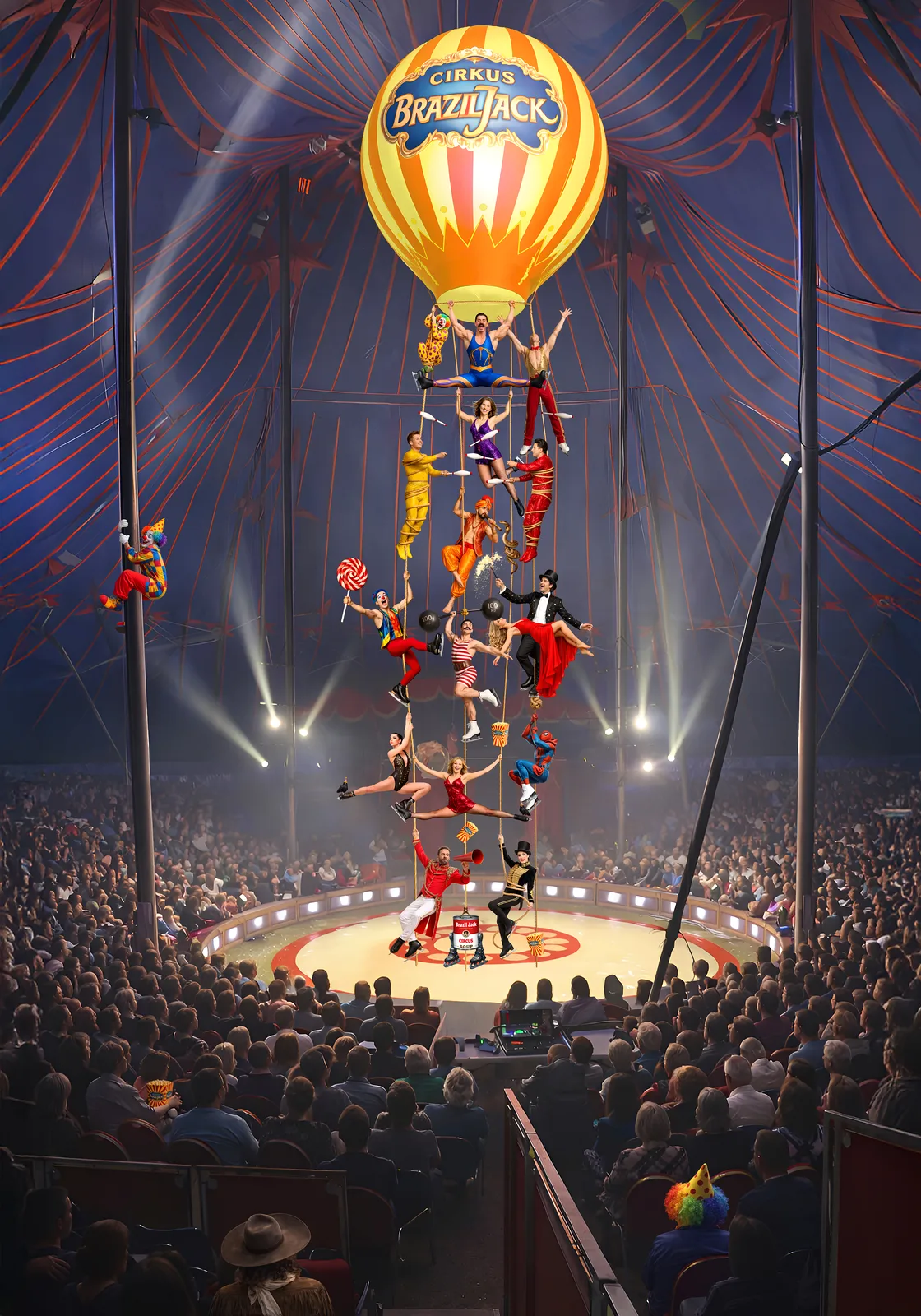
Introduction — A Circle Held in the Air
Before a single word is spoken, the image has already conveyed its message.
A ring of light gathers the crowd. Above it, a delicate structure of bodies rises—balanced, suspended, held together by trust rather than force. At the very top, a balloon bearing the name of Cirkus Brazil Jack hovers like a sun, as if the entire construction depends on something both weightless and vast.
Nothing here is certain. Each element relies on another. Every movement risks falling apart. Yet, for now, it remains.
This is the circus.
Not merely as spectacle, but as a form: a living structure built on movement, repetition, and the ongoing negotiation between control and uncertainty. What seems effortless is the result of precision. What looks playful carries risk. What appears temporary leaves a lasting imprint.
The audience surrounds it, forming a circle. Their attention is active—it supports what they see. Without it, the structure would collapse. With it, the impossible briefly becomes real.
This image does not show a performance.
It demonstrates a principle.
The circus is not simply a place, but a way of organising bodies, space, and attention into a shared moment that cannot be exactly replicated. It rises, like this human tower, from countless individual acts—each reliant on the others, each contributing to a fragile whole.
And when it concludes, nothing remains where it once stood.
Besides the memory of balance.
Except the sense that something held together—against gravity, against time, against certainty—long enough to be seen.
This essay starts with a picture.
“The Last Light of the Travelling Ring
It came before the roads were straight
before the towns had settled into certainty,
when distance still meant something
and the arrival carried weight.
You heard it first—
not the music, not the drums,
but the tremor in the air,
a murmur of wheels against gravel,
a language of movement
spoken long before it was seen.
Then the colours appeared.
Red worn by weather,
gold dulled by rain and hands,
canvas breathing like a lung
in the open field at the edge of everything.
Children stood closest.
They always did.
As if they understood
that’s what was coming
would not stay.
Inside—
there was no world,
only a circle
where the world forgot itself.
A horse moved like memory,
turning and turning
as if time could be trained.
A man in a borrowed hat
stood at the centre,
holding nothing
but the attention of others
as if it were reins.
A woman rose into the air
and did not fall—
not because she could not,
but because, for a moment,
the ground agreed to wait.
And somewhere, always,
a clown laughed too loudly
at something that was not quite a joke,
holding together the silence
between what was risked
and what was saved.
Outside, the night remained the same.
Stars did not rearrange themselves.
The fields did not remember the footsteps.
But something had shifted—
not in the ground,
but in those who had watched.
They left carrying fragments:
a balance that held,
a fall that never came,
a feeling that the world
might have edges after all.
And by morning,
nothing remained.
Only a circle
you could not see—
and could not quite forget.
The Circle That Returns
Some forms belong to places, and others move through them.
The circus belongs to the latter.
It does not anchor itself in stone, nor does it depend on permanence to define its existence. It arrives, accumulates, transforms, and then disappears. What endures is not the structure but the impression it leaves—the feeling that something momentarily disrupted the order of things.
To comprehend the circus, one must therefore start not with buildings or institutions, but with movement. A movement that dates back to the elongated arena of the Circus Maximus, where spectacle followed a line, and forward to the circular ring shaped by Philip Astley in eighteenth-century London, where that line was drawn inward and held.
Between these two gestures—expansion and concentration—the circus discovered its shape.
But form alone does not sustain it.
The circus survives through those who sustain it. Through performers, workers, and directors who recognise that its essence isn't fixed but can be recreated repeatedly, in different places, under changing conditions. Among them stands Brazil Jack, a figure whose life traces the circus's journey across Europe and into Sweden, not as an invention but as a continuation.
In Sweden, especially in cities like Malmö, this movement finds a receptive environment. A landscape shaped by distance and transition, where arrivals and departures are not disruptions but part of the rhythm itself. The circus does not impose itself here; it aligns with what is already there.
This essay accompanies that movement.
From ancient Rome to the contemporary performance circle. From open fields to enclosed venues. From spectacles featuring animals to a form centred on the human body. From recognised figures to shared traditions—among them those upheld by Romani communities, whose knowledge of movement and continuity has long intertwined with circus life.
At its core lies a paradox.
The circus creates a space that feels whole, yet exists only for a short time. It attracts attention, yet relies on dispersal. It hints at continuity, yet endures through change.
And yet, it returns. Not to the same place, and never in the same form — but always recognisable. Like a circle, drawn once more.
Wherever people gather, look, and believe—if only for a moment—that something extraordinary could happen within an ordinary world.
"Orimmad Gonks
"
Malmö, mars 2026
Brazil Jack - The Man Who Moved the Circle - Mannen som flyttade cirkeln
Prologue
Before the tent is erected, before the posters are stuck on walls and pillars, before the first wagon arrives in town, there is only a shape.
A circle.
It is simple enough to draw—one continuous line without a beginning or an end—and yet it encompasses within it the entire logic of the circus. Not as a building, not as an institution, but as an idea. A space set apart. A boundary that gathers people, directs their gaze, and suspends, for a moment, the ordinary order of things.
The circus begins here, not with spectacle, but with separation.
Inside the circle, something is about to occur. Outside it, life continues as it always has. The distinction is subtle, almost invisible, yet absolute. Cross that line, and the rules change. Gravity persists, but it is contested. Identity remains, but it is enacted. Time itself seems to pause, stretched between expectation and wonder.
This circle, however, does not stay where it is drawn.
Unlike the arenas of antiquity or the theatres of later centuries, the circus does not belong to a fixed place. It arrives, builds its own centre, and departs again, leaving no permanent mark besides memory. The ground returns to what it was—a field, a square, an empty lot—but something has moved through it, something that cannot be entirely erased.
In this sense, the circus is not a location. It is a movement.
It moves along roads that connect places without belonging to any of them. It appears at the edges of cities, seasons, and expectations—and transforms these edges into temporary centres. For a brief moment, the periphery becomes the focus, and the overlooked is illuminated.
Then it moves on.
To follow the circus is therefore not to follow a line, but a series of circles—drawn, dissolved, and drawn again elsewhere. Each one is complete in itself, each one echoes the others, and none of them is permanent.
This is the paradox at the core of the circus: it creates a form that suggests continuity, yet exists only through change.
In Sweden, a country shaped by distance, shifting light, and a landscape that alternates between openness and enclosure, this paradox finds a particular resonance. The circus does not disrupt the landscape but aligns with it. It follows its rhythms. It respects its silences. It briefly injects a concentrated intensity into a space otherwise governed by restraint.
Cities such as Malmö—open to the sea, shaped by movement, accustomed to arrivals and departures—become natural hosts for this form. The circus does not fully transform them; it reveals something already present within them.
A readiness for change. A tolerance for the temporary. A curiosity about what comes from elsewhere. And at the centre of it all, always, the same shape remains.
The circle. Not fixed, not anchored, but carried—like a memory, like a promise—across time and space.
Drawn once more, wherever people gather to watch, wonder, and believe, even if only for a moment, that the world can be different.
Chapter 1 — Circus Maximus: The Line Before the Circle
If one insists on tracing the origin of the circus to a single place, one inevitably arrives at Circus Maximus in Rome. Yet, to do so requires a correction just as important as the claim itself: this first “circus” was not a perfect circle. It was a line—stretched, elongated, and bent into an oval.
According to Roman tradition, the site dates back to the city's very founding. In 753 BCE, when Romulus is said to have established Rome, the valley between the Palatine and Aventine hills already served as a gathering place. It was here, during the early regal period—traditionally dated to the 7th–6th centuries BCE—that the ludi, the public games, began to take shape.
Among these early events were the Consualia, games attributed to Romulus himself. Under the pretence of celebration—horse races, contests, festivities—the Romans invited neighbouring peoples, including the Sabines. What followed, as later sources recount, was the abduction of the Sabine women. The spectacle, in other words, was never innocent. From its earliest moments, the gathering of crowds, the directing of attention, and the suspension of ordinary order could serve purposes beyond mere entertainment.
The structure that later became known as the Circus Maximus developed gradually. By the time of the Roman Republic, especially from the 3rd to 2nd centuries BCE, the space had adopted a more defined architectural form. Under Julius Caesar in the 1st century BCE, it was significantly expanded, becoming one of the largest venues in the Roman world. Later emperors, including Augustus (reigned 27 BCE – 14 CE) and other early Empire rulers, continued to monumentalise the site.
At its peak, during the first centuries of the Roman Empire, the Circus Maximus could seat well over 150,000 spectators—possibly more. It was no longer a temporary gathering place, but a permanent, central feature of Roman public life.
And yet, despite its scale and permanence, its logic remained that of movement.
The Circus Maximus was a racetrack. A vast, architectural expression of motion, designed not for containment but for speed. At its centre was the spina, a dividing barrier that transformed the arena into a circuit of repetition. Horses and chariots did not gather towards a middle point; they raced along a path, around it, against it, driven forward by momentum rather than by balance.
Here, the spectacle was directional. It unfolded in time and space, progressing rather than revolving. The audience did not look at the centre; it followed a motion. Eyes moved along the track, anticipating the next turn, the next collision, the next moment where control might give way to chaos.
And yet, even within this linear logic, elements that feel unmistakably familiar appear. Horses stood at the heart of the spectacle, their power both harnessed and showcased. Around the races, between them, and sometimes within the broader programme, performers emerged—acrobats, tricksters, figures who occupied the margins of the main event. They did not define the space, but they animated it, creating variation, rhythm, and interruptions.
In this layering, one can begin to sense a structure that would later be condensed and refined. Not yet a circus as we understand it, but a gathering of its components: movement, risk, display, and audience, all brought together within a defined space.
What distinguishes the Roman form is precisely its refusal of the circle. It does not concentrate experience; it disperses it along a path. The arena is not a point of focus but a field of progression. One might say that the Circus Maximus represents the circus before it turns inward.
That turn would come much later. When the modern circus emerged in eighteenth-century Europe, the elongated track was compressed into a circle. What had once been a race became a balance. What had been stretched across distance was gathered into a centre. The horse remained, but its function changed—from speed to control, from forward motion to circular precision.
Seen in this light, the Circus Maximus is not the complete circus, but its first expansion—formed over centuries, from its legendary founding in 753 BCE to its grand peak during the Empire. It is the line before the circle, the outward gesture that would eventually be drawn inward.
The arena in Rome has long fallen silent. Its structure now exists only in fragments, its function dissolved with the empire that sustained it. But the logic it contained did not vanish. It moved—carried not by stone, but by practice, by memory, by repetition throughout time.
And when it reappeared, it was transformed.
Chapter 1 — Circus Maximus: The Line Before the Circle
If one insists on tracing the origin of the circus to a single place, one inevitably arrives at Circus Maximus in Rome. However, this requires an important correction: the first “circus” was not a circle. It was a line—stretched, elongated, and bent into an oval.
According to Roman tradition, the site dates back to the city's very founding. In 753 BCE, when Romulus is said to have established Rome, the valley between the Palatine and Aventine hills was already a gathering place. It was here, during the early regal period—traditionally dated to the 7th–6th centuries BCE—that the first organised games began to take shape.
Among these early events were the *Consualia*, games attributed to Romulus himself. Under the pretext of celebration—horse races, contests, festivities—the Romans invited neighbouring peoples, including the Sabines. What followed, as later sources recount, was the abduction of the Sabine women.
The moment is portrayed not as confusion, but as precision. While the guests were engrossed in the spectacle—focused on the races, the movement, and the shared excitement—the Romans acted. The signal was given. Instantly, the meaning of the gathering shifted. What had seemed as hospitality revealed itself as strategy.
Seen in this light, the event reveals something fundamental. The spectacle did not merely entertain; it organised attention. And once attention was organised, it could be harnessed. The crowd, united in its gaze, became—if only for a moment—defenceless through that very unity. The visible held them. The decisive battle happened elsewhere.
The spectacle, in other words, was never innocent. From its very beginning, the gathering of bodies, the focusing of attention, and the pausing of normal rules could almost effortlessly shift from celebration into action. The arena did not merely display power; it made it possible.
The structure that would later be known as the Circus Maximus developed gradually. By the time of the Roman Republic, especially from the third to the second centuries BC, the space had taken on a more defined architectural shape. Under Julius Caesar in the first century BC, it was significantly expanded. Under Augustus (27 BC – 14 AD) and subsequent emperors, it was monumentalised into one of the largest public venues in the Roman world.
At its peak, the Circus Maximus could accommodate over 150,000 spectators. It was no longer a temporary gathering place but a permanent centre of collective focus—an institution where politics, entertainment, and mass experience came together.
Yet, despite its scale and permanence, its logic remained that of movement.
The Circus Maximus was a racetrack. A vast architectural symbol of motion, designed not for containment but for speed. At its centre ran the *spina*, a dividing barrier that turned the arena into a circuit of repetition. Horses and chariots did not gather towards a middle point; they raced along a route, around it, against it, driven forward by momentum rather than drawn inward by balance.
Here, the spectacle was directional. It unfolded in time and space, progressing rather than revolving. The audience did not look at the centre; it followed a motion. Eyes moved along the track, anticipating the next turn, the next collision, the next moment where control might give way to chaos.
And yet, even within this linear logic, elements appear that feel unmistakably familiar. Horses stood at the core of the spectacle, their power both harnessed and displayed. Around the races, between them, and sometimes within the broader program, performers appeared—acrobats, tricksters, figures who occupied the margins of the main event. They did not define the space, but they animated it, creating variation, rhythm, and interruption.
In this layering, one begins to recognise a structure that would later be condensed and refined. Not yet a circus as we understand it, but a gathering of its components: movement, risk, display, and audience, all brought together within a defined space.
What distinguishes the Roman form is precisely its rejection of the circle. It does not concentrate experience; it disperses it along a path. The arena is not a point of focus but a field of progression. One might say that the Circus Maximus represents the circus before it turns inward.
That turn would come much later. When the modern circus emerged in eighteenth-century Europe, the elongated track was compressed into a circle. What had once been a race became a display of balance. What had been stretched across distances was gathered into a centre. The horse remained, but its role changed—from speed to control, from forward motion to circular precision.
Seen in this light, the Circus Maximus is not the circus in its final form, but its first expansion—developed over centuries, from the legendary founding in 753 BCE to its monumental peak under the Roman Empire. It is the line before the circle, the outward gesture that would eventually be drawn inward.
The arena in Rome has long since fallen silent. Its structure remains only in fragments, its purpose dissolved with the empire that sustained it. But the logic it contained did not vanish. It moved—carried not by stone, but by practice, by memory, by repetition across time.
And when it reappeared, it did so in a transformed form.
The line had become a circle.
Chapter 2 — The Ring Is Invented
If the Roman circus spread motion across a distance, the modern circus does the opposite. It gathers, compresses, and holds it in place.
This shift is usually attributed to Philip Astley in late-eighteenth-century London, around 1768. But as with all origins, its significance lies more in the change it signifies than in the specific date.
Astley did not intend to invent the circus as a cultural form. He was a horse rider, skilled in equestrian performance. What he discovered—perhaps instinctively, perhaps through practice—was that a horse moving in a circle created a certain kind of stability. The centrifugal force helped the rider’s balance. The body, instead of resisting motion, learned to work with it.
From this practical realisation grew something much larger.
The circle—roughly 13 metres across—was chosen not for symbolic reasons but for physical ones. However, once established, it started to influence everything happening within it. Movement was no longer linear, as in Rome. It was rotational. The performer did not move from point to point; instead, he repeatedly returned to the same spot.
This had implications for perception.
In a circular space, there is no privileged viewpoint. The audience surrounds the action. Every movement must be clear from all sides. Every gesture must reach across the entire ring. The performer is no longer part of a sequence along a track, but the centre of a shared field of attention.
The circus, in its modern form, emerged from this shift—from line to circle, from progression to concentration.
Astley quickly understood that the horse alone was not enough. Between the riding displays, other performers were introduced, including acrobats, rope walkers, and clowns. What had been peripheral in Rome became integrated here. The programme was no longer a single dominant event with interruptions; it was a composition of acts, each contributing to a rhythm.
The clown, in particular, assumes a new role. Not merely a filler, but a mediator. He bridges the acts, absorbs tension, and redirects attention. While the Roman spectacle could be overwhelming, the modern circus adjusts. It introduces variety within limits.
It is also here that one observes a subtle reversal of the earlier dynamic of attention.
In Rome, attention could be used against the audience, directed outward, allowing something decisive to happen elsewhere. In Astley’s ring, attention is directed inward and held there. The whole structure relies on it. There is no outside action, no hidden event. Everything must happen within the circle, under everyone's gaze.
Control, in other words, becomes apparent.
And yet, the tension persists. The horse may be controlled, but it remains a living force. The acrobat may rehearse, but the risk is real. The circle contains danger but does not eradicate it. It frames it, makes it understandable, and transforms it into something that can be shared.
What Astley created was therefore not only a new form of entertainment but also a new spatial logic—a way of organising bodies, movement, and attention into a coherent whole.
From this point onwards, the circus is no longer linked to monumental architecture. It can be assembled and disassembled. The ring can be drawn anywhere—a field, a courtyard, a temporary structure. What matters is not the permanence of the space but the precision of its form.
The circle, once discovered, becomes portable.
And with that portability, the circus begins to move in a new way—not as a relic of older traditions, but as a defined form capable of reproducing itself across distances.
The line has been gathered.
The circle holds.
Chapter 3 — The Circus Comes to Sweden
If the circle made the circus portable, it also made it inevitable.
By the early nineteenth century, the form established by Philip Astley had begun to spread across Europe, not as a fixed institution, but as something that could be carried by people, through practice and repetition. The circus did not arrive in Sweden as a finished idea. It arrived gradually, in fragments, adapting itself to a landscape that was both open and resistant.
At this time, Sweden was a country of distance. Roads stretched long between towns. Communities were small, often self-contained. Entertainment, in the modern sense, was not readily available; it appeared occasionally, and when it did, it gathered people with an intensity that is hard to imagine today.
Before the circus as such took hold, there were already figures moving through this landscape. Gycklare, musicians, itinerant performers—individuals and small groups who appeared at markets and seasonal gatherings. They worked without a fixed structure, without a defined ring, but they understood something essential: how to create attention out of nothing, how to hold it, and how to leave before it dissolved.
When the modern circus began to enter Sweden during the nineteenth century, it did not replace these traditions. Instead, it absorbed them.
The circular ring, once drawn, established a new order. What had been scattered became organised. The performance was no longer improvised in the loose sense; it followed a structured sequence. Horses moved in controlled patterns—acrobats performed within defined limits. The clown, no longer an isolated figure, became part of a system.
And yet, the older rhythm persisted.
The circus in Sweden was never entirely urban in its early stages. It belonged to movement, to the road. It travelled from town to town, from market to market, aligning itself with the seasonal flow of life. It appeared, gathered an audience, and vanished once more. The ring was drawn, held, and erased.
In this sense, the circus did not impose itself on the Swedish landscape; it followed it.
There is also something in the Swedish temperament that subtly shaped its form: a certain restraint, a preference for clarity over excess, and a sensitivity to balance. Even within spectacle, an underlying structure often remains visible. The illusion does not overwhelm; it coexists with an awareness of its construction.
This does not diminish the circus. It refines it.
By the mid- to late-nineteenth century, travelling circuses had become a recognisable presence across the country. Many came from abroad—Germany, Denmark, France—bringing with them techniques, animals, performers, and a broader European repertoire. But gradually, something else began to emerge.
A Swedish circus identity.
Not defined by isolation, but by adaptation. By the ability to take an international form and align it with local conditions. The distances remained. The roads remained. The need to build, perform, and move on remained.
What changed was the continuity.
The circus was no longer an occasional visitor. It became a returning presence. Something expected, even anticipated. In some places, its arrival marked a point in the year—a temporary shift in the rhythm of everyday life.
And within this movement, certain figures would begin to stand out. Individuals who did not merely participate in the circus but shaped its path through the country. Who understood not only how to perform within the ring, but how to carry it across distance.
The stage, in other words, was set.
The circle had learned to travel.
Chapter 4 — Malmö: A City That Receives the Circus
If the circus depends on movement, it also relies on places that know how to welcome it.
Malmö is one such place.
Situated on the edge of Sweden, facing the narrow stretch of water that separates it from Denmark, the city has long existed in a continual state of arrival and departure. Goods, people, languages, and ideas have passed through it for centuries. It is not a city resistant to movement; it is shaped by it. And for that reason, the circus did not arrive here as something entirely foreign. It entered a landscape already accustomed to transition.
In the nineteenth century, as travelling circuses started to move more regularly across Sweden, Malmö became a natural stop not only because of its size but also because of its location. It was both an endpoint and a gateway—a place where journeys paused, turned, or recommenced.
The circus did not initially appear in buildings but in open spaces.
At the outskirts of the city—fields, temporary clearings, undefined ground—the wagons would arrive. The act of arrival was itself a form of announcement. Before any performance began, the presence of the circus could be felt—animals, equipment, voices, unfamiliar rhythms. Something had entered the city that did not belong to it, and yet would, for a brief period, reshape it.
Children would gather first, then adults. Curiosity spread ahead of the performance.
The circus did not need to explain itself. It revealed itself gradually.
There is a unique quality to cities that receive travelling forms of culture. They must be open enough to permit entry, but structured enough to contain it. Malmö, at this stage of its development—growing, industrialising, but not yet fully stabilised—offered precisely this balance.
The circus could occupy its margins without being pushed away. It could attract crowds without disrupting the city’s existing order.
And yet, even in this early phase, something begins to shift.
The temporary does not remain entirely temporary. Repetition creates expectation. Expectation creates structure. The circus, returning again and again, begins to inscribe itself into the city’s memory. The fields where tents once stood are no longer neutral; they are marked, even when empty.
This is how a travelling form begins to leave traces.
In Malmö, these traces would eventually take on a more permanent shape. The desire to contain, to stabilise, to bring the spectacle within walls—this impulse grows alongside the city itself. But before that happens, it is important to recognise what comes first.
The encounter. A city and a movement meeting in an open space.
No architecture, no fixed seating, no controlled entrance—only the gathering of people around something that has arrived from elsewhere. The circus, at this moment, is still close to its origins. It is defined not by where it is, but by the fact that it is there at all.
And then, just as quickly, it is gone.
But Malmö does not return entirely to what it once was.
Something has shifted, though only slightly. The city has observed what can happen when attention is drawn, when space is altered, when the ordinary is disrupted.
And once that has been witnessed, it cannot be completely forgotten.
The ground remembers even when it is empty.
Chapter 5 — The Malmö Hippodrom: Containing the Uncontainable
At a certain point, repetition necessitates form.
What recurs often enough begins to demand a place — not a temporary clearing, not an improvised edge, but something more deliberate. In Malmö, this impulse took shape at the end of the nineteenth century, when the circus and its related spectacles were drawn inward, from field to building, from movement to structure.
The Hippodrome, inaugurated in 1899, stands as the clearest expression of this transition.
The name itself evokes memories of earlier forms of horses, of movement, of arenas defined by action. But here, in Malmö, that motion is shaped by architecture. Walls ascend where there once was open air. A roof takes the place of the sky. The entrance is no longer open; it is now controlled. One does not simply arrive; one enters.
This changes everything, and yet, at first glance, almost nothing.
The fundamental elements remain. There is still a centre. There is still an audience gathered around it. There is still the expectation that something extraordinary will occur within that defined space. But the relationship between these elements has shifted.
In the open field, the circus created its own boundary. In the Hippodrome, the boundary is predetermined.
What was once drawn and erased becomes permanent.
This permanence offers benefits. The performance is no longer affected by weather, light, or the unpredictability of outdoor spaces. Sound can be controlled. Visibility can be organised. The audience can be seated, arranged, and directed. The experience becomes more dependable, more consistent.
But something else has changed simultaneously.
The feeling of arrival lessens. The circus, once a disruption, becomes just another event. It is no longer something that changes a place; it occupies one already defined. The edge becomes the centre, but in doing so, it loses some of its unpredictability.
And yet, the Hippodrome does not erase the earlier form—it preserves it, in translation.
Inside, the circus's logic continues. The gaze remains fixed on a shared focus. The body remains at risk, at least symbolically. The performance still relies on the tension between control and the risk of failure. The circle, though no longer literally drawn in sawdust under an open sky, still exists conceptually.
One could say that the building tries to hold onto something that resists being held.
This tension gives the space its unique character. It is not just a theatre, though it shares some qualities with one. It is not just an arena, though it echoes older forms. It exists somewhere in between—a structure designed to contain movement, knowing that movement will always surpass it.
In Malmö, this architectural gesture reflects a wider transformation. The city itself is becoming more fixed, more defined, and more organised. Industrialisation, urban planning, and institutional life increasingly shape how space is used and experienced.
The Hippodrome epitomises this moment.
It signals that the circus has gained enough significance to warrant a dedicated space—and that the city feels confident enough to provide one.
Yet, even within its walls, echoes of the older rhythm persist. The performance begins. The audience assembles. Attention turns inward.
For a while, the space holds.
But when the lights dim, and the crowd disperses, what remains isn’t solely confined within the building. The experience persists, not in the structure itself, but in those who have experienced it.
The Hippodrome stands still. The circus, even here, does not.
Chapter 6 — Posters Before Performance
Before the circus arrives, it is already there, not in body, not in sound, but in image.
Long before the wagons roll into the outskirts of Malmö, before the ropes are raised or the ring is drawn, the city begins to change in another way. Walls, pillars, façades—surfaces that belong to everyday life—are taken over by something else. Colour appears where there was none. Figures emerge larger than life. Promises are made without explanation.
The circus announces itself through posters.
In the early decades of the twentieth century, this visual language became inseparable from the circus experience itself. The poster is not a supplement to the performance; it is its first act. It prepares the eye before the body arrives. It captures attention before the space is even defined.
A lion rears against a field of red. A rider stands upright on a galloping horse. A trapeze artist hangs, suspended in a moment that seems to defy both gravity and time. A clown smiles—perhaps a little too broadly—inviting laughter while suggesting something less easily named.
These images do not depict reality. They exaggerate it, distil it, transform it.
They serve as thresholds.
Seeing a circus poster in Malmö at this moment is to be briefly displaced. One remains in the city—on the way to work, passing a tram stop, turning a corner—but the image interrupts that flow. It creates a space in the mind where something else can unfold. The ordinary relaxes its hold.
In this way, the poster performs the same function as the arena once did.
It captures attention.
And, as in earlier forms, once attention is directed, it can be maintained, shaped, or even harnessed.
The viewer pauses. Their gaze lingers. The image promises more than it reveals. It suggests that what will occur inside the tent—or within the walls of the Hippodrome—is not merely an event, but an experience that surpasses the everyday. The poster does not explain how. It does not need to. It depends on suggestion, on the gap between what is seen and what is imagined.
There is also a particular clarity to this visual culture in Malmö. Perhaps it is the light, perhaps the urban fabric, but the posters tend towards clarity even in their exaggeration. They speak directly. They do not conceal their intent: Come and see.
And yet, beneath that directness lies something more complex.
The poster, like the Roman spectacle, captures attention beforehand. It creates a shared focus before the event starts. It prepares the crowd, aligns their expectations, and shapes their perception before they even step into the performance space.
What happens inside the ring will always surpass the image—but it will also be framed by it.
The circus, in other words, begins not with the first act, but with the first glance.
In Malmö, as in other places, the poster becomes part of the city’s rhythm. It appears, accumulates, fades, and is replaced. Layers build upon layers. Even when torn or weathered, the remnants remain visible—ghosts of past performances and traces of promises already fulfilled.
And then, as always, the circus arrives. But by then, something has already happened. The audience has been gathered—silently, visually, in advance. The circle has begun to form, not on the ground, but in the mind.
Chapter 7 — Brazil Jack: The Man Who Moved the Circle
If the circus in Sweden learned to travel, it also needed someone who understood what that movement truly meant.
In Brazil Jack, the travelling circus, found not only a director but also a symbol of embodiment. He did not merely operate within the structure that had emerged during the nineteenth century—he expanded it, refined it, and carried it across the country with a consistency that would outlast his own lifetime.
The name itself was already a performance.
“Brazil Jack” suggested distance, heat, and elsewhere. It evoked a geography far removed from the Scandinavian landscape of fields, forests, and coastal light. For audiences who might never leave their region, the name opened a horizon. It did not describe the man; it created him. And in doing so, it aligned perfectly with the logic of the circus: to present something that is both real and constructed at the same time.
But if the name was illusion, the life behind it was rooted in movement.
His father, Max Alexander Rhodin, broke with a settled, bourgeois existence in 1862, leaving home at the age of fourteen to join the travelling illusionist Joseph le Tort. From that moment onward, movement ceased to be an exception and became a condition. It is within this shift that Brazil Jack’s life must be understood.
He himself was born during a tour in Norway in 1871.
From the beginning, then, his life was not anchored in place, but in transit. He would carry this itinerant existence throughout his life as a circus director, fairground owner, musician, and a figure of remarkable versatility within popular entertainment.
His early career reflects this fluidity. In 1885, he took his first engagement on his own with the small family circus Bergman. Four years later, he entered a different and decisive milieu, joining the Romani company of Bomba Dimitri, where he remained for approximately three years.
This period was not incidental. It was formative.
Within that company, performance extended beyond the ring into ritual. Publicly staged weddings, music, dance, and communal celebration blurred the boundary between spectacle and life. Brazil Jack himself appeared under the name “Caroli Demitri,” taking part in ceremonies in which he symbolically married members of the troupe before a paying audience. What was presented was at once theatre and lived culture. The audience did not merely observe; it was drawn into a shared event.
When he left the company, he did not leave the relationships behind.
He held a respected position within Romani circles, described as “a man with a chair”—someone whose judgement could be sought in matters of conflict and decision. He became a godfather to Romani children and maintained connections that spanned generations. Names such as Taikon, Caldaras, Demitri, and Bessik remained part of a shared memory in which he continued to feature.
What emerges here is not a solitary figure, but a point of convergence.
When Brazil Jack later established what would become the Brazil Jack Circus, he did so not from a single tradition but through a fusion of worlds. The circus he created combined elements of Swedish rural mobility, European circus structure, and Romani performance culture—not as separate layers, but as something already interconnected.
To run such a circus required more than artistic vision. It required precision.
Wagons, performers, equipment—everything had to move in coordination over long distances and through changing conditions. The circus could not fail to arrive. It could not fail to perform. And once it had performed, it had to disappear again, leaving behind only memory and expectation. What seemed spontaneous was actually disciplined. Every act, every transition, every moment of apparent improvisation relied on repetition and control.
Yet, the circus never lost its sense of risk.
The horse remained central—reflecting both early European traditions and the deeper history of performance—but here it was part of a wider system of coordination. Around it, acrobats, clowns, and performers created variation without breaking the structure. The performance was not a series of isolated acts, but a movement through attention—guided, released, and gathered again.
This understanding went beyond the ring.
The circus arrived in a town as an event, but it left as a memory. Fields became arenas. Edges became centres. The ordinary was interrupted, reconfigured, and then restored. What remained could not be fixed in place.
This is where Brazil Jack’s importance becomes clear. He did not fix the circus. He made it move.
The continuity of Brazil Jack Circus into the present is not simply about preservation, but about adaptation. Through generations, the form has changed—responding to new conditions, new expectations, and new ethical frameworks—while keeping its core logic.
That logic is about movement. Moving the circus is not just about transportation; it's about understanding that it exists only in that movement.
In that realisation, he left behind something that cannot be contained within a building, a poster, or even a name.
A direction. The circle, carried across the road.
Chapter 8 — The Cowboy Who Rode the Swedish Road
If the circus depends on movement, it also depends on how that movement is seen.
Brazil Jack understood this with remarkable clarity. Long before the concept of branding existed, he crafted not only a circus but also an image. The image he chose did not stem from the Swedish landscape; it originated elsewhere— from a mythology already unfolding across Europe.
The cowboy.
By the turn of the twentieth century, the idea of the American West had started to spread widely. Through travelling shows, printed images, and stories involving figures like Buffalo Bill, Europe encountered a vision of vast landscapes, independence, and controlled violence. It was not an exact reflection of reality but a distilled narrative—recognisable, repeatable, and compelling.
Brazil Jack adopted this language.
The wide-brimmed hat, the posture, the relationship to the horse—these elements were not accidental. They placed him within a framework that audiences could immediately understand, even if they had never seen its origin. The cowboy represented something beyond the individual. It indicated freedom, mastery, and distance. It suggested a life in motion rather than in one spot.
In Sweden, this had a particular significance.
The landscape did not resemble the American plains, yet the distances were genuine. The roads were long. The need to move—seasonally, economically, practically—was part of daily life. The cowboy, in this context, became less a foreign figure and more a translation—a way of making visible something that already existed but had not yet been given a form.
There is also an overlap here with older traditions of mobility.
The travelling circus, like other itinerant lifestyles, relies on self-reliance, adaptability, and a familiarity with uncertainty. These qualities are amplified and simplified by the cowboy myth. By adopting that image, Brazil Jack linked the circus to a broader narrative of movement—one that connected the Swedish road to a global imagination.
And yet, as always, the image functions on more than one level.
For the audience, it is immediate. It creates recognition, expectation, and a sense that what they are about to witness belongs to a larger world. For those within the circus, it is practical. The ringmaster must keep the performance cohesive. He must command attention, establish order, and sustain the fragile balance on which everything depends.
The costume does not replace this role. It intensifies it.
The cowboy, standing at the centre of the ring, becomes both a figure and a symbol. He embodies control while hinting at freedom. He directs attention yet appears effortless. He belongs to the performance, yet stands slightly apart from it.
What remains striking is how effectively this image resonates.
It moves with the circus from town to town, from field to field, from one temporary centre to another. It precedes the performance, accompanies it, and lingers after it has ended. For many, it becomes inseparable from the memory of the circus itself.
Brazil Jack did not become an American cowboy.
He became something more precise.
A Swedish ringmaster who carried a borrowed myth across a landscape that reshaped it. A figure who stood at the intersection of local reality and global imagination, and made that intersection visible.
And in doing so, he added another layer to the circus. Not only movement, not only structure, but image. Something that could be recognised before it was understood.
Something that, like the circle itself, could be carried.
Chapter 9 — The Vanishing Menagerie
If the circus once gathered the world into the ring, it did so not only through human skill but through the presence of animals.
Within Brazil Jack Circus, as in circuses across Europe, the menagerie was long a central element. Horses remained fundamental—echoing both the Roman arena and the origins of the modern circus—but they were joined by other creatures: animals that signified distance, difference, and the possibility of control over what lay beyond the familiar.
An elephant stepping into a Swedish town did not merely perform. It carried with it an entire imagined elsewhere. A lion did not simply obey; it embodied something untamed, something that the performance sought to frame, to contain, to render visible within the safety of the ring.
The spectacle was not only in what the animals did but also in what they represented.
They transformed the circus into a condensed world— a place where the boundaries between human and animal, culture and nature, control and instinct could be staged for an audience. The trainer, positioned at the centre, became a figure of mediation—part authority, part illusionist—suggesting that what is wild can be brought under control.
For a long time, this was not questioned. But meanings are not fixed.
Over the course of the twentieth century, and increasingly so in its latter half, the relationship between humans and animals in Sweden began to shift both culturally and legally. What had once been understood as skill and mastery was reinterpreted. The same image—a trained animal responding to command—could now evoke unease rather than admiration.
In Sweden, this shift was not just theoretical.
It took shape through public debate, shifting norms, and legislation that placed animal welfare at the heart of societal responsibility. The question was no longer simply whether animals could perform, but whether they should be made to do so within the constraints of a travelling spectacle—transported, confined, and repeatedly exposed to unfamiliar environments.
The audience had changed, but so had the framework within which the circus operated.
What had once been a source of wonder increasingly appeared as a problem—both ethical and practical. The conditions needed to sustain animal acts came under scrutiny. The very idea of presenting animals for entertainment began to lose its legitimacy.
Within this evolving landscape, Brazil Jack Circus underwent a transformation that was both gradual and decisive.
The animals vanished.
Not suddenly, but as a gradual process shaped by changing expectations and stricter standards. The circus adapted—not just to stay viable but to remain acceptable within a society that had redefined its relationship with animals.
In this context, the disappearance of the menagerie was not merely an internal artistic choice. It was part of a broader Swedish development where ethical considerations became inseparable from cultural practice.
What was left was the body.
The human body, exposed, disciplined, vulnerable. The acrobat’s balance, the aerialist’s suspension, the clown’s timing—all became more visible, more central. The risk was not eliminated; it was redistributed. It could no longer be projected onto the unpredictability of animals. Instead, it had to be borne by the performers themselves.
In this shift, something was lost—but something else was clarified.
The circus no longer claimed to encompass the entire world. It no longer needed to represent distance through imported creatures. Instead, it turned inward, focusing on what could be created within the limits of human ability and imagination.
This transformation also brought the traditional circus closer to newer forms, such as Cirkus Cirkör, where the emphasis lies on expression rather than spectacle, on narrative rather than accumulation. And yet, for a circus with a history as long as Brazil Jack’s, the change carries a particular weight.
The absence of animals is not neutral.
It is felt as a trace—an echo of what once defined the form, and of why that definition could no longer stand. The space in the ring is not empty at all; it is filled with memory, with a past that continues to shape the present even as it fades away.
And yet, the circus arrives. The tent is raised. The lights are lit. The audience gathers.
Children may still carry with them images inherited from another time—elephants, lions, a world condensed into spectacle. What they encounter now is different, but not diminished. They see bodies in motion, trust enacted in real time, a choreography of precision that no longer depends on domination, but on cooperation.
The circle remains. If anything, it has become clearer.
Stripped of the need to represent everything, the circus can now focus on what it has always contained: a space where human possibility is tested, extended, and briefly made visible.
The menagerie has vanished. The form endures.
Chapter 10 — The Road That Was Shared
If the circus is driven by movement, then it is never sustained by one alone. Beneath the enduring names—most notably, Brazil Jack—lies another history, less visible but equally vital: the history of those who travelled the same roads without always being recognised.
Among them were Romani performers, workers, and families whose lives had long been defined by mobility. Long before the modern circus emerged in the eighteenth century, Romani communities across Europe had cultivated skills that naturally aligned with performance—music, animal handling, acrobatics, craftsmanship, and improvisation. But more than any specific act, they carried something else: a knowledge of how to live in motion.
When travelling circuses like Brazil Jack Circus moved across Sweden in the late nineteenth and early twentieth centuries, they did not create this mobility from nothing. They entered into an existing tradition of movement, one that was already structured, practised, and maintained across generations. The wagons bore a name, but the life within them was plural.
This plurality was not always recognised. Official histories tend to focus on directors, founders, and institutions. They record what can be documented—names, dates, ownership. But the circus itself resists fixity. It relies on knowledge carried in bodies, routines, and gestures repeated until they no longer need explanation.
Romani workers and performers often embodied this knowledge. They trained animals, repaired equipment, performed, adapted, and passed on skills that could not easily be written down. Their contribution was not only labour but also continuity—a way of maintaining a way of life that depends on constant change.
Within this shared space, there were also forms of performance that operated at the edges of the circus and sometimes even beyond it. One such example is the collaboration between travelling companies and Romani groups, in which the lines between life and spectacle were intentionally blurred.
In the company of the so-called Bombad Demitri, events were organised around Romani wedding rituals—ceremonies performed for a paying audience. Here, Brazil Jack, under the name “the Gypsy Prince Caroli Demitri,” took part in these performances, symbolically marrying the daughters of Bomba Demitri in a series of public ceremonies.
The structure is striking.
A ritual inherent to life is transformed into spectacle. A personal transition becomes a public event. The audience not only observes but also pays to witness what seems to be genuine. Music, dance, and celebration then follow, extending the occasion beyond the moment of union into a wider atmosphere of festivity.
These performances were popular.
But their popularity reveals something deeper. The audience was not only drawn to skill or risk, but to the promise of access to something perceived as real, intimate, and culturally distinct. What was presented was not an illusion in the strict sense, but a staged proximity to lived experience.
And here, the earlier logic reemerges.
Attention is focused. The gaze shifts. A boundary is crossed—not physically, but perceptually. What belongs to one context is transferred into another. The spectacle does not invent; it redefines.
In this context, these events operate at a complex crossroads. They imply exchange, cooperation, and shared spaces. However, they also provoke questions about representation—who presents, who is seen, and under what circumstances.
There is, nonetheless, no reason to romanticise this shared journey. The same societies that embraced the circus as spectacle often regarded Romani people with suspicion, restriction, and exclusion. The tent could provide a temporary sense of belonging, but outside it, the structures of the nation persisted. Travelling together did not equate to equality.
And yet, within the circus, another possibility emerged.
The performance itself required a kind of cooperation that transcended these divisions. Acts depend on timing, trust, and an awareness that goes beyond language. The trapeze artist must depend on the catcher. The ensemble must move as one. Failure is not individual; it is shared.
From this perspective, the legacy of Brazil Jack is not only that of a founder but also of a framework. A structure within which different traditions—Swedish, Romani, and others—could intersect, overlap, and support one another, even under unequal conditions. The circus did not resolve these tensions, but it made a certain form of coexistence possible.
Today, as the circus has transformed—when animals have gone, when aesthetics have shifted, and new narratives have emerged—traces of this shared history remain. They are not always visible in the performance itself, but they endure in its logic. In the rhythm of coming and going, in knowing how to create a temporary world and then dismantle it, and in understanding that movement is not a break in life but its very structure.
The road still exists.
It passes through cities like Malmö and beyond, across landscapes that have changed yet remain recognisable. It carries memories that are not fixed but moving—layered, carried forward, reinterpreted.
And at its present edge stands a contemporary figure, Trolle Rhodin III, whose lineage and life once again bring different traditions into contact. With a Romanian mother and an inherited connection—direct or indirect—to the Romani world, which has long intersected with circus life, he embodies not a single origin but a continuation shaped by crossings.
The road has not ended. It has changed hands.
And in that passage—from one generation to another, from one culture to another—the circus remains what it has always been: Shared.
Chapter 11 — Malmö Again: A Mirror of Movement
Returning to Malmö is not about going back to an origin but rather to a point where the different strands of the circus momentarily align.
The city has evolved. The open fields at its edges have been built over, structured, and incorporated into a more defined urban landscape. The temporary spaces where the circus once appeared unexpectedly are fewer and more difficult to find. Yet, the logic that once made Malmö welcoming to the circus has not vanished; it has merely changed form.
Malmö remains a place of arrival. A city shaped by movement, crossings, and the constant negotiation between what comes from elsewhere and what takes root. In this way, it continues to reflect the circus itself — not in appearance, but in structure.
Within this landscape, the legacy of Brazil Jack endures, not as repetition but as transformation. Brazil Jack Circus no longer presents the world as it once did. The animals are gone. The menagerie has vanished. What remains is something more concentrated, more deliberate.
The modern circus does not aim to encompass everything. It selects.
In the case of Brazil Jack, this selection has increasingly focused on the human body as both medium and message. Acrobatic precision, aerial movement, balance, strength—these are no longer elements within a larger spectacle, but the spectacle itself. The emphasis lies not on accumulation but on clarity.
There is also a renewed focus on form.
Light, rhythm, timing, and spatial composition assume a greater importance. The performance is no longer solely a sequence of acts, but a deliberately crafted experience. Elements once regarded as secondary—music, transitions, the pacing of attention—become crucial to the audience's perception of what occurs in the ring.
In this context, the traditional circus approaches something that was once viewed as separate: contemporary performance.
Yet, Brazil Jack does not dissolve into abstraction. It maintains its grounding in accessibility. The audience remains gathered as a collective. The experience is still shared in real time. What has changed is not the presence of spectacle, but its nature.
Here, figures such as Trolle Rhodin III, representing a later generation within the Swedish circus tradition, become significant. As a third-generation circus director, he is part of a lineage that connects directly back to the era of travelling tents and animal acts, yet operates within a fundamentally different artistic and ethical framework. His presence indicates continuity—not as repetition, but as inheritance reshaped.
The focus has shifted towards what modern audiences respond to most immediately.
Illusion, for example, has regained a central role. The magician does not command animals; he commands perception. What is seen and what is understood are no longer the same. The audience leans forward, not out of fear of physical danger but out of curiosity—how is this possible? The act plays out in the mind as much as in space.
Acrobatics, too, have assumed a more prominent role. The human body, precisely controlled and visibly at risk, provides something that remains fundamentally real in an age of digital illusion. Balance, timing, trust—these are not simulated. They occur in front of the audience, in real time, and can fail.
This is what many find most compelling today.
It is not the display of dominance over animals, but the exposure of human limits. It is not the accumulation of spectacle, but the focus of attention. The circus no longer needs to show everything; it must present something that cannot be easily replaced.
For Malmö, this transformation strikes a chord.
A city that has shifted from industry to culture, from production to expression, and recognises something of itself in this change as a multicultural town. The circus, once an external event arriving from elsewhere, now mirrors internal processes—questions of identity, form, and how to capture attention in a world flooded with images.
And yet, the structure remains familiar. A space is formed. An audience gathers. Attention is concentrated. Something occurs that exists only in that moment and cannot be exactly repeated.
The circus has evolved, but it has not lost its essence.
In Malmö, as previously, it arrives not only as entertainment but also as a way of organising perception. A means of briefly establishing a shared centre in a world that is otherwise scattered.
And now, at the centre of that space, stands a figure formed by the very movement that once transported the circus across Europe.
Trolle Rhodin III does not signify a break, but a continuation—one where lineage, geography, and cultural crossings merge. With roots spanning generations of circus life and a background that includes a Romanian mother and ties to the broader traditions that have long intersected with the circus, he embodies the form as it exists today: not fixed, but passed on.
The city welcomes him as it once welcomed others. Not as something completely new, but as something returning—altered, reshaped, yet still recognisably the same.
The circus no longer needs to arrive with animals or spectacle seen from afar. It comes with memory and those who keep it alive.
Epilogue — The Circle Remains
In the beginning, there was no circle.
There was a line—stretched across the ground in Circus Maximus, driven by speed, by direction, by the force of movement that could not yet be contained. Horses ran, crowds followed, and attention was pulled forward. The spectacle unfolded along a path.
Eventually, the line bent.
In the hands of Philip Astley in 1768, it was gathered, drawn inward, and held in place. The circle emerged—not as a symbol, but as a solution. A form where balance could be maintained, where movement returned to itself, and where the audience no longer followed but was surrounded.
From that moment, the circus transformed into something different.
No longer a journey from place to place, but a space where all converged.
And then, it started to move again.
Across Europe, across Sweden, along roads that connected places without belonging to them, the circle was carried. Not as an object, but as a practice. Drawn, erased, redrawn. In fields, in towns, in cities like Malmö. Completed each time. Each time is temporary.
In this movement, figures appeared—not as origins, but as bearers.
Brazil Jack did not create the circus from nothing. He was born into it, shaped by it, and carried it forward. From London to St. Petersburg, from shadow and light to horse and ring, his life traced the very logic the circus relies on: that nothing remains still, and that everything must be in motion to stay alive.
Around him, and within the same movement, others moved too.
Named and unnamed. Performers, workers, families. Among them, Romani traditions intertwined with the circus—sometimes recognised, often unnoticed—bringing with them knowledge of movement, continuity, and life lived without fixed ground. The circus did not belong to a single lineage. It was always shared, even when it did not openly acknowledge it.
At times, it gathered the world into itself—animals, spectacle, distance made visible. At other times, it shed these layers, returning to a more concentrated state. The body. The act. The moment where balance holds, or fails.
And still, it persisted.
In Malmö, the circus was initially performed in open fields, then indoors, and later in new formats. It was never fully assimilated. It remained somewhat apart, subtly in motion, even when contained. A reminder that space can be transformed, that attention can be gathered, and that something temporary can feel complete.
Now, the circle is drawn again.
At its centre stands not an origin but a continuation. Trolle Rhodin III carries forward a lineage that is not singular but layered—shaped by generations, crossings, and the same movement that once brought the circus into being.
The animals are gone. The spectacle has changed. The images that once promised the impossible have given way to something else—perhaps quieter, but no less precise.
The circle persists.
Not as a fixed shape, but as a way of organising the world. A space where attention converges, where risk becomes apparent, where the ordinary is momentarily paused.
It is created
Jörgen Thornberg
The Circle That Moves - Den rörliga cirkeln, 2026
Digital
50 x 70 cm
3 200 kr
The Circle That Moves - Den rörliga cirkeln
Svensk text på slutet
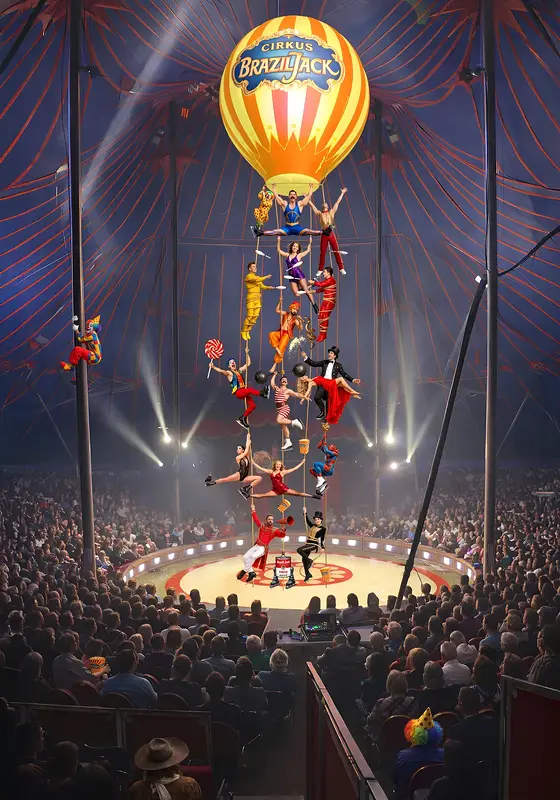
Introduction — A Circle Held in the Air
Before a single word is spoken, the image has already conveyed its message.
A ring of light gathers the crowd. Above it, a delicate structure of bodies rises—balanced, suspended, held together by trust rather than force. At the very top, a balloon bearing the name of Cirkus Brazil Jack hovers like a sun, as if the entire construction depends on something both weightless and vast.
Nothing here is certain. Each element relies on another. Every movement risks falling apart. Yet, for now, it remains.
This is the circus.
Not merely as spectacle, but as a form: a living structure built on movement, repetition, and the ongoing negotiation between control and uncertainty. What seems effortless is the result of precision. What looks playful carries risk. What appears temporary leaves a lasting imprint.
The audience surrounds it, forming a circle. Their attention is active—it supports what they see. Without it, the structure would collapse. With it, the impossible briefly becomes real.
This image does not show a performance.
It demonstrates a principle.
The circus is not simply a place, but a way of organising bodies, space, and attention into a shared moment that cannot be exactly replicated. It rises, like this human tower, from countless individual acts—each reliant on the others, each contributing to a fragile whole.
And when it concludes, nothing remains where it once stood.
Besides the memory of balance.
Except the sense that something held together—against gravity, against time, against certainty—long enough to be seen.
This essay starts with a picture.
“The Last Light of the Travelling Ring
It came before the roads were straight
before the towns had settled into certainty,
when distance still meant something
and the arrival carried weight.
You heard it first—
not the music, not the drums,
but the tremor in the air,
a murmur of wheels against gravel,
a language of movement
spoken long before it was seen.
Then the colours appeared.
Red worn by weather,
gold dulled by rain and hands,
canvas breathing like a lung
in the open field at the edge of everything.
Children stood closest.
They always did.
As if they understood
that’s what was coming
would not stay.
Inside—
there was no world,
only a circle
where the world forgot itself.
A horse moved like memory,
turning and turning
as if time could be trained.
A man in a borrowed hat
stood at the centre,
holding nothing
but the attention of others
as if it were reins.
A woman rose into the air
and did not fall—
not because she could not,
but because, for a moment,
the ground agreed to wait.
And somewhere, always,
a clown laughed too loudly
at something that was not quite a joke,
holding together the silence
between what was risked
and what was saved.
Outside, the night remained the same.
Stars did not rearrange themselves.
The fields did not remember the footsteps.
But something had shifted—
not in the ground,
but in those who had watched.
They left carrying fragments:
a balance that held,
a fall that never came,
a feeling that the world
might have edges after all.
And by morning,
nothing remained.
Only a circle
you could not see—
and could not quite forget.
The Circle That Returns
Some forms belong to places, and others move through them.
The circus belongs to the latter.
It does not anchor itself in stone, nor does it depend on permanence to define its existence. It arrives, accumulates, transforms, and then disappears. What endures is not the structure but the impression it leaves—the feeling that something momentarily disrupted the order of things.
To comprehend the circus, one must therefore start not with buildings or institutions, but with movement. A movement that dates back to the elongated arena of the Circus Maximus, where spectacle followed a line, and forward to the circular ring shaped by Philip Astley in eighteenth-century London, where that line was drawn inward and held.
Between these two gestures—expansion and concentration—the circus discovered its shape.
But form alone does not sustain it.
The circus survives through those who sustain it. Through performers, workers, and directors who recognise that its essence isn't fixed but can be recreated repeatedly, in different places, under changing conditions. Among them stands Brazil Jack, a figure whose life traces the circus's journey across Europe and into Sweden, not as an invention but as a continuation.
In Sweden, especially in cities like Malmö, this movement finds a receptive environment. A landscape shaped by distance and transition, where arrivals and departures are not disruptions but part of the rhythm itself. The circus does not impose itself here; it aligns with what is already there.
This essay accompanies that movement.
From ancient Rome to the contemporary performance circle. From open fields to enclosed venues. From spectacles featuring animals to a form centred on the human body. From recognised figures to shared traditions—among them those upheld by Romani communities, whose knowledge of movement and continuity has long intertwined with circus life.
At its core lies a paradox.
The circus creates a space that feels whole, yet exists only for a short time. It attracts attention, yet relies on dispersal. It hints at continuity, yet endures through change.
And yet, it returns. Not to the same place, and never in the same form — but always recognisable. Like a circle, drawn once more.
Wherever people gather, look, and believe—if only for a moment—that something extraordinary could happen within an ordinary world.
"Orimmad Gonks
"
Malmö, mars 2026
Brazil Jack - The Man Who Moved the Circle - Mannen som flyttade cirkeln
Prologue
Before the tent is erected, before the posters are stuck on walls and pillars, before the first wagon arrives in town, there is only a shape.
A circle.
It is simple enough to draw—one continuous line without a beginning or an end—and yet it encompasses within it the entire logic of the circus. Not as a building, not as an institution, but as an idea. A space set apart. A boundary that gathers people, directs their gaze, and suspends, for a moment, the ordinary order of things.
The circus begins here, not with spectacle, but with separation.
Inside the circle, something is about to occur. Outside it, life continues as it always has. The distinction is subtle, almost invisible, yet absolute. Cross that line, and the rules change. Gravity persists, but it is contested. Identity remains, but it is enacted. Time itself seems to pause, stretched between expectation and wonder.
This circle, however, does not stay where it is drawn.
Unlike the arenas of antiquity or the theatres of later centuries, the circus does not belong to a fixed place. It arrives, builds its own centre, and departs again, leaving no permanent mark besides memory. The ground returns to what it was—a field, a square, an empty lot—but something has moved through it, something that cannot be entirely erased.
In this sense, the circus is not a location. It is a movement.
It moves along roads that connect places without belonging to any of them. It appears at the edges of cities, seasons, and expectations—and transforms these edges into temporary centres. For a brief moment, the periphery becomes the focus, and the overlooked is illuminated.
Then it moves on.
To follow the circus is therefore not to follow a line, but a series of circles—drawn, dissolved, and drawn again elsewhere. Each one is complete in itself, each one echoes the others, and none of them is permanent.
This is the paradox at the core of the circus: it creates a form that suggests continuity, yet exists only through change.
In Sweden, a country shaped by distance, shifting light, and a landscape that alternates between openness and enclosure, this paradox finds a particular resonance. The circus does not disrupt the landscape but aligns with it. It follows its rhythms. It respects its silences. It briefly injects a concentrated intensity into a space otherwise governed by restraint.
Cities such as Malmö—open to the sea, shaped by movement, accustomed to arrivals and departures—become natural hosts for this form. The circus does not fully transform them; it reveals something already present within them.
A readiness for change. A tolerance for the temporary. A curiosity about what comes from elsewhere. And at the centre of it all, always, the same shape remains.
The circle. Not fixed, not anchored, but carried—like a memory, like a promise—across time and space.
Drawn once more, wherever people gather to watch, wonder, and believe, even if only for a moment, that the world can be different.
Chapter 1 — Circus Maximus: The Line Before the Circle
If one insists on tracing the origin of the circus to a single place, one inevitably arrives at Circus Maximus in Rome. Yet, to do so requires a correction just as important as the claim itself: this first “circus” was not a perfect circle. It was a line—stretched, elongated, and bent into an oval.
According to Roman tradition, the site dates back to the city's very founding. In 753 BCE, when Romulus is said to have established Rome, the valley between the Palatine and Aventine hills already served as a gathering place. It was here, during the early regal period—traditionally dated to the 7th–6th centuries BCE—that the ludi, the public games, began to take shape.
Among these early events were the Consualia, games attributed to Romulus himself. Under the pretence of celebration—horse races, contests, festivities—the Romans invited neighbouring peoples, including the Sabines. What followed, as later sources recount, was the abduction of the Sabine women. The spectacle, in other words, was never innocent. From its earliest moments, the gathering of crowds, the directing of attention, and the suspension of ordinary order could serve purposes beyond mere entertainment.
The structure that later became known as the Circus Maximus developed gradually. By the time of the Roman Republic, especially from the 3rd to 2nd centuries BCE, the space had adopted a more defined architectural form. Under Julius Caesar in the 1st century BCE, it was significantly expanded, becoming one of the largest venues in the Roman world. Later emperors, including Augustus (reigned 27 BCE – 14 CE) and other early Empire rulers, continued to monumentalise the site.
At its peak, during the first centuries of the Roman Empire, the Circus Maximus could seat well over 150,000 spectators—possibly more. It was no longer a temporary gathering place, but a permanent, central feature of Roman public life.
And yet, despite its scale and permanence, its logic remained that of movement.
The Circus Maximus was a racetrack. A vast, architectural expression of motion, designed not for containment but for speed. At its centre was the spina, a dividing barrier that transformed the arena into a circuit of repetition. Horses and chariots did not gather towards a middle point; they raced along a path, around it, against it, driven forward by momentum rather than by balance.
Here, the spectacle was directional. It unfolded in time and space, progressing rather than revolving. The audience did not look at the centre; it followed a motion. Eyes moved along the track, anticipating the next turn, the next collision, the next moment where control might give way to chaos.
And yet, even within this linear logic, elements that feel unmistakably familiar appear. Horses stood at the heart of the spectacle, their power both harnessed and showcased. Around the races, between them, and sometimes within the broader programme, performers emerged—acrobats, tricksters, figures who occupied the margins of the main event. They did not define the space, but they animated it, creating variation, rhythm, and interruptions.
In this layering, one can begin to sense a structure that would later be condensed and refined. Not yet a circus as we understand it, but a gathering of its components: movement, risk, display, and audience, all brought together within a defined space.
What distinguishes the Roman form is precisely its refusal of the circle. It does not concentrate experience; it disperses it along a path. The arena is not a point of focus but a field of progression. One might say that the Circus Maximus represents the circus before it turns inward.
That turn would come much later. When the modern circus emerged in eighteenth-century Europe, the elongated track was compressed into a circle. What had once been a race became a balance. What had been stretched across distance was gathered into a centre. The horse remained, but its function changed—from speed to control, from forward motion to circular precision.
Seen in this light, the Circus Maximus is not the complete circus, but its first expansion—formed over centuries, from its legendary founding in 753 BCE to its grand peak during the Empire. It is the line before the circle, the outward gesture that would eventually be drawn inward.
The arena in Rome has long fallen silent. Its structure now exists only in fragments, its function dissolved with the empire that sustained it. But the logic it contained did not vanish. It moved—carried not by stone, but by practice, by memory, by repetition throughout time.
And when it reappeared, it was transformed.
Chapter 1 — Circus Maximus: The Line Before the Circle
If one insists on tracing the origin of the circus to a single place, one inevitably arrives at Circus Maximus in Rome. However, this requires an important correction: the first “circus” was not a circle. It was a line—stretched, elongated, and bent into an oval.
According to Roman tradition, the site dates back to the city's very founding. In 753 BCE, when Romulus is said to have established Rome, the valley between the Palatine and Aventine hills was already a gathering place. It was here, during the early regal period—traditionally dated to the 7th–6th centuries BCE—that the first organised games began to take shape.
Among these early events were the *Consualia*, games attributed to Romulus himself. Under the pretext of celebration—horse races, contests, festivities—the Romans invited neighbouring peoples, including the Sabines. What followed, as later sources recount, was the abduction of the Sabine women.
The moment is portrayed not as confusion, but as precision. While the guests were engrossed in the spectacle—focused on the races, the movement, and the shared excitement—the Romans acted. The signal was given. Instantly, the meaning of the gathering shifted. What had seemed as hospitality revealed itself as strategy.
Seen in this light, the event reveals something fundamental. The spectacle did not merely entertain; it organised attention. And once attention was organised, it could be harnessed. The crowd, united in its gaze, became—if only for a moment—defenceless through that very unity. The visible held them. The decisive battle happened elsewhere.
The spectacle, in other words, was never innocent. From its very beginning, the gathering of bodies, the focusing of attention, and the pausing of normal rules could almost effortlessly shift from celebration into action. The arena did not merely display power; it made it possible.
The structure that would later be known as the Circus Maximus developed gradually. By the time of the Roman Republic, especially from the third to the second centuries BC, the space had taken on a more defined architectural shape. Under Julius Caesar in the first century BC, it was significantly expanded. Under Augustus (27 BC – 14 AD) and subsequent emperors, it was monumentalised into one of the largest public venues in the Roman world.
At its peak, the Circus Maximus could accommodate over 150,000 spectators. It was no longer a temporary gathering place but a permanent centre of collective focus—an institution where politics, entertainment, and mass experience came together.
Yet, despite its scale and permanence, its logic remained that of movement.
The Circus Maximus was a racetrack. A vast architectural symbol of motion, designed not for containment but for speed. At its centre ran the *spina*, a dividing barrier that turned the arena into a circuit of repetition. Horses and chariots did not gather towards a middle point; they raced along a route, around it, against it, driven forward by momentum rather than drawn inward by balance.
Here, the spectacle was directional. It unfolded in time and space, progressing rather than revolving. The audience did not look at the centre; it followed a motion. Eyes moved along the track, anticipating the next turn, the next collision, the next moment where control might give way to chaos.
And yet, even within this linear logic, elements appear that feel unmistakably familiar. Horses stood at the core of the spectacle, their power both harnessed and displayed. Around the races, between them, and sometimes within the broader program, performers appeared—acrobats, tricksters, figures who occupied the margins of the main event. They did not define the space, but they animated it, creating variation, rhythm, and interruption.
In this layering, one begins to recognise a structure that would later be condensed and refined. Not yet a circus as we understand it, but a gathering of its components: movement, risk, display, and audience, all brought together within a defined space.
What distinguishes the Roman form is precisely its rejection of the circle. It does not concentrate experience; it disperses it along a path. The arena is not a point of focus but a field of progression. One might say that the Circus Maximus represents the circus before it turns inward.
That turn would come much later. When the modern circus emerged in eighteenth-century Europe, the elongated track was compressed into a circle. What had once been a race became a display of balance. What had been stretched across distances was gathered into a centre. The horse remained, but its role changed—from speed to control, from forward motion to circular precision.
Seen in this light, the Circus Maximus is not the circus in its final form, but its first expansion—developed over centuries, from the legendary founding in 753 BCE to its monumental peak under the Roman Empire. It is the line before the circle, the outward gesture that would eventually be drawn inward.
The arena in Rome has long since fallen silent. Its structure remains only in fragments, its purpose dissolved with the empire that sustained it. But the logic it contained did not vanish. It moved—carried not by stone, but by practice, by memory, by repetition across time.
And when it reappeared, it did so in a transformed form.
The line had become a circle.
Chapter 2 — The Ring Is Invented
If the Roman circus spread motion across a distance, the modern circus does the opposite. It gathers, compresses, and holds it in place.
This shift is usually attributed to Philip Astley in late-eighteenth-century London, around 1768. But as with all origins, its significance lies more in the change it signifies than in the specific date.
Astley did not intend to invent the circus as a cultural form. He was a horse rider, skilled in equestrian performance. What he discovered—perhaps instinctively, perhaps through practice—was that a horse moving in a circle created a certain kind of stability. The centrifugal force helped the rider’s balance. The body, instead of resisting motion, learned to work with it.
From this practical realisation grew something much larger.
The circle—roughly 13 metres across—was chosen not for symbolic reasons but for physical ones. However, once established, it started to influence everything happening within it. Movement was no longer linear, as in Rome. It was rotational. The performer did not move from point to point; instead, he repeatedly returned to the same spot.
This had implications for perception.
In a circular space, there is no privileged viewpoint. The audience surrounds the action. Every movement must be clear from all sides. Every gesture must reach across the entire ring. The performer is no longer part of a sequence along a track, but the centre of a shared field of attention.
The circus, in its modern form, emerged from this shift—from line to circle, from progression to concentration.
Astley quickly understood that the horse alone was not enough. Between the riding displays, other performers were introduced, including acrobats, rope walkers, and clowns. What had been peripheral in Rome became integrated here. The programme was no longer a single dominant event with interruptions; it was a composition of acts, each contributing to a rhythm.
The clown, in particular, assumes a new role. Not merely a filler, but a mediator. He bridges the acts, absorbs tension, and redirects attention. While the Roman spectacle could be overwhelming, the modern circus adjusts. It introduces variety within limits.
It is also here that one observes a subtle reversal of the earlier dynamic of attention.
In Rome, attention could be used against the audience, directed outward, allowing something decisive to happen elsewhere. In Astley’s ring, attention is directed inward and held there. The whole structure relies on it. There is no outside action, no hidden event. Everything must happen within the circle, under everyone's gaze.
Control, in other words, becomes apparent.
And yet, the tension persists. The horse may be controlled, but it remains a living force. The acrobat may rehearse, but the risk is real. The circle contains danger but does not eradicate it. It frames it, makes it understandable, and transforms it into something that can be shared.
What Astley created was therefore not only a new form of entertainment but also a new spatial logic—a way of organising bodies, movement, and attention into a coherent whole.
From this point onwards, the circus is no longer linked to monumental architecture. It can be assembled and disassembled. The ring can be drawn anywhere—a field, a courtyard, a temporary structure. What matters is not the permanence of the space but the precision of its form.
The circle, once discovered, becomes portable.
And with that portability, the circus begins to move in a new way—not as a relic of older traditions, but as a defined form capable of reproducing itself across distances.
The line has been gathered.
The circle holds.
Chapter 3 — The Circus Comes to Sweden
If the circle made the circus portable, it also made it inevitable.
By the early nineteenth century, the form established by Philip Astley had begun to spread across Europe, not as a fixed institution, but as something that could be carried by people, through practice and repetition. The circus did not arrive in Sweden as a finished idea. It arrived gradually, in fragments, adapting itself to a landscape that was both open and resistant.
At this time, Sweden was a country of distance. Roads stretched long between towns. Communities were small, often self-contained. Entertainment, in the modern sense, was not readily available; it appeared occasionally, and when it did, it gathered people with an intensity that is hard to imagine today.
Before the circus as such took hold, there were already figures moving through this landscape. Gycklare, musicians, itinerant performers—individuals and small groups who appeared at markets and seasonal gatherings. They worked without a fixed structure, without a defined ring, but they understood something essential: how to create attention out of nothing, how to hold it, and how to leave before it dissolved.
When the modern circus began to enter Sweden during the nineteenth century, it did not replace these traditions. Instead, it absorbed them.
The circular ring, once drawn, established a new order. What had been scattered became organised. The performance was no longer improvised in the loose sense; it followed a structured sequence. Horses moved in controlled patterns—acrobats performed within defined limits. The clown, no longer an isolated figure, became part of a system.
And yet, the older rhythm persisted.
The circus in Sweden was never entirely urban in its early stages. It belonged to movement, to the road. It travelled from town to town, from market to market, aligning itself with the seasonal flow of life. It appeared, gathered an audience, and vanished once more. The ring was drawn, held, and erased.
In this sense, the circus did not impose itself on the Swedish landscape; it followed it.
There is also something in the Swedish temperament that subtly shaped its form: a certain restraint, a preference for clarity over excess, and a sensitivity to balance. Even within spectacle, an underlying structure often remains visible. The illusion does not overwhelm; it coexists with an awareness of its construction.
This does not diminish the circus. It refines it.
By the mid- to late-nineteenth century, travelling circuses had become a recognisable presence across the country. Many came from abroad—Germany, Denmark, France—bringing with them techniques, animals, performers, and a broader European repertoire. But gradually, something else began to emerge.
A Swedish circus identity.
Not defined by isolation, but by adaptation. By the ability to take an international form and align it with local conditions. The distances remained. The roads remained. The need to build, perform, and move on remained.
What changed was the continuity.
The circus was no longer an occasional visitor. It became a returning presence. Something expected, even anticipated. In some places, its arrival marked a point in the year—a temporary shift in the rhythm of everyday life.
And within this movement, certain figures would begin to stand out. Individuals who did not merely participate in the circus but shaped its path through the country. Who understood not only how to perform within the ring, but how to carry it across distance.
The stage, in other words, was set.
The circle had learned to travel.
Chapter 4 — Malmö: A City That Receives the Circus
If the circus depends on movement, it also relies on places that know how to welcome it.
Malmö is one such place.
Situated on the edge of Sweden, facing the narrow stretch of water that separates it from Denmark, the city has long existed in a continual state of arrival and departure. Goods, people, languages, and ideas have passed through it for centuries. It is not a city resistant to movement; it is shaped by it. And for that reason, the circus did not arrive here as something entirely foreign. It entered a landscape already accustomed to transition.
In the nineteenth century, as travelling circuses started to move more regularly across Sweden, Malmö became a natural stop not only because of its size but also because of its location. It was both an endpoint and a gateway—a place where journeys paused, turned, or recommenced.
The circus did not initially appear in buildings but in open spaces.
At the outskirts of the city—fields, temporary clearings, undefined ground—the wagons would arrive. The act of arrival was itself a form of announcement. Before any performance began, the presence of the circus could be felt—animals, equipment, voices, unfamiliar rhythms. Something had entered the city that did not belong to it, and yet would, for a brief period, reshape it.
Children would gather first, then adults. Curiosity spread ahead of the performance.
The circus did not need to explain itself. It revealed itself gradually.
There is a unique quality to cities that receive travelling forms of culture. They must be open enough to permit entry, but structured enough to contain it. Malmö, at this stage of its development—growing, industrialising, but not yet fully stabilised—offered precisely this balance.
The circus could occupy its margins without being pushed away. It could attract crowds without disrupting the city’s existing order.
And yet, even in this early phase, something begins to shift.
The temporary does not remain entirely temporary. Repetition creates expectation. Expectation creates structure. The circus, returning again and again, begins to inscribe itself into the city’s memory. The fields where tents once stood are no longer neutral; they are marked, even when empty.
This is how a travelling form begins to leave traces.
In Malmö, these traces would eventually take on a more permanent shape. The desire to contain, to stabilise, to bring the spectacle within walls—this impulse grows alongside the city itself. But before that happens, it is important to recognise what comes first.
The encounter. A city and a movement meeting in an open space.
No architecture, no fixed seating, no controlled entrance—only the gathering of people around something that has arrived from elsewhere. The circus, at this moment, is still close to its origins. It is defined not by where it is, but by the fact that it is there at all.
And then, just as quickly, it is gone.
But Malmö does not return entirely to what it once was.
Something has shifted, though only slightly. The city has observed what can happen when attention is drawn, when space is altered, when the ordinary is disrupted.
And once that has been witnessed, it cannot be completely forgotten.
The ground remembers even when it is empty.
Chapter 5 — The Malmö Hippodrom: Containing the Uncontainable
At a certain point, repetition necessitates form.
What recurs often enough begins to demand a place — not a temporary clearing, not an improvised edge, but something more deliberate. In Malmö, this impulse took shape at the end of the nineteenth century, when the circus and its related spectacles were drawn inward, from field to building, from movement to structure.
The Hippodrome, inaugurated in 1899, stands as the clearest expression of this transition.
The name itself evokes memories of earlier forms of horses, of movement, of arenas defined by action. But here, in Malmö, that motion is shaped by architecture. Walls ascend where there once was open air. A roof takes the place of the sky. The entrance is no longer open; it is now controlled. One does not simply arrive; one enters.
This changes everything, and yet, at first glance, almost nothing.
The fundamental elements remain. There is still a centre. There is still an audience gathered around it. There is still the expectation that something extraordinary will occur within that defined space. But the relationship between these elements has shifted.
In the open field, the circus created its own boundary. In the Hippodrome, the boundary is predetermined.
What was once drawn and erased becomes permanent.
This permanence offers benefits. The performance is no longer affected by weather, light, or the unpredictability of outdoor spaces. Sound can be controlled. Visibility can be organised. The audience can be seated, arranged, and directed. The experience becomes more dependable, more consistent.
But something else has changed simultaneously.
The feeling of arrival lessens. The circus, once a disruption, becomes just another event. It is no longer something that changes a place; it occupies one already defined. The edge becomes the centre, but in doing so, it loses some of its unpredictability.
And yet, the Hippodrome does not erase the earlier form—it preserves it, in translation.
Inside, the circus's logic continues. The gaze remains fixed on a shared focus. The body remains at risk, at least symbolically. The performance still relies on the tension between control and the risk of failure. The circle, though no longer literally drawn in sawdust under an open sky, still exists conceptually.
One could say that the building tries to hold onto something that resists being held.
This tension gives the space its unique character. It is not just a theatre, though it shares some qualities with one. It is not just an arena, though it echoes older forms. It exists somewhere in between—a structure designed to contain movement, knowing that movement will always surpass it.
In Malmö, this architectural gesture reflects a wider transformation. The city itself is becoming more fixed, more defined, and more organised. Industrialisation, urban planning, and institutional life increasingly shape how space is used and experienced.
The Hippodrome epitomises this moment.
It signals that the circus has gained enough significance to warrant a dedicated space—and that the city feels confident enough to provide one.
Yet, even within its walls, echoes of the older rhythm persist. The performance begins. The audience assembles. Attention turns inward.
For a while, the space holds.
But when the lights dim, and the crowd disperses, what remains isn’t solely confined within the building. The experience persists, not in the structure itself, but in those who have experienced it.
The Hippodrome stands still. The circus, even here, does not.
Chapter 6 — Posters Before Performance
Before the circus arrives, it is already there, not in body, not in sound, but in image.
Long before the wagons roll into the outskirts of Malmö, before the ropes are raised or the ring is drawn, the city begins to change in another way. Walls, pillars, façades—surfaces that belong to everyday life—are taken over by something else. Colour appears where there was none. Figures emerge larger than life. Promises are made without explanation.
The circus announces itself through posters.
In the early decades of the twentieth century, this visual language became inseparable from the circus experience itself. The poster is not a supplement to the performance; it is its first act. It prepares the eye before the body arrives. It captures attention before the space is even defined.
A lion rears against a field of red. A rider stands upright on a galloping horse. A trapeze artist hangs, suspended in a moment that seems to defy both gravity and time. A clown smiles—perhaps a little too broadly—inviting laughter while suggesting something less easily named.
These images do not depict reality. They exaggerate it, distil it, transform it.
They serve as thresholds.
Seeing a circus poster in Malmö at this moment is to be briefly displaced. One remains in the city—on the way to work, passing a tram stop, turning a corner—but the image interrupts that flow. It creates a space in the mind where something else can unfold. The ordinary relaxes its hold.
In this way, the poster performs the same function as the arena once did.
It captures attention.
And, as in earlier forms, once attention is directed, it can be maintained, shaped, or even harnessed.
The viewer pauses. Their gaze lingers. The image promises more than it reveals. It suggests that what will occur inside the tent—or within the walls of the Hippodrome—is not merely an event, but an experience that surpasses the everyday. The poster does not explain how. It does not need to. It depends on suggestion, on the gap between what is seen and what is imagined.
There is also a particular clarity to this visual culture in Malmö. Perhaps it is the light, perhaps the urban fabric, but the posters tend towards clarity even in their exaggeration. They speak directly. They do not conceal their intent: Come and see.
And yet, beneath that directness lies something more complex.
The poster, like the Roman spectacle, captures attention beforehand. It creates a shared focus before the event starts. It prepares the crowd, aligns their expectations, and shapes their perception before they even step into the performance space.
What happens inside the ring will always surpass the image—but it will also be framed by it.
The circus, in other words, begins not with the first act, but with the first glance.
In Malmö, as in other places, the poster becomes part of the city’s rhythm. It appears, accumulates, fades, and is replaced. Layers build upon layers. Even when torn or weathered, the remnants remain visible—ghosts of past performances and traces of promises already fulfilled.
And then, as always, the circus arrives. But by then, something has already happened. The audience has been gathered—silently, visually, in advance. The circle has begun to form, not on the ground, but in the mind.
Chapter 7 — Brazil Jack: The Man Who Moved the Circle
If the circus in Sweden learned to travel, it also needed someone who understood what that movement truly meant.
In Brazil Jack, the travelling circus, found not only a director but also a symbol of embodiment. He did not merely operate within the structure that had emerged during the nineteenth century—he expanded it, refined it, and carried it across the country with a consistency that would outlast his own lifetime.
The name itself was already a performance.
“Brazil Jack” suggested distance, heat, and elsewhere. It evoked a geography far removed from the Scandinavian landscape of fields, forests, and coastal light. For audiences who might never leave their region, the name opened a horizon. It did not describe the man; it created him. And in doing so, it aligned perfectly with the logic of the circus: to present something that is both real and constructed at the same time.
But if the name was illusion, the life behind it was rooted in movement.
His father, Max Alexander Rhodin, broke with a settled, bourgeois existence in 1862, leaving home at the age of fourteen to join the travelling illusionist Joseph le Tort. From that moment onward, movement ceased to be an exception and became a condition. It is within this shift that Brazil Jack’s life must be understood.
He himself was born during a tour in Norway in 1871.
From the beginning, then, his life was not anchored in place, but in transit. He would carry this itinerant existence throughout his life as a circus director, fairground owner, musician, and a figure of remarkable versatility within popular entertainment.
His early career reflects this fluidity. In 1885, he took his first engagement on his own with the small family circus Bergman. Four years later, he entered a different and decisive milieu, joining the Romani company of Bomba Dimitri, where he remained for approximately three years.
This period was not incidental. It was formative.
Within that company, performance extended beyond the ring into ritual. Publicly staged weddings, music, dance, and communal celebration blurred the boundary between spectacle and life. Brazil Jack himself appeared under the name “Caroli Demitri,” taking part in ceremonies in which he symbolically married members of the troupe before a paying audience. What was presented was at once theatre and lived culture. The audience did not merely observe; it was drawn into a shared event.
When he left the company, he did not leave the relationships behind.
He held a respected position within Romani circles, described as “a man with a chair”—someone whose judgement could be sought in matters of conflict and decision. He became a godfather to Romani children and maintained connections that spanned generations. Names such as Taikon, Caldaras, Demitri, and Bessik remained part of a shared memory in which he continued to feature.
What emerges here is not a solitary figure, but a point of convergence.
When Brazil Jack later established what would become the Brazil Jack Circus, he did so not from a single tradition but through a fusion of worlds. The circus he created combined elements of Swedish rural mobility, European circus structure, and Romani performance culture—not as separate layers, but as something already interconnected.
To run such a circus required more than artistic vision. It required precision.
Wagons, performers, equipment—everything had to move in coordination over long distances and through changing conditions. The circus could not fail to arrive. It could not fail to perform. And once it had performed, it had to disappear again, leaving behind only memory and expectation. What seemed spontaneous was actually disciplined. Every act, every transition, every moment of apparent improvisation relied on repetition and control.
Yet, the circus never lost its sense of risk.
The horse remained central—reflecting both early European traditions and the deeper history of performance—but here it was part of a wider system of coordination. Around it, acrobats, clowns, and performers created variation without breaking the structure. The performance was not a series of isolated acts, but a movement through attention—guided, released, and gathered again.
This understanding went beyond the ring.
The circus arrived in a town as an event, but it left as a memory. Fields became arenas. Edges became centres. The ordinary was interrupted, reconfigured, and then restored. What remained could not be fixed in place.
This is where Brazil Jack’s importance becomes clear. He did not fix the circus. He made it move.
The continuity of Brazil Jack Circus into the present is not simply about preservation, but about adaptation. Through generations, the form has changed—responding to new conditions, new expectations, and new ethical frameworks—while keeping its core logic.
That logic is about movement. Moving the circus is not just about transportation; it's about understanding that it exists only in that movement.
In that realisation, he left behind something that cannot be contained within a building, a poster, or even a name.
A direction. The circle, carried across the road.
Chapter 8 — The Cowboy Who Rode the Swedish Road
If the circus depends on movement, it also depends on how that movement is seen.
Brazil Jack understood this with remarkable clarity. Long before the concept of branding existed, he crafted not only a circus but also an image. The image he chose did not stem from the Swedish landscape; it originated elsewhere— from a mythology already unfolding across Europe.
The cowboy.
By the turn of the twentieth century, the idea of the American West had started to spread widely. Through travelling shows, printed images, and stories involving figures like Buffalo Bill, Europe encountered a vision of vast landscapes, independence, and controlled violence. It was not an exact reflection of reality but a distilled narrative—recognisable, repeatable, and compelling.
Brazil Jack adopted this language.
The wide-brimmed hat, the posture, the relationship to the horse—these elements were not accidental. They placed him within a framework that audiences could immediately understand, even if they had never seen its origin. The cowboy represented something beyond the individual. It indicated freedom, mastery, and distance. It suggested a life in motion rather than in one spot.
In Sweden, this had a particular significance.
The landscape did not resemble the American plains, yet the distances were genuine. The roads were long. The need to move—seasonally, economically, practically—was part of daily life. The cowboy, in this context, became less a foreign figure and more a translation—a way of making visible something that already existed but had not yet been given a form.
There is also an overlap here with older traditions of mobility.
The travelling circus, like other itinerant lifestyles, relies on self-reliance, adaptability, and a familiarity with uncertainty. These qualities are amplified and simplified by the cowboy myth. By adopting that image, Brazil Jack linked the circus to a broader narrative of movement—one that connected the Swedish road to a global imagination.
And yet, as always, the image functions on more than one level.
For the audience, it is immediate. It creates recognition, expectation, and a sense that what they are about to witness belongs to a larger world. For those within the circus, it is practical. The ringmaster must keep the performance cohesive. He must command attention, establish order, and sustain the fragile balance on which everything depends.
The costume does not replace this role. It intensifies it.
The cowboy, standing at the centre of the ring, becomes both a figure and a symbol. He embodies control while hinting at freedom. He directs attention yet appears effortless. He belongs to the performance, yet stands slightly apart from it.
What remains striking is how effectively this image resonates.
It moves with the circus from town to town, from field to field, from one temporary centre to another. It precedes the performance, accompanies it, and lingers after it has ended. For many, it becomes inseparable from the memory of the circus itself.
Brazil Jack did not become an American cowboy.
He became something more precise.
A Swedish ringmaster who carried a borrowed myth across a landscape that reshaped it. A figure who stood at the intersection of local reality and global imagination, and made that intersection visible.
And in doing so, he added another layer to the circus. Not only movement, not only structure, but image. Something that could be recognised before it was understood.
Something that, like the circle itself, could be carried.
Chapter 9 — The Vanishing Menagerie
If the circus once gathered the world into the ring, it did so not only through human skill but through the presence of animals.
Within Brazil Jack Circus, as in circuses across Europe, the menagerie was long a central element. Horses remained fundamental—echoing both the Roman arena and the origins of the modern circus—but they were joined by other creatures: animals that signified distance, difference, and the possibility of control over what lay beyond the familiar.
An elephant stepping into a Swedish town did not merely perform. It carried with it an entire imagined elsewhere. A lion did not simply obey; it embodied something untamed, something that the performance sought to frame, to contain, to render visible within the safety of the ring.
The spectacle was not only in what the animals did but also in what they represented.
They transformed the circus into a condensed world— a place where the boundaries between human and animal, culture and nature, control and instinct could be staged for an audience. The trainer, positioned at the centre, became a figure of mediation—part authority, part illusionist—suggesting that what is wild can be brought under control.
For a long time, this was not questioned. But meanings are not fixed.
Over the course of the twentieth century, and increasingly so in its latter half, the relationship between humans and animals in Sweden began to shift both culturally and legally. What had once been understood as skill and mastery was reinterpreted. The same image—a trained animal responding to command—could now evoke unease rather than admiration.
In Sweden, this shift was not just theoretical.
It took shape through public debate, shifting norms, and legislation that placed animal welfare at the heart of societal responsibility. The question was no longer simply whether animals could perform, but whether they should be made to do so within the constraints of a travelling spectacle—transported, confined, and repeatedly exposed to unfamiliar environments.
The audience had changed, but so had the framework within which the circus operated.
What had once been a source of wonder increasingly appeared as a problem—both ethical and practical. The conditions needed to sustain animal acts came under scrutiny. The very idea of presenting animals for entertainment began to lose its legitimacy.
Within this evolving landscape, Brazil Jack Circus underwent a transformation that was both gradual and decisive.
The animals vanished.
Not suddenly, but as a gradual process shaped by changing expectations and stricter standards. The circus adapted—not just to stay viable but to remain acceptable within a society that had redefined its relationship with animals.
In this context, the disappearance of the menagerie was not merely an internal artistic choice. It was part of a broader Swedish development where ethical considerations became inseparable from cultural practice.
What was left was the body.
The human body, exposed, disciplined, vulnerable. The acrobat’s balance, the aerialist’s suspension, the clown’s timing—all became more visible, more central. The risk was not eliminated; it was redistributed. It could no longer be projected onto the unpredictability of animals. Instead, it had to be borne by the performers themselves.
In this shift, something was lost—but something else was clarified.
The circus no longer claimed to encompass the entire world. It no longer needed to represent distance through imported creatures. Instead, it turned inward, focusing on what could be created within the limits of human ability and imagination.
This transformation also brought the traditional circus closer to newer forms, such as Cirkus Cirkör, where the emphasis lies on expression rather than spectacle, on narrative rather than accumulation. And yet, for a circus with a history as long as Brazil Jack’s, the change carries a particular weight.
The absence of animals is not neutral.
It is felt as a trace—an echo of what once defined the form, and of why that definition could no longer stand. The space in the ring is not empty at all; it is filled with memory, with a past that continues to shape the present even as it fades away.
And yet, the circus arrives. The tent is raised. The lights are lit. The audience gathers.
Children may still carry with them images inherited from another time—elephants, lions, a world condensed into spectacle. What they encounter now is different, but not diminished. They see bodies in motion, trust enacted in real time, a choreography of precision that no longer depends on domination, but on cooperation.
The circle remains. If anything, it has become clearer.
Stripped of the need to represent everything, the circus can now focus on what it has always contained: a space where human possibility is tested, extended, and briefly made visible.
The menagerie has vanished. The form endures.
Chapter 10 — The Road That Was Shared
If the circus is driven by movement, then it is never sustained by one alone. Beneath the enduring names—most notably, Brazil Jack—lies another history, less visible but equally vital: the history of those who travelled the same roads without always being recognised.
Among them were Romani performers, workers, and families whose lives had long been defined by mobility. Long before the modern circus emerged in the eighteenth century, Romani communities across Europe had cultivated skills that naturally aligned with performance—music, animal handling, acrobatics, craftsmanship, and improvisation. But more than any specific act, they carried something else: a knowledge of how to live in motion.
When travelling circuses like Brazil Jack Circus moved across Sweden in the late nineteenth and early twentieth centuries, they did not create this mobility from nothing. They entered into an existing tradition of movement, one that was already structured, practised, and maintained across generations. The wagons bore a name, but the life within them was plural.
This plurality was not always recognised. Official histories tend to focus on directors, founders, and institutions. They record what can be documented—names, dates, ownership. But the circus itself resists fixity. It relies on knowledge carried in bodies, routines, and gestures repeated until they no longer need explanation.
Romani workers and performers often embodied this knowledge. They trained animals, repaired equipment, performed, adapted, and passed on skills that could not easily be written down. Their contribution was not only labour but also continuity—a way of maintaining a way of life that depends on constant change.
Within this shared space, there were also forms of performance that operated at the edges of the circus and sometimes even beyond it. One such example is the collaboration between travelling companies and Romani groups, in which the lines between life and spectacle were intentionally blurred.
In the company of the so-called Bombad Demitri, events were organised around Romani wedding rituals—ceremonies performed for a paying audience. Here, Brazil Jack, under the name “the Gypsy Prince Caroli Demitri,” took part in these performances, symbolically marrying the daughters of Bomba Demitri in a series of public ceremonies.
The structure is striking.
A ritual inherent to life is transformed into spectacle. A personal transition becomes a public event. The audience not only observes but also pays to witness what seems to be genuine. Music, dance, and celebration then follow, extending the occasion beyond the moment of union into a wider atmosphere of festivity.
These performances were popular.
But their popularity reveals something deeper. The audience was not only drawn to skill or risk, but to the promise of access to something perceived as real, intimate, and culturally distinct. What was presented was not an illusion in the strict sense, but a staged proximity to lived experience.
And here, the earlier logic reemerges.
Attention is focused. The gaze shifts. A boundary is crossed—not physically, but perceptually. What belongs to one context is transferred into another. The spectacle does not invent; it redefines.
In this context, these events operate at a complex crossroads. They imply exchange, cooperation, and shared spaces. However, they also provoke questions about representation—who presents, who is seen, and under what circumstances.
There is, nonetheless, no reason to romanticise this shared journey. The same societies that embraced the circus as spectacle often regarded Romani people with suspicion, restriction, and exclusion. The tent could provide a temporary sense of belonging, but outside it, the structures of the nation persisted. Travelling together did not equate to equality.
And yet, within the circus, another possibility emerged.
The performance itself required a kind of cooperation that transcended these divisions. Acts depend on timing, trust, and an awareness that goes beyond language. The trapeze artist must depend on the catcher. The ensemble must move as one. Failure is not individual; it is shared.
From this perspective, the legacy of Brazil Jack is not only that of a founder but also of a framework. A structure within which different traditions—Swedish, Romani, and others—could intersect, overlap, and support one another, even under unequal conditions. The circus did not resolve these tensions, but it made a certain form of coexistence possible.
Today, as the circus has transformed—when animals have gone, when aesthetics have shifted, and new narratives have emerged—traces of this shared history remain. They are not always visible in the performance itself, but they endure in its logic. In the rhythm of coming and going, in knowing how to create a temporary world and then dismantle it, and in understanding that movement is not a break in life but its very structure.
The road still exists.
It passes through cities like Malmö and beyond, across landscapes that have changed yet remain recognisable. It carries memories that are not fixed but moving—layered, carried forward, reinterpreted.
And at its present edge stands a contemporary figure, Trolle Rhodin III, whose lineage and life once again bring different traditions into contact. With a Romanian mother and an inherited connection—direct or indirect—to the Romani world, which has long intersected with circus life, he embodies not a single origin but a continuation shaped by crossings.
The road has not ended. It has changed hands.
And in that passage—from one generation to another, from one culture to another—the circus remains what it has always been: Shared.
Chapter 11 — Malmö Again: A Mirror of Movement
Returning to Malmö is not about going back to an origin but rather to a point where the different strands of the circus momentarily align.
The city has evolved. The open fields at its edges have been built over, structured, and incorporated into a more defined urban landscape. The temporary spaces where the circus once appeared unexpectedly are fewer and more difficult to find. Yet, the logic that once made Malmö welcoming to the circus has not vanished; it has merely changed form.
Malmö remains a place of arrival. A city shaped by movement, crossings, and the constant negotiation between what comes from elsewhere and what takes root. In this way, it continues to reflect the circus itself — not in appearance, but in structure.
Within this landscape, the legacy of Brazil Jack endures, not as repetition but as transformation. Brazil Jack Circus no longer presents the world as it once did. The animals are gone. The menagerie has vanished. What remains is something more concentrated, more deliberate.
The modern circus does not aim to encompass everything. It selects.
In the case of Brazil Jack, this selection has increasingly focused on the human body as both medium and message. Acrobatic precision, aerial movement, balance, strength—these are no longer elements within a larger spectacle, but the spectacle itself. The emphasis lies not on accumulation but on clarity.
There is also a renewed focus on form.
Light, rhythm, timing, and spatial composition assume a greater importance. The performance is no longer solely a sequence of acts, but a deliberately crafted experience. Elements once regarded as secondary—music, transitions, the pacing of attention—become crucial to the audience's perception of what occurs in the ring.
In this context, the traditional circus approaches something that was once viewed as separate: contemporary performance.
Yet, Brazil Jack does not dissolve into abstraction. It maintains its grounding in accessibility. The audience remains gathered as a collective. The experience is still shared in real time. What has changed is not the presence of spectacle, but its nature.
Here, figures such as Trolle Rhodin III, representing a later generation within the Swedish circus tradition, become significant. As a third-generation circus director, he is part of a lineage that connects directly back to the era of travelling tents and animal acts, yet operates within a fundamentally different artistic and ethical framework. His presence indicates continuity—not as repetition, but as inheritance reshaped.
The focus has shifted towards what modern audiences respond to most immediately.
Illusion, for example, has regained a central role. The magician does not command animals; he commands perception. What is seen and what is understood are no longer the same. The audience leans forward, not out of fear of physical danger but out of curiosity—how is this possible? The act plays out in the mind as much as in space.
Acrobatics, too, have assumed a more prominent role. The human body, precisely controlled and visibly at risk, provides something that remains fundamentally real in an age of digital illusion. Balance, timing, trust—these are not simulated. They occur in front of the audience, in real time, and can fail.
This is what many find most compelling today.
It is not the display of dominance over animals, but the exposure of human limits. It is not the accumulation of spectacle, but the focus of attention. The circus no longer needs to show everything; it must present something that cannot be easily replaced.
For Malmö, this transformation strikes a chord.
A city that has shifted from industry to culture, from production to expression, and recognises something of itself in this change as a multicultural town. The circus, once an external event arriving from elsewhere, now mirrors internal processes—questions of identity, form, and how to capture attention in a world flooded with images.
And yet, the structure remains familiar. A space is formed. An audience gathers. Attention is concentrated. Something occurs that exists only in that moment and cannot be exactly repeated.
The circus has evolved, but it has not lost its essence.
In Malmö, as previously, it arrives not only as entertainment but also as a way of organising perception. A means of briefly establishing a shared centre in a world that is otherwise scattered.
And now, at the centre of that space, stands a figure formed by the very movement that once transported the circus across Europe.
Trolle Rhodin III does not signify a break, but a continuation—one where lineage, geography, and cultural crossings merge. With roots spanning generations of circus life and a background that includes a Romanian mother and ties to the broader traditions that have long intersected with the circus, he embodies the form as it exists today: not fixed, but passed on.
The city welcomes him as it once welcomed others. Not as something completely new, but as something returning—altered, reshaped, yet still recognisably the same.
The circus no longer needs to arrive with animals or spectacle seen from afar. It comes with memory and those who keep it alive.
Epilogue — The Circle Remains
In the beginning, there was no circle.
There was a line—stretched across the ground in Circus Maximus, driven by speed, by direction, by the force of movement that could not yet be contained. Horses ran, crowds followed, and attention was pulled forward. The spectacle unfolded along a path.
Eventually, the line bent.
In the hands of Philip Astley in 1768, it was gathered, drawn inward, and held in place. The circle emerged—not as a symbol, but as a solution. A form where balance could be maintained, where movement returned to itself, and where the audience no longer followed but was surrounded.
From that moment, the circus transformed into something different.
No longer a journey from place to place, but a space where all converged.
And then, it started to move again.
Across Europe, across Sweden, along roads that connected places without belonging to them, the circle was carried. Not as an object, but as a practice. Drawn, erased, redrawn. In fields, in towns, in cities like Malmö. Completed each time. Each time is temporary.
In this movement, figures appeared—not as origins, but as bearers.
Brazil Jack did not create the circus from nothing. He was born into it, shaped by it, and carried it forward. From London to St. Petersburg, from shadow and light to horse and ring, his life traced the very logic the circus relies on: that nothing remains still, and that everything must be in motion to stay alive.
Around him, and within the same movement, others moved too.
Named and unnamed. Performers, workers, families. Among them, Romani traditions intertwined with the circus—sometimes recognised, often unnoticed—bringing with them knowledge of movement, continuity, and life lived without fixed ground. The circus did not belong to a single lineage. It was always shared, even when it did not openly acknowledge it.
At times, it gathered the world into itself—animals, spectacle, distance made visible. At other times, it shed these layers, returning to a more concentrated state. The body. The act. The moment where balance holds, or fails.
And still, it persisted.
In Malmö, the circus was initially performed in open fields, then indoors, and later in new formats. It was never fully assimilated. It remained somewhat apart, subtly in motion, even when contained. A reminder that space can be transformed, that attention can be gathered, and that something temporary can feel complete.
Now, the circle is drawn again.
At its centre stands not an origin but a continuation. Trolle Rhodin III carries forward a lineage that is not singular but layered—shaped by generations, crossings, and the same movement that once brought the circus into being.
The animals are gone. The spectacle has changed. The images that once promised the impossible have given way to something else—perhaps quieter, but no less precise.
The circle persists.
Not as a fixed shape, but as a way of organising the world. A space where attention converges, where risk becomes apparent, where the ordinary is momentarily paused.
It is created
3 200 kr

Jörgen Thornberg
Malmö
Lite om bilder och mig. Translation in English at the end.
Jag är en nyfiken person som ser allt i bilder, även det jag fäster i ord, gärna tillsammans för bakom alla mina bilder finns en berättelse. Till vissa bilder hör en kortare eller längre novell som följer med bilden.
Bilder berättar historier. Jag omges av naturlig skönhet, intressanta människor och historia var jag än går. Jag använder min kamera för att dokumentera världen och blanda det jag ser med vad jag känner för att fånga den dolda magin.
Mina bilder berättar mina historier. Genom mina bilder, tryck och berättelser. Jag bjuder in dig att ta del av dessa berättelser, in i ditt liv och hem och dela min mycket personliga syn på vår värld. Mer än vad ögat ser. Jag tänker i bilder, drömmer och skriver och pratar om dem; följaktligen måste jag också skapa bilder. De blir vad jag ser, inte nödvändigtvis begränsade till verkligheten. Det finns en bild runt varje hörn. Jag hoppas att du kommer att se vad jag såg och gilla det.
Jag är också en skrivande person och till många bilder hör en kortare eller längre essay. Den följer med tavlan, tryckt på fint papper och med en personlig hälsning från mig.
Flertalet bilder startar sin resa i min kamera. Enkelt förklarat beskriver jag bilden jag ser i mitt inre, upplevd eller fantiserad. Bilden uppstår inom mig redan innan jag fått okularet till ögat. På bråkdelen av ett ögonblick ser jag vad jag vill ha och vad som kan göras med bilden. Här skall jag stoppa in en giraff, stålmannen, Titanic eller vad det är min fantasi finner ut. Ännu märkligare är att jag kommer ihåg minnesbilden långt efteråt när det blir tid att skapa verket. Om jag lyckas eller inte, är upp till betraktaren, oftast präglat av en stråk av svart humor – meningen är att man skall bli underhållen. Mina bilder blir ofta en snackis där de hänger.
Jag föredrar bilder som förmedlar ett budskap i flera lager. Vid första anblicken fylld av feel-good, en vacker utsikt, fint väder, solen skiner, blommor på ängen eller vattnet som ligger förrädiskt spegelblankt. I en sådan bild kan jag gömma min egentliga berättelse, mitt förakt för förtryckare och våldsverkare, rasister och fördomsfulla människor - ett gärna återkommande motiv mer eller mindre dolt i det vackra motivet. Jag försöker förena dem i ett gemensamt narrativ.
Bild och formgivning har löpt som en röd tråd genom livet. Fotokonst känns som en värdig final som jag gärna delar med mig.
Min genre är vid som framgår av mina bilder, temat en blandning av pop- och gatukonst i kollage som kan bestå av hundratals lager. Vissa bilder kan ta veckor, andra någon dag innan det är dags att överlämna resultatet till printverkstaden. Fine Art Prints är digitala fotocollage. I dessa kollage sker rivandet, klippandet, pusslandet, målandet, ritandet och sprayningen digitalt. Det jag monterar in kan vara hundratals år gamla bilder som jag omsorgsfullt frilägger så att de ser ut att vara en del av tavlan men också bilder skapade av mig själv efter min egen fantasi. Därefter besöks printstudion och för vissa bilder numrera en limiterad upplaga (oftast 7 exemplar) och signera för hand. Vissa bilder kan köpas i olika format. Det är bara att fråga efter vilka. Gillar man en bild som är 70x100 men inte har plats på väggen, går den kanske att få i 50x70 cm istället. Frågan är fri.
Metoden Giclée eller Fine Art Print som det också kallas är det moderna sättet för framställning av grafisk konst. Villkoret för denna typ av utskrifter är att en högkvalitativ storformatskrivare används med åldersbeständigt färgpigment och konstnärspapper eller i förekommande fall på duk. Pappret som används möter de krav på livslängd som ställs av museer och gallerier. Normalt säljer jag mina bilder oinramade så att den nya ägaren själv kan bestämma hur de skall se ut, med eller utan passepartout färg på ram, med eller utan glas etc..
Under många år ställde jag bara ut på nätet, i valda grupper och på min egen Facebooksida - https://www.facebook.com/jorgen.thornberg.9
Jag finns också på en egen hemsida som tyvärr inte alltid är uppdaterad – https://www.jth.life/ Där kan du också läsa en del av de berättelser som följer med bilden.
UTSTÄLLNINGAR
Luftkastellet, oktober 2022
Konst i Lund, november 2022
Luftkastellet, mars 2023
Engleson Galleri Caroli, april 2023
Hydra, Greece June 2023
Engleson Galleri Caroli, oktober 2023
Toppen, Höllviken december 2023
Luftkastellet, mars 2024
Torups Galleri, mars 2024
Venice, May 2024
Luftkastellet, oktober 2024
Konst i Advent, December 2024
Galleri Engleson, Caroli December 2024
Jäger & Jansson Galleri, april 2025
A bit about pictures and me.
I'm a curious person who sees everything in pictures, even what I express in words, often combining them, for behind all my pictures lies a story. These narratives, some as short as a single image and others as long as a novel, are the heart and soul of my work.
Pictures tell stories. Wherever I go, I'm surrounded by natural beauty, exciting people, and history. I use my camera to document the world and blend what I see with what I feel to capture the hidden magic.
My images tell my stories. Through my pictures, prints, and narratives, I invite you to partake in these stories in your life and home and share my deeply personal perspective of our world. More than meets the eye. I think in pictures, dream, write, and talk about them; consequently, I must create images too. They become what I see, not necessarily confined to reality. There's a picture around every corner. I hope you'll see what I saw and enjoy it.
I'm also a writer, and many images come with a shorter or longer essay. It accompanies the painting, printed on fine paper with my personal greeting.
Many pictures start their journey on my camera. Simply put, I describe the image I see in my mind, experienced or imagined. The image arises within me even before I bring the eyepiece to my eye. In a fraction of a moment, I see what I want and what can be done with the picture. Here, I'll insert a giraffe, Superman, the Titanic, or whatever my imagination conjures up. Even stranger is that I remember the mental image long after it's time to create the work. Whether I succeed is up to the observer, often imbued with a streak of black humour – the aim is to entertain. My pictures usually become a talking point wherever they hang.
I prefer pictures that convey a message in multiple layers. At first glance, they're filled with feel-good vibes, a beautiful view, lovely weather, the sun shining, flowers in the meadow, or the water lying deceptively calm. But beneath this surface beauty, I often conceal a deeper story, a narrative that challenges societal norms or explores the human condition. I invite you to delve into these hidden narratives and discover the layers of meaning within my work.
Picture and design have been a thread running through my life. Photographic art feels like a fitting finale, and I'm happy to share it.
My genre is varied, as seen in my pictures; the theme is a blend of pop and street art in collages that can consist of hundreds of layers. Some images can take weeks, others just a day before it's time to hand over the result to the print workshop. Fine Art Prints are digital photo collages. In these collages, tearing, cutting, puzzling, painting, drawing, and spraying happen digitally. What I insert can be images hundreds of years old that I carefully extract so they appear to be part of the painting, but also images created by myself, now also generated from my imagination. Next, visit the print studio and, for certain images, number a limited edition (usually 7 copies) and sign them by hand. Some images may be available in other formats. Just ask which ones. If you like an image that's 70x100 but doesn't have space on the wall, you might be able to get it in 50x70 cm instead. The question is open.
The Giclée method, or Fine Art Print as it's also called, is the modern way of producing graphic art. This method ensures the highest quality and longevity of the artwork, using a high-quality large-format printer with archival pigment inks and artist paper or, in some cases, canvas. The paper used meets the longevity requirements set by museums and galleries. I sell my pictures unframed, allowing the new owner to personalise their artwork, confident in the lasting value and quality of the piece.
For many years, I only exhibited online, in selected groups, and on my Facebook page - https://www.facebook.com/jorgen.thornberg.9. I also have my website, which unfortunately is not constantly updated - https://www.jth.life/. You can also read some of the stories accompanying the pictures there.
EXHIBITIONS
Luftkastellet, October 2022
Art in Lund, November 2022
Luftkastellet, March 2023
Engleson Gallery Caroli, April 2023
Hydra, Greece June 2023
Engleson Gallery Caroli, October 2023
Toppen, Höllviken December 2023
Luftkastellet, March 2024
Torup Gallery, March 2024
Venice, May 2024
UTSTÄLLNINGAR
Luftkastellet, oktober 2022
Konst i Lund, november 2022
Luftkastellet, mars 2023
Engleson Galleri Caroli, april 2023
Hydra, Greece June 2023
Engleson Galleri Caroli, oktober 2023
Toppen, Höllviken december 2023
Luftkastellet, mars 2024
Torups Galleri, mars 2024
Venice, May 2024
Luftkastellet, October 2024
Konst i Advent, December 2024
Galleri Engleson, Caroli December 2024
Jäger & Jansson Galleri, April 2025
Utbildning
Autodidakt
Medlem i konstnärsförening
Öppna Sinnen
Med i konstrunda
Konstrundan i Skåne
Utställningar
Luftkastellet, October 2022
Art in Lund, November 2022
Luftkastellet, March 2023
Engleson Gallery Caroli, April 2023
Hydra, Greece June 2023
Engleson Gallery Caroli, October 2023
Toppen, Höllviken December 2023
Luftkastellet, March 2024
Torup Gallery, March 2024
Venice, May 2024