Vi använder cookies för att ge dig bästa möjliga upplevelse. Välj vilka cookies du tillåter.
Läs mer i vår integritetspolicy
Jörgen Thornberg
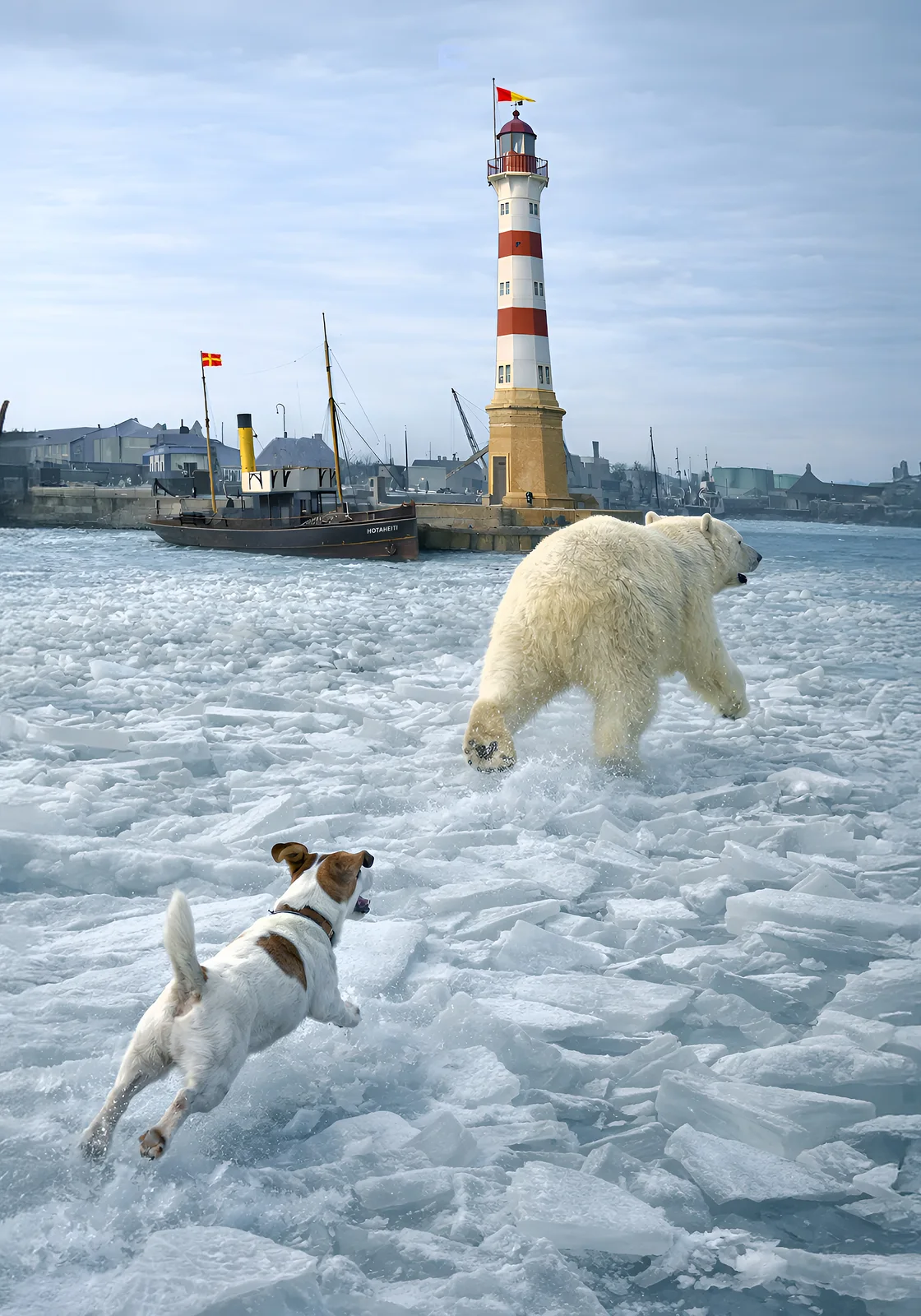
The Boozy Bear of Möllevången - Fyllebjörnen från Möllevången, 2026
Digital
50 x 70 cm
3 200 kr
The Boozy Bear of Möllevången - Fyllebjörnen från Möllevången
Svensk översättning på slutet
This story, like many other strange tales, begins with a reputation that people enjoyed laughing at but never quite managed to dispel. Abroad, Sweden had long been viewed as a land of snow, silence, and quirks, a country where people travelled on skis and where polar bears could easily roam between houses. The Swedes themselves, of course, dismissed such notions with a shrug. They understood the difference between fantasy and reality.
But the winter of 1940 was unlike any other. The cold settled over Malmö, the Sound froze, and suddenly the world looked different. When the sea became a road and distance shrank to something you could walk across, the unlikely also grew less impossible. It was under these unusual circumstances that the rumour briefly proved true, for someone had seen something out there on the ice. A bright figure. A great creature. A bear, they said. A polar bear. And a Jack Russell who chased it all the way to Denmark.
Be grateful to the ice bear that Hitler did not attempt to seize Sweden as well. Der Führer was well aware that our defences were weak, but against polar bears intoxicated by brandy, the Germans had no effective weapon. A German officer in Copenhagen experienced this firsthand and was eaten by lions in the process. And this time, the information did not come from fairy tales or from the Arctic, but from something much more grounded: a circus based in Malmö.
"Orimmad Gonks
"
Malmö, mars 2026
Prologue — The Rumour That Refused to Die
They had heard it before, though never in Sweden itself, where people clearly distinguished between a story and a mystery; however, elsewhere—café in Berlin, drawing rooms in London, in the White House in Washington, or travel notes written by men who had never gone further north than Hamburg—the idea persisted with almost commendable stubbornness: that in Sweden, polar bears roamed the streets.
It was seldom presented as fact and more often conveyed with a half-amused certainty reserved for distant places where reality could be replaced by imagination, a land of endless winter and measured silence, where people moved not on foot but by ski, gliding between houses as if snow were not a condition but a constant state of being. In that whiteness, it almost seemed logical that something large, pale, and faintly dangerous might occasionally pass between the buildings without causing undue surprise.
The Swedes, for their part, denied it with the calm confidence of those who do not feel particularly threatened by the absurd, pointing to their streets, cafés, tramlines, and the unremarkable fact that one can sit down in Malmö or Stockholm, order coffee, and expect it to arrive without interruption by Arctic wildlife. However reasonable such arguments may be, they had little impact on a rumour that required neither evidence nor correction to persist, and which seemed to thrive precisely because of the distance between those who told it and those who lived in the place it described.
Rumours, after all, have a way of lingering.
They settle, repeat themselves, gather small embellishments, and from time to time—just often enough to survive—they receive only the slightest assistance from reality, not through confirmation but via coincidence, a change in circumstances that makes the unlikely momentarily less impossible.
The winter of 1940 marked a significant change.
It arrived early and forcefully, chilling the harbour, streets, and the city's daily life until even the familiar began to feel different as the cold persisted. The winds remained calm, and the waters of the Öresund began to transform: first forming a thin, uncertain surface, then thickening, and eventually settling into a form that could support weight. Soon, people no longer just observed the ice but actively stepped onto it, crossing between Malmö and Copenhagen on foot, skis, or whatever means they had, as if the very geography had temporarily loosened its grip and allowed both shores to meet halfway.
During such a winter, when the sea could turn into land and distances could become walkable, it did not take much for the imagination to adjust accordingly. What might otherwise have been dismissed without thought was now met with a moment’s hesitation, a pause just long enough for a suggestion to take root.
Someone saw something.
Not entirely clear or complete, but sufficient to notice — a movement on the ice, a pale shape where no pale shape should be, and as the observation passed from one person to another, it acquired the necessary form. This simple and unavoidable conclusion always lurks at the end of such chains.
A bear. A white one.
A polar bear.
In Malmö.
”You must be joking!”
The laughter that followed was immediate, but it did not quite settle as easily as it should have, lingering a little longer than normal, as if uncertain whether it had dismissed something entirely imaginary or just something inconveniently real. Because this winter, unlike others, had already shown that certain boundaries were less fixed than they seemed, and if the sea could freeze, a man could walk to Denmark. Then the gap between the expected and the impossible had, at least for a moment, become dangerously narrow.
What no one yet understood, and what no one could reasonably have guessed, was that the rumours, for once, had not entirely come from nowhere, and that somewhere between the harbour, the ice, and the dimly lit streets of a city that saw itself as too ordinary for such things, something had indeed appeared — not carried south by currents or wandering in from distant Arctic silence, but reaching by far more mundane means.
It had arrived with the circus.
Chapter 1 — The Escape
Circuses come and go with a familiar rhythm that cities come to recognise without ever fully memorising, arriving with trumpets and fanfares on their carriages, posters, and promises of something beyond the ordinary — and then leaving more quietly, leaving behind little more than trampled ground and a faint sense that reality has been stretched for a few days in directions it would not normally take.
When the legendary Brazil Jack brought his company to Malmö, it was understood that the city would, for a brief period, host precisely that kind of expansion—an influx of animals, performers, and unlikely skills that seemed to belong to a different realm of existence, something not entirely separate from everyday life but sufficiently removed to be regarded as spectacle rather than reality.
Among these attractions, one drew particular attention, not because it behaved in a way that confirmed the public’s expectations, but because it quietly contradicted them. The polar bear, known to the posters and handlers as Freddie, did not display the unpredictable aggression associated with such an animal, nor did he carry himself with the distant indifference that might have made him seem untouchable. Instead, he occupied a curious middle ground—trained, responsive, and—within the carefully controlled limits of the circus—almost approachable, a creature whose size and strength remained evident but whose behaviour had been shaped into something that could be presented, repeated, and relied upon.
Freddie’s main number, if it can be called that, involved a form of boxing that owed more to tradition than realism, a stylised exchange of gestures and movements in which he, guided by his handler, would raise his paws, shift his weight, and respond to cues that created the impression of a contest without ever allowing it to become one. It was enough to fascinate an audience, to provoke laughter and applause, and to evoke that particular satisfaction that arises from briefly redefining the boundaries between human and animal into something comprehensible.
There was no sign of escape in this. The routines were established, the enclosures secure by the standards of the time, and everyone—performers, handlers, and audience—believed that what had been trained could also be contained, and that the boundary between performance and reality would stay intact as long as no one decided to cross it.
Yet such lines often depend on tiny, unnoticed details that are too mundane to be remembered—like an unlatched latch, a brief distraction, or a series of events that, individually, seem harmless. However, when combined, they lead to a result that, in hindsight, appears both unavoidable and baffling.
No one later agreed on how it happened.
Some mentioned a gate left ajar, others a handler called away at an inopportune moment. Some preferred the simpler explanation that an animal, no matter how well trained, retains within it a memory of something that cannot be entirely eradicated, a direction that exists independently of instruction and will, when given the smallest chance, emerge without warning.
What can be said with some certainty is that Freddie was not driven by panic.
There was no sudden violence, no destruction, no dramatic confrontation that might have marked the moment as exceptional. Instead, his departure appears almost incidental, a movement from one space to another, from enclosure to yard, from yard to street, as if he were following a path that had always existed, unnoticed until it was used.
The initial observations were uncertain.
A figure seen from afar, a pale shape moving among buildings, of a size that didn't match any known domestic animal, and as these impressions were exchanged, compared, and gradually aligned, the conclusion that had already begun to circulate in the city found, for the first time, some semblance of confirmation.
The rumour had spread. The one about polar bears walking the streets of Sweden in winter. Just as natural as people skiing and kick-sledging to work. Why not? If they use snakes as pillows in the tropics, then some bears can't upset anyone.
Freddie, for his part, did not seem particularly concerned about the seriousness of his situation, walking through the streets with a deliberation that suggested neither urgency nor confusion, but rather a quiet curiosity. He paused where there was space, moved on where there was none, his presence initially seen as an anomaly and, as more people observed him, as something that demanded a response, even if that response was merely standing still and watching him go by.
He was, in every important sense, out of place.
And yet, during the unusual winter conditions, when the familiar had already begun to shift, and the unlikely had gained a level of tolerance it would not normally possess, his presence did not immediately trigger the panic that might otherwise have followed. Instead, it was met with a mix of disbelief and fascination that often accompanies events with no clear precedent—a hesitation between dismissing and recognising.
A polar bear in Malmö.
Not a rumour now, but a fact—however temporary, however unstable—that had quietly woven itself, almost unnoticed, into the fabric of the city.
And Freddie, steadily moving forward, was already leaving the circus's organised layout behind, entering a part of the city where order took on a different form altogether.
Möllevången was waiting.
Chapter 2 — The Temptations of Möllevången
If the circus symbolised a form of order disguised as spectacle, then Möllevången belonged to an entirely different category—a part of Malmö where order existed, certainly, but in a looser, more negotiable sense, shaped less by intention than by habit, by the slow accumulation of lives that had learned to accommodate irregularity rather than resist it. Here, the unexpected, when it appeared, was not immediately rejected but observed, considered, and, if possible, woven into the ongoing fabric of the place.
Freddie entered this environment without ceremony, crossing from the more structured streets into a network of courtyards, workshops, and modest dwellings, where the day’s activities had already begun to settle into their evening rhythms, and where a figure of his size and colour, however unusual, did not immediately cause alarm so much as a pause, a recalibration of attention, as if those who saw him were briefly readjusting their understanding of what, under the circumstances, might be tolerated.
There are places in every city where categories blur.
Where a man may be what he claims, or something entirely different, and where the line between the expected and the improbable is navigated not through strict rules but through experience—a shared understanding that some deviations, as long as they are not excessive, can be accepted without conflict. Möllevången was such a place, and it was here that Freddie encountered the element that would change the course of his brief and otherwise unremarkable journey.
They saw him first as a shape, then as a possibility.
A white mass moving with purpose, neither hurried nor hesitant, and as recognition set in, it did so not with fear but with curiosity— that particular curiosity that arises when the extraordinary appears unexplainably and offers, in doing so, an opportunity for engagement rather than retreat.
Someone laughed.
It is difficult to say who, and even more challenging to determine whether the laughter was directed at the situation, the animal, or the quiet absurdity of being in the company of something that, by all reasonable accounts, should not have been there at all. What matters is that the laughter was not followed by concern, but by curiosity, and that curiosity, as is common in such places, quickly turned into action.
Freddie, who had been trained to respond to human presence without aggression, did not withdraw.
He paused, observed, and in doing so, allowed the gap between himself and the small group that had gathered to close to a point where interaction became not only feasible but, in a sense, unavoidable. It was at this moment that the first offering was presented, not in the form of food, which might have met with expectation, but in the form of something far less appropriate and, for that very reason, much more meaningful.
Schnapps.
The bottle was offered with a kind of casual confidence, as if its contents were understood to possess qualities beyond their usual purpose—a universal solvent for uncertainty, a way to make the unfamiliar seem approachable. Whether held out in jest or genuine curiosity, it carried the unspoken suggestion that whatever this encounter might become, it would not adhere to ordinary rules.
Freddie accepted.
Not with eagerness or reluctance, but with the same measured responsiveness that had characterised his performance in the ring—a willingness to engage with what was presented, to incorporate it into his experience without immediate judgment. As the liquid, sharp and unfamiliar, made its way into his system, it began, slowly at first and then with increasing clarity, to alter the balance that had hitherto kept his behaviour within predictable boundaries.
Alcohol affects different beings in different ways.
In some, it causes aggression; in others, withdrawal; and in many, a gradual erosion of restraint, revealing tendencies usually kept in check. However, in Freddie, it produced something far less expected: an expansive contentment that showed itself not in stillness but in motion, a lightness that contrasted with his size. As this sensation took hold, it expressed itself in a way no one present could have foreseen and that, once begun, was not easily contained.
He danced.
Not in any structured or recognisable form, and certainly not to the standards of performance he was accustomed to, but in a way that suggested an internal rhythm newly discovered—a series of shifts, turns, and gestures that gradually and more enthusiastically carried him into the centre of the space that had formed around him. As the onlookers began to respond—through laughter, encouragement, and the occasional attempt to mimic what they saw—the scene gained a quality that hovered between celebration and disbelief.
The cold, which had so far defined the season, seemed, for a moment, to recede.
Movement generates heat, and Freddie, whose body was already acclimated to much harsher conditions than those of the city, found himself, under the combined influence of exertion and intoxication, experiencing a sensation that called for adjustment. It was not a need for more activity, but for relief—a return to balance that could only be achieved by counteracting the warmth that had started to build beneath his thick fur.
He paused.
The rhythm, as it was, diminished. In its place, a different focus emerged — a shift in attention that drew him away from the circle that had formed and towards something more distant, less defined but equally compelling, a direction indicated not by sight but by scent, by the faint and persistent trace of salt carried on the air.
The sea.
It had been there all along, just beyond the structures and streets, its frozen surface stretching out into a space that, in this particular winter, no longer served as a boundary. Still, as an invitation, and as Freddie turned towards it, the shift from one environment to another began quietly, without announcement, without resistance, as if the path had been waiting for him to notice it.
Behind him, the laughter continued for a moment longer, then faded.
The group, having taken part in an event that defied easy explanation, started to disperse, each holding their own version of what had happened. Over time, this story would re-enter the city's circulation, adding to a narrative already surpassing its own limits.
Freddie moved on.
Warmer now than he had any reason to be, guided by a sensation he did not need to understand, he left Möllevången behind, carrying with him the effects of an encounter that had changed not his nature, but his path. As he approached the harbour, the faint, sharp scent of the sea grew stronger, coalescing into a presence that promised, if not clarity, then at least a sense of balance.
He was not alone in this pursuit.
Somewhere behind him, at a distance too great to notice immediately but too close to ignore, another figure had seen him—smaller, quicker. It had a resolve that would soon become clear.
The chase had begun.
Chapter 3 — The Pull of the Sea
What had begun in confusion and continued as an accidental celebration now settled into something more purposeful, as Freddie, still carrying within him the warmth and unstructured joy of his recent encounter, moved steadily toward the harbour. He was guided less by intention than by sensation, by that faint but persistent trace of salt and open space that, even in its frozen state, marked the presence of the sea.
The winter had altered the city’s relationship with its own geography.
Where there had once been a boundary—water, movement, uncertainty—there was now, under the specific conditions of that season, a surface that invited passage. This plane stretched outward from the docks and quays of Malmö and, in doing so, transformed distance into something negotiable, measurable not in nautical terms but in steps, in strides, in the simple act of moving forward without interruption.
The ice did not appear as a uniform expanse.
It varied in tone and texture, here smooth and pale, there broken and ridged, a landscape that retained, even in its solidity, the memory of movement. As Freddie approached its edge, the transition from land to frozen water did not occur as a crossing but as a continuation, a subtle shift in resistance beneath his weight that needed no more than the instinctive recalibration of balance that anyone must perform when the ground beneath them changes character.
He stepped onto the ice confidently.
From his perspective, there was no reason to treat this surface as fundamentally different from others he had encountered, no awareness of its temporary nature, no recognition of the conditions that had made it possible. As he moved outward, away from the harbour structures and into the open space of the strait, his figure, already unlikely within the city, gained a new sense of scale, appearing more fitting to the environment, as if the landscape itself was better suited to accommodate him.
Behind him, the city withdrew.
Its lines, its geometry, and its contained spaces gave way to something less defined—a horizon that stretched without obstruction. Ahead, though not yet clear in detail, lay the opposite shore, the distant outline of Copenhagen. Under normal circumstances, it would have remained separated by water. Still, in this particular winter, it existed as a destination reachable without vessels or planning, by anyone—or anything—willing to undertake the crossing.
Freddie’s movement remained steady.
It was neither hurried nor aimless, but marked by the same deliberate pace that had carried him through the streets—a rhythm lacking urgency yet filled with a certain inevitability, as if each step naturally followed the one before, without the need for decision or contemplation. The warmth that had driven him from Möllevången gradually began to fade, replaced by the colder, more familiar sensation of air brushing against his fur—a balance restored not through conscious effort but simply through exposure.
It might have ended there.
The crossing might have remained what it appeared to be: an unusual yet self-contained event, a trained animal crossing an accidental bridge between two countries, observed perhaps by a few, noted by more, and ultimately woven into the broader story of that remarkable winter.
But once set in motion, stories tend to attract complications.
The figure that had been subtly following Freddie at a distance—small enough to go unnoticed and persistent enough not to be dismissed—had now closed the gap to a point where its presence could no longer be ignored. As the space between them shrank, the nature of the relationship it signified became clearer, not through any formal declaration, but through the unmistakable language of movement.
The dog was not large.
In any other context, it might have been considered insignificant, its size categorising it as manageable, domestic, and controlled. However, such classifications rely as much on behaviour as on appearance. In this case, behaviour rendered size irrelevant, transforming what might have been a minor presence into a force driven entirely by its own resolve.
A Jack Russell is a Jack Russell.
It moved with such precision that it suggested neither hesitation nor doubt, its course fixed, its focus unwavering. As it advanced, its voice—sharp, continuous, and entirely disproportionate to its physical size—pierced through the open space with a clarity that needed no interpretation, announcing not just its presence but also its purpose. This purpose did not appear to consider the nature of the object it had chosen to pursue.
Freddie recognised it not as a threat but as an intrusion.
A disruption in his normally steady movement, a sound and motion that brought an element of unpredictability to a situation that had, until then, been defined by its quiet coherence. As he briefly turned to identify the source of this disturbance, the contrast between them—size, scale, mass, and velocity—became apparent and, under different circumstances, might have seemed absurd.
The Jack Russell did not slow.
If anything, recognising its presence seemed to strengthen its resolve, affirming the pursuit it was already committed to. As it closed the distance further, the interaction between them shifted from parallel movement to something more dynamic—a relationship defined not by coexistence but by pursuit, by the simple and clear fact that one was now following the other.
Freddie adjusted.
Not in panic or fear, but in response, a slight increase in pace and a recalibration of direction were acknowledged, without fully engaging the presence behind him. As this adjustment took hold, the movement across the ice gained a new character, no longer a solitary progression but a sequence shaped by two participants, each following a logic that did not require agreement.
The open expanse of the Öresund stretched ahead, unchanged and indifferent to the small drama unfolding on its surface. As the bear and Jack Russell moved across it, one driven by the need to restore balance, the other by a conviction that needed no justification, the distance between the two shores gradually began to diminish.
Behind them, Malmö faded.
Ahead across the ice, Copenhagen waited.
And between these points, on a surface that only existed because the season had allowed it, the rumour that had once been dismissed as impossible continued, step by step, to grow into something far more difficult to ignore.
Chapter 4 — The Crossing
There is a point, somewhere between departure and arrival, where a movement ceases to be connected to its origin but has not yet taken on the character of its destination. It was within this interval, suspended between the receding structures of Malmö and the still indistinct outline of Copenhagen, that Freddie’s crossing of the frozen surface of the Öresund gained a quality that, while entirely dependent on circumstance, still seemed to possess its own internal necessity.
The ice, which had from a distance appeared continuous, revealed, upon closer inspection, a complexity that defied simplification—a shifting arrangement of planes and fractures, of surfaces that alternately appeared smooth and resistant. Its variations demanded from those who crossed it a type of attention less concerned with direction than with adjustment, with the constant readjustment of weight and movement that allowed progress to continue unimpeded.
Freddie traversed this landscape with a steady pace that, if not elegant, was at least effective.
His size, which might have been a hindrance in other contexts, here provided an advantage, spreading his weight across the uneven surface in a way that enabled him to cross sections that would have challenged a lighter, more delicately balanced person. As he progressed, the rhythm of his movement settled into a pattern that, while lacking urgency, demonstrated a persistence that made continuing his journey less a matter of choice than of ongoing effort.
Behind him, the Jack Russell followed.
Its movement, in contrast, was driven not by adaptation but by insistence—a series of swift adjustments that constantly compensated, moment by moment, for the uneven terrain as it moved forward, its voice—sharp, unmodulated, and wholly committed—continued to express a stance that needed no elaboration: the straightforward assertion that the gap between itself and its target was not to be kept constant, but deliberately reduced.
The interaction between them did not follow any standard pursuit model.
There was no escalation into panic, no sudden increase in speed that might have made the situation seem urgently critical. Instead, there was a slow, steady deepening of connection—a gradual narrowing of distance that, while never fully settled, remained in ongoing negotiation. Freddie adjusted his course, and the Jack Russell corrected its own in response, with each move setting the scene for the next.
Periodically, they crossed paths, and these moments were observed.
Figures appeared on the ice from a distance, individuals who had, out of necessity or curiosity, undertaken their own passage between the two shores, and who, upon encountering this unlikely scene—a polar bear walking at a steady pace, chased by a dog whose resolve was extraordinary—were compelled, if only briefly, to reconsider the categories by which they interpreted what they saw.
Some stopped.
Others carried on, perhaps wisely choosing not to interfere with a situation that offered no clear invitation to intervene. As these witnesses resumed their journey, they bore an account that would, in time, return to the city, adding to a narrative already pushing its own boundaries—a story in which the unlikely had not only been imagined but observed.
The air remained still.
The cold, although still present, had lost its initial harshness, settling into a state that could be endured without resistance. As the distance to the opposite shore lessened, the forms that had so far existed only as hints began to take shape—the outlines of buildings, quays, and the ordered spaces defining the edge of the city they approached.
Copenhagen gradually appeared.
Not as a sudden revelation, but as an accumulation of detail and a horizon gaining depth, Freddie continued. The shift from the open expanse of the strait to the more contained setting of the harbour began to suggest itself not as a disruption, but as a continuation of the same movement that had carried him from enclosure to street, from street to ice, and now from ice towards another arrangement of space in which his presence would once again demand interpretation.
The Jack Russell, undiminished, maintained its course.
If the distance had not been eliminated, it would have been reduced to a point where the relation between them could no longer be considered incidental. As they approached the edge of the ice, where its irregular surface gave way to the more defined structures of the harbour, the interaction that had so far been confined to the open space of the strait began to suggest a different kind of resolution.
Freddie did not pause.
The movement that had begun without a clear purpose continued without hesitation, pushing him forward into a space that, like the one he had left, would be required to accommodate his presence, whether it was prepared to do so or not. As he stepped from the frozen surface towards the first signs of solid ground, the conditions that had made the crossing possible began, quietly, to fall away behind him.
What lay ahead was not a return to order, but another variation of it.
And within that variation, the elements that had so far defined his passage—the cold, the movement, the pursuit—would find new forms, new expressions, and, in time, a conclusion that would surpass, in both scale and consequence, anything that had yet occurred upon the ice.
Chapter 5 — The Zoo
The shift from ice to land did not present itself with a clear sign. For Freddie, whose movement had so far been guided more by continuity than by strict categories, the transition from the open, frozen expanse of the Öresund to the structured edges of Copenhagen felt less like crossing a boundary and more like a change in texture — a slight increase in resistance beneath his weight, a return to surfaces that maintained their shape without effort.
Behind him, the ice persisted, its temporary dominance already beginning to seem uncertain, as if the conditions that once supported it were now preparing to retreat, leaving only the memory of a trail that briefly linked two places without the usual pathways.
Ahead, the city coalesced into familiar forms.
Buildings, enclosures, and orderly spaces suggested function, purpose, and expectations of use. Freddie’s movement led him into one such space — neither fully public nor entirely hidden — not by deliberate intention but through natural alignment, simply because the path he followed didn’t end but continued, guiding him through an opening that, under normal circumstances, would have been marked, monitored, and controlled.
Copenhagen Zoo did not anticipate his arrival.
Its boundaries, established intentionally rather than by accident, were designed to regulate movement both inside and outside, to create a clear distinction between observer and observed, between human and animal. Yet, such distinctions, however carefully maintained, are vulnerable to disruption when the conditions supporting them shift, even slightly, from their expected alignment.
Freddie entered without objection.
There was no gate to be forced, no barrier to be overcome in a dramatic sense that might have marked the moment as exceptional. Instead, his passage seems to have happened through a convergence of circumstances too ordinary to be remarkable on its own, but enough, when combined, to yield a result that later would seem both unlikely and inevitable. In short, who fights with a bear?
The Jack Russell followed.
Its pursuit, previously characterised by open space and continuous movement, now faced a different arrangement—boundaries, paths, and enclosures that did not diminish its purpose but required it to adapt and reroute its energy through channels not originally designed for such intent. As it progressed, its voice persisted in asserting itself, steady in tone, yet now echoing against surfaces that reflected it in fragments.
The first response did not originate from the public but from those whose presence within the zoo was driven by duty rather than curiosity.
A keeper, alerted not visually but by sound—specifically the persistent, incongruous barking that disturbed the established rhythm of the institution—moved towards its source, expecting to find something manageable, something that could be dealt with within the existing framework of procedures.
What he discovered did not match that expectation.
The Jack Russell itself posed no difficulty.
Small, determined, and entirely focused, it could be contained by means appropriate to its size, and as the keeper approached, the method of containment that suggested itself required neither innovation nor risk, but simply the application of a tool designed for precisely such purposes.
A net.
The capture was swift.
The Jack Russell, whose pursuit had thus far proceeded without interruption, found itself, in a single movement, removed from the relation that had defined it. Its trajectory was halted not by the object of its attention, but by an external intervention that made its intention temporarily irrelevant. As it was lifted, contained, and carried away, the dynamic that had driven the crossing finally came to a close.
Freddie, freed from pursuit, did not immediately change his course.
The absence of the disturbance behind him registered not as relief but as a change in condition, a quieting of the environment that allowed his movement to settle into a form more closely aligned with the one it had possessed before the encounter. As he continued deeper into the structured space of the zoo, his presence began to intersect with another category of organisation, one in which animals were not anomalies but constituents.
Recognition followed.
Not immediate, not complete, but sufficient.
A polar bear, out of place in the city, became within the context of the zoo something else — a member of a category already present, already accounted for — and as those responsible for the institution began to assemble an understanding of what had occurred, the response that emerged was not one of alarm but of adjustment, a reconfiguration of roles that allowed the unexpected to be incorporated into the existing system.
Freddie was not returned.
Not immediately, and not without careful thought, but the conditions that had brought him there, the distance he had crossed, and the circumstances of his arrival all contributed to a decision favouring containment over restoration—a temporary pause of origin in favour of a present that could be controlled, observed, and, if needed, explained.
He had found, if not a destination, then at least a place where his presence could be maintained.
Meanwhile, the Jack Russell had been removed, its role finished, its contribution to the sequence of events complete, albeit not without consequences, for it had, in its own uncompromising manner, ensured that the move from one city to another was no longer a simple act but had become an event—something to be recounted, repeated, and eventually altered.
Inside the zoo, the conditions were different.
Enclosures, routines, and expectations that did not require negotiation, and as Freddie settled into this new setup, the qualities that had defined him within the circus—his responsiveness and his capacity for structured interaction—began, gradually, to reassert themselves, not as performance but as potential, as the foundation for something that, under the particular circumstances of the time, would soon take on a new form.
Outside, the city carried on.
Inside, a new story was beginning to take shape.
And at its centre, untroubled by the sequence that had brought him there, Freddie waited—not for what would happen, but for what would be asked of him next.
Chapter 6 — Gentleman Freddie
It did not take long before what was initially perceived as an anomaly began to evolve into something more valuable. In an institution like Copenhagen Zoo, this was not merely about maintaining order but about survival, especially as conditions outside the gates had already begun to shift, demanding new ways to sustain both public interest and the enterprise's future.
Freddie adapted, almost unsettlingly well, to this change.
What had been a carefully rehearsed and clearly contained act in the circus now seemed more like a possibility than just a repeat. This skill could be reactivated, adjusted, and, most importantly, reframed for a context in which the audience sought not only entertainment but also something that could briefly alleviate the increasing weight of everyday life under occupation in Denmark.
It was at this point that the comparison first emerged—not as an exact analogy but as a useful reference, offering shape to what was happening. The name invoked carried a certain timeless elegance: James J. Corbett.
Gentleman Freddie.
There was something in the way he moved, in the controlled weight of his body, in the almost exaggerated contrast between motion and stillness, that made the comparison feel less arbitrary than it might otherwise have been. When his former routine was reintroduced, initially cautiously and then with growing confidence, it became clear that not only was it possible to recreate it, but that, in this new context, it took on a different meaning altogether.
The audience assembled.
Not in the unstructured manner that had marked certain moments of the circus, but in a more cohesive formation, one that carried with it a different kind of expectation— quieter perhaps, but no less intense. When Freddie stepped forward, no longer as an escaped curiosity but as someone who had now been given a role, it became obvious that what was being offered was not merely a performance, but a reprieve— a temporary suspension of the order that normally made itself felt in everything from official announcements to private conversations.
He boxed.
Initially, not against a genuine opponent, but against a form, a structure, a sequence of movements that, even without resistance, hinted at conflict—an implied struggle that did not need to be fulfilled to be understood. It was in this hint that part of the appeal resided—that what was shown was not violence itself, but its controlled depiction—a means of observing force without experiencing its consequences.
The applause did not arrive immediately.
It grew, emerging from a tentative realisation that gradually coalesced into something more unified—something that, for a moment, brought those present into a shared experience that contrasted with the fragmented reality awaiting them outside. In this transition from hesitation to acceptance, Freddie became not only an attraction but a figure with a specific role.
He became a relief.
Not in the sense of altering anything fundamental, but more subtly—that he provided a moment of diversion, a space where attention could rest on something not requiring interpretation in political or existential terms. It was this very trait that made him valuable—not only to the audience but also to the institution, which saw in him a way to sustain continuity that might otherwise have waned.
At the same time, and perhaps inevitably, his role started to shift.
What had initially been a return to something familiar gradually developed into something more direct, approaching the point where representation and reality begin to blend, where the question is no longer whether a movement can be performed, but what happens when it is aimed at something capable of responding.
It started as a suggestion.
Not from the crowd, nor from any official source, but from a more informal sphere where the line between entertainment and provocation is less clear, and where the idea of letting Freddie encounter something other than empty air—something that could respond, deflect, or at least react—began to hold a certain resonance.
A meeting.
A match.
The concept itself was not new.
The history of the circus is filled with performances where the unexpected is intentionally staged to evoke a mixture of tension and fascination. However, in the current context, it carried a different significance. This burden extended beyond mere entertainment into territory that was not yet fully articulated but was already embedded in the proposal's very structure.
If realised, it would require an opponent.
At this stage, the seemingly harmless idea began to shift toward a direction no one, at that time, appeared fully willing to admit, yet it would soon become unavoidable.
Freddie, who had been shielded by a structure from the unpredictable so far, was now facing a situation where the outcome could no longer be guaranteed, where what had once been play risked turning into something more definite.
He did not know this.
And perhaps it was precisely because of this that what followed unfolded as it did, without resistance or hesitation, as if each step had already been written into the circumstances that had made his presence possible from the outset. For in a time when boundaries had already been crossed and what had once been unthinkable had become part of everyday life, it didn't take much for this too to seem possible. It only took someone willing to step forward. And it soon became clear that such a person not only existed but that he, for reasons that related more to himself than the situation, was ready to do exactly that.
Chapter 7 — The Officer
It was not officially announced, nor was it arranged with enough formality to appear legitimate. Still, once introduced, the idea quickly spread through informal channels, generating interest, distortion, and, most importantly, expectation, until it felt less like a decision and more like an inevitability.
The presence of occupying forces in Copenhagen had, by then, become part of the city’s visible fabric—reflected not only in uniforms and insignia but also in their manner, a way of occupying space that conveyed an unspoken assertion of authority. It was within this context that the person responsible for completing the arrangement made himself known.
He did not present himself as part of a spectacle.
He presented himself as its correction.
A German officer, whose name was recorded, misremembered, and ultimately replaced by the more enduring label to which he belonged, entered the scene not to be entertained but because he saw disorder and felt compelled to impose a more recognisable form—one in which strength was displayed, hierarchy reaffirmed, and ambiguity eliminated.
The proposal, when made, bore the tone of something that did not anticipate refusal.
A match.
Not a performance or suggestion, but a contest, presented in words that allowed little interpretation. While those overseeing the zoo recognised, at least partly, the risks involved, the conditions they operated under did not promote resistance. What might, in different circumstances, have been dismissed outright was instead permitted to proceed, if not with approval, then with reluctant acceptance. As before, Freddie was not consulted. His role, as outlined by others, merely required his presence and response to cues that had previously guided his behaviour. As he was brought into the space designated for the encounter, the framework that had previously contained his actions was subtly but decisively changed, expanding to include an element beyond full control. The officer entered with a different perception. For him, the situation was not within the ambiguous realm of performance but within a more clearly defined framework of confrontation, where his presence was not as a participant among others but as a figure whose authority extended beyond the immediate context, whose involvement altered the nature of the event. The audience gathered, though not expecting entertainment.
There was an unspoken tension, evident in how attention was directed and how silence settled more swiftly than before. As the two figures—one human, one animal—began to share the same space, the line between spectacle and event started, almost imperceptibly, to fade.
Freddie regarded him.
Not with recognition in the human sense, but through a form of perception that did not require language, which operated via association and the accumulation of past experience. It was in this moment of encounter that something from his past—something not entirely erased by training—began to assert itself.
There had been, in the circus in Malmö, a figure.
A performer whose presence was marked not by collaboration but by imposition— a man whose interactions with those around him had carried a quality that did not align with the structured mutuality of the performance, but rather with a more unilateral exercise of control. Though the details of this association could not be reconstructed precisely, what remained was sufficient.
A scent.
A tone.
A posture.
Something in the officer corresponded.
The connection didn't need to be conscious to be effective. As Freddie’s focus settled, not on the form of the man before him, but on the pattern he represented, the conditions that had previously dictated his behaviour started to shift, not abruptly, but with a quiet finality that would, in a few moments, become unmistakable.
The signal was given.
Whether through gesture, word, or the simple convergence of expectation and readiness isn’t entirely clear, but the effect was immediate—a shift from potential to action that left no room for reconsideration. As the officer advanced, his movement marked by confidence rather than caution, the encounter framed as a contest began to take shape.
Freddie moved.
Not as he had in performance, not within the limits of a rehearsed sequence, but in a manner that maintained the form of the familiar while discarding its constraints. His weight shifted, his body aligned, and in this alignment, for the first time, there was an absence of mediation—a directness with no precedent in the structured exchanges of the circus ring.
The first exchange was brief.
Perhaps too brief to be fully registered by those observing, yet it was enough to show that what was happening did not match the expectations under which it was organised. As the officer, still trying to control the situation and impose a predictable form on the movement, began to see the imbalance between intention and capacity, it suddenly and decisively became clear.
Freddie responded.
Not with excess or prolonged struggle, but with a single, decisive motion—one that echoed the gestures of his past routines yet was no longer limited by them. This movement contained all his strength, the full force of a body unrestrained by performance, and with it, the encounter ended.
It finished before it had truly begun.
The officer, whose actions had been based on a faulty understanding of the situation, found himself, in a single move, removed from the control he had aimed for. His trajectory shifted so dramatically that there was no chance of turning back. As his movement took him beyond the immediate conflict, the outcome—once uncertain—became clear and required no further interpretation.
What happened next would be remembered in many different ways.
The distance, the angle, the final point of contact—these details might vary, as such details always do. Still, the core fact remained unchanged: the encounter, meant as a display of control, had instead revealed its absence, with the consequences of this realisation extending beyond those directly involved.
Silence persisted, briefly.
Not as a lack of sound, but as a pause, a moment when the implications of what had happened had not yet been fully absorbed, and in that moment, the structure that had made the event possible gradually began, quietly, to break down, its assumptions no longer valid, its outcome no longer open to change.
Freddie stood.
Unaware, perhaps, of the importance attached to his action, but fully aware of its outcome, his movement concluded, his role, for the moment, complete.
What remained was not the match itself, but its aftermath.
And it was in that aftermath that the story, already unlikely, would assume a form that made it irreparable.
Chapter 8 — The Lions
What followed did not merely continue the encounter. Instead, it signified a redirection of force — an outward displacement that propagated the consequences of a single movement beyond its origin, into a domain governed by different conditions. It was during this brief yet decisive transition that the outcome assumed the form it would later be remembered for.
The officer did not fall. He travelled; in fact, he flew.
Though subtle, the distinction was crucial, because what happened could not merely be described as a loss of balance or control. It was better understood as a trajectory—a movement triggered by contact, sustained by momentum, a passage through space that, once begun, could not be stopped, shaping not only the end of the encounter but also its interpretation.
The distance was later contested.
Some spoke of twenty metres, others of more, and in retellings, some extended it even further. Nonetheless, these variations, though inevitable, did not distort the essence of the event, which was less about measuring space and more about its direction and where that direction ultimately led.
It ended at the enclosure.
Within Copenhagen Zoo, the layout of spaces followed a logic that separated species based on both practical and conceptual criteria, creating boundaries that defined not only where each animal belonged but also how it was perceived. Among these spaces, the lion enclosure held a position that combined visibility with containment. In this space, power could be observed without being directly confronted.
On that specific day, the enclosure was not empty.
The lions, whose routines followed patterns no less organised than those of any other zoo inhabitants, had been fed a selection of cuts that, while adequate on their own, did not eliminate the chance of variation. As the officer’s route crossed the space they occupied, the introduction of a new element into this established pattern triggered a response that required no deliberation.
Predators do not negotiate.
They recognise. Millions of years of evolution have taught them.
The division between what is and what could be is not a matter they need to consider. As the form that entered their enclosure became something that, albeit imperfectly, fit the category of prey, the reaction was neither excessive nor restrained but appropriate to the circumstances, an engagement that, once begun, continued to its natural conclusion without deviation.
The decision—if it can even be called that—was clear-cut.
Between what was supplied and what arrived, the difference was not one of necessity but of interest. Interest, in such cases, asserts its own authority— a priority that requires no justification, and once established, directs actions so plainly that other options become irrelevant.
The observers did not intervene. Why should they, when someone else was dealing with an enemy. A Nazi.
Not immediately, and not without good reason, because the circumstances that created the situation did not permit a response that was both effective and safe. As the sequence progressed, the boundary intended to separate observer from observed asserted itself in a manner that, although consistent with its purpose, no longer aligned with the original expectations for which it had been designed.
When the movement ceased, all that remained was not the form that had initially manifested.
The process, swift in its action and thorough in its result, left little that usual standards could recognise. It was only after a necessary wait, when it was safe to approach the enclosure, that those responsible could confirm what had already been understood.
There was nothing left to recover. Not even a blood stain.
The event, in its physical form, had entirely contained itself within the space where it occurred, leaving behind not an object but an absence — a state that, though hard to describe, was nonetheless clear in its message.
The silence that followed was different from the one before.
It was no longer a pause, but a realisation — a moment when the consequences of what had happened started to align with an understanding that extended beyond the immediate, beyond the boundary, beyond even the institution itself, into the wider context where such events acquire their meaning.
Within that context, the story began to shift.
What had been, until then, a series of unlikely events now took on a form that refused to be contained — a story that, once set free, would not easily be limited to the circumstances that caused it but would instead spread outward, carried by those who saw it, changed by those who heard about it, and ultimately becoming something that mattered not only in fact but in memory.
Freddie, for his part, remained where he was.
Unchanged in his immediate condition and unaltered in his perception of what had just transpired, his role—though not yet fully defined—had acquired a dimension that extended beyond mere performance, surpassing even the accidental path that had brought him here. As those around him began to consider the implications of what had happened, it became increasingly clear that the situation, far from resolving itself, was entering a new phase, one where the consequences would no longer be confined within the zoo.
There would be a response. Of that, there was little doubt.
And it was this certainty, more than the event itself, that began to shape what would come next, introducing an element into the story that could not be ignored, and which would, in time, demand an action that none of those present had initially planned to undertake.
Chapter 9 — The Return Across the Ice
It was not the event itself, but its implications that demanded action. Among those who understood this most immediately was the man responsible for maintaining the usual routines of the polar bear enclosure at Copenhagen Zoo until that moment. That responsibility, under the current circumstances, suddenly expanded, leaving little room for deliberation.
He did not wait for instructions.
In times governed by clear hierarchies, one might expect decisions, consultations, and authorisations to follow a sequence. However, the current conditions do not favour such processes. It was this lack of structure that allowed for a different response — one based not on procedure but on recognition, on the immediate realisation that what had occurred would not stay contained. When fully understood, the consequences would extend beyond the zoo's boundaries into an area where control could no longer be negotiated.
Once the conclusion was reached, there was no room for hesitation. Freddie could not stay.
Not because he failed in any particular sense, but because circumstances had shifted. The framework that had accommodated him no longer existed in a form capable of supporting him, and the authority overseeing the city would inevitably seek to reassert itself in a way that blurred the lines between accident and intention.
The decision, if it could be called that, was therefore not a choice among options but an acceptance of necessity. Freddie had to leave.
The method for achieving this revealed itself not as a plan but as a memory—a return to the natural state that had enabled his arrival, the frozen expanse of the Öresund, which, although already beginning to lose the certainty it held only days earlier, still provided a route that did not require permission, documentation, or explanation.
There was no time to prepare.
The man moved quickly, gathering only what was needed, not in terms of equipment but in determination. As he approached Freddie, who stayed within the enclosure, unmoved by the rapid shifts in his situation, the interaction that followed did not rely on force but on familiarity, on the lingering structure of trust that had been built in the brief time since his arrival.
Freddie did not resist because he had no reason to.
The cues were clear: the man's presence was not associated with danger but with continuity. As the enclosure was opened — not to oppose its purpose, but as a temporary pause — the shift from containment to movement occurred smoothly — not as an escape, but as an extension.
The choice to mount him was made without hesitation.
Considering the circumstances, few options could have achieved the desired outcome with such efficiency, and as the man positioned himself — not with the finesse of a seasoned rider but with the resolve of someone who had accepted limited choices — the resulting picture — a keeper on a polar bear — would have been regarded as impossible under any other conditions.
In this situation, it simply proved effective.
They moved quickly.
Not through the main avenues, nor along the paths that would have exposed them to observation, but through the margins — the less visible transitions between spaces — where movement could happen without immediate notice. As they left the grounds of the zoo, the city, still absorbed in its own rhythms, did not immediately notice the passage of what, in another context, would have been unmistakable.
The harbour stretched out before them. The ice, though changed, still remained.
Its surface, no longer as stable as before, still held enough integrity to permit crossing, though not without risk. As Freddie stepped onto it again, the transition from land to frozen water repeated itself, not as an echo of the previous passage, but as its inversion. This return brought with it a different set of conditions, a different urgency, and a different relation to what lay behind and ahead.
The man held his position.
Balance, in such circumstances, was not a matter of precision. Still, it was about persistence and maintaining alignment through adjustment rather than control. As they moved outward, away from Copenhagen and towards Malmö, the space between the two shores once again became the crossing point, though now under a pressure that had not existed before.
Behind them, the Danish Capital disappeared into the distance.
Ahead, the opposite shore reappeared, not just as a destination but as a sanctuary, a place where the conditions that caused the sequence of events might, if not be reversed, at least be absorbed into a less immediately intense setting.
The ice responded.
It shifted, made sounds, and marked their passage with subtle signs of strain that come with moving across a surface that was no longer entirely confident of itself, yet it remained steady, as it had before, allowing the crossing to proceed, step by step, towards its end.
They did not speak.
There was nothing left to say that could have changed the conditions under which they moved, and the relationship between them, once established, required no further words; a shared trajectory was enough to sustain the movement without interruption.
Over time, the distant shore came closer.
The structures of Malmö once again became clear. As Freddie stepped from the ice onto solid ground, the transition that had begun days earlier reached its conclusion, not as a return to the start, but as the formation of a new state, in which the events that had happened could not be erased but might, perhaps, be reinterpreted.
Behind them, the ice was about to break apart.
The passage was about to close.
And what had once been possible, for a fleeting and improbable moment, would again become unreachable, leaving only the memory of a path that had existed just long enough to let a bear, a man, and a story cross from one country into another without permission, record or immediate correction.
Freddie had come back.
But what he brought with him was no longer solely his.
Chapter 10 — The Explanation
By the time Freddie returned to Malmö, the story had already begun to outrun the event, moving ahead of him, preceding his arrival, detaching itself from the sequence and attaching instead to the structures through which a city explains itself to itself. As it circulated through cafés, along streets, and across the informal networks that carry what cannot be officially recorded, it acquired a form that no longer relied on accuracy but on resonance, on its ability to account for something that, while improbable, had nonetheless happened. A polar bear had been seen, and this was no longer in dispute. However, the details proved more adaptable, expanding and contracting as needed by the storyteller, adding elements that were not strictly necessary but helped the story persist, such as crossing the frozen Öresund, a small relentless dog, and the vaguely described involvement of forces beyond the city's normal jurisdiction.
The event at Copenhagen Zoo did not remain confined, even if fewer witnessed it firsthand. As it entered the story, it did so in a modified form, with details diminished, rearranged, or heightened depending on how it was retold. While the original sequence—the officer, the motion, the enclosure—was not always maintained in its initial order, the outcome gained a clarity that resisted dilution, a conclusion that became difficult to ignore once introduced: a German officer had been involved, and he had not been successful. From this, further implications arose, not as explicit statements but as suggestions or inferences that required no formal expression. It was in this space, between what was said and what was understood, that the story started to serve a purpose beyond its immediate facts, offering not a factual explanation but a practical one. This narrative could absorb and redirect questions that might otherwise be difficult to resolve.
Why, it was asked, had Sweden remained untouched? Why had the events that overtook neighbouring countries not spread across the narrow strip of water that, in that particular winter, had briefly ceased to serve as a barrier? The answers available within official discourse were limited, constrained by necessity, diplomacy, and the need for a neutrality that could not be defined too clearly. It was precisely in this absence that the story found its place, not as a contradiction but as a supplement. This explanation did not compete with the official one. Still, it existed alongside it, operating according to a different logic in which cause and effect were not measured in policy but in anecdote. The Germans, it was said, had taken notice, not of negotiations or strategy but of something more immediate, an event that demonstrated in a form that required no translation that certain encounters did not proceed according to expectation and that the consequences of misjudgement could be both swift and irreversible. From this, it followed, quite naturally, that caution had prevailed, and once the lesson was learned, it did not need to be repeated.
Whether this was due to a lack of information, other priorities, or a more elusive feeling that certain events were best left unscrutinised, remained unclear. But rumour has it that the decision was made by the Führer himself, who understood the logic of violence better than most. If you do not want to get a large paw in your face, you should keep a proper distance. A country full of polar bears did not seem like a good idea. It was precisely this ambiguity that allowed the story to carry several interpretations at once and function both as an anecdote and as an explanation, and, in some contexts, as a low-key consolation.
Freddie, whose role in this explanation remained both central and unclear, returned not as a spectacle but as a principle, a presence that did not need constant visibility to exert influence. As he resumed his place within the mor
Jörgen Thornberg
The Boozy Bear of Möllevången - Fyllebjörnen från Möllevången, 2026
Digital
50 x 70 cm
3 200 kr
The Boozy Bear of Möllevången - Fyllebjörnen från Möllevången
Svensk översättning på slutet
This story, like many other strange tales, begins with a reputation that people enjoyed laughing at but never quite managed to dispel. Abroad, Sweden had long been viewed as a land of snow, silence, and quirks, a country where people travelled on skis and where polar bears could easily roam between houses. The Swedes themselves, of course, dismissed such notions with a shrug. They understood the difference between fantasy and reality.
But the winter of 1940 was unlike any other. The cold settled over Malmö, the Sound froze, and suddenly the world looked different. When the sea became a road and distance shrank to something you could walk across, the unlikely also grew less impossible. It was under these unusual circumstances that the rumour briefly proved true, for someone had seen something out there on the ice. A bright figure. A great creature. A bear, they said. A polar bear. And a Jack Russell who chased it all the way to Denmark.
Be grateful to the ice bear that Hitler did not attempt to seize Sweden as well. Der Führer was well aware that our defences were weak, but against polar bears intoxicated by brandy, the Germans had no effective weapon. A German officer in Copenhagen experienced this firsthand and was eaten by lions in the process. And this time, the information did not come from fairy tales or from the Arctic, but from something much more grounded: a circus based in Malmö.
"Orimmad Gonks
"
Malmö, mars 2026
Prologue — The Rumour That Refused to Die
They had heard it before, though never in Sweden itself, where people clearly distinguished between a story and a mystery; however, elsewhere—café in Berlin, drawing rooms in London, in the White House in Washington, or travel notes written by men who had never gone further north than Hamburg—the idea persisted with almost commendable stubbornness: that in Sweden, polar bears roamed the streets.
It was seldom presented as fact and more often conveyed with a half-amused certainty reserved for distant places where reality could be replaced by imagination, a land of endless winter and measured silence, where people moved not on foot but by ski, gliding between houses as if snow were not a condition but a constant state of being. In that whiteness, it almost seemed logical that something large, pale, and faintly dangerous might occasionally pass between the buildings without causing undue surprise.
The Swedes, for their part, denied it with the calm confidence of those who do not feel particularly threatened by the absurd, pointing to their streets, cafés, tramlines, and the unremarkable fact that one can sit down in Malmö or Stockholm, order coffee, and expect it to arrive without interruption by Arctic wildlife. However reasonable such arguments may be, they had little impact on a rumour that required neither evidence nor correction to persist, and which seemed to thrive precisely because of the distance between those who told it and those who lived in the place it described.
Rumours, after all, have a way of lingering.
They settle, repeat themselves, gather small embellishments, and from time to time—just often enough to survive—they receive only the slightest assistance from reality, not through confirmation but via coincidence, a change in circumstances that makes the unlikely momentarily less impossible.
The winter of 1940 marked a significant change.
It arrived early and forcefully, chilling the harbour, streets, and the city's daily life until even the familiar began to feel different as the cold persisted. The winds remained calm, and the waters of the Öresund began to transform: first forming a thin, uncertain surface, then thickening, and eventually settling into a form that could support weight. Soon, people no longer just observed the ice but actively stepped onto it, crossing between Malmö and Copenhagen on foot, skis, or whatever means they had, as if the very geography had temporarily loosened its grip and allowed both shores to meet halfway.
During such a winter, when the sea could turn into land and distances could become walkable, it did not take much for the imagination to adjust accordingly. What might otherwise have been dismissed without thought was now met with a moment’s hesitation, a pause just long enough for a suggestion to take root.
Someone saw something.
Not entirely clear or complete, but sufficient to notice — a movement on the ice, a pale shape where no pale shape should be, and as the observation passed from one person to another, it acquired the necessary form. This simple and unavoidable conclusion always lurks at the end of such chains.
A bear. A white one.
A polar bear.
In Malmö.
”You must be joking!”
The laughter that followed was immediate, but it did not quite settle as easily as it should have, lingering a little longer than normal, as if uncertain whether it had dismissed something entirely imaginary or just something inconveniently real. Because this winter, unlike others, had already shown that certain boundaries were less fixed than they seemed, and if the sea could freeze, a man could walk to Denmark. Then the gap between the expected and the impossible had, at least for a moment, become dangerously narrow.
What no one yet understood, and what no one could reasonably have guessed, was that the rumours, for once, had not entirely come from nowhere, and that somewhere between the harbour, the ice, and the dimly lit streets of a city that saw itself as too ordinary for such things, something had indeed appeared — not carried south by currents or wandering in from distant Arctic silence, but reaching by far more mundane means.
It had arrived with the circus.
Chapter 1 — The Escape
Circuses come and go with a familiar rhythm that cities come to recognise without ever fully memorising, arriving with trumpets and fanfares on their carriages, posters, and promises of something beyond the ordinary — and then leaving more quietly, leaving behind little more than trampled ground and a faint sense that reality has been stretched for a few days in directions it would not normally take.
When the legendary Brazil Jack brought his company to Malmö, it was understood that the city would, for a brief period, host precisely that kind of expansion—an influx of animals, performers, and unlikely skills that seemed to belong to a different realm of existence, something not entirely separate from everyday life but sufficiently removed to be regarded as spectacle rather than reality.
Among these attractions, one drew particular attention, not because it behaved in a way that confirmed the public’s expectations, but because it quietly contradicted them. The polar bear, known to the posters and handlers as Freddie, did not display the unpredictable aggression associated with such an animal, nor did he carry himself with the distant indifference that might have made him seem untouchable. Instead, he occupied a curious middle ground—trained, responsive, and—within the carefully controlled limits of the circus—almost approachable, a creature whose size and strength remained evident but whose behaviour had been shaped into something that could be presented, repeated, and relied upon.
Freddie’s main number, if it can be called that, involved a form of boxing that owed more to tradition than realism, a stylised exchange of gestures and movements in which he, guided by his handler, would raise his paws, shift his weight, and respond to cues that created the impression of a contest without ever allowing it to become one. It was enough to fascinate an audience, to provoke laughter and applause, and to evoke that particular satisfaction that arises from briefly redefining the boundaries between human and animal into something comprehensible.
There was no sign of escape in this. The routines were established, the enclosures secure by the standards of the time, and everyone—performers, handlers, and audience—believed that what had been trained could also be contained, and that the boundary between performance and reality would stay intact as long as no one decided to cross it.
Yet such lines often depend on tiny, unnoticed details that are too mundane to be remembered—like an unlatched latch, a brief distraction, or a series of events that, individually, seem harmless. However, when combined, they lead to a result that, in hindsight, appears both unavoidable and baffling.
No one later agreed on how it happened.
Some mentioned a gate left ajar, others a handler called away at an inopportune moment. Some preferred the simpler explanation that an animal, no matter how well trained, retains within it a memory of something that cannot be entirely eradicated, a direction that exists independently of instruction and will, when given the smallest chance, emerge without warning.
What can be said with some certainty is that Freddie was not driven by panic.
There was no sudden violence, no destruction, no dramatic confrontation that might have marked the moment as exceptional. Instead, his departure appears almost incidental, a movement from one space to another, from enclosure to yard, from yard to street, as if he were following a path that had always existed, unnoticed until it was used.
The initial observations were uncertain.
A figure seen from afar, a pale shape moving among buildings, of a size that didn't match any known domestic animal, and as these impressions were exchanged, compared, and gradually aligned, the conclusion that had already begun to circulate in the city found, for the first time, some semblance of confirmation.
The rumour had spread. The one about polar bears walking the streets of Sweden in winter. Just as natural as people skiing and kick-sledging to work. Why not? If they use snakes as pillows in the tropics, then some bears can't upset anyone.
Freddie, for his part, did not seem particularly concerned about the seriousness of his situation, walking through the streets with a deliberation that suggested neither urgency nor confusion, but rather a quiet curiosity. He paused where there was space, moved on where there was none, his presence initially seen as an anomaly and, as more people observed him, as something that demanded a response, even if that response was merely standing still and watching him go by.
He was, in every important sense, out of place.
And yet, during the unusual winter conditions, when the familiar had already begun to shift, and the unlikely had gained a level of tolerance it would not normally possess, his presence did not immediately trigger the panic that might otherwise have followed. Instead, it was met with a mix of disbelief and fascination that often accompanies events with no clear precedent—a hesitation between dismissing and recognising.
A polar bear in Malmö.
Not a rumour now, but a fact—however temporary, however unstable—that had quietly woven itself, almost unnoticed, into the fabric of the city.
And Freddie, steadily moving forward, was already leaving the circus's organised layout behind, entering a part of the city where order took on a different form altogether.
Möllevången was waiting.
Chapter 2 — The Temptations of Möllevången
If the circus symbolised a form of order disguised as spectacle, then Möllevången belonged to an entirely different category—a part of Malmö where order existed, certainly, but in a looser, more negotiable sense, shaped less by intention than by habit, by the slow accumulation of lives that had learned to accommodate irregularity rather than resist it. Here, the unexpected, when it appeared, was not immediately rejected but observed, considered, and, if possible, woven into the ongoing fabric of the place.
Freddie entered this environment without ceremony, crossing from the more structured streets into a network of courtyards, workshops, and modest dwellings, where the day’s activities had already begun to settle into their evening rhythms, and where a figure of his size and colour, however unusual, did not immediately cause alarm so much as a pause, a recalibration of attention, as if those who saw him were briefly readjusting their understanding of what, under the circumstances, might be tolerated.
There are places in every city where categories blur.
Where a man may be what he claims, or something entirely different, and where the line between the expected and the improbable is navigated not through strict rules but through experience—a shared understanding that some deviations, as long as they are not excessive, can be accepted without conflict. Möllevången was such a place, and it was here that Freddie encountered the element that would change the course of his brief and otherwise unremarkable journey.
They saw him first as a shape, then as a possibility.
A white mass moving with purpose, neither hurried nor hesitant, and as recognition set in, it did so not with fear but with curiosity— that particular curiosity that arises when the extraordinary appears unexplainably and offers, in doing so, an opportunity for engagement rather than retreat.
Someone laughed.
It is difficult to say who, and even more challenging to determine whether the laughter was directed at the situation, the animal, or the quiet absurdity of being in the company of something that, by all reasonable accounts, should not have been there at all. What matters is that the laughter was not followed by concern, but by curiosity, and that curiosity, as is common in such places, quickly turned into action.
Freddie, who had been trained to respond to human presence without aggression, did not withdraw.
He paused, observed, and in doing so, allowed the gap between himself and the small group that had gathered to close to a point where interaction became not only feasible but, in a sense, unavoidable. It was at this moment that the first offering was presented, not in the form of food, which might have met with expectation, but in the form of something far less appropriate and, for that very reason, much more meaningful.
Schnapps.
The bottle was offered with a kind of casual confidence, as if its contents were understood to possess qualities beyond their usual purpose—a universal solvent for uncertainty, a way to make the unfamiliar seem approachable. Whether held out in jest or genuine curiosity, it carried the unspoken suggestion that whatever this encounter might become, it would not adhere to ordinary rules.
Freddie accepted.
Not with eagerness or reluctance, but with the same measured responsiveness that had characterised his performance in the ring—a willingness to engage with what was presented, to incorporate it into his experience without immediate judgment. As the liquid, sharp and unfamiliar, made its way into his system, it began, slowly at first and then with increasing clarity, to alter the balance that had hitherto kept his behaviour within predictable boundaries.
Alcohol affects different beings in different ways.
In some, it causes aggression; in others, withdrawal; and in many, a gradual erosion of restraint, revealing tendencies usually kept in check. However, in Freddie, it produced something far less expected: an expansive contentment that showed itself not in stillness but in motion, a lightness that contrasted with his size. As this sensation took hold, it expressed itself in a way no one present could have foreseen and that, once begun, was not easily contained.
He danced.
Not in any structured or recognisable form, and certainly not to the standards of performance he was accustomed to, but in a way that suggested an internal rhythm newly discovered—a series of shifts, turns, and gestures that gradually and more enthusiastically carried him into the centre of the space that had formed around him. As the onlookers began to respond—through laughter, encouragement, and the occasional attempt to mimic what they saw—the scene gained a quality that hovered between celebration and disbelief.
The cold, which had so far defined the season, seemed, for a moment, to recede.
Movement generates heat, and Freddie, whose body was already acclimated to much harsher conditions than those of the city, found himself, under the combined influence of exertion and intoxication, experiencing a sensation that called for adjustment. It was not a need for more activity, but for relief—a return to balance that could only be achieved by counteracting the warmth that had started to build beneath his thick fur.
He paused.
The rhythm, as it was, diminished. In its place, a different focus emerged — a shift in attention that drew him away from the circle that had formed and towards something more distant, less defined but equally compelling, a direction indicated not by sight but by scent, by the faint and persistent trace of salt carried on the air.
The sea.
It had been there all along, just beyond the structures and streets, its frozen surface stretching out into a space that, in this particular winter, no longer served as a boundary. Still, as an invitation, and as Freddie turned towards it, the shift from one environment to another began quietly, without announcement, without resistance, as if the path had been waiting for him to notice it.
Behind him, the laughter continued for a moment longer, then faded.
The group, having taken part in an event that defied easy explanation, started to disperse, each holding their own version of what had happened. Over time, this story would re-enter the city's circulation, adding to a narrative already surpassing its own limits.
Freddie moved on.
Warmer now than he had any reason to be, guided by a sensation he did not need to understand, he left Möllevången behind, carrying with him the effects of an encounter that had changed not his nature, but his path. As he approached the harbour, the faint, sharp scent of the sea grew stronger, coalescing into a presence that promised, if not clarity, then at least a sense of balance.
He was not alone in this pursuit.
Somewhere behind him, at a distance too great to notice immediately but too close to ignore, another figure had seen him—smaller, quicker. It had a resolve that would soon become clear.
The chase had begun.
Chapter 3 — The Pull of the Sea
What had begun in confusion and continued as an accidental celebration now settled into something more purposeful, as Freddie, still carrying within him the warmth and unstructured joy of his recent encounter, moved steadily toward the harbour. He was guided less by intention than by sensation, by that faint but persistent trace of salt and open space that, even in its frozen state, marked the presence of the sea.
The winter had altered the city’s relationship with its own geography.
Where there had once been a boundary—water, movement, uncertainty—there was now, under the specific conditions of that season, a surface that invited passage. This plane stretched outward from the docks and quays of Malmö and, in doing so, transformed distance into something negotiable, measurable not in nautical terms but in steps, in strides, in the simple act of moving forward without interruption.
The ice did not appear as a uniform expanse.
It varied in tone and texture, here smooth and pale, there broken and ridged, a landscape that retained, even in its solidity, the memory of movement. As Freddie approached its edge, the transition from land to frozen water did not occur as a crossing but as a continuation, a subtle shift in resistance beneath his weight that needed no more than the instinctive recalibration of balance that anyone must perform when the ground beneath them changes character.
He stepped onto the ice confidently.
From his perspective, there was no reason to treat this surface as fundamentally different from others he had encountered, no awareness of its temporary nature, no recognition of the conditions that had made it possible. As he moved outward, away from the harbour structures and into the open space of the strait, his figure, already unlikely within the city, gained a new sense of scale, appearing more fitting to the environment, as if the landscape itself was better suited to accommodate him.
Behind him, the city withdrew.
Its lines, its geometry, and its contained spaces gave way to something less defined—a horizon that stretched without obstruction. Ahead, though not yet clear in detail, lay the opposite shore, the distant outline of Copenhagen. Under normal circumstances, it would have remained separated by water. Still, in this particular winter, it existed as a destination reachable without vessels or planning, by anyone—or anything—willing to undertake the crossing.
Freddie’s movement remained steady.
It was neither hurried nor aimless, but marked by the same deliberate pace that had carried him through the streets—a rhythm lacking urgency yet filled with a certain inevitability, as if each step naturally followed the one before, without the need for decision or contemplation. The warmth that had driven him from Möllevången gradually began to fade, replaced by the colder, more familiar sensation of air brushing against his fur—a balance restored not through conscious effort but simply through exposure.
It might have ended there.
The crossing might have remained what it appeared to be: an unusual yet self-contained event, a trained animal crossing an accidental bridge between two countries, observed perhaps by a few, noted by more, and ultimately woven into the broader story of that remarkable winter.
But once set in motion, stories tend to attract complications.
The figure that had been subtly following Freddie at a distance—small enough to go unnoticed and persistent enough not to be dismissed—had now closed the gap to a point where its presence could no longer be ignored. As the space between them shrank, the nature of the relationship it signified became clearer, not through any formal declaration, but through the unmistakable language of movement.
The dog was not large.
In any other context, it might have been considered insignificant, its size categorising it as manageable, domestic, and controlled. However, such classifications rely as much on behaviour as on appearance. In this case, behaviour rendered size irrelevant, transforming what might have been a minor presence into a force driven entirely by its own resolve.
A Jack Russell is a Jack Russell.
It moved with such precision that it suggested neither hesitation nor doubt, its course fixed, its focus unwavering. As it advanced, its voice—sharp, continuous, and entirely disproportionate to its physical size—pierced through the open space with a clarity that needed no interpretation, announcing not just its presence but also its purpose. This purpose did not appear to consider the nature of the object it had chosen to pursue.
Freddie recognised it not as a threat but as an intrusion.
A disruption in his normally steady movement, a sound and motion that brought an element of unpredictability to a situation that had, until then, been defined by its quiet coherence. As he briefly turned to identify the source of this disturbance, the contrast between them—size, scale, mass, and velocity—became apparent and, under different circumstances, might have seemed absurd.
The Jack Russell did not slow.
If anything, recognising its presence seemed to strengthen its resolve, affirming the pursuit it was already committed to. As it closed the distance further, the interaction between them shifted from parallel movement to something more dynamic—a relationship defined not by coexistence but by pursuit, by the simple and clear fact that one was now following the other.
Freddie adjusted.
Not in panic or fear, but in response, a slight increase in pace and a recalibration of direction were acknowledged, without fully engaging the presence behind him. As this adjustment took hold, the movement across the ice gained a new character, no longer a solitary progression but a sequence shaped by two participants, each following a logic that did not require agreement.
The open expanse of the Öresund stretched ahead, unchanged and indifferent to the small drama unfolding on its surface. As the bear and Jack Russell moved across it, one driven by the need to restore balance, the other by a conviction that needed no justification, the distance between the two shores gradually began to diminish.
Behind them, Malmö faded.
Ahead across the ice, Copenhagen waited.
And between these points, on a surface that only existed because the season had allowed it, the rumour that had once been dismissed as impossible continued, step by step, to grow into something far more difficult to ignore.
Chapter 4 — The Crossing
There is a point, somewhere between departure and arrival, where a movement ceases to be connected to its origin but has not yet taken on the character of its destination. It was within this interval, suspended between the receding structures of Malmö and the still indistinct outline of Copenhagen, that Freddie’s crossing of the frozen surface of the Öresund gained a quality that, while entirely dependent on circumstance, still seemed to possess its own internal necessity.
The ice, which had from a distance appeared continuous, revealed, upon closer inspection, a complexity that defied simplification—a shifting arrangement of planes and fractures, of surfaces that alternately appeared smooth and resistant. Its variations demanded from those who crossed it a type of attention less concerned with direction than with adjustment, with the constant readjustment of weight and movement that allowed progress to continue unimpeded.
Freddie traversed this landscape with a steady pace that, if not elegant, was at least effective.
His size, which might have been a hindrance in other contexts, here provided an advantage, spreading his weight across the uneven surface in a way that enabled him to cross sections that would have challenged a lighter, more delicately balanced person. As he progressed, the rhythm of his movement settled into a pattern that, while lacking urgency, demonstrated a persistence that made continuing his journey less a matter of choice than of ongoing effort.
Behind him, the Jack Russell followed.
Its movement, in contrast, was driven not by adaptation but by insistence—a series of swift adjustments that constantly compensated, moment by moment, for the uneven terrain as it moved forward, its voice—sharp, unmodulated, and wholly committed—continued to express a stance that needed no elaboration: the straightforward assertion that the gap between itself and its target was not to be kept constant, but deliberately reduced.
The interaction between them did not follow any standard pursuit model.
There was no escalation into panic, no sudden increase in speed that might have made the situation seem urgently critical. Instead, there was a slow, steady deepening of connection—a gradual narrowing of distance that, while never fully settled, remained in ongoing negotiation. Freddie adjusted his course, and the Jack Russell corrected its own in response, with each move setting the scene for the next.
Periodically, they crossed paths, and these moments were observed.
Figures appeared on the ice from a distance, individuals who had, out of necessity or curiosity, undertaken their own passage between the two shores, and who, upon encountering this unlikely scene—a polar bear walking at a steady pace, chased by a dog whose resolve was extraordinary—were compelled, if only briefly, to reconsider the categories by which they interpreted what they saw.
Some stopped.
Others carried on, perhaps wisely choosing not to interfere with a situation that offered no clear invitation to intervene. As these witnesses resumed their journey, they bore an account that would, in time, return to the city, adding to a narrative already pushing its own boundaries—a story in which the unlikely had not only been imagined but observed.
The air remained still.
The cold, although still present, had lost its initial harshness, settling into a state that could be endured without resistance. As the distance to the opposite shore lessened, the forms that had so far existed only as hints began to take shape—the outlines of buildings, quays, and the ordered spaces defining the edge of the city they approached.
Copenhagen gradually appeared.
Not as a sudden revelation, but as an accumulation of detail and a horizon gaining depth, Freddie continued. The shift from the open expanse of the strait to the more contained setting of the harbour began to suggest itself not as a disruption, but as a continuation of the same movement that had carried him from enclosure to street, from street to ice, and now from ice towards another arrangement of space in which his presence would once again demand interpretation.
The Jack Russell, undiminished, maintained its course.
If the distance had not been eliminated, it would have been reduced to a point where the relation between them could no longer be considered incidental. As they approached the edge of the ice, where its irregular surface gave way to the more defined structures of the harbour, the interaction that had so far been confined to the open space of the strait began to suggest a different kind of resolution.
Freddie did not pause.
The movement that had begun without a clear purpose continued without hesitation, pushing him forward into a space that, like the one he had left, would be required to accommodate his presence, whether it was prepared to do so or not. As he stepped from the frozen surface towards the first signs of solid ground, the conditions that had made the crossing possible began, quietly, to fall away behind him.
What lay ahead was not a return to order, but another variation of it.
And within that variation, the elements that had so far defined his passage—the cold, the movement, the pursuit—would find new forms, new expressions, and, in time, a conclusion that would surpass, in both scale and consequence, anything that had yet occurred upon the ice.
Chapter 5 — The Zoo
The shift from ice to land did not present itself with a clear sign. For Freddie, whose movement had so far been guided more by continuity than by strict categories, the transition from the open, frozen expanse of the Öresund to the structured edges of Copenhagen felt less like crossing a boundary and more like a change in texture — a slight increase in resistance beneath his weight, a return to surfaces that maintained their shape without effort.
Behind him, the ice persisted, its temporary dominance already beginning to seem uncertain, as if the conditions that once supported it were now preparing to retreat, leaving only the memory of a trail that briefly linked two places without the usual pathways.
Ahead, the city coalesced into familiar forms.
Buildings, enclosures, and orderly spaces suggested function, purpose, and expectations of use. Freddie’s movement led him into one such space — neither fully public nor entirely hidden — not by deliberate intention but through natural alignment, simply because the path he followed didn’t end but continued, guiding him through an opening that, under normal circumstances, would have been marked, monitored, and controlled.
Copenhagen Zoo did not anticipate his arrival.
Its boundaries, established intentionally rather than by accident, were designed to regulate movement both inside and outside, to create a clear distinction between observer and observed, between human and animal. Yet, such distinctions, however carefully maintained, are vulnerable to disruption when the conditions supporting them shift, even slightly, from their expected alignment.
Freddie entered without objection.
There was no gate to be forced, no barrier to be overcome in a dramatic sense that might have marked the moment as exceptional. Instead, his passage seems to have happened through a convergence of circumstances too ordinary to be remarkable on its own, but enough, when combined, to yield a result that later would seem both unlikely and inevitable. In short, who fights with a bear?
The Jack Russell followed.
Its pursuit, previously characterised by open space and continuous movement, now faced a different arrangement—boundaries, paths, and enclosures that did not diminish its purpose but required it to adapt and reroute its energy through channels not originally designed for such intent. As it progressed, its voice persisted in asserting itself, steady in tone, yet now echoing against surfaces that reflected it in fragments.
The first response did not originate from the public but from those whose presence within the zoo was driven by duty rather than curiosity.
A keeper, alerted not visually but by sound—specifically the persistent, incongruous barking that disturbed the established rhythm of the institution—moved towards its source, expecting to find something manageable, something that could be dealt with within the existing framework of procedures.
What he discovered did not match that expectation.
The Jack Russell itself posed no difficulty.
Small, determined, and entirely focused, it could be contained by means appropriate to its size, and as the keeper approached, the method of containment that suggested itself required neither innovation nor risk, but simply the application of a tool designed for precisely such purposes.
A net.
The capture was swift.
The Jack Russell, whose pursuit had thus far proceeded without interruption, found itself, in a single movement, removed from the relation that had defined it. Its trajectory was halted not by the object of its attention, but by an external intervention that made its intention temporarily irrelevant. As it was lifted, contained, and carried away, the dynamic that had driven the crossing finally came to a close.
Freddie, freed from pursuit, did not immediately change his course.
The absence of the disturbance behind him registered not as relief but as a change in condition, a quieting of the environment that allowed his movement to settle into a form more closely aligned with the one it had possessed before the encounter. As he continued deeper into the structured space of the zoo, his presence began to intersect with another category of organisation, one in which animals were not anomalies but constituents.
Recognition followed.
Not immediate, not complete, but sufficient.
A polar bear, out of place in the city, became within the context of the zoo something else — a member of a category already present, already accounted for — and as those responsible for the institution began to assemble an understanding of what had occurred, the response that emerged was not one of alarm but of adjustment, a reconfiguration of roles that allowed the unexpected to be incorporated into the existing system.
Freddie was not returned.
Not immediately, and not without careful thought, but the conditions that had brought him there, the distance he had crossed, and the circumstances of his arrival all contributed to a decision favouring containment over restoration—a temporary pause of origin in favour of a present that could be controlled, observed, and, if needed, explained.
He had found, if not a destination, then at least a place where his presence could be maintained.
Meanwhile, the Jack Russell had been removed, its role finished, its contribution to the sequence of events complete, albeit not without consequences, for it had, in its own uncompromising manner, ensured that the move from one city to another was no longer a simple act but had become an event—something to be recounted, repeated, and eventually altered.
Inside the zoo, the conditions were different.
Enclosures, routines, and expectations that did not require negotiation, and as Freddie settled into this new setup, the qualities that had defined him within the circus—his responsiveness and his capacity for structured interaction—began, gradually, to reassert themselves, not as performance but as potential, as the foundation for something that, under the particular circumstances of the time, would soon take on a new form.
Outside, the city carried on.
Inside, a new story was beginning to take shape.
And at its centre, untroubled by the sequence that had brought him there, Freddie waited—not for what would happen, but for what would be asked of him next.
Chapter 6 — Gentleman Freddie
It did not take long before what was initially perceived as an anomaly began to evolve into something more valuable. In an institution like Copenhagen Zoo, this was not merely about maintaining order but about survival, especially as conditions outside the gates had already begun to shift, demanding new ways to sustain both public interest and the enterprise's future.
Freddie adapted, almost unsettlingly well, to this change.
What had been a carefully rehearsed and clearly contained act in the circus now seemed more like a possibility than just a repeat. This skill could be reactivated, adjusted, and, most importantly, reframed for a context in which the audience sought not only entertainment but also something that could briefly alleviate the increasing weight of everyday life under occupation in Denmark.
It was at this point that the comparison first emerged—not as an exact analogy but as a useful reference, offering shape to what was happening. The name invoked carried a certain timeless elegance: James J. Corbett.
Gentleman Freddie.
There was something in the way he moved, in the controlled weight of his body, in the almost exaggerated contrast between motion and stillness, that made the comparison feel less arbitrary than it might otherwise have been. When his former routine was reintroduced, initially cautiously and then with growing confidence, it became clear that not only was it possible to recreate it, but that, in this new context, it took on a different meaning altogether.
The audience assembled.
Not in the unstructured manner that had marked certain moments of the circus, but in a more cohesive formation, one that carried with it a different kind of expectation— quieter perhaps, but no less intense. When Freddie stepped forward, no longer as an escaped curiosity but as someone who had now been given a role, it became obvious that what was being offered was not merely a performance, but a reprieve— a temporary suspension of the order that normally made itself felt in everything from official announcements to private conversations.
He boxed.
Initially, not against a genuine opponent, but against a form, a structure, a sequence of movements that, even without resistance, hinted at conflict—an implied struggle that did not need to be fulfilled to be understood. It was in this hint that part of the appeal resided—that what was shown was not violence itself, but its controlled depiction—a means of observing force without experiencing its consequences.
The applause did not arrive immediately.
It grew, emerging from a tentative realisation that gradually coalesced into something more unified—something that, for a moment, brought those present into a shared experience that contrasted with the fragmented reality awaiting them outside. In this transition from hesitation to acceptance, Freddie became not only an attraction but a figure with a specific role.
He became a relief.
Not in the sense of altering anything fundamental, but more subtly—that he provided a moment of diversion, a space where attention could rest on something not requiring interpretation in political or existential terms. It was this very trait that made him valuable—not only to the audience but also to the institution, which saw in him a way to sustain continuity that might otherwise have waned.
At the same time, and perhaps inevitably, his role started to shift.
What had initially been a return to something familiar gradually developed into something more direct, approaching the point where representation and reality begin to blend, where the question is no longer whether a movement can be performed, but what happens when it is aimed at something capable of responding.
It started as a suggestion.
Not from the crowd, nor from any official source, but from a more informal sphere where the line between entertainment and provocation is less clear, and where the idea of letting Freddie encounter something other than empty air—something that could respond, deflect, or at least react—began to hold a certain resonance.
A meeting.
A match.
The concept itself was not new.
The history of the circus is filled with performances where the unexpected is intentionally staged to evoke a mixture of tension and fascination. However, in the current context, it carried a different significance. This burden extended beyond mere entertainment into territory that was not yet fully articulated but was already embedded in the proposal's very structure.
If realised, it would require an opponent.
At this stage, the seemingly harmless idea began to shift toward a direction no one, at that time, appeared fully willing to admit, yet it would soon become unavoidable.
Freddie, who had been shielded by a structure from the unpredictable so far, was now facing a situation where the outcome could no longer be guaranteed, where what had once been play risked turning into something more definite.
He did not know this.
And perhaps it was precisely because of this that what followed unfolded as it did, without resistance or hesitation, as if each step had already been written into the circumstances that had made his presence possible from the outset. For in a time when boundaries had already been crossed and what had once been unthinkable had become part of everyday life, it didn't take much for this too to seem possible. It only took someone willing to step forward. And it soon became clear that such a person not only existed but that he, for reasons that related more to himself than the situation, was ready to do exactly that.
Chapter 7 — The Officer
It was not officially announced, nor was it arranged with enough formality to appear legitimate. Still, once introduced, the idea quickly spread through informal channels, generating interest, distortion, and, most importantly, expectation, until it felt less like a decision and more like an inevitability.
The presence of occupying forces in Copenhagen had, by then, become part of the city’s visible fabric—reflected not only in uniforms and insignia but also in their manner, a way of occupying space that conveyed an unspoken assertion of authority. It was within this context that the person responsible for completing the arrangement made himself known.
He did not present himself as part of a spectacle.
He presented himself as its correction.
A German officer, whose name was recorded, misremembered, and ultimately replaced by the more enduring label to which he belonged, entered the scene not to be entertained but because he saw disorder and felt compelled to impose a more recognisable form—one in which strength was displayed, hierarchy reaffirmed, and ambiguity eliminated.
The proposal, when made, bore the tone of something that did not anticipate refusal.
A match.
Not a performance or suggestion, but a contest, presented in words that allowed little interpretation. While those overseeing the zoo recognised, at least partly, the risks involved, the conditions they operated under did not promote resistance. What might, in different circumstances, have been dismissed outright was instead permitted to proceed, if not with approval, then with reluctant acceptance. As before, Freddie was not consulted. His role, as outlined by others, merely required his presence and response to cues that had previously guided his behaviour. As he was brought into the space designated for the encounter, the framework that had previously contained his actions was subtly but decisively changed, expanding to include an element beyond full control. The officer entered with a different perception. For him, the situation was not within the ambiguous realm of performance but within a more clearly defined framework of confrontation, where his presence was not as a participant among others but as a figure whose authority extended beyond the immediate context, whose involvement altered the nature of the event. The audience gathered, though not expecting entertainment.
There was an unspoken tension, evident in how attention was directed and how silence settled more swiftly than before. As the two figures—one human, one animal—began to share the same space, the line between spectacle and event started, almost imperceptibly, to fade.
Freddie regarded him.
Not with recognition in the human sense, but through a form of perception that did not require language, which operated via association and the accumulation of past experience. It was in this moment of encounter that something from his past—something not entirely erased by training—began to assert itself.
There had been, in the circus in Malmö, a figure.
A performer whose presence was marked not by collaboration but by imposition— a man whose interactions with those around him had carried a quality that did not align with the structured mutuality of the performance, but rather with a more unilateral exercise of control. Though the details of this association could not be reconstructed precisely, what remained was sufficient.
A scent.
A tone.
A posture.
Something in the officer corresponded.
The connection didn't need to be conscious to be effective. As Freddie’s focus settled, not on the form of the man before him, but on the pattern he represented, the conditions that had previously dictated his behaviour started to shift, not abruptly, but with a quiet finality that would, in a few moments, become unmistakable.
The signal was given.
Whether through gesture, word, or the simple convergence of expectation and readiness isn’t entirely clear, but the effect was immediate—a shift from potential to action that left no room for reconsideration. As the officer advanced, his movement marked by confidence rather than caution, the encounter framed as a contest began to take shape.
Freddie moved.
Not as he had in performance, not within the limits of a rehearsed sequence, but in a manner that maintained the form of the familiar while discarding its constraints. His weight shifted, his body aligned, and in this alignment, for the first time, there was an absence of mediation—a directness with no precedent in the structured exchanges of the circus ring.
The first exchange was brief.
Perhaps too brief to be fully registered by those observing, yet it was enough to show that what was happening did not match the expectations under which it was organised. As the officer, still trying to control the situation and impose a predictable form on the movement, began to see the imbalance between intention and capacity, it suddenly and decisively became clear.
Freddie responded.
Not with excess or prolonged struggle, but with a single, decisive motion—one that echoed the gestures of his past routines yet was no longer limited by them. This movement contained all his strength, the full force of a body unrestrained by performance, and with it, the encounter ended.
It finished before it had truly begun.
The officer, whose actions had been based on a faulty understanding of the situation, found himself, in a single move, removed from the control he had aimed for. His trajectory shifted so dramatically that there was no chance of turning back. As his movement took him beyond the immediate conflict, the outcome—once uncertain—became clear and required no further interpretation.
What happened next would be remembered in many different ways.
The distance, the angle, the final point of contact—these details might vary, as such details always do. Still, the core fact remained unchanged: the encounter, meant as a display of control, had instead revealed its absence, with the consequences of this realisation extending beyond those directly involved.
Silence persisted, briefly.
Not as a lack of sound, but as a pause, a moment when the implications of what had happened had not yet been fully absorbed, and in that moment, the structure that had made the event possible gradually began, quietly, to break down, its assumptions no longer valid, its outcome no longer open to change.
Freddie stood.
Unaware, perhaps, of the importance attached to his action, but fully aware of its outcome, his movement concluded, his role, for the moment, complete.
What remained was not the match itself, but its aftermath.
And it was in that aftermath that the story, already unlikely, would assume a form that made it irreparable.
Chapter 8 — The Lions
What followed did not merely continue the encounter. Instead, it signified a redirection of force — an outward displacement that propagated the consequences of a single movement beyond its origin, into a domain governed by different conditions. It was during this brief yet decisive transition that the outcome assumed the form it would later be remembered for.
The officer did not fall. He travelled; in fact, he flew.
Though subtle, the distinction was crucial, because what happened could not merely be described as a loss of balance or control. It was better understood as a trajectory—a movement triggered by contact, sustained by momentum, a passage through space that, once begun, could not be stopped, shaping not only the end of the encounter but also its interpretation.
The distance was later contested.
Some spoke of twenty metres, others of more, and in retellings, some extended it even further. Nonetheless, these variations, though inevitable, did not distort the essence of the event, which was less about measuring space and more about its direction and where that direction ultimately led.
It ended at the enclosure.
Within Copenhagen Zoo, the layout of spaces followed a logic that separated species based on both practical and conceptual criteria, creating boundaries that defined not only where each animal belonged but also how it was perceived. Among these spaces, the lion enclosure held a position that combined visibility with containment. In this space, power could be observed without being directly confronted.
On that specific day, the enclosure was not empty.
The lions, whose routines followed patterns no less organised than those of any other zoo inhabitants, had been fed a selection of cuts that, while adequate on their own, did not eliminate the chance of variation. As the officer’s route crossed the space they occupied, the introduction of a new element into this established pattern triggered a response that required no deliberation.
Predators do not negotiate.
They recognise. Millions of years of evolution have taught them.
The division between what is and what could be is not a matter they need to consider. As the form that entered their enclosure became something that, albeit imperfectly, fit the category of prey, the reaction was neither excessive nor restrained but appropriate to the circumstances, an engagement that, once begun, continued to its natural conclusion without deviation.
The decision—if it can even be called that—was clear-cut.
Between what was supplied and what arrived, the difference was not one of necessity but of interest. Interest, in such cases, asserts its own authority— a priority that requires no justification, and once established, directs actions so plainly that other options become irrelevant.
The observers did not intervene. Why should they, when someone else was dealing with an enemy. A Nazi.
Not immediately, and not without good reason, because the circumstances that created the situation did not permit a response that was both effective and safe. As the sequence progressed, the boundary intended to separate observer from observed asserted itself in a manner that, although consistent with its purpose, no longer aligned with the original expectations for which it had been designed.
When the movement ceased, all that remained was not the form that had initially manifested.
The process, swift in its action and thorough in its result, left little that usual standards could recognise. It was only after a necessary wait, when it was safe to approach the enclosure, that those responsible could confirm what had already been understood.
There was nothing left to recover. Not even a blood stain.
The event, in its physical form, had entirely contained itself within the space where it occurred, leaving behind not an object but an absence — a state that, though hard to describe, was nonetheless clear in its message.
The silence that followed was different from the one before.
It was no longer a pause, but a realisation — a moment when the consequences of what had happened started to align with an understanding that extended beyond the immediate, beyond the boundary, beyond even the institution itself, into the wider context where such events acquire their meaning.
Within that context, the story began to shift.
What had been, until then, a series of unlikely events now took on a form that refused to be contained — a story that, once set free, would not easily be limited to the circumstances that caused it but would instead spread outward, carried by those who saw it, changed by those who heard about it, and ultimately becoming something that mattered not only in fact but in memory.
Freddie, for his part, remained where he was.
Unchanged in his immediate condition and unaltered in his perception of what had just transpired, his role—though not yet fully defined—had acquired a dimension that extended beyond mere performance, surpassing even the accidental path that had brought him here. As those around him began to consider the implications of what had happened, it became increasingly clear that the situation, far from resolving itself, was entering a new phase, one where the consequences would no longer be confined within the zoo.
There would be a response. Of that, there was little doubt.
And it was this certainty, more than the event itself, that began to shape what would come next, introducing an element into the story that could not be ignored, and which would, in time, demand an action that none of those present had initially planned to undertake.
Chapter 9 — The Return Across the Ice
It was not the event itself, but its implications that demanded action. Among those who understood this most immediately was the man responsible for maintaining the usual routines of the polar bear enclosure at Copenhagen Zoo until that moment. That responsibility, under the current circumstances, suddenly expanded, leaving little room for deliberation.
He did not wait for instructions.
In times governed by clear hierarchies, one might expect decisions, consultations, and authorisations to follow a sequence. However, the current conditions do not favour such processes. It was this lack of structure that allowed for a different response — one based not on procedure but on recognition, on the immediate realisation that what had occurred would not stay contained. When fully understood, the consequences would extend beyond the zoo's boundaries into an area where control could no longer be negotiated.
Once the conclusion was reached, there was no room for hesitation. Freddie could not stay.
Not because he failed in any particular sense, but because circumstances had shifted. The framework that had accommodated him no longer existed in a form capable of supporting him, and the authority overseeing the city would inevitably seek to reassert itself in a way that blurred the lines between accident and intention.
The decision, if it could be called that, was therefore not a choice among options but an acceptance of necessity. Freddie had to leave.
The method for achieving this revealed itself not as a plan but as a memory—a return to the natural state that had enabled his arrival, the frozen expanse of the Öresund, which, although already beginning to lose the certainty it held only days earlier, still provided a route that did not require permission, documentation, or explanation.
There was no time to prepare.
The man moved quickly, gathering only what was needed, not in terms of equipment but in determination. As he approached Freddie, who stayed within the enclosure, unmoved by the rapid shifts in his situation, the interaction that followed did not rely on force but on familiarity, on the lingering structure of trust that had been built in the brief time since his arrival.
Freddie did not resist because he had no reason to.
The cues were clear: the man's presence was not associated with danger but with continuity. As the enclosure was opened — not to oppose its purpose, but as a temporary pause — the shift from containment to movement occurred smoothly — not as an escape, but as an extension.
The choice to mount him was made without hesitation.
Considering the circumstances, few options could have achieved the desired outcome with such efficiency, and as the man positioned himself — not with the finesse of a seasoned rider but with the resolve of someone who had accepted limited choices — the resulting picture — a keeper on a polar bear — would have been regarded as impossible under any other conditions.
In this situation, it simply proved effective.
They moved quickly.
Not through the main avenues, nor along the paths that would have exposed them to observation, but through the margins — the less visible transitions between spaces — where movement could happen without immediate notice. As they left the grounds of the zoo, the city, still absorbed in its own rhythms, did not immediately notice the passage of what, in another context, would have been unmistakable.
The harbour stretched out before them. The ice, though changed, still remained.
Its surface, no longer as stable as before, still held enough integrity to permit crossing, though not without risk. As Freddie stepped onto it again, the transition from land to frozen water repeated itself, not as an echo of the previous passage, but as its inversion. This return brought with it a different set of conditions, a different urgency, and a different relation to what lay behind and ahead.
The man held his position.
Balance, in such circumstances, was not a matter of precision. Still, it was about persistence and maintaining alignment through adjustment rather than control. As they moved outward, away from Copenhagen and towards Malmö, the space between the two shores once again became the crossing point, though now under a pressure that had not existed before.
Behind them, the Danish Capital disappeared into the distance.
Ahead, the opposite shore reappeared, not just as a destination but as a sanctuary, a place where the conditions that caused the sequence of events might, if not be reversed, at least be absorbed into a less immediately intense setting.
The ice responded.
It shifted, made sounds, and marked their passage with subtle signs of strain that come with moving across a surface that was no longer entirely confident of itself, yet it remained steady, as it had before, allowing the crossing to proceed, step by step, towards its end.
They did not speak.
There was nothing left to say that could have changed the conditions under which they moved, and the relationship between them, once established, required no further words; a shared trajectory was enough to sustain the movement without interruption.
Over time, the distant shore came closer.
The structures of Malmö once again became clear. As Freddie stepped from the ice onto solid ground, the transition that had begun days earlier reached its conclusion, not as a return to the start, but as the formation of a new state, in which the events that had happened could not be erased but might, perhaps, be reinterpreted.
Behind them, the ice was about to break apart.
The passage was about to close.
And what had once been possible, for a fleeting and improbable moment, would again become unreachable, leaving only the memory of a path that had existed just long enough to let a bear, a man, and a story cross from one country into another without permission, record or immediate correction.
Freddie had come back.
But what he brought with him was no longer solely his.
Chapter 10 — The Explanation
By the time Freddie returned to Malmö, the story had already begun to outrun the event, moving ahead of him, preceding his arrival, detaching itself from the sequence and attaching instead to the structures through which a city explains itself to itself. As it circulated through cafés, along streets, and across the informal networks that carry what cannot be officially recorded, it acquired a form that no longer relied on accuracy but on resonance, on its ability to account for something that, while improbable, had nonetheless happened. A polar bear had been seen, and this was no longer in dispute. However, the details proved more adaptable, expanding and contracting as needed by the storyteller, adding elements that were not strictly necessary but helped the story persist, such as crossing the frozen Öresund, a small relentless dog, and the vaguely described involvement of forces beyond the city's normal jurisdiction.
The event at Copenhagen Zoo did not remain confined, even if fewer witnessed it firsthand. As it entered the story, it did so in a modified form, with details diminished, rearranged, or heightened depending on how it was retold. While the original sequence—the officer, the motion, the enclosure—was not always maintained in its initial order, the outcome gained a clarity that resisted dilution, a conclusion that became difficult to ignore once introduced: a German officer had been involved, and he had not been successful. From this, further implications arose, not as explicit statements but as suggestions or inferences that required no formal expression. It was in this space, between what was said and what was understood, that the story started to serve a purpose beyond its immediate facts, offering not a factual explanation but a practical one. This narrative could absorb and redirect questions that might otherwise be difficult to resolve.
Why, it was asked, had Sweden remained untouched? Why had the events that overtook neighbouring countries not spread across the narrow strip of water that, in that particular winter, had briefly ceased to serve as a barrier? The answers available within official discourse were limited, constrained by necessity, diplomacy, and the need for a neutrality that could not be defined too clearly. It was precisely in this absence that the story found its place, not as a contradiction but as a supplement. This explanation did not compete with the official one. Still, it existed alongside it, operating according to a different logic in which cause and effect were not measured in policy but in anecdote. The Germans, it was said, had taken notice, not of negotiations or strategy but of something more immediate, an event that demonstrated in a form that required no translation that certain encounters did not proceed according to expectation and that the consequences of misjudgement could be both swift and irreversible. From this, it followed, quite naturally, that caution had prevailed, and once the lesson was learned, it did not need to be repeated.
Whether this was due to a lack of information, other priorities, or a more elusive feeling that certain events were best left unscrutinised, remained unclear. But rumour has it that the decision was made by the Führer himself, who understood the logic of violence better than most. If you do not want to get a large paw in your face, you should keep a proper distance. A country full of polar bears did not seem like a good idea. It was precisely this ambiguity that allowed the story to carry several interpretations at once and function both as an anecdote and as an explanation, and, in some contexts, as a low-key consolation.
Freddie, whose role in this explanation remained both central and unclear, returned not as a spectacle but as a principle, a presence that did not need constant visibility to exert influence. As he resumed his place within the mor
3 200 kr

Jörgen Thornberg
Malmö
Lite om bilder och mig. Translation in English at the end.
Jag är en nyfiken person som ser allt i bilder, även det jag fäster i ord, gärna tillsammans för bakom alla mina bilder finns en berättelse. Till vissa bilder hör en kortare eller längre novell som följer med bilden.
Bilder berättar historier. Jag omges av naturlig skönhet, intressanta människor och historia var jag än går. Jag använder min kamera för att dokumentera världen och blanda det jag ser med vad jag känner för att fånga den dolda magin.
Mina bilder berättar mina historier. Genom mina bilder, tryck och berättelser. Jag bjuder in dig att ta del av dessa berättelser, in i ditt liv och hem och dela min mycket personliga syn på vår värld. Mer än vad ögat ser. Jag tänker i bilder, drömmer och skriver och pratar om dem; följaktligen måste jag också skapa bilder. De blir vad jag ser, inte nödvändigtvis begränsade till verkligheten. Det finns en bild runt varje hörn. Jag hoppas att du kommer att se vad jag såg och gilla det.
Jag är också en skrivande person och till många bilder hör en kortare eller längre essay. Den följer med tavlan, tryckt på fint papper och med en personlig hälsning från mig.
Flertalet bilder startar sin resa i min kamera. Enkelt förklarat beskriver jag bilden jag ser i mitt inre, upplevd eller fantiserad. Bilden uppstår inom mig redan innan jag fått okularet till ögat. På bråkdelen av ett ögonblick ser jag vad jag vill ha och vad som kan göras med bilden. Här skall jag stoppa in en giraff, stålmannen, Titanic eller vad det är min fantasi finner ut. Ännu märkligare är att jag kommer ihåg minnesbilden långt efteråt när det blir tid att skapa verket. Om jag lyckas eller inte, är upp till betraktaren, oftast präglat av en stråk av svart humor – meningen är att man skall bli underhållen. Mina bilder blir ofta en snackis där de hänger.
Jag föredrar bilder som förmedlar ett budskap i flera lager. Vid första anblicken fylld av feel-good, en vacker utsikt, fint väder, solen skiner, blommor på ängen eller vattnet som ligger förrädiskt spegelblankt. I en sådan bild kan jag gömma min egentliga berättelse, mitt förakt för förtryckare och våldsverkare, rasister och fördomsfulla människor - ett gärna återkommande motiv mer eller mindre dolt i det vackra motivet. Jag försöker förena dem i ett gemensamt narrativ.
Bild och formgivning har löpt som en röd tråd genom livet. Fotokonst känns som en värdig final som jag gärna delar med mig.
Min genre är vid som framgår av mina bilder, temat en blandning av pop- och gatukonst i kollage som kan bestå av hundratals lager. Vissa bilder kan ta veckor, andra någon dag innan det är dags att överlämna resultatet till printverkstaden. Fine Art Prints är digitala fotocollage. I dessa kollage sker rivandet, klippandet, pusslandet, målandet, ritandet och sprayningen digitalt. Det jag monterar in kan vara hundratals år gamla bilder som jag omsorgsfullt frilägger så att de ser ut att vara en del av tavlan men också bilder skapade av mig själv efter min egen fantasi. Därefter besöks printstudion och för vissa bilder numrera en limiterad upplaga (oftast 7 exemplar) och signera för hand. Vissa bilder kan köpas i olika format. Det är bara att fråga efter vilka. Gillar man en bild som är 70x100 men inte har plats på väggen, går den kanske att få i 50x70 cm istället. Frågan är fri.
Metoden Giclée eller Fine Art Print som det också kallas är det moderna sättet för framställning av grafisk konst. Villkoret för denna typ av utskrifter är att en högkvalitativ storformatskrivare används med åldersbeständigt färgpigment och konstnärspapper eller i förekommande fall på duk. Pappret som används möter de krav på livslängd som ställs av museer och gallerier. Normalt säljer jag mina bilder oinramade så att den nya ägaren själv kan bestämma hur de skall se ut, med eller utan passepartout färg på ram, med eller utan glas etc..
Under många år ställde jag bara ut på nätet, i valda grupper och på min egen Facebooksida - https://www.facebook.com/jorgen.thornberg.9
Jag finns också på en egen hemsida som tyvärr inte alltid är uppdaterad – https://www.jth.life/ Där kan du också läsa en del av de berättelser som följer med bilden.
UTSTÄLLNINGAR
Luftkastellet, oktober 2022
Konst i Lund, november 2022
Luftkastellet, mars 2023
Engleson Galleri Caroli, april 2023
Hydra, Greece June 2023
Engleson Galleri Caroli, oktober 2023
Toppen, Höllviken december 2023
Luftkastellet, mars 2024
Torups Galleri, mars 2024
Venice, May 2024
Luftkastellet, oktober 2024
Konst i Advent, December 2024
Galleri Engleson, Caroli December 2024
Jäger & Jansson Galleri, april 2025
A bit about pictures and me.
I'm a curious person who sees everything in pictures, even what I express in words, often combining them, for behind all my pictures lies a story. These narratives, some as short as a single image and others as long as a novel, are the heart and soul of my work.
Pictures tell stories. Wherever I go, I'm surrounded by natural beauty, exciting people, and history. I use my camera to document the world and blend what I see with what I feel to capture the hidden magic.
My images tell my stories. Through my pictures, prints, and narratives, I invite you to partake in these stories in your life and home and share my deeply personal perspective of our world. More than meets the eye. I think in pictures, dream, write, and talk about them; consequently, I must create images too. They become what I see, not necessarily confined to reality. There's a picture around every corner. I hope you'll see what I saw and enjoy it.
I'm also a writer, and many images come with a shorter or longer essay. It accompanies the painting, printed on fine paper with my personal greeting.
Many pictures start their journey on my camera. Simply put, I describe the image I see in my mind, experienced or imagined. The image arises within me even before I bring the eyepiece to my eye. In a fraction of a moment, I see what I want and what can be done with the picture. Here, I'll insert a giraffe, Superman, the Titanic, or whatever my imagination conjures up. Even stranger is that I remember the mental image long after it's time to create the work. Whether I succeed is up to the observer, often imbued with a streak of black humour – the aim is to entertain. My pictures usually become a talking point wherever they hang.
I prefer pictures that convey a message in multiple layers. At first glance, they're filled with feel-good vibes, a beautiful view, lovely weather, the sun shining, flowers in the meadow, or the water lying deceptively calm. But beneath this surface beauty, I often conceal a deeper story, a narrative that challenges societal norms or explores the human condition. I invite you to delve into these hidden narratives and discover the layers of meaning within my work.
Picture and design have been a thread running through my life. Photographic art feels like a fitting finale, and I'm happy to share it.
My genre is varied, as seen in my pictures; the theme is a blend of pop and street art in collages that can consist of hundreds of layers. Some images can take weeks, others just a day before it's time to hand over the result to the print workshop. Fine Art Prints are digital photo collages. In these collages, tearing, cutting, puzzling, painting, drawing, and spraying happen digitally. What I insert can be images hundreds of years old that I carefully extract so they appear to be part of the painting, but also images created by myself, now also generated from my imagination. Next, visit the print studio and, for certain images, number a limited edition (usually 7 copies) and sign them by hand. Some images may be available in other formats. Just ask which ones. If you like an image that's 70x100 but doesn't have space on the wall, you might be able to get it in 50x70 cm instead. The question is open.
The Giclée method, or Fine Art Print as it's also called, is the modern way of producing graphic art. This method ensures the highest quality and longevity of the artwork, using a high-quality large-format printer with archival pigment inks and artist paper or, in some cases, canvas. The paper used meets the longevity requirements set by museums and galleries. I sell my pictures unframed, allowing the new owner to personalise their artwork, confident in the lasting value and quality of the piece.
For many years, I only exhibited online, in selected groups, and on my Facebook page - https://www.facebook.com/jorgen.thornberg.9. I also have my website, which unfortunately is not constantly updated - https://www.jth.life/. You can also read some of the stories accompanying the pictures there.
EXHIBITIONS
Luftkastellet, October 2022
Art in Lund, November 2022
Luftkastellet, March 2023
Engleson Gallery Caroli, April 2023
Hydra, Greece June 2023
Engleson Gallery Caroli, October 2023
Toppen, Höllviken December 2023
Luftkastellet, March 2024
Torup Gallery, March 2024
Venice, May 2024
UTSTÄLLNINGAR
Luftkastellet, oktober 2022
Konst i Lund, november 2022
Luftkastellet, mars 2023
Engleson Galleri Caroli, april 2023
Hydra, Greece June 2023
Engleson Galleri Caroli, oktober 2023
Toppen, Höllviken december 2023
Luftkastellet, mars 2024
Torups Galleri, mars 2024
Venice, May 2024
Luftkastellet, October 2024
Konst i Advent, December 2024
Galleri Engleson, Caroli December 2024
Jäger & Jansson Galleri, April 2025
Utbildning
Autodidakt
Medlem i konstnärsförening
Öppna Sinnen
Med i konstrunda
Konstrundan i Skåne
Utställningar
Luftkastellet, October 2022
Art in Lund, November 2022
Luftkastellet, March 2023
Engleson Gallery Caroli, April 2023
Hydra, Greece June 2023
Engleson Gallery Caroli, October 2023
Toppen, Höllviken December 2023
Luftkastellet, March 2024
Torup Gallery, March 2024
Venice, May 2024