Vi använder cookies för att ge dig bästa möjliga upplevelse. Välj vilka cookies du tillåter.
Läs mer i vår integritetspolicy
Jörgen Thornberg
Gustav Adolf Chicken Race 1967, 2026
Digital
50 x 70 cm
3 200 kr
Gustav Adolf Chicken Race 1967
Svensk text på slutet
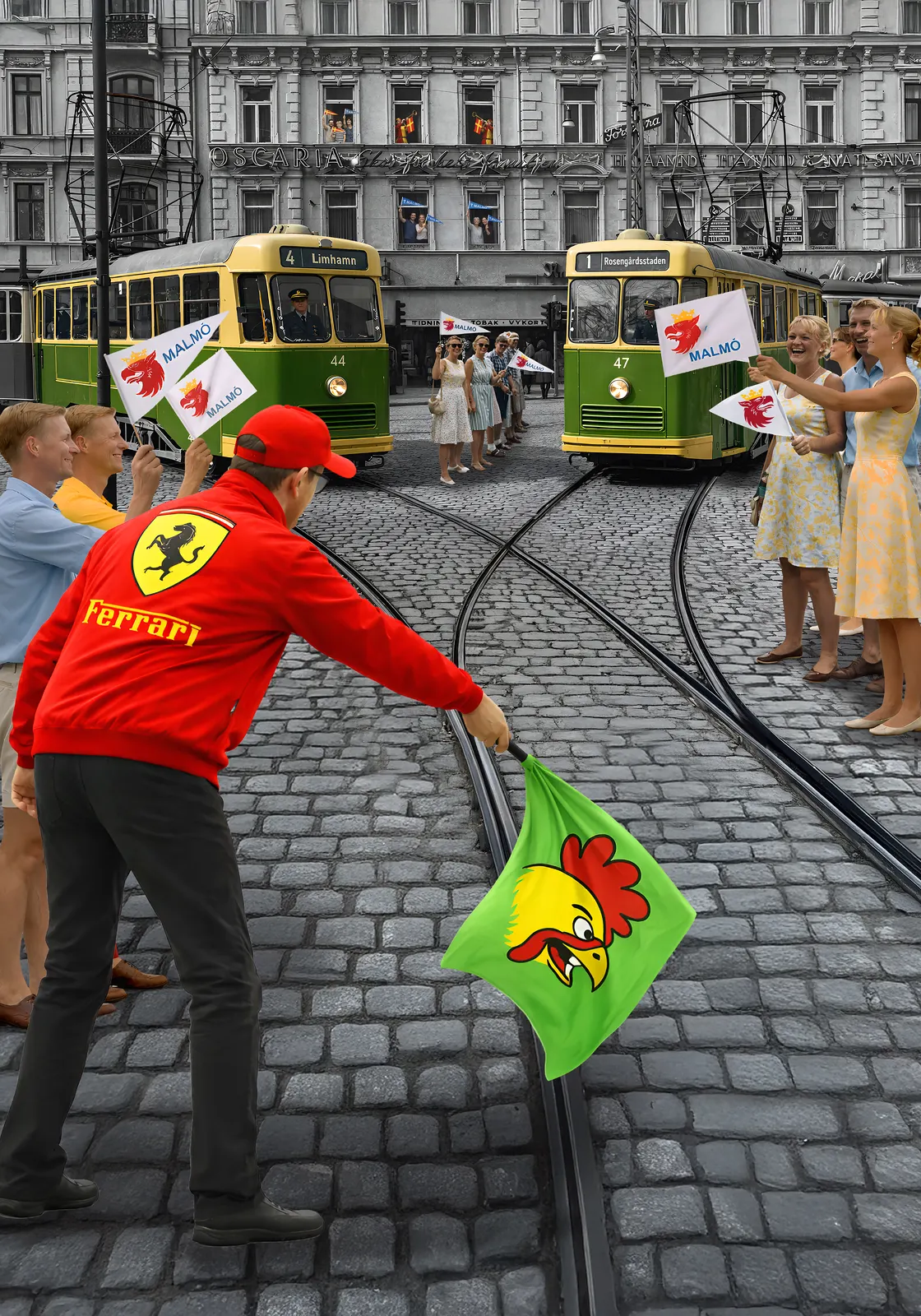
Two trams move towards each other across Gustav Adolfs torg. Their rails cross in an X. People gather to watch. It feels like a test of courage, a moment when someone has to give way.
But trams cannot swerve. They stay on their tracks. Right there, on the fixed path and the illusion of choice, the story of the chicken race begins.
The word conjures up images of petrol fumes and teenage pride. It brings to mind cars on the edge of a cliff, the tense standoff of the Cuban Missile Crisis, and the logic of game theory, where the first to give in loses. It is a game where courage and fear are measured in seconds, and the results can range from a scratched bumper to a global disaster.
Then we travel to western Queensland. To a pub in Tambo. To a remote-controlled car filled with mealworms. To eight hens running four laps as the crowd laughs and places bets for charity.
It is the same word, but in completely different worlds.
Between the trams’ relentless rails in Malmö and the hens’ instinctive dash across the Australian desert lies the full span of the concept. Here, determinism meets play, prestige meets innocence, and geopolitics meets pub entertainment.
In this essay, we explore these contrasts. We move from the cliffs of youthful legends to the tense rooms of the Cold War, from a city’s crossroads in 1967 to a small outback town where chicken is no longer just a metaphor.
And beneath it all, the same question hums:
Is it really courage that makes the difference?
Or is it the path set long ago?
"Chicken Race
Two engines hum at the edge of the night,
Headlights cutting the canyon of light.
Chrome like a promise, breath held tight—
Who will turn, and who will fight?
Rubber and gasoline scent the air,
Teenage courage stripped bare.
No room for doubt, no room for prayer—
Only the question hangs there.
Drive.
Closer still, the distance thins,
Prestige roars and reason spins.
No one remembers how it begins—
Only that losing means someone wins.
Blink.
The cliff below is dark and wide,
Ego is riding shotgun inside.
Fear and honour side by side,
Both too proud to step aside.
In another room with maps outspread,
Red lines circle what lies ahead.
Generals speak of what’s been said,
While silence drums inside each head.
Hold.
Across a square where rails align,
Steel on steel in a crossing sign,
Two trams glide on a fixed design—
No steering wheel, no warning sign.
They do not swerve. They cannot choose.
The track decides what they will lose.
What looks like courage may confuse—
Sometimes the system lights the fuse.
Far away where the desert lies,
Under enormous outback skies,
A feathered blur in dust will rise—
No shame, no daredevil disguise.
A tiny car with a wormy prize,
Eight hens chase with hungry eyes.
The crowd laughs; no empire dies.
No one falls, and no one cries.
Same word spoken, worlds apart—
From nuclear brink to county fair start.
From trembling hand to racing heart,
From calculated move to art.
So tell me now, when engines roar,
When pride stands guard at freedom’s door,
What is the thing we’re racing for?
To win?
To prove?
To not be poor?
Or is it simply this once more—
The fear of being called
a coward
before
we turn?"
Malmö, March 2026
Prologue
Chicken Race – When the Tracks Are Already Laid
At Gustav Adolfs Square in Malmö, two green trams approach each other, almost like a game of chicken. The rails cross in an X. The crowd is packed together, waving pennants. A man in a red Ferrari jacket lowers a green flag with a wild-looking chicken head. The moment is about courage—who will give in first? You can see the tension on both drivers’ faces.
But trams can’t swerve. They have to follow the tracks laid out for them. It’s the perfect setup for a dramatic game of chicken.
Behind all the action stands a grand old building with a long sign that reads OSCARIA. It was once one of Sweden’s biggest shoe stores, with its own factory—a real part of the country’s industrial history. Oscaria was eventually sold to Bata and closed down. It’s just one more example of how things change and how the market has its own pace.
It’s 1967, right before everything changes. This is the end of the tram era—the showdown between steel wheels and rubber tyres.
On 3 September 1967, Sweden switched to driving on the right side of the road. The entire traffic system changed. In Malmö, this meant the end of the trams. New bus routes took over, and except for Line 4 to Limhamn and Sibbarp, trams vanished from the streets. By 1973, even that last line was gone. Malmö was no longer a tram city.
What looks like a game – two cars rushing towards one another – becomes, in retrospect, something else. A meeting between two epochs. The rail-bound city and rubber-tired modernity. Fixed infrastructure and a flexible future. A real game of chicken depends on free will and the chance to turn away. But here, the outcome was already set.
The tracks cross, and neither tram can turn aside. Both are the same size. This isn’t about the bigger one winning, but about a tough struggle between two drivers, each protected by tons of steel.
The crowd waves and cheers, and trumpets blare from two windows. Even with all the tension, the mood is festive. Still, it’s already the end for Line 1. Its driver will soon be just another bus driver.
All through the twentieth century, driving a tram—or even better, a train—was a dream job for many boys. Being a train driver was the top goal, with a tram driver next. No one really dreamed of driving a bus.
And right in the middle of all this, two eras cross paths at a steel X.
Chicken – The Grammar of Cowardice
Long before it described a car at the edge of a cliff or a scenario in game theory, 'chicken' was a word that hurt. In American slang from the 1920s and 30s, it meant calling someone a coward. A chicken would rather run away than stand and fight. It flutters, backs off, and avoids conflict. The phrase 'to chicken out' became common, meaning to pull back at the last minute or to back down when courage was needed.
But the word was never just about fear. Fear is something we feel inside, but cowardice is shaped by society. You are not called a chicken when you are alone; it happens when others are watching. Cowardice is a label others give you. So, from the start, the chicken race is less about courage and more about reputation.
It is about saving face.
In honour cultures – whether traditional or modern – the loss of face is worse than material loss. To be called a coward is to lose rank. It is a symbolic castration within a masculine hierarchy. That is why the word is so effective. It strikes at the most vulnerable point: the need to be perceived as fearless.
This is also why the chicken race is not really rational. It comes from a society where being recognised by people matters more than staying safe. The person who drives towards the cliff is not trying to die, but wants to avoid being called a coward. The one who refuses to turn is not drawn to danger, but is afraid of being shamed.
This is the main idea: the chicken race is a staged showdown where the fear of being embarrassed pushes people to act more than the fear of getting hurt.
This idea is deeply rooted in modern life. Today, people have to shape their own identities and earn respect through their actions. Courage becomes something you have to show. You have to act bravely, even if turning away would be the smarter choice. Looking weak is not just a personal issue; it affects your place in the social order.
When we see two cars speeding towards each other or two countries threatening each other with nuclear weapons, this simple word is still at work in the background. The word itself is simple, but its social impact is powerful.
The chicken race does not start with cars or weapons. It starts with a word that stings.
1950s Car Culture – The Youth Myth and the Aesthetics of the Cliff
The chicken race became iconic not in politics or economics, but in American car culture after World War II. In the 1950s, the United States was expanding. Suburbs spread, petrol was cheap, and highways stretched wide. Cars were more than transport; they represented identity, freedom, and gender roles. For young men, driving was not just about getting from one place to another—it was about living out their own myth.
In this setting, the chicken race became a ritual. Two drivers faced off, sometimes heading straight for a cliff. Engines roared as the crowd watched in suspense. Whoever swerved first was seen as a coward. The one who held on longest was considered brave—or maybe reckless. The line between the two was very thin.
This myth is captured best in Rebel Without a Cause. James Dean stands by his car, looking both vulnerable and defiant. In the film’s famous scene, two teenagers race towards a cliff, planning to jump out before the car goes over. The first to jump is called a chicken. The real drama is not the crash, but the tense moment just before.
This is where a new style appears: the appeal of the cliff. It’s not death that draws people in, but the thrill of being on the edge. Standing at the brink, not showing fear, becomes the point. The chicken race is more than a contest; it’s a public show of courage. It challenges masculinity, social rank, and self-image. The young man has to prove he isn’t scared, even if he is.
This is also why the chicken race is so intimately linked to teenage rebellion. Postwar youth have material security but existential uncertainty. The fathers have been at war. The sons have cars. They must create their own battlefield. The cliff becomes their front line. The car is their uniform.
Yet beneath this myth lies emptiness. The chicken race has no real purpose. It creates nothing and leaves nothing behind. It’s a self-destructive game where the only thing at stake is reputation. It shows a culture that values safety yet remains drawn to danger. The same society that builds highways and suburbs also sets up these risky contests at cliff edges.
It is here that the chicken race acquires its modern structure: the choice. Everything hinges on that fraction of a second when someone can swerve. Freedom makes the drama possible. The freedom to choose cowardice or courage. The freedom to save oneself or hold course.
This is why the difference with the Malmö scene stands out. In 1950s California, a driver could swerve and make a choice. But in Malmö in 1967, the tram’s tracks were fixed. The tram couldn’t turn away or leave its path. There was no cliff edge—just a crossing of steel rails.
But let’s not jump ahead. Before the chicken race turns into a symbol of fate in a Swedish city, it first becomes something even more abstract.
The next stage is when play turns into science.
Game Theory: When play turns into mathematics
What’s striking about the chicken race is how quickly it moved from teenage car lots and the thrill of the cliff to academic settings. In the 1950s and 60s, economists, mathematicians, and strategists began modelling human behaviour. War, negotiation, and competition could all be seen as games.
And suddenly there is "The Game of Chicken."
What was once a car ritual in California became a mathematical matrix in Princeton.
The setup is simple. Two people are on a collision course. If both swerve, disaster is avoided, but no one wins. If one swerves and the other does not, the one who stays gains respect. If neither swerves, disaster happens. Mathematically, this is shown with boxes and numbers. In real life, it’s full of pride, fear, and risk.
What’s interesting is that this game reveals a paradox in rational thinking. The logical choice is to avoid disaster. But if both players think that way, one might try to take advantage and refuse to swerve. Sometimes, the smartest move is to act as if you won’t back down, no matter what.
At this point, things change. The chicken race stops being about personal bravery and becomes about credibility. The winner is the one who can most convincingly show they are willing to go all the way.
This is a cold and almost cynical way to look at human behaviour. Emotions turn into strategies. Prestige is just another factor. Disaster is simply one possible result.
Still, the model captures something very real. It describes moments when both sides are trapped by their own self-image, where backing down feels worse than keeping up the fight. What matters most is not the outcome, but how it looks to others.
At this stage, the chicken race loses its connection to youth and becomes a means of analysing power. It’s no longer just about two boys in cars. Now, it’s about companies, countries, and military alliances. Negotiations become battles where both sides must show strength to avoid embarrassment.
But at the heart of the model is still the same idea: chicken. It’s about the fear of looking like a coward. Even though game theory uses math, it’s built on the same old social rule—no one wants to be the first to give in.
Now, everything is ready for the next step. When game theory meets real-world politics, the chicken race stops being just a metaphor.
It goes global.
The Cold War – Brinkmanship and the World Holding Its Breath
When the chicken race steps out of the seminar rooms and into geopolitics, the proportions change, but not the structure. In the 1960s, two systems confronted one another: the United States and the Soviet Union. Two ideologies, two military blocs, two arsenals, together capable of destroying the planet several times over. The rhetoric is harsh, the suspicion total, the prestige monumental.
It is here that the concept of brinkmanship acquires its full meaning—the art of going to the edge of the abyss without falling. To demonstrate resolve so convincingly that the opponent backs down first. Not to blink.
When the chicken race idea shifts from classroom debates to world politics, the stakes rise, but the basic setup remains the same. In the 1960s, the United States and the Soviet Union faced each other. Two ideologies, two military alliances, and two huge arsenals could destroy the world many times. The talk was tough, suspicion ran high, and national pride was on the line.
This is where brinkmanship truly comes into play: the skill of approaching disaster without actually falling into it. The goal is to show such determination that the other side gives in first. The key is not to flinch.
The Cuban Missile Crisis in 1962 is the best example. American spy planes found Soviet nuclear missiles in Cuba. Washington reacted. Moscow answered. Fleets moved. Missiles were aimed. For a few days in October, the world held its breath. Two superpowers were heading straight for each other.
The setup is just like the 1950s car duel, but with one big difference. Here, there are no teenagers who can jump out at the last moment. There is no crowd watching. There are no shiny car bumpers. Instead, there are careful calculations, secret messages, and the shared threat of total destruction.
Prestige is central. If the United States accepts Soviet missiles in Cuba, it signals weakness. If the Soviet Union backs down without compensation, it signals weakness. In this climate, weakness can have repercussions far beyond the crisis itself. Every move must therefore be weighed not only for its practical effect but also for how it will be perceived. The chicken race becomes a game of credibility on a global scale.
The most troubling part is the double logic involved. The sensible goal is to prevent nuclear war. Yet to do that, each side must act as if it were willing to risk it. Each side must convince the other that it will not back down. The side that shows the most convincing determination gains an advantage in negotiations.
For several days, world politics was on the edge. No one wanted to look like they had given in. Everyone knew what disaster could come, yet the standoff continued.
In the end, both sides stepped back in a way that let neither lose face. The compromise was mostly hidden. In public, both looked strong. In private, both knew how close they had come to disaster.
At this stage, the chicken-race idea is stretched to its limits. It began as slang and a youth ritual, then became a mathematical concept, and finally posed a real danger to humanity. This shows how much politics relies on symbolic courage and the fear of seeming weak.
Because of this, it's interesting to see how the idea takes hold in daily life. It becomes a metaphor for things like negotiations, strikes, and budget fights. The idea spreads from world politics into everyday conversations.
The next step is to see how this idea goes from car culture and nuclear standoffs to a wider social metaphor.
From Car Culture to Social Metaphor
After the Cold War, the chicken race was no longer a dramatic event. Instead, it became a way to describe a pattern. It moved from dangerous standoffs to negotiations and political debates. It was no longer an actual duel, but a structure seen in many conflicts.
Two sides refuse to compromise. Pride matters more than the real issue. There is a real risk of harm, but neither side wants to be the first to give in. No one wants to seem weak.
We see this in politics when governments and opposition parties get stuck in budget battles. In labour disputes, strikes and lockouts can threaten to shut down society. In trade wars, tariffs can keep rising, especially during financial crises when banks or countries test each other's determination. In military standoffs, any step back can look like surrender.
But this also happens on a smaller scale. In personal relationships, two people may refuse to make the first move to make up. In families, no one wants to be the first to say sorry. In everyday life, pride often gets in the way of practical solutions.
In these situations, the chicken race idea helps explain modern conflict. It describes cases where the setup itself pushes people to take risks, mostly because backing down would be embarrassing. Often, it's not hate that drives this, but the fear of seeming weak.
The paradox is that everyone often knows what the game looks like. Everyone knows it would be wise to swerve. Yet the confrontation continues, because the one who swerves first risks losing more symbolically than materially. The chicken race thus becomes a model of how prestige can become more dangerous than the conflict itself.
Now, the idea is so common that people use 'chicken race' to talk about conflicts between political parties or companies, even when no one's life is at risk. The metaphor has lost its original danger, but the basic setup is the same: two sides heading for a clash, neither wanting to give in first.
This is where we see the deeper irony in the Malmö example. If a chicken race depends on having the chance to turn away, what happens if that choice is gone? What if things are so rigid that no one can change direction?
This leads us to the main paradox: the moment when free will and fate clash.
Prestige is at the heart of the matter. If the United States accepts Soviet missiles in Cuba, it looks weak. If the Soviet Union backs down without getting something in return, it also looks weak. In this tense environment, any sign of weakness can have consequences that go far beyond the immediate crisis. Every decision must be considered not just for its real-world impact, but also for how others will see it. The chicken race turns into a global contest of credibility.
What is most troubling is the double logic at play. The sensible goal is to avoid nuclear war. Yet to prevent war, each side must show it is willing to risk it. Each must convince the other that it will not back down. The side that shows the most convincing resolve gains an advantage in negotiations.
For a few days, world politics stands on the edge. It is like looking over a cliff, but on a global scale. No one wants to be seen as a coward. Everyone understands the disaster that could follow. Still, the standoff goes on.
In the end, both sides pull back in a way that lets neither lose face completely. The compromise is mostly hidden. In public, both appear strong. In private, both know how close they came to disaster.
At this point, the chicken race reaches its extreme. It has gone from a slang term and a youth ritual to a mathematical idea and even an existential threat to humanity. The concept shows its full impact: it reveals how much politics depends on symbolic courage and the fear of looking weak.
For this reason, it is interesting to see how the idea slips into everyday life. It becomes a metaphor for negotiations, strikes, and budget crises. The concept moves from world politics into public debate.
The next step is to trace how this idea moves from car culture and nuclear standoffs to a broader social metaphor.
From Car Culture to Social Metaphor
After the Cold War, the chicken race ceases to be a spectacular event and instead becomes a description of a structure. It moves from cliffs and missile sites to negotiating tables and parliamentary chambers. It is no longer a concrete duel but a pattern in how conflicts unfold.
Two sides refuse to compromise. Prestige becomes more important than the actual issue. There is a real risk of harm, but neither wants to be the first to give in. No one wants to seem weak.
We see this in politics when governments and oppositions get stuck in budget standoffs. In labour disputes, strikes and lockouts can threaten to shut down society. In international trade wars, tariffs rise during financial crises as banks or countries test each other's resolve. In military standoffs, any retreat can look like surrender.
But this also happens on a smaller scale. In personal relationships, two people may refuse to make the first move toward making up. In family arguments, no one wants to say sorry. In everyday life, pride often gets in the way of practical solutions.
Here, the chicken race becomes a way to understand modern conflict. It describes situations in which the setup itself pushes people toward a risky point, mainly because backing down incurs a social cost. Often, it is not hatred that drives the conflict, but the fear of losing face.
The paradox is that everyone usually knows how the game works. Everyone knows it would be smarter to back down. Still, the standoff goes on, because the first to give in risks losing more in reputation than in real terms. The chicken race becomes a model for how pride can be more dangerous than the conflict itself.
By now, the idea is so common that people use it almost casually. We talk about a "chicken race" between political parties or companies, even when no one's life is at risk. The metaphor has lost its deadly meaning, but the basic setup is the same: two sides heading for a clash, neither willing to back down first.
This is where we start to see the deeper irony in the Malmö example. If a chicken race depends on the chance to turn aside, what happens when that option is gone? What if the situation is so rigid that no one can change course?
This brings us to the paradox: the moment when free will and fate come into conflict.
The Paradox – When Freedom Is an Illusion
The concept of the Chicken Race centres on a critical moment: the brief instant when a participant may swerve. The entire scenario hinges on the driver's ability to change course. If a superpower withdraws its missiles or a politician chooses to compromise, the confrontation is averted. Without this possibility, the situation no longer constitutes a chicken race; it becomes an inevitable collision.
For this reason, the concept is inherently linked to free will: the freedom to resolve a crisis or to abstain from intervention, and the freedom to prioritise prestige over safety.
However, in the Malmö scenario, an inversion is evident. Trams cannot swerve because they are confined to their tracks. While drivers may apply the brakes, they cannot exit the system or perform a dramatic evasive manoeuvre. Their trajectory is predetermined.
In this context, the underlying absurdity becomes apparent. Superficially, the event resembles a chicken race, with two vehicles on a collision course, public anticipation, and a signal to commence. However, the fundamental structure is one of determinism; no participant can select an alternative route, as the tracks are fixed.
This dynamic renders the scene more philosophical than dramatic, raising a fundamental question: to what extent are individuals truly free when they perceive themselves as competing in acts of courage?
Within the narrative of car culture, choice is framed as an individual act. In game theory, it is conceptualised as a strategic decision. During the Cold War, it represented a geopolitical calculation. In contrast, within a rail-based urban environment, choice is embedded in infrastructure; the system itself dictates direction.
A broader consideration arises in this context. Modernity frequently emphasises the narrative of choice, suggesting that individuals select direction, technology, and the future, as well as between competing systems. However, these choices are often predetermined by economic forces, political decisions, and technological investments. Once infrastructure is established, altering direction becomes challenging.
Thus, the chicken race emerges as an illusion of freedom. Although the drama of the moment is experienced, the outcome is largely determined by prior decisions. The fate of the tramway is not determined by drivers but by traffic policy, urban planning, and the prevailing ideology of modernity.
This situation has an almost tragic dimension. While drivers may exhibit courage or composure, their outcomes are determined by broader systemic forces. The central issue is not individual bravery, but rather which system endures.
For that reason, the next step becomes decisive. When the chicken race moves from cliffs and missiles to Malmö in 1967, it is no longer two individuals who meet.
Rather, it is a confrontation between two historical epochs..
From Cliff to System Shift – Malmö 1967
In 1967, a chicken race in Malmö changed the perspective. It was not about two young people at a cliff's edge or two superpowers on the verge of disaster. Instead, it was a city facing a decision, or at least feeling like it was.
On 3 September 1967, Sweden switched to driving on the right-hand side of the road. This was not just a logistical challenge but also a mental shift. Signs were changed, bus doors were moved, and routines had to be updated. Underneath these changes, a bigger shift was happening: modern life was speeding up. Flexibility became the guiding idea. Rubber tyres represented the future, while rails were seen as old-fashioned.
In Malmö, the traffic reform marked the end of the tram system. A new network of routes was introduced, and buses took over. The trams, which had been the city's main form of transport for decades, slowly vanished. Only Line 4 to Limhamn and Sibbarp lasted a little longer, closing in 1973. After that, Malmö was no longer a tram city.
This was not a dramatic crash but a shift in the whole system. Still, it looked a bit like a chicken race. Two types of technology faced off: the fixed-rail system and the mobile bus. The rail was steady and part of the city's fabric, while the bus was flexible, adaptable, and modern.
The trams 'lost, not because they were worse machines, but because the political and economic thinking changed. At the same time, a similar shift was happening across the country. More long-distance freight moved from rail to trucks. Swedish State Railways faced difficulties, and the rails lost their once secure place.
What is interesting is that people saw this as a choice. They talked about the traffic of the future, about efficiency, and about adaptability. It felt like choosing a direction, just as a driver in a chicken race decides whether to keep going or turn away. But looking back, we can wonder how much of a real choice it was. Oil prices, urban planning ideas, car culture, and international trends all pushed things in the same direction.
The tracks cross, and one era gives way to another.
Three decades later, the pendulum begins to swing back. Stockholm reintroduces tram lines. Lund builds new ones. The question arises: why not Malmö? What was once perceived as self-evident modernity now appears short-sighted. The rail, once considered rigid and outdated, is revalued as sustainable and forward-looking.
Here, the chicken race shows how things can come full circle. We hurry towards a solution, sure it is the only sensible choice. The old technology steps aside, and the new one wins. But history keeps going, and sometimes these systems cross paths again at new steel intersections.
In Malmö in 1967, it was not about two drivers showing their bravery. It was a city shifting between two ways of building its transport system. The tram stood for one era, the bus for another. Behind it all was the same feeling as in a car duel: the fear of looking old-fashioned or being left behind.
It was not two young people standing at the edge of a cliff.
It was a city that believed it was choosing the direction of modernity.
But before we finish, we need to take an unexpected turn. If a chicken race can be a youth ritual, a moment in world politics, and a big change in systems, it can also become something completely different.
Now we go to the desert.
When the Chicken Became Literal – Tambo, Queensland
Every evening during the season in the small town of Tambo in western Queensland, Ben's Chicken Racing takes place. The event is held at the Royal Carrangarra Hotel. There are no missiles, no cliffs, and no ideological battles. Instead, there are laying hens, a remote-controlled car, and a crowd with beers in hand.
The setup is simple, almost to the point of being obvious. Eight to ten hens line up at the start. A small remote-controlled car, filled with mealworms, leads the way. The hens chase it for four laps. People in the audience place bets on their chosen hen. The money raised goes to charity, including the Royal Flying Doctor Service. The hens have names like Barcoo Blue, Ginger Ninja, and Beyoncé. The event is popular, noisy, and a bit chaotic.
There is no sense of looming danger or deep crisis.
In this setting, calling someone a "chicken" is not an insult. It simply describes a bird running after food. There is no prestige involved. No one worries about losing face or proving themselves. No one risks a global disaster by refusing to back down.
It is almost as if language itself has shaken off its drama. What once meant preferring death to being called a coward has become a communal game whose purpose is to raise money for rural medical transport. The chicken race has been disarmed.
That is exactly why Tambo is worth mentioning in an essay about the chicken race. It shows how ideas can move from one culture to another, and how a word that means both shame and pride in one place can become simple and harmless in another. It reminds us that much of the drama comes from how we interpret things, not just from what actually happens.
In the classic chicken race, what matters is who swerves first. In Tambo, what matters is who finds the mealworms fastest. There is nothing to win except a laugh and a charitable contribution. The risk is minimal. No abyss awaits.
This is a funny contrast to the tense days of the Cuban Missile Crisis or the last tram crossing in Malmö. But the difference is useful. It shows that the chicken race is really a pattern we apply to different situations. Sometimes it is dangerous, and sometimes it is just for fun.
The setup could not be simpler:
8–10 laying hens.
A small remote-controlled car.
The bait: mealworms.
Four laps.
People in the audience place bets on their chosen hen. Some of the well-known hens have names like Barcoo Blue, Ginger Ninja, and Beyoncé.
The proceeds go to charity, including the Royal Flying Doctor Service.
This leads to a bigger question: what is at the heart of the idea? Is it about danger, prestige, the freedom to back down, or our habit of seeing confrontation as a test of bravery?
When 'chicken' is taken literally, all the symbolic pressure goes away. But when the word is used as a metaphor in politics, infrastructure, or relationships, the drama comes back.
So, between hens in the desert and tram tracks in Malmö, we see the full range of what the concept can mean.
To Blink or To Be Bound
The chicken race begins with a word that burns. It continues with teenagers at cliffs, mathematicians at blackboards, generals in crisis rooms, and politicians unwilling to lose face. It ends — or rather lands — at a tram junction in Malmö and in a pub in Queensland. It is an idea that shifts between tragedy and farce.
Yet through all these shifts runs a common nerve: the fear of blinking first, of showing weakness, of admitting that one could have turned but chose not to.
In car culture, it was about personal courage. In game theory, it was about making the smartest move. During the Cold War, it was about the survival of civilisation. In Malmö in 1967, it was about a city's self-image and its future. In Tambo, it is simply a hen chasing food.
The real difference is in the consequences. The setup stays the same. But in the Malmö example, there is something new: determinism. The tram cannot leave its track. It does not have the same freedom as a car at the edge of a cliff. It follows a path already set. This reveals an uncomfortable truth about the chicken race: our choices are often less free than we think. We like to speak of standing firm, of not backing down, of not being chicken. But many times it is not courage or cowardice that determines the outcome, but structures, infrastructures, economies and ideologies that have already laid the rails.
That does not mean people have no responsibility. A driver can still brake. A politician can still compromise. A superpower can still step back. But our choices are never unlimited. There are always boundaries to our freedom.
The chicken race becomes a mirror for us. It reveals how much of modern life is based on hiding weakness. It shows that pride can be more dangerous than the conflict itself. It also shows how systems can push people into confrontations that nobody really wants.
Meanwhile, in the Queensland desert, hens chase a remote-controlled car, and the audience laughs. There, the word has lost its charge. There is no shame in being chicken. It is simply a body following its instinct.
Maybe there is an unexpected lesson in that.
The most destructive element in the chicken race is not the danger, but the idea that one must not back down.
Sometimes, real courage means choosing to turn aside.
Pride can sometimes be a more dangerous motivator than fear.
At Gustav Adolf's Torg, the rails cross in an X. Two trams meet. The audience cheers. It looks like a test of courage. But in reality, it is an image of something else: how eras meet, how systems replace one another, how we interpret change as conflict.
So, the chicken race is not just a duel. It is a story about how we see strength, weakness, and the paths we choose.
The real question is not just who gives in first. It is also about who set the path in the first place.
The question is not the least who laid the tracks.
Två spårvagnar rullar mot varandra över Gustav Adolfs torg. Rälsen korsas i ett X. Publiken står samlad. Det ser ut som ett test av mod. Ett ögonblick där någon måste väja.
Men spårvagnar väjer inte.
De följer sina räler.
Och just där – i den låsta kursen, i illusionen av val – börjar berättelsen om chicken race.
Begreppet har en laddning av bensinångor och tonårig prestige. Det för tankarna till bilar vid stup, till Kubakrisens nervkrig, till spelteorins kalla matriser där den som blinkar först förlorar. Ett spel där mod och feghet vägs i sekunder, och där konsekvenserna kan vara allt från skrapade stötfångare till global katastrof.
Men så förflyttas vi till västra Queensland.
Till en pub i Tambo.
Till en radiostyrd bil laddad med mjölmaskar.
Till åtta värphöns som springer fyra varv medan publiken skrattar och satsar pengar till välgörenhet.
Samma ord. Helt olika världar.
Mellan spårvagnarnas obönhörliga räls i Malmö och hönsens instinktiva språng i den australiska öknen ryms hela begreppets spännvidd. Här möts determinism och lek, prestige och oskuld, geopolitik och pubunderhållning.
I denna essä rör vi oss genom dessa kontraster. Från ungdomsmytens stup till kalla krigets krisrum. Från stadens teknologiska vägval 1967 till en ökenstad där chicken blivit bokstavlig.
Och under allt ligger samma fråga och vibrerar:
Är det verkligen modet som avgör?
Eller är det rälsen som redan lagts?
Prolog
Chicken Race – När spåren redan är lagda
På Gustav Adolfs torg i Malmö möts två gröna spårvagnar i vad som ser ut som ett klassiskt chicken race. Rälsen löper samman i ett X. Publiken står tätt. Vimplar viftas. En man i en röd Ferrari-jacka sänker en grön flagga med ett hysteriskt kycklinghuvud. Allt tycks handla om mod: vem väjer först? Det syns på båda förarnas sammanbitna ansikten.
Men spårvagnar kan inte väja. De följer sina räler. De är bundna till den väg som redan lagts. Snacka om upplägg för ett brutalt chicken race.
Bakom dramat reser sig den monumentala sekelskiftesfasaden med den långa skylten: OSCARIA – en av landets största skobutikskedjor, med egen tillverkning, ett stycke svensk industrihistoria. Oscaria såldes till Bata och lades ned. Ännu ett exempel på hur strukturer förändras, hur marknaden kör sitt eget race.
Året är 1967. Ögonblicket precis före den verkliga omställningen. Spårvägens armageddon. Järnhjulens slutuppgörelse med gummidäcken.
Den 3 september 1967 går Sverige över till högertrafik. Hela trafiksystemet ritas om. I Malmö blir detta i praktiken dödsstöten för spårvägen. Ett nytt linjenät införs. Bussar tar över. Med undantag för linje 4 till Limhamn och Sibbarp försvinner spårvagnarna från stadens gator. 1973 läggs även denna sista linje ned. Därmed upphör Malmö att vara spårvägsstad.
Det som i bilden ser ut som en lek – två vagnar som rusar mot varandra – blir i efterhand något annat. Ett möte mellan två epoker. Den spårbundna staden och den gummihjulsburna moderniteten. Den fasta infrastrukturen och den flexibla framtiden.
Chicken Race bygger på fri vilja. På möjligheten att svänga undan. Men här var det redan bestämt.
Spåren korsas. Ingen kan väja. Båda vagnarna är lika stora. I detta fall är det inte den störste som går först, utan en hänsynslös kamp mellan två viljor skyddade av flera ton plåt och järn.
Publiken vinkar och tjoar. Från två fönster ljuder trumpetfanfarer. Trots dramatiken råder feststämning. Hur som helst är det ändå kört för linje 1. Föraren degraderas snart till att bli en bland många bussförare.
Att köra spårvagn – och ännu mer järnvägslok – var under hela 1900-talet en pojkdröm. Lokföraren stod högst. Spårvägaren kom strax därefter. Att ratta en buss var inget man drömde om.
Och mitt i detta skådespel möts två epoker på ett X av stål.
Chicken – feghetens grammatik
Innan det blev en bil vid ett stup, innan det blev en spelteoretisk modell eller en kärnvapenduell, var chicken ett ord som skavde. I amerikansk slang under 1920– och 30-talet betydde det att kalla någon feg. En kyckling flyr hellre än slåss. Den flaxar, backar, undviker konfrontation. Att “chicken out” blev ett etablerat uttryck – att dra sig ur i sista stund, att backa när modet krävdes.
Men det intressanta är att ordet aldrig bara handlade om rädsla. Rädsla är biologisk. Feghet är social. Man är inte chicken i ensamhet; man blir det i andras blick. Feghet är ett offentligt tillstånd. Det är något som tillskrivs dig. Därför är chicken race från början inte en berättelse om mod, utan om prestige.
Det handlar om ansiktet.
I hederskulturer – oavsett om de är traditionella eller moderna – är förlusten av ansiktet värre än den materiella förlusten. Att bli kallad feg är att förlora rang. Det är en symbolisk kastration i en maskulin hierarki. Det är därför ordet är så effektivt. Det trycker på det mest sårbara: behovet av att uppfattas som orädd.
Det är också därför chicken race aldrig är en rationell situation i grunden. Den uppstår ur en social struktur där erkännandet från andra väger tyngre än säkerheten. Den som kör mot stupet gör det inte för att dö, utan för att inte bli kallad feg. Den som står kvar gör det inte för att han älskar faran, utan för att han fruktar skammen.
Här ligger den första nyckeln till begreppet: chicken race är en ritualiserad konfrontation där hotet om förnedring driver handlingen mer än hotet om fysisk skada.
Detta är djupt modernitetens logik. I en värld där individen ska skapa sig själv, där identiteten inte är given av börd utan av prestation, blir modet en valuta. Man måste visa det. Uppvisa det. Spela det. Att väja kan vara klokt – men det ser svagt ut. Och svaghet är inte bara en personlig brist, utan en position i en hierarki.
När vi senare ser två bilar rusa mot varandra eller två supermakter hota med kärnvapen är det denna lilla språkliga mekanism som fortfarande arbetar i bakgrunden. Ordet är enkelt. Men dess sociala laddning är explosiv.
Chicken race börjar alltså inte med motorer eller missiler. Det börjar med ett ord som bränner.
1950-talets bilkultur – ungdomsmyten och stupets estetik
När chicken race får sin ikoniska form är det inte i politiken och inte i ekonomin, utan i den amerikanska efterkrigstidens bilkultur. USA på 1950-talet är ett land i materiell expansion. Förorterna växer, bensinen är billig, vägarna breda. Bilen blir mer än ett transportmedel – den blir identitet, frihet, könsmarkör. Den unge mannen bakom ratten är inte bara förare; han är protagonist i sin egen myt.
Det är i detta landskap chicken race uppstår som ritual. Två förare ställer upp. Mot varandra eller mot en klippavsats. Motorerna varvar. Publiken håller andan. Den som först svänger undan är feg. Den som sitter kvar längst är modig – eller galen. Skillnaden är hårfin.
Det mest koncentrerade uttrycket för denna myt finns i Rebel Without a Cause. James Dean står lutad mot bilen med den där hållningen som blivit ikon: sårbar och trotsig på samma gång. I filmens berömda scen kör två ungdomar mot en klippavsats. De ska hoppa ur innan bilen störtar. Den som hoppar först är chicken. Det är inte kraschen som är huvudnumret. Det är ögonblicket innan.
Här föds en särskild estetik: stupets estetik. Det är inte döden som lockar, utan gränsen. Att befinna sig precis på kanten och visa att man inte darrar. Chicken race är därför inte bara en tävling; det är en offentlig ceremoni i modets teater. Den prövar maskulinitet, hierarki och självbild. Den unge mannen måste visa att han inte är rädd – även om han är det.
Det är också därför chicken race är så intimt förbundet med tonårsuppror. Efterkrigstidens ungdomar har materiell trygghet men existentiell osäkerhet. Fäderna har varit i krig. Sönerna har bilar. De måste skapa sitt eget slagfält. Stupet blir deras frontlinje. Bilen deras uniform.
Men under denna myt finns en tomhet. Chicken race saknar mål. Det producerar inget. Det bygger inget. Det är ett självförstörande spel där det enda kapitalet är prestige. Det är en dramatisk manifestation av en kultur som samtidigt dyrkar säkerhet och flirtar med risk. Man bygger motorvägar och förorter – och iscensätter stupdueller.
Det är också här chicken race får sin moderna struktur: valet. Allt hänger på den bråkdelen av en sekund när någon kan svänga. Det är friheten som gör dramat möjligt. Friheten att välja feghet eller mod. Friheten att rädda sig själv eller hålla kursen.
Och just därför är kontrasten till Malmö-scenen så slående. I 1950-talets Kalifornien kan bilen svänga. Föraren kan välja. I 1967 års Malmö är rälsen redan lagd. Spårvagnen kan inte vrida ratten åt sidan och lämna sin bana. Den har ingen stupkant att kasta sig mot – bara ett X av stål.
Men vi ska inte gå dit än. För innan chicken race blir determinismens ironi i en svensk stad, ska det förvandlas till något ännu mer abstrakt.
Nästa steg är att lek blir vetenskap.
Spelteori – när lek blir matematik
Det märkliga med chicken race är att det mycket snabbt lämnar tonårens grusplaner och klippavsatsens romantik och kliver in i seminarierummen. Under 1950- och 60-talen börjar ekonomer, matematiker och strategiska tänkare formulera mänskligt beteende i modeller. Krig, förhandlingar, konkurrens – allt kan reduceras till spel.
Och plötsligt finns “The Game of Chicken”.
Det som i Kalifornien var en motorritual blir i Princeton en matris.
Upplägget är brutalt enkelt. Två aktörer står på kollisionskurs. Om båda väjer undviks katastrofen, men ingen framstår som segrare. Om den ena väjer och den andra inte, vinner den som står kvar prestige. Om ingen väjer inträffar katastrofen. I matematisk form kan detta skrivas i rutor och siffror. I verkligheten är det laddat med stolthet, rädsla och hot.
Det fascinerande är att spelet avslöjar en paradox i rationaliteten. Det rationella vore att undvika katastrof. Men om båda resonerar så, kan någon frestas att utnyttja situationen och stå kvar. Därför kan det rationella ibland vara att verka irrationell. Att övertyga motståndaren om att man inte tänker svänga, oavsett konsekvenser.
Här sker en förskjutning. Chicken race är inte längre en fråga om personlig moduppvisning. Det blir en fråga om trovärdighet. Den som mest övertygande signalerar att han är beredd att gå under, vinner.
Det är ett kyligt och nästan cyniskt synsätt på mänskligt handlande. Känslor reduceras till strategier. Prestige blir en variabel. Katastrof blir ett utfall i en tabell.
Men modellen har något djupt realistiskt i sig. Den beskriver situationer där båda parter är låsta av sin egen självbild. Där reträtt kostar mer symboliskt än fortsatt konfrontation. Där det viktigaste inte är vad som faktiskt händer, utan hur det uppfattas.
Och här börjar chicken race lämna ungdomens symbolik och bli ett verktyg för maktanalys. Det är inte längre bara två pojkar i bilar. Det är företag, stater, militärallianser. Det är förhandlingar där båda parter måste visa styrka för att inte förlora ansiktet.
Men i modellens kärna finns fortfarande det ursprungliga ordet. Chicken. Rädslan för att framstå som feg. Spelteorin må vara matematiskt formulerad, men den bygger på samma gamla sociala mekanism: ingen vill vara den som blinkar först.
Det är nu scenen är satt för nästa steg. För när spelteorins tabeller möter geopolitikens verklighet upphör chicken race att vara metafor. Det blir globalt.
Kalla kriget – brinkmanship och världen håller andan
När chicken race kliver ut ur seminarierummen och in i geopolitiken förändras proportionerna, men inte strukturen. Under 1960-talet står två system mot varandra: USA och Sovjetunionen. Två ideologier, två militära block, två arsenaler som tillsammans kan utplåna planeten flera gånger om. Retoriken är hård, misstänksamheten total, prestigen monumental.
Det är här begreppet brinkmanship får sin fulla betydelse – konsten att gå till avgrundens kant utan att falla. Att demonstrera beslutsamhet så övertygande att motståndaren backar först. Att inte blinka.
Kubakrisen 1962 är det tydligaste exemplet. Amerikanska spaningsflyg upptäcker sovjetiska kärnvapenramper på Kuba. Washington reagerar. Moskva svarar. Flottor sätts i rörelse. Missiler riktas. Under några oktoberdagar befinner sig världen i ett tillstånd som närmast kan beskrivas som en kollektiv inandning. Två makter på kollisionskurs.
Strukturen är identisk med 1950-talets bilduell, men med en avgörande skillnad: här finns inga ungdomar som kan hoppa ur i sista sekund. Det finns ingen publik som jublar. Det finns inga kromade kofångare. Det finns bara beräkningar, hemliga meddelanden och ett ömsesidigt hot om total förintelse.
Prestigen är central. Om USA accepterar sovjetiska missiler på Kuba signalerar det svaghet. Om Sovjet backar utan motprestation signalerar det svaghet. Och svaghet i detta klimat kan få följdverkningar långt bortom själva krisen. Därför måste varje steg vägas mot hur det uppfattas. Chicken race blir här ett spel om trovärdighet i global skala.
Det mest oroande är att rationaliteten i situationen är dubbelbottnad. Det rationella är att undvika kärnvapenkrig. Men för att undvika krig måste man visa att man är beredd att riskera det. Man måste övertyga motståndaren om att man inte tänker väja. Den som mest trovärdigt kan signalera sin beslutsamhet vinner förhandlingsutrymmet.
Så rör sig världspolitiken under några dagar på kanten av stupet. Det är stupets estetik i planetär skala. Ingen vill vara chicken. Alla vet vad katastrofen innebär. Ändå fortsätter spelet.
Till slut backar båda – på ett sätt som gör att ingen helt förlorar ansiktet. En kompromiss i det fördolda. Offentligt kan båda sidor tala om fasthet. Privat vet man hur nära det var.
Här har chicken race nått sin yttersta spets. Från slanguttryck till ungdomsritual, från matematiskt schema till existentiellt hot mot mänskligheten. Begreppet visar sin fulla kraft: det blottlägger hur mycket av politiken som handlar om symboliskt mod och rädslan för att framstå som svag.
Men just därför är det intressant att se hur det sedan glider in i vardagen. Hur det blir en metafor för förhandlingar, strejker, budgetkriser. Hur det sipprar ner från världspolitiken till samhällsdebatten.
Nästa steg är att följa den rörelsen – från bilkultur och kärnvapenbalans till allmän samhällsmetafor.
Från bilkultur till samhällsmetafor
Efter kalla kriget upphör chicken race att vara en spektakulär händelse och blir i stället en beskrivning av en struktur. Det rör sig från stup och missilramper till förhandlingsbord och plenisalar. Det är inte längre en konkret duell, utan ett mönster i hur konflikter drivs.
Två parter vägrar kompromissa. Prestige är viktigare än sakfrågan. Risken för förödelse finns där, men ingen vill vara den som ger sig först. Ingen vill framstå som svag.
Man ser det i politiken när regeringar och opposition låser sig i budgetförhandlingar. I arbetsmarknadskonflikter där strejk och lockout hotar att lamslå samhället. I internationella handelskrig där tullar höjs i en eskalerande spiral. I ekonomiska kriser där banker eller stater testar varandras beslutsamhet. I militära upptrappningar där varje reträtt riskerar att tolkas som kapitulation.
Men också i det lilla. I personliga relationer där två människor vägrar ta första steget mot försoning. I familjekonflikter där ingen vill be om ursäkt. I vardagens mikropolitik där stolthet står i vägen för pragmatism.
Det är här chicken race blir ett begrepp för modern konfliktkultur. Det beskriver situationer där själva strukturen driver aktörerna mot en farlig punkt, just därför att reträtten är socialt kostsam. Det är inte alltid hatet som driver spelet, utan rädslan för att tappa ansikte.
Det paradoxala är att alla ofta vet hur spelet ser ut. Alla vet att det vore klokt att svänga. Ändå fortsätter man, för att den som svänger först riskerar att förlora mer symboliskt än materiellt. Chicken race är därmed en modell för hur prestige kan bli farligare än själva konflikten.
I detta skede har begreppet blivit så etablerat att det kan användas nästan slentrianmässigt. Man talar om ett “chicken race” mellan politiska partier eller företag utan att någon faktiskt riskerar livet. Metaforen har lösgjorts från sin dödliga kärna, men strukturen finns kvar: två aktörer på kurs mot varandra, ingen vill blinka först.
Och det är just här vi kan börja ana den djupare ironin i Malmöbilden. För om chicken race förutsätter möjligheten att väja, vad händer då när denna möjlighet saknas? Vad händer när strukturen är så fast att ingen egentligen kan ändra riktning?
Det leder oss till det paradoxala – till den punkt där fri vilja och determinism kolliderar.
Det paradoxala – när friheten är en illusion
Chicken race bygger på ett ögonblick. Den bråkdelen av en sekund när någon kan svänga undan. Hela dramat vilar på att valet finns. Att föraren kan vrida ratten. Att supermakten kan dra tillbaka missilerna. Att politikern kan kompromissa. Utan denna möjlighet upphör spelet att vara chicken race och blir i stället kollision.
Det är därför begreppet alltid är kopplat till fri vilja. Friheten att rädda situationen – och friheten att avstå från att göra det. Friheten att välja prestige framför säkerhet.
Men i din Malmö-scen uppstår en inversion. Spårvagnar kan inte svänga. De följer sina räler. Förarna kan bromsa, men de kan inte lämna systemet. De kan inte styra ut på trottoaren och rädda ansiktet genom en dramatisk undanmanöver. Deras bana är redan definierad.
Det är här absurdismen uppstår. Ytan är ett chicken race: två enheter på kollisionskurs, publikens förväntan, flaggan som faller. Men djupstrukturen är determinism. Ingen kan välja en annan väg. Spåren är lagda.
Detta gör scenen mer filosofisk än dramatisk. Den ställer frågan som ligger under hela begreppet: hur fria är vi egentligen när vi tror att vi tävlar i mod?
I bilkulturens myt är valet individuellt. I spelteorin är det strategiskt. I kalla kriget är det geopolitisk kalkyl. Men i den spårbundna staden är valet inbyggt i infrastrukturen. Systemet bestämmer riktningen.
Och här öppnar sig en större tanke. Moderniteten älskar berättelsen om val. Vi väljer riktning, teknik, framtid. Vi väljer mellan system. Men ofta är dessa val redan strukturerade av ekonomiska krafter, politiska beslut och tekniska investeringar. När rälsen en gång är lagd, är det svårt att plötsligt köra åt ett annat håll.
Chicken race framstår då som en illusion av frihet. Vi upplever dramatiken i ögonblicket – men det mesta är redan avgjort av tidigare beslut. Det är inte förarna som bestämmer om spårvägen ska leva eller dö. Det är trafikpolitiken, stadsplaneringen, modernitetens ideologi.
I detta ligger en nästan tragisk dimension. Förarna kan uppvisa mod eller kyla, men deras öde är knutet till något större. Det är inte en fråga om vem som är mest orädd, utan om vilket system som överlever.
Och just därför blir nästa steg avgörande. För när chicken race förflyttas från stup och missiler till Malmö 1967, är det inte två individer som möts. Det är två epoker.
Från stup till systemskifte – Malmö 1967
När man placerar ett chicken race i Malmö 1967 förskjuts perspektivet. Det är inte längre två ungdomar vid en klippavsats, eller på en gatustump eller två supermakter vid avgrundens rand. Det är en stad som står inför ett beslut – eller åtminstone upplever att den gör det.
Den 3 september 1967 går Sverige över till högertrafik. Det är en logistisk och mental revolution. Skyltar byts, bussdörrar flyttas, rutiner skrivs om. Men under denna tekniska operation ligger en djupare rörelse: moderniteten accelererar. Flexibilitet blir ledord. Gummihjul uppfattas som framtid, räls som det förflutna.
I Malmö blir högertrafikomläggningen i praktiken dödsstöten för spårvägen. Ett nytt linjenät införs. Bussarna tar över. Spårvagnarna – som i decennier varit stadens pulsådror – försvinner successivt. Endast linje 4 till Limhamn och Sibbarp får en respit. 1973 är det slut även för den. Malmö upphör att vara spårvägsstad.
Detta är inte en kollision i dramatisk mening. Det är en systemförskjutning. Men strukturen liknar chicken race. Två teknologier står mot varandra: den spårbundna infrastrukturen och den rörliga bussen. Den ena är fast, förutsägbar, integrerad i stadens kropp. Den andra är flexibel, anpassningsbar, modern.
Spårvagnarna “förlorar”. Inte för att de är sämre maskiner, utan för att den politiska och ekonomiska logiken förändras. Samtidigt sker något liknande på nationell nivå. Fjärrfrakt flyttas i allt högre grad från järnväg till lastbil. SJ får problem. Rälsen mister sin självklara position.
Det intressanta är att detta uppfattas som ett val. Man talar om framtidens trafik. Om effektivitet. Om anpassningsförmåga. Man upplever att man väljer riktning – precis som föraren i chicken race väljer att hålla kurs eller svänga. Men i efterhand kan man fråga sig hur fritt detta val egentligen var. Oljeekonomi, stadsplaneringsideal, bilismens ideologi och internationella trender tryckte i samma riktning.
Spåren korsas. En epok ger vika.
Tre decennier senare börjar pendeln svänga tillbaka. Stockholm återinför spårväg på vissa sträckor. Lund bygger nytt. Diskussionen väcks: varför inte Malmö? Det som en gång uppfattades som självklar modernitet framstår plötsligt som kortsiktigt. Rälsen, som ansågs stel och föråldrad, uppvärderas som hållbar och framtidsinriktad.
Chicken race visar här sin cirkulära natur. Vi rusar mot en lösning i övertygelsen om att den är den enda rationella. Den gamla tekniken väjer. Den nya triumferar. Men historien tar inte slut där. Den fortsätter, och ibland möts systemen igen, på nya X av stål.
I Malmö 1967 är det alltså inte två förare som testar sitt mod. Det är en stad som rör sig mellan två infrastrukturella paradigm. Spårvagnen blir symbol för en epok. Bussen för en annan. Och i bakgrunden finns samma mekanism som i bilduellen: rädslan för att framstå som bakåtsträvande, rädslan för att inte hänga med.
Det var inte två ungdomar vid en klippavsats. Det var en stad som tyckte sig välja modernitetens riktning.
Men innan vi avslutar måste vi göra en oväntad förflyttning. För om chicken race kan vara ungdomsritual, geopolitik och systemskifte, kan det också bli något helt annat.
Nu går vi till öknen.
När kycklingen blev bokstavlig – Tambo, Queensland
I den lilla staden Tambo i västra Queensland arrangeras varje kväll under säsong något som kallas Ben’s Chicken Racing, ett äkta Chicken Race. Platsen är Royal Carrangarra Hotel. Inga missiler. Inga stup. Ingen ideologisk frontlinje. Bara värphöns, en radiostyrd bil och en publik med öl i handen.
Upplägget är nästan övertydligt i sin enkelhet. Åtta till tio höns ställs upp. En liten radiostyrd bil kör iväg, laddad med mjölmaskar. Hönsen springer fyra varv efter den. Publiken satsar pengar på “sin” höna. Intäkterna går till välgörenhet, bland annat Royal Flying Doctor Service. Tävlande bär namn som Barcoo Blue, Ginger Ninja och Beyoncé. Det är folkligt, högljutt, lätt kaotiskt.
Och helt utan existentiell avgrund.
Här är “chicken” inte en förolämpning. Det är en fjäderklädd kropp som springer mot mat. Ingen prestige står på spel. Ingen riskerar ansiktet. Ingen behöver demonstrera maskulinitet eller geopolitisk trovärdighet. Ingen kan utlösa en global katastrof genom att hålla kursen för länge.
Det är nästan som om språket själv har skakat av sig sin egen dramatik. Det som en gång handlade om att hellre dö än att bli kallad feg har blivit en gemensam lek där syftet är att samla in pengar till sjuktransporter i glesbygden. Chicken race har avväpnats.
Men just därför är Tambo intressant i en essä om chicken race. För det visar hur begrepp vandrar. Hur ett ord kan bära på en laddning av skam och prestige i en kultur, för att i en annan bli bokstavligt och oskyldigt. Det avslöjar hur mycket av dramatiken som ligger i tolkningen, inte i själva handlingen.
I det klassiska chicken racet är det avgörande vem som väjer först. I Tambo är det avgörande vem som hittar mjölmaskarna snabbast. Det finns inget att vinna annat än ett skratt och en insats till välgörenhet. Risken är minimal. Ingen avgrund väntar.
Det är en nästan komisk kontrast till Kubakrisens oktoberdagar eller till spårvagnarnas sista korsning i Malmö. Men kontrasten är fruktbar. Den visar att chicken race i grunden är en struktur vi lägger över situationer. Ibland är den dödlig. Ibland är den bara underhållning.
Upplägget är nästan löjligt enkel:
8–10 värphöns.
En liten radiostyrd bil.
Betet: mjölmaskar.
Fyra varv.
Publiken satsar pengar på “sin” höna. Kända tävlingshöns bär namn som: Barcoo Blue, Ginger Ninja och Beyoncé.
Intäkterna går till välgörenhet, bland annat Royal Flying Doctor Service.
Frågan är då vad som egentligen är kärnan i begreppet. Är det faran? Prestigen? Friheten att väja? Eller är det vår benägenhet att tolka konfrontation som en prövning av mod?
När kycklingen blir bokstavlig försvinner det symboliska trycket. Men när ordet åter blir metafor – i politiken, i infrastrukturen, i relationer – återkommer dramatiken.
Och där, mellan fjädrar i öknen och räls i Malmö, finns hela begreppets spännvidd.
Att blinka – eller att vara bunden
Chicken race börjar med ett ord som bränner. Det fortsätter med tonåringar vid stup, med matematiker vid svarta tavlor, med generaler i krisrum, med politiker som inte vill förlora ansiktet. Det slutar – eller snarare landar – i en spårvägskorsning i Malmö och i en pub i Queensland där höns jagar mjölmaskar.
Det är ett begrepp som rör sig mellan tragedi och fars.
Men genom alla dessa förflyttningar finns en gemensam nerv: rädslan för att blinka först. Att visa svaghet. Att erkänna att man hade kunnat svänga – men valde att göra det.
I bilkulturen var det individens mod som stod på spel. I spelteorin var det strategins rationalitet. I kalla kriget var det civilisationens överlevnad. I Malmö 1967 var det en stads självbild och teknologiska riktning. I Tambo är det bara en höna som springer efter mat.
Skillnaden ligger i konsekvenserna. Strukturen är densamma. Men i Malmö-bilden uppstår något som inte riktigt finns i de andra exemplen: determinismen. Spårvagnen kan inte lämna sitt spår. Den är inte fri att välja på samma sätt som bilen vid stupet. Den rör sig inom ett system som redan bestämts. Därmed blottläggs en obekväm sanning om chicken race: ofta är valen mindre fria än de framstår.
Vi talar gärna om att stå kvar, om att inte vika ner sig, om att inte vara chicken. Men många gånger är det inte mod eller feghet som avgör, utan strukturer, infrastrukturer, ekonomier och ideologier som redan lagt rälsen. Det betyder inte att människan är utan ansvar. Föraren kan bromsa. Politikern kan kompromissa. Supermakten kan backa. Men handlingsutrymmet är aldrig obegränsat. Friheten är alltid inramad. Chicken race blir då en spegel. Den visar hur mycket av moderniteten som är uppbyggd kring föreställningen om att inte visa svaghet. Den visar hur prestige kan bli farligare än själva konflikten. Den visar hur system kan driva aktörer mot konfrontationer som ingen egentligen vill ha.
Och samtidigt, i öknen i Queensland, springer höns efter en radiostyrd bil och publiken skrattar. Där har ordet förlorat sin laddning. Där finns ingen skam i att vara chicken. Det är bara en kropp som följer sin instinkt. Kanske är det där en oväntad lärdom gömmer sig. Att det mest destruktiva i chicken race inte är faran, utan föreställningen om att man inte får backa. Att mod ibland består i att väja. Att prestige kan vara en farligare drivkraft än rädsla.
På Gustav Adolfs torg korsas rälsen i ett X. Två vagnar möts. Publiken jublar. Det ser ut som ett test av mod. Men i själva verket är det en bild av något annat: hur epoker möts, hur system ersätter varandra, hur vi tolkar förändring som kamp.
Chicken race är därför inte bara en duell. Det är en berättelse om hur vi förstår styrka
Jörgen Thornberg
Gustav Adolf Chicken Race 1967, 2026
Digital
50 x 70 cm
3 200 kr
Gustav Adolf Chicken Race 1967
Svensk text på slutet
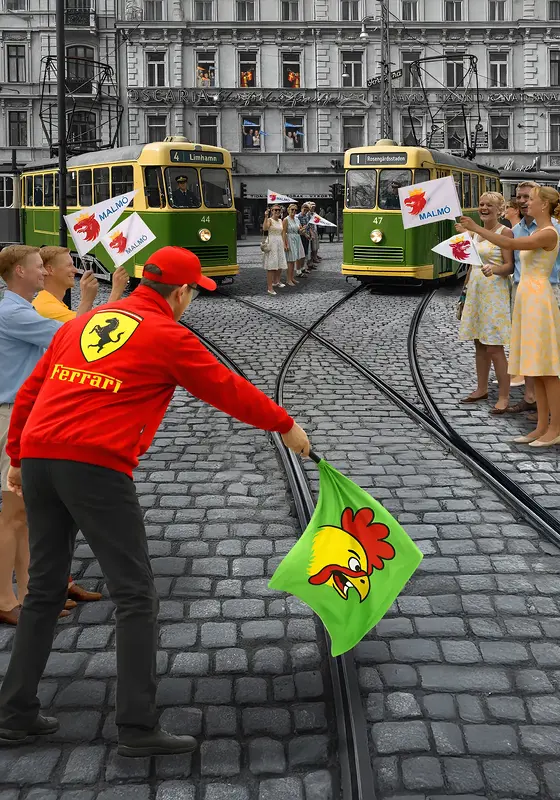
Two trams move towards each other across Gustav Adolfs torg. Their rails cross in an X. People gather to watch. It feels like a test of courage, a moment when someone has to give way.
But trams cannot swerve. They stay on their tracks. Right there, on the fixed path and the illusion of choice, the story of the chicken race begins.
The word conjures up images of petrol fumes and teenage pride. It brings to mind cars on the edge of a cliff, the tense standoff of the Cuban Missile Crisis, and the logic of game theory, where the first to give in loses. It is a game where courage and fear are measured in seconds, and the results can range from a scratched bumper to a global disaster.
Then we travel to western Queensland. To a pub in Tambo. To a remote-controlled car filled with mealworms. To eight hens running four laps as the crowd laughs and places bets for charity.
It is the same word, but in completely different worlds.
Between the trams’ relentless rails in Malmö and the hens’ instinctive dash across the Australian desert lies the full span of the concept. Here, determinism meets play, prestige meets innocence, and geopolitics meets pub entertainment.
In this essay, we explore these contrasts. We move from the cliffs of youthful legends to the tense rooms of the Cold War, from a city’s crossroads in 1967 to a small outback town where chicken is no longer just a metaphor.
And beneath it all, the same question hums:
Is it really courage that makes the difference?
Or is it the path set long ago?
"Chicken Race
Two engines hum at the edge of the night,
Headlights cutting the canyon of light.
Chrome like a promise, breath held tight—
Who will turn, and who will fight?
Rubber and gasoline scent the air,
Teenage courage stripped bare.
No room for doubt, no room for prayer—
Only the question hangs there.
Drive.
Closer still, the distance thins,
Prestige roars and reason spins.
No one remembers how it begins—
Only that losing means someone wins.
Blink.
The cliff below is dark and wide,
Ego is riding shotgun inside.
Fear and honour side by side,
Both too proud to step aside.
In another room with maps outspread,
Red lines circle what lies ahead.
Generals speak of what’s been said,
While silence drums inside each head.
Hold.
Across a square where rails align,
Steel on steel in a crossing sign,
Two trams glide on a fixed design—
No steering wheel, no warning sign.
They do not swerve. They cannot choose.
The track decides what they will lose.
What looks like courage may confuse—
Sometimes the system lights the fuse.
Far away where the desert lies,
Under enormous outback skies,
A feathered blur in dust will rise—
No shame, no daredevil disguise.
A tiny car with a wormy prize,
Eight hens chase with hungry eyes.
The crowd laughs; no empire dies.
No one falls, and no one cries.
Same word spoken, worlds apart—
From nuclear brink to county fair start.
From trembling hand to racing heart,
From calculated move to art.
So tell me now, when engines roar,
When pride stands guard at freedom’s door,
What is the thing we’re racing for?
To win?
To prove?
To not be poor?
Or is it simply this once more—
The fear of being called
a coward
before
we turn?"
Malmö, March 2026
Prologue
Chicken Race – When the Tracks Are Already Laid
At Gustav Adolfs Square in Malmö, two green trams approach each other, almost like a game of chicken. The rails cross in an X. The crowd is packed together, waving pennants. A man in a red Ferrari jacket lowers a green flag with a wild-looking chicken head. The moment is about courage—who will give in first? You can see the tension on both drivers’ faces.
But trams can’t swerve. They have to follow the tracks laid out for them. It’s the perfect setup for a dramatic game of chicken.
Behind all the action stands a grand old building with a long sign that reads OSCARIA. It was once one of Sweden’s biggest shoe stores, with its own factory—a real part of the country’s industrial history. Oscaria was eventually sold to Bata and closed down. It’s just one more example of how things change and how the market has its own pace.
It’s 1967, right before everything changes. This is the end of the tram era—the showdown between steel wheels and rubber tyres.
On 3 September 1967, Sweden switched to driving on the right side of the road. The entire traffic system changed. In Malmö, this meant the end of the trams. New bus routes took over, and except for Line 4 to Limhamn and Sibbarp, trams vanished from the streets. By 1973, even that last line was gone. Malmö was no longer a tram city.
What looks like a game – two cars rushing towards one another – becomes, in retrospect, something else. A meeting between two epochs. The rail-bound city and rubber-tired modernity. Fixed infrastructure and a flexible future. A real game of chicken depends on free will and the chance to turn away. But here, the outcome was already set.
The tracks cross, and neither tram can turn aside. Both are the same size. This isn’t about the bigger one winning, but about a tough struggle between two drivers, each protected by tons of steel.
The crowd waves and cheers, and trumpets blare from two windows. Even with all the tension, the mood is festive. Still, it’s already the end for Line 1. Its driver will soon be just another bus driver.
All through the twentieth century, driving a tram—or even better, a train—was a dream job for many boys. Being a train driver was the top goal, with a tram driver next. No one really dreamed of driving a bus.
And right in the middle of all this, two eras cross paths at a steel X.
Chicken – The Grammar of Cowardice
Long before it described a car at the edge of a cliff or a scenario in game theory, 'chicken' was a word that hurt. In American slang from the 1920s and 30s, it meant calling someone a coward. A chicken would rather run away than stand and fight. It flutters, backs off, and avoids conflict. The phrase 'to chicken out' became common, meaning to pull back at the last minute or to back down when courage was needed.
But the word was never just about fear. Fear is something we feel inside, but cowardice is shaped by society. You are not called a chicken when you are alone; it happens when others are watching. Cowardice is a label others give you. So, from the start, the chicken race is less about courage and more about reputation.
It is about saving face.
In honour cultures – whether traditional or modern – the loss of face is worse than material loss. To be called a coward is to lose rank. It is a symbolic castration within a masculine hierarchy. That is why the word is so effective. It strikes at the most vulnerable point: the need to be perceived as fearless.
This is also why the chicken race is not really rational. It comes from a society where being recognised by people matters more than staying safe. The person who drives towards the cliff is not trying to die, but wants to avoid being called a coward. The one who refuses to turn is not drawn to danger, but is afraid of being shamed.
This is the main idea: the chicken race is a staged showdown where the fear of being embarrassed pushes people to act more than the fear of getting hurt.
This idea is deeply rooted in modern life. Today, people have to shape their own identities and earn respect through their actions. Courage becomes something you have to show. You have to act bravely, even if turning away would be the smarter choice. Looking weak is not just a personal issue; it affects your place in the social order.
When we see two cars speeding towards each other or two countries threatening each other with nuclear weapons, this simple word is still at work in the background. The word itself is simple, but its social impact is powerful.
The chicken race does not start with cars or weapons. It starts with a word that stings.
1950s Car Culture – The Youth Myth and the Aesthetics of the Cliff
The chicken race became iconic not in politics or economics, but in American car culture after World War II. In the 1950s, the United States was expanding. Suburbs spread, petrol was cheap, and highways stretched wide. Cars were more than transport; they represented identity, freedom, and gender roles. For young men, driving was not just about getting from one place to another—it was about living out their own myth.
In this setting, the chicken race became a ritual. Two drivers faced off, sometimes heading straight for a cliff. Engines roared as the crowd watched in suspense. Whoever swerved first was seen as a coward. The one who held on longest was considered brave—or maybe reckless. The line between the two was very thin.
This myth is captured best in Rebel Without a Cause. James Dean stands by his car, looking both vulnerable and defiant. In the film’s famous scene, two teenagers race towards a cliff, planning to jump out before the car goes over. The first to jump is called a chicken. The real drama is not the crash, but the tense moment just before.
This is where a new style appears: the appeal of the cliff. It’s not death that draws people in, but the thrill of being on the edge. Standing at the brink, not showing fear, becomes the point. The chicken race is more than a contest; it’s a public show of courage. It challenges masculinity, social rank, and self-image. The young man has to prove he isn’t scared, even if he is.
This is also why the chicken race is so intimately linked to teenage rebellion. Postwar youth have material security but existential uncertainty. The fathers have been at war. The sons have cars. They must create their own battlefield. The cliff becomes their front line. The car is their uniform.
Yet beneath this myth lies emptiness. The chicken race has no real purpose. It creates nothing and leaves nothing behind. It’s a self-destructive game where the only thing at stake is reputation. It shows a culture that values safety yet remains drawn to danger. The same society that builds highways and suburbs also sets up these risky contests at cliff edges.
It is here that the chicken race acquires its modern structure: the choice. Everything hinges on that fraction of a second when someone can swerve. Freedom makes the drama possible. The freedom to choose cowardice or courage. The freedom to save oneself or hold course.
This is why the difference with the Malmö scene stands out. In 1950s California, a driver could swerve and make a choice. But in Malmö in 1967, the tram’s tracks were fixed. The tram couldn’t turn away or leave its path. There was no cliff edge—just a crossing of steel rails.
But let’s not jump ahead. Before the chicken race turns into a symbol of fate in a Swedish city, it first becomes something even more abstract.
The next stage is when play turns into science.
Game Theory: When play turns into mathematics
What’s striking about the chicken race is how quickly it moved from teenage car lots and the thrill of the cliff to academic settings. In the 1950s and 60s, economists, mathematicians, and strategists began modelling human behaviour. War, negotiation, and competition could all be seen as games.
And suddenly there is "The Game of Chicken."
What was once a car ritual in California became a mathematical matrix in Princeton.
The setup is simple. Two people are on a collision course. If both swerve, disaster is avoided, but no one wins. If one swerves and the other does not, the one who stays gains respect. If neither swerves, disaster happens. Mathematically, this is shown with boxes and numbers. In real life, it’s full of pride, fear, and risk.
What’s interesting is that this game reveals a paradox in rational thinking. The logical choice is to avoid disaster. But if both players think that way, one might try to take advantage and refuse to swerve. Sometimes, the smartest move is to act as if you won’t back down, no matter what.
At this point, things change. The chicken race stops being about personal bravery and becomes about credibility. The winner is the one who can most convincingly show they are willing to go all the way.
This is a cold and almost cynical way to look at human behaviour. Emotions turn into strategies. Prestige is just another factor. Disaster is simply one possible result.
Still, the model captures something very real. It describes moments when both sides are trapped by their own self-image, where backing down feels worse than keeping up the fight. What matters most is not the outcome, but how it looks to others.
At this stage, the chicken race loses its connection to youth and becomes a means of analysing power. It’s no longer just about two boys in cars. Now, it’s about companies, countries, and military alliances. Negotiations become battles where both sides must show strength to avoid embarrassment.
But at the heart of the model is still the same idea: chicken. It’s about the fear of looking like a coward. Even though game theory uses math, it’s built on the same old social rule—no one wants to be the first to give in.
Now, everything is ready for the next step. When game theory meets real-world politics, the chicken race stops being just a metaphor.
It goes global.
The Cold War – Brinkmanship and the World Holding Its Breath
When the chicken race steps out of the seminar rooms and into geopolitics, the proportions change, but not the structure. In the 1960s, two systems confronted one another: the United States and the Soviet Union. Two ideologies, two military blocs, two arsenals, together capable of destroying the planet several times over. The rhetoric is harsh, the suspicion total, the prestige monumental.
It is here that the concept of brinkmanship acquires its full meaning—the art of going to the edge of the abyss without falling. To demonstrate resolve so convincingly that the opponent backs down first. Not to blink.
When the chicken race idea shifts from classroom debates to world politics, the stakes rise, but the basic setup remains the same. In the 1960s, the United States and the Soviet Union faced each other. Two ideologies, two military alliances, and two huge arsenals could destroy the world many times. The talk was tough, suspicion ran high, and national pride was on the line.
This is where brinkmanship truly comes into play: the skill of approaching disaster without actually falling into it. The goal is to show such determination that the other side gives in first. The key is not to flinch.
The Cuban Missile Crisis in 1962 is the best example. American spy planes found Soviet nuclear missiles in Cuba. Washington reacted. Moscow answered. Fleets moved. Missiles were aimed. For a few days in October, the world held its breath. Two superpowers were heading straight for each other.
The setup is just like the 1950s car duel, but with one big difference. Here, there are no teenagers who can jump out at the last moment. There is no crowd watching. There are no shiny car bumpers. Instead, there are careful calculations, secret messages, and the shared threat of total destruction.
Prestige is central. If the United States accepts Soviet missiles in Cuba, it signals weakness. If the Soviet Union backs down without compensation, it signals weakness. In this climate, weakness can have repercussions far beyond the crisis itself. Every move must therefore be weighed not only for its practical effect but also for how it will be perceived. The chicken race becomes a game of credibility on a global scale.
The most troubling part is the double logic involved. The sensible goal is to prevent nuclear war. Yet to do that, each side must act as if it were willing to risk it. Each side must convince the other that it will not back down. The side that shows the most convincing determination gains an advantage in negotiations.
For several days, world politics was on the edge. No one wanted to look like they had given in. Everyone knew what disaster could come, yet the standoff continued.
In the end, both sides stepped back in a way that let neither lose face. The compromise was mostly hidden. In public, both looked strong. In private, both knew how close they had come to disaster.
At this stage, the chicken-race idea is stretched to its limits. It began as slang and a youth ritual, then became a mathematical concept, and finally posed a real danger to humanity. This shows how much politics relies on symbolic courage and the fear of seeming weak.
Because of this, it's interesting to see how the idea takes hold in daily life. It becomes a metaphor for things like negotiations, strikes, and budget fights. The idea spreads from world politics into everyday conversations.
The next step is to see how this idea goes from car culture and nuclear standoffs to a wider social metaphor.
From Car Culture to Social Metaphor
After the Cold War, the chicken race was no longer a dramatic event. Instead, it became a way to describe a pattern. It moved from dangerous standoffs to negotiations and political debates. It was no longer an actual duel, but a structure seen in many conflicts.
Two sides refuse to compromise. Pride matters more than the real issue. There is a real risk of harm, but neither side wants to be the first to give in. No one wants to seem weak.
We see this in politics when governments and opposition parties get stuck in budget battles. In labour disputes, strikes and lockouts can threaten to shut down society. In trade wars, tariffs can keep rising, especially during financial crises when banks or countries test each other's determination. In military standoffs, any step back can look like surrender.
But this also happens on a smaller scale. In personal relationships, two people may refuse to make the first move to make up. In families, no one wants to be the first to say sorry. In everyday life, pride often gets in the way of practical solutions.
In these situations, the chicken race idea helps explain modern conflict. It describes cases where the setup itself pushes people to take risks, mostly because backing down would be embarrassing. Often, it's not hate that drives this, but the fear of seeming weak.
The paradox is that everyone often knows what the game looks like. Everyone knows it would be wise to swerve. Yet the confrontation continues, because the one who swerves first risks losing more symbolically than materially. The chicken race thus becomes a model of how prestige can become more dangerous than the conflict itself.
Now, the idea is so common that people use 'chicken race' to talk about conflicts between political parties or companies, even when no one's life is at risk. The metaphor has lost its original danger, but the basic setup is the same: two sides heading for a clash, neither wanting to give in first.
This is where we see the deeper irony in the Malmö example. If a chicken race depends on having the chance to turn away, what happens if that choice is gone? What if things are so rigid that no one can change direction?
This leads us to the main paradox: the moment when free will and fate clash.
Prestige is at the heart of the matter. If the United States accepts Soviet missiles in Cuba, it looks weak. If the Soviet Union backs down without getting something in return, it also looks weak. In this tense environment, any sign of weakness can have consequences that go far beyond the immediate crisis. Every decision must be considered not just for its real-world impact, but also for how others will see it. The chicken race turns into a global contest of credibility.
What is most troubling is the double logic at play. The sensible goal is to avoid nuclear war. Yet to prevent war, each side must show it is willing to risk it. Each must convince the other that it will not back down. The side that shows the most convincing resolve gains an advantage in negotiations.
For a few days, world politics stands on the edge. It is like looking over a cliff, but on a global scale. No one wants to be seen as a coward. Everyone understands the disaster that could follow. Still, the standoff goes on.
In the end, both sides pull back in a way that lets neither lose face completely. The compromise is mostly hidden. In public, both appear strong. In private, both know how close they came to disaster.
At this point, the chicken race reaches its extreme. It has gone from a slang term and a youth ritual to a mathematical idea and even an existential threat to humanity. The concept shows its full impact: it reveals how much politics depends on symbolic courage and the fear of looking weak.
For this reason, it is interesting to see how the idea slips into everyday life. It becomes a metaphor for negotiations, strikes, and budget crises. The concept moves from world politics into public debate.
The next step is to trace how this idea moves from car culture and nuclear standoffs to a broader social metaphor.
From Car Culture to Social Metaphor
After the Cold War, the chicken race ceases to be a spectacular event and instead becomes a description of a structure. It moves from cliffs and missile sites to negotiating tables and parliamentary chambers. It is no longer a concrete duel but a pattern in how conflicts unfold.
Two sides refuse to compromise. Prestige becomes more important than the actual issue. There is a real risk of harm, but neither wants to be the first to give in. No one wants to seem weak.
We see this in politics when governments and oppositions get stuck in budget standoffs. In labour disputes, strikes and lockouts can threaten to shut down society. In international trade wars, tariffs rise during financial crises as banks or countries test each other's resolve. In military standoffs, any retreat can look like surrender.
But this also happens on a smaller scale. In personal relationships, two people may refuse to make the first move toward making up. In family arguments, no one wants to say sorry. In everyday life, pride often gets in the way of practical solutions.
Here, the chicken race becomes a way to understand modern conflict. It describes situations in which the setup itself pushes people toward a risky point, mainly because backing down incurs a social cost. Often, it is not hatred that drives the conflict, but the fear of losing face.
The paradox is that everyone usually knows how the game works. Everyone knows it would be smarter to back down. Still, the standoff goes on, because the first to give in risks losing more in reputation than in real terms. The chicken race becomes a model for how pride can be more dangerous than the conflict itself.
By now, the idea is so common that people use it almost casually. We talk about a "chicken race" between political parties or companies, even when no one's life is at risk. The metaphor has lost its deadly meaning, but the basic setup is the same: two sides heading for a clash, neither willing to back down first.
This is where we start to see the deeper irony in the Malmö example. If a chicken race depends on the chance to turn aside, what happens when that option is gone? What if the situation is so rigid that no one can change course?
This brings us to the paradox: the moment when free will and fate come into conflict.
The Paradox – When Freedom Is an Illusion
The concept of the Chicken Race centres on a critical moment: the brief instant when a participant may swerve. The entire scenario hinges on the driver's ability to change course. If a superpower withdraws its missiles or a politician chooses to compromise, the confrontation is averted. Without this possibility, the situation no longer constitutes a chicken race; it becomes an inevitable collision.
For this reason, the concept is inherently linked to free will: the freedom to resolve a crisis or to abstain from intervention, and the freedom to prioritise prestige over safety.
However, in the Malmö scenario, an inversion is evident. Trams cannot swerve because they are confined to their tracks. While drivers may apply the brakes, they cannot exit the system or perform a dramatic evasive manoeuvre. Their trajectory is predetermined.
In this context, the underlying absurdity becomes apparent. Superficially, the event resembles a chicken race, with two vehicles on a collision course, public anticipation, and a signal to commence. However, the fundamental structure is one of determinism; no participant can select an alternative route, as the tracks are fixed.
This dynamic renders the scene more philosophical than dramatic, raising a fundamental question: to what extent are individuals truly free when they perceive themselves as competing in acts of courage?
Within the narrative of car culture, choice is framed as an individual act. In game theory, it is conceptualised as a strategic decision. During the Cold War, it represented a geopolitical calculation. In contrast, within a rail-based urban environment, choice is embedded in infrastructure; the system itself dictates direction.
A broader consideration arises in this context. Modernity frequently emphasises the narrative of choice, suggesting that individuals select direction, technology, and the future, as well as between competing systems. However, these choices are often predetermined by economic forces, political decisions, and technological investments. Once infrastructure is established, altering direction becomes challenging.
Thus, the chicken race emerges as an illusion of freedom. Although the drama of the moment is experienced, the outcome is largely determined by prior decisions. The fate of the tramway is not determined by drivers but by traffic policy, urban planning, and the prevailing ideology of modernity.
This situation has an almost tragic dimension. While drivers may exhibit courage or composure, their outcomes are determined by broader systemic forces. The central issue is not individual bravery, but rather which system endures.
For that reason, the next step becomes decisive. When the chicken race moves from cliffs and missiles to Malmö in 1967, it is no longer two individuals who meet.
Rather, it is a confrontation between two historical epochs..
From Cliff to System Shift – Malmö 1967
In 1967, a chicken race in Malmö changed the perspective. It was not about two young people at a cliff's edge or two superpowers on the verge of disaster. Instead, it was a city facing a decision, or at least feeling like it was.
On 3 September 1967, Sweden switched to driving on the right-hand side of the road. This was not just a logistical challenge but also a mental shift. Signs were changed, bus doors were moved, and routines had to be updated. Underneath these changes, a bigger shift was happening: modern life was speeding up. Flexibility became the guiding idea. Rubber tyres represented the future, while rails were seen as old-fashioned.
In Malmö, the traffic reform marked the end of the tram system. A new network of routes was introduced, and buses took over. The trams, which had been the city's main form of transport for decades, slowly vanished. Only Line 4 to Limhamn and Sibbarp lasted a little longer, closing in 1973. After that, Malmö was no longer a tram city.
This was not a dramatic crash but a shift in the whole system. Still, it looked a bit like a chicken race. Two types of technology faced off: the fixed-rail system and the mobile bus. The rail was steady and part of the city's fabric, while the bus was flexible, adaptable, and modern.
The trams 'lost, not because they were worse machines, but because the political and economic thinking changed. At the same time, a similar shift was happening across the country. More long-distance freight moved from rail to trucks. Swedish State Railways faced difficulties, and the rails lost their once secure place.
What is interesting is that people saw this as a choice. They talked about the traffic of the future, about efficiency, and about adaptability. It felt like choosing a direction, just as a driver in a chicken race decides whether to keep going or turn away. But looking back, we can wonder how much of a real choice it was. Oil prices, urban planning ideas, car culture, and international trends all pushed things in the same direction.
The tracks cross, and one era gives way to another.
Three decades later, the pendulum begins to swing back. Stockholm reintroduces tram lines. Lund builds new ones. The question arises: why not Malmö? What was once perceived as self-evident modernity now appears short-sighted. The rail, once considered rigid and outdated, is revalued as sustainable and forward-looking.
Here, the chicken race shows how things can come full circle. We hurry towards a solution, sure it is the only sensible choice. The old technology steps aside, and the new one wins. But history keeps going, and sometimes these systems cross paths again at new steel intersections.
In Malmö in 1967, it was not about two drivers showing their bravery. It was a city shifting between two ways of building its transport system. The tram stood for one era, the bus for another. Behind it all was the same feeling as in a car duel: the fear of looking old-fashioned or being left behind.
It was not two young people standing at the edge of a cliff.
It was a city that believed it was choosing the direction of modernity.
But before we finish, we need to take an unexpected turn. If a chicken race can be a youth ritual, a moment in world politics, and a big change in systems, it can also become something completely different.
Now we go to the desert.
When the Chicken Became Literal – Tambo, Queensland
Every evening during the season in the small town of Tambo in western Queensland, Ben's Chicken Racing takes place. The event is held at the Royal Carrangarra Hotel. There are no missiles, no cliffs, and no ideological battles. Instead, there are laying hens, a remote-controlled car, and a crowd with beers in hand.
The setup is simple, almost to the point of being obvious. Eight to ten hens line up at the start. A small remote-controlled car, filled with mealworms, leads the way. The hens chase it for four laps. People in the audience place bets on their chosen hen. The money raised goes to charity, including the Royal Flying Doctor Service. The hens have names like Barcoo Blue, Ginger Ninja, and Beyoncé. The event is popular, noisy, and a bit chaotic.
There is no sense of looming danger or deep crisis.
In this setting, calling someone a "chicken" is not an insult. It simply describes a bird running after food. There is no prestige involved. No one worries about losing face or proving themselves. No one risks a global disaster by refusing to back down.
It is almost as if language itself has shaken off its drama. What once meant preferring death to being called a coward has become a communal game whose purpose is to raise money for rural medical transport. The chicken race has been disarmed.
That is exactly why Tambo is worth mentioning in an essay about the chicken race. It shows how ideas can move from one culture to another, and how a word that means both shame and pride in one place can become simple and harmless in another. It reminds us that much of the drama comes from how we interpret things, not just from what actually happens.
In the classic chicken race, what matters is who swerves first. In Tambo, what matters is who finds the mealworms fastest. There is nothing to win except a laugh and a charitable contribution. The risk is minimal. No abyss awaits.
This is a funny contrast to the tense days of the Cuban Missile Crisis or the last tram crossing in Malmö. But the difference is useful. It shows that the chicken race is really a pattern we apply to different situations. Sometimes it is dangerous, and sometimes it is just for fun.
The setup could not be simpler:
8–10 laying hens.
A small remote-controlled car.
The bait: mealworms.
Four laps.
People in the audience place bets on their chosen hen. Some of the well-known hens have names like Barcoo Blue, Ginger Ninja, and Beyoncé.
The proceeds go to charity, including the Royal Flying Doctor Service.
This leads to a bigger question: what is at the heart of the idea? Is it about danger, prestige, the freedom to back down, or our habit of seeing confrontation as a test of bravery?
When 'chicken' is taken literally, all the symbolic pressure goes away. But when the word is used as a metaphor in politics, infrastructure, or relationships, the drama comes back.
So, between hens in the desert and tram tracks in Malmö, we see the full range of what the concept can mean.
To Blink or To Be Bound
The chicken race begins with a word that burns. It continues with teenagers at cliffs, mathematicians at blackboards, generals in crisis rooms, and politicians unwilling to lose face. It ends — or rather lands — at a tram junction in Malmö and in a pub in Queensland. It is an idea that shifts between tragedy and farce.
Yet through all these shifts runs a common nerve: the fear of blinking first, of showing weakness, of admitting that one could have turned but chose not to.
In car culture, it was about personal courage. In game theory, it was about making the smartest move. During the Cold War, it was about the survival of civilisation. In Malmö in 1967, it was about a city's self-image and its future. In Tambo, it is simply a hen chasing food.
The real difference is in the consequences. The setup stays the same. But in the Malmö example, there is something new: determinism. The tram cannot leave its track. It does not have the same freedom as a car at the edge of a cliff. It follows a path already set. This reveals an uncomfortable truth about the chicken race: our choices are often less free than we think. We like to speak of standing firm, of not backing down, of not being chicken. But many times it is not courage or cowardice that determines the outcome, but structures, infrastructures, economies and ideologies that have already laid the rails.
That does not mean people have no responsibility. A driver can still brake. A politician can still compromise. A superpower can still step back. But our choices are never unlimited. There are always boundaries to our freedom.
The chicken race becomes a mirror for us. It reveals how much of modern life is based on hiding weakness. It shows that pride can be more dangerous than the conflict itself. It also shows how systems can push people into confrontations that nobody really wants.
Meanwhile, in the Queensland desert, hens chase a remote-controlled car, and the audience laughs. There, the word has lost its charge. There is no shame in being chicken. It is simply a body following its instinct.
Maybe there is an unexpected lesson in that.
The most destructive element in the chicken race is not the danger, but the idea that one must not back down.
Sometimes, real courage means choosing to turn aside.
Pride can sometimes be a more dangerous motivator than fear.
At Gustav Adolf's Torg, the rails cross in an X. Two trams meet. The audience cheers. It looks like a test of courage. But in reality, it is an image of something else: how eras meet, how systems replace one another, how we interpret change as conflict.
So, the chicken race is not just a duel. It is a story about how we see strength, weakness, and the paths we choose.
The real question is not just who gives in first. It is also about who set the path in the first place.
The question is not the least who laid the tracks.
Två spårvagnar rullar mot varandra över Gustav Adolfs torg. Rälsen korsas i ett X. Publiken står samlad. Det ser ut som ett test av mod. Ett ögonblick där någon måste väja.
Men spårvagnar väjer inte.
De följer sina räler.
Och just där – i den låsta kursen, i illusionen av val – börjar berättelsen om chicken race.
Begreppet har en laddning av bensinångor och tonårig prestige. Det för tankarna till bilar vid stup, till Kubakrisens nervkrig, till spelteorins kalla matriser där den som blinkar först förlorar. Ett spel där mod och feghet vägs i sekunder, och där konsekvenserna kan vara allt från skrapade stötfångare till global katastrof.
Men så förflyttas vi till västra Queensland.
Till en pub i Tambo.
Till en radiostyrd bil laddad med mjölmaskar.
Till åtta värphöns som springer fyra varv medan publiken skrattar och satsar pengar till välgörenhet.
Samma ord. Helt olika världar.
Mellan spårvagnarnas obönhörliga räls i Malmö och hönsens instinktiva språng i den australiska öknen ryms hela begreppets spännvidd. Här möts determinism och lek, prestige och oskuld, geopolitik och pubunderhållning.
I denna essä rör vi oss genom dessa kontraster. Från ungdomsmytens stup till kalla krigets krisrum. Från stadens teknologiska vägval 1967 till en ökenstad där chicken blivit bokstavlig.
Och under allt ligger samma fråga och vibrerar:
Är det verkligen modet som avgör?
Eller är det rälsen som redan lagts?
Prolog
Chicken Race – När spåren redan är lagda
På Gustav Adolfs torg i Malmö möts två gröna spårvagnar i vad som ser ut som ett klassiskt chicken race. Rälsen löper samman i ett X. Publiken står tätt. Vimplar viftas. En man i en röd Ferrari-jacka sänker en grön flagga med ett hysteriskt kycklinghuvud. Allt tycks handla om mod: vem väjer först? Det syns på båda förarnas sammanbitna ansikten.
Men spårvagnar kan inte väja. De följer sina räler. De är bundna till den väg som redan lagts. Snacka om upplägg för ett brutalt chicken race.
Bakom dramat reser sig den monumentala sekelskiftesfasaden med den långa skylten: OSCARIA – en av landets största skobutikskedjor, med egen tillverkning, ett stycke svensk industrihistoria. Oscaria såldes till Bata och lades ned. Ännu ett exempel på hur strukturer förändras, hur marknaden kör sitt eget race.
Året är 1967. Ögonblicket precis före den verkliga omställningen. Spårvägens armageddon. Järnhjulens slutuppgörelse med gummidäcken.
Den 3 september 1967 går Sverige över till högertrafik. Hela trafiksystemet ritas om. I Malmö blir detta i praktiken dödsstöten för spårvägen. Ett nytt linjenät införs. Bussar tar över. Med undantag för linje 4 till Limhamn och Sibbarp försvinner spårvagnarna från stadens gator. 1973 läggs även denna sista linje ned. Därmed upphör Malmö att vara spårvägsstad.
Det som i bilden ser ut som en lek – två vagnar som rusar mot varandra – blir i efterhand något annat. Ett möte mellan två epoker. Den spårbundna staden och den gummihjulsburna moderniteten. Den fasta infrastrukturen och den flexibla framtiden.
Chicken Race bygger på fri vilja. På möjligheten att svänga undan. Men här var det redan bestämt.
Spåren korsas. Ingen kan väja. Båda vagnarna är lika stora. I detta fall är det inte den störste som går först, utan en hänsynslös kamp mellan två viljor skyddade av flera ton plåt och järn.
Publiken vinkar och tjoar. Från två fönster ljuder trumpetfanfarer. Trots dramatiken råder feststämning. Hur som helst är det ändå kört för linje 1. Föraren degraderas snart till att bli en bland många bussförare.
Att köra spårvagn – och ännu mer järnvägslok – var under hela 1900-talet en pojkdröm. Lokföraren stod högst. Spårvägaren kom strax därefter. Att ratta en buss var inget man drömde om.
Och mitt i detta skådespel möts två epoker på ett X av stål.
Chicken – feghetens grammatik
Innan det blev en bil vid ett stup, innan det blev en spelteoretisk modell eller en kärnvapenduell, var chicken ett ord som skavde. I amerikansk slang under 1920– och 30-talet betydde det att kalla någon feg. En kyckling flyr hellre än slåss. Den flaxar, backar, undviker konfrontation. Att “chicken out” blev ett etablerat uttryck – att dra sig ur i sista stund, att backa när modet krävdes.
Men det intressanta är att ordet aldrig bara handlade om rädsla. Rädsla är biologisk. Feghet är social. Man är inte chicken i ensamhet; man blir det i andras blick. Feghet är ett offentligt tillstånd. Det är något som tillskrivs dig. Därför är chicken race från början inte en berättelse om mod, utan om prestige.
Det handlar om ansiktet.
I hederskulturer – oavsett om de är traditionella eller moderna – är förlusten av ansiktet värre än den materiella förlusten. Att bli kallad feg är att förlora rang. Det är en symbolisk kastration i en maskulin hierarki. Det är därför ordet är så effektivt. Det trycker på det mest sårbara: behovet av att uppfattas som orädd.
Det är också därför chicken race aldrig är en rationell situation i grunden. Den uppstår ur en social struktur där erkännandet från andra väger tyngre än säkerheten. Den som kör mot stupet gör det inte för att dö, utan för att inte bli kallad feg. Den som står kvar gör det inte för att han älskar faran, utan för att han fruktar skammen.
Här ligger den första nyckeln till begreppet: chicken race är en ritualiserad konfrontation där hotet om förnedring driver handlingen mer än hotet om fysisk skada.
Detta är djupt modernitetens logik. I en värld där individen ska skapa sig själv, där identiteten inte är given av börd utan av prestation, blir modet en valuta. Man måste visa det. Uppvisa det. Spela det. Att väja kan vara klokt – men det ser svagt ut. Och svaghet är inte bara en personlig brist, utan en position i en hierarki.
När vi senare ser två bilar rusa mot varandra eller två supermakter hota med kärnvapen är det denna lilla språkliga mekanism som fortfarande arbetar i bakgrunden. Ordet är enkelt. Men dess sociala laddning är explosiv.
Chicken race börjar alltså inte med motorer eller missiler. Det börjar med ett ord som bränner.
1950-talets bilkultur – ungdomsmyten och stupets estetik
När chicken race får sin ikoniska form är det inte i politiken och inte i ekonomin, utan i den amerikanska efterkrigstidens bilkultur. USA på 1950-talet är ett land i materiell expansion. Förorterna växer, bensinen är billig, vägarna breda. Bilen blir mer än ett transportmedel – den blir identitet, frihet, könsmarkör. Den unge mannen bakom ratten är inte bara förare; han är protagonist i sin egen myt.
Det är i detta landskap chicken race uppstår som ritual. Två förare ställer upp. Mot varandra eller mot en klippavsats. Motorerna varvar. Publiken håller andan. Den som först svänger undan är feg. Den som sitter kvar längst är modig – eller galen. Skillnaden är hårfin.
Det mest koncentrerade uttrycket för denna myt finns i Rebel Without a Cause. James Dean står lutad mot bilen med den där hållningen som blivit ikon: sårbar och trotsig på samma gång. I filmens berömda scen kör två ungdomar mot en klippavsats. De ska hoppa ur innan bilen störtar. Den som hoppar först är chicken. Det är inte kraschen som är huvudnumret. Det är ögonblicket innan.
Här föds en särskild estetik: stupets estetik. Det är inte döden som lockar, utan gränsen. Att befinna sig precis på kanten och visa att man inte darrar. Chicken race är därför inte bara en tävling; det är en offentlig ceremoni i modets teater. Den prövar maskulinitet, hierarki och självbild. Den unge mannen måste visa att han inte är rädd – även om han är det.
Det är också därför chicken race är så intimt förbundet med tonårsuppror. Efterkrigstidens ungdomar har materiell trygghet men existentiell osäkerhet. Fäderna har varit i krig. Sönerna har bilar. De måste skapa sitt eget slagfält. Stupet blir deras frontlinje. Bilen deras uniform.
Men under denna myt finns en tomhet. Chicken race saknar mål. Det producerar inget. Det bygger inget. Det är ett självförstörande spel där det enda kapitalet är prestige. Det är en dramatisk manifestation av en kultur som samtidigt dyrkar säkerhet och flirtar med risk. Man bygger motorvägar och förorter – och iscensätter stupdueller.
Det är också här chicken race får sin moderna struktur: valet. Allt hänger på den bråkdelen av en sekund när någon kan svänga. Det är friheten som gör dramat möjligt. Friheten att välja feghet eller mod. Friheten att rädda sig själv eller hålla kursen.
Och just därför är kontrasten till Malmö-scenen så slående. I 1950-talets Kalifornien kan bilen svänga. Föraren kan välja. I 1967 års Malmö är rälsen redan lagd. Spårvagnen kan inte vrida ratten åt sidan och lämna sin bana. Den har ingen stupkant att kasta sig mot – bara ett X av stål.
Men vi ska inte gå dit än. För innan chicken race blir determinismens ironi i en svensk stad, ska det förvandlas till något ännu mer abstrakt.
Nästa steg är att lek blir vetenskap.
Spelteori – när lek blir matematik
Det märkliga med chicken race är att det mycket snabbt lämnar tonårens grusplaner och klippavsatsens romantik och kliver in i seminarierummen. Under 1950- och 60-talen börjar ekonomer, matematiker och strategiska tänkare formulera mänskligt beteende i modeller. Krig, förhandlingar, konkurrens – allt kan reduceras till spel.
Och plötsligt finns “The Game of Chicken”.
Det som i Kalifornien var en motorritual blir i Princeton en matris.
Upplägget är brutalt enkelt. Två aktörer står på kollisionskurs. Om båda väjer undviks katastrofen, men ingen framstår som segrare. Om den ena väjer och den andra inte, vinner den som står kvar prestige. Om ingen väjer inträffar katastrofen. I matematisk form kan detta skrivas i rutor och siffror. I verkligheten är det laddat med stolthet, rädsla och hot.
Det fascinerande är att spelet avslöjar en paradox i rationaliteten. Det rationella vore att undvika katastrof. Men om båda resonerar så, kan någon frestas att utnyttja situationen och stå kvar. Därför kan det rationella ibland vara att verka irrationell. Att övertyga motståndaren om att man inte tänker svänga, oavsett konsekvenser.
Här sker en förskjutning. Chicken race är inte längre en fråga om personlig moduppvisning. Det blir en fråga om trovärdighet. Den som mest övertygande signalerar att han är beredd att gå under, vinner.
Det är ett kyligt och nästan cyniskt synsätt på mänskligt handlande. Känslor reduceras till strategier. Prestige blir en variabel. Katastrof blir ett utfall i en tabell.
Men modellen har något djupt realistiskt i sig. Den beskriver situationer där båda parter är låsta av sin egen självbild. Där reträtt kostar mer symboliskt än fortsatt konfrontation. Där det viktigaste inte är vad som faktiskt händer, utan hur det uppfattas.
Och här börjar chicken race lämna ungdomens symbolik och bli ett verktyg för maktanalys. Det är inte längre bara två pojkar i bilar. Det är företag, stater, militärallianser. Det är förhandlingar där båda parter måste visa styrka för att inte förlora ansiktet.
Men i modellens kärna finns fortfarande det ursprungliga ordet. Chicken. Rädslan för att framstå som feg. Spelteorin må vara matematiskt formulerad, men den bygger på samma gamla sociala mekanism: ingen vill vara den som blinkar först.
Det är nu scenen är satt för nästa steg. För när spelteorins tabeller möter geopolitikens verklighet upphör chicken race att vara metafor. Det blir globalt.
Kalla kriget – brinkmanship och världen håller andan
När chicken race kliver ut ur seminarierummen och in i geopolitiken förändras proportionerna, men inte strukturen. Under 1960-talet står två system mot varandra: USA och Sovjetunionen. Två ideologier, två militära block, två arsenaler som tillsammans kan utplåna planeten flera gånger om. Retoriken är hård, misstänksamheten total, prestigen monumental.
Det är här begreppet brinkmanship får sin fulla betydelse – konsten att gå till avgrundens kant utan att falla. Att demonstrera beslutsamhet så övertygande att motståndaren backar först. Att inte blinka.
Kubakrisen 1962 är det tydligaste exemplet. Amerikanska spaningsflyg upptäcker sovjetiska kärnvapenramper på Kuba. Washington reagerar. Moskva svarar. Flottor sätts i rörelse. Missiler riktas. Under några oktoberdagar befinner sig världen i ett tillstånd som närmast kan beskrivas som en kollektiv inandning. Två makter på kollisionskurs.
Strukturen är identisk med 1950-talets bilduell, men med en avgörande skillnad: här finns inga ungdomar som kan hoppa ur i sista sekund. Det finns ingen publik som jublar. Det finns inga kromade kofångare. Det finns bara beräkningar, hemliga meddelanden och ett ömsesidigt hot om total förintelse.
Prestigen är central. Om USA accepterar sovjetiska missiler på Kuba signalerar det svaghet. Om Sovjet backar utan motprestation signalerar det svaghet. Och svaghet i detta klimat kan få följdverkningar långt bortom själva krisen. Därför måste varje steg vägas mot hur det uppfattas. Chicken race blir här ett spel om trovärdighet i global skala.
Det mest oroande är att rationaliteten i situationen är dubbelbottnad. Det rationella är att undvika kärnvapenkrig. Men för att undvika krig måste man visa att man är beredd att riskera det. Man måste övertyga motståndaren om att man inte tänker väja. Den som mest trovärdigt kan signalera sin beslutsamhet vinner förhandlingsutrymmet.
Så rör sig världspolitiken under några dagar på kanten av stupet. Det är stupets estetik i planetär skala. Ingen vill vara chicken. Alla vet vad katastrofen innebär. Ändå fortsätter spelet.
Till slut backar båda – på ett sätt som gör att ingen helt förlorar ansiktet. En kompromiss i det fördolda. Offentligt kan båda sidor tala om fasthet. Privat vet man hur nära det var.
Här har chicken race nått sin yttersta spets. Från slanguttryck till ungdomsritual, från matematiskt schema till existentiellt hot mot mänskligheten. Begreppet visar sin fulla kraft: det blottlägger hur mycket av politiken som handlar om symboliskt mod och rädslan för att framstå som svag.
Men just därför är det intressant att se hur det sedan glider in i vardagen. Hur det blir en metafor för förhandlingar, strejker, budgetkriser. Hur det sipprar ner från världspolitiken till samhällsdebatten.
Nästa steg är att följa den rörelsen – från bilkultur och kärnvapenbalans till allmän samhällsmetafor.
Från bilkultur till samhällsmetafor
Efter kalla kriget upphör chicken race att vara en spektakulär händelse och blir i stället en beskrivning av en struktur. Det rör sig från stup och missilramper till förhandlingsbord och plenisalar. Det är inte längre en konkret duell, utan ett mönster i hur konflikter drivs.
Två parter vägrar kompromissa. Prestige är viktigare än sakfrågan. Risken för förödelse finns där, men ingen vill vara den som ger sig först. Ingen vill framstå som svag.
Man ser det i politiken när regeringar och opposition låser sig i budgetförhandlingar. I arbetsmarknadskonflikter där strejk och lockout hotar att lamslå samhället. I internationella handelskrig där tullar höjs i en eskalerande spiral. I ekonomiska kriser där banker eller stater testar varandras beslutsamhet. I militära upptrappningar där varje reträtt riskerar att tolkas som kapitulation.
Men också i det lilla. I personliga relationer där två människor vägrar ta första steget mot försoning. I familjekonflikter där ingen vill be om ursäkt. I vardagens mikropolitik där stolthet står i vägen för pragmatism.
Det är här chicken race blir ett begrepp för modern konfliktkultur. Det beskriver situationer där själva strukturen driver aktörerna mot en farlig punkt, just därför att reträtten är socialt kostsam. Det är inte alltid hatet som driver spelet, utan rädslan för att tappa ansikte.
Det paradoxala är att alla ofta vet hur spelet ser ut. Alla vet att det vore klokt att svänga. Ändå fortsätter man, för att den som svänger först riskerar att förlora mer symboliskt än materiellt. Chicken race är därmed en modell för hur prestige kan bli farligare än själva konflikten.
I detta skede har begreppet blivit så etablerat att det kan användas nästan slentrianmässigt. Man talar om ett “chicken race” mellan politiska partier eller företag utan att någon faktiskt riskerar livet. Metaforen har lösgjorts från sin dödliga kärna, men strukturen finns kvar: två aktörer på kurs mot varandra, ingen vill blinka först.
Och det är just här vi kan börja ana den djupare ironin i Malmöbilden. För om chicken race förutsätter möjligheten att väja, vad händer då när denna möjlighet saknas? Vad händer när strukturen är så fast att ingen egentligen kan ändra riktning?
Det leder oss till det paradoxala – till den punkt där fri vilja och determinism kolliderar.
Det paradoxala – när friheten är en illusion
Chicken race bygger på ett ögonblick. Den bråkdelen av en sekund när någon kan svänga undan. Hela dramat vilar på att valet finns. Att föraren kan vrida ratten. Att supermakten kan dra tillbaka missilerna. Att politikern kan kompromissa. Utan denna möjlighet upphör spelet att vara chicken race och blir i stället kollision.
Det är därför begreppet alltid är kopplat till fri vilja. Friheten att rädda situationen – och friheten att avstå från att göra det. Friheten att välja prestige framför säkerhet.
Men i din Malmö-scen uppstår en inversion. Spårvagnar kan inte svänga. De följer sina räler. Förarna kan bromsa, men de kan inte lämna systemet. De kan inte styra ut på trottoaren och rädda ansiktet genom en dramatisk undanmanöver. Deras bana är redan definierad.
Det är här absurdismen uppstår. Ytan är ett chicken race: två enheter på kollisionskurs, publikens förväntan, flaggan som faller. Men djupstrukturen är determinism. Ingen kan välja en annan väg. Spåren är lagda.
Detta gör scenen mer filosofisk än dramatisk. Den ställer frågan som ligger under hela begreppet: hur fria är vi egentligen när vi tror att vi tävlar i mod?
I bilkulturens myt är valet individuellt. I spelteorin är det strategiskt. I kalla kriget är det geopolitisk kalkyl. Men i den spårbundna staden är valet inbyggt i infrastrukturen. Systemet bestämmer riktningen.
Och här öppnar sig en större tanke. Moderniteten älskar berättelsen om val. Vi väljer riktning, teknik, framtid. Vi väljer mellan system. Men ofta är dessa val redan strukturerade av ekonomiska krafter, politiska beslut och tekniska investeringar. När rälsen en gång är lagd, är det svårt att plötsligt köra åt ett annat håll.
Chicken race framstår då som en illusion av frihet. Vi upplever dramatiken i ögonblicket – men det mesta är redan avgjort av tidigare beslut. Det är inte förarna som bestämmer om spårvägen ska leva eller dö. Det är trafikpolitiken, stadsplaneringen, modernitetens ideologi.
I detta ligger en nästan tragisk dimension. Förarna kan uppvisa mod eller kyla, men deras öde är knutet till något större. Det är inte en fråga om vem som är mest orädd, utan om vilket system som överlever.
Och just därför blir nästa steg avgörande. För när chicken race förflyttas från stup och missiler till Malmö 1967, är det inte två individer som möts. Det är två epoker.
Från stup till systemskifte – Malmö 1967
När man placerar ett chicken race i Malmö 1967 förskjuts perspektivet. Det är inte längre två ungdomar vid en klippavsats, eller på en gatustump eller två supermakter vid avgrundens rand. Det är en stad som står inför ett beslut – eller åtminstone upplever att den gör det.
Den 3 september 1967 går Sverige över till högertrafik. Det är en logistisk och mental revolution. Skyltar byts, bussdörrar flyttas, rutiner skrivs om. Men under denna tekniska operation ligger en djupare rörelse: moderniteten accelererar. Flexibilitet blir ledord. Gummihjul uppfattas som framtid, räls som det förflutna.
I Malmö blir högertrafikomläggningen i praktiken dödsstöten för spårvägen. Ett nytt linjenät införs. Bussarna tar över. Spårvagnarna – som i decennier varit stadens pulsådror – försvinner successivt. Endast linje 4 till Limhamn och Sibbarp får en respit. 1973 är det slut även för den. Malmö upphör att vara spårvägsstad.
Detta är inte en kollision i dramatisk mening. Det är en systemförskjutning. Men strukturen liknar chicken race. Två teknologier står mot varandra: den spårbundna infrastrukturen och den rörliga bussen. Den ena är fast, förutsägbar, integrerad i stadens kropp. Den andra är flexibel, anpassningsbar, modern.
Spårvagnarna “förlorar”. Inte för att de är sämre maskiner, utan för att den politiska och ekonomiska logiken förändras. Samtidigt sker något liknande på nationell nivå. Fjärrfrakt flyttas i allt högre grad från järnväg till lastbil. SJ får problem. Rälsen mister sin självklara position.
Det intressanta är att detta uppfattas som ett val. Man talar om framtidens trafik. Om effektivitet. Om anpassningsförmåga. Man upplever att man väljer riktning – precis som föraren i chicken race väljer att hålla kurs eller svänga. Men i efterhand kan man fråga sig hur fritt detta val egentligen var. Oljeekonomi, stadsplaneringsideal, bilismens ideologi och internationella trender tryckte i samma riktning.
Spåren korsas. En epok ger vika.
Tre decennier senare börjar pendeln svänga tillbaka. Stockholm återinför spårväg på vissa sträckor. Lund bygger nytt. Diskussionen väcks: varför inte Malmö? Det som en gång uppfattades som självklar modernitet framstår plötsligt som kortsiktigt. Rälsen, som ansågs stel och föråldrad, uppvärderas som hållbar och framtidsinriktad.
Chicken race visar här sin cirkulära natur. Vi rusar mot en lösning i övertygelsen om att den är den enda rationella. Den gamla tekniken väjer. Den nya triumferar. Men historien tar inte slut där. Den fortsätter, och ibland möts systemen igen, på nya X av stål.
I Malmö 1967 är det alltså inte två förare som testar sitt mod. Det är en stad som rör sig mellan två infrastrukturella paradigm. Spårvagnen blir symbol för en epok. Bussen för en annan. Och i bakgrunden finns samma mekanism som i bilduellen: rädslan för att framstå som bakåtsträvande, rädslan för att inte hänga med.
Det var inte två ungdomar vid en klippavsats. Det var en stad som tyckte sig välja modernitetens riktning.
Men innan vi avslutar måste vi göra en oväntad förflyttning. För om chicken race kan vara ungdomsritual, geopolitik och systemskifte, kan det också bli något helt annat.
Nu går vi till öknen.
När kycklingen blev bokstavlig – Tambo, Queensland
I den lilla staden Tambo i västra Queensland arrangeras varje kväll under säsong något som kallas Ben’s Chicken Racing, ett äkta Chicken Race. Platsen är Royal Carrangarra Hotel. Inga missiler. Inga stup. Ingen ideologisk frontlinje. Bara värphöns, en radiostyrd bil och en publik med öl i handen.
Upplägget är nästan övertydligt i sin enkelhet. Åtta till tio höns ställs upp. En liten radiostyrd bil kör iväg, laddad med mjölmaskar. Hönsen springer fyra varv efter den. Publiken satsar pengar på “sin” höna. Intäkterna går till välgörenhet, bland annat Royal Flying Doctor Service. Tävlande bär namn som Barcoo Blue, Ginger Ninja och Beyoncé. Det är folkligt, högljutt, lätt kaotiskt.
Och helt utan existentiell avgrund.
Här är “chicken” inte en förolämpning. Det är en fjäderklädd kropp som springer mot mat. Ingen prestige står på spel. Ingen riskerar ansiktet. Ingen behöver demonstrera maskulinitet eller geopolitisk trovärdighet. Ingen kan utlösa en global katastrof genom att hålla kursen för länge.
Det är nästan som om språket själv har skakat av sig sin egen dramatik. Det som en gång handlade om att hellre dö än att bli kallad feg har blivit en gemensam lek där syftet är att samla in pengar till sjuktransporter i glesbygden. Chicken race har avväpnats.
Men just därför är Tambo intressant i en essä om chicken race. För det visar hur begrepp vandrar. Hur ett ord kan bära på en laddning av skam och prestige i en kultur, för att i en annan bli bokstavligt och oskyldigt. Det avslöjar hur mycket av dramatiken som ligger i tolkningen, inte i själva handlingen.
I det klassiska chicken racet är det avgörande vem som väjer först. I Tambo är det avgörande vem som hittar mjölmaskarna snabbast. Det finns inget att vinna annat än ett skratt och en insats till välgörenhet. Risken är minimal. Ingen avgrund väntar.
Det är en nästan komisk kontrast till Kubakrisens oktoberdagar eller till spårvagnarnas sista korsning i Malmö. Men kontrasten är fruktbar. Den visar att chicken race i grunden är en struktur vi lägger över situationer. Ibland är den dödlig. Ibland är den bara underhållning.
Upplägget är nästan löjligt enkel:
8–10 värphöns.
En liten radiostyrd bil.
Betet: mjölmaskar.
Fyra varv.
Publiken satsar pengar på “sin” höna. Kända tävlingshöns bär namn som: Barcoo Blue, Ginger Ninja och Beyoncé.
Intäkterna går till välgörenhet, bland annat Royal Flying Doctor Service.
Frågan är då vad som egentligen är kärnan i begreppet. Är det faran? Prestigen? Friheten att väja? Eller är det vår benägenhet att tolka konfrontation som en prövning av mod?
När kycklingen blir bokstavlig försvinner det symboliska trycket. Men när ordet åter blir metafor – i politiken, i infrastrukturen, i relationer – återkommer dramatiken.
Och där, mellan fjädrar i öknen och räls i Malmö, finns hela begreppets spännvidd.
Att blinka – eller att vara bunden
Chicken race börjar med ett ord som bränner. Det fortsätter med tonåringar vid stup, med matematiker vid svarta tavlor, med generaler i krisrum, med politiker som inte vill förlora ansiktet. Det slutar – eller snarare landar – i en spårvägskorsning i Malmö och i en pub i Queensland där höns jagar mjölmaskar.
Det är ett begrepp som rör sig mellan tragedi och fars.
Men genom alla dessa förflyttningar finns en gemensam nerv: rädslan för att blinka först. Att visa svaghet. Att erkänna att man hade kunnat svänga – men valde att göra det.
I bilkulturen var det individens mod som stod på spel. I spelteorin var det strategins rationalitet. I kalla kriget var det civilisationens överlevnad. I Malmö 1967 var det en stads självbild och teknologiska riktning. I Tambo är det bara en höna som springer efter mat.
Skillnaden ligger i konsekvenserna. Strukturen är densamma. Men i Malmö-bilden uppstår något som inte riktigt finns i de andra exemplen: determinismen. Spårvagnen kan inte lämna sitt spår. Den är inte fri att välja på samma sätt som bilen vid stupet. Den rör sig inom ett system som redan bestämts. Därmed blottläggs en obekväm sanning om chicken race: ofta är valen mindre fria än de framstår.
Vi talar gärna om att stå kvar, om att inte vika ner sig, om att inte vara chicken. Men många gånger är det inte mod eller feghet som avgör, utan strukturer, infrastrukturer, ekonomier och ideologier som redan lagt rälsen. Det betyder inte att människan är utan ansvar. Föraren kan bromsa. Politikern kan kompromissa. Supermakten kan backa. Men handlingsutrymmet är aldrig obegränsat. Friheten är alltid inramad. Chicken race blir då en spegel. Den visar hur mycket av moderniteten som är uppbyggd kring föreställningen om att inte visa svaghet. Den visar hur prestige kan bli farligare än själva konflikten. Den visar hur system kan driva aktörer mot konfrontationer som ingen egentligen vill ha.
Och samtidigt, i öknen i Queensland, springer höns efter en radiostyrd bil och publiken skrattar. Där har ordet förlorat sin laddning. Där finns ingen skam i att vara chicken. Det är bara en kropp som följer sin instinkt. Kanske är det där en oväntad lärdom gömmer sig. Att det mest destruktiva i chicken race inte är faran, utan föreställningen om att man inte får backa. Att mod ibland består i att väja. Att prestige kan vara en farligare drivkraft än rädsla.
På Gustav Adolfs torg korsas rälsen i ett X. Två vagnar möts. Publiken jublar. Det ser ut som ett test av mod. Men i själva verket är det en bild av något annat: hur epoker möts, hur system ersätter varandra, hur vi tolkar förändring som kamp.
Chicken race är därför inte bara en duell. Det är en berättelse om hur vi förstår styrka
3 200 kr

Jörgen Thornberg
Malmö
Lite om bilder och mig. Translation in English at the end.
Jag är en nyfiken person som ser allt i bilder, även det jag fäster i ord, gärna tillsammans för bakom alla mina bilder finns en berättelse. Till vissa bilder hör en kortare eller längre novell som följer med bilden.
Bilder berättar historier. Jag omges av naturlig skönhet, intressanta människor och historia var jag än går. Jag använder min kamera för att dokumentera världen och blanda det jag ser med vad jag känner för att fånga den dolda magin.
Mina bilder berättar mina historier. Genom mina bilder, tryck och berättelser. Jag bjuder in dig att ta del av dessa berättelser, in i ditt liv och hem och dela min mycket personliga syn på vår värld. Mer än vad ögat ser. Jag tänker i bilder, drömmer och skriver och pratar om dem; följaktligen måste jag också skapa bilder. De blir vad jag ser, inte nödvändigtvis begränsade till verkligheten. Det finns en bild runt varje hörn. Jag hoppas att du kommer att se vad jag såg och gilla det.
Jag är också en skrivande person och till många bilder hör en kortare eller längre essay. Den följer med tavlan, tryckt på fint papper och med en personlig hälsning från mig.
Flertalet bilder startar sin resa i min kamera. Enkelt förklarat beskriver jag bilden jag ser i mitt inre, upplevd eller fantiserad. Bilden uppstår inom mig redan innan jag fått okularet till ögat. På bråkdelen av ett ögonblick ser jag vad jag vill ha och vad som kan göras med bilden. Här skall jag stoppa in en giraff, stålmannen, Titanic eller vad det är min fantasi finner ut. Ännu märkligare är att jag kommer ihåg minnesbilden långt efteråt när det blir tid att skapa verket. Om jag lyckas eller inte, är upp till betraktaren, oftast präglat av en stråk av svart humor – meningen är att man skall bli underhållen. Mina bilder blir ofta en snackis där de hänger.
Jag föredrar bilder som förmedlar ett budskap i flera lager. Vid första anblicken fylld av feel-good, en vacker utsikt, fint väder, solen skiner, blommor på ängen eller vattnet som ligger förrädiskt spegelblankt. I en sådan bild kan jag gömma min egentliga berättelse, mitt förakt för förtryckare och våldsverkare, rasister och fördomsfulla människor - ett gärna återkommande motiv mer eller mindre dolt i det vackra motivet. Jag försöker förena dem i ett gemensamt narrativ.
Bild och formgivning har löpt som en röd tråd genom livet. Fotokonst känns som en värdig final som jag gärna delar med mig.
Min genre är vid som framgår av mina bilder, temat en blandning av pop- och gatukonst i kollage som kan bestå av hundratals lager. Vissa bilder kan ta veckor, andra någon dag innan det är dags att överlämna resultatet till printverkstaden. Fine Art Prints är digitala fotocollage. I dessa kollage sker rivandet, klippandet, pusslandet, målandet, ritandet och sprayningen digitalt. Det jag monterar in kan vara hundratals år gamla bilder som jag omsorgsfullt frilägger så att de ser ut att vara en del av tavlan men också bilder skapade av mig själv efter min egen fantasi. Därefter besöks printstudion och för vissa bilder numrera en limiterad upplaga (oftast 7 exemplar) och signera för hand. Vissa bilder kan köpas i olika format. Det är bara att fråga efter vilka. Gillar man en bild som är 70x100 men inte har plats på väggen, går den kanske att få i 50x70 cm istället. Frågan är fri.
Metoden Giclée eller Fine Art Print som det också kallas är det moderna sättet för framställning av grafisk konst. Villkoret för denna typ av utskrifter är att en högkvalitativ storformatskrivare används med åldersbeständigt färgpigment och konstnärspapper eller i förekommande fall på duk. Pappret som används möter de krav på livslängd som ställs av museer och gallerier. Normalt säljer jag mina bilder oinramade så att den nya ägaren själv kan bestämma hur de skall se ut, med eller utan passepartout färg på ram, med eller utan glas etc..
Under många år ställde jag bara ut på nätet, i valda grupper och på min egen Facebooksida - https://www.facebook.com/jorgen.thornberg.9
Jag finns också på en egen hemsida som tyvärr inte alltid är uppdaterad – https://www.jth.life/ Där kan du också läsa en del av de berättelser som följer med bilden.
UTSTÄLLNINGAR
Luftkastellet, oktober 2022
Konst i Lund, november 2022
Luftkastellet, mars 2023
Engleson Galleri Caroli, april 2023
Hydra, Greece June 2023
Engleson Galleri Caroli, oktober 2023
Toppen, Höllviken december 2023
Luftkastellet, mars 2024
Torups Galleri, mars 2024
Venice, May 2024
Luftkastellet, oktober 2024
Konst i Advent, December 2024
Galleri Engleson, Caroli December 2024
Jäger & Jansson Galleri, april 2025
A bit about pictures and me.
I'm a curious person who sees everything in pictures, even what I express in words, often combining them, for behind all my pictures lies a story. These narratives, some as short as a single image and others as long as a novel, are the heart and soul of my work.
Pictures tell stories. Wherever I go, I'm surrounded by natural beauty, exciting people, and history. I use my camera to document the world and blend what I see with what I feel to capture the hidden magic.
My images tell my stories. Through my pictures, prints, and narratives, I invite you to partake in these stories in your life and home and share my deeply personal perspective of our world. More than meets the eye. I think in pictures, dream, write, and talk about them; consequently, I must create images too. They become what I see, not necessarily confined to reality. There's a picture around every corner. I hope you'll see what I saw and enjoy it.
I'm also a writer, and many images come with a shorter or longer essay. It accompanies the painting, printed on fine paper with my personal greeting.
Many pictures start their journey on my camera. Simply put, I describe the image I see in my mind, experienced or imagined. The image arises within me even before I bring the eyepiece to my eye. In a fraction of a moment, I see what I want and what can be done with the picture. Here, I'll insert a giraffe, Superman, the Titanic, or whatever my imagination conjures up. Even stranger is that I remember the mental image long after it's time to create the work. Whether I succeed is up to the observer, often imbued with a streak of black humour – the aim is to entertain. My pictures usually become a talking point wherever they hang.
I prefer pictures that convey a message in multiple layers. At first glance, they're filled with feel-good vibes, a beautiful view, lovely weather, the sun shining, flowers in the meadow, or the water lying deceptively calm. But beneath this surface beauty, I often conceal a deeper story, a narrative that challenges societal norms or explores the human condition. I invite you to delve into these hidden narratives and discover the layers of meaning within my work.
Picture and design have been a thread running through my life. Photographic art feels like a fitting finale, and I'm happy to share it.
My genre is varied, as seen in my pictures; the theme is a blend of pop and street art in collages that can consist of hundreds of layers. Some images can take weeks, others just a day before it's time to hand over the result to the print workshop. Fine Art Prints are digital photo collages. In these collages, tearing, cutting, puzzling, painting, drawing, and spraying happen digitally. What I insert can be images hundreds of years old that I carefully extract so they appear to be part of the painting, but also images created by myself, now also generated from my imagination. Next, visit the print studio and, for certain images, number a limited edition (usually 7 copies) and sign them by hand. Some images may be available in other formats. Just ask which ones. If you like an image that's 70x100 but doesn't have space on the wall, you might be able to get it in 50x70 cm instead. The question is open.
The Giclée method, or Fine Art Print as it's also called, is the modern way of producing graphic art. This method ensures the highest quality and longevity of the artwork, using a high-quality large-format printer with archival pigment inks and artist paper or, in some cases, canvas. The paper used meets the longevity requirements set by museums and galleries. I sell my pictures unframed, allowing the new owner to personalise their artwork, confident in the lasting value and quality of the piece.
For many years, I only exhibited online, in selected groups, and on my Facebook page - https://www.facebook.com/jorgen.thornberg.9. I also have my website, which unfortunately is not constantly updated - https://www.jth.life/. You can also read some of the stories accompanying the pictures there.
EXHIBITIONS
Luftkastellet, October 2022
Art in Lund, November 2022
Luftkastellet, March 2023
Engleson Gallery Caroli, April 2023
Hydra, Greece June 2023
Engleson Gallery Caroli, October 2023
Toppen, Höllviken December 2023
Luftkastellet, March 2024
Torup Gallery, March 2024
Venice, May 2024
UTSTÄLLNINGAR
Luftkastellet, oktober 2022
Konst i Lund, november 2022
Luftkastellet, mars 2023
Engleson Galleri Caroli, april 2023
Hydra, Greece June 2023
Engleson Galleri Caroli, oktober 2023
Toppen, Höllviken december 2023
Luftkastellet, mars 2024
Torups Galleri, mars 2024
Venice, May 2024
Luftkastellet, October 2024
Konst i Advent, December 2024
Galleri Engleson, Caroli December 2024
Jäger & Jansson Galleri, April 2025
Utbildning
Autodidakt
Medlem i konstnärsförening
Öppna Sinnen
Med i konstrunda
Konstrundan i Skåne
Utställningar
Luftkastellet, October 2022
Art in Lund, November 2022
Luftkastellet, March 2023
Engleson Gallery Caroli, April 2023
Hydra, Greece June 2023
Engleson Gallery Caroli, October 2023
Toppen, Höllviken December 2023
Luftkastellet, March 2024
Torup Gallery, March 2024
Venice, May 2024