Vi använder cookies för att ge dig bästa möjliga upplevelse. Välj vilka cookies du tillåter.
Läs mer i vår integritetspolicy
Jörgen Thornberg
The Skunk in the Room - Skunken i Rummet, 2026
Digital
50 x 70 cm
3 200 kr
The Skunk in the Room - Skunken i Rummet
Svensk text på slutet
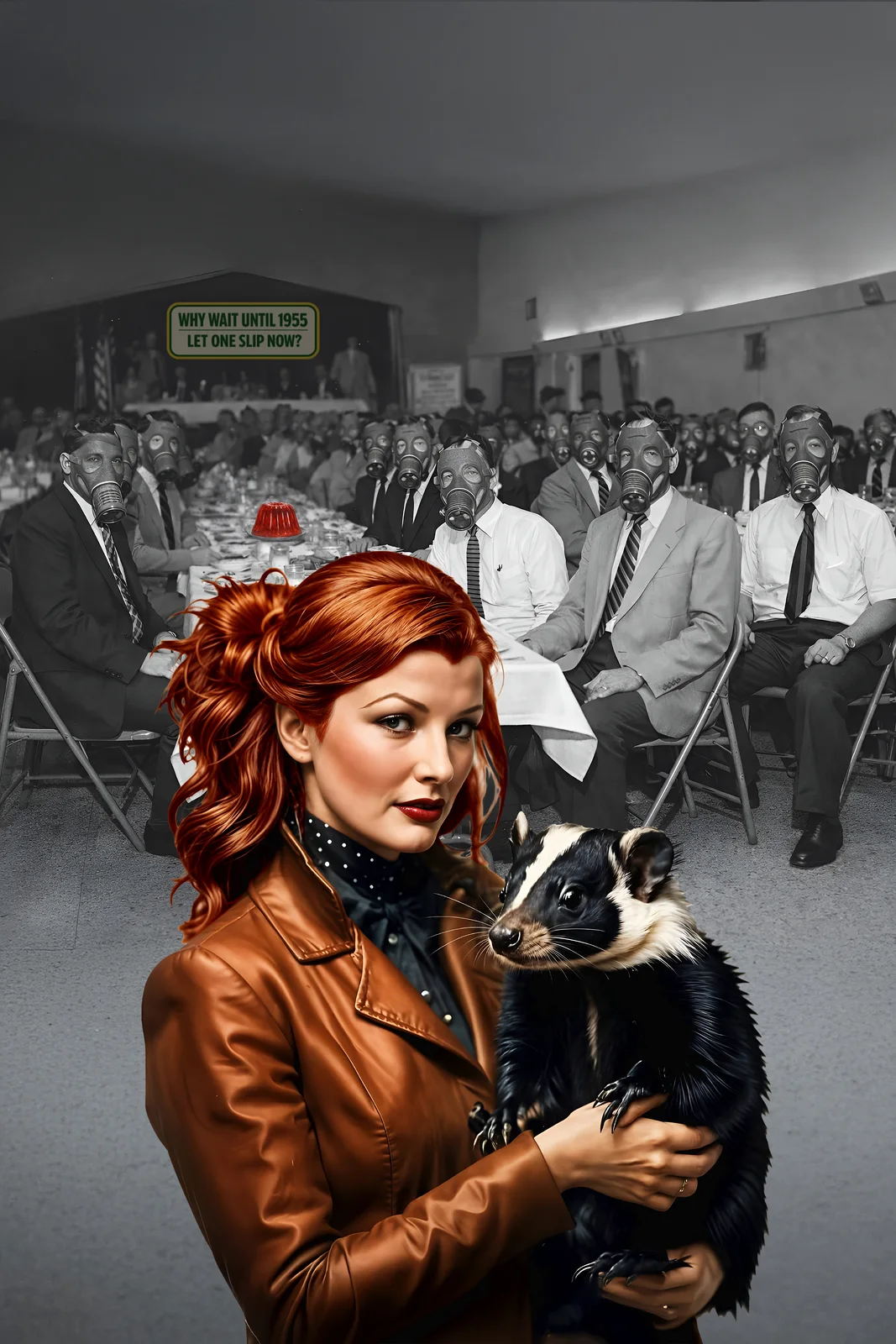
A long table stretches out. At the podium, a few important figures sit. Men wear suits and white shirts. Coffee cups and sugar bowls are set out, along with official minutes. Everything is correct, orderly, and symmetrical, reflecting the spirit of the post-war era. They sit with straight backs and focused gazes, demonstrating the institution’s dignity.
Then come the gas masks. This is where the image breaks apart. The men sit as if they are waiting for an attack, even though the war ended ten years ago. Maybe the air in the room is contaminated, with something invisible drifting between the walls and threatening their order. But there is no smoke, no siren, and no catastrophe. It is just a meeting.
Then you notice her.
Her red hair stands out in a world that is otherwise black and white. The colour refuses to fade into the background. She holds a skunk in her arms, calm and almost affectionate. On the table, a red jelly cake trembles, soft and strikingly physical. Everything else remains monochrome.
It is 1955. The men have returned home, but they still sit there wearing gas masks. The real question is not what happened in the room, but what they believe happened.
“There Is a Skunk in the Room
It is 1955
and the war is over
but not entirely.
The men sit in rows
pressed collars, polished shoes,
backs straight as if a whistle
might still cut the air.
They wear gas masks
to a meeting about budgets.
No smoke.
No siren.
Only coffee cooling
in porcelain cups.
She stands in colour.
Red hair like a struck match
in a monochrome world
that prefers its women
in softer shades.
In her arms, a skunk—
black, white, patient.
A creature with a reputation
stronger than its scent.
On the table,
a red jelly cake trembles—
soft, excessive, alive—
while the minutes of the meeting
remain stiff and grey.
“There is a skunk in the room,”
someone thinks
but does not say.
What they mean is:
there is something here
that will not leave.
She does not hiss.
She does not spray.
She does not apologise.
She stands
where once
she was temporary.
The war took the men.
The war gave her work.
Peace expected her to fade.
She did not.
The skunk is calm
until pressed.
It carries its warning
like a rumour.
So does she.
In bed,
they might have called her fire.
In the boardroom,
they call her trouble.
The difference
is vertical.
And so they filter the air
as if ambition were poison,
as if permanence
had a smell.
But the only thing
truly rotting
is certainty.
She shifts the weight
of the small animal
in her arms.
It does not move.
Neither does she.”
Malmö, February 2026
The Skunk in the Room - Skunken i Rummet
The year is 1955. Ten years have passed since the war ended, but the old male order has not fully returned. A long table is set with coffee cups, sugar bowls, and official minutes. The men sit close together, dressed formally, with tables and chairs lined up in neat rows. Their backs are straight, as if they still follow military discipline. They are all wearing gas masks.
Of course, it is not combat gas they are afraid of.
Everything is black and white: the room, the walls, the suits, and the faces behind the masks. This postwar society is in greyscale—administered, structured, and rational. It longs for predictability, for the men’s world that had just erased millions of lives, cities, and villages.
She stands in the foreground.
Her red hair catches the light, a colour that does not apologise. She holds a skunk in her arms, glossy and black with a white stripe. The skunk is also in colour. In the middle of the long table, a red jelly cake trembles, soft and organic in shape, almost provocatively.
Anything that stands out is in colour. Everything that stands for order is in black and white. This is where the metaphor starts.
The men sit behind their masks, as if the room is toxic or the air has changed. There is no siren, no fire, and no clear threat. Still, their caution is obvious.
The woman does not move. The skunk does not spray. Instead, it is the men’s eyes that shift.
“There is a skunk in the room.”
This phrase hints at something unwanted, something people would rather not mention. It is a problem that smells, spreads, and disrupts the meeting. Here, the skunk is both real and symbolic. It is small, still, and almost gentle in her arms. It only defends itself when threatened.
The same is true for the woman. Maybe that is exactly why she chose a skunk as her companion.
This room is more than just a room. It stands for the labour market, the boardroom, the office, and the workshop. It represents the postwar return to normal life. But within that normalcy, something has changed.
When the men returned from the war, they found their workplaces already filled. Women had taken over factories, offices, and government jobs. They had learned how to use the machines, mastered routines, and taken on responsibility. They had earned wages and gained experience.
And the women had no intention of stepping aside.
The men are not trying to block out the scent of perfume. They are trying to filter out the smell of something lasting—of competition and of change that will not go away.
The skunk in the room is not aggressive. It just refuses to leave. If treated badly, it will stink.
The Witch, the Temptress, and the Red Threat
Long before the woman ever entered the boardroom, her roles had already been decided for her. For centuries, red hair has been seen as a cultural warning sign—not because the colour itself is dangerous, but because it signals difference. In societies where normal means looking like the majority, red hair marks someone as unusual, and the unusual is often viewed with suspicion.
In the Middle Ages, red hair was often associated with witchcraft. While witch trials rarely focused on hair colour in legal terms, people often imagined that red-haired women were connected to forces beyond control. She was not just different; she was seen as potentially dangerous. Knowing about herbs, being independent, or spending time alone could all be seen as warning signs.
During the Renaissance and Baroque periods, her role changed. She became the temptress. Both artists and preachers, whether they meant to or not, linked red hair to desire and temptation. She was seen as someone who enticed and seduced, valued for her body rather than her mind. A man’s morality was tested, and blame could quietly be placed on her hair, her look, or her personality.
In the nineteenth century, novels and melodramas cast her as the fiery one—passionate, hard to control, and in need of discipline or saving. Red hair became a literary shortcut for heat, drama, and unpredictability.
In twentieth-century popular culture, all of this was summed up in one phrase: red hair means trouble. Film noir and advertising could make her seem both attractive and dangerous at once. She was seen as desirable but risky—an adventure, not an equal partner.
Through all these changes, one thing stays the same: she is shaped by male anxiety. She is called a witch when she knows things, a temptress when she inspires desire, fiery when she shows willpower, and “trouble” when she resists control. The scene from 1955 is not just a single moment, but the result of a long history of projected fears. When the red-haired woman enters the workplace as a permanent figure, she brings centuries of meaning with her.
She is no longer hidden in the forest, the boudoir, or the edges of a novel. Now, she stands at the long table. She is employed, competent, and here to stay. Red hair, once a sign of a witch or a seductress, can now be seen as something even more unsettling: ambition. At this point, old folklore images start to clash with reality. The witch could be burned, the temptress judged, and the fiery woman tamed through marriage. But the working woman of 1955, taking her place, does not give in so easily.
It is in this tension that the skunk gains its full meaning.
The War, the Factories, and the Unexpected Result
When the war began, men left offices, workshops, and government agencies to serve in the military. Their desks and machines stayed behind, and many never came back because they were killed or permanently disabled. The economy had to keep running, so someone needed to step in. Women took on these roles—at first temporarily, since people thought the war would be short, then out of necessity as the men stayed away, and finally as a normal part of life because the war dragged on. They learned to use lathes and handle bookkeeping, payroll, and logistics. They wore work clothes and took on responsibility, performing just as well as the men had.
This was no romantic interlude but a structural transformation. In both Europe and the United States, women’s participation in industry and administration increased significantly during the war years. They became accustomed to wages, routines, collegiality, and a daily life beyond the home’s walls. The workplace was no longer an abstract male domain; it became a concrete reality. A woman could afford to be self-assured.
When the war ended, people expected things to go back to how they were before. Posters and magazines told women to return home so the returning soldiers could have their jobs back. Society wanted to restore normal life. But what was normal had already changed. Once someone has had responsibility, it is hard to give it up. Someone who has earned their own money sees dependence in a new way.
So, 1955 was not a new beginning but what came after. Ten years had gone by. Many women left some jobs, but not all, and some resisted leaving. Women held positions of influence in schools, offices, and businesses. They aimed to move up, questioned unfair pay, and talked about their skills instead of just their situation.
It is also important to remember that the war killed between 25 and 35 million men, and many more were left permanently disabled. This meant there were many roles to fill. Still, new problems appeared.
This is where the picture becomes clearer. The men in gas masks do not show real fear, but a deeper worry within the system. When they came back, they saw that their absence had not left a gap, but evidence. Women could do the work. Sometimes just as well, sometimes even better. That fact could not be ignored.
The skunk in the woman’s arms is not meant to provoke, but to remind. It says: I am here. I have been here. I plan to stay. Like the skunk, which protects its space without attacking, she holds her place simply by being there.
What ‘stinks’ in the room is not a lack of skill. It is a competition. It is understood that the job market is no longer just for men. This realisation, more than anyone’s personality or appearance, is what makes things tense in 1955.
The Workplace as a Battlefield Without Uniforms
While the war had clear battle lines, the job market afterwards was more subtle. There were no guns, no flags, and no official surrenders. Still, power was shifting. This change showed up slowly in paychecks, promotions, and decisions about who kept their jobs after changes. Many men saw this coming before it was obvious. They feared women as rivals.
During the war, women had proved they could sustain production. They drove trams, managed offices, operated machinery, and kept the books. When the men returned, the issue was not merely logistical—who should hold which position—but existential. Work was more than a livelihood; it was status, identity, manhood.
This is why the gas masks in the picture stand out. They show people protecting themselves from something that is not actually harmful. There is no real threat to the company—work goes on, notes are taken, and coffee is served. Still, it feels like something is in the air.
What fills the air is not her ability, but her demand to stay. She is not satisfied with just ‘helping out during the war.’ She wants to keep her place. She wants to move forward. She wants to stay even after the crisis is over.
In the 1950s, especially in the United States, ads and popular culture promoted the idea of the housewife. But in reality, many women, especially those who were single or working-class, still worked for wages. The gap between this ideal and real life became part of the mood of the time. On the surface, people praised the stable family, but behind the scenes, there was an ongoing struggle over roles and power.
In this struggle, the woman is seen as ‘the skunk.’ It is not because she smells bad—she only wears perfume—but because she will not back down. Like a skunk, she is not aggressive. She sits quietly in the room. But everyone knows that if someone tries to force her out, things could get messy: arguments, public debates, strikes, or scandals. In the minds of some men, her presence is a problem.
This metaphor is harsh because it reveals the real issue: something is seen as troubling not because of what it is, but because of where it is. A woman at home seems normal. A woman in bed is wanted. But a woman sitting with decision-makers is seen as a problem.
So, the room fills with rules, polite behaviour, and jokes about personality or hair colour. These things help people cope. They also help avoid saying the real truth: the balance of power is changing.
Maybe that is what really ‘smells’—not her being there, but the fading of old beliefs.
The Private Permission and the Public Boundary
What stands out most in the 1955 scene is not that the woman is seen as dangerous, but where she is allowed to be that way. The same traits that make people uneasy in the boardroom are welcomed in private. Passion is appealing in the bedroom. Temperament can be exciting in romance. Willpower might even be seen as energy, as long as it does not turn into demands for equal pay or promotion.
Old figures from folklore still shape this divide. The witch was scary when she was outside control, but could seem attractive once contained. The temptress was seen as a threat to morals, but was still important in fantasy. A fiery woman could be desirable, as long as her passion did not affect contracts or boardroom decisions.
The image highlights this split. She stands tall and holds the skunk with confidence. She is there as a real presence, not just decoration. Still, the room around her stays guarded and closed off, as if her being in public is seen as something unwanted.
In 1950s culture, the image of the perfect housewife was everywhere: the cheerful hostess, the tidy mother. Yet, many women still worked, especially in service jobs and offices as secretaries, receptionists, and typists. This gap between the ideal and reality led to a strange compromise: a woman could be modern and attractive, but her independence was not supposed to look like power.
This is where the hidden line appears. She can be passionate, but only in private. She can be fiery, but only at home. She can be strong-willed, as long as it helps the family, not the workplace. When she brings that same energy to her job, it causes tension. Ambition is seen as aggression. Confidence is called arrogance. Determination is labeled as ‘temperament.’ Red hair becomes an easy excuse: people say she acts that way, as if her hair color explains everything.
It is also important to remember that this was the time when the ‘vamp’ became a strong figure in popular culture. The movie femme fatale appeared—sometimes blonde and innocent-looking, sometimes dark-haired and more openly threatening, and, in the public mind, most dangerous when red-haired, like Rita Hayworth in Gilda. In this image, many old ideas come together: the woman who seduces, unsettles, and challenges male self-control. She represents both attraction and the risk of things falling apart.
But the vamp mainly reflects fear. She is dramatic because she is seen as having power over men’s desires, not because she wants power in business or institutions. In the 1955 boardroom, it is not seduction that upsets things, but competition. It is not her look that makes men put on gas masks, but the worry that a woman’s independence could last.
The skunk in her arms is therefore more than a provocation; it is a reminder of how quickly fascination turns into defensiveness when a woman’s power shifts from one arena to another. In the private room, she is alluring. In the public sphere, she is disruptive. And precisely there, in the movement between these spaces, 1955 becomes a turning point—not because the woman became dangerous, but because her presence became inescapable.
What was it, really, that smelled?
When you are sitting with a gas mask on, it is easy to blame the air. You think something in the room is wrong, that something has changed. But the real question is what actually smells, and who notices it.
Throughout history, women have been seen as dangerous in different ways: as witches, as temptresses, or as vamps with erotic power. In every time period, this fear is really about control. Who makes the rules? Who holds knowledge? Who decides what is allowed?
1955 is no different, but now the threat is more about real things than myths. It is about pay, jobs, and who is in charge. It is about who gets to stay after the crisis is over. The war let women in; peace made men expect to take back control. When that did not fully happen, tension grew.
This is why the skunk is a fitting metaphor. It is not naturally aggressive. It only defends itself when it feels threatened. It does not always smell; it only does when pushed. In the same way, a woman’s presence at work is not automatically disruptive. It only seems that way when people see it as an intrusion.
So what people see as a bad smell is not her skills, hair colour, or personality. It is the change that occurs when a once-exclusive space opens up, and power is no longer automatic but must be discussed.
In the image, the men stay seated, protected by their masks. She stands without one, holding the animal calmly. She does not run away or say sorry. Maybe the most striking thing is that she shows no drama, no attack, no hysteria. She is just there. And still, she holds the skunk.
That is exactly why the metaphor is so powerful. If she had acted aggressively, the fear would have had something clear to focus on. But she is calm. It is the others who react with drama.
So maybe the saying should be turned around. There is a skunk in the room, but it might not be the one people expect. Maybe it is not the woman’s presence that is the problem, but the insecurity of the old system. Maybe it is not her ambition that is toxic, but the fact that it can no longer be overlooked.
1955 was not when women became dangerous. It was when their lasting presence became clear. And when something permanent meets privilege, there is always a sense of loss.
The skunk in the room is not a threat. It is simply a fact. But if it is attacked, it will smell.
The conclusion – horizontally accepted, vertically questioned
If we take the metaphor as far as it goes, one clear but uncomfortable truth stands out. The woman was never truly banned. She was just controlled, with limits on where she could act.
In private life—in bed, at home, or in fantasy—her passion was accepted. The fiery woman, the sensual one, the redhead with spirit: all of these were allowed as long as the man’s role stayed the same. In these spaces, her power was just an extra, a bit of excitement.
But in public life—in jobs, in careers, and in power structures—the same traits suddenly became a problem. Ambition was seen as aggression. Independence was called disobedience. Persistence was viewed as competition.
This is what 1955 shows us. It was not that women started working, but that they stopped accepting their work as temporary. They had kept factories and offices running during the war. They saw that the system worked with them at the centre. Asking them to step aside was not just a practical change—it was a symbolic step down.
The skunk in her arms sums this up clearly. It is small but knows its own strength. It protects its space without attacking. It is known for its smell, but it only releases it when threatened.
The woman herself has not changed over the centuries. What has changed is the time and place. In the bedroom, she was seen as dangerous. In the boardroom, she became dangerous in a new way.
Maybe the most telling part of the image is that she is not the one protecting herself. The men are the ones behind masks. They try to filter the air and control the situation, reacting to a change that has already happened. The woman was threatening. The conclusion is that her permanence was perceived as such. She no longer wished to be the exception, the helper, or the parenthesis between war and peace.
She planned to stay.
And that alone was enough for the men in the room to say they sensed something in the air.
Jörgen Thornberg
The Skunk in the Room - Skunken i Rummet, 2026
Digital
50 x 70 cm
3 200 kr
The Skunk in the Room - Skunken i Rummet
Svensk text på slutet
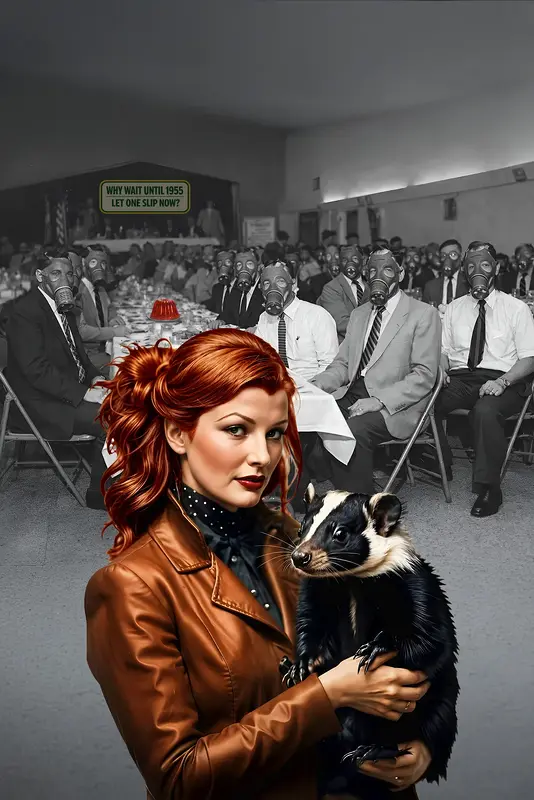
A long table stretches out. At the podium, a few important figures sit. Men wear suits and white shirts. Coffee cups and sugar bowls are set out, along with official minutes. Everything is correct, orderly, and symmetrical, reflecting the spirit of the post-war era. They sit with straight backs and focused gazes, demonstrating the institution’s dignity.
Then come the gas masks. This is where the image breaks apart. The men sit as if they are waiting for an attack, even though the war ended ten years ago. Maybe the air in the room is contaminated, with something invisible drifting between the walls and threatening their order. But there is no smoke, no siren, and no catastrophe. It is just a meeting.
Then you notice her.
Her red hair stands out in a world that is otherwise black and white. The colour refuses to fade into the background. She holds a skunk in her arms, calm and almost affectionate. On the table, a red jelly cake trembles, soft and strikingly physical. Everything else remains monochrome.
It is 1955. The men have returned home, but they still sit there wearing gas masks. The real question is not what happened in the room, but what they believe happened.
“There Is a Skunk in the Room
It is 1955
and the war is over
but not entirely.
The men sit in rows
pressed collars, polished shoes,
backs straight as if a whistle
might still cut the air.
They wear gas masks
to a meeting about budgets.
No smoke.
No siren.
Only coffee cooling
in porcelain cups.
She stands in colour.
Red hair like a struck match
in a monochrome world
that prefers its women
in softer shades.
In her arms, a skunk—
black, white, patient.
A creature with a reputation
stronger than its scent.
On the table,
a red jelly cake trembles—
soft, excessive, alive—
while the minutes of the meeting
remain stiff and grey.
“There is a skunk in the room,”
someone thinks
but does not say.
What they mean is:
there is something here
that will not leave.
She does not hiss.
She does not spray.
She does not apologise.
She stands
where once
she was temporary.
The war took the men.
The war gave her work.
Peace expected her to fade.
She did not.
The skunk is calm
until pressed.
It carries its warning
like a rumour.
So does she.
In bed,
they might have called her fire.
In the boardroom,
they call her trouble.
The difference
is vertical.
And so they filter the air
as if ambition were poison,
as if permanence
had a smell.
But the only thing
truly rotting
is certainty.
She shifts the weight
of the small animal
in her arms.
It does not move.
Neither does she.”
Malmö, February 2026
The Skunk in the Room - Skunken i Rummet
The year is 1955. Ten years have passed since the war ended, but the old male order has not fully returned. A long table is set with coffee cups, sugar bowls, and official minutes. The men sit close together, dressed formally, with tables and chairs lined up in neat rows. Their backs are straight, as if they still follow military discipline. They are all wearing gas masks.
Of course, it is not combat gas they are afraid of.
Everything is black and white: the room, the walls, the suits, and the faces behind the masks. This postwar society is in greyscale—administered, structured, and rational. It longs for predictability, for the men’s world that had just erased millions of lives, cities, and villages.
She stands in the foreground.
Her red hair catches the light, a colour that does not apologise. She holds a skunk in her arms, glossy and black with a white stripe. The skunk is also in colour. In the middle of the long table, a red jelly cake trembles, soft and organic in shape, almost provocatively.
Anything that stands out is in colour. Everything that stands for order is in black and white. This is where the metaphor starts.
The men sit behind their masks, as if the room is toxic or the air has changed. There is no siren, no fire, and no clear threat. Still, their caution is obvious.
The woman does not move. The skunk does not spray. Instead, it is the men’s eyes that shift.
“There is a skunk in the room.”
This phrase hints at something unwanted, something people would rather not mention. It is a problem that smells, spreads, and disrupts the meeting. Here, the skunk is both real and symbolic. It is small, still, and almost gentle in her arms. It only defends itself when threatened.
The same is true for the woman. Maybe that is exactly why she chose a skunk as her companion.
This room is more than just a room. It stands for the labour market, the boardroom, the office, and the workshop. It represents the postwar return to normal life. But within that normalcy, something has changed.
When the men returned from the war, they found their workplaces already filled. Women had taken over factories, offices, and government jobs. They had learned how to use the machines, mastered routines, and taken on responsibility. They had earned wages and gained experience.
And the women had no intention of stepping aside.
The men are not trying to block out the scent of perfume. They are trying to filter out the smell of something lasting—of competition and of change that will not go away.
The skunk in the room is not aggressive. It just refuses to leave. If treated badly, it will stink.
The Witch, the Temptress, and the Red Threat
Long before the woman ever entered the boardroom, her roles had already been decided for her. For centuries, red hair has been seen as a cultural warning sign—not because the colour itself is dangerous, but because it signals difference. In societies where normal means looking like the majority, red hair marks someone as unusual, and the unusual is often viewed with suspicion.
In the Middle Ages, red hair was often associated with witchcraft. While witch trials rarely focused on hair colour in legal terms, people often imagined that red-haired women were connected to forces beyond control. She was not just different; she was seen as potentially dangerous. Knowing about herbs, being independent, or spending time alone could all be seen as warning signs.
During the Renaissance and Baroque periods, her role changed. She became the temptress. Both artists and preachers, whether they meant to or not, linked red hair to desire and temptation. She was seen as someone who enticed and seduced, valued for her body rather than her mind. A man’s morality was tested, and blame could quietly be placed on her hair, her look, or her personality.
In the nineteenth century, novels and melodramas cast her as the fiery one—passionate, hard to control, and in need of discipline or saving. Red hair became a literary shortcut for heat, drama, and unpredictability.
In twentieth-century popular culture, all of this was summed up in one phrase: red hair means trouble. Film noir and advertising could make her seem both attractive and dangerous at once. She was seen as desirable but risky—an adventure, not an equal partner.
Through all these changes, one thing stays the same: she is shaped by male anxiety. She is called a witch when she knows things, a temptress when she inspires desire, fiery when she shows willpower, and “trouble” when she resists control. The scene from 1955 is not just a single moment, but the result of a long history of projected fears. When the red-haired woman enters the workplace as a permanent figure, she brings centuries of meaning with her.
She is no longer hidden in the forest, the boudoir, or the edges of a novel. Now, she stands at the long table. She is employed, competent, and here to stay. Red hair, once a sign of a witch or a seductress, can now be seen as something even more unsettling: ambition. At this point, old folklore images start to clash with reality. The witch could be burned, the temptress judged, and the fiery woman tamed through marriage. But the working woman of 1955, taking her place, does not give in so easily.
It is in this tension that the skunk gains its full meaning.
The War, the Factories, and the Unexpected Result
When the war began, men left offices, workshops, and government agencies to serve in the military. Their desks and machines stayed behind, and many never came back because they were killed or permanently disabled. The economy had to keep running, so someone needed to step in. Women took on these roles—at first temporarily, since people thought the war would be short, then out of necessity as the men stayed away, and finally as a normal part of life because the war dragged on. They learned to use lathes and handle bookkeeping, payroll, and logistics. They wore work clothes and took on responsibility, performing just as well as the men had.
This was no romantic interlude but a structural transformation. In both Europe and the United States, women’s participation in industry and administration increased significantly during the war years. They became accustomed to wages, routines, collegiality, and a daily life beyond the home’s walls. The workplace was no longer an abstract male domain; it became a concrete reality. A woman could afford to be self-assured.
When the war ended, people expected things to go back to how they were before. Posters and magazines told women to return home so the returning soldiers could have their jobs back. Society wanted to restore normal life. But what was normal had already changed. Once someone has had responsibility, it is hard to give it up. Someone who has earned their own money sees dependence in a new way.
So, 1955 was not a new beginning but what came after. Ten years had gone by. Many women left some jobs, but not all, and some resisted leaving. Women held positions of influence in schools, offices, and businesses. They aimed to move up, questioned unfair pay, and talked about their skills instead of just their situation.
It is also important to remember that the war killed between 25 and 35 million men, and many more were left permanently disabled. This meant there were many roles to fill. Still, new problems appeared.
This is where the picture becomes clearer. The men in gas masks do not show real fear, but a deeper worry within the system. When they came back, they saw that their absence had not left a gap, but evidence. Women could do the work. Sometimes just as well, sometimes even better. That fact could not be ignored.
The skunk in the woman’s arms is not meant to provoke, but to remind. It says: I am here. I have been here. I plan to stay. Like the skunk, which protects its space without attacking, she holds her place simply by being there.
What ‘stinks’ in the room is not a lack of skill. It is a competition. It is understood that the job market is no longer just for men. This realisation, more than anyone’s personality or appearance, is what makes things tense in 1955.
The Workplace as a Battlefield Without Uniforms
While the war had clear battle lines, the job market afterwards was more subtle. There were no guns, no flags, and no official surrenders. Still, power was shifting. This change showed up slowly in paychecks, promotions, and decisions about who kept their jobs after changes. Many men saw this coming before it was obvious. They feared women as rivals.
During the war, women had proved they could sustain production. They drove trams, managed offices, operated machinery, and kept the books. When the men returned, the issue was not merely logistical—who should hold which position—but existential. Work was more than a livelihood; it was status, identity, manhood.
This is why the gas masks in the picture stand out. They show people protecting themselves from something that is not actually harmful. There is no real threat to the company—work goes on, notes are taken, and coffee is served. Still, it feels like something is in the air.
What fills the air is not her ability, but her demand to stay. She is not satisfied with just ‘helping out during the war.’ She wants to keep her place. She wants to move forward. She wants to stay even after the crisis is over.
In the 1950s, especially in the United States, ads and popular culture promoted the idea of the housewife. But in reality, many women, especially those who were single or working-class, still worked for wages. The gap between this ideal and real life became part of the mood of the time. On the surface, people praised the stable family, but behind the scenes, there was an ongoing struggle over roles and power.
In this struggle, the woman is seen as ‘the skunk.’ It is not because she smells bad—she only wears perfume—but because she will not back down. Like a skunk, she is not aggressive. She sits quietly in the room. But everyone knows that if someone tries to force her out, things could get messy: arguments, public debates, strikes, or scandals. In the minds of some men, her presence is a problem.
This metaphor is harsh because it reveals the real issue: something is seen as troubling not because of what it is, but because of where it is. A woman at home seems normal. A woman in bed is wanted. But a woman sitting with decision-makers is seen as a problem.
So, the room fills with rules, polite behaviour, and jokes about personality or hair colour. These things help people cope. They also help avoid saying the real truth: the balance of power is changing.
Maybe that is what really ‘smells’—not her being there, but the fading of old beliefs.
The Private Permission and the Public Boundary
What stands out most in the 1955 scene is not that the woman is seen as dangerous, but where she is allowed to be that way. The same traits that make people uneasy in the boardroom are welcomed in private. Passion is appealing in the bedroom. Temperament can be exciting in romance. Willpower might even be seen as energy, as long as it does not turn into demands for equal pay or promotion.
Old figures from folklore still shape this divide. The witch was scary when she was outside control, but could seem attractive once contained. The temptress was seen as a threat to morals, but was still important in fantasy. A fiery woman could be desirable, as long as her passion did not affect contracts or boardroom decisions.
The image highlights this split. She stands tall and holds the skunk with confidence. She is there as a real presence, not just decoration. Still, the room around her stays guarded and closed off, as if her being in public is seen as something unwanted.
In 1950s culture, the image of the perfect housewife was everywhere: the cheerful hostess, the tidy mother. Yet, many women still worked, especially in service jobs and offices as secretaries, receptionists, and typists. This gap between the ideal and reality led to a strange compromise: a woman could be modern and attractive, but her independence was not supposed to look like power.
This is where the hidden line appears. She can be passionate, but only in private. She can be fiery, but only at home. She can be strong-willed, as long as it helps the family, not the workplace. When she brings that same energy to her job, it causes tension. Ambition is seen as aggression. Confidence is called arrogance. Determination is labeled as ‘temperament.’ Red hair becomes an easy excuse: people say she acts that way, as if her hair color explains everything.
It is also important to remember that this was the time when the ‘vamp’ became a strong figure in popular culture. The movie femme fatale appeared—sometimes blonde and innocent-looking, sometimes dark-haired and more openly threatening, and, in the public mind, most dangerous when red-haired, like Rita Hayworth in Gilda. In this image, many old ideas come together: the woman who seduces, unsettles, and challenges male self-control. She represents both attraction and the risk of things falling apart.
But the vamp mainly reflects fear. She is dramatic because she is seen as having power over men’s desires, not because she wants power in business or institutions. In the 1955 boardroom, it is not seduction that upsets things, but competition. It is not her look that makes men put on gas masks, but the worry that a woman’s independence could last.
The skunk in her arms is therefore more than a provocation; it is a reminder of how quickly fascination turns into defensiveness when a woman’s power shifts from one arena to another. In the private room, she is alluring. In the public sphere, she is disruptive. And precisely there, in the movement between these spaces, 1955 becomes a turning point—not because the woman became dangerous, but because her presence became inescapable.
What was it, really, that smelled?
When you are sitting with a gas mask on, it is easy to blame the air. You think something in the room is wrong, that something has changed. But the real question is what actually smells, and who notices it.
Throughout history, women have been seen as dangerous in different ways: as witches, as temptresses, or as vamps with erotic power. In every time period, this fear is really about control. Who makes the rules? Who holds knowledge? Who decides what is allowed?
1955 is no different, but now the threat is more about real things than myths. It is about pay, jobs, and who is in charge. It is about who gets to stay after the crisis is over. The war let women in; peace made men expect to take back control. When that did not fully happen, tension grew.
This is why the skunk is a fitting metaphor. It is not naturally aggressive. It only defends itself when it feels threatened. It does not always smell; it only does when pushed. In the same way, a woman’s presence at work is not automatically disruptive. It only seems that way when people see it as an intrusion.
So what people see as a bad smell is not her skills, hair colour, or personality. It is the change that occurs when a once-exclusive space opens up, and power is no longer automatic but must be discussed.
In the image, the men stay seated, protected by their masks. She stands without one, holding the animal calmly. She does not run away or say sorry. Maybe the most striking thing is that she shows no drama, no attack, no hysteria. She is just there. And still, she holds the skunk.
That is exactly why the metaphor is so powerful. If she had acted aggressively, the fear would have had something clear to focus on. But she is calm. It is the others who react with drama.
So maybe the saying should be turned around. There is a skunk in the room, but it might not be the one people expect. Maybe it is not the woman’s presence that is the problem, but the insecurity of the old system. Maybe it is not her ambition that is toxic, but the fact that it can no longer be overlooked.
1955 was not when women became dangerous. It was when their lasting presence became clear. And when something permanent meets privilege, there is always a sense of loss.
The skunk in the room is not a threat. It is simply a fact. But if it is attacked, it will smell.
The conclusion – horizontally accepted, vertically questioned
If we take the metaphor as far as it goes, one clear but uncomfortable truth stands out. The woman was never truly banned. She was just controlled, with limits on where she could act.
In private life—in bed, at home, or in fantasy—her passion was accepted. The fiery woman, the sensual one, the redhead with spirit: all of these were allowed as long as the man’s role stayed the same. In these spaces, her power was just an extra, a bit of excitement.
But in public life—in jobs, in careers, and in power structures—the same traits suddenly became a problem. Ambition was seen as aggression. Independence was called disobedience. Persistence was viewed as competition.
This is what 1955 shows us. It was not that women started working, but that they stopped accepting their work as temporary. They had kept factories and offices running during the war. They saw that the system worked with them at the centre. Asking them to step aside was not just a practical change—it was a symbolic step down.
The skunk in her arms sums this up clearly. It is small but knows its own strength. It protects its space without attacking. It is known for its smell, but it only releases it when threatened.
The woman herself has not changed over the centuries. What has changed is the time and place. In the bedroom, she was seen as dangerous. In the boardroom, she became dangerous in a new way.
Maybe the most telling part of the image is that she is not the one protecting herself. The men are the ones behind masks. They try to filter the air and control the situation, reacting to a change that has already happened. The woman was threatening. The conclusion is that her permanence was perceived as such. She no longer wished to be the exception, the helper, or the parenthesis between war and peace.
She planned to stay.
And that alone was enough for the men in the room to say they sensed something in the air.
3 200 kr

Jörgen Thornberg
Malmö
Lite om bilder och mig. Translation in English at the end.
Jag är en nyfiken person som ser allt i bilder, även det jag fäster i ord, gärna tillsammans för bakom alla mina bilder finns en berättelse. Till vissa bilder hör en kortare eller längre novell som följer med bilden.
Bilder berättar historier. Jag omges av naturlig skönhet, intressanta människor och historia var jag än går. Jag använder min kamera för att dokumentera världen och blanda det jag ser med vad jag känner för att fånga den dolda magin.
Mina bilder berättar mina historier. Genom mina bilder, tryck och berättelser. Jag bjuder in dig att ta del av dessa berättelser, in i ditt liv och hem och dela min mycket personliga syn på vår värld. Mer än vad ögat ser. Jag tänker i bilder, drömmer och skriver och pratar om dem; följaktligen måste jag också skapa bilder. De blir vad jag ser, inte nödvändigtvis begränsade till verkligheten. Det finns en bild runt varje hörn. Jag hoppas att du kommer att se vad jag såg och gilla det.
Jag är också en skrivande person och till många bilder hör en kortare eller längre essay. Den följer med tavlan, tryckt på fint papper och med en personlig hälsning från mig.
Flertalet bilder startar sin resa i min kamera. Enkelt förklarat beskriver jag bilden jag ser i mitt inre, upplevd eller fantiserad. Bilden uppstår inom mig redan innan jag fått okularet till ögat. På bråkdelen av ett ögonblick ser jag vad jag vill ha och vad som kan göras med bilden. Här skall jag stoppa in en giraff, stålmannen, Titanic eller vad det är min fantasi finner ut. Ännu märkligare är att jag kommer ihåg minnesbilden långt efteråt när det blir tid att skapa verket. Om jag lyckas eller inte, är upp till betraktaren, oftast präglat av en stråk av svart humor – meningen är att man skall bli underhållen. Mina bilder blir ofta en snackis där de hänger.
Jag föredrar bilder som förmedlar ett budskap i flera lager. Vid första anblicken fylld av feel-good, en vacker utsikt, fint väder, solen skiner, blommor på ängen eller vattnet som ligger förrädiskt spegelblankt. I en sådan bild kan jag gömma min egentliga berättelse, mitt förakt för förtryckare och våldsverkare, rasister och fördomsfulla människor - ett gärna återkommande motiv mer eller mindre dolt i det vackra motivet. Jag försöker förena dem i ett gemensamt narrativ.
Bild och formgivning har löpt som en röd tråd genom livet. Fotokonst känns som en värdig final som jag gärna delar med mig.
Min genre är vid som framgår av mina bilder, temat en blandning av pop- och gatukonst i kollage som kan bestå av hundratals lager. Vissa bilder kan ta veckor, andra någon dag innan det är dags att överlämna resultatet till printverkstaden. Fine Art Prints är digitala fotocollage. I dessa kollage sker rivandet, klippandet, pusslandet, målandet, ritandet och sprayningen digitalt. Det jag monterar in kan vara hundratals år gamla bilder som jag omsorgsfullt frilägger så att de ser ut att vara en del av tavlan men också bilder skapade av mig själv efter min egen fantasi. Därefter besöks printstudion och för vissa bilder numrera en limiterad upplaga (oftast 7 exemplar) och signera för hand. Vissa bilder kan köpas i olika format. Det är bara att fråga efter vilka. Gillar man en bild som är 70x100 men inte har plats på väggen, går den kanske att få i 50x70 cm istället. Frågan är fri.
Metoden Giclée eller Fine Art Print som det också kallas är det moderna sättet för framställning av grafisk konst. Villkoret för denna typ av utskrifter är att en högkvalitativ storformatskrivare används med åldersbeständigt färgpigment och konstnärspapper eller i förekommande fall på duk. Pappret som används möter de krav på livslängd som ställs av museer och gallerier. Normalt säljer jag mina bilder oinramade så att den nya ägaren själv kan bestämma hur de skall se ut, med eller utan passepartout färg på ram, med eller utan glas etc..
Under många år ställde jag bara ut på nätet, i valda grupper och på min egen Facebooksida - https://www.facebook.com/jorgen.thornberg.9
Jag finns också på en egen hemsida som tyvärr inte alltid är uppdaterad – https://www.jth.life/ Där kan du också läsa en del av de berättelser som följer med bilden.
UTSTÄLLNINGAR
Luftkastellet, oktober 2022
Konst i Lund, november 2022
Luftkastellet, mars 2023
Engleson Galleri Caroli, april 2023
Hydra, Greece June 2023
Engleson Galleri Caroli, oktober 2023
Toppen, Höllviken december 2023
Luftkastellet, mars 2024
Torups Galleri, mars 2024
Venice, May 2024
Luftkastellet, oktober 2024
Konst i Advent, December 2024
Galleri Engleson, Caroli December 2024
Jäger & Jansson Galleri, april 2025
A bit about pictures and me.
I'm a curious person who sees everything in pictures, even what I express in words, often combining them, for behind all my pictures lies a story. These narratives, some as short as a single image and others as long as a novel, are the heart and soul of my work.
Pictures tell stories. Wherever I go, I'm surrounded by natural beauty, exciting people, and history. I use my camera to document the world and blend what I see with what I feel to capture the hidden magic.
My images tell my stories. Through my pictures, prints, and narratives, I invite you to partake in these stories in your life and home and share my deeply personal perspective of our world. More than meets the eye. I think in pictures, dream, write, and talk about them; consequently, I must create images too. They become what I see, not necessarily confined to reality. There's a picture around every corner. I hope you'll see what I saw and enjoy it.
I'm also a writer, and many images come with a shorter or longer essay. It accompanies the painting, printed on fine paper with my personal greeting.
Many pictures start their journey on my camera. Simply put, I describe the image I see in my mind, experienced or imagined. The image arises within me even before I bring the eyepiece to my eye. In a fraction of a moment, I see what I want and what can be done with the picture. Here, I'll insert a giraffe, Superman, the Titanic, or whatever my imagination conjures up. Even stranger is that I remember the mental image long after it's time to create the work. Whether I succeed is up to the observer, often imbued with a streak of black humour – the aim is to entertain. My pictures usually become a talking point wherever they hang.
I prefer pictures that convey a message in multiple layers. At first glance, they're filled with feel-good vibes, a beautiful view, lovely weather, the sun shining, flowers in the meadow, or the water lying deceptively calm. But beneath this surface beauty, I often conceal a deeper story, a narrative that challenges societal norms or explores the human condition. I invite you to delve into these hidden narratives and discover the layers of meaning within my work.
Picture and design have been a thread running through my life. Photographic art feels like a fitting finale, and I'm happy to share it.
My genre is varied, as seen in my pictures; the theme is a blend of pop and street art in collages that can consist of hundreds of layers. Some images can take weeks, others just a day before it's time to hand over the result to the print workshop. Fine Art Prints are digital photo collages. In these collages, tearing, cutting, puzzling, painting, drawing, and spraying happen digitally. What I insert can be images hundreds of years old that I carefully extract so they appear to be part of the painting, but also images created by myself, now also generated from my imagination. Next, visit the print studio and, for certain images, number a limited edition (usually 7 copies) and sign them by hand. Some images may be available in other formats. Just ask which ones. If you like an image that's 70x100 but doesn't have space on the wall, you might be able to get it in 50x70 cm instead. The question is open.
The Giclée method, or Fine Art Print as it's also called, is the modern way of producing graphic art. This method ensures the highest quality and longevity of the artwork, using a high-quality large-format printer with archival pigment inks and artist paper or, in some cases, canvas. The paper used meets the longevity requirements set by museums and galleries. I sell my pictures unframed, allowing the new owner to personalise their artwork, confident in the lasting value and quality of the piece.
For many years, I only exhibited online, in selected groups, and on my Facebook page - https://www.facebook.com/jorgen.thornberg.9. I also have my website, which unfortunately is not constantly updated - https://www.jth.life/. You can also read some of the stories accompanying the pictures there.
EXHIBITIONS
Luftkastellet, October 2022
Art in Lund, November 2022
Luftkastellet, March 2023
Engleson Gallery Caroli, April 2023
Hydra, Greece June 2023
Engleson Gallery Caroli, October 2023
Toppen, Höllviken December 2023
Luftkastellet, March 2024
Torup Gallery, March 2024
Venice, May 2024
UTSTÄLLNINGAR
Luftkastellet, oktober 2022
Konst i Lund, november 2022
Luftkastellet, mars 2023
Engleson Galleri Caroli, april 2023
Hydra, Greece June 2023
Engleson Galleri Caroli, oktober 2023
Toppen, Höllviken december 2023
Luftkastellet, mars 2024
Torups Galleri, mars 2024
Venice, May 2024
Luftkastellet, October 2024
Konst i Advent, December 2024
Galleri Engleson, Caroli December 2024
Jäger & Jansson Galleri, April 2025
Utbildning
Autodidakt
Medlem i konstnärsförening
Öppna Sinnen
Med i konstrunda
Konstrundan i Skåne
Utställningar
Luftkastellet, October 2022
Art in Lund, November 2022
Luftkastellet, March 2023
Engleson Gallery Caroli, April 2023
Hydra, Greece June 2023
Engleson Gallery Caroli, October 2023
Toppen, Höllviken December 2023
Luftkastellet, March 2024
Torup Gallery, March 2024
Venice, May 2024