Vi använder cookies för att ge dig bästa möjliga upplevelse. Välj vilka cookies du tillåter.
Läs mer i vår integritetspolicy
Jörgen Thornberg
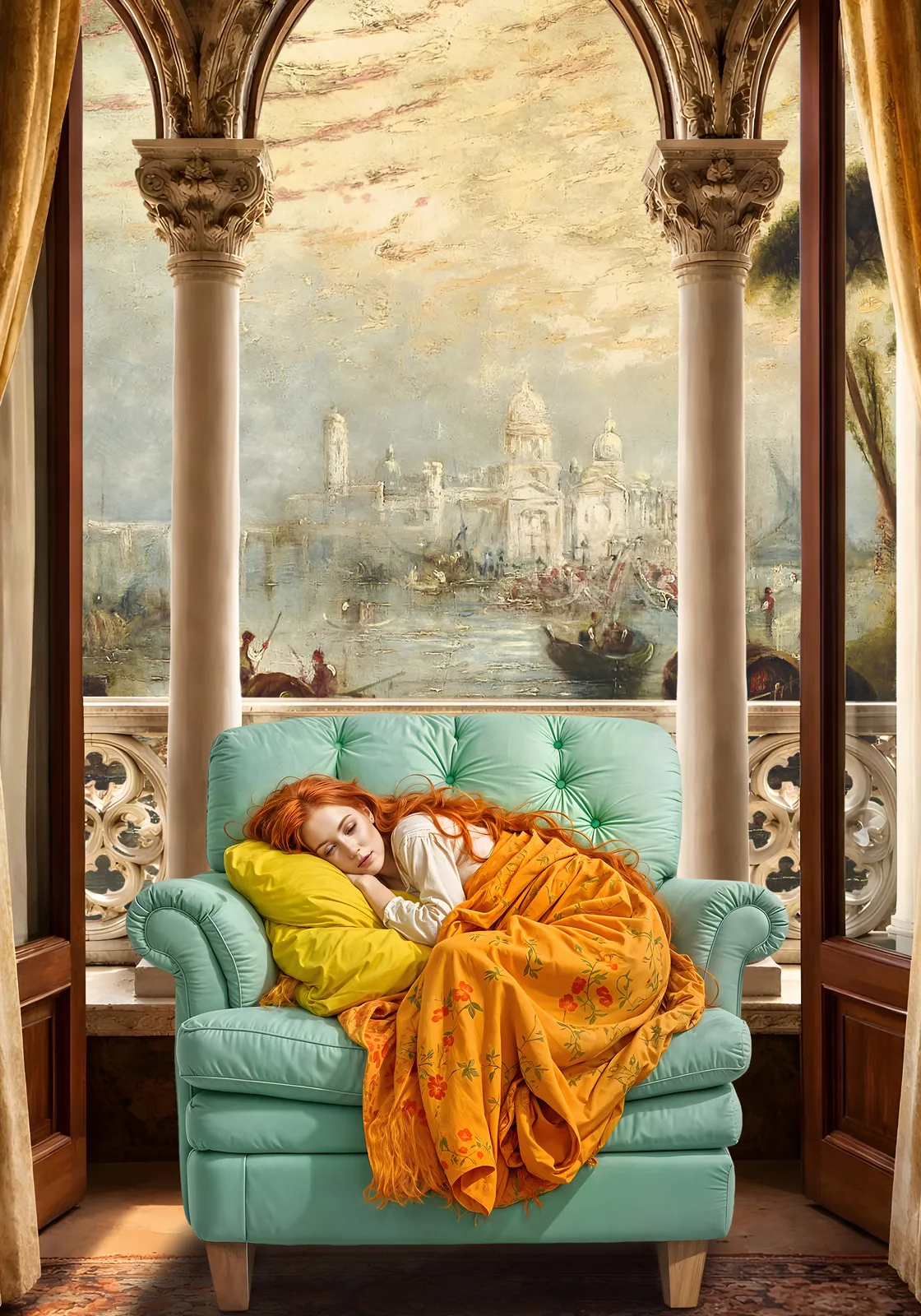
Flaming Jane, 2026
Digital
50 x 70 cm
Flaming Jane
Jane Asher’s hair was famously flaming red, but her temperament never was. The fire, in her case, did not announce itself in raised voices or dramatic gestures. It burned inward. Calm, controlled, quietly resolute. Where others in the 1960s performed passion, Jane practised containment. She listened more than she spoke, observed more than she reacted. Those who mistook her composure for coolness missed the point entirely. Her steadiness was not the absence of feeling, but the discipline of it.
The flame suggested by Flaming Jane is therefore not one of temper but of persistence — a slow, enduring heat. The kind that does not flare up and vanish, but shapes its surroundings over time. It was this inner fire that made her both irresistible and unreachable, a woman whose presence inspired songs yet resisted possession. Her hair may have been red, but her strength lay in her refusal to burn on command. Jane was like the picture of the woman who slept through Beatlemania.
Jane Asher was already famous when Paul McCartney walked into her life. That detail is often forgotten, flattened by the Beatles' mythology, but it matters. She was not discovered by him, not shaped by him, not launched through him. She had been acting since childhood, appearing on stage and screen while still in plaits, trained, articulate, and quietly formidable. By the early 1960s, Jane Asher was a public figure in her own right — a recognisable face of British poise and intelligence.
Her upbringing set her apart. The daughter of Margaret Asher, a respected music teacher, and Richard Asher, a physician and broadcaster, Jane grew up in a household where culture was not decoration but daily practice. Conversation mattered. Education mattered. Discipline mattered. It was into this refined, slightly austere North London world that Paul McCartney stepped in 1963, a young man from Liverpool whose fame was accelerating faster than anyone could emotionally process.
They met at the Royal Albert Hall. He was immediately smitten. She was intrigued, but not dazzled.
Love in Wimpole Street
For five years, Paul McCartney lived at the Ashers’ family home at 57 Wimpole Street. This was not some bohemian squat of rock excess but a proper middle-class house, where tea was served, and doors were knocked on. Jane’s parents tolerated Paul, but they did not orbit him. In many ways, it was Jane’s world that disciplined Paul, not the other way around.
Some of the most famous songs in popular music were written in that house. Yesterday, And I Love Her, I’m Looking Through You, We Can Work It Out — all carry traces of Jane, her presence, her emotional distance, her independence. She inspired him, but she did not surrender herself to him. That tension runs through the music.
Songs for Jane
What is unusual about the songs Paul McCartney wrote during his years with Jane Asher is not their sentiment, but their restraint. These are not songs of conquest or possession. They circle a woman who remains just out of reach — emotionally present, intellectually intact, never fully absorbed into the singer’s need.
And I Love Her is almost ceremonial in its simplicity. The melody steps carefully, as if aware that the woman it addresses values quiet over spectacle. There is no promise of eternity here, only devotion offered without demand — a tone that mirrors Jane’s refusal to be overwhelmed by fame or romance.
By We Can Work It Out, the tone has shifted. Love becomes negotiation. Time, patience, and perspective — all are invoked like arguments in a private conversation. The song suggests not harmony but effort, and beneath its optimism lies the friction of two strong wills moving at different speeds.
I’m Looking Through You exposes the paradox at the heart of the relationship. The accusation of distance is aimed at the very woman who insisted on her independence. Jane was not disappearing — she was living. Working. Choosing. The song’s irritation reveals more about the singer’s insecurity than about its subject.
The emotional centre of this sequence is For No One. Here, the drama has evaporated. What remains is the quiet devastation of recognition: love has ended, not through betrayal or cruelty, but through divergence. The song’s clarity is almost brutal. It does not ask for sympathy. It states a fact.
Taken together, these songs form a psychological portrait rather than a romantic monument. Jane Asher is not immortalised as a muse, but as an equal — a woman whose refusal to dissolve into another person’s narrative forced the music to grow up.
Jane continued working. Films, theatre, and television. She travelled. She refused to become decorative.
Paul, meanwhile, was becoming Paul McCartney.
Fidelity and Fracture
Their relationship, so often romanticised, was quietly uneven. Paul was deeply attached, but also increasingly unfaithful. Touring, temptation, the intoxicating belief that standard rules no longer applied — all the familiar patterns of sudden male stardom were there. Jane, by contrast, expected seriousness. Partnership. Trust.
One of the most painful anecdotes — confirmed by Asher herself years later — concerns the way she discovered his infidelity. Returning unexpectedly from a theatre engagement abroad, she walked into their shared home and found another woman in bed. Not rumours. Not whispers. Presence.
The relationship did not end immediately, but something fundamental broke.
What followed was not a dramatic public rupture but a slow, dignified withdrawal. Jane Asher did not fight for Paul McCartney. She chose herself.
The Engagement That Wasn’t
They were engaged, quietly, for years. No rush. No announcement. Paul hesitated. Jane noticed.
In 1968, while Jane was away performing in Bristol, Paul gave an interview in which he casually mentioned that they had split. She heard about the end of her engagement on the radio.
It is difficult to imagine a more Beatles-era way to end a relationship: globally broadcast, emotionally negligent, framed as an aside.
Jane never publicly humiliated him in return. Her restraint became part of her legend.
After Paul
After McCartney, Jane Asher did not disappear into footnotes. She reinvented herself repeatedly. She trained as a psychoanalyst. She became a successful entrepreneur, founding a catering business that quietly thrived for decades. She continued acting. She wrote novels. She remained articulate, private, and resistant to nostalgia.
When asked about Paul later in life, she has been neither bitter nor sentimental. She acknowledges love. She acknowledges betrayal. She refuses victimhood.
That, perhaps, is her most radical act.
Flaming Jane
Seen through this lens, Flaming Jane becomes more than an image of sleep. It is not passivity. It is containment. Fire held in fabric. A woman resting not because she is exhausted by fame, but because she survived it intact.
Jane Asher was not a muse who burned out.
She was a woman who stepped away from the fire—and kept her colour.
Jörgen Thornberg
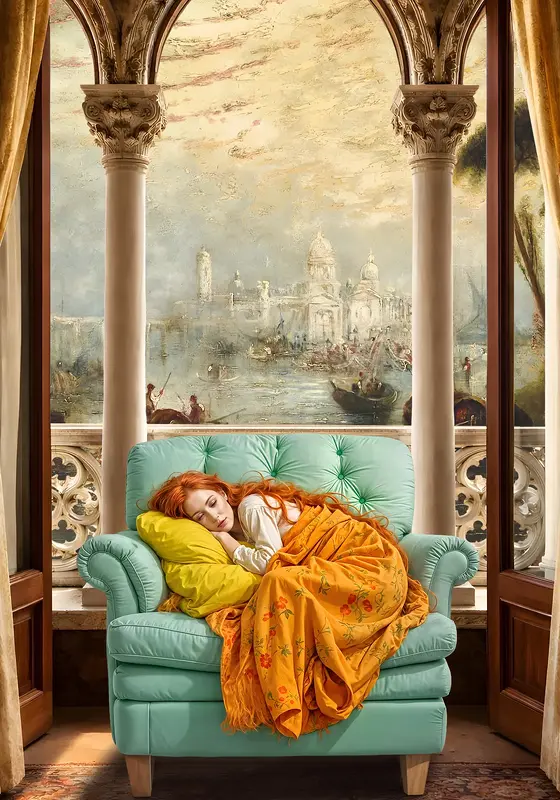
Flaming Jane, 2026
Digital
50 x 70 cm
Flaming Jane
Jane Asher’s hair was famously flaming red, but her temperament never was. The fire, in her case, did not announce itself in raised voices or dramatic gestures. It burned inward. Calm, controlled, quietly resolute. Where others in the 1960s performed passion, Jane practised containment. She listened more than she spoke, observed more than she reacted. Those who mistook her composure for coolness missed the point entirely. Her steadiness was not the absence of feeling, but the discipline of it.
The flame suggested by Flaming Jane is therefore not one of temper but of persistence — a slow, enduring heat. The kind that does not flare up and vanish, but shapes its surroundings over time. It was this inner fire that made her both irresistible and unreachable, a woman whose presence inspired songs yet resisted possession. Her hair may have been red, but her strength lay in her refusal to burn on command. Jane was like the picture of the woman who slept through Beatlemania.
Jane Asher was already famous when Paul McCartney walked into her life. That detail is often forgotten, flattened by the Beatles' mythology, but it matters. She was not discovered by him, not shaped by him, not launched through him. She had been acting since childhood, appearing on stage and screen while still in plaits, trained, articulate, and quietly formidable. By the early 1960s, Jane Asher was a public figure in her own right — a recognisable face of British poise and intelligence.
Her upbringing set her apart. The daughter of Margaret Asher, a respected music teacher, and Richard Asher, a physician and broadcaster, Jane grew up in a household where culture was not decoration but daily practice. Conversation mattered. Education mattered. Discipline mattered. It was into this refined, slightly austere North London world that Paul McCartney stepped in 1963, a young man from Liverpool whose fame was accelerating faster than anyone could emotionally process.
They met at the Royal Albert Hall. He was immediately smitten. She was intrigued, but not dazzled.
Love in Wimpole Street
For five years, Paul McCartney lived at the Ashers’ family home at 57 Wimpole Street. This was not some bohemian squat of rock excess but a proper middle-class house, where tea was served, and doors were knocked on. Jane’s parents tolerated Paul, but they did not orbit him. In many ways, it was Jane’s world that disciplined Paul, not the other way around.
Some of the most famous songs in popular music were written in that house. Yesterday, And I Love Her, I’m Looking Through You, We Can Work It Out — all carry traces of Jane, her presence, her emotional distance, her independence. She inspired him, but she did not surrender herself to him. That tension runs through the music.
Songs for Jane
What is unusual about the songs Paul McCartney wrote during his years with Jane Asher is not their sentiment, but their restraint. These are not songs of conquest or possession. They circle a woman who remains just out of reach — emotionally present, intellectually intact, never fully absorbed into the singer’s need.
And I Love Her is almost ceremonial in its simplicity. The melody steps carefully, as if aware that the woman it addresses values quiet over spectacle. There is no promise of eternity here, only devotion offered without demand — a tone that mirrors Jane’s refusal to be overwhelmed by fame or romance.
By We Can Work It Out, the tone has shifted. Love becomes negotiation. Time, patience, and perspective — all are invoked like arguments in a private conversation. The song suggests not harmony but effort, and beneath its optimism lies the friction of two strong wills moving at different speeds.
I’m Looking Through You exposes the paradox at the heart of the relationship. The accusation of distance is aimed at the very woman who insisted on her independence. Jane was not disappearing — she was living. Working. Choosing. The song’s irritation reveals more about the singer’s insecurity than about its subject.
The emotional centre of this sequence is For No One. Here, the drama has evaporated. What remains is the quiet devastation of recognition: love has ended, not through betrayal or cruelty, but through divergence. The song’s clarity is almost brutal. It does not ask for sympathy. It states a fact.
Taken together, these songs form a psychological portrait rather than a romantic monument. Jane Asher is not immortalised as a muse, but as an equal — a woman whose refusal to dissolve into another person’s narrative forced the music to grow up.
Jane continued working. Films, theatre, and television. She travelled. She refused to become decorative.
Paul, meanwhile, was becoming Paul McCartney.
Fidelity and Fracture
Their relationship, so often romanticised, was quietly uneven. Paul was deeply attached, but also increasingly unfaithful. Touring, temptation, the intoxicating belief that standard rules no longer applied — all the familiar patterns of sudden male stardom were there. Jane, by contrast, expected seriousness. Partnership. Trust.
One of the most painful anecdotes — confirmed by Asher herself years later — concerns the way she discovered his infidelity. Returning unexpectedly from a theatre engagement abroad, she walked into their shared home and found another woman in bed. Not rumours. Not whispers. Presence.
The relationship did not end immediately, but something fundamental broke.
What followed was not a dramatic public rupture but a slow, dignified withdrawal. Jane Asher did not fight for Paul McCartney. She chose herself.
The Engagement That Wasn’t
They were engaged, quietly, for years. No rush. No announcement. Paul hesitated. Jane noticed.
In 1968, while Jane was away performing in Bristol, Paul gave an interview in which he casually mentioned that they had split. She heard about the end of her engagement on the radio.
It is difficult to imagine a more Beatles-era way to end a relationship: globally broadcast, emotionally negligent, framed as an aside.
Jane never publicly humiliated him in return. Her restraint became part of her legend.
After Paul
After McCartney, Jane Asher did not disappear into footnotes. She reinvented herself repeatedly. She trained as a psychoanalyst. She became a successful entrepreneur, founding a catering business that quietly thrived for decades. She continued acting. She wrote novels. She remained articulate, private, and resistant to nostalgia.
When asked about Paul later in life, she has been neither bitter nor sentimental. She acknowledges love. She acknowledges betrayal. She refuses victimhood.
That, perhaps, is her most radical act.
Flaming Jane
Seen through this lens, Flaming Jane becomes more than an image of sleep. It is not passivity. It is containment. Fire held in fabric. A woman resting not because she is exhausted by fame, but because she survived it intact.
Jane Asher was not a muse who burned out.
She was a woman who stepped away from the fire—and kept her colour.

Jörgen Thornberg
Malmö
Lite om bilder och mig. Translation in English at the end.
Jag är en nyfiken person som ser allt i bilder, även det jag fäster i ord, gärna tillsammans för bakom alla mina bilder finns en berättelse. Till vissa bilder hör en kortare eller längre novell som följer med bilden.
Bilder berättar historier. Jag omges av naturlig skönhet, intressanta människor och historia var jag än går. Jag använder min kamera för att dokumentera världen och blanda det jag ser med vad jag känner för att fånga den dolda magin.
Mina bilder berättar mina historier. Genom mina bilder, tryck och berättelser. Jag bjuder in dig att ta del av dessa berättelser, in i ditt liv och hem och dela min mycket personliga syn på vår värld. Mer än vad ögat ser. Jag tänker i bilder, drömmer och skriver och pratar om dem; följaktligen måste jag också skapa bilder. De blir vad jag ser, inte nödvändigtvis begränsade till verkligheten. Det finns en bild runt varje hörn. Jag hoppas att du kommer att se vad jag såg och gilla det.
Jag är också en skrivande person och till många bilder hör en kortare eller längre essay. Den följer med tavlan, tryckt på fint papper och med en personlig hälsning från mig.
Flertalet bilder startar sin resa i min kamera. Enkelt förklarat beskriver jag bilden jag ser i mitt inre, upplevd eller fantiserad. Bilden uppstår inom mig redan innan jag fått okularet till ögat. På bråkdelen av ett ögonblick ser jag vad jag vill ha och vad som kan göras med bilden. Här skall jag stoppa in en giraff, stålmannen, Titanic eller vad det är min fantasi finner ut. Ännu märkligare är att jag kommer ihåg minnesbilden långt efteråt när det blir tid att skapa verket. Om jag lyckas eller inte, är upp till betraktaren, oftast präglat av en stråk av svart humor – meningen är att man skall bli underhållen. Mina bilder blir ofta en snackis där de hänger.
Jag föredrar bilder som förmedlar ett budskap i flera lager. Vid första anblicken fylld av feel-good, en vacker utsikt, fint väder, solen skiner, blommor på ängen eller vattnet som ligger förrädiskt spegelblankt. I en sådan bild kan jag gömma min egentliga berättelse, mitt förakt för förtryckare och våldsverkare, rasister och fördomsfulla människor - ett gärna återkommande motiv mer eller mindre dolt i det vackra motivet. Jag försöker förena dem i ett gemensamt narrativ.
Bild och formgivning har löpt som en röd tråd genom livet. Fotokonst känns som en värdig final som jag gärna delar med mig.
Min genre är vid som framgår av mina bilder, temat en blandning av pop- och gatukonst i kollage som kan bestå av hundratals lager. Vissa bilder kan ta veckor, andra någon dag innan det är dags att överlämna resultatet till printverkstaden. Fine Art Prints är digitala fotocollage. I dessa kollage sker rivandet, klippandet, pusslandet, målandet, ritandet och sprayningen digitalt. Det jag monterar in kan vara hundratals år gamla bilder som jag omsorgsfullt frilägger så att de ser ut att vara en del av tavlan men också bilder skapade av mig själv efter min egen fantasi. Därefter besöks printstudion och för vissa bilder numrera en limiterad upplaga (oftast 7 exemplar) och signera för hand. Vissa bilder kan köpas i olika format. Det är bara att fråga efter vilka. Gillar man en bild som är 70x100 men inte har plats på väggen, går den kanske att få i 50x70 cm istället. Frågan är fri.
Metoden Giclée eller Fine Art Print som det också kallas är det moderna sättet för framställning av grafisk konst. Villkoret för denna typ av utskrifter är att en högkvalitativ storformatskrivare används med åldersbeständigt färgpigment och konstnärspapper eller i förekommande fall på duk. Pappret som används möter de krav på livslängd som ställs av museer och gallerier. Normalt säljer jag mina bilder oinramade så att den nya ägaren själv kan bestämma hur de skall se ut, med eller utan passepartout färg på ram, med eller utan glas etc..
Under många år ställde jag bara ut på nätet, i valda grupper och på min egen Facebooksida - https://www.facebook.com/jorgen.thornberg.9
Jag finns också på en egen hemsida som tyvärr inte alltid är uppdaterad – https://www.jth.life/ Där kan du också läsa en del av de berättelser som följer med bilden.
UTSTÄLLNINGAR
Luftkastellet, oktober 2022
Konst i Lund, november 2022
Luftkastellet, mars 2023
Engleson Galleri Caroli, april 2023
Hydra, Greece June 2023
Engleson Galleri Caroli, oktober 2023
Toppen, Höllviken december 2023
Luftkastellet, mars 2024
Torups Galleri, mars 2024
Venice, May 2024
Luftkastellet, oktober 2024
Konst i Advent, December 2024
Galleri Engleson, Caroli December 2024
Jäger & Jansson Galleri, april 2025
A bit about pictures and me.
I'm a curious person who sees everything in pictures, even what I express in words, often combining them, for behind all my pictures lies a story. These narratives, some as short as a single image and others as long as a novel, are the heart and soul of my work.
Pictures tell stories. Wherever I go, I'm surrounded by natural beauty, exciting people, and history. I use my camera to document the world and blend what I see with what I feel to capture the hidden magic.
My images tell my stories. Through my pictures, prints, and narratives, I invite you to partake in these stories in your life and home and share my deeply personal perspective of our world. More than meets the eye. I think in pictures, dream, write, and talk about them; consequently, I must create images too. They become what I see, not necessarily confined to reality. There's a picture around every corner. I hope you'll see what I saw and enjoy it.
I'm also a writer, and many images come with a shorter or longer essay. It accompanies the painting, printed on fine paper with my personal greeting.
Many pictures start their journey on my camera. Simply put, I describe the image I see in my mind, experienced or imagined. The image arises within me even before I bring the eyepiece to my eye. In a fraction of a moment, I see what I want and what can be done with the picture. Here, I'll insert a giraffe, Superman, the Titanic, or whatever my imagination conjures up. Even stranger is that I remember the mental image long after it's time to create the work. Whether I succeed is up to the observer, often imbued with a streak of black humour – the aim is to entertain. My pictures usually become a talking point wherever they hang.
I prefer pictures that convey a message in multiple layers. At first glance, they're filled with feel-good vibes, a beautiful view, lovely weather, the sun shining, flowers in the meadow, or the water lying deceptively calm. But beneath this surface beauty, I often conceal a deeper story, a narrative that challenges societal norms or explores the human condition. I invite you to delve into these hidden narratives and discover the layers of meaning within my work.
Picture and design have been a thread running through my life. Photographic art feels like a fitting finale, and I'm happy to share it.
My genre is varied, as seen in my pictures; the theme is a blend of pop and street art in collages that can consist of hundreds of layers. Some images can take weeks, others just a day before it's time to hand over the result to the print workshop. Fine Art Prints are digital photo collages. In these collages, tearing, cutting, puzzling, painting, drawing, and spraying happen digitally. What I insert can be images hundreds of years old that I carefully extract so they appear to be part of the painting, but also images created by myself, now also generated from my imagination. Next, visit the print studio and, for certain images, number a limited edition (usually 7 copies) and sign them by hand. Some images may be available in other formats. Just ask which ones. If you like an image that's 70x100 but doesn't have space on the wall, you might be able to get it in 50x70 cm instead. The question is open.
The Giclée method, or Fine Art Print as it's also called, is the modern way of producing graphic art. This method ensures the highest quality and longevity of the artwork, using a high-quality large-format printer with archival pigment inks and artist paper or, in some cases, canvas. The paper used meets the longevity requirements set by museums and galleries. I sell my pictures unframed, allowing the new owner to personalise their artwork, confident in the lasting value and quality of the piece.
For many years, I only exhibited online, in selected groups, and on my Facebook page - https://www.facebook.com/jorgen.thornberg.9. I also have my website, which unfortunately is not constantly updated - https://www.jth.life/. You can also read some of the stories accompanying the pictures there.
EXHIBITIONS
Luftkastellet, October 2022
Art in Lund, November 2022
Luftkastellet, March 2023
Engleson Gallery Caroli, April 2023
Hydra, Greece June 2023
Engleson Gallery Caroli, October 2023
Toppen, Höllviken December 2023
Luftkastellet, March 2024
Torup Gallery, March 2024
Venice, May 2024
UTSTÄLLNINGAR
Luftkastellet, oktober 2022
Konst i Lund, november 2022
Luftkastellet, mars 2023
Engleson Galleri Caroli, april 2023
Hydra, Greece June 2023
Engleson Galleri Caroli, oktober 2023
Toppen, Höllviken december 2023
Luftkastellet, mars 2024
Torups Galleri, mars 2024
Venice, May 2024
Luftkastellet, October 2024
Konst i Advent, December 2024
Galleri Engleson, Caroli December 2024
Jäger & Jansson Galleri, April 2025
Utbildning
Autodidakt
Medlem i konstnärsförening
Öppna Sinnen
Med i konstrunda
Konstrundan i Skåne
Utställningar
Luftkastellet, October 2022
Art in Lund, November 2022
Luftkastellet, March 2023
Engleson Gallery Caroli, April 2023
Hydra, Greece June 2023
Engleson Gallery Caroli, October 2023
Toppen, Höllviken December 2023
Luftkastellet, March 2024
Torup Gallery, March 2024
Venice, May 2024