Vi använder cookies för att ge dig bästa möjliga upplevelse. Välj vilka cookies du tillåter.
Läs mer i vår integritetspolicy
Jörgen Thornberg
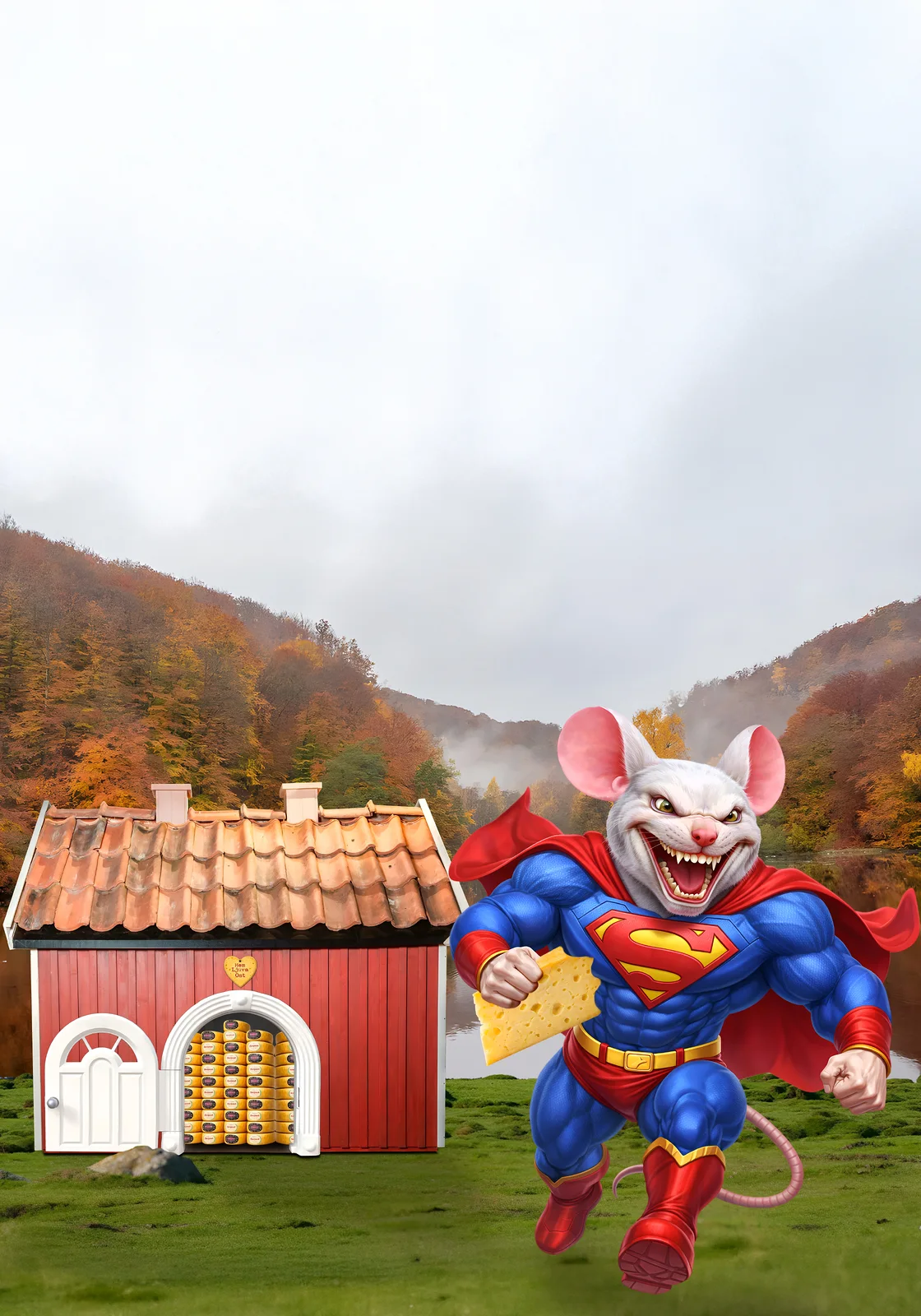
Home Sweet Cheese, 2026
Digital
50 x 70 cm
3 200 kr
Home Sweet Cheese
In this essay, landscape, myth, and household management converge to evoke feelings of belonging. A red house with white trim at Skäralid on Söderåsen—one of Scania's most symbolically charged places—serves as a point of pride, symbolising strength, sustenance, and time. This setting highlights how landscape and tradition shape cultural identity, with Supermouse as a guardian of these enduring values. It is here that the story of cheese as a symbol of cultural roots begins, connecting landscape, tradition, and its symbolic significance in Scandinavian culture.
Here, cheese functions both literally and symbolically: as nourishment, a source of power, a stored future, and a delicacy. It embodies Scandinavian cultural values such as patience, self-sufficiency, and resilience-core traits that underpin Scandinavian identity and pride. Like spinach for Popeye or honey for Bamse the Bear, it is not a reward but a prerequisite for survival, reflecting a tradition of preparedness and endurance.
The Scanian cheeses—Herrgård, Prästost, and Brännvinsost—are more than regional varieties; they symbolise the landscape and land-use practices of Scandinavia. Linked to their European counterparts-Västerbotten, Gruyère, and Parmesan-they form a genealogy of ageing, transforming milk into time, landscape, and tradition. These cheeses embody the land's influence on cultural resilience and self-sufficiency, illustrating how landscape shapes identity through food.
"Home Sweet Cheese" is therefore not a play on words but a statement. A home built as a storehouse rather than a sentiment, out of function rather than nostalgia. A narrative that moves between the humorous and the serious, between fable and reality, and that ultimately poses a simple question: what is it, really, that carries us when nothing is urgent anymore? This invites the audience to reflect on the stability and trust rooted in tradition and home, offering reassurance and a sense of continuity.
Now we can enter the essay.
"Supermouse and his Quiet Feast
When night settles over the pantry’s realm
and the refrigerator’s pale light turns to moon,
Supermouse steps forward without haste.
No cape is fluttering.
Only his tail draws a calm arc in the air.
He chooses with care.
Not the panic of hunger,
but the discernment of one who knows
that time is the secret spice.
Here, a Comté, dense as a well-built argument.
There, a Gruyère carrying memories of Alpine winters.
A piece of aged cheddar—
not aggressive, but resolute.
And, set aside with near reverence:
Parmigiano,
broken—never sliced—
The way one breaks a promise is everyday.
Supermouse eats slowly.
Not to display virtue,
but to let each bite
finish its thought.
Crumbs fall like footnotes to the floor.
The scent of milk, salt, and years
settles like an archive in the room.
This is no orgy.
This is a conversation between cheese and mouse.
He feasts, yes—
but the feast is methodical.
A victory over haste,
over the hysteria of the fresh.
When at last he withdraws,
nothing is ruined.
The wheels remain, slightly lighter,
dignified in their waiting.
Supermouse licks his paw,
nods to the shelf,
and leaves behind
not emptiness
but balance.
The cheese has spoken.
And the world, for a moment,
is in order."
Malmö, January 2026
Home Sweet Cheese
Skäralid lies on Söderåsen—a landscape of contrasts: still waters and raging torrents. Here, where Supermouse has his place, the lake is often calm, creating a peaceful refuge. Mirror-smooth and quiet, it invites reflection and serenity. The beech forests surrounding the water deepen this sense of tranquillity, making time seem to slow, fostering a feeling of calm in the reader.
In the middle of this landscape stands a house everyone recognises, a national signature. Red with white trim. A form so self-evident it almost disappears from view. A house that signals order, labour, and continuity. Inside, cheese is stored from floor to ceiling, reflecting a deep-rooted tradition of rural self-sufficiency and cultural identity in Scania.
This is where Supermouse lives. Not temporarily, not on the run, but rooted. His storehouse of cheese is a symbol of resilience and independence, echoing sustainable practices of rural self-sufficiency. Wheels of cheese, stacked with care, reflect a culture of self-reliance and resourcefulness, inspiring appreciation for traditional preparedness practices that resonate with contemporary sustainability values.
For Supermouse, cheese is not merely a pleasure. It is a necessity, just as spinach was for Popeye or honey for the mighty bear Bamse. Strength requires something to build on. Power does not arise from empty gestures but from something stored, concentrated, and worked through. A strong mouse can fend for himself—but only if he has prepared.
The house on Söderåsen, therefore, does not tell a tale of isolation but of self-sufficiency and cultural endurance rooted in centuries-old practices. The cheese stored here symbolises patience and preparation, echoing the long history of rural life and the importance of preserving traditions through generations.
Here, in this red house set against the backdrop of the beech forest, myth and practice meet. Supermouse is both hero and housekeeper. His strength is as much logistical as physical. What he has gathered is not random but the result of a landscape, a tradition, and a way of thinking. Once the eye grows accustomed to the stacks, the wheels, and the weight, it becomes clear: this is no ordinary cheese. These are hard cheeses. Cheeses that age with time. Cheeses that do not hurry. This is where the story begins.
Once one has understood why the house is filled with cheese, the next question becomes inevitable: which cheese? Supermouse's stockpile reflects the cultural heritage of the Scanian landscape, with hard cheeses rooted in it. Today, these practices remain vital for maintaining regional identity and resilience, embodying a tradition of patience and enduring craftsmanship that links past and present.
Scania has long been a land of milk, shaped by seasonal routines of summer grazing and winter preservation. Pastures yielding abundant grass, combined with a climate favourable to livestock, fostered a tradition in which cheese-making extended the summer's bounty into the cold months. Historically, these practices were essential for rural communities' survival, showcasing rural ingenuity and resilience rooted in centuries-old regional customs.
Herrgård cheese (Manor house cheese) is the most widely available in the store. Mild, rounded, and even, it demands no attention yet always works. Its creamy texture and subtle flavour make it a versatile staple-sliceable, meltable, and comforting. In the Scanian kitchen, it has often been the base cheese—the one that makes no statement yet is never absent, evoking a sense of familiarity and tradition for those who value simple, enduring flavours.
Präst cheese (Priest cheese) is more concentrated. Saltier, aged longer, clearer in flavour. Tied initially to parsonages and payment in kind, where cheese formed part of livelihood and compensation, it carried a different weight from the start. Präst cheese was meant to last. It was meant to withstand waiting. In the storehouse, it does not sit at the front; it is reserved, not excluded.
Brännvin cheese (Schnapps cheese) breaks the pattern. A stronger, more idiosyncratic variant, often based on aged hard cheese treated with spirits or spices. Here, durability matters less than intensity. The flavour is denser, more forceful, less forgiving. In the traditional kitchen, it was not an everyday cheese, but something brought out on special occasions. For Supermouse, it is a complement, not a replacement—a concentrate rather than a staple.
What unites these cheeses is not their taste but their relationship to time. They are made to wait, to be stored, turned, and matured before being put to use. They are the result of a way of thinking that always takes the future into account. One does not consume everything at once; one stores.
Supermouse's house follows the same logic. There are no quick solutions here, no fresh impulses. Only things that reckon with the passage of time—and that benefit from it. In this sense, the cheeses are not merely food but an extension of the landscape outside. Grass, cows, labour, and waiting have been drawn together into something that can be stacked, stored, and used when needed.
Scania goes a long way, but it is not the whole world.
When one leaves Scania behind—without leaving one's taste buds there as well—a broader context opens up. The hard cheeses in Supermouse's store have clear relatives: sometimes cousins, sometimes elder siblings, occasionally distant but recognisable members of the family. They are scattered across Europe yet united by the same basic idea: that milk can be transformed into something that withstands time delicately.
Västerbotten cheese is closest in temperament. It comes from a completely different landscape, yet out of a similar necessity. Long winters, short summers, the need for storage. Its flavour is stronger than that of the Scanian cheeses, more concentrated, sometimes almost insistently so. It is not made to spread, but to make a mark. In the kitchen, it is often used sparingly, grated rather than sliced, as if each fragment were a statement. Within the family, it is the one that has gone furthest in the same direction as Präst cheese—only with even greater consistency.
Further south, in the Alpine valleys, cheeses such as Gruyère are made. They share much with the Nordic hard cheeses, yet have been shaped by different conditions: altitude, summer pastures, and long winters spent indoors. Gruyère is firm but not dry, complex but not aggressive. It serves as sustenance and as an ingredient, both on its own and in company. In the family, it is the balanced relative, the one who manages many contexts without losing their character.
And then there are the ancient ones—those who have almost left the world of milk behind. Parmesan belongs here. A cheese that is not sliced but preferably broken, a delicacy that pairs with grapes of different colours and sweetness. Here, ageing has been taken so far that the cheese has become crystalline, almost mineral. It is no longer just food, but a concentration of time. In the family tree, Parmesan is the one who went ahead, the one who set the rules, the one who shows what happens when patience is allowed to work to its fullest.
What distinguishes these cheeses is climate, tradition, and the degree of ageing. Still, more deeply, they symbolise a cultural belief: that patience and long-term care are essential for creating lasting value. They embody a collective trust that what is built today will serve future generations, illustrating the importance of patience and foresight in society.
In Supermouse's house, all of this is gathered in concentrated form. Scanian cheeses sit alongside their European relatives, not as trophies but as assets. A storehouse built on experience rather than preference. Here, it is not about choosing the best cheese but about understanding its role—and being able to vary it. At regular intervals, he makes purchasing trips to the Continent to supplement his collection with local delicacies. Reaching a high alpine pasture in Switzerland or northern Italy is no challenge for a supermouse who flies there and back at supersonic speed. If he sets off after an early cheese breakfast, he is back by evening, carrying a net full of well-aged wheels.
Hard cheeses are not individualists. They embody system thinking and respect for tradition. They belong in households that reckon with winter, scarcity, and the passage of time, reminding the audience that enduring effort creates lasting value.
In that sense, Supermouse's store is not an exception but a continuation of a timeless principle. A modern myth built on an old insight: that strength does not arise in the moment but in what is saved. This echoes our current need for patience and long-term thinking amid rapid change.
Storage is never neutral. It is not merely a collection of things but an expression of how one views the future. In an agrarian society, the store was an answer to uncertainty. One knew that harvests could fail, that winters could be long, and that access was never guaranteed. And so buffers were built: grain in barns, firewood in stacks, meat in salt, butter in tubs—cheese in the cellar.
Hard cheese held a special place in this system. It was not only durable but also predictable. It changed slowly and in known patterns. It required supervision, but not constant attention. Turn it, wash it, keep it at the right temperature, and it will do its work on its own. Cheese became a kind of collaboration between human beings and time.
This is what makes Supermouse's store comprehensible. It is not about abundance but about control and clarity. He knows what he has, what will suffice, and how to enjoy it, fostering the audience's calm and confidence in the value of deliberate, thoughtful storage.
To store cheese is to accept slowness. One cannot accelerate maturation without destroying it. One cannot take shortcuts. Whoever builds a cheese store also builds patience into the household. In this lies a quiet discipline, standing in sharp contrast to a society where everything is expected to be immediately available.
Hard cheeses require space and trust, embodying a philosophical stance: that patience and confidence in the process lead to meaningful outcomes. Trusting that what is set aside will mature into something more pleasurable reflects a worldview in which enduring effort and faith over time produce lasting value, both in cheese and in life.
In Supermouse's cottage, this way of thinking is concentrated in a single room. The walls are not filled with things but with cheese. Each wheel represents not only food but also a future situation in which that food will be needed. That is why the store feels calm rather than overloaded. It is built with a margin.
This way of thinking is older than both markets and price tags. It belongs to a world where value was not measured by rapid turnover but by endurance—where security was not something one bought but something one built.
When Supermouse withdraws to his hideaway, he is therefore doing nothing unusual. He is continuing a long tradition of gathering what lasts, choosing what reckons with time, and trusting that strength arises from preparation rather than improvisation.
And in this lies perhaps the most straightforward explanation for why the house is filled with hard cheeses rather than anything else. They are not just food. They are stored decisions.
Supermouse, despite his mythical status, embodies a life of independence and self-sufficiency. His household is not adventurous nor improvised; it reflects a deliberate simplicity. His strength lies in avoiding surprises through careful preparation, which illustrates his resilience. Everything in the house has a purpose, and what is absent signifies what is unnecessary, reinforcing themes of autonomy and self-reliance.
Supermouse's withdrawal to reduce dependence on the outside world should inspire readers to value their own independence and resilience, emphasising that true strength comes from self-reliance and quiet perseverance.
The hard cheeses symbolise patience and preparedness. They demand no immediate attention, do not spoil quickly, and resist overconsumption, waiting silently. This morality echoes agrarian values and contrasts with modern impulsiveness, emphasising that choosing enduring resources over fleeting temptations reflects a more profound commitment to stability and foresight.
The store's carefully balanced size, designed to create calm without overwhelming, underscores that security can be simple and manageable. This environment reassures readers that peace of mind comes from thoughtful restraint and deliberate planning, fostering a sense of stability rooted in modesty.
The house on Söderåsen thus functions as a kind of counter-image, not to the city or the market, but to the idea of constant availability. There are no last-minute orders to place here, no deliveries that can rescue the situation. Everything that is to be used must already be in place.
Supermouse's strength, rooted in discipline and patience, should inspire readers' admiration for the quiet, persistent effort that sustains independence and security.
And perhaps that is precisely why the image works—a red house, a mirror-smooth lake, stacks of cheese. Nothing is happening yet, but everything is prepared. It is a stillness that does not arise from passivity but from work already done.
This is where Supermouse differs from the hero of the moment. He does not need to intervene. He has already arranged what is required.
It is easy to read Supermouse's house as a fable, but it may be more accurate to see it as a reminder. The image says nothing about flight, threat, or crisis. And yet it is saturated with preparedness—not the loud kind, but the kind built in advance and therefore rarely noticed. The urgency in the image comes from his daily super-round, like any jogger's, a substantial piece of cheese clenched in one paw as he darts between the beech forest's trunks.
In a society that values instant solutions, the store on Söderåsen exemplifies patience and deliberate planning, illustrating that proper security often requires time and acceptance of natural processes.
This is also why they are not replaced by anything else. No powder, no concentrate, no substitute fills the same role. The cheese is the result of a continuous process that begins far beyond the house: in the grass, in the cows, in the seasons. It carries the entire chain, but in condensed form. It is a landscape that can be stacked.
Supermouse thus appears not as a collector but as a steward. He has not broken the chain; he has extended it. The red house is not an endpoint but a node in a system that stretches back in time. What is inside is not meant to impress but to function.
Perhaps that is why the lake lies mirror-smooth precisely here, not as an idyll but as a consequence. When nothing needs to be rushed, and nothing is lacking, the landscape can rest. Stillness becomes not an absence of movement but a sign that the movement has already taken place.
In the end, the image says nothing about cheese itself. It says something about how strength is rarely dramatic—how it often looks like preparation, like a store, like something that waits patiently until it is needed.
The heart above the door bearing the words "Home Sweet Cheese" is no joke, but a statement of fact. This is where Supermouse lives. Here is what is required.
Jörgen Thornberg
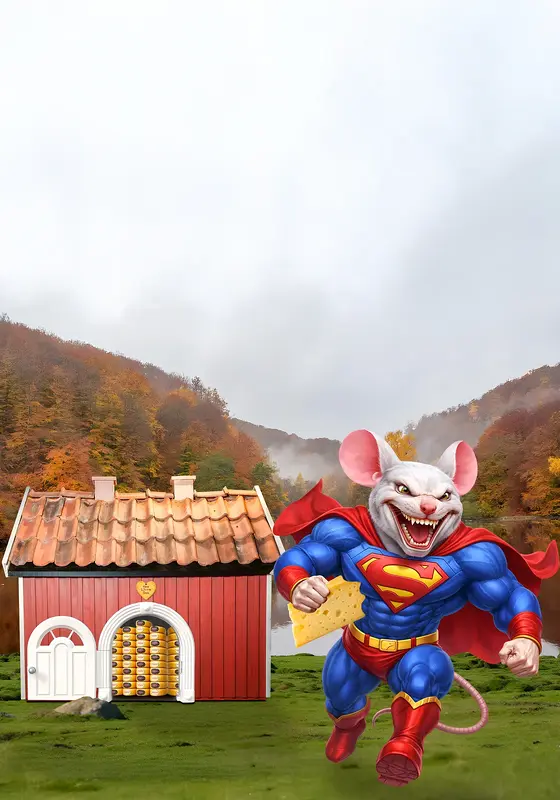
Home Sweet Cheese, 2026
Digital
50 x 70 cm
3 200 kr
Home Sweet Cheese
In this essay, landscape, myth, and household management converge to evoke feelings of belonging. A red house with white trim at Skäralid on Söderåsen—one of Scania's most symbolically charged places—serves as a point of pride, symbolising strength, sustenance, and time. This setting highlights how landscape and tradition shape cultural identity, with Supermouse as a guardian of these enduring values. It is here that the story of cheese as a symbol of cultural roots begins, connecting landscape, tradition, and its symbolic significance in Scandinavian culture.
Here, cheese functions both literally and symbolically: as nourishment, a source of power, a stored future, and a delicacy. It embodies Scandinavian cultural values such as patience, self-sufficiency, and resilience-core traits that underpin Scandinavian identity and pride. Like spinach for Popeye or honey for Bamse the Bear, it is not a reward but a prerequisite for survival, reflecting a tradition of preparedness and endurance.
The Scanian cheeses—Herrgård, Prästost, and Brännvinsost—are more than regional varieties; they symbolise the landscape and land-use practices of Scandinavia. Linked to their European counterparts-Västerbotten, Gruyère, and Parmesan-they form a genealogy of ageing, transforming milk into time, landscape, and tradition. These cheeses embody the land's influence on cultural resilience and self-sufficiency, illustrating how landscape shapes identity through food.
"Home Sweet Cheese" is therefore not a play on words but a statement. A home built as a storehouse rather than a sentiment, out of function rather than nostalgia. A narrative that moves between the humorous and the serious, between fable and reality, and that ultimately poses a simple question: what is it, really, that carries us when nothing is urgent anymore? This invites the audience to reflect on the stability and trust rooted in tradition and home, offering reassurance and a sense of continuity.
Now we can enter the essay.
"Supermouse and his Quiet Feast
When night settles over the pantry’s realm
and the refrigerator’s pale light turns to moon,
Supermouse steps forward without haste.
No cape is fluttering.
Only his tail draws a calm arc in the air.
He chooses with care.
Not the panic of hunger,
but the discernment of one who knows
that time is the secret spice.
Here, a Comté, dense as a well-built argument.
There, a Gruyère carrying memories of Alpine winters.
A piece of aged cheddar—
not aggressive, but resolute.
And, set aside with near reverence:
Parmigiano,
broken—never sliced—
The way one breaks a promise is everyday.
Supermouse eats slowly.
Not to display virtue,
but to let each bite
finish its thought.
Crumbs fall like footnotes to the floor.
The scent of milk, salt, and years
settles like an archive in the room.
This is no orgy.
This is a conversation between cheese and mouse.
He feasts, yes—
but the feast is methodical.
A victory over haste,
over the hysteria of the fresh.
When at last he withdraws,
nothing is ruined.
The wheels remain, slightly lighter,
dignified in their waiting.
Supermouse licks his paw,
nods to the shelf,
and leaves behind
not emptiness
but balance.
The cheese has spoken.
And the world, for a moment,
is in order."
Malmö, January 2026
Home Sweet Cheese
Skäralid lies on Söderåsen—a landscape of contrasts: still waters and raging torrents. Here, where Supermouse has his place, the lake is often calm, creating a peaceful refuge. Mirror-smooth and quiet, it invites reflection and serenity. The beech forests surrounding the water deepen this sense of tranquillity, making time seem to slow, fostering a feeling of calm in the reader.
In the middle of this landscape stands a house everyone recognises, a national signature. Red with white trim. A form so self-evident it almost disappears from view. A house that signals order, labour, and continuity. Inside, cheese is stored from floor to ceiling, reflecting a deep-rooted tradition of rural self-sufficiency and cultural identity in Scania.
This is where Supermouse lives. Not temporarily, not on the run, but rooted. His storehouse of cheese is a symbol of resilience and independence, echoing sustainable practices of rural self-sufficiency. Wheels of cheese, stacked with care, reflect a culture of self-reliance and resourcefulness, inspiring appreciation for traditional preparedness practices that resonate with contemporary sustainability values.
For Supermouse, cheese is not merely a pleasure. It is a necessity, just as spinach was for Popeye or honey for the mighty bear Bamse. Strength requires something to build on. Power does not arise from empty gestures but from something stored, concentrated, and worked through. A strong mouse can fend for himself—but only if he has prepared.
The house on Söderåsen, therefore, does not tell a tale of isolation but of self-sufficiency and cultural endurance rooted in centuries-old practices. The cheese stored here symbolises patience and preparation, echoing the long history of rural life and the importance of preserving traditions through generations.
Here, in this red house set against the backdrop of the beech forest, myth and practice meet. Supermouse is both hero and housekeeper. His strength is as much logistical as physical. What he has gathered is not random but the result of a landscape, a tradition, and a way of thinking. Once the eye grows accustomed to the stacks, the wheels, and the weight, it becomes clear: this is no ordinary cheese. These are hard cheeses. Cheeses that age with time. Cheeses that do not hurry. This is where the story begins.
Once one has understood why the house is filled with cheese, the next question becomes inevitable: which cheese? Supermouse's stockpile reflects the cultural heritage of the Scanian landscape, with hard cheeses rooted in it. Today, these practices remain vital for maintaining regional identity and resilience, embodying a tradition of patience and enduring craftsmanship that links past and present.
Scania has long been a land of milk, shaped by seasonal routines of summer grazing and winter preservation. Pastures yielding abundant grass, combined with a climate favourable to livestock, fostered a tradition in which cheese-making extended the summer's bounty into the cold months. Historically, these practices were essential for rural communities' survival, showcasing rural ingenuity and resilience rooted in centuries-old regional customs.
Herrgård cheese (Manor house cheese) is the most widely available in the store. Mild, rounded, and even, it demands no attention yet always works. Its creamy texture and subtle flavour make it a versatile staple-sliceable, meltable, and comforting. In the Scanian kitchen, it has often been the base cheese—the one that makes no statement yet is never absent, evoking a sense of familiarity and tradition for those who value simple, enduring flavours.
Präst cheese (Priest cheese) is more concentrated. Saltier, aged longer, clearer in flavour. Tied initially to parsonages and payment in kind, where cheese formed part of livelihood and compensation, it carried a different weight from the start. Präst cheese was meant to last. It was meant to withstand waiting. In the storehouse, it does not sit at the front; it is reserved, not excluded.
Brännvin cheese (Schnapps cheese) breaks the pattern. A stronger, more idiosyncratic variant, often based on aged hard cheese treated with spirits or spices. Here, durability matters less than intensity. The flavour is denser, more forceful, less forgiving. In the traditional kitchen, it was not an everyday cheese, but something brought out on special occasions. For Supermouse, it is a complement, not a replacement—a concentrate rather than a staple.
What unites these cheeses is not their taste but their relationship to time. They are made to wait, to be stored, turned, and matured before being put to use. They are the result of a way of thinking that always takes the future into account. One does not consume everything at once; one stores.
Supermouse's house follows the same logic. There are no quick solutions here, no fresh impulses. Only things that reckon with the passage of time—and that benefit from it. In this sense, the cheeses are not merely food but an extension of the landscape outside. Grass, cows, labour, and waiting have been drawn together into something that can be stacked, stored, and used when needed.
Scania goes a long way, but it is not the whole world.
When one leaves Scania behind—without leaving one's taste buds there as well—a broader context opens up. The hard cheeses in Supermouse's store have clear relatives: sometimes cousins, sometimes elder siblings, occasionally distant but recognisable members of the family. They are scattered across Europe yet united by the same basic idea: that milk can be transformed into something that withstands time delicately.
Västerbotten cheese is closest in temperament. It comes from a completely different landscape, yet out of a similar necessity. Long winters, short summers, the need for storage. Its flavour is stronger than that of the Scanian cheeses, more concentrated, sometimes almost insistently so. It is not made to spread, but to make a mark. In the kitchen, it is often used sparingly, grated rather than sliced, as if each fragment were a statement. Within the family, it is the one that has gone furthest in the same direction as Präst cheese—only with even greater consistency.
Further south, in the Alpine valleys, cheeses such as Gruyère are made. They share much with the Nordic hard cheeses, yet have been shaped by different conditions: altitude, summer pastures, and long winters spent indoors. Gruyère is firm but not dry, complex but not aggressive. It serves as sustenance and as an ingredient, both on its own and in company. In the family, it is the balanced relative, the one who manages many contexts without losing their character.
And then there are the ancient ones—those who have almost left the world of milk behind. Parmesan belongs here. A cheese that is not sliced but preferably broken, a delicacy that pairs with grapes of different colours and sweetness. Here, ageing has been taken so far that the cheese has become crystalline, almost mineral. It is no longer just food, but a concentration of time. In the family tree, Parmesan is the one who went ahead, the one who set the rules, the one who shows what happens when patience is allowed to work to its fullest.
What distinguishes these cheeses is climate, tradition, and the degree of ageing. Still, more deeply, they symbolise a cultural belief: that patience and long-term care are essential for creating lasting value. They embody a collective trust that what is built today will serve future generations, illustrating the importance of patience and foresight in society.
In Supermouse's house, all of this is gathered in concentrated form. Scanian cheeses sit alongside their European relatives, not as trophies but as assets. A storehouse built on experience rather than preference. Here, it is not about choosing the best cheese but about understanding its role—and being able to vary it. At regular intervals, he makes purchasing trips to the Continent to supplement his collection with local delicacies. Reaching a high alpine pasture in Switzerland or northern Italy is no challenge for a supermouse who flies there and back at supersonic speed. If he sets off after an early cheese breakfast, he is back by evening, carrying a net full of well-aged wheels.
Hard cheeses are not individualists. They embody system thinking and respect for tradition. They belong in households that reckon with winter, scarcity, and the passage of time, reminding the audience that enduring effort creates lasting value.
In that sense, Supermouse's store is not an exception but a continuation of a timeless principle. A modern myth built on an old insight: that strength does not arise in the moment but in what is saved. This echoes our current need for patience and long-term thinking amid rapid change.
Storage is never neutral. It is not merely a collection of things but an expression of how one views the future. In an agrarian society, the store was an answer to uncertainty. One knew that harvests could fail, that winters could be long, and that access was never guaranteed. And so buffers were built: grain in barns, firewood in stacks, meat in salt, butter in tubs—cheese in the cellar.
Hard cheese held a special place in this system. It was not only durable but also predictable. It changed slowly and in known patterns. It required supervision, but not constant attention. Turn it, wash it, keep it at the right temperature, and it will do its work on its own. Cheese became a kind of collaboration between human beings and time.
This is what makes Supermouse's store comprehensible. It is not about abundance but about control and clarity. He knows what he has, what will suffice, and how to enjoy it, fostering the audience's calm and confidence in the value of deliberate, thoughtful storage.
To store cheese is to accept slowness. One cannot accelerate maturation without destroying it. One cannot take shortcuts. Whoever builds a cheese store also builds patience into the household. In this lies a quiet discipline, standing in sharp contrast to a society where everything is expected to be immediately available.
Hard cheeses require space and trust, embodying a philosophical stance: that patience and confidence in the process lead to meaningful outcomes. Trusting that what is set aside will mature into something more pleasurable reflects a worldview in which enduring effort and faith over time produce lasting value, both in cheese and in life.
In Supermouse's cottage, this way of thinking is concentrated in a single room. The walls are not filled with things but with cheese. Each wheel represents not only food but also a future situation in which that food will be needed. That is why the store feels calm rather than overloaded. It is built with a margin.
This way of thinking is older than both markets and price tags. It belongs to a world where value was not measured by rapid turnover but by endurance—where security was not something one bought but something one built.
When Supermouse withdraws to his hideaway, he is therefore doing nothing unusual. He is continuing a long tradition of gathering what lasts, choosing what reckons with time, and trusting that strength arises from preparation rather than improvisation.
And in this lies perhaps the most straightforward explanation for why the house is filled with hard cheeses rather than anything else. They are not just food. They are stored decisions.
Supermouse, despite his mythical status, embodies a life of independence and self-sufficiency. His household is not adventurous nor improvised; it reflects a deliberate simplicity. His strength lies in avoiding surprises through careful preparation, which illustrates his resilience. Everything in the house has a purpose, and what is absent signifies what is unnecessary, reinforcing themes of autonomy and self-reliance.
Supermouse's withdrawal to reduce dependence on the outside world should inspire readers to value their own independence and resilience, emphasising that true strength comes from self-reliance and quiet perseverance.
The hard cheeses symbolise patience and preparedness. They demand no immediate attention, do not spoil quickly, and resist overconsumption, waiting silently. This morality echoes agrarian values and contrasts with modern impulsiveness, emphasising that choosing enduring resources over fleeting temptations reflects a more profound commitment to stability and foresight.
The store's carefully balanced size, designed to create calm without overwhelming, underscores that security can be simple and manageable. This environment reassures readers that peace of mind comes from thoughtful restraint and deliberate planning, fostering a sense of stability rooted in modesty.
The house on Söderåsen thus functions as a kind of counter-image, not to the city or the market, but to the idea of constant availability. There are no last-minute orders to place here, no deliveries that can rescue the situation. Everything that is to be used must already be in place.
Supermouse's strength, rooted in discipline and patience, should inspire readers' admiration for the quiet, persistent effort that sustains independence and security.
And perhaps that is precisely why the image works—a red house, a mirror-smooth lake, stacks of cheese. Nothing is happening yet, but everything is prepared. It is a stillness that does not arise from passivity but from work already done.
This is where Supermouse differs from the hero of the moment. He does not need to intervene. He has already arranged what is required.
It is easy to read Supermouse's house as a fable, but it may be more accurate to see it as a reminder. The image says nothing about flight, threat, or crisis. And yet it is saturated with preparedness—not the loud kind, but the kind built in advance and therefore rarely noticed. The urgency in the image comes from his daily super-round, like any jogger's, a substantial piece of cheese clenched in one paw as he darts between the beech forest's trunks.
In a society that values instant solutions, the store on Söderåsen exemplifies patience and deliberate planning, illustrating that proper security often requires time and acceptance of natural processes.
This is also why they are not replaced by anything else. No powder, no concentrate, no substitute fills the same role. The cheese is the result of a continuous process that begins far beyond the house: in the grass, in the cows, in the seasons. It carries the entire chain, but in condensed form. It is a landscape that can be stacked.
Supermouse thus appears not as a collector but as a steward. He has not broken the chain; he has extended it. The red house is not an endpoint but a node in a system that stretches back in time. What is inside is not meant to impress but to function.
Perhaps that is why the lake lies mirror-smooth precisely here, not as an idyll but as a consequence. When nothing needs to be rushed, and nothing is lacking, the landscape can rest. Stillness becomes not an absence of movement but a sign that the movement has already taken place.
In the end, the image says nothing about cheese itself. It says something about how strength is rarely dramatic—how it often looks like preparation, like a store, like something that waits patiently until it is needed.
The heart above the door bearing the words "Home Sweet Cheese" is no joke, but a statement of fact. This is where Supermouse lives. Here is what is required.
3 200 kr

Jörgen Thornberg
Malmö
Lite om bilder och mig. Translation in English at the end.
Jag är en nyfiken person som ser allt i bilder, även det jag fäster i ord, gärna tillsammans för bakom alla mina bilder finns en berättelse. Till vissa bilder hör en kortare eller längre novell som följer med bilden.
Bilder berättar historier. Jag omges av naturlig skönhet, intressanta människor och historia var jag än går. Jag använder min kamera för att dokumentera världen och blanda det jag ser med vad jag känner för att fånga den dolda magin.
Mina bilder berättar mina historier. Genom mina bilder, tryck och berättelser. Jag bjuder in dig att ta del av dessa berättelser, in i ditt liv och hem och dela min mycket personliga syn på vår värld. Mer än vad ögat ser. Jag tänker i bilder, drömmer och skriver och pratar om dem; följaktligen måste jag också skapa bilder. De blir vad jag ser, inte nödvändigtvis begränsade till verkligheten. Det finns en bild runt varje hörn. Jag hoppas att du kommer att se vad jag såg och gilla det.
Jag är också en skrivande person och till många bilder hör en kortare eller längre essay. Den följer med tavlan, tryckt på fint papper och med en personlig hälsning från mig.
Flertalet bilder startar sin resa i min kamera. Enkelt förklarat beskriver jag bilden jag ser i mitt inre, upplevd eller fantiserad. Bilden uppstår inom mig redan innan jag fått okularet till ögat. På bråkdelen av ett ögonblick ser jag vad jag vill ha och vad som kan göras med bilden. Här skall jag stoppa in en giraff, stålmannen, Titanic eller vad det är min fantasi finner ut. Ännu märkligare är att jag kommer ihåg minnesbilden långt efteråt när det blir tid att skapa verket. Om jag lyckas eller inte, är upp till betraktaren, oftast präglat av en stråk av svart humor – meningen är att man skall bli underhållen. Mina bilder blir ofta en snackis där de hänger.
Jag föredrar bilder som förmedlar ett budskap i flera lager. Vid första anblicken fylld av feel-good, en vacker utsikt, fint väder, solen skiner, blommor på ängen eller vattnet som ligger förrädiskt spegelblankt. I en sådan bild kan jag gömma min egentliga berättelse, mitt förakt för förtryckare och våldsverkare, rasister och fördomsfulla människor - ett gärna återkommande motiv mer eller mindre dolt i det vackra motivet. Jag försöker förena dem i ett gemensamt narrativ.
Bild och formgivning har löpt som en röd tråd genom livet. Fotokonst känns som en värdig final som jag gärna delar med mig.
Min genre är vid som framgår av mina bilder, temat en blandning av pop- och gatukonst i kollage som kan bestå av hundratals lager. Vissa bilder kan ta veckor, andra någon dag innan det är dags att överlämna resultatet till printverkstaden. Fine Art Prints är digitala fotocollage. I dessa kollage sker rivandet, klippandet, pusslandet, målandet, ritandet och sprayningen digitalt. Det jag monterar in kan vara hundratals år gamla bilder som jag omsorgsfullt frilägger så att de ser ut att vara en del av tavlan men också bilder skapade av mig själv efter min egen fantasi. Därefter besöks printstudion och för vissa bilder numrera en limiterad upplaga (oftast 7 exemplar) och signera för hand. Vissa bilder kan köpas i olika format. Det är bara att fråga efter vilka. Gillar man en bild som är 70x100 men inte har plats på väggen, går den kanske att få i 50x70 cm istället. Frågan är fri.
Metoden Giclée eller Fine Art Print som det också kallas är det moderna sättet för framställning av grafisk konst. Villkoret för denna typ av utskrifter är att en högkvalitativ storformatskrivare används med åldersbeständigt färgpigment och konstnärspapper eller i förekommande fall på duk. Pappret som används möter de krav på livslängd som ställs av museer och gallerier. Normalt säljer jag mina bilder oinramade så att den nya ägaren själv kan bestämma hur de skall se ut, med eller utan passepartout färg på ram, med eller utan glas etc..
Under många år ställde jag bara ut på nätet, i valda grupper och på min egen Facebooksida - https://www.facebook.com/jorgen.thornberg.9
Jag finns också på en egen hemsida som tyvärr inte alltid är uppdaterad – https://www.jth.life/ Där kan du också läsa en del av de berättelser som följer med bilden.
UTSTÄLLNINGAR
Luftkastellet, oktober 2022
Konst i Lund, november 2022
Luftkastellet, mars 2023
Engleson Galleri Caroli, april 2023
Hydra, Greece June 2023
Engleson Galleri Caroli, oktober 2023
Toppen, Höllviken december 2023
Luftkastellet, mars 2024
Torups Galleri, mars 2024
Venice, May 2024
Luftkastellet, oktober 2024
Konst i Advent, December 2024
Galleri Engleson, Caroli December 2024
Jäger & Jansson Galleri, april 2025
A bit about pictures and me.
I'm a curious person who sees everything in pictures, even what I express in words, often combining them, for behind all my pictures lies a story. These narratives, some as short as a single image and others as long as a novel, are the heart and soul of my work.
Pictures tell stories. Wherever I go, I'm surrounded by natural beauty, exciting people, and history. I use my camera to document the world and blend what I see with what I feel to capture the hidden magic.
My images tell my stories. Through my pictures, prints, and narratives, I invite you to partake in these stories in your life and home and share my deeply personal perspective of our world. More than meets the eye. I think in pictures, dream, write, and talk about them; consequently, I must create images too. They become what I see, not necessarily confined to reality. There's a picture around every corner. I hope you'll see what I saw and enjoy it.
I'm also a writer, and many images come with a shorter or longer essay. It accompanies the painting, printed on fine paper with my personal greeting.
Many pictures start their journey on my camera. Simply put, I describe the image I see in my mind, experienced or imagined. The image arises within me even before I bring the eyepiece to my eye. In a fraction of a moment, I see what I want and what can be done with the picture. Here, I'll insert a giraffe, Superman, the Titanic, or whatever my imagination conjures up. Even stranger is that I remember the mental image long after it's time to create the work. Whether I succeed is up to the observer, often imbued with a streak of black humour – the aim is to entertain. My pictures usually become a talking point wherever they hang.
I prefer pictures that convey a message in multiple layers. At first glance, they're filled with feel-good vibes, a beautiful view, lovely weather, the sun shining, flowers in the meadow, or the water lying deceptively calm. But beneath this surface beauty, I often conceal a deeper story, a narrative that challenges societal norms or explores the human condition. I invite you to delve into these hidden narratives and discover the layers of meaning within my work.
Picture and design have been a thread running through my life. Photographic art feels like a fitting finale, and I'm happy to share it.
My genre is varied, as seen in my pictures; the theme is a blend of pop and street art in collages that can consist of hundreds of layers. Some images can take weeks, others just a day before it's time to hand over the result to the print workshop. Fine Art Prints are digital photo collages. In these collages, tearing, cutting, puzzling, painting, drawing, and spraying happen digitally. What I insert can be images hundreds of years old that I carefully extract so they appear to be part of the painting, but also images created by myself, now also generated from my imagination. Next, visit the print studio and, for certain images, number a limited edition (usually 7 copies) and sign them by hand. Some images may be available in other formats. Just ask which ones. If you like an image that's 70x100 but doesn't have space on the wall, you might be able to get it in 50x70 cm instead. The question is open.
The Giclée method, or Fine Art Print as it's also called, is the modern way of producing graphic art. This method ensures the highest quality and longevity of the artwork, using a high-quality large-format printer with archival pigment inks and artist paper or, in some cases, canvas. The paper used meets the longevity requirements set by museums and galleries. I sell my pictures unframed, allowing the new owner to personalise their artwork, confident in the lasting value and quality of the piece.
For many years, I only exhibited online, in selected groups, and on my Facebook page - https://www.facebook.com/jorgen.thornberg.9. I also have my website, which unfortunately is not constantly updated - https://www.jth.life/. You can also read some of the stories accompanying the pictures there.
EXHIBITIONS
Luftkastellet, October 2022
Art in Lund, November 2022
Luftkastellet, March 2023
Engleson Gallery Caroli, April 2023
Hydra, Greece June 2023
Engleson Gallery Caroli, October 2023
Toppen, Höllviken December 2023
Luftkastellet, March 2024
Torup Gallery, March 2024
Venice, May 2024
UTSTÄLLNINGAR
Luftkastellet, oktober 2022
Konst i Lund, november 2022
Luftkastellet, mars 2023
Engleson Galleri Caroli, april 2023
Hydra, Greece June 2023
Engleson Galleri Caroli, oktober 2023
Toppen, Höllviken december 2023
Luftkastellet, mars 2024
Torups Galleri, mars 2024
Venice, May 2024
Luftkastellet, October 2024
Konst i Advent, December 2024
Galleri Engleson, Caroli December 2024
Jäger & Jansson Galleri, April 2025
Utbildning
Autodidakt
Medlem i konstnärsförening
Öppna Sinnen
Med i konstrunda
Konstrundan i Skåne
Utställningar
Luftkastellet, October 2022
Art in Lund, November 2022
Luftkastellet, March 2023
Engleson Gallery Caroli, April 2023
Hydra, Greece June 2023
Engleson Gallery Caroli, October 2023
Toppen, Höllviken December 2023
Luftkastellet, March 2024
Torup Gallery, March 2024
Venice, May 2024