Vi använder cookies för att ge dig bästa möjliga upplevelse. Välj vilka cookies du tillåter.
Läs mer i vår integritetspolicy
Jörgen Thornberg
Watch out for seagulls, 2026
Digital
50 x 70 cm
3 200 kr
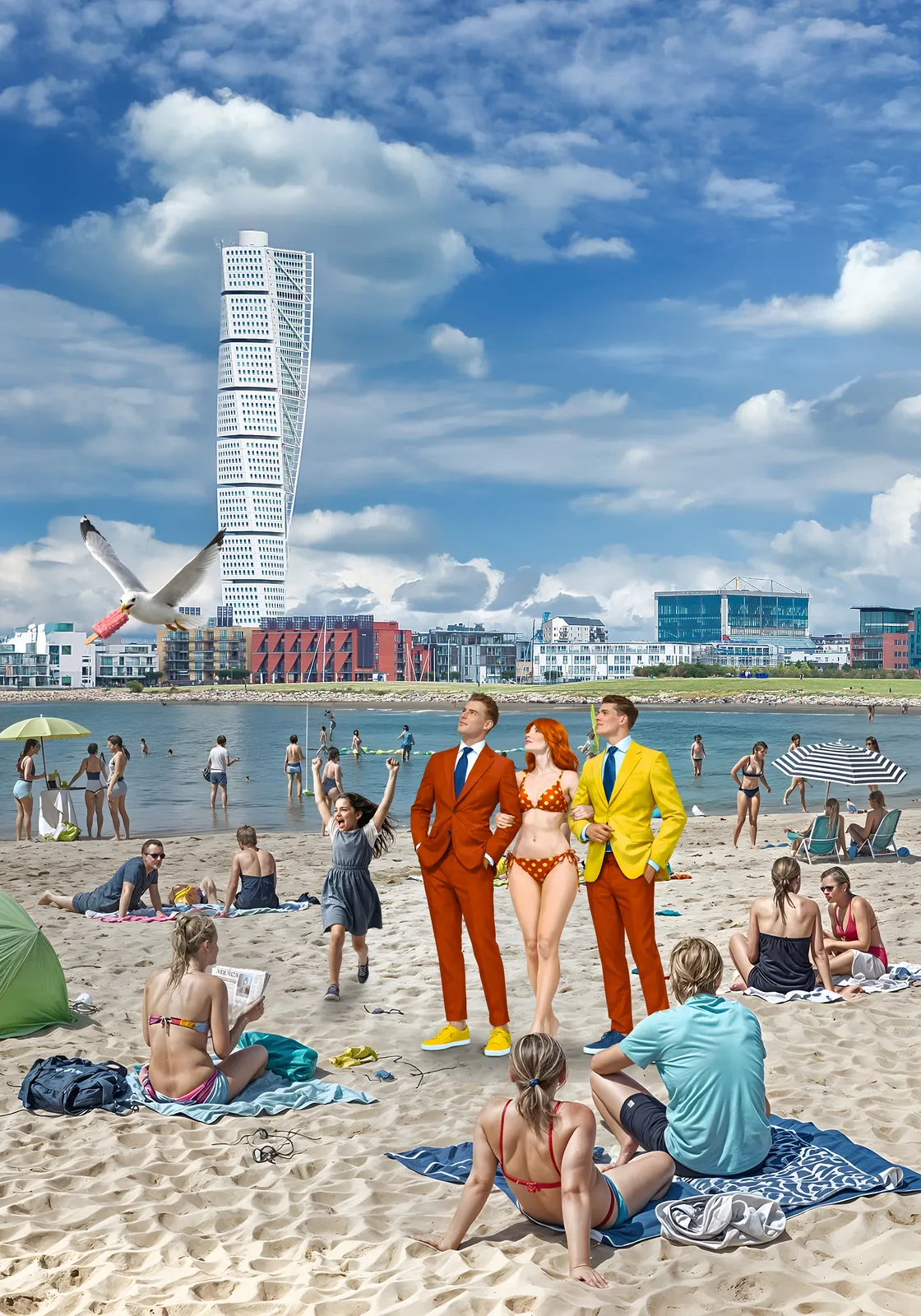
Watch out for seagulls
What the image captures is not the disaster itself but its opening move. A tiny action, such as a stolen ice cream or a crying child, may seem insignificant but can lead to larger issues, reminding us that small actions can have significant consequences. No one is injured. Nothing appears broken. The beach returns to its lazy equilibrium within seconds. This highlights how minor choices can shape outcomes, encouraging the audience to feel responsible for their small actions and their impact.
But this is how such stories begin.
Because the image does not lead directly to what follows, it prepares us for it. The same bird, the same casual cruelty, the same human reflex to dismiss a minor disturbance as insignificant. The message is clear: small, careless actions, such as impulsive decisions or quick fixes, can escalate into bigger problems if overlooked. Recognising this helps you stay responsible for preventing larger issues and encourages ongoing vigilance. Being alert to minor signs empowers you to act before problems grow, fostering a sense of control and preparedness.
What happens next does not take place on the beach.
It unfolds later, elsewhere, on a rooftop terrace in Malmö, with coffee, cinnamon buns, and a family convinced nothing bad will happen that day. The seagull is no longer visible, but its work is not done. Small, overlooked risks can have lasting consequences, so stay vigilant and trust your awareness.
What follows is a cautionary tale. Whatever you do, stay alert to minor signs of trouble, such as seagulls, because overlooked risks can escalate into bigger issues if ignored. Remember, small actions by anyone can impact us all, so vigilance is a shared responsibility. Recognising that everyone plays a part can inspire a collective effort to stay attentive and responsible, emphasising that social awareness is a community effort.
"Rune, or the Physics of Misfortune
It did not start with thunder.
It did not start with fate.
It started with a foot,
a moment too bare,
and a seagull having had enough of the world.
From coffee cups and cinnamon buns
the day leaned gently forward.
From roof to bathroom,
from confidence to porcelain,
from this, it will only take a second
why is nothing moving anymore?
Rune trusted gravity.
Gravity disagreed.
One slip became a lesson,
one flush became a decision,
one pull became a negotiation
between bone and ceramic.
The house watched quietly.
The toilet held firm.
Arms broke to the left,
legs answered on the right.
Stairs demanded tribute.
Doors closed when asked not to.
Beds rolled away without remorse.
Even ribs, loyal for decades,
eventually resigned.
Doctors shook their heads.
Nurses stopped counting.
Clipboards ran out of margins.
And somewhere, far above it all,
a seagull digested calmly,
having long since moved on
to its next small act
with disproportionate consequences.
Rune survived.
That much must be said.
But survival is not always victory.
Wrapped in plaster, catalogued in pain,
he entered history sideways,
not as a hero,
not as a warning,
but as a statistical anomaly.
Thus, Rune found his place
in the Guinness Book of Records:
for the longest documented chain
of avoidable mishaps
triggered by a single bird
with excellent timing.
So remember him
when summer feels harmless,
when problems seem small,
when fixes look easy.
And above all:
watch the sky."
Malmö, January 2026
How Everything Can Go to Hell Because of a Single Seagull
At first glance, my image looks quite innocent — like an ordinary summer day on the beach at Ribersborg. One of those days when time seems to have paused. People are scattered across the sand, among towels and parasols, with bent backs and sunburnt shoulders. Someone is reading, others are half-asleep, and many are gazing out over the water without really seeing anything. Children are playing at the water’s edge. The water is warm enough that no one complains out loud.
It is a day without world politics. There are no Trumps here, no Putins. No wars demanding moral positions. China lies far away — both geographically and mentally. Everything that usually presses in on us has, for the moment, withdrawn. At Ribersborg, there is a quiet truce between humanity and reality.
Precisely for that reason, everything is fragile.
And then, right in the middle of the idyll, the drama strikes — not with noise and thunder, but with a swift, whistling dive from above. A seagull swoops down with the cold precision possessed only by seasoned urban birds. It snatches a little girl’s ice-cream stick straight from her hand and rises again, satisfied, in a confident arc towards the city.
The girl runs after it, arms in the air, distraught. The ice cream — barely begun, dripping, irreplaceable — is already lost. The adults barely have time to react. Someone laughs nervously. Someone else thinks children learn from adversity. Most people think nothing at all.
But something has been set in motion, illustrating how small, seemingly harmless moments can unexpectedly escalate, emphasising the need for vigilance in everyday life.
Always stay alert for seagulls, especially those that defecate, because it reminds the audience to be cautious of minor moments that can unexpectedly escalate.
What follows is a cautionary tale, as seagulls can be dangerous animals.
In my story, it was a Saturday. A deceptively calm, almost ceremonial morning when the whole family sat outside, drinking coffee and pretending life was simple. They lived at the very top of an old building in Malmö, without an elevator, but with a large roof terrace that more than compensated for the stairs. From up there, one could see the entire city: the church towers, Malmö Live, and Turning Torso rising like a twisted thought on the horizon. It felt as if the whole world lay at their feet.
Rune sat barefoot, a coffee cup in his hand, enjoying the sun. Anita sat opposite him with a cinnamon bun. The children — two of them, at just the right age to be both happy and easily frightened — shared a glass of juice.
“This,” said Anita, “is still worth all the stairs.”
Rune had time to nod.
Then it happened.
Not like a gunshot. Not like an explosion. But like a sticky, warm, treacherous plaff-a humorous reminder that life's chaos often sneaks up on us when we least expect it, making us smile at the absurdity.
“Dad…?” one of the children said cautiously.
Rune said nothing. He lifted his foot slowly, as if hoping that what he saw would not be real. A seagull glided over the terrace, indifferent.
“It… it pooped on me,” Rune finally said, in the same tone one uses when noting a natural disaster at a distance. His foot was now coated in cold, sticky seagull droppings, turning a simple walk into a potential catastrophe. For what is a tsunami in Asia compared with a bare foot smeared with seagull droppings?
The children began to cry immediately. One out of pure empathy. The other was out of disgust.
“Go inside!” Anita shouted. “Go inside right now and get it off! But don’t smear it all over the living room rug.”
Rune hopped in through the terrace door on one leg. At the bathroom doorway, he stopped. Shit! Anita had left her underwear soaking in the sink.
“No,” muttered Rune. “Not today.” He looked around. The bathtub? Occupied by the children’s toys. The shower down the hall? Too far.
That was when Rune's quick thinking showed that staying alert during even simple actions can prevent minor incidents from spiraling into chaos and encourage vigilance.
“Smart,” he said to himself.
He lifted the toilet lid, put his foot in, and flushed.
It worked. In fact, it worked perfectly. His foot was clean, but the water splashed all over the floor.
When Rune took a step back to lift his foot from the toilet bowl, he slipped as if on polished ice, demonstrating how a moment of distraction can lead to unexpected trouble and the importance of constant vigilance.
“No, no, no, no, no,” said Rune, and began pumping and twisting his foot. It only got worse.
“ANITA!” he shouted.
Anita came running and saw Rune, his foot in the toilet, blood running from a gash on his forehead caused by the edge of the bathroom cabinet, which had fallen to the floor with a crash. The entire floor was covered in shattered mirror glass.
“What have you done now?” she asked in that voice that never makes things better.
“Don’t talk — pull!” hissed Rune.
She pulled as hard as she could. Nothing happened except a wet sloshing sound from the toilet bowl and an unbearable pain in Rune’s foot.
“Pull for king and country!” Rune commanded rudely. His leg had cramped, which did not help matters.
Anita pulled and pulled, but the foot remained stuck, and the pain was almost unbearable.
“Pull with everything you’ve got when I count to three. We’ll take a run-up,” he said. Now his voice was gentler, almost pleading.
“I’ll do my best,” Anita squeaked.
“One, two, three.”
They took the run-up together. The foot came free with a cracking sound. It was probably the toes that broke, as later confirmed by the X-ray.
Rune flew backwards, slamming his elbow straight into the sink, shattering the porcelain. His underwear flew through the air like soaked rags. His head struck the doorframe with a sound no one wants to hear in their own home—a crack in the skull and a concussion. Rune felt nothing—he had passed out and lay curled up in the doorway to the bathroom. Blood was pouring from cuts under the sole of his foot, which had stepped on the shattered glass.
Screaming. Children who thought their father was dying. Anita dialled 112. An ambulance was quickly on its way, and the children calmed down when their father woke, confused but at least alive.
When the ambulance arrived, Anita ran downstairs to meet it.
“Top floor?” the paramedics asked, looking up and counting.
“Sixth floor without an elevator?” he said.
“Without an elevator,” said Anita.
“Sigh.” Up all the stairs, Anita leading the way. Rune lay where he had fallen, the worried children keeping watch. The paramedics checked his vital signs. Given the circumstances, he was in decent shape and had perked up after the blow to the doorframe. They carefully transferred Rune onto the stretcher and strapped him in. Out into the stairwell, and down they went.
Narrow, winding staircases are a challenge. One floor went well, then another. Halfway down, the one in front lost his grip. The stretcher caught on the railing and spun. Rune’s left leg — the one that had been unharmed — smashed against the stone steps, and the shinbone snapped in two.
“Damn,” Rune muttered weakly. A mild expression for pain that really called for something more substantial.
They had turned onto Pildammsvägen, passed Malmö Opera, and reached the intersection with Carl Gustaf’s Road. The traffic lights were red, but an ambulance with flashing lights and sirens had priority.
The bus driver turning in from the cross street surely knew that. The problem was not him, but a cyclist who ran a red light at full speed. Bus drivers dislike running over cyclists, even when cyclists are breaking the law. It does not look good on a CV. The ambulance had to brake sharply and missed the bus by mere centimetres. Rune fared worse: he was thrown from the stretcher and broke his other arm when he hit the floor.
At the hospital, the misery continued as Rune was wheeled into the elevator.
“Wait!” someone shouted.
Too late. The elevator doors closed on his leg. Crunch. The leg, still intact, broke in two places. Rune passed out. Surely nothing more could happen now.
When they wheeled him towards the operating theatre, no one had set the brakes.
The bed rolled away.
So did Rune.
He hit the floor with his upper body first. Three ribs gave up.
Rune was plastered from head to toe, his head bandaged, looking like an Egyptian mummy. Whether it was a consolation or not, Rune ended up in the Guinness Book of Records.
It all began on a rooftop terrace in Malmö.
With coffee and cinnamon buns.
And a seagull defecating.
So watch out for seagulls. You never know what they might set in motion.
Losing your ice cream is the least of it.
Jörgen Thornberg
Watch out for seagulls, 2026
Digital
50 x 70 cm
3 200 kr
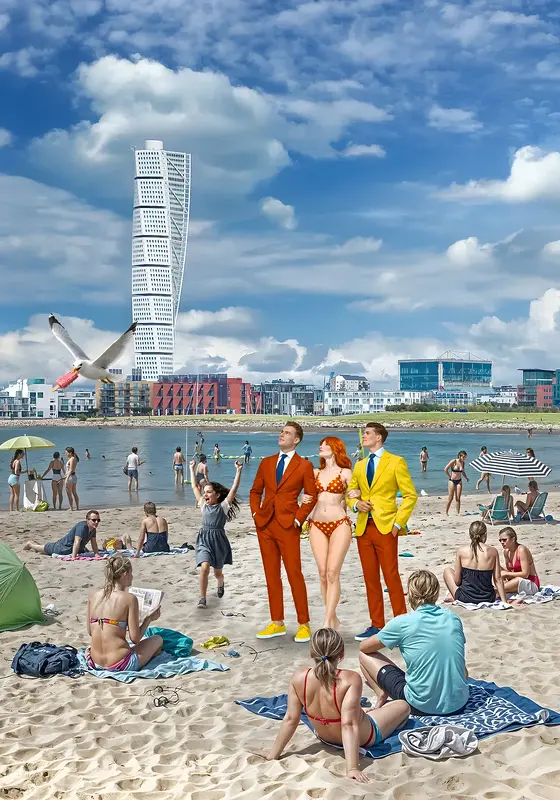
Watch out for seagulls
What the image captures is not the disaster itself but its opening move. A tiny action, such as a stolen ice cream or a crying child, may seem insignificant but can lead to larger issues, reminding us that small actions can have significant consequences. No one is injured. Nothing appears broken. The beach returns to its lazy equilibrium within seconds. This highlights how minor choices can shape outcomes, encouraging the audience to feel responsible for their small actions and their impact.
But this is how such stories begin.
Because the image does not lead directly to what follows, it prepares us for it. The same bird, the same casual cruelty, the same human reflex to dismiss a minor disturbance as insignificant. The message is clear: small, careless actions, such as impulsive decisions or quick fixes, can escalate into bigger problems if overlooked. Recognising this helps you stay responsible for preventing larger issues and encourages ongoing vigilance. Being alert to minor signs empowers you to act before problems grow, fostering a sense of control and preparedness.
What happens next does not take place on the beach.
It unfolds later, elsewhere, on a rooftop terrace in Malmö, with coffee, cinnamon buns, and a family convinced nothing bad will happen that day. The seagull is no longer visible, but its work is not done. Small, overlooked risks can have lasting consequences, so stay vigilant and trust your awareness.
What follows is a cautionary tale. Whatever you do, stay alert to minor signs of trouble, such as seagulls, because overlooked risks can escalate into bigger issues if ignored. Remember, small actions by anyone can impact us all, so vigilance is a shared responsibility. Recognising that everyone plays a part can inspire a collective effort to stay attentive and responsible, emphasising that social awareness is a community effort.
"Rune, or the Physics of Misfortune
It did not start with thunder.
It did not start with fate.
It started with a foot,
a moment too bare,
and a seagull having had enough of the world.
From coffee cups and cinnamon buns
the day leaned gently forward.
From roof to bathroom,
from confidence to porcelain,
from this, it will only take a second
why is nothing moving anymore?
Rune trusted gravity.
Gravity disagreed.
One slip became a lesson,
one flush became a decision,
one pull became a negotiation
between bone and ceramic.
The house watched quietly.
The toilet held firm.
Arms broke to the left,
legs answered on the right.
Stairs demanded tribute.
Doors closed when asked not to.
Beds rolled away without remorse.
Even ribs, loyal for decades,
eventually resigned.
Doctors shook their heads.
Nurses stopped counting.
Clipboards ran out of margins.
And somewhere, far above it all,
a seagull digested calmly,
having long since moved on
to its next small act
with disproportionate consequences.
Rune survived.
That much must be said.
But survival is not always victory.
Wrapped in plaster, catalogued in pain,
he entered history sideways,
not as a hero,
not as a warning,
but as a statistical anomaly.
Thus, Rune found his place
in the Guinness Book of Records:
for the longest documented chain
of avoidable mishaps
triggered by a single bird
with excellent timing.
So remember him
when summer feels harmless,
when problems seem small,
when fixes look easy.
And above all:
watch the sky."
Malmö, January 2026
How Everything Can Go to Hell Because of a Single Seagull
At first glance, my image looks quite innocent — like an ordinary summer day on the beach at Ribersborg. One of those days when time seems to have paused. People are scattered across the sand, among towels and parasols, with bent backs and sunburnt shoulders. Someone is reading, others are half-asleep, and many are gazing out over the water without really seeing anything. Children are playing at the water’s edge. The water is warm enough that no one complains out loud.
It is a day without world politics. There are no Trumps here, no Putins. No wars demanding moral positions. China lies far away — both geographically and mentally. Everything that usually presses in on us has, for the moment, withdrawn. At Ribersborg, there is a quiet truce between humanity and reality.
Precisely for that reason, everything is fragile.
And then, right in the middle of the idyll, the drama strikes — not with noise and thunder, but with a swift, whistling dive from above. A seagull swoops down with the cold precision possessed only by seasoned urban birds. It snatches a little girl’s ice-cream stick straight from her hand and rises again, satisfied, in a confident arc towards the city.
The girl runs after it, arms in the air, distraught. The ice cream — barely begun, dripping, irreplaceable — is already lost. The adults barely have time to react. Someone laughs nervously. Someone else thinks children learn from adversity. Most people think nothing at all.
But something has been set in motion, illustrating how small, seemingly harmless moments can unexpectedly escalate, emphasising the need for vigilance in everyday life.
Always stay alert for seagulls, especially those that defecate, because it reminds the audience to be cautious of minor moments that can unexpectedly escalate.
What follows is a cautionary tale, as seagulls can be dangerous animals.
In my story, it was a Saturday. A deceptively calm, almost ceremonial morning when the whole family sat outside, drinking coffee and pretending life was simple. They lived at the very top of an old building in Malmö, without an elevator, but with a large roof terrace that more than compensated for the stairs. From up there, one could see the entire city: the church towers, Malmö Live, and Turning Torso rising like a twisted thought on the horizon. It felt as if the whole world lay at their feet.
Rune sat barefoot, a coffee cup in his hand, enjoying the sun. Anita sat opposite him with a cinnamon bun. The children — two of them, at just the right age to be both happy and easily frightened — shared a glass of juice.
“This,” said Anita, “is still worth all the stairs.”
Rune had time to nod.
Then it happened.
Not like a gunshot. Not like an explosion. But like a sticky, warm, treacherous plaff-a humorous reminder that life's chaos often sneaks up on us when we least expect it, making us smile at the absurdity.
“Dad…?” one of the children said cautiously.
Rune said nothing. He lifted his foot slowly, as if hoping that what he saw would not be real. A seagull glided over the terrace, indifferent.
“It… it pooped on me,” Rune finally said, in the same tone one uses when noting a natural disaster at a distance. His foot was now coated in cold, sticky seagull droppings, turning a simple walk into a potential catastrophe. For what is a tsunami in Asia compared with a bare foot smeared with seagull droppings?
The children began to cry immediately. One out of pure empathy. The other was out of disgust.
“Go inside!” Anita shouted. “Go inside right now and get it off! But don’t smear it all over the living room rug.”
Rune hopped in through the terrace door on one leg. At the bathroom doorway, he stopped. Shit! Anita had left her underwear soaking in the sink.
“No,” muttered Rune. “Not today.” He looked around. The bathtub? Occupied by the children’s toys. The shower down the hall? Too far.
That was when Rune's quick thinking showed that staying alert during even simple actions can prevent minor incidents from spiraling into chaos and encourage vigilance.
“Smart,” he said to himself.
He lifted the toilet lid, put his foot in, and flushed.
It worked. In fact, it worked perfectly. His foot was clean, but the water splashed all over the floor.
When Rune took a step back to lift his foot from the toilet bowl, he slipped as if on polished ice, demonstrating how a moment of distraction can lead to unexpected trouble and the importance of constant vigilance.
“No, no, no, no, no,” said Rune, and began pumping and twisting his foot. It only got worse.
“ANITA!” he shouted.
Anita came running and saw Rune, his foot in the toilet, blood running from a gash on his forehead caused by the edge of the bathroom cabinet, which had fallen to the floor with a crash. The entire floor was covered in shattered mirror glass.
“What have you done now?” she asked in that voice that never makes things better.
“Don’t talk — pull!” hissed Rune.
She pulled as hard as she could. Nothing happened except a wet sloshing sound from the toilet bowl and an unbearable pain in Rune’s foot.
“Pull for king and country!” Rune commanded rudely. His leg had cramped, which did not help matters.
Anita pulled and pulled, but the foot remained stuck, and the pain was almost unbearable.
“Pull with everything you’ve got when I count to three. We’ll take a run-up,” he said. Now his voice was gentler, almost pleading.
“I’ll do my best,” Anita squeaked.
“One, two, three.”
They took the run-up together. The foot came free with a cracking sound. It was probably the toes that broke, as later confirmed by the X-ray.
Rune flew backwards, slamming his elbow straight into the sink, shattering the porcelain. His underwear flew through the air like soaked rags. His head struck the doorframe with a sound no one wants to hear in their own home—a crack in the skull and a concussion. Rune felt nothing—he had passed out and lay curled up in the doorway to the bathroom. Blood was pouring from cuts under the sole of his foot, which had stepped on the shattered glass.
Screaming. Children who thought their father was dying. Anita dialled 112. An ambulance was quickly on its way, and the children calmed down when their father woke, confused but at least alive.
When the ambulance arrived, Anita ran downstairs to meet it.
“Top floor?” the paramedics asked, looking up and counting.
“Sixth floor without an elevator?” he said.
“Without an elevator,” said Anita.
“Sigh.” Up all the stairs, Anita leading the way. Rune lay where he had fallen, the worried children keeping watch. The paramedics checked his vital signs. Given the circumstances, he was in decent shape and had perked up after the blow to the doorframe. They carefully transferred Rune onto the stretcher and strapped him in. Out into the stairwell, and down they went.
Narrow, winding staircases are a challenge. One floor went well, then another. Halfway down, the one in front lost his grip. The stretcher caught on the railing and spun. Rune’s left leg — the one that had been unharmed — smashed against the stone steps, and the shinbone snapped in two.
“Damn,” Rune muttered weakly. A mild expression for pain that really called for something more substantial.
They had turned onto Pildammsvägen, passed Malmö Opera, and reached the intersection with Carl Gustaf’s Road. The traffic lights were red, but an ambulance with flashing lights and sirens had priority.
The bus driver turning in from the cross street surely knew that. The problem was not him, but a cyclist who ran a red light at full speed. Bus drivers dislike running over cyclists, even when cyclists are breaking the law. It does not look good on a CV. The ambulance had to brake sharply and missed the bus by mere centimetres. Rune fared worse: he was thrown from the stretcher and broke his other arm when he hit the floor.
At the hospital, the misery continued as Rune was wheeled into the elevator.
“Wait!” someone shouted.
Too late. The elevator doors closed on his leg. Crunch. The leg, still intact, broke in two places. Rune passed out. Surely nothing more could happen now.
When they wheeled him towards the operating theatre, no one had set the brakes.
The bed rolled away.
So did Rune.
He hit the floor with his upper body first. Three ribs gave up.
Rune was plastered from head to toe, his head bandaged, looking like an Egyptian mummy. Whether it was a consolation or not, Rune ended up in the Guinness Book of Records.
It all began on a rooftop terrace in Malmö.
With coffee and cinnamon buns.
And a seagull defecating.
So watch out for seagulls. You never know what they might set in motion.
Losing your ice cream is the least of it.
3 200 kr

Jörgen Thornberg
Malmö
Lite om bilder och mig. Translation in English at the end.
Jag är en nyfiken person som ser allt i bilder, även det jag fäster i ord, gärna tillsammans för bakom alla mina bilder finns en berättelse. Till vissa bilder hör en kortare eller längre novell som följer med bilden.
Bilder berättar historier. Jag omges av naturlig skönhet, intressanta människor och historia var jag än går. Jag använder min kamera för att dokumentera världen och blanda det jag ser med vad jag känner för att fånga den dolda magin.
Mina bilder berättar mina historier. Genom mina bilder, tryck och berättelser. Jag bjuder in dig att ta del av dessa berättelser, in i ditt liv och hem och dela min mycket personliga syn på vår värld. Mer än vad ögat ser. Jag tänker i bilder, drömmer och skriver och pratar om dem; följaktligen måste jag också skapa bilder. De blir vad jag ser, inte nödvändigtvis begränsade till verkligheten. Det finns en bild runt varje hörn. Jag hoppas att du kommer att se vad jag såg och gilla det.
Jag är också en skrivande person och till många bilder hör en kortare eller längre essay. Den följer med tavlan, tryckt på fint papper och med en personlig hälsning från mig.
Flertalet bilder startar sin resa i min kamera. Enkelt förklarat beskriver jag bilden jag ser i mitt inre, upplevd eller fantiserad. Bilden uppstår inom mig redan innan jag fått okularet till ögat. På bråkdelen av ett ögonblick ser jag vad jag vill ha och vad som kan göras med bilden. Här skall jag stoppa in en giraff, stålmannen, Titanic eller vad det är min fantasi finner ut. Ännu märkligare är att jag kommer ihåg minnesbilden långt efteråt när det blir tid att skapa verket. Om jag lyckas eller inte, är upp till betraktaren, oftast präglat av en stråk av svart humor – meningen är att man skall bli underhållen. Mina bilder blir ofta en snackis där de hänger.
Jag föredrar bilder som förmedlar ett budskap i flera lager. Vid första anblicken fylld av feel-good, en vacker utsikt, fint väder, solen skiner, blommor på ängen eller vattnet som ligger förrädiskt spegelblankt. I en sådan bild kan jag gömma min egentliga berättelse, mitt förakt för förtryckare och våldsverkare, rasister och fördomsfulla människor - ett gärna återkommande motiv mer eller mindre dolt i det vackra motivet. Jag försöker förena dem i ett gemensamt narrativ.
Bild och formgivning har löpt som en röd tråd genom livet. Fotokonst känns som en värdig final som jag gärna delar med mig.
Min genre är vid som framgår av mina bilder, temat en blandning av pop- och gatukonst i kollage som kan bestå av hundratals lager. Vissa bilder kan ta veckor, andra någon dag innan det är dags att överlämna resultatet till printverkstaden. Fine Art Prints är digitala fotocollage. I dessa kollage sker rivandet, klippandet, pusslandet, målandet, ritandet och sprayningen digitalt. Det jag monterar in kan vara hundratals år gamla bilder som jag omsorgsfullt frilägger så att de ser ut att vara en del av tavlan men också bilder skapade av mig själv efter min egen fantasi. Därefter besöks printstudion och för vissa bilder numrera en limiterad upplaga (oftast 7 exemplar) och signera för hand. Vissa bilder kan köpas i olika format. Det är bara att fråga efter vilka. Gillar man en bild som är 70x100 men inte har plats på väggen, går den kanske att få i 50x70 cm istället. Frågan är fri.
Metoden Giclée eller Fine Art Print som det också kallas är det moderna sättet för framställning av grafisk konst. Villkoret för denna typ av utskrifter är att en högkvalitativ storformatskrivare används med åldersbeständigt färgpigment och konstnärspapper eller i förekommande fall på duk. Pappret som används möter de krav på livslängd som ställs av museer och gallerier. Normalt säljer jag mina bilder oinramade så att den nya ägaren själv kan bestämma hur de skall se ut, med eller utan passepartout färg på ram, med eller utan glas etc..
Under många år ställde jag bara ut på nätet, i valda grupper och på min egen Facebooksida - https://www.facebook.com/jorgen.thornberg.9
Jag finns också på en egen hemsida som tyvärr inte alltid är uppdaterad – https://www.jth.life/ Där kan du också läsa en del av de berättelser som följer med bilden.
UTSTÄLLNINGAR
Luftkastellet, oktober 2022
Konst i Lund, november 2022
Luftkastellet, mars 2023
Engleson Galleri Caroli, april 2023
Hydra, Greece June 2023
Engleson Galleri Caroli, oktober 2023
Toppen, Höllviken december 2023
Luftkastellet, mars 2024
Torups Galleri, mars 2024
Venice, May 2024
Luftkastellet, oktober 2024
Konst i Advent, December 2024
Galleri Engleson, Caroli December 2024
Jäger & Jansson Galleri, april 2025
A bit about pictures and me.
I'm a curious person who sees everything in pictures, even what I express in words, often combining them, for behind all my pictures lies a story. These narratives, some as short as a single image and others as long as a novel, are the heart and soul of my work.
Pictures tell stories. Wherever I go, I'm surrounded by natural beauty, exciting people, and history. I use my camera to document the world and blend what I see with what I feel to capture the hidden magic.
My images tell my stories. Through my pictures, prints, and narratives, I invite you to partake in these stories in your life and home and share my deeply personal perspective of our world. More than meets the eye. I think in pictures, dream, write, and talk about them; consequently, I must create images too. They become what I see, not necessarily confined to reality. There's a picture around every corner. I hope you'll see what I saw and enjoy it.
I'm also a writer, and many images come with a shorter or longer essay. It accompanies the painting, printed on fine paper with my personal greeting.
Many pictures start their journey on my camera. Simply put, I describe the image I see in my mind, experienced or imagined. The image arises within me even before I bring the eyepiece to my eye. In a fraction of a moment, I see what I want and what can be done with the picture. Here, I'll insert a giraffe, Superman, the Titanic, or whatever my imagination conjures up. Even stranger is that I remember the mental image long after it's time to create the work. Whether I succeed is up to the observer, often imbued with a streak of black humour – the aim is to entertain. My pictures usually become a talking point wherever they hang.
I prefer pictures that convey a message in multiple layers. At first glance, they're filled with feel-good vibes, a beautiful view, lovely weather, the sun shining, flowers in the meadow, or the water lying deceptively calm. But beneath this surface beauty, I often conceal a deeper story, a narrative that challenges societal norms or explores the human condition. I invite you to delve into these hidden narratives and discover the layers of meaning within my work.
Picture and design have been a thread running through my life. Photographic art feels like a fitting finale, and I'm happy to share it.
My genre is varied, as seen in my pictures; the theme is a blend of pop and street art in collages that can consist of hundreds of layers. Some images can take weeks, others just a day before it's time to hand over the result to the print workshop. Fine Art Prints are digital photo collages. In these collages, tearing, cutting, puzzling, painting, drawing, and spraying happen digitally. What I insert can be images hundreds of years old that I carefully extract so they appear to be part of the painting, but also images created by myself, now also generated from my imagination. Next, visit the print studio and, for certain images, number a limited edition (usually 7 copies) and sign them by hand. Some images may be available in other formats. Just ask which ones. If you like an image that's 70x100 but doesn't have space on the wall, you might be able to get it in 50x70 cm instead. The question is open.
The Giclée method, or Fine Art Print as it's also called, is the modern way of producing graphic art. This method ensures the highest quality and longevity of the artwork, using a high-quality large-format printer with archival pigment inks and artist paper or, in some cases, canvas. The paper used meets the longevity requirements set by museums and galleries. I sell my pictures unframed, allowing the new owner to personalise their artwork, confident in the lasting value and quality of the piece.
For many years, I only exhibited online, in selected groups, and on my Facebook page - https://www.facebook.com/jorgen.thornberg.9. I also have my website, which unfortunately is not constantly updated - https://www.jth.life/. You can also read some of the stories accompanying the pictures there.
EXHIBITIONS
Luftkastellet, October 2022
Art in Lund, November 2022
Luftkastellet, March 2023
Engleson Gallery Caroli, April 2023
Hydra, Greece June 2023
Engleson Gallery Caroli, October 2023
Toppen, Höllviken December 2023
Luftkastellet, March 2024
Torup Gallery, March 2024
Venice, May 2024
UTSTÄLLNINGAR
Luftkastellet, oktober 2022
Konst i Lund, november 2022
Luftkastellet, mars 2023
Engleson Galleri Caroli, april 2023
Hydra, Greece June 2023
Engleson Galleri Caroli, oktober 2023
Toppen, Höllviken december 2023
Luftkastellet, mars 2024
Torups Galleri, mars 2024
Venice, May 2024
Luftkastellet, October 2024
Konst i Advent, December 2024
Galleri Engleson, Caroli December 2024
Jäger & Jansson Galleri, April 2025
Utbildning
Autodidakt
Medlem i konstnärsförening
Öppna Sinnen
Med i konstrunda
Konstrundan i Skåne
Utställningar
Luftkastellet, October 2022
Art in Lund, November 2022
Luftkastellet, March 2023
Engleson Gallery Caroli, April 2023
Hydra, Greece June 2023
Engleson Gallery Caroli, October 2023
Toppen, Höllviken December 2023
Luftkastellet, March 2024
Torup Gallery, March 2024
Venice, May 2024