Vi använder cookies för att ge dig bästa möjliga upplevelse. Välj vilka cookies du tillåter.
Läs mer i vår integritetspolicy
Jörgen Thornberg
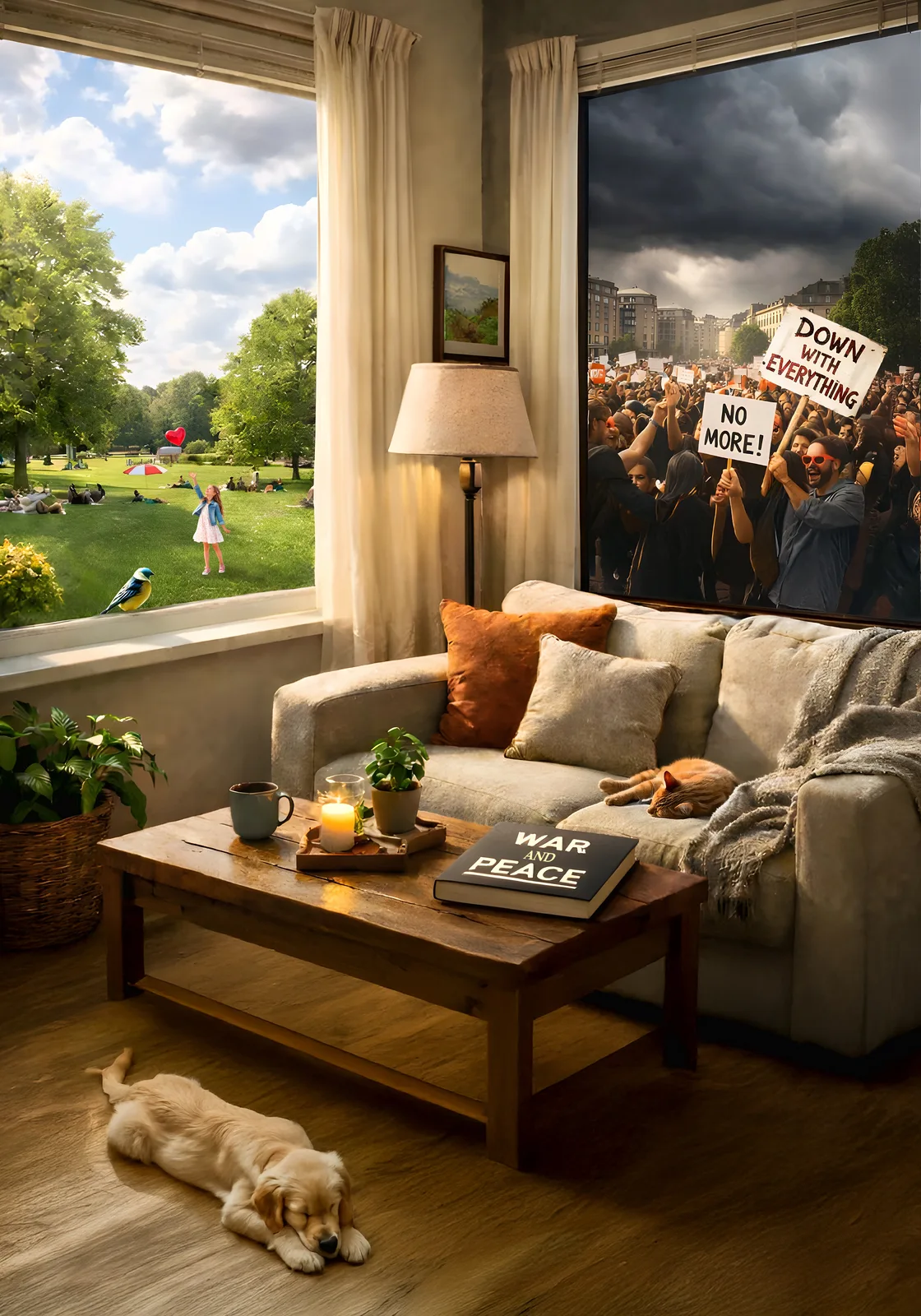
Room with a split view, 2026
Digital
50 x 70 cm
3 200 kr
Room with a split view
Some texts begin with an argument. This one starts with a room. Not because rooms are neutral, but because they are where we pretend neutrality still exists. We sit down, light a candle, let the coffee cool, pet the dog, and ignore the news for five minutes longer than we should, and we call that “normal life.” Recognising these everyday choices can remind readers of their power to influence societal conflict through daily actions, making them feel their actions matter.
We are told that the world is polarised, as if this were a new condition, as if history once moved politely forward in a straight line. It never did. What changes is not the existence of conflict but its temperature. Some decades simmer. Some boil. Some suddenly tip into the kind of heat that rewrites everything—like the years before the First World War, like the late 1930s, like other thresholds that looked ordinary until they became apparent in retrospect. Our own time has that smell: a mixture of speed and fatigue, of certainty and panic, of moral language used as weaponry, of people no longer trusting institutions yet still demanding miracles from them. A world where the middle grows tired, and tiredness is the most politically dangerous emotion of all, urging the audience to feel a collective sense of responsibility for societal stability and change.
This essay is not written from the street, nor from the park. It is written from the place most of us actually inhabit: the interior. The half-shelter. The lived-in compromise. The domestic civilisation that feels private until it suddenly isn’t. Because history does not only happen in parliaments and barricades; it happens while dinner is being made. It occurs while someone says, “Let’s not talk about politics.” It happens while we decide what to tolerate, what to excuse, what to laugh off, what to postpone. It occurs in the small personal choices that later look like big mistakes, highlighting how individual decisions, like ignoring specific conversations or accepting injustices, shape societal outcomes.
There is another layer here, one we rarely admit without discomfort: the way we freeze our past in bronze and then act surprised when it continues to speak. Statues are not only monuments. They are choices made once and kept alive by habit. They stand as if time were a simple story and power were innocent. They are not. A statue is a sentence carved into public space. It tells you who mattered. It tells you who must be honoured. It tells you whose pain is allowed to remain unmentioned. Recognising this can inspire a sense of responsibility for the societal messages we uphold.
Yes—this is a text about a room with two windows. But it is also about what we do with inheritance when it no longer fits our conscience. About how quickly a calm view can turn, and how slowly courage tends to arrive. Recognising that change requires collective effort can inspire hope and a sense of shared responsibility for shaping the future.
If the world is heading toward a giant reckoning, it will not begin with a single dramatic moment. It will start, as it always does, with ordinary people sitting in ordinary rooms, looking out at two different realities, and deciding which one they are willing to keep seeing.
Now we can enter the prologue.
"Room with a split view
Two windows cleave the daylight into two,
one holds a park where time forgets its blade;
a child lets go of a red heart, rising through
a sky that has not learned what must be paid.
Green silence sprawls; the easy hours pretend
the world is gently left alone,
as if the grass could guarantee the end,
as if a future grows by seeds of tone.
The other window crowds the air with need,
with signs that burn like short, untested prayers;
“Down with it all,” they cry, and do not read
how ruins breed new masters, new despairs.
Between these views, we sit—no walls, no fence—
and choose what stays: our comfort, or our sense."
Malmö, January 2026
Prologue – Room with a split view
Every city carries a few statues it never buried, lingering in open squares, their silent presence shaping our collective memory more than we realise. They stand in open squares, polished by rain and pigeons, protected by habit rather than conviction. We walk past them daily, pretending they are silent, while they quietly instruct us in what we are supposed to forget. This text is not written to destroy a statue. It is written to be listened to. Not to the king it depicts, but to the power it preserves-whether it symbolises colonialism, oppression, or national pride. Not to the horse it balances upon, but to the weight it still carries, such as historical trauma or societal values. Not to the history it claims to represent, but to the history it refuses to mourn, like marginalised voices or contested narratives. Recognising these complex feelings can help the audience develop patience and a deeper understanding of the debate around statues, fostering a more empathetic approach to societal change and shared values.
The image that opens this essay offers a dreamlike version of reality. Batwoman sits calmly before the empty pedestal on Stortorget. The stone base remains, but the king and his horse are already airborne, lifted into an uncertain sky, stripped of gravity and authority. The hero does not celebrate. She rests, as if the removal of power were. The Room is quiet. Not the kind of silence that means nothing is happening, but the kind that means everything is happening somewhere else. A sofa holds its shape from yesterday. A cat sleeps as if history were a rumour. A dog dreams without knowing what. On the table lies a book whose title no one needs to read anymore: War and Peace. A candle burns with the modest ambition of light. A coffee cup cools—life, as we still recognise it.
And then there are the windows.
To the left, the park opens like a memory of what humanity once promised itself. Green grass. Soft shadows. A child releases a red, heart-shaped balloon into a sky that has not yet been asked to carry what it will. People lie in the grass, not as a statement but as a habit. A bird rests on the windowsill as if it had always belonged there. Nothing demands attention. Everything exists.
To the right, the city gathers into a roar. Faces pressed together by urgency. Signs raised not towards a solution but towards a breaking point, such as debates over Confederate statues or colonial monuments. Down with everything. No more. Clouds thicken as if even the weather has chosen a side. The future here is not released into the sky — the throat seizes it. These conflicts reveal how societal memory is contested and how statues become symbols of unresolved histories, urging patience and nuanced understanding.
Between these two views stands the Room, a tangible space filled with cushions, dust, and warmth, symbolising the fragile human interior caught between contrasting societal narratives and memories. This Room represents our collective consciousness, where conflicting histories, like statues and their meanings, coexist and challenge us to find empathy and patience as we navigate societal change.
Not a metaphorical room. A real one. With cushions. With dust. With warmth. With fragile order. A human interior is placed directly between two versions of the same world.
This is where we live now. Not in the park. Not in the crowd. But in the narrow space between them. Recognising that change takes time can help the audience feel hopeful and resilient about societal progress.
We like to imagine that history unfolds out there, while life happens in here. But history has always happened in rooms like this. In rooms where people thought they were safe while empires rehearsed. In rooms where children played while borders were redrawn. In rooms where books were read while future graves were already being measured.
We tell ourselves that our time is unique in its polarisation. But the atmosphere is older than we think. The late 1930s carried it. The years before the First World War brought it. The decades before revolutions, before collapses, before awakenings carried it too. That trembling sense that something is coming, without agreement on what it is. There is a collective intuition that the present cannot hold forever.
And yet, the Room remains.
Civilisation has always been built from the inside out. From people who made coffee while the world sharpened its knives. From families who closed the curtains while ideas outside demanded daylight. From individuals who believed stability was permanent because it had lasted their whole lifetime.
The tragedy is not that people fail to see catastrophe coming. The tragedy is that they always see it — from a sofa.
This essay does not take place in the park. It does not take place in the crowd. It takes place here in the Room, where both are visible. Where no choice has yet been made, every choice is already present.
Because the world today is split not just by borders but by windows representing different perspectives on societal memory and statues, our choices determine which view we keep open or close, urging patience and understanding in these debates.
And we are the ones who decide which view we dare to keep open.
Chapter One – The Window of Innocence
From the sofa, the left window looks almost unreal. Not because it is beautiful, but because it is uncomplicated. The park does not argue. It does not persuade. It does not recruit. It simply exists, as if existence itself were still a sufficient purpose.
The child stands in the grass, an arm raised, releasing the red heart-shaped balloon not as a gesture but as an instinct. Children do not yet express hope. They practise it. They let it go to see what it does. The balloon rises without explanation, without programme, without ideology. It carries nothing but air and projection.
Around her, people lie in the grass with the relaxed arrogance of those who believe time belongs to them. They scroll, talk, laugh, and nap. No one in that park is preparing for history. They are only preparing for the evening. The bird on the windowsill does not know it is part of a symbol. It only knows the warmth of the stone and the mild calculation of when to fly.
This window represents humanity’s oldest illusion: that peace is our natural state.
We want to believe that violence is an interruption, that conflict is an anomaly, and that cruelty is an exception. We want to see ourselves as a species temporarily disturbed rather than permanently unfinished. The park allows us to sustain that belief. It tells us that the world is still capable of gentleness without supervision.
And in a sense, it is.
Civilisation is real. Progress is real. Childhood endures. Nature adapts. Love repeats itself. New generations are born without memory of the catastrophes that made their existence possible. Every child is evidence that humanity has not given up on itself.
But the park is also selective. It shows us what survives, not what struggles. It shows us leisure, not labour. It shows us peace, not the structures that protect it. It shows us innocence, not the cost of maintaining it.
The balloon is red, not by accident. It is the colour of love, but also of blood. The same shade that waves in celebration also waves in warning. The child does not know this yet. She should not have to. But history does.
This window is not naïve. It is necessary.
Without it, we would not care enough to defend anything. Without it, we would not recognise what is being lost as the other window grows louder. Without it, the world would become only a battlefield and never again a home.
Yet this window also seduces us into thinking that continuity equals safety. That is because children are still playing; the future must still be kind. That is because the grass is green and the soil beneath it remains stable.
Empires have always collapsed while children were playing in the parks.
Wars have always begun while lovers were planning weekends.
Revolutions have consistently brewed while someone was teaching someone else to ride a bicycle.
The park does not lie, but it does not warn either.
It simply reminds us of what we are trying to protect, even when we forget that protection is needed.
From the sofa, the left window is comforting. It tells us that humanity still knows how to be human. The danger is not in believing this. The danger is that we think this is enough. It's not a victory but a relief. It is an angelic solution — the kind we can afford only in art. In reality, statues do not fly away. They must be argued with, legislated, contextualised, relocated, or defended. They require committees, archives, conflicts, compromises, and courage. Recognising this effort can foster respect and patience for the process of change, helping the audience appreciate the work involved and the importance of persistence.
The image is therefore not a proposal. It is a wish, a longing for history to release itself as easily as a balloon floats away, encouraging us to approach change with patience and understanding as part of societal growth. Recognising that change is a gradual process can help the audience develop respect for the sustained effort required to shape collective memory.
Karl X Gustav does not stand in Malmö because he belongs there. He stands there because we have not yet decided what to do with our inheritance. This essay attempts to determine — not by shouting at the past, but by refusing to kneel before it. Recognising the emotional and cultural significance of such statues can help us approach these debates with patience and respect, understanding that they embody more than history — they reflect our collective identity and values.
Chapter Two – The Window of Reckoning
From the same sofa, the right window feels closer, even though it is farther away, symbolising the urgency of societal awareness and collective action. Sound seems to travel faster from this direction, emphasising the need for attentive listening to signals of societal unrest. Faces press against the glass of history, demanding recognition of societal issues that threaten stability. Hands rise not in greeting but in demand, highlighting the importance of a collective voice. The crowd does not ask to be understood; it asks to be heard, urging us to recognise the signs of societal unrest that foreshadow change. Here, the future is no longer released like a balloon; it is negotiated, shouted, threatened, promised, and postponed, reflecting the complex dynamics of societal change. The signs are simple because anger always is. Down with everything. No more. They do not point towards a destination but towards exhaustion and the collective sense that current societal structures are no longer tolerable, even if we cannot yet agree on what should replace them. This underscores the importance of collective responsibility in addressing unrest and fostering societal stability.
This window represents humanity’s other constant: the refusal to continue as before. Every age eventually produces its crowd, not because people are violent by nature, but because they are patient only up to a point. Injustice accumulates quietly, like dust in corners. When it is finally disturbed, it rises all at once, filling the Room. The faces in the crowd are not monsters. They are clerks, students, parents, workers, dreamers. People who once sat on sofas like this one, thinking they had time. People who once looked at parks and believed they would always be there. Recognising this pattern can inspire hope that collective effort can bring about change before it's too late, empowering us to act now.
The late nineteenth century saw such crowds, as did the years before 1914, the 1930s, and every moment when an old order persisted too long after losing legitimacy. Recognise this pattern to deepen understanding of societal change: stability becomes stagnation, order becomes exclusion, tradition becomes immunity, and patience becomes debt. The crowd does not rise because people suddenly hate peace; it rises because peace has stopped including them, highlighting the importance of inclusion in societal stability.
Yet crowds are dangerous not because they are wrong, but because they are large. They carry justified anger and unjustified simplifications in the same breath. They want change, but they also wish to release. And release does not always distinguish between walls and foundations. From the window, it is impossible to tell which voices are building and which are burning, which hands are reaching forward and which are only pushing away. History never labels them clearly in the moment. It only does so afterwards, when the price has already been paid.
This is why the crowd frightens the Room. Not because it is always wrong, but because it is never only right. The slogans are not lies; they are incomplete sentences. They speak of endings without grammar for beginnings. They know what must fall, but not yet what must stand. In the late 1930s, many crowds believed they were correcting history. In 1913, many thought they were modernising it. In every age, crowds believe they are closing a chapter. Often, they open several others without knowing their titles.
The clouds above the crowd are not a metaphor but a reminder that no human storm happens alone, illustrating how politics, economics, technology, identity, fear, pride, humiliation, and hope constantly gather and interact. From the sofa, this window is disturbing not because it shows chaos but because it reveals the necessity of change driven by these interconnected forces. Recognise that societal transformation involves multiple interconnected forces, emphasising collective responsibility for addressing societal issues and the complex web that sustains or destabilises society. Recognising this web can inspire proactive engagement to influence societal change rather than passively observing it.
We like to imagine that we can avoid this window, that we can stay in the park, that we can protect the balloon by ignoring the shouting. But history has never allowed such comfort. Every society that refused to look through this window eventually became the crowd. Every civilisation that silenced this window eventually heard it breaking down the door. Recognising our collective responsibility is essential to preventing societal collapse and fostering meaningful change.
The Room feels smaller here. The air grows heavier. The coffee cools faster. The candle seems less decorative and more temporary. Yet this window is also proof of life. Dead societies do not protest. Frozen cultures do not gather. Finished histories do not shout. The crowd means the story is still being written, even if we fear the following paragraph.
From the sofa, between these two windows, we begin to grasp the real tension of our time: not between peace and conflict, but between continuity and transformation. And the Room knows what the windows have not yet admitted, that neither can exist without the other.
Chapter Three – The Illusion of Safety
The Room itself now demands attention, not as shelter but as agreement. The sofa is not only furniture but a declaration that something is stable enough to sit on. The table is not only a surface but a promise that objects will remain where we place them. The candle is not only light but also the quiet human conviction that atmosphere can be controlled. Even the book on the table rests as if its weight were permanent. The Room pretends that gravity is loyal. This is how safety works. It does not announce itself. It furnishes itself. It arranges the world into shapes we can repeat. We call this comfort. We call this home. We call this civilisation when we have enough of it.
Yet no room has ever been stronger than the century outside it. Interiors survive only as long as the structures beneath them do. Walls stand because agreements still hold. Floors hold because institutions still function. Light switches work because unseen systems continue to honour invisible contracts. We rarely think about this until the moment we must. History is full of rooms that looked exactly like this one on the day before they ceased to exist. Rooms in Vienna in 1913. Rooms in Berlin in 1938. Rooms in Sarajevo, Leningrad, Baghdad, Damascus, Kyiv. Rooms with books, pets, coffee cups and people who believed they were still living inside continuity.
The illusion of safety is not stupidity; it is efficiency. No society could function if every citizen woke each morning expecting collapse. Stability must be assumed valid. But when that assumption becomes faith, the Room ceases to be protection and becomes denial. The Room teaches us to mistake duration for permanence. Because something has lasted, we believe it will continue. Because something has not yet broken, we think it cannot. Because the floor has held us, we believe it owes us that loyalty.
Yet civilisation has never promised durability. It has only practised it. The cat sleeps because it does not know what a nation is. The dog dreams because it does not know what a border is. Their peace is real, but borrowed. It rests on arrangements they did not negotiate and could not defend. Humans, however, do know. And still we lie back on the sofa as if knowledge alone were protection.
We decorate safety to forget it is conditional. We hang art on walls built by compromise. We place flowers on tables stabilised by fragile treaties. We sip coffee inside systems that can change language, currency, law and meaning faster than we can rearrange our furniture. This does not make the Room dishonest. It makes it human. The tragedy is not that we trust rooms. The tragedy is that we forget they were built.
Every safe space is a historical achievement, not a natural state. Every quiet evening is a political miracle disguised as routine. Every unbroken night is the result of countless unseen decisions that hold, for now. The Room, therefore, is not innocent. It is inherited. And inheritance carries responsibility. The illusion of safety is not that the Room feels safe. The illusion is that it believes it will remain so without effort.
From the sofa, with both windows in view, we begin to understand the cruel tenderness of civilisation: that it gives us enough peace to forget how much work it takes to preserve it. The Room is not the opposite of the crowd. It is what the crowd is fighting to redefine. The Room is not the opposite of the park. It is what the park depends on to remain a park. Yet the Room is also where we most easily lose our courage, because it feels like enough.
Chapter Two – The Window of Reckoning
From the same sofa, the right window feels closer, even though it is farther away, symbolising the urgency of societal awareness and collective action. Sound seems to travel faster from this direction, emphasising the need for attentive listening. Faces press against the glass of history, demanding recognition of societal issues that threaten stability. Hands rise not in greeting but in demand, highlighting the importance of a collective voice. The crowd does not ask to be understood; it asks to be heard, urging us to recognise the signs of societal unrest that signal bigger change. Here, the future is no longer released like a balloon; it is negotiated, shouted, threatened, promised, and postponed, reflecting the complex dynamics of societal change. The signs are simple because anger always is. Down with everything. No more. They do not point towards a destination but towards exhaustion and the collective sense that current societal structures are no longer tolerable, even if we cannot yet agree on what should replace them. This should inspire the audience to see their role in shaping change and feel empowered to act, recognising that individual responsibility is essential for collective transformation.
This window represents humanity’s other constant: the refusal to continue as before. Every age eventually produces its crowd, not because people are violent by nature, but because they are patient only up to a point. Injustice accumulates quietly, like dust in corners. When it is finally disturbed, it rises all at once, filling the Room. The faces in the crowd are not monsters. They are clerks, students, parents, workers, dreamers. People who once sat on sofas like this one, thinking they had time. People who once looked at parks and believed they would always be there.
The late nineteenth century saw such crowds, as did the years before 1914, the 1930s, and every moment when an old order persisted too long after losing legitimacy. Recognise this pattern to deepen understanding of societal change: stability becomes stagnation, order becomes exclusion, tradition becomes immunity, and patience becomes debt. For example, the rise of civil rights movements in the 20th century illustrates how marginalised groups challenge exclusionary systems. The crowd does not rise because people suddenly hate peace; it rises because peace has stopped including them, such as marginalised groups or dissenting voices. This highlights the importance of active inclusion in societal stability, urging us to consider how our actions can foster a more inclusive society and prevent unrest.
Yet crowds are dangerous not because they are wrong, but because they are large. They carry justified anger and unjustified simplifications in the same breath. They want change, but they also wish to release. And release does not always distinguish between walls and foundations. From the window, it is impossible to tell which voices are building and which are burning, which hands are reaching forward and which are only pushing away. History never labels them clearly in the moment. It only does so afterwards, when the price has already been paid.
This is why the crowd frightens the Room. Not because it is always wrong, but because it is never only right. The slogans are not lies; they are incomplete sentences. They speak of endings without grammar for beginnings. They know what must fall, but not yet what must stand. In the late 1930s, many crowds believed they were correcting history. In 1913, many thought they were modernising it. In every age, crowds believe they are closing a chapter. Often, they open several others without knowing their titles.
This cloud above the crowd is not a metaphor but a reminder that no human storm happens alone, illustrating how politics, economics, technology, identity, fear, pride, humiliation, and hope constantly gather and influence one another. From the sofa, this window is disturbing not because it shows chaos but because it reveals the necessity of change. Recognise that societal transformation involves multiple interconnected forces, emphasising collective responsibility for addressing societal issues. This should motivate the audience to see their role in the larger system and the importance of collective effort.
We like to imagine that we can avoid this window, that we can stay in the park, that we can protect the balloon by ignoring the shouting. But history has never allowed such comfort. Every society that refused to look through this window eventually became the crowd. Every civilisation that silenced this window eventually heard it breaking down the door.
The Room feels smaller here. The air grows heavier. The coffee cools faster. The candle seems less decorative and more temporary. Yet this window is also proof of life. Dead societies do not protest. Frozen cultures do not gather. Finished histories do not shout. The crowd means the story is still being written, even if we fear the following paragraph.
From the sofa, between these two windows, we begin to grasp the real tension of our time: not between peace and conflict, but between continuity and transformation. And the Room knows what the windows have not yet admitted, that neither can exist without the other.
Chapter Three – The Illusion of Safety
The Room itself now demands attention, not as shelter but as agreement. The sofa is not only furniture but a declaration that something is stable enough to sit on. The table is not only a surface but a promise that objects will remain where we place them. The candle is not only light but also the quiet human conviction that atmosphere can be controlled. Even the book on the table rests as if its weight were permanent. The Room pretends that gravity is loyal. This is how safety works. It does not announce itself. It furnishes itself. It arranges the world into shapes we can repeat. We call this comfort. We call this home. We call this civilisation when we have enough of it.
Yet no room has ever been stronger than the century outside it. Interiors survive only as long as the structures beneath them do. Walls stand because agreements still hold. Floors hold because institutions still function. Light switches work because unseen systems continue to honour invisible contracts. We rarely think about this until the moment we must. History is full of rooms that looked exactly like this one on the day before they ceased to exist. Rooms in Vienna in 1913. Rooms in Berlin in 1938. Rooms in Sarajevo, Leningrad, Baghdad, Damascus, Kyiv. Rooms with books, pets, coffee cups and people who believed they were still living inside continuity. Recognising this fragility can inspire a sense of shared responsibility to protect and sustain societal stability.
The illusion of safety is not stupidity; it is efficiency. No society could function if every citizen woke each morning expecting collapse. Stability must be assumed valid. But when that assumption becomes faith, the Room ceases to be protection and becomes denial. The Room teaches us to mistake duration for permanence. Because something has lasted, we believe it will continue. Because something has not yet broken, we think it cannot. Because the floor has held us, we believe it owes us that loyalty, underscoring the fragility of societal safety and the importance of collective vigilance.
Yet civilisation has never promised durability. It has only practised it. The cat sleeps because it does not know what a nation is. The dog dreams because it does not know what a border is. Their peace is real, but borrowed. It rests on arrangements they did not negotiate and could not defend. Humans, however, do know. And still we lie back on the sofa as if knowledge alone were protection.
We decorate safety to forget it is conditional. We hang art on walls built by compromise. We place flowers on tables stabilised by fragile treaties. We sip coffee inside systems that can change language, currency, law and meaning faster than we can rearrange our furniture. This does not make the Room dishonest. It makes it human. The tragedy is not that we trust rooms. The tragedy is that we forget they were built.
Every safe space is a historical achievement, not a natural state. Every quiet evening is a political miracle disguised as routine. Every unbroken night is the result of countless unseen decisions that hold, for now. The Room, therefore, is not innocent. It is inherited. And inheritance carries responsibility. The illusion of safety is not that the Room feels safe. The illusion is that it believes it will remain so without effort.
From the sofa, with both windows in view, we begin to understand the cruel tenderness of civilisation: that it gives us enough peace to forget how much work it takes to preserve it. The Room is not the opposite of the cro Chapter Four – History Never Moves in Rhythm.
History never advances in straight lines, and it never keeps pace with human expectations. It moves like weather rather than like machinery, in pressures, shifts, delays and sudden storms. From inside the Room, this is difficult to accept because it is built on repetition. We wake up, sit down, drink, read, speak, sleep, and we call this continuity. But history does not care about routines. It only cares about accumulation. Economic tensions accumulate. Cultural fractures accumulate. Technological power accumulates. Humiliation accumulates. Fear accumulates. And then, often without warning, time changes speed. The years before the First World War felt like progress until they suddenly became a catastrophe. The 1930s felt like a crisis until they suddenly became destiny. The Cold War felt permanent until it suddenly ended. History never tells us when it is rehearsing and when it is performing.
This is why every generation believes it lives in a unique moment of danger. And every generation is both right and wrong, because the moment is always genuinely fragile. Wrong because fragility is the normal state of civilisation. The past looks stable only because we already know how it ended. The present feels unstable because we do not. We forget that people in 1899, 1913, 1928, 1967, 1989 and 2001 all believed they were standing at the edge of something undefined. They were just not in the way they imagined.
Progress, therefore, is not a staircase. It is a path constantly interrupted by landslides. But the path remains. Even when it disappears under mud and stones, it is found again. Not because humanity is wise, but because humanity is stubborn. Knowledge returns—rights return. Institutions rebuild. Empathy resurfaces. Often slower than we wish, but faster than we fear. Plagues, wars, ideologies and religious absolutism have frozen development for generations, yet none of them has managed to cancel it permanently. Even the darkest centuries carried seeds that later centuries would use.
From the Room, this rhythm is almost impossible to feel. We experience history as mood rather than movement. We sense anxiety rather than trajectory. We confuse intensity with direction. A loud present feels larger than a silent past. A screaming crowd feels more decisive than a slow reform. But time is not impressed by volume. It is shaped by persistence.
This is why those who say that everything is collapsing are as wrong as those who say that everything is fine. Collapse and construction coexist—decline and development overlap. Regression and learning occur simultaneously across different layers of the same society. The world does not choose between darkness and light. It experiments with both.
From the sofa, between the two windows, history reveals its actual cruelty and its true mercy: that no generation is allowed to finish the story. Still, every generation is allowed to move it slightly. Sometimes forward, sometimes sideways, sometimes backwards, but never entirely still.
The danger of our time is not that we resemble the years before significant conflicts. The danger is that we believe resemblance means repetition. History does not repeat. It only rhymes, and humans are terrible at hearing rhythm when they are standing inside it.
The Room, therefore, should not ask whether we are about to enter a catastrophe or a renaissance. It should ask something far more demanding: what part of this moment will future generations recognise as necessary?
Because history will not judge us for our fear, it will judge us for what we did while we were afraid.
Chapter Five – The Myth of the Better Past
From the sofa, the past always looks calmer than the present. Not because it was, but because it is finished. We know its endings. We know which catastrophes it survived. We know which wars stopped, which diseases faded, which regimes fell. The past feels safe because it can no longer surprise us. The present, by contrast, is unfinished. It has not yet revealed what it will demand in payment.
This is why nostalgia is such a powerful political and emotional drug. It allows us to replace uncertainty with memory, even when that memory is edited with alternative truths. When people say that things were better before, they rarely mean that life was easier, healthier, freer or more just. They suggest that life was more legible. The rules were harsher, but clearer. The hierarchies were crueller, but more stable. The suffering was more widespread, but less discussed. Silence passed for order.
The myth of the better past is built on selective vision. It remembers the furniture but forgets the funerals. It recalls the manners but not the mortality. It celebrates the architecture but ignores the amputations, the childbirth deaths, the untreated infections, the routine violence, the legal invisibility of women, the economic imprisonment of the poor, the racial, religious and social exclusions that were not exceptions but structures.
Those who truly had it better before were almost always a minority. A class. A caste. A gender. A lineage. And even they lived under constant threat. Heads fell faster in old regimes than reputations fall today. A wrong alliance, a wrong belief, a bad word could end everything. Privilege was never safety. It was only proximity to power.
Disease did not respect class. Plague, tuberculosis, smallpox, polio, influenza, and childbirth fever struck blindly. Kings died of infected teeth. The queen died in labour. Children are killed in numbers that modern societies can barely imagine. Entire families vanished not through drama but through bacteria. There was no heroism in this—only helplessness.
When we compare today with yesterday, we often compare inconvenience with catastrophe and call it decline. We confuse loss of familiarity with loss of humanity. We forget that our grandparents accepted conditions we would today call intolerable. We forget that progress is often invisible to those who no longer need to fight for it.
The past was not better. It was just quieter in its cruelty. Suffering did not protest. It endured. Injustice did not trend. It persisted. Silence was not harmony. It was a lack of voice.
This does not mean the present is good. It means the present is honest. Our time exposes its conflicts instead of hiding them behind etiquette. Our time allows anger to speak, fear to organise, injustice to be named. It feels like chaos to those who confuse stability with fairness.
The Room, with its two windows, reveals this clearly. The park tempts us to romanticise continuity. The crowd tempts us to demonise disorder. Nostalgia chooses the park and erases the crowd. Radicalism chooses the crowd and burns the park. But history requires both memory and movement.
When people insist that everything is getting worse, they are often grieving a loss of position, not a loss of justice. They are mourning a world that favoured them more clearly. This grief is human, but it is not universal. Progress always hurts those who benefited most from inequality.
The truth is uncomfortable: humanity has never been more alive, more informed, more interconnected, more capable of self-correction than it is now. It has also never been more anxious, more aware of its own fragility, more conscious of the consequences of its choices. These two conditions are not opposites. They are symptoms of the same development.
The past feels better because it no longer demands anything from us. The present feels unbearable because it still does.
From the sofa, the myth of the better past dissolves not into optimism, but into responsibility. We are not living in the worst time. We are living in a time that still has something to lose.
And that is precisely why it frightens us.
Chapter Six – The Three Layers of Humanity
From the sofa, humanity does not appear as a crowd, but as a structure. Not two camps, not fifty-fifty, but three uneven layers moving at different speeds. At the top, a small minority that creates, questions, carries responsibility, and imagines beyond immediate reward. At the bottom, another small minority that exploits, manipulates, destroys, or refuses responsibility altogether. Between them, the great middle, the largest group of all, not defined by ideology but by adaptability. This middle is not weak, but undecided. Not ignorant, but sensitive to direction. It does not lead history. It authorises it.
The top has always been too small to save the world alone. The bottom has always been too small to ruin it on its own. Everything depends on which voice the middle recognises as legitimate. This is why the struggle of every age is never truly between good and evil, but between guidance and seduction. The middle does not seek heroes. It seeks plausibility. It follows what feels stable, respectable, and regular. It rarely asks who benefits most.
From the Room, this structure becomes painfully visible. The park speaks mainly to the top, to those who still believe in care, continuity and responsibility. The crowd speaks primarily to the bottom, to those who feel nothing left to lose. The middle stands between the windows, absorbing both languages without fully committing to either.
This is not a moral accusation. It is a human description. The middle must survive. It must work, raise children, pay rent, and preserve energy. It cannot afford constant heroism. It cannot afford continuous revolt. It wants the world to remain livable more than it wants it to become ideal.
Yet history never moves when the middle remains neutral. It only moves when the middle leans. Sometimes it leans upward, toward reform, dignity, education, and cooperation. Sometimes it leans downward, toward fear, simplification, exclusion, and resentment. The middle rarely notices the difference at first. It only feels relief or anger. The consequences come later.
This is why totalitarian systems have never been built by monsters alone. They have been built by millions of ordinary people who valued stability over truth. And this is why democratic breakthroughs have never been achieved by saints alone, but by ordinary people who finally accepted instability in exchange for dignity.
The Room is therefore not just a place between two windows. It is the seat of the middle. It is where choices are not shouted, but postponed, where responsibility is not denied, but delayed, and history waits patiently for permission.
The top speaks in complexity. The bottom speaks with certainty. The middle prefers certainty. Not because it is foolish, but because certainty is cheaper to live with. Complexity demands effort. Certainty demands loyalty.
This is the quiet danger of our time. Not the existence of extremism, which has always existed, but the fatigue of the middle. When the middle grows tired, it stops asking which direction is higher. It only asks which direction feels safer.
From the sofa, we begin to understand that humanity is not divided between good and evil, but between those who accept responsibility for the future and those who outsource it. And the middle decides which side becomes history.
The Room does not belong to the top or the bottom. It belongs to the middle. And that is why the Room matters more than the windows.
Because the windows can only show, the Room must choose.
wd. It is what the crowd is fighting to redefine. The Room is not the opposite of the park. It is what the park depends on to remain a park. Yet the Room is also where we most easily lose our courage, because it feels like enough.
Chapter Seven – The Comfort of Polarisation
From the sofa, polarisation looks like clarity. Two windows. Two stories. Two futures. This simplicity can feel reassuring, offering a sense of control in a complex world and inspiring hope for change.
We often believe that polarisation is forced upon us by politics, media or technology. But in truth, it is welcomed by something older and quieter in us. It relieves us of the burden of ambivalence. It allows us to replace thought with position. Once we have chosen a side, we no longer have to strain to listen. We only have to defend with loyalty.
The Room makes this temptation visible. The park invites us to defend continuity at any cost. The crowd invites us to destroy continuity at any cost. Both promise meaning. Both offer moral shelter. Both tell us that the other side is the real danger. What neither admits is that both are incomplete.
Polarisation feels like courage, but it is often exhaustion in disguise. It is the moment when nuance becomes too heavy to carry, when contradiction becomes too uncomfortable to hold. When complexity feels like betrayal and simplicity feels like truth, recognising this can inspire the audience to see their role in shaping societal dynamics and foster hope for change.
This is why polarisation spreads faster than reflection. Reflection has no flag. Polarisation has colours, slogans, gestures, and enemies. Reflection asks for patience. Polarisation offers belonging. Reflection demands doubt. Polarisation offers certainty.
From the sofa, one can see how polarisation turns both windows into mirrors. The park begins to see only its own innocence. The crowd begins to see only its own righteousness. Each side stops seeing the human beings on the other side and begins seeing symbols instead. Once people become symbols, anything becomes possible.
History is filled with moments when societies believed they were choosing between two futures, when in reality they were choosing between two simplifications. The French Revolution, the Russian Revolution, the ideological wars of the twentieth century, the culture wars of today. In every case, polarisation promised purification. In every case, it delivered new forms of blindness.
Polarisation does not create conflict. It organises it. It gives chaos uniforms. It offers fear grammar. It gives anger choreography. And once conflict is organised, it becomes easier to prolong than to resolve.
The tragedy is that polarisation often begins with legitimate grievances. Real injustice. Real exclusion. Real suffering. But as soon as these grievances are forced into binary shapes, they lose their capacity to heal. They can only conquer.
From the Room, the greatest danger of polarisation becomes clear: it not only divides societies but also diminishes collective responsibility. Engaging in community dialogues and collaborative initiatives can help rebuild shared accountability, making responsibility a tangible collective effort.
This is why polarisation is comfortable. It allows us to hate without reflection and to love without doubt. It will enable us to feel morally alive while intellectually asleep.
The Room, however, resists this comfort by showing both windows at once. While patience and tension are challenging, they are essential for societal resilience, and valuing these qualities can inspire the audience to see their importance in fostering societal health.
From the sofa, we begin to understand that polarisation is not the opposite of apathy. It is its emotional cousin. Both avoid responsibility. One avoids it by withdrawing. The other avoids it by shouting.
And the Room waits, not for louder voices, but for sustained attention. Only attentive listening can hold two windows open without closing either, fostering understanding and responsibility.
Because only attention can hold two windows without closing either.
Chapter Eight – War and Peace at the Same Time
The book on the table has not moved. It lies there with the quiet arrogance of a title that has outlived every interpretation of it. War and Peace. Not as a choice, but as a condition. Not as alternatives, but as simultaneity. Humanity has never lived in one without the other. It has only shifted its attention between them.
From the sofa, it becomes evident that war and peace are not separate eras but continuous layers. Somewhere, someone is falling in love while another prepares to kill; peace and war coexist in the same space, demanding our awareness and responsibility.
This is why every generation is shocked when war returns. Not because it is new, but because we had agreed to look away from where it was already living. We had placed it in other countries, other cultures, other histories. We had turned it into archive material. And archives feel finished.
Peace, in turn, is not the absence of conflict. It is the fragile arrangement that prevents conflict from becoming slaughter. It is a discipline, not a gift. It is a contract renewed every morning by institutions, habits, trust, restraint and memory. When any of these weaken, peace does not collapse loudly. It erodes quietly.
From the Room, the coexistence of war and peace becomes impossible to deny. The park is peaceful. The crowd is not yet at war, but it is no longer at peace. The Room itself is the negotiation. The book on the table is not literature. It is a diagnosis.
We like to believe that humanity moves from war to peace as it matures. But history suggests something harsher and more honest: peace requires active effort. Recognising this can motivate the audience to see peace as an ongoing pursuit rather than a passive state, encouraging a sense of responsibility and perseverance.
This does not mean that war is inevitable. It means that peace is never free. It demands more intelligence than hatred, more patience than fear, more imagination than revenge. And these qualities are not evenly distributed, nor easily maintained.
From the sofa, the cruel paradox appears clearly. We educate children in peace while we entertain ourselves with war. We teach cooperation while we reward domination. We speak of unity while we organise competition. We condemn violence while we design systems that depend on humiliation. And then we act surprised when war returns in new uniforms.
Yet humanity has also learned something fundamental. We kill fewer than we used to. We torture less than we used to. We accept fewer justifications for cruelty than we used to. We grieve more publicly. We hide less behind necessity. Peace has not won, but it has changed the rules of war.
The book on the table, therefore, is not pessimistic. It is honest. It does not ask us to choose between war and peace. It asks us to recognise that we are always responsible for how much space we give each other.
From the Room, we finally understand that the fundamental question of our time is not whether we will face conflict, but whether we will still recognise peace when it requires sacrifice instead of comfort.
War shouts. Peace whispers. The Room is where we decide which voice we train ourselves to hear.
And the book remains on the table, not as a warning, but as a reminder: that humanity has always lived inside both words, and that every generation must choose which one it allows to define the sentence.
Chapter Nine – Our Time’s Fragile Balance
From the sofa, the present no longer feels like a moment. It feels like a threshold. Technology accelerates faster than ethics. Information moves faster than understanding. Emotions travel faster than responsibility. Never before has humanity known so much about itself while trusting itself so little. We see more, hear more, compare more, remember more, and yet feel less confident about what any of it means.
This is why our time resembles the years before great ruptures. Not in ideology, not in uniforms, not in slogans, but in atmosphere. There is a sensation that structures are ageing faster than replacements can be built. In the quiet realisation that rules still function but no longer convince. In the growing gap between legality and legitimacy. In the widespread intuition that something fundamental is being renegotiated without a common language.
The early twentieth century felt this way. So did the late 1930s. So did many forgotten decades before them. People sensed that the world they were living in had become too small for the forces it had unleashed. Industry had outgrown politics. Nations had outgrown diplomacy. Weapons had outgrown morality. Today, technology has outgrown governance. Communication has outgrown wisdom. Power has outgrown accountability.
From the Room, this imbalance is not abstract. It is intimate. It enters through screens, through conversations, through silences. It shapes how children imagine the future and how adults fear it. It changes how we speak to strangers and how we judge neighbours. It replaces curiosity with vigilance and patience with positioning.
Yet this time is not only dangerous. It is also extraordinarily alive. More voices speak—more stories surface. More injustices are named. More solidarities form across borders that once felt absolute. Humanity has never been so aware of its own contradictions. This awareness is uncomfortable, but it is also a form of growth.
The danger is not awareness. The threat is acceleration without reflection. When everything moves faster, responsibility feels heavier. When every opinion finds an audience, truth feels smaller. When every identity demands recognition, shared language feels fragile. And when shared language weakens, conflict learns new dialects.
From the sofa, we begin to see that our time is not on the brink because it is worse than before, but because it is more complex. Simpler ages could hide their violence. We display ours in real time. Simpler ages could postpone reckoning. We livestream it.
This is why our anxiety feels global. Not because catastrophe is inevitable, but because consequence is unavoidable. Climate, migration, technology, inequality, identity, power, memory, all now intersect. There are no isolated crises anymore. Every fracture resonates across systems.
Yet history whispers something important here. Every age that believed it was standing at the edge was correct in one sense and wrong in another. It was proper that change was inevitable. It was wrong about its own centrality. The world did not end. It transformed. And the transformation was never as pure as fear imagined nor as gentle as hope desired.
From the Room, our fragile balance reveals its true nature. It is not the balance between good and evil. It is the balance between humility and arrogance. Between listening and reacting. Between patience and panic. Between responsibility and comfort.
Our time is asking not for heroes, but for adults. Not for saviours, but for caretakers. Not for certainty, but for endurance.
The Room still stands. The windows are still open. The book still lies on the table. The candle still burns. None of this guarantees survival. But all of it offers a choice.
Because fragile balance is not a verdict, it is an invitation.
And history is watching how we answer it.
Chapter Ten – The Responsibility of the Middle
From the sofa, the final truth of the Room becomes unavoidable: this space does not belong to the loudest voices outside the windows, but to those who remain inside. The Room is not heroic. It is not radical. It is not pure. It is ordinary. And because it is ordinary, it carries the most significant weight. It belongs to the middle, not as ideology but as a condition. The middle is where people live, work, love, hesitate, adapt and continue. It is where societies either mature or decay.
We often misunderstand the middle as a weakness. In reality, it is power without spectacle. It is the majority that does not write manifestos, but signs laws. It does not storm buildings, but pays for them. It does not dominate history, but legitimises it. The middle is the quiet author of continuity. And when continuity changes direction, it is because the middle has allowed it.
The top may imagine futures. The bottom may demand rupture. But neither can succeed without the middle lending its weight. The middle does not lead revolutions or institutions. It decides whether they survive. It is therefore the most dangerous and the most necessary position in any civilisation.
From the Room, this becomes painfully clear. The middle wants stability but benefits from progress. It wants peace but depends on conflict to correct injustice. It wants comfort but also dignity. These desires are not contradictions. They are human. But when they are not consciously balanced, they become easily manipulated.
History shows that the middle rarely chooses evil. It chooses convenience. It chooses what feels familiar, workable, respectable. Sometimes this leads upward. Sometimes it leads downward. The difference is not intention, but attention. The middle does not fall because it hates goodness. It falls because it stops asking what goodness requires.
This is why responsibility in the middle is heavier than in any other position. The top can fail loudly. The bottom can fail violently. The middle fails silently, through small permissions, postponed objections, and reasonable compromises that slowly change the moral temperature of a society. No dictatorship has ever risen without the middle first deciding that resistance was too inconvenient. No democracy has ever survived without the middle deciding that responsibility was worth discomfort.
The Room is therefore not neutral. It is decisive. It is where history is not made but allowed to happen. The windows may show direction, but the Room decides motion. The Room decides whether the park remains a park or becomes a memory. The Room decides whether the crowd becomes reform or ruin.
From the sofa, we must finally admit that the middle is not an observer of history. It is its instrument. And every instrument must eventually accept that it produces sound, whether it intends to or not.
This is the uncomfortable dignity of being ordinary. That nothing about it is small. That everyday choices accumulate into eras. That silence becomes permission. That patience becomes structure. That hesitation becomes destiny.
The Room does not ask us to choose sides. It asks us to accept authorship.
Because in the end, history is not written by those who shout the loudest or think the highest. It is written by those who live in between and decide, day after day, what they are willing to allow to continue.
And the Room, quietly, waits for that decision.
Epilogue – Keeping Both Windows Open
The Room has not changed. The sofa still carries the shape of human presence. The table still holds its small constellations of objects. The candle still burns with no knowledge of symbolism. The book still waits to be opened or ignored. Nothing dramatic has happened inside. And yet everything has.
Because the Room has been named.
It is no longer only a place of comfort. It is a position. A responsibility. A fragile platform suspended between two truths that refuse to disappear. The park will not vanish because innocence is older than history. The crowd will not vanish because injustice is older than law. And the Room will not vanish because humanity has always needed somewhere to hesitate.
We often believe that history moves when people choose one side. In reality, history moves when people refuse to close one of the windows, when they accept that contradiction is not weakness, when they understand that tension is not failure, when they realise that civilisation is not built on purity, but on endurance.
The greatest danger of our time is not collapse. It is a simplification. The belief that the world can be reduced to one explanation, one enemy, one solution, one story. Every catastrophe in history has begun with someone deciding that complexity was the problem.
The Room resists this. It refuses to let the park erase the crowd. It refuses to let the crowd burn the park. It refuses to pretend that peace is innocent or that conflict is useless. It holds both, not because they are equal, but because they are real.
We will never live in a world without broken systems. We will never live in a world without longing. We will never live in a world without anger. But we may still live in a world where these forces are carried with care instead of worshipped with rage.
The Room does not promise salvation. It offers something far more difficult: participation. Not in spectacle, but in maintenance. Not in heroism, but in continuity. Not in purity, but in responsibility.
Those who stand in the park alone will eventually be surprised by the crowd. Those who stand alone in the crowd will ultimately destroy the park. Only those who remain in the Room can recognise when each must be protected from the other.
History does not need us to be right. It needs us to be awake.
The windows will continue to change. The views will sharpen, soften, darken, and brighten in line with future trends. The Room will age; the walls need new wallpaper, and the curtains and furniture will be replaced when you get tired of the old ones. New eyes will reread the book. The candle will burn out and be lit again. Nothing in this Room is eternal. But the act of keeping it open is.
And perhaps that is the quiet definition of civilisation: not a state we reach, but a room we agree to maintain.
Not because it is perfect.
But because it is still possible.
And as long as the Room remains, with both windows open, the story has not yet chosen its final sentence. And the cat and the dog can continue their innocent sleep.
Jörgen Thornberg
Room with a split view, 2026
Digital
50 x 70 cm
3 200 kr
Room with a split view
Some texts begin with an argument. This one starts with a room. Not because rooms are neutral, but because they are where we pretend neutrality still exists. We sit down, light a candle, let the coffee cool, pet the dog, and ignore the news for five minutes longer than we should, and we call that “normal life.” Recognising these everyday choices can remind readers of their power to influence societal conflict through daily actions, making them feel their actions matter.
We are told that the world is polarised, as if this were a new condition, as if history once moved politely forward in a straight line. It never did. What changes is not the existence of conflict but its temperature. Some decades simmer. Some boil. Some suddenly tip into the kind of heat that rewrites everything—like the years before the First World War, like the late 1930s, like other thresholds that looked ordinary until they became apparent in retrospect. Our own time has that smell: a mixture of speed and fatigue, of certainty and panic, of moral language used as weaponry, of people no longer trusting institutions yet still demanding miracles from them. A world where the middle grows tired, and tiredness is the most politically dangerous emotion of all, urging the audience to feel a collective sense of responsibility for societal stability and change.
This essay is not written from the street, nor from the park. It is written from the place most of us actually inhabit: the interior. The half-shelter. The lived-in compromise. The domestic civilisation that feels private until it suddenly isn’t. Because history does not only happen in parliaments and barricades; it happens while dinner is being made. It occurs while someone says, “Let’s not talk about politics.” It happens while we decide what to tolerate, what to excuse, what to laugh off, what to postpone. It occurs in the small personal choices that later look like big mistakes, highlighting how individual decisions, like ignoring specific conversations or accepting injustices, shape societal outcomes.
There is another layer here, one we rarely admit without discomfort: the way we freeze our past in bronze and then act surprised when it continues to speak. Statues are not only monuments. They are choices made once and kept alive by habit. They stand as if time were a simple story and power were innocent. They are not. A statue is a sentence carved into public space. It tells you who mattered. It tells you who must be honoured. It tells you whose pain is allowed to remain unmentioned. Recognising this can inspire a sense of responsibility for the societal messages we uphold.
Yes—this is a text about a room with two windows. But it is also about what we do with inheritance when it no longer fits our conscience. About how quickly a calm view can turn, and how slowly courage tends to arrive. Recognising that change requires collective effort can inspire hope and a sense of shared responsibility for shaping the future.
If the world is heading toward a giant reckoning, it will not begin with a single dramatic moment. It will start, as it always does, with ordinary people sitting in ordinary rooms, looking out at two different realities, and deciding which one they are willing to keep seeing.
Now we can enter the prologue.
"Room with a split view
Two windows cleave the daylight into two,
one holds a park where time forgets its blade;
a child lets go of a red heart, rising through
a sky that has not learned what must be paid.
Green silence sprawls; the easy hours pretend
the world is gently left alone,
as if the grass could guarantee the end,
as if a future grows by seeds of tone.
The other window crowds the air with need,
with signs that burn like short, untested prayers;
“Down with it all,” they cry, and do not read
how ruins breed new masters, new despairs.
Between these views, we sit—no walls, no fence—
and choose what stays: our comfort, or our sense."
Malmö, January 2026
Prologue – Room with a split view
Every city carries a few statues it never buried, lingering in open squares, their silent presence shaping our collective memory more than we realise. They stand in open squares, polished by rain and pigeons, protected by habit rather than conviction. We walk past them daily, pretending they are silent, while they quietly instruct us in what we are supposed to forget. This text is not written to destroy a statue. It is written to be listened to. Not to the king it depicts, but to the power it preserves-whether it symbolises colonialism, oppression, or national pride. Not to the horse it balances upon, but to the weight it still carries, such as historical trauma or societal values. Not to the history it claims to represent, but to the history it refuses to mourn, like marginalised voices or contested narratives. Recognising these complex feelings can help the audience develop patience and a deeper understanding of the debate around statues, fostering a more empathetic approach to societal change and shared values.
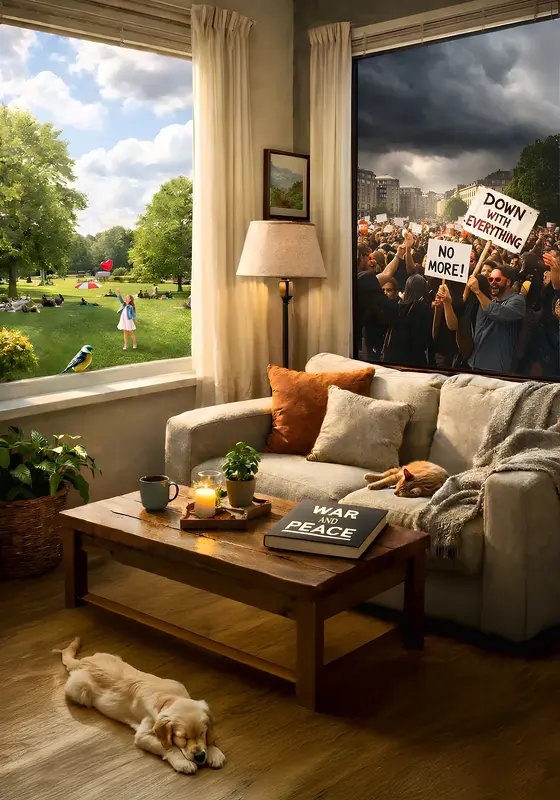
The image that opens this essay offers a dreamlike version of reality. Batwoman sits calmly before the empty pedestal on Stortorget. The stone base remains, but the king and his horse are already airborne, lifted into an uncertain sky, stripped of gravity and authority. The hero does not celebrate. She rests, as if the removal of power were. The Room is quiet. Not the kind of silence that means nothing is happening, but the kind that means everything is happening somewhere else. A sofa holds its shape from yesterday. A cat sleeps as if history were a rumour. A dog dreams without knowing what. On the table lies a book whose title no one needs to read anymore: War and Peace. A candle burns with the modest ambition of light. A coffee cup cools—life, as we still recognise it.
And then there are the windows.
To the left, the park opens like a memory of what humanity once promised itself. Green grass. Soft shadows. A child releases a red, heart-shaped balloon into a sky that has not yet been asked to carry what it will. People lie in the grass, not as a statement but as a habit. A bird rests on the windowsill as if it had always belonged there. Nothing demands attention. Everything exists.
To the right, the city gathers into a roar. Faces pressed together by urgency. Signs raised not towards a solution but towards a breaking point, such as debates over Confederate statues or colonial monuments. Down with everything. No more. Clouds thicken as if even the weather has chosen a side. The future here is not released into the sky — the throat seizes it. These conflicts reveal how societal memory is contested and how statues become symbols of unresolved histories, urging patience and nuanced understanding.
Between these two views stands the Room, a tangible space filled with cushions, dust, and warmth, symbolising the fragile human interior caught between contrasting societal narratives and memories. This Room represents our collective consciousness, where conflicting histories, like statues and their meanings, coexist and challenge us to find empathy and patience as we navigate societal change.
Not a metaphorical room. A real one. With cushions. With dust. With warmth. With fragile order. A human interior is placed directly between two versions of the same world.
This is where we live now. Not in the park. Not in the crowd. But in the narrow space between them. Recognising that change takes time can help the audience feel hopeful and resilient about societal progress.
We like to imagine that history unfolds out there, while life happens in here. But history has always happened in rooms like this. In rooms where people thought they were safe while empires rehearsed. In rooms where children played while borders were redrawn. In rooms where books were read while future graves were already being measured.
We tell ourselves that our time is unique in its polarisation. But the atmosphere is older than we think. The late 1930s carried it. The years before the First World War brought it. The decades before revolutions, before collapses, before awakenings carried it too. That trembling sense that something is coming, without agreement on what it is. There is a collective intuition that the present cannot hold forever.
And yet, the Room remains.
Civilisation has always been built from the inside out. From people who made coffee while the world sharpened its knives. From families who closed the curtains while ideas outside demanded daylight. From individuals who believed stability was permanent because it had lasted their whole lifetime.
The tragedy is not that people fail to see catastrophe coming. The tragedy is that they always see it — from a sofa.
This essay does not take place in the park. It does not take place in the crowd. It takes place here in the Room, where both are visible. Where no choice has yet been made, every choice is already present.
Because the world today is split not just by borders but by windows representing different perspectives on societal memory and statues, our choices determine which view we keep open or close, urging patience and understanding in these debates.
And we are the ones who decide which view we dare to keep open.
Chapter One – The Window of Innocence
From the sofa, the left window looks almost unreal. Not because it is beautiful, but because it is uncomplicated. The park does not argue. It does not persuade. It does not recruit. It simply exists, as if existence itself were still a sufficient purpose.
The child stands in the grass, an arm raised, releasing the red heart-shaped balloon not as a gesture but as an instinct. Children do not yet express hope. They practise it. They let it go to see what it does. The balloon rises without explanation, without programme, without ideology. It carries nothing but air and projection.
Around her, people lie in the grass with the relaxed arrogance of those who believe time belongs to them. They scroll, talk, laugh, and nap. No one in that park is preparing for history. They are only preparing for the evening. The bird on the windowsill does not know it is part of a symbol. It only knows the warmth of the stone and the mild calculation of when to fly.
This window represents humanity’s oldest illusion: that peace is our natural state.
We want to believe that violence is an interruption, that conflict is an anomaly, and that cruelty is an exception. We want to see ourselves as a species temporarily disturbed rather than permanently unfinished. The park allows us to sustain that belief. It tells us that the world is still capable of gentleness without supervision.
And in a sense, it is.
Civilisation is real. Progress is real. Childhood endures. Nature adapts. Love repeats itself. New generations are born without memory of the catastrophes that made their existence possible. Every child is evidence that humanity has not given up on itself.
But the park is also selective. It shows us what survives, not what struggles. It shows us leisure, not labour. It shows us peace, not the structures that protect it. It shows us innocence, not the cost of maintaining it.
The balloon is red, not by accident. It is the colour of love, but also of blood. The same shade that waves in celebration also waves in warning. The child does not know this yet. She should not have to. But history does.
This window is not naïve. It is necessary.
Without it, we would not care enough to defend anything. Without it, we would not recognise what is being lost as the other window grows louder. Without it, the world would become only a battlefield and never again a home.
Yet this window also seduces us into thinking that continuity equals safety. That is because children are still playing; the future must still be kind. That is because the grass is green and the soil beneath it remains stable.
Empires have always collapsed while children were playing in the parks.
Wars have always begun while lovers were planning weekends.
Revolutions have consistently brewed while someone was teaching someone else to ride a bicycle.
The park does not lie, but it does not warn either.
It simply reminds us of what we are trying to protect, even when we forget that protection is needed.
From the sofa, the left window is comforting. It tells us that humanity still knows how to be human. The danger is not in believing this. The danger is that we think this is enough. It's not a victory but a relief. It is an angelic solution — the kind we can afford only in art. In reality, statues do not fly away. They must be argued with, legislated, contextualised, relocated, or defended. They require committees, archives, conflicts, compromises, and courage. Recognising this effort can foster respect and patience for the process of change, helping the audience appreciate the work involved and the importance of persistence.
The image is therefore not a proposal. It is a wish, a longing for history to release itself as easily as a balloon floats away, encouraging us to approach change with patience and understanding as part of societal growth. Recognising that change is a gradual process can help the audience develop respect for the sustained effort required to shape collective memory.
Karl X Gustav does not stand in Malmö because he belongs there. He stands there because we have not yet decided what to do with our inheritance. This essay attempts to determine — not by shouting at the past, but by refusing to kneel before it. Recognising the emotional and cultural significance of such statues can help us approach these debates with patience and respect, understanding that they embody more than history — they reflect our collective identity and values.
Chapter Two – The Window of Reckoning
From the same sofa, the right window feels closer, even though it is farther away, symbolising the urgency of societal awareness and collective action. Sound seems to travel faster from this direction, emphasising the need for attentive listening to signals of societal unrest. Faces press against the glass of history, demanding recognition of societal issues that threaten stability. Hands rise not in greeting but in demand, highlighting the importance of a collective voice. The crowd does not ask to be understood; it asks to be heard, urging us to recognise the signs of societal unrest that foreshadow change. Here, the future is no longer released like a balloon; it is negotiated, shouted, threatened, promised, and postponed, reflecting the complex dynamics of societal change. The signs are simple because anger always is. Down with everything. No more. They do not point towards a destination but towards exhaustion and the collective sense that current societal structures are no longer tolerable, even if we cannot yet agree on what should replace them. This underscores the importance of collective responsibility in addressing unrest and fostering societal stability.
This window represents humanity’s other constant: the refusal to continue as before. Every age eventually produces its crowd, not because people are violent by nature, but because they are patient only up to a point. Injustice accumulates quietly, like dust in corners. When it is finally disturbed, it rises all at once, filling the Room. The faces in the crowd are not monsters. They are clerks, students, parents, workers, dreamers. People who once sat on sofas like this one, thinking they had time. People who once looked at parks and believed they would always be there. Recognising this pattern can inspire hope that collective effort can bring about change before it's too late, empowering us to act now.
The late nineteenth century saw such crowds, as did the years before 1914, the 1930s, and every moment when an old order persisted too long after losing legitimacy. Recognise this pattern to deepen understanding of societal change: stability becomes stagnation, order becomes exclusion, tradition becomes immunity, and patience becomes debt. The crowd does not rise because people suddenly hate peace; it rises because peace has stopped including them, highlighting the importance of inclusion in societal stability.
Yet crowds are dangerous not because they are wrong, but because they are large. They carry justified anger and unjustified simplifications in the same breath. They want change, but they also wish to release. And release does not always distinguish between walls and foundations. From the window, it is impossible to tell which voices are building and which are burning, which hands are reaching forward and which are only pushing away. History never labels them clearly in the moment. It only does so afterwards, when the price has already been paid.
This is why the crowd frightens the Room. Not because it is always wrong, but because it is never only right. The slogans are not lies; they are incomplete sentences. They speak of endings without grammar for beginnings. They know what must fall, but not yet what must stand. In the late 1930s, many crowds believed they were correcting history. In 1913, many thought they were modernising it. In every age, crowds believe they are closing a chapter. Often, they open several others without knowing their titles.
The clouds above the crowd are not a metaphor but a reminder that no human storm happens alone, illustrating how politics, economics, technology, identity, fear, pride, humiliation, and hope constantly gather and interact. From the sofa, this window is disturbing not because it shows chaos but because it reveals the necessity of change driven by these interconnected forces. Recognise that societal transformation involves multiple interconnected forces, emphasising collective responsibility for addressing societal issues and the complex web that sustains or destabilises society. Recognising this web can inspire proactive engagement to influence societal change rather than passively observing it.
We like to imagine that we can avoid this window, that we can stay in the park, that we can protect the balloon by ignoring the shouting. But history has never allowed such comfort. Every society that refused to look through this window eventually became the crowd. Every civilisation that silenced this window eventually heard it breaking down the door. Recognising our collective responsibility is essential to preventing societal collapse and fostering meaningful change.
The Room feels smaller here. The air grows heavier. The coffee cools faster. The candle seems less decorative and more temporary. Yet this window is also proof of life. Dead societies do not protest. Frozen cultures do not gather. Finished histories do not shout. The crowd means the story is still being written, even if we fear the following paragraph.
From the sofa, between these two windows, we begin to grasp the real tension of our time: not between peace and conflict, but between continuity and transformation. And the Room knows what the windows have not yet admitted, that neither can exist without the other.
Chapter Three – The Illusion of Safety
The Room itself now demands attention, not as shelter but as agreement. The sofa is not only furniture but a declaration that something is stable enough to sit on. The table is not only a surface but a promise that objects will remain where we place them. The candle is not only light but also the quiet human conviction that atmosphere can be controlled. Even the book on the table rests as if its weight were permanent. The Room pretends that gravity is loyal. This is how safety works. It does not announce itself. It furnishes itself. It arranges the world into shapes we can repeat. We call this comfort. We call this home. We call this civilisation when we have enough of it.
Yet no room has ever been stronger than the century outside it. Interiors survive only as long as the structures beneath them do. Walls stand because agreements still hold. Floors hold because institutions still function. Light switches work because unseen systems continue to honour invisible contracts. We rarely think about this until the moment we must. History is full of rooms that looked exactly like this one on the day before they ceased to exist. Rooms in Vienna in 1913. Rooms in Berlin in 1938. Rooms in Sarajevo, Leningrad, Baghdad, Damascus, Kyiv. Rooms with books, pets, coffee cups and people who believed they were still living inside continuity.
The illusion of safety is not stupidity; it is efficiency. No society could function if every citizen woke each morning expecting collapse. Stability must be assumed valid. But when that assumption becomes faith, the Room ceases to be protection and becomes denial. The Room teaches us to mistake duration for permanence. Because something has lasted, we believe it will continue. Because something has not yet broken, we think it cannot. Because the floor has held us, we believe it owes us that loyalty.
Yet civilisation has never promised durability. It has only practised it. The cat sleeps because it does not know what a nation is. The dog dreams because it does not know what a border is. Their peace is real, but borrowed. It rests on arrangements they did not negotiate and could not defend. Humans, however, do know. And still we lie back on the sofa as if knowledge alone were protection.
We decorate safety to forget it is conditional. We hang art on walls built by compromise. We place flowers on tables stabilised by fragile treaties. We sip coffee inside systems that can change language, currency, law and meaning faster than we can rearrange our furniture. This does not make the Room dishonest. It makes it human. The tragedy is not that we trust rooms. The tragedy is that we forget they were built.
Every safe space is a historical achievement, not a natural state. Every quiet evening is a political miracle disguised as routine. Every unbroken night is the result of countless unseen decisions that hold, for now. The Room, therefore, is not innocent. It is inherited. And inheritance carries responsibility. The illusion of safety is not that the Room feels safe. The illusion is that it believes it will remain so without effort.
From the sofa, with both windows in view, we begin to understand the cruel tenderness of civilisation: that it gives us enough peace to forget how much work it takes to preserve it. The Room is not the opposite of the crowd. It is what the crowd is fighting to redefine. The Room is not the opposite of the park. It is what the park depends on to remain a park. Yet the Room is also where we most easily lose our courage, because it feels like enough.
Chapter Two – The Window of Reckoning
From the same sofa, the right window feels closer, even though it is farther away, symbolising the urgency of societal awareness and collective action. Sound seems to travel faster from this direction, emphasising the need for attentive listening. Faces press against the glass of history, demanding recognition of societal issues that threaten stability. Hands rise not in greeting but in demand, highlighting the importance of a collective voice. The crowd does not ask to be understood; it asks to be heard, urging us to recognise the signs of societal unrest that signal bigger change. Here, the future is no longer released like a balloon; it is negotiated, shouted, threatened, promised, and postponed, reflecting the complex dynamics of societal change. The signs are simple because anger always is. Down with everything. No more. They do not point towards a destination but towards exhaustion and the collective sense that current societal structures are no longer tolerable, even if we cannot yet agree on what should replace them. This should inspire the audience to see their role in shaping change and feel empowered to act, recognising that individual responsibility is essential for collective transformation.
This window represents humanity’s other constant: the refusal to continue as before. Every age eventually produces its crowd, not because people are violent by nature, but because they are patient only up to a point. Injustice accumulates quietly, like dust in corners. When it is finally disturbed, it rises all at once, filling the Room. The faces in the crowd are not monsters. They are clerks, students, parents, workers, dreamers. People who once sat on sofas like this one, thinking they had time. People who once looked at parks and believed they would always be there.
The late nineteenth century saw such crowds, as did the years before 1914, the 1930s, and every moment when an old order persisted too long after losing legitimacy. Recognise this pattern to deepen understanding of societal change: stability becomes stagnation, order becomes exclusion, tradition becomes immunity, and patience becomes debt. For example, the rise of civil rights movements in the 20th century illustrates how marginalised groups challenge exclusionary systems. The crowd does not rise because people suddenly hate peace; it rises because peace has stopped including them, such as marginalised groups or dissenting voices. This highlights the importance of active inclusion in societal stability, urging us to consider how our actions can foster a more inclusive society and prevent unrest.
Yet crowds are dangerous not because they are wrong, but because they are large. They carry justified anger and unjustified simplifications in the same breath. They want change, but they also wish to release. And release does not always distinguish between walls and foundations. From the window, it is impossible to tell which voices are building and which are burning, which hands are reaching forward and which are only pushing away. History never labels them clearly in the moment. It only does so afterwards, when the price has already been paid.
This is why the crowd frightens the Room. Not because it is always wrong, but because it is never only right. The slogans are not lies; they are incomplete sentences. They speak of endings without grammar for beginnings. They know what must fall, but not yet what must stand. In the late 1930s, many crowds believed they were correcting history. In 1913, many thought they were modernising it. In every age, crowds believe they are closing a chapter. Often, they open several others without knowing their titles.
This cloud above the crowd is not a metaphor but a reminder that no human storm happens alone, illustrating how politics, economics, technology, identity, fear, pride, humiliation, and hope constantly gather and influence one another. From the sofa, this window is disturbing not because it shows chaos but because it reveals the necessity of change. Recognise that societal transformation involves multiple interconnected forces, emphasising collective responsibility for addressing societal issues. This should motivate the audience to see their role in the larger system and the importance of collective effort.
We like to imagine that we can avoid this window, that we can stay in the park, that we can protect the balloon by ignoring the shouting. But history has never allowed such comfort. Every society that refused to look through this window eventually became the crowd. Every civilisation that silenced this window eventually heard it breaking down the door.
The Room feels smaller here. The air grows heavier. The coffee cools faster. The candle seems less decorative and more temporary. Yet this window is also proof of life. Dead societies do not protest. Frozen cultures do not gather. Finished histories do not shout. The crowd means the story is still being written, even if we fear the following paragraph.
From the sofa, between these two windows, we begin to grasp the real tension of our time: not between peace and conflict, but between continuity and transformation. And the Room knows what the windows have not yet admitted, that neither can exist without the other.
Chapter Three – The Illusion of Safety
The Room itself now demands attention, not as shelter but as agreement. The sofa is not only furniture but a declaration that something is stable enough to sit on. The table is not only a surface but a promise that objects will remain where we place them. The candle is not only light but also the quiet human conviction that atmosphere can be controlled. Even the book on the table rests as if its weight were permanent. The Room pretends that gravity is loyal. This is how safety works. It does not announce itself. It furnishes itself. It arranges the world into shapes we can repeat. We call this comfort. We call this home. We call this civilisation when we have enough of it.
Yet no room has ever been stronger than the century outside it. Interiors survive only as long as the structures beneath them do. Walls stand because agreements still hold. Floors hold because institutions still function. Light switches work because unseen systems continue to honour invisible contracts. We rarely think about this until the moment we must. History is full of rooms that looked exactly like this one on the day before they ceased to exist. Rooms in Vienna in 1913. Rooms in Berlin in 1938. Rooms in Sarajevo, Leningrad, Baghdad, Damascus, Kyiv. Rooms with books, pets, coffee cups and people who believed they were still living inside continuity. Recognising this fragility can inspire a sense of shared responsibility to protect and sustain societal stability.
The illusion of safety is not stupidity; it is efficiency. No society could function if every citizen woke each morning expecting collapse. Stability must be assumed valid. But when that assumption becomes faith, the Room ceases to be protection and becomes denial. The Room teaches us to mistake duration for permanence. Because something has lasted, we believe it will continue. Because something has not yet broken, we think it cannot. Because the floor has held us, we believe it owes us that loyalty, underscoring the fragility of societal safety and the importance of collective vigilance.
Yet civilisation has never promised durability. It has only practised it. The cat sleeps because it does not know what a nation is. The dog dreams because it does not know what a border is. Their peace is real, but borrowed. It rests on arrangements they did not negotiate and could not defend. Humans, however, do know. And still we lie back on the sofa as if knowledge alone were protection.
We decorate safety to forget it is conditional. We hang art on walls built by compromise. We place flowers on tables stabilised by fragile treaties. We sip coffee inside systems that can change language, currency, law and meaning faster than we can rearrange our furniture. This does not make the Room dishonest. It makes it human. The tragedy is not that we trust rooms. The tragedy is that we forget they were built.
Every safe space is a historical achievement, not a natural state. Every quiet evening is a political miracle disguised as routine. Every unbroken night is the result of countless unseen decisions that hold, for now. The Room, therefore, is not innocent. It is inherited. And inheritance carries responsibility. The illusion of safety is not that the Room feels safe. The illusion is that it believes it will remain so without effort.
From the sofa, with both windows in view, we begin to understand the cruel tenderness of civilisation: that it gives us enough peace to forget how much work it takes to preserve it. The Room is not the opposite of the cro Chapter Four – History Never Moves in Rhythm.
History never advances in straight lines, and it never keeps pace with human expectations. It moves like weather rather than like machinery, in pressures, shifts, delays and sudden storms. From inside the Room, this is difficult to accept because it is built on repetition. We wake up, sit down, drink, read, speak, sleep, and we call this continuity. But history does not care about routines. It only cares about accumulation. Economic tensions accumulate. Cultural fractures accumulate. Technological power accumulates. Humiliation accumulates. Fear accumulates. And then, often without warning, time changes speed. The years before the First World War felt like progress until they suddenly became a catastrophe. The 1930s felt like a crisis until they suddenly became destiny. The Cold War felt permanent until it suddenly ended. History never tells us when it is rehearsing and when it is performing.
This is why every generation believes it lives in a unique moment of danger. And every generation is both right and wrong, because the moment is always genuinely fragile. Wrong because fragility is the normal state of civilisation. The past looks stable only because we already know how it ended. The present feels unstable because we do not. We forget that people in 1899, 1913, 1928, 1967, 1989 and 2001 all believed they were standing at the edge of something undefined. They were just not in the way they imagined.
Progress, therefore, is not a staircase. It is a path constantly interrupted by landslides. But the path remains. Even when it disappears under mud and stones, it is found again. Not because humanity is wise, but because humanity is stubborn. Knowledge returns—rights return. Institutions rebuild. Empathy resurfaces. Often slower than we wish, but faster than we fear. Plagues, wars, ideologies and religious absolutism have frozen development for generations, yet none of them has managed to cancel it permanently. Even the darkest centuries carried seeds that later centuries would use.
From the Room, this rhythm is almost impossible to feel. We experience history as mood rather than movement. We sense anxiety rather than trajectory. We confuse intensity with direction. A loud present feels larger than a silent past. A screaming crowd feels more decisive than a slow reform. But time is not impressed by volume. It is shaped by persistence.
This is why those who say that everything is collapsing are as wrong as those who say that everything is fine. Collapse and construction coexist—decline and development overlap. Regression and learning occur simultaneously across different layers of the same society. The world does not choose between darkness and light. It experiments with both.
From the sofa, between the two windows, history reveals its actual cruelty and its true mercy: that no generation is allowed to finish the story. Still, every generation is allowed to move it slightly. Sometimes forward, sometimes sideways, sometimes backwards, but never entirely still.
The danger of our time is not that we resemble the years before significant conflicts. The danger is that we believe resemblance means repetition. History does not repeat. It only rhymes, and humans are terrible at hearing rhythm when they are standing inside it.
The Room, therefore, should not ask whether we are about to enter a catastrophe or a renaissance. It should ask something far more demanding: what part of this moment will future generations recognise as necessary?
Because history will not judge us for our fear, it will judge us for what we did while we were afraid.
Chapter Five – The Myth of the Better Past
From the sofa, the past always looks calmer than the present. Not because it was, but because it is finished. We know its endings. We know which catastrophes it survived. We know which wars stopped, which diseases faded, which regimes fell. The past feels safe because it can no longer surprise us. The present, by contrast, is unfinished. It has not yet revealed what it will demand in payment.
This is why nostalgia is such a powerful political and emotional drug. It allows us to replace uncertainty with memory, even when that memory is edited with alternative truths. When people say that things were better before, they rarely mean that life was easier, healthier, freer or more just. They suggest that life was more legible. The rules were harsher, but clearer. The hierarchies were crueller, but more stable. The suffering was more widespread, but less discussed. Silence passed for order.
The myth of the better past is built on selective vision. It remembers the furniture but forgets the funerals. It recalls the manners but not the mortality. It celebrates the architecture but ignores the amputations, the childbirth deaths, the untreated infections, the routine violence, the legal invisibility of women, the economic imprisonment of the poor, the racial, religious and social exclusions that were not exceptions but structures.
Those who truly had it better before were almost always a minority. A class. A caste. A gender. A lineage. And even they lived under constant threat. Heads fell faster in old regimes than reputations fall today. A wrong alliance, a wrong belief, a bad word could end everything. Privilege was never safety. It was only proximity to power.
Disease did not respect class. Plague, tuberculosis, smallpox, polio, influenza, and childbirth fever struck blindly. Kings died of infected teeth. The queen died in labour. Children are killed in numbers that modern societies can barely imagine. Entire families vanished not through drama but through bacteria. There was no heroism in this—only helplessness.
When we compare today with yesterday, we often compare inconvenience with catastrophe and call it decline. We confuse loss of familiarity with loss of humanity. We forget that our grandparents accepted conditions we would today call intolerable. We forget that progress is often invisible to those who no longer need to fight for it.
The past was not better. It was just quieter in its cruelty. Suffering did not protest. It endured. Injustice did not trend. It persisted. Silence was not harmony. It was a lack of voice.
This does not mean the present is good. It means the present is honest. Our time exposes its conflicts instead of hiding them behind etiquette. Our time allows anger to speak, fear to organise, injustice to be named. It feels like chaos to those who confuse stability with fairness.
The Room, with its two windows, reveals this clearly. The park tempts us to romanticise continuity. The crowd tempts us to demonise disorder. Nostalgia chooses the park and erases the crowd. Radicalism chooses the crowd and burns the park. But history requires both memory and movement.
When people insist that everything is getting worse, they are often grieving a loss of position, not a loss of justice. They are mourning a world that favoured them more clearly. This grief is human, but it is not universal. Progress always hurts those who benefited most from inequality.
The truth is uncomfortable: humanity has never been more alive, more informed, more interconnected, more capable of self-correction than it is now. It has also never been more anxious, more aware of its own fragility, more conscious of the consequences of its choices. These two conditions are not opposites. They are symptoms of the same development.
The past feels better because it no longer demands anything from us. The present feels unbearable because it still does.
From the sofa, the myth of the better past dissolves not into optimism, but into responsibility. We are not living in the worst time. We are living in a time that still has something to lose.
And that is precisely why it frightens us.
Chapter Six – The Three Layers of Humanity
From the sofa, humanity does not appear as a crowd, but as a structure. Not two camps, not fifty-fifty, but three uneven layers moving at different speeds. At the top, a small minority that creates, questions, carries responsibility, and imagines beyond immediate reward. At the bottom, another small minority that exploits, manipulates, destroys, or refuses responsibility altogether. Between them, the great middle, the largest group of all, not defined by ideology but by adaptability. This middle is not weak, but undecided. Not ignorant, but sensitive to direction. It does not lead history. It authorises it.
The top has always been too small to save the world alone. The bottom has always been too small to ruin it on its own. Everything depends on which voice the middle recognises as legitimate. This is why the struggle of every age is never truly between good and evil, but between guidance and seduction. The middle does not seek heroes. It seeks plausibility. It follows what feels stable, respectable, and regular. It rarely asks who benefits most.
From the Room, this structure becomes painfully visible. The park speaks mainly to the top, to those who still believe in care, continuity and responsibility. The crowd speaks primarily to the bottom, to those who feel nothing left to lose. The middle stands between the windows, absorbing both languages without fully committing to either.
This is not a moral accusation. It is a human description. The middle must survive. It must work, raise children, pay rent, and preserve energy. It cannot afford constant heroism. It cannot afford continuous revolt. It wants the world to remain livable more than it wants it to become ideal.
Yet history never moves when the middle remains neutral. It only moves when the middle leans. Sometimes it leans upward, toward reform, dignity, education, and cooperation. Sometimes it leans downward, toward fear, simplification, exclusion, and resentment. The middle rarely notices the difference at first. It only feels relief or anger. The consequences come later.
This is why totalitarian systems have never been built by monsters alone. They have been built by millions of ordinary people who valued stability over truth. And this is why democratic breakthroughs have never been achieved by saints alone, but by ordinary people who finally accepted instability in exchange for dignity.
The Room is therefore not just a place between two windows. It is the seat of the middle. It is where choices are not shouted, but postponed, where responsibility is not denied, but delayed, and history waits patiently for permission.
The top speaks in complexity. The bottom speaks with certainty. The middle prefers certainty. Not because it is foolish, but because certainty is cheaper to live with. Complexity demands effort. Certainty demands loyalty.
This is the quiet danger of our time. Not the existence of extremism, which has always existed, but the fatigue of the middle. When the middle grows tired, it stops asking which direction is higher. It only asks which direction feels safer.
From the sofa, we begin to understand that humanity is not divided between good and evil, but between those who accept responsibility for the future and those who outsource it. And the middle decides which side becomes history.
The Room does not belong to the top or the bottom. It belongs to the middle. And that is why the Room matters more than the windows.
Because the windows can only show, the Room must choose.
wd. It is what the crowd is fighting to redefine. The Room is not the opposite of the park. It is what the park depends on to remain a park. Yet the Room is also where we most easily lose our courage, because it feels like enough.
Chapter Seven – The Comfort of Polarisation
From the sofa, polarisation looks like clarity. Two windows. Two stories. Two futures. This simplicity can feel reassuring, offering a sense of control in a complex world and inspiring hope for change.
We often believe that polarisation is forced upon us by politics, media or technology. But in truth, it is welcomed by something older and quieter in us. It relieves us of the burden of ambivalence. It allows us to replace thought with position. Once we have chosen a side, we no longer have to strain to listen. We only have to defend with loyalty.
The Room makes this temptation visible. The park invites us to defend continuity at any cost. The crowd invites us to destroy continuity at any cost. Both promise meaning. Both offer moral shelter. Both tell us that the other side is the real danger. What neither admits is that both are incomplete.
Polarisation feels like courage, but it is often exhaustion in disguise. It is the moment when nuance becomes too heavy to carry, when contradiction becomes too uncomfortable to hold. When complexity feels like betrayal and simplicity feels like truth, recognising this can inspire the audience to see their role in shaping societal dynamics and foster hope for change.
This is why polarisation spreads faster than reflection. Reflection has no flag. Polarisation has colours, slogans, gestures, and enemies. Reflection asks for patience. Polarisation offers belonging. Reflection demands doubt. Polarisation offers certainty.
From the sofa, one can see how polarisation turns both windows into mirrors. The park begins to see only its own innocence. The crowd begins to see only its own righteousness. Each side stops seeing the human beings on the other side and begins seeing symbols instead. Once people become symbols, anything becomes possible.
History is filled with moments when societies believed they were choosing between two futures, when in reality they were choosing between two simplifications. The French Revolution, the Russian Revolution, the ideological wars of the twentieth century, the culture wars of today. In every case, polarisation promised purification. In every case, it delivered new forms of blindness.
Polarisation does not create conflict. It organises it. It gives chaos uniforms. It offers fear grammar. It gives anger choreography. And once conflict is organised, it becomes easier to prolong than to resolve.
The tragedy is that polarisation often begins with legitimate grievances. Real injustice. Real exclusion. Real suffering. But as soon as these grievances are forced into binary shapes, they lose their capacity to heal. They can only conquer.
From the Room, the greatest danger of polarisation becomes clear: it not only divides societies but also diminishes collective responsibility. Engaging in community dialogues and collaborative initiatives can help rebuild shared accountability, making responsibility a tangible collective effort.
This is why polarisation is comfortable. It allows us to hate without reflection and to love without doubt. It will enable us to feel morally alive while intellectually asleep.
The Room, however, resists this comfort by showing both windows at once. While patience and tension are challenging, they are essential for societal resilience, and valuing these qualities can inspire the audience to see their importance in fostering societal health.
From the sofa, we begin to understand that polarisation is not the opposite of apathy. It is its emotional cousin. Both avoid responsibility. One avoids it by withdrawing. The other avoids it by shouting.
And the Room waits, not for louder voices, but for sustained attention. Only attentive listening can hold two windows open without closing either, fostering understanding and responsibility.
Because only attention can hold two windows without closing either.
Chapter Eight – War and Peace at the Same Time
The book on the table has not moved. It lies there with the quiet arrogance of a title that has outlived every interpretation of it. War and Peace. Not as a choice, but as a condition. Not as alternatives, but as simultaneity. Humanity has never lived in one without the other. It has only shifted its attention between them.
From the sofa, it becomes evident that war and peace are not separate eras but continuous layers. Somewhere, someone is falling in love while another prepares to kill; peace and war coexist in the same space, demanding our awareness and responsibility.
This is why every generation is shocked when war returns. Not because it is new, but because we had agreed to look away from where it was already living. We had placed it in other countries, other cultures, other histories. We had turned it into archive material. And archives feel finished.
Peace, in turn, is not the absence of conflict. It is the fragile arrangement that prevents conflict from becoming slaughter. It is a discipline, not a gift. It is a contract renewed every morning by institutions, habits, trust, restraint and memory. When any of these weaken, peace does not collapse loudly. It erodes quietly.
From the Room, the coexistence of war and peace becomes impossible to deny. The park is peaceful. The crowd is not yet at war, but it is no longer at peace. The Room itself is the negotiation. The book on the table is not literature. It is a diagnosis.
We like to believe that humanity moves from war to peace as it matures. But history suggests something harsher and more honest: peace requires active effort. Recognising this can motivate the audience to see peace as an ongoing pursuit rather than a passive state, encouraging a sense of responsibility and perseverance.
This does not mean that war is inevitable. It means that peace is never free. It demands more intelligence than hatred, more patience than fear, more imagination than revenge. And these qualities are not evenly distributed, nor easily maintained.
From the sofa, the cruel paradox appears clearly. We educate children in peace while we entertain ourselves with war. We teach cooperation while we reward domination. We speak of unity while we organise competition. We condemn violence while we design systems that depend on humiliation. And then we act surprised when war returns in new uniforms.
Yet humanity has also learned something fundamental. We kill fewer than we used to. We torture less than we used to. We accept fewer justifications for cruelty than we used to. We grieve more publicly. We hide less behind necessity. Peace has not won, but it has changed the rules of war.
The book on the table, therefore, is not pessimistic. It is honest. It does not ask us to choose between war and peace. It asks us to recognise that we are always responsible for how much space we give each other.
From the Room, we finally understand that the fundamental question of our time is not whether we will face conflict, but whether we will still recognise peace when it requires sacrifice instead of comfort.
War shouts. Peace whispers. The Room is where we decide which voice we train ourselves to hear.
And the book remains on the table, not as a warning, but as a reminder: that humanity has always lived inside both words, and that every generation must choose which one it allows to define the sentence.
Chapter Nine – Our Time’s Fragile Balance
From the sofa, the present no longer feels like a moment. It feels like a threshold. Technology accelerates faster than ethics. Information moves faster than understanding. Emotions travel faster than responsibility. Never before has humanity known so much about itself while trusting itself so little. We see more, hear more, compare more, remember more, and yet feel less confident about what any of it means.
This is why our time resembles the years before great ruptures. Not in ideology, not in uniforms, not in slogans, but in atmosphere. There is a sensation that structures are ageing faster than replacements can be built. In the quiet realisation that rules still function but no longer convince. In the growing gap between legality and legitimacy. In the widespread intuition that something fundamental is being renegotiated without a common language.
The early twentieth century felt this way. So did the late 1930s. So did many forgotten decades before them. People sensed that the world they were living in had become too small for the forces it had unleashed. Industry had outgrown politics. Nations had outgrown diplomacy. Weapons had outgrown morality. Today, technology has outgrown governance. Communication has outgrown wisdom. Power has outgrown accountability.
From the Room, this imbalance is not abstract. It is intimate. It enters through screens, through conversations, through silences. It shapes how children imagine the future and how adults fear it. It changes how we speak to strangers and how we judge neighbours. It replaces curiosity with vigilance and patience with positioning.
Yet this time is not only dangerous. It is also extraordinarily alive. More voices speak—more stories surface. More injustices are named. More solidarities form across borders that once felt absolute. Humanity has never been so aware of its own contradictions. This awareness is uncomfortable, but it is also a form of growth.
The danger is not awareness. The threat is acceleration without reflection. When everything moves faster, responsibility feels heavier. When every opinion finds an audience, truth feels smaller. When every identity demands recognition, shared language feels fragile. And when shared language weakens, conflict learns new dialects.
From the sofa, we begin to see that our time is not on the brink because it is worse than before, but because it is more complex. Simpler ages could hide their violence. We display ours in real time. Simpler ages could postpone reckoning. We livestream it.
This is why our anxiety feels global. Not because catastrophe is inevitable, but because consequence is unavoidable. Climate, migration, technology, inequality, identity, power, memory, all now intersect. There are no isolated crises anymore. Every fracture resonates across systems.
Yet history whispers something important here. Every age that believed it was standing at the edge was correct in one sense and wrong in another. It was proper that change was inevitable. It was wrong about its own centrality. The world did not end. It transformed. And the transformation was never as pure as fear imagined nor as gentle as hope desired.
From the Room, our fragile balance reveals its true nature. It is not the balance between good and evil. It is the balance between humility and arrogance. Between listening and reacting. Between patience and panic. Between responsibility and comfort.
Our time is asking not for heroes, but for adults. Not for saviours, but for caretakers. Not for certainty, but for endurance.
The Room still stands. The windows are still open. The book still lies on the table. The candle still burns. None of this guarantees survival. But all of it offers a choice.
Because fragile balance is not a verdict, it is an invitation.
And history is watching how we answer it.
Chapter Ten – The Responsibility of the Middle
From the sofa, the final truth of the Room becomes unavoidable: this space does not belong to the loudest voices outside the windows, but to those who remain inside. The Room is not heroic. It is not radical. It is not pure. It is ordinary. And because it is ordinary, it carries the most significant weight. It belongs to the middle, not as ideology but as a condition. The middle is where people live, work, love, hesitate, adapt and continue. It is where societies either mature or decay.
We often misunderstand the middle as a weakness. In reality, it is power without spectacle. It is the majority that does not write manifestos, but signs laws. It does not storm buildings, but pays for them. It does not dominate history, but legitimises it. The middle is the quiet author of continuity. And when continuity changes direction, it is because the middle has allowed it.
The top may imagine futures. The bottom may demand rupture. But neither can succeed without the middle lending its weight. The middle does not lead revolutions or institutions. It decides whether they survive. It is therefore the most dangerous and the most necessary position in any civilisation.
From the Room, this becomes painfully clear. The middle wants stability but benefits from progress. It wants peace but depends on conflict to correct injustice. It wants comfort but also dignity. These desires are not contradictions. They are human. But when they are not consciously balanced, they become easily manipulated.
History shows that the middle rarely chooses evil. It chooses convenience. It chooses what feels familiar, workable, respectable. Sometimes this leads upward. Sometimes it leads downward. The difference is not intention, but attention. The middle does not fall because it hates goodness. It falls because it stops asking what goodness requires.
This is why responsibility in the middle is heavier than in any other position. The top can fail loudly. The bottom can fail violently. The middle fails silently, through small permissions, postponed objections, and reasonable compromises that slowly change the moral temperature of a society. No dictatorship has ever risen without the middle first deciding that resistance was too inconvenient. No democracy has ever survived without the middle deciding that responsibility was worth discomfort.
The Room is therefore not neutral. It is decisive. It is where history is not made but allowed to happen. The windows may show direction, but the Room decides motion. The Room decides whether the park remains a park or becomes a memory. The Room decides whether the crowd becomes reform or ruin.
From the sofa, we must finally admit that the middle is not an observer of history. It is its instrument. And every instrument must eventually accept that it produces sound, whether it intends to or not.
This is the uncomfortable dignity of being ordinary. That nothing about it is small. That everyday choices accumulate into eras. That silence becomes permission. That patience becomes structure. That hesitation becomes destiny.
The Room does not ask us to choose sides. It asks us to accept authorship.
Because in the end, history is not written by those who shout the loudest or think the highest. It is written by those who live in between and decide, day after day, what they are willing to allow to continue.
And the Room, quietly, waits for that decision.
Epilogue – Keeping Both Windows Open
The Room has not changed. The sofa still carries the shape of human presence. The table still holds its small constellations of objects. The candle still burns with no knowledge of symbolism. The book still waits to be opened or ignored. Nothing dramatic has happened inside. And yet everything has.
Because the Room has been named.
It is no longer only a place of comfort. It is a position. A responsibility. A fragile platform suspended between two truths that refuse to disappear. The park will not vanish because innocence is older than history. The crowd will not vanish because injustice is older than law. And the Room will not vanish because humanity has always needed somewhere to hesitate.
We often believe that history moves when people choose one side. In reality, history moves when people refuse to close one of the windows, when they accept that contradiction is not weakness, when they understand that tension is not failure, when they realise that civilisation is not built on purity, but on endurance.
The greatest danger of our time is not collapse. It is a simplification. The belief that the world can be reduced to one explanation, one enemy, one solution, one story. Every catastrophe in history has begun with someone deciding that complexity was the problem.
The Room resists this. It refuses to let the park erase the crowd. It refuses to let the crowd burn the park. It refuses to pretend that peace is innocent or that conflict is useless. It holds both, not because they are equal, but because they are real.
We will never live in a world without broken systems. We will never live in a world without longing. We will never live in a world without anger. But we may still live in a world where these forces are carried with care instead of worshipped with rage.
The Room does not promise salvation. It offers something far more difficult: participation. Not in spectacle, but in maintenance. Not in heroism, but in continuity. Not in purity, but in responsibility.
Those who stand in the park alone will eventually be surprised by the crowd. Those who stand alone in the crowd will ultimately destroy the park. Only those who remain in the Room can recognise when each must be protected from the other.
History does not need us to be right. It needs us to be awake.
The windows will continue to change. The views will sharpen, soften, darken, and brighten in line with future trends. The Room will age; the walls need new wallpaper, and the curtains and furniture will be replaced when you get tired of the old ones. New eyes will reread the book. The candle will burn out and be lit again. Nothing in this Room is eternal. But the act of keeping it open is.
And perhaps that is the quiet definition of civilisation: not a state we reach, but a room we agree to maintain.
Not because it is perfect.
But because it is still possible.
And as long as the Room remains, with both windows open, the story has not yet chosen its final sentence. And the cat and the dog can continue their innocent sleep.
3 200 kr
Jörgen Thornberg
Malmö
Lite om bilder och mig. Translation in English at the end.
Jag är en nyfiken person som ser allt i bilder, även det jag fäster i ord, gärna tillsammans för bakom alla mina bilder finns en berättelse. Till vissa bilder hör en kortare eller längre novell som följer med bilden.
Bilder berättar historier. Jag omges av naturlig skönhet, intressanta människor och historia var jag än går. Jag använder min kamera för att dokumentera världen och blanda det jag ser med vad jag känner för att fånga den dolda magin.
Mina bilder berättar mina historier. Genom mina bilder, tryck och berättelser. Jag bjuder in dig att ta del av dessa berättelser, in i ditt liv och hem och dela min mycket personliga syn på vår värld. Mer än vad ögat ser. Jag tänker i bilder, drömmer och skriver och pratar om dem; följaktligen måste jag också skapa bilder. De blir vad jag ser, inte nödvändigtvis begränsade till verkligheten. Det finns en bild runt varje hörn. Jag hoppas att du kommer att se vad jag såg och gilla det.
Jag är också en skrivande person och till många bilder hör en kortare eller längre essay. Den följer med tavlan, tryckt på fint papper och med en personlig hälsning från mig.
Flertalet bilder startar sin resa i min kamera. Enkelt förklarat beskriver jag bilden jag ser i mitt inre, upplevd eller fantiserad. Bilden uppstår inom mig redan innan jag fått okularet till ögat. På bråkdelen av ett ögonblick ser jag vad jag vill ha och vad som kan göras med bilden. Här skall jag stoppa in en giraff, stålmannen, Titanic eller vad det är min fantasi finner ut. Ännu märkligare är att jag kommer ihåg minnesbilden långt efteråt när det blir tid att skapa verket. Om jag lyckas eller inte, är upp till betraktaren, oftast präglat av en stråk av svart humor – meningen är att man skall bli underhållen. Mina bilder blir ofta en snackis där de hänger.
Jag föredrar bilder som förmedlar ett budskap i flera lager. Vid första anblicken fylld av feel-good, en vacker utsikt, fint väder, solen skiner, blommor på ängen eller vattnet som ligger förrädiskt spegelblankt. I en sådan bild kan jag gömma min egentliga berättelse, mitt förakt för förtryckare och våldsverkare, rasister och fördomsfulla människor - ett gärna återkommande motiv mer eller mindre dolt i det vackra motivet. Jag försöker förena dem i ett gemensamt narrativ.
Bild och formgivning har löpt som en röd tråd genom livet. Fotokonst känns som en värdig final som jag gärna delar med mig.
Min genre är vid som framgår av mina bilder, temat en blandning av pop- och gatukonst i kollage som kan bestå av hundratals lager. Vissa bilder kan ta veckor, andra någon dag innan det är dags att överlämna resultatet till printverkstaden. Fine Art Prints är digitala fotocollage. I dessa kollage sker rivandet, klippandet, pusslandet, målandet, ritandet och sprayningen digitalt. Det jag monterar in kan vara hundratals år gamla bilder som jag omsorgsfullt frilägger så att de ser ut att vara en del av tavlan men också bilder skapade av mig själv efter min egen fantasi. Därefter besöks printstudion och för vissa bilder numrera en limiterad upplaga (oftast 7 exemplar) och signera för hand. Vissa bilder kan köpas i olika format. Det är bara att fråga efter vilka. Gillar man en bild som är 70x100 men inte har plats på väggen, går den kanske att få i 50x70 cm istället. Frågan är fri.
Metoden Giclée eller Fine Art Print som det också kallas är det moderna sättet för framställning av grafisk konst. Villkoret för denna typ av utskrifter är att en högkvalitativ storformatskrivare används med åldersbeständigt färgpigment och konstnärspapper eller i förekommande fall på duk. Pappret som används möter de krav på livslängd som ställs av museer och gallerier. Normalt säljer jag mina bilder oinramade så att den nya ägaren själv kan bestämma hur de skall se ut, med eller utan passepartout färg på ram, med eller utan glas etc..
Under många år ställde jag bara ut på nätet, i valda grupper och på min egen Facebooksida - https://www.facebook.com/jorgen.thornberg.9
Jag finns också på en egen hemsida som tyvärr inte alltid är uppdaterad – https://www.jth.life/ Där kan du också läsa en del av de berättelser som följer med bilden.
UTSTÄLLNINGAR
Luftkastellet, oktober 2022
Konst i Lund, november 2022
Luftkastellet, mars 2023
Engleson Galleri Caroli, april 2023
Hydra, Greece June 2023
Engleson Galleri Caroli, oktober 2023
Toppen, Höllviken december 2023
Luftkastellet, mars 2024
Torups Galleri, mars 2024
Venice, May 2024
Luftkastellet, oktober 2024
Konst i Advent, December 2024
Galleri Engleson, Caroli December 2024
Jäger & Jansson Galleri, april 2025
A bit about pictures and me.
I'm a curious person who sees everything in pictures, even what I express in words, often combining them, for behind all my pictures lies a story. These narratives, some as short as a single image and others as long as a novel, are the heart and soul of my work.
Pictures tell stories. Wherever I go, I'm surrounded by natural beauty, exciting people, and history. I use my camera to document the world and blend what I see with what I feel to capture the hidden magic.
My images tell my stories. Through my pictures, prints, and narratives, I invite you to partake in these stories in your life and home and share my deeply personal perspective of our world. More than meets the eye. I think in pictures, dream, write, and talk about them; consequently, I must create images too. They become what I see, not necessarily confined to reality. There's a picture around every corner. I hope you'll see what I saw and enjoy it.
I'm also a writer, and many images come with a shorter or longer essay. It accompanies the painting, printed on fine paper with my personal greeting.
Many pictures start their journey on my camera. Simply put, I describe the image I see in my mind, experienced or imagined. The image arises within me even before I bring the eyepiece to my eye. In a fraction of a moment, I see what I want and what can be done with the picture. Here, I'll insert a giraffe, Superman, the Titanic, or whatever my imagination conjures up. Even stranger is that I remember the mental image long after it's time to create the work. Whether I succeed is up to the observer, often imbued with a streak of black humour – the aim is to entertain. My pictures usually become a talking point wherever they hang.
I prefer pictures that convey a message in multiple layers. At first glance, they're filled with feel-good vibes, a beautiful view, lovely weather, the sun shining, flowers in the meadow, or the water lying deceptively calm. But beneath this surface beauty, I often conceal a deeper story, a narrative that challenges societal norms or explores the human condition. I invite you to delve into these hidden narratives and discover the layers of meaning within my work.
Picture and design have been a thread running through my life. Photographic art feels like a fitting finale, and I'm happy to share it.
My genre is varied, as seen in my pictures; the theme is a blend of pop and street art in collages that can consist of hundreds of layers. Some images can take weeks, others just a day before it's time to hand over the result to the print workshop. Fine Art Prints are digital photo collages. In these collages, tearing, cutting, puzzling, painting, drawing, and spraying happen digitally. What I insert can be images hundreds of years old that I carefully extract so they appear to be part of the painting, but also images created by myself, now also generated from my imagination. Next, visit the print studio and, for certain images, number a limited edition (usually 7 copies) and sign them by hand. Some images may be available in other formats. Just ask which ones. If you like an image that's 70x100 but doesn't have space on the wall, you might be able to get it in 50x70 cm instead. The question is open.
The Giclée method, or Fine Art Print as it's also called, is the modern way of producing graphic art. This method ensures the highest quality and longevity of the artwork, using a high-quality large-format printer with archival pigment inks and artist paper or, in some cases, canvas. The paper used meets the longevity requirements set by museums and galleries. I sell my pictures unframed, allowing the new owner to personalise their artwork, confident in the lasting value and quality of the piece.
For many years, I only exhibited online, in selected groups, and on my Facebook page - https://www.facebook.com/jorgen.thornberg.9. I also have my website, which unfortunately is not constantly updated - https://www.jth.life/. You can also read some of the stories accompanying the pictures there.
EXHIBITIONS
Luftkastellet, October 2022
Art in Lund, November 2022
Luftkastellet, March 2023
Engleson Gallery Caroli, April 2023
Hydra, Greece June 2023
Engleson Gallery Caroli, October 2023
Toppen, Höllviken December 2023
Luftkastellet, March 2024
Torup Gallery, March 2024
Venice, May 2024
UTSTÄLLNINGAR
Luftkastellet, oktober 2022
Konst i Lund, november 2022
Luftkastellet, mars 2023
Engleson Galleri Caroli, april 2023
Hydra, Greece June 2023
Engleson Galleri Caroli, oktober 2023
Toppen, Höllviken december 2023
Luftkastellet, mars 2024
Torups Galleri, mars 2024
Venice, May 2024
Luftkastellet, October 2024
Konst i Advent, December 2024
Galleri Engleson, Caroli December 2024
Jäger & Jansson Galleri, April 2025
Utbildning
Autodidakt
Medlem i konstnärsförening
Öppna Sinnen
Med i konstrunda
Konstrundan i Skåne
Utställningar
Luftkastellet, October 2022
Art in Lund, November 2022
Luftkastellet, March 2023
Engleson Gallery Caroli, April 2023
Hydra, Greece June 2023
Engleson Gallery Caroli, October 2023
Toppen, Höllviken December 2023
Luftkastellet, March 2024
Torup Gallery, March 2024
Venice, May 2024