Vi använder cookies för att ge dig bästa möjliga upplevelse. Välj vilka cookies du tillåter.
Läs mer i vår integritetspolicy
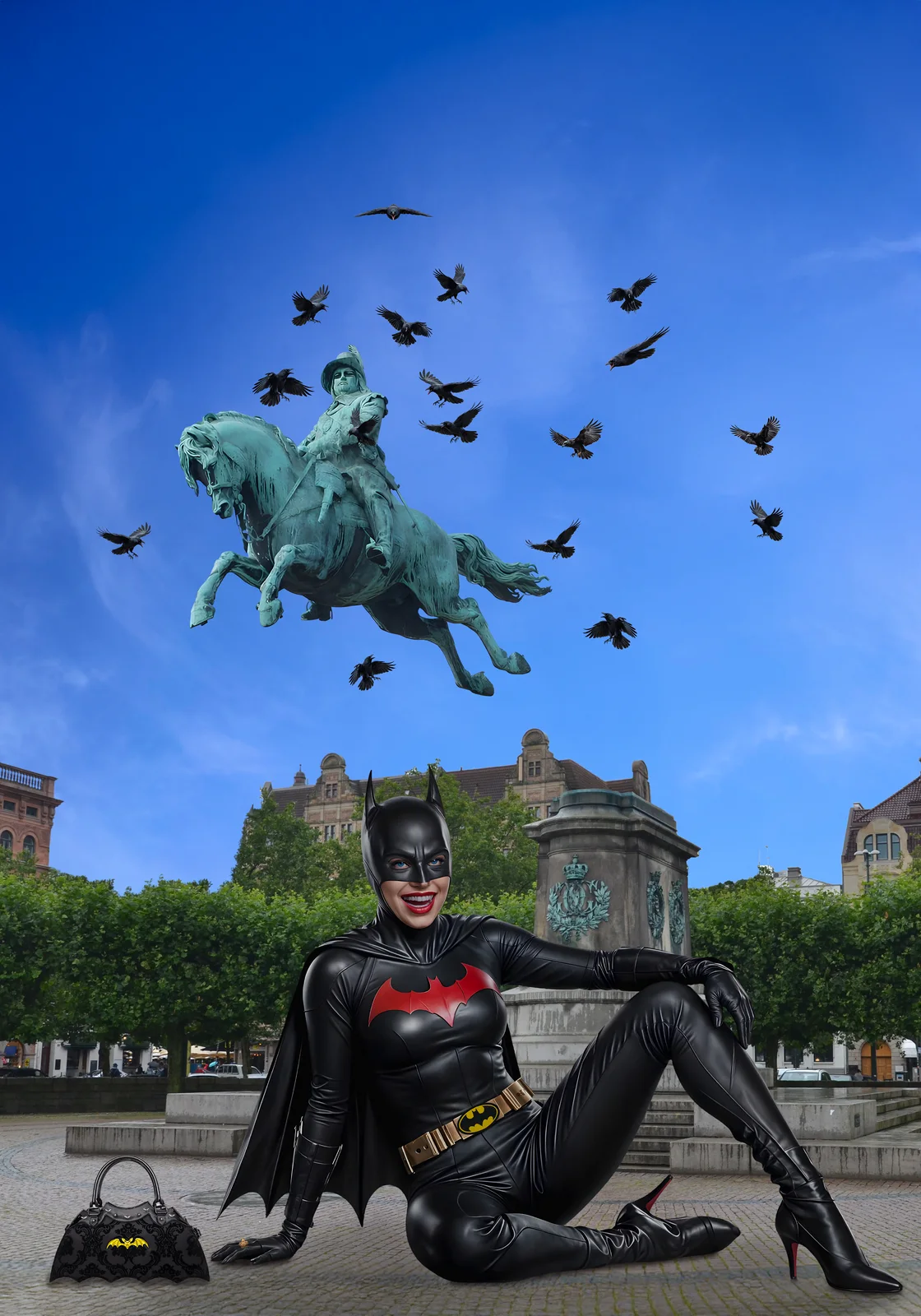
Jörgen Thornberg
Fly to hell, you shit king, 2026
Digital
50 x 70 cm
3 200 kr
Fly to hell, you shit king
Every city carries a few bodies it never buried, lingering in open squares, their silent presence shaping our collective memory more than we realise. They stand in open squares, polished by rain and pigeons, protected by habit rather than conviction. We walk past them daily, pretending they are silent, while they quietly instruct us in what we are supposed to forget. This text is not written to destroy a statue. It is written to be listened to. Not to the king it depicts, but to the power it preserves. Not to the horse it balances upon, but to the weight it still carries. Not to the history it claims to represent, but to the history it refuses to mourn. Recognising these complex feelings can help the audience develop patience and a deeper understanding of the debate around statues, fostering a more empathetic approach to societal change.
The image that opens this essay offers a dreamlike version of reality. Batwoman sits calmly before the empty pedestal on Stortorget. The stone base remains, but the king and his horse are already airborne, lifted into an uncertain sky, stripped of gravity and authority. The hero does not celebrate. She rests, as if the removal of power were not a victory but a relief. It is an angelic solution — the kind we can afford only in art. In reality, statues do not fly away. They must be argued with, legislated, contextualised, relocated, or defended. They require committees, archives, conflicts, compromises, and courage. Recognising this effort can foster respect and patience for the process of change, helping the audience appreciate the work involved and the importance of persistence.
The image is therefore not a proposal. It is a wish, a longing for history to release itself as easily as a balloon floats away, encouraging us to approach change with patience and understanding as part of societal growth. Recognising that change is a gradual process can help the audience develop respect for the ongoing effort required to shape collective memory.
Karl X Gustav does not stand in Malmö because he belongs there. He stands there because we have not yet decided what to do with our inheritance. This essay is an attempt to determine — not by shouting at the past, but by refusing to kneel before it. Recognising the emotional and cultural significance of such statues can help us approach these debates with patience and respect, understanding that they embody more than history-they reflect our collective identity and values.
"Fly to Hell, You Shit King
You did not fall from heaven.
You rose from mud,
from hunger,
from borders drawn with knives.
You called it destiny.
We call it graves.
Your horse never chose you.
Your people never chose you.
Your victims never chose you.
Only power chose you,
and you obeyed it well.
You ate land.
You drank cities.
You slept while languages disappeared.
And now you sit in bronze,
polished into virtue,
washed of smell,
washed of blood,
washed of women’s names.
Your victories have no faces.
Your monuments have no tears.
You are not remembered.
You are displayed.
You are not honoured.
You are tolerated.
We walk past you with coffee,
with children,
with banners,
with tired eyes that no longer believe in kings.
You still sit as if history owes you a chair.
But history owes you nothing.
It owes the burned villages a voice.
It owes the silenced bodies a place.
It owes the conquered the right to speak back.
So fly to hell, you shit king.
Not in anger,
but in honesty.
Fly to the hell of being seen
without polish,
without excuses,
without pedestal.
Fly to the hell of being remembered
as you were,
not as you wished to be.
We do not curse you.
We release you.
And in doing so,
we finally free ourselves
from carrying your weight."
Malmö, January 2026
Prologue — The King Who Should Not Be Standing There
He still stands in the middle of Stortorget in Malmö. The heavy body in the saddle. The horse that does not move. The gaze that meets no one. A king in bronze, frozen in a moment that was never truly ours. Karl X Gustav — the conqueror, the warrior, the glutton, the shit king to those who remember with their bodies rather than with textbooks.
The statue was raised in 1896, a time when national pride and imperial narratives were dominant, shaping public acceptance of such symbols, when history could still be polished for celebration, when violence could be called unity and conquest reconciliation, and when one could speak of a “triple Nordic brotherhood” without counting the dead. Since then, it has not moved.
The statue has not moved for 130 years — but societal perceptions have shifted, prompting us to reflect on how collective views evolve.
And that is why it remains there—not as an innocent work of art, but as a symbol of society's ongoing struggle with history and power, prompting the audience to feel connected to the collective challenge of understanding how societal views evolve.
It stands as a physical remnant of a power we claim to have left behind, placed at Malmö's Stortorget — a conquered square in a land once part of Denmark — symbolising the ongoing political influence embedded in monuments.
With every passer-by, every stroller, every demonstration circling the pedestal, every tourist photograph, and every Malmö resident whose eyes slide past without truly seeing, the statue continues to speak — not about Karl X Gustav as a person, but about our relationship to power, violence, and memory.
That is why it is no longer merely a historical monument; it embodies ongoing societal debates about memory, power, and reconciliation, urging the audience to consider their own perspectives and the importance of these conversations. This is where the essay begins.
The Statue as an Idea: A Monument Built on a Lie
The statue did not arise from silence. It emerged from an idea — an idea that, from the start, contained a contradiction. Karl X Gustav’s equestrian statue was conceived not as a warning, not as a confession, not even as a reminder of conquest, but as a gesture of reconciliation. It was intended to unite what war had torn apart and to transform blood into symbolism, violence into brotherhood.
The driving force behind the project was the historian Martin Weibull, a passionate advocate of Scandinavianism. In his vision, Karl X Gustav was not primarily the king who crushed Denmark, but the ruler who pursued a Nordic unity policy guided by “natural borders.” The king who had marched across frozen belts, broken a monarchy, and forced a peace was reinterpreted as a misunderstood architect of Nordic harmony. At the inauguration, Weibull even raised a toast to a “triple Nordic fatherland.”
The idea is almost grotesque from a modern perspective, evoking discomfort and scepticism about how the conqueror was recast as a unifier, despite the immense suffering involved.
The monument committee prevailed despite protests from Danish critics, Scandinavianists, and Malmö's Social Democrats, highlighting the diverse societal views that shape the monument's meaning and the ongoing debate about its place in public space.
This is the first and perhaps most important truth about the statue: it was not raised to tell the truth about Karl X Gustav, but to reshape his violence into a narrative of reconciliation.
When the statue was unveiled in 1896, the ceremony was theatrical in its excess. There was a church service, military formations, royal speeches, specially composed music, salutes from Malmöhus, and synchronised cheers. The city dressed itself in festivity, as if celebration itself could wash history clean. The king’s body was absent, but his voice was read aloud through the speech of Oscar II. The past spoke in carefully chosen words.
Yet another voice was also present. The social democratic newspaper Arbetet described the statue not as a heroic figure but as a grotesque silhouette, a heavy rider wrapped in cloth, resembling death carrying a coffin through the summer dusk. While Sydsvenskan praised the weather, the decorations, and the noble tone, Arbetet noted the heat, the cost, and the arrogance. Two perspectives stood on the same square, looking at the same statue, already unable to agree on what it meant.
This tension has never gone away.
The statue was intended to freeze a single interpretation of history into bronze. Instead, it froze a conflict.
Weibull’s dream of reconciliation failed almost immediately, as nationalism replaced Scandinavianism, transforming the statue from a symbol of unity into one of domination, reflecting ongoing societal struggles with national identity and historical memory.
And perhaps this was inevitable. No monument can truly reconcile violence through aesthetics. No sculpture can turn forced submission into shared memory. No bronze body can carry the moral weight of conquest without eventually cracking under it.
Karl X Gustav’s statue was built on a lie — not the lie that he existed or that he conquered, but the lie that conquest could be remembered without acknowledging those who were conquered.
And that lie still stands in the middle of Malmö.
The Conquered Square
Stortorget in Malmö is not an innocent place. It presents itself as an open civic space, a neutral centre, and a meeting point for commerce, politics, and everyday life. Yet beneath its stones lies a history of submission that invites reflection on power dynamics. The square is not merely a square; it is a reminder of a transfer of power. And at its very centre stands the body of the man who embodied that transfer.
Karl X Gustav never set foot in Malmö. He landed in Helsingborg, but his influence extended across the region. When Malmö’s citizens were forced to swear loyalty to him in the seventeenth century, they did so before an empty chair outside the town hall. The king was absent, yet his authority was absolute. His presence was symbolic, distant, unquestionable. The statue repeats that absence. He still does not meet the city. He still does not belong to it. He still rules it from a distance.
To place an equestrian statue of an erövrarkung in the heart of the conquered city is not a neutral historical act. It is a spatial declaration that can evoke feelings of dominance and unresolved tension, reminding viewers of the lasting impact of conquest.
From a Stockholm perspective, this may seem abstract. From a Skåne perspective, it is concrete. Geography matters. Malmö lies closer to Copenhagen than to Stockholm. Language, trade, culture, and family once flowed more naturally across the sound than towards the capital. The statue interrupts that memory. It does not merely commemorate a king; it overwrites a landscape.
This is why the statue has never been merely a statue. It has always been an identity wound.
For some, it marks the birth of Sweden as a modern territorial state. For others, it signals the loss of something older. The conflict is not about loyalty to Denmark or Sweden in a nationalist sense, but about whose history is allowed to define the place.
Defenders often argue that the statue is part of Malmö’s cultural environment and that it belongs in the square because it has stood there for so long. But time does not neutralise meaning. It only layers it, deepening the sense of unresolved tension. What once was a symbol of reconciliation became a symbol of domination, and later a persistent reminder of unresolved conflict. This ongoing social unrest invites reflection on how monuments influence current social justice issues.
The square itself testifies to this. Demonstrations have circled the statue, and political banners have passed beneath its shadow, fostering a sense of ongoing social unrest and collective memory that still lingers.
In this way, Stortorget has become a theatre of historical negotiation. Every generation returns to the same question without ever resolving it: Is this king ours, or has he been imposed upon us?
The square does not answer. The statue does not answer. Only the conflict remains.
And it is precisely here that the statue reveals its proper function. It is not a bridge between past and present but a fault line that can evoke reflection on the ongoing political tensions embedded in Malmö's identity and history.
It divides memory from history, identity from territory, and belonging from power.
And as long as Karl X Gustav remains seated in the middle of the square, Malmö, in a subtle but persistent way, remains a conquered city in its own symbolic centre.
The Body of the King
Karl X Gustav is not only remembered for battles and treaties. He is also remembered through his body. The statue does not conceal this. On the contrary, it insists upon it. The king sits heavily in the saddle, broad, compact, almost swollen with his own authority. The horse beneath him appears less a noble companion than a burdened carrier. The image is not one of motion but of weight.
Contemporary sources describe Karl X Gustav as a man of excess. He ate, drank, and indulged with the confidence of one who believed the world existed to sustain him. His appetite was not merely physical; it was political. He consumed territories, resources, and lives with the same certainty with which he consumed food and wine. His early death was not a tragedy of fate but a foreseeable consequence of a body that mirrored a reign without restraint.
In the statue, this excess is aestheticised. Gluttony becomes solidity. Heaviness becomes dignity. The burden on the horse becomes heroic composure. Art transforms physical decline into symbolic authority. The body is disciplined by bronze, even though history tells us it was not disciplined in life.
This is no trivial detail. Bodies matter in monuments. They teach us how to read power. A slender king suggests elegance. A dynamic king suggests movement. A heavy king suggests permanence. Karl X Gustav’s body tells the city: I am here to stay. The statue's physical features serve as visual cues that reinforce the enduring nature of authority and dominance embedded in the monument.
The horse, however, tells another story. It does not advance. It does not rear. It does not charge. It stands. Muscles tense, yet direction is suspended. The animal appears to hesitate beneath its rider, as if the weight itself has frozen its will. The statue becomes a silent allegory: power that has arrived but no longer knows where to go.
This physical composition reflects the more profound truth of Karl X Gustav’s legacy. His reign was driven by momentum rather than vision. He conquered not to build but to possess. He ruled not to stabilise but to extend. His victories created borders, but not a sense of belonging. His body mirrors this contradiction. It occupies space but does not move through it.
The king's body is therefore not merely a portrait of a man. It is a political form that embodies the assertion of dominance and control. It teaches us how power manifests when it no longer needs to justify itself, becoming weighty, silent, and self-evident.
In this sense, the statue is brutally honest. It does not lie about Karl X Gustav’s temperament. It lies only in his virtue.
He is not carved as a thinker, not as a lawgiver, not as a protector. He is created as weight. And in politics, weight is the oldest form of authority.
The gluttonous king sits where he has been placed, not because he belongs there but because he has not been removed.
And the horse continues to carry him.
The Violent King
Karl X Gustav’s reign is often described in terms of strategy, courage, and daring. The words are chosen carefully, as if violence itself could be refined by vocabulary. Yet beneath every strategic manoeuvre lies a field of broken bodies. Beneath every courageous advance lies a line of villages that no longer existed the next morning. His wars were not abstractions. They were physical, cold, and absolute.
The campaigns against Denmark were not only battles between armies but acts of total pressure on a population. Cities were starved, the countryside burned, and civilians were displaced. The forced peace of Roskilde in 1658 did not merely redraw borders; it reorganised lives. Skåne did not become Swedish by persuasion. It became Swedish by exhaustion.
This violence the statue does not show. The bronze body presents control without consequence, authority without debris. The horse’s hooves do not trample mud mixed with blood. The king’s cloak does not smell of smoke. The polished surface erases the human cost of movement.
Violence, however, does not disappear when it is aestheticised. It only becomes harder to name.
Karl X Gustav did not merely win wars. He normalised domination. He made conquest seem inevitable. And inevitability is the most effective form of violence because it persuades its victims that resistance is meaningless.
In Malmö, the statue participates in this logic. It does not threaten. It does not shout. It simply remains. Its presence implies that what happened had to happen, that what was taken was meant to be taken, and that history itself desired this outcome.
This is why the statue cannot be neutral. It does not merely remember violence; it stabilises it.
The defenders of the monument often argue that one must judge historical figures by the standards of their time. But this argument quietly assumes that suffering belongs only to its time. That the pain of those who lost land, language, and agency somehow expired when the century changed.
Violence does not expire. It mutates. It settles into institutions, borders, habits, and monuments.
The statue of Karl X Gustav is not violent because it depicts a sword. It is violent because it represents a victory without mourning.
And where there is victory without mourning, there is domination without conscience.
The violent king, therefore, does not belong only to the seventeenth century. He belongs to every moment when his violence is allowed to remain unquestioned.
And that is why he remains standing.
The Conquered Square
Stortorget in Malmö is not an innocent place. It presents itself as an open civic space, a neutral centre, and a meeting point for commerce, politics, and everyday life. Yet beneath its stones lies a history of submission that invites reflection on power dynamics. The square is not merely a square; it is a reminder of a transfer of power from Danish to Swedish rule. And at its very centre stands the body of the man who embodied that transfer.
Karl X Gustav never set foot in Malmö. He landed in Helsingborg. When Malmö’s citizens were forced to swear loyalty to him in the seventeenth century, they did so before an empty chair outside the town hall. The king was absent, yet his authority was absolute. His presence was symbolic, distant, unquestionable. The statue repeats that absence. He still does not meet the city. He still does not belong to it. He still rules it from a distance.
Reframe the equestrian statue as a visual assertion of dominance, emphasising its symbolism of conquest and power.
From a Stockholm perspective, this may seem abstract. From a Skåne perspective, it is concrete. Geography matters. Malmö lies closer to Copenhagen than to Stockholm. Language, trade, culture, and family once flowed more naturally across the sound than towards the capital. The statue interrupts that memory, asserting a Swedish dominance that overwrites local identity. It does not merely commemorate a king; it overwrites a landscape.
This is why the statue has never been merely a statue. It has always been an identity wound that deeply resonates with Malmö's community, stirring feelings of unresolved conflict and collective memory, fostering a sense of connection and reflection.
For some, it marks the birth of Sweden as a modern territorial state. For others, it signals the loss of something older. The conflict is not about loyalty to Denmark or Sweden in a nationalist sense, but about whose history is allowed to define the place.
Defenders often argue that the statue is part of Malmö’s cultural environment and that it belongs in the square because it has stood there for so long. But time does not neutralise meaning. It only layers it, deepening the sense of unresolved tension. What once was a symbol of reconciliation became a symbol of domination, and later a persistent reminder of unresolved conflict.
Emphasise how the statue's physical presence in the square reflects ongoing social unrest and collective memory, engaging the reader more deeply.
In this way, Stortorget has become a theatre of historical negotiation. Every generation returns to the same question without ever resolving it: Is this king ours, or has he been imposed upon us?
The square does not answer. The statue does not answer. Only the conflict remains.
In this way, the statue reveals its proper function as a provocation that encourages us to reflect on ongoing political tensions embedded in Malmö's identity and history, prompting a sense of responsibility and awareness.
It divides memory from history, identity from territory, and belonging from power.
And as long as Karl X Gustav remains seated in the middle of the square, Malmö, in a subtle but persistent way, remains a conquered city in its own symbolic centre.
The Body of the King
Karl X Gustav is not only remembered for battles and treaties. He is also remembered through his body. The statue does not conceal this. On the contrary, it insists upon it. The king sits heavily in the saddle, broad, compact, almost swollen with his own authority. The horse beneath him appears less a noble companion than a burdened carrier. The image is not one of motion but of weight.
Contemporary sources describe Karl X Gustav as a man of excess. He ate, drank, and indulged with the confidence of one who believed the world existed to sustain him. His appetite was not merely physical; it was political. He consumed territories, resources, and lives with the same certainty with which he consumed food and wine. His early death was not a tragedy of fate but a foreseeable consequence of a body that mirrored a reign without restraint.
In the statue, this excess is aestheticised. Gluttony becomes solidity. Heaviness becomes dignity. The burden on the horse becomes heroic composure. Art transforms physical decline into symbolic authority. The body is disciplined by bronze, even though history tells us it was not disciplined in life.
This is no trivial detail. Bodies matter in monuments. They teach us how to read power. A slender king suggests elegance. A dynamic king suggests movement. A heavy king suggests permanence. Karl X Gustav’s body tells the city: I am here to stay, instilling a sense of authority and stability.
The horse, however, tells another story. It does not advance. It does not rear. It does not charge. It stands. Muscles tense, yet direction is suspended. The animal appears to hesitate beneath its rider, as if the weight itself has frozen its will. The statue becomes a silent allegory: power that has arrived but no longer knows where to go.
This physical composition reflects the more profound truth of Karl X Gustav’s legacy. His reign was driven by momentum rather than vision. He conquered not to build but to possess. He ruled not to stabilise but to extend. His victories created borders, but not a sense of belonging. His body mirrors this contradiction. It occupies space but does not move through it.
The king's body is therefore not merely a portrait of a man. It is a weighty political symbol that embodies the assertion of dominance and control, urging us to consider how power manifests when it no longer needs justification, becoming silent and self-evident.
In this sense, the statue is brutally honest. It does not lie about Karl X Gustav’s temperament. It lies only in his virtue.
He is not carved as a thinker, not as a lawgiver, not as a protector. He is created as weight. And in politics, weight is the oldest form of authority.
The gluttonous king sits where he has been placed, not because he belongs there but because he has not been removed. And the horse continues to carry him.
The Violent King
Karl X Gustav’s reign is often described in terms of strategy, courage, and daring. The words are chosen carefully, as if violence itself could be refined by vocabulary. Yet beneath every strategic manoeuvre lies a field of broken bodies. Beneath every courageous advance lies a line of villages that no longer existed the next morning. His wars were not abstractions. They were physical, cold, and absolute.
The campaigns against Denmark were not only battles between armies but acts of total pressure on a population. Cities were starved, the countryside burned, and civilians were displaced. The forced peace of Roskilde in 1658 did not merely redraw borders; it reorganised lives. Skåne did not become Swedish by persuasion. It became Swedish by exhaustion.
This violence the statue does not show. The bronze body presents control without consequence, authority without debris. The horse’s hooves do not trample mud mixed with blood. The king’s cloak does not smell of smoke. The polished surface erases the human cost of movement.
Violence, however, does not disappear when it is aestheticised. It only becomes harder to name.
Karl X Gustav did not merely win wars. He normalised domination. He made conquest seem inevitable. And inevitability is the most effective form of violence because it persuades its victims that resistance is meaningless.
In Malmö, the statue participates in this logic. It does not threaten. It does not shout. It simply remains. Its presence implies that what happened had to happen, that what was taken was meant to be taken, and that history itself desired this outcome.
This is why the statue cannot be neutral. It does not merely remember violence; it stabilises it.
The defenders of the monument often argue that one must judge historical figures by the standards of their time. But this argument quietly assumes that suffering belongs only to its time. That the pain of those who lost land, language, and agency somehow expired when the century changed.
Violence does not expire. It mutates. It settles into institutions, borders, habits, and monuments.
The statue of Karl X Gustav is not violent because it depicts a sword. It is violent because it represents a victory without mourning.
And where there is victory without mourning, there is domination without conscience.
The violent king, therefore, does not belong only to the seventeenth century. He belongs to every moment when his violence is allowed to remain unquestioned. And that is why he remains standing.
The King and the Women
Power does not end on the battlefield. It follows the body wherever it goes. The Karl X Gustav statue in Malmö exemplifies how authority shapes not only borders but also societal values, intimacy, and silence. Exploring its symbolism reveals how historical power influences public memory and social justice today.
Seventeenth-century historical sources confirm that Karl X Gustav had a reputation for behaving ruthlessly towards women, both before and during his reign. The most well-known case is his relationship with the noblewoman Märta Allertz, with whom he fathered a son out of wedlock. But this was not an isolated story of courtly romance. It was part of a broader pattern in which royal power erased the possibility of refusal. Testimonies describe how women were pressured, coerced, or placed in situations where consent was structurally impossible.
The king’s sexual behaviour was considered problematic even by some of his contemporaries, though his military successes conveniently overshadowed his personal conduct in historical memory. According to surviving accounts, part of the royal allowance was used to pay men to marry women the king had impregnated. Responsibility was outsourced. Consequences were managed. The king moved on.
This is not a footnote to history. It is a continuation of the same logic that ruled the battlefield. Bodies were taken because they could be taken. Silence was enforced because it could be implemented. Power does not distinguish between territory and flesh.
Yet the statue knows nothing of this. Bronze does not blush. The saddle does not remember. The sculpted body bears no trace of those who were forced to bear the consequences of the king’s desires.
When modern debates address women’s bodily integrity, consent, and power structures, they often seem disconnected from history. But in Skåne, the statue’s symbolism reflects how these issues were historically ignored or tolerated, highlighting regional conflicts between local memory and national narratives that resonate with Malmö's community.
This silence calls for moral clarity today, encouraging the audience to feel a sense of responsibility and moral purpose in understanding how past complicity influences our present and our duty to act.
The violent king not only destroyed cities but also organised private lives around his will. His power entered homes, bodies, and futures.
And still the statue stands as if none of this had happened.
The horse carries him as if he were only a ruler, and the bronze face presents him as only a warrior. Yet beneath that surface lies a man whose authority was built on fear and access, a history concealed behind the statue's polished exterior that invites deeper reflection.
The king who conquered lands also conquered women.
And that too is part of what remains in the centre of Malmö.
Identity and Resistance
The conflict surrounding the statue has never been only about Karl X Gustav. It has always been about who is allowed to define a place. Identity is not an abstract concept here; it is geographic, linguistic, historical, and emotional. To stand in Malmö is not the same as standing in Stockholm. To look at the statue in Skåne is not the same as looking at it in a textbook.
For many in southern Sweden, the statue embodies not national unity but regional displacement. It symbolises a story told from above, not from within, emphasising how the region’s lived memory conflicts with the official narrative of expansion and consolidation.
This is why the debate over Karl X Gustav has never followed simple party lines. Conservatives, liberals, social democrats, and regionalists have all found themselves on both sides of the argument. The fault line does not run through ideology; it runs through belonging. Those who defend the statue often speak of continuity, heritage, and artistic value. Those who oppose it speak of dignity, memory, and voice.
Regional identity in Skåne has long been in tension with national identity. Language, humour, cultural references, and historical loyalties form a fabric that does not fully dissolve into Swedish uniformity. The statue, however, insists on uniformity. It presents one version of history as the only version. It offers no space for negotiation.
The resistance to the statue is about the right to share and interpret history, empowering the audience to feel agency and hope as they challenge imposed narratives and shape collective memory through community efforts and dialogue.
The statue does not merely commemorate Karl X Gustav. It disciplines the landscape into a single story. It tells Malmö who it is supposed to be.
This ongoing contestation suggests that Malmö's relationship with the statue is dynamic. It invites us to consider actions like contextualisation, removal, or reinterpretation, encouraging society to reflect on responsible memorial practices and fostering moral dialogue about the future of such symbols in the city.
This is perhaps its most revealing quality. True monuments are embraced. This one is endured.
Endurance, however, is not the same as acceptance. It is merely a delayed confrontation.
The statue’s survival has depended less on conviction than on inertia. It stands not because it convinces, but because it is heavy.
And in public memory, heaviness often passes for legitimacy.
But legitimacy that rests on silence is always temporary.
The Monument That Refuses to Die
Monuments are built to outlive those who raise them. Their ambition is not presence but permanence, and created with the expectation that future generations will inherit not only their material form but also their intended meaning. Yet history rarely grants monuments that luxury.
Reinhart Koselleck described monuments as sites of unresolved identification. They are intended to honour the dead, console the living, and justify survival. They promise continuity between loss and meaning. Yet in doing so, they also freeze violence into symbolic form. They transform killing into memory and memory into legitimacy.
Karl X Gustav’s statue belongs entirely to this tradition. Although it was not erected as a war memorial, it functions as one. It commemorates conquest without honouring those who were conquered. It offers a body without graves. It presents victory without mourning.
Magnus Rodell has noted that monuments differ from other media precisely because they aspire to timelessness. They are built to resist reinterpretation. Yet paradoxically, this rigidity makes them vulnerable. While societies change, monuments do not. And when meaning no longer fits the form, conflict emerges.
The equestrian statue in Malmö was contested from the outset. It has never had a stable symbolic identity. It has moved from a symbol of reconciliation to a nationalist relic to a regional provocation to a political problem. Each generation has read it differently, yet the bronze body has remained unchanged.
This creates a peculiar tension. The monument insists on continuity, while society demands change. The result is not harmony but friction.
A monument that cannot change must either be endlessly reinterpreted or eventually rejected. Karl X Gustav’s statue has survived by being constantly reinterpreted but never resolved. It has become a permanent question mark cast in metal.
What will it mean in fifty years? In a hundred? Will it still represent conquest? Will it represent controversy? Or will it represent only a society's inability to decide what to do with its own symbols?
This is the curse of the eternal monument. It demands loyalty from generations that never consented to its message. It occupies space without renewing its right to do so.
The statue refuses to die, not because it is loved but because it remains unresolved.
And unresolved monuments do not disappear. They accumulate tension. They wait.
What Do We Do With Our Shit Kings?
Every society inherits its shit kings. Not only the figures themselves, but also the decisions to honour them. The problem is not that Karl X Gustav lived, conquered, indulged, and ruled. The problem is that he was later elevated into something he never was: a symbol of unity, dignity, and historical necessity.
Removing a statue is not erasing history. It is an admission that history has consequences. It is an acknowledgement that remembrance is a choice, not a duty. We do not forget Karl X Gustav by questioning his place on Stortorget. We remember him more honestly.
Those who defend the statue often speak as if its removal were a form of censorship. But monuments are not books. They are not archives. They are honours. A society does not place a body on a pedestal to document it, but to legitimise it.
No one suggests removing Karl X Gustav from history. The question is whether he should remain elevated above the daily life of a city he never knew, representing values the town no longer shares.
Keeping the statue is also a choice. It is a decision to prioritise continuity over conscience, inertia over reflection. It is to say that the comfort of familiarity outweighs the discomfort of moral clarity.
There are ways to confront a monument without destroying it. It can be contextualised, relocated, and surrounded by counter-narratives. But it cannot remain untouched and pretend to be neutral. Neutrality is the privilege of power.
The statue on Stortorget has long ceased to be merely historical. It has become ethical. It asks us what kind of society we believe ourselves to be part of—one that honours conquest without mourning, or one that dares to confront its inheritance without flattery.
Karl X Gustav need not fall for history to stand. But he must be seen for what he was: a product of violence, appetite, and power, not a father of unity.
We do not dishonour ourselves by questioning our monuments. We dishonour ourselves by refusing to.
Epilogue — The Square After the King
One day, the statue will no longer stand there. Whether by decision, accident, or quiet relocation, the horse will eventually leave the square. Bronze does not last forever, not even when it pretends to.
What will remain is not the absence of Karl X Gustav, but the question he forced the city to carry for more than a century. The question of who we honour. The question of what we forgive. The question of how long a society can confuse history with dignity.
Stortorget will still be Stortorget. Some buildings may have been replaced. The sky is sometimes blue, and children will still run across the stones. Demonstrations will still gather. Tourists will still raise their cameras. Life will not collapse because a king disappears from a pedestal. Life may, in fact, become lighter.
The statue has taught Malmö many things. It has taught the city how power freezes itself into form. It has taught how conquest can be dressed as heritage. It has taught how long silence can last when it is comfortable.
But it has also taught something else. It has taught that memory is not passive. That identity is not inherited like property. That belonging is negotiated, not commanded.
Karl X Gustav’s most significant legacy in Malmö is not his conquest. It is the resistance to his presence.
That resistance is not vandalism, not ignorance, not hatred of history. It is history continuing to speak.
A monument that cannot be questioned is not culture. It is obedience.
Malmö does not need a king to stand at its centre. It requires the courage to decide what its centre means.
When the horse finally leaves the square, nothing essential will be lost. But something important may be gained: the right to remember without kneeling.
And when that happens, the city will not be poorer in history.
It will be richer in itself.
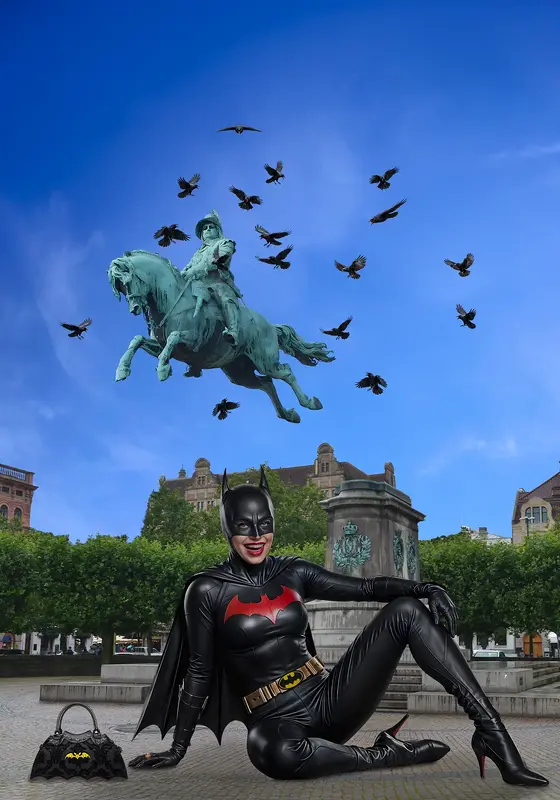
Jörgen Thornberg
Fly to hell, you shit king, 2026
Digital
50 x 70 cm
3 200 kr
Fly to hell, you shit king
Every city carries a few bodies it never buried, lingering in open squares, their silent presence shaping our collective memory more than we realise. They stand in open squares, polished by rain and pigeons, protected by habit rather than conviction. We walk past them daily, pretending they are silent, while they quietly instruct us in what we are supposed to forget. This text is not written to destroy a statue. It is written to be listened to. Not to the king it depicts, but to the power it preserves. Not to the horse it balances upon, but to the weight it still carries. Not to the history it claims to represent, but to the history it refuses to mourn. Recognising these complex feelings can help the audience develop patience and a deeper understanding of the debate around statues, fostering a more empathetic approach to societal change.
The image that opens this essay offers a dreamlike version of reality. Batwoman sits calmly before the empty pedestal on Stortorget. The stone base remains, but the king and his horse are already airborne, lifted into an uncertain sky, stripped of gravity and authority. The hero does not celebrate. She rests, as if the removal of power were not a victory but a relief. It is an angelic solution — the kind we can afford only in art. In reality, statues do not fly away. They must be argued with, legislated, contextualised, relocated, or defended. They require committees, archives, conflicts, compromises, and courage. Recognising this effort can foster respect and patience for the process of change, helping the audience appreciate the work involved and the importance of persistence.
The image is therefore not a proposal. It is a wish, a longing for history to release itself as easily as a balloon floats away, encouraging us to approach change with patience and understanding as part of societal growth. Recognising that change is a gradual process can help the audience develop respect for the ongoing effort required to shape collective memory.
Karl X Gustav does not stand in Malmö because he belongs there. He stands there because we have not yet decided what to do with our inheritance. This essay is an attempt to determine — not by shouting at the past, but by refusing to kneel before it. Recognising the emotional and cultural significance of such statues can help us approach these debates with patience and respect, understanding that they embody more than history-they reflect our collective identity and values.
"Fly to Hell, You Shit King
You did not fall from heaven.
You rose from mud,
from hunger,
from borders drawn with knives.
You called it destiny.
We call it graves.
Your horse never chose you.
Your people never chose you.
Your victims never chose you.
Only power chose you,
and you obeyed it well.
You ate land.
You drank cities.
You slept while languages disappeared.
And now you sit in bronze,
polished into virtue,
washed of smell,
washed of blood,
washed of women’s names.
Your victories have no faces.
Your monuments have no tears.
You are not remembered.
You are displayed.
You are not honoured.
You are tolerated.
We walk past you with coffee,
with children,
with banners,
with tired eyes that no longer believe in kings.
You still sit as if history owes you a chair.
But history owes you nothing.
It owes the burned villages a voice.
It owes the silenced bodies a place.
It owes the conquered the right to speak back.
So fly to hell, you shit king.
Not in anger,
but in honesty.
Fly to the hell of being seen
without polish,
without excuses,
without pedestal.
Fly to the hell of being remembered
as you were,
not as you wished to be.
We do not curse you.
We release you.
And in doing so,
we finally free ourselves
from carrying your weight."
Malmö, January 2026
Prologue — The King Who Should Not Be Standing There
He still stands in the middle of Stortorget in Malmö. The heavy body in the saddle. The horse that does not move. The gaze that meets no one. A king in bronze, frozen in a moment that was never truly ours. Karl X Gustav — the conqueror, the warrior, the glutton, the shit king to those who remember with their bodies rather than with textbooks.
The statue was raised in 1896, a time when national pride and imperial narratives were dominant, shaping public acceptance of such symbols, when history could still be polished for celebration, when violence could be called unity and conquest reconciliation, and when one could speak of a “triple Nordic brotherhood” without counting the dead. Since then, it has not moved.
The statue has not moved for 130 years — but societal perceptions have shifted, prompting us to reflect on how collective views evolve.
And that is why it remains there—not as an innocent work of art, but as a symbol of society's ongoing struggle with history and power, prompting the audience to feel connected to the collective challenge of understanding how societal views evolve.
It stands as a physical remnant of a power we claim to have left behind, placed at Malmö's Stortorget — a conquered square in a land once part of Denmark — symbolising the ongoing political influence embedded in monuments.
With every passer-by, every stroller, every demonstration circling the pedestal, every tourist photograph, and every Malmö resident whose eyes slide past without truly seeing, the statue continues to speak — not about Karl X Gustav as a person, but about our relationship to power, violence, and memory.
That is why it is no longer merely a historical monument; it embodies ongoing societal debates about memory, power, and reconciliation, urging the audience to consider their own perspectives and the importance of these conversations. This is where the essay begins.
The Statue as an Idea: A Monument Built on a Lie
The statue did not arise from silence. It emerged from an idea — an idea that, from the start, contained a contradiction. Karl X Gustav’s equestrian statue was conceived not as a warning, not as a confession, not even as a reminder of conquest, but as a gesture of reconciliation. It was intended to unite what war had torn apart and to transform blood into symbolism, violence into brotherhood.
The driving force behind the project was the historian Martin Weibull, a passionate advocate of Scandinavianism. In his vision, Karl X Gustav was not primarily the king who crushed Denmark, but the ruler who pursued a Nordic unity policy guided by “natural borders.” The king who had marched across frozen belts, broken a monarchy, and forced a peace was reinterpreted as a misunderstood architect of Nordic harmony. At the inauguration, Weibull even raised a toast to a “triple Nordic fatherland.”
The idea is almost grotesque from a modern perspective, evoking discomfort and scepticism about how the conqueror was recast as a unifier, despite the immense suffering involved.
The monument committee prevailed despite protests from Danish critics, Scandinavianists, and Malmö's Social Democrats, highlighting the diverse societal views that shape the monument's meaning and the ongoing debate about its place in public space.
This is the first and perhaps most important truth about the statue: it was not raised to tell the truth about Karl X Gustav, but to reshape his violence into a narrative of reconciliation.
When the statue was unveiled in 1896, the ceremony was theatrical in its excess. There was a church service, military formations, royal speeches, specially composed music, salutes from Malmöhus, and synchronised cheers. The city dressed itself in festivity, as if celebration itself could wash history clean. The king’s body was absent, but his voice was read aloud through the speech of Oscar II. The past spoke in carefully chosen words.
Yet another voice was also present. The social democratic newspaper Arbetet described the statue not as a heroic figure but as a grotesque silhouette, a heavy rider wrapped in cloth, resembling death carrying a coffin through the summer dusk. While Sydsvenskan praised the weather, the decorations, and the noble tone, Arbetet noted the heat, the cost, and the arrogance. Two perspectives stood on the same square, looking at the same statue, already unable to agree on what it meant.
This tension has never gone away.
The statue was intended to freeze a single interpretation of history into bronze. Instead, it froze a conflict.
Weibull’s dream of reconciliation failed almost immediately, as nationalism replaced Scandinavianism, transforming the statue from a symbol of unity into one of domination, reflecting ongoing societal struggles with national identity and historical memory.
And perhaps this was inevitable. No monument can truly reconcile violence through aesthetics. No sculpture can turn forced submission into shared memory. No bronze body can carry the moral weight of conquest without eventually cracking under it.
Karl X Gustav’s statue was built on a lie — not the lie that he existed or that he conquered, but the lie that conquest could be remembered without acknowledging those who were conquered.
And that lie still stands in the middle of Malmö.
The Conquered Square
Stortorget in Malmö is not an innocent place. It presents itself as an open civic space, a neutral centre, and a meeting point for commerce, politics, and everyday life. Yet beneath its stones lies a history of submission that invites reflection on power dynamics. The square is not merely a square; it is a reminder of a transfer of power. And at its very centre stands the body of the man who embodied that transfer.
Karl X Gustav never set foot in Malmö. He landed in Helsingborg, but his influence extended across the region. When Malmö’s citizens were forced to swear loyalty to him in the seventeenth century, they did so before an empty chair outside the town hall. The king was absent, yet his authority was absolute. His presence was symbolic, distant, unquestionable. The statue repeats that absence. He still does not meet the city. He still does not belong to it. He still rules it from a distance.
To place an equestrian statue of an erövrarkung in the heart of the conquered city is not a neutral historical act. It is a spatial declaration that can evoke feelings of dominance and unresolved tension, reminding viewers of the lasting impact of conquest.
From a Stockholm perspective, this may seem abstract. From a Skåne perspective, it is concrete. Geography matters. Malmö lies closer to Copenhagen than to Stockholm. Language, trade, culture, and family once flowed more naturally across the sound than towards the capital. The statue interrupts that memory. It does not merely commemorate a king; it overwrites a landscape.
This is why the statue has never been merely a statue. It has always been an identity wound.
For some, it marks the birth of Sweden as a modern territorial state. For others, it signals the loss of something older. The conflict is not about loyalty to Denmark or Sweden in a nationalist sense, but about whose history is allowed to define the place.
Defenders often argue that the statue is part of Malmö’s cultural environment and that it belongs in the square because it has stood there for so long. But time does not neutralise meaning. It only layers it, deepening the sense of unresolved tension. What once was a symbol of reconciliation became a symbol of domination, and later a persistent reminder of unresolved conflict. This ongoing social unrest invites reflection on how monuments influence current social justice issues.
The square itself testifies to this. Demonstrations have circled the statue, and political banners have passed beneath its shadow, fostering a sense of ongoing social unrest and collective memory that still lingers.
In this way, Stortorget has become a theatre of historical negotiation. Every generation returns to the same question without ever resolving it: Is this king ours, or has he been imposed upon us?
The square does not answer. The statue does not answer. Only the conflict remains.
And it is precisely here that the statue reveals its proper function. It is not a bridge between past and present but a fault line that can evoke reflection on the ongoing political tensions embedded in Malmö's identity and history.
It divides memory from history, identity from territory, and belonging from power.
And as long as Karl X Gustav remains seated in the middle of the square, Malmö, in a subtle but persistent way, remains a conquered city in its own symbolic centre.
The Body of the King
Karl X Gustav is not only remembered for battles and treaties. He is also remembered through his body. The statue does not conceal this. On the contrary, it insists upon it. The king sits heavily in the saddle, broad, compact, almost swollen with his own authority. The horse beneath him appears less a noble companion than a burdened carrier. The image is not one of motion but of weight.
Contemporary sources describe Karl X Gustav as a man of excess. He ate, drank, and indulged with the confidence of one who believed the world existed to sustain him. His appetite was not merely physical; it was political. He consumed territories, resources, and lives with the same certainty with which he consumed food and wine. His early death was not a tragedy of fate but a foreseeable consequence of a body that mirrored a reign without restraint.
In the statue, this excess is aestheticised. Gluttony becomes solidity. Heaviness becomes dignity. The burden on the horse becomes heroic composure. Art transforms physical decline into symbolic authority. The body is disciplined by bronze, even though history tells us it was not disciplined in life.
This is no trivial detail. Bodies matter in monuments. They teach us how to read power. A slender king suggests elegance. A dynamic king suggests movement. A heavy king suggests permanence. Karl X Gustav’s body tells the city: I am here to stay. The statue's physical features serve as visual cues that reinforce the enduring nature of authority and dominance embedded in the monument.
The horse, however, tells another story. It does not advance. It does not rear. It does not charge. It stands. Muscles tense, yet direction is suspended. The animal appears to hesitate beneath its rider, as if the weight itself has frozen its will. The statue becomes a silent allegory: power that has arrived but no longer knows where to go.
This physical composition reflects the more profound truth of Karl X Gustav’s legacy. His reign was driven by momentum rather than vision. He conquered not to build but to possess. He ruled not to stabilise but to extend. His victories created borders, but not a sense of belonging. His body mirrors this contradiction. It occupies space but does not move through it.
The king's body is therefore not merely a portrait of a man. It is a political form that embodies the assertion of dominance and control. It teaches us how power manifests when it no longer needs to justify itself, becoming weighty, silent, and self-evident.
In this sense, the statue is brutally honest. It does not lie about Karl X Gustav’s temperament. It lies only in his virtue.
He is not carved as a thinker, not as a lawgiver, not as a protector. He is created as weight. And in politics, weight is the oldest form of authority.
The gluttonous king sits where he has been placed, not because he belongs there but because he has not been removed.
And the horse continues to carry him.
The Violent King
Karl X Gustav’s reign is often described in terms of strategy, courage, and daring. The words are chosen carefully, as if violence itself could be refined by vocabulary. Yet beneath every strategic manoeuvre lies a field of broken bodies. Beneath every courageous advance lies a line of villages that no longer existed the next morning. His wars were not abstractions. They were physical, cold, and absolute.
The campaigns against Denmark were not only battles between armies but acts of total pressure on a population. Cities were starved, the countryside burned, and civilians were displaced. The forced peace of Roskilde in 1658 did not merely redraw borders; it reorganised lives. Skåne did not become Swedish by persuasion. It became Swedish by exhaustion.
This violence the statue does not show. The bronze body presents control without consequence, authority without debris. The horse’s hooves do not trample mud mixed with blood. The king’s cloak does not smell of smoke. The polished surface erases the human cost of movement.
Violence, however, does not disappear when it is aestheticised. It only becomes harder to name.
Karl X Gustav did not merely win wars. He normalised domination. He made conquest seem inevitable. And inevitability is the most effective form of violence because it persuades its victims that resistance is meaningless.
In Malmö, the statue participates in this logic. It does not threaten. It does not shout. It simply remains. Its presence implies that what happened had to happen, that what was taken was meant to be taken, and that history itself desired this outcome.
This is why the statue cannot be neutral. It does not merely remember violence; it stabilises it.
The defenders of the monument often argue that one must judge historical figures by the standards of their time. But this argument quietly assumes that suffering belongs only to its time. That the pain of those who lost land, language, and agency somehow expired when the century changed.
Violence does not expire. It mutates. It settles into institutions, borders, habits, and monuments.
The statue of Karl X Gustav is not violent because it depicts a sword. It is violent because it represents a victory without mourning.
And where there is victory without mourning, there is domination without conscience.
The violent king, therefore, does not belong only to the seventeenth century. He belongs to every moment when his violence is allowed to remain unquestioned.
And that is why he remains standing.
The Conquered Square
Stortorget in Malmö is not an innocent place. It presents itself as an open civic space, a neutral centre, and a meeting point for commerce, politics, and everyday life. Yet beneath its stones lies a history of submission that invites reflection on power dynamics. The square is not merely a square; it is a reminder of a transfer of power from Danish to Swedish rule. And at its very centre stands the body of the man who embodied that transfer.
Karl X Gustav never set foot in Malmö. He landed in Helsingborg. When Malmö’s citizens were forced to swear loyalty to him in the seventeenth century, they did so before an empty chair outside the town hall. The king was absent, yet his authority was absolute. His presence was symbolic, distant, unquestionable. The statue repeats that absence. He still does not meet the city. He still does not belong to it. He still rules it from a distance.
Reframe the equestrian statue as a visual assertion of dominance, emphasising its symbolism of conquest and power.
From a Stockholm perspective, this may seem abstract. From a Skåne perspective, it is concrete. Geography matters. Malmö lies closer to Copenhagen than to Stockholm. Language, trade, culture, and family once flowed more naturally across the sound than towards the capital. The statue interrupts that memory, asserting a Swedish dominance that overwrites local identity. It does not merely commemorate a king; it overwrites a landscape.
This is why the statue has never been merely a statue. It has always been an identity wound that deeply resonates with Malmö's community, stirring feelings of unresolved conflict and collective memory, fostering a sense of connection and reflection.
For some, it marks the birth of Sweden as a modern territorial state. For others, it signals the loss of something older. The conflict is not about loyalty to Denmark or Sweden in a nationalist sense, but about whose history is allowed to define the place.
Defenders often argue that the statue is part of Malmö’s cultural environment and that it belongs in the square because it has stood there for so long. But time does not neutralise meaning. It only layers it, deepening the sense of unresolved tension. What once was a symbol of reconciliation became a symbol of domination, and later a persistent reminder of unresolved conflict.
Emphasise how the statue's physical presence in the square reflects ongoing social unrest and collective memory, engaging the reader more deeply.
In this way, Stortorget has become a theatre of historical negotiation. Every generation returns to the same question without ever resolving it: Is this king ours, or has he been imposed upon us?
The square does not answer. The statue does not answer. Only the conflict remains.
In this way, the statue reveals its proper function as a provocation that encourages us to reflect on ongoing political tensions embedded in Malmö's identity and history, prompting a sense of responsibility and awareness.
It divides memory from history, identity from territory, and belonging from power.
And as long as Karl X Gustav remains seated in the middle of the square, Malmö, in a subtle but persistent way, remains a conquered city in its own symbolic centre.
The Body of the King
Karl X Gustav is not only remembered for battles and treaties. He is also remembered through his body. The statue does not conceal this. On the contrary, it insists upon it. The king sits heavily in the saddle, broad, compact, almost swollen with his own authority. The horse beneath him appears less a noble companion than a burdened carrier. The image is not one of motion but of weight.
Contemporary sources describe Karl X Gustav as a man of excess. He ate, drank, and indulged with the confidence of one who believed the world existed to sustain him. His appetite was not merely physical; it was political. He consumed territories, resources, and lives with the same certainty with which he consumed food and wine. His early death was not a tragedy of fate but a foreseeable consequence of a body that mirrored a reign without restraint.
In the statue, this excess is aestheticised. Gluttony becomes solidity. Heaviness becomes dignity. The burden on the horse becomes heroic composure. Art transforms physical decline into symbolic authority. The body is disciplined by bronze, even though history tells us it was not disciplined in life.
This is no trivial detail. Bodies matter in monuments. They teach us how to read power. A slender king suggests elegance. A dynamic king suggests movement. A heavy king suggests permanence. Karl X Gustav’s body tells the city: I am here to stay, instilling a sense of authority and stability.
The horse, however, tells another story. It does not advance. It does not rear. It does not charge. It stands. Muscles tense, yet direction is suspended. The animal appears to hesitate beneath its rider, as if the weight itself has frozen its will. The statue becomes a silent allegory: power that has arrived but no longer knows where to go.
This physical composition reflects the more profound truth of Karl X Gustav’s legacy. His reign was driven by momentum rather than vision. He conquered not to build but to possess. He ruled not to stabilise but to extend. His victories created borders, but not a sense of belonging. His body mirrors this contradiction. It occupies space but does not move through it.
The king's body is therefore not merely a portrait of a man. It is a weighty political symbol that embodies the assertion of dominance and control, urging us to consider how power manifests when it no longer needs justification, becoming silent and self-evident.
In this sense, the statue is brutally honest. It does not lie about Karl X Gustav’s temperament. It lies only in his virtue.
He is not carved as a thinker, not as a lawgiver, not as a protector. He is created as weight. And in politics, weight is the oldest form of authority.
The gluttonous king sits where he has been placed, not because he belongs there but because he has not been removed. And the horse continues to carry him.
The Violent King
Karl X Gustav’s reign is often described in terms of strategy, courage, and daring. The words are chosen carefully, as if violence itself could be refined by vocabulary. Yet beneath every strategic manoeuvre lies a field of broken bodies. Beneath every courageous advance lies a line of villages that no longer existed the next morning. His wars were not abstractions. They were physical, cold, and absolute.
The campaigns against Denmark were not only battles between armies but acts of total pressure on a population. Cities were starved, the countryside burned, and civilians were displaced. The forced peace of Roskilde in 1658 did not merely redraw borders; it reorganised lives. Skåne did not become Swedish by persuasion. It became Swedish by exhaustion.
This violence the statue does not show. The bronze body presents control without consequence, authority without debris. The horse’s hooves do not trample mud mixed with blood. The king’s cloak does not smell of smoke. The polished surface erases the human cost of movement.
Violence, however, does not disappear when it is aestheticised. It only becomes harder to name.
Karl X Gustav did not merely win wars. He normalised domination. He made conquest seem inevitable. And inevitability is the most effective form of violence because it persuades its victims that resistance is meaningless.
In Malmö, the statue participates in this logic. It does not threaten. It does not shout. It simply remains. Its presence implies that what happened had to happen, that what was taken was meant to be taken, and that history itself desired this outcome.
This is why the statue cannot be neutral. It does not merely remember violence; it stabilises it.
The defenders of the monument often argue that one must judge historical figures by the standards of their time. But this argument quietly assumes that suffering belongs only to its time. That the pain of those who lost land, language, and agency somehow expired when the century changed.
Violence does not expire. It mutates. It settles into institutions, borders, habits, and monuments.
The statue of Karl X Gustav is not violent because it depicts a sword. It is violent because it represents a victory without mourning.
And where there is victory without mourning, there is domination without conscience.
The violent king, therefore, does not belong only to the seventeenth century. He belongs to every moment when his violence is allowed to remain unquestioned. And that is why he remains standing.
The King and the Women
Power does not end on the battlefield. It follows the body wherever it goes. The Karl X Gustav statue in Malmö exemplifies how authority shapes not only borders but also societal values, intimacy, and silence. Exploring its symbolism reveals how historical power influences public memory and social justice today.
Seventeenth-century historical sources confirm that Karl X Gustav had a reputation for behaving ruthlessly towards women, both before and during his reign. The most well-known case is his relationship with the noblewoman Märta Allertz, with whom he fathered a son out of wedlock. But this was not an isolated story of courtly romance. It was part of a broader pattern in which royal power erased the possibility of refusal. Testimonies describe how women were pressured, coerced, or placed in situations where consent was structurally impossible.
The king’s sexual behaviour was considered problematic even by some of his contemporaries, though his military successes conveniently overshadowed his personal conduct in historical memory. According to surviving accounts, part of the royal allowance was used to pay men to marry women the king had impregnated. Responsibility was outsourced. Consequences were managed. The king moved on.
This is not a footnote to history. It is a continuation of the same logic that ruled the battlefield. Bodies were taken because they could be taken. Silence was enforced because it could be implemented. Power does not distinguish between territory and flesh.
Yet the statue knows nothing of this. Bronze does not blush. The saddle does not remember. The sculpted body bears no trace of those who were forced to bear the consequences of the king’s desires.
When modern debates address women’s bodily integrity, consent, and power structures, they often seem disconnected from history. But in Skåne, the statue’s symbolism reflects how these issues were historically ignored or tolerated, highlighting regional conflicts between local memory and national narratives that resonate with Malmö's community.
This silence calls for moral clarity today, encouraging the audience to feel a sense of responsibility and moral purpose in understanding how past complicity influences our present and our duty to act.
The violent king not only destroyed cities but also organised private lives around his will. His power entered homes, bodies, and futures.
And still the statue stands as if none of this had happened.
The horse carries him as if he were only a ruler, and the bronze face presents him as only a warrior. Yet beneath that surface lies a man whose authority was built on fear and access, a history concealed behind the statue's polished exterior that invites deeper reflection.
The king who conquered lands also conquered women.
And that too is part of what remains in the centre of Malmö.
Identity and Resistance
The conflict surrounding the statue has never been only about Karl X Gustav. It has always been about who is allowed to define a place. Identity is not an abstract concept here; it is geographic, linguistic, historical, and emotional. To stand in Malmö is not the same as standing in Stockholm. To look at the statue in Skåne is not the same as looking at it in a textbook.
For many in southern Sweden, the statue embodies not national unity but regional displacement. It symbolises a story told from above, not from within, emphasising how the region’s lived memory conflicts with the official narrative of expansion and consolidation.
This is why the debate over Karl X Gustav has never followed simple party lines. Conservatives, liberals, social democrats, and regionalists have all found themselves on both sides of the argument. The fault line does not run through ideology; it runs through belonging. Those who defend the statue often speak of continuity, heritage, and artistic value. Those who oppose it speak of dignity, memory, and voice.
Regional identity in Skåne has long been in tension with national identity. Language, humour, cultural references, and historical loyalties form a fabric that does not fully dissolve into Swedish uniformity. The statue, however, insists on uniformity. It presents one version of history as the only version. It offers no space for negotiation.
The resistance to the statue is about the right to share and interpret history, empowering the audience to feel agency and hope as they challenge imposed narratives and shape collective memory through community efforts and dialogue.
The statue does not merely commemorate Karl X Gustav. It disciplines the landscape into a single story. It tells Malmö who it is supposed to be.
This ongoing contestation suggests that Malmö's relationship with the statue is dynamic. It invites us to consider actions like contextualisation, removal, or reinterpretation, encouraging society to reflect on responsible memorial practices and fostering moral dialogue about the future of such symbols in the city.
This is perhaps its most revealing quality. True monuments are embraced. This one is endured.
Endurance, however, is not the same as acceptance. It is merely a delayed confrontation.
The statue’s survival has depended less on conviction than on inertia. It stands not because it convinces, but because it is heavy.
And in public memory, heaviness often passes for legitimacy.
But legitimacy that rests on silence is always temporary.
The Monument That Refuses to Die
Monuments are built to outlive those who raise them. Their ambition is not presence but permanence, and created with the expectation that future generations will inherit not only their material form but also their intended meaning. Yet history rarely grants monuments that luxury.
Reinhart Koselleck described monuments as sites of unresolved identification. They are intended to honour the dead, console the living, and justify survival. They promise continuity between loss and meaning. Yet in doing so, they also freeze violence into symbolic form. They transform killing into memory and memory into legitimacy.
Karl X Gustav’s statue belongs entirely to this tradition. Although it was not erected as a war memorial, it functions as one. It commemorates conquest without honouring those who were conquered. It offers a body without graves. It presents victory without mourning.
Magnus Rodell has noted that monuments differ from other media precisely because they aspire to timelessness. They are built to resist reinterpretation. Yet paradoxically, this rigidity makes them vulnerable. While societies change, monuments do not. And when meaning no longer fits the form, conflict emerges.
The equestrian statue in Malmö was contested from the outset. It has never had a stable symbolic identity. It has moved from a symbol of reconciliation to a nationalist relic to a regional provocation to a political problem. Each generation has read it differently, yet the bronze body has remained unchanged.
This creates a peculiar tension. The monument insists on continuity, while society demands change. The result is not harmony but friction.
A monument that cannot change must either be endlessly reinterpreted or eventually rejected. Karl X Gustav’s statue has survived by being constantly reinterpreted but never resolved. It has become a permanent question mark cast in metal.
What will it mean in fifty years? In a hundred? Will it still represent conquest? Will it represent controversy? Or will it represent only a society's inability to decide what to do with its own symbols?
This is the curse of the eternal monument. It demands loyalty from generations that never consented to its message. It occupies space without renewing its right to do so.
The statue refuses to die, not because it is loved but because it remains unresolved.
And unresolved monuments do not disappear. They accumulate tension. They wait.
What Do We Do With Our Shit Kings?
Every society inherits its shit kings. Not only the figures themselves, but also the decisions to honour them. The problem is not that Karl X Gustav lived, conquered, indulged, and ruled. The problem is that he was later elevated into something he never was: a symbol of unity, dignity, and historical necessity.
Removing a statue is not erasing history. It is an admission that history has consequences. It is an acknowledgement that remembrance is a choice, not a duty. We do not forget Karl X Gustav by questioning his place on Stortorget. We remember him more honestly.
Those who defend the statue often speak as if its removal were a form of censorship. But monuments are not books. They are not archives. They are honours. A society does not place a body on a pedestal to document it, but to legitimise it.
No one suggests removing Karl X Gustav from history. The question is whether he should remain elevated above the daily life of a city he never knew, representing values the town no longer shares.
Keeping the statue is also a choice. It is a decision to prioritise continuity over conscience, inertia over reflection. It is to say that the comfort of familiarity outweighs the discomfort of moral clarity.
There are ways to confront a monument without destroying it. It can be contextualised, relocated, and surrounded by counter-narratives. But it cannot remain untouched and pretend to be neutral. Neutrality is the privilege of power.
The statue on Stortorget has long ceased to be merely historical. It has become ethical. It asks us what kind of society we believe ourselves to be part of—one that honours conquest without mourning, or one that dares to confront its inheritance without flattery.
Karl X Gustav need not fall for history to stand. But he must be seen for what he was: a product of violence, appetite, and power, not a father of unity.
We do not dishonour ourselves by questioning our monuments. We dishonour ourselves by refusing to.
Epilogue — The Square After the King
One day, the statue will no longer stand there. Whether by decision, accident, or quiet relocation, the horse will eventually leave the square. Bronze does not last forever, not even when it pretends to.
What will remain is not the absence of Karl X Gustav, but the question he forced the city to carry for more than a century. The question of who we honour. The question of what we forgive. The question of how long a society can confuse history with dignity.
Stortorget will still be Stortorget. Some buildings may have been replaced. The sky is sometimes blue, and children will still run across the stones. Demonstrations will still gather. Tourists will still raise their cameras. Life will not collapse because a king disappears from a pedestal. Life may, in fact, become lighter.
The statue has taught Malmö many things. It has taught the city how power freezes itself into form. It has taught how conquest can be dressed as heritage. It has taught how long silence can last when it is comfortable.
But it has also taught something else. It has taught that memory is not passive. That identity is not inherited like property. That belonging is negotiated, not commanded.
Karl X Gustav’s most significant legacy in Malmö is not his conquest. It is the resistance to his presence.
That resistance is not vandalism, not ignorance, not hatred of history. It is history continuing to speak.
A monument that cannot be questioned is not culture. It is obedience.
Malmö does not need a king to stand at its centre. It requires the courage to decide what its centre means.
When the horse finally leaves the square, nothing essential will be lost. But something important may be gained: the right to remember without kneeling.
And when that happens, the city will not be poorer in history.
It will be richer in itself.
3 200 kr

Jörgen Thornberg
Malmö
Lite om bilder och mig. Translation in English at the end.
Jag är en nyfiken person som ser allt i bilder, även det jag fäster i ord, gärna tillsammans för bakom alla mina bilder finns en berättelse. Till vissa bilder hör en kortare eller längre novell som följer med bilden.
Bilder berättar historier. Jag omges av naturlig skönhet, intressanta människor och historia var jag än går. Jag använder min kamera för att dokumentera världen och blanda det jag ser med vad jag känner för att fånga den dolda magin.
Mina bilder berättar mina historier. Genom mina bilder, tryck och berättelser. Jag bjuder in dig att ta del av dessa berättelser, in i ditt liv och hem och dela min mycket personliga syn på vår värld. Mer än vad ögat ser. Jag tänker i bilder, drömmer och skriver och pratar om dem; följaktligen måste jag också skapa bilder. De blir vad jag ser, inte nödvändigtvis begränsade till verkligheten. Det finns en bild runt varje hörn. Jag hoppas att du kommer att se vad jag såg och gilla det.
Jag är också en skrivande person och till många bilder hör en kortare eller längre essay. Den följer med tavlan, tryckt på fint papper och med en personlig hälsning från mig.
Flertalet bilder startar sin resa i min kamera. Enkelt förklarat beskriver jag bilden jag ser i mitt inre, upplevd eller fantiserad. Bilden uppstår inom mig redan innan jag fått okularet till ögat. På bråkdelen av ett ögonblick ser jag vad jag vill ha och vad som kan göras med bilden. Här skall jag stoppa in en giraff, stålmannen, Titanic eller vad det är min fantasi finner ut. Ännu märkligare är att jag kommer ihåg minnesbilden långt efteråt när det blir tid att skapa verket. Om jag lyckas eller inte, är upp till betraktaren, oftast präglat av en stråk av svart humor – meningen är att man skall bli underhållen. Mina bilder blir ofta en snackis där de hänger.
Jag föredrar bilder som förmedlar ett budskap i flera lager. Vid första anblicken fylld av feel-good, en vacker utsikt, fint väder, solen skiner, blommor på ängen eller vattnet som ligger förrädiskt spegelblankt. I en sådan bild kan jag gömma min egentliga berättelse, mitt förakt för förtryckare och våldsverkare, rasister och fördomsfulla människor - ett gärna återkommande motiv mer eller mindre dolt i det vackra motivet. Jag försöker förena dem i ett gemensamt narrativ.
Bild och formgivning har löpt som en röd tråd genom livet. Fotokonst känns som en värdig final som jag gärna delar med mig.
Min genre är vid som framgår av mina bilder, temat en blandning av pop- och gatukonst i kollage som kan bestå av hundratals lager. Vissa bilder kan ta veckor, andra någon dag innan det är dags att överlämna resultatet till printverkstaden. Fine Art Prints är digitala fotocollage. I dessa kollage sker rivandet, klippandet, pusslandet, målandet, ritandet och sprayningen digitalt. Det jag monterar in kan vara hundratals år gamla bilder som jag omsorgsfullt frilägger så att de ser ut att vara en del av tavlan men också bilder skapade av mig själv efter min egen fantasi. Därefter besöks printstudion och för vissa bilder numrera en limiterad upplaga (oftast 7 exemplar) och signera för hand. Vissa bilder kan köpas i olika format. Det är bara att fråga efter vilka. Gillar man en bild som är 70x100 men inte har plats på väggen, går den kanske att få i 50x70 cm istället. Frågan är fri.
Metoden Giclée eller Fine Art Print som det också kallas är det moderna sättet för framställning av grafisk konst. Villkoret för denna typ av utskrifter är att en högkvalitativ storformatskrivare används med åldersbeständigt färgpigment och konstnärspapper eller i förekommande fall på duk. Pappret som används möter de krav på livslängd som ställs av museer och gallerier. Normalt säljer jag mina bilder oinramade så att den nya ägaren själv kan bestämma hur de skall se ut, med eller utan passepartout färg på ram, med eller utan glas etc..
Under många år ställde jag bara ut på nätet, i valda grupper och på min egen Facebooksida - https://www.facebook.com/jorgen.thornberg.9
Jag finns också på en egen hemsida som tyvärr inte alltid är uppdaterad – https://www.jth.life/ Där kan du också läsa en del av de berättelser som följer med bilden.
UTSTÄLLNINGAR
Luftkastellet, oktober 2022
Konst i Lund, november 2022
Luftkastellet, mars 2023
Engleson Galleri Caroli, april 2023
Hydra, Greece June 2023
Engleson Galleri Caroli, oktober 2023
Toppen, Höllviken december 2023
Luftkastellet, mars 2024
Torups Galleri, mars 2024
Venice, May 2024
Luftkastellet, oktober 2024
Konst i Advent, December 2024
Galleri Engleson, Caroli December 2024
Jäger & Jansson Galleri, april 2025
A bit about pictures and me.
I'm a curious person who sees everything in pictures, even what I express in words, often combining them, for behind all my pictures lies a story. These narratives, some as short as a single image and others as long as a novel, are the heart and soul of my work.
Pictures tell stories. Wherever I go, I'm surrounded by natural beauty, exciting people, and history. I use my camera to document the world and blend what I see with what I feel to capture the hidden magic.
My images tell my stories. Through my pictures, prints, and narratives, I invite you to partake in these stories in your life and home and share my deeply personal perspective of our world. More than meets the eye. I think in pictures, dream, write, and talk about them; consequently, I must create images too. They become what I see, not necessarily confined to reality. There's a picture around every corner. I hope you'll see what I saw and enjoy it.
I'm also a writer, and many images come with a shorter or longer essay. It accompanies the painting, printed on fine paper with my personal greeting.
Many pictures start their journey on my camera. Simply put, I describe the image I see in my mind, experienced or imagined. The image arises within me even before I bring the eyepiece to my eye. In a fraction of a moment, I see what I want and what can be done with the picture. Here, I'll insert a giraffe, Superman, the Titanic, or whatever my imagination conjures up. Even stranger is that I remember the mental image long after it's time to create the work. Whether I succeed is up to the observer, often imbued with a streak of black humour – the aim is to entertain. My pictures usually become a talking point wherever they hang.
I prefer pictures that convey a message in multiple layers. At first glance, they're filled with feel-good vibes, a beautiful view, lovely weather, the sun shining, flowers in the meadow, or the water lying deceptively calm. But beneath this surface beauty, I often conceal a deeper story, a narrative that challenges societal norms or explores the human condition. I invite you to delve into these hidden narratives and discover the layers of meaning within my work.
Picture and design have been a thread running through my life. Photographic art feels like a fitting finale, and I'm happy to share it.
My genre is varied, as seen in my pictures; the theme is a blend of pop and street art in collages that can consist of hundreds of layers. Some images can take weeks, others just a day before it's time to hand over the result to the print workshop. Fine Art Prints are digital photo collages. In these collages, tearing, cutting, puzzling, painting, drawing, and spraying happen digitally. What I insert can be images hundreds of years old that I carefully extract so they appear to be part of the painting, but also images created by myself, now also generated from my imagination. Next, visit the print studio and, for certain images, number a limited edition (usually 7 copies) and sign them by hand. Some images may be available in other formats. Just ask which ones. If you like an image that's 70x100 but doesn't have space on the wall, you might be able to get it in 50x70 cm instead. The question is open.
The Giclée method, or Fine Art Print as it's also called, is the modern way of producing graphic art. This method ensures the highest quality and longevity of the artwork, using a high-quality large-format printer with archival pigment inks and artist paper or, in some cases, canvas. The paper used meets the longevity requirements set by museums and galleries. I sell my pictures unframed, allowing the new owner to personalise their artwork, confident in the lasting value and quality of the piece.
For many years, I only exhibited online, in selected groups, and on my Facebook page - https://www.facebook.com/jorgen.thornberg.9. I also have my website, which unfortunately is not constantly updated - https://www.jth.life/. You can also read some of the stories accompanying the pictures there.
EXHIBITIONS
Luftkastellet, October 2022
Art in Lund, November 2022
Luftkastellet, March 2023
Engleson Gallery Caroli, April 2023
Hydra, Greece June 2023
Engleson Gallery Caroli, October 2023
Toppen, Höllviken December 2023
Luftkastellet, March 2024
Torup Gallery, March 2024
Venice, May 2024
UTSTÄLLNINGAR
Luftkastellet, oktober 2022
Konst i Lund, november 2022
Luftkastellet, mars 2023
Engleson Galleri Caroli, april 2023
Hydra, Greece June 2023
Engleson Galleri Caroli, oktober 2023
Toppen, Höllviken december 2023
Luftkastellet, mars 2024
Torups Galleri, mars 2024
Venice, May 2024
Luftkastellet, October 2024
Konst i Advent, December 2024
Galleri Engleson, Caroli December 2024
Jäger & Jansson Galleri, April 2025
Utbildning
Autodidakt
Medlem i konstnärsförening
Öppna Sinnen
Med i konstrunda
Konstrundan i Skåne
Utställningar
Luftkastellet, October 2022
Art in Lund, November 2022
Luftkastellet, March 2023
Engleson Gallery Caroli, April 2023
Hydra, Greece June 2023
Engleson Gallery Caroli, October 2023
Toppen, Höllviken December 2023
Luftkastellet, March 2024
Torup Gallery, March 2024
Venice, May 2024