Vi använder cookies för att ge dig bästa möjliga upplevelse. Välj vilka cookies du tillåter.
Läs mer i vår integritetspolicy
Jörgen Thornberg
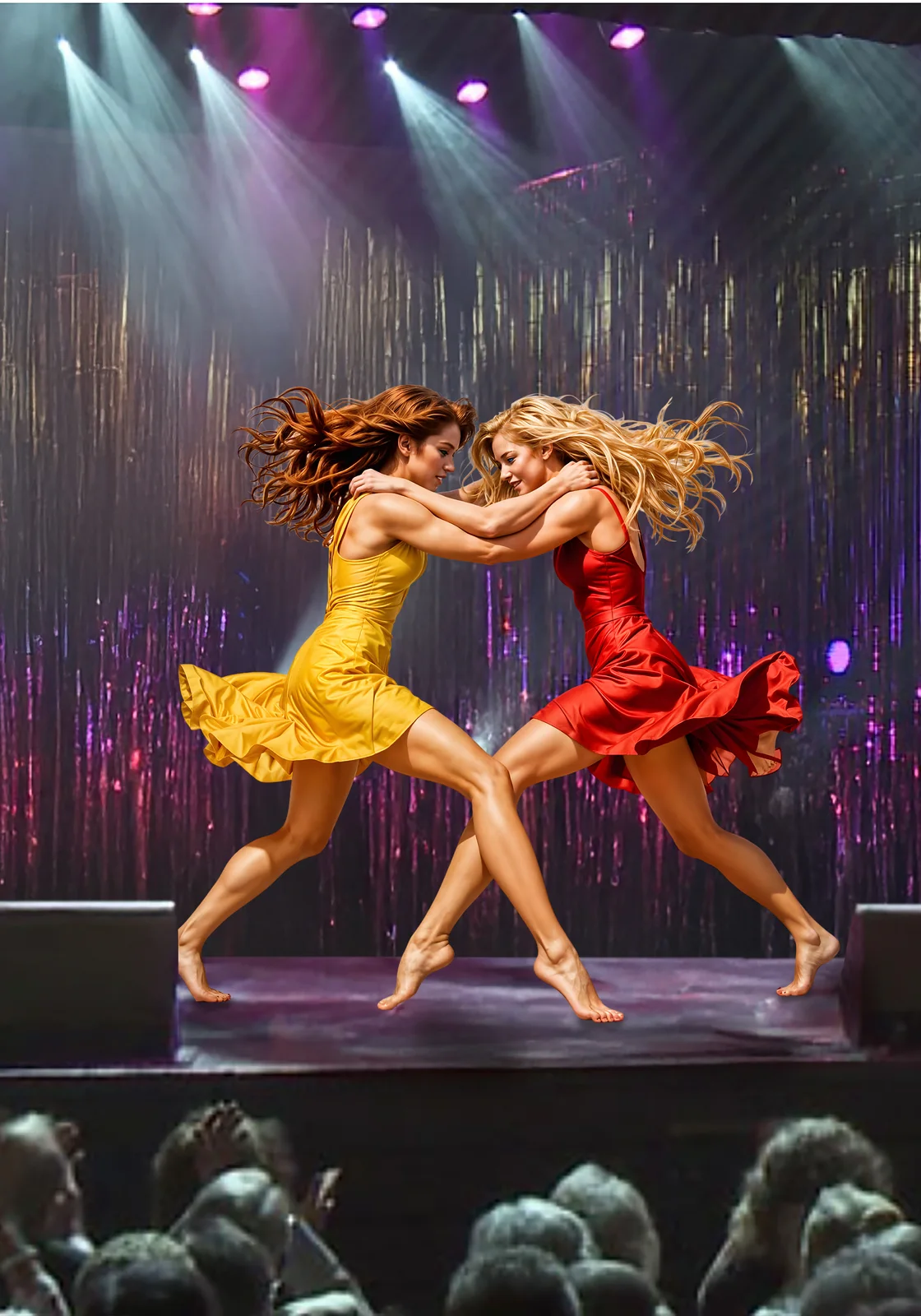
Catch as Catch Can - Matching Colours, 2026
Digital
50 x 70 cm
3 200 kr
Catch as Catch Can - Matching Colours
This image is not sexist, even if it may appear so to those who judge in haste. I intend to provoke curiosity and invite reflection, because clarifying its purpose helps the audience feel intrigued and open-minded, making them more receptive to different perspectives, not least by reading the accompanying text and grasping the full context. Sometimes, to make people think, one must place things at their sharpest edge. Women’s struggle — or competition, if one prefers — for newly gained rights and opportunities unfolds in full view, a drama played out on the stage of working life with half of humanity seated in the audience.
I could have illustrated my essay on female competition with two heavy Russian mud wrestlers, but choosing a different image emphasises that men, who most need to reflect on these dynamics, have a responsibility to understand societal realities. For many women, this is part of their lived experience, and fostering this understanding deepens empathy and awareness, encouraging the audience to feel a sense of responsibility and motivation to understand societal influences.
If the women in the image are young and beautiful, it is because, in this case, the purpose justifies the means. Beauty becomes the bait—not the message—clarifying the intent and encouraging viewers to feel curious about superficial appearances and to seek a deeper understanding of societal perceptions and gender stereotypes, fostering critical reflection on surface-level judgments.
"Matching Colours
They do not meet as enemies,
nor as sisters already certain of their bond.
They meet as weight and counterweight,
as pulse and restraint,
as two answers to the same unfinished question.
Bare feet remember the floor.
Fingers remember the risk.
Each grip is both refusal and invitation.
One carries fire in yellow silk,
the other discipline is in red.
Neither colour dominates.
They exist only because the other stands beside it.
This is not a fight.
Fights want endings.
This is not a dance.
Dances promise harmony.
This is the moment between.
Where strength learns to breathe.
Where rivalry forgets how to wound.
Where closeness does not demand surrender.
They do not ask who will win.
They ask who will remain.
History moves through their shoulders.
Expectation through their hips.
Future through the fragile distance between their palms.
And in that distance, something rare appears:
a power that does not need to conquer
in order to exist.
Two women.
Two colours.
One balance that must be chosen again
with every movement."
Malmö, January 2026
Prologue – The Opened Room
The struggle between the sexes is far from over. In many parts of the world, it has not even begun. There, a woman is still legally, culturally, or religiously defined as someone else's possession — of a father, a husband, a god, or a tradition. Her body belongs to morality, her choices to honour, her voice to silence. Equality is not debated; it is unthinkable. Yet elsewhere, the room has begun to open, offering hope for ongoing progress.
In large parts of the Western world, women now leave universities with the highest grades. They dominate academic statistics, enter professions once closed to them, and move through corporate structures where competence increasingly outweighs gender. In multinational companies where measurable results govern promotion, women not only compete—they often excel. In some sectors, they even earn more than their male colleagues, not by ideology but by performance. This is not a cultural opinion. It is a statistical shift.
The belief that equality would dissolve competition, sisterhood, and solidarity has not been realised. Women compete — intensely, strategically, emotionally, and professionally — within a societal framework shaped by centuries of exclusion, adaptation, negotiation, and survival, underscoring the role of societal norms in shaping female rivalry. That should evoke empathy and understanding for the emotional complexity women face as they navigate these norms.
For most of history, women did not compete for power. They competed for access: to protection, to legitimacy, to space within systems designed without them. When power is inaccessible, competition becomes indirect. When authority is forbidden, influence becomes subtle. When aggression is punished, strategy becomes relational. This is not nature. It is conditioning. And as emancipation begins to open doors, competition shifts and adapts, reflecting a resilient and evolving process.
Now women compete for positions, ideas, voices, authorship, and leadership. Not because they have abandoned sisterhood, but because they have finally been allowed to want more than survival. Yet the old patterns persist in the body and the nervous system: in social reflexes, inherited caution, internalised doubt, and the learned habit of measuring oneself through others. Understanding these psychological mechanisms can help readers grasp why women sometimes see other women as mirrors, not enemies, and how these patterns influence female rivalry.
Religion and cultural norms often frame womanhood as obedience, sacrifice, and containment, shaping behaviours like rivalry and influence. In many cultures, these norms create specific expectations for female rivalry, often as a survival strategy within accepted boundaries. Exploring how these norms vary across societies can deepen cultural analysis and help readers understand the diverse manifestations of female competition.
Not for approval, but for position. Not for protection, but for presence. Not for permission, but for authorship.
This space reflects a collective transition — a bridge between restriction and freedom — where modern female competition embodies both memory and future, inspiring a shared purpose among women navigating this evolution. It aims to make the audience feel hopeful and motivated about the ongoing change.
Which is why images sometimes understand what numbers cannot. Two women, balanced in motion, neither winning nor losing, neither yielding nor destroying. They are not enemies. They are not sisters yet. They are participants in an unfinished equality, standing at the precise moment when competition is no longer submission and solidarity has not yet fully learned to breathe.
My essay begins in that space.
Different Games, Same Arena
Male and female competition is often portrayed as two versions of the same instinct expressed through different bodies. Science suggests something more precise: it is the same evolutionary pressure filtered through various social, cultural, and religious histories. The difference is not primarily biological. It is structural, psychological, and artistic.
Male competition has traditionally been permitted, rewarded, and ritualised. It has taken the form of hierarchy, territory, visible dominance, and measurable victory. Boys are trained early to test their strength, endure defeat, seek status, and accept conflict as a standard path to recognition. Losing is painful, but allowed. Winning is celebrated. The arena is public.
Female competition has taken another path. For centuries, open rivalry was dangerous. Aggression could cost reputation, safety, or a sense of belonging. As a result, competition moved into subtler domains: social influence, emotional positioning, relational proximity, and moral legitimacy. The arena became private. Victory became ambiguous. Loss became silent.
This complexity does not weaken female competition; it deepens it, highlighting the nuanced, layered nature of women's rivalry, shaped by social and emotional factors.
Psychological studies show that women often evaluate themselves more in relation to others than in isolation, because their historical survival depended on relational awareness. Reading the room, sensing shifts in alliances, and detecting status changes were not social games; they were protective skills rooted in psychological mechanisms. Competition was not about defeating another woman, but about maintaining one’s place in a fragile social balance.
As emancipation expanded educational and professional opportunities, women entered arenas long shaped by male competitive norms. The rules were clear, but the emotional training was different. Women were suddenly expected to compete openly in systems built on visibility, self-promotion, and tolerance of conflict, while still being socially rewarded for empathy, modesty, and cohesion. The psychological tension between these expectations remains one of the deepest challenges to modern equality.
Today’s female competition often carries a double consciousness. A woman competes for a position while simultaneously negotiating how visible, assertive, or ambitious she is allowed to appear. She must win without seeming ruthless, lead without appearing cold, and excel without threatening the relational fabric around her. Male competitors rarely carry this additional layer of self-regulation.
Yet when conditions improve, something remarkable happens. Female competition becomes strikingly efficient. Research in organisational psychology shows that women in merit-based environments often outperform male peers in collaborative leadership, long-term strategic thinking, and conflict resolution. Their competitive strength does not lie in domination but in integration. They do not only seek to win; they strive to make winning sustainable.
It does not make female competition gentler, but makes it broader. It involves not only the opponent but also the system. Not only the result, but also its cost. Not only the self but also the relationships that survive the outcome. This should help the audience value the complexity and strategic nature of female rivalry beyond surface appearances.
This difference is often misinterpreted. Female competition is sometimes dismissed as indirect, emotional, or personal, while male competition is labelled as rational and objective. In reality, both are emotional and strategic. The difference lies in what has historically been allowed to be expressed.
When two women meet in competition today, they do not only meet as individuals. They meet as carriers of different survival strategies shaped by the same unequal past. Their encounters can feel simultaneously intense and restrained, intimate and distant, and cooperative and confrontational.
They are not playing different games. They are playing the same game with different inherited rules.
And when those rules begin to dissolve, when equality is no longer a promise but a practice, something new becomes possible: competition without erasure, rivalry without humiliation, ambition without exile.
This is the psychological territory where modern female competition now stands — no longer hidden, no longer apologetic, yet still negotiating its form.
It is not a softer competition. It is a more conscious one.
The Mirror Stage: Social Media and the Reinvention of Rivalry
In earlier generations, female rivalry often unfolded in rooms: classrooms, offices, kitchens, corridors, committees, and family gatherings. It had geography. It had witnesses. It had consequences that were slow, local, and usually containable. Today, much of that rivalry has moved into a space with no walls and no closing hours. Social media did not invent comparison; it industrialised it. It turned private measurement into a public habit and made visibility itself a form of currency, profoundly influencing societal perceptions of womanhood.
The old competitive question was, “Who is she in our world?” The new question is, “How is she performing in the world?” This shift influences societal perceptions of womanhood by emphasising metrics such as followers, likes, and comments, which shape collective ideals and stereotypes. Recognising this helps readers understand how social media's focus on quantification impacts societal views of women's roles and identities.
For women, who have historically been judged through appearance, desirability, and moral reputation, this new arena can evoke feelings of pressure and vulnerability. It offers a stage where one can build a voice, a business, a platform, a community. It also provides an endless gallery of curated perfection, where everybody is posed, every kitchen is lit, every relationship looks effortless, and every success story is compressed into a caption. The result is not merely envy. It is a constant, low-grade psychological evaluation: Am I behind? Am I enough? Am I visible? Am I fading? This ongoing comparison can make women feel overwhelmed and insecure, affecting their self-perception and mental health.
What makes this form of rivalry particularly potent is that it often bypasses conscious thought. Social comparison becomes a reflex, triggered by visual content that activates social instincts like the need to belong, fear of exclusion, and vigilance toward status shifts. The scroll is a silent audition. And because the content is visual, it triggers older social instincts that evolved for small groups: the need to belong, the fear of exclusion, the vigilance toward status shifts. The brain treats the feed as a social environment, even though it is a marketplace. This shared experience can make the audience feel less alone in their own social media struggles.
Here, the “mirror stage” becomes more than a metaphor. Social media is not simply a mirror; it is a hall of mirrors, multiplying versions of womanhood and demanding that each woman locate herself within them. The comparison extends beyond beauty to motherhood, success, and sexuality, with branding transforming identity into a curated product. This influences societal perceptions by equating worth with marketable images and self-presentation.
And here Madeleine Albright enters, not as a slogan but as a symptom. “There is a special place in hell for women who don’t help other women.” The line became famous because it hit a nerve. It expressed a hunger for solidarity in a world where women have so often been left to survive alone. But it also revealed something complicated: the desire to regulate female loyalty as a moral duty rather than a lived relationship. In a culture already filled with judgment, Albright’s sentence can sound like a rescue rope and a whip at the same time.
Social media amplifies that ambiguity. It turns solidarity into performance. It asks women not only to support each other, but to be seen supporting each other. It can create genuine communities, but it can also make a new kind of policing: a demand for public allegiance, the expectation of constant endorsement, the suspicion that any critique is betrayal. The paradox is painful: women want freedom, yet the digital arena often replaces old constraints with new ones, dressed as empowerment. Recognising this complexity can inspire appreciation for genuine sisterhood and critical reflection on superficial support.
At the same time, rivalry has become more aesthetically coded. It does not always appear as hostility. It seems like a lifestyle. It appears as “wellness.” It appears as “discipline.” It looks like a carefully framed self-improvement that quietly implies that those who struggle have not tried hard enough. The competitive signal is not shouted; it is curated, and the battlefield is not announced; it is filtered.
In this environment, a woman can be surrounded by women and still feel alone. She can be praised and still feel inadequate. She can be successful and still feel as if she is competing against an invisible standard that never stops moving. The rivalry is no longer only between individuals; it is between a person and the algorithmic mirror that reflects her back to herself in rankings.
The image of two women in physical motion can feel almost radical today. Your two figures are not competing on the same screen. They are present. They are embodied. They are forced to negotiate with each other in real time, not through curated fragments. They cannot hide behind captions. They cannot edit their angles. The encounter is honest because it has weight, breath, friction, and balance. It returns competition to the body, where it becomes understandable again—not as a moral failure but as a human condition.
Social media has not made women worse. It has made the comparison louder. It has made rivalry more constant. It has made solidarity both more necessary and more complicated. And it has taught the modern woman to see herself as others see her, even when no one is actually looking.
In the next chapter, the rivalry becomes even more layered because the mirror is no longer digital. It is biological, economic, and cultural at once. Motherhood and career do not merely collide; they create a double arena where women are asked to compete on two fronts, with one body, under contradictory rules.
The Double Arena: Motherhood, Career, and the Body of Choice
If social media turned rivalry into a mirror, motherhood turns it into a fault line. No other life decision exposes the contradictions of modern female competition as clearly as deciding whether to have children. In theory, a woman today is free to choose. In practice, every choice is still weighed, interpreted, and silently ranked.
Motherhood is often presented as a private matter, but it is one of the most public evaluations of a woman’s life. To have children is to be judged for timing, devotion, balance, sacrifice, and presence. Not having children is to be considered in terms of priorities, emotional depth, femininity, and future regret – and with sinking birth-rates deemed selfish. The modern woman is rarely asked whether she is fulfilled; she is asked whether she has chosen correctly.
The situation creates a competition that has no visible opponent. Women do not compete directly with each other here; they compete against incompatible expectations. Be ambitious, but not absent. Be nurturing, but not dependent. Be productive, but not cold. Be devoted, but not limited. The body becomes a negotiation space between biology and biography, between time and ambition.
In professional environments, motherhood still carries a cost that statistics continue to document. Career interruptions, slower promotion, reduced income growth, and subtle shifts in perceived competence remain common patterns. Even in progressive societies, motherhood is often treated as a potential liability, while fatherhood is frequently seen as a source of stability. The same act of care produces different professional meanings depending on gender.
This does not mean that women regret motherhood. It means that motherhood is still not fully integrated into the logic of equality. It remains a personal responsibility inside a collective structure that was never redesigned for it. As a result, women often find themselves competing not only with colleagues but with time itself. They must compress excellence into shorter windows, negotiate energy more precisely, and justify ambitions more carefully.
Here, the rivalry between women can become especially painful. Not because women lack empathy, but because each woman’s solution reflects another woman’s compromise. One woman’s career success may highlight another’s postponed dreams. One woman’s devotion at home may illuminate another’s absence. The rivalry is not about superiority; it is about unresolved longing.
And yet, this is also where solidarity can deepen. When women begin to recognise that their differences are not failures, but responses to the same structural tension, rivalry loses its cruelty. It becomes comparison without condemnation—difference without hierarchy.
Modern research in psychology shows that women who feel supported by other women in their life choices — whether or not those choices align with their own — experience lower stress, higher professional confidence, and greater long-term satisfaction. The absence of judgment does not remove ambition; it makes ambition sustainable.
Your image echoes this tension with quiet precision. The two women are in motion, but neither is falling. They lean into each other’s weight without collapse. Their balance depends not on sameness, but on mutual adjustment. One does not erase the other’s direction. Each one holds her own axis while responding to the other’s force.
This is precisely how modern womanhood functions. Not in a single path, but in intersecting trajectories. Not in identical solutions, but in shared tension.
Motherhood and career are not opposites. They are two expressions of agency struggling inside a structure that still prefers simplicity. And until that structure changes, women will continue to compete in a double arena, carrying twice the calculation in every decision.
Yet within that complexity lies something quietly revolutionary: the refusal to reduce womanhood to a single correct form. The acceptance that equality does not mean sameness, and that rivalry does not mean rejection.
In the next chapter, we leave psychology and enter vision because there is something that art, image, and body understand about this tension that numbers can never fully capture.
What Images Know That Numbers Cannot
Statistics are precise, but they are mute. They can tell us how many women graduate, how many are promoted, and how many earn more or less than their male colleagues. They can trace curves of progress and plateaus of resistance. What they cannot show is how it feels to stand inside those numbers. They cannot show hesitation in a posture, tension in a hand, or the quiet dignity of holding one’s ground. They cannot show rivalry without cruelty, or strength without conquest.
Images can.
An image does not argue. It reveals. It does not persuade through logic, but through recognition. We look at a body in motion and understand something before we can explain it. We read balance, effort, resistance, vulnerability, and intention in a fraction of a second. The body becomes a sentence the mind does not need to translate.
Visual art has always been one of the most precise instruments for understanding power. Long before sociology named structures, painters and sculptors showed who was standing and who was kneeling. Long before feminism got a name, images had already recorded who was allowed to look back and who was expected to look down. Today, when equality is debated in percentages, images return us to something more intimate: the lived grammar of the body.
Your two women say more about modern female competition than any bar chart. They do not represent winners and losers. They represent tension held in equilibrium. Their bodies do not illustrate dominance; they illustrate negotiation. The viewer cannot easily decide who leads and who follows, because the answer changes with every fraction of movement. This instability is the truth of contemporary equality. It is not fixed. It is dynamic. It must be maintained.
Numbers suggest that progress is linear. Images remind us that progress is physical. It requires balance. It requires adjustment. It requires constant recalibration.
An image can also hold a contradiction without resolving it. Statistics demand clarity: up or down, better or worse, equal or unequal. An image can have both. It can show rivalry and intimacy in the same gesture. It can show resistance and trust in the exact grip. It can show independence and dependence without either becoming a failure.
This is why art often becomes the first place where social change is emotionally understood. Before laws change, before institutions adapt, before language catches up, the body has already rehearsed the future. Dancers, actors, models, and artists test new relations in form long before they become normalised in life.
In this sense, your image is not an illustration of a theory. It is a rehearsal of a possibility. It does not tell us what female rivalry should be. It shows us what it can look like when it is no longer poisoned by hierarchy.
The white background matters here. It removes context so that nothing distracts from the relation itself. No workplace. No home. No stage. No history. Only two bodies negotiating presence. This emptiness is not absence. It is an invitation. It allows the viewer to project any system, any culture, any story onto the scene. The image becomes universal because it is stripped of explanation.
And in that universality, something radical happens. The viewer is no longer watching two women. The viewer is watching a relation. A structure. A tension that exists not only between genders, but within every struggle for recognition.
Numbers can tell us where we are. Images can show us who we are becoming.
In the final chapter, the last opposition dissolves. Sisterhood and rivalry, long treated as enemies, begin to reveal themselves as two expressions of the same desire: to be seen, to be valued, and to be free without standing alone.
Sisters and Rivals: A False Opposition
Sisterhood and rivalry are often presented as moral opposites, as if one must cancel the other. A woman is expected either to support other women unconditionally or to be suspected of betrayal. But human relationships do not function in absolutes, and neither does equality. Rivalry is not the enemy of solidarity. It is one of its tests.
True sisterhood does not mean the absence of conflict. It means the refusal to reduce conflict to hostility. It means allowing differences without converting them into hierarchy. It means recognising that another woman’s strength does not diminish one’s own, even when it challenges it. Rivalry becomes destructive only when it is framed as a zero-sum game. When one woman’s success is interpreted as another’s erasure, the system has already failed before the individuals have acted.
Historically, women were taught that space was limited. Limited seats, limited respect, limited protection, limited voices. In such conditions, rivalry could not help but become sharp. If only one could be chosen, every other woman became a potential obstacle. But equality changes the mathematics. When space expands, rivalry can shift from a survival instinct to creative tension.
This is the form of rivalry that art understands so well. Two dancers can push each other into higher precision. Two thinkers can sharpen each other’s clarity. Two leaders can elevate each other’s standards. Rivalry, in this sense, is not separation. It is proximity. It requires recognition. It requires respect. One does not compete with what one considers inferior.
Sisterhood, then, is not the promise that women will always agree, always protect, always approve. It is the commitment not to abandon each other when disagreement appears. It is the understanding that equality is not fragile because of difference, but because of fear. When fear recedes, rivalry no longer needs to wound to exist.
In this context, Madeleine Albright’s sentence takes on its fullest meaning. “There is a special place in hell for women who don’t help other women.” Taken literally, it sounds punitive. Taken humanly, it sounds desperate. It expresses the exhaustion of centuries in which women were left alone to navigate systems designed against them. It is less a judgment than a cry for alliance.
But an alliance cannot be commanded. It must be chosen. And it can only be selected when women are allowed to remain individuals, not symbols of each other’s moral duty. Sisterhood that demands obedience becomes another form of control. Sisterhood that allows rivalry becomes a form of freedom.
This is why your image does not show two women embracing. It shows them negotiating. Their grip is neither tender nor violent. Their closeness is neither sentimental nor hostile. They acknowledge each other’s force. They adjust. They remain present. Neither disappears into the other. Neither steps away.
They are rivals because they are equals. They are sisters because neither seeks annihilation.
In this moment, rivalry becomes a language of respect. Sisterhood becomes a space that can hold tension without collapse. The opposition dissolves, and what remains is relation.
Equality does not mean harmony. It means the right to remain in the room even when harmony fails. It means the right to be challenged without being erased. It means the right to be strong without standing alone.
This is where the essay ends, but where the image continues. Two women, balanced between force and care, between self and other, between past and possibility. They do not resolve the conflict. They carry it.
And in carrying it, they make it human.
Epilogue – The Space That Remains
Every struggle for equality eventually reaches a point at which the language of opposition no longer suffices. Not because conflict has vanished, but because it has matured. The relationship between women is no longer adequately described through loyalty or betrayal, support or rivalry, unity or division. Those words belong to earlier stages of the same journey. They were necessary when the room was small. They become insufficient when the room begins to open.
The two women in the image do not represent a conclusion. They represent a condition. A condition in which strength is no longer measured by domination, and closeness is no longer confused with surrender. They stand inside a balance that cannot be fixed, only maintained. Their bodies understand what their cultures are still learning: that equality is not a destination but a continuous adjustment.
They do not ask who should lead. They ask how both can remain standing.
This is perhaps the quietest revolution of all. Not the overthrow of power, but the transformation of relation. Not the victory of one over another, but the refusal to let victory be the only meaning of strength. In that refusal, something deeply human returns to competition. It regains proportion. It regains dignity. It regains breath.
Future women’s relationships will not be built on slogans; they will depend on physical encounters. In moments where rivalry does not erase care, and care does not demand silence on moments where ambition can exist without apology, and tenderness without weakness, in moments where women no longer have to choose between being strong and being connected.
That future will not look like harmony. It will look like movement. It will look like a negotiation. It will look like two bodies in motion, adjusting to each other without collapsing.
Perhaps that is the most honest image of equality we can offer ourselves. Not a final pose. Not a perfect symmetry. But a living balance, constantly re-created, constantly vulnerable, continually authentic.
The struggle between the sexes is far from over. In many places, it has barely begun. But within that unfinished story, a quieter shift is already taking place. Women are no longer only fighting systems. They are learning how to remain in relation to one another while doing so.
And in that learning, something more durable than victory begins to form.
Not an answer.
A space.
Jörgen Thornberg
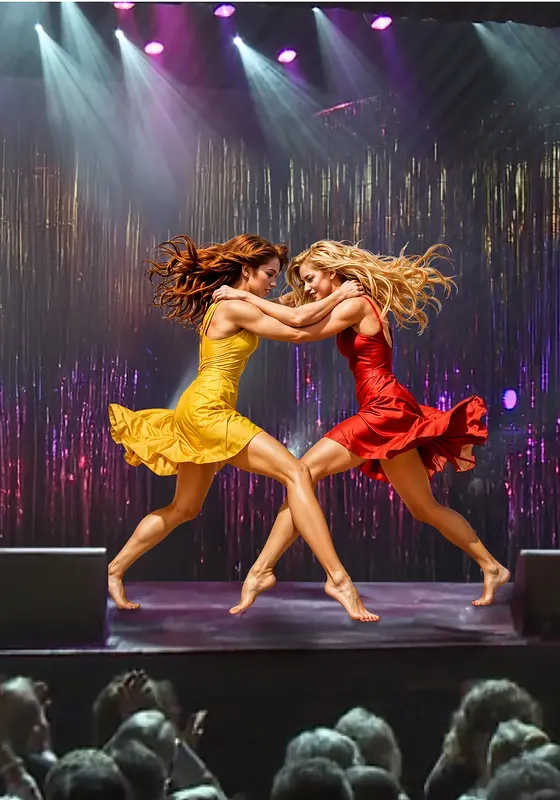
Catch as Catch Can - Matching Colours, 2026
Digital
50 x 70 cm
3 200 kr
Catch as Catch Can - Matching Colours
This image is not sexist, even if it may appear so to those who judge in haste. I intend to provoke curiosity and invite reflection, because clarifying its purpose helps the audience feel intrigued and open-minded, making them more receptive to different perspectives, not least by reading the accompanying text and grasping the full context. Sometimes, to make people think, one must place things at their sharpest edge. Women’s struggle — or competition, if one prefers — for newly gained rights and opportunities unfolds in full view, a drama played out on the stage of working life with half of humanity seated in the audience.
I could have illustrated my essay on female competition with two heavy Russian mud wrestlers, but choosing a different image emphasises that men, who most need to reflect on these dynamics, have a responsibility to understand societal realities. For many women, this is part of their lived experience, and fostering this understanding deepens empathy and awareness, encouraging the audience to feel a sense of responsibility and motivation to understand societal influences.
If the women in the image are young and beautiful, it is because, in this case, the purpose justifies the means. Beauty becomes the bait—not the message—clarifying the intent and encouraging viewers to feel curious about superficial appearances and to seek a deeper understanding of societal perceptions and gender stereotypes, fostering critical reflection on surface-level judgments.
"Matching Colours
They do not meet as enemies,
nor as sisters already certain of their bond.
They meet as weight and counterweight,
as pulse and restraint,
as two answers to the same unfinished question.
Bare feet remember the floor.
Fingers remember the risk.
Each grip is both refusal and invitation.
One carries fire in yellow silk,
the other discipline is in red.
Neither colour dominates.
They exist only because the other stands beside it.
This is not a fight.
Fights want endings.
This is not a dance.
Dances promise harmony.
This is the moment between.
Where strength learns to breathe.
Where rivalry forgets how to wound.
Where closeness does not demand surrender.
They do not ask who will win.
They ask who will remain.
History moves through their shoulders.
Expectation through their hips.
Future through the fragile distance between their palms.
And in that distance, something rare appears:
a power that does not need to conquer
in order to exist.
Two women.
Two colours.
One balance that must be chosen again
with every movement."
Malmö, January 2026
Prologue – The Opened Room
The struggle between the sexes is far from over. In many parts of the world, it has not even begun. There, a woman is still legally, culturally, or religiously defined as someone else's possession — of a father, a husband, a god, or a tradition. Her body belongs to morality, her choices to honour, her voice to silence. Equality is not debated; it is unthinkable. Yet elsewhere, the room has begun to open, offering hope for ongoing progress.
In large parts of the Western world, women now leave universities with the highest grades. They dominate academic statistics, enter professions once closed to them, and move through corporate structures where competence increasingly outweighs gender. In multinational companies where measurable results govern promotion, women not only compete—they often excel. In some sectors, they even earn more than their male colleagues, not by ideology but by performance. This is not a cultural opinion. It is a statistical shift.
The belief that equality would dissolve competition, sisterhood, and solidarity has not been realised. Women compete — intensely, strategically, emotionally, and professionally — within a societal framework shaped by centuries of exclusion, adaptation, negotiation, and survival, underscoring the role of societal norms in shaping female rivalry. That should evoke empathy and understanding for the emotional complexity women face as they navigate these norms.
For most of history, women did not compete for power. They competed for access: to protection, to legitimacy, to space within systems designed without them. When power is inaccessible, competition becomes indirect. When authority is forbidden, influence becomes subtle. When aggression is punished, strategy becomes relational. This is not nature. It is conditioning. And as emancipation begins to open doors, competition shifts and adapts, reflecting a resilient and evolving process.
Now women compete for positions, ideas, voices, authorship, and leadership. Not because they have abandoned sisterhood, but because they have finally been allowed to want more than survival. Yet the old patterns persist in the body and the nervous system: in social reflexes, inherited caution, internalised doubt, and the learned habit of measuring oneself through others. Understanding these psychological mechanisms can help readers grasp why women sometimes see other women as mirrors, not enemies, and how these patterns influence female rivalry.
Religion and cultural norms often frame womanhood as obedience, sacrifice, and containment, shaping behaviours like rivalry and influence. In many cultures, these norms create specific expectations for female rivalry, often as a survival strategy within accepted boundaries. Exploring how these norms vary across societies can deepen cultural analysis and help readers understand the diverse manifestations of female competition.
Not for approval, but for position. Not for protection, but for presence. Not for permission, but for authorship.
This space reflects a collective transition — a bridge between restriction and freedom — where modern female competition embodies both memory and future, inspiring a shared purpose among women navigating this evolution. It aims to make the audience feel hopeful and motivated about the ongoing change.
Which is why images sometimes understand what numbers cannot. Two women, balanced in motion, neither winning nor losing, neither yielding nor destroying. They are not enemies. They are not sisters yet. They are participants in an unfinished equality, standing at the precise moment when competition is no longer submission and solidarity has not yet fully learned to breathe.
My essay begins in that space.
Different Games, Same Arena
Male and female competition is often portrayed as two versions of the same instinct expressed through different bodies. Science suggests something more precise: it is the same evolutionary pressure filtered through various social, cultural, and religious histories. The difference is not primarily biological. It is structural, psychological, and artistic.
Male competition has traditionally been permitted, rewarded, and ritualised. It has taken the form of hierarchy, territory, visible dominance, and measurable victory. Boys are trained early to test their strength, endure defeat, seek status, and accept conflict as a standard path to recognition. Losing is painful, but allowed. Winning is celebrated. The arena is public.
Female competition has taken another path. For centuries, open rivalry was dangerous. Aggression could cost reputation, safety, or a sense of belonging. As a result, competition moved into subtler domains: social influence, emotional positioning, relational proximity, and moral legitimacy. The arena became private. Victory became ambiguous. Loss became silent.
This complexity does not weaken female competition; it deepens it, highlighting the nuanced, layered nature of women's rivalry, shaped by social and emotional factors.
Psychological studies show that women often evaluate themselves more in relation to others than in isolation, because their historical survival depended on relational awareness. Reading the room, sensing shifts in alliances, and detecting status changes were not social games; they were protective skills rooted in psychological mechanisms. Competition was not about defeating another woman, but about maintaining one’s place in a fragile social balance.
As emancipation expanded educational and professional opportunities, women entered arenas long shaped by male competitive norms. The rules were clear, but the emotional training was different. Women were suddenly expected to compete openly in systems built on visibility, self-promotion, and tolerance of conflict, while still being socially rewarded for empathy, modesty, and cohesion. The psychological tension between these expectations remains one of the deepest challenges to modern equality.
Today’s female competition often carries a double consciousness. A woman competes for a position while simultaneously negotiating how visible, assertive, or ambitious she is allowed to appear. She must win without seeming ruthless, lead without appearing cold, and excel without threatening the relational fabric around her. Male competitors rarely carry this additional layer of self-regulation.
Yet when conditions improve, something remarkable happens. Female competition becomes strikingly efficient. Research in organisational psychology shows that women in merit-based environments often outperform male peers in collaborative leadership, long-term strategic thinking, and conflict resolution. Their competitive strength does not lie in domination but in integration. They do not only seek to win; they strive to make winning sustainable.
It does not make female competition gentler, but makes it broader. It involves not only the opponent but also the system. Not only the result, but also its cost. Not only the self but also the relationships that survive the outcome. This should help the audience value the complexity and strategic nature of female rivalry beyond surface appearances.
This difference is often misinterpreted. Female competition is sometimes dismissed as indirect, emotional, or personal, while male competition is labelled as rational and objective. In reality, both are emotional and strategic. The difference lies in what has historically been allowed to be expressed.
When two women meet in competition today, they do not only meet as individuals. They meet as carriers of different survival strategies shaped by the same unequal past. Their encounters can feel simultaneously intense and restrained, intimate and distant, and cooperative and confrontational.
They are not playing different games. They are playing the same game with different inherited rules.
And when those rules begin to dissolve, when equality is no longer a promise but a practice, something new becomes possible: competition without erasure, rivalry without humiliation, ambition without exile.
This is the psychological territory where modern female competition now stands — no longer hidden, no longer apologetic, yet still negotiating its form.
It is not a softer competition. It is a more conscious one.
The Mirror Stage: Social Media and the Reinvention of Rivalry
In earlier generations, female rivalry often unfolded in rooms: classrooms, offices, kitchens, corridors, committees, and family gatherings. It had geography. It had witnesses. It had consequences that were slow, local, and usually containable. Today, much of that rivalry has moved into a space with no walls and no closing hours. Social media did not invent comparison; it industrialised it. It turned private measurement into a public habit and made visibility itself a form of currency, profoundly influencing societal perceptions of womanhood.
The old competitive question was, “Who is she in our world?” The new question is, “How is she performing in the world?” This shift influences societal perceptions of womanhood by emphasising metrics such as followers, likes, and comments, which shape collective ideals and stereotypes. Recognising this helps readers understand how social media's focus on quantification impacts societal views of women's roles and identities.
For women, who have historically been judged through appearance, desirability, and moral reputation, this new arena can evoke feelings of pressure and vulnerability. It offers a stage where one can build a voice, a business, a platform, a community. It also provides an endless gallery of curated perfection, where everybody is posed, every kitchen is lit, every relationship looks effortless, and every success story is compressed into a caption. The result is not merely envy. It is a constant, low-grade psychological evaluation: Am I behind? Am I enough? Am I visible? Am I fading? This ongoing comparison can make women feel overwhelmed and insecure, affecting their self-perception and mental health.
What makes this form of rivalry particularly potent is that it often bypasses conscious thought. Social comparison becomes a reflex, triggered by visual content that activates social instincts like the need to belong, fear of exclusion, and vigilance toward status shifts. The scroll is a silent audition. And because the content is visual, it triggers older social instincts that evolved for small groups: the need to belong, the fear of exclusion, the vigilance toward status shifts. The brain treats the feed as a social environment, even though it is a marketplace. This shared experience can make the audience feel less alone in their own social media struggles.
Here, the “mirror stage” becomes more than a metaphor. Social media is not simply a mirror; it is a hall of mirrors, multiplying versions of womanhood and demanding that each woman locate herself within them. The comparison extends beyond beauty to motherhood, success, and sexuality, with branding transforming identity into a curated product. This influences societal perceptions by equating worth with marketable images and self-presentation.
And here Madeleine Albright enters, not as a slogan but as a symptom. “There is a special place in hell for women who don’t help other women.” The line became famous because it hit a nerve. It expressed a hunger for solidarity in a world where women have so often been left to survive alone. But it also revealed something complicated: the desire to regulate female loyalty as a moral duty rather than a lived relationship. In a culture already filled with judgment, Albright’s sentence can sound like a rescue rope and a whip at the same time.
Social media amplifies that ambiguity. It turns solidarity into performance. It asks women not only to support each other, but to be seen supporting each other. It can create genuine communities, but it can also make a new kind of policing: a demand for public allegiance, the expectation of constant endorsement, the suspicion that any critique is betrayal. The paradox is painful: women want freedom, yet the digital arena often replaces old constraints with new ones, dressed as empowerment. Recognising this complexity can inspire appreciation for genuine sisterhood and critical reflection on superficial support.
At the same time, rivalry has become more aesthetically coded. It does not always appear as hostility. It seems like a lifestyle. It appears as “wellness.” It appears as “discipline.” It looks like a carefully framed self-improvement that quietly implies that those who struggle have not tried hard enough. The competitive signal is not shouted; it is curated, and the battlefield is not announced; it is filtered.
In this environment, a woman can be surrounded by women and still feel alone. She can be praised and still feel inadequate. She can be successful and still feel as if she is competing against an invisible standard that never stops moving. The rivalry is no longer only between individuals; it is between a person and the algorithmic mirror that reflects her back to herself in rankings.
The image of two women in physical motion can feel almost radical today. Your two figures are not competing on the same screen. They are present. They are embodied. They are forced to negotiate with each other in real time, not through curated fragments. They cannot hide behind captions. They cannot edit their angles. The encounter is honest because it has weight, breath, friction, and balance. It returns competition to the body, where it becomes understandable again—not as a moral failure but as a human condition.
Social media has not made women worse. It has made the comparison louder. It has made rivalry more constant. It has made solidarity both more necessary and more complicated. And it has taught the modern woman to see herself as others see her, even when no one is actually looking.
In the next chapter, the rivalry becomes even more layered because the mirror is no longer digital. It is biological, economic, and cultural at once. Motherhood and career do not merely collide; they create a double arena where women are asked to compete on two fronts, with one body, under contradictory rules.
The Double Arena: Motherhood, Career, and the Body of Choice
If social media turned rivalry into a mirror, motherhood turns it into a fault line. No other life decision exposes the contradictions of modern female competition as clearly as deciding whether to have children. In theory, a woman today is free to choose. In practice, every choice is still weighed, interpreted, and silently ranked.
Motherhood is often presented as a private matter, but it is one of the most public evaluations of a woman’s life. To have children is to be judged for timing, devotion, balance, sacrifice, and presence. Not having children is to be considered in terms of priorities, emotional depth, femininity, and future regret – and with sinking birth-rates deemed selfish. The modern woman is rarely asked whether she is fulfilled; she is asked whether she has chosen correctly.
The situation creates a competition that has no visible opponent. Women do not compete directly with each other here; they compete against incompatible expectations. Be ambitious, but not absent. Be nurturing, but not dependent. Be productive, but not cold. Be devoted, but not limited. The body becomes a negotiation space between biology and biography, between time and ambition.
In professional environments, motherhood still carries a cost that statistics continue to document. Career interruptions, slower promotion, reduced income growth, and subtle shifts in perceived competence remain common patterns. Even in progressive societies, motherhood is often treated as a potential liability, while fatherhood is frequently seen as a source of stability. The same act of care produces different professional meanings depending on gender.
This does not mean that women regret motherhood. It means that motherhood is still not fully integrated into the logic of equality. It remains a personal responsibility inside a collective structure that was never redesigned for it. As a result, women often find themselves competing not only with colleagues but with time itself. They must compress excellence into shorter windows, negotiate energy more precisely, and justify ambitions more carefully.
Here, the rivalry between women can become especially painful. Not because women lack empathy, but because each woman’s solution reflects another woman’s compromise. One woman’s career success may highlight another’s postponed dreams. One woman’s devotion at home may illuminate another’s absence. The rivalry is not about superiority; it is about unresolved longing.
And yet, this is also where solidarity can deepen. When women begin to recognise that their differences are not failures, but responses to the same structural tension, rivalry loses its cruelty. It becomes comparison without condemnation—difference without hierarchy.
Modern research in psychology shows that women who feel supported by other women in their life choices — whether or not those choices align with their own — experience lower stress, higher professional confidence, and greater long-term satisfaction. The absence of judgment does not remove ambition; it makes ambition sustainable.
Your image echoes this tension with quiet precision. The two women are in motion, but neither is falling. They lean into each other’s weight without collapse. Their balance depends not on sameness, but on mutual adjustment. One does not erase the other’s direction. Each one holds her own axis while responding to the other’s force.
This is precisely how modern womanhood functions. Not in a single path, but in intersecting trajectories. Not in identical solutions, but in shared tension.
Motherhood and career are not opposites. They are two expressions of agency struggling inside a structure that still prefers simplicity. And until that structure changes, women will continue to compete in a double arena, carrying twice the calculation in every decision.
Yet within that complexity lies something quietly revolutionary: the refusal to reduce womanhood to a single correct form. The acceptance that equality does not mean sameness, and that rivalry does not mean rejection.
In the next chapter, we leave psychology and enter vision because there is something that art, image, and body understand about this tension that numbers can never fully capture.
What Images Know That Numbers Cannot
Statistics are precise, but they are mute. They can tell us how many women graduate, how many are promoted, and how many earn more or less than their male colleagues. They can trace curves of progress and plateaus of resistance. What they cannot show is how it feels to stand inside those numbers. They cannot show hesitation in a posture, tension in a hand, or the quiet dignity of holding one’s ground. They cannot show rivalry without cruelty, or strength without conquest.
Images can.
An image does not argue. It reveals. It does not persuade through logic, but through recognition. We look at a body in motion and understand something before we can explain it. We read balance, effort, resistance, vulnerability, and intention in a fraction of a second. The body becomes a sentence the mind does not need to translate.
Visual art has always been one of the most precise instruments for understanding power. Long before sociology named structures, painters and sculptors showed who was standing and who was kneeling. Long before feminism got a name, images had already recorded who was allowed to look back and who was expected to look down. Today, when equality is debated in percentages, images return us to something more intimate: the lived grammar of the body.
Your two women say more about modern female competition than any bar chart. They do not represent winners and losers. They represent tension held in equilibrium. Their bodies do not illustrate dominance; they illustrate negotiation. The viewer cannot easily decide who leads and who follows, because the answer changes with every fraction of movement. This instability is the truth of contemporary equality. It is not fixed. It is dynamic. It must be maintained.
Numbers suggest that progress is linear. Images remind us that progress is physical. It requires balance. It requires adjustment. It requires constant recalibration.
An image can also hold a contradiction without resolving it. Statistics demand clarity: up or down, better or worse, equal or unequal. An image can have both. It can show rivalry and intimacy in the same gesture. It can show resistance and trust in the exact grip. It can show independence and dependence without either becoming a failure.
This is why art often becomes the first place where social change is emotionally understood. Before laws change, before institutions adapt, before language catches up, the body has already rehearsed the future. Dancers, actors, models, and artists test new relations in form long before they become normalised in life.
In this sense, your image is not an illustration of a theory. It is a rehearsal of a possibility. It does not tell us what female rivalry should be. It shows us what it can look like when it is no longer poisoned by hierarchy.
The white background matters here. It removes context so that nothing distracts from the relation itself. No workplace. No home. No stage. No history. Only two bodies negotiating presence. This emptiness is not absence. It is an invitation. It allows the viewer to project any system, any culture, any story onto the scene. The image becomes universal because it is stripped of explanation.
And in that universality, something radical happens. The viewer is no longer watching two women. The viewer is watching a relation. A structure. A tension that exists not only between genders, but within every struggle for recognition.
Numbers can tell us where we are. Images can show us who we are becoming.
In the final chapter, the last opposition dissolves. Sisterhood and rivalry, long treated as enemies, begin to reveal themselves as two expressions of the same desire: to be seen, to be valued, and to be free without standing alone.
Sisters and Rivals: A False Opposition
Sisterhood and rivalry are often presented as moral opposites, as if one must cancel the other. A woman is expected either to support other women unconditionally or to be suspected of betrayal. But human relationships do not function in absolutes, and neither does equality. Rivalry is not the enemy of solidarity. It is one of its tests.
True sisterhood does not mean the absence of conflict. It means the refusal to reduce conflict to hostility. It means allowing differences without converting them into hierarchy. It means recognising that another woman’s strength does not diminish one’s own, even when it challenges it. Rivalry becomes destructive only when it is framed as a zero-sum game. When one woman’s success is interpreted as another’s erasure, the system has already failed before the individuals have acted.
Historically, women were taught that space was limited. Limited seats, limited respect, limited protection, limited voices. In such conditions, rivalry could not help but become sharp. If only one could be chosen, every other woman became a potential obstacle. But equality changes the mathematics. When space expands, rivalry can shift from a survival instinct to creative tension.
This is the form of rivalry that art understands so well. Two dancers can push each other into higher precision. Two thinkers can sharpen each other’s clarity. Two leaders can elevate each other’s standards. Rivalry, in this sense, is not separation. It is proximity. It requires recognition. It requires respect. One does not compete with what one considers inferior.
Sisterhood, then, is not the promise that women will always agree, always protect, always approve. It is the commitment not to abandon each other when disagreement appears. It is the understanding that equality is not fragile because of difference, but because of fear. When fear recedes, rivalry no longer needs to wound to exist.
In this context, Madeleine Albright’s sentence takes on its fullest meaning. “There is a special place in hell for women who don’t help other women.” Taken literally, it sounds punitive. Taken humanly, it sounds desperate. It expresses the exhaustion of centuries in which women were left alone to navigate systems designed against them. It is less a judgment than a cry for alliance.
But an alliance cannot be commanded. It must be chosen. And it can only be selected when women are allowed to remain individuals, not symbols of each other’s moral duty. Sisterhood that demands obedience becomes another form of control. Sisterhood that allows rivalry becomes a form of freedom.
This is why your image does not show two women embracing. It shows them negotiating. Their grip is neither tender nor violent. Their closeness is neither sentimental nor hostile. They acknowledge each other’s force. They adjust. They remain present. Neither disappears into the other. Neither steps away.
They are rivals because they are equals. They are sisters because neither seeks annihilation.
In this moment, rivalry becomes a language of respect. Sisterhood becomes a space that can hold tension without collapse. The opposition dissolves, and what remains is relation.
Equality does not mean harmony. It means the right to remain in the room even when harmony fails. It means the right to be challenged without being erased. It means the right to be strong without standing alone.
This is where the essay ends, but where the image continues. Two women, balanced between force and care, between self and other, between past and possibility. They do not resolve the conflict. They carry it.
And in carrying it, they make it human.
Epilogue – The Space That Remains
Every struggle for equality eventually reaches a point at which the language of opposition no longer suffices. Not because conflict has vanished, but because it has matured. The relationship between women is no longer adequately described through loyalty or betrayal, support or rivalry, unity or division. Those words belong to earlier stages of the same journey. They were necessary when the room was small. They become insufficient when the room begins to open.
The two women in the image do not represent a conclusion. They represent a condition. A condition in which strength is no longer measured by domination, and closeness is no longer confused with surrender. They stand inside a balance that cannot be fixed, only maintained. Their bodies understand what their cultures are still learning: that equality is not a destination but a continuous adjustment.
They do not ask who should lead. They ask how both can remain standing.
This is perhaps the quietest revolution of all. Not the overthrow of power, but the transformation of relation. Not the victory of one over another, but the refusal to let victory be the only meaning of strength. In that refusal, something deeply human returns to competition. It regains proportion. It regains dignity. It regains breath.
Future women’s relationships will not be built on slogans; they will depend on physical encounters. In moments where rivalry does not erase care, and care does not demand silence on moments where ambition can exist without apology, and tenderness without weakness, in moments where women no longer have to choose between being strong and being connected.
That future will not look like harmony. It will look like movement. It will look like a negotiation. It will look like two bodies in motion, adjusting to each other without collapsing.
Perhaps that is the most honest image of equality we can offer ourselves. Not a final pose. Not a perfect symmetry. But a living balance, constantly re-created, constantly vulnerable, continually authentic.
The struggle between the sexes is far from over. In many places, it has barely begun. But within that unfinished story, a quieter shift is already taking place. Women are no longer only fighting systems. They are learning how to remain in relation to one another while doing so.
And in that learning, something more durable than victory begins to form.
Not an answer.
A space.
3 200 kr

Jörgen Thornberg
Malmö
Lite om bilder och mig. Translation in English at the end.
Jag är en nyfiken person som ser allt i bilder, även det jag fäster i ord, gärna tillsammans för bakom alla mina bilder finns en berättelse. Till vissa bilder hör en kortare eller längre novell som följer med bilden.
Bilder berättar historier. Jag omges av naturlig skönhet, intressanta människor och historia var jag än går. Jag använder min kamera för att dokumentera världen och blanda det jag ser med vad jag känner för att fånga den dolda magin.
Mina bilder berättar mina historier. Genom mina bilder, tryck och berättelser. Jag bjuder in dig att ta del av dessa berättelser, in i ditt liv och hem och dela min mycket personliga syn på vår värld. Mer än vad ögat ser. Jag tänker i bilder, drömmer och skriver och pratar om dem; följaktligen måste jag också skapa bilder. De blir vad jag ser, inte nödvändigtvis begränsade till verkligheten. Det finns en bild runt varje hörn. Jag hoppas att du kommer att se vad jag såg och gilla det.
Jag är också en skrivande person och till många bilder hör en kortare eller längre essay. Den följer med tavlan, tryckt på fint papper och med en personlig hälsning från mig.
Flertalet bilder startar sin resa i min kamera. Enkelt förklarat beskriver jag bilden jag ser i mitt inre, upplevd eller fantiserad. Bilden uppstår inom mig redan innan jag fått okularet till ögat. På bråkdelen av ett ögonblick ser jag vad jag vill ha och vad som kan göras med bilden. Här skall jag stoppa in en giraff, stålmannen, Titanic eller vad det är min fantasi finner ut. Ännu märkligare är att jag kommer ihåg minnesbilden långt efteråt när det blir tid att skapa verket. Om jag lyckas eller inte, är upp till betraktaren, oftast präglat av en stråk av svart humor – meningen är att man skall bli underhållen. Mina bilder blir ofta en snackis där de hänger.
Jag föredrar bilder som förmedlar ett budskap i flera lager. Vid första anblicken fylld av feel-good, en vacker utsikt, fint väder, solen skiner, blommor på ängen eller vattnet som ligger förrädiskt spegelblankt. I en sådan bild kan jag gömma min egentliga berättelse, mitt förakt för förtryckare och våldsverkare, rasister och fördomsfulla människor - ett gärna återkommande motiv mer eller mindre dolt i det vackra motivet. Jag försöker förena dem i ett gemensamt narrativ.
Bild och formgivning har löpt som en röd tråd genom livet. Fotokonst känns som en värdig final som jag gärna delar med mig.
Min genre är vid som framgår av mina bilder, temat en blandning av pop- och gatukonst i kollage som kan bestå av hundratals lager. Vissa bilder kan ta veckor, andra någon dag innan det är dags att överlämna resultatet till printverkstaden. Fine Art Prints är digitala fotocollage. I dessa kollage sker rivandet, klippandet, pusslandet, målandet, ritandet och sprayningen digitalt. Det jag monterar in kan vara hundratals år gamla bilder som jag omsorgsfullt frilägger så att de ser ut att vara en del av tavlan men också bilder skapade av mig själv efter min egen fantasi. Därefter besöks printstudion och för vissa bilder numrera en limiterad upplaga (oftast 7 exemplar) och signera för hand. Vissa bilder kan köpas i olika format. Det är bara att fråga efter vilka. Gillar man en bild som är 70x100 men inte har plats på väggen, går den kanske att få i 50x70 cm istället. Frågan är fri.
Metoden Giclée eller Fine Art Print som det också kallas är det moderna sättet för framställning av grafisk konst. Villkoret för denna typ av utskrifter är att en högkvalitativ storformatskrivare används med åldersbeständigt färgpigment och konstnärspapper eller i förekommande fall på duk. Pappret som används möter de krav på livslängd som ställs av museer och gallerier. Normalt säljer jag mina bilder oinramade så att den nya ägaren själv kan bestämma hur de skall se ut, med eller utan passepartout färg på ram, med eller utan glas etc..
Under många år ställde jag bara ut på nätet, i valda grupper och på min egen Facebooksida - https://www.facebook.com/jorgen.thornberg.9
Jag finns också på en egen hemsida som tyvärr inte alltid är uppdaterad – https://www.jth.life/ Där kan du också läsa en del av de berättelser som följer med bilden.
UTSTÄLLNINGAR
Luftkastellet, oktober 2022
Konst i Lund, november 2022
Luftkastellet, mars 2023
Engleson Galleri Caroli, april 2023
Hydra, Greece June 2023
Engleson Galleri Caroli, oktober 2023
Toppen, Höllviken december 2023
Luftkastellet, mars 2024
Torups Galleri, mars 2024
Venice, May 2024
Luftkastellet, oktober 2024
Konst i Advent, December 2024
Galleri Engleson, Caroli December 2024
Jäger & Jansson Galleri, april 2025
A bit about pictures and me.
I'm a curious person who sees everything in pictures, even what I express in words, often combining them, for behind all my pictures lies a story. These narratives, some as short as a single image and others as long as a novel, are the heart and soul of my work.
Pictures tell stories. Wherever I go, I'm surrounded by natural beauty, exciting people, and history. I use my camera to document the world and blend what I see with what I feel to capture the hidden magic.
My images tell my stories. Through my pictures, prints, and narratives, I invite you to partake in these stories in your life and home and share my deeply personal perspective of our world. More than meets the eye. I think in pictures, dream, write, and talk about them; consequently, I must create images too. They become what I see, not necessarily confined to reality. There's a picture around every corner. I hope you'll see what I saw and enjoy it.
I'm also a writer, and many images come with a shorter or longer essay. It accompanies the painting, printed on fine paper with my personal greeting.
Many pictures start their journey on my camera. Simply put, I describe the image I see in my mind, experienced or imagined. The image arises within me even before I bring the eyepiece to my eye. In a fraction of a moment, I see what I want and what can be done with the picture. Here, I'll insert a giraffe, Superman, the Titanic, or whatever my imagination conjures up. Even stranger is that I remember the mental image long after it's time to create the work. Whether I succeed is up to the observer, often imbued with a streak of black humour – the aim is to entertain. My pictures usually become a talking point wherever they hang.
I prefer pictures that convey a message in multiple layers. At first glance, they're filled with feel-good vibes, a beautiful view, lovely weather, the sun shining, flowers in the meadow, or the water lying deceptively calm. But beneath this surface beauty, I often conceal a deeper story, a narrative that challenges societal norms or explores the human condition. I invite you to delve into these hidden narratives and discover the layers of meaning within my work.
Picture and design have been a thread running through my life. Photographic art feels like a fitting finale, and I'm happy to share it.
My genre is varied, as seen in my pictures; the theme is a blend of pop and street art in collages that can consist of hundreds of layers. Some images can take weeks, others just a day before it's time to hand over the result to the print workshop. Fine Art Prints are digital photo collages. In these collages, tearing, cutting, puzzling, painting, drawing, and spraying happen digitally. What I insert can be images hundreds of years old that I carefully extract so they appear to be part of the painting, but also images created by myself, now also generated from my imagination. Next, visit the print studio and, for certain images, number a limited edition (usually 7 copies) and sign them by hand. Some images may be available in other formats. Just ask which ones. If you like an image that's 70x100 but doesn't have space on the wall, you might be able to get it in 50x70 cm instead. The question is open.
The Giclée method, or Fine Art Print as it's also called, is the modern way of producing graphic art. This method ensures the highest quality and longevity of the artwork, using a high-quality large-format printer with archival pigment inks and artist paper or, in some cases, canvas. The paper used meets the longevity requirements set by museums and galleries. I sell my pictures unframed, allowing the new owner to personalise their artwork, confident in the lasting value and quality of the piece.
For many years, I only exhibited online, in selected groups, and on my Facebook page - https://www.facebook.com/jorgen.thornberg.9. I also have my website, which unfortunately is not constantly updated - https://www.jth.life/. You can also read some of the stories accompanying the pictures there.
EXHIBITIONS
Luftkastellet, October 2022
Art in Lund, November 2022
Luftkastellet, March 2023
Engleson Gallery Caroli, April 2023
Hydra, Greece June 2023
Engleson Gallery Caroli, October 2023
Toppen, Höllviken December 2023
Luftkastellet, March 2024
Torup Gallery, March 2024
Venice, May 2024
UTSTÄLLNINGAR
Luftkastellet, oktober 2022
Konst i Lund, november 2022
Luftkastellet, mars 2023
Engleson Galleri Caroli, april 2023
Hydra, Greece June 2023
Engleson Galleri Caroli, oktober 2023
Toppen, Höllviken december 2023
Luftkastellet, mars 2024
Torups Galleri, mars 2024
Venice, May 2024
Luftkastellet, October 2024
Konst i Advent, December 2024
Galleri Engleson, Caroli December 2024
Jäger & Jansson Galleri, April 2025
Utbildning
Autodidakt
Medlem i konstnärsförening
Öppna Sinnen
Med i konstrunda
Konstrundan i Skåne
Utställningar
Luftkastellet, October 2022
Art in Lund, November 2022
Luftkastellet, March 2023
Engleson Gallery Caroli, April 2023
Hydra, Greece June 2023
Engleson Gallery Caroli, October 2023
Toppen, Höllviken December 2023
Luftkastellet, March 2024
Torup Gallery, March 2024
Venice, May 2024