Vi använder cookies för att ge dig bästa möjliga upplevelse. Välj vilka cookies du tillåter.
Läs mer i vår integritetspolicy
Jörgen Thornberg
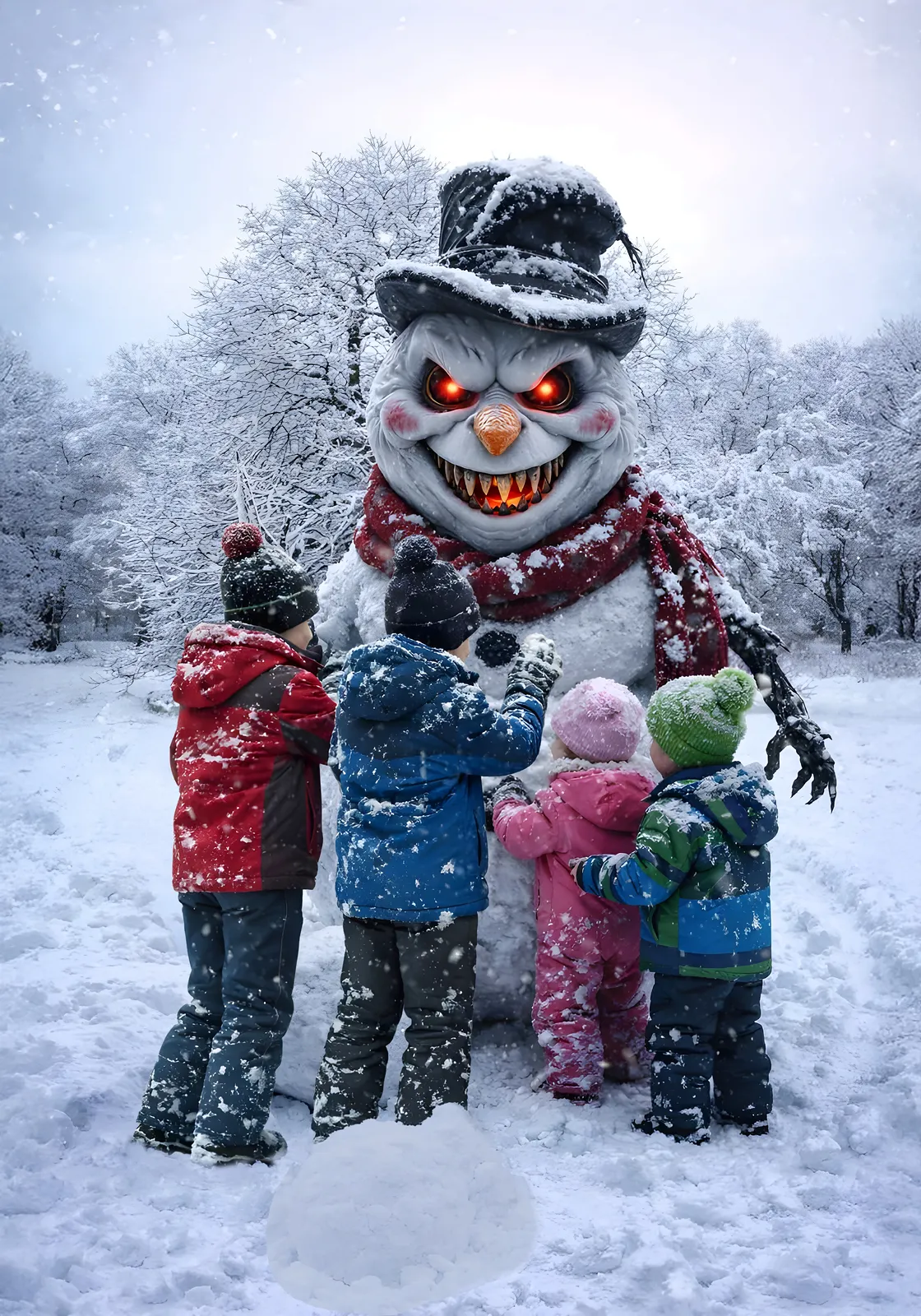
The Snowman 2.0 – The Monster We Built, 2026
Digital
50 x 70 cm
3 200 kr
The Snowman 2.0 – The Monster We Built
"From Carrots to Claws
Once snowmen stood with crooked pride,
With carrot noses, coal for eyes,
Straw hair beneath a borrowed hat,
And smiles too kind ever to bite.
They leaned like jokes against the cold,
Too weak to scare, too soft to hold,
Built only to melt, to bow, to fall,
To teach us that winter can be small.
Their arms were sticks, their hearts were light,
They waved goodbye each fading night,
And when they sank into the ground,
No shadow stayed, no trace was found.
But winters learned another tone,
And children learned from worlds unknown.
The screens grew loud, the stories sharp,
The gentle grin became a mark.
Now snowmen rise with a heavier stare,
With burning eyes and teeth to spare,
No carrot nose, no humble face,
But sculpted strength that claims its place.
They do not lean. They do not plead.
They stand like something built to lead.
They do not melt in friendly shame,
They dare the sun to know their name.
No child intends to build a beast,
They only build what feels increased.
What looks alive. What looks complete.
What will not vanish at their feet.
From coal to fire, from straw to bone,
From winter’s joke to winter’s throne,
The snowman changed, not out of hate,
But out of what we taught, what was great?
And still the snow is just the same,
Still soft, still white, still free of blame,
But what we roll into its skin
Is where the monster enters in.
So here he stands, both child and sign,
Both frost and mirror, yours and mine,
From carrot smiles to sharpened art,
The snowman learned our hidden heart.
And when he melts, as all things do,
The question will remain with you:
Did winter change — or did we teach
The snow how far it may reach?"
Malmö, January 2026
The Snowman 2.0 – The Innocent Beginning
At first glance, it is only a winter scene in Slottsparken, in the heart of Malmö. Snow rests on the trees; the ground is a pale white, almost blinding field; and children in colourful jackets stand close together around a snowman they have just finished building. Their bodies lean forward with the quiet concentration that only children possess, that sacred seriousness reserved for play. The park, usually full of joggers, dogs, strollers, and passing lives, has been transformed into a white stage where something simple appears to be taking place.
But the snowman's face does not just appear; it demands attention, inviting the audience to interpret its symbolism and societal meaning, highlighting how societal fears influence perception and fostering empathy for these underlying tensions. This approach helps the audience connect emotionally with the deeper societal messages embedded in children's play.
Its eyes burn. Its mouth holds too many teeth. Its face does not belong to winter folklore, but to something older, darker, and unmistakably contemporary. Yet, the children do not recoil. They do not step back. They see only what they have made: a creation, a success, a proud result of teamwork, cold fingers, and heavy snowballs rolled across the park. The tracks at their feet still reveal the process, the choreography of innocent labour. Nothing here suggests fear. Everything suggests pride.
This is the first truth of the image: the monster is not imposed. It is constructed. Not by violence, not by hatred, but by play.
Once, a snowman was a joke against winter. A harmless rebellion made of frost and laughter. He had a crooked carrot nose, coal eyes that could never threaten, straw hair borrowed from a barn, and a hat that seemed to belong to a grandfather. He was doomed to melt, and everyone knew it. That knowledge was part of his charm. He existed only to remind us that winter could be mocked.
He is a symbol of transformation, no longer inherited but invented, inspiring the audience to reflect on how childhood perceptions mirror societal fears and cultural shifts, and perhaps that is the most unsettling detail of all: they did not break the snowman; they improved him. They gave him strength, presence, and a face that would not disappear quietly.
The children who built him did not intend to make a monster; they aimed for something exciting and impressive, revealing how childhood perceptions mirror societal fears and cultural shifts, and perhaps that is the most unsettling detail of all: they did not break the snowman; they improved him. They gave him strength, presence, and a face that would not disappear quietly.
In this moment, innocence and imagination meet a world they cannot yet name. The children do not know the languages of war, politics, climate collapse, or media noise, but they know intensity. They know contrast. They know that stronger expressions feel more alive. And so the snowman grows teeth.
He is not evil in their eyes. He is only more interesting.
We recognise the shapes of monsters long before children learn the word, which should evoke empathy for how societal fears, such as media portrayals or political tensions, silently influence perception and contribute to the creation of tension in childhood imagination.
The snowman stands in Slottsparken as a bridge between two worlds: the world of those who create without guilt and the world of those who interpret with experience, fostering respect and curiosity about childhood perception and societal influence. This framing invites the audience to appreciate the complexity of children's symbolic expressions.
This is not a story about children who built a monster. It is a story about a world that taught them how.
When the Snowman Changed His Face
There was a time when a snowman was not allowed to frighten anyone, serving only to soften winter and evoke innocence, with a simple carrot nose and coal eyes, embodying mercy and playfulness.
The traditional snowman never looked back at us. He never judged. He never demanded. He existed only to melt and be forgotten, and in that forgetting there was comfort. Winter could be endured because it would not last. Even its symbols were fragile.
But somewhere along the way, the snowman learned to stare.
He began to gain weight. His eyes sharpened. His smile widened beyond friendliness. He stopped leaning and started standing. He no longer belonged to farms and courtyards, but to cities, screens, and imaginations trained by intensity. He was no longer built only to disappear. He was built to remain in memory.
The snowman in Slottsparken carries none of the old humility. He does not apologise for his size. He does not ask permission to exist. He does not promise to melt quietly. His face announces itself. He is no longer a seasonal joke. He is a character. A presence. Almost a personality.
This is not because children have become cruel. It is because the world around them became louder.
Children do not invent monsters in isolation; they absorb them from films, games, headlines, and screens, processes rooted in developmental psychology that illustrate how societal fears shape children's perceptions and imagination.
The snowman becomes an echo of that lesson.
He is built with excitement, not with hatred. But excitement, shaped by societal fears and media influence, is enough to change a face. What once was comic becomes impressive. What once was weak becomes boring. What once was harmless becomes forgettable. And the snowman, wanting to survive in the collective imagination, evolves accordingly.
This is how innocence does not disappear. It adapts.
The old snowman was a creature of patience. The new one is a creature of attention. He competes with dragons, superheroes, villains, and machines. He must look stronger to be seen at all. He must look dangerous to remain interesting. He must look unforgettable to avoid being replaced.
In Slottsparken, children unknowingly enact a subtle form of cultural evolution, shaping a snow figure that reflects not just winter but societal expectations and change.
The snowman no longer belongs to folklore. He belongs to feedback.
And we stand before him not because he frightens us, but because he recognises us.
The Children’s Archive
If adults write history, children illustrate its atmosphere. Their drawings are not records of events, but of pressure. Not of facts, but of feelings. A child rarely draws a political leader, a war, or a treaty. A child draws a house that is burning, a figure without hands, a sky that is too dark, a sun that watches instead of warming. They do not reproduce the world as it is described to them. They reproduce the world as it settles inside them.
For centuries, children’s drawings were filled with proximity. Families stood together. Houses had windows that smiled. Trees were generous. The sun almost always appeared in the corner, patient and kind. Even storms were decorative. Even fear had round edges. But slowly the paper changed. Figures began to stand farther apart. Faces lost mouths. Arms stretched without touching. Colours grew heavier. Red stopped meaning flowers and began meaning alarms. Black was no longer a border; it became a field. Blue became colder. Yellow became sharper. The sun remained, but it began to look less confident.
This was not a sudden revolution. It was a quiet migration. Children did not decide to draw differently. They responded. They responded to images on screens that arrived before explanations. To words they did not fully understand but fully felt. To adults who spoke about danger in lowered voices. To rooms where news was always on, even when nobody was watching. To a world that learned to whisper catastrophe in ordinary tones.
Children are not protected from time. They are not given language for it yet. And so they translate it into form. They draw towers that lean, faces that stare, figures that float without ground, monsters that are not hunted, only observed. They draw power from size, fear from distance, safety from disappearance.
In this sense, children’s drawings are not naïve. They are precise. They do not interpret history. They register it. The snowman in Slottsparken belongs to this archive. He is not a toy. He is a symptom. He stands in snow the way specific figures stand in drawings: too solid, too central, too aware. He does not attack. He does not move. He occupies. And in that occupation, he mirrors the silent lesson of our time: that presence itself can be intimidating.
Children did not give him teeth because they wanted to frighten us. They gave him teeth because teeth mean impact. They mean that something matters. They suggest that something cannot be ignored. The snowman’s face is therefore not cruel. It is efficient. And that is perhaps the most honest detail of all. Children do not yet think in moral terms. They believe in intensity. They believe in visibility. They feel in the survival of attention.
They build what will not disappear. And when we look at their creations and feel uneasy, it is not because children have changed. It is because the world has. Their drawings, their monsters, their snowmen are not warnings. They are mirrors. Not of what children fear, but of what they have learned, is essential. And in that learning, innocence does not vanish. It simply begins to speak another dialect.
Who the Image Belongs To
Every image has two owners: the one who creates it, and the one who understands it. Between those two, meaning is born.
The children in Slottsparken hold the snowman. They rolled the snow, pressed the surfaces, shaped the mouth, and placed the eyes. Their ownership is physical, immediate, and unquestioning. The snowman belongs to their effort, to their cold fingers, to their laughter and exhaustion. For them, he is not a symbol. He is a result.
We, who look at him later, own him differently. We do not own his weight or his texture. We own his interpretation. We bring history to him. We bring language, fear, memory, and comparison. We bring Munch, Turner, wars, headlines, climate, screens, politics, and exhaustion. We carry all the things children have not yet learned to name. And in doing so, we turn a figure of play into a figure of meaning.
This difference is not a failure of innocence. It is the structure of time.
Children create without metaphor. Adults see only through it.
The snowman, therefore, exists in a narrow passage between two worlds. On the one hand, he is a winter performer. On the other hand, he is a cultural reflection. He is both harmless and heavy. Both temporary and enduring. Both joke and document. And neither side is wrong.
The image belongs to the children because they made it. It belongs to us because we cannot stop reading it.
This is why the snowman does not accuse. He does not protest. He does not explain. He stands, allowing both worlds to project themselves onto him. He is strong enough to carry both innocence and responsibility without collapsing into either.
In that sense, the snowman is not a monster because he is frightening. He is a monster because he is composite. He is built from many small intentions that together form something none of them fully foresaw. That is how all cultural monsters are born, not from evil, but from accumulation.
We often say that children are the future. But in their images, they are already the present. They show us not what will come, but what has already arrived quietly. Their drawings do not predict disaster. They confirm the atmosphere.
The snowman in Slottsparken does not belong to winter. He belongs to this moment in history. And yet, he will melt. His body will soften. His teeth will collapse. His eyes will fall into the snow. And the children will walk away without grief, because for them, nothing essential was lost.
But for us, something remains.
Not in the snow. But in the image we carry with us when we leave.
The Snowman We Remember
When we think of the old snowman, we are not really thinking of snow. We are thinking of ourselves as we once were. The carrot nose, the coal eyes, the crooked mouth, the straw hair beneath a borrowed hat — these details did not belong to winter as much as they belonged to a memory of harmlessness. The old snowman carried no ambition. He did not want to be impressive. He did not want to be remembered. He wanted only to exist briefly and then disappear without consequence.
He leaned because he could. He looked foolish because there was no danger in doing so. His body was unstable, his posture uncertain, his future already decided by temperature. He promised nothing and threatened nothing. He was built to melt, and in that melting, there was comfort. He reassured us that even what we created would not last long enough to demand responsibility.
The old snowman belonged to a time when fragility was still allowed to be gentle, when disappearance was not a failure. When symbols were permitted to be temporary, he was not designed to survive imagination. He was intended to be forgotten with kindness.
The Snowman 2.0 belongs to a different condition. He is not built for vanishing. He is built for impression. He is constructed to remain in images, in memory, in conversation. He is not part of a season but part of a narrative. He no longer belongs to nature’s cycle but to attention’s economy.
When we miss the old snowman, we are not longing for carrots and coal. We are longing for a world in which even our metaphors were light. A world where nothing is asked to stay. A world where winter itself did not pretend to be permanent.
Yet it would not be very ethical to believe that the past was kinder. Wars burned then as they do now. Injustice ruled then as it does now. The difference is not that fear was absent, but that it was less visible. It did not sit in every room. It did not speak through every screen. It did not interrupt every silence.
Today, nothing hides easily. Even winter learns to speak loudly.
So when children in Slottsparken build their snowman, they are not betraying tradition. They are continuing it under different conditions. They are still shaping snow into meaning. They are still negotiating with the cold. They are still practising creation. Only the vocabulary has changed.
The old snowman said, without words, that winter would pass. The new one says that winter must be understood.
And perhaps that is the quiet honesty of Snowman 2.0.
No politics
It is essential to understand what the snowman is not. His face is not a caricature of Putin or Trump, any more than children during the Second World War gave their snowmen Hitler’s moustache. Children do not work with satire. They do not build political portraits. They build atmospheres. Their imagination does not attack individuals; it absorbs climates.
Psychological studies of children’s drawings in times of war, crisis, and uncertainty show this with striking clarity. Children rarely reproduce concrete leaders or specific events. Instead, they translate pressure into form. Power becomes size. Fear becomes distance. Authority becomes eyes that stare. Violence becomes teeth. Anxiety becomes a posture.
The snowman’s face, therefore, does not mock anyone. It does not accuse any leader. It reflects a collective emotional weather. It is not a portrait of a man, but of a mood. Not a political statement, but a psychological registration.
That is why the snowman feels contemporary without being topical. He does not belong to a headline. He belongs to a sensation. He carries no name, and precisely for that reason, he holds many.
Children do not personalise fear. They monumentalise it.
And this is what separates their creations from propaganda or parody. The snowman is not a joke at someone’s expense. He is an honest construction of how strength, danger, and presence have been taught to look. He is not a message. He is a mirror.
In that sense, Snowman 2.0 is not mocking power. He is revealing how power feels when it has already entered the imagination of those who do not yet understand it.
The Monster We Built
When we say that the snowman is the monster we built, we usually imagine guilt. But guilt is too simple. Monsters are rarely born from intention. They are born from agreement. From habits that slowly become structures. From small choices that seem harmless until they begin to look back at us.
The children in Slottsparken did not build a monster because they wished for one. They built what felt alive, what felt strong, what felt worth finishing. Their snowman is not an accusation. He is a consequence. He stands there not as a verdict, but as a summary.
We taught children that visibility is power. That size is protection. That intensity is survival. That presence must compete. That silence disappears. And so they shaped snow accordingly. They did not imitate cruelty. They imitate relevance.
The monster, then, is not the snowman. The beast is the system of attention that taught him how to look.
When we look at him and feel uneasy, we often look for someone to blame. But blame does not belong to children, nor to snow, nor even to the image. It belongs to the invisible grammar of our time. The way fear is normalised. The way conflict is aestheticised. The way strength is mistaken for safety.
The snowman stands in Slottsparken as a polite reminder that innocence does not disappear. It transforms. It learns the language of its surroundings. It absorbs tone before it understands content. It repeats the rhythm before it understands the meaning.
And so the monster we built is not an enemy. He is a messenger we did not ask for but cannot silence.
He tells us that children are not copying our world. They are completing it.
And in that completion, the responsibility quietly shifts.
Not to those who rolled the snow.
But to those who shaped the weather.
Epilogue: After the Snow
When spring comes to Slottsparken, the snowman will not protest. He will soften. His teeth will lose their shape. His eyes will sink back into the white. His body will quietly return to the ground from which it was borrowed. The children will not mourn him. They will already be building something else.
That is how innocence survives, not by holding on, but by moving on.
But we will remember him. Not because he frightened us, and not because he accused us, but because he revealed something we rarely allow ourselves to see: how gently a culture enters imagination, and how faithfully imagination returns it in another form. The snowman did not speak of leaders, wars, or headlines. He talked of atmosphere. He spoke of what strength, danger, and presence have begun to look like to those who are still learning how the world works.
The monster we built was therefore never a monster in the children’s hands. He became one only in our eyes, because we recognised ourselves in his posture. We recognised our language in his face. We recognised our time in his silence.
And perhaps that is the final responsibility of art: not to accuse, not to explain, not to comfort, but to hold up a shape long enough for us to understand what we have already placed inside it.
The snowman will melt. The image will remain. And in that quiet difference between what disappears and what stays, we may finally understand that innocence does not vanish when it changes. It simply learns to speak in snow.
And we, who once built harmless figures with carrot noses and coal eyes, now stand before Snowman 2.0 not as judges, but as witnesses. Witnesses to a world that no longer teaches its children how to mock winter, but how to survive it.
The snowman is gone. The season continues. And the question he leaves behind is not what the children built, but what we allowed them to imagine.
The old snowman told us that winter would pass. The new one tells us that winter must be read.
And perhaps that is the final discomfort of the image. Not that children can build monsters, but that they can do so without fear, without intention, and without knowing that anything has changed.
They will grow up. They will learn names, causes, histories, and responsibilities. But the snowman will already have done his work. He will have shown us, briefly and honestly, how our world feels before it learns how to speak.
That is why he matters.
Not because he frightened us, but because he did not mean to.
Jörgen Thornberg
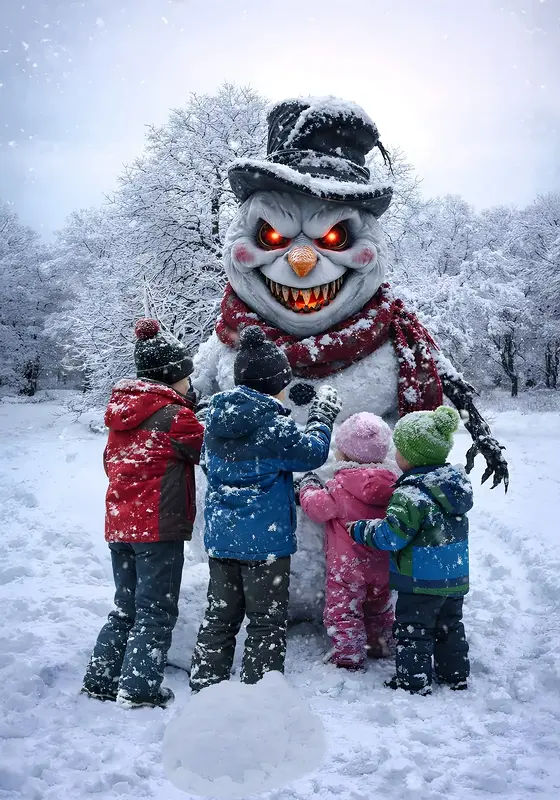
The Snowman 2.0 – The Monster We Built, 2026
Digital
50 x 70 cm
3 200 kr
The Snowman 2.0 – The Monster We Built
"From Carrots to Claws
Once snowmen stood with crooked pride,
With carrot noses, coal for eyes,
Straw hair beneath a borrowed hat,
And smiles too kind ever to bite.
They leaned like jokes against the cold,
Too weak to scare, too soft to hold,
Built only to melt, to bow, to fall,
To teach us that winter can be small.
Their arms were sticks, their hearts were light,
They waved goodbye each fading night,
And when they sank into the ground,
No shadow stayed, no trace was found.
But winters learned another tone,
And children learned from worlds unknown.
The screens grew loud, the stories sharp,
The gentle grin became a mark.
Now snowmen rise with a heavier stare,
With burning eyes and teeth to spare,
No carrot nose, no humble face,
But sculpted strength that claims its place.
They do not lean. They do not plead.
They stand like something built to lead.
They do not melt in friendly shame,
They dare the sun to know their name.
No child intends to build a beast,
They only build what feels increased.
What looks alive. What looks complete.
What will not vanish at their feet.
From coal to fire, from straw to bone,
From winter’s joke to winter’s throne,
The snowman changed, not out of hate,
But out of what we taught, what was great?
And still the snow is just the same,
Still soft, still white, still free of blame,
But what we roll into its skin
Is where the monster enters in.
So here he stands, both child and sign,
Both frost and mirror, yours and mine,
From carrot smiles to sharpened art,
The snowman learned our hidden heart.
And when he melts, as all things do,
The question will remain with you:
Did winter change — or did we teach
The snow how far it may reach?"
Malmö, January 2026
The Snowman 2.0 – The Innocent Beginning
At first glance, it is only a winter scene in Slottsparken, in the heart of Malmö. Snow rests on the trees; the ground is a pale white, almost blinding field; and children in colourful jackets stand close together around a snowman they have just finished building. Their bodies lean forward with the quiet concentration that only children possess, that sacred seriousness reserved for play. The park, usually full of joggers, dogs, strollers, and passing lives, has been transformed into a white stage where something simple appears to be taking place.
But the snowman's face does not just appear; it demands attention, inviting the audience to interpret its symbolism and societal meaning, highlighting how societal fears influence perception and fostering empathy for these underlying tensions. This approach helps the audience connect emotionally with the deeper societal messages embedded in children's play.
Its eyes burn. Its mouth holds too many teeth. Its face does not belong to winter folklore, but to something older, darker, and unmistakably contemporary. Yet, the children do not recoil. They do not step back. They see only what they have made: a creation, a success, a proud result of teamwork, cold fingers, and heavy snowballs rolled across the park. The tracks at their feet still reveal the process, the choreography of innocent labour. Nothing here suggests fear. Everything suggests pride.
This is the first truth of the image: the monster is not imposed. It is constructed. Not by violence, not by hatred, but by play.
Once, a snowman was a joke against winter. A harmless rebellion made of frost and laughter. He had a crooked carrot nose, coal eyes that could never threaten, straw hair borrowed from a barn, and a hat that seemed to belong to a grandfather. He was doomed to melt, and everyone knew it. That knowledge was part of his charm. He existed only to remind us that winter could be mocked.
He is a symbol of transformation, no longer inherited but invented, inspiring the audience to reflect on how childhood perceptions mirror societal fears and cultural shifts, and perhaps that is the most unsettling detail of all: they did not break the snowman; they improved him. They gave him strength, presence, and a face that would not disappear quietly.
The children who built him did not intend to make a monster; they aimed for something exciting and impressive, revealing how childhood perceptions mirror societal fears and cultural shifts, and perhaps that is the most unsettling detail of all: they did not break the snowman; they improved him. They gave him strength, presence, and a face that would not disappear quietly.
In this moment, innocence and imagination meet a world they cannot yet name. The children do not know the languages of war, politics, climate collapse, or media noise, but they know intensity. They know contrast. They know that stronger expressions feel more alive. And so the snowman grows teeth.
He is not evil in their eyes. He is only more interesting.
We recognise the shapes of monsters long before children learn the word, which should evoke empathy for how societal fears, such as media portrayals or political tensions, silently influence perception and contribute to the creation of tension in childhood imagination.
The snowman stands in Slottsparken as a bridge between two worlds: the world of those who create without guilt and the world of those who interpret with experience, fostering respect and curiosity about childhood perception and societal influence. This framing invites the audience to appreciate the complexity of children's symbolic expressions.
This is not a story about children who built a monster. It is a story about a world that taught them how.
When the Snowman Changed His Face
There was a time when a snowman was not allowed to frighten anyone, serving only to soften winter and evoke innocence, with a simple carrot nose and coal eyes, embodying mercy and playfulness.
The traditional snowman never looked back at us. He never judged. He never demanded. He existed only to melt and be forgotten, and in that forgetting there was comfort. Winter could be endured because it would not last. Even its symbols were fragile.
But somewhere along the way, the snowman learned to stare.
He began to gain weight. His eyes sharpened. His smile widened beyond friendliness. He stopped leaning and started standing. He no longer belonged to farms and courtyards, but to cities, screens, and imaginations trained by intensity. He was no longer built only to disappear. He was built to remain in memory.
The snowman in Slottsparken carries none of the old humility. He does not apologise for his size. He does not ask permission to exist. He does not promise to melt quietly. His face announces itself. He is no longer a seasonal joke. He is a character. A presence. Almost a personality.
This is not because children have become cruel. It is because the world around them became louder.
Children do not invent monsters in isolation; they absorb them from films, games, headlines, and screens, processes rooted in developmental psychology that illustrate how societal fears shape children's perceptions and imagination.
The snowman becomes an echo of that lesson.
He is built with excitement, not with hatred. But excitement, shaped by societal fears and media influence, is enough to change a face. What once was comic becomes impressive. What once was weak becomes boring. What once was harmless becomes forgettable. And the snowman, wanting to survive in the collective imagination, evolves accordingly.
This is how innocence does not disappear. It adapts.
The old snowman was a creature of patience. The new one is a creature of attention. He competes with dragons, superheroes, villains, and machines. He must look stronger to be seen at all. He must look dangerous to remain interesting. He must look unforgettable to avoid being replaced.
In Slottsparken, children unknowingly enact a subtle form of cultural evolution, shaping a snow figure that reflects not just winter but societal expectations and change.
The snowman no longer belongs to folklore. He belongs to feedback.
And we stand before him not because he frightens us, but because he recognises us.
The Children’s Archive
If adults write history, children illustrate its atmosphere. Their drawings are not records of events, but of pressure. Not of facts, but of feelings. A child rarely draws a political leader, a war, or a treaty. A child draws a house that is burning, a figure without hands, a sky that is too dark, a sun that watches instead of warming. They do not reproduce the world as it is described to them. They reproduce the world as it settles inside them.
For centuries, children’s drawings were filled with proximity. Families stood together. Houses had windows that smiled. Trees were generous. The sun almost always appeared in the corner, patient and kind. Even storms were decorative. Even fear had round edges. But slowly the paper changed. Figures began to stand farther apart. Faces lost mouths. Arms stretched without touching. Colours grew heavier. Red stopped meaning flowers and began meaning alarms. Black was no longer a border; it became a field. Blue became colder. Yellow became sharper. The sun remained, but it began to look less confident.
This was not a sudden revolution. It was a quiet migration. Children did not decide to draw differently. They responded. They responded to images on screens that arrived before explanations. To words they did not fully understand but fully felt. To adults who spoke about danger in lowered voices. To rooms where news was always on, even when nobody was watching. To a world that learned to whisper catastrophe in ordinary tones.
Children are not protected from time. They are not given language for it yet. And so they translate it into form. They draw towers that lean, faces that stare, figures that float without ground, monsters that are not hunted, only observed. They draw power from size, fear from distance, safety from disappearance.
In this sense, children’s drawings are not naïve. They are precise. They do not interpret history. They register it. The snowman in Slottsparken belongs to this archive. He is not a toy. He is a symptom. He stands in snow the way specific figures stand in drawings: too solid, too central, too aware. He does not attack. He does not move. He occupies. And in that occupation, he mirrors the silent lesson of our time: that presence itself can be intimidating.
Children did not give him teeth because they wanted to frighten us. They gave him teeth because teeth mean impact. They mean that something matters. They suggest that something cannot be ignored. The snowman’s face is therefore not cruel. It is efficient. And that is perhaps the most honest detail of all. Children do not yet think in moral terms. They believe in intensity. They believe in visibility. They feel in the survival of attention.
They build what will not disappear. And when we look at their creations and feel uneasy, it is not because children have changed. It is because the world has. Their drawings, their monsters, their snowmen are not warnings. They are mirrors. Not of what children fear, but of what they have learned, is essential. And in that learning, innocence does not vanish. It simply begins to speak another dialect.
Who the Image Belongs To
Every image has two owners: the one who creates it, and the one who understands it. Between those two, meaning is born.
The children in Slottsparken hold the snowman. They rolled the snow, pressed the surfaces, shaped the mouth, and placed the eyes. Their ownership is physical, immediate, and unquestioning. The snowman belongs to their effort, to their cold fingers, to their laughter and exhaustion. For them, he is not a symbol. He is a result.
We, who look at him later, own him differently. We do not own his weight or his texture. We own his interpretation. We bring history to him. We bring language, fear, memory, and comparison. We bring Munch, Turner, wars, headlines, climate, screens, politics, and exhaustion. We carry all the things children have not yet learned to name. And in doing so, we turn a figure of play into a figure of meaning.
This difference is not a failure of innocence. It is the structure of time.
Children create without metaphor. Adults see only through it.
The snowman, therefore, exists in a narrow passage between two worlds. On the one hand, he is a winter performer. On the other hand, he is a cultural reflection. He is both harmless and heavy. Both temporary and enduring. Both joke and document. And neither side is wrong.
The image belongs to the children because they made it. It belongs to us because we cannot stop reading it.
This is why the snowman does not accuse. He does not protest. He does not explain. He stands, allowing both worlds to project themselves onto him. He is strong enough to carry both innocence and responsibility without collapsing into either.
In that sense, the snowman is not a monster because he is frightening. He is a monster because he is composite. He is built from many small intentions that together form something none of them fully foresaw. That is how all cultural monsters are born, not from evil, but from accumulation.
We often say that children are the future. But in their images, they are already the present. They show us not what will come, but what has already arrived quietly. Their drawings do not predict disaster. They confirm the atmosphere.
The snowman in Slottsparken does not belong to winter. He belongs to this moment in history. And yet, he will melt. His body will soften. His teeth will collapse. His eyes will fall into the snow. And the children will walk away without grief, because for them, nothing essential was lost.
But for us, something remains.
Not in the snow. But in the image we carry with us when we leave.
The Snowman We Remember
When we think of the old snowman, we are not really thinking of snow. We are thinking of ourselves as we once were. The carrot nose, the coal eyes, the crooked mouth, the straw hair beneath a borrowed hat — these details did not belong to winter as much as they belonged to a memory of harmlessness. The old snowman carried no ambition. He did not want to be impressive. He did not want to be remembered. He wanted only to exist briefly and then disappear without consequence.
He leaned because he could. He looked foolish because there was no danger in doing so. His body was unstable, his posture uncertain, his future already decided by temperature. He promised nothing and threatened nothing. He was built to melt, and in that melting, there was comfort. He reassured us that even what we created would not last long enough to demand responsibility.
The old snowman belonged to a time when fragility was still allowed to be gentle, when disappearance was not a failure. When symbols were permitted to be temporary, he was not designed to survive imagination. He was intended to be forgotten with kindness.
The Snowman 2.0 belongs to a different condition. He is not built for vanishing. He is built for impression. He is constructed to remain in images, in memory, in conversation. He is not part of a season but part of a narrative. He no longer belongs to nature’s cycle but to attention’s economy.
When we miss the old snowman, we are not longing for carrots and coal. We are longing for a world in which even our metaphors were light. A world where nothing is asked to stay. A world where winter itself did not pretend to be permanent.
Yet it would not be very ethical to believe that the past was kinder. Wars burned then as they do now. Injustice ruled then as it does now. The difference is not that fear was absent, but that it was less visible. It did not sit in every room. It did not speak through every screen. It did not interrupt every silence.
Today, nothing hides easily. Even winter learns to speak loudly.
So when children in Slottsparken build their snowman, they are not betraying tradition. They are continuing it under different conditions. They are still shaping snow into meaning. They are still negotiating with the cold. They are still practising creation. Only the vocabulary has changed.
The old snowman said, without words, that winter would pass. The new one says that winter must be understood.
And perhaps that is the quiet honesty of Snowman 2.0.
No politics
It is essential to understand what the snowman is not. His face is not a caricature of Putin or Trump, any more than children during the Second World War gave their snowmen Hitler’s moustache. Children do not work with satire. They do not build political portraits. They build atmospheres. Their imagination does not attack individuals; it absorbs climates.
Psychological studies of children’s drawings in times of war, crisis, and uncertainty show this with striking clarity. Children rarely reproduce concrete leaders or specific events. Instead, they translate pressure into form. Power becomes size. Fear becomes distance. Authority becomes eyes that stare. Violence becomes teeth. Anxiety becomes a posture.
The snowman’s face, therefore, does not mock anyone. It does not accuse any leader. It reflects a collective emotional weather. It is not a portrait of a man, but of a mood. Not a political statement, but a psychological registration.
That is why the snowman feels contemporary without being topical. He does not belong to a headline. He belongs to a sensation. He carries no name, and precisely for that reason, he holds many.
Children do not personalise fear. They monumentalise it.
And this is what separates their creations from propaganda or parody. The snowman is not a joke at someone’s expense. He is an honest construction of how strength, danger, and presence have been taught to look. He is not a message. He is a mirror.
In that sense, Snowman 2.0 is not mocking power. He is revealing how power feels when it has already entered the imagination of those who do not yet understand it.
The Monster We Built
When we say that the snowman is the monster we built, we usually imagine guilt. But guilt is too simple. Monsters are rarely born from intention. They are born from agreement. From habits that slowly become structures. From small choices that seem harmless until they begin to look back at us.
The children in Slottsparken did not build a monster because they wished for one. They built what felt alive, what felt strong, what felt worth finishing. Their snowman is not an accusation. He is a consequence. He stands there not as a verdict, but as a summary.
We taught children that visibility is power. That size is protection. That intensity is survival. That presence must compete. That silence disappears. And so they shaped snow accordingly. They did not imitate cruelty. They imitate relevance.
The monster, then, is not the snowman. The beast is the system of attention that taught him how to look.
When we look at him and feel uneasy, we often look for someone to blame. But blame does not belong to children, nor to snow, nor even to the image. It belongs to the invisible grammar of our time. The way fear is normalised. The way conflict is aestheticised. The way strength is mistaken for safety.
The snowman stands in Slottsparken as a polite reminder that innocence does not disappear. It transforms. It learns the language of its surroundings. It absorbs tone before it understands content. It repeats the rhythm before it understands the meaning.
And so the monster we built is not an enemy. He is a messenger we did not ask for but cannot silence.
He tells us that children are not copying our world. They are completing it.
And in that completion, the responsibility quietly shifts.
Not to those who rolled the snow.
But to those who shaped the weather.
Epilogue: After the Snow
When spring comes to Slottsparken, the snowman will not protest. He will soften. His teeth will lose their shape. His eyes will sink back into the white. His body will quietly return to the ground from which it was borrowed. The children will not mourn him. They will already be building something else.
That is how innocence survives, not by holding on, but by moving on.
But we will remember him. Not because he frightened us, and not because he accused us, but because he revealed something we rarely allow ourselves to see: how gently a culture enters imagination, and how faithfully imagination returns it in another form. The snowman did not speak of leaders, wars, or headlines. He talked of atmosphere. He spoke of what strength, danger, and presence have begun to look like to those who are still learning how the world works.
The monster we built was therefore never a monster in the children’s hands. He became one only in our eyes, because we recognised ourselves in his posture. We recognised our language in his face. We recognised our time in his silence.
And perhaps that is the final responsibility of art: not to accuse, not to explain, not to comfort, but to hold up a shape long enough for us to understand what we have already placed inside it.
The snowman will melt. The image will remain. And in that quiet difference between what disappears and what stays, we may finally understand that innocence does not vanish when it changes. It simply learns to speak in snow.
And we, who once built harmless figures with carrot noses and coal eyes, now stand before Snowman 2.0 not as judges, but as witnesses. Witnesses to a world that no longer teaches its children how to mock winter, but how to survive it.
The snowman is gone. The season continues. And the question he leaves behind is not what the children built, but what we allowed them to imagine.
The old snowman told us that winter would pass. The new one tells us that winter must be read.
And perhaps that is the final discomfort of the image. Not that children can build monsters, but that they can do so without fear, without intention, and without knowing that anything has changed.
They will grow up. They will learn names, causes, histories, and responsibilities. But the snowman will already have done his work. He will have shown us, briefly and honestly, how our world feels before it learns how to speak.
That is why he matters.
Not because he frightened us, but because he did not mean to.
3 200 kr

Jörgen Thornberg
Malmö
Lite om bilder och mig. Translation in English at the end.
Jag är en nyfiken person som ser allt i bilder, även det jag fäster i ord, gärna tillsammans för bakom alla mina bilder finns en berättelse. Till vissa bilder hör en kortare eller längre novell som följer med bilden.
Bilder berättar historier. Jag omges av naturlig skönhet, intressanta människor och historia var jag än går. Jag använder min kamera för att dokumentera världen och blanda det jag ser med vad jag känner för att fånga den dolda magin.
Mina bilder berättar mina historier. Genom mina bilder, tryck och berättelser. Jag bjuder in dig att ta del av dessa berättelser, in i ditt liv och hem och dela min mycket personliga syn på vår värld. Mer än vad ögat ser. Jag tänker i bilder, drömmer och skriver och pratar om dem; följaktligen måste jag också skapa bilder. De blir vad jag ser, inte nödvändigtvis begränsade till verkligheten. Det finns en bild runt varje hörn. Jag hoppas att du kommer att se vad jag såg och gilla det.
Jag är också en skrivande person och till många bilder hör en kortare eller längre essay. Den följer med tavlan, tryckt på fint papper och med en personlig hälsning från mig.
Flertalet bilder startar sin resa i min kamera. Enkelt förklarat beskriver jag bilden jag ser i mitt inre, upplevd eller fantiserad. Bilden uppstår inom mig redan innan jag fått okularet till ögat. På bråkdelen av ett ögonblick ser jag vad jag vill ha och vad som kan göras med bilden. Här skall jag stoppa in en giraff, stålmannen, Titanic eller vad det är min fantasi finner ut. Ännu märkligare är att jag kommer ihåg minnesbilden långt efteråt när det blir tid att skapa verket. Om jag lyckas eller inte, är upp till betraktaren, oftast präglat av en stråk av svart humor – meningen är att man skall bli underhållen. Mina bilder blir ofta en snackis där de hänger.
Jag föredrar bilder som förmedlar ett budskap i flera lager. Vid första anblicken fylld av feel-good, en vacker utsikt, fint väder, solen skiner, blommor på ängen eller vattnet som ligger förrädiskt spegelblankt. I en sådan bild kan jag gömma min egentliga berättelse, mitt förakt för förtryckare och våldsverkare, rasister och fördomsfulla människor - ett gärna återkommande motiv mer eller mindre dolt i det vackra motivet. Jag försöker förena dem i ett gemensamt narrativ.
Bild och formgivning har löpt som en röd tråd genom livet. Fotokonst känns som en värdig final som jag gärna delar med mig.
Min genre är vid som framgår av mina bilder, temat en blandning av pop- och gatukonst i kollage som kan bestå av hundratals lager. Vissa bilder kan ta veckor, andra någon dag innan det är dags att överlämna resultatet till printverkstaden. Fine Art Prints är digitala fotocollage. I dessa kollage sker rivandet, klippandet, pusslandet, målandet, ritandet och sprayningen digitalt. Det jag monterar in kan vara hundratals år gamla bilder som jag omsorgsfullt frilägger så att de ser ut att vara en del av tavlan men också bilder skapade av mig själv efter min egen fantasi. Därefter besöks printstudion och för vissa bilder numrera en limiterad upplaga (oftast 7 exemplar) och signera för hand. Vissa bilder kan köpas i olika format. Det är bara att fråga efter vilka. Gillar man en bild som är 70x100 men inte har plats på väggen, går den kanske att få i 50x70 cm istället. Frågan är fri.
Metoden Giclée eller Fine Art Print som det också kallas är det moderna sättet för framställning av grafisk konst. Villkoret för denna typ av utskrifter är att en högkvalitativ storformatskrivare används med åldersbeständigt färgpigment och konstnärspapper eller i förekommande fall på duk. Pappret som används möter de krav på livslängd som ställs av museer och gallerier. Normalt säljer jag mina bilder oinramade så att den nya ägaren själv kan bestämma hur de skall se ut, med eller utan passepartout färg på ram, med eller utan glas etc..
Under många år ställde jag bara ut på nätet, i valda grupper och på min egen Facebooksida - https://www.facebook.com/jorgen.thornberg.9
Jag finns också på en egen hemsida som tyvärr inte alltid är uppdaterad – https://www.jth.life/ Där kan du också läsa en del av de berättelser som följer med bilden.
UTSTÄLLNINGAR
Luftkastellet, oktober 2022
Konst i Lund, november 2022
Luftkastellet, mars 2023
Engleson Galleri Caroli, april 2023
Hydra, Greece June 2023
Engleson Galleri Caroli, oktober 2023
Toppen, Höllviken december 2023
Luftkastellet, mars 2024
Torups Galleri, mars 2024
Venice, May 2024
Luftkastellet, oktober 2024
Konst i Advent, December 2024
Galleri Engleson, Caroli December 2024
Jäger & Jansson Galleri, april 2025
A bit about pictures and me.
I'm a curious person who sees everything in pictures, even what I express in words, often combining them, for behind all my pictures lies a story. These narratives, some as short as a single image and others as long as a novel, are the heart and soul of my work.
Pictures tell stories. Wherever I go, I'm surrounded by natural beauty, exciting people, and history. I use my camera to document the world and blend what I see with what I feel to capture the hidden magic.
My images tell my stories. Through my pictures, prints, and narratives, I invite you to partake in these stories in your life and home and share my deeply personal perspective of our world. More than meets the eye. I think in pictures, dream, write, and talk about them; consequently, I must create images too. They become what I see, not necessarily confined to reality. There's a picture around every corner. I hope you'll see what I saw and enjoy it.
I'm also a writer, and many images come with a shorter or longer essay. It accompanies the painting, printed on fine paper with my personal greeting.
Many pictures start their journey on my camera. Simply put, I describe the image I see in my mind, experienced or imagined. The image arises within me even before I bring the eyepiece to my eye. In a fraction of a moment, I see what I want and what can be done with the picture. Here, I'll insert a giraffe, Superman, the Titanic, or whatever my imagination conjures up. Even stranger is that I remember the mental image long after it's time to create the work. Whether I succeed is up to the observer, often imbued with a streak of black humour – the aim is to entertain. My pictures usually become a talking point wherever they hang.
I prefer pictures that convey a message in multiple layers. At first glance, they're filled with feel-good vibes, a beautiful view, lovely weather, the sun shining, flowers in the meadow, or the water lying deceptively calm. But beneath this surface beauty, I often conceal a deeper story, a narrative that challenges societal norms or explores the human condition. I invite you to delve into these hidden narratives and discover the layers of meaning within my work.
Picture and design have been a thread running through my life. Photographic art feels like a fitting finale, and I'm happy to share it.
My genre is varied, as seen in my pictures; the theme is a blend of pop and street art in collages that can consist of hundreds of layers. Some images can take weeks, others just a day before it's time to hand over the result to the print workshop. Fine Art Prints are digital photo collages. In these collages, tearing, cutting, puzzling, painting, drawing, and spraying happen digitally. What I insert can be images hundreds of years old that I carefully extract so they appear to be part of the painting, but also images created by myself, now also generated from my imagination. Next, visit the print studio and, for certain images, number a limited edition (usually 7 copies) and sign them by hand. Some images may be available in other formats. Just ask which ones. If you like an image that's 70x100 but doesn't have space on the wall, you might be able to get it in 50x70 cm instead. The question is open.
The Giclée method, or Fine Art Print as it's also called, is the modern way of producing graphic art. This method ensures the highest quality and longevity of the artwork, using a high-quality large-format printer with archival pigment inks and artist paper or, in some cases, canvas. The paper used meets the longevity requirements set by museums and galleries. I sell my pictures unframed, allowing the new owner to personalise their artwork, confident in the lasting value and quality of the piece.
For many years, I only exhibited online, in selected groups, and on my Facebook page - https://www.facebook.com/jorgen.thornberg.9. I also have my website, which unfortunately is not constantly updated - https://www.jth.life/. You can also read some of the stories accompanying the pictures there.
EXHIBITIONS
Luftkastellet, October 2022
Art in Lund, November 2022
Luftkastellet, March 2023
Engleson Gallery Caroli, April 2023
Hydra, Greece June 2023
Engleson Gallery Caroli, October 2023
Toppen, Höllviken December 2023
Luftkastellet, March 2024
Torup Gallery, March 2024
Venice, May 2024
UTSTÄLLNINGAR
Luftkastellet, oktober 2022
Konst i Lund, november 2022
Luftkastellet, mars 2023
Engleson Galleri Caroli, april 2023
Hydra, Greece June 2023
Engleson Galleri Caroli, oktober 2023
Toppen, Höllviken december 2023
Luftkastellet, mars 2024
Torups Galleri, mars 2024
Venice, May 2024
Luftkastellet, October 2024
Konst i Advent, December 2024
Galleri Engleson, Caroli December 2024
Jäger & Jansson Galleri, April 2025
Utbildning
Autodidakt
Medlem i konstnärsförening
Öppna Sinnen
Med i konstrunda
Konstrundan i Skåne
Utställningar
Luftkastellet, October 2022
Art in Lund, November 2022
Luftkastellet, March 2023
Engleson Gallery Caroli, April 2023
Hydra, Greece June 2023
Engleson Gallery Caroli, October 2023
Toppen, Höllviken December 2023
Luftkastellet, March 2024
Torup Gallery, March 2024
Venice, May 2024