Vi använder cookies för att ge dig bästa möjliga upplevelse. Välj vilka cookies du tillåter.
Läs mer i vår integritetspolicy
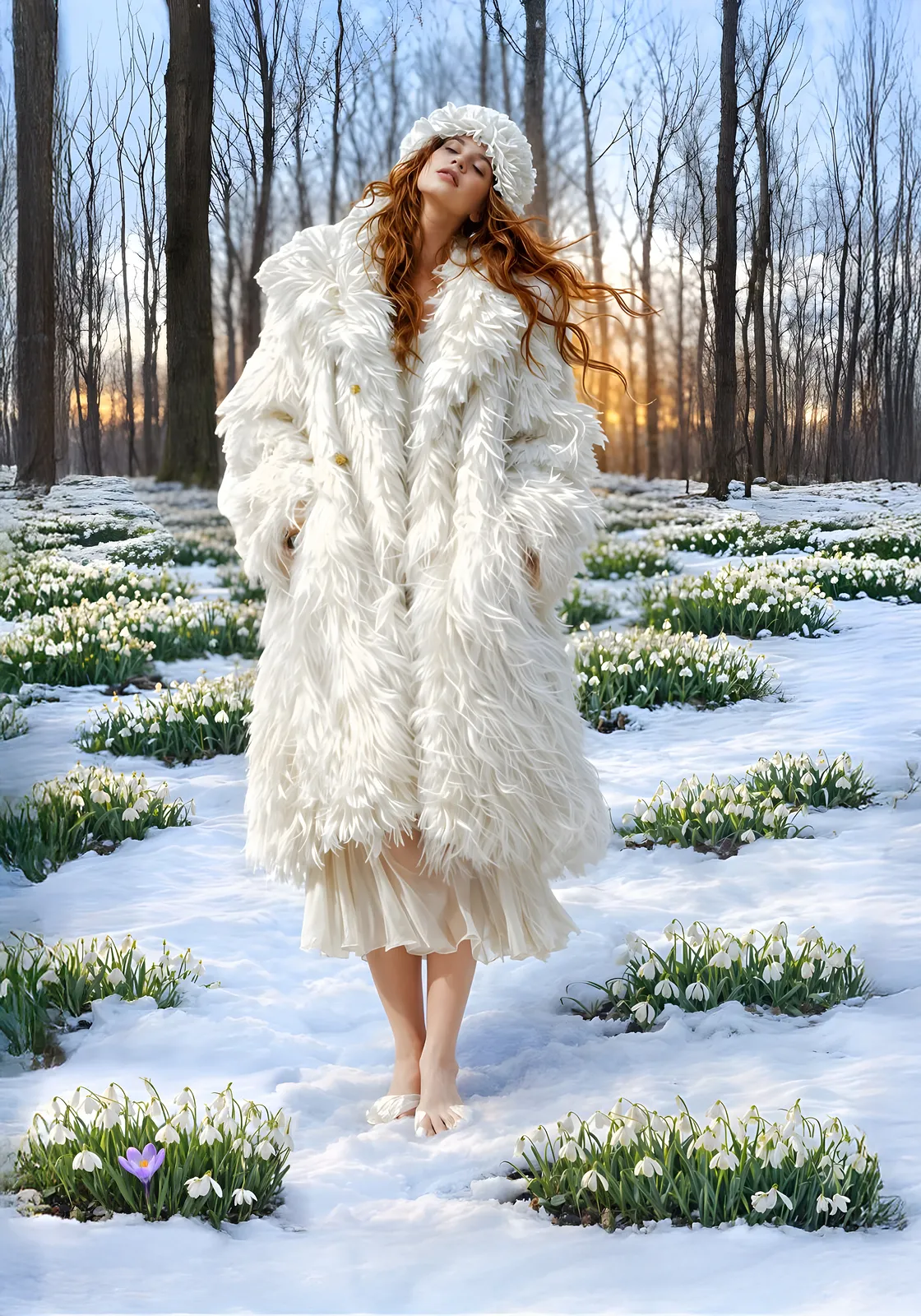
Jörgen Thornberg
The Snowdrop Queen - Barefoot Between Seasons, 2026
Digital
50 x 70 cm
30 200 kr
The Snowdrop Queen - Barefoot Between Seasons
"The Snowdrop Queen
She rose where winter still refused to go,
A barefoot queen in borrowed morning light;
The Snowdrop breathed within her fragile glow,
And taught the cold to loosen in her sight.
The earth still held its breath around her ground,
Yet she advanced, too tender to be brave;
The silent flowers listened to her sound,
As winter named her early for the grave.
She walked where seasons had not learned to be,
Her bare white steps upon the frost-bit feet;
The snow itself seemed suddenly to see
How loss and hope in her soft footsteps meet.
O Snowdrop Queen, you crown the space between,
Barefoot in time, our fragile in-between."
Malmö, January 2026
The Snowdrop Queen - Barefoot Between Seasons
It was winter. The air was sharp, the wind thin and biting, but beneath earth and snow all was still and sheltered. There the Flower lay — not yet a flower, only a thought folded into a bulb, waiting patiently for summer's promise to unfold. Rain trickled through the white blanket, down into the soil, until it touched the bulb like a quiet knock from another world. It spoke of light. Soon a sunbeam followed — slender, patient, persistent — boring its way through ice and darkness until it reached the Flower. 'Come in,' said the Flower.
"I cannot," replied the Sunbeam. "I am not yet strong enough. I will return in the summer."
"When will summer come?" asked the Flower, and it asked this every time a new sunbeam arrived. Yet it trusted that patience and time would bring the warmth it longed for, fostering calm strength and trust amid the cold and snow.
"How long does it last?" whispered the Flower. Something tingled within it — a restlessness, a longing that was almost a pain.
The Flower pressed against its thin shell, softened by rain, warmed by earth, and encouraged by light. It burst through the snow — pale and green, delicate and brave — lifting a small white bud on its slender stalk, its narrow leaves curled around it like folded arms. The snow was cold, but light now streamed into it. This moment of emergence reflects the quiet resilience that can inspire calm strength and patience in your readers.
"Welcome," sang the Sunbeams as they kissed the Flower, until it opened fully, white as snow and marked with soft green lines. It bowed its head, not from weakness but from humility.
"Beautiful Flower," sang the light. "You are the first. You are the only one. You are our promise." They told it of summer — of lilacs and laburnums and roses yet to come — but gently reminded it that it was first. The Flower trembled with joy. It felt the sunlight move through its leaves and stem like music. There it stood, fragile yet firm, in its white dress with green bands, praising a summer it had never seen, embodying hope and trust in new beginnings.
Then the wind came. "You have come too early," said Wind and Weather. "This is still our season." The cold returned. Days passed without sunlight. The Flower stood alone in the snow, showing vulnerability as it faced uncertainty.
"You will break," said the frost. "You will wither. Why did you come?" "The Sun deceived you," whispered the wind. "You are only a snowdrop — a summer fool." "Snowdrop," repeated the Flower softly to itself in the frozen morning. "Summer fool."
Then the children came into the garden. "A snowdrop!" they cried. "So sweet. So beautiful. The first. The only one." Their words were warmer than sunlight, and in its gladness, the Flower did not notice it was being picked. It lay in a child's hand, was kissed, carried into warmth, and placed in water. It felt as if summer had arrived all at once.
The girl who owned the hand had just been confirmed. She had a dear young friend. "He shall be my snowdrop," she said. She placed the Flower on scented paper with a poem — playful, teasing, tender in its mockery, beginning and ending with 'snowdrop'. Then the Flower was folded inside the paper. Darkness again, but now gentle. It travelled. It was pressed. It was shaken. At last, the letter was opened. The young man kissed the Flower and placed it in a drawer among letters. It was there too—the only Flower. Time passed. Summer passed. Winter passed. One summer, the drawer was opened again, this time with impatience. The letters were thrown aside. The poem was flung away. The Flower fell to the floor — flattened, pale, forgotten. What had happened? What always happens. She had chosen another.
Morning light touched the Flower on the floor. A maid found it and placed it inside a book. And so the Snowdrop lay again between verses — printed verses now, grander perhaps, but not kinder. Years passed. At last, the book was opened. "A snowdrop," said the reader. "With meaning." He spoke of the poet Ambrosius Stub — a snowdrop himself, too early, too tender, too fragile for his time, mocked, chilled, misunderstood. "A winter fool. A summer fool. And yet — the first." The Snowdrop was reverently placed back between the pages. It understood. Not as humans understand — but as flowers do. And that was enough.
And yet the story did not end in the book.
And yet the story did not end in the book. Now she stands where the Flower once stood. Barefoot in the snow, she rises with the same quiet insistence, her body carrying the memory of a gesture older than language. Her white coat is not a garment but an echo, her red hair the last remaining warmth the bulb once imagined before it knew it could exist. She walks as if she remembers being underground. As if her bones once pressed against frozen soil, waiting for light to become trustworthy. Her feet touch the snow not in defiance, but in recognition. She is not stepping into winter. She is stepping out of it, inspiring acceptance of new beginnings despite uncertainty.
Around her, the snowdrops bow in their small, gathered families, repeating in miniature what she now completes on a human scale. They are no longer only flowers. They are witnesses. She is not their Queen. She is their continuation. She does not conquer winter. She allows winter to release her. This quiet resilience aims to inspire feelings of calm strength and acceptance in your audience.
Her closed eyes do not belong to sleep, but to listening — to the echo of a voice that once said, "You are first," and to the colder voices that answered, "You are too early." She has learned that both can be true without cancelling each other out. She is what happens when belief grows tall enough to walk, when fragility learns posture. When the Snowdrop finally becomes human without losing its humility.
The snow still lies around her, but it no longer defines the scene. It frames it. Winter is no longer the story. She is. And if one looks closely, one can see that she is not walking on snow at all. She is walking on time itself — on the thin, trembling moment between what has been and what dares to begin.
She is the Snowdrop, finally allowed to stay.
The Snowdrop has never claimed to be heroic. It does not conquer winter, does not challenge it openly, does not announce a revolution. It simply appears. In a season that has not yet agreed to change, it opens itself with the quiet insistence of something that believes more than it knows.
It is often called fragile, and indeed it is. Its stem bends easily. Its head bows naturally. But this posture is not submission. It is a different kind of strength – the strength of something that understands timing not as permission but as inner necessity. The Snowdrop does not wait for spring. It waits only for itself.
What makes it unsettling is not its beauty but its decision. It emerges when the world still belongs to ice. It risks frost, wind, and indifference. And it does so without any guarantee of survival. In this, it resembles not only early flowers but also early artists, early lovers, and early voices in any age. Those who speak before the room is ready often pay for it. Yet without them, the room would never change.
The Snowdrop does not promise summer. It only suggests that summer might still be possible. Its message is not loud enough to convince, only gentle enough to invite. That is why it is easily overlooked. And why, once noticed, it is rarely forgotten.
In literature and in memory, the Snowdrop has often been misunderstood as a symbol of innocence. It is more precise to call it a symbol of courage disguised as gentleness. It does not push the snow aside in anger. It simply grows through it.
And perhaps that is its most profound lesson: that the beginning is not an act of certainty but of trust. The Snowdrop does not bloom because it knows the cold will end. It blooms because it chooses not to let the cold decide.
In this way, it belongs not only to gardens and forests, but to every human moment when something small insists on being real before it is safe to be so. It belongs to the first word of a poem, the first touch after loss, and the first step taken without applause.
The Snowdrop does not announce victory. It announces the possibility.
And that, quietly, is enough.
In 1845, Hans Christian Andersen wrote the fairy tale' The Snowdrop'. He called it "the shy little flower that dares to be first." In his story, the Snowdrop lies buried beneath ice and darkness, mocked by larger, more vigorous plants, yet it blooms anyway. Andersen did not depict the Flower as a simple botanical character. He made it a mirror of the artist: the one who appears before the world is ready, who risks ridicule to exist at all. It is said that Andersen himself felt closest to the Snowdrop among all flowers, as if he recognised in it his own fragile insistence on being seen.
In his telling, the Snowdrop is not heroic for its size or strength, but for its timing. It does not wait for approval. It does not negotiate with winter. It simply decides that existence cannot be postponed. In that sense, Andersen's Snowdrop is less a flower than a confession.
Even science recognised what poetry had already understood. Charles Darwin studied the Snowdrop's curved stem and described how it protects the blossom from frost by bending its head to shield the blossom from the cold. For Darwin, this was one of nature's quiet demonstrations of intelligent adaptation. The Snowdrop survives not by resisting the world, but by learning to move within it.
And then there is the royal affection. Queen Elizabeth II loved snowdrops and had them planted in vast numbers at Sandringham. For her, they were not merely ornamental. They were a private symbol that the year could always begin again, no matter how long winter had lasted.
Thus, the Snowdrop embodies three simultaneous identities: the artist's courage in Andersen, nature's intelligence in Darwin, and time's renewal in the Queen's gardens. It stands at the intersection of vulnerability and persistence, humility and defiance. It does not shout its meaning. It simply returns.
Perhaps that is why it continues to speak across centuries. Not because it is the most beautiful Flower, but because it is the first to believe in what is not yet visible.
And that, quietly, is enough.
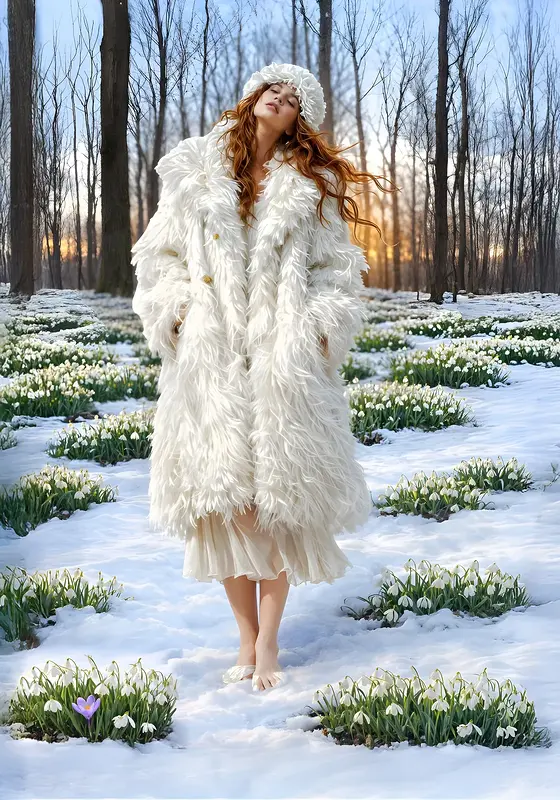
Jörgen Thornberg
The Snowdrop Queen - Barefoot Between Seasons, 2026
Digital
50 x 70 cm
30 200 kr
The Snowdrop Queen - Barefoot Between Seasons
"The Snowdrop Queen
She rose where winter still refused to go,
A barefoot queen in borrowed morning light;
The Snowdrop breathed within her fragile glow,
And taught the cold to loosen in her sight.
The earth still held its breath around her ground,
Yet she advanced, too tender to be brave;
The silent flowers listened to her sound,
As winter named her early for the grave.
She walked where seasons had not learned to be,
Her bare white steps upon the frost-bit feet;
The snow itself seemed suddenly to see
How loss and hope in her soft footsteps meet.
O Snowdrop Queen, you crown the space between,
Barefoot in time, our fragile in-between."
Malmö, January 2026
The Snowdrop Queen - Barefoot Between Seasons
It was winter. The air was sharp, the wind thin and biting, but beneath earth and snow all was still and sheltered. There the Flower lay — not yet a flower, only a thought folded into a bulb, waiting patiently for summer's promise to unfold. Rain trickled through the white blanket, down into the soil, until it touched the bulb like a quiet knock from another world. It spoke of light. Soon a sunbeam followed — slender, patient, persistent — boring its way through ice and darkness until it reached the Flower. 'Come in,' said the Flower.
"I cannot," replied the Sunbeam. "I am not yet strong enough. I will return in the summer."
"When will summer come?" asked the Flower, and it asked this every time a new sunbeam arrived. Yet it trusted that patience and time would bring the warmth it longed for, fostering calm strength and trust amid the cold and snow.
"How long does it last?" whispered the Flower. Something tingled within it — a restlessness, a longing that was almost a pain.
The Flower pressed against its thin shell, softened by rain, warmed by earth, and encouraged by light. It burst through the snow — pale and green, delicate and brave — lifting a small white bud on its slender stalk, its narrow leaves curled around it like folded arms. The snow was cold, but light now streamed into it. This moment of emergence reflects the quiet resilience that can inspire calm strength and patience in your readers.
"Welcome," sang the Sunbeams as they kissed the Flower, until it opened fully, white as snow and marked with soft green lines. It bowed its head, not from weakness but from humility.
"Beautiful Flower," sang the light. "You are the first. You are the only one. You are our promise." They told it of summer — of lilacs and laburnums and roses yet to come — but gently reminded it that it was first. The Flower trembled with joy. It felt the sunlight move through its leaves and stem like music. There it stood, fragile yet firm, in its white dress with green bands, praising a summer it had never seen, embodying hope and trust in new beginnings.
Then the wind came. "You have come too early," said Wind and Weather. "This is still our season." The cold returned. Days passed without sunlight. The Flower stood alone in the snow, showing vulnerability as it faced uncertainty.
"You will break," said the frost. "You will wither. Why did you come?" "The Sun deceived you," whispered the wind. "You are only a snowdrop — a summer fool." "Snowdrop," repeated the Flower softly to itself in the frozen morning. "Summer fool."
Then the children came into the garden. "A snowdrop!" they cried. "So sweet. So beautiful. The first. The only one." Their words were warmer than sunlight, and in its gladness, the Flower did not notice it was being picked. It lay in a child's hand, was kissed, carried into warmth, and placed in water. It felt as if summer had arrived all at once.
The girl who owned the hand had just been confirmed. She had a dear young friend. "He shall be my snowdrop," she said. She placed the Flower on scented paper with a poem — playful, teasing, tender in its mockery, beginning and ending with 'snowdrop'. Then the Flower was folded inside the paper. Darkness again, but now gentle. It travelled. It was pressed. It was shaken. At last, the letter was opened. The young man kissed the Flower and placed it in a drawer among letters. It was there too—the only Flower. Time passed. Summer passed. Winter passed. One summer, the drawer was opened again, this time with impatience. The letters were thrown aside. The poem was flung away. The Flower fell to the floor — flattened, pale, forgotten. What had happened? What always happens. She had chosen another.
Morning light touched the Flower on the floor. A maid found it and placed it inside a book. And so the Snowdrop lay again between verses — printed verses now, grander perhaps, but not kinder. Years passed. At last, the book was opened. "A snowdrop," said the reader. "With meaning." He spoke of the poet Ambrosius Stub — a snowdrop himself, too early, too tender, too fragile for his time, mocked, chilled, misunderstood. "A winter fool. A summer fool. And yet — the first." The Snowdrop was reverently placed back between the pages. It understood. Not as humans understand — but as flowers do. And that was enough.
And yet the story did not end in the book.
And yet the story did not end in the book. Now she stands where the Flower once stood. Barefoot in the snow, she rises with the same quiet insistence, her body carrying the memory of a gesture older than language. Her white coat is not a garment but an echo, her red hair the last remaining warmth the bulb once imagined before it knew it could exist. She walks as if she remembers being underground. As if her bones once pressed against frozen soil, waiting for light to become trustworthy. Her feet touch the snow not in defiance, but in recognition. She is not stepping into winter. She is stepping out of it, inspiring acceptance of new beginnings despite uncertainty.
Around her, the snowdrops bow in their small, gathered families, repeating in miniature what she now completes on a human scale. They are no longer only flowers. They are witnesses. She is not their Queen. She is their continuation. She does not conquer winter. She allows winter to release her. This quiet resilience aims to inspire feelings of calm strength and acceptance in your audience.
Her closed eyes do not belong to sleep, but to listening — to the echo of a voice that once said, "You are first," and to the colder voices that answered, "You are too early." She has learned that both can be true without cancelling each other out. She is what happens when belief grows tall enough to walk, when fragility learns posture. When the Snowdrop finally becomes human without losing its humility.
The snow still lies around her, but it no longer defines the scene. It frames it. Winter is no longer the story. She is. And if one looks closely, one can see that she is not walking on snow at all. She is walking on time itself — on the thin, trembling moment between what has been and what dares to begin.
She is the Snowdrop, finally allowed to stay.
The Snowdrop has never claimed to be heroic. It does not conquer winter, does not challenge it openly, does not announce a revolution. It simply appears. In a season that has not yet agreed to change, it opens itself with the quiet insistence of something that believes more than it knows.
It is often called fragile, and indeed it is. Its stem bends easily. Its head bows naturally. But this posture is not submission. It is a different kind of strength – the strength of something that understands timing not as permission but as inner necessity. The Snowdrop does not wait for spring. It waits only for itself.
What makes it unsettling is not its beauty but its decision. It emerges when the world still belongs to ice. It risks frost, wind, and indifference. And it does so without any guarantee of survival. In this, it resembles not only early flowers but also early artists, early lovers, and early voices in any age. Those who speak before the room is ready often pay for it. Yet without them, the room would never change.
The Snowdrop does not promise summer. It only suggests that summer might still be possible. Its message is not loud enough to convince, only gentle enough to invite. That is why it is easily overlooked. And why, once noticed, it is rarely forgotten.
In literature and in memory, the Snowdrop has often been misunderstood as a symbol of innocence. It is more precise to call it a symbol of courage disguised as gentleness. It does not push the snow aside in anger. It simply grows through it.
And perhaps that is its most profound lesson: that the beginning is not an act of certainty but of trust. The Snowdrop does not bloom because it knows the cold will end. It blooms because it chooses not to let the cold decide.
In this way, it belongs not only to gardens and forests, but to every human moment when something small insists on being real before it is safe to be so. It belongs to the first word of a poem, the first touch after loss, and the first step taken without applause.
The Snowdrop does not announce victory. It announces the possibility.
And that, quietly, is enough.
In 1845, Hans Christian Andersen wrote the fairy tale' The Snowdrop'. He called it "the shy little flower that dares to be first." In his story, the Snowdrop lies buried beneath ice and darkness, mocked by larger, more vigorous plants, yet it blooms anyway. Andersen did not depict the Flower as a simple botanical character. He made it a mirror of the artist: the one who appears before the world is ready, who risks ridicule to exist at all. It is said that Andersen himself felt closest to the Snowdrop among all flowers, as if he recognised in it his own fragile insistence on being seen.
In his telling, the Snowdrop is not heroic for its size or strength, but for its timing. It does not wait for approval. It does not negotiate with winter. It simply decides that existence cannot be postponed. In that sense, Andersen's Snowdrop is less a flower than a confession.
Even science recognised what poetry had already understood. Charles Darwin studied the Snowdrop's curved stem and described how it protects the blossom from frost by bending its head to shield the blossom from the cold. For Darwin, this was one of nature's quiet demonstrations of intelligent adaptation. The Snowdrop survives not by resisting the world, but by learning to move within it.
And then there is the royal affection. Queen Elizabeth II loved snowdrops and had them planted in vast numbers at Sandringham. For her, they were not merely ornamental. They were a private symbol that the year could always begin again, no matter how long winter had lasted.
Thus, the Snowdrop embodies three simultaneous identities: the artist's courage in Andersen, nature's intelligence in Darwin, and time's renewal in the Queen's gardens. It stands at the intersection of vulnerability and persistence, humility and defiance. It does not shout its meaning. It simply returns.
Perhaps that is why it continues to speak across centuries. Not because it is the most beautiful Flower, but because it is the first to believe in what is not yet visible.
And that, quietly, is enough.
30 200 kr

Jörgen Thornberg
Malmö
Lite om bilder och mig. Translation in English at the end.
Jag är en nyfiken person som ser allt i bilder, även det jag fäster i ord, gärna tillsammans för bakom alla mina bilder finns en berättelse. Till vissa bilder hör en kortare eller längre novell som följer med bilden.
Bilder berättar historier. Jag omges av naturlig skönhet, intressanta människor och historia var jag än går. Jag använder min kamera för att dokumentera världen och blanda det jag ser med vad jag känner för att fånga den dolda magin.
Mina bilder berättar mina historier. Genom mina bilder, tryck och berättelser. Jag bjuder in dig att ta del av dessa berättelser, in i ditt liv och hem och dela min mycket personliga syn på vår värld. Mer än vad ögat ser. Jag tänker i bilder, drömmer och skriver och pratar om dem; följaktligen måste jag också skapa bilder. De blir vad jag ser, inte nödvändigtvis begränsade till verkligheten. Det finns en bild runt varje hörn. Jag hoppas att du kommer att se vad jag såg och gilla det.
Jag är också en skrivande person och till många bilder hör en kortare eller längre essay. Den följer med tavlan, tryckt på fint papper och med en personlig hälsning från mig.
Flertalet bilder startar sin resa i min kamera. Enkelt förklarat beskriver jag bilden jag ser i mitt inre, upplevd eller fantiserad. Bilden uppstår inom mig redan innan jag fått okularet till ögat. På bråkdelen av ett ögonblick ser jag vad jag vill ha och vad som kan göras med bilden. Här skall jag stoppa in en giraff, stålmannen, Titanic eller vad det är min fantasi finner ut. Ännu märkligare är att jag kommer ihåg minnesbilden långt efteråt när det blir tid att skapa verket. Om jag lyckas eller inte, är upp till betraktaren, oftast präglat av en stråk av svart humor – meningen är att man skall bli underhållen. Mina bilder blir ofta en snackis där de hänger.
Jag föredrar bilder som förmedlar ett budskap i flera lager. Vid första anblicken fylld av feel-good, en vacker utsikt, fint väder, solen skiner, blommor på ängen eller vattnet som ligger förrädiskt spegelblankt. I en sådan bild kan jag gömma min egentliga berättelse, mitt förakt för förtryckare och våldsverkare, rasister och fördomsfulla människor - ett gärna återkommande motiv mer eller mindre dolt i det vackra motivet. Jag försöker förena dem i ett gemensamt narrativ.
Bild och formgivning har löpt som en röd tråd genom livet. Fotokonst känns som en värdig final som jag gärna delar med mig.
Min genre är vid som framgår av mina bilder, temat en blandning av pop- och gatukonst i kollage som kan bestå av hundratals lager. Vissa bilder kan ta veckor, andra någon dag innan det är dags att överlämna resultatet till printverkstaden. Fine Art Prints är digitala fotocollage. I dessa kollage sker rivandet, klippandet, pusslandet, målandet, ritandet och sprayningen digitalt. Det jag monterar in kan vara hundratals år gamla bilder som jag omsorgsfullt frilägger så att de ser ut att vara en del av tavlan men också bilder skapade av mig själv efter min egen fantasi. Därefter besöks printstudion och för vissa bilder numrera en limiterad upplaga (oftast 7 exemplar) och signera för hand. Vissa bilder kan köpas i olika format. Det är bara att fråga efter vilka. Gillar man en bild som är 70x100 men inte har plats på väggen, går den kanske att få i 50x70 cm istället. Frågan är fri.
Metoden Giclée eller Fine Art Print som det också kallas är det moderna sättet för framställning av grafisk konst. Villkoret för denna typ av utskrifter är att en högkvalitativ storformatskrivare används med åldersbeständigt färgpigment och konstnärspapper eller i förekommande fall på duk. Pappret som används möter de krav på livslängd som ställs av museer och gallerier. Normalt säljer jag mina bilder oinramade så att den nya ägaren själv kan bestämma hur de skall se ut, med eller utan passepartout färg på ram, med eller utan glas etc..
Under många år ställde jag bara ut på nätet, i valda grupper och på min egen Facebooksida - https://www.facebook.com/jorgen.thornberg.9
Jag finns också på en egen hemsida som tyvärr inte alltid är uppdaterad – https://www.jth.life/ Där kan du också läsa en del av de berättelser som följer med bilden.
UTSTÄLLNINGAR
Luftkastellet, oktober 2022
Konst i Lund, november 2022
Luftkastellet, mars 2023
Engleson Galleri Caroli, april 2023
Hydra, Greece June 2023
Engleson Galleri Caroli, oktober 2023
Toppen, Höllviken december 2023
Luftkastellet, mars 2024
Torups Galleri, mars 2024
Venice, May 2024
Luftkastellet, oktober 2024
Konst i Advent, December 2024
Galleri Engleson, Caroli December 2024
Jäger & Jansson Galleri, april 2025
A bit about pictures and me.
I'm a curious person who sees everything in pictures, even what I express in words, often combining them, for behind all my pictures lies a story. These narratives, some as short as a single image and others as long as a novel, are the heart and soul of my work.
Pictures tell stories. Wherever I go, I'm surrounded by natural beauty, exciting people, and history. I use my camera to document the world and blend what I see with what I feel to capture the hidden magic.
My images tell my stories. Through my pictures, prints, and narratives, I invite you to partake in these stories in your life and home and share my deeply personal perspective of our world. More than meets the eye. I think in pictures, dream, write, and talk about them; consequently, I must create images too. They become what I see, not necessarily confined to reality. There's a picture around every corner. I hope you'll see what I saw and enjoy it.
I'm also a writer, and many images come with a shorter or longer essay. It accompanies the painting, printed on fine paper with my personal greeting.
Many pictures start their journey on my camera. Simply put, I describe the image I see in my mind, experienced or imagined. The image arises within me even before I bring the eyepiece to my eye. In a fraction of a moment, I see what I want and what can be done with the picture. Here, I'll insert a giraffe, Superman, the Titanic, or whatever my imagination conjures up. Even stranger is that I remember the mental image long after it's time to create the work. Whether I succeed is up to the observer, often imbued with a streak of black humour – the aim is to entertain. My pictures usually become a talking point wherever they hang.
I prefer pictures that convey a message in multiple layers. At first glance, they're filled with feel-good vibes, a beautiful view, lovely weather, the sun shining, flowers in the meadow, or the water lying deceptively calm. But beneath this surface beauty, I often conceal a deeper story, a narrative that challenges societal norms or explores the human condition. I invite you to delve into these hidden narratives and discover the layers of meaning within my work.
Picture and design have been a thread running through my life. Photographic art feels like a fitting finale, and I'm happy to share it.
My genre is varied, as seen in my pictures; the theme is a blend of pop and street art in collages that can consist of hundreds of layers. Some images can take weeks, others just a day before it's time to hand over the result to the print workshop. Fine Art Prints are digital photo collages. In these collages, tearing, cutting, puzzling, painting, drawing, and spraying happen digitally. What I insert can be images hundreds of years old that I carefully extract so they appear to be part of the painting, but also images created by myself, now also generated from my imagination. Next, visit the print studio and, for certain images, number a limited edition (usually 7 copies) and sign them by hand. Some images may be available in other formats. Just ask which ones. If you like an image that's 70x100 but doesn't have space on the wall, you might be able to get it in 50x70 cm instead. The question is open.
The Giclée method, or Fine Art Print as it's also called, is the modern way of producing graphic art. This method ensures the highest quality and longevity of the artwork, using a high-quality large-format printer with archival pigment inks and artist paper or, in some cases, canvas. The paper used meets the longevity requirements set by museums and galleries. I sell my pictures unframed, allowing the new owner to personalise their artwork, confident in the lasting value and quality of the piece.
For many years, I only exhibited online, in selected groups, and on my Facebook page - https://www.facebook.com/jorgen.thornberg.9. I also have my website, which unfortunately is not constantly updated - https://www.jth.life/. You can also read some of the stories accompanying the pictures there.
EXHIBITIONS
Luftkastellet, October 2022
Art in Lund, November 2022
Luftkastellet, March 2023
Engleson Gallery Caroli, April 2023
Hydra, Greece June 2023
Engleson Gallery Caroli, October 2023
Toppen, Höllviken December 2023
Luftkastellet, March 2024
Torup Gallery, March 2024
Venice, May 2024
UTSTÄLLNINGAR
Luftkastellet, oktober 2022
Konst i Lund, november 2022
Luftkastellet, mars 2023
Engleson Galleri Caroli, april 2023
Hydra, Greece June 2023
Engleson Galleri Caroli, oktober 2023
Toppen, Höllviken december 2023
Luftkastellet, mars 2024
Torups Galleri, mars 2024
Venice, May 2024
Luftkastellet, October 2024
Konst i Advent, December 2024
Galleri Engleson, Caroli December 2024
Jäger & Jansson Galleri, April 2025
Utbildning
Autodidakt
Medlem i konstnärsförening
Öppna Sinnen
Med i konstrunda
Konstrundan i Skåne
Utställningar
Luftkastellet, October 2022
Art in Lund, November 2022
Luftkastellet, March 2023
Engleson Gallery Caroli, April 2023
Hydra, Greece June 2023
Engleson Gallery Caroli, October 2023
Toppen, Höllviken December 2023
Luftkastellet, March 2024
Torup Gallery, March 2024
Venice, May 2024