Vi använder cookies för att ge dig bästa möjliga upplevelse. Välj vilka cookies du tillåter.
Läs mer i vår integritetspolicy
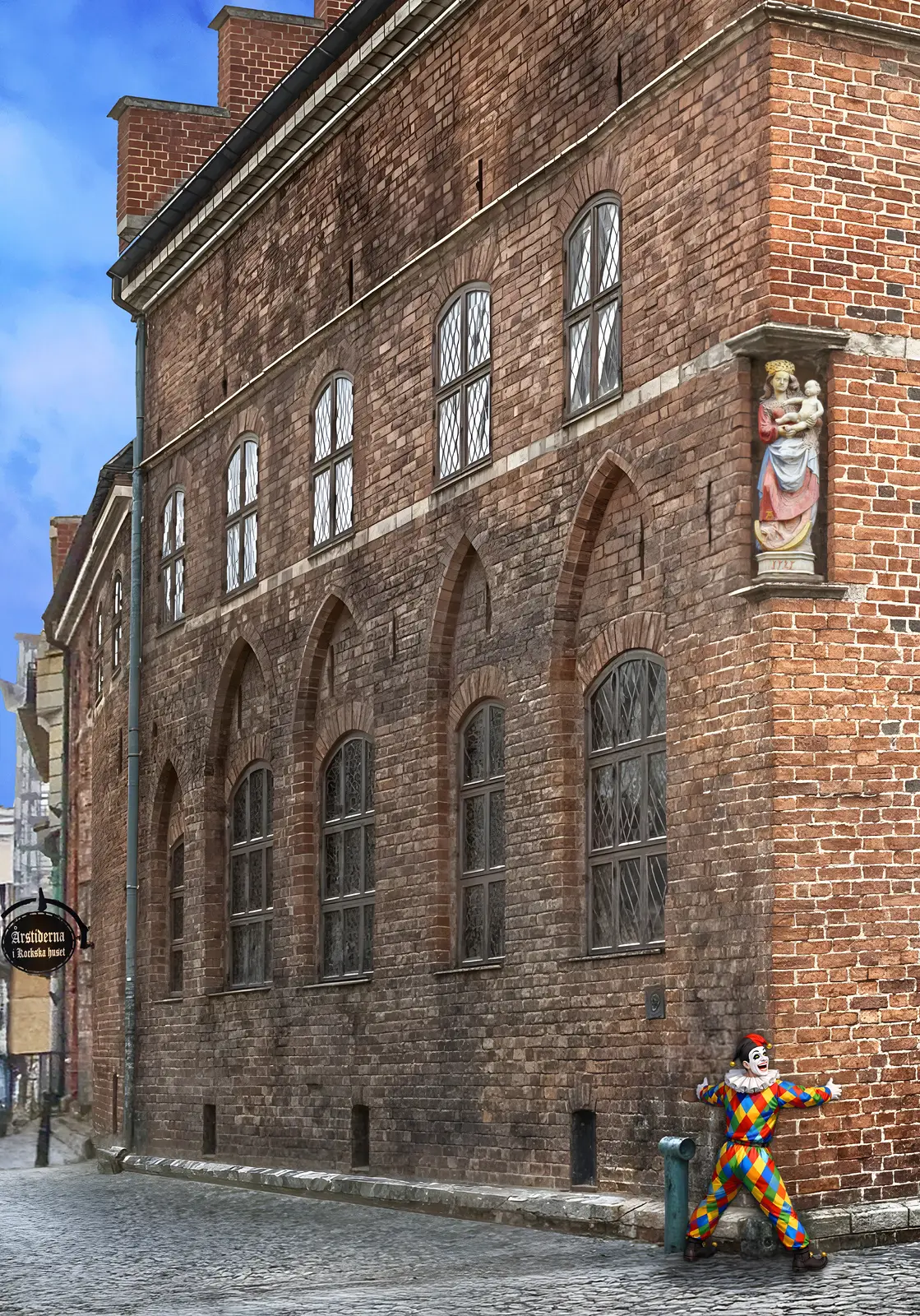
Jörgen Thornberg
The Old Vaults Tell, 2026
Digital
50 x 70 cm
3 200 kr
The Old Vaults Tell
"The Moose Who Drank the Masque
In Kock’s old vaults where the candles swayed,
And manners pretended while virtue delayed,
The wine was bold, the ale was free,
And dignity fled by the count of three.
Christian roared with a soldier’s cheer,
Tycho blinked at another beer,
The harlequin bowed, the Queen misstepped,
And Solomon’s wisdom politely slept.
Pies were flying, grease was king,
Someone forgot what Hope should sing,
Faith fell sideways, Charity too,
Peace gave a speech no one listened to.
The table groaned, the floor was slick,
Knives went wandering far too quick,
Fingers ruled where forks were not.
And history blushed at every spot.
Then entered the guest with hooves and pride,
An antlered lord on a foamy ride,
A moose who drank like a Viking dream,
And wobbled like politics mid-regime.
“Oh, drink!” they cried, “You noble beast!”
He drank like he’d invented the feast,
Cup after cup, with soulful grace,
Until the stairs revealed his place.
Down he went with royal sound,
A noble thud on Christian ground,
Not slain by arrow, sword or noose —
But by hospitality and juice.
The guests went silent, then went pale,
Then blamed the steps, the light, the ale,
Tycho sighed, the court pretended,
The moose’s legend thus was ended.
Yet still we laugh in Kock’s old hall,
Where stone remembers every fall,
Where kings were drunk and virtues ran,
And etiquette forgot its plan.
So raise a cup to hooves and crown,
To wine that lifts and stairs that frown,
To feasts that tumble into lore,
And moose who partied once — and more.
For if you drink where vaults can hear,
Your echo lasts for many a year,
And somewhere in that drunken tone
A moose still claims the stairs his throne."
Malmö, January 2026
The Old Vaults Tell
Stone remembers what people forget.
Not in words, but in the colours of brick, soaked with centuries of tobacco smoke and soot from open fireplaces, in the particular way a laugh once struck a ceiling and never left it. Close your eyes, and you have the whole story.
Down in Jörgen Kock’s sixteenth-century house, in the old vaults, stories do not fade — they sediment.
Among the many tales pressed into our ribs of limestone and mortar, one still faintly smells of beer and animal breath. It is the story of the feast of feasts in Malmö, never surpassed, yet the house still stands. That is how good a builder Jörgen Kock was. Even the City Hall he built bears witness to the same skill. All the more unjust that he never lived to experience the feast himself. He died in 1556, and the feast I am about to tell of took place forty years later. It was the thunderous banquet that still lives on in cracks in the vaults and in an oral tradition that has remarkably well survived the centuries. The story of how a strategically placed harlequin embraced the walls so they would not collapse over “Den långa Adelgatan,” now called “Västergatan,” the extension of what is still called “Adelgatan,” the noblest of Malmö’s old streets.
This is the four-hundred-year-old story of the great banquet at Jörgen Kock’s house and the harlequin who saved the home for posterity — and of Tycho Brahe’s moose. Unmatched to this day, it remains a standing challenge to today’s party-loving citizens of Malmö.
A juicy vault party narrative of the infamous 1591 entertainment in Malmö at Jörgen Kock’s house, with revel-loving Scanian hosts and other Danes invited, led by Denmark’s Christian IV. It was essentially a court-sanctioned bacchanal where the planned masque collapsed into slapstick drunken chaos — spilt “gifts,” falls, forgotten lines, people vomiting in the lower hall, and more.
A drama unfolded in the vaulted cellars of a great house.
A Supper That Wouldn’t Stay Upstairs
They meant it to be magnificent — as all court entertainments are intended to be — a feast meant to reassure the Danish Kingdom of its greatness, to be swallowed like wine and toasted into friendship.
Upstairs, the halls were dressed in obedience: tapestries hung straight, candlelight rehearsed its flattering angles, and servants moved like chess pieces. But the real party — the one history remembers — was always going to end below, where stone keeps secrets better than courtiers do.
The tables were not merely set — they were loaded, as if abundance itself had been summoned to prove a political point. Long oak boards stretched beneath linen cloths that could not quite conceal the scars of earlier feasts, their fibres already absorbing the first stains of wine and grease like eager witnesses. At one end lay whole roasted boars, their skins lacquered to a deep amber sheen, apples still clenched between their teeth like ceremonial jokes. Nearby, venison haunches rested beneath garlands of rosemary and juniper, their juices pooling slowly, staining the wood in shapes no one would later admit to noticing.
Capon and goose lay split and glistening, their flesh pale and yielding, their skins blistered and salted until they cracked at the lightest touch. Thick sausages, coarse with herbs and grain, curled like sleeping animals beside slabs of black pudding and pressed meats marbled with fat. Pies rose in proud domes, their crusts stamped with the seals of kitchens that considered themselves as crucial as heraldry. When cut, they released perfumes of clove, mace, pepper, and vinegar, revealing interiors of minced game, dried fruits, and dark gravies that bled slowly onto the plates.
There were fish, too — pike arranged in ceremonial curves, trout laid on beds of fennel, eels glazed until they resembled polished leather. Pickled herring shimmered silver in shallow bowls, surrounded by mustard seeds and sliced onions. Oysters lay open like pale mouths, offering themselves without resistance. Crabs and crayfish formed rigid red towers that would later collapse under careless hands.
Bread arrived not as slices but as weapons: dense rye loaves, hard white rounds, coarse barley cakes, all meant to tear, to break, to soak. Butter sat in carved dishes, heavily salted, cut into shapes that would not survive the hour. Cheeses stood like geological layers — fresh, soft, sharp, blue-veined, yellow, white — sweating gently, giving off the faint living odour of milk’s long transformation.
Between the dishes stood bowls of fruit: figs split and dark, grapes already shedding, pears bruised by travel, apples polished until they reflected candlelight like minor planets. There were sugared almonds, honeyed walnuts, candied peel, and preserved cherries that glowed unnaturally bright, like edible jewels. Sauces waited in heavy cups: sour cherry, mustard thick with seed, green herb pastes ground with oil and vinegar, and brown gravies rich with marrow.
And always, always, the vessels.
Wine in thick glass jugs, some clear, some clouded, all sticky at the neck. Wine from the Rhine, wine from France, wine that no one quite trusted but drank anyway. Pewter cups, wooden cups, horn cups, cups already dented by earlier mouths. And behind the tables, like a silent choir, the barrels: ale, beer, dark brew, pale brew, mead in smaller casks — their spigots already leaking in anticipation, their bases wet with previous impatience.
At first, the guests approached like actors who still remembered their lines.
They reached politely. They cut carefully. They nodded while chewing. They used knives as tools, not weapons. They wiped their fingers on a cloth, making gestures that looked unconscious. They spoke of flavour, spice, quality, and foreign origins. They complimented cooks they would never meet. They praised the generosity of hosts they were already planning to outdrink.
But abundance does not tolerate etiquette for long.
As cups emptied faster than they were filled, as grease warmed the hands, as wine softened the joints of memory, the table began to change its meaning. It was no longer a display. It became a field.
Hands reached across one another. Knives cut without hesitation. Fingers dipped into sauces without apology. Bread was no longer torn — it was seized. Pieces vanished mid-air. Bones were dropped where they fell. Mouths spoke while full. Laughter carried crumbs. Someone wiped a blade on their sleeve. Someone else wiped their sleeve on the tablecloth.
Without forks — those future diplomats of dining — the body reclaimed its authority. Fingers pinched meat. Thumbs pressed fat. Knuckles glistened. Grease shone on lips, beards, and cuffs. Wine ran down chins and was not wiped away. Cups were refilled before they were fully emptied, so that the liquid sloshed over the edges and into laps without concern.
The table began to look less like a still life and more like a battlefield: broken crusts, gnawed bones, smeared sauces, overturned bowls, and collapsed pies exposing their interiors like soft architecture.
And still they ate.
Not because they were hungry — but because the table allowed it.
Elegance did not vanish all at once. It dissolved. A gesture lingered here, a courtesy there, but they floated in a sea of appetite that no longer respected them. The language changed. Words shortened. Laughter grew louder. Chewing became audible. Compliments turned into demands.
Someone grabbed a joint of meat from another’s plate. Someone else did the same and laughed. Someone tried to protest but failed because their mouth was full. Someone raised a cup and forgot why. Someone kissed someone they should not have. Someone deliberately spilt wine to watch it run.
And the table, that patient accomplice, accepted everything.
By the end, they no longer served themselves.
They attacked.
They threw themselves forward like animals at a watering place. They tore, dipped, and scooped. They bit directly from shared portions. They wiped their knives on bread and ate it. They licked their fingers without shame. They forgot who was noble and who was not. They forgot who owned the house. They forgot who was watching.
They forgot that elegance had ever existed.
And the table, stripped, stained, victorious, stood between them like a conquered empire — proof that civilisation is always thinner than the linen that tries to cover it.
Down in the undercroft, the vaults arched overhead like the ribs of a sleeping beast. The air was cooler here, damp with old mortar and the scent of old barrels. Torches made the walls sweat gold. The floor was worn smooth by generations of footsteps and spilt drink. And there, in that half-underground womb of stone, the night’s logic changed: titles softened, manners slid, and the language of state became the language of cups.
Because King Christian IV had arrived, famously able to drink like a man whose liver had been trained by cavalry. The second most important person of the evening, the astronomer Tycho Brahe from Ven, could match him in stamina, if not in elegance. The trouble, as the story makes clear, was that everyone else tried to keep up. Gentlemen, ladies, players, attendants — a court attempting to imitate its kings, and failing in the most physical ways possible.
At first, it was hearty and almost wholesome: laughter bouncing off the vaults, boots scraping, a musician or two doing their best to keep the rhythm while the room took on that warm blur that makes every joke funnier than it deserves.
Then the plan arrived.
There was to be a masque — a grand allegorical show: Solomon and the Queen of Sheba — staged as a glittering tribute to royal wisdom and international concord. In the imagination, it would have been a jewel: measured speeches, ritualised movement, symbolic gifts.
In reality, it became a kind of sacred farce.
The Queen of Sheba — played by a great lady of Malmö — approached with her casket of gifts. But the steps betrayed her (or the wine did; the wine usually insists it’s innocent). She stumbled, the casket flew, and what should have been stately offerings became a bright catastrophe of sweetmeats and sticky luxuries — creams, jellies, spiced delicacies — scattering like applause that had turned physical.
The vaults erupted. Napkins came rushing in like white flags. Someone laughed too hard. Someone tried to look dignified and failed. Someone — probably several someones — began to clap, because clapping is what people do when they don’t know how else to survive public embarrassment.
And then — as if the night wanted a crown to wear on its stupidity — Christian IV attempted to dance with Sheba.
It should have been gallant. It should have been charming. It should have been a little dangerous in the attractive way that kings sometimes are.
Instead, his Royal Highness fell over.
Not a poetic fall. Not a heroic stumble. A proper, human “gravity still rules here” collapse — the kind of moment the stone vaults were built to witness and never forget.
Upstairs, they might have pretended it had never happened.
Under the vaults, it became legendary.
From that moment, the masque did not simply wobble — it dissolved. Hope forgot her speech (which, frankly, is the most accurate allegory anyone could have staged). Faith was drunk. Charity left the scene to join the others in the lower hall — where, according to the tale’s delicious bluntness, the sacred virtues were no longer performing virtue at all, but vomiting like mortals.
You can picture it in the vaults: the echo of retching turning a moral pageant into a comedy of stone acoustics—the stink of wine and panic. Courtiers are trying to decide whether to help or to pretend not to see. A servant with the haunted eyes of someone who has just realised the monarchy is made of flesh.
Meanwhile, the show staggered on because the court always does.
Victory appeared — and Victory, too, was drunk enough to be escorted away and put to bed. Peace made her little speech, no doubt with the bravest face she could muster, because Peace, at least, understood public relations.
And Tycho?
History gives us the perfect detail: the king being put to bed with his clothes still smeared with the remains of the feast — the spilt “gifts,” the wine, the sweets — as if he had been christened not with holy water but with dessert.
That is the kind of image that vaults love: the sovereign reduced to a sticky man, carried off as the undercroft still rings with laughter and the last cup is still making the rounds. But the story does not end with a king sleeping off his disgrace. The feast continued according to the customs of the time — as long as someone could still move, the show must go on.
The harlequin deserves all honour, but it was an elk that stole the show that night. A drunken elk.
Not a myth. Not quite a joke. A true, awkward, noble-born tragedy from the late sixteenth century, when astronomy was modernising the heavens but court life still preferred spectacle to sense.
Tycho Brahe, the great Danish astronomer, kept a tame elk — or a moose, depending on which language remembers it. In Scandinavian tongues, the word slides easily between the two. What matters is that it was large, gentle, and absurdly well-mannered. It followed him like a dog. It wandered through halls built for boots and silk. It was a living emblem of Renaissance eccentricity: nature domesticated by curiosity.
The animal lived on his estate on the island of Hven, where Tycho’s observatories rose like instruments aimed at eternity. There, amid brass quadrants and star catalogues, the moose moved quietly, a terrestrial counterweight to celestial ambition.
But one evening — sometime in the early 1590s — the moose arrived as a guest.
Yes. A guest. A guest with eighteen tines on its antlers.
Tycho had brought his elk to honour his noble host. The dinner began with grandeur. Candles flared. Cups were filled. The moose, admired, indulged, and amused the company. Someone — inevitably — offered it beer.
And the moose drank. And drank. And drank more. Its master, Tycho, had no chance of keeping up.
Not delicately. Not symbolically. It drank as only a large, trusting creature can, surrounded by laughing humans who still believe they are in control of the evening.
The vaults know this moment well: the laughter tightening, the cups refilling too quickly, the boundary between novelty and foolishness dissolving.
Beer does not care whether the guest has hooves.
Soon, the moose swayed. Not dramatically. Not comically yet. Just enough to disguise concern as amusement. Then, urged or wandering or simply seeking a quieter corner, it approached a stair.
Stairs are inventions of gravity. Animals understand slopes. They do not understand architecture’s pride.
The moose slipped.
The fall was not elegant. No symbolism accompanied it. No moral lesson arrived in time. A heavy body met stone, and the vaults still remember the sound — a sound like furniture breaking its oath to remain furniture.
The moose did not survive.
And so ended one of the most improbable companion animals in scientific history — not beneath the stars, not in forests, not in freedom, but on a staircase, drunk on human hospitality.
The guests sobered. The cups emptied quietly. Laughter reassembled into guilt. Someone tried to say it was an accident, which is what all accidents become once they require witnesses.
Tycho Brahe mourned his animal. Not publicly. Not theatrically. Yet the loss followed him like a shadow across later accounts. The story survived because it embarrassed everyone just enough to remain unforgettable.
And down there, under the vaults, it found its permanent home.
Because the vaults recognise their own kind of truth.
Not the truth of equations. Not the truth of court etiquette. But the truth is that civilisation is always one cup away from absurdity.
The moose did not die because it was foolish. It died because it trusted its hooves.
And every time laughter echoes a little too long between stone arches, every time a feast forgets its limits, every time a noble hall pretends it is wiser than the bodies within it — the vaults remember the soft thunder of hooves on the steps.
They do not judge.
They only tell.
And they tell us this:
Even in the age of visiting the Moon and going to Mars, we are still learning how to walk down stairs — while drunk — and why it is essential to keep a harlequin close at hand.
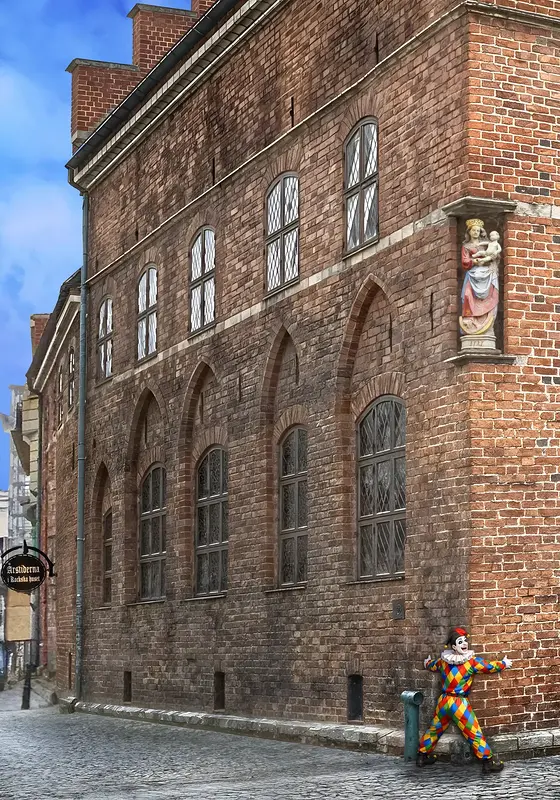
Jörgen Thornberg
The Old Vaults Tell, 2026
Digital
50 x 70 cm
3 200 kr
The Old Vaults Tell
"The Moose Who Drank the Masque
In Kock’s old vaults where the candles swayed,
And manners pretended while virtue delayed,
The wine was bold, the ale was free,
And dignity fled by the count of three.
Christian roared with a soldier’s cheer,
Tycho blinked at another beer,
The harlequin bowed, the Queen misstepped,
And Solomon’s wisdom politely slept.
Pies were flying, grease was king,
Someone forgot what Hope should sing,
Faith fell sideways, Charity too,
Peace gave a speech no one listened to.
The table groaned, the floor was slick,
Knives went wandering far too quick,
Fingers ruled where forks were not.
And history blushed at every spot.
Then entered the guest with hooves and pride,
An antlered lord on a foamy ride,
A moose who drank like a Viking dream,
And wobbled like politics mid-regime.
“Oh, drink!” they cried, “You noble beast!”
He drank like he’d invented the feast,
Cup after cup, with soulful grace,
Until the stairs revealed his place.
Down he went with royal sound,
A noble thud on Christian ground,
Not slain by arrow, sword or noose —
But by hospitality and juice.
The guests went silent, then went pale,
Then blamed the steps, the light, the ale,
Tycho sighed, the court pretended,
The moose’s legend thus was ended.
Yet still we laugh in Kock’s old hall,
Where stone remembers every fall,
Where kings were drunk and virtues ran,
And etiquette forgot its plan.
So raise a cup to hooves and crown,
To wine that lifts and stairs that frown,
To feasts that tumble into lore,
And moose who partied once — and more.
For if you drink where vaults can hear,
Your echo lasts for many a year,
And somewhere in that drunken tone
A moose still claims the stairs his throne."
Malmö, January 2026
The Old Vaults Tell
Stone remembers what people forget.
Not in words, but in the colours of brick, soaked with centuries of tobacco smoke and soot from open fireplaces, in the particular way a laugh once struck a ceiling and never left it. Close your eyes, and you have the whole story.
Down in Jörgen Kock’s sixteenth-century house, in the old vaults, stories do not fade — they sediment.
Among the many tales pressed into our ribs of limestone and mortar, one still faintly smells of beer and animal breath. It is the story of the feast of feasts in Malmö, never surpassed, yet the house still stands. That is how good a builder Jörgen Kock was. Even the City Hall he built bears witness to the same skill. All the more unjust that he never lived to experience the feast himself. He died in 1556, and the feast I am about to tell of took place forty years later. It was the thunderous banquet that still lives on in cracks in the vaults and in an oral tradition that has remarkably well survived the centuries. The story of how a strategically placed harlequin embraced the walls so they would not collapse over “Den långa Adelgatan,” now called “Västergatan,” the extension of what is still called “Adelgatan,” the noblest of Malmö’s old streets.
This is the four-hundred-year-old story of the great banquet at Jörgen Kock’s house and the harlequin who saved the home for posterity — and of Tycho Brahe’s moose. Unmatched to this day, it remains a standing challenge to today’s party-loving citizens of Malmö.
A juicy vault party narrative of the infamous 1591 entertainment in Malmö at Jörgen Kock’s house, with revel-loving Scanian hosts and other Danes invited, led by Denmark’s Christian IV. It was essentially a court-sanctioned bacchanal where the planned masque collapsed into slapstick drunken chaos — spilt “gifts,” falls, forgotten lines, people vomiting in the lower hall, and more.
A drama unfolded in the vaulted cellars of a great house.
A Supper That Wouldn’t Stay Upstairs
They meant it to be magnificent — as all court entertainments are intended to be — a feast meant to reassure the Danish Kingdom of its greatness, to be swallowed like wine and toasted into friendship.
Upstairs, the halls were dressed in obedience: tapestries hung straight, candlelight rehearsed its flattering angles, and servants moved like chess pieces. But the real party — the one history remembers — was always going to end below, where stone keeps secrets better than courtiers do.
The tables were not merely set — they were loaded, as if abundance itself had been summoned to prove a political point. Long oak boards stretched beneath linen cloths that could not quite conceal the scars of earlier feasts, their fibres already absorbing the first stains of wine and grease like eager witnesses. At one end lay whole roasted boars, their skins lacquered to a deep amber sheen, apples still clenched between their teeth like ceremonial jokes. Nearby, venison haunches rested beneath garlands of rosemary and juniper, their juices pooling slowly, staining the wood in shapes no one would later admit to noticing.
Capon and goose lay split and glistening, their flesh pale and yielding, their skins blistered and salted until they cracked at the lightest touch. Thick sausages, coarse with herbs and grain, curled like sleeping animals beside slabs of black pudding and pressed meats marbled with fat. Pies rose in proud domes, their crusts stamped with the seals of kitchens that considered themselves as crucial as heraldry. When cut, they released perfumes of clove, mace, pepper, and vinegar, revealing interiors of minced game, dried fruits, and dark gravies that bled slowly onto the plates.
There were fish, too — pike arranged in ceremonial curves, trout laid on beds of fennel, eels glazed until they resembled polished leather. Pickled herring shimmered silver in shallow bowls, surrounded by mustard seeds and sliced onions. Oysters lay open like pale mouths, offering themselves without resistance. Crabs and crayfish formed rigid red towers that would later collapse under careless hands.
Bread arrived not as slices but as weapons: dense rye loaves, hard white rounds, coarse barley cakes, all meant to tear, to break, to soak. Butter sat in carved dishes, heavily salted, cut into shapes that would not survive the hour. Cheeses stood like geological layers — fresh, soft, sharp, blue-veined, yellow, white — sweating gently, giving off the faint living odour of milk’s long transformation.
Between the dishes stood bowls of fruit: figs split and dark, grapes already shedding, pears bruised by travel, apples polished until they reflected candlelight like minor planets. There were sugared almonds, honeyed walnuts, candied peel, and preserved cherries that glowed unnaturally bright, like edible jewels. Sauces waited in heavy cups: sour cherry, mustard thick with seed, green herb pastes ground with oil and vinegar, and brown gravies rich with marrow.
And always, always, the vessels.
Wine in thick glass jugs, some clear, some clouded, all sticky at the neck. Wine from the Rhine, wine from France, wine that no one quite trusted but drank anyway. Pewter cups, wooden cups, horn cups, cups already dented by earlier mouths. And behind the tables, like a silent choir, the barrels: ale, beer, dark brew, pale brew, mead in smaller casks — their spigots already leaking in anticipation, their bases wet with previous impatience.
At first, the guests approached like actors who still remembered their lines.
They reached politely. They cut carefully. They nodded while chewing. They used knives as tools, not weapons. They wiped their fingers on a cloth, making gestures that looked unconscious. They spoke of flavour, spice, quality, and foreign origins. They complimented cooks they would never meet. They praised the generosity of hosts they were already planning to outdrink.
But abundance does not tolerate etiquette for long.
As cups emptied faster than they were filled, as grease warmed the hands, as wine softened the joints of memory, the table began to change its meaning. It was no longer a display. It became a field.
Hands reached across one another. Knives cut without hesitation. Fingers dipped into sauces without apology. Bread was no longer torn — it was seized. Pieces vanished mid-air. Bones were dropped where they fell. Mouths spoke while full. Laughter carried crumbs. Someone wiped a blade on their sleeve. Someone else wiped their sleeve on the tablecloth.
Without forks — those future diplomats of dining — the body reclaimed its authority. Fingers pinched meat. Thumbs pressed fat. Knuckles glistened. Grease shone on lips, beards, and cuffs. Wine ran down chins and was not wiped away. Cups were refilled before they were fully emptied, so that the liquid sloshed over the edges and into laps without concern.
The table began to look less like a still life and more like a battlefield: broken crusts, gnawed bones, smeared sauces, overturned bowls, and collapsed pies exposing their interiors like soft architecture.
And still they ate.
Not because they were hungry — but because the table allowed it.
Elegance did not vanish all at once. It dissolved. A gesture lingered here, a courtesy there, but they floated in a sea of appetite that no longer respected them. The language changed. Words shortened. Laughter grew louder. Chewing became audible. Compliments turned into demands.
Someone grabbed a joint of meat from another’s plate. Someone else did the same and laughed. Someone tried to protest but failed because their mouth was full. Someone raised a cup and forgot why. Someone kissed someone they should not have. Someone deliberately spilt wine to watch it run.
And the table, that patient accomplice, accepted everything.
By the end, they no longer served themselves.
They attacked.
They threw themselves forward like animals at a watering place. They tore, dipped, and scooped. They bit directly from shared portions. They wiped their knives on bread and ate it. They licked their fingers without shame. They forgot who was noble and who was not. They forgot who owned the house. They forgot who was watching.
They forgot that elegance had ever existed.
And the table, stripped, stained, victorious, stood between them like a conquered empire — proof that civilisation is always thinner than the linen that tries to cover it.
Down in the undercroft, the vaults arched overhead like the ribs of a sleeping beast. The air was cooler here, damp with old mortar and the scent of old barrels. Torches made the walls sweat gold. The floor was worn smooth by generations of footsteps and spilt drink. And there, in that half-underground womb of stone, the night’s logic changed: titles softened, manners slid, and the language of state became the language of cups.
Because King Christian IV had arrived, famously able to drink like a man whose liver had been trained by cavalry. The second most important person of the evening, the astronomer Tycho Brahe from Ven, could match him in stamina, if not in elegance. The trouble, as the story makes clear, was that everyone else tried to keep up. Gentlemen, ladies, players, attendants — a court attempting to imitate its kings, and failing in the most physical ways possible.
At first, it was hearty and almost wholesome: laughter bouncing off the vaults, boots scraping, a musician or two doing their best to keep the rhythm while the room took on that warm blur that makes every joke funnier than it deserves.
Then the plan arrived.
There was to be a masque — a grand allegorical show: Solomon and the Queen of Sheba — staged as a glittering tribute to royal wisdom and international concord. In the imagination, it would have been a jewel: measured speeches, ritualised movement, symbolic gifts.
In reality, it became a kind of sacred farce.
The Queen of Sheba — played by a great lady of Malmö — approached with her casket of gifts. But the steps betrayed her (or the wine did; the wine usually insists it’s innocent). She stumbled, the casket flew, and what should have been stately offerings became a bright catastrophe of sweetmeats and sticky luxuries — creams, jellies, spiced delicacies — scattering like applause that had turned physical.
The vaults erupted. Napkins came rushing in like white flags. Someone laughed too hard. Someone tried to look dignified and failed. Someone — probably several someones — began to clap, because clapping is what people do when they don’t know how else to survive public embarrassment.
And then — as if the night wanted a crown to wear on its stupidity — Christian IV attempted to dance with Sheba.
It should have been gallant. It should have been charming. It should have been a little dangerous in the attractive way that kings sometimes are.
Instead, his Royal Highness fell over.
Not a poetic fall. Not a heroic stumble. A proper, human “gravity still rules here” collapse — the kind of moment the stone vaults were built to witness and never forget.
Upstairs, they might have pretended it had never happened.
Under the vaults, it became legendary.
From that moment, the masque did not simply wobble — it dissolved. Hope forgot her speech (which, frankly, is the most accurate allegory anyone could have staged). Faith was drunk. Charity left the scene to join the others in the lower hall — where, according to the tale’s delicious bluntness, the sacred virtues were no longer performing virtue at all, but vomiting like mortals.
You can picture it in the vaults: the echo of retching turning a moral pageant into a comedy of stone acoustics—the stink of wine and panic. Courtiers are trying to decide whether to help or to pretend not to see. A servant with the haunted eyes of someone who has just realised the monarchy is made of flesh.
Meanwhile, the show staggered on because the court always does.
Victory appeared — and Victory, too, was drunk enough to be escorted away and put to bed. Peace made her little speech, no doubt with the bravest face she could muster, because Peace, at least, understood public relations.
And Tycho?
History gives us the perfect detail: the king being put to bed with his clothes still smeared with the remains of the feast — the spilt “gifts,” the wine, the sweets — as if he had been christened not with holy water but with dessert.
That is the kind of image that vaults love: the sovereign reduced to a sticky man, carried off as the undercroft still rings with laughter and the last cup is still making the rounds. But the story does not end with a king sleeping off his disgrace. The feast continued according to the customs of the time — as long as someone could still move, the show must go on.
The harlequin deserves all honour, but it was an elk that stole the show that night. A drunken elk.
Not a myth. Not quite a joke. A true, awkward, noble-born tragedy from the late sixteenth century, when astronomy was modernising the heavens but court life still preferred spectacle to sense.
Tycho Brahe, the great Danish astronomer, kept a tame elk — or a moose, depending on which language remembers it. In Scandinavian tongues, the word slides easily between the two. What matters is that it was large, gentle, and absurdly well-mannered. It followed him like a dog. It wandered through halls built for boots and silk. It was a living emblem of Renaissance eccentricity: nature domesticated by curiosity.
The animal lived on his estate on the island of Hven, where Tycho’s observatories rose like instruments aimed at eternity. There, amid brass quadrants and star catalogues, the moose moved quietly, a terrestrial counterweight to celestial ambition.
But one evening — sometime in the early 1590s — the moose arrived as a guest.
Yes. A guest. A guest with eighteen tines on its antlers.
Tycho had brought his elk to honour his noble host. The dinner began with grandeur. Candles flared. Cups were filled. The moose, admired, indulged, and amused the company. Someone — inevitably — offered it beer.
And the moose drank. And drank. And drank more. Its master, Tycho, had no chance of keeping up.
Not delicately. Not symbolically. It drank as only a large, trusting creature can, surrounded by laughing humans who still believe they are in control of the evening.
The vaults know this moment well: the laughter tightening, the cups refilling too quickly, the boundary between novelty and foolishness dissolving.
Beer does not care whether the guest has hooves.
Soon, the moose swayed. Not dramatically. Not comically yet. Just enough to disguise concern as amusement. Then, urged or wandering or simply seeking a quieter corner, it approached a stair.
Stairs are inventions of gravity. Animals understand slopes. They do not understand architecture’s pride.
The moose slipped.
The fall was not elegant. No symbolism accompanied it. No moral lesson arrived in time. A heavy body met stone, and the vaults still remember the sound — a sound like furniture breaking its oath to remain furniture.
The moose did not survive.
And so ended one of the most improbable companion animals in scientific history — not beneath the stars, not in forests, not in freedom, but on a staircase, drunk on human hospitality.
The guests sobered. The cups emptied quietly. Laughter reassembled into guilt. Someone tried to say it was an accident, which is what all accidents become once they require witnesses.
Tycho Brahe mourned his animal. Not publicly. Not theatrically. Yet the loss followed him like a shadow across later accounts. The story survived because it embarrassed everyone just enough to remain unforgettable.
And down there, under the vaults, it found its permanent home.
Because the vaults recognise their own kind of truth.
Not the truth of equations. Not the truth of court etiquette. But the truth is that civilisation is always one cup away from absurdity.
The moose did not die because it was foolish. It died because it trusted its hooves.
And every time laughter echoes a little too long between stone arches, every time a feast forgets its limits, every time a noble hall pretends it is wiser than the bodies within it — the vaults remember the soft thunder of hooves on the steps.
They do not judge.
They only tell.
And they tell us this:
Even in the age of visiting the Moon and going to Mars, we are still learning how to walk down stairs — while drunk — and why it is essential to keep a harlequin close at hand.
3 200 kr

Jörgen Thornberg
Malmö
Lite om bilder och mig. Translation in English at the end.
Jag är en nyfiken person som ser allt i bilder, även det jag fäster i ord, gärna tillsammans för bakom alla mina bilder finns en berättelse. Till vissa bilder hör en kortare eller längre novell som följer med bilden.
Bilder berättar historier. Jag omges av naturlig skönhet, intressanta människor och historia var jag än går. Jag använder min kamera för att dokumentera världen och blanda det jag ser med vad jag känner för att fånga den dolda magin.
Mina bilder berättar mina historier. Genom mina bilder, tryck och berättelser. Jag bjuder in dig att ta del av dessa berättelser, in i ditt liv och hem och dela min mycket personliga syn på vår värld. Mer än vad ögat ser. Jag tänker i bilder, drömmer och skriver och pratar om dem; följaktligen måste jag också skapa bilder. De blir vad jag ser, inte nödvändigtvis begränsade till verkligheten. Det finns en bild runt varje hörn. Jag hoppas att du kommer att se vad jag såg och gilla det.
Jag är också en skrivande person och till många bilder hör en kortare eller längre essay. Den följer med tavlan, tryckt på fint papper och med en personlig hälsning från mig.
Flertalet bilder startar sin resa i min kamera. Enkelt förklarat beskriver jag bilden jag ser i mitt inre, upplevd eller fantiserad. Bilden uppstår inom mig redan innan jag fått okularet till ögat. På bråkdelen av ett ögonblick ser jag vad jag vill ha och vad som kan göras med bilden. Här skall jag stoppa in en giraff, stålmannen, Titanic eller vad det är min fantasi finner ut. Ännu märkligare är att jag kommer ihåg minnesbilden långt efteråt när det blir tid att skapa verket. Om jag lyckas eller inte, är upp till betraktaren, oftast präglat av en stråk av svart humor – meningen är att man skall bli underhållen. Mina bilder blir ofta en snackis där de hänger.
Jag föredrar bilder som förmedlar ett budskap i flera lager. Vid första anblicken fylld av feel-good, en vacker utsikt, fint väder, solen skiner, blommor på ängen eller vattnet som ligger förrädiskt spegelblankt. I en sådan bild kan jag gömma min egentliga berättelse, mitt förakt för förtryckare och våldsverkare, rasister och fördomsfulla människor - ett gärna återkommande motiv mer eller mindre dolt i det vackra motivet. Jag försöker förena dem i ett gemensamt narrativ.
Bild och formgivning har löpt som en röd tråd genom livet. Fotokonst känns som en värdig final som jag gärna delar med mig.
Min genre är vid som framgår av mina bilder, temat en blandning av pop- och gatukonst i kollage som kan bestå av hundratals lager. Vissa bilder kan ta veckor, andra någon dag innan det är dags att överlämna resultatet till printverkstaden. Fine Art Prints är digitala fotocollage. I dessa kollage sker rivandet, klippandet, pusslandet, målandet, ritandet och sprayningen digitalt. Det jag monterar in kan vara hundratals år gamla bilder som jag omsorgsfullt frilägger så att de ser ut att vara en del av tavlan men också bilder skapade av mig själv efter min egen fantasi. Därefter besöks printstudion och för vissa bilder numrera en limiterad upplaga (oftast 7 exemplar) och signera för hand. Vissa bilder kan köpas i olika format. Det är bara att fråga efter vilka. Gillar man en bild som är 70x100 men inte har plats på väggen, går den kanske att få i 50x70 cm istället. Frågan är fri.
Metoden Giclée eller Fine Art Print som det också kallas är det moderna sättet för framställning av grafisk konst. Villkoret för denna typ av utskrifter är att en högkvalitativ storformatskrivare används med åldersbeständigt färgpigment och konstnärspapper eller i förekommande fall på duk. Pappret som används möter de krav på livslängd som ställs av museer och gallerier. Normalt säljer jag mina bilder oinramade så att den nya ägaren själv kan bestämma hur de skall se ut, med eller utan passepartout färg på ram, med eller utan glas etc..
Under många år ställde jag bara ut på nätet, i valda grupper och på min egen Facebooksida - https://www.facebook.com/jorgen.thornberg.9
Jag finns också på en egen hemsida som tyvärr inte alltid är uppdaterad – https://www.jth.life/ Där kan du också läsa en del av de berättelser som följer med bilden.
UTSTÄLLNINGAR
Luftkastellet, oktober 2022
Konst i Lund, november 2022
Luftkastellet, mars 2023
Engleson Galleri Caroli, april 2023
Hydra, Greece June 2023
Engleson Galleri Caroli, oktober 2023
Toppen, Höllviken december 2023
Luftkastellet, mars 2024
Torups Galleri, mars 2024
Venice, May 2024
Luftkastellet, oktober 2024
Konst i Advent, December 2024
Galleri Engleson, Caroli December 2024
Jäger & Jansson Galleri, april 2025
A bit about pictures and me.
I'm a curious person who sees everything in pictures, even what I express in words, often combining them, for behind all my pictures lies a story. These narratives, some as short as a single image and others as long as a novel, are the heart and soul of my work.
Pictures tell stories. Wherever I go, I'm surrounded by natural beauty, exciting people, and history. I use my camera to document the world and blend what I see with what I feel to capture the hidden magic.
My images tell my stories. Through my pictures, prints, and narratives, I invite you to partake in these stories in your life and home and share my deeply personal perspective of our world. More than meets the eye. I think in pictures, dream, write, and talk about them; consequently, I must create images too. They become what I see, not necessarily confined to reality. There's a picture around every corner. I hope you'll see what I saw and enjoy it.
I'm also a writer, and many images come with a shorter or longer essay. It accompanies the painting, printed on fine paper with my personal greeting.
Many pictures start their journey on my camera. Simply put, I describe the image I see in my mind, experienced or imagined. The image arises within me even before I bring the eyepiece to my eye. In a fraction of a moment, I see what I want and what can be done with the picture. Here, I'll insert a giraffe, Superman, the Titanic, or whatever my imagination conjures up. Even stranger is that I remember the mental image long after it's time to create the work. Whether I succeed is up to the observer, often imbued with a streak of black humour – the aim is to entertain. My pictures usually become a talking point wherever they hang.
I prefer pictures that convey a message in multiple layers. At first glance, they're filled with feel-good vibes, a beautiful view, lovely weather, the sun shining, flowers in the meadow, or the water lying deceptively calm. But beneath this surface beauty, I often conceal a deeper story, a narrative that challenges societal norms or explores the human condition. I invite you to delve into these hidden narratives and discover the layers of meaning within my work.
Picture and design have been a thread running through my life. Photographic art feels like a fitting finale, and I'm happy to share it.
My genre is varied, as seen in my pictures; the theme is a blend of pop and street art in collages that can consist of hundreds of layers. Some images can take weeks, others just a day before it's time to hand over the result to the print workshop. Fine Art Prints are digital photo collages. In these collages, tearing, cutting, puzzling, painting, drawing, and spraying happen digitally. What I insert can be images hundreds of years old that I carefully extract so they appear to be part of the painting, but also images created by myself, now also generated from my imagination. Next, visit the print studio and, for certain images, number a limited edition (usually 7 copies) and sign them by hand. Some images may be available in other formats. Just ask which ones. If you like an image that's 70x100 but doesn't have space on the wall, you might be able to get it in 50x70 cm instead. The question is open.
The Giclée method, or Fine Art Print as it's also called, is the modern way of producing graphic art. This method ensures the highest quality and longevity of the artwork, using a high-quality large-format printer with archival pigment inks and artist paper or, in some cases, canvas. The paper used meets the longevity requirements set by museums and galleries. I sell my pictures unframed, allowing the new owner to personalise their artwork, confident in the lasting value and quality of the piece.
For many years, I only exhibited online, in selected groups, and on my Facebook page - https://www.facebook.com/jorgen.thornberg.9. I also have my website, which unfortunately is not constantly updated - https://www.jth.life/. You can also read some of the stories accompanying the pictures there.
EXHIBITIONS
Luftkastellet, October 2022
Art in Lund, November 2022
Luftkastellet, March 2023
Engleson Gallery Caroli, April 2023
Hydra, Greece June 2023
Engleson Gallery Caroli, October 2023
Toppen, Höllviken December 2023
Luftkastellet, March 2024
Torup Gallery, March 2024
Venice, May 2024
UTSTÄLLNINGAR
Luftkastellet, oktober 2022
Konst i Lund, november 2022
Luftkastellet, mars 2023
Engleson Galleri Caroli, april 2023
Hydra, Greece June 2023
Engleson Galleri Caroli, oktober 2023
Toppen, Höllviken december 2023
Luftkastellet, mars 2024
Torups Galleri, mars 2024
Venice, May 2024
Luftkastellet, October 2024
Konst i Advent, December 2024
Galleri Engleson, Caroli December 2024
Jäger & Jansson Galleri, April 2025
Utbildning
Autodidakt
Medlem i konstnärsförening
Öppna Sinnen
Med i konstrunda
Konstrundan i Skåne
Utställningar
Luftkastellet, October 2022
Art in Lund, November 2022
Luftkastellet, March 2023
Engleson Gallery Caroli, April 2023
Hydra, Greece June 2023
Engleson Gallery Caroli, October 2023
Toppen, Höllviken December 2023
Luftkastellet, March 2024
Torup Gallery, March 2024
Venice, May 2024