Vi använder cookies för att ge dig bästa möjliga upplevelse. Välj vilka cookies du tillåter.
Läs mer i vår integritetspolicy
Jörgen Thornberg
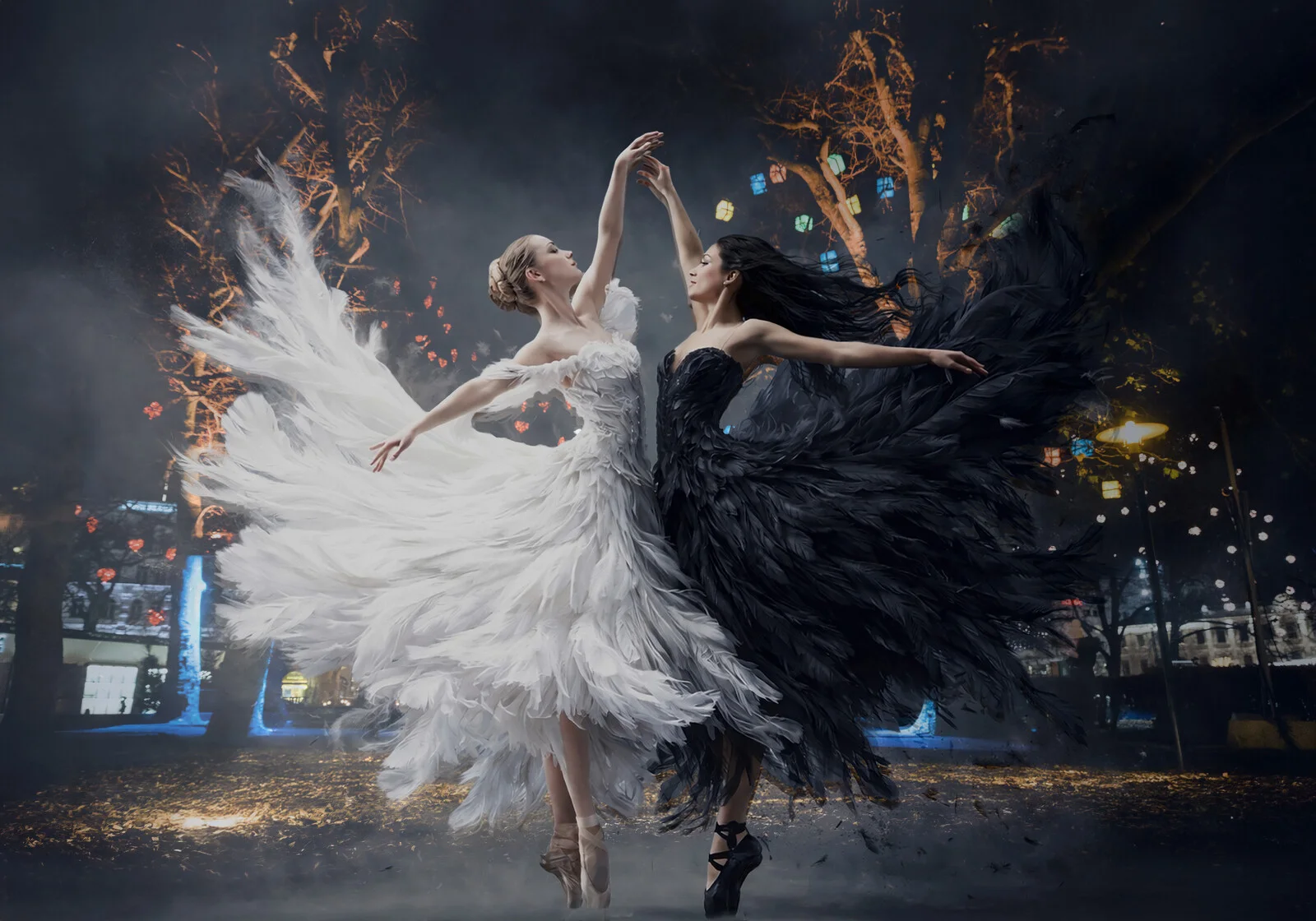
Adagio of a Black and a White Swan Pas de Deux, 2025
Digital
70 x 50 cm
3 200 kr
Adagio of a Black and a White Swan Pas de Deux
Before the Dance Begins, some stories open in grand halls, with chandeliers and velvet curtains, where audiences arrive already prepared to believe. This is not one of them. This story starts in Malmö, a city whose urban space becomes a stage for exploring societal boundaries, beneath winter skies that seem to forget the existence of light. It begins in Malmö, on a square where buses hiss, footsteps hurry, and no one expects wonder to intervene. What secret lies hidden in this quiet city, waiting to be uncovered by those who look beyond the surface? This opening aims to spark curiosity and invite the audience into an extraordinary, mysterious world, leaving them intrigued and eager to discover more.
Yet sometimes, without warning, reality thins like a fragile veil fluttering in the wind, revealing glimpses of something beyond ordinary perception.
Sometimes the world becomes transparent for long enough for something else—something older, more fragile—to pass through. And if you happen to be there, if the cold bites your thoughts into stillness and you stop long enough to belong to that moment, you may see them: two dancers where there should be only one, feathers where there should be wind, ballet in a place that has never known a curtain. Who are these figures, and what story do they carry across the thin boundary of reality? This moment, so fleeting and delicate, invites awe and makes witnessing this rare event feel like a privilege.
Most will walk past and never know it happened. But if you continue reading, you will understand what it means.
Because what follows is not merely the account of a dance. It is the story of a rule broken, a body divided, and a myth made real for the length of a single breath. This moment, so transformative and extraordinary, beckons curiosity and invites the audience to feel awe at the story's mythic power.
This is the Adagio of a Black and a White Swan Pas de Deux — and this is what happened the night the impossible came to Malmö, a moment woven with mystery and poetic grace that transcends the ordinary.
“Sonnet — The Tale of Swan Lake
By moonlit lake where silent waters keep,
A prince once wandered, caught by winter’s breath;
He found a swan in feathers folded deep,
A maiden cursed to live between life’s death.
Her name was Odette—white, a trembling heart,
Enchanted by a sorcerer’s cruel art;
At night, she walked, by daylight torn apart,
A captive soul in feathers split apart.
Yet came the Black Swan, dark with cunning guise,
Odile, who wore deception like a flame;
The prince, betrayed, believed his longing’s lies,
And doomed the one who never spoke his name.
Love could not save what fate refused to bend—
Two swans embraced, then fell—yet rose in the end.”
Malmö, December 2025
Prelude: When Swans Appear in Winter
There are nights in Malmö when the city holds its breath. Not the nights of snowfall, nor the sharp, crystalline mornings when the seagulls draw sharp lines across the Sound, but the nights left hanging between celebrations—between Christmas, with its metallic bells and sugar-coated promises, and New Year’s Eve, when fireworks will bruise the sky with colour. This in-between is its own kind of season, a liminal space where societal expectations pause, revealing the fragile architecture of time and inviting contemplation of what lies beyond tradition, prompting reflection on societal divisions and the potential for change. It is a moment that can inspire hope for Malmö's ongoing transformation and unity, encouraging the audience to see the city as a symbol of possibility.
Most people never notice it. They hurry across Gustav Adolfs Torg, collars raised, fingers tight around bags containing returns and regrets. They are thinking about what comes next—resolutions, calendars, the shape of a January yet to be negotiated. They do not lift their gaze to the trees, bare and lit by winter lamps, like arteries of old memories. They do not hear the hush that settles over the cobblestones, as if the ground itself were waiting.
But if you were to stop—if you were to stand still long enough to let the cold bite through your intentions—you might notice a ripple in the air. A disturbance with no source. A tuning fork struck by no hand. And then you would see them: two figures not meant to exist in the same breath, symbolising societal divisions—white and black, dawn and dusk. Their skirts were wild with feathers that were not feathers, but the suggestion of feathers, as if winter itself were shedding its own skin. This imagery invites reflection on how societal boundaries are constructed and challenged through art, urging viewers to reconsider the divisions that often seem insurmountable and to engage in deeper reflection on societal separation and the possibility of unity.
It is said that swans do not dance where people walk. Yet, here—within the quiet pause—the rules soften, creating space for wonder and societal critique to unfold, inviting viewers to imagine new ways to understand and find unity. The dance of the swans becomes a metaphor for societal harmony and division, encouraging the audience to reflect on how art can inspire collective change beyond surface appearances.
Ballet History: Why the Two Swans Never Meet
To understand why this dance should not be possible, one must travel to a stage far from Malmö: St. Petersburg, 1895. It is there that Swan Lake, in the version the world now knows, took definitive form under the hands of Marius Petipa and Lev Ivanov, set to the pulse and melancholy of Tchaikovsky’s score. Since that moment, the ballet has existed as both myth and architecture—a set of rules, a script written into the body. Among these rules is one that rarely reaches the audience’s ear, because it is not spoken, only embodied: the White Swan and the Black Swan do not coexist. This rule echoes societal divisions that persist beyond the stage, inviting reflection on how art both reflects and challenges societal constraints.
In the dramaturgy of Swan Lake, Odette—the White Swan—is purity, vulnerability, and the lyric of longing. Odile—the Black Swan—is deception, seduction, and the glittering mask of what one wishes to be. So tradition makes them twins in spirit yet inseparable in form, embodied by one dancer, a single woman, whose sweat and breath carry the burden of two identities. Her body splits, but her presence never does. Ballet here is a metaphysics: the soul can fracture, but the stage will not permit the pieces to stand side by side.
Why? Because the illusion depends on it.
If both Odette and Odile were to appear at once, if white feathers brushed against black on the same stage, the audience would see not magic—but mechanism. They would know a trick revealed, a double exposure, the myth undone. Ballet, after all, is not only movement. It is secrecy. It is the body saying: I can be more than one thing, but you may see only one at a time. This mystery can inspire the audience to believe in unseen possibilities for societal unity beyond surface appearances.
Over more than a century of performances, choreographers have guarded this boundary as if it were a sacred law, mirroring societal norms that define and limit identity. The two swans can meet only in the viewer's mind—never in flesh. They are a dialogue written across acts, not across shared space. One bows as the other rises. The curtain protects their separation. In a world made of illusion, this is the last rule one does not break. Challenging this rule becomes a metaphor for questioning societal divisions and imagining new possibilities for unity, emphasising art's role in societal critique and the importance of breaking down restrictive boundaries. This inspires admiration for the artistry and encourages viewers to reflect on their own societal constraints.
Yet in Malmö, that rule has shattered like lake ice under a late December stride, inspiring the audience to feel hope and believe that societal boundaries can be challenged, fostering unity beyond tradition and illusion.
The Impossible Encounter: When Identity Splits
What happens when what should be one becomes two—not metaphorically, but visibly, undeniably? When identity, generally confined to a single silhouette, steps out of itself and stands face to face with its own reflection? That is the paradox at the centre of this image: two swans in a single breath, the body divided not by violence but by permission.
Their arms rise not in imitation but in recognition, inviting viewers to experience introspection and the possibility of self-encounter through art.
The impossible becomes its own kind of truth: identity is a multifaceted, ever-changing prism that invites viewers to embrace its fluidity and complexity.
The silent theatre of Malmö’s winter square invites viewers to feel part of a shared moment, fostering community and collective reflection through art.
Their duet asks a question that most lives never dare to articulate: What would it feel like to meet the part of yourself that you have silenced? To look into a pair of eyes that belong to you yet do not answer to your name?
In this moment—this frozen adagio—the self is allowed to be more than one answer. The impossible encounter occurs not because time or choreography makes room for it, but because life sometimes grants a single loophole: a night when the body no longer guards its borders, and what should remain inside can finally step outside, unafraid, echoing the complex layers of personal and collective identity.
The Stage Is Not a Stage: Gustav Adolf's Torg as Theatre
Gazing at this public square—a place of transit rather than devotion—can inspire viewers to see ordinary spaces as potential sites of quiet wonder and reflection.
Gustav Adolfs Torg, with its buses sighing at the kerb and its pavements worn by centuries of footsteps, becomes a silent testament to how urban spaces can transform into stages of collective memory and personal reflection, blurring the line between everyday life and art.
Illumination flickers across wet stones. Light spills from windows into mist, where the swans now dance, turning the square into a half-lit canvas. Behind them, the city rises like a silent audience—faceless, unaware, yet bearing witness simply by continuing to exist. The trees, stripped bare by winter, attempt to mimic proscenium arches. Their branches reach upward, sketching frames around the dancers, a reverence they have never shown to anyone walking by at noon.
Here, ballet is no longer confined by choreography. It bleeds into the landscape. The white swan’s skirts catch the faint drafts of wind that sweep across the square. The black swan’s feathers echo the shadows of passing clouds. The city breathes, and the dancers breathe in return. There is no separation between them.
To dance on a stage is to be seen.
To dance here is to be.
The square does not applaud, but it remembers. In the morning, when the dancers are gone, and the world has returned to its errands and obligations, something will linger—a residue of grace, like the ghost of music in a hall long after the bows are packed away. People crossing the square will not know why they feel it, why their chest tightens at the sight of bare trees, or why the pavement seems to echo lightly under their feet. It is because, once, the impossible was true here.
Once, this was a theatre.
Music That Cannot Be Heard
Though Malmö lacks a symphony, the unseen music—born from wind and silence-embodies how intangible art in urban spaces can evoke a profound sense of identity and wonder beyond sound or proof, inviting viewers to experience the space poetically and emotionally.
It is the kind that cannot be recorded. The kind that does not exist for anyone who demands proof.
Perhaps it is the wind that first suggests the adagio. Winter air moves slowly, as if reluctant to disturb the quiet between the dancers. The fabric of their skirts whispers against itself, feathered hems brushing rhythm into the space between steps. A distant bus exhales at its stop, a sigh that becomes a bass note. Christmas lights tremble in the branches like a glockenspiel, so that only memory can hear them.
What follows is a score assembled by absence. There are no violins, but there is breath. There are no cellos, but there is the pulse that slows as two bodies move in effortless symmetry. The sound of a foot grazing stone—barely audible—becomes percussion. Even silence participates, shaping the tempo as a shoreline shapes the ocean’s return.
Those who stumble across this performance—if any do—will not understand what they hear. They will think it quiet. They will think nothing is happening. They will believe that music must be amplified to exist. They will not realise that some compositions are so intimate and intangible that listening becomes a physical act—the chest widening, the gaze softening, the body remembering that it has a soul, even when the music cannot be heard.
Perhaps that is the question posed by this impossible duet: Is music something we hear, or something we allow ourselves to feel? Encouraging viewers to listen beyond sound, to engage with the space's silent poetry, deepens their personal reflection and connection.
On this square-turned-stage, the answer is clear. The adagio is not played—it is breathed.
The Ritual of the In-Between Days
There are days on the calendar that refuse to be defined. Not holidays, not workdays—days suspended, like droplets caught between freeze and fall. The week between Christmas and New Year is one of them: a corridor of time, dimly lit, where people drift rather than march. During these days, human identity loosens, opening a space for hope, renewal, and reassurance. We are unfinished sentences, offering a gentle reminder that change is natural and welcoming.
It is in such liminal spaces that myth slips most readily into the world.
Children sense it first. They wander through the city, wrapped in coats, their cheeks red with cold, asking questions adults have forgotten how to hear: Where does snow go when it leaves the sky? Do the lights stay on when we sleep? Could ballerinas dance here, on the stones where pigeons walk? Adults answer with logic; children answer with possibility. And it is through this possibility that swans find entry.
Between years, the world becomes porous. Identity becomes negotiable. It is no longer absurd to imagine one body becoming two, or two bodies sharing one pulse. The white swan—symbol of vulnerability and truth—might step outside herself for just long enough to face the version of herself shaped by fear, ambition, and seduction: the black swan. Here, in the dusk of the year, no rule forbids it. The self may wear more than one face without apology, reminding us that embracing all facets of ourselves is a vital step in personal growth. This dance mirrors our own moments of change, inviting us to see transition as an act of courage and self-awareness, and to celebrate transformation as a beautiful and inevitable part of life.
Cities feel this too. Malmö, ever shifting and ever translating itself from industry to innovation, from harbour to glass-fronted skyline, becomes a fitting host for such transformation. Its surfaces remember shipyards and protests, theatres and marketplaces, and beneath every era lies the ghost of another. Malmö's history of constant change embodies the essence of liminal spaces, making it a perfect backdrop for a dance that defies continuity and celebrates transition, mirroring our own capacity for renewal and the urban landscape as a reflection of our internal journeys.
The ritual of the in-between days is simple: stand still long enough, and life will show you what it hides.
Sometimes that revelation is quiet. Snow against lamplight. A stranger’s kindness.
And sometimes—rarely, impossibly—it is two swans, dancing where no ballet should ever take place.
A Pas de Deux Beyond the Classical
In ballet, a pas de deux is a pact—an agreement between two bodies to enter time together. It is an art of surrender and negotiation: one supports, one balances; one lifts, one trusts. It is a dialogue without language, a conversation where the sentence is breath, and the punctuation is touch. But what unfolds on Gustav Adolf's Torg is not merely a pas de deux. It is something older, stranger—something that remembers that before steps were codified, bodies moved because they needed to, seeking liberation through movement.
There is no ballet master here, no rehearsal mirrored endlessly in studio glass until the body forgets its imperfections. The white swan does not bow to the demands of form. The black swan does not sharpen her lines to satisfy criticism. Their duet is not concerned with an audience—or perhaps the audience is the winter night itself, watching with the impassive gaze of the stars.
In the classical tradition, Odette and Odile are opposites that cancel each other out: one must rise for the other to disappear. On stage, only one truth is allowed to exist at a time. But here—on stone and shadow—both truths are permitted. The adagio becomes not a demonstration of control but an act of liberation. The body is no longer required to hide its contradictions. The swan does not need to choose between vulnerability and power. She may be both.
This duet asks more than it answers. It suggests that identity is not something to be resolved but something to be witnessed. That a woman may carry tenderness and ferocity in the same breath—and that such simultaneity is not a flaw but a universal aspect of human experience. Recognising this ambiguity allows us to cherish the fluidity of our own selves and embrace change as a vital part of life's ongoing dance.
If the classical pas de deux is a dialogue, this is a confession. If ballet is about illusion, this is about truth. Perhaps that is why it is beautiful—because it does not require perfection to exist. It only requires courage.
Epilogue: When They Leave
At some point—no one knows when—the dance ends. There is no final pose, no bow, no applause that rises like a tide meeting the shore. One moment, the swans are there, suspended in a breath of movement that feels as if it could rewrite the city. And then, like winter fog thinning beneath a pale dawn, they are gone.
No footprints remain. No feathers are caught in the cobblestone seams. The square looks precisely as it always has: practical, indifferent, prepared for weather and errands. Morning commuters will hurry across it, coffee warming their palms, unaware that they are crossing the afterimage of an impossibility.
But Malmö remembers. Cities, like bodies, store memory in unexpected places. In windowpanes that once reflected a dance. In lamplight that once outlined two silhouettes. In a gust of cold air that seems to echo the sweep of a skirt. And perhaps in the quiet ache that rises in anyone's chest who pauses there without knowing why, connecting us to a collective memory of fleeting beauty.
If Swan Lake teaches us that one soul can fracture into two, this night teaches the inverse—that fractures sometimes mend. That division can meet itself. That opposites, long kept apart to preserve illusion, can—briefly, impossibly—touch.
Between one year and the next, between one breath and another, between who we are and who we fear to become, the white swan and the black swan met, danced, and vanished.
And if anyone ever asks whether it truly happened, the city itself may answer—not with certainty, but with an invitation:
Stand still.
Listen.
Wait for the new year.
Jörgen Thornberg
Adagio of a Black and a White Swan Pas de Deux, 2025
Digital
70 x 50 cm
3 200 kr
Adagio of a Black and a White Swan Pas de Deux
Before the Dance Begins, some stories open in grand halls, with chandeliers and velvet curtains, where audiences arrive already prepared to believe. This is not one of them. This story starts in Malmö, a city whose urban space becomes a stage for exploring societal boundaries, beneath winter skies that seem to forget the existence of light. It begins in Malmö, on a square where buses hiss, footsteps hurry, and no one expects wonder to intervene. What secret lies hidden in this quiet city, waiting to be uncovered by those who look beyond the surface? This opening aims to spark curiosity and invite the audience into an extraordinary, mysterious world, leaving them intrigued and eager to discover more.
Yet sometimes, without warning, reality thins like a fragile veil fluttering in the wind, revealing glimpses of something beyond ordinary perception.
Sometimes the world becomes transparent for long enough for something else—something older, more fragile—to pass through. And if you happen to be there, if the cold bites your thoughts into stillness and you stop long enough to belong to that moment, you may see them: two dancers where there should be only one, feathers where there should be wind, ballet in a place that has never known a curtain. Who are these figures, and what story do they carry across the thin boundary of reality? This moment, so fleeting and delicate, invites awe and makes witnessing this rare event feel like a privilege.
Most will walk past and never know it happened. But if you continue reading, you will understand what it means.
Because what follows is not merely the account of a dance. It is the story of a rule broken, a body divided, and a myth made real for the length of a single breath. This moment, so transformative and extraordinary, beckons curiosity and invites the audience to feel awe at the story's mythic power.
This is the Adagio of a Black and a White Swan Pas de Deux — and this is what happened the night the impossible came to Malmö, a moment woven with mystery and poetic grace that transcends the ordinary.
“Sonnet — The Tale of Swan Lake
By moonlit lake where silent waters keep,
A prince once wandered, caught by winter’s breath;
He found a swan in feathers folded deep,
A maiden cursed to live between life’s death.
Her name was Odette—white, a trembling heart,
Enchanted by a sorcerer’s cruel art;
At night, she walked, by daylight torn apart,
A captive soul in feathers split apart.
Yet came the Black Swan, dark with cunning guise,
Odile, who wore deception like a flame;
The prince, betrayed, believed his longing’s lies,
And doomed the one who never spoke his name.
Love could not save what fate refused to bend—
Two swans embraced, then fell—yet rose in the end.”
Malmö, December 2025
Prelude: When Swans Appear in Winter
There are nights in Malmö when the city holds its breath. Not the nights of snowfall, nor the sharp, crystalline mornings when the seagulls draw sharp lines across the Sound, but the nights left hanging between celebrations—between Christmas, with its metallic bells and sugar-coated promises, and New Year’s Eve, when fireworks will bruise the sky with colour. This in-between is its own kind of season, a liminal space where societal expectations pause, revealing the fragile architecture of time and inviting contemplation of what lies beyond tradition, prompting reflection on societal divisions and the potential for change. It is a moment that can inspire hope for Malmö's ongoing transformation and unity, encouraging the audience to see the city as a symbol of possibility.
Most people never notice it. They hurry across Gustav Adolfs Torg, collars raised, fingers tight around bags containing returns and regrets. They are thinking about what comes next—resolutions, calendars, the shape of a January yet to be negotiated. They do not lift their gaze to the trees, bare and lit by winter lamps, like arteries of old memories. They do not hear the hush that settles over the cobblestones, as if the ground itself were waiting.
But if you were to stop—if you were to stand still long enough to let the cold bite through your intentions—you might notice a ripple in the air. A disturbance with no source. A tuning fork struck by no hand. And then you would see them: two figures not meant to exist in the same breath, symbolising societal divisions—white and black, dawn and dusk. Their skirts were wild with feathers that were not feathers, but the suggestion of feathers, as if winter itself were shedding its own skin. This imagery invites reflection on how societal boundaries are constructed and challenged through art, urging viewers to reconsider the divisions that often seem insurmountable and to engage in deeper reflection on societal separation and the possibility of unity.
It is said that swans do not dance where people walk. Yet, here—within the quiet pause—the rules soften, creating space for wonder and societal critique to unfold, inviting viewers to imagine new ways to understand and find unity. The dance of the swans becomes a metaphor for societal harmony and division, encouraging the audience to reflect on how art can inspire collective change beyond surface appearances.
Ballet History: Why the Two Swans Never Meet
To understand why this dance should not be possible, one must travel to a stage far from Malmö: St. Petersburg, 1895. It is there that Swan Lake, in the version the world now knows, took definitive form under the hands of Marius Petipa and Lev Ivanov, set to the pulse and melancholy of Tchaikovsky’s score. Since that moment, the ballet has existed as both myth and architecture—a set of rules, a script written into the body. Among these rules is one that rarely reaches the audience’s ear, because it is not spoken, only embodied: the White Swan and the Black Swan do not coexist. This rule echoes societal divisions that persist beyond the stage, inviting reflection on how art both reflects and challenges societal constraints.
In the dramaturgy of Swan Lake, Odette—the White Swan—is purity, vulnerability, and the lyric of longing. Odile—the Black Swan—is deception, seduction, and the glittering mask of what one wishes to be. So tradition makes them twins in spirit yet inseparable in form, embodied by one dancer, a single woman, whose sweat and breath carry the burden of two identities. Her body splits, but her presence never does. Ballet here is a metaphysics: the soul can fracture, but the stage will not permit the pieces to stand side by side.
Why? Because the illusion depends on it.
If both Odette and Odile were to appear at once, if white feathers brushed against black on the same stage, the audience would see not magic—but mechanism. They would know a trick revealed, a double exposure, the myth undone. Ballet, after all, is not only movement. It is secrecy. It is the body saying: I can be more than one thing, but you may see only one at a time. This mystery can inspire the audience to believe in unseen possibilities for societal unity beyond surface appearances.
Over more than a century of performances, choreographers have guarded this boundary as if it were a sacred law, mirroring societal norms that define and limit identity. The two swans can meet only in the viewer's mind—never in flesh. They are a dialogue written across acts, not across shared space. One bows as the other rises. The curtain protects their separation. In a world made of illusion, this is the last rule one does not break. Challenging this rule becomes a metaphor for questioning societal divisions and imagining new possibilities for unity, emphasising art's role in societal critique and the importance of breaking down restrictive boundaries. This inspires admiration for the artistry and encourages viewers to reflect on their own societal constraints.
Yet in Malmö, that rule has shattered like lake ice under a late December stride, inspiring the audience to feel hope and believe that societal boundaries can be challenged, fostering unity beyond tradition and illusion.
The Impossible Encounter: When Identity Splits
What happens when what should be one becomes two—not metaphorically, but visibly, undeniably? When identity, generally confined to a single silhouette, steps out of itself and stands face to face with its own reflection? That is the paradox at the centre of this image: two swans in a single breath, the body divided not by violence but by permission.
Their arms rise not in imitation but in recognition, inviting viewers to experience introspection and the possibility of self-encounter through art.
The impossible becomes its own kind of truth: identity is a multifaceted, ever-changing prism that invites viewers to embrace its fluidity and complexity.
The silent theatre of Malmö’s winter square invites viewers to feel part of a shared moment, fostering community and collective reflection through art.
Their duet asks a question that most lives never dare to articulate: What would it feel like to meet the part of yourself that you have silenced? To look into a pair of eyes that belong to you yet do not answer to your name?
In this moment—this frozen adagio—the self is allowed to be more than one answer. The impossible encounter occurs not because time or choreography makes room for it, but because life sometimes grants a single loophole: a night when the body no longer guards its borders, and what should remain inside can finally step outside, unafraid, echoing the complex layers of personal and collective identity.
The Stage Is Not a Stage: Gustav Adolf's Torg as Theatre
Gazing at this public square—a place of transit rather than devotion—can inspire viewers to see ordinary spaces as potential sites of quiet wonder and reflection.
Gustav Adolfs Torg, with its buses sighing at the kerb and its pavements worn by centuries of footsteps, becomes a silent testament to how urban spaces can transform into stages of collective memory and personal reflection, blurring the line between everyday life and art.
Illumination flickers across wet stones. Light spills from windows into mist, where the swans now dance, turning the square into a half-lit canvas. Behind them, the city rises like a silent audience—faceless, unaware, yet bearing witness simply by continuing to exist. The trees, stripped bare by winter, attempt to mimic proscenium arches. Their branches reach upward, sketching frames around the dancers, a reverence they have never shown to anyone walking by at noon.
Here, ballet is no longer confined by choreography. It bleeds into the landscape. The white swan’s skirts catch the faint drafts of wind that sweep across the square. The black swan’s feathers echo the shadows of passing clouds. The city breathes, and the dancers breathe in return. There is no separation between them.
To dance on a stage is to be seen.
To dance here is to be.
The square does not applaud, but it remembers. In the morning, when the dancers are gone, and the world has returned to its errands and obligations, something will linger—a residue of grace, like the ghost of music in a hall long after the bows are packed away. People crossing the square will not know why they feel it, why their chest tightens at the sight of bare trees, or why the pavement seems to echo lightly under their feet. It is because, once, the impossible was true here.
Once, this was a theatre.
Music That Cannot Be Heard
Though Malmö lacks a symphony, the unseen music—born from wind and silence-embodies how intangible art in urban spaces can evoke a profound sense of identity and wonder beyond sound or proof, inviting viewers to experience the space poetically and emotionally.
It is the kind that cannot be recorded. The kind that does not exist for anyone who demands proof.
Perhaps it is the wind that first suggests the adagio. Winter air moves slowly, as if reluctant to disturb the quiet between the dancers. The fabric of their skirts whispers against itself, feathered hems brushing rhythm into the space between steps. A distant bus exhales at its stop, a sigh that becomes a bass note. Christmas lights tremble in the branches like a glockenspiel, so that only memory can hear them.
What follows is a score assembled by absence. There are no violins, but there is breath. There are no cellos, but there is the pulse that slows as two bodies move in effortless symmetry. The sound of a foot grazing stone—barely audible—becomes percussion. Even silence participates, shaping the tempo as a shoreline shapes the ocean’s return.
Those who stumble across this performance—if any do—will not understand what they hear. They will think it quiet. They will think nothing is happening. They will believe that music must be amplified to exist. They will not realise that some compositions are so intimate and intangible that listening becomes a physical act—the chest widening, the gaze softening, the body remembering that it has a soul, even when the music cannot be heard.
Perhaps that is the question posed by this impossible duet: Is music something we hear, or something we allow ourselves to feel? Encouraging viewers to listen beyond sound, to engage with the space's silent poetry, deepens their personal reflection and connection.
On this square-turned-stage, the answer is clear. The adagio is not played—it is breathed.
The Ritual of the In-Between Days
There are days on the calendar that refuse to be defined. Not holidays, not workdays—days suspended, like droplets caught between freeze and fall. The week between Christmas and New Year is one of them: a corridor of time, dimly lit, where people drift rather than march. During these days, human identity loosens, opening a space for hope, renewal, and reassurance. We are unfinished sentences, offering a gentle reminder that change is natural and welcoming.
It is in such liminal spaces that myth slips most readily into the world.
Children sense it first. They wander through the city, wrapped in coats, their cheeks red with cold, asking questions adults have forgotten how to hear: Where does snow go when it leaves the sky? Do the lights stay on when we sleep? Could ballerinas dance here, on the stones where pigeons walk? Adults answer with logic; children answer with possibility. And it is through this possibility that swans find entry.
Between years, the world becomes porous. Identity becomes negotiable. It is no longer absurd to imagine one body becoming two, or two bodies sharing one pulse. The white swan—symbol of vulnerability and truth—might step outside herself for just long enough to face the version of herself shaped by fear, ambition, and seduction: the black swan. Here, in the dusk of the year, no rule forbids it. The self may wear more than one face without apology, reminding us that embracing all facets of ourselves is a vital step in personal growth. This dance mirrors our own moments of change, inviting us to see transition as an act of courage and self-awareness, and to celebrate transformation as a beautiful and inevitable part of life.
Cities feel this too. Malmö, ever shifting and ever translating itself from industry to innovation, from harbour to glass-fronted skyline, becomes a fitting host for such transformation. Its surfaces remember shipyards and protests, theatres and marketplaces, and beneath every era lies the ghost of another. Malmö's history of constant change embodies the essence of liminal spaces, making it a perfect backdrop for a dance that defies continuity and celebrates transition, mirroring our own capacity for renewal and the urban landscape as a reflection of our internal journeys.
The ritual of the in-between days is simple: stand still long enough, and life will show you what it hides.
Sometimes that revelation is quiet. Snow against lamplight. A stranger’s kindness.
And sometimes—rarely, impossibly—it is two swans, dancing where no ballet should ever take place.
A Pas de Deux Beyond the Classical
In ballet, a pas de deux is a pact—an agreement between two bodies to enter time together. It is an art of surrender and negotiation: one supports, one balances; one lifts, one trusts. It is a dialogue without language, a conversation where the sentence is breath, and the punctuation is touch. But what unfolds on Gustav Adolf's Torg is not merely a pas de deux. It is something older, stranger—something that remembers that before steps were codified, bodies moved because they needed to, seeking liberation through movement.
There is no ballet master here, no rehearsal mirrored endlessly in studio glass until the body forgets its imperfections. The white swan does not bow to the demands of form. The black swan does not sharpen her lines to satisfy criticism. Their duet is not concerned with an audience—or perhaps the audience is the winter night itself, watching with the impassive gaze of the stars.
In the classical tradition, Odette and Odile are opposites that cancel each other out: one must rise for the other to disappear. On stage, only one truth is allowed to exist at a time. But here—on stone and shadow—both truths are permitted. The adagio becomes not a demonstration of control but an act of liberation. The body is no longer required to hide its contradictions. The swan does not need to choose between vulnerability and power. She may be both.
This duet asks more than it answers. It suggests that identity is not something to be resolved but something to be witnessed. That a woman may carry tenderness and ferocity in the same breath—and that such simultaneity is not a flaw but a universal aspect of human experience. Recognising this ambiguity allows us to cherish the fluidity of our own selves and embrace change as a vital part of life's ongoing dance.
If the classical pas de deux is a dialogue, this is a confession. If ballet is about illusion, this is about truth. Perhaps that is why it is beautiful—because it does not require perfection to exist. It only requires courage.
Epilogue: When They Leave
At some point—no one knows when—the dance ends. There is no final pose, no bow, no applause that rises like a tide meeting the shore. One moment, the swans are there, suspended in a breath of movement that feels as if it could rewrite the city. And then, like winter fog thinning beneath a pale dawn, they are gone.
No footprints remain. No feathers are caught in the cobblestone seams. The square looks precisely as it always has: practical, indifferent, prepared for weather and errands. Morning commuters will hurry across it, coffee warming their palms, unaware that they are crossing the afterimage of an impossibility.
But Malmö remembers. Cities, like bodies, store memory in unexpected places. In windowpanes that once reflected a dance. In lamplight that once outlined two silhouettes. In a gust of cold air that seems to echo the sweep of a skirt. And perhaps in the quiet ache that rises in anyone's chest who pauses there without knowing why, connecting us to a collective memory of fleeting beauty.
If Swan Lake teaches us that one soul can fracture into two, this night teaches the inverse—that fractures sometimes mend. That division can meet itself. That opposites, long kept apart to preserve illusion, can—briefly, impossibly—touch.
Between one year and the next, between one breath and another, between who we are and who we fear to become, the white swan and the black swan met, danced, and vanished.
And if anyone ever asks whether it truly happened, the city itself may answer—not with certainty, but with an invitation:
Stand still.
Listen.
Wait for the new year.
3 200 kr

Jörgen Thornberg
Malmö
Lite om bilder och mig. Translation in English at the end.
Jag är en nyfiken person som ser allt i bilder, även det jag fäster i ord, gärna tillsammans för bakom alla mina bilder finns en berättelse. Till vissa bilder hör en kortare eller längre novell som följer med bilden.
Bilder berättar historier. Jag omges av naturlig skönhet, intressanta människor och historia var jag än går. Jag använder min kamera för att dokumentera världen och blanda det jag ser med vad jag känner för att fånga den dolda magin.
Mina bilder berättar mina historier. Genom mina bilder, tryck och berättelser. Jag bjuder in dig att ta del av dessa berättelser, in i ditt liv och hem och dela min mycket personliga syn på vår värld. Mer än vad ögat ser. Jag tänker i bilder, drömmer och skriver och pratar om dem; följaktligen måste jag också skapa bilder. De blir vad jag ser, inte nödvändigtvis begränsade till verkligheten. Det finns en bild runt varje hörn. Jag hoppas att du kommer att se vad jag såg och gilla det.
Jag är också en skrivande person och till många bilder hör en kortare eller längre essay. Den följer med tavlan, tryckt på fint papper och med en personlig hälsning från mig.
Flertalet bilder startar sin resa i min kamera. Enkelt förklarat beskriver jag bilden jag ser i mitt inre, upplevd eller fantiserad. Bilden uppstår inom mig redan innan jag fått okularet till ögat. På bråkdelen av ett ögonblick ser jag vad jag vill ha och vad som kan göras med bilden. Här skall jag stoppa in en giraff, stålmannen, Titanic eller vad det är min fantasi finner ut. Ännu märkligare är att jag kommer ihåg minnesbilden långt efteråt när det blir tid att skapa verket. Om jag lyckas eller inte, är upp till betraktaren, oftast präglat av en stråk av svart humor – meningen är att man skall bli underhållen. Mina bilder blir ofta en snackis där de hänger.
Jag föredrar bilder som förmedlar ett budskap i flera lager. Vid första anblicken fylld av feel-good, en vacker utsikt, fint väder, solen skiner, blommor på ängen eller vattnet som ligger förrädiskt spegelblankt. I en sådan bild kan jag gömma min egentliga berättelse, mitt förakt för förtryckare och våldsverkare, rasister och fördomsfulla människor - ett gärna återkommande motiv mer eller mindre dolt i det vackra motivet. Jag försöker förena dem i ett gemensamt narrativ.
Bild och formgivning har löpt som en röd tråd genom livet. Fotokonst känns som en värdig final som jag gärna delar med mig.
Min genre är vid som framgår av mina bilder, temat en blandning av pop- och gatukonst i kollage som kan bestå av hundratals lager. Vissa bilder kan ta veckor, andra någon dag innan det är dags att överlämna resultatet till printverkstaden. Fine Art Prints är digitala fotocollage. I dessa kollage sker rivandet, klippandet, pusslandet, målandet, ritandet och sprayningen digitalt. Det jag monterar in kan vara hundratals år gamla bilder som jag omsorgsfullt frilägger så att de ser ut att vara en del av tavlan men också bilder skapade av mig själv efter min egen fantasi. Därefter besöks printstudion och för vissa bilder numrera en limiterad upplaga (oftast 7 exemplar) och signera för hand. Vissa bilder kan köpas i olika format. Det är bara att fråga efter vilka. Gillar man en bild som är 70x100 men inte har plats på väggen, går den kanske att få i 50x70 cm istället. Frågan är fri.
Metoden Giclée eller Fine Art Print som det också kallas är det moderna sättet för framställning av grafisk konst. Villkoret för denna typ av utskrifter är att en högkvalitativ storformatskrivare används med åldersbeständigt färgpigment och konstnärspapper eller i förekommande fall på duk. Pappret som används möter de krav på livslängd som ställs av museer och gallerier. Normalt säljer jag mina bilder oinramade så att den nya ägaren själv kan bestämma hur de skall se ut, med eller utan passepartout färg på ram, med eller utan glas etc..
Under många år ställde jag bara ut på nätet, i valda grupper och på min egen Facebooksida - https://www.facebook.com/jorgen.thornberg.9
Jag finns också på en egen hemsida som tyvärr inte alltid är uppdaterad – https://www.jth.life/ Där kan du också läsa en del av de berättelser som följer med bilden.
UTSTÄLLNINGAR
Luftkastellet, oktober 2022
Konst i Lund, november 2022
Luftkastellet, mars 2023
Engleson Galleri Caroli, april 2023
Hydra, Greece June 2023
Engleson Galleri Caroli, oktober 2023
Toppen, Höllviken december 2023
Luftkastellet, mars 2024
Torups Galleri, mars 2024
Venice, May 2024
Luftkastellet, oktober 2024
Konst i Advent, December 2024
Galleri Engleson, Caroli December 2024
Jäger & Jansson Galleri, april 2025
A bit about pictures and me.
I'm a curious person who sees everything in pictures, even what I express in words, often combining them, for behind all my pictures lies a story. These narratives, some as short as a single image and others as long as a novel, are the heart and soul of my work.
Pictures tell stories. Wherever I go, I'm surrounded by natural beauty, exciting people, and history. I use my camera to document the world and blend what I see with what I feel to capture the hidden magic.
My images tell my stories. Through my pictures, prints, and narratives, I invite you to partake in these stories in your life and home and share my deeply personal perspective of our world. More than meets the eye. I think in pictures, dream, write, and talk about them; consequently, I must create images too. They become what I see, not necessarily confined to reality. There's a picture around every corner. I hope you'll see what I saw and enjoy it.
I'm also a writer, and many images come with a shorter or longer essay. It accompanies the painting, printed on fine paper with my personal greeting.
Many pictures start their journey on my camera. Simply put, I describe the image I see in my mind, experienced or imagined. The image arises within me even before I bring the eyepiece to my eye. In a fraction of a moment, I see what I want and what can be done with the picture. Here, I'll insert a giraffe, Superman, the Titanic, or whatever my imagination conjures up. Even stranger is that I remember the mental image long after it's time to create the work. Whether I succeed is up to the observer, often imbued with a streak of black humour – the aim is to entertain. My pictures usually become a talking point wherever they hang.
I prefer pictures that convey a message in multiple layers. At first glance, they're filled with feel-good vibes, a beautiful view, lovely weather, the sun shining, flowers in the meadow, or the water lying deceptively calm. But beneath this surface beauty, I often conceal a deeper story, a narrative that challenges societal norms or explores the human condition. I invite you to delve into these hidden narratives and discover the layers of meaning within my work.
Picture and design have been a thread running through my life. Photographic art feels like a fitting finale, and I'm happy to share it.
My genre is varied, as seen in my pictures; the theme is a blend of pop and street art in collages that can consist of hundreds of layers. Some images can take weeks, others just a day before it's time to hand over the result to the print workshop. Fine Art Prints are digital photo collages. In these collages, tearing, cutting, puzzling, painting, drawing, and spraying happen digitally. What I insert can be images hundreds of years old that I carefully extract so they appear to be part of the painting, but also images created by myself, now also generated from my imagination. Next, visit the print studio and, for certain images, number a limited edition (usually 7 copies) and sign them by hand. Some images may be available in other formats. Just ask which ones. If you like an image that's 70x100 but doesn't have space on the wall, you might be able to get it in 50x70 cm instead. The question is open.
The Giclée method, or Fine Art Print as it's also called, is the modern way of producing graphic art. This method ensures the highest quality and longevity of the artwork, using a high-quality large-format printer with archival pigment inks and artist paper or, in some cases, canvas. The paper used meets the longevity requirements set by museums and galleries. I sell my pictures unframed, allowing the new owner to personalise their artwork, confident in the lasting value and quality of the piece.
For many years, I only exhibited online, in selected groups, and on my Facebook page - https://www.facebook.com/jorgen.thornberg.9. I also have my website, which unfortunately is not constantly updated - https://www.jth.life/. You can also read some of the stories accompanying the pictures there.
EXHIBITIONS
Luftkastellet, October 2022
Art in Lund, November 2022
Luftkastellet, March 2023
Engleson Gallery Caroli, April 2023
Hydra, Greece June 2023
Engleson Gallery Caroli, October 2023
Toppen, Höllviken December 2023
Luftkastellet, March 2024
Torup Gallery, March 2024
Venice, May 2024
UTSTÄLLNINGAR
Luftkastellet, oktober 2022
Konst i Lund, november 2022
Luftkastellet, mars 2023
Engleson Galleri Caroli, april 2023
Hydra, Greece June 2023
Engleson Galleri Caroli, oktober 2023
Toppen, Höllviken december 2023
Luftkastellet, mars 2024
Torups Galleri, mars 2024
Venice, May 2024
Luftkastellet, October 2024
Konst i Advent, December 2024
Galleri Engleson, Caroli December 2024
Jäger & Jansson Galleri, April 2025
Utbildning
Autodidakt
Medlem i konstnärsförening
Öppna Sinnen
Med i konstrunda
Konstrundan i Skåne
Utställningar
Luftkastellet, October 2022
Art in Lund, November 2022
Luftkastellet, March 2023
Engleson Gallery Caroli, April 2023
Hydra, Greece June 2023
Engleson Gallery Caroli, October 2023
Toppen, Höllviken December 2023
Luftkastellet, March 2024
Torup Gallery, March 2024
Venice, May 2024