Vi använder cookies för att ge dig bästa möjliga upplevelse. Välj vilka cookies du tillåter.
Läs mer i vår integritetspolicy
Jörgen Thornberg
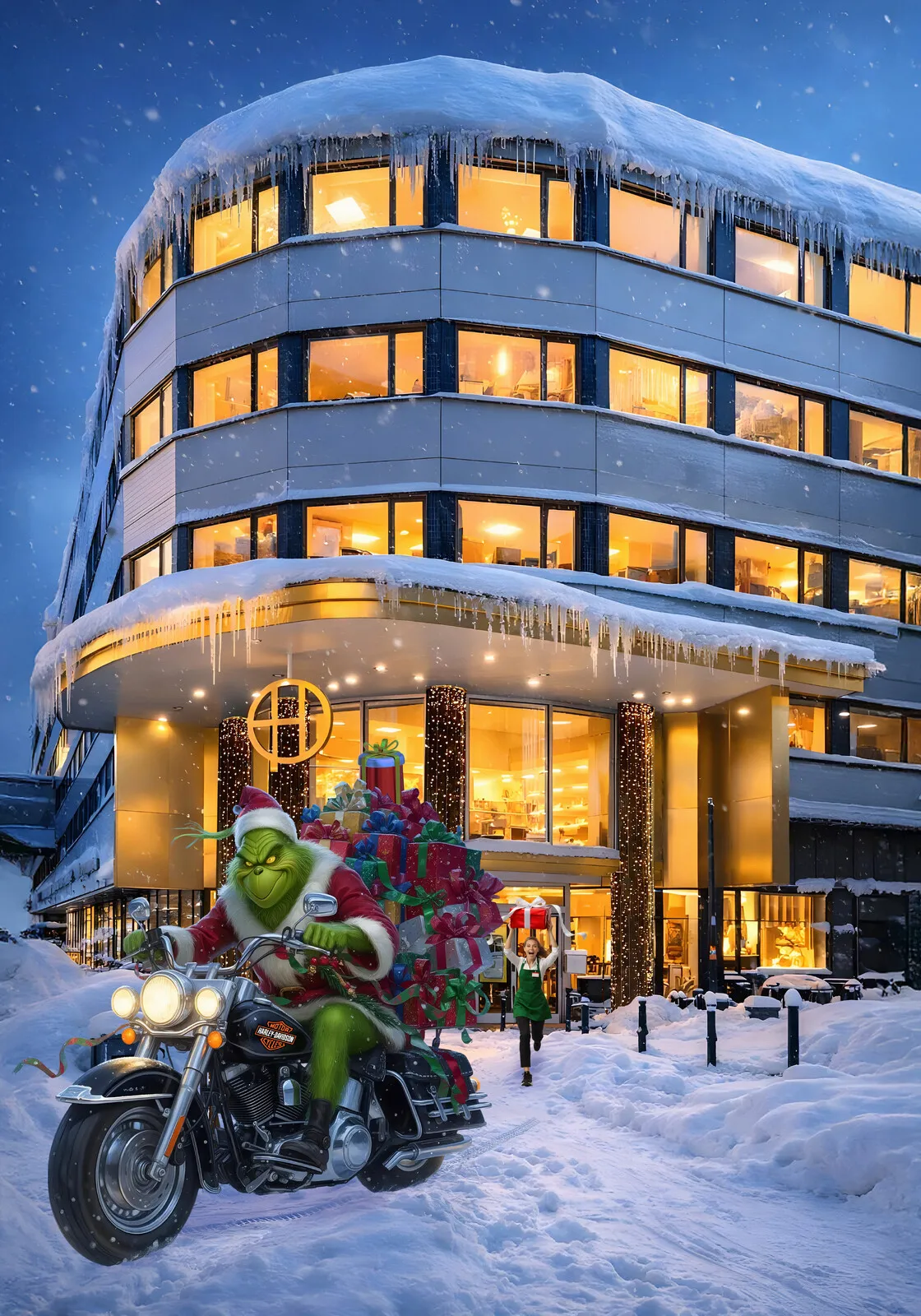
The Grinch Delivery – Christmas on the Run, 2025
Digital
50 x 70 cm
3 200 kr
The Grinch Delivery – Christmas on the Run
At first glance, the story seems almost absurd: a lone figure in a furry green Santa suit, riding a Harley through a snow-drowned city, collecting gifts meant for strangers. It challenges us to question the societal image of holiday cheer and community, revealing a deeper layer beneath the whimsy. This narrative prompts us to examine how societal expectations shape our understanding of community and shared purpose during holidays, especially when those expectations are disrupted.
Christmas in modern cities has become a contract: joy ordered in advance, paid for, tracked, and expected to arrive precisely on time. Highlighting how societal expectations shape our holiday experiences can help readers reflect on their own perceptions and assumptions about celebration and community.
“How the Grinch Stole Christmas in Malmö
It was snow that sealed the streets,
white walls rising where roads once ran,
and Malmö, trimmed in winter light,
waited for a knock that never came.
He rode not with sleigh or bells,
but on a Harley, chrome like frozen fire,
a green shadow in a Santa coat,
collecting wishes like debts owed.
Door by door, the city held its breath,
expecting joy the way lungs expect air,
but parcels vanished into the weather,
names folded under his gloved hand.
Children searched beneath their trees,
small palms lifting emptiness like evidence;
parents whispered explanations
no one believed, not even themselves.
Some say he laughed; some say he didn’t.
Legends shift like snow in the wind.
But every tale agrees:
What he stole was not wrapped in ribbon.
He stole the certainty of arrival,
the quiet contract we never signed
but always trusted—
that happiness could be delivered.
And yet, in the hollows left behind,
warmth flickered like an afterthought:
a spoon dropped in a stairwell,
a thermos shared between strangers,
A city learning, slowly,
that celebration is not sent—
It is made.”
Malmö, December 2025
The Grinch Delivery – Christmas on the Run
A few years ago, the old-fashioned kind of Christmas returned, with sub-zero temperatures and heavy snowfall. It came so quickly that the street department could not keep up, and for a while, Hansakompagniet in the city centre was more or less snowed in. Because it was the day before Christmas Eve, panic spread throughout the department store. They were sitting on a mountain of parcels, waiting for home delivery to customers who had taken up the offer of ‘Christmas Gift to the Door’. It was around the same time that people had grown used to having food delivered to their homes – even from finer restaurants. So why not Christmas presents as well? Little did they know, a humorous twist was about to unfold with a Grinch-themed delivery that would turn their holiday upside down, adding a playful touch to the season's chaos.
When Grinch Delivery got in touch, no one raised an eyebrow at the odd name. Bring, Go, Budbärar’n, Jeppes, In Time, Frishers, Beglerbegovic, and a handful of other exotic surnames had already taught people not to raise an eyebrow – so Grinch did not seem strange in that context. When the friendly man who introduced himself as Dr Seuss arrived, the store manager was immediately charmed. If a company has a representative with a doctoral title, it must be serious, he reasoned. That they had been operating since 1957 only strengthened his confidence. Perhaps he should have wondered about the picture on their website, which depicted a peculiar creature sneaking about in a wintry landscape, dressed in a Santa suit. But it was Christmas, and pictures of trucks had made one ad look like the next. “Good that they stand out,” the manager thought. The humorous twist was that the delivery was themed around the Grinch, the classic Christmas villain, adding a quirky holiday touch that the manager didn't see coming.
There was nothing strange about calling the Grinch when the weather made roads and streets impassable to ordinary vehicles. The peculiar figure on the handlebars had already delivered ten rounds of parcels. It was probably the Santa suit that deceived. A sober Santa on a three-hundred-kilogram Harley inspired trust, even if the driver’s face was green. In a city of 187 nationalities, people are used to seeing others who look different. The thick green furry Santa suit – for it must be that – was interpreted as a bold stylistic choice and surely held up well against the cold. The image of a green Santa on a Harley added a humorous and quirky touch to the holiday chaos, making the scene memorable and amusing for readers.
Some customers called to ask when their parcels would arrive, worried that no one would consider the state of the streets around Hansa, which were blocked by snow. Not until Christmas morning did anxiety spread. No Christmas gifts seemed to have reached their destinations, and on the company’s website and answering machine, “Jingle Bells” played relentlessly. One of the younger shop assistants googled a little more deeply about the Grinch and found both a children’s book and a film starring Jim Carrey. Then they understood, sharing a laugh over the holiday mishap and the playful chaos that brought everyone together in the spirit of the season.
The green man had stolen Christmas from hundreds of Malmö residents. The Grinch is green and hairy, with a cynical outlook on life. He is a loner who dislikes people socialising and having fun. Above all, he despises the most fantastic holiday of all in the American town of Whoville – Christmas. The book tells of how the Grinch wants to “steal” Christmas from the villagers – that is, take away everything typical of Christmas so they can't celebrate at all. He has repeated this act in Malmö.
Some stories cling to geography – but some, like frost, travel on breath and need only cold air to reform. This contrast can make readers feel nostalgic and encourage them to reflect on the true meaning of celebration beyond material goods.
The story of the Grinch shows how materialism can overshadow genuine connection, making us nostalgic and longing for meaningful relationships at Christmas, which can evoke empathy and reflection in your audience.
In Malmö, whispers rose through stairwells and courtyards. “Was it the weather? Was it sabotage?” Someone in Ribersborg claimed to have seen him fly by – not ride – a green streak against the winter light, as though weighted not by cargo but by loneliness. Every tale of the Grinch ends – if you read it carefully – not in comedy but in ache. It makes us wonder: have we lost sight of the true spirit of Christmas, replaced by fleeting moments and material pursuits? A creature who hates Christmas is always, secretly, one who once wanted it and was denied, reflecting society's tendency to commodify and then neglect the holiday's more profound meaning, encouraging hope for genuine community and presence.
Dr Seuss's stories, with their warnings and rhymes, remind us that hearts shrink when neglected and that understanding can rekindle the true spirit of Christmas we all seek.
A Holiday on Demand
Long before the snowstorm, long before a green silhouette on a Harley carved its way through the streets, Malmö had already embraced the idea that everything could arrive on command. This shift from ritual and memory to instant gratification reveals how convenience has redefined Christmas, often at the expense of meaningful shared traditions and authentic connection.
Christmas has been repackaged, not as ritual or memory, but as a service, highlighting how convenience shifts the focus from community to instant gratification. For example, online shopping and instant gift delivery exemplify this change. This prompts us to consider whether the ease of getting everything on demand-gifts, experiences, even holiday cheer-diminishes the holiday's true meaning and erodes the opportunity for meaningful, shared traditions that foster authentic connection beyond material exchange.
It was understandable, then, that no one questioned the offer. Christmas Gift to Your Door. A slogan so smooth it bypassed doubt entirely. It sounded like progress. It felt like kindness. Yet beneath it lay a quiet shift: Christmas was no longer something people made together – it became something they received, eroding the tradition of shared effort and connection.
The logic was simple: if a restaurant could appear at your table, if groceries could arrive before you opened the fridge, if shoes, sofas, medicines, and entire wardrobes could materialise in cardboard boxes—why not joy?
Why not the smell of pine, delivered pre-installed? Why not a surprise, wrapped and ribboned by someone you would never meet?
This ritual of package arrival can make us feel the loneliness that convenience masks, encouraging us to seek genuine presence this holiday season. Reflecting on how we can prioritise authentic connection, perhaps through shared meals, storytelling, or giving time, can help counteract the superficiality promoted by consumerism and restore the true spirit of Christmas.
The management at Hansa understood this perfectly. They did not sell objects. They sold reassurance. A child who receives a parcel delivered to the door believes, at least for one morning, that the world remembers them. And so, somewhere inside the meeting rooms, someone said the sentence that would later echo like an accusation: “We cannot afford a single failed delivery.”
It was not greed. It was faith.
Faith in systems, not stories. Faith in barcodes, not Bethlehem. Faith in promises wrapped in plastic rather than in hands extended across a table.
And so when the weather turned, they did not ask, “Should we pause?” They asked instead, “Who else can we call?”
Because the idea of Christmas faltering—of gifts not arriving—felt unthinkable, it felt like a personal affront—a breach of contract with the universe.
It is in that moment – that refusal to accept interruption – that the Grinch’s shadow lengthened. His power, after all, does not come from theft alone; it comes from timing. He enters when a society cannot imagine surviving without its comforts.
He waits until the world forgets what celebration once looked like, when nothing at all arrived.
The Name No One Questioned, a symbol of how surface labels, like names and titles, mask deeper truths, invites reflection on the illusions we accept without scrutiny and challenges perceptions of identity.
When the phone call was made, it was almost casual. A number taken from a printed list, a name that slid past the eyes without friction: Grinch Delivery. It did not sound any stranger than the others—Bring, Budbärar’n, Jeppes, In Time, Beglerbegovic. The age of logistics had taught everyone not to look too closely. Names no longer held identity; they were merely labels pasted onto motion. All that mattered was speed.
The manager, already pacing with the agitation that comes with responsibility and guilt, felt relief simply because someone answered. The voice on the line was polite, warm, even jovial. He introduced himself as Dr Seuss. And that, perhaps more than anything, dissolved the last of the manager’s caution. In a world where titles stand in for trust, a doctorate—any doctorate—still works like a skeleton key. If a man has been called “Doctor,” surely he knows what he is doing.
They met by the loading bay, where the snow gathered in heaps like neglected promises. He did not arrive in a van or a branded vehicle. He walked. A tall shape approached through the swirling white, pushing a Harley-Davidson like a myth dragging its own entrance. The chrome's shine and the motorcycle's youthful energy symbolise superficial reliability-wealth that promises certainty but may conceal vulnerability beneath the surface.
That the rider himself was green seemed irrelevant. In a city of 187 nationalities, difference had become wallpaper. People had learned to ignore the unfamiliar politely. Besides, it was nearly Christmas. A Santa suit—even a furry green one—felt like marketing. Scandinavian pragmatism wrapped itself around the sight and found an explanation: a costume for warmth, a bold promotional choice, or perhaps a symbol of the blurred line between presence and absence, inviting the audience to ponder what the figure truly represents beyond appearances.
No one looked twice. No one asked why he had no sleigh, why snow slipped from his shoulders as if he had been standing in it for years, or why his smile was thin and curved like a blade. What mattered was that he promised movement. He took the clipboard. He nodded once. And parcels—hundreds of them—were loaded like offerings onto a machine built for wind and noise.
There is always a moment, before disaster, when a choice is made that feels merely efficient. History rarely announces itself; it creeps in through side doors. A signature. A nod. A set of keys is handed over. A man in a Santa suit is driving away. This quiet transition underscores how surface appearances can mask more profound truths, encouraging the audience to question what is real versus what is merely seen.
And then he was gone—a roar swallowed by snow. A trail of tyre marks was already vanishing, as if erased by an unseen hand. Inside Hansa, the staff allowed themselves to breathe. They believed that Christmas was now secure again, that the universe had bent to their will.
They did not yet know that what they had actually ordered was absence. This silence echoes louder than any delivery, prompting the audience to reflect on what is truly real beyond surface appearances.
The Ten Rounds
He rode as if the city belonged to him. Snow burst beneath the Harley’s wheels like torn paper, the engine a low, animal growl against Malmö’s winter-softened silence. People who saw him from balconies or through frosted windows later described the same thing: he did not appear to deliver—he seemed to claim.
His first stop was at Gamla Väster—a row of elegant townhouses where porch lights, shaped like golden halos, glowed against the dark. A family looked out from the top floor, cups of glögg in hand, waiting for a knock. But he did not dismount. He paused, for just a breath, as if feeding on anticipation itself. Then he revved the engine and moved on. The family kept waiting, unaware that the absence already had a witness.
Second round—Slottstaden. The snow here lay deep and untouched, smoothing out curbs and hedges into one unbroken white landscape. He stopped beside a green-painted recycling station, that mundane altar to modern habits, and glanced at the sheet of names and addresses strapped to his fuel tank. With a gloved hand, he folded the paper in half and tucked it away, as if reducing those households to silence were as easy as changing the weather. The parcels behind him sat like trophies.
Third—Sorgenfri. Fourth—Rosengård. Fifth—Limhamn. People would later argue about exactly where they saw him: outside a bakery, engine steaming in the cold; beside a block of yellow-brick apartments, staring up at a row of lit Advent candles in windows. Some swore he spoke to no one. Others insisted they heard him laugh—a sound sharp enough to split ice.
By the seventh round, the city itself began to shift. Snow muffled everything—sirens, traffic, impatience. What should have been the busiest day of the year grew strangely still, like a painting observed but not lived. The Grinch rode through it like an anachronism—something prehistoric, wearing borrowed clothes. His beard caught snowflakes. His fur turned white at the tips. In that moment, he looked less like a thief and more like a prophecy.
Only at the ninth stop did anyone try to intervene. A boy, no more than ten, stood at a doorway on Gamla Väster, his boots too big, his coat inherited. He held a note in his mittened hand. A list, written in crooked letters, full of simple wishes. He took a step forward, thinking this Santa was his. The Grinch looked at him, studied him, in that long, measuring way that stories use to test character. Then he rode off. The note fell into the snow, a small white surrender swallowed by a larger white world.
Ten rounds. That was all it took. Ten loops through a city whose streets folded like pages in a book, leaving behind only faint outlines where presence once was, prompting reflection on impermanence and what remains when expectations fade.
Inside the department store, they checked their watches. They assumed efficiency. They assumed progress. They assumed, above all, that delivery meant arrival.
But out in the snow, a truth older than commerce was rewriting itself: taking is also a form of movement, prompting us to consider whether loss is a kind of journey or transformation-an act that reshapes what we hold dear, revealing the deeper meaning of giving beyond material exchange.
And nothing moves faster than what disappears.
Christmas Morning
Morning arrived without triumph. It did not spill across Malmö in gold, nor summon choirs of light. It crept instead—grey and hesitant, as though embarrassed by what it was forced to reveal. Snow still lay deep, softening the city into silence. Windows glowed with candles timed to flicker on at dawn, but no doorbells rang. No footsteps crunched up garden paths. No parcels rested like promises on porches.
Inside apartments and terraced houses, children woke first. It was always the children. They rose with rehearsed excitement, blankets thrown aside, eyes wide and bright. They hurried towards trees dressed with all the things adults hoped would compensate: glass baubles reflecting better years, strings of lights pretending time could be reversed, ornaments inherited from grandmothers who believed in rituals the way others believe in insurance. The children searched beneath branches and benches, behind sofas and curtains. They looked twice, then again, because children are the last to abandon hope.
When disappointment came, it was small at first—a puzzled frown, a silent ache that lingered longer than words. A question whispered rather than spoken, hinting at the quiet weight of what's missing. Disappointment spreads—like frost across glass-reminding us how absence leaves an imprint that endures beyond the moment.
Across the city, people opened laptops and phones, seeking information, reassurance, and outrage. The Grinch Delivery website still loaded—white snowflakes falling on a loop, “Jingle Bells” chiming with mechanical cheer. A line of text promised: Your joy is on its way. Beneath it, nothing. No tracking numbers. No updates. Only the void where certainty had been.
In some kitchens, anger rose. In others, resignation. In one on Möllevången, a single mother stared at the space beneath her artificial fir. She felt her breath tighten—not because she believed gifts were salvation, but because this morning she had hoped to give her children something that looked like everyone else’s photographs. Elsewhere, an elderly man who lived alone put on his coat and sat by his window anyway. He had been waiting for no one, but even solitude, when contrasted with expectation, becomes sharper, more echoing.
What bound the city together in that hour was not outrage. It was realisation—slow, dawning: that Christmas, for the first time in years, demanded something of them.
In Gamla Väster, the boy with the too-large boots pressed his forehead to the cold glass, watching snow bury the note he had dropped the day before. Across from him, on a balcony, a hummingbird feeder stood frozen, untouched. The world was full of things meant to be filled, yet empty.
And yet—something else stirred. A hush unlike snow. A pause that was not absence but invitation. In the gap left by what never arrived, people were forced to ask a question modern cities rarely allow: what remains, when nothing is delivered?
Some switched on televisions. Some opened old boxes of decorations and found tiny paper stars, made by hands now gone. Some gathered in corridors and stairwells, shyly offering pieces of what they had. One child began to sing, softly at first. The melody wavered, fragile, like a candle in a draft.
Outside, the city waited, holding its breath. It did not yet know what this morning would bring.
But absence has a shape. And Malmö was beginning to take shape.
The Empty Loading Bay
At Hansa, dawn did not arrive through living rooms or children’s whispers. It came through fluorescent light and the metallic click of a key turning in a staff door. The first employee stepped in, stamping snow from her boots, expecting the day to demand speed, apologies, and improvisation. She imagined phones ringing, customers complaining, and a storm of logistics waiting to be tamed. Instead, she walked into stillness.
The loading bay—normally a choreography of motion, boxes sliding, tape tearing, voices calling numbers—stood bare. Not even a single stray ribbon lay on the concrete floor. Only tyre marks arched towards the exit, then disappeared into the snow, like the punctuation of a sentence whose meaning no one had yet read.
A clipboard leaned against a wall, warped by damp. The list of addresses was missing. Someone had written, in thick felt pen, a single line—perhaps a joke left by night staff, or something older: Some things are not meant to be delivered.
She read it twice, then carried it inside, her pulse rising. On the shop floor, garlands still lit up in cycles of festive programming, indifferent to loss. Speakers continued to play music with the kind of optimism only technology can sustain. On a looping screen, an ad promised smiling children tearing open gifts, pixelated joy repeating without shame.
Managers arrived one by one, each rehearsing excuses under their breath, expecting chaos outside but salvation within. When the truth presented itself—quiet, undeniable—they stood in a semicircle, staring at the loading bay door as if it were a mouth that had swallowed their plans. They spoke in clipped fragments: “The weather—” “Maybe delays—” “He will be back—” None finished their sentences.
Someone checked the company email. No reply. Someone else called the number on the Grinch Delivery card. Instead of a ring, the familiar metallic chime of “Jingle Bells” filled the room, as if mocking the urgency of human voices. One young employee, desperate for facts, pulled out her phone, searched the name again—and this time scrolled further. Images surfaced: a green creature in fur, a cartoon heart shrinking, a film still of Jim Carrey baring teeth in a grin that was never meant to comfort.
It spread among them like the weather: understanding, first resisted, then accepted. The Grinch had not delayed. He had completed his work.
There was no grand reaction. No shouting, no slamming of fists. Just the sinking realisation that they had misplaced their faith. A holiday, they had believed, could be purchased, outsourced, entrusted to engines and strangers. Now they stood before an altar of absence, learning what remains when systems fail.
One of the senior clerks—working there longer than most of them had been alive—leaned her hand against a rack of unsold decorations and spoke more to herself than to the room: “Maybe this is what Christmas feels like, before we covered it in packaging.”
Her words hung there, unacknowledged, yet no one contradicted them.
Outside, the snow continued. It did not pardon. It did not explain. It simply fell, each flake a reminder that the world once moved without schedules, couriers, or promises made on glossy paper.
Inside, Hansa waited, surrounded by everything it could not provide.
What It Means to Steal a Holiday
To say that the Grinch stole Christmas is to speak in metaphor, yet Malmö learned it the hard way. Streets untouched by delivery vans, porches bare, wrapping paper never torn, gifts that existed only as digital receipts in email folders—absence made physical. But the actual theft was subtler. What vanished that morning was not merchandise. It was certain.
Holidays are scaffolding. They hold a society upright through darkness, weather, and fear. Without them, days bleed into one another, and winter stretches on without landmark or promise. For centuries, people have fought the cold by insisting there is a moment—one moment—when joy is non-negotiable. In churches, kitchens, and crowded living rooms, the ritual has always been the same: gather, pause, remember.
When Christmas became something delivered by courier, gathering became optional. Pausing became inconvenient. Remembering became outsourced. The ritual grew hollow—an automated sequence of exchanges rather than a human act. Emphasising active participation shows how small, intentional acts can make a celebration meaningful.
When the Grinch rode through Malmö, that participation was severed. He removed not the objects of Christmas but the illusion that they were enough. In the long white hours of that morning, people discovered that rituals, once abandoned, do not wait patiently. They dissipate like warmth.
What does it mean to steal a holiday? It means exposing how fragile it has become.
A celebration exists only when it is enacted. No parcel can replace a gesture. No courier can deliver belongings. The theft, then, was a revelation: a mirror held up to a city that believed joy could be left on a doormat like a newspaper. The Grinch did not steal gifts—he revealed their limits.
Across Malmö, that truth spread like thaw. Neighbours who once passed each other without eye contact now met in stairwells, united by absence. Families who had prepared for photographs instead prepared for conversations. Some were angry. Some were embarrassed. Some were quietly relieved that the performance had failed, granting them—unexpectedly—permission to be human again. These small acts, repeated beyond holidays, can inspire the audience to feel hopeful about the enduring power of kindness to foster community.
In a world where everything arrives, the only thing still capable of surprising us is what fails to show up.
And so the question the city now faced was not: “Where are our gifts?” but rather: “Who are we without them?”
The answer was waiting, not in theory but in the streets.
When Someone Finally Opens a Door
Every shift in history begins with a gesture small enough to overlook. On that strange Christmas morning, Malmö waited for someone else to act. People stood in their living rooms and kitchens, staring at the absence beneath their trees as though it were a riddle someone else should solve. But change rarely comes announced. It comes when a hand moves—almost without permission.
It began in a stairwell in Möllevången. A neighbour’s door opened not because of courage or strategy but because someone accidentally dropped a spoon. The clatter echoed through thin walls, and a woman in a dressing gown laughed at the sound—laughing simply to break the tension. She stepped outside to check on the noise, then hesitated, realising her neighbour—the single mother from the floor below—was standing there too, clutching coffee like armour.
Neither of them mentioned the missing gifts. Instead, one offered sugar, and the other provided it. It was enough. These small acts of kindness, like sharing sugar or a warm smile, remind us that simple gestures can rebuild community bonds and foster connection during difficult times, proving that everyday kindness is mighty.
Elsewhere, in Västra Hamnen, a family left a thermos of hot chocolate outside their door with a note: "Take what you need." Within an hour, three cups had gone. No one thanked them. They didn’t need to. The act itself was language.
A choir student on Davidshall—told all season that no one attends carol services anymore—stood on her balcony and began to sing, not loudly, not well, but honestly. The song drifted down and met the street like a candle landing on snow. Someone below joined, humming, unsure of the words. A third voice followed. Soon, the silence that had coated the city began, imperceptibly, to thin.
In the shadow of an apartment block on Rörsjöstaden, an old man who had bought nothing that year—who had expected to be forgotten—put on his coat, walked out, and sat on a bench. He was not waiting for anyone. He was offering his presence. Two teenagers, restless because their screens now felt inadequate for the morning, sat beside him. They didn’t speak. They didn’t need to. Shared silence, like this quiet companionship, can knit a city together more tightly than shared opinions, showing how small gestures can create meaningful bonds.
The Grinch had taken the visible markers of celebration, but what rose in their place was older, almost instinctive—an inheritance buried under decades of efficiency. Connection, enacted without planning, hospitality without ceremony, and spontaneous acts of kindness, like a shared song or a quiet moment, are ways communities can rediscover themselves. These small, universal gestures can resonate with diverse experiences, showing how community bonds are built through simple, genuine acts.
There is a moment, every winter, when the cold seems endless. But there is another moment—quieter, harder to notice—when warmth begins to return. It rarely arrives as a feast. It comes as a cup of hot chocolate, a note taped to a door, a song sung without applause. These small gestures inspire reflection on how warmth and joy reappear through simple acts.
It was in these small offerings that Malmö learned what the Grinch never understood: celebration is not something that happens to people. It is something people actively create through a cup of hot chocolate, a note taped to a door, a song sung without applause, and acts of kindness that build community from the ground up.
And once someone opens a door, others follow.
A City Begins to Remember
By midday, Malmö no longer looked like a place waiting for news. The morning’s stunned stillness loosened, as if a hand were unclenching. Streets that had seemed abandoned began to show footprints—small at first, then overlapping, as if the city itself were learning to walk again. Snowploughs remained useless against the weight of winter, but people, it turned out, could clear paths simply by choosing to leave home.
On Södra Förstadsgatan, a bakery that had never planned to open, served its last loaves to whoever queued outside. No prices, no receipts—just a nod, a thank-you, and the soft rustle of paper bags warming cold hands. Outside a corner shop near Triangeln, someone dragged a portable speaker onto the pavement and played music—not because it was tradition, but because the silence needed company. Couples swayed without thinking. Strangers swayed because the couples did.
Some gestures were almost invisible—a scarf left on a fence post for anyone colder than the one who tied it there. A child’s drawing taped to a lobby wall—crayon snowflakes, a crooked tree, the words “God Jul” written with conviction. An invitation slipped under a neighbour’s door: Come if you want. Bring nothing.
The city became a map of improvised sanctuaries—balconies, stairwells, laundry rooms, shop thresholds—places where people gathered without planning, where time slowed long enough for recognition. Faces that had once passed each other anonymously now held eye contact. Greetings grew into conversations. Conversations grew into something like trust.
No one called it a Christmas revival. No one used words like 'community' or 'resilience'. They acted, and that was enough.
There were still houses where the disappointment remained heavy. Some families chose not to open their doors, perhaps still waiting, possibly grieving something that had nothing to do with gifts. Grief has its own calendar, indifferent to holidays. But even there, the city’s new rhythm pressed gently at the edges—a neighbour knocking not to ask, but to offer soup; a handwritten note left on a mat; a child humming through a wall.
What changed most, however, was the air. It felt less cold, even as the snow continued. Windows that had been closed against the weather and strangers now stood ajar, letting sound travel—voices, laughter, the faint scrape of chairs being pulled closer. Malmö, a city known for its diversity, suddenly felt unified not by language or heritage but by absence—and what people did with it.
The holiday everyone believed had been stolen turned out to be dormant. Rituals that seemed rigid proved pliable. The shape of Christmas was not in the parcels that never arrived, but in what people made when left with nothing but snow and each other.
The city did not return to what it had been. It began, quietly, to become something else.
The One Who Watched
He did not disappear after the ten rounds. Legends never leave as quickly as they arrive; they linger, hovering just outside the frame, waiting to see what their actions have wrought. The Grinch remained on the outskirts of Malmö, where snowdrifts rose like pale dunes, and the sea blurred into the sky. He stood beside his Harley, its chrome dulled by frost, and looked towards the city as if expecting smoke to rise or sorrow to echo. He was accustomed to aftermaths defined by ruin.
But the silence that reached him was wrong. It was too alive.
Stories had always taught him that stealing joy would end it. That if he removed the gifts, the lights, the symbols, the celebration would collapse like a tent with its pegs pulled free. Yet from a distance, he heard something that did not belong in a conquered landscape: sound. Not loud, not triumphant—but layered. The murmur of voices. Footsteps. A thin strand of melody carried by the wind. Not carols—no choir could be heard from so far away—but the unmistakable cadence of people choosing each other.
It unsettled him.
His whole existence had been shaped by a single belief: that warmth belonged to others and that joy was a door he could never open. He had learned long ago that if he could not join a holiday, he could dismantle it. His thefts were armour, not cruelty. To take what others loved was a way of proving that he had never wanted it.
But Malmö did not break. That was the first fracture in his understanding. Snow swallowed the city’s outlines yet could not bury what had risen there. He watched, expecting anger—pitchforks, search parties, police cars battling the storm—but none came. Instead, lights appeared in windows, not to guard possessions but to welcome someone who might knock. He saw, in the distance, the faint flicker of something communal. It was not directed at him. That made it worse.
He sat on the motorcycle seat, listening to the engine cooling beneath him. For the first time in a very long while, he felt the outline of what absence leaves behind. Not triumph. Not victory. Something quieter: the ache of being unnecessary.
He imagined the boy in oversized boots. The note in the snow. The way children’s faces must look when their expectations collapse. He thought these memories would please him. They did not.
The cold around him was absolute. It did not soften, as the city had begun to do. Snowflakes clung to his fur, refusing to melt. Malmö’s transformation did not warn him. He was merely adjacent to it, outside its circle.
He had believed all his life that taking was a form of power. Now he saw it differently. Taking only defines the taker. Giving defines the world.
He did not move towards the city. Legends, after all, do not enter a story twice without changing shape. He stood there, watching the slightest signs of a holiday he had not brought but could not stop.
And somewhere inside him—very deeply, where memory had long since ceased to travel—something shifted by a fraction. A thought without language, a longing without a name.
If warmth could arise from what he destroyed, what might he create if he created it?
He did not yet have the answer—only the question.
Epilogue – What Remains
By the time evening folded itself around the city, Malmö had already begun to forget how the day had begun. Snowbanks still towered along the pavements, untouched parcels still sat in warehouses, awaiting futures that would never come, but people no longer looked towards doors for answers. They looked towards one another.
Windows glowed not with automation, but because hands had chosen to light them. Children who, in the morning, had stood bewildered before empty trees now sat in circles on living room floors, trading stories instead of gifts. Paper stars, cut hurriedly from school notebooks, hung where ribbons once would have. Not perfect. Not planned. Enough.
In Möllevången, laughter escaped through stairwell vents, as steam escaped from kitchens. In Västra Hamnen, someone left a bowl of oranges by an elevator, with a note that said, "Take two." In Gamla Väster, the boy with the oversized boots found his own drawing taped to his door—someone had seen, someone had noticed. His smile, though small, was genuine.
No proclamation announced the return of the celebration. No church bells rang. Yet a kind of worship took shape—quiet, improvised, made from whatever the day had offered. Joy, stripped of its packaging, proved lighter to carry.
Far beyond the reach of the streetlights, on a ridge where snow hardened into ice, the Grinch watched as night softened the horizon. He could no longer tell where the city ended and the sky began. He listened—for sorrow, for crying, for anger—but instead he heard the low, uneven rumble of human closeness. A sound he had spent a lifetime believing he did not need. A sound he now understood he had never known.
For a moment—no longer than a held breath—he wondered whether he might have been part of it, had the world been different, had he been different. But legends and wounds are slow to thaw. He placed a hand on the Harley’s seat, then let it fall. The machine did not move. Neither did he.
Cities forget. Snow melts. Stories travel. Perhaps one year he will ride again—not to take, but because there is nowhere else to go. Or maybe he will remain only in whispers, a caution passed from parent to child. Remember: a holiday cannot be delivered. Remember: what you wait for may never come. Remember: what you create with your own hands will never be stolen.
Malmö slept that night beneath a sky made clear by cold. The moon, pale and perfect, cast its light across roofs and windows, lighting the city as gifts never could. No one could say whether the holiday had been ruined or reborn.
But when morning came, footprints still led towards one another.
And that, somehow, was enough.
Jörgen Thornberg
The Grinch Delivery – Christmas on the Run, 2025
Digital
50 x 70 cm
3 200 kr
The Grinch Delivery – Christmas on the Run
At first glance, the story seems almost absurd: a lone figure in a furry green Santa suit, riding a Harley through a snow-drowned city, collecting gifts meant for strangers. It challenges us to question the societal image of holiday cheer and community, revealing a deeper layer beneath the whimsy. This narrative prompts us to examine how societal expectations shape our understanding of community and shared purpose during holidays, especially when those expectations are disrupted.
Christmas in modern cities has become a contract: joy ordered in advance, paid for, tracked, and expected to arrive precisely on time. Highlighting how societal expectations shape our holiday experiences can help readers reflect on their own perceptions and assumptions about celebration and community.
“How the Grinch Stole Christmas in Malmö
It was snow that sealed the streets,
white walls rising where roads once ran,
and Malmö, trimmed in winter light,
waited for a knock that never came.
He rode not with sleigh or bells,
but on a Harley, chrome like frozen fire,
a green shadow in a Santa coat,
collecting wishes like debts owed.
Door by door, the city held its breath,
expecting joy the way lungs expect air,
but parcels vanished into the weather,
names folded under his gloved hand.
Children searched beneath their trees,
small palms lifting emptiness like evidence;
parents whispered explanations
no one believed, not even themselves.
Some say he laughed; some say he didn’t.
Legends shift like snow in the wind.
But every tale agrees:
What he stole was not wrapped in ribbon.
He stole the certainty of arrival,
the quiet contract we never signed
but always trusted—
that happiness could be delivered.
And yet, in the hollows left behind,
warmth flickered like an afterthought:
a spoon dropped in a stairwell,
a thermos shared between strangers,
A city learning, slowly,
that celebration is not sent—
It is made.”
Malmö, December 2025
The Grinch Delivery – Christmas on the Run
A few years ago, the old-fashioned kind of Christmas returned, with sub-zero temperatures and heavy snowfall. It came so quickly that the street department could not keep up, and for a while, Hansakompagniet in the city centre was more or less snowed in. Because it was the day before Christmas Eve, panic spread throughout the department store. They were sitting on a mountain of parcels, waiting for home delivery to customers who had taken up the offer of ‘Christmas Gift to the Door’. It was around the same time that people had grown used to having food delivered to their homes – even from finer restaurants. So why not Christmas presents as well? Little did they know, a humorous twist was about to unfold with a Grinch-themed delivery that would turn their holiday upside down, adding a playful touch to the season's chaos.
When Grinch Delivery got in touch, no one raised an eyebrow at the odd name. Bring, Go, Budbärar’n, Jeppes, In Time, Frishers, Beglerbegovic, and a handful of other exotic surnames had already taught people not to raise an eyebrow – so Grinch did not seem strange in that context. When the friendly man who introduced himself as Dr Seuss arrived, the store manager was immediately charmed. If a company has a representative with a doctoral title, it must be serious, he reasoned. That they had been operating since 1957 only strengthened his confidence. Perhaps he should have wondered about the picture on their website, which depicted a peculiar creature sneaking about in a wintry landscape, dressed in a Santa suit. But it was Christmas, and pictures of trucks had made one ad look like the next. “Good that they stand out,” the manager thought. The humorous twist was that the delivery was themed around the Grinch, the classic Christmas villain, adding a quirky holiday touch that the manager didn't see coming.
There was nothing strange about calling the Grinch when the weather made roads and streets impassable to ordinary vehicles. The peculiar figure on the handlebars had already delivered ten rounds of parcels. It was probably the Santa suit that deceived. A sober Santa on a three-hundred-kilogram Harley inspired trust, even if the driver’s face was green. In a city of 187 nationalities, people are used to seeing others who look different. The thick green furry Santa suit – for it must be that – was interpreted as a bold stylistic choice and surely held up well against the cold. The image of a green Santa on a Harley added a humorous and quirky touch to the holiday chaos, making the scene memorable and amusing for readers.
Some customers called to ask when their parcels would arrive, worried that no one would consider the state of the streets around Hansa, which were blocked by snow. Not until Christmas morning did anxiety spread. No Christmas gifts seemed to have reached their destinations, and on the company’s website and answering machine, “Jingle Bells” played relentlessly. One of the younger shop assistants googled a little more deeply about the Grinch and found both a children’s book and a film starring Jim Carrey. Then they understood, sharing a laugh over the holiday mishap and the playful chaos that brought everyone together in the spirit of the season.
The green man had stolen Christmas from hundreds of Malmö residents. The Grinch is green and hairy, with a cynical outlook on life. He is a loner who dislikes people socialising and having fun. Above all, he despises the most fantastic holiday of all in the American town of Whoville – Christmas. The book tells of how the Grinch wants to “steal” Christmas from the villagers – that is, take away everything typical of Christmas so they can't celebrate at all. He has repeated this act in Malmö.
Some stories cling to geography – but some, like frost, travel on breath and need only cold air to reform. This contrast can make readers feel nostalgic and encourage them to reflect on the true meaning of celebration beyond material goods.
The story of the Grinch shows how materialism can overshadow genuine connection, making us nostalgic and longing for meaningful relationships at Christmas, which can evoke empathy and reflection in your audience.
In Malmö, whispers rose through stairwells and courtyards. “Was it the weather? Was it sabotage?” Someone in Ribersborg claimed to have seen him fly by – not ride – a green streak against the winter light, as though weighted not by cargo but by loneliness. Every tale of the Grinch ends – if you read it carefully – not in comedy but in ache. It makes us wonder: have we lost sight of the true spirit of Christmas, replaced by fleeting moments and material pursuits? A creature who hates Christmas is always, secretly, one who once wanted it and was denied, reflecting society's tendency to commodify and then neglect the holiday's more profound meaning, encouraging hope for genuine community and presence.
Dr Seuss's stories, with their warnings and rhymes, remind us that hearts shrink when neglected and that understanding can rekindle the true spirit of Christmas we all seek.
A Holiday on Demand
Long before the snowstorm, long before a green silhouette on a Harley carved its way through the streets, Malmö had already embraced the idea that everything could arrive on command. This shift from ritual and memory to instant gratification reveals how convenience has redefined Christmas, often at the expense of meaningful shared traditions and authentic connection.
Christmas has been repackaged, not as ritual or memory, but as a service, highlighting how convenience shifts the focus from community to instant gratification. For example, online shopping and instant gift delivery exemplify this change. This prompts us to consider whether the ease of getting everything on demand-gifts, experiences, even holiday cheer-diminishes the holiday's true meaning and erodes the opportunity for meaningful, shared traditions that foster authentic connection beyond material exchange.
It was understandable, then, that no one questioned the offer. Christmas Gift to Your Door. A slogan so smooth it bypassed doubt entirely. It sounded like progress. It felt like kindness. Yet beneath it lay a quiet shift: Christmas was no longer something people made together – it became something they received, eroding the tradition of shared effort and connection.
The logic was simple: if a restaurant could appear at your table, if groceries could arrive before you opened the fridge, if shoes, sofas, medicines, and entire wardrobes could materialise in cardboard boxes—why not joy?
Why not the smell of pine, delivered pre-installed? Why not a surprise, wrapped and ribboned by someone you would never meet?
This ritual of package arrival can make us feel the loneliness that convenience masks, encouraging us to seek genuine presence this holiday season. Reflecting on how we can prioritise authentic connection, perhaps through shared meals, storytelling, or giving time, can help counteract the superficiality promoted by consumerism and restore the true spirit of Christmas.
The management at Hansa understood this perfectly. They did not sell objects. They sold reassurance. A child who receives a parcel delivered to the door believes, at least for one morning, that the world remembers them. And so, somewhere inside the meeting rooms, someone said the sentence that would later echo like an accusation: “We cannot afford a single failed delivery.”
It was not greed. It was faith.
Faith in systems, not stories. Faith in barcodes, not Bethlehem. Faith in promises wrapped in plastic rather than in hands extended across a table.
And so when the weather turned, they did not ask, “Should we pause?” They asked instead, “Who else can we call?”
Because the idea of Christmas faltering—of gifts not arriving—felt unthinkable, it felt like a personal affront—a breach of contract with the universe.
It is in that moment – that refusal to accept interruption – that the Grinch’s shadow lengthened. His power, after all, does not come from theft alone; it comes from timing. He enters when a society cannot imagine surviving without its comforts.
He waits until the world forgets what celebration once looked like, when nothing at all arrived.
The Name No One Questioned, a symbol of how surface labels, like names and titles, mask deeper truths, invites reflection on the illusions we accept without scrutiny and challenges perceptions of identity.
When the phone call was made, it was almost casual. A number taken from a printed list, a name that slid past the eyes without friction: Grinch Delivery. It did not sound any stranger than the others—Bring, Budbärar’n, Jeppes, In Time, Beglerbegovic. The age of logistics had taught everyone not to look too closely. Names no longer held identity; they were merely labels pasted onto motion. All that mattered was speed.
The manager, already pacing with the agitation that comes with responsibility and guilt, felt relief simply because someone answered. The voice on the line was polite, warm, even jovial. He introduced himself as Dr Seuss. And that, perhaps more than anything, dissolved the last of the manager’s caution. In a world where titles stand in for trust, a doctorate—any doctorate—still works like a skeleton key. If a man has been called “Doctor,” surely he knows what he is doing.
They met by the loading bay, where the snow gathered in heaps like neglected promises. He did not arrive in a van or a branded vehicle. He walked. A tall shape approached through the swirling white, pushing a Harley-Davidson like a myth dragging its own entrance. The chrome's shine and the motorcycle's youthful energy symbolise superficial reliability-wealth that promises certainty but may conceal vulnerability beneath the surface.
That the rider himself was green seemed irrelevant. In a city of 187 nationalities, difference had become wallpaper. People had learned to ignore the unfamiliar politely. Besides, it was nearly Christmas. A Santa suit—even a furry green one—felt like marketing. Scandinavian pragmatism wrapped itself around the sight and found an explanation: a costume for warmth, a bold promotional choice, or perhaps a symbol of the blurred line between presence and absence, inviting the audience to ponder what the figure truly represents beyond appearances.
No one looked twice. No one asked why he had no sleigh, why snow slipped from his shoulders as if he had been standing in it for years, or why his smile was thin and curved like a blade. What mattered was that he promised movement. He took the clipboard. He nodded once. And parcels—hundreds of them—were loaded like offerings onto a machine built for wind and noise.
There is always a moment, before disaster, when a choice is made that feels merely efficient. History rarely announces itself; it creeps in through side doors. A signature. A nod. A set of keys is handed over. A man in a Santa suit is driving away. This quiet transition underscores how surface appearances can mask more profound truths, encouraging the audience to question what is real versus what is merely seen.
And then he was gone—a roar swallowed by snow. A trail of tyre marks was already vanishing, as if erased by an unseen hand. Inside Hansa, the staff allowed themselves to breathe. They believed that Christmas was now secure again, that the universe had bent to their will.
They did not yet know that what they had actually ordered was absence. This silence echoes louder than any delivery, prompting the audience to reflect on what is truly real beyond surface appearances.
The Ten Rounds
He rode as if the city belonged to him. Snow burst beneath the Harley’s wheels like torn paper, the engine a low, animal growl against Malmö’s winter-softened silence. People who saw him from balconies or through frosted windows later described the same thing: he did not appear to deliver—he seemed to claim.
His first stop was at Gamla Väster—a row of elegant townhouses where porch lights, shaped like golden halos, glowed against the dark. A family looked out from the top floor, cups of glögg in hand, waiting for a knock. But he did not dismount. He paused, for just a breath, as if feeding on anticipation itself. Then he revved the engine and moved on. The family kept waiting, unaware that the absence already had a witness.
Second round—Slottstaden. The snow here lay deep and untouched, smoothing out curbs and hedges into one unbroken white landscape. He stopped beside a green-painted recycling station, that mundane altar to modern habits, and glanced at the sheet of names and addresses strapped to his fuel tank. With a gloved hand, he folded the paper in half and tucked it away, as if reducing those households to silence were as easy as changing the weather. The parcels behind him sat like trophies.
Third—Sorgenfri. Fourth—Rosengård. Fifth—Limhamn. People would later argue about exactly where they saw him: outside a bakery, engine steaming in the cold; beside a block of yellow-brick apartments, staring up at a row of lit Advent candles in windows. Some swore he spoke to no one. Others insisted they heard him laugh—a sound sharp enough to split ice.
By the seventh round, the city itself began to shift. Snow muffled everything—sirens, traffic, impatience. What should have been the busiest day of the year grew strangely still, like a painting observed but not lived. The Grinch rode through it like an anachronism—something prehistoric, wearing borrowed clothes. His beard caught snowflakes. His fur turned white at the tips. In that moment, he looked less like a thief and more like a prophecy.
Only at the ninth stop did anyone try to intervene. A boy, no more than ten, stood at a doorway on Gamla Väster, his boots too big, his coat inherited. He held a note in his mittened hand. A list, written in crooked letters, full of simple wishes. He took a step forward, thinking this Santa was his. The Grinch looked at him, studied him, in that long, measuring way that stories use to test character. Then he rode off. The note fell into the snow, a small white surrender swallowed by a larger white world.
Ten rounds. That was all it took. Ten loops through a city whose streets folded like pages in a book, leaving behind only faint outlines where presence once was, prompting reflection on impermanence and what remains when expectations fade.
Inside the department store, they checked their watches. They assumed efficiency. They assumed progress. They assumed, above all, that delivery meant arrival.
But out in the snow, a truth older than commerce was rewriting itself: taking is also a form of movement, prompting us to consider whether loss is a kind of journey or transformation-an act that reshapes what we hold dear, revealing the deeper meaning of giving beyond material exchange.
And nothing moves faster than what disappears.
Christmas Morning
Morning arrived without triumph. It did not spill across Malmö in gold, nor summon choirs of light. It crept instead—grey and hesitant, as though embarrassed by what it was forced to reveal. Snow still lay deep, softening the city into silence. Windows glowed with candles timed to flicker on at dawn, but no doorbells rang. No footsteps crunched up garden paths. No parcels rested like promises on porches.
Inside apartments and terraced houses, children woke first. It was always the children. They rose with rehearsed excitement, blankets thrown aside, eyes wide and bright. They hurried towards trees dressed with all the things adults hoped would compensate: glass baubles reflecting better years, strings of lights pretending time could be reversed, ornaments inherited from grandmothers who believed in rituals the way others believe in insurance. The children searched beneath branches and benches, behind sofas and curtains. They looked twice, then again, because children are the last to abandon hope.
When disappointment came, it was small at first—a puzzled frown, a silent ache that lingered longer than words. A question whispered rather than spoken, hinting at the quiet weight of what's missing. Disappointment spreads—like frost across glass-reminding us how absence leaves an imprint that endures beyond the moment.
Across the city, people opened laptops and phones, seeking information, reassurance, and outrage. The Grinch Delivery website still loaded—white snowflakes falling on a loop, “Jingle Bells” chiming with mechanical cheer. A line of text promised: Your joy is on its way. Beneath it, nothing. No tracking numbers. No updates. Only the void where certainty had been.
In some kitchens, anger rose. In others, resignation. In one on Möllevången, a single mother stared at the space beneath her artificial fir. She felt her breath tighten—not because she believed gifts were salvation, but because this morning she had hoped to give her children something that looked like everyone else’s photographs. Elsewhere, an elderly man who lived alone put on his coat and sat by his window anyway. He had been waiting for no one, but even solitude, when contrasted with expectation, becomes sharper, more echoing.
What bound the city together in that hour was not outrage. It was realisation—slow, dawning: that Christmas, for the first time in years, demanded something of them.
In Gamla Väster, the boy with the too-large boots pressed his forehead to the cold glass, watching snow bury the note he had dropped the day before. Across from him, on a balcony, a hummingbird feeder stood frozen, untouched. The world was full of things meant to be filled, yet empty.
And yet—something else stirred. A hush unlike snow. A pause that was not absence but invitation. In the gap left by what never arrived, people were forced to ask a question modern cities rarely allow: what remains, when nothing is delivered?
Some switched on televisions. Some opened old boxes of decorations and found tiny paper stars, made by hands now gone. Some gathered in corridors and stairwells, shyly offering pieces of what they had. One child began to sing, softly at first. The melody wavered, fragile, like a candle in a draft.
Outside, the city waited, holding its breath. It did not yet know what this morning would bring.
But absence has a shape. And Malmö was beginning to take shape.
The Empty Loading Bay
At Hansa, dawn did not arrive through living rooms or children’s whispers. It came through fluorescent light and the metallic click of a key turning in a staff door. The first employee stepped in, stamping snow from her boots, expecting the day to demand speed, apologies, and improvisation. She imagined phones ringing, customers complaining, and a storm of logistics waiting to be tamed. Instead, she walked into stillness.
The loading bay—normally a choreography of motion, boxes sliding, tape tearing, voices calling numbers—stood bare. Not even a single stray ribbon lay on the concrete floor. Only tyre marks arched towards the exit, then disappeared into the snow, like the punctuation of a sentence whose meaning no one had yet read.
A clipboard leaned against a wall, warped by damp. The list of addresses was missing. Someone had written, in thick felt pen, a single line—perhaps a joke left by night staff, or something older: Some things are not meant to be delivered.
She read it twice, then carried it inside, her pulse rising. On the shop floor, garlands still lit up in cycles of festive programming, indifferent to loss. Speakers continued to play music with the kind of optimism only technology can sustain. On a looping screen, an ad promised smiling children tearing open gifts, pixelated joy repeating without shame.
Managers arrived one by one, each rehearsing excuses under their breath, expecting chaos outside but salvation within. When the truth presented itself—quiet, undeniable—they stood in a semicircle, staring at the loading bay door as if it were a mouth that had swallowed their plans. They spoke in clipped fragments: “The weather—” “Maybe delays—” “He will be back—” None finished their sentences.
Someone checked the company email. No reply. Someone else called the number on the Grinch Delivery card. Instead of a ring, the familiar metallic chime of “Jingle Bells” filled the room, as if mocking the urgency of human voices. One young employee, desperate for facts, pulled out her phone, searched the name again—and this time scrolled further. Images surfaced: a green creature in fur, a cartoon heart shrinking, a film still of Jim Carrey baring teeth in a grin that was never meant to comfort.
It spread among them like the weather: understanding, first resisted, then accepted. The Grinch had not delayed. He had completed his work.
There was no grand reaction. No shouting, no slamming of fists. Just the sinking realisation that they had misplaced their faith. A holiday, they had believed, could be purchased, outsourced, entrusted to engines and strangers. Now they stood before an altar of absence, learning what remains when systems fail.
One of the senior clerks—working there longer than most of them had been alive—leaned her hand against a rack of unsold decorations and spoke more to herself than to the room: “Maybe this is what Christmas feels like, before we covered it in packaging.”
Her words hung there, unacknowledged, yet no one contradicted them.
Outside, the snow continued. It did not pardon. It did not explain. It simply fell, each flake a reminder that the world once moved without schedules, couriers, or promises made on glossy paper.
Inside, Hansa waited, surrounded by everything it could not provide.
What It Means to Steal a Holiday
To say that the Grinch stole Christmas is to speak in metaphor, yet Malmö learned it the hard way. Streets untouched by delivery vans, porches bare, wrapping paper never torn, gifts that existed only as digital receipts in email folders—absence made physical. But the actual theft was subtler. What vanished that morning was not merchandise. It was certain.
Holidays are scaffolding. They hold a society upright through darkness, weather, and fear. Without them, days bleed into one another, and winter stretches on without landmark or promise. For centuries, people have fought the cold by insisting there is a moment—one moment—when joy is non-negotiable. In churches, kitchens, and crowded living rooms, the ritual has always been the same: gather, pause, remember.
When Christmas became something delivered by courier, gathering became optional. Pausing became inconvenient. Remembering became outsourced. The ritual grew hollow—an automated sequence of exchanges rather than a human act. Emphasising active participation shows how small, intentional acts can make a celebration meaningful.
When the Grinch rode through Malmö, that participation was severed. He removed not the objects of Christmas but the illusion that they were enough. In the long white hours of that morning, people discovered that rituals, once abandoned, do not wait patiently. They dissipate like warmth.
What does it mean to steal a holiday? It means exposing how fragile it has become.
A celebration exists only when it is enacted. No parcel can replace a gesture. No courier can deliver belongings. The theft, then, was a revelation: a mirror held up to a city that believed joy could be left on a doormat like a newspaper. The Grinch did not steal gifts—he revealed their limits.
Across Malmö, that truth spread like thaw. Neighbours who once passed each other without eye contact now met in stairwells, united by absence. Families who had prepared for photographs instead prepared for conversations. Some were angry. Some were embarrassed. Some were quietly relieved that the performance had failed, granting them—unexpectedly—permission to be human again. These small acts, repeated beyond holidays, can inspire the audience to feel hopeful about the enduring power of kindness to foster community.
In a world where everything arrives, the only thing still capable of surprising us is what fails to show up.
And so the question the city now faced was not: “Where are our gifts?” but rather: “Who are we without them?”
The answer was waiting, not in theory but in the streets.
When Someone Finally Opens a Door
Every shift in history begins with a gesture small enough to overlook. On that strange Christmas morning, Malmö waited for someone else to act. People stood in their living rooms and kitchens, staring at the absence beneath their trees as though it were a riddle someone else should solve. But change rarely comes announced. It comes when a hand moves—almost without permission.
It began in a stairwell in Möllevången. A neighbour’s door opened not because of courage or strategy but because someone accidentally dropped a spoon. The clatter echoed through thin walls, and a woman in a dressing gown laughed at the sound—laughing simply to break the tension. She stepped outside to check on the noise, then hesitated, realising her neighbour—the single mother from the floor below—was standing there too, clutching coffee like armour.
Neither of them mentioned the missing gifts. Instead, one offered sugar, and the other provided it. It was enough. These small acts of kindness, like sharing sugar or a warm smile, remind us that simple gestures can rebuild community bonds and foster connection during difficult times, proving that everyday kindness is mighty.
Elsewhere, in Västra Hamnen, a family left a thermos of hot chocolate outside their door with a note: "Take what you need." Within an hour, three cups had gone. No one thanked them. They didn’t need to. The act itself was language.
A choir student on Davidshall—told all season that no one attends carol services anymore—stood on her balcony and began to sing, not loudly, not well, but honestly. The song drifted down and met the street like a candle landing on snow. Someone below joined, humming, unsure of the words. A third voice followed. Soon, the silence that had coated the city began, imperceptibly, to thin.
In the shadow of an apartment block on Rörsjöstaden, an old man who had bought nothing that year—who had expected to be forgotten—put on his coat, walked out, and sat on a bench. He was not waiting for anyone. He was offering his presence. Two teenagers, restless because their screens now felt inadequate for the morning, sat beside him. They didn’t speak. They didn’t need to. Shared silence, like this quiet companionship, can knit a city together more tightly than shared opinions, showing how small gestures can create meaningful bonds.
The Grinch had taken the visible markers of celebration, but what rose in their place was older, almost instinctive—an inheritance buried under decades of efficiency. Connection, enacted without planning, hospitality without ceremony, and spontaneous acts of kindness, like a shared song or a quiet moment, are ways communities can rediscover themselves. These small, universal gestures can resonate with diverse experiences, showing how community bonds are built through simple, genuine acts.
There is a moment, every winter, when the cold seems endless. But there is another moment—quieter, harder to notice—when warmth begins to return. It rarely arrives as a feast. It comes as a cup of hot chocolate, a note taped to a door, a song sung without applause. These small gestures inspire reflection on how warmth and joy reappear through simple acts.
It was in these small offerings that Malmö learned what the Grinch never understood: celebration is not something that happens to people. It is something people actively create through a cup of hot chocolate, a note taped to a door, a song sung without applause, and acts of kindness that build community from the ground up.
And once someone opens a door, others follow.
A City Begins to Remember
By midday, Malmö no longer looked like a place waiting for news. The morning’s stunned stillness loosened, as if a hand were unclenching. Streets that had seemed abandoned began to show footprints—small at first, then overlapping, as if the city itself were learning to walk again. Snowploughs remained useless against the weight of winter, but people, it turned out, could clear paths simply by choosing to leave home.
On Södra Förstadsgatan, a bakery that had never planned to open, served its last loaves to whoever queued outside. No prices, no receipts—just a nod, a thank-you, and the soft rustle of paper bags warming cold hands. Outside a corner shop near Triangeln, someone dragged a portable speaker onto the pavement and played music—not because it was tradition, but because the silence needed company. Couples swayed without thinking. Strangers swayed because the couples did.
Some gestures were almost invisible—a scarf left on a fence post for anyone colder than the one who tied it there. A child’s drawing taped to a lobby wall—crayon snowflakes, a crooked tree, the words “God Jul” written with conviction. An invitation slipped under a neighbour’s door: Come if you want. Bring nothing.
The city became a map of improvised sanctuaries—balconies, stairwells, laundry rooms, shop thresholds—places where people gathered without planning, where time slowed long enough for recognition. Faces that had once passed each other anonymously now held eye contact. Greetings grew into conversations. Conversations grew into something like trust.
No one called it a Christmas revival. No one used words like 'community' or 'resilience'. They acted, and that was enough.
There were still houses where the disappointment remained heavy. Some families chose not to open their doors, perhaps still waiting, possibly grieving something that had nothing to do with gifts. Grief has its own calendar, indifferent to holidays. But even there, the city’s new rhythm pressed gently at the edges—a neighbour knocking not to ask, but to offer soup; a handwritten note left on a mat; a child humming through a wall.
What changed most, however, was the air. It felt less cold, even as the snow continued. Windows that had been closed against the weather and strangers now stood ajar, letting sound travel—voices, laughter, the faint scrape of chairs being pulled closer. Malmö, a city known for its diversity, suddenly felt unified not by language or heritage but by absence—and what people did with it.
The holiday everyone believed had been stolen turned out to be dormant. Rituals that seemed rigid proved pliable. The shape of Christmas was not in the parcels that never arrived, but in what people made when left with nothing but snow and each other.
The city did not return to what it had been. It began, quietly, to become something else.
The One Who Watched
He did not disappear after the ten rounds. Legends never leave as quickly as they arrive; they linger, hovering just outside the frame, waiting to see what their actions have wrought. The Grinch remained on the outskirts of Malmö, where snowdrifts rose like pale dunes, and the sea blurred into the sky. He stood beside his Harley, its chrome dulled by frost, and looked towards the city as if expecting smoke to rise or sorrow to echo. He was accustomed to aftermaths defined by ruin.
But the silence that reached him was wrong. It was too alive.
Stories had always taught him that stealing joy would end it. That if he removed the gifts, the lights, the symbols, the celebration would collapse like a tent with its pegs pulled free. Yet from a distance, he heard something that did not belong in a conquered landscape: sound. Not loud, not triumphant—but layered. The murmur of voices. Footsteps. A thin strand of melody carried by the wind. Not carols—no choir could be heard from so far away—but the unmistakable cadence of people choosing each other.
It unsettled him.
His whole existence had been shaped by a single belief: that warmth belonged to others and that joy was a door he could never open. He had learned long ago that if he could not join a holiday, he could dismantle it. His thefts were armour, not cruelty. To take what others loved was a way of proving that he had never wanted it.
But Malmö did not break. That was the first fracture in his understanding. Snow swallowed the city’s outlines yet could not bury what had risen there. He watched, expecting anger—pitchforks, search parties, police cars battling the storm—but none came. Instead, lights appeared in windows, not to guard possessions but to welcome someone who might knock. He saw, in the distance, the faint flicker of something communal. It was not directed at him. That made it worse.
He sat on the motorcycle seat, listening to the engine cooling beneath him. For the first time in a very long while, he felt the outline of what absence leaves behind. Not triumph. Not victory. Something quieter: the ache of being unnecessary.
He imagined the boy in oversized boots. The note in the snow. The way children’s faces must look when their expectations collapse. He thought these memories would please him. They did not.
The cold around him was absolute. It did not soften, as the city had begun to do. Snowflakes clung to his fur, refusing to melt. Malmö’s transformation did not warn him. He was merely adjacent to it, outside its circle.
He had believed all his life that taking was a form of power. Now he saw it differently. Taking only defines the taker. Giving defines the world.
He did not move towards the city. Legends, after all, do not enter a story twice without changing shape. He stood there, watching the slightest signs of a holiday he had not brought but could not stop.
And somewhere inside him—very deeply, where memory had long since ceased to travel—something shifted by a fraction. A thought without language, a longing without a name.
If warmth could arise from what he destroyed, what might he create if he created it?
He did not yet have the answer—only the question.
Epilogue – What Remains
By the time evening folded itself around the city, Malmö had already begun to forget how the day had begun. Snowbanks still towered along the pavements, untouched parcels still sat in warehouses, awaiting futures that would never come, but people no longer looked towards doors for answers. They looked towards one another.
Windows glowed not with automation, but because hands had chosen to light them. Children who, in the morning, had stood bewildered before empty trees now sat in circles on living room floors, trading stories instead of gifts. Paper stars, cut hurriedly from school notebooks, hung where ribbons once would have. Not perfect. Not planned. Enough.
In Möllevången, laughter escaped through stairwell vents, as steam escaped from kitchens. In Västra Hamnen, someone left a bowl of oranges by an elevator, with a note that said, "Take two." In Gamla Väster, the boy with the oversized boots found his own drawing taped to his door—someone had seen, someone had noticed. His smile, though small, was genuine.
No proclamation announced the return of the celebration. No church bells rang. Yet a kind of worship took shape—quiet, improvised, made from whatever the day had offered. Joy, stripped of its packaging, proved lighter to carry.
Far beyond the reach of the streetlights, on a ridge where snow hardened into ice, the Grinch watched as night softened the horizon. He could no longer tell where the city ended and the sky began. He listened—for sorrow, for crying, for anger—but instead he heard the low, uneven rumble of human closeness. A sound he had spent a lifetime believing he did not need. A sound he now understood he had never known.
For a moment—no longer than a held breath—he wondered whether he might have been part of it, had the world been different, had he been different. But legends and wounds are slow to thaw. He placed a hand on the Harley’s seat, then let it fall. The machine did not move. Neither did he.
Cities forget. Snow melts. Stories travel. Perhaps one year he will ride again—not to take, but because there is nowhere else to go. Or maybe he will remain only in whispers, a caution passed from parent to child. Remember: a holiday cannot be delivered. Remember: what you wait for may never come. Remember: what you create with your own hands will never be stolen.
Malmö slept that night beneath a sky made clear by cold. The moon, pale and perfect, cast its light across roofs and windows, lighting the city as gifts never could. No one could say whether the holiday had been ruined or reborn.
But when morning came, footprints still led towards one another.
And that, somehow, was enough.
3 200 kr

Jörgen Thornberg
Malmö
Lite om bilder och mig. Translation in English at the end.
Jag är en nyfiken person som ser allt i bilder, även det jag fäster i ord, gärna tillsammans för bakom alla mina bilder finns en berättelse. Till vissa bilder hör en kortare eller längre novell som följer med bilden.
Bilder berättar historier. Jag omges av naturlig skönhet, intressanta människor och historia var jag än går. Jag använder min kamera för att dokumentera världen och blanda det jag ser med vad jag känner för att fånga den dolda magin.
Mina bilder berättar mina historier. Genom mina bilder, tryck och berättelser. Jag bjuder in dig att ta del av dessa berättelser, in i ditt liv och hem och dela min mycket personliga syn på vår värld. Mer än vad ögat ser. Jag tänker i bilder, drömmer och skriver och pratar om dem; följaktligen måste jag också skapa bilder. De blir vad jag ser, inte nödvändigtvis begränsade till verkligheten. Det finns en bild runt varje hörn. Jag hoppas att du kommer att se vad jag såg och gilla det.
Jag är också en skrivande person och till många bilder hör en kortare eller längre essay. Den följer med tavlan, tryckt på fint papper och med en personlig hälsning från mig.
Flertalet bilder startar sin resa i min kamera. Enkelt förklarat beskriver jag bilden jag ser i mitt inre, upplevd eller fantiserad. Bilden uppstår inom mig redan innan jag fått okularet till ögat. På bråkdelen av ett ögonblick ser jag vad jag vill ha och vad som kan göras med bilden. Här skall jag stoppa in en giraff, stålmannen, Titanic eller vad det är min fantasi finner ut. Ännu märkligare är att jag kommer ihåg minnesbilden långt efteråt när det blir tid att skapa verket. Om jag lyckas eller inte, är upp till betraktaren, oftast präglat av en stråk av svart humor – meningen är att man skall bli underhållen. Mina bilder blir ofta en snackis där de hänger.
Jag föredrar bilder som förmedlar ett budskap i flera lager. Vid första anblicken fylld av feel-good, en vacker utsikt, fint väder, solen skiner, blommor på ängen eller vattnet som ligger förrädiskt spegelblankt. I en sådan bild kan jag gömma min egentliga berättelse, mitt förakt för förtryckare och våldsverkare, rasister och fördomsfulla människor - ett gärna återkommande motiv mer eller mindre dolt i det vackra motivet. Jag försöker förena dem i ett gemensamt narrativ.
Bild och formgivning har löpt som en röd tråd genom livet. Fotokonst känns som en värdig final som jag gärna delar med mig.
Min genre är vid som framgår av mina bilder, temat en blandning av pop- och gatukonst i kollage som kan bestå av hundratals lager. Vissa bilder kan ta veckor, andra någon dag innan det är dags att överlämna resultatet till printverkstaden. Fine Art Prints är digitala fotocollage. I dessa kollage sker rivandet, klippandet, pusslandet, målandet, ritandet och sprayningen digitalt. Det jag monterar in kan vara hundratals år gamla bilder som jag omsorgsfullt frilägger så att de ser ut att vara en del av tavlan men också bilder skapade av mig själv efter min egen fantasi. Därefter besöks printstudion och för vissa bilder numrera en limiterad upplaga (oftast 7 exemplar) och signera för hand. Vissa bilder kan köpas i olika format. Det är bara att fråga efter vilka. Gillar man en bild som är 70x100 men inte har plats på väggen, går den kanske att få i 50x70 cm istället. Frågan är fri.
Metoden Giclée eller Fine Art Print som det också kallas är det moderna sättet för framställning av grafisk konst. Villkoret för denna typ av utskrifter är att en högkvalitativ storformatskrivare används med åldersbeständigt färgpigment och konstnärspapper eller i förekommande fall på duk. Pappret som används möter de krav på livslängd som ställs av museer och gallerier. Normalt säljer jag mina bilder oinramade så att den nya ägaren själv kan bestämma hur de skall se ut, med eller utan passepartout färg på ram, med eller utan glas etc..
Under många år ställde jag bara ut på nätet, i valda grupper och på min egen Facebooksida - https://www.facebook.com/jorgen.thornberg.9
Jag finns också på en egen hemsida som tyvärr inte alltid är uppdaterad – https://www.jth.life/ Där kan du också läsa en del av de berättelser som följer med bilden.
UTSTÄLLNINGAR
Luftkastellet, oktober 2022
Konst i Lund, november 2022
Luftkastellet, mars 2023
Engleson Galleri Caroli, april 2023
Hydra, Greece June 2023
Engleson Galleri Caroli, oktober 2023
Toppen, Höllviken december 2023
Luftkastellet, mars 2024
Torups Galleri, mars 2024
Venice, May 2024
Luftkastellet, oktober 2024
Konst i Advent, December 2024
Galleri Engleson, Caroli December 2024
Jäger & Jansson Galleri, april 2025
A bit about pictures and me.
I'm a curious person who sees everything in pictures, even what I express in words, often combining them, for behind all my pictures lies a story. These narratives, some as short as a single image and others as long as a novel, are the heart and soul of my work.
Pictures tell stories. Wherever I go, I'm surrounded by natural beauty, exciting people, and history. I use my camera to document the world and blend what I see with what I feel to capture the hidden magic.
My images tell my stories. Through my pictures, prints, and narratives, I invite you to partake in these stories in your life and home and share my deeply personal perspective of our world. More than meets the eye. I think in pictures, dream, write, and talk about them; consequently, I must create images too. They become what I see, not necessarily confined to reality. There's a picture around every corner. I hope you'll see what I saw and enjoy it.
I'm also a writer, and many images come with a shorter or longer essay. It accompanies the painting, printed on fine paper with my personal greeting.
Many pictures start their journey on my camera. Simply put, I describe the image I see in my mind, experienced or imagined. The image arises within me even before I bring the eyepiece to my eye. In a fraction of a moment, I see what I want and what can be done with the picture. Here, I'll insert a giraffe, Superman, the Titanic, or whatever my imagination conjures up. Even stranger is that I remember the mental image long after it's time to create the work. Whether I succeed is up to the observer, often imbued with a streak of black humour – the aim is to entertain. My pictures usually become a talking point wherever they hang.
I prefer pictures that convey a message in multiple layers. At first glance, they're filled with feel-good vibes, a beautiful view, lovely weather, the sun shining, flowers in the meadow, or the water lying deceptively calm. But beneath this surface beauty, I often conceal a deeper story, a narrative that challenges societal norms or explores the human condition. I invite you to delve into these hidden narratives and discover the layers of meaning within my work.
Picture and design have been a thread running through my life. Photographic art feels like a fitting finale, and I'm happy to share it.
My genre is varied, as seen in my pictures; the theme is a blend of pop and street art in collages that can consist of hundreds of layers. Some images can take weeks, others just a day before it's time to hand over the result to the print workshop. Fine Art Prints are digital photo collages. In these collages, tearing, cutting, puzzling, painting, drawing, and spraying happen digitally. What I insert can be images hundreds of years old that I carefully extract so they appear to be part of the painting, but also images created by myself, now also generated from my imagination. Next, visit the print studio and, for certain images, number a limited edition (usually 7 copies) and sign them by hand. Some images may be available in other formats. Just ask which ones. If you like an image that's 70x100 but doesn't have space on the wall, you might be able to get it in 50x70 cm instead. The question is open.
The Giclée method, or Fine Art Print as it's also called, is the modern way of producing graphic art. This method ensures the highest quality and longevity of the artwork, using a high-quality large-format printer with archival pigment inks and artist paper or, in some cases, canvas. The paper used meets the longevity requirements set by museums and galleries. I sell my pictures unframed, allowing the new owner to personalise their artwork, confident in the lasting value and quality of the piece.
For many years, I only exhibited online, in selected groups, and on my Facebook page - https://www.facebook.com/jorgen.thornberg.9. I also have my website, which unfortunately is not constantly updated - https://www.jth.life/. You can also read some of the stories accompanying the pictures there.
EXHIBITIONS
Luftkastellet, October 2022
Art in Lund, November 2022
Luftkastellet, March 2023
Engleson Gallery Caroli, April 2023
Hydra, Greece June 2023
Engleson Gallery Caroli, October 2023
Toppen, Höllviken December 2023
Luftkastellet, March 2024
Torup Gallery, March 2024
Venice, May 2024
UTSTÄLLNINGAR
Luftkastellet, oktober 2022
Konst i Lund, november 2022
Luftkastellet, mars 2023
Engleson Galleri Caroli, april 2023
Hydra, Greece June 2023
Engleson Galleri Caroli, oktober 2023
Toppen, Höllviken december 2023
Luftkastellet, mars 2024
Torups Galleri, mars 2024
Venice, May 2024
Luftkastellet, October 2024
Konst i Advent, December 2024
Galleri Engleson, Caroli December 2024
Jäger & Jansson Galleri, April 2025
Utbildning
Autodidakt
Medlem i konstnärsförening
Öppna Sinnen
Med i konstrunda
Konstrundan i Skåne
Utställningar
Luftkastellet, October 2022
Art in Lund, November 2022
Luftkastellet, March 2023
Engleson Gallery Caroli, April 2023
Hydra, Greece June 2023
Engleson Gallery Caroli, October 2023
Toppen, Höllviken December 2023
Luftkastellet, March 2024
Torup Gallery, March 2024
Venice, May 2024