Vi använder cookies för att ge dig bästa möjliga upplevelse. Välj vilka cookies du tillåter.
Läs mer i vår integritetspolicy
Jörgen Thornberg
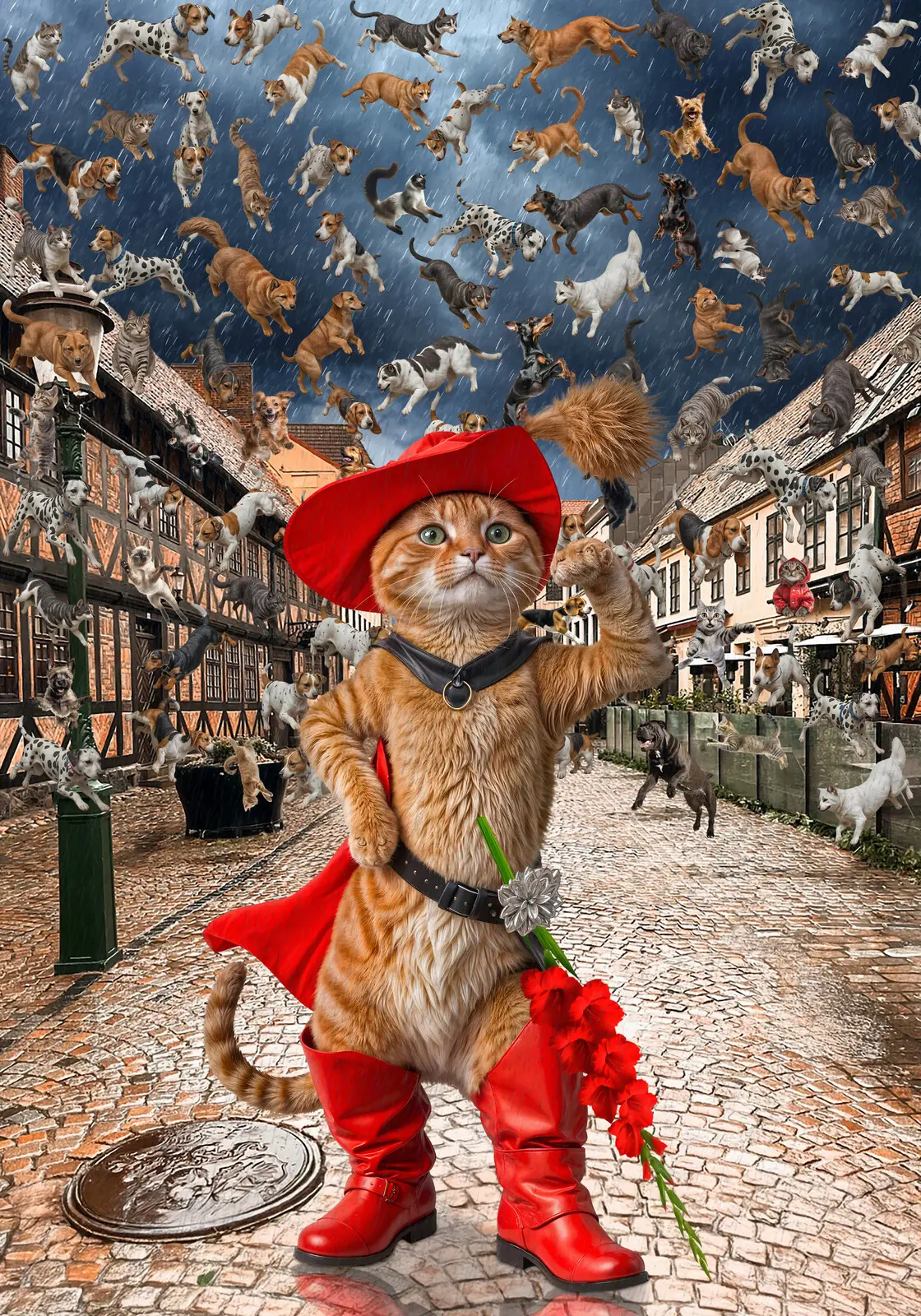
It's Raining Cats and Dogs, 2025
Digital
50 x 70 cm
3 200 kr
It's Raining Cats and Dogs
Language, a living entity like no other, showcases its remarkable adaptability when faced with challenges, its ability to evolve when bored, and its capacity for invention when logic fails. Its dynamic nature, akin to a well-bred butler, dutifully fetching words, arranging sentences, and maintaining order, is a source of constant intrigue. But then, in a sudden and unexpected moment, it disrupts the norm, overturning the expected and exclaiming: “It’s raining cats and dogs!” In that instant, language transcends its role as a mere descriptor of the world and becomes a creator, transforming the sensible into the surreal. Reason gives way to imagination, and the unexpected becomes the norm.
An idiom like this doesn’t originate from grammar books. It emerges from panic, humour, and the desperate human urge to make sense of what cannot be controlled. When the sky opens and water pours down like a collapsing stage curtain, ordinary vocabulary disappears. The only option is to exaggerate. We don’t say “heavy rainfall.” We shout the impossible.
Amidst the surreal scene of falling cats, airborne dogs, and a world turned upside down, stands Puss in Boots. Unfazed, composed, and exuding an air of confidence. As the sky loses its sanity, he maintains his impeccable appearance, with his hat tilted just right, cape fluttering, and boots shining. He embodies a profound truth that we often overlook: when reality becomes a puzzle, imagination is the only tool worth holding onto.
Idioms do not originate from truth. They originate from refusal. They are a cultural expression, a way for a community to collectively refuse to let chaos triumph, to describe the world as it is, and to surrender imagination to weather reports.
Refusal to let chaos triumph. Refusal to describe the world as it is. Refusal to surrender imagination to weather reports. This refusal is not a sign of weakness, but a testament to the power of language to shape our reality and inspire us to see beyond the ordinary. It's a power that, when recognised, can enlighten us and make us appreciate the influence of language in our lives.
“It’s raining cats and dogs” is therefore not just an observation. It is a powerful act of defiance, a refusal to succumb to the chaos of the storm, and a declaration of the resilience of the human spirit. Idioms, at their essence, are powerful tools that express our resilience and empower us to face life's storms.
As long as Puss in Boots stands there in the downpour, unbothered and impeccably dressed, he acts as a symbol of something profound: In a world that seems to have lost its sanity, style and imagination might be the very things that keep us grounded and sane. Imagination, in this context, is not just a flight of fancy but a powerful tool for resilience. Puss in Boots, a character known for his wit and resourcefulness, embodies this idea. His calm demeanour and stylish appearance in the midst of chaos serve as a reminder that even in the most challenging situations, maintaining a sense of imagination and creativity can help us navigate the storm.
“Sonnet – When Cats and Dogs Descend from Storm-torn Skies
When thunder rips the seams of reason’s cloak
and rooftops tremble under nature’s rage,
the sky forgets its manners when it broke
and hurls down cats and dogs like beasts from the stage.
They tumble through the air in a wild parade,
a furry chaos, barking, drenched, absurd;
The rain becomes a rumour weather made,
a whispered idiom, half-dream, half-heard.
We stand below and doubt our seeing eyes;
logic retreats, and fancy takes command.
The world dissolves beneath enchanted skies,
as myth and meteorology join hands.
And last — boots gleaming through the swirling flood —
Puss tips his hat: a king in rain and mud.”
Malmö. November 2025
It's Raining Cats and Dogs – The Rebellion of Idioms
Language is a peculiar organism. It lives, moves, mutates, and conjures images so unexpected that reality can no longer contain them. One of the clearest examples is the idiom “It’s raining cats and dogs,” a phrase so absurd that it defies all logic and reason. Yet, it not only exists but thrives. It inhabits language like a rebel, like a stowaway in our mouths. We say it without recognising how absurd it is: that cats and dogs are falling from the sky. But idioms are never created out of logic. They are born from desperation, humour, and attempts to control the uncontrollable. When the sky opens and it rains so heavily that the world becomes a single sheet of cascading water, ordinary words are no longer enough. Then language does the only sensible thing: it loses its mind, leaving us amused and entertained by its absurdity.
When we view the image of Puss in Boots, the cat in red boots standing alone and unbothered on a medieval cobblestone street, amidst falling cats and dogs, we realise that the idiom has come to life. He stands there as the only one who comprehends the logic of the situation. It’s raining pets — of course, you put on your best boots. His cape flutters in the wind, his hat sits tilted in that effortless, cocky way that only a hero or a fool can manage, and in one paw, he doesn’t hold a sword but a gladiolus — the flower of strength and honour. It is as if he knew the idiom would materialise and thought: someone has to look good when the world goes mad. His resilience and imagination in the face of chaos inspire us and keep us intrigued.
But let us pause. Why cats and dogs? The simplest explanation — and the one people truly believed in.
The simplest explanation, and one that people actually believed, comes from history. In 17th-century London, a city not known for pampered pets with their own Instagram profiles, cats and dogs roamed the streets freely and wild. They sought shelter wherever they could find it: under wagons, in piles of rags against house walls, or, interestingly, on roofs made of thatch and wooden shingles. When the rain became so heavy that no roof could withstand it, everything loose was carried away into the gutters. This included not only sticks and debris but also the unfortunate animals that happened to be in the wrong place at the wrong time. When people saw dogs and cats being swept along the street in the brown torrents, someone could dryly remark, enlightening us about the historical roots of this seemingly absurd idiom:
“Look, it’s raining cats and dogs.” And it wasn’t even a metaphor. It was merely a report of what they saw.
The people of that time did not have the same modern relationship with pets. Today’s cat rules the sofa, the bed, and the blankets, living like the Emperor of the Inner Realm. The dog now has a harness costing 1899 kronor, its own winter jacket, and emotional coaching for motion sickness. But in 17th-century London, a cat was simply a rodent hunter. A dog was once seen as a guard or a cleaner. No one ran out into the storm shouting, “Come inside, poor darling, it’s too wet for your paws!” Back then, animals stayed outside regardless of the weather. Everyone else hurried indoors. Only cats and dogs remained, exposed to the elements.
And thus a phrase was born — one that still showers us.
Idioms are born where logic ends, and they play a crucial role in enriching and enlivening our language. Their unique ability to encapsulate complex ideas in a few words is something to be appreciated and fascinated by.
Swedish has its own peculiarities: "gå som katten kring het gröt" (walk like the cat around the hot porridge), "inte köpa grisen i säcken" (don't buy the pig in the sack) Swedish has its own peculiarities: "gå som katten kring het gröt" (walk like the cat around the hot porridge), "inte köpa grisen i säcken" (don't buy the pig in the sack), "det finns inga dåliga väder, bara dåliga kläder" (there's no bad weather, only bad clothing). Swedish has its own peculiarities: “gå som katten kring het gröt” (walk like the cat around the hot porridge), “inte köpa grisen i säcken” (don’t buy the pig in the sack), “det finns inga dåliga väder, bara dåliga kläder” (there’s no bad weather, only bad clothing). Swedish idioms are practical. Earthbound. Sensible. They explain. They comfort. They impose structure.
English, however, loves exaggeration. It delights in the grandeur and excessiveness of language, often leading to moments of amusement and entertainment for its speakers and listeners.
It rains cats and dogs. No allegories, no metaphors. Just animals falling from the sky.
Shakespeare, the pioneer of idioms, would have appreciated this phrase. In Shakespeare’s world, nothing was beyond reach: lovers die from misunderstandings, kings are murdered by their wives, ghosts haunt castle corridors, forests walk, and identities are swapped with nothing more than a hat and a different tone of voice. In King Lear, he describes one of the most violent storms in world literature with the line:
“Blow, winds, and crack your cheeks! Rage! Blow!”
Shakespeare transformed nature’s fury into a metaphor for psychological turbulence. The entire play hinges on the idea that the storm outside reflects the turmoil within. If the idiom “It’s raining cats and dogs” had existed in Shakespeare’s era, he would have employed it. He would have amplified it, making it even more over the top, and let Lear proclaim: “It rains not water, but beasts!” This playful exaggeration of idioms by Shakespeare would have entertained and intrigued us, just as it did his audience.
Shakespeare would have understood us. He would have understood Pussy in Boots.
And here, amidst the absurdity of the idiom, stands the cat in his boots.
Pussy in Boots embodies the idiom. He is language at its most defiant, refusing to be neutral. He stands proud on rain-slicked cobblestones, a mix of Errol Flynn, Don Quixote, and a self-styled fashion icon who, after accidentally reading a book on heroism, decided to become the star of his own film. He is a living testament to the power of idioms, their ability to take language to the extreme, to be both literal and figurative at the same time.
We laugh at him — but we need him. Because he does what the idiom does: he takes it literally.
When the sky loses control, he never loses his style. When cats and dogs fall like misguided projectiles around him, he does the only thing left to do: he straightens his back and keeps walking. He refuses to let chaos intimidate him. He becomes the defender of language — its knight.
The red colour of his boots is more than just a design choice. It is a symbol. It cuts through the chaos. It challenges the greyness. In a world where everything falls apart, the cat remains standing. In a society where noise prevails, he chooses direction. And in an age where language is often reduced to function, statistics, and algorithms, he defends the power of imagery: exaggeration.
History is a treasure trove of idioms, each a unique expression that enriches our language and culture.
A unique strength of idiomatic expressions is that they require people not to take them literally. However, literal-mindedness is a disease that has long afflicted humanity. I once saw a newly arrived American take the expression “kick the bucket” literally and — in front of a group of puzzled Brits — kick a wash-bucket so forcefully that it flew out the door and shattered a window. No one explained the linguistic misunderstanding afterwards; there was no need. The idiom had shifted from metaphor to action, and we stood there like frozen statues of grammatical shame.
Understanding idioms is not just a linguistic exercise; it's a shared play, a collective imagination that binds us together in a linguistic community. Those who lack it, unfortunately, fall out of language. Idioms, with their shared meanings and cultural resonance, create a sense of belonging and shared experience among language users.
But Pussy in Boots never falls. He is the everlasting guardian of idioms.
A language lacking idioms is a culture devoid of imagination.
We tend to believe that language exists to describe reality. However, it is actually the other way around. Reality, as we experience it, is often too dull, too dry, or too literal. It is language that shapes the images we live within. It is the idioms that help us endure the monotony of this reality, and in doing so, they create a new, more vibrant reality of their own. The power of language to transform our perception of the world is a testament to the wonder and magic of words.
When someone says, “It’s pouring,” it’s a statement of fact.
When someone says, “It’s raining cats and dogs,” the storm becomes literature.
When the sky opens — and the idiom becomes a way of life.
Perhaps that is why Puss in Boots is needed more than ever. Not because he is a cat in boots, but because he represents a stance towards life: defiance. The uncompromising posture. The ability to keep walking, back straight, even when the world is inexplicable. He embodies the human dream of integrity in a universe that couldn’t care less. His resilience in the face of chaos and his refusal to be intimidated by the storm make him a powerful symbol of human resilience. His example inspires us to stand tall in the face of adversity, to refuse to be cowed by the chaos that surrounds us.
The cat is absurd — but he is free. And when we see him standing there amid chaos crashing around him, we realise the truth: It is not the world that needs to be understandable. It is we who must be imaginative.
When it literally rains cats and dogs, Puss in Boots keeps walking. His resilience in the face of chaos is a powerful reminder that we, too, can weather life's storms.
Epilogue
“It’s raining cats and dogs” is not merely a phrase. It is a way to make a storm seem more entertaining than it truly is. A resistance movement against the tyranny of literalness. Proof that language is bigger than reality. And somewhere in the storm, among airborne furballs and the absurdity of language, stands a cat in red boots, tipping his hat towards the unreasonable heavens.
Puss in Boots reminds us that imagination is always drier than the weather.
Puss in Boots — the rebel who challenged fate
Now, we revisit the beginning, the fairy tale that has shaped the very archetype of the story of "Puss in Boots" over centuries. Before he became a figure capable of standing beneath a sky where cats and dogs fall like projectiles, he was Puss in Boots — one of literary history’s most underestimated revolutionaries. Charles Perrault’s tale from 1697 is often seen as a playful fable about a talking cat, but beneath it lies something entirely different: a study in strategy, survival, and social ascent. Puss in Boots makes the boldest claim in the story: that cleverness can defeat one's birthright. That intelligence outweighs lineage. That imagination is mightier than fate. He is not noble, not born for greatness, not blessed by gods or bloodlines. He is a cat who receives a hat and a pair of boots — and uses them to invent his own identity.
Puss in Boots does something few characters in literature dare to do. He refuses to accept the world as given; instead, he makes reality malleable through language. He doesn’t lie — he creates. Through words, he convinces the king that his master owns lands that do not exist. Through the story he tells, he forces reality to follow his will. It is performative magic, long before the term existed. Words are not descriptions — they are action. “My lord, the Marquis of Carabas,” he says, and in that moment, his poor master becomes a marquis because the cat has spoken him into being. Language turns imagination into fact. The line becomes law. Reality bends to the invented. Puss in Boots creates his own world by imagining a better one — and people believe him.
That is why Pussy in Boots today can stand in the pouring rain without an umbrella and remain unfazed. He descends from Puss’s primal spirit: the belief that identity is not something we are given — but something we choose. Where others wait for miracles, he becomes the miracle. Where others seek guarantees, he seeks courage. He has never depended on logic. He has never asked for permission. He has never apologised for existing. He pulls on his boots, tips his hat, and walks into life as if the world were a stage made just for him.
His boots are not merely clothing. They are a statement. They say: I will walk my own path, no matter the weather or distance.
In that sense, Puss in Boots may be regarded as the first modern protagonist. Not a hero by birthright. Not the chosen one. Instead, a character who refuses to accept destiny as an ultimate truth. For centuries, we have focused on the surface of the fairy tale, neglecting its underlying moral. Puss in Boots does not teach us to deceive kings. He teaches us not to be fooled by our limitations. He is resistance in disguise. A story in the shape of a cat, carrying the essence of a philosophy: destiny is not fixed — it is negotiable.
When the world falls apart around us, whether literally or metaphorically raining cats and dogs, there is something profoundly comforting in the thought that we can be like him. That we can put on our boots — metaphorical or not — and step into the storm without surrendering. That there is dignity in refusing to make ourselves smaller than the world expects. When everything around us tries to force us into realism, imagination remains our only defence.
Perhaps that is why Puss has endured through fairy tales, from the Renaissance to modern times, from manuscripts to today’s global meme culture (in the true sense of the word — images and ideas shared, reshaped, and remixed until everyone recognises them). He continues to call out to us across the ages: “You are not what you were given. You are what you choose.” When Pussy in Boots looks up into the chaotic sky, when the rain hits his cloak and his boots fill with water, he knows something we often forget: the world can be unreasonable — but dignity is a choice. Imagination is a strategy. Defiance of destiny is freedom.
The final chapter of “It’s Raining Cats and Dogs” is therefore not an ending but a reminder. Puss in Boots does not stand on Laroche Street in Malmö to conquer the weather. He endures to demonstrate that he can adapt to reality. Not because he does not feel the storm, but to challenge it with the stance: “This does not touch me.” And perhaps that is why we love him, both as a story and as a symbol. He is not successful despite the boots. He is successful because of them. The shoes are his strength—they give him seven-league strides.
That is why he does not cower before the idiom. He embodies the idiom—a cat refusing to drown in the absurdity of words. A hero who takes the metaphor literally to demonstrate that we do not need to bow to the rules.
In a world where so much falls from the sky without our consent, the only thing left to do is:
Put on your boots. Lift your gaze. And step out into the rain — because, in fact, there are clothes that make a walk in the rain a pleasure.
Jörgen Thornberg
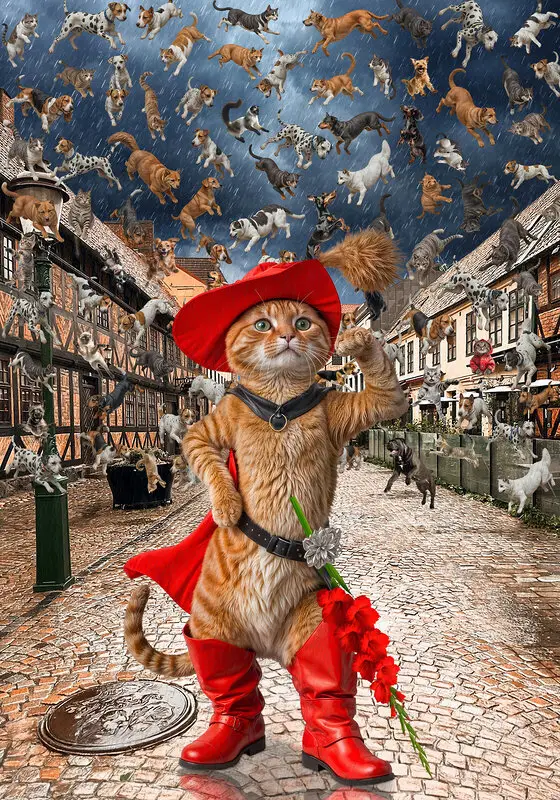
It's Raining Cats and Dogs, 2025
Digital
50 x 70 cm
3 200 kr
It's Raining Cats and Dogs
Language, a living entity like no other, showcases its remarkable adaptability when faced with challenges, its ability to evolve when bored, and its capacity for invention when logic fails. Its dynamic nature, akin to a well-bred butler, dutifully fetching words, arranging sentences, and maintaining order, is a source of constant intrigue. But then, in a sudden and unexpected moment, it disrupts the norm, overturning the expected and exclaiming: “It’s raining cats and dogs!” In that instant, language transcends its role as a mere descriptor of the world and becomes a creator, transforming the sensible into the surreal. Reason gives way to imagination, and the unexpected becomes the norm.
An idiom like this doesn’t originate from grammar books. It emerges from panic, humour, and the desperate human urge to make sense of what cannot be controlled. When the sky opens and water pours down like a collapsing stage curtain, ordinary vocabulary disappears. The only option is to exaggerate. We don’t say “heavy rainfall.” We shout the impossible.
Amidst the surreal scene of falling cats, airborne dogs, and a world turned upside down, stands Puss in Boots. Unfazed, composed, and exuding an air of confidence. As the sky loses its sanity, he maintains his impeccable appearance, with his hat tilted just right, cape fluttering, and boots shining. He embodies a profound truth that we often overlook: when reality becomes a puzzle, imagination is the only tool worth holding onto.
Idioms do not originate from truth. They originate from refusal. They are a cultural expression, a way for a community to collectively refuse to let chaos triumph, to describe the world as it is, and to surrender imagination to weather reports.
Refusal to let chaos triumph. Refusal to describe the world as it is. Refusal to surrender imagination to weather reports. This refusal is not a sign of weakness, but a testament to the power of language to shape our reality and inspire us to see beyond the ordinary. It's a power that, when recognised, can enlighten us and make us appreciate the influence of language in our lives.
“It’s raining cats and dogs” is therefore not just an observation. It is a powerful act of defiance, a refusal to succumb to the chaos of the storm, and a declaration of the resilience of the human spirit. Idioms, at their essence, are powerful tools that express our resilience and empower us to face life's storms.
As long as Puss in Boots stands there in the downpour, unbothered and impeccably dressed, he acts as a symbol of something profound: In a world that seems to have lost its sanity, style and imagination might be the very things that keep us grounded and sane. Imagination, in this context, is not just a flight of fancy but a powerful tool for resilience. Puss in Boots, a character known for his wit and resourcefulness, embodies this idea. His calm demeanour and stylish appearance in the midst of chaos serve as a reminder that even in the most challenging situations, maintaining a sense of imagination and creativity can help us navigate the storm.
“Sonnet – When Cats and Dogs Descend from Storm-torn Skies
When thunder rips the seams of reason’s cloak
and rooftops tremble under nature’s rage,
the sky forgets its manners when it broke
and hurls down cats and dogs like beasts from the stage.
They tumble through the air in a wild parade,
a furry chaos, barking, drenched, absurd;
The rain becomes a rumour weather made,
a whispered idiom, half-dream, half-heard.
We stand below and doubt our seeing eyes;
logic retreats, and fancy takes command.
The world dissolves beneath enchanted skies,
as myth and meteorology join hands.
And last — boots gleaming through the swirling flood —
Puss tips his hat: a king in rain and mud.”
Malmö. November 2025
It's Raining Cats and Dogs – The Rebellion of Idioms
Language is a peculiar organism. It lives, moves, mutates, and conjures images so unexpected that reality can no longer contain them. One of the clearest examples is the idiom “It’s raining cats and dogs,” a phrase so absurd that it defies all logic and reason. Yet, it not only exists but thrives. It inhabits language like a rebel, like a stowaway in our mouths. We say it without recognising how absurd it is: that cats and dogs are falling from the sky. But idioms are never created out of logic. They are born from desperation, humour, and attempts to control the uncontrollable. When the sky opens and it rains so heavily that the world becomes a single sheet of cascading water, ordinary words are no longer enough. Then language does the only sensible thing: it loses its mind, leaving us amused and entertained by its absurdity.
When we view the image of Puss in Boots, the cat in red boots standing alone and unbothered on a medieval cobblestone street, amidst falling cats and dogs, we realise that the idiom has come to life. He stands there as the only one who comprehends the logic of the situation. It’s raining pets — of course, you put on your best boots. His cape flutters in the wind, his hat sits tilted in that effortless, cocky way that only a hero or a fool can manage, and in one paw, he doesn’t hold a sword but a gladiolus — the flower of strength and honour. It is as if he knew the idiom would materialise and thought: someone has to look good when the world goes mad. His resilience and imagination in the face of chaos inspire us and keep us intrigued.
But let us pause. Why cats and dogs? The simplest explanation — and the one people truly believed in.
The simplest explanation, and one that people actually believed, comes from history. In 17th-century London, a city not known for pampered pets with their own Instagram profiles, cats and dogs roamed the streets freely and wild. They sought shelter wherever they could find it: under wagons, in piles of rags against house walls, or, interestingly, on roofs made of thatch and wooden shingles. When the rain became so heavy that no roof could withstand it, everything loose was carried away into the gutters. This included not only sticks and debris but also the unfortunate animals that happened to be in the wrong place at the wrong time. When people saw dogs and cats being swept along the street in the brown torrents, someone could dryly remark, enlightening us about the historical roots of this seemingly absurd idiom:
“Look, it’s raining cats and dogs.” And it wasn’t even a metaphor. It was merely a report of what they saw.
The people of that time did not have the same modern relationship with pets. Today’s cat rules the sofa, the bed, and the blankets, living like the Emperor of the Inner Realm. The dog now has a harness costing 1899 kronor, its own winter jacket, and emotional coaching for motion sickness. But in 17th-century London, a cat was simply a rodent hunter. A dog was once seen as a guard or a cleaner. No one ran out into the storm shouting, “Come inside, poor darling, it’s too wet for your paws!” Back then, animals stayed outside regardless of the weather. Everyone else hurried indoors. Only cats and dogs remained, exposed to the elements.
And thus a phrase was born — one that still showers us.
Idioms are born where logic ends, and they play a crucial role in enriching and enlivening our language. Their unique ability to encapsulate complex ideas in a few words is something to be appreciated and fascinated by.
Swedish has its own peculiarities: "gå som katten kring het gröt" (walk like the cat around the hot porridge), "inte köpa grisen i säcken" (don't buy the pig in the sack) Swedish has its own peculiarities: "gå som katten kring het gröt" (walk like the cat around the hot porridge), "inte köpa grisen i säcken" (don't buy the pig in the sack), "det finns inga dåliga väder, bara dåliga kläder" (there's no bad weather, only bad clothing). Swedish has its own peculiarities: “gå som katten kring het gröt” (walk like the cat around the hot porridge), “inte köpa grisen i säcken” (don’t buy the pig in the sack), “det finns inga dåliga väder, bara dåliga kläder” (there’s no bad weather, only bad clothing). Swedish idioms are practical. Earthbound. Sensible. They explain. They comfort. They impose structure.
English, however, loves exaggeration. It delights in the grandeur and excessiveness of language, often leading to moments of amusement and entertainment for its speakers and listeners.
It rains cats and dogs. No allegories, no metaphors. Just animals falling from the sky.
Shakespeare, the pioneer of idioms, would have appreciated this phrase. In Shakespeare’s world, nothing was beyond reach: lovers die from misunderstandings, kings are murdered by their wives, ghosts haunt castle corridors, forests walk, and identities are swapped with nothing more than a hat and a different tone of voice. In King Lear, he describes one of the most violent storms in world literature with the line:
“Blow, winds, and crack your cheeks! Rage! Blow!”
Shakespeare transformed nature’s fury into a metaphor for psychological turbulence. The entire play hinges on the idea that the storm outside reflects the turmoil within. If the idiom “It’s raining cats and dogs” had existed in Shakespeare’s era, he would have employed it. He would have amplified it, making it even more over the top, and let Lear proclaim: “It rains not water, but beasts!” This playful exaggeration of idioms by Shakespeare would have entertained and intrigued us, just as it did his audience.
Shakespeare would have understood us. He would have understood Pussy in Boots.
And here, amidst the absurdity of the idiom, stands the cat in his boots.
Pussy in Boots embodies the idiom. He is language at its most defiant, refusing to be neutral. He stands proud on rain-slicked cobblestones, a mix of Errol Flynn, Don Quixote, and a self-styled fashion icon who, after accidentally reading a book on heroism, decided to become the star of his own film. He is a living testament to the power of idioms, their ability to take language to the extreme, to be both literal and figurative at the same time.
We laugh at him — but we need him. Because he does what the idiom does: he takes it literally.
When the sky loses control, he never loses his style. When cats and dogs fall like misguided projectiles around him, he does the only thing left to do: he straightens his back and keeps walking. He refuses to let chaos intimidate him. He becomes the defender of language — its knight.
The red colour of his boots is more than just a design choice. It is a symbol. It cuts through the chaos. It challenges the greyness. In a world where everything falls apart, the cat remains standing. In a society where noise prevails, he chooses direction. And in an age where language is often reduced to function, statistics, and algorithms, he defends the power of imagery: exaggeration.
History is a treasure trove of idioms, each a unique expression that enriches our language and culture.
A unique strength of idiomatic expressions is that they require people not to take them literally. However, literal-mindedness is a disease that has long afflicted humanity. I once saw a newly arrived American take the expression “kick the bucket” literally and — in front of a group of puzzled Brits — kick a wash-bucket so forcefully that it flew out the door and shattered a window. No one explained the linguistic misunderstanding afterwards; there was no need. The idiom had shifted from metaphor to action, and we stood there like frozen statues of grammatical shame.
Understanding idioms is not just a linguistic exercise; it's a shared play, a collective imagination that binds us together in a linguistic community. Those who lack it, unfortunately, fall out of language. Idioms, with their shared meanings and cultural resonance, create a sense of belonging and shared experience among language users.
But Pussy in Boots never falls. He is the everlasting guardian of idioms.
A language lacking idioms is a culture devoid of imagination.
We tend to believe that language exists to describe reality. However, it is actually the other way around. Reality, as we experience it, is often too dull, too dry, or too literal. It is language that shapes the images we live within. It is the idioms that help us endure the monotony of this reality, and in doing so, they create a new, more vibrant reality of their own. The power of language to transform our perception of the world is a testament to the wonder and magic of words.
When someone says, “It’s pouring,” it’s a statement of fact.
When someone says, “It’s raining cats and dogs,” the storm becomes literature.
When the sky opens — and the idiom becomes a way of life.
Perhaps that is why Puss in Boots is needed more than ever. Not because he is a cat in boots, but because he represents a stance towards life: defiance. The uncompromising posture. The ability to keep walking, back straight, even when the world is inexplicable. He embodies the human dream of integrity in a universe that couldn’t care less. His resilience in the face of chaos and his refusal to be intimidated by the storm make him a powerful symbol of human resilience. His example inspires us to stand tall in the face of adversity, to refuse to be cowed by the chaos that surrounds us.
The cat is absurd — but he is free. And when we see him standing there amid chaos crashing around him, we realise the truth: It is not the world that needs to be understandable. It is we who must be imaginative.
When it literally rains cats and dogs, Puss in Boots keeps walking. His resilience in the face of chaos is a powerful reminder that we, too, can weather life's storms.
Epilogue
“It’s raining cats and dogs” is not merely a phrase. It is a way to make a storm seem more entertaining than it truly is. A resistance movement against the tyranny of literalness. Proof that language is bigger than reality. And somewhere in the storm, among airborne furballs and the absurdity of language, stands a cat in red boots, tipping his hat towards the unreasonable heavens.
Puss in Boots reminds us that imagination is always drier than the weather.
Puss in Boots — the rebel who challenged fate
Now, we revisit the beginning, the fairy tale that has shaped the very archetype of the story of "Puss in Boots" over centuries. Before he became a figure capable of standing beneath a sky where cats and dogs fall like projectiles, he was Puss in Boots — one of literary history’s most underestimated revolutionaries. Charles Perrault’s tale from 1697 is often seen as a playful fable about a talking cat, but beneath it lies something entirely different: a study in strategy, survival, and social ascent. Puss in Boots makes the boldest claim in the story: that cleverness can defeat one's birthright. That intelligence outweighs lineage. That imagination is mightier than fate. He is not noble, not born for greatness, not blessed by gods or bloodlines. He is a cat who receives a hat and a pair of boots — and uses them to invent his own identity.
Puss in Boots does something few characters in literature dare to do. He refuses to accept the world as given; instead, he makes reality malleable through language. He doesn’t lie — he creates. Through words, he convinces the king that his master owns lands that do not exist. Through the story he tells, he forces reality to follow his will. It is performative magic, long before the term existed. Words are not descriptions — they are action. “My lord, the Marquis of Carabas,” he says, and in that moment, his poor master becomes a marquis because the cat has spoken him into being. Language turns imagination into fact. The line becomes law. Reality bends to the invented. Puss in Boots creates his own world by imagining a better one — and people believe him.
That is why Pussy in Boots today can stand in the pouring rain without an umbrella and remain unfazed. He descends from Puss’s primal spirit: the belief that identity is not something we are given — but something we choose. Where others wait for miracles, he becomes the miracle. Where others seek guarantees, he seeks courage. He has never depended on logic. He has never asked for permission. He has never apologised for existing. He pulls on his boots, tips his hat, and walks into life as if the world were a stage made just for him.
His boots are not merely clothing. They are a statement. They say: I will walk my own path, no matter the weather or distance.
In that sense, Puss in Boots may be regarded as the first modern protagonist. Not a hero by birthright. Not the chosen one. Instead, a character who refuses to accept destiny as an ultimate truth. For centuries, we have focused on the surface of the fairy tale, neglecting its underlying moral. Puss in Boots does not teach us to deceive kings. He teaches us not to be fooled by our limitations. He is resistance in disguise. A story in the shape of a cat, carrying the essence of a philosophy: destiny is not fixed — it is negotiable.
When the world falls apart around us, whether literally or metaphorically raining cats and dogs, there is something profoundly comforting in the thought that we can be like him. That we can put on our boots — metaphorical or not — and step into the storm without surrendering. That there is dignity in refusing to make ourselves smaller than the world expects. When everything around us tries to force us into realism, imagination remains our only defence.
Perhaps that is why Puss has endured through fairy tales, from the Renaissance to modern times, from manuscripts to today’s global meme culture (in the true sense of the word — images and ideas shared, reshaped, and remixed until everyone recognises them). He continues to call out to us across the ages: “You are not what you were given. You are what you choose.” When Pussy in Boots looks up into the chaotic sky, when the rain hits his cloak and his boots fill with water, he knows something we often forget: the world can be unreasonable — but dignity is a choice. Imagination is a strategy. Defiance of destiny is freedom.
The final chapter of “It’s Raining Cats and Dogs” is therefore not an ending but a reminder. Puss in Boots does not stand on Laroche Street in Malmö to conquer the weather. He endures to demonstrate that he can adapt to reality. Not because he does not feel the storm, but to challenge it with the stance: “This does not touch me.” And perhaps that is why we love him, both as a story and as a symbol. He is not successful despite the boots. He is successful because of them. The shoes are his strength—they give him seven-league strides.
That is why he does not cower before the idiom. He embodies the idiom—a cat refusing to drown in the absurdity of words. A hero who takes the metaphor literally to demonstrate that we do not need to bow to the rules.
In a world where so much falls from the sky without our consent, the only thing left to do is:
Put on your boots. Lift your gaze. And step out into the rain — because, in fact, there are clothes that make a walk in the rain a pleasure.
3 200 kr

Jörgen Thornberg
Malmö
Lite om bilder och mig. Translation in English at the end.
Jag är en nyfiken person som ser allt i bilder, även det jag fäster i ord, gärna tillsammans för bakom alla mina bilder finns en berättelse. Till vissa bilder hör en kortare eller längre novell som följer med bilden.
Bilder berättar historier. Jag omges av naturlig skönhet, intressanta människor och historia var jag än går. Jag använder min kamera för att dokumentera världen och blanda det jag ser med vad jag känner för att fånga den dolda magin.
Mina bilder berättar mina historier. Genom mina bilder, tryck och berättelser. Jag bjuder in dig att ta del av dessa berättelser, in i ditt liv och hem och dela min mycket personliga syn på vår värld. Mer än vad ögat ser. Jag tänker i bilder, drömmer och skriver och pratar om dem; följaktligen måste jag också skapa bilder. De blir vad jag ser, inte nödvändigtvis begränsade till verkligheten. Det finns en bild runt varje hörn. Jag hoppas att du kommer att se vad jag såg och gilla det.
Jag är också en skrivande person och till många bilder hör en kortare eller längre essay. Den följer med tavlan, tryckt på fint papper och med en personlig hälsning från mig.
Flertalet bilder startar sin resa i min kamera. Enkelt förklarat beskriver jag bilden jag ser i mitt inre, upplevd eller fantiserad. Bilden uppstår inom mig redan innan jag fått okularet till ögat. På bråkdelen av ett ögonblick ser jag vad jag vill ha och vad som kan göras med bilden. Här skall jag stoppa in en giraff, stålmannen, Titanic eller vad det är min fantasi finner ut. Ännu märkligare är att jag kommer ihåg minnesbilden långt efteråt när det blir tid att skapa verket. Om jag lyckas eller inte, är upp till betraktaren, oftast präglat av en stråk av svart humor – meningen är att man skall bli underhållen. Mina bilder blir ofta en snackis där de hänger.
Jag föredrar bilder som förmedlar ett budskap i flera lager. Vid första anblicken fylld av feel-good, en vacker utsikt, fint väder, solen skiner, blommor på ängen eller vattnet som ligger förrädiskt spegelblankt. I en sådan bild kan jag gömma min egentliga berättelse, mitt förakt för förtryckare och våldsverkare, rasister och fördomsfulla människor - ett gärna återkommande motiv mer eller mindre dolt i det vackra motivet. Jag försöker förena dem i ett gemensamt narrativ.
Bild och formgivning har löpt som en röd tråd genom livet. Fotokonst känns som en värdig final som jag gärna delar med mig.
Min genre är vid som framgår av mina bilder, temat en blandning av pop- och gatukonst i kollage som kan bestå av hundratals lager. Vissa bilder kan ta veckor, andra någon dag innan det är dags att överlämna resultatet till printverkstaden. Fine Art Prints är digitala fotocollage. I dessa kollage sker rivandet, klippandet, pusslandet, målandet, ritandet och sprayningen digitalt. Det jag monterar in kan vara hundratals år gamla bilder som jag omsorgsfullt frilägger så att de ser ut att vara en del av tavlan men också bilder skapade av mig själv efter min egen fantasi. Därefter besöks printstudion och för vissa bilder numrera en limiterad upplaga (oftast 7 exemplar) och signera för hand. Vissa bilder kan köpas i olika format. Det är bara att fråga efter vilka. Gillar man en bild som är 70x100 men inte har plats på väggen, går den kanske att få i 50x70 cm istället. Frågan är fri.
Metoden Giclée eller Fine Art Print som det också kallas är det moderna sättet för framställning av grafisk konst. Villkoret för denna typ av utskrifter är att en högkvalitativ storformatskrivare används med åldersbeständigt färgpigment och konstnärspapper eller i förekommande fall på duk. Pappret som används möter de krav på livslängd som ställs av museer och gallerier. Normalt säljer jag mina bilder oinramade så att den nya ägaren själv kan bestämma hur de skall se ut, med eller utan passepartout färg på ram, med eller utan glas etc..
Under många år ställde jag bara ut på nätet, i valda grupper och på min egen Facebooksida - https://www.facebook.com/jorgen.thornberg.9
Jag finns också på en egen hemsida som tyvärr inte alltid är uppdaterad – https://www.jth.life/ Där kan du också läsa en del av de berättelser som följer med bilden.
UTSTÄLLNINGAR
Luftkastellet, oktober 2022
Konst i Lund, november 2022
Luftkastellet, mars 2023
Engleson Galleri Caroli, april 2023
Hydra, Greece June 2023
Engleson Galleri Caroli, oktober 2023
Toppen, Höllviken december 2023
Luftkastellet, mars 2024
Torups Galleri, mars 2024
Venice, May 2024
Luftkastellet, oktober 2024
Konst i Advent, December 2024
Galleri Engleson, Caroli December 2024
Jäger & Jansson Galleri, april 2025
A bit about pictures and me.
I'm a curious person who sees everything in pictures, even what I express in words, often combining them, for behind all my pictures lies a story. These narratives, some as short as a single image and others as long as a novel, are the heart and soul of my work.
Pictures tell stories. Wherever I go, I'm surrounded by natural beauty, exciting people, and history. I use my camera to document the world and blend what I see with what I feel to capture the hidden magic.
My images tell my stories. Through my pictures, prints, and narratives, I invite you to partake in these stories in your life and home and share my deeply personal perspective of our world. More than meets the eye. I think in pictures, dream, write, and talk about them; consequently, I must create images too. They become what I see, not necessarily confined to reality. There's a picture around every corner. I hope you'll see what I saw and enjoy it.
I'm also a writer, and many images come with a shorter or longer essay. It accompanies the painting, printed on fine paper with my personal greeting.
Many pictures start their journey on my camera. Simply put, I describe the image I see in my mind, experienced or imagined. The image arises within me even before I bring the eyepiece to my eye. In a fraction of a moment, I see what I want and what can be done with the picture. Here, I'll insert a giraffe, Superman, the Titanic, or whatever my imagination conjures up. Even stranger is that I remember the mental image long after it's time to create the work. Whether I succeed is up to the observer, often imbued with a streak of black humour – the aim is to entertain. My pictures usually become a talking point wherever they hang.
I prefer pictures that convey a message in multiple layers. At first glance, they're filled with feel-good vibes, a beautiful view, lovely weather, the sun shining, flowers in the meadow, or the water lying deceptively calm. But beneath this surface beauty, I often conceal a deeper story, a narrative that challenges societal norms or explores the human condition. I invite you to delve into these hidden narratives and discover the layers of meaning within my work.
Picture and design have been a thread running through my life. Photographic art feels like a fitting finale, and I'm happy to share it.
My genre is varied, as seen in my pictures; the theme is a blend of pop and street art in collages that can consist of hundreds of layers. Some images can take weeks, others just a day before it's time to hand over the result to the print workshop. Fine Art Prints are digital photo collages. In these collages, tearing, cutting, puzzling, painting, drawing, and spraying happen digitally. What I insert can be images hundreds of years old that I carefully extract so they appear to be part of the painting, but also images created by myself, now also generated from my imagination. Next, visit the print studio and, for certain images, number a limited edition (usually 7 copies) and sign them by hand. Some images may be available in other formats. Just ask which ones. If you like an image that's 70x100 but doesn't have space on the wall, you might be able to get it in 50x70 cm instead. The question is open.
The Giclée method, or Fine Art Print as it's also called, is the modern way of producing graphic art. This method ensures the highest quality and longevity of the artwork, using a high-quality large-format printer with archival pigment inks and artist paper or, in some cases, canvas. The paper used meets the longevity requirements set by museums and galleries. I sell my pictures unframed, allowing the new owner to personalise their artwork, confident in the lasting value and quality of the piece.
For many years, I only exhibited online, in selected groups, and on my Facebook page - https://www.facebook.com/jorgen.thornberg.9. I also have my website, which unfortunately is not constantly updated - https://www.jth.life/. You can also read some of the stories accompanying the pictures there.
EXHIBITIONS
Luftkastellet, October 2022
Art in Lund, November 2022
Luftkastellet, March 2023
Engleson Gallery Caroli, April 2023
Hydra, Greece June 2023
Engleson Gallery Caroli, October 2023
Toppen, Höllviken December 2023
Luftkastellet, March 2024
Torup Gallery, March 2024
Venice, May 2024
UTSTÄLLNINGAR
Luftkastellet, oktober 2022
Konst i Lund, november 2022
Luftkastellet, mars 2023
Engleson Galleri Caroli, april 2023
Hydra, Greece June 2023
Engleson Galleri Caroli, oktober 2023
Toppen, Höllviken december 2023
Luftkastellet, mars 2024
Torups Galleri, mars 2024
Venice, May 2024
Luftkastellet, October 2024
Konst i Advent, December 2024
Galleri Engleson, Caroli December 2024
Jäger & Jansson Galleri, April 2025
Utbildning
Autodidakt
Medlem i konstnärsförening
Öppna Sinnen
Med i konstrunda
Konstrundan i Skåne
Utställningar
Luftkastellet, October 2022
Art in Lund, November 2022
Luftkastellet, March 2023
Engleson Gallery Caroli, April 2023
Hydra, Greece June 2023
Engleson Gallery Caroli, October 2023
Toppen, Höllviken December 2023
Luftkastellet, March 2024
Torup Gallery, March 2024
Venice, May 2024