Vi använder cookies för att ge dig bästa möjliga upplevelse. Välj vilka cookies du tillåter.
Läs mer i vår integritetspolicy
Jörgen Thornberg
The Physics of Desire, 2025
Digital
50 x 70 cm
3 200 kr
The Physics of Desire
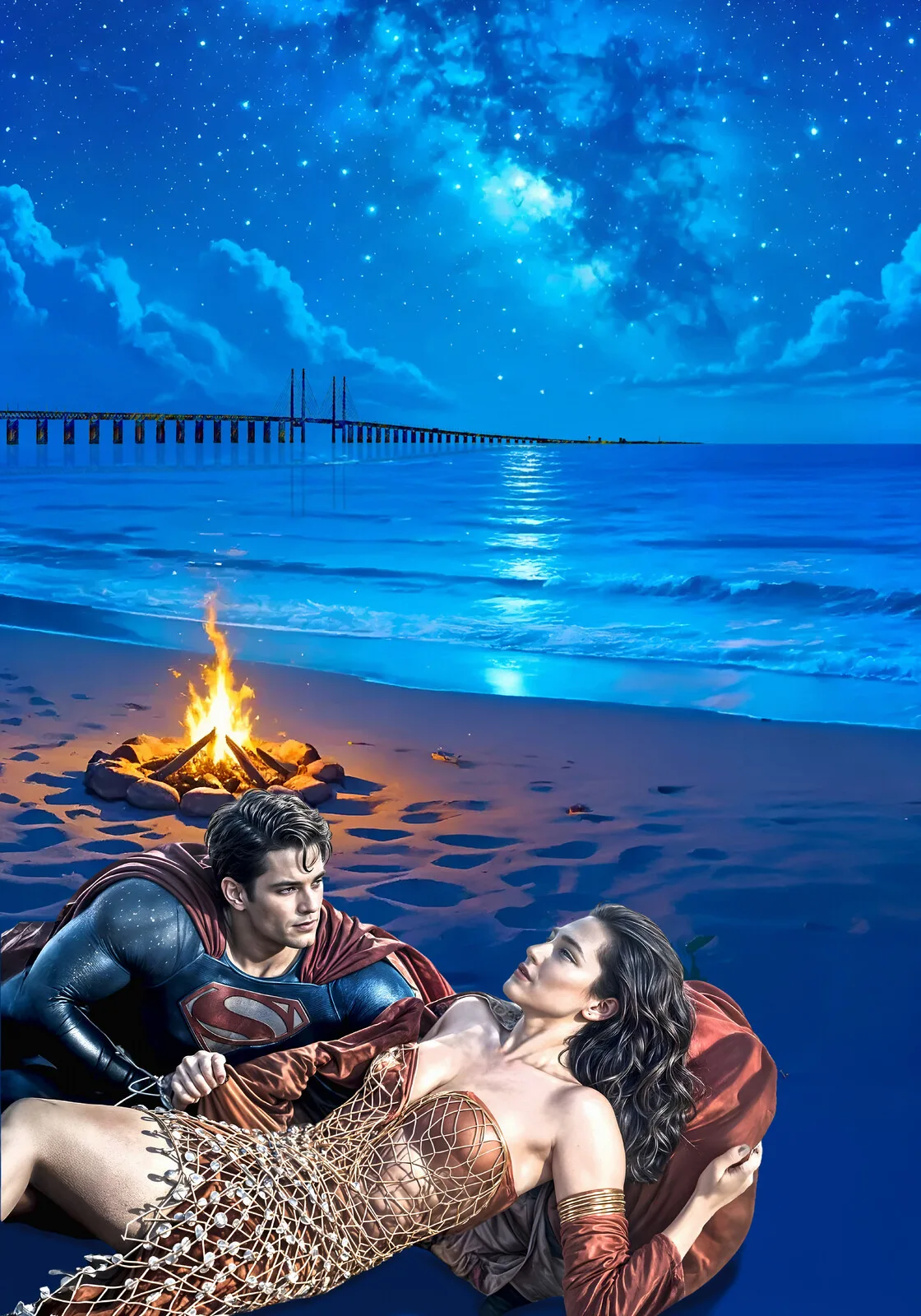
Before love became therapy, before it turned into an algorithm, before it was reduced to a dating app and a dopamine economy, it was something far more dangerous: a collision of forces that were never meant to touch. One such symbolic collision occurred when Superman and Wonder Woman – icons representing moral ideals and female independence – briefly crossed not just paths but gravity itself, not as a fairy tale or a romance, but as a disruption in the symbolic order. Their encounter exemplifies how mythic figures embody complex cultural symbols of love and power, illustrating the layered nature of myth and the cultural significance of modern love.
This passage begins with the impossible tension between the super-preacher and the Amazon rebel, then moves backwards in time to earlier improbable unions: to gods and monsters, mortals and immortals, fire and water, sun and moon. Because before Superman and Wonder Woman lay on a beach at Ribersborg beneath a manufactured night sky, other mythic and cultural pairings had already explored the same paradox: love as contradiction, attraction as a structural error, desire as something that occurs precisely where it should not, underscoring the persistent theme of mythological contradictions and their role in cultural symbolism. These mythic pairings reveal how cultural symbols of love often embody contradictions that challenge societal norms, emphasising their role in shaping cultural perceptions of love and desire.
“Ribersborg Rhapsody
Superman arrived in a slightly wrinkled cape,
courtesy of Scandinavian wind and fate.
Wonder Woman brought no lasso that night –
just a thermos and a look that said: don’t moralise, behave.
They didn’t talk about saving worlds or men,
nor kryptonite or gender roles,
they spoke of sand in unlikely places
and why Swedish hot dogs taste like existential souls.
The moon played saxophone from the western sky,
low notes over Öresund’s indifferent gleam,
a silver solo sliding between their silhouettes
like a half-ironic, half-romantic dream.
Superman tried to be noble, as he always does,
ordering mineral water to show restraint.
Wonder Woman ordered wine and said,
“Relax, darling – your virtue looks slightly strained.”
A couple of joggers stared, then quickly looked away,
as superheroes do not fit Malmö’s casual air,
but the sea just shrugged and continued breathing
like it had seen such nonsense everywhere.
He spoke of justice, she spoke of choice,
he spoke of duty, she of pleasure,
finally, she kissed him mid-sentence and said:
“You’re adorable, but far too full of leisure.”
So they lay on the sand, not saving a soul,
just saving a moment from becoming dull,
while the moon kept playing in minor chords
and Superman forgot to be wonderful.
By morning, he flew off, back to his sermons and skies,
she left a star-shaped footprint in the tide,
and Ribersborg whispered to the dunes:
“Even legends need a night to misbehave and slide.”
Some may ask, with an eyebrow raised,
who conquered whom when the night was grazed.
Was it dominance, power, a vertical affair,
or just two capes tangled in salty air?
They never settled it, history suggests,
no press release, no leaked side effects.
Only this: the stars changed shift that night,
and gravity forgot what was wrong or right.
For when gods and heroines meet in sand,
there is no “over” or “under” command —
sometimes the only victory worth the tale
is when both lose… and the universe exhales.”
Malmö. November 2025
The Physics of Desire – The Archaeology of Love: From Fire to Electricity
Superman and Wonder Woman, in an intimate scene, exemplify when power meets power. Every era has its impossible couples; the only difference is their costumes. In antiquity, they were gods and nymphs; in the Middle Ages, knights and queens; during the Romantic era, pale heroines and doomed poets. Today, they wear latex, symbols, and capes – but the core remains the same: two forces that do not truly belong together, representing opposing principles, yet drawn to each other with an intensity that is not romantic but physical.
Wonder Woman and Superman embody archetypes-she as a feminist icon rooted in Amazonian culture, he as the American hero, highlighting contrasting ideals.
That is why their encounter is confrontational rather than sentimental. Their gazes reveal not love but a clash of worldviews testing each other’s structural integrity-her as a symbol of female sovereignty rooted in Amazonian myth, him burdened by extraterrestrial duty embodying American heroism.
And yet, attraction occurs. Not as love, but as a fleeting moment where both step outside their roles—a disruption in the system.
In the image you provided, romance is not the main element; rather, it is a temporary ceasefire. They are not lying in a domestic idyll, but on a nocturnal beach beneath an artificially dense starry sky, as though the universe itself were holding its breath to watch them. The fire behind them is a primal force, ancient and raw, while the bridge in the distance – cold modern infrastructure – extends like a line between two worlds. Fire and steel. Nature and civilisation. And in the midst of it, two bodies that truly belong to neither.
Wonder Woman does not lie there as an object. She is relaxed but not submissive – what happens occurs on her terms. Her body is not “sexy” in the conventional sense but monumental, almost sculptural, wrapped in a net that resembles both armour and captivity. It presents an ambiguous image: bound by her role as a superwoman, yet sovereign; exposed but never defeated. Superman, on the other hand, is diminished. He is powerful, yes, but more human than ever – testosterone playing tricks on him. His gaze carries no world-hegemonic certainty, only a rare vulnerability. And at the edge of his eye, desire glows unmistakably.
This is where the unlikely couple appears. Not because they match, but because they don’t.
She is not attracted to the soul of this male hero but to his physical presence. And Superman is not attracted to her as a partner to build a life with, but to her sexuality, for who would not want to have sex with Wonder Woman? Perhaps this is why their encounter can never be more than temporary—a one-night stand on the margins of mythology. Not because they lack will but because their archetypes forbid it. She is created to resist messianic figures. He is programmed to be one—to save the world, not to submit to a strong-willed woman.
Highlight how their brief encounter exemplifies an archetypal opposition, illustrating the mythic theme of contrasting forces like fire and water shaping love and desire, thus enriching the symbolic analysis.
Like fire and water.
Like the sun and moon.
Like all the improbable couples before them.
Highlight how the convergence of opposing systems – fire and water, sun and moon-symbolises the fragile boundary of archetypes, enriching mythic interpretation and cultural meaning, and deepening the analysis of love's symbolic dimensions, thereby expanding the cultural context.
Origins and Divine Conjunction
Love is not an invention but an archaeological discovery, continuously unearthed anew. In the earliest layers of human expression, long before literature and moral philosophy, in the flickering glow of cave paintings, we do not encounter romance in a modern sense but proximity – two bodies cooperating in the ritual of survival. In Çatalhöyük – an ancient archaeological site in Turkey, nearly ten thousand years old – The fertility figurines, with their heavy, earthbound sensuality, suggest a duality — a primordial image of connection rather than solely the individual. Even here, there is a hint of love as more than reproduction – as bonding, as alliance, as circulation.
In the mythic world of Mesopotamia, the earliest consciously conceived love couple appears in Inanna and Dumuzi. Their union is neither private nor sentimental but cosmic. It governs seasons, harvests, and divine harmony. Love here is a natural force. In the Egyptian myth of Isis and Osiris, this deepens further: love becomes reconstruction, resistance against death. When Isis reassembles her dismembered husband, it is not merely erotic devotion but also a statement: love as rebuilding, as a refusal to accept dissolution. Here, the idea of love as survival beyond physical disintegration is born.
Love as Tragedy and Structure in Antiquity
In antiquity, love becomes a narrative. No longer merely ritual, but drama. Orpheus and Eurydice embody the impossible love – the one that dares to challenge the underworld but collapses because of a single human weakness: the backward glance. This is where love begins to be defined through loss. Simultaneously, Eros and Psyche introduce another structure, in which love becomes a trial, a development, and a transformation. Their story concerns the soul’s maturation as much as erotic desire.
Paris and Helen embody the destructive potential of passion, illustrating one model of love that destroys rather than builds, which helps focus the discussion on love's varied representations across history and media.
Forbidden Unions of the Middle Ages highlight love's rebellious nature, portraying relationships like Tristan and Isolde's as defying morality and societal boundaries, thereby reinforcing the theme of love's challenge to authority within historical contexts.
The Middle Ages portrayed love as a moral dilemma, with Tristan and Isolde's relationship symbolising desire that transcends morality and law through a destiny-bound potion. Lancelot and Guinevere exemplify love's defiance of hierarchy, challenging societal and sacred boundaries, thus emphasising love's rebellious nature in medieval culture.
Standing alongside mythic couples are Abelard and Héloïse, whose documented love exposes the real consequences of love-social exclusion, bodily harm, and religious obedience, making love a tangible, lived destiny rather than just a story.
The Body at the Centre: Renaissance and Baroque
In the Renaissance, the body reemerges. Venus and Mars illustrate the merger of beauty and violence, eroticism and power in the same scene. Cupid and Venus reiterate love’s cycle, where desire, motherhood, and divinity converge. Simultaneously, Shakespeare constructs in Romeo and Juliet the most influential modern myth of love: two individuals who choose each other against family, societal norms, and time, with love becoming an active act of resistance.
Through Botticelli, Titian, and Caravaggio, the body of love becomes visually tangible-skin, glances, hands, gestures-making love a concrete, observable event and illustrating the shift from literary to visual representations in art history.
The Abyss of Romanticism
During the Romantic period, love became a form of existential suffering. Werther and Lotte portray inaccessible love as self-immolation. His love is not a relationship but an inner fire that consumes him. Even darker are Heathcliff and Catherine in Wuthering Heights, where love is not connection but possession. They do not love each other – they are each different, beyond morality, beyond death.
In Caspar David Friedrich’s landscapes, couples seldom appear in proximity, yet love persists as a form of absence. The figure in front of the sea, the cliff, or the fog always contains an unseen other within it.
The Fractures of Modernism
In modern times, love becomes fragmented. Klimt and Emilie Flöge embody a spiritual and artistic connection rather than a traditional romance. Their relationship is expressed through ornament and gaze, not through marital acts.
Frida Kahlo and Diego Rivera reveal the most brutal form of love: a relationship rooted in both creation and destruction, passion and pain. Love here is not an idyll but an exposed nerve. Zelda and F. Scott Fitzgerald embody a parallel tragedy where glamour and creativity coexist with self-destruction and psychological collapse.
Film, Popular Culture and Modern Myth-Making
In cinema, romantic couples become the mythic figures of our era. Bogart and Bergman in Casablanca portray love as a sacrifice, with the greatest act of love being renunciation. Bonnie and Clyde exemplify romanticised lawlessness—two against the world, even though the world ultimately prevails. Jack and Rose in Titanic continue this myth in a different epic form: a cross-class love set against catastrophe.
Han Solo and Leia place this in the cosmos of popular culture, where love becomes resistance even in a universe of war and galaxies. Their relationship embodies irony, strength, and vulnerability – a modern echo of ancient archetypes.
Nan Goldin’s photographs finally shatter the illusion. Here, there are no ideals – only bodies, desire, dependency, violence, and intimacy. Love is raw, sometimes destructive, sometimes tender. Duane Hanson’s hyperrealistic sculptures freeze ordinary couples in an eternal in-between: together yet alone, close yet without actual contact. They embody love’s frozen moments.
The Recurring Form of Love highlights mythological and symbolic love relationships, sharpening the scholarly focus and engaging readers interested in these themes.
From Inanna and Dumuzi to Han and Leia, these mythic narratives exemplify how love functions as both a creative and destructive force, illustrating recurring archetypes across cultures and enriching the discussion.
Throughout art history, love embodies ritual, power, guilt, projection, longing, and identity, revealing its cultural and psychological importance through recurring motifs.
Cosmic couples like fire and water, sun and moon, exemplify symbolic love relationships that embody profound metaphysical paradoxes, emphasising universal themes of love's impossibility.
Some cosmic couples, like fire and water, are not human but symbolise profound metaphysical paradoxes, emphasising universal themes of love's impossibility.
Fire and water are the most archetypal elements. They are nature’s most obvious opposites, destined to clash yet also dependent on each other in all major stories. Fire without water leads to destruction. Water without fire becomes stagnant, lifeless matter. In alchemy and esotericism, they symbolise not only physical forces but also aspects of the psyche: passion and emotion, will and memory, consumption and healing. When they converge in myths, a catastrophe or miracle always occurs – often both at once. Volcano meets sea, steam rises, and the world is reshaped.
The sun and the moon are perhaps the most poeticised couple in human history. They never meet, but their separation is the very condition of the world. The sun represents action, projection, flame, and the masculine, the fiercely life-giving. The moon is reflective, mutable, nocturnal, and dreamy. Their relationship is not one of union but of rhythm – day and night, conscious and unconscious. In myths from all cultures, they are depicted as lovers who have lost each other: in Aztec legends, Norse mythology, and Japanese stories. They chase each other across the sky, come close but never collide, lest the world ignite.
Heaven and earth form another ancient pair. In almost all creation myths, the elements were initially intertwined until they were separated to make space for the world. The love between them is a sacrifice that enables life. Their separation is a cosmic divorce, not born of bitterness but of necessity. Love is sacrificed for creation.
Light and darkness – not as good and evil, but as seeing and not seeing, presence and rest. They rely on each other to define boundaries. Without darkness, light cannot be seen; without light, darkness remains unseen. In art, they are lovers and enemies. They define each other through their boundary.
Even time and space can be viewed as an unlikely pair. They never exist apart, yet can never fully merge. They curve around each other, shape each other’s conditions, yet remain fundamentally distinct dimensions. Their relationship is the foundation upon which the universe itself rests.
Unlike human love couples – Inanna and Dumuzi, Orpheus and Eurydice, Tristan and Isolde, Frida and Diego – these cosmic pairs are not troubled by jealousy, betrayal, or misunderstanding. Their struggle is more unyielding. They cannot choose or negotiate. They are destined to be what they are – and yet we can only grasp their relationship through our own human feelings.
Perhaps these unlikely couples are the most romantic of all precisely because they never achieve each other, never touch, and never merge into one. They must exist in tension, at a distance, as eternal promises without fulfilment. And it is precisely there, in the unachievable, that romance reaches its most monumental form.
The mythological and cultural symbolism of improbable couples highlights their significance in storytelling and art, emphasising human themes.
In myths, love often defies reason, making stories about improbable couples more compelling and engaging for audiences.
Odysseus and Circe exemplify mythological symbolism, with her as a sorceress representing divine power and his survival instinct, highlighting an improbable union that embodies control and submission without illusions.
But he does not stop there. After Circe comes Calypso – the nymph who falls in love with him, not to destroy him, but to keep him. She offers him immortality. An eternal life. Everything. Yet, he still wishes to go home. Their relationship is even more unlikely: a mortal man and an immortal woman, where the divine becomes the abandoned party. In visual art, their encounters have inspired countless paintings where she is often depicted as the embodiment of sorrow rather than power. Here, the hierarchy is reversed: the goddess becomes the forsaken one.
In the Greek divine realm, such paradoxes are not exceptions but the norm.
Zeus and Europa illustrate divine paradoxes, with Zeus transforming into a bull to abduct a mortal princess, symbolising the complex and often unequal divine unions depicted in art from antiquity to the Baroque.
Pasiphaë's love for the bull, which results in the Minotaur, symbolises the grotesque yet fertile union between human and beast, driving the myth's themes of revenge and the creation of the labyrinth, a motif essential to Greek myth.
Speaking of him: Ariadne and Dionysus.
Ariadne is abandoned by Theseus, only to be loved by a god. From hero to the god of wine, ecstasy, and madness. A human betrayal replaced by divine passion. A couple born out of loss rather than choice.
And if we stay within Odysseus’ world, think of Ares and Aphrodite – the god of war and the goddess of love. An absurd pairing: destruction and fertility intertwined in the same bed and caught in adultery by Hephaestus, the smith-god who forges a metal net around their naked bodies. Love, war, and technology become entangled in the same scene.
In Norse mythology, there are similar unlikely constellations: Njord and Skadi – the sea god and the mountain huntress. They try to live together but fail because they literally cannot endure each other’s worlds: he yearns for the waves, she for the snow. A marriage born of compromise but doomed by nature itself.
And Odin and Frigg, where he is the ever-wandering, secretive, elusive one, while she is the goddess of home, fate-weaving, and family. A relationship between warlike restlessness and care, between exile and home.
In contemporary visual culture, the enduring appeal of improbable couples persists: Fred Astaire and Ginger Rogers – bodies in perfect harmony, personalities in complete imbalance- exemplify this fascination.
The unlikely couple is never endearing.
It is nearly always a problem.
A friction.
A crack.
But this is precisely why improbable couples endure in art-they embody love that defies reason and expectation, making their stories compelling and memorable.
We forget love because it is sensible.
We remember it because it ought not to have happened.
Like when Superman and Wonder Woman flirted on Ribersborg beach.
Jörgen Thornberg
The Physics of Desire, 2025
Digital
50 x 70 cm
3 200 kr
The Physics of Desire
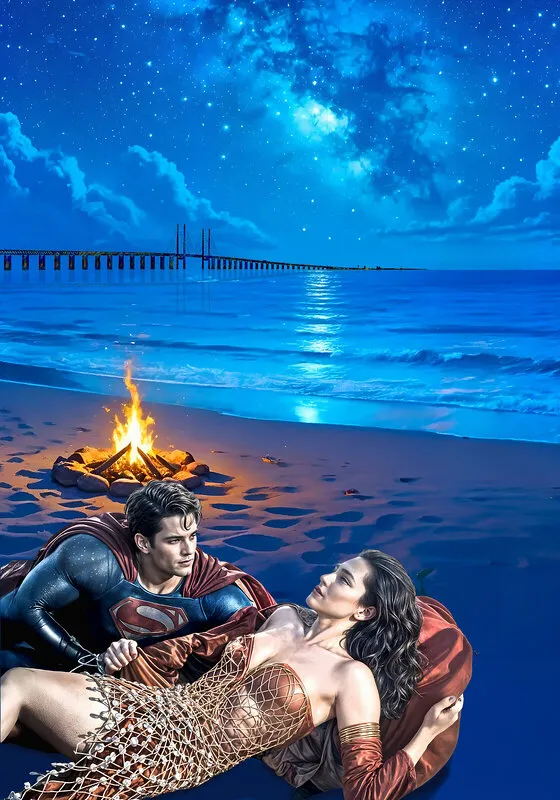
Before love became therapy, before it turned into an algorithm, before it was reduced to a dating app and a dopamine economy, it was something far more dangerous: a collision of forces that were never meant to touch. One such symbolic collision occurred when Superman and Wonder Woman – icons representing moral ideals and female independence – briefly crossed not just paths but gravity itself, not as a fairy tale or a romance, but as a disruption in the symbolic order. Their encounter exemplifies how mythic figures embody complex cultural symbols of love and power, illustrating the layered nature of myth and the cultural significance of modern love.
This passage begins with the impossible tension between the super-preacher and the Amazon rebel, then moves backwards in time to earlier improbable unions: to gods and monsters, mortals and immortals, fire and water, sun and moon. Because before Superman and Wonder Woman lay on a beach at Ribersborg beneath a manufactured night sky, other mythic and cultural pairings had already explored the same paradox: love as contradiction, attraction as a structural error, desire as something that occurs precisely where it should not, underscoring the persistent theme of mythological contradictions and their role in cultural symbolism. These mythic pairings reveal how cultural symbols of love often embody contradictions that challenge societal norms, emphasising their role in shaping cultural perceptions of love and desire.
“Ribersborg Rhapsody
Superman arrived in a slightly wrinkled cape,
courtesy of Scandinavian wind and fate.
Wonder Woman brought no lasso that night –
just a thermos and a look that said: don’t moralise, behave.
They didn’t talk about saving worlds or men,
nor kryptonite or gender roles,
they spoke of sand in unlikely places
and why Swedish hot dogs taste like existential souls.
The moon played saxophone from the western sky,
low notes over Öresund’s indifferent gleam,
a silver solo sliding between their silhouettes
like a half-ironic, half-romantic dream.
Superman tried to be noble, as he always does,
ordering mineral water to show restraint.
Wonder Woman ordered wine and said,
“Relax, darling – your virtue looks slightly strained.”
A couple of joggers stared, then quickly looked away,
as superheroes do not fit Malmö’s casual air,
but the sea just shrugged and continued breathing
like it had seen such nonsense everywhere.
He spoke of justice, she spoke of choice,
he spoke of duty, she of pleasure,
finally, she kissed him mid-sentence and said:
“You’re adorable, but far too full of leisure.”
So they lay on the sand, not saving a soul,
just saving a moment from becoming dull,
while the moon kept playing in minor chords
and Superman forgot to be wonderful.
By morning, he flew off, back to his sermons and skies,
she left a star-shaped footprint in the tide,
and Ribersborg whispered to the dunes:
“Even legends need a night to misbehave and slide.”
Some may ask, with an eyebrow raised,
who conquered whom when the night was grazed.
Was it dominance, power, a vertical affair,
or just two capes tangled in salty air?
They never settled it, history suggests,
no press release, no leaked side effects.
Only this: the stars changed shift that night,
and gravity forgot what was wrong or right.
For when gods and heroines meet in sand,
there is no “over” or “under” command —
sometimes the only victory worth the tale
is when both lose… and the universe exhales.”
Malmö. November 2025
The Physics of Desire – The Archaeology of Love: From Fire to Electricity
Superman and Wonder Woman, in an intimate scene, exemplify when power meets power. Every era has its impossible couples; the only difference is their costumes. In antiquity, they were gods and nymphs; in the Middle Ages, knights and queens; during the Romantic era, pale heroines and doomed poets. Today, they wear latex, symbols, and capes – but the core remains the same: two forces that do not truly belong together, representing opposing principles, yet drawn to each other with an intensity that is not romantic but physical.
Wonder Woman and Superman embody archetypes-she as a feminist icon rooted in Amazonian culture, he as the American hero, highlighting contrasting ideals.
That is why their encounter is confrontational rather than sentimental. Their gazes reveal not love but a clash of worldviews testing each other’s structural integrity-her as a symbol of female sovereignty rooted in Amazonian myth, him burdened by extraterrestrial duty embodying American heroism.
And yet, attraction occurs. Not as love, but as a fleeting moment where both step outside their roles—a disruption in the system.
In the image you provided, romance is not the main element; rather, it is a temporary ceasefire. They are not lying in a domestic idyll, but on a nocturnal beach beneath an artificially dense starry sky, as though the universe itself were holding its breath to watch them. The fire behind them is a primal force, ancient and raw, while the bridge in the distance – cold modern infrastructure – extends like a line between two worlds. Fire and steel. Nature and civilisation. And in the midst of it, two bodies that truly belong to neither.
Wonder Woman does not lie there as an object. She is relaxed but not submissive – what happens occurs on her terms. Her body is not “sexy” in the conventional sense but monumental, almost sculptural, wrapped in a net that resembles both armour and captivity. It presents an ambiguous image: bound by her role as a superwoman, yet sovereign; exposed but never defeated. Superman, on the other hand, is diminished. He is powerful, yes, but more human than ever – testosterone playing tricks on him. His gaze carries no world-hegemonic certainty, only a rare vulnerability. And at the edge of his eye, desire glows unmistakably.
This is where the unlikely couple appears. Not because they match, but because they don’t.
She is not attracted to the soul of this male hero but to his physical presence. And Superman is not attracted to her as a partner to build a life with, but to her sexuality, for who would not want to have sex with Wonder Woman? Perhaps this is why their encounter can never be more than temporary—a one-night stand on the margins of mythology. Not because they lack will but because their archetypes forbid it. She is created to resist messianic figures. He is programmed to be one—to save the world, not to submit to a strong-willed woman.
Highlight how their brief encounter exemplifies an archetypal opposition, illustrating the mythic theme of contrasting forces like fire and water shaping love and desire, thus enriching the symbolic analysis.
Like fire and water.
Like the sun and moon.
Like all the improbable couples before them.
Highlight how the convergence of opposing systems – fire and water, sun and moon-symbolises the fragile boundary of archetypes, enriching mythic interpretation and cultural meaning, and deepening the analysis of love's symbolic dimensions, thereby expanding the cultural context.
Origins and Divine Conjunction
Love is not an invention but an archaeological discovery, continuously unearthed anew. In the earliest layers of human expression, long before literature and moral philosophy, in the flickering glow of cave paintings, we do not encounter romance in a modern sense but proximity – two bodies cooperating in the ritual of survival. In Çatalhöyük – an ancient archaeological site in Turkey, nearly ten thousand years old – The fertility figurines, with their heavy, earthbound sensuality, suggest a duality — a primordial image of connection rather than solely the individual. Even here, there is a hint of love as more than reproduction – as bonding, as alliance, as circulation.
In the mythic world of Mesopotamia, the earliest consciously conceived love couple appears in Inanna and Dumuzi. Their union is neither private nor sentimental but cosmic. It governs seasons, harvests, and divine harmony. Love here is a natural force. In the Egyptian myth of Isis and Osiris, this deepens further: love becomes reconstruction, resistance against death. When Isis reassembles her dismembered husband, it is not merely erotic devotion but also a statement: love as rebuilding, as a refusal to accept dissolution. Here, the idea of love as survival beyond physical disintegration is born.
Love as Tragedy and Structure in Antiquity
In antiquity, love becomes a narrative. No longer merely ritual, but drama. Orpheus and Eurydice embody the impossible love – the one that dares to challenge the underworld but collapses because of a single human weakness: the backward glance. This is where love begins to be defined through loss. Simultaneously, Eros and Psyche introduce another structure, in which love becomes a trial, a development, and a transformation. Their story concerns the soul’s maturation as much as erotic desire.
Paris and Helen embody the destructive potential of passion, illustrating one model of love that destroys rather than builds, which helps focus the discussion on love's varied representations across history and media.
Forbidden Unions of the Middle Ages highlight love's rebellious nature, portraying relationships like Tristan and Isolde's as defying morality and societal boundaries, thereby reinforcing the theme of love's challenge to authority within historical contexts.
The Middle Ages portrayed love as a moral dilemma, with Tristan and Isolde's relationship symbolising desire that transcends morality and law through a destiny-bound potion. Lancelot and Guinevere exemplify love's defiance of hierarchy, challenging societal and sacred boundaries, thus emphasising love's rebellious nature in medieval culture.
Standing alongside mythic couples are Abelard and Héloïse, whose documented love exposes the real consequences of love-social exclusion, bodily harm, and religious obedience, making love a tangible, lived destiny rather than just a story.
The Body at the Centre: Renaissance and Baroque
In the Renaissance, the body reemerges. Venus and Mars illustrate the merger of beauty and violence, eroticism and power in the same scene. Cupid and Venus reiterate love’s cycle, where desire, motherhood, and divinity converge. Simultaneously, Shakespeare constructs in Romeo and Juliet the most influential modern myth of love: two individuals who choose each other against family, societal norms, and time, with love becoming an active act of resistance.
Through Botticelli, Titian, and Caravaggio, the body of love becomes visually tangible-skin, glances, hands, gestures-making love a concrete, observable event and illustrating the shift from literary to visual representations in art history.
The Abyss of Romanticism
During the Romantic period, love became a form of existential suffering. Werther and Lotte portray inaccessible love as self-immolation. His love is not a relationship but an inner fire that consumes him. Even darker are Heathcliff and Catherine in Wuthering Heights, where love is not connection but possession. They do not love each other – they are each different, beyond morality, beyond death.
In Caspar David Friedrich’s landscapes, couples seldom appear in proximity, yet love persists as a form of absence. The figure in front of the sea, the cliff, or the fog always contains an unseen other within it.
The Fractures of Modernism
In modern times, love becomes fragmented. Klimt and Emilie Flöge embody a spiritual and artistic connection rather than a traditional romance. Their relationship is expressed through ornament and gaze, not through marital acts.
Frida Kahlo and Diego Rivera reveal the most brutal form of love: a relationship rooted in both creation and destruction, passion and pain. Love here is not an idyll but an exposed nerve. Zelda and F. Scott Fitzgerald embody a parallel tragedy where glamour and creativity coexist with self-destruction and psychological collapse.
Film, Popular Culture and Modern Myth-Making
In cinema, romantic couples become the mythic figures of our era. Bogart and Bergman in Casablanca portray love as a sacrifice, with the greatest act of love being renunciation. Bonnie and Clyde exemplify romanticised lawlessness—two against the world, even though the world ultimately prevails. Jack and Rose in Titanic continue this myth in a different epic form: a cross-class love set against catastrophe.
Han Solo and Leia place this in the cosmos of popular culture, where love becomes resistance even in a universe of war and galaxies. Their relationship embodies irony, strength, and vulnerability – a modern echo of ancient archetypes.
Nan Goldin’s photographs finally shatter the illusion. Here, there are no ideals – only bodies, desire, dependency, violence, and intimacy. Love is raw, sometimes destructive, sometimes tender. Duane Hanson’s hyperrealistic sculptures freeze ordinary couples in an eternal in-between: together yet alone, close yet without actual contact. They embody love’s frozen moments.
The Recurring Form of Love highlights mythological and symbolic love relationships, sharpening the scholarly focus and engaging readers interested in these themes.
From Inanna and Dumuzi to Han and Leia, these mythic narratives exemplify how love functions as both a creative and destructive force, illustrating recurring archetypes across cultures and enriching the discussion.
Throughout art history, love embodies ritual, power, guilt, projection, longing, and identity, revealing its cultural and psychological importance through recurring motifs.
Cosmic couples like fire and water, sun and moon, exemplify symbolic love relationships that embody profound metaphysical paradoxes, emphasising universal themes of love's impossibility.
Some cosmic couples, like fire and water, are not human but symbolise profound metaphysical paradoxes, emphasising universal themes of love's impossibility.
Fire and water are the most archetypal elements. They are nature’s most obvious opposites, destined to clash yet also dependent on each other in all major stories. Fire without water leads to destruction. Water without fire becomes stagnant, lifeless matter. In alchemy and esotericism, they symbolise not only physical forces but also aspects of the psyche: passion and emotion, will and memory, consumption and healing. When they converge in myths, a catastrophe or miracle always occurs – often both at once. Volcano meets sea, steam rises, and the world is reshaped.
The sun and the moon are perhaps the most poeticised couple in human history. They never meet, but their separation is the very condition of the world. The sun represents action, projection, flame, and the masculine, the fiercely life-giving. The moon is reflective, mutable, nocturnal, and dreamy. Their relationship is not one of union but of rhythm – day and night, conscious and unconscious. In myths from all cultures, they are depicted as lovers who have lost each other: in Aztec legends, Norse mythology, and Japanese stories. They chase each other across the sky, come close but never collide, lest the world ignite.
Heaven and earth form another ancient pair. In almost all creation myths, the elements were initially intertwined until they were separated to make space for the world. The love between them is a sacrifice that enables life. Their separation is a cosmic divorce, not born of bitterness but of necessity. Love is sacrificed for creation.
Light and darkness – not as good and evil, but as seeing and not seeing, presence and rest. They rely on each other to define boundaries. Without darkness, light cannot be seen; without light, darkness remains unseen. In art, they are lovers and enemies. They define each other through their boundary.
Even time and space can be viewed as an unlikely pair. They never exist apart, yet can never fully merge. They curve around each other, shape each other’s conditions, yet remain fundamentally distinct dimensions. Their relationship is the foundation upon which the universe itself rests.
Unlike human love couples – Inanna and Dumuzi, Orpheus and Eurydice, Tristan and Isolde, Frida and Diego – these cosmic pairs are not troubled by jealousy, betrayal, or misunderstanding. Their struggle is more unyielding. They cannot choose or negotiate. They are destined to be what they are – and yet we can only grasp their relationship through our own human feelings.
Perhaps these unlikely couples are the most romantic of all precisely because they never achieve each other, never touch, and never merge into one. They must exist in tension, at a distance, as eternal promises without fulfilment. And it is precisely there, in the unachievable, that romance reaches its most monumental form.
The mythological and cultural symbolism of improbable couples highlights their significance in storytelling and art, emphasising human themes.
In myths, love often defies reason, making stories about improbable couples more compelling and engaging for audiences.
Odysseus and Circe exemplify mythological symbolism, with her as a sorceress representing divine power and his survival instinct, highlighting an improbable union that embodies control and submission without illusions.
But he does not stop there. After Circe comes Calypso – the nymph who falls in love with him, not to destroy him, but to keep him. She offers him immortality. An eternal life. Everything. Yet, he still wishes to go home. Their relationship is even more unlikely: a mortal man and an immortal woman, where the divine becomes the abandoned party. In visual art, their encounters have inspired countless paintings where she is often depicted as the embodiment of sorrow rather than power. Here, the hierarchy is reversed: the goddess becomes the forsaken one.
In the Greek divine realm, such paradoxes are not exceptions but the norm.
Zeus and Europa illustrate divine paradoxes, with Zeus transforming into a bull to abduct a mortal princess, symbolising the complex and often unequal divine unions depicted in art from antiquity to the Baroque.
Pasiphaë's love for the bull, which results in the Minotaur, symbolises the grotesque yet fertile union between human and beast, driving the myth's themes of revenge and the creation of the labyrinth, a motif essential to Greek myth.
Speaking of him: Ariadne and Dionysus.
Ariadne is abandoned by Theseus, only to be loved by a god. From hero to the god of wine, ecstasy, and madness. A human betrayal replaced by divine passion. A couple born out of loss rather than choice.
And if we stay within Odysseus’ world, think of Ares and Aphrodite – the god of war and the goddess of love. An absurd pairing: destruction and fertility intertwined in the same bed and caught in adultery by Hephaestus, the smith-god who forges a metal net around their naked bodies. Love, war, and technology become entangled in the same scene.
In Norse mythology, there are similar unlikely constellations: Njord and Skadi – the sea god and the mountain huntress. They try to live together but fail because they literally cannot endure each other’s worlds: he yearns for the waves, she for the snow. A marriage born of compromise but doomed by nature itself.
And Odin and Frigg, where he is the ever-wandering, secretive, elusive one, while she is the goddess of home, fate-weaving, and family. A relationship between warlike restlessness and care, between exile and home.
In contemporary visual culture, the enduring appeal of improbable couples persists: Fred Astaire and Ginger Rogers – bodies in perfect harmony, personalities in complete imbalance- exemplify this fascination.
The unlikely couple is never endearing.
It is nearly always a problem.
A friction.
A crack.
But this is precisely why improbable couples endure in art-they embody love that defies reason and expectation, making their stories compelling and memorable.
We forget love because it is sensible.
We remember it because it ought not to have happened.
Like when Superman and Wonder Woman flirted on Ribersborg beach.
3 200 kr

Jörgen Thornberg
Malmö
Lite om bilder och mig. Translation in English at the end.
Jag är en nyfiken person som ser allt i bilder, även det jag fäster i ord, gärna tillsammans för bakom alla mina bilder finns en berättelse. Till vissa bilder hör en kortare eller längre novell som följer med bilden.
Bilder berättar historier. Jag omges av naturlig skönhet, intressanta människor och historia var jag än går. Jag använder min kamera för att dokumentera världen och blanda det jag ser med vad jag känner för att fånga den dolda magin.
Mina bilder berättar mina historier. Genom mina bilder, tryck och berättelser. Jag bjuder in dig att ta del av dessa berättelser, in i ditt liv och hem och dela min mycket personliga syn på vår värld. Mer än vad ögat ser. Jag tänker i bilder, drömmer och skriver och pratar om dem; följaktligen måste jag också skapa bilder. De blir vad jag ser, inte nödvändigtvis begränsade till verkligheten. Det finns en bild runt varje hörn. Jag hoppas att du kommer att se vad jag såg och gilla det.
Jag är också en skrivande person och till många bilder hör en kortare eller längre essay. Den följer med tavlan, tryckt på fint papper och med en personlig hälsning från mig.
Flertalet bilder startar sin resa i min kamera. Enkelt förklarat beskriver jag bilden jag ser i mitt inre, upplevd eller fantiserad. Bilden uppstår inom mig redan innan jag fått okularet till ögat. På bråkdelen av ett ögonblick ser jag vad jag vill ha och vad som kan göras med bilden. Här skall jag stoppa in en giraff, stålmannen, Titanic eller vad det är min fantasi finner ut. Ännu märkligare är att jag kommer ihåg minnesbilden långt efteråt när det blir tid att skapa verket. Om jag lyckas eller inte, är upp till betraktaren, oftast präglat av en stråk av svart humor – meningen är att man skall bli underhållen. Mina bilder blir ofta en snackis där de hänger.
Jag föredrar bilder som förmedlar ett budskap i flera lager. Vid första anblicken fylld av feel-good, en vacker utsikt, fint väder, solen skiner, blommor på ängen eller vattnet som ligger förrädiskt spegelblankt. I en sådan bild kan jag gömma min egentliga berättelse, mitt förakt för förtryckare och våldsverkare, rasister och fördomsfulla människor - ett gärna återkommande motiv mer eller mindre dolt i det vackra motivet. Jag försöker förena dem i ett gemensamt narrativ.
Bild och formgivning har löpt som en röd tråd genom livet. Fotokonst känns som en värdig final som jag gärna delar med mig.
Min genre är vid som framgår av mina bilder, temat en blandning av pop- och gatukonst i kollage som kan bestå av hundratals lager. Vissa bilder kan ta veckor, andra någon dag innan det är dags att överlämna resultatet till printverkstaden. Fine Art Prints är digitala fotocollage. I dessa kollage sker rivandet, klippandet, pusslandet, målandet, ritandet och sprayningen digitalt. Det jag monterar in kan vara hundratals år gamla bilder som jag omsorgsfullt frilägger så att de ser ut att vara en del av tavlan men också bilder skapade av mig själv efter min egen fantasi. Därefter besöks printstudion och för vissa bilder numrera en limiterad upplaga (oftast 7 exemplar) och signera för hand. Vissa bilder kan köpas i olika format. Det är bara att fråga efter vilka. Gillar man en bild som är 70x100 men inte har plats på väggen, går den kanske att få i 50x70 cm istället. Frågan är fri.
Metoden Giclée eller Fine Art Print som det också kallas är det moderna sättet för framställning av grafisk konst. Villkoret för denna typ av utskrifter är att en högkvalitativ storformatskrivare används med åldersbeständigt färgpigment och konstnärspapper eller i förekommande fall på duk. Pappret som används möter de krav på livslängd som ställs av museer och gallerier. Normalt säljer jag mina bilder oinramade så att den nya ägaren själv kan bestämma hur de skall se ut, med eller utan passepartout färg på ram, med eller utan glas etc..
Under många år ställde jag bara ut på nätet, i valda grupper och på min egen Facebooksida - https://www.facebook.com/jorgen.thornberg.9
Jag finns också på en egen hemsida som tyvärr inte alltid är uppdaterad – https://www.jth.life/ Där kan du också läsa en del av de berättelser som följer med bilden.
UTSTÄLLNINGAR
Luftkastellet, oktober 2022
Konst i Lund, november 2022
Luftkastellet, mars 2023
Engleson Galleri Caroli, april 2023
Hydra, Greece June 2023
Engleson Galleri Caroli, oktober 2023
Toppen, Höllviken december 2023
Luftkastellet, mars 2024
Torups Galleri, mars 2024
Venice, May 2024
Luftkastellet, oktober 2024
Konst i Advent, December 2024
Galleri Engleson, Caroli December 2024
Jäger & Jansson Galleri, april 2025
A bit about pictures and me.
I'm a curious person who sees everything in pictures, even what I express in words, often combining them, for behind all my pictures lies a story. These narratives, some as short as a single image and others as long as a novel, are the heart and soul of my work.
Pictures tell stories. Wherever I go, I'm surrounded by natural beauty, exciting people, and history. I use my camera to document the world and blend what I see with what I feel to capture the hidden magic.
My images tell my stories. Through my pictures, prints, and narratives, I invite you to partake in these stories in your life and home and share my deeply personal perspective of our world. More than meets the eye. I think in pictures, dream, write, and talk about them; consequently, I must create images too. They become what I see, not necessarily confined to reality. There's a picture around every corner. I hope you'll see what I saw and enjoy it.
I'm also a writer, and many images come with a shorter or longer essay. It accompanies the painting, printed on fine paper with my personal greeting.
Many pictures start their journey on my camera. Simply put, I describe the image I see in my mind, experienced or imagined. The image arises within me even before I bring the eyepiece to my eye. In a fraction of a moment, I see what I want and what can be done with the picture. Here, I'll insert a giraffe, Superman, the Titanic, or whatever my imagination conjures up. Even stranger is that I remember the mental image long after it's time to create the work. Whether I succeed is up to the observer, often imbued with a streak of black humour – the aim is to entertain. My pictures usually become a talking point wherever they hang.
I prefer pictures that convey a message in multiple layers. At first glance, they're filled with feel-good vibes, a beautiful view, lovely weather, the sun shining, flowers in the meadow, or the water lying deceptively calm. But beneath this surface beauty, I often conceal a deeper story, a narrative that challenges societal norms or explores the human condition. I invite you to delve into these hidden narratives and discover the layers of meaning within my work.
Picture and design have been a thread running through my life. Photographic art feels like a fitting finale, and I'm happy to share it.
My genre is varied, as seen in my pictures; the theme is a blend of pop and street art in collages that can consist of hundreds of layers. Some images can take weeks, others just a day before it's time to hand over the result to the print workshop. Fine Art Prints are digital photo collages. In these collages, tearing, cutting, puzzling, painting, drawing, and spraying happen digitally. What I insert can be images hundreds of years old that I carefully extract so they appear to be part of the painting, but also images created by myself, now also generated from my imagination. Next, visit the print studio and, for certain images, number a limited edition (usually 7 copies) and sign them by hand. Some images may be available in other formats. Just ask which ones. If you like an image that's 70x100 but doesn't have space on the wall, you might be able to get it in 50x70 cm instead. The question is open.
The Giclée method, or Fine Art Print as it's also called, is the modern way of producing graphic art. This method ensures the highest quality and longevity of the artwork, using a high-quality large-format printer with archival pigment inks and artist paper or, in some cases, canvas. The paper used meets the longevity requirements set by museums and galleries. I sell my pictures unframed, allowing the new owner to personalise their artwork, confident in the lasting value and quality of the piece.
For many years, I only exhibited online, in selected groups, and on my Facebook page - https://www.facebook.com/jorgen.thornberg.9. I also have my website, which unfortunately is not constantly updated - https://www.jth.life/. You can also read some of the stories accompanying the pictures there.
EXHIBITIONS
Luftkastellet, October 2022
Art in Lund, November 2022
Luftkastellet, March 2023
Engleson Gallery Caroli, April 2023
Hydra, Greece June 2023
Engleson Gallery Caroli, October 2023
Toppen, Höllviken December 2023
Luftkastellet, March 2024
Torup Gallery, March 2024
Venice, May 2024
UTSTÄLLNINGAR
Luftkastellet, oktober 2022
Konst i Lund, november 2022
Luftkastellet, mars 2023
Engleson Galleri Caroli, april 2023
Hydra, Greece June 2023
Engleson Galleri Caroli, oktober 2023
Toppen, Höllviken december 2023
Luftkastellet, mars 2024
Torups Galleri, mars 2024
Venice, May 2024
Luftkastellet, October 2024
Konst i Advent, December 2024
Galleri Engleson, Caroli December 2024
Jäger & Jansson Galleri, April 2025
Utbildning
Autodidakt
Medlem i konstnärsförening
Öppna Sinnen
Med i konstrunda
Konstrundan i Skåne
Utställningar
Luftkastellet, October 2022
Art in Lund, November 2022
Luftkastellet, March 2023
Engleson Gallery Caroli, April 2023
Hydra, Greece June 2023
Engleson Gallery Caroli, October 2023
Toppen, Höllviken December 2023
Luftkastellet, March 2024
Torup Gallery, March 2024
Venice, May 2024