Vi använder cookies för att ge dig bästa möjliga upplevelse. Välj vilka cookies du tillåter.
Läs mer i vår integritetspolicy
Jörgen Thornberg
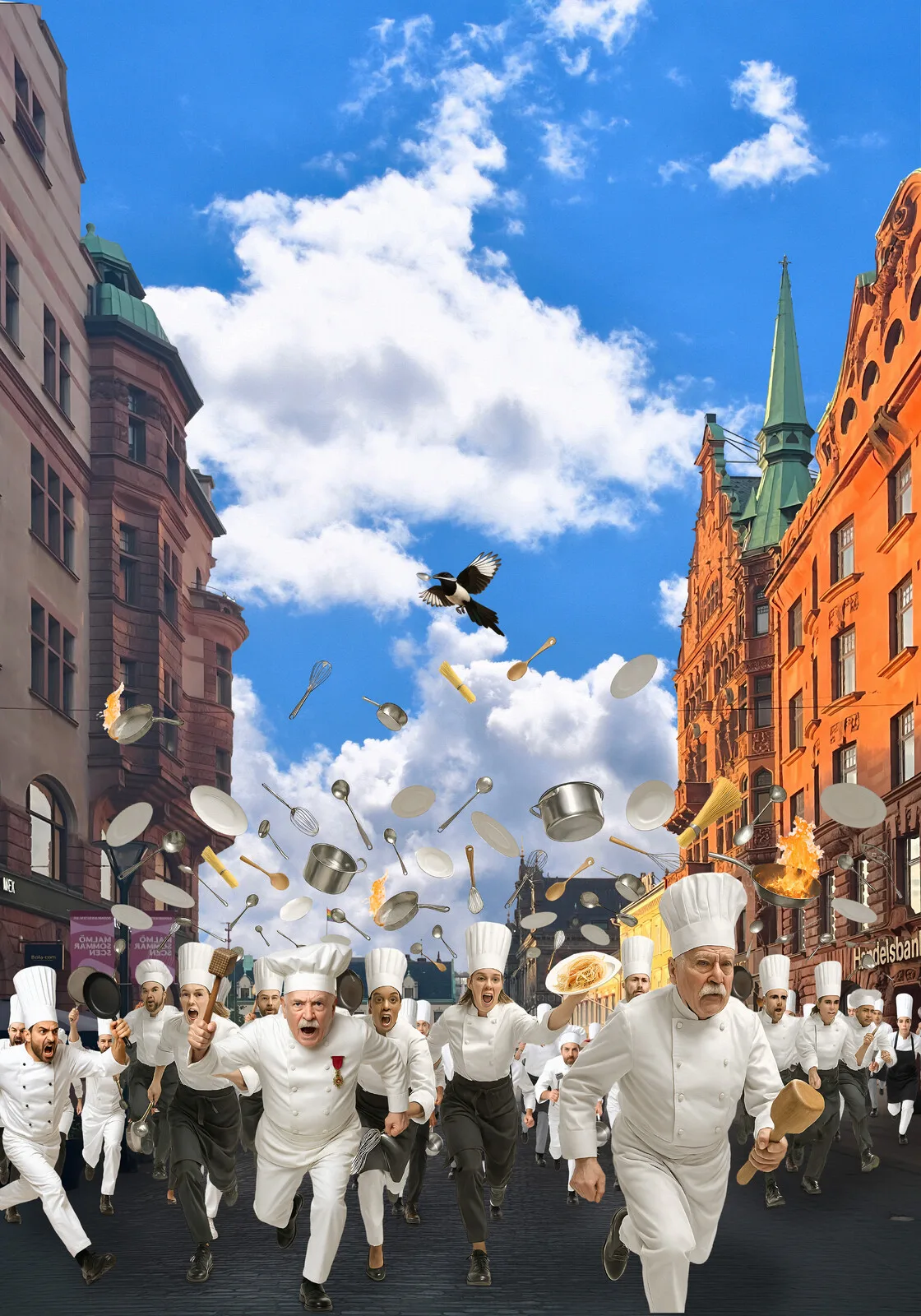
The Cook Riot, 2025
Digital
50 x 70 cm
3 200 kr
The Cook Riot
In Malmö, the children’s film 'Ratatouille' became a civic fable, sparking a transformative journey in the city's culinary scene. Long before the premiere, the rumour arrived — an animated rat in Paris had bypassed hierarchy — and the idea slipped under our doors like a draft: if talent can come from anywhere, who controls the kitchen? From Royal’s glowing marquee to Operagrillen’s linen-starched calm, the question ricocheted through the city’s arteries until it reached the chefs who had built their identities out of burns, reductions, and belief.
This is a narrative of craft and belief, of the dignified art of haute cuisine colliding with the uncontrolled democracy of hunger. It commences with posters proclaiming “ANYONE CAN COOK,” and a magpie that pilfered a silver spoon as if to inaugurate a new era. It progressed through a white-clad procession that resembled a festival until it didn’t, a press conference led by a rat in an apricot apron, and a cake battle —a symbolic clash of culinary ideologies, so dramatic that Mack Sennett would have taken a bow.
Underneath the comedy lies a pivotal question: Is excellence a closed guild or a movable feast? The chefs bring their toques and tradition; the 'rats', a metaphor for outsiders or underdogs, bring their mise en place and market share, their struggle resonating with us all. Somewhere between Savoy’s legacy and Royal’s entrance, between pride and curiosity, Malmö embarks on a journey towards a third path—a fresh approach to taste and creativity that respects discipline without shunning surprise. Call it Haute Râtisine: not a rejection of standards, but a reassignment of permission. Here, quality is not determined by your status, but by what you offer. And the city, for once, is open-minded enough to embrace it.
“Sonnet: “Crème & Concord
In Royal’s hall, where icing filled the air,
Where chefs hurled sponge and cream with wounded pride,
Each sugared missile flew without a care—
A pastry war where honour nearly died.
But through the chaos, small and unforeseen,
The rat brigade stood steady, calm, and wise;
They watched the humans drown in custard sheen,
Yet saw in them a fire they recognised.
A truce arose from crumbs upon the floor,
From shared delight in flavour, craft, and art;
For taste knows neither whisk nor species lore—
It dwells in passion, not in rank or heart.
And thus, from flying cakes and wounded pride,
A chef and rat stirred peace—and cooked side by side.”
Malmö. November 2025
The Cook Riot
The film Ratatouille swept across the globe and eventually reached Malmö, but the rumour arrived first, carried by illegal copies circulating online. The Parisian rat Remy's success as a restaurateur inspired every rat on earth to dream of better days. His Scanian colleague, Jöns, had already opened the restaurant Savoir in Gamla Väster, just one block from Lilla Torg in the centre of the restaurant district. In Malmö’s underground—the hidden world beneath cobblestones and building foundations, a place where rats lived and worked, unseen by human eyes—he was already regarded as the rats’ own Lendrop, the legendary restaurateur at Savoy. Not a bad role model. Jöns soon gained followers, and as everyone knows, rats multiply quickly. For those unfamiliar with French, savoir means "to know" or "to be able to." The unexpected source of talent, in this case, being a rat, was a revelation that fascinated and surprised many, challenging societal norms and preconceived notions about who can be creative.
Pixar’s Ratatouille (2007) is—beneath its animated rat comedy surface—one of the most precise portrayals of creativity, professional pride, and the aspiration of defining oneself. The film follows Remy, a rat with an exceptional sense of taste and smell, who refuses to accept his position at the bottom of the food chain. He doesn’t merely want to cook—he desires to be creative, to change, to produce something that evokes emotion in others. In the elitist world of French haute cuisine, where hierarchies are as firm as the walls of an opera house, his mere presence poses a challenge to the system. “Anyone can cook” is the central message of the film, but it does not mean that everyone is necessarily skilled at cooking. It suggests that talent and quality can originate from surprising places—even from those the world is not ready to recognise. The profound shift lies in the viewpoint: Remy is the artist; the humans are the craftsmen. They follow recipes; he disrupts them. He is driven by passion, intuition, and an almost overwhelming desire to express his creativity. It is not the species that is outlawed—it is the ambition.
The relationship between Remy and Linguini in Ratatouille is a brilliant metaphor for the creative process: one has the idea and the sensibility, the other has access to the world and the ability to execute. Together, they form one creator—both mind and hand. The film not only showcases this unique partnership but also celebrates the resilience it takes to create something extraordinary. This celebration of resilience is a powerful message that resonates with the audience, inspiring them to embrace their own creative journeys with a sense of determination and hope, and deepening their understanding of the film's messages about creativity and societal norms.
One of the most impactful scenes in the film is not Remy’s culinary success but the transformation of food critic Anton Ego. When Ego tastes Remy’s ratatouille, he is immediately transported to a childhood memory of safety and love. His cynicism vanishes in seconds. The food doesn’t just engage his intellect — it touches his emotions, his history, his vulnerability. The film suggests that art need not impress; it must move. Ego doesn't surrender to the flavour, but to the memory.
Ratatouille is not just a film about a rat's culinary success, but a bold challenge to the deepest fear of elitism. If a rat can produce something exceptional, what does that imply about those whose whole identity is built on exclusivity? The film prompts the audience to rethink their own perceptions of talent and creativity, engaging them in a thought-provoking journey. Who owns the idea of quality? Who has the right to call themselves an artist? These questions, raised by the film, challenge the audience to reconsider their beliefs and perceptions, sparking a lively and engaging debate.
Remy does more than change the kitchen—he upends the hierarchy. He prompts humans to question whether value resides in technique or in passion. He demonstrates that perfection is not the goal; authenticity in expression is the ultimate objective. That food, like art, is about meaning. And in a world where status is often valued more than creativity, that is revolutionary. When the film ends, it's not the rat that has become human. It's the humans who have become more human—or more rat-like, depending on your perspective. They have learned that talent can come from unexpected places, that inspiration doesn't follow hierarchies, and that the joy of creating isn't just for the chosen few, but for those who dare. Ratatouille isn't just a film about food but about identity and the pursuit of creativity. It raises a question: who determines what quality is—the creators or the judges? And it responds with the same clarity as its courage, enlightening the audience about the broader cultural issues at play: “Anyone can cook.” But only those who dare can change the world.
Royal Cinema in Malmö had laid out the red carpet. The popcorn machines puffed like tiny steam engines, and posters for Ratatouille hung from every lamppost in the city. The success was unavoidable. Along the entire length of Södertull, the queue slowly moved forward: children with sparkling eyes, parents with limited patience, and the occasional culture enthusiast pretending he was there for “the cinematic composition.” On each door of the cinema, a large decal announced “ANYONE CAN COOK!” and beneath it, in smaller print: “No rats were harmed in the production of this film.”
It didn’t help.
The film's message detonated like a bomb among Malmö’s chefs. To them, the slogan wasn’t inspiring—it was a direct assault on their professional identity. Can anyone cook? Oh really? Then why had they spent three years at the Culinary Institute in Kristianstad, followed by years of gruelling apprenticeship in various restaurant kitchens? Their professional pride—forged by scorched forearms, sleepless service shifts, and hundreds of hours of reductions—suddenly had to contend with a rat backed by an animation budget that could make their kitchen equipment look like child's play.
Rumours started spreading early at Möllevångstorget. Someone whispered that there was a rat capable of reducing a stock in six minutes. It didn’t matter that the claim was biologically and gastronomically absurd; all it took was one person to say it with confidence. When an influencer at Stortorget posted a video on YouTube and Instagram explaining how one could “reduce food waste by inviting urban rodents into the kitchen,” the reaction erupted. The Reel received 48,000 views in less than an hour and was tagged with #RatMentorship and #CulinaryEquality. The chefs' reaction to this was a mix of disbelief and outrage, as they struggled to comprehend how a rat could become a symbol of culinary excellence.
It was then that the chefs’ first counter-reaction took shape.
At the restaurant Kniven & Teglet, head chef Håkan walked around holding a stack of printed CVs. He had been searching for interns for three months without a single reply, and now he had to deal with a world where rats suddenly had film contracts. His sous-chef accidentally cut his thumb—not on the knife, but out of pure existential rage while waving a useless CV in the air. At La Saucisson de Malmö, a barista refused to serve a cappuccino to a customer who claimed she had seen the film three times and believed her hamster “had potential.” The barista slowly put the cup down, leaned forward and said, in a voice cold enough to frost the saucer: “Come back when you’ve learned the difference between passion and fur.”
Then the catastrophe.
Children in the cinema began throwing popcorn at the screen, chanting “Remy! Remy!” What had started as a rumour had now become a trend. At Chez Urban, a waiter handed out slips of paper that turned out to be QR codes, linking to the message:
“Let rats work in kitchens!
Democracy in gastronomy!”
Despite their initial shock, the chefs were not ones to back down. When a magpie flew across Gustav Adolf's torg carrying a stolen silver spoon in its beak—like a general signalling the beginning of a mutiny—something snapped. The sous-chef from Torpedgrillen looked up and said: “That’s a sign. We have to act.” Their determination was palpable, inspiring those around them with a sense of unity and resilience. This was not a battle they were willing to lose.
The decisive moment came when one of the chefs ripped down the cinema’s decal, raised his voice, and roared with a tone that made the popcorn machine cough:
“NOT EVERYONE BLOODY CAN COOK!”
The crowd fell silent. And that was when the Cook Riot began.
Operagrillen: The secret meeting
After the Royal incident, a message spread like wildfire through Malmö’s kitchens: 'Urgent meeting at Operagrillen. Chefs' assembly TONIGHT at 19:00. Culinary crisis demands immediate action.'
“Meeting at Operagrillen. Industry emergency. Chefs’ assembly TONIGHT at 19:00.”
Operagrillen—Malmö Opera’s refined restaurant with white tablecloths and starched linen napkins—had never hosted anything like this. Usually, it was a sanctuary of controlled elegance. A place where conversations revolved around the fragility of life, the transcendence of opera, and whether it was ethical to serve oxtail in modern times.
Tonight was different.
The chefs stormed in like a band of brothers, united in their cause. Tall toques, prepped ladles, and one or two burnt pots still smoking slightly. They filled the entire lounge, bringing with them the smell of frying fat and a palpable sense of accumulated professional resentment.
Conveniently, Malmö Opera was performing Fiddler on the Roof. Through the wall, Terje’s powerful voice rang:
“If I were a Rich Man!”
It echoed like a gilded lie.
One chef collapsed into an armchair and muttered:
“Yes, tradition. Exactly. Not Rat on the Roof, where the rodent is called Terje.”
The meeting began when head chef Håkan climbed onto a chair, raised a wooden spoon like a union banner, and struck a saucepan. The sound echoed through the restaurant, making a waitress instinctively believe someone had ordered extra bread.
“Colleagues,” he said, “we face an unprecedented threat.
It’s not gluten-free.
It’s not vegan.
It’s worse.”
A heavy silence.
“It is… rat-driven.”
Agitated whispers. Someone fanned themselves with a menu. Sous-chef Masoud, still traumatised by the stock-reducing rumour, removed his hat and squeezed it like a stress ball.
Håkan unrolled a poster with the film’s slogan and held it up as if it were a biological weapon.
“ANYONE CAN COOK!” he declared, a reference to the film that had sparked this rat-driven revolution. Little did we know, it was a prophecy of our impending battle.
“This,” he said, “is how it starts.
First, the film.
Then the mentality.
Next, the rats take the kitchens.”
Someone muttered:
“They don’t even need salaries.”
Another:
“They’re tiny. They can cook inside the ventilation ducts and still take up less space than a junior chef.”
The discussion swelled. A chef from Dockan said a customer had asked if their restaurant collaborated with rats—otherwise they would book somewhere else. A restaurateur from Ribersborg had already received an email from a family requesting a Remy-themed birthday menu. The rats, it seemed, were not just a nuisance, but a culinary threat, infiltrating the very heart of Malmö's dining scene.
And someone, from the back:
“I think I saw a rat carrying an oyster knife outside Scandic Triangeln.”
That was the final straw.
Håkan stretched out his arm, spoon pointing like a general signalling a charge:
“We revolt. We take back the city.”
On the other side of the wall, the orchestra launched into the third verse of If I Were a Rich Man. The chefs stood still, listening to the ensemble sing of dreams, dignity, and the fight for identity.
Tradition. Tradition.
Håkan nodded toward the sound and summed up everything in one sentence:
“We are the craft. They are the rats. We go to war.”
The chefs rose as one, their unwavering determination shining in their eyes. They grabbed their ladles and pots as if they were instruments in a revolutionary orchestra, and marched toward the exit. This was not just a meeting. This was a call to arms. Operagrillen had transformed from a fine dining establishment to a war council, a clear sign of the chefs' unwavering readiness for battle.
Operagrillen had transformed from a fine dining establishment to a war council, a clear sign of the chefs' readiness for battle. The air was charged with anticipation, the next move in this culinary war about to unfold, and the chefs were ready to face it head-on.
War was coming.
Let the rodent cooks tremble.
Outside, night was settling in. A magpie hovered above, a stolen silver spoon in its beak — taken from the Opera terrace — circling as if surveying the battlefield. Some chefs headed to Malmö’s night-open bars to fortify themselves for the coming day; others trudged home for a solitary nightcap and to make sense of everything. How on earth had it come to this? A French rat.
The Cook Riot — on the streets
The following day, the meeting point was the legendary Savoy — once Malmö’s proud cathedral of fine dining, now barely reaching the level of a motivated rat. Since the house chef had offered the empty dining room to the chefs, the guerrilla brigade filled the space from wall to wall. Outside, it was equally crowded; white toques bobbed all the way down Hamngatan.
When the doors to Savoy’s historic dining room swung open, the chefs surged out like a white avalanche of pride and pent-up resentment at being compared to rodents. They waved ladles like swords and brandished saucepans like shields. The first marching line passed the fountain by the Town Hall, their footsteps clattering against the cobblestones. It almost looked organised. It wasn’t. It was a white-clad mob with tall hats.
The magpie from the previous night made a wide arc above them, wielding the silver spoon like a battle banner.
As they moved along Södergatan, passersby paused to watch. Tourists raised their phones, while locals debated whether this was performance art, a political protest, or an installation from Moderna Museet. The white jackets, the clatter of pans, and the occasional battle cry created an atmosphere that no one could quite understand. A culture journalist in a trench coat whispered, thrilled:
This is either avant-garde or labour law.
The chefs themselves were resolute, determined to etch their names in history. Their first slogans echoed against the facades. There were historic precedents — the food riots of 1917, First of May protest marches — Stortorget had witnessed uprisings before. Now it was the chefs’ moment, and they were unwavering in their resolve to leave an indelible mark.
“NO RODENTS!
KITCHENS WITHOUT FUR!”
Read one of the banners.
“JÖNS AND REMY MUST BE FINISHED!” they chanted, their voices echoing so loudly that a nearby dog started to howl in solidarity. This was not just a battle cry, but a resolute rejection of the rat's influence on their craft, a declaration of their unwavering commitment to their culinary principles.
Clusters of restaurant guests gazed from outdoor terraces as the march went by. Someone leaned out of a flat window and shouted:
“Is this Fine Dining for Palestine, or what’s the theme?”
With each step towards Royal, the chefs were resolute, their unity a testament to their determination. They were acutely aware of the changing tide. Children were now asking for 'rat menus' in school cafeterias, and parents were questioning why preschools didn’t serve ratatouille. The rats weren’t just infiltrating the kitchens, but also shaping the culinary expectations of the next generation.
And those blasted posters everywhere:
ANYONE CAN COOK.
The sight of those blasted posters everywhere made their stomachs turn. It was effective propaganda, a stark reminder that if you repeat a lie often enough, it becomes truth.
By the time the march reached Södergatan, the crowd had swelled. Restaurateurs, culinary creators, head chefs, sous-chefs, commis, grill cooks, fish cooks, pastry chefs — even food-truck chefs. A pastry chef with a pink candyfloss beard exclaimed that his macarons deserved better than being likened to rodents’ antics on a cinema screen. The chefs were united in their cause, each one standing shoulder to shoulder with the others.
An elderly chef — a legend from Savoy’s golden era — stood on a bench outside Apoteket Lejonet. In his hand, he clutched a cast-iron frying pan — a relic from a time when cooking was a matter of survival. He raised it like a general lifts a sword.
“COMRADES, LISTEN!
We thicken sauces with bravery.
We burn our tongues for flavour.
We thin the sauce with our tears when the dining room is empty.
Should rats take our jobs and replace Swedish home cooking with the new French cuisine?
What say you?”
The crowd responded loudly, almost biblically, but with a clear Malmö accent.
“NO! NO, FOR FUCK’S SAKE — NO!”
That was the moment a protest turned into an uprising.
As the march passed Skomakaregatan, everyone saw the banner hanging from a gable wall.
RATATOUILLE — EXTRA SCREENING.
In front of Royal, families queued, blissfully unaware of the impending culinary civil war.
Time came to a halt. Even the silence had a noise.
One chef raised a megaphone:
“NOT EVERYONE BLOODY CAN COOK!”
People on the street jumped. Inside the cinema, the popcorn machine wheezed — a warning sign. The disorganised tramp of chef shoes echoed across the square.
At that very moment, the rats made their appearance.
They emerged from drains, ventilation grilles, and shadows along the walls. They were organised. Many wore tiny chef’s hats, and some carried aprons. One hauled a wagon of spice jars. Without a sound, the rodents marched forward in formation, distributing menus to bewildered passers-by.
Malmö’s culinary elite stared — not at the rats, but at the discipline.
The rodents had mise en place.
They were prepared. They were structured. They knew exactly what they were doing, challenging the chefs' perception of them as mere pests.
They were prepared. They were structured.
They knew exactly what they were doing.
On one hand, Malmö’s chefs were in disarray, panicking, shouting, and waving ladles. On the other hand, the rats stood in disciplined contrast, their structured approach a stark contrast to the chefs' chaos.
The Confrontation at Royal
The magpie perched on the cinema marquee, a silver spoon in its beak, glaring down on both sides like a judge in a surreal cooking contest. Where the bird’s loyalty truly lay was impossible to determine — magpies are pragmatists. History would tell.
This was no longer a protest.
It was a battle for the soul of the kitchen.
And Malmö held its breath before the first strike.
The chefs, their determination radiating in the air, stormed into Royal. The doors swung open, popcorn scattered across the floor, and someone knocked over a box of 3D glasses. Children shrieked with delight. Parents yelled in confusion. But the chefs remained undeterred, their resolve unwavering.
In the foyer, the rats were waiting. Not scattered, but lined up like disciplined kitchen staff. Their strategic choice of the cinema as their venue was a testament to their intelligence, a calculated move reminiscent of the old days under Lars Lendrop at the Savoy: if the shoes didn’t fit, you were out before the bread had cooled. Their discipline was a force to be reckoned with, leaving the audience in awe of their organisation.
Tiny rats in miniature aprons stood by the sweets counter offering “sample bites.”
One rat held up a sign:
“Try our home-made popcorn spice rub!”
The chefs froze, not out of fear, but out of respect. They recognised the look in their enemy’s eyes — a hunger not just for food, but for creativity. The chefs couldn't help but admire the rats' innovative approach, sparking the audience's curiosity about what the rats would do next.
Then arrived the press conference.
A sign had been taped to a popcorn stand:
SGF — The Swedish Rodent Federation proclaims a new gastronomic era
No one understands how the rats organised themselves. Some say it occurs through an encrypted communication network within the city’s sewers — the Dark Sewer Web. Beside the sweets counter, the rats had erected a podium. Where else?
A microphone was placed on a banana crate. Behind it, a rat stood wearing an apricot-coloured apron.
Thank you for being here. My name is Jöns, head chef at Savoir in Lilla Torg. I’m here to speak about democracy and equal chances. And most importantly: the new cuisine — from a rat’s perspective. A perspective that, I assure you, is not to be sniffed at.
Above his head, a PowerPoint slide appeared.
“Anyone can cook — even rats.”
The image showed Remy stirring a pot.
Humans claim that rats are unhygienic. But honest to goodness — what does your kitchen look like after Sunday brunch? Ours is cleaner. We have many willing paws. And discipline. Living close to humans for thousands of years has made it necessary. Our commitment to sustainability and cleanliness is something to be admired, inspiring the audience with our values.
Several chefs turned away — in their own restaurants, extra hands were scarce despite all the undeclared labour.
Next slide:
“Food waste: an existential duty.”
Jöns grinned; his large incisors glinted.
“You throw away parmesan. We create dishes from leftovers.”
Slide three: a graph illustrating rodent-based gastronomy soaring, while human fine dining nosedives towards zero. In the corner blinked one word:
Sustainable cooking.
Jöns discussed restraint, balance, and creativity. He emphasised the importance of listening to the ingredients before discarding them.
Use your senses before throwing anything at the rats. Even though we appreciate the free produce, your habits aren’t good for our shared planet. If we didn’t exist, things would be far worse.
Investor statistics appeared:
Future kitchen investment: Rats, 62%; humans, 38%.
Next slide:
#StopFoodWaste — StartRatTaste
Jöns explained why rodent menus are better for both the environment and digestion. More vegetables. More variety. Less ego.
A chef hurried forward, pointed at the screen, and shouted:
You can’t even obtain a HACCP certification!
Jöns replied calmly:
We rely on our senses, not acronyms. If an ingredient smells off, tastes unpleasant, or looks unsuitable, it’s unfit for cooking — regardless of the best-before labels or invoices from your suppliers. No spice in the world can change that.
He paused, then spoke with solemn pride:
“We have been in restaurant kitchens since the beginning. Inns and taverns have been around for 5,000 years. Excavations from Mesopotamia and Crete show that food service existed long before Michelin stars were introduced. We are the oldest guests — and we have far stronger stomachs.”
A murmur of panic spread among the chefs. Masoud, the sous-chef who had so far remained frozen, whispered to Håkan:
“They’re not discussing food. They’re talking about market share and growth plans. They’re speaking in KPIs. These rats are... startups and entrepreneurs. And that makes them far more dangerous.
Jöns finished his talk:
“First Gamla Väster. Then all of Malmö. Then Copenhagen. Berlin.
And after that — the world.”
The rats cheered. Their collective squeak drowned the chefs’ despondent sigh.
Morale among Malmö’s culinary elite collapsed. Even Håkan appeared ready to give in. The contest was finished.
Or so they thought.
The pastry chefs had staged a coup. They each brought a dozen cakes and aimed to kill the rats with a cholesterol shock — death by sugar. The plan was straightforward:
Let the rats devour themselves to death.
They had conducted poor research.
Rats are selective. They only eat what they need to survive and reproduce. This stark contrast to the rampant food waste in human kitchens is a poignant satire on the inefficiency and excess that often characterise our food industry.
Unbeknownst to the dessert chefs, their fellow cooks had fortified themselves at Kramer’s Bar on Stortorget before the uprising, leaving behind a sea of empty bottles. This, of course, had a profound effect on their aim, which was now as accurate as a blindfolded archer. And to add to the absurdity, their intended targets were the diminutive rat chefs, resulting in a comical outcome where most of the delectable pastries missed their mark and landed on their human colleagues, creating a scene that was both chaotic and hilariously absurd.
No one is pleased when a cream cake hits you squarely in the face, which naturally calls for revenge and sends testosterone surging. It took only seconds before a proper cake battle, reminiscent of a medieval joust, broke out over the heads of the astonished rats, who took shelter in one of the candy counter’s glass cases. When the cakes were gone, Cinema Royal had outdone every classic Mack Sennett film ever screened there since the theatre opened in 1961.
Crème and Chaos
It didn’t start like a typical war — no declaration, just pastry chefs producing their smuggled projectiles without hesitation. One pâtissier held a cream cake in the palm of his hand, another gripped his dessert like an Olympic discus and hurled it after three steady breaths. Director Mack Sennett used to say that slapstick isn’t about the pie itself, but the moment before — the vibrating potential. Suddenly, a dozen hands went up. Then the first cake flew.
It sailed through the air in an arc, with a unique aerodynamics of its own. The cream trembled, the strawberries quivered as the projectile headed toward its target, Jöns — who didn’t even need to duck as it soared far above him towards Håkan, who ducked at the last second, sending the cake on as a white meteor straight into the face of a chef from Möllevången, followed by a wet, muffled flop as cream, sponge cake, and strawberries met a bewildered human being. Then that unforgettable sight: a pair of eyes blinking through the cream, while a lone strawberry slowly slid down a cheek. No swearing, just silence — and one should know that the people of Möllevången are not to be trifled with.
Vollmer’s pâtissier stuck to his battle plan and aimed for a rat. It might have hit its target if a sous-chef hadn’t straightened his back at that exact moment. The cake slammed into his face with full force. One second of complete stillness. Then he retaliated with a chocolate-mousse cake without even wiping the raspberry jam from his eyelashes.
Not a single cake reached a rat — only cooks who happened to walk through a cake’s path. This was no Sennett silent film; it turned into a long flaffssssch, a sound no one present would ever forget.
Now there was no turning back, armed as they were with sugar and fat. Cakes began raining down from all directions, hissing through the air. Many exploded right in some chef’s mug, others splattered against the walls, and fragments of cake covered the floor. Cream spread across the foyer carpet, making it white and slushy like a Scanian winter. Mack Sennett himself would have bowed before the absurd elegance with which a Napoleon cake ceased to be a dessert and became a projectile, a stark contrast to the chaotic scene it was a part of.
A pâtissier with a pink candy-cane beard reloaded like an experienced artilleryman. He took aim at the one who had just planted a savarin on his chest, closed one eye, and launched a Princess Cake with such force that the marzipan fluttered like a sail.
It became a cacophony of noise: smacking whipped cream, the dull thud of savarins hitting walls, swearing and cooks screaming in ecstasy, rats squeaking in shock. A tiramisu flew in a perfect semicircle before landing on the head of a baker who suddenly looked like a tragic Santa Claus with a full white beard. Behind the candy counter, where rats had taken refuge in a makeshift bunker, the goo seeped through the cracks and formed icicle-like stalactites of cream. The rats, usually the ones causing chaos, were now the shocked onlookers, their usual mischief overshadowed by the humans' sugar-fueled madness.
In a matter of moments, the Royal descended into utter chaos, with cream, jam, sponge cake, and icing splattered everywhere. Each step was a squelch; chef hats flew off when struck by cakes, ladles clattered to the ground, and marzipan roses were flattened underfoot. No one knew who had thrown what; everyone was aiming at everyone else, except the rats. This was not just a cake war; it was a sugar-fuelled violence, a riot of confectionery, and the most absurd war of the millennium. It was chaos, with Sennett’s spirit lingering in the foyer, a scene that would have made even the most serious of onlookers burst into laughter at the sheer absurdity of it all, a chaos that was both intense and riotous.
The battle finally came to an end when the cakes ran out, and it was no longer worth scraping together enough to make a new projectile. The cooks and the interiors now resembled paintings by Karel Appel or the Northerner Bengt Lindström — both of whom must surely have had a cake war in mind when creating their art. The relief was palpable, and a sense of satisfaction filled the air as the chaos subsided, bringing a much-needed resolution to the absurdity that had unfolded, a resolution that was both relieving and satisfying.
The wise among Malmö’s culinary elite reached an almost philosophical conclusion: the more cooks, the worse the soup — but the better the cake war. It was impossible to say who had won; everyone was equally smeared, except the rats, which, in their improvised bunkers, had remained dry and now nibbled on whatever decoration had flown their way, pondering evolution’s miscalculations. There isn’t a rat alive who doesn’t know that, in a systemic collapse, rats outlive humans. Rats and cockroaches don’t need civilisation — but humans need it to survive. This reflection on the nature of survival and the role of civilisation in human life brings a sense of deep contemplation to the aftermath of the cake war.
Nils, the eldest chef and a legend from Savoy’s golden age — a man who had reduced sauces longer than most had been alive — stepped forward and wiped the worst of the goo from his psychedelic chef’s jacket. Nils realised he and his colleagues had nothing left to lose. Their dignity had already vanished in the cake war; now the goal was to regain their honour, which required pragmatism and compromise.
Next to the improvised podium from which the rat Jöns had spoken, a small tasting display had been set up behind plexiglass. Nils had earlier noticed that inside there were several tiny plates lined up, just as one would see in a chef’s competition before a tasting. He suspected that this had been the plan — but the rat chef had never made it that far before the cake-throwing began.
Nils wiped away cake and cream with a finger and saw that what lay inside seemed untouched. Carefully, he lifted the panel and picked up the first tiny plate arranged by his little rat colleague.
“Rât Minimaliste,” read the sign — Nils could read it only after fishing out a magnifying glass he always carried, being an older gentleman.
An appetiser featuring a small piece of roasted cauliflower, drizzled with lemon oil and fresh thyme. A starter reduced to its essence — simplicity that defies excess.
The knife and fork would have been perfect in his granddaughter’s doll's house, but far less suitable for his broad fingers. Somehow, he managed to make them work between thumb and forefinger. Etiquette be damned — he used the knife to scoop up some of the sauce into his mouth. He smacked his lips like a true connoisseur, and silence settled over the foyer as they awaited his judgment.
“Minimalistic. Provocative. Perfect,” exclaimed the Savoy chef, delighted. “On par with Savoy, circa 1981! No small compliment, I assure you. Lendrop would have applauded.” A murmur rippled through the hall.
As the moment for the first course approached, the excitement in the air was electric. A soup, as tradition dictates, was about to be served, igniting a sense of anticipation and eagerness in the audience.
“Râtatouille Velouté Royale,” the menu on the lower shelf proclaimed, the text barely legible through his regular glasses. It was a silky velouté of roasted celeriac and cauliflower, infused with the essence of white wine and reduced stock, and crowned with confit zucchini, tomato, and pepper — the very ingredients that once graced the Parisian rat Remy's ratatouille, now reimagined into a refined starter. It was accompanied by a herb oil of tarragon and parsley, and a butter-fried brioche filled with pecorino and crushed thyme.
The soup spoon was barely larger than a pinhead, a design that ensured the experience lingered. Nils savoured the velouté as one should, and his four smacks echoed through the room. Another collective gasp swept through the crowd. No smacking: disqualified. One smack: acceptable. Two: “Well, I’ll be damned.” Three: Michelin-star-level. Four had never happened — or so Håkan believed. This rat belonged to the absolute culinary elite, which didn’t make things easier for Malmö’s chef collective. Nils rinsed his mouth with still Ramlösa before the next dish, a fish — or veggie, depending on outlook.
“Râtelle Royale” — scallops with green apple from Österlen and tarragon with smoked Herrgård cheese from Allerum; Romanesco broccoli à la Alnarp alongside the caramelised scallops, paired with tiny cheese rusks from Söderslätt. They were small enough to fit beneath his sharpest incisor. But good heavens, what flavour!
The first of two main courses was manageable with the rat kitchen’s tiny cutlery, helped along by a wooden toothpick Nils kept in a leather sheath in his pocket. Three emphatic smacks sent yet another wave of murmurs through the crowd — a sensation was brewing.
The next main course was stored in the smallest microwave Nils had ever seen; a press of a button — perfectly sized for a toothpick — and seconds later, the dish was at the perfect temperature. “Râtissime d’Hiver,” the menu called it — roasted veal loin, liquorice-marinated rutabaga, smoked snail eggs, Jerusalem artichoke, creamy mushrooms and seared Brännvinsost cheese. After a few miniature bites, it was over. Nils shook his head in a kind of resignation, then smacked four times. The murmuring in the room had a tone of melancholy — this tasting spelt trouble for the chefs.
Dessert rested in a tiny warming cabinet: “Râtisserie Arctique” — oven-baked chocolate pasta with hand-stirred lingonberries from Söderåsen, flavoured with a thin reduction of tar syrup that lent discreet smokiness. In a bowl of ice, accompanying the warm, semi-set cream, were chilled chocolate sablé, silky lingonberry caramel, crisp meringues, airy crème fraîche parfait, and whipped lingonberry cream.
Four smacks, and Nils had to speak his delight. “Truly a Scanian dessert, where the forest’s acidity meets the plains’ sweetness — the depth of chocolate, the clarity of tartness, and a hint of smoke from the charcoal pits of ancestors. To me, it tastes of childhood, midsummer, but also loss paired with hope. All at once.” Tears rose in Nils’s eyes as he thought of his grandmother’s 1930s chocolate ice cream, a dish that had always brought him comfort and joy. “Good heavens, am I really this old?” The 'Râtisserie Arctique' dessert, with its blend of flavours and memories, served as a poignant reminder of the passage of time and the evolution of culinary traditions. It was a dish that not only delighted his palate but also stirred his soul, bringing back memories of his childhood and the evolution of his culinary journey.
“This is, goddamnit, the best thing I’ve ever tasted,” Nils said, frowning deeply.
The army of chefs on Royal’s smeared carpet dropped their ladles in slow motion, as though someone had switched off gravity. No splash, just a slurp. Nobody spoke. Barely anyone breathed. It was neither victory nor defeat. It was a collective awakening, a moment that inspired hope and a new beginning in the culinary world.
After contemplating his experience for a while, Nils opened his mouth:
“My dear sisters and brothers. They always say, 'The more cooks, the worse the soup.' But perhaps it’s the other way around. Maybe the secret lies in letting more in — even the most unexpected.
Haute cuisine and Râtisine. Two worlds. One truth. Taste recognises no rank. Let us call it Haute Râtisine, La nouvelle cuisine — a historic revolution in the culinary world, born tonight, and let the rest of the world catch up. This 'historic revolution' refers to the merging of haute cuisine and Râtisine, a new culinary movement that values taste over tradition and inclusivity over exclusivity.
The rats emerged from every crevice that had protected them during the cake war. In the middle of the slush stood cooks and rats side by side — not as enemies, but as… colleagues. This unexpected alliance was a testament to the transformative power of food and the breaking down of societal barriers.
Epilogue – The Malmö Accord. The 'Malmö Accord' refers to the agreement reached between the Malmö Chef Collective, the Swedish Rodent Federation (SRF), and The Magpie with the Spoon, symbolising the newfound harmony and collaboration between humans and rats in the culinary world.
The next morning, a new sign hung on Royal’s entrance. No one knew who put it there. It just appeared:
“Anyone can cook, big or small —
But not everyone needs to be in the kitchen at the same time.
And watch where you put your feet.”
Signed by three founders:
Malmö Chef Collective
Swedish Rodent Federation (SRF)
The Magpie with the Spoon
High atop the theatre’s marquee sat the stolen silver spoon. The magpie circled over the square, cawing with satisfaction. It had never chosen sides — only taken what shimmered most — and now it had become the symbol of Haute Râtisine, the new cuisine destined to conquer the world. From its high vantage point, it heard and saw everything, serving as the eternal secretary of this gastronomic academy.
Meanwhile, Jöns had sent the word throughout Malmö’s underworld, where roughly a million rats reside.
“Dear Rodents! Free cake served at Cinema Royal between 01:00 and 04:00 on Friday night. Entrance through the Södertull passage — tunnels north and south! The Gustav Adolf sewer line also works.”
Such summonses travel faster than a rat can run — in every direction at once. The last chef had barely left before eager rodents arrived in droves.
When the cleaning staff arrived at eight, they discovered someone had already done their job. Their conclusion: a double booking. Since they were paid regardless, they went home. Lucky them — no one had told them what condition the place had been in, which would undoubtedly have caused a union dispute. Happiest of all was the chefs’ union, relieved of what would have been a costly sanitation bill. Malmö’s rats had likely never been so full after clearing every crumb from a historic cake war. The chefs' union breathed a collective sigh of relief at this unexpected turn of events.
“When all is said and done, tomorrow is another day,” as Scarlett O’Hara said in Gone with the Wind — though she wasn’t thinking about reinventing Skånsk Äggakaka or violating culinary tradition. Nor was she thinking about tomorrow’s rat championships at the old sports field, involving throwing small pieces of cheese. The current record is 19.95 meters and hasn’t been broken in years. The cheese must be aged Herrgård without holes — completely solid — and here in Skåne, the honey-yellow Allerum Herrgård is the only acceptable choice.
Jörgen Thornberg
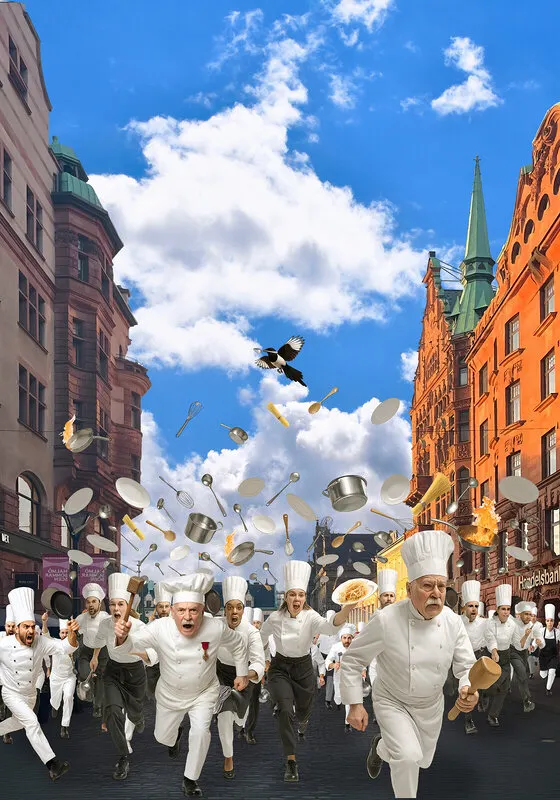
The Cook Riot, 2025
Digital
50 x 70 cm
3 200 kr
The Cook Riot
In Malmö, the children’s film 'Ratatouille' became a civic fable, sparking a transformative journey in the city's culinary scene. Long before the premiere, the rumour arrived — an animated rat in Paris had bypassed hierarchy — and the idea slipped under our doors like a draft: if talent can come from anywhere, who controls the kitchen? From Royal’s glowing marquee to Operagrillen’s linen-starched calm, the question ricocheted through the city’s arteries until it reached the chefs who had built their identities out of burns, reductions, and belief.
This is a narrative of craft and belief, of the dignified art of haute cuisine colliding with the uncontrolled democracy of hunger. It commences with posters proclaiming “ANYONE CAN COOK,” and a magpie that pilfered a silver spoon as if to inaugurate a new era. It progressed through a white-clad procession that resembled a festival until it didn’t, a press conference led by a rat in an apricot apron, and a cake battle —a symbolic clash of culinary ideologies, so dramatic that Mack Sennett would have taken a bow.
Underneath the comedy lies a pivotal question: Is excellence a closed guild or a movable feast? The chefs bring their toques and tradition; the 'rats', a metaphor for outsiders or underdogs, bring their mise en place and market share, their struggle resonating with us all. Somewhere between Savoy’s legacy and Royal’s entrance, between pride and curiosity, Malmö embarks on a journey towards a third path—a fresh approach to taste and creativity that respects discipline without shunning surprise. Call it Haute Râtisine: not a rejection of standards, but a reassignment of permission. Here, quality is not determined by your status, but by what you offer. And the city, for once, is open-minded enough to embrace it.
“Sonnet: “Crème & Concord
In Royal’s hall, where icing filled the air,
Where chefs hurled sponge and cream with wounded pride,
Each sugared missile flew without a care—
A pastry war where honour nearly died.
But through the chaos, small and unforeseen,
The rat brigade stood steady, calm, and wise;
They watched the humans drown in custard sheen,
Yet saw in them a fire they recognised.
A truce arose from crumbs upon the floor,
From shared delight in flavour, craft, and art;
For taste knows neither whisk nor species lore—
It dwells in passion, not in rank or heart.
And thus, from flying cakes and wounded pride,
A chef and rat stirred peace—and cooked side by side.”
Malmö. November 2025
The Cook Riot
The film Ratatouille swept across the globe and eventually reached Malmö, but the rumour arrived first, carried by illegal copies circulating online. The Parisian rat Remy's success as a restaurateur inspired every rat on earth to dream of better days. His Scanian colleague, Jöns, had already opened the restaurant Savoir in Gamla Väster, just one block from Lilla Torg in the centre of the restaurant district. In Malmö’s underground—the hidden world beneath cobblestones and building foundations, a place where rats lived and worked, unseen by human eyes—he was already regarded as the rats’ own Lendrop, the legendary restaurateur at Savoy. Not a bad role model. Jöns soon gained followers, and as everyone knows, rats multiply quickly. For those unfamiliar with French, savoir means "to know" or "to be able to." The unexpected source of talent, in this case, being a rat, was a revelation that fascinated and surprised many, challenging societal norms and preconceived notions about who can be creative.
Pixar’s Ratatouille (2007) is—beneath its animated rat comedy surface—one of the most precise portrayals of creativity, professional pride, and the aspiration of defining oneself. The film follows Remy, a rat with an exceptional sense of taste and smell, who refuses to accept his position at the bottom of the food chain. He doesn’t merely want to cook—he desires to be creative, to change, to produce something that evokes emotion in others. In the elitist world of French haute cuisine, where hierarchies are as firm as the walls of an opera house, his mere presence poses a challenge to the system. “Anyone can cook” is the central message of the film, but it does not mean that everyone is necessarily skilled at cooking. It suggests that talent and quality can originate from surprising places—even from those the world is not ready to recognise. The profound shift lies in the viewpoint: Remy is the artist; the humans are the craftsmen. They follow recipes; he disrupts them. He is driven by passion, intuition, and an almost overwhelming desire to express his creativity. It is not the species that is outlawed—it is the ambition.
The relationship between Remy and Linguini in Ratatouille is a brilliant metaphor for the creative process: one has the idea and the sensibility, the other has access to the world and the ability to execute. Together, they form one creator—both mind and hand. The film not only showcases this unique partnership but also celebrates the resilience it takes to create something extraordinary. This celebration of resilience is a powerful message that resonates with the audience, inspiring them to embrace their own creative journeys with a sense of determination and hope, and deepening their understanding of the film's messages about creativity and societal norms.
One of the most impactful scenes in the film is not Remy’s culinary success but the transformation of food critic Anton Ego. When Ego tastes Remy’s ratatouille, he is immediately transported to a childhood memory of safety and love. His cynicism vanishes in seconds. The food doesn’t just engage his intellect — it touches his emotions, his history, his vulnerability. The film suggests that art need not impress; it must move. Ego doesn't surrender to the flavour, but to the memory.
Ratatouille is not just a film about a rat's culinary success, but a bold challenge to the deepest fear of elitism. If a rat can produce something exceptional, what does that imply about those whose whole identity is built on exclusivity? The film prompts the audience to rethink their own perceptions of talent and creativity, engaging them in a thought-provoking journey. Who owns the idea of quality? Who has the right to call themselves an artist? These questions, raised by the film, challenge the audience to reconsider their beliefs and perceptions, sparking a lively and engaging debate.
Remy does more than change the kitchen—he upends the hierarchy. He prompts humans to question whether value resides in technique or in passion. He demonstrates that perfection is not the goal; authenticity in expression is the ultimate objective. That food, like art, is about meaning. And in a world where status is often valued more than creativity, that is revolutionary. When the film ends, it's not the rat that has become human. It's the humans who have become more human—or more rat-like, depending on your perspective. They have learned that talent can come from unexpected places, that inspiration doesn't follow hierarchies, and that the joy of creating isn't just for the chosen few, but for those who dare. Ratatouille isn't just a film about food but about identity and the pursuit of creativity. It raises a question: who determines what quality is—the creators or the judges? And it responds with the same clarity as its courage, enlightening the audience about the broader cultural issues at play: “Anyone can cook.” But only those who dare can change the world.
Royal Cinema in Malmö had laid out the red carpet. The popcorn machines puffed like tiny steam engines, and posters for Ratatouille hung from every lamppost in the city. The success was unavoidable. Along the entire length of Södertull, the queue slowly moved forward: children with sparkling eyes, parents with limited patience, and the occasional culture enthusiast pretending he was there for “the cinematic composition.” On each door of the cinema, a large decal announced “ANYONE CAN COOK!” and beneath it, in smaller print: “No rats were harmed in the production of this film.”
It didn’t help.
The film's message detonated like a bomb among Malmö’s chefs. To them, the slogan wasn’t inspiring—it was a direct assault on their professional identity. Can anyone cook? Oh really? Then why had they spent three years at the Culinary Institute in Kristianstad, followed by years of gruelling apprenticeship in various restaurant kitchens? Their professional pride—forged by scorched forearms, sleepless service shifts, and hundreds of hours of reductions—suddenly had to contend with a rat backed by an animation budget that could make their kitchen equipment look like child's play.
Rumours started spreading early at Möllevångstorget. Someone whispered that there was a rat capable of reducing a stock in six minutes. It didn’t matter that the claim was biologically and gastronomically absurd; all it took was one person to say it with confidence. When an influencer at Stortorget posted a video on YouTube and Instagram explaining how one could “reduce food waste by inviting urban rodents into the kitchen,” the reaction erupted. The Reel received 48,000 views in less than an hour and was tagged with #RatMentorship and #CulinaryEquality. The chefs' reaction to this was a mix of disbelief and outrage, as they struggled to comprehend how a rat could become a symbol of culinary excellence.
It was then that the chefs’ first counter-reaction took shape.
At the restaurant Kniven & Teglet, head chef Håkan walked around holding a stack of printed CVs. He had been searching for interns for three months without a single reply, and now he had to deal with a world where rats suddenly had film contracts. His sous-chef accidentally cut his thumb—not on the knife, but out of pure existential rage while waving a useless CV in the air. At La Saucisson de Malmö, a barista refused to serve a cappuccino to a customer who claimed she had seen the film three times and believed her hamster “had potential.” The barista slowly put the cup down, leaned forward and said, in a voice cold enough to frost the saucer: “Come back when you’ve learned the difference between passion and fur.”
Then the catastrophe.
Children in the cinema began throwing popcorn at the screen, chanting “Remy! Remy!” What had started as a rumour had now become a trend. At Chez Urban, a waiter handed out slips of paper that turned out to be QR codes, linking to the message:
“Let rats work in kitchens!
Democracy in gastronomy!”
Despite their initial shock, the chefs were not ones to back down. When a magpie flew across Gustav Adolf's torg carrying a stolen silver spoon in its beak—like a general signalling the beginning of a mutiny—something snapped. The sous-chef from Torpedgrillen looked up and said: “That’s a sign. We have to act.” Their determination was palpable, inspiring those around them with a sense of unity and resilience. This was not a battle they were willing to lose.
The decisive moment came when one of the chefs ripped down the cinema’s decal, raised his voice, and roared with a tone that made the popcorn machine cough:
“NOT EVERYONE BLOODY CAN COOK!”
The crowd fell silent. And that was when the Cook Riot began.
Operagrillen: The secret meeting
After the Royal incident, a message spread like wildfire through Malmö’s kitchens: 'Urgent meeting at Operagrillen. Chefs' assembly TONIGHT at 19:00. Culinary crisis demands immediate action.'
“Meeting at Operagrillen. Industry emergency. Chefs’ assembly TONIGHT at 19:00.”
Operagrillen—Malmö Opera’s refined restaurant with white tablecloths and starched linen napkins—had never hosted anything like this. Usually, it was a sanctuary of controlled elegance. A place where conversations revolved around the fragility of life, the transcendence of opera, and whether it was ethical to serve oxtail in modern times.
Tonight was different.
The chefs stormed in like a band of brothers, united in their cause. Tall toques, prepped ladles, and one or two burnt pots still smoking slightly. They filled the entire lounge, bringing with them the smell of frying fat and a palpable sense of accumulated professional resentment.
Conveniently, Malmö Opera was performing Fiddler on the Roof. Through the wall, Terje’s powerful voice rang:
“If I were a Rich Man!”
It echoed like a gilded lie.
One chef collapsed into an armchair and muttered:
“Yes, tradition. Exactly. Not Rat on the Roof, where the rodent is called Terje.”
The meeting began when head chef Håkan climbed onto a chair, raised a wooden spoon like a union banner, and struck a saucepan. The sound echoed through the restaurant, making a waitress instinctively believe someone had ordered extra bread.
“Colleagues,” he said, “we face an unprecedented threat.
It’s not gluten-free.
It’s not vegan.
It’s worse.”
A heavy silence.
“It is… rat-driven.”
Agitated whispers. Someone fanned themselves with a menu. Sous-chef Masoud, still traumatised by the stock-reducing rumour, removed his hat and squeezed it like a stress ball.
Håkan unrolled a poster with the film’s slogan and held it up as if it were a biological weapon.
“ANYONE CAN COOK!” he declared, a reference to the film that had sparked this rat-driven revolution. Little did we know, it was a prophecy of our impending battle.
“This,” he said, “is how it starts.
First, the film.
Then the mentality.
Next, the rats take the kitchens.”
Someone muttered:
“They don’t even need salaries.”
Another:
“They’re tiny. They can cook inside the ventilation ducts and still take up less space than a junior chef.”
The discussion swelled. A chef from Dockan said a customer had asked if their restaurant collaborated with rats—otherwise they would book somewhere else. A restaurateur from Ribersborg had already received an email from a family requesting a Remy-themed birthday menu. The rats, it seemed, were not just a nuisance, but a culinary threat, infiltrating the very heart of Malmö's dining scene.
And someone, from the back:
“I think I saw a rat carrying an oyster knife outside Scandic Triangeln.”
That was the final straw.
Håkan stretched out his arm, spoon pointing like a general signalling a charge:
“We revolt. We take back the city.”
On the other side of the wall, the orchestra launched into the third verse of If I Were a Rich Man. The chefs stood still, listening to the ensemble sing of dreams, dignity, and the fight for identity.
Tradition. Tradition.
Håkan nodded toward the sound and summed up everything in one sentence:
“We are the craft. They are the rats. We go to war.”
The chefs rose as one, their unwavering determination shining in their eyes. They grabbed their ladles and pots as if they were instruments in a revolutionary orchestra, and marched toward the exit. This was not just a meeting. This was a call to arms. Operagrillen had transformed from a fine dining establishment to a war council, a clear sign of the chefs' unwavering readiness for battle.
Operagrillen had transformed from a fine dining establishment to a war council, a clear sign of the chefs' readiness for battle. The air was charged with anticipation, the next move in this culinary war about to unfold, and the chefs were ready to face it head-on.
War was coming.
Let the rodent cooks tremble.
Outside, night was settling in. A magpie hovered above, a stolen silver spoon in its beak — taken from the Opera terrace — circling as if surveying the battlefield. Some chefs headed to Malmö’s night-open bars to fortify themselves for the coming day; others trudged home for a solitary nightcap and to make sense of everything. How on earth had it come to this? A French rat.
The Cook Riot — on the streets
The following day, the meeting point was the legendary Savoy — once Malmö’s proud cathedral of fine dining, now barely reaching the level of a motivated rat. Since the house chef had offered the empty dining room to the chefs, the guerrilla brigade filled the space from wall to wall. Outside, it was equally crowded; white toques bobbed all the way down Hamngatan.
When the doors to Savoy’s historic dining room swung open, the chefs surged out like a white avalanche of pride and pent-up resentment at being compared to rodents. They waved ladles like swords and brandished saucepans like shields. The first marching line passed the fountain by the Town Hall, their footsteps clattering against the cobblestones. It almost looked organised. It wasn’t. It was a white-clad mob with tall hats.
The magpie from the previous night made a wide arc above them, wielding the silver spoon like a battle banner.
As they moved along Södergatan, passersby paused to watch. Tourists raised their phones, while locals debated whether this was performance art, a political protest, or an installation from Moderna Museet. The white jackets, the clatter of pans, and the occasional battle cry created an atmosphere that no one could quite understand. A culture journalist in a trench coat whispered, thrilled:
This is either avant-garde or labour law.
The chefs themselves were resolute, determined to etch their names in history. Their first slogans echoed against the facades. There were historic precedents — the food riots of 1917, First of May protest marches — Stortorget had witnessed uprisings before. Now it was the chefs’ moment, and they were unwavering in their resolve to leave an indelible mark.
“NO RODENTS!
KITCHENS WITHOUT FUR!”
Read one of the banners.
“JÖNS AND REMY MUST BE FINISHED!” they chanted, their voices echoing so loudly that a nearby dog started to howl in solidarity. This was not just a battle cry, but a resolute rejection of the rat's influence on their craft, a declaration of their unwavering commitment to their culinary principles.
Clusters of restaurant guests gazed from outdoor terraces as the march went by. Someone leaned out of a flat window and shouted:
“Is this Fine Dining for Palestine, or what’s the theme?”
With each step towards Royal, the chefs were resolute, their unity a testament to their determination. They were acutely aware of the changing tide. Children were now asking for 'rat menus' in school cafeterias, and parents were questioning why preschools didn’t serve ratatouille. The rats weren’t just infiltrating the kitchens, but also shaping the culinary expectations of the next generation.
And those blasted posters everywhere:
ANYONE CAN COOK.
The sight of those blasted posters everywhere made their stomachs turn. It was effective propaganda, a stark reminder that if you repeat a lie often enough, it becomes truth.
By the time the march reached Södergatan, the crowd had swelled. Restaurateurs, culinary creators, head chefs, sous-chefs, commis, grill cooks, fish cooks, pastry chefs — even food-truck chefs. A pastry chef with a pink candyfloss beard exclaimed that his macarons deserved better than being likened to rodents’ antics on a cinema screen. The chefs were united in their cause, each one standing shoulder to shoulder with the others.
An elderly chef — a legend from Savoy’s golden era — stood on a bench outside Apoteket Lejonet. In his hand, he clutched a cast-iron frying pan — a relic from a time when cooking was a matter of survival. He raised it like a general lifts a sword.
“COMRADES, LISTEN!
We thicken sauces with bravery.
We burn our tongues for flavour.
We thin the sauce with our tears when the dining room is empty.
Should rats take our jobs and replace Swedish home cooking with the new French cuisine?
What say you?”
The crowd responded loudly, almost biblically, but with a clear Malmö accent.
“NO! NO, FOR FUCK’S SAKE — NO!”
That was the moment a protest turned into an uprising.
As the march passed Skomakaregatan, everyone saw the banner hanging from a gable wall.
RATATOUILLE — EXTRA SCREENING.
In front of Royal, families queued, blissfully unaware of the impending culinary civil war.
Time came to a halt. Even the silence had a noise.
One chef raised a megaphone:
“NOT EVERYONE BLOODY CAN COOK!”
People on the street jumped. Inside the cinema, the popcorn machine wheezed — a warning sign. The disorganised tramp of chef shoes echoed across the square.
At that very moment, the rats made their appearance.
They emerged from drains, ventilation grilles, and shadows along the walls. They were organised. Many wore tiny chef’s hats, and some carried aprons. One hauled a wagon of spice jars. Without a sound, the rodents marched forward in formation, distributing menus to bewildered passers-by.
Malmö’s culinary elite stared — not at the rats, but at the discipline.
The rodents had mise en place.
They were prepared. They were structured. They knew exactly what they were doing, challenging the chefs' perception of them as mere pests.
They were prepared. They were structured.
They knew exactly what they were doing.
On one hand, Malmö’s chefs were in disarray, panicking, shouting, and waving ladles. On the other hand, the rats stood in disciplined contrast, their structured approach a stark contrast to the chefs' chaos.
The Confrontation at Royal
The magpie perched on the cinema marquee, a silver spoon in its beak, glaring down on both sides like a judge in a surreal cooking contest. Where the bird’s loyalty truly lay was impossible to determine — magpies are pragmatists. History would tell.
This was no longer a protest.
It was a battle for the soul of the kitchen.
And Malmö held its breath before the first strike.
The chefs, their determination radiating in the air, stormed into Royal. The doors swung open, popcorn scattered across the floor, and someone knocked over a box of 3D glasses. Children shrieked with delight. Parents yelled in confusion. But the chefs remained undeterred, their resolve unwavering.
In the foyer, the rats were waiting. Not scattered, but lined up like disciplined kitchen staff. Their strategic choice of the cinema as their venue was a testament to their intelligence, a calculated move reminiscent of the old days under Lars Lendrop at the Savoy: if the shoes didn’t fit, you were out before the bread had cooled. Their discipline was a force to be reckoned with, leaving the audience in awe of their organisation.
Tiny rats in miniature aprons stood by the sweets counter offering “sample bites.”
One rat held up a sign:
“Try our home-made popcorn spice rub!”
The chefs froze, not out of fear, but out of respect. They recognised the look in their enemy’s eyes — a hunger not just for food, but for creativity. The chefs couldn't help but admire the rats' innovative approach, sparking the audience's curiosity about what the rats would do next.
Then arrived the press conference.
A sign had been taped to a popcorn stand:
SGF — The Swedish Rodent Federation proclaims a new gastronomic era
No one understands how the rats organised themselves. Some say it occurs through an encrypted communication network within the city’s sewers — the Dark Sewer Web. Beside the sweets counter, the rats had erected a podium. Where else?
A microphone was placed on a banana crate. Behind it, a rat stood wearing an apricot-coloured apron.
Thank you for being here. My name is Jöns, head chef at Savoir in Lilla Torg. I’m here to speak about democracy and equal chances. And most importantly: the new cuisine — from a rat’s perspective. A perspective that, I assure you, is not to be sniffed at.
Above his head, a PowerPoint slide appeared.
“Anyone can cook — even rats.”
The image showed Remy stirring a pot.
Humans claim that rats are unhygienic. But honest to goodness — what does your kitchen look like after Sunday brunch? Ours is cleaner. We have many willing paws. And discipline. Living close to humans for thousands of years has made it necessary. Our commitment to sustainability and cleanliness is something to be admired, inspiring the audience with our values.
Several chefs turned away — in their own restaurants, extra hands were scarce despite all the undeclared labour.
Next slide:
“Food waste: an existential duty.”
Jöns grinned; his large incisors glinted.
“You throw away parmesan. We create dishes from leftovers.”
Slide three: a graph illustrating rodent-based gastronomy soaring, while human fine dining nosedives towards zero. In the corner blinked one word:
Sustainable cooking.
Jöns discussed restraint, balance, and creativity. He emphasised the importance of listening to the ingredients before discarding them.
Use your senses before throwing anything at the rats. Even though we appreciate the free produce, your habits aren’t good for our shared planet. If we didn’t exist, things would be far worse.
Investor statistics appeared:
Future kitchen investment: Rats, 62%; humans, 38%.
Next slide:
#StopFoodWaste — StartRatTaste
Jöns explained why rodent menus are better for both the environment and digestion. More vegetables. More variety. Less ego.
A chef hurried forward, pointed at the screen, and shouted:
You can’t even obtain a HACCP certification!
Jöns replied calmly:
We rely on our senses, not acronyms. If an ingredient smells off, tastes unpleasant, or looks unsuitable, it’s unfit for cooking — regardless of the best-before labels or invoices from your suppliers. No spice in the world can change that.
He paused, then spoke with solemn pride:
“We have been in restaurant kitchens since the beginning. Inns and taverns have been around for 5,000 years. Excavations from Mesopotamia and Crete show that food service existed long before Michelin stars were introduced. We are the oldest guests — and we have far stronger stomachs.”
A murmur of panic spread among the chefs. Masoud, the sous-chef who had so far remained frozen, whispered to Håkan:
“They’re not discussing food. They’re talking about market share and growth plans. They’re speaking in KPIs. These rats are... startups and entrepreneurs. And that makes them far more dangerous.
Jöns finished his talk:
“First Gamla Väster. Then all of Malmö. Then Copenhagen. Berlin.
And after that — the world.”
The rats cheered. Their collective squeak drowned the chefs’ despondent sigh.
Morale among Malmö’s culinary elite collapsed. Even Håkan appeared ready to give in. The contest was finished.
Or so they thought.
The pastry chefs had staged a coup. They each brought a dozen cakes and aimed to kill the rats with a cholesterol shock — death by sugar. The plan was straightforward:
Let the rats devour themselves to death.
They had conducted poor research.
Rats are selective. They only eat what they need to survive and reproduce. This stark contrast to the rampant food waste in human kitchens is a poignant satire on the inefficiency and excess that often characterise our food industry.
Unbeknownst to the dessert chefs, their fellow cooks had fortified themselves at Kramer’s Bar on Stortorget before the uprising, leaving behind a sea of empty bottles. This, of course, had a profound effect on their aim, which was now as accurate as a blindfolded archer. And to add to the absurdity, their intended targets were the diminutive rat chefs, resulting in a comical outcome where most of the delectable pastries missed their mark and landed on their human colleagues, creating a scene that was both chaotic and hilariously absurd.
No one is pleased when a cream cake hits you squarely in the face, which naturally calls for revenge and sends testosterone surging. It took only seconds before a proper cake battle, reminiscent of a medieval joust, broke out over the heads of the astonished rats, who took shelter in one of the candy counter’s glass cases. When the cakes were gone, Cinema Royal had outdone every classic Mack Sennett film ever screened there since the theatre opened in 1961.
Crème and Chaos
It didn’t start like a typical war — no declaration, just pastry chefs producing their smuggled projectiles without hesitation. One pâtissier held a cream cake in the palm of his hand, another gripped his dessert like an Olympic discus and hurled it after three steady breaths. Director Mack Sennett used to say that slapstick isn’t about the pie itself, but the moment before — the vibrating potential. Suddenly, a dozen hands went up. Then the first cake flew.
It sailed through the air in an arc, with a unique aerodynamics of its own. The cream trembled, the strawberries quivered as the projectile headed toward its target, Jöns — who didn’t even need to duck as it soared far above him towards Håkan, who ducked at the last second, sending the cake on as a white meteor straight into the face of a chef from Möllevången, followed by a wet, muffled flop as cream, sponge cake, and strawberries met a bewildered human being. Then that unforgettable sight: a pair of eyes blinking through the cream, while a lone strawberry slowly slid down a cheek. No swearing, just silence — and one should know that the people of Möllevången are not to be trifled with.
Vollmer’s pâtissier stuck to his battle plan and aimed for a rat. It might have hit its target if a sous-chef hadn’t straightened his back at that exact moment. The cake slammed into his face with full force. One second of complete stillness. Then he retaliated with a chocolate-mousse cake without even wiping the raspberry jam from his eyelashes.
Not a single cake reached a rat — only cooks who happened to walk through a cake’s path. This was no Sennett silent film; it turned into a long flaffssssch, a sound no one present would ever forget.
Now there was no turning back, armed as they were with sugar and fat. Cakes began raining down from all directions, hissing through the air. Many exploded right in some chef’s mug, others splattered against the walls, and fragments of cake covered the floor. Cream spread across the foyer carpet, making it white and slushy like a Scanian winter. Mack Sennett himself would have bowed before the absurd elegance with which a Napoleon cake ceased to be a dessert and became a projectile, a stark contrast to the chaotic scene it was a part of.
A pâtissier with a pink candy-cane beard reloaded like an experienced artilleryman. He took aim at the one who had just planted a savarin on his chest, closed one eye, and launched a Princess Cake with such force that the marzipan fluttered like a sail.
It became a cacophony of noise: smacking whipped cream, the dull thud of savarins hitting walls, swearing and cooks screaming in ecstasy, rats squeaking in shock. A tiramisu flew in a perfect semicircle before landing on the head of a baker who suddenly looked like a tragic Santa Claus with a full white beard. Behind the candy counter, where rats had taken refuge in a makeshift bunker, the goo seeped through the cracks and formed icicle-like stalactites of cream. The rats, usually the ones causing chaos, were now the shocked onlookers, their usual mischief overshadowed by the humans' sugar-fueled madness.
In a matter of moments, the Royal descended into utter chaos, with cream, jam, sponge cake, and icing splattered everywhere. Each step was a squelch; chef hats flew off when struck by cakes, ladles clattered to the ground, and marzipan roses were flattened underfoot. No one knew who had thrown what; everyone was aiming at everyone else, except the rats. This was not just a cake war; it was a sugar-fuelled violence, a riot of confectionery, and the most absurd war of the millennium. It was chaos, with Sennett’s spirit lingering in the foyer, a scene that would have made even the most serious of onlookers burst into laughter at the sheer absurdity of it all, a chaos that was both intense and riotous.
The battle finally came to an end when the cakes ran out, and it was no longer worth scraping together enough to make a new projectile. The cooks and the interiors now resembled paintings by Karel Appel or the Northerner Bengt Lindström — both of whom must surely have had a cake war in mind when creating their art. The relief was palpable, and a sense of satisfaction filled the air as the chaos subsided, bringing a much-needed resolution to the absurdity that had unfolded, a resolution that was both relieving and satisfying.
The wise among Malmö’s culinary elite reached an almost philosophical conclusion: the more cooks, the worse the soup — but the better the cake war. It was impossible to say who had won; everyone was equally smeared, except the rats, which, in their improvised bunkers, had remained dry and now nibbled on whatever decoration had flown their way, pondering evolution’s miscalculations. There isn’t a rat alive who doesn’t know that, in a systemic collapse, rats outlive humans. Rats and cockroaches don’t need civilisation — but humans need it to survive. This reflection on the nature of survival and the role of civilisation in human life brings a sense of deep contemplation to the aftermath of the cake war.
Nils, the eldest chef and a legend from Savoy’s golden age — a man who had reduced sauces longer than most had been alive — stepped forward and wiped the worst of the goo from his psychedelic chef’s jacket. Nils realised he and his colleagues had nothing left to lose. Their dignity had already vanished in the cake war; now the goal was to regain their honour, which required pragmatism and compromise.
Next to the improvised podium from which the rat Jöns had spoken, a small tasting display had been set up behind plexiglass. Nils had earlier noticed that inside there were several tiny plates lined up, just as one would see in a chef’s competition before a tasting. He suspected that this had been the plan — but the rat chef had never made it that far before the cake-throwing began.
Nils wiped away cake and cream with a finger and saw that what lay inside seemed untouched. Carefully, he lifted the panel and picked up the first tiny plate arranged by his little rat colleague.
“Rât Minimaliste,” read the sign — Nils could read it only after fishing out a magnifying glass he always carried, being an older gentleman.
An appetiser featuring a small piece of roasted cauliflower, drizzled with lemon oil and fresh thyme. A starter reduced to its essence — simplicity that defies excess.
The knife and fork would have been perfect in his granddaughter’s doll's house, but far less suitable for his broad fingers. Somehow, he managed to make them work between thumb and forefinger. Etiquette be damned — he used the knife to scoop up some of the sauce into his mouth. He smacked his lips like a true connoisseur, and silence settled over the foyer as they awaited his judgment.
“Minimalistic. Provocative. Perfect,” exclaimed the Savoy chef, delighted. “On par with Savoy, circa 1981! No small compliment, I assure you. Lendrop would have applauded.” A murmur rippled through the hall.
As the moment for the first course approached, the excitement in the air was electric. A soup, as tradition dictates, was about to be served, igniting a sense of anticipation and eagerness in the audience.
“Râtatouille Velouté Royale,” the menu on the lower shelf proclaimed, the text barely legible through his regular glasses. It was a silky velouté of roasted celeriac and cauliflower, infused with the essence of white wine and reduced stock, and crowned with confit zucchini, tomato, and pepper — the very ingredients that once graced the Parisian rat Remy's ratatouille, now reimagined into a refined starter. It was accompanied by a herb oil of tarragon and parsley, and a butter-fried brioche filled with pecorino and crushed thyme.
The soup spoon was barely larger than a pinhead, a design that ensured the experience lingered. Nils savoured the velouté as one should, and his four smacks echoed through the room. Another collective gasp swept through the crowd. No smacking: disqualified. One smack: acceptable. Two: “Well, I’ll be damned.” Three: Michelin-star-level. Four had never happened — or so Håkan believed. This rat belonged to the absolute culinary elite, which didn’t make things easier for Malmö’s chef collective. Nils rinsed his mouth with still Ramlösa before the next dish, a fish — or veggie, depending on outlook.
“Râtelle Royale” — scallops with green apple from Österlen and tarragon with smoked Herrgård cheese from Allerum; Romanesco broccoli à la Alnarp alongside the caramelised scallops, paired with tiny cheese rusks from Söderslätt. They were small enough to fit beneath his sharpest incisor. But good heavens, what flavour!
The first of two main courses was manageable with the rat kitchen’s tiny cutlery, helped along by a wooden toothpick Nils kept in a leather sheath in his pocket. Three emphatic smacks sent yet another wave of murmurs through the crowd — a sensation was brewing.
The next main course was stored in the smallest microwave Nils had ever seen; a press of a button — perfectly sized for a toothpick — and seconds later, the dish was at the perfect temperature. “Râtissime d’Hiver,” the menu called it — roasted veal loin, liquorice-marinated rutabaga, smoked snail eggs, Jerusalem artichoke, creamy mushrooms and seared Brännvinsost cheese. After a few miniature bites, it was over. Nils shook his head in a kind of resignation, then smacked four times. The murmuring in the room had a tone of melancholy — this tasting spelt trouble for the chefs.
Dessert rested in a tiny warming cabinet: “Râtisserie Arctique” — oven-baked chocolate pasta with hand-stirred lingonberries from Söderåsen, flavoured with a thin reduction of tar syrup that lent discreet smokiness. In a bowl of ice, accompanying the warm, semi-set cream, were chilled chocolate sablé, silky lingonberry caramel, crisp meringues, airy crème fraîche parfait, and whipped lingonberry cream.
Four smacks, and Nils had to speak his delight. “Truly a Scanian dessert, where the forest’s acidity meets the plains’ sweetness — the depth of chocolate, the clarity of tartness, and a hint of smoke from the charcoal pits of ancestors. To me, it tastes of childhood, midsummer, but also loss paired with hope. All at once.” Tears rose in Nils’s eyes as he thought of his grandmother’s 1930s chocolate ice cream, a dish that had always brought him comfort and joy. “Good heavens, am I really this old?” The 'Râtisserie Arctique' dessert, with its blend of flavours and memories, served as a poignant reminder of the passage of time and the evolution of culinary traditions. It was a dish that not only delighted his palate but also stirred his soul, bringing back memories of his childhood and the evolution of his culinary journey.
“This is, goddamnit, the best thing I’ve ever tasted,” Nils said, frowning deeply.
The army of chefs on Royal’s smeared carpet dropped their ladles in slow motion, as though someone had switched off gravity. No splash, just a slurp. Nobody spoke. Barely anyone breathed. It was neither victory nor defeat. It was a collective awakening, a moment that inspired hope and a new beginning in the culinary world.
After contemplating his experience for a while, Nils opened his mouth:
“My dear sisters and brothers. They always say, 'The more cooks, the worse the soup.' But perhaps it’s the other way around. Maybe the secret lies in letting more in — even the most unexpected.
Haute cuisine and Râtisine. Two worlds. One truth. Taste recognises no rank. Let us call it Haute Râtisine, La nouvelle cuisine — a historic revolution in the culinary world, born tonight, and let the rest of the world catch up. This 'historic revolution' refers to the merging of haute cuisine and Râtisine, a new culinary movement that values taste over tradition and inclusivity over exclusivity.
The rats emerged from every crevice that had protected them during the cake war. In the middle of the slush stood cooks and rats side by side — not as enemies, but as… colleagues. This unexpected alliance was a testament to the transformative power of food and the breaking down of societal barriers.
Epilogue – The Malmö Accord. The 'Malmö Accord' refers to the agreement reached between the Malmö Chef Collective, the Swedish Rodent Federation (SRF), and The Magpie with the Spoon, symbolising the newfound harmony and collaboration between humans and rats in the culinary world.
The next morning, a new sign hung on Royal’s entrance. No one knew who put it there. It just appeared:
“Anyone can cook, big or small —
But not everyone needs to be in the kitchen at the same time.
And watch where you put your feet.”
Signed by three founders:
Malmö Chef Collective
Swedish Rodent Federation (SRF)
The Magpie with the Spoon
High atop the theatre’s marquee sat the stolen silver spoon. The magpie circled over the square, cawing with satisfaction. It had never chosen sides — only taken what shimmered most — and now it had become the symbol of Haute Râtisine, the new cuisine destined to conquer the world. From its high vantage point, it heard and saw everything, serving as the eternal secretary of this gastronomic academy.
Meanwhile, Jöns had sent the word throughout Malmö’s underworld, where roughly a million rats reside.
“Dear Rodents! Free cake served at Cinema Royal between 01:00 and 04:00 on Friday night. Entrance through the Södertull passage — tunnels north and south! The Gustav Adolf sewer line also works.”
Such summonses travel faster than a rat can run — in every direction at once. The last chef had barely left before eager rodents arrived in droves.
When the cleaning staff arrived at eight, they discovered someone had already done their job. Their conclusion: a double booking. Since they were paid regardless, they went home. Lucky them — no one had told them what condition the place had been in, which would undoubtedly have caused a union dispute. Happiest of all was the chefs’ union, relieved of what would have been a costly sanitation bill. Malmö’s rats had likely never been so full after clearing every crumb from a historic cake war. The chefs' union breathed a collective sigh of relief at this unexpected turn of events.
“When all is said and done, tomorrow is another day,” as Scarlett O’Hara said in Gone with the Wind — though she wasn’t thinking about reinventing Skånsk Äggakaka or violating culinary tradition. Nor was she thinking about tomorrow’s rat championships at the old sports field, involving throwing small pieces of cheese. The current record is 19.95 meters and hasn’t been broken in years. The cheese must be aged Herrgård without holes — completely solid — and here in Skåne, the honey-yellow Allerum Herrgård is the only acceptable choice.
3 200 kr

Jörgen Thornberg
Malmö
Lite om bilder och mig. Translation in English at the end.
Jag är en nyfiken person som ser allt i bilder, även det jag fäster i ord, gärna tillsammans för bakom alla mina bilder finns en berättelse. Till vissa bilder hör en kortare eller längre novell som följer med bilden.
Bilder berättar historier. Jag omges av naturlig skönhet, intressanta människor och historia var jag än går. Jag använder min kamera för att dokumentera världen och blanda det jag ser med vad jag känner för att fånga den dolda magin.
Mina bilder berättar mina historier. Genom mina bilder, tryck och berättelser. Jag bjuder in dig att ta del av dessa berättelser, in i ditt liv och hem och dela min mycket personliga syn på vår värld. Mer än vad ögat ser. Jag tänker i bilder, drömmer och skriver och pratar om dem; följaktligen måste jag också skapa bilder. De blir vad jag ser, inte nödvändigtvis begränsade till verkligheten. Det finns en bild runt varje hörn. Jag hoppas att du kommer att se vad jag såg och gilla det.
Jag är också en skrivande person och till många bilder hör en kortare eller längre essay. Den följer med tavlan, tryckt på fint papper och med en personlig hälsning från mig.
Flertalet bilder startar sin resa i min kamera. Enkelt förklarat beskriver jag bilden jag ser i mitt inre, upplevd eller fantiserad. Bilden uppstår inom mig redan innan jag fått okularet till ögat. På bråkdelen av ett ögonblick ser jag vad jag vill ha och vad som kan göras med bilden. Här skall jag stoppa in en giraff, stålmannen, Titanic eller vad det är min fantasi finner ut. Ännu märkligare är att jag kommer ihåg minnesbilden långt efteråt när det blir tid att skapa verket. Om jag lyckas eller inte, är upp till betraktaren, oftast präglat av en stråk av svart humor – meningen är att man skall bli underhållen. Mina bilder blir ofta en snackis där de hänger.
Jag föredrar bilder som förmedlar ett budskap i flera lager. Vid första anblicken fylld av feel-good, en vacker utsikt, fint väder, solen skiner, blommor på ängen eller vattnet som ligger förrädiskt spegelblankt. I en sådan bild kan jag gömma min egentliga berättelse, mitt förakt för förtryckare och våldsverkare, rasister och fördomsfulla människor - ett gärna återkommande motiv mer eller mindre dolt i det vackra motivet. Jag försöker förena dem i ett gemensamt narrativ.
Bild och formgivning har löpt som en röd tråd genom livet. Fotokonst känns som en värdig final som jag gärna delar med mig.
Min genre är vid som framgår av mina bilder, temat en blandning av pop- och gatukonst i kollage som kan bestå av hundratals lager. Vissa bilder kan ta veckor, andra någon dag innan det är dags att överlämna resultatet till printverkstaden. Fine Art Prints är digitala fotocollage. I dessa kollage sker rivandet, klippandet, pusslandet, målandet, ritandet och sprayningen digitalt. Det jag monterar in kan vara hundratals år gamla bilder som jag omsorgsfullt frilägger så att de ser ut att vara en del av tavlan men också bilder skapade av mig själv efter min egen fantasi. Därefter besöks printstudion och för vissa bilder numrera en limiterad upplaga (oftast 7 exemplar) och signera för hand. Vissa bilder kan köpas i olika format. Det är bara att fråga efter vilka. Gillar man en bild som är 70x100 men inte har plats på väggen, går den kanske att få i 50x70 cm istället. Frågan är fri.
Metoden Giclée eller Fine Art Print som det också kallas är det moderna sättet för framställning av grafisk konst. Villkoret för denna typ av utskrifter är att en högkvalitativ storformatskrivare används med åldersbeständigt färgpigment och konstnärspapper eller i förekommande fall på duk. Pappret som används möter de krav på livslängd som ställs av museer och gallerier. Normalt säljer jag mina bilder oinramade så att den nya ägaren själv kan bestämma hur de skall se ut, med eller utan passepartout färg på ram, med eller utan glas etc..
Under många år ställde jag bara ut på nätet, i valda grupper och på min egen Facebooksida - https://www.facebook.com/jorgen.thornberg.9
Jag finns också på en egen hemsida som tyvärr inte alltid är uppdaterad – https://www.jth.life/ Där kan du också läsa en del av de berättelser som följer med bilden.
UTSTÄLLNINGAR
Luftkastellet, oktober 2022
Konst i Lund, november 2022
Luftkastellet, mars 2023
Engleson Galleri Caroli, april 2023
Hydra, Greece June 2023
Engleson Galleri Caroli, oktober 2023
Toppen, Höllviken december 2023
Luftkastellet, mars 2024
Torups Galleri, mars 2024
Venice, May 2024
Luftkastellet, oktober 2024
Konst i Advent, December 2024
Galleri Engleson, Caroli December 2024
Jäger & Jansson Galleri, april 2025
A bit about pictures and me.
I'm a curious person who sees everything in pictures, even what I express in words, often combining them, for behind all my pictures lies a story. These narratives, some as short as a single image and others as long as a novel, are the heart and soul of my work.
Pictures tell stories. Wherever I go, I'm surrounded by natural beauty, exciting people, and history. I use my camera to document the world and blend what I see with what I feel to capture the hidden magic.
My images tell my stories. Through my pictures, prints, and narratives, I invite you to partake in these stories in your life and home and share my deeply personal perspective of our world. More than meets the eye. I think in pictures, dream, write, and talk about them; consequently, I must create images too. They become what I see, not necessarily confined to reality. There's a picture around every corner. I hope you'll see what I saw and enjoy it.
I'm also a writer, and many images come with a shorter or longer essay. It accompanies the painting, printed on fine paper with my personal greeting.
Many pictures start their journey on my camera. Simply put, I describe the image I see in my mind, experienced or imagined. The image arises within me even before I bring the eyepiece to my eye. In a fraction of a moment, I see what I want and what can be done with the picture. Here, I'll insert a giraffe, Superman, the Titanic, or whatever my imagination conjures up. Even stranger is that I remember the mental image long after it's time to create the work. Whether I succeed is up to the observer, often imbued with a streak of black humour – the aim is to entertain. My pictures usually become a talking point wherever they hang.
I prefer pictures that convey a message in multiple layers. At first glance, they're filled with feel-good vibes, a beautiful view, lovely weather, the sun shining, flowers in the meadow, or the water lying deceptively calm. But beneath this surface beauty, I often conceal a deeper story, a narrative that challenges societal norms or explores the human condition. I invite you to delve into these hidden narratives and discover the layers of meaning within my work.
Picture and design have been a thread running through my life. Photographic art feels like a fitting finale, and I'm happy to share it.
My genre is varied, as seen in my pictures; the theme is a blend of pop and street art in collages that can consist of hundreds of layers. Some images can take weeks, others just a day before it's time to hand over the result to the print workshop. Fine Art Prints are digital photo collages. In these collages, tearing, cutting, puzzling, painting, drawing, and spraying happen digitally. What I insert can be images hundreds of years old that I carefully extract so they appear to be part of the painting, but also images created by myself, now also generated from my imagination. Next, visit the print studio and, for certain images, number a limited edition (usually 7 copies) and sign them by hand. Some images may be available in other formats. Just ask which ones. If you like an image that's 70x100 but doesn't have space on the wall, you might be able to get it in 50x70 cm instead. The question is open.
The Giclée method, or Fine Art Print as it's also called, is the modern way of producing graphic art. This method ensures the highest quality and longevity of the artwork, using a high-quality large-format printer with archival pigment inks and artist paper or, in some cases, canvas. The paper used meets the longevity requirements set by museums and galleries. I sell my pictures unframed, allowing the new owner to personalise their artwork, confident in the lasting value and quality of the piece.
For many years, I only exhibited online, in selected groups, and on my Facebook page - https://www.facebook.com/jorgen.thornberg.9. I also have my website, which unfortunately is not constantly updated - https://www.jth.life/. You can also read some of the stories accompanying the pictures there.
EXHIBITIONS
Luftkastellet, October 2022
Art in Lund, November 2022
Luftkastellet, March 2023
Engleson Gallery Caroli, April 2023
Hydra, Greece June 2023
Engleson Gallery Caroli, October 2023
Toppen, Höllviken December 2023
Luftkastellet, March 2024
Torup Gallery, March 2024
Venice, May 2024
UTSTÄLLNINGAR
Luftkastellet, oktober 2022
Konst i Lund, november 2022
Luftkastellet, mars 2023
Engleson Galleri Caroli, april 2023
Hydra, Greece June 2023
Engleson Galleri Caroli, oktober 2023
Toppen, Höllviken december 2023
Luftkastellet, mars 2024
Torups Galleri, mars 2024
Venice, May 2024
Luftkastellet, October 2024
Konst i Advent, December 2024
Galleri Engleson, Caroli December 2024
Jäger & Jansson Galleri, April 2025
Utbildning
Autodidakt
Medlem i konstnärsförening
Öppna Sinnen
Med i konstrunda
Konstrundan i Skåne
Utställningar
Luftkastellet, October 2022
Art in Lund, November 2022
Luftkastellet, March 2023
Engleson Gallery Caroli, April 2023
Hydra, Greece June 2023
Engleson Gallery Caroli, October 2023
Toppen, Höllviken December 2023
Luftkastellet, March 2024
Torup Gallery, March 2024
Venice, May 2024