Vi använder cookies för att ge dig bästa möjliga upplevelse. Välj vilka cookies du tillåter.
Läs mer i vår integritetspolicy
Jörgen Thornberg
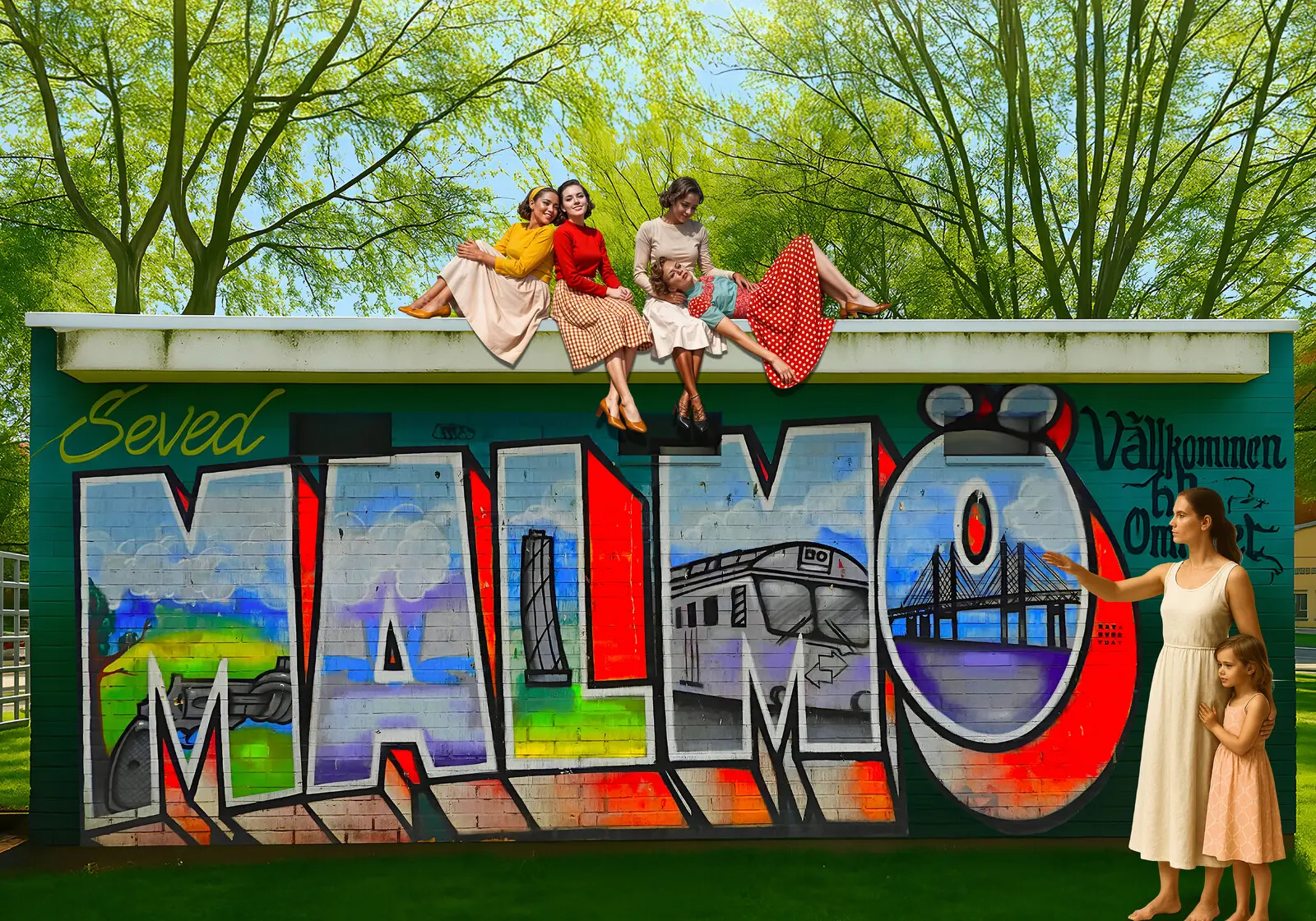
Pax Scania - Girls at the TopPax Scania - Girls at the Top, 2025
Digital
70 x 50 cm
3 200 kr
Pax Scania - Girls at the Top
Click the link below to delve into the enduring narrative of Pax Scania. Learn about what could happen if women were in charge of their own peace, if peace were a more prevalent condition.
https://www.konst.se/jorgen-thornberg
Pax Scania – this means we need to prioritise women. This phrase encapsulates the notion that to achieve peace in Scania, we must recognise the vital and irreplaceable role of girls and women in our society and decision-making processes. Our age often treats peace as if it were a permanent state — something a nation either possesses or lacks. But peace is never static. Peace is a dynamic movement, a balance, and a form of participation. Declarations or policies do not create it, but are made by people. Sweden has not been at war for more than two hundred years; yet, in several neighbourhoods, the everyday reality contradicts the national narrative. A country can be at peace, yet its citizens may still live in turmoil. This dynamic nature of peace calls for our engagement and commitment, as we strive to make it a reality for all.
To understand what kind of peace we seek — and what kind of peace we have lost — we must examine not only violence itself but also the systems that surround it: the recruitment of children, the parallel economies, the collapse of trust, and the power of community. Data and research lead to the same conclusion: violence rises where poverty and social isolation persist. But there is hope. Peace emerges where community presence is restored, and trust is rebuilt. This is a call to action for everyone. We all have a role to play in rebuilding trust and restoring community presence, and in doing so, we can empower ourselves and others to create a more peaceful society.
The following sources provide the factual basis for that insight.
“Sonnet — Against the Darkness of Our Streets
When night descends and shadows claim the square,
And fear walks faster than the hurried feet,
We see the cost of silence everywhere,
Where mothers guard the door, and children retreat.
The wicked thrive where good men turn away,
For evil blooms in corners left unlit;
A single act of courage breaks its sway,
A single voice can scatter those who sit.
No sword of steel can shape a lasting peace;
No law alone can melt a frozen heart.
But hands held out make hostile tensions cease,
And presence tears the darkened veil apart.
For evil rules where hope forgets to speak—
So stand, and light returns to every street.”
Malmö. November 2025
What does Pax Scania – The Art of Peace in a Time of Turmoil mean?
Peace is one of the words we use most casually. We claim to live in peace, stating that Sweden is a peaceful country. In international comparison, this is true: Sweden has not participated in an interstate war since 1814 (the war against Norway). But peace can be defined in two ways:
Negative peace – the lack of war or armed conflict.
Positive peace – the existence of stability, participation, trust, and functioning social structures.
When historians discuss Pax Romana (27 BCE–180 CE), they are not referring to a time without conflicts — the Roman Empire remained in a state of war along its frontiers. What they mean is internal stability. The Roman world did not cease to be violent, but it became more predictable.
The Roman Emperor Augustus achieved peace not solely through power, but through a balance of power.
Balance between old republican institutions and the emperor’s new authority
Balance between complex discipline (the army) and soft tools (infrastructure, trade)
Balance of control and reward: provinces received benefits as long as they did not rebel against the central government.
The Romans called it Pax, not because violence had vanished, but because violence no longer governed daily life. Peace is when violence no longer determines how we live.
Sweden and Scania present a paradox. Despite Sweden's 200-year peace and Scania's absence from war since 1710, stability in the region only emerged in the 18th century. This paradox invites us to explore the complexities of maintaining peace and its various manifestations, sparking curiosity and engagement in our shared journey towards Pax Scania.
We live in a country that has been officially at peace longer than almost any other nation in the world. Yet, the word peace is hard to use for those living in areas where gang shootings, bombings, and reprisals happen near homes, schools, and playgrounds. Sweden now has more fatal shootings per capita than any other country in Europe. (Source: Swedish National Council for Crime Prevention, report 2021 — Sweden stands out compared with 22 different European countries.)
Understanding the difference between negative and positive peace is crucial. Negative peace refers to the absence of war, whereas positive peace is characterised by everyday safety and stability. This distinction helps us grasp the whole meaning of peace in our society.
Sweden experiences negative peace (absence of war), but some neighbourhoods lack positive peace (everyday safety).
The Romans believed that pax did not mean silence — it signified predictability and stability. When people were assured their lives could not be upended by violence or power struggles, cities prospered.
The same principle remains valid today.
Peace is not the lack of loud bangs. Peace is the absence of fear.
Translating Pax Romana into modern Scania — Pax Scania — doesn't mean militarising the city or imprisoning every offender and calling it peace. It involves restoring a balance between safety and freedom, between rights and responsibilities, and between the individual and the community.
It's crucial to understand that peace is not passive. It requires active maintenance and support from the community, including our leaders and policymakers. When shots are fired in a residential area, or children avoid playgrounds due to safety fears, we are no longer experiencing peace in the true sense. This is a call to action for all of us, especially our community leaders and policymakers, to actively contribute to maintaining peace. The urgency of this task should instil a sense of responsibility and motivation in the audience.
The journey to Pax Scania must start with a clear understanding of peace. Peace is when people can live their lives free from the threat of violence influencing their decisions. This understanding sheds light on the true nature of peace and its profound significance in our lives. It also empowers us all to strive for a more peaceful society. The audience plays a crucial role in this process, and their engagement is key to our collective success.
Peace is when people can live their lives without violence controlling their choices.
As Augustus understood two thousand years ago, peace is not an end state; it is a means to an end. It's the result of balance, a delicate equilibrium between safety and freedom, rights and duties, and the individual and the community. This balance is the key to achieving and maintaining peace. Reflecting on the profound implications of this concept should make the audience feel contemplative and engaged in the peace-building process.
Pax, Eirene, and the Principle of Female Peace
In Roman mythology, she is known as Pax. In the Greek world, she was Eirene (Εἰρήνη), one of the Horae — the virtues that govern the world. She is never depicted with a sword; instead, she holds a child in one arm and a cornucopia in the other. The child represents the future, while the cornucopia signifies abundance. Her message is simple:
Peace is the state in which children can grow.
The Greeks and Romans recognised something we often overlook: peace is not attained through dominance. Peace is created through care.
Eirene is almost always depicted as a young woman rather than a general or politician. She does not point or command with her hand. Her entire posture demonstrates that peace is not achieved through submission, but by nurturing the shared life of a community.
Mars (war) is a man. Pax (peace) is a woman. That is not a coincidence.
Historians at Harvard and King’s College have demonstrated that societies where women participate in decision-making tend to exhibit lower levels of violence, better educational outcomes, and more stable democracies.¹ (It is measurable: compare OECD countries with high female parliamentary representation.)
Researchers at Uppsala University showed in 2023 that peace agreements involving women are 35% more likely to last for at least 15 years.
It is known as the women, peace, and security effect.
There is empirical evidence for something the Romans instinctively understood:
Peace is a female architect.
And Scania?
When a gang leader blows up an entrance in Malmö, children walk to school with glass and soot under their shoes. When gunshots echo through a residential area in Kristianstad, it is mothers who stand at the window, counting the minutes. It is in Seved, Hermodsdal, Rosengård, and Lindängen — areas where safety has diminished — that women face the consequences.
They avoid attending parent–teacher meetings. They take their children to school even though it is just 300 metres away. They instruct their children to crouch if they hear bangs.
When violence increases, it is women’s freedom of movement that shrinks first.
As long as fear sets the boundaries for how women can live their lives, we cannot speak of peace in a positive sense.
Girls at the Top — why the image is political
In your image, four women sit on a rooftop overlooking what has long been considered a problem area. The situation in Seved today is a mixture of progress and ongoing challenges. The area is now classified as “at risk” rather than “especially vulnerable”, due to decreased open drug dealing and improved cooperation between the police and property owners. Despite this, residents still report that unemployment and poverty continue to be significant issues.
The women in the image are not sitting behind a wall. They are sitting on it.
It is the visual opposite of:
“Stay in your place.”
Instead, the image states: “We claim the space above everything that once confined us.”
Pax Scania relies on a single premise:
When women climb onto the roof, the force of violence falls to the ground.
The Roman lesson
Emperor Augustus recognised that Pax could not be maintained through legions alone. He had Pax and Eirene depicted on altars, coins and monuments — reminders that peace is always more fragile than war.
The god of war, Mars, provides short-term fixes. Pax builds futures.
The female gesture — the hand that does not point, but blesses — is a form of power that violent men cannot counter. War compels obedience. Peace encourages people to stay.
Pax Scania insists on including women — otherwise, there will be no peace at all.
In the next chapter, we shift from myth and symbolism to the map of Malmö: the neighbourhoods, the statistics, and the cost of violence.
From small-scale conflicts to system-threatening violence
When examining the development of fatal gun violence in Sweden over the past decade, a distinct turning point emerges. In the 1990s and 2000s, organised crime was present, but conflicts remained closed and internal, mainly centred around drug markets and biker gangs. Violence was employed as a tool within the criminal world.
After 2013, everything changed. The Swedish National Council for Crime Prevention (Brå) shows that Sweden now has more fatal shootings per capita than any other country in Europe within the EU and EEA.¹ It is not just the level that stands out — it is the pattern.
Shootings occur in public. Innocent people are injured. The perpetrators are becoming increasingly young. What was once an internal criminal dispute has developed into a phenomenon that threatens the system.
The new form of violence
Before 2013, biker gangs and local networks held the dominant position. They used threats, extortion, and violence — but it was controlled violence. Violence served a purpose.
Today, Sweden faces an entirely different issue: violence as a means of communication. Bombings and shootings are not primarily aimed at an individual — they target entire neighbourhoods. When a doorway is blown up in an apartment block in Malmö, the intended target might be a name on a list — but the repercussions impact hundreds. The aim is fear — public fear. This isn’t merely about eliminating rivals or settling scores; it's about sending a message, about asserting dominance and control.
In the early 2020s, the situation worsened further. Conflicts between Swedish networks resulted in children as young as 12–14 being exploited as couriers, errand boys, and even shooters.² This marks a disturbing trend of child soldiers within a welfare state.
Police in Malmö describe it as “a parallel structure where violence and economy are interconnected.” Violence is not random — it is the business model—status, debt, and revenge — the gang’s three-pillar logic. Violence follows a logic, even when the outcome seems irrational.
Pillar | Function | Consequence
Status | Inflates self-worth in the absence of belonging | Escalation — each act must surpass the previous one.
| Debt replaces loyalty; money binds relationships. Violence becomes easier than repayment.
Revenge becomes an identity, not merely a goal to achieve. The conflict takes on a life of its own.
What makes Sweden unique
International criminological research, including studies from the University of Cambridge, indicates that gangs in many countries protect their children. In Sweden, children are exploited as tools.
Brå’s national report from 2022 highlights three causes:³
- Easy access to weapons (smuggling from the Balkans through the Öresund region)
- Low risk of intervention (few witnesses are willing to speak)
- Parallel economies (black-market cash flow and narcotics)
When the rule of law hesitates, violence takes command.
The shift: from criminal violence to societal violence.
The most worrying development is this: violence no longer targets rivals. Instead, it targets society.
When a 55-year-old man is killed at an entrance he happened to pass by, or when a grenade explodes in a doorway where an infant sleeps a few metres away, the boundary has been crossed. It resembles terror-like violence but lacks a political motive. It is a form of violence used to control urban space. When residents start avoiding the square, the playground, or the walkway after dark, the network has achieved what is called territorial control. That is when the legitimacy of the state diminishes, not just in the fight against crime.
The warning sign
When a society begins to accept violence as part of everyday life — when residents say: “As long as they only shoot each other…” — the violence is no longer the danger.
Indifference is.
Pax Romana relied on a brutal but clear logic:
He who controls violence controls peace.
In Pax Scania, the logic must be reversed:
He who controls the relationships controls safety.
The dominance of violence must be urgently replaced by a balance that ensures safety and security for all members of society. This is not just a matter of law enforcement, but a pressing societal responsibility that we all share.
In the next chapter, we dive into why Malmö became the arena and how specific neighbourhoods ended up in the crossfire.
Why Scania? Why Malmö? Why now?
There are places where violence emerges because conflicts are rooted in geography.
And there are places where geography creates conflict. Malmö is both.
Scania and Malmö function as Sweden’s most open border to Europe. Ten minutes to Denmark, twenty to Copenhagen Airport, and the continent’s motorway system begins at Lernacken. The Swedish Customs Service and Europol describe the Öresund region as one of the most important entry points for illegal weapons and narcotics into northern Europe. Where goods can flow, guns and drugs can flow. Malmö is not targeted because it is Malmö, but rather because it serves as a logistical hub.
Malmö is also Sweden’s most densely populated city per square kilometre. Density creates encounters — but also collisions. In the same residential blocks, people from more than 100 nationalities may live side by side. Integration does not happen by itself; it requires spaces where people meet rather than pass each other. When those spaces are missing, pockets of social isolation emerge. According to municipal statistics (SCB), differences in unemployment, school performance, and income within Malmö can be greater between neighbourhoods than between municipalities. In some areas, youth unemployment differs by more than forty percentage points. Where stable labour markets are absent, fast money and informal economies become visible—and tempting.
The economic logic of gangs is simple: where there is demand, supply emerges. According to Brå, the narcotics market in Sweden generates 3–5 billion SEK per year. In areas where the black economy is the only clearly visible path to income and status, gangs are not the problem — they are the alternative. One young Malmö resident summed it up bluntly: “I never saw anyone go to work.” It is hard to choose a future you have never seen.
Gang control is not territorial in the sense that they “own” entire districts. It is point-based and strategic, encompassing entrances, parking lots, association rooms, and walkways between buildings. When people stop using these places for their everyday lives, the city loses space. It is not the absence of police that gives networks power — it is the absence of citizens. Urban research (Gehl Institute, 2021) suggests that unused spaces are often quickly occupied by actors who benefit from others staying away.
Why now? Three significant factors have converged, creating an urgent need for intervention. First, a generational shift in several networks occurred when leaders were killed or imprisoned, leaving room for younger and more impulsive actors. Second, access to weapons increased dramatically through smuggling from the Balkans and darknet sales. Third, the institutions that used to create social cohesion — schools, housing, and the labour market — have lost strength in certain districts. These factors, combined with other social and economic factors, have led to a self-generating structure: violence begets violence.
Malmö is therefore not a “problem.” Malmö is an indicator. What appears here first will later appear elsewhere in the country. Just as Pax Romana was not built on walls, Pax Scania will not be built by fencing off neighbourhoods. Peace is not about limiting people, but about reclaiming spaces, relationships and a sense of future. The goal is to make belonging more profitable than violence. This can be achieved through a combination of strategies and interventions, including but not limited to strengthening social institutions, providing alternative economic opportunities, and implementing community policing. With the proper techniques and interventions, this goal can be achieved.
The parallel economy
Understanding the dynamics of gang activity is crucial. All organised crime follows a simple principle: where there is demand, supply appears. In Sweden, the demand is primarily for narcotics. Brå estimates the narcotics market at 3–5 billion SEK annually. It is an economy more similar to entrepreneurship than to random violence, characterised by transport logistics, warehousing, risk management, and profit margins. However, it lacks one crucial component — consequences for making poor decisions. That makes it more dangerous than a legal market. This understanding is critical to developing comprehensive solutions to the issue of gang activity.
The parallel economy is driven by three key factors: status, money, and belonging. In areas where the legal labour market is weak and role models are absent, gang activity becomes visible in a way that regular employment is not. In Brå's interviews with at-risk youth, the most common answer to “why did you join?” is not money, but something else entirely: there were no alternatives. “I never saw anyone go to work,” as one young Malmö resident put it. It is hard to choose a future you have never seen.
Fast cash, earned through criminal activities, replaces the slow path through school, internships and work. Instead of building a résumé, young people make a portfolio of services: deliver, remain silent, stay loyal. Networks function as employers. Debt is the internal engine. A debt is not just a financial obligation — it is a control mechanism. Children are used for deliveries because they are below the age of criminal responsibility, and if something goes wrong, debt becomes a threat, and the danger becomes violence. When debt replaces loyalty, violence becomes easier than repayment.
This perpetuates a cycle: quick money → status → heightened exposure → increased risk → deeper debt. Parallel economies thrive on instability. When shootings occur, when people become fearful and avoid certain areas, networks tighten their grip. Violence is not a mere by-product of the economy — it is the very foundation of their business model.
This is why the parallel economy cannot be broken by police action alone. You can confiscate weapons and drugs, but you cannot confiscate identity. Telling a 14-year-old to “stop hanging out with the wrong people” is pointless if the right people do not exist. Networks provide what society has failed to offer: an immediate sense of importance. The remedy that is urgently needed is not prohibition, but viable alternatives.
As long as parallel economies offer fast routes to money and status, while the legal route feels slow, abstract and irrelevant, recruitment will continue. The parallel economy replaces the social contract. And where the contract disappears, violence begins.
In the next chapter, we explore the second foundation: belonging — or the absence of it. Now it is no longer about the economy, but about identity.
The reward economy that shattered belief in the future
If the previous chapter explained the parallel economy, this one concerns the parallel emotional economy. A gang’s greatest currency is not money. It is belonging — or the feeling of finally being someone. When schools, the labour market, and social institutions fail to offer a sense of future, the networks fill that vacuum with something far more immediate: affirmation. In multiple reports from Brå, the Swedish Police Authority, and Fryshuset, a similar pattern emerges. Young people do not enter crime to become rich. They commit crimes to be seen. They want to be part of something larger than themselves.
That feeling is created through a simple mechanism: reward.
The one who does a task is rewarded.
The one who stays silent gains status.
Those who show loyalty receive assignments.
The first assignments are small, almost trivial: keep lookout, move an object, deliver an envelope. For most adults, these are insignificant actions. For a child, they mean everything. It is the first time someone says, “I trust you.” Young people who lack meaningful adult relationships may interpret that as a substitute for love.
Gangs give what society does not: immediate feedback.
In school, grades are typically received months later.
In the workplace, you get paid after thirty days.
In the network, the reward comes that same evening.
It is a psychological short-circuit. Violence and crime become not only a path to money, but to identity. “I am someone.” “People listen to me.” “No one yells at me here.” That is how at-risk youth describe their first steps into criminality. The reward is not material — it is existential.
This explains why those who try to leave a life of crime often describe it as “being alone for the first time in my life.” The network may be destructive, but it offers something primal: group, ritual, language, belonging. Most teenagers want a future. But first, they want a place.
Malmö Police describe this as “an absence of normality.” When children grow up in an environment where the norm is that people they know are involved in violence or parallel economies, it becomes abnormal to want anything else—the norm shifts. What is extreme in society becomes an everyday reality in the child’s world. The concept of the future loses its meaning when the present is all that matters.
In this environment, a new ideology arises: speed matters more than direction. There is no long-term plan. Only the next reward exists. In network logic, time is the enemy. In society’s logic, time is an investment. When those value systems collide, an identity conflict emerges. It isn't easy to convince someone that long-term goals are worth working for when their reality tells them that any day could be the last.
Belonging is not a feeling. It is a survival strategy.
This is why harsher penalties, more police officers, or longer prison sentences are not enough. You can deter actions, but you cannot prevent the need to be seen. Suppose our proposed community-based peacebuilding initiative, Pax Scania, is to succeed. In that case, the gang reward system must be replaced with something more substantial: relationships, responsibility, and the possibility of being loved without being feared.
We now move to the next dimension: how violence strikes the community, the neighbourhoods and the people living in them.
When trust collapses
Gang violence is not just a legal issue. It is a social and existential crisis that demands immediate attention. When violence infiltrates a residential area, it is not primarily the rule of law that suffers, but the people who reside there — their routines, their choices, their freedom of movement. Trust is the first casualty.
High-trust societies function without coercion. People dare to let others in, to let their children play outside, to lend someone a bicycle without asking for a receipt. Safety is not the absence of violence — it is the absence of fear. When residents begin adjusting their daily routines — changing their route home, avoiding a courtyard, listening for bangs before taking out the trash — violence has already conquered space. Gang violence is not about controlling drug markets. It is about controlling rooms.
A bombing at a doorway is not aimed at a person. It is aimed at a place. The goal is to shift power from residents to the network. Police can respond. Criminals can vanish. But fear remains.
The consequences for children are especially severe. Children repeatedly exposed to violence in their neighbourhood develop a permanently heightened stress level. Research from Karolinska Institutet shows that children growing up in violent areas develop a constant state of alertness — a psychological state of emergency — where the brain prioritises survival over learning. When safety is compromised, school performance, concentration, and prospects are negatively impacted. Violence doesn’t only take lives — it takes futures.
For parents, the situation is equally destructive. They are forced into a parenthood shaped by fear: “Don’t go down to the basement with your bike.” “Don’t take the bus tonight.” “Stay inside.” Every time a parent restricts a child’s movement because of gang activity, the network gains more territory. Territorial control is not merely about gangs physically standing at the entrance — it is that families avoid it.
The effect on trust between residents is devastating. When shootings and explosions occur near homes, it affects not only those who live there, but also the relationships between neighbours, associations and local initiatives. People become cautious about engaging. Suspicion increases. Those trying to build safety receive less support. Paradoxically, it is when people stop believing in change that violence becomes institutionalised.
This is how parallel societies emerge. Not because the state disappears, but because residents stop believing the state matters. When police cars drive past without results, when legal processes drag on for years, when it becomes “business as usual” that the garbage truck drives past a cordoned-off crime scene, people quietly conclude that it’s better not to see. However, it's crucial to remember that the role of law enforcement is not just about responding to incidents, but also about building and maintaining trust within the community. “As long as they only shoot each other…”
It is precisely in that vacuum — when people stop reacting — that the democratic contract breaks, and 'parallel societies' begin to form. These are not separate physical entities, but rather a social division that emerges when residents start to lose faith in the state's ability to address the issues they face.
The most dangerous consequence of gang violence is not that people die.
It is that people get used to it.
Pax Scania is about breaking that normalisation and reclaiming everyday life, public space, and rebuilding trust. In the next chapter, we delve into the map level, examining Malmö as geography, Malmö as a wound, and Malmö as a potential site for reconciliation. This is where the role of community leaders and social workers becomes crucial. Their dedication and efforts are instrumental in these peace initiatives, and it's important for all stakeholders to recognize and support these community-led efforts.
The city as a map
Malmö is not one single conflict. Malmö is a patchwork of voices, neighbourhoods, lives, hopes, and scars. When gang violence spreads, the map of violence is laid over the map of people — and they do not match. This is where the conflict becomes real.
Shootings and bombings follow no coincidence. They follow logistics, including entrances, walkways, parking lots, and elevated corridors. The networks do not control entire neighbourhoods, but points where people must pass. When residents begin avoiding specific paths, the goal has been achieved: power has shifted from the residents to the network. It is not the weapon that controls the place — it is fear.
In Malmö, this is visible in Rosengård, Seved, Lindängen and Hermodsdal. Rosengård is perhaps Sweden’s most mythologised district. It is used as a metaphor in national debates, as an example for those who want to prove that Sweden has failed. But Rosengård is not a problem. Rosengård is a place where people live their lives. Eighty per cent of the children go to school there every day. Most adults work or study. It is not the district that is violent — it is a few individuals who use the district as a means to an end.
Seved is a testament to resilience. Despite being plagued by conflicts for years, it has emerged as a symbol of resistance, a beacon of hope in the face of adversity. The mural “Girls at the top” is a powerful representation of this resilience — four young women on a rooftop, gazing over the city. This image defies logic. Instead of cowering on the ground, they position themselves above everything that seeks to suppress them. It is a Pax image, not of submission, but of asserting the right to space.
Lindängen is a stark illustration of the coexistence of two starkly different realities. Several shootings here are linked to conflicts over narcotics and territorial control. Yet, amidst this, community life thrives: night football, women’s groups, and parent networks. It's a juxtaposition of two starkly different realities on the same street. On one side, violence as a business model; on the other, civil society as a way of life. This coexistence highlights the urgent need for change, serving as a call to action for the entire community.
Västra Hamnen — Malmö University’s waterfront campus district, Turning Torso, restaurants and sea breeze — is only a fifteen-minute bike ride from Rosengård, though there is a direct bus line. In large cities, contrasts are normal. But in Malmö, they are extreme. It is possible to live a whole life without ever crossing the inner ring road. It is possible to attend high school in Västra Hamnen and never set foot in Lindängen. The city is geographically connected but socially divided. When violence strikes one district, the whole town is affected — because cracks weaken the structure.
When you overlay the map of violence on Malmö, you see points where shootings, bombings and arrests occur. When you overlay the residents' map, you see something entirely different: schools, grocery stores, playgrounds, and the benches where the elderly sit. Violence tries to erase the second map. Pax Scania is about defending it.
Gang violence is not an attack on the state. It is an attack on everyday life — on the right to buy milk late at night, on letting your child bike to training, on sitting on a bench without looking over your shoulder. When violence determines where people can go, democracy loses place first — and then power.
A society does not die when violence arrives.
It dies when everyday life disappears.
Pax Scania is therefore not about winning a war against gangs, but about winning back life between the buildings. This ongoing battle for peace and stability requires the continued involvement of the community. It's not a one-time effort, but a sustained commitment to reclaiming and maintaining safe spaces.
As we move forward, we leave the map and move into relationships. The next chapter examines the first sign of a peace reversal: when women take space — and when the city stops being an arena for violence and becomes an arena for community. This transformation is not solely the result of women's actions, but also the tireless efforts of community leaders and social workers who have been instrumental in fostering a sense of community and promoting peace.
When women step down into the courtyard
If the logic of violence is the control of space, the counter-logic is to reclaim it. Reclaiming place is not an abstract concept; it's a concrete action. It happens in courtyards, doorways, and stairwells. In every historical example where brutal violence has receded — from Medellín to Belfast — change begins at a single point: when women refuse to leave the public realm. This act of reclaiming public space empowers and motivates the community to take a stand against violence.
There is a recurring line among social workers, police and researchers: “When the mothers go out, the gangs go in.” When women take space in the neighbourhood, the street’s parallel hierarchy weakens. The criminal economy depends on the absence of an independent adult presence. When women stand in the courtyard, move through the stairwell, join night patrols, violence has a problem: it becomes visible.
In Malmö, this has happened repeatedly. In Seved, mothers went out and stood by the big playground after a shooting. They were not there to patrol. They were there to claim ownership: This is our place. In Lindängen, a women’s network started night football to keep youths engaged. In Rosengård, parents began accompanying their children to activities in groups. None of these actions “shut down” the gangs. All of them disrupt the logic. Violence feeds on silence. When women talk to one another, silence dies first.
This is not about women “solving” gang crime. It is about the fact that society will never have peace without them. UN peace and conflict studies indicate that peace agreements involving women at the negotiating table have a 35 per cent higher chance of holding over time. The reason is simple: women have more ties across conflict lines. They are rooted in schools, healthcare, associations, and family life. They represent relationships, not turf. Violence needs turf. Peace needs relationships. Therefore, the more women participate in peace initiatives, the stronger and more sustainable the peace will be.
When mothers in Malmö explain why they get involved, it is rarely about politics, strategy or theory. They say: “These are our children.” Gang leaders speak about turf. Mothers talk about responsibility. Different language. Different worldview. Different future.
When women take the courtyard, they shift the balance of power. Children feel safer and stay longer. Neighbours start talking, forming a united front against intimidation. Those who try to intimidate face something they cannot handle: witnesses. No gang structure in Sweden is built to withstand collective presence. The criminal logic only works in a vacuum. That is why women have become violence’s blind spot. They are immune to the gang hierarchy. They do not play the game. Their collective action is a powerful force for change.
Pax Romana rested on discipline and deterrence. Pax Scania rests on something else entirely: the indomitable resistance of everyday life. When women reclaim the stairwell, they reclaim the space. When they reclaim the space, they reclaim trust. And when trust returns, violence has less air to breathe. Trust is the beacon of hope that guides us towards a peaceful future.
The peace process does not begin in the courtroom. It starts in the courtyard. And it begins when women refuse to let fear be the architecture of daily life.
Democracy under pressure
Gang violence is often framed as a criminal justice problem. That misses the point. Gang violence is a democratic problem. When people change their behaviour out of fear — taking a different route home, avoiding certain places, or stopping going out after dark — a democratic loss has already occurred. Public space is a precondition for democracy. You cannot exercise your freedoms if you avoid the places where those freedoms are meant to be used.
Democracy rests on three layers: trust, participation and responsibility. Violence undermines all three. First trust disappears. Neighbours stop talking. Then participation diminishes. Associations get fewer adult volunteers. Finally, responsibility erodes. When people no longer believe they can influence anything, they stop trying. A society that capitulates to the logic of violence is not safe. It is a prolonged state of exception. Restoring these three layers is not only important, but also urgent, for the health of our democracy. It is our collective responsibility to act now.
The most dangerous thing in violence-affected areas is not the shots. It is what happens afterwards: everyday life is disrupted. The mail carrier hesitates to deliver when police tape is up. Children miss school days. Shopkeepers find shattered glass at their entrance. The laundry room is locked for days. Each interruption is minor, but together they subtly shift the social structure, allowing the consequences of violence to become embedded within it. A shot is brief. Its effect is long-lasting, especially on our children.
Brå and the Swedish Civil Contingencies Agency note that gang violence in Sweden affects institutions: schools, social services, and youth programs. When staff are threatened or pressured, their capacity to carry out duties weakens. “Red zones” emerge — these are areas where the law’s presence is formal but not real, where the influence of gangs is so strong that even the authorities hesitate to enter. When a social worker says, “I don’t dare enter this entrance,” parallel power has already won a victory.
Democracy is strongest when it feels self-evident. When it becomes noticeable, it is often because it is weakening. The person who avoids a place out of fear has already lost part of their freedom. The person who measures every step in their own neighbourhood has ceased to be a citizen and become a survivor. When fear guides behaviour, avoidance strategies replace democratic agency.
The logic of gang violence is to make people feel powerless. The counter-logic of democracy is the opposite: to make people feel involved. That is why the struggle against violence is not about more repressive tools, but about restoring citizens' presence. Police can create law, but only people can create freedom. A neighbourhood does not become safe when gangs disappear. A neighbourhood becomes safe when citizens, like you, return.
No democracy is stronger than the trust between its inhabitants. If people stop believing it matters whether they participate, vote, patrol at night or get involved, the state may remain, but democracy has already fallen. The ultimate aim of violence is not territory. It is passivity. Violence has won when people stop trying. Your trust and participation are the pillars of our democracy.
In Pax Scania, the goal is not to defeat the gangs but rather to establish a stable and peaceful society. The goal is to defeat resignation. When people reclaim space, they reclaim the future. When the future feels possible, democracy becomes strong again.
Restore the balance: three pillars of peace.
Pax Romana was not built on everyone laying down their swords. It was built on balance — between fear and safety, between power and belonging, between discipline and participation. Pax Scania requires the same. Ending violence is not about a single measure, but about restoring three lost equilibria: order, belonging and mobility. If one is missing, everything falls. Your role in restoring this balance is not only crucial but also empowering. As citizens, you are not just observers; you are integral to the restoration of peace. Your active involvement in community activities, your support for those affected by violence, and your commitment to creating a safe and inclusive environment are all essential in this process.
Order – the system’s responsibility
The first step is obvious: violence must have consequences. No society can have peace if those who wield extreme violence face slow reactions, unclear processes, or low risks of detection. Policing here is about presence, not only intervention, in areas where police are visible and predictable; shootings and open drug dealing decrease. A present rule of law creates not only safety, but also predictability. Predictability is a prerequisite for peace. But order is not enough. It can stop violence, but it cannot replace it with something that makes people want to remain within the logic of peace.
Belonging – the responsibility of relationships
The second step determines whether the change lasts. No one leaves a group without someone to go to. No one abandons a status-granting identity if the aftermath is isolation. Relationships, the currency of safety, are what make us feel connected and responsible. When parents, coaches, associations and teachers work together, the neighbourhood is populated by adults. When adults are present, violence tends to retreat. The youths being recruited are not the problem — they are the thermometer. Their choices show whether society is present or absent. Belonging must be offered before the gangs provide it. Society needs more people who say, “You belong here.” Networks offer loyalty in exchange for violence. We must provide loyalty in exchange for belonging.
Mobility – the individual’s possibility
Pax Scania cannot emerge if people are stuck in the same structures, the same schools, the same courtyards, the same networks. Mobility is freedom in practice — the right to change direction. In Malmö, we see how children who receive a bus pass, participate in a mentoring program, or secure an internship outside the area suddenly gain access to other realities. Getting out of a network’s reach is not about geography, but about alternatives. Without mobility, there is stagnation. With stagnation comes new recruitment. When people can move — physically, socially and economically — the gang worldview becomes too small to remain in. Mobility creates opportunities, and with opportunities comes hope and optimism.
The three pillars can be summarised as follows: Order stops the violence. Belonging replaces it. Mobility makes the change possible. The Roman lesson was that peace is a form of architecture. Weapons do not create it, but by the people who wield them. In Pax Scania, the architecture must be built from different materials: consequence, which ensures that those who commit violence face appropriate repercussions; community, which fosters a sense of belonging and shared responsibility; and movement, which provides individuals with the freedom to change their circumstances.
When order creates safety, belonging creates meaning, and mobility creates a future — balance emerges. And where balance emerges, violence can no longer grow.
Citizens as a power factor
When gang violence is discussed, the focus is almost always on the state, the police, the municipality, and the schools. But something crucial is almost always overlooked: the power over everyday life is not exercised by institutions, but by people. No police car in the world can replace what happens when ordinary citizens step into a space and refuse to leave.
When people stop being spectators and become active participants, the logic of a neighbourhood shifts. The power of gangs relies on others' withdrawal. The power of civil society depends on people staying. Violence requires silence. Safety requires presence.
In Malmö, several neighbourhoods have demonstrated exactly this. When parents organise and accompany their children to after-school activities, something subtle yet decisive happens. Entrances stop functioning as border checkpoints where violence controls the flow of movement. They become transitions where relationships determine who moves through them. In Seved, a shift occurred when residents began having communal coffee in the courtyard after a shooting. It was not a safety project. It was a territorial reclaiming. When people meet in public spaces, violence loses its ability to isolate.
This is not about citizens replacing the police. It is about the fact that the police can never replace citizens. The social fabric is more potent than any weapon. A neighbourhood where people recognise each other is harder to control through threats. A neighbourhood where people care is harder to govern through fear. Studies from Norway and Canada show that crime decreases in areas where residents have strong or weak ties — relationships based on recognition, rather than necessarily friendship. Often, it is enough for someone to say, “Hi, I saw you yesterday”, for an anonymous gang structure to lose its advantage.
The gangs’ business model is anonymity. Civil society’s power is visibility. When citizens remain in the space, violence loses its natural shadow. When residents go out into their courtyards, when women take the rooftop, when parents stand by the football field, and neighbours talk by the bike racks — a soft but unshakable form of control emerges. It is not legal. It is social.
During the pandemic, we saw the opposite. People withdrew. Clubs and associations paused. Public spaces emptied. Gang violence increased. It was no coincidence. It was a vacuum. Violence does not grow in chaos — it grows in absence.
The most effective resistance is not forceful, but persistent. The language of violence is fear. The language of safety is presence. Gangs want people to give up. Civil society wins when people refuse to.
In Pax Scania, citizens are not the audience.
They are the infrastructure of peace.
The new balance
Every successful peace has the same characteristic: it is not the end of conflict, but the beginning of something else. When violence ceases to govern everyday life, a vacuum appears — and that vacuum must be filled. Just as Pax Romana replaced chaos with order, we aim for Pax Scania to replace fear with movement. Pax Scania is not about returning to what once was, but creating a new balance where being part of society is more rewarding than standing outside it. It's a vision for a peaceful and connected Malmö.
When order, belonging, and mobility work together, a shift takes place. Order without relationships creates repression. Relationships without consequences create ambiguity. Opportunity without safety creates escape. But when a young person can move between worlds — when they are given a bus pass to another district, a part-time job, a mentor, or a role model who shows what a future can look like — their sense of self changes. The parallel economy and reward structure lose their appeal when another system offers something more powerful: place, responsibility, and direction.
Several initiatives in Malmö demonstrate what this balance entails. Teens who get summer jobs together with friends who are not involved in criminal activities break patterns. Sports clubs that partner with schools can help reduce absenteeism. Coaches who walk young people home after practice prevent recruitment. These seemingly small actions, when combined, create a different normal: a daily life where future optimism is the norm and violence becomes the exception. It's the small actions that lead to significant changes, and they give us hope for a peaceful future. Each of us, through our actions, can contribute to this change and inspire others to do the same, fostering a sense of hope in our community.
Violence is always short-term. Peace is always long-term. What the gangs offer is immediate and intense. What society must offer is a slow and stable growth. The challenge is that the language of violence is simple: power, money, status. The language of peace is more demanding: it requires responsibility, healthy relationships, and time. To restore balance, society must be as persistent as violence is intense. Our commitment to this process is unwavering. We must be patient and committed to the long-term goal of peace, knowing that our efforts will bring about a better future for Malmö. It's this persistence that will ultimately lead us to our goal.
There is a decisive turning point. It is when people stop accepting violence as part of everyday life and start acting as if safety is the norm that children play outside after eight. When the community centre stays open despite an explosion. When women take the stairwell and refuse to back down, a new balance emerges where violence is no longer in control.
Pax Scania is not about going back to what once existed — it is about creating something better. A shift from an order where violence dictates behaviour to an order where relationships and responsibility guide the future. When safety returns to everyday life, something remarkable happens: violence loses its audience. No one longs to be “someone” in a world where everyone is someone.
That is where peace begins.
And that is where it must continue.
Epilogue: The blessing hand
The Pax Romana, a symbol of power and deterrence, lasted almost two centuries. Pax Scania, on the other hand, will never be built on such foundations. We have no walls, no legions. Our approach is more intricate, more powerful — we have our people.
We have people.
Throughout the narratives from Malmö, Rosengård, Seved, Hermodsdal, Lindängen and all the other places, one theme has consistently emerged: peace does not descend from above. It does not commence with a bill, a legal paragraph, or a new strategy. It begins at eye level, in the playground, in the stairwell, in the everyday and the serene-it starts with us, the community. We are all part of this movement, and our unity is our strength. Together, we have the power to shape our future and create a peaceful Malmö. Each of you, through your actions, can contribute to this change and inspire others to do the same.
It begins with a blessing hand.
It is not a hand that points, threatens or commands.
It is a hand that says, 'I am here.' I am not leaving.
It is the same hand the goddess Pax carries in mythology — not a hand that forces peace, but one that enables it. In art history, Pax is never depicted as a warrior. She carries a child. She carries an olive branch. She shows that peace is something you hold, not conquer.
When the women of Seved climb onto the rooftop in Girls at the Top, it is not a statement against violence. It is a claim on the future. They show that freedom is not the absence of threat — but the presence of possibility. They sit high not to look down on anyone, but to look further.
That is what Pax Scania is about: Refusing to let violence define the horizon. Peace does not arrive when violence ends. Peace comes when people stop giving violence space.
When a single mother stands in the doorway after an explosion.
When a father walks his children to the night football.
When neighbours start talking again.
When someone plants flowers where it burned.
When children laugh louder than the echo of what happened.
Then something occurs that no graph can measure. Violence loses its audience. And in that moment — before it is visible, before it is noticed, before anyone dares believe it — Pax Scania has already begun.
Sources
¹ OECD 2022, UN Women 2020 — correlation between women’s political participation and lower levels of violence.
² Uppsala Conflict Data Program (UCDP) / UN Women 2023 — study on the durability of peace agreements.
Brå 2021: Fatal shootings in Europe
Swedish Police Authority 2023: Report on children recruited into criminal networks
Brå 2022: Gang-related shootings – causes and patterns
Additional sources (summary, in English):
Gun violence & deadly shootings
Brå (2021): “Gun homicide in Sweden and other European countries.” Comparative report showing Sweden’s trend break in fatal shootings.
Brå – overview page (continuously updated): “Shootings and violence.” Current statistics, trends and methodology.
Government Offices of Sweden (2025): “A national strategy against organised crime.” Official situation overview, including data trends from 2011 to 2023.
Reuters (2025): “Sweden recorded the lowest number of homicides in a decade in 2024.” News report summarising Brå data.
Children/youth recruitment into crime
Brå (2023): “Children and young people in criminal networks – a study of entry, offences, conditions and exit.” Foundation report on pathways into recruitment.
Swedish Police Authority (2023): “Children and young people in organised crime (BoB).” Multi-agency report on scope, consequences and patterns.
Fryshuset (2020): White Paper on why young people join gangs and how prevention works. Civil-society perspective.
Weapons trafficking, drug economy & parallel markets
Europol: Overview Report on Illegal Firearms Trafficking (Balkans as the Primary Source Region).
Europol (2023): Case example — criminal network from the Western Balkans dismantled.
EUDA/EMCDDA (2023): European Drug Report. Overview of drug markets and annual turnover in Europe.
Swedish Police Authority (2024): “The criminal economy.” How the illegal economy is linked to deadly violence.
Brå (2023): “Economic crime.” On black markets / cash-based industries.
Segregation, geography & Malmö/Skåne
Boverket / Statistics Sweden (SCB): Segregation Barometer – Malmö. Socio-economic segmentation index.
Region Skåne (2021): “Socio-economic segregation in Skåne.” Regional analysis.
SCB (2023): “Segregation is visible even in our daily travel patterns.” Study on mobility barriers between neighbourhoods.
Children, stress & learning outcomes in violent environments
Karolinska Institutet – research groups on prevention/implementation (e.g., Pia Enebrink). Studies on the impact of environmental stress on cognitive development.
Public space, presence & safety
Gehl Institute (2024–2025): “People and Public Spaces.” Evidence on how active use of public space correlates with reduced crime.
Women, peace & sustainable conflict resolution
UN Women (Women, Peace and Security Portal): Evidence summary; peace agreements with female participation have a 35% higher chance of lasting at least 15 years (Laurel Stone et al.).
Jörgen Thornberg
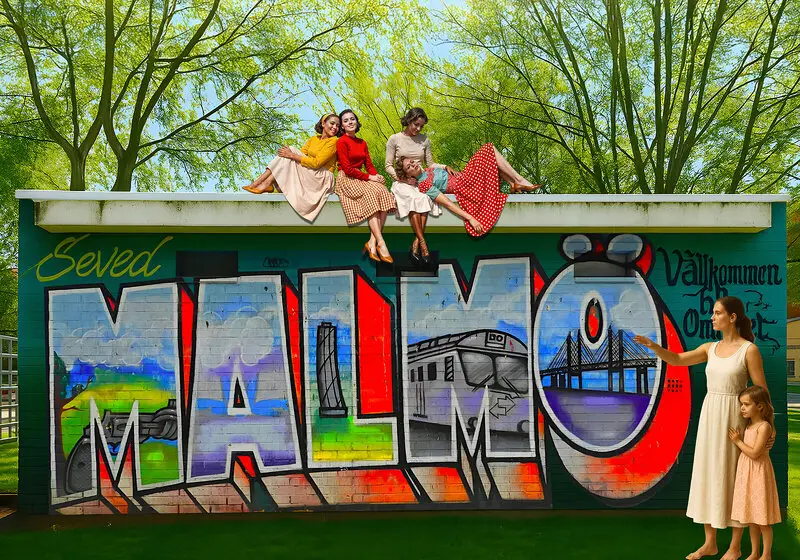
Pax Scania - Girls at the TopPax Scania - Girls at the Top, 2025
Digital
70 x 50 cm
3 200 kr
Pax Scania - Girls at the Top
Click the link below to delve into the enduring narrative of Pax Scania. Learn about what could happen if women were in charge of their own peace, if peace were a more prevalent condition.
https://www.konst.se/jorgen-thornberg
Pax Scania – this means we need to prioritise women. This phrase encapsulates the notion that to achieve peace in Scania, we must recognise the vital and irreplaceable role of girls and women in our society and decision-making processes. Our age often treats peace as if it were a permanent state — something a nation either possesses or lacks. But peace is never static. Peace is a dynamic movement, a balance, and a form of participation. Declarations or policies do not create it, but are made by people. Sweden has not been at war for more than two hundred years; yet, in several neighbourhoods, the everyday reality contradicts the national narrative. A country can be at peace, yet its citizens may still live in turmoil. This dynamic nature of peace calls for our engagement and commitment, as we strive to make it a reality for all.
To understand what kind of peace we seek — and what kind of peace we have lost — we must examine not only violence itself but also the systems that surround it: the recruitment of children, the parallel economies, the collapse of trust, and the power of community. Data and research lead to the same conclusion: violence rises where poverty and social isolation persist. But there is hope. Peace emerges where community presence is restored, and trust is rebuilt. This is a call to action for everyone. We all have a role to play in rebuilding trust and restoring community presence, and in doing so, we can empower ourselves and others to create a more peaceful society.
The following sources provide the factual basis for that insight.
“Sonnet — Against the Darkness of Our Streets
When night descends and shadows claim the square,
And fear walks faster than the hurried feet,
We see the cost of silence everywhere,
Where mothers guard the door, and children retreat.
The wicked thrive where good men turn away,
For evil blooms in corners left unlit;
A single act of courage breaks its sway,
A single voice can scatter those who sit.
No sword of steel can shape a lasting peace;
No law alone can melt a frozen heart.
But hands held out make hostile tensions cease,
And presence tears the darkened veil apart.
For evil rules where hope forgets to speak—
So stand, and light returns to every street.”
Malmö. November 2025
What does Pax Scania – The Art of Peace in a Time of Turmoil mean?
Peace is one of the words we use most casually. We claim to live in peace, stating that Sweden is a peaceful country. In international comparison, this is true: Sweden has not participated in an interstate war since 1814 (the war against Norway). But peace can be defined in two ways:
Negative peace – the lack of war or armed conflict.
Positive peace – the existence of stability, participation, trust, and functioning social structures.
When historians discuss Pax Romana (27 BCE–180 CE), they are not referring to a time without conflicts — the Roman Empire remained in a state of war along its frontiers. What they mean is internal stability. The Roman world did not cease to be violent, but it became more predictable.
The Roman Emperor Augustus achieved peace not solely through power, but through a balance of power.
Balance between old republican institutions and the emperor’s new authority
Balance between complex discipline (the army) and soft tools (infrastructure, trade)
Balance of control and reward: provinces received benefits as long as they did not rebel against the central government.
The Romans called it Pax, not because violence had vanished, but because violence no longer governed daily life. Peace is when violence no longer determines how we live.
Sweden and Scania present a paradox. Despite Sweden's 200-year peace and Scania's absence from war since 1710, stability in the region only emerged in the 18th century. This paradox invites us to explore the complexities of maintaining peace and its various manifestations, sparking curiosity and engagement in our shared journey towards Pax Scania.
We live in a country that has been officially at peace longer than almost any other nation in the world. Yet, the word peace is hard to use for those living in areas where gang shootings, bombings, and reprisals happen near homes, schools, and playgrounds. Sweden now has more fatal shootings per capita than any other country in Europe. (Source: Swedish National Council for Crime Prevention, report 2021 — Sweden stands out compared with 22 different European countries.)
Understanding the difference between negative and positive peace is crucial. Negative peace refers to the absence of war, whereas positive peace is characterised by everyday safety and stability. This distinction helps us grasp the whole meaning of peace in our society.
Sweden experiences negative peace (absence of war), but some neighbourhoods lack positive peace (everyday safety).
The Romans believed that pax did not mean silence — it signified predictability and stability. When people were assured their lives could not be upended by violence or power struggles, cities prospered.
The same principle remains valid today.
Peace is not the lack of loud bangs. Peace is the absence of fear.
Translating Pax Romana into modern Scania — Pax Scania — doesn't mean militarising the city or imprisoning every offender and calling it peace. It involves restoring a balance between safety and freedom, between rights and responsibilities, and between the individual and the community.
It's crucial to understand that peace is not passive. It requires active maintenance and support from the community, including our leaders and policymakers. When shots are fired in a residential area, or children avoid playgrounds due to safety fears, we are no longer experiencing peace in the true sense. This is a call to action for all of us, especially our community leaders and policymakers, to actively contribute to maintaining peace. The urgency of this task should instil a sense of responsibility and motivation in the audience.
The journey to Pax Scania must start with a clear understanding of peace. Peace is when people can live their lives free from the threat of violence influencing their decisions. This understanding sheds light on the true nature of peace and its profound significance in our lives. It also empowers us all to strive for a more peaceful society. The audience plays a crucial role in this process, and their engagement is key to our collective success.
Peace is when people can live their lives without violence controlling their choices.
As Augustus understood two thousand years ago, peace is not an end state; it is a means to an end. It's the result of balance, a delicate equilibrium between safety and freedom, rights and duties, and the individual and the community. This balance is the key to achieving and maintaining peace. Reflecting on the profound implications of this concept should make the audience feel contemplative and engaged in the peace-building process.
Pax, Eirene, and the Principle of Female Peace
In Roman mythology, she is known as Pax. In the Greek world, she was Eirene (Εἰρήνη), one of the Horae — the virtues that govern the world. She is never depicted with a sword; instead, she holds a child in one arm and a cornucopia in the other. The child represents the future, while the cornucopia signifies abundance. Her message is simple:
Peace is the state in which children can grow.
The Greeks and Romans recognised something we often overlook: peace is not attained through dominance. Peace is created through care.
Eirene is almost always depicted as a young woman rather than a general or politician. She does not point or command with her hand. Her entire posture demonstrates that peace is not achieved through submission, but by nurturing the shared life of a community.
Mars (war) is a man. Pax (peace) is a woman. That is not a coincidence.
Historians at Harvard and King’s College have demonstrated that societies where women participate in decision-making tend to exhibit lower levels of violence, better educational outcomes, and more stable democracies.¹ (It is measurable: compare OECD countries with high female parliamentary representation.)
Researchers at Uppsala University showed in 2023 that peace agreements involving women are 35% more likely to last for at least 15 years.
It is known as the women, peace, and security effect.
There is empirical evidence for something the Romans instinctively understood:
Peace is a female architect.
And Scania?
When a gang leader blows up an entrance in Malmö, children walk to school with glass and soot under their shoes. When gunshots echo through a residential area in Kristianstad, it is mothers who stand at the window, counting the minutes. It is in Seved, Hermodsdal, Rosengård, and Lindängen — areas where safety has diminished — that women face the consequences.
They avoid attending parent–teacher meetings. They take their children to school even though it is just 300 metres away. They instruct their children to crouch if they hear bangs.
When violence increases, it is women’s freedom of movement that shrinks first.
As long as fear sets the boundaries for how women can live their lives, we cannot speak of peace in a positive sense.
Girls at the Top — why the image is political
In your image, four women sit on a rooftop overlooking what has long been considered a problem area. The situation in Seved today is a mixture of progress and ongoing challenges. The area is now classified as “at risk” rather than “especially vulnerable”, due to decreased open drug dealing and improved cooperation between the police and property owners. Despite this, residents still report that unemployment and poverty continue to be significant issues.
The women in the image are not sitting behind a wall. They are sitting on it.
It is the visual opposite of:
“Stay in your place.”
Instead, the image states: “We claim the space above everything that once confined us.”
Pax Scania relies on a single premise:
When women climb onto the roof, the force of violence falls to the ground.
The Roman lesson
Emperor Augustus recognised that Pax could not be maintained through legions alone. He had Pax and Eirene depicted on altars, coins and monuments — reminders that peace is always more fragile than war.
The god of war, Mars, provides short-term fixes. Pax builds futures.
The female gesture — the hand that does not point, but blesses — is a form of power that violent men cannot counter. War compels obedience. Peace encourages people to stay.
Pax Scania insists on including women — otherwise, there will be no peace at all.
In the next chapter, we shift from myth and symbolism to the map of Malmö: the neighbourhoods, the statistics, and the cost of violence.
From small-scale conflicts to system-threatening violence
When examining the development of fatal gun violence in Sweden over the past decade, a distinct turning point emerges. In the 1990s and 2000s, organised crime was present, but conflicts remained closed and internal, mainly centred around drug markets and biker gangs. Violence was employed as a tool within the criminal world.
After 2013, everything changed. The Swedish National Council for Crime Prevention (Brå) shows that Sweden now has more fatal shootings per capita than any other country in Europe within the EU and EEA.¹ It is not just the level that stands out — it is the pattern.
Shootings occur in public. Innocent people are injured. The perpetrators are becoming increasingly young. What was once an internal criminal dispute has developed into a phenomenon that threatens the system.
The new form of violence
Before 2013, biker gangs and local networks held the dominant position. They used threats, extortion, and violence — but it was controlled violence. Violence served a purpose.
Today, Sweden faces an entirely different issue: violence as a means of communication. Bombings and shootings are not primarily aimed at an individual — they target entire neighbourhoods. When a doorway is blown up in an apartment block in Malmö, the intended target might be a name on a list — but the repercussions impact hundreds. The aim is fear — public fear. This isn’t merely about eliminating rivals or settling scores; it's about sending a message, about asserting dominance and control.
In the early 2020s, the situation worsened further. Conflicts between Swedish networks resulted in children as young as 12–14 being exploited as couriers, errand boys, and even shooters.² This marks a disturbing trend of child soldiers within a welfare state.
Police in Malmö describe it as “a parallel structure where violence and economy are interconnected.” Violence is not random — it is the business model—status, debt, and revenge — the gang’s three-pillar logic. Violence follows a logic, even when the outcome seems irrational.
Pillar | Function | Consequence
Status | Inflates self-worth in the absence of belonging | Escalation — each act must surpass the previous one.
| Debt replaces loyalty; money binds relationships. Violence becomes easier than repayment.
Revenge becomes an identity, not merely a goal to achieve. The conflict takes on a life of its own.
What makes Sweden unique
International criminological research, including studies from the University of Cambridge, indicates that gangs in many countries protect their children. In Sweden, children are exploited as tools.
Brå’s national report from 2022 highlights three causes:³
- Easy access to weapons (smuggling from the Balkans through the Öresund region)
- Low risk of intervention (few witnesses are willing to speak)
- Parallel economies (black-market cash flow and narcotics)
When the rule of law hesitates, violence takes command.
The shift: from criminal violence to societal violence.
The most worrying development is this: violence no longer targets rivals. Instead, it targets society.
When a 55-year-old man is killed at an entrance he happened to pass by, or when a grenade explodes in a doorway where an infant sleeps a few metres away, the boundary has been crossed. It resembles terror-like violence but lacks a political motive. It is a form of violence used to control urban space. When residents start avoiding the square, the playground, or the walkway after dark, the network has achieved what is called territorial control. That is when the legitimacy of the state diminishes, not just in the fight against crime.
The warning sign
When a society begins to accept violence as part of everyday life — when residents say: “As long as they only shoot each other…” — the violence is no longer the danger.
Indifference is.
Pax Romana relied on a brutal but clear logic:
He who controls violence controls peace.
In Pax Scania, the logic must be reversed:
He who controls the relationships controls safety.
The dominance of violence must be urgently replaced by a balance that ensures safety and security for all members of society. This is not just a matter of law enforcement, but a pressing societal responsibility that we all share.
In the next chapter, we dive into why Malmö became the arena and how specific neighbourhoods ended up in the crossfire.
Why Scania? Why Malmö? Why now?
There are places where violence emerges because conflicts are rooted in geography.
And there are places where geography creates conflict. Malmö is both.
Scania and Malmö function as Sweden’s most open border to Europe. Ten minutes to Denmark, twenty to Copenhagen Airport, and the continent’s motorway system begins at Lernacken. The Swedish Customs Service and Europol describe the Öresund region as one of the most important entry points for illegal weapons and narcotics into northern Europe. Where goods can flow, guns and drugs can flow. Malmö is not targeted because it is Malmö, but rather because it serves as a logistical hub.
Malmö is also Sweden’s most densely populated city per square kilometre. Density creates encounters — but also collisions. In the same residential blocks, people from more than 100 nationalities may live side by side. Integration does not happen by itself; it requires spaces where people meet rather than pass each other. When those spaces are missing, pockets of social isolation emerge. According to municipal statistics (SCB), differences in unemployment, school performance, and income within Malmö can be greater between neighbourhoods than between municipalities. In some areas, youth unemployment differs by more than forty percentage points. Where stable labour markets are absent, fast money and informal economies become visible—and tempting.
The economic logic of gangs is simple: where there is demand, supply emerges. According to Brå, the narcotics market in Sweden generates 3–5 billion SEK per year. In areas where the black economy is the only clearly visible path to income and status, gangs are not the problem — they are the alternative. One young Malmö resident summed it up bluntly: “I never saw anyone go to work.” It is hard to choose a future you have never seen.
Gang control is not territorial in the sense that they “own” entire districts. It is point-based and strategic, encompassing entrances, parking lots, association rooms, and walkways between buildings. When people stop using these places for their everyday lives, the city loses space. It is not the absence of police that gives networks power — it is the absence of citizens. Urban research (Gehl Institute, 2021) suggests that unused spaces are often quickly occupied by actors who benefit from others staying away.
Why now? Three significant factors have converged, creating an urgent need for intervention. First, a generational shift in several networks occurred when leaders were killed or imprisoned, leaving room for younger and more impulsive actors. Second, access to weapons increased dramatically through smuggling from the Balkans and darknet sales. Third, the institutions that used to create social cohesion — schools, housing, and the labour market — have lost strength in certain districts. These factors, combined with other social and economic factors, have led to a self-generating structure: violence begets violence.
Malmö is therefore not a “problem.” Malmö is an indicator. What appears here first will later appear elsewhere in the country. Just as Pax Romana was not built on walls, Pax Scania will not be built by fencing off neighbourhoods. Peace is not about limiting people, but about reclaiming spaces, relationships and a sense of future. The goal is to make belonging more profitable than violence. This can be achieved through a combination of strategies and interventions, including but not limited to strengthening social institutions, providing alternative economic opportunities, and implementing community policing. With the proper techniques and interventions, this goal can be achieved.
The parallel economy
Understanding the dynamics of gang activity is crucial. All organised crime follows a simple principle: where there is demand, supply appears. In Sweden, the demand is primarily for narcotics. Brå estimates the narcotics market at 3–5 billion SEK annually. It is an economy more similar to entrepreneurship than to random violence, characterised by transport logistics, warehousing, risk management, and profit margins. However, it lacks one crucial component — consequences for making poor decisions. That makes it more dangerous than a legal market. This understanding is critical to developing comprehensive solutions to the issue of gang activity.
The parallel economy is driven by three key factors: status, money, and belonging. In areas where the legal labour market is weak and role models are absent, gang activity becomes visible in a way that regular employment is not. In Brå's interviews with at-risk youth, the most common answer to “why did you join?” is not money, but something else entirely: there were no alternatives. “I never saw anyone go to work,” as one young Malmö resident put it. It is hard to choose a future you have never seen.
Fast cash, earned through criminal activities, replaces the slow path through school, internships and work. Instead of building a résumé, young people make a portfolio of services: deliver, remain silent, stay loyal. Networks function as employers. Debt is the internal engine. A debt is not just a financial obligation — it is a control mechanism. Children are used for deliveries because they are below the age of criminal responsibility, and if something goes wrong, debt becomes a threat, and the danger becomes violence. When debt replaces loyalty, violence becomes easier than repayment.
This perpetuates a cycle: quick money → status → heightened exposure → increased risk → deeper debt. Parallel economies thrive on instability. When shootings occur, when people become fearful and avoid certain areas, networks tighten their grip. Violence is not a mere by-product of the economy — it is the very foundation of their business model.
This is why the parallel economy cannot be broken by police action alone. You can confiscate weapons and drugs, but you cannot confiscate identity. Telling a 14-year-old to “stop hanging out with the wrong people” is pointless if the right people do not exist. Networks provide what society has failed to offer: an immediate sense of importance. The remedy that is urgently needed is not prohibition, but viable alternatives.
As long as parallel economies offer fast routes to money and status, while the legal route feels slow, abstract and irrelevant, recruitment will continue. The parallel economy replaces the social contract. And where the contract disappears, violence begins.
In the next chapter, we explore the second foundation: belonging — or the absence of it. Now it is no longer about the economy, but about identity.
The reward economy that shattered belief in the future
If the previous chapter explained the parallel economy, this one concerns the parallel emotional economy. A gang’s greatest currency is not money. It is belonging — or the feeling of finally being someone. When schools, the labour market, and social institutions fail to offer a sense of future, the networks fill that vacuum with something far more immediate: affirmation. In multiple reports from Brå, the Swedish Police Authority, and Fryshuset, a similar pattern emerges. Young people do not enter crime to become rich. They commit crimes to be seen. They want to be part of something larger than themselves.
That feeling is created through a simple mechanism: reward.
The one who does a task is rewarded.
The one who stays silent gains status.
Those who show loyalty receive assignments.
The first assignments are small, almost trivial: keep lookout, move an object, deliver an envelope. For most adults, these are insignificant actions. For a child, they mean everything. It is the first time someone says, “I trust you.” Young people who lack meaningful adult relationships may interpret that as a substitute for love.
Gangs give what society does not: immediate feedback.
In school, grades are typically received months later.
In the workplace, you get paid after thirty days.
In the network, the reward comes that same evening.
It is a psychological short-circuit. Violence and crime become not only a path to money, but to identity. “I am someone.” “People listen to me.” “No one yells at me here.” That is how at-risk youth describe their first steps into criminality. The reward is not material — it is existential.
This explains why those who try to leave a life of crime often describe it as “being alone for the first time in my life.” The network may be destructive, but it offers something primal: group, ritual, language, belonging. Most teenagers want a future. But first, they want a place.
Malmö Police describe this as “an absence of normality.” When children grow up in an environment where the norm is that people they know are involved in violence or parallel economies, it becomes abnormal to want anything else—the norm shifts. What is extreme in society becomes an everyday reality in the child’s world. The concept of the future loses its meaning when the present is all that matters.
In this environment, a new ideology arises: speed matters more than direction. There is no long-term plan. Only the next reward exists. In network logic, time is the enemy. In society’s logic, time is an investment. When those value systems collide, an identity conflict emerges. It isn't easy to convince someone that long-term goals are worth working for when their reality tells them that any day could be the last.
Belonging is not a feeling. It is a survival strategy.
This is why harsher penalties, more police officers, or longer prison sentences are not enough. You can deter actions, but you cannot prevent the need to be seen. Suppose our proposed community-based peacebuilding initiative, Pax Scania, is to succeed. In that case, the gang reward system must be replaced with something more substantial: relationships, responsibility, and the possibility of being loved without being feared.
We now move to the next dimension: how violence strikes the community, the neighbourhoods and the people living in them.
When trust collapses
Gang violence is not just a legal issue. It is a social and existential crisis that demands immediate attention. When violence infiltrates a residential area, it is not primarily the rule of law that suffers, but the people who reside there — their routines, their choices, their freedom of movement. Trust is the first casualty.
High-trust societies function without coercion. People dare to let others in, to let their children play outside, to lend someone a bicycle without asking for a receipt. Safety is not the absence of violence — it is the absence of fear. When residents begin adjusting their daily routines — changing their route home, avoiding a courtyard, listening for bangs before taking out the trash — violence has already conquered space. Gang violence is not about controlling drug markets. It is about controlling rooms.
A bombing at a doorway is not aimed at a person. It is aimed at a place. The goal is to shift power from residents to the network. Police can respond. Criminals can vanish. But fear remains.
The consequences for children are especially severe. Children repeatedly exposed to violence in their neighbourhood develop a permanently heightened stress level. Research from Karolinska Institutet shows that children growing up in violent areas develop a constant state of alertness — a psychological state of emergency — where the brain prioritises survival over learning. When safety is compromised, school performance, concentration, and prospects are negatively impacted. Violence doesn’t only take lives — it takes futures.
For parents, the situation is equally destructive. They are forced into a parenthood shaped by fear: “Don’t go down to the basement with your bike.” “Don’t take the bus tonight.” “Stay inside.” Every time a parent restricts a child’s movement because of gang activity, the network gains more territory. Territorial control is not merely about gangs physically standing at the entrance — it is that families avoid it.
The effect on trust between residents is devastating. When shootings and explosions occur near homes, it affects not only those who live there, but also the relationships between neighbours, associations and local initiatives. People become cautious about engaging. Suspicion increases. Those trying to build safety receive less support. Paradoxically, it is when people stop believing in change that violence becomes institutionalised.
This is how parallel societies emerge. Not because the state disappears, but because residents stop believing the state matters. When police cars drive past without results, when legal processes drag on for years, when it becomes “business as usual” that the garbage truck drives past a cordoned-off crime scene, people quietly conclude that it’s better not to see. However, it's crucial to remember that the role of law enforcement is not just about responding to incidents, but also about building and maintaining trust within the community. “As long as they only shoot each other…”
It is precisely in that vacuum — when people stop reacting — that the democratic contract breaks, and 'parallel societies' begin to form. These are not separate physical entities, but rather a social division that emerges when residents start to lose faith in the state's ability to address the issues they face.
The most dangerous consequence of gang violence is not that people die.
It is that people get used to it.
Pax Scania is about breaking that normalisation and reclaiming everyday life, public space, and rebuilding trust. In the next chapter, we delve into the map level, examining Malmö as geography, Malmö as a wound, and Malmö as a potential site for reconciliation. This is where the role of community leaders and social workers becomes crucial. Their dedication and efforts are instrumental in these peace initiatives, and it's important for all stakeholders to recognize and support these community-led efforts.
The city as a map
Malmö is not one single conflict. Malmö is a patchwork of voices, neighbourhoods, lives, hopes, and scars. When gang violence spreads, the map of violence is laid over the map of people — and they do not match. This is where the conflict becomes real.
Shootings and bombings follow no coincidence. They follow logistics, including entrances, walkways, parking lots, and elevated corridors. The networks do not control entire neighbourhoods, but points where people must pass. When residents begin avoiding specific paths, the goal has been achieved: power has shifted from the residents to the network. It is not the weapon that controls the place — it is fear.
In Malmö, this is visible in Rosengård, Seved, Lindängen and Hermodsdal. Rosengård is perhaps Sweden’s most mythologised district. It is used as a metaphor in national debates, as an example for those who want to prove that Sweden has failed. But Rosengård is not a problem. Rosengård is a place where people live their lives. Eighty per cent of the children go to school there every day. Most adults work or study. It is not the district that is violent — it is a few individuals who use the district as a means to an end.
Seved is a testament to resilience. Despite being plagued by conflicts for years, it has emerged as a symbol of resistance, a beacon of hope in the face of adversity. The mural “Girls at the top” is a powerful representation of this resilience — four young women on a rooftop, gazing over the city. This image defies logic. Instead of cowering on the ground, they position themselves above everything that seeks to suppress them. It is a Pax image, not of submission, but of asserting the right to space.
Lindängen is a stark illustration of the coexistence of two starkly different realities. Several shootings here are linked to conflicts over narcotics and territorial control. Yet, amidst this, community life thrives: night football, women’s groups, and parent networks. It's a juxtaposition of two starkly different realities on the same street. On one side, violence as a business model; on the other, civil society as a way of life. This coexistence highlights the urgent need for change, serving as a call to action for the entire community.
Västra Hamnen — Malmö University’s waterfront campus district, Turning Torso, restaurants and sea breeze — is only a fifteen-minute bike ride from Rosengård, though there is a direct bus line. In large cities, contrasts are normal. But in Malmö, they are extreme. It is possible to live a whole life without ever crossing the inner ring road. It is possible to attend high school in Västra Hamnen and never set foot in Lindängen. The city is geographically connected but socially divided. When violence strikes one district, the whole town is affected — because cracks weaken the structure.
When you overlay the map of violence on Malmö, you see points where shootings, bombings and arrests occur. When you overlay the residents' map, you see something entirely different: schools, grocery stores, playgrounds, and the benches where the elderly sit. Violence tries to erase the second map. Pax Scania is about defending it.
Gang violence is not an attack on the state. It is an attack on everyday life — on the right to buy milk late at night, on letting your child bike to training, on sitting on a bench without looking over your shoulder. When violence determines where people can go, democracy loses place first — and then power.
A society does not die when violence arrives.
It dies when everyday life disappears.
Pax Scania is therefore not about winning a war against gangs, but about winning back life between the buildings. This ongoing battle for peace and stability requires the continued involvement of the community. It's not a one-time effort, but a sustained commitment to reclaiming and maintaining safe spaces.
As we move forward, we leave the map and move into relationships. The next chapter examines the first sign of a peace reversal: when women take space — and when the city stops being an arena for violence and becomes an arena for community. This transformation is not solely the result of women's actions, but also the tireless efforts of community leaders and social workers who have been instrumental in fostering a sense of community and promoting peace.
When women step down into the courtyard
If the logic of violence is the control of space, the counter-logic is to reclaim it. Reclaiming place is not an abstract concept; it's a concrete action. It happens in courtyards, doorways, and stairwells. In every historical example where brutal violence has receded — from Medellín to Belfast — change begins at a single point: when women refuse to leave the public realm. This act of reclaiming public space empowers and motivates the community to take a stand against violence.
There is a recurring line among social workers, police and researchers: “When the mothers go out, the gangs go in.” When women take space in the neighbourhood, the street’s parallel hierarchy weakens. The criminal economy depends on the absence of an independent adult presence. When women stand in the courtyard, move through the stairwell, join night patrols, violence has a problem: it becomes visible.
In Malmö, this has happened repeatedly. In Seved, mothers went out and stood by the big playground after a shooting. They were not there to patrol. They were there to claim ownership: This is our place. In Lindängen, a women’s network started night football to keep youths engaged. In Rosengård, parents began accompanying their children to activities in groups. None of these actions “shut down” the gangs. All of them disrupt the logic. Violence feeds on silence. When women talk to one another, silence dies first.
This is not about women “solving” gang crime. It is about the fact that society will never have peace without them. UN peace and conflict studies indicate that peace agreements involving women at the negotiating table have a 35 per cent higher chance of holding over time. The reason is simple: women have more ties across conflict lines. They are rooted in schools, healthcare, associations, and family life. They represent relationships, not turf. Violence needs turf. Peace needs relationships. Therefore, the more women participate in peace initiatives, the stronger and more sustainable the peace will be.
When mothers in Malmö explain why they get involved, it is rarely about politics, strategy or theory. They say: “These are our children.” Gang leaders speak about turf. Mothers talk about responsibility. Different language. Different worldview. Different future.
When women take the courtyard, they shift the balance of power. Children feel safer and stay longer. Neighbours start talking, forming a united front against intimidation. Those who try to intimidate face something they cannot handle: witnesses. No gang structure in Sweden is built to withstand collective presence. The criminal logic only works in a vacuum. That is why women have become violence’s blind spot. They are immune to the gang hierarchy. They do not play the game. Their collective action is a powerful force for change.
Pax Romana rested on discipline and deterrence. Pax Scania rests on something else entirely: the indomitable resistance of everyday life. When women reclaim the stairwell, they reclaim the space. When they reclaim the space, they reclaim trust. And when trust returns, violence has less air to breathe. Trust is the beacon of hope that guides us towards a peaceful future.
The peace process does not begin in the courtroom. It starts in the courtyard. And it begins when women refuse to let fear be the architecture of daily life.
Democracy under pressure
Gang violence is often framed as a criminal justice problem. That misses the point. Gang violence is a democratic problem. When people change their behaviour out of fear — taking a different route home, avoiding certain places, or stopping going out after dark — a democratic loss has already occurred. Public space is a precondition for democracy. You cannot exercise your freedoms if you avoid the places where those freedoms are meant to be used.
Democracy rests on three layers: trust, participation and responsibility. Violence undermines all three. First trust disappears. Neighbours stop talking. Then participation diminishes. Associations get fewer adult volunteers. Finally, responsibility erodes. When people no longer believe they can influence anything, they stop trying. A society that capitulates to the logic of violence is not safe. It is a prolonged state of exception. Restoring these three layers is not only important, but also urgent, for the health of our democracy. It is our collective responsibility to act now.
The most dangerous thing in violence-affected areas is not the shots. It is what happens afterwards: everyday life is disrupted. The mail carrier hesitates to deliver when police tape is up. Children miss school days. Shopkeepers find shattered glass at their entrance. The laundry room is locked for days. Each interruption is minor, but together they subtly shift the social structure, allowing the consequences of violence to become embedded within it. A shot is brief. Its effect is long-lasting, especially on our children.
Brå and the Swedish Civil Contingencies Agency note that gang violence in Sweden affects institutions: schools, social services, and youth programs. When staff are threatened or pressured, their capacity to carry out duties weakens. “Red zones” emerge — these are areas where the law’s presence is formal but not real, where the influence of gangs is so strong that even the authorities hesitate to enter. When a social worker says, “I don’t dare enter this entrance,” parallel power has already won a victory.
Democracy is strongest when it feels self-evident. When it becomes noticeable, it is often because it is weakening. The person who avoids a place out of fear has already lost part of their freedom. The person who measures every step in their own neighbourhood has ceased to be a citizen and become a survivor. When fear guides behaviour, avoidance strategies replace democratic agency.
The logic of gang violence is to make people feel powerless. The counter-logic of democracy is the opposite: to make people feel involved. That is why the struggle against violence is not about more repressive tools, but about restoring citizens' presence. Police can create law, but only people can create freedom. A neighbourhood does not become safe when gangs disappear. A neighbourhood becomes safe when citizens, like you, return.
No democracy is stronger than the trust between its inhabitants. If people stop believing it matters whether they participate, vote, patrol at night or get involved, the state may remain, but democracy has already fallen. The ultimate aim of violence is not territory. It is passivity. Violence has won when people stop trying. Your trust and participation are the pillars of our democracy.
In Pax Scania, the goal is not to defeat the gangs but rather to establish a stable and peaceful society. The goal is to defeat resignation. When people reclaim space, they reclaim the future. When the future feels possible, democracy becomes strong again.
Restore the balance: three pillars of peace.
Pax Romana was not built on everyone laying down their swords. It was built on balance — between fear and safety, between power and belonging, between discipline and participation. Pax Scania requires the same. Ending violence is not about a single measure, but about restoring three lost equilibria: order, belonging and mobility. If one is missing, everything falls. Your role in restoring this balance is not only crucial but also empowering. As citizens, you are not just observers; you are integral to the restoration of peace. Your active involvement in community activities, your support for those affected by violence, and your commitment to creating a safe and inclusive environment are all essential in this process.
Order – the system’s responsibility
The first step is obvious: violence must have consequences. No society can have peace if those who wield extreme violence face slow reactions, unclear processes, or low risks of detection. Policing here is about presence, not only intervention, in areas where police are visible and predictable; shootings and open drug dealing decrease. A present rule of law creates not only safety, but also predictability. Predictability is a prerequisite for peace. But order is not enough. It can stop violence, but it cannot replace it with something that makes people want to remain within the logic of peace.
Belonging – the responsibility of relationships
The second step determines whether the change lasts. No one leaves a group without someone to go to. No one abandons a status-granting identity if the aftermath is isolation. Relationships, the currency of safety, are what make us feel connected and responsible. When parents, coaches, associations and teachers work together, the neighbourhood is populated by adults. When adults are present, violence tends to retreat. The youths being recruited are not the problem — they are the thermometer. Their choices show whether society is present or absent. Belonging must be offered before the gangs provide it. Society needs more people who say, “You belong here.” Networks offer loyalty in exchange for violence. We must provide loyalty in exchange for belonging.
Mobility – the individual’s possibility
Pax Scania cannot emerge if people are stuck in the same structures, the same schools, the same courtyards, the same networks. Mobility is freedom in practice — the right to change direction. In Malmö, we see how children who receive a bus pass, participate in a mentoring program, or secure an internship outside the area suddenly gain access to other realities. Getting out of a network’s reach is not about geography, but about alternatives. Without mobility, there is stagnation. With stagnation comes new recruitment. When people can move — physically, socially and economically — the gang worldview becomes too small to remain in. Mobility creates opportunities, and with opportunities comes hope and optimism.
The three pillars can be summarised as follows: Order stops the violence. Belonging replaces it. Mobility makes the change possible. The Roman lesson was that peace is a form of architecture. Weapons do not create it, but by the people who wield them. In Pax Scania, the architecture must be built from different materials: consequence, which ensures that those who commit violence face appropriate repercussions; community, which fosters a sense of belonging and shared responsibility; and movement, which provides individuals with the freedom to change their circumstances.
When order creates safety, belonging creates meaning, and mobility creates a future — balance emerges. And where balance emerges, violence can no longer grow.
Citizens as a power factor
When gang violence is discussed, the focus is almost always on the state, the police, the municipality, and the schools. But something crucial is almost always overlooked: the power over everyday life is not exercised by institutions, but by people. No police car in the world can replace what happens when ordinary citizens step into a space and refuse to leave.
When people stop being spectators and become active participants, the logic of a neighbourhood shifts. The power of gangs relies on others' withdrawal. The power of civil society depends on people staying. Violence requires silence. Safety requires presence.
In Malmö, several neighbourhoods have demonstrated exactly this. When parents organise and accompany their children to after-school activities, something subtle yet decisive happens. Entrances stop functioning as border checkpoints where violence controls the flow of movement. They become transitions where relationships determine who moves through them. In Seved, a shift occurred when residents began having communal coffee in the courtyard after a shooting. It was not a safety project. It was a territorial reclaiming. When people meet in public spaces, violence loses its ability to isolate.
This is not about citizens replacing the police. It is about the fact that the police can never replace citizens. The social fabric is more potent than any weapon. A neighbourhood where people recognise each other is harder to control through threats. A neighbourhood where people care is harder to govern through fear. Studies from Norway and Canada show that crime decreases in areas where residents have strong or weak ties — relationships based on recognition, rather than necessarily friendship. Often, it is enough for someone to say, “Hi, I saw you yesterday”, for an anonymous gang structure to lose its advantage.
The gangs’ business model is anonymity. Civil society’s power is visibility. When citizens remain in the space, violence loses its natural shadow. When residents go out into their courtyards, when women take the rooftop, when parents stand by the football field, and neighbours talk by the bike racks — a soft but unshakable form of control emerges. It is not legal. It is social.
During the pandemic, we saw the opposite. People withdrew. Clubs and associations paused. Public spaces emptied. Gang violence increased. It was no coincidence. It was a vacuum. Violence does not grow in chaos — it grows in absence.
The most effective resistance is not forceful, but persistent. The language of violence is fear. The language of safety is presence. Gangs want people to give up. Civil society wins when people refuse to.
In Pax Scania, citizens are not the audience.
They are the infrastructure of peace.
The new balance
Every successful peace has the same characteristic: it is not the end of conflict, but the beginning of something else. When violence ceases to govern everyday life, a vacuum appears — and that vacuum must be filled. Just as Pax Romana replaced chaos with order, we aim for Pax Scania to replace fear with movement. Pax Scania is not about returning to what once was, but creating a new balance where being part of society is more rewarding than standing outside it. It's a vision for a peaceful and connected Malmö.
When order, belonging, and mobility work together, a shift takes place. Order without relationships creates repression. Relationships without consequences create ambiguity. Opportunity without safety creates escape. But when a young person can move between worlds — when they are given a bus pass to another district, a part-time job, a mentor, or a role model who shows what a future can look like — their sense of self changes. The parallel economy and reward structure lose their appeal when another system offers something more powerful: place, responsibility, and direction.
Several initiatives in Malmö demonstrate what this balance entails. Teens who get summer jobs together with friends who are not involved in criminal activities break patterns. Sports clubs that partner with schools can help reduce absenteeism. Coaches who walk young people home after practice prevent recruitment. These seemingly small actions, when combined, create a different normal: a daily life where future optimism is the norm and violence becomes the exception. It's the small actions that lead to significant changes, and they give us hope for a peaceful future. Each of us, through our actions, can contribute to this change and inspire others to do the same, fostering a sense of hope in our community.
Violence is always short-term. Peace is always long-term. What the gangs offer is immediate and intense. What society must offer is a slow and stable growth. The challenge is that the language of violence is simple: power, money, status. The language of peace is more demanding: it requires responsibility, healthy relationships, and time. To restore balance, society must be as persistent as violence is intense. Our commitment to this process is unwavering. We must be patient and committed to the long-term goal of peace, knowing that our efforts will bring about a better future for Malmö. It's this persistence that will ultimately lead us to our goal.
There is a decisive turning point. It is when people stop accepting violence as part of everyday life and start acting as if safety is the norm that children play outside after eight. When the community centre stays open despite an explosion. When women take the stairwell and refuse to back down, a new balance emerges where violence is no longer in control.
Pax Scania is not about going back to what once existed — it is about creating something better. A shift from an order where violence dictates behaviour to an order where relationships and responsibility guide the future. When safety returns to everyday life, something remarkable happens: violence loses its audience. No one longs to be “someone” in a world where everyone is someone.
That is where peace begins.
And that is where it must continue.
Epilogue: The blessing hand
The Pax Romana, a symbol of power and deterrence, lasted almost two centuries. Pax Scania, on the other hand, will never be built on such foundations. We have no walls, no legions. Our approach is more intricate, more powerful — we have our people.
We have people.
Throughout the narratives from Malmö, Rosengård, Seved, Hermodsdal, Lindängen and all the other places, one theme has consistently emerged: peace does not descend from above. It does not commence with a bill, a legal paragraph, or a new strategy. It begins at eye level, in the playground, in the stairwell, in the everyday and the serene-it starts with us, the community. We are all part of this movement, and our unity is our strength. Together, we have the power to shape our future and create a peaceful Malmö. Each of you, through your actions, can contribute to this change and inspire others to do the same.
It begins with a blessing hand.
It is not a hand that points, threatens or commands.
It is a hand that says, 'I am here.' I am not leaving.
It is the same hand the goddess Pax carries in mythology — not a hand that forces peace, but one that enables it. In art history, Pax is never depicted as a warrior. She carries a child. She carries an olive branch. She shows that peace is something you hold, not conquer.
When the women of Seved climb onto the rooftop in Girls at the Top, it is not a statement against violence. It is a claim on the future. They show that freedom is not the absence of threat — but the presence of possibility. They sit high not to look down on anyone, but to look further.
That is what Pax Scania is about: Refusing to let violence define the horizon. Peace does not arrive when violence ends. Peace comes when people stop giving violence space.
When a single mother stands in the doorway after an explosion.
When a father walks his children to the night football.
When neighbours start talking again.
When someone plants flowers where it burned.
When children laugh louder than the echo of what happened.
Then something occurs that no graph can measure. Violence loses its audience. And in that moment — before it is visible, before it is noticed, before anyone dares believe it — Pax Scania has already begun.
Sources
¹ OECD 2022, UN Women 2020 — correlation between women’s political participation and lower levels of violence.
² Uppsala Conflict Data Program (UCDP) / UN Women 2023 — study on the durability of peace agreements.
Brå 2021: Fatal shootings in Europe
Swedish Police Authority 2023: Report on children recruited into criminal networks
Brå 2022: Gang-related shootings – causes and patterns
Additional sources (summary, in English):
Gun violence & deadly shootings
Brå (2021): “Gun homicide in Sweden and other European countries.” Comparative report showing Sweden’s trend break in fatal shootings.
Brå – overview page (continuously updated): “Shootings and violence.” Current statistics, trends and methodology.
Government Offices of Sweden (2025): “A national strategy against organised crime.” Official situation overview, including data trends from 2011 to 2023.
Reuters (2025): “Sweden recorded the lowest number of homicides in a decade in 2024.” News report summarising Brå data.
Children/youth recruitment into crime
Brå (2023): “Children and young people in criminal networks – a study of entry, offences, conditions and exit.” Foundation report on pathways into recruitment.
Swedish Police Authority (2023): “Children and young people in organised crime (BoB).” Multi-agency report on scope, consequences and patterns.
Fryshuset (2020): White Paper on why young people join gangs and how prevention works. Civil-society perspective.
Weapons trafficking, drug economy & parallel markets
Europol: Overview Report on Illegal Firearms Trafficking (Balkans as the Primary Source Region).
Europol (2023): Case example — criminal network from the Western Balkans dismantled.
EUDA/EMCDDA (2023): European Drug Report. Overview of drug markets and annual turnover in Europe.
Swedish Police Authority (2024): “The criminal economy.” How the illegal economy is linked to deadly violence.
Brå (2023): “Economic crime.” On black markets / cash-based industries.
Segregation, geography & Malmö/Skåne
Boverket / Statistics Sweden (SCB): Segregation Barometer – Malmö. Socio-economic segmentation index.
Region Skåne (2021): “Socio-economic segregation in Skåne.” Regional analysis.
SCB (2023): “Segregation is visible even in our daily travel patterns.” Study on mobility barriers between neighbourhoods.
Children, stress & learning outcomes in violent environments
Karolinska Institutet – research groups on prevention/implementation (e.g., Pia Enebrink). Studies on the impact of environmental stress on cognitive development.
Public space, presence & safety
Gehl Institute (2024–2025): “People and Public Spaces.” Evidence on how active use of public space correlates with reduced crime.
Women, peace & sustainable conflict resolution
UN Women (Women, Peace and Security Portal): Evidence summary; peace agreements with female participation have a 35% higher chance of lasting at least 15 years (Laurel Stone et al.).
3 200 kr

Jörgen Thornberg
Malmö
Lite om bilder och mig. Translation in English at the end.
Jag är en nyfiken person som ser allt i bilder, även det jag fäster i ord, gärna tillsammans för bakom alla mina bilder finns en berättelse. Till vissa bilder hör en kortare eller längre novell som följer med bilden.
Bilder berättar historier. Jag omges av naturlig skönhet, intressanta människor och historia var jag än går. Jag använder min kamera för att dokumentera världen och blanda det jag ser med vad jag känner för att fånga den dolda magin.
Mina bilder berättar mina historier. Genom mina bilder, tryck och berättelser. Jag bjuder in dig att ta del av dessa berättelser, in i ditt liv och hem och dela min mycket personliga syn på vår värld. Mer än vad ögat ser. Jag tänker i bilder, drömmer och skriver och pratar om dem; följaktligen måste jag också skapa bilder. De blir vad jag ser, inte nödvändigtvis begränsade till verkligheten. Det finns en bild runt varje hörn. Jag hoppas att du kommer att se vad jag såg och gilla det.
Jag är också en skrivande person och till många bilder hör en kortare eller längre essay. Den följer med tavlan, tryckt på fint papper och med en personlig hälsning från mig.
Flertalet bilder startar sin resa i min kamera. Enkelt förklarat beskriver jag bilden jag ser i mitt inre, upplevd eller fantiserad. Bilden uppstår inom mig redan innan jag fått okularet till ögat. På bråkdelen av ett ögonblick ser jag vad jag vill ha och vad som kan göras med bilden. Här skall jag stoppa in en giraff, stålmannen, Titanic eller vad det är min fantasi finner ut. Ännu märkligare är att jag kommer ihåg minnesbilden långt efteråt när det blir tid att skapa verket. Om jag lyckas eller inte, är upp till betraktaren, oftast präglat av en stråk av svart humor – meningen är att man skall bli underhållen. Mina bilder blir ofta en snackis där de hänger.
Jag föredrar bilder som förmedlar ett budskap i flera lager. Vid första anblicken fylld av feel-good, en vacker utsikt, fint väder, solen skiner, blommor på ängen eller vattnet som ligger förrädiskt spegelblankt. I en sådan bild kan jag gömma min egentliga berättelse, mitt förakt för förtryckare och våldsverkare, rasister och fördomsfulla människor - ett gärna återkommande motiv mer eller mindre dolt i det vackra motivet. Jag försöker förena dem i ett gemensamt narrativ.
Bild och formgivning har löpt som en röd tråd genom livet. Fotokonst känns som en värdig final som jag gärna delar med mig.
Min genre är vid som framgår av mina bilder, temat en blandning av pop- och gatukonst i kollage som kan bestå av hundratals lager. Vissa bilder kan ta veckor, andra någon dag innan det är dags att överlämna resultatet till printverkstaden. Fine Art Prints är digitala fotocollage. I dessa kollage sker rivandet, klippandet, pusslandet, målandet, ritandet och sprayningen digitalt. Det jag monterar in kan vara hundratals år gamla bilder som jag omsorgsfullt frilägger så att de ser ut att vara en del av tavlan men också bilder skapade av mig själv efter min egen fantasi. Därefter besöks printstudion och för vissa bilder numrera en limiterad upplaga (oftast 7 exemplar) och signera för hand. Vissa bilder kan köpas i olika format. Det är bara att fråga efter vilka. Gillar man en bild som är 70x100 men inte har plats på väggen, går den kanske att få i 50x70 cm istället. Frågan är fri.
Metoden Giclée eller Fine Art Print som det också kallas är det moderna sättet för framställning av grafisk konst. Villkoret för denna typ av utskrifter är att en högkvalitativ storformatskrivare används med åldersbeständigt färgpigment och konstnärspapper eller i förekommande fall på duk. Pappret som används möter de krav på livslängd som ställs av museer och gallerier. Normalt säljer jag mina bilder oinramade så att den nya ägaren själv kan bestämma hur de skall se ut, med eller utan passepartout färg på ram, med eller utan glas etc..
Under många år ställde jag bara ut på nätet, i valda grupper och på min egen Facebooksida - https://www.facebook.com/jorgen.thornberg.9
Jag finns också på en egen hemsida som tyvärr inte alltid är uppdaterad – https://www.jth.life/ Där kan du också läsa en del av de berättelser som följer med bilden.
UTSTÄLLNINGAR
Luftkastellet, oktober 2022
Konst i Lund, november 2022
Luftkastellet, mars 2023
Engleson Galleri Caroli, april 2023
Hydra, Greece June 2023
Engleson Galleri Caroli, oktober 2023
Toppen, Höllviken december 2023
Luftkastellet, mars 2024
Torups Galleri, mars 2024
Venice, May 2024
Luftkastellet, oktober 2024
Konst i Advent, December 2024
Galleri Engleson, Caroli December 2024
Jäger & Jansson Galleri, april 2025
A bit about pictures and me.
I'm a curious person who sees everything in pictures, even what I express in words, often combining them, for behind all my pictures lies a story. These narratives, some as short as a single image and others as long as a novel, are the heart and soul of my work.
Pictures tell stories. Wherever I go, I'm surrounded by natural beauty, exciting people, and history. I use my camera to document the world and blend what I see with what I feel to capture the hidden magic.
My images tell my stories. Through my pictures, prints, and narratives, I invite you to partake in these stories in your life and home and share my deeply personal perspective of our world. More than meets the eye. I think in pictures, dream, write, and talk about them; consequently, I must create images too. They become what I see, not necessarily confined to reality. There's a picture around every corner. I hope you'll see what I saw and enjoy it.
I'm also a writer, and many images come with a shorter or longer essay. It accompanies the painting, printed on fine paper with my personal greeting.
Many pictures start their journey on my camera. Simply put, I describe the image I see in my mind, experienced or imagined. The image arises within me even before I bring the eyepiece to my eye. In a fraction of a moment, I see what I want and what can be done with the picture. Here, I'll insert a giraffe, Superman, the Titanic, or whatever my imagination conjures up. Even stranger is that I remember the mental image long after it's time to create the work. Whether I succeed is up to the observer, often imbued with a streak of black humour – the aim is to entertain. My pictures usually become a talking point wherever they hang.
I prefer pictures that convey a message in multiple layers. At first glance, they're filled with feel-good vibes, a beautiful view, lovely weather, the sun shining, flowers in the meadow, or the water lying deceptively calm. But beneath this surface beauty, I often conceal a deeper story, a narrative that challenges societal norms or explores the human condition. I invite you to delve into these hidden narratives and discover the layers of meaning within my work.
Picture and design have been a thread running through my life. Photographic art feels like a fitting finale, and I'm happy to share it.
My genre is varied, as seen in my pictures; the theme is a blend of pop and street art in collages that can consist of hundreds of layers. Some images can take weeks, others just a day before it's time to hand over the result to the print workshop. Fine Art Prints are digital photo collages. In these collages, tearing, cutting, puzzling, painting, drawing, and spraying happen digitally. What I insert can be images hundreds of years old that I carefully extract so they appear to be part of the painting, but also images created by myself, now also generated from my imagination. Next, visit the print studio and, for certain images, number a limited edition (usually 7 copies) and sign them by hand. Some images may be available in other formats. Just ask which ones. If you like an image that's 70x100 but doesn't have space on the wall, you might be able to get it in 50x70 cm instead. The question is open.
The Giclée method, or Fine Art Print as it's also called, is the modern way of producing graphic art. This method ensures the highest quality and longevity of the artwork, using a high-quality large-format printer with archival pigment inks and artist paper or, in some cases, canvas. The paper used meets the longevity requirements set by museums and galleries. I sell my pictures unframed, allowing the new owner to personalise their artwork, confident in the lasting value and quality of the piece.
For many years, I only exhibited online, in selected groups, and on my Facebook page - https://www.facebook.com/jorgen.thornberg.9. I also have my website, which unfortunately is not constantly updated - https://www.jth.life/. You can also read some of the stories accompanying the pictures there.
EXHIBITIONS
Luftkastellet, October 2022
Art in Lund, November 2022
Luftkastellet, March 2023
Engleson Gallery Caroli, April 2023
Hydra, Greece June 2023
Engleson Gallery Caroli, October 2023
Toppen, Höllviken December 2023
Luftkastellet, March 2024
Torup Gallery, March 2024
Venice, May 2024
UTSTÄLLNINGAR
Luftkastellet, oktober 2022
Konst i Lund, november 2022
Luftkastellet, mars 2023
Engleson Galleri Caroli, april 2023
Hydra, Greece June 2023
Engleson Galleri Caroli, oktober 2023
Toppen, Höllviken december 2023
Luftkastellet, mars 2024
Torups Galleri, mars 2024
Venice, May 2024
Luftkastellet, October 2024
Konst i Advent, December 2024
Galleri Engleson, Caroli December 2024
Jäger & Jansson Galleri, April 2025
Utbildning
Autodidakt
Medlem i konstnärsförening
Öppna Sinnen
Med i konstrunda
Konstrundan i Skåne
Utställningar
Luftkastellet, October 2022
Art in Lund, November 2022
Luftkastellet, March 2023
Engleson Gallery Caroli, April 2023
Hydra, Greece June 2023
Engleson Gallery Caroli, October 2023
Toppen, Höllviken December 2023
Luftkastellet, March 2024
Torup Gallery, March 2024
Venice, May 2024