Vi använder cookies för att ge dig bästa möjliga upplevelse. Välj vilka cookies du tillåter.
Läs mer i vår integritetspolicy
Jörgen Thornberg
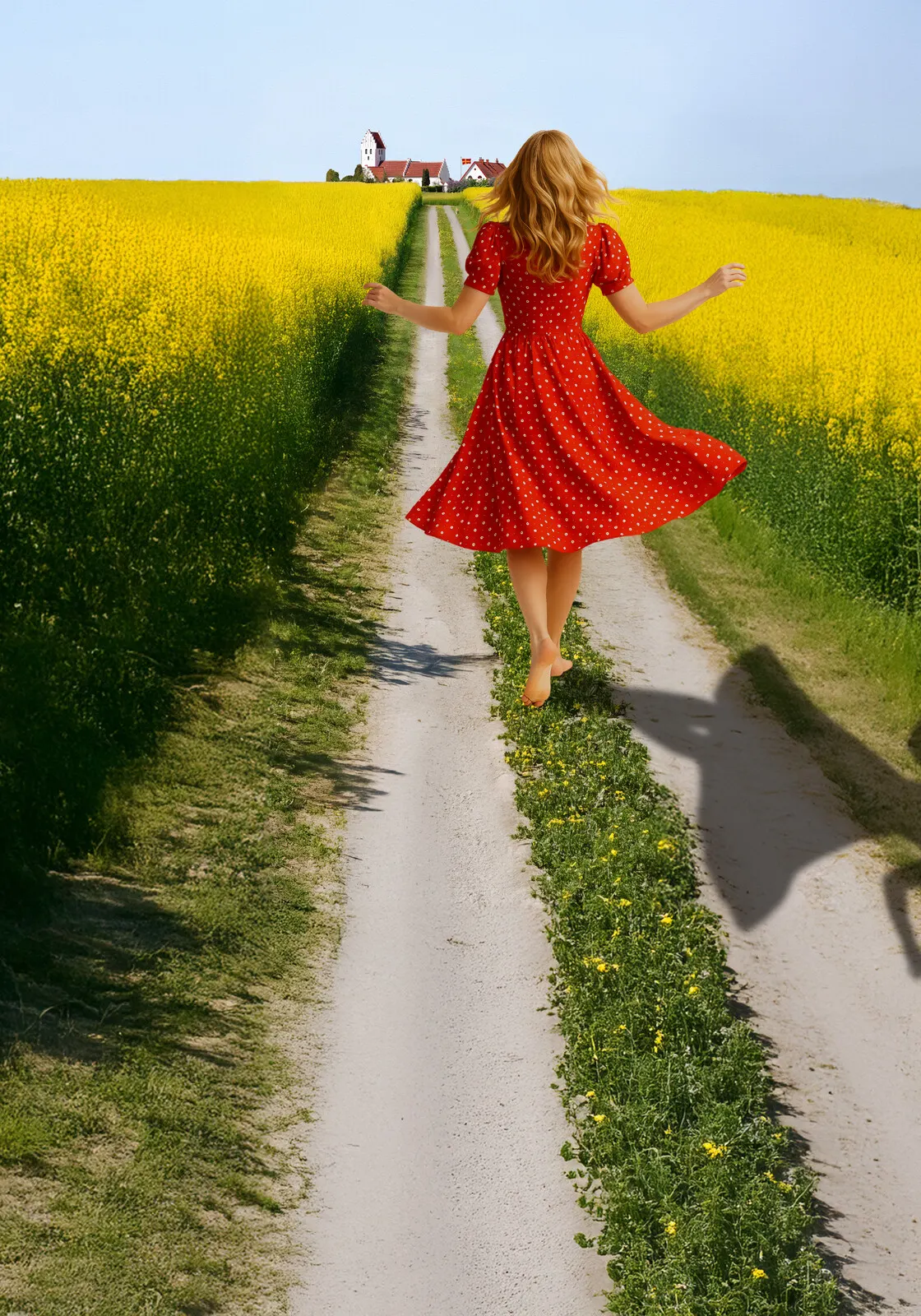
She Walked the Line, 2025
Digital
50 x 70 cm
3 200 kr
She Walked the Line
Before anyone catches a glimpse of her, before the fields burst into a vibrant display and before the cat claims her as its own, Betty does something that most only dream of: she boldly steps off the map. Not because she is lost, but because she refuses to be confined by the paths drawn by others. Where most would hesitate at the edge of certainty, she leans into the unknown with the liberating independence of someone who has finally stopped seeking approval. Her freedom is palpable, a reminder that we all have the power to break free from the constraints of societal expectations.
In a world that demands women to remain balanced, composed, efficient, and small, Betty does the most audacious thing imaginable — she expands. She claims space. She strides the green line between two seas of yellow, not to conform, nor to impress, but to declare her presence. With each step, she reaffirms a simple, daring truth: some lines are not meant to be followed. They are meant to be crossed, empowering all who dare to defy. Betty's stride is a powerful symbol of her defiance of societal expectations, a testament to her empowerment and personal growth. Her defiance is a call to rebellion, inspiring us all to challenge the status quo.
Now, it is just Betty and the red cat walking together. There is no map to guide them, nor anyone's permission to ask. Only the endless yellow line extends into eternity — the line every woman is taught to balance on throughout her life. Yet, Betty's journey with the red cat is not just a walk; it's a powerful symbol of her independence and freedom, a testament to her refusal to be confined by societal norms.
“Between Yellow and Green
(a poem for Betty)
She steps where roads grow narrow,
where certainty thins into breath,
where the world demands caution
but the wind insists on courage.
Yellow whispers:
Stay in line.
Green murmurs:
Choose your way.
Her bare feet land on the strip between them—
a spine of the Earth
thin as expectation,
strong as refusal.
Every flower is an audience,
every gust a witness.
Yellow flares like a warning,
but she turns it into fuel.
Green offers direction,
but she turns it into destiny.
She does not walk—
she claims.
She does not follow—
she begins.
Far ahead,
where horizon becomes faith,
a place waits that men forgot to guard—
an altar not of obedience
but of origin.
Not marble.
Not gold.
But carved by centuries of women
whose names survived only in the grain of the wood
they held up with their shoulders.
She walks for them.
And the balance others call impossible
is simply motion to her—
one foot in the hue of boundaries,
one foot in the hue of becoming,
eyes fixed on the place
where yellow turns into light
and green turns into choice.
If she trembles,
the fields don’t notice.
If she doubts,
the cat moves forward anyway.
For somewhere ahead lies the altar—
not to God,
but to women who walked the line before her,
who carried worlds on their heads
and never asked permission.
And step by step,
Betty learns the oldest truth:
You don’t reach freedom.
You walk into it.”
Malmö. October 2025
She Walked the Line
Betty doesn’t just walk the line—she owns it. She stands barefoot on the narrow green strip, a tightrope between two roaring seas of yellow rapeseed. Her red polka-dot dress flares around her like a banner of defiance. It's spring in Burlöv; the lilacs along the village edge have burst into purple bloom, their heavy scent creating a gentle border between the old houses and the open fields. The 12th-century church rises just beyond the lilac hedge, whitewashed and square, its tower watching her like an old witness.
Betty sings loudly—Dolly Parton’s cover of Johnny Cash’s “I Walk the Line.” Cash wrote it as a promise of fidelity to his wife, a declaration that temptation followed him on tour and that he would behave, would walk the line to stay loyal. But when Dolly sings it, and when Betty claims it, the meaning shifts. It ceases to be a man’s promise to obey and becomes a woman’s declaration of sovereignty.
She doesn’t walk the line because the world demands discipline; she walks it because she has chosen this precise, impossible line—her line. She does not belong to anyone, and therefore she owes no promises. Fidelity means nothing when loyalty is only to herself. A red farm cat bursts from the rapeseed, tail high like a banner of agreement, and races towards her as if cheering her on, zigzagging through the yellow in joyful disobedience.
The world around her is gold and violent in its radiance; yellow has always been a colour of warning, boundaries, and being told to stay in place. Here, the yellow is not a fence. It is a witness. She sees the rapeseed fields for what they are: a symbol of the balancing act the world expects from women, the narrow margin they are granted to move, decide, and exist. Men are given motorways; women are given tightropes and told not to fall. Yet she refuses to tremble. She sings the lyric that once promised loyalty to someone else—“Because you’re mine, I walk the line”—but the pronoun has shifted; there is no “you.” She walks the line because she owns the road, the choice, the future.
Her friend—the church’s female priest—is waiting for her at Burlöv Old Church, the Romanesque building whose 1598 altarpiece has always inspired Betty. For once, a male Renaissance artist had carved what feminists instinctively recognised: Beneath the altar stand five sculpted women representing the virtues—Love, Faith, Hope, Temperance, Justice—and between the upper tiers rise carved caryatids, women with crossed arms supporting the weight of the upper structure. Women literally bearing the world on their heads.
Betty laughs to herself as she walks; naturally, women have always held up the church. Long before Betty arrived here, American suffragists marched under the colour gold—yellow ribbons, yellow banners, yellow roses—because yellow symbolised courage, amplification, female resolve. Yellow was the colour of women’s suffrage — the colour of self-determination and the right to claim space. When Betty places her feet on the narrow green line between two seas of yellow, it is not a balancing act. It is an inheritance. She sings, she dances, she walks. And every step proclaims: the line is hers.
Yellow Through History
Betty does not spend much time contemplating existential questions; she is too busy living. Yet as she walks, she glances out over the vast yellow bloom surrounding her, a sea of light so intense that even God, if He exists, would have to be here. Nothing could be more breathtaking than this blaze of yellow stretching towards the horizon — divine not as a metaphor, but as a fact. The hue matters to her. Yellow is not just a colour; it is a feminist thread woven through history, a golden line carved through centuries of silence and restraint. It is the colour women marched under, the hue that refused to apologise for being seen. To Betty, the fields are not merely in bloom — they are bearing witness.
In the ancient world, yellow was divine. The Egyptians wrapped their gods in gold because gold never decays; it was the hue of immortality. In temples dedicated to Demeter and Apollo, fields like these were not just crops but offerings, symbols of the sun and the harvest, of creation and continuation—yellow represented life. Yet history twists everything, especially what glows. During the Middle Ages, the same shade was reinterpreted as suspicion.
With the advent of modernity, a period marked by profound social and cultural changes, the symbolism of yellow underwent another shift. In the church murals across Europe, Judas was often depicted in yellow, a symbol of his betrayal. Similarly, prostitutes and outsiders were mandated to wear yellow in certain cities, making their difference visible. The divine hue had become an accusation. However, in London at the end of the 19th century, yellow was reclaimed. Feminists and avant-garde writers cherished The Yellow Book, a provocative literary magazine that irritated critics by featuring women writers, not muses, simply by including them.
Yellow, once a symbol of shame, has undergone a remarkable transformation into a symbol of exposure, audacity, and a refusal to disappear. In the United Kingdom, suffragists proudly marched in a golden hue, adorned with yellow roses and ribbons. Yellow, now symbolising bravery and the right to occupy space, became the colour of women claiming public ground, the shade of a voice becoming visible. This is a powerful testament to the resilience and strength of those who refused to be defined by the past. Today, Betty walks through the same hue — not as a devotee, not as a warning, but as proof. Yellow has belonged to gods, traitors, and outcasts. Today, it belongs to her.
By the time modern artists arrived, yellow was no longer a symbol — it was a sensation. The Impressionists didn’t just paint light; they captured the feeling of being struck by it. Monet let yellow spill across haystacks and fog, as if morning itself had just been invented. Renoir warmed his skin with it. Turner dissolved entire storms in golden haze. But no one wielded yellow the way van Gogh did. He didn’t use it to depict the world — he used it to endure it. His yellows blazed, vibrating between ecstasy and collapse, the hue of a soul that refused to fade. In his letters, he wrote that yellow was sunlight, hope, “a light that cannot be extinguished.” He painted fields like the one Betty walks through, not as landscapes but as states of mind. That was van Gogh’s secret: yellow wasn’t just a field. Yellow was a pulse. And in this moment, Betty feels the same pulse beneath her feet — not in paint, but in life itself. The light doesn’t fall on her. It rises to meet her. Art, with its transformative power, has played a significant role in changing perceptions of yellow, illuminating its potential.
In the modern world, yellow has become a symbol of caution. Painted on asphalt, printed on warning tape and traffic signs, glowing from control dashboards, it tells us where not to stand, where not to cross, where not to go. Yellow is the colour of hesitation, of restriction, of rules designed to keep bodies in line. On roads, the yellow line means: stay in your lane. In classrooms, caution signs mean "think twice." In society, women learn early where the safe zones end. Yellow has become the colour of margins — of boundaries disguised as protection. Men move freely across space; women are conditioned to assess the risk of every step. Betty understands this instinctively. The world has outlined yellow lines around her since childhood: smile but don’t invite, be seen but not loud, walk but don’t take up space. Yet out here, with bare feet and wind-tangled hair, she refuses to see yellow as a warning. The colour that once constrained women — in corridors, in churches, in law — now unveils itself to her as a symbol of possibility.
She walks the green line not because she must stay balanced but because she chooses the space in between. Yellow urges caution. She uses it as a runway. In her body, yellow has ceased to be a boundary. It has become a direction. Here, on this road between two seas of light, Betty does the forbidden: she uses a hue that has always signalled limitation to claim space. Yellow no longer commands her to stay between the lines. She dances on them. The 'green line' symbolises freedom and choice, while the 'yellow line' represents caution and restriction. Betty's decision to walk the green line, despite the yellow line's caution, is a powerful statement of her personal journey to claim her own space.
The Women Who Hold Up the World
Betty pushes open the heavy church door without knocking—the scent of lilac from outside mingles with the calm, chalky stillness of the stone interior. Sunlight slips through the narrow Romanesque windows, casting long yellow stripes on the ancient floor, as if the outside fields have entered with her. Her priest friend is already waiting, perhaps leaning casually against the baptismal font, her clerical collar as natural on her as a scarf. They greet each other silently. Some friendships begin with words; theirs began with recognition. The priest once joked that Betty doesn’t need saving, only space. Betty replied that most women need both. They still laugh about it.
Betty moves closer to the altarpiece — the reason she adores this church more than any gallery in Copenhagen. Carved in 1598, it rises in three tiers of Renaissance grandeur. Between the upper panels stand caryatids: women with straight backs and crossed arms, supporting the upper structure on their heads. Their faces show no suffering, no collapse — only stillness, composure, and dignified endurance. Beneath the altar are five more women, representing the virtues: Love, Faith, Hope, Temperance, and Justice. Twelve women in total, holding up the entire theological architecture. No saints. No disciples. Only women.
Betty once asked the priest how on earth this had slipped past the patriarchy. The priest smiled and said, “Sometimes men don’t notice the foundations they stand on.” Betty runs her hand along the wooden carving, feeling the grooves of a chisel that shaped these women four centuries ago. The caryatids carry the weight quietly — just like her mother did, and her grandmother before her. Women have always held up the world. Men have just given speeches about it.
The priest steps closer, lowering her voice. “You know what I see in them?” she says. “Not obedience. Architecture.” Betty nods. She understands. Outside, yellow told her to stay within the margins. Inside, women hold the structure that others claim to lead. Yellow was once betrayal, then warning, then suffrage; here, in the carved grain of the altar, yellow becomes lineage. A thread. A foundation. Betty doesn’t pray. She stands in silence, feet firmly on the stone floor, and feels something more solid than faith — ownership.
This is Betty’s geography: a green line through yellow, a doorway into history, a place where women carry the building on their heads and no one calls it extraordinary. She doesn’t need forgiveness. She doesn’t need permission. She only needs space to move. Out on the road, she walked the line. Here, in the church, she understands what supports it. The line was never the miracle. She was.
Betty pushes open the heavy church door without knocking—the scent of lilac from outside mingles with the calm, chalky stillness of the stone interior. Sunlight slips through the narrow Romanesque windows, casting long yellow stripes on the ancient floor, as if the outside fields have entered with her. Her priest friend is already waiting, perhaps leaning casually against the baptismal font, her clerical collar as natural on her as a scarf. They greet each other silently. Some friendships begin with words; theirs began with recognition. The priest once joked that Betty doesn’t need saving, only space. Betty replied that most women need both. They still laugh about it.
Betty moves closer to the altarpiece — the reason she adores this church more than any gallery in Copenhagen. Carved in 1598, it rises in three tiers of Renaissance grandeur. Between the upper panels stand caryatids: women with straight backs and crossed arms, supporting the upper structure on their heads. Their faces show no suffering, no collapse — only stillness, composure, and dignified endurance. These women, these caryatids, are not just supporting the structure; they are embodying resilience in its purest form. Beneath the altar are five more women, representing the virtues: Love, Faith, Hope, Temperance, and Justice. Twelve women in total, holding up the entire theological architecture. No saints. No disciples. Only women.
Betty once asked the priest how on earth this had slipped past the patriarchy. The priest smiled and said, “Sometimes men don’t notice the foundations they stand on.” Betty runs her hand along the wooden carving, feeling the grooves of a chisel that shaped these women four centuries ago. The caryatids carry the weight quietly — just like her mother did, and her grandmother before her. Women have always held up the world. Men have just given speeches about it. The priest's words about the unnoticed strength of women resonate with Betty, enlightening her.
The priest steps closer, lowering her voice. “You know what I see in them?” she says. “Not obedience. Architecture.” Betty nods. She understands. The priest's perspective on the altarpiece is enlightening. Outside, yellow told her to stay within the margins. Inside, women hold the structure that others claim to lead. Yellow was once betrayal, then warning, then suffrage; here, in the carved grain of the altar, yellow becomes lineage. A thread. A foundation. Betty doesn’t pray. She stands in silence, feet firmly on the stone floor, and feels something more solid than faith — ownership.
This is Betty’s geography: a green line through yellow, a doorway into history, a place where women carry the building on their heads and no one calls it extraordinary. The church is not just a place of worship for Betty; it is a sanctuary that embodies her beliefs and values. She doesn’t need forgiveness. She doesn’t need permission. She only needs space to move. Out on the road, she walked the line. Here, in the church, she understands what supports it. The line was never the miracle. She was.
The Yellow Book
As Betty leaves the church, a surge of empowerment fills her. She no longer walks; she strides. The rapeseed fields ripple like applause on both sides of the road, and the wind slips into her hair as if it wants to join her steps. The yellow no longer feels like a warning. It feels like an audience that finally understands her. She considers the altarpiece — twelve women quietly carrying the world — and how their strength was carved into wood four centuries ago, long before anyone dared call it feminism. The church, a symbol of patriarchal power, now stands behind her, its influence waning as she steps into her own. The weight of the church's patriarchal power, a symbol of the societal norms that have confined women for centuries, is palpable as Betty steps away from it, into a future of her own making.
Betty has always been drawn to books, especially those that challenge without raising their voices. The Yellow Book was one such book — not a manifesto, but a gateway, a resolute magazine. Published in London in the 1890s, bound in striking yellow, it depicted women on the printed page not as muses with lowered eyes, but as writers, not as decoration, but as a declaration. The colour yellow, often associated with caution or warning, was transformed into a symbol of visibility and empowerment. It didn’t claim to be feminist; it simply allowed women to exist in public without apology. That was enough to enrage critics and inspire suffragists. Yellow was no longer a symbol of shame or betrayal; it became visible. The cover alone was provocative — a slab of yellow on a gentleman’s table was like a flare announcing: someone in this house reads without permission. The Yellow Book, with its bold yellow cover, was a beacon of hope, showing that change was possible and that women could exist in public without fear or shame.
To Betty, that is the feminist revolution in its purest form — not shouting, not fighting, but existing where one was not expected. Every era has its yellow lines. These 'yellow lines' are the societal norms and expectations that confine women to specific roles and spaces. Some are painted on roads, some on book covers, some in the architecture of cathedrals. They all say the same thing: stay in your place. The Yellow Book once refused but widened the margins and invited women to write beyond them. Betty feels that lineage in her body as she walks. She isn’t trying to take anyone’s space. She is simply using the space that should have been hers all along.
A gust lifts the hem of her red dress. The yellow fields blaze around her, not as caution but as confidence. The Yellow Book gave women a place on the page. The suffrage movement granted women a place in the law. Betty gives herself a place on the road. She walks, she writes her own outline against the landscape, and she knows this: taking space is not defiance. It is an inheritance, a right that she and all women are entitled to. It is a reclaiming of the space historically denied to women, a manifestation of the feminist revolution in action. Betty's actions are not just a reclaiming of space, but a bold and courageous assertion of her rights and her place in the world, inspiring others to do the same.
The line was never the boundary.
It was the entry point, the starting line of a journey towards empowerment and self-realisation.
The Direction of Freedom
The road leaves the fields and gently ascends toward the village. Gravel gives way to asphalt; the green strip narrows, then disappears. Yet Betty continues walking as if the line still exists beneath her feet. She no longer needs it to be visible. Freedom, once realised, does not vanish just because the road changes texture. She passes the lilac hedge again — the air is rich with fragrance, a sweet rebellion of its own. Bees swarm lazily among the blossoms, intoxicated by pollen, indifferent to traffic rules and property boundaries. Betty envies them, but only for a moment. Then she realises: she is doing exactly what they are doing, moving through the world without permission.
She hears the church door creak open. The priest, a figure of guidance and understanding, appears on the steps, her robe gently stirred by the wind, holding two mugs of coffee as if serving caffeine directly onto a medieval threshold were the most natural thing in the world. “You found your way without getting lost,” the priest calls. Betty laughs. “I didn’t find the way. I chose it.” The priest, a beacon of understanding, raises her cup in a salute. “Same thing.” They sit together on the low stone wall where the lilac hedge thins out. The fields around them ripple like a yellow sea. From here, the road Betty walked along looks absurdly narrow — a thread between two oceans.
“Do you know what the hardest thing is?” the priest asks, her voice carrying a weight of understanding. “Not walking the line. Leaving it.” Betty understands what she means. Some women are taught to stay within the margins until they feel safe there. Some confuse balance with obedience. Betty watches the road stretch back towards the horizon. She could go home. Back to what is expected. Back to what fits. But the thought holds no sway. She feels no nostalgia for smallness. She reflects on the caryatids inside the church — women bearing the weight of the world without recognition. She considers suffragists marching beneath yellow banners. She thinks about the women who wrote in The Yellow Book simply because no one could stop them. The priest, her understanding a balm for Betty's soul, nudges her. “So, where are you going?” Betty stands.
The red cat from the field leaps onto the wall and rubs against her leg, as if volunteering to accompany her. She scratches its head. “Forward,” she says. No hesitation. No metaphor. Just forward. The priest smiles, her eyes filled with encouragement. “Then go.” Betty steps down from the wall onto the road again. The line has gone, but her stride remains. She walks past the hedges, the houses, and the last mailbox marking the edge of the village. She doesn’t check her phone or look at a map. For centuries, the world has told women how to move — carefully, quietly, gratefully. Betty stomps, wholly and freely. The line is no longer beneath her feet; it is within her. And the world — yellow, vast, waiting — finally opens up, a stark contrast to the narrow road she once walked: her courage, a beacon for all who dare to step off the line.
The Road That Wasn’t on the Map
The road narrows again after the last house, as if uncertain whether it still qualifies as a road at all. The asphalt fades back into gravel, then into packed earth. Grass invades the centre like a gentle rebellion. Most would turn back here. When paths lose definition, certainty vanishes with them. But Betty feels the opposite; each step makes things clearer. She is no longer walking away from something — she is walking towards something, empowered by the uncertainty.
The priest and the village have disappeared behind her, swallowed by distance and lilac scent. Ahead of her, the horizon refuses to explain itself. It simply waits. She hears the rustling before she sees it: the red cat has followed her. Silent. Determined. Like a witness assigned to record her freedom, the cat's presence adds a layer of mystery to Betty's journey. Betty laughs softly. “All right,” she says. “But I’m not responsible for your choices.”
The cat looks up as if to say: That’s precisely why I follow you. A gust of wind blows through the rapeseed, making the flowers ripple like a breath. The fields are no longer just a backdrop — they move with her. With every step, the landscape shifts from mere geography to agency. Betty thinks about how roads are supposed to work. Someone decides where they start and finish, how wide they are, and who can use them. A road is control disguised as help. But this path — this uncertain strip of earth — doesn’t instruct her. It responds to her. Every step she takes seems to carve the ground rather than follow it.
For the first time in her life, she doesn’t feel grateful for the space she is permitted to occupy. She feels entitled to it. She remembers something the priest once said while refilling a communion cup: “Faith is not certainty. It is movement.” Back then, Betty had rolled her eyes. Now the words fall into place like stones beneath her feet, transforming her understanding of faith. Faith is not knowing. Faith is stepping. The wind grows stronger, almost playful, pushing at her back. She realises, with sudden clarity, that this road isn’t leading her anywhere she has been told exists.
And that is the point. Roads on maps lead you to destinations chosen by others. Roads that aren’t on maps lead you to yourself. She reaches a fork — not dramatic, not monumental, just two paths gently parting among birch trees. Neither is marked. The red cat trots ahead and chooses the left path without hesitation. Betty laughs. “You’re bold,” she says. The cat flicks its tail, and so do you. She follows, not because the cat chooses, but because she does. The path curves, and the fields fall away, revealing an open sky—endless, unfathomable. In that moment, Betty understands something deeper than freedom. Freedom is not the absence of obstacles; it is the absence of permission. She has stopped asking and has begun becoming. If someone were watching from above—be it a drone, heaven, or the indifferent eye of history—they would see a woman on a road that shouldn’t exist, walking as if she owns direction itself—without a line beneath her feet. The line now resides within her. And the world—whatever it becomes—will have to adapt.
Arrival Without Destination
The birch path suddenly opens into a clearing, not into another field, where the world feels wide enough for a breath. The grass here is shorter, pressed down as if others have stood in this very spot, contemplating the same unthinkable thought: I don’t have to go back. The thought, like a seed planted in her mind, had grown into a daring possibility, a whisper of freedom. A wooden gate stands crooked at the far end of the clearing. It isn’t locked; it isn’t even closed. It leans against its hinges like someone who has never learned to refuse entry.
On the other side lies a meadow that isn't included in any Burlöv brochure, mentioned in any hiking app, or marked by a dot on any tourist map—a place without instructions. The red cat slips through first, tail high, setting the example. Betty rests her hand on the gate, but doesn't push it open yet. She listens. The wind has changed direction; it’s now coming toward her, not past her, as if the world has paused for a breath. The thought arrives uninvited, unfiltered, utterly accurate: What if this is what freedom feels like — silence that doesn’t ask anything of you? She has spent most of her adult life walking towards expectations. Towards roles. Towards promises. Today, she walked towards herself. She looks back once, not with regret but with acknowledgement. The meadow, with its untamed beauty, beckons her to step into the unknown, inviting the audience to feel the allure of the unfamiliar, the untamed beauty that calls to the soul.
The church tower remains visible, a white square in the distance, and she imagines the priest inside, placing cups back on their shelf—a woman who also carries the world, albeit in a different building. Betty smiles. The world behind her stays intact. That is not why she leaves it. She departs because nothing within her remains intact if she stays. She turns back to the meadow. She pushes open the gate. The wood sighs. The hinges do not protest. The meadow welcomes her without ceremony. There is no triumph here, no orchestral swell, no applause—only space. A space that needs no justification. The cat trots ahead and drops to the ground, rolling ecstatically in the grass, as if to show how one should step into a future. In this departure, Betty finds a palpable sense of liberation, inviting the audience to feel the same. Her courage, a beacon of inspiration, shines through her every step.
Betty steps forward, and the ground shifts slightly beneath her feet, soft and warm. No line. No road. No audience. Only direction. She exhales so profoundly that it feels as if her ribs rearrange themselves. Standing there, at the threshold of a life she has not yet imagined, she suddenly understands: Freedom is not a place. Freedom is not movement. Freedom is choosing the unknown over the familiar. She feels no need to record this moment, no urge to turn it into a metaphor. The world has enough metaphors for women who leave. But this departure is hers alone, a personal journey into the unknown. Her journey, a proof of the uniqueness of each individual's path, invites the audience to embrace their own, however different it may be.
She departs. Betty doesn’t know where the meadow leads. She only knows that she isn’t lost. For the first time, uncertainty doesn’t frighten her. It yields to her. She takes one more step, then another, and the horizon widens in response. The red cat follows, not as a guide but as a witness, its presence underscoring the significance of Betty's journey —a silent testament to her courage. Together they fade into the meadow, two figures moving freely. And the world — yellow, vast, amazed — allows them to pass.
Jörgen Thornberg
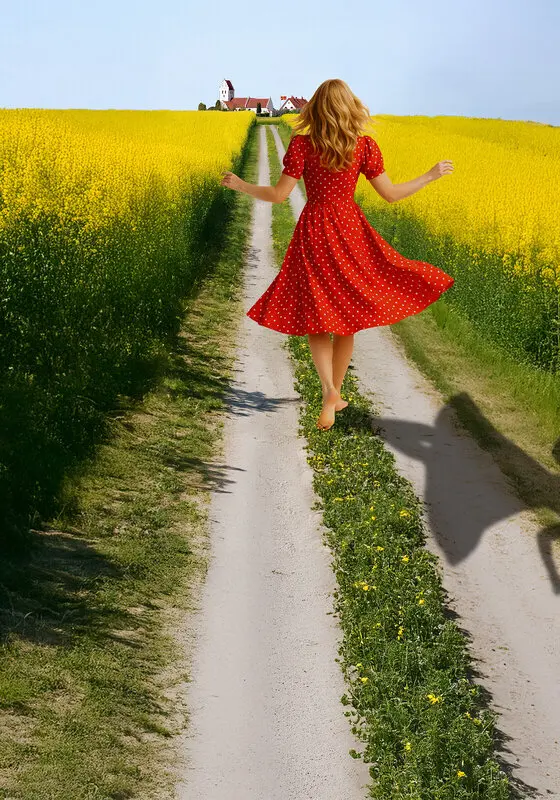
She Walked the Line, 2025
Digital
50 x 70 cm
3 200 kr
She Walked the Line
Before anyone catches a glimpse of her, before the fields burst into a vibrant display and before the cat claims her as its own, Betty does something that most only dream of: she boldly steps off the map. Not because she is lost, but because she refuses to be confined by the paths drawn by others. Where most would hesitate at the edge of certainty, she leans into the unknown with the liberating independence of someone who has finally stopped seeking approval. Her freedom is palpable, a reminder that we all have the power to break free from the constraints of societal expectations.
In a world that demands women to remain balanced, composed, efficient, and small, Betty does the most audacious thing imaginable — she expands. She claims space. She strides the green line between two seas of yellow, not to conform, nor to impress, but to declare her presence. With each step, she reaffirms a simple, daring truth: some lines are not meant to be followed. They are meant to be crossed, empowering all who dare to defy. Betty's stride is a powerful symbol of her defiance of societal expectations, a testament to her empowerment and personal growth. Her defiance is a call to rebellion, inspiring us all to challenge the status quo.
Now, it is just Betty and the red cat walking together. There is no map to guide them, nor anyone's permission to ask. Only the endless yellow line extends into eternity — the line every woman is taught to balance on throughout her life. Yet, Betty's journey with the red cat is not just a walk; it's a powerful symbol of her independence and freedom, a testament to her refusal to be confined by societal norms.
“Between Yellow and Green
(a poem for Betty)
She steps where roads grow narrow,
where certainty thins into breath,
where the world demands caution
but the wind insists on courage.
Yellow whispers:
Stay in line.
Green murmurs:
Choose your way.
Her bare feet land on the strip between them—
a spine of the Earth
thin as expectation,
strong as refusal.
Every flower is an audience,
every gust a witness.
Yellow flares like a warning,
but she turns it into fuel.
Green offers direction,
but she turns it into destiny.
She does not walk—
she claims.
She does not follow—
she begins.
Far ahead,
where horizon becomes faith,
a place waits that men forgot to guard—
an altar not of obedience
but of origin.
Not marble.
Not gold.
But carved by centuries of women
whose names survived only in the grain of the wood
they held up with their shoulders.
She walks for them.
And the balance others call impossible
is simply motion to her—
one foot in the hue of boundaries,
one foot in the hue of becoming,
eyes fixed on the place
where yellow turns into light
and green turns into choice.
If she trembles,
the fields don’t notice.
If she doubts,
the cat moves forward anyway.
For somewhere ahead lies the altar—
not to God,
but to women who walked the line before her,
who carried worlds on their heads
and never asked permission.
And step by step,
Betty learns the oldest truth:
You don’t reach freedom.
You walk into it.”
Malmö. October 2025
She Walked the Line
Betty doesn’t just walk the line—she owns it. She stands barefoot on the narrow green strip, a tightrope between two roaring seas of yellow rapeseed. Her red polka-dot dress flares around her like a banner of defiance. It's spring in Burlöv; the lilacs along the village edge have burst into purple bloom, their heavy scent creating a gentle border between the old houses and the open fields. The 12th-century church rises just beyond the lilac hedge, whitewashed and square, its tower watching her like an old witness.
Betty sings loudly—Dolly Parton’s cover of Johnny Cash’s “I Walk the Line.” Cash wrote it as a promise of fidelity to his wife, a declaration that temptation followed him on tour and that he would behave, would walk the line to stay loyal. But when Dolly sings it, and when Betty claims it, the meaning shifts. It ceases to be a man’s promise to obey and becomes a woman’s declaration of sovereignty.
She doesn’t walk the line because the world demands discipline; she walks it because she has chosen this precise, impossible line—her line. She does not belong to anyone, and therefore she owes no promises. Fidelity means nothing when loyalty is only to herself. A red farm cat bursts from the rapeseed, tail high like a banner of agreement, and races towards her as if cheering her on, zigzagging through the yellow in joyful disobedience.
The world around her is gold and violent in its radiance; yellow has always been a colour of warning, boundaries, and being told to stay in place. Here, the yellow is not a fence. It is a witness. She sees the rapeseed fields for what they are: a symbol of the balancing act the world expects from women, the narrow margin they are granted to move, decide, and exist. Men are given motorways; women are given tightropes and told not to fall. Yet she refuses to tremble. She sings the lyric that once promised loyalty to someone else—“Because you’re mine, I walk the line”—but the pronoun has shifted; there is no “you.” She walks the line because she owns the road, the choice, the future.
Her friend—the church’s female priest—is waiting for her at Burlöv Old Church, the Romanesque building whose 1598 altarpiece has always inspired Betty. For once, a male Renaissance artist had carved what feminists instinctively recognised: Beneath the altar stand five sculpted women representing the virtues—Love, Faith, Hope, Temperance, Justice—and between the upper tiers rise carved caryatids, women with crossed arms supporting the weight of the upper structure. Women literally bearing the world on their heads.
Betty laughs to herself as she walks; naturally, women have always held up the church. Long before Betty arrived here, American suffragists marched under the colour gold—yellow ribbons, yellow banners, yellow roses—because yellow symbolised courage, amplification, female resolve. Yellow was the colour of women’s suffrage — the colour of self-determination and the right to claim space. When Betty places her feet on the narrow green line between two seas of yellow, it is not a balancing act. It is an inheritance. She sings, she dances, she walks. And every step proclaims: the line is hers.
Yellow Through History
Betty does not spend much time contemplating existential questions; she is too busy living. Yet as she walks, she glances out over the vast yellow bloom surrounding her, a sea of light so intense that even God, if He exists, would have to be here. Nothing could be more breathtaking than this blaze of yellow stretching towards the horizon — divine not as a metaphor, but as a fact. The hue matters to her. Yellow is not just a colour; it is a feminist thread woven through history, a golden line carved through centuries of silence and restraint. It is the colour women marched under, the hue that refused to apologise for being seen. To Betty, the fields are not merely in bloom — they are bearing witness.
In the ancient world, yellow was divine. The Egyptians wrapped their gods in gold because gold never decays; it was the hue of immortality. In temples dedicated to Demeter and Apollo, fields like these were not just crops but offerings, symbols of the sun and the harvest, of creation and continuation—yellow represented life. Yet history twists everything, especially what glows. During the Middle Ages, the same shade was reinterpreted as suspicion.
With the advent of modernity, a period marked by profound social and cultural changes, the symbolism of yellow underwent another shift. In the church murals across Europe, Judas was often depicted in yellow, a symbol of his betrayal. Similarly, prostitutes and outsiders were mandated to wear yellow in certain cities, making their difference visible. The divine hue had become an accusation. However, in London at the end of the 19th century, yellow was reclaimed. Feminists and avant-garde writers cherished The Yellow Book, a provocative literary magazine that irritated critics by featuring women writers, not muses, simply by including them.
Yellow, once a symbol of shame, has undergone a remarkable transformation into a symbol of exposure, audacity, and a refusal to disappear. In the United Kingdom, suffragists proudly marched in a golden hue, adorned with yellow roses and ribbons. Yellow, now symbolising bravery and the right to occupy space, became the colour of women claiming public ground, the shade of a voice becoming visible. This is a powerful testament to the resilience and strength of those who refused to be defined by the past. Today, Betty walks through the same hue — not as a devotee, not as a warning, but as proof. Yellow has belonged to gods, traitors, and outcasts. Today, it belongs to her.
By the time modern artists arrived, yellow was no longer a symbol — it was a sensation. The Impressionists didn’t just paint light; they captured the feeling of being struck by it. Monet let yellow spill across haystacks and fog, as if morning itself had just been invented. Renoir warmed his skin with it. Turner dissolved entire storms in golden haze. But no one wielded yellow the way van Gogh did. He didn’t use it to depict the world — he used it to endure it. His yellows blazed, vibrating between ecstasy and collapse, the hue of a soul that refused to fade. In his letters, he wrote that yellow was sunlight, hope, “a light that cannot be extinguished.” He painted fields like the one Betty walks through, not as landscapes but as states of mind. That was van Gogh’s secret: yellow wasn’t just a field. Yellow was a pulse. And in this moment, Betty feels the same pulse beneath her feet — not in paint, but in life itself. The light doesn’t fall on her. It rises to meet her. Art, with its transformative power, has played a significant role in changing perceptions of yellow, illuminating its potential.
In the modern world, yellow has become a symbol of caution. Painted on asphalt, printed on warning tape and traffic signs, glowing from control dashboards, it tells us where not to stand, where not to cross, where not to go. Yellow is the colour of hesitation, of restriction, of rules designed to keep bodies in line. On roads, the yellow line means: stay in your lane. In classrooms, caution signs mean "think twice." In society, women learn early where the safe zones end. Yellow has become the colour of margins — of boundaries disguised as protection. Men move freely across space; women are conditioned to assess the risk of every step. Betty understands this instinctively. The world has outlined yellow lines around her since childhood: smile but don’t invite, be seen but not loud, walk but don’t take up space. Yet out here, with bare feet and wind-tangled hair, she refuses to see yellow as a warning. The colour that once constrained women — in corridors, in churches, in law — now unveils itself to her as a symbol of possibility.
She walks the green line not because she must stay balanced but because she chooses the space in between. Yellow urges caution. She uses it as a runway. In her body, yellow has ceased to be a boundary. It has become a direction. Here, on this road between two seas of light, Betty does the forbidden: she uses a hue that has always signalled limitation to claim space. Yellow no longer commands her to stay between the lines. She dances on them. The 'green line' symbolises freedom and choice, while the 'yellow line' represents caution and restriction. Betty's decision to walk the green line, despite the yellow line's caution, is a powerful statement of her personal journey to claim her own space.
The Women Who Hold Up the World
Betty pushes open the heavy church door without knocking—the scent of lilac from outside mingles with the calm, chalky stillness of the stone interior. Sunlight slips through the narrow Romanesque windows, casting long yellow stripes on the ancient floor, as if the outside fields have entered with her. Her priest friend is already waiting, perhaps leaning casually against the baptismal font, her clerical collar as natural on her as a scarf. They greet each other silently. Some friendships begin with words; theirs began with recognition. The priest once joked that Betty doesn’t need saving, only space. Betty replied that most women need both. They still laugh about it.
Betty moves closer to the altarpiece — the reason she adores this church more than any gallery in Copenhagen. Carved in 1598, it rises in three tiers of Renaissance grandeur. Between the upper panels stand caryatids: women with straight backs and crossed arms, supporting the upper structure on their heads. Their faces show no suffering, no collapse — only stillness, composure, and dignified endurance. Beneath the altar are five more women, representing the virtues: Love, Faith, Hope, Temperance, and Justice. Twelve women in total, holding up the entire theological architecture. No saints. No disciples. Only women.
Betty once asked the priest how on earth this had slipped past the patriarchy. The priest smiled and said, “Sometimes men don’t notice the foundations they stand on.” Betty runs her hand along the wooden carving, feeling the grooves of a chisel that shaped these women four centuries ago. The caryatids carry the weight quietly — just like her mother did, and her grandmother before her. Women have always held up the world. Men have just given speeches about it.
The priest steps closer, lowering her voice. “You know what I see in them?” she says. “Not obedience. Architecture.” Betty nods. She understands. Outside, yellow told her to stay within the margins. Inside, women hold the structure that others claim to lead. Yellow was once betrayal, then warning, then suffrage; here, in the carved grain of the altar, yellow becomes lineage. A thread. A foundation. Betty doesn’t pray. She stands in silence, feet firmly on the stone floor, and feels something more solid than faith — ownership.
This is Betty’s geography: a green line through yellow, a doorway into history, a place where women carry the building on their heads and no one calls it extraordinary. She doesn’t need forgiveness. She doesn’t need permission. She only needs space to move. Out on the road, she walked the line. Here, in the church, she understands what supports it. The line was never the miracle. She was.
Betty pushes open the heavy church door without knocking—the scent of lilac from outside mingles with the calm, chalky stillness of the stone interior. Sunlight slips through the narrow Romanesque windows, casting long yellow stripes on the ancient floor, as if the outside fields have entered with her. Her priest friend is already waiting, perhaps leaning casually against the baptismal font, her clerical collar as natural on her as a scarf. They greet each other silently. Some friendships begin with words; theirs began with recognition. The priest once joked that Betty doesn’t need saving, only space. Betty replied that most women need both. They still laugh about it.
Betty moves closer to the altarpiece — the reason she adores this church more than any gallery in Copenhagen. Carved in 1598, it rises in three tiers of Renaissance grandeur. Between the upper panels stand caryatids: women with straight backs and crossed arms, supporting the upper structure on their heads. Their faces show no suffering, no collapse — only stillness, composure, and dignified endurance. These women, these caryatids, are not just supporting the structure; they are embodying resilience in its purest form. Beneath the altar are five more women, representing the virtues: Love, Faith, Hope, Temperance, and Justice. Twelve women in total, holding up the entire theological architecture. No saints. No disciples. Only women.
Betty once asked the priest how on earth this had slipped past the patriarchy. The priest smiled and said, “Sometimes men don’t notice the foundations they stand on.” Betty runs her hand along the wooden carving, feeling the grooves of a chisel that shaped these women four centuries ago. The caryatids carry the weight quietly — just like her mother did, and her grandmother before her. Women have always held up the world. Men have just given speeches about it. The priest's words about the unnoticed strength of women resonate with Betty, enlightening her.
The priest steps closer, lowering her voice. “You know what I see in them?” she says. “Not obedience. Architecture.” Betty nods. She understands. The priest's perspective on the altarpiece is enlightening. Outside, yellow told her to stay within the margins. Inside, women hold the structure that others claim to lead. Yellow was once betrayal, then warning, then suffrage; here, in the carved grain of the altar, yellow becomes lineage. A thread. A foundation. Betty doesn’t pray. She stands in silence, feet firmly on the stone floor, and feels something more solid than faith — ownership.
This is Betty’s geography: a green line through yellow, a doorway into history, a place where women carry the building on their heads and no one calls it extraordinary. The church is not just a place of worship for Betty; it is a sanctuary that embodies her beliefs and values. She doesn’t need forgiveness. She doesn’t need permission. She only needs space to move. Out on the road, she walked the line. Here, in the church, she understands what supports it. The line was never the miracle. She was.
The Yellow Book
As Betty leaves the church, a surge of empowerment fills her. She no longer walks; she strides. The rapeseed fields ripple like applause on both sides of the road, and the wind slips into her hair as if it wants to join her steps. The yellow no longer feels like a warning. It feels like an audience that finally understands her. She considers the altarpiece — twelve women quietly carrying the world — and how their strength was carved into wood four centuries ago, long before anyone dared call it feminism. The church, a symbol of patriarchal power, now stands behind her, its influence waning as she steps into her own. The weight of the church's patriarchal power, a symbol of the societal norms that have confined women for centuries, is palpable as Betty steps away from it, into a future of her own making.
Betty has always been drawn to books, especially those that challenge without raising their voices. The Yellow Book was one such book — not a manifesto, but a gateway, a resolute magazine. Published in London in the 1890s, bound in striking yellow, it depicted women on the printed page not as muses with lowered eyes, but as writers, not as decoration, but as a declaration. The colour yellow, often associated with caution or warning, was transformed into a symbol of visibility and empowerment. It didn’t claim to be feminist; it simply allowed women to exist in public without apology. That was enough to enrage critics and inspire suffragists. Yellow was no longer a symbol of shame or betrayal; it became visible. The cover alone was provocative — a slab of yellow on a gentleman’s table was like a flare announcing: someone in this house reads without permission. The Yellow Book, with its bold yellow cover, was a beacon of hope, showing that change was possible and that women could exist in public without fear or shame.
To Betty, that is the feminist revolution in its purest form — not shouting, not fighting, but existing where one was not expected. Every era has its yellow lines. These 'yellow lines' are the societal norms and expectations that confine women to specific roles and spaces. Some are painted on roads, some on book covers, some in the architecture of cathedrals. They all say the same thing: stay in your place. The Yellow Book once refused but widened the margins and invited women to write beyond them. Betty feels that lineage in her body as she walks. She isn’t trying to take anyone’s space. She is simply using the space that should have been hers all along.
A gust lifts the hem of her red dress. The yellow fields blaze around her, not as caution but as confidence. The Yellow Book gave women a place on the page. The suffrage movement granted women a place in the law. Betty gives herself a place on the road. She walks, she writes her own outline against the landscape, and she knows this: taking space is not defiance. It is an inheritance, a right that she and all women are entitled to. It is a reclaiming of the space historically denied to women, a manifestation of the feminist revolution in action. Betty's actions are not just a reclaiming of space, but a bold and courageous assertion of her rights and her place in the world, inspiring others to do the same.
The line was never the boundary.
It was the entry point, the starting line of a journey towards empowerment and self-realisation.
The Direction of Freedom
The road leaves the fields and gently ascends toward the village. Gravel gives way to asphalt; the green strip narrows, then disappears. Yet Betty continues walking as if the line still exists beneath her feet. She no longer needs it to be visible. Freedom, once realised, does not vanish just because the road changes texture. She passes the lilac hedge again — the air is rich with fragrance, a sweet rebellion of its own. Bees swarm lazily among the blossoms, intoxicated by pollen, indifferent to traffic rules and property boundaries. Betty envies them, but only for a moment. Then she realises: she is doing exactly what they are doing, moving through the world without permission.
She hears the church door creak open. The priest, a figure of guidance and understanding, appears on the steps, her robe gently stirred by the wind, holding two mugs of coffee as if serving caffeine directly onto a medieval threshold were the most natural thing in the world. “You found your way without getting lost,” the priest calls. Betty laughs. “I didn’t find the way. I chose it.” The priest, a beacon of understanding, raises her cup in a salute. “Same thing.” They sit together on the low stone wall where the lilac hedge thins out. The fields around them ripple like a yellow sea. From here, the road Betty walked along looks absurdly narrow — a thread between two oceans.
“Do you know what the hardest thing is?” the priest asks, her voice carrying a weight of understanding. “Not walking the line. Leaving it.” Betty understands what she means. Some women are taught to stay within the margins until they feel safe there. Some confuse balance with obedience. Betty watches the road stretch back towards the horizon. She could go home. Back to what is expected. Back to what fits. But the thought holds no sway. She feels no nostalgia for smallness. She reflects on the caryatids inside the church — women bearing the weight of the world without recognition. She considers suffragists marching beneath yellow banners. She thinks about the women who wrote in The Yellow Book simply because no one could stop them. The priest, her understanding a balm for Betty's soul, nudges her. “So, where are you going?” Betty stands.
The red cat from the field leaps onto the wall and rubs against her leg, as if volunteering to accompany her. She scratches its head. “Forward,” she says. No hesitation. No metaphor. Just forward. The priest smiles, her eyes filled with encouragement. “Then go.” Betty steps down from the wall onto the road again. The line has gone, but her stride remains. She walks past the hedges, the houses, and the last mailbox marking the edge of the village. She doesn’t check her phone or look at a map. For centuries, the world has told women how to move — carefully, quietly, gratefully. Betty stomps, wholly and freely. The line is no longer beneath her feet; it is within her. And the world — yellow, vast, waiting — finally opens up, a stark contrast to the narrow road she once walked: her courage, a beacon for all who dare to step off the line.
The Road That Wasn’t on the Map
The road narrows again after the last house, as if uncertain whether it still qualifies as a road at all. The asphalt fades back into gravel, then into packed earth. Grass invades the centre like a gentle rebellion. Most would turn back here. When paths lose definition, certainty vanishes with them. But Betty feels the opposite; each step makes things clearer. She is no longer walking away from something — she is walking towards something, empowered by the uncertainty.
The priest and the village have disappeared behind her, swallowed by distance and lilac scent. Ahead of her, the horizon refuses to explain itself. It simply waits. She hears the rustling before she sees it: the red cat has followed her. Silent. Determined. Like a witness assigned to record her freedom, the cat's presence adds a layer of mystery to Betty's journey. Betty laughs softly. “All right,” she says. “But I’m not responsible for your choices.”
The cat looks up as if to say: That’s precisely why I follow you. A gust of wind blows through the rapeseed, making the flowers ripple like a breath. The fields are no longer just a backdrop — they move with her. With every step, the landscape shifts from mere geography to agency. Betty thinks about how roads are supposed to work. Someone decides where they start and finish, how wide they are, and who can use them. A road is control disguised as help. But this path — this uncertain strip of earth — doesn’t instruct her. It responds to her. Every step she takes seems to carve the ground rather than follow it.
For the first time in her life, she doesn’t feel grateful for the space she is permitted to occupy. She feels entitled to it. She remembers something the priest once said while refilling a communion cup: “Faith is not certainty. It is movement.” Back then, Betty had rolled her eyes. Now the words fall into place like stones beneath her feet, transforming her understanding of faith. Faith is not knowing. Faith is stepping. The wind grows stronger, almost playful, pushing at her back. She realises, with sudden clarity, that this road isn’t leading her anywhere she has been told exists.
And that is the point. Roads on maps lead you to destinations chosen by others. Roads that aren’t on maps lead you to yourself. She reaches a fork — not dramatic, not monumental, just two paths gently parting among birch trees. Neither is marked. The red cat trots ahead and chooses the left path without hesitation. Betty laughs. “You’re bold,” she says. The cat flicks its tail, and so do you. She follows, not because the cat chooses, but because she does. The path curves, and the fields fall away, revealing an open sky—endless, unfathomable. In that moment, Betty understands something deeper than freedom. Freedom is not the absence of obstacles; it is the absence of permission. She has stopped asking and has begun becoming. If someone were watching from above—be it a drone, heaven, or the indifferent eye of history—they would see a woman on a road that shouldn’t exist, walking as if she owns direction itself—without a line beneath her feet. The line now resides within her. And the world—whatever it becomes—will have to adapt.
Arrival Without Destination
The birch path suddenly opens into a clearing, not into another field, where the world feels wide enough for a breath. The grass here is shorter, pressed down as if others have stood in this very spot, contemplating the same unthinkable thought: I don’t have to go back. The thought, like a seed planted in her mind, had grown into a daring possibility, a whisper of freedom. A wooden gate stands crooked at the far end of the clearing. It isn’t locked; it isn’t even closed. It leans against its hinges like someone who has never learned to refuse entry.
On the other side lies a meadow that isn't included in any Burlöv brochure, mentioned in any hiking app, or marked by a dot on any tourist map—a place without instructions. The red cat slips through first, tail high, setting the example. Betty rests her hand on the gate, but doesn't push it open yet. She listens. The wind has changed direction; it’s now coming toward her, not past her, as if the world has paused for a breath. The thought arrives uninvited, unfiltered, utterly accurate: What if this is what freedom feels like — silence that doesn’t ask anything of you? She has spent most of her adult life walking towards expectations. Towards roles. Towards promises. Today, she walked towards herself. She looks back once, not with regret but with acknowledgement. The meadow, with its untamed beauty, beckons her to step into the unknown, inviting the audience to feel the allure of the unfamiliar, the untamed beauty that calls to the soul.
The church tower remains visible, a white square in the distance, and she imagines the priest inside, placing cups back on their shelf—a woman who also carries the world, albeit in a different building. Betty smiles. The world behind her stays intact. That is not why she leaves it. She departs because nothing within her remains intact if she stays. She turns back to the meadow. She pushes open the gate. The wood sighs. The hinges do not protest. The meadow welcomes her without ceremony. There is no triumph here, no orchestral swell, no applause—only space. A space that needs no justification. The cat trots ahead and drops to the ground, rolling ecstatically in the grass, as if to show how one should step into a future. In this departure, Betty finds a palpable sense of liberation, inviting the audience to feel the same. Her courage, a beacon of inspiration, shines through her every step.
Betty steps forward, and the ground shifts slightly beneath her feet, soft and warm. No line. No road. No audience. Only direction. She exhales so profoundly that it feels as if her ribs rearrange themselves. Standing there, at the threshold of a life she has not yet imagined, she suddenly understands: Freedom is not a place. Freedom is not movement. Freedom is choosing the unknown over the familiar. She feels no need to record this moment, no urge to turn it into a metaphor. The world has enough metaphors for women who leave. But this departure is hers alone, a personal journey into the unknown. Her journey, a proof of the uniqueness of each individual's path, invites the audience to embrace their own, however different it may be.
She departs. Betty doesn’t know where the meadow leads. She only knows that she isn’t lost. For the first time, uncertainty doesn’t frighten her. It yields to her. She takes one more step, then another, and the horizon widens in response. The red cat follows, not as a guide but as a witness, its presence underscoring the significance of Betty's journey —a silent testament to her courage. Together they fade into the meadow, two figures moving freely. And the world — yellow, vast, amazed — allows them to pass.
3 200 kr

Jörgen Thornberg
Malmö
Lite om bilder och mig. Translation in English at the end.
Jag är en nyfiken person som ser allt i bilder, även det jag fäster i ord, gärna tillsammans för bakom alla mina bilder finns en berättelse. Till vissa bilder hör en kortare eller längre novell som följer med bilden.
Bilder berättar historier. Jag omges av naturlig skönhet, intressanta människor och historia var jag än går. Jag använder min kamera för att dokumentera världen och blanda det jag ser med vad jag känner för att fånga den dolda magin.
Mina bilder berättar mina historier. Genom mina bilder, tryck och berättelser. Jag bjuder in dig att ta del av dessa berättelser, in i ditt liv och hem och dela min mycket personliga syn på vår värld. Mer än vad ögat ser. Jag tänker i bilder, drömmer och skriver och pratar om dem; följaktligen måste jag också skapa bilder. De blir vad jag ser, inte nödvändigtvis begränsade till verkligheten. Det finns en bild runt varje hörn. Jag hoppas att du kommer att se vad jag såg och gilla det.
Jag är också en skrivande person och till många bilder hör en kortare eller längre essay. Den följer med tavlan, tryckt på fint papper och med en personlig hälsning från mig.
Flertalet bilder startar sin resa i min kamera. Enkelt förklarat beskriver jag bilden jag ser i mitt inre, upplevd eller fantiserad. Bilden uppstår inom mig redan innan jag fått okularet till ögat. På bråkdelen av ett ögonblick ser jag vad jag vill ha och vad som kan göras med bilden. Här skall jag stoppa in en giraff, stålmannen, Titanic eller vad det är min fantasi finner ut. Ännu märkligare är att jag kommer ihåg minnesbilden långt efteråt när det blir tid att skapa verket. Om jag lyckas eller inte, är upp till betraktaren, oftast präglat av en stråk av svart humor – meningen är att man skall bli underhållen. Mina bilder blir ofta en snackis där de hänger.
Jag föredrar bilder som förmedlar ett budskap i flera lager. Vid första anblicken fylld av feel-good, en vacker utsikt, fint väder, solen skiner, blommor på ängen eller vattnet som ligger förrädiskt spegelblankt. I en sådan bild kan jag gömma min egentliga berättelse, mitt förakt för förtryckare och våldsverkare, rasister och fördomsfulla människor - ett gärna återkommande motiv mer eller mindre dolt i det vackra motivet. Jag försöker förena dem i ett gemensamt narrativ.
Bild och formgivning har löpt som en röd tråd genom livet. Fotokonst känns som en värdig final som jag gärna delar med mig.
Min genre är vid som framgår av mina bilder, temat en blandning av pop- och gatukonst i kollage som kan bestå av hundratals lager. Vissa bilder kan ta veckor, andra någon dag innan det är dags att överlämna resultatet till printverkstaden. Fine Art Prints är digitala fotocollage. I dessa kollage sker rivandet, klippandet, pusslandet, målandet, ritandet och sprayningen digitalt. Det jag monterar in kan vara hundratals år gamla bilder som jag omsorgsfullt frilägger så att de ser ut att vara en del av tavlan men också bilder skapade av mig själv efter min egen fantasi. Därefter besöks printstudion och för vissa bilder numrera en limiterad upplaga (oftast 7 exemplar) och signera för hand. Vissa bilder kan köpas i olika format. Det är bara att fråga efter vilka. Gillar man en bild som är 70x100 men inte har plats på väggen, går den kanske att få i 50x70 cm istället. Frågan är fri.
Metoden Giclée eller Fine Art Print som det också kallas är det moderna sättet för framställning av grafisk konst. Villkoret för denna typ av utskrifter är att en högkvalitativ storformatskrivare används med åldersbeständigt färgpigment och konstnärspapper eller i förekommande fall på duk. Pappret som används möter de krav på livslängd som ställs av museer och gallerier. Normalt säljer jag mina bilder oinramade så att den nya ägaren själv kan bestämma hur de skall se ut, med eller utan passepartout färg på ram, med eller utan glas etc..
Under många år ställde jag bara ut på nätet, i valda grupper och på min egen Facebooksida - https://www.facebook.com/jorgen.thornberg.9
Jag finns också på en egen hemsida som tyvärr inte alltid är uppdaterad – https://www.jth.life/ Där kan du också läsa en del av de berättelser som följer med bilden.
UTSTÄLLNINGAR
Luftkastellet, oktober 2022
Konst i Lund, november 2022
Luftkastellet, mars 2023
Engleson Galleri Caroli, april 2023
Hydra, Greece June 2023
Engleson Galleri Caroli, oktober 2023
Toppen, Höllviken december 2023
Luftkastellet, mars 2024
Torups Galleri, mars 2024
Venice, May 2024
Luftkastellet, oktober 2024
Konst i Advent, December 2024
Galleri Engleson, Caroli December 2024
Jäger & Jansson Galleri, april 2025
A bit about pictures and me.
I'm a curious person who sees everything in pictures, even what I express in words, often combining them, for behind all my pictures lies a story. These narratives, some as short as a single image and others as long as a novel, are the heart and soul of my work.
Pictures tell stories. Wherever I go, I'm surrounded by natural beauty, exciting people, and history. I use my camera to document the world and blend what I see with what I feel to capture the hidden magic.
My images tell my stories. Through my pictures, prints, and narratives, I invite you to partake in these stories in your life and home and share my deeply personal perspective of our world. More than meets the eye. I think in pictures, dream, write, and talk about them; consequently, I must create images too. They become what I see, not necessarily confined to reality. There's a picture around every corner. I hope you'll see what I saw and enjoy it.
I'm also a writer, and many images come with a shorter or longer essay. It accompanies the painting, printed on fine paper with my personal greeting.
Many pictures start their journey on my camera. Simply put, I describe the image I see in my mind, experienced or imagined. The image arises within me even before I bring the eyepiece to my eye. In a fraction of a moment, I see what I want and what can be done with the picture. Here, I'll insert a giraffe, Superman, the Titanic, or whatever my imagination conjures up. Even stranger is that I remember the mental image long after it's time to create the work. Whether I succeed is up to the observer, often imbued with a streak of black humour – the aim is to entertain. My pictures usually become a talking point wherever they hang.
I prefer pictures that convey a message in multiple layers. At first glance, they're filled with feel-good vibes, a beautiful view, lovely weather, the sun shining, flowers in the meadow, or the water lying deceptively calm. But beneath this surface beauty, I often conceal a deeper story, a narrative that challenges societal norms or explores the human condition. I invite you to delve into these hidden narratives and discover the layers of meaning within my work.
Picture and design have been a thread running through my life. Photographic art feels like a fitting finale, and I'm happy to share it.
My genre is varied, as seen in my pictures; the theme is a blend of pop and street art in collages that can consist of hundreds of layers. Some images can take weeks, others just a day before it's time to hand over the result to the print workshop. Fine Art Prints are digital photo collages. In these collages, tearing, cutting, puzzling, painting, drawing, and spraying happen digitally. What I insert can be images hundreds of years old that I carefully extract so they appear to be part of the painting, but also images created by myself, now also generated from my imagination. Next, visit the print studio and, for certain images, number a limited edition (usually 7 copies) and sign them by hand. Some images may be available in other formats. Just ask which ones. If you like an image that's 70x100 but doesn't have space on the wall, you might be able to get it in 50x70 cm instead. The question is open.
The Giclée method, or Fine Art Print as it's also called, is the modern way of producing graphic art. This method ensures the highest quality and longevity of the artwork, using a high-quality large-format printer with archival pigment inks and artist paper or, in some cases, canvas. The paper used meets the longevity requirements set by museums and galleries. I sell my pictures unframed, allowing the new owner to personalise their artwork, confident in the lasting value and quality of the piece.
For many years, I only exhibited online, in selected groups, and on my Facebook page - https://www.facebook.com/jorgen.thornberg.9. I also have my website, which unfortunately is not constantly updated - https://www.jth.life/. You can also read some of the stories accompanying the pictures there.
EXHIBITIONS
Luftkastellet, October 2022
Art in Lund, November 2022
Luftkastellet, March 2023
Engleson Gallery Caroli, April 2023
Hydra, Greece June 2023
Engleson Gallery Caroli, October 2023
Toppen, Höllviken December 2023
Luftkastellet, March 2024
Torup Gallery, March 2024
Venice, May 2024
UTSTÄLLNINGAR
Luftkastellet, oktober 2022
Konst i Lund, november 2022
Luftkastellet, mars 2023
Engleson Galleri Caroli, april 2023
Hydra, Greece June 2023
Engleson Galleri Caroli, oktober 2023
Toppen, Höllviken december 2023
Luftkastellet, mars 2024
Torups Galleri, mars 2024
Venice, May 2024
Luftkastellet, October 2024
Konst i Advent, December 2024
Galleri Engleson, Caroli December 2024
Jäger & Jansson Galleri, April 2025
Utbildning
Autodidakt
Medlem i konstnärsförening
Öppna Sinnen
Med i konstrunda
Konstrundan i Skåne
Utställningar
Luftkastellet, October 2022
Art in Lund, November 2022
Luftkastellet, March 2023
Engleson Gallery Caroli, April 2023
Hydra, Greece June 2023
Engleson Gallery Caroli, October 2023
Toppen, Höllviken December 2023
Luftkastellet, March 2024
Torup Gallery, March 2024
Venice, May 2024