Vi använder cookies för att ge dig bästa möjliga upplevelse. Välj vilka cookies du tillåter.
Läs mer i vår integritetspolicy
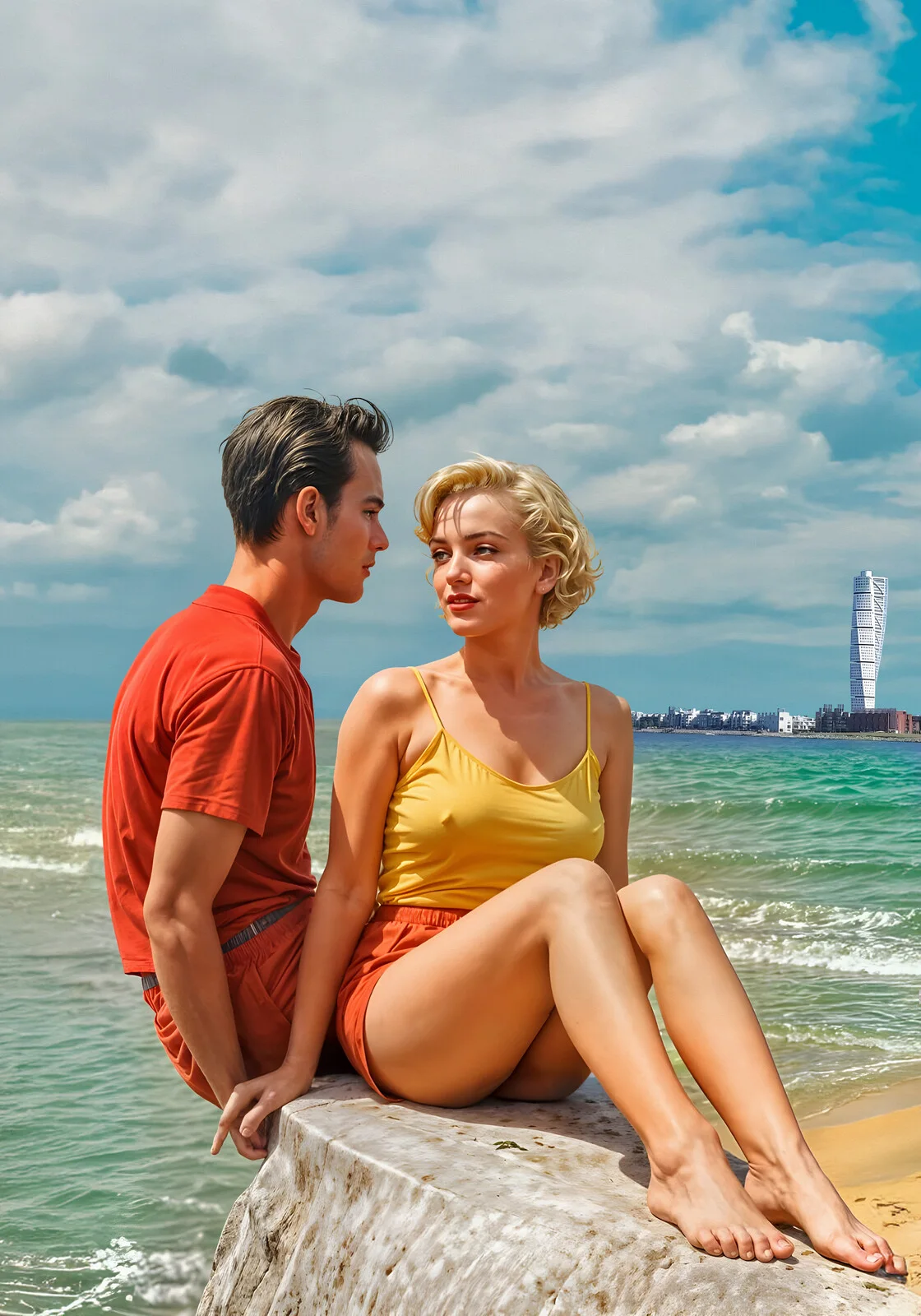
Jörgen Thornberg
The Misfits, 2025
Digital
50 x 70 cm
3 200 kr
The Misfits
They didn’t arrive by conventional means. Instead, they emerged from a passage in time—a 'wormhole,' a tunnel-like structure in spacetime that connects disparate points in the universe —in a daring act of liberation.
From their distant star — the one they now call home — Marilyn and Monty agreed on a small rebellion: spending an afternoon on Earth to breathe real wind again. They chose Malmö, not Hollywood, because here, fame can’t find you at Ribersborg. The only spotlight comes from the shifting sun over the Sound, and the only audience is a handful of gulls who couldn’t care less who you used to be. It was a profound relief, a freedom from the suffocating burden of fame, a weight so heavy it felt like it could crush their spirits, now lifted from their shoulders.
They sat on a weathered concrete block at the edge of the unfinished pier, shoes removed, feet resting on the raw cement, as the Öresund wind wove through their hair. Behind them, Turning Torso spiralled into the sky — not a skyscraper, but a powerful symbol that even steel can twist free from the rigid expectations of society.
They had once stood in the Nevada desert, a barren landscape that mirrored the emptiness within them, with cameras circling them, filmed as if the wind could strip their souls bare — and neither of them had ever fully recovered from The Misfits. This film thrust them into the unforgiving spotlight of fame, exposing their vulnerabilities and struggles to the world.
From afar, they resembled two typical tourists taking a break between chats, frozen in time as if they were in their early thirties. Yet their past was a stark contrast to this serene present —a life of constant scrutiny and performance. The transformation was so stark, it was as if they were different people altogether.
Up close, they appeared to be two Time-travellers on a temporary leave from eternity, finally permitted to speak without scripts, roles, or the burden of legends. They weren’t looking back to make sense of their lives — they were looking back with a fierce, almost desperate desire to understand the true meaning of their freedom, a quest that consumed their thoughts and drove them to the edge of their understanding.
“The Misfits, a sonnet✦
Upon that desert stage of dust and flame,
Where truth stood bare, unmasked by fame’s deceit,
Two wandering souls, unknowing, softly came—
Each carries wounds the world would never meet.
She was the moon the cameras begged to keep,
Yet trembled underneath her borrowed light;
He was the star too restless to be steeped
In false applause that haunts the sleepless night.
Their hearts, though bruised, knew one another’s ache—
Like glass that shivers when its twin is touched.
For in that tale of lives too real to fake,
They found peace; the world had asked too much.
No script could hold the truth they dared admit:
They were the roles—like the misfit script.
Yet when the final reel began to fade,
And daylight drowned the cameras’ hungry stare,
They lingered there, two shadows in the shade,
Both seeking refuge from the world’s despair.
For neither fame nor fragile silver screen
Could soothe a heart that knew too much of loss;
They learned that truth, once spoken, grows unseen—
A whispered vow beneath the desert’s cross.
She feared that hope was merely painted gold,
He feared his fire would flicker into ash;
But in each other’s gaze, they dared be bold,
Unmasked, unguarded — fragile, yet not brash.
And though the world still names them misfits both,
They kept one promise Time could never break:
Those souls who meet in honesty and oath
Shall find each other — even past heartbreak.
And now they sit where northern waters gleam,
Far from the desert’s whisper, heat and dust;
On Ribban’s shore, where wind and salt redeem
The wounds of those who loved because they must.
Time bowed its head and let them slip away,
Two wandering souls escaped from fate’s command.
No crowds, no scripts — just sea and fading day,
The Turning Torso is watching from the land.
For love that’s real outlives the mortal frame;
It needs no studio’s lie to be sublime.
Misfits they were — in heart, in soul, in name —
Yet here they conquered what had conquered time.”
Malmö. October 2025
The Misfits - Marilyn and Monty at Ribban
The wind flowed in from Öresund, restless and salty, curling around them like a curious spirit. They sat on a weathered concrete block — the start of a pier that never was — its rough surface warm from the afternoon sun. Behind them, Turning Torso spiralled towards the clouds, a white monument to everything the future had learned to twist and never quite straighten.
Marilyn held her yellow scarf in one hand and her laughter in the other. The wind toyed with the hem of her shorts; the fabric flashed red against the blue horizon. Beside her, Monty’s shirt — also red — fluttered in the gusts like a signal flag. They looked like a matched pair in some forgotten Technicolour film, two wanderers washed ashore in Malmö, their shared past casting a warm glow over the present.
“Funny, isn’t it,” she said, “how the world keeps spinning — even when you stop dancing.” Their shared introspection hung in the air, inviting the audience to join their contemplative mood.
He smiled, slow and crooked. “You never really stopped, Marilyn. You just changed the rhythm.”
She laughed, that breathy, impossible sound that still carried the sadness of every spotlight. “And you, Monty? You still look like you’re waiting for someone to yell ‘Action.’”
“Maybe I am,” he said. “Or maybe I’m just waiting for the next good scene.”
They sat in silence for a while, watching the light shift over the waves. A pair of gulls wheeled above the shoreline, their shadows gliding over the sun-bleached planks below — like ghosts of a camera crew that had once followed their every move.
“Do you ever miss it?” she asked.
“The work, yes,” he said. “The rest — not for a second.”
She nodded. “I used to think fame was a kind of salvation. Turns out, it was just another religion.”
Monty looked at her, his eyes soft and tired. “And what do you believe in now?”
Marilyn pulled her knees in closer, the yellow of her top catching the afternoon light. She smiled at the sun. “Oh, the same as always,” she said. “Grace. Light. And maybe... a better script next time.”
A gust of wind sent a whirl of sand swirling around their bare feet. The waves clapped against the half-built pier like an audience that refused to leave.
And for a moment — just one fleeting instant of eternity — they sat together, two souls out of time, framed by sea and sky, chuckling at the past and at themselves—two Time-travellers recalling the Desert. Their acceptance of the past brought a sense of closure and resolution to their shared journey.
The wind from Öresund softened, carrying the scent of seaweed and sun-warmed stone. Marilyn rested her hand on the cool concrete between them, feeling the faint pulse of the tide through the structure, as if the sea itself remembered their lines.
“Do you ever think about that shoot in Nevada?” she asked.
Monty’s gaze remained fixed on the water, the horizon warping like an old film strip. “I do,” he said softly. “I can still taste the dust. The wind sliced across the flats as if it wanted to peel the truth off everyone.”
She smiled slightly. “We were all raw then. The Misfits wasn’t a movie — it was an X-ray.”
He chuckled. “And no one liked what they saw.”
She turned towards him. “Except us. We recognised something.”
“The lost part,” he said. “You had it too.”
“Maybe that’s why we trusted each other,” she said softly. “Everyone else was acting. We were trying not to break.”
A pause lingered between them, filled by the rhythm of small waves crashing against the shore. The sound was calmer than the desert wind, yet it carried the same loneliness.
“Clark used to say that picture would kill him,” Monty murmured.
“And it did,” she replied. “He died just after the shoot finished. Maybe the film didn’t kill him — maybe it only completed what life had already begun.”
“Maybe it set him free,” Monty said. “We all were prisoners of something — the roles, the expectations, the idea of who we were supposed to be.”
Marilyn brushed a strand of hair from her face; it caught the sunlight briefly. Gold. “Freedom,” she said. “That’s the one thing Hollywood never learned to fake.”
He smiled. “And the one thing we never learned to keep.”
They both chuckled softly — the kind of laugh that happens when memory temporarily stops hurting. The sea responded with its patient applause, the green waves rolling and unrolling like film reels moving in slow motion.
Turning Torso shimmered behind them — a white ribbon twisting upwards, as if even architecture longed to dance.
“Maybe we didn’t get a happy ending, Monty,” she said, her voice a whisper now, “but at least we got to tell the truth.” Monty, her long-time friend and confidant, nodded in understanding, his eyes reflecting the shared journey they had been on.
“And maybe,” he replied, “that’s all the ending we ever needed.”
The wind shifted once more, lifting the red of his sleeve and the yellow of her top — two colours flickering together in the Malmö light like a single flame that refuses to go out.
The Triangle
The light over the water turned silvery, and the air was faintly tinged with salt and memory. Turning Torso glowed through the haze, twisting like a reel of film caught in an endless loop.
“Arthur wrote The Misfits for me,” Marilyn said quietly. “He said it was a gift, a kind of truth between us. But when I read it, it felt more like a diagnosis.”
Monty looked at her. “He wrote to you as Roslyn.”
“Yes,” she said. “And everyone thought it was flattering — that I should be grateful. But Roslyn saw through his sadness, not my own. I was the fragile woman he wanted to save, not the one who was fighting to survive. I could hardly recognise myself.”
She gazed across the water. “Arthur wanted to understand me, but he couldn’t live with what he found. He called it art; I called it exposure.”
Monty’s voice was quiet. “That’s what writers do. They think they’re telling the truth, but really they’re just explaining themselves.”
Marilyn laughed softly. “He thought if he wrote me down, he could keep me — like a butterfly in a box.”
“You were already gone by then,” Monty said.
Yes. We were falling apart, but he kept writing — even when he saw me breaking. He said it was the only way he knew how to help me. But how do you love someone by turning them into a story?
The wind tugged at the yellow of her top, as if emphasising the question.
“Did you ever love him?” Monty asked gently.
“I did,” she replied. “I loved the man who still believed words could save people. But by the time we made that film, we weren’t partners any longer. I was his material.”
She smiled faintly. “And he’d already found someone new — Inge, the photographer. She was calm, serious, and steady on her feet. I was all light and blur. I think he’d had enough of the blur.”
“He started seeing her during the filming, didn’t he?"
“Yes,” she said. “She was there every day, quietly behind her camera. With me, he analysed; with her, he rested.”
She turned the small shell in her hand. “He said The Misfits would bring us closer. But every scene pushed us further apart. By the time we finished, we didn’t even speak the same language.”
Monty nodded. “It happens. You start with trying to understand each other, and you end up writing separate scripts.”
She smiled at him—tired, tender. “And you, Monty—you understood without words. Maybe that’s why I liked you. You didn’t need to fix me.”
He looked at her, a faint smile playing at the corner of his mouth. “You didn’t need fixing. You just needed someone who saw you as real.”
The sea lapped against the stone, gentle and rhythmic.
“You were my mirror, Monty,” she said. “You were as lost as I was — and somehow that made me feel less alone. Everyone else saw my fame; you saw my fear.”
He was silent for a moment. “You once said I was the only one worse off than you. Maybe that was true. But maybe that’s why we recognised each other — we knew what it meant to live on the edge of the frame.”
She laughed, shaking her head. “You and I — two broken reflections looking for light.”
A pause lingered — the kind that only exists between people who no longer need to pretend.
“Maybe that’s what we were, Monty,” she said quietly. “The misfits he wrote about — but also the ones who escaped the page.”
Monty nodded. “And here we are. Still out of the frame. Still dancing with the wind.”
For a long moment, they sat in silence, their reflections wavering in the water below — two souls whose stories had already ended, yet still managing to carry on talking. Their stories, once intertwined, had now diverged, but their connection remained, a testament to the enduring power of shared experiences, a bond that transcends the limitations of language and time. It was a bond forged in the crucible of their shared journey, a bond that would endure long after their stories had been told.
Twin Souls
The light had become colder, the air tinged with silver and blue. The afternoon was fading into that strange Scandinavian half-light where everything appears both close and infinite. Turning Torso stood behind them like a white sundial marking a time that no longer mattered.
Marilyn drew her scarf closer around her shoulders. “You know, Monty,” she said softly, “sometimes I think we were the same person — just born into two different bodies."
He smiled faintly. “You mean two halves of the same mistake?”
She laughed, but it broke halfway through. “No. Two halves of the same wound.”
The sea sighed against the stone. The rhythm seemed to mirror their breathing.
“You and I,” she continued, “we were both made for the camera, but not for the world behind it. We could perform anything except being happy.” Their shared experiences in the film industry had not only shaped them but also forged a profound understanding of the price of fame, creating a bond that transcended words.
Monty looked down, tracing the grain of the concrete with his thumb. “They said I was too sensitive for Hollywood. Too fragile, too complicated, too much of everything that doesn’t sell.”
She nodded. “They said the same about me — only they made it sound like a compliment.”
The wind moved between them, carrying the faint cries of gulls.
“Do you ever wonder,” he asked, “if what we call sensitivity is just another kind of armour? A way of staying alive by feeling too much?” Their introspection, a testament to the depth of their emotional journey, echoed in the quiet of the evening.
Marilyn thought for a moment. “Maybe. But I think we felt too true. That’s what people can’t bear — truth that bleeds.”
He looked up, meeting her eyes. “You tried to heal people by making them dream. I tried to do it by making them believe. We both failed in the same way — we made them feel too much.”
She smiled, her eyes glistening with the soft salt of the wind. “Maybe that’s why we recognised each other on that set. Everyone else was hiding behind characters. You and I — we were the cracks.”
Monty’s voice was low, almost tender. “And cracks let the light in.”
She looked at him then — really looked. The lines around his mouth, the shadow under his eyes, the quiet dignity of someone who has walked through too much fire.
“Do you ever wish,” she whispered, “that we’d met before all of this — before the fame, before the scripts?”
He shook his head slowly. “No. We wouldn’t have known what we were looking at. You have to break before you can recognise the pieces.” Their acceptance of their past—a testament to their growth and resilience—was as clear as the evening sky.
The sea shimmered between them, green glass under a pale sun.
She leaned back, watching the horizon with Copenhagen in the distance. “Maybe that’s what twin souls are,” she said. “Not people who complete each other, but people who understand why they never will.”
Monty smiled. “And still stay.”
The wind had softened to a sigh now, lifting her scarf just enough to brush against his shoulder.
“Maybe that’s our redemption,” she said quietly. “That even after everything — we still believed in light.”
He nodded. “And in each other.”
They sat in silence. Behind them, Turning Torso caught the final light of day and shone like a silver flame twisting upwards — as if the city itself were listening.
And for a moment, they were no longer ghosts of old fame, fragments of someone else’s story, but simply two souls who had finally found the mirror they’d been missing all their lives. Their resilience, their ability to endure and find solace in each other, was truly inspiring.
After the Curtain Fell
Evening slowly spread across the Sound. The light had turned to glass — thin, blue, and shimmering. Turning Torso stood pale against the fading sky, its reflection trembling like an unfinished thought.
Marilyn drew her knees up and wrapped her arms around them. “You know,” she said, “after The Misfits, it felt like the world just… exhaled me. Like everyone was done watching.”
Monty looked at her quietly. “They weren’t done. They were just afraid of what they saw.”
She smiled faintly. “I never finished another film. There was supposed to be one — Something’s Got to Give. But I guess it was me who had to give.”
The wind off Öresund grew colder, brushing against her bare legs. She didn’t seem to notice.
“They said I was impossible,” she continued. “Late. Unreliable. They never said I was sick, or scared, or just tired of pretending. Hollywood doesn’t forgive women for being human.”
Monty nodded, his jaw tightening. “They don’t forgive men either. Not when the cracks start to show.”
He paused, then added, “After The Misfits, I couldn’t get work for years. They said I was difficult — unstable — that no one could insure me. I became a warning, not a name.”
Marilyn turned to him, her eyes soft. “You were brilliant, Monty. You gave them truth, and they didn’t know what to do with it.”
He chuckled. “Truth doesn’t sell popcorn.”
She smiled, but sadness lingered behind it. “Neither does pain.”
For a while, they listened to the tide slipping through the sand below. The air smelled faintly of iron and salt, like old film left too long in the can.
“I heard about your last picture,” she said gently. “The Defector, wasn’t it?”
He nodded. “Germany. Cold studios, colder people. I finished it, but I was already somewhere else. Not here, not gone — just tired.”
Marilyn looked out towards the horizon, where the sun was dissolving into silver. “I wish I’d seen it.”
He smiled. “And I wish you’d finished yours.”
The wind moved between them like a sigh.
“They said you died in your sleep,” he said softly.
She looked down, tracing a pattern in the dust with her fingertip. “Maybe I did. Maybe I was dreaming my way out.”
Monty’s voice was almost a whisper. “I never stopped feeling that absence — like the world tilted a little when you left.”
She looked up at him then, her face lit by the last fragile light. “We were both misfits, Monty. And the world doesn’t like what it can’t fix. But we understood each other, didn't we? Our shared understanding was our refuge in a world that couldn't comprehend us.”
He nodded. “No. It just leaves it behind.”
They sat there for a long while, two ghosts in the Malmö twilight, surrounded by the slow breathing of the sea.
“I think,” Marilyn said at last, “that we were both punished for wanting to be real. But we didn't give up, did we? We fought against the tide of expectations, and that's something to be proud of.”
Monty’s voice was rough. “And remembered for the same reason.”
A single light flickered on the horizon — a ship, maybe, or something older. The air had gone perfectly still.
“Maybe that’s how it works,” she murmured. “They bury the body, but not the ache.”
He smiled faintly. “And not the truth." Turning Torso shimmered once more in the fading light — a white spiral reaching towards everything they had lost and nearly found. For a moment, the air seemed to hold them both — the woman who had become light, and the man who had become shadow — suspended between remembrance and mercy.
After the Curtain Fell
Evening slowly spread over the Sound. The light had dimmed to silver, gentle as a breath. Turning Torso shimmered faintly behind them — a white helix spiralling against the fading sky, like a reel of film looping back on itself.
Marilyn drew her knees up and wrapped her arms around them. “You know,” she said, “after The Misfits, it felt as if the world just… exhaled me. Like everyone had finished watching.”
Monty glanced at her, the wind blowing his hair across his forehead. “They weren’t done. They were just afraid of what they saw.”
She smiled faintly. “I never finished another film. There was supposed to be one — Something’s Got to Give. But it all fell apart. They said I was unreliable, impossible. No one wanted to admit I was sick — or scared — or exhausted.”
The wind off Öresund grew colder, brushing against her bare legs. She didn’t seem to notice.
“The studio fired me halfway through,” she continued. “They even sued me — can you imagine? Sued me for not pretending hard enough.”
Monty frowned. “And then?”
“She said, a year later, they wanted to start again—same film, new actress. But Dean refused. He told them he wouldn’t do it without me. Said I was the heart of the picture.” She smiled wistfully. “That was Dean. He had more loyalty than the whole studio put together.”
Monty nodded slowly. “He must’ve seen what they didn’t.”
“She said, he did. Dean understood kindness. And exhaustion.”},
She looked out towards the horizon, her eyes following the faint shimmer of the sea. “Sometimes I wonder… if you had been there, Monty — if you’d played opposite me — maybe I would’ve stayed. Maybe I would’ve made it through the script.”
He turned to her, startled. “Me?”
“Yes,” she said softly. “You would’ve understood the silences. You always did. You would’ve made me feel seen instead of studied. We were always on the same page, weren't we?”
He smiled faintly. “You wouldn’t have had to act.”
She chuckled. “That’s what I mean. It might not have saved me, but it would have made me want to stay a little longer.”
The wind sighed around them, and for a moment it sounded almost like film running through a projector — that fragile rhythm of a story still being told.
“I heard about your last picture,” she said after a pause. “The Defector, wasn’t it?”
He nodded. “Germany. Cold studios, colder people. I finished it, but I was already somewhere else. Not here, not gone — just tired.”
Marilyn watched the water shimmer like mercury. “I wish I’d seen it.”
He smiled gently. “And I wish you’d finished yours.”
For a long while, they said nothing. The air between them was filled with memory — the sound of the sea, the hum of distance, the weight of everything unfinished.
“They said you died in your sleep,” Monty said at last, his voice barely audible.
She lowered her gaze. “Maybe I did. Maybe I just dreamed my way out.”
He was silent for a moment, then said, “When you went, the whole world dimmed a little. I could feel it — like something vital had gone missing.”
She looked up, her expression calm but sad. “We were both misfits, Monty. The world doesn’t like what it can’t fix.”
He nodded slowly. “No. It just leaves it behind.”
They sat there, two ghosts in the Malmö twilight, wrapped in sea air and the faint pulse of the tide.
“I think,” she said quietly, “that we were both punished for wanting to be real.”
Monty’s voice was rough with feeling. “And remembered for the same reason.”
A single light flickered on the horizon — a ship, or maybe a ghost of one.
“Maybe that’s how it works,” she murmured. “They bury the body, but not the ache.”
He looked at her and smiled faintly. “And not the truth.”
Turning Torso shimmered one final time in the blue dusk — a white spiral ascending into the calm sky, like film twisting into eternity.
And for a moment, the air seemed to hold them both — the woman who had become light, and the man who had become shadow — suspended between memory and mercy.
Rewriting the Stars
Dusk thickened over the Sound. The sea lay like liquid glass, reflecting the Turning Torso as if it were a white rocket ready to launch.
Marilyn, her smile a beacon of determination, brushed a strand of hair from her face. “You know what I’ve been thinking, Monty? Maybe we should finish it—the film. Something’s Got to Give. Not as it was — but as it should’ve been.”
Monty raised an eyebrow. “After sixty years?”
She laughed gently. “Why not? Time clearly isn’t our problem anymore.”
He tilted his head, amused. “And who would we cast?”
“Someone young enough to believe,” she said. “And brave enough to fall apart on camera.”
They fell silent for a moment, watching the light fade over the Öresund Bridge in the distance. Then Marilyn snapped her fingers, her eyes brightening.
“Timothée,” she said. “Timothée Chalamet. He has that look — like he’s already lived too long for his age.”
Monty nodded slowly. “Yes. He has the ache. The silence between the lines. And the vanity to hide it.”
“And for me,” she continued, “Anya Taylor-Joy. She doesn’t imitate anyone — she haunts the screen. She’s like a mirror that remembers you.”
Monty smiled. “You’ve been watching her.”
“Only enough to know she could make me believable again,” Marilyn said. “Not as a victim. As a voyager.”
The sea murmured against the stone, as if in approval.
“So,” Monty said, leaning forward. “How do we rewrite this?”
She paused for a moment, her voice gentle yet confident. “The island becomes space. A woman lost beyond the stars. Her ship vanishes into a cosmic whirlpool — a malström of light — and for her, only six months pass. But when she returns to Earth, forty years have gone by.”
He listened closely. “And her husband?”
“He’s seventy now,” she said. “Edward. We’ll call him Eddie. It was your middle name, wasn’t it?”
He smiled faintly. “You remember.”
“Of course,” she said. “He’s remarried. He’s built a life — quiet, loyal, ordinary. And then one day, the sky opens and she falls back through it.”
Monty’s gaze deepened. “She lands back home?”
“Yes,” she said. “Only home no longer exists. Her children are grown. The man she loved is nearly gone. She’s still thirty-five, glowing with cosmic dust, while time has turned everything else into memory.”
He leaned back, silent for a long moment. “That’s beautiful,” he said finally. “Einstein meets heartbreak. A relativity of love.”
Marilyn smiled. “Exactly. The world waited for her, but moved on. She didn’t age — but she lost her era.”
He leaned forward again. “And the new wife?”
“She’s no longer the rival,” Marilyn said. “She’s the one who helps her understand. Two women who’ve both loved the same man at different times. It’s not jealousy — it’s geometry.”
Monty chuckled. “You’re turning physics into poetry again.”
She winked. “Well, someone has to.”
They both watched the sky darken into a deep blue. A plane crossed the horizon — its lights blinking like a tiny spacecraft caught in the wrong century.
Monty broke the silence. “So how does it end?”
Marilyn smiled, her voice barely above the whisper of the sea. “She realises she can’t stay. Her body’s out of sync. Her heartbeat runs on a different clock. So she goes back into orbit — one last flight. But this time, he watches her go.”
“And?”
“She leaves him a message,” she said. “A simple line — something you would’ve written.”
He looked at her. “Like what?”
She met his eyes. “Don’t wait for me. Just keep looking up.”
For a moment, neither spoke. The Sound stretched endlessly before them — water, glass, sky, and silence.
“That’s the ending,” Monty said softly. “Not a goodbye. Just an understanding.”
“And maybe,” she whispered, “the film we were always meant to make.”
Turning Torso shimmered in the fading light — no longer a tower, but a rocket slowly ascending, bearing all unfinished dreams.
Jörgen Thornberg
The Misfits, 2025
Digital
50 x 70 cm
3 200 kr
The Misfits
They didn’t arrive by conventional means. Instead, they emerged from a passage in time—a 'wormhole,' a tunnel-like structure in spacetime that connects disparate points in the universe —in a daring act of liberation.
From their distant star — the one they now call home — Marilyn and Monty agreed on a small rebellion: spending an afternoon on Earth to breathe real wind again. They chose Malmö, not Hollywood, because here, fame can’t find you at Ribersborg. The only spotlight comes from the shifting sun over the Sound, and the only audience is a handful of gulls who couldn’t care less who you used to be. It was a profound relief, a freedom from the suffocating burden of fame, a weight so heavy it felt like it could crush their spirits, now lifted from their shoulders.
They sat on a weathered concrete block at the edge of the unfinished pier, shoes removed, feet resting on the raw cement, as the Öresund wind wove through their hair. Behind them, Turning Torso spiralled into the sky — not a skyscraper, but a powerful symbol that even steel can twist free from the rigid expectations of society.
They had once stood in the Nevada desert, a barren landscape that mirrored the emptiness within them, with cameras circling them, filmed as if the wind could strip their souls bare — and neither of them had ever fully recovered from The Misfits. This film thrust them into the unforgiving spotlight of fame, exposing their vulnerabilities and struggles to the world.
From afar, they resembled two typical tourists taking a break between chats, frozen in time as if they were in their early thirties. Yet their past was a stark contrast to this serene present —a life of constant scrutiny and performance. The transformation was so stark, it was as if they were different people altogether.
Up close, they appeared to be two Time-travellers on a temporary leave from eternity, finally permitted to speak without scripts, roles, or the burden of legends. They weren’t looking back to make sense of their lives — they were looking back with a fierce, almost desperate desire to understand the true meaning of their freedom, a quest that consumed their thoughts and drove them to the edge of their understanding.
“The Misfits, a sonnet✦
Upon that desert stage of dust and flame,
Where truth stood bare, unmasked by fame’s deceit,
Two wandering souls, unknowing, softly came—
Each carries wounds the world would never meet.
She was the moon the cameras begged to keep,
Yet trembled underneath her borrowed light;
He was the star too restless to be steeped
In false applause that haunts the sleepless night.
Their hearts, though bruised, knew one another’s ache—
Like glass that shivers when its twin is touched.
For in that tale of lives too real to fake,
They found peace; the world had asked too much.
No script could hold the truth they dared admit:
They were the roles—like the misfit script.
Yet when the final reel began to fade,
And daylight drowned the cameras’ hungry stare,
They lingered there, two shadows in the shade,
Both seeking refuge from the world’s despair.
For neither fame nor fragile silver screen
Could soothe a heart that knew too much of loss;
They learned that truth, once spoken, grows unseen—
A whispered vow beneath the desert’s cross.
She feared that hope was merely painted gold,
He feared his fire would flicker into ash;
But in each other’s gaze, they dared be bold,
Unmasked, unguarded — fragile, yet not brash.
And though the world still names them misfits both,
They kept one promise Time could never break:
Those souls who meet in honesty and oath
Shall find each other — even past heartbreak.
And now they sit where northern waters gleam,
Far from the desert’s whisper, heat and dust;
On Ribban’s shore, where wind and salt redeem
The wounds of those who loved because they must.
Time bowed its head and let them slip away,
Two wandering souls escaped from fate’s command.
No crowds, no scripts — just sea and fading day,
The Turning Torso is watching from the land.
For love that’s real outlives the mortal frame;
It needs no studio’s lie to be sublime.
Misfits they were — in heart, in soul, in name —
Yet here they conquered what had conquered time.”
Malmö. October 2025
The Misfits - Marilyn and Monty at Ribban
The wind flowed in from Öresund, restless and salty, curling around them like a curious spirit. They sat on a weathered concrete block — the start of a pier that never was — its rough surface warm from the afternoon sun. Behind them, Turning Torso spiralled towards the clouds, a white monument to everything the future had learned to twist and never quite straighten.
Marilyn held her yellow scarf in one hand and her laughter in the other. The wind toyed with the hem of her shorts; the fabric flashed red against the blue horizon. Beside her, Monty’s shirt — also red — fluttered in the gusts like a signal flag. They looked like a matched pair in some forgotten Technicolour film, two wanderers washed ashore in Malmö, their shared past casting a warm glow over the present.
“Funny, isn’t it,” she said, “how the world keeps spinning — even when you stop dancing.” Their shared introspection hung in the air, inviting the audience to join their contemplative mood.
He smiled, slow and crooked. “You never really stopped, Marilyn. You just changed the rhythm.”
She laughed, that breathy, impossible sound that still carried the sadness of every spotlight. “And you, Monty? You still look like you’re waiting for someone to yell ‘Action.’”
“Maybe I am,” he said. “Or maybe I’m just waiting for the next good scene.”
They sat in silence for a while, watching the light shift over the waves. A pair of gulls wheeled above the shoreline, their shadows gliding over the sun-bleached planks below — like ghosts of a camera crew that had once followed their every move.
“Do you ever miss it?” she asked.
“The work, yes,” he said. “The rest — not for a second.”
She nodded. “I used to think fame was a kind of salvation. Turns out, it was just another religion.”
Monty looked at her, his eyes soft and tired. “And what do you believe in now?”
Marilyn pulled her knees in closer, the yellow of her top catching the afternoon light. She smiled at the sun. “Oh, the same as always,” she said. “Grace. Light. And maybe... a better script next time.”
A gust of wind sent a whirl of sand swirling around their bare feet. The waves clapped against the half-built pier like an audience that refused to leave.
And for a moment — just one fleeting instant of eternity — they sat together, two souls out of time, framed by sea and sky, chuckling at the past and at themselves—two Time-travellers recalling the Desert. Their acceptance of the past brought a sense of closure and resolution to their shared journey.
The wind from Öresund softened, carrying the scent of seaweed and sun-warmed stone. Marilyn rested her hand on the cool concrete between them, feeling the faint pulse of the tide through the structure, as if the sea itself remembered their lines.
“Do you ever think about that shoot in Nevada?” she asked.
Monty’s gaze remained fixed on the water, the horizon warping like an old film strip. “I do,” he said softly. “I can still taste the dust. The wind sliced across the flats as if it wanted to peel the truth off everyone.”
She smiled slightly. “We were all raw then. The Misfits wasn’t a movie — it was an X-ray.”
He chuckled. “And no one liked what they saw.”
She turned towards him. “Except us. We recognised something.”
“The lost part,” he said. “You had it too.”
“Maybe that’s why we trusted each other,” she said softly. “Everyone else was acting. We were trying not to break.”
A pause lingered between them, filled by the rhythm of small waves crashing against the shore. The sound was calmer than the desert wind, yet it carried the same loneliness.
“Clark used to say that picture would kill him,” Monty murmured.
“And it did,” she replied. “He died just after the shoot finished. Maybe the film didn’t kill him — maybe it only completed what life had already begun.”
“Maybe it set him free,” Monty said. “We all were prisoners of something — the roles, the expectations, the idea of who we were supposed to be.”
Marilyn brushed a strand of hair from her face; it caught the sunlight briefly. Gold. “Freedom,” she said. “That’s the one thing Hollywood never learned to fake.”
He smiled. “And the one thing we never learned to keep.”
They both chuckled softly — the kind of laugh that happens when memory temporarily stops hurting. The sea responded with its patient applause, the green waves rolling and unrolling like film reels moving in slow motion.
Turning Torso shimmered behind them — a white ribbon twisting upwards, as if even architecture longed to dance.
“Maybe we didn’t get a happy ending, Monty,” she said, her voice a whisper now, “but at least we got to tell the truth.” Monty, her long-time friend and confidant, nodded in understanding, his eyes reflecting the shared journey they had been on.
“And maybe,” he replied, “that’s all the ending we ever needed.”
The wind shifted once more, lifting the red of his sleeve and the yellow of her top — two colours flickering together in the Malmö light like a single flame that refuses to go out.
The Triangle
The light over the water turned silvery, and the air was faintly tinged with salt and memory. Turning Torso glowed through the haze, twisting like a reel of film caught in an endless loop.
“Arthur wrote The Misfits for me,” Marilyn said quietly. “He said it was a gift, a kind of truth between us. But when I read it, it felt more like a diagnosis.”
Monty looked at her. “He wrote to you as Roslyn.”
“Yes,” she said. “And everyone thought it was flattering — that I should be grateful. But Roslyn saw through his sadness, not my own. I was the fragile woman he wanted to save, not the one who was fighting to survive. I could hardly recognise myself.”
She gazed across the water. “Arthur wanted to understand me, but he couldn’t live with what he found. He called it art; I called it exposure.”
Monty’s voice was quiet. “That’s what writers do. They think they’re telling the truth, but really they’re just explaining themselves.”
Marilyn laughed softly. “He thought if he wrote me down, he could keep me — like a butterfly in a box.”
“You were already gone by then,” Monty said.
Yes. We were falling apart, but he kept writing — even when he saw me breaking. He said it was the only way he knew how to help me. But how do you love someone by turning them into a story?
The wind tugged at the yellow of her top, as if emphasising the question.
“Did you ever love him?” Monty asked gently.
“I did,” she replied. “I loved the man who still believed words could save people. But by the time we made that film, we weren’t partners any longer. I was his material.”
She smiled faintly. “And he’d already found someone new — Inge, the photographer. She was calm, serious, and steady on her feet. I was all light and blur. I think he’d had enough of the blur.”
“He started seeing her during the filming, didn’t he?"
“Yes,” she said. “She was there every day, quietly behind her camera. With me, he analysed; with her, he rested.”
She turned the small shell in her hand. “He said The Misfits would bring us closer. But every scene pushed us further apart. By the time we finished, we didn’t even speak the same language.”
Monty nodded. “It happens. You start with trying to understand each other, and you end up writing separate scripts.”
She smiled at him—tired, tender. “And you, Monty—you understood without words. Maybe that’s why I liked you. You didn’t need to fix me.”
He looked at her, a faint smile playing at the corner of his mouth. “You didn’t need fixing. You just needed someone who saw you as real.”
The sea lapped against the stone, gentle and rhythmic.
“You were my mirror, Monty,” she said. “You were as lost as I was — and somehow that made me feel less alone. Everyone else saw my fame; you saw my fear.”
He was silent for a moment. “You once said I was the only one worse off than you. Maybe that was true. But maybe that’s why we recognised each other — we knew what it meant to live on the edge of the frame.”
She laughed, shaking her head. “You and I — two broken reflections looking for light.”
A pause lingered — the kind that only exists between people who no longer need to pretend.
“Maybe that’s what we were, Monty,” she said quietly. “The misfits he wrote about — but also the ones who escaped the page.”
Monty nodded. “And here we are. Still out of the frame. Still dancing with the wind.”
For a long moment, they sat in silence, their reflections wavering in the water below — two souls whose stories had already ended, yet still managing to carry on talking. Their stories, once intertwined, had now diverged, but their connection remained, a testament to the enduring power of shared experiences, a bond that transcends the limitations of language and time. It was a bond forged in the crucible of their shared journey, a bond that would endure long after their stories had been told.
Twin Souls
The light had become colder, the air tinged with silver and blue. The afternoon was fading into that strange Scandinavian half-light where everything appears both close and infinite. Turning Torso stood behind them like a white sundial marking a time that no longer mattered.
Marilyn drew her scarf closer around her shoulders. “You know, Monty,” she said softly, “sometimes I think we were the same person — just born into two different bodies."
He smiled faintly. “You mean two halves of the same mistake?”
She laughed, but it broke halfway through. “No. Two halves of the same wound.”
The sea sighed against the stone. The rhythm seemed to mirror their breathing.
“You and I,” she continued, “we were both made for the camera, but not for the world behind it. We could perform anything except being happy.” Their shared experiences in the film industry had not only shaped them but also forged a profound understanding of the price of fame, creating a bond that transcended words.
Monty looked down, tracing the grain of the concrete with his thumb. “They said I was too sensitive for Hollywood. Too fragile, too complicated, too much of everything that doesn’t sell.”
She nodded. “They said the same about me — only they made it sound like a compliment.”
The wind moved between them, carrying the faint cries of gulls.
“Do you ever wonder,” he asked, “if what we call sensitivity is just another kind of armour? A way of staying alive by feeling too much?” Their introspection, a testament to the depth of their emotional journey, echoed in the quiet of the evening.
Marilyn thought for a moment. “Maybe. But I think we felt too true. That’s what people can’t bear — truth that bleeds.”
He looked up, meeting her eyes. “You tried to heal people by making them dream. I tried to do it by making them believe. We both failed in the same way — we made them feel too much.”
She smiled, her eyes glistening with the soft salt of the wind. “Maybe that’s why we recognised each other on that set. Everyone else was hiding behind characters. You and I — we were the cracks.”
Monty’s voice was low, almost tender. “And cracks let the light in.”
She looked at him then — really looked. The lines around his mouth, the shadow under his eyes, the quiet dignity of someone who has walked through too much fire.
“Do you ever wish,” she whispered, “that we’d met before all of this — before the fame, before the scripts?”
He shook his head slowly. “No. We wouldn’t have known what we were looking at. You have to break before you can recognise the pieces.” Their acceptance of their past—a testament to their growth and resilience—was as clear as the evening sky.
The sea shimmered between them, green glass under a pale sun.
She leaned back, watching the horizon with Copenhagen in the distance. “Maybe that’s what twin souls are,” she said. “Not people who complete each other, but people who understand why they never will.”
Monty smiled. “And still stay.”
The wind had softened to a sigh now, lifting her scarf just enough to brush against his shoulder.
“Maybe that’s our redemption,” she said quietly. “That even after everything — we still believed in light.”
He nodded. “And in each other.”
They sat in silence. Behind them, Turning Torso caught the final light of day and shone like a silver flame twisting upwards — as if the city itself were listening.
And for a moment, they were no longer ghosts of old fame, fragments of someone else’s story, but simply two souls who had finally found the mirror they’d been missing all their lives. Their resilience, their ability to endure and find solace in each other, was truly inspiring.
After the Curtain Fell
Evening slowly spread across the Sound. The light had turned to glass — thin, blue, and shimmering. Turning Torso stood pale against the fading sky, its reflection trembling like an unfinished thought.
Marilyn drew her knees up and wrapped her arms around them. “You know,” she said, “after The Misfits, it felt like the world just… exhaled me. Like everyone was done watching.”
Monty looked at her quietly. “They weren’t done. They were just afraid of what they saw.”
She smiled faintly. “I never finished another film. There was supposed to be one — Something’s Got to Give. But I guess it was me who had to give.”
The wind off Öresund grew colder, brushing against her bare legs. She didn’t seem to notice.
“They said I was impossible,” she continued. “Late. Unreliable. They never said I was sick, or scared, or just tired of pretending. Hollywood doesn’t forgive women for being human.”
Monty nodded, his jaw tightening. “They don’t forgive men either. Not when the cracks start to show.”
He paused, then added, “After The Misfits, I couldn’t get work for years. They said I was difficult — unstable — that no one could insure me. I became a warning, not a name.”
Marilyn turned to him, her eyes soft. “You were brilliant, Monty. You gave them truth, and they didn’t know what to do with it.”
He chuckled. “Truth doesn’t sell popcorn.”
She smiled, but sadness lingered behind it. “Neither does pain.”
For a while, they listened to the tide slipping through the sand below. The air smelled faintly of iron and salt, like old film left too long in the can.
“I heard about your last picture,” she said gently. “The Defector, wasn’t it?”
He nodded. “Germany. Cold studios, colder people. I finished it, but I was already somewhere else. Not here, not gone — just tired.”
Marilyn looked out towards the horizon, where the sun was dissolving into silver. “I wish I’d seen it.”
He smiled. “And I wish you’d finished yours.”
The wind moved between them like a sigh.
“They said you died in your sleep,” he said softly.
She looked down, tracing a pattern in the dust with her fingertip. “Maybe I did. Maybe I was dreaming my way out.”
Monty’s voice was almost a whisper. “I never stopped feeling that absence — like the world tilted a little when you left.”
She looked up at him then, her face lit by the last fragile light. “We were both misfits, Monty. And the world doesn’t like what it can’t fix. But we understood each other, didn't we? Our shared understanding was our refuge in a world that couldn't comprehend us.”
He nodded. “No. It just leaves it behind.”
They sat there for a long while, two ghosts in the Malmö twilight, surrounded by the slow breathing of the sea.
“I think,” Marilyn said at last, “that we were both punished for wanting to be real. But we didn't give up, did we? We fought against the tide of expectations, and that's something to be proud of.”
Monty’s voice was rough. “And remembered for the same reason.”
A single light flickered on the horizon — a ship, maybe, or something older. The air had gone perfectly still.
“Maybe that’s how it works,” she murmured. “They bury the body, but not the ache.”
He smiled faintly. “And not the truth." Turning Torso shimmered once more in the fading light — a white spiral reaching towards everything they had lost and nearly found. For a moment, the air seemed to hold them both — the woman who had become light, and the man who had become shadow — suspended between remembrance and mercy.
After the Curtain Fell
Evening slowly spread over the Sound. The light had dimmed to silver, gentle as a breath. Turning Torso shimmered faintly behind them — a white helix spiralling against the fading sky, like a reel of film looping back on itself.
Marilyn drew her knees up and wrapped her arms around them. “You know,” she said, “after The Misfits, it felt as if the world just… exhaled me. Like everyone had finished watching.”
Monty glanced at her, the wind blowing his hair across his forehead. “They weren’t done. They were just afraid of what they saw.”
She smiled faintly. “I never finished another film. There was supposed to be one — Something’s Got to Give. But it all fell apart. They said I was unreliable, impossible. No one wanted to admit I was sick — or scared — or exhausted.”
The wind off Öresund grew colder, brushing against her bare legs. She didn’t seem to notice.
“The studio fired me halfway through,” she continued. “They even sued me — can you imagine? Sued me for not pretending hard enough.”
Monty frowned. “And then?”
“She said, a year later, they wanted to start again—same film, new actress. But Dean refused. He told them he wouldn’t do it without me. Said I was the heart of the picture.” She smiled wistfully. “That was Dean. He had more loyalty than the whole studio put together.”
Monty nodded slowly. “He must’ve seen what they didn’t.”
“She said, he did. Dean understood kindness. And exhaustion.”},
She looked out towards the horizon, her eyes following the faint shimmer of the sea. “Sometimes I wonder… if you had been there, Monty — if you’d played opposite me — maybe I would’ve stayed. Maybe I would’ve made it through the script.”
He turned to her, startled. “Me?”
“Yes,” she said softly. “You would’ve understood the silences. You always did. You would’ve made me feel seen instead of studied. We were always on the same page, weren't we?”
He smiled faintly. “You wouldn’t have had to act.”
She chuckled. “That’s what I mean. It might not have saved me, but it would have made me want to stay a little longer.”
The wind sighed around them, and for a moment it sounded almost like film running through a projector — that fragile rhythm of a story still being told.
“I heard about your last picture,” she said after a pause. “The Defector, wasn’t it?”
He nodded. “Germany. Cold studios, colder people. I finished it, but I was already somewhere else. Not here, not gone — just tired.”
Marilyn watched the water shimmer like mercury. “I wish I’d seen it.”
He smiled gently. “And I wish you’d finished yours.”
For a long while, they said nothing. The air between them was filled with memory — the sound of the sea, the hum of distance, the weight of everything unfinished.
“They said you died in your sleep,” Monty said at last, his voice barely audible.
She lowered her gaze. “Maybe I did. Maybe I just dreamed my way out.”
He was silent for a moment, then said, “When you went, the whole world dimmed a little. I could feel it — like something vital had gone missing.”
She looked up, her expression calm but sad. “We were both misfits, Monty. The world doesn’t like what it can’t fix.”
He nodded slowly. “No. It just leaves it behind.”
They sat there, two ghosts in the Malmö twilight, wrapped in sea air and the faint pulse of the tide.
“I think,” she said quietly, “that we were both punished for wanting to be real.”
Monty’s voice was rough with feeling. “And remembered for the same reason.”
A single light flickered on the horizon — a ship, or maybe a ghost of one.
“Maybe that’s how it works,” she murmured. “They bury the body, but not the ache.”
He looked at her and smiled faintly. “And not the truth.”
Turning Torso shimmered one final time in the blue dusk — a white spiral ascending into the calm sky, like film twisting into eternity.
And for a moment, the air seemed to hold them both — the woman who had become light, and the man who had become shadow — suspended between memory and mercy.
Rewriting the Stars
Dusk thickened over the Sound. The sea lay like liquid glass, reflecting the Turning Torso as if it were a white rocket ready to launch.
Marilyn, her smile a beacon of determination, brushed a strand of hair from her face. “You know what I’ve been thinking, Monty? Maybe we should finish it—the film. Something’s Got to Give. Not as it was — but as it should’ve been.”
Monty raised an eyebrow. “After sixty years?”
She laughed gently. “Why not? Time clearly isn’t our problem anymore.”
He tilted his head, amused. “And who would we cast?”
“Someone young enough to believe,” she said. “And brave enough to fall apart on camera.”
They fell silent for a moment, watching the light fade over the Öresund Bridge in the distance. Then Marilyn snapped her fingers, her eyes brightening.
“Timothée,” she said. “Timothée Chalamet. He has that look — like he’s already lived too long for his age.”
Monty nodded slowly. “Yes. He has the ache. The silence between the lines. And the vanity to hide it.”
“And for me,” she continued, “Anya Taylor-Joy. She doesn’t imitate anyone — she haunts the screen. She’s like a mirror that remembers you.”
Monty smiled. “You’ve been watching her.”
“Only enough to know she could make me believable again,” Marilyn said. “Not as a victim. As a voyager.”
The sea murmured against the stone, as if in approval.
“So,” Monty said, leaning forward. “How do we rewrite this?”
She paused for a moment, her voice gentle yet confident. “The island becomes space. A woman lost beyond the stars. Her ship vanishes into a cosmic whirlpool — a malström of light — and for her, only six months pass. But when she returns to Earth, forty years have gone by.”
He listened closely. “And her husband?”
“He’s seventy now,” she said. “Edward. We’ll call him Eddie. It was your middle name, wasn’t it?”
He smiled faintly. “You remember.”
“Of course,” she said. “He’s remarried. He’s built a life — quiet, loyal, ordinary. And then one day, the sky opens and she falls back through it.”
Monty’s gaze deepened. “She lands back home?”
“Yes,” she said. “Only home no longer exists. Her children are grown. The man she loved is nearly gone. She’s still thirty-five, glowing with cosmic dust, while time has turned everything else into memory.”
He leaned back, silent for a long moment. “That’s beautiful,” he said finally. “Einstein meets heartbreak. A relativity of love.”
Marilyn smiled. “Exactly. The world waited for her, but moved on. She didn’t age — but she lost her era.”
He leaned forward again. “And the new wife?”
“She’s no longer the rival,” Marilyn said. “She’s the one who helps her understand. Two women who’ve both loved the same man at different times. It’s not jealousy — it’s geometry.”
Monty chuckled. “You’re turning physics into poetry again.”
She winked. “Well, someone has to.”
They both watched the sky darken into a deep blue. A plane crossed the horizon — its lights blinking like a tiny spacecraft caught in the wrong century.
Monty broke the silence. “So how does it end?”
Marilyn smiled, her voice barely above the whisper of the sea. “She realises she can’t stay. Her body’s out of sync. Her heartbeat runs on a different clock. So she goes back into orbit — one last flight. But this time, he watches her go.”
“And?”
“She leaves him a message,” she said. “A simple line — something you would’ve written.”
He looked at her. “Like what?”
She met his eyes. “Don’t wait for me. Just keep looking up.”
For a moment, neither spoke. The Sound stretched endlessly before them — water, glass, sky, and silence.
“That’s the ending,” Monty said softly. “Not a goodbye. Just an understanding.”
“And maybe,” she whispered, “the film we were always meant to make.”
Turning Torso shimmered in the fading light — no longer a tower, but a rocket slowly ascending, bearing all unfinished dreams.
3 200 kr

Jörgen Thornberg
Malmö
Lite om bilder och mig. Translation in English at the end.
Jag är en nyfiken person som ser allt i bilder, även det jag fäster i ord, gärna tillsammans för bakom alla mina bilder finns en berättelse. Till vissa bilder hör en kortare eller längre novell som följer med bilden.
Bilder berättar historier. Jag omges av naturlig skönhet, intressanta människor och historia var jag än går. Jag använder min kamera för att dokumentera världen och blanda det jag ser med vad jag känner för att fånga den dolda magin.
Mina bilder berättar mina historier. Genom mina bilder, tryck och berättelser. Jag bjuder in dig att ta del av dessa berättelser, in i ditt liv och hem och dela min mycket personliga syn på vår värld. Mer än vad ögat ser. Jag tänker i bilder, drömmer och skriver och pratar om dem; följaktligen måste jag också skapa bilder. De blir vad jag ser, inte nödvändigtvis begränsade till verkligheten. Det finns en bild runt varje hörn. Jag hoppas att du kommer att se vad jag såg och gilla det.
Jag är också en skrivande person och till många bilder hör en kortare eller längre essay. Den följer med tavlan, tryckt på fint papper och med en personlig hälsning från mig.
Flertalet bilder startar sin resa i min kamera. Enkelt förklarat beskriver jag bilden jag ser i mitt inre, upplevd eller fantiserad. Bilden uppstår inom mig redan innan jag fått okularet till ögat. På bråkdelen av ett ögonblick ser jag vad jag vill ha och vad som kan göras med bilden. Här skall jag stoppa in en giraff, stålmannen, Titanic eller vad det är min fantasi finner ut. Ännu märkligare är att jag kommer ihåg minnesbilden långt efteråt när det blir tid att skapa verket. Om jag lyckas eller inte, är upp till betraktaren, oftast präglat av en stråk av svart humor – meningen är att man skall bli underhållen. Mina bilder blir ofta en snackis där de hänger.
Jag föredrar bilder som förmedlar ett budskap i flera lager. Vid första anblicken fylld av feel-good, en vacker utsikt, fint väder, solen skiner, blommor på ängen eller vattnet som ligger förrädiskt spegelblankt. I en sådan bild kan jag gömma min egentliga berättelse, mitt förakt för förtryckare och våldsverkare, rasister och fördomsfulla människor - ett gärna återkommande motiv mer eller mindre dolt i det vackra motivet. Jag försöker förena dem i ett gemensamt narrativ.
Bild och formgivning har löpt som en röd tråd genom livet. Fotokonst känns som en värdig final som jag gärna delar med mig.
Min genre är vid som framgår av mina bilder, temat en blandning av pop- och gatukonst i kollage som kan bestå av hundratals lager. Vissa bilder kan ta veckor, andra någon dag innan det är dags att överlämna resultatet till printverkstaden. Fine Art Prints är digitala fotocollage. I dessa kollage sker rivandet, klippandet, pusslandet, målandet, ritandet och sprayningen digitalt. Det jag monterar in kan vara hundratals år gamla bilder som jag omsorgsfullt frilägger så att de ser ut att vara en del av tavlan men också bilder skapade av mig själv efter min egen fantasi. Därefter besöks printstudion och för vissa bilder numrera en limiterad upplaga (oftast 7 exemplar) och signera för hand. Vissa bilder kan köpas i olika format. Det är bara att fråga efter vilka. Gillar man en bild som är 70x100 men inte har plats på väggen, går den kanske att få i 50x70 cm istället. Frågan är fri.
Metoden Giclée eller Fine Art Print som det också kallas är det moderna sättet för framställning av grafisk konst. Villkoret för denna typ av utskrifter är att en högkvalitativ storformatskrivare används med åldersbeständigt färgpigment och konstnärspapper eller i förekommande fall på duk. Pappret som används möter de krav på livslängd som ställs av museer och gallerier. Normalt säljer jag mina bilder oinramade så att den nya ägaren själv kan bestämma hur de skall se ut, med eller utan passepartout färg på ram, med eller utan glas etc..
Under många år ställde jag bara ut på nätet, i valda grupper och på min egen Facebooksida - https://www.facebook.com/jorgen.thornberg.9
Jag finns också på en egen hemsida som tyvärr inte alltid är uppdaterad – https://www.jth.life/ Där kan du också läsa en del av de berättelser som följer med bilden.
UTSTÄLLNINGAR
Luftkastellet, oktober 2022
Konst i Lund, november 2022
Luftkastellet, mars 2023
Engleson Galleri Caroli, april 2023
Hydra, Greece June 2023
Engleson Galleri Caroli, oktober 2023
Toppen, Höllviken december 2023
Luftkastellet, mars 2024
Torups Galleri, mars 2024
Venice, May 2024
Luftkastellet, oktober 2024
Konst i Advent, December 2024
Galleri Engleson, Caroli December 2024
Jäger & Jansson Galleri, april 2025
A bit about pictures and me.
I'm a curious person who sees everything in pictures, even what I express in words, often combining them, for behind all my pictures lies a story. These narratives, some as short as a single image and others as long as a novel, are the heart and soul of my work.
Pictures tell stories. Wherever I go, I'm surrounded by natural beauty, exciting people, and history. I use my camera to document the world and blend what I see with what I feel to capture the hidden magic.
My images tell my stories. Through my pictures, prints, and narratives, I invite you to partake in these stories in your life and home and share my deeply personal perspective of our world. More than meets the eye. I think in pictures, dream, write, and talk about them; consequently, I must create images too. They become what I see, not necessarily confined to reality. There's a picture around every corner. I hope you'll see what I saw and enjoy it.
I'm also a writer, and many images come with a shorter or longer essay. It accompanies the painting, printed on fine paper with my personal greeting.
Many pictures start their journey on my camera. Simply put, I describe the image I see in my mind, experienced or imagined. The image arises within me even before I bring the eyepiece to my eye. In a fraction of a moment, I see what I want and what can be done with the picture. Here, I'll insert a giraffe, Superman, the Titanic, or whatever my imagination conjures up. Even stranger is that I remember the mental image long after it's time to create the work. Whether I succeed is up to the observer, often imbued with a streak of black humour – the aim is to entertain. My pictures usually become a talking point wherever they hang.
I prefer pictures that convey a message in multiple layers. At first glance, they're filled with feel-good vibes, a beautiful view, lovely weather, the sun shining, flowers in the meadow, or the water lying deceptively calm. But beneath this surface beauty, I often conceal a deeper story, a narrative that challenges societal norms or explores the human condition. I invite you to delve into these hidden narratives and discover the layers of meaning within my work.
Picture and design have been a thread running through my life. Photographic art feels like a fitting finale, and I'm happy to share it.
My genre is varied, as seen in my pictures; the theme is a blend of pop and street art in collages that can consist of hundreds of layers. Some images can take weeks, others just a day before it's time to hand over the result to the print workshop. Fine Art Prints are digital photo collages. In these collages, tearing, cutting, puzzling, painting, drawing, and spraying happen digitally. What I insert can be images hundreds of years old that I carefully extract so they appear to be part of the painting, but also images created by myself, now also generated from my imagination. Next, visit the print studio and, for certain images, number a limited edition (usually 7 copies) and sign them by hand. Some images may be available in other formats. Just ask which ones. If you like an image that's 70x100 but doesn't have space on the wall, you might be able to get it in 50x70 cm instead. The question is open.
The Giclée method, or Fine Art Print as it's also called, is the modern way of producing graphic art. This method ensures the highest quality and longevity of the artwork, using a high-quality large-format printer with archival pigment inks and artist paper or, in some cases, canvas. The paper used meets the longevity requirements set by museums and galleries. I sell my pictures unframed, allowing the new owner to personalise their artwork, confident in the lasting value and quality of the piece.
For many years, I only exhibited online, in selected groups, and on my Facebook page - https://www.facebook.com/jorgen.thornberg.9. I also have my website, which unfortunately is not constantly updated - https://www.jth.life/. You can also read some of the stories accompanying the pictures there.
EXHIBITIONS
Luftkastellet, October 2022
Art in Lund, November 2022
Luftkastellet, March 2023
Engleson Gallery Caroli, April 2023
Hydra, Greece June 2023
Engleson Gallery Caroli, October 2023
Toppen, Höllviken December 2023
Luftkastellet, March 2024
Torup Gallery, March 2024
Venice, May 2024
UTSTÄLLNINGAR
Luftkastellet, oktober 2022
Konst i Lund, november 2022
Luftkastellet, mars 2023
Engleson Galleri Caroli, april 2023
Hydra, Greece June 2023
Engleson Galleri Caroli, oktober 2023
Toppen, Höllviken december 2023
Luftkastellet, mars 2024
Torups Galleri, mars 2024
Venice, May 2024
Luftkastellet, October 2024
Konst i Advent, December 2024
Galleri Engleson, Caroli December 2024
Jäger & Jansson Galleri, April 2025
Utbildning
Autodidakt
Medlem i konstnärsförening
Öppna Sinnen
Med i konstrunda
Konstrundan i Skåne
Utställningar
Luftkastellet, October 2022
Art in Lund, November 2022
Luftkastellet, March 2023
Engleson Gallery Caroli, April 2023
Hydra, Greece June 2023
Engleson Gallery Caroli, October 2023
Toppen, Höllviken December 2023
Luftkastellet, March 2024
Torup Gallery, March 2024
Venice, May 2024