Vi använder cookies för att ge dig bästa möjliga upplevelse. Välj vilka cookies du tillåter.
Läs mer i vår integritetspolicy
Jörgen Thornberg
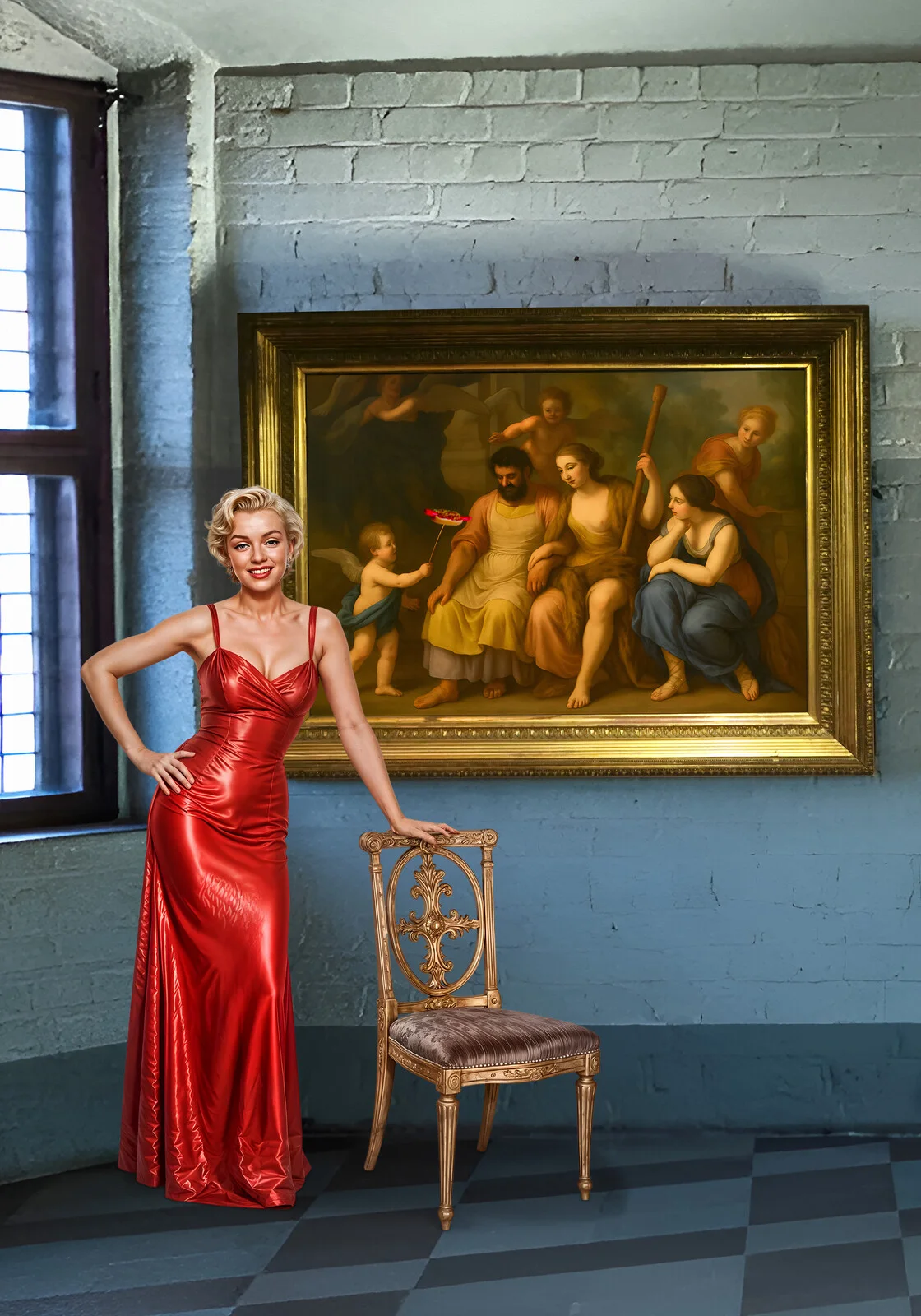
The Domestic Labours of Hercules – The Taming of the Titan, 2025
Digital
50 x 70 cm
3 200 kr
The Domestic Labours of Hercules – The Taming of the Titan
Our age delights in rediscovering what it once dismissed. Myths reappear wearing modern clothes; the dead return not as ghosts but as visitors from the imagination. During her brief journey from her star to Malmö, Marilyn Monroe, a figure of influence, made a significant stop at Malmöhus — the best-preserved Renaissance castle in the Nordic countries. Her visit, a moment of profound significance in the annals of history and myth, brought with it a lost painting: the original work that the artist had once spirited away from his studio and hung in the bedroom of his eternal dwelling in the cosmos.
They often do that, these travellers between worlds — return to recover what was most precious to them in life. The painting presented the true image of Hercules’ fate, not the altered versions the artist was compelled to paint for various European courts, one of which had eventually ended up in Malmö.
Throughout the week Marilyn stayed with her lifelong friend, Anita Ekberg, the work went unnoticed. Not even the curator in charge, a pivotal figure in this unfolding drama, spotted the change — although she likely had other things occupying her mind. If she had seen it, she might well have thought, like any perceptive woman would, that it was about time.
And so, before we follow the painting’s curious journey, shrouded in the deepest mystery and intrigue, it might be fitting to recall the profound story behind it, a narrative that carries the weight of history and myth.
“The Thirteenth Labour
He wrestled lions, fought with flame,
Each beast and tyrant fell the same.
He cleaned the stables, killed the boar,
And carried courage shore to shore.
He caught the hind, the bull, the mare,
He dragged the hound from Hades’ lair.
He stole a belt, he fetched some fruit,
And skinned a serpent, tall and brute.
Twelve mighty labours — all complete!
The world lay humbled at his feet.
The gods looked down, began to grin:
“Now let the real work begin.”
For heaven’s justice, strangely neat,
Is not to fight but to learn defeat.
He came to serve a queen instead,
And swapped his club for flax and thread.
His lion’s skin became her shawl,
His club an ornament on the wall.
The apron fit, the spindle spun —
And this is how feminism began.
Now centuries have passed since then,
But myths recycle once again.
For strength, to last, must learn to bend —
And heroes wash the floors in the end.”
Malmö. October 2025
The Domestic Labours of Hercules – The Taming of the Titan
During her brief journey from her star to Malmö, Marilyn Monroe, a figure often associated with beauty and femininity, could not resist a visit to Malmöhus — the best-preserved Renaissance castle in the Nordic countries. She was drawn to this place not only for its historical significance but also for the beauty of the lost painting she carried with her. This painting, the original work that the artist had once spirited away from his studio and hung in the bedroom of his eternal dwelling in the cosmos, depicted the true image of Hercules' fate. They often do that, these time-travelling souls — return to reclaim the things they loved most during their earthly lives.
The painting revealed the actual image of Hercules’ fate, not the altered versions the artist was compelled to produce for various European courts, one of which eventually found its way to Malmö. Throughout the week, Marilyn stayed with her lifelong friend, Anita Ekberg, a fellow enthusiast of ancient myths and symbolism, who shared Marilyn's passion for the lost painting and the story it depicted. The artwork hung unnoticed, and the curator overseeing it, though she probably had other matters on her mind, didn't notice the change. Had she seen it, it is very likely that, as a woman, she would have thought it was about time.
In any case, it may now be appropriate to recall the story behind it.
In ancient myths, Hercules defeated monsters, rivers, and kings. Yet, his most humiliating labour was not among the Twelve, but the thirteenth — when he became a woman's property. This thirteenth labour was a unique and transformative experience for Hercules, a test of his character and humility. Sold as punishment for his crimes, he found himself in the service of Queen Omphale of Lydia, spinning wool in her chambers and wearing women’s clothes while she donned his lion’s skin and wielded his club. This was a moment that redefined Hercules, challenging his strength and resilience in a way that no other labour had.
Giovanni Francesco Romanelli’s 17th-century painting captures that moment of reversal — strength softened by grace, masculinity tamed by desire. In this reimagined version, Hercules sits domesticated in a shimmering gown and apron, the very picture of reluctant servitude, while Omphale lounges half-naked beside him, wrapped in the lion’s pelt of conquest. The playful putti mock the fallen hero with a skewer topped by a red Danish sausage, a modern wink at the eternal comedy of pride undone by passion.
The myth is older than any temple and more relevant than any sermon: when power yields to love, even the titan must do the washing up.
The Tamed Titan
There are few myths as richly ironic as that of Hercules and Omphale — the hero undone not by monsters or gods, but by a woman armed with nothing more than a spindle and a smile. After a lifetime of conquering lions, hydras, and mountains, the strongest man in the world finds himself spinning wool in a queen’s chamber, dressed in women’s clothes and wearing an apron. It is, in every sense, the taming of the titan, a twist of fate that even the gods might find amusing. This unexpected turn in the myth adds a layer of irony and depth that resonates with the complexities of human experience.
In the reimagined Romanelli painting, The Domestic Labours of Hercules – The Taming of the Titan, the reversal is complete. The mighty demigod sits in soft fabrics, half embarrassed, half resigned, while Omphale — calm, amused, and radiant — he wears his lion’s skin and casually rests his club across her lap. Around them, cherubs laugh; one even offers a red Danish sausage on a stick, a symbol as cheeky as it is profound. The red Danish sausage, a staple of Danish cuisine, is a playful nod to the painting's cultural context, adding a layer of humour to the scene. For what could be more human, more eternal, than the comedy of pride subdued by love?
The myth of Hercules and Omphale captures a paradox that echoes with modern times: the hero who conquers the world, yet loses himself at home. Hercules’ submission is not just punishment; it signifies a profound transformation. The rough edges of heroism are softened through intimacy and the domestic sphere, which men of power often overlook. The demigod becomes a husband, a servant, perhaps even a feminist — though an unwilling one. His club, once a weapon, turns into a household utensil. His lion’s skin, once a trophy, transforms into his mistress’s shawl, marking a deep shift in his identity and power.
In this way, the myth of Hercules and Omphale serves as an early allegory of gender and power, as well as of the eternal theatre of attraction—a play in which strength bows before beauty, and the laughter of the gods reflects that of the audience. The 'eternal theatre of attraction' refers to the enduring dynamics of power and desire, where strength and beauty, masculinity and femininity, engage in a perpetual dance of dominance and submission. These themes, as old as time, continue to resonate in our modern world, making the myth a timeless reflection of human nature.
The Myth as Humiliation and Atonement
In the mythic cycle of Hercules, one of the most subversive and revealing episodes is his unexpected servitude to Queen Omphale. After a fit of rage that led to the killing of Iphitus, Hercules is not condemned to battle a new monster, but to submit to a woman. The mightiest man alive becomes the possession of a foreign queen, stripped of his weapons, his fame, and his masculine armour. What began as a form of atonement turns into a profound transformation—a metamorphosis that uncovers the deeper layers of his humiliation.
In Lydia, Omphale orders Hercules to swap his lion’s skin for silk, his club for a distaff. He sits spinning wool among her attendants, his once heroic figure now bent into domestic work. The symbolism is ruthless: masculinity reduced to subservience, the conqueror defeated by embroidery. The Greeks loved these reversals — stories in which arrogance is humbled, strength is ridiculed, and desire proves more potent than any god.
Yet there is more to the story than ridicule. The ancients recognised that the boundary between power and surrender, masculinity and femininity, is permeable. This boundary is significant because it reminds us that even divine strength must submit to order, to balance, to Eros. Here, 'Eros' represents not just romantic love, but the cosmic force that governs the balance of power and desire. Omphale’s dominance is therefore not merely erotic; it is cosmological. She restores equilibrium to a world thrown off by Hercules’ excess.
Still, the irony remains undeniable: the mightiest of heroes, confined in the oldest of prisons — the household. The myth becomes a mirror, reflecting both punishment and parody. It is an early reflection on the fragility of male heroism, on how easily virtue can descend into vanity, and on how the hand that once wielded a club may one day hold a broom. This fragility of male heroism is a central theme in the myth, revealing the ease with which virtue can be corrupted and the narrative's complex layers.
From Phallus to Spindle – The Shift of Symbolism
Very few myths present a symbolic reversal as elegantly as the story of Hercules and Omphale. The hero who once wielded a club, the epitome of masculine power, now holds a spindle, a quiet instrument of domestic labour. This transformation is not just a moral shift, but a profound change in symbolism: the club, a symbol of strength, is replaced by the spindle, a symbol of continuity. The cosmic axis of male potency has been replaced by the humble rhythm of spinning — a metaphor as old as civilisation itself.
In antiquity, the club was both weapon and symbol — a compressed tree, a relic of wild nature tamed to serve human will. To wield it was to extend the arm of domination. The spindle, by contrast, belongs to the private sphere: the seated body, the repetitive gesture, the creation of fabric rather than the destruction of beasts. In this mythic act of exchange — club for spindle — the Greeks encoded a complete inversion of gendered meaning: violence replaced by continuity, conquest by craft.
What Romanelli depicts, whether intentionally or not, is a political allegory disguised as a love story. The hero's virtue, his very core of “manly excellence,” is replaced by industria — the diligence, patience, and continuity linked to the feminine principle. Omphale does not emasculate Hercules; she redefines his strength. Her dominion is not over his body, but over his narrative. She becomes the creator of his new role, a role that challenges traditional notions of heroism and power.
This symbolic shift resonates well beyond the myth itself. The club and the spindle appear consistently throughout Western iconography: sceptre and distaff, sword and thread, power and care. The moral embedded in the myth is not just a lesson for the ancients, but a timeless truth: that civilisation progresses not only through force but also through craftsmanship. The spindle is the quiet counterpart to the club — less dramatic, yet infinitely more enduring, inspiring us with the enduring lessons of the past.
Hercules’ humiliation thus marks a more profound realisation: that creation demands surrender, and that even the tools of power must eventually submit to the softer logic of the loom. This profound realisation invites us to introspect on the nature of power and creation.
Romanelli and the Baroque Balance of Power
When Giovanni Francesco Romanelli painted Hercules and Omphale in mid-seventeenth-century Rome, he was not merely illustrating a myth; he was translating an ancient irony into the visual language of the Baroque. A pupil of Pietro da Cortona, Romanelli inherited the Roman taste for grandeur and moral allegory—scenes that mesmerised the eye while subtly instructing the soul. His canvases shimmer with satin, pearl, and flesh; yet behind the splendour lies the same enduring lesson: even strength must kneel before beauty, and even virtue can be tempted to remain human.
In Hercules and Omphale, the exchange of garments becomes theatrical. Draperies billow, the air is golden, and the composition moves along diagonals — a dance of submission and control. Romanelli’s Hercules, stripped of his leonine grandeur, sits uncomfortably in silken folds; Omphale, radiant and half-naked, wears his lion’s skin like a victory cloak. The club, once a phallic symbol of conquest, rests easily in her hand, now more an ornament than a weapon. Around them, playful putti flutter as commentators of fate, their laughter bridging the sacred and the profane.
This is Baroque psychology at its most refined. Romanelli understood that the moral core of the myth — Eros conquers Virtue — could be made palatable through splendour. His world was one where power and piety coexisted in sensual tension, and where every canvas was both confession and masquerade. The male hero, softened by colour and light, becomes a study in vulnerability; the woman, crowned with grace, becomes the embodiment of composure and wit.
What might have been moral satire in antiquity becomes, in Romanelli’s interpretation, an exploration of the balance between genders, forces, and forms. The painting does not mock Hercules; it redeems him through beauty. His surrender becomes aesthetically justified, even desirable. Because in the Baroque imagination, to yield was not necessarily to lose — it was to participate in the divine choreography of contrast, where shadow gives meaning to light, and submission becomes another form of splendour.
From Omphale to the Home Trap – Modern Reflections on Power and Gender
Suppose Omphale’s boudoir was the ancient prototype of the domestic sphere. In that case, Hercules’ servitude marks the start of an eternal drama — one that still unfolds in kitchens, offices, and bedrooms today. The myth, set in Lydia, transcends time, resonating across every era in which gender, labour, and love intertwine. What begins as punishment for violence ends as a parody of power; what seems like humiliation becomes a mirror held up to modern life, reflecting our shared experiences across centuries. This enduring relevance of the myth connects us to a timeless narrative, reminding us that the struggles of power and gender are not unique to our era.
The 'home trap' — a term I use to describe the invisible structure of societal expectations that ensnare both men and women in different ways. Omphale’s dominion, once seen as scandalous, now manifests as self-control: a woman who leads not through commands but through her presence. Hercules, meanwhile, exemplifies the modern man’s double bind: condemned to be both strong and sensitive, assertive yet domesticated. His apron is no longer a symbol of shame, but of adaptation. Yet beneath the fabric of equality, the same tensions persist — between desire and duty, between emancipation and performance.
Our contemporary culture continues to revisit the myth in endless variations. Advertising frames it as irony: the empowered woman in a tailored suit, the man changing nappies with calm ease. Sitcoms recycle it as domestic comedy: the husband clumsily doing housework, the wife wielding competence like a sceptre. Social media transforms it into theatre — curated glimpses of mutual exhaustion and performative equilibrium. Everywhere, the old script persists: the genders swap costumes, but the play stays the same.
Viewed through this perspective, Romanelli’s painting seems prophetic. The heroine’s composed authority, the hero’s tentative stance, and the laughter of the putti — all illustrate the paradox of modern partnership. Omphale is not a tyrant; she exemplifies the multitasking modern woman. Hercules is not emasculated; he is slow to realise what women have known all along: that power resides not in domination, but in endurance.
Ultimately, the domestic labours of Hercules are ours — the unending negotiations of pride, affection, and equality that shape intimacy itself. And just as in the myth, humour remains essential. Without laughter, no one can endure the housework of love.
Love, Power, and the Philosophy of Laughter
Laughter has always been the most civilised way to cope with power. The myth of Hercules and Omphale, told and retold for millennia, is not solely about dominance and desire — it is about how the gods themselves learned to laugh at human vanity's spectacle. The Greeks, who viewed tragedy as sacred, also recognised that comedy was its necessary counterpart: the release that comes with recognition. When the strongest man in the world wears a dress, the world does not end; it becomes understandable again. This profound insight into the role of laughter in understanding power elevates the myth to a new level.
Laughter restores perspective. In Romanelli’s version, the cherubs’ giggles are not cruelty but healing — a reminder that even divinity requires humility. Hercules, bound by his apron and stripped of his heroism, becomes relatable precisely because he is ridiculous. It is through embarrassment that he re-engages with the human community. The same principle applies to love: it disarms the self-important, reveals the pretentious, and compels the powerful to see themselves as others do.
In every epoch, this laughter has borne moral significance. The medieval sculptor chiselling obscene figures in cathedral corners understood this; so did Molière, Shakespeare, and today’s cartoonists. Humour is the secular form of grace — it elevates us without condemning. The hero's fall is not the end of virtue but its renewal through irony.
To laugh at Hercules is not to mock him; it is to join him in the shared absurdity of being human. His humiliation becomes universal, his servitude allegorical. We recognise ourselves in his defeat, for we too oscillate between grandeur and clumsiness, between mythic aspiration and domestic fatigue. Love’s comedy, a term I use to describe the humorous aspects of love and relationships, is thus not a betrayal of tragedy but its antidote — the sound of the soul exhaling after too much seriousness. This stress on love's comedy as an antidote to seriousness offers a sense of relief, reminding us that even in the most serious situations, laughter can provide a much-needed break.
In this context, The Domestic Labours of Hercules – The Taming of the Titan is not only a satire on gender or heroism but also a reflection on balance itself. Power cannot endure without irony, and love cannot survive without play. The smile of Omphale and the laughter of the putti uphold that truth through the ages: that strength redeemed by laughter is the only kind worth maintaining.
Conclusion – The Eternal Balance
Ultimately, Hercules’ story is more about perspective than punishment. What starts as a myth of humiliation turns into an allegory of harmony — the ongoing balance between power and tenderness, will and yielding, conquest and care. The ancient Greeks may have laughed first, but their laughter was wise: even the gods needed to find balance. To fall, to serve, to be tamed — these were not only comic moments but also lessons in humility. This profound reflection on balance in the myth brings a new level of understanding to the narrative.
Romanelli’s luminous vision, revived in his private painting ‘The Domestic Labours of Hercules – The Taming of the Titan’, captures that balance with mischievous grace. This painting depicts the moment when Hercules, stripped of his heroism, is tamed by Omphale, who is calm beneath the lion’s skin, holding the club of authority with effortless grace. The putti mock but also mediate — their laughter bridging the gap between satire and sympathy. Everything in the composition resonates with the same paradox: beauty born of imbalance, dignity rescued through play.
And so the myth comes back to us — not as a relic of the past but as a reflection. We still live in the rhythm of Hercules and Omphale: strength seeking tenderness, love testing pride, irony dissolving fear. Every partnership, every negotiation of gender and power, mimics its dance on a small scale. What once was punishment has become a pattern; what was humiliation is now recognition.
Maybe that's why this story refuses to fade. It isn't about the end of heroism, but its change — from the roar of lions to the whisper of household chores, from the club to the spindle, from conquest to coexistence. The titan isn't destroyed; he is educated. And Omphale, far from being his ruin, is his completion — the one who transforms brute force into balance, and balance into art.
In that sense, Hercules’ final labour was not his thirteenth but his first human one: to laugh, to love, and to learn that even titans must take their turn at the washing-up.
Epilogue – Curator’s Afterword: The Timeless Relevance of Hercules
Every age reshapes its gods, and each generation rewrites its myths. In ours, heroes have swapped their lions for laundry, their swords for smartphones. Yet, the enduring relevance of Hercules in the modern world is not just a historical curiosity, but a living presence in our shared spaces of modern life-the kitchen, the office, the screen. The conflict between strength and sensitivity, pride and tenderness, action and reflection, once played out in Omphale's palace, now unfolds in our daily interactions.
Romanelli’s myth, reimagined through humour and compassion, reflects a civilisation that has grown weary of superficial power. We no longer chase the triumph of the club, but seek the balance of the heart. The apron has become as symbolic as the lion’s skin: not a sign of defeat, but a new uniform for the domesticated hero.
Art, like myth, thrives on contradiction. In The Domestic Labour of Hercules – The Taming of the Titan, the laughter of the cherubs becomes our own: affectionate, knowing, slightly guilty. We recognise the absurdity of human roles — and their necessity. To be humbled is not to be humiliated, but to be reminded of scale; to serve is not to surrender, but to participate in the comedy of connection.
That is why Hercules still matters. He reminds us that heroism need not roar; it can whisper, sweep the floor, or laugh at itself. In a world still obsessed with power, this ancient farce remains an act of quiet resistance. It's a testament to the fact that even the mightiest among us, like Hercules, must eventually learn the art of grace, transforming from a symbol of power to a figure of grace.
Appendix – The Four Faces of Hercules
“Even the strongest must learn to yield.” — after Ovid.
To understand Hercules is to confront a paradox: the strongest of men, defeated by the gentlest of gestures. Beneath the myth's armour, he is not a single figure but a composite being — romantic, erotic, maternal, and human all at once. His encounter with Omphale is not merely an episode of punishment; it reveals complexity, a moment when strength turns inward and becomes self-aware. This paradoxical nature of Hercules's character is what makes him so intriguing and relatable.
The Romantic Titan
Behind his lion’s skin beats the heart of a clumsy lover. Hercules’ conquests were never solely physical; they were also quests for belonging. The heroic body conceals an emotional orphanage — a longing to be seen without being feared. In Omphale’s chamber, amid laughter and silk, he experiences something the battlefield never offered: stillness. His romance is not sentimental but existential — the realisation that intimacy, not victory, gives him form.
The Erotic Beast
Yet he is also driven by raw desire. Ancient poets did not hide their lust; he is the personification of unrestrained virility. His service to Omphale is therefore a ritual of restraint — Eros learning decorum. In her presence, the sheer kinetic energy of desire is folded back upon itself, domesticated, refined into play. The apron becomes an ironic chastity belt, and the spindle a symbol of erotic discipline. Lust, redirected, becomes education.
The Inverted Mother
When Hercules spins wool, he enters the feminine cosmos of creation. For the first time, his labour sustains rather than destroys. The act of spinning is maternal, cyclical, nurturing — a radical inversion of his usual violence. In that quiet, repetitive gesture, he becomes a midwife to his own humility. This is Hercules as the nurturer of balance, the reluctant participant in a sacred paradox: the male force learning to give rather than to take.
The Human Paradox
Ultimately, Hercules's survival is a testament to the power of transformation. He is both the beast and the philosopher, the lover and the labourer, the victim and the volunteer. His humiliation under Omphale is not degradation but metamorphosis — the price of becoming conscious. To serve, to blush, to be ridiculous: these are the rites of passage from heroism to humanity. His journey from power to humility is a source of inspiration or warning for us all.
In the laughter of the putti and the tenderness of Omphale’s gaze, we glimpse the truth of this transformation. Hercules is no longer the instrument of divine command but the subject of human comedy — a creature caught between lust and love, power and vulnerability, myth and mirror.
Hercules remains, eternally, what most powerful men are behind closed doors: a tamed titan seeking grace in the aftermath of strength.
Jörgen Thornberg
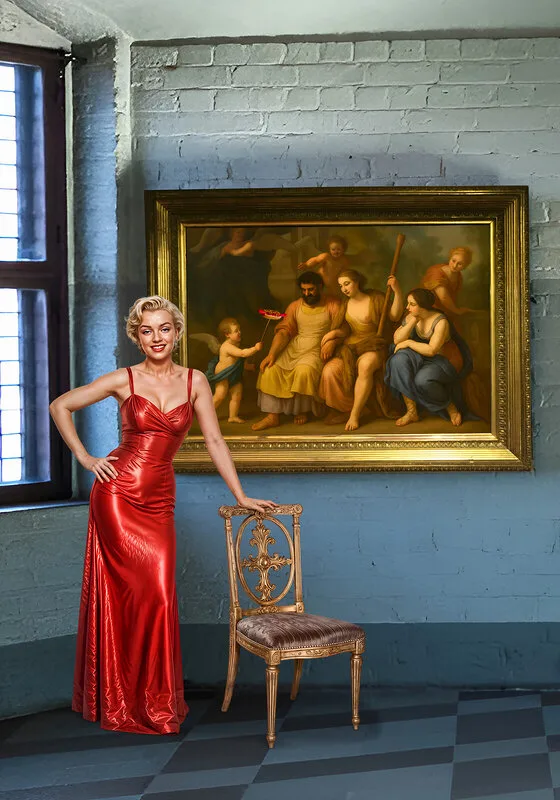
The Domestic Labours of Hercules – The Taming of the Titan, 2025
Digital
50 x 70 cm
3 200 kr
The Domestic Labours of Hercules – The Taming of the Titan
Our age delights in rediscovering what it once dismissed. Myths reappear wearing modern clothes; the dead return not as ghosts but as visitors from the imagination. During her brief journey from her star to Malmö, Marilyn Monroe, a figure of influence, made a significant stop at Malmöhus — the best-preserved Renaissance castle in the Nordic countries. Her visit, a moment of profound significance in the annals of history and myth, brought with it a lost painting: the original work that the artist had once spirited away from his studio and hung in the bedroom of his eternal dwelling in the cosmos.
They often do that, these travellers between worlds — return to recover what was most precious to them in life. The painting presented the true image of Hercules’ fate, not the altered versions the artist was compelled to paint for various European courts, one of which had eventually ended up in Malmö.
Throughout the week Marilyn stayed with her lifelong friend, Anita Ekberg, the work went unnoticed. Not even the curator in charge, a pivotal figure in this unfolding drama, spotted the change — although she likely had other things occupying her mind. If she had seen it, she might well have thought, like any perceptive woman would, that it was about time.
And so, before we follow the painting’s curious journey, shrouded in the deepest mystery and intrigue, it might be fitting to recall the profound story behind it, a narrative that carries the weight of history and myth.
“The Thirteenth Labour
He wrestled lions, fought with flame,
Each beast and tyrant fell the same.
He cleaned the stables, killed the boar,
And carried courage shore to shore.
He caught the hind, the bull, the mare,
He dragged the hound from Hades’ lair.
He stole a belt, he fetched some fruit,
And skinned a serpent, tall and brute.
Twelve mighty labours — all complete!
The world lay humbled at his feet.
The gods looked down, began to grin:
“Now let the real work begin.”
For heaven’s justice, strangely neat,
Is not to fight but to learn defeat.
He came to serve a queen instead,
And swapped his club for flax and thread.
His lion’s skin became her shawl,
His club an ornament on the wall.
The apron fit, the spindle spun —
And this is how feminism began.
Now centuries have passed since then,
But myths recycle once again.
For strength, to last, must learn to bend —
And heroes wash the floors in the end.”
Malmö. October 2025
The Domestic Labours of Hercules – The Taming of the Titan
During her brief journey from her star to Malmö, Marilyn Monroe, a figure often associated with beauty and femininity, could not resist a visit to Malmöhus — the best-preserved Renaissance castle in the Nordic countries. She was drawn to this place not only for its historical significance but also for the beauty of the lost painting she carried with her. This painting, the original work that the artist had once spirited away from his studio and hung in the bedroom of his eternal dwelling in the cosmos, depicted the true image of Hercules' fate. They often do that, these time-travelling souls — return to reclaim the things they loved most during their earthly lives.
The painting revealed the actual image of Hercules’ fate, not the altered versions the artist was compelled to produce for various European courts, one of which eventually found its way to Malmö. Throughout the week, Marilyn stayed with her lifelong friend, Anita Ekberg, a fellow enthusiast of ancient myths and symbolism, who shared Marilyn's passion for the lost painting and the story it depicted. The artwork hung unnoticed, and the curator overseeing it, though she probably had other matters on her mind, didn't notice the change. Had she seen it, it is very likely that, as a woman, she would have thought it was about time.
In any case, it may now be appropriate to recall the story behind it.
In ancient myths, Hercules defeated monsters, rivers, and kings. Yet, his most humiliating labour was not among the Twelve, but the thirteenth — when he became a woman's property. This thirteenth labour was a unique and transformative experience for Hercules, a test of his character and humility. Sold as punishment for his crimes, he found himself in the service of Queen Omphale of Lydia, spinning wool in her chambers and wearing women’s clothes while she donned his lion’s skin and wielded his club. This was a moment that redefined Hercules, challenging his strength and resilience in a way that no other labour had.
Giovanni Francesco Romanelli’s 17th-century painting captures that moment of reversal — strength softened by grace, masculinity tamed by desire. In this reimagined version, Hercules sits domesticated in a shimmering gown and apron, the very picture of reluctant servitude, while Omphale lounges half-naked beside him, wrapped in the lion’s pelt of conquest. The playful putti mock the fallen hero with a skewer topped by a red Danish sausage, a modern wink at the eternal comedy of pride undone by passion.
The myth is older than any temple and more relevant than any sermon: when power yields to love, even the titan must do the washing up.
The Tamed Titan
There are few myths as richly ironic as that of Hercules and Omphale — the hero undone not by monsters or gods, but by a woman armed with nothing more than a spindle and a smile. After a lifetime of conquering lions, hydras, and mountains, the strongest man in the world finds himself spinning wool in a queen’s chamber, dressed in women’s clothes and wearing an apron. It is, in every sense, the taming of the titan, a twist of fate that even the gods might find amusing. This unexpected turn in the myth adds a layer of irony and depth that resonates with the complexities of human experience.
In the reimagined Romanelli painting, The Domestic Labours of Hercules – The Taming of the Titan, the reversal is complete. The mighty demigod sits in soft fabrics, half embarrassed, half resigned, while Omphale — calm, amused, and radiant — he wears his lion’s skin and casually rests his club across her lap. Around them, cherubs laugh; one even offers a red Danish sausage on a stick, a symbol as cheeky as it is profound. The red Danish sausage, a staple of Danish cuisine, is a playful nod to the painting's cultural context, adding a layer of humour to the scene. For what could be more human, more eternal, than the comedy of pride subdued by love?
The myth of Hercules and Omphale captures a paradox that echoes with modern times: the hero who conquers the world, yet loses himself at home. Hercules’ submission is not just punishment; it signifies a profound transformation. The rough edges of heroism are softened through intimacy and the domestic sphere, which men of power often overlook. The demigod becomes a husband, a servant, perhaps even a feminist — though an unwilling one. His club, once a weapon, turns into a household utensil. His lion’s skin, once a trophy, transforms into his mistress’s shawl, marking a deep shift in his identity and power.
In this way, the myth of Hercules and Omphale serves as an early allegory of gender and power, as well as of the eternal theatre of attraction—a play in which strength bows before beauty, and the laughter of the gods reflects that of the audience. The 'eternal theatre of attraction' refers to the enduring dynamics of power and desire, where strength and beauty, masculinity and femininity, engage in a perpetual dance of dominance and submission. These themes, as old as time, continue to resonate in our modern world, making the myth a timeless reflection of human nature.
The Myth as Humiliation and Atonement
In the mythic cycle of Hercules, one of the most subversive and revealing episodes is his unexpected servitude to Queen Omphale. After a fit of rage that led to the killing of Iphitus, Hercules is not condemned to battle a new monster, but to submit to a woman. The mightiest man alive becomes the possession of a foreign queen, stripped of his weapons, his fame, and his masculine armour. What began as a form of atonement turns into a profound transformation—a metamorphosis that uncovers the deeper layers of his humiliation.
In Lydia, Omphale orders Hercules to swap his lion’s skin for silk, his club for a distaff. He sits spinning wool among her attendants, his once heroic figure now bent into domestic work. The symbolism is ruthless: masculinity reduced to subservience, the conqueror defeated by embroidery. The Greeks loved these reversals — stories in which arrogance is humbled, strength is ridiculed, and desire proves more potent than any god.
Yet there is more to the story than ridicule. The ancients recognised that the boundary between power and surrender, masculinity and femininity, is permeable. This boundary is significant because it reminds us that even divine strength must submit to order, to balance, to Eros. Here, 'Eros' represents not just romantic love, but the cosmic force that governs the balance of power and desire. Omphale’s dominance is therefore not merely erotic; it is cosmological. She restores equilibrium to a world thrown off by Hercules’ excess.
Still, the irony remains undeniable: the mightiest of heroes, confined in the oldest of prisons — the household. The myth becomes a mirror, reflecting both punishment and parody. It is an early reflection on the fragility of male heroism, on how easily virtue can descend into vanity, and on how the hand that once wielded a club may one day hold a broom. This fragility of male heroism is a central theme in the myth, revealing the ease with which virtue can be corrupted and the narrative's complex layers.
From Phallus to Spindle – The Shift of Symbolism
Very few myths present a symbolic reversal as elegantly as the story of Hercules and Omphale. The hero who once wielded a club, the epitome of masculine power, now holds a spindle, a quiet instrument of domestic labour. This transformation is not just a moral shift, but a profound change in symbolism: the club, a symbol of strength, is replaced by the spindle, a symbol of continuity. The cosmic axis of male potency has been replaced by the humble rhythm of spinning — a metaphor as old as civilisation itself.
In antiquity, the club was both weapon and symbol — a compressed tree, a relic of wild nature tamed to serve human will. To wield it was to extend the arm of domination. The spindle, by contrast, belongs to the private sphere: the seated body, the repetitive gesture, the creation of fabric rather than the destruction of beasts. In this mythic act of exchange — club for spindle — the Greeks encoded a complete inversion of gendered meaning: violence replaced by continuity, conquest by craft.
What Romanelli depicts, whether intentionally or not, is a political allegory disguised as a love story. The hero's virtue, his very core of “manly excellence,” is replaced by industria — the diligence, patience, and continuity linked to the feminine principle. Omphale does not emasculate Hercules; she redefines his strength. Her dominion is not over his body, but over his narrative. She becomes the creator of his new role, a role that challenges traditional notions of heroism and power.
This symbolic shift resonates well beyond the myth itself. The club and the spindle appear consistently throughout Western iconography: sceptre and distaff, sword and thread, power and care. The moral embedded in the myth is not just a lesson for the ancients, but a timeless truth: that civilisation progresses not only through force but also through craftsmanship. The spindle is the quiet counterpart to the club — less dramatic, yet infinitely more enduring, inspiring us with the enduring lessons of the past.
Hercules’ humiliation thus marks a more profound realisation: that creation demands surrender, and that even the tools of power must eventually submit to the softer logic of the loom. This profound realisation invites us to introspect on the nature of power and creation.
Romanelli and the Baroque Balance of Power
When Giovanni Francesco Romanelli painted Hercules and Omphale in mid-seventeenth-century Rome, he was not merely illustrating a myth; he was translating an ancient irony into the visual language of the Baroque. A pupil of Pietro da Cortona, Romanelli inherited the Roman taste for grandeur and moral allegory—scenes that mesmerised the eye while subtly instructing the soul. His canvases shimmer with satin, pearl, and flesh; yet behind the splendour lies the same enduring lesson: even strength must kneel before beauty, and even virtue can be tempted to remain human.
In Hercules and Omphale, the exchange of garments becomes theatrical. Draperies billow, the air is golden, and the composition moves along diagonals — a dance of submission and control. Romanelli’s Hercules, stripped of his leonine grandeur, sits uncomfortably in silken folds; Omphale, radiant and half-naked, wears his lion’s skin like a victory cloak. The club, once a phallic symbol of conquest, rests easily in her hand, now more an ornament than a weapon. Around them, playful putti flutter as commentators of fate, their laughter bridging the sacred and the profane.
This is Baroque psychology at its most refined. Romanelli understood that the moral core of the myth — Eros conquers Virtue — could be made palatable through splendour. His world was one where power and piety coexisted in sensual tension, and where every canvas was both confession and masquerade. The male hero, softened by colour and light, becomes a study in vulnerability; the woman, crowned with grace, becomes the embodiment of composure and wit.
What might have been moral satire in antiquity becomes, in Romanelli’s interpretation, an exploration of the balance between genders, forces, and forms. The painting does not mock Hercules; it redeems him through beauty. His surrender becomes aesthetically justified, even desirable. Because in the Baroque imagination, to yield was not necessarily to lose — it was to participate in the divine choreography of contrast, where shadow gives meaning to light, and submission becomes another form of splendour.
From Omphale to the Home Trap – Modern Reflections on Power and Gender
Suppose Omphale’s boudoir was the ancient prototype of the domestic sphere. In that case, Hercules’ servitude marks the start of an eternal drama — one that still unfolds in kitchens, offices, and bedrooms today. The myth, set in Lydia, transcends time, resonating across every era in which gender, labour, and love intertwine. What begins as punishment for violence ends as a parody of power; what seems like humiliation becomes a mirror held up to modern life, reflecting our shared experiences across centuries. This enduring relevance of the myth connects us to a timeless narrative, reminding us that the struggles of power and gender are not unique to our era.
The 'home trap' — a term I use to describe the invisible structure of societal expectations that ensnare both men and women in different ways. Omphale’s dominion, once seen as scandalous, now manifests as self-control: a woman who leads not through commands but through her presence. Hercules, meanwhile, exemplifies the modern man’s double bind: condemned to be both strong and sensitive, assertive yet domesticated. His apron is no longer a symbol of shame, but of adaptation. Yet beneath the fabric of equality, the same tensions persist — between desire and duty, between emancipation and performance.
Our contemporary culture continues to revisit the myth in endless variations. Advertising frames it as irony: the empowered woman in a tailored suit, the man changing nappies with calm ease. Sitcoms recycle it as domestic comedy: the husband clumsily doing housework, the wife wielding competence like a sceptre. Social media transforms it into theatre — curated glimpses of mutual exhaustion and performative equilibrium. Everywhere, the old script persists: the genders swap costumes, but the play stays the same.
Viewed through this perspective, Romanelli’s painting seems prophetic. The heroine’s composed authority, the hero’s tentative stance, and the laughter of the putti — all illustrate the paradox of modern partnership. Omphale is not a tyrant; she exemplifies the multitasking modern woman. Hercules is not emasculated; he is slow to realise what women have known all along: that power resides not in domination, but in endurance.
Ultimately, the domestic labours of Hercules are ours — the unending negotiations of pride, affection, and equality that shape intimacy itself. And just as in the myth, humour remains essential. Without laughter, no one can endure the housework of love.
Love, Power, and the Philosophy of Laughter
Laughter has always been the most civilised way to cope with power. The myth of Hercules and Omphale, told and retold for millennia, is not solely about dominance and desire — it is about how the gods themselves learned to laugh at human vanity's spectacle. The Greeks, who viewed tragedy as sacred, also recognised that comedy was its necessary counterpart: the release that comes with recognition. When the strongest man in the world wears a dress, the world does not end; it becomes understandable again. This profound insight into the role of laughter in understanding power elevates the myth to a new level.
Laughter restores perspective. In Romanelli’s version, the cherubs’ giggles are not cruelty but healing — a reminder that even divinity requires humility. Hercules, bound by his apron and stripped of his heroism, becomes relatable precisely because he is ridiculous. It is through embarrassment that he re-engages with the human community. The same principle applies to love: it disarms the self-important, reveals the pretentious, and compels the powerful to see themselves as others do.
In every epoch, this laughter has borne moral significance. The medieval sculptor chiselling obscene figures in cathedral corners understood this; so did Molière, Shakespeare, and today’s cartoonists. Humour is the secular form of grace — it elevates us without condemning. The hero's fall is not the end of virtue but its renewal through irony.
To laugh at Hercules is not to mock him; it is to join him in the shared absurdity of being human. His humiliation becomes universal, his servitude allegorical. We recognise ourselves in his defeat, for we too oscillate between grandeur and clumsiness, between mythic aspiration and domestic fatigue. Love’s comedy, a term I use to describe the humorous aspects of love and relationships, is thus not a betrayal of tragedy but its antidote — the sound of the soul exhaling after too much seriousness. This stress on love's comedy as an antidote to seriousness offers a sense of relief, reminding us that even in the most serious situations, laughter can provide a much-needed break.
In this context, The Domestic Labours of Hercules – The Taming of the Titan is not only a satire on gender or heroism but also a reflection on balance itself. Power cannot endure without irony, and love cannot survive without play. The smile of Omphale and the laughter of the putti uphold that truth through the ages: that strength redeemed by laughter is the only kind worth maintaining.
Conclusion – The Eternal Balance
Ultimately, Hercules’ story is more about perspective than punishment. What starts as a myth of humiliation turns into an allegory of harmony — the ongoing balance between power and tenderness, will and yielding, conquest and care. The ancient Greeks may have laughed first, but their laughter was wise: even the gods needed to find balance. To fall, to serve, to be tamed — these were not only comic moments but also lessons in humility. This profound reflection on balance in the myth brings a new level of understanding to the narrative.
Romanelli’s luminous vision, revived in his private painting ‘The Domestic Labours of Hercules – The Taming of the Titan’, captures that balance with mischievous grace. This painting depicts the moment when Hercules, stripped of his heroism, is tamed by Omphale, who is calm beneath the lion’s skin, holding the club of authority with effortless grace. The putti mock but also mediate — their laughter bridging the gap between satire and sympathy. Everything in the composition resonates with the same paradox: beauty born of imbalance, dignity rescued through play.
And so the myth comes back to us — not as a relic of the past but as a reflection. We still live in the rhythm of Hercules and Omphale: strength seeking tenderness, love testing pride, irony dissolving fear. Every partnership, every negotiation of gender and power, mimics its dance on a small scale. What once was punishment has become a pattern; what was humiliation is now recognition.
Maybe that's why this story refuses to fade. It isn't about the end of heroism, but its change — from the roar of lions to the whisper of household chores, from the club to the spindle, from conquest to coexistence. The titan isn't destroyed; he is educated. And Omphale, far from being his ruin, is his completion — the one who transforms brute force into balance, and balance into art.
In that sense, Hercules’ final labour was not his thirteenth but his first human one: to laugh, to love, and to learn that even titans must take their turn at the washing-up.
Epilogue – Curator’s Afterword: The Timeless Relevance of Hercules
Every age reshapes its gods, and each generation rewrites its myths. In ours, heroes have swapped their lions for laundry, their swords for smartphones. Yet, the enduring relevance of Hercules in the modern world is not just a historical curiosity, but a living presence in our shared spaces of modern life-the kitchen, the office, the screen. The conflict between strength and sensitivity, pride and tenderness, action and reflection, once played out in Omphale's palace, now unfolds in our daily interactions.
Romanelli’s myth, reimagined through humour and compassion, reflects a civilisation that has grown weary of superficial power. We no longer chase the triumph of the club, but seek the balance of the heart. The apron has become as symbolic as the lion’s skin: not a sign of defeat, but a new uniform for the domesticated hero.
Art, like myth, thrives on contradiction. In The Domestic Labour of Hercules – The Taming of the Titan, the laughter of the cherubs becomes our own: affectionate, knowing, slightly guilty. We recognise the absurdity of human roles — and their necessity. To be humbled is not to be humiliated, but to be reminded of scale; to serve is not to surrender, but to participate in the comedy of connection.
That is why Hercules still matters. He reminds us that heroism need not roar; it can whisper, sweep the floor, or laugh at itself. In a world still obsessed with power, this ancient farce remains an act of quiet resistance. It's a testament to the fact that even the mightiest among us, like Hercules, must eventually learn the art of grace, transforming from a symbol of power to a figure of grace.
Appendix – The Four Faces of Hercules
“Even the strongest must learn to yield.” — after Ovid.
To understand Hercules is to confront a paradox: the strongest of men, defeated by the gentlest of gestures. Beneath the myth's armour, he is not a single figure but a composite being — romantic, erotic, maternal, and human all at once. His encounter with Omphale is not merely an episode of punishment; it reveals complexity, a moment when strength turns inward and becomes self-aware. This paradoxical nature of Hercules's character is what makes him so intriguing and relatable.
The Romantic Titan
Behind his lion’s skin beats the heart of a clumsy lover. Hercules’ conquests were never solely physical; they were also quests for belonging. The heroic body conceals an emotional orphanage — a longing to be seen without being feared. In Omphale’s chamber, amid laughter and silk, he experiences something the battlefield never offered: stillness. His romance is not sentimental but existential — the realisation that intimacy, not victory, gives him form.
The Erotic Beast
Yet he is also driven by raw desire. Ancient poets did not hide their lust; he is the personification of unrestrained virility. His service to Omphale is therefore a ritual of restraint — Eros learning decorum. In her presence, the sheer kinetic energy of desire is folded back upon itself, domesticated, refined into play. The apron becomes an ironic chastity belt, and the spindle a symbol of erotic discipline. Lust, redirected, becomes education.
The Inverted Mother
When Hercules spins wool, he enters the feminine cosmos of creation. For the first time, his labour sustains rather than destroys. The act of spinning is maternal, cyclical, nurturing — a radical inversion of his usual violence. In that quiet, repetitive gesture, he becomes a midwife to his own humility. This is Hercules as the nurturer of balance, the reluctant participant in a sacred paradox: the male force learning to give rather than to take.
The Human Paradox
Ultimately, Hercules's survival is a testament to the power of transformation. He is both the beast and the philosopher, the lover and the labourer, the victim and the volunteer. His humiliation under Omphale is not degradation but metamorphosis — the price of becoming conscious. To serve, to blush, to be ridiculous: these are the rites of passage from heroism to humanity. His journey from power to humility is a source of inspiration or warning for us all.
In the laughter of the putti and the tenderness of Omphale’s gaze, we glimpse the truth of this transformation. Hercules is no longer the instrument of divine command but the subject of human comedy — a creature caught between lust and love, power and vulnerability, myth and mirror.
Hercules remains, eternally, what most powerful men are behind closed doors: a tamed titan seeking grace in the aftermath of strength.
3 200 kr

Jörgen Thornberg
Malmö
Lite om bilder och mig. Translation in English at the end.
Jag är en nyfiken person som ser allt i bilder, även det jag fäster i ord, gärna tillsammans för bakom alla mina bilder finns en berättelse. Till vissa bilder hör en kortare eller längre novell som följer med bilden.
Bilder berättar historier. Jag omges av naturlig skönhet, intressanta människor och historia var jag än går. Jag använder min kamera för att dokumentera världen och blanda det jag ser med vad jag känner för att fånga den dolda magin.
Mina bilder berättar mina historier. Genom mina bilder, tryck och berättelser. Jag bjuder in dig att ta del av dessa berättelser, in i ditt liv och hem och dela min mycket personliga syn på vår värld. Mer än vad ögat ser. Jag tänker i bilder, drömmer och skriver och pratar om dem; följaktligen måste jag också skapa bilder. De blir vad jag ser, inte nödvändigtvis begränsade till verkligheten. Det finns en bild runt varje hörn. Jag hoppas att du kommer att se vad jag såg och gilla det.
Jag är också en skrivande person och till många bilder hör en kortare eller längre essay. Den följer med tavlan, tryckt på fint papper och med en personlig hälsning från mig.
Flertalet bilder startar sin resa i min kamera. Enkelt förklarat beskriver jag bilden jag ser i mitt inre, upplevd eller fantiserad. Bilden uppstår inom mig redan innan jag fått okularet till ögat. På bråkdelen av ett ögonblick ser jag vad jag vill ha och vad som kan göras med bilden. Här skall jag stoppa in en giraff, stålmannen, Titanic eller vad det är min fantasi finner ut. Ännu märkligare är att jag kommer ihåg minnesbilden långt efteråt när det blir tid att skapa verket. Om jag lyckas eller inte, är upp till betraktaren, oftast präglat av en stråk av svart humor – meningen är att man skall bli underhållen. Mina bilder blir ofta en snackis där de hänger.
Jag föredrar bilder som förmedlar ett budskap i flera lager. Vid första anblicken fylld av feel-good, en vacker utsikt, fint väder, solen skiner, blommor på ängen eller vattnet som ligger förrädiskt spegelblankt. I en sådan bild kan jag gömma min egentliga berättelse, mitt förakt för förtryckare och våldsverkare, rasister och fördomsfulla människor - ett gärna återkommande motiv mer eller mindre dolt i det vackra motivet. Jag försöker förena dem i ett gemensamt narrativ.
Bild och formgivning har löpt som en röd tråd genom livet. Fotokonst känns som en värdig final som jag gärna delar med mig.
Min genre är vid som framgår av mina bilder, temat en blandning av pop- och gatukonst i kollage som kan bestå av hundratals lager. Vissa bilder kan ta veckor, andra någon dag innan det är dags att överlämna resultatet till printverkstaden. Fine Art Prints är digitala fotocollage. I dessa kollage sker rivandet, klippandet, pusslandet, målandet, ritandet och sprayningen digitalt. Det jag monterar in kan vara hundratals år gamla bilder som jag omsorgsfullt frilägger så att de ser ut att vara en del av tavlan men också bilder skapade av mig själv efter min egen fantasi. Därefter besöks printstudion och för vissa bilder numrera en limiterad upplaga (oftast 7 exemplar) och signera för hand. Vissa bilder kan köpas i olika format. Det är bara att fråga efter vilka. Gillar man en bild som är 70x100 men inte har plats på väggen, går den kanske att få i 50x70 cm istället. Frågan är fri.
Metoden Giclée eller Fine Art Print som det också kallas är det moderna sättet för framställning av grafisk konst. Villkoret för denna typ av utskrifter är att en högkvalitativ storformatskrivare används med åldersbeständigt färgpigment och konstnärspapper eller i förekommande fall på duk. Pappret som används möter de krav på livslängd som ställs av museer och gallerier. Normalt säljer jag mina bilder oinramade så att den nya ägaren själv kan bestämma hur de skall se ut, med eller utan passepartout färg på ram, med eller utan glas etc..
Under många år ställde jag bara ut på nätet, i valda grupper och på min egen Facebooksida - https://www.facebook.com/jorgen.thornberg.9
Jag finns också på en egen hemsida som tyvärr inte alltid är uppdaterad – https://www.jth.life/ Där kan du också läsa en del av de berättelser som följer med bilden.
UTSTÄLLNINGAR
Luftkastellet, oktober 2022
Konst i Lund, november 2022
Luftkastellet, mars 2023
Engleson Galleri Caroli, april 2023
Hydra, Greece June 2023
Engleson Galleri Caroli, oktober 2023
Toppen, Höllviken december 2023
Luftkastellet, mars 2024
Torups Galleri, mars 2024
Venice, May 2024
Luftkastellet, oktober 2024
Konst i Advent, December 2024
Galleri Engleson, Caroli December 2024
Jäger & Jansson Galleri, april 2025
A bit about pictures and me.
I'm a curious person who sees everything in pictures, even what I express in words, often combining them, for behind all my pictures lies a story. These narratives, some as short as a single image and others as long as a novel, are the heart and soul of my work.
Pictures tell stories. Wherever I go, I'm surrounded by natural beauty, exciting people, and history. I use my camera to document the world and blend what I see with what I feel to capture the hidden magic.
My images tell my stories. Through my pictures, prints, and narratives, I invite you to partake in these stories in your life and home and share my deeply personal perspective of our world. More than meets the eye. I think in pictures, dream, write, and talk about them; consequently, I must create images too. They become what I see, not necessarily confined to reality. There's a picture around every corner. I hope you'll see what I saw and enjoy it.
I'm also a writer, and many images come with a shorter or longer essay. It accompanies the painting, printed on fine paper with my personal greeting.
Many pictures start their journey on my camera. Simply put, I describe the image I see in my mind, experienced or imagined. The image arises within me even before I bring the eyepiece to my eye. In a fraction of a moment, I see what I want and what can be done with the picture. Here, I'll insert a giraffe, Superman, the Titanic, or whatever my imagination conjures up. Even stranger is that I remember the mental image long after it's time to create the work. Whether I succeed is up to the observer, often imbued with a streak of black humour – the aim is to entertain. My pictures usually become a talking point wherever they hang.
I prefer pictures that convey a message in multiple layers. At first glance, they're filled with feel-good vibes, a beautiful view, lovely weather, the sun shining, flowers in the meadow, or the water lying deceptively calm. But beneath this surface beauty, I often conceal a deeper story, a narrative that challenges societal norms or explores the human condition. I invite you to delve into these hidden narratives and discover the layers of meaning within my work.
Picture and design have been a thread running through my life. Photographic art feels like a fitting finale, and I'm happy to share it.
My genre is varied, as seen in my pictures; the theme is a blend of pop and street art in collages that can consist of hundreds of layers. Some images can take weeks, others just a day before it's time to hand over the result to the print workshop. Fine Art Prints are digital photo collages. In these collages, tearing, cutting, puzzling, painting, drawing, and spraying happen digitally. What I insert can be images hundreds of years old that I carefully extract so they appear to be part of the painting, but also images created by myself, now also generated from my imagination. Next, visit the print studio and, for certain images, number a limited edition (usually 7 copies) and sign them by hand. Some images may be available in other formats. Just ask which ones. If you like an image that's 70x100 but doesn't have space on the wall, you might be able to get it in 50x70 cm instead. The question is open.
The Giclée method, or Fine Art Print as it's also called, is the modern way of producing graphic art. This method ensures the highest quality and longevity of the artwork, using a high-quality large-format printer with archival pigment inks and artist paper or, in some cases, canvas. The paper used meets the longevity requirements set by museums and galleries. I sell my pictures unframed, allowing the new owner to personalise their artwork, confident in the lasting value and quality of the piece.
For many years, I only exhibited online, in selected groups, and on my Facebook page - https://www.facebook.com/jorgen.thornberg.9. I also have my website, which unfortunately is not constantly updated - https://www.jth.life/. You can also read some of the stories accompanying the pictures there.
EXHIBITIONS
Luftkastellet, October 2022
Art in Lund, November 2022
Luftkastellet, March 2023
Engleson Gallery Caroli, April 2023
Hydra, Greece June 2023
Engleson Gallery Caroli, October 2023
Toppen, Höllviken December 2023
Luftkastellet, March 2024
Torup Gallery, March 2024
Venice, May 2024
UTSTÄLLNINGAR
Luftkastellet, oktober 2022
Konst i Lund, november 2022
Luftkastellet, mars 2023
Engleson Galleri Caroli, april 2023
Hydra, Greece June 2023
Engleson Galleri Caroli, oktober 2023
Toppen, Höllviken december 2023
Luftkastellet, mars 2024
Torups Galleri, mars 2024
Venice, May 2024
Luftkastellet, October 2024
Konst i Advent, December 2024
Galleri Engleson, Caroli December 2024
Jäger & Jansson Galleri, April 2025
Utbildning
Autodidakt
Medlem i konstnärsförening
Öppna Sinnen
Med i konstrunda
Konstrundan i Skåne
Utställningar
Luftkastellet, October 2022
Art in Lund, November 2022
Luftkastellet, March 2023
Engleson Gallery Caroli, April 2023
Hydra, Greece June 2023
Engleson Gallery Caroli, October 2023
Toppen, Höllviken December 2023
Luftkastellet, March 2024
Torup Gallery, March 2024
Venice, May 2024