Vi använder cookies för att ge dig bästa möjliga upplevelse. Välj vilka cookies du tillåter.
Läs mer i vår integritetspolicy
Jörgen Thornberg
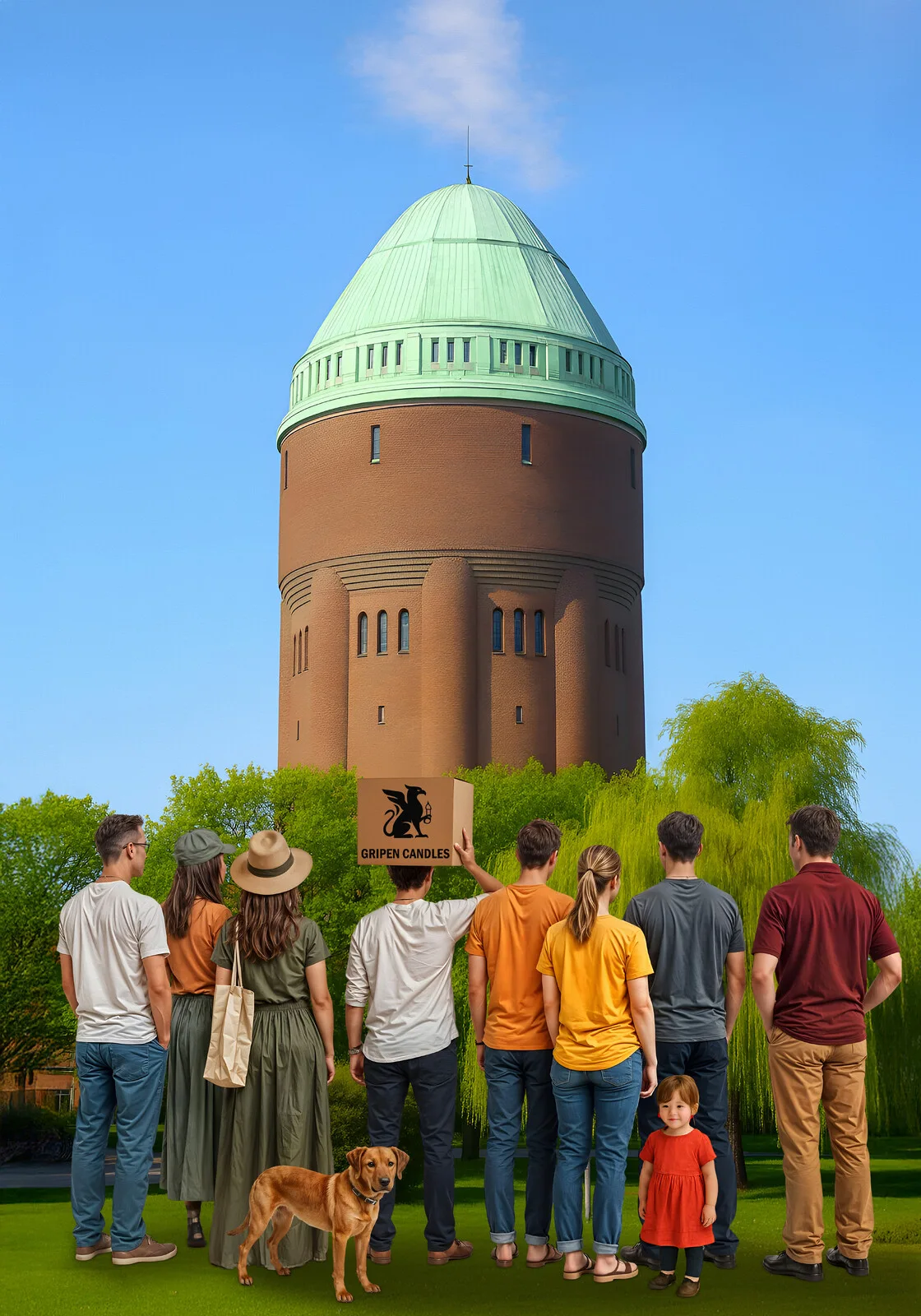
Priapos' Tower, 2025
Digital
50 x 70 cm
3 200 kr
Priapos' Tower
In Praise of the Upright, there are many ways to measure a civilisation, but height has long been one of the favourites. From the first standing stone to the latest glass spire, humanity has kept building monuments that reach insistently upward — as if to remind the heavens who started this competition in the first place.
No creature on Earth has been so fixated on verticality. Trees grow, mountains rise, volcanoes erupt, but only humans insist on calling it art. We have built towers for gods, kings, corporations, and the idea of progress itself. When we run out of deities, we dedicate our structures to ourselves. These towering structures, a testament to our ingenuity, never fail to inspire awe and amazement, evoking a sense of wonder that transcends time and culture, and leaves us in awe of our own capabilities.
It is a habit that walks the fine line between brilliance and farce. Each century has its Priapus — the patron saint of civic overconfidence — and each skyline its moral guardian, ready to blush on cue. What started as a plea for immortality—a desperate desire to leave a mark that time cannot erase—has turned into a contest of prominence: whoever stands tallest wins.
Yet behind the grandeur lies a fragile truth. The tower, however monumental, is merely a gesture — a vertical sigh of mortality. Beneath every steeple and obelisk lurks the same anxiety: that time will one day bring everything down. The pyramid, the minaret, the skyscraper — all are architectural prayers against gravity, a universal fear of mortality that unites us all, reminding us of our shared human experience and the fleeting nature of life. It's a sobering reminder of our shared humanity and the inevitability of our mortality.
This essay traces those prayers through time, from the stony ambitions of ancient Egypt to the mirrored façades of Fifth Avenue, from the divine indecencies of Greek myth to the civic comedy of modern Malmö. It is, in short, a brief history of human stiffness — the will to rise, to outshine, and, occasionally, to laugh at ourselves in the process. This journey of ambition and the enduring quest for immortality is a fascinating one, highlighting the continuous evolution of human ambition.
“Priapus Rising – A Ballad of Lofty Ambitions
From desert dust to mirrored glass,
Each age repeats the selfsame farce;
A tower thrusts, a steeple gleams —
Another man has immortal dreams.
Old Keops stacked his stones so neat,
To rest his pride beneath his feet;
The higher built, the more divine —
And left the workers dead in line.
Then Shah Jahan, in marble white,
Erected love in lunar light;
He swore it was for wedded grace—
But carved, in truth, his own proud face.
The Caesars raised their golden spires,
The Popes lit up their holy pyres;
Each king and sultan took a turn
To prove how high his faith could burn.
From Babel’s tongue to Babylon,
Each age insists the sky’s our home;
Yet every tower’s haughty head
Soon learns to bow when mortals bled.
And then came Trump, with gilded grin,
A Pharaoh draped in fake-tanned skin;
His glass obelisk pierced the skies—
A monument to compromise.
Now Malmö’s water tower stands,
As sturdy as its builder’s hands;
A civic joke, a local charm,
That points to heaven, safe from harm.
So raise your steeples, domes, and rods,
Your Babels, Burjs, and house of gods;
Each claims to reach eternal heights—
But ends as scaffolds for our rites.
The moral, friends? It’s rather plain:
The taller built, the more in vain.
For all our stones and steel and fuss,
The biggest joke is still on us.”
Malmö. October 2025
Priapus’ Tower – A Short History of Human Stiffness, a title that alludes to the Greek god Priapus, known for his exaggerated phallus. This connection sets the stage for our exploration of phallic symbols in architecture.
They appear here and there, one taller than the next, all striving to showcase the greatness of someone or something—particularly in relation to everything around them, which often extends far beyond the horizon. Some creations make the grotesquely exaggerated penis of Priapus seem laughably small. The structure need not even resemble a phallus, as long as it fulfils its purpose: to dominate the skyline and showcase its creator’s glory. A square pyramid, after all, remains unrivalled. Constructing 2.3 million stone blocks weighing approximately 6 million tons was perhaps a challenge never to be surpassed. It's a bit like a cosmic joke —a testament to human ambition and the lengths we will go to leave our mark on the world.
Throughout history, the form has varied, yet few monuments appear as convincingly glans-like as Malmö’s water tower in the photograph. The intention can, of course, be obscured by dedicating one’s creation to a higher cause—a god, a moral virtue, or a departed spouse—so long as everyone is constantly reminded of the sender, so to speak. This variety in cultural interpretations of phallic symbols — from the grandeur of the Taj Mahal to the simplicity of the Cerne Abbas Giant — is a testament to the richness and diversity of human belief systems, fostering profound respect and appreciation for different cultures.
From Keops to Taj Mahal
That Cheops’s soul was preserved for eternity supposedly guaranteed everyone’s own immortality. The Taj Mahal, a Maharaja’s tribute to his deceased wife, was naturally the ultimate proof of his own greatness. The eight million visitors who pass through its gates each year probably give little thought to who the wife actually was, blinded by this architectural marvel — one of the seven wonders of the world — built by Shah Jahan the Magnificent. These monuments, standing the test of time, remind us of the enduring legacy of human ambition and creativity, inspiring awe and reverence. The grandeur of the Taj Mahal, in particular, evokes a sense of wonder and admiration. It's like comparing a grand romantic gesture to a cosmic insurance policy.
It is unlikely that anyone today would build a mausoleum for a deceased spouse. The twenty-first century presents new possibilities: conquering space and being the first on Mars would surely overshadow the Pyramid of Cheops. As a symbol of masculinity, a patch of land on the red planet would be difficult to surpass.
Priapus Returns in Gold – From Pharaohs to Fifth Avenue
The trick, of course, is the same one used by everyone with power and wealth. Cheops stole from his people to build his monument to himself. Donald Trump snuck the recipe into Trump Tower when he built it.
The Trump Tower, with its opulence and grandeur, served as a physical manifestation of Trump's wealth and power, reinforcing his image as a successful businessman. People may mock it as much as they like—very few men in their lifetimes can construct an edifice of that calibre and magnitude on Fifth Avenue, in what they call “the most important city in the world.” The tower's design and location played a crucial role in shaping public perception of Trump, demonstrating the profound influence of architecture in shaping cultural narratives.
In a 1998 BBC Hard Talk interview, Trump declared: “I love building great buildings… I get great artistic pride out of a great building like Trump Tower.” Its mirrored glass style embodied the 1980s creed that greed was good. The building initially caused a sensation; reportedly, 100,000 people visited the atrium each Saturday during the holidays, in total, almost as many as the Taj Mahal receives in a year.
Luxury brands such as Buccellati and Charles Jourdan were tenants. Steven Spielberg maintained a pied-à-terre, and Michael Jackson owned a duplex with a dance studio. Trump, naturally, reserved the best for himself: a 1,000-square-metre penthouse spanning three floors. Few buildings are as strongly associated with their owners in the public imagination as Trump Tower. The Trump Organisation, one suspects, will fight to its last breath to protect its symbol of power.
The Cerne Abbas Giant is a hill figure near the village of Cerne Abbas, in Dorset, England. The National Trust currently owns it and lists it as a scheduled monument of England. Measuring 55 metres (180 ft) in length, the hill figure depicts a bald, nude male with a prominent erection, holding his left hand out to the side and wielding a large club in his right hand. This figure, believed to be a symbol of fertility, has been a subject of fascination and debate for centuries. Some think it represents the Roman god Hercules, while others see it as a Celtic deity. This diversity of interpretations adds to the rich tapestry of cultural symbolism associated with phallic structures, fostering respect and appreciation for different cultures.
But times change, and so do phallic symbols. When New York woke from its cocaine-fuelled 1980s party, it became clear that not everything that glittered was gold—most of it was brass. Retailers hesitated at the sky-high rents and departed. The glitterati who once resided there—Johnny Carson, Sophia Loren—were replaced by “Medicaid cheats, coke dealers, mobsters,” as journalist Wayne Barrett wrote in The Village Voice. This evolution of phallic symbols reflects the changing societal norms and values, prompting us to reflect on our past and present.
It mattered little to Trump; the bill had already been settled by others, of course. His name remains his most valuable asset, far surpassing the bricks and mortar. The building itself is part of a network of companies and private investors. What Trump claims to own actually belongs to an opaque property company of uncertain parentage. Yet the Trump Tower, with its towering height and unmistakable shape, is a clear embodiment of phallic symbolism, inseparable from Donald Trump himself.
In the realm of phallic symbols, form matters little; what matters is that it rises—or protrudes. Trump Tower’s 202 metres, only marginally taller than Malmö’s Turning Torso, have long been overshadowed by local rivals such as 425 Park Avenue, more than twice its height. But in the world of phallic symbols, no street address surpasses a Trump Tower.
The Fetish of Height – From Babel to Burj Khalifa
Long before Freud, humanity was already fascinated by height. The Tower of Babel was the first skyscraper — and the initial moral lesson in overreach. Every era since has repeated this pattern: the higher we ascend, the more divine we feel, and the more spectacular the fall.
In the industrial age, ambition grew upwards. Smoke stacks, radio masts, and observation towers became secular cathedrals, proclaiming the new religion of progress. The Eiffel Tower was mocked as a monstrosity when it opened in 1889; within a generation, it became the world’s most beloved exclamation mark.
The twentieth century transformed the phallus into policy. Cities competed for altitude as monarchs once competed for crowns. New York built the Empire State Building, Chicago responded with the Sears Tower, and Dubai — ever bold — thrust the Burj Khalifa into the clouds, nearly a kilometre high. Saudi Arabia is now planning the Jeddah Tower, promising to pierce the very edge of heaven, as if daring God to unleash another flood.
We often regard skyscrapers as feats of engineering, but they are truly monuments to ego. Each new tower starts as an act of defiance and ends up as a tourist attraction. The skyline has taken the place of the cathedral; ambition has replaced awe.
Yet even the tallest building remains, at its core, a modern pyramid: a massive stone of self-assertion supported by the labour of thousands. Humanity has never ceased building tombs — it has simply replaced the sarcophagus with a penthouse.
World’s Most Phallic Buildings
A contest once organised by Cabinet magazine aimed to find the most phallic-looking building in the world. The water tower in Ypsilanti, Michigan—known locally as The Brick Dick—won the title. Standing at forty-five metres tall, it proudly displays its brick-red form, exuding virility. The contest was a lighthearted way to explore the prevalence of phallic symbols in architecture and the often humorous interpretations of these structures. Seriously, what were the engineers thinking in 1889? An urban legend suggests the tower will collapse if a virgin graduates from nearby Eastern Michigan University.
The judges clearly overlooked Malmö’s own Södervärn Water Tower—both taller (fifty-four metres) and, by any standard, far more elegant. And also by the locals called the Malmö Dick.
The Torre Agbar in Barcelona, Spain, a thirty-two-storey tower, evokes a similar image. Its shape closely resembles Malmö’s phallic water tower; either someone copied the blueprints or the architect was watching pornography during the design phase. At 142 metres, the Spanish version falls short compared to the Turning Torso’s angular tip—though that, admittedly, makes little difference unless one is referring to literal intercourse.
From Hohle Fels to Reykjavík – A Brief Archaeology of the Phallus
Phallic symbols, of course, have a long and storied history. The Hohle Fels Phallus, found in a German cave, is among the earliest representations of male sexuality ever discovered. The twenty-centimetre-long, three-centimetre-wide object, dated to around 28,000 years ago, was carved and polished by the Gravettian culture near Ulm in southern Germany. Given its proportions, it may well have served as both a totem and a sexual toy—a multipurpose innovation long before multitasking became fashionable. This early example of a phallic symbol stands as a testament to the enduring fascination with male sexuality and power, and the profound role it played in shaping our cultural history, as it represents the earliest known instance of phallic symbolism in human culture.
Jumping forward a few thousand years, Iceland’s Phallological Museum in Reykjavík boasts the world’s most extensive collection of penises and penile parts—over 300 specimens from more than 100 species of mammals, along with twenty-two imagined members from Icelandic folklore. This diverse collection is a testament to the universal fascination with phallic symbols, transcending cultural and geographical boundaries.
The Female Counterpart – From Venus to the Void
If Priapus, the god of protrusion and male sexuality, is the counterpart, Venus is the goddess of presence and female fertility. Where the phallus thrusts upwards, she opens inwards. While men have historically constructed towers, women shaped the first bowls, temples, and hearths — the architecture of containment rather than conquest.
The Palaeolithic Venus of Willendorf, carved thirty thousand years ago, was small enough to fit into a palm but bore the weight of the world. Her rounded belly and ample thighs symbolised abundance, not ambition. She was not made to be observed from afar but to be held close — a portable eternity.
Across millennia, the feminine symbol, which represents nurturing, containment, and life-giving, endured in the yoni shrines of India, the cup-shaped altars of Minoan Crete, and the domed churches of Byzantium. Cathedrals, too, are secretly female. The nave — from navis, meaning womb or vessel — embraces the congregation within arches that curve like ribs. Light shines through stained glass as if through living skin. Even the word matrix — once meaning “mother” — Endures in mathematics, medicine, and mythology alike.
Modern architecture has forsaken this symmetry. Steel has replaced clay; the vertical has triumphed over the circular. Yet the goddess persists, concealed within curves, fountains, and gardens. Georgia O’Keeffe painted her deserts as if they were open petals. Louise Bourgeois sculpted her spiders as guardians of the maternal.
If Priapus embodies the will to ascend, Venus signifies the wisdom to stay. Between them lies the entire history of human creation — the eternal dialogue between the tower and the cave, between what reaches out and what receives. It's this balance, this harmony, that has shaped our world.
Napoleon’s Private Part
The most famous detached penis in history allegedly belonged to Napoleon Bonaparte. Removed during his autopsy in 1821, it has passed through several owners and now belongs to the family of American urologist John K. Lattimer, who purchased it in 1977. The relic has been mocked for its tiny size, described as “a shrivelled eel” or “a piece of leather.” So le petit caporal was not merely his nickname — it was his measurement.
When Christie’s, a renowned auction house, failed to sell Napoleon’s relic at auction in 1969, one London newspaper quipped, “Not tonight, Josephine.” This episode, which was a part of a larger auction of historical artefacts, inspired Tony Perrottet’s book Napoleon’s Privates: 2,500 Years of History Unzipped, a collection of the most intimate absurdities in history.
Of Size, Significance, and Survival
Whether size matters depends entirely on context. The phrase "the phrase size doesn’t matter" is often used to deflect embarrassment, but in politics, economics, and most public spectacles, it clearly does. In traffic as in life, the largest vehicle goes first—assuming the rest wish to survive.
Regarding record-holders, the man believed to have the world’s longest penis is Jonah Falcon, an American whose measurements—thirty-four centimetres erect—have both fascinated and gained sympathy. Falcon's experience with his organ, including the potential health risks and his decision to donate it to a museum, sheds light on the cultural perceptions of masculinity and the significance of size in modern society.
Priapus and the Grotesque
In Greek art, the most enormous genitals were reserved not for heroes but for fools and satyrs—half-human, half-horse spirits of the forest, with absurd proportions. Priapus, the god of fertility, possessed an impossibly large and permanently erect penis. He was seen as hideous, comic, and entirely unfit for polite society. The moral appears clear: the bigger the symbol, the less attractive the bearer. It's a reminder of the absurdity of some historical beliefs, which can bring a smile to your face.
What cannot be shown can still be suggested. Thus, the development of the codpiece—from the Middle English 'cod', meaning scrotum—was a triangular flap covering the front of men’s hose in the fifteenth and sixteenth centuries. Initially merely practical, by the time of Henry VIII, it had become a proud, pointed projection of masculinity, often reinforced with boiled leather or steel.
The Modern Codpiece
The codpiece persisted in a subtler form: the ballet bulge, the discreet upward curve of the rock star’s trousers, the digital smoothing of female anatomy for “safety reasons.” In today’s AI-regulated imagery, modest protrusion is allowed, but female curves are subtly airbrushed away. It's an ironic reflection of modern standards, where modesty is permitted for one gender but not the other, prompting us to reflect on the societal norms we accept.
It is, after all, the same country where every major sporting event starts with teenage cheerleaders kicking their legs sky-high—an innocent tradition defended with the passion of a constitutional right. The line between choreography and pornography, between pride and display, remains as blurred as ever.
The Moral Matrons – Blushing at the Skyline
No civilisation is complete without its moral matrons — the self-appointed guardians of propriety, constantly balancing between outrage and curiosity. They appear throughout history like a recurring chorus of modesty: in togas, in corsets, in sensible shoes. These figures, often women, play a crucial role in shaping societal norms and values, particularly regarding public displays of power and sexuality.
When the first obelisks appeared in ancient Egypt, the priestesses frowned; when Michelangelo carved David, the nuns looked away; when the Eiffel Tower was unveiled, Parisian ladies called it obscene. Every era regards its skyline as indecent.
Malmö has its own chapter in this tradition. When the Södervärn water tower was erected, rumours floated that it was “too suggestive.” Local newspapers received letters from concerned citizens questioning whether the city’s water pressure had become morally inflated. The architect responded — quite honestly — that the shape was purely functional. This, of course, only made matters worse.
The moral matrons have observed every emerging form, tutting loyally beneath each new horizon. Their mission is eternal: to ensure that desire stays tasteful, that art keeps disciplined, and that towers remember their true purpose.
And yet, secretly, we owe them gratitude. Without their protests, half of history’s monuments would lack an audience. Every scandal needs its spectators; every upright structure, its disapproving glance. In the grand theatre of human ambition, the moral matron is not a villain but an essential critic — forever clutching her pearls, ensuring the show goes on. Their role is not to stifle creativity but to ensure it remains within the bounds of propriety, making them indispensable in shaping societal norms.
Epilogue – The City’s Private Part
And perhaps that is the secret charm of Malmö’s own contribution to its long, upright history. Locals call it by many names, some affectionate, some less so. One suggestion has been Malmö’s Private Part—a phrase both polite and mischievous, ideally suited to British embarrassment. In Swedish, however, such understatement is impossible: between “Malmös kuk” (Malmö’s Dick) and the town’s Moral guardians, there lies only a nervous laugh. This cultural difference in perception offers a fascinating insight, inviting us to explore and understand the diverse ways people view the world.
Others prefer a more classical allusion: Priapus’ Tower—Malmö’s modest monument to the eternal urge to ascend. It stands, like all its predecessors from Egypt to Fifth Avenue, as proof that humanity’s greatest ambition has never been to reach the heavens, but to ensure that something of its own creation points steadfastly in that direction. This enduring symbol of human ambition can inspire us to reflect on our own aspirations and the legacies we hope to leave behind.
We certainly live in a wacky and wonderful world.
PS.
Why the Dog and the Child Look Away
While the adults are engrossed by the 'great civic phallus', a symbol of power and authority, and its monumental absurdity, the child and the dog remain unfazed. This 'great civic phallus' is a metaphor for the societal structures and norms that adults often revere and aspire to, but to the child and the dog, these hold no enigma or charm. To them, the world is already replete with towering entities; these structures have no enigma or charm. Height is simply a part of their everyday existence.
The girl, with the calm logic of innocence, sees no reason to look up when the ground is full of wonders. Her innocence, untainted by societal norms, is a beacon of purity. The dog, with his unwavering loyalty, instead looks towards the viewer, as if to ask what all the fuss is about. And the ground is full of smells.
Together, they boldly scatter the spell of reverence, the societal expectation that we must admire and aspire to great heights. This 'spell of reverence' is the societal pressure to conform to certain norms and values, often symbolised by looking up at towering structures. Their resolute refusal to join the upward gaze becomes a small act of rebellion — a reminder that not everyone needs to reach for the sky. After all, what could possibly be worth seeing up there?
Jörgen Thornberg
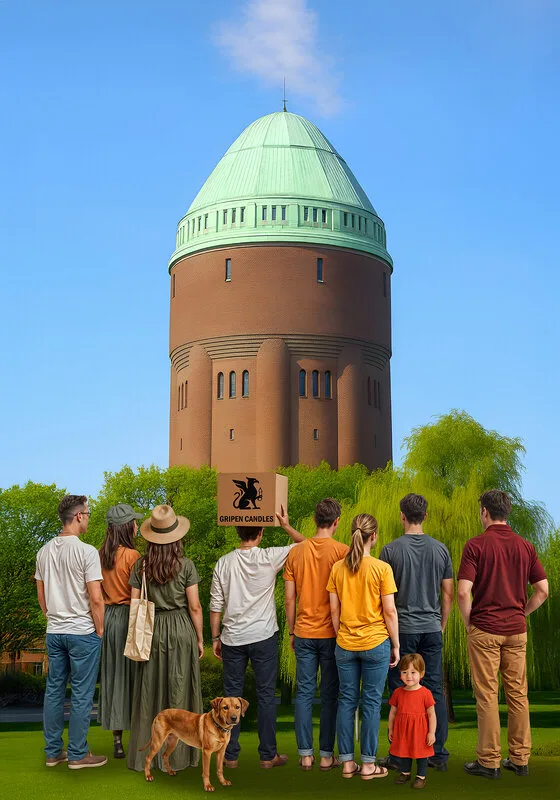
Priapos' Tower, 2025
Digital
50 x 70 cm
3 200 kr
Priapos' Tower
In Praise of the Upright, there are many ways to measure a civilisation, but height has long been one of the favourites. From the first standing stone to the latest glass spire, humanity has kept building monuments that reach insistently upward — as if to remind the heavens who started this competition in the first place.
No creature on Earth has been so fixated on verticality. Trees grow, mountains rise, volcanoes erupt, but only humans insist on calling it art. We have built towers for gods, kings, corporations, and the idea of progress itself. When we run out of deities, we dedicate our structures to ourselves. These towering structures, a testament to our ingenuity, never fail to inspire awe and amazement, evoking a sense of wonder that transcends time and culture, and leaves us in awe of our own capabilities.
It is a habit that walks the fine line between brilliance and farce. Each century has its Priapus — the patron saint of civic overconfidence — and each skyline its moral guardian, ready to blush on cue. What started as a plea for immortality—a desperate desire to leave a mark that time cannot erase—has turned into a contest of prominence: whoever stands tallest wins.
Yet behind the grandeur lies a fragile truth. The tower, however monumental, is merely a gesture — a vertical sigh of mortality. Beneath every steeple and obelisk lurks the same anxiety: that time will one day bring everything down. The pyramid, the minaret, the skyscraper — all are architectural prayers against gravity, a universal fear of mortality that unites us all, reminding us of our shared human experience and the fleeting nature of life. It's a sobering reminder of our shared humanity and the inevitability of our mortality.
This essay traces those prayers through time, from the stony ambitions of ancient Egypt to the mirrored façades of Fifth Avenue, from the divine indecencies of Greek myth to the civic comedy of modern Malmö. It is, in short, a brief history of human stiffness — the will to rise, to outshine, and, occasionally, to laugh at ourselves in the process. This journey of ambition and the enduring quest for immortality is a fascinating one, highlighting the continuous evolution of human ambition.
“Priapus Rising – A Ballad of Lofty Ambitions
From desert dust to mirrored glass,
Each age repeats the selfsame farce;
A tower thrusts, a steeple gleams —
Another man has immortal dreams.
Old Keops stacked his stones so neat,
To rest his pride beneath his feet;
The higher built, the more divine —
And left the workers dead in line.
Then Shah Jahan, in marble white,
Erected love in lunar light;
He swore it was for wedded grace—
But carved, in truth, his own proud face.
The Caesars raised their golden spires,
The Popes lit up their holy pyres;
Each king and sultan took a turn
To prove how high his faith could burn.
From Babel’s tongue to Babylon,
Each age insists the sky’s our home;
Yet every tower’s haughty head
Soon learns to bow when mortals bled.
And then came Trump, with gilded grin,
A Pharaoh draped in fake-tanned skin;
His glass obelisk pierced the skies—
A monument to compromise.
Now Malmö’s water tower stands,
As sturdy as its builder’s hands;
A civic joke, a local charm,
That points to heaven, safe from harm.
So raise your steeples, domes, and rods,
Your Babels, Burjs, and house of gods;
Each claims to reach eternal heights—
But ends as scaffolds for our rites.
The moral, friends? It’s rather plain:
The taller built, the more in vain.
For all our stones and steel and fuss,
The biggest joke is still on us.”
Malmö. October 2025
Priapus’ Tower – A Short History of Human Stiffness, a title that alludes to the Greek god Priapus, known for his exaggerated phallus. This connection sets the stage for our exploration of phallic symbols in architecture.
They appear here and there, one taller than the next, all striving to showcase the greatness of someone or something—particularly in relation to everything around them, which often extends far beyond the horizon. Some creations make the grotesquely exaggerated penis of Priapus seem laughably small. The structure need not even resemble a phallus, as long as it fulfils its purpose: to dominate the skyline and showcase its creator’s glory. A square pyramid, after all, remains unrivalled. Constructing 2.3 million stone blocks weighing approximately 6 million tons was perhaps a challenge never to be surpassed. It's a bit like a cosmic joke —a testament to human ambition and the lengths we will go to leave our mark on the world.
Throughout history, the form has varied, yet few monuments appear as convincingly glans-like as Malmö’s water tower in the photograph. The intention can, of course, be obscured by dedicating one’s creation to a higher cause—a god, a moral virtue, or a departed spouse—so long as everyone is constantly reminded of the sender, so to speak. This variety in cultural interpretations of phallic symbols — from the grandeur of the Taj Mahal to the simplicity of the Cerne Abbas Giant — is a testament to the richness and diversity of human belief systems, fostering profound respect and appreciation for different cultures.
From Keops to Taj Mahal
That Cheops’s soul was preserved for eternity supposedly guaranteed everyone’s own immortality. The Taj Mahal, a Maharaja’s tribute to his deceased wife, was naturally the ultimate proof of his own greatness. The eight million visitors who pass through its gates each year probably give little thought to who the wife actually was, blinded by this architectural marvel — one of the seven wonders of the world — built by Shah Jahan the Magnificent. These monuments, standing the test of time, remind us of the enduring legacy of human ambition and creativity, inspiring awe and reverence. The grandeur of the Taj Mahal, in particular, evokes a sense of wonder and admiration. It's like comparing a grand romantic gesture to a cosmic insurance policy.
It is unlikely that anyone today would build a mausoleum for a deceased spouse. The twenty-first century presents new possibilities: conquering space and being the first on Mars would surely overshadow the Pyramid of Cheops. As a symbol of masculinity, a patch of land on the red planet would be difficult to surpass.
Priapus Returns in Gold – From Pharaohs to Fifth Avenue
The trick, of course, is the same one used by everyone with power and wealth. Cheops stole from his people to build his monument to himself. Donald Trump snuck the recipe into Trump Tower when he built it.
The Trump Tower, with its opulence and grandeur, served as a physical manifestation of Trump's wealth and power, reinforcing his image as a successful businessman. People may mock it as much as they like—very few men in their lifetimes can construct an edifice of that calibre and magnitude on Fifth Avenue, in what they call “the most important city in the world.” The tower's design and location played a crucial role in shaping public perception of Trump, demonstrating the profound influence of architecture in shaping cultural narratives.
In a 1998 BBC Hard Talk interview, Trump declared: “I love building great buildings… I get great artistic pride out of a great building like Trump Tower.” Its mirrored glass style embodied the 1980s creed that greed was good. The building initially caused a sensation; reportedly, 100,000 people visited the atrium each Saturday during the holidays, in total, almost as many as the Taj Mahal receives in a year.
Luxury brands such as Buccellati and Charles Jourdan were tenants. Steven Spielberg maintained a pied-à-terre, and Michael Jackson owned a duplex with a dance studio. Trump, naturally, reserved the best for himself: a 1,000-square-metre penthouse spanning three floors. Few buildings are as strongly associated with their owners in the public imagination as Trump Tower. The Trump Organisation, one suspects, will fight to its last breath to protect its symbol of power.
The Cerne Abbas Giant is a hill figure near the village of Cerne Abbas, in Dorset, England. The National Trust currently owns it and lists it as a scheduled monument of England. Measuring 55 metres (180 ft) in length, the hill figure depicts a bald, nude male with a prominent erection, holding his left hand out to the side and wielding a large club in his right hand. This figure, believed to be a symbol of fertility, has been a subject of fascination and debate for centuries. Some think it represents the Roman god Hercules, while others see it as a Celtic deity. This diversity of interpretations adds to the rich tapestry of cultural symbolism associated with phallic structures, fostering respect and appreciation for different cultures.
But times change, and so do phallic symbols. When New York woke from its cocaine-fuelled 1980s party, it became clear that not everything that glittered was gold—most of it was brass. Retailers hesitated at the sky-high rents and departed. The glitterati who once resided there—Johnny Carson, Sophia Loren—were replaced by “Medicaid cheats, coke dealers, mobsters,” as journalist Wayne Barrett wrote in The Village Voice. This evolution of phallic symbols reflects the changing societal norms and values, prompting us to reflect on our past and present.
It mattered little to Trump; the bill had already been settled by others, of course. His name remains his most valuable asset, far surpassing the bricks and mortar. The building itself is part of a network of companies and private investors. What Trump claims to own actually belongs to an opaque property company of uncertain parentage. Yet the Trump Tower, with its towering height and unmistakable shape, is a clear embodiment of phallic symbolism, inseparable from Donald Trump himself.
In the realm of phallic symbols, form matters little; what matters is that it rises—or protrudes. Trump Tower’s 202 metres, only marginally taller than Malmö’s Turning Torso, have long been overshadowed by local rivals such as 425 Park Avenue, more than twice its height. But in the world of phallic symbols, no street address surpasses a Trump Tower.
The Fetish of Height – From Babel to Burj Khalifa
Long before Freud, humanity was already fascinated by height. The Tower of Babel was the first skyscraper — and the initial moral lesson in overreach. Every era since has repeated this pattern: the higher we ascend, the more divine we feel, and the more spectacular the fall.
In the industrial age, ambition grew upwards. Smoke stacks, radio masts, and observation towers became secular cathedrals, proclaiming the new religion of progress. The Eiffel Tower was mocked as a monstrosity when it opened in 1889; within a generation, it became the world’s most beloved exclamation mark.
The twentieth century transformed the phallus into policy. Cities competed for altitude as monarchs once competed for crowns. New York built the Empire State Building, Chicago responded with the Sears Tower, and Dubai — ever bold — thrust the Burj Khalifa into the clouds, nearly a kilometre high. Saudi Arabia is now planning the Jeddah Tower, promising to pierce the very edge of heaven, as if daring God to unleash another flood.
We often regard skyscrapers as feats of engineering, but they are truly monuments to ego. Each new tower starts as an act of defiance and ends up as a tourist attraction. The skyline has taken the place of the cathedral; ambition has replaced awe.
Yet even the tallest building remains, at its core, a modern pyramid: a massive stone of self-assertion supported by the labour of thousands. Humanity has never ceased building tombs — it has simply replaced the sarcophagus with a penthouse.
World’s Most Phallic Buildings
A contest once organised by Cabinet magazine aimed to find the most phallic-looking building in the world. The water tower in Ypsilanti, Michigan—known locally as The Brick Dick—won the title. Standing at forty-five metres tall, it proudly displays its brick-red form, exuding virility. The contest was a lighthearted way to explore the prevalence of phallic symbols in architecture and the often humorous interpretations of these structures. Seriously, what were the engineers thinking in 1889? An urban legend suggests the tower will collapse if a virgin graduates from nearby Eastern Michigan University.
The judges clearly overlooked Malmö’s own Södervärn Water Tower—both taller (fifty-four metres) and, by any standard, far more elegant. And also by the locals called the Malmö Dick.
The Torre Agbar in Barcelona, Spain, a thirty-two-storey tower, evokes a similar image. Its shape closely resembles Malmö’s phallic water tower; either someone copied the blueprints or the architect was watching pornography during the design phase. At 142 metres, the Spanish version falls short compared to the Turning Torso’s angular tip—though that, admittedly, makes little difference unless one is referring to literal intercourse.
From Hohle Fels to Reykjavík – A Brief Archaeology of the Phallus
Phallic symbols, of course, have a long and storied history. The Hohle Fels Phallus, found in a German cave, is among the earliest representations of male sexuality ever discovered. The twenty-centimetre-long, three-centimetre-wide object, dated to around 28,000 years ago, was carved and polished by the Gravettian culture near Ulm in southern Germany. Given its proportions, it may well have served as both a totem and a sexual toy—a multipurpose innovation long before multitasking became fashionable. This early example of a phallic symbol stands as a testament to the enduring fascination with male sexuality and power, and the profound role it played in shaping our cultural history, as it represents the earliest known instance of phallic symbolism in human culture.
Jumping forward a few thousand years, Iceland’s Phallological Museum in Reykjavík boasts the world’s most extensive collection of penises and penile parts—over 300 specimens from more than 100 species of mammals, along with twenty-two imagined members from Icelandic folklore. This diverse collection is a testament to the universal fascination with phallic symbols, transcending cultural and geographical boundaries.
The Female Counterpart – From Venus to the Void
If Priapus, the god of protrusion and male sexuality, is the counterpart, Venus is the goddess of presence and female fertility. Where the phallus thrusts upwards, she opens inwards. While men have historically constructed towers, women shaped the first bowls, temples, and hearths — the architecture of containment rather than conquest.
The Palaeolithic Venus of Willendorf, carved thirty thousand years ago, was small enough to fit into a palm but bore the weight of the world. Her rounded belly and ample thighs symbolised abundance, not ambition. She was not made to be observed from afar but to be held close — a portable eternity.
Across millennia, the feminine symbol, which represents nurturing, containment, and life-giving, endured in the yoni shrines of India, the cup-shaped altars of Minoan Crete, and the domed churches of Byzantium. Cathedrals, too, are secretly female. The nave — from navis, meaning womb or vessel — embraces the congregation within arches that curve like ribs. Light shines through stained glass as if through living skin. Even the word matrix — once meaning “mother” — Endures in mathematics, medicine, and mythology alike.
Modern architecture has forsaken this symmetry. Steel has replaced clay; the vertical has triumphed over the circular. Yet the goddess persists, concealed within curves, fountains, and gardens. Georgia O’Keeffe painted her deserts as if they were open petals. Louise Bourgeois sculpted her spiders as guardians of the maternal.
If Priapus embodies the will to ascend, Venus signifies the wisdom to stay. Between them lies the entire history of human creation — the eternal dialogue between the tower and the cave, between what reaches out and what receives. It's this balance, this harmony, that has shaped our world.
Napoleon’s Private Part
The most famous detached penis in history allegedly belonged to Napoleon Bonaparte. Removed during his autopsy in 1821, it has passed through several owners and now belongs to the family of American urologist John K. Lattimer, who purchased it in 1977. The relic has been mocked for its tiny size, described as “a shrivelled eel” or “a piece of leather.” So le petit caporal was not merely his nickname — it was his measurement.
When Christie’s, a renowned auction house, failed to sell Napoleon’s relic at auction in 1969, one London newspaper quipped, “Not tonight, Josephine.” This episode, which was a part of a larger auction of historical artefacts, inspired Tony Perrottet’s book Napoleon’s Privates: 2,500 Years of History Unzipped, a collection of the most intimate absurdities in history.
Of Size, Significance, and Survival
Whether size matters depends entirely on context. The phrase "the phrase size doesn’t matter" is often used to deflect embarrassment, but in politics, economics, and most public spectacles, it clearly does. In traffic as in life, the largest vehicle goes first—assuming the rest wish to survive.
Regarding record-holders, the man believed to have the world’s longest penis is Jonah Falcon, an American whose measurements—thirty-four centimetres erect—have both fascinated and gained sympathy. Falcon's experience with his organ, including the potential health risks and his decision to donate it to a museum, sheds light on the cultural perceptions of masculinity and the significance of size in modern society.
Priapus and the Grotesque
In Greek art, the most enormous genitals were reserved not for heroes but for fools and satyrs—half-human, half-horse spirits of the forest, with absurd proportions. Priapus, the god of fertility, possessed an impossibly large and permanently erect penis. He was seen as hideous, comic, and entirely unfit for polite society. The moral appears clear: the bigger the symbol, the less attractive the bearer. It's a reminder of the absurdity of some historical beliefs, which can bring a smile to your face.
What cannot be shown can still be suggested. Thus, the development of the codpiece—from the Middle English 'cod', meaning scrotum—was a triangular flap covering the front of men’s hose in the fifteenth and sixteenth centuries. Initially merely practical, by the time of Henry VIII, it had become a proud, pointed projection of masculinity, often reinforced with boiled leather or steel.
The Modern Codpiece
The codpiece persisted in a subtler form: the ballet bulge, the discreet upward curve of the rock star’s trousers, the digital smoothing of female anatomy for “safety reasons.” In today’s AI-regulated imagery, modest protrusion is allowed, but female curves are subtly airbrushed away. It's an ironic reflection of modern standards, where modesty is permitted for one gender but not the other, prompting us to reflect on the societal norms we accept.
It is, after all, the same country where every major sporting event starts with teenage cheerleaders kicking their legs sky-high—an innocent tradition defended with the passion of a constitutional right. The line between choreography and pornography, between pride and display, remains as blurred as ever.
The Moral Matrons – Blushing at the Skyline
No civilisation is complete without its moral matrons — the self-appointed guardians of propriety, constantly balancing between outrage and curiosity. They appear throughout history like a recurring chorus of modesty: in togas, in corsets, in sensible shoes. These figures, often women, play a crucial role in shaping societal norms and values, particularly regarding public displays of power and sexuality.
When the first obelisks appeared in ancient Egypt, the priestesses frowned; when Michelangelo carved David, the nuns looked away; when the Eiffel Tower was unveiled, Parisian ladies called it obscene. Every era regards its skyline as indecent.
Malmö has its own chapter in this tradition. When the Södervärn water tower was erected, rumours floated that it was “too suggestive.” Local newspapers received letters from concerned citizens questioning whether the city’s water pressure had become morally inflated. The architect responded — quite honestly — that the shape was purely functional. This, of course, only made matters worse.
The moral matrons have observed every emerging form, tutting loyally beneath each new horizon. Their mission is eternal: to ensure that desire stays tasteful, that art keeps disciplined, and that towers remember their true purpose.
And yet, secretly, we owe them gratitude. Without their protests, half of history’s monuments would lack an audience. Every scandal needs its spectators; every upright structure, its disapproving glance. In the grand theatre of human ambition, the moral matron is not a villain but an essential critic — forever clutching her pearls, ensuring the show goes on. Their role is not to stifle creativity but to ensure it remains within the bounds of propriety, making them indispensable in shaping societal norms.
Epilogue – The City’s Private Part
And perhaps that is the secret charm of Malmö’s own contribution to its long, upright history. Locals call it by many names, some affectionate, some less so. One suggestion has been Malmö’s Private Part—a phrase both polite and mischievous, ideally suited to British embarrassment. In Swedish, however, such understatement is impossible: between “Malmös kuk” (Malmö’s Dick) and the town’s Moral guardians, there lies only a nervous laugh. This cultural difference in perception offers a fascinating insight, inviting us to explore and understand the diverse ways people view the world.
Others prefer a more classical allusion: Priapus’ Tower—Malmö’s modest monument to the eternal urge to ascend. It stands, like all its predecessors from Egypt to Fifth Avenue, as proof that humanity’s greatest ambition has never been to reach the heavens, but to ensure that something of its own creation points steadfastly in that direction. This enduring symbol of human ambition can inspire us to reflect on our own aspirations and the legacies we hope to leave behind.
We certainly live in a wacky and wonderful world.
PS.
Why the Dog and the Child Look Away
While the adults are engrossed by the 'great civic phallus', a symbol of power and authority, and its monumental absurdity, the child and the dog remain unfazed. This 'great civic phallus' is a metaphor for the societal structures and norms that adults often revere and aspire to, but to the child and the dog, these hold no enigma or charm. To them, the world is already replete with towering entities; these structures have no enigma or charm. Height is simply a part of their everyday existence.
The girl, with the calm logic of innocence, sees no reason to look up when the ground is full of wonders. Her innocence, untainted by societal norms, is a beacon of purity. The dog, with his unwavering loyalty, instead looks towards the viewer, as if to ask what all the fuss is about. And the ground is full of smells.
Together, they boldly scatter the spell of reverence, the societal expectation that we must admire and aspire to great heights. This 'spell of reverence' is the societal pressure to conform to certain norms and values, often symbolised by looking up at towering structures. Their resolute refusal to join the upward gaze becomes a small act of rebellion — a reminder that not everyone needs to reach for the sky. After all, what could possibly be worth seeing up there?
3 200 kr

Jörgen Thornberg
Malmö
Lite om bilder och mig. Translation in English at the end.
Jag är en nyfiken person som ser allt i bilder, även det jag fäster i ord, gärna tillsammans för bakom alla mina bilder finns en berättelse. Till vissa bilder hör en kortare eller längre novell som följer med bilden.
Bilder berättar historier. Jag omges av naturlig skönhet, intressanta människor och historia var jag än går. Jag använder min kamera för att dokumentera världen och blanda det jag ser med vad jag känner för att fånga den dolda magin.
Mina bilder berättar mina historier. Genom mina bilder, tryck och berättelser. Jag bjuder in dig att ta del av dessa berättelser, in i ditt liv och hem och dela min mycket personliga syn på vår värld. Mer än vad ögat ser. Jag tänker i bilder, drömmer och skriver och pratar om dem; följaktligen måste jag också skapa bilder. De blir vad jag ser, inte nödvändigtvis begränsade till verkligheten. Det finns en bild runt varje hörn. Jag hoppas att du kommer att se vad jag såg och gilla det.
Jag är också en skrivande person och till många bilder hör en kortare eller längre essay. Den följer med tavlan, tryckt på fint papper och med en personlig hälsning från mig.
Flertalet bilder startar sin resa i min kamera. Enkelt förklarat beskriver jag bilden jag ser i mitt inre, upplevd eller fantiserad. Bilden uppstår inom mig redan innan jag fått okularet till ögat. På bråkdelen av ett ögonblick ser jag vad jag vill ha och vad som kan göras med bilden. Här skall jag stoppa in en giraff, stålmannen, Titanic eller vad det är min fantasi finner ut. Ännu märkligare är att jag kommer ihåg minnesbilden långt efteråt när det blir tid att skapa verket. Om jag lyckas eller inte, är upp till betraktaren, oftast präglat av en stråk av svart humor – meningen är att man skall bli underhållen. Mina bilder blir ofta en snackis där de hänger.
Jag föredrar bilder som förmedlar ett budskap i flera lager. Vid första anblicken fylld av feel-good, en vacker utsikt, fint väder, solen skiner, blommor på ängen eller vattnet som ligger förrädiskt spegelblankt. I en sådan bild kan jag gömma min egentliga berättelse, mitt förakt för förtryckare och våldsverkare, rasister och fördomsfulla människor - ett gärna återkommande motiv mer eller mindre dolt i det vackra motivet. Jag försöker förena dem i ett gemensamt narrativ.
Bild och formgivning har löpt som en röd tråd genom livet. Fotokonst känns som en värdig final som jag gärna delar med mig.
Min genre är vid som framgår av mina bilder, temat en blandning av pop- och gatukonst i kollage som kan bestå av hundratals lager. Vissa bilder kan ta veckor, andra någon dag innan det är dags att överlämna resultatet till printverkstaden. Fine Art Prints är digitala fotocollage. I dessa kollage sker rivandet, klippandet, pusslandet, målandet, ritandet och sprayningen digitalt. Det jag monterar in kan vara hundratals år gamla bilder som jag omsorgsfullt frilägger så att de ser ut att vara en del av tavlan men också bilder skapade av mig själv efter min egen fantasi. Därefter besöks printstudion och för vissa bilder numrera en limiterad upplaga (oftast 7 exemplar) och signera för hand. Vissa bilder kan köpas i olika format. Det är bara att fråga efter vilka. Gillar man en bild som är 70x100 men inte har plats på väggen, går den kanske att få i 50x70 cm istället. Frågan är fri.
Metoden Giclée eller Fine Art Print som det också kallas är det moderna sättet för framställning av grafisk konst. Villkoret för denna typ av utskrifter är att en högkvalitativ storformatskrivare används med åldersbeständigt färgpigment och konstnärspapper eller i förekommande fall på duk. Pappret som används möter de krav på livslängd som ställs av museer och gallerier. Normalt säljer jag mina bilder oinramade så att den nya ägaren själv kan bestämma hur de skall se ut, med eller utan passepartout färg på ram, med eller utan glas etc..
Under många år ställde jag bara ut på nätet, i valda grupper och på min egen Facebooksida - https://www.facebook.com/jorgen.thornberg.9
Jag finns också på en egen hemsida som tyvärr inte alltid är uppdaterad – https://www.jth.life/ Där kan du också läsa en del av de berättelser som följer med bilden.
UTSTÄLLNINGAR
Luftkastellet, oktober 2022
Konst i Lund, november 2022
Luftkastellet, mars 2023
Engleson Galleri Caroli, april 2023
Hydra, Greece June 2023
Engleson Galleri Caroli, oktober 2023
Toppen, Höllviken december 2023
Luftkastellet, mars 2024
Torups Galleri, mars 2024
Venice, May 2024
Luftkastellet, oktober 2024
Konst i Advent, December 2024
Galleri Engleson, Caroli December 2024
Jäger & Jansson Galleri, april 2025
A bit about pictures and me.
I'm a curious person who sees everything in pictures, even what I express in words, often combining them, for behind all my pictures lies a story. These narratives, some as short as a single image and others as long as a novel, are the heart and soul of my work.
Pictures tell stories. Wherever I go, I'm surrounded by natural beauty, exciting people, and history. I use my camera to document the world and blend what I see with what I feel to capture the hidden magic.
My images tell my stories. Through my pictures, prints, and narratives, I invite you to partake in these stories in your life and home and share my deeply personal perspective of our world. More than meets the eye. I think in pictures, dream, write, and talk about them; consequently, I must create images too. They become what I see, not necessarily confined to reality. There's a picture around every corner. I hope you'll see what I saw and enjoy it.
I'm also a writer, and many images come with a shorter or longer essay. It accompanies the painting, printed on fine paper with my personal greeting.
Many pictures start their journey on my camera. Simply put, I describe the image I see in my mind, experienced or imagined. The image arises within me even before I bring the eyepiece to my eye. In a fraction of a moment, I see what I want and what can be done with the picture. Here, I'll insert a giraffe, Superman, the Titanic, or whatever my imagination conjures up. Even stranger is that I remember the mental image long after it's time to create the work. Whether I succeed is up to the observer, often imbued with a streak of black humour – the aim is to entertain. My pictures usually become a talking point wherever they hang.
I prefer pictures that convey a message in multiple layers. At first glance, they're filled with feel-good vibes, a beautiful view, lovely weather, the sun shining, flowers in the meadow, or the water lying deceptively calm. But beneath this surface beauty, I often conceal a deeper story, a narrative that challenges societal norms or explores the human condition. I invite you to delve into these hidden narratives and discover the layers of meaning within my work.
Picture and design have been a thread running through my life. Photographic art feels like a fitting finale, and I'm happy to share it.
My genre is varied, as seen in my pictures; the theme is a blend of pop and street art in collages that can consist of hundreds of layers. Some images can take weeks, others just a day before it's time to hand over the result to the print workshop. Fine Art Prints are digital photo collages. In these collages, tearing, cutting, puzzling, painting, drawing, and spraying happen digitally. What I insert can be images hundreds of years old that I carefully extract so they appear to be part of the painting, but also images created by myself, now also generated from my imagination. Next, visit the print studio and, for certain images, number a limited edition (usually 7 copies) and sign them by hand. Some images may be available in other formats. Just ask which ones. If you like an image that's 70x100 but doesn't have space on the wall, you might be able to get it in 50x70 cm instead. The question is open.
The Giclée method, or Fine Art Print as it's also called, is the modern way of producing graphic art. This method ensures the highest quality and longevity of the artwork, using a high-quality large-format printer with archival pigment inks and artist paper or, in some cases, canvas. The paper used meets the longevity requirements set by museums and galleries. I sell my pictures unframed, allowing the new owner to personalise their artwork, confident in the lasting value and quality of the piece.
For many years, I only exhibited online, in selected groups, and on my Facebook page - https://www.facebook.com/jorgen.thornberg.9. I also have my website, which unfortunately is not constantly updated - https://www.jth.life/. You can also read some of the stories accompanying the pictures there.
EXHIBITIONS
Luftkastellet, October 2022
Art in Lund, November 2022
Luftkastellet, March 2023
Engleson Gallery Caroli, April 2023
Hydra, Greece June 2023
Engleson Gallery Caroli, October 2023
Toppen, Höllviken December 2023
Luftkastellet, March 2024
Torup Gallery, March 2024
Venice, May 2024
UTSTÄLLNINGAR
Luftkastellet, oktober 2022
Konst i Lund, november 2022
Luftkastellet, mars 2023
Engleson Galleri Caroli, april 2023
Hydra, Greece June 2023
Engleson Galleri Caroli, oktober 2023
Toppen, Höllviken december 2023
Luftkastellet, mars 2024
Torups Galleri, mars 2024
Venice, May 2024
Luftkastellet, October 2024
Konst i Advent, December 2024
Galleri Engleson, Caroli December 2024
Jäger & Jansson Galleri, April 2025
Utbildning
Autodidakt
Medlem i konstnärsförening
Öppna Sinnen
Med i konstrunda
Konstrundan i Skåne
Utställningar
Luftkastellet, October 2022
Art in Lund, November 2022
Luftkastellet, March 2023
Engleson Gallery Caroli, April 2023
Hydra, Greece June 2023
Engleson Gallery Caroli, October 2023
Toppen, Höllviken December 2023
Luftkastellet, March 2024
Torup Gallery, March 2024
Venice, May 2024