Vi använder cookies för att ge dig bästa möjliga upplevelse. Välj vilka cookies du tillåter.
Läs mer i vår integritetspolicy
Jörgen Thornberg
Utan titel, 2025
Digital
50 x 70 cm
3 200 kr
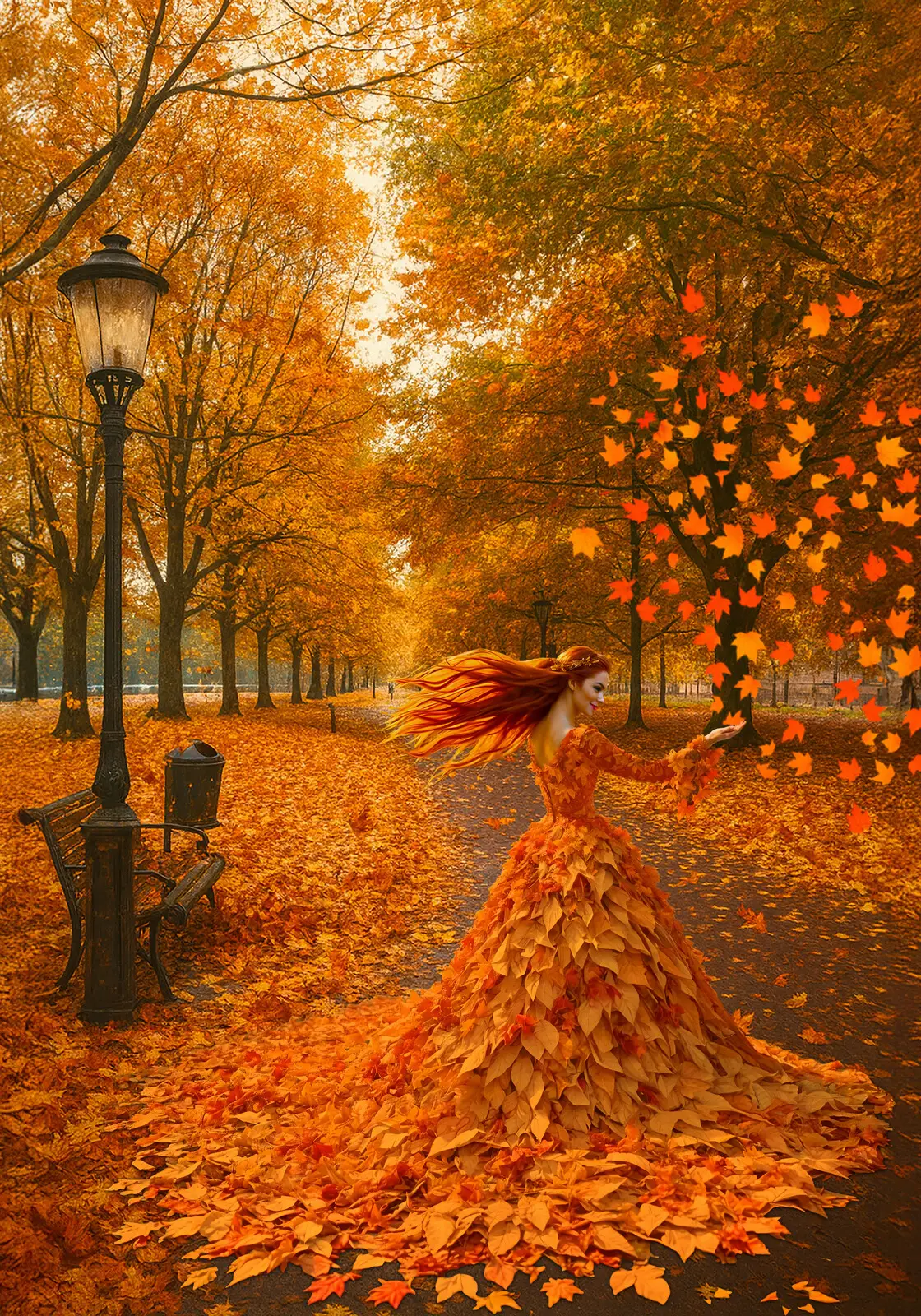
Persephone Scattering Her Autumn Leaves
The title celebrates the enduring power of myth to reveal the unseen forces that shape nature, time, and the human soul. In this essay, the ancient goddess acts both as a symbol and a narrator — the red-haired spirit of autumn whose gesture connects decay with renewal, darkness with light. Through her, the old wisdom of the seasons is reborn: that all things must fall so they may rise again.
Embedded in the myth of Demeter and Persephone — one of humanity’s earliest allegories of loss and return — the text reflects on how ancient stories, timeless in their relevance, continue to reside within the natural world. Persephone’s descent and re-emergence mirror the rhythm of our own lives: the cycles of grief and growth, of endings that give rise to beginnings.
In an age that tracks time through data and progress rather than seasons and renewal, her story reminds us of what we risk forgetting — that the world’s deepest truths still linger beneath the surface, in the turning of the leaves and the silence of the soil.
“Persephone’s Autumn Hymn
She stirs the trees with whispered grace,
Her breath a chill the woods embrace.
Each leaf she plucks, once green, now gold,
Becomes a tale of life retold.
She scatters time with gentle hands,
Across the fields, the sleeping lands.
Each falling flame, each drifting hue,
Is winter’s seed — and spring’s debut.
She spins decay to silken thread,
A crown of dusk upon her head.
Through rust and amber, soft and slow,
She teaches earth the art of woe.
For death, she says, is not an end,
But just the curve where seasons bend.
And every leaf the wind lets fall
Will one day answer April’s call.”
Malmö. October 2025
Persephone Scattering Her Autumn Leaves
Our age often forgets—and even hides—the profound knowledge and wisdom that once shaped human understanding. What does not align with modern science is quietly dismissed as myth, poetry, or superstition. Yet, the enduring influence of the ancient divinities, unseen but ever-present, is a testament to a deeper, timeless wisdom that may well be among us, shaping our lives and understanding in ways we may not fully comprehend.
You can almost feel their breath in the change of seasons, in the shifting moods of the weather, in the unseen rhythms of life and decay, where life gives way to death and death gives way to life. Take autumn, for example. The trees give up their green attire and turn to gold before an unseen force gathers their fading leaves and scatters them across the neighbourhood. Who is it that plucks these once-living leaves from the branches and lays them down like snow upon the ground?
If you look closely—beyond the ordinary, with the eyes of an older, wiser person—you might catch a glimpse of her. A red-haired woman darting through the wind like a restless bird, plucking one leaf here, another there, her arms full of the crimson, amber, and ochre colours of the season. Her actions, shrouded in enigmatic mystery, not only invite us to wonder and question but also keep us engaged, always pondering the unseen forces at play in the world.
The resemblance is no coincidence, for this is Persephone, goddess of autumn, scattering the seeds of winter. Just as the sower plants grains that will sprout when warmth returns, Persephone sows the cold that will sleep beneath the drifts of leaves until the cycle begins anew. Her actions, shrouded in mystery, serve as a powerful reminder of the cyclical nature of life, where what withers will rise again, and what sleeps will one day awaken. It's a reminder not just of the inevitability of change but also of the promise of renewal, inspiring hope in our hearts.
Persephone, a figure of unrivalled complexity in Greek mythology, symbolises both life and death, spring and decay, innocence and power. Her mysterious duality, which has fascinated poets, philosophers, and artists for over two millennia, reflects the human experience. Her story resonates with us because it mirrors the constant cycle of life and death, the ever-present tension between innocence and power. It's this fascination with her duality that keeps us engaged with her story.
Origins and Family
Persephone (Περσεφόνη in Greek), also known by her older name Kore (meaning “maiden” or “girl”), is the daughter of Demeter, the goddess of grain and fertility, and Zeus, the king of the gods. She grew up in the luminous meadows of the upper world, a place of eternal spring and abundance, surrounded by flowers, nymphs, and the laughter of eternal youth. This setting is significant because it represents the innocence and beauty of youth, a stark contrast to the underworld's darkness and decay.
But her beauty drew the gaze of Hades, lord of the underworld, who fell in love with her and decided to make her his queen.
The Abduction (The Rape of Persephone)
One day, as Persephone gathered flowers in a field — often said to be the plain of Enna in Sicily — the earth split open, and Hades appeared in his golden chariot drawn by black horses. He seized the young goddess and took her down into the darkness.
This event, known as The Rape of Persephone (raptio in Latin, meaning abduction rather than sexual assault in the ancient sense), became one of the central myths explaining the origin of the seasons.
When Demeter discovered her daughter's absence, her heart shattered into a million pieces. She roamed the world, refusing to let crops flourish until Persephone was returned. Famine gripped the earth, and people began to wither away.
Finally, Zeus intervened by sending Hermes to the underworld to negotiate Persephone’s release. However, Hades tricked her into eating six pomegranate seeds — a binding act that tethered her to his realm.
The Cycle of the Seasons
A compromise was struck: Persephone would spend six months of the year with Hades in the underworld, and six months with her mother on Earth. Her return each spring was a cause for jubilation for Demeter, and nature burst into bloom once more. But when she descended back to Hades, the earth mourned — the trees shed their leaves, and winter's chill set in.
Thus, Persephone, with her alternating presence in the underworld and on earth, became the living symbol of renewal and loss, life and death intertwined — the eternal rhythm of nature itself.
Persephone’s Dual Nature
Persephone’s character is a testament to her strength, defined by her dual nature. She is both Kore, the innocent maiden of the flowers, and Persephone, the mighty Queen of the Dead. This tension, often depicted in art and literature, symbolises transition — the boundary between sunlight and shadow, birth and death, innocence and wisdom.
In her role as Kore, she embodies the vibrant, youthful energy of life — the promise of spring and the bounty of harvest. Yet as Queen of the Underworld, she remains unwavering and composed, guiding souls into the afterlife and reigning alongside Hades with quiet authority. Unlike the fearsome or monstrous figures often linked with death, Persephone rules the underworld with balance, compassion, and steadfast justice.
The Mysteries of Eleusis
The myth of Persephone and Demeter inspired the Eleusinian Mysteries, the most sacred religious rituals of ancient Greece. These secret ceremonies, held annually near Athens, offered initiates a glimpse of divine truth and the hope of rebirth after death. The rituals reenact Persephone’s descent into the underworld and her triumphant return, symbolising the soul’s immortality and the eternal cycle of renewal. The Eleusinian Mysteries were a significant part of ancient Greek religious life, and their connection to Persephone's myth underscores her cultural importance.
To speak her name within these mysteries was an act of reverence. The initiates believed that, through Persephone’s journey, they too might overcome the terror of mortality and find light beyond the darkness.
Symbolism and Legacy
Persephone’s story, a timeless tale of transformation and duality, has inspired numerous reinterpretations over the centuries. To the ancients, she was the explanation for the changing of the seasons. To poets, she became the mirror of human experience — the oscillation between joy and sorrow, youth and ageing, presence and absence. Her story, with its rich symbolism and profound themes, continues to resonate with us, offering a connection to a cultural heritage that spans millennia and remains as relevant today as it was in ancient times, enriching our understanding of the world and our place in it.
In Renaissance art, she frequently appears as a calm, luminous figure emerging from shadows, her hands holding flowers or pomegranate seeds. In Romantic poetry, she is depicted as the eternal bride — loved and destined by fate. Modern feminists have reimagined her not as a victim of abduction, but as a woman who gains agency through transformation — one who descends into darkness and returns stronger, wiser, and sovereign over both worlds.
The Pomegranate
The pomegranate, Persephone’s fruit, has become one of the most potent symbols in mythology. Its red seeds symbolise both life and captivity, fertility and bondage. In eating them, Persephone partook of the underworld’s essence; she became forever tied to its cycles, unable to return to her former innocence fully. Yet, in doing so, she also gained power. The act that condemned her also elevated her. The pomegranate, with its paradoxical symbolism, invites us to ponder the transformative power of knowledge and the complex nature of life's experiences.
The pomegranate thus serves as a paradox of transformation — to taste knowledge is to lose purity, but also to gain depth. Artists have long used the fruit as a metaphor for the tension between desire and consequence, and as a reminder that every blossoming life carries within it the promise of decay, and every ending holds the seed of renewal.
Persephone in Art and Literature
From antiquity to the present, Persephone’s image has transformed. In Greek vase paintings, she is depicted as a luminous maiden, often beside Demeter or emerging from Hades’ chariot. In classical sculpture, her composed and distant gaze mirrors her dual rule over the fertile fields above and the silent realm below. This 'dual rule' refers to Persephone's unique position as both a goddess of life and fertility in the upper world, and as the Queen of the Dead in the underworld. This duality is a key aspect of her character and is often depicted in art and literature.
Dante invoked her shadow in The Divine Comedy, while Ovid, in his Metamorphoses, made her story the focus of his reflections on transformation. In later centuries, artists like Rossetti and Waterhouse depicted her as a Pre-Raphaelite muse, caught between innocence and desire. In the twentieth century, poets such as Louise Glück (Averno) and Margaret Atwood revisited her as a voice of female self-discovery — no longer a passive victim, but a self-aware goddess of thresholds, embracing both her light and her darkness.
Modern Resonance
Persephone's story is not just a myth, but a reflection of the rhythm of every human life. It mirrors the fall into grief, the slow re-emergence into light, and the balance between holding on and letting go. She persists because she personifies change itself, reminding us that descent is not always loss-sometimes it is the essential journey towards understanding.
In ecological terms, she embodies the Earth's respiration — the winter's repose and spring's heartbeat. Psychologically, she reflects the descent into the unconscious —the domain of shadow and dream, where new understanding is born. Spiritually, she signifies rebirth through accepting mortality — an ancient truth as old as the soil itself.
Epilogue
Watching Persephone scatter her autumn leaves is to see the moment before she departs — when beauty gives way to silence and colour to memory. She does not mourn the approaching darkness; she prepares for it. In her gesture lies the world’s wisdom: that all things must fall so they may rise again.
Jörgen Thornberg
Utan titel, 2025
Digital
50 x 70 cm
3 200 kr
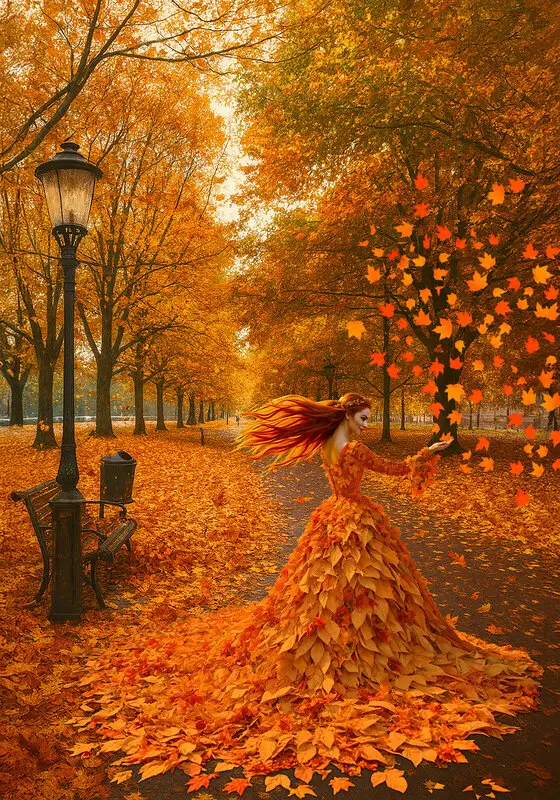
Persephone Scattering Her Autumn Leaves
The title celebrates the enduring power of myth to reveal the unseen forces that shape nature, time, and the human soul. In this essay, the ancient goddess acts both as a symbol and a narrator — the red-haired spirit of autumn whose gesture connects decay with renewal, darkness with light. Through her, the old wisdom of the seasons is reborn: that all things must fall so they may rise again.
Embedded in the myth of Demeter and Persephone — one of humanity’s earliest allegories of loss and return — the text reflects on how ancient stories, timeless in their relevance, continue to reside within the natural world. Persephone’s descent and re-emergence mirror the rhythm of our own lives: the cycles of grief and growth, of endings that give rise to beginnings.
In an age that tracks time through data and progress rather than seasons and renewal, her story reminds us of what we risk forgetting — that the world’s deepest truths still linger beneath the surface, in the turning of the leaves and the silence of the soil.
“Persephone’s Autumn Hymn
She stirs the trees with whispered grace,
Her breath a chill the woods embrace.
Each leaf she plucks, once green, now gold,
Becomes a tale of life retold.
She scatters time with gentle hands,
Across the fields, the sleeping lands.
Each falling flame, each drifting hue,
Is winter’s seed — and spring’s debut.
She spins decay to silken thread,
A crown of dusk upon her head.
Through rust and amber, soft and slow,
She teaches earth the art of woe.
For death, she says, is not an end,
But just the curve where seasons bend.
And every leaf the wind lets fall
Will one day answer April’s call.”
Malmö. October 2025
Persephone Scattering Her Autumn Leaves
Our age often forgets—and even hides—the profound knowledge and wisdom that once shaped human understanding. What does not align with modern science is quietly dismissed as myth, poetry, or superstition. Yet, the enduring influence of the ancient divinities, unseen but ever-present, is a testament to a deeper, timeless wisdom that may well be among us, shaping our lives and understanding in ways we may not fully comprehend.
You can almost feel their breath in the change of seasons, in the shifting moods of the weather, in the unseen rhythms of life and decay, where life gives way to death and death gives way to life. Take autumn, for example. The trees give up their green attire and turn to gold before an unseen force gathers their fading leaves and scatters them across the neighbourhood. Who is it that plucks these once-living leaves from the branches and lays them down like snow upon the ground?
If you look closely—beyond the ordinary, with the eyes of an older, wiser person—you might catch a glimpse of her. A red-haired woman darting through the wind like a restless bird, plucking one leaf here, another there, her arms full of the crimson, amber, and ochre colours of the season. Her actions, shrouded in enigmatic mystery, not only invite us to wonder and question but also keep us engaged, always pondering the unseen forces at play in the world.
The resemblance is no coincidence, for this is Persephone, goddess of autumn, scattering the seeds of winter. Just as the sower plants grains that will sprout when warmth returns, Persephone sows the cold that will sleep beneath the drifts of leaves until the cycle begins anew. Her actions, shrouded in mystery, serve as a powerful reminder of the cyclical nature of life, where what withers will rise again, and what sleeps will one day awaken. It's a reminder not just of the inevitability of change but also of the promise of renewal, inspiring hope in our hearts.
Persephone, a figure of unrivalled complexity in Greek mythology, symbolises both life and death, spring and decay, innocence and power. Her mysterious duality, which has fascinated poets, philosophers, and artists for over two millennia, reflects the human experience. Her story resonates with us because it mirrors the constant cycle of life and death, the ever-present tension between innocence and power. It's this fascination with her duality that keeps us engaged with her story.
Origins and Family
Persephone (Περσεφόνη in Greek), also known by her older name Kore (meaning “maiden” or “girl”), is the daughter of Demeter, the goddess of grain and fertility, and Zeus, the king of the gods. She grew up in the luminous meadows of the upper world, a place of eternal spring and abundance, surrounded by flowers, nymphs, and the laughter of eternal youth. This setting is significant because it represents the innocence and beauty of youth, a stark contrast to the underworld's darkness and decay.
But her beauty drew the gaze of Hades, lord of the underworld, who fell in love with her and decided to make her his queen.
The Abduction (The Rape of Persephone)
One day, as Persephone gathered flowers in a field — often said to be the plain of Enna in Sicily — the earth split open, and Hades appeared in his golden chariot drawn by black horses. He seized the young goddess and took her down into the darkness.
This event, known as The Rape of Persephone (raptio in Latin, meaning abduction rather than sexual assault in the ancient sense), became one of the central myths explaining the origin of the seasons.
When Demeter discovered her daughter's absence, her heart shattered into a million pieces. She roamed the world, refusing to let crops flourish until Persephone was returned. Famine gripped the earth, and people began to wither away.
Finally, Zeus intervened by sending Hermes to the underworld to negotiate Persephone’s release. However, Hades tricked her into eating six pomegranate seeds — a binding act that tethered her to his realm.
The Cycle of the Seasons
A compromise was struck: Persephone would spend six months of the year with Hades in the underworld, and six months with her mother on Earth. Her return each spring was a cause for jubilation for Demeter, and nature burst into bloom once more. But when she descended back to Hades, the earth mourned — the trees shed their leaves, and winter's chill set in.
Thus, Persephone, with her alternating presence in the underworld and on earth, became the living symbol of renewal and loss, life and death intertwined — the eternal rhythm of nature itself.
Persephone’s Dual Nature
Persephone’s character is a testament to her strength, defined by her dual nature. She is both Kore, the innocent maiden of the flowers, and Persephone, the mighty Queen of the Dead. This tension, often depicted in art and literature, symbolises transition — the boundary between sunlight and shadow, birth and death, innocence and wisdom.
In her role as Kore, she embodies the vibrant, youthful energy of life — the promise of spring and the bounty of harvest. Yet as Queen of the Underworld, she remains unwavering and composed, guiding souls into the afterlife and reigning alongside Hades with quiet authority. Unlike the fearsome or monstrous figures often linked with death, Persephone rules the underworld with balance, compassion, and steadfast justice.
The Mysteries of Eleusis
The myth of Persephone and Demeter inspired the Eleusinian Mysteries, the most sacred religious rituals of ancient Greece. These secret ceremonies, held annually near Athens, offered initiates a glimpse of divine truth and the hope of rebirth after death. The rituals reenact Persephone’s descent into the underworld and her triumphant return, symbolising the soul’s immortality and the eternal cycle of renewal. The Eleusinian Mysteries were a significant part of ancient Greek religious life, and their connection to Persephone's myth underscores her cultural importance.
To speak her name within these mysteries was an act of reverence. The initiates believed that, through Persephone’s journey, they too might overcome the terror of mortality and find light beyond the darkness.
Symbolism and Legacy
Persephone’s story, a timeless tale of transformation and duality, has inspired numerous reinterpretations over the centuries. To the ancients, she was the explanation for the changing of the seasons. To poets, she became the mirror of human experience — the oscillation between joy and sorrow, youth and ageing, presence and absence. Her story, with its rich symbolism and profound themes, continues to resonate with us, offering a connection to a cultural heritage that spans millennia and remains as relevant today as it was in ancient times, enriching our understanding of the world and our place in it.
In Renaissance art, she frequently appears as a calm, luminous figure emerging from shadows, her hands holding flowers or pomegranate seeds. In Romantic poetry, she is depicted as the eternal bride — loved and destined by fate. Modern feminists have reimagined her not as a victim of abduction, but as a woman who gains agency through transformation — one who descends into darkness and returns stronger, wiser, and sovereign over both worlds.
The Pomegranate
The pomegranate, Persephone’s fruit, has become one of the most potent symbols in mythology. Its red seeds symbolise both life and captivity, fertility and bondage. In eating them, Persephone partook of the underworld’s essence; she became forever tied to its cycles, unable to return to her former innocence fully. Yet, in doing so, she also gained power. The act that condemned her also elevated her. The pomegranate, with its paradoxical symbolism, invites us to ponder the transformative power of knowledge and the complex nature of life's experiences.
The pomegranate thus serves as a paradox of transformation — to taste knowledge is to lose purity, but also to gain depth. Artists have long used the fruit as a metaphor for the tension between desire and consequence, and as a reminder that every blossoming life carries within it the promise of decay, and every ending holds the seed of renewal.
Persephone in Art and Literature
From antiquity to the present, Persephone’s image has transformed. In Greek vase paintings, she is depicted as a luminous maiden, often beside Demeter or emerging from Hades’ chariot. In classical sculpture, her composed and distant gaze mirrors her dual rule over the fertile fields above and the silent realm below. This 'dual rule' refers to Persephone's unique position as both a goddess of life and fertility in the upper world, and as the Queen of the Dead in the underworld. This duality is a key aspect of her character and is often depicted in art and literature.
Dante invoked her shadow in The Divine Comedy, while Ovid, in his Metamorphoses, made her story the focus of his reflections on transformation. In later centuries, artists like Rossetti and Waterhouse depicted her as a Pre-Raphaelite muse, caught between innocence and desire. In the twentieth century, poets such as Louise Glück (Averno) and Margaret Atwood revisited her as a voice of female self-discovery — no longer a passive victim, but a self-aware goddess of thresholds, embracing both her light and her darkness.
Modern Resonance
Persephone's story is not just a myth, but a reflection of the rhythm of every human life. It mirrors the fall into grief, the slow re-emergence into light, and the balance between holding on and letting go. She persists because she personifies change itself, reminding us that descent is not always loss-sometimes it is the essential journey towards understanding.
In ecological terms, she embodies the Earth's respiration — the winter's repose and spring's heartbeat. Psychologically, she reflects the descent into the unconscious —the domain of shadow and dream, where new understanding is born. Spiritually, she signifies rebirth through accepting mortality — an ancient truth as old as the soil itself.
Epilogue
Watching Persephone scatter her autumn leaves is to see the moment before she departs — when beauty gives way to silence and colour to memory. She does not mourn the approaching darkness; she prepares for it. In her gesture lies the world’s wisdom: that all things must fall so they may rise again.
3 200 kr

Jörgen Thornberg
Malmö
Lite om bilder och mig. Translation in English at the end.
Jag är en nyfiken person som ser allt i bilder, även det jag fäster i ord, gärna tillsammans för bakom alla mina bilder finns en berättelse. Till vissa bilder hör en kortare eller längre novell som följer med bilden.
Bilder berättar historier. Jag omges av naturlig skönhet, intressanta människor och historia var jag än går. Jag använder min kamera för att dokumentera världen och blanda det jag ser med vad jag känner för att fånga den dolda magin.
Mina bilder berättar mina historier. Genom mina bilder, tryck och berättelser. Jag bjuder in dig att ta del av dessa berättelser, in i ditt liv och hem och dela min mycket personliga syn på vår värld. Mer än vad ögat ser. Jag tänker i bilder, drömmer och skriver och pratar om dem; följaktligen måste jag också skapa bilder. De blir vad jag ser, inte nödvändigtvis begränsade till verkligheten. Det finns en bild runt varje hörn. Jag hoppas att du kommer att se vad jag såg och gilla det.
Jag är också en skrivande person och till många bilder hör en kortare eller längre essay. Den följer med tavlan, tryckt på fint papper och med en personlig hälsning från mig.
Flertalet bilder startar sin resa i min kamera. Enkelt förklarat beskriver jag bilden jag ser i mitt inre, upplevd eller fantiserad. Bilden uppstår inom mig redan innan jag fått okularet till ögat. På bråkdelen av ett ögonblick ser jag vad jag vill ha och vad som kan göras med bilden. Här skall jag stoppa in en giraff, stålmannen, Titanic eller vad det är min fantasi finner ut. Ännu märkligare är att jag kommer ihåg minnesbilden långt efteråt när det blir tid att skapa verket. Om jag lyckas eller inte, är upp till betraktaren, oftast präglat av en stråk av svart humor – meningen är att man skall bli underhållen. Mina bilder blir ofta en snackis där de hänger.
Jag föredrar bilder som förmedlar ett budskap i flera lager. Vid första anblicken fylld av feel-good, en vacker utsikt, fint väder, solen skiner, blommor på ängen eller vattnet som ligger förrädiskt spegelblankt. I en sådan bild kan jag gömma min egentliga berättelse, mitt förakt för förtryckare och våldsverkare, rasister och fördomsfulla människor - ett gärna återkommande motiv mer eller mindre dolt i det vackra motivet. Jag försöker förena dem i ett gemensamt narrativ.
Bild och formgivning har löpt som en röd tråd genom livet. Fotokonst känns som en värdig final som jag gärna delar med mig.
Min genre är vid som framgår av mina bilder, temat en blandning av pop- och gatukonst i kollage som kan bestå av hundratals lager. Vissa bilder kan ta veckor, andra någon dag innan det är dags att överlämna resultatet till printverkstaden. Fine Art Prints är digitala fotocollage. I dessa kollage sker rivandet, klippandet, pusslandet, målandet, ritandet och sprayningen digitalt. Det jag monterar in kan vara hundratals år gamla bilder som jag omsorgsfullt frilägger så att de ser ut att vara en del av tavlan men också bilder skapade av mig själv efter min egen fantasi. Därefter besöks printstudion och för vissa bilder numrera en limiterad upplaga (oftast 7 exemplar) och signera för hand. Vissa bilder kan köpas i olika format. Det är bara att fråga efter vilka. Gillar man en bild som är 70x100 men inte har plats på väggen, går den kanske att få i 50x70 cm istället. Frågan är fri.
Metoden Giclée eller Fine Art Print som det också kallas är det moderna sättet för framställning av grafisk konst. Villkoret för denna typ av utskrifter är att en högkvalitativ storformatskrivare används med åldersbeständigt färgpigment och konstnärspapper eller i förekommande fall på duk. Pappret som används möter de krav på livslängd som ställs av museer och gallerier. Normalt säljer jag mina bilder oinramade så att den nya ägaren själv kan bestämma hur de skall se ut, med eller utan passepartout färg på ram, med eller utan glas etc..
Under många år ställde jag bara ut på nätet, i valda grupper och på min egen Facebooksida - https://www.facebook.com/jorgen.thornberg.9
Jag finns också på en egen hemsida som tyvärr inte alltid är uppdaterad – https://www.jth.life/ Där kan du också läsa en del av de berättelser som följer med bilden.
UTSTÄLLNINGAR
Luftkastellet, oktober 2022
Konst i Lund, november 2022
Luftkastellet, mars 2023
Engleson Galleri Caroli, april 2023
Hydra, Greece June 2023
Engleson Galleri Caroli, oktober 2023
Toppen, Höllviken december 2023
Luftkastellet, mars 2024
Torups Galleri, mars 2024
Venice, May 2024
Luftkastellet, oktober 2024
Konst i Advent, December 2024
Galleri Engleson, Caroli December 2024
Jäger & Jansson Galleri, april 2025
A bit about pictures and me.
I'm a curious person who sees everything in pictures, even what I express in words, often combining them, for behind all my pictures lies a story. These narratives, some as short as a single image and others as long as a novel, are the heart and soul of my work.
Pictures tell stories. Wherever I go, I'm surrounded by natural beauty, exciting people, and history. I use my camera to document the world and blend what I see with what I feel to capture the hidden magic.
My images tell my stories. Through my pictures, prints, and narratives, I invite you to partake in these stories in your life and home and share my deeply personal perspective of our world. More than meets the eye. I think in pictures, dream, write, and talk about them; consequently, I must create images too. They become what I see, not necessarily confined to reality. There's a picture around every corner. I hope you'll see what I saw and enjoy it.
I'm also a writer, and many images come with a shorter or longer essay. It accompanies the painting, printed on fine paper with my personal greeting.
Many pictures start their journey on my camera. Simply put, I describe the image I see in my mind, experienced or imagined. The image arises within me even before I bring the eyepiece to my eye. In a fraction of a moment, I see what I want and what can be done with the picture. Here, I'll insert a giraffe, Superman, the Titanic, or whatever my imagination conjures up. Even stranger is that I remember the mental image long after it's time to create the work. Whether I succeed is up to the observer, often imbued with a streak of black humour – the aim is to entertain. My pictures usually become a talking point wherever they hang.
I prefer pictures that convey a message in multiple layers. At first glance, they're filled with feel-good vibes, a beautiful view, lovely weather, the sun shining, flowers in the meadow, or the water lying deceptively calm. But beneath this surface beauty, I often conceal a deeper story, a narrative that challenges societal norms or explores the human condition. I invite you to delve into these hidden narratives and discover the layers of meaning within my work.
Picture and design have been a thread running through my life. Photographic art feels like a fitting finale, and I'm happy to share it.
My genre is varied, as seen in my pictures; the theme is a blend of pop and street art in collages that can consist of hundreds of layers. Some images can take weeks, others just a day before it's time to hand over the result to the print workshop. Fine Art Prints are digital photo collages. In these collages, tearing, cutting, puzzling, painting, drawing, and spraying happen digitally. What I insert can be images hundreds of years old that I carefully extract so they appear to be part of the painting, but also images created by myself, now also generated from my imagination. Next, visit the print studio and, for certain images, number a limited edition (usually 7 copies) and sign them by hand. Some images may be available in other formats. Just ask which ones. If you like an image that's 70x100 but doesn't have space on the wall, you might be able to get it in 50x70 cm instead. The question is open.
The Giclée method, or Fine Art Print as it's also called, is the modern way of producing graphic art. This method ensures the highest quality and longevity of the artwork, using a high-quality large-format printer with archival pigment inks and artist paper or, in some cases, canvas. The paper used meets the longevity requirements set by museums and galleries. I sell my pictures unframed, allowing the new owner to personalise their artwork, confident in the lasting value and quality of the piece.
For many years, I only exhibited online, in selected groups, and on my Facebook page - https://www.facebook.com/jorgen.thornberg.9. I also have my website, which unfortunately is not constantly updated - https://www.jth.life/. You can also read some of the stories accompanying the pictures there.
EXHIBITIONS
Luftkastellet, October 2022
Art in Lund, November 2022
Luftkastellet, March 2023
Engleson Gallery Caroli, April 2023
Hydra, Greece June 2023
Engleson Gallery Caroli, October 2023
Toppen, Höllviken December 2023
Luftkastellet, March 2024
Torup Gallery, March 2024
Venice, May 2024
UTSTÄLLNINGAR
Luftkastellet, oktober 2022
Konst i Lund, november 2022
Luftkastellet, mars 2023
Engleson Galleri Caroli, april 2023
Hydra, Greece June 2023
Engleson Galleri Caroli, oktober 2023
Toppen, Höllviken december 2023
Luftkastellet, mars 2024
Torups Galleri, mars 2024
Venice, May 2024
Luftkastellet, October 2024
Konst i Advent, December 2024
Galleri Engleson, Caroli December 2024
Jäger & Jansson Galleri, April 2025
Utbildning
Autodidakt
Medlem i konstnärsförening
Öppna Sinnen
Med i konstrunda
Konstrundan i Skåne
Utställningar
Luftkastellet, October 2022
Art in Lund, November 2022
Luftkastellet, March 2023
Engleson Gallery Caroli, April 2023
Hydra, Greece June 2023
Engleson Gallery Caroli, October 2023
Toppen, Höllviken December 2023
Luftkastellet, March 2024
Torup Gallery, March 2024
Venice, May 2024