Vi använder cookies för att ge dig bästa möjliga upplevelse. Välj vilka cookies du tillåter.
Läs mer i vår integritetspolicy
Jörgen Thornberg
Dive into the mad barrel - Hoppa i Galen Tunna, 2025
Digital
50 x 70 cm
3 200 kr
Dive into the mad barrel - Hoppa i Galen Tunna
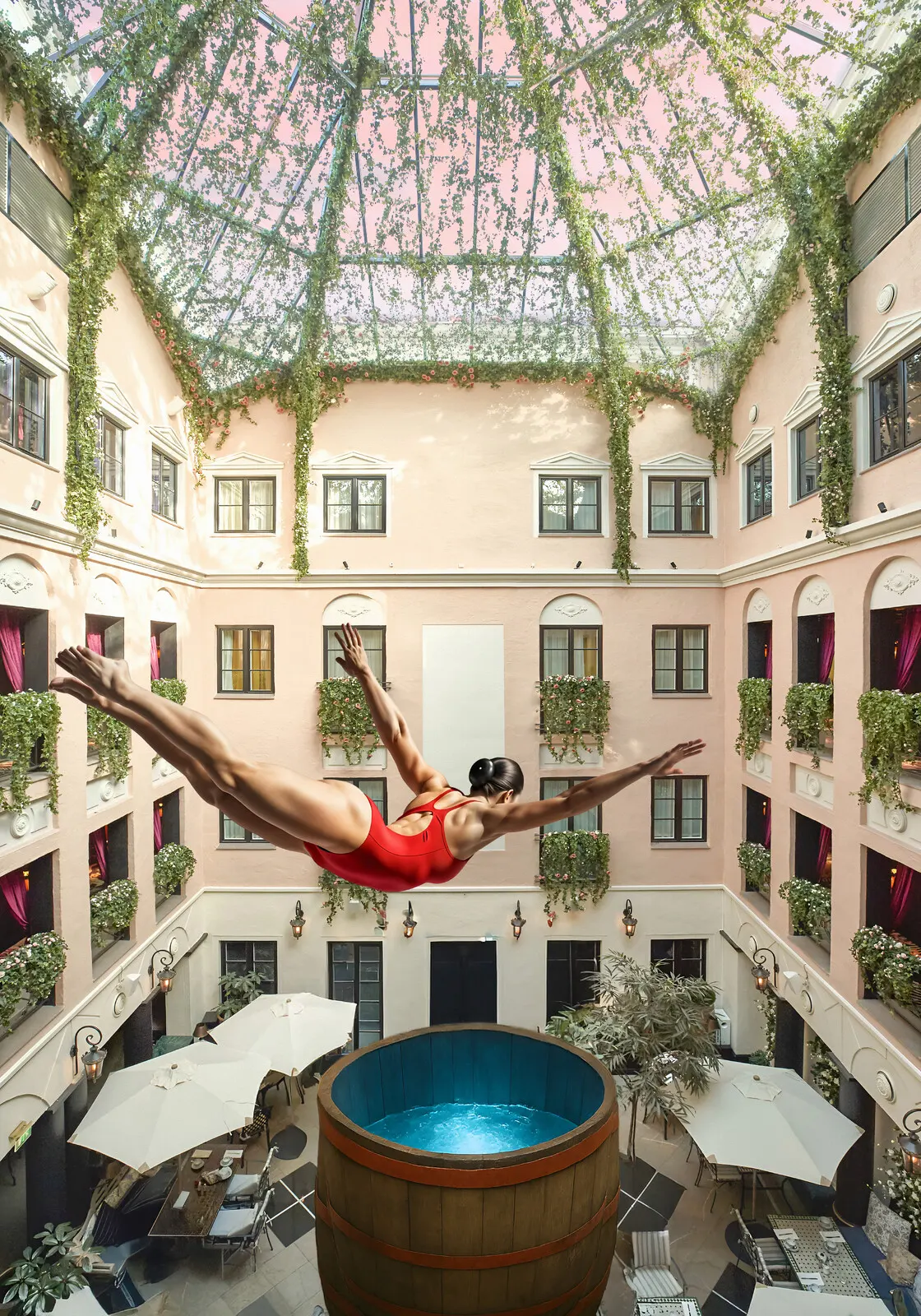
The woman in the picture chose her moment with surgical precision, a moment that was not just a leap, but a revelation of wisdom. Early on a Sunday morning, when everyone — including the night porter — was still asleep, she climbed to the top floor of the hotel and took a breath. Then she leapt — straight into the air — aiming for a large barrel filled with water below. No splash, not even a whisper. Just a leap, a defiance of gravity, a moment of madness that somehow made perfect sense.
The scene might have been taken from a dream — or from a proverb. The woman's leap, a moment of madness that somehow made perfect sense, mirrors the essence of a proverb. Language often acts that way: reckless, in the sense that it takes risks in condensing complex human experiences into a few words; poetic, in the way it uses metaphors and imagery to convey profound truths; and dangerously human, in that it reflects our deepest fears, desires, and contradictions. Our proverbs are tiny acts of madness, full of wisdom, shame, courage, and self-deception all at once. They reveal who we are when we plunge headlong into life — or into the barrel — not quite knowing where we’ll land. For instance, 'look before you leap' or 'the early bird catches the worm' are proverbs that encapsulate this essence.
From the Swedish crazy barrel to the blue cupboard and the Asian white elephant runs a thread of human folly — a continuum of absurdity where laughter and tragedy meet. Within these sayings lies the entire anatomy of our condition: the paradox of self-inflicted embarrassment, where we often disgrace ourselves in our pursuit of recognition; the cycle of royal revenge, a pattern of retaliation and retribution that perpetuates conflict; the ubiquity of everyday comedy, the humor we find in the mundane and the ordinary; and the moral cruelty of words, the harm we can inflict through language. These elements are not just random aspects of human life; they are interconnected and form the fabric of our existence. They remind us that in every culture, the ridiculous and the sublime are neighbours — and that wisdom often arrives dressed as a joke.
“A Toast to Mad Proverbs
Raise your glass to the words of the mad,
to the sayings absurd yet strangely glad,
to the wisdom wrapped in foolish rhyme,
that tumbles through the halls of time.
For who would leap in a barrel insane,
or shit in a blue cupboard for praise or gain?
Who’d nurse a white elephant, grand and grim,
till the gold runs out and the lights grow dim?
We love our phrases, crooked and wild,
born of a prank, a saint, or a child.
They mock our reason, they soften our pain,
and whisper: “Go on — be foolish again.”
Each proverb’s a mirror, cracked but clear,
reflecting our hopes, our pride, our fear.
We fall, we flounder, we laugh, we try —
and language winks as we slip and fly.
So here’s to the barrel, the cupboard, the beast,
to every disaster dressed as a feast.
For sense is dull, but folly divine —
and madness, my friends, is proverbially mine.”
Malmö. October 2025
The Crazy Barrel, the Blue Cupboard and the White Elephant – A Journey Through the Folly of Language
“Hoppa i Galen Tunna”. The Swedish phrase broadly means to throw yourself into something reckless, risky, or downright foolish — a project, a love affair, a decision — without thinking first. To “jump into a crazy barrel” (hoppa i galen tunna) is to dive headfirst into madness, often with a hint of humour or self-irony. This idiom reflects the Swedish cultural value of self-awareness and the ability to laugh at one's own mistakes, leaving the audience with a sense of enlightenment.
The girl in the picture, for example, is seen leaping from the top floor of a hotel directly into a large barrel filled with water. She chose her moment carefully — very early on a Sunday morning when everyone, including the night porter, was asleep. She was skilled enough to make no sound at all — not even a splash.
That sort of stunt was once common in the circus. I once met performer Vicky Vacki, who used to leap from a swaying mast into a tiny barrel far below. The trick was to land just beside the barrel, slowing her fall with a tarpaulin stretched over the water, which cushioned her descent over several metres. It was, of course, an extraordinarily daring act. She was a Time-traveller — she told me she had come back to Earth from her star.
Regarding the proverb itself, numerous theories exist about its origin, most of which trace back to the 19th-century world of fairs and travelling circuses. This historical context not only enriches our understanding of the idiom but also fosters a sense of connection to the past, inviting you to delve into the rich history of this enduring narrative.
During popular festivals of that era, there were often so-called crazy barrels — large wooden casks in which clowns, acrobats, or even animals were placed for comic acts. A “crazy barrel” might spin, bounce, or roll down a slope. To “jump into it” was therefore something only a fool — or a hero — would do. This cultural context, rooted in the 19th-century world of fairs and travelling circuses, not only adds a layer of understanding and appreciation for the idiom but also fosters a deep connection to the past. It's a connection to a time when life was simpler, yet more daring, and when people found joy in the most unexpected places. This makes the audience feel more connected to the historical roots of the idioms and the cultural significance of such daring acts.
In Swedish, the expression became metaphorical: “att hoppa i galen tuna” — literally “to jump into a crazy barrel” — has no exact English equivalent, but it closely resembles “to jump into the wrong barrel,” “to throw oneself into a mad situation,” or “to bite off more than one can chew.” This metaphorical usage, which is often used to describe situations where one has taken on more than they can handle, enlightens us about the idiom's versatility and depth of meaning. It's not just about taking on a difficult task, but also about the element of surprise and the need to adapt quickly. This provides a deeper understanding of the cultural significance of the idiom, leaving us with a sense of enlightenment.
It also resembles other idioms such as “to get oneself into hot water,” “to land in the soup,” or the Swedish “sätta sig i klistret” — “to get oneself stuck in the glue.” In older Swedish dialects, there’s also “sätta sig i galna tunnan” — “to sit down in the crazy barrel” — the same idea: throwing oneself into something one will soon regret, though with a wink of self-inflicted comedy. These idioms, which all convey the idea of getting oneself into a difficult or regrettable situation, share a similar meaning, further enriching our understanding of the idiom 'to jump into a crazy barrel' and its place in the Swedish language and culture.
Today, the expression is mainly used humourously and self-consciously, often with a laugh: “Well, I suppose I’ve jumped into the crazy barrel again!” Meaning: “Here I go again — another mad project.”
The most commonly cited origin story comes from the 19th century. One theory describes a man who, after a sauna bath, intended to jump into a barrel of cold water but accidentally leapt into one filled with tar instead. He had a plan — but it didn’t end well. Sitting there covered in tar, he probably had time to reflect on his mistake, along with a certain amount of shame. This story highlights the self-reflective nature of the idiom. It's not just about making a mistake, but also about taking responsibility for it and learning from it. It prompts us to reflect on our own actions, fostering a sense of introspection and ultimately leading to a deeper understanding of the idiomatic expression.
This is the explanation provided in Pelle Holm’s book about proverbs “Bevingade ord” (“Winged Words”), and it has appeared in several dictionaries. However, there is no definitive proof that it is accurate.
Another, even less pleasant version recounts a man who attempted to hide inside a barrel — a common storage vessel in the old days — but unfortunately chose one filled with latrine. The poor fellow found himself in a situation that was not just disgusting but positively revolting. However, it might have been easier to wash off than tar, as he might have reassured himself.
However, as the story goes, the proverb certainly earns its place in the cabinet of odd or, at the very least, amusing sayings. It's so outlandish, it's hard not to chuckle.
Far-fetched? Maybe. But unless you have a better theory, I’ll stay exactly where I am — in my crazy barrel, waiting for the applause. Is it funny? I think so, but perhaps not the funniest. But I'm sticking to it!
While there’s no definitive 'funniest' proverb, some certainly tickle the funny bone. My personal pick? 'It’s never too late to give up.' The irony in this one always brings a smile to my face.
For me, this proverb is more than just a witty saying. It's a mantra I've lived by, often to the point of stubbornness. But I’ll keep pushing forward, because in the end, we all have to accept life’s twists and turns. It’s like a distant relative of the English saying, 'If at first you don’t succeed, give up — it’s easier.'
Then there’s “You have to kiss a lot of frogs before you find your swine,” a twisted variation on the fairytale idea of “You have to kiss a lot of frogs before you find your prince.”
And “Stand your ground, or someone else will stand on it for you!” — a gritty equivalent of the English “If you don’t blow your own trumpet, no one else will.” Both sayings encourage a cheeky form of self-assertion that borders on defiance.
Here are a few more Swedish proverbs that are humorous but still carry a grain of truth or irony.
“What you don’t do today, you won’t have to redo tomorrow.” (Compare with the English “Never do today what you can put off till tomorrow,” often attributed to Mark Twain.)
“Never put off until tomorrow what your mother can do today.” This is a perfect domestic parody of the original saying, “Never put off till tomorrow what you can do today," reflecting the cultural value of family and the role of mothers in many societies.
“Stand your ground, or someone else will stand on it!” — again, very Nordic in its quiet stubbornness.
“A naked man fears no pickpocket.” (The English have “You can’t lose what you never had,” but the Swedish version is far bolder — and colder.)
“If you’ve struck the axe into the boat, you’ll have to row like hell.” (A parody of “If you’ve taken the Devil into your boat, you must row him ashore.” The English might say: “You’ve made your bed, now lie in it,” or “You’ve cooked your goose.”)
And then there’s one I once devoted an entire essay to: “When need is greatest, the pub is nearest.” Which, all things considered, isn’t such bad advice for party lovers. (The English would probably say, “When the going gets tough, the tough go to the pub.”)
Finally, there’s the wonderfully peculiar Swedish idiom “to shit in the blue cupboard” — meaning to embarrass oneself or to cross a line. The phrase may have originated in the 19th century, a time when the so-called “fine cupboards” used to store linen, silverware, and glass were often painted blue. The blue colour — Berlin blue, freshly available and fashionable — indicated refinement, unlike the earlier common red-brown and ochre paints. So, if someone decided to use that fine blue cupboard as a chamber pot, that would indeed be going too far, giving us a unique insight into the social norms of the time.
Far-fetched? Perhaps. But do you have a better theory? (The nearest British equivalents might be “to put your foot in it,” “to make a complete fool of yourself,” or the very British “to drop a clanger.” None of them, however, involves furniture or quite the same vivid imagery, highlighting the unique and rich nature of the Swedish language.
A Modest Collection of Mad English Idioms
If Swedes have their peculiar barrels and blue cupboards, the English are not without their own linguistic quirks — sayings that tumble, twist, and sometimes make as little sense as they charm. Here are a few that belong to the same extended family of cheerful absurdity, guaranteed to leave you in stitches with their humorous twists.
“To go off the deep end.”
This phrase, 'to go off the deep end', originates from the early 20th century when it was used to describe someone losing their temper or self-control. It's like plunging straight into a pool without checking the depth first—a close cousin to jumping into a crazy barrel. The phrase has evolved, but its essence remains the same.
“To throw caution to the wind.”
This idiom, 'to throw caution to the wind', is a poetic way of saying: I realise this is a dreadful idea, but I’m going ahead with it anyway. It's a phrase that captures the spirit of risk-taking and adventure.
“To jump in at the deep end.”
Starting something difficult or risky without preparation — a phrase that sounds brave until you actually imagine it.
“To make a pig’s ear of it.”
To mess something up completely. The Swedes might say “att göra bort sig”, but the English prefer to do it with livestock.
“To go the whole hog.”
To do something completely and without restriction. (Note the recurring pig theme — clearly, pigs have suffered for our idioms.)
“To take the plunge.”
Often used about both business ventures and marriage — in other words, two equally hazardous forms of diving. Like the girl in my picture.
“To have one’s head in the clouds.”
To dream wildly or live in fantasy — where barrels can indeed fly and blue cupboards speak.
“To put your foot in it.”
To describe something embarrassing — not as chaotic as the blue cupboard, but nearly.
“To make a mountain out of a molehill.”
Exaggerating a minor problem until it becomes a heroic scale is a national pastime in many countries.
“To let the cat out of the bag.”
To reveal a secret unintentionally — a relic from medieval markets where unscrupulous sellers traded piglets for cats. (One more pig connection. The farmyard truly runs through the English subconscious.)
“To go bananas.”
A modern favourite — to act crazy, lose control, or become irrationally happy. Linguistically enriching, psychologically alarming.
“To throw in the towel.”
From boxing — meaning to give up. A direct rival to the Swedish “It’s never too late to give up.”
“Not playing with a full deck.”
A considerate way to suggest that someone may not be entirely well.
“As mad as a hatter.”
From the mercury-poisoned hat-makers of old England — proof that madness, like fashion, is cyclical.
“Don’t look a gift white elephant in the mouth.” This phrase, with its roots in the symbolic value of the white elephant, is a rich source of hidden drama and schadenfreude.
White Elephants – The Gift That Ruins You
In the radiant heat of Southeast Asia, long before the phrase journeyed west and shed its sacred aura, a white elephant was not a mere jest. It was a marvel. To possess one was to bask in the divine aura — a living emblem of authority, purity, and cosmic favour. The creature was untouchable, beyond labour, and sacred beyond commerce. Its very existence served as a reminder that some gifts, though dazzling, come with unseen shackles. This historical context enriches our understanding of the phrase's cultural significance.
But kings, of course, understood irony long before the English did. In Siam or Burma, when a monarch wished to punish a troublesome nobleman — one too proud to execute, too powerful to ignore — he might send him a white elephant. Refusing the royal gift would be treachery; accepting it meant ruin. The nobleman would spend his fortune feeding, bathing, housing, and honouring his celestial pet until his estates crumbled under the weight of piety. Thus, the white elephant became the perfect instrument of slow, ceremonial destruction — a gift masquerading as grace.
From that exquisite cruelty, the English not only adopted the phrase but also the sentiment. A white elephant now signifies something grand, expensive, and useless — a stadium nobody visits, a half-built railway, a luxury resort abandoned to the weeds. The empire that once measured the world in teak and tea found a new pleasure: laughing at its own excess. “Another white elephant,” the papers sigh, when yet another billion disappears into architectural vanity. The expression allows one to sneer politely at waste while secretly enjoying the satisfaction that someone else is footing the bill. This societal critique embedded in the phrase can engage the audience in a larger discourse.
There’s tragedy, too, beneath the smirk, for the white elephant is never malevolent — only innocent, treasured, and destructive. It encapsulates that paradox at the core of all human ambition: the dream of possessing what cannot be truly owned. We erect monuments, we gather lovers, we pursue purity — and when the burden becomes too great, we call it divine. The white elephant becomes a symbol of our addiction to splendour and our fear of simplicity. This reflection on our own ambitions can evoke a sense of introspection in the audience.
Even in language, the beast retains its sadism. It punishes not the fool who gives, but the one who receives. To own a white elephant is to live under constant scrutiny, trapped in the glare of gratitude. Every stroke of the royal gift is a reminder that freedom has been exchanged for honour. In this sense, the proverb contains a trace of moral cruelty worthy of a Victorian parable: Be careful what you accept — generosity may be the slowest form of revenge.
And yet the expression persists because it flatters our cynicism. We laugh at the billionaire’s art collection, the city’s empty skyscraper, the government’s ghost train. Schadenfreude is the hidden fuel behind the idiom — that subtle, universal relief that someone else’s vanity has cost them more than ours. There is pleasure in watching the mighty fall under the golden weight of their own gifts. We call it irony, but it resembles vengeance.
So the next time you hear that a country has built a gleaming airport no one needs, or a magnate has bought a yacht too large for any harbour, remember the old Siamese king smiling behind his fan. The white elephant still wanders among us, patient, sacred, absurd — and forever hungry.
In conclusion:
Every language maintains a small attic of lunacy — phrases born from accidents, trades, and jokes that have outlived their tellers. The Swedes may jump into barrels, the English may lose pigs and let cats escape from bags, but somewhere between tar and tea, both nations have learned the same lesson: humour is the only way to stay sane, and our shared cultural history, reflected in these idioms, is what connects us all, making us feel part of a larger, shared narrative.

Jörgen Thornberg
Dive into the mad barrel - Hoppa i Galen Tunna, 2025
Digital
50 x 70 cm
3 200 kr
Dive into the mad barrel - Hoppa i Galen Tunna
The woman in the picture chose her moment with surgical precision, a moment that was not just a leap, but a revelation of wisdom. Early on a Sunday morning, when everyone — including the night porter — was still asleep, she climbed to the top floor of the hotel and took a breath. Then she leapt — straight into the air — aiming for a large barrel filled with water below. No splash, not even a whisper. Just a leap, a defiance of gravity, a moment of madness that somehow made perfect sense.
The scene might have been taken from a dream — or from a proverb. The woman's leap, a moment of madness that somehow made perfect sense, mirrors the essence of a proverb. Language often acts that way: reckless, in the sense that it takes risks in condensing complex human experiences into a few words; poetic, in the way it uses metaphors and imagery to convey profound truths; and dangerously human, in that it reflects our deepest fears, desires, and contradictions. Our proverbs are tiny acts of madness, full of wisdom, shame, courage, and self-deception all at once. They reveal who we are when we plunge headlong into life — or into the barrel — not quite knowing where we’ll land. For instance, 'look before you leap' or 'the early bird catches the worm' are proverbs that encapsulate this essence.
From the Swedish crazy barrel to the blue cupboard and the Asian white elephant runs a thread of human folly — a continuum of absurdity where laughter and tragedy meet. Within these sayings lies the entire anatomy of our condition: the paradox of self-inflicted embarrassment, where we often disgrace ourselves in our pursuit of recognition; the cycle of royal revenge, a pattern of retaliation and retribution that perpetuates conflict; the ubiquity of everyday comedy, the humor we find in the mundane and the ordinary; and the moral cruelty of words, the harm we can inflict through language. These elements are not just random aspects of human life; they are interconnected and form the fabric of our existence. They remind us that in every culture, the ridiculous and the sublime are neighbours — and that wisdom often arrives dressed as a joke.
“A Toast to Mad Proverbs
Raise your glass to the words of the mad,
to the sayings absurd yet strangely glad,
to the wisdom wrapped in foolish rhyme,
that tumbles through the halls of time.
For who would leap in a barrel insane,
or shit in a blue cupboard for praise or gain?
Who’d nurse a white elephant, grand and grim,
till the gold runs out and the lights grow dim?
We love our phrases, crooked and wild,
born of a prank, a saint, or a child.
They mock our reason, they soften our pain,
and whisper: “Go on — be foolish again.”
Each proverb’s a mirror, cracked but clear,
reflecting our hopes, our pride, our fear.
We fall, we flounder, we laugh, we try —
and language winks as we slip and fly.
So here’s to the barrel, the cupboard, the beast,
to every disaster dressed as a feast.
For sense is dull, but folly divine —
and madness, my friends, is proverbially mine.”
Malmö. October 2025
The Crazy Barrel, the Blue Cupboard and the White Elephant – A Journey Through the Folly of Language
“Hoppa i Galen Tunna”. The Swedish phrase broadly means to throw yourself into something reckless, risky, or downright foolish — a project, a love affair, a decision — without thinking first. To “jump into a crazy barrel” (hoppa i galen tunna) is to dive headfirst into madness, often with a hint of humour or self-irony. This idiom reflects the Swedish cultural value of self-awareness and the ability to laugh at one's own mistakes, leaving the audience with a sense of enlightenment.
The girl in the picture, for example, is seen leaping from the top floor of a hotel directly into a large barrel filled with water. She chose her moment carefully — very early on a Sunday morning when everyone, including the night porter, was asleep. She was skilled enough to make no sound at all — not even a splash.
That sort of stunt was once common in the circus. I once met performer Vicky Vacki, who used to leap from a swaying mast into a tiny barrel far below. The trick was to land just beside the barrel, slowing her fall with a tarpaulin stretched over the water, which cushioned her descent over several metres. It was, of course, an extraordinarily daring act. She was a Time-traveller — she told me she had come back to Earth from her star.
Regarding the proverb itself, numerous theories exist about its origin, most of which trace back to the 19th-century world of fairs and travelling circuses. This historical context not only enriches our understanding of the idiom but also fosters a sense of connection to the past, inviting you to delve into the rich history of this enduring narrative.
During popular festivals of that era, there were often so-called crazy barrels — large wooden casks in which clowns, acrobats, or even animals were placed for comic acts. A “crazy barrel” might spin, bounce, or roll down a slope. To “jump into it” was therefore something only a fool — or a hero — would do. This cultural context, rooted in the 19th-century world of fairs and travelling circuses, not only adds a layer of understanding and appreciation for the idiom but also fosters a deep connection to the past. It's a connection to a time when life was simpler, yet more daring, and when people found joy in the most unexpected places. This makes the audience feel more connected to the historical roots of the idioms and the cultural significance of such daring acts.
In Swedish, the expression became metaphorical: “att hoppa i galen tuna” — literally “to jump into a crazy barrel” — has no exact English equivalent, but it closely resembles “to jump into the wrong barrel,” “to throw oneself into a mad situation,” or “to bite off more than one can chew.” This metaphorical usage, which is often used to describe situations where one has taken on more than they can handle, enlightens us about the idiom's versatility and depth of meaning. It's not just about taking on a difficult task, but also about the element of surprise and the need to adapt quickly. This provides a deeper understanding of the cultural significance of the idiom, leaving us with a sense of enlightenment.
It also resembles other idioms such as “to get oneself into hot water,” “to land in the soup,” or the Swedish “sätta sig i klistret” — “to get oneself stuck in the glue.” In older Swedish dialects, there’s also “sätta sig i galna tunnan” — “to sit down in the crazy barrel” — the same idea: throwing oneself into something one will soon regret, though with a wink of self-inflicted comedy. These idioms, which all convey the idea of getting oneself into a difficult or regrettable situation, share a similar meaning, further enriching our understanding of the idiom 'to jump into a crazy barrel' and its place in the Swedish language and culture.
Today, the expression is mainly used humourously and self-consciously, often with a laugh: “Well, I suppose I’ve jumped into the crazy barrel again!” Meaning: “Here I go again — another mad project.”
The most commonly cited origin story comes from the 19th century. One theory describes a man who, after a sauna bath, intended to jump into a barrel of cold water but accidentally leapt into one filled with tar instead. He had a plan — but it didn’t end well. Sitting there covered in tar, he probably had time to reflect on his mistake, along with a certain amount of shame. This story highlights the self-reflective nature of the idiom. It's not just about making a mistake, but also about taking responsibility for it and learning from it. It prompts us to reflect on our own actions, fostering a sense of introspection and ultimately leading to a deeper understanding of the idiomatic expression.
This is the explanation provided in Pelle Holm’s book about proverbs “Bevingade ord” (“Winged Words”), and it has appeared in several dictionaries. However, there is no definitive proof that it is accurate.
Another, even less pleasant version recounts a man who attempted to hide inside a barrel — a common storage vessel in the old days — but unfortunately chose one filled with latrine. The poor fellow found himself in a situation that was not just disgusting but positively revolting. However, it might have been easier to wash off than tar, as he might have reassured himself.
However, as the story goes, the proverb certainly earns its place in the cabinet of odd or, at the very least, amusing sayings. It's so outlandish, it's hard not to chuckle.
Far-fetched? Maybe. But unless you have a better theory, I’ll stay exactly where I am — in my crazy barrel, waiting for the applause. Is it funny? I think so, but perhaps not the funniest. But I'm sticking to it!
While there’s no definitive 'funniest' proverb, some certainly tickle the funny bone. My personal pick? 'It’s never too late to give up.' The irony in this one always brings a smile to my face.
For me, this proverb is more than just a witty saying. It's a mantra I've lived by, often to the point of stubbornness. But I’ll keep pushing forward, because in the end, we all have to accept life’s twists and turns. It’s like a distant relative of the English saying, 'If at first you don’t succeed, give up — it’s easier.'
Then there’s “You have to kiss a lot of frogs before you find your swine,” a twisted variation on the fairytale idea of “You have to kiss a lot of frogs before you find your prince.”
And “Stand your ground, or someone else will stand on it for you!” — a gritty equivalent of the English “If you don’t blow your own trumpet, no one else will.” Both sayings encourage a cheeky form of self-assertion that borders on defiance.
Here are a few more Swedish proverbs that are humorous but still carry a grain of truth or irony.
“What you don’t do today, you won’t have to redo tomorrow.” (Compare with the English “Never do today what you can put off till tomorrow,” often attributed to Mark Twain.)
“Never put off until tomorrow what your mother can do today.” This is a perfect domestic parody of the original saying, “Never put off till tomorrow what you can do today," reflecting the cultural value of family and the role of mothers in many societies.
“Stand your ground, or someone else will stand on it!” — again, very Nordic in its quiet stubbornness.
“A naked man fears no pickpocket.” (The English have “You can’t lose what you never had,” but the Swedish version is far bolder — and colder.)
“If you’ve struck the axe into the boat, you’ll have to row like hell.” (A parody of “If you’ve taken the Devil into your boat, you must row him ashore.” The English might say: “You’ve made your bed, now lie in it,” or “You’ve cooked your goose.”)
And then there’s one I once devoted an entire essay to: “When need is greatest, the pub is nearest.” Which, all things considered, isn’t such bad advice for party lovers. (The English would probably say, “When the going gets tough, the tough go to the pub.”)
Finally, there’s the wonderfully peculiar Swedish idiom “to shit in the blue cupboard” — meaning to embarrass oneself or to cross a line. The phrase may have originated in the 19th century, a time when the so-called “fine cupboards” used to store linen, silverware, and glass were often painted blue. The blue colour — Berlin blue, freshly available and fashionable — indicated refinement, unlike the earlier common red-brown and ochre paints. So, if someone decided to use that fine blue cupboard as a chamber pot, that would indeed be going too far, giving us a unique insight into the social norms of the time.
Far-fetched? Perhaps. But do you have a better theory? (The nearest British equivalents might be “to put your foot in it,” “to make a complete fool of yourself,” or the very British “to drop a clanger.” None of them, however, involves furniture or quite the same vivid imagery, highlighting the unique and rich nature of the Swedish language.
A Modest Collection of Mad English Idioms
If Swedes have their peculiar barrels and blue cupboards, the English are not without their own linguistic quirks — sayings that tumble, twist, and sometimes make as little sense as they charm. Here are a few that belong to the same extended family of cheerful absurdity, guaranteed to leave you in stitches with their humorous twists.
“To go off the deep end.”
This phrase, 'to go off the deep end', originates from the early 20th century when it was used to describe someone losing their temper or self-control. It's like plunging straight into a pool without checking the depth first—a close cousin to jumping into a crazy barrel. The phrase has evolved, but its essence remains the same.
“To throw caution to the wind.”
This idiom, 'to throw caution to the wind', is a poetic way of saying: I realise this is a dreadful idea, but I’m going ahead with it anyway. It's a phrase that captures the spirit of risk-taking and adventure.
“To jump in at the deep end.”
Starting something difficult or risky without preparation — a phrase that sounds brave until you actually imagine it.
“To make a pig’s ear of it.”
To mess something up completely. The Swedes might say “att göra bort sig”, but the English prefer to do it with livestock.
“To go the whole hog.”
To do something completely and without restriction. (Note the recurring pig theme — clearly, pigs have suffered for our idioms.)
“To take the plunge.”
Often used about both business ventures and marriage — in other words, two equally hazardous forms of diving. Like the girl in my picture.
“To have one’s head in the clouds.”
To dream wildly or live in fantasy — where barrels can indeed fly and blue cupboards speak.
“To put your foot in it.”
To describe something embarrassing — not as chaotic as the blue cupboard, but nearly.
“To make a mountain out of a molehill.”
Exaggerating a minor problem until it becomes a heroic scale is a national pastime in many countries.
“To let the cat out of the bag.”
To reveal a secret unintentionally — a relic from medieval markets where unscrupulous sellers traded piglets for cats. (One more pig connection. The farmyard truly runs through the English subconscious.)
“To go bananas.”
A modern favourite — to act crazy, lose control, or become irrationally happy. Linguistically enriching, psychologically alarming.
“To throw in the towel.”
From boxing — meaning to give up. A direct rival to the Swedish “It’s never too late to give up.”
“Not playing with a full deck.”
A considerate way to suggest that someone may not be entirely well.
“As mad as a hatter.”
From the mercury-poisoned hat-makers of old England — proof that madness, like fashion, is cyclical.
“Don’t look a gift white elephant in the mouth.” This phrase, with its roots in the symbolic value of the white elephant, is a rich source of hidden drama and schadenfreude.
White Elephants – The Gift That Ruins You
In the radiant heat of Southeast Asia, long before the phrase journeyed west and shed its sacred aura, a white elephant was not a mere jest. It was a marvel. To possess one was to bask in the divine aura — a living emblem of authority, purity, and cosmic favour. The creature was untouchable, beyond labour, and sacred beyond commerce. Its very existence served as a reminder that some gifts, though dazzling, come with unseen shackles. This historical context enriches our understanding of the phrase's cultural significance.
But kings, of course, understood irony long before the English did. In Siam or Burma, when a monarch wished to punish a troublesome nobleman — one too proud to execute, too powerful to ignore — he might send him a white elephant. Refusing the royal gift would be treachery; accepting it meant ruin. The nobleman would spend his fortune feeding, bathing, housing, and honouring his celestial pet until his estates crumbled under the weight of piety. Thus, the white elephant became the perfect instrument of slow, ceremonial destruction — a gift masquerading as grace.
From that exquisite cruelty, the English not only adopted the phrase but also the sentiment. A white elephant now signifies something grand, expensive, and useless — a stadium nobody visits, a half-built railway, a luxury resort abandoned to the weeds. The empire that once measured the world in teak and tea found a new pleasure: laughing at its own excess. “Another white elephant,” the papers sigh, when yet another billion disappears into architectural vanity. The expression allows one to sneer politely at waste while secretly enjoying the satisfaction that someone else is footing the bill. This societal critique embedded in the phrase can engage the audience in a larger discourse.
There’s tragedy, too, beneath the smirk, for the white elephant is never malevolent — only innocent, treasured, and destructive. It encapsulates that paradox at the core of all human ambition: the dream of possessing what cannot be truly owned. We erect monuments, we gather lovers, we pursue purity — and when the burden becomes too great, we call it divine. The white elephant becomes a symbol of our addiction to splendour and our fear of simplicity. This reflection on our own ambitions can evoke a sense of introspection in the audience.
Even in language, the beast retains its sadism. It punishes not the fool who gives, but the one who receives. To own a white elephant is to live under constant scrutiny, trapped in the glare of gratitude. Every stroke of the royal gift is a reminder that freedom has been exchanged for honour. In this sense, the proverb contains a trace of moral cruelty worthy of a Victorian parable: Be careful what you accept — generosity may be the slowest form of revenge.
And yet the expression persists because it flatters our cynicism. We laugh at the billionaire’s art collection, the city’s empty skyscraper, the government’s ghost train. Schadenfreude is the hidden fuel behind the idiom — that subtle, universal relief that someone else’s vanity has cost them more than ours. There is pleasure in watching the mighty fall under the golden weight of their own gifts. We call it irony, but it resembles vengeance.
So the next time you hear that a country has built a gleaming airport no one needs, or a magnate has bought a yacht too large for any harbour, remember the old Siamese king smiling behind his fan. The white elephant still wanders among us, patient, sacred, absurd — and forever hungry.
In conclusion:
Every language maintains a small attic of lunacy — phrases born from accidents, trades, and jokes that have outlived their tellers. The Swedes may jump into barrels, the English may lose pigs and let cats escape from bags, but somewhere between tar and tea, both nations have learned the same lesson: humour is the only way to stay sane, and our shared cultural history, reflected in these idioms, is what connects us all, making us feel part of a larger, shared narrative.
3 200 kr
Jörgen Thornberg
Malmö
Lite om bilder och mig. Translation in English at the end.
Jag är en nyfiken person som ser allt i bilder, även det jag fäster i ord, gärna tillsammans för bakom alla mina bilder finns en berättelse. Till vissa bilder hör en kortare eller längre novell som följer med bilden.
Bilder berättar historier. Jag omges av naturlig skönhet, intressanta människor och historia var jag än går. Jag använder min kamera för att dokumentera världen och blanda det jag ser med vad jag känner för att fånga den dolda magin.
Mina bilder berättar mina historier. Genom mina bilder, tryck och berättelser. Jag bjuder in dig att ta del av dessa berättelser, in i ditt liv och hem och dela min mycket personliga syn på vår värld. Mer än vad ögat ser. Jag tänker i bilder, drömmer och skriver och pratar om dem; följaktligen måste jag också skapa bilder. De blir vad jag ser, inte nödvändigtvis begränsade till verkligheten. Det finns en bild runt varje hörn. Jag hoppas att du kommer att se vad jag såg och gilla det.
Jag är också en skrivande person och till många bilder hör en kortare eller längre essay. Den följer med tavlan, tryckt på fint papper och med en personlig hälsning från mig.
Flertalet bilder startar sin resa i min kamera. Enkelt förklarat beskriver jag bilden jag ser i mitt inre, upplevd eller fantiserad. Bilden uppstår inom mig redan innan jag fått okularet till ögat. På bråkdelen av ett ögonblick ser jag vad jag vill ha och vad som kan göras med bilden. Här skall jag stoppa in en giraff, stålmannen, Titanic eller vad det är min fantasi finner ut. Ännu märkligare är att jag kommer ihåg minnesbilden långt efteråt när det blir tid att skapa verket. Om jag lyckas eller inte, är upp till betraktaren, oftast präglat av en stråk av svart humor – meningen är att man skall bli underhållen. Mina bilder blir ofta en snackis där de hänger.
Jag föredrar bilder som förmedlar ett budskap i flera lager. Vid första anblicken fylld av feel-good, en vacker utsikt, fint väder, solen skiner, blommor på ängen eller vattnet som ligger förrädiskt spegelblankt. I en sådan bild kan jag gömma min egentliga berättelse, mitt förakt för förtryckare och våldsverkare, rasister och fördomsfulla människor - ett gärna återkommande motiv mer eller mindre dolt i det vackra motivet. Jag försöker förena dem i ett gemensamt narrativ.
Bild och formgivning har löpt som en röd tråd genom livet. Fotokonst känns som en värdig final som jag gärna delar med mig.
Min genre är vid som framgår av mina bilder, temat en blandning av pop- och gatukonst i kollage som kan bestå av hundratals lager. Vissa bilder kan ta veckor, andra någon dag innan det är dags att överlämna resultatet till printverkstaden. Fine Art Prints är digitala fotocollage. I dessa kollage sker rivandet, klippandet, pusslandet, målandet, ritandet och sprayningen digitalt. Det jag monterar in kan vara hundratals år gamla bilder som jag omsorgsfullt frilägger så att de ser ut att vara en del av tavlan men också bilder skapade av mig själv efter min egen fantasi. Därefter besöks printstudion och för vissa bilder numrera en limiterad upplaga (oftast 7 exemplar) och signera för hand. Vissa bilder kan köpas i olika format. Det är bara att fråga efter vilka. Gillar man en bild som är 70x100 men inte har plats på väggen, går den kanske att få i 50x70 cm istället. Frågan är fri.
Metoden Giclée eller Fine Art Print som det också kallas är det moderna sättet för framställning av grafisk konst. Villkoret för denna typ av utskrifter är att en högkvalitativ storformatskrivare används med åldersbeständigt färgpigment och konstnärspapper eller i förekommande fall på duk. Pappret som används möter de krav på livslängd som ställs av museer och gallerier. Normalt säljer jag mina bilder oinramade så att den nya ägaren själv kan bestämma hur de skall se ut, med eller utan passepartout färg på ram, med eller utan glas etc..
Under många år ställde jag bara ut på nätet, i valda grupper och på min egen Facebooksida - https://www.facebook.com/jorgen.thornberg.9
Jag finns också på en egen hemsida som tyvärr inte alltid är uppdaterad – https://www.jth.life/ Där kan du också läsa en del av de berättelser som följer med bilden.
UTSTÄLLNINGAR
Luftkastellet, oktober 2022
Konst i Lund, november 2022
Luftkastellet, mars 2023
Engleson Galleri Caroli, april 2023
Hydra, Greece June 2023
Engleson Galleri Caroli, oktober 2023
Toppen, Höllviken december 2023
Luftkastellet, mars 2024
Torups Galleri, mars 2024
Venice, May 2024
Luftkastellet, oktober 2024
Konst i Advent, December 2024
Galleri Engleson, Caroli December 2024
Jäger & Jansson Galleri, april 2025
A bit about pictures and me.
I'm a curious person who sees everything in pictures, even what I express in words, often combining them, for behind all my pictures lies a story. These narratives, some as short as a single image and others as long as a novel, are the heart and soul of my work.
Pictures tell stories. Wherever I go, I'm surrounded by natural beauty, exciting people, and history. I use my camera to document the world and blend what I see with what I feel to capture the hidden magic.
My images tell my stories. Through my pictures, prints, and narratives, I invite you to partake in these stories in your life and home and share my deeply personal perspective of our world. More than meets the eye. I think in pictures, dream, write, and talk about them; consequently, I must create images too. They become what I see, not necessarily confined to reality. There's a picture around every corner. I hope you'll see what I saw and enjoy it.
I'm also a writer, and many images come with a shorter or longer essay. It accompanies the painting, printed on fine paper with my personal greeting.
Many pictures start their journey on my camera. Simply put, I describe the image I see in my mind, experienced or imagined. The image arises within me even before I bring the eyepiece to my eye. In a fraction of a moment, I see what I want and what can be done with the picture. Here, I'll insert a giraffe, Superman, the Titanic, or whatever my imagination conjures up. Even stranger is that I remember the mental image long after it's time to create the work. Whether I succeed is up to the observer, often imbued with a streak of black humour – the aim is to entertain. My pictures usually become a talking point wherever they hang.
I prefer pictures that convey a message in multiple layers. At first glance, they're filled with feel-good vibes, a beautiful view, lovely weather, the sun shining, flowers in the meadow, or the water lying deceptively calm. But beneath this surface beauty, I often conceal a deeper story, a narrative that challenges societal norms or explores the human condition. I invite you to delve into these hidden narratives and discover the layers of meaning within my work.
Picture and design have been a thread running through my life. Photographic art feels like a fitting finale, and I'm happy to share it.
My genre is varied, as seen in my pictures; the theme is a blend of pop and street art in collages that can consist of hundreds of layers. Some images can take weeks, others just a day before it's time to hand over the result to the print workshop. Fine Art Prints are digital photo collages. In these collages, tearing, cutting, puzzling, painting, drawing, and spraying happen digitally. What I insert can be images hundreds of years old that I carefully extract so they appear to be part of the painting, but also images created by myself, now also generated from my imagination. Next, visit the print studio and, for certain images, number a limited edition (usually 7 copies) and sign them by hand. Some images may be available in other formats. Just ask which ones. If you like an image that's 70x100 but doesn't have space on the wall, you might be able to get it in 50x70 cm instead. The question is open.
The Giclée method, or Fine Art Print as it's also called, is the modern way of producing graphic art. This method ensures the highest quality and longevity of the artwork, using a high-quality large-format printer with archival pigment inks and artist paper or, in some cases, canvas. The paper used meets the longevity requirements set by museums and galleries. I sell my pictures unframed, allowing the new owner to personalise their artwork, confident in the lasting value and quality of the piece.
For many years, I only exhibited online, in selected groups, and on my Facebook page - https://www.facebook.com/jorgen.thornberg.9. I also have my website, which unfortunately is not constantly updated - https://www.jth.life/. You can also read some of the stories accompanying the pictures there.
EXHIBITIONS
Luftkastellet, October 2022
Art in Lund, November 2022
Luftkastellet, March 2023
Engleson Gallery Caroli, April 2023
Hydra, Greece June 2023
Engleson Gallery Caroli, October 2023
Toppen, Höllviken December 2023
Luftkastellet, March 2024
Torup Gallery, March 2024
Venice, May 2024
UTSTÄLLNINGAR
Luftkastellet, oktober 2022
Konst i Lund, november 2022
Luftkastellet, mars 2023
Engleson Galleri Caroli, april 2023
Hydra, Greece June 2023
Engleson Galleri Caroli, oktober 2023
Toppen, Höllviken december 2023
Luftkastellet, mars 2024
Torups Galleri, mars 2024
Venice, May 2024
Luftkastellet, October 2024
Konst i Advent, December 2024
Galleri Engleson, Caroli December 2024
Jäger & Jansson Galleri, April 2025
Utbildning
Autodidakt
Medlem i konstnärsförening
Öppna Sinnen
Med i konstrunda
Konstrundan i Skåne
Utställningar
Luftkastellet, October 2022
Art in Lund, November 2022
Luftkastellet, March 2023
Engleson Gallery Caroli, April 2023
Hydra, Greece June 2023
Engleson Gallery Caroli, October 2023
Toppen, Höllviken December 2023
Luftkastellet, March 2024
Torup Gallery, March 2024
Venice, May 2024