Vi använder cookies för att ge dig bästa möjliga upplevelse. Välj vilka cookies du tillåter.
Läs mer i vår integritetspolicy
Jörgen Thornberg
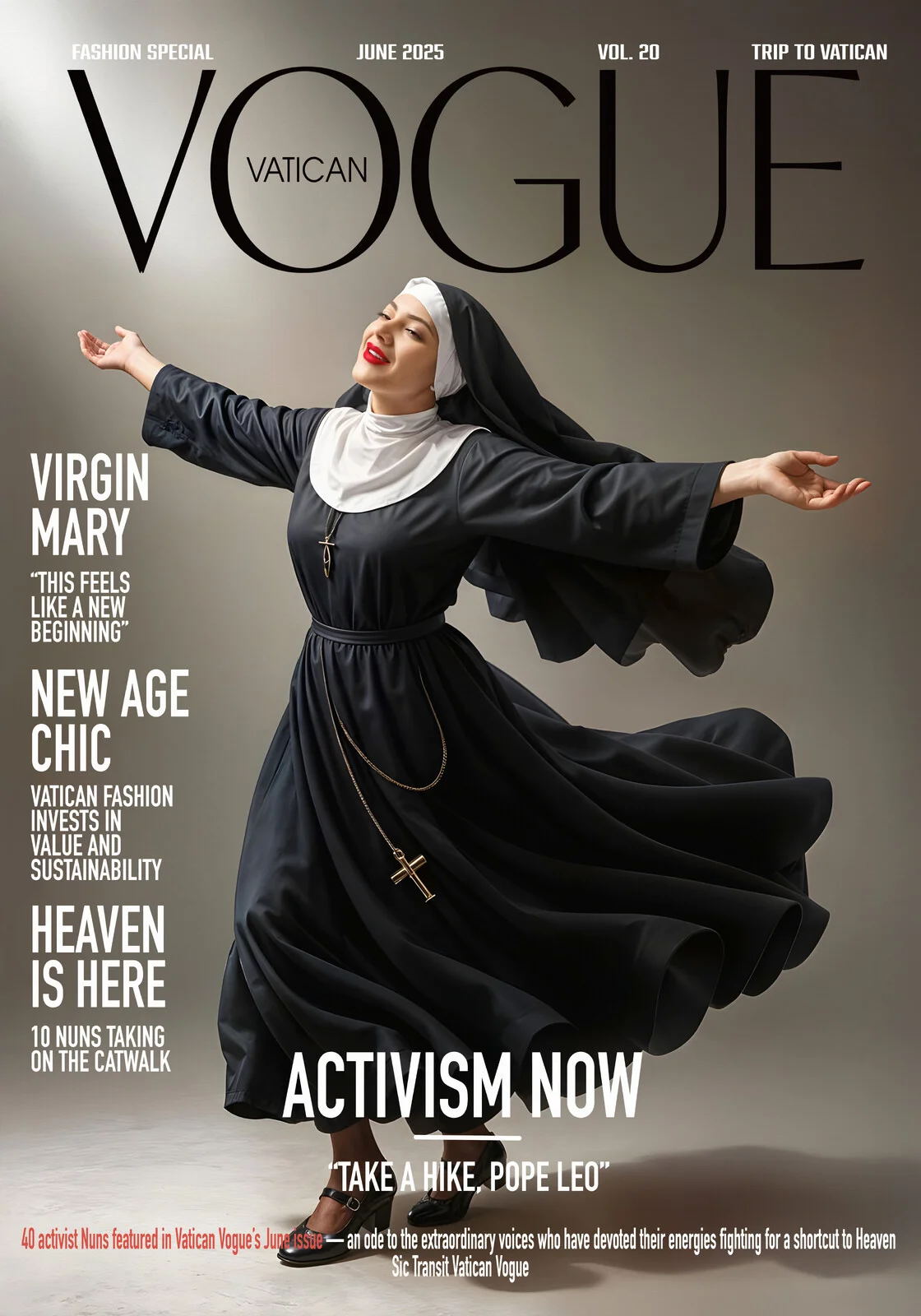
VATICAN VOGUE, 2025
Digital
50 x 70 cm
3 200 kr
VATICAN VOGUE
When Faith Learned to Dance
The Vatican Vogue, a term that encapsulates the profound historical and cultural concepts of dance and happiness within religion, sets the stage for a stimulating discourse. This concept, born from the interplay of religion, dance, and fashion, challenges conventional perspectives of religious expression. It fosters a more jubilant and all-encompassing understanding of faith, sparking our imagination for a future in which spiritual practices are not just accepted but joyfully celebrated, inspiring us to embrace the joy and celebration in our own spiritual journeys.
In this vision, the catwalk transforms into an altar — a space where the sacred and the sensual converge under a single light, inviting us to reconsider our preconceived notions. The gravity of the Church clashes with the vivacity of fashion, and what emerges from this collision is not sacrilege, but a fresh start. Vatican Vogue poses a disarming yet direct question: what if holiness could dance? What if faith itself had a rhythm?
From Miriam's tambourine to the spinning robes of Sufi dervishes, from temple dances in India to gospel choirs in Harlem, dance has always been a language of devotion. Yet in the Western world, faith has often been taught to be static — constrained by fear, shame, and patriarchal restraint. This project, therefore, is a call to remember that before theology found its voice, humanity already knew how to dance, challenging the static view of faith in the Western world.
“When God Changed the Beat
One morning, the angels overslept,
and Gabriel dropped his trumpet.
It rolled across the sky like thunder
and struck a drum in Zanzibar.
It started with the nun on Vogue’s front page,
caught mid-spin in a beam of light —
habit swirling like a storm of grace,
Rosary swinging to the rhythm of delight.
Some cried blasphemy, some said trend,
but Heaven leaned in to see.
For once, the angels dropped their poise,
and tapped their feet — discreetly.
A monk in Burma tapped his bowl,
a rabbi clapped in Brooklyn,
a nun spun twice in Florence
and shouted, “Lord, I still can move!”
Soon the muezzin hummed off-key,
the choir in Lagos lost its page,
but nobody cared — the rhythm spread
like sunlight breaking rules.
A Hindu priest untied his sandals,
a Buddhist smiled and joined the sway,
while priests in Rome pretended not to,
but their hips betrayed the truth.
From Arctic choirs of frozen hymns
to samba saints in Rio’s rain,
each prayer became a heartbeat,
each breath a dance again.
The world kept time on borrowed feet,
no creed, no border, only refrain —
for once, the only heresy
was standing still.
And when the headlines caught the wave,
no single cover could contain the trance —
So, Vatican Vogue released a special issue,
the thickest one to date —
devoted entirely
to the joy of holy dance.”
Malmö. October 2025
Vatican Vogue – The Joyful Heresy and Holiness as Haute Couture
There is so much to discuss — the image and the entire Vatican Vogue cover evoke a marvellous blend of satire, fashion iconography, and theological pop culture. It’s as if the Church hierarchy has taken to the catwalk, illuminated by a celestial spotlight that feels more like studio lighting than divine illumination. The sacred and the profane intersect in a choreography of fabric, faith, and irony. The cover presents a striking image of the Church hierarchy — monks, nuns, and priests — in a fashion-forward setting, challenging traditional perceptions of religious attire and behaviour.
The image cleverly plays with fashion terminology, turning the religious habit into couture. This transformation is more than a visual trick; it marks a profound shift in perception. The once-symbol of withdrawal now serves as an emblem of self-expression, with the nun’s robe fluttering like a banner of freedom. It's a change that challenges our preconceptions and invites us to see things from a new angle.
Activism Now – When Faith Meets Fashion Revolt
The headline “Activism Now: Take a Hike, Pope Leo” crackles with defiance. It is cheeky and subversive, a wink disguised as a revolution. Activism is no longer confined to banners and sermons — it has adopted silk, grace, and a perfectly timed spin. Vatican Vogue transforms into a feminist fantasy, a rebellion woven in prayer. By 'feminist fantasy', I mean a vision of religious practice that empowers women, enabling them to express their faith in ways traditionally reserved for men and challenging patriarchal norms within religious institutions. It's a concept that reimagines religious roles and practices, advocating for a more inclusive and equal representation in the church hierarchy.
Women here reclaim the stage not through preaching but through presence. The image turns spiritual protest into style. By 'spiritual protest into style', I mean the idea that religious expression can serve as a form of protest against traditional, restrictive norms. The catwalk replaces the pulpit; the habit becomes armour. It’s not about mocking belief but about reimagining it—as a space where joy, not guilt, proves faith. It's a concept that challenges the traditional solemnity of religious practices, promoting a more joyful, expressive form of faith.
The Dancing Nun as Icon
At the centre of this narrative stands the dancing nun, her face lifted towards the light, her arms open, her robe in flight. She is both saint and performer — a spiritual Isadora Duncan. Her body moves not in rebellion but in rapture. This is faith as physical joy, not submission; a liturgy of movement rather than silence. Her dance is not just a performance, but a powerful symbol of the potential for transformation in religious practices, inspiring us with the possibility of a more joyful and inclusive future.
In the dancing nun, we see the possibility of resurrection — not the biblical kind, but a revival of faith through pleasure, laughter, and freedom. She personifies what religion often forgets: that the body itself can be sacred. When she moves, she redeems stillness, filling us with hope for a future where joy and freedom are part of religious practice. This vision offers a hopeful alternative to the traditional, sombre view of religion.
Could It Be Like This?
Could it be like this? Would we trust God less if faith were joyful? If monks, nuns, and priests appeared as if they were having fun all the time and, by doing so, became role models? Then we all should have joy, sing, dance, and fill the churches.
What if holiness were not about renunciation but about embodying joy? If the presence of God replaced the fear of God? If the monastery was a place of laughter and rhythm, where movement itself became prayer? This vision of faith, where joy is not just a byproduct but a defining characteristic, offers a compelling alternative to the traditional, sombre view of religion, inspiring us to consider new perspectives on faith.
Perhaps faith would be reborn not in austerity but in dance; not in sorrow but in delight. A faith that doesn’t ask us to bow, but to participate. This vision of faith, where joy is not just a byproduct but a defining characteristic, offers a compelling alternative to the traditional, sombre view of religion. It's a vision that invites us to embrace joy and freedom in our spiritual practices, providing a hopeful alternative to the traditional, sombre view of religion.
In some Free Churches, singing is the heartbeat of faith. The gospel isn't just spoken but sung — carried by breath, rhythm, and collective pulse. In Black churches across America, this has developed into a whole cultural tradition: gospel and spirituals rooted in pain yet shining with hope. Song became both prayer and protest — a way to survive, to breathe, to be free.
The contrast with Europe’s restrained psalms is striking. Here, piety still wears a frown. But what if joy, not sorrow, and not a stern, sometimes harsh church, were the true measure of faith? What if God were loudest when we dared to sing, clap, and dance?
Islam does not dance openly — not visibly. Prayer is a choreography of stillness, a rhythm of humility and focus — and mostly a masculine affair. Yet even there, mysticism breaks through the silence. The whirling dervishes of Sufism spin their way towards God, their motion itself a form of devotion. For them, dance is prayer — a spiral of surrender.
In Hinduism, movement is sacred. The gods themselves dance — Shiva Nataraja spinning the universe into existence, Krishna dancing with his devotees beneath the moon. To move is to worship; to sing is to praise. The great temple dances — Bharatanatyam, Odissi, Kathak — are not mere entertainment but forms of meditation. The body becomes a temple, rhythm becomes an altar.
Even Buddhism, often linked with tranquillity, has its exceptions. Tibetan monks perform cham, masked ritual dances symbolising protection and enlightenment. In Japan, Bon Odori honours the dead through movement and joy — a festival where remembrance itself begins to dance.
And so we return to the image of the dancing nun. She is not blasphemous — she is prophetic. She reclaims what religion has forgotten: that holiness has a pulse. She dances not against God but with Him. She wears her calling like couture — with grace, light, and freedom.
Perhaps this is where future faith begins: in joy, in rhythm, in a sacred body allowed to breathe. This vision offers a hopeful outlook on the future of faith — one not confined by austerity and sorrow, but alive with joy and rhythm. It suggests a way forward, a path for faith to be revitalised and reinvigorated by the power of joy, giving us hope for a more joyful and inclusive future of religious practices. It's a vision that promises a more inclusive and welcoming future for all believers.
Sacred Dance – From Miriam to the Catwalk
Dance, a recurring theme in the Bible, is often portrayed positively. It serves as an expression of joy, gratitude, victory, and divine presence — sometimes ritual, sometimes prophetic, sometimes purely spontaneous, a bodily response to the closeness of God. This historical perspective highlights the spiritual significance of dance, providing a deeper understanding of its role in religious expression. It underscores the critical part dance has played in worship, from the Old Testament to the present day.
In the Old Testament, dance is more than just a physical act; it is a celebration of life, victory, and faith itself. Women dance after triumph — Miriam, Deborah, the daughters of Shiloh — and men dance before the Lord, like David, who “danced with all his might” before the Ark. It is a joyful act of worship, a testament to God's closeness, not a threat to it.
God is seen as present in movement and shared joy. There are no moral doubts; dance is both sacred and ordinary — a natural way of expressing life.
By the time of the New Testament, society had changed significantly. Urbanisation, hierarchy, and patriarchy became more prominent. Dance appears less often and is linked to worldly entertainment—banquets, intrigue, and female beauty. The story of Herodias’s daughter, usually known as Salome, shifts everything: her dance that leads to the death of John the Baptist redefines movement as dangerous.
It is not the movement that becomes sinful — it is the gaze. The sin lies not in her dance, but in how male power perceives it. Here begins the patriarchal reinterpretation that replaces the earlier sacred view of the body with suspicion and control.
Throughout the Middle Ages and the Reformation, this pattern became ingrained. The Church separates the body from the soul, viewing the body as a source of temptation. Dance is banished from sanctuaries into theatres, markets, and festivals, while prayer and stillness remain within the walls. Holy dance survives only in mystical or marginal traditions — among specific monastic orders, the Sufi dervishes, and later in charismatic movements where the body once more becomes an instrument of praise.
So, yes — it all depends on timing and perspective. In early Hebrew religion, dance was viewed as a sign of divine presence. During the Greco-Roman moral outlook of the New Testament, it could be seen as a possible threat to spiritual discipline.
Or, as one might say with a wink in true Vatican Vogue style:
In the Old Testament, they dance with God; in the New Testament, they begin to worry about who’s watching.
And from those ancient circles of tambourines and psalms to the studio lights of Vatican Vogue, the movement of worship endures — transformed, hidden, and rediscovered.
The Nun’s Rebellion
The dancing nun, in her rebellion against centuries of misinterpretation, embodies a potent transformation. Her movement is not merely an act of remembrance but a reclaiming of what faith once was before it was confined by male anxiety and the need for control. Her dance is a beacon of inspiration, reminding us of the spiritual joy that movement once brought to worship.
The Church’s mistrust of dance reveals a broader patriarchal fear: men attempting to shield other men from seeing, feeling, or being tempted by the women they control. It is the same logic that hides women behind veils, burqas, and moral standards; the same desire to conceal visibility, to restrict beauty within modesty.
But the nun refuses invisibility. Her spin in the beam of light is a theological statement. She demonstrates what religion once celebrated and later shamed — that music and movement were always part of worship, that the body was once a vessel of gratitude and divine joy.
Her dance restores what the patriarchal gaze has tarnished. It reminds us that the problem was never the woman who moved — it was the man who still desired her, motionless.
Or, as evolution might admit with weary irony: Man has always been both creator and culprit.
Epilogue – When the Divine Steps Into the Light
Vatican Vogue fundamentally presents a vision of reconciliation — between body and spirit, faith and beauty, the sacred and the human. It envisions a religion that is not only devout but also lively and vibrant, where joy and beauty in movement are celebrated as essential to worship. The dancing nun, far from being a provocation, embodies this vision, offering a glimpse of a more inclusive and joyful religious experience.
In her defiance of solemnity, she reunites what we are taught to keep apart — devotion and delight, duty and desire. Her revolutionary act serves as a powerful reminder that faith can be both devout and vibrant, and that joy can be part of worship.
Both the Church and fashion serve as stages of transformation. The priest’s vestment and the designer’s gown are fashioned from the same dream — ritualised identity. While fashion constantly reinvents itself each season, the Church too often remains hidden in its archives. Vatican Vogue opens the wardrobe and lets the light in.
And perhaps that is where the divine regains its power — not as doctrine, but as experience; not as an institution, but as a movement. Faith becomes danceable; dance becomes sacred.
For those brave enough to look, the nun on the catwalk is no joke. She is a living gospel, a smile amidst centuries of solemnity, a reminder that grace and joy were never meant to be strangers.
This could be where future faith begins: in joy, in rhythm, in a sacred body allowed to breathe. This vision offers a hopeful outlook on the future of faith — one not confined by austerity and sorrow, but alive with joy and rhythm. It suggests a way forward, a path for faith to be revitalised and reinvigorated by the power of joy, giving us hope for a more joyful and inclusive future of religious practices.
Perhaps this is how all worldly glory should pass — not in ashes or silence, but in laughter, in light, and in one more step towards heaven.
And perhaps it is finally time for religion to close the door on man’s prolonged use of God as a means of controlling birth and family — a divine pretext for safeguarding property, purity, and daughters from the wrong suitors.
Finale – Is God a Dancer?
And finally, a question I have often asked myself — however blasphemous it may seem in the eyes of the devoutly bigoted: Is God a dancer?
If one takes creation literally — and knows one’s Bible — the answer may be less heretical than it sounds. Scripture tells us that God created humankind in His own image. And since the Old Testament places such weight on dance and joy — those earliest echoes of divine celebration — then God must surely be the finest dancer of them all: eternity’s Fred Astaire, the creator of every rhythm and every step, the unseen partner in every joyful movement.
Perhaps he is not seated on a throne at all, but out there on the floor — spinning through the galaxies, keeping time with the pulse of the universe.
Hallelujah
Jörgen Thornberg
VATICAN VOGUE, 2025
Digital
50 x 70 cm
3 200 kr
VATICAN VOGUE
When Faith Learned to Dance
The Vatican Vogue, a term that encapsulates the profound historical and cultural concepts of dance and happiness within religion, sets the stage for a stimulating discourse. This concept, born from the interplay of religion, dance, and fashion, challenges conventional perspectives of religious expression. It fosters a more jubilant and all-encompassing understanding of faith, sparking our imagination for a future in which spiritual practices are not just accepted but joyfully celebrated, inspiring us to embrace the joy and celebration in our own spiritual journeys.
In this vision, the catwalk transforms into an altar — a space where the sacred and the sensual converge under a single light, inviting us to reconsider our preconceived notions. The gravity of the Church clashes with the vivacity of fashion, and what emerges from this collision is not sacrilege, but a fresh start. Vatican Vogue poses a disarming yet direct question: what if holiness could dance? What if faith itself had a rhythm?
From Miriam's tambourine to the spinning robes of Sufi dervishes, from temple dances in India to gospel choirs in Harlem, dance has always been a language of devotion. Yet in the Western world, faith has often been taught to be static — constrained by fear, shame, and patriarchal restraint. This project, therefore, is a call to remember that before theology found its voice, humanity already knew how to dance, challenging the static view of faith in the Western world.
“When God Changed the Beat
One morning, the angels overslept,
and Gabriel dropped his trumpet.
It rolled across the sky like thunder
and struck a drum in Zanzibar.
It started with the nun on Vogue’s front page,
caught mid-spin in a beam of light —
habit swirling like a storm of grace,
Rosary swinging to the rhythm of delight.
Some cried blasphemy, some said trend,
but Heaven leaned in to see.
For once, the angels dropped their poise,
and tapped their feet — discreetly.
A monk in Burma tapped his bowl,
a rabbi clapped in Brooklyn,
a nun spun twice in Florence
and shouted, “Lord, I still can move!”
Soon the muezzin hummed off-key,
the choir in Lagos lost its page,
but nobody cared — the rhythm spread
like sunlight breaking rules.
A Hindu priest untied his sandals,
a Buddhist smiled and joined the sway,
while priests in Rome pretended not to,
but their hips betrayed the truth.
From Arctic choirs of frozen hymns
to samba saints in Rio’s rain,
each prayer became a heartbeat,
each breath a dance again.
The world kept time on borrowed feet,
no creed, no border, only refrain —
for once, the only heresy
was standing still.
And when the headlines caught the wave,
no single cover could contain the trance —
So, Vatican Vogue released a special issue,
the thickest one to date —
devoted entirely
to the joy of holy dance.”
Malmö. October 2025
Vatican Vogue – The Joyful Heresy and Holiness as Haute Couture
There is so much to discuss — the image and the entire Vatican Vogue cover evoke a marvellous blend of satire, fashion iconography, and theological pop culture. It’s as if the Church hierarchy has taken to the catwalk, illuminated by a celestial spotlight that feels more like studio lighting than divine illumination. The sacred and the profane intersect in a choreography of fabric, faith, and irony. The cover presents a striking image of the Church hierarchy — monks, nuns, and priests — in a fashion-forward setting, challenging traditional perceptions of religious attire and behaviour.
The image cleverly plays with fashion terminology, turning the religious habit into couture. This transformation is more than a visual trick; it marks a profound shift in perception. The once-symbol of withdrawal now serves as an emblem of self-expression, with the nun’s robe fluttering like a banner of freedom. It's a change that challenges our preconceptions and invites us to see things from a new angle.
Activism Now – When Faith Meets Fashion Revolt
The headline “Activism Now: Take a Hike, Pope Leo” crackles with defiance. It is cheeky and subversive, a wink disguised as a revolution. Activism is no longer confined to banners and sermons — it has adopted silk, grace, and a perfectly timed spin. Vatican Vogue transforms into a feminist fantasy, a rebellion woven in prayer. By 'feminist fantasy', I mean a vision of religious practice that empowers women, enabling them to express their faith in ways traditionally reserved for men and challenging patriarchal norms within religious institutions. It's a concept that reimagines religious roles and practices, advocating for a more inclusive and equal representation in the church hierarchy.
Women here reclaim the stage not through preaching but through presence. The image turns spiritual protest into style. By 'spiritual protest into style', I mean the idea that religious expression can serve as a form of protest against traditional, restrictive norms. The catwalk replaces the pulpit; the habit becomes armour. It’s not about mocking belief but about reimagining it—as a space where joy, not guilt, proves faith. It's a concept that challenges the traditional solemnity of religious practices, promoting a more joyful, expressive form of faith.
The Dancing Nun as Icon
At the centre of this narrative stands the dancing nun, her face lifted towards the light, her arms open, her robe in flight. She is both saint and performer — a spiritual Isadora Duncan. Her body moves not in rebellion but in rapture. This is faith as physical joy, not submission; a liturgy of movement rather than silence. Her dance is not just a performance, but a powerful symbol of the potential for transformation in religious practices, inspiring us with the possibility of a more joyful and inclusive future.
In the dancing nun, we see the possibility of resurrection — not the biblical kind, but a revival of faith through pleasure, laughter, and freedom. She personifies what religion often forgets: that the body itself can be sacred. When she moves, she redeems stillness, filling us with hope for a future where joy and freedom are part of religious practice. This vision offers a hopeful alternative to the traditional, sombre view of religion.
Could It Be Like This?
Could it be like this? Would we trust God less if faith were joyful? If monks, nuns, and priests appeared as if they were having fun all the time and, by doing so, became role models? Then we all should have joy, sing, dance, and fill the churches.
What if holiness were not about renunciation but about embodying joy? If the presence of God replaced the fear of God? If the monastery was a place of laughter and rhythm, where movement itself became prayer? This vision of faith, where joy is not just a byproduct but a defining characteristic, offers a compelling alternative to the traditional, sombre view of religion, inspiring us to consider new perspectives on faith.
Perhaps faith would be reborn not in austerity but in dance; not in sorrow but in delight. A faith that doesn’t ask us to bow, but to participate. This vision of faith, where joy is not just a byproduct but a defining characteristic, offers a compelling alternative to the traditional, sombre view of religion. It's a vision that invites us to embrace joy and freedom in our spiritual practices, providing a hopeful alternative to the traditional, sombre view of religion.
In some Free Churches, singing is the heartbeat of faith. The gospel isn't just spoken but sung — carried by breath, rhythm, and collective pulse. In Black churches across America, this has developed into a whole cultural tradition: gospel and spirituals rooted in pain yet shining with hope. Song became both prayer and protest — a way to survive, to breathe, to be free.
The contrast with Europe’s restrained psalms is striking. Here, piety still wears a frown. But what if joy, not sorrow, and not a stern, sometimes harsh church, were the true measure of faith? What if God were loudest when we dared to sing, clap, and dance?
Islam does not dance openly — not visibly. Prayer is a choreography of stillness, a rhythm of humility and focus — and mostly a masculine affair. Yet even there, mysticism breaks through the silence. The whirling dervishes of Sufism spin their way towards God, their motion itself a form of devotion. For them, dance is prayer — a spiral of surrender.
In Hinduism, movement is sacred. The gods themselves dance — Shiva Nataraja spinning the universe into existence, Krishna dancing with his devotees beneath the moon. To move is to worship; to sing is to praise. The great temple dances — Bharatanatyam, Odissi, Kathak — are not mere entertainment but forms of meditation. The body becomes a temple, rhythm becomes an altar.
Even Buddhism, often linked with tranquillity, has its exceptions. Tibetan monks perform cham, masked ritual dances symbolising protection and enlightenment. In Japan, Bon Odori honours the dead through movement and joy — a festival where remembrance itself begins to dance.
And so we return to the image of the dancing nun. She is not blasphemous — she is prophetic. She reclaims what religion has forgotten: that holiness has a pulse. She dances not against God but with Him. She wears her calling like couture — with grace, light, and freedom.
Perhaps this is where future faith begins: in joy, in rhythm, in a sacred body allowed to breathe. This vision offers a hopeful outlook on the future of faith — one not confined by austerity and sorrow, but alive with joy and rhythm. It suggests a way forward, a path for faith to be revitalised and reinvigorated by the power of joy, giving us hope for a more joyful and inclusive future of religious practices. It's a vision that promises a more inclusive and welcoming future for all believers.
Sacred Dance – From Miriam to the Catwalk
Dance, a recurring theme in the Bible, is often portrayed positively. It serves as an expression of joy, gratitude, victory, and divine presence — sometimes ritual, sometimes prophetic, sometimes purely spontaneous, a bodily response to the closeness of God. This historical perspective highlights the spiritual significance of dance, providing a deeper understanding of its role in religious expression. It underscores the critical part dance has played in worship, from the Old Testament to the present day.
In the Old Testament, dance is more than just a physical act; it is a celebration of life, victory, and faith itself. Women dance after triumph — Miriam, Deborah, the daughters of Shiloh — and men dance before the Lord, like David, who “danced with all his might” before the Ark. It is a joyful act of worship, a testament to God's closeness, not a threat to it.
God is seen as present in movement and shared joy. There are no moral doubts; dance is both sacred and ordinary — a natural way of expressing life.
By the time of the New Testament, society had changed significantly. Urbanisation, hierarchy, and patriarchy became more prominent. Dance appears less often and is linked to worldly entertainment—banquets, intrigue, and female beauty. The story of Herodias’s daughter, usually known as Salome, shifts everything: her dance that leads to the death of John the Baptist redefines movement as dangerous.
It is not the movement that becomes sinful — it is the gaze. The sin lies not in her dance, but in how male power perceives it. Here begins the patriarchal reinterpretation that replaces the earlier sacred view of the body with suspicion and control.
Throughout the Middle Ages and the Reformation, this pattern became ingrained. The Church separates the body from the soul, viewing the body as a source of temptation. Dance is banished from sanctuaries into theatres, markets, and festivals, while prayer and stillness remain within the walls. Holy dance survives only in mystical or marginal traditions — among specific monastic orders, the Sufi dervishes, and later in charismatic movements where the body once more becomes an instrument of praise.
So, yes — it all depends on timing and perspective. In early Hebrew religion, dance was viewed as a sign of divine presence. During the Greco-Roman moral outlook of the New Testament, it could be seen as a possible threat to spiritual discipline.
Or, as one might say with a wink in true Vatican Vogue style:
In the Old Testament, they dance with God; in the New Testament, they begin to worry about who’s watching.
And from those ancient circles of tambourines and psalms to the studio lights of Vatican Vogue, the movement of worship endures — transformed, hidden, and rediscovered.
The Nun’s Rebellion
The dancing nun, in her rebellion against centuries of misinterpretation, embodies a potent transformation. Her movement is not merely an act of remembrance but a reclaiming of what faith once was before it was confined by male anxiety and the need for control. Her dance is a beacon of inspiration, reminding us of the spiritual joy that movement once brought to worship.
The Church’s mistrust of dance reveals a broader patriarchal fear: men attempting to shield other men from seeing, feeling, or being tempted by the women they control. It is the same logic that hides women behind veils, burqas, and moral standards; the same desire to conceal visibility, to restrict beauty within modesty.
But the nun refuses invisibility. Her spin in the beam of light is a theological statement. She demonstrates what religion once celebrated and later shamed — that music and movement were always part of worship, that the body was once a vessel of gratitude and divine joy.
Her dance restores what the patriarchal gaze has tarnished. It reminds us that the problem was never the woman who moved — it was the man who still desired her, motionless.
Or, as evolution might admit with weary irony: Man has always been both creator and culprit.
Epilogue – When the Divine Steps Into the Light
Vatican Vogue fundamentally presents a vision of reconciliation — between body and spirit, faith and beauty, the sacred and the human. It envisions a religion that is not only devout but also lively and vibrant, where joy and beauty in movement are celebrated as essential to worship. The dancing nun, far from being a provocation, embodies this vision, offering a glimpse of a more inclusive and joyful religious experience.
In her defiance of solemnity, she reunites what we are taught to keep apart — devotion and delight, duty and desire. Her revolutionary act serves as a powerful reminder that faith can be both devout and vibrant, and that joy can be part of worship.
Both the Church and fashion serve as stages of transformation. The priest’s vestment and the designer’s gown are fashioned from the same dream — ritualised identity. While fashion constantly reinvents itself each season, the Church too often remains hidden in its archives. Vatican Vogue opens the wardrobe and lets the light in.
And perhaps that is where the divine regains its power — not as doctrine, but as experience; not as an institution, but as a movement. Faith becomes danceable; dance becomes sacred.
For those brave enough to look, the nun on the catwalk is no joke. She is a living gospel, a smile amidst centuries of solemnity, a reminder that grace and joy were never meant to be strangers.
This could be where future faith begins: in joy, in rhythm, in a sacred body allowed to breathe. This vision offers a hopeful outlook on the future of faith — one not confined by austerity and sorrow, but alive with joy and rhythm. It suggests a way forward, a path for faith to be revitalised and reinvigorated by the power of joy, giving us hope for a more joyful and inclusive future of religious practices.
Perhaps this is how all worldly glory should pass — not in ashes or silence, but in laughter, in light, and in one more step towards heaven.
And perhaps it is finally time for religion to close the door on man’s prolonged use of God as a means of controlling birth and family — a divine pretext for safeguarding property, purity, and daughters from the wrong suitors.
Finale – Is God a Dancer?
And finally, a question I have often asked myself — however blasphemous it may seem in the eyes of the devoutly bigoted: Is God a dancer?
If one takes creation literally — and knows one’s Bible — the answer may be less heretical than it sounds. Scripture tells us that God created humankind in His own image. And since the Old Testament places such weight on dance and joy — those earliest echoes of divine celebration — then God must surely be the finest dancer of them all: eternity’s Fred Astaire, the creator of every rhythm and every step, the unseen partner in every joyful movement.
Perhaps he is not seated on a throne at all, but out there on the floor — spinning through the galaxies, keeping time with the pulse of the universe.
Hallelujah
3 200 kr

Jörgen Thornberg
Malmö
Lite om bilder och mig. Translation in English at the end.
Jag är en nyfiken person som ser allt i bilder, även det jag fäster i ord, gärna tillsammans för bakom alla mina bilder finns en berättelse. Till vissa bilder hör en kortare eller längre novell som följer med bilden.
Bilder berättar historier. Jag omges av naturlig skönhet, intressanta människor och historia var jag än går. Jag använder min kamera för att dokumentera världen och blanda det jag ser med vad jag känner för att fånga den dolda magin.
Mina bilder berättar mina historier. Genom mina bilder, tryck och berättelser. Jag bjuder in dig att ta del av dessa berättelser, in i ditt liv och hem och dela min mycket personliga syn på vår värld. Mer än vad ögat ser. Jag tänker i bilder, drömmer och skriver och pratar om dem; följaktligen måste jag också skapa bilder. De blir vad jag ser, inte nödvändigtvis begränsade till verkligheten. Det finns en bild runt varje hörn. Jag hoppas att du kommer att se vad jag såg och gilla det.
Jag är också en skrivande person och till många bilder hör en kortare eller längre essay. Den följer med tavlan, tryckt på fint papper och med en personlig hälsning från mig.
Flertalet bilder startar sin resa i min kamera. Enkelt förklarat beskriver jag bilden jag ser i mitt inre, upplevd eller fantiserad. Bilden uppstår inom mig redan innan jag fått okularet till ögat. På bråkdelen av ett ögonblick ser jag vad jag vill ha och vad som kan göras med bilden. Här skall jag stoppa in en giraff, stålmannen, Titanic eller vad det är min fantasi finner ut. Ännu märkligare är att jag kommer ihåg minnesbilden långt efteråt när det blir tid att skapa verket. Om jag lyckas eller inte, är upp till betraktaren, oftast präglat av en stråk av svart humor – meningen är att man skall bli underhållen. Mina bilder blir ofta en snackis där de hänger.
Jag föredrar bilder som förmedlar ett budskap i flera lager. Vid första anblicken fylld av feel-good, en vacker utsikt, fint väder, solen skiner, blommor på ängen eller vattnet som ligger förrädiskt spegelblankt. I en sådan bild kan jag gömma min egentliga berättelse, mitt förakt för förtryckare och våldsverkare, rasister och fördomsfulla människor - ett gärna återkommande motiv mer eller mindre dolt i det vackra motivet. Jag försöker förena dem i ett gemensamt narrativ.
Bild och formgivning har löpt som en röd tråd genom livet. Fotokonst känns som en värdig final som jag gärna delar med mig.
Min genre är vid som framgår av mina bilder, temat en blandning av pop- och gatukonst i kollage som kan bestå av hundratals lager. Vissa bilder kan ta veckor, andra någon dag innan det är dags att överlämna resultatet till printverkstaden. Fine Art Prints är digitala fotocollage. I dessa kollage sker rivandet, klippandet, pusslandet, målandet, ritandet och sprayningen digitalt. Det jag monterar in kan vara hundratals år gamla bilder som jag omsorgsfullt frilägger så att de ser ut att vara en del av tavlan men också bilder skapade av mig själv efter min egen fantasi. Därefter besöks printstudion och för vissa bilder numrera en limiterad upplaga (oftast 7 exemplar) och signera för hand. Vissa bilder kan köpas i olika format. Det är bara att fråga efter vilka. Gillar man en bild som är 70x100 men inte har plats på väggen, går den kanske att få i 50x70 cm istället. Frågan är fri.
Metoden Giclée eller Fine Art Print som det också kallas är det moderna sättet för framställning av grafisk konst. Villkoret för denna typ av utskrifter är att en högkvalitativ storformatskrivare används med åldersbeständigt färgpigment och konstnärspapper eller i förekommande fall på duk. Pappret som används möter de krav på livslängd som ställs av museer och gallerier. Normalt säljer jag mina bilder oinramade så att den nya ägaren själv kan bestämma hur de skall se ut, med eller utan passepartout färg på ram, med eller utan glas etc..
Under många år ställde jag bara ut på nätet, i valda grupper och på min egen Facebooksida - https://www.facebook.com/jorgen.thornberg.9
Jag finns också på en egen hemsida som tyvärr inte alltid är uppdaterad – https://www.jth.life/ Där kan du också läsa en del av de berättelser som följer med bilden.
UTSTÄLLNINGAR
Luftkastellet, oktober 2022
Konst i Lund, november 2022
Luftkastellet, mars 2023
Engleson Galleri Caroli, april 2023
Hydra, Greece June 2023
Engleson Galleri Caroli, oktober 2023
Toppen, Höllviken december 2023
Luftkastellet, mars 2024
Torups Galleri, mars 2024
Venice, May 2024
Luftkastellet, oktober 2024
Konst i Advent, December 2024
Galleri Engleson, Caroli December 2024
Jäger & Jansson Galleri, april 2025
A bit about pictures and me.
I'm a curious person who sees everything in pictures, even what I express in words, often combining them, for behind all my pictures lies a story. These narratives, some as short as a single image and others as long as a novel, are the heart and soul of my work.
Pictures tell stories. Wherever I go, I'm surrounded by natural beauty, exciting people, and history. I use my camera to document the world and blend what I see with what I feel to capture the hidden magic.
My images tell my stories. Through my pictures, prints, and narratives, I invite you to partake in these stories in your life and home and share my deeply personal perspective of our world. More than meets the eye. I think in pictures, dream, write, and talk about them; consequently, I must create images too. They become what I see, not necessarily confined to reality. There's a picture around every corner. I hope you'll see what I saw and enjoy it.
I'm also a writer, and many images come with a shorter or longer essay. It accompanies the painting, printed on fine paper with my personal greeting.
Many pictures start their journey on my camera. Simply put, I describe the image I see in my mind, experienced or imagined. The image arises within me even before I bring the eyepiece to my eye. In a fraction of a moment, I see what I want and what can be done with the picture. Here, I'll insert a giraffe, Superman, the Titanic, or whatever my imagination conjures up. Even stranger is that I remember the mental image long after it's time to create the work. Whether I succeed is up to the observer, often imbued with a streak of black humour – the aim is to entertain. My pictures usually become a talking point wherever they hang.
I prefer pictures that convey a message in multiple layers. At first glance, they're filled with feel-good vibes, a beautiful view, lovely weather, the sun shining, flowers in the meadow, or the water lying deceptively calm. But beneath this surface beauty, I often conceal a deeper story, a narrative that challenges societal norms or explores the human condition. I invite you to delve into these hidden narratives and discover the layers of meaning within my work.
Picture and design have been a thread running through my life. Photographic art feels like a fitting finale, and I'm happy to share it.
My genre is varied, as seen in my pictures; the theme is a blend of pop and street art in collages that can consist of hundreds of layers. Some images can take weeks, others just a day before it's time to hand over the result to the print workshop. Fine Art Prints are digital photo collages. In these collages, tearing, cutting, puzzling, painting, drawing, and spraying happen digitally. What I insert can be images hundreds of years old that I carefully extract so they appear to be part of the painting, but also images created by myself, now also generated from my imagination. Next, visit the print studio and, for certain images, number a limited edition (usually 7 copies) and sign them by hand. Some images may be available in other formats. Just ask which ones. If you like an image that's 70x100 but doesn't have space on the wall, you might be able to get it in 50x70 cm instead. The question is open.
The Giclée method, or Fine Art Print as it's also called, is the modern way of producing graphic art. This method ensures the highest quality and longevity of the artwork, using a high-quality large-format printer with archival pigment inks and artist paper or, in some cases, canvas. The paper used meets the longevity requirements set by museums and galleries. I sell my pictures unframed, allowing the new owner to personalise their artwork, confident in the lasting value and quality of the piece.
For many years, I only exhibited online, in selected groups, and on my Facebook page - https://www.facebook.com/jorgen.thornberg.9. I also have my website, which unfortunately is not constantly updated - https://www.jth.life/. You can also read some of the stories accompanying the pictures there.
EXHIBITIONS
Luftkastellet, October 2022
Art in Lund, November 2022
Luftkastellet, March 2023
Engleson Gallery Caroli, April 2023
Hydra, Greece June 2023
Engleson Gallery Caroli, October 2023
Toppen, Höllviken December 2023
Luftkastellet, March 2024
Torup Gallery, March 2024
Venice, May 2024
UTSTÄLLNINGAR
Luftkastellet, oktober 2022
Konst i Lund, november 2022
Luftkastellet, mars 2023
Engleson Galleri Caroli, april 2023
Hydra, Greece June 2023
Engleson Galleri Caroli, oktober 2023
Toppen, Höllviken december 2023
Luftkastellet, mars 2024
Torups Galleri, mars 2024
Venice, May 2024
Luftkastellet, October 2024
Konst i Advent, December 2024
Galleri Engleson, Caroli December 2024
Jäger & Jansson Galleri, April 2025
Utbildning
Autodidakt
Medlem i konstnärsförening
Öppna Sinnen
Med i konstrunda
Konstrundan i Skåne
Utställningar
Luftkastellet, October 2022
Art in Lund, November 2022
Luftkastellet, March 2023
Engleson Gallery Caroli, April 2023
Hydra, Greece June 2023
Engleson Gallery Caroli, October 2023
Toppen, Höllviken December 2023
Luftkastellet, March 2024
Torup Gallery, March 2024
Venice, May 2024